More than two years ago, I explained in a TV interview that the looters and moochers should be careful that they don’t kill the geese that lay the golden eggs. After all, parasites need a healthy host.
The collapse of Europe’s welfare states should be a wake-up call for these people, but that hasn’t stopped the demands for more redistribution in Washington. As Michael Barone noted, the folks on the left assume that there will always be someone to plunder.
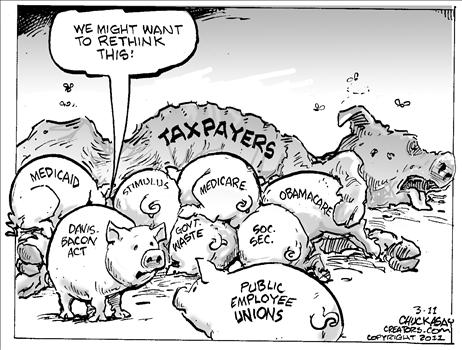
But at least the piglets in this Chuck Asay cartoon are finally waking up to reality.
Thank you so much for your time. I know how valuable it is. I also appreciate the fine family that you have and your commitment as a father and a husband.
Sincerely,
Everette Hatcher III, 13900 Cottontail Lane, Alexander, AR 72002, ph 501-920-5733, lowcostsqueegees@yahoo.com
Social Security is a Ponzi Scheme but Blake who is a blogger said I was off base. Ark Times reader says Social Security is not Ponzi Scheme Social Security Disaster Walter E. Williams Columnist, Townhall.com Politicians who are principled enough to point out the fraud of Social Security, referring to it as a lie and […]
We got to do something soon about Social Security. The Case for Social Security Personal Accounts Posted by Daniel J. Mitchell There are two crises facing Social Security. First the program has a gigantic unfunded liability, largely caused by demographics. Second, the program is a very bad deal for younger workers, making them pay record […]
Senator Obama’s Social Security Tax Plan Uploaded by afq2007 on Jul 23, 2008 In addition to several other tax increases, Senator Barack Obama wants to increase the Social Security payroll tax burden by imposing the tax on income above $250,000. This would be a sharp departure from current law, which only requires that the tax […]
Saving Social Security with Personal Retirement Accounts Uploaded by afq2007 on Jan 10, 2011 There are two crises facing Social Security. First the program has a gigantic unfunded liability, largely thanks to demographics. Second, the program is a very bad deal for younger workers, making them pay record amounts of tax in exchange for comparatively meager benefits. This […]
“Saving the American Dream: The Heritage Plan to Fix the Debt, Cut Spending, and Restore Prosperity,” Heritage Foundation, May 10, 2011 by Stuart Butler, Ph.D. , Alison Acosta Fraser and William Beach is one of the finest papers I have ever read. Over the next few days I will post portions of this paper, but […]
Is Social Security a Ponzi Scheme? I just started a series on this subject. In this article below you will see where the name “Ponzi scheme” came from and if it should be applied to the Social Security System. Ponzi! Ponzi! Ponzi! 9/14/2011 | Email John Stossel | Columnist’s Archive Ponzi! Ponzi! Ponzi! There, I […]
Uploaded by LibertyPen on Jan 8, 2009 Professor Williams explains what’s ahead for Social Security Dan Mitchell on Social Security I have said that Social Security is a Ponzi scheme and sometimes you will hear someone in the public say the same thing. Yes, It Is a Ponzi Scheme by Michael D. Tanner Michael Tanner […]
President Obama and other politicians are advocating higher taxes, with a particular emphasis on class-warfare taxes targeting the so-called rich. This Center for Freedom and Prosperity Foundation video explains why fiscal policy based on hate and envy is fundamentally misguided. For more information please visit our web page: www.freedomandprosperity.org.
_________________
President Obama really does stick to his view that the wealthy need to rescue the rest of us on everything, but that view does not work. There are not enough rich people out there to solve our budget woes. Actually what has happened in the past when the government wants more money it starts off going after the rich, but when that does not bring in much money then the only alternative is to go after the rest of us.
Max Brantley argues on the Arkansas Times Blog that most of us are taxed too much so we must tax the rich more but that will not come close to bringing us to a balanced budget. However, it will destroy job creation.
Democrats on the Joint Select Committee on Deficit Reduction last week floated a proposal that includes massive tax increases on wealthy Americans. While their plan would also include some cuts to entitlement programs, the tax-code changes make up a significant portion, according to press reports.
The Los Angeles Times reported: “Revenue would be raised mostly by bumping up the high-end tax bracket and limiting deductions for upper-income earners, those familiar with the talks said.”
The so-called Super Committee, of course, could be an opportunity for Congress to reform the tax code. Writing in the Washington Times last week, Heritage’s J.D. Foster observed:
But if tax reform is part of a deficit-reduction exercise because the language of tax reform has been co-opted to disguise a tax hike, then both the hike and the reform should and likely will fail. Be very clear — tax reform is revenue neutral as traditionally scored. If a tax proposal is shown to raise revenue, then it’s not tax reform, it’s just another big-government tax hike.
As for that proposal floated by Democrats this week, it’s simply not a viable solution. This chart from Heritage’s 2001 Budget Chart Book reveals that Congress would need to increase tax rates on wealthy Americans to mathematically impossible levels to close future deficits.
I got to see Arthur Laffer speak in 1981 in Memphis and he predicted what would happen the next few years with tax revenue as a result of the Reagan Tax Cuts and he was right on every prediction. Why do you continue to say that this has been tried before and does not work?
But I haven’t specifically responded to some recent studies which make rather outlandish claims that the revenue-maximizing tax rate is 70 percent or above.
President Obama and others are demanding that we raise taxes on the “rich,” and two recent academic papers that have gotten a lot of attention claim to show that there will be no ill effects if we do. The first paper, by Peter Diamond of MIT and Emmanuel Saez of the University of California, Berkeley, appeared in the Journal of Economic Perspectives last August. The second, by Mr. Saez, along with Thomas Piketty of the Paris School of Economics and Stefanie Stantcheva of MIT, was published by the National Bureau of Economic Research three months later. Both suggested that federal tax revenues would not decline even if the rate on the top 1% of earners were raised to 73%-83%.
How do they arrive at such high numbers? Alan explains.
The authors arrive at their conclusion through an unusual calculation of the “elasticity” (responsiveness) of taxable income to changes in marginal tax rates. According to a formula devised by Mr. Saez, if the elasticity is 1.0, the revenue-maximizing top tax rate would be 40% including state and Medicare taxes. That means the elasticity of taxable income (ETI) would have to be an unbelievably low 0.2 to 0.25 if the revenue-maximizing top tax rates were 73%-83% for the top 1%. The authors of both papers reach this conclusion with creative, if wholly unpersuasive, statistical arguments.
Is this assumption warranted? Hardly. Alan elaborates, making the same points I’ve made about rich people being different than the rest of us.
But the ETI for all taxpayers is going to be lower than for higher-income earners, simply because people with modest incomes and modest taxes are not willing or able to vary their income much in response to small tax changes. So the real question is the ETI of the top 1%. Harvard’s Raj Chetty observed in 2009 that “The empirical literature on the taxable income elasticity has generally found that elasticities are large (0.5 to 1.5) for individuals in the top percentile of the income distribution.” In that same year, Treasury Department economist Bradley Heim estimated that the ETI is 1.2 for incomes above $500,000 (the top 1% today starts around $350,000).
Alan cites other studies as well, all of which show that Saez, Piketty, Diamond, and Stantcheva, are well outside the mainstream.
For all intents and purposes, they cherry-picked data and made unrealistic assumptions in order to justify class-warfare tax policies.
Thank you so much for your time. I know how valuable it is. I also appreciate the fine family that you have and your commitment as a father and a husband.
Sincerely,
Everette Hatcher III, 13900 Cottontail Lane, Alexander, AR 72002, ph 501-920-5733, lowcostsqueegees@yahoo.com
President Obama and other politicians are advocating higher taxes, with a particular emphasis on class-warfare taxes targeting the so-called rich. This Center for Freedom and Prosperity Foundation video explains why fiscal policy based on hate and envy is fundamentally misguided. For more information please visit our web page: www.freedomandprosperity.org.
Jeffrey A. Miron is Senior Lecturer and Director of Undergraduate Studies at Harvard University and Senior Fellow at the Cato Institute. Miron blogs at JeffreyMiron.com and is the author of Libertarianism, from A to Z.
What is the “fair” amount of taxation on high-income taxpayers?
To liberals, the answer is always “more.” Liberals view high income — meaning any income that exceeds their own — as the result of luck or anti-social behavior. Hence liberals believe “fairness” justifies government-imposed transfers from the rich to everyone else. Many conservatives accept this view implicitly. They oppose soak-the-rich policies because of concern over growth, but they do not dispute whether such policies are fair.
But high tax rates on the rich are not fair or desirable for any other reason; they are an expression of America’s worst instincts, and their adverse consequences go beyond their negatives for economic growth.
The liberal hatred of the rich is a minority view, not a widely shared American value.
Consider first the view that differences in income result from luck rather than hard work: some people are born with big trust funds or innate skill and talent, and these fortuitous differences explain much of why some people have higher incomes than others.
Never mind that such a characterization is grossly incomplete. Luck undoubtedly explains some income differences, but this is not the whole story. Many trust fund babies have squandered their wealth, and inborn skill or talent means little unless combined with hard work.
But even if all income differences reflect luck, why are government-imposed “corrections” fair? The fact that liberals assert this does not make it true, any more than assertions to the contrary make it false. Fairness is an ill-defined, infinitely malleable concept, readily tailored to suit the ends of those asserting fairness, independent of facts or reason.
Worse, if liberals can assert a right to the wealth of the rich, why cannot others assert the right to similar transfers, such as from blacks to whites, Catholics to Protestants, or Sunni to Shia? Government coercion based on one group’s view of fairness is a first step toward arbitrary transfers of all kinds.
Now consider the claim that income differences result from illegal, unethical, or otherwise inappropriate behavior. This claim has an element of truth: some wealth results from illegal acts, and policies that punish such acts are appropriate.
But most inappropriate wealth accumulations results from bad government policies: those that restrict competition, enable crony capitalism, and hand large tax breaks to politically connected interest groups. These differences in wealth are a social ill, but the right response is removing the policies that promote them, not targeting everyone with high income.
The claim that soaking the rich is fair, therefore, has no basis in logic or in generating desirable outcomes; instead, it represents envy and hatred.
Why do liberals hate the rich? Perhaps because liberals were the “smart” but nerdy and socially awkward kids in high school, the ones who aced the SATs but did not excel at sports and rarely got asked to the prom. Some of their “dumber” classmates, meanwhile, went on to make more money, marry better-looking spouses, and have more fun.
Liberals find all this unjust because it rekindles their emotional insecurities from long ago. They do not have the honesty to accept that those with less SAT smarts might have other skills that the marketplace values. Instead, they resent wealth and convince themselves that large financial gains are ill-gotten.
Jeffrey A. Miron is Senior Lecturer and Director of Undergraduate Studies at Harvard University and Senior Fellow at the Cato Institute. Miron blogs at JeffreyMiron.com and is the author of Libertarianism, from A to Z.
The liberal views on fairness and redistribution are far more defensible, of course, when it comes to providing for the truly needy. Reasonable people can criticize the structure of current anti-poverty programs, or argue that the system is overly generous, or suggest that private charity would be more effective at caring for the least vulnerable.
The desire to help the poor, however, represents a generous instinct: giving to those in desperate situations, where bad luck undoubtedly plays a major role. Soaking the rich is a selfish instinct, one that undermines good will generally.
And most Americans share this perspective. They are enthusiastic about public and private attempt to help the poor, but they do not agree that soaking the rich is fair. That is why U.S. policy has rarely embraced punitive income taxation or an aggressive estate tax. Instead, Americans are happy to celebrate well-earned success. The liberal hatred of the rich is a minority view, not a widely shared American value.
For America to restore its economic greatness, it must put aside the liberal hatred of the rich and embrace anew its deeply held respect for success. If it does, America will have enough for everyone.
How can Washington D. C. get enough money to balance the budget and not cut spending. The answer is that everyone’s taxes must go up. Don’t let anyone fool you. There is not enough money to just tax the rich. Instead, entitlements need to be reform and real spending cuts need to be made.
The Washington establishment loves talking about the “distribution” of income and taxes. The CBO has issued a new report on the topic that will no doubt keep the discussion rolling on.
The mindset of many people in government is encapsulated by this sentence in the CBO report: “Market income is very unevenly distributed.” But anyone with a decent appreciation of America’s economy knows that market income is in fact earned in a decentralized fashion by 140 million people and 25 million businesses spread across this vast land. It is not ”distributed” from a big vault in the capital by central-planning czars with a god-given preemptive right to decide how much everyone gets.
Yes, the huge subsidies that the federal government hands out each year are “distributed.” But CBO statisticians seem to be so used to thinking about the entire economy as a giant government-created pie that they say market income is also distributed.
That said, the CBO report has some interesting statistics to consider. Most important are calculations of average federal tax rates, which are total federal taxes paid as a share of income. The chart shows average tax rates by quintiles, which each contain one fifth of U.S. households grouped by income level. The households at the top are hit with the largest burdens by far. Elsewhere, I’ve discussed who some of these high-earning households are and the damage done by nailing them with such high taxes. (For example, see here and here).
Dan Mitchell notes, “To make matters worse, the United States also has one of the most onerous death taxes in the world.” I just don’t understand why a person has to pay a death tax when he dies. If a person is a very talented pianist is he allowed to pass that teaching and skill along to his children? Parents should not be encouraged to spend their money on wild living versus building up their businesses for their children. How would that affect the economy to encourage people to divide and sell their businesses versus building them up?
Considering that every economic theory agrees that living standards and worker compensation are closely correlated with the amount of capital in an economy (this picture is a compelling illustration of the relationship), one would think that politicians – particularly those who say they want to improve wages – would be very anxious not to create tax penalties on saving and investment.
To make matters worse, the United States also has one of the most onerous death taxes in the world. As you can see from this chart prepared by the Joint Economic Committee, it is more punitive than places such as Greece, France, and Venezuela.
Who would have ever thought that Russia would have the correct death tax rate, while the United States would have one of the world’s worst systems?
Fortunately, not all U.S. tax policies are this bad. Our taxation of labor income is generally not as bad as other industrialized nations. And the burden of government spending in the United States tends to be lower than European nations (though both Bush and Obama have undermined that advantage).
But these mitigating factors don’t change the fact that the U.S. needlessly punishes saving and investment, and workers are the biggest victims. So let’s junk the internal revenue code and adopt a simple and fair flat tax.
If you’re a taxpayer and you like beef jerky, I have good and bad news. The good news is that Jack Link’s is expanding the production facilities at its corporate home in Minong, Wisconsin. The bad news is the expansion is being “made possible” with a $365,000 federal grant to Minong for infrastructure upgrades.
The money comes from the Department of Housing and Urban Development’s Community Development Block Grant program. Curiously, the state’s Wisconsin Economic Development Corporation doesn’t mention in the press release that the money is coming from federal taxpayers:
The Village of Minong will receive a $356,000 Community Development Block Grant for Public Facilities for Economic Development from the Wisconsin Economic Development Corporation (WEDC) to help finance utility improvements that will facilitate the expansion of Link Snacks, Inc. Link Snacks’ expansion is expected to create 70 full-time jobs over the next three years…
The Community Development Block Grant program is a versatile financing tool for general-purpose local units of government in need of funds to undertake needed infrastructure and public building projects. The program is designed to enhance the vitality of a community by undertaking public investment that contributes to its overall community and economic development.
The WEDC was created by Republican Gov. Scott Walker to replace the state’s Department of Commerce and is modeled after Gov. Mitch Daniels’ Indiana Economic Development Corporation. Like the IEDC, the WEDC dispenses corporate welfare and engages in what I derisively call “press release economics.” Given that the press release doesn’t mention that the money came from the federal government, and thus makes it look like the Walker administration is responsible for the “job creation,” I’d say that the WEDC has learned well from its cousin in Indiana.
The bottom line is that it is not a proper role of the federal government to fund local infrastructure projects for the benefit of a business. The bureaucratic inefficiency alone of laundering money through three levels of government (from federal to state to local) is reason enough to terminate the Community Development Block Grant program. Unfortunately, the CDBG program creates a win-win situation for politicians at all levels, which means that taxpayers are going to keep losing unless enough voters come to realize that robbing Peter to pay Paul’s company isn’t good economics.
Stimulating the economy comes from giving the private sector incentive to grow or in other words cutting taxes for job creators and not class warfare. Sadly we have had too many RINOS out there. The Tea Party is the answer for that. The liberal Arkansas Times blog runned by Max Brantley is upset that the Tea Party is making strides, but I hope they keep getting real spending conservatives in the Republican party. That is only hope or we will turn into Greece down the road.
I take the pro-market position in this special report on Fox News.
The discussion focuses on the following questions.
Does government spending create jobs? This is the discredited Keynesian notion that you become richer by switching money from your right pocket to left pocket, and I explain that this approach has never worked.
What does create jobs? I explain we need to shrink the burden of government and I cite my favorite Golden Rule about the importance of making sure the productive sector of the economy grows faster than the public sector.
Should there be more government workers? Anyone who has seen this video knows my answer to that question.
Is it a good idea to raise taxes on the rich? I argue that penalizing success doesn’t make sense, so class warfare tax policy should be rejected.
Would it help to impose higher taxes on corporations? Since the United States already penalizes companies with the world’s highest corporate tax rate, that question answers itself.
Dan Mitchell hits the nail on the head and sometimes it gets so sad that you just have to laugh at it like Conan does. In order to correct this mess we got to get people off of government support and get them in the private market place!!!!
A similar theme can be found in this great new cartoon from Chuck Asay.
And just in case you think Asay is being unfair, keep in mind that folks like Obama and Pelosi actually have claimed that more unemployment benefits is “stimulus.” Yes, you read correctly. Subsidizing unemployment is good for growth to these strange ideologues.
Late-night comedian Conan O’Brien’s blog has a new post parodying Washington’s excessive spending. “Team Coco has found out why our government is so broke,” the blog explains, “They’ve been spending all our hard earned tax dollars on some pretty ridiculous programs.” The post contains a list of humorous fake programs and encourages readers submit their own.
Washington will spend $2.6 million training Chinese prostitutes to drink more responsibly on the job.
Because of overstaffing, the U.S. Postal Service selects 1,125 employees per day to sit in empty rooms. They are not allowed to work, read, play cards, watch television, or do anything. This costs $50 million annually.
Stimulus dollars have been spent on mascot costumes, electric golf carts, and a university study examining how much alcohol college freshmen women require before agreeing to casual sex.
Washington will spend $615,175 on an archive honoring the Grateful Dead.
The Securities and Exchange Commission spent $3.9 million rearranging desks and offices at its Washington, D.C., headquarters.
Congress recently gave Alaska Airlines $500,000 to paint a Chinook salmon on a Boeing 737.
Washington spends $25 billion annually maintaining unused or vacant federal properties.
The Federal Communications Commission spent $350,000 to sponsor NASCAR driver David Gilliland.
Washington has spent $3 billion re-sanding beaches—even as this new sand washes back into the ocean.
Taxpayers are funding paintings of high-ranking government officials at a cost of up to $50,000 apiece.
The Conservation Reserve program pays farmers $2 billion annually not to farm their land.
And the list goes on and on. When it comes to government spending, the truth is often stranger than fiction.
_____________
Thank you so much for your time. I know how valuable it is. I also appreciate the fine family that you have and your commitment as a father and a husband.
Sincerely,
Everette Hatcher III, 13900 Cottontail Lane, Alexander, AR 72002, ph 501-920-5733, lowcostsqueegees@yahoo.com






 The Daily Hatch