Category Archives: Taxes

Return of ‘the Evil Empire’? 

“Evil Empire” Speech by President Reagan – Address to the National Assoc…

 width=

Displaying photos of Cuban missile sites, then-President Ronald Reagan called Russia “the evil empire” at a March 23, 1983, press conference. (Photo: Penelope Breese/Liaison/Hulton Archive/Getty Images)

Regardless of what any American feels about what steps we should take in response to Russian President Vladimir Putin’s aggressive incursion into Ukraine, for sure most are appalled by what he has done.

As Putin moves to regain Russian control over nations that once were part of the Soviet sphere, we ought to think about the circumstances under which the Soviet Union collapsed to consider how it all might be reversed.

In March 1983, President Ronald Reagan spoke to the National Association of Evangelicals in Orlando, Florida, and delivered what would famously become known as the speech in which he called the Soviet Union the “evil empire.”

Discussing America’s efforts to confront the Soviet Union’s nuclear arsenal, he said: “I urge you to beware the temptation of pride … declaring yourselves above it all and label both sides equally at fault, to ignore the facts of history and the aggressive impulses of an evil empire … and thereby remove yourself from the struggle between right and wrong and good and evil.”

Reagan spoke more than powerful words of truth that day. He spoke almost as a prophet.

He noted further: “While America’s military strength is important, let me add here that I’ve always maintained that the struggle now going on for the world will never be decided by bombs or rockets, by armies or military might. The real crisis we face today is a spiritual one; at root, it is a test of moral will and faith.”

Some eight years later, the Soviet Union, which for years during the Cold War was thought to be the superpower rival to the United States, collapsed.

There was no war. There was just resolve and Reagan’s unwavering commitment to the principles he articulated that day in 1983. And eight years after that speech, in 1991, Ukraine, now under siege by Putin, was freed from subjugation under the Soviet regime and declared its freedom, independence, and sovereignty.

As Putin tries to reverse history, it is incumbent upon us to not forget that Reagan declared the global struggle as first and foremost a spiritual struggle, a struggle of good against evil.

As Americans watch events unfold in Ukraine, we must refocus on what is going on in our own country. If we lose a sense of the importance and relevance of Reagan’s words as they apply at home, we surely will not know how to relate to events as they transpire in the rest of the world.

And there is plenty of reason to believe we are losing that perspective at home. We see a direct correlation within our own borders, in our own country, of the decline in faith in the eternal principles that keep us free, and with this decline, Americans are gradually but decisively choosing to abandon their freedom.

In a survey published at the end of last year, Gallup reported that 69% of Americans self-identified as Christians in 2021, compared with 90% who self-identified as Christians in 1971. Twenty-one percent said they have “no religion” in 2021, compared to 4% in 1971. In 1965, 70% of Americans said religion is “very important” to them. By 2021, this was down to 49%.

Coincident with the decline of the importance that Americans give to religion, Americans have turned their lives increasingly over to government control. In 1950, government at federal, state, and local levels took almost 23% of the American economy. In 2020, this reached almost 45%.

Turning back again to Reagan’s words, “But we must never forget that no government schemes are going to perfect man.” Our struggle, said Reagan, is about good and evil.

It’s no accident that as America retreats in this struggle, as Americans increasingly believe that government can perfect man, and as we relinquish our freedom, despots like Putin will step forward and try to move the world back to a darker time.

COPYRIGHT 2022 CREATORS.COM

The Daily Signal publishes a variety of perspectives. Nothing written here is to be construed as representing the views of The Heritage Foundation.

Have an opinion about this article? To sound off, please email letters@DailySignal.com and we’ll consider publishing your edited remarks in our regular “We Hear You” feature. Remember to include the url or headline of the article plus your name and town and/or state.

Tax Cartels Mean Ever-Higher Tax Rates

When President Biden proposed a “global minimum tax” for businesses, I immediately warned that would lead to ever-increasing tax rates.

Ross Kaminsky of KHOW and I discussed how this is already happening.

I hate being right, but it’s always safe to predict that politicians and bureaucrats will embrace policies that give more power to government.

Especially when they are very anxious to stifle tax competition.

For decades, people in government have been upset that the tax cuts implemented by Ronald Reagan and Margaret Thatchertriggered a four-decade trend of lower tax rates and pro-growth tax reform.

That’s the reason Biden and his Treasury Secretary proposed a 15 percent minimum tax rate for businesses.

And it’s the reason they now want the rate to be even higher.

Though even I’m surprised that they’re already pushing for that outcome when the original pact hasn’t even been approved or implemented.

Here are some passages from a report by Reuters.

Treasury Secretary Janet Yellen will press G20 counterparts this week for a global minimum corporate tax rate above the 15% floor agreed by 130 countries last week…the global minimum tax rate…is tied to the outcome of legislation to raise the U.S. minimum tax rate, a Treasury official said.The Biden administration has proposed doubling the U.S. minimum tax on corporations overseas intangible income to 21% along with a new companion “enforcement” tax that would deny deductions to companies for tax payments to countries that fail to adopt the new global minimum rate. The officials said several countries were pushing for a rate above 15%, along with the United States.

Other kleptocratic governments naturally want the same thing.

A G7 proposal for a global minimum tax rate of 15% is too low and a rate of at least 21% is needed, Argentina’s finance minister said on Monday, leading a push by some developing countries… “The 15% rate is way too low,” Argentine Finance Minister Martin Guzman told an online panel hosted by the Independent Commission for the Reform of International Corporate Taxation. …”The minimum rate being proposed would not do much to countries in Africa…,” Mathew Gbonjubola, Nigeria’s tax policy director, told the same conference.

Needless to say, I’m not surprised that Argentina is on the wrong side.

And supporters of class warfare also are agitating for a higher minimum rate. Here are some excerpts from a column in the New York Times by Gabriel Zucman and Gus Wezerek.

In the decades after World War II, close to 50 percent of American companies’ earnings went to state and federal taxes. …it was a golden period. …President Biden should be applauded for trying to end the race to the bottom on corporate tax rates. But even if Congress approves the 15 percent global minimum corporate tax, it won’t be enough. …the Biden administration to give working families a real leg up, it should push Congress to enact a 25 percent minimum tax, which would bring in about $200 billion in additional revenue each year. …With a 25 percent minimum corporate tax, the Biden administration would begin to reverse decades of growing inequality. And it would encourage other countries to do the same, replacing a race to the bottom with a sprint to the top.

I can’t resist making two observations about this ideological screed.

  1. Even the IMF and OECD agree that the so-called race to the bottom has not led to a decline in corporate tax revenues, even when measured as a share of economic output.
  2. Since companies legally avoid rather than illegally evade taxes, the headline of the column is utterly dishonest – but it’s what we’ve learned to expect from the New York Times.

The only good thing about the Zucman-Wezerek column is that it includes this chart showing how corporate tax rates have dramatically declined since 1980.
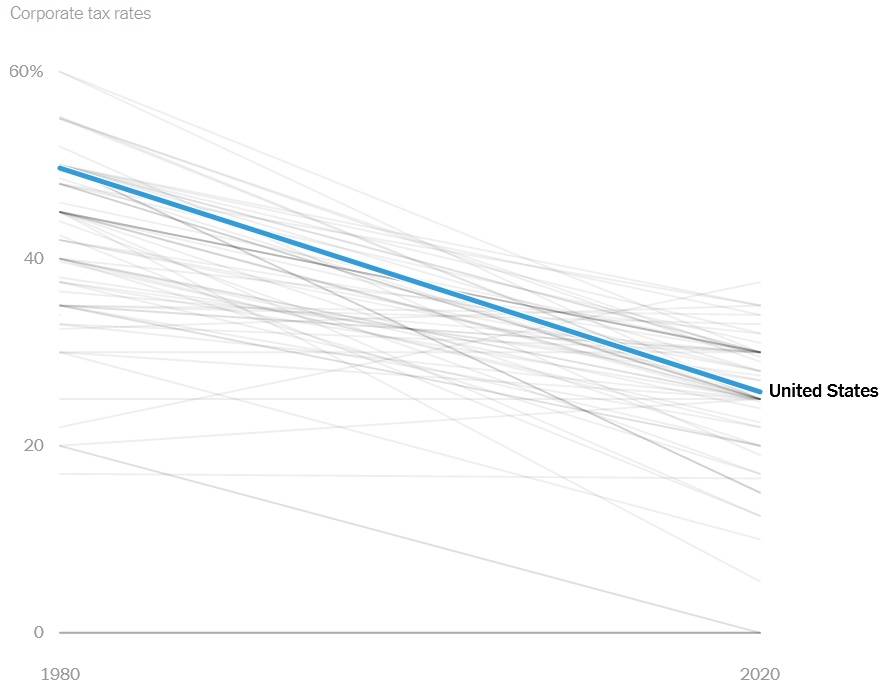
P.S. For those interested, the horizontal line at the bottom is for Bermuda, though other jurisdictions (such as Monaco and the Cayman Islands) also deserve credit for having no corporate income taxes.

P.P.S. If you want to know why high corporate tax rates are misguided, click here. And if you want to know why Biden’s plan to raise the U.S. corporate tax rate is misguided, click here. Or here. Or here.

P.P.P.S. And if you want more information about why Biden’s global tax cartel is bad, click here, here, and here.

I enjoyed this article below because it demonstrates that the Laffer Curve has been working for almost 100 years now when it is put to the test in the USA. I actually got to hear Arthur Laffer speak in person in 1981 and he told us in advance what was going to happen the 1980’s and it all came about as he said it would when Ronald Reagan’s tax cuts took place. I wish we would lower taxes now instead of looking for more revenue through raised taxes. We have to grow the economy:

What Mitt Romney Said Last Night About Tax Cuts And The Deficit Was Absolutely Right. And What Obama Said Was Absolutely Wrong.

Mitt Romney repeatedly said last night that he would not allow tax cuts to add to the deficit.  He repeatedly said it because over and over again Obama blathered the liberal talking point that cutting taxes necessarily increased deficits.

Romney’s exact words: “I want to underline that — no tax cut that adds to the deficit.”

Meanwhile, Obama has promised to cut the deficit in half during his first four years – but instead gave America the highest deficits in the history of the entire human race.

I’ve written about this before.  Let’s replay what has happened every single time we’ve ever cut the income tax rate.

The fact of the matter is that we can go back to Calvin Coolidge who said very nearly THE EXACT SAME THING to his treasury secretary: he too would not allow any tax cuts that added to the debt.  Andrew Mellon – quite possibly the most brilliant economic mind of his day – did a great deal of research and determined what he believed was the best tax rate.  And the Coolidge administration DID cut income taxes and MASSIVELY increased revenues.  Coolidge and Mellon cut the income tax rate 67.12 percent (from 73 to 24 percent); and revenues not only did not go down, but they went UP by at least 42.86 percent (from $700 billion to over $1 billion).

That’s something called a documented fact.  But that wasn’t all that happened: another incredible thing was that the taxes and percentage of taxes paid actually went UP for the rich.  Because as they were allowed to keep more of the profits that they earned by investing in successful business, they significantly increased their investments and therefore paid more in taxes than they otherwise would have had they continued sheltering their money to protect themselves from the higher tax rates.  Liberals ignore reality, but it is simply true.  It is a fact.  It happened.

Then FDR came along and raised the tax rates again and the opposite happened: we collected less and less revenue while the burden of taxation fell increasingly on the poor and middle class again.  Which is exactly what Obama wants to do.

People don’t realize that John F. Kennedy, one of the greatest Democrat presidents, was a TAX CUTTER who believed the conservative economic philosophy that cutting tax rates would in fact increase tax revenues.  He too cut taxes, and he too increased tax revenues.

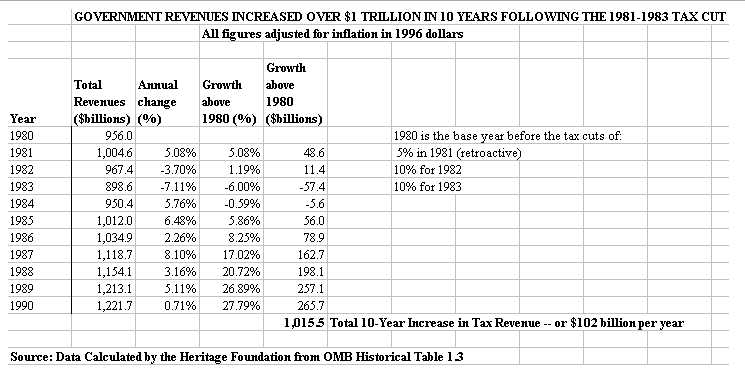
So we get to Ronald Reagan, who famously cut taxes.  And again, we find that Reagan cut that godawful liberal tax rate during an incredibly godawful liberal-caused economic recession, and he increased tax revenue by 20.71 percent (with revenues increasing from $956 billion to $1.154 trillion).  And again, the taxes were paid primarily by the rich:

“The share of the income tax burden borne by the top 10 percent of taxpayers increased from 48.0 percent in 1981 to 57.2 percent in 1988. Meanwhile, the share of income taxes paid by the bottom 50 percent of taxpayers dropped from 7.5 percent in 1981 to 5.7 percent in 1988.”

So we get to George Bush and the Bush tax cuts that liberals and in particular Obama have just demonized up one side and demagogued down the other.  And I can simply quote the New York Times AT the time:

Sharp Rise in Tax Revenue to Pare U.S. Deficit By EDMUND L. ANDREWS Published: July 13, 2005

WASHINGTON, July 12 – For the first time since President Bush took office, an unexpected leap in tax revenue is about to shrink the federal budget deficit this year, by nearly $100 billion.

A Jump in Corporate Payments On Wednesday, White House officials plan to announce that the deficit for the 2005 fiscal year, which ends in September, will be far smaller than the $427 billion they estimated in February.

Mr. Bush plans to hail the improvement at a cabinet meeting and to cite it as validation of his argument that tax cuts would stimulate the economy and ultimately help pay for themselves.

Based on revenue and spending data through June, the budget deficit for the first nine months of the fiscal year was $251 billion, $76 billion lower than the $327 billion gap recorded at the corresponding point a year earlier.

The Congressional Budget Office estimated last week that the deficit for the full fiscal year, which reached $412 billion in 2004, could be “significantly less than $350 billion, perhaps below $325 billion.”

The big surprise has been in tax revenue, which is running nearly 15 percent higher than in 2004. Corporate tax revenue has soared about 40 percent, after languishing for four years, and individual tax revenue is up as well
.

And of course the New York Times, as reliable liberals, use the adjective whenever something good happens under conservative policies and whenever something bad happens under liberal policies: ”unexpected.”   But it WASN’T ”unexpected.”  It was EXACTLY what Republicans had said would happen and in fact it was exactly what HAD IN FACT HAPPENED every single time we’ve EVER cut income tax rates.

The truth is that conservative tax policy has a perfect track record: every single time it has ever been tried, we have INCREASED tax revenues while not only exploding economic activity and creating more jobs, but encouraging the wealthy to pay more in taxes as well.  And liberals simply dishonestly refuse to acknowledge documented history.

Meanwhile, liberals also have a perfect record … of FAILUREThey keep raising taxes and keep not understanding why they don’t get the revenues they predicted.

The following is a section from my article, “Tax Cuts INCREASE Revenues; They Have ALWAYS Increased Revenues“, where I document every single thing I said above:

The Falsehood That Tax Cuts Increase The Deficit

Now let’s take a look at the utterly fallacious view that tax cuts in general create higher deficits.

Let’s take a trip back in time, starting with the 1920s.  From Burton Folsom’s book, New Deal or Raw Deal?:

In 1921, President Harding asked the sixty-five-year-old [Andrew] Mellon to be secretary of the treasury; the national debt [resulting from WWI] had surpassed $20 billion and unemployment had reached 11.7 percent, one of the highest rates in U.S. history.  Harding invited Mellon to tinker with tax rates to encourage investment without incurring more debt. Mellon studied the problem carefully; his solution was what is today called “supply side economics,” the idea of cutting taxes to stimulate investment.  High income tax rates, Mellon argued, “inevitably put pressure upon the taxpayer to withdraw this capital from productive business and invest it in tax-exempt securities. . . . The result is that the sources of taxation are drying up, wealth is failing to carry its share of the tax burden; and capital is being diverted into channels which yield neither revenue to the Government nor profit to the people” (page 128).

Mellon wrote, “It seems difficult for some to understand that high rates of taxation do not necessarily mean large revenue to the Government, and that more revenue may often be obtained by lower taxes.”  And he compared the government setting tax rates on incomes to a businessman setting prices on products: “If a price is fixed too high, sales drop off and with them profits.”

And what happened?

“As secretary of the treasury, Mellon promoted, and Harding and Coolidge backed, a plan that eventually cut taxes on large incomes from 73 to 24 percent and on smaller incomes from 4 to 1/2 of 1 percent.  These tax cuts helped produce an outpouring of economic development – from air conditioning to refrigerators to zippers, Scotch tape to radios and talking movies.  Investors took more risks when they were allowed to keep more of their gains.  President Coolidge, during his six years in office, averaged only 3.3 percent unemployment and 1 percent inflation – the lowest misery index of any president in the twentieth century.

Furthermore, Mellon was also vindicated in his astonishing predictions that cutting taxes across the board would generate more revenue.  In the early 1920s, when the highest tax rate was 73 percent, the total income tax revenue to the U.S. government was a little over $700 million.  In 1928 and 1929, when the top tax rate was slashed to 25 and 24 percent, the total revenue topped the $1 billion mark.  Also remarkable, as Table 3 indicates, is that the burden of paying these taxes fell increasingly upon the wealthy” (page 129-130).

Now, that is incredible upon its face, but it becomes even more incredible when contrasted with FDR’s antibusiness and confiscatory tax policies, which both dramatically shrunk in terms of actual income tax revenues (from $1.096 billion in 1929 to $527 million in 1935), and dramatically shifted the tax burden to the backs of the poor by imposing huge new excise taxes (from $540 million in 1929 to $1.364 billion in 1935).  See Table 1 on page 125 of New Deal or Raw Deal for that information.

FDR both collected far less taxes from the rich, while imposing a far more onerous tax burden upon the poor.

It is simply a matter of empirical fact that tax cuts create increased revenue, and that those [Democrats] who have refused to pay attention to that fact have ended up reducing government revenues even as they increased the burdens on the poorest whom they falsely claim to help.

Let’s move on to John F. Kennedy, one of the most popular Democrat presidents ever.  Few realize that he was also a supply-side tax cutter.

Kennedy said:

“It is a paradoxical truth that tax rates are too high and tax revenues are too low and the soundest way to raise the revenues in the long run is to cut the rates now … Cutting taxes now is not to incur a budget deficit, but to achieve the more prosperous, expanding economy which can bring a budget surplus.”

– John F. Kennedy, Nov. 20, 1962, president’s news conference


“Lower rates of taxation will stimulate economic activity and so raise the levels of personal and corporate income as to yield within a few years an increased – not a reduced – flow of revenues to the federal government.”

– John F. Kennedy, Jan. 17, 1963, annual budget message to the Congress, fiscal year 1964

“In today’s economy, fiscal prudence and responsibility call for tax reduction even if it temporarily enlarges the federal deficit – why reducing taxes is the best way open to us to increase revenues.”

– John F. Kennedy, Jan. 21, 1963, annual message to the Congress: “The Economic Report Of The President”


“It is no contradiction – the most important single thing we can do to stimulate investment in today’s economy is to raise consumption by major reduction of individual income tax rates.”

– John F. Kennedy, Jan. 21, 1963, annual message to the Congress: “The Economic Report Of The President”


“Our tax system still siphons out of the private economy too large a share of personal and business purchasing power and reduces the incentive for risk, investment and effort – thereby aborting our recoveries and stifling our national growth rate.”

– John F. Kennedy, Jan. 24, 1963, message to Congress on tax reduction and reform, House Doc. 43, 88th Congress, 1st Session.


“A tax cut means higher family income and higher business profits and a balanced federal budget. Every taxpayer and his family will have more money left over after taxes for a new car, a new home, new conveniences, education and investment. Every businessman can keep a higher percentage of his profits in his cash register or put it to work expanding or improving his business, and as the national income grows, the federal government will ultimately end up with more revenues.”

– John F. Kennedy, Sept. 18, 1963, radio and television address to the nation on tax-reduction bill

Which is to say that modern Democrats are essentially calling one of their greatest presidents a liar when they demonize tax cuts as a means of increasing government revenues.

So let’s move on to Ronald Reagan.  Reagan had two major tax cutting policies implemented: the Economic Recovery Tax Act (ERTA) of 1981, which was retroactive to 1981, and the Tax Reform Act of 1986.

Did Reagan’s tax cuts decrease federal revenues?  Hardly:

We find that 8 of the following 10 years there was a surplus of revenue from 1980, prior to the Reagan tax cuts.  And, following the Tax Reform Act of 1986, there was a MASSIVE INCREASEof revenue.

So Reagan’s tax cuts increased revenue.  But who paid the increased tax revenue?  The poor?  Opponents of the Reagan tax cuts argued that his policy was a giveaway to the rich (ever heard that one before?) because their tax payments would fall.  But that was exactly wrong.  In reality:

“The share of the income tax burden borne by the top 10 percent of taxpayers increased from 48.0 percent in 1981 to 57.2 percent in 1988. Meanwhile, the share of income taxes paid by the bottom 50 percent of taxpayers dropped from 7.5 percent in 1981 to 5.7 percent in 1988.”

So Ronald Reagan a) collected more total revenue, b) collected more revenue from the rich, while c) reducing revenue collected by the bottom half of taxpayers, and d) generated an economic powerhouse that lasted – with only minor hiccups – for nearly three decades.  Pretty good achievement considering that his predecessor was forced to describe his own economy as a “malaise,” suffering due to a “crisis of confidence.” Pretty good considering that President Jimmy Carter responded to a reporter’s question as to what he would do about the problem of inflation by answering, “It would be misleading for me to tell any of you that there is a solution to it.”

Reagan whipped inflation.  Just as he whipped that malaise and that crisis of confidence.

________

The Laffer Curve, Part III: Dynamic Scoring

Dan Mitchell article notes, ”Democrats in Congress have made it much easier for state-level Republicans to slash taxes this year… That’s because Democrats have shoveled a ton of federal money onto the states!”

_________

State Tax Progress

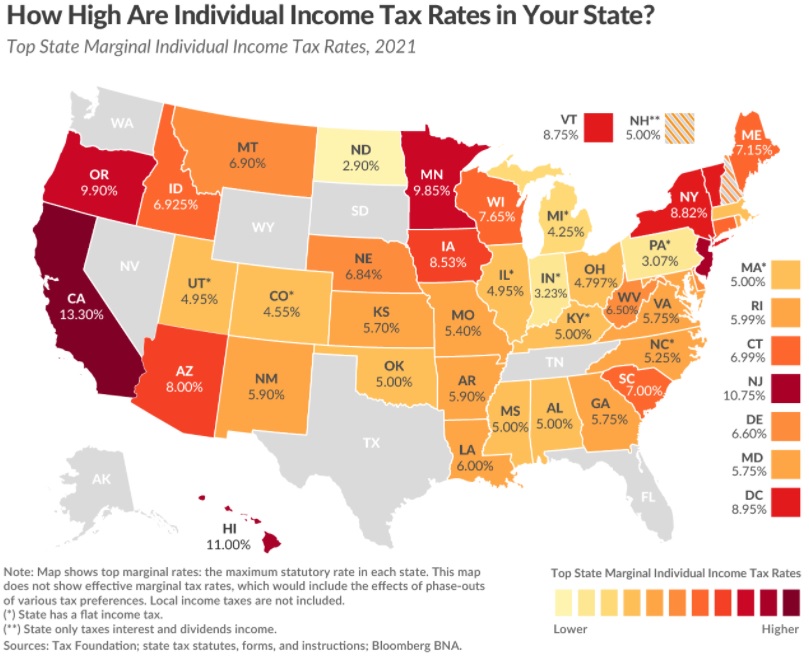
Last year I shared a very encouraging map, which identified the many states that have been cutting tax rates.

After the November elections, I wrote a couple of encouragingcolumns about voters making sensible decisions when given the ability to vote for higher or lower taxes.

Later that month, I updated my five-column table showing which states have the best and worst tax systems.

And I ended the year with a look at the Tax Foundation’s State Tax Business Climate Index.

All things considered, not a bad year. At least at the state level.

Well, we may see more progress this year.

Grover Norquist of Americans for Tax Reform has a column in the Wall Street Journal about an ongoing revolution of pro-growth tax cuts at the state level.

…in the 50 states there is a dramatic increase in tax competition to provide the best government at the lowest cost. …Americans have noticed that high-tax states don’t provide better roads, education or other services. Florida (with 22 million residents) has no income tax and the state spends half as much as New York (20 million residents).New York has a top state income tax of 8.82% (soon rising to 10.9%) and was the only state to raise its personal income-tax rate during the pandemic. …state leaders have discovered that…marginal income-tax rate…reduction is enabled by spending restraint. North Carolina provided the best example of this strategy over the past seven years. …Louisiana, under the leadership of Senate Majority Leader Sharon Hewitt, has set a path to reduce its income tax every year triggers are met. These triggers could take Louisiana’s income tax to zero by 2034… Ten other states have begun the march to a zero rate.

The column also mentions other states, such as Iowa, that hopefully will replace discriminatory regimes with simple and fair flat taxes.

Not everyone is happy about these developments.

In a column for the Washington Post, Catherine Rampell points out that some of the tax cutting was enabled by Biden’s big handouts to state governments.

Democrats in Congress have made it much easier for state-level Republicans to slash taxes this year… That’s because Democrats have shoveled a ton of federal money onto the states… Big budget surpluses have inspired the governors of Missouri, South Carolina and Iowa to propose cuts to their income tax rates. Utah’s Senate recently approved a $160 million tax cut, with its state House of Representatives expected to make the proposal even more expansive. And Mississippi is working to cut taxes on food sales and car tags — and to phase out its income tax entirely. …Even blue and purple states may jump on the traditionally conservative tax-cut bandwagon, too. …after President Biden took office, Democrats decided to go big with their stimulus bill… Democrats sent states and localities an additional $500 billion, including direct state and local covid relief grants, plus separate funding for education, transit and other programs. …many states have more cash than they know what to do with. …total state and local receipts were 26 percent higher in 2021 than they were in 2019.

Here’s the part she doesn’t like.

Republicans are taking these deficit-financed federal dollars, passing them on to constituents in the form of lower taxes and reaping the political benefits — all while being able to blame Democrats for the enormous cost they add to the federal debt. …perhaps red states reasonably assume that Democrats won’t learn their lesson — and will keep the federal dollars flowing, even if doing so hands Republicans home-state political victories.

Interestingly, congressional Democrats recognized this might be a problem.

But the anti-tax cut language they included in their handout legislation has not been effective.

Democrats did include legislative language that forbade any pandemic relief funds from being used to “either directly or indirectly” finance tax cuts. But enforcing that provision was always going to be difficult… Federal judges have already blocked Treasury from enforcing the no-tax-cut provision in at least 15 states… More litigation is pending, but these developments have emboldened Republicans, who are eager to use Democrats’ sloppy bill design against them.

All of this may be a quandary for libertarians and conservatives.

Biden’s boondoggle stimulus was bad legislation. And the same can be said for major parts of Trump’s pandemic emergency spending bills.

Yet one fortunate side effect is that state governments have had so much money that some of them have been cutting taxes.

But some of them also have been spending more money, and that won’t lead to good results.

All things considered, this really shouldn’t be a quandary. We got two bad things (more federal spending and more spending in some states) and one good thing (tax cuts in some states).

P.S. At some point, the politicians in Washington will have to restore some fiscal sanity, but I’m not holding my breath for good policy.

P.P.S. I suspect we’ll see even more interstate tax migration over the next few years. Simply stated, many people would rather live in libertarian-oriented states rather tha

Texas vs. California, Part VII

To begin the seventh edition of our series comparing policy in Texas and California (previous entries in March 2010, February 2013, April 2013, October 2018, June 2019, and December 2020), here’s a video from Prager University.

There will be a lot of information in today’s column, so if you’re pressed for time, here are three sentences that tell you what you need to know.

California has all sorts of natural advantages over Texas, especially endless sunshine and beautiful topography.

Texas has better government policy than California, most notably in areas such as taxation and regulation.

Since people are moving from the Golden State to the Lone Star State, public policy seems to matter more than natural beauty.

Now let’s look at a bunch of evidence to support those three sentences.

We’ll start with an article by Joel Kotkin of Chapman University.

If one were to explore the most blessed places on earth, California, my home for a half century, would surely be up there. …its salubrious climate, spectacular scenery, vast natural resources… President Biden recently suggested that he wants to “make America California again”. Yet…he should consider whether the California model may be better seen as a cautionary tale than a roadmap to a better future… California now suffers the highest cost-adjusted poverty rate in the country, and the widest gap between middle and upper-middle income earners. …the state has slowly morphed into a low wage economy. Over the past decade, 80% of the state’s jobs have paid under the median wage — half of which are paid less than $40,000…minorities do better today outside of California, enjoying far higher adjusted incomes and rates of homeownership in places like Atlanta and Dallas than in San Francisco and Los Angeles. Almost one-third of Hispanics, the state’s largest ethnic group, subsist below the poverty line, compared with 21% outside the state. …progressive…policies have not brought about greater racial harmony, enhanced upward mobility and widely based economic growth.

Next we have some business news from the San Francisco Chronicle.

Business leaders fear tech giant Oracle’s recent announcement that it is leaving the Bay Area for Austin, Texas, will lead to more exits unless some fundamental political and economic changes are made to keep the region attractive and competitive. “This is something that we have been warning people about for several years. California is not business friendly, we should be honest about it,” said Kenneth Rosen, chairman of the UC Berkeley Fisher Center for Real Estate and Urban Economics.Bay Area Council President Jim Wunderman said… “From consulting companies to tax lawyers to bankers and commercial real estate firms, every person I talk with who provides services to big Bay Area corporations are telling me that their clients are strategizing about leaving…” Charles Schwab, McKesson and Hewlett Packard Enterprise have all exited the high-cost, high-tax, high-regulation Bay Area for a less-expensive, less-regulated and business-friendlier political climate. All of them rode off to Texas. …the pace of the departures appears to be increasing. …A recent online survey of 2,325 California residents, taken between Nov. 4 and Nov. 23 by the Public Policy Institute of California, found 26% of residents have seriously considered moving out of state and that 58% say that the American Dream is harder to achieve in California than elsewhere.

Are California politicians trying to make things better, in hopes of stopping out-migration to places such as Texas?

Not according to this column by Hank Adler in the Wall Street Journal.

California’s Legislature is considering a wealth tax on residents, part-year residents, and any person who spends more than 60 days inside the state’s borders in a single year. Even those who move out of state would continue to be subject to the tax for a decade… Assembly Bill 2088 proposes calculating the wealth tax based on current world-wide net worth each Dec. 31. For part-year and temporary residents, the tax would be proportionate based on their number of days in California. The annual tax would be on current net worth and therefore would include wealth earned, inherited or obtained through gifts or estates long before and long after leaving the state. …The authors of the bill estimate the wealth tax will provide Sacramento $7.5 billion in additional revenue every year. Another proposal—to increase the top state income-tax rate to 16.8%—would annually raise another $6.8 billion. Today, California’s wealthiest 1% pay approximately 46% of total state income taxes. …the Legislature looks to the wealthiest Californians to fill funding gaps without considering the constitutionality of the proposals and the ability of people and companies to pick up and leave the state, which news reports suggest they are doing in large numbers. …As of this moment, there are no police roadblocks on the freeways trying to keep moving trucks from leaving California. If A.B. 2088 becomes law, the state may need to consider placing some.

The late (and great) Walter Williams actually joked back in 2012that California might set up East German-style border checkpoints. Let’s hope satire doesn’t become reality.

But what isn’t satire is that people are fleeing the state (along with other poorly governed jurisdictions).

Simply state, the blue state model of high taxes and big government is not working (just as it isn’t working in countries with high taxes and big government).

Interestingly, even the New York Times recognizes that there is a problem in the state that used to be a role model for folks on the left.

Opining for that outlet at the start of the month, Brett Stephens raised concerns about the Golden State.

…today’s Democratic leaders might look to the very Democratic state of California as a model for America’s future. You remember California: People used to want to move there, start businesses, raise families, live their American dream. These days, not so much. Between July 2019 and July 2020, more people — 135,400 to be precise — left the state than moved in… No. 1 destination: Texas, followed by Arizona, Nevada and Washington. Three of those states have no state income tax.

California, by contrast, has very high taxes. Not just an onerous income tax, but high taxes across the board.

Californians also pay some of the nation’s highest sales tax rates (8.66 percent) and corporate tax rates (8.84 percent), as well as the highest taxes on gasoline (63 cents on a gallon as of January, as compared with 20 cents in Texas).

Sadly, these high taxes don’t translate into good services from government.

The state ranks 21st in the country in terms of spending per public school pupil, but 27th in its K-12 educational outcomes. It ties Oregon for third place among states in terms of its per capita homeless rate. Infrastructure? As of 2019, the state had an estimated $70 billion in deferred maintenance backlog. Debt? The state’s unfunded pension liabilities in 2019 ran north of $1.1 trillion, …or $81,300 per household.

Makes you wonder whether the rest of the nation should copy that model?

Democrats hold both U.S. Senate seats, 42 of its 53 seats in the House, have lopsided majorities in the State Assembly and Senate, run nearly every big city and have controlled the governor’s mansion for a decade. If ever there was a perfect laboratory for liberal governance, this is it. So how do you explain these results? …If California is a vision of the sort of future the Biden administration wants for Americans, expect Americans to demur.

Some might be tempted to dismiss Stephens’ column because he is considered the token conservative at the New York Times.

But Ezra Klein also acknowledges that California has a problem, and nobody will accuse him of being on the right side of the spectrum.

Here’s some of what he wrote in his column earlier this month for the New York Times.

I love California. I was born and raised in Orange County. I was educated in the state’s public schools and graduated from the University of California system… But for that very reason, our failures of governance worry me. California has the highest poverty rate in the nation,when you factor in housing costs, and vies for the top spot in income inequality, too. …but there’s a reason 130,000 more people leave than enter each year. California is dominated by Democrats, but many of the people Democrats claim to care about most can’t afford to live there. …California, as the biggest state in the nation, and one where Democrats hold total control of the government, carries a special burden. If progressivism cannot work here, why should the country believe it can work anywhere else?

Kudos to Klein for admitting problems on his side (just like I praise the few GOPers who criticized Trump’s big-government policies).

But his column definitely had some quirky parts, such as when he wrote that, “There are bright spots in recent years…a deeply progressive plan to tax the wealthy.”

That’s actually a big reason for the state’s decline, not a “bright spot.”

I’m not the only one to recognize the limitations of his column.

Kevin Williamson wrote an entire rebuttal for National Review.

Who but Ezra Klein could survey the wreck left-wing Democrats have made of California and conclude that the state’s problem is its excessive conservatism? …Klein the rhetorician anticipates objections on this front and writes that he is not speaking of “the political conservatism that privatizes Medicare, but the temperamental conservatism that” — see if this formulation sounds at all familiar — “stands athwart change and yells ‘Stop!’”…California progressives have progressive policies and progressive power, and they like it that way. That is the substance of their conservatism. …Klein and others of his ilk like to present themselves as dispassionate pragmatists, enlightened empiricists who only want to do “what works.” …Klein mocks San Francisco for renaming schools (Begone, Abraham Lincoln!) while it has no plan to reopen them, but he cannot quite see that these are two aspects of a single phenomenon. …Klein…must eventually understand that the troubles he identifies in California are baked into the progressive cake. …That has real-world consequences, currently on display in California to such a spectacular degree that even Ezra Klein is able dimly to perceive them. Maybe he’ll learn something.

I especially appreciate this passage since it excoriates rich leftists for putting teacher unions ahead of disadvantaged children.

Intentions do not matter very much, and mere stated intentions matter even less. Klein is blind to that, which is why he is able to write, as though there were something unusual on display: “For all the city’s vaunted progressivism, [San Francisco] has some of the highest private school enrollment numbers in the country.” Rich progressives have always been in favor of school choice and private schools — for themselves. They only oppose choice for poor people, whose interests must for political reasons be subordinated to those of the public-sector unions from which Democrats in cities such as San Francisco derive their power.

Let’s conclude with some levity.

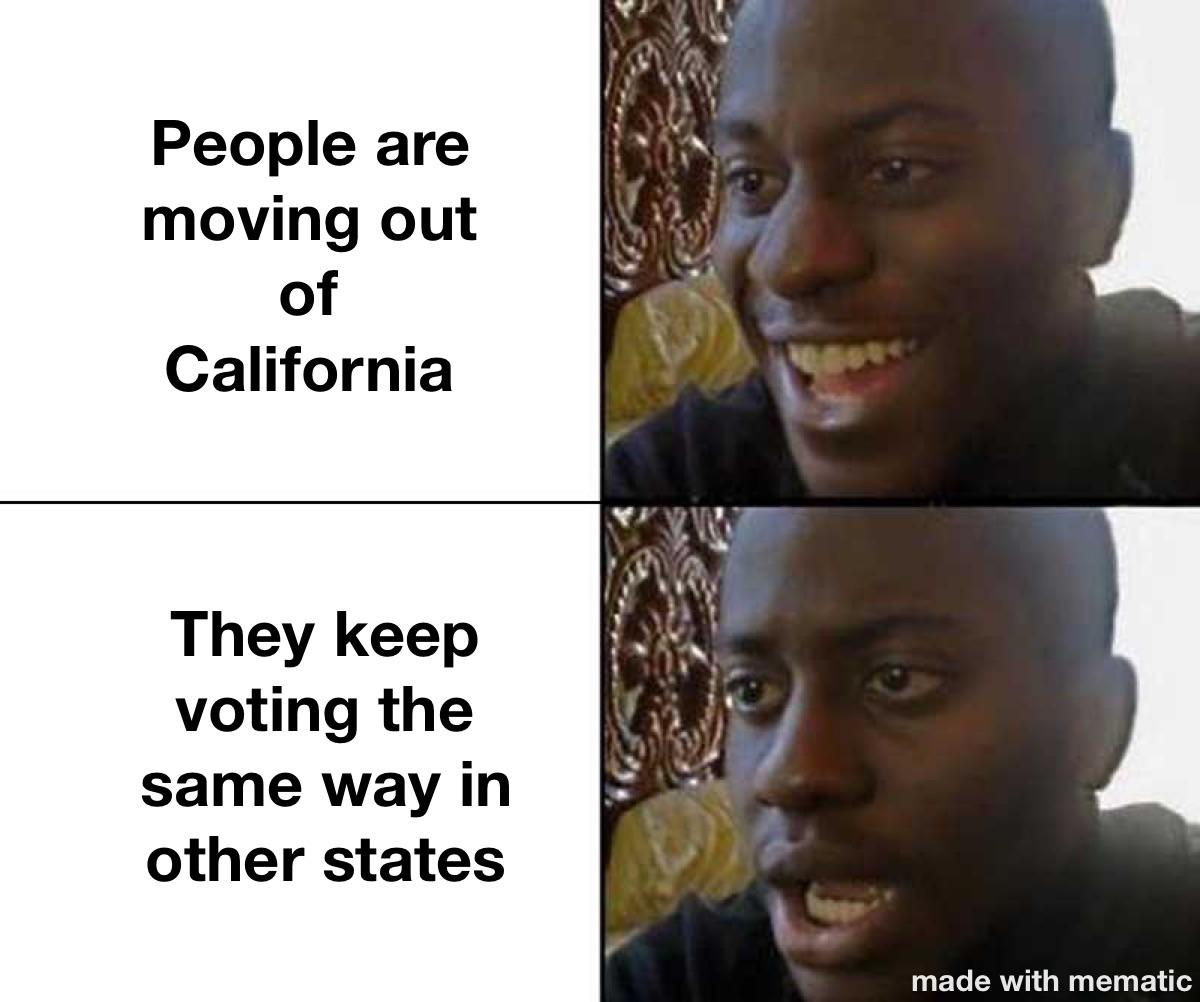
Here’s a meme that contemplates whether California emigrants bring bad voting habits with them.

Though that’s apparently more of a problem in Colorado rather than in Texas.

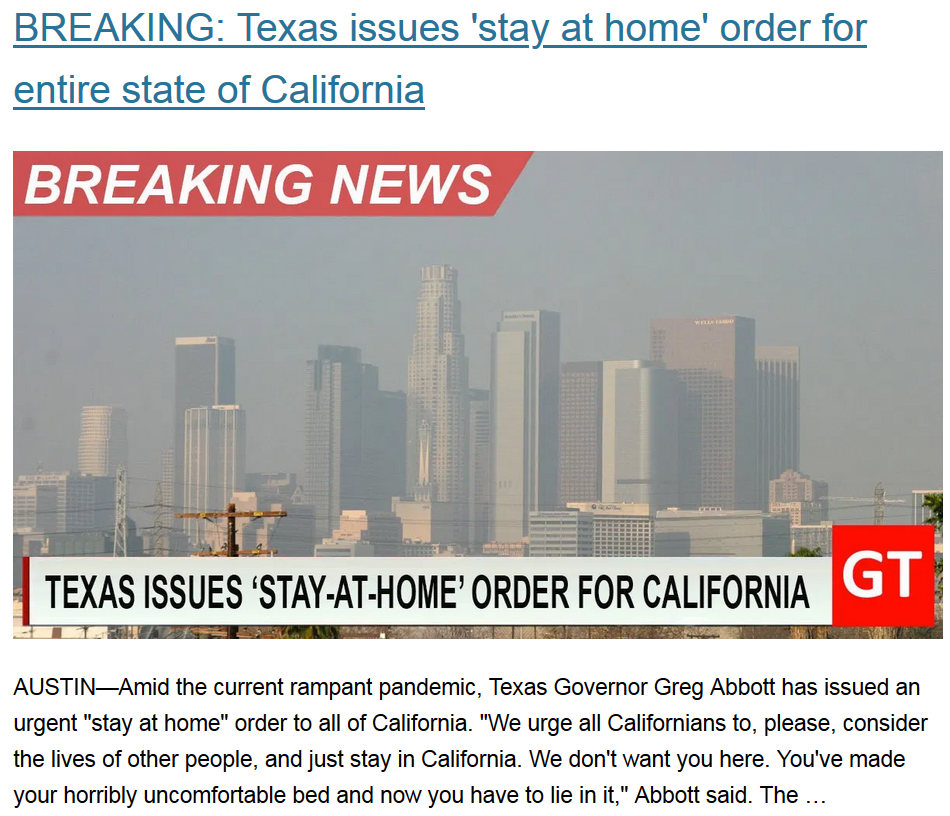
And here’s some clever humor from Genesius Times.

P.S. My favorite California-themed humor (not counting the state’s elected officials) can be found here, hereherehere, and here.

High-tax states are languishing but  zero-income-tax states such as Texas are growing rapidly!!!!

Much of my writing is focused on the real-world impact of government policy, and this is why I repeatedly look at the relative economic performance of big government jurisdictions and small government jurisdictions.

But I don’t just highlight differences between nations. Yes, it’s educational to look at North Korea vs. South Korea or Chile vs. Venezuela vs. Argentina, but I also think you can learn a lot by looking at what’s happening with different states in America.

So we’ve looked at high-tax states that are languishing, such as California and Illinois, and compared them to zero-income-tax states such as Texas.

With this in mind, you can understand that I was intrigued to see that even the establishment media is noticing that Texas is out-pacing the rest of the nation.

Here are some excerpts from a report by CNN Money on rapid population growth in Texas.

More Americans moved to Texas in recent years than any other state: A net gain of more than 387,000 in the latest Census for 2013. …Five Texas cities — Austin, Houston, San Antonio, Dallas and Fort Worth — were among the top 20 fastest growing large metro areas. Some smaller Texas metro areas grew even faster. In oil-rich Odessa, the population grew 3.3% and nearby Midland recorded a 3% gain.

But why is the population growing?

Well, CNN Money points out that low housing prices and jobs are big reasons.

And on the issue of housing, the article does acknowledge the role of “easy regulations” that enable new home construction.

But on the topic of jobs, the piece contains some good data on employment growth, but no mention of policy.

Jobs is the No. 1 reason for population moves, with affordable housing a close second. …Jobs are plentiful in Austin, where the unemployment rate is just 4.6%. Moody’s Analytics projects job growth to average 4% a year through 2015. Just as important, many jobs there are well paid: The median income of more than $75,000 is nearly 20% higher than the national median.

That’s it. Read the entire article if you don’t believe me, but the reporter was able to write a complete article about the booming economy in Texas without mentioning – not even once – that there’s no state income tax.

But that wasn’t the only omission.

The article doesn’t mention that Texas is the 4th-best state in the Tax Foundation’s ranking of state and local tax burdens.

The article doesn’t mention that Texas was the least oppressive state in the Texas Public Policy Foundation’s Soft Tyranny Index.

The article doesn’t mention that Texas was ranked #20 in a study of the overall fiscal condition of the 50 states.

The article doesn’t mention that Texas is in 4th place in a combined ranking of economic freedom in U.S. state and Canadian provinces.

The article doesn’t mention that Texas was ranked #11 in the Tax Foundation’s State Business Tax Climate Index.

The article doesn’t mention that Texas is in 14th place in the Mercatus ranking of overall freedom for the 50 states (and in 10th place for fiscal freedom).

By the way, I’m not trying to argue that Texas is the best state.

Indeed, it only got the top ranking in one of the measures cited above.

My point, instead, is simply to note that it takes willful blindness to write about the strong population growth and job performance of Texas without making at least a passing reference to the fact that it is a low-tax, pro-market state.

At least compared to other states. And especially compared to the high-tax states that are stagnating.

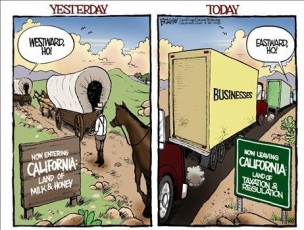
Such as California, as illustrated by this data and this data, as well as this Lisa Benson cartoon.

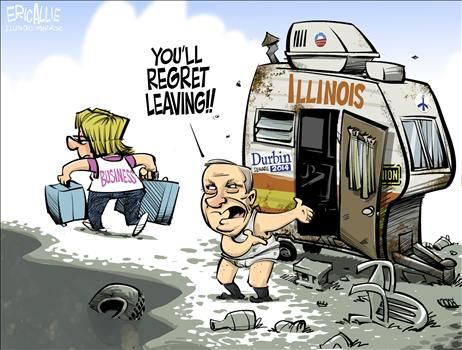
Such as Illinois, as illustrated by this data and this Eric Allie cartoon.

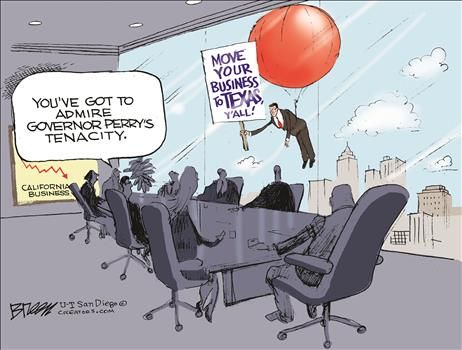
And I can’t resist adding this Steve Breen cartoon, if for no other reason that it reminds me of another one of his cartoons that I shared last year.

Speaking of humor, this Chuck Asay cartoon speculates on how future archaeologists will view California. And this joke about Texas, California, and a coyote is among my most-viewed blog posts.

All jokes aside, I want to reiterate what I wrote above. Texas is far from perfect. There’s too much government in the Lone Star state. It’s only a success story when compared to California.

P.S. Paul Krugman has tried to defend California, which has made him an easy target. I debunked him earlier this year, and I also linked to a superb Kevin Williamson takedown of Krugman at the bottom of this post.

P.P.S. Once again, I repeat the two-part challenge I’ve issued to the left. I’ll be happy if any statists can successfully respond to just one of the two questions I posed.

Related posts:

California is the Greece of the USA, but Texas is not perfect either!!!

California is the Greece of the USA, but Texas is not perfect either!!! Just Because California Is Terrible, that Doesn’t Mean Texas Is Perfect January 21, 2013 by Dan Mitchell Texas is in much better shape than California. Taxes are lower, in part because Texas has no state income tax. No wonder the Lone Star State […]

Dan Mitchell on Texas v. California (includes editorial cartoon)

We should lower federal taxes because jobs are going to states like Texas that have low taxes. (We should lower state taxes too!!) What Can We Learn by Comparing the Employment Situation in Texas vs. California? April 3, 2013 by Dan Mitchell One of the great things about federalism, above and beyond the fact that it […]

Ark Times blogger claims California is better than Texas but facts don’t bear that out (3 great political cartoons)

I got on the Arkansas Times Blog and noticed that a person on there was bragging about the high minimum wage law in San Francisco and how everything was going so well there. On 2-15-13 on the Arkansas Times Blog I posted: Couldn’t be better (the person using the username “Couldn’t be better)  is bragging […]

California burdensome government causing some of business community to leave for Texas

Does Government Have a Revenue or Spending Problem? People say the government has a debt problem. Debt is caused by deficits, which is the difference between what the government collects in tax revenue and the amount of government spending. Every time the government runs a deficit, the government debt increases. So what’s to blame: too […]

Arkansas Times blogger picks California business environment over Texas, proves liberals don’t live in real world(Part 2)

       Former California Governor Arnold Schwarzenegger with his family   I posted a portion of an article by John Fund of the Wall Street Journal that pointed out that many businesses are leaving California because of all of their government red tape and moving to Texas. My username is SalineRepublican and this is […]

John Fund’s talk in Little Rock 4-27-11(Part 4):Responding to liberals who criticize states like Texas that don’t have the red tape that California has

John Fund at Chamber Day, Part 1 Last week I got to attend the first ever “Conservative Lunch Series” presented by  KARN and Americans for Prosperity Foundation at the Little Rock Hilton on University Avenue. This monthly luncheon will be held the fourth Wednesday of every month. The speaker for today’s luncheon was John Fund. John […]

California and France have raised taxes so much that it has hurt economic growth!!!

___________ California and France have raised taxes so much that it has hurt economic growth!!! Mirror, Mirror, on the Wall, which Nation and State Punish Success Most of All? September 25, 2014 by Dan Mitchell I’ve shared some interested rankings on tax policy, including a map from the Tax Foundation showing which states have the earliest […]

Jerry Brown raised taxes in California and a rise in the minimum wage, but it won’t work like Krugman thinks!!!

___________   Jerry Brown raised taxes in California and a rise in the minimum wage, but it won’t work like Krugman thinks!!!! This cartoon below shows what will eventually happen to California and any other state that keeps raising taxes higher and higher.   Krugman’s “Gotcha” Moment Leaves Something to Be Desired July 25, 2014 by […]

Open letter to President Obama (Part 573) Are the states of Illinois and California going to join Detroit in Bankruptcy one day?

Open letter to President Obama (Part 573) (Emailed to White House on 7-29-13.) President Obama c/o The White House 1600 Pennsylvania Avenue NW Washington, DC 20500 Dear Mr. President, I know that you receive 20,000 letters a day and that you actually read 10 of them every day. I really do respect you for trying to get […]

Open letter to President Obama (Part 561) We should lower federal taxes because jobs are going to states like Texas that have low taxes

Open letter to President Obama (Part 561) (Emailed to White House on 6-25-13.) President Obama c/o The White House 1600 Pennsylvania Avenue NW Washington, DC 20500 Dear Mr. President, I know that you receive 20,000 letters a day and that you actually read 10 of them every day. I really do respect you for trying to get […]

DAN MITCHELL: “Imagine that you are a high-value entrepreneur facing the possibility of having to pay more than 18 percent of your income to state politicians? Do you leave California?”

_________

California and Economic Suicide

I wrote back in 2012 that California voters opted for “slow-motion economic suicide” by voting to raise the state’s top income tax rate to 13.3 percent.

Sure enough, having the nation’s highest state income tax ratehas been bad news.

More and more companies and households are leaving the (no-longer) Golden State for zero-income-tax states such as Texas, Nevada, and Florida.

Unfortunately, it appears that California politicians aren’t learning any lessons from this exodus.

They’re now pushing for a massive tax increase to fund a government takeover of health care.

The Wall Street Journal opined about the new plan.

California Democrats are busy reviving government-run, single-payer health care, despite its failure in the state five years ago. …Their revived legislation would replace Medicare, Medicaid and private health insurance with a state-run system… Californians would also be entitled to an expansive list of benefits including vision, dental, hearing and long-term care. A board of bureaucrats would control costs—i.e., ration care. …While Californians would technically be entitled to a “free” knee replacement, they might not get one if bureaucrats consider them too old—but the state won’t let people know that’s the reason. …Arizona could soon become a hot destination for medical tourism. …As for the tax increases… Start with a 2.3% excise tax on business with more than $2 million in annual gross receipts… Employers with 50 or more workers would also pay a 1.25% payroll tax, which would be passed onto workers. Workers earning more than $49,900 would pay an additional 1% payroll tax. …would raise the effective income tax on wage earners making more than $61,213 to 11.55%—more than millionaires pay in every state but New York. …An additional progressive surtax would start at 0.5% on income over $149,509 and rise to 2.5% at $2,484,121. …The top marginal rate would rise to 15.8% on unearned income, including capital gains, and 18.05% on wage income.

In a column for Reason, Joe Bishop-Henchman and Andrew Wilford of the National Taxpayers Union explain the likely impact of the proposed tax increases.

As the mad scientist laboratory for bad tax policy in America, California is constantly striving to come up with poorly designed and harmful taxes to pay for ever-increasing spending. But even by its own lofty standards, California has truly outdone itself with its latest proposal to fund a state single-payer health care system. …Not only would the proposed $163 billion in new tax revenue nearly double last year’s total revenue for the tax-happy state,but California would structure these new taxes in such a way as to be even more harmful than doubled tax liabilities already imply. …the 2.3 percent gross receipts tax sticks out. …whether a business has a profit margin of 0.1 percent or 10 percent, it would still have to pay the same percentage of its total revenues. …a rate that is three times the level of the nation’s current highest. …the proposal to institute a payroll tax on businesses with 50 or more employees…would create an obvious disincentive for businesses to hire their 50th employee. …the payroll tax would discourage both hiring employees and paying them higher wages, a disastrous outcome for workers. …individual income tax rates…would effectively be…an 18-bracket tax structure with a top marginal tax rate of 18.05 percent. …a trend that California appears to have its head in the sand about: overtaxed businesses and individuals fleeing for greener pastures.

Let’s elaborate on that final sentence and ask ourselves what the tipping point will be for various taxpayers.

  • Imagine you run a business and you have to pay a 2.3 percent tax on all your receipts, even if you happen to be losing money? Do you leave the state?
  • Imagine if you are a typical employee and government takes more than 10 percent of your income in exchange for bad roads and bad schools? Do you leave the state?
  • Imagine that you are a high-value entrepreneur facing the possibility of having to pay more than 18 percent of your income to state politicians? Do you leave?
  • Imagine being an investor who is thinking about forgoing consumption in order to make an investment that might result in a punitive capital gains tax? Do you leave?

And while you contemplate those questions, remember that California is already very unfriendly to taxpayers, ranking #48according to the Tax Foundation and ranking #49 according to the Fraser Institute.

Moreover, while California politicians consider a massive tax increase, other states are lowering tax rates.

In other words, California already is in trouble and many state politicians now want to double down on a losing bet.

P.S. California considered a government-run health plan a few years ago and backed off, so maybe there’s hope.

P.P.S. Illinois has been the long-time leader in the poll that asks which state will be the first to suffer political collapse. That may change if this California plan is enacted.

P.P.P.S. When I’m feeling petty and malicious, I sometime hope jurisdictions adopt bad policy because that will give me more evidence showing the adverse consequences of bad policy.

Texas vs. California, Part VII

To begin the seventh edition of our series comparing policy in Texas and California (previous entries in March 2010, February 2013, April 2013, October 2018, June 2019, and December 2020), here’s a video from Prager University.

There will be a lot of information in today’s column, so if you’re pressed for time, here are three sentences that tell you what you need to know.

California has all sorts of natural advantages over Texas, especially endless sunshine and beautiful topography.

Texas has better government policy than California, most notably in areas such as taxation and regulation.

Since people are moving from the Golden State to the Lone Star State, public policy seems to matter more than natural beauty.

Now let’s look at a bunch of evidence to support those three sentences.

We’ll start with an article by Joel Kotkin of Chapman University.

If one were to explore the most blessed places on earth, California, my home for a half century, would surely be up there. …its salubrious climate, spectacular scenery, vast natural resources… President Biden recently suggested that he wants to “make America California again”. Yet…he should consider whether the California model may be better seen as a cautionary tale than a roadmap to a better future… California now suffers the highest cost-adjusted poverty rate in the country, and the widest gap between middle and upper-middle income earners. …the state has slowly morphed into a low wage economy. Over the past decade, 80% of the state’s jobs have paid under the median wage — half of which are paid less than $40,000…minorities do better today outside of California, enjoying far higher adjusted incomes and rates of homeownership in places like Atlanta and Dallas than in San Francisco and Los Angeles. Almost one-third of Hispanics, the state’s largest ethnic group, subsist below the poverty line, compared with 21% outside the state. …progressive…policies have not brought about greater racial harmony, enhanced upward mobility and widely based economic growth.

Next we have some business news from the San Francisco Chronicle.

Business leaders fear tech giant Oracle’s recent announcement that it is leaving the Bay Area for Austin, Texas, will lead to more exits unless some fundamental political and economic changes are made to keep the region attractive and competitive. “This is something that we have been warning people about for several years. California is not business friendly, we should be honest about it,” said Kenneth Rosen, chairman of the UC Berkeley Fisher Center for Real Estate and Urban Economics.Bay Area Council President Jim Wunderman said… “From consulting companies to tax lawyers to bankers and commercial real estate firms, every person I talk with who provides services to big Bay Area corporations are telling me that their clients are strategizing about leaving…” Charles Schwab, McKesson and Hewlett Packard Enterprise have all exited the high-cost, high-tax, high-regulation Bay Area for a less-expensive, less-regulated and business-friendlier political climate. All of them rode off to Texas. …the pace of the departures appears to be increasing. …A recent online survey of 2,325 California residents, taken between Nov. 4 and Nov. 23 by the Public Policy Institute of California, found 26% of residents have seriously considered moving out of state and that 58% say that the American Dream is harder to achieve in California than elsewhere.

Are California politicians trying to make things better, in hopes of stopping out-migration to places such as Texas?

Not according to this column by Hank Adler in the Wall Street Journal.

California’s Legislature is considering a wealth tax on residents, part-year residents, and any person who spends more than 60 days inside the state’s borders in a single year. Even those who move out of state would continue to be subject to the tax for a decade… Assembly Bill 2088 proposes calculating the wealth tax based on current world-wide net worth each Dec. 31. For part-year and temporary residents, the tax would be proportionate based on their number of days in California. The annual tax would be on current net worth and therefore would include wealth earned, inherited or obtained through gifts or estates long before and long after leaving the state. …The authors of the bill estimate the wealth tax will provide Sacramento $7.5 billion in additional revenue every year. Another proposal—to increase the top state income-tax rate to 16.8%—would annually raise another $6.8 billion. Today, California’s wealthiest 1% pay approximately 46% of total state income taxes. …the Legislature looks to the wealthiest Californians to fill funding gaps without considering the constitutionality of the proposals and the ability of people and companies to pick up and leave the state, which news reports suggest they are doing in large numbers. …As of this moment, there are no police roadblocks on the freeways trying to keep moving trucks from leaving California. If A.B. 2088 becomes law, the state may need to consider placing some.

The late (and great) Walter Williams actually joked back in 2012that California might set up East German-style border checkpoints. Let’s hope satire doesn’t become reality.

But what isn’t satire is that people are fleeing the state (along with other poorly governed jurisdictions).

Simply state, the blue state model of high taxes and big government is not working (just as it isn’t working in countries with high taxes and big government).

Interestingly, even the New York Times recognizes that there is a problem in the state that used to be a role model for folks on the left.

Opining for that outlet at the start of the month, Brett Stephens raised concerns about the Golden State.

…today’s Democratic leaders might look to the very Democratic state of California as a model for America’s future. You remember California: People used to want to move there, start businesses, raise families, live their American dream. These days, not so much. Between July 2019 and July 2020, more people — 135,400 to be precise — left the state than moved in… No. 1 destination: Texas, followed by Arizona, Nevada and Washington. Three of those states have no state income tax.

California, by contrast, has very high taxes. Not just an onerous income tax, but high taxes across the board.

Californians also pay some of the nation’s highest sales tax rates (8.66 percent) and corporate tax rates (8.84 percent), as well as the highest taxes on gasoline (63 cents on a gallon as of January, as compared with 20 cents in Texas).

Sadly, these high taxes don’t translate into good services from government.

The state ranks 21st in the country in terms of spending per public school pupil, but 27th in its K-12 educational outcomes. It ties Oregon for third place among states in terms of its per capita homeless rate. Infrastructure? As of 2019, the state had an estimated $70 billion in deferred maintenance backlog. Debt? The state’s unfunded pension liabilities in 2019 ran north of $1.1 trillion, …or $81,300 per household.

Makes you wonder whether the rest of the nation should copy that model?

Democrats hold both U.S. Senate seats, 42 of its 53 seats in the House, have lopsided majorities in the State Assembly and Senate, run nearly every big city and have controlled the governor’s mansion for a decade. If ever there was a perfect laboratory for liberal governance, this is it. So how do you explain these results? …If California is a vision of the sort of future the Biden administration wants for Americans, expect Americans to demur.

Some might be tempted to dismiss Stephens’ column because he is considered the token conservative at the New York Times.

But Ezra Klein also acknowledges that California has a problem, and nobody will accuse him of being on the right side of the spectrum.

Here’s some of what he wrote in his column earlier this month for the New York Times.

I love California. I was born and raised in Orange County. I was educated in the state’s public schools and graduated from the University of California system… But for that very reason, our failures of governance worry me. California has the highest poverty rate in the nation,when you factor in housing costs, and vies for the top spot in income inequality, too. …but there’s a reason 130,000 more people leave than enter each year. California is dominated by Democrats, but many of the people Democrats claim to care about most can’t afford to live there. …California, as the biggest state in the nation, and one where Democrats hold total control of the government, carries a special burden. If progressivism cannot work here, why should the country believe it can work anywhere else?

Kudos to Klein for admitting problems on his side (just like I praise the few GOPers who criticized Trump’s big-government policies).

But his column definitely had some quirky parts, such as when he wrote that, “There are bright spots in recent years…a deeply progressive plan to tax the wealthy.”

That’s actually a big reason for the state’s decline, not a “bright spot.”

I’m not the only one to recognize the limitations of his column.

Kevin Williamson wrote an entire rebuttal for National Review.

Who but Ezra Klein could survey the wreck left-wing Democrats have made of California and conclude that the state’s problem is its excessive conservatism? …Klein the rhetorician anticipates objections on this front and writes that he is not speaking of “the political conservatism that privatizes Medicare, but the temperamental conservatism that” — see if this formulation sounds at all familiar — “stands athwart change and yells ‘Stop!’”…California progressives have progressive policies and progressive power, and they like it that way. That is the substance of their conservatism. …Klein and others of his ilk like to present themselves as dispassionate pragmatists, enlightened empiricists who only want to do “what works.” …Klein mocks San Francisco for renaming schools (Begone, Abraham Lincoln!) while it has no plan to reopen them, but he cannot quite see that these are two aspects of a single phenomenon. …Klein…must eventually understand that the troubles he identifies in California are baked into the progressive cake. …That has real-world consequences, currently on display in California to such a spectacular degree that even Ezra Klein is able dimly to perceive them. Maybe he’ll learn something.

I especially appreciate this passage since it excoriates rich leftists for putting teacher unions ahead of disadvantaged children.

Intentions do not matter very much, and mere stated intentions matter even less. Klein is blind to that, which is why he is able to write, as though there were something unusual on display: “For all the city’s vaunted progressivism, [San Francisco] has some of the highest private school enrollment numbers in the country.” Rich progressives have always been in favor of school choice and private schools — for themselves. They only oppose choice for poor people, whose interests must for political reasons be subordinated to those of the public-sector unions from which Democrats in cities such as San Francisco derive their power.

Let’s conclude with some levity.

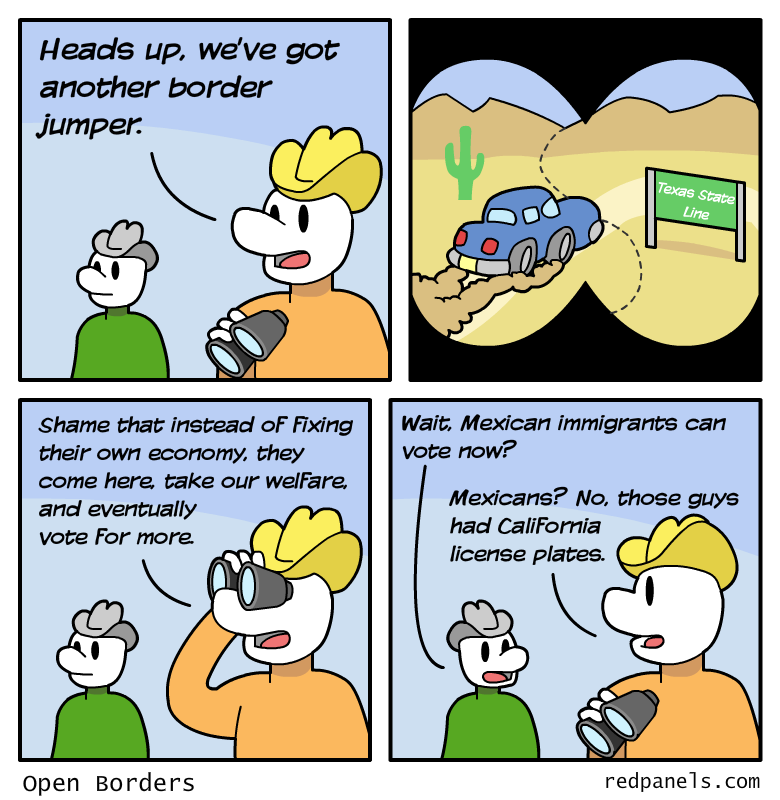
Here’s a meme that contemplates whether California emigrants bring bad voting habits with them.

Though that’s apparently more of a problem in Colorado rather than in Texas.

And here’s some clever humor from Genesius Times.

P.S. My favorite California-themed humor (not counting the state’s elected officials) can be found here, hereherehere, and here.

High-tax states are languishing but  zero-income-tax states such as Texas are growing rapidly!!!!

Much of my writing is focused on the real-world impact of government policy, and this is why I repeatedly look at the relative economic performance of big government jurisdictions and small government jurisdictions.

But I don’t just highlight differences between nations. Yes, it’s educational to look at North Korea vs. South Korea or Chile vs. Venezuela vs. Argentina, but I also think you can learn a lot by looking at what’s happening with different states in America.

So we’ve looked at high-tax states that are languishing, such as California and Illinois, and compared them to zero-income-tax states such as Texas.

With this in mind, you can understand that I was intrigued to see that even the establishment media is noticing that Texas is out-pacing the rest of the nation.

Here are some excerpts from a report by CNN Money on rapid population growth in Texas.

More Americans moved to Texas in recent years than any other state: A net gain of more than 387,000 in the latest Census for 2013. …Five Texas cities — Austin, Houston, San Antonio, Dallas and Fort Worth — were among the top 20 fastest growing large metro areas. Some smaller Texas metro areas grew even faster. In oil-rich Odessa, the population grew 3.3% and nearby Midland recorded a 3% gain.

But why is the population growing?

Well, CNN Money points out that low housing prices and jobs are big reasons.

And on the issue of housing, the article does acknowledge the role of “easy regulations” that enable new home construction.

But on the topic of jobs, the piece contains some good data on employment growth, but no mention of policy.

Jobs is the No. 1 reason for population moves, with affordable housing a close second. …Jobs are plentiful in Austin, where the unemployment rate is just 4.6%. Moody’s Analytics projects job growth to average 4% a year through 2015. Just as important, many jobs there are well paid: The median income of more than $75,000 is nearly 20% higher than the national median.

That’s it. Read the entire article if you don’t believe me, but the reporter was able to write a complete article about the booming economy in Texas without mentioning – not even once – that there’s no state income tax.

But that wasn’t the only omission.

The article doesn’t mention that Texas is the 4th-best state in the Tax Foundation’s ranking of state and local tax burdens.

The article doesn’t mention that Texas was the least oppressive state in the Texas Public Policy Foundation’s Soft Tyranny Index.

The article doesn’t mention that Texas was ranked #20 in a study of the overall fiscal condition of the 50 states.

The article doesn’t mention that Texas is in 4th place in a combined ranking of economic freedom in U.S. state and Canadian provinces.

The article doesn’t mention that Texas was ranked #11 in the Tax Foundation’s State Business Tax Climate Index.

The article doesn’t mention that Texas is in 14th place in the Mercatus ranking of overall freedom for the 50 states (and in 10th place for fiscal freedom).

By the way, I’m not trying to argue that Texas is the best state.

Indeed, it only got the top ranking in one of the measures cited above.

My point, instead, is simply to note that it takes willful blindness to write about the strong population growth and job performance of Texas without making at least a passing reference to the fact that it is a low-tax, pro-market state.

At least compared to other states. And especially compared to the high-tax states that are stagnating.

Such as California, as illustrated by this data and this data, as well as this Lisa Benson cartoon.

Such as Illinois, as illustrated by this data and this Eric Allie cartoon.

And I can’t resist adding this Steve Breen cartoon, if for no other reason that it reminds me of another one of his cartoons that I shared last year.

Speaking of humor, this Chuck Asay cartoon speculates on how future archaeologists will view California. And this joke about Texas, California, and a coyote is among my most-viewed blog posts.

All jokes aside, I want to reiterate what I wrote above. Texas is far from perfect. There’s too much government in the Lone Star state. It’s only a success story when compared to California.

P.S. Paul Krugman has tried to defend California, which has made him an easy target. I debunked him earlier this year, and I also linked to a superb Kevin Williamson takedown of Krugman at the bottom of this post.

P.P.S. Once again, I repeat the two-part challenge I’ve issued to the left. I’ll be happy if any statists can successfully respond to just one of the two questions I posed.

Related posts:

California is the Greece of the USA, but Texas is not perfect either!!!

California is the Greece of the USA, but Texas is not perfect either!!! Just Because California Is Terrible, that Doesn’t Mean Texas Is Perfect January 21, 2013 by Dan Mitchell Texas is in much better shape than California. Taxes are lower, in part because Texas has no state income tax. No wonder the Lone Star State […]

Dan Mitchell on Texas v. California (includes editorial cartoon)

We should lower federal taxes because jobs are going to states like Texas that have low taxes. (We should lower state taxes too!!) What Can We Learn by Comparing the Employment Situation in Texas vs. California? April 3, 2013 by Dan Mitchell One of the great things about federalism, above and beyond the fact that it […]

Ark Times blogger claims California is better than Texas but facts don’t bear that out (3 great political cartoons)

I got on the Arkansas Times Blog and noticed that a person on there was bragging about the high minimum wage law in San Francisco and how everything was going so well there. On 2-15-13 on the Arkansas Times Blog I posted: Couldn’t be better (the person using the username “Couldn’t be better)  is bragging […]

California burdensome government causing some of business community to leave for Texas

Does Government Have a Revenue or Spending Problem? People say the government has a debt problem. Debt is caused by deficits, which is the difference between what the government collects in tax revenue and the amount of government spending. Every time the government runs a deficit, the government debt increases. So what’s to blame: too […]

Arkansas Times blogger picks California business environment over Texas, proves liberals don’t live in real world(Part 2)

       Former California Governor Arnold Schwarzenegger with his family   I posted a portion of an article by John Fund of the Wall Street Journal that pointed out that many businesses are leaving California because of all of their government red tape and moving to Texas. My username is SalineRepublican and this is […]

John Fund’s talk in Little Rock 4-27-11(Part 4):Responding to liberals who criticize states like Texas that don’t have the red tape that California has

John Fund at Chamber Day, Part 1 Last week I got to attend the first ever “Conservative Lunch Series” presented by  KARN and Americans for Prosperity Foundation at the Little Rock Hilton on University Avenue. This monthly luncheon will be held the fourth Wednesday of every month. The speaker for today’s luncheon was John Fund. John […]

California and France have raised taxes so much that it has hurt economic growth!!!

___________ California and France have raised taxes so much that it has hurt economic growth!!! Mirror, Mirror, on the Wall, which Nation and State Punish Success Most of All? September 25, 2014 by Dan Mitchell I’ve shared some interested rankings on tax policy, including a map from the Tax Foundation showing which states have the earliest […]

Jerry Brown raised taxes in California and a rise in the minimum wage, but it won’t work like Krugman thinks!!!

___________   Jerry Brown raised taxes in California and a rise in the minimum wage, but it won’t work like Krugman thinks!!!! This cartoon below shows what will eventually happen to California and any other state that keeps raising taxes higher and higher.   Krugman’s “Gotcha” Moment Leaves Something to Be Desired July 25, 2014 by […]

Open letter to President Obama (Part 573) Are the states of Illinois and California going to join Detroit in Bankruptcy one day?

Open letter to President Obama (Part 573) (Emailed to White House on 7-29-13.) President Obama c/o The White House 1600 Pennsylvania Avenue NW Washington, DC 20500 Dear Mr. President, I know that you receive 20,000 letters a day and that you actually read 10 of them every day. I really do respect you for trying to get […]

Open letter to President Obama (Part 561) We should lower federal taxes because jobs are going to states like Texas that have low taxes

Open letter to President Obama (Part 561) (Emailed to White House on 6-25-13.) President Obama c/o The White House 1600 Pennsylvania Avenue NW Washington, DC 20500 Dear Mr. President, I know that you receive 20,000 letters a day and that you actually read 10 of them every day. I really do respect you for trying to get […]

Dan Mitchell article: The Case for Capitalism, Part VI

[

The Case for Capitalism, Part VI

I have shared five videos (Part I, Part II, Part III, Part IV, and Part V) that make the case for capitalism.

Here’s a sixth example.

The video notes that poverty was the natural condition for humanity (notwithstanding the economic illiteracy of Congresswoman Pressley).

But then, starting a couple of hundred years ago, capitalism gained a foothold and – for the first time in world history – there were nations with mass prosperity.

We learn about how various places became rich, including the United States, Hong Kong, and New Zealand.

The narrator also pointed out that Ireland experienced a period of dramatic market-driven growth.

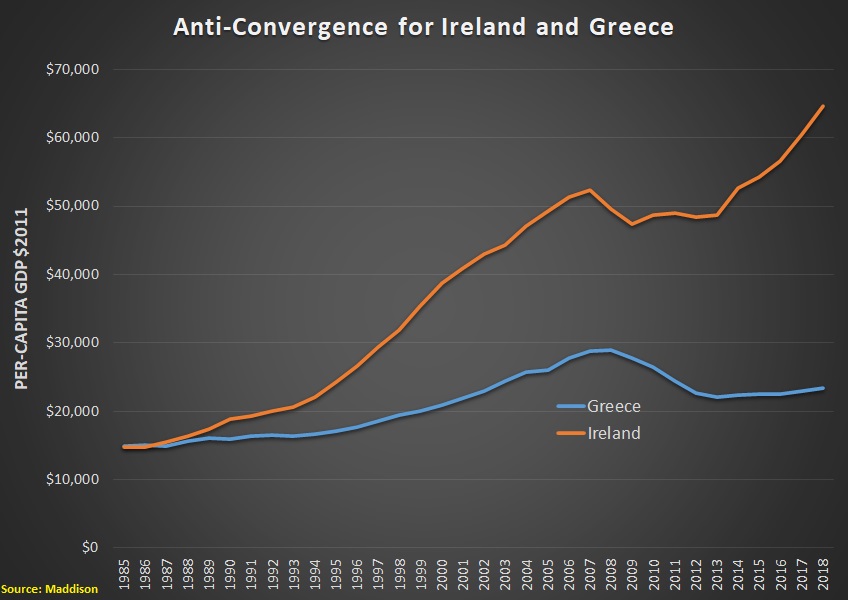
Which gives me a good excuse to make the following comparison, which shows the dramatic divergence between Ireland and Greece beginning in the mid-1980s.

Why the stunning divergence (one of many examples I’ve collected)?

Ireland controlled spending and cut tax rates and now routinely ranks among the nations with the most economic liberty.

Greece, by contrast, has imposed more and more government over time.

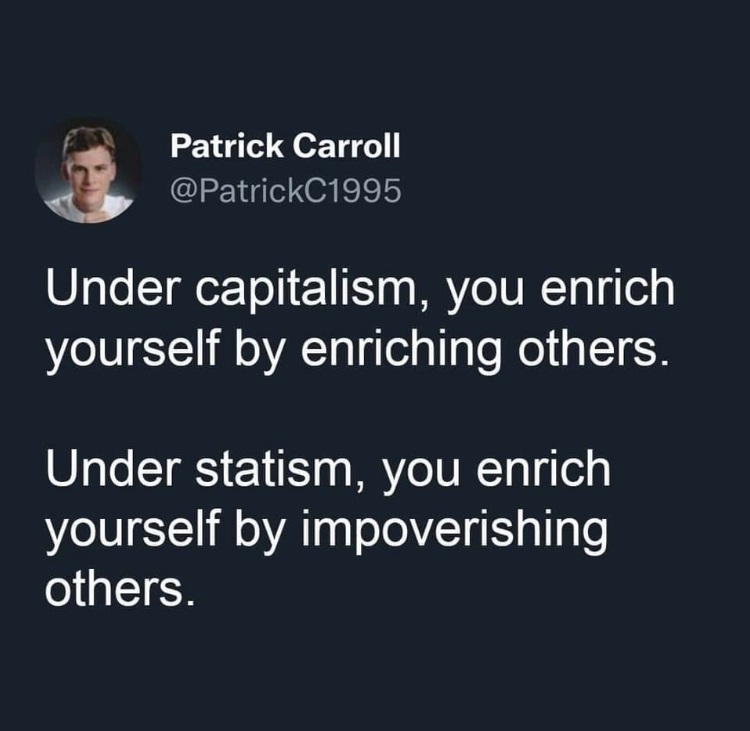
Let’s close with this tweet, which nicely summarizes Walter Williams’ famous observation.

P.S. This comparison of Sweden and Greece also makes the key point about the superiority of markets over statism.

P.P.S. Don Boudreaux and Deirdre McCloskey have must-watch videos on how capitalism enabled (some) nations to escape poverty.

The Best President in Recent History

Since I view Ronald Reagan as an honorary libertarian, I was very happy back in 2013 to see that he won a landslide victory over Barack Obama in a hypothetical poll.

This meant that voters either were old enough to personally experience the benefits of Reaganomics, or they managed to learn some history (in spite of a biased education establishment).

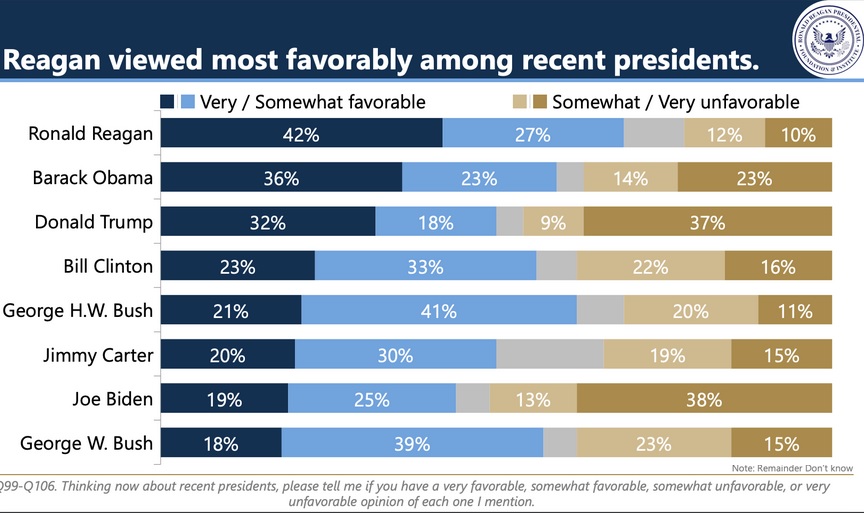
Well, now I have another reason to be happy. According to a new poll shared by Paul Bedard of the Washington Examiner, nearly 70 percent of respondents have a favorable impression of Reagan, easily the best result for all recent presidents.

Reagan also is disliked by the smallest percentage of respondents, a fact that almost surely irks some of my Reagan-hating friends.

And definitely irks Paul Krugman.

My two cents for today is that the current fight between Trumpism and establishment Republicanism is merely stylistic. If you crunch the numbers, you’ll see that both camps are big spenders.

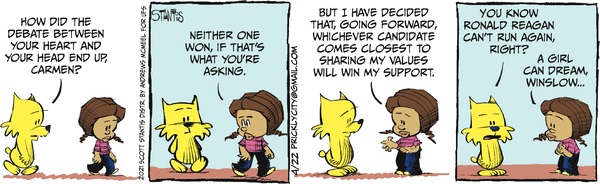
I much prefer Reaganism.

Let’s wrap up with this cartoon strip that captures my sentiments.

P.S. Here’s an amusing story from Reagan about socialism (h/t: Don Boudreaux).

Not quite as good as this video, and it’s not even good enough to get added to this collection of Reagan videos, but it is a good description of why socialism is a failure.

P.S. There was one other president in the 20th century who deserves praise and applause.

Tax Cartels Mean Ever-Higher Tax Rates

When President Biden proposed a “global minimum tax” for businesses, I immediately warned that would lead to ever-increasing tax rates.

Ross Kaminsky of KHOW and I discussed how this is already happening.

I hate being right, but it’s always safe to predict that politicians and bureaucrats will embrace policies that give more power to government.

Especially when they are very anxious to stifle tax competition.

For decades, people in government have been upset that the tax cuts implemented by Ronald Reagan and Margaret Thatchertriggered a four-decade trend of lower tax rates and pro-growth tax reform.

That’s the reason Biden and his Treasury Secretary proposed a 15 percent minimum tax rate for businesses.

And it’s the reason they now want the rate to be even higher.

Though even I’m surprised that they’re already pushing for that outcome when the original pact hasn’t even been approved or implemented.

Here are some passages from a report by Reuters.

Treasury Secretary Janet Yellen will press G20 counterparts this week for a global minimum corporate tax rate above the 15% floor agreed by 130 countries last week…the global minimum tax rate…is tied to the outcome of legislation to raise the U.S. minimum tax rate, a Treasury official said.The Biden administration has proposed doubling the U.S. minimum tax on corporations overseas intangible income to 21% along with a new companion “enforcement” tax that would deny deductions to companies for tax payments to countries that fail to adopt the new global minimum rate. The officials said several countries were pushing for a rate above 15%, along with the United States.

Other kleptocratic governments naturally want the same thing.

A G7 proposal for a global minimum tax rate of 15% is too low and a rate of at least 21% is needed, Argentina’s finance minister said on Monday, leading a push by some developing countries… “The 15% rate is way too low,” Argentine Finance Minister Martin Guzman told an online panel hosted by the Independent Commission for the Reform of International Corporate Taxation. …”The minimum rate being proposed would not do much to countries in Africa…,” Mathew Gbonjubola, Nigeria’s tax policy director, told the same conference.

Needless to say, I’m not surprised that Argentina is on the wrong side.

And supporters of class warfare also are agitating for a higher minimum rate. Here are some excerpts from a column in the New York Times by Gabriel Zucman and Gus Wezerek.

In the decades after World War II, close to 50 percent of American companies’ earnings went to state and federal taxes. …it was a golden period. …President Biden should be applauded for trying to end the race to the bottom on corporate tax rates. But even if Congress approves the 15 percent global minimum corporate tax, it won’t be enough. …the Biden administration to give working families a real leg up, it should push Congress to enact a 25 percent minimum tax, which would bring in about $200 billion in additional revenue each year. …With a 25 percent minimum corporate tax, the Biden administration would begin to reverse decades of growing inequality. And it would encourage other countries to do the same, replacing a race to the bottom with a sprint to the top.

I can’t resist making two observations about this ideological screed.

  1. Even the IMF and OECD agree that the so-called race to the bottom has not led to a decline in corporate tax revenues, even when measured as a share of economic output.
  2. Since companies legally avoid rather than illegally evade taxes, the headline of the column is utterly dishonest – but it’s what we’ve learned to expect from the New York Times.

The only good thing about the Zucman-Wezerek column is that it includes this chart showing how corporate tax rates have dramatically declined since 1980.

P.S. For those interested, the horizontal line at the bottom is for Bermuda, though other jurisdictions (such as Monaco and the Cayman Islands) also deserve credit for having no corporate income taxes.

P.P.S. If you want to know why high corporate tax rates are misguided, click here. And if you want to know why Biden’s plan to raise the U.S. corporate tax rate is misguided, click here. Or here. Or here.

P.P.P.S. And if you want more information about why Biden’s global tax cartel is bad, click here, here, and here.

I enjoyed this article below because it demonstrates that the Laffer Curve has been working for almost 100 years now when it is put to the test in the USA. I actually got to hear Arthur Laffer speak in person in 1981 and he told us in advance what was going to happen the 1980’s and it all came about as he said it would when Ronald Reagan’s tax cuts took place. I wish we would lower taxes now instead of looking for more revenue through raised taxes. We have to grow the economy:

What Mitt Romney Said Last Night About Tax Cuts And The Deficit Was Absolutely Right. And What Obama Said Was Absolutely Wrong.

Mitt Romney repeatedly said last night that he would not allow tax cuts to add to the deficit.  He repeatedly said it because over and over again Obama blathered the liberal talking point that cutting taxes necessarily increased deficits.

Romney’s exact words: “I want to underline that — no tax cut that adds to the deficit.”

Meanwhile, Obama has promised to cut the deficit in half during his first four years – but instead gave America the highest deficits in the history of the entire human race.

I’ve written about this before.  Let’s replay what has happened every single time we’ve ever cut the income tax rate.

The fact of the matter is that we can go back to Calvin Coolidge who said very nearly THE EXACT SAME THING to his treasury secretary: he too would not allow any tax cuts that added to the debt.  Andrew Mellon – quite possibly the most brilliant economic mind of his day – did a great deal of research and determined what he believed was the best tax rate.  And the Coolidge administration DID cut income taxes and MASSIVELY increased revenues.  Coolidge and Mellon cut the income tax rate 67.12 percent (from 73 to 24 percent); and revenues not only did not go down, but they went UP by at least 42.86 percent (from $700 billion to over $1 billion).

That’s something called a documented fact.  But that wasn’t all that happened: another incredible thing was that the taxes and percentage of taxes paid actually went UP for the rich.  Because as they were allowed to keep more of the profits that they earned by investing in successful business, they significantly increased their investments and therefore paid more in taxes than they otherwise would have had they continued sheltering their money to protect themselves from the higher tax rates.  Liberals ignore reality, but it is simply true.  It is a fact.  It happened.

Then FDR came along and raised the tax rates again and the opposite happened: we collected less and less revenue while the burden of taxation fell increasingly on the poor and middle class again.  Which is exactly what Obama wants to do.

People don’t realize that John F. Kennedy, one of the greatest Democrat presidents, was a TAX CUTTER who believed the conservative economic philosophy that cutting tax rates would in fact increase tax revenues.  He too cut taxes, and he too increased tax revenues.

So we get to Ronald Reagan, who famously cut taxes.  And again, we find that Reagan cut that godawful liberal tax rate during an incredibly godawful liberal-caused economic recession, and he increased tax revenue by 20.71 percent (with revenues increasing from $956 billion to $1.154 trillion).  And again, the taxes were paid primarily by the rich:

“The share of the income tax burden borne by the top 10 percent of taxpayers increased from 48.0 percent in 1981 to 57.2 percent in 1988. Meanwhile, the share of income taxes paid by the bottom 50 percent of taxpayers dropped from 7.5 percent in 1981 to 5.7 percent in 1988.”

So we get to George Bush and the Bush tax cuts that liberals and in particular Obama have just demonized up one side and demagogued down the other.  And I can simply quote the New York Times AT the time:

Sharp Rise in Tax Revenue to Pare U.S. Deficit By EDMUND L. ANDREWS Published: July 13, 2005

WASHINGTON, July 12 – For the first time since President Bush took office, an unexpected leap in tax revenue is about to shrink the federal budget deficit this year, by nearly $100 billion.

A Jump in Corporate Payments On Wednesday, White House officials plan to announce that the deficit for the 2005 fiscal year, which ends in September, will be far smaller than the $427 billion they estimated in February.

Mr. Bush plans to hail the improvement at a cabinet meeting and to cite it as validation of his argument that tax cuts would stimulate the economy and ultimately help pay for themselves.

Based on revenue and spending data through June, the budget deficit for the first nine months of the fiscal year was $251 billion, $76 billion lower than the $327 billion gap recorded at the corresponding point a year earlier.

The Congressional Budget Office estimated last week that the deficit for the full fiscal year, which reached $412 billion in 2004, could be “significantly less than $350 billion, perhaps below $325 billion.”

The big surprise has been in tax revenue, which is running nearly 15 percent higher than in 2004. Corporate tax revenue has soared about 40 percent, after languishing for four years, and individual tax revenue is up as well
.

And of course the New York Times, as reliable liberals, use the adjective whenever something good happens under conservative policies and whenever something bad happens under liberal policies: ”unexpected.”   But it WASN’T ”unexpected.”  It was EXACTLY what Republicans had said would happen and in fact it was exactly what HAD IN FACT HAPPENED every single time we’ve EVER cut income tax rates.

The truth is that conservative tax policy has a perfect track record: every single time it has ever been tried, we have INCREASED tax revenues while not only exploding economic activity and creating more jobs, but encouraging the wealthy to pay more in taxes as well.  And liberals simply dishonestly refuse to acknowledge documented history.

Meanwhile, liberals also have a perfect record … of FAILUREThey keep raising taxes and keep not understanding why they don’t get the revenues they predicted.

The following is a section from my article, “Tax Cuts INCREASE Revenues; They Have ALWAYS Increased Revenues“, where I document every single thing I said above:

The Falsehood That Tax Cuts Increase The Deficit

Now let’s take a look at the utterly fallacious view that tax cuts in general create higher deficits.

Let’s take a trip back in time, starting with the 1920s.  From Burton Folsom’s book, New Deal or Raw Deal?:

In 1921, President Harding asked the sixty-five-year-old [Andrew] Mellon to be secretary of the treasury; the national debt [resulting from WWI] had surpassed $20 billion and unemployment had reached 11.7 percent, one of the highest rates in U.S. history.  Harding invited Mellon to tinker with tax rates to encourage investment without incurring more debt. Mellon studied the problem carefully; his solution was what is today called “supply side economics,” the idea of cutting taxes to stimulate investment.  High income tax rates, Mellon argued, “inevitably put pressure upon the taxpayer to withdraw this capital from productive business and invest it in tax-exempt securities. . . . The result is that the sources of taxation are drying up, wealth is failing to carry its share of the tax burden; and capital is being diverted into channels which yield neither revenue to the Government nor profit to the people” (page 128).

Mellon wrote, “It seems difficult for some to understand that high rates of taxation do not necessarily mean large revenue to the Government, and that more revenue may often be obtained by lower taxes.”  And he compared the government setting tax rates on incomes to a businessman setting prices on products: “If a price is fixed too high, sales drop off and with them profits.”

And what happened?

“As secretary of the treasury, Mellon promoted, and Harding and Coolidge backed, a plan that eventually cut taxes on large incomes from 73 to 24 percent and on smaller incomes from 4 to 1/2 of 1 percent.  These tax cuts helped produce an outpouring of economic development – from air conditioning to refrigerators to zippers, Scotch tape to radios and talking movies.  Investors took more risks when they were allowed to keep more of their gains.  President Coolidge, during his six years in office, averaged only 3.3 percent unemployment and 1 percent inflation – the lowest misery index of any president in the twentieth century.

Furthermore, Mellon was also vindicated in his astonishing predictions that cutting taxes across the board would generate more revenue.  In the early 1920s, when the highest tax rate was 73 percent, the total income tax revenue to the U.S. government was a little over $700 million.  In 1928 and 1929, when the top tax rate was slashed to 25 and 24 percent, the total revenue topped the $1 billion mark.  Also remarkable, as Table 3 indicates, is that the burden of paying these taxes fell increasingly upon the wealthy” (page 129-130).

Now, that is incredible upon its face, but it becomes even more incredible when contrasted with FDR’s antibusiness and confiscatory tax policies, which both dramatically shrunk in terms of actual income tax revenues (from $1.096 billion in 1929 to $527 million in 1935), and dramatically shifted the tax burden to the backs of the poor by imposing huge new excise taxes (from $540 million in 1929 to $1.364 billion in 1935).  See Table 1 on page 125 of New Deal or Raw Deal for that information.

FDR both collected far less taxes from the rich, while imposing a far more onerous tax burden upon the poor.

It is simply a matter of empirical fact that tax cuts create increased revenue, and that those [Democrats] who have refused to pay attention to that fact have ended up reducing government revenues even as they increased the burdens on the poorest whom they falsely claim to help.

Let’s move on to John F. Kennedy, one of the most popular Democrat presidents ever.  Few realize that he was also a supply-side tax cutter.

Kennedy said:

“It is a paradoxical truth that tax rates are too high and tax revenues are too low and the soundest way to raise the revenues in the long run is to cut the rates now … Cutting taxes now is not to incur a budget deficit, but to achieve the more prosperous, expanding economy which can bring a budget surplus.”

– John F. Kennedy, Nov. 20, 1962, president’s news conference


“Lower rates of taxation will stimulate economic activity and so raise the levels of personal and corporate income as to yield within a few years an increased – not a reduced – flow of revenues to the federal government.”

– John F. Kennedy, Jan. 17, 1963, annual budget message to the Congress, fiscal year 1964

“In today’s economy, fiscal prudence and responsibility call for tax reduction even if it temporarily enlarges the federal deficit – why reducing taxes is the best way open to us to increase revenues.”

– John F. Kennedy, Jan. 21, 1963, annual message to the Congress: “The Economic Report Of The President”


“It is no contradiction – the most important single thing we can do to stimulate investment in today’s economy is to raise consumption by major reduction of individual income tax rates.”

– John F. Kennedy, Jan. 21, 1963, annual message to the Congress: “The Economic Report Of The President”


“Our tax system still siphons out of the private economy too large a share of personal and business purchasing power and reduces the incentive for risk, investment and effort – thereby aborting our recoveries and stifling our national growth rate.”

– John F. Kennedy, Jan. 24, 1963, message to Congress on tax reduction and reform, House Doc. 43, 88th Congress, 1st Session.


“A tax cut means higher family income and higher business profits and a balanced federal budget. Every taxpayer and his family will have more money left over after taxes for a new car, a new home, new conveniences, education and investment. Every businessman can keep a higher percentage of his profits in his cash register or put it to work expanding or improving his business, and as the national income grows, the federal government will ultimately end up with more revenues.”

– John F. Kennedy, Sept. 18, 1963, radio and television address to the nation on tax-reduction bill

Which is to say that modern Democrats are essentially calling one of their greatest presidents a liar when they demonize tax cuts as a means of increasing government revenues.

So let’s move on to Ronald Reagan.  Reagan had two major tax cutting policies implemented: the Economic Recovery Tax Act (ERTA) of 1981, which was retroactive to 1981, and the Tax Reform Act of 1986.

Did Reagan’s tax cuts decrease federal revenues?  Hardly:

We find that 8 of the following 10 years there was a surplus of revenue from 1980, prior to the Reagan tax cuts.  And, following the Tax Reform Act of 1986, there was a MASSIVE INCREASEof revenue.

So Reagan’s tax cuts increased revenue.  But who paid the increased tax revenue?  The poor?  Opponents of the Reagan tax cuts argued that his policy was a giveaway to the rich (ever heard that one before?) because their tax payments would fall.  But that was exactly wrong.  In reality:

“The share of the income tax burden borne by the top 10 percent of taxpayers increased from 48.0 percent in 1981 to 57.2 percent in 1988. Meanwhile, the share of income taxes paid by the bottom 50 percent of taxpayers dropped from 7.5 percent in 1981 to 5.7 percent in 1988.”

So Ronald Reagan a) collected more total revenue, b) collected more revenue from the rich, while c) reducing revenue collected by the bottom half of taxpayers, and d) generated an economic powerhouse that lasted – with only minor hiccups – for nearly three decades.  Pretty good achievement considering that his predecessor was forced to describe his own economy as a “malaise,” suffering due to a “crisis of confidence.” Pretty good considering that President Jimmy Carter responded to a reporter’s question as to what he would do about the problem of inflation by answering, “It would be misleading for me to tell any of you that there is a solution to it.”

Reagan whipped inflation.  Just as he whipped that malaise and that crisis of confidence.

________

The Laffer Curve, Part III: Dynamic Scoring
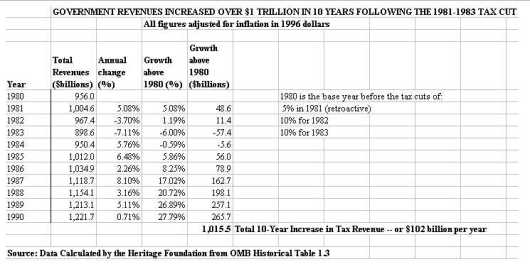
Longstanding Anti‐​Price Gouging Statutes Worsen Shortages 

By Ryan Bourne and Brad Subramaniam

Anti‐​price gouging laws prolonged shortages of certain goods that were in high demand early in the pandemic. Some analysis suggests these laws even worsened public health outcomes, because ongoing shortages of, say, hand sanitizer and toilet paper, led to consumers in states with these regulations searching for them more at physical retailers, actually increasing transmission of the virus.

But there’s an interesting question that’s often underexplored in regard to these laws: how does the expectation that these price controls will be triggered shape people’s beliefs about products’ availability and so customer search behavior?

That’s the topic of another fascinating new paper by economists Rik Chakraborti and Gavin Roberts. Using data for online searches for hand sanitizer and toilet paper across states, they harness the variation in when laws were introduced to research the question: is consumer search behaviour different in states with new anti‐​price gouging legislation introduced during the pandemic from states with pre‐​existing anti‐​price gouging laws?

Economic theory would suggest that any anti‐​price gouging legislation, whenever introduced, would lead to more consumer search for goods, due to the induced shortages. And, sure enough, after controlling for the effects of lockdowns, rising infections, and declines in travel which plagued the early stages of the pandemic, consumers in states with anti‐​price gouging laws were significantly more likely to search online for toilet paper and hand sanitizer than those in states without such laws.

More searching presumably reflects higher levels of hoarding and panic‐​buying creating the shortages—after all, having to resort to online shopping for goods that are commonly bought in stores means the local grocery or drug store has probably been emptied already.

But theory would also suggest that customers in states with past experience of anti‐​price gouging laws might search even more intensely, because people come to expect shortages again when crises hit. In other words, those who have experienced shortages before might be more likely to hoard and panic buy this time around, leading to even higher online search than in situations where new laws are introduced for the first time.

Again, Chakraborti and Roberts’ paper suggests economic theory is correct. States with anti‐​price gouging regulations on the books before the pandemic saw Google Shopping searches for hand sanitizer jump by 153 percent and toilet paper searches nearly double (a 99 percent increase) relative to states without anti‐​price gouging laws. This uplift was much larger than in states where the laws were introduced during the pandemic (100 percent and 46 percent, respectively).

The long and short is that consumers in states with pre‐​existing price controls searched most intensely online for hand sanitizer and toilet paper. This suggests customers learned from previous experience of these price regulations’ effects, with the higher search levels reflecting greater hoarding and panic buying in anticipation of shortages to come. As the authors state, this implies that longstanding anti‐​price gouging legislation is even worse for economic welfare than we might think. The anticipation of shortages actually compounds shortages as consumers become more “experienced,” with excessive and fruitless searching for products the wasteful result.

For more on the basics of anti‐​price gouging legislation in the pandemic, see my book Economics In One Virus. Other Cato pieces can be found here, here, and here.


Government, Markets, and the Supply Chain

Way back in 2009, I shared a meme that succinctly summarizes how Washington operates.

It’s basically a version of Mitchell’s Law. To elaborate, governments cause problems and politicians then use those problems as an excuse to make government even bigger.

Lather, rinse, repeat.

I worry the same thing may be about to happen because of the current concern about “supply chain” issues, perhaps best illustrated by the backlog of ships at key ports, leading to shortages of key goods.

Some of this mess is fallout from the coronavirus pandemic, but it’s being exacerbated by bad policy.

In a column for Reason, J.D. Tuccille points out that government is the problem, not the solution.

…supply-chain issues…create shortages and push prices up around the world. …Lockdowns also changed people’s lives, closing offices and factories and confining people at home. That resulted in massive and unpredictable shifts in demand and unreliable supply. …”Market economies tend to be pretty good at getting food on the supermarket shelves and fuel in petrol stations, if left to themselves,” agrees Pilkington. “That last part is key: if left to themselves. Heavy-handed interference in market economies tends to produce the same pathologies we see in socialist economies, including shortages and inflation. That has been the unintended consequence of lockdown.” …The danger is that people see economic problems caused by earlier fiddling and then demand even more government intervention. …if the government were to further meddle in the market to allocate products made scarce by earlier actions, it’s hard to see how the result wouldn’t be anything other than increased supply chain chaos.

Allysia Finley opines for the Wall Street Journal about California’s role in the supply-chain mess.

The backup of container ships at the Long Beach and Los Angeles ports has grown in recent weeks… The two Southern California ports handle only about 40% of containers entering the U.S., mostly from Asia. Yet ports in other states seem to be handling the surge better. Gov. Ron DeSantis said last month that Florida’s seaports had open capacity.So what’s the matter with California? State labor and environmental policies. …business groups recently asked Gov. Gavin Newsom to declare a state of emergency and suspend labor and environmental laws that are interfering with the movement of goods. …One barrier is a law known as AB5. …Trucking companies warned that the law could put small carriers out of business and cause drivers to leave the state. …there’s little doubt the law hinders efficiency and productivity. …State officials have also pressed localities to attach green mandates to permits for new warehouses, which can be poison pills. …This boatload of regulations is making it more expensive and difficult to store goods arriving at California ports.

Needless to say, I’m not surprised California is making things worse.

The state seems to have some of the nation’s worst politicians.

But let’s set that aside and close with some discussion about one of the differences between government and the private sector.

This may surprise some readers, but people and businesses in the private sector make mistakes all the time.

So part of the supply-chain mess presumably is a result of companies and entrepreneurs making bad guesses.

That being said, there’s a big feedback mechanism in the private sector. It’s called profit and loss.

So when mistakes are made, there’s a big incentive to quickly change.

With government, by contrast, there’s very little flexibility (as we saw during the pandemic). And when politicians and bureaucrats do act, they often respond to political incentives that lead them to make things worse.


Big-Government Republicans Enable Big-Government Democrats

I get asked why I frequently criticize Republicans.

My response is easy. I care about results rather than rhetoric. And while GOP politicians often pay lip service to the principles of limited government,they usually increase spending even faster than Democrats.

Indeed, Republicans are even worse than Democrats when measuring the growth of domestic spending!

This is bad news because it means the burden of government expands when Republicans are in charge.

And, as Gary Abernathy points out in a column for the Washington Post, Republicans then don’t have the moral authority to complain when Democrats engage in spending binges.

President Biden is proposing another $3 trillion in spending… There are objections, but none that can be taken seriously. …Republicans had lost their standing as the party of fiscal responsibility when most of them succumbed to the political virus of covid fever and rubber-stamped around $4 trillion in “covid relief,”… With Trump out and Biden in, Republicans suddenly pretended that their 2020 spending spree happened in some alternate universe.But the GOP’s united opposition to Biden’s $1.9 trillion package won’t wash off the stench of the hypocrisy. …I noted a year ago that we had crossed the Rubicon, that our longtime flirtation with socialism had become a permanent relationship. Congratulations, Bernie Sanders. The GOP won’t become irrelevant because of its association with Trump, as some predict. It will diminish because it is bizarrely opposing now that which it helped make palatable just last year. Fiscal responsibility is dead, and Republicans helped bury it. Put the shovels away, there’s no digging it up now.

For what it’s worth, I hope genuine fiscal responsibility isn’t dead.

Maybe it’s been hibernating ever since Reagan left office (like Pepperidge Farm, I’m old enough to remember those wonderful years).

Subsequent Republican presidents liked to copy Reagan’s rhetoric, but they definitely didn’t copy his policies.

  • Spending restraint was hibernating during the presidency of George H.W. Bush.
  • Spending restraint also was hibernating during the presidency of George W. Bush.
  • And spending restraint was hibernating during the presidency of Donald Trump.

I’m not the only one to notice GOP hypocrisy.

Here are some excerpts from a 2019 column in the Washington Post by Fareed Zakaria.

In what Republicans used to call the core of their agenda — limited government — Trump has been profoundly unconservative. …Trump has now added more than $88 billion in taxes in the form of tariffs, according to the right-leaning Tax Foundation. (Despite what the president says, tariffs are taxes on foreign goods paid by U.S. consumers.) This has had the effect of reducing gross domestic product and denting the wages of Americans.…For decades, conservatives including Margaret Thatcher and Ronald Reagan preached to the world the virtues of free trade. But perhaps even more, they believed in the idea that governments should not pick winners and losers in the economy… Yet the Trump administration…behaved like a Central Planning Agency, granting exemptions on tariffs to favored companies and industries, while refusing them to others. …In true Soviet style, lobbyists, lawyers and corporate executives now line up to petition government officials for these treasured waivers, which are granted in an opaque process… On the core issue that used to define the GOP — economics — the party’s agenda today is state planning and crony capitalism.

Zakaria is right about Republicans going along with most of Trump’s bad policies (as illustrated by this cartoon strip).*

The bottom line is that Republicans would be much more effective arguing against Biden’s spending orgy had they also argued for spending restraint when Trump was in the White House.

P.S. It will be interesting to see what happens in the near future. Will the GOP be a small-government Reagan party or a big-government Trump party?

Or maybe it will go back to being a Nixon-type party, which would mean bigger government but without mean tweets. And there are plenty of options.

If they make the wrong choice (anything other than Reaganism), Margaret Thatcher has already warned us about the consequences.

*To be fair, Republicans also went along with Trump’s good policies. It’s just unfortunate that spending restraint wasn’t one of them.

—-

March 31, 2021

President Biden  c/o The White House
1600 Pennsylvania Avenue NW
Washington, DC 20500

Dear Mr. President,

Please explain to me if you ever do plan to balance the budget while you are President? I have written these things below about you and I really do think that you don’t want to cut spending in order to balance the budget. It seems you ever are daring the Congress to stop you from spending more.

President Barack Obama speaks about the debt limit in the East Room of the White House in Washington. | AP Photo


“The credit of the United States ‘is not a bargaining chip,’ Obama said on 1-14-13. However, President Obama keeps getting our country’s credit rating downgraded as he raises the debt ceiling higher and higher!!!!

Washington Could Learn a Lot from a Drug Addict

Just spend more, don’t know how to cut!!! Really!!! That is not living in the real world is it?

Making more dependent on government is not the way to go!!

Why is our government in over 16 trillion dollars in debt? There are many reasons for this but the biggest reason is people say “Let’s spend someone else’s money to solve our problems.” Liberals like Max Brantley have talked this way for years. Brantley will say that conservatives are being harsh when they don’t want the government out encouraging people to be dependent on the government. The Obama adminstration has even promoted a plan for young people to follow like Julia the Moocher.  

David Ramsey demonstrates in his Arkansas Times Blog post of 1-14-13 that very point:

Arkansas Politics / Health Care Arkansas’s share of Medicaid expansion and the national debt

Posted by on Mon, Jan 14, 2013 at 1:02 PM

Baby carrot Arkansas Medicaid expansion image


Imagine standing a baby carrot up next to the 25-story Stephens building in Little Rock. That gives you a picture of the impact on the national debt that federal spending in Arkansas on Medicaid expansion would have, while here at home expansion would give coverage to more than 200,000 of our neediest citizens, create jobs, and save money for the state.

Here’s the thing: while more than a billion dollars a year in federal spending would represent a big-time stimulus for Arkansas, it’s not even a drop in the bucket when it comes to the national debt.

Currently, the national debt is around $16.4 trillion. In fiscal year 2015, the federal government would spend somewhere in the neighborhood of $1.2 billion to fund Medicaid expansion in Arkansas if we say yes. That’s about 1/13,700th of the debt.

It’s hard to get a handle on numbers that big, so to put that in perspective, let’s get back to the baby carrot. Imagine that the height of the Stephens building (365 feet) is the $16 trillion national debt. That $1.2 billion would be the length of a ladybug. Of course, we’re not just talking about one year if we expand. Between now and 2021, the federal government projects to contribute around $10 billion. The federal debt is projected to be around $25 trillion by then, so we’re talking about 1/2,500th of the debt. Compared to the Stephens building? That’s a baby carrot.

______________

Here is how it will all end if everyone feels they should be allowed to have their “baby carrot.”

How sad it is that liberals just don’t get this reality.

Here is what the Founding Fathers had to say about welfare. David Weinberger noted:

While living in Europe in the 1760s, Franklin observed: “in different countries … the more public provisions were made for the poor, the less they provided for themselves, and of course became poorer. And, on the contrary, the less was done for them, the more they did for themselves, and became richer.”

Alexander Fraser Tytler, Lord Woodhouselee (15 October 1747 – 5 January 1813) was a Scottish lawyer, writer, and professor. Tytler was also a historian, and he noted, “A democracy cannot exist as a permanent form of government. It can only exist until the majority discovers it can vote itself largess out of the public treasury. After that, the majority always votes for the candidate promising the most benefits with the result the democracy collapses because of the loose fiscal policy ensuing, always to be followed by a dictatorship, then a monarchy.”

Thomas Jefferson to Joseph Milligan

April 6, 1816

[Jefferson affirms that the main purpose of society is to enable human beings to keep the fruits of their labor. — TGW]

To take from one, because it is thought that his own industry and that of his fathers has acquired too much, in order to spare to others, who, or whose fathers have not exercised equal industry and skill, is to violate arbitrarily the first principle of association, “the guarantee to every one of a free exercise of his industry, and the fruits acquired by it.” If the overgrown wealth of an individual be deemed dangerous to the State, the best corrective is the law of equal inheritance to all in equal degree; and the better, as this enforces a law of nature, while extra taxation violates it.

[From Writings of Thomas Jefferson, ed. Albert E. Bergh (Washington: Thomas Jefferson Memorial Association, 1904), 14:466.]

_______

Jefferson pointed out that to take from the rich and give to the poor through government is just wrong. Franklin knew the poor would have a better path upward without government welfare coming their way. Milton Friedman’s negative income tax is the best method for doing that and by taking away all welfare programs and letting them go to the churches for charity.

_____________

_________

Thank you so much for your time. I know how valuable it is. I also appreciate the fine family that you have and your commitment as a father and a husband.

Sincerely,

Everette Hatcher III, 13900 Cottontail Lane, Alexander, AR 72002, ph 501-920-5733

Williams with Sowell – Minimum Wage

Thomas Sowell

Thomas Sowell – Reducing Black Unemployment

By WALTER WILLIAMS

—-

Ronald Reagan with Milton Friedman
Milton Friedman The Power of the Market 2-5

Related posts:

Welfare Spending Shattering All-Time Highs

  We got to act fast and get off this path of socialism. Morning Bell: Welfare Spending Shattering All-Time Highs Robert Rector and Amy Payne October 18, 2012 at 9:03 am It’s been a pretty big year for welfare—and a new report shows welfare is bigger than ever. The Obama Administration turned a giant spotlight […]

We need more brave souls that will vote against Washington welfare programs

We need to cut Food Stamp program and not extend it. However, it seems that people tell the taxpayers back home they are going to Washington and cut government spending but once they get up there they just fall in line with  everyone else that keeps spending our money. I am glad that at least […]

Welfare programs are not the answer for the poor

Government Must Cut Spending Uploaded by HeritageFoundation on Dec 2, 2010 The government can cut roughly $343 billion from the federal budget and they can do so immediately. __________ Liberals argue that the poor need more welfare programs, but I have always argued that these programs enslave the poor to the government. Food Stamps Growth […]

Private charities are best solution and not government welfare

Milton Friedman – The Negative Income Tax Published on May 11, 2012 by LibertyPen In this 1968 interview, Milton Friedman explained the negative income tax, a proposal that at minimum would save taxpayers the 72 percent of our current welfare budget spent on administration. http://www.LibertyPen.com Source: Firing Line with William F Buckley Jr. ________________ Milton […]

The book “After the Welfare State”

Dan Mitchell Commenting on Obama’s Failure to Propose a Fiscal Plan Published on Aug 16, 2012 by danmitchellcato No description available. ___________ After the Welfare State Posted by David Boaz Cato senior fellow Tom G. Palmer, who is lecturing about freedom in Slovenia and Tbilisi this week, asked me to post this announcement of his […]

President Obama responds to Heritage Foundation critics on welfare reform waivers

Is President Obama gutting the welfare reform that Bill Clinton signed into law? Morning Bell: Obama Denies Gutting Welfare Reform Amy Payne August 8, 2012 at 9:15 am The Obama Administration came out swinging against its critics on welfare reform yesterday, with Press Secretary Jay Carney saying the charge that the Administration gutted the successful […]

Welfare reform part 3

Thomas Sowell – Welfare Welfare reform was working so good. Why did we have to abandon it? Look at this article from 2003. The Continuing Good News About Welfare Reform By Robert Rector and Patrick Fagan, Ph.D. February 6, 2003 Six years ago, President Bill Clinton signed legislation overhauling part of the nation’s welfare system. […]

Welfare reform part 2

Uploaded by ForaTv on May 29, 2009 Complete video at: http://fora.tv/2009/05/18/James_Bartholomew_The_Welfare_State_Were_In Author James Bartholomew argues that welfare benefits actually increase government handouts by ‘ruining’ ambition. He compares welfare to a humane mousetrap. —– Welfare reform was working so good. Why did we have to abandon it? Look at this article from 2003. In the controversial […]

Why did Obama stop the Welfare Reform that Clinton put in?

Thomas Sowell If the welfare reform law was successful then why change it? Wasn’t Bill Clinton the president that signed into law? Obama Guts Welfare Reform Robert Rector and Kiki Bradley July 12, 2012 at 4:10 pm Today, the Obama Department of Health and Human Services (HHS) released an official policy directive rewriting the welfare […]

“Feedback Friday” Letter to White House generated form letter response July 10,2012 on welfare, etc (part 14)

I have been writing President Obama letters and have not received a personal response yet.  (He reads 10 letters a day personally and responds to each of them.) However, I did receive a form letter in the form of an email on July 10, 2012. I don’t know which letter of mine generated this response so I have […]

Dan Mitchell “According to a new poll shared by Paul Bedard of the Washington Examiner, nearly 70 percent of respondents have a favorable impression of Reagan, easily the best result for all recent presidents!”

[

The Best President in Recent History

Since I view Ronald Reagan as an honorary libertarian, I was very happy back in 2013 to see that he won a landslide victory over Barack Obama in a hypothetical poll.

This meant that voters either were old enough to personally experience the benefits of Reaganomics, or they managed to learn some history (in spite of a biased education establishment).

Well, now I have another reason to be happy. According to a new poll shared by Paul Bedard of the Washington Examiner, nearly 70 percent of respondents have a favorable impression of Reagan, easily the best result for all recent presidents.

Reagan also is disliked by the smallest percentage of respondents, a fact that almost surely irks some of my Reagan-hating friends.

And definitely irks Paul Krugman.

My two cents for today is that the current fight between Trumpism and establishment Republicanism is merely stylistic. If you crunch the numbers, you’ll see that both camps are big spenders.

I much prefer Reaganism.

Let’s wrap up with this cartoon strip that captures my sentiments.

P.S. Here’s an amusing story from Reagan about socialism (h/t: Don Boudreaux).

Not quite as good as this video, and it’s not even good enough to get added to this collection of Reagan videos, but it is a good description of why socialism is a failure.

P.S. There was one other president in the 20th century who deserves praise and applause.

Tax Cartels Mean Ever-Higher Tax Rates

When President Biden proposed a “global minimum tax” for businesses, I immediately warned that would lead to ever-increasing tax rates.

Ross Kaminsky of KHOW and I discussed how this is already happening.

I hate being right, but it’s always safe to predict that politicians and bureaucrats will embrace policies that give more power to government.

Especially when they are very anxious to stifle tax competition.

For decades, people in government have been upset that the tax cuts implemented by Ronald Reagan and Margaret Thatchertriggered a four-decade trend of lower tax rates and pro-growth tax reform.

That’s the reason Biden and his Treasury Secretary proposed a 15 percent minimum tax rate for businesses.

And it’s the reason they now want the rate to be even higher.

Though even I’m surprised that they’re already pushing for that outcome when the original pact hasn’t even been approved or implemented.

Here are some passages from a report by Reuters.

Treasury Secretary Janet Yellen will press G20 counterparts this week for a global minimum corporate tax rate above the 15% floor agreed by 130 countries last week…the global minimum tax rate…is tied to the outcome of legislation to raise the U.S. minimum tax rate, a Treasury official said.The Biden administration has proposed doubling the U.S. minimum tax on corporations overseas intangible income to 21% along with a new companion “enforcement” tax that would deny deductions to companies for tax payments to countries that fail to adopt the new global minimum rate. The officials said several countries were pushing for a rate above 15%, along with the United States.

Other kleptocratic governments naturally want the same thing.

A G7 proposal for a global minimum tax rate of 15% is too low and a rate of at least 21% is needed, Argentina’s finance minister said on Monday, leading a push by some developing countries… “The 15% rate is way too low,” Argentine Finance Minister Martin Guzman told an online panel hosted by the Independent Commission for the Reform of International Corporate Taxation. …”The minimum rate being proposed would not do much to countries in Africa…,” Mathew Gbonjubola, Nigeria’s tax policy director, told the same conference.

Needless to say, I’m not surprised that Argentina is on the wrong side.

And supporters of class warfare also are agitating for a higher minimum rate. Here are some excerpts from a column in the New York Times by Gabriel Zucman and Gus Wezerek.

In the decades after World War II, close to 50 percent of American companies’ earnings went to state and federal taxes. …it was a golden period. …President Biden should be applauded for trying to end the race to the bottom on corporate tax rates. But even if Congress approves the 15 percent global minimum corporate tax, it won’t be enough. …the Biden administration to give working families a real leg up, it should push Congress to enact a 25 percent minimum tax, which would bring in about $200 billion in additional revenue each year. …With a 25 percent minimum corporate tax, the Biden administration would begin to reverse decades of growing inequality. And it would encourage other countries to do the same, replacing a race to the bottom with a sprint to the top.

I can’t resist making two observations about this ideological screed.

  1. Even the IMF and OECD agree that the so-called race to the bottom has not led to a decline in corporate tax revenues, even when measured as a share of economic output.
  2. Since companies legally avoid rather than illegally evade taxes, the headline of the column is utterly dishonest – but it’s what we’ve learned to expect from the New York Times.

The only good thing about the Zucman-Wezerek column is that it includes this chart showing how corporate tax rates have dramatically declined since 1980.

P.S. For those interested, the horizontal line at the bottom is for Bermuda, though other jurisdictions (such as Monaco and the Cayman Islands) also deserve credit for having no corporate income taxes.

P.P.S. If you want to know why high corporate tax rates are misguided, click here. And if you want to know why Biden’s plan to raise the U.S. corporate tax rate is misguided, click here. Or here. Or here.

P.P.P.S. And if you want more information about why Biden’s global tax cartel is bad, click here, here, and here.

I enjoyed this article below because it demonstrates that the Laffer Curve has been working for almost 100 years now when it is put to the test in the USA. I actually got to hear Arthur Laffer speak in person in 1981 and he told us in advance what was going to happen the 1980’s and it all came about as he said it would when Ronald Reagan’s tax cuts took place. I wish we would lower taxes now instead of looking for more revenue through raised taxes. We have to grow the economy:

What Mitt Romney Said Last Night About Tax Cuts And The Deficit Was Absolutely Right. And What Obama Said Was Absolutely Wrong.

Mitt Romney repeatedly said last night that he would not allow tax cuts to add to the deficit.  He repeatedly said it because over and over again Obama blathered the liberal talking point that cutting taxes necessarily increased deficits.

Romney’s exact words: “I want to underline that — no tax cut that adds to the deficit.”

Meanwhile, Obama has promised to cut the deficit in half during his first four years – but instead gave America the highest deficits in the history of the entire human race.

I’ve written about this before.  Let’s replay what has happened every single time we’ve ever cut the income tax rate.

The fact of the matter is that we can go back to Calvin Coolidge who said very nearly THE EXACT SAME THING to his treasury secretary: he too would not allow any tax cuts that added to the debt.  Andrew Mellon – quite possibly the most brilliant economic mind of his day – did a great deal of research and determined what he believed was the best tax rate.  And the Coolidge administration DID cut income taxes and MASSIVELY increased revenues.  Coolidge and Mellon cut the income tax rate 67.12 percent (from 73 to 24 percent); and revenues not only did not go down, but they went UP by at least 42.86 percent (from $700 billion to over $1 billion).

That’s something called a documented fact.  But that wasn’t all that happened: another incredible thing was that the taxes and percentage of taxes paid actually went UP for the rich.  Because as they were allowed to keep more of the profits that they earned by investing in successful business, they significantly increased their investments and therefore paid more in taxes than they otherwise would have had they continued sheltering their money to protect themselves from the higher tax rates.  Liberals ignore reality, but it is simply true.  It is a fact.  It happened.

Then FDR came along and raised the tax rates again and the opposite happened: we collected less and less revenue while the burden of taxation fell increasingly on the poor and middle class again.  Which is exactly what Obama wants to do.

People don’t realize that John F. Kennedy, one of the greatest Democrat presidents, was a TAX CUTTER who believed the conservative economic philosophy that cutting tax rates would in fact increase tax revenues.  He too cut taxes, and he too increased tax revenues.

So we get to Ronald Reagan, who famously cut taxes.  And again, we find that Reagan cut that godawful liberal tax rate during an incredibly godawful liberal-caused economic recession, and he increased tax revenue by 20.71 percent (with revenues increasing from $956 billion to $1.154 trillion).  And again, the taxes were paid primarily by the rich:

“The share of the income tax burden borne by the top 10 percent of taxpayers increased from 48.0 percent in 1981 to 57.2 percent in 1988. Meanwhile, the share of income taxes paid by the bottom 50 percent of taxpayers dropped from 7.5 percent in 1981 to 5.7 percent in 1988.”

So we get to George Bush and the Bush tax cuts that liberals and in particular Obama have just demonized up one side and demagogued down the other.  And I can simply quote the New York Times AT the time:

Sharp Rise in Tax Revenue to Pare U.S. Deficit By EDMUND L. ANDREWS Published: July 13, 2005

WASHINGTON, July 12 – For the first time since President Bush took office, an unexpected leap in tax revenue is about to shrink the federal budget deficit this year, by nearly $100 billion.

A Jump in Corporate Payments On Wednesday, White House officials plan to announce that the deficit for the 2005 fiscal year, which ends in September, will be far smaller than the $427 billion they estimated in February.

Mr. Bush plans to hail the improvement at a cabinet meeting and to cite it as validation of his argument that tax cuts would stimulate the economy and ultimately help pay for themselves.

Based on revenue and spending data through June, the budget deficit for the first nine months of the fiscal year was $251 billion, $76 billion lower than the $327 billion gap recorded at the corresponding point a year earlier.

The Congressional Budget Office estimated last week that the deficit for the full fiscal year, which reached $412 billion in 2004, could be “significantly less than $350 billion, perhaps below $325 billion.”

The big surprise has been in tax revenue, which is running nearly 15 percent higher than in 2004. Corporate tax revenue has soared about 40 percent, after languishing for four years, and individual tax revenue is up as well
.

And of course the New York Times, as reliable liberals, use the adjective whenever something good happens under conservative policies and whenever something bad happens under liberal policies: ”unexpected.”   But it WASN’T ”unexpected.”  It was EXACTLY what Republicans had said would happen and in fact it was exactly what HAD IN FACT HAPPENED every single time we’ve EVER cut income tax rates.

The truth is that conservative tax policy has a perfect track record: every single time it has ever been tried, we have INCREASED tax revenues while not only exploding economic activity and creating more jobs, but encouraging the wealthy to pay more in taxes as well.  And liberals simply dishonestly refuse to acknowledge documented history.

Meanwhile, liberals also have a perfect record … of FAILUREThey keep raising taxes and keep not understanding why they don’t get the revenues they predicted.

The following is a section from my article, “Tax Cuts INCREASE Revenues; They Have ALWAYS Increased Revenues“, where I document every single thing I said above:

The Falsehood That Tax Cuts Increase The Deficit

Now let’s take a look at the utterly fallacious view that tax cuts in general create higher deficits.

Let’s take a trip back in time, starting with the 1920s.  From Burton Folsom’s book, New Deal or Raw Deal?:

In 1921, President Harding asked the sixty-five-year-old [Andrew] Mellon to be secretary of the treasury; the national debt [resulting from WWI] had surpassed $20 billion and unemployment had reached 11.7 percent, one of the highest rates in U.S. history.  Harding invited Mellon to tinker with tax rates to encourage investment without incurring more debt. Mellon studied the problem carefully; his solution was what is today called “supply side economics,” the idea of cutting taxes to stimulate investment.  High income tax rates, Mellon argued, “inevitably put pressure upon the taxpayer to withdraw this capital from productive business and invest it in tax-exempt securities. . . . The result is that the sources of taxation are drying up, wealth is failing to carry its share of the tax burden; and capital is being diverted into channels which yield neither revenue to the Government nor profit to the people” (page 128).

Mellon wrote, “It seems difficult for some to understand that high rates of taxation do not necessarily mean large revenue to the Government, and that more revenue may often be obtained by lower taxes.”  And he compared the government setting tax rates on incomes to a businessman setting prices on products: “If a price is fixed too high, sales drop off and with them profits.”

And what happened?

“As secretary of the treasury, Mellon promoted, and Harding and Coolidge backed, a plan that eventually cut taxes on large incomes from 73 to 24 percent and on smaller incomes from 4 to 1/2 of 1 percent.  These tax cuts helped produce an outpouring of economic development – from air conditioning to refrigerators to zippers, Scotch tape to radios and talking movies.  Investors took more risks when they were allowed to keep more of their gains.  President Coolidge, during his six years in office, averaged only 3.3 percent unemployment and 1 percent inflation – the lowest misery index of any president in the twentieth century.

Furthermore, Mellon was also vindicated in his astonishing predictions that cutting taxes across the board would generate more revenue.  In the early 1920s, when the highest tax rate was 73 percent, the total income tax revenue to the U.S. government was a little over $700 million.  In 1928 and 1929, when the top tax rate was slashed to 25 and 24 percent, the total revenue topped the $1 billion mark.  Also remarkable, as Table 3 indicates, is that the burden of paying these taxes fell increasingly upon the wealthy” (page 129-130).

Now, that is incredible upon its face, but it becomes even more incredible when contrasted with FDR’s antibusiness and confiscatory tax policies, which both dramatically shrunk in terms of actual income tax revenues (from $1.096 billion in 1929 to $527 million in 1935), and dramatically shifted the tax burden to the backs of the poor by imposing huge new excise taxes (from $540 million in 1929 to $1.364 billion in 1935).  See Table 1 on page 125 of New Deal or Raw Deal for that information.

FDR both collected far less taxes from the rich, while imposing a far more onerous tax burden upon the poor.

It is simply a matter of empirical fact that tax cuts create increased revenue, and that those [Democrats] who have refused to pay attention to that fact have ended up reducing government revenues even as they increased the burdens on the poorest whom they falsely claim to help.

Let’s move on to John F. Kennedy, one of the most popular Democrat presidents ever.  Few realize that he was also a supply-side tax cutter.

Kennedy said:

“It is a paradoxical truth that tax rates are too high and tax revenues are too low and the soundest way to raise the revenues in the long run is to cut the rates now … Cutting taxes now is not to incur a budget deficit, but to achieve the more prosperous, expanding economy which can bring a budget surplus.”

– John F. Kennedy, Nov. 20, 1962, president’s news conference


“Lower rates of taxation will stimulate economic activity and so raise the levels of personal and corporate income as to yield within a few years an increased – not a reduced – flow of revenues to the federal government.”

– John F. Kennedy, Jan. 17, 1963, annual budget message to the Congress, fiscal year 1964

“In today’s economy, fiscal prudence and responsibility call for tax reduction even if it temporarily enlarges the federal deficit – why reducing taxes is the best way open to us to increase revenues.”

– John F. Kennedy, Jan. 21, 1963, annual message to the Congress: “The Economic Report Of The President”


“It is no contradiction – the most important single thing we can do to stimulate investment in today’s economy is to raise consumption by major reduction of individual income tax rates.”

– John F. Kennedy, Jan. 21, 1963, annual message to the Congress: “The Economic Report Of The President”


“Our tax system still siphons out of the private economy too large a share of personal and business purchasing power and reduces the incentive for risk, investment and effort – thereby aborting our recoveries and stifling our national growth rate.”

– John F. Kennedy, Jan. 24, 1963, message to Congress on tax reduction and reform, House Doc. 43, 88th Congress, 1st Session.


“A tax cut means higher family income and higher business profits and a balanced federal budget. Every taxpayer and his family will have more money left over after taxes for a new car, a new home, new conveniences, education and investment. Every businessman can keep a higher percentage of his profits in his cash register or put it to work expanding or improving his business, and as the national income grows, the federal government will ultimately end up with more revenues.”

– John F. Kennedy, Sept. 18, 1963, radio and television address to the nation on tax-reduction bill

Which is to say that modern Democrats are essentially calling one of their greatest presidents a liar when they demonize tax cuts as a means of increasing government revenues.

So let’s move on to Ronald Reagan.  Reagan had two major tax cutting policies implemented: the Economic Recovery Tax Act (ERTA) of 1981, which was retroactive to 1981, and the Tax Reform Act of 1986.

Did Reagan’s tax cuts decrease federal revenues?  Hardly:

We find that 8 of the following 10 years there was a surplus of revenue from 1980, prior to the Reagan tax cuts.  And, following the Tax Reform Act of 1986, there was a MASSIVE INCREASEof revenue.

So Reagan’s tax cuts increased revenue.  But who paid the increased tax revenue?  The poor?  Opponents of the Reagan tax cuts argued that his policy was a giveaway to the rich (ever heard that one before?) because their tax payments would fall.  But that was exactly wrong.  In reality:

“The share of the income tax burden borne by the top 10 percent of taxpayers increased from 48.0 percent in 1981 to 57.2 percent in 1988. Meanwhile, the share of income taxes paid by the bottom 50 percent of taxpayers dropped from 7.5 percent in 1981 to 5.7 percent in 1988.”

So Ronald Reagan a) collected more total revenue, b) collected more revenue from the rich, while c) reducing revenue collected by the bottom half of taxpayers, and d) generated an economic powerhouse that lasted – with only minor hiccups – for nearly three decades.  Pretty good achievement considering that his predecessor was forced to describe his own economy as a “malaise,” suffering due to a “crisis of confidence.” Pretty good considering that President Jimmy Carter responded to a reporter’s question as to what he would do about the problem of inflation by answering, “It would be misleading for me to tell any of you that there is a solution to it.”

Reagan whipped inflation.  Just as he whipped that malaise and that crisis of confidence.

________

The Laffer Curve, Part III: Dynamic Scoring
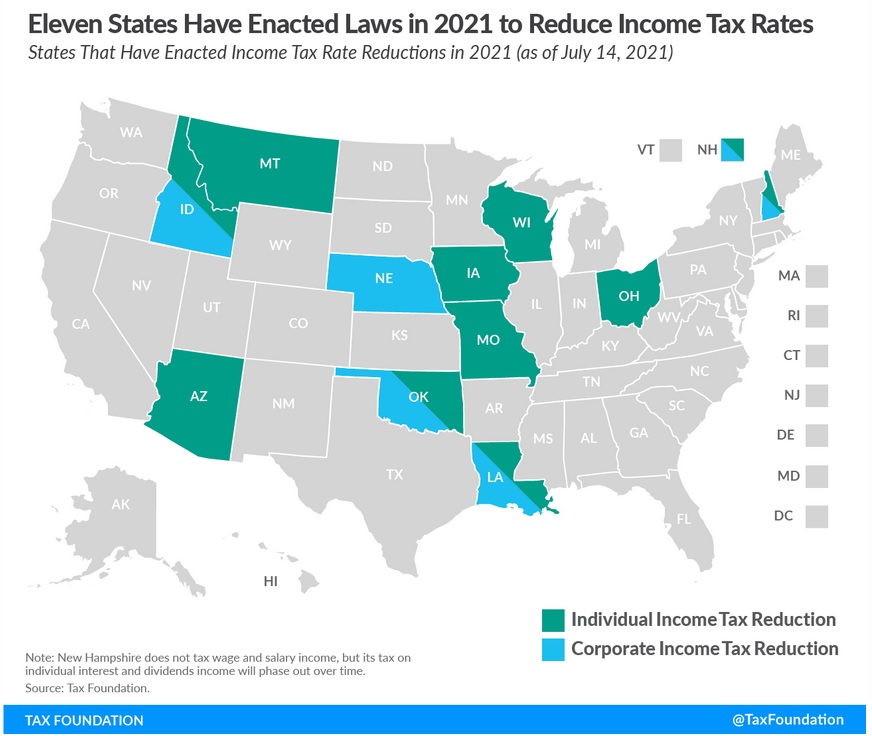
Dan Mitchell on Supply Chain Mess: “People and businesses in the private sector make mistakes…there’s a big feedback mechanism in the private sector. It’s called profit and loss!”


Government, Markets, and the Supply Chain

Way back in 2009, I shared a meme that succinctly summarizes how Washington operates.

It’s basically a version of Mitchell’s Law. To elaborate, governments cause problems and politicians then use those problems as an excuse to make government even bigger.

Lather, rinse, repeat.

I worry the same thing may be about to happen because of the current concern about “supply chain” issues, perhaps best illustrated by the backlog of ships at key ports, leading to shortages of key goods.

Some of this mess is fallout from the coronavirus pandemic, but it’s being exacerbated by bad policy.

In a column for Reason, J.D. Tuccille points out that government is the problem, not the solution.

…supply-chain issues…create shortages and push prices up around the world. …Lockdowns also changed people’s lives, closing offices and factories and confining people at home. That resulted in massive and unpredictable shifts in demand and unreliable supply. …”Market economies tend to be pretty good at getting food on the supermarket shelves and fuel in petrol stations, if left to themselves,” agrees Pilkington. “That last part is key: if left to themselves. Heavy-handed interference in market economies tends to produce the same pathologies we see in socialist economies, including shortages and inflation. That has been the unintended consequence of lockdown.” …The danger is that people see economic problems caused by earlier fiddling and then demand even more government intervention. …if the government were to further meddle in the market to allocate products made scarce by earlier actions, it’s hard to see how the result wouldn’t be anything other than increased supply chain chaos.

Allysia Finley opines for the Wall Street Journal about California’s role in the supply-chain mess.

The backup of container ships at the Long Beach and Los Angeles ports has grown in recent weeks… The two Southern California ports handle only about 40% of containers entering the U.S., mostly from Asia. Yet ports in other states seem to be handling the surge better. Gov. Ron DeSantis said last month that Florida’s seaports had open capacity.So what’s the matter with California? State labor and environmental policies. …business groups recently asked Gov. Gavin Newsom to declare a state of emergency and suspend labor and environmental laws that are interfering with the movement of goods. …One barrier is a law known as AB5. …Trucking companies warned that the law could put small carriers out of business and cause drivers to leave the state. …there’s little doubt the law hinders efficiency and productivity. …State officials have also pressed localities to attach green mandates to permits for new warehouses, which can be poison pills. …This boatload of regulations is making it more expensive and difficult to store goods arriving at California ports.

Needless to say, I’m not surprised California is making things worse.

The state seems to have some of the nation’s worst politicians.

But let’s set that aside and close with some discussion about one of the differences between government and the private sector.

This may surprise some readers, but people and businesses in the private sector make mistakes all the time.

So part of the supply-chain mess presumably is a result of companies and entrepreneurs making bad guesses.

That being said, there’s a big feedback mechanism in the private sector. It’s called profit and loss.

So when mistakes are made, there’s a big incentive to quickly change.

With government, by contrast, there’s very little flexibility (as we saw during the pandemic). And when politicians and bureaucrats do act, they often respond to political incentives that lead them to make things worse.


Big-Government Republicans Enable Big-Government Democrats

I get asked why I frequently criticize Republicans.

My response is easy. I care about results rather than rhetoric. And while GOP politicians often pay lip service to the principles of limited government,they usually increase spending even faster than Democrats.

Indeed, Republicans are even worse than Democrats when measuring the growth of domestic spending!

This is bad news because it means the burden of government expands when Republicans are in charge.

And, as Gary Abernathy points out in a column for the Washington Post, Republicans then don’t have the moral authority to complain when Democrats engage in spending binges.

President Biden is proposing another $3 trillion in spending… There are objections, but none that can be taken seriously. …Republicans had lost their standing as the party of fiscal responsibility when most of them succumbed to the political virus of covid fever and rubber-stamped around $4 trillion in “covid relief,”… With Trump out and Biden in, Republicans suddenly pretended that their 2020 spending spree happened in some alternate universe.But the GOP’s united opposition to Biden’s $1.9 trillion package won’t wash off the stench of the hypocrisy. …I noted a year ago that we had crossed the Rubicon, that our longtime flirtation with socialism had become a permanent relationship. Congratulations, Bernie Sanders. The GOP won’t become irrelevant because of its association with Trump, as some predict. It will diminish because it is bizarrely opposing now that which it helped make palatable just last year. Fiscal responsibility is dead, and Republicans helped bury it. Put the shovels away, there’s no digging it up now.

For what it’s worth, I hope genuine fiscal responsibility isn’t dead.

Maybe it’s been hibernating ever since Reagan left office (like Pepperidge Farm, I’m old enough to remember those wonderful years).

Subsequent Republican presidents liked to copy Reagan’s rhetoric, but they definitely didn’t copy his policies.

  • Spending restraint was hibernating during the presidency of George H.W. Bush.
  • Spending restraint also was hibernating during the presidency of George W. Bush.
  • And spending restraint was hibernating during the presidency of Donald Trump.

I’m not the only one to notice GOP hypocrisy.

Here are some excerpts from a 2019 column in the Washington Post by Fareed Zakaria.

In what Republicans used to call the core of their agenda — limited government — Trump has been profoundly unconservative. …Trump has now added more than $88 billion in taxes in the form of tariffs, according to the right-leaning Tax Foundation. (Despite what the president says, tariffs are taxes on foreign goods paid by U.S. consumers.) This has had the effect of reducing gross domestic product and denting the wages of Americans.…For decades, conservatives including Margaret Thatcher and Ronald Reagan preached to the world the virtues of free trade. But perhaps even more, they believed in the idea that governments should not pick winners and losers in the economy… Yet the Trump administration…behaved like a Central Planning Agency, granting exemptions on tariffs to favored companies and industries, while refusing them to others. …In true Soviet style, lobbyists, lawyers and corporate executives now line up to petition government officials for these treasured waivers, which are granted in an opaque process… On the core issue that used to define the GOP — economics — the party’s agenda today is state planning and crony capitalism.

Zakaria is right about Republicans going along with most of Trump’s bad policies (as illustrated by this cartoon strip).*

The bottom line is that Republicans would be much more effective arguing against Biden’s spending orgy had they also argued for spending restraint when Trump was in the White House.

P.S. It will be interesting to see what happens in the near future. Will the GOP be a small-government Reagan party or a big-government Trump party?

Or maybe it will go back to being a Nixon-type party, which would mean bigger government but without mean tweets. And there are plenty of options.

If they make the wrong choice (anything other than Reaganism), Margaret Thatcher has already warned us about the consequences.

*To be fair, Republicans also went along with Trump’s good policies. It’s just unfortunate that spending restraint wasn’t one of them.

—-

March 31, 2021

President Biden  c/o The White House
1600 Pennsylvania Avenue NW
Washington, DC 20500

Dear Mr. President,

Please explain to me if you ever do plan to balance the budget while you are President? I have written these things below about you and I really do think that you don’t want to cut spending in order to balance the budget. It seems you ever are daring the Congress to stop you from spending more.

President Barack Obama speaks about the debt limit in the East Room of the White House in Washington. | AP Photo


“The credit of the United States ‘is not a bargaining chip,’ Obama said on 1-14-13. However, President Obama keeps getting our country’s credit rating downgraded as he raises the debt ceiling higher and higher!!!!

Washington Could Learn a Lot from a Drug Addict

Just spend more, don’t know how to cut!!! Really!!! That is not living in the real world is it?

Making more dependent on government is not the way to go!!

Why is our government in over 16 trillion dollars in debt? There are many reasons for this but the biggest reason is people say “Let’s spend someone else’s money to solve our problems.” Liberals like Max Brantley have talked this way for years. Brantley will say that conservatives are being harsh when they don’t want the government out encouraging people to be dependent on the government. The Obama adminstration has even promoted a plan for young people to follow like Julia the Moocher.  

David Ramsey demonstrates in his Arkansas Times Blog post of 1-14-13 that very point:

Arkansas Politics / Health Care Arkansas’s share of Medicaid expansion and the national debt

Posted by on Mon, Jan 14, 2013 at 1:02 PM

Baby carrot Arkansas Medicaid expansion image


Imagine standing a baby carrot up next to the 25-story Stephens building in Little Rock. That gives you a picture of the impact on the national debt that federal spending in Arkansas on Medicaid expansion would have, while here at home expansion would give coverage to more than 200,000 of our neediest citizens, create jobs, and save money for the state.

Here’s the thing: while more than a billion dollars a year in federal spending would represent a big-time stimulus for Arkansas, it’s not even a drop in the bucket when it comes to the national debt.

Currently, the national debt is around $16.4 trillion. In fiscal year 2015, the federal government would spend somewhere in the neighborhood of $1.2 billion to fund Medicaid expansion in Arkansas if we say yes. That’s about 1/13,700th of the debt.

It’s hard to get a handle on numbers that big, so to put that in perspective, let’s get back to the baby carrot. Imagine that the height of the Stephens building (365 feet) is the $16 trillion national debt. That $1.2 billion would be the length of a ladybug. Of course, we’re not just talking about one year if we expand. Between now and 2021, the federal government projects to contribute around $10 billion. The federal debt is projected to be around $25 trillion by then, so we’re talking about 1/2,500th of the debt. Compared to the Stephens building? That’s a baby carrot.

______________

Here is how it will all end if everyone feels they should be allowed to have their “baby carrot.”

How sad it is that liberals just don’t get this reality.

Here is what the Founding Fathers had to say about welfare. David Weinberger noted:

While living in Europe in the 1760s, Franklin observed: “in different countries … the more public provisions were made for the poor, the less they provided for themselves, and of course became poorer. And, on the contrary, the less was done for them, the more they did for themselves, and became richer.”

Alexander Fraser Tytler, Lord Woodhouselee (15 October 1747 – 5 January 1813) was a Scottish lawyer, writer, and professor. Tytler was also a historian, and he noted, “A democracy cannot exist as a permanent form of government. It can only exist until the majority discovers it can vote itself largess out of the public treasury. After that, the majority always votes for the candidate promising the most benefits with the result the democracy collapses because of the loose fiscal policy ensuing, always to be followed by a dictatorship, then a monarchy.”

Thomas Jefferson to Joseph Milligan

April 6, 1816

[Jefferson affirms that the main purpose of society is to enable human beings to keep the fruits of their labor. — TGW]

To take from one, because it is thought that his own industry and that of his fathers has acquired too much, in order to spare to others, who, or whose fathers have not exercised equal industry and skill, is to violate arbitrarily the first principle of association, “the guarantee to every one of a free exercise of his industry, and the fruits acquired by it.” If the overgrown wealth of an individual be deemed dangerous to the State, the best corrective is the law of equal inheritance to all in equal degree; and the better, as this enforces a law of nature, while extra taxation violates it.

[From Writings of Thomas Jefferson, ed. Albert E. Bergh (Washington: Thomas Jefferson Memorial Association, 1904), 14:466.]

_______

Jefferson pointed out that to take from the rich and give to the poor through government is just wrong. Franklin knew the poor would have a better path upward without government welfare coming their way. Milton Friedman’s negative income tax is the best method for doing that and by taking away all welfare programs and letting them go to the churches for charity.

_____________

_________

Thank you so much for your time. I know how valuable it is. I also appreciate the fine family that you have and your commitment as a father and a husband.

Sincerely,

Everette Hatcher III, 13900 Cottontail Lane, Alexander, AR 72002, ph 501-920-5733

Williams with Sowell – Minimum Wage

Thomas Sowell

Thomas Sowell – Reducing Black Unemployment

By WALTER WILLIAMS

—-

Ronald Reagan with Milton Friedman
Milton Friedman The Power of the Market 2-5

Related posts:

Welfare Spending Shattering All-Time Highs

  We got to act fast and get off this path of socialism. Morning Bell: Welfare Spending Shattering All-Time Highs Robert Rector and Amy Payne October 18, 2012 at 9:03 am It’s been a pretty big year for welfare—and a new report shows welfare is bigger than ever. The Obama Administration turned a giant spotlight […]

We need more brave souls that will vote against Washington welfare programs

We need to cut Food Stamp program and not extend it. However, it seems that people tell the taxpayers back home they are going to Washington and cut government spending but once they get up there they just fall in line with  everyone else that keeps spending our money. I am glad that at least […]

Welfare programs are not the answer for the poor

Government Must Cut Spending Uploaded by HeritageFoundation on Dec 2, 2010 The government can cut roughly $343 billion from the federal budget and they can do so immediately. __________ Liberals argue that the poor need more welfare programs, but I have always argued that these programs enslave the poor to the government. Food Stamps Growth […]

Private charities are best solution and not government welfare

Milton Friedman – The Negative Income Tax Published on May 11, 2012 by LibertyPen In this 1968 interview, Milton Friedman explained the negative income tax, a proposal that at minimum would save taxpayers the 72 percent of our current welfare budget spent on administration. http://www.LibertyPen.com Source: Firing Line with William F Buckley Jr. ________________ Milton […]

The book “After the Welfare State”

Dan Mitchell Commenting on Obama’s Failure to Propose a Fiscal Plan Published on Aug 16, 2012 by danmitchellcato No description available. ___________ After the Welfare State Posted by David Boaz Cato senior fellow Tom G. Palmer, who is lecturing about freedom in Slovenia and Tbilisi this week, asked me to post this announcement of his […]

President Obama responds to Heritage Foundation critics on welfare reform waivers

Is President Obama gutting the welfare reform that Bill Clinton signed into law? Morning Bell: Obama Denies Gutting Welfare Reform Amy Payne August 8, 2012 at 9:15 am The Obama Administration came out swinging against its critics on welfare reform yesterday, with Press Secretary Jay Carney saying the charge that the Administration gutted the successful […]

Welfare reform part 3

Thomas Sowell – Welfare Welfare reform was working so good. Why did we have to abandon it? Look at this article from 2003. The Continuing Good News About Welfare Reform By Robert Rector and Patrick Fagan, Ph.D. February 6, 2003 Six years ago, President Bill Clinton signed legislation overhauling part of the nation’s welfare system. […]

Welfare reform part 2

Uploaded by ForaTv on May 29, 2009 Complete video at: http://fora.tv/2009/05/18/James_Bartholomew_The_Welfare_State_Were_In Author James Bartholomew argues that welfare benefits actually increase government handouts by ‘ruining’ ambition. He compares welfare to a humane mousetrap. —– Welfare reform was working so good. Why did we have to abandon it? Look at this article from 2003. In the controversial […]

Why did Obama stop the Welfare Reform that Clinton put in?

Thomas Sowell If the welfare reform law was successful then why change it? Wasn’t Bill Clinton the president that signed into law? Obama Guts Welfare Reform Robert Rector and Kiki Bradley July 12, 2012 at 4:10 pm Today, the Obama Department of Health and Human Services (HHS) released an official policy directive rewriting the welfare […]

“Feedback Friday” Letter to White House generated form letter response July 10,2012 on welfare, etc (part 14)

I have been writing President Obama letters and have not received a personal response yet.  (He reads 10 letters a day personally and responds to each of them.) However, I did receive a form letter in the form of an email on July 10, 2012. I don’t know which letter of mine generated this response so I have […]

America in Debt Damage Zone 

OCTOBER 19, 2021 10:16AM

America in Debt Damage Zone


Federal government debt is rising rapidly. The government spent almost $1 trillion more than it raised in revenues in 2019, and the overspending gap widened to $3 trillion in 2020 and 2021. The excess spending was borrowed from domestic and foreign creditors, and it all represents costs pushed forward onto tomorrow’s taxpayers.

The United States is becoming one of the most indebted high‐​income nations in the world. Including state and local debt, our government debt totals 141 percent of gross domestic product (GDP), which compares to an average of 100 percent of GDP for 32 high‐​income countries.

One likely effect of our high debt is slower economic growth. Economists have not nailed down precisely the mechanisms through which that happens, but many statistical studies find that higher debt correlates with slower economic growth.

Veronique de Rugy and Jack Salmon at the Mercatus Center summarized 24 cross‐​country studies that looked at government debt and growth, as summarized in the table below. Seventeen of the studies found a threshold above which rising debt is associated with reduced growth.

Government debt above 90 percent of GDP is correlated with slower economic growth, based on the average of 17 studies. That means America’s debt—at 141 percent and rising—is well into the debt damage zone and is likely undermining our prosperity already.

Salmon updated his debt and growth research in the Cato Journal. He found 36 studies that identified a statistically significant negative effect of government debt on growth.

s

Data note: for the 17‐​country average, I used the higher figure when a study found a range for the growth‐​slowdown threshold.


In their haste to pass massive spending bills and clobber the rich, the Democrats are floating some radical tax schemes. The latest far‐​out idea is to tax capital gains even before gains are realized. No other country in the OECD taxes capital gains in such an aggressive manner.

The Democrats are obsessed with raising taxes on capital. They’ve proposed raising the top capital gains tax rate, even though our federal‐​state rate of 29 percent is already higher than the 19.5 percentaverage in Europe. They’ve proposed raising the corporate tax rate, even though our federal‐​state rate of 27 percent is already higher than the 19 percent average in Europe. And some Democrats want to impose an annual wealth tax, even though nearly all European countries have eliminated those harmful levies.

Many high‐​income countries in Europe and elsewhere have heavier overall tax burdens than we do, but they make up the difference with high taxes on consumption, not capital. These countries recognize that taxes on consumption, such as value‐​added taxes (VATs), are less damaging than taxes on capital.

The Democrats are steering America to a worse place than Europe—a place where the private sector is undermined by expansive welfare programs, and where the programs are funded by taxes on capital rather than VATs. I am against a VAT for the United States because I favor smaller government, but I worry that the Democrats want to impose bigger government funded in an even more damaging manner than big European governments.

Let’s compare taxation in the United States and other high‐​income nations. In 2019, overall tax revenues were 24.5 percent of GDP in the United States and 33.8 percent in 35 OECD countries, on average. The charts below show the shares of overall tax revenues raised by taxes on goods and services or consumption (e.g. VATs and sales taxes) and taxes on income and profits (e.g. individual income taxes, corporate income taxes, and capital gains taxes). The charts are from here.

The United States raises a larger share of revenues from (more damaging) income and profits taxes and a smaller share from (less damaging) consumption taxes. Democratic proposals would worsen our reliance on the more damaging taxes. Instead, we should devolve government programs to the states and rely on state sales taxes to fund the needed activities.

s

Notes: The OECD tax shares appear to be based on 35 countries in 2019, but would include fewer countries in prior years. I calculate that U.S. taxes in 2019 were somewhat higher than the 24.5 percent reported by the OECD. I discuss unrealized capital gains here and here, and I examine taxes on capital income here and consumption taxes here.

Biden’s Befuddlement on Corporate Taxation

Let’s look today at the wonky issue of “book income” because it’s an opportunity to point out that there are three types of leftists.

  1. Honest leftists who understand economics and recognize tradeoffs (I think of them as “Okunites“).
  2. Dishonest leftists who understand economics but pretend that tradeoffs don’t exist (the “demagogues“).
  3. Leftists who have no idea what they’re saying or thinking (I think of them as, well, Joe Biden).

I’m being snarky about the President because of this recent tweet, which contains a couple of big, glaring mistakes.

What are the mistakes (I’m not calling them lies because I don’t think Biden has the slightest idea that he is wrong, much less why he’s wrong).

  • The first mistake is that corporations pay a lot of tax (payroll tax, property tax, etc) even if they are losing money and don’t owe any corporate income tax.
  • The second mistakes is that Biden is relying on a report about corporate income taxes that has been debunkedbecause it relied on book income rather than taxable income.
  • The third mistake is that the President implies that his plan force all big companies to pay the corporate tax when that’s obviously not true.

Regarding that third mistake, Kyle Pomerleau of the American Enterprise Institute explains why there will still be companies paying zero corporate income tax.

While the Biden administration’s proposals would increase the tax burden on corporations by about $2 trillion over the next decade, they would not change the basic structure of the corporate income tax. The Democrats’ proposal would not end corporations paying zero federal income tax in certain years.Corporations will still be able to carryforward losses, and credits will still be available for corporations to offset their tax liability. The administration has proposed a minimum tax to address these headlines by tying federal tax liability to book income. The minimum tax would require corporations with net income over $2 billion to pay the greater of their ordinary corporate tax liability or 15 percent of their book or financial statement income. Corporations would still be able to offset the book minimum tax with losses and general business credits.

Glenn Kessler of the Washington Post tried to defend Biden’s tweet as part of his misnamed “Fact Checker.”

He had to acknowledge Biden was using a made-up number, but nonetheless concluded that the President’s assertion was “probably in the ballpark.”

This is one of Biden’s favorite statistics. …the president has used it in speeches or interviews 10 times since April. Normally he is careful to refer to “federal income taxes” so the tweet is little off by referring just to “taxes.” …Let’s dig into this statistic. It’s not necessarily wrong but there are some limitations. …The number comes from…the left-leaning Institute on Taxation and Economic Policy (ITEP). …Company tax returns generally are not made public, so ITEP’s numbers are the product of its own research and analysis of public filings. But it is an imperfect measure. …the information in the filings may not reflect what is in the tax returns. …Nevertheless, the notion that 10 to 20 percent of Fortune 500 companies do not pay federal income taxes is consistent with a 2020 report by the nonpartisan Joint Committee of Taxation. …This “55 corporations” number is probably in the ballpark.

For what it’s worth, I don’t care that Kessler gave Biden a pass for writing “taxes” instead of “federal income taxes.”

After all, that’s almost surely what he meant to write (just like Trump almost surely meant “highest corporate tax rate” when complaining about America being the “highest taxed nation”).

But I’m not in a forgiving mood about the rest of Biden’s tweet (or Kessler’s biased analysis) for the simple reason that there is zero recognition that companies occasionally don’t pay tax for the simple reason that they sometimes lose money.

I’ve made this point when writing about boring issues such as depreciation, carry forwards, and net operating losses.
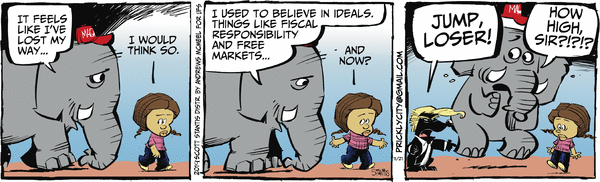
At the risk of stating the obvious, companies shouldn’t pay any corporate income tax in years when they don’t have any corporate income.

P.S. I’m not mocking Biden’s tweet for partisan reasons. I was similarly critical of one of Trump’s tweets that was glaringly wrong on the issue of trade.

Corporate Taxes and the Laffer Curve

In a new documentary film, Race to the Bottom, I had an opportunity to pontificate briefly about corporate tax and the Laffer Curve.

Dan Mitchell on Corporate Tax Rates and the Laffer Curve

At the risk of understatement, I represented a minority viewpoint in the documentary. Most of the people interviewed had a negative view of tax competition, considering it to be (as suggested by the title) a “race to the bottom.”

By contrast, I view tax competition as a way of constraining the “stationary bandit” so that we don’t wind up with “goldfish government.”

For purposes of today’s column, though, I want to focus on the narrower issue of the relationship between corporate tax rates and corporate tax revenue.

In the above video, I asserted that lower rates did not result in lower revenue. Indeed, I even made the bold statement that revenues increased.

Is that correct?

Fortunately, I don’t need to do any elaborate calculations to prove my point. I’ll simply direct readers to the work of two left-leaning international bureaucracies.

Back in 2017, I cited an article form the International Monetary Fund that included a graph clearly illustrating that the drop in tax rates has not been accompanied by a drop in tax revenue.
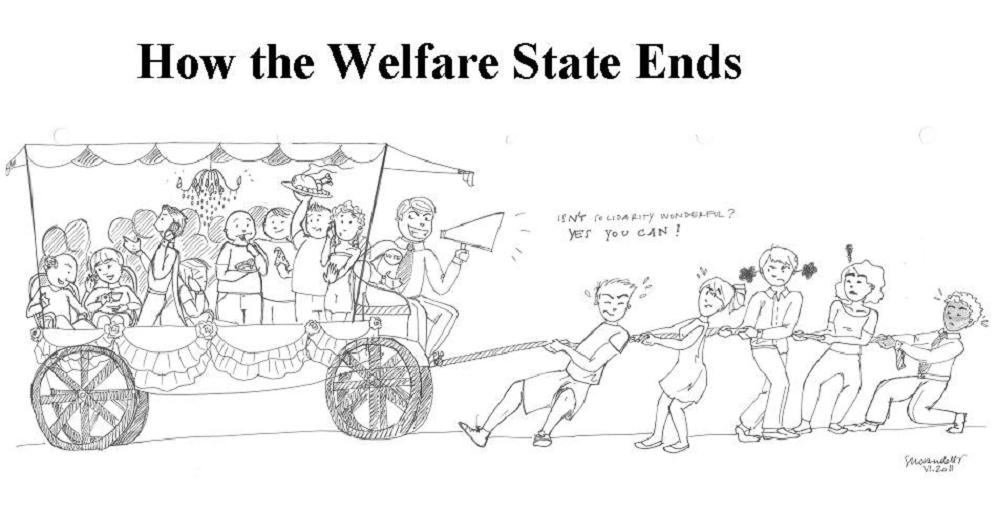
This was a remarkable admission considering that the article argued in favor of higher tax burdens.

Likewise, last year I cited a study from the Organization for Economic Cooperation and Development that also acknowledged that falling tax rates on companies did not translate into lower revenues.

Given that the OECD has a big project to increase business tax burdens, that also was a startling admission.

None of this means, by the way, that lower rates always lead to more revenue.

Indeed, most tax cuts cause revenue to decline (though not as much as predicted by static estimates).

The bottom line is that lower tax rates are good for economic performance and my friends on the left shouldn’t get too worried about disappearing tax revenue.

P.S. There’s also some 2017 OECD data and 2018 OECD dataabout business tax rates and business tax revenues.

P.P.S. Earlier this year, I cited OECD data that also included personal income tax rates and tax revenue.

—-

Emailed to White House on 1-3-13.)

President Obama c/o The White House
1600 Pennsylvania Avenue NW
Washington, DC 20500

Dear Mr. President,

I know that you receive 20,000 letters a day and that you actually read 10 of them every day. I really do respect you for trying to get a pulse on what is going on out here.

Class Warfare just don’t pay it seems. Why can’t we learn from other countries’ mistakes?

Back in mid-2010, I wrote that Portugal was going to exacerbate its fiscal problems by raising taxes.

Needless to say, I was right. Not that this required any special insight. After all, no nation has ever taxed its way to prosperity.

We’re now at the end of 2012 and Portugal is still saddled with a weak economy. And the higher taxes haven’t resulted in less red ink. Indeed, according to the Economist Intelligence Unit, government debt has jumped from 93 percent of GDP in 2010 to 124 percent of GDP this year.

Why did higher taxes backfire in Portugal? For the same reasons that higher taxes have failed in Greece, Spain, Bulgaria, France, Italy, the United Kingdom, and so many other nations.

  • Higher taxes undermine incentives for productive behavior, thus reducing an economy’s potential for growth. This means less economic output, which also means a smaller tax base. This Laffer Curve effect doesn’t necessarily mean less revenue, but it certainly means that tax increases rarely raise as much money as initially projected.
  • Higher taxes usually are a substitute for the real solution of spending restraint (i.e., Mitchell’s Golden Rule). Politicians oftentimes refuse to reduce the burden of government spending because of an expectation of additional tax revenue. Heck, in many cases, higher taxes trigger an increase in the size and scope of the public sector.

So did Portugal learn any lessons from this failed experiment in Obamanomics?

Hardly. Indeed, the government plans to double down on this approach – even though it’s increasingly apparent that higher tax burdens won’t translate into much – if any – additional tax revenue. Here are some excerpts from a report in the Financial Times.

Lisbon plans to lift income tax revenue by more than 30 per cent, raising the effective average rate by more than a third from 9.8 to 13.2 per cent. Anyone receiving more than the minimum wage of €485 a month, including pensioners, will also pay an extraordinary tax of 3.5 per cent on their income. …the steep tax increases facing many families have made the outlook for 2013 – the third consecutive year of austerity, recession and rising unemployment – the grimmest yet. Total tax revenue has fallen considerably below target this year, forcing the government to implement additional austerity measures… The coalition will be relying on increased state revenue to account for about 80 per cent of the fiscal adjustment required in 2013 – a reversal of the original bailout plan, in which consolidation was to be achieved mainly through spending cuts.

Amazing. The government imposes huge tax hikes, which don’t generate any positive results. Yet even though “tax revenue has fallen considerably below target,” confirming that there are significant Laffer Curve issues, the government chooses to repeat the snake-oil fiscal therapy of higher taxes.

Anybody want to guess what’s going to happen? The answer, of course, is that this will further dampen incentives to generate income and comply with the government’s fiscal demands.

The latest increases have stretched the tax system to the limit, says Carlos Loureiro, a tax partner at Deloitte. “The current model is exhausted. We need to do something different,” he says. “Any further increase in tax rates is unlikely to result in increased revenue.” Income from value added tax, the government’s biggest source of tax revenue representing about 36 per cent of the total, has been falling since 2008, despite a sharp increase in the rate – the main rate is now 23 per cent. Both the government and the European Commission have acknowledged the risks of depending on increased tax revenue, which is more growth sensitive, to meet fiscal targets and contingency spending cuts amounting to 0.5 per cent of national output have prepared in case of another tax shortfall.

I almost want to laugh at the part of the excerpt which notes that tax revenue “has been falling…despite a sharp increase in the rate.”

Maybe it’s time for these fiscal pyromaniacs to realize that revenues might be falling because rates are higher. In other words, Portugal not only isn’t at the ideal point on the Laffer Curve (collecting the amount of revenue needed to finance legitimate activities of government), it may even be past the revenue-maximizing part of the curve.

To be fair, there are lots of factors that determine economic performance, so higher tax burdens are just one possible explanation for why the tax base is shrinking or stagnant.

The one thing we can state with certainty, though, is that Portugal’s fiscal problem is too much government spending. The failure to address this problem then leads to very unpleasant symptoms, such as lots of red ink and self-destructive class-warfare tax policy.

If all that sounds familiar, that’s because it’s also a description of what President Obama is proposing for the United States.

Ummm…shouldn’t they be targeting politicians?

P.S. I don’t want to imply that Portugal is a total basket case. True, I’m not optimistic about the country’s future, but at least some lawmakers now acknowledge that Keynesian spending was a big mistake. And there are even signs that Portuguese officials are beginning to realize that lower tax rates should be part of the solution. But good policy may be impossible since so many people now have a moocher mentality.

P.P.S. At the risk of bearing bad news to close the year, research from both the Bank for International Settlements and the Organization for Economic Cooperation and Development shows the United States actually faces a bigger long-run fiscal challenge than Portugal.

The Laffer Curve – Explained

Uploaded by on Nov 14, 2011

This video explains the relationship between tax rates, taxable income, and tax revenue. The key lesson is that the Laffer Curve is not an all-or-nothing proposition, where we have to choose between the exaggerated claim that “all tax cuts pay for themselves” and the equally silly assumption that tax policy doesn’t effect the economy and there is never any revenue feedback. From http://www.freedomandprosperity.org 202-285-0244

__________________________________

__________

Thank you so much for your time. I know how valuable it is. I also appreciate the fine family that you have and your commitment as a father and a husband.

Sincerely,

Everette Hatcher III, 13900 Cottontail Lane, Alexander, AR 72002, ph 501-920-5733, lowcostsqueegees@yahoo.com

Related posts:

Open letter to President Obama (Part 201)Tea Party favorite Representative links article “Prescott and Ohanian: Taxes Are Much Higher Than You Think”

    (Emailed to White House on 12-21-12.) President Obama c/o The White House 1600 Pennsylvania Avenue NW Washington, DC 20500 Dear Mr. President, I know that you receive 20,000 letters a day and that you actually read 10 of them every day. I really do respect you for trying to get a pulse on […]

Open letter to President Obama (Part 200.2)Tea Party Republican Representative takes on the President concerning fiscal cliff

(Emailed to White House on 12-21-12.) President Obama c/o The White House 1600 Pennsylvania Avenue NW Washington, DC 20500 Dear Mr. President, I know that you receive 20,000 letters a day and that you actually read 10 of them every day. I really do respect you for trying to get a pulse on what is […]

Open letter to President Obama (Part 200.1)Tea Party favorite Representative shares link on facebook

(Emailed to White House on 12-21-12) President Obama c/o The White House 1600 Pennsylvania Avenue NW Washington, DC 20500 Dear Mr. President, I know that you receive 20,000 letters a day and that you actually read 10 of them every day. I really do respect you for trying to get a pulse on what is […]

Open letter to President Obama (Part 199) Tea Party favorite takes on President

  The federal government has a spending problem and Milton Friedman came up with the negative income tax to help poor people get out of the welfare trap. It seems that the government screws up about everything. Then why is President Obama wanting more taxes? _______________ Milton Friedman – The Negative Income Tax Published on […]

Tea Party Heroes Rep. David Schweikert (R-AZ),Justin Amash (R-MI), Tim Huelskamp (R-KS) have been punished by Boehner

I was sad to read that the Speaker John Boehner has been involved in punishing tea  party republicans. Actually I have written letters to several of these same tea party heroes telling them that I have emailed Boehner encouraging him to listen to them. Rep. David Schweikert (R-AZ),Justin Amash (R-MI), and Tim Huelskamp (R-KS). have been contacted […]

Some Tea Party heroes (Part 10)

Michael Tanner of the Cato Institute in his article, “Hitting the Ceiling,” National Review Online, March 7, 2012 noted: After all, despite all the sturm und drang about spending cuts as part of last year’s debt-ceiling deal, federal spending not only increased from 2011 to 2012, it rose faster than inflation and population growth combined. […]

Some Tea Party heroes (Part 9)

Michael Tanner of the Cato Institute in his article, “Hitting the Ceiling,” National Review Online, March 7, 2012 noted: After all, despite all the sturm und drang about spending cuts as part of last year’s debt-ceiling deal, federal spending not only increased from 2011 to 2012, it rose faster than inflation and population growth combined. […]

49 posts on Tea Party heroes of mine

Some of the heroes are Mo Brooks, Martha Roby, Jeff Flake, Trent Franks, Duncan Hunter, Tom Mcclintock, Devin Nunes, Scott Tipton, Bill Posey, Steve Southerland and those others below in the following posts. THEY VOTED AGAINST THE DEBT CEILING INCREASE IN 2011 AND WE NEED THAT TYPE OF LEADERSHIP NOW SINCE PRESIDENT OBAMA HAS BEEN […]

Some Tea Party Republicans win and some lose

I hated to see that Allen West may be on the way out. ABC News reported: Nov 7, 2012 7:20am What Happened to the Tea Party (and the Blue Dogs?) Some of the Republican Party‘s most controversial House members are clinging to narrow leads in races where only a few votes are left to count. […]

Some Tea Party heroes (Part 8)

Rep Himes and Rep Schweikert Discuss the Debt and Budget Deal Michael Tanner of the Cato Institute in his article, “Hitting the Ceiling,” National Review Online, March 7, 2012 noted: After all, despite all the sturm und drang about spending cuts as part of last year’s debt-ceiling deal, federal spending not only increased from 2011 […]

Democrats Rush to Pass Radical Tax Schemes 


In their haste to pass massive spending bills and clobber the rich, the Democrats are floating some radical tax schemes. The latest far‐​out idea is to tax capital gains even before gains are realized. No other country in the OECD taxes capital gains in such an aggressive manner.

The Democrats are obsessed with raising taxes on capital. They’ve proposed raising the top capital gains tax rate, even though our federal‐​state rate of 29 percent is already higher than the 19.5 percentaverage in Europe. They’ve proposed raising the corporate tax rate, even though our federal‐​state rate of 27 percent is already higher than the 19 percent average in Europe. And some Democrats want to impose an annual wealth tax, even though nearly all European countries have eliminated those harmful levies.

Many high‐​income countries in Europe and elsewhere have heavier overall tax burdens than we do, but they make up the difference with high taxes on consumption, not capital. These countries recognize that taxes on consumption, such as value‐​added taxes (VATs), are less damaging than taxes on capital.

The Democrats are steering America to a worse place than Europe—a place where the private sector is undermined by expansive welfare programs, and where the programs are funded by taxes on capital rather than VATs. I am against a VAT for the United States because I favor smaller government, but I worry that the Democrats want to impose bigger government funded in an even more damaging manner than big European governments.

Let’s compare taxation in the United States and other high‐​income nations. In 2019, overall tax revenues were 24.5 percent of GDP in the United States and 33.8 percent in 35 OECD countries, on average. The charts below show the shares of overall tax revenues raised by taxes on goods and services or consumption (e.g. VATs and sales taxes) and taxes on income and profits (e.g. individual income taxes, corporate income taxes, and capital gains taxes). The charts are from here.

The United States raises a larger share of revenues from (more damaging) income and profits taxes and a smaller share from (less damaging) consumption taxes. Democratic proposals would worsen our reliance on the more damaging taxes. Instead, we should devolve government programs to the states and rely on state sales taxes to fund the needed activities.

s

Notes: The OECD tax shares appear to be based on 35 countries in 2019, but would include fewer countries in prior years. I calculate that U.S. taxes in 2019 were somewhat higher than the 24.5 percent reported by the OECD. I discuss unrealized capital gains here and here, and I examine taxes on capital income here and consumption taxes here.

Biden’s Befuddlement on Corporate Taxation

Let’s look today at the wonky issue of “book income” because it’s an opportunity to point out that there are three types of leftists.

  1. Honest leftists who understand economics and recognize tradeoffs (I think of them as “Okunites“).
  2. Dishonest leftists who understand economics but pretend that tradeoffs don’t exist (the “demagogues“).
  3. Leftists who have no idea what they’re saying or thinking (I think of them as, well, Joe Biden).

I’m being snarky about the President because of this recent tweet, which contains a couple of big, glaring mistakes.

What are the mistakes (I’m not calling them lies because I don’t think Biden has the slightest idea that he is wrong, much less why he’s wrong).

  • The first mistake is that corporations pay a lot of tax (payroll tax, property tax, etc) even if they are losing money and don’t owe any corporate income tax.
  • The second mistakes is that Biden is relying on a report about corporate income taxes that has been debunkedbecause it relied on book income rather than taxable income.
  • The third mistake is that the President implies that his plan force all big companies to pay the corporate tax when that’s obviously not true.

Regarding that third mistake, Kyle Pomerleau of the American Enterprise Institute explains why there will still be companies paying zero corporate income tax.

While the Biden administration’s proposals would increase the tax burden on corporations by about $2 trillion over the next decade, they would not change the basic structure of the corporate income tax. The Democrats’ proposal would not end corporations paying zero federal income tax in certain years.Corporations will still be able to carryforward losses, and credits will still be available for corporations to offset their tax liability. The administration has proposed a minimum tax to address these headlines by tying federal tax liability to book income. The minimum tax would require corporations with net income over $2 billion to pay the greater of their ordinary corporate tax liability or 15 percent of their book or financial statement income. Corporations would still be able to offset the book minimum tax with losses and general business credits.

Glenn Kessler of the Washington Post tried to defend Biden’s tweet as part of his misnamed “Fact Checker.”

He had to acknowledge Biden was using a made-up number, but nonetheless concluded that the President’s assertion was “probably in the ballpark.”

This is one of Biden’s favorite statistics. …the president has used it in speeches or interviews 10 times since April. Normally he is careful to refer to “federal income taxes” so the tweet is little off by referring just to “taxes.” …Let’s dig into this statistic. It’s not necessarily wrong but there are some limitations. …The number comes from…the left-leaning Institute on Taxation and Economic Policy (ITEP). …Company tax returns generally are not made public, so ITEP’s numbers are the product of its own research and analysis of public filings. But it is an imperfect measure. …the information in the filings may not reflect what is in the tax returns. …Nevertheless, the notion that 10 to 20 percent of Fortune 500 companies do not pay federal income taxes is consistent with a 2020 report by the nonpartisan Joint Committee of Taxation. …This “55 corporations” number is probably in the ballpark.

For what it’s worth, I don’t care that Kessler gave Biden a pass for writing “taxes” instead of “federal income taxes.”

After all, that’s almost surely what he meant to write (just like Trump almost surely meant “highest corporate tax rate” when complaining about America being the “highest taxed nation”).

But I’m not in a forgiving mood about the rest of Biden’s tweet (or Kessler’s biased analysis) for the simple reason that there is zero recognition that companies occasionally don’t pay tax for the simple reason that they sometimes lose money.

I’ve made this point when writing about boring issues such as depreciation, carry forwards, and net operating losses.

At the risk of stating the obvious, companies shouldn’t pay any corporate income tax in years when they don’t have any corporate income.

P.S. I’m not mocking Biden’s tweet for partisan reasons. I was similarly critical of one of Trump’s tweets that was glaringly wrong on the issue of trade.

Corporate Taxes and the Laffer Curve

In a new documentary film, Race to the Bottom, I had an opportunity to pontificate briefly about corporate tax and the Laffer Curve.

Dan Mitchell on Corporate Tax Rates and the Laffer Curve

At the risk of understatement, I represented a minority viewpoint in the documentary. Most of the people interviewed had a negative view of tax competition, considering it to be (as suggested by the title) a “race to the bottom.”

By contrast, I view tax competition as a way of constraining the “stationary bandit” so that we don’t wind up with “goldfish government.”

For purposes of today’s column, though, I want to focus on the narrower issue of the relationship between corporate tax rates and corporate tax revenue.

In the above video, I asserted that lower rates did not result in lower revenue. Indeed, I even made the bold statement that revenues increased.

Is that correct?

Fortunately, I don’t need to do any elaborate calculations to prove my point. I’ll simply direct readers to the work of two left-leaning international bureaucracies.

Back in 2017, I cited an article form the International Monetary Fund that included a graph clearly illustrating that the drop in tax rates has not been accompanied by a drop in tax revenue.

This was a remarkable admission considering that the article argued in favor of higher tax burdens.

Likewise, last year I cited a study from the Organization for Economic Cooperation and Development that also acknowledged that falling tax rates on companies did not translate into lower revenues.

Given that the OECD has a big project to increase business tax burdens, that also was a startling admission.

None of this means, by the way, that lower rates always lead to more revenue.

Indeed, most tax cuts cause revenue to decline (though not as much as predicted by static estimates).

The bottom line is that lower tax rates are good for economic performance and my friends on the left shouldn’t get too worried about disappearing tax revenue.

P.S. There’s also some 2017 OECD data and 2018 OECD dataabout business tax rates and business tax revenues.

P.P.S. Earlier this year, I cited OECD data that also included personal income tax rates and tax revenue.

—-

Emailed to White House on 1-3-13.)

President Obama c/o The White House
1600 Pennsylvania Avenue NW
Washington, DC 20500

Dear Mr. President,

I know that you receive 20,000 letters a day and that you actually read 10 of them every day. I really do respect you for trying to get a pulse on what is going on out here.

Class Warfare just don’t pay it seems. Why can’t we learn from other countries’ mistakes?

Back in mid-2010, I wrote that Portugal was going to exacerbate its fiscal problems by raising taxes.

Needless to say, I was right. Not that this required any special insight. After all, no nation has ever taxed its way to prosperity.

We’re now at the end of 2012 and Portugal is still saddled with a weak economy. And the higher taxes haven’t resulted in less red ink. Indeed, according to the Economist Intelligence Unit, government debt has jumped from 93 percent of GDP in 2010 to 124 percent of GDP this year.

Why did higher taxes backfire in Portugal? For the same reasons that higher taxes have failed in Greece, Spain, Bulgaria, France, Italy, the United Kingdom, and so many other nations.

  • Higher taxes undermine incentives for productive behavior, thus reducing an economy’s potential for growth. This means less economic output, which also means a smaller tax base. This Laffer Curve effect doesn’t necessarily mean less revenue, but it certainly means that tax increases rarely raise as much money as initially projected.
  • Higher taxes usually are a substitute for the real solution of spending restraint (i.e., Mitchell’s Golden Rule). Politicians oftentimes refuse to reduce the burden of government spending because of an expectation of additional tax revenue. Heck, in many cases, higher taxes trigger an increase in the size and scope of the public sector.

So did Portugal learn any lessons from this failed experiment in Obamanomics?

Hardly. Indeed, the government plans to double down on this approach – even though it’s increasingly apparent that higher tax burdens won’t translate into much – if any – additional tax revenue. Here are some excerpts from a report in the Financial Times.

Lisbon plans to lift income tax revenue by more than 30 per cent, raising the effective average rate by more than a third from 9.8 to 13.2 per cent. Anyone receiving more than the minimum wage of €485 a month, including pensioners, will also pay an extraordinary tax of 3.5 per cent on their income. …the steep tax increases facing many families have made the outlook for 2013 – the third consecutive year of austerity, recession and rising unemployment – the grimmest yet. Total tax revenue has fallen considerably below target this year, forcing the government to implement additional austerity measures… The coalition will be relying on increased state revenue to account for about 80 per cent of the fiscal adjustment required in 2013 – a reversal of the original bailout plan, in which consolidation was to be achieved mainly through spending cuts.

Amazing. The government imposes huge tax hikes, which don’t generate any positive results. Yet even though “tax revenue has fallen considerably below target,” confirming that there are significant Laffer Curve issues, the government chooses to repeat the snake-oil fiscal therapy of higher taxes.

Anybody want to guess what’s going to happen? The answer, of course, is that this will further dampen incentives to generate income and comply with the government’s fiscal demands.

The latest increases have stretched the tax system to the limit, says Carlos Loureiro, a tax partner at Deloitte. “The current model is exhausted. We need to do something different,” he says. “Any further increase in tax rates is unlikely to result in increased revenue.” Income from value added tax, the government’s biggest source of tax revenue representing about 36 per cent of the total, has been falling since 2008, despite a sharp increase in the rate – the main rate is now 23 per cent. Both the government and the European Commission have acknowledged the risks of depending on increased tax revenue, which is more growth sensitive, to meet fiscal targets and contingency spending cuts amounting to 0.5 per cent of national output have prepared in case of another tax shortfall.

I almost want to laugh at the part of the excerpt which notes that tax revenue “has been falling…despite a sharp increase in the rate.”

Maybe it’s time for these fiscal pyromaniacs to realize that revenues might be falling because rates are higher. In other words, Portugal not only isn’t at the ideal point on the Laffer Curve (collecting the amount of revenue needed to finance legitimate activities of government), it may even be past the revenue-maximizing part of the curve.

To be fair, there are lots of factors that determine economic performance, so higher tax burdens are just one possible explanation for why the tax base is shrinking or stagnant.

The one thing we can state with certainty, though, is that Portugal’s fiscal problem is too much government spending. The failure to address this problem then leads to very unpleasant symptoms, such as lots of red ink and self-destructive class-warfare tax policy.

If all that sounds familiar, that’s because it’s also a description of what President Obama is proposing for the United States.

Ummm…shouldn’t they be targeting politicians?

P.S. I don’t want to imply that Portugal is a total basket case. True, I’m not optimistic about the country’s future, but at least some lawmakers now acknowledge that Keynesian spending was a big mistake. And there are even signs that Portuguese officials are beginning to realize that lower tax rates should be part of the solution. But good policy may be impossible since so many people now have a moocher mentality.

P.P.S. At the risk of bearing bad news to close the year, research from both the Bank for International Settlements and the Organization for Economic Cooperation and Development shows the United States actually faces a bigger long-run fiscal challenge than Portugal.

The Laffer Curve – Explained

Uploaded by on Nov 14, 2011

This video explains the relationship between tax rates, taxable income, and tax revenue. The key lesson is that the Laffer Curve is not an all-or-nothing proposition, where we have to choose between the exaggerated claim that “all tax cuts pay for themselves” and the equally silly assumption that tax policy doesn’t effect the economy and there is never any revenue feedback. From http://www.freedomandprosperity.org 202-285-0244

__________________________________

__________

Thank you so much for your time. I know how valuable it is. I also appreciate the fine family that you have and your commitment as a father and a husband.

Sincerely,

Everette Hatcher III, 13900 Cottontail Lane, Alexander, AR 72002, ph 501-920-5733, lowcostsqueegees@yahoo.com

Related posts:

Open letter to President Obama (Part 201)Tea Party favorite Representative links article “Prescott and Ohanian: Taxes Are Much Higher Than You Think”

    (Emailed to White House on 12-21-12.) President Obama c/o The White House 1600 Pennsylvania Avenue NW Washington, DC 20500 Dear Mr. President, I know that you receive 20,000 letters a day and that you actually read 10 of them every day. I really do respect you for trying to get a pulse on […]

Open letter to President Obama (Part 200.2)Tea Party Republican Representative takes on the President concerning fiscal cliff

(Emailed to White House on 12-21-12.) President Obama c/o The White House 1600 Pennsylvania Avenue NW Washington, DC 20500 Dear Mr. President, I know that you receive 20,000 letters a day and that you actually read 10 of them every day. I really do respect you for trying to get a pulse on what is […]

Open letter to President Obama (Part 200.1)Tea Party favorite Representative shares link on facebook

(Emailed to White House on 12-21-12) President Obama c/o The White House 1600 Pennsylvania Avenue NW Washington, DC 20500 Dear Mr. President, I know that you receive 20,000 letters a day and that you actually read 10 of them every day. I really do respect you for trying to get a pulse on what is […]

Open letter to President Obama (Part 199) Tea Party favorite takes on President

  The federal government has a spending problem and Milton Friedman came up with the negative income tax to help poor people get out of the welfare trap. It seems that the government screws up about everything. Then why is President Obama wanting more taxes? _______________ Milton Friedman – The Negative Income Tax Published on […]

Tea Party Heroes Rep. David Schweikert (R-AZ),Justin Amash (R-MI), Tim Huelskamp (R-KS) have been punished by Boehner

I was sad to read that the Speaker John Boehner has been involved in punishing tea  party republicans. Actually I have written letters to several of these same tea party heroes telling them that I have emailed Boehner encouraging him to listen to them. Rep. David Schweikert (R-AZ),Justin Amash (R-MI), and Tim Huelskamp (R-KS). have been contacted […]

Some Tea Party heroes (Part 10)

Michael Tanner of the Cato Institute in his article, “Hitting the Ceiling,” National Review Online, March 7, 2012 noted: After all, despite all the sturm und drang about spending cuts as part of last year’s debt-ceiling deal, federal spending not only increased from 2011 to 2012, it rose faster than inflation and population growth combined. […]

Some Tea Party heroes (Part 9)

Michael Tanner of the Cato Institute in his article, “Hitting the Ceiling,” National Review Online, March 7, 2012 noted: After all, despite all the sturm und drang about spending cuts as part of last year’s debt-ceiling deal, federal spending not only increased from 2011 to 2012, it rose faster than inflation and population growth combined. […]

49 posts on Tea Party heroes of mine

Some of the heroes are Mo Brooks, Martha Roby, Jeff Flake, Trent Franks, Duncan Hunter, Tom Mcclintock, Devin Nunes, Scott Tipton, Bill Posey, Steve Southerland and those others below in the following posts. THEY VOTED AGAINST THE DEBT CEILING INCREASE IN 2011 AND WE NEED THAT TYPE OF LEADERSHIP NOW SINCE PRESIDENT OBAMA HAS BEEN […]

Some Tea Party Republicans win and some lose

I hated to see that Allen West may be on the way out. ABC News reported: Nov 7, 2012 7:20am What Happened to the Tea Party (and the Blue Dogs?) Some of the Republican Party‘s most controversial House members are clinging to narrow leads in races where only a few votes are left to count. […]

Some Tea Party heroes (Part 8)

Rep Himes and Rep Schweikert Discuss the Debt and Budget Deal Michael Tanner of the Cato Institute in his article, “Hitting the Ceiling,” National Review Online, March 7, 2012 noted: After all, despite all the sturm und drang about spending cuts as part of last year’s debt-ceiling deal, federal spending not only increased from 2011 […]

What’s in Democrats’ $1.75 Trillion Spending Bill 

What's in the spending bill width=

President Joe Biden delivers remarks on his Build Back Better agenda from the East Room of the White House after meeting with members of the House Democratic Caucus at the U.S. Capitol on Oct. 28. (Photo: Kent Nishimura/Los Angeles Times/Getty Images)

The White House released on Thursday a framework for the Build Back Better agenda—a massive, $1.75 trillion spending bill that will radically transform the American way of life as we know it—and Democrats in Congress are intent on rapidly moving it immediately. We asked analysts from The Heritage Foundation to examine what is in the bill text. We will update their responses as they come in:

Budget Gimmicks

The White House’s newly released frameworkreturns to a tried-and-true way to obscure the true cost of the legislation: budget gimmicks. The current reconciliation instructions place caps on the 10-year deficit impact of provisions that could be included in the bill.

However, the new framework provides partial funding for many programs—creating temporary benefits that are clearly intended to be made permanent. This means that the cost estimates in this framework are only the tip of the iceberg of what the White House has planned.

For example, both the child care and pre-K provisions are reported as being given “funding for six years” despite both being listed also as “a long-term program.” The Obamacare tax credit extension would last only through 2025. The expanded child and earned income tax credits would each be extended for only one year.

Keep in mind that the annual cost for each of these programs would, likely, be higher in the 10th year of the budgetary window than in the first year. As such:

  • Child care and Pre-K: Actual 10-year cost is likely more than twice the reported cost of $400 billion.
  • Obamacare Tax Credit: Actual 10-year cost is likely much more than three times the reported cost of $130 billion.
  • Child and Earned Income Tax Credits: Actual 10-year cost is likely more than 10 times the reported cost of $200 billion.

In total, these programs would likely cost well over $2.3 trillion above the estimate in this framework over 10 years. This excess would be more than $18,700 of new spending per American household.

These gimmicks will set up future congresses with intentionally tough votes whether to extend new entitlement benefits. This process is clearly intended to circumvent the fiscally responsible controls in the reconciliation process. Using these gimmicks, the bill could be used to sneak in much larger debt-busting spending.

The issue here is not simply the spending—it is where that money comes from and where it goes.

By front-loading the spending and spreading tax hikes across 10 years, the framework would increase already-high inflationary pressures. Even worse, the taxes would suppress business investment at a time when the economic recovery is in danger of stalling out.

The drafters of this framework use the term “investment” to cover their planned corporate cronyism and wealth redistribution. This bill would make no investment—it would only misdirect the wealth generated by all Americans through their hard work.

Make no mistake, this plan is ultimately a framework for how much President Joe Biden wants to take out of your wallet to fund his ideological interests.

Richard Stern is a senior policy analyst focusing on budget policy at The Heritage Foundation and David Ditch is a policy analyst at Heritage’s Grover M. Hermann Center for the Federal Budget

Child Allowance Tax Credit

In March, Democrats transformed the child tax credit into a $250 to $300 per child monthly child allowance—no work conditions attached. Now, Democrats’ newly released framework would extend the monthly child allowance for another year, through the end of 2022.

The child tax credit used to increase as low-income parents worked more. The Biden child allowance, however, now goes to nonworking families because it removed the child tax credit’s existing requirement to work. Proponents insist that this giveaway won’t substantially affect low-income parents’ interest in working, but a new study has made it clear what history also teachesus: Fewer low-income families will work.

The Biden administration has claimed that this change would provide tax relief to families; in reality, this is a “bait and switch” claim. The vast majority of the spending would send unconditional welfare checks to low-income Americans.

This policy will subsidize nonworking families, increasing the likelihood that the most vulnerable will remain outside the workforce. It also will subsidize single parenthood, including among teens, thereby weakening the probability that children will be raised by a married mother and father. Overall, the policy will undermine marriage and discourage work, fewer children will experience social success and upward mobility, and low-income Americans will be left behind.

History teaches us the failures of such a flawed policy. In the 1990s, Congress replaced a failed program, Aid to Families with Dependent Children, with Temporary Assistance for Needy Families, a work-based program. Prior to the Temporary Assistance for Needy Families program, income families faced profoundly negative results from no-strings-attached cash benefits.

One in seven children was dependent on the Aid to Families with Dependent Children welfare program, and intergenerational poverty worsened. Some 90% of cash safety-net recipients were single mothers; the majority were never married. The majority of families were on Aid to Families with Dependent Children welfare program rolls for an average of eight years. Work among the recipient parents was extremely low—nearly nine in 10 families were workless. Many remained in long-term poverty.

Moreover, researchers at the University of Chicagohave warned that the Democrats’ effort to rollback work requirements in welfare would lay the stage for history to repeat itself. The researchers found that 1.5 million workers—2.6% of all working parents—would exit the labor force if the child allowance is made permanent. Accounting for the drop in work, the authors calculate that the child allowance would not ease deep child poverty (families making less than $18,945). This is a far cry from the 39% reduction in deep poverty the left promised.

Unpublished data from the Bureau of Labor Statistics suggests the payments may already be reducing work. When the pandemic began, parents experienced fewer employment losses. But since the late spring of this year—coinciding with the beginning of the child payments—that trend reversed, and parents’ employment actually declined.

Our nation’s safety net already serves tens of millions of people with over $1.1 trillion federal tax dollars allocated to 89 means-tested federal welfare programs, including nearly $500 billion spent on means-tested cash, food, housing, and medical care for poor and low-income families with children. This money has a direct impact on the well-being of poor and lower-income Americans and often provides incentives that are actively harmful to the poor, including by undermining marriage formation.

Policymakers are rightly looking for ways to support marriage, encourage work, foster upward mobility, and help more Americans to overcome poverty and attain self-sufficiency. Those who want to achieve that goal should begin by rejecting Biden’s plan to reverse the successes of a quarter-century of work-based welfare reform.

– Leslie Ford, a visiting fellow focusing on domestic policy studies at The Heritage Foundation, and Rachel Greszler, a research fellow focusing on economics, the budget, and entitlements at The Heritage Foundation

Corporate Tax

The framework claims it will raise $325 billion from a 15% corporate minimum tax on large companies’ book income. Book income is what companies report in their financial statements. Different accounting rules apply for determining taxable income and book income, and that’s by design.

It’s troubling that the rules for determining book income are determined by a Connecticut-based nonprofit, the Financial Accounting Standards Board. Effectively, Congress could be handing some of its taxing authority over to a private organization.

Advocates of the new minimum tax justify the tax on the grounds that some corporations “get away with” not paying tax in certain years.

Corporations often pay zero taxes in a year because of losses in that year or because they accrued net operating losses in prior years. Net operating losses are an efficient, desirable feature of a corporate income tax because they help ensure that the tax code is not biased against businesses with large year-over-year fluctuations in loss and income.

Suppose Company A has $1 million of profit one year and another $1 million profit in the second year. Company B, on the other hand, suffers a loss of $10 million in the first year, followed by a gain of $12 million in the second year. Note: Both companies have a total profit of $2 million over the second years. If not for the allowance of net operating losses, Company B would have to pay tax on $12 million of profit in the second year but would get no tax relief for the $10 million of losses incurred in the first year.

Introducing a minimum tax on book income complicates and distorts the net operating losses system by leaving certain taxpayers unable to use net operating losses to offset future gains. Book income does not factor in net operating losses, introducing a bias in the tax code against companies with large fluctuations in loss and income. This bias would extend to companies that have a significant one-time investment expense leading to a taxable loss. Effectively, this plan would force certain taxpayers to pay taxes on their losses, dollar for dollar, as if they were income.

Since the 2017 Tax Cuts and Jobs Act, companies have been able to immediately expense investments in short-lived assets. By encouraging capital investment, this is one of the most pro-growth policies in the tax code. The minimum tax would counterproductively work to offset these pro-growth expensing provisions, because under current financial accounting rules, such expenses may only be deducted over the course of several years.

Under the present tax system, when companies do consistently avoid paying tax, it is usually because they are able to claim preferential tax credits that are only available to favored businesses or industries. Unfortunately, there are dozens of provisions now being considered that would expand corporate tax credits.

Minimum taxes are burdensome to administer and comply with, as they effectively represent entirely new parallel tax systems. In addition to the corporate profits minimum tax, Congress is also weighing expansion of another minimum tax system in the international tax code. These additional layers of complexity are good news for auditors and accountants, but bad news for businesses that want to focus on improving the goods and services they provide.

– Preston Brashers is a senior policy analyst focusing on tax policy at The Heritage Foundation

Energy

Democrats went back to the playbook of the 2000s and are regurgitating stale energy policies that don’t work to subsidize politically preferred energy technologies through the tax code. Included in the House Democrats’ massive spending package is a $553 billion wealth transfer from taxpayers to fund the lifestyle choices of wealthy Americans, corporations, and environmental activists.

The biggest ticket item is $320 billion in tax subsidies for electric vehicles, solar energy, wind turbines, biofuels and other boutique fuels, and other so-called green energy technologies. This is to say nothing of the $10 billion for college programs to train a generation of environmental activists, $2.5 billion for “tree equity,” and $5 million apiece for desert fish and bee conservation.

It’s bad enough that years of lobbying by special interests appears to be working. Back in 2015, Republicans and Democrats reached a compromise in the omnibus spending bill to extend credits one more time and put them on a schedule to sunset in 2022, a decision that diverted over $14 billion to the green energy industry. From the beginning, these credits were designed to be temporary but have expired, been extended, re-extended, and retroactively extended for decades.

The bill would not only renew these tax credits—it would expand them by making them available for cash rebates. Of course companies are taking the hint and already figuring out creative ways to cash in—for example, by buying electric vehicles to offer as rental cars and loaners just to get the tax write-off. While that may be a shrewd business move one can’t blame companies for making, one should blame Congress for being all too willing to push policies that put taxpayers on the bill for it.

Yet somehow, the left has managed to make these green energy subsidies even worse. Tied to tax credits for electric vehicles, wind, and solar are additional bonuses for labor unions. While the framework promises to help “more Americans to join and remain in the labor force,” it intentionally rigs the game against workers who choose not to join a labor union and against foreign-owned companies investing in the U.S.

Ironically, this could harm plans for expansive new manufacturing spaces for electric vehicles and batteries—allegedly the very technologies the left wants—by companies that don’t fit the bill’s narrow agenda.

To be very clear—the problem isn’t green energy technologies. The problem is cronyist energy policy that is patently unfair, increases barriers to entry for innovative technologies that don’t fit the government’s mold, masks risks and costs, and encourages behavior our common sense might otherwise dissuade us from.

If Congress wants to support energy innovation in the U.S., it should be moving closer to—not further from—a pro-growth, competitive tax policy. This should include getting rid of all targeted energy tax credits and championing policies like full and immediate expensing of R&D, short-term assets (like tools and equipment) and long-term assets (like manufacturing space).

We know what the results of good energy policy can look like. Between 2018 and 2019, the economy was breaking records in growth and employment as average energy costs fell 5% and Americans’ per capita energy costs decreased in every state except California. And yet the left wants the rest of America to look like California and is trying to export the state’s climate policy experiment through the tax code and the Biden administration’s regulatory agenda.

If green energy technologies are low-cost and competitive, why is Congress still throwing billions of taxpayer dollars at them every year? And what will it take to get Congress to keep the promise it made in 2015?

– Katie Tubb is a senior policy analyst focusing on energy and environment at The Heritage Foundation

Health Care

The proposal would make existing Affordable Care Act subsidies more generous and make them available to more people, regardless of income.

Specifically, individuals with income between 100% and 150% of the federal poverty line would no longer have to contribute to the cost of their Obamacare premiums. Obamacare subsidies would be extended to the “rich”—defined here as individuals with incomes above 400% poverty, and it would also offer new federal subsidies for those individuals in state that chose not to adopt the Obamacare Medicaid expansion in lieu of the creation of a new Medicaid public option.

Although the subsidies are temporary since they are tethered to Obamacare (another budget gimmick), these changes are intended to drive more people to the government-run Obamacare exchanges, including some of whom would have otherwise had insurance.

The more people enrolled in Obamacare, the more the government controls the delivery of care and benefits. Moreover, these changes attempt to cover up the fact that Obamacare is driving up—not down—the costs of coverage, and that means that the mega-insurance plans in Obamacare will continue to raise premiums, knowing that ultimately the taxpayers will pick up the cost.

It changes the requirements for those with access to employer-based coverage to qualify for Obamacare subsidies.

Under current law, individuals with access to employer-based coverage are not eligible for Obamacare subsidies unless their share of the premium costs exceed 9.2%. The bill would lower that threshold to 8.5%.

The private, employer-based market is where the majority of American still get their health care and remains a critical obstacle to a full-blown government-run health care plan. Lowering the threshold is a small, but significant, shift in the opposite direction.

This change alongside expanding the availability of subsidies could disrupt the employer-based market by driving more people out of their existing coverage and toward the government-run plan. A recent Congressional Budget Office estimate notes that the package of policies embedded in the plan would result in 2.8 million fewer people with employer-based coverage.

The proposal blocks access to information about non-Obamacare coverage options. The bill would prohibit federal funds from being used to “promote non-[Affordable Care Act] compliant health insurance coverage” and explicitly defines short-duration and association health plans as such options.

This comes on the heels of the Biden administration’s move earlier this year to use taxpayer money to fund a marketing campaign to promote Obamacare.

With rising costs and fewer options, many Americans have sought out alternative health care arrangements. Promoting Obamacare over non-Obamacare alternatives is yet another attempt to shut down private competition and drive people to the government-run Obamacare exchanges, where the government determines access to the coverage options.

– Nina Owcharenko Schaefer is a senior research fellow focusing on health policy at The Heritage Foundation

Higher Education

Biden’s framework would spend $40 billion to increase the maximum Pell Grant award by $550, send additional subsidies to historically black colleges and universities and minority-serving institutions, and provide additional funding for community colleges and workforce development.

These additional federal subsidies will only encourage schools to raise prices, shifting more of the burden of paying for higher education from the student who benefits to all taxpayers.

Colleges will have received an additional $76 billion in federal spending over the past year and a half in response to COVID-19—a monumental sum nearly equivalent to the Department of Education’s entire annual discretionary budget. This plan would add tens of billions more.

Colleges have needed a course-correction for decades, and new federal subsidies will continue to enable general fiscal maladministration, avoiding necessary structural reforms, and changes at the university level that would actually reduce college costs.

For example, from 2001 to 2011, the number of non-teaching employees and administrators increased 50% faster than teaching faculty. Non-instructional staff now accounts for more than half of university payroll costs.

Ever-increasing college costs fueled in part by federal subsidies have muddied colleges’ value proposition. Across the country, tuition and fees for in-state students attending four-year universities have nearly tripled in real terms since 1990. Since 1970, inflation-adjusted tuition rates have quintupled at both public and private colleges.

Federal subsidies have increased dramatically, with spending on student loans rising 328% over the last 30 years, from $20.4 billion during the 1989-90 school year to $87.5 billion during the 2019-20 school year. As University of Ohio economist Richard Vedder explains:

[I]t takes more resources today to educate a postsecondary student than a generation ago… Relative to other sectors of the economy, universities are becoming less efficient, less productive, and, consequently, more costly.

This spending package, by adding another $40 billion in federal subsidies, will only continue this trend, fueling increases in higher education costs while shifting more of the burden onto taxpayers.

Lindsey Burke is the director of The Heritage Foundation’s Center for Education Policy and the Mark A. Kolokotrones fellow in education

Housing

The framework’s proposed spending on affordable housing will fund the efforts of D.C. bureaucrats to intrude on local housing policies in a concerted effort to socially reengineer communities through the Affirmatively Furthering Fair Housing Rule.

The Affirmatively Furthering Fair Housing Rule’s objectives are pursued by conditioning federal housing grants—particularly from the Community Development Block Grant program—on local governments approving affordable housing projects, transportation initiatives, and zoning guidelines preferred by the federal government.

The Trump administration suspended Affirmatively Furthering Fair Housing Rule in 2018, and terminated it in July 2020. Ben Carson, secretary of the Department of Housing and Urban Development, explained that the Affirmatively Furthering Fair Housing Rule is “unworkable and ultimately a waste of time for localities to comply with, too often resulting in funds being steered away from communities that need them most.”

The Biden administration restored the definitions and certification requirements of Affirmatively Furthering Fair Housing Rule in June 2021. Affordability concerns are best addressed by voluntary reforms of local land use regulations, eliminating rent control, and making it easier for landlords to evict nonpaying tenants.

Down payment assistance will further stoke price increases in the price of housing—especially for lower and moderately priced homes most likely to be purchased by recipients of these grants. Although a select few purchasers may benefit from the proceeds, other families seeking to purchase homes will suffer from the increase in costs.

Furthermore, property tax burdens may increase as the valuation of these properties increases from this artificial injection of additional capital into the housing market.

– Joel Griffith is a research fellow focusing on financial regulations at The Heritage Foundation

Immigration

The Biden administration has turned the U.S. immigration system into immigration chaos, and now the left wants American taxpayers to pay for it. The Democrats will continue to try to ram through amnesty using budget tricks. This will effectively reward illegal immigrants and will fuel the surge we are seeing play out every day at our southern border.

The Biden administration has itself to blame for inflating the backlog of immigration benefit applications. When it continues to add hundreds of thousands of illegal aliens to the application line, those who followed the law and apply for legitimate benefits are forced to wait years longer to have their application adjudicated.

What’s more, immigration benefits are fee-based. This is sound fiscal policy as applicants, not taxpayers, should pay for their own benefit application. To force U.S. taxpayers to pay for the Biden administration’s own backlog punishes Americans, fails to hold the administration accountable for their open border policies, and hurts lawful immigrants, their family members, and employers.

“Expanding legal representation” is a euphemism for taxpayer-funded attorneys for deportable aliens. Aliens already have a right to counsel in (civil) immigration proceedings, but at no expense to the government. The left has sought to chip away at this sound fiscal policy for decades, starting with illegal alien minors.

Requiring taxpayers to fund attorneys would be a fiscal bottomless pit, given the unknown millions of illegal aliens already in the country, plus the unending flow of illegal aliens currently crossing the border, plus the yearslong immigration court backlogs.

Furthermore, it would treat deportable aliens better than U.S. citizens, who do not have a right to taxpayer-funded attorneys in civil proceedings.

The left continues to ruin our asylum system while calling it “efficient and humane.” Asylum is intended to protect those who suffered or have a well-founded fear of persecution based on their race, religion, nationality, political opinion, or membership in a particular social group. Yet the left shoe horns in general violence, crime, and climate change into membership in a particular social group and labels them asylees.

Those conditions do not meet the definition for asylum and such applicants are not eligible. Watering down asylum to declare every applicant eligible hurts those who truly faced or fear real persecution. This is chaotic and inhumane.

– Lora Ries is the director of The Heritage Foundation’s Center for Technology Policy and a senior research fellow focused on homeland security at Heritage’s Davis Institute for National Security and Foreign Policy

IRS Slush Fund

The bill would provide a massive $79 billion slush fund for the Internal Revenue Service, paid in a lump sum and available to use through 2031.

This slush fund is about six times the IRS’ entire annual budget. The IRS had a $13 billion budget in 2021, including $5 billion for nearly 35,000 enforcement agents.

The bill would even give the secretary of the Treasury, “or the Secretary’s delegate,” “personnel flexibilities” “to take such personnel actions as the Secretary (or the Secretary’s delegate) determines necessary to administer the Internal Revenue Code.”

There simply is no credible way for the scandalridden and union-dominated agency to absorb so much extra funding and power while avoiding waste, fraud, and abuse.

This slush fund raises the risk of returning to a politicized IRS. The IRS has a decadeslong history of overreach and abuse, from the collecting of a list of enemies of the Nixon administration to attempting to fire a whistleblower who participated in a series of hearings on IRS abuse in the Clinton administration to the infamous targeting scandal under the Obama administration to the leak of confidential taxpayer records and associating the teachings of the Bible with a political party this year.

The bill would also provide $105 million to the Treasury’s Office of Tax Policy to issue new regulations and $153 million to the U.S. Tax Court.

Matthew Dickerson

Labor Unions

The framework includes $350,000,000 that will be allocated to the National Labor Relations Board for the fiscal year 2022. The funds will remain available until Sept. 30, 2026.

According to the Build Back Better plan, this money will be used to fund the implementation of electronic voting for union elections. The federal government should not involve itself in union elections. Unions should fund electronic voting through the dues they receive from their members.

As a self-professed “union guy,” Biden has strongly advocated greater unionization in the U.S. workforce. American workers, however, do not seem to agree.

According to the Bureau of Labor Statistics, the union membership rate declined to 10.8% in 2020 with strong union presence among public sector workers. In fact, the union membership rate has been in decline for approximately the past 40 years.

The Biden administration’s plans to increase unionization are evidently misaligned with the needs of the current labor market. With long-term societal trends showing diminished union favorability, Biden insists on using taxpayer funding to support his political objectives.

Biden’s pro-union, anti-business economic policies are harmful to American firms, workers, and consumers. This provision uses taxpayer money to support union efforts, in essence, raising taxes on all Americans to provide a political giveaway to unions.

Unions are partially to blame for the supply chain crisis plaguing the Los Angeles and Long Beach ports. Strong union presence and restrictive operating procedures that resulted from union pressure and collective bargaining have left many Americans unconvinced that they should provide more of their earnings to support union activities.

With the salary of dock workers at the Los Angeles and Long Beach ports averaging $171,000annually, it is difficult to argue that these union workers are unable to fund their own election infrastructure.

Aside from high costs, Biden’s unionization efforts promote lower productivity that typically coincides with union participation. At a time when Americans are struggling with a supply chain crisis and rising consumer prices that are partially a result of unions, Americans would be better served by an administration that is more focused on free enterprise and free market labor policies.

Now would be a good time for Biden to invoke his promise of unity and do what’s best for all Americans.

– Elizabeth Hanke is a research fellow focusing on labor economics and policy at The Heritage Foundation

Medicare

The bill adds a hearing services benefit to the Medicare program, effective Jan. 1, 2024. The provision would reimburse “qualified” audiologists and physicians for providing a variety of hearing services, as well as reimbursement for hearing aids. Payment rates are to be set by the secretary of health and human services, and $370 million is appropriated for the implementation of the program.

As anticipated, the bill does not add dental or vision coverage. That’s a good thing—because all these benefits are a solution in search of a problem. They duplicate coverage already provided in private supplemental coverage as well as Medicare Advantage plans. Thus, the provision continues the step-by-step government crowd-out of the private financing and delivery of coverage and care.

– Robert Moffit is a senior fellow focusing on health care and entitlement programs, particularly Medicare, at The Heritage Foundation

Medicaid and Medicare

The legislation assumes a larger role for the federal government in Medicaid. The proposal would create a new grant program within Medicaid that would add new federal funding for home and community-based services.

The proposal would also impose new federal requirements on state Medicaid programs, would allow states to remove certain income limits to qualify for Medicaid and the Children’s Health Insurance Program, and would weaken oversight and accountability through various policy changes.

Congress already provided significant federal Medicaid resources to the states, including for home- and community-based services earlier this year. Using Medicaid to solve the country’s health care woes is shortsighted and poorly targeted, and supplanting state flexibility with federal mandates only makes matters worse.

These efforts would drive out private alternatives and stretch an already overburdened safety-net program.

While the legislation drops dental and vision benefits, it still adds a new hearing benefit to the traditional Medicare program. To avoid an even bigger price tag, the benefit would be phased-in in 2024.

While traditional Medicare does not include dental, vision, or hearing coverage, Medicare Advantage—the private Medicare alternatives—already offers many of these benefits to seniors without government intervention or interference.

Not only does this proposal inject the government where it isn’t necessary, but also piles new obligations onto the already overdrawn Medicare program that will only accelerate the fragile fiscal circumstances facing the program.

– Nina Owcharenko Schaefer

Pre-K and Child Care

The framework includes $400 billion in new spending for universal pre-K and large child care subsidies that cap parents’ child care costs at 7% of families’ income for those earning up to 250% of the state median income (topping out at $429,000 for a family of four in D.C.). Both programs would initially be funded for six years.

Instead of reducing child care costs, expanding options, and helping more parents achieve the child care they desire, the proposals would drastically increase costs and restrict options to government-controlled providers.

A whole host of government dictates—such as requiring subsidized providers to pay “living wages” ($27 per hour for a single mom in Mississippi and $39 in Boston) and that all pre-K workers have a bachelor’s degree (despite zero evidence that such degrees make someone a better caretaker)—would easily drive up costs by 50% or more.

And at the same time, the proposal would limit access to child care. In Chicago, the rollout of universal pre-K is “strangling private day care,” as most parents send children to the government program, even if it doesn’t meet their needs. New Jersey’s “model” pre-K program has an accountability crisis and is wrought with political favoritism.

The proposed federal subsidies would likely be out-of-reach to faith-based providers, because in declaring them recipients of federal funds, it would compromise their ability to run their programs and hire workers according to their beliefs.

Pushing children into government-controlled, center-based child care that’s been shown to have negative impacts on kids’ and families’ long-term outcomes is not a sound “investment.”

In fact, the preeminent author of studies upon which these proposal are based, James Heckman, said, “I have never supported universal pre-school … Public preschool programs can potentially compensate for the home environments of disadvantaged children. No public preschool program can provide the environments and the parental love and care of a functioning family and the lifetime benefits that ensue.” He estimated that parental care has “rates of return of more like 30 or 40%.”

While this proposal provides nothing to the majority of disproportionately low-income parents who prefer family-based care, it would provide $30,000 in child care subsidies to a couple with $344,000 income and two children living in D.C.

If policymakers really want to help families in need, they should expand choices for existing child care funds, including allowing parents to use the roughly $10,000 per child worth of ineffective Head Start spending at a provider of their choice.

– Lindsey Burke and Rachel Greszler

Prescription Drugs

Still to be determined is whether the bill will include provisions to impose government price controls on prescription drugs.

Previous versions would have the federal government set prices for certain prescription drugs in the Medicare program, based on prices paid in other countries. Companies that refused to accept the government price would be subject to an excise tax.

Government control over the price of pharmaceuticals means government control over access to pharmaceuticals. Like residents in those selected other countries, seniors would face less access and fewer choices under this model.

Moreover, government price controls would not end with pharmaceuticals. Similar mechanisms are envisioned with a full-blown government-run program, where the government sets payment rates for all health care services.

Americans only need to look to Canada and the United Kingdom to see the impact such controls have on access to care, where wait lists are common and expected, and where access to treatments are limited or denied.

– Nina Owcharenko Schaefer

State and Local Tax Deduction

Biden’s newest big government socialism framework makes no mention of repealing the cap on the deduction for state and local taxes—popularly known as “SALT.”

An important reform included in the Tax Cuts and Jobs Act was to cap the SALT deduction at $10,000. The SALT deduction subsidizes high taxes imposed by state and local governments. The primary beneficiary of the SALT deduction is high-income taxpayers in high-tax states. Prior to the cap being put in place, the average millionaire from New York or California deducted more than $450,000 per year of SALT, while the average Texas millionaire only deducted about $50,000 resulting in a federal tax liability nearly $180,000 higher than their high-tax state counterparts.

Restoring subsidies for high-income taxpayers in high-tax states has been a priority for some blue-state lawmakers that have said “No SALT, no deal.” There have been reports that House Speaker Nancy Pelosi, D-Calif., and Rep. Richard Neal, D-Mass., chairman of the Ways and Means Committee, “have given NJ/NY Democrats assurance it will be in bill.”

Instead of this harmful proposal, Congress should finish the job and repeal the SALT deduction.

– Matthew Dickerson is the director of The Heritage Foundation’s Grover M. Hermann Center for the Federal Budget

Woke Gender Ideology

According to Senate rules, a reconciliation package should be limited to budget questions. But in 2021, the reconciliation process offers the chance for radical gender activists to slip the language and assumptions of their ideology into federal legislation.

For instance, the text on “Maternal Mortality” consists of 15 sections that appropriate funds for a range of grants and programs for research and education on women’s health.

And yet, in these sections discussing mothers who might face high-risk conditions related to childbearing, we find gender-neutral terminology repeated 18 times in more than half of the 15 sections. The most common phrase? “Pregnant, lactating, and postpartum individuals.”

While “individual” or “person” is common in legal documents when the referent could be male or female, that doesn’t explain what’s happening here. The use of vague, ungendered terms is an attempt to make legal language compliant with an ideology that denies the innate binary of male and female.

The newest reconciliation draft makes this agenda even more obvious.

In an earlier version, for instance, in a separate section on Medicaid, the text retained “pregnant and postpartum women”—since it was referring to past legislation. In the current version, this doesn’t slip through. Whereas before it referred to “pregnant and postpartum women,” it now calls for the offending “w” word (in the singular) with “individual.” To be clear, this is a deliberate erasure of the word “women.”

They did let a shocking reference to “she” slip through. (Perhaps they’ll catch that during the next round of edits.)

There is now only one use of “women” in the entire document that is not directly quoting a previous law. It’s here: “Assessing the potential causes of relatively low rates of maternal mortality among Hispanic individuals and foreign-born Black women.”

The trajectory is unmistakable: Whenever feasible, references to woman are being neutered. We’ve seen this Congress’ commitment to radical gender ideology since its opening days. In early January, House Speaker Nancy Pelosi, D-Calif., made gender-neutral language standard practice for Congress.

This approach persists even when the bill is dealing with topics unique to women. In 2021, opting to refer to a woman as a “pregnant, lactating, and postpartum individual” suggests that someone need not be a female to be pregnant, to lactate, or to suffer postpartum health complications.

That is, of course, exactly the point. For certain radical gender activists, being a woman is more a function of nurture and self-designation than nature and biology. That language reflects that conviction.

– Jay Richards, the William E. Simon senior research fellow in Heritage’s DeVos Center for Religion and Civil Society, and Jared Eckert a research assistant at Heritage’s DeVos Center for Religion and Civil Society

Have an opinion about this article? To sound off, please email letters@DailySignal.com and we’ll consider publishing your edited remarks in our regular “We Hear You” feature. Remember to include the URL or headline of the article plus your name and town and/or state.

Biden’s Befuddlement on Corporate Taxation

Let’s look today at the wonky issue of “book income” because it’s an opportunity to point out that there are three types of leftists.

  1. Honest leftists who understand economics and recognize tradeoffs (I think of them as “Okunites“).
  2. Dishonest leftists who understand economics but pretend that tradeoffs don’t exist (the “demagogues“).
  3. Leftists who have no idea what they’re saying or thinking (I think of them as, well, Joe Biden).

I’m being snarky about the President because of this recent tweet, which contains a couple of big, glaring mistakes.

What are the mistakes (I’m not calling them lies because I don’t think Biden has the slightest idea that he is wrong, much less why he’s wrong).

  • The first mistake is that corporations pay a lot of tax (payroll tax, property tax, etc) even if they are losing money and don’t owe any corporate income tax.
  • The second mistakes is that Biden is relying on a report about corporate income taxes that has been debunkedbecause it relied on book income rather than taxable income.
  • The third mistake is that the President implies that his plan force all big companies to pay the corporate tax when that’s obviously not true.

Regarding that third mistake, Kyle Pomerleau of the American Enterprise Institute explains why there will still be companies paying zero corporate income tax.

While the Biden administration’s proposals would increase the tax burden on corporations by about $2 trillion over the next decade, they would not change the basic structure of the corporate income tax. The Democrats’ proposal would not end corporations paying zero federal income tax in certain years.Corporations will still be able to carryforward losses, and credits will still be available for corporations to offset their tax liability. The administration has proposed a minimum tax to address these headlines by tying federal tax liability to book income. The minimum tax would require corporations with net income over $2 billion to pay the greater of their ordinary corporate tax liability or 15 percent of their book or financial statement income. Corporations would still be able to offset the book minimum tax with losses and general business credits.

Glenn Kessler of the Washington Post tried to defend Biden’s tweet as part of his misnamed “Fact Checker.”

He had to acknowledge Biden was using a made-up number, but nonetheless concluded that the President’s assertion was “probably in the ballpark.”

This is one of Biden’s favorite statistics. …the president has used it in speeches or interviews 10 times since April. Normally he is careful to refer to “federal income taxes” so the tweet is little off by referring just to “taxes.” …Let’s dig into this statistic. It’s not necessarily wrong but there are some limitations. …The number comes from…the left-leaning Institute on Taxation and Economic Policy (ITEP). …Company tax returns generally are not made public, so ITEP’s numbers are the product of its own research and analysis of public filings. But it is an imperfect measure. …the information in the filings may not reflect what is in the tax returns. …Nevertheless, the notion that 10 to 20 percent of Fortune 500 companies do not pay federal income taxes is consistent with a 2020 report by the nonpartisan Joint Committee of Taxation. …This “55 corporations” number is probably in the ballpark.

For what it’s worth, I don’t care that Kessler gave Biden a pass for writing “taxes” instead of “federal income taxes.”

After all, that’s almost surely what he meant to write (just like Trump almost surely meant “highest corporate tax rate” when complaining about America being the “highest taxed nation”).

But I’m not in a forgiving mood about the rest of Biden’s tweet (or Kessler’s biased analysis) for the simple reason that there is zero recognition that companies occasionally don’t pay tax for the simple reason that they sometimes lose money.

I’ve made this point when writing about boring issues such as depreciation, carry forwards, and net operating losses.

At the risk of stating the obvious, companies shouldn’t pay any corporate income tax in years when they don’t have any corporate income.

P.S. I’m not mocking Biden’s tweet for partisan reasons. I was similarly critical of one of Trump’s tweets that was glaringly wrong on the issue of trade.

Corporate Taxes and the Laffer Curve

In a new documentary film, Race to the Bottom, I had an opportunity to pontificate briefly about corporate tax and the Laffer Curve.

Dan Mitchell on Corporate Tax Rates and the Laffer Curve

At the risk of understatement, I represented a minority viewpoint in the documentary. Most of the people interviewed had a negative view of tax competition, considering it to be (as suggested by the title) a “race to the bottom.”

By contrast, I view tax competition as a way of constraining the “stationary bandit” so that we don’t wind up with “goldfish government.”

For purposes of today’s column, though, I want to focus on the narrower issue of the relationship between corporate tax rates and corporate tax revenue.

In the above video, I asserted that lower rates did not result in lower revenue. Indeed, I even made the bold statement that revenues increased.

Is that correct?

Fortunately, I don’t need to do any elaborate calculations to prove my point. I’ll simply direct readers to the work of two left-leaning international bureaucracies.

Back in 2017, I cited an article form the International Monetary Fund that included a graph clearly illustrating that the drop in tax rates has not been accompanied by a drop in tax revenue.

This was a remarkable admission considering that the article argued in favor of higher tax burdens.

Likewise, last year I cited a study from the Organization for Economic Cooperation and Development that also acknowledged that falling tax rates on companies did not translate into lower revenues.

Given that the OECD has a big project to increase business tax burdens, that also was a startling admission.

None of this means, by the way, that lower rates always lead to more revenue.

Indeed, most tax cuts cause revenue to decline (though not as much as predicted by static estimates).

The bottom line is that lower tax rates are good for economic performance and my friends on the left shouldn’t get too worried about disappearing tax revenue.

P.S. There’s also some 2017 OECD data and 2018 OECD dataabout business tax rates and business tax revenues.

P.P.S. Earlier this year, I cited OECD data that also included personal income tax rates and tax revenue.

—-

Emailed to White House on 1-3-13.)

President Obama c/o The White House
1600 Pennsylvania Avenue NW
Washington, DC 20500

Dear Mr. President,

I know that you receive 20,000 letters a day and that you actually read 10 of them every day. I really do respect you for trying to get a pulse on what is going on out here.

Class Warfare just don’t pay it seems. Why can’t we learn from other countries’ mistakes?

Back in mid-2010, I wrote that Portugal was going to exacerbate its fiscal problems by raising taxes.

Needless to say, I was right. Not that this required any special insight. After all, no nation has ever taxed its way to prosperity.

We’re now at the end of 2012 and Portugal is still saddled with a weak economy. And the higher taxes haven’t resulted in less red ink. Indeed, according to the Economist Intelligence Unit, government debt has jumped from 93 percent of GDP in 2010 to 124 percent of GDP this year.

Why did higher taxes backfire in Portugal? For the same reasons that higher taxes have failed in Greece, Spain, Bulgaria, France, Italy, the United Kingdom, and so many other nations.

  • Higher taxes undermine incentives for productive behavior, thus reducing an economy’s potential for growth. This means less economic output, which also means a smaller tax base. This Laffer Curve effect doesn’t necessarily mean less revenue, but it certainly means that tax increases rarely raise as much money as initially projected.
  • Higher taxes usually are a substitute for the real solution of spending restraint (i.e., Mitchell’s Golden Rule). Politicians oftentimes refuse to reduce the burden of government spending because of an expectation of additional tax revenue. Heck, in many cases, higher taxes trigger an increase in the size and scope of the public sector.

So did Portugal learn any lessons from this failed experiment in Obamanomics?

Hardly. Indeed, the government plans to double down on this approach – even though it’s increasingly apparent that higher tax burdens won’t translate into much – if any – additional tax revenue. Here are some excerpts from a report in the Financial Times.

Lisbon plans to lift income tax revenue by more than 30 per cent, raising the effective average rate by more than a third from 9.8 to 13.2 per cent. Anyone receiving more than the minimum wage of €485 a month, including pensioners, will also pay an extraordinary tax of 3.5 per cent on their income. …the steep tax increases facing many families have made the outlook for 2013 – the third consecutive year of austerity, recession and rising unemployment – the grimmest yet. Total tax revenue has fallen considerably below target this year, forcing the government to implement additional austerity measures… The coalition will be relying on increased state revenue to account for about 80 per cent of the fiscal adjustment required in 2013 – a reversal of the original bailout plan, in which consolidation was to be achieved mainly through spending cuts.

Amazing. The government imposes huge tax hikes, which don’t generate any positive results. Yet even though “tax revenue has fallen considerably below target,” confirming that there are significant Laffer Curve issues, the government chooses to repeat the snake-oil fiscal therapy of higher taxes.

Anybody want to guess what’s going to happen? The answer, of course, is that this will further dampen incentives to generate income and comply with the government’s fiscal demands.

The latest increases have stretched the tax system to the limit, says Carlos Loureiro, a tax partner at Deloitte. “The current model is exhausted. We need to do something different,” he says. “Any further increase in tax rates is unlikely to result in increased revenue.” Income from value added tax, the government’s biggest source of tax revenue representing about 36 per cent of the total, has been falling since 2008, despite a sharp increase in the rate – the main rate is now 23 per cent. Both the government and the European Commission have acknowledged the risks of depending on increased tax revenue, which is more growth sensitive, to meet fiscal targets and contingency spending cuts amounting to 0.5 per cent of national output have prepared in case of another tax shortfall.

I almost want to laugh at the part of the excerpt which notes that tax revenue “has been falling…despite a sharp increase in the rate.”

Maybe it’s time for these fiscal pyromaniacs to realize that revenues might be falling because rates are higher. In other words, Portugal not only isn’t at the ideal point on the Laffer Curve (collecting the amount of revenue needed to finance legitimate activities of government), it may even be past the revenue-maximizing part of the curve.

To be fair, there are lots of factors that determine economic performance, so higher tax burdens are just one possible explanation for why the tax base is shrinking or stagnant.

The one thing we can state with certainty, though, is that Portugal’s fiscal problem is too much government spending. The failure to address this problem then leads to very unpleasant symptoms, such as lots of red ink and self-destructive class-warfare tax policy.

If all that sounds familiar, that’s because it’s also a description of what President Obama is proposing for the United States.

Ummm…shouldn’t they be targeting politicians?

P.S. I don’t want to imply that Portugal is a total basket case. True, I’m not optimistic about the country’s future, but at least some lawmakers now acknowledge that Keynesian spending was a big mistake. And there are even signs that Portuguese officials are beginning to realize that lower tax rates should be part of the solution. But good policy may be impossible since so many people now have a moocher mentality.

P.P.S. At the risk of bearing bad news to close the year, research from both the Bank for International Settlements and the Organization for Economic Cooperation and Development shows the United States actually faces a bigger long-run fiscal challenge than Portugal.

The Laffer Curve – Explained

Uploaded by on Nov 14, 2011

This video explains the relationship between tax rates, taxable income, and tax revenue. The key lesson is that the Laffer Curve is not an all-or-nothing proposition, where we have to choose between the exaggerated claim that “all tax cuts pay for themselves” and the equally silly assumption that tax policy doesn’t effect the economy and there is never any revenue feedback. From http://www.freedomandprosperity.org 202-285-0244

__________________________________

__________

Thank you so much for your time. I know how valuable it is. I also appreciate the fine family that you have and your commitment as a father and a husband.

Sincerely,

Everette Hatcher III, 13900 Cottontail Lane, Alexander, AR 72002, ph 501-920-5733, lowcostsqueegees@yahoo.com

Related posts:

Open letter to President Obama (Part 201)Tea Party favorite Representative links article “Prescott and Ohanian: Taxes Are Much Higher Than You Think”

    (Emailed to White House on 12-21-12.) President Obama c/o The White House 1600 Pennsylvania Avenue NW Washington, DC 20500 Dear Mr. President, I know that you receive 20,000 letters a day and that you actually read 10 of them every day. I really do respect you for trying to get a pulse on […]

Open letter to President Obama (Part 200.2)Tea Party Republican Representative takes on the President concerning fiscal cliff

(Emailed to White House on 12-21-12.) President Obama c/o The White House 1600 Pennsylvania Avenue NW Washington, DC 20500 Dear Mr. President, I know that you receive 20,000 letters a day and that you actually read 10 of them every day. I really do respect you for trying to get a pulse on what is […]

Open letter to President Obama (Part 200.1)Tea Party favorite Representative shares link on facebook

(Emailed to White House on 12-21-12) President Obama c/o The White House 1600 Pennsylvania Avenue NW Washington, DC 20500 Dear Mr. President, I know that you receive 20,000 letters a day and that you actually read 10 of them every day. I really do respect you for trying to get a pulse on what is […]

Open letter to President Obama (Part 199) Tea Party favorite takes on President

  The federal government has a spending problem and Milton Friedman came up with the negative income tax to help poor people get out of the welfare trap. It seems that the government screws up about everything. Then why is President Obama wanting more taxes? _______________ Milton Friedman – The Negative Income Tax Published on […]

Tea Party Heroes Rep. David Schweikert (R-AZ),Justin Amash (R-MI), Tim Huelskamp (R-KS) have been punished by Boehner

I was sad to read that the Speaker John Boehner has been involved in punishing tea  party republicans. Actually I have written letters to several of these same tea party heroes telling them that I have emailed Boehner encouraging him to listen to them. Rep. David Schweikert (R-AZ),Justin Amash (R-MI), and Tim Huelskamp (R-KS). have been contacted […]

Some Tea Party heroes (Part 10)

Michael Tanner of the Cato Institute in his article, “Hitting the Ceiling,” National Review Online, March 7, 2012 noted: After all, despite all the sturm und drang about spending cuts as part of last year’s debt-ceiling deal, federal spending not only increased from 2011 to 2012, it rose faster than inflation and population growth combined. […]

Some Tea Party heroes (Part 9)

Michael Tanner of the Cato Institute in his article, “Hitting the Ceiling,” National Review Online, March 7, 2012 noted: After all, despite all the sturm und drang about spending cuts as part of last year’s debt-ceiling deal, federal spending not only increased from 2011 to 2012, it rose faster than inflation and population growth combined. […]

49 posts on Tea Party heroes of mine

Some of the heroes are Mo Brooks, Martha Roby, Jeff Flake, Trent Franks, Duncan Hunter, Tom Mcclintock, Devin Nunes, Scott Tipton, Bill Posey, Steve Southerland and those others below in the following posts. THEY VOTED AGAINST THE DEBT CEILING INCREASE IN 2011 AND WE NEED THAT TYPE OF LEADERSHIP NOW SINCE PRESIDENT OBAMA HAS BEEN […]

Some Tea Party Republicans win and some lose

I hated to see that Allen West may be on the way out. ABC News reported: Nov 7, 2012 7:20am What Happened to the Tea Party (and the Blue Dogs?) Some of the Republican Party‘s most controversial House members are clinging to narrow leads in races where only a few votes are left to count. […]

Some Tea Party heroes (Part 8)

Rep Himes and Rep Schweikert Discuss the Debt and Budget Deal Michael Tanner of the Cato Institute in his article, “Hitting the Ceiling,” National Review Online, March 7, 2012 noted: After all, despite all the sturm und drang about spending cuts as part of last year’s debt-ceiling deal, federal spending not only increased from 2011 […]