Category Archives: spending out of control

5 Charts Show Why Congress Must Stop Adding to National Debt

Debt Stimulus Package

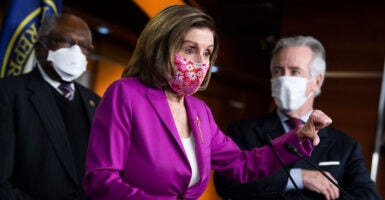
An enormous “stimulus” package was signed into law on Thursday, which is expected to bring government spending for this year to $6.9 trillion. This will add dramatically add to the national debt, which is currently at $28 trillion. Pictured: Speaker of the House Nancy Pelosi, D-Calif., conducts a news conference on the on the stimulus bill on Tuesday. (Photo: Tom Williams/CQ-Roll Call, Inc./Getty Images)

President Joe Biden signed into law an enormous, debt-financed “stimulus” package on Thursday. This was the final step in a multi-month process to pass a heavily flawed piece of legislation.

We might be tempted to hope that this will finally sate the left’s appetite for big government. After all, the size and scope of government will expand more than 54%—from $4.5 trillion of annual spending in 2019 to about $6.9 trillion this year—once the new spending bill is factored in, based on calculations by experts at The Heritage Foundation.

Washington added $4.5 trillion to the national debt over the last year alone. This brings the total debt level to $28 trillion, or roughly $225,000 per U.S. household.

Unfortunately, even that might not be enough to get congressional leaders and the Biden administration to pump the brakes on the spending spree. A planned infrastructure spending package could top $2 trillion, and there is little appetite to pay for it.

Want to keep up with the 24/7 news cycle? Want to know the most important stories of the day for conservatives? Need news you can trust? Subscribe to The Daily Signal’s email newsletter. Learn more >>

There are plenty of reasons why Congress should avoid another bloated spending deal. The nonpartisan Congressional Budget Office issued a report last week detailing one of the most important reasons: our nation’s finances are rapidly heading into dangerous territory.

While the numbers involved can seem incomprehensibly large, these charts can help to visualize the looming disaster.
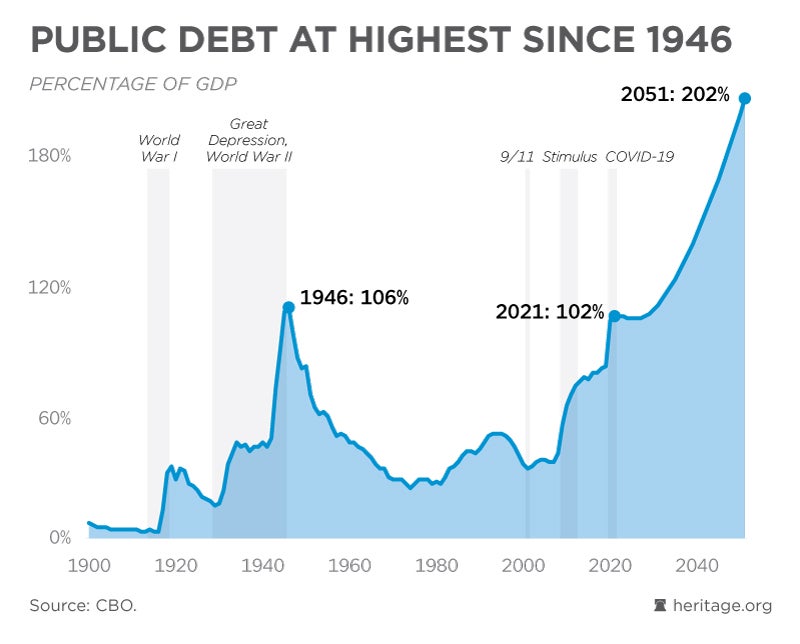
The federal government amassed a record-setting amount of debt during the Great Depression and World War II. When the war was over, federal spending was adjusted from 41% of the economy in 1945 to 11.4% in 1948.

A combination of lower spending and rapid revenue increases from the post-war economic boom meant that the national debt shrank dramatically relative to the economy.

Unfortunately, such rapid debt reduction would be almost impossible to duplicate today.

Even the most optimistic growth forecasts fall well short of what was seen after World War II. More importantly, because most federal spending goes towards established benefit programs like Social Security and Medicare, it would be extremely difficult to cut spending at a similar pace.

However, policies to boost economic growth and restrain spending are still the best way to prevent the national debt from reaching crisis proportions.
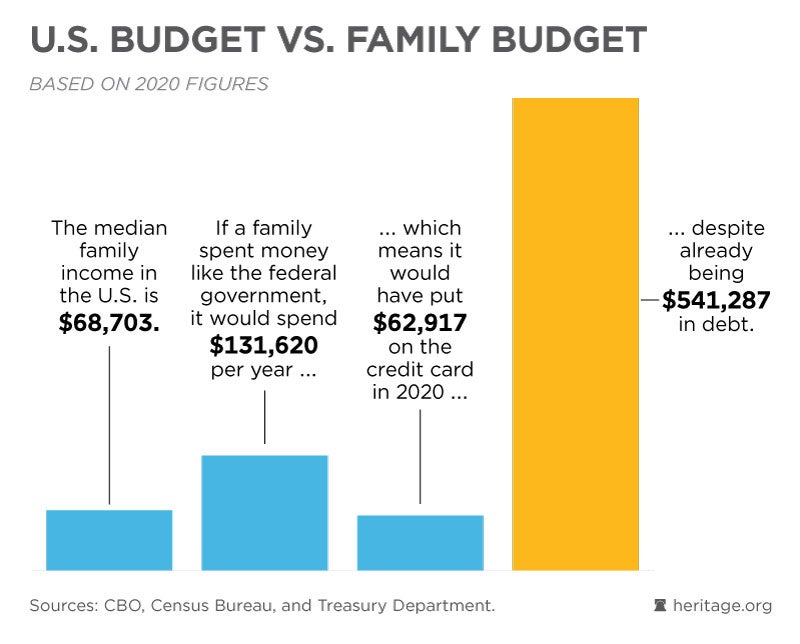
In 2020, the federal government spent almost twice as much as it took in from taxes. The new legislative package means that this year’s deficit will likely be even bigger than last year’s.

These sky-high deficits add to an even larger total debt.

Uncle Sam has benefitted from a run of low interest rates over the last several years, blunting the cost of the escalating debt. Yet we can’t assume that this will last forever.

If you went to a bank for a big loan, you would expect them to ask some tough questions about your finances. The same holds true for the global financial system, which we count on to buy our debt.

While short-term federal bonds are still considered a safe investment, markets are demanding much higher yields for longer-term debt. Credit rating agencies have recently warnedthat our credit rating could be downgraded unless steps are taken to address overspending and the debt.

They have also cautioned us that interest rates will rise. This signals that our days of cheap creditcould be coming to an end sooner than we would want. If that happens, America will pay a steep price.
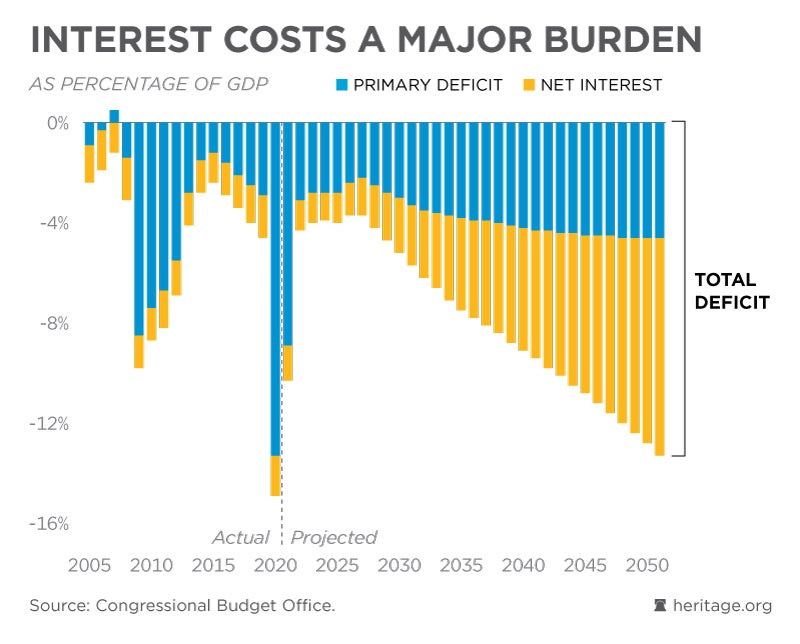
That “steep price” is not metaphorical. The Congressional Budget Office’s new report shows that the cost of servicing the national debt was already set to explode before the stimulus package passed.

Right now, interest on the debt is a burden the economy can handle. However, even a modest interest rate increase—coupled with continued irresponsibility from Washington—will cause interest costs to increase more than five-fold in the next few decades.

This would be an anchor around the neck for the economy, and would make the growth and prosperity we take for granted next to impossible for future generations to experience.
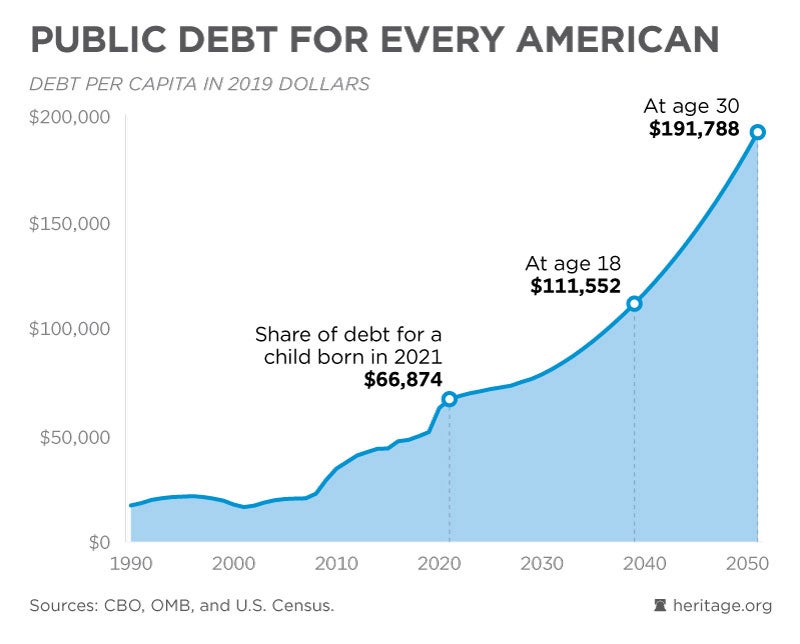
In the not-so-distant past—specifically, the year 2018—the amount of public debt per person was just under $50,000. Today, it stands at nearly $67,000 for every American, including children.

It only gets worse from there. A baby born tomorrow is expected to have over $111,000 in debt to their name when they turn 18, and nearly $192,000 by age 30.

Those numbers do not account for the new stimulus bill, a potential infrastructure package, or expanded benefit programs. Instead, the main reason why debt will skyrocket over the coming years is because federal spending is being allowed to grow without limits.
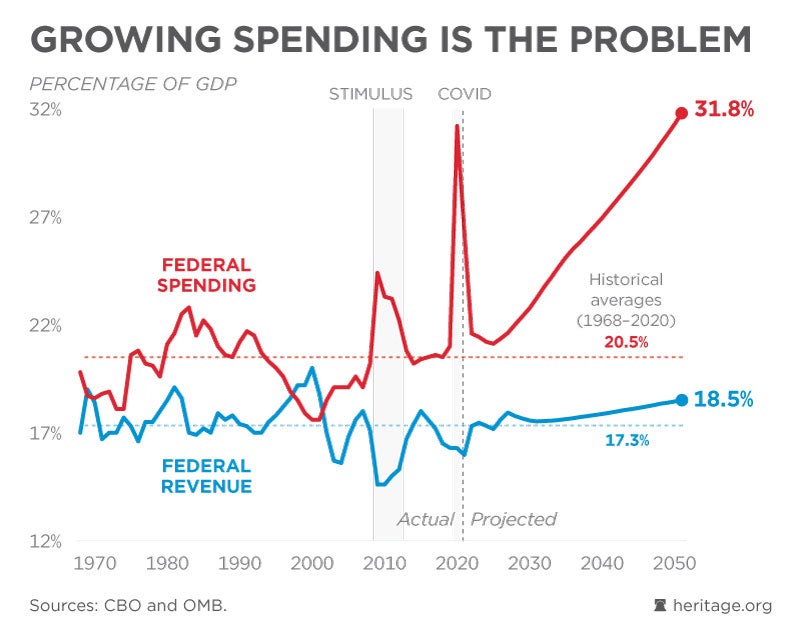
While some on the left blame the 2017 tax cuts for deficits, this chart makes it clear that the culprit for our long-term financial gap is an explosion in federal spending.

Spending was already above the historical average in 2019, and will grow much faster than the economy from 2022 onwards. Meanwhile, revenue will soon return to normal levels.

Why do we expect such a rapid increase in federal spending? A handful of programs, primarily Social Security, Medicare, and Medicaid, have been set up in an unsustainable way. Reforming these programs by balancing the needs of both retirees and future generations would be a tremendous breakthrough.

However, Congress has consistently avoided the issue of unsustainable programs, and has even made things worse by expanding benefits. The longer Washington waits to confront this problem, the more drastic the remedies will have to be.

Experts from The Heritage Foundation have provided legislators with the policy tools they need to address this mounting crisis, meaning members of Congress can’t plead ignorance.

Those in positions of leadership have a responsibility to do the right thing for present and future Americans, and the public must hold them accountable if they do not.

Have an opinion about this article? To sound off, please email letters@DailySignal.com and we will consider publishing your remarks in our regular “We Hear You” feature.

—-

March 31, 2021

President Biden  c/o The White House
1600 Pennsylvania Avenue NW
Washington, DC 20500

Dear Mr. President,

Please explain to me if you ever do plan to balance the budget while you are President? I have written these things below about you and I really do think that you don’t want to cut spending in order to balance the budget. It seems you ever are daring the Congress to stop you from spending more.

President Barack Obama speaks about the debt limit in the East Room of the White House in Washington. | AP Photo

“The credit of the United States ‘is not a bargaining chip,’ Obama said on 1-14-13. However, President Obama keeps getting our country’s credit rating downgraded as he raises the debt ceiling higher and higher!!!!

Washington Could Learn a Lot from a Drug Addict

Just spend more, don’t know how to cut!!! Really!!! That is not living in the real world is it?

Making more dependent on government is not the way to go!!

Why is our government in over 16 trillion dollars in debt? There are many reasons for this but the biggest reason is people say “Let’s spend someone else’s money to solve our problems.” Liberals like Max Brantley have talked this way for years. Brantley will say that conservatives are being harsh when they don’t want the government out encouraging people to be dependent on the government. The Obama adminstration has even promoted a plan for young people to follow like Julia the Moocher.  

David Ramsey demonstrates in his Arkansas Times Blog post of 1-14-13 that very point:

Arkansas Politics / Health Care Arkansas’s share of Medicaid expansion and the national debt

Posted by on Mon, Jan 14, 2013 at 1:02 PM

Baby carrot Arkansas Medicaid expansion image

Imagine standing a baby carrot up next to the 25-story Stephens building in Little Rock. That gives you a picture of the impact on the national debt that federal spending in Arkansas on Medicaid expansion would have, while here at home expansion would give coverage to more than 200,000 of our neediest citizens, create jobs, and save money for the state.

Here’s the thing: while more than a billion dollars a year in federal spending would represent a big-time stimulus for Arkansas, it’s not even a drop in the bucket when it comes to the national debt.

Currently, the national debt is around $16.4 trillion. In fiscal year 2015, the federal government would spend somewhere in the neighborhood of $1.2 billion to fund Medicaid expansion in Arkansas if we say yes. That’s about 1/13,700th of the debt.

It’s hard to get a handle on numbers that big, so to put that in perspective, let’s get back to the baby carrot. Imagine that the height of the Stephens building (365 feet) is the $16 trillion national debt. That $1.2 billion would be the length of a ladybug. Of course, we’re not just talking about one year if we expand. Between now and 2021, the federal government projects to contribute around $10 billion. The federal debt is projected to be around $25 trillion by then, so we’re talking about 1/2,500th of the debt. Compared to the Stephens building? That’s a baby carrot.

______________

Here is how it will all end if everyone feels they should be allowed to have their “baby carrot.”

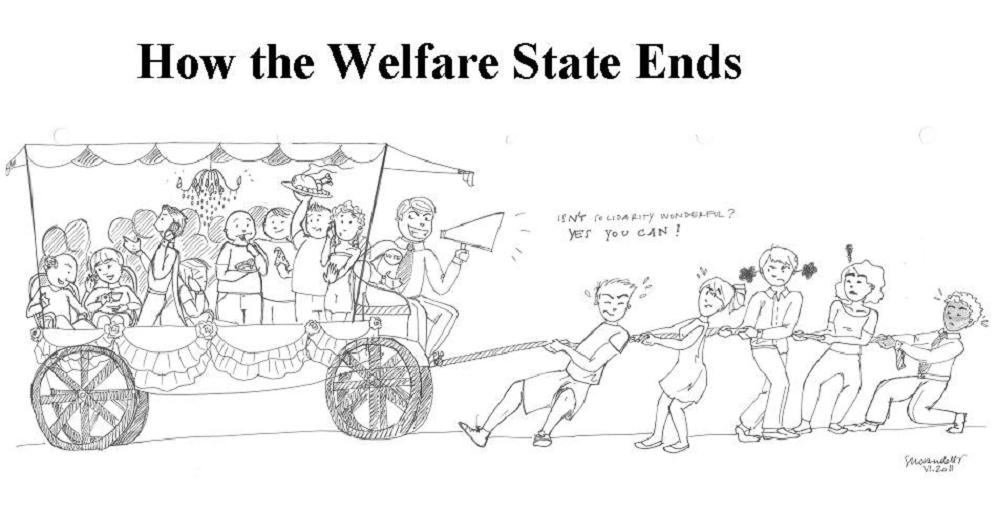
How sad it is that liberals just don’t get this reality.

Here is what the Founding Fathers had to say about welfare. David Weinberger noted:

While living in Europe in the 1760s, Franklin observed: “in different countries … the more public provisions were made for the poor, the less they provided for themselves, and of course became poorer. And, on the contrary, the less was done for them, the more they did for themselves, and became richer.”

Alexander Fraser Tytler, Lord Woodhouselee (15 October 1747 – 5 January 1813) was a Scottish lawyer, writer, and professor. Tytler was also a historian, and he noted, “A democracy cannot exist as a permanent form of government. It can only exist until the majority discovers it can vote itself largess out of the public treasury. After that, the majority always votes for the candidate promising the most benefits with the result the democracy collapses because of the loose fiscal policy ensuing, always to be followed by a dictatorship, then a monarchy.”

Thomas Jefferson to Joseph Milligan

April 6, 1816

[Jefferson affirms that the main purpose of society is to enable human beings to keep the fruits of their labor. — TGW]

To take from one, because it is thought that his own industry and that of his fathers has acquired too much, in order to spare to others, who, or whose fathers have not exercised equal industry and skill, is to violate arbitrarily the first principle of association, “the guarantee to every one of a free exercise of his industry, and the fruits acquired by it.” If the overgrown wealth of an individual be deemed dangerous to the State, the best corrective is the law of equal inheritance to all in equal degree; and the better, as this enforces a law of nature, while extra taxation violates it.

[From Writings of Thomas Jefferson, ed. Albert E. Bergh (Washington: Thomas Jefferson Memorial Association, 1904), 14:466.]

_______

Jefferson pointed out that to take from the rich and give to the poor through government is just wrong. Franklin knew the poor would have a better path upward without government welfare coming their way. Milton Friedman’s negative income tax is the best method for doing that and by taking away all welfare programs and letting them go to the churches for charity.

_____________

_________

Thank you so much for your time. I know how valuable it is. I also appreciate the fine family that you have and your commitment as a father and a husband.

Sincerely,

Everette Hatcher III, 13900 Cottontail Lane, Alexander, AR 72002, ph 501-920-5733

Williams with Sowell – Minimum Wage
Thomas Sowell

Thomas Sowell – Reducing Black Unemployment

By WALTER WILLIAMS

—-

Ronald Reagan with Milton Friedman
Milton Friedman The Power of the Market 2-5

Related posts:

Welfare Spending Shattering All-Time Highs

  We got to act fast and get off this path of socialism. Morning Bell: Welfare Spending Shattering All-Time Highs Robert Rector and Amy Payne October 18, 2012 at 9:03 am It’s been a pretty big year for welfare—and a new report shows welfare is bigger than ever. The Obama Administration turned a giant spotlight […]

We need more brave souls that will vote against Washington welfare programs

We need to cut Food Stamp program and not extend it. However, it seems that people tell the taxpayers back home they are going to Washington and cut government spending but once they get up there they just fall in line with  everyone else that keeps spending our money. I am glad that at least […]

Welfare programs are not the answer for the poor

Government Must Cut Spending Uploaded by HeritageFoundation on Dec 2, 2010 The government can cut roughly $343 billion from the federal budget and they can do so immediately. __________ Liberals argue that the poor need more welfare programs, but I have always argued that these programs enslave the poor to the government. Food Stamps Growth […]

Private charities are best solution and not government welfare

Milton Friedman – The Negative Income Tax Published on May 11, 2012 by LibertyPen In this 1968 interview, Milton Friedman explained the negative income tax, a proposal that at minimum would save taxpayers the 72 percent of our current welfare budget spent on administration. http://www.LibertyPen.com Source: Firing Line with William F Buckley Jr. ________________ Milton […]

The book “After the Welfare State”

Dan Mitchell Commenting on Obama’s Failure to Propose a Fiscal Plan Published on Aug 16, 2012 by danmitchellcato No description available. ___________ After the Welfare State Posted by David Boaz Cato senior fellow Tom G. Palmer, who is lecturing about freedom in Slovenia and Tbilisi this week, asked me to post this announcement of his […]

President Obama responds to Heritage Foundation critics on welfare reform waivers

Is President Obama gutting the welfare reform that Bill Clinton signed into law? Morning Bell: Obama Denies Gutting Welfare Reform Amy Payne August 8, 2012 at 9:15 am The Obama Administration came out swinging against its critics on welfare reform yesterday, with Press Secretary Jay Carney saying the charge that the Administration gutted the successful […]

Welfare reform part 3

Thomas Sowell – Welfare Welfare reform was working so good. Why did we have to abandon it? Look at this article from 2003. The Continuing Good News About Welfare Reform By Robert Rector and Patrick Fagan, Ph.D. February 6, 2003 Six years ago, President Bill Clinton signed legislation overhauling part of the nation’s welfare system. […]

Welfare reform part 2

Uploaded by ForaTv on May 29, 2009 Complete video at: http://fora.tv/2009/05/18/James_Bartholomew_The_Welfare_State_Were_In Author James Bartholomew argues that welfare benefits actually increase government handouts by ‘ruining’ ambition. He compares welfare to a humane mousetrap. —– Welfare reform was working so good. Why did we have to abandon it? Look at this article from 2003. In the controversial […]

Why did Obama stop the Welfare Reform that Clinton put in?

Thomas Sowell If the welfare reform law was successful then why change it? Wasn’t Bill Clinton the president that signed into law? Obama Guts Welfare Reform Robert Rector and Kiki Bradley July 12, 2012 at 4:10 pm Today, the Obama Department of Health and Human Services (HHS) released an official policy directive rewriting the welfare […]

“Feedback Friday” Letter to White House generated form letter response July 10,2012 on welfare, etc (part 14)

I have been writing President Obama letters and have not received a personal response yet.  (He reads 10 letters a day personally and responds to each of them.) However, I did receive a form letter in the form of an email on July 10, 2012. I don’t know which letter of mine generated this response so I have […]

Dan Mitchell’s article The World’s Most Politically Illiterate Statement

The World’s Most Politically Illiterate Statement

Exactly one month ago, I declared that Congresswoman Ayanna Pressley deserved an award for the “world’s most economically illiterate statement” because of her claim that “poverty is not naturally occurring.”

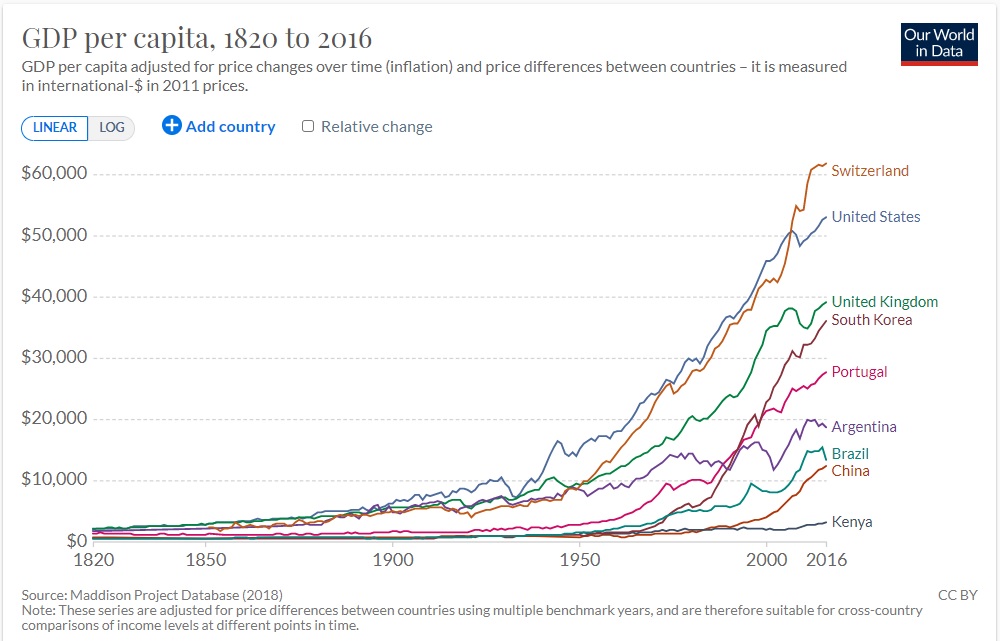
In reality, poverty has been the norm throughout history. As documented by Professors Deirdre McCloskey and Don Boudreaux, it was only the development of capitalism (starting a few hundred years ago in Europe) that enabled humanity to enjoy amazing and unprecedented increases in living standards.

Moreover, Ms. Pressely was trying to argue that redistribution was the proper way to address poverty, and I concluded my column by noting “that part of her statement also is wrong, according to both U.S. data and global data.”

Today, I want to debunk another preposterous assertion.

David Smith of the U.K.-based Guardian wrote a columnyesterday claiming that Biden’s so-called stimulus should be celebrated since it marks an end to forty years of Reaganomics.

…he will…be on a mission to restore faith in government. Confidence in it “has been plummeting since the late 60s to what it is now”, Biden noted in his remarks last week. His legislation, called the American Rescue Plan, can correct that with the biggest expansion of the welfare state in decades. …Biden knows better than anyone what that means. When he was born, in 1942, the president was Franklin Roosevelt, architect of the New Deal… When Biden was a student at the University of Delaware, Lyndon Johnson embarked on his project of the “Great Society”… Then came Ronald Reagan and his famous quip: “The nine most terrifying words in the English language are: I’m from the government and I’m here to help.” …He described Johnson’s “Great Society” as a fundamental wrong turn and set about dismantling it. …This orthodoxy held and dominated the political centre ground. …Biden’s could hardly be more of a polar opposite. …All the more reason to enjoy his victory lap and celebrate that four decades of Reaganism and “trickle down” economics are at an end.

Some of that political analysis is reasonable. FDR’s failed New Deal did expand government, as did LBJ’s failed War on Poverty.

And it’s also true that Reagan challenged their big-government orthodoxy and was somewhat successful in reining in the welfare state (“dismantling it” is a huge exaggeration, however).

But the author’s claim that there were “four decades of Reaganism” is breathtaking nonsense.

  • George H.W. Bush expanded the burden of government.
  • George W. Bush expanded the burden of government.
  • Barack Obama expanded the burden of government.
  • Donald Trump expanded the burden of government.

That’s 24 years of statist policies after Reagan left office.

If Mr. Smith actually knew the subject matter and wanted to write an honest article, he could have made an argument about16 years of Reaganism because we also benefited from a net reduction in the burden of government during Clinton’s eight years in office.

But the 21st century has been nothing but bad news for proponents of free markets. If you peruse Economic Freedom of the World, you’ll find that America’s level of economic freedom peaked in 2000 with a score of 8.67 (on a 1-10 scale).

Now the score for the United States has dropped to 8.22.

By the way, that’s not catastrophically bad. There’s no immediate risk of America becoming another Greece. And we’ll presumably never turn into Venezuela, no matter how hard Biden tries (it wouldn’t even happen if Vice President Harris took over).

That being said, what we’ve endured over the past two decades definitely is not Reaganism. The “Washington Consensus” is just a distant memory.

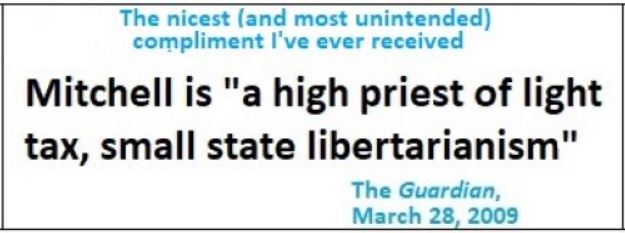
P.S. David Smith’s article is an example of sloppy journalism at a left-wing newspaper, but I’ll always have a bit of fondness for the Guardian because of the unintended compliment it bestowed upon me back in 2009.

P.P.S. For younger readers who did not experience the Reagan years, here’s my assessment of his record and here are some videos of some of his iconic remarks (and here’s a bonus video).

Rand Paul questions if US borrowing puts country on path to become Venezuela

Paul’s comments came just a day after the Senate passed President Biden’s $1.9 trillion COVID-19 relief bill

Sen. Rand Paul, one of the most outspoken Republicans about government spending, took to Twitter Sunday to ask if Congress’ borrowing is putting the U.S. economy on the same path as Venezuela’s.

“New 1,000,000 bolivar note in Venezuela worth 53 cents,” Paul tweeted, while linking to a Bloomberg report on hyperinflation in Caracas. “Will US be the next Venezuela with Congress borrowing over $6 trillion in one year?”

Paul’s comments came just a day after the Senate passed President Biden’s $1.9 trillion COVID-19 relief bill in a 50-49 vote. Sen. Mitt Romney, R-Utah, also expressed dismay over some of what he identified as wasteful spending in the bill, including providing billions in financial assistance to states that do not need it.

“We’re going to be asking the American people to allow us to borrow money from China and others, pass that on to our kids and grandkids so that we can send money to states like California and mine that don’t need the money,” Romney said. “That doesn’t make any sense at all.”

GET THE FOX NEWS APP

Venezuela’s economy has deteriorated due to, oil prices, the coronavirus and years of hyperinflation, according to Reuters. Its central bank issued a new banknote worth 1 million bolivars that will be worth 52 cents. The report said that many Venezuelans use U.S. currency to complete transactions.

March 31, 2021

President Biden  c/o The White House
1600 Pennsylvania Avenue NW
Washington, DC 20500

Dear Mr. President,

Please explain to me if you ever do plan to balance the budget while you are President? I have written these things below about you and I really do think that you don’t want to cut spending in order to balance the budget. It seems you ever are daring the Congress to stop you from spending more.

President Barack Obama speaks about the debt limit in the East Room of the White House in Washington. | AP Photo

“The credit of the United States ‘is not a bargaining chip,’ Obama said on 1-14-13. However, President Obama keeps getting our country’s credit rating downgraded as he raises the debt ceiling higher and higher!!!!

Washington Could Learn a Lot from a Drug Addict

Just spend more, don’t know how to cut!!! Really!!! That is not living in the real world is it?

Making more dependent on government is not the way to go!!

Why is our government in over 16 trillion dollars in debt? There are many reasons for this but the biggest reason is people say “Let’s spend someone else’s money to solve our problems.” Liberals like Max Brantley have talked this way for years. Brantley will say that conservatives are being harsh when they don’t want the government out encouraging people to be dependent on the government. The Obama adminstration has even promoted a plan for young people to follow like Julia the Moocher.  

David Ramsey demonstrates in his Arkansas Times Blog post of 1-14-13 that very point:

Arkansas Politics / Health Care Arkansas’s share of Medicaid expansion and the national debt

Posted by on Mon, Jan 14, 2013 at 1:02 PM

Baby carrot Arkansas Medicaid expansion image

Imagine standing a baby carrot up next to the 25-story Stephens building in Little Rock. That gives you a picture of the impact on the national debt that federal spending in Arkansas on Medicaid expansion would have, while here at home expansion would give coverage to more than 200,000 of our neediest citizens, create jobs, and save money for the state.

Here’s the thing: while more than a billion dollars a year in federal spending would represent a big-time stimulus for Arkansas, it’s not even a drop in the bucket when it comes to the national debt.

Currently, the national debt is around $16.4 trillion. In fiscal year 2015, the federal government would spend somewhere in the neighborhood of $1.2 billion to fund Medicaid expansion in Arkansas if we say yes. That’s about 1/13,700th of the debt.

It’s hard to get a handle on numbers that big, so to put that in perspective, let’s get back to the baby carrot. Imagine that the height of the Stephens building (365 feet) is the $16 trillion national debt. That $1.2 billion would be the length of a ladybug. Of course, we’re not just talking about one year if we expand. Between now and 2021, the federal government projects to contribute around $10 billion. The federal debt is projected to be around $25 trillion by then, so we’re talking about 1/2,500th of the debt. Compared to the Stephens building? That’s a baby carrot.

______________

Here is how it will all end if everyone feels they should be allowed to have their “baby carrot.”

How sad it is that liberals just don’t get this reality.

Here is what the Founding Fathers had to say about welfare. David Weinberger noted:

While living in Europe in the 1760s, Franklin observed: “in different countries … the more public provisions were made for the poor, the less they provided for themselves, and of course became poorer. And, on the contrary, the less was done for them, the more they did for themselves, and became richer.”

Alexander Fraser Tytler, Lord Woodhouselee (15 October 1747 – 5 January 1813) was a Scottish lawyer, writer, and professor. Tytler was also a historian, and he noted, “A democracy cannot exist as a permanent form of government. It can only exist until the majority discovers it can vote itself largess out of the public treasury. After that, the majority always votes for the candidate promising the most benefits with the result the democracy collapses because of the loose fiscal policy ensuing, always to be followed by a dictatorship, then a monarchy.”

Thomas Jefferson to Joseph Milligan

April 6, 1816

[Jefferson affirms that the main purpose of society is to enable human beings to keep the fruits of their labor. — TGW]

To take from one, because it is thought that his own industry and that of his fathers has acquired too much, in order to spare to others, who, or whose fathers have not exercised equal industry and skill, is to violate arbitrarily the first principle of association, “the guarantee to every one of a free exercise of his industry, and the fruits acquired by it.” If the overgrown wealth of an individual be deemed dangerous to the State, the best corrective is the law of equal inheritance to all in equal degree; and the better, as this enforces a law of nature, while extra taxation violates it.

[From Writings of Thomas Jefferson, ed. Albert E. Bergh (Washington: Thomas Jefferson Memorial Association, 1904), 14:466.]

_______

Jefferson pointed out that to take from the rich and give to the poor through government is just wrong. Franklin knew the poor would have a better path upward without government welfare coming their way. Milton Friedman’s negative income tax is the best method for doing that and by taking away all welfare programs and letting them go to the churches for charity.

_____________

_________

Thank you so much for your time. I know how valuable it is. I also appreciate the fine family that you have and your commitment as a father and a husband.

Sincerely,

Everette Hatcher III, 13900 Cottontail Lane, Alexander, AR 72002, ph 501-920-5733

Williams with Sowell – Minimum Wage

Thomas Sowell

Thomas Sowell – Reducing Black Unemployment

By WALTER WILLIAMS

—-

Ronald Reagan with Milton Friedman
Milton Friedman The Power of the Market 2-5

Related posts:

Welfare Spending Shattering All-Time Highs

  We got to act fast and get off this path of socialism. Morning Bell: Welfare Spending Shattering All-Time Highs Robert Rector and Amy Payne October 18, 2012 at 9:03 am It’s been a pretty big year for welfare—and a new report shows welfare is bigger than ever. The Obama Administration turned a giant spotlight […]

We need more brave souls that will vote against Washington welfare programs

We need to cut Food Stamp program and not extend it. However, it seems that people tell the taxpayers back home they are going to Washington and cut government spending but once they get up there they just fall in line with  everyone else that keeps spending our money. I am glad that at least […]

Welfare programs are not the answer for the poor

Government Must Cut Spending Uploaded by HeritageFoundation on Dec 2, 2010 The government can cut roughly $343 billion from the federal budget and they can do so immediately. __________ Liberals argue that the poor need more welfare programs, but I have always argued that these programs enslave the poor to the government. Food Stamps Growth […]

Private charities are best solution and not government welfare

Milton Friedman – The Negative Income Tax Published on May 11, 2012 by LibertyPen In this 1968 interview, Milton Friedman explained the negative income tax, a proposal that at minimum would save taxpayers the 72 percent of our current welfare budget spent on administration. http://www.LibertyPen.com Source: Firing Line with William F Buckley Jr. ________________ Milton […]

The book “After the Welfare State”

Dan Mitchell Commenting on Obama’s Failure to Propose a Fiscal Plan Published on Aug 16, 2012 by danmitchellcato No description available. ___________ After the Welfare State Posted by David Boaz Cato senior fellow Tom G. Palmer, who is lecturing about freedom in Slovenia and Tbilisi this week, asked me to post this announcement of his […]

President Obama responds to Heritage Foundation critics on welfare reform waivers

Is President Obama gutting the welfare reform that Bill Clinton signed into law? Morning Bell: Obama Denies Gutting Welfare Reform Amy Payne August 8, 2012 at 9:15 am The Obama Administration came out swinging against its critics on welfare reform yesterday, with Press Secretary Jay Carney saying the charge that the Administration gutted the successful […]

Welfare reform part 3

Thomas Sowell – Welfare Welfare reform was working so good. Why did we have to abandon it? Look at this article from 2003. The Continuing Good News About Welfare Reform By Robert Rector and Patrick Fagan, Ph.D. February 6, 2003 Six years ago, President Bill Clinton signed legislation overhauling part of the nation’s welfare system. […]

Welfare reform part 2

Uploaded by ForaTv on May 29, 2009 Complete video at: http://fora.tv/2009/05/18/James_Bartholomew_The_Welfare_State_Were_In Author James Bartholomew argues that welfare benefits actually increase government handouts by ‘ruining’ ambition. He compares welfare to a humane mousetrap. —– Welfare reform was working so good. Why did we have to abandon it? Look at this article from 2003. In the controversial […]

Why did Obama stop the Welfare Reform that Clinton put in?

Thomas Sowell If the welfare reform law was successful then why change it? Wasn’t Bill Clinton the president that signed into law? Obama Guts Welfare Reform Robert Rector and Kiki Bradley July 12, 2012 at 4:10 pm Today, the Obama Department of Health and Human Services (HHS) released an official policy directive rewriting the welfare […]

“Feedback Friday” Letter to White House generated form letter response July 10,2012 on welfare, etc (part 14)

I have been writing President Obama letters and have not received a personal response yet.  (He reads 10 letters a day personally and responds to each of them.) However, I did receive a form letter in the form of an email on July 10, 2012. I don’t know which letter of mine generated this response so I have […]
My March 11, 2021 letter to President Joe Biden, MILTON FRIEDMAN: “The high rate of unemployment among teenagers, and especially black teenagers, is both a scandal and a serious source of social unrest. Yet it is largely a result of minimum wage laws.”

Ep. 4 – From Cradle to Grave [6/7]. Milton Friedman’s Free to Choose (1980)

March 11, 2021

President Biden c/o The White House
1600 Pennsylvania Avenue NW
Washington, DC 20500

Dear Mr. President,

Thank you for taking time to have your office try and get a pulse on what is going on out here in the country. I wanted to let you know what I think about the minimum wage increase you have proposed for the whole country and I wanted to quote Milton Friedman who you are familiar with and you made it clear in July that you didn’t care for his views! Let me challenge you to take a closer look at what he had to say!

_____________

Thank you so much for your time. I know how valuable it is. I also appreciate the fine family that you have and your commitment as a father and a husband.

Sincerely,

Everette Hatcher III, 13900 Cottontail Lane, Alexander, AR 72002, ph 501-920-5733

Williams with Sowell – Minimum Wage

Thomas Sowell

Thomas Sowell – Reducing Black Unemployment

By WALTER WILLIAMS

—-

Ronald Reagan with Milton Friedman
Milton Friedman The Power of the Market 2-5

Dan Mitchell article Expanding the Welfare State with Per-Child Handouts

Expanding the Welfare State with Per-Child Handouts

Two days ago, I shared data showing that people in the big nations of Western Europe only have about 75 cents of income for every $1 that Americans earn.

That’s a remarkable gap, and it’s getting larger rather than smaller, even though theory says that shouldn’t happen.

But what’s even more shocking is that a poor person in the United States would be middle class in most European nations.

And a low-income person in America is better off than the average European.

When I see numbers like this (and lots of other data I have shared over the years, all of which tells the same story), I have two reactions.

  • First, I want to laugh at anyone who thinks Europeans have a better distribution of income.
  • Second, I want to scream at anyone who things we should copy the European economic policy.

But my laughing and screaming obviously has no effect because Washington politicians are poised to enact a giant expansion of the welfare state.

And there’s plenty of support for this risky concept from both Democrats and Republicans.

On the GOP side, Senator Mitt Romney has proposed a big tax increase to pay for a big increase in redistribution spending in the form of universal handouts for families with children, an idea that I criticized early last month.

And Oren Cass, a former campaign aide for Romney, has a slightly different plan to impose higher taxes to fund handouts for families with children. I recently critiqued that plan in an article co-authored with Veronique de Rugy of the Mercatus Center. Here’s some of what we wrote.

…the proposal for a Family Income Supplemental Credit (Fisc) from Oren Cass and Wells King is misguided, mostly because it would raise tax rates and expand the burden of government spending. …the Fisc would cost $200 billion annually. …$80 billion per year, would be financed with tax increases. …this fact alone should make the Fisc a non-starter as a matter of fiscal policy. …Income tax rates already are too high, and President Biden wants to raise them further. Self-styled conservatives should not be aiding and abetting the push for class-warfare taxation by adding to the collection of proposed tax-rate increases on workers, investors, entrepreneurs, and business owners. …it would be desirable for families to have more economic opportunity and financial security. However, it doesn’t follow that conservatives should support subsidizing child-bearing and -rearing. We do not think copying Europe and imposing more redistribution is the right approach. Americans enjoy far-higher living standards than people on the other side of the Atlantic Ocean, thanks in part to our smaller fiscal burden.

As you might expect, folks on the left are very excited about expanding the welfare state.

Biden’s so-called stimulus plan also contains a big one-time handout to households with children (with proponents hoping the lure of free cash will lead those households to demand that Washington make such giveaways a permanent part of American life).

Scott Winship of the American Enterprise Institute pours cold water on all the above proposals. Except he focuses not on fiscal policy, but on the fact that these schemes will subsidize dependency and encourage out-of-wedlock births – thus undermining the very successful welfare reform of the 1990s.

A child allowance would send unconditional cash benefits to nearly all families on a per-child basis.Child allowances run a very real risk of encouraging more single parenthood and more no-worker families, both of which could worsen entrenched poverty in the long run—an overreliance on government transfers, poverty over longer stretches of childhood, intergenerational poverty, and geographically concentrated poverty. …Poverty among the children of single parents fell from 50 percent in the early 1980s to 15 percent today, with an especially sharp decline during the 1990s. This was a period in which policy reforms encouraged work, by imposing time limits and work requirements on receipt of cash welfare and expanding benefits to low-income workers. …We should strive to reduce child poverty further, but it matters how we do so. Reducing this year’s poverty while exacerbating entrenched poverty and reversing the progress we have made since welfare reform would be a hollow victory indeed. So much the worse if a child allowance leads to irresistible calls for a universal basic income, which would also increase nonwork among the childless.

Michael Barone is similarly perplexed that lawmakers are so intent on reversing the progress of welfare reform.

When public policies have produced disastrous results, and when alternative policies have resulted in immediate, seemingly miraculous improvement, why would anyone want to go back to the earlier policies? …births to unwed mothers and welfare dependency rose…from 1965 to 1975, violent crime and welfare dependency, both heavily concentrated among blacks, nearly tripled — tripled. For two more decades, crime and welfare dependency remained at the same high levels, sometimes zooming higher. …Reform, first by Thompson in Wisconsin and then by Newt Gingrich and Bill Clinton in the 1996 welfare bill, required mothers to work. Social workers’ focus was changed from handing out more checks to helping moms get and hold jobs. The results: Welfare rolls plummeted; teen births plunged; kids raised by working moms did better in school and in life. Liberals have tried to stealthily roll back the reforms. They’ve been joined by some cultural conservatives, worried about population decline… These include Sen. Mitt Romney, who supports a child allowance that is fully refundable — which is to say that government will send a check to parents, married or unmarried… A version of this, limited to one year, has been inserted in the “COVID relief” bill of President Joe Biden’s administration. A single parent with two kids, working or not, could qualify for $7,200 a year plus $6,400 in food stamps. …Mickey Kaus…argues that…”(A) large subset of recipients will go from one worker to zero workers.” That means “millions of kids growing up in fatherless homes, where nobody goes into the labor force, where the mainstream world of employment is a foreign country.” Past experience says he’s right and that…the people most hurt will be black Americans.

So is there a real danger that per-child handouts will become law?

The obvious answer is yes since they are included in Biden’s faux stimulus.

But that’s just a one-year giveaway. It’s unclear whether households will get addicted to that free cash and thus demand that the handouts get extended (based on my Second Theorem of Government, I’m pessimistic).

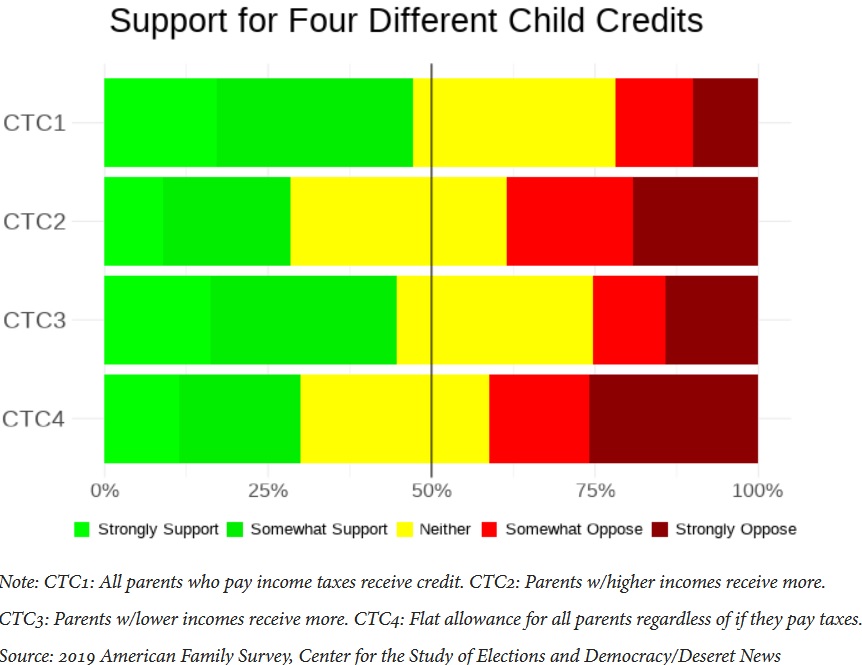
Robert VerBruggen has some polling data on this topic.

Here’s how he characterized the results.

So, what does the average person think…? The 2019 American Family Survey, a poll covering 3,000 adults from the Center for the Study of Elections and Democracy, tested four different child tax credit proposals… The results give us a sense of how the public—and some key segments of it—see the issue. Interestingly, none of the ideas had majority support…Nearly half of Americans can support a credit sold as tax relief that’s either broad-based (CTC1) or targeted to the lower-income (CTC3), but an across-the-board handout to parents just for being parents (CTC4) can’t even garner one-third support. …the major takeaways are these: 1) The child tax credit, in general, is not as popular as one might think — even in questions that don’t mention the taxes needed to pay for it, it never manages a majority; and 2) despite some energy on the pro-family intellectual right for flat, universal child allowances (CTC4), Republicans and even independents among the general public are really not fond of the idea.

This data is semi-encouraging. I’m definitely glad people are suspicious of big per-child handouts. And I suspect opposition will grow when people learn about the European-style taxes that would be needed to finance such a huge giveaway.

But it doesn’t help the fight for sensible policy when some self-styled conservatives advocate for big expansions of the welfare state – especially when such ideas inevitably will erode societal capital.

P.S. As indicated by the above excerpt, Scott Winship’s article concludes with a warning that universal per-child handouts could be the camel’s nose under the tent for a “basic income,” which is the crazy notion that government should give everyone money. That’s an additional reason to reject the idea, as even Joe Biden once realized.

P.P.S. Some proponents use the term “child tax credit” to describe per-child handouts, but that’s disingenuous at best. A handout doesn’t magically become a tax cut just because the recipient happens to pay tax. Moreover, the handouts in these proposals generally are “refundable,” which is simply fiscal jargon for handouts that also go to people who don’t pay any tax.

P.P.P.S. The real-world evidence casts considerable doubt on the notion that per-child handouts will increase birthrates.


Milton Friedman’s Free to Choose – Ep.4 (1/7) – From Cradle to Grave

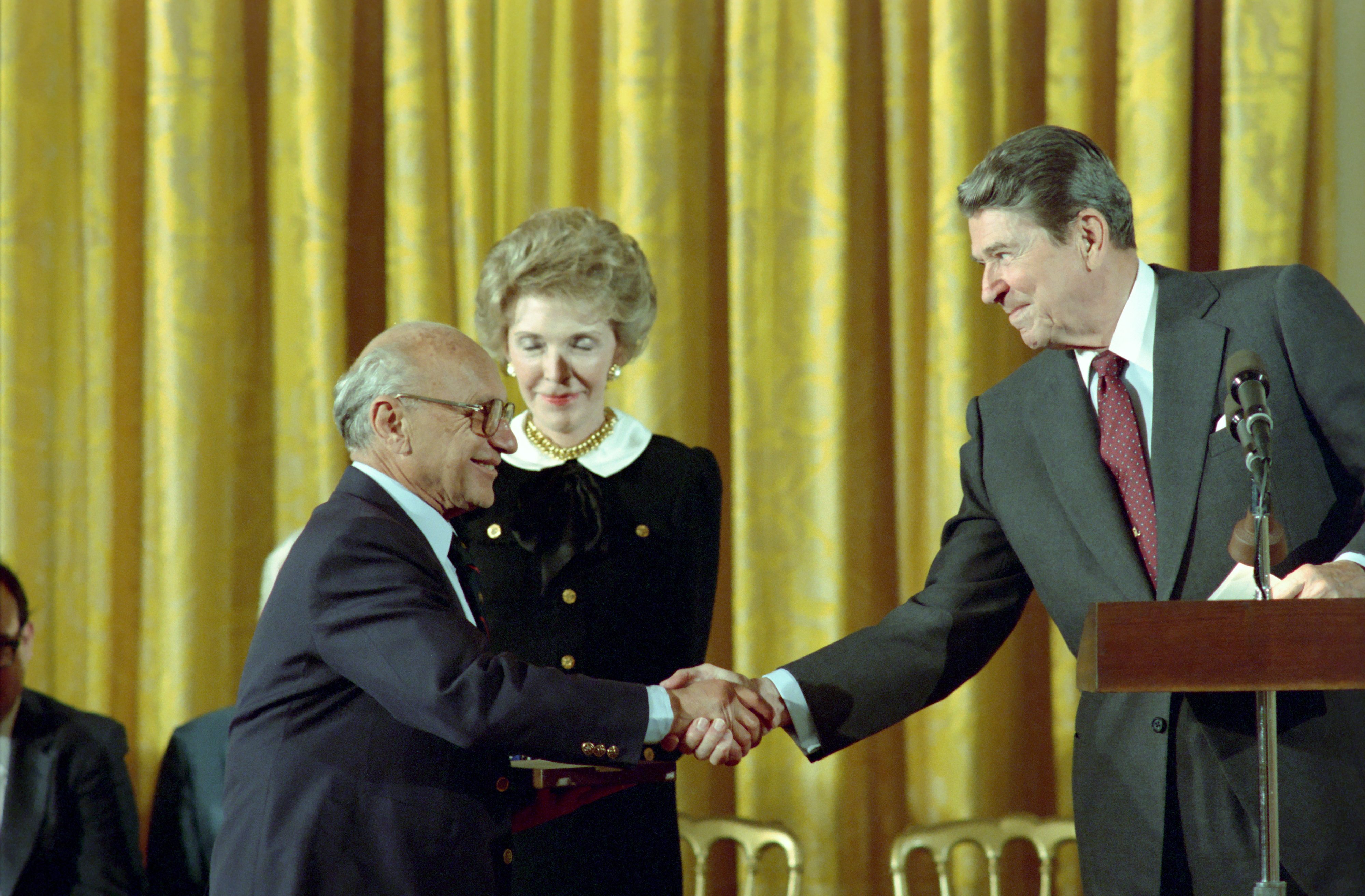
File:President Ronald Reagan and Nancy Reagan in The East Room Congratulating Milton Friedman Receiving The Presidential Medal of Freedom.jpg

January 21, 2021

President Biden c/o The White House
1600 Pennsylvania Avenue NW
Washington, DC 20500

Dear Mr. President,

With the national debt increasing faster than ever we must make the hard decisions to balance the budget now. If we wait another decade to balance the budget then we will surely risk our economic collapse.

The first step is to remove all welfare programs and replace them with the negative income tax program that Milton Friedman first suggested.

Milton Friedman points out that though many government welfare programs are well intentioned, they tend to have pernicious side effects. In Dr. Friedman’s view, perhaps the most serious shortcoming of governmental welfare activities is their tendency to strip away individual independence and dignity. This is because bureaucrats in welfare agencies are placed in positions of tremendous power over welfare recipients, exercising great influence over their lives. In addition, welfare programs tend to be self-perpetuating because they destroy work incentives. Dr. Friedman suggests a negative income tax as a way of helping the poor. The government would pay money to people falling below a certain income level. As they obtained jobs and earned money, they would continue to receive some payments from the government until their outside income reached a certain ceiling. This system would make people better off who sought work and earned income.

Here is a transcript of a portion of the “Free to Choose” program called “From Cradle to Grave” (program #4 in the 10 part series):

Transcript:
Friedman: After the 2nd World War, New York City authorities retained rent control supposedly to help their poorer citizens. The intentions were good. This in the Bronx was one result.
By the 50′s the same authorities were taxing their citizens. Including those who lived in the Bronx and other devastated areas beyond the East River to subsidize public housing. Another idea with good intentions yet poor people are paying for this, subsidized apartments for the well-to-do. When government at city or federal level spends our money to help us, strange things happen.
The idea that government had to protect us came to be accepted during the terrible years of the Depression. Capitalism was said to have failed. And politicians were looking for a new approach.
Franklin Delano Roosevelt was a candidate for the presidency. He was governor of New York State. At the governor’s mansion in Albany, he met repeatedly with friends and colleagues to try to find some way out of the Depression. The problems of the day were to be solved by government action and government spending. The measures that FDR and his associates discussed here derived from a long line of past experience. Some of the roots of these measures go back to Bismark’s Germany at the end of the 19th Century. The first modern state to institute old age pensions and other similar measures on the part of government. In the early 20th Century Great Britain followed suit under Lloyd George and Churchill. It too instituted old age pensions and similar plans.
These precursors of the modern welfare state had little effect on practice in the United States. But they did have a very great effect on the intellectuals on the campus like those who gathered here with FDR. The people who met here had little personal experience of the horrors of the Depression but they were confident that they had the solution. In their long discussions as they sat around this fireplace trying to design programs to meet the problems raised by the worst Depression in the history of the United States, they quite naturally drew upon the ideas that were prevalent at the time. The intellectual climate had become one in which it was taken for granted that government had to play a major role in solving the problems in providing what came later to be called Security from Cradle to Grave.
Roosevelt’s first priority after his election was to deal with massive unemployment. A Public Works program was started. The government financed projects to build highways, bridges and dams. The National Recovery Administration was set up to revitalize industry. Roosevelt wanted to see America move into a new era. The Social Security Act was passed and other measures followed. Unemployment benefits, welfare payments, distribution of surplus food. With these measures, of course, came rules, regulations and red tape as familiar today as they were novel then. The government bureaucracy began to grow and it’s been growing ever since.
This is just a small part of the Social Security empire today. Their headquarters in Baltimore has 16 rooms this size. All these people are dispensing our money with the best possible intentions. But at what cost?
In the 50 years since the Albany meetings, we have given government more and more control over our lives and our income. In New York State alone, these government buildings house 11,000 bureaucrats. Administering government programs that cost New York taxpayers 22 billion dollars. At the federal level, the Department of Health, Education and Welfare alone has a budget larger than any government in the world except only Russia and the United States.
Yet these government measures often do not help the people they are supposed to. Richard Brown’s daughter, Helema, needs constant medical attention. She has a throat defect and has to be connected to a breathing machine so that she’ll survive the nights. It’s expensive treatment and you might expect the family to qualify for a Medicaid grant.
Richard Brown: No, I don’t get it, cause I’m not eligible for it. I make a few dollars too much and the salary that I make I can’t afford to really live and to save anything is out of the question. And I mean, I live, we live from payday to payday. I mean literally from payday to payday.
Friedman: His struggle isn’t made any easier by the fact that Mr. Brown knows that if he gave up his job as an orderly at the Harlem Hospital, he would qualify for a government handout. And he’d be better off financially.
Hospital Worker: Mr. Brown, do me a favor please? There is a section patient.
Friedman: It’s a terrible pressure on him. But he is proud of the work that he does here and he’s strong enough to resist the pressure.
Richard Brown: I’m Mr. Brown. Your fully dilated and I’m here to take you to the delivery. Try not to push, please. We want to have a nice sterile delivery.
Friedman: Mr. Brown has found out the hard way that welfare programs destroy an individual’s independence.
Richard Brown: We’ve considered welfare. We went to see, to apply for welfare but, we were told that we were only eligible for $5.00 a month. And, to receive this $5.00 we would have to cash in our son’s savings bonds. And that’s not even worth it. I don’t believe in something for nothing anyway.
Mrs. Brown: I think a lot of people are capable of working and are willing to work, but it’s just the way it is set up. It, the mother and the children are better off if the husband isn’t working or if the husband isn’t there. And this breaks up so many poor families.
Friedman: One of the saddest things is that many of the children whose parents are on welfare will in their turn end up in the welfare trap when they grow up. In this public housing project in the Bronx, New York, 3/4′s of the families are now receiving welfare payments.
Well Mr. Brown wanted to keep away from this kind of thing for a very good reason. The people who get on welfare lose their human independence and feeling of dignity. They become subject to the dictates and whims of their welfare supervisor who can tell them whether they can live here or there, whether they may put in a telephone, what they may do with their lives. They are treated like children, not like responsible adults and they are trapped in the system. Maybe a job comes up which looks better than welfare but they are afraid to take it because if they lose it after a few months it maybe six months or nine months before they can get back onto welfare. And as a result, this becomes a self-perpetuating cycle rather than simply a temporary state of affairs.
Things have gone even further elsewhere. This is a huge mistake. A public housing project in Manchester, England.
Well we’re 3,000 miles away from the Bronx here but you’d never know it just by looking around. It looks as if we are at the same place. It’s the same kind of flats, the same kind of massive housing units, decrepit even though they were only built 7 or 8 years ago. Vandalism, graffiti, the same feeling about the place. Of people who don’t have a great deal of drive and energy because somebody else is taking care of their day to day needs because the state has deprived them of an incentive to find jobs to become responsible people to be the real support for themselves and their families.
_______________

Thank you so much for your time. I know how valuable it is. I also appreciate the fine family that you have and your commitment as a father and a husband.

Sincerely,

Everette Hatcher III, 13900 Cottontail Lane, Alexander, AR 72002, ph 501-920-5733

Related posts:

Washington is lecturing us about eating too much when they are spending addicts!!!!

Washington is lecturing us about eating too much when they are spending addicts!!!! Let’s Fix the Real Obesity Problem in Washington May 11, 2013 by Dan Mitchell Whenever someone proposes that we need more intervention from the federal government, I always go to the Constitution and check Article I, Section VIII. This is because I’m old fashioned and […]

Dan Mitchell of the Cato Institute:HUD has to go!!!! (includes political cartoon)

You want a suggestion on how to cut the government then start at HUD. I would prefer to eliminate all of it. Here are Dan Mitchell’s thoughts below: Sequestration’s Impact on HUD: Just 358 More Days and Mission Accomplished March 12, 2013 by Dan Mitchell As part of my “Question of the Week” series, I had […]

Coldplay the documentary with pictures and videos (Part 6 )

Coldplay Max Masters – Part 7 of 7 Chris Martin revealed in his interview with Howard Stern that he was rasied an evangelical Christian but he has left the church. I believe that many words that he puts in his songs today are generated from the deep seated Christian beliefs from his childhood that find […]

Open letter to President Obama (Part 138 B)

Real Time with Bill Maher March 16 2012 – Alexandra Pelosi Interviews Welfare Recipients in NYC Published on Mar 18, 2012 by vclubscenedotcom Real Time with Bill Maher March 16 2012 – Alexandra Pelosi Interviews Welfare Recipients __________ President Obama c/o The White House 1600 Pennsylvania Avenue NW Washington, DC 20500 Dear Mr. President, I […]

Are conservatives generous or are liberals?

Real Time with Bill Maher March 16 2012 – Alexandra Pelosi Interviews Welfare Recipients in NYC Published on Mar 18, 2012 by vclubscenedotcom Real Time with Bill Maher March 16 2012 – Alexandra Pelosi Interviews Welfare Recipients __________ Liberals like the idea of the welfare state while conservatives suggest charity through private organizations serve the […]

Democrats lied about spending cuts in 1982 and 1990

Washington Could Learn a Lot from a Drug Addict What kind of intervention does Congress need to get it to spend with its spending addiction? Back in 1982 Reagan was promised $3 in cuts for every $1 in tax increases but the cuts never came. In 1990 Bush was promised 2 for 1 but they […]

Transcript and video of Republican Debate June 13, 2011 New Hampshire (Part 4)

Republican Presidential Debate In New Hampshire pt.4 Rep. Ron Paul, R-Texas gestures as he answers a question as former Massachusetts Gov. Mitt Romney, left, and former Minnesota Gov. Tim Pawlenty, listen during the first New Hampshire Republican presidential debate at St. Anselm College in Manchester, N.H., Monday, June 13, 2011. (AP Photo/Jim Cole) KING: Welcome […]

Senator Pryor asks for Spending Cut Suggestions! Here are a few!(Part 1) (Al Green, Famous Arkansan)

  Senator Mark Pryor wants our ideas on how to cut federal spending. Take a look at this video clip below: Senator Pryor has asked us to send our ideas to him at cutspending@pryor.senate.gov and I have done so (at 4:04 pm CST on April 7th, 2011, and will continue to do so in the […]

Six great economic crossroads of the 20th and 21st centuries examined by Michael Reagan

I found this article very interesting. The Kennedy-Reagan Truth vs. the Obama Delusion by Jim Denney In his book The New Reagan Revolution, Michael Reagan examined six great economic crossroads of the 20th and 21st centuries. These six critical junctures in the history of the United States serve as economic laboratories to test two contrasting economic […]

Dumas:Lowering Capital Gains Tax Bad Idea

HALT:HaltingArkansasLiberalswithTruth.com This video clip gives 6 reasons why the Capital Gains Tax should be abolished Ernest Dumas in his article “Tax work not wealth,” (Arkansas Times, Nov 25, 2010) asserts, “The (capital gains) tax rate was raised in 1976 under President Gerald Ford and economic growth accelerated. President Jimmy Carter cut the top rate from 39 […]

By Everette Hatcher III | Posted in Arkansas Times, Cato Institute, Ernest Dumas, Taxes | Edit |

GOP rep blasts Navy for together with guide that argues America is basically racist on studying record

EXCLUSIVE – Republican Indiana Rep. Jim Banks on Wednesday despatched a letter to Adm. Michael M. Gilday after the Navy included Boston College Professor Ibram X. Kendi‘s “Tips on how to Be an Antiracist” on its 2021 studying record.

The No. 1 New York Instances bestseller, which has been adopted by some schools and educators, offers recommendation on how folks can be explicitly “antiracist,” versus not racist, and “guarantees to turn out to be a vital guide for anybody who desires to transcend an consciousness of racism to the subsequent step of contributing to the formation of a very simply and equitable society,” according to the creator’s web site.

NAVY TASK FORCE PLEDGE ON DISCRIMINATION, ‘INTERSECTIONAL IDENTITIES’: WHAT WE KNOW

Banks, a Naval Reserve officer since 2012 and rating member of the Home Armed Providers Subcommittee on Army Personnel, argues in his letter that the views promoted within the guide on the 2021 Chief of Naval Operations Skilled Studying Program are “explicitly anti-American” and referred to as on Gilday to elucidate the Nacy’s determination to incorporate it on the CNO-PRP record or take away it.

“The views promoted in ‘Tips on how to Be an Antiracist’ are explicitly anti-American. Based on Kendi, America is basically racist, so anti-Americanism is an ethical crucial,” Branks wrote. “… Cohesiveness and unity in our armed companies is important. Kendi’s concepts are divisive and can undermine morale and weaken our nationwide safety.”

The Navy didn’t reply to an inquiry from Fox Information.

The guide is listed below the “Sailors” class within the “Foundational” sub-section, which goals to be certain that Navy sailors “stay one of the best educated and educated pressure on the planet,” and that the navy department cultivates “a tradition of warfighting excellence rooted in our core values,” according toNavy’s web site.

SENIOR NAVY COMMANDERS TAKE ON EXTREMIST BEHAVIOR AMONG THE RANKS

Banks added in his letter that he’s “flabbergasted by the Navy’s determination to formally endorse such a dangerous and subversive guide” and referred to as on Gilday to offer him “with a written response explaining how ‘Tips on how to be an Antiracist’ cultivates a tradition of warfighting excellence,’ or take away ‘Tips on how to be an Antiracist’ from the CNO-PRP Studying Record.”

“As a former servicemember, the declare that ‘Tips on how to Be an Antiracist’ is according to the Navy’s core values is troubling,” the congressman wrote. “In Kendi’s personal phrases, the defining thought behind the guide is that: ‘there isn’t any such factor a not-racist thought,’ there are solely, ‘racist concepts and antiracist concepts.’”

Banks cited The Civil Rights Act, which prohibits discrimination based mostly on race, colour, faith, intercourse or nationwide origin.

Kendi, nevertheless, argues in his guide that “if discrimination is creating fairness, then it’s antiracist. If discrimination is creating inequity, then it’s racist. … The one treatment to racist discrimination is antiracist discrimination.”

CLICK HERE FOR THE FOX NEWS APP

“Though this sounds innocent, it’s radically against foundational American paperwork just like the Structure’s Equal Safety Clause, and more moderen anti-discrimination protections just like the Civil Rights Act of 1964,” Banks wrote.

The guide additionally concludes that the US as a nation, in addition to its establishments, are inherently “racist”; “capitalism is basically racist”; “racism is basically capitalist”; and that “with regards to therapeutic America of racism,” Individuals ought to “need to heal America with out ache, however with out ache, there isn’t any progress.”

NAVY VET DIED AFTER CALIFORNIA POLICE KNELT ON HIS NECK FOR NEARLY 5 MINUTES, FAMILY ALLEGES

Gross sales of anti-racism books together with “Tips on how to be an Anti-Racist”; Robin D’Angilo’s “White Fragility”; and Ijeomo Oluo’s “So You Wish to Discuss About Race” surged in recognition over the summer season after George Floyd‘s Might 25 demise in police custody in Minneapolis — an occasion that sparked protests throughout the nation and requires each atypical Individuals and huge companies to take steps towards selling antiracism and racial fairness.

Ep. 4 – From Cradle to Grave [6/7]. Milton Friedman’s Free to Choose (1980)

February 27, 2021

President Biden c/o The White House
1600 Pennsylvania Avenue NW
Washington, DC 20500

Dear Mr. President,

Thank you for taking time to have your office try and get a pulse on what is going on out here in the country. I wanted to let you know what I think about the minimum wage increase you have proposed for the whole country and I wanted to quote Milton Friedman who you are familiar with and you made it clear in July that you didn’t care for his views! Let me challenge you to take a closer look at what he had to say!

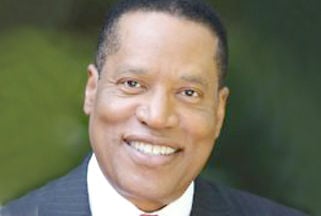
Larry Elder

Rapper/actor Ice Cube is on the brink of understanding the left-wing con.

He appears on the verge of understanding the fake product that the Democrats and the media have been peddling: that America remains guilty of “systemic racism.”

In a video Cube posted on social media, he wondered what Blacks are getting in return for their virtually unquestioned loyalty to the Democratic Party. In explaining why he recently met with Democrats and Republicans, Cube tweeted: “Every side is the Darkside for us here in America. They’re all the same until something changes for us. They all lie and they all cheat but we can’t afford not to negotiate with whoever is in power or our condition in this country will never change. Our justice is bipartisan.”

I sent him a series of tweets to assist him in his journey of political discovery:

Dear Ice Cube,

Urge Blacks to follow your lead and that of your parents! You were raised by two parents and were voluntarily bused to a better school rather than attending the nearby inferior public school. Like your parents, you raised your own kids in a nuclear intact family.

Democrats’ policies hurt Blacks. Welfare causes fatherlessness. Unskilled illegals compete with unskilled Blacks for jobs. Democrats oppose school choice. For votes, Democrats play the race card to keep Blacks angry.

IT’S A … SCAM!

The No. 1 problem in the Black community is that 70% of Black kids are born without the father married to their mom. Barack Obama said kids growing up without a father are five times more likely to live in poverty, nine times more likely to drop out of school and 20 times more likely to send up in prison.

Blame government welfare.

“There’s no more important ingredient for success, nothing that would be more important for us reducing violence than strong, stable families – which means we should do more to promote marriage and encourage fatherhood.” -Barack Obama, Feb. 15, 2013.

“I know for a fact that had I had a father, I’d have some discipline … more confidence. Your mother cannot calm you down the way a man can … can’t reassure you the way a man can … You need a man to teach you how to be a man.” – Tupac Shakur.

“Don’t blame the system (for Black incarceration). It starts at the home. It starts at home. … It starts with how you raise your children. If a young man doesn’t have a father figure, he’ll go find a father figure.” – Denzel Washington, November 2017.

Of the 1,000 people killed by cops each year, less than 4% are white cop/unarmed Black. Half of all homicide victims are Black, almost all killed by Blacks. It isn’t poverty or “systemic racism.”

During the Great Depression, Black unemployment was 50%, with a lower murder rate.

Speaking of “systemic racism,” Democrats want to INCREASE the minimum wage to $15. Economist Milton Friedman called the minimum wage law “the most anti-Negro” law on the statute books.

“There is nothing more painful to me at this stage in my life than to walk down the street and hear footsteps and start thinking about a robbery. Then (I) look around and see someone white and feel relieved.” – The Rev. Jesse Jackson, 1993.

Of the approximately 1,000 people killed by police each year, most resisted with a weapon or resisted violently.

Half are white. Less than 4% of the 1,000 involve a white cop and an unarmed Black. More unarmed whites are killed by cops each year than unarmed Blacks.?

“White police officers were less likely than Black or Hispanic officers to shoot unarmed Black suspects. … ‘An Empirical Analysis’ … by (a Black) Harvard economics professor … (found) zero evidence of racial bias in police shootings. … Note also that police officers face an 18.5 times greater chance of being killed by a Black male than an unarmed Black male has of being killed by a police officer.” – Heather Mac Donald, Manhattan Institute, July 12, 2016.

In 2018, the FBI reported 748 interracial homicides between Blacks and whites.

Homicides committed by Blacks (13% of population) against whites: 514. Homicides committed by non-Hispanic whites (60% of population) against Blacks: 234.

In 2018, there were more than 600,000 interracial violent victimizations (excluding homicide) between Blacks and whites, with 90% committed by Blacks against whites, and 10% by whites against Blacks.

In 2018, Blacks, at 13% of the population, committed 24% of “hate crimes.”

Whites, at 60% of the population, committed 54% of hate crimes.

A 1997 Time/CNN poll asked Black teens if racism was a big, small or no problem in their own lives, and 89% said small or no problem. More Black teens than white teens called “failure to take advantage of available opportunities” a bigger problem than racism.

Ice Cube is starting to get it.

Hopefully all this information helps him. Racism has never been a less important factor in success. For votes, Democratic politicians say otherwise to keep Blacks angry. Mr. Cube, bring others to the light.

Larry Elder is a bestselling author and nationally syndicated radio talk show host. Follow him on Twitter @LarryElder.

_____________

Thank you so much for your time. I know how valuable it is. I also appreciate the fine family that you have and your commitment as a father and a husband.

Sincerely,

Everette Hatcher III, 13900 Cottontail Lane, Alexander, AR 72002, ph 501-920-5733

Williams with Sowell – Minimum Wage

Thomas Sowell

Thomas Sowell – Reducing Black Unemployment

By WALTER WILLIAMS

—-

Ronald Reagan with Milton Friedman
Milton Friedman The Power of the Market 2-5

My March 9, 2021 letter to President Joe Biden, MILTON FRIEDMAN: The higher wage rate decreed by Congress for low-paid workers will raise the cost of the goods that these workers produce—and must discourage sales. It will also induce employers to replace such workers with other workers—either to do the same work or to produce machinery to do the same work or to produce machinery to do the work!

Ep. 4 – From Cradle to Grave [6/7]. Milton Friedman’s Free to Choose (1980)

March 9,  2021

President Biden c/o The White House
1600 Pennsylvania Avenue NW
Washington, DC 20500

Dear Mr. President,

Thank you for taking time to have your office try and get a pulse on what is going on out here in the country. I wanted to let you know what I think about the minimum wage increase you have proposed for the whole country and I wanted to quote Milton Friedman who you are familiar with and you made it clear in July that you didn’t care for his views! Let me challenge you to take a closer look at what he had to say!

Minimum-Wage Rates”
by Milton Friedman
Newsweek, 26 September 1966
©The Newsweek/Daily Beast Company LLC

Congress has just acted to increase unemployment. It did so by raising the legal minimum-wage rate from $1.25 to $1.60 an hour, effective in 1968, and extending its coverage. The result will be and must be to add to the ranks of the unemployed.

Does a merchant increase his sales by raising prices? Does higher pay of domestic servants induce more housewives to hire help? The situation is no different for other employers. The higher wage rate decreed by Congress for low-paid workers will raise the cost of the goods that these workers produce—and must discourage sales. It will also induce employers to replace such workers with other workers—either to do the same work or to produce machinery to do the same work or to produce machinery to do the work.
Some workers who already receive wages well above the legal minimum will benefit—because they will face less competition from the unskilled. That is why many unions are strong supporters of higher minimum-wage rates. Some employers and employees in places where wages are already high will benefit because they will face less competition from businessmen who might otherwise invest capital in areas that have large pools of unskilled labor. That is why Northern manufactures and unions, particularly in new England, are the principal sources of political pressure for higher legal minimum-wage rates.

The groups that will be hurt the most are the low-paid and the unskilled. The ones who remain employed will receive higher wage rates, but fewer will be employed. As Prof. James Tobin, who was a member of president Kennedy’s Council of Economic Advisers, recently wrote: “People who lack the capacity to earn a decent living need to be helped, but they will not be helped by minimum-wage laws, trade-union wage pressures or other devices which seek to compel employers to pay them more than their work is worth. The more likely outcome of such regulations is that the intended beneficiaries are not employed at all.”
The loss to the unskilled workers will not be offset by gains to others. Smaller total employment will result in a smaller total output. Hence the community as a whole will be worse off.
Women, teen-agers, Negroes and particularly Negro teen-agers, will be especially hard hit. I am convinced that the minimum-wage law is the most anti-Negro law on our statute books—in its effect not its intent. It is a tragic but undoubted legacy of the past—and one we must try to correct—that on the average Negroes have lower skills than whites. Similarly, teen-agers are less skilled than older workers. Both Negroes and teen-agers are only made worse off by discouraging employers from hiring them. On the-job training—the main route whereby the unskilled have become skilled—is thus denied them.
The shockingly high rate of unemployment among teen-age Negro boys is largely a result of the present Federal minimum-wage rate. And unemployment will be boosted still higher by the rise just enacted. Before 1956, unemployment among Negro boys aged 14 to 19 was around 8 to 11

per cent, about the same as among white boys. Within two years after the legal minimum was raised from 75 cents to $1 an hour in 1956, unemployment among Negro boys shot up to 24 per cent and among white boys to 14 per cent. Both figures have remained roughly the same ever since. But I am convinced that, when it becomes effective, the $1.60 minimum will increase unemployment among Negro boys to 30 per cent or more.

Many well-meaning people favor legal minimum-wage rates in the mistaken belief that they help the poor. These people confuse wage rates with wage income. It has always been a mystery to me to understand why a youngster is better off unemployed at $1.60 an hour than employed at $1.25. Moreover, many workers in low wage brackets are supplementary earners—that is, youngsters who are just getting started or elderly folk who are adding to the main source of family income. I favor governmental measures that are designed to set a floor under family income. Legal minimum-wage rates only make this task more difficult.

The rise in the legal minimum-wage rate is a monument to the power of superficial thinking.

_____________

Thank you so much for your time. I know how valuable it is. I also appreciate the fine family that you have and your commitment as a father and a husband.

Sincerely,

Everette Hatcher III, 13900 Cottontail Lane, Alexander, AR 72002, ph 501-920-5733

Williams with Sowell – Minimum Wage

Thomas Sowell

Thomas Sowell – Reducing Black Unemployment

By WALTER WILLIAMS

—-

Ronald Reagan with Milton Friedman
Milton Friedman The Power of the Market 2-5

2 Major Reports Conclude Excessive Government Spending Threatens American Prosperity

Government Spending

The United States received its lowest ranking ever in the newly released 2021 Index of Economic Freedom, placing just 20th in the world in overall economic freedom. Pictured: Midtown Manhattan, the Empire State Building, and the towers of Hudson Yards in New York City as seen from Weehawken, New Jersey, on March 6. (Photo: Gary Hershorn/Getty Images)

Last week, two important reports were released, shining a light on one of the major challenges facing America—excessive government spending that is causing the poor and declining fiscal health of the federal government. This reduces economic freedom and threatens prosperity, making it more difficult for families to live the American dream.

In The Heritage Foundation’s 2021 Index of Economic Freedom, which was released March 5, the results weren’t pretty for the United States. The U.S. received its lowest ranking ever, just 20th in the world in overall economic freedom.

The reason? A dramatic drop in fiscal health, scored at only 34.9 out of 100. This is worse than 150 other countries and is a failing grade on anybody’s report card.

Later that same afternoon, the Congressional Budget Office released “The 2021 Long-Term Budget Outlook.” This report provides a snapshot of the nation’s fiscal health over the next 30 years.

Want to keep up with the 24/7 news cycle? Want to know the most important stories of the day for conservatives? Need news you can trust? Subscribe to The Daily Signal’s email newsletter. Learn more >>

The diagnosis is not good.

While tax revenues are projected to rise above their historical average as a share of the economy, the growth of spending will outpace that growth in revenue. Federal government spending as a percentage of gross domestic product was already above its historical average even before the pandemic, and is projected to continue growing.

Because of overspending, the national debt held by the public has already eclipsed the size of the economy, and is projected to continue rising much higher than it ever has before, reaching 202% of GDP by 2051.

The net interest costs for the taxpayers of financing this debt will skyrocket from 1.4% of GDP (about $300 billion) this year to 8.6% of GDP in 2051. For the sake of comparison, that would be more than 250% higher than what we currently spend on national defense as a percentage of GDP.

The primary drivers of the increases in spending are unsustainable entitlement programs, which require significant reform not only for the sake of the taxpayers, but also to allow better results for Americans in need.

Unless substantial reforms are implemented, Medicare’s Hospital Insurance Trust Fund will be exhausted in 2026. The Social Security Trust Fund is projected to be depleted by 2032, which could cause across-the-board benefit reductions for all retirees just 11 years from now.

Over the long term, government spending simply cannot continue growing faster than the economy.

The Congressional Budget Office has been warning for years about the significant negative consequences of the high and rising federal debt. As the recent “Long-Term Budget Outlook” report indicates, the current fiscal trajectory would “reduce business investment, and slow the growth of economic output,” and would “increase the risk of a fiscal crisis.”

The Congressional Budget Office also warns that high levels of debt would pose a threat to America’s national interests because it would cause “increase[d] interest payments to foreign holders of U.S. debt,” and “an erosion of confidence in the U.S. dollar as an international reserve currency.”

This current path is not acceptable.

The United States needs to get its fiscal health in order, not just to improve its ranking in the Index of Economic Freedom, but because of what that improved ranking would mean for the American people.

The index results demonstrate year after year that people living in countries with higher levels of economic freedom enjoy higher levels of per capita income, better health care and education, and cleaner environments than those living where economic freedom is significantly constrained. Even modest improvements in economic freedom can boost growth rates as well.

These two important reports should be a wake-up call for policymakers that they need to start slowing the growth of spending. Thankfully, there are solutions that could be implemented, such as those included in The Heritage Foundation’s “Blueprint for a Responsible Post-COVID-19 Budget.”

Some recommendations found in the blueprint include reforming benefit programs, preventing out-of-control spending, and maintaining a pro-growth economic policy, among many others.

Unfortunately, the longer we wait, the more difficult will be the climb out of the fiscal hole that politicians have been digging for years. The time for action is now.

Have an opinion about this article? To sound off, please email letters@DailySignal.com and we will consider publishing your remarks in our regular “We Hear You” feature.

National Debt Set to Skyrocket

Everyone wants to know more about the budget and here is some key information with a chart from the Heritage Foundation and a video from the Cato Institute.

In the past, wars and the Great Depression contributed to rapid but temporary increases in the national debt. Over the next few decades, runaway spending on MedicareMedicaid, and Social Security will drive the debt to unsustainable levels.

PERCENTAGE OF GDP

Download

National Debt Set to Skyrocket

Source: Heritage Foundation calculations based on data from the U.S. Department of the Treasury, Institute for the Measurement of Worth, Congressional Budget Office, and White House Office of Management and Budget.

Chart 20 of 42

In Depth

  • Policy Papers for Researchers

  • Technical Notes

    The charts in this book are based primarily on data available as of March 2011 from the Office of Management and Budget (OMB) and the Congressional Budget Office (CBO). The charts using OMB data display the historical growth of the federal government to 2010 while the charts using CBO data display both historical and projected growth from as early as 1940 to 2084. Projections based on OMB data are taken from the White House Fiscal Year 2012 budget. The charts provide data on an annual basis except… Read More

  • Authors

    Emily GoffResearch Assistant
    Thomas A. Roe Institute for Economic Policy StudiesKathryn NixPolicy Analyst
    Center for Health Policy StudiesJohn FlemingSenior Data Graphics Editor

Rand Paul questions if US borrowing puts country on path to become Venezuela

Rand Paul questions if US borrowing puts country on path to become Venezuela

Paul’s comments came just a day after the Senate passed President Biden’s $1.9 trillion COVID-19 relief bill

Sen. Rand Paul, one of the most outspoken Republicans about government spending, took to Twitter Sunday to ask if Congress’ borrowing is putting the U.S. economy on the same path as Venezuela’s.

“New 1,000,000 bolivar note in Venezuela worth 53 cents,” Paul tweeted, while linking to a Bloomberg report on hyperinflation in Caracas. “Will US be the next Venezuela with Congress borrowing over $6 trillion in one year?”

Paul’s comments came just a day after the Senate passed President Biden’s $1.9 trillion COVID-19 relief bill in a 50-49 vote. Sen. Mitt Romney, R-Utah, also expressed dismay over some of what he identified as wasteful spending in the bill, including providing billions in financial assistance to states that do not need it.

“We’re going to be asking the American people to allow us to borrow money from China and others, pass that on to our kids and grandkids so that we can send money to states like California and mine that don’t need the money,” Romney said. “That doesn’t make any sense at all.”

GET THE FOX NEWS APP

Venezuela’s economy has deteriorated due to, oil prices, the coronavirus and years of hyperinflation, according to Reuters. Its central bank issued a new banknote worth 1 million bolivars that will be worth 52 cents. The report said that many Venezuelans use U.S. currency to complete transactions.

March 31, 2021

President Biden  c/o The White House
1600 Pennsylvania Avenue NW
Washington, DC 20500

Dear Mr. President,

Please explain to me if you ever do plan to balance the budget while you are President? I have written these things below about you and I really do think that you don’t want to cut spending in order to balance the budget. It seems you ever are daring the Congress to stop you from spending more.

President Barack Obama speaks about the debt limit in the East Room of the White House in Washington. | AP Photo

“The credit of the United States ‘is not a bargaining chip,’ Obama said on 1-14-13. However, President Obama keeps getting our country’s credit rating downgraded as he raises the debt ceiling higher and higher!!!!

Washington Could Learn a Lot from a Drug Addict

Just spend more, don’t know how to cut!!! Really!!! That is not living in the real world is it?

Making more dependent on government is not the way to go!!

Why is our government in over 16 trillion dollars in debt? There are many reasons for this but the biggest reason is people say “Let’s spend someone else’s money to solve our problems.” Liberals like Max Brantley have talked this way for years. Brantley will say that conservatives are being harsh when they don’t want the government out encouraging people to be dependent on the government. The Obama adminstration has even promoted a plan for young people to follow like Julia the Moocher.  

David Ramsey demonstrates in his Arkansas Times Blog post of 1-14-13 that very point:

Arkansas Politics / Health Care Arkansas’s share of Medicaid expansion and the national debt

Posted by on Mon, Jan 14, 2013 at 1:02 PM

Baby carrot Arkansas Medicaid expansion image

Imagine standing a baby carrot up next to the 25-story Stephens building in Little Rock. That gives you a picture of the impact on the national debt that federal spending in Arkansas on Medicaid expansion would have, while here at home expansion would give coverage to more than 200,000 of our neediest citizens, create jobs, and save money for the state.

Here’s the thing: while more than a billion dollars a year in federal spending would represent a big-time stimulus for Arkansas, it’s not even a drop in the bucket when it comes to the national debt.

Currently, the national debt is around $16.4 trillion. In fiscal year 2015, the federal government would spend somewhere in the neighborhood of $1.2 billion to fund Medicaid expansion in Arkansas if we say yes. That’s about 1/13,700th of the debt.

It’s hard to get a handle on numbers that big, so to put that in perspective, let’s get back to the baby carrot. Imagine that the height of the Stephens building (365 feet) is the $16 trillion national debt. That $1.2 billion would be the length of a ladybug. Of course, we’re not just talking about one year if we expand. Between now and 2021, the federal government projects to contribute around $10 billion. The federal debt is projected to be around $25 trillion by then, so we’re talking about 1/2,500th of the debt. Compared to the Stephens building? That’s a baby carrot.

______________

Here is how it will all end if everyone feels they should be allowed to have their “baby carrot.”

How sad it is that liberals just don’t get this reality.

Here is what the Founding Fathers had to say about welfare. David Weinberger noted:

While living in Europe in the 1760s, Franklin observed: “in different countries … the more public provisions were made for the poor, the less they provided for themselves, and of course became poorer. And, on the contrary, the less was done for them, the more they did for themselves, and became richer.”

Alexander Fraser Tytler, Lord Woodhouselee (15 October 1747 – 5 January 1813) was a Scottish lawyer, writer, and professor. Tytler was also a historian, and he noted, “A democracy cannot exist as a permanent form of government. It can only exist until the majority discovers it can vote itself largess out of the public treasury. After that, the majority always votes for the candidate promising the most benefits with the result the democracy collapses because of the loose fiscal policy ensuing, always to be followed by a dictatorship, then a monarchy.”

Thomas Jefferson to Joseph Milligan

April 6, 1816

[Jefferson affirms that the main purpose of society is to enable human beings to keep the fruits of their labor. — TGW]

To take from one, because it is thought that his own industry and that of his fathers has acquired too much, in order to spare to others, who, or whose fathers have not exercised equal industry and skill, is to violate arbitrarily the first principle of association, “the guarantee to every one of a free exercise of his industry, and the fruits acquired by it.” If the overgrown wealth of an individual be deemed dangerous to the State, the best corrective is the law of equal inheritance to all in equal degree; and the better, as this enforces a law of nature, while extra taxation violates it.

[From Writings of Thomas Jefferson, ed. Albert E. Bergh (Washington: Thomas Jefferson Memorial Association, 1904), 14:466.]

_______

Jefferson pointed out that to take from the rich and give to the poor through government is just wrong. Franklin knew the poor would have a better path upward without government welfare coming their way. Milton Friedman’s negative income tax is the best method for doing that and by taking away all welfare programs and letting them go to the churches for charity.

_____________

_________

Thank you so much for your time. I know how valuable it is. I also appreciate the fine family that you have and your commitment as a father and a husband.

Sincerely,

Everette Hatcher III, 13900 Cottontail Lane, Alexander, AR 72002, ph 501-920-5733

Williams with Sowell – Minimum Wage

Thomas Sowell

Thomas Sowell – Reducing Black Unemployment

By WALTER WILLIAMS

—-

Ronald Reagan with Milton Friedman
Milton Friedman The Power of the Market 2-5

Related posts:

Welfare Spending Shattering All-Time Highs

  We got to act fast and get off this path of socialism. Morning Bell: Welfare Spending Shattering All-Time Highs Robert Rector and Amy Payne October 18, 2012 at 9:03 am It’s been a pretty big year for welfare—and a new report shows welfare is bigger than ever. The Obama Administration turned a giant spotlight […]

We need more brave souls that will vote against Washington welfare programs

We need to cut Food Stamp program and not extend it. However, it seems that people tell the taxpayers back home they are going to Washington and cut government spending but once they get up there they just fall in line with  everyone else that keeps spending our money. I am glad that at least […]

Welfare programs are not the answer for the poor

Government Must Cut Spending Uploaded by HeritageFoundation on Dec 2, 2010 The government can cut roughly $343 billion from the federal budget and they can do so immediately. __________ Liberals argue that the poor need more welfare programs, but I have always argued that these programs enslave the poor to the government. Food Stamps Growth […]

Private charities are best solution and not government welfare

Milton Friedman – The Negative Income Tax Published on May 11, 2012 by LibertyPen In this 1968 interview, Milton Friedman explained the negative income tax, a proposal that at minimum would save taxpayers the 72 percent of our current welfare budget spent on administration. http://www.LibertyPen.com Source: Firing Line with William F Buckley Jr. ________________ Milton […]

The book “After the Welfare State”

Dan Mitchell Commenting on Obama’s Failure to Propose a Fiscal Plan Published on Aug 16, 2012 by danmitchellcato No description available. ___________ After the Welfare State Posted by David Boaz Cato senior fellow Tom G. Palmer, who is lecturing about freedom in Slovenia and Tbilisi this week, asked me to post this announcement of his […]

President Obama responds to Heritage Foundation critics on welfare reform waivers

Is President Obama gutting the welfare reform that Bill Clinton signed into law? Morning Bell: Obama Denies Gutting Welfare Reform Amy Payne August 8, 2012 at 9:15 am The Obama Administration came out swinging against its critics on welfare reform yesterday, with Press Secretary Jay Carney saying the charge that the Administration gutted the successful […]

Welfare reform part 3

Thomas Sowell – Welfare Welfare reform was working so good. Why did we have to abandon it? Look at this article from 2003. The Continuing Good News About Welfare Reform By Robert Rector and Patrick Fagan, Ph.D. February 6, 2003 Six years ago, President Bill Clinton signed legislation overhauling part of the nation’s welfare system. […]

Welfare reform part 2

Uploaded by ForaTv on May 29, 2009 Complete video at: http://fora.tv/2009/05/18/James_Bartholomew_The_Welfare_State_Were_In Author James Bartholomew argues that welfare benefits actually increase government handouts by ‘ruining’ ambition. He compares welfare to a humane mousetrap. —– Welfare reform was working so good. Why did we have to abandon it? Look at this article from 2003. In the controversial […]

Why did Obama stop the Welfare Reform that Clinton put in?

Thomas Sowell If the welfare reform law was successful then why change it? Wasn’t Bill Clinton the president that signed into law? Obama Guts Welfare Reform Robert Rector and Kiki Bradley July 12, 2012 at 4:10 pm Today, the Obama Department of Health and Human Services (HHS) released an official policy directive rewriting the welfare […]

“Feedback Friday” Letter to White House generated form letter response July 10,2012 on welfare, etc (part 14)

I have been writing President Obama letters and have not received a personal response yet.  (He reads 10 letters a day personally and responds to each of them.) However, I did receive a form letter in the form of an email on July 10, 2012. I don’t know which letter of mine generated this response so I have […]

My March 7, 2021 letter to President Joe Biden, In 1966, Milton Friedman argued “that the minimum-wage law is the most anti-Negro law on our statute books.”

Ep. 4 – From Cradle to Grave [6/7]. Milton Friedman’s Free to Choose (1980)

March 7, 2021

President Biden c/o The White House
1600 Pennsylvania Avenue NW
Washington, DC 20500

Dear Mr. President,

Thank you for taking time to have your office try and get a pulse on what is going on out here in the country. I wanted to let you know what I think about the minimum wage increase you have proposed for the whole country and I wanted to quote Milton Friedman who you are familiar with and you made it clear in July that you didn’t care for his views! Let me challenge you to take a closer look at what he had to say!

The Racist History of Minimum Wage Laws

  • nothiring.JPG

TAGS Big GovernmentU.S. History

04/16/2017

In 1966, Milton Friedman wrote an op-ed for Newsweekentitled “Minimum Wage Rates.” In it, he argued “that the minimum-wage law is the most anti-Negro law on our statute books.” He was, of course, referring to the then-present era, after the far more explicitly racist laws from the slavery and segregation eras of United States history had already been done away with. But his observation about the racist effects of minimum wage laws can be traced back to the nineteenth century, and they continue to have a disproportionately deleterious effect on African-Americans into the present day.

The earliest of such laws were regulations passed in regards to the railroad industry. At the end of the nineteenth century, as Dr. Walter Williams points out, “On some railroads — most notably in the South — blacks were 85–90 percent of the firemen, 27 percent of the brakemen, and 12 percent of the switchmen.”1

The Brotherhood of Locomotive Firemen, unable to block railroad companies from hiring the non-unionized black workers, called for regulations preventing the employment of blacks. In 1909, a compromise was offered: a minimum wage, which was to be imposed equally on all races.

To the pro-minimum wage advocate, this may superficially seem like an anti-racist policy. During this time, with racism still rampant throughout the United States, blacks were only able to enjoy such high levels of employment by accepting lower wages than their white counterparts. These wage-gaps at the time genuinely were the product of racist sentiment.

But this new wage rule, of course, did not eliminate the racism of nineteenth-century employers. Instead, it displaced their racism at the expense of black workers. One white union member at the time celebrated the new rule for removing “the incentive for employing the Negro.”2 This early minimum wage rule was explicitly put in place to prevent African-Americans from finding employment, and it was successful in this goal.

In the 1930s, racial views had hardly improved, if at all. Despite this, the unemployment rate among blacks was actually marginally lower than that of whites.3 Like the railroad workers, this was due to their willingness to accept lower wages than whites. But as infuriating as the employer racism at the time might be, the 1930s wage laws should incite even more anger.

In 1931, Congress passed the Davis-Bacon Act, requiring uniform wages for any workers employed in federally funded public works projects. In 1933, the National Industrial Recovery Act was signed into law, mandating industry-specific wages throughout the economy. In 1938, the Fair Labor Standards Act — the only one of the three to remain permanently on the books — took effect, initially imposing a federal minimum wage for any worker engaged in interstate commerce.

All of these laws served to price African-Americans out of the job market. Rather than forcing employers to pay non-racist wages, it simply forced blacks to shift from suffering race-motivated wages to suffering race-motivated unemployment.

The industries that were not governed by minimum wage laws demonstrate the market’s propensity to raise the relative income of discriminated people. In the 1920s, for example, popular black performers were starring in Broadway plays alongside whites. In the 1940s, Jackie Robinson broke the color barrier in Major League Baseball, despite the racism in professional sports. Meanwhile, blacks in civilian and government jobs were being pushed out of their industries by wage floors.

By the 1960s, many African-Americans were employed as farmers — at least partly due to this being one of the few remaining fields of work that was not yet subject to wage regulations. This changed in 1967, when the government extended the minimum wage laws to American farmers as part of the “War on Poverty.” Black farmers who were accustomed to making a modest $3.50 per day were now legally required to be paid $1.00 per hour — a tremendous increase in wages.

The effect of this law was immediate and undeniable. An estimated 25,000 farm workers were put out of work in the Mississippi Delta region alone.4 Black farmers were not oblivious to the cause-and-effect at play. “That dollar an hour ain’t worth nothing,” said the wife of one day-laborer. “It would have been better if it had been 50 cents a day if you work every day.”5 Fifty cents per day, of course, was a lower wage than what her husband would have been earning prior to the law. Her point was clear: the federal minimum wage destroyed their ability to earn a living.

Instead of raising the wages of the predominantly-black farmers, the new law sped-up the move toward mechanization and ushered in the use of chemical weed killers instead of the previously more economical human weed pullers. Meanwhile, black migration out of these farmlands occurred by the thousands; the New York Timesin 1968 called it the “Negro Exodus.”

Whatever your feelings on the status of racism in America today, it is difficult to argue that the United States is actually more racist than it was during the Jim Crow era. In that time span, the country has gone from making African-Americans drink from different water fountains to electing the first black president. Yet, despite this distinct improvement, the unemployment rate of black teens is roughly double that of whites. In 1948, by contrast, the unemployment rate among teenagers was the same between the races.6 Despite the widespread racism remaining in the country following the emancipation of slaves, the rise of a black middle-class started to emerge quickly and continued for decades. But thanks to meddlesome laws passed by presumably well-intentioned bureaucrats, the government has only served to stifle this upward trajectory.

  • 1.Walter E. Williams, South Africa’s War Against Capitalism (New York: Praeger, 1989), p. 74.
  • 2.Sterling D. Spero and Abram Harris, The Black Worker (New York: Kennikat Press, 1931), p. 291.
  • 3.Thomas Sowell, Basic Economics: A Common Sense Guide to the Economy, 3rd ed. (New York: Basic Books, 2007), p. 250.
  • 4.James C. Cobb, “Somebody Done Nailed Us on the Cross: Federal Farm and Welfare Policy and the Civil Rights Movement in the Mississippi Delta,” The Journal of American History (December 1990): 912–36.
  • 5.Des Moines Register, February 27, 1968, p. 2.
  • 6.Sowell, Basic Economics, p. 251.
Author:

Chris Calton

Chris Calton is a 2018 Mises Institute Research Fellow and an economic historian. He is writer and host of the Historical Controversies podcast.

_____________

Thank you so much for your time. I know how valuable it is. I also appreciate the fine family that you have and your commitment as a father and a husband.

Sincerely,

Everette Hatcher III, 13900 Cottontail Lane, Alexander, AR 72002, ph 501-920-5733

Williams with Sowell – Minimum Wage

Thomas Sowell

Thomas Sowell – Reducing Black Unemployment

By WALTER WILLIAMS

—-

Ronald Reagan with Milton Friedman
Milton Friedman The Power of the Market 2-5

Time to Start Talking About America’s Coming Bankruptcy

Our federal debt now amounts to more than $81,000 for every single person in the country. (Photo: Pavlo Conchar/SOPA Images/LightRocket/Getty Images)

Did you know America is going bankrupt? Most people don’t. Maybe the saddest part about our country’s state of affairs is that all our vitriol and dysfunction has come at a time when we aren’t even addressing our biggest problems.

It would be one thing if America collectively decided we have to be honest about where we are as a country and we were in the middle of a charged debate about how to fix it. Instead, we are fighting about trivial things while pretty much everyone in the country, on all sides of the political spectrum, has decided our real problems are so bad we may as well ignore them.

Have you ever had a friend who’s had some horrible, embarrassing event in their life? The last thing you want to do is mention it. That’s America and our debt problem. It’s so bad that we don’t talk about it anymore.

It was a full 10 years ago that we were so focused on our debt that then-President Barack Obama was forced to set up a national commission to deal with it.

Want to keep up with the 24/7 news cycle? Want to know the most important stories of the day for conservatives? Need news you can trust? Subscribe to The Daily Signal’s email newsletter. Learn more >>

The bipartisan commission led by former Bill Clinton chief of staff Erskine Bowles and former Republican Sen. Alan Simpson came up with a series of recommendations, including tax hikes and reforms to our entitlement programs. They were attacked by both the right and left, and none of the solutions were enacted into law, but at least we were trying.

When the Bowles-Simpson commission was formed, America was about $13 trillion in debt. Today, we owe more than double that, more than $26 trillion.

Those numbers are so big nobody understands them. To put it in perspective, our entire economic output in 2020 was $21 trillion. If America could magically not spend a dime—nobody bought anything, including food or other staples—and we put it all toward paying off our federal debt for an entire year, we still wouldn’t pay it off.

In more personal terms, our federal debt now amounts to more than $81,000 for every single person in the country, or over $227,000 for the average household in America.

If the problem is twice as bad as it was 10 years ago, why don’t we even discuss it anymore? It’s as if we are so close to the iceberg that it’s too late to avoid it. Let’s just keep the band playing and enjoy things while we can. It’s all going to be our kids’ problem.

This is, of course, a fundamentally anti-American sentiment. The goal of leaving things better for your kids is as American as apple pie. We are certainly not doing that anymore.

Our national desire to wish our problems away is so severe that we have even come up with an intellectual framework for it. Modern Monetary Theory, or MMT, is the belief that deficits and debt don’t really matter for a sovereign country that can print its own currency. Need more money? You just keep printing more. It’s like magic. The bill never comes due.

MMT proponents ignore or explain away the downside to the constant printing of money and issuance of debt, including our creditors losing faith and no longer buying our bonds, hyperinflation, and the consequences for the dollar as an exchange traded currency. Despite these huge flaws, it’s amazing the extent to which MMT has caught on as a convenient political excuse to continue ignoring our imminent debt disaster.

What will happen in a debt crisis; why are we ignoring this obvious and impending catastrophe; and what should we do about it?

At some point, as we continue to borrow money, the interest we pay on our debt will be so high we will not be able to afford the rest of our budget. The solution will be to borrow more.

As the borrowing binge grows, those buying our bonds will grow worried and demand a higher return. This, in turn, will create a vicious debt cycle, which has already happened in many countries around the world. The result is catastrophic reductions in spending and increases in taxes to try to satisfy creditors to keep the money flowing.

The only reason we haven’t seen it yet in America is we are such an economically powerful country that our creditors have not yet lost faith in our ability to pay it off. If that day comes—and unless we make changes, it eventually will—the crisis is going to hurt all Americans.

We are ignoring our looming debt crisis because it’s not a winner politically. Both parties contributed to the problem.

The Bush, Obama, Trump, and Biden administrations will all be to blame. Republicans, traditionally the party of fiscal responsibility, have lost all credibility on the issue. After shutting down the government over spending under Obama, they spent happily at record levels under President Donald Trump.

It’s attractive for politicians to keep taxes low and spending high. Each of our last four presidential administrations has benefited from this dynamic.

Wall Street and global business, which dominates Washington policymaking, have also benefited greatly. These corporate actors care about their next financial quarter a lot more than our country’s state of affairs 10 or more years down the road.

This period will be looked upon by historians as the saddest time in our history: a once great country behaving so selfishly and with such short-term interests that they sold their children’s futures away with barely any debate.

The biggest cop-out in Washington is the presidential commission. It rarely accomplishes anything. Yet our situation is so bad that another bipartisan commission may be our best bet.

The commission should include both corporatists and populists. As much of a cop-out as this is, we are not prepared to begin debating real solutions (which will involve some pain). Shining a light back on the problem may be all we can accomplish today. We should start.

March 31, 2021

President Biden  c/o The White House
1600 Pennsylvania Avenue NW
Washington, DC 20500

Dear Mr. President,

Please explain to me if you ever do plan to balance the budget while you are President? I have written these things below about you and I really do think that you don’t want to cut spending in order to balance the budget. It seems you ever are daring the Congress to stop you from spending more.

President Barack Obama speaks about the debt limit in the East Room of the White House in Washington. | AP Photo

“The credit of the United States ‘is not a bargaining chip,’ Obama said on 1-14-13. However, President Obama keeps getting our country’s credit rating downgraded as he raises the debt ceiling higher and higher!!!!

Washington Could Learn a Lot from a Drug Addict

Just spend more, don’t know how to cut!!! Really!!! That is not living in the real world is it?

Making more dependent on government is not the way to go!!

Why is our government in over 16 trillion dollars in debt? There are many reasons for this but the biggest reason is people say “Let’s spend someone else’s money to solve our problems.” Liberals like Max Brantley have talked this way for years. Brantley will say that conservatives are being harsh when they don’t want the government out encouraging people to be dependent on the government. The Obama adminstration has even promoted a plan for young people to follow like Julia the Moocher.  

David Ramsey demonstrates in his Arkansas Times Blog post of 1-14-13 that very point:

Arkansas Politics / Health Care Arkansas’s share of Medicaid expansion and the national debt

Posted by on Mon, Jan 14, 2013 at 1:02 PM

Baby carrot Arkansas Medicaid expansion image

Imagine standing a baby carrot up next to the 25-story Stephens building in Little Rock. That gives you a picture of the impact on the national debt that federal spending in Arkansas on Medicaid expansion would have, while here at home expansion would give coverage to more than 200,000 of our neediest citizens, create jobs, and save money for the state.

Here’s the thing: while more than a billion dollars a year in federal spending would represent a big-time stimulus for Arkansas, it’s not even a drop in the bucket when it comes to the national debt.

Currently, the national debt is around $16.4 trillion. In fiscal year 2015, the federal government would spend somewhere in the neighborhood of $1.2 billion to fund Medicaid expansion in Arkansas if we say yes. That’s about 1/13,700th of the debt.

It’s hard to get a handle on numbers that big, so to put that in perspective, let’s get back to the baby carrot. Imagine that the height of the Stephens building (365 feet) is the $16 trillion national debt. That $1.2 billion would be the length of a ladybug. Of course, we’re not just talking about one year if we expand. Between now and 2021, the federal government projects to contribute around $10 billion. The federal debt is projected to be around $25 trillion by then, so we’re talking about 1/2,500th of the debt. Compared to the Stephens building? That’s a baby carrot.

______________

Here is how it will all end if everyone feels they should be allowed to have their “baby carrot.”

How sad it is that liberals just don’t get this reality.

Here is what the Founding Fathers had to say about welfare. David Weinberger noted:

While living in Europe in the 1760s, Franklin observed: “in different countries … the more public provisions were made for the poor, the less they provided for themselves, and of course became poorer. And, on the contrary, the less was done for them, the more they did for themselves, and became richer.”

Alexander Fraser Tytler, Lord Woodhouselee (15 October 1747 – 5 January 1813) was a Scottish lawyer, writer, and professor. Tytler was also a historian, and he noted, “A democracy cannot exist as a permanent form of government. It can only exist until the majority discovers it can vote itself largess out of the public treasury. After that, the majority always votes for the candidate promising the most benefits with the result the democracy collapses because of the loose fiscal policy ensuing, always to be followed by a dictatorship, then a monarchy.”

Thomas Jefferson to Joseph Milligan

April 6, 1816

[Jefferson affirms that the main purpose of society is to enable human beings to keep the fruits of their labor. — TGW]

To take from one, because it is thought that his own industry and that of his fathers has acquired too much, in order to spare to others, who, or whose fathers have not exercised equal industry and skill, is to violate arbitrarily the first principle of association, “the guarantee to every one of a free exercise of his industry, and the fruits acquired by it.” If the overgrown wealth of an individual be deemed dangerous to the State, the best corrective is the law of equal inheritance to all in equal degree; and the better, as this enforces a law of nature, while extra taxation violates it.

[From Writings of Thomas Jefferson, ed. Albert E. Bergh (Washington: Thomas Jefferson Memorial Association, 1904), 14:466.]

_______

Jefferson pointed out that to take from the rich and give to the poor through government is just wrong. Franklin knew the poor would have a better path upward without government welfare coming their way. Milton Friedman’s negative income tax is the best method for doing that and by taking away all welfare programs and letting them go to the churches for charity.

_____________

_________

Thank you so much for your time. I know how valuable it is. I also appreciate the fine family that you have and your commitment as a father and a husband.

Sincerely,

Everette Hatcher III, 13900 Cottontail Lane, Alexander, AR 72002, ph 501-920-5733

Williams with Sowell – Minimum Wage

Thomas Sowell

Thomas Sowell – Reducing Black Unemployment

By WALTER WILLIAMS

—-

Ronald Reagan with Milton Friedman
Milton Friedman The Power of the Market 2-5

Related posts:

Welfare Spending Shattering All-Time Highs

  We got to act fast and get off this path of socialism. Morning Bell: Welfare Spending Shattering All-Time Highs Robert Rector and Amy Payne October 18, 2012 at 9:03 am It’s been a pretty big year for welfare—and a new report shows welfare is bigger than ever. The Obama Administration turned a giant spotlight […]

We need more brave souls that will vote against Washington welfare programs

We need to cut Food Stamp program and not extend it. However, it seems that people tell the taxpayers back home they are going to Washington and cut government spending but once they get up there they just fall in line with  everyone else that keeps spending our money. I am glad that at least […]

Welfare programs are not the answer for the poor

Government Must Cut Spending Uploaded by HeritageFoundation on Dec 2, 2010 The government can cut roughly $343 billion from the federal budget and they can do so immediately. __________ Liberals argue that the poor need more welfare programs, but I have always argued that these programs enslave the poor to the government. Food Stamps Growth […]

Private charities are best solution and not government welfare

Milton Friedman – The Negative Income Tax Published on May 11, 2012 by LibertyPen In this 1968 interview, Milton Friedman explained the negative income tax, a proposal that at minimum would save taxpayers the 72 percent of our current welfare budget spent on administration. http://www.LibertyPen.com Source: Firing Line with William F Buckley Jr. ________________ Milton […]

The book “After the Welfare State”

Dan Mitchell Commenting on Obama’s Failure to Propose a Fiscal Plan Published on Aug 16, 2012 by danmitchellcato No description available. ___________ After the Welfare State Posted by David Boaz Cato senior fellow Tom G. Palmer, who is lecturing about freedom in Slovenia and Tbilisi this week, asked me to post this announcement of his […]

President Obama responds to Heritage Foundation critics on welfare reform waivers

Is President Obama gutting the welfare reform that Bill Clinton signed into law? Morning Bell: Obama Denies Gutting Welfare Reform Amy Payne August 8, 2012 at 9:15 am The Obama Administration came out swinging against its critics on welfare reform yesterday, with Press Secretary Jay Carney saying the charge that the Administration gutted the successful […]

Welfare reform part 3

Thomas Sowell – Welfare Welfare reform was working so good. Why did we have to abandon it? Look at this article from 2003. The Continuing Good News About Welfare Reform By Robert Rector and Patrick Fagan, Ph.D. February 6, 2003 Six years ago, President Bill Clinton signed legislation overhauling part of the nation’s welfare system. […]

Welfare reform part 2

Uploaded by ForaTv on May 29, 2009 Complete video at: http://fora.tv/2009/05/18/James_Bartholomew_The_Welfare_State_Were_In Author James Bartholomew argues that welfare benefits actually increase government handouts by ‘ruining’ ambition. He compares welfare to a humane mousetrap. —– Welfare reform was working so good. Why did we have to abandon it? Look at this article from 2003. In the controversial […]

Why did Obama stop the Welfare Reform that Clinton put in?

Thomas Sowell If the welfare reform law was successful then why change it? Wasn’t Bill Clinton the president that signed into law? Obama Guts Welfare Reform Robert Rector and Kiki Bradley July 12, 2012 at 4:10 pm Today, the Obama Department of Health and Human Services (HHS) released an official policy directive rewriting the welfare […]

“Feedback Friday” Letter to White House generated form letter response July 10,2012 on welfare, etc (part 14)

I have been writing President Obama letters and have not received a personal response yet.  (He reads 10 letters a day personally and responds to each of them.) However, I did receive a form letter in the form of an email on July 10, 2012. I don’t know which letter of mine generated this response so I have […]