Category Archives: spending out of control

2 cartons illustrate the fate of socialism from the Cato Institute

Cato Institute scholar Dan Mitchell is right about Greece and the fate of socialism:

In my speeches, especially when talking about the fiscal crisis in Europe (or the future fiscal crisis in America), I often warn that the welfare state reaches a point-of-no-return when the number of people riding in the wagon begins to outnumber the number of people pulling the wagon.

To be more specific, if more than 50 percent of the population is dependent on government (employed in the bureaucracy, living off welfare, receiving pensions, etc), it becomes rather difficult to form a coalition to fix the mess. This may explain why Greek politicians have resisted significant reforms, even though the nation faces a fiscal death spiral.

But you don’t need me to explain this relationship. One of our Cato interns, Silvia Morandotti, used her artistic skills to create two images (click pictures for better resolution) that show what a welfare state looks like when it first begins and what it eventually becomes.

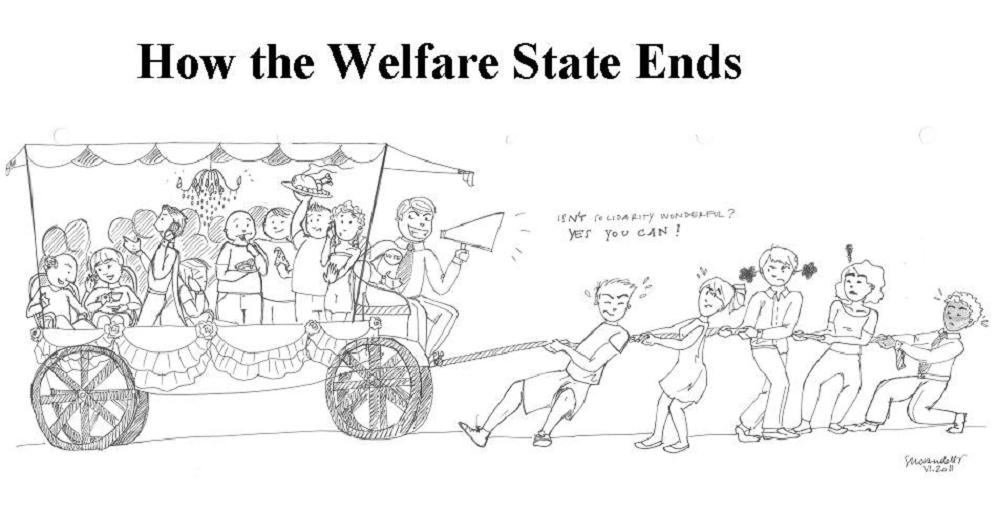
These images are remarkably accurate. The welfare state starts with small programs targeted at a handful of genuinely needy people. But as  politicians figure out the electoral benefits of expanding programs and people figure out the that they can let others work on their behalf, the ratio of producers to consumers begins to worsen.

Eventually, even though the moochers and looters should realize that it is not in their interest to over-burden the people pulling the wagon, the entire system breaks down.

Then things get really interesting. Small nations such as Greece can rely on permanent bailouts from bigger countries and the IMF, but sooner or later, as larger nations begin to go bankrupt, that approach won’t be feasible.

I often conclude my speeches by joking with the audience that it’s time to stock up on canned goods, bottled water, and ammo. Many people, I’m finding, don’t think that line very funny.

___________________

The Department of Health and Human Services administers the huge and fast-growing Medicare and Medicaid programs. These programs fuel rising health costs, distort health markets, and are plagued by waste and fraud. The department also runs an array of other expensive subsidy programs, including Head Start, TANF, and LIHEAP. Growth in HHS spending is creating a federal financial crisis, and the 2010 health care law sadly makes the situation worse.

The department will spend $910 billion in 2011, or $7,710 for every U.S. household. It employs 68,000 workers and runs more than 420 subsidy programs.


Timeline of Government Growth

  • See this timeline for key events in the department’s growth.

Reading Room

Cato Experts

Spending Cuts Summary

  • Here are proposed reforms to save $81 billion annually in the short-run and prevent federal health costs from consuming a growing share of the economy in the long-run.

Downsize This!

  • Medicare Reforms. Medicare should be transformed into a system based on vouchers, individual savings, and competitive insurance markets.
  • Medicaid Reforms. Federal spending on low-income health care should be converted to block grants for the states.
  • TANF and Welfare Spending. Welfare reforms in 1996 created Temporary Assistance for Needy Families, but this sort of aid should be provided by private charities.
  • Head Start and Other Subsidies. HHS funds a vast array of other subsidy programs, many of which are wasteful and ineffective.
  • 2010 Health Care Legislation. The law expanded Medicaid, added new taxes and subsidies, created new bureaucracies, and did little to reduce cost growth in health care.

The government of the United States is a definite government, confined to specified objects. It is not like the state governments, whose powers are more general. Charity is no part of the legislative duty of the government.

– James Madison. A paraphrase from Elliot’s Debates regarding a proposed subsidy bill, House of Representatives, January 10, 1794.

Dear Senator Pryor, why not pass the Balanced Budget Amendment? (Part 14 Thirsty Thursday, Open letter to Senator Pryor)

Dear Senator Pryor, why not pass the Balanced Budget Amendment? (Part 14 Thirsty Thursday, Open letter to Senator Pryor)

Dear Senator Pryor,

Why not pass the Balanced  Budget Amendment? As you know that federal deficit is at all time high (1.6 trillion deficit with revenues of 2.2 trillion and spending at 3.8 trillion).

On my blog www.HaltingArkansasLiberalswithTruth.com I took you at your word and sent you over 100 emails with specific spending cut ideas. However, I did not see any of them in the recent debt deal that Congress adopted. Now I am trying another approach. Every week from now on I will send you an email explaining different reasons why we need the Balanced Budget Amendment. It will appear on my blog on “Thirsty Thursday” because the government is always thirsty for more money to spend.

Congressman Walsh Introduces Balanced Budget Amendment

04/07/11

 Washington, D.C. –  As part of his ongoing effort to restore fiscal responsibility in Washington, Congressman Joe Walsh (R-IL) today introduced H.J.Res.54, a Balanced Budget Amendment to the United States Constitution that provides a framework for putting our country on a path economic stability. This amendment is the House-companion to the Senate amendment that all 47 Republicans unanimously introduced last week, which would require the President to submit a balanced budget to Congress prior to each fiscal year.

“The federal government cannot continue to burden our children with this crushing deficit,” said Congressman Walsh. “American families have been working through a recession for the past three years by spending less and saving more, yet the federal government continues to spend money it simply does not have. Congress has neglected the real root cause and continues to be part of the problem, not part of the solution.”

“This amendment is the solution. If the average American family has to find a way to balance their checkbook each year and live within their means, there is no reason that the federal government can’t do the same.”    

“It was important to me that my first piece of legislation as a United States Congressman serves the American people by easing the burden of the government in their daily lives.A key provision to this amendment is to ensure that the budget is not balanced on the backs of hard working Americans, and thus H.J.Res.54 would require a 2/3 super-majority in both Houses for any tax increase.”

“Most importantly, this amendment shows families and businesses across America that Congress is serious about stabilizing our economy long-term. It’s time to bring our country out of the red.”

The Balanced Budget Amendment resolution features the following key provisions:

  • Presidential requirement to submit a balanced budget and Congressional requirement to pass a balanced budget;
  • Federal spending cap that Congress must limit outlays to no more than 18 percent of GDP, in line with the historical average of revenues over the last 40 years (this year, the federal government is projected to spend close to 25% of GDP);
  • Prohibits the courts from ordering revenue increases.

Senator Pryor asks for Spending Cut Suggestions! Here are a few!(Part 119)

Senator Mark Pryor wants our ideas on how to cut federal spending. Take a look at this video clip below:

Senator Pryor has asked us to send our ideas to him at cutspending@pryor.senate.gov and I have done so in the past and will continue to do so in the future.

On May 11, 2011,  I emailed to this above address and I got this email back from Senator Pryor’s office:

Please note, this is not a monitored email account. Due to the sheer volume of correspondence I receive, I ask that constituents please contact me via my website with any responses or additional concerns. If you would like a specific reply to your message, please visit http://pryor.senate.gov/contact. This system ensures that I will continue to keep Arkansas First by allowing me to better organize the thousands of emails I get from Arkansans each week and ensuring that I have all the information I need to respond to your particular communication in timely manner.  I appreciate you writing. I always welcome your input and suggestions. Please do not hesitate to contact me on any issue of concern to you in the future.

Therefore, I went to the website and sent this email below:

Here are a few more I emailed to him myself.

Senator Rand Paul on Feb 7, 2011 wrote the article “A Modest $500 Billion Proposal: My spending cuts would keep 85% of government funding and not touch Social Security,” Wall Street Journal and he observed:

Here are some of his specific suggestions:

End TARP: Saves $4.5 billion
Originally described as a $700 billion bailout, TARP never approaches the capped price. Following the Dodd-Frank
Wall Street Reform Act, TARP was restructured. Within this restructuring, the cap was lowered to $475 billion, and
the Secretary of the Treasury no longer had the authority to reuse paid back TARP funds or sold assets.
The September 2010 Outlay of TARP funds report put out by Treasury comparing committed amounts and actual
disbursements, shows a $87.39 billion savings if no more money was disbursed.

The Sixty Six who resisted “Sugar-coated Satan Sandwich” Debt Deal (Part 26)

The Sixty Six who resisted “Sugar-coated Satan Sandwich” Debt Deal (Part 26)

This post today is a part of a series I am doing on the 66 Republican Tea Party favorites that resisted eating the “Sugar-coated Satan Sandwich” Debt Deal. Actually that name did not originate from a representative who agrees with the Tea Party, but from a liberal.

Rep. Emanuel Clever (D-Mo.) called the newly agreed-upon bipartisan compromise deal to raise the  debt limit “a sugar-coated satan sandwich.”

“This deal is a sugar-coated satan sandwich. If you lift the bun, you will not like what you see,” Clever tweeted on August 1, 2011.

Burton Opposes Sham Deficit Reduction Deal

Posted by Joshua Gillespie on August 1, 2011

FOR IMMEDIATE RELEASE                                                                        CONTACT: Joshua Gillespie
August 1, 2011                                                                                                      (202)225-2276

Burton Opposes Sham Deficit Reduction Deal

WASHINGTON, D.C. – Representative Dan Burton (R-IN-05) issued the following statement after the House of Representatives’ approved the deficit reduction deal negotiated with President Obama and Senate Democrats:

“Our nation has never defaulted in its history and we must take action to continue to meet our financial obligations.  However, in good conscience I could not support the deficit reduction package worked out this past weekend.  I have said repeatedly that Washington does not have a revenue problem, it has a spending problem and this bill does nothing to change the spending culture ingrained in Washington. 

“First, A Balanced Budget Amendment is the ONLY way to finally force Washington to live within its means.  However, unlike the Cut, Cap and Balance Act or the Boehner proposal passed by the House of Representatives, the deficit reduction deal does not require a Balanced Budget Amendment be sent to the States for ratification before the President is granted a debt ceiling increase; it merely requires a vote on a Balanced Budget Amendment.  Passing a Balanced Budget Amendment requires a 2/3rds vote in the House and Senate and a majority of Democrats have already expressed opposition to a Balanced Budget Amendment, so obtaining the necessary votes without significant leverage – such as the threat of default – is highly unlikely;

“Second, the deficit reduction deal does not prevent future tax increases or reduce the size of government.   In fact, the deficit reduction deal assumes that all the Bush tax cuts expire in December 2012.  In other words the additional revenue is already built into the bill which would make it difficult if not impossible to meet the deficit reduction targets AND extend the Bush tax cuts beyond 2012.  In addition, the suggestion that it is impossible for the Joint Committee to raise additional tax revenue simply is not accurate, it’s false;

“Third, the automatic spending cuts placed in the deal to force Congress to maintain fiscal discipline are unrealistic and unworkable.  Half of the proposed automatic cuts would come from defense programs which will undermine our ability to project power, strengthen our adversaries, and weaken our alliances.  Additional automatic cuts will come from Medicare providers; already underpaid by Medicare.  Historically Congress has rolled back any proposed cuts to Medicare providers and there is no reason to believe Congress won’t do so again.  It is also unrealistic to believe Congress will allow substantial cuts to defense spending while our troops are engaged in three wars (Iraq, Afghanistan, and Libya);

“Finally, the deficit reduction deal may be unconstitutional.  The deficit reduction deal allows the President to unilaterally raise the debt ceiling subject to a resolution of disapproval by the Congress (which the President can veto).  The debt limit is a statutory requirement and must therefore be changed by law.   ONLY Congress has the power to make law not the President; and Congress cannot, and most importantly should not, surrender this power to the president.

“The American people want a solution to this crisis, not a deal that allows Washington to kick the can down the road once again. Regrettably, the deficit reduction deal is not that solution.”

Balancing the Budget Without Cutting Spending Would Cause Taxes to Skyrocket

Balancing the Budget Without Cutting Spending Would Cause Taxes to Skyrocket

Everyone wants to know more about the budget and here is some key information with a chart from the Heritage Foundation and a video from the Cato Institute.

America is running massive deficits, and a balanced budget requirement is often considered a way to rein in red ink. Without serious entitlement and other spending reforms, the level of taxes required to balance the federal budget would reach economically stagnating levels.

PERCENTAGE OF GDP

Download

Balancing the Budget Without Cutting Spending Would Cause Taxes to Skyrocket

Source: Heritage Foundation calculations based on Congressional Budget Office data (Alternative Fiscal Scenario).

Chart 37 of 42

In Depth

  • Policy Papers for Researchers

  • Technical Notes

    The charts in this book are based primarily on data available as of March 2011 from the Office of Management and Budget (OMB) and the Congressional Budget Office (CBO). The charts using OMB data display the historical growth of the federal government to 2010 while the charts using CBO data display both historical and projected growth from as early as 1940 to 2084. Projections based on OMB data are taken from the White House Fiscal Year 2012 budget. The charts provide data on an annual basis except… Read More

  • Authors

    Emily GoffResearch Assistant
    Thomas A. Roe Institute for Economic Policy StudiesKathryn NixPolicy Analyst
    Center for Health Policy StudiesJohn FlemingSenior Data Graphics Editor

The Sixty Six who resisted “Sugar-coated Satan Sandwich” Debt Deal (Part 25)

Uploaded by on Jun 14, 2011

Our country’s debt continues to grow — it’s eating away at the American Dream. We need to make real cuts now. We need Cut, Cap, and Balance.

The Sixty Six who resisted “Sugar-coated Satan Sandwich” Debt Deal (Part 25)

This post today is a part of a series I am doing on the 66 Republican Tea Party favorites that resisted eating the “Sugar-coated Satan Sandwich” Debt Deal. Actually that name did not originate from a representative who agrees with the Tea Party, but from a liberal.

Rep. Emanuel Clever (D-Mo.) called the newly agreed-upon bipartisan compromise deal to raise the  debt limit “a sugar-coated satan sandwich.”

“This deal is a sugar-coated satan sandwich. If you lift the bun, you will not like what you see,” Clever tweeted on August 1, 2011.

Congressman Walsh Issues Statement on His Vote Against Debt Deal

08/01/11

WASHINGTON–  Today, Congressman Joe Walsh (IL-08) voted against the latest debt ceiling deal brokered by President Obama and Congressional leaders.

“Last night’s deal shows how far the debate has moved in just a few months,” said Congressman Walsh. “At the beginning of this debate President Obama demanded a blank check increase in the debt limit with no spending cuts attached.  When that didn’t work, he insisted on huge tax increases on American families and job creators. The Republican Party, however, stood strong and refused to pay for reckless spending withmoretax increases.”

“While I give my Republican leadership all the credit in the world, I cannot support this latest deal: it spends too much and cuts too little.  While this deal will cut $2.4 trillion from the national debt over the next 10 years, Washington will still add another $7 trillion to the national debt over that same period.”

“The fact that there are only $7 billion in cuts next year, an election year, shows how blatantly political this bill is.  We need to be slashing reckless spending now and in the future, not just when it is politically convenient for the President.”

“Democrats still don’t get it and refuse to make the spending cuts necessary to avoid a credit downgrade. I have made it clear from day one that I will never vote for an increase in the debt ceiling unless it fundamentally and structurally changes the way Washington spends money. I believe that the way to do that is through statutory spending caps and a Balanced Budget Amendment to the Constitution.”

U.S. Debt on Track to Fuel Economic Crisis

U.S. Debt on Track to Fuel Economic Crisis

Everyone wants to know more about the budget and here is some key information with a chart from the Heritage Foundation and a video from the Cato Institute.

Countries like Greece and Portugal have suffered or are anticipating financial crises as a result of mounting debt. If the U.S. continues federal deficit spending on its current trajectory, it will face similar economic woes.

PROJECTED U.S. PUBLICLY HELD DEBT AS PERCENTAGE OF GDP

Download

U.S. Debt on Track to Fuel Economic Crisis

Source: Organisation for Economic Co-operation and Development and Congressional Budget Office (Alternative Fiscal Scenario).

Chart 27 of 42

In Depth

  • Policy Papers for Researchers

  • Technical Notes

    The charts in this book are based primarily on data available as of March 2011 from the Office of Management and Budget (OMB) and the Congressional Budget Office (CBO). The charts using OMB data display the historical growth of the federal government to 2010 while the charts using CBO data display both historical and projected growth from as early as 1940 to 2084. Projections based on OMB data are taken from the White House Fiscal Year 2012 budget. The charts provide data on an annual basis except… Read More

  • Authors

    Emily GoffResearch Assistant
    Thomas A. Roe Institute for Economic Policy StudiesKathryn NixPolicy Analyst
    Center for Health Policy StudiesJohn FlemingSenior Data Graphics Editor

Total Government Spending Has More Than Doubled Since 1965

Total Government Spending Has More Than Doubled Since 1965

Everyone wants to know more about the budget and here is some key information with a chart from the Heritage Foundation and a video from the Cato Institute.

State and local government spending per household imposes a significant, and growing, burden on taxpayers on top of federal spending. In 1970, median household income was $17,839 greater than total government spending per household, compared to only $2,431 in 2009.

PER-HOUSEHOLD SPENDING, IN INFLATION-ADJUSTED DOLLARS (2010)

Download

Total Government Spending Has More Than Doubled Since 1965

Source: U.S. Census Bureau, White House Office of Management and Budget, and 2011 Economic Report of the President.

Chart 5 of 42

In Depth

  • Policy Papers for Researchers

  • Technical Notes

    The charts in this book are based primarily on data available as of March 2011 from the Office of Management and Budget (OMB) and the Congressional Budget Office (CBO). The charts using OMB data display the historical growth of the federal government to 2010 while the charts using CBO data display both historical and projected growth from as early as 1940 to 2084. Projections based on OMB data are taken from the White House Fiscal Year 2012 budget. The charts provide data on an annual basis except… Read More

  • Authors

    Emily GoffResearch Assistant
    Thomas A. Roe Institute for Economic Policy StudiesKathryn NixPolicy Analyst
    Center for Health Policy StudiesJohn FlemingSenior Data Graphics Editor

Dear Senator Pryor, why not pass the Balanced Budget Amendment? (Part 13 Thirsty Thursday, Open letter to Senator Pryor)

Dear Senator Pryor, why not pass the Balanced Budget Amendment? (Part 13 Thirsty Thursday, Open letter to Senator Pryor)

Office of the Majority Whip | Balanced Budget Amendment Video

In 1995, Congress nearly passed a constitutional amendment mandating a balanced budget. The Balanced Budget Amendment would have forced the federal government to live within its means. This Balanced Budget Amendment failed by one vote. 16 years later, Congress has the chance to get it right. Our time is now.

______________________

Dear Senator Pryor,

Why not pass the Balanced  Budget Amendment? As you know that federal deficit is at all time high (1.6 trillion deficit with revenues of 2.2 trillion and spending at 3.8 trillion).

On my blog www.HaltingArkansasLiberalswithTruth.com I took you at your word and sent you over 100 emails with specific spending cut ideas. However, I did not see any of them in the recent debt deal that Congress adopted. Now I am trying another approach. Every week from now on I will send you an email explaining different reasons why we need the Balanced Budget Amendment. It will appear on my blog on “Thirsty Thursday” because the government is always thirsty for more money to spend.

The Debt Ceiling and the Balanced Budget Amendment

Posted by David Boaz

The Washington Post editorializes:

A balanced-budget amendment would deprive policymakers of the flexibility they need to address national security and economic emergencies.

A fair point. Statesmen should have the ability to “address national security and economic emergencies.” But the same day’s paper included this graphic on the growth of the national debt:

National Debt

Does this look like the record of policymakers making sensible decisions, running surpluses in good year and deficits when they have to “address national security and economic emergencies”? Of course not. Once Keynesianism gave policymakers permission to run deficits, they spent with abandon year after year. And that’s why it makes sense to impose rules on them, even rules that leave less flexibility than would be ideal if you had ideal statesmen. Indeed, the debt ceiling itself should be that kind of rule, one that limits the amount of debt policymakers can run up. But it has obviously failed.

We’ve become so used to these stunning, incomprehensible, unfathomable levels of deficits and debt — and to the once-rare concept of trillions of dollars — that we forget how new all this debt is. In 1980, after 190 years of federal spending, the national debt was “only” $1 trillion. Now, just 30 years later, it’s sailing past $14 trillion.

Historian John Steele Gordon points out how unnecessary our situation is:

There have always been two reasons for adding to the national debt. One is to fight wars. The second is to counteract recessions. But while the national debt in 1982 was 35% of GDP, after a quarter century of nearly uninterrupted economic growth and the end of the Cold War the debt-to-GDP ratio has more than doubled.

It is hard to escape the idea that this happened only because Democrats and Republicans alike never said no to any significant interest group. Despite a genuine economic emergency, the stimulus bill is more about dispensing goodies to Democratic interest groups than stimulating the economy. Even Sen. Charles Schumer (D., N.Y.) — no deficit hawk when his party is in the majority — called it “porky.”

Annual federal spending rose by a trillion dollars when Republicans controlled the government from 2001 to 2007. It has risen another trillion during the Bush-Obama response to the financial crisis. So spending every year is now twice what it was when Bill Clinton left office. Republicans and Democrats alike should be able to find wasteful, extravagant, and unnecessary programs to cut back or eliminate. They could find some of them here in this report by Chris Edwards.

In the Kentucky Resolutions, Thomas Jefferson wrote, “In questions of power, then, let no more be heard of confidence in man, but bind him down from mischief by the chains of the Constitution.” Just so. When it becomes clear that Congress as a body cannot be trusted with the management of the public fisc, then bind them down with the chains of the Constitution, even — or especially — chains that deny them the flexibility they have heretofore abused.

Is a lack of money the problem for our public schools?

Is a lack of money the problem for our public schools?

Everything You Need to Know About Public School Spending in Less Than 2½ Minutes

Posted by Adam Schaeffer

Neal McCluskey gutted the President’s new “Save the Teachers” American Jobs Act sales pitch a good while back, as did Andrew Coulson here. Thankfully, it seems a lot of senators agree it’s a bad idea.

Last week, a $35 Billion piece of the president’s new “stimulus” plan, which included $30 Billion to bail out government schools—againwent down in the Senate:

Our public education problem is huge; we’re spending far too much and getting way too little. But most people don’t know the basic details. They still think we need to spend more on education.

So, for all of you who want to get the details but don’t have much time, or have family and friends who need to be introduced to reality, I present to you . . . Everything you need to know about public school spending in less than 2½ minutes.

Watch it, “like” it, post it on Facebook, email it around, comment, and generally get the word out . . . because we really do need to get the word out.

Public School Spending in Less than 2½ Minutes

Uploaded by on Oct 21, 2011

Everything you need to know about public school spending in less than 2½ minutes.

______________________

Adam Schaeffer • October 25, 2011 @ 10:54 am
Filed under: Education and Child Policy; Government and Politics; Tax and Budget Policy
Tags: , ,