Category Archives: spending out of control

Dan Mitchell: “There’s no reason why taxpayers across the nation should be subsidizing the cost of railway, bus, and subway travel in a handful of cities”

There Should Be No Federal Funding for Mass Transit

As a matter of sensible public policy (and well as fealty to the Constitution), the federal government should not be involved in transportation.

But since I don’t expect the current crowd in Washington has any interest in getting rid of the Department of Transportation, perhaps we should have a more modest goal of eliminating subsidies for mass transit.

After all, there’s no reason why taxpayers across the nation should be subsidizing the cost of railway, bus, and subway travel in a handful of cities.

Getting rid of these handouts would save a decent chunk of money. Here’s a chart from Downsizing Government, which shows the history of pre-pandemic spending by the Federal Transit Administration.
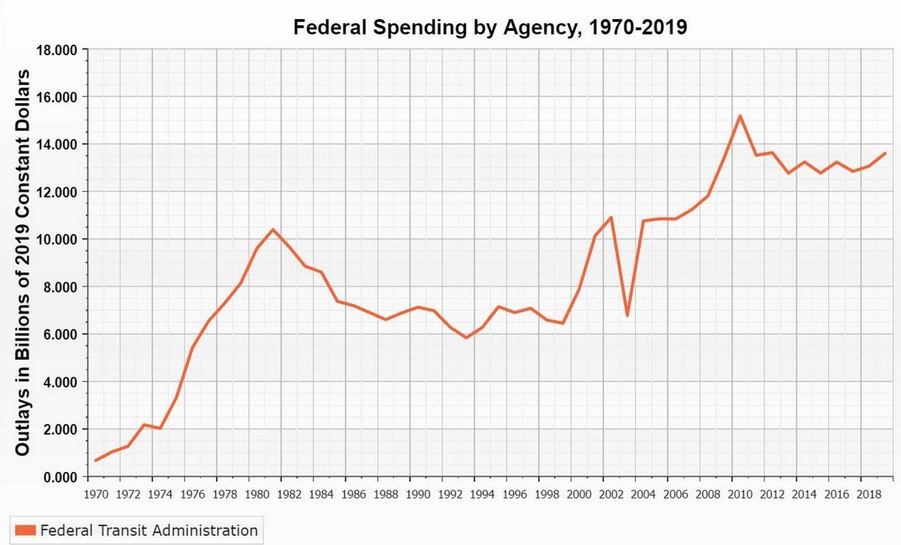
But that chart is now out of date since politicians have used the pandemic as an excuse to dramatically increase the burden of federal spending. Including big handouts for mass transit.

And now they want to raid taxpayers for more transit money as part of a spending spree on infrastructure.

The Wall Street Journal editorialized about this topic a couple of days ago.

Democrats are accusing Republicans of holding up the Senate infrastructure deal over funding for mass transit. Here’s what’s really going on: Republicans have bowed to most Democratic demands. But now Democrats are also insisting that they acquiesce to spending ever more to rescue broken rail and bus systems in big liberal cities. Mass transit typically receives $13 billion in federal funds each year, and Congress provided an additional $70 billion for urban transit last year in the myriad pandemic spending bills. That’s more than six times the normal transit budget and more than the annual operating and capital spending of every transit agency in the U.S. combined. …But most mass transit systems face a larger structural budget problem that pre-dated the pandemic: Ballooning operating costs from generous labor contracts and pension payments, which are siphoning off money from system improvements and repairs. Many systems have also been losing riders due to lousy service… So Democrats want Republicans to bail out those cities and their public unions. Republicans have agreed to a $48.5 billion supplemental appropriation for mass transit in the deal. But in addition Democrats are demanding that 20% of transportation spending from the highway trust fund—financed by gas tax revenues—go toward transit.

This is throwing good money after bad.

In a column for the Foundation for Economic Education back in 2019, Hans Bader explained that mass transit in an inefficient money pit.

Mass transit is largely a failure and continues to decline despite growing subsidies to many mass transit systems. Light rail systems are white elephants. …South Korea is abolishing its celebrated high-speed rail line from its capital, Seoul, to a nearby major city because it can’t cover even the marginal costs of keeping the trains running. Most people who ride trains don’t need maximum possible speed,and most of those who do will still take the plane to reach distant destinations. …most Japanese don’t take the bullet train either; they take buses because the bullet train is too expensive. Bullet trains do interfere with freight lines, so Japanese freight lines carry much less cargo than in the United States, where railroads—rather than trucks—carry most freight, thereby reducing pollution… California’s so-called bullet train is vastly behind schedule and over budget, and will likely never come close to covering its operating costs once it is built. …Just the first leg of this $77 billion project will cost billions more than budgeted. And the project is already at least 11 years behind schedule.

Government is a big reason why transit is so inefficient and expensive.

Industry expert Randal O’Toole wrote about the harmful impact of socialized systems back in 2018.

Public ownership of transit has significantly increased the cost of transit, creating another disadvantage for the transit industry relative to other modes of travel. Before 1964, transit systems in most American cities were private and profitable, albeit declining. In 1964, Congress gave cities and states incentives to take over transit systems, and within a decade nearly all had been municipalized …followed by a staggering decline in transit productivity. In the decade before 1964, transit systems carried an average of about 59,000 riders per operating employee. This plunged after 1964 and today averages fewer than 27,000 riders per employee… It is doubtful that any American industry has suffered a 54 percent decline in worker productivity over 30 years unless it was another industry taken over by the government and inflicted with all the inefficiencies associated with government control and management.

We’ll close with this chart from O’Toole’s study, which shows total taxpayer subsidies over time.
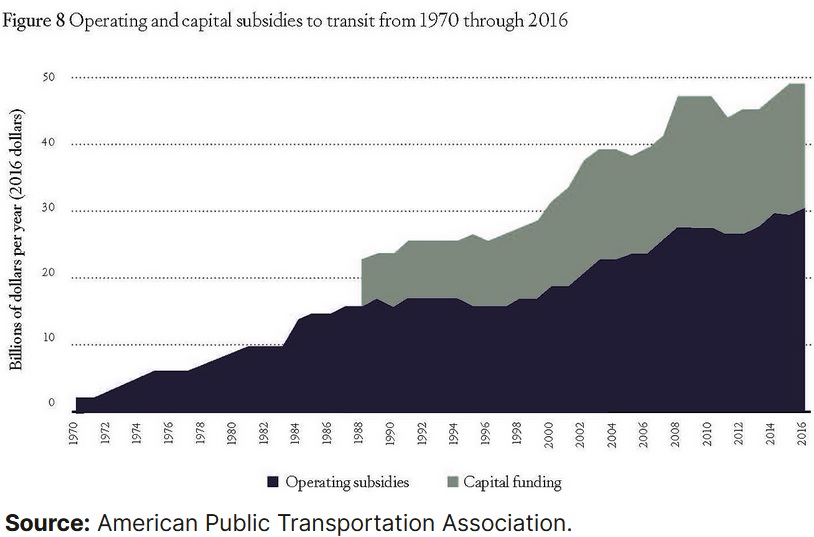
The bottom line is that government transit systems are a lot like government schools. More and more money gets spent over time with worse and worse results.

Except maybe mass transit is even worse because of absurd cost overruns.

P.S. Click here and here to learn more about the boondoggle of government-funded rail.

P.P.S. Click here to learn more about the boondoggle of government-funded subways.

TRY BORROWING AT A BANK WITH A FINANCIAL CONDITION LIKE THE USA HAS:

The problem in Washington is not lack of revenue but our lack of spending restraint. This video below makes that point. WASHINGTON IS A SPENDING ADDICT!!!

I love reading this blog by Dan Mitchell. No two people agree on everything but I sure do agree with most everything Dan writes on this blog of his. However, I disagree silently with something he has written today. I think it is encouraging that the Republicans in the House have been able to accomplish some things in slowing down the growth in spending by Obama. I know Dan would agree that more needs to be done. For instance, why don’t they just vote no on the next increase to the debt ceiling limit. I have praised over and over and over the 66 House Republicans that voted no on that before. If they did not raise the debt ceiling then we would have a balanced budget instantly.  I agree that the Tea Party has made a difference and I have personally posted 49 posts on my blog on different Tea Party heroes of mine.

What would happen if the debt ceiling was not increased? Yes President Obama would probably cancel White House tours and he would try to stop mail service or something else to get on our nerves but that is what the Republicans need to do.

I have written hundreds of letters and emails to President Obama and I must say that I have been impressed that he has had the White House staff answer so many of my letters. However, his policies have not changed, and by the way the White House after answering over 50 of my letters before November of 2012 has not answered one since.  President Obama committed to cutting nothing from the budget that I can tell. Republicans must take the next step now and vote no on the debt ceiling increase!!!

In recent months, people have asked me why I’m acting all giddy and optimistic. Am I hooked on cocaine? Have I fallen in love? Did I inherit several million dollars?

These questions started after I said the fiscal cliff was a smaller loss than I expected. Then people wondered what was going on when I wrote that we should celebrate the sequester victory. The questions got more intense when I opined that the Tea Party had made a positive difference. And people were even more nonplussed when I wrote that we should enjoy a win over the IMF.

But I’m not the only person thinking that things may be heading in the right direction.

Conn Carroll explains his optimism in the Washington Examiner. He starts by noting how bad Congress was back in 2009 and 2010.

…its liberal predecessor passed a trillion-dollar stimulus, enacted a government takeover of health care and institutionalized the power of Wall Street’s Too Big To Fail banks by passing the Dodd-Frank financial regulation law.

Then he explains that the new Tea Party Congress has changed the fiscal outlook.

…if you look at the hard numbers — if you look at the tax-and-spending trajectory that the United States was on before the 112th Congress was sworn into office, and then look at the path the U.S. is on now — you’d see that Republicans in Congress have made tremendous progress in shrinking the size and scope of the federal government.

But is there any proof?

Conn points out that the CBO “baselines” from early 2011 showed government growing very rapidly.

…the nonpartisan Congressional Budget Office released its annual Budget and Economic Outlook for fiscal years 2011 through 2021. That document showed the federal government was on track to spend…a total of almost $50 trillion ($49.8 trillion to be exact) through 2021. At the same time, tax revenues were set to rise from just 14.8 percent of GDP in 2011 to 20.8 percent in 2021.

The same estimates from early this year, by contrast, show government growing at a slower pace.

The CBO’s Budget and Economic Outlook for fiscal years 2013 through 2023 shows just how much House Republicans have actually accomplished. The federal government is now on track to spend just $46.2 trillion through 2021. That is a $3.6 trillion spending cut. And instead of taxes eating up 21 percent of the U.S. economy in 2021, now the government is set to take in just 18.9 percent.

Here are the respective baselines from those CBO publications. Let’s start by looking at how spending is projected to grow at a slower pace for the rest of the decade.
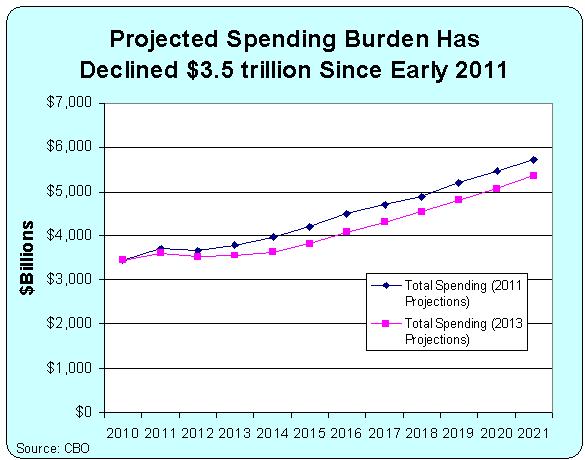
2011-2013 Spending Projections

That’s $3.5 trillion of savings. Not genuine spending cuts, of course, but it’s real progress if government doesn’t grow as fast.

Here are the revenue numbers.
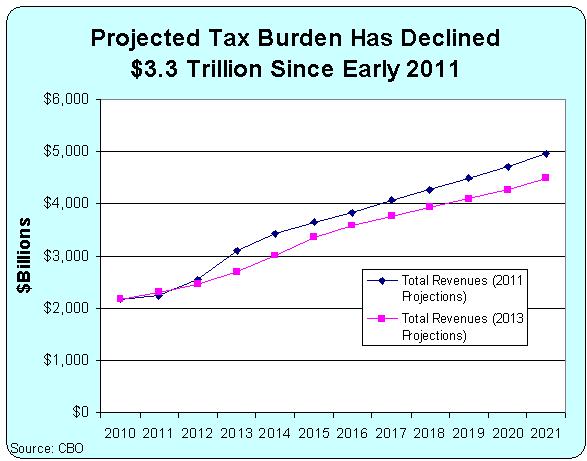
2011-2013 Revenue Projections

This data basically shows that the tax burden will be much smaller than projected because about 98 percent of the Bush tax cuts were made permanent as part of the fiscal cliff deal.

And if you believe in the Starve-the-Beast theory (and you should), this will make it harder for politicians to increase the burden of government spending in the future.

Conn also notes that the unemployment rate has fallen.

Despite all of this supposedly economy-killing “austerity,” unemployment has steadily fallen, too. When Republicans took control of the House in 2011, the nation’s unemployment rate was 9 percent. Today, it has fallen to 7.7 percent.

If this seems like a familiar point, it’s because I share his assessment. I wrote back in February of last year that gridlock was a positive thing for the economy since it reduced the likelihood of new bad policies.

What’s remarkable about these developments, as Conn notes, is that folks were expecting Obama to have momentum as his second term began.

Just three months ago, many in Washington were predicting Obama would steamroll Republicans into accepting higher taxes for millions of earners, undoing the sequester and maybe even passing new stimulus spending. Instead, Republicans have stayed unified, outfoxed Obama, preserved and made permanent most of last decade’s tax cuts (including permanent indexing of the Alternative Minimum Tax) and let the sequester cuts occur on schedule. As a result, Obama’s approval ratings have tumbled, and his entire second-term agenda is in jeopardy.

The final sentence in that excerpt explains why I’m feeling semi-optimistic. Obama’s agenda of more taxes and more spending is being thwarted.

To be sure, that doesn’t mean we’re seeing good policies of tax reform and fiscal restraint. And we still face a very dour fiscal future unless entitlements are reformed.

But we’re going in the wrong direction at a slower pace, and that beats the alternative.

__________

Related posts:

Sixty Six who resisted “Sugar-coated Satan Sandwich” Debt Deal (Part 49)

Sixty Six who resisted “Sugar-coated Satan Sandwich” Debt Deal (Part 49) This post today is a part of a series I am doing on the 66 Republican Tea Party favorites that resisted eating the “Sugar-coated Satan Sandwich” Debt Deal. Actually that name did not originate from a representative who agrees with the Tea Party, but […]

Sixty Six who resisted “Sugar-coated Satan Sandwich” Debt Deal (Part 48)

Sixty Six who resisted “Sugar-coated Satan Sandwich” Debt Deal (Part 48) This post today is a part of a series I am doing on the 66 Republican Tea Party favorites that resisted eating the “Sugar-coated Satan Sandwich” Debt Deal. Actually that name did not originate from a representative who agrees with the Tea Party, but […]

Sixty Six who resisted “Sugar-coated Satan Sandwich” Debt Deal (Part 47)

Sixty Six who resisted “Sugar-coated Satan Sandwich” Debt Deal (Part 47) This post today is a part of a series I am doing on the 66 Republican Tea Party favorites that resisted eating the “Sugar-coated Satan Sandwich” Debt Deal. Actually that name did not originate from a representative who agrees with the Tea Party, but […]

Sixty Six who resisted “Sugar-coated Satan Sandwich” Debt Deal (Part 46)

  Sixty Six who resisted “Sugar-coated Satan Sandwich” Debt Deal (Part 46) This post today is a part of a series I am doing on the 66 Republican Tea Party favorites that resisted eating the “Sugar-coated Satan Sandwich” Debt Deal. Actually that name did not originate from a representative who agrees with the Tea Party, […]

Sixty Six who resisted “Sugar-coated Satan Sandwich” Debt Deal (Part 45)

Sixty Six who resisted “Sugar-coated Satan Sandwich” Debt Deal (Part 45) This post today is a part of a series I am doing on the 66 Republican Tea Party favorites that resisted eating the “Sugar-coated Satan Sandwich” Debt Deal. Actually that name did not originate from a representative who agrees with the Tea Party, but […]

Sixty Six who resisted “Sugar-coated Satan Sandwich” Debt Deal (Part 44)

Sixty Six who resisted “Sugar-coated Satan Sandwich” Debt Deal (Part 44) This post today is a part of a series I am doing on the 66 Republican Tea Party favorites that resisted eating the “Sugar-coated Satan Sandwich” Debt Deal. Actually that name did not originate from a representative who agrees with the Tea Party, but […]

Sixty Six who resisted “Sugar-coated Satan Sandwich” Debt Deal (Part 43)

Sixty Six who resisted “Sugar-coated Satan Sandwich” Debt Deal (Part 43) This post today is a part of a series I am doing on the 66 Republican Tea Party favorites that resisted eating the “Sugar-coated Satan Sandwich” Debt Deal. Actually that name did not originate from a representative who agrees with the Tea Party, but […]

Sixty Six who resisted “Sugar-coated Satan Sandwich” Debt Deal (Part 42)

Sixty Six who resisted “Sugar-coated Satan Sandwich” Debt Deal (Part 42) This post today is a part of a series I am doing on the 66 Republican Tea Party favorites that resisted eating the “Sugar-coated Satan Sandwich” Debt Deal. Actually that name did not originate from a representative who agrees with the Tea Party, but […]

Sixty Six who resisted “Sugar-coated Satan Sandwich” Debt Deal (Part 41)

Sixty Six who resisted “Sugar-coated Satan Sandwich” Debt Deal (Part 41) This post today is a part of a series I am doing on the 66 Republican Tea Party favorites that resisted eating the “Sugar-coated Satan Sandwich” Debt Deal. Actually that name did not originate from a representative who agrees with the Tea Party, but […]

Sixty Six who resisted “Sugar-coated Satan Sandwich” Debt Deal (Part 40)

Sixty Six who resisted “Sugar-coated Satan Sandwich” Debt Deal (Part 40) This post today is a part of a series I am doing on the 66 Republican Tea Party favorites that resisted eating the “Sugar-coated Satan Sandwich” Debt Deal. Actually that name did not originate from a representative who agrees with the Tea Party, but […]

Sixty Six who resisted “Sugar-coated Satan Sandwich” Debt Deal (Part 39)

Sixty Six who resisted “Sugar-coated Satan Sandwich” Debt Deal (Part 39) This post today is a part of a series I am doing on the 66 Republican Tea Party favorites that resisted eating the “Sugar-coated Satan Sandwich” Debt Deal. Actually that name did not originate from a representative who agrees with the Tea Party, but […]

Sixty Six who resisted “Sugar-coated Satan Sandwich” Debt Deal (Part 38)

Sixty Six who resisted “Sugar-coated Satan Sandwich” Debt Deal (Part 38) This post today is a part of a series I am doing on the 66 Republican Tea Party favorites that resisted eating the “Sugar-coated Satan Sandwich” Debt Deal. Actually that name did not originate from a representative who agrees with the Tea Party, but […]

Sixty Six who resisted “Sugar-coated Satan Sandwich” Debt Deal (Part 37)

Sixty Six who resisted “Sugar-coated Satan Sandwich” Debt Deal (Part 37) This post today is a part of a series I am doing on the 66 Republican Tea Party favorites that resisted eating the “Sugar-coated Satan Sandwich” Debt Deal. Actually that name did not originate from a representative who agrees with the Tea Party, but […]

Sixty Six who resisted “Sugar-coated Satan Sandwich” Debt Deal (Part 36)

Sixty Six who resisted “Sugar-coated Satan Sandwich” Debt Deal (Part 36) This post today is a part of a series I am doing on the 66 Republican Tea Party favorites that resisted eating the “Sugar-coated Satan Sandwich” Debt Deal. Actually that name did not originate from a representative who agrees with the Tea Party, but […]

Sixty Six who resisted “Sugar-coated Satan Sandwich” Debt Deal (Part 35)

Sixty Six who resisted “Sugar-coated Satan Sandwich” Debt Deal (Part 35) This post today is a part of a series I am doing on the 66 Republican Tea Party favorites that resisted eating the “Sugar-coated Satan Sandwich” Debt Deal. Actually that name did not originate from a representative who agrees with the Tea Party, but […]

Sixty Six who resisted “Sugar-coated Satan Sandwich” Debt Deal (Part 34)

Sixty Six who resisted “Sugar-coated Satan Sandwich” Debt Deal (Part 34) This post today is a part of a series I am doing on the 66 Republican Tea Party favorites that resisted eating the “Sugar-coated Satan Sandwich” Debt Deal. Actually that name did not originate from a representative who agrees with the Tea Party, but […]

Sixty Six who resisted “Sugar-coated Satan Sandwich” Debt Deal (Part 33)

Sixty Six who resisted “Sugar-coated Satan Sandwich” Debt Deal (Part 33) This post today is a part of a series I am doing on the 66 Republican Tea Party favorites that resisted eating the “Sugar-coated Satan Sandwich” Debt Deal. Actually that name did not originate from a representative who agrees with the Tea Party, but […]

Sixty Six who resisted “Sugar-coated Satan Sandwich” Debt Deal (Part 32)

Sixty Six who resisted “Sugar-coated Satan Sandwich” Debt Deal (Part 32) This post today is a part of a series I am doing on the 66 Republican Tea Party favorites that resisted eating the “Sugar-coated Satan Sandwich” Debt Deal. Actually that name did not originate from a representative who agrees with the Tea Party, but […]

Sixty Six who resisted “Sugar-coated Satan Sandwich” Debt Deal (Part 31)

Congressmen Tim Huelskamp on the debt ceiling Sixty Six who resisted “Sugar-coated Satan Sandwich” Debt Deal (Part 31) This post today is a part of a series I am doing on the 66 Republican Tea Party favorites that resisted eating the “Sugar-coated Satan Sandwich” Debt Deal. Actually that name did not originate from a representative […]

Sixty Six who resisted “Sugar-coated Satan Sandwich” Debt Deal (Part 30)

Sixty Six who resisted “Sugar-coated Satan Sandwich” Debt Deal (Part 30) This post today is a part of a series I am doing on the 66 Republican Tea Party favorites that resisted eating the “Sugar-coated Satan Sandwich” Debt Deal. Actually that name did not originate from a representative who agrees with the Tea Party, but […]

The Sixty Six who resisted “Sugar-coated Satan Sandwich” Debt Deal (Part 29)

 Sixty Six who resisted “Sugar-coated Satan Sandwich” Debt Deal (Part 29) This post today is a part of a series I am doing on the 66 Republican Tea Party favorites that resisted eating the “Sugar-coated Satan Sandwich” Debt Deal. Actually that name did not originate from a representative who agrees with the Tea Party, but […]

The Sixty Six who resisted “Sugar-coated Satan Sandwich” Debt Deal (Part 28)

The Sixty Six who resisted “Sugar-coated Satan Sandwich” Debt Deal (Part 28) This post today is a part of a series I am doing on the 66 Republican Tea Party favorites that resisted eating the “Sugar-coated Satan Sandwich” Debt Deal. Actually that name did not originate from a representative who agrees with the Tea Party, […]

The Sixty Six who resisted “Sugar-coated Satan Sandwich” Debt Deal (Part 27)

The Sixty Six who resisted “Sugar-coated Satan Sandwich” Debt Deal (Part 27) This post today is a part of a series I am doing on the 66 Republican Tea Party favorites that resisted eating the “Sugar-coated Satan Sandwich” Debt Deal. Actually that name did not originate from a representative who agrees with the Tea Party, […]

Dan Mitchell noted “politicians should only spend money to finance “public goods” that generate offsetting benefits!”

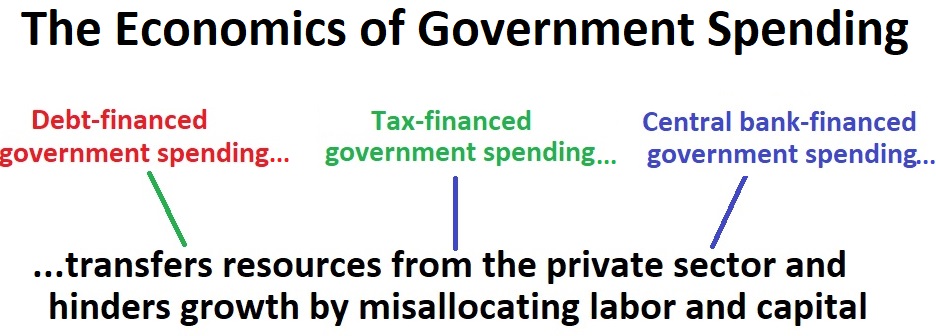
Government Spending Is a Problem, Regardless of How It Is Financed

Back in 2019, I listed “Six Principles to Guide Policy on Government Spending.”

If I was required to put it all in one sentence (sort of), here’s the most important thing to understand about fiscal policy.

This does not mean, by the way, that we should be anarcho-capitalists and oppose all government spending.

But it does mean that all government spending imposes a burden on the economy and that politicians should only spend money to finance “public goods” that generate offsetting benefits.

Assuming, of course, that the goal is greater prosperity.

I’m motivated to address this topic because Philip Klein wrote a column for National Review about Biden’s new spending. He points out that this new spending is bad, regardless of whether it is debt-financed or tax-financed.

As Democrats race toward squandering another $4.1 trillion — perhaps with some Republican help — we are being told over and over how the biggest stumbling block is figuring out how the new spending will be “paid for.” …Senator Joe Manchin (D., W.Va.), who is trying to maintain his image as a moderate, insisted that he doesn’t believe the spending should be passed if it isn’t fully financed.“Everything should be paid for,” Manchin has told reporters. …Republican members of the bipartisan group have also made similar comments. …But it is folly to consider massive amounts of new spending to be “responsible” as long as members of Congress come up with enough taxes to raise… At some point in the next few weeks, Democrats (and possibly Republicans) will announce that they have reached a deal on some sort of major spending compromise. They will claim that it is fully paid for, and assert that it is fiscally responsible. But there is nothing responsible about adding trillions in new obligations at a time when the nation is already heading for fiscal catastrophe.

Klein is correct.

Biden’s spending binge will be just as damaging to prosperity if it is financed with taxes rather than financed by debt.

The key thing to realize is that we’ll have less growth if more of the economy’s output is consumed by government spending.

Giving politicians and bureaucrats more control over the allocation of resources is a very bad idea (as even the World Bank, OECD, and IMF have admitted).

March 31, 2021

President Biden  c/o The White House
1600 Pennsylvania Avenue NW
Washington, DC 20500

Dear Mr. President,

Please explain to me if you ever do plan to balance the budget while you are President? I have written these things below about you and I really do think that you don’t want to cut spending in order to balance the budget. It seems you ever are daring the Congress to stop you from spending more.

President Barack Obama speaks about the debt limit in the East Room of the White House in Washington. | AP Photo

“The credit of the United States ‘is not a bargaining chip,’ Obama said on 1-14-13. However, President Obama keeps getting our country’s credit rating downgraded as he raises the debt ceiling higher and higher!!!!

Washington Could Learn a Lot from a Drug Addict

Just spend more, don’t know how to cut!!! Really!!! That is not living in the real world is it?

Making more dependent on government is not the way to go!!

Why is our government in over 16 trillion dollars in debt? There are many reasons for this but the biggest reason is people say “Let’s spend someone else’s money to solve our problems.” Liberals like Max Brantley have talked this way for years. Brantley will say that conservatives are being harsh when they don’t want the government out encouraging people to be dependent on the government. The Obama adminstration has even promoted a plan for young people to follow like Julia the Moocher.  

David Ramsey demonstrates in his Arkansas Times Blog post of 1-14-13 that very point:

Arkansas Politics / Health Care Arkansas’s share of Medicaid expansion and the national debt

Posted by on Mon, Jan 14, 2013 at 1:02 PM

Baby carrot Arkansas Medicaid expansion image

Imagine standing a baby carrot up next to the 25-story Stephens building in Little Rock. That gives you a picture of the impact on the national debt that federal spending in Arkansas on Medicaid expansion would have, while here at home expansion would give coverage to more than 200,000 of our neediest citizens, create jobs, and save money for the state.

Here’s the thing: while more than a billion dollars a year in federal spending would represent a big-time stimulus for Arkansas, it’s not even a drop in the bucket when it comes to the national debt.

Currently, the national debt is around $16.4 trillion. In fiscal year 2015, the federal government would spend somewhere in the neighborhood of $1.2 billion to fund Medicaid expansion in Arkansas if we say yes. That’s about 1/13,700th of the debt.

It’s hard to get a handle on numbers that big, so to put that in perspective, let’s get back to the baby carrot. Imagine that the height of the Stephens building (365 feet) is the $16 trillion national debt. That $1.2 billion would be the length of a ladybug. Of course, we’re not just talking about one year if we expand. Between now and 2021, the federal government projects to contribute around $10 billion. The federal debt is projected to be around $25 trillion by then, so we’re talking about 1/2,500th of the debt. Compared to the Stephens building? That’s a baby carrot.

______________

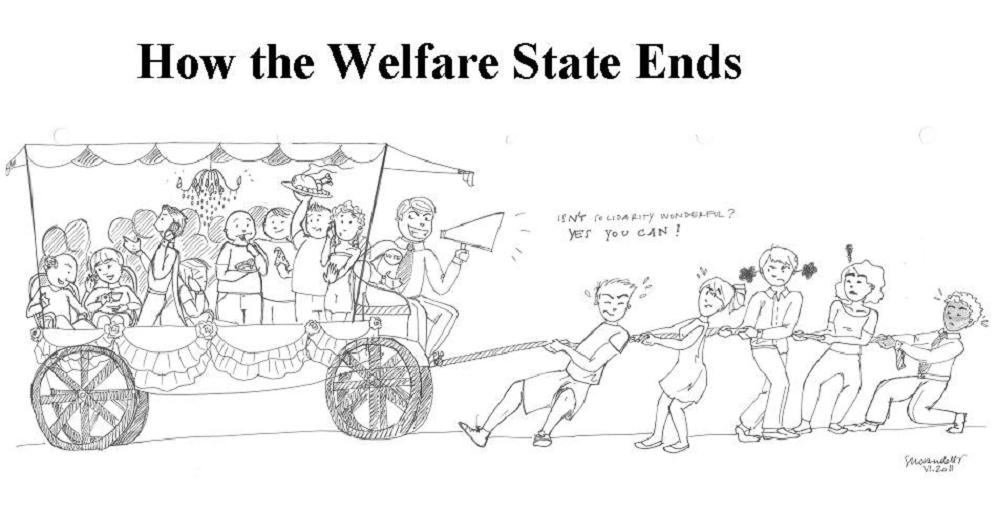
Here is how it will all end if everyone feels they should be allowed to have their “baby carrot.”

How sad it is that liberals just don’t get this reality.

Here is what the Founding Fathers had to say about welfare. David Weinberger noted:

While living in Europe in the 1760s, Franklin observed: “in different countries … the more public provisions were made for the poor, the less they provided for themselves, and of course became poorer. And, on the contrary, the less was done for them, the more they did for themselves, and became richer.”

Alexander Fraser Tytler, Lord Woodhouselee (15 October 1747 – 5 January 1813) was a Scottish lawyer, writer, and professor. Tytler was also a historian, and he noted, “A democracy cannot exist as a permanent form of government. It can only exist until the majority discovers it can vote itself largess out of the public treasury. After that, the majority always votes for the candidate promising the most benefits with the result the democracy collapses because of the loose fiscal policy ensuing, always to be followed by a dictatorship, then a monarchy.”

Thomas Jefferson to Joseph Milligan

April 6, 1816

[Jefferson affirms that the main purpose of society is to enable human beings to keep the fruits of their labor. — TGW]

To take from one, because it is thought that his own industry and that of his fathers has acquired too much, in order to spare to others, who, or whose fathers have not exercised equal industry and skill, is to violate arbitrarily the first principle of association, “the guarantee to every one of a free exercise of his industry, and the fruits acquired by it.” If the overgrown wealth of an individual be deemed dangerous to the State, the best corrective is the law of equal inheritance to all in equal degree; and the better, as this enforces a law of nature, while extra taxation violates it.

[From Writings of Thomas Jefferson, ed. Albert E. Bergh (Washington: Thomas Jefferson Memorial Association, 1904), 14:466.]

_______

Jefferson pointed out that to take from the rich and give to the poor through government is just wrong. Franklin knew the poor would have a better path upward without government welfare coming their way. Milton Friedman’s negative income tax is the best method for doing that and by taking away all welfare programs and letting them go to the churches for charity.

_____________

_________

Thank you so much for your time. I know how valuable it is. I also appreciate the fine family that you have and your commitment as a father and a husband.

Sincerely,

Everette Hatcher III, 13900 Cottontail Lane, Alexander, AR 72002, ph 501-920-5733

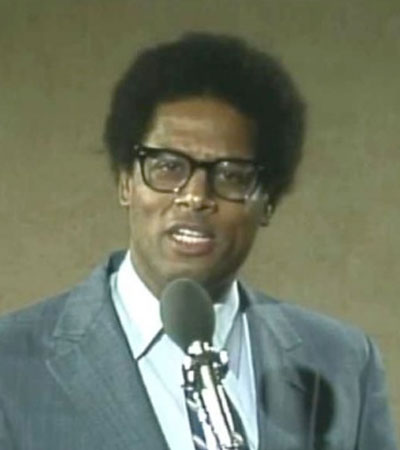
Williams with Sowell – Minimum Wage

Thomas Sowell

Thomas Sowell – Reducing Black Unemployment

By WALTER WILLIAMS

—-

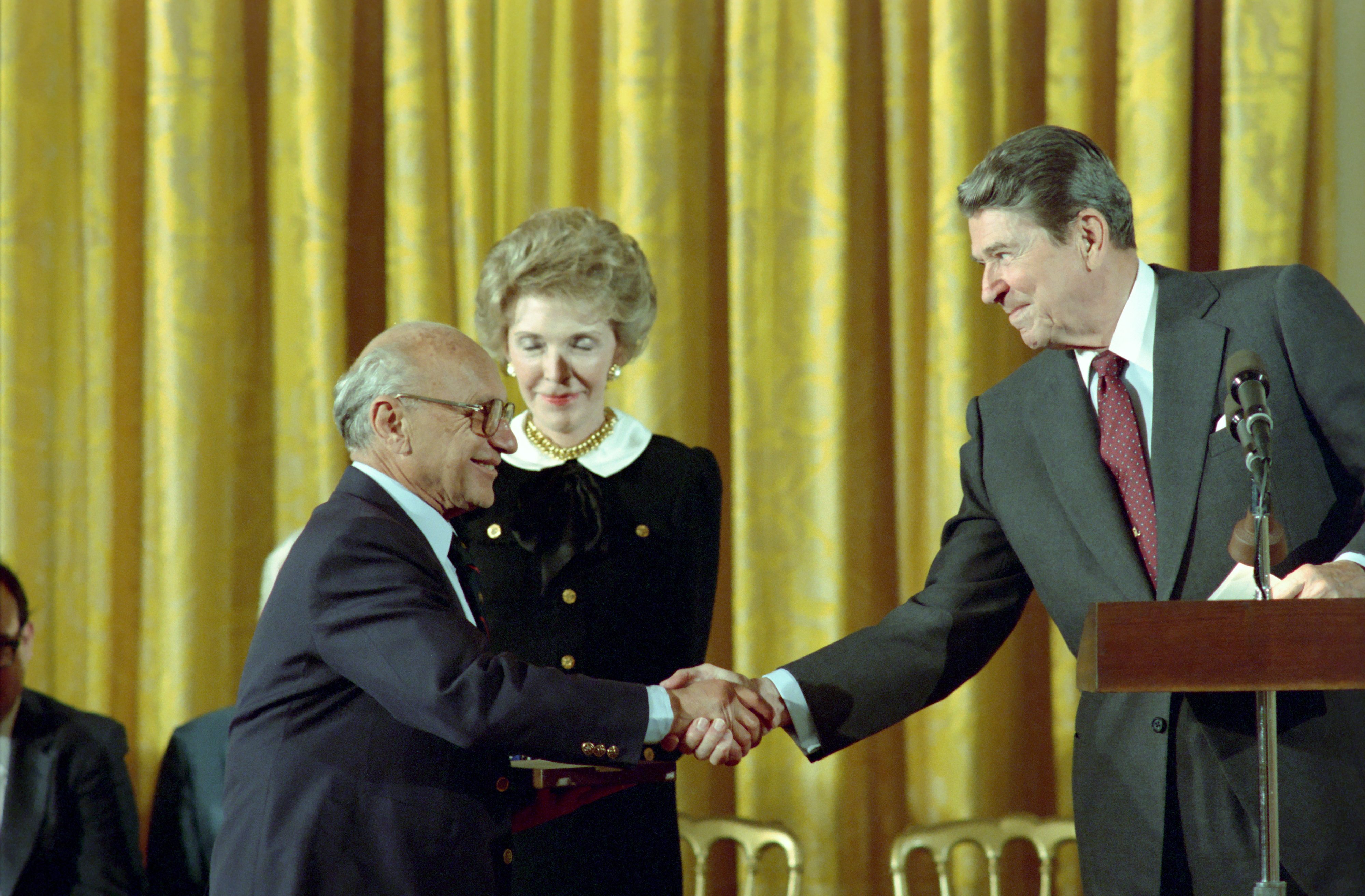
Ronald Reagan with Milton Friedman
Milton Friedman The Power of the Market 2-5

Related posts:

Welfare Spending Shattering All-Time Highs

  We got to act fast and get off this path of socialism. Morning Bell: Welfare Spending Shattering All-Time Highs Robert Rector and Amy Payne October 18, 2012 at 9:03 am It’s been a pretty big year for welfare—and a new report shows welfare is bigger than ever. The Obama Administration turned a giant spotlight […]

We need more brave souls that will vote against Washington welfare programs

We need to cut Food Stamp program and not extend it. However, it seems that people tell the taxpayers back home they are going to Washington and cut government spending but once they get up there they just fall in line with  everyone else that keeps spending our money. I am glad that at least […]

Welfare programs are not the answer for the poor

Government Must Cut Spending Uploaded by HeritageFoundation on Dec 2, 2010 The government can cut roughly $343 billion from the federal budget and they can do so immediately. __________ Liberals argue that the poor need more welfare programs, but I have always argued that these programs enslave the poor to the government. Food Stamps Growth […]

Private charities are best solution and not government welfare

Milton Friedman – The Negative Income Tax Published on May 11, 2012 by LibertyPen In this 1968 interview, Milton Friedman explained the negative income tax, a proposal that at minimum would save taxpayers the 72 percent of our current welfare budget spent on administration. http://www.LibertyPen.com Source: Firing Line with William F Buckley Jr. ________________ Milton […]

The book “After the Welfare State”

Dan Mitchell Commenting on Obama’s Failure to Propose a Fiscal Plan Published on Aug 16, 2012 by danmitchellcato No description available. ___________ After the Welfare State Posted by David Boaz Cato senior fellow Tom G. Palmer, who is lecturing about freedom in Slovenia and Tbilisi this week, asked me to post this announcement of his […]

President Obama responds to Heritage Foundation critics on welfare reform waivers

Is President Obama gutting the welfare reform that Bill Clinton signed into law? Morning Bell: Obama Denies Gutting Welfare Reform Amy Payne August 8, 2012 at 9:15 am The Obama Administration came out swinging against its critics on welfare reform yesterday, with Press Secretary Jay Carney saying the charge that the Administration gutted the successful […]

Welfare reform part 3

Thomas Sowell – Welfare Welfare reform was working so good. Why did we have to abandon it? Look at this article from 2003. The Continuing Good News About Welfare Reform By Robert Rector and Patrick Fagan, Ph.D. February 6, 2003 Six years ago, President Bill Clinton signed legislation overhauling part of the nation’s welfare system. […]

Welfare reform part 2

Uploaded by ForaTv on May 29, 2009 Complete video at: http://fora.tv/2009/05/18/James_Bartholomew_The_Welfare_State_Were_In Author James Bartholomew argues that welfare benefits actually increase government handouts by ‘ruining’ ambition. He compares welfare to a humane mousetrap. —– Welfare reform was working so good. Why did we have to abandon it? Look at this article from 2003. In the controversial […]

Why did Obama stop the Welfare Reform that Clinton put in?

Thomas Sowell If the welfare reform law was successful then why change it? Wasn’t Bill Clinton the president that signed into law? Obama Guts Welfare Reform Robert Rector and Kiki Bradley July 12, 2012 at 4:10 pm Today, the Obama Department of Health and Human Services (HHS) released an official policy directive rewriting the welfare […]

“Feedback Friday” Letter to White House generated form letter response July 10,2012 on welfare, etc (part 14)

I have been writing President Obama letters and have not received a personal response yet.  (He reads 10 letters a day personally and responds to each of them.) However, I did receive a form letter in the form of an email on July 10, 2012. I don’t know which letter of mine generated this response so I have […]

Thomas Jefferson was right when he warned that “eternal vigilance is the price of liberty.”

Thomas Sowell Exposes Dishonest Budgetary Scare Tactics and Cartoonists Mock Obama’s Hysteria

Public finance experts are quite familiar with the budgetary shenanigans of cossetted government bureaucracies.

They even have terms to describe how agencies and departments try to manipulate outcomes by claiming that any requirement for fiscal restraint will necessitate cuts to the most politically popular parts of the budget.

  • The “fireman first principle” – Describes how local government bodies (often coordinating with local politicians) will claim that firemen will have to be laid off and/or firehouses will have to close if there is any budgetary discipline. You can replace firefighters with cops or teachers if you want. The key point is to divert attention from the countless ways that local governments waste money by focusing on the few things that voters actually care about.
  • The “Washington Monument syndrome” – Based on a real-world example during the 1970s of the National Park Service claiming it would have to shut down tourist access to popular Washington-area sites if it was subject to fiscal restraint, the modern-day equivalent is President Obama scaring people with hysterical assertions about threats to food safety and airline operations.

Thomas Sowell clearly understands this racket.

Back in my teaching days, many years ago, one of the things I liked to ask the class to consider was this: Imagine a government agency with only two tasks: (1) building statues of Benedict Arnold and (2) providing life-saving medications to children. If this agency’s budget were cut, what would it do? The answer, of course, is that it would cut back on the medications for children. Why? Because that would be what was most likely to get the budget cuts restored. If they cut back on building statues of Benedict Arnold, people might ask why they were building statues of Benedict Arnold in the first place.

Bingo. Bulls-eye. A perfect analysis of bureaucratic incentives and public-choice economics.

Sowell then describes what’s now happening in Washington.

The Obama administration is following the same pattern. The Department of Homeland Security, for example, released thousands of illegal aliens from prisons to save money — and create alarm. The Federal Aviation Administration says it is planning to cut back on the number of air traffic controllers, which would, at a minimum, create delays for airline passengers, in addition to fears for safety that can create more public alarm. …it serves Obama’s interest to maximize the damage and the public alarm, which he can direct against Republicans. President Obama has said that he would veto legislation to let him choose what to cut. That should tell us everything we need to know about the utter cynicism of this glib man.

The political cartoonists also are having a field day making fun of Obama’s silly demagoguery.

Let’s start with Michael Ramirez. You can see why he’s currently leading in the best-cartoonist poll.

Sequester Cartoon Ramirez 4

Nate Beeler also has a good contribution to the debate. The President is acting like the world is going to end because spending is going to be “slashed” by 1.2 percent, which means – gasp! – that spending will “only” grow by $2.4 trillion over the next 10 years.

Yet somehow Armageddon has not occurred.

Sequester Cartoon Beeler 4

Indeed, the worst possible outcome for Obama and the other statists is that people notice zero negative impact when spending is restrained.

This Steve Kelley cartoon is very appealing to me because it shows the President going after the sequester when the real problem is an excessive burden of government spending.

Sequester Cartoon Kelley 4

Last but not least, we have a very good Scott Stantis cartoon.

Sequester Cartoon Stantis 4

The Stantis cartoon is particularly insightful because the GOP has won the battle, but the war is not over.

As I noted yesterday, Obama will have several additional opportunities to undo the sequester savings.

Thomas Jefferson was right when he warned that “eternal vigilance is the price of liberty.”

P.S. You can enjoy more sequester cartoons here, here, and here.

Is Washington Bankrupting America?

Uploaded by on Apr 20, 2010

Be first to receive our videos and other timely info about economic policy. Subscribe at http://www.bankruptingamerica.org
————————-
According to a recent poll, 74 percent of likely voters are extremely or very concerned about the current level of government spending. And 58 percent think the level of spending is unsustainable.

Is the public right? Is Washington bankrupting America? Some facts from the video:

Spending per household has risen over 40 percent in the last 10 years and is set to do so again in the next 10 pushing debt (and interest on the debt) to unprecedented levels. But that’s just a result of PAST spending…

Our government owes $106 trillion in FUTURE spending commitments – that cannot be paid for.

We can solve it, but politicians will have to make tough choices. Increasing taxes can’t do the trick ($106 trillion is equivalent to taking all of the taxable income from every American nine times over), nor is it fair to saddle taxpayers with a problem created by government irresponsibility.

We need real spending reform. Merely returning to the spending per household levels of the 1990s would balance the budget in three years.

___________

I wish we would eliminate several departments of the federal government  and in the process get back to vision of founders. That is what the GOP Platform has done in 2012. Take a look at this article below by Dan Mitchell of the Cato Institute.

I wish the Republican Platform was binding.

Too bad it’s meaningless fluff

Why? Because the GOP, for all intents and purposes, has just proposed to eliminate the Department of Education, the Department of Housing and Urban Development, the Department of Energy, the Department of Agriculture, the Department of Transportation, the Department of Health and Human Services, along with a host of other government programs, agencies, and departments.

More specifically, they endorsed the 10th Amendment to the U.S. Constitution, which means they put themselves on record in favor of getting rid of all federal spending and intervention that is inconsistent with the Founding Fathers’ vision of a limited central government.

Here’s some of the story, as reported by The Hill,

All federal spending should be reviewed to ensure powers reserved for the states are not given to the federal government, according to the GOP platform approved Tuesday. The platform language is meant to ensure all federal spending meets the requirements of the 10th amendment, which prohibits state powers from being given to the feds. “We support the review and examination of all federal agencies to eliminate wasteful spending, operational inefficiencies, or abuse of power to determine whether they are performing functions that are better performed by the States,” the platform reads. “These functions, as appropriate, should be returned to the States in accordance with the Tenth Amendment of the United States Constitution.”

For those of you who don’t have your Cato Institute pocket Constitutions handy, here’s what the 10th Amendment says.

The powers not delegated to the United States by the Constitution, nor prohibited by it to the States, are reserved to the States respectively, or to the people.

In other words, the 10th Amendment is basically a back-up plan to re-emphasize that the federal government was prohibited from exercising power in any area other than what is specified in the enumerated powers section of Article I, Section VIII.

And if you look at those enumerated powers, that pretty much invalidates much of what happens in Washington.

That’s the good news. The bad news is that the Republican platform will have less impact on a potential Romney presidency than this blog.  In other words, Republicans don’t intend to live up to this promise. Heck, they don’t even know that they have such a position. That’s why I included the asterisk in the title and must draw your attention to this fine print.

*Offer not good when GOP holds power.

But I suppose it’s good that they included this language in the platform, even if it’s merely empty political rhetoric

P.S. If they did abide by the 10th Amendment, it means that Obamacare also would be repealed.

P.P.S. Yes, this implies limits on democracy. Our Founding Fathers, contrary to E.J. Dionne’s superficial analysis, were opposed to untrammeled majoritarianism and wanted to make sure 51 percent of the people couldn’t vote to rape and pillage 49 percent of the people.

In describing Biden Administration Dan Mitchell notes “During the Obama years, I shared a cartoon strip that cleverly makes the point that some people will choose not to work if they can get enough goodies from the government”

The Economics of “Labor Shortages”

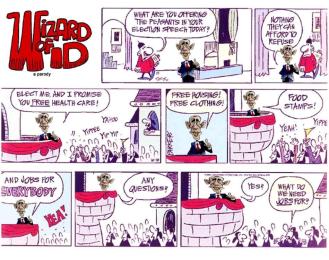
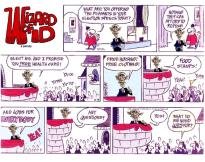
During the Obama years, I shared a cartoon strip that cleverly makes the point that some people will choose not to work if they can get enough goodies from the government.

That Wizard-of-Id parody has been viewed more than 56,000 times, which suggests many readers also thought it was worth sharing.

But it obviously hasn’t been shared often enough with the crowd in Washington. Politicians have created a welfare state that penalizes work and rewards dependency.

Especially now that there are bonus payments for staying unemployed. Which makes it hard to businesses to find workers.

Our friends on the left, however, think there’s a solution to this problem.

In his column for the New York Times, David Leonhardt says there is not a labor shortage because employers can simply raise wages.

The idea that the United States suffers from a labor shortage is fast becoming conventional wisdom. But before you accept the idea, it’s worth taking a few minutes to think it through. Once you do, you may realize that the labor shortage is more myth than reality. …one of the beauties of capitalism is its mechanism for dealing with shortages.In a communist system, people must wait in long lines when there is more demand than supply for an item. That’s an actual shortage. In a capitalist economy, however, there is a ready solution. …When a company is struggling to find enough labor, it can solve the problem by offering to pay a higher price for that labor — also known as higher wages. More workers will then enter the labor market. Suddenly, the labor shortage will be no more. …Sure enough, some companies have responded to the alleged labor shortage by doing exactly this. …companies that have recently announced pay increases include Amazon, Chipotle, Costco, McDonald’s, Walmart, J.P. Morgan Chase and Sheetz convenience stores.

Leonhardt is correct that businesses can lure workers back into the job market by boosting wages. I’m glad he recognizes how the price system works.

But he completely ignores the issue of whether some jobs will simply disappear because they’re not worth the amount of money that would be required to out-compete government handouts.

That’s the key argument from the Wall Street Journal‘s editorialon the topic.

…the U.S. labor market turned in its second disappointing result in a row in May, according to Friday’s Labor Department report. That’s what happens when government pays Americans not to work. Employers created 559,000 net new jobs in the month, which sounds great until you notice that 1.5 million fewer workers in May said they were unable to work because their employer closed or lost business due to the pandemic.…The civilian labor force shrank in May by 53,000, and the number of men over age 20 who were employed fell by 8,000. …What gives? The Occam’s razor explanation is that in March the Biden Administration and Congress ladled out another mountain of cash to Americans—work not required. The extra $300 a week in enhanced jobless benefits is one problem, since millions of Americans can make more staying on the couch. …This is on top of regular jobless benefits, plus new or extended cash payments such as the $3,000 per child tax credit, additional ObamaCare subsidies, and the $1,400 checks to individuals. Again, no work required.

For all intents and purposes, politicians in DC have been undoing the great achievement of welfare reform. That 1996 law was designed to push people from idleness into employment, and it was largely successful.

But over the past couple of decades, laws like Obamacare have given people goodies without any conditionality, which has resulted in many people deciding once again that they don’t need to work.

And if Biden’s per-child handouts are made permanent, expect the problem to get even worse.

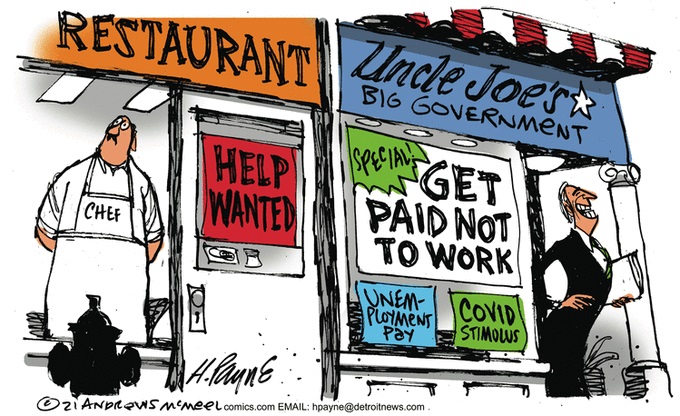
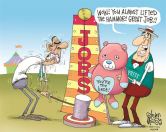
Since we started with a cartoon, let’s close with another cartoon.

This gem from Henry Payne captures the problem facing many small businesses.

Big companies have enough financial depth that they can adapt. They have considerable ability to get rid of low-skilled jobs, invest in labor-saving technologies, and even give some raises to employees they retain.

Many small businesses, however, are simply out of luck. That’s one group of victims.

The other victims are the people who get goodies from politicians. Yes, the various handouts make their lives easier in the short run, but once they get trapped in the quicksand of government dependency, it’s very difficult to escape.

P.S. Because he said some sensible things about “basic income” back in 2017, I had hoped Biden would be better on this issue. I should have known better based on his track record.


Rolling Stones – Hang Fire LIVE East Rutherford, New Jersey ’81

Comparing Rolling Stones’ Song HANG FIRE to the Way People in USA are reacting to President Biden increasing Unemployment  Benefits!

https://youtu.be/3xbtlW16Gts

Dan Henninger also opined for the WSJ. Here’s some of what he wrote.

By making unemployment insurance competitive with market wage rates in a pandemic, the Biden Democrats may have done long-term damage to the American work ethic. …The welfare reforms of the 1990s were based on the realization that transfer payments undermined the work ethic. The Biden-Sanders Democrats are dropping that work requirement for recipients of cash payments.

https://youtu.be/o-u81UnQ16Q

Reminds me of a Rolling Stones song HANG FIRE in which peoples’ desires are to sit around and be lazy and dream about winning a lot at the casino! Check out these lyrics:

In the sweet old country where I come from
Nobody ever works
Yeah nothing gets done

We hang fire, we hang fire
You know marrying money is a full time job
I don’t need the aggravation
I’m a lazy slob

I hang fire, I hang fire
Hang fire, put it on the wire baby
Hang fire, hang fire put it on the wire baby, go ahead
Hang fire
We’ve got nothing to eat
We got nowhere to work
Nothing to drink
We just lost our shirts
I’m on the dole
We ain’t for hire
Say what the hell
Say what the hell, hang fire
Hang fire, hang fire, hang fire, put it on the wire, baby
Hang fire, hang fire, hang fire, hang fire
Hang fire, hang fire, put it on the wire, baby
Doo doo doo
Doo doo doo
Doo doo doo
Doo doo
Doo doo doo
Doo doo doo
Doo doo doo
Doo doo, hang fire, hang fire, hang fire
Doo doo doo
Doo doo doo
Doo doo doo, hang fire, hang fire, put it on the wire, baby
Doo doo
Doo doo doo
Doo doo doo
Doo doo doo
Doo doo
Yeah ten thousand dollars, go have some fun
Put it all on at a hundred to one

Hang fire, hang fire, hang fire, put it on the wire, baby
Doo doo
Doo doo, hang fire, hang fire put it on the wire
Hang fire, hang fire, hang fire, hang fire
Put it on the wire, baby
Put it on the wire


Subsidized Unemployment and the Work Ethic

I wrote two days ago about subsidized unemployment, followed later in the day by this interview.

https://youtu.be/cXfXpgVAefE

This controversy raises a fundamental economic issue.

I explained in the interview that employers only hire people when they expect a new worker will generate at least enough revenue to cover the cost of employment.

There’s a similar calculation on the part of individuals, as shown by this satirical cartoon strip.

People decide to take jobs when they expect the additional after-tax income they earn will compensate them for the loss of leisure and/or the unpleasantness of working.

Which is why many people are now choosing not to work since the government has increased the subsidies for idleness (a bad policy that began under Trump).

The Wall Street Journal editorialized about this issue a couple of days ago.

White House economists say there’s no “measurable” evidence that the $300 federal unemployment bonus is discouraging unemployed people from seeking work. They were rebutted by Tuesday’s Bureau of Labor Statistics’ Jolts survey, which showed a record 8.1 million job openings in March.…But these jobs often pay less than what most workers could make on unemployment. That explains why the number of job openings in many industries increased more than the number of new hires in March. …The number of workers who quit their jobs also grew by 125,000. …some quitters may be leaving their jobs because they figure they can make more unemployed for the next six months after Democrats extended the bonus into September.

Dan Henninger also opined on the issue for the WSJ. Here’s some of what he wrote.

President Biden said, “People will come back to work if they’re paid a decent wage.” But what if he’s wrong? What if his $300 unemployment insurance bonus on top of the checks sent directly to millions of people (which began during the Trump presidency) turns out to be a big, long-term mistake? …Mr. Biden and the left expect these outlays effectively to raise the minimum wage by forcing employers to compete with Uncle Sam’s money. …Ideas have consequences. By making unemployment insurance competitive with market wage rates in a pandemic, the Biden Democrats may have done long-term damage to the American work ethic. …The welfare reforms of the 1990s were based on the realization that transfer payments undermined the work ethic. The Biden-Sanders Democrats are dropping that work requirement for recipients of cash payments.

Amen.

I made similar arguments about the erosion of the work ethic last year when discussing this issue.

And this concern applies to other forms of redistribution. Including, most notably, the foolish idea of big per-child handouts.

P.S. The WSJ editorial cited above mentioned the Labor Department’s JOLT data. Those numbers are also useful if you want proof that federal bureaucrats are overpaid, and you’ll also see that the same thing is true for state and local government employees.

The Upside-Down Morality and Economic Illiteracy of Class Warfare

My Eighth Theorem of Government is very simple.

If someone writes and talks about poverty, I generally assume that they care about poor people. They may have good ideas for helping the poor, or they may have bad ideas. But I usually don’t doubt their sincerity.

But when someone writes and talks about inequality, I worry that they don’t really care about the less fortunate and that they’re instead motivated by envy, resentment, and jealousy of rich people.

And this concern probably applies to a couple of law professors, Michael Heller of Columbia and James Salzman of UCLA. They recently wrote a column for the Washington Post on how the government should grab more money from the private sector when rich people die.

They seem particularly agitated that states such as South Dakota have strong asset-protection laws that limit the reach of the death tax.

Income inequality has widened. One…way to tackle the problem. Instead of focusing only on taxing wealth accumulation, we can address the hidden flip side — wealth transmission. …The place to start is South Dakota… The state has created…wealth-sheltering tools including the aptly named “dynasty trust.” …Congress can…plug holes in our leaky estate tax system. One step would be to tax trusts at the passage of each generation and limit generation-skipping tax-exempt trusts. A bigger step would be to ensure that appreciated stocks…are taxed… Better still, let’s start anew. Ditch the existing estate tax and replace it with an inheritance tax

There’s nothing remarkable in their proposals. Just a typical collection of tax-the-rich schemes one might expect from a couple of academics.

But I can’t resist commenting on their article because of two inadvertent admissions.

First, we have a passage that reveals a twisted sense of morality. They apparently think it’s a “heist” if people keep their own money.

America’s ultra-wealthy have pulled off a brilliantly designed heist, with a string of South Dakota governors as accomplices.

For all intents and purposes, the law professors are making an amazing claim that it’s stealing if you don’t meekly surrender your money to politicians.

Apparently they agree with Richard Murphy that all income belongs to the government and it’s akin to an entitlement program or “state aid” if politicians let you keep a slice.

Second, the law professors make the mistake of trying to be economists. They want readers to think the national economy suffers if money stays in the private sector.

Nearly no one in South Dakota complains, because the harm falls on the national economy… We all suffer high and hidden costs…getting less in government services. …South Dakota locks away resources that could spark entrepreneurial innovation.

According to their analysis, a nation such as Singapore must be very poor while a country such as Greece must be very rich.

Needless to say, the opposite is true. Larger burdens of government spending are associated with less prosperity and dynamism.

I’ll offer one final observation. Professors Heller and Salzman obviously want more and more taxes on the rich.

But I wonder what they would say if confronted with the data showing that the United States already collects a greater share of tax revenue from the rich than any other OECD country.

P.S. The reason the U.S. collects proportionately more taxes from the rich is that other developed countries have bigger welfare states, and that necessarily leads to much higher tax burdens on lower-income and middle-class taxpayers (as honest folks on the left acknowledge).


Milton Friedman’s Free to Choose – Ep.4 (1/7) – From Cradle to Grave

File:President Ronald Reagan and Nancy Reagan in The East Room Congratulating Milton Friedman Receiving The Presidential Medal of Freedom.jpg

January 21, 2021

President Biden c/o The White House
1600 Pennsylvania Avenue NW
Washington, DC 20500

Dear Mr. President,

With the national debt increasing faster than ever we must make the hard decisions to balance the budget now. If we wait another decade to balance the budget then we will surely risk our economic collapse.

The first step is to remove all welfare programs and replace them with the negative income tax program that Milton Friedman first suggested.

Milton Friedman points out that though many government welfare programs are well intentioned, they tend to have pernicious side effects. In Dr. Friedman’s view, perhaps the most serious shortcoming of governmental welfare activities is their tendency to strip away individual independence and dignity. This is because bureaucrats in welfare agencies are placed in positions of tremendous power over welfare recipients, exercising great influence over their lives. In addition, welfare programs tend to be self-perpetuating because they destroy work incentives. Dr. Friedman suggests a negative income tax as a way of helping the poor. The government would pay money to people falling below a certain income level. As they obtained jobs and earned money, they would continue to receive some payments from the government until their outside income reached a certain ceiling. This system would make people better off who sought work and earned income.

Here is a transcript of a portion of the “Free to Choose” program called “From Cradle to Grave” (program #4 in the 10 part series):

Transcript:
Friedman: After the 2nd World War, New York City authorities retained rent control supposedly to help their poorer citizens. The intentions were good. This in the Bronx was one result.
By the 50′s the same authorities were taxing their citizens. Including those who lived in the Bronx and other devastated areas beyond the East River to subsidize public housing. Another idea with good intentions yet poor people are paying for this, subsidized apartments for the well-to-do. When government at city or federal level spends our money to help us, strange things happen.
The idea that government had to protect us came to be accepted during the terrible years of the Depression. Capitalism was said to have failed. And politicians were looking for a new approach.
Franklin Delano Roosevelt was a candidate for the presidency. He was governor of New York State. At the governor’s mansion in Albany, he met repeatedly with friends and colleagues to try to find some way out of the Depression. The problems of the day were to be solved by government action and government spending. The measures that FDR and his associates discussed here derived from a long line of past experience. Some of the roots of these measures go back to Bismark’s Germany at the end of the 19th Century. The first modern state to institute old age pensions and other similar measures on the part of government. In the early 20th Century Great Britain followed suit under Lloyd George and Churchill. It too instituted old age pensions and similar plans.
These precursors of the modern welfare state had little effect on practice in the United States. But they did have a very great effect on the intellectuals on the campus like those who gathered here with FDR. The people who met here had little personal experience of the horrors of the Depression but they were confident that they had the solution. In their long discussions as they sat around this fireplace trying to design programs to meet the problems raised by the worst Depression in the history of the United States, they quite naturally drew upon the ideas that were prevalent at the time. The intellectual climate had become one in which it was taken for granted that government had to play a major role in solving the problems in providing what came later to be called Security from Cradle to Grave.
Roosevelt’s first priority after his election was to deal with massive unemployment. A Public Works program was started. The government financed projects to build highways, bridges and dams. The National Recovery Administration was set up to revitalize industry. Roosevelt wanted to see America move into a new era. The Social Security Act was passed and other measures followed. Unemployment benefits, welfare payments, distribution of surplus food. With these measures, of course, came rules, regulations and red tape as familiar today as they were novel then. The government bureaucracy began to grow and it’s been growing ever since.
This is just a small part of the Social Security empire today. Their headquarters in Baltimore has 16 rooms this size. All these people are dispensing our money with the best possible intentions. But at what cost?
In the 50 years since the Albany meetings, we have given government more and more control over our lives and our income. In New York State alone, these government buildings house 11,000 bureaucrats. Administering government programs that cost New York taxpayers 22 billion dollars. At the federal level, the Department of Health, Education and Welfare alone has a budget larger than any government in the world except only Russia and the United States.
Yet these government measures often do not help the people they are supposed to. Richard Brown’s daughter, Helema, needs constant medical attention. She has a throat defect and has to be connected to a breathing machine so that she’ll survive the nights. It’s expensive treatment and you might expect the family to qualify for a Medicaid grant.
Richard Brown: No, I don’t get it, cause I’m not eligible for it. I make a few dollars too much and the salary that I make I can’t afford to really live and to save anything is out of the question. And I mean, I live, we live from payday to payday. I mean literally from payday to payday.
Friedman: His struggle isn’t made any easier by the fact that Mr. Brown knows that if he gave up his job as an orderly at the Harlem Hospital, he would qualify for a government handout. And he’d be better off financially.
Hospital Worker: Mr. Brown, do me a favor please? There is a section patient.
Friedman: It’s a terrible pressure on him. But he is proud of the work that he does here and he’s strong enough to resist the pressure.
Richard Brown: I’m Mr. Brown. Your fully dilated and I’m here to take you to the delivery. Try not to push, please. We want to have a nice sterile delivery.
Friedman: Mr. Brown has found out the hard way that welfare programs destroy an individual’s independence.
Richard Brown: We’ve considered welfare. We went to see, to apply for welfare but, we were told that we were only eligible for $5.00 a month. And, to receive this $5.00 we would have to cash in our son’s savings bonds. And that’s not even worth it. I don’t believe in something for nothing anyway.
Mrs. Brown: I think a lot of people are capable of working and are willing to work, but it’s just the way it is set up. It, the mother and the children are better off if the husband isn’t working or if the husband isn’t there. And this breaks up so many poor families.
Friedman: One of the saddest things is that many of the children whose parents are on welfare will in their turn end up in the welfare trap when they grow up. In this public housing project in the Bronx, New York, 3/4′s of the families are now receiving welfare payments.
Well Mr. Brown wanted to keep away from this kind of thing for a very good reason. The people who get on welfare lose their human independence and feeling of dignity. They become subject to the dictates and whims of their welfare supervisor who can tell them whether they can live here or there, whether they may put in a telephone, what they may do with their lives. They are treated like children, not like responsible adults and they are trapped in the system. Maybe a job comes up which looks better than welfare but they are afraid to take it because if they lose it after a few months it maybe six months or nine months before they can get back onto welfare. And as a result, this becomes a self-perpetuating cycle rather than simply a temporary state of affairs.
Things have gone even further elsewhere. This is a huge mistake. A public housing project in Manchester, England.
Well we’re 3,000 miles away from the Bronx here but you’d never know it just by looking around. It looks as if we are at the same place. It’s the same kind of flats, the same kind of massive housing units, decrepit even though they were only built 7 or 8 years ago. Vandalism, graffiti, the same feeling about the place. Of people who don’t have a great deal of drive and energy because somebody else is taking care of their day to day needs because the state has deprived them of an incentive to find jobs to become responsible people to be the real support for themselves and their families.
_______________

Thank you so much for your time. I know how valuable it is. I also appreciate the fine family that you have and your commitment as a father and a husband.

Sincerely,

Everette Hatcher III, 13900 Cottontail Lane, Alexander, AR 72002, ph 501-920-5733

Related posts:

Washington is lecturing us about eating too much when they are spending addicts!!!!

Washington is lecturing us about eating too much when they are spending addicts!!!! Let’s Fix the Real Obesity Problem in Washington May 11, 2013 by Dan Mitchell Whenever someone proposes that we need more intervention from the federal government, I always go to the Constitution and check Article I, Section VIII. This is because I’m old fashioned and […]

Dan Mitchell of the Cato Institute:HUD has to go!!!! (includes political cartoon)

You want a suggestion on how to cut the government then start at HUD. I would prefer to eliminate all of it. Here are Dan Mitchell’s thoughts below: Sequestration’s Impact on HUD: Just 358 More Days and Mission Accomplished March 12, 2013 by Dan Mitchell As part of my “Question of the Week” series, I had […]

Coldplay the documentary with pictures and videos (Part 6 )

Coldplay Max Masters – Part 7 of 7 Chris Martin revealed in his interview with Howard Stern that he was rasied an evangelical Christian but he has left the church. I believe that many words that he puts in his songs today are generated from the deep seated Christian beliefs from his childhood that find […]

Open letter to President Obama (Part 138 B)

Real Time with Bill Maher March 16 2012 – Alexandra Pelosi Interviews Welfare Recipients in NYC Published on Mar 18, 2012 by vclubscenedotcom Real Time with Bill Maher March 16 2012 – Alexandra Pelosi Interviews Welfare Recipients __________ President Obama c/o The White House 1600 Pennsylvania Avenue NW Washington, DC 20500 Dear Mr. President, I […]

Are conservatives generous or are liberals?

Real Time with Bill Maher March 16 2012 – Alexandra Pelosi Interviews Welfare Recipients in NYC Published on Mar 18, 2012 by vclubscenedotcom Real Time with Bill Maher March 16 2012 – Alexandra Pelosi Interviews Welfare Recipients __________ Liberals like the idea of the welfare state while conservatives suggest charity through private organizations serve the […]

Democrats lied about spending cuts in 1982 and 1990

Washington Could Learn a Lot from a Drug Addict What kind of intervention does Congress need to get it to spend with its spending addiction? Back in 1982 Reagan was promised $3 in cuts for every $1 in tax increases but the cuts never came. In 1990 Bush was promised 2 for 1 but they […]

Transcript and video of Republican Debate June 13, 2011 New Hampshire (Part 4)

Republican Presidential Debate In New Hampshire pt.4 Rep. Ron Paul, R-Texas gestures as he answers a question as former Massachusetts Gov. Mitt Romney, left, and former Minnesota Gov. Tim Pawlenty, listen during the first New Hampshire Republican presidential debate at St. Anselm College in Manchester, N.H., Monday, June 13, 2011. (AP Photo/Jim Cole) KING: Welcome […]

Senator Pryor asks for Spending Cut Suggestions! Here are a few!(Part 1) (Al Green, Famous Arkansan)

  Senator Mark Pryor wants our ideas on how to cut federal spending. Take a look at this video clip below: Senator Pryor has asked us to send our ideas to him at cutspending@pryor.senate.gov and I have done so (at 4:04 pm CST on April 7th, 2011, and will continue to do so in the […]

Six great economic crossroads of the 20th and 21st centuries examined by Michael Reagan

I found this article very interesting. The Kennedy-Reagan Truth vs. the Obama Delusion by Jim Denney In his book The New Reagan Revolution, Michael Reagan examined six great economic crossroads of the 20th and 21st centuries. These six critical junctures in the history of the United States serve as economic laboratories to test two contrasting economic […]

Dumas:Lowering Capital Gains Tax Bad Idea

HALT:HaltingArkansasLiberalswithTruth.com This video clip gives 6 reasons why the Capital Gains Tax should be abolished Ernest Dumas in his article “Tax work not wealth,” (Arkansas Times, Nov 25, 2010) asserts, “The (capital gains) tax rate was raised in 1976 under President Gerald Ford and economic growth accelerated. President Jimmy Carter cut the top rate from 39 […]

By Everette Hatcher III | Posted in Arkansas Times, Cato Institute, Ernest Dumas, Taxes | Edit |

Jennifer Graham: “The minimum wage did not increase during the eight years that Reagan was president, a term that began in 1980. That was the same year that Friedman and his wife, Rose Friedman, published a book that was so popular that it led to a PBS series and videos that are even now popular on YouTube”

<img class="i-amphtml-blurry-placeholder" src="data:;base64,

Photo illustration by Ethan Hendricks and Zoë Petersen

As Congress considers what to do about a proposed $15 minimum wage, Republican opposition to the bill can be traced to two influential voices of the past: President Ronald Reagan and Nobel Prize-winning economist Milton Friedman.

The minimum wage did not increase during the eight years that Reagan was president, a term that began in 1980. That was the same year that Friedman and his wife, Rose Friedman, published a book that was so popular that it led to a PBS series and videos that are even now popular on YouTube.

In “Free to Choose,” an examination of economics and liberty, the Friedmans wrote that minimum-wage laws require employers to discriminate against unskilled workers. That argument and others made by Friedman have informed a generation of Republicans and Libertarians who now face the challenge of defending a longstanding principle in light of growing income inequality and public sentiment that has bent toward increasing the minimum wage.

Democrats’ efforts to include the wage increase in a COVID-19 relief bill were stalled Thursday when Senate parliamentarian Elizabeth MacDonough, a nonpartisan official, ruled that it is not permissible as written, The Washington Post reported.

Utah Republican Sen. Mitt Romney is among those seeking to identify a compromise that would avert stalled legislation of the past that has left the minimum wage unchanged since 2009, when it was set at $7.25 an hour.

<img class="i-amphtml-blurry-placeholder" src="data:;base64,

Sen. Mitt Romney, R-Utah, pauses during an interview with KSL’s Doug Wright in Salt Lake City on Thursday, Feb. 6, 2020, the day after he voted to convict President Donald Trump on one impeachment count.
Laura Seitz, Deseret News

Romney, along with Sen. Tom Cotton, an Arkansas Republican, crafted a bill introduced Thursday that would gradually increase the minimum wage to $10 an hour over four years with a slower phase-in for businesses with fewer than 20 employees.

Unlike some of his fellow Republicans, who oppose a minimum wage in principle, Romney believes that legislation to increase the wage should reflect changes in the cost of living while seeking to avert negative effects, such as job loss.

“There may be philosophical debates about whether or not we should have a minimum wage, but the reality is, we’re going to have a minimum wage,” said Romney, who also pushed for smaller increases than Democrats wanted when he was governor of Massachusetts.

Republican Sen. Josh Hawley of Missouri, meanwhile, has said he would support the Democratic proposal for a $15 minimum wage, but only for employees of large companies. He has proposed a “blue-collar bonus” that would provide refundable tax credits for people making below $16.50 an hour.

Lost in much of the debate is how relatively few Americans would see an increase in pay, if the federal minimum wage is increased. According to the Bureau of Labor Statistics, in 2020, about 1.5% of hourly workers in the U.S. earned the minimum wage or less.

The history of the minimum wage begins with Franklin D. Roosevelt and the National Industrial Recovery Act of 1933, which launched a series of guaranteed wages that ranged from $12 to $15 — a week. But it’s the time period between Reagan’s inauguration and Romney’s proposal that Republican thinking on the minimum wage became more entrenched. Here’s why the minimum wage has caused so much angst for the Republican Party, and where it may be headed this year.

A minimum wage of zero?

Survey any number of conservative pundits and podcasters, and you’ll find sharp-tongued resistance to President Joe Biden’s proposal to incrementally raise the minimum wage to $15 an hour by 2025. Daily Wire commentator Matt Walsh, for example, recently wrote on Twitter that “competent adults” aren’t working for minimum wage.

Walsh and other conservative pundits argue that most people who earn minimum wage are young and unskilled, and they may not need more money (for example, if they are students still living at home) or don’t deserve more because they provide little value to their employer. That thinking is at the heart of the Friedmans’ assertion in “Free to Choose” that “the minimum wage law requires employers to discriminate against people with low skills.”

“No one describes it that way, but that is in fact what it is,” the Friedmans wrote, adding that a poorly educated teen with no work history might only be worth $2 an hour to an employer, and unless the employer is willing to throw in another 90 cents of “charity” to reach the then-minimum wage of $2.90, the teen wouldn’t have a job at all.

“It has always been a mystery to us why a young person is better off unemployed from a job that would pay $2.90 an hour than employed at a job that pays $2.00 an hour,” the Friedmans wrote.

The Friedmans also said that low-paying jobs and apprenticeships provide other value than money to the unskilled worker, such as the chance to learn new skills and acquire experience.

More than 100 studies have shown that increases in the minimum wage result in fewer available jobs, said Steve Hanke, a professor of applied economics at Johns Hopkins University in Baltimore, who was a senior economist on President Reagan’s council of economic advisers.

A new report from the nonpartisan Congressional Budget Office projects that if the Raise the Wage Act of 2021 is enacted as written, there would be 1.4 million fewer jobs in the U.S., a decline of 0.9%.

“The people the minimum wage is designed to help, it hurts, because they don’t get the minimum wage. They don’t have a job. If you jack the minimum wage up higher than someone is worth, they’re not going to be hired,” Hanke said.

Mark J. Perry, a scholar at the American Enterprise Institute and economics professor at the University of Michigan-Flint, agreed, saying that people often think the minimum-wage debate pits an employee against an employer; in fact, he said, it’s about employees competing against each other.

“Low-skilled workers compete against higher-skilled workers. That’s something that often gets overlooked. Employers will overlook those lower-skilled workers in favor of hiring higher-skilled workers,” Perry said.

“As (economist) Thomas Sowell has pointed out, the real minimum wage is always zero because that’s what the worker makes if he or she can’t find a job because he’s been priced out of the labor market because the minimum wage is above what they’re really worth to an employer.”

Costs vs. benefits

The Congressional Budget Office report, however, also says a minimum wage increase would reduce the number of Americans in poverty by 0.9 million, and that there would be fewer people reliant on government programs, such as food assistance.

Paul K. Sonn, state policy program director for the National Employment Law Project, a New York nonprofit that advocates for a $15 minimum wage, said any negative effects of the change, such as the potential for increased consumer prices, are outweighed by the benefits. And he notes that recent surveys have found a majority of Americans favor a higher minimum wage, as do many companies. Amazon, for example, which already has an in-house $15 minimum wage, supports the change nationwide.

“We believe $15 an hour is the minimum anyone in the U.S. should be paid for an hour of labor. We also believe it’s good for business,” Jay Carney, Amazon’s senior vice president of global corporate affairs, wrote on the company website.

Walmart, the largest employer in the U.S., starts its workers at $11, offering a Friedman-like argument that the pay structure allows its workers to advance.

“Those people that we’re raising wages for tend to have been with us for a longer period of time than someone that might be earning the entry wage,” CEO Doug McMillon told investors, Business Insider reported. “We’re trying to … create this ladder of opportunity, providing an opportunity for people when they start with the company to build a career like so many of us already have.”

McMillon, who began his career at Walmart as a teen making $6.50 an hour, said the company wouldn’t be able to implement its ladder of increases if it had to pay everyone a minimum of $15 an hour right now.

The minimum wage in the U.S. is a complicated patchwork of laws, with states and even cities having standards independent of federal law.

According to the National Conference of State Legislatures, 29 states and the District of Columbia have established minimum wages above the federal minimum wage.

But it is the differences between the states that are a prime component of arguments against a federal minimum wage, according to Perry, at the American Enterprise Institute.

“There’s no reason that we should have a $15 uniform wage for the entire country, for both high-cost-of-living areas and low-cost-of-living areas,” he said. Fifteen dollars an hour might be appropriate in Hawaii, which has the nation’s highest cost of living, he said, but $10 might be more appropriate for Mississippi.

“You could make the case that if there is going to be a minimum-wage law, it should be set by the state or county or city government, not by the federal government,” he said.

But Romney, the senator from Utah, said America has a federal minimum wage and it’s not going away, so it’s incumbent upon policymakers to enact one that has a minimal effect on the number of jobs. He said the $10 proposal he has put forth with Cotton and three other senators would not result in lost jobs, and he has long been in favor of a minimum wage that adjusts for inflation. In the matter of wages, he says, the government has a justifiable interest in what private businesses do.

“The federal government does provide support for people at the very low income level,” he said. “Not having a minimum wage can increase the amount of federal expenditures for health care, food, clothing and child benefits, so the federal government does very much have a stake in what businesses are paying people.”

What would Reagan do?

With his proposal, Romney has again established himself as an outlier. He has previously said that Republicans are “nuts” to not want to raise the minimum wage, adding “I think, as a party, to say we’re trying to help the middle class of America and the poor and not raise the minimum wage sends exactly the wrong signal.”

Yet proponents of a higher minimum wage, such as Sonn at the National Employment Law Project, are unhappy with the Romney-Cotton plan, which also requires employers to verify the employment status of their workers through E-Verify.

Sonn called the stipulation a “punitive anti-immigrant measure masquerading as a minimum-wage increase.”

Romney also finds himself outside the tent of people like Hanke, who considered Friedman a friend and mentor and who also was friends with another economist widely admired by conservatives, Friedrich Hayek.

Romney, Hanke said, is “off the reservation” when it comes to the minimum wage. “The government should not be in the business of setting prices, whether they’re for labor or for goods and services,” he said. “The market should be determinant, with sellers and buyers voluntarily agreeing what price they pay. … From my point of view, it really is immoral for the government to be coming in and setting prices of things.”

<img class="i-amphtml-blurry-placeholder" src="data:;base64,

President Ronald Reagan visits Hooper, Weber County, on Sept. 10, 1982.
Tom Smart, Deseret News

Hanke doesn’t think much of Hawley’s proposal, either. “Milton Friedman would scold him and give him a quick lesson in economics, and so would I,” he said.

And what would Hanke’s former employer, Ronald Reagan, do, if he’d been confronted with legislation to raise the minimum wage, which was $3.35 during his administration, to $15, as Democrats propose today?

“I don’t think he would have abolished it all together, because Reagan was principled, but pragmatic,” Hanke said. “I don’t think he would think the abolition of the minimum wage would be worth the political cost of doing it, even though he would be very happy to have gotten rid of the whole thing.

“I think he would have remained as quiet as possible on raising it, as he did.”

Ep. 4 – From Cradle to Grave [6/7]. Milton Friedman’s Free to Choose (1980)

March 11, 2021

President Biden c/o The White House
1600 Pennsylvania Avenue NW
Washington, DC 20500

Dear Mr. President,

Thank you for taking time to have your office try and get a pulse on what is going on out here in the country. I wanted to let you know what I think about the minimum wage increase you have proposed for the whole country and I wanted to quote Milton Friedman who you are familiar with and you made it clear in July that you didn’t care for his views! Let me challenge you to take a closer look at what he had to say!

_____________

Thank you so much for your time. I know how valuable it is. I also appreciate the fine family that you have and your commitment as a father and a husband.

Sincerely,

Everette Hatcher III, 13900 Cottontail Lane, Alexander, AR 72002, ph 501-920-5733

Williams with Sowell – Minimum Wage

Thomas Sowell

Thomas Sowell – Reducing Black Unemployment

By WALTER WILLIAMS

—-

Ronald Reagan with Milton Friedman
Milton Friedman The Power of the Market 2-5

MILTON FRIEDMAN: “I would rather have government spend one trillion dollars with a deficit of a half a trillion dollars than have government spend two trillion dollars with no deficit.” (article by Dan Mitchell)

The CRFB Fiscal Quiz

I’ve shared all sorts of online quizzes that supposedly can detect things such as whether you’re a pure libertarian.

Or even whether you’re a communist.

Today, courtesy of the folks at the Committee for a Responsible Budget, you can agree or disagree with 24 statements to determine your “budget personality.”

I have some quibbles about some of the wording (for instance, I couldn’t answer “neither” when asked to react to: “The government should spend more money on children than on seniors”).

But I can’t quibble with the results. Given the potential outcomes, I’m glad to be a “Minimalist” who is “in favor of smaller government.”

Though I’m disappointed that I apparently didn’t get a perfect score on “Size of Government.”

And I need to explain why I got a mediocre score on the topic of “Fiscal Responsibility.”

The budget geeks at the Committee for a Responsible Federal Budget (CRFB) have a well-deserved reputation for rigorous analysis. I regularly cite their numbers and appreciate the work that they do.

That being said, they mistakenly focus on deficits and debt when the real problem is too much government.

I agree with Milton Friedman, who wisely observed that ““I would rather have government spend one trillion dollars with a deficit of a half a trillion dollars than have government spend two trillion dollars with no deficit.”

The folks at CRFB would disagree.

Indeed, they are so fixated on red ink that they would welcome tax increases.

At the risk of understatement, that would be a very bad approach.

The evidence from Europe shows that higher taxes simply lead to higher spending. And more debt.

Indeed, Milton Friedman also commented on this issue, warning that, “History shows that over a long period of time government will spend whatever the tax system raises plus as much more as it can get away with.”

The bottom line is that CRFB not only has the wrong definition of “Fiscal Responsibility,” but they also support policies that would make matters worse – even from their perspective!

EP 4 – From Cradle to Grave [6/7]. Milton Friedman’s Free to Choose (1980)

March 1, 2021

President Biden c/o The White House
1600 Pennsylvania Avenue NW
Washington, DC 20500

Dear Mr. President,

Thank you for taking time to have your office try and get a pulse on what is going on out here in the country. I wanted to let you know what I think about the minimum wage increase you have proposed for the whole country and I wanted to quote Milton Friedman who you are familiar with and you made it clear in July that you didn’t care for his views! Let me challenge you to take a closer look at what he had to say!

Four Progressive Minimum Wage Myths Debunked

Democrats are just making things up to advance their job-killing cause.

|

_____________

Thank you so much for your time. I know how valuable it is. I also appreciate the fine family that you have and your commitment as a father and a husband.

Sincerely,

Everette Hatcher III, 13900 Cottontail Lane, Alexander, AR 72002, ph 501-920-5733

Williams with Sowell – Minimum Wage

Thomas Sowell

Thomas Sowell – Reducing Black Unemployment

By WALTER WILLIAMS

—-

Ronald Reagan with Milton Friedman
Milton Friedman The Power of the Market 2-5

“Severely Disabled Man Suffers Consequences of Paying Americans Not to Work”

_______________

This morning I pointed out the similarities of Rolling Stones song HANG FIRE to what President Biden is doing by incentivizing staying home and being a lazy slob!

President Joe Biden rejects the notion that generous COVID-19 relief provisions, and state and local aid, create disincentives for work. Pictured: Biden addresses a joint session of Congress, with Vice President Kamala Harris and House Speaker Nancy Pelosi, D-Calif., on the dais behind him, April 28, in Washington, D.C. (Photo: Melina Mara-Pool/Getty Images)

“Experts” predicted 1 million jobs would be created in April. The actual number fell far short, at 266,000. Republicans warned that overly generous COVID-19 relief benefits create a disincentive to work.

The day before this disappointing jobs report, Bloomberg wrote:

In earnings calls and business surveys, executives often blame stimulus checks and generous unemployment benefits for hampering hiring efforts. …

Friday’s employment report, which is projected to show the economy added 1 million jobs in April, should offer new insight into this mismatch and whether it’s deterring growth.

Want to keep up with the 24/7 news cycle? Want to know the most important stories of the day for conservatives? Need news you can trust? Subscribe to The Daily Signal’s email newsletter. Learn more >>

When the numbers came in, Biden administration officials lacked no shortage of excuses. Some potential workers, they argued, feared going back to work because of COVID-19; many schools had still yet to resume in-school learning, particularly burdensome for single parents; we’re still early in the bounce back from the COVID-19-stricken economy; one month’s worth of numbers does not a story tell; and employers just need to raise wages.

Labor Secretary Marty Walsh urged perspective: “Well, you know, under normal circumstances, and certainly we’re not living in normal circumstances, the 266,000 job gain a month is a good number. Unfortunately, we’re still in the midst of a pandemic.”

President Joe Biden rejected the elephant-in-the-room possible explanation for the disappointingly low April job numbers—that the generous provisions in the COVID-19 relief packages, coupled with state and local aid, create a disincentive for people to go back to work. Biden dismissed “loose talk that Americans just don’t want to work. … The data shows that more workers are looking for jobs, and many can’t find them.”

>> Watch “Severely Disabled Man Suffers Consequences of Paying Americans Not to Work”:

But Bloomberg wrote, “Anyone who previously made less than $32,000 per year is better off financially in the near term receiving unemployment benefits, according to economists at Bank of America.”

Blog writers for the libertarian Cato Institute wrote: “Combined with state unemployment benefits, around 37 percent of workers can currently make more unemployed than in work. A low-income worker in Massachusetts previously earning $535 per week faced a pre-pandemic replacement rate of unemployment insurance benefits to earnings of 48 percent ($257). Now, the same worker would obtain benefits worth 104 percent of their pre-recession earnings ($557).”

But not to worry because, writes The Washington Post, a Labor Department spokesperson says his office “has not seen evidence” that the COVID-19 relief benefits incentivize people not to work.

Since when does the Biden administration require “data” or “evidence”?

Where is the evidence that a $15 minimum wagewill do more good than harm, given that the overwhelming consensus among economists is that minimum wage loss hurt the unskilled?

Where is the evidence that a $2.4 trillion “infrastructure investment” plan will do more good than harm, given the necessary massive tax increases?

Where is the evidence that universal pre-K for the poor will improve results for K-12, given the “fade out” effect that shows no long-term benefit?

There is, however, a great deal of evidence that burdening the economy with more taxes and regulations hurt growth. Eight years into the New Deal plan designed to rescue the economy from the Great Depression, President Franklin Delano Roosevelt’s secretary of the treasury, Henry Morgenthau, wrote:

We have tried spending money. We are spending more than we have ever spent before and it does not work. … I want to see this country prosperous. I want to see people get a job. I want to see people get enough to eat. We have never made good on our promises. … I say after eight years of this Administration we have just as much unemployment as when we started … and an enormous debt to boot!

But as long as politicians, in the name of compassion, take money from one party to give to another; borrow money to be paid later with interest; and print money that ultimately triggers inflation, who needs evidence?

DISTRIBUTED BY CREATORS.COM

The Daily Signal publishes a variety of perspectives. Nothing written here is to be construed as representing the views of The Heritage Foundation.

Have an opinion about this article? To sound off, please email letters@DailySignal.com and we’ll consider publishing your edited remarks in our regular “We Hear You” feature. Remember to include the URL or headline of the article plus your name and town and/or state.

Many  academic studies show that extending unemployment benefits lead to more joblessness!!

Washington is in the middle of another debate about redistributing money.

But that’s hardly newsworthy. Politics, after all, is basically a never-ending racket in which insiders buy votes and accumulate power with other people’s money.

The current debate about extending unemployment benefits is remarkable, though (at least from an economic perspective), because certain politicians want to give people money on the condition that they don’t get a job. Needless to say, that leads to a very perverse incentive structure.

There is a problem with joblessness, to be sure, but it’s misguided to think that extending unemployment benefits is the compassionate response.

Senator Paul and I wrote a column for USA Today about a better way of helping the unemployed. Looking at the empirical evidence, we argue that it’s time to unleash the private sector by reducing the burden of government.

We started with an assessment of the labor market, which has been dismal under Obama’s reign.

The nation is enduring the weakest recovery since the Great Depression, 11 million people remain unemployed, and millions more have dropped out of the labor force. For minorities, it’s even worse. The black unemployment rate is more than twice that of whites. And the weak job market means that even those who are employed are having a hard time climbing the economic ladder.

We explain that more unemployment benefits is a misguided approach.

There’s a lot of talk about helping those down on their luck, but there’s a big divide on the best approach. Our view is that America needs a growth agenda based on reducing the burden of government. The unemployed need a strong job market, not endless handouts that create dependency. …There’s an understandable desire in Washington to “do something,” and extending benefits once again certainly is the easy route for policy makers. But if we are serious about keeping workers out of the long-term unemployment trap, we must have a debate about which policies cause unemployment and which policies create jobs.

The column cites many of the academic studies showing that unemployment benefits lead to more joblessness.

I’ve made this point during television interviews, and this Michael Ramirez cartoon echoes our thinking in a more entertaining fashion.

And we definitely can’t overlook this superb Wizard-of-Id parody. It doesn’t focus specifically on unemployment benefits, but it makes a great point about labor supply incentives.

But let’s get back to the column. Our main goal is to identify the types of policies that would generate jobs and growth.

Simply stated, genuine compassion should be defined by helping people get back to work so they don’t need to be wards of the state.

And easing the burden of government is the best way to make that happen. Our column looks at some evidence – from both overseas and here at home – about the policies that are associated with better economic performance.

Big government is responsible for today’s unemployment situation. …Since President Obama was elected, we have spent $560 billion on unemployment benefits. It’s likely many more jobs would have been created had the government not diverted that money from the economy’s productive sector. …Instead of copying stagnant European nations with bigger public sectors, we should learn from countries that have achieved better performance by lowering the burden of government. Singapore and Hong Kong are examples of jurisdictions with small governments and free markets that enjoy strong and sustained growth with very low levels of joblessness. …look at Canada, which has significantly boosted its jobs market with pro-growth reforms, or Switzerland, which has cemented its traditionally strong labor markets with reforms to control the growth of government. This is not a partisan argument. Or at least it shouldn’t be. The United States enjoyed strong levels of job creation during both the Reagan and Clinton years. But in both cases, public policy was largely the same, featuring an increase in economic freedom.

Some people may wonder whether Reagan and Clinton belong in the same category.

Well, as illustrated by this chart, they both presided over periods with impressive job creation.

And they both presided over periods with generally good economic policy.

Reagan moved the country in the right direction on purpose. Clinton, by contrast, may have wanted to move the nation in the other direction, but he was unsuccessful.Indeed, the evidence is very strong that the overall burden of government fell during his tenure.

Whether by accident or design, America needs another period of free markets and shrinking government.

For further details on the recipe for good policy, here’s the video I narrated for the Center for Freedom and Prosperity, which explains the conditions that lead to strong and sustained growth.

Free Markets and Small Government Produce Prosperity

Uploaded on Feb 17, 2009

Now that the so-called stimulus has been enacted, hopefully policy makers will turn their attention to policies that actually improve economic performance. This Center for Freedom and Prosperity Foundation video reviews the key finding in the Fraser Institute’s Economic Freedom of the World and explains that, contrary to the policies of Presidents Bush and Obama, smaller government and free markets are the way to boost economic growth. For more information: http://www.freedomandprosperity.org

__________________

P.S. I’m obviously a fan of Senator Rand Paul. Not only does he choose good people as op-ed partners, he also gave me public credit for a good Obamacare joke.

P.P.S. On a separate topic, I wrote in December 2012 that the strongest evidence for media bias is which stories get covered. A perfect example is that journalists already have given 17 times as much coverage of the Chris Christie “bridgegate” scandal as they gave to the IRS scandal over the past six months

Related posts:

If you want to cut government waste then stop allowing people to get addicted to government programs!!!!

______________ If you want to cut government waste then stop allowing people  to get addicted to government programs!!!! November 3, 2013 1:07PM Lindbeck’s Law: The Self-Destructive Nature of Expanding Government Benefits By Alan Reynolds Share Relevant foresight from Swedish economist Assar Lindbeck, “Hazardous Welfare State Dynamics,” American Economic Review, May 1995: The basic dilemma of […]

Lots of Waste at the Federal Mediation and Conciliation Service!!!!

____________ Lots of Waste at the Federal Mediation and Conciliation Service!!!! November 5, 2013 12:50PM ICYMI: FMCS By Jim Harper Share During the hullaballoo around the government shutdown, the Washington Examiner published a jaw-dropping series of stories about blatant waste in an obscure federal agency called the Federal Mediation and Conciliation Service. These stories shouldn’t […]

Open letter to President Obama (Part 440) A suggestion to cut some wasteful spending out of the government Part 6 (includes editorial cartoon)

(Emailed to White House on 3-15-13.) President Obama c/o The White House 1600 Pennsylvania Avenue NW Washington, DC 20500 Dear Mr. President, I know that you receive 20,000 letters a day and that you actually read 10 of them every day. I really do respect you for trying to get a pulse on what is […]

Comparing Rolling Stones’ Song HANG FIRE to the Way People in USA are reacting to President Biden increasing Unemployment Benefits!

Rolling Stones – Hang Fire LIVE East Rutherford, New Jersey ’81

Comparing Rolling Stones’ Song HANG FIRE to the Way People in USA are reacting to President Biden increasing Unemployment  Benefits!

https://youtu.be/3xbtlW16Gts

Dan Henninger also opined for the WSJ. Here’s some of what he wrote.

By making unemployment insurance competitive with market wage rates in a pandemic, the Biden Democrats may have done long-term damage to the American work ethic. …The welfare reforms of the 1990s were based on the realization that transfer payments undermined the work ethic. The Biden-Sanders Democrats are dropping that work requirement for recipients of cash payments.

https://youtu.be/o-u81UnQ16Q

Reminds me of a Rolling Stones song HANG FIRE in which peoples’ desires are to sit around and be lazy and dream about winning a lot at the casino! Check out these lyrics:

In the sweet old country where I come from
Nobody ever works
Yeah nothing gets done

We hang fire, we hang fire
You know marrying money is a full time job
I don’t need the aggravation
I’m a lazy slob

I hang fire, I hang fire
Hang fire, put it on the wire baby
Hang fire, hang fire put it on the wire baby, go ahead
Hang fire
We’ve got nothing to eat
We got nowhere to work
Nothing to drink
We just lost our shirts
I’m on the dole
We ain’t for hire
Say what the hell
Say what the hell, hang fire
Hang fire, hang fire, hang fire, put it on the wire, baby
Hang fire, hang fire, hang fire, hang fire
Hang fire, hang fire, put it on the wire, baby
Doo doo doo
Doo doo doo
Doo doo doo
Doo doo
Doo doo doo
Doo doo doo
Doo doo doo
Doo doo, hang fire, hang fire, hang fire
Doo doo doo
Doo doo doo
Doo doo doo, hang fire, hang fire, put it on the wire, baby
Doo doo
Doo doo doo
Doo doo doo
Doo doo doo
Doo doo
Yeah ten thousand dollars, go have some fun
Put it all on at a hundred to one

Hang fire, hang fire, hang fire, put it on the wire, baby
Doo doo
Doo doo, hang fire, hang fire put it on the wire
Hang fire, hang fire, hang fire, hang fire
Put it on the wire, baby
Put it on the wire


Subsidized Unemployment and the Work Ethic

I wrote two days ago about subsidized unemployment, followed later in the day by this interview.

https://youtu.be/cXfXpgVAefE

This controversy raises a fundamental economic issue.

I explained in the interview that employers only hire people when they expect a new worker will generate at least enough revenue to cover the cost of employment.

There’s a similar calculation on the part of individuals, as shown by this satirical cartoon strip.

People decide to take jobs when they expect the additional after-tax income they earn will compensate them for the loss of leisure and/or the unpleasantness of working.

Which is why many people are now choosing not to work since the government has increased the subsidies for idleness (a bad policy that began under Trump).

The Wall Street Journal editorialized about this issue a couple of days ago.

White House economists say there’s no “measurable” evidence that the $300 federal unemployment bonus is discouraging unemployed people from seeking work. They were rebutted by Tuesday’s Bureau of Labor Statistics’ Jolts survey, which showed a record 8.1 million job openings in March.…But these jobs often pay less than what most workers could make on unemployment. That explains why the number of job openings in many industries increased more than the number of new hires in March. …The number of workers who quit their jobs also grew by 125,000. …some quitters may be leaving their jobs because they figure they can make more unemployed for the next six months after Democrats extended the bonus into September.

Dan Henninger also opined on the issue for the WSJ. Here’s some of what he wrote.

President Biden said, “People will come back to work if they’re paid a decent wage.” But what if he’s wrong? What if his $300 unemployment insurance bonus on top of the checks sent directly to millions of people (which began during the Trump presidency) turns out to be a big, long-term mistake? …Mr. Biden and the left expect these outlays effectively to raise the minimum wage by forcing employers to compete with Uncle Sam’s money. …Ideas have consequences. By making unemployment insurance competitive with market wage rates in a pandemic, the Biden Democrats may have done long-term damage to the American work ethic. …The welfare reforms of the 1990s were based on the realization that transfer payments undermined the work ethic. The Biden-Sanders Democrats are dropping that work requirement for recipients of cash payments.

Amen.

I made similar arguments about the erosion of the work ethic last year when discussing this issue.

And this concern applies to other forms of redistribution. Including, most notably, the foolish idea of big per-child handouts.

P.S. The WSJ editorial cited above mentioned the Labor Department’s JOLT data. Those numbers are also useful if you want proof that federal bureaucrats are overpaid, and you’ll also see that the same thing is true for state and local government employees.

The Upside-Down Morality and Economic Illiteracy of Class Warfare

My Eighth Theorem of Government is very simple.

If someone writes and talks about poverty, I generally assume that they care about poor people. They may have good ideas for helping the poor, or they may have bad ideas. But I usually don’t doubt their sincerity.

But when someone writes and talks about inequality, I worry that they don’t really care about the less fortunate and that they’re instead motivated by envy, resentment, and jealousy of rich people.

And this concern probably applies to a couple of law professors, Michael Heller of Columbia and James Salzman of UCLA. They recently wrote a column for the Washington Post on how the government should grab more money from the private sector when rich people die.

They seem particularly agitated that states such as South Dakota have strong asset-protection laws that limit the reach of the death tax.

Income inequality has widened. One…way to tackle the problem. Instead of focusing only on taxing wealth accumulation, we can address the hidden flip side — wealth transmission. …The place to start is South Dakota… The state has created…wealth-sheltering tools including the aptly named “dynasty trust.” …Congress can…plug holes in our leaky estate tax system. One step would be to tax trusts at the passage of each generation and limit generation-skipping tax-exempt trusts. A bigger step would be to ensure that appreciated stocks…are taxed… Better still, let’s start anew. Ditch the existing estate tax and replace it with an inheritance tax

There’s nothing remarkable in their proposals. Just a typical collection of tax-the-rich schemes one might expect from a couple of academics.

But I can’t resist commenting on their article because of two inadvertent admissions.

First, we have a passage that reveals a twisted sense of morality. They apparently think it’s a “heist” if people keep their own money.

America’s ultra-wealthy have pulled off a brilliantly designed heist, with a string of South Dakota governors as accomplices.

For all intents and purposes, the law professors are making an amazing claim that it’s stealing if you don’t meekly surrender your money to politicians.

Apparently they agree with Richard Murphy that all income belongs to the government and it’s akin to an entitlement program or “state aid” if politicians let you keep a slice.

Second, the law professors make the mistake of trying to be economists. They want readers to think the national economy suffers if money stays in the private sector.

Nearly no one in South Dakota complains, because the harm falls on the national economy… We all suffer high and hidden costs…getting less in government services. …South Dakota locks away resources that could spark entrepreneurial innovation.

According to their analysis, a nation such as Singapore must be very poor while a country such as Greece must be very rich.

Needless to say, the opposite is true. Larger burdens of government spending are associated with less prosperity and dynamism.

I’ll offer one final observation. Professors Heller and Salzman obviously want more and more taxes on the rich.

But I wonder what they would say if confronted with the data showing that the United States already collects a greater share of tax revenue from the rich than any other OECD country.

P.S. The reason the U.S. collects proportionately more taxes from the rich is that other developed countries have bigger welfare states, and that necessarily leads to much higher tax burdens on lower-income and middle-class taxpayers (as honest folks on the left acknowledge).


Milton Friedman’s Free to Choose – Ep.4 (1/7) – From Cradle to Grave

File:President Ronald Reagan and Nancy Reagan in The East Room Congratulating Milton Friedman Receiving The Presidential Medal of Freedom.jpg

January 21, 2021

President Biden c/o The White House
1600 Pennsylvania Avenue NW
Washington, DC 20500

Dear Mr. President,

With the national debt increasing faster than ever we must make the hard decisions to balance the budget now. If we wait another decade to balance the budget then we will surely risk our economic collapse.

The first step is to remove all welfare programs and replace them with the negative income tax program that Milton Friedman first suggested.

Milton Friedman points out that though many government welfare programs are well intentioned, they tend to have pernicious side effects. In Dr. Friedman’s view, perhaps the most serious shortcoming of governmental welfare activities is their tendency to strip away individual independence and dignity. This is because bureaucrats in welfare agencies are placed in positions of tremendous power over welfare recipients, exercising great influence over their lives. In addition, welfare programs tend to be self-perpetuating because they destroy work incentives. Dr. Friedman suggests a negative income tax as a way of helping the poor. The government would pay money to people falling below a certain income level. As they obtained jobs and earned money, they would continue to receive some payments from the government until their outside income reached a certain ceiling. This system would make people better off who sought work and earned income.

Here is a transcript of a portion of the “Free to Choose” program called “From Cradle to Grave” (program #4 in the 10 part series):

Transcript:
Friedman: After the 2nd World War, New York City authorities retained rent control supposedly to help their poorer citizens. The intentions were good. This in the Bronx was one result.
By the 50′s the same authorities were taxing their citizens. Including those who lived in the Bronx and other devastated areas beyond the East River to subsidize public housing. Another idea with good intentions yet poor people are paying for this, subsidized apartments for the well-to-do. When government at city or federal level spends our money to help us, strange things happen.
The idea that government had to protect us came to be accepted during the terrible years of the Depression. Capitalism was said to have failed. And politicians were looking for a new approach.
Franklin Delano Roosevelt was a candidate for the presidency. He was governor of New York State. At the governor’s mansion in Albany, he met repeatedly with friends and colleagues to try to find some way out of the Depression. The problems of the day were to be solved by government action and government spending. The measures that FDR and his associates discussed here derived from a long line of past experience. Some of the roots of these measures go back to Bismark’s Germany at the end of the 19th Century. The first modern state to institute old age pensions and other similar measures on the part of government. In the early 20th Century Great Britain followed suit under Lloyd George and Churchill. It too instituted old age pensions and similar plans.
These precursors of the modern welfare state had little effect on practice in the United States. But they did have a very great effect on the intellectuals on the campus like those who gathered here with FDR. The people who met here had little personal experience of the horrors of the Depression but they were confident that they had the solution. In their long discussions as they sat around this fireplace trying to design programs to meet the problems raised by the worst Depression in the history of the United States, they quite naturally drew upon the ideas that were prevalent at the time. The intellectual climate had become one in which it was taken for granted that government had to play a major role in solving the problems in providing what came later to be called Security from Cradle to Grave.
Roosevelt’s first priority after his election was to deal with massive unemployment. A Public Works program was started. The government financed projects to build highways, bridges and dams. The National Recovery Administration was set up to revitalize industry. Roosevelt wanted to see America move into a new era. The Social Security Act was passed and other measures followed. Unemployment benefits, welfare payments, distribution of surplus food. With these measures, of course, came rules, regulations and red tape as familiar today as they were novel then. The government bureaucracy began to grow and it’s been growing ever since.
This is just a small part of the Social Security empire today. Their headquarters in Baltimore has 16 rooms this size. All these people are dispensing our money with the best possible intentions. But at what cost?
In the 50 years since the Albany meetings, we have given government more and more control over our lives and our income. In New York State alone, these government buildings house 11,000 bureaucrats. Administering government programs that cost New York taxpayers 22 billion dollars. At the federal level, the Department of Health, Education and Welfare alone has a budget larger than any government in the world except only Russia and the United States.
Yet these government measures often do not help the people they are supposed to. Richard Brown’s daughter, Helema, needs constant medical attention. She has a throat defect and has to be connected to a breathing machine so that she’ll survive the nights. It’s expensive treatment and you might expect the family to qualify for a Medicaid grant.
Richard Brown: No, I don’t get it, cause I’m not eligible for it. I make a few dollars too much and the salary that I make I can’t afford to really live and to save anything is out of the question. And I mean, I live, we live from payday to payday. I mean literally from payday to payday.
Friedman: His struggle isn’t made any easier by the fact that Mr. Brown knows that if he gave up his job as an orderly at the Harlem Hospital, he would qualify for a government handout. And he’d be better off financially.
Hospital Worker: Mr. Brown, do me a favor please? There is a section patient.
Friedman: It’s a terrible pressure on him. But he is proud of the work that he does here and he’s strong enough to resist the pressure.
Richard Brown: I’m Mr. Brown. Your fully dilated and I’m here to take you to the delivery. Try not to push, please. We want to have a nice sterile delivery.
Friedman: Mr. Brown has found out the hard way that welfare programs destroy an individual’s independence.
Richard Brown: We’ve considered welfare. We went to see, to apply for welfare but, we were told that we were only eligible for $5.00 a month. And, to receive this $5.00 we would have to cash in our son’s savings bonds. And that’s not even worth it. I don’t believe in something for nothing anyway.
Mrs. Brown: I think a lot of people are capable of working and are willing to work, but it’s just the way it is set up. It, the mother and the children are better off if the husband isn’t working or if the husband isn’t there. And this breaks up so many poor families.
Friedman: One of the saddest things is that many of the children whose parents are on welfare will in their turn end up in the welfare trap when they grow up. In this public housing project in the Bronx, New York, 3/4′s of the families are now receiving welfare payments.
Well Mr. Brown wanted to keep away from this kind of thing for a very good reason. The people who get on welfare lose their human independence and feeling of dignity. They become subject to the dictates and whims of their welfare supervisor who can tell them whether they can live here or there, whether they may put in a telephone, what they may do with their lives. They are treated like children, not like responsible adults and they are trapped in the system. Maybe a job comes up which looks better than welfare but they are afraid to take it because if they lose it after a few months it maybe six months or nine months before they can get back onto welfare. And as a result, this becomes a self-perpetuating cycle rather than simply a temporary state of affairs.
Things have gone even further elsewhere. This is a huge mistake. A public housing project in Manchester, England.
Well we’re 3,000 miles away from the Bronx here but you’d never know it just by looking around. It looks as if we are at the same place. It’s the same kind of flats, the same kind of massive housing units, decrepit even though they were only built 7 or 8 years ago. Vandalism, graffiti, the same feeling about the place. Of people who don’t have a great deal of drive and energy because somebody else is taking care of their day to day needs because the state has deprived them of an incentive to find jobs to become responsible people to be the real support for themselves and their families.
_______________

Thank you so much for your time. I know how valuable it is. I also appreciate the fine family that you have and your commitment as a father and a husband.

Sincerely,

Everette Hatcher III, 13900 Cottontail Lane, Alexander, AR 72002, ph 501-920-5733

Related posts:

Washington is lecturing us about eating too much when they are spending addicts!!!!

Washington is lecturing us about eating too much when they are spending addicts!!!! Let’s Fix the Real Obesity Problem in Washington May 11, 2013 by Dan Mitchell Whenever someone proposes that we need more intervention from the federal government, I always go to the Constitution and check Article I, Section VIII. This is because I’m old fashioned and […]

Dan Mitchell of the Cato Institute:HUD has to go!!!! (includes political cartoon)

You want a suggestion on how to cut the government then start at HUD. I would prefer to eliminate all of it. Here are Dan Mitchell’s thoughts below: Sequestration’s Impact on HUD: Just 358 More Days and Mission Accomplished March 12, 2013 by Dan Mitchell As part of my “Question of the Week” series, I had […]

Coldplay the documentary with pictures and videos (Part 6 )

Coldplay Max Masters – Part 7 of 7 Chris Martin revealed in his interview with Howard Stern that he was rasied an evangelical Christian but he has left the church. I believe that many words that he puts in his songs today are generated from the deep seated Christian beliefs from his childhood that find […]

Open letter to President Obama (Part 138 B)

Real Time with Bill Maher March 16 2012 – Alexandra Pelosi Interviews Welfare Recipients in NYC Published on Mar 18, 2012 by vclubscenedotcom Real Time with Bill Maher March 16 2012 – Alexandra Pelosi Interviews Welfare Recipients __________ President Obama c/o The White House 1600 Pennsylvania Avenue NW Washington, DC 20500 Dear Mr. President, I […]

Are conservatives generous or are liberals?

Real Time with Bill Maher March 16 2012 – Alexandra Pelosi Interviews Welfare Recipients in NYC Published on Mar 18, 2012 by vclubscenedotcom Real Time with Bill Maher March 16 2012 – Alexandra Pelosi Interviews Welfare Recipients __________ Liberals like the idea of the welfare state while conservatives suggest charity through private organizations serve the […]

Democrats lied about spending cuts in 1982 and 1990

Washington Could Learn a Lot from a Drug Addict What kind of intervention does Congress need to get it to spend with its spending addiction? Back in 1982 Reagan was promised $3 in cuts for every $1 in tax increases but the cuts never came. In 1990 Bush was promised 2 for 1 but they […]

Transcript and video of Republican Debate June 13, 2011 New Hampshire (Part 4)

Republican Presidential Debate In New Hampshire pt.4 Rep. Ron Paul, R-Texas gestures as he answers a question as former Massachusetts Gov. Mitt Romney, left, and former Minnesota Gov. Tim Pawlenty, listen during the first New Hampshire Republican presidential debate at St. Anselm College in Manchester, N.H., Monday, June 13, 2011. (AP Photo/Jim Cole) KING: Welcome […]

Senator Pryor asks for Spending Cut Suggestions! Here are a few!(Part 1) (Al Green, Famous Arkansan)

  Senator Mark Pryor wants our ideas on how to cut federal spending. Take a look at this video clip below: Senator Pryor has asked us to send our ideas to him at cutspending@pryor.senate.gov and I have done so (at 4:04 pm CST on April 7th, 2011, and will continue to do so in the […]

Six great economic crossroads of the 20th and 21st centuries examined by Michael Reagan

I found this article very interesting. The Kennedy-Reagan Truth vs. the Obama Delusion by Jim Denney In his book The New Reagan Revolution, Michael Reagan examined six great economic crossroads of the 20th and 21st centuries. These six critical junctures in the history of the United States serve as economic laboratories to test two contrasting economic […]

Dumas:Lowering Capital Gains Tax Bad Idea

HALT:HaltingArkansasLiberalswithTruth.com This video clip gives 6 reasons why the Capital Gains Tax should be abolished Ernest Dumas in his article “Tax work not wealth,” (Arkansas Times, Nov 25, 2010) asserts, “The (capital gains) tax rate was raised in 1976 under President Gerald Ford and economic growth accelerated. President Jimmy Carter cut the top rate from 39 […]

By Everette Hatcher III | Posted in Arkansas Times, Cato Institute, Ernest Dumas, Taxes | Edit |

Subsidized Unemployment and the Work Ethic by Daniel Mitchell


Subsidized Unemployment and the Work Ethic

I wrote two days ago about subsidized unemployment, followed later in the day by this interview.

https://youtu.be/cXfXpgVAefE

This controversy raises a fundamental economic issue.

I explained in the interview that employers only hire people when they expect a new worker will generate at least enough revenue to cover the cost of employment.

There’s a similar calculation on the part of individuals, as shown by this satirical cartoon strip.

People decide to take jobs when they expect the additional after-tax income they earn will compensate them for the loss of leisure and/or the unpleasantness of working.

Which is why many people are now choosing not to work since the government has increased the subsidies for idleness (a bad policy that began under Trump).

The Wall Street Journal editorialized about this issue a couple of days ago.

White House economists say there’s no “measurable” evidence that the $300 federal unemployment bonus is discouraging unemployed people from seeking work. They were rebutted by Tuesday’s Bureau of Labor Statistics’ Jolts survey, which showed a record 8.1 million job openings in March.…But these jobs often pay less than what most workers could make on unemployment. That explains why the number of job openings in many industries increased more than the number of new hires in March. …The number of workers who quit their jobs also grew by 125,000. …some quitters may be leaving their jobs because they figure they can make more unemployed for the next six months after Democrats extended the bonus into September.

Dan Henninger also opined on the issue for the WSJ. Here’s some of what he wrote.

President Biden said, “People will come back to work if they’re paid a decent wage.” But what if he’s wrong? What if his $300 unemployment insurance bonus on top of the checks sent directly to millions of people (which began during the Trump presidency) turns out to be a big, long-term mistake? …Mr. Biden and the left expect these outlays effectively to raise the minimum wage by forcing employers to compete with Uncle Sam’s money. …Ideas have consequences. By making unemployment insurance competitive with market wage rates in a pandemic, the Biden Democrats may have done long-term damage to the American work ethic. …The welfare reforms of the 1990s were based on the realization that transfer payments undermined the work ethic. The Biden-Sanders Democrats are dropping that work requirement for recipients of cash payments.

Amen.

I made similar arguments about the erosion of the work ethic last year when discussing this issue.

And this concern applies to other forms of redistribution. Including, most notably, the foolish idea of big per-child handouts.

P.S. The WSJ editorial cited above mentioned the Labor Department’s JOLT data. Those numbers are also useful if you want proof that federal bureaucrats are overpaid, and you’ll also see that the same thing is true for state and local government employees.

The Upside-Down Morality and Economic Illiteracy of Class Warfare

My Eighth Theorem of Government is very simple.

If someone writes and talks about poverty, I generally assume that they care about poor people. They may have good ideas for helping the poor, or they may have bad ideas. But I usually don’t doubt their sincerity.

But when someone writes and talks about inequality, I worry that they don’t really care about the less fortunate and that they’re instead motivated by envy, resentment, and jealousy of rich people.

And this concern probably applies to a couple of law professors, Michael Heller of Columbia and James Salzman of UCLA. They recently wrote a column for the Washington Post on how the government should grab more money from the private sector when rich people die.

They seem particularly agitated that states such as South Dakota have strong asset-protection laws that limit the reach of the death tax.

Income inequality has widened. One…way to tackle the problem. Instead of focusing only on taxing wealth accumulation, we can address the hidden flip side — wealth transmission. …The place to start is South Dakota… The state has created…wealth-sheltering tools including the aptly named “dynasty trust.” …Congress can…plug holes in our leaky estate tax system. One step would be to tax trusts at the passage of each generation and limit generation-skipping tax-exempt trusts. A bigger step would be to ensure that appreciated stocks…are taxed… Better still, let’s start anew. Ditch the existing estate tax and replace it with an inheritance tax

There’s nothing remarkable in their proposals. Just a typical collection of tax-the-rich schemes one might expect from a couple of academics.

But I can’t resist commenting on their article because of two inadvertent admissions.

First, we have a passage that reveals a twisted sense of morality. They apparently think it’s a “heist” if people keep their own money.

America’s ultra-wealthy have pulled off a brilliantly designed heist, with a string of South Dakota governors as accomplices.

For all intents and purposes, the law professors are making an amazing claim that it’s stealing if you don’t meekly surrender your money to politicians.

Apparently they agree with Richard Murphy that all income belongs to the government and it’s akin to an entitlement program or “state aid” if politicians let you keep a slice.

Second, the law professors make the mistake of trying to be economists. They want readers to think the national economy suffers if money stays in the private sector.

Nearly no one in South Dakota complains, because the harm falls on the national economy… We all suffer high and hidden costs…getting less in government services. …South Dakota locks away resources that could spark entrepreneurial innovation.

According to their analysis, a nation such as Singapore must be very poor while a country such as Greece must be very rich.

Needless to say, the opposite is true. Larger burdens of government spending are associated with less prosperity and dynamism.

I’ll offer one final observation. Professors Heller and Salzman obviously want more and more taxes on the rich.

But I wonder what they would say if confronted with the data showing that the United States already collects a greater share of tax revenue from the rich than any other OECD country.

P.S. The reason the U.S. collects proportionately more taxes from the rich is that other developed countries have bigger welfare states, and that necessarily leads to much higher tax burdens on lower-income and middle-class taxpayers (as honest folks on the left acknowledge).


Milton Friedman’s Free to Choose – Ep.4 (1/7) – From Cradle to Grave

File:President Ronald Reagan and Nancy Reagan in The East Room Congratulating Milton Friedman Receiving The Presidential Medal of Freedom.jpg

January 21, 2021

President Biden c/o The White House
1600 Pennsylvania Avenue NW
Washington, DC 20500

Dear Mr. President,

With the national debt increasing faster than ever we must make the hard decisions to balance the budget now. If we wait another decade to balance the budget then we will surely risk our economic collapse.

The first step is to remove all welfare programs and replace them with the negative income tax program that Milton Friedman first suggested.

Milton Friedman points out that though many government welfare programs are well intentioned, they tend to have pernicious side effects. In Dr. Friedman’s view, perhaps the most serious shortcoming of governmental welfare activities is their tendency to strip away individual independence and dignity. This is because bureaucrats in welfare agencies are placed in positions of tremendous power over welfare recipients, exercising great influence over their lives. In addition, welfare programs tend to be self-perpetuating because they destroy work incentives. Dr. Friedman suggests a negative income tax as a way of helping the poor. The government would pay money to people falling below a certain income level. As they obtained jobs and earned money, they would continue to receive some payments from the government until their outside income reached a certain ceiling. This system would make people better off who sought work and earned income.

Here is a transcript of a portion of the “Free to Choose” program called “From Cradle to Grave” (program #4 in the 10 part series):

Transcript:
Friedman: After the 2nd World War, New York City authorities retained rent control supposedly to help their poorer citizens. The intentions were good. This in the Bronx was one result.
By the 50′s the same authorities were taxing their citizens. Including those who lived in the Bronx and other devastated areas beyond the East River to subsidize public housing. Another idea with good intentions yet poor people are paying for this, subsidized apartments for the well-to-do. When government at city or federal level spends our money to help us, strange things happen.
The idea that government had to protect us came to be accepted during the terrible years of the Depression. Capitalism was said to have failed. And politicians were looking for a new approach.
Franklin Delano Roosevelt was a candidate for the presidency. He was governor of New York State. At the governor’s mansion in Albany, he met repeatedly with friends and colleagues to try to find some way out of the Depression. The problems of the day were to be solved by government action and government spending. The measures that FDR and his associates discussed here derived from a long line of past experience. Some of the roots of these measures go back to Bismark’s Germany at the end of the 19th Century. The first modern state to institute old age pensions and other similar measures on the part of government. In the early 20th Century Great Britain followed suit under Lloyd George and Churchill. It too instituted old age pensions and similar plans.
These precursors of the modern welfare state had little effect on practice in the United States. But they did have a very great effect on the intellectuals on the campus like those who gathered here with FDR. The people who met here had little personal experience of the horrors of the Depression but they were confident that they had the solution. In their long discussions as they sat around this fireplace trying to design programs to meet the problems raised by the worst Depression in the history of the United States, they quite naturally drew upon the ideas that were prevalent at the time. The intellectual climate had become one in which it was taken for granted that government had to play a major role in solving the problems in providing what came later to be called Security from Cradle to Grave.
Roosevelt’s first priority after his election was to deal with massive unemployment. A Public Works program was started. The government financed projects to build highways, bridges and dams. The National Recovery Administration was set up to revitalize industry. Roosevelt wanted to see America move into a new era. The Social Security Act was passed and other measures followed. Unemployment benefits, welfare payments, distribution of surplus food. With these measures, of course, came rules, regulations and red tape as familiar today as they were novel then. The government bureaucracy began to grow and it’s been growing ever since.
This is just a small part of the Social Security empire today. Their headquarters in Baltimore has 16 rooms this size. All these people are dispensing our money with the best possible intentions. But at what cost?
In the 50 years since the Albany meetings, we have given government more and more control over our lives and our income. In New York State alone, these government buildings house 11,000 bureaucrats. Administering government programs that cost New York taxpayers 22 billion dollars. At the federal level, the Department of Health, Education and Welfare alone has a budget larger than any government in the world except only Russia and the United States.
Yet these government measures often do not help the people they are supposed to. Richard Brown’s daughter, Helema, needs constant medical attention. She has a throat defect and has to be connected to a breathing machine so that she’ll survive the nights. It’s expensive treatment and you might expect the family to qualify for a Medicaid grant.
Richard Brown: No, I don’t get it, cause I’m not eligible for it. I make a few dollars too much and the salary that I make I can’t afford to really live and to save anything is out of the question. And I mean, I live, we live from payday to payday. I mean literally from payday to payday.
Friedman: His struggle isn’t made any easier by the fact that Mr. Brown knows that if he gave up his job as an orderly at the Harlem Hospital, he would qualify for a government handout. And he’d be better off financially.
Hospital Worker: Mr. Brown, do me a favor please? There is a section patient.
Friedman: It’s a terrible pressure on him. But he is proud of the work that he does here and he’s strong enough to resist the pressure.
Richard Brown: I’m Mr. Brown. Your fully dilated and I’m here to take you to the delivery. Try not to push, please. We want to have a nice sterile delivery.
Friedman: Mr. Brown has found out the hard way that welfare programs destroy an individual’s independence.
Richard Brown: We’ve considered welfare. We went to see, to apply for welfare but, we were told that we were only eligible for $5.00 a month. And, to receive this $5.00 we would have to cash in our son’s savings bonds. And that’s not even worth it. I don’t believe in something for nothing anyway.
Mrs. Brown: I think a lot of people are capable of working and are willing to work, but it’s just the way it is set up. It, the mother and the children are better off if the husband isn’t working or if the husband isn’t there. And this breaks up so many poor families.
Friedman: One of the saddest things is that many of the children whose parents are on welfare will in their turn end up in the welfare trap when they grow up. In this public housing project in the Bronx, New York, 3/4′s of the families are now receiving welfare payments.
Well Mr. Brown wanted to keep away from this kind of thing for a very good reason. The people who get on welfare lose their human independence and feeling of dignity. They become subject to the dictates and whims of their welfare supervisor who can tell them whether they can live here or there, whether they may put in a telephone, what they may do with their lives. They are treated like children, not like responsible adults and they are trapped in the system. Maybe a job comes up which looks better than welfare but they are afraid to take it because if they lose it after a few months it maybe six months or nine months before they can get back onto welfare. And as a result, this becomes a self-perpetuating cycle rather than simply a temporary state of affairs.
Things have gone even further elsewhere. This is a huge mistake. A public housing project in Manchester, England.
Well we’re 3,000 miles away from the Bronx here but you’d never know it just by looking around. It looks as if we are at the same place. It’s the same kind of flats, the same kind of massive housing units, decrepit even though they were only built 7 or 8 years ago. Vandalism, graffiti, the same feeling about the place. Of people who don’t have a great deal of drive and energy because somebody else is taking care of their day to day needs because the state has deprived them of an incentive to find jobs to become responsible people to be the real support for themselves and their families.
_______________

Thank you so much for your time. I know how valuable it is. I also appreciate the fine family that you have and your commitment as a father and a husband.

Sincerely,

Everette Hatcher III, 13900 Cottontail Lane, Alexander, AR 72002, ph 501-920-5733

Related posts:

Washington is lecturing us about eating too much when they are spending addicts!!!!

Washington is lecturing us about eating too much when they are spending addicts!!!! Let’s Fix the Real Obesity Problem in Washington May 11, 2013 by Dan Mitchell Whenever someone proposes that we need more intervention from the federal government, I always go to the Constitution and check Article I, Section VIII. This is because I’m old fashioned and […]

Dan Mitchell of the Cato Institute:HUD has to go!!!! (includes political cartoon)

You want a suggestion on how to cut the government then start at HUD. I would prefer to eliminate all of it. Here are Dan Mitchell’s thoughts below: Sequestration’s Impact on HUD: Just 358 More Days and Mission Accomplished March 12, 2013 by Dan Mitchell As part of my “Question of the Week” series, I had […]

Coldplay the documentary with pictures and videos (Part 6 )

Coldplay Max Masters – Part 7 of 7 Chris Martin revealed in his interview with Howard Stern that he was rasied an evangelical Christian but he has left the church. I believe that many words that he puts in his songs today are generated from the deep seated Christian beliefs from his childhood that find […]

Open letter to President Obama (Part 138 B)

Real Time with Bill Maher March 16 2012 – Alexandra Pelosi Interviews Welfare Recipients in NYC Published on Mar 18, 2012 by vclubscenedotcom Real Time with Bill Maher March 16 2012 – Alexandra Pelosi Interviews Welfare Recipients __________ President Obama c/o The White House 1600 Pennsylvania Avenue NW Washington, DC 20500 Dear Mr. President, I […]

Are conservatives generous or are liberals?

Real Time with Bill Maher March 16 2012 – Alexandra Pelosi Interviews Welfare Recipients in NYC Published on Mar 18, 2012 by vclubscenedotcom Real Time with Bill Maher March 16 2012 – Alexandra Pelosi Interviews Welfare Recipients __________ Liberals like the idea of the welfare state while conservatives suggest charity through private organizations serve the […]

Democrats lied about spending cuts in 1982 and 1990

Washington Could Learn a Lot from a Drug Addict What kind of intervention does Congress need to get it to spend with its spending addiction? Back in 1982 Reagan was promised $3 in cuts for every $1 in tax increases but the cuts never came. In 1990 Bush was promised 2 for 1 but they […]

Transcript and video of Republican Debate June 13, 2011 New Hampshire (Part 4)

Republican Presidential Debate In New Hampshire pt.4 Rep. Ron Paul, R-Texas gestures as he answers a question as former Massachusetts Gov. Mitt Romney, left, and former Minnesota Gov. Tim Pawlenty, listen during the first New Hampshire Republican presidential debate at St. Anselm College in Manchester, N.H., Monday, June 13, 2011. (AP Photo/Jim Cole) KING: Welcome […]

Senator Pryor asks for Spending Cut Suggestions! Here are a few!(Part 1) (Al Green, Famous Arkansan)

  Senator Mark Pryor wants our ideas on how to cut federal spending. Take a look at this video clip below: Senator Pryor has asked us to send our ideas to him at cutspending@pryor.senate.gov and I have done so (at 4:04 pm CST on April 7th, 2011, and will continue to do so in the […]

Six great economic crossroads of the 20th and 21st centuries examined by Michael Reagan

I found this article very interesting. The Kennedy-Reagan Truth vs. the Obama Delusion by Jim Denney In his book The New Reagan Revolution, Michael Reagan examined six great economic crossroads of the 20th and 21st centuries. These six critical junctures in the history of the United States serve as economic laboratories to test two contrasting economic […]

Dumas:Lowering Capital Gains Tax Bad Idea

HALT:HaltingArkansasLiberalswithTruth.com This video clip gives 6 reasons why the Capital Gains Tax should be abolished Ernest Dumas in his article “Tax work not wealth,” (Arkansas Times, Nov 25, 2010) asserts, “The (capital gains) tax rate was raised in 1976 under President Gerald Ford and economic growth accelerated. President Jimmy Carter cut the top rate from 39 […]

By Everette Hatcher III | Posted in Arkansas Times, Cato Institute, Ernest Dumas, Taxes | Edit |

The Upside-Down Economics of Subsidized Unemployment by Dan Mitchell

_______________


The Upside-Down Economics of Subsidized Unemployment

Back in 2010, I applauded Paul Krugman for acknowledging that government unemployment benefits can encourage joblessness.

And I even cited Krugman in this 2012 debate on the topic.

We’re debating this issue again today, but it’s an even bigger problem because politicians in Washington have added a special bonus payment for people who stay unemployed.

So we’re naturally finding that people are more reluctant to work, which is a rational choice for many of them since they’re getting more money for sitting on their butts.

So if Krugman recognized back in 2009 that regular-sized unemployment benefits lead to more joblessness, he must be even more worried about today’s super-sized unemployment benefits.

But there’s a catch. Krugman made his sensible observations on this issue in a textbook when he was still an academic economist, back when he felt some professional obligation to be rational and pay attention to the academic evidence and empirical research.

Today, he’s an ideologue and polemicist. So we get nonsense like this column in the New York Times.

…the Bureau of Labor Statistics announced that the U.S. economy added only 266,000 jobs in April, far short of consensus expectations that we’d gain around a million new jobs. Was this evidence that the economy really is being held back because we’re “paying people not to work”?No. For one thing, you should never make much of one month’s numbers, especially in an economy still distorted by the pandemic. …Also, if unemployment benefits were holding job growth back, you’d expect the worst performance in low-wage industries, where benefits are large relative to wages. …on the face of it the data don’t support an unemployment-benefits story. So what actually happened? We don’t know. Maybe it was a statistical aberration.

For what it’s worth, I prefer the sober-minded analysis available in editorials from the Wall Street Journal.

Such as this one.

Employers nationwide have complained for months that Washington’s $300-a-week bonus has made it harder to find willing workers. Yet Mr. Biden brushed aside the complaints, saying he and his staff “don’t see much evidence” that the payments are a “major factor.” …The perverse incentive of the bonus is clear, and the evidence goes beyond the anecdotes from tens of thousands of employers. …Bank of America economist Joseph Song notes that any worker earning less than $32,000 annually would get a raise by going on unemployment… The President intended his remarks to depict his Administration as the driver of job growth instead of its main hindrance. It was a tall order. But the bright side is that his urgent appearance showed that more Americans are figuring out that when the government pays people not to work, millions choose not to.

The good news is that some governors are opting out.

Here are some excerpts from a report in the Washington Post.

An unexpected slowdown in hiring nationwide has prompted some Republican governors to start slashing jobless benefits in their states, hoping that the loss of generous federal aid might force more people to try to return to work. …Arkansas on Friday became the latest to announce plans to cancel the extra benefits, joining Montana and South Carolina earlier in the week… Indiana Gov. Eric Holcomb signaled to local reporters that the state could soon follow suit, while Arizona Gov. Doug Ducey is considering the same.

I’m tempted to comment about the Post‘s usual bias (saying GOP governors want to “slash” when they’re simply proposing to return to regular-sized benefits).

But let’s stick to the topic.

Here’s another interview on the issue, but it’s about the current fight rather than the Obama-era fight.

I’m especially concerned, as I noted in the interview, that bad government policy may erode the work ethic.

I’ll close with a comment about the fight we had during the Obama years. Back then, the battle revolved around extended unemployment benefits rather than turbo-charged benefits.

Republicans eventually prevailed in blocking the extended benefits. So what happened? As you might expect, there was an increase in employment.

P.S. I imagine this story from Michigan and this example from Ohio will ring a bell with many people because they have some relative or buddy who also has used government benefits as an excuse to stay unemployed.

P.P.S. Senator Rand Paul and I wrote about this issue back in 2014.

P.P.P.S. For some unintentional humor, Nancy Pelosi actually argued that the economy is stronger when people are paid not to work.


Many  academic studies show that extending unemployment benefits lead to more joblessness!!

Washington is in the middle of another debate about redistributing money.

But that’s hardly newsworthy. Politics, after all, is basically a never-ending racket in which insiders buy votes and accumulate power with other people’s money.

The current debate about extending unemployment benefits is remarkable, though (at least from an economic perspective), because certain politicians want to give people money on the condition that they don’t get a job. Needless to say, that leads to a very perverse incentive structure.

There is a problem with joblessness, to be sure, but it’s misguided to think that extending unemployment benefits is the compassionate response.

Senator Paul and I wrote a column for USA Today about a better way of helping the unemployed. Looking at the empirical evidence, we argue that it’s time to unleash the private sector by reducing the burden of government.

We started with an assessment of the labor market, which has been dismal under Obama’s reign.

The nation is enduring the weakest recovery since the Great Depression, 11 million people remain unemployed, and millions more have dropped out of the labor force. For minorities, it’s even worse. The black unemployment rate is more than twice that of whites. And the weak job market means that even those who are employed are having a hard time climbing the economic ladder.

We explain that more unemployment benefits is a misguided approach.

There’s a lot of talk about helping those down on their luck, but there’s a big divide on the best approach. Our view is that America needs a growth agenda based on reducing the burden of government. The unemployed need a strong job market, not endless handouts that create dependency. …There’s an understandable desire in Washington to “do something,” and extending benefits once again certainly is the easy route for policy makers. But if we are serious about keeping workers out of the long-term unemployment trap, we must have a debate about which policies cause unemployment and which policies create jobs.

The column cites many of the academic studies showing that unemployment benefits lead to more joblessness.

I’ve made this point during television interviews, and this Michael Ramirez cartoon echoes our thinking in a more entertaining fashion.

And we definitely can’t overlook this superb Wizard-of-Id parody. It doesn’t focus specifically on unemployment benefits, but it makes a great point about labor supply incentives.

But let’s get back to the column. Our main goal is to identify the types of policies that would generate jobs and growth.

Simply stated, genuine compassion should be defined by helping people get back to work so they don’t need to be wards of the state.

And easing the burden of government is the best way to make that happen. Our column looks at some evidence – from both overseas and here at home – about the policies that are associated with better economic performance.

Big government is responsible for today’s unemployment situation. …Since President Obama was elected, we have spent $560 billion on unemployment benefits. It’s likely many more jobs would have been created had the government not diverted that money from the economy’s productive sector. …Instead of copying stagnant European nations with bigger public sectors, we should learn from countries that have achieved better performance by lowering the burden of government. Singapore and Hong Kong are examples of jurisdictions with small governments and free markets that enjoy strong and sustained growth with very low levels of joblessness. …look at Canada, which has significantly boosted its jobs market with pro-growth reforms, or Switzerland, which has cemented its traditionally strong labor markets with reforms to control the growth of government. This is not a partisan argument. Or at least it shouldn’t be. The United States enjoyed strong levels of job creation during both the Reagan and Clinton years. But in both cases, public policy was largely the same, featuring an increase in economic freedom.

Some people may wonder whether Reagan and Clinton belong in the same category.

Well, as illustrated by this chart, they both presided over periods with impressive job creation.

And they both presided over periods with generally good economic policy.

Reagan moved the country in the right direction on purpose. Clinton, by contrast, may have wanted to move the nation in the other direction, but he was unsuccessful.Indeed, the evidence is very strong that the overall burden of government fell during his tenure.

Whether by accident or design, America needs another period of free markets and shrinking government.

For further details on the recipe for good policy, here’s the video I narrated for the Center for Freedom and Prosperity, which explains the conditions that lead to strong and sustained growth.

Free Markets and Small Government Produce Prosperity

Uploaded on Feb 17, 2009

Now that the so-called stimulus has been enacted, hopefully policy makers will turn their attention to policies that actually improve economic performance. This Center for Freedom and Prosperity Foundation video reviews the key finding in the Fraser Institute’s Economic Freedom of the World and explains that, contrary to the policies of Presidents Bush and Obama, smaller government and free markets are the way to boost economic growth. For more information: http://www.freedomandprosperity.org


__________________

P.S. I’m obviously a fan of Senator Rand Paul. Not only does he choose good people as op-ed partners, he also gave me public credit for a good Obamacare joke.

P.P.S. On a separate topic, I wrote in December 2012 that the strongest evidence for media bias is which stories get covered. A perfect example is that journalists already have given 17 times as much coverage of the Chris Christie “bridgegate” scandal as they gave to the IRS scandal over the past six months

Related posts:

If you want to cut government waste then stop allowing people to get addicted to government programs!!!!

______________ If you want to cut government waste then stop allowing people  to get addicted to government programs!!!! November 3, 2013 1:07PM Lindbeck’s Law: The Self-Destructive Nature of Expanding Government Benefits By Alan Reynolds Share Relevant foresight from Swedish economist Assar Lindbeck, “Hazardous Welfare State Dynamics,” American Economic Review, May 1995: The basic dilemma of […]

Lots of Waste at the Federal Mediation and Conciliation Service!!!!

____________ Lots of Waste at the Federal Mediation and Conciliation Service!!!! November 5, 2013 12:50PM ICYMI: FMCS By Jim Harper Share During the hullaballoo around the government shutdown, the Washington Examiner published a jaw-dropping series of stories about blatant waste in an obscure federal agency called the Federal Mediation and Conciliation Service. These stories shouldn’t […]

Open letter to President Obama (Part 440) A suggestion to cut some wasteful spending out of the government Part 6 (includes editorial cartoon)

(Emailed to White House on 3-15-13.) President Obama c/o The White House 1600 Pennsylvania Avenue NW Washington, DC 20500 Dear Mr. President, I know that you receive 20,000 letters a day and that you actually read 10 of them every day. I really do respect you for trying to get a pulse on what is […]