According to the 2012 Index of Economic Freedom, a joint publication of The Heritage Foundation and The Wall Street Journal, global economic freedom has declined over the past year. But what does this mean for America and the world?
Economic freedom empowers ordinary people with greater opportunity and individual choice, and it lets people decide for themselves how best to achieve their highest aspirations. From the amount a government spends, to the individual property rights extended to its citizens, a nation’s economic freedom is closely tied to key values like the elimination of poverty and freedom from corruption.
To learn more about economic freedom and view the 2012 Index country rankings, visit us online at heritage.org/Index
U.S. Senator Roy Blunt (Mo.) participated in a press conference with GOP Senators in response to President Obama’s budget proposal on February 13, 2012.
_________________________
President Obama c/o The White House
1600 Pennsylvania Avenue NW
Washington, DC 20500
There is no doubt that our deficit spending will ruin us eventually. What kind of nation are we turning over to our kids and grandkids? Take a look at this fine article from the Cato Institute:
President Obama’s budget proposal was unveiled today, generating all sorts of conflicting statements from both parties.
Some of the assertions wrongly focus on red ink rather than the size of government. Others rely on dishonest Washington budget math, which means spending increases magically become budget cuts simply because outlays are growing at a slower rate than previously planned.
When you strip away all the misleading and inaccurate rhetoric, here’s the one set of numbers that really matters. If we believe the President’s forecasts (which may be a best-case scenario), the burden of federal spending will grow by $2 trillion between this year and 2022.
In all likelihood, the actual numbers will be worse than this forecast.
The President’s budget, for instance, projects that the burden of federal spending will expand by less than 1 percent next year. That sounds like good news since it would satisfy Mitchell’s Golden Rule.
But don’t believe it. If we look at the budget Obama proposed last year, federal spending was supposed to fall this year. Yet the Obama Administration now projects that outlays in 2012 will be more than 5 percent higher than they were in 2011.
The most honest assessment of the budget came from the President’s Chief of Staff, who openly stated that, “the time for austerity is not today.”
With $2 trillion of additional spending (and probably more), that’s the understatement of the century.
I’ve already pointed out that the budget could be balanced in about 10 years if the Congress and the President displayed a modest bit of fiscal discipline and allowed spending to grow by no more than 2 percent annually.
But the goal shouldn’t be to balance the budget. We want faster growth, more freedom, and constitutional government. All of these goals (as well as balancing the budget) are made possible by reducing the burden of federal spending.
Thank you so much for your time. I know how valuable it is. I also appreciate the fine family that you have and your committment as a father and a husband.
Sincerely,
Everette Hatcher III, 13900 Cottontail Lane, Alexander, AR 72002, ph 501-920-5733, lowcostsqueegees@yahoo.com
Rep. James Lankford (R-OK) responded to President Obama’s FY 2013 budget proposal that fails to cut the deficit in half by the end of his first term as promised. The budget also delayed the tough decisions to cut spending and reform entitlements that are needed to avoid a debt crisis.
_______________________
President Obama c/o The White House
1600 Pennsylvania Avenue NW
Washington, DC 20500
The new federal budget includes a range of accounting maneuvers to cast the administration’s 10-year projections in the best possible light. Senate Republicans point out some of President Obama’s funky accounting here. But note that the George W. Bush administration also used tricks to make deficit forecasts look more optimistic.
That’s why it’s useful to look at a president’s spending numbers for the current year and next year, rather than the make-believe numbers for later years in the budget. The chart shows total federal outlays since 2000 and Obama’s estimated spending for 2012 and proposed spending for 2013. Data are for fiscal years. Also, I’ve excluded TARP spending because reestimates of TARP costs distort the data.
Spending has gone up from $2.98 trillion in 2008—the year before Obama came into office—to a proposed $3.80 trillion in 2013. That is a 28-percent increase in five years, which represents a compound annual growth rate of 5.0 percent. Because the economy has stagnated during this period, spending has increased as a share of GDP.
Note that the lack of an overall spending increase in 2013 is not a victory for frugality. For one thing, spending on the 2009 “stimulus” bill peaked at $235 billion in 2010 and is now falling. It will be roughly $30 billion in 2013.
Similarly, Iraq/Afghanistan war costs peaked at $163 billion in 2010 and are expected to fall to $97 billion by 2013. There have been similar drop offs in spending for recession-related programs such as unemployment insurance.
Thus, as stimulus, war, and recession-related costs are falling by hundreds of billions of dollars, President Obama is using the money to increase spending on other programs. We have run deficits greater than a trillion dollars four years in a row, and yet the president seems oblivious to the need for real spending cuts.
Thank you so much for your time. I know how valuable it is. I also appreciate the fine family that you have and your committment as a father and a husband.
Sincerely,
Everette Hatcher III, 13900 Cottontail Lane, Alexander, AR 72002, ph 501-920-5733, lowcostsqueegees@yahoo.com
In the debate of job creation and how best to pursue it as a policy goal, one point is forgotten: Government doesn’t create jobs. Government only diverts resources from one use to another, which doesn’t create new employment.
Video produced by Caleb Brown and Austin Bragg.
___________________________
It seems that liberals will never wake up. Over and over they have tried stimulus plans but they don’t work. Take a look at this excellent article from the Cato Institute:
Lawmakers are considering extending temporary payroll tax cuts. But the policy is based on faulty Keynesian theories and misplaced confidence in the government’s ability to micromanage short-run growth.
In textbook Keynesian terms, federal deficits stimulate growth by goosing “aggregate demand,” or consumer spending. Since the recession began, we’ve had a lot of goosing — deficits were $459 billion in 2008, $1.4 trillion in 2009, $1.3 trillion in 2010, and $1.3 trillion in 2011. Despite that huge supposed stimulus, unemployment remains remarkably high and the recovery has been the slowest since World War II.
Policymakers should ignore the Keynesians and their faulty models, and instead focus on reforms to aid long-run growth…
Yet supporters of extending payroll tax cuts think that adding another $265 billion to the deficit next year will somehow spur growth. That “stimulus” would be on top of the $1 trillion in deficit spending that is already expected in 2012. Far from helping the economy, all this deficit spending is destabilizing financial markets, scaring businesses away from investing, and imposing crushing debt burdens on young people.
For three years, policymakers have tried to manipulate short-run economic growth, and they have failed. They have put too much trust in macroeconomists, who are frankly lousy at modeling the complex workings of the short-run economy. In early 2008, the Congressional Budget Office projected that economic growth would strengthen in subsequent years, and thus completely missed the deep recession that had already begun. And then there was the infamously bad projection by Obama’s macroeconomists that unemployment would peak at 8 percent and then fall steadily if the 2009 stimulus plan was passed.
Some of the same Keynesian macroeconomists who got it wrong on the recession and stimulus are now claiming that a temporary payroll tax break would boost growth. But as Stanford University economist John Taylor has argued, the supposed benefits of government stimulus have been “built in” or predetermined by the underlying assumptions of the Keynesian models.
Policymakers should ignore the Keynesians and their faulty models, and instead focus on reforms to aid long-run growth, which economists know a lot more about. Cutting the corporate tax rate, for example, is an overdue reform with bipartisan support that would enhance America’s long-run productivity and competitiveness.
If Congress is intent on cutting payroll taxes, it should do so within the context of long-run fiscal reforms. One idea is to allow workers to steer a portion of their payroll taxes into personal retirement accounts, as Chile and other nations have done. That reform would feel like a tax cut to workers because they would retain ownership of the funds, and it would begin solving the long-term budget crisis that looms over the economy.
Dan Mitchell discusses the effectiveness of the stimulus Uploaded by catoinstitutevideo on Nov 3, 2009 11-2-09 When I think of all our hard earned money that has been wasted on stimulus programs it makes me sad. It has never worked and will not in the future too. Take a look at a few thoughts from […]
Government Spending Doesn’t Create Jobs Uploaded by catoinstitutevideo on Sep 7, 2011 Share this on Facebook: http://on.fb.me/qnjkn9 Tweet it: http://tiny.cc/o9v9t In the debate of job creation and how best to pursue it as a policy goal, one point is forgotten: Government doesn’t create jobs. Government only diverts resources from one use to another, which doesn’t […]
In his recent article Ernie Dumas sticks to his guns that we should balance the budget without being forced to with a “Balanced Budget Amendment,” but I wonder how well that has worked so far? I have made this a key issue for this blog in the past as you can tell below: Dear Senator […]
(Picture from Arkansas Times Blog) When I think about all the anger and hate coming from the Occupy Wall Street crowd, I wonder if they have read this story below? Solyndra: Crooked Politics or Just Bad Economics? Posted by David Boaz Amy Harder has a good take on the Solyndra issue in National Journal Daily […]
Dear Senator Pryor, why not pass the Balanced Budget Amendment? (Part 13 Thirsty Thursday, Open letter to Senator Pryor) Office of the Majority Whip | Balanced Budget Amendment Video In 1995, Congress nearly passed a constitutional amendment mandating a balanced budget. The Balanced Budget Amendment would have forced the federal government to live within its […]
Andrew Demillo pointed this out and also Jason Tolbert noted: PRYOR OPPOSES THE OBAMA JOBS BILL THAT HE VOTED TO ADVANCE Sen. Mark Pryor has been traveling around the state touting a six-part jobs plan that he says “includes a number of bipartisan initiatives, is aimed at creating jobs by setting the table for growth, encouraging new […]
Is a lack of money the problem for our public schools? Everything You Need to Know About Public School Spending in Less Than 2½ Minutes Posted by Adam Schaeffer Neal McCluskey gutted the President’s new “Save the Teachers” American Jobs Act sales pitch a good while back, as did Andrew Coulson here. Thankfully, it seems […]
The Oversight Committee is examining reports of food stamp merchants previously disqualified who continue to defraud the program. According to a Scripps Howard News Service report, food stamp fraud costs taxpayers hundreds of millions every year.
Chairman Darrell Issa (R-CA) called the hearing in response to a Scripps Howard News Service investigative report exposing widespread abuse. The investigation revealed that retailers who lost authorization to accept food stamps were still conducting business despite their restrictions.
“[D]ozens of individuals who had been banned as food-stamp vendors nonetheless remained in the business in New York; Los Angeles; Phoenix; San Diego; Tulsa, Okla.; West Palm Beach, Fla.; Baltimore and other communities across the country,” according to the report. Scripps Howard discovered this by comparing U.S. Department of Agriculture disqualification records against documents from health-inspection reports to business filings and corporate certificates.
At yesterday’s hearing, Kevin Concannon, undersecretary of the U.S. Department of Agriculture’s Food and Nutrition Service, defended the government’s efforts to combat fraud. He also cast blame on the messenger.
“As with other leads and observations we receive from the public, we took this information very seriously. We began an immediate investigation into all of the stores that were brought to our attention and we have added further layers of security to our retailer oversight process. However, our research indicates that many of the cases identified by Scripps Howard do not involve improper activity,” he said.
Issa, meanwhile, vowed to keep a watchful eye on USDA, demanding additional documents and information.
“With record numbers of Americans using food stamps, with an annual price tag of $75.3 billion, anything short of rigorous anti-fraud measures will be very costly to taxpayers,” Issa said.
The USDA should have been conducting the oversight that the Scripps Howard News Service was doing, according to Issa. “It was the government’s own databases that [Scripps] went to and discovered there was no enforcement under this administration,” he said.
The most common type of fraud is food-stamp trafficking where retailers encourage food-stamp recipients to trade their benefits for cash, alcohol or cigarettes. Once the card is swiped, the merchant takes full payment for the transaction’s stated price and pockets the difference, which can add up to $50,000 a month.
“The crime is as widespread as it is simple: Stores accept food stamps, but instead of requiring that customers walk away with wholesome groceries, they provide the customers a small amount of cash — typically 50 cents on the food stamp dollar. While taxpayers lose out — the money isn’t going toward wholesome food — food stamp recipients are receiving no-strings attached cash while stores are taking a hefty profit for serving as a moneychanger,” according to the Scripps Howard report.
This fraud comes at a high price to taxpayers. “According to Reuters, food stamp fraud accounts for just 1 percent of food stamp benefits, but equals about $750 million each year,” Issa wrote in a letter to USDA. “Since President Obama took office three years ago, the number of SNAP enrollees has dramatically increased. Today approximately 46.1 million people receive food stamps, with 14 million of those individuals enrolling since President Obama took office. According to the Washington Times, SNAP enrolled six million new people in Fiscal Year 2011 at an increased cost of $7 billion.”
The Supplemental Nutrition Assistance Program, which administers food stamps, has a mission to address hunger and poverty. The SNAP website reads like an advertisement: “Only 86% of eligible District residents, and 41% of eligible low-income working families, receive SNAP/Food Stamps. Every $1 of SNAP/Food Stamps spent in the community generates $1.85 in local economic activity. D.C. would gain millions in federal funds by signing up eligible households — funds that would stimulate the local economy. People who work sometimes assume they are not eligible for SNAP/Food Stamps, or that time-off from work is required to apply. This is not true. A family of 3 with a minimum wage earner could be eligible for over $3,000 annually in benefits, and working families can complete phone interviews rather than go to the SNAP/Food Stamps office in-person.”
Under the Obama administration, the United States has seen a dramatic increase in the welfare state, making individuals more dependent on government.
“Now, more than 67.3 million Americans depend on the federal government for everything from food stamps and college tuition to retirement services and health care,” according to Heritage’s Index of Dependence on Government, which revealed an 8.1 percent increase at a cost of roughly $2.5 trillion.
Why not pass the Balanced Budget Amendment? As you know that federal deficit is at all time high (1.6 trillion deficit with revenues of 2.2 trillion and spending at 3.8 trillion).
On my blog www.HaltingArkansasLiberalswithTruth.com I took you at your word and sent you over 100 emails with specific spending cut ideas. However, I did not see any of them in the recent debt deal that Congress adopted. Now I am trying another approach. Every week from now on I will send you an email explaining different reasons why we need the Balanced Budget Amendment. It will appear on my blog on “Thirsty Thursday” because the government is always thirsty for more money to spend.
In this paper below you will read:
America cannot raise taxes to continue overspending, because tax hikes shrink our economy and grow our government. America cannot borrow more to continue overspending, because borrowing puts an enormous financial burden on the American children of tomorrow. A BBA will help address this long-term problem because, after the multi-year process for securing ratification of the BBA by three-quarters of the states, the BBA will keep federal spending under control in subsequent years.
Washington has not been able to cut spending so the BBA is needed to force Washington to do the right thing. Your father David Pryor was the governor of Arkansas and he knew what it meant to have a balanced budget by mandate.
Thank you again for this opportunity to share my ideas with you.
Two key principles should govern congressional consideration of an amendment to the U.S. Constitution that requires the federal government to balance its budget:
First Principle: A Balanced Budget Amendment (BBA) is important to help bring long-term fiscal responsibility to America’s future when the BBA takes effect after ratification by three-quarters of the state legislatures; it is equally important for Congress to cut spending nowto address the current overspending crisis.
Second Principle: An effective BBA will include three elements to: (a) control spending, taxation, and borrowing, (b) ensure the defense of America, and (c) enforce the requirement to balance the budget.
Cuts for the Future, Cuts for the Present
Federal spending is out of control—both obligations for the future and spending right now.
Congress must get spending under control in the long term. America cannot raise taxes to continue overspending, because tax hikes shrink our economy and grow our government. America cannot borrow more to continue overspending, because borrowing puts an enormous financial burden on the American children of tomorrow. A BBA will help address this long-term problem because, after the multi-year process for securing ratification of the BBA by three-quarters of the states, the BBA will keep federal spending under control in subsequent years.
Congress also must get spending under control in theshort term. Federal overspending is not simply about the future, but also about the present. Under the President’s Fiscal Year 2012 Budget Submission, measured by the Congressional Budget Office, the federal government will spend $1.2 trillion more than it will take in, a gargantuan burden of additional debt forced on future generations to pay current bills.
Thus, America needs both a Balanced Budget Amendment for the long term and deep cuts in federal spending starting right now, without waiting for a BBA to take effect. As Congress considers budget resolutions, appropriations bills, appropriations continuing resolutions, and debt limit bills, Congress should take every opportunity now to cut federal spending, including for the biggest overspending problem: the ever-growing entitlement programs.
Congress should recognize that the best way to encourage state legislatures to ratify a BBA is to demonstrate, through consistent congressional cuts in spending, that the American people have the will to accept spending cuts to balance the budget.
Elements of a Successful Balanced Budget Amendment
A successful BBA will:
Control spending, taxing, and borrowing through a requirement to balance the budget.The BBA should cap annual spending at a level not exceeding either: (a) a specified percentage of the value of goods and services the economy produces in a year (known as gross domestic product, or GDP), or (b) the level of revenues. To ensure that Congress cannot simply balance the budget by continually raising taxes instead of cutting overspending, the BBA should require Congress to act by supermajority votes if Members wish to raise taxes. Any authority the BBA grants Congress to deal with economic slowdowns, by waiving temporarily the requirement that spending not exceed the GDP percentage or revenue level, should specify the amount of above-revenue spending allowed and require supermajority votes.
Defend America. The BBA should allow Congress by supermajority votes to waive temporarily compliance with the balanced budget requirement when waiver is essential to pay for the defense of Americans from attack.
Enforce the balanced budget requirement. The BBA should provide for its own enforcement, but must specifically exclude courts from any enforcement of the BBA, so unelected judges do not make policy decisions such as determining the appropriate level of funding for federal programs. A government that spends money in excess of its revenues must borrow to cover the difference. Therefore, to enforce the requirement to balance the budget, the BBA should prohibit government issuance of debt, except when necessary to finance a temporary deficit resulting from congressional supermajority votes discussed above.
America is in a fiscal crisis. Our government spends too much. Overspending must stop immediately. Overspending will stop only if Congress cuts spending now, including with respect to the ever-expanding entitlement programs. For the future, Congress and three-quarters of state legislatures can adopt and ratify a Balanced Budget Amendment to the U.S. Constitution to anchor the American willingness to live within a balanced budget.
David S. Addington is Vice President for Domestic and Economic Policy, and J. D. Foster, Ph.D., is Norman B. Ture Senior Fellow in the Economics of Fiscal Policy, at The Heritage Foundation.
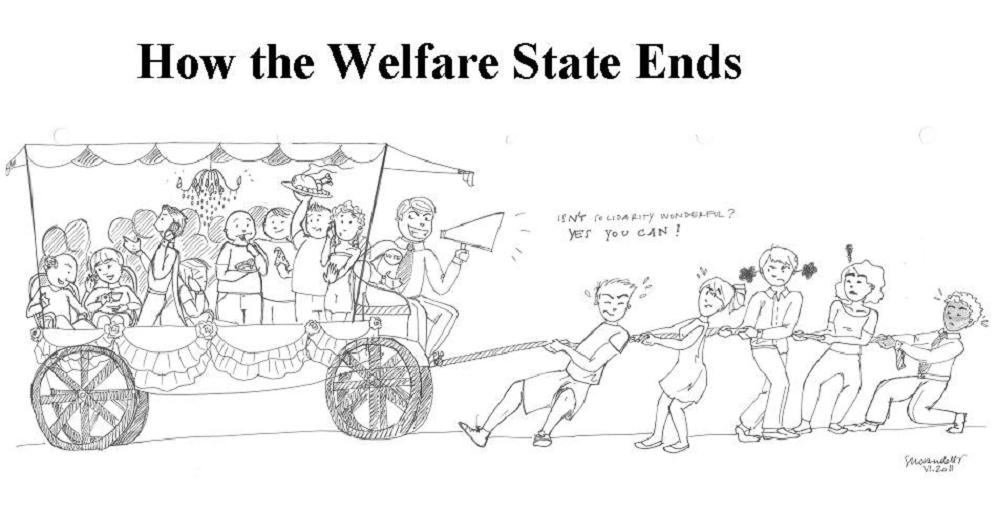
In my speeches, especially when talking about the fiscal crisis in Europe (or the future fiscal crisis in America), I often warn that the welfare state reaches a point-of-no-return when the number of people riding in the wagon begins to outnumber the number of people pulling the wagon.
To be more specific, if more than 50 percent of the population is dependent on government (employed in the bureaucracy, living off welfare, receiving pensions, etc), it becomes rather difficult to form a coalition to fix the mess. This may explain why Greek politicians have resisted significant reforms, even though the nation faces a fiscal death spiral.
But you don’t need me to explain this relationship. One of our Cato interns, Silvia Morandotti, used her artistic skills to create two images (click pictures for better resolution) that show what a welfare state looks like when it first begins and what it eventually becomes.
These images are remarkably accurate. The welfare state starts with small programs targeted at a handful of genuinely needy people. But as politicians figure out the electoral benefits of expanding programs and people figure out the that they can let others work on their behalf, the ratio of producers to consumers begins to worsen.
Then things get really interesting. Small nations such as Greece can rely on permanent bailouts from bigger countries and the IMF, but sooner or later, as larger nations begin to go bankrupt, that approach won’t be feasible.
I often conclude my speeches by joking with the audience that it’s time to stock up on canned goods, bottled water, and ammo. Many people, I’m finding, don’t think that line very funny.
___________________
The Department of Health and Human Services administers the huge and fast-growing Medicare and Medicaid programs. These programs fuel rising health costs, distort health markets, and are plagued by waste and fraud. The department also runs an array of other expensive subsidy programs, including Head Start, TANF, and LIHEAP. Growth in HHS spending is creating a federal financial crisis, and the 2010 health care law sadly makes the situation worse.
The department will spend $910 billion in 2011, or $7,710 for every U.S. household. It employs 68,000 workers and runs more than 420 subsidy programs.
Here are proposed reforms to save $81 billion annually in the short-run and prevent federal health costs from consuming a growing share of the economy in the long-run.
Downsize This!
Medicare Reforms. Medicare should be transformed into a system based on vouchers, individual savings, and competitive insurance markets.
Medicaid Reforms. Federal spending on low-income health care should be converted to block grants for the states.
TANF and Welfare Spending. Welfare reforms in 1996 created Temporary Assistance for Needy Families, but this sort of aid should be provided by private charities.
Head Start and Other Subsidies. HHS funds a vast array of other subsidy programs, many of which are wasteful and ineffective.
2010 Health Care Legislation. The law expanded Medicaid, added new taxes and subsidies, created new bureaucracies, and did little to reduce cost growth in health care.
“The government of the United States is a definite government, confined to specified objects. It is not like the state governments, whose powers are more general. Charity is no part of the legislative duty of the government.”
– James Madison. A paraphrase from Elliot’s Debates regarding a proposed subsidy bill, House of Representatives, January 10, 1794.
____________ Levin on Milton Friedman: ‘One Thing to Have Free Immigration to Jobs, Another for Welfare’ By Michael Morris | January 16, 2015 | 5:12 PM EST During his show on January 15, 2015, Nationally syndicated radio host Mark Levin recalled the famed economist Milton Friedman and explored an important reason why open immigration, despite […]
_____________________ Levin on Milton Friedman: ‘One Thing to Have Free Immigration to Jobs, Another for Welfare’ By Michael Morris | January 16, 2015 | 5:12 PM EST During his show on January 15, 2015, Nationally syndicated radio host Mark Levin recalled the famed economist Milton Friedman and explored an important reason why open immigration, despite […]
Open letter to President Obama (Part 691) Milton Friedman (Emailed to White House on 6-25-13.) President Obama c/o The White House 1600 Pennsylvania Avenue NW Washington, DC 20500 Dear Mr. President, I know that you receive 20,000 letters a day and that you actually read 10 of them every day. I really do respect you for trying to […]
Open letter to President Obama (Part 683) Milton Friedman (Emailed to White House on 6-25-13.) President Obama c/o The White House 1600 Pennsylvania Avenue NW Washington, DC 20500 Dear Mr. President, I know that you receive 20,000 letters a day and that you actually read 10 of them every day. I really do respect you for trying to […]
I have written about the tremendous increase in the food stamp program the last 9 years before and that means that both President Obama and Bush were guilty of not trying to slow down it’s growth. Furthermore, Republicans have been some of the biggest supporters of the food stamp program. Milton Friedman had a good […]
_____________________________________ Milton Friedman On Charlie Rose (Part One) The late Milton Friedman discusses economics and otherwise with Charlie Rose. _________________________________________ Milton Friedman: Life and ideas – Part 01 Milton Friedman: Life and ideas A brief biography of Milton Friedman _____________________________________ Stossel – “Free to Choose” (Milton Friedman) 1/6 6-10-10. pt.1 of 6. Stossel discusses Milton […]
I have written about the tremendous increase in the food stamp program the last 9 years before and that means that both President Obama and Bush were guilty of not trying to slow down it’s growth. Furthermore, Republicans have been some of the biggest supporters of the food stamp program. Milton Friedman had a […]
Milton Friedman did not favor free immigration with existing welfare state in USA Milton Friedman – Illegal Immigration – PT 2 Uploaded on Dec 18, 2009 (2 of 2) Professor Friedman fields a question on the dynamics of illegal immigration ________________ Heritage Responds to Senator Rubio on Immigration Study Amy Payne May 8, 2013 at […]
The best way to destroy the welfare trap is to put in Milton Friedman’s negative income tax. A Picture of How Redistribution Programs Trap the Less Fortunate in Lives of Dependency I wrote last year about the way in which welfare programs lead to very high implicit marginal tax rates on low-income people. More specifically, they […]
Testing Milton Friedman: Free Markets – Full Video Hong Kong and the Miracle of Compounding Long-Run Growth March 11, 2016 by Dan Mitchell Hong Kong is a truly remarkable jurisdiction. Can you name, after all, another government in the world that brags about how little it spends on redistribution programs andhow few people are dependent on […]
http://www.tinshipproductions.com Chattanooga Tea Party’s Liberty Forum Saturday, February 25, 2012
This speech is unedited and shown in it’s entire 55 minutes.
Urging Congress to spend more money on infrastucture, Rep. John Sarbanes (Big Government-Maryland) says, ”You’ve got to kind of get past this mentality that you can’t spend any money at all.”
Right. Because it’s that kind of attitude that has given us a federal budget of $3.8 trillion, up more than 100 percent in a decade, and spending at permanently higher levels of GDP:
In the debate of job creation and how best to pursue it as a policy goal, one point is forgotten: Government doesn’t create jobs. Government only diverts resources from one use to another, which doesn’t create new employment.
Video produced by Caleb Brown and Austin Bragg.
______________
I really think that Dan Mitchell of the Cato Institute is one of the best of explaining conservative economic policies and how they would benefit us all. Here he takes a look at Obama’s economic policies.
* The unemployment rate is still above 8 percent, even though the White House promised it would drop to about 6 percent today if the stimulus was enacted.
* Several million fewer Americans have jobs today than five years ago.
* The poverty rate has jumped to more than 15 percent, with a record number of Americans living below the poverty level of income.
* According to the most recent data, median household income is lower than when the recession began.
* The burden of government spending remains high, and record levels of red ink are a symptom of that bloat in Washington.
* The threat of higher taxes is omnipresent, serving as a Sword of Damocles over the economy’s neck.
* Continued weakness in the housing and financial sectors reminds people that bailouts and intervention have left lots of problems unsolved.
I also explain that some of the recent good news is in spite of the President’s statist policies.
* The recovery began just as Obama’s stimulus spending ended, thus confirming suspicions that lots of money was wasted as part of a process that hindered the economy’s growth.
* The job numbers only began to improve at the end of 2010, right as Republicans took control of the House and presumably ended Obama’s ability to further shift the nation’s course.
The final point is one deserving of elaboration. People in the private sector necessarily have to make educated guesses about the future economic environment. With this in mind, I think it’s quite reasonable – as I commented last month – to argue that the GOP takeover on Capitol Hill boosted the economy since entrepreneurs could feel more comfortable that the federal government wasn’t going to be imposing additional burdens.
This indictment of Obama’s dismal economic track record does not suggest, I should hasten to add, that Mitt Romney or Rick Santorum would be any better. Both of them seem closer to Bush than Reagan, so it’s not clear they would make any substantive changes in the burden of the federal government.
Washington Could Learn a Lot from a Drug Addict The problem with Washington is they are addicted to overspending our money and the problem is not that the government needs more money to waste. They survived on less than 4% of GDP the first 150 years that our nation existed (except in wartimes), but this […]
Dan Mitchell is right about the “Occupy Wall St crowd” The Arkansas Times Blog reported: Occupy Little Rock occupies Clinton Library parking lot Gabe Gentry Members of the Occupy Little Rock group have set up camp outside the Clinton Library, video contributor Gabe Gentry reports. Around 65 are gathered currently with chimineas and grills and pizzas. Thirty […]
The Cato Institute videos are always good and these are no different. New Video Has Important Message: Freedom and Prosperity vs. Big Government and Stagnation Posted by Daniel J. Mitchell The folks from the Koch Institute put together a great video a couple of months ago looking at why some nations are rich and others […]
Uploaded by WSJDigitalNetwork on Feb 23, 2012 Editorial board member Steve Moore breaks down Mitt Romney’s and President Obama’s tax plans. _____________________ Here is an excellent article by Dan Mitchell of the Cato Institute concerning President Obama great advice for another country. When Obama Rejects Government Intervention and Says It Is Better to “Let the […]
RAISE TAXES: Report says Rick Crawford will break from GOP and back millionaires’ tax. The Arkansas Times reported that Congressman Rick Crawford has a plan that includes raising taxes for 5 years if there is an agreement to pass the Balanced Budget Amendment. However, if after 5 years the Balanced Budget Amendment does not get […]
Government Spending Doesn’t Create Jobs Uploaded by catoinstitutevideo on Sep 7, 2011 Share this on Facebook: http://on.fb.me/qnjkn9 Tweet it: http://tiny.cc/o9v9t In the debate of job creation and how best to pursue it as a policy goal, one point is forgotten: Government doesn’t create jobs. Government only diverts resources from one use to another, which doesn’t […]
But we also know that it is difficult to convince politicians to do what’s right for the nation. And if they don’t change the course of fiscal policy, and we leave the federal government on autopilot, then America is doomed to become another Greece. The combination of poorly designed entitlement programs (mostly Medicare and Medicaid) and an aging population […]
Uploaded by NatlTaxpayersUnion on Feb 15, 2011 Dan Mitchell, Senior Fellow at the Cato Institute, speaks at Moving Forward on Entitlements: Practical Steps to Reform, NTUF’s entitlement reform event at CPAC, on Feb. 11, 2011. People think that we need to raise more revenue but I say we need to cut spending. Take a look […]
Uploaded by NatlTaxpayersUnion on Feb 15, 2011 Dan Mitchell, Senior Fellow at the Cato Institute, speaks at Moving Forward on Entitlements: Practical Steps to Reform, NTUF’s entitlement reform event at CPAC, on Feb. 11, 2011. ____________________ People think that we need to raise more revenue but I say we need to cut spending. Take a […]
In this post I have gathered several videos from the Cato Institute concerning the subject of failed stimulus plans. _____ Government Spending Doesn’t Create Jobs Uploaded by catoinstitutevideo on Sep 7, 2011 Share this on Facebook: http://on.fb.me/qnjkn9 Tweet it: http://tiny.cc/o9v9t In the debate of job creation and how best to pursue it as a policy […]
I wonder what the people would have said if Rutherford Hayes had spent 24.7% of GDP a year? Obama laughs at the thought of Rutherford on Mount Rushmore, but with the economic mess we have now I don’t there is much of a chance that President Obama will end up on there either. Here is an excellent article by Dan Mitchell of the Cato Institute:
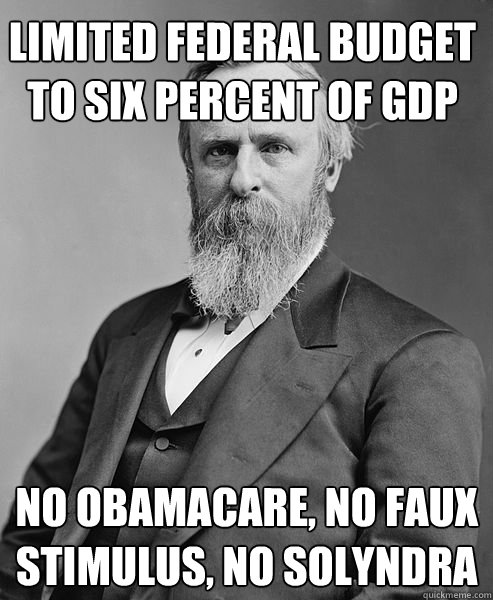
But I feel the need to rise to the defense of Rutherford B. Hayes, who was mocked recently by the current President. This Mark Steyn column is a deliciously vicious commentary on Obama’s speech, so no need for me to delve into the details.
Instead, I want to jump on the bandwagon and produce some posters comparing the 19th President and the 44th President (if you’re not aware, posters of Pres. Hayes with self-created captions have been all over the Internet).
You won’t be surprised to learn that I’m focused on the policy differences between Hayes and Obama.
Most important, Hayes largely was true to the Founding Fathers’ vision of a limited central government. Government spending averaged only about 6 percent of economic output during his tenure (probably less, the data are not very robust, so I took the worst-case numbers) and America was blessedly free of the income tax.






 The Daily Hatch