Category Archives: spending out of control

In 2011 Social Security spent $45 billion more in benefits than it took in from its payroll tax

Uploaded by on Jun 21, 2011

Senator Kay Bailey Hutchison delivered remarks regarding her landmark proposal on entitlement reform, the Defend and Save Social Security Act at the Heritage Foundation’s “Saving Social Security” event. Sen. Hutchison announced that Senator Jon Kyl (R-AZ), member of Biden’s budget working group, has lent his support of her bill as the original cosponsor. At her press conference last week, Sen. Hutchison unveiled her Social Security proposal, and today she reiterated the urgency of putting Social Security on the table in the Biden budget group discussions. Sen. Hutchison sent a letter to Vice President Joe Biden last week urging him to incorporate Social Security reform in the ongoing deficit reduction debates that he is leading.

___________________

If you don’t think that Social Security is in trouble then just consider the fact that the first Baby Boomer just got their first Social Security check at age 65 in 2011 and now we have 19 more years of baby boomers retiring. Also in 2011 Social Security spent $45 billion more in benefits than it took in from its payroll tax.

Social Security Finances Significantly Worse, Says 2012 Trustees Report

By
April 23, 2012

“There are risks and costs to action. But they are far less than the long-range risks of comfortable inaction.”

—John F. Kennedy

“Lawmakers should not delay addressing the long-run financial challenges facing Social Security and Medicare,” the trustees wrote. “If they take action sooner rather than later, more options and more time will be available to phase in changes so that the public has adequate time to prepare.”

—2012 Social Security trustees report

Social Security’s finances significantly worsened last year, according to the new 2012 trustees report,[1] because of a weakened economy and structural problems with the program. The April 23 report shows that all people who receive Social Security benefits face about a 25 percent benefit cut as soon as 2033—three years earlier than predicted in last year’s report. The program’s long-term deficit is now larger than it was before the 1983 reforms. In order to pay all of its promised benefits, Social Security would require massive annual injections of general revenue tax money in addition to what the program receives from payroll taxes. These additional funds would be needed for the next 75 years and beyond.

Factors Dragging Down Social Security

The poor numbers come from a number of factors, including the continued weakness of the U.S. economy, high energy prices holding down wages, and a significant increase in the number of people who receive benefits from Social Security’s disability program (SSDI). SSDI has its own sub-trust fund that will be exhausted in 2016. While some SSDI costs will be paid from money that would have gone to pay retirement and survivors’ benefits, SSDI recipients face across-the-board benefit reductions in just four years. As this year’s report shows, the need to reform SSDI is as great as the need to fix the rest of the program.

Long-Term Financial Picture Worsens

In net-present-value terms, Social Security owes $11.3 trillion more in benefits than it will receive in taxes. This 2012 number consists of $2.7 trillion to repay the special-issue bonds in the trust fund and $6.5 trillion to pay benefits after the trust fund is exhausted in 2033. This is an increase of $2.2 trillion from last year’s report. This is the largest one-year drop in the program’s finances since 1994.

Net present value is the amount of money that would have to be invested today in order to have enough money on hand to pay deficits in the future. In other words, Congress would have to invest $11.3 trillion today in order to have enough money to pay all of Social Security’s promised benefits through 2086. This money would be in addition to what Social Security receives during those years from its payroll taxes.

The trustees report’s perpetual projection extends beyond the usual 75-year planning horizon. In net-present-value terms, the perpetual projection is $20.5 trillion, including money necessary to repay bonds in the trust fund. Last year’s number was $17.9 trillion.

This means that Social Security’s net-present-value deficit after 2086 is $9.2 trillion. These projections show that the program’s total deficit continues to grow well beyond the 75-year projection period. For that reason, a successful reform would need to eliminate the deficits over the 75-year window and address those that come after that period.

In actuarial terms, Social Security’s long-term financing declined sharply from a 75-year deficit of 2.22 percent of taxable payroll in last year’s report to a deficit of 2.67 percent. This 0.44 percent change resulted mainly from the economy’s continued weakness and the effects of high energy costs.

Social Security Ran Another Deficit Last Year

In 2011, the Old-Age and Survivors Trust Fund, which pays for retirement and survivors’ benefits, took in $698.8 billion, which includes $106.5 billion that came from a paper transaction that credited interest to the trust fund. Excluding the interest, the retirement and survivors program had income of $592.3 billion but paid out $603.8 billion in benefits, leaving a deficit for 2011 of $11.5 billion. Additional deficits were suffered by Social Security’s disability program.

Counting both programs together, in 2011, Social Security spent $45 billion more in benefits than it took in from its payroll tax. This deficit is in addition to a $49 billion gap in 2010 and an expected average annual gap of about $66 billion between 2012 and 2018. These deficits will quickly balloon to alarming proportions. After adjusting for inflation, annual deficits will reach $95 billion in 2020 and $318.7 billion in 2030 before the trust fund runs out in 2033. Now is the time to focus on solutions.

The immediate cash-flow deficits are largely due to the effects of the recession on the program’s finances. The recession increased the amount of benefits paid out by Social Security, as older workers who lost their jobs chose to file for benefits earlier than they might have otherwise. Meanwhile, younger unemployed workers did not pay Social Security taxes, while workers who suffered a drop in their incomes paid lower amounts. However, this year’s projections show that these effects will continue. Higher energy prices are expected to dampen income increases, while the longer-term effects of the recession are likely to hold down the number of hours individuals can work.

Moreover, the condition of Social Security continues to deteriorate in future years so that the overall estimate is further worsened in 2012, when the 75-year financial window shifts to include 2086—a year when Social Security is expected to run a very large deficit.

The Trust Fund Does Not Make Social Security Healthy

The existence of a trust fund does not make Social Security healthy. Although those assets are guaranteed by the full faith and credit of the United States, the bonds it contains must be repaid using general revenue that would otherwise go to other programs. Similarly, the interest that Social Security receives on existing trust fund balances is not spendable income. It merely inflates the numbers in the trust fund and increases the amount that Social Security will eventually receive from general revenue. The only part that counts today is the cash that Social Security receives from the Treasury to cover its annual operating losses.

Many opponents of reform claim that raising payroll taxes by about 2.7 percent (the average percentage difference between revenues and outlays over the 75-year period) would permanently solve Social Security’s problems. The reality, however, is that the program’s future deficits are projected to be both large and growing, so this tax increase would still leave a huge shortfall. Modest changes will not fix the current system.

Delay in Fixing Social Security Will Only Make Matters Even Worse

Congress could have fixed Social Security several years ago but delayed because it feared making the difficult decisions. A further delay in addressing Social Security’s financial problems will only make the situation even worse. The new trustees report is not based on conjecture; it is based on a firm understanding of the economy and the U.S. population. Almost every new taxpayer who will begin a career before 2033 is living today and can be counted. Similarly, all the people who will face approximately 25 percent across-the-board benefit cuts starting in the year 2033 if Congress does nothing to fix the program are alive now, and most of them are paying taxes.

Social Security’s problems are based on demographics that do not change from year to year. The people who will be hurt if nothing is done to fix Social Security are not unknown people of the future: They are the nation’s children and grandchildren of today.

David C. John is Senior Research Fellow in Retirement Security and Financial Institutions in the Thomas A. Roe Institute for Economic Policy Studies at The Heritage Foundation.

Dan Mitchell of the Cato Institute: How to balance the budget

It’s Simple to Balance The Budget Without Higher Taxes

Uploaded by on Oct 4, 2010

Politicians and interest groups claim higher taxes are necessary because it would be impossible to cut spending by enough to get rid of red ink. This Center for Freedom and Prosperity video shows that these assertions are nonsense. The budget can be balanced very quickly by simply limiting the annual growth of federal spending.

____________________

People are being told that radical spending cuts are a must if we are to balance the budget, but maybe that is not true.

Even though I favor radical reductions in the burden of government, I’ve made the point that good fiscal policy merely requires that government spending grow slower than the private sector – what I call Mitchell’s Golden Rule.

And if lawmakers simply cap the growth of spending, so that it grows by about 2 percent annually, the budget deficit disappears in a decade.

It’s even better to impose more restraint, of course, which is why I’ve said favorable things about Senator Rand Paul’s plan.

There’s also a “Penny Plan” that would reduce primary spending (non-interest spending) by 1 percent each year. As James Carter and Jason Fichtner explain, this degree of fiscal restraint would reduce the burden of government spending to about 18 percent of economic output.

Any viable solution must cut spending growth. Sen. Mike Enzi of Wyoming and Rep. Connie Mack of Florida have introduced legislation in their respective chambers to do just that. Their “Penny Plan” – recently updated to reflect the latest budget developments – calls for reducing federal spending (excluding interest payments) 1 percent a year for five years, balancing the budget in the fifth year. To maintain balance once it’s reached, Mr. Enzi and Mr. Mack would cap federal spending at 18 percent of GDP. By no small coincidence, 18 percent of GDP roughly matches the U.S. long-run average level of taxation since World War II. Is it realistic to think Congress could limit federal spending to 18 percent of GDP? Actually, there is precedent. Federal spending fell as a share of GDP for nine consecutive years before bottoming out at 18.2 percent of GDP in fiscal 2000 and 2001. The Penny Plan would return federal spending, expressed as a share of GDP, near the level achieved during the last two years of the Clinton administration.

The various interest groups that infest Washington would complain about this degree of spending discipline, but Carter and Fichtner make a good point when they say that this simply means the same size government – as a share of GDP – that we had when Bill Clinton left office.

I realize I’m getting old and my memory may not be what it used to be, but I don’t recall people starving in the streets and grannies being ejected from hospitals during the Clinton years. Am I missing something?

Open letters to President Obama displayed here on www.thedailyhatch.org

I have been writing letters to President Obama almost all of 2012. I have received several responses from the White House but none of the responses have been personal responses from the President.

Below is a letter I wrote to the President and a form letter response that I got followed by links to other letters I have written him.

KIreland.jpg 

Science Matters #2: Former supermodel Kathy Ireland tells Mike Huckabee about how she became pro-life after reading what the science books have to say.

President Obama c/o The White House
1600 Pennsylvania Avenue NW
Washington, DC 20500

Dear Mr. President,

I know that you receive 20,000 letters a day and that you actually read 10 of them every day. I really do respect you for trying to get a pulse on what is going on out here.

I wanted to talk to you today about your views on abortion. Everyone remembers Kathy Ireland from her Sports Illustrated days and actually she has became a very successful business person.  However, I wanted to talk about her pro-life views.

_____________

Back on April 27, 2009 Fox News ran a story by Hollie McKay(Supermodel Kathy Ireland Lashes Out Against Pro Choice,”) on  Ireland.

It’s no secret that the majority of Hollywood stars are strong advocates for a woman’s right to choose whether or not she wants to terminate a pregnancy, however former “Sports Illustrated” supermodel-turned-entrepreneur-turned-author Kathy Ireland has gone against the grain of the glitterati and spoken out against abortion.

“My entire life I was pro-choice — who was I to tell another woman what she could or couldn’t do with her body? But when I was 18, I became a Christian and I dove into the medical books, I dove into science,” Ireland told Tarts while promoting her insightful new book “Real Solutions for Busy Mom: Your Guide to Success and Sanity.”

“What I read was astounding and I learned that at the moment of conception a new life comes into being. The complete genetic blueprint is there, the DNA is determined, the blood type is determined, the sex is determined, the unique set of fingerprints that nobody has had or ever will have is already there.”

However Ireland admitted that she did everything she could to avoid becoming a believer in pro-life.

“I called Planned Parenthood and begged them to give me their best argument and all they could come up with that it is really just a clump of cells and if you get it early enough it doesn’t even look like a baby. Well, we’re all clumps of cells and the unborn does not look like a baby the same way the baby does not look like a teenager, a teenager does not look like a senior citizen. That unborn baby looks exactly the way human beings are supposed to look at that stage of development. It doesn’t suddenly become a human being at a certain point in time,” Ireland argued. “I’ve also asked leading scientists across our country to please show me some shred of evidence that the unborn is not a human being. I didn’t want to be pro-life, but this is not a woman’s rights issue but a human rights issue.”

My good friend Dr. Kevin R. Henke is a scientist and also an atheistic evolutionist. I had a lot of discussions with Kevin over religious views. I remember going over John 7:17 with him one day. It says:

John 7:17 (Amplified Bible)

17If any man desires to do His will (God’s pleasure), he will know (have the needed illumination to recognize, and can tell for himself) whether the teaching is from God or whether I am speaking from Myself and of My own accord and on My own authority.

I challenged Kevin to read a chapter a day of the Book of John and pray to God and ask God, “Dear God, if you are there then reveal yourself to me, and I pledge to serve you the rest of my life.”

Kevin did that and he even wrote down the thoughts that came to his mind and sent it to me and these thoughts filled a notebook.

Kevin did not become a Christian, but I am still praying for him. I do respect Kevin because he is an honest man. Interestingly enough he  told me that he was pro-life because the unborn baby has all the genetic code at  the time of conception that they will have for the rest of their life. Below are some other comments by other scientists:

Dr. Hymie Gordon (Mayo Clinic): “By all criteria of modern molecular biology, life is present from the moment of conception.”

Dr. Micheline Matthews-Roth (Harvard University Medical School): “It is scientifically correct to say that an individual human life begins at conception.”

Dr. Alfred Bongioanni (University of Pennsylvania): “I have learned from my earliest medical education that human life begins at the time of conception.”

Dr. Jerome LeJeune, “the Father of Modern Genetics” (University of Descartes, Paris): “To accept the fact that after fertilization has taken place a new human has come into being is no longer a matter of taste or opinion . . . it is plain experimental evidence.”

__

Thank you so much for your time. I know how valuable it is. I also appreciate the fine family that you have and your committment as a father and a husband.

Sincerely,

Everette Hatcher III, 13900 Cottontail Lane, Alexander, AR 72002, ph 501-920-5733, lowcostsqueegees@yahoo.com

_______________

I actually mailed this to President Obama about a week ago and got this email back:

The White House, Washington


April 16, 2012

Dear Everette:

Thank you for taking the time to share your views on abortion.  This is a heart-wrenching issue, and I appreciate your input and thoughts.

I am committed to making my Administration the most open and transparent in history, and part of delivering on that promise is hearing from people like you.  I take seriously your opinions and respect your point of view on this issue.  Please know that your concerns will be on my mind in the days ahead.

Thank you, again, for writing.  I encourage you to visit www.WhiteHouse.gov to learn more about my Administration or to contact me in the future.

Sincerely,

Barack Obama

An open letter to President Obama (Part 65)

Leader Cantor On CNN Responding To President Obama’s State of the Union Address Uploaded by EricCantor on Jan 25, 2012 ______________ President Obama c/o The White House 1600 Pennsylvania Avenue NW Washington, DC 20500 Dear Mr. President, I know that you receive 20,000 letters a day and that you actually read 10 of them every day. I […]


“Feedback Friday” Letter to White House generated form letter response March 7, 2011 (part 3)

I have been writing President Obama letters and have not received a personal response yet.  (He reads 10 letters a day personally and responds to each of them.) However, I did receive a form letter in the form of an email on March 7, 2011. I don’t know which letter of mine generated this response so I have […]


An open letter to President Obama (Part 58) “Our national debt threatens our security”

Liam Fox Issues a Warning to America Uploaded by HeritageFoundation on Feb 28, 2012 Britain’s Liam Fox has a warning for America: Fix the debt problem now or suffer the consequences of less power on the world stage. The former U.K. secretary of state for defense visited Heritage to explain why the America’s debt is […]

“Feedback Friday” Letter to White House generated form letter response Jan 27, 2011 (part 2)

I have been writing President Obama letters and have not received a personal response yet.  (He reads 10 letters a day personally and responds to each of them.) However, I did receive a form letter in the form of an email on January 27, 2011. I don’t know which letter of mine generated this response so I have […]

“Feedback Friday” Letter to White House generated form letter response Jan 25, 2011 (part 1)

I have been writing President Obama letters and have not received a personal response yet.  (He reads 10 letters a day personally and responds to each of them.) However, I did receive a form letter in the form of an email on January 25, 2011. I don’t know which letter of mine generated this response so I have […]

An open letter to President Obama (Part 48 of my response to State of Union Speech 1-24-12)

An open letter to President Obama (Part 48 of my response to State of Union Speech 1-24-12) Rep Michael Burgess response Uploaded by MichaelCBurgessMD on Jan 25, 2012 This week Dr. Burgess provides an update from Washington and responds to President Obama’s State of the Union address. President Obama’s state of the union speech Jan 24, 2012 […]

An open letter to President Obama (Part 47, A response to your budget)

Corker Says President’s 2012 Budget Proposal Shows “Lack of Urgency” on Spending Uploaded by senatorcorker on Feb 14, 2011 In remarks on the Senate floor today, U.S. Senator Bob Corker, R-Tenn., expressed disappointment in President Obama’s 2012 budget proposal, saying it displayed a “lack of urgency” to get federal spending under control. Corker has introduced […]

An open letter to President Obama (Part 1 of State of Union Speech 1-24-12)

President Obama’s state of the union speech Jan 24, 2012 Feb 6, 2012 President Obama c/o The White House 1600 Pennsylvania Avenue NW Washington, DC 20500 Dear Mr. President, I know that you receive 20,000 letters a day and that you actually read 10 of them every day. I really do respect you for trying […]

An open letter to President Obama

  January 25, 2012 President Obama c/o The White House 1600 Pennsylvania Avenue NW Washington, DC 20500 Dear Mr. President, I know that you receive 20,000 letters a day and that you actually read 10 of them every day. I really do respect you for trying to get a pulse on what is going on […]


An open letter to President Obama (Part 63)

Rep Michael Burgess response

Uploaded by on Jan 25, 2012

This week Dr. Burgess provides an update from Washington and responds to President Obama’s State of the Union address.

_______________

President Obama c/o The White House
1600 Pennsylvania Avenue NW
Washington, DC 20500

Dear Mr. President,

I know that you receive 20,000 letters a day and that you actually read 10 of them every day. I really do respect you for trying to get a pulse on what is going on out here.

Here is an excellent piece from the Heritage Foundation with a reaction to the president’s proposed budget:

Obama’s Budget Sings a Golden Oldie: “Do You Believe in Magic?”– J.D. Foster Imagine if every President magically got an extra year. Budgets are always full of contestable assumptions and assertions, and President Obama’s fiscal year 2013 budget is no exception. But few budgets get an extra year—certainly none in recent memory, until now. It’s not that President Obama’s budget assumes his first term will last five years instead of four, or that a second term would last an extra year. But there is an extra year in the budget. It shows up in the economic assumptions, specifically, his assumptions for economic growth. Every budget rests on two basic pillars: the President’s policy proposals in conjunction with current law, and the economic assumptions that drive tax receipts and much of federal spending. A President can be forgiven a little optimism in formulating these economic assumptions, as every Administration believes its policies would produce a stronger economy. And, after all, these economic forecasts, while painstakingly developed, are nevertheless little more than SWAGs, which is budget speak for Silly, Wild-A** Guesses. Even so, ever since the humorous debates about rosey-scenario forecasts dating back to the 1980s, a budget’s economic forecasts rarely diverge substantially from the conventional wisdom as evidenced by the Blue Chip forecast, essentially an average of selected private-sector forecasters. It’s not that the Blue Chip forecast is more likely than any other to be right, but at least it does reflect something of a safe, prudent consensus. The January Blue Chip forecast as reported in the budget has growth in real output in 2012 of 2.2 percent, which agrees with the Congressional Budget Office forecast. The Administration shows a substantially higher forecast of 2.7 percent. That’s a big difference for the most important year—the current year. A pattern of the Administration projecting substantially stronger growth continues in the forecasts for every year up until 2017—what would be the end of President Obama’s second term if re-elected, when at last the Administration’s forecast returns to earth. The net effect of these uber-strong annual economic growth forecasts is that from 2012 to 2017, the Administration projects a whopping 3.9 percent more cumulative growth than does the Blue Chip forecast. In economic terms, that’s like adding an extra year of growth—an extra very good year of growth. And the effect of this irrational economic forecasting exuberance on the deficit in 2017? The budget tells us that, too, in a sensitivity table (3-1). According to the President’s own budget, the deficit in 2016 would jump by about $195 billion, from $649 billion to about $844 billion, if they used the more conservative Blue Chip forecast. If only we could count on this magical economic year of growth, maybe we could wish our fiscal troubles away. As the Lovin’ Spoonful sang it: “Do you believe in magic?”

_________________________________

I don’t know much about projections and the assumptions they are based on. However, I do know that it is impossible to claim that this budget proposal cuts anything when in fact it adds 8 trillion to the deficit in coming years.

Thank you so much for your time. I know how valuable it is. I also appreciate the fine family that you have and your committment as a father and a husband.

Sincerely,

Everette Hatcher III, 13900 Cottontail Lane, Alexander, AR 72002, ph 501-920-5733, lowcostsqueegees@yahoo.com

400% increase in food stamps since 2000

Welfare Can And Must Be Reformed

Uploaded by on Jun 29, 2010

If America does not get welfare reform under control, it will bankrupt America. But the Heritage Foundation’s Robert Rector has a five-step plan to reform welfare while protecting our most vulnerable.

__________________________

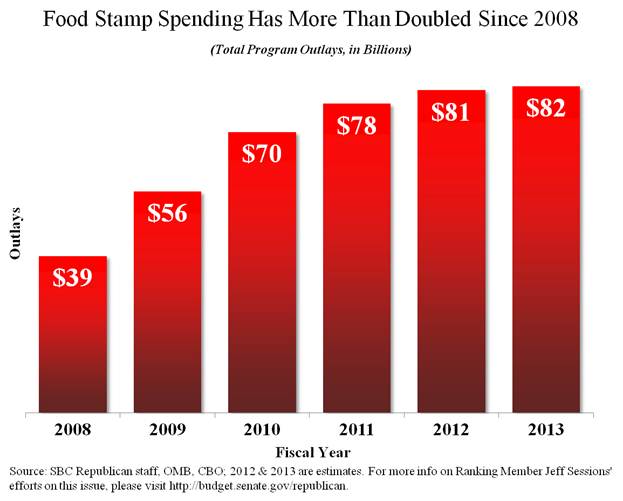
If welfare increases as much as it has in the last decade then it will ruin our country soon. Not only does it hurt the incentive to work since many get caught in the welfare trap, but we can no longer pay for increases like this one for the food stamp budget (up 400% since 2000).

Rachel Sheffield

April 23, 2012 at 11:39 am

The number of Americans on food stamps (or, as it is now called, the Supplemental Nutrition Assistance Program, or SNAP) is higher than ever before, according to a new Congressional Budget Office report. Since 2007, rolls have grown by 70 percent. And participation rates are expected to increase over the next two years.

While some of the growth can be attributed to the recession, participation rates were steadily climbing prior to the recession. Since 2000, the number of Americans on food stamps has jumped by roughly 260 percent, from 17.2 million to 44.7 million in 2011.

Naturally, government spending on food stamps has also jumped, from approximately $20 billion in 2000 to a whopping $78 billion last year, a nearly 400 percent increase.

The growth in participation rates seems to be part of the federal government’s goal, as a report from the U.S. Department of Agriculture released just this month explains.

The food stamps program is just one part of an ever-expanding government welfare system that includes not only 12 food assistance welfare programs but a total of 79 federal welfare programs. These programs provide not only food assistance but cash, housing, energy and utility assistance, education services, child care, medical care, and so forth.

The total cost of these programs reached $927 billion last year. Welfare is now the fastest growing part of government spending, and despite welfare costs increasing 16-fold since the War on Poverty began in the 1960s—and total spending on cash, food, and housing assistance now twice the amount necessary to pull all Americans out of poverty—President Obama wants to spend more. Aggregate welfare costs are projected to reach over $1.5 trillion in 2022.

As Heritage senior fellow Robert Rector said last week at a House Budget Committee hearing, out of control welfare costs are contributing to “ruinous and unsustainable future budget deficits.”

To get spending under control, Congress can roll back current welfare spending to pre-recession levels (adjusted for inflation) once the current recession ends and then capping aggregate welfare spending at the rate of inflation going forward. Doing so would save American taxpayers more than $2.7 trillion during the first decade.

America’s growing welfare state is creating a system of increased dependence and contributing to a growing federal debt. Helping the poor should mean promoting individual freedom through self-reliance rather than creating dependence through an unsustainable government dole.

Churches, not the government, have traditionally helped the poor in the long history of the USA

If you look at the first 150 years of our nation’s history you will find practically no welfare or assistance to the poor coming from the government. In fact, most of the help came from local churches. During the last few decades the government had created the welfare trap that robs people of responsibility to better themselves. Many in the welfare trap feel they are being treated like children.

With all that in mind I found this article below very helpful.

U.S. Conference of Catholic Bishops and Spending Cuts

Posted by Tad DeHaven

House Budget Committee chairman Paul Ryan (R-WI) and Speaker John Boehner (R-OH) are pushing back against criticism from the U.S. Conference of Catholic Bishops over the GOP’s proposed cuts to domestic spending programs. They should.

The USCCB’s criticism comes at a time when it’s appropriately fighting the Obama administration’s mandate that Church-affiliated employers must provide health insurance that covers birth control. As a Catholic, it pains me that the bishops apparently do not recognize that a central government that is big and powerful enough to spend billions of other people’s dollars on housing, food, and health care programs, which the bishops support, is inevitably going to shove its tentacles into areas where they’re not wanted. In other words, if you play with fire, there’s a good chance you’re going to get burnt.

The bishops have now sent four letters to Congress that call on policymakers to “create a ‘circle of protection’ around poor and vulnerable people and programs that meet their basic needs and protect their lives and dignity.” Oh please. Even if it were the proper role of the federal government to fund such programs, the government’s efforts have been inefficient and often counterproductive. If anything, the massive federal welfare state that has sprung up over the past five decades has stripped countless Americans of their dignity by making them reliant on the cold hand of the bureaucrat.

Note this paragraph from a USCCB letter that argues against cuts to housing programs:

As bishops, we see firsthand the pain and suffering in our communities and in our parishes caused by homelessness and lack of affordable housing. The Catholic community is one of the largest private providers of housing services for the poor and vulnerable in the country. We shelter the homeless, develop affordable housing for families and people with disabilities, counsel families at risk of foreclosure, and provide housing and care for those at the end of life. At a time when the need for assistance from HUD programs is growing, cutting funds for them could cause thousands of individuals and families to lose their housing and worsen the hardship of thousands more in need of affordable housing. 

The responsibility for addressing such concerns properly belongs to the Church and other organizations that possess that “firsthand” view of the struggles many people face. I won’t get into a discussion on Catholic social teaching, but it’s impossible for me to imagine that the perpetual mess that is the Department of Housing & Urban Development comports with the principles of subsidiarity.

The Catholic Church could do a lot more for the poor if its parishioners were able to put more into the collection plate instead of rendering it unto Caesar. Thus, it’s pretty sad that the bishops see this as a “time when the need for assistance from HUD programs is growing” rather than a time for the Church to reassert its traditional role in taking care of those in need—a role that is hindered by the welfare state that the bishops embrace.

Senator Pryor asks for Spending Cut Suggestions! Here are a few!(Part 144)

Senator Mark Pryor wants our ideas on how to cut federal spending. Take a look at this video clip below:

Senator Pryor has asked us to send our ideas to him at cutspending@pryor.senate.gov and I have done so in the past and will continue to do so in the future.

On May 11, 2011,  I emailed to this above address and I got this email back from Senator Pryor’s office:

Please note, this is not a monitored email account. Due to the sheer volume of correspondence I receive, I ask that constituents please contact me via my website with any responses or additional concerns. If you would like a specific reply to your message, please visit http://pryor.senate.gov/contact. This system ensures that I will continue to keep Arkansas First by allowing me to better organize the thousands of emails I get from Arkansans each week and ensuring that I have all the information I need to respond to your particular communication in timely manner.  I appreciate you writing. I always welcome your input and suggestions. Please do not hesitate to contact me on any issue of concern to you in the future.

Here are a few more I just emailed to him myself:

GUIDELINE #10: Utilize the “ideas industry” for specific proposals.
Those seeking specific proposals to reduce wasteful spending have several options available:
  • The Congressional Budget Office (CBO) periodically releases a Budget Options book containing more than 200 specific reforms that would reduce more than $100 billion in wasteful spending, complete with justifications and savings estimates. (See Appendix 3.)
  • The General Accounting Office (GAO) conducts hundreds of studies each year on wasteful and underperforming federal programs. The GAO also often releases a Budgetary Implications of Selected GAO Work for the current fiscal year, which is a book similar to CBO’s Budget Options, detailing hundreds of specific, implementable ways to reduce waste.
  • The Government Performance and Results Act (GPRA) requires agencies to lay out specific multi-year goals to improve performance and reduce waste and report regularly on their progress toward these goals. Together with Inspector General (IG) reports, GPRA reports show which programs are failing in their missions.
  • Think tanks such as The Heritage Foundation, the Cato Institute, and Citizens Against Government Waste release hundreds of studies each year showing how to save taxpayer dollars.

Here are some more places to cut:

  • Immediately before the current recession, Washington spent $24,800 per household. Simply returning to that level (adjusted for inflation) would likely balance the budget by 2019without any tax hikes.
  • The federal government made at least $98 billionin improper payments in 2009.

An award to the person who cut spending by our federal governement the most ($47)

A funny carton.

In recent years, taxpayers have been victimized by huge expansions in the burden of government spending. Among the highlights (lowlights would be a much better word):

With all that misery and failure, you would think people would be happy to learn that some government employees are trying to save money. So enjoy a laugh about this cartoon.

Sadly, the cartoon isn’t accurate, even by standards of parody. The agents were trying to save their own money by ripping off the escort. If they were using taxpayer money, they probably would have paid twice the going rate.

But it’s still funny, so enjoy. And if you appreciate political humor about Colombian hookers, check out this Bill Clinton post from a few days ago.

But if you refuse to be distracted by humor and would rather focus on reckless and wasteful spending, then you should watch this Rahn Curve video to understand the economic damage of big government.

Milton Friedman was right about Obama’s misguided view of stimulus many years ago “Friedman Friday”

Milton Friedman knew it a long time ago that President Obama was wrong when he blamed the ATM for unemployment. Take a look at this video clip below. He exposes the falacy that ignoring the principle of efficency will help create jobs. This is the misguided view that Obama has that led him to the failed stimulus two years ago too.

Sen. Ron Johnson (R-WI) spent 31 years in manufacturing before his election to Congress last November. He’s not letting that experience go to waste.

Johnson is out with a new video this morning to coincide with President Obama’s visit to Carnegie Mellon University in Pittsburgh to promote manufacturing. He criticizes Obama’s recent comments blaming inventions like the ATM for unemployment.

“This is a depressing display of economic ignorance,” Johnson says. He adds: “Technological innovations create jobs. They drive our economy forward, by helping workers be more productive. That raises everyone’s living standards.”

Johnson recounts a story of Milton Friedman’s visit to China. Upon seeing Chinese workers digging with shovels, he asked, “Why not use bulldozers?”. Freidman was told that workers using shovels would create more jobs. He replied, “Then why not use spoons, instead of shovels?”

Heritage is currently seeking stories from business owners who have encountered government regulations that harm business. If you would like to share your story, please send an email to scribe@heritage.org

Projected Federal spending caused U.S. credit downgrade

Everyone wants to blame the Tea Party for the downgrade, but a Tea party approach is needed to get on the right tract.


The Debt Ceiling and the Balanced Budget Amendment

Posted by David Boaz

The Washington Post editorializes:

A balanced-budget amendment would deprive policymakers of the flexibility they need to address national security and economic emergencies.

A fair point. Statesmen should have the ability to “address national security and economic emergencies.” But the same day’s paper included this graphic on the growth of the national debt:

National Debt

Does this look like the record of policymakers making sensible decisions, running surpluses in good year and deficits when they have to “address national security and economic emergencies”? Of course not. Once Keynesianism gave policymakers permission to run deficits, they spent with abandon year after year. And that’s why it makes sense to impose rules on them, even rules that leave less flexibility than would be ideal if you had ideal statesmen. Indeed, the debt ceiling itself should be that kind of rule, one that limits the amount of debt policymakers can run up. But it has obviously failed.

We’ve become so used to these stunning, incomprehensible, unfathomable levels of deficits and debt — and to the once-rare concept of trillions of dollars — that we forget how new all this debt is. In 1980, after 190 years of federal spending, the national debt was “only” $1 trillion. Now, just 30 years later, it’s sailing past $14 trillion.

Historian John Steele Gordon points out how unnecessary our situation is:

There have always been two reasons for adding to the national debt. One is to fight wars. The second is to counteract recessions. But while the national debt in 1982 was 35% of GDP, after a quarter century of nearly uninterrupted economic growth and the end of the Cold War the debt-to-GDP ratio has more than doubled.

It is hard to escape the idea that this happened only because Democrats and Republicans alike never said no to any significant interest group. Despite a genuine economic emergency, the stimulus bill is more about dispensing goodies to Democratic interest groups than stimulating the economy. Even Sen. Charles Schumer (D., N.Y.) — no deficit hawk when his party is in the majority — called it “porky.”

Annual federal spending rose by a trillion dollars when Republicans controlled the government from 2001 to 2007. It has risen another trillion during the Bush-Obama response to the financial crisis. So spending every year is now twice what it was when Bill Clinton left office. Republicans and Democrats alike should be able to find wasteful, extravagant, and unnecessary programs to cut back or eliminate. They could find some of them here in this report by Chris Edwards.

In the Kentucky Resolutions, Thomas Jefferson wrote, “In questions of power, then, let no more be heard of confidence in man, but bind him down from mischief by the chains of the Constitution.” Just so. When it becomes clear that Congress as a body cannot be trusted with the management of the public fisc, then bind them down with the chains of the Constitution, even — or especially — chains that deny them the flexibility they have heretofore abused.

President Obama’s Statement on Credit Downgrade

Uploaded by on Aug 8, 2011

The President assures Americans that, “we will always be a triple-A country.” August 8, 2011.

______________________________________