Category Archives: spending out of control

Welfare reform part 3

Thomas Sowell – Welfare

Welfare reform was working so good. Why did we have to abandon it? Look at this article from 2003.

The Continuing Good News About Welfare Reform

By and
February 6, 2003

Six years ago, President Bill Clinton signed legislation overhauling part of the nation’s welfare system. The Personal Responsibility and Work Opportunity Reconciliation Act of 1996 (P.L. 104-193) replaced the failed social program known as Aid to Families with Dependent Children (AFDC) with a new program called Temporary Assistance to Needy Families (TANF). The reform legislation had three goals: (1) to reduce welfare dependence and increase employment; (2) to reduce child poverty; and (3) to reduce illegitimacy and strengthen marriage.

WELFARE REFORM AND CHILD POVERTY

A recent paper by Dr. Rebecca M. Blank, former member of the Council of Economic Advisers in the Clinton White House, examines the link between welfare reform and child poverty.22 Professor Blank analyzes the income of families with children from 1992 to 2000 and finds that incomes rose for all but the bottom 2 percent of families with children. Moreover, poor families showed greater income gains than higher-income families, “suggesting that most poor families experienced larger income gains than did most middle and upper-middle income families.”23

Dr. Blank’s analysis shows a direct link between state welfare reform policies and rising incomes among poor families. States with welfare reform programs that offered “strong work incentives” showed greater increases in the income of single parents with children than did states with weak work incentives. Moreover,

at the bottom of the distribution, states with strong work incentives have the smallest share of children in families with negative changes in income, while states with the weakest work incentives show the highest share of children with [decreases in income].24

In other words, states with strong welfare work incentives had fewer families that lost income than did states with weak welfare work incentives. Blank finds that these income differences are the result of state welfare policies rather than differences in state economies.

In addition, Dr. Blank examines the effects of tough welfare reform “penalties” on the incomes of poor single-parent families. Examining the impact of stricter time limits and strong sanction policies that “provide a strong enforcement mechanism for women to participate in welfare-to-work programs,” she finds that tough welfare policies had a positive effect in raising the incomes of poor families. Overall, states with stricter time limits and stronger sanction policies were more successful in raising the incomes of poor children than were states with lenient policies. Dr. Blank concludes that

states with strict or moderate penalties for not working consistently show higher income gains among poor children throughout the income distribution than do states with lenient penalties…. [I]t is the more lenient states with softer penalties where children’s income seems to have grown least.25

Out-of-Wedlock Childbearing and the Economy
Out-of-wedlock childbearing and marriage rates have never been correlated to periods of economic growth. Efforts to link the positive changes in these areas to growth in the economy are without any basis in fact. The onset of welfare reform is the only plausible explanation for the shifts in these social trends. welfare reform affected out-of-wedlock childbearing and marriage in two ways.

First, even before passage of the law, the public debate about welfare reform sent a strong symbolic message that, in the future, welfare would be time-limited and that single mothers would be expected to work and be self-reliant. This message communicated to potential single mothers that the welfare system would be less supportive of out-of-wedlock childbearing and that raising a child outside of marriage would be more challenging in the future. The reduction in out-of-wedlock births was, at least in part, a response to this message.

Second, reform indirectly reduced welfare’s disincentives to marriage. Traditional welfare stood as an economic alternative to marriage, and mothers on welfare faced very stiff financial penalties if they did marry. As women leave AFDC/TANF as a result of welfare reform, fewer are affected by welfare’s financial penalties against marriage. In addition, some women may rely on husbands to provide income that is no longer available from welfare. Thus, as the number of women on welfare shrinks, marriage and cohabitation rates among low-income individuals can be expected to rise.

Welfare Reform and the Current Recession
When welfare reform was enacted, liberal opponents predicted that it would yield sharp increases in poverty even in good economic times; the effects of reform during a recession were expected to be disastrous. As noted, liberal predictions about the negative effects of reform during good economic times have been proven completely erroneous. Moreover, the disastrous effects expected of welfare reform during an economic downturn have, at least so far, failed to materialize during the current recession.

Historically, during a recession, overall child poverty rises by two to three percentage points. For example, during the economic downturn in the early 1990s, the overall child poverty rate rose from 14.8 percent to 17.8 percent. Historically, black child poverty rises even more sharply during a recession. During the back-to-back recessions in the early 1980s, for example, black child poverty rose by more than six percentage points, from 41.2 percent in 1979 to 47.6 percent in 1982.

However, during the current recession (which began in April 2001), these traditional negative patterns have not appeared. While the poverty rate for adults rose during 2001 in a manner consistent with prior recessions, the poverty rates for children in general — and for black children in particular — differed sharply from prior historical patterns. Despite the recession, from 2000 to 2001, the overall child poverty rate remained flat.26 The poverty rate for black children actually fell by a full percentage point from 31.2 percent in 2000 to 30.2 percent in 2001. Such a decline in black child poverty during a recession is without historical precedent.

While the child poverty figures for 2001 (the first year of the current recession) are unusually positive, a note of caution is warranted. The effects of a recession on poverty often continue and deepen for two or three years after the recession’s onset. Thus, when the Census Bureau releases poverty figures for 2002 and 2003, it is quite possible that reported child poverty will increase.27 However, if the unusual poverty figures for 2001 are any indication, the overall increase in child poverty (if any) generated by the current recession is likely to be far milder than in prior economic downturns.

The welfare dependence figures during the current recession also differ sharply from prior recessions. As Chart 3 shows, the AFDC caseload almost always rose during recessions.28 In some cases, the increase in caseload was dramatic. For example, during the early 1990s, the AFDC caseload rose by around 30 percent. However, during the current recession, the TANF caseload has actually declined. Between the beginning of the recession in April 2001 and September 2002 (the date of the most recent available data), the caseload actually fell by 4.4 percent.

The fact that welfare caseloads have, up to now, declined during the current recession is good news. However, a note of caution is, again, warranted. The effects of a recession in increasing welfare dependence may continue for several years after the onset of the recession. Thus, it is possible that TANF caseloads will rise during 2003. However, the recent trends in caseload strongly suggest that, if TANF caseloads do rise in 2003, the increase will be quite small when compared to increases spurred by prior recessions.

The fact that child poverty has not, as yet, risen during the present recession is linked to the continuing decline of TANF caseloads. During previous recessions, large numbers of single mothers left employment and entered the AFDC program. Families on AFDC are almost always poor. Thus, increases in welfare caseloads during prior recessions invariably led to concurrent increases in child poverty. However, the work requirements and time limits established by welfare reform have created strong pressures discouraging single mothers from leaving employment and entering welfare. The fact that TANF caseloads have not risen during the current recession has, in turn, helped to limit any rise in child poverty.

LOOKING TO THE FUTURE

The trends of the past six years have led some of the strongest critics of welfare reform to reconsider their opposition, at least in part. In 1996, Deputy Assistant Secretary for Human Services Policy Wendell Primus also resigned from the Clinton Administration to protest the President’s signing of the welfare reform legislation, predicting that the new law would throw millions of children into poverty.

As Director of Income Security at the Center on Budget and Policy Priorities, Primus has spent the past six years analyzing the effects of welfare reform. The evidence has tempered his earlier pessimism. “In many ways,” he recently stated, “welfare reform is working better than I thought it would. The sky isn’t falling anymore. Whatever we have been doing over the last five years, we ought to keep going.”29

Wendell Primus is correct. When Congress reauthorizes the TANF program this year, it should push forward boldly to promote further the three explicit goals of the 1996 reform:

  1. To reduce dependence and increase employment;
  2. To reduce child poverty; and
  3. To reduce illegitimacy and strengthen marriage.

These three goals are linked synergistically. Work requirements in welfare will reduce dependence and increase employment, which in turn will reduce poverty. As fewer women depend on welfare in the future, marriage rates may well rise. Increasing marriage, in turn, is the most effective means of reducing poverty.

Next Steps in Reform
When Congress reauthorizes Temporary Assistance to Needy Families in 2003, it should take the following specific steps.

  1. Strengthen federal work requirements
    Currently, about half of the 2 million mothers on TANF are idle on the rolls and are not engaged in constructive activities leading to self-sufficiency. This is unacceptable. Existing federal work requirements must be greatly strengthened so that all able-bodied parents are engaged continuously in supervised job search, community service work, or training.

    In addition, some states still provide federal welfare as an unconditional entitlement; recipients who refuse to perform required activities continue to receive most benefits. In reauthorizing the TANF program, Congress should ensure that the law prohibits federal funds from being misused in this manner in the future.

    Some might object to toughening work requirements during a recession, but it is important to remember that the TANF reauthorization law will set the rules for the program not for one year, but for the next five years. Provisions to toughen federal work requirements can be phased in so that they do not take effect until 2005 or later, long after the current recession has passed.

  2. Strengthen marriage
    As Chart 5 shows, the poverty rate among single-parent families is about five times higher than the poverty rate among married-couple families. The most effective way to reduce child poverty and increase child well-being is to increase the number of stable, healthy marriages. This can be accomplished in three ways.

First, the substantial penalties against marriage in the overall welfare system should be reduced. As it is currently structured, welfare rewards illegitimacy and wages war against marriage. That war must cease.30

Second, the government should educate young men and women on the benefits of healthy marriage in life.

Third, programs should provide couples with the skills needed to reduce conflict and physical abuse and to increase satisfaction and longevity in a marital relationship.

The 1996 TANF law established the formal goals of reducing out-of-wedlock childbearing and increasing marriage, but despite nearly $100 billion in TANF spending over the past five years, the states have spent virtually nothing on specific pro-marriage programs. The slowdown in the growth of illegitimacy and the increases in marriage have occurred as the incidental byproduct of work-related reforms and not as the result of positive pro-marriage initiatives by the states. The current neglect of marriage is scandalous and deeply injurious to the well-being of children. In future years, at least $300 million in TANF funds should be earmarked for pro-marriage initiatives.

CONCLUSION

More than 20 years ago, President Jimmy Carter stated, “the welfare system is anti-work, anti-family, inequitable in its treatment of the poor and wasteful of the taxpayers’ dollars.”31 President Carter was correct in his assessment.

The 1996 welfare reform began necessary changes in the disastrous old welfare system. The rewards for non-work in the TANF program have been substantially reduced. But much more remains to be done. When Congress reauthorizes TANF this year, it should ensure that, in the future, all able-bodied welfare recipients are required to work or undertake other constructive activities as a condition of receiving aid.

But increasing work is not enough. Each year, one-third of all children are born outside of wedlock; this means that one child is born to an unmarried mother every 25 seconds. This collapse of marriage is the principal cause of child poverty and welfare dependence. In addition, children in these families are more likely to become involved in crime, to have emotional and behavioral problems, to be physically abused, to fail in school, to abuse drugs, and to end up on welfare as adults.

Despite these harsh facts, the anti-marriage effects of welfare, which President Carter noted over two decades ago, are largely intact. The current indifference and hostility to marriage in the welfare system is a national disgrace. In reauthorizing TANF, Congress must make the rebuilding of marriage its top priority. The restoration of marriage in American society is truly the next frontier of welfare reform.

Robert Rector is Senior Research Fellow in Domestic Policy Studies, and Patrick F. Fagan is William H. G. FitzGerald Research Fellow in Family and Cultural Issues, at The Heritage Foundation. This paper is an updated version of Heritage Foundation Backgrounder No. 1468, published on September 5, 2001.

Welfare reform part 2

Uploaded by on May 29, 2009

Complete video at: http://fora.tv/2009/05/18/James_Bartholomew_The_Welfare_State_Were_In

Author James Bartholomew argues that welfare benefits actually increase government handouts by ‘ruining’ ambition. He compares welfare to a humane mousetrap.

—–

Welfare reform was working so good. Why did we have to abandon it? Look at this article from 2003.

In the controversial book The Welfare State We’re In, James Bartholomew argues that the welfare state in Britain has resulted in a generation of badly educated and dependent citizens, leading to lives of deprivation for thousands and undermining the original intent behind its creation in the 1940s.

Has the welfare state really led to more harm than good? What does this imply for the ever-expanding welfare state in the United States? – Cato Institute

James Bartholomew trained as a banker in the City of London before moving into journalism with the Financial Times and the Far Eastern Economic Review, for whom he worked in Hong Kong and Tokyo. Returning to England on the Trans-Siberian Railway through communist China and the Soviet Union an experience which influenced his political outlook he subsequently became a leader writer on The Daily Telegraph and the Daily Mail.

____________________________

The Continuing Good News About Welfare Reform

By and
February 6, 2003

Six years ago, President Bill Clinton signed legislation overhauling part of the nation’s welfare system. The Personal Responsibility and Work Opportunity Reconciliation Act of 1996 (P.L. 104-193) replaced the failed social program known as Aid to Families with Dependent Children (AFDC) with a new program called Temporary Assistance to Needy Families (TANF). The reform legislation had three goals: (1) to reduce welfare dependence and increase employment; (2) to reduce child poverty; and (3) to reduce illegitimacy and strengthen marriage.

Plummeting Welfare Dependence
The designers of welfare reform were concerned that prolonged welfare dependence had negative effects on the development of children. Their goal was to disrupt inter-generational dependence by moving families with children off the welfare rolls through increased work and marriage. Since the enactment of welfare reform, welfare dependence has been cut by more than half. The caseload in the former AFDC (now TANF) program has fallen from 4.3 million families in August 1996 to 2.02 million in September 2002. (See Chart 3.)

bg 1620 - chart 3

Contrary to conventional wisdom, the decline in welfare dependence has been greatest among the most disadvantaged and least employable single mothers — the group with the greatest tendency toward long-term dependence. Specifically, dependence has fallen most sharply among young never-married mothers who have low levels of education and young children.17This is dramatic confirmation that welfare reform is affecting the whole welfare caseload, not merely the most employable mothers.

Strikingly, the TANF caseload has continued to decline even during the current recession. The caseload has fallen from 2.109 million families in April 2001 at the beginning of the recession to 2.017 million in September 2002 (the most recently measured month). This represents a net decline in caseload of 4.4 percent since the beginning of the recession. The continuing decline in welfare dependence during the recession stands in sharp contrast to the 30 percent growth in the AFDC caseload during the economic slowdown of the early 1990s.

Increased Employment
Since the mid-1990s, the employment rate of single mothers has increased dramatically. Again, contrary to conventional wisdom, employment has increased most rapidly among the most disadvantaged, least employable groups:

  • Employment of never-married mothers has increased nearly 50 percent.
  • Employment of single mothers who are high school dropouts has risen by two-thirds.
  • Employment of young single mothers (ages 18 to 24) has nearly doubled.18

Thus, against conventional wisdom, the effects of welfare reform have been the greatest among the most disadvantaged single parents — those with the greatest barriers to self-sufficiency. Both decreases in dependence and increases in employment have been most dramatic among those who have the greatest tendency to long-term dependence; that is, among the younger never-married mothers with little education.

A Halt in the Rise of Out-of-Wedlock Childbearing
After the beginning of the War on poverty, the illegitimacy rate (the percentage of births outside of marriage) increased enormously. For nearly three decades, out-of-wedlock births as a share of all births rose steadily at a rate of almost one percentage point per year. Overall, out-of-wedlock births rose from 7.7 percent of all births in 1965 to an astonishing 32.6 percent in 1994. However, in the mid-1990s, the relentless 30-year rise in illegitimacy came to an abrupt halt. For the past five years, the out-of-wedlock birth rate has remained essentially flat. (See Chart 4.)

Among blacks, the out-of-wedlock birth rate actually fell from 70.4 percent in 1994 to 68.8 percent in 1999. Among whites, the rate rose slightly, from 25.5 percent to 26.7 percent, but the rate of increase was far slower than it had been in the period prior to welfare reform.

A Shift Toward Marriage
Throughout the War on poverty period, marriage eroded. However, since the welfare reform was enacted, this negative trend has begun to reverse. The share of children living with single mothers has declined, while the share living with married couples has increased.

This change is most pronounced among blacks. Between 1994 and 1999, the share of black children living with single mothers fell from 47.1 percent to 43.1 percent, while the share living with married couples rose from 34.8 percent to 38.9 percent. Similar though smaller shifts occurred among Hispanics.19

While these changes are small, they do represent a distinct reversal of the prevailing negative trends of the past four decades. If these shifts toward marriage are harbingers of future social trends, they are the most positive and significant news in all of welfare reform.

WHO GETS THE CREDIT? THE GOOD ECONOMY VERSUS WELFARE REFORM

Some would argue that the positive effects noted above are the product of the robust economy during the 1990s rather than the results of welfare reform. However, the evidence supporting an economic interpretation of these changes is not strong.

Chart 3 shows the AFDC caseload from 1950 to 2000. On the chart, periods of economic recession are shaded, and periods of economic growth are shown in white. Historically, periods of economic growth have not resulted in lower welfare caseloads. The chart shows eight periods of economic expansion prior to the 1990s, yet none of these periods of growth led to a significant drop in AFDC caseload. Indeed, during two previous economic expansions (the late 1960s and the early 1970s), the welfare caseload grew substantially. Only during the expansion of the 1990s does the caseload drop appreciably.

How was the economic expansion of the 1990s different from the eight prior expansions? The answer is welfare reform.

Chart 3 does show that the national TANF decline has slowed appreciably during the current recession, which began in April 2001. Critics of reform might argue that this shows the state of the economy has been the dominant factor in the reduction of dependence. While it is true that the slowdown in the economy is affecting the decline in caseload, however, it is important to note the vast difference in trends before and after welfare reform. Prior to the mid-1990s, the AFDC caseload remained flat or rose during economic expansions and generally rose to a substantial degree during recessions. Since welfare reform, the welfare caseload has plummeted downward during good economic times and declined more slowly during the recession.

Thus, while the state of the economy does have an effect on AFDC/TANF caseloads, irrespective of economic conditions, the difference in caseload trends before and after reform is enormous. This difference is clearly due to the impact of welfare reform policies.

Another way to disentangle the effects of welfare policies and economic factors on declining caseloads is to examine the differences in state performance. The rate of caseload decline varies enormously among the 50 states. If improving economic conditions were the main factor driving down caseloads, the variation in state reduction rates should be linked to variation in state economic conditions. On the other hand, if welfare polices are the key factor behind falling dependence, the differences in reduction rates should be linked to specific state welfare policies.

In a 1999 Heritage Foundation study, “The Determinants of welfare Caseload Decline,” one of the present authors examined the impact of economic factors and welfare policies on falling caseloads in the states.20 This analysis showed that differences in state welfare reform policies were highly successful in explaining the rapid rates of caseload decline. By contrast, the relative vigor of state economies, as measured by unemployment rates, changes in unemployment, or state job growth, had no statistically significant effect on caseload decline.

A recent paper by Dr. June O’Neill, former Director of the Congressional Budget Office, reaches similar conclusions. Dr. O’Neill examined changes in welfare caseload and employment from 1983 to 1999. Her analysis shows that in the period after the enactment of welfare reform, policy changes accounted for roughly three-quarters of the increase in employment and decrease in dependence. By contrast, economic conditions explained only about one-quarter of the changes in employment and dependence.21 Substantial employment increases, in turn, have led to large drops in child poverty.

Overall, the health of the economy in the mid and late 1990s did serve as a positive background factor contributing to positive changes in welfare dependence, employment, and poverty. It is very unlikely, for example, that dramatic drops in dependence and increases in employment would have occurred during a prolonged recession. However, it is also certain that good economic conditions alone would not have produced the striking changes that occurred in the late 1990s. It is only when welfare reform was coupled with a growing economy that these dramatic positive changes occurred.

Emails on Solyndra surface from Obama administration

The government shouldn’t pick winners and losers in the private market place like President Obama has done.

Lachlan Markay

August 3, 2012 at 12:40 pm

On Thursday, the House Energy and Commerce Committee released a bombshell report, 18 months in the making and 147 pages long, detailing its investigation into bankrupt solar company Solyndra.

Along with the report, the committee released a trove of emails between Solyndra stakeholders and administration officials. They paint a troubling picture of efforts to prop up the company despite its bleak economic outlook, and reactions to the company’s eventual bankruptcy.

Scribe has compiled a list of the top 10 most revealing emails released as part of the investigation.

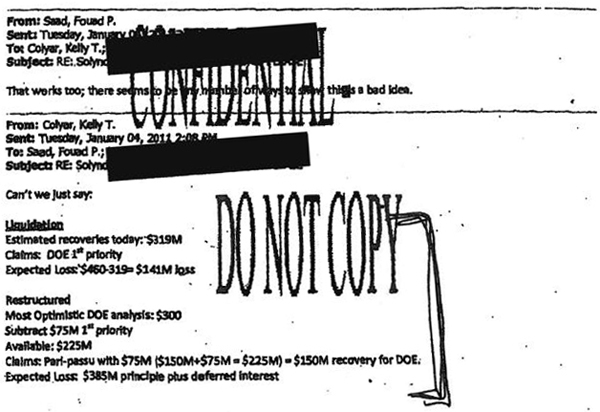
1. The White House Office of Management and Budget held that the Energy Department’s decision to restructure Solyndra’s loan was “a bad idea” and would result in greater taxpayer losses.

In March of 2011, DOE ignored the advice of White House budget officials and restructured Solyndra’s federally-backed loan, giving private investors priority in the repayment of their investments. DOE insisted that this would produce the greatest returns for taxpayers, but OMB officials, in a series of emails earlier that year, pondered ways to demonstrate to DOE that restructuring the loan would be “a bad idea.”

OMB analyst Kelly Coylar crunched the numbers, and found that DOE would lose about $141 million if it allowed Solyndra to go bankrupt and liquidated its assets. A restructuring agreement, on the other hand, could more than double taxpayer losses, she wrote.

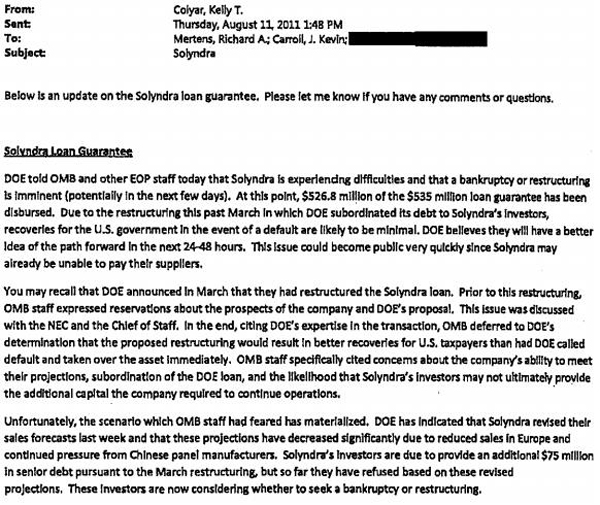
2. White House Chief of Staff Bill Daley was briefed on Solyndra’s troubles before the Energy Department restructured Solyndra’s loan.

The eventual restructuring agreement may have violated federal law, according to the Energy and Commerce Committee. It is of particular note, then, that then-White House Chief of Staff Bill Daley was briefed on the possibility of restructuring Solyndra’s federally-backed loan before that decision was made.

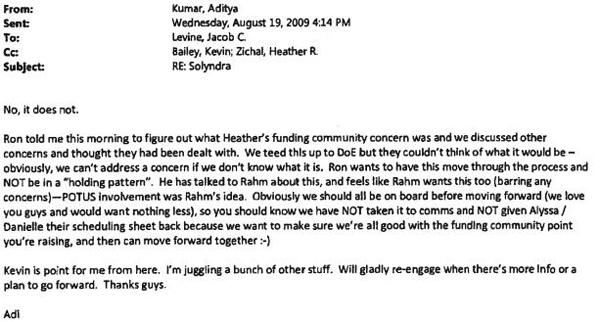
3. President Obama’s Solyndra photo-op was then-CoS Rahm Emanuel’s idea.

Emanuel has repeatedly said that he doesn’t remember anything about the Solyndra loan guarantee process. This email shows that he was heavily involved in White House efforts to promote the loan guarantee, most notably by suggesting the president conduct a photo-op at the company’s Fremont, CA headquarters.

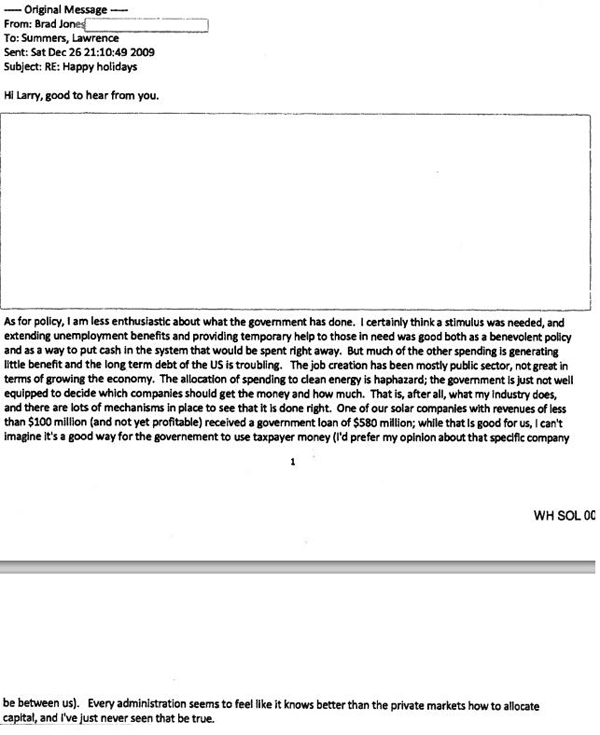
4. Even Solyndra’s investors knew that the company was a bad bet for taxpayers.

In an email to Lawrence Summers, then the chair of the White House’s National Economic Council, Brad Jones, an advisor with Solyndra investor Redpoint Ventures, said that while the loan guarantee for Solyndra would prove beneficial for Redpoint, “I can’t imagine it’s a good way for the government to use taxpayer money.”

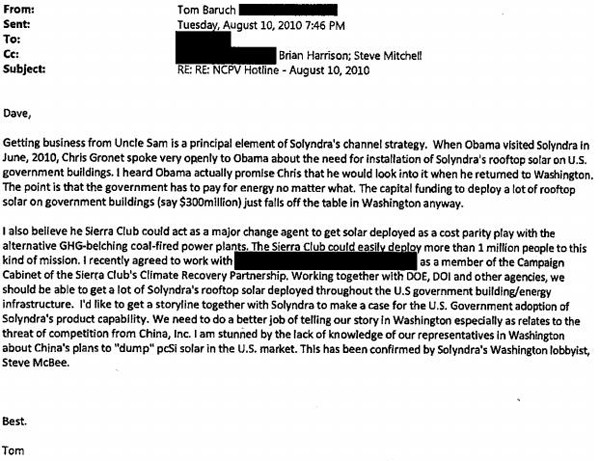
5. Getting federal money was integral to Solyndra’s business model.

“Getting business from Uncle Sam is a principal element of Solyndra’s channel strategy,” wrote Tom Baruch, founder of Solyndra investor CEMA Capital, in a August 10, 2010 email. When government takes it upon itself to pick winners and losers in the marketplace, securing government funds can be just as lucrative as conducting standard business activities, which inevitably directs more resources into unproductive political activities.

6. Solyndra’s CEO referred to the federal government as the “Bank of Washington.”

Solyndra was quite brazen about its government-centric business strategy, as this email from CEO Chris Gronet demonstrates.

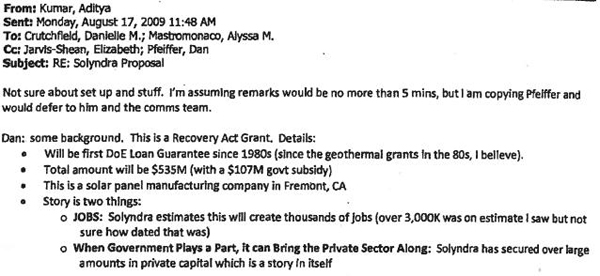
7. Solyndra was supposed to be a model of how government could empower the private sector.

In an email to White House communications staffer Dan Pfeiffer, Aditya Kumar, a senior advisor to the Vice President, said Solyndra exemplified an oft-repeated administration talking point on green energy “investment”: “When Government Plays a Part, it can Bring the Private Sector Along.”

Solyndra did bring the private sector along – all the way to its bankruptcy.

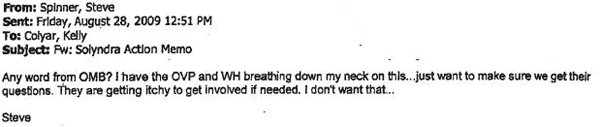
8. The White House and Vice President’s office pressured DOE to move on the Solyndra loan guarantee, which in turn pressured OMB.

In an August 28, 2009 email to Coylar, DOE official Steve Spinner, who headed up the Department’s Solyndra activities, said, “the OVP [Office of the Vice President] and WH [White House]” were “breathing down my neck” on the proposed Solyndra loan guarantee.

Spinner was trying to speed up OMB’s analysis of the Solyndra project to fit with the White House’s schedule, which had already set a date for the president’s Solyndra photo-op. OMB would later confirm that it had rushed its Solyndra analysis under pressure from the White House.

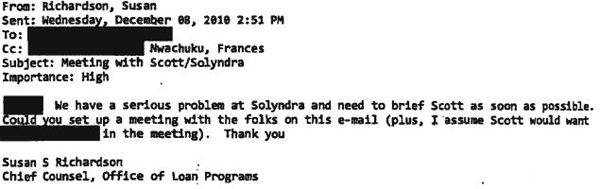
9. Upon news of the bankruptcy, DOE admitted it had “a serious problem at Solyndra.”

Despite numerous attempts since Solyndra’s bankruptcy to downplay the scandal, emails exchanged upon news that the company would go under reveal that the DOE knew just how bad the bankruptcy was. “We have a serious problem at Solyndra,” Susan Richardson, chief counsel of DOE’s Loan Program’s Office, wrote.

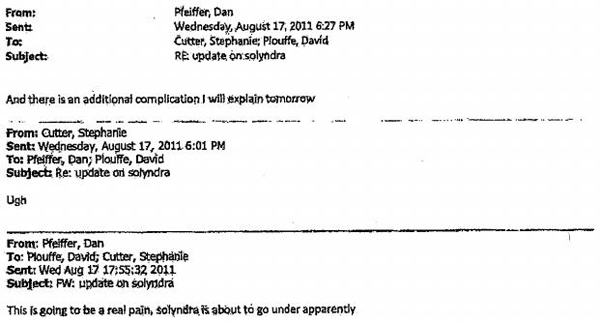
10. The White House’s reaction to Solyndra’s bankruptcy: “Ugh.”

The White House also knew that Solyndra’s bankruptcy posed a problem, as evinced by then-White House advisor Stephanie Cutter’s reaction to the news – in one word: “ugh.”

In an effort to downplay the scandal, Cutter has since insisted that Solyndra was “widely praised as successful and innovative.”

_____________

Open letter to President Obama (Part 121)

President Obama c/o The White House
1600 Pennsylvania Avenue NW
Washington, DC 20500

Dear Mr. President,

I know that you receive 20,000 letters a day and that you actually read 10 of them every day. I really do respect you for trying to get a pulse on what is going on out here.

The stimulus did not work for the USA and it has never worked.

There’s an old saying that insanity is doing the same thing over and over again while expecting different results. This certainly is a good description of Keynesians, who relentlessly push more government spending as some sort of magic potion for the economy – notwithstanding a record of failure.

The latest example if Larry Summers, the former economist for the Obama White House, who says Europeans need to make government bigger.

Here is some of what he writes for today’s Washington Post.

European efforts to contain crisis have fallen short. …Much of what is being urged on and in Europe is likely to be not just ineffective but counterproductive to maintaining the monetary union, restoring normal financial conditions and government access to markets, and reestablishing economic growth. The premise of European policymaking is that countries are overindebted and so unable to access markets on reasonable terms, and that the high interest rates associated with excessive debt hurt the financial system and inhibit growth. The strategy is to provide financing while insisting on austerity, in hopes that countries can rein in their excessive spending enough to restore credibility, bring down interest rates and restart economic growth.

The good news is that Summers recognizes that there has been “excessive spending.” The bad news is that he uses the wrong definition of austerity.

Many European nations seem to think higher taxes are a sign of fiscal conservatism (see this post by Veronique de Rugy for a good discussion of this confusion). Summers accepts that approach, and says that policy makers should choose a Keynesian policy instead.

Unfortunately, Europe has misdiagnosed its problems in important respects and set the wrong strategic course. …Europe’s problem countries are in trouble because the financial crisis underway since 2008 has damaged their financial systems and led to a collapse in growth. High deficits are much more a symptom than a cause of their problems. And treating symptoms rather than underlying causes is usually a good way to make a patient worse. …The right focus for Europe is on growth; in this dimension, increased austerity is a step in the wrong direction.

There’s more good news. Summers is right in stating that Europe suffers from low growth. And I agree with him that the European version of austerity – higher taxes – is not a solution.

But, as always, there is a catch. Summers has the wrong approach on how to encourage growth. He wants Keynesian spending, and here is his defense.

 Skeptics will rightly wonder how a prescription for more spending by countries that already have trouble borrowing can be correct. The answer lies in the difference between borrowing by individuals and countries. Normally, an individual helps his creditors by borrowing less; but a person who stops borrowing to finance commuting to his job does his creditors no favor. A country’s income is determined by spending, so a country that pursues austerity to the point where its economy is driven into a downward spiral does its creditors no favor.

Sounds semi-reasonable. After all, everyone understands that it is important to get to their place of employment. Sometimes you spend money to make money.

But here’s the problem. Can anyone name anything in so-called stimulus schemes that actually increase a nation’s productive capacity? As we saw with Obama’s failed stimulus, lots of money gets distributed, but the main purpose seems to be buying votes and creating dependency.

What about jobs? A miserable failure.

Adding insult to injury, you probably won’t be surprised to learn that American taxpayers are supposed to pick up the lion’s share of the tab for the new spending in Europe since Summers wants the IMF to be the sugar daddy.

Going forward, the IMF and international community should condition further support not merely on individual countries’ actions but on a common European commitment to growth.

This approach is illogical, as explained in this video.

And let’s consider the historical record. Nations that have tried this type of “stimulus” have not fared well. Big spending increase under Hoover and Roosevelt failed in the 1930s. Japan tried several Keynesian packages and failed in the 1990s. Bush failed in 2008 and Obama failed in 2009.

Germany did not go with a big program of government spending, and they did better than the United States. The same is true about Canada. But the real success story is the Baltic nations. They imposed real spending restraint, not the fake austerity found in places such as the United Kingdom.

And even though it caused some short-term pain since there’s a short-term cost when labor and capital get redeployed to more productive uses, the Baltic nations are now in much better shape that the European nations that have floundered because they limited themselves to the no-win choice of Keynesianism and tax hikes.

_______________

Thank you so much for your time. I know how valuable it is. I also appreciate the fine family that you have and your commitment as a father and a husband.

Sincerely,

Everette Hatcher III, 13900 Cottontail Lane, Alexander, AR 72002, ph 501-920-5733, lowcostsqueegees@yahoo.com

Open letter to President Obama (Part 120B)

Ep. 4 – From Cradle to Grave [4/7]. Milton Friedman’s Free to Choose (1980)

President Obama c/o The White House
1600 Pennsylvania Avenue NW
Washington, DC 20500

Dear Mr. President,

I know that you receive 20,000 letters a day and that you actually read 10 of them every day. I really do respect you for trying to get a pulse on what is going on out here.

With the national debt increasing faster than ever we must make the hard decisions to balance the budget now. If we wait another decade to balance the budget then we will surely risk our economic collapse.

The first step is to remove all welfare programs and replace them with the negative income tax program that Milton Friedman first suggested.

Milton Friedman points out that though many government welfare programs are well intentioned, they tend to have pernicious side effects. In Dr. Friedman’s view, perhaps the most serious shortcoming of governmental welfare activities is their tendency to strip away individual independence and dignity. This is because bureaucrats in welfare agencies are placed in positions of tremendous power over welfare recipients, exercising great influence over their lives. In addition, welfare programs tend to be self-perpetuating because they destroy work incentives. Dr. Friedman suggests a negative income tax as a way of helping the poor. The government would pay money to people falling below a certain income level. As they obtained jobs and earned money, they would continue to receive some payments from the government until their outside income reached a certain ceiling. This system would make people better off who sought work and earned income.

Here is a  portion of the trancript of the “Free to Choose” program called “From Cradle to Grave” (program #4 in the 10 part series):

DISCUSSION

Participants: Robert McKenzie, Moderator; Milton Friedman; James R. Dumpson, Chief Administrator, Human Resources Admin., NYC; Thomas Sowell, Professor of Economics, UCLA; Robert Lampman, Professor of Economics, Institute of Poverty; Helen Bohen O’Bannon, Secretary of Welfare, State of Pennsylvania

MCKENZIE: The discussion’s already underway here at the University of Chicago, so let’s join it.

DUMPSON: As I looked at the film, I had a growing sense of anger. Anger that that position failed to recognize that the system that was being attacked was necessary in our capitalistic, free enterprise system that by its own failure produces poverty, and therefore requires governmental intervention in the interest of those people caught in the traps of poverty. So, as I sat and looked at the film, and as I hear Dr. Friedman’s statement, I was aroused to the point, as I said, of anger because only half the story is told. We are really blaming again a victim, this time a system, the welfare system, for the failure of other systems to operate in the interest of people.

MCKENZIE: Let’s get other reactions now to that statement: “Trying to do good with other people’s money simply has not worked, the welfare system is rotting away the very fabric of society.” Tom Sowell.

SOWELL: My reaction was just the opposite from __ my anger was at what had been created in the city where I grew up, under very different conditions, during the period of capitalistic failure, during the period when there wasn’t this humanitarianism, and when it was possible for people to live better and to get out of that poverty. Now, I think someone who lived in the very same place where I lived would find it much harder to escape from that poverty because of all these things. Buildings were not abandoned like the buildings that we saw in that film when I lived in Harlem. The crime rate __ they’re all things that are blamed upon the failures of the previous method did not exist. I slept out on the fire escapes in Harlem. I would defy anybody to do that in any part of New York City today.

LAMPMAN: Traditionally in the United States we have tried to avoid some of the welfare trap that was referred to by denying eligibility to people who are able-bodied and not aged and so on. And we’ve therefore tried to close the welfare door to a good number of categories within the poor population. The second point that was emphasized and I think needs to be put in some perspective is that some, but not all, of what we might call welfare programs broadly, have this very strong take-back of benefits as you earn some more money and that I guess is what I would like to single out as the principal problem identified in the film but it is not common to any and all welfare programs that one might think of.

O’BANNON: When the family fails, when the private sector fails to create jobs at a fast enough rate you find that people are unemployed and drift into needing help in order to exist and the welfare system was created in the ’30’s to do exactly that. When the private sector, essentially, failed we have the development of a welfare system, and it’s not corrupting society, it is taking what society _ institutions have left behind: The family breaking up, the economy not expanding fast enough, the health system failing, the educational system not doing its job. We have untrained, unskilled people looking for jobs in a highly technical society or jobs that pay so low that people cannot in fact live at a decent level of humanity. I see the welfare system not corrupting, but in fact taking the remains and attempting to help people live in dignity.

MCKENZIE: So rotting away the fabric of society is not supported __ except perhaps by you, would you back that phrase or so.

SOWELL: Absolutely. You’re saying __ you’re talking about the failures of the other parts of society. What the welfare system and other kinds of governmental programs are doing is paying people to fail insofar as they fail they receive the money; insofar as they succeed, even to a moderate extent, the money is taken away. This is even extended into the school systems where they will give money to schools with low scores; insofar as the school improves its education the money is taken away, so that you are subsidizing people to fail in their own private lives and become more dependent upon the handouts.

O’BANNON: We have expectations built in today about the quality of life, the quality of jobs, the level if income for which one expects in return. Why? Because we look at the level around us that it takes us to have __

SOWELL: No, that’s not why. That’s not why. I may have all sorts of expectations, the question is: What can I do? If someone else is subsidizing my expectations, my expectations would be far higher. But insofar as the Center for Advanced Study was subsidizing my expectations a few years ago, I refused to work at UCLA for the normal full professor’s salary. Why should I when I can get the same money for being at the Center for Advanced Study with no hours, no duties and no classes.

MCKENZIE: Let’s look at another proposition in Milton’s case. The insidious effect on those who receive welfare. They lose their independence and dignity, are treated like children, and so on. Now, Dr. Dumpson, as a former Administrator of a major program, is that a great hazard?

DUMPSON: That is not a great hazard. As a matter of fact, that presumes that people get on welfare, stay on welfare, and therefore have the result that Dr. Friedman’s statement issues. The fact of the matter is that in our AFDC program throughout the country and particularly was this true in New York, there is a graduate __ a turnover of the welfare AFDC roles _ about a third of them go off each year. Now, if these people were so destroyed by the system, when they go off they wouldn’t go into employment, they wouldn’t hold employment, they wouldn’t stay off the roles for six months, eighteen months, twenty-four months, as long as they are able to stay off. So, there’s something wrong with that argument when one looks at people and what they do. People, you know, who are poor are no different from those of us who are not poor and their motivation for self-dependency, self-support and mobility in the economic scale is no different that those of __ than the motives we have, so that they will not let the system __ you remember, Dr. Friedman, the welfare rights organization who refused to let the system squash them down as it was attempting to do. We turned the policies around.

FRIEDMAN: You and I agree completely, that the people who are poor and are on welfare roles are no different from the rest of us. Of course not. They are human beings and they deserve every sympathy and every possibility of making their own way, but the welfare system makes them different.

DUMPSON: But you give them __

FRIEDMAN: It makes it in their interest to be different.

MCKENZIE: How do you account for them going off the roles, Milton?

FRIEDMAN: Oh, but figures are figures and you’ve got to be careful with figures. The fact that a third, there’s a turnover of a third does not mean that there aren’t half who are on all the time. People come on, go off; come on, go off. We’ve got to have the other figures __

DUMPSON: The latest statistic, Dr. Friedman, is that __

FRIEDMAN: __ fraction __

DUMPSON: __ 34 percent of the people on AFDC are on for five years or longer and when one thinks of the purpose of the AFDC program, which was the rearing and support of children, dependent children, minor children, I would submit to you that five years is not a terribly long time for a mother and children to have to be dependent if there’s no other source of income.

_______________

Thank you so much for your time. I know how valuable it is. I also appreciate the fine family that you have and your commitment as a father and a husband.

Sincerely,

Everette Hatcher III, 13900 Cottontail Lane, Alexander, AR 72002, ph 501-920-5733, lowcostsqueegees@yahoo.com

Messin’ with the Taxpayers is not dangerous like messin’ with Big Foot

I love these commercials but I not happy with this news from the article below.

Jack Link’s Presents: Messin’ With Taxpayers

Posted by Tad DeHaven

If you’re a taxpayer and you like beef jerky, I have good and bad news. The good news is that Jack Link’s is expanding the production facilities at its corporate home in Minong, Wisconsin. The bad news is the expansion is being “made possible” with a $365,000 federal grant to Minong for infrastructure upgrades.

The money comes from the Department of Housing and Urban Development’s Community Development Block Grant program. Curiously, the state’s Wisconsin Economic Development Corporation doesn’t mention in the press release that the money is coming from federal taxpayers:

The Village of Minong will receive a $356,000 Community Development Block Grant for Public Facilities for Economic Development from the Wisconsin Economic Development Corporation (WEDC) to help finance utility improvements that will facilitate the expansion of Link Snacks, Inc. Link Snacks’ expansion is expected to create 70 full-time jobs over the next three years…

The Community Development Block Grant program is a versatile financing tool for general-purpose local units of government in need of funds to undertake needed infrastructure and public building projects. The program is designed to enhance the vitality of a community by undertaking public investment that contributes to its overall community and economic development.

The WEDC was created by Republican Gov. Scott Walker to replace the state’s Department of Commerce and is modeled after Gov. Mitch Daniels’ Indiana Economic Development Corporation.  Like the IEDC, the WEDC dispenses corporate welfare and engages in what I derisively call “press release economics.” Given that the press release doesn’t mention that the money came from the federal government, and thus makes it look like the Walker administration is responsible for the “job creation,” I’d say that the WEDC has learned well from its cousin in Indiana.

The bottom line is that it is not a proper role of the federal government to fund local infrastructure projects for the benefit of a business. The bureaucratic inefficiency alone of laundering money through three levels of government (from federal to state to local) is reason enough to terminate the Community Development Block Grant program. Unfortunately, the CDBG program creates a win-win situation for politicians at all levels, which means that taxpayers are going to keep losing unless enough voters come to realize that robbing Peter to pay Paul’s company isn’t good economics.

See this Cato essay for more on fiscal federalism and this essay for more on the community development subsidies.

Great cartoon from Dan Mitchell’s blog on government moochers

I thought it was great when the Republican Congress and Bill Clinton put in welfare reform but now that has been done away with and no one has to work anymore it seems. In fact, over 40% of the USA is now on the government dole. What is going to happen when that figure gets over 50%? Maybe this cartoon below will be true.  


The all-time, most-viewed post on this blog is this set of cartoons showing how the welfare state begins and how it eventually becomes an unsustainable mess.

The great Chuck Asay has a cartoon that takes the next step, showing what happens when the looters and moochers who ride in the wagon get pitted against those who are pulling the wagon.

Since I’m not a Romney fan (for a bunch of reasons outlined here), I would have preferred if the cartoon didn’t imply anything about the current election and instead focused on the rhetorical question of what happens to a society when those living off the government outnumber those who get stuck picking up the tab.

It also would have been more accurate to have the two slave drivers somehow identified as “politicians” and the “IRS.”

But it’s a very clever cartoon, so it’s worth sharing even if I’m nitpicking.

You can see my favorite Asay cartoons here, here, herehere, here, here, here, here, here, here, herehereherehere, and here.

Related posts:

Open letter to President Obama (Part 120)

President Obama c/o The White House 1600 Pennsylvania Avenue NW Washington, DC 20500 Dear Mr. President, I know that you receive 20,000 letters a day and that you actually read 10 of them every day. I really do respect you for trying to get a pulse on what is going on out here.  Dan Mitchell […]

“Feedback Friday” Letter to White House generated form letter response July 10,2012 on welfare, etc (part 14)

I have been writing President Obama letters and have not received a personal response yet.  (He reads 10 letters a day personally and responds to each of them.) However, I did receive a form letter in the form of an email on July 10, 2012. I don’t know which letter of mine generated this response so I have […]

Welfare reform part 1

Welfare reform was working so good. Why did we have to abandon it? Look at this article from 2003. The Continuing Good News About Welfare Reform By Robert Rector and Patrick Fagan, Ph.D. February 6, 2003 Six years ago, President Bill Clinton signed legislation overhauling part of the nation’s welfare system. The Personal Responsibility and […]

Open letter to President Obama (Part 119B)

Ep. 4 – From Cradle to Grave [3/7]. Milton Friedman’s Free to Choose (1980) President Obama c/o The White House 1600 Pennsylvania Avenue NW Washington, DC 20500 Dear Mr. President, I know that you receive 20,000 letters a day and that you actually read 10 of them every day. I really do respect you for […]

Open letter to President Obama (Part 118B)

President Obama c/o The White House 1600 Pennsylvania Avenue NW Washington, DC 20500 Dear Mr. President, I know that you receive 20,000 letters a day and that you actually read 10 of them every day. I really do respect you for trying to get a pulse on what is going on out here. With the […]

40% of USA on government dole, need to eliminate welfare and put in Friedman’s negative income tax

Eight Reasons Why Big Government Hurts Economic Growth We got to cut these welfare programs before everyone stops working and wants to get the free stuff. The Bible says if you don’t work then you should not eat. It also says that churches should help the poor but it doesn’t say that the government should […]


Why did Obama stop the Welfare Reform that Clinton put in?

Thomas Sowell

If the welfare reform law was successful then why change it? Wasn’t Bill Clinton the president that signed into law?

Robert Rector and Kiki Bradley

July 12, 2012 at 4:10 pm

Today, the Obama Department of Health and Human Services (HHS) released an official policy directive rewriting the welfare reform law of 1996. The new policy guts the federal work requirements that were the foundation of the reform law. The Obama directive bludgeons the letter and intent of the actual reform legislation.

Welfare Reform under Clinton

Welfare reform replaced the old Aid to Families with Dependent Children with a new program, Temporary Assistance for Needy Families (TANF). The underlying concept of welfare reform was that able-bodied adults should be required to work or prepare for work as a condition of receiving welfare aid.

The welfare reform law is often characterized as simply giving state governments more flexibility in operating welfare programs. This is a serious misunderstanding. While new law (the Personal Responsibility and Work Opportunity Reconciliation Act of 1996) did grants states more flexibility in some respects, the core of the act was the creation of rigorous new federal work standards that state governments were required to implement.

The welfare reform law was very successful. In the four decades prior to welfare reform, the welfare caseload never experienced a significant decline. But, in the four years after welfare reform, the caseload dropped by nearly half. Employment surged and child poverty among affected groups plummeted. The driving force behind these improvements was the rigorous new federal work requirements contained in the TANF law.

Obama’s Trick to Get Around Work Requirements

Today the Obama Administration issued a new directive stating that the traditional TANF work requirements can be waived or overridden by a legal device called the section 1115 waiver authority under the Social Security law (42 U.S.C. 1315).

Section 1115 states that “the Secretary may waive compliance with any of the requirements” of specified parts of various laws. But this is not an open-ended authority: Any provision of law that can be waived under section 1115 must be listed in section 1115 itself. The work provisions of the TANF program are contained in section 407 (entitled, appropriately, “mandatory work requirements”). Critically, this section, as well as most other TANF requirements, are deliberately not listed in section 1115; they are not waiveable.

In establishing TANF, Congress deliberately exempted or shielded nearly all of the TANF program from the section 1115 waiver authority. They did not want the law to be rewritten at the whim of Health and Human Services (HHS) bureaucrats. Of the roughly 35 sections of the TANF law, only one is listed as waiveable under section 1115. This is section 402.

Section 402 describes state plans—reports that state governments must file to HHS describing the actions they will undertake to comply with the many requirements established in the other sections of the TANF law. The authority to waive section 402 provides the option to waive state reporting requirements only, not to overturn the core requirements of the TANF program contained in the other sections of the TANF law.

The new Obama dictate asserts that because the work requirements, established in section 407, are mentioned as an item that state governments must report about in section 402, all the work requirements can be waived. This removes the core of the TANF program; TANF becomes a blank slate that HHS bureaucrats and liberal state bureaucrats can rewrite at will.

Congressional Research Service: “There Are No TANF Waivers”

In a December 2001 document, “Welfare Reform Waivers and TANF,” the non-partisan Congressional Research Service clarified that the limited authority to waive state reporting requirement in section 402 does not grant authority to override work and other major requirements in the other sections of the TANF law (sections that were deliberately not listed under the section 1115 waiver authority):

Technically, there is waiver authority for TANF state plan requirement; however, [the] major TANF requirements are not in state plans. Effectively, there are no TANF waivers.

Obviously, if the Congress had wanted HHS to be able to waive the TANF work requirements laid out in section 407, it would have listed that section as waiveable under section 1115. It did not do that.

Define “Work”…

In the past, state bureaucrats have attempted to define activities such as hula dancing, attending Weight Watchers, and bed rest as “work.” These dodges were blocked by the federal work standards. Now that the Obama Administration has abolished those standards, we can expect “work” in the TANF program to mean anything but work.

The new welfare dictate issued by the Obama Administration clearly guts the law. The Administration tramples on the actual legislation passed by Congress and seeks to impose its own policy choices—a pattern that has become all too common in this Administration.

The result is the end of welfare reform.

Max Brantley of Arkansas Times upset at Tea Party’s success

Stimulating the economy comes from giving the private sector incentive to grow or in other words cutting taxes for job creators and not class warfare. Sadly we have had too many RINOS out there. The Tea Party is the answer for that. The liberal Arkansas Times blog runned by Max Brantley is upset that the Tea Party is making strides, but I hope they keep getting real spending conservatives in the Republican party. That is only hope or we will turn into Greece down the road.

With Obama’s dismal record on jobs, there’s a lot of debate about how to improve the employment situation.

I take the pro-market position in this special report on Fox News.

The discussion focuses on the following questions.

In other words, there is no secret to job creation. Just get government out of the way.

Open letter to President Obama (Part 120)

President Obama c/o The White House
1600 Pennsylvania Avenue NW
Washington, DC 20500

Dear Mr. President,

I know that you receive 20,000 letters a day and that you actually read 10 of them every day. I really do respect you for trying to get a pulse on what is going on out here. 

Dan Mitchell hits the nail on the head and sometimes it gets so sad that you just have to laugh at it like Conan does. In order to correct this mess we got to get people off of government support and get them in the private market place!!!!

The third-most viewed post in the history of this blog, with more than 22,000 views, is this set of cartoons showing how the welfare state begins and how it ends.

A similar theme can be found in this great new cartoon from Chuck Asay.

And just in case you think Asay is being unfair, keep in mind that folks like Obama and Pelosi actually have claimed that more unemployment benefits is “stimulus.” Yes, you read correctly. Subsidizing unemployment is good for growth to these strange ideologues.

Asay’s cartoon is so good that it may dethrone my previous top choice. Though sometimes I am most impressed by this one showing why parasites shouldn’t kill their host animal.

I’d be curious to know which one all of you think is most effective.

And since Asay’s work is almost always worth sharing, you can find more of my top picks hereherehere, and here.

Sometimes it is tragic that you got to laugh about it.

Brandon Stewart

August 10, 2011 at 7:31 pm

Late-night comedian Conan O’Brien’s blog has a new post parodying Washington’s excessive spending. “Team Coco has found out why our government is so broke,” the blog explains, “They’ve been spending all our hard earned tax dollars on some pretty ridiculous programs.” The post contains a list of humorous fake programs and encourages readers submit their own.

But sadly, there’s no need to turn to a crack team of comedy writers to gin up examples of ridiculous government spending. Instead, one need only look to the shenanigans on Capitol Hill to find a list of absurd expenditures of taxpayer dollars. As Heritage has reported, in addition to long-term, substantive reforms$343 billion of wasteful government spending could be cut immediately. And while Conan’s list is populated by a number of outlandish (but fake) programs, there are plenty of REAL government programs that are just as ridiculous. Conan, try these on for size:

  • Washington will spend $2.6 million training Chinese prostitutes to drink more responsibly on the job.
  • Because of overstaffing, the U.S. Postal Service selects 1,125 employees per day to sit in empty rooms. They are not allowed to work, read, play cards, watch television, or do anything. This costs $50 million annually.
  • Stimulus dollars have been spent on mascot costumes, electric golf carts, and a university study examining how much alcohol college freshmen women require before agreeing to casual sex.
  • Washington will spend $615,175 on an archive honoring the Grateful Dead.
  • The Securities and Exchange Commission spent $3.9 million rearranging desks and offices at its Washington, D.C., headquarters.
  • Congress recently gave Alaska Airlines $500,000 to paint a Chinook salmon on a Boeing 737.
  • Washington spends $25 billion annually maintaining unused or vacant federal properties.
  • The Federal Communications Commission spent $350,000 to sponsor NASCAR driver David Gilliland.
  • Washington has spent $3 billion re-sanding beaches—even as this new sand washes back into the ocean.
  • Taxpayers are funding paintings of high-ranking government officials at a cost of up to $50,000 apiece.
  • The Conservation Reserve program pays farmers $2 billion annually not to farm their land.

And the list goes on and on. When it comes to government spending, the truth is often stranger than fiction.

_____________

Thank you so much for your time. I know how valuable it is. I also appreciate the fine family that you have and your commitment as a father and a husband.

Sincerely,

Everette Hatcher III, 13900 Cottontail Lane, Alexander, AR 72002, ph 501-920-5733, lowcostsqueegees@yahoo.com