Category Archives: Ronald Reagan

Dan Mitchell article: Thatcher, Lawson, and Pro-Growth Tax Policy

Thatcher, Lawson, and Pro-Growth Tax Policy

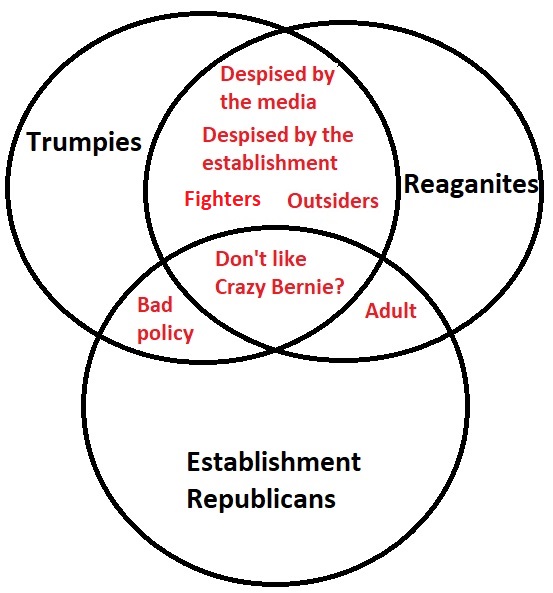
As documented in Commanding Heights: The Battle of Ideas, Margaret Thatcher and Ronald Reagansaved their nations from economic malaise and decline.

Today, let’s focus on what happened in the United Kingdom.

Economic liberty greatly increased during the Thatcher years.

She deserves the lion’s share of the credit for the U.K.’s economic rebirth and renaissance, but she also had the wisdom to appoint some very principled and very capable people to her cabinet.

Such as Nigel Lawson, who served as her Chancellor of the Exchequer (akin to a combined Treasury Secretary/OMB Director in the U.S.).

Lawson died last week, leading to many tributes to his role is resuscitating the U.K. economy.

The Wall Street Journal‘s editorial summarized his achievements.

…our problems are solvable, as they were a half century ago. One of those crucial problem solvers was British politician Nigel Lawson, who died this week at age 91. …the 1970s…was even more miserable in the United Kingdom than it was in the U.S. By the time Margaret Thatcher led the Tories into office in May 1979, inflation was raging and the country had been wracked by strikes in its “winter of discontent”… Lawson entered Thatcher’s administration… He made his historic mark as Chancellor of the Exchequer starting in 1983. He’s best known for his tax reforms, which reduced the top personal income-tax rate to 40% from 60% and brought the top corporate rate to 35% from a 1970s high of 52%. He also was a steward of the Thatcher administration’s privatizations of large state-owned firms and the “Big Bang” financial reforms that would transform London into a global financial center.

In a column for CapX, Madsen Pirie examines Lawson’s work.

Nigel Lawson left a huge legacy. Under his stewardship Britain went from being the sick man of Europe into becoming an economic powerhouse and one of the world’s leading economies. He is regarded by many as the finest Chancellor of the 20th century… Lord Lawson held the firm conviction that lower taxes created space for enterprise and opportunity, and made it his policy that in every Budget he would lower the burden of taxation and abolish at least one tax.…During his tenure, Britain was transformed from being an economy in which most major businesses and services were owned and run by the state, into one in which they became private businesses, paying taxes instead of receiving taxpayer subsidies. Failing and outdated state enterprises became modern, successful private ones. …His 1988 Budget…announced that all taxes above 40% would be abolished, and that the basic rate would be cut to 25%, its lowest for 50 years… Within a very short time, more money was coming into the Treasury from the lower rates than it had been taking in from the higher ones. It was a vindication of the Laffer Curve. …The top 10% of earners had been paying 35% of the total income tax take. Under Lawson’s lower rate that went up to 48%. In rough terms this meant that the top 10% went from paying just over a third to just under a half of total income taxes.

In other words, the lower tax rates in the U.K. had the same positive impact as the lower tax rates in the U.S., both in terms of encouraging growth and confirming the Laffer Curve.

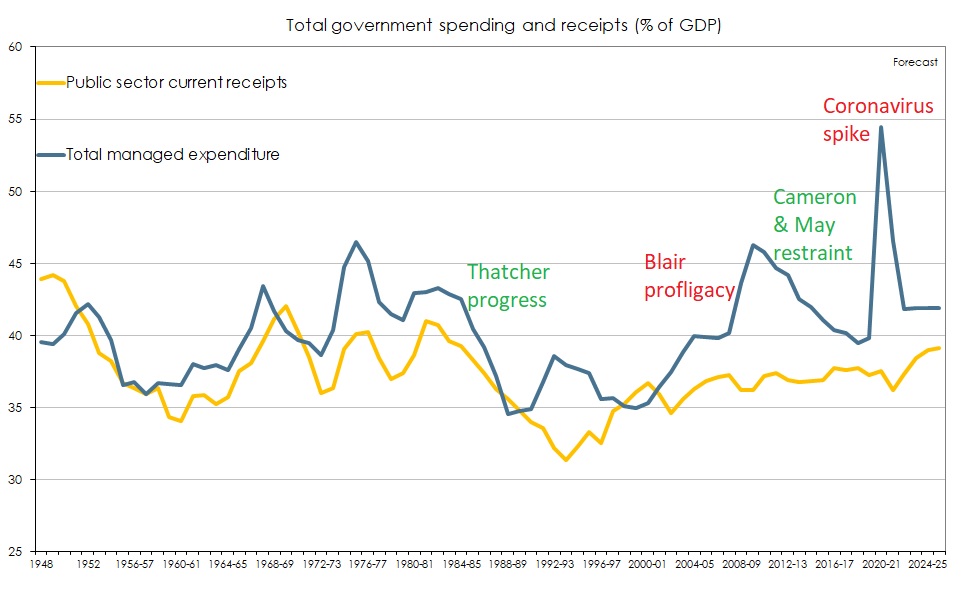
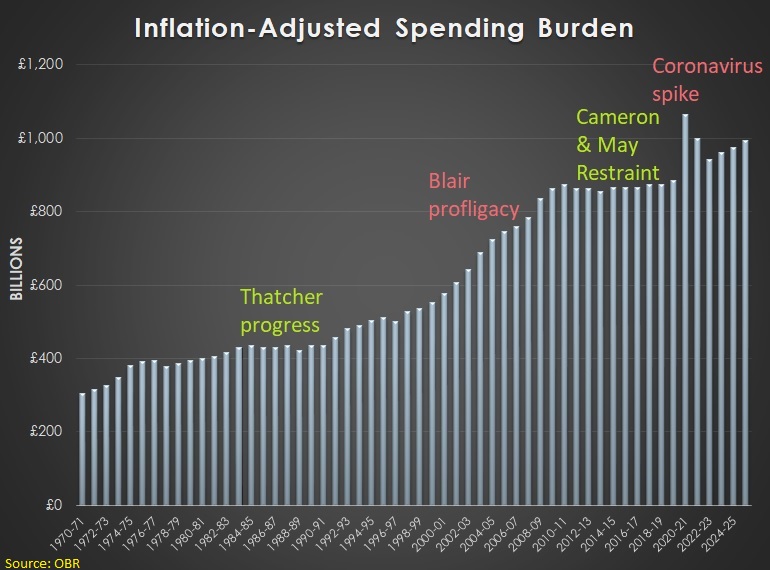
But let’s not forget that there also was spending restraint during the Thatcher years, particularly when Lawson was Chancellor of the Exchequer.

Just like we got spending restraint during the Reagan years.

The moral of the story is that it’s great to have good leaders, and it’s great when those leaders appoint good people.

P.S. If you want the U.S. equivalent of Nigel Lawson, the best historical example would be Andrew Mellon.

The Big Question for Tories (and Republicans): What’s the Alternative to “Free-Market Fundamentalism”?

Because of her support for lower tax rates, I was excited when Liz Truss became Prime Minister of the United Kingdom.

Especially since her predecessor, Boris Johnson, turned out to be an empty-suit populist who supported higher taxes and a bigger burden of government spending.

But I’m not excited anymore.

Indeed, it’s more accurate to say that I’m despondent since the Prime Minister is abandoning (or is being pressured to abandon) key parts of her pro-growth agenda.

For details, check out this Bloomberg report, written by Julian Harris, about the (rapidly disappearing) tax-cutting agenda of the new British Prime Minister.

Westminster’s most hard-line advocates of free markets and lower taxes are looking on in despair as their agenda crumbles… When Liz Truss became prime minister just over five weeks ago, she promised to deliver a radical set of policies rooted in laissez-faire economics — an attempt to boost the UK‘s sluggish rate of growth. Yet her chancellor of the exchequer, Kwasi Kwarteng, faced a quick reality check when his mini-budget, packed with unfunded tax cuts and unaccompanied by independent forecasts, …triggered mayhem… Truss fired Kwarteng and replaced him with Jeremy Hunt as she was forced into a dramatic u-turn over her tax plans. …Truss conceded…and dropped her plan to freeze corporation tax. …Still, some believers are sticking by “Trussonomics”…Patrick Minford,..a professor at Cardiff University, said..“Liz Truss’s policies for growth are absolutely right, and to be thrown off them by a bit of market turbulence is insane.” …Eamonn Butler, co-founder of the Adam Smith Institute, similarly insisted that Truss “is not the source of the problem — she’s trying to cure the problem.”

Eamonn is right.

The United Kingdom faces serious economic challenges. But the problems are the result of bad government policies that already exist rather than the possibility of some future tax cuts.

In a column for the Telegraph, Allister Heath says the U.K.’s central bank deserves a big chunk of the blame.

Liz Truss and Kwasi Kwarteng have been doubly unlucky. While almost everybody else in Britain remained in denial, they correctly identified this absurd game for the con-trick that it truly was, warned that it was about to implode and pledged to replace it with a more honest system. Instead of a zombie economy based on rising asset prices and fake, debt-fuelled growth, their mission was to encourage Britain to produce more real goods and services, to work harder and invest more by reforming taxes and regulation.What happened next is dispiriting in the extreme. …Truss and her Chancellor moved too quickly and, paradoxically, given their warnings about the rottenness of the system, ended up pulling out the last block from the Jenga tower, sending all of the pieces tumbling down. …they didn’t crash the economy – it was about to come tumbling down anyway – but they had the misfortune of precipitating and accelerating the day of reckoning. …Andrew Bailey, the Governor of the Bank of England…, has been deeply unimpressive in all of this, helping to keep interest rates too low… The idea, now accepted so widely, that the price of money must be kept extremely low and quantitative easing deployed at every opportunity has undermined every aspect of the economy and society. …Too few people realise how terribly the easy money, high tax, high regulation orthodoxy has failed.

Allister closes with some speculation about possible alternatives. If the Tories in the U.K. decide to reject so-called “free-market fundamentalism,” what’s their alternative?

He thinks the Labour Party will take control, and with very bad results. Jeremy Corbyn will not be in charge, but his economic policies will get enacted.

If Truss is destroyed, the alternative won’t even be social democracy: it will be Labour, the hard Left, the full gamut of punitive taxation, including of wealth and housing, and even more spending, culminating rapidly in economic oblivion.

That is an awful scenario. Basically turning the United Kingdom into Greece.

I want to take a different approach, though, and contemplate what will happen if the Conservative Party rejects the Truss approach and embraces big-government conservatism.

Here are some questions I’d like them to answer:

  • Do you want improved competitiveness and more economic growth?
  • If you want more growth, which of your spending increases will lead to those outcomes?
  • Which of your tax increases will lead to more competitiveness or more prosperity?
  • Will you reform benefit programs to avert built-in spending increases caused by an aging population?
  • If you won’t reform entitlements, which taxes will you increase to keep debt under control?
  • If you don’t plan major tax increases, do you think the economy can absorb endless debt?

I’m asking these questions for two reasons. First, there are no good answers and I’d like to shame big-government Tories into doing the right thing.

Second, these questions are also very relevant in the United States. Even since the Reagan years, opponents of libertarian economic policies have flitted from one trendy idea to another (national conservatism, compassionate conservatism, kinder-and-gentler conservatismcommon-good capitalism, reform conservatism, etc).

To be fair, they usually don’t try to claim their dirigiste policies will produce higher living standards. Instead, they blindly assert that it will be easier to win elections if Republicans abandon Reaganism.

So I’ll close by observing that Ronald Reagan won two landslide elections and his legacy was strong enough that voters then elected another Republican (the same can’t be said for big-government GOPers like Nixon, Bush, Bush, or Trump).

Switching back to the United Kingdom, Margaret Thatcher repeatedly won election and her legacy was strong enough that voters then elected another Conservative.

The bottom line is that good policy can lead to good political outcomes, whereas bad policy generally leads to bad political outcomes.

P.S. To be sure, there were times when Reagan’s poll numbers were very bad. And the same is true for Thatcher. But because they pursued good policies, economic growth returned and they reaped political benefits. Sadly, it appears that Truss won’t have a chance to adopt good policy, so we will never know if she also would have benefited from a similar economic renaissance.

Tax Cartels Mean Ever-Higher Tax Rates

When President Biden proposed a “global minimum tax” for businesses, I immediately warned that would lead to ever-increasing tax rates.

Ross Kaminsky of KHOW and I discussed how this is already happening.

I hate being right, but it’s always safe to predict that politicians and bureaucrats will embrace policies that give more power to government.

Especially when they are very anxious to stifle tax competition.

For decades, people in government have been upset that the tax cuts implemented by Ronald Reagan and Margaret Thatchertriggered a four-decade trend of lower tax rates and pro-growth tax reform.

That’s the reason Biden and his Treasury Secretary proposed a 15 percent minimum tax rate for businesses.

And it’s the reason they now want the rate to be even higher.

Though even I’m surprised that they’re already pushing for that outcome when the original pact hasn’t even been approved or implemented.

Here are some passages from a report by Reuters.

Treasury Secretary Janet Yellen will press G20 counterparts this week for a global minimum corporate tax rate above the 15% floor agreed by 130 countries last week…the global minimum tax rate…is tied to the outcome of legislation to raise the U.S. minimum tax rate, a Treasury official said.The Biden administration has proposed doubling the U.S. minimum tax on corporations overseas intangible income to 21% along with a new companion “enforcement” tax that would deny deductions to companies for tax payments to countries that fail to adopt the new global minimum rate. The officials said several countries were pushing for a rate above 15%, along with the United States.

Other kleptocratic governments naturally want the same thing.

A G7 proposal for a global minimum tax rate of 15% is too low and a rate of at least 21% is needed, Argentina’s finance minister said on Monday, leading a push by some developing countries… “The 15% rate is way too low,” Argentine Finance Minister Martin Guzman told an online panel hosted by the Independent Commission for the Reform of International Corporate Taxation. …”The minimum rate being proposed would not do much to countries in Africa…,” Mathew Gbonjubola, Nigeria’s tax policy director, told the same conference.

Needless to say, I’m not surprised that Argentina is on the wrong side.

And supporters of class warfare also are agitating for a higher minimum rate. Here are some excerpts from a column in the New York Times by Gabriel Zucman and Gus Wezerek.

In the decades after World War II, close to 50 percent of American companies’ earnings went to state and federal taxes. …it was a golden period. …President Biden should be applauded for trying to end the race to the bottom on corporate tax rates. But even if Congress approves the 15 percent global minimum corporate tax, it won’t be enough. …the Biden administration to give working families a real leg up, it should push Congress to enact a 25 percent minimum tax, which would bring in about $200 billion in additional revenue each year. …With a 25 percent minimum corporate tax, the Biden administration would begin to reverse decades of growing inequality. And it would encourage other countries to do the same, replacing a race to the bottom with a sprint to the top.

I can’t resist making two observations about this ideological screed.

  1. Even the IMF and OECD agree that the so-called race to the bottom has not led to a decline in corporate tax revenues, even when measured as a share of economic output.
  2. Since companies legally avoid rather than illegally evade taxes, the headline of the column is utterly dishonest – but it’s what we’ve learned to expect from the New York Times.

The only good thing about the Zucman-Wezerek column is that it includes this chart showing how corporate tax rates have dramatically declined since 1980.

P.S. For those interested, the horizontal line at the bottom is for Bermuda, though other jurisdictions (such as Monaco and the Cayman Islands) also deserve credit for having no corporate income taxes.

P.P.S. If you want to know why high corporate tax rates are misguided, click here. And if you want to know why Biden’s plan to raise the U.S. corporate tax rate is misguided, click here. Or here. Or here.

P.P.P.S. And if you want more information about why Biden’s global tax cartel is bad, click here, here, and here.

I enjoyed this article below because it demonstrates that the Laffer Curve has been working for almost 100 years now when it is put to the test in the USA. I actually got to hear Arthur Laffer speak in person in 1981 and he told us in advance what was going to happen the 1980’s and it all came about as he said it would when Ronald Reagan’s tax cuts took place. I wish we would lower taxes now instead of looking for more revenue through raised taxes. We have to grow the economy:

What Mitt Romney Said Last Night About Tax Cuts And The Deficit Was Absolutely Right. And What Obama Said Was Absolutely Wrong.

Mitt Romney repeatedly said last night that he would not allow tax cuts to add to the deficit.  He repeatedly said it because over and over again Obama blathered the liberal talking point that cutting taxes necessarily increased deficits.

Romney’s exact words: “I want to underline that — no tax cut that adds to the deficit.”

Meanwhile, Obama has promised to cut the deficit in half during his first four years – but instead gave America the highest deficits in the history of the entire human race.

I’ve written about this before.  Let’s replay what has happened every single time we’ve ever cut the income tax rate.

The fact of the matter is that we can go back to Calvin Coolidge who said very nearly THE EXACT SAME THING to his treasury secretary: he too would not allow any tax cuts that added to the debt.  Andrew Mellon – quite possibly the most brilliant economic mind of his day – did a great deal of research and determined what he believed was the best tax rate.  And the Coolidge administration DID cut income taxes and MASSIVELY increased revenues.  Coolidge and Mellon cut the income tax rate 67.12 percent (from 73 to 24 percent); and revenues not only did not go down, but they went UP by at least 42.86 percent (from $700 billion to over $1 billion).

That’s something called a documented fact.  But that wasn’t all that happened: another incredible thing was that the taxes and percentage of taxes paid actually went UP for the rich.  Because as they were allowed to keep more of the profits that they earned by investing in successful business, they significantly increased their investments and therefore paid more in taxes than they otherwise would have had they continued sheltering their money to protect themselves from the higher tax rates.  Liberals ignore reality, but it is simply true.  It is a fact.  It happened.

Then FDR came along and raised the tax rates again and the opposite happened: we collected less and less revenue while the burden of taxation fell increasingly on the poor and middle class again.  Which is exactly what Obama wants to do.

People don’t realize that John F. Kennedy, one of the greatest Democrat presidents, was a TAX CUTTER who believed the conservative economic philosophy that cutting tax rates would in fact increase tax revenues.  He too cut taxes, and he too increased tax revenues.

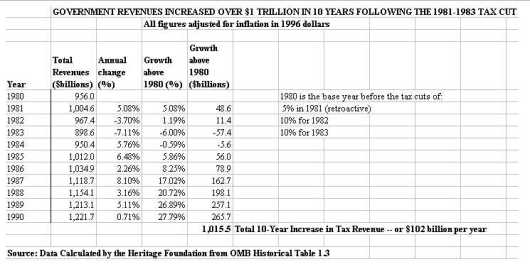
So we get to Ronald Reagan, who famously cut taxes.  And again, we find that Reagan cut that godawful liberal tax rate during an incredibly godawful liberal-caused economic recession, and he increased tax revenue by 20.71 percent (with revenues increasing from $956 billion to $1.154 trillion).  And again, the taxes were paid primarily by the rich:

“The share of the income tax burden borne by the top 10 percent of taxpayers increased from 48.0 percent in 1981 to 57.2 percent in 1988. Meanwhile, the share of income taxes paid by the bottom 50 percent of taxpayers dropped from 7.5 percent in 1981 to 5.7 percent in 1988.”

So we get to George Bush and the Bush tax cuts that liberals and in particular Obama have just demonized up one side and demagogued down the other.  And I can simply quote the New York Times AT the time:

Sharp Rise in Tax Revenue to Pare U.S. Deficit By EDMUND L. ANDREWS Published: July 13, 2005

WASHINGTON, July 12 – For the first time since President Bush took office, an unexpected leap in tax revenue is about to shrink the federal budget deficit this year, by nearly $100 billion.

A Jump in Corporate Payments On Wednesday, White House officials plan to announce that the deficit for the 2005 fiscal year, which ends in September, will be far smaller than the $427 billion they estimated in February.

Mr. Bush plans to hail the improvement at a cabinet meeting and to cite it as validation of his argument that tax cuts would stimulate the economy and ultimately help pay for themselves.

Based on revenue and spending data through June, the budget deficit for the first nine months of the fiscal year was $251 billion, $76 billion lower than the $327 billion gap recorded at the corresponding point a year earlier.

The Congressional Budget Office estimated last week that the deficit for the full fiscal year, which reached $412 billion in 2004, could be “significantly less than $350 billion, perhaps below $325 billion.”

The big surprise has been in tax revenue, which is running nearly 15 percent higher than in 2004. Corporate tax revenue has soared about 40 percent, after languishing for four years, and individual tax revenue is up as well
.

And of course the New York Times, as reliable liberals, use the adjective whenever something good happens under conservative policies and whenever something bad happens under liberal policies: ”unexpected.”   But it WASN’T ”unexpected.”  It was EXACTLY what Republicans had said would happen and in fact it was exactly what HAD IN FACT HAPPENED every single time we’ve EVER cut income tax rates.

The truth is that conservative tax policy has a perfect track record: every single time it has ever been tried, we have INCREASED tax revenues while not only exploding economic activity and creating more jobs, but encouraging the wealthy to pay more in taxes as well.  And liberals simply dishonestly refuse to acknowledge documented history.

Meanwhile, liberals also have a perfect record … of FAILUREThey keep raising taxes and keep not understanding why they don’t get the revenues they predicted.

The following is a section from my article, “Tax Cuts INCREASE Revenues; They Have ALWAYS Increased Revenues“, where I document every single thing I said above:

The Falsehood That Tax Cuts Increase The Deficit

Now let’s take a look at the utterly fallacious view that tax cuts in general create higher deficits.

Let’s take a trip back in time, starting with the 1920s.  From Burton Folsom’s book, New Deal or Raw Deal?:

In 1921, President Harding asked the sixty-five-year-old [Andrew] Mellon to be secretary of the treasury; the national debt [resulting from WWI] had surpassed $20 billion and unemployment had reached 11.7 percent, one of the highest rates in U.S. history.  Harding invited Mellon to tinker with tax rates to encourage investment without incurring more debt. Mellon studied the problem carefully; his solution was what is today called “supply side economics,” the idea of cutting taxes to stimulate investment.  High income tax rates, Mellon argued, “inevitably put pressure upon the taxpayer to withdraw this capital from productive business and invest it in tax-exempt securities. . . . The result is that the sources of taxation are drying up, wealth is failing to carry its share of the tax burden; and capital is being diverted into channels which yield neither revenue to the Government nor profit to the people” (page 128).

Mellon wrote, “It seems difficult for some to understand that high rates of taxation do not necessarily mean large revenue to the Government, and that more revenue may often be obtained by lower taxes.”  And he compared the government setting tax rates on incomes to a businessman setting prices on products: “If a price is fixed too high, sales drop off and with them profits.”

And what happened?

“As secretary of the treasury, Mellon promoted, and Harding and Coolidge backed, a plan that eventually cut taxes on large incomes from 73 to 24 percent and on smaller incomes from 4 to 1/2 of 1 percent.  These tax cuts helped produce an outpouring of economic development – from air conditioning to refrigerators to zippers, Scotch tape to radios and talking movies.  Investors took more risks when they were allowed to keep more of their gains.  President Coolidge, during his six years in office, averaged only 3.3 percent unemployment and 1 percent inflation – the lowest misery index of any president in the twentieth century.

Furthermore, Mellon was also vindicated in his astonishing predictions that cutting taxes across the board would generate more revenue.  In the early 1920s, when the highest tax rate was 73 percent, the total income tax revenue to the U.S. government was a little over $700 million.  In 1928 and 1929, when the top tax rate was slashed to 25 and 24 percent, the total revenue topped the $1 billion mark.  Also remarkable, as Table 3 indicates, is that the burden of paying these taxes fell increasingly upon the wealthy” (page 129-130).

Now, that is incredible upon its face, but it becomes even more incredible when contrasted with FDR’s antibusiness and confiscatory tax policies, which both dramatically shrunk in terms of actual income tax revenues (from $1.096 billion in 1929 to $527 million in 1935), and dramatically shifted the tax burden to the backs of the poor by imposing huge new excise taxes (from $540 million in 1929 to $1.364 billion in 1935).  See Table 1 on page 125 of New Deal or Raw Deal for that information.

FDR both collected far less taxes from the rich, while imposing a far more onerous tax burden upon the poor.

It is simply a matter of empirical fact that tax cuts create increased revenue, and that those [Democrats] who have refused to pay attention to that fact have ended up reducing government revenues even as they increased the burdens on the poorest whom they falsely claim to help.

Let’s move on to John F. Kennedy, one of the most popular Democrat presidents ever.  Few realize that he was also a supply-side tax cutter.

Kennedy said:

“It is a paradoxical truth that tax rates are too high and tax revenues are too low and the soundest way to raise the revenues in the long run is to cut the rates now … Cutting taxes now is not to incur a budget deficit, but to achieve the more prosperous, expanding economy which can bring a budget surplus.”

– John F. Kennedy, Nov. 20, 1962, president’s news conference


“Lower rates of taxation will stimulate economic activity and so raise the levels of personal and corporate income as to yield within a few years an increased – not a reduced – flow of revenues to the federal government.”

– John F. Kennedy, Jan. 17, 1963, annual budget message to the Congress, fiscal year 1964

“In today’s economy, fiscal prudence and responsibility call for tax reduction even if it temporarily enlarges the federal deficit – why reducing taxes is the best way open to us to increase revenues.”

– John F. Kennedy, Jan. 21, 1963, annual message to the Congress: “The Economic Report Of The President”


“It is no contradiction – the most important single thing we can do to stimulate investment in today’s economy is to raise consumption by major reduction of individual income tax rates.”

– John F. Kennedy, Jan. 21, 1963, annual message to the Congress: “The Economic Report Of The President”


“Our tax system still siphons out of the private economy too large a share of personal and business purchasing power and reduces the incentive for risk, investment and effort – thereby aborting our recoveries and stifling our national growth rate.”

– John F. Kennedy, Jan. 24, 1963, message to Congress on tax reduction and reform, House Doc. 43, 88th Congress, 1st Session.


“A tax cut means higher family income and higher business profits and a balanced federal budget. Every taxpayer and his family will have more money left over after taxes for a new car, a new home, new conveniences, education and investment. Every businessman can keep a higher percentage of his profits in his cash register or put it to work expanding or improving his business, and as the national income grows, the federal government will ultimately end up with more revenues.”

– John F. Kennedy, Sept. 18, 1963, radio and television address to the nation on tax-reduction bill

Which is to say that modern Democrats are essentially calling one of their greatest presidents a liar when they demonize tax cuts as a means of increasing government revenues.

So let’s move on to Ronald Reagan.  Reagan had two major tax cutting policies implemented: the Economic Recovery Tax Act (ERTA) of 1981, which was retroactive to 1981, and the Tax Reform Act of 1986.

Did Reagan’s tax cuts decrease federal revenues?  Hardly:

We find that 8 of the following 10 years there was a surplus of revenue from 1980, prior to the Reagan tax cuts.  And, following the Tax Reform Act of 1986, there was a MASSIVE INCREASEof revenue.

So Reagan’s tax cuts increased revenue.  But who paid the increased tax revenue?  The poor?  Opponents of the Reagan tax cuts argued that his policy was a giveaway to the rich (ever heard that one before?) because their tax payments would fall.  But that was exactly wrong.  In reality:

“The share of the income tax burden borne by the top 10 percent of taxpayers increased from 48.0 percent in 1981 to 57.2 percent in 1988. Meanwhile, the share of income taxes paid by the bottom 50 percent of taxpayers dropped from 7.5 percent in 1981 to 5.7 percent in 1988.”

So Ronald Reagan a) collected more total revenue, b) collected more revenue from the rich, while c) reducing revenue collected by the bottom half of taxpayers, and d) generated an economic powerhouse that lasted – with only minor hiccups – for nearly three decades.  Pretty good achievement considering that his predecessor was forced to describe his own economy as a “malaise,” suffering due to a “crisis of confidence.” Pretty good considering that President Jimmy Carter responded to a reporter’s question as to what he would do about the problem of inflation by answering, “It would be misleading for me to tell any of you that there is a solution to it.”

Reagan whipped inflation.  Just as he whipped that malaise and that crisis of confidence.

________

The Laffer Curve, Part III: Dynamic Scoring

Dan Mitchell: Mirror, Mirror, on the Wall, Which Nation Punishes Success Most of All?

Mirror, Mirror, on the Wall, Which Nation Punishes Success Most of All?

Marginal tax rates (how much you are taxed for earning additional money) have a big impact on incentives to engage in productive activity such as work, saving, investment, and entrepreneurship.

This is why governments should keep tax rates at modest levels.

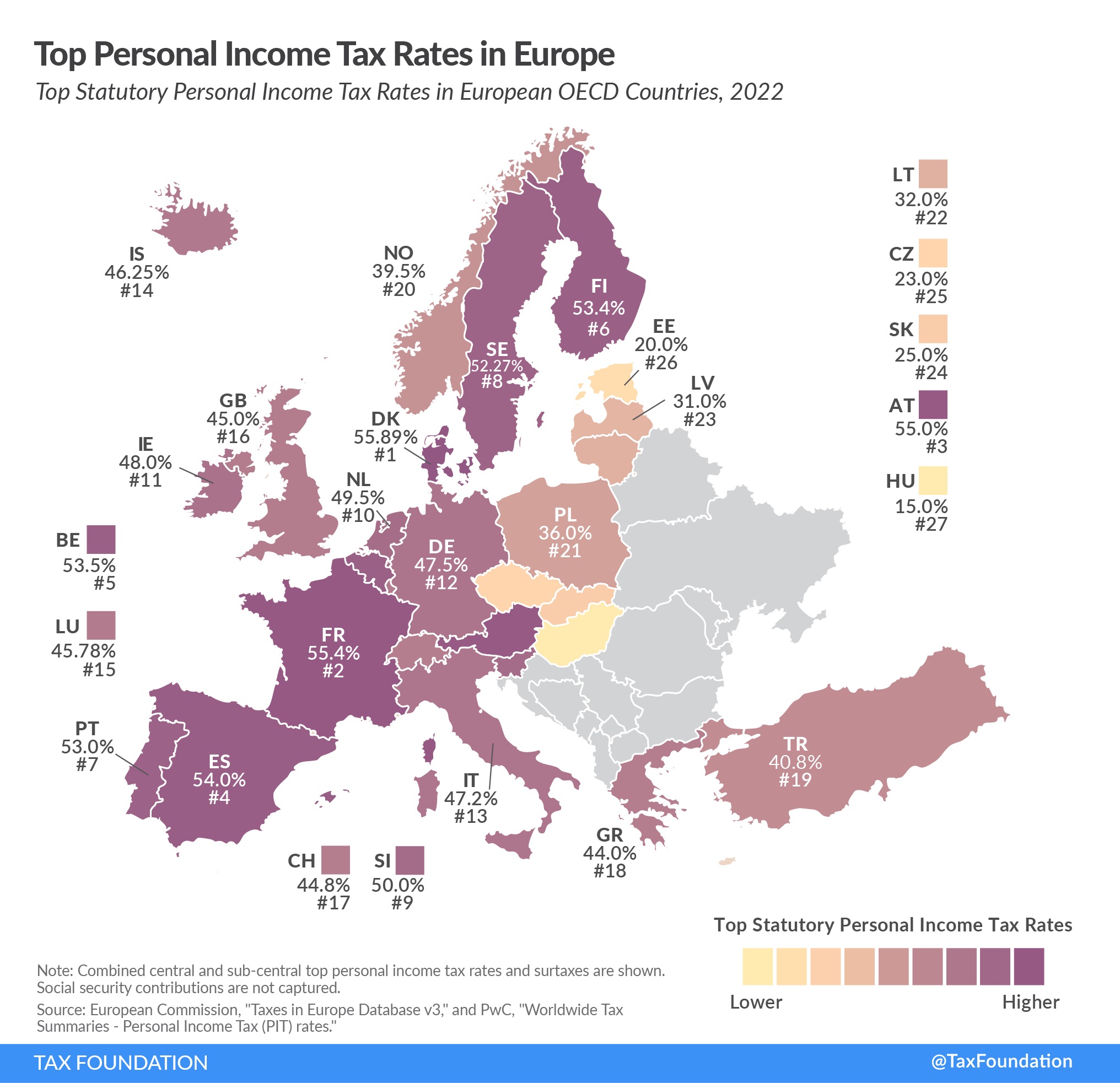
But as you can see from this map from the Tax Foundation, European governments generally cannot resist the temptation to impose onerous top tax rates on investors, entrepreneurs, business owners, and other successful taxpayers.

Congratulations to Hungary for having the lowest rate, followed by Estonia, the Czech Republic, and Slovakia.

And “congratulations” to Denmark for having the highest top tax rate, followed by France, Austria, and Spain.

At this point, a few caveats are necessary. A nation’s top income tax rate is important, but it’s not the only thing that matters for tax policy.

  • It’s also important to look at social insurance(payroll) taxes, particularly if they apply to all income.
  • It’s also important to look at the level of “double taxation” on income that is saved and invested.
  • It’s also important to look at VATs, which increase the wedge between pre-tax income and post-tax consumption.

Needless to say, other economic policies also matter. A nation might have a good tax system but very dirigiste policies in other areas. Or vice-versa.

For instance, even though Hungary has the lowest top tax rate on personal income and Denmark has the highest, there’s actually more overall economic liberty in Denmark.

Some readers may be wondering how the United States compares to the European nations shown in the above map.

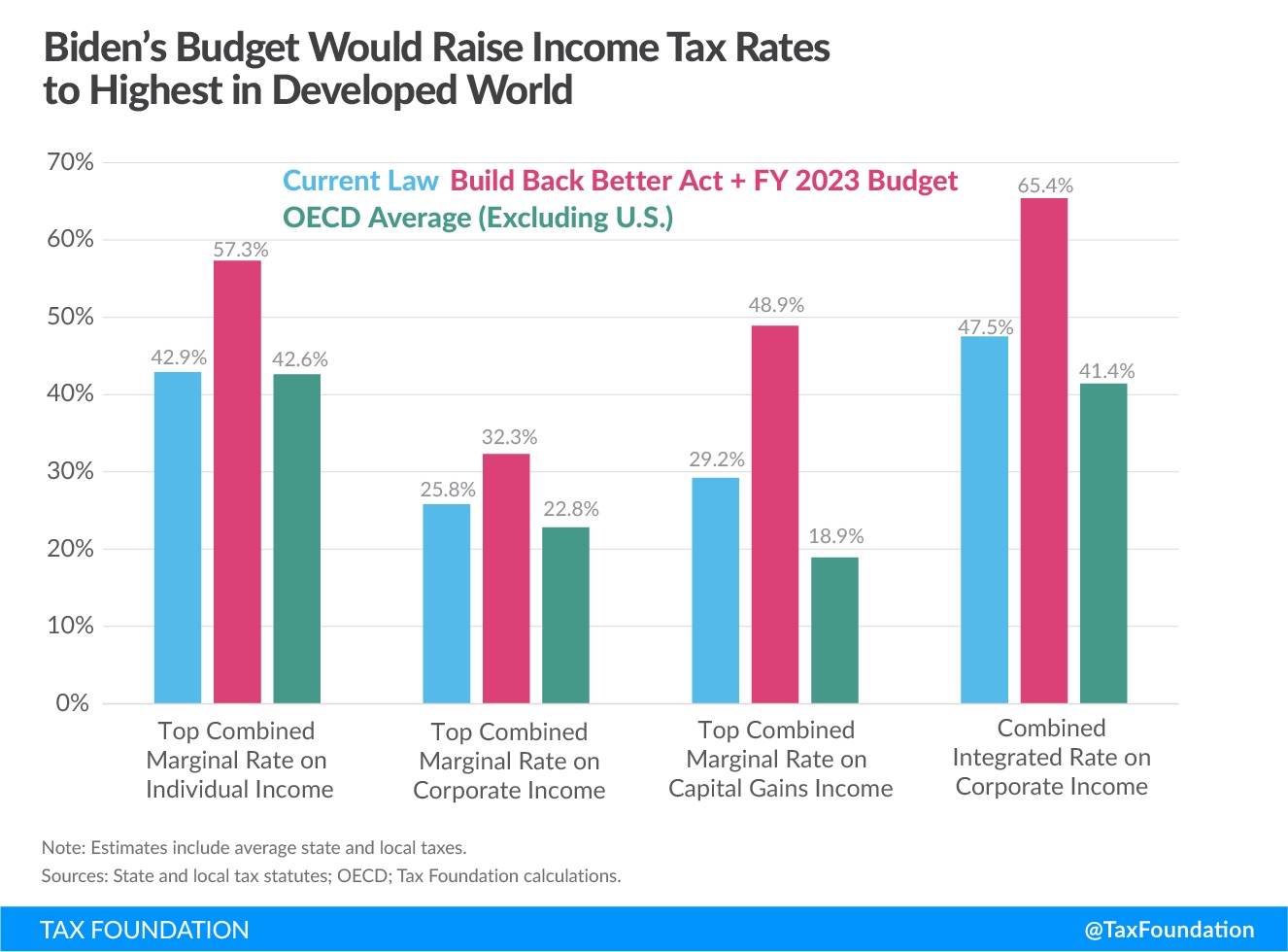
The good news (relatively speaking) is that the top tax rate in the United States is 42.9 percent, so that’s lower than the average in Europe.

The bad news is that the US would have the highest tax rate if Biden’s budget was approved.

However, the top income tax rate in the United States can vary substantially depending on state.

A resident of New York or California, for instance, will face a much higher top tax rate than a resident of a zero-income-tax state such as Texas or Florida.

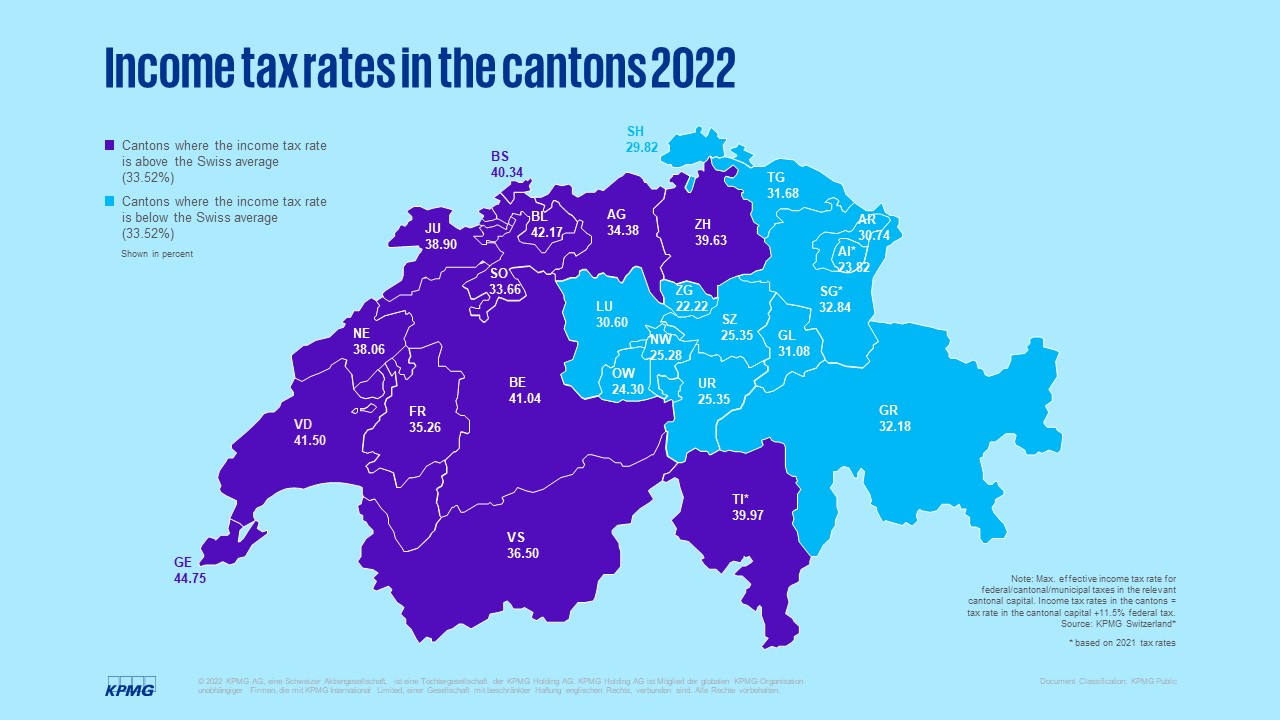
The same thing is even more true in Switzerland, where top tax rates vary substantially.

A successful taxpayer in Zug pays a top tax rate of 22.22 percent, less than half as much as a similar taxpayer in Geneva.

I’ll close by noting that this map is another example of the advantages of genuine federalism.

When the central government is small and most government takes place at the state and local level (or, in the case of Switzerland, at the cantonal and municipal level), there is more diversity, choice, and jurisdictional competition.

That type of federalism still exists in Switzerland, but unfortunately is eroding in the United States.

The Big Question for Tories (and Republicans): What’s the Alternative to “Free-Market Fundamentalism”?

Because of her support for lower tax rates, I was excited when Liz Truss became Prime Minister of the United Kingdom.

Especially since her predecessor, Boris Johnson, turned out to be an empty-suit populist who supported higher taxes and a bigger burden of government spending.

But I’m not excited anymore.

Indeed, it’s more accurate to say that I’m despondent since the Prime Minister is abandoning (or is being pressured to abandon) key parts of her pro-growth agenda.

For details, check out this Bloomberg report, written by Julian Harris, about the (rapidly disappearing) tax-cutting agenda of the new British Prime Minister.

Westminster’s most hard-line advocates of free markets and lower taxes are looking on in despair as their agenda crumbles… When Liz Truss became prime minister just over five weeks ago, she promised to deliver a radical set of policies rooted in laissez-faire economics — an attempt to boost the UK‘s sluggish rate of growth. Yet her chancellor of the exchequer, Kwasi Kwarteng, faced a quick reality check when his mini-budget, packed with unfunded tax cuts and unaccompanied by independent forecasts, …triggered mayhem… Truss fired Kwarteng and replaced him with Jeremy Hunt as she was forced into a dramatic u-turn over her tax plans. …Truss conceded…and dropped her plan to freeze corporation tax. …Still, some believers are sticking by “Trussonomics”…Patrick Minford,..a professor at Cardiff University, said..“Liz Truss’s policies for growth are absolutely right, and to be thrown off them by a bit of market turbulence is insane.” …Eamonn Butler, co-founder of the Adam Smith Institute, similarly insisted that Truss “is not the source of the problem — she’s trying to cure the problem.”

Eamonn is right.

The United Kingdom faces serious economic challenges. But the problems are the result of bad government policies that already exist rather than the possibility of some future tax cuts.

In a column for the Telegraph, Allister Heath says the U.K.’s central bank deserves a big chunk of the blame.

Liz Truss and Kwasi Kwarteng have been doubly unlucky. While almost everybody else in Britain remained in denial, they correctly identified this absurd game for the con-trick that it truly was, warned that it was about to implode and pledged to replace it with a more honest system. Instead of a zombie economy based on rising asset prices and fake, debt-fuelled growth, their mission was to encourage Britain to produce more real goods and services, to work harder and invest more by reforming taxes and regulation.What happened next is dispiriting in the extreme. …Truss and her Chancellor moved too quickly and, paradoxically, given their warnings about the rottenness of the system, ended up pulling out the last block from the Jenga tower, sending all of the pieces tumbling down. …they didn’t crash the economy – it was about to come tumbling down anyway – but they had the misfortune of precipitating and accelerating the day of reckoning. …Andrew Bailey, the Governor of the Bank of England…, has been deeply unimpressive in all of this, helping to keep interest rates too low… The idea, now accepted so widely, that the price of money must be kept extremely low and quantitative easing deployed at every opportunity has undermined every aspect of the economy and society. …Too few people realise how terribly the easy money, high tax, high regulation orthodoxy has failed.

Allister closes with some speculation about possible alternatives. If the Tories in the U.K. decide to reject so-called “free-market fundamentalism,” what’s their alternative?

He thinks the Labour Party will take control, and with very bad results. Jeremy Corbyn will not be in charge, but his economic policies will get enacted.

If Truss is destroyed, the alternative won’t even be social democracy: it will be Labour, the hard Left, the full gamut of punitive taxation, including of wealth and housing, and even more spending, culminating rapidly in economic oblivion.

That is an awful scenario. Basically turning the United Kingdom into Greece.

I want to take a different approach, though, and contemplate what will happen if the Conservative Party rejects the Truss approach and embraces big-government conservatism.

Here are some questions I’d like them to answer:

  • Do you want improved competitiveness and more economic growth?
  • If you want more growth, which of your spending increases will lead to those outcomes?
  • Which of your tax increases will lead to more competitiveness or more prosperity?
  • Will you reform benefit programs to avert built-in spending increases caused by an aging population?
  • If you won’t reform entitlements, which taxes will you increase to keep debt under control?
  • If you don’t plan major tax increases, do you think the economy can absorb endless debt?

I’m asking these questions for two reasons. First, there are no good answers and I’d like to shame big-government Tories into doing the right thing.

Second, these questions are also very relevant in the United States. Even since the Reagan years, opponents of libertarian economic policies have flitted from one trendy idea to another (national conservatism, compassionate conservatism, kinder-and-gentler conservatismcommon-good capitalism, reform conservatism, etc).

To be fair, they usually don’t try to claim their dirigiste policies will produce higher living standards. Instead, they blindly assert that it will be easier to win elections if Republicans abandon Reaganism.

So I’ll close by observing that Ronald Reagan won two landslide elections and his legacy was strong enough that voters then elected another Republican (the same can’t be said for big-government GOPers like Nixon, Bush, Bush, or Trump).

Switching back to the United Kingdom, Margaret Thatcher repeatedly won election and her legacy was strong enough that voters then elected another Conservative.

The bottom line is that good policy can lead to good political outcomes, whereas bad policy generally leads to bad political outcomes.

P.S. To be sure, there were times when Reagan’s poll numbers were very bad. And the same is true for Thatcher. But because they pursued good policies, economic growth returned and they reaped political benefits. Sadly, it appears that Truss won’t have a chance to adopt good policy, so we will never know if she also would have benefited from a similar economic renaissance.

Tax Cartels Mean Ever-Higher Tax Rates

When President Biden proposed a “global minimum tax” for businesses, I immediately warned that would lead to ever-increasing tax rates.

Ross Kaminsky of KHOW and I discussed how this is already happening.

I hate being right, but it’s always safe to predict that politicians and bureaucrats will embrace policies that give more power to government.

Especially when they are very anxious to stifle tax competition.

For decades, people in government have been upset that the tax cuts implemented by Ronald Reagan and Margaret Thatchertriggered a four-decade trend of lower tax rates and pro-growth tax reform.

That’s the reason Biden and his Treasury Secretary proposed a 15 percent minimum tax rate for businesses.

And it’s the reason they now want the rate to be even higher.

Though even I’m surprised that they’re already pushing for that outcome when the original pact hasn’t even been approved or implemented.

Here are some passages from a report by Reuters.

Treasury Secretary Janet Yellen will press G20 counterparts this week for a global minimum corporate tax rate above the 15% floor agreed by 130 countries last week…the global minimum tax rate…is tied to the outcome of legislation to raise the U.S. minimum tax rate, a Treasury official said.The Biden administration has proposed doubling the U.S. minimum tax on corporations overseas intangible income to 21% along with a new companion “enforcement” tax that would deny deductions to companies for tax payments to countries that fail to adopt the new global minimum rate. The officials said several countries were pushing for a rate above 15%, along with the United States.

Other kleptocratic governments naturally want the same thing.

A G7 proposal for a global minimum tax rate of 15% is too low and a rate of at least 21% is needed, Argentina’s finance minister said on Monday, leading a push by some developing countries… “The 15% rate is way too low,” Argentine Finance Minister Martin Guzman told an online panel hosted by the Independent Commission for the Reform of International Corporate Taxation. …”The minimum rate being proposed would not do much to countries in Africa…,” Mathew Gbonjubola, Nigeria’s tax policy director, told the same conference.

Needless to say, I’m not surprised that Argentina is on the wrong side.

And supporters of class warfare also are agitating for a higher minimum rate. Here are some excerpts from a column in the New York Times by Gabriel Zucman and Gus Wezerek.

In the decades after World War II, close to 50 percent of American companies’ earnings went to state and federal taxes. …it was a golden period. …President Biden should be applauded for trying to end the race to the bottom on corporate tax rates. But even if Congress approves the 15 percent global minimum corporate tax, it won’t be enough. …the Biden administration to give working families a real leg up, it should push Congress to enact a 25 percent minimum tax, which would bring in about $200 billion in additional revenue each year. …With a 25 percent minimum corporate tax, the Biden administration would begin to reverse decades of growing inequality. And it would encourage other countries to do the same, replacing a race to the bottom with a sprint to the top.

I can’t resist making two observations about this ideological screed.

  1. Even the IMF and OECD agree that the so-called race to the bottom has not led to a decline in corporate tax revenues, even when measured as a share of economic output.
  2. Since companies legally avoid rather than illegally evade taxes, the headline of the column is utterly dishonest – but it’s what we’ve learned to expect from the New York Times.

The only good thing about the Zucman-Wezerek column is that it includes this chart showing how corporate tax rates have dramatically declined since 1980.

P.S. For those interested, the horizontal line at the bottom is for Bermuda, though other jurisdictions (such as Monaco and the Cayman Islands) also deserve credit for having no corporate income taxes.

P.P.S. If you want to know why high corporate tax rates are misguided, click here. And if you want to know why Biden’s plan to raise the U.S. corporate tax rate is misguided, click here. Or here. Or here.

P.P.P.S. And if you want more information about why Biden’s global tax cartel is bad, click here, here, and here.

I enjoyed this article below because it demonstrates that the Laffer Curve has been working for almost 100 years now when it is put to the test in the USA. I actually got to hear Arthur Laffer speak in person in 1981 and he told us in advance what was going to happen the 1980’s and it all came about as he said it would when Ronald Reagan’s tax cuts took place. I wish we would lower taxes now instead of looking for more revenue through raised taxes. We have to grow the economy:

What Mitt Romney Said Last Night About Tax Cuts And The Deficit Was Absolutely Right. And What Obama Said Was Absolutely Wrong.

Mitt Romney repeatedly said last night that he would not allow tax cuts to add to the deficit.  He repeatedly said it because over and over again Obama blathered the liberal talking point that cutting taxes necessarily increased deficits.

Romney’s exact words: “I want to underline that — no tax cut that adds to the deficit.”

Meanwhile, Obama has promised to cut the deficit in half during his first four years – but instead gave America the highest deficits in the history of the entire human race.

I’ve written about this before.  Let’s replay what has happened every single time we’ve ever cut the income tax rate.

The fact of the matter is that we can go back to Calvin Coolidge who said very nearly THE EXACT SAME THING to his treasury secretary: he too would not allow any tax cuts that added to the debt.  Andrew Mellon – quite possibly the most brilliant economic mind of his day – did a great deal of research and determined what he believed was the best tax rate.  And the Coolidge administration DID cut income taxes and MASSIVELY increased revenues.  Coolidge and Mellon cut the income tax rate 67.12 percent (from 73 to 24 percent); and revenues not only did not go down, but they went UP by at least 42.86 percent (from $700 billion to over $1 billion).

That’s something called a documented fact.  But that wasn’t all that happened: another incredible thing was that the taxes and percentage of taxes paid actually went UP for the rich.  Because as they were allowed to keep more of the profits that they earned by investing in successful business, they significantly increased their investments and therefore paid more in taxes than they otherwise would have had they continued sheltering their money to protect themselves from the higher tax rates.  Liberals ignore reality, but it is simply true.  It is a fact.  It happened.

Then FDR came along and raised the tax rates again and the opposite happened: we collected less and less revenue while the burden of taxation fell increasingly on the poor and middle class again.  Which is exactly what Obama wants to do.

People don’t realize that John F. Kennedy, one of the greatest Democrat presidents, was a TAX CUTTER who believed the conservative economic philosophy that cutting tax rates would in fact increase tax revenues.  He too cut taxes, and he too increased tax revenues.

So we get to Ronald Reagan, who famously cut taxes.  And again, we find that Reagan cut that godawful liberal tax rate during an incredibly godawful liberal-caused economic recession, and he increased tax revenue by 20.71 percent (with revenues increasing from $956 billion to $1.154 trillion).  And again, the taxes were paid primarily by the rich:

“The share of the income tax burden borne by the top 10 percent of taxpayers increased from 48.0 percent in 1981 to 57.2 percent in 1988. Meanwhile, the share of income taxes paid by the bottom 50 percent of taxpayers dropped from 7.5 percent in 1981 to 5.7 percent in 1988.”

So we get to George Bush and the Bush tax cuts that liberals and in particular Obama have just demonized up one side and demagogued down the other.  And I can simply quote the New York Times AT the time:

Sharp Rise in Tax Revenue to Pare U.S. Deficit By EDMUND L. ANDREWS Published: July 13, 2005

WASHINGTON, July 12 – For the first time since President Bush took office, an unexpected leap in tax revenue is about to shrink the federal budget deficit this year, by nearly $100 billion.

A Jump in Corporate Payments On Wednesday, White House officials plan to announce that the deficit for the 2005 fiscal year, which ends in September, will be far smaller than the $427 billion they estimated in February.

Mr. Bush plans to hail the improvement at a cabinet meeting and to cite it as validation of his argument that tax cuts would stimulate the economy and ultimately help pay for themselves.

Based on revenue and spending data through June, the budget deficit for the first nine months of the fiscal year was $251 billion, $76 billion lower than the $327 billion gap recorded at the corresponding point a year earlier.

The Congressional Budget Office estimated last week that the deficit for the full fiscal year, which reached $412 billion in 2004, could be “significantly less than $350 billion, perhaps below $325 billion.”

The big surprise has been in tax revenue, which is running nearly 15 percent higher than in 2004. Corporate tax revenue has soared about 40 percent, after languishing for four years, and individual tax revenue is up as well
.

And of course the New York Times, as reliable liberals, use the adjective whenever something good happens under conservative policies and whenever something bad happens under liberal policies: ”unexpected.”   But it WASN’T ”unexpected.”  It was EXACTLY what Republicans had said would happen and in fact it was exactly what HAD IN FACT HAPPENED every single time we’ve EVER cut income tax rates.

The truth is that conservative tax policy has a perfect track record: every single time it has ever been tried, we have INCREASED tax revenues while not only exploding economic activity and creating more jobs, but encouraging the wealthy to pay more in taxes as well.  And liberals simply dishonestly refuse to acknowledge documented history.

Meanwhile, liberals also have a perfect record … of FAILUREThey keep raising taxes and keep not understanding why they don’t get the revenues they predicted.

The following is a section from my article, “Tax Cuts INCREASE Revenues; They Have ALWAYS Increased Revenues“, where I document every single thing I said above:

The Falsehood That Tax Cuts Increase The Deficit

Now let’s take a look at the utterly fallacious view that tax cuts in general create higher deficits.

Let’s take a trip back in time, starting with the 1920s.  From Burton Folsom’s book, New Deal or Raw Deal?:

In 1921, President Harding asked the sixty-five-year-old [Andrew] Mellon to be secretary of the treasury; the national debt [resulting from WWI] had surpassed $20 billion and unemployment had reached 11.7 percent, one of the highest rates in U.S. history.  Harding invited Mellon to tinker with tax rates to encourage investment without incurring more debt. Mellon studied the problem carefully; his solution was what is today called “supply side economics,” the idea of cutting taxes to stimulate investment.  High income tax rates, Mellon argued, “inevitably put pressure upon the taxpayer to withdraw this capital from productive business and invest it in tax-exempt securities. . . . The result is that the sources of taxation are drying up, wealth is failing to carry its share of the tax burden; and capital is being diverted into channels which yield neither revenue to the Government nor profit to the people” (page 128).

Mellon wrote, “It seems difficult for some to understand that high rates of taxation do not necessarily mean large revenue to the Government, and that more revenue may often be obtained by lower taxes.”  And he compared the government setting tax rates on incomes to a businessman setting prices on products: “If a price is fixed too high, sales drop off and with them profits.”

And what happened?

“As secretary of the treasury, Mellon promoted, and Harding and Coolidge backed, a plan that eventually cut taxes on large incomes from 73 to 24 percent and on smaller incomes from 4 to 1/2 of 1 percent.  These tax cuts helped produce an outpouring of economic development – from air conditioning to refrigerators to zippers, Scotch tape to radios and talking movies.  Investors took more risks when they were allowed to keep more of their gains.  President Coolidge, during his six years in office, averaged only 3.3 percent unemployment and 1 percent inflation – the lowest misery index of any president in the twentieth century.

Furthermore, Mellon was also vindicated in his astonishing predictions that cutting taxes across the board would generate more revenue.  In the early 1920s, when the highest tax rate was 73 percent, the total income tax revenue to the U.S. government was a little over $700 million.  In 1928 and 1929, when the top tax rate was slashed to 25 and 24 percent, the total revenue topped the $1 billion mark.  Also remarkable, as Table 3 indicates, is that the burden of paying these taxes fell increasingly upon the wealthy” (page 129-130).

Now, that is incredible upon its face, but it becomes even more incredible when contrasted with FDR’s antibusiness and confiscatory tax policies, which both dramatically shrunk in terms of actual income tax revenues (from $1.096 billion in 1929 to $527 million in 1935), and dramatically shifted the tax burden to the backs of the poor by imposing huge new excise taxes (from $540 million in 1929 to $1.364 billion in 1935).  See Table 1 on page 125 of New Deal or Raw Deal for that information.

FDR both collected far less taxes from the rich, while imposing a far more onerous tax burden upon the poor.

It is simply a matter of empirical fact that tax cuts create increased revenue, and that those [Democrats] who have refused to pay attention to that fact have ended up reducing government revenues even as they increased the burdens on the poorest whom they falsely claim to help.

Let’s move on to John F. Kennedy, one of the most popular Democrat presidents ever.  Few realize that he was also a supply-side tax cutter.

Kennedy said:

“It is a paradoxical truth that tax rates are too high and tax revenues are too low and the soundest way to raise the revenues in the long run is to cut the rates now … Cutting taxes now is not to incur a budget deficit, but to achieve the more prosperous, expanding economy which can bring a budget surplus.”

– John F. Kennedy, Nov. 20, 1962, president’s news conference


“Lower rates of taxation will stimulate economic activity and so raise the levels of personal and corporate income as to yield within a few years an increased – not a reduced – flow of revenues to the federal government.”

– John F. Kennedy, Jan. 17, 1963, annual budget message to the Congress, fiscal year 1964

“In today’s economy, fiscal prudence and responsibility call for tax reduction even if it temporarily enlarges the federal deficit – why reducing taxes is the best way open to us to increase revenues.”

– John F. Kennedy, Jan. 21, 1963, annual message to the Congress: “The Economic Report Of The President”


“It is no contradiction – the most important single thing we can do to stimulate investment in today’s economy is to raise consumption by major reduction of individual income tax rates.”

– John F. Kennedy, Jan. 21, 1963, annual message to the Congress: “The Economic Report Of The President”


“Our tax system still siphons out of the private economy too large a share of personal and business purchasing power and reduces the incentive for risk, investment and effort – thereby aborting our recoveries and stifling our national growth rate.”

– John F. Kennedy, Jan. 24, 1963, message to Congress on tax reduction and reform, House Doc. 43, 88th Congress, 1st Session.


“A tax cut means higher family income and higher business profits and a balanced federal budget. Every taxpayer and his family will have more money left over after taxes for a new car, a new home, new conveniences, education and investment. Every businessman can keep a higher percentage of his profits in his cash register or put it to work expanding or improving his business, and as the national income grows, the federal government will ultimately end up with more revenues.”

– John F. Kennedy, Sept. 18, 1963, radio and television address to the nation on tax-reduction bill

Which is to say that modern Democrats are essentially calling one of their greatest presidents a liar when they demonize tax cuts as a means of increasing government revenues.

So let’s move on to Ronald Reagan.  Reagan had two major tax cutting policies implemented: the Economic Recovery Tax Act (ERTA) of 1981, which was retroactive to 1981, and the Tax Reform Act of 1986.

Did Reagan’s tax cuts decrease federal revenues?  Hardly:

We find that 8 of the following 10 years there was a surplus of revenue from 1980, prior to the Reagan tax cuts.  And, following the Tax Reform Act of 1986, there was a MASSIVE INCREASEof revenue.

So Reagan’s tax cuts increased revenue.  But who paid the increased tax revenue?  The poor?  Opponents of the Reagan tax cuts argued that his policy was a giveaway to the rich (ever heard that one before?) because their tax payments would fall.  But that was exactly wrong.  In reality:

“The share of the income tax burden borne by the top 10 percent of taxpayers increased from 48.0 percent in 1981 to 57.2 percent in 1988. Meanwhile, the share of income taxes paid by the bottom 50 percent of taxpayers dropped from 7.5 percent in 1981 to 5.7 percent in 1988.”

So Ronald Reagan a) collected more total revenue, b) collected more revenue from the rich, while c) reducing revenue collected by the bottom half of taxpayers, and d) generated an economic powerhouse that lasted – with only minor hiccups – for nearly three decades.  Pretty good achievement considering that his predecessor was forced to describe his own economy as a “malaise,” suffering due to a “crisis of confidence.” Pretty good considering that President Jimmy Carter responded to a reporter’s question as to what he would do about the problem of inflation by answering, “It would be misleading for me to tell any of you that there is a solution to it.”

Reagan whipped inflation.  Just as he whipped that malaise and that crisis of confidence.

________

The Laffer Curve, Part III: Dynamic Scoring

Dan Mitchell: A New Member for the Bureaucrat Hall of Fame

A New Member for the Bureaucrat Hall of Fame

My primary problem with bureaucrats is that they often work for agencies and departments that should not exist.

My secondary problem is that they generally get overcompensated compared to workers in the economy’s productive sector.

And my tertiary problem with government employees is that they have job protections that encourage bad behavior – everything from sloth to crime.

When selecting new members for the Bureaucrat Hall of Fame, I usually pick from that final group.

And that’s the purpose of today’s column. We have a bureaucrat from Washington, DC, who deserves to be honored.

But he’s not a federal bureaucrat. He’s a cop with the DC metropolitan police. Here are some details of his misdeeds, as reported by Amanda Michelle Gomez.

The former vice chair of D.C. Police Union, Medgar Webster Sr., was arrested on Saturday for allegedly defrauding the D.C. government by working a second job at Whole Foods Market while reporting as on duty for the Metropolitan Police Department.…MPD paid Webster $33,845, including overtime and holiday pay, for hours he was simultaneously on the clock at Whole Foods, according to an arrest affidavit. Webster allegedly worked at two locations for the grocery chain between January 2021 and April 2022, and earned $45,946 at one of those stores along H Street Southeast. …Webster earned an hourly rate of $53.11 as an officer, which was adjusted to $79.67 for overtime work, per the affidavit.

If nothing else, I guess we can say he’s not lazy. I imagine other cops don’t bother doing any work, but they’re probably home napping instead of working a second job.

So congratulations…sort of.

But here’s the part of the story that definitely makes Mr. Webster a Hall of Famer.

He was caught double-dipping only because he got in trouble for sexual harassment at his second job.

The police spokesperson says agents discovered Webster was allegedly working a second job while on the clock at MPD during an “unrelated [Internal Affairs Division] investigation.” Webster was being investigated for engaging in an “unwanted sexual contact” with an individual at the Whole Foods.

Apparently he was trying to double-dip in more than one way.

Seems like he has something in common with Mr. Geary.

P.S. My all-time favorite example of anti-bureaucrat satire is this video, though this top-10 list from David Letterman is a close second.

P.P.S. Since we’re making fun of bureaucrats, here’s a good jab at the Post Office from Jimmy Kimmel and a clever one-liner from Craig Ferguson. And to see how government operates, we have the Fable of the Ant. But this Pearls before Swine cartoon strip is very clever. Also, here’s a new element discovered inside the bureaucracy, and a letter to the bureaucracy from someone renewing a passport.

Protecting Individual Savings from Double Taxation

While speaking last year in Hawaii on the topic of good tax policy, I explained why it is misguided to impose extra layers of tax on saving and investment.

Regarding the problem of double taxation, I’ve addressed how various features of the tax code need to be fixed.

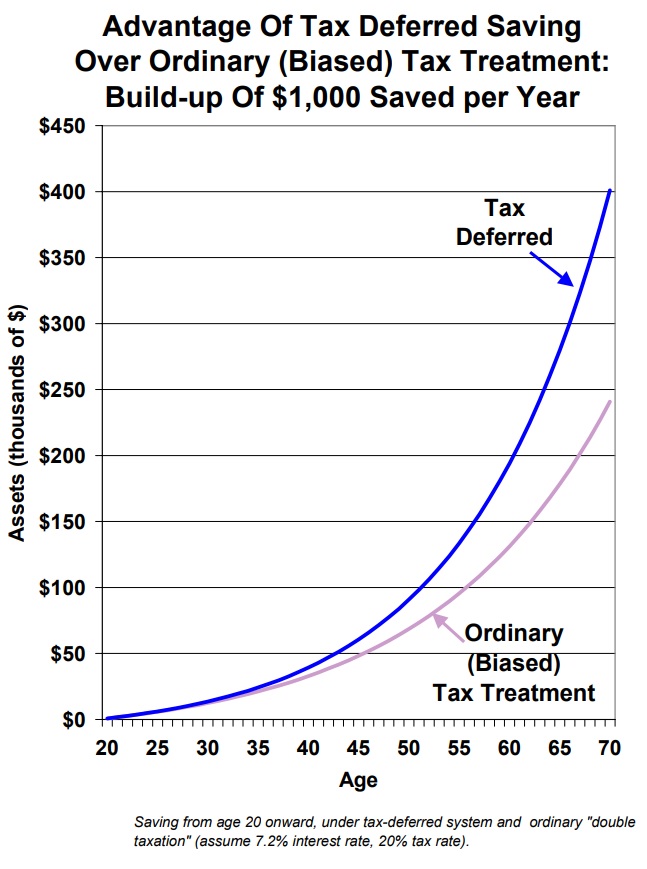
Today, we’re going to focus on the fixing the tax treatment of household savings. And the problem that needs fixing is that the federal government taxes you when you earn money and also taxes any interest you earn if you decide to save some of your after-tax income.

As you can see from the chart, this creates a tax wedge.

And that tax wedge distorts people’s decisions and makes them more likely to choose immediate consumption rather than savings (which can be viewed as deferred consumption).

As mentioned in the video, every economic theoryrecognizes that saving and investment (again, just another way of saying deferred consumption) are critical to future growth and rising living standards. So there are good reasons to fix the tax code.

The good news is that there are two ways to fix this problem.

  1. Tax income only one time when it is first earned.
  2. Tax income only one time when it is consumed.

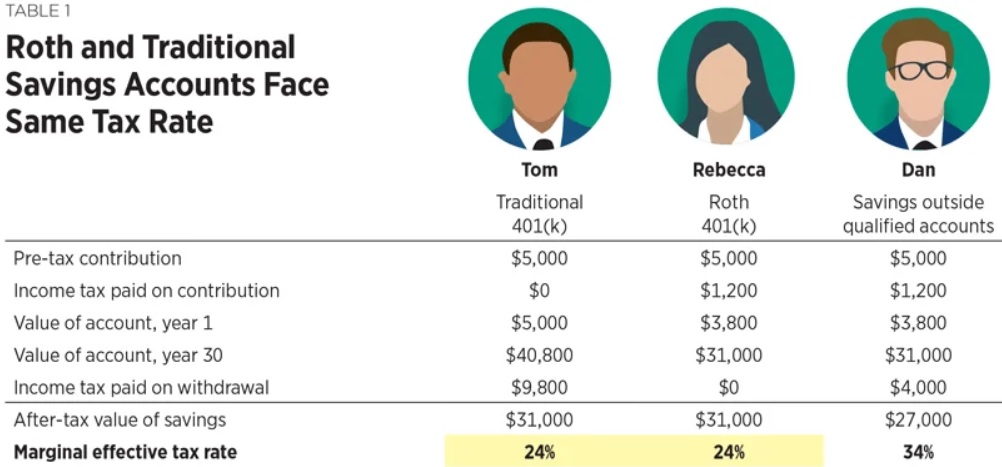
In practical terms, the first option treats all savings like a “Roth IRA,”, which means you pay tax the year you earn your income, but the IRS does not get another bit at the apple if you save some of your after-tax income and it earns interest or otherwise grows in value.

The second option treats all savings like a 401(k), which means you are not taxed on any income that you place in a savings vehicle, but you are taxed on any money (including any interest or other returns) that you withdraw from the account.

As shown by Adam Michel of the Heritage Foundation, both of these approaches lead to the same long-run result (and thus are superior to what happens when people save without being protected from double taxation).

The good news is that Americans can protect their savings from double taxation by using either individual retirement accounts (IRAs) or 401(k)s.

The bad news is that those “qualified accounts” are restricted. Only people who are saving for retirement can protect themselves from double taxation.

That needs to change.

Here’s what I wrote back in 2012 and I think it’s reasonably succinct and accurate.

…all saving and investment should be treated the way we currently treat individual retirement accounts. If you have a traditional IRA (or “front-ended” IRA), you get a deduction for any money you put in a retirement account, but then you pay tax on the money – including any earnings – when the money is withdrawn. If you have a Roth IRA (or “back-ended” IRA), you pay tax on your income in the year that it is earned, but if you put the money in a retirement account, there is no additional tax on withdrawals or the subsequent earnings. From an economic perspective, front-ended IRAs and back-ended IRAs generate the same result. Income that is saved and invested is treated the same as income that is immediately consumed. From a present-value perspective, front-ended IRAs and back-ended IRAs produce the same outcome. All that changes is the point at which the government imposes the single layer of tax.

The key takeaways are in the first and last sentences. All savings should be protected from double taxation, not just what you set aside for retirement. And that means government can tax you one time, either when you first earn the income or when you consume the income.

This means we need universal savings accounts, sort of like they have in Canada.

Here’s what Robert Bellafiore of the Tax Foundation wrote about the idea back in 2019.

USAs do not penalize withdrawals on account of their purpose or timing. In contrast, some types of existing savings accounts are not neutral, penalizing people who withdraw their money for anything but approved purposes at approved times. For example, withdrawals from 529 accounts can only be made without penalty if they are used to fund education.If a parent has a 529 account for a child but must make a withdrawal to cover emergency expenses, he or she must pay income taxes on the earnings, plus a 10 percent penalty. Withdrawals from 401(k)s before the age of 59½ incur the same penalty, though there are certain exceptions. USAs’ neutrality would likely boost saving, for two reasons. First, when savings are not hit by multiple layers of taxation, savers can expect a higher return and are therefore likely to save more. Both IRAs and 401(k)s tax savings only once, and studies have estimated that roughly half of 401(k) balances, and roughly a quarter of all IRA contributions, constitute new saving—in other words, dollars that would have been spent are saved instead.

The bottom line is that we need to copy jurisdictions such as Hong Kong and Singapore that have little or no double taxation of any kind.

Especially since we now live in a world where inflation has become an issue, which acts as a hidden tax on saving and investment.

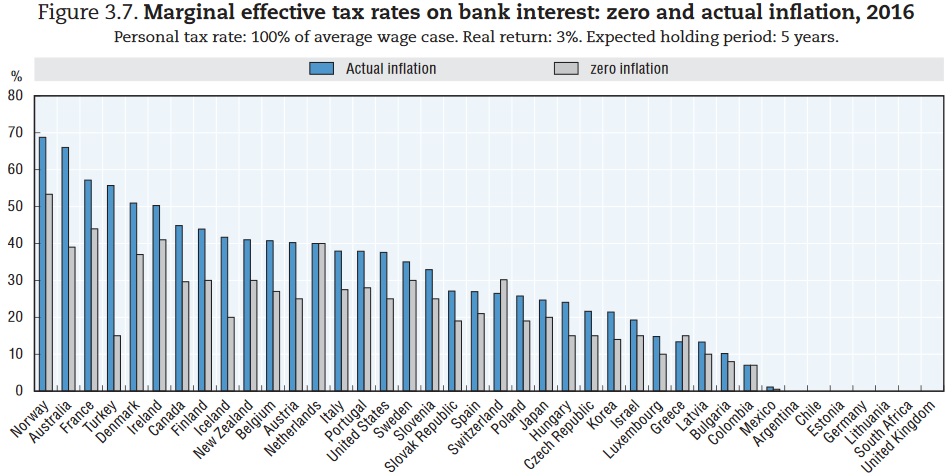
I’ll close with this chart from the OECD. It’s a few years old, so I’m sure some nations have changed their policies, but it gives one a good idea of how savings is treated around the world.

The bottom line is that it’s good to avoid Norway and the United States is unimpressive.

I’m very surprised to see that Argentina and Germany have good policy.

P.S. For some of our friends on the left, policies that protect from double taxation are akin to an entitlement.

I enjoyed this article below because it demonstrates that the Laffer Curve has been working for almost 100 years now when it is put to the test in the USA. I actually got to hear Arthur Laffer speak in person in 1981 and he told us in advance what was going to happen the 1980’s and it all came about as he said it would when Ronald Reagan’s tax cuts took place. I wish we would lower taxes now instead of looking for more revenue through raised taxes. We have to grow the economy:

What Mitt Romney Said Last Night About Tax Cuts And The Deficit Was Absolutely Right. And What Obama Said Was Absolutely Wrong.

Mitt Romney repeatedly said last night that he would not allow tax cuts to add to the deficit.  He repeatedly said it because over and over again Obama blathered the liberal talking point that cutting taxes necessarily increased deficits.

Romney’s exact words: “I want to underline that — no tax cut that adds to the deficit.”

Meanwhile, Obama has promised to cut the deficit in half during his first four years – but instead gave America the highest deficits in the history of the entire human race.

I’ve written about this before.  Let’s replay what has happened every single time we’ve ever cut the income tax rate.

The fact of the matter is that we can go back to Calvin Coolidge who said very nearly THE EXACT SAME THING to his treasury secretary: he too would not allow any tax cuts that added to the debt.  Andrew Mellon – quite possibly the most brilliant economic mind of his day – did a great deal of research and determined what he believed was the best tax rate.  And the Coolidge administration DID cut income taxes and MASSIVELY increased revenues.  Coolidge and Mellon cut the income tax rate 67.12 percent (from 73 to 24 percent); and revenues not only did not go down, but they went UP by at least 42.86 percent (from $700 billion to over $1 billion).

That’s something called a documented fact.  But that wasn’t all that happened: another incredible thing was that the taxes and percentage of taxes paid actually went UP for the rich.  Because as they were allowed to keep more of the profits that they earned by investing in successful business, they significantly increased their investments and therefore paid more in taxes than they otherwise would have had they continued sheltering their money to protect themselves from the higher tax rates.  Liberals ignore reality, but it is simply true.  It is a fact.  It happened.

Then FDR came along and raised the tax rates again and the opposite happened: we collected less and less revenue while the burden of taxation fell increasingly on the poor and middle class again.  Which is exactly what Obama wants to do.

People don’t realize that John F. Kennedy, one of the greatest Democrat presidents, was a TAX CUTTER who believed the conservative economic philosophy that cutting tax rates would in fact increase tax revenues.  He too cut taxes, and he too increased tax revenues.

So we get to Ronald Reagan, who famously cut taxes.  And again, we find that Reagan cut that godawful liberal tax rate during an incredibly godawful liberal-caused economic recession, and he increased tax revenue by 20.71 percent (with revenues increasing from $956 billion to $1.154 trillion).  And again, the taxes were paid primarily by the rich:

“The share of the income tax burden borne by the top 10 percent of taxpayers increased from 48.0 percent in 1981 to 57.2 percent in 1988. Meanwhile, the share of income taxes paid by the bottom 50 percent of taxpayers dropped from 7.5 percent in 1981 to 5.7 percent in 1988.”

So we get to George Bush and the Bush tax cuts that liberals and in particular Obama have just demonized up one side and demagogued down the other.  And I can simply quote the New York Times AT the time:

Sharp Rise in Tax Revenue to Pare U.S. Deficit By EDMUND L. ANDREWS Published: July 13, 2005

WASHINGTON, July 12 – For the first time since President Bush took office, an unexpected leap in tax revenue is about to shrink the federal budget deficit this year, by nearly $100 billion.

A Jump in Corporate Payments On Wednesday, White House officials plan to announce that the deficit for the 2005 fiscal year, which ends in September, will be far smaller than the $427 billion they estimated in February.

Mr. Bush plans to hail the improvement at a cabinet meeting and to cite it as validation of his argument that tax cuts would stimulate the economy and ultimately help pay for themselves.

Based on revenue and spending data through June, the budget deficit for the first nine months of the fiscal year was $251 billion, $76 billion lower than the $327 billion gap recorded at the corresponding point a year earlier.

The Congressional Budget Office estimated last week that the deficit for the full fiscal year, which reached $412 billion in 2004, could be “significantly less than $350 billion, perhaps below $325 billion.”

The big surprise has been in tax revenue, which is running nearly 15 percent higher than in 2004. Corporate tax revenue has soared about 40 percent, after languishing for four years, and individual tax revenue is up as well
.

And of course the New York Times, as reliable liberals, use the adjective whenever something good happens under conservative policies and whenever something bad happens under liberal policies: ”unexpected.”   But it WASN’T ”unexpected.”  It was EXACTLY what Republicans had said would happen and in fact it was exactly what HAD IN FACT HAPPENED every single time we’ve EVER cut income tax rates.

The truth is that conservative tax policy has a perfect track record: every single time it has ever been tried, we have INCREASED tax revenues while not only exploding economic activity and creating more jobs, but encouraging the wealthy to pay more in taxes as well.  And liberals simply dishonestly refuse to acknowledge documented history.

Meanwhile, liberals also have a perfect record … of FAILUREThey keep raising taxes and keep not understanding why they don’t get the revenues they predicted.

The following is a section from my article, “Tax Cuts INCREASE Revenues; They Have ALWAYS Increased Revenues“, where I document every single thing I said above:

The Falsehood That Tax Cuts Increase The Deficit

Now let’s take a look at the utterly fallacious view that tax cuts in general create higher deficits.

Let’s take a trip back in time, starting with the 1920s.  From Burton Folsom’s book, New Deal or Raw Deal?:

In 1921, President Harding asked the sixty-five-year-old [Andrew] Mellon to be secretary of the treasury; the national debt [resulting from WWI] had surpassed $20 billion and unemployment had reached 11.7 percent, one of the highest rates in U.S. history.  Harding invited Mellon to tinker with tax rates to encourage investment without incurring more debt. Mellon studied the problem carefully; his solution was what is today called “supply side economics,” the idea of cutting taxes to stimulate investment.  High income tax rates, Mellon argued, “inevitably put pressure upon the taxpayer to withdraw this capital from productive business and invest it in tax-exempt securities. . . . The result is that the sources of taxation are drying up, wealth is failing to carry its share of the tax burden; and capital is being diverted into channels which yield neither revenue to the Government nor profit to the people” (page 128).

Mellon wrote, “It seems difficult for some to understand that high rates of taxation do not necessarily mean large revenue to the Government, and that more revenue may often be obtained by lower taxes.”  And he compared the government setting tax rates on incomes to a businessman setting prices on products: “If a price is fixed too high, sales drop off and with them profits.”

And what happened?

“As secretary of the treasury, Mellon promoted, and Harding and Coolidge backed, a plan that eventually cut taxes on large incomes from 73 to 24 percent and on smaller incomes from 4 to 1/2 of 1 percent.  These tax cuts helped produce an outpouring of economic development – from air conditioning to refrigerators to zippers, Scotch tape to radios and talking movies.  Investors took more risks when they were allowed to keep more of their gains.  President Coolidge, during his six years in office, averaged only 3.3 percent unemployment and 1 percent inflation – the lowest misery index of any president in the twentieth century.

Furthermore, Mellon was also vindicated in his astonishing predictions that cutting taxes across the board would generate more revenue.  In the early 1920s, when the highest tax rate was 73 percent, the total income tax revenue to the U.S. government was a little over $700 million.  In 1928 and 1929, when the top tax rate was slashed to 25 and 24 percent, the total revenue topped the $1 billion mark.  Also remarkable, as Table 3 indicates, is that the burden of paying these taxes fell increasingly upon the wealthy” (page 129-130).

Now, that is incredible upon its face, but it becomes even more incredible when contrasted with FDR’s antibusiness and confiscatory tax policies, which both dramatically shrunk in terms of actual income tax revenues (from $1.096 billion in 1929 to $527 million in 1935), and dramatically shifted the tax burden to the backs of the poor by imposing huge new excise taxes (from $540 million in 1929 to $1.364 billion in 1935).  See Table 1 on page 125 of New Deal or Raw Deal for that information.

FDR both collected far less taxes from the rich, while imposing a far more onerous tax burden upon the poor.

It is simply a matter of empirical fact that tax cuts create increased revenue, and that those [Democrats] who have refused to pay attention to that fact have ended up reducing government revenues even as they increased the burdens on the poorest whom they falsely claim to help.

Let’s move on to John F. Kennedy, one of the most popular Democrat presidents ever.  Few realize that he was also a supply-side tax cutter.

Kennedy said:

“It is a paradoxical truth that tax rates are too high and tax revenues are too low and the soundest way to raise the revenues in the long run is to cut the rates now … Cutting taxes now is not to incur a budget deficit, but to achieve the more prosperous, expanding economy which can bring a budget surplus.”

– John F. Kennedy, Nov. 20, 1962, president’s news conference


“Lower rates of taxation will stimulate economic activity and so raise the levels of personal and corporate income as to yield within a few years an increased – not a reduced – flow of revenues to the federal government.”

– John F. Kennedy, Jan. 17, 1963, annual budget message to the Congress, fiscal year 1964

“In today’s economy, fiscal prudence and responsibility call for tax reduction even if it temporarily enlarges the federal deficit – why reducing taxes is the best way open to us to increase revenues.”

– John F. Kennedy, Jan. 21, 1963, annual message to the Congress: “The Economic Report Of The President”


“It is no contradiction – the most important single thing we can do to stimulate investment in today’s economy is to raise consumption by major reduction of individual income tax rates.”

– John F. Kennedy, Jan. 21, 1963, annual message to the Congress: “The Economic Report Of The President”


“Our tax system still siphons out of the private economy too large a share of personal and business purchasing power and reduces the incentive for risk, investment and effort – thereby aborting our recoveries and stifling our national growth rate.”

– John F. Kennedy, Jan. 24, 1963, message to Congress on tax reduction and reform, House Doc. 43, 88th Congress, 1st Session.


“A tax cut means higher family income and higher business profits and a balanced federal budget. Every taxpayer and his family will have more money left over after taxes for a new car, a new home, new conveniences, education and investment. Every businessman can keep a higher percentage of his profits in his cash register or put it to work expanding or improving his business, and as the national income grows, the federal government will ultimately end up with more revenues.”

– John F. Kennedy, Sept. 18, 1963, radio and television address to the nation on tax-reduction bill

Which is to say that modern Democrats are essentially calling one of their greatest presidents a liar when they demonize tax cuts as a means of increasing government revenues.

So let’s move on to Ronald Reagan.  Reagan had two major tax cutting policies implemented: the Economic Recovery Tax Act (ERTA) of 1981, which was retroactive to 1981, and the Tax Reform Act of 1986.

Did Reagan’s tax cuts decrease federal revenues?  Hardly:

We find that 8 of the following 10 years there was a surplus of revenue from 1980, prior to the Reagan tax cuts.  And, following the Tax Reform Act of 1986, there was a MASSIVE INCREASEof revenue.

So Reagan’s tax cuts increased revenue.  But who paid the increased tax revenue?  The poor?  Opponents of the Reagan tax cuts argued that his policy was a giveaway to the rich (ever heard that one before?) because their tax payments would fall.  But that was exactly wrong.  In reality:

“The share of the income tax burden borne by the top 10 percent of taxpayers increased from 48.0 percent in 1981 to 57.2 percent in 1988. Meanwhile, the share of income taxes paid by the bottom 50 percent of taxpayers dropped from 7.5 percent in 1981 to 5.7 percent in 1988.”

So Ronald Reagan a) collected more total revenue, b) collected more revenue from the rich, while c) reducing revenue collected by the bottom half of taxpayers, and d) generated an economic powerhouse that lasted – with only minor hiccups – for nearly three decades.  Pretty good achievement considering that his predecessor was forced to describe his own economy as a “malaise,” suffering due to a “crisis of confidence.” Pretty good considering that President Jimmy Carter responded to a reporter’s question as to what he would do about the problem of inflation by answering, “It would be misleading for me to tell any of you that there is a solution to it.”

Reagan whipped inflation.  Just as he whipped that malaise and that crisis of confidence.

________

The Laffer Curve, Part III: Dynamic Scoring

Dan Mitchell: Government vs. Poor People

I

Government vs. Poor People

My Fourteenth Theorem of Government explains that when government intervenes for the ostensible purpose of providing help to poor people in the short run,it is all but inevitable that such policies will hurt poor people in the long run.

It is hardly a revelation that bigger government causes problems, but it is particularly discouraging when such policies victimize the least fortunate members of society.

I’m discussing this issue today because I recently discovered a 2018 article by Brian Balfour.

Published by the Foundation for Economic Education, the article lists seven ways that government traps people in poverty.

At the risk of over-simplifying, four of those policies directly hurt poor people.

  1. The “quicksand effect” of the welfare state, which discourages self-advancement.
  2. Minimum wage laws that remove the bottom rungs of the economic ladder.
  3. Green energy policies that make basic utilities needlessly expensive.
  4. Protectionist trade policies that increase the price of essential products.

And three of those policies indirectly hurt poor people.

  1. Punitive tax policies that discourage job creation and productivity advances.
  2. Regulatory policies that impose high costs and cause inefficiency.
  3. Inflationary monetary policies by central banks that cause higher prices.

There’s nothing in the article that’s wrong, but I’m going to conclude today’s column by pointing out a big sin of omission.

The author’s list should have included the government education monopoly. Especially since poor families tend to live in the areas with the worst-performing government schools.

Failing government schools have a very direct and very negative impact on the life prospects of low-income kids.

So I’ll end by noting that I’m very excited that school choice is beginning to sweep the nation.

P.S. There are many other government policies that have a disproportionately negative impact on poor people. Everything from Social Security to revenuepolicing, but don’t forget government lotteries, licensing laws, and nanny state protections (all of which may help to explain why poor people are skeptical about the supposed benefits of bigger government).

The Adverse Economic Consequences of Busting Social Security’s Wage Base Cap

Today we are going to look at proposals to expandthe burden of Social Security payroll taxes, and let’s start by recycling this 2008 video.

All of the analysis in the video is still accurate, but two of the numbers need to be updated.

  • Social Security’s long-run deficit is now $56 trillion rather than $24.9 trillion as was the case back in 2008.
  • Social Security payroll taxes now apply to income up to $162K rather than $102K as was the case back in 2008.

If you don’t have time to watch a 9-minute video, I can summarize the issue by noting that Social Security was designed as an “earned benefit,” which means workers contribute to the system in exchange for future benefits. The more you earn, the more you pay, and the more benefits you receive.

But because Social Security is supposed to be akin to an insurance program, there’s a limit on both the amount of benefits any retiree can receive and the amount of taxes that any worker must pay (the same principle applies in many other nations).

Some politicians want to get rid of the limit (the “wage base cap”) on the amount of taxes workers must pay. Instead of applying the 12.4 percent Social Security payroll tax on the first $162,000 of income, they want to impose the tax on all income.

In some cases, they want this big increase in marginal tax rates in order to prop up the Social Security system while in other cases they actually want to expand the program.

In either case, the economic consequences would be very bad.

In today’s Wall Street Journal, Travis Nix explainswhy this would be counterproductive.

…lawmakers in both parties are mulling the idea of lifting the payroll tax cap. The resulting increase in revenue would do little more than delay the inevitable by extending the program’s life a few more years. …European countries cap payroll taxes at much lower incomes than the U.S. does. Germany caps payroll taxes for health insurance at about $62,000 and the Netherlands caps theirs for social security at $40,370.Uncapping the payroll tax in the U.S. would only widen the disparity and make America a less attractive country in which to work and invest. …Uncapping the payroll tax would raise the top tax rate on Americans’ labor income—income and employee payroll tax combined—to as high as 43.2%. This excludes state taxes and the employer payroll tax, which make the rate even higher. The U.S. hasn’t seen labor tax rates that high since before Ronald Reagan. …European countries that cap their payroll taxes at relatively low incomes understand that you can’t fund a social-safety net without providing an incentive to work. The U.S. should too.

Let’s also look at what Mark Warshawsky of the American Enterprise Institute wrote last year.

…imposing a massive tax increase — 12.4 percentage points — on the earnings of about 10 million highly productive, mostly middle-class workers earning more than $160,200 would have several notable consequences. It would reduce their support for the program,severely discourage their labor market participation, and encourage payroll tax avoidance through converting earnings to incentive stock options and other forms of employee stock ownership. …In many instances, these workers would have their wages taxed at federal, state and local levels at rates exceeding 70 percent. …almost 20 percent of current and future covered workers are projected to earn above the taxable maximum in any one year.

And here is some of Allison Schrager’s analysis from 2020.

When it comes to financing the future of Social Security, many Democrats have a simple and wrong solution: lift the cap on earnings subject to the payroll tax. …there are costs to these plans. A 12.4% marginal tax increase is significant.If the cap is eliminated, an individual who makes $250,000 a year would see their Social Security tax liability increase by 88%. …many households—especially those in states with high state taxes—will be paying more than 60% in federal, state, and local income and payroll taxes… only 6% of the population earns more than the cap. But income varies over people’s lives: 36% of Americans will be in the top 5% of earners at least one year of their career.

I’ll close by observing that it we’ve had big fights under Bush, Obama, Trump, and Biden about whether the top personal income tax rate should go up by about 3 percentage points or down by 3 percentage points.

Since keeping marginal tax rates low helps encourage productive behavior, those were important fights.

Now we face a fight that should be far more important since some politicians want to raise the marginal tax rate by 12.4 percentage points.

It is true that Social Security is in deep financial trouble, but propping up (or expanding) the current system would be bad news for the economy and it would produce a bleaker future for young people.

It would be far better to begin a transition to personal retirement accounts.

P.S. Chile and Australia have created personal retirement accounts. You can also learn about reforms in SwitzerlandHong KongNetherlands, the Faroe IslandsDenmarkIsrael, and Sweden.

I enjoyed this article below because it demonstrates that the Laffer Curve has been working for almost 100 years now when it is put to the test in the USA. I actually got to hear Arthur Laffer speak in person in 1981 and he told us in advance what was going to happen the 1980’s and it all came about as he said it would when Ronald Reagan’s tax cuts took place. I wish we would lower taxes now instead of looking for more revenue through raised taxes. We have to grow the economy:

What Mitt Romney Said Last Night About Tax Cuts And The Deficit Was Absolutely Right. And What Obama Said Was Absolutely Wrong.

Mitt Romney repeatedly said last night that he would not allow tax cuts to add to the deficit.  He repeatedly said it because over and over again Obama blathered the liberal talking point that cutting taxes necessarily increased deficits.

Romney’s exact words: “I want to underline that — no tax cut that adds to the deficit.”

Meanwhile, Obama has promised to cut the deficit in half during his first four years – but instead gave America the highest deficits in the history of the entire human race.

I’ve written about this before.  Let’s replay what has happened every single time we’ve ever cut the income tax rate.

The fact of the matter is that we can go back to Calvin Coolidge who said very nearly THE EXACT SAME THING to his treasury secretary: he too would not allow any tax cuts that added to the debt.  Andrew Mellon – quite possibly the most brilliant economic mind of his day – did a great deal of research and determined what he believed was the best tax rate.  And the Coolidge administration DID cut income taxes and MASSIVELY increased revenues.  Coolidge and Mellon cut the income tax rate 67.12 percent (from 73 to 24 percent); and revenues not only did not go down, but they went UP by at least 42.86 percent (from $700 billion to over $1 billion).

That’s something called a documented fact.  But that wasn’t all that happened: another incredible thing was that the taxes and percentage of taxes paid actually went UP for the rich.  Because as they were allowed to keep more of the profits that they earned by investing in successful business, they significantly increased their investments and therefore paid more in taxes than they otherwise would have had they continued sheltering their money to protect themselves from the higher tax rates.  Liberals ignore reality, but it is simply true.  It is a fact.  It happened.

Then FDR came along and raised the tax rates again and the opposite happened: we collected less and less revenue while the burden of taxation fell increasingly on the poor and middle class again.  Which is exactly what Obama wants to do.

People don’t realize that John F. Kennedy, one of the greatest Democrat presidents, was a TAX CUTTER who believed the conservative economic philosophy that cutting tax rates would in fact increase tax revenues.  He too cut taxes, and he too increased tax revenues.

So we get to Ronald Reagan, who famously cut taxes.  And again, we find that Reagan cut that godawful liberal tax rate during an incredibly godawful liberal-caused economic recession, and he increased tax revenue by 20.71 percent (with revenues increasing from $956 billion to $1.154 trillion).  And again, the taxes were paid primarily by the rich:

“The share of the income tax burden borne by the top 10 percent of taxpayers increased from 48.0 percent in 1981 to 57.2 percent in 1988. Meanwhile, the share of income taxes paid by the bottom 50 percent of taxpayers dropped from 7.5 percent in 1981 to 5.7 percent in 1988.”

So we get to George Bush and the Bush tax cuts that liberals and in particular Obama have just demonized up one side and demagogued down the other.  And I can simply quote the New York Times AT the time:

Sharp Rise in Tax Revenue to Pare U.S. Deficit By EDMUND L. ANDREWS Published: July 13, 2005

WASHINGTON, July 12 – For the first time since President Bush took office, an unexpected leap in tax revenue is about to shrink the federal budget deficit this year, by nearly $100 billion.

A Jump in Corporate Payments On Wednesday, White House officials plan to announce that the deficit for the 2005 fiscal year, which ends in September, will be far smaller than the $427 billion they estimated in February.

Mr. Bush plans to hail the improvement at a cabinet meeting and to cite it as validation of his argument that tax cuts would stimulate the economy and ultimately help pay for themselves.

Based on revenue and spending data through June, the budget deficit for the first nine months of the fiscal year was $251 billion, $76 billion lower than the $327 billion gap recorded at the corresponding point a year earlier.

The Congressional Budget Office estimated last week that the deficit for the full fiscal year, which reached $412 billion in 2004, could be “significantly less than $350 billion, perhaps below $325 billion.”

The big surprise has been in tax revenue, which is running nearly 15 percent higher than in 2004. Corporate tax revenue has soared about 40 percent, after languishing for four years, and individual tax revenue is up as well
.

And of course the New York Times, as reliable liberals, use the adjective whenever something good happens under conservative policies and whenever something bad happens under liberal policies: ”unexpected.”   But it WASN’T ”unexpected.”  It was EXACTLY what Republicans had said would happen and in fact it was exactly what HAD IN FACT HAPPENED every single time we’ve EVER cut income tax rates.

The truth is that conservative tax policy has a perfect track record: every single time it has ever been tried, we have INCREASED tax revenues while not only exploding economic activity and creating more jobs, but encouraging the wealthy to pay more in taxes as well.  And liberals simply dishonestly refuse to acknowledge documented history.

Meanwhile, liberals also have a perfect record … of FAILUREThey keep raising taxes and keep not understanding why they don’t get the revenues they predicted.

The following is a section from my article, “Tax Cuts INCREASE Revenues; They Have ALWAYS Increased Revenues“, where I document every single thing I said above:

The Falsehood That Tax Cuts Increase The Deficit

Now let’s take a look at the utterly fallacious view that tax cuts in general create higher deficits.

Let’s take a trip back in time, starting with the 1920s.  From Burton Folsom’s book, New Deal or Raw Deal?:

In 1921, President Harding asked the sixty-five-year-old [Andrew] Mellon to be secretary of the treasury; the national debt [resulting from WWI] had surpassed $20 billion and unemployment had reached 11.7 percent, one of the highest rates in U.S. history.  Harding invited Mellon to tinker with tax rates to encourage investment without incurring more debt. Mellon studied the problem carefully; his solution was what is today called “supply side economics,” the idea of cutting taxes to stimulate investment.  High income tax rates, Mellon argued, “inevitably put pressure upon the taxpayer to withdraw this capital from productive business and invest it in tax-exempt securities. . . . The result is that the sources of taxation are drying up, wealth is failing to carry its share of the tax burden; and capital is being diverted into channels which yield neither revenue to the Government nor profit to the people” (page 128).

Mellon wrote, “It seems difficult for some to understand that high rates of taxation do not necessarily mean large revenue to the Government, and that more revenue may often be obtained by lower taxes.”  And he compared the government setting tax rates on incomes to a businessman setting prices on products: “If a price is fixed too high, sales drop off and with them profits.”

And what happened?

“As secretary of the treasury, Mellon promoted, and Harding and Coolidge backed, a plan that eventually cut taxes on large incomes from 73 to 24 percent and on smaller incomes from 4 to 1/2 of 1 percent.  These tax cuts helped produce an outpouring of economic development – from air conditioning to refrigerators to zippers, Scotch tape to radios and talking movies.  Investors took more risks when they were allowed to keep more of their gains.  President Coolidge, during his six years in office, averaged only 3.3 percent unemployment and 1 percent inflation – the lowest misery index of any president in the twentieth century.

Furthermore, Mellon was also vindicated in his astonishing predictions that cutting taxes across the board would generate more revenue.  In the early 1920s, when the highest tax rate was 73 percent, the total income tax revenue to the U.S. government was a little over $700 million.  In 1928 and 1929, when the top tax rate was slashed to 25 and 24 percent, the total revenue topped the $1 billion mark.  Also remarkable, as Table 3 indicates, is that the burden of paying these taxes fell increasingly upon the wealthy” (page 129-130).

Now, that is incredible upon its face, but it becomes even more incredible when contrasted with FDR’s antibusiness and confiscatory tax policies, which both dramatically shrunk in terms of actual income tax revenues (from $1.096 billion in 1929 to $527 million in 1935), and dramatically shifted the tax burden to the backs of the poor by imposing huge new excise taxes (from $540 million in 1929 to $1.364 billion in 1935).  See Table 1 on page 125 of New Deal or Raw Deal for that information.

FDR both collected far less taxes from the rich, while imposing a far more onerous tax burden upon the poor.

It is simply a matter of empirical fact that tax cuts create increased revenue, and that those [Democrats] who have refused to pay attention to that fact have ended up reducing government revenues even as they increased the burdens on the poorest whom they falsely claim to help.

Let’s move on to John F. Kennedy, one of the most popular Democrat presidents ever.  Few realize that he was also a supply-side tax cutter.

Kennedy said:

“It is a paradoxical truth that tax rates are too high and tax revenues are too low and the soundest way to raise the revenues in the long run is to cut the rates now … Cutting taxes now is not to incur a budget deficit, but to achieve the more prosperous, expanding economy which can bring a budget surplus.”

– John F. Kennedy, Nov. 20, 1962, president’s news conference


“Lower rates of taxation will stimulate economic activity and so raise the levels of personal and corporate income as to yield within a few years an increased – not a reduced – flow of revenues to the federal government.”

– John F. Kennedy, Jan. 17, 1963, annual budget message to the Congress, fiscal year 1964

“In today’s economy, fiscal prudence and responsibility call for tax reduction even if it temporarily enlarges the federal deficit – why reducing taxes is the best way open to us to increase revenues.”

– John F. Kennedy, Jan. 21, 1963, annual message to the Congress: “The Economic Report Of The President”


“It is no contradiction – the most important single thing we can do to stimulate investment in today’s economy is to raise consumption by major reduction of individual income tax rates.”

– John F. Kennedy, Jan. 21, 1963, annual message to the Congress: “The Economic Report Of The President”


“Our tax system still siphons out of the private economy too large a share of personal and business purchasing power and reduces the incentive for risk, investment and effort – thereby aborting our recoveries and stifling our national growth rate.”

– John F. Kennedy, Jan. 24, 1963, message to Congress on tax reduction and reform, House Doc. 43, 88th Congress, 1st Session.


“A tax cut means higher family income and higher business profits and a balanced federal budget. Every taxpayer and his family will have more money left over after taxes for a new car, a new home, new conveniences, education and investment. Every businessman can keep a higher percentage of his profits in his cash register or put it to work expanding or improving his business, and as the national income grows, the federal government will ultimately end up with more revenues.”

– John F. Kennedy, Sept. 18, 1963, radio and television address to the nation on tax-reduction bill

Which is to say that modern Democrats are essentially calling one of their greatest presidents a liar when they demonize tax cuts as a means of increasing government revenues.

So let’s move on to Ronald Reagan.  Reagan had two major tax cutting policies implemented: the Economic Recovery Tax Act (ERTA) of 1981, which was retroactive to 1981, and the Tax Reform Act of 1986.

Did Reagan’s tax cuts decrease federal revenues?  Hardly:

We find that 8 of the following 10 years there was a surplus of revenue from 1980, prior to the Reagan tax cuts.  And, following the Tax Reform Act of 1986, there was a MASSIVE INCREASEof revenue.

So Reagan’s tax cuts increased revenue.  But who paid the increased tax revenue?  The poor?  Opponents of the Reagan tax cuts argued that his policy was a giveaway to the rich (ever heard that one before?) because their tax payments would fall.  But that was exactly wrong.  In reality:

“The share of the income tax burden borne by the top 10 percent of taxpayers increased from 48.0 percent in 1981 to 57.2 percent in 1988. Meanwhile, the share of income taxes paid by the bottom 50 percent of taxpayers dropped from 7.5 percent in 1981 to 5.7 percent in 1988.”

So Ronald Reagan a) collected more total revenue, b) collected more revenue from the rich, while c) reducing revenue collected by the bottom half of taxpayers, and d) generated an economic powerhouse that lasted – with only minor hiccups – for nearly three decades.  Pretty good achievement considering that his predecessor was forced to describe his own economy as a “malaise,” suffering due to a “crisis of confidence.” Pretty good considering that President Jimmy Carter responded to a reporter’s question as to what he would do about the problem of inflation by answering, “It would be misleading for me to tell any of you that there is a solution to it.”

Reagan whipped inflation.  Just as he whipped that malaise and that crisis of confidence.

________

The Laffer Curve, Part III: Dynamic Scoring

Dan Mitchell: The Case Against Biden’s Class-Warfare Tax Policy, Part V

I

The Case Against Biden’s Class-Warfare Tax Policy, Part V

In 2020 and 2021, I wrote a four-part series (here, here, here, and here) about Biden’s class-warfare tax agenda.

And I also wrote a series of columns about some of his worst ideas.

He even proposed taxes that don’t exist anywhere else in the world.

The main purpose of those columns was to explain why it would be economically harmful to impose punitive tax rates on productive behaviors such as work, saving, investment, and entrepreneurship.

Unsurprisingly, Biden still wants all these tax increases, even though Democrats lost control of the House of Representatives.

Today, let’s look at his awful proposal to tax unrealized capital gains (an idea so absurd that no other nation has enacted this destructive levy).

Eric Boehm’s article in Reason debunks Biden’s proposal (the president calls it a billionaire’s tax).

Say what you will about the Biden administration’s approach to tax-the-rich populism: It’s creative. …Taxpayers with net wealth above $100 million would have to pay a minimum effective tax rate of 20 percent on an expanded measure of income that adds unrealized capital gains to more conventional sources of income, like wages, business income, and investment income. …By raising the effective tax rate on capital gains, the proposal would reduce U.S. saving, discourage entrepreneurship, and decrease economic output. …An annual tax on paper gains would be conspicuously complex. The largest administrative problems relate to valuing non-tradable assets like privately held businesses and taxing illiquid taxpayers with large gains on paper but little cash on hand to pay a minimum tax bill. …Given these problems, it’s unsurprising the idea hasn’t caught on around the world.

And the Wall Street Journal has an editorial about this class-warfare scheme.

After the November midterm election, President Biden was asked what he would change in his last two years. “Nothing,” he said, and…he proved it by reproposing…enormous tax increases that he couldn’t get through even a Democratic Congress. Start with a reprise of his “billionaire minimum tax.” …For starters, it isn’t a billionaire tax and it isn’t an income tax. It would apply to households worth more than $100 million in accumulated assets, and its target is wealth. …if your assets rise in value during a year, you will pay taxes on that increase even if you realized no actual gains through a sale. …If your assets fell in value, you would not be able to deduct the full loss from your overall income. Heads the government wins, tails you lose.

The bottom line is that the capital gains tax is an awful levy.

But rather than abolishing the tax to boost American competitiveness, Biden has latched on to an idea to make a bad tax even worse.

And that’s in addition to his other proposals to make the capital gains tax more burdensome!

P.S. I guess we shouldn’t be surprised at bad ideas since the president is infamous for economically illiterate tax tweets.

The Adverse Economic Consequences of Busting Social Security’s Wage Base Cap

Today we are going to look at proposals to expandthe burden of Social Security payroll taxes, and let’s start by recycling this 2008 video.

All of the analysis in the video is still accurate, but two of the numbers need to be updated.

  • Social Security’s long-run deficit is now $56 trillion rather than $24.9 trillion as was the case back in 2008.
  • Social Security payroll taxes now apply to income up to $162K rather than $102K as was the case back in 2008.

If you don’t have time to watch a 9-minute video, I can summarize the issue by noting that Social Security was designed as an “earned benefit,” which means workers contribute to the system in exchange for future benefits. The more you earn, the more you pay, and the more benefits you receive.

But because Social Security is supposed to be akin to an insurance program, there’s a limit on both the amount of benefits any retiree can receive and the amount of taxes that any worker must pay (the same principle applies in many other nations).

Some politicians want to get rid of the limit (the “wage base cap”) on the amount of taxes workers must pay. Instead of applying the 12.4 percent Social Security payroll tax on the first $162,000 of income, they want to impose the tax on all income.

In some cases, they want this big increase in marginal tax rates in order to prop up the Social Security system while in other cases they actually want to expand the program.

In either case, the economic consequences would be very bad.

In today’s Wall Street Journal, Travis Nix explainswhy this would be counterproductive.

…lawmakers in both parties are mulling the idea of lifting the payroll tax cap. The resulting increase in revenue would do little more than delay the inevitable by extending the program’s life a few more years. …European countries cap payroll taxes at much lower incomes than the U.S. does. Germany caps payroll taxes for health insurance at about $62,000 and the Netherlands caps theirs for social security at $40,370.Uncapping the payroll tax in the U.S. would only widen the disparity and make America a less attractive country in which to work and invest. …Uncapping the payroll tax would raise the top tax rate on Americans’ labor income—income and employee payroll tax combined—to as high as 43.2%. This excludes state taxes and the employer payroll tax, which make the rate even higher. The U.S. hasn’t seen labor tax rates that high since before Ronald Reagan. …European countries that cap their payroll taxes at relatively low incomes understand that you can’t fund a social-safety net without providing an incentive to work. The U.S. should too.

Let’s also look at what Mark Warshawsky of the American Enterprise Institute wrote last year.

…imposing a massive tax increase — 12.4 percentage points — on the earnings of about 10 million highly productive, mostly middle-class workers earning more than $160,200 would have several notable consequences. It would reduce their support for the program,severely discourage their labor market participation, and encourage payroll tax avoidance through converting earnings to incentive stock options and other forms of employee stock ownership. …In many instances, these workers would have their wages taxed at federal, state and local levels at rates exceeding 70 percent. …almost 20 percent of current and future covered workers are projected to earn above the taxable maximum in any one year.

And here is some of Allison Schrager’s analysis from 2020.

When it comes to financing the future of Social Security, many Democrats have a simple and wrong solution: lift the cap on earnings subject to the payroll tax. …there are costs to these plans. A 12.4% marginal tax increase is significant.If the cap is eliminated, an individual who makes $250,000 a year would see their Social Security tax liability increase by 88%. …many households—especially those in states with high state taxes—will be paying more than 60% in federal, state, and local income and payroll taxes… only 6% of the population earns more than the cap. But income varies over people’s lives: 36% of Americans will be in the top 5% of earners at least one year of their career.

I’ll close by observing that it we’ve had big fights under Bush, Obama, Trump, and Biden about whether the top personal income tax rate should go up by about 3 percentage points or down by 3 percentage points.

Since keeping marginal tax rates low helps encourage productive behavior, those were important fights.

Now we face a fight that should be far more important since some politicians want to raise the marginal tax rate by 12.4 percentage points.

It is true that Social Security is in deep financial trouble, but propping up (or expanding) the current system would be bad news for the economy and it would produce a bleaker future for young people.

It would be far better to begin a transition to personal retirement accounts.

P.S. Chile and Australia have created personal retirement accounts. You can also learn about reforms in SwitzerlandHong KongNetherlands, the Faroe IslandsDenmarkIsrael, and Sweden.

I enjoyed this article below because it demonstrates that the Laffer Curve has been working for almost 100 years now when it is put to the test in the USA. I actually got to hear Arthur Laffer speak in person in 1981 and he told us in advance what was going to happen the 1980’s and it all came about as he said it would when Ronald Reagan’s tax cuts took place. I wish we would lower taxes now instead of looking for more revenue through raised taxes. We have to grow the economy:

What Mitt Romney Said Last Night About Tax Cuts And The Deficit Was Absolutely Right. And What Obama Said Was Absolutely Wrong.

Mitt Romney repeatedly said last night that he would not allow tax cuts to add to the deficit.  He repeatedly said it because over and over again Obama blathered the liberal talking point that cutting taxes necessarily increased deficits.

Romney’s exact words: “I want to underline that — no tax cut that adds to the deficit.”

Meanwhile, Obama has promised to cut the deficit in half during his first four years – but instead gave America the highest deficits in the history of the entire human race.

I’ve written about this before.  Let’s replay what has happened every single time we’ve ever cut the income tax rate.

The fact of the matter is that we can go back to Calvin Coolidge who said very nearly THE EXACT SAME THING to his treasury secretary: he too would not allow any tax cuts that added to the debt.  Andrew Mellon – quite possibly the most brilliant economic mind of his day – did a great deal of research and determined what he believed was the best tax rate.  And the Coolidge administration DID cut income taxes and MASSIVELY increased revenues.  Coolidge and Mellon cut the income tax rate 67.12 percent (from 73 to 24 percent); and revenues not only did not go down, but they went UP by at least 42.86 percent (from $700 billion to over $1 billion).

That’s something called a documented fact.  But that wasn’t all that happened: another incredible thing was that the taxes and percentage of taxes paid actually went UP for the rich.  Because as they were allowed to keep more of the profits that they earned by investing in successful business, they significantly increased their investments and therefore paid more in taxes than they otherwise would have had they continued sheltering their money to protect themselves from the higher tax rates.  Liberals ignore reality, but it is simply true.  It is a fact.  It happened.

Then FDR came along and raised the tax rates again and the opposite happened: we collected less and less revenue while the burden of taxation fell increasingly on the poor and middle class again.  Which is exactly what Obama wants to do.

People don’t realize that John F. Kennedy, one of the greatest Democrat presidents, was a TAX CUTTER who believed the conservative economic philosophy that cutting tax rates would in fact increase tax revenues.  He too cut taxes, and he too increased tax revenues.

So we get to Ronald Reagan, who famously cut taxes.  And again, we find that Reagan cut that godawful liberal tax rate during an incredibly godawful liberal-caused economic recession, and he increased tax revenue by 20.71 percent (with revenues increasing from $956 billion to $1.154 trillion).  And again, the taxes were paid primarily by the rich:

“The share of the income tax burden borne by the top 10 percent of taxpayers increased from 48.0 percent in 1981 to 57.2 percent in 1988. Meanwhile, the share of income taxes paid by the bottom 50 percent of taxpayers dropped from 7.5 percent in 1981 to 5.7 percent in 1988.”

So we get to George Bush and the Bush tax cuts that liberals and in particular Obama have just demonized up one side and demagogued down the other.  And I can simply quote the New York Times AT the time:

Sharp Rise in Tax Revenue to Pare U.S. Deficit By EDMUND L. ANDREWS Published: July 13, 2005

WASHINGTON, July 12 – For the first time since President Bush took office, an unexpected leap in tax revenue is about to shrink the federal budget deficit this year, by nearly $100 billion.

A Jump in Corporate Payments On Wednesday, White House officials plan to announce that the deficit for the 2005 fiscal year, which ends in September, will be far smaller than the $427 billion they estimated in February.

Mr. Bush plans to hail the improvement at a cabinet meeting and to cite it as validation of his argument that tax cuts would stimulate the economy and ultimately help pay for themselves.

Based on revenue and spending data through June, the budget deficit for the first nine months of the fiscal year was $251 billion, $76 billion lower than the $327 billion gap recorded at the corresponding point a year earlier.

The Congressional Budget Office estimated last week that the deficit for the full fiscal year, which reached $412 billion in 2004, could be “significantly less than $350 billion, perhaps below $325 billion.”

The big surprise has been in tax revenue, which is running nearly 15 percent higher than in 2004. Corporate tax revenue has soared about 40 percent, after languishing for four years, and individual tax revenue is up as well
.

And of course the New York Times, as reliable liberals, use the adjective whenever something good happens under conservative policies and whenever something bad happens under liberal policies: ”unexpected.”   But it WASN’T ”unexpected.”  It was EXACTLY what Republicans had said would happen and in fact it was exactly what HAD IN FACT HAPPENED every single time we’ve EVER cut income tax rates.

The truth is that conservative tax policy has a perfect track record: every single time it has ever been tried, we have INCREASED tax revenues while not only exploding economic activity and creating more jobs, but encouraging the wealthy to pay more in taxes as well.  And liberals simply dishonestly refuse to acknowledge documented history.

Meanwhile, liberals also have a perfect record … of FAILUREThey keep raising taxes and keep not understanding why they don’t get the revenues they predicted.

The following is a section from my article, “Tax Cuts INCREASE Revenues; They Have ALWAYS Increased Revenues“, where I document every single thing I said above:

The Falsehood That Tax Cuts Increase The Deficit

Now let’s take a look at the utterly fallacious view that tax cuts in general create higher deficits.

Let’s take a trip back in time, starting with the 1920s.  From Burton Folsom’s book, New Deal or Raw Deal?:

In 1921, President Harding asked the sixty-five-year-old [Andrew] Mellon to be secretary of the treasury; the national debt [resulting from WWI] had surpassed $20 billion and unemployment had reached 11.7 percent, one of the highest rates in U.S. history.  Harding invited Mellon to tinker with tax rates to encourage investment without incurring more debt. Mellon studied the problem carefully; his solution was what is today called “supply side economics,” the idea of cutting taxes to stimulate investment.  High income tax rates, Mellon argued, “inevitably put pressure upon the taxpayer to withdraw this capital from productive business and invest it in tax-exempt securities. . . . The result is that the sources of taxation are drying up, wealth is failing to carry its share of the tax burden; and capital is being diverted into channels which yield neither revenue to the Government nor profit to the people” (page 128).

Mellon wrote, “It seems difficult for some to understand that high rates of taxation do not necessarily mean large revenue to the Government, and that more revenue may often be obtained by lower taxes.”  And he compared the government setting tax rates on incomes to a businessman setting prices on products: “If a price is fixed too high, sales drop off and with them profits.”

And what happened?

“As secretary of the treasury, Mellon promoted, and Harding and Coolidge backed, a plan that eventually cut taxes on large incomes from 73 to 24 percent and on smaller incomes from 4 to 1/2 of 1 percent.  These tax cuts helped produce an outpouring of economic development – from air conditioning to refrigerators to zippers, Scotch tape to radios and talking movies.  Investors took more risks when they were allowed to keep more of their gains.  President Coolidge, during his six years in office, averaged only 3.3 percent unemployment and 1 percent inflation – the lowest misery index of any president in the twentieth century.

Furthermore, Mellon was also vindicated in his astonishing predictions that cutting taxes across the board would generate more revenue.  In the early 1920s, when the highest tax rate was 73 percent, the total income tax revenue to the U.S. government was a little over $700 million.  In 1928 and 1929, when the top tax rate was slashed to 25 and 24 percent, the total revenue topped the $1 billion mark.  Also remarkable, as Table 3 indicates, is that the burden of paying these taxes fell increasingly upon the wealthy” (page 129-130).

Now, that is incredible upon its face, but it becomes even more incredible when contrasted with FDR’s antibusiness and confiscatory tax policies, which both dramatically shrunk in terms of actual income tax revenues (from $1.096 billion in 1929 to $527 million in 1935), and dramatically shifted the tax burden to the backs of the poor by imposing huge new excise taxes (from $540 million in 1929 to $1.364 billion in 1935).  See Table 1 on page 125 of New Deal or Raw Deal for that information.

FDR both collected far less taxes from the rich, while imposing a far more onerous tax burden upon the poor.

It is simply a matter of empirical fact that tax cuts create increased revenue, and that those [Democrats] who have refused to pay attention to that fact have ended up reducing government revenues even as they increased the burdens on the poorest whom they falsely claim to help.

Let’s move on to John F. Kennedy, one of the most popular Democrat presidents ever.  Few realize that he was also a supply-side tax cutter.

Kennedy said:

“It is a paradoxical truth that tax rates are too high and tax revenues are too low and the soundest way to raise the revenues in the long run is to cut the rates now … Cutting taxes now is not to incur a budget deficit, but to achieve the more prosperous, expanding economy which can bring a budget surplus.”

– John F. Kennedy, Nov. 20, 1962, president’s news conference


“Lower rates of taxation will stimulate economic activity and so raise the levels of personal and corporate income as to yield within a few years an increased – not a reduced – flow of revenues to the federal government.”

– John F. Kennedy, Jan. 17, 1963, annual budget message to the Congress, fiscal year 1964

“In today’s economy, fiscal prudence and responsibility call for tax reduction even if it temporarily enlarges the federal deficit – why reducing taxes is the best way open to us to increase revenues.”

– John F. Kennedy, Jan. 21, 1963, annual message to the Congress: “The Economic Report Of The President”


“It is no contradiction – the most important single thing we can do to stimulate investment in today’s economy is to raise consumption by major reduction of individual income tax rates.”

– John F. Kennedy, Jan. 21, 1963, annual message to the Congress: “The Economic Report Of The President”


“Our tax system still siphons out of the private economy too large a share of personal and business purchasing power and reduces the incentive for risk, investment and effort – thereby aborting our recoveries and stifling our national growth rate.”

– John F. Kennedy, Jan. 24, 1963, message to Congress on tax reduction and reform, House Doc. 43, 88th Congress, 1st Session.


“A tax cut means higher family income and higher business profits and a balanced federal budget. Every taxpayer and his family will have more money left over after taxes for a new car, a new home, new conveniences, education and investment. Every businessman can keep a higher percentage of his profits in his cash register or put it to work expanding or improving his business, and as the national income grows, the federal government will ultimately end up with more revenues.”

– John F. Kennedy, Sept. 18, 1963, radio and television address to the nation on tax-reduction bill

Which is to say that modern Democrats are essentially calling one of their greatest presidents a liar when they demonize tax cuts as a means of increasing government revenues.

So let’s move on to Ronald Reagan.  Reagan had two major tax cutting policies implemented: the Economic Recovery Tax Act (ERTA) of 1981, which was retroactive to 1981, and the Tax Reform Act of 1986.

Did Reagan’s tax cuts decrease federal revenues?  Hardly:

We find that 8 of the following 10 years there was a surplus of revenue from 1980, prior to the Reagan tax cuts.  And, following the Tax Reform Act of 1986, there was a MASSIVE INCREASEof revenue.

So Reagan’s tax cuts increased revenue.  But who paid the increased tax revenue?  The poor?  Opponents of the Reagan tax cuts argued that his policy was a giveaway to the rich (ever heard that one before?) because their tax payments would fall.  But that was exactly wrong.  In reality:

“The share of the income tax burden borne by the top 10 percent of taxpayers increased from 48.0 percent in 1981 to 57.2 percent in 1988. Meanwhile, the share of income taxes paid by the bottom 50 percent of taxpayers dropped from 7.5 percent in 1981 to 5.7 percent in 1988.”

So Ronald Reagan a) collected more total revenue, b) collected more revenue from the rich, while c) reducing revenue collected by the bottom half of taxpayers, and d) generated an economic powerhouse that lasted – with only minor hiccups – for nearly three decades.  Pretty good achievement considering that his predecessor was forced to describe his own economy as a “malaise,” suffering due to a “crisis of confidence.” Pretty good considering that President Jimmy Carter responded to a reporter’s question as to what he would do about the problem of inflation by answering, “It would be misleading for me to tell any of you that there is a solution to it.”

Reagan whipped inflation.  Just as he whipped that malaise and that crisis of confidence.

________

The Laffer Curve, Part III: Dynamic Scoring

Dan Mitchell: The Adverse Economic Consequences of Busting Social Security’s Wage Base Cap

I

The Adverse Economic Consequences of Busting Social Security’s Wage Base Cap

Today we are going to look at proposals to expandthe burden of Social Security payroll taxes, and let’s start by recycling this 2008 video.

All of the analysis in the video is still accurate, but two of the numbers need to be updated.

  • Social Security’s long-run deficit is now $56 trillion rather than $24.9 trillion as was the case back in 2008.
  • Social Security payroll taxes now apply to income up to $162K rather than $102K as was the case back in 2008.

If you don’t have time to watch a 9-minute video, I can summarize the issue by noting that Social Security was designed as an “earned benefit,” which means workers contribute to the system in exchange for future benefits. The more you earn, the more you pay, and the more benefits you receive.

But because Social Security is supposed to be akin to an insurance program, there’s a limit on both the amount of benefits any retiree can receive and the amount of taxes that any worker must pay (the same principle applies in many other nations).

Some politicians want to get rid of the limit (the “wage base cap”) on the amount of taxes workers must pay. Instead of applying the 12.4 percent Social Security payroll tax on the first $162,000 of income, they want to impose the tax on all income.

In some cases, they want this big increase in marginal tax rates in order to prop up the Social Security system while in other cases they actually want to expand the program.

In either case, the economic consequences would be very bad.

In today’s Wall Street Journal, Travis Nix explainswhy this would be counterproductive.

…lawmakers in both parties are mulling the idea of lifting the payroll tax cap. The resulting increase in revenue would do little more than delay the inevitable by extending the program’s life a few more years. …European countries cap payroll taxes at much lower incomes than the U.S. does. Germany caps payroll taxes for health insurance at about $62,000 and the Netherlands caps theirs for social security at $40,370.Uncapping the payroll tax in the U.S. would only widen the disparity and make America a less attractive country in which to work and invest. …Uncapping the payroll tax would raise the top tax rate on Americans’ labor income—income and employee payroll tax combined—to as high as 43.2%. This excludes state taxes and the employer payroll tax, which make the rate even higher. The U.S. hasn’t seen labor tax rates that high since before Ronald Reagan. …European countries that cap their payroll taxes at relatively low incomes understand that you can’t fund a social-safety net without providing an incentive to work. The U.S. should too.

Let’s also look at what Mark Warshawsky of the American Enterprise Institute wrote last year.

…imposing a massive tax increase — 12.4 percentage points — on the earnings of about 10 million highly productive, mostly middle-class workers earning more than $160,200 would have several notable consequences. It would reduce their support for the program,severely discourage their labor market participation, and encourage payroll tax avoidance through converting earnings to incentive stock options and other forms of employee stock ownership. …In many instances, these workers would have their wages taxed at federal, state and local levels at rates exceeding 70 percent. …almost 20 percent of current and future covered workers are projected to earn above the taxable maximum in any one year.

And here is some of Allison Schrager’s analysis from 2020.

When it comes to financing the future of Social Security, many Democrats have a simple and wrong solution: lift the cap on earnings subject to the payroll tax. …there are costs to these plans. A 12.4% marginal tax increase is significant.If the cap is eliminated, an individual who makes $250,000 a year would see their Social Security tax liability increase by 88%. …many households—especially those in states with high state taxes—will be paying more than 60% in federal, state, and local income and payroll taxes… only 6% of the population earns more than the cap. But income varies over people’s lives: 36% of Americans will be in the top 5% of earners at least one year of their career.

I’ll close by observing that it we’ve had big fights under Bush, Obama, Trump, and Biden about whether the top personal income tax rate should go up by about 3 percentage points or down by 3 percentage points.

Since keeping marginal tax rates low helps encourage productive behavior, those were important fights.

Now we face a fight that should be far more important since some politicians want to raise the marginal tax rate by 12.4 percentage points.

It is true that Social Security is in deep financial trouble, but propping up (or expanding) the current system would be bad news for the economy and it would produce a bleaker future for young people.

It would be far better to begin a transition to personal retirement accounts.

P.S. Chile and Australia have created personal retirement accounts. You can also learn about reforms in SwitzerlandHong KongNetherlands, the Faroe IslandsDenmarkIsrael, and Sweden.

I enjoyed this article below because it demonstrates that the Laffer Curve has been working for almost 100 years now when it is put to the test in the USA. I actually got to hear Arthur Laffer speak in person in 1981 and he told us in advance what was going to happen the 1980’s and it all came about as he said it would when Ronald Reagan’s tax cuts took place. I wish we would lower taxes now instead of looking for more revenue through raised taxes. We have to grow the economy:

What Mitt Romney Said Last Night About Tax Cuts And The Deficit Was Absolutely Right. And What Obama Said Was Absolutely Wrong.

Mitt Romney repeatedly said last night that he would not allow tax cuts to add to the deficit.  He repeatedly said it because over and over again Obama blathered the liberal talking point that cutting taxes necessarily increased deficits.

Romney’s exact words: “I want to underline that — no tax cut that adds to the deficit.”

Meanwhile, Obama has promised to cut the deficit in half during his first four years – but instead gave America the highest deficits in the history of the entire human race.

I’ve written about this before.  Let’s replay what has happened every single time we’ve ever cut the income tax rate.

The fact of the matter is that we can go back to Calvin Coolidge who said very nearly THE EXACT SAME THING to his treasury secretary: he too would not allow any tax cuts that added to the debt.  Andrew Mellon – quite possibly the most brilliant economic mind of his day – did a great deal of research and determined what he believed was the best tax rate.  And the Coolidge administration DID cut income taxes and MASSIVELY increased revenues.  Coolidge and Mellon cut the income tax rate 67.12 percent (from 73 to 24 percent); and revenues not only did not go down, but they went UP by at least 42.86 percent (from $700 billion to over $1 billion).

That’s something called a documented fact.  But that wasn’t all that happened: another incredible thing was that the taxes and percentage of taxes paid actually went UP for the rich.  Because as they were allowed to keep more of the profits that they earned by investing in successful business, they significantly increased their investments and therefore paid more in taxes than they otherwise would have had they continued sheltering their money to protect themselves from the higher tax rates.  Liberals ignore reality, but it is simply true.  It is a fact.  It happened.

Then FDR came along and raised the tax rates again and the opposite happened: we collected less and less revenue while the burden of taxation fell increasingly on the poor and middle class again.  Which is exactly what Obama wants to do.

People don’t realize that John F. Kennedy, one of the greatest Democrat presidents, was a TAX CUTTER who believed the conservative economic philosophy that cutting tax rates would in fact increase tax revenues.  He too cut taxes, and he too increased tax revenues.

So we get to Ronald Reagan, who famously cut taxes.  And again, we find that Reagan cut that godawful liberal tax rate during an incredibly godawful liberal-caused economic recession, and he increased tax revenue by 20.71 percent (with revenues increasing from $956 billion to $1.154 trillion).  And again, the taxes were paid primarily by the rich:

“The share of the income tax burden borne by the top 10 percent of taxpayers increased from 48.0 percent in 1981 to 57.2 percent in 1988. Meanwhile, the share of income taxes paid by the bottom 50 percent of taxpayers dropped from 7.5 percent in 1981 to 5.7 percent in 1988.”

So we get to George Bush and the Bush tax cuts that liberals and in particular Obama have just demonized up one side and demagogued down the other.  And I can simply quote the New York Times AT the time:

Sharp Rise in Tax Revenue to Pare U.S. Deficit By EDMUND L. ANDREWS Published: July 13, 2005

WASHINGTON, July 12 – For the first time since President Bush took office, an unexpected leap in tax revenue is about to shrink the federal budget deficit this year, by nearly $100 billion.

A Jump in Corporate Payments On Wednesday, White House officials plan to announce that the deficit for the 2005 fiscal year, which ends in September, will be far smaller than the $427 billion they estimated in February.

Mr. Bush plans to hail the improvement at a cabinet meeting and to cite it as validation of his argument that tax cuts would stimulate the economy and ultimately help pay for themselves.

Based on revenue and spending data through June, the budget deficit for the first nine months of the fiscal year was $251 billion, $76 billion lower than the $327 billion gap recorded at the corresponding point a year earlier.

The Congressional Budget Office estimated last week that the deficit for the full fiscal year, which reached $412 billion in 2004, could be “significantly less than $350 billion, perhaps below $325 billion.”

The big surprise has been in tax revenue, which is running nearly 15 percent higher than in 2004. Corporate tax revenue has soared about 40 percent, after languishing for four years, and individual tax revenue is up as well
.

And of course the New York Times, as reliable liberals, use the adjective whenever something good happens under conservative policies and whenever something bad happens under liberal policies: ”unexpected.”   But it WASN’T ”unexpected.”  It was EXACTLY what Republicans had said would happen and in fact it was exactly what HAD IN FACT HAPPENED every single time we’ve EVER cut income tax rates.

The truth is that conservative tax policy has a perfect track record: every single time it has ever been tried, we have INCREASED tax revenues while not only exploding economic activity and creating more jobs, but encouraging the wealthy to pay more in taxes as well.  And liberals simply dishonestly refuse to acknowledge documented history.

Meanwhile, liberals also have a perfect record … of FAILUREThey keep raising taxes and keep not understanding why they don’t get the revenues they predicted.

The following is a section from my article, “Tax Cuts INCREASE Revenues; They Have ALWAYS Increased Revenues“, where I document every single thing I said above:

The Falsehood That Tax Cuts Increase The Deficit

Now let’s take a look at the utterly fallacious view that tax cuts in general create higher deficits.

Let’s take a trip back in time, starting with the 1920s.  From Burton Folsom’s book, New Deal or Raw Deal?:

In 1921, President Harding asked the sixty-five-year-old [Andrew] Mellon to be secretary of the treasury; the national debt [resulting from WWI] had surpassed $20 billion and unemployment had reached 11.7 percent, one of the highest rates in U.S. history.  Harding invited Mellon to tinker with tax rates to encourage investment without incurring more debt. Mellon studied the problem carefully; his solution was what is today called “supply side economics,” the idea of cutting taxes to stimulate investment.  High income tax rates, Mellon argued, “inevitably put pressure upon the taxpayer to withdraw this capital from productive business and invest it in tax-exempt securities. . . . The result is that the sources of taxation are drying up, wealth is failing to carry its share of the tax burden; and capital is being diverted into channels which yield neither revenue to the Government nor profit to the people” (page 128).

Mellon wrote, “It seems difficult for some to understand that high rates of taxation do not necessarily mean large revenue to the Government, and that more revenue may often be obtained by lower taxes.”  And he compared the government setting tax rates on incomes to a businessman setting prices on products: “If a price is fixed too high, sales drop off and with them profits.”

And what happened?

“As secretary of the treasury, Mellon promoted, and Harding and Coolidge backed, a plan that eventually cut taxes on large incomes from 73 to 24 percent and on smaller incomes from 4 to 1/2 of 1 percent.  These tax cuts helped produce an outpouring of economic development – from air conditioning to refrigerators to zippers, Scotch tape to radios and talking movies.  Investors took more risks when they were allowed to keep more of their gains.  President Coolidge, during his six years in office, averaged only 3.3 percent unemployment and 1 percent inflation – the lowest misery index of any president in the twentieth century.

Furthermore, Mellon was also vindicated in his astonishing predictions that cutting taxes across the board would generate more revenue.  In the early 1920s, when the highest tax rate was 73 percent, the total income tax revenue to the U.S. government was a little over $700 million.  In 1928 and 1929, when the top tax rate was slashed to 25 and 24 percent, the total revenue topped the $1 billion mark.  Also remarkable, as Table 3 indicates, is that the burden of paying these taxes fell increasingly upon the wealthy” (page 129-130).

Now, that is incredible upon its face, but it becomes even more incredible when contrasted with FDR’s antibusiness and confiscatory tax policies, which both dramatically shrunk in terms of actual income tax revenues (from $1.096 billion in 1929 to $527 million in 1935), and dramatically shifted the tax burden to the backs of the poor by imposing huge new excise taxes (from $540 million in 1929 to $1.364 billion in 1935).  See Table 1 on page 125 of New Deal or Raw Deal for that information.

FDR both collected far less taxes from the rich, while imposing a far more onerous tax burden upon the poor.

It is simply a matter of empirical fact that tax cuts create increased revenue, and that those [Democrats] who have refused to pay attention to that fact have ended up reducing government revenues even as they increased the burdens on the poorest whom they falsely claim to help.

Let’s move on to John F. Kennedy, one of the most popular Democrat presidents ever.  Few realize that he was also a supply-side tax cutter.

Kennedy said:

“It is a paradoxical truth that tax rates are too high and tax revenues are too low and the soundest way to raise the revenues in the long run is to cut the rates now … Cutting taxes now is not to incur a budget deficit, but to achieve the more prosperous, expanding economy which can bring a budget surplus.”

– John F. Kennedy, Nov. 20, 1962, president’s news conference


“Lower rates of taxation will stimulate economic activity and so raise the levels of personal and corporate income as to yield within a few years an increased – not a reduced – flow of revenues to the federal government.”

– John F. Kennedy, Jan. 17, 1963, annual budget message to the Congress, fiscal year 1964

“In today’s economy, fiscal prudence and responsibility call for tax reduction even if it temporarily enlarges the federal deficit – why reducing taxes is the best way open to us to increase revenues.”

– John F. Kennedy, Jan. 21, 1963, annual message to the Congress: “The Economic Report Of The President”


“It is no contradiction – the most important single thing we can do to stimulate investment in today’s economy is to raise consumption by major reduction of individual income tax rates.”

– John F. Kennedy, Jan. 21, 1963, annual message to the Congress: “The Economic Report Of The President”


“Our tax system still siphons out of the private economy too large a share of personal and business purchasing power and reduces the incentive for risk, investment and effort – thereby aborting our recoveries and stifling our national growth rate.”

– John F. Kennedy, Jan. 24, 1963, message to Congress on tax reduction and reform, House Doc. 43, 88th Congress, 1st Session.


“A tax cut means higher family income and higher business profits and a balanced federal budget. Every taxpayer and his family will have more money left over after taxes for a new car, a new home, new conveniences, education and investment. Every businessman can keep a higher percentage of his profits in his cash register or put it to work expanding or improving his business, and as the national income grows, the federal government will ultimately end up with more revenues.”

– John F. Kennedy, Sept. 18, 1963, radio and television address to the nation on tax-reduction bill

Which is to say that modern Democrats are essentially calling one of their greatest presidents a liar when they demonize tax cuts as a means of increasing government revenues.

So let’s move on to Ronald Reagan.  Reagan had two major tax cutting policies implemented: the Economic Recovery Tax Act (ERTA) of 1981, which was retroactive to 1981, and the Tax Reform Act of 1986.

Did Reagan’s tax cuts decrease federal revenues?  Hardly:

We find that 8 of the following 10 years there was a surplus of revenue from 1980, prior to the Reagan tax cuts.  And, following the Tax Reform Act of 1986, there was a MASSIVE INCREASEof revenue.

So Reagan’s tax cuts increased revenue.  But who paid the increased tax revenue?  The poor?  Opponents of the Reagan tax cuts argued that his policy was a giveaway to the rich (ever heard that one before?) because their tax payments would fall.  But that was exactly wrong.  In reality:

“The share of the income tax burden borne by the top 10 percent of taxpayers increased from 48.0 percent in 1981 to 57.2 percent in 1988. Meanwhile, the share of income taxes paid by the bottom 50 percent of taxpayers dropped from 7.5 percent in 1981 to 5.7 percent in 1988.”

So Ronald Reagan a) collected more total revenue, b) collected more revenue from the rich, while c) reducing revenue collected by the bottom half of taxpayers, and d) generated an economic powerhouse that lasted – with only minor hiccups – for nearly three decades.  Pretty good achievement considering that his predecessor was forced to describe his own economy as a “malaise,” suffering due to a “crisis of confidence.” Pretty good considering that President Jimmy Carter responded to a reporter’s question as to what he would do about the problem of inflation by answering, “It would be misleading for me to tell any of you that there is a solution to it.”

Reagan whipped inflation.  Just as he whipped that malaise and that crisis of confidence.

________

The Laffer Curve, Part III: Dynamic Scoring

Dan Mitchell: All savings should be protected from double taxation, not just what you set aside for retirement. And that means government can tax you one time, either when you first earn the income or when you consume the income!

Protecting Individual Savings from Double Taxation

While speaking last year in Hawaii on the topic of good tax policy, I explained why it is misguided to impose extra layers of tax on saving and investment.

Regarding the problem of double taxation, I’ve addressed how various features of the tax code need to be fixed.

Today, we’re going to focus on the fixing the tax treatment of household savings. And the problem that needs fixing is that the federal government taxes you when you earn money and also taxes any interest you earn if you decide to save some of your after-tax income.

As you can see from the chart, this creates a tax wedge.

And that tax wedge distorts people’s decisions and makes them more likely to choose immediate consumption rather than savings (which can be viewed as deferred consumption).

As mentioned in the video, every economic theoryrecognizes that saving and investment (again, just another way of saying deferred consumption) are critical to future growth and rising living standards. So there are good reasons to fix the tax code.

The good news is that there are two ways to fix this problem.

  1. Tax income only one time when it is first earned.
  2. Tax income only one time when it is consumed.

In practical terms, the first option treats all savings like a “Roth IRA,”, which means you pay tax the year you earn your income, but the IRS does not get another bit at the apple if you save some of your after-tax income and it earns interest or otherwise grows in value.

The second option treats all savings like a 401(k), which means you are not taxed on any income that you place in a savings vehicle, but you are taxed on any money (including any interest or other returns) that you withdraw from the account.

As shown by Adam Michel of the Heritage Foundation, both of these approaches lead to the same long-run result (and thus are superior to what happens when people save without being protected from double taxation).

The good news is that Americans can protect their savings from double taxation by using either individual retirement accounts (IRAs) or 401(k)s.

The bad news is that those “qualified accounts” are restricted. Only people who are saving for retirement can protect themselves from double taxation.

That needs to change.

Here’s what I wrote back in 2012 and I think it’s reasonably succinct and accurate.

…all saving and investment should be treated the way we currently treat individual retirement accounts. If you have a traditional IRA (or “front-ended” IRA), you get a deduction for any money you put in a retirement account, but then you pay tax on the money – including any earnings – when the money is withdrawn. If you have a Roth IRA (or “back-ended” IRA), you pay tax on your income in the year that it is earned, but if you put the money in a retirement account, there is no additional tax on withdrawals or the subsequent earnings. From an economic perspective, front-ended IRAs and back-ended IRAs generate the same result. Income that is saved and invested is treated the same as income that is immediately consumed. From a present-value perspective, front-ended IRAs and back-ended IRAs produce the same outcome. All that changes is the point at which the government imposes the single layer of tax.

The key takeaways are in the first and last sentences. All savings should be protected from double taxation, not just what you set aside for retirement. And that means government can tax you one time, either when you first earn the income or when you consume the income.

This means we need universal savings accounts, sort of like they have in Canada.

Here’s what Robert Bellafiore of the Tax Foundation wrote about the idea back in 2019.

USAs do not penalize withdrawals on account of their purpose or timing. In contrast, some types of existing savings accounts are not neutral, penalizing people who withdraw their money for anything but approved purposes at approved times. For example, withdrawals from 529 accounts can only be made without penalty if they are used to fund education.If a parent has a 529 account for a child but must make a withdrawal to cover emergency expenses, he or she must pay income taxes on the earnings, plus a 10 percent penalty. Withdrawals from 401(k)s before the age of 59½ incur the same penalty, though there are certain exceptions. USAs’ neutrality would likely boost saving, for two reasons. First, when savings are not hit by multiple layers of taxation, savers can expect a higher return and are therefore likely to save more. Both IRAs and 401(k)s tax savings only once, and studies have estimated that roughly half of 401(k) balances, and roughly a quarter of all IRA contributions, constitute new saving—in other words, dollars that would have been spent are saved instead.

The bottom line is that we need to copy jurisdictions such as Hong Kong and Singapore that have little or no double taxation of any kind.

Especially since we now live in a world where inflation has become an issue, which acts as a hidden tax on saving and investment.

I’ll close with this chart from the OECD. It’s a few years old, so I’m sure some nations have changed their policies, but it gives one a good idea of how savings is treated around the world.

The bottom line is that it’s good to avoid Norway and the United States is unimpressive.

I’m very surprised to see that Argentina and Germany have good policy.

P.S. For some of our friends on the left, policies that protect from double taxation are akin to an entitlement.

I enjoyed this article below because it demonstrates that the Laffer Curve has been working for almost 100 years now when it is put to the test in the USA. I actually got to hear Arthur Laffer speak in person in 1981 and he told us in advance what was going to happen the 1980’s and it all came about as he said it would when Ronald Reagan’s tax cuts took place. I wish we would lower taxes now instead of looking for more revenue through raised taxes. We have to grow the economy:

What Mitt Romney Said Last Night About Tax Cuts And The Deficit Was Absolutely Right. And What Obama Said Was Absolutely Wrong.

Mitt Romney repeatedly said last night that he would not allow tax cuts to add to the deficit.  He repeatedly said it because over and over again Obama blathered the liberal talking point that cutting taxes necessarily increased deficits.

Romney’s exact words: “I want to underline that — no tax cut that adds to the deficit.”

Meanwhile, Obama has promised to cut the deficit in half during his first four years – but instead gave America the highest deficits in the history of the entire human race.

I’ve written about this before.  Let’s replay what has happened every single time we’ve ever cut the income tax rate.

The fact of the matter is that we can go back to Calvin Coolidge who said very nearly THE EXACT SAME THING to his treasury secretary: he too would not allow any tax cuts that added to the debt.  Andrew Mellon – quite possibly the most brilliant economic mind of his day – did a great deal of research and determined what he believed was the best tax rate.  And the Coolidge administration DID cut income taxes and MASSIVELY increased revenues.  Coolidge and Mellon cut the income tax rate 67.12 percent (from 73 to 24 percent); and revenues not only did not go down, but they went UP by at least 42.86 percent (from $700 billion to over $1 billion).

That’s something called a documented fact.  But that wasn’t all that happened: another incredible thing was that the taxes and percentage of taxes paid actually went UP for the rich.  Because as they were allowed to keep more of the profits that they earned by investing in successful business, they significantly increased their investments and therefore paid more in taxes than they otherwise would have had they continued sheltering their money to protect themselves from the higher tax rates.  Liberals ignore reality, but it is simply true.  It is a fact.  It happened.

Then FDR came along and raised the tax rates again and the opposite happened: we collected less and less revenue while the burden of taxation fell increasingly on the poor and middle class again.  Which is exactly what Obama wants to do.

People don’t realize that John F. Kennedy, one of the greatest Democrat presidents, was a TAX CUTTER who believed the conservative economic philosophy that cutting tax rates would in fact increase tax revenues.  He too cut taxes, and he too increased tax revenues.

So we get to Ronald Reagan, who famously cut taxes.  And again, we find that Reagan cut that godawful liberal tax rate during an incredibly godawful liberal-caused economic recession, and he increased tax revenue by 20.71 percent (with revenues increasing from $956 billion to $1.154 trillion).  And again, the taxes were paid primarily by the rich:

“The share of the income tax burden borne by the top 10 percent of taxpayers increased from 48.0 percent in 1981 to 57.2 percent in 1988. Meanwhile, the share of income taxes paid by the bottom 50 percent of taxpayers dropped from 7.5 percent in 1981 to 5.7 percent in 1988.”

So we get to George Bush and the Bush tax cuts that liberals and in particular Obama have just demonized up one side and demagogued down the other.  And I can simply quote the New York Times AT the time:

Sharp Rise in Tax Revenue to Pare U.S. Deficit By EDMUND L. ANDREWS Published: July 13, 2005

WASHINGTON, July 12 – For the first time since President Bush took office, an unexpected leap in tax revenue is about to shrink the federal budget deficit this year, by nearly $100 billion.

A Jump in Corporate Payments On Wednesday, White House officials plan to announce that the deficit for the 2005 fiscal year, which ends in September, will be far smaller than the $427 billion they estimated in February.

Mr. Bush plans to hail the improvement at a cabinet meeting and to cite it as validation of his argument that tax cuts would stimulate the economy and ultimately help pay for themselves.

Based on revenue and spending data through June, the budget deficit for the first nine months of the fiscal year was $251 billion, $76 billion lower than the $327 billion gap recorded at the corresponding point a year earlier.

The Congressional Budget Office estimated last week that the deficit for the full fiscal year, which reached $412 billion in 2004, could be “significantly less than $350 billion, perhaps below $325 billion.”

The big surprise has been in tax revenue, which is running nearly 15 percent higher than in 2004. Corporate tax revenue has soared about 40 percent, after languishing for four years, and individual tax revenue is up as well
.

And of course the New York Times, as reliable liberals, use the adjective whenever something good happens under conservative policies and whenever something bad happens under liberal policies: ”unexpected.”   But it WASN’T ”unexpected.”  It was EXACTLY what Republicans had said would happen and in fact it was exactly what HAD IN FACT HAPPENED every single time we’ve EVER cut income tax rates.

The truth is that conservative tax policy has a perfect track record: every single time it has ever been tried, we have INCREASED tax revenues while not only exploding economic activity and creating more jobs, but encouraging the wealthy to pay more in taxes as well.  And liberals simply dishonestly refuse to acknowledge documented history.

Meanwhile, liberals also have a perfect record … of FAILUREThey keep raising taxes and keep not understanding why they don’t get the revenues they predicted.

The following is a section from my article, “Tax Cuts INCREASE Revenues; They Have ALWAYS Increased Revenues“, where I document every single thing I said above:

The Falsehood That Tax Cuts Increase The Deficit

Now let’s take a look at the utterly fallacious view that tax cuts in general create higher deficits.

Let’s take a trip back in time, starting with the 1920s.  From Burton Folsom’s book, New Deal or Raw Deal?:

In 1921, President Harding asked the sixty-five-year-old [Andrew] Mellon to be secretary of the treasury; the national debt [resulting from WWI] had surpassed $20 billion and unemployment had reached 11.7 percent, one of the highest rates in U.S. history.  Harding invited Mellon to tinker with tax rates to encourage investment without incurring more debt. Mellon studied the problem carefully; his solution was what is today called “supply side economics,” the idea of cutting taxes to stimulate investment.  High income tax rates, Mellon argued, “inevitably put pressure upon the taxpayer to withdraw this capital from productive business and invest it in tax-exempt securities. . . . The result is that the sources of taxation are drying up, wealth is failing to carry its share of the tax burden; and capital is being diverted into channels which yield neither revenue to the Government nor profit to the people” (page 128).

Mellon wrote, “It seems difficult for some to understand that high rates of taxation do not necessarily mean large revenue to the Government, and that more revenue may often be obtained by lower taxes.”  And he compared the government setting tax rates on incomes to a businessman setting prices on products: “If a price is fixed too high, sales drop off and with them profits.”

And what happened?

“As secretary of the treasury, Mellon promoted, and Harding and Coolidge backed, a plan that eventually cut taxes on large incomes from 73 to 24 percent and on smaller incomes from 4 to 1/2 of 1 percent.  These tax cuts helped produce an outpouring of economic development – from air conditioning to refrigerators to zippers, Scotch tape to radios and talking movies.  Investors took more risks when they were allowed to keep more of their gains.  President Coolidge, during his six years in office, averaged only 3.3 percent unemployment and 1 percent inflation – the lowest misery index of any president in the twentieth century.

Furthermore, Mellon was also vindicated in his astonishing predictions that cutting taxes across the board would generate more revenue.  In the early 1920s, when the highest tax rate was 73 percent, the total income tax revenue to the U.S. government was a little over $700 million.  In 1928 and 1929, when the top tax rate was slashed to 25 and 24 percent, the total revenue topped the $1 billion mark.  Also remarkable, as Table 3 indicates, is that the burden of paying these taxes fell increasingly upon the wealthy” (page 129-130).

Now, that is incredible upon its face, but it becomes even more incredible when contrasted with FDR’s antibusiness and confiscatory tax policies, which both dramatically shrunk in terms of actual income tax revenues (from $1.096 billion in 1929 to $527 million in 1935), and dramatically shifted the tax burden to the backs of the poor by imposing huge new excise taxes (from $540 million in 1929 to $1.364 billion in 1935).  See Table 1 on page 125 of New Deal or Raw Deal for that information.

FDR both collected far less taxes from the rich, while imposing a far more onerous tax burden upon the poor.

It is simply a matter of empirical fact that tax cuts create increased revenue, and that those [Democrats] who have refused to pay attention to that fact have ended up reducing government revenues even as they increased the burdens on the poorest whom they falsely claim to help.

Let’s move on to John F. Kennedy, one of the most popular Democrat presidents ever.  Few realize that he was also a supply-side tax cutter.

Kennedy said:

“It is a paradoxical truth that tax rates are too high and tax revenues are too low and the soundest way to raise the revenues in the long run is to cut the rates now … Cutting taxes now is not to incur a budget deficit, but to achieve the more prosperous, expanding economy which can bring a budget surplus.”

– John F. Kennedy, Nov. 20, 1962, president’s news conference


“Lower rates of taxation will stimulate economic activity and so raise the levels of personal and corporate income as to yield within a few years an increased – not a reduced – flow of revenues to the federal government.”

– John F. Kennedy, Jan. 17, 1963, annual budget message to the Congress, fiscal year 1964

“In today’s economy, fiscal prudence and responsibility call for tax reduction even if it temporarily enlarges the federal deficit – why reducing taxes is the best way open to us to increase revenues.”

– John F. Kennedy, Jan. 21, 1963, annual message to the Congress: “The Economic Report Of The President”


“It is no contradiction – the most important single thing we can do to stimulate investment in today’s economy is to raise consumption by major reduction of individual income tax rates.”

– John F. Kennedy, Jan. 21, 1963, annual message to the Congress: “The Economic Report Of The President”


“Our tax system still siphons out of the private economy too large a share of personal and business purchasing power and reduces the incentive for risk, investment and effort – thereby aborting our recoveries and stifling our national growth rate.”

– John F. Kennedy, Jan. 24, 1963, message to Congress on tax reduction and reform, House Doc. 43, 88th Congress, 1st Session.


“A tax cut means higher family income and higher business profits and a balanced federal budget. Every taxpayer and his family will have more money left over after taxes for a new car, a new home, new conveniences, education and investment. Every businessman can keep a higher percentage of his profits in his cash register or put it to work expanding or improving his business, and as the national income grows, the federal government will ultimately end up with more revenues.”

– John F. Kennedy, Sept. 18, 1963, radio and television address to the nation on tax-reduction bill

Which is to say that modern Democrats are essentially calling one of their greatest presidents a liar when they demonize tax cuts as a means of increasing government revenues.

So let’s move on to Ronald Reagan.  Reagan had two major tax cutting policies implemented: the Economic Recovery Tax Act (ERTA) of 1981, which was retroactive to 1981, and the Tax Reform Act of 1986.

Did Reagan’s tax cuts decrease federal revenues?  Hardly:

We find that 8 of the following 10 years there was a surplus of revenue from 1980, prior to the Reagan tax cuts.  And, following the Tax Reform Act of 1986, there was a MASSIVE INCREASEof revenue.

So Reagan’s tax cuts increased revenue.  But who paid the increased tax revenue?  The poor?  Opponents of the Reagan tax cuts argued that his policy was a giveaway to the rich (ever heard that one before?) because their tax payments would fall.  But that was exactly wrong.  In reality:

“The share of the income tax burden borne by the top 10 percent of taxpayers increased from 48.0 percent in 1981 to 57.2 percent in 1988. Meanwhile, the share of income taxes paid by the bottom 50 percent of taxpayers dropped from 7.5 percent in 1981 to 5.7 percent in 1988.”

So Ronald Reagan a) collected more total revenue, b) collected more revenue from the rich, while c) reducing revenue collected by the bottom half of taxpayers, and d) generated an economic powerhouse that lasted – with only minor hiccups – for nearly three decades.  Pretty good achievement considering that his predecessor was forced to describe his own economy as a “malaise,” suffering due to a “crisis of confidence.” Pretty good considering that President Jimmy Carter responded to a reporter’s question as to what he would do about the problem of inflation by answering, “It would be misleading for me to tell any of you that there is a solution to it.”

Reagan whipped inflation.  Just as he whipped that malaise and that crisis of confidence.

________

The Laffer Curve, Part III: Dynamic Scoring

Dan Mitchell: Republican Warfare, Part II: Supply-Side Economics and Government Spending

Republican Warfare, Part II: Supply-Side Economics and Government Spending

As part of a recent discussion at the Adam Smith Institute in London, I explained why advocates of sensible taxation in the U.S. and U.K. need to be serious about controlling government spending.

At the risk of stating the obvious, it will be almost impossible to achieve better tax policy if the spending burden continues to increase and we enter an era of endless deficits and debt.

We presumably won’t get needed policy reforms from the Democratic Party (the era of JFK is long gone, and Bill Clinton’s moderate approach also is a distant memory).

But what about Republicans?

In part I of this series, I argued that Trump’s big-government populism was bad politics as well as bad policy.

But I was not arguing for establishment Republicans such as Bush or Romney.

Instead, I think the GOP needs to return to the era of Reagan-style libertarianism.

That means some things that Trumpies want, such as lower tax rates, but it also means genuine spending restraint. Which we didn’t get during the Trump years.

In part II, let’s contemplate whether this is a realistic hope, at least once we get past the Biden years.

If history is any guide, the answer is yes. Here’s another video, from more than 10 years ago, that shows the fiscal discipline the nation enjoyed under both Reagan and Clinton.

If you want more recent evidence, we also had a five-year spending freeze after the so-called Tea Party Republicans took power in 2010.

What about today? Can Republicans sober up and once again become fiscal hawks,morphing into good supply-siders who want better tax policy and spending restraint?

Or are they the bad supply-siders, meaning they spout rhetoric about tax cuts but don’t take the tough steps (such as entitlement reform) that are needed to make lower tax rates realistic?

I’ll close with a very depressing observation. The current fiscal situation is bad, but remember that things will get much worse because of demographic changes such as population aging.

Those who oppose entitlement reform necessarily are embracing huge tax increases and perpetual economic stagnation. Not to mention handing more power to Democrats.

There is no alternative.

I enjoyed this article below because it demonstrates that the Laffer Curve has been working for almost 100 years now when it is put to the test in the USA. I actually got to hear Arthur Laffer speak in person in 1981 and he told us in advance what was going to happen the 1980’s and it all came about as he said it would when Ronald Reagan’s tax cuts took place. I wish we would lower taxes now instead of looking for more revenue through raised taxes. We have to grow the economy:

What Mitt Romney Said Last Night About Tax Cuts And The Deficit Was Absolutely Right. And What Obama Said Was Absolutely Wrong.

Mitt Romney repeatedly said last night that he would not allow tax cuts to add to the deficit.  He repeatedly said it because over and over again Obama blathered the liberal talking point that cutting taxes necessarily increased deficits.

Romney’s exact words: “I want to underline that — no tax cut that adds to the deficit.”

Meanwhile, Obama has promised to cut the deficit in half during his first four years – but instead gave America the highest deficits in the history of the entire human race.

I’ve written about this before.  Let’s replay what has happened every single time we’ve ever cut the income tax rate.

The fact of the matter is that we can go back to Calvin Coolidge who said very nearly THE EXACT SAME THING to his treasury secretary: he too would not allow any tax cuts that added to the debt.  Andrew Mellon – quite possibly the most brilliant economic mind of his day – did a great deal of research and determined what he believed was the best tax rate.  And the Coolidge administration DID cut income taxes and MASSIVELY increased revenues.  Coolidge and Mellon cut the income tax rate 67.12 percent (from 73 to 24 percent); and revenues not only did not go down, but they went UP by at least 42.86 percent (from $700 billion to over $1 billion).

That’s something called a documented fact.  But that wasn’t all that happened: another incredible thing was that the taxes and percentage of taxes paid actually went UP for the rich.  Because as they were allowed to keep more of the profits that they earned by investing in successful business, they significantly increased their investments and therefore paid more in taxes than they otherwise would have had they continued sheltering their money to protect themselves from the higher tax rates.  Liberals ignore reality, but it is simply true.  It is a fact.  It happened.

Then FDR came along and raised the tax rates again and the opposite happened: we collected less and less revenue while the burden of taxation fell increasingly on the poor and middle class again.  Which is exactly what Obama wants to do.

People don’t realize that John F. Kennedy, one of the greatest Democrat presidents, was a TAX CUTTER who believed the conservative economic philosophy that cutting tax rates would in fact increase tax revenues.  He too cut taxes, and he too increased tax revenues.

So we get to Ronald Reagan, who famously cut taxes.  And again, we find that Reagan cut that godawful liberal tax rate during an incredibly godawful liberal-caused economic recession, and he increased tax revenue by 20.71 percent (with revenues increasing from $956 billion to $1.154 trillion).  And again, the taxes were paid primarily by the rich:

“The share of the income tax burden borne by the top 10 percent of taxpayers increased from 48.0 percent in 1981 to 57.2 percent in 1988. Meanwhile, the share of income taxes paid by the bottom 50 percent of taxpayers dropped from 7.5 percent in 1981 to 5.7 percent in 1988.”

So we get to George Bush and the Bush tax cuts that liberals and in particular Obama have just demonized up one side and demagogued down the other.  And I can simply quote the New York Times AT the time:

Sharp Rise in Tax Revenue to Pare U.S. Deficit By EDMUND L. ANDREWS Published: July 13, 2005

WASHINGTON, July 12 – For the first time since President Bush took office, an unexpected leap in tax revenue is about to shrink the federal budget deficit this year, by nearly $100 billion.

A Jump in Corporate Payments On Wednesday, White House officials plan to announce that the deficit for the 2005 fiscal year, which ends in September, will be far smaller than the $427 billion they estimated in February.

Mr. Bush plans to hail the improvement at a cabinet meeting and to cite it as validation of his argument that tax cuts would stimulate the economy and ultimately help pay for themselves.

Based on revenue and spending data through June, the budget deficit for the first nine months of the fiscal year was $251 billion, $76 billion lower than the $327 billion gap recorded at the corresponding point a year earlier.

The Congressional Budget Office estimated last week that the deficit for the full fiscal year, which reached $412 billion in 2004, could be “significantly less than $350 billion, perhaps below $325 billion.”

The big surprise has been in tax revenue, which is running nearly 15 percent higher than in 2004. Corporate tax revenue has soared about 40 percent, after languishing for four years, and individual tax revenue is up as well
.

And of course the New York Times, as reliable liberals, use the adjective whenever something good happens under conservative policies and whenever something bad happens under liberal policies: ”unexpected.”   But it WASN’T ”unexpected.”  It was EXACTLY what Republicans had said would happen and in fact it was exactly what HAD IN FACT HAPPENED every single time we’ve EVER cut income tax rates.

The truth is that conservative tax policy has a perfect track record: every single time it has ever been tried, we have INCREASED tax revenues while not only exploding economic activity and creating more jobs, but encouraging the wealthy to pay more in taxes as well.  And liberals simply dishonestly refuse to acknowledge documented history.

Meanwhile, liberals also have a perfect record … of FAILUREThey keep raising taxes and keep not understanding why they don’t get the revenues they predicted.

The following is a section from my article, “Tax Cuts INCREASE Revenues; They Have ALWAYS Increased Revenues“, where I document every single thing I said above:

The Falsehood That Tax Cuts Increase The Deficit

Now let’s take a look at the utterly fallacious view that tax cuts in general create higher deficits.

Let’s take a trip back in time, starting with the 1920s.  From Burton Folsom’s book, New Deal or Raw Deal?:

In 1921, President Harding asked the sixty-five-year-old [Andrew] Mellon to be secretary of the treasury; the national debt [resulting from WWI] had surpassed $20 billion and unemployment had reached 11.7 percent, one of the highest rates in U.S. history.  Harding invited Mellon to tinker with tax rates to encourage investment without incurring more debt. Mellon studied the problem carefully; his solution was what is today called “supply side economics,” the idea of cutting taxes to stimulate investment.  High income tax rates, Mellon argued, “inevitably put pressure upon the taxpayer to withdraw this capital from productive business and invest it in tax-exempt securities. . . . The result is that the sources of taxation are drying up, wealth is failing to carry its share of the tax burden; and capital is being diverted into channels which yield neither revenue to the Government nor profit to the people” (page 128).

Mellon wrote, “It seems difficult for some to understand that high rates of taxation do not necessarily mean large revenue to the Government, and that more revenue may often be obtained by lower taxes.”  And he compared the government setting tax rates on incomes to a businessman setting prices on products: “If a price is fixed too high, sales drop off and with them profits.”

And what happened?

“As secretary of the treasury, Mellon promoted, and Harding and Coolidge backed, a plan that eventually cut taxes on large incomes from 73 to 24 percent and on smaller incomes from 4 to 1/2 of 1 percent.  These tax cuts helped produce an outpouring of economic development – from air conditioning to refrigerators to zippers, Scotch tape to radios and talking movies.  Investors took more risks when they were allowed to keep more of their gains.  President Coolidge, during his six years in office, averaged only 3.3 percent unemployment and 1 percent inflation – the lowest misery index of any president in the twentieth century.

Furthermore, Mellon was also vindicated in his astonishing predictions that cutting taxes across the board would generate more revenue.  In the early 1920s, when the highest tax rate was 73 percent, the total income tax revenue to the U.S. government was a little over $700 million.  In 1928 and 1929, when the top tax rate was slashed to 25 and 24 percent, the total revenue topped the $1 billion mark.  Also remarkable, as Table 3 indicates, is that the burden of paying these taxes fell increasingly upon the wealthy” (page 129-130).

Now, that is incredible upon its face, but it becomes even more incredible when contrasted with FDR’s antibusiness and confiscatory tax policies, which both dramatically shrunk in terms of actual income tax revenues (from $1.096 billion in 1929 to $527 million in 1935), and dramatically shifted the tax burden to the backs of the poor by imposing huge new excise taxes (from $540 million in 1929 to $1.364 billion in 1935).  See Table 1 on page 125 of New Deal or Raw Deal for that information.

FDR both collected far less taxes from the rich, while imposing a far more onerous tax burden upon the poor.

It is simply a matter of empirical fact that tax cuts create increased revenue, and that those [Democrats] who have refused to pay attention to that fact have ended up reducing government revenues even as they increased the burdens on the poorest whom they falsely claim to help.

Let’s move on to John F. Kennedy, one of the most popular Democrat presidents ever.  Few realize that he was also a supply-side tax cutter.

Kennedy said:

“It is a paradoxical truth that tax rates are too high and tax revenues are too low and the soundest way to raise the revenues in the long run is to cut the rates now … Cutting taxes now is not to incur a budget deficit, but to achieve the more prosperous, expanding economy which can bring a budget surplus.”

– John F. Kennedy, Nov. 20, 1962, president’s news conference


“Lower rates of taxation will stimulate economic activity and so raise the levels of personal and corporate income as to yield within a few years an increased – not a reduced – flow of revenues to the federal government.”

– John F. Kennedy, Jan. 17, 1963, annual budget message to the Congress, fiscal year 1964

“In today’s economy, fiscal prudence and responsibility call for tax reduction even if it temporarily enlarges the federal deficit – why reducing taxes is the best way open to us to increase revenues.”

– John F. Kennedy, Jan. 21, 1963, annual message to the Congress: “The Economic Report Of The President”


“It is no contradiction – the most important single thing we can do to stimulate investment in today’s economy is to raise consumption by major reduction of individual income tax rates.”

– John F. Kennedy, Jan. 21, 1963, annual message to the Congress: “The Economic Report Of The President”


“Our tax system still siphons out of the private economy too large a share of personal and business purchasing power and reduces the incentive for risk, investment and effort – thereby aborting our recoveries and stifling our national growth rate.”

– John F. Kennedy, Jan. 24, 1963, message to Congress on tax reduction and reform, House Doc. 43, 88th Congress, 1st Session.


“A tax cut means higher family income and higher business profits and a balanced federal budget. Every taxpayer and his family will have more money left over after taxes for a new car, a new home, new conveniences, education and investment. Every businessman can keep a higher percentage of his profits in his cash register or put it to work expanding or improving his business, and as the national income grows, the federal government will ultimately end up with more revenues.”

– John F. Kennedy, Sept. 18, 1963, radio and television address to the nation on tax-reduction bill

Which is to say that modern Democrats are essentially calling one of their greatest presidents a liar when they demonize tax cuts as a means of increasing government revenues.

So let’s move on to Ronald Reagan.  Reagan had two major tax cutting policies implemented: the Economic Recovery Tax Act (ERTA) of 1981, which was retroactive to 1981, and the Tax Reform Act of 1986.

Did Reagan’s tax cuts decrease federal revenues?  Hardly:

We find that 8 of the following 10 years there was a surplus of revenue from 1980, prior to the Reagan tax cuts.  And, following the Tax Reform Act of 1986, there was a MASSIVE INCREASEof revenue.

So Reagan’s tax cuts increased revenue.  But who paid the increased tax revenue?  The poor?  Opponents of the Reagan tax cuts argued that his policy was a giveaway to the rich (ever heard that one before?) because their tax payments would fall.  But that was exactly wrong.  In reality:

“The share of the income tax burden borne by the top 10 percent of taxpayers increased from 48.0 percent in 1981 to 57.2 percent in 1988. Meanwhile, the share of income taxes paid by the bottom 50 percent of taxpayers dropped from 7.5 percent in 1981 to 5.7 percent in 1988.”

So Ronald Reagan a) collected more total revenue, b) collected more revenue from the rich, while c) reducing revenue collected by the bottom half of taxpayers, and d) generated an economic powerhouse that lasted – with only minor hiccups – for nearly three decades.  Pretty good achievement considering that his predecessor was forced to describe his own economy as a “malaise,” suffering due to a “crisis of confidence.” Pretty good considering that President Jimmy Carter responded to a reporter’s question as to what he would do about the problem of inflation by answering, “It would be misleading for me to tell any of you that there is a solution to it.”

Reagan whipped inflation.  Just as he whipped that malaise and that crisis of confidence.

________

The Laffer Curve, Part III: Dynamic Scoring

Fetterman Stumbles Constantly in Pennsylvania U.S. Senate Debate!!! COMPLETE TRANSCRIPT AND VIDEO!!!!

Pennsylvania U.S. Senate Debate

LINK

A Senate race now a spectacle.

John Fetterman (00:03):

He chose money over his conscience.

Dr. Mehmet Oz (00:07):

My opponent, John Fetterman, by his own admission grew up in luxury and privilege.

Speaker 1 (00:11):

Insults stealing the spotlight while voters want a voice on the issues.

Speaker 2 (00:16):

I’m thinking about women’s rights.

Speaker 3 (00:17):

Unity of the people.

Speaker 4 (00:19):

I’m looking for civility.

Speaker 5 (00:20):

I think public health is most important.

Speaker 6 (00:23):

Our leaders are not leaders at all.

Speaker 1 (00:25):

Tonight, Lieutenant Governor John Fetterman and Dr. Mehmet Oz, face-to-face for the first and only time. Both been looking to prove they have what it takes to represent the people of Pennsylvania.

John Fetterman (00:37):

Send Dr. Oz back to New Jersey.

Dr. Mehmet Oz (00:40):

I stand for Pennsylvania values and I’m proud of it.

Speaker 1 (00:42):

Live from the ABC27 Studios in Harrisburg, this is the Pennsylvania US Senate Debate.

Leland Vittert (00:51):

Welcome to Debate Night in America. I’m Leland Vittert from News Nation. The stakes tonight could not be higher, not only for the Keystone State, but for the country. Control of the US Senate for either party runs through Pennsylvania. Dennis Owens, WHTM political reporter and anchor here in Harrisburg, along with Lisa Sylvester from WPXI in Pittsburgh, will moderate tonight’s debate.

(01:16)
We want to welcome our viewers watching tonight from across the country on News Nation. Voters can watch this debate in all 67 Pennsylvania counties on nine television stations serving the Commonwealth. Before we get started, let’s go over tonight’s rules. Mr. Fetterman, Mr. Oz, you will have 60 seconds to answer each question. If there’s a follow-up question or rebuttal, you will have up to 30 seconds. Each candidate will also have 90 seconds for a closing statement. When your time is up, you’ll hear this bell. Gentlemen, thank you for being here. Dennis and Lisa,

Dennis Owens (01:57):

Thank you, Leland. Good evening, candidates, who moments ago just met for the first time. We’re happy to have you here. Welcome to our audience watching at home on air, online and on News Nation. And we encourage everyone who is watching tonight to share your thoughts on social media. Remember to use the #PASenateDebate.

Lisa Sylvester (02:16):

And you may notice these large monitors that are behind us. This is part of our closed captioning system. It was requested by John Fetterman to help him process the questions that we are asking him tonight, and approved by both campaigns and both candidates can see the monitors.

Dennis Owens (02:31):

One of the screens will show only the questions being asked tonight. The second screen will caption the questions and responses from Mehmet Oz. We have live, experienced captioners in studio to ensure we are as accurate as possible in what Sure to be a fast-paced program.

Lisa Sylvester (02:50):

And just to note, for those of you using closed captioning at home, the captions you see are not tied to the captions that the candidates will see here tonight.

Dennis Owens (03:00):

Thank you, Lisa. With that, let’s get started. Mr. Fetterman, we’re going to begin with you. Your political experience includes serving as the mayor of Braddock, a small borough near Pittsburgh, and one term as Lieutenant Governor. You’re running for a seat that could decide the balance of power in Washington. What qualifies you to be a US Senator? You have 60 seconds.

John Fetterman (03:24):

Hi. Good night, everybody. I’m running to serve Pennsylvania. He’s running to use Pennsylvania. Here’s a man that spent more than $20 million of his own money to try to buy that seat. I’m also having to talk about something called the Oz rule, that if he’s on TV, he’s lying. He did that during his career on his TV show. He’s done that during his campaign about lying about our record here. And he’s also lying probably during this debate. And let’s also talk about the elephant in the room. I had a stroke. He’s never let me forget that. And I might miss some words during this debate, mush two words together, but it knocked me down. But I’m going to keep coming back up. And this campaign is all about, to me, is about fighting for everyone in Pennsylvania that ever got knocked down, that needs to get back up, and fighting for all forgotten communities all across Pennsylvania that also got knocked down that needs to keep get back up.

Dennis Owens (04:28):

Thank you very much Mr. Fetterman. Mr. Oz, you are a doctor, a businessman and television personality, but this is your first run for elected office. What qualifies you to be a US senator from Pennsylvania? You have 60 seconds.

Dr. Mehmet Oz (04:41):

I’m running for the US Senate because Washington keeps getting it wrong with extreme positions. I want to bring civility, balance, all the things that you want to see because you’ve been telling it to me on the campaign trail. And by doing that, we can bring us together in a way that has not been done of late. Democrats, Republicans talking to each other. John Fetterman takes everything to an extreme and those extreme positions hurt us all.

(05:05)
Let’s take crime as an example because it’s been such a big problem. Maureen Faulkner accompanied me today to the studio. You know that her husband was a police officer in Philadelphia, was brutally murdered. John Fetterman, during this crime wave, has been trying to get as many murderers convicted and sentenced to life in prison, out of jail as possible, including people who are similar to the men who murdered her husband. He does it without the rest of the parole board agreeing. He’s doing it without the families on board. These radical positions extend beyond crime to wanting to legalize all drugs, to open the border, to raising our taxes. I want Washington to be civil again. We need it to be less radical. John Fetterman, unfortunately, would bring that.

Dennis Owens (05:48):

Okay, Mr. Oz. Thank you. Lisa.

Lisa Sylvester (05:50):

All right. Gentlemen, onto the economy. Pennsylvanians are struggling to put food on the table and gas in their cars. Our Nexstar Emerson College The Hill Pole shows the economy and inflation are the biggest concerns for voters. 39% of them listed that as the top issue. Beginning with you, Mr. Oz, you have blamed President Biden and reckless democratic spending for the inflation crisis, but voters would like to hear your specific plan to cut spending. Please explain in 60 seconds.

Dr. Mehmet Oz (06:22):

Well, if you ask the US government, they’ll tell you. They have 4% waste in fraud. Now, I’ve traveled over the Commonwealth and spoken to countless people. There was a lady in Beaver County at a county fair who told me with fear in her heart that she wanted to provide food for her son, highly nutritious chicken. She couldn’t afford it anymore. That’s a big problem. If we’ve got 4% waste in fraud, we ought to be take to be able to take care of that.

(06:45)
John Fetterman’s, however response, continually is to raise taxes. He raised taxes as mayor. He tried to raise taxes as Lieutenant Governor, 46%. That’s a big tax rate. He supported Joe Biden’s recent tax rate increase and he’s done that without paying his own taxes 67 times. I’ll say that again. He hasn’t paid his own taxes 67 times, but he is raising mine and yours. Those are radical positions. They’re extreme. They’re out of touch with the values of Pennsylvanians and I can make the difficult decisions as you do in the operating room as a surgeon. I’ll make them cutting our budget as well to make sure we don’t have to raise taxes on a population already desperately in pain from the high inflation rate.

Lisa Sylvester (07:25):

Mr. Fetterman, I will allow a 15 second rebuttal. He has specifically said you have not paid your taxes and that you want to raise taxes on Americans. How do you respond?

John Fetterman (07:36):

Absolutely. The Oz rule, of course, he’s lying. It was helping two students 17 years ago to help them buy their own homes. They didn’t pay the bills and it got paid and it has never been an issue in any of the campaign before. It was all about nonprofit.

Lisa Sylvester (07:55):

All right. Thank you, Mr. Fetterman. Continuing with you, Mr. Fetterman, your opponent has criticized Democratic spending as you heard. Has the Biden administration overspent and if so, where do you think spending should be cut? You have 60 seconds.

John Fetterman (08:13):

No. Here’s what I think. We have to fight about inflation here right now. That’s what we need to fight about inflation right now because it’s a tax on working families. And Dr. Oz can’t possibly understand what that is like. He has 10 gigantic mansions. We must push back against corporate greed. We must make sure that we’re also pushing back against price gouging as well, too. We also be able to make more in Pennsylvania, make more in America. When he had a choice to make his merchandise, the Oz label is on, he made it all in China. Who can you believe that can fight against inflation and pushing back against corporate greed or somebody that has chosen working in China versus over American workers?

Lisa Sylvester (09:02):

All right. I will allow a 15 second rebuttal to his comments that you have been making things in China. Mr. Oz.

Dr. Mehmet Oz (09:08):

I’ve been trying to talk about policy issues with the people of Pennsylvania. As a doctor, I listen to their ideas and I want to talk about them. When John Fetterman brings up houses, the irony is he didn’t pay for his own house. He got it for a dollar from his sister and he hasn’t been able to earn a living on his own. He’s lived off his parents. So it’s not a topic that we should be debating on the stage. We should be talking about crime and inflation, the issues that are hurting Pennsylvanians that they’re talking about at their kitchen table.

John Fetterman (09:34):

No. That’s like He got his Pennsylvania house-

Lisa Sylvester (09:38):

All right, Mr. Fetterman-

John Fetterman (09:38):

From his inlays from a dollar. That’s typical.

Lisa Sylvester (09:41):

Mr. Fetterman, we have to continue on. We’ll continue on with a question. A follow-up question to you, Mr. Oz. This one is just for you. You tweeted in August that you will never stop fighting to lower gas prices for Pennsylvanians. Does that include supporting a suspension of the federal gas tax? You have 30 seconds.

Dr. Mehmet Oz (09:58):

I’m supportive of reducing taxes, but we want to be thoughtful about the long-term game plan to get gas taxes down, and frankly, all energy prices down. I have gone around the Commonwealth. I’ve witnessed people say, “I’m not going on vacation this year because I can’t afford to pay to take my trailer to the campground.” They can’t even get there. What we have to do is ensure that we don’t have increased inflation, and the best way to do that is reduce gas prices. John Fetterman has gone after the energy industry. He’s called it a a stain on Pennsylvania and argued we have to ban fracking. That is disconnected from Pennsylvanians.

Lisa Sylvester (10:32):

Thank you. Thank you, Mr. Oz. We will get to the issue of fracking later on in this discussion. But meantime, turning back to you, Mr. Fetterman, for a follow-up. In an OpEd for the Wilkes-Barre Times Leader, you wrote, “It is time we crack down on the big, price gouging corporations that are making record profits while jacking up prices for all of us.” How do you plan to do this, sir? You mentioned going after price gouging corporations. How do you plan to do this? You have 30 seconds.

John Fetterman (11:01):

Yeah, exactly. We have to keep pushing back on that and he would never make that choice to fight for families here in Pennsylvania. He has never met an oil company that he doesn’t swipe right about. He has never been able to stand up for working families all across Pennsylvania. We must push back. Inflation has hurt Americans and Pennsylvania’s families and it has given the oil companies record profits.

Lisa Sylvester (11:31):

All right. Thank you, Mr. Fetterman. Turning to the next issue, Dennis.

Dennis Owens (11:34):

The minimum wage in Pennsylvania and at the national level currently sits at $7.25 an hour and has not been increased since 2009. Each of our neighboring states has raised minimum wages, you see them there on your screen, including New Jersey at $13 an hour and West Virginia at $8.75. But Pennsylvania has not followed suit. The first question is for you, Mr. Fetterman. Do you support raising the federal minimum wage to $15 an hour? Why or why not? You have 60 seconds.

John Fetterman (12:07):

Yeah, I do. Absolutely. I think it’s a disgrace at $7.25 an hour. And how can a man with 10 gigantic mansions has unwilling to talk about a willing wage for anybody? Imagine a signal mom trying with two children trying to raise with them. Realizing making $31,000 a year, $15 an hour. I believe every work has dignity and every paycheck must have dignity in it as well. True. I’ve always supported a living wage and we make sure that everyone has economic security.

Dennis Owens (12:41):

I have a follow up for you, Mr. Fetterman. What do you say to small business owners who have told us that if the minimum wage were increased to $15 an hour, it would put them out of business? You have 30 seconds

John Fetterman (12:53):

No. We all have to make sure that everyone that works is able to. That’s the most American bargain, that if you work full-time, you should be able to live in dignity as well true. And I believe they haven’t have any businesses being… You can’t have businesses being subsidized by not paying individuals that just simply can’t behave to pay their own way.

Dennis Owens (13:19):

Okay, Mr. Fetterman. Thank you. Mr. Oz, turning to you. Do you support raising the federal minimum wage to $15 an hour? Why or why not? You have 60 seconds.

Dr. Mehmet Oz (13:28):

I think market forces have already driven up the minimum wage. I was with a hotel worker actually here in Harrisburg a few months ago and he was telling me how hard it was to live on the $15 an hour that he was getting paid. John Fetterman shoots too low. We want much more money than that and there are many ways to achieve that, but John Fetterman thinks the minimum wage is his weekly allowance from his parents. He’s not really cognizant of the real challenges of business owners who’ve got to balance that with employees. Thankfully, we have a solution. And John, you didn’t answer the question. You can’t put businesses out of commission in order to pay more wages because the wages will go to zero, which is John Fetterman’s radical plan if you really follow it to conclusion.

(14:07)
Here’s what I would do. We have one of the richest energy states in the country. I believe if we could unleash the energy beneath our feet here in Pennsylvania, there’d be plenty of money to go around. We’d have increased wages, a more reason for students to take vocational classes to be able to learn trades, which I’m strongly supportive of. We’d also be able to pipe that gas and improve our economy and reduce inflation. That’s a plan that works and it’s humble enough that I can say broadly-

Dennis Owens (14:34):

Thank you. I want to give you, Mr. Fetterman, a 15 second follow-up to what he just said about you.

John Fetterman (14:40):

No. Again, it’s remarkable. He hasn’t really had any answer that he actually had about that in his… He doesn’t want to talk about having somebody having a living wage and to having somebody able to survive again.

Dennis Owens (14:53):

And I want to come back to you now, Mr. Oz, for a quick follow-up. What do you say to those Pennsylvanians that he just spoke of that are trying to survive on $7.25 an hour, which is less than all of our neighbors?

Dennis Owens (15:00):

… Survive on $7.25 an hour, which is less than all of our neighbors. You have 30 seconds.

Dr. Mehmet Oz (15:05):

Oh, I don’t think you should have to survive on $7.25 an hour. I want the minimum wage up as high as it can go. I want to highlight that I have an agenda for prosperity, unlike John Fetterman, I want us all getting paid a lot more than $15. And I answered your question directly in a way that would preserve business owners, job creators, so they thrive, and we’d have lots more employees entering the workforce and then prospering getting paid $25, $35, $45 an hour. But we’re never going to get there if we don’t unleash our energy. And John Fetterman’s stubbornness on calling it a stain on Pennsylvania is an insult to those workers.

Dennis Owens (15:38):

To be clear, you said you want people making a lot more, but that’s not through a federal law of minimum wage, that’s through market forces?

Dr. Mehmet Oz (15:43):

Market forces should drive it up anyway, and it’s already done that.

Dennis Owens (15:46):

Thank you.

Dr. Mehmet Oz (15:47):

You should be able to get paid much more than $15 an hour.

Dennis Owens (15:49):

Thank you. Lisa?

Lisa Sylvester (15:50):

All right, thank you gentlemen. Another big issue for voters is abortion. Mr. Oz, we will begin with you. You say that you’re pro-life, but you do support abortion exceptions in the cases of rape, incest, and to protect the life of the mother. Aside from those three exceptions, should abortion be banned in America? 60 seconds.

Dr. Mehmet Oz (16:10):

There should not be involvement from the federal government in how states decide their abortion decisions. As a physician, I’ve been in the room when there’s some difficult conversations happening. I don’t want the federal government involved with that at all. I want women, doctors, local political leaders letting the democracy that’s always allowed our nation to thrive to put the best ideas forward so states can decide for themselves. Contrast that with my opponent, John Fetterman, who on this debate stage said that he would demand federally mandated rules for all states they’d have to follow that would allow abortion at 38 weeks on the delivery table, and he would force it to be subsidized by taxpayers across the country no matter what their personal beliefs are. That’s radical. That’s extreme. That is out of touch with what the average voter in Pennsylvania believes is appropriate.

(16:57)
Now, ironically, John Fetterman has been running ads on this topic, dishonest ads. I need to correct the record. They were so bad they got pulled off television stations. Even on this station, he was running dishonest ads that I had pulled off. I haven’t had a single ad pulled down. My ads tell the truth. John Fetterman’s are a fiction of his imagination.

Lisa Sylvester (17:14):

All right, I’m going to let Mr. Fetterman respond specifically about the ads being pulled off the air, and then we will return to you, Mr. Oz. Mr. Fetterman?

John Fetterman (17:23):

Yeah, I want to look into the face of every woman in Pennsylvania. If you believe that the choice of your reproductive freedom belongs with Dr. Oz, then you have a choice. But if you believe that the choice for abortion belongs between you and your doctor, that’s what I fight for. Roe v. Wade for me should be the law. He celebrated when Roe v. Wade went down. And my campaign would fight for Roe v. Wade, and if given the opportunity to codify it into law.

Lisa Sylvester (17:55):

All right. Thank you, Mr. Fetterman. Going back to you, I want to circle back to something that you said, Mr. Oz, you mentioned the decision to regulate abortion should be something that is left up to the states. Now, Republican Senator Lindsey Graham has introduced a federal bill to ban abortion after 15 weeks. I know that you’ve been asked about this question before. If the vote were held today, you were elected senator, you’re on the Senate floor, the clerk calls you, there’s a roll call vote, are you a yay or a nay? How would you vote on the Lindsey Graham bill? You have 30 seconds.

Dr. Mehmet Oz (18:25):

Lisa, I don’t even need 30 seconds. I’ll give you a bigger answer. I am not going to support federal rules that block the ability of states to do what they wish to do. The abortion decision should be left up the states and specifically when John Fetterman-

John Fetterman (18:39):

You roll with Doug Mastriano.

Dr. Mehmet Oz (18:42):

John, you’ll have your turn, John.

Lisa Sylvester (18:43):

One moment, Mr. Fetterman. Continue, Mr. Oz.

Dr. Mehmet Oz (18:45):

I’ve been very clear on my desire as a physician not to interfere with how states decide. So when John purposely, knowingly misrepresents that to women, he scares them. He’s purposely trying to alarm them. And the fear mongering isn’t working. Running tens of millions of dollars of ads claiming that I’m against all abortions when he knows that’s not right, claiming that I’m going to strict with Pennsylvania when he knows that’s not honest. I can’t be any clearer than I’ve been on this stage today. John Fetterman, if you just hear that one story today, I’d be really happy. But I know you’re not going to, because you’re going to go right back to telling the fables that you believe.

Lisa Sylvester (19:17):

Mr. Oz, I want a 15 second clarification. You are saying that you would leave it up to the states if the federal government does not have a role here. So are you saying you would not vote for the Lindsey Graham bill?

Dr. Mehmet Oz (19:29):

Any bill that violates what I said, which is the federal government interfering with the state rule and abortion, I would vote against. What I feel strongly about is that women in Pennsylvania understand what I’m saying and not believe that someone who’s taken an extreme position like John Fetterman represents them. Because most women do not believe that we should, at a federal level, codify 38 weeks of permission to have an abortion and have taxpayers pay of it.

Lisa Sylvester (19:53):

So a yes or no on the Lindsay Graham Bill?

Dr. Mehmet Oz (19:55):

I think I’ve answered this very clearly three times now.

Lisa Sylvester (19:57):

Okay. All right. Thank you, Mr. Oz. Turning to you, Mr. Fetterman, you have frequently stated your belief that abortion should be safe and legal. Do you support any limits on when a woman can have an abortion? Please explain it. 60 seconds.

John Fetterman (20:10):

You know what I support, I support on Roe v. Wade. That was the law of the land for 50 years. He celebrated when it fell down and I would fight to reestablish on Roe v. Wade. That’s what I run on, that’s what I believe. And I’ve always believed that the choice [inaudible 00:20:27] women and their doctors and he believes that the choice should be with him or Republican legislators all across this nation.

Lisa Sylvester (20:34):

All right-

Dr. Mehmet Oz (20:34):

I’m sorry. I must correct that. Once again, he’s misrepresented what I’ve said. But he also said something very dishonest. On this debate stage, he said very specifically, in his primary debate, when he was still debating, that he would support 38 weeks of mandated rules by the federal government that would prevent any state from blocking it. So that’s not Roe v. Wade.

John Fetterman (20:54):

That’s that’s not true. I support Roe v. Wade. That’s the simple.

Dr. Mehmet Oz (20:57):

You said specifically you would support a federal rule on 38 weeks.

Lisa Sylvester (21:00):

Mr. Oz, Mr. Oz. Thank you. Thank you. We’ll move on.

Dr. Mehmet Oz (21:03):

I think it’s important that John at least acknowledge that he’s not honest here because you said the opposite on TV-

Lisa Sylvester (21:07):

All right, Mr. Oz, we must continue on. Mr. Fetterman, turning to you, we have a follow up question. Would you support allocating federal funds to transport women who live in states where abortion is banned to states where they can get one, and why? 30 seconds.

John Fetterman (21:23):

I would. I would. Because I believe abortion rights is a universal right for all women in America. I believe that abortion is healthcare, and I believe that that is a choice that belongs with each woman and their doctor.

Lisa Sylvester (21:41):

All right. Thank you, Mr. Fetterman. Turning to the next issue, Dennis.

Dennis Owens (21:44):

Thank you, Lisa. Let’s turn to what has become one of the key themes of this race, fitness to serve. For these individual questions, there will be no rebuttals allowed. Mr. Fetterman, we begin with you. You suffered, as you mentioned a moment ago, a stroke four days before the May primary. Last week, you released this note from your doctor saying you can work full duty in public office, but you have not released your detailed medical records surrounding your stroke. Mr. Fetterman, will you pledge tonight to release those records in the interest of transparency? You have 60 seconds.

John Fetterman (22:21):

To me, for transparency is about showing up. I’m here today to have a debate. I have speeches in front of 3000 people in Montgomery County, all across Pennsylvania, big, big crowds. I believe if my doctor believes that I’m fit to serve and that’s what I believe is appropriate, and now with two weeks before the election, I have run a campaign and I’ve been very transparent about being very open about the fact we’re going to use captioning. And I believe that, again, my doctors, the real doctors that I believe, they all believe that I’m ready to be served.

Dennis Owens (22:56):

Follow up. I didn’t hear you say you would release your full medical records. Why not? You have 30 seconds.

John Fetterman (23:03):

Again, my doctor believes that I’m fit to be serving, and that’s what I believe is where I’m standing.

Dennis Owens (23:09):

Okay. Mr. Fetterman, thank you. Mr. Oz, you have built a lucrative career around medicine, but you’ve been criticized even by some fellow physicians for promoting, quote, “Unproven, ill-advised, and at times potentially dangerous treatments.” What is your response to that? You have 60 seconds.

Dr. Mehmet Oz (23:26):

One of the great blessings of traveling around Pennsylvania is you run into people who have watched the show. They thank me very much for giving them lifesaving advice on chronic issues like high blood pressure or dealing with their anxiety. The show did very well because it provided high quality information that empowered people, which is exactly what I want to do when I’m a senator. Give people the power, let them make decisions for their wellbeing.

(23:48)
Now, John Fetterman’s approach to health is a very dangerous one. He believes we should socialize medicine. He embraced this with Bernie Sanders, who endorsed. The two candidates called themselves the two most progressive people in America. When you have socialized medicine, Dennis, you shut down the ability of people to get access to healthcare. Doctors stop practicing. There are no medications available. The lines get long. It’s a disaster, and it puts people at risk. So I don’t believe we should allow socialized medicine, the abolition of all private healthcare insurance in America. And radical positions like the ones taken by John Fetterman make him too extreme to serve. If we’re going to bring balance to Washington, you got to bring people who understand the ramifications. Even Joe Biden, even Joe Biden called John Fetterman’s idea, I’ll quote him, preposterous.

Dennis Owens (24:32):

Mr. Fetterman, I’m going to let you respond in just a minute, but I have a follow up for you first, Mr. Oz. Did you or your company make a profit from promoting those products? You have 30 seconds.

Dr. Mehmet Oz (24:41):

I never sold weight loss products as described in those commercials. It’s a television show, like this is a television show, so people can run commercials on the shows, and that’s a perfectly appropriate and very transparent process. I ruffled a lot of feathers on my show because I told people the truth and I’m proud of that and I’ll do the exact same thing as a US Senator. But there’s no way to defend what John Fetterman has done with socialized medicine. That is a radical departure from what we in America have accepted and [inaudible 00:25:12].

John Fetterman (25:11):

Again, I must respond to that.

Dr. Mehmet Oz (25:12):

John, you’ll have your turn. John, let me finish. There must be a relationship between a doctor and a patient, and that’s what I would direct patients to do.

Dennis Owens (25:21):

Thank you. Mr. Fetterman, he accused you of socialized medicine, supporting socialized medicine. What is your response?

John Fetterman (25:26):

Yeah. Again, it’s the Oz rule. He’s on TV and he is lying. I never supported any of that thing. He keeps talking about Bernie Sanders. Three years ago, he was on his show and he hugged him and he said, “I love this guy.” Why don’t you pretend that you live in Vermont instead of Pennsylvania and run against Bernie Sanders? Because all you can do is talk about Bernie Sanders. Because my truth is is that healthcare is a basic fundamental right, and I believe in expanding that, and I believe about supporting fighting for healthcare, the kind of healthcare that saved my life.

Dennis Owens (25:59):

Thank you very much.

Dr. Mehmet Oz (26:00):

Dennis, that was dishonest. He explicitly supported socialized medicine.

Dennis Owens (26:03):

Mr. Oz, we have a lot of topics to get to.

Lisa Sylvester (26:05):

We are gong to move on.

Dennis Owens (26:06):

Lisa, you go ahead.

Lisa Sylvester (26:06):

We are going to move on to the next topic, and this has come up earlier, and that is the issue of fracking. Pennsylvania only trails Texas in terms of natural gas production. Both of you have taken shifting positions on the issue of fracking. Mr. Oz, we begin with you. You wrote a column in 2014 calling for no fracking pending health study results. But in a video posted on social media in March, you said, “Natural gas guarantees high paying skilled jobs right here in Pennsylvania. So back off Biden. Give us freedom to frack.” Mr. Oz. Please explain that changing position. 60 seconds.

Dr. Mehmet Oz (26:47):

I’ve been very consistent. Fracking has been demonstrated, it’s a very old technology, to be safe. It is a lifeline for this commonwealth to be able to build wealth similar to what they’ve been able to achieve in other states. For that reason, I strongly support fracking, drilling, the piping of that natural gas. In fact, I’d build a facility even in Philadelphia so we can export it to our allies and help them, the ones that are struggling now in Western Europe because of the Ukrainian war. John Fetterman calls fracking a stain on Pennsylvania. He says that he will sign a moratorium to ban its continued use. He’s against pipelines. He supported the vote against the Keystone pipeline that ended up shutting it down. He supports Biden’s desire to ban fracking on public lands, which are our lands, all of our lands together. This is a extreme position on energy. If we unleashed our energy here in Pennsylvania, it would help everybody. Why John Fetterman is so rigidly stuck on fighting against energy companies is stunning to me because it’s the jobs I want, tens of thousands of high paying jobs to help Pennsylvanians.

Lisa Sylvester (27:51):

Thank you, Mr. Oz. Mr. Fetterman, 15 seconds.

John Fetterman (27:52):

Oz Rule. I absolutely support fracking. In fact, I live across the street from a steel mill and they are going to frack to create their own energy in order to make them more competitive. And I support that, living closer to anybody else in Pennsylvania for fracking to myself. I believe that we need independence with energy. And I believe I’ve walked that line my entire career. I believe Democrats-

Lisa Sylvester (28:17):

Mr. Fetterman, I do have a specific question, which you can continue on this topic, but you have made two conflicting statements regarding fracking. In a 2018 interview, you said, quote, “I don’t support fracking at all. I never have.” But earlier this month, you told an interviewer, “I support fracking. I support the energy independence that we should have here in the United States.” So Mr. Fetterman, please explain your changing position. 60 seconds.

John Fetterman (28:47):

I’ve always supported fracking and I always believe that independence with our energy is critical. We can’t be held ransom to somebody like Russia. I’ve always believed that energy independence is critical and I’ve always believed that, and I do support fracking. I’ve never taken any money from their industry, but I support how critical it is that we produce our own energy and create energy independence.

Dr. Mehmet Oz (29:16):

I must correct the record. He-

Lisa Sylvester (29:17):

Just a second, Mr. Oz. I do want to clarify something. You’re saying tonight that you support fracking, that you’ve always supported fracking, but there is that 2018 interview that you said, quote, “I don’t support fracking at all.” So how do you square the two?

John Fetterman (29:36):

Oh, I do support fracking. I support fracking, and I stand, and I do support fracking.

Lisa Sylvester (29:47):

Okay. Thank you, Mr. Fetterman. Onto-

Dr. Mehmet Oz (29:49):

I’m sorry, Lisa. There’s not just a statement you read. There are multiple, pictures of him signing moratorium.

Lisa Sylvester (29:54):

We have to go. We have to move on. I-

Dr. Mehmet Oz (29:55):

But we have to get the fundamentals of the truth out here.

Lisa Sylvester (29:58):

We have a lot of topics-

Dr. Mehmet Oz (29:58):

John Fetterman over and over again took positions against energy.

Lisa Sylvester (30:00):

We have a lot of topics. You will have a chance to have that in your closing-

Lisa Sylvester (30:00):

Energy. We have a lot of topics. You will have a chance to have that in [inaudible 00:30:04].

Dr. Mehmet Oz (30:03):

One comment then [inaudible 00:30:05].

Lisa Sylvester (30:04):

Onto the new topic.

Dennis Owens (30:09):

Mr. Oz, we want it now turn to public safety. Mr. Fetterman, Republicans have called you dangerously soft on crime. The Pennsylvania State Troopers Association has endorsed Democrat Josh Shapiro for governor, but in this race it endorsed your Republican opponent. Mr. Oz, what is your response to those endorsements and what is your response to accusations that you are “dangerously soft on crime?” You have 60 seconds.

John Fetterman (30:37):

I believe that I run on my record on crime. I ran to be mayor back in 2005 in order to fight gun violence and that’s exactly what I did. In working with the police and working with our community, I would say I was able to stop gun violence for five and a half years as mayor ever accomplished before or since my time as mayor, because I’m the only person on this stage right now that was successful about pushing back against gun violence and being the community more safe.

(31:10)
All he’s done is just put a plan up on his website in the last 24 hours. He has no experience. He has never made any attempt to try to address crime during his entire career, except showing up for photo ops here in Philadelphia.

Dennis Owens (31:26):

I will give you 15 seconds to respond to that. And then I have a question for you.

Dr. Mehmet Oz (31:29):

The Fraternal Order of Police from Braddock, the small town he represented, endorsed me. They supported me because what he’s saying is not true. Violence skyrocketed in Braddock. The town wasn’t in a good shape when John got there. It got worse when he was there. People kept leaving, so of course you’re going to have all kinds of bear aberrations, but John, the city was dangerous under your leadership and that’s why [inaudible 00:31:52].

Dennis Owens (31:51):

Mr. Oz, this past summer Congress passed the first gun control bill in decades. That would not have happened without the support of the man you are running to replace, Pat Toomey. How would you have voted on that bill and would you continue Toomey’s legacy as being one of the lead Republicans in Congress on pushing for gun reforms? You have 60 seconds.

Dr. Mehmet Oz (32:13):

I have been supported by Pat Toomey. I have enjoyed working with him. I think he’s done a wonderful job. There are parts of that bill that I like a lot. For example, I like the fact that their background checks that are being strengthened now, so we can make sure that people who should not have guns don’t get guns. I also like the fact that there was a lot of money invested for mental health, which is an important part of the equation.

(32:34)
I’ve been to Philadelphia. I’ve done prayer vigils with Black clergy leaders who are desperately trying to save the people in their community. Half the murders in Philadelphia are committed by people under 18. We have got to get mental health services to these people and it’s not happening now.

(32:48)
But part of the problem is that we have taken away the ability of police to do their job and that’s on John Fetterrman, because John Fetterman has taken such a harsh position against them. He’s undermined them at every level, taken away some of their funding. He’s pushed for Crashner, who he admires tremendously and he’s spoken highly of him just this week. He’s taken his policies to a new extreme. He’s argued that people should be let out of jail without any bail, no matter what they did to get in there. He’s argued to release one third of all prisoners, one third of all prisoners out of touch.

Dennis Owens (33:17):

Quickly, 15 seconds. Would you have voted for that Pat Toomey supported bill?

Dr. Mehmet Oz (33:23):

I would’ve tried to improve that bill. There are things that I think most of us appreciate. I wasn’t there at the time, so I can’t speak to what was possible, but I do know there are parts of that bill that do make sense and the ones I described should be followed. Let’s see how it works out.

Dennis Owens (33:35):

Thank you. Lisa.

Lisa Sylvester (33:35):

Onto our next issue. And that is illegal immigration. It has been a problem in the United States for decades, but it is now spiking. US Customs and Border Protection just released numbers from fiscal year 2022. They show more than 2.7 million total enforcement actions in the US. That is the most ever.

(33:56)
Mr. Oz, beginning with you. Republican governors in the South have been sending migrants to Democratic run cities and states without a plan or without any coordination. It is certainly gaining a lot of attention, but is it an effective way to deal with the influx of migrants? You have 60 seconds.

Dr. Mehmet Oz (34:13):

Lisa, we have a catastrophe at the border and we should not have sanctuary cities as John Fetterman has tried to introduce, but I’ve been into the parts of Philadelphia and Allentown and Redding where we have large Latino populations. I understand the challenges of the border. My father was an immigrant. My mother were immigrants. I understand what legal immigration offers us, but the completely porous, open nature of our border, which John Fetterman supports has created a humanitarian crisis with cartel’s profiting, with human trafficking operations.

(34:42)
They take the money, they buy narcotics from China and bring that into our country and it’s making every state a border state. Pennsylvania is already a border state, because we’re top three in the country in fentanyl overdoses. Lisa, I can’t go anywhere where and giving any big event where I don’t meet multiple people who say their personal lives have been destroyed because of fentanyl overdoses. Yet John Fetterman not only wants an open border, not only supports sanctuary cities, but he wants to legalize all hard drugs in America, including narcotics. That is out of touch with everybody, that radical position was tried in Oregon, which he endorsed, 50% homicide increase rate.

Lisa Sylvester (35:19):

One moment. I will give a 15 second rebuttal.

John Fetterman (35:22):

Yeah, that is again, [inaudible 00:35:24] rule. That is just not true. Here, his family’s company was levied the largest fine for immigration hiring of immigrate illegals. And I think he should sit this one out about in terms of what, a secure border.

Lisa Sylvester (35:43):

All right. We do have a follow up specifically for you. Mr. Fetterman, Vice President Kamala Harris says, “The southern border is secure, yet we are seeing an unprecedented number of migrants crossing.” Is the border secure? And if not, what would you do to fix what both parties are calling a crisis? You have 60 seconds Mr. Fetterman.

John Fetterman (36:05):

Yeah, I believe that that secure border can be compatible with compassion. I believe we need a comprehensive and bipartisan solution for immigration. That’s what I believe. I don’t ever recall in the Statue of Liberty did they say, “Take our tired, huddle masses and put them on a bus and use cheap political stunts about them.” I believe we have to develop a comprehensive and bipartisan solution to address our issue here for immigration here in our nation.

Lisa Sylvester (36:36):

All right, thank you gentlemen. Onto the next issue.

Dr. Mehmet Oz (36:38):

John’s not addressing the elephant in the room, fentanyl.

Lisa Sylvester (36:41):

We have to move on to the next issue. We will be circling back on that.

Dennis Owens (36:44):

Turning now to foreign policy. Mr. Fetterman, what do you believe is the greatest foreign threat to the United States of America? You have 60 seconds.

John Fetterman (36:55):

I believe is right now is China. I believe China is not our friend and I believe that we can’t be able to push back and we need to stand against China. And I believe that Dr. Oz has chosen to manufacture all of his merchandise on his name on it in China, which one of us on this stage is going to stand up against and stand firm against China. And I believe that’s our single biggest issue right now to make sure that we address China and make sure that we know that it’s not our friend.

Dennis Owens (37:27):

Mr. Oz, what do you believe is the greatest foreign threat to the United States of America? You have 60 seconds.

Dr. Mehmet Oz (37:33):

The fact that our country’s not projecting strength. Take for example what we’re doing with Iran. In order to try to get them to give us a little oil so we can deal with the catastrophe that Russia has caused, we have gone to them and tried to sign a deal that would allow them, once again, to have the nuclear power to blow up Israel, which they promised they would do. John Fetterman supports that deal.

(37:54)
It doesn’t make any sense for America to treat our enemies better than our allies. We have the message with our strong voice and the energy we have in our country that we have control over our future. And the best way for America to establish its dominance is to unleash the energy here in Pennsylvania and across the country. By not doing that, not only do we cause all kinds of problems with local jobs and inflation, but we’re destroying our ability to remain energy dominant and we’re not able to become allies like we should be for countries like European nations, which are going to struggle with their coldest winter ever.

(38:27)
It’s the best way to punch Putin back and to teach China lesson is American energy to reign supreme. And John Fetterman doesn’t like American energy and they’re scared of him, because they know they can’t trust them. He’s proven it.

Dennis Owens (38:38):

Mr. Oz, thank you. Lisa.

Lisa Sylvester (38:40):

All right to on our next issue. In our recent Nexstar poll, a hypothetical rematch between Joe Biden and Donald Trump in 2024 would be a statistical tie in Pennsylvania. 46% of people said they would vote for former President Trump, 45% for President Biden. Mr. Oz, would you support a Trump 2024 run and why? 60 seconds.

Dr. Mehmet Oz (39:03):

I’ll support whoever the Republican party puts up. And I have reached out across the aisle on my campaign because I want to bring balance to Washington. And I’ve tried to work with Democrats and Republicans and people in the middle and people aren’t sure and people who forgot and people who got angry with where their party was headed. I want to bring us together to make this country do what it’s always been able to do. Unify, not divide and address the problems as a surgeon because in the OR, that’s what I do.

(39:27)
I just fix the big problem in front of me. John Fetterman, however, cannot go to Washington and work with the other side because he doesn’t even get along with his own side. He criticized Joe Biden for not spending enough money and not sidling up close enough to Bernie Sanders. He says he won’t work with Joe Mansion. He said, “If you like Joe Mansion, don’t vote for me.” So if you’re picking fight with your own party, you’re not going to be able to reach across the aisle to the other side. His extreme positions have made him untenable For Republican lawmakers. We need to send someone to Washington who understands the importance of balance, sensible decision making and a common sense approach to the challenges that we all face. That’s not John Fetterman

Lisa Sylvester (40:03):

A Mr. Oz, Donald Trump has supported you. He has endorsed you. Why won’t you fully commit to supporting him in 2024?

Dr. Mehmet Oz (40:13):

Oh, I do. I would support Donald Trump if he decided to run for president.

Lisa Sylvester (40:16):

All right. Thank you.

Dr. Mehmet Oz (40:17):

But this is bigger than one candidate. This is a much bigger story about how we are going to build a bigger tent to let more Americans feel safe.

Lisa Sylvester (40:24):

Are you concerned about the ongoing legal investigations involving the former president? 30 seconds, sir.

Dr. Mehmet Oz (40:29):

I haven’t followed them very carefully. I’ve been campaigning pretty aggressively. They’ll work themselves out. I have tremendous confidence in the American legal system and I believe law and order will reign supreme. But speaking about that topic, there’s one person on this stage who’s broken the law, we believe. John Fetterman took a shotgun, chased an unarmed African American man and put the gun apparently according to that man, to his chest. John, you weren’t pulled over by the police. They let you go. You were the Mayor at the time. Why haven’t you apologize to that unarmed, innocent Black man who you put a shotgun to his chest?

Lisa Sylvester (41:00):

All right, we will allow a 30 response to that. Mr. Fetterman, specifically what he was saying, referring to the incident in Braddock.

John Fetterman (41:06):

No, I made the opportunity to defend our community as the chief law enforcement officer there. Everybody in Braddock, an overwhelmingly majority community of Black community, all understood what happened. They understood what happened and everybody agreed that. And nobody believes that it was anything about me making a split second decision to defend our community as well.

Dr. Mehmet Oz (41:32):

Why not apologize?

Lisa Sylvester (41:33):

Mr. Oz, please. We are still with Mr. Fetterman, turning to you right now. You support a Biden run. Do you support a Biden run in 2024? Why in 60 seconds?

John Fetterman (41:46):

That’s honestly, it’s up to his choice. Whether he, and if he does choose to run, I would absolutely support him. But ultimately that’s ultimately only his choice.

Lisa Sylvester (41:53):

All right. Thank you Mr. Fetterman. A follow up question on this, our Nexstar poll shows 51% of Pennsylvania voters disapprove of the President’s job performance. You have publicly supported many of his policy positions. Are there any that you disagree with? 30 seconds.

John Fetterman (42:15):

Oh, I just believe he needs to do more about supporting and fighting about inflation. And I do believe he can do more about that. But at the end of the day, I think Joe Biden is a good, good family man. And I believe he stands for the union way of life. And I believe that unemployment is already down to the lowest level in the last 50 years.

Lisa Sylvester (42:37):

All right. Thank you gentlemen. Dennis?

Dennis Owens (42:38):

Let’s turn now gentlemen to the issue of social security. It is only fully funded through 2034. Many Americans are worried that they will never receive their full benefit or have to accept cuts to their benefits. Mr. Fetterman, how are we going to make sure it is there for them? You have 60 seconds.

John Fetterman (42:58):

We need to make sure that Dr. Oz and the Republicans believe in cutting Medicare and Social Security. And I believe that they have to support and expand Social Security. And if somebody sends me to send me to Washington DC I would support and stand and to support security, Social Security.

Dennis Owens (43:20):

Okay. Thank you, Mr. Oz. Same question to you. How are you going to make sure that social security is available for future Americans? You have 60 seconds.

Dr. Mehmet Oz (43:28):

We made a deal with the wonderful seniors of our nation. They worked their hearts out. They paid into a program. No one’s going to touch it on my watch except to make sure that it’s stronger than it is right now. Social Security, Medicare, which I know a lot about as a doctor, are the fundamental element of security for our seniors. And they deserve to feel like they’re value by nation.

(43:47)
John Fetterman, again, has been burning ads and saying that I’m against those with no proof. I have never said anything different than what I’m saying to you on this stage. But in effort to fear monger with people who are older and can be taken advantage of, he’ll run these ads. John, it’s re reprehensible, but it’s also reflective of your approach to doing these things. You haven’t shown up on the campaign trail. You haven’t answered questions from voters, not once on the campaign trail.

(44:10)
You haven’t answered questions from media once on the campaign trail, even just to show that you could do it. And this is the only debate I could get you to come to talk to me on. And I had to beg on my knees to get you to come. And if it wasn’t for Dennis probably getting involved, I don’t think it would’ve happened. Seniors need to know more about your radical left positions, and I need to be able to tell them about my positions. That’s what democracy is built on. We exchange ideas. The voters decide you have hidden from that.

Dennis Owens (44:34):

Mr. Oz, I’m going to let you have 15 seconds at a moment, Mr. Fetterman, but can you give us a specific example of what you would do to protect social Security?

Dr. Mehmet Oz (44:41):

Well, for one, we have to make sure that it adequately increases with the higher inflation rates that we have. So we’ve got to make that 4% of wasted money that right now is in the budget redirected appropriately. And one of the first places that I would use it is Social Security and Medicare. And here’s the reason. One of the worst things we can do to a people is give them bad quality care. And so if you have-

Dr. Mehmet Oz (45:00):

Bad quality care. And so if you have people who are not going to see a doctor, for example, because they can’t afford it, they’ll get sicker. Bad medicine means more cost. No one benefits.

Dennis Owens (45:11):

Thank you Mr. Fetterman. He said a few things a moment ago. I want to give you 15 seconds to respond to those.

John Fetterman (45:19):

Now again, I just can’t say one thing other than that Dr. Oz would not support and he would support cutting Medicare.

Dr. Mehmet Oz (45:29):

John, why do you say that? I’ve never said that.

John Fetterman (45:31):

It’s absolutely a fact. It’s a fact. You would’ve voted against the inflation reduction act, which has dropped our prescription drugs and he doesn’t believe-

Dennis Owens (45:41):

Okay, gentlemen, we need to move on, Lisa.

Lisa Sylvester (45:42):

All right, we are moving on to the topic of education. The cost of college tuition is now out of reach for many, many families. Our question is for both of you. We start with Mr. Oz, What is your plan to bring down the cost of higher education long term? You have one minute, Mr. Oz.

Dr. Mehmet Oz (45:59):

I’ve worked in an academic medical centers my whole life, so I’m in higher education. And I can tell you the reason that the prices have gone up sixfold in the last 40 years is not because the education quality’s better. We’ve added extra layers of middle level individuals who don’t actually improve the quality education in my opinion. There’s a lot of expenses now incurred by these institutions. And it’s not right for the American people to be stuck with the bill. I would push them to offer more electronic classes. Half the kids don’t live on campus anyway.

(46:28)
John Fetterman’s approach, however, is not to deal with the unnecessarily high cost, but just to pay it. So if you want to pay students who didn’t pay their loans back, basically what John Fetterman and Joe Biden are arguing for is for plumbers who didn’t go to college and couldn’t for a bunch of reasons afford it, to pay the bills of lawyers who went to graduate school and haven’t paid their debt back. I don’t think that’s right for the American people. We want a fair system, drop the cost down by pushing for more value for the money we’re spending, and then ensure there’s a high quality education that lets people make a living when they graduate.

Lisa Sylvester (47:01):

All right, I will allow a 15 second rebuttal specifically on the issue of student loan debt, which Mr. Oz was referring to. Mr. Fetterman.

John Fetterman (47:09):

Again, Dr. Oz loves free money when it’s a half a million dollar tax break on one of his homes down in a ranch in Florida. And whether it was a $50 tax break about his farm in Montgomery County. So it’s about supporting and helping young earners, excuse me, young students to give them a break. I believe that supporting-

Lisa Sylvester (47:40):

All right, let me just ask specifically, with the plan to ease student loan debt, the debt forgiveness of $10,000, $20,000 for Pell Grant recipients, do you support that position?

John Fetterman (47:53):

I do absolutely support that. I believe, like I said, it’s about helping young learners be able to get a better start, getting off in the start of their life. And I do believe that, and I believe a majority of Americans support that as well too. Helping young learners.

Lisa Sylvester (48:11):

All right. Mr. Fetterman, I want to ask you the same question that I asked Mr. Oz, and what is your plan to bring down the cost of higher education long term? You have one minute.

John Fetterman (48:21):

Yeah, He didn’t answer the question whatsoever.

Dr. Mehmet Oz (48:24):

I did answer.

John Fetterman (48:26):

And I believe-.

Lisa Sylvester (48:27):

Mr. Oz, please give him a moment.

John Fetterman (48:29):

You didn’t. I fundamentally believe that every quality public university education should be very affordable in every state. And I think that needs to be a significant investment to make sure that anyone be able to afford to go to get a four degree university degree at say at Penn State or at Pitt or any state schools, to make it much more affordable. And that means inquiring a significant investment to make sure and create it affordable that every family can afford.

Lisa Sylvester (49:03):

How exactly Mr. Fetterman do you propose doing that, to make it more affordable for families?

John Fetterman (49:10):

I just believe I just making it that much more. It costs too much. And I believe providing the resources to reduce the tuition to allow families to be able to afford it.

Lisa Sylvester (49:21):

All right. We have a follow up question. This one now is for both of you. This is from NewsNation viewer Ann Andrews a registered nurse from near Erie and is a vocational educational instructor for university and a practicing registered nurse.

Ann Andrews (49:38):

If you are elected, could you please tell me what you would be doing for vocational education in the state of Pennsylvania as well as our nation?

Lisa Sylvester (49:47):

So Mr. Oz, if elected, what would you do for vocational education? You have 30 seconds.

Dr. Mehmet Oz (49:52):

I’ve visited vocational schools. I’ve an answer, but John, because you obviously I wasn’t clear enough for you to understand this. There’s no question that cutting out the middle levels of higher education and providing digital programs would reduce the cost of education. It’s a concrete set of ideas that I’d like to move on. With regard to vocational education. This is really important for us to allow our trade unions to get more closely linked with the vocational schools. I was in a vocational school in Westmoreland and they have about a thousand kids. They could take 2000 kids. Funding those programs is the smartest way to invest our tax dollars, will turn out twice as many children who have a job as soon as they graduate. It supports our trade unions who want those kids in their positions anyway. It makes the whole program work.

Lisa Sylvester (50:34):

Thank you Mr. Oz. Mr. Fetterman, if elected, what would you do for vocational education? You have 30 seconds.

John Fetterman (50:41):

Again, it’s just the same, the way that University for degrees as well too. Supporting that and partnering with the unions and making sure that vocation training is affordable and providing the resources to make sure everyone has the opportunity. Going to college isn’t the right choice for every person, but going to those kind of vocational schools, able to create a career to weigh, to, excuse me, to raise a lot of high salary. And again, supporting to reduce those costs are critical too.

Lisa Sylvester (51:16):

All right. Thank you gentlemen. Dennis.

Dennis Owens (51:18):

Moving now. Multiple members of Congress, specifically Democrats have called for the Supreme Court to be expanded candidates. We want to know where you stand on this, Mr. Fetterman. Should the Supreme Court be expanded? And if so, by how many justices. You have 60 seconds.

John Fetterman (51:35):

I don’t believe. I don’t stand and I don’t believe in that. I fundamentally believe that even though I don’t agree with the ideological breakup of the Supreme Court, I believe it’s not about changing the rules, it’s about acknowledging where we’re at. Much the way the Republicans want to try to change the Constitution about how our Supreme Court in Pennsylvania is going to be done. And I don’t support that. So I think it’s critical that we be consistent and I do not believe in supporting the Supreme Court.

Dennis Owens (52:08):

Mr. Oz, same question to you. Should the Supreme Court be expanded? If so, by how many justices you have? 60 seconds.

Dr. Mehmet Oz (52:14):

I would never touch the make up of the Supreme Court and I would advocate to leave it the exact same size it is, but John Fetterman’s radical positions have spilled over into what he would do in Washington. One of the first things he has said, and he came back to the campaign trail, is that he wanted to bust the filibuster, which means removing the brakes on the Senate overreacting. That’s a risk.

John Fetterman (52:34):

That’s true. That is true.

Dr. Mehmet Oz (52:36):

But if you do that, then you would free up the Democrats in the Senate without getting the normal amount of votes to actually expand the Supreme Court, add more states, do things that are detrimental to the wellbeing of the country. So I think, and your first day back arguing that we should get rid of the filibuster is a dangerously radical move that would hurt Washington. It’s not in our nation’s best interest.

Dennis Owens (52:58):

Thank you both very much.

Lisa Sylvester (52:59):

All right. At this time we are ready for our closing statements. You each have 90 seconds to convince Pennsylvanians to vote for you on Election Day. Mr. Fetterman, you are first. 90 seconds.

John Fetterman (53:13):

Once again, I would just like to say that my campaign is all about fighting for anyone in Pennsylvania that ever got knocked down, that had to get back up again. I’m also fighting for any forgotten community all across Pennsylvania that ever got knocked down, that had to be made to get back up. And I’ve made my entire career dedicating to those kinds of pursuits. I started as a GED instructor back in Braddock over 20 years ago because I believe it’s about serving Pennsylvania, not about using Pennsylvania for their own end, interests as well. To me, careers are or field… By your real underlying values. And my values have always been about fighting for forgotten communities all across Pennsylvania.

Lisa Sylvester (54:04):

All right, thank you Mr. Fetterman. Mr. Oz, your final thoughts? 90 seconds.

Dr. Mehmet Oz (54:09):

I’ve loved traveling to the four corners of the beautiful Commonwealth, and I’ve heard your problems. I’m a surgeon doctor. I listen to what you say and I’m trying to help address them today. I’ve talked to seniors worried their social security checks wouldn’t go far enough with the raging inflation. I’ve talked to couples want to make their first down payment on a new house and they can’t afford it anymore because of interest rates. I’ve talked to families.

John Fetterman (54:30):

You want to cut Social Security.

Lisa Sylvester (54:32):

Mr. Fetterman, It’s his turn for his closing.

Dr. Mehmet Oz (54:34):

I’ve talked to families worried about fentanyl, showing up in their mailbox and literally taking the lives of their children, who they find blue in bed. I’ve talked to families who won’t let their kids go outside because of the crime wave that’s been facilitated by left radical policies like the ones John Fetterman has been advocating for. But here’s the deal, right? None of this has to happen. This is all very addressable. I’m a surgeon, I’m not a politician. We take big problems, we focus on them and we fix them. We do it by uniting, by coming together, not dividing. And by doing that we can get ahead. But I’ve got one question to challenge you with. Just one question. If you take what I’m saying to heart, ask yourself this and others in your family, are you unhappy with where America’s headed? I am. And if you are as well that I’m the candidate for change.

(55:22)
I’m a living embodiment of the American dream. I believe we’re the land of opportunity, the land of plenty. I believe we can balance a budget without recklessly spending. I believe we can have an unleashed energy policy that helps us all. I believe that we can have safe city streets and a secure border so legal immigrants can come across, but you shut the fentanyl out. I believe we can give parents choice in where their kids go to school. We can have affordable healthcare. But most of all, I believe in you. And if you can do this together and we can, I would ask for your vote on Election Day. God bless you.

Dennis Owens (55:50):

We do have one final question. An important issue in Pennsylvania. The eyes of the state are on this debate tonight, but on Sunday they will be on Lincoln Financial Field in Philadelphia as the state’s two NFL teams go head to head, Mr. Fetterman, Steelers or Eagles. And why?

John Fetterman (56:08):

Oh, clearly always for the Steelers.

Dennis Owens (56:11):

Mr. Oz.

Dr. Mehmet Oz (56:12):

I’ll be at the game rooting for my Eagles. Fly eagles, fly.

Dennis Owens (56:17):

Gentlemen, thank you both so much. This does conclude our debate. We do want to thank our candidates for being with us, Mr. Fetterman and Mr. Oz, and for all of you at home who have been watching, thank you so much.

Lisa Sylvester (56:28):

And we want to thank our team at WHTM for hosting us at their studios tonight. Remember, voters on Election Day is just two weeks from today on Tuesday, November 8th. Thanks for being with us and have a great night.

1980 Presidential Candidate Debate: Governor Ronald Reagan and President Jimmy Carter – 10/28/80

Above is the video of the complete debate. Below is the 9th part of the transcript that deals with the closing statements of both candidates. This segment begins at  1:28  minute mark.

October 28, 1980 Debate Transcript

October 28, 1980

The Carter-Reagan Presidential Debate

MR. SMITH: Gentlemen, each of you now has three minutes for a closing statement. President Carter, you’re first.

MR. CARTER: First of all, I’d like to thank the League of Women Voters for making this debate possible. I think it’s been a very constructive debate and I hope it’s helped to acquaint the American people with the sharp differences between myself and Governor Reagan. Also, I want to thank the people of Cleveland and Ohio for being such hospitable hosts during these last few hours in my life. I’ve been President now for almost four years. I’ve had to make thousands of decisions, and each one of those decisions has been a learning process. I’ve seen the strength of my nation, and I’ve seen the crises it approached in a tentative way. And I’ve had to deal with those crises as best I could. As I’ve studied the record between myself and Governor Reagan, I’ve been impressed with the stark differences that exist between us. I think the result of this debate indicates that that fact is true. I consider myself in the mainstream of my party. I consider myself in the mainstream even of the bipartisan list of Presidents who served before me. The United States must be a nation strong; the United States must be a nation secure. We must have a society that’s just and fair. And we must extend the benefits of our own commitment to peace, to create a peaceful world. I believe that since I’ve been in office, there have been six or eight areas of combat evolved in other parts of the world. In each case, I alone have had to determine the interests of my country and the degree of involvement of my country. I’ve done that with moderation, with care, with thoughtfulness; sometimes consulting experts. But, I’ve learned in this last three and a half years that when an issue is extremely difficult, when the call is very close, the chances are the experts will be divided almost 50-50. And the final judgment about the future of the nation – war, peace, involvement, reticence, thoughtfulness, care, consideration, concern – has to be made by the man in the Oval Office. It’s a lonely job, but with the involvement of the American people in the process, with an open Government, the job is a very gratifying one. The American people now are facing, next Tuesday, a lonely decision. Those listening to my voice will have to make a judgment about the future of this country. And I think they ought to remember that one vote can make a lot of difference. If one vote per precinct had changed in 1960, John Kennedy would never have been President of this nation. And if a few more people had gone to the polls and voted in 1968, Hubert Humphrey would have been President; Richard Nixon would not. There is a partnership involved in our nation. To stay strong, to stay at peace, to raise high the banner of human rights, to set an example for the rest of the world, to let our deep beliefs and commitments be felt by others in other nations, is my plan for the future. I ask the American people to join me in this partnership.

MR. SMITH: Governor Reagan?

MR. REAGAN: Yes, I would like to add my words of thanks, too, to the ladies of the League of Women Voters for making these debates possible. I’m sorry that we couldn’t persuade the bringing in of the third candidate, so that he could have been seen also in these debates. But still, it’s good that at least once, all three of us were heard by the people of this country. Next Tuesday is Election Day. Next Tuesday all of you will go to the polls, will stand there in the polling place and make a decision. I think when you make that decision, it might be well if you would ask yourself, are you better off than you were four years ago? Is it easier for you to go and buy things in the stores than it was four years ago? Is there more or less unemployment in the country than there was four years ago? Is America as respected throughout the world as it was? Do you feel that our security is as safe, that we’re as strong as we were four years ago? And if you answer all of those questions yes, why then, I think your choice is very obvious as to whom you will vote for. If you don’t agree, if you don’t think that this course that we’ve been on for the last four years is what you would like to see us follow for the next four, then I could suggest another choice that you have. This country doesn’t have to be in the shape that it is in. We do not have to go on sharing in scarcity with the country getting worse off, with unemployment growing. We talk about the unemployment lines. If all of the unemployed today were in a single line allowing two feet for each of them, that line would reach from New York City to Los Angeles, California. All of this can be cured and all of it can be solved. I have not had the experience the President has had in holding that office, but I think in being Governor of California, the most populous state in the Union – if it were a nation, it would be the seventh-ranking economic power in the world – I, too, had some lonely moments and decisions to make. I know that the economic program that I have proposed for this nation in the next few years can resolve many of the problems that trouble us today. I know because we did it there. We cut the cost – the increased cost of government – in half over the eight years. We returned $5.7 billion in tax rebates, credits and cuts to our people. We, as I have said earlier, fell below the national average in inflation when we did that. And I know that we did give back authority and autonomy to the people. I would like to have a crusade today, and I would like to lead that crusade with your help. And it would be one to take Government off the backs of the great people of this country, and turn you loose again to do those things that I know you can do so well, because you did them and made this country great. Thank you.

Dan Mitchell: There were times when Reagan’s poll numbers were very bad. And the same is true for Thatcher. But because they pursued good policies, economic growth returned and they reaped political benefits!

The Big Question for Tories (and Republicans): What’s the Alternative to “Free-Market Fundamentalism”?

Because of her support for lower tax rates, I was excited when Liz Truss became Prime Minister of the United Kingdom.

Especially since her predecessor, Boris Johnson, turned out to be an empty-suit populist who supported higher taxes and a bigger burden of government spending.

But I’m not excited anymore.

Indeed, it’s more accurate to say that I’m despondent since the Prime Minister is abandoning (or is being pressured to abandon) key parts of her pro-growth agenda.

For details, check out this Bloomberg report, written by Julian Harris, about the (rapidly disappearing) tax-cutting agenda of the new British Prime Minister.

Westminster’s most hard-line advocates of free markets and lower taxes are looking on in despair as their agenda crumbles… When Liz Truss became prime minister just over five weeks ago, she promised to deliver a radical set of policies rooted in laissez-faire economics — an attempt to boost the UK‘s sluggish rate of growth. Yet her chancellor of the exchequer, Kwasi Kwarteng, faced a quick reality check when his mini-budget, packed with unfunded tax cuts and unaccompanied by independent forecasts, …triggered mayhem… Truss fired Kwarteng and replaced him with Jeremy Hunt as she was forced into a dramatic u-turn over her tax plans. …Truss conceded…and dropped her plan to freeze corporation tax. …Still, some believers are sticking by “Trussonomics”…Patrick Minford,..a professor at Cardiff University, said..“Liz Truss’s policies for growth are absolutely right, and to be thrown off them by a bit of market turbulence is insane.” …Eamonn Butler, co-founder of the Adam Smith Institute, similarly insisted that Truss “is not the source of the problem — she’s trying to cure the problem.”

Eamonn is right.

The United Kingdom faces serious economic challenges. But the problems are the result of bad government policies that already exist rather than the possibility of some future tax cuts.

In a column for the Telegraph, Allister Heath says the U.K.’s central bank deserves a big chunk of the blame.

Liz Truss and Kwasi Kwarteng have been doubly unlucky. While almost everybody else in Britain remained in denial, they correctly identified this absurd game for the con-trick that it truly was, warned that it was about to implode and pledged to replace it with a more honest system. Instead of a zombie economy based on rising asset prices and fake, debt-fuelled growth, their mission was to encourage Britain to produce more real goods and services, to work harder and invest more by reforming taxes and regulation.What happened next is dispiriting in the extreme. …Truss and her Chancellor moved too quickly and, paradoxically, given their warnings about the rottenness of the system, ended up pulling out the last block from the Jenga tower, sending all of the pieces tumbling down. …they didn’t crash the economy – it was about to come tumbling down anyway – but they had the misfortune of precipitating and accelerating the day of reckoning. …Andrew Bailey, the Governor of the Bank of England…, has been deeply unimpressive in all of this, helping to keep interest rates too low… The idea, now accepted so widely, that the price of money must be kept extremely low and quantitative easing deployed at every opportunity has undermined every aspect of the economy and society. …Too few people realise how terribly the easy money, high tax, high regulation orthodoxy has failed.
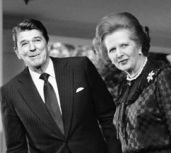
Allister closes with some speculation about possible alternatives. If the Tories in the U.K. decide to reject so-called “free-market fundamentalism,” what’s their alternative?

He thinks the Labour Party will take control, and with very bad results. Jeremy Corbyn will not be in charge, but his economic policies will get enacted.

If Truss is destroyed, the alternative won’t even be social democracy: it will be Labour, the hard Left, the full gamut of punitive taxation, including of wealth and housing, and even more spending, culminating rapidly in economic oblivion.

That is an awful scenario. Basically turning the United Kingdom into Greece.

I want to take a different approach, though, and contemplate what will happen if the Conservative Party rejects the Truss approach and embraces big-government conservatism.

Here are some questions I’d like them to answer:

  • Do you want improved competitiveness and more economic growth?
  • If you want more growth, which of your spending increases will lead to those outcomes?
  • Which of your tax increases will lead to more competitiveness or more prosperity?
  • Will you reform benefit programs to avert built-in spending increases caused by an aging population?
  • If you won’t reform entitlements, which taxes will you increase to keep debt under control?
  • If you don’t plan major tax increases, do you think the economy can absorb endless debt?

I’m asking these questions for two reasons. First, there are no good answers and I’d like to shame big-government Tories into doing the right thing.

Second, these questions are also very relevant in the United States. Even since the Reagan years, opponents of libertarian economic policies have flitted from one trendy idea to another (national conservatism, compassionate conservatism, kinder-and-gentler conservatismcommon-good capitalism, reform conservatism, etc).

To be fair, they usually don’t try to claim their dirigiste policies will produce higher living standards. Instead, they blindly assert that it will be easier to win elections if Republicans abandon Reaganism.

So I’ll close by observing that Ronald Reagan won two landslide elections and his legacy was strong enough that voters then elected another Republican (the same can’t be said for big-government GOPers like Nixon, Bush, Bush, or Trump).

Switching back to the United Kingdom, Margaret Thatcher repeatedly won election and her legacy was strong enough that voters then elected another Conservative.

The bottom line is that good policy can lead to good political outcomes, whereas bad policy generally leads to bad political outcomes.

P.S. To be sure, there were times when Reagan’s poll numbers were very bad. And the same is true for Thatcher. But because they pursued good policies, economic growth returned and they reaped political benefits. Sadly, it appears that Truss won’t have a chance to adopt good policy, so we will never know if she also would have benefited from a similar economic renaissance.

Tax Cartels Mean Ever-Higher Tax Rates

When President Biden proposed a “global minimum tax” for businesses, I immediately warned that would lead to ever-increasing tax rates.

Ross Kaminsky of KHOW and I discussed how this is already happening.

I hate being right, but it’s always safe to predict that politicians and bureaucrats will embrace policies that give more power to government.

Especially when they are very anxious to stifle tax competition.

For decades, people in government have been upset that the tax cuts implemented by Ronald Reagan and Margaret Thatchertriggered a four-decade trend of lower tax rates and pro-growth tax reform.

That’s the reason Biden and his Treasury Secretary proposed a 15 percent minimum tax rate for businesses.

And it’s the reason they now want the rate to be even higher.

Though even I’m surprised that they’re already pushing for that outcome when the original pact hasn’t even been approved or implemented.

Here are some passages from a report by Reuters.

Treasury Secretary Janet Yellen will press G20 counterparts this week for a global minimum corporate tax rate above the 15% floor agreed by 130 countries last week…the global minimum tax rate…is tied to the outcome of legislation to raise the U.S. minimum tax rate, a Treasury official said.The Biden administration has proposed doubling the U.S. minimum tax on corporations overseas intangible income to 21% along with a new companion “enforcement” tax that would deny deductions to companies for tax payments to countries that fail to adopt the new global minimum rate. The officials said several countries were pushing for a rate above 15%, along with the United States.

Other kleptocratic governments naturally want the same thing.

A G7 proposal for a global minimum tax rate of 15% is too low and a rate of at least 21% is needed, Argentina’s finance minister said on Monday, leading a push by some developing countries… “The 15% rate is way too low,” Argentine Finance Minister Martin Guzman told an online panel hosted by the Independent Commission for the Reform of International Corporate Taxation. …”The minimum rate being proposed would not do much to countries in Africa…,” Mathew Gbonjubola, Nigeria’s tax policy director, told the same conference.

Needless to say, I’m not surprised that Argentina is on the wrong side.

And supporters of class warfare also are agitating for a higher minimum rate. Here are some excerpts from a column in the New York Times by Gabriel Zucman and Gus Wezerek.

In the decades after World War II, close to 50 percent of American companies’ earnings went to state and federal taxes. …it was a golden period. …President Biden should be applauded for trying to end the race to the bottom on corporate tax rates. But even if Congress approves the 15 percent global minimum corporate tax, it won’t be enough. …the Biden administration to give working families a real leg up, it should push Congress to enact a 25 percent minimum tax, which would bring in about $200 billion in additional revenue each year. …With a 25 percent minimum corporate tax, the Biden administration would begin to reverse decades of growing inequality. And it would encourage other countries to do the same, replacing a race to the bottom with a sprint to the top.
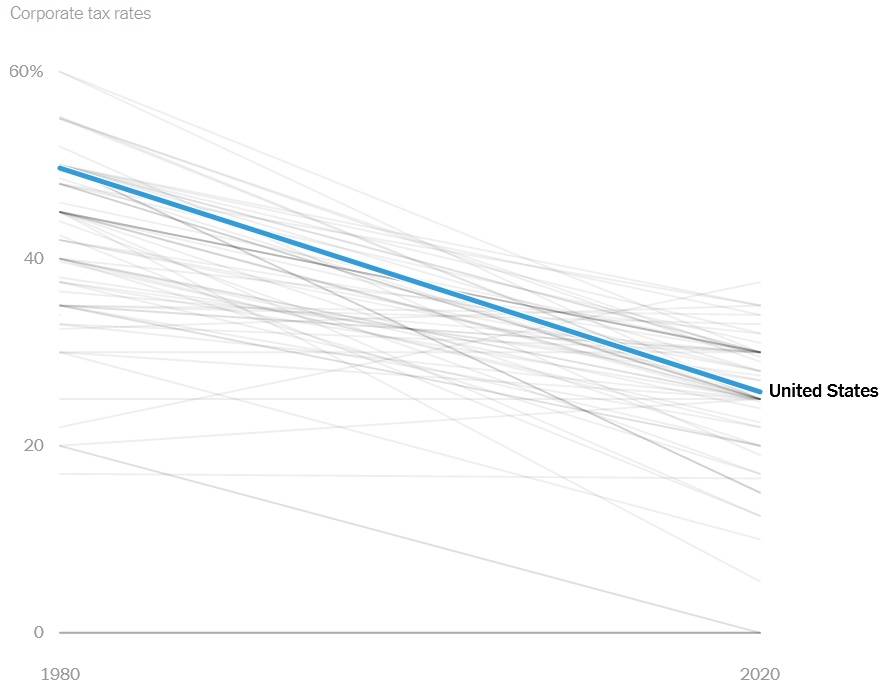
I can’t resist making two observations about this ideological screed.

  1. Even the IMF and OECD agree that the so-called race to the bottom has not led to a decline in corporate tax revenues, even when measured as a share of economic output.
  2. Since companies legally avoid rather than illegally evade taxes, the headline of the column is utterly dishonest – but it’s what we’ve learned to expect from the New York Times.

The only good thing about the Zucman-Wezerek column is that it includes this chart showing how corporate tax rates have dramatically declined since 1980.

P.S. For those interested, the horizontal line at the bottom is for Bermuda, though other jurisdictions (such as Monaco and the Cayman Islands) also deserve credit for having no corporate income taxes.

P.P.S. If you want to know why high corporate tax rates are misguided, click here. And if you want to know why Biden’s plan to raise the U.S. corporate tax rate is misguided, click here. Or here. Or here.

P.P.P.S. And if you want more information about why Biden’s global tax cartel is bad, click here, here, and here.

I enjoyed this article below because it demonstrates that the Laffer Curve has been working for almost 100 years now when it is put to the test in the USA. I actually got to hear Arthur Laffer speak in person in 1981 and he told us in advance what was going to happen the 1980’s and it all came about as he said it would when Ronald Reagan’s tax cuts took place. I wish we would lower taxes now instead of looking for more revenue through raised taxes. We have to grow the economy:

What Mitt Romney Said Last Night About Tax Cuts And The Deficit Was Absolutely Right. And What Obama Said Was Absolutely Wrong.

Mitt Romney repeatedly said last night that he would not allow tax cuts to add to the deficit.  He repeatedly said it because over and over again Obama blathered the liberal talking point that cutting taxes necessarily increased deficits.

Romney’s exact words: “I want to underline that — no tax cut that adds to the deficit.”

Meanwhile, Obama has promised to cut the deficit in half during his first four years – but instead gave America the highest deficits in the history of the entire human race.

I’ve written about this before.  Let’s replay what has happened every single time we’ve ever cut the income tax rate.

The fact of the matter is that we can go back to Calvin Coolidge who said very nearly THE EXACT SAME THING to his treasury secretary: he too would not allow any tax cuts that added to the debt.  Andrew Mellon – quite possibly the most brilliant economic mind of his day – did a great deal of research and determined what he believed was the best tax rate.  And the Coolidge administration DID cut income taxes and MASSIVELY increased revenues.  Coolidge and Mellon cut the income tax rate 67.12 percent (from 73 to 24 percent); and revenues not only did not go down, but they went UP by at least 42.86 percent (from $700 billion to over $1 billion).

That’s something called a documented fact.  But that wasn’t all that happened: another incredible thing was that the taxes and percentage of taxes paid actually went UP for the rich.  Because as they were allowed to keep more of the profits that they earned by investing in successful business, they significantly increased their investments and therefore paid more in taxes than they otherwise would have had they continued sheltering their money to protect themselves from the higher tax rates.  Liberals ignore reality, but it is simply true.  It is a fact.  It happened.

Then FDR came along and raised the tax rates again and the opposite happened: we collected less and less revenue while the burden of taxation fell increasingly on the poor and middle class again.  Which is exactly what Obama wants to do.

People don’t realize that John F. Kennedy, one of the greatest Democrat presidents, was a TAX CUTTER who believed the conservative economic philosophy that cutting tax rates would in fact increase tax revenues.  He too cut taxes, and he too increased tax revenues.

So we get to Ronald Reagan, who famously cut taxes.  And again, we find that Reagan cut that godawful liberal tax rate during an incredibly godawful liberal-caused economic recession, and he increased tax revenue by 20.71 percent (with revenues increasing from $956 billion to $1.154 trillion).  And again, the taxes were paid primarily by the rich:

“The share of the income tax burden borne by the top 10 percent of taxpayers increased from 48.0 percent in 1981 to 57.2 percent in 1988. Meanwhile, the share of income taxes paid by the bottom 50 percent of taxpayers dropped from 7.5 percent in 1981 to 5.7 percent in 1988.”

So we get to George Bush and the Bush tax cuts that liberals and in particular Obama have just demonized up one side and demagogued down the other.  And I can simply quote the New York Times AT the time:

Sharp Rise in Tax Revenue to Pare U.S. Deficit By EDMUND L. ANDREWS Published: July 13, 2005

WASHINGTON, July 12 – For the first time since President Bush took office, an unexpected leap in tax revenue is about to shrink the federal budget deficit this year, by nearly $100 billion.

A Jump in Corporate Payments On Wednesday, White House officials plan to announce that the deficit for the 2005 fiscal year, which ends in September, will be far smaller than the $427 billion they estimated in February.

Mr. Bush plans to hail the improvement at a cabinet meeting and to cite it as validation of his argument that tax cuts would stimulate the economy and ultimately help pay for themselves.

Based on revenue and spending data through June, the budget deficit for the first nine months of the fiscal year was $251 billion, $76 billion lower than the $327 billion gap recorded at the corresponding point a year earlier.

The Congressional Budget Office estimated last week that the deficit for the full fiscal year, which reached $412 billion in 2004, could be “significantly less than $350 billion, perhaps below $325 billion.”

The big surprise has been in tax revenue, which is running nearly 15 percent higher than in 2004. Corporate tax revenue has soared about 40 percent, after languishing for four years, and individual tax revenue is up as well
.

And of course the New York Times, as reliable liberals, use the adjective whenever something good happens under conservative policies and whenever something bad happens under liberal policies: ”unexpected.”   But it WASN’T ”unexpected.”  It was EXACTLY what Republicans had said would happen and in fact it was exactly what HAD IN FACT HAPPENED every single time we’ve EVER cut income tax rates.

The truth is that conservative tax policy has a perfect track record: every single time it has ever been tried, we have INCREASED tax revenues while not only exploding economic activity and creating more jobs, but encouraging the wealthy to pay more in taxes as well.  And liberals simply dishonestly refuse to acknowledge documented history.

Meanwhile, liberals also have a perfect record … of FAILUREThey keep raising taxes and keep not understanding why they don’t get the revenues they predicted.

The following is a section from my article, “Tax Cuts INCREASE Revenues; They Have ALWAYS Increased Revenues“, where I document every single thing I said above:

The Falsehood That Tax Cuts Increase The Deficit

Now let’s take a look at the utterly fallacious view that tax cuts in general create higher deficits.

Let’s take a trip back in time, starting with the 1920s.  From Burton Folsom’s book, New Deal or Raw Deal?:

In 1921, President Harding asked the sixty-five-year-old [Andrew] Mellon to be secretary of the treasury; the national debt [resulting from WWI] had surpassed $20 billion and unemployment had reached 11.7 percent, one of the highest rates in U.S. history.  Harding invited Mellon to tinker with tax rates to encourage investment without incurring more debt. Mellon studied the problem carefully; his solution was what is today called “supply side economics,” the idea of cutting taxes to stimulate investment.  High income tax rates, Mellon argued, “inevitably put pressure upon the taxpayer to withdraw this capital from productive business and invest it in tax-exempt securities. . . . The result is that the sources of taxation are drying up, wealth is failing to carry its share of the tax burden; and capital is being diverted into channels which yield neither revenue to the Government nor profit to the people” (page 128).

Mellon wrote, “It seems difficult for some to understand that high rates of taxation do not necessarily mean large revenue to the Government, and that more revenue may often be obtained by lower taxes.”  And he compared the government setting tax rates on incomes to a businessman setting prices on products: “If a price is fixed too high, sales drop off and with them profits.”

And what happened?

“As secretary of the treasury, Mellon promoted, and Harding and Coolidge backed, a plan that eventually cut taxes on large incomes from 73 to 24 percent and on smaller incomes from 4 to 1/2 of 1 percent.  These tax cuts helped produce an outpouring of economic development – from air conditioning to refrigerators to zippers, Scotch tape to radios and talking movies.  Investors took more risks when they were allowed to keep more of their gains.  President Coolidge, during his six years in office, averaged only 3.3 percent unemployment and 1 percent inflation – the lowest misery index of any president in the twentieth century.

Furthermore, Mellon was also vindicated in his astonishing predictions that cutting taxes across the board would generate more revenue.  In the early 1920s, when the highest tax rate was 73 percent, the total income tax revenue to the U.S. government was a little over $700 million.  In 1928 and 1929, when the top tax rate was slashed to 25 and 24 percent, the total revenue topped the $1 billion mark.  Also remarkable, as Table 3 indicates, is that the burden of paying these taxes fell increasingly upon the wealthy” (page 129-130).

Now, that is incredible upon its face, but it becomes even more incredible when contrasted with FDR’s antibusiness and confiscatory tax policies, which both dramatically shrunk in terms of actual income tax revenues (from $1.096 billion in 1929 to $527 million in 1935), and dramatically shifted the tax burden to the backs of the poor by imposing huge new excise taxes (from $540 million in 1929 to $1.364 billion in 1935).  See Table 1 on page 125 of New Deal or Raw Deal for that information.

FDR both collected far less taxes from the rich, while imposing a far more onerous tax burden upon the poor.

It is simply a matter of empirical fact that tax cuts create increased revenue, and that those [Democrats] who have refused to pay attention to that fact have ended up reducing government revenues even as they increased the burdens on the poorest whom they falsely claim to help.

Let’s move on to John F. Kennedy, one of the most popular Democrat presidents ever.  Few realize that he was also a supply-side tax cutter.

Kennedy said:

“It is a paradoxical truth that tax rates are too high and tax revenues are too low and the soundest way to raise the revenues in the long run is to cut the rates now … Cutting taxes now is not to incur a budget deficit, but to achieve the more prosperous, expanding economy which can bring a budget surplus.”

– John F. Kennedy, Nov. 20, 1962, president’s news conference


“Lower rates of taxation will stimulate economic activity and so raise the levels of personal and corporate income as to yield within a few years an increased – not a reduced – flow of revenues to the federal government.”

– John F. Kennedy, Jan. 17, 1963, annual budget message to the Congress, fiscal year 1964

“In today’s economy, fiscal prudence and responsibility call for tax reduction even if it temporarily enlarges the federal deficit – why reducing taxes is the best way open to us to increase revenues.”

– John F. Kennedy, Jan. 21, 1963, annual message to the Congress: “The Economic Report Of The President”


“It is no contradiction – the most important single thing we can do to stimulate investment in today’s economy is to raise consumption by major reduction of individual income tax rates.”

– John F. Kennedy, Jan. 21, 1963, annual message to the Congress: “The Economic Report Of The President”


“Our tax system still siphons out of the private economy too large a share of personal and business purchasing power and reduces the incentive for risk, investment and effort – thereby aborting our recoveries and stifling our national growth rate.”

– John F. Kennedy, Jan. 24, 1963, message to Congress on tax reduction and reform, House Doc. 43, 88th Congress, 1st Session.


“A tax cut means higher family income and higher business profits and a balanced federal budget. Every taxpayer and his family will have more money left over after taxes for a new car, a new home, new conveniences, education and investment. Every businessman can keep a higher percentage of his profits in his cash register or put it to work expanding or improving his business, and as the national income grows, the federal government will ultimately end up with more revenues.”

– John F. Kennedy, Sept. 18, 1963, radio and television address to the nation on tax-reduction bill

Which is to say that modern Democrats are essentially calling one of their greatest presidents a liar when they demonize tax cuts as a means of increasing government revenues.

So let’s move on to Ronald Reagan.  Reagan had two major tax cutting policies implemented: the Economic Recovery Tax Act (ERTA) of 1981, which was retroactive to 1981, and the Tax Reform Act of 1986.

Did Reagan’s tax cuts decrease federal revenues?  Hardly:

We find that 8 of the following 10 years there was a surplus of revenue from 1980, prior to the Reagan tax cuts.  And, following the Tax Reform Act of 1986, there was a MASSIVE INCREASEof revenue.

So Reagan’s tax cuts increased revenue.  But who paid the increased tax revenue?  The poor?  Opponents of the Reagan tax cuts argued that his policy was a giveaway to the rich (ever heard that one before?) because their tax payments would fall.  But that was exactly wrong.  In reality:

“The share of the income tax burden borne by the top 10 percent of taxpayers increased from 48.0 percent in 1981 to 57.2 percent in 1988. Meanwhile, the share of income taxes paid by the bottom 50 percent of taxpayers dropped from 7.5 percent in 1981 to 5.7 percent in 1988.”

So Ronald Reagan a) collected more total revenue, b) collected more revenue from the rich, while c) reducing revenue collected by the bottom half of taxpayers, and d) generated an economic powerhouse that lasted – with only minor hiccups – for nearly three decades.  Pretty good achievement considering that his predecessor was forced to describe his own economy as a “malaise,” suffering due to a “crisis of confidence.” Pretty good considering that President Jimmy Carter responded to a reporter’s question as to what he would do about the problem of inflation by answering, “It would be misleading for me to tell any of you that there is a solution to it.”

Reagan whipped inflation.  Just as he whipped that malaise and that crisis of confidence.

________

The Laffer Curve, Part III: Dynamic Scoring