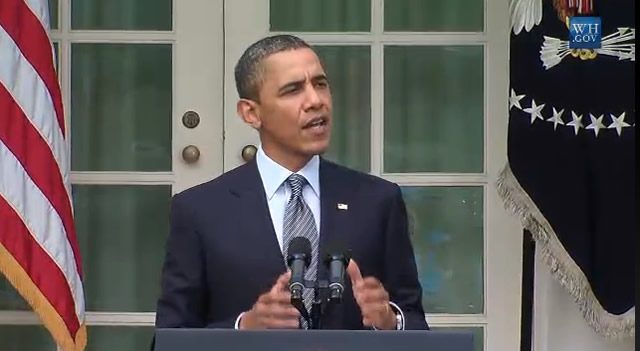
As Americans across the country gas up their cars for their Memorial Day getaways this weekend, their wallets will take a bigger-than-usual hit. That’s because gas prices are up $1.06 from last year according to a study by AAA. In fact, prices have more than doubled since President Obama took office. And while the media has been slow to demand answers of the President, he has been busy trying to deflect attention away from his incoherent energy policy with a number of gas price-related myths.
Our latest video takes several of these myths head on and puts them to rest. From overstating the impact of green energy to downplaying the devastating impact of his drilling moratorium, the President should spend less time trying to deflect criticism and more time working to ease pain at the pump.
If you’ve heard other myths, let us know in the comments. In the meantime, please help us get the word out about our latest video by sharing it with friends and family.
Bono has the wrong answer for the poor of the world (Part 3)
Bono praises the election of President Obama!!!
I love Milton Friedman’s film series “Free to Choose.” In that film series over and over it is shown that the ability to move from poor to rich is more abundant here than any other country in the world. This article below reminded me of that that.
_________________________
This is a series of posts that show that Bono (who I have been listening to since 1983) has the wrong solution to the problem of worldwide hunger.
Politico reports here that a group of celebrities, including former Baptist pastor Mike Huckabee, shouted a four-letter obscenity for cameras in a promotion to speak up against famine. Bleeps and labels to cover mouths obscure the actual word.
In the PSA, our celebrity supporters shout out one four letter word that the majority of viewers will find offensive, in order to shine a light on something only a minority seems to be offended by. I know the tone is a bit rough for ONE — that’s no accident. If it feels like a punch in the face, then good — mission accomplished. It’s time for a wakeup call and here’s the alarm. Love it? Great. Hate it? OK. Just don’t ignore it.
I’m not sure I believe Huck did precisely as described.
_____________
One of the key parts of the solution is economic freedom, economic growth and free trade. It is not the bailout, welfare approach of President Obama who Bono supported in 2008.
Daniel Griswold is director of the Center for Trade Policy Studies at the Cato Institute.
Added to cato.org on October 30, 2004
This article appeared on cato.org on October 30, 2004.
I’m happy to talk about how to explain the benefits of free trade to the public. It took me until I was about 35 years old to figure out that that is my calling in life, explaining free trade, and doing it not just to the high and mighty in Washington, but to people around the country and hopefully around the world. I’ve spent two thirds of my adult life outside of Washington, D.C. Twelve of those years were in Colorado Springs, Colorado, as an editorial page editor, writing daily editorials for 100,000 different households in a community that’s very much a slice of Middle America.
How we explain the benefits of free trade is hugely important today. Trade and globalization are being debated on cable TV every night. The expansion of trade and foreign investment is determining the shape of our world. And it is controversial among the public if not in the economics profession. Surveys of economist show that a large majority free trade is the right policy. Study after study confirms what theory has long taught, that countries open to trade grow faster and achieve higher incomes than those that are closed.
The public does not share the view of the economics profession on trade. People have a general notion that trade is good for the country, but then they have all sorts of qualifications. Most people will accept trade as a general principle as long as we require minimum labor and environmental standards in poor countries and protect U.S. workers. So you see this gap between the economics profession and the public.
Daniel Griswold is director of the Center for Trade Policy Studies at the Cato Institute.
This gap persists despite 200 plus years of having “The Wealth of Nations” by Adam Smith. If you haven’t read “The Wealth of Nations,” I would highly recommend it, especially Book IV. Adam Smith’s writing is so lively and applicable to today. Then we have the French economist Frederic Bastiat. I’m not sure how anybody could explain free trade better than Bastiat. And yet, here we are, 150 years later, still debating and trying to explain free trade.
Trade Benefits for Producers
Another point is that companies and businesses are huge importers. Half of what we import to the United States each year is imported for businesses. They import raw materials, energy and lumber and cement and that sort of thing. They import intermediate components, parts, auto parts, computer parts, that go in for final assembly. And then of course they import re is capital machinery, machines that come in that make U.S. companies more competitive.
Here are some examples: A typical American computer has “Dell” or “Hewlett Packard” stamped on it, but most of it is made overseas. Maybe some of the most important parts are made in the United States, the brains of it, but the components, the hard drives, the flat panel display screens are made abroad. In fact, 60 percent of a typical American computer is made in the Far East. We are much better off because of that. We can afford computers in our homes, in our businesses. Our whole economy is more productive.
Consider steel. It was not one of President Bush’s finest moments when he imposed tariffs on steel in March of 2002. Yes, it probably kept one or two aging steel mills in business, but it raised the price of steel for a broad swath of U.S. industry–the automobile industry, the tool and die industry and other metal fabrication businesses, the construction industry. Those sectors use a lot of steel, and they paid a price for those tariffs.
One of the arguments the Cato Institute made that was quite effective in Congress in stopping steel protection was we pointed out that for every job in the steel industry, there are 40 jobs in the United States in industries that use steel as a component in its production. This was a perfectly legitimate free trade argument that also playing on this public desire to defend jobs. You want to protect jobs? There are more jobs in jeopardy from higher steel prices than are protected by higher steel prices.
Sugar is yet another example. Yes, sugar quotas cost costs U.S. consumers almost $2 billion a year, or $20 a year to a typical American household. But the quotas also cost jobs. Chicago used to be ringed by confectionery companies that would take sugar in as an important input and crank out Lifesavers and candy bars. In 2002 a Lifesaver factory in Holland, Michigan, announced it was moving to Canada because Canada allows sugar to be bought at the global price. We’re losing jobs because of sugar protection.
So again, you’re emphasizing the producer. You’re putting protectionists on the defensive. The sugar program is costing manufacturing jobs. The steel tariffs are costing manufacturing jobs.
When foreigners sell us something, they earn dollars, but then they have to do something with those dollars. They can’t pay their workers and suppliers back in Japan or China with dollars. They exchange the dollars they earn for their local currency, and then those dollars come back to the United States to buy our goods and services. They also come back to buy investment assets.
So what happens when we raise trade barriers? It’s harder for foreigners to earn those dollars to spend in our markets. So when you suppress imports into the United States through trade protection, you’re also going to see exports fall. You’re going to see foreign investment fall. And of course you invite retaliation, too. If we raise our trade barriers, other countries raise theirs. So import barriers put exports at risk. It’s a very important point to make.
Let me add a concluding word about production. We hear the charge that America is “de industrializing.” Here is where some simple facts can work so well. I just love to point out that, in the United States, we are manufacturing 50 percent more stuff than we were a decade ago. According to the Federal Reserve, manufacturing output in the United States is up 50 percent in the past ten year, double what it was in 1980, and triple what it was in the good old 1960s. We’re producing more stuff with fewer workers because they are so much more productive. Is that bad that our workers are more productive?
Trade and Jobs–The Real Story
This leads us to a third major battle ground–jobs. All right, you want to talk about jobs? Let’s talk about trade and jobs. Again, acknowledge the pain of workers laid off because of import competition, but we need to put those layoffs in the context of the tremendous job churn in a dynamic market economy. Our eye is always on the net jobs gained and jobs lost, but underneath that number are millions of jobs that are created and destroyed every year. This is the “creative destruction” Joseph Schumpeter talked about.
The U.S. Labor Department has actually tried to calculate total jobs lost and total jobs created, and what they found is that in a typical year, there are something like 30 million jobs in the U.S. economy that are eliminated, half of them permanently. Fifteen million jobs every year just disappear, never to come back again. The other 15 million are seasonal type jobs that disappear and then pop up again.
How many jobs do you think are lost from trade every year? It’s about 400,000. Those are jobs lost because of imports from China and other places that displacing U.S. production, from outsourcing, that sort of thing. To put that number in context, the U.S. economy employs 140 million workers. Of those, about 325,000 people every week are lining up for unemployment insurance. There is a story behind every one of them. So of the 15 million jobs that disappear permanently each year, trade and outsourcing accounts for 2 percent–2 percent–of the total jobs displaced in the U.S. economy.
What eliminates the other 98 percent? Changing consumer tastes, new technology, domestic competition. Let’s put some flesh and blood on that fact. Kodak, the good old camera company, has laid off 25, 000 workers in the past two years. Because of outsourcing? Because of trade? No. Because of those nifty digital cameras that I bet just about everybody in this room owns. You contributed to putting a Kodak worker out of work with that digital camera. Would we seriously think of banning digital cameras to save those jobs? It would be ludicrous. And yet, that’s what we’re talking about when we consider restricting outsourcing or raising tariffs. When we talk about people who have lost their jobs from trade, we should talk about everybody who has lost their jobs for whatever reason. There is nothing unique about trade when it comes to jobs.
Free Trade and the World’s Poor
Another area of positive terrain for us that we shouldn’t give up is the poor and the world’s children. The highest trade barriers remaining in the United States are aimed at products that are disproportionately consumed by poor people at home and produced by poor people abroad. Our highest trade barriers are on farm products, on textiles and apparel and shoes. And not just all shoes. We have our highest trade barriers on low end shoes, the kind you would buy in a Pay Less Shoe Store. But not on the kind you would buy in a Gucci store.
A moderate Democratic think tank in Washington called the Progressive Policy Institute issued a study in 2004 that documented that U.S. tariffs are much higher on low-end goods than high-end goods. For example, the tariff on imported silk underwear into the United States is virtually zero, but the tariff on imported synthetic or low grade cotton is higher. So if you wear silk underwear, you get a low tariff. If you wear the regular kind of underwear like the rest of us, you pay a high tariff. This study calculated that a single mother with two children earning $20,000 a year pays an effective tariff on the goods she consumes that’s three times higher than what a single executive earning $100,000 a year would pay.
Our existing trade barriers are biased against the poor at home. A trade representative in Washington likes to say that our goal should “to make sure that every discount store in America is a duty free shop for working families.”
How about the world’s poor? Here’s a headline you probably didn’t see in your local newspaper:” Global Poverty Down by Half Since 1981.” The Share of the world’s population living on dollar a day or less has dropped from 40 percent then to 20 percent today, and that share is expected to continue to fall. And by the way, virtually all that progress has happened in poor countries that have progressively globalized. Places like Sub Saharan Africa, there is very little progress. In fact, the number of poor is rising in those places.
The World Bank could not find a single example of a poor country that had kept its markets closed and chased away foreign investment, and at the same time made progress against poverty. In other words, all the poor countries that followed our example, most of them have made progress against poverty. Those that follow the teachings of the anti globalization people have made no progress.
The evidence on trade and poverty became so overwhelming that Oxfam International issue a study in 2002 that, while critical of a lot of things in the global economy, came down firmly on the side of trade being a friend of the poor. And they pointed out that by getting rid of these rich-country trade barriers, we could deliver twice as much income to poor countries as all the aid we give them.
More trade, more democracy
Let me end up with a few thoughts about war and peace and democracy, another area where we’re on solid terrain and where this does resonate with people more than the consumer issues. And this is especially effective in the post 9/11 world. September 11th made my job of promoting immigration more difficult. It made the job of promoting trade liberalization a little bit easier.
Bob Zoellick, the former U.S. Trade Representative, was fast out of the block. He had an op-ed in the Post about a month after September 11th, saying this is one more reason to progressively pursue global trade, because trade promotes higher living standards, human rights, democracy, and more cooperation among nations. And he was on solid ground. That was not an opportunistic argument; it was a factual argument.
I think this especially works with older audiences, people who can remember, or at least their parents can remember, the Great Depression. We had the Smoot Hawley Tariff Act in 1930. It was a disaster by all measures. Let’s remind people of that. It’s a good history lesson. Granted, Smoot Hawley did not cause the Great Depression, but it certainly didn’t end it. It didn’t create jobs. It deepened and prolonged the Great Depression. It launched a downward global spiral in trade, by encouraging trade barriers abroad that exacerbated international tensions and helped lay the groundwork for World War II.
One of the many good decisions made during and after World War II was, in the United States, to turn away from protectionism towards freer trade. We launched the General Agreement on Tariffs and Trade. We encouraged the Europeans to trade more with each other through the common market. And you have to say, that’s been a spectacular success in terms of promoting the peace in Western Europe. And this was a bipartisan policy supported by JFK, Eisenhower, and Truman.
The world today is more democratic and politically free because of trade and globalization. A 2004 Cato study documented that countries that are open to trade are more likely to be democracies and respect human rights. We can point to examples of South Korea, Taiwan, Chile, Mexico, Ghana–all are countries that embarked on economic liberalization, which laid the groundwork for political liberalization.
Free trade begets a growing middle class, which often forms the backbone of political pluralism. Freedom House, a New York-based think tank, has documented that a higher share of the world’s people are living under democracies today, where they enjoy political and civil liberties, than at any time in human history. That’s another headline you probably didn’t see in the New York Times recently, but it’s true.
More peace on Earth
Finally, free trade has spread peace around the world. By encouraging democracy, democracies are less likely to fight wars with each other. In fact, they virtually never do. But also globalization has given governments one more reason not to go to war because, among its evils, it disrupts trade, which raises the cost of war. Trade doesn’t prevent war, but it gives leaders one more reason to stop and think before they go to war.
Here’s another headline I bet you didn’t see in one of the major papers. This was actually an Associated Press headline from April 2004: “War declining worldwide, studies say.” And sure enough, according to a Swedish think tank, the number of people who die in international wars annually is down to about 20,000, the lowest figure in the postwar era. That compares to the 700,000 people who died in 1951. According to the World Bank, civil wars are declining in those less developed regions that are globalizing. All this dies into the war on terrorism, of course. The Middle East is one of the least globalized regions in the world. Their share of global trade and investment has been declining significantly. Outside of oil, they offer virtually nothing to the rest of the world.
Mohammed Atta, the ringleader of the September 11 attacks, was not poor. He had a master’s degree can came from a well-to-do Egyptian family. He just didn’t have a future. He came from a stagnant country, socially, politically, and economically. We need to encourage, among other things, for countries in the Middle East to trade more with each other.
We do not help the situation with cotton subsidies in the United States. They deliver subsidies to 25,000 U.S. cotton farmers, with an average per capita wealth of $800,000. That drives down the global price of cotton. Where are the cotton producers in poor countries? Well, among them are Sub Saharan African countries like Mali. Mali is one of the few Muslim majority countries in the world that is free, that has a democracy, where people enjoy full civil and political liberties. How do we encourage that sort of political and economic reform in the Muslim world? We drive down the global price of their chief commodity export through our cotton program, extracting $250 million a year from that part of the world, where that is no small change.
Free trade makes us freer as individuals. It makes us better off as consumers. It makes us more productive as workers and producers, lifting hundreds of millions of people out of poverty around the world and spreading democracy, human rights and peace around the world. That is the story we must tell.
U2 performs Pride: In the name of Love, a song about Martin Luther King, at President-elect Barack Obama’s Inaugural concert on the Lincoln Memorial in Washington D.C. Bono told the estimated 600,000 there that on Tuesday “that dream comes to pass.” Jan. 18, 2009
I loved reading this article below. (Take a look at the link to other posts I have done on Steve Jobs.) David Boaz makes some great observations:
How much value is the Post Office creating this year? Or Amtrak? Or Solyndra? And if you point out that the Post Office does create value for its customers even though it loses money every year, I would ask, how much more value might its competitors create, if it allowed competition?
Steve Jobs created a lot of new jobs, but President Obama’s stimulus did not stimulus much of anything but waste in government. Take a look at the final paragraph:
Instead of another bag of taxpayers’ money for state and local governments and politically favored businesses, a real jobs program would encourage the next Steve Jobs to create value. What would that involve? Keep taxes on investment and creativity low. Reduce the national debt and its threat of huge tax hikes to come. Ease the burdens of regulation, especially regulations that make it difficult to open a business, hire and keep the best employees, and develop new ideas. Open the huge, stagnant postal and schooling businesses to competition, innovation, and entrepreneurship. Repeal some of the licensing laws that now afflict 1,100 occupations. Renew progress toward free trade. Make it smart for businesses to invest their time, money, and brainpower in productive activity, not lobbying.
The all-too-early death of Steve Jobs was reported on the day that President Obama made another defense of his so-called jobs bill. Which one actually benefited (or would benefit) Americans and the American economy? Lots of people have talked about the way Steve Jobs changed technology, changed business, changed the world. And I trust there’ll be no more churlish complaints about his alleged lack of philanthropy. As Dan Pallotta definitively pointed out,
What a loss to humanity it would have been if Jobs had dedicated the last 25 years of his life to figuring out how to give his billions away, instead of doing what he does best…. [T]he world has no greater philanthropist than Steve Jobs. If ever a man contributed to humanity, here he is.
Two years ago Portfolio magazine did a great graphic on “The Steve Jobs Economy,” trying to assess just how much value he himself had created for the economy. The conclusion: Jobs’s personal wealth at the time was estimated at $5.7 billion. But he was generating $30 billion a year in revenue for Apple, its partners, and its competitors (who were spurred to get better). Here’s the analysis (sorry for the imperfect tear sheet):
Click image to enlarge. And for text but not graphics at Portfolio, click here.
According to Portfolio and the experts it consulted, Jobs was producing $30 billion a year in value for various companies. And of course that means that consumers believed they were getting at least that much value themselves, or they wouldn’t buy the products. That’s a wealth creator. And that number pales in comparison to this one: After returning to Apple in 1997, Jobs took the total value of the company from about $2 billion to $350 billion.
How much value is the Post Office creating this year? Or Amtrak? Or Solyndra? And if you point out that the Post Office does create value for its customers even though it loses money every year, I would ask, how much more value might its competitors create, if it allowed competition?
Instead of another bag of taxpayers’ money for state and local governments and politically favored businesses, a real jobs program would encourage the next Steve Jobs to create value. What would that involve? Keep taxes on investment and creativity low. Reduce the national debt and its threat of huge tax hikes to come. Ease the burdens of regulation, especially regulations that make it difficult to open a business, hire and keep the best employees, and develop new ideas. Open the huge, stagnant postal and schooling businesses to competition, innovation, and entrepreneurship. Repeal some of the licensing laws that now afflict 1,100 occupations. Renew progress toward free trade. Make it smart for businesses to invest their time, money, and brainpower in productive activity, not lobbying.
I loved reading this article below. (Take a look at the link to other posts I have done on Steve Jobs.) David Boaz makes some great observations: How much value is the Post Office creating this year? Or Amtrak? Or Solyndra? And if you point out that the Post Office does create value for its […]
Steve Jobs’ 2005 Stanford Commencement Address Uploaded by StanfordUniversity on Mar 7, 2008 Drawing from some of the most pivotal points in his life, Steve Jobs, chief executive officer and co-founder of Apple Computer and of Pixar Animation Studios, urged graduates to pursue their dreams and see the opportunities in life’s setbacks — including death […]
Things you may not know about Steve Jobs: Steve Jobs leans against his wife, Laurene Powell Jobs (Lea Suzuki/San Francisco Chronicle/Corbis) For all of his years in the spotlight at the helm of Apple, Steve Jobs in many ways remains an inscrutable figure — even in his death. Fiercely private, Jobs concealed most specifics about […]
Steve Jobs passed away on October 5, 2011. I personally am very grateful to him for helping the world so much with his ideas and I have written about tha before. Dan Mitchell of the Cato Institute noted: He’s built a $360 billion company. That presumably means at least $352 billion of wealth in the […]
Did Steve Jobs help people even though he did not give away a lot of money? (I just finished a post concerning Steve’s religious beliefs and a post about 8 things you may not know about Steve Jobs) Uploaded by UM0kusha0kusha on Sep 16, 2010 clip from The First Round Up *1934* ~~enjoy!! ______________________________________________ In the short film […]
Heritage’s experts watched President Barack Obama’s debt reduction and tax increase proposal. Here are their immediate reactions:
_______________
The President’s Debt Reduction Proposals: The Wrong Diagnosis
The President’s “debt reduction” proposals released today are a fine statement of liberal ideology, but a poor attempt at fiscal policy. His so-called “balanced approach” – using a mix of spending reductions and tax increases – is the wrong formulation to start with. It merely perpetuates a misunderstanding of the fundamental problem: deficits and debt are symptoms; the underlying illness is excessive and uncontrolled spending.
The federal government today is claiming roughly one-fourth of total economic output – about 25 percent of gross domestic product (GDP) – a post-World War II record. This is dead weight on the economy, because every dollar of spending gets paid for – through taxes, borrowing, fees, offsetting receipts, etc. – and hence is no longer available to growth producing activities in the economy. That is why spending is considered one of the best measures of the size and scope of government. As Professor Allen Schick has written, fundamentally government is what it spends.
But even more problematic than the level of spending is its trajectory – especially in federal entitlements. According to the latest figures by the Congressional Budget Office, entitlement spending is projected to rise at a rate of about 5.3 percent per year. That is faster than projected inflation, and faster than nominal GDP. So even if the gap between spending and revenue were closed, entitlements would immediately begin outrunning taxes again, resurrecting deficits.
As is well known, the problem is most acute in the Big Three entitlements: Social Security is growing at a rate of 5.8 percent per year, Medicare at 6.3 percent, and Medicaid at 9 percent. Clearly, these growth rates cannot be lowered by trimming around the edges of the programs, cutting wasteful spending and overpayments, and squeezing medical providers. It requires fundamental reforms that alter the incentives toward overutilization and inefficient delivery of medical services. But these are exactly the kinds of things the President has ruled out. He expressly rejects adjusting benefits or eligibility. He claims his proposal will save $248 billion in Medicare, of which 90 percent would come from reducing overpayments, not from restructuring the program. This is not a serious proposal for addressing the government’s spending and debt problems.
Similarly, he claims savings “that build on the Affordable Care Act” almost entirely from vague improvements in efficiency: “by reducing wasteful spending and erroneous payments, and supporting reforms that boost the quality of care.” Nevertheless, it is curious that his vaunted health care program – which was advertised as reducing deficits – is so inefficient that it is already projected to generate $320 billion in overspending over the next 10 years.
In addition to all these failings, the President takes credit for a whopping $2.3 trillion in spending reductions that either are already assumed, or are based on manufactured spending projections.
First he claims $1.2 trillion in savings (including debt service reduction) from the spending caps in the Budget Control Act. Those are not new savings.
Even more exotic is his $1.1 trillion in savings from drawing down military activities in Iraq and Afghanistan. The President’s budget proposed a total of just $576.5 billion over 10 years for Overseas Contingency Operations (OCO). This amount consists of a $126.5-billion request for fiscal year 2012, and then placeholders of $50 billion a year through 2021. In other words, the 10-year total is largely illusory. Even if it were real, however, it would be impossible to save $1.1 trillion in war spending when the President proposed to spend only about half that amount. It appears the savings are measured against a Congressional Budget Office (CBO) baseline hat assumed the peak, 2010 “surge” level for war spending, and then inflated it for subsequent years. This was an unreal figure to begin with – and one CBO removed in estimating discretionary savings in the Budget Control Act – and yet the President assumes the savings. This is emblematic of just how disingenuous his debt reduction plan truly is.
This is not a serious effort to address the government’s very real spending and deficit crisis – which has worsened significantly in the past two-and-a-half years. It is, to repeat, ideology, not policy.
Patrick Louis Knudsen Grover M. Hermann Senior Fellow in Federal Budgetary Affairs
Tax Hikes Not the Answer, but Obama Wants Them to Be
President Obama seems intent on not solving our budget and debt crisis. Indeed, he seems almost fixated on making it worse. His latest plan would immediately ramp up spending to “jolt” job creation in ways that have proven to fail. Once again, Obama is sticking to his strategy of ramping up spending thus “locking in” higher levels that make the job of budget cutters more difficult. Somehow, he maintains, this is necessary and right for America, making it seem that this spending is inevitable and inexorable. Thus, the only thing we can do is to hike taxes.
Riiiiiiight.
Tax hike are not the answer. Plain and simple. Unless we fundamentally tackle entitlement programs taxes will have to be perpetually raised to keep pace with dramatic growth in spending as Medicare, Medicaid and – yes Mr. President — Social Security grow like a giant tsunami blowing toxic red ink all over the budget and the economy.
Yes, the President did propose spending cuts. Teeeeensie tiny ones. $250 billion to Medicare and $72 billion to Medicaid likely over ten years. But bear in mind these are two of the biggest and fastest growing programs in the budget. Medicare this year alone is over $500 billion and over the next ten years will likely reach $7.5 trillion. But here, the devil is in the details. The small changes he may propose that would affect retirees will be backloaded – until after any possible second term. And he abandons future retirees by taking any changes to Social Security off the table. He’s right that spending cuts alone aren’t the solution – the policies must be right too.
Obama is demanding a “balanced” approach as though somehow hiking taxes is both fair and necessary. But this notion that he is pushing – half tax hikes and half spending cuts – is beyond the class warfare message it sends. It is a tactic. A tactic to stall the real reforms that our leaders in Washington must undertake now in order to avert a fiscal, economic and moral crisis.
The simple fact is that our budget and debt crisis can be solved without hiking taxes. Saving the American Dream, the Heritage Plan to Fix the Debt, Cut Spending and Restore Prosperity is a bold, innovative plan that does just that. It transforms our entitlement programs, rolls back wasteful and inefficient spending, protects the nation and overhauls our punitive, inefficient and uncompetitive tax code.
Federal Spending needs a complete do-over. We must return to our roots our founding fathers’ laid out – of a limited government. A low tax, low spending and fast growing nation. One where our kids can enjoy the same kind of opportunity as their parents and grandparents. One where our seniors know they can go into retirement with the economic security that they will be able to access quality health care that works for them, and a Social Security benefit that will protect them from poverty.
President Obama’s newest plan is simply his April speech cast under the lighting of the Super Committee with the election as a backdrop. The nation needs more.
Letting Tax Cuts Expire Will Not Balance the Budget
(This chart originally came out before the decision was made in Dec of 2010 to extend the tax cuts, but it is important now to look at this subject again since they will again expire at the end of 2012!!!)
Everyone wants to know more about the budget and here is some key information with a chart from the Heritage Foundation and a video from the Cato Institute about the Laffer Curve. In a year and half (end of 2012) the Bush Tax Cuts will expire. However, is that wise? Not if you understand the Laffer Curve.
Some argue for allowing the 2001 and 2003 tax cuts to expire, including subjecting the middle class to the alternative minimum tax in order to balance the budget. Under this scenario, unaffordable deficit spending would still continue, and economic growth and job creation would suffer.
The charts in this book are based primarily on data available as of March 2011 from the Office of Management and Budget (OMB) and the Congressional Budget Office (CBO). The charts using OMB data display the historical growth of the federal government to 2010 while the charts using CBO data display both historical and projected growth from as early as 1940 to 2084. Projections based on OMB data are taken from the White House Fiscal Year 2012 budget. The charts provide data on an annual basis except… Read More
Authors
Emily GoffResearch Assistant
Thomas A. Roe Institute for Economic Policy StudiesKathryn NixPolicy Analyst
Center for Health Policy StudiesJohn FlemingSenior Data Graphics Editor
The old political playbook will not work this time around.
Bragging on Obamacare and the first stimulus in Arkansas will not do much for Pryor in 2014. In this clip above Senator Pryor praises Mike, Vic and Marion. (All three of those men bailed out and Marion and Vic were replaced by Republicans and in 2012 an election will determine the replacement for Mike Ross.) Then he goes on to praise President Obama’s leadership.
___________________
Mark Pryor voted for the first stimulus and will not say what he thinks about the second stimulus. I have written about that before and offer the links below to those earlier posts. Also I wanted to pass along this fine article by Red Arkansas Blog.
Imagine the hearty laughter we had yesterday afternoon when we received an email from President Barack Obama’s campaign blaming House Republicans (and exhorting you to spam your local House Republican’s Twitter feed [if you are represented by a Democrat, you end up spamming Speaker John Boehner]) for not passing his second stimulus bill (thanks Debbie for letting us use that term!) while at roughly the same time, Mr. Obama’s chief cheerleader in the Senate, Sen. Harry Reid, blocked an effort to put Stimulus 2: Electric Boogaloo to an up-or-down vote.
Of course, Mr. Reid may have a good reason for relatively delaying the relative “right away” vote on Mr. Obama’s stimulus: he can’t herd his own caucus.
“It seems it’s a lot easier to block a Republican plan than to get the Democrats to rally around President Barack Obama. Even though Senate Majority Leader Harry Reid (D-Nev.) has repeatedly promised to call a vote on the president’s plan, he has slow-walked Obama’s jobs bill amid fractures within his caucus over how to pay for it.”
It also turns out that the Senate Democratic Whip Dick Durbin may also have a bit of a limp whip (isn’t there a pill for that?):
“Senate Majority Whip Dick Durbin (D-Ill.) said, at the moment, Democrats in Congress don’t have the votes to pass President Obama’s jobs bill”
Of course, this brings us to our own Sen. Mark Pryor who, to date, has not expressed a position on Stimulus II, despite voting for Stimulus I in 2009 that hasn’t really done a whole heckuva lot.
Given the Senate Democratic leadership being forced to delay an immediate vote while they scrounge the north side of the Capitol for votes, Mr. Pryor’s position on a bill that would increase taxes on our state’s natural gas industry (isn’t it good for jobs?) becomes very important.
Because of the importance of Mr. Pryor’s stance on Stimulus II, we are forced to wonder why our senior senator is skulking in the shadows and not speaking to it.
Is he worried about angering the increasingly liberal Democratic Party of Arkansas by not publicly supporting President Obama’s plan to raise taxes on job creators? After all, he sponsored that resolution to create National JC Penny White Sale Da… err… National Jobs Day.
PARTING SHOT
Will Sen. Pryor add an unemployed person to his office staff? How about the DPA? Who should we direct resumes to?
It is my view that if the economy keeps stinking that Republicans will have a field day in November of 2012. However, the same principle holds true that challengers to Democrats will be very successful in Democratic primaries. In Arkansas many have longed for another Clinton in the White House. Could it happen? It is my […]
Thanks to the Arkansas Times Blog and to Arkansas Media Watch for pointing out what Senator Pryor said in his recent visit to Rogers, Arkansas: Getting the economy on track will require deep cuts to the federal budget and a fairer tax system, Sen. Mark Pryor, D-Ark., said Tuesday. National defense, Social Security and Medicare […]
Dear Senator Pryor, Why not pass the Balanced Budget amendment? As you know that federal deficit is at all time high (1.6 trillion deficit with revenues of 2.2 trillion and spending at 3.8 trillion). On my blog http://www.HaltingArkansasLiberalswithTruth.com I took you at your word and sent you over 100 emails with specific spending cut ideas. However, […]
Dear Senator Pryor, Why not pass the Balanced Budget Amendment? As you know that federal deficit is at all time high (1.6 trillion deficit with revenues of 2.2 trillion and spending at 3.8 trillion). On my blog http://www.HaltingArkansasLiberalswithTruth.com I took you at your word and sent you over 100 emails with specific spending cut ideas. However, […]
Mark Pryor voted for the Debt Deal on August 2, 2011. He said, “We must continue making tough decisions to reduce our debt. ” However, I don’t think cutting 22 billion out of projected increases in a 3.6 trillion budget is “making the tough decision to reduce our debt.” Aug 01 2011 Statement by Senator Mark […]
Dear Senator Pryor, The President asked us to contact those representing us in Washington and that is exactly what I am doing today. Let make a few points. First, in the past few months I have responded to your request to provide SPECIFIC SPENDING CUT SUGGESTIONS to your office. I have done so over 100 […]
Mark Pryor’s support of the ultra liberal Obama is very clear in the video clip above. He voted for President Obama’s plan to nationalize healthcare and Obama’s stimulus plan that wasted almost a trillion dollars. Now he is following President Obama down the path of raising taxes during the debt ceiling debate. The Arkansas Times Blog […]
Still of Alan Alda, John Candy, Kevin Pollak, Rip Torn, Michael Moore and Rhea Perlman in Canadian Bacon
Michael Moore is a liberal movie director and his films have been pitiful. However, I did enjoy the movie “Canadian Bacon” which was very funny. Above is a clip from that movie.
On his Twitter feed Monday, the Oscar-winning film director also blamed the 2008 economic collapse on Standard & Poor’s — apparently because it and other credit-ratings agencies did not downgrade mortgage-based bonds, which encouraged the housing bubble and let it spread throughout the economy.
“Pres Obama, show some guts & arrest the CEO of Standard & Poors. These criminals brought down the economy in 2008& now they will do it again,” Mr. Moore wrote.
Standard & Poor’s, one of three key debt agencies, stripped the U.S. federal government of its AAA status Friday night and reduced it to AA+ for the first time in the nation’s history.
I don’t think that Standard and Poors did anything wrong and I think they would have been wrong if they did not act because of all the political pressure they were receiving from the Obama administration. My views are much closer to those below.
FreedomWorks President Matt Kibbe told The Daily Caller that liberals are using the slogan to distract Americans from the bad economic numbers he says President Obama’s policies have caused. “Well of course they want to say that,” Kibbe said of how the Obama administration is attempting to blame the tea party movement for the credit downgrade. “They don’t want to talk about how Obama’s fiscal policy led to this and 9.1 percent unemployment.”
Kibbe noted that Obama never provided his own debt plan and added that he believes it was Democrats and liberal Republicans who perpetuated the “out-of-control spending” that led Standard & Poor’s to downgrade the U.S. credit rating from AAA to AA+ with a negative outlook for the first time in the nation’s history.
Let Freedom Ring executive director Alex Cortes said the reason his organization launched TheObamaDowngrade.com is to point out how it’s largely the president’s fault for the credit downgrade. Like Kibbe, Cortes says both political parties are responsible for overspending through the years. But, he argued, Republicans are the “only ones” who have put “serious reforms” on the table in recent months.
_______________________________________
Terry Miller, director of the Center for International Trade and Economics at the Heritage Foundation, talks about Standard and Poor’s downgrade of the U.S.’s debt rating to AA+ from AAA and its impact on investment strategy. Miller speaks with Betty Liu and Erik Schatzker on Bloomberg Television’s “InsideTrack.” (Source: Bloomberg)
Politico reports here that a group of celebrities, including former Baptist pastor Mike Huckabee, shouted a four-letter obscenity for cameras in a promotion to speak up against famine. Bleeps and labels to cover mouths obscure the actual word.
In the PSA, our celebrity supporters shout out one four letter word that the majority of viewers will find offensive, in order to shine a light on something only a minority seems to be offended by. I know the tone is a bit rough for ONE — that’s no accident. If it feels like a punch in the face, then good — mission accomplished. It’s time for a wakeup call and here’s the alarm. Love it? Great. Hate it? OK. Just don’t ignore it.
I’m not sure I believe Huck did precisely as described.
_____________
One of the key parts of the solution is economic freedom. It is not the bailout, welfare approach of President Obama who Bono supported in 2008. Here is the second part of an excellent article from the Cato Institute:
Ending Mass Poverty
by Ian Vásquez
September 2001
Ian Vásquez is director of the Cato Institute’s Project on Global Economic Liberty. This essay originally appeared on the U.S. Department of State’s electronic journal, Economic Perspectives (September 2001).
Economic growth is the “only path to end mass poverty,” says economist Ian Vásquez, who argues that redistribution or traditional poverty reduction programs have done little to relieve poverty. Vásquez writes that the higher the degree of economic freedom — which consists of personal choice, protection of private property, and freedom of exchange — the greater the reduction in poverty. Extending the system of property rights protection to include the property of poor people would be one of the most important poverty reduction strategies a nation could take, he says.
The historical record is clear: the single, most effective way to reduce world poverty is economic growth. Western countries began discovering this around 1820 when they broke with the historical norm of low growth and initiated an era of dramatic advances in material well-being. Living standards tripled in Europe and quadrupled in the United States in that century, improving at an even faster pace in the next 100 years. Economic growth thus eliminated mass poverty in what is today considered the developed world. Taking the long view, growth has also reduced poverty in other parts of the world: in 1820, about 75 percent of humanity lived on less than a dollar per day; today about 20 percent live under that amount.
Even a short-term view confirms that the recent acceleration of growth in many developing countries has reduced poverty, measured the same way. In the past 10 years, the percentage of poor people in the developing world fell from 29 to 24 percent. Despite that progress, however, the number of poor people has remained stubbornly high at around 1,200 million. And geographically, reductions in poverty have been uneven.
This mixed performance has prompted many observers to ask what factors other than growth reduce poverty and if growth is enough to accomplish that goal. Market reforms themselves have been questioned as a way of helping the poor. After all, many developing countries have liberalized their economies to varying degrees in the past decade.
But it would be a colossal mistake to lose focus on market-based growth and concentrate instead on redistribution or traditional poverty reduction programs that have done little by comparison to relieve poverty. Keeping the right focus is important for three reasons — there is, in fact, a strong relationship between growth and poverty reduction, economic freedom causes growth, and most developing countries can still do much more in the way of policies and institutional reforms to help the poor…
The Importance of Economic Freedom
The West’s escape from poverty did not occur by chance. Sustained growth over long periods of time took place in an environment that generally encouraged free enterprise and the protection of private property. Today, developing countries have an advantage. By adopting liberal economic policies, poor countries can achieve within one generation the kind of economic progress that it took rich countries 100 years to achieve. High growth is possible because poor countries will be catching up to rich countries, rather than forging a new path. Studies by both the World Bank and the International Monetary Fund confirm that countries such as China and others that have chosen to open their economies are indeed converging with the industrialized world.
The most comprehensive empirical study on the relationship between economic policies and prosperity is the Fraser Institute’s “Economic Freedom of the World” annual report. It looks at more than 20 components of economic freedom, ranging from size of government to monetary and trade policy, in 123 countries over a 25-year period. The study finds a strong relationship between economic freedom and prosperity. Divided by quintiles, the freest economies have an average per capita income of $19,800 compared with $2,210 in the least free quintile. Freer economies also grow faster than less free economies. Per capita growth in the 1990s was 2.27 percent in the most free quintile, while it was -1.45 percent in the least free countries.
The Fraser study also found that economic freedom is strongly related to poverty reduction and other indicators of progress. The United Nations’ Human Poverty Index is negatively correlated with the Fraser index of economic freedom. People living in the top 20 percent of countries in terms of economic freedom, moreover, tend to live about two decades longer than people in the bottom 20 percent. Lower infant mortality, higher literacy rates, lower corruption, and greater access to safe drinking water are also associated with increases in economic liberty. Indeed, the United Nations’ Human Development Index, which measures various aspects of standards of living, correlates positively with greater economic freedom.
The implications for the poor are impressive. Economists Steve Hanke and Stephen Walters examined the leading empirical studies on the relationship between economic freedom and prosperity and concluded that a 10 percent increase in economic freedom tends to increase per capita gross national product by 7.4 to 13.6 percent. Since developing countries can still increase their levels of economic freedom substantially, and some have by 100 percent or more in the past two decades, the payoff of enhanced liberty can be seen not only in terms of growth but also in terms of a range of human development indicators. Hanke and Walters found, for example, that an increase in per capita income from $500 to $1,000 produces a rise in life expectancy of about 6 percent. Indeed, high growth creates the wealth that makes it possible for countries to invest in health, education, and other human needs that are an essential part of continued growth. Nor are those benefits shared unequally. The Fraser study found that there is no correlation between economic freedom and inequality, while a World Bank study has found that the incomes of the poorest 20 percent of the population rise proportionately with the average rise in income.
Toward More Effective Poverty Reduction
Although the collapse of central planning forced many countries to abandon inward-looking economic policies in the 1990s, most of the developing world is still far from adopting a coherent set of policies consistent with economic freedom. Russia may have dumped communism, but in terms of economic freedom the Fraser Institute ranks the country 117 out of 123 nations. Even countries such as Argentina and Mexico that have done much to liberalize their economies have clung to policy remnants of the past, with devastating consequences for the poor. Mexico’s peso crisis of 1994-95, for example, resulted from monetary and fiscal policies during an election year that were thoroughly inconsistent with market economics.
Attention to market-oriented macroeconomic policies is well founded, particularly since they benefit the poor. That is especially so of two such policies — reducing inflation and the level of spending — which disproportionately favor the poor. Much less attention, however, has been paid to institutional reforms and the microeconomic environment. Three areas stand out: the rule of law, the level of bureaucratic regulation, and the private property rights of the poor.
A legal system capable of enforcing contracts and protecting persons and their property rights in an evenhanded manner is central to both economic freedom and progress. Indeed, the sustainability of a market economy — and of market reforms themselves — rests largely on the application of the rule of law. Yet the rule of law is conspicuously missing in much of the developing world. The 2001 “Economic Freedom of the World” report, which includes a more comprehensive index of economic freedom for 58 countries, takes this measure into account. It finds that Latin American countries rank especially low in this area. Also at the bottom of the list are transition countries such as Russia and Ukraine. Were reliable data available for African countries, they would no doubt receive low ratings as well.
The absence of the rule of law is especially unfortunate for the poor, not only because they have fewer private resources to protect their rights, but also because the rule of law in itself is related to economic growth. Robert Barro created an index that measured the rule of law on a scale of 0 to 6 and found that a country’s growth rate increases by half a percentage point with each increment in his index. Because the rule of law provides essential protections for the poor, sustains a market exchange system, and promotes growth, it may well be the most important ingredient of economic prosperity.
Another much neglected area in need of reform is regulation. Here again the Fraser Institute’s comprehensive index found that the freedom to operate a business and compete in the market is circumscribed in much of the developing world. The same countries that ranked low in the rule of law area ranked low in this area. To have an idea of the bureaucratic burden with which people in the developing world must contend, consider the cases of Canada, Bolivia, and Hungary. According to a study by the National Bureau of Economic Research, it takes two days, two bureaucratic procedures, and $280 to open a business in Canada. By contrast, an entrepreneur in Bolivia must pay $2,696 in fees, wait 82 business days, and go through 20 procedures to do the same. In Hungary the same operation takes 53 business days, 10 procedures, and $3,647. Such costly barriers favor big firms at the expense of small enterprises, where most jobs are created, and push a large proportion of the developing world’s population into the informal economy.
The informal economy in the developing world is large due to another major factor. The private property rights of the poor are not legally recognized. Peruvian economist Hernando de Soto has documented how poor people around the world have no security in their assets because they lack legal title to their property. In rural Peru, for example, 70 percent of poor people’s property is not recognized by the state. The lack of such legal protection severely limits the wealth-creating potential that the poor would otherwise have were they allowed to participate within the legal framework of the market. Without secure private property rights, the poor cannot use collateral to get a loan, cannot take out insurance, and find it difficult to plan in the long term.
Ending what amounts to legal discrimination would permit poor people to benefit fully from the market system and allow the poor to use their considerable assets to create wealth. Indeed, as de Soto has shown, the poor are already asset rich. According to him, the assets of the poor are worth 40 times the value of all foreign aid since 1945. The wealth of Haiti’s poor, for example, is more than 150 times greater than all foreign investment in that country since its independence in 1804. In the limited places that poor people’s property has been registered, the results have been impressive. Where registration was done in Peru, new businesses were created, production increased, asset values rose 200 percent, and credit became available.
Extending the system of property rights protection to include the property of poor people is the most important social reform that developing countries can undertake. It is a reform that has been almost completely ignored around the world, yet it would directly affect the poor and produce dramatic results for literally thousands of millions of people.
Keeping the Right Focus
Countries have ended mass poverty only by following policies that encourage economic growth. But that growth must be self-sustaining to translate into enduring increases in wealth. Policies of forced industrialization or state-led development may produce high growth for a time, but history has shown that such episodes are followed by economic contraction. Economic freedom, by contrast, shows a strong relationship with prosperity and growth over time. Fortunately, many developing countries are following that path, producing high and rapid growth and showing that it is good for the poor. Their experience may create a demonstration effect for the majority of nations that are in many ways still economically unfree.
All developing nations can do more to increase growth. Establishing the rule of law, reducing barriers that hamper entrepreneurship and competition, and recognizing the property rights of the poor are three reforms that go beyond the liberalization measures that many countries have already introduced. Those reforms not only contribute to economic growth; they increase the effectiveness of growth in reducing poverty. Policy-makers in rich and poor countries alike should not lose focus on the promise of growth. It remains the only path to end mass poverty.
U2 performs Pride: In the name of Love, a song about Martin Luther King, at President-elect Barack Obama’s Inaugural concert on the Lincoln Memorial in Washington D.C. Bono told the estimated 600,000 there that on Tuesday “that dream comes to pass.” Jan. 18, 2009
Sept. 9 (Bloomberg) — David Addington, vice president at the Heritage Foundation, and Ryan McConaghy, economic director at Third Way, discuss President Barack Obama’s $447 billion jobs plan. They speak with Deirdre Bolton and Erik Schatzker on Bloomberg Television’s “InsideTrack.” (Source: Bloomberg)
__________________
Is Buffett getting misquoted by the Obama administration?
Republicans are getting a great deal of mileage out of an interview investor Warren Buffett gave Friday morning, contending that the billionaire failed to endorse President Obama’s jobs plan or the proposed tax hike that bears his name.The Republican National Committee, for example, e-blasted a mailer that claimed Buffett had disagreed in a CNBC interview with Andrew Ross Sorkin with Obama’s plan to raise taxes on America’s top earners.
But did Buffett actually say that? More than anything, while interviewed on the floor of the New York Stock Exchange, he took a pass on commenting on Obama’s plan at all. As they used to say in the 20th century, let’s go to the videotape:
Andrew Ross Sorkin: “Let’s talk about the Buffett Rule for a moment. Talk to me about how it came about in terms of the White House getting in touch with you and you putting your name to this?”
Warren Buffett: “Well, [National Economic Council Director] Gene Sperling called and said, ’Can we use your name?’ And I said, yes.”
Sorkin: “Are you happy you said yes?”
Buffett: “Sure, I mean I wrote about it.”
Sorkin: “Are you happy with the way it’s been described? Is the program that the White House has presented — a million dollars and over — your program?”
Buffett: “Well, the precise program, I don’t know what their program will be. My program would be on the very high incomes that are taxed very low — not just high incomes. Some guy making $50 million playing baseball, his taxes won’t change. If you make 50 million dollars a year appearing on television, his income won’t change, but if they make a lot of money and they pay a very low tax rate, like me, it would be changed by a minimum tax that would only bring them up to what the other people pay .”
Sorkin: “Does that mean you disagree with the president’s new jobs proposal, which would be paid for by raising taxes on households with incomes of over $250,000?”
Buffett: “That’s another program that I won’t be discussing, but my program is to have a tax on ultra-rich people who are paying very low tax rates. Not just all the rich people. It probably would apply to 50,000 people in a population of 310 million.”
Sorkin: “That means you disagree with the president on the 250,000?”
Buffett: “No, no, you may disagree –“
Sorkin: “I’m asking, you agree that 250,000 is the right number?”
Buffett: “I will look at the overall plan that gets submitted to Congress, which they are voting on, and decide, net, do I like it or do I not like it? There’s no question there will be parts I’ll disagree with.” (Watch the video of the interview at the end of this article.)
Part of the confusion stems from Obama’s use of Buffett’s name in recent speeches as promoting the idea the rich “pay their fair share.” The Buffett Rule, as Buffett described in the interview and as he has proposed elsewhere, would affect a small percentage (less than 1) of America’s wealthiest citizens and would elevate the rate they pay on capital gains to be comparable to middle-class tax rates.
Essentially, the proposal was boiled down to a metaphor that has billionaires such as Buffett paying taxes at a lower rate than their “secretaries.”
When Obama rolled out his version of the rule, it was described as a tax on millionaires, but in truth, it wouldn’t affect most people who earn more than $1 million a year unless they derived most of their income from investments.
Along with that proposal, Obama has advocated letting the George W. Bush-era tax cuts expire for families making more than $250,000 a year—something which has nothing to do with Warren Buffett or the “Buffett Rule.”
Here’s what Buffett told the Fox Business Network Friday:
“I didn’t say the wealthy should pay more. I said the ultra-wealthy who are paying very low tax rates should pay more and the figures show that the 400 top tax payers who earned an average of almost $230 million apiece were paying 21% in a combined payroll tax and income tax, which is well below what all the people in my office pay now. What I’m talking about would not apply to someone that made $5 million a year as a baseball player or $10 million a year on media. It would apply only to probably 50,000 people out of 309 million who have huge incomes pay very low taxes. If you have a country with a deficit of over a trillion dollars and you think it can be solved by voluntary tax payments then you believe in the tooth fairy. There should be a policy that applies to people with money who earn lots of money and pay very low rates. If they earn it by normal jobs what I say would not hit them at all.”
Do the rich avoid the taxes that we all pay? Do the Rich Avoid Taxes? Posted by David Boaz President Obama says the rich should pay higher tax rates, citing billionaire Warren Buffett, who says he pays a lower tax rate than his secretary. Various analysts have pointed out that Buffett takes very little salary […]
Addington, McConaghy Debate Obama’s Jobs Plan Published on Sep 9, 2011 by Bloomberg Sept. 9 (Bloomberg) — David Addington, vice president at the Heritage Foundation, and Ryan McConaghy, economic director at Third Way, discuss President Barack Obama’s $447 billion jobs plan. They speak with Deirdre Bolton and Erik Schatzker on Bloomberg Television’s “InsideTrack.” (Source: Bloomberg) […]
President Obama and Alternative Minimum Tax Dan Mitchell does it again. He is always right on the mark. CPAs Celebrate as Obama Proposes to Create a Turbo-Charged Alternative Minimum Tax Posted by Daniel J. Mitchell Wow, this is remarkable. The alternative minimum tax (AMT) is one of the most-hated features of the tax code. It […]
Brantley, Buffett and Obama: “Stop coddling the rich” The Laffer Curve, Part I: Understanding the Theory Max Brantley is fond of accusing Republicans of coddling the rich and here comes Warren Buffett and validates both what President Obama and Brantley have been saying. However, will the increase in taxes have the desired result that they […]
Max Brantley on the Arkansas Times Blog, August 15, 2011, asserted: Billionaire Warren Buffett laments, again, in a New York Times op-ed how the rich don’t share the sacrifices made by others in the U.S.. He notes his effectiie tax rate of 17 percent is lower than that of many of the working people in his office on account of preferences for […]
Five Key Reasons to Reject Class-Warfare Tax Policy Max Brantley on the Arkansas Times Blog, August 15, 2011, asserted: Billionaire Warren Buffett laments, again, in a New York Times op-ed how the rich don’t share the sacrifices made by others in the U.S.. He notes his effectiie tax rate of 17 percent is lower than […]
Dan Mitchell on Taxing the Rich Max Brantley this morning on the Arkansas Times Blog, August 15, 2011, asserted: Billionaire Warren Buffett laments, again, in a New York Times op-ed how the rich don’t share the sacrifices made by others in the U.S.. He notes his effectiie tax rate of 17 percent is lower than […]
Entitlements Will Consume All Tax Revenues by 2049
Everyone wants to know more about the budget and here is some key information with a chart from the Heritage Foundation and a video from the Cato Institute.
If the average historical level of tax revenue is extended, spending on Medicare, Medicaid and the Obamacare subsidy program, and Social Security will consume all revenues by 2049. Becauseentitlement spending is funded on autopilot, no revenue will be left to pay for other government spending, including constitutional functions such as defense.
The charts in this book are based primarily on data available as of March 2011 from the Office of Management and Budget (OMB) and the Congressional Budget Office (CBO). The charts using OMB data display the historical growth of the federal government to 2010 while the charts using CBO data display both historical and projected growth from as early as 1940 to 2084. Projections based on OMB data are taken from the White House Fiscal Year 2012 budget. The charts provide data on an annual basis except… Read More
Authors
Emily GoffResearch Assistant
Thomas A. Roe Institute for Economic Policy StudiesKathryn NixPolicy Analyst
Center for Health Policy StudiesJohn FlemingSenior Data Graphics Editor



 Without Entitlement Reform, Federal Spending Could Consume One-Half of the Economy by 2056
 Hiking Taxes to Pay for Entitlements Would Require Doubling Tax Rates


 In One Year, Spending on Interest on the National Debt Is Greater Than Funding for Most Programs
 Entitlement Spending Will More Than Double by 2050


