President Obama’s stunning appointments of Richard Cordray to the Consumer Financial Protection Bureau and of three more bureaucrats to the National Labor Relations Board has been described by many observers as a serious blow to the Constitution and the separation of powers.
In addition to the strong Constitutional argument against the President’s actions, there are several signs that the President’s interpretation of recess appointments has not always been the same. As Andrew Grossman points out that several weeks ago, President Obama signed a two-month extension of the payroll tax cut which had been passed by the Senate in a pro forma session. As Grossman explains if the Senate was actually on recess, it couldn’t have passed the bill and the President couldn’t have signed it.
It would seem the President is trying to have it both ways. Check out our newest video which highlights these are other points to explain why the President’s decision was unconstitutional.
In last week’s campaign speech disguised as an address to Congress, President Obama said, “Warren Buffett pays a lower tax rate than his secretary — an outrage he has asked us to fix.”
Writing recently in The New York Times, the famed chairman of Berkshire Hathaway complained that his federal income tax last year was “only 17.4% of my taxable income” — less than $7 million on a taxable income of about $40 million.
Buffett claimed that, like himself, other “mega-rich pay income taxes at a rate of 15% on most of their earnings,” but that is not at all common. The average income-tax rate of those earning between $1 million and $10 million was 29.5% in 2009.
Obama used Buffett’s uniquely low 17.4% tax as proof that “a few of the most affluent citizens and most profitable corporations enjoy tax breaks and loopholes that nobody else gets.” That is not true.
To hold out the tax policies of 1977 or 1992 as examples of effective ways to raise more revenue is ludicrous.
Anyone whose income is almost entirely composed of realized capital gains or dividends would “pay income taxes at a rate of 15% on most of their earning.” Investors with modest incomes also pay a tax rate of 15% on dividends and capital gains, although that rate is scheduled to rise to 18.8% under the Obama health law (and much higher if Congress enacted the “reforms” Obama will propose next Monday).
Before 2003, when the tax on dividends was made the same as the tax on capital gains, Berkshire Hathaway was a handy tax dodge — a way to own dividend-paying stocks without paying taxes on the dividends. Buffett is famous for collecting stocks with a generous dividend yield without Berkshire itself paying any dividend.
The dividends Berkshire receives are reinvested in buying more stocks, so the holding company ends up with more assets per share which results in capital gains that would be taxable only if the shares are sold.
Warren Buffett is the second wealthiest person in America, but he reports surprisingly little taxable income for someone who owns more than $50 billion of Berkshire shares. Increasing the tax rate on salaries and interest income would barely affect him.
He pays himself a salary of just $100,000, which explains how he pays less than his employees do in payroll taxes. He dodged the estate tax by donating his wealth to the Bill and Melinda Gates Foundation. He doubtless reduces his taxable income with other donations to charity, which explains why he repeatedly refers to taxable income rather than adjusted gross income.
Mr. Buffett ends by appointing himself tax czar and declares he “would raise rates immediately on taxable income in excess of $1 million, including, of course, dividends and capital gains. And for those who make $10 million or more … (he) would suggest an additional increase in rate.”
Since he only reports $100,000 of salary, he has nothing to lose by advocating a higher tax rate on salaries. Nearly all of his income in 2010 consisted of capital gains on sales of Berkshire shares, because those shares pay no dividends. But Buffett could just as easily hang onto appreciated shares rather than selling them, or he could donate them to charity.
Raising tax rates on dividends and capital gains sounds easier than it is. Nobody with substantial wealth can be forced to realize taxable gains by selling appreciated assets. A realized gain is no more valuable than an unrealized gain. On the contrary, it is less valuable by the amount of the tax.
Nobody can be forced to hold dividend-paying stocks either. They can instead buy Berkshire Hathaway shares if the tax on dividends goes up, as Buffett understands.
Despite his personal and professional dependence on capital gains, Buffett nevertheless feigns total ignorance of who pays the capital gains tax and why. He says, “I have worked with investors for 60 years and I have yet to see anyone — not even when capital gains rates were 39.9% in 1976-77 — shy away from a sensible investment because of the tax rate on the potential gain.”
Well, the Dow Jones industrial average was 831 at the end of 1977 — down from 969 at the end of 1965 — so somebody was having trouble finding investments that would still look sensible after paying a 39.9% tax.
In any case, for Buffett to focus on the act of buying stocks or property is all wrong. The capital gains tax is not a tax on buying assets. It is a tax on selling assets. If you don’t sell, there is no tax. And when the capital gains tax is high, very few people are willing to sell.
In 1977, when the capital gains tax was 39.9%, realized gains amounted to less than 1.57% of GDP. From 1987 to 1996, when the capital gains tax was 28%, realized gains rose to 2.3% of GDP. Since 28% of 2.3 is larger than 39.9% of 1.57, the lower tax rate clearly raised more tax revenue.
From 2004 to 2007, when the capital gains tax was 15%, realized gains amounted to 5.2% of GDP. Since 15% of 5.2 is larger than 28% of 2.3, the lower tax rate again raised more tax revenue. The government cannot afford to raise this tax, particularly on those most likely to pay it.
Buffett focuses on the 400 tax returns with the highest reported incomes, which are often one-time capital gains from the sale of a business or real estate.
“In 1992,” he writes, “the top 400 had aggregate taxable income of $16.9 billion and paid federal taxes of 29.2% on that sum. In 2008, the aggregate income of the highest 400 had soared to $90.9 billion — a staggering $227.4 million on average — but the rate paid had fallen to 21.5%.”
In 1992 only 39% of reported income of the top 400 came from capital gains and dividends because those tax rates were so high. With most reported income coming from salaries, the average tax rate was high.
By 2008, 67% of reported income of the top 400 came from capital gains and dividends because both were taxed at 15%. That diluted the average tax rate, yet nevertheless resulted in much more taxes paid because the amount of reported income was so much larger.
The big change was not in actual income, but merely in what the IRS counts as income. People were hiding more of their wealth in 1992 than they did in 2006-2008, and they were hiding even more in 1977.
It is easy to advocate a higher tax rate on capital gains, but it is even easier to avoid paying that higher tax rate. Simply hold onto assets that went up and sell those that went down, and never realize gains until you have offsetting losses.
The evidence is undeniable that affluent investors and property owners report far fewer gains whenever the capital gains tax goes up. Choosing to pay tax on capital gains and dividends is usually voluntary, and when the rate gets too high we run short of volunteers.
With the super-high 1977 tax rates of 39.9% on capital gains and 70% on dividends and salaries, federal revenues were 18% of GDP. In 1992, revenues were only 17.5% of GDP. In 2007, thanks in large part to a 15% tax rate on capital gains and dividends, revenues were 18.5% of GDP.
To hold out the tax policies of 1977 or 1992 as examples of effective ways to raise more revenue is ludicrous. It didn’t work then, and it wouldn’t work now.
A video by CF&P Foundation that builds on the discussion of theory in Part I and evidence in Part II, this concluding video in the series on the Laffer Curve explains how the Joint Committee on Taxation’s revenue-estimating process is based on the absurd theory that changes in tax policy – even dramatic reforms such as a flat tax – do not effect economic growth. In other words, the current system assumes the Laffer Curve does not exist. Because of congressional budget rules, this leads to a bias for tax increases and against tax cuts. The video explains that “static scoring” should be replaced with “dynamic scoring” so that lawmakers will have more accurate information when making decisions about tax policy. For more information please visit the Center for Freedom and Prosperity’s web site: http://www.freedomandprosperity.org.
http://blog.heritage.org/2010/12/16/new-video-pork-filled-spending-bill-just-… Despite promises from President Obama last year and again last month that he opposed reckless omnibus spending bills and earmarks, the White House and members of Congress are now supporting a reckless $1.1 trillion spending bill reportedly stuffed with roughly 6,500 earmarks.
________________________
Below you see an article and videos by Dan Mitchell of the Cato Institute concerning Reagan and Clinton. First lets look at where we are now with Obama.
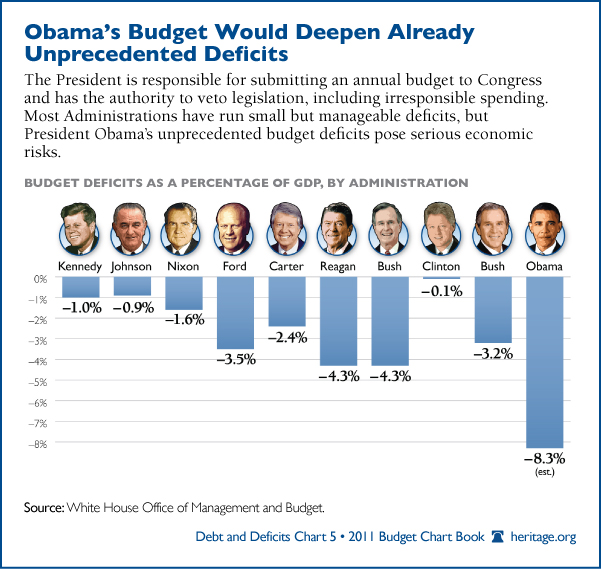
Over the last 10 presidents was have had 16.9% of GDP of deficits total from five Republican presidents and 12.7% total from Democratic presidents. However, what is most disturbing is that 8.3% of the 12.7% comes from the Obama administration who is currently in power and we are no longer in the cold war era. That is almost double the total of all the other four Democratic presidents combined under just one president. Take a look at the chart below from the Heritage Foundation:
Over the past 50 years, 10 U.S. presidents have made annual budget requests to Congress, projecting deficits both big and small. But no other president compares to Barack Obama when it comes to the size and scale of the current budget deficit facing the United States.
The country is facing an 8.3 percent estimated average national deficit of a two-term Obama administration — the biggest of the past 50 years. By comparison, the current estimate for Obama is nearly double the percentage under Presidents Ronald Reagan and George H.W. Bush — and they were fighting the Cold War.
Political party doesn’t tell the whole story, however. President Bill Clinton leads the pack of presidents since 1961, according to data from the White House Office of Management and Budget. Heritage put together this graphic as part of our Budget Chart Book.
So what does the current trajectory mean for the United States? We’re certainly no longer looking at a continuation of manageable deficits in the years to come. This is a dramatic change in the magnitude of annual shortfalls at the federal level. That’s one reason Heritage came up with a plan to fix the debt crisis.
If you have a suggestion for a chart we should feature in the future, please post a comment below, email us at scribe@heritage.org, or send me at tweet @RobertBluey.
President Obama unveiled his fiscal year 2012 budget today, and there’s good news and bad news. The good news is that there’s no major initiative such as the so-called stimulus scheme or the government-run healthcare proposal. The bad news, though, is that government is far too big and Obama’s budget does nothing to address this problem.
Actual spending cuts would be the best option, of course, but limiting the growth of spending is all that’s needed to slowly shrink the burden of government spending relative to gross domestic product.
Fortunately, we have two role models from recent history that show it is possible to control the federal budget. This video from the Center for Freedom and Prosperity uses data from the Historical Tables of the Budget to demonstrate the fiscal policy achievements of both Ronald Reagan and Bill Clinton.
Spending Restraint, Part I: Lessons from Ronald Reagan and Bill Clinton
Ronald Reagan and Bill Clinton both reduced the relative burden of government, largely because they were able to restrain the growth of domestic spending. The mini-documentary from the Center for Freedom and Prosperity uses data from the Historical Tables of the Budget to show how Reagan and Clinton succeeded and compares their record to the fiscal profligacy of the Bush-Obama years.
_____________________
Some people will want to argue about who gets credit for the good fiscal policy of the 1980s and 1990s.
Bill Clinton’s performance, for instance, may not have been so impressive if he had succeeded in pushing through his version of government-run healthcare or if he didn’t have to deal with a Republican Congress after the 1994 elections. But that’s a debate for partisans. All that matters is that the burden of government spending fell during Bill Clinton’s reign, and that was good for the budget and good for the economy. And there’s no question he did a much better job than George W. Bush.
Indeed, a major theme in this new video is that the past 10 years have been a fiscal disaster. Both Bush and Obama have dramatically boosted the burden of government spending — largely because of rapid increases in domestic spending.
Last but not least, this video reviews the theory and evidence for the “Rahn Curve,” which is the notion that there is a growth-maximizing level of government outlays. The bad news is that government already is far too big in the United States. This is undermining prosperity and reducing competitiveness.
Nations can make remarkable fiscal progress if policy makers simply limit the growth of government spending. This video, which is Part II of a series, uses examples from recent history in Canada, Ireland, Slovakia, and New Zealand to demonstrate how it is possible to achieve rapid improvements in fiscal policy by restraining the burden of government spending. Part I of the series examined how Ronald Reagan and Bill Clinton were successful in controlling government outlays — particularly the burden of domestic spending programs. http://www.freedomandprosperity.org
I love the Cato Institute because they give us the facts that liberals just can’t refute. Instead of trying to raise our taxes, President Obama should be cutting spending.
Kathy says that recent U.S. spending data is “exaggerated” because of the recession, and indeed, spending has soared not only here, but in most major countries because of the unfortunate popularity of Keynesian pump-priming theories. My point was that the American smaller-government advantage eroded both during the Bush growth years and during the Obama recession years, as seen in Figure 2 of my testimony.
Kathy noted that the OECD data I used are different than U.S. national income accounts data published by the Bureau of Economic Analysis. Well, that’s right. Every country has quirks in the way they do their national income data. The advantage of using OECD data is that the economists at the OECD adjust for these quirks and create spending data that is comparable across countries. If Kathy has more accurate international comparisons, I’d love to see them.
Finally, Kathy says that just because American government spending divided by GDP is about 40 percent, that “doesn’t mean that government controls about 40 percent of the U.S.economy.” I don’t agree. She means that government does not produce 40 percent of gross domestic product, which is true. The broader figure of 40 or 41 percent includes not just government production but government transfers. And transfers do entail government control over resources because both the taxing and spending activities involved in transfer programs distort private sector behavior. Thus, the government misallocates resources both when it “produces” useless solar power activities in its own labs and when it subsidizes failed private solar companies.
Anyway, thanks to Kathy for raising the important issue of the overall size of government because it is something that the policy community should focus more attention on. For data geeks, the OECD has all kinds of cross-country comparison data here. Government spending is Table 25.
Everyone wants to know more about the budget and here is some key information with a chart from the Heritage Foundation and a video from the Cato Institute.
The federal government is spending more per household than ever before. Since 1965, spending per household has grown by nearly 162 percent, from $11,431 in 1965 to $29,401 in 2010. From 2010 to 2021, it is projected to rise to $35,773, a 22 percent increase.
INFLATION-ADJUSTED DOLLARS (2010)
Download
Source: U.S. Census Bureau, White House Office of Management and Budget, and Congressional Budget Office.
The charts in this book are based primarily on data available as of March 2011 from the Office of Management and Budget (OMB) and the Congressional Budget Office (CBO). The charts using OMB data display the historical growth of the federal government to 2010 while the charts using CBO data display both historical and projected growth from as early as 1940 to 2084. Projections based on OMB data are taken from the White House Fiscal Year 2012 budget. The charts provide data on an annual basis except… Read More
Authors
Emily GoffResearch Assistant
Thomas A. Roe Institute for Economic Policy StudiesKathryn NixPolicy Analyst
Center for Health Policy StudiesJohn FlemingSenior Data Graphics Editor
The ladies on “The View”sit down and talk about President Obama’s commencement speech at the University of Notre Dame and talk about how the crowd got a little riled over Abortion protesters. They then continue on the abortion subject which leads to a heated discussion between Joy Behar and Elisabeth Hasselbeck.
______________________
Answering the logic of the liberal ladies on “The View” is this video below:
Answering Those Who Are Only “Personally Pro-Life” – Quick Thought
Ana Benderas of Live Action addresses those who are personally against abortion but believe that others should be able to take the life on unborn children. Learn more about Live Action at: http://LiveAction.org
Demonstrators march through the streets of Little Rock on Saturday in a protest organized by Occupy Little Rock. (John Lyon photo) Occupy Arkansas got cranked up today in Little Rock with their first march and several hundred showed up. It was unlike the pro-life marches that I have been a part of that have had […]
The Arkansas Times blogger going by the username “Sound Policy” asserted, “…you do know there is a slight difference between fetal tissue and babies, don’t you? Don’t you?” My response was taken from the material below: Science Matters #2: Former supermodel Kathy Ireland tells Mike Huckabee about how she became pro-life after reading what the science […]
What Ever Happened to the Human Race? Jason Tolbert told a story about pro-life marchers and their tactic of prayer: OWNER TURNS SPRINKLERS ON PRO-LIFE PRAYER VIGIL In July, I wrote about a new movement springing up in Arkansas that seeks to combat abortion not with violent protest, but with peaceful prayer demonstrations. It is called “40 […]
Francis Schaeffer and C. Everett Koop were prophetic (jh29) What Ever Happened to the Human Race? I recently heard this Breakpoint Commentary by Chuck Colson and it just reminded me of how prophetic Francis Schaeffer and C. Everett Koop were in the late 1970′s with their book and film series “Whatever happened to the human […]
A Ronald Reagan radio address from 1975 addresses the topics of abortion and adoption. This comes from a collection of audio commentaries titled “Reagan in His Own Voice.” I just wanted to share with you one of the finest prolife papers I have ever read, and it is by President Ronald Wilson Reagan. I have […]
I have made it clear from day one when I started this blog that Francis Schaeffer, Milton Friedman, Ronald Reagan and Adrian Rogers had been the biggest influences on my political and religious views. Today I am responding to an unfair attack on Francis Schaeffer’s book “A Christian Manifesto.” As you can see on the […]
President and Nancy Reagan talking to Mother Teresa in the Oval Office. 6/20/85. Superbowl commercial with Tim Tebow and Mom. Jason Tolbert wrote a great article this week about a pro-life meeting. He mentons William Harrison who I have written about before on this blog. I used to write letters to the editor a whole […]
I wrote a response to an article on abortion on the Arkansas Times Blog and it generated more hate than enlightenment from the liberals on the blog. However, there was a few thoughtful responses. One is from spunkrat who really did identify the real issue. WHEN DOES A HUMAN LIFE BEGIN? _______________________________________ Posted by spunkrat […]
Superbowl commercial with Tim Tebow and Mom. The Arkansas Times article, “Putting the fetus first: Pro-lifers keep up attack on access, but pro-choice advocates fend off the end to abortion right” by Leslie Newell Peacock is very lengthy but I want to deal with all of it in this new series. click to enlarge ROSE MIMMS: […]
The Arkansas Times article, “Putting the fetus first: Pro-lifers keep up attack on access, but pro-choice advocates fend off the end to abortion right” by Leslie Newell Peacock is very lengthy but I want to deal with all of it in this new series. click to enlarge ROSE MIMMS: Arkansas Right to Life director unswayed by […]
“Jane Roe” or Roe v Wade is now a prolife Christian. She’s recently has done a commercial about it. _______________________________ I have often wondered why we got to this point in our country’s life and we allow abortion. The answer is found in the words of Schaffer. Philosopher and Theologian, Francis A. Schaeffer has […]
Modern man’s humanist thought has brought us to the point now that many people realize that they could not find final answers and that would lead to despair. Many people then took leaps into the area of non-reason to find some kind of meaning in life. Some people actually tried to look at communism and […]
Modern man’s humanist thought has brought us to the point now that many people realize that they could not find final answers and that would lead to despair. Many people then turned to trying to find answers in the area of non-reason. There were no fixed values and they just held on to the two […]
Richard Land on Abortion part 3 On the Arkansas Times Blog this morning I posted a short pro-life piece and it received this response: We have been over this time and again SalineRepublican, and I think we all know the issue: when does the right of a woman to control her own body yield to […]
Bob Jordan / Associated Press No. 13: Duke ends UNLV’s perfect season Final Four, March 30, 1991 — The Runnin’ Rebs returned four starters from the 1990 champions and rolled through the ’90-91 season. They entered the Final Four 34-0 and faced Duke, a team the Rebs beat by 30 points in the ’90 title […]
Vice Admiral C. Everett Koop, USPHS Surgeon General of the United States Francis Schaeffer Main page Francis Schaeffer and Dr. C. Everett Koop put together this wonderful film series “Whatever happened to the human race?” and my senior class teacher Mark Brink taught us a semester long course on it in 1979. I was so […]
This is such a great video series “The Silent Scream.” I have never seen it until now and I wish I had seen it 30 years ago. Take a look at the video clip below. I wanted to pass along a portion of the excellent article “Bernard Nathanson: A Life Transformed by the Truth about […]
Sherwood Haisty is taking my sons Hunter and Wilson to Grace Community Church in the Los Angeles area this morning where Dr. John MacArthur is pastor. They will be attending both Sunday School and Worship. I wanted to pass along a portion of the excellent article “Bernard Nathanson: A Life Transformed by the Truth about […]
[John Boozman] says that Buffett is being hypocritical to support Obama’s proposed tax increases because they wouldn’t solve the problem and wouldn’t affect him. In fact, he says, Obama’s bill might raise the secretary’s taxes if she and her husband make $250,000 while Buffett continues benefiting from those loopholes.
“It’s just class warfare,” he says. “It’s a simplistic solution that, like I say, it directs off the real issue of why we’re not creating jobs, why we’re having the increase in the discrepancy between the rich and our middle class, lower middle class.”
Sept. 9 (Bloomberg) — David Addington, vice president at the Heritage Foundation, and Ryan McConaghy, economic director at Third Way, discuss President Barack Obama’s $447 billion jobs plan. They speak with Deirdre Bolton and Erik Schatzker on Bloomberg Television’s “InsideTrack.” (Source: Bloomberg)
__________________
Is Buffett getting misquoted by the Obama administration?
Republicans are getting a great deal of mileage out of an interview investor Warren Buffett gave Friday morning, contending that the billionaire failed to endorse President Obama’s jobs plan or the proposed tax hike that bears his name.The Republican National Committee, for example, e-blasted a mailer that claimed Buffett had disagreed in a CNBC interview with Andrew Ross Sorkin with Obama’s plan to raise taxes on America’s top earners.
But did Buffett actually say that? More than anything, while interviewed on the floor of the New York Stock Exchange, he took a pass on commenting on Obama’s plan at all. As they used to say in the 20th century, let’s go to the videotape:
Andrew Ross Sorkin: “Let’s talk about the Buffett Rule for a moment. Talk to me about how it came about in terms of the White House getting in touch with you and you putting your name to this?”
Warren Buffett: “Well, [National Economic Council Director] Gene Sperling called and said, ’Can we use your name?’ And I said, yes.”
Sorkin: “Are you happy you said yes?”
Buffett: “Sure, I mean I wrote about it.”
Sorkin: “Are you happy with the way it’s been described? Is the program that the White House has presented — a million dollars and over — your program?”
Buffett: “Well, the precise program, I don’t know what their program will be. My program would be on the very high incomes that are taxed very low — not just high incomes. Some guy making $50 million playing baseball, his taxes won’t change. If you make 50 million dollars a year appearing on television, his income won’t change, but if they make a lot of money and they pay a very low tax rate, like me, it would be changed by a minimum tax that would only bring them up to what the other people pay .”
Sorkin: “Does that mean you disagree with the president’s new jobs proposal, which would be paid for by raising taxes on households with incomes of over $250,000?”
Buffett: “That’s another program that I won’t be discussing, but my program is to have a tax on ultra-rich people who are paying very low tax rates. Not just all the rich people. It probably would apply to 50,000 people in a population of 310 million.”
Sorkin: “That means you disagree with the president on the 250,000?”
Buffett: “No, no, you may disagree –“
Sorkin: “I’m asking, you agree that 250,000 is the right number?”
Buffett: “I will look at the overall plan that gets submitted to Congress, which they are voting on, and decide, net, do I like it or do I not like it? There’s no question there will be parts I’ll disagree with.” (Watch the video of the interview at the end of this article.)
Part of the confusion stems from Obama’s use of Buffett’s name in recent speeches as promoting the idea the rich “pay their fair share.” The Buffett Rule, as Buffett described in the interview and as he has proposed elsewhere, would affect a small percentage (less than 1) of America’s wealthiest citizens and would elevate the rate they pay on capital gains to be comparable to middle-class tax rates.
Essentially, the proposal was boiled down to a metaphor that has billionaires such as Buffett paying taxes at a lower rate than their “secretaries.”
When Obama rolled out his version of the rule, it was described as a tax on millionaires, but in truth, it wouldn’t affect most people who earn more than $1 million a year unless they derived most of their income from investments.
Along with that proposal, Obama has advocated letting the George W. Bush-era tax cuts expire for families making more than $250,000 a year—something which has nothing to do with Warren Buffett or the “Buffett Rule.”
Here’s what Buffett told the Fox Business Network Friday:
“I didn’t say the wealthy should pay more. I said the ultra-wealthy who are paying very low tax rates should pay more and the figures show that the 400 top tax payers who earned an average of almost $230 million apiece were paying 21% in a combined payroll tax and income tax, which is well below what all the people in my office pay now. What I’m talking about would not apply to someone that made $5 million a year as a baseball player or $10 million a year on media. It would apply only to probably 50,000 people out of 309 million who have huge incomes pay very low taxes. If you have a country with a deficit of over a trillion dollars and you think it can be solved by voluntary tax payments then you believe in the tooth fairy. There should be a policy that applies to people with money who earn lots of money and pay very low rates. If they earn it by normal jobs what I say would not hit them at all.”
Dan Mitchell on Taxing the Rich Max Brantley this morning on the Arkansas Times Blog, August 15, 2011, asserted: Billionaire Warren Buffett laments, again, in a New York Times op-ed how the rich don’t share the sacrifices made by others in the U.S.. He notes his effectiie tax rate of 17 percent is lower than […]
I loved reading this article below. (Take a look at the link to other posts I have done on Steve Jobs.) David Boaz makes some great observations: How much value is the Post Office creating this year? Or Amtrak? Or Solyndra? And if you point out that the Post Office does create value for its […]
(If you want to check out other posts I have done about about Steve Jobs:Some say Steve Jobs was an atheist , Steve Jobs and Adoption , What is the eternal impact of Steve Jobs’ life? ,Steve Jobs versus President Obama: Who created more jobs? ,Steve Jobs’ view of death and what the Bible has to say about it ,8 things you might not know about Steve Jobs ,Steve […]
(If you want to check out other posts I have done about about Steve Jobs:Some say Steve Jobs was an atheist , Steve Jobs and Adoption , What is the eternal impact of Steve Jobs’ life? ,Steve Jobs versus President Obama: Who created more jobs? ,Steve Jobs’ view of death and what the Bible has to say about it ,8 things you might not know about Steve Jobs ,Steve […]
Did Steve Jobs help people even though he did not give away a lot of money? (I just finished a post concerning Steve’s religious beliefs and a post about 8 things you may not know about Steve Jobs) Uploaded by UM0kusha0kusha on Sep 16, 2010 clip from The First Round Up *1934* ~~enjoy!! ______________________________________________ In the short film […]
Addington, McConaghy Debate Obama’s Jobs Plan Published on Sep 9, 2011 by Bloomberg Sept. 9 (Bloomberg) — David Addington, vice president at the Heritage Foundation, and Ryan McConaghy, economic director at Third Way, discuss President Barack Obama’s $447 billion jobs plan. They speak with Deirdre Bolton and Erik Schatzker on Bloomberg Television’s “InsideTrack.” (Source: Bloomberg) […]
Do the rich avoid the taxes that we all pay? Do the Rich Avoid Taxes? Posted by David Boaz President Obama says the rich should pay higher tax rates, citing billionaire Warren Buffett, who says he pays a lower tax rate than his secretary. Various analysts have pointed out that Buffett takes very little salary […]
President Obama and Alternative Minimum Tax Dan Mitchell does it again. He is always right on the mark. CPAs Celebrate as Obama Proposes to Create a Turbo-Charged Alternative Minimum Tax Posted by Daniel J. Mitchell Wow, this is remarkable. The alternative minimum tax (AMT) is one of the most-hated features of the tax code. It […]
Brantley, Buffett and Obama: “Stop coddling the rich” The Laffer Curve, Part I: Understanding the Theory Max Brantley is fond of accusing Republicans of coddling the rich and here comes Warren Buffett and validates both what President Obama and Brantley have been saying. However, will the increase in taxes have the desired result that they […]
Max Brantley on the Arkansas Times Blog, August 15, 2011, asserted: Billionaire Warren Buffett laments, again, in a New York Times op-ed how the rich don’t share the sacrifices made by others in the U.S.. He notes his effectiie tax rate of 17 percent is lower than that of many of the working people in his office on account of preferences for […]
Five Key Reasons to Reject Class-Warfare Tax Policy Max Brantley on the Arkansas Times Blog, August 15, 2011, asserted: Billionaire Warren Buffett laments, again, in a New York Times op-ed how the rich don’t share the sacrifices made by others in the U.S.. He notes his effectiie tax rate of 17 percent is lower than […]
In addition to several other tax increases, Senator Barack Obama wants to increase the Social Security payroll tax burden by imposing the tax on income above $250,000. This would be a sharp departure from current law, which only requires that the tax be imposed on the amount of income needed to “pay for” promised benefits. But more important, at least from an economic perspective, the Senator’s initiative would increase the top tax rate on productive behavior by as much as 12 percentage points – and this would be in addition to his proposal to kill the 2003 tax rate reductions and further boost the top rate by 4.6 percentage points. This mini-documentary explains why a big tax rate increase on highly productive people would be very damaging to America’s prosperity, especially in a competitive global economy. Simply stated, pushing top tax rates in the United States to French and German levels means at least some degree of French-style and German-style economic stagnation. Visit http://www.freedomandprosperity.org for more information.
Wow, this is remarkable. The alternative minimum tax (AMT) is one of the most-hated features of the tax code. It is such a nightmare of complexity that even Democrats routinely have supported “patches” and “band-aids” to protect millions of additional households from getting trapped in this surreal parallel tax universe – one that requires taxpayers to calculate their taxes two different ways, with the IRS getting the maximum amount of money from the two returns. (Hong Kong, by contrast, give taxpayers the option of calculating their taxes two different ways, but they’re allowed to pay the smaller of the two amounts.)
Notwithstanding the AMT’s status as arguably the worst feature of the internal revenue code, President Obama apparently wants to double down on this horrific policy by creating a new version of this nightmarish provision.
The administration’s principle resembles the Alternative Minimum Tax, which was first adopted in 1969 and was intended to hit the superwealthy. The AMT has been hitting an increasing number of the middle class because it wasn’t indexed for inflation, and Congress has continually wrestled with how to get rid of it.
The WSJ article also notes that a glaring inconsistency in the White House’s rhetoric. the plan is supposed to be a “very significant” tax hike, but doubling the tax burden on millionaires would only raise $19 billion per year. In other words, the Administration’s class-warfare rhetoric is probably just cover for a tax hike that actually will hit a lot of people with far more modest incomes.
The proposal also could apply to a broader selection of taxpayers—all households with incomes of more than $1 million. Those earners are expected to pay an average of $845,000 this year, according to the nonpartisan Tax Policy Center. Assuming the households in the group of 22,000 pay that amount, even doubling their tax burden would raise just $19 billion a year at a time when deficit reduction is being measured in trillions of dollars. That doesn’t take into effect any change in taxpayer behavior prompted by a new tax regime. A senior administration official said that depending on where the minimum rate is set, the plan could be a “very significant” revenue raiser. The official wouldn’t provide details. …Some conservative economists say such a proposal could put a drag on capital markets and ignores the fact that many companies have already paid tax on the income before it is distributed to owners as dividends or capital gains.
The New York Times, to its credit, provides a fair description of the issue (including a much-needed acknowledgement that Warren Buffett may not have been honest and/or accurate), and also suggests that Obama may be proposing to replace the existing AMT with this new version (though that presumably would negate its impact as a revenue-raiser).
Mr. Obama will not specify a rate or other details, and it is unclear how much revenue his plan would raise. But his idea of a millionaires’ minimum tax will be prominent in the broad plan for long-term deficit reduction that he will outline at the White House on Monday. Mr. Obama’s proposal is certain to draw opposition from Republicans, who have staunchly opposed raising taxes on the affluent because, they say, it would discourage investment. It could also invite scrutiny from some economists who have disputed Mr. Buffett’s assertion that the megarich pay a lower tax rate over all. Mr. Buffett’s critics say many of the rich actually make more from wages than from investments. …The administration wants such a tax to replace the alternative minimum tax, which was created decades ago to make sure the richest taxpayers with plentiful deductions and credits did not avoid income taxes, but which now hits millions of Americans who are considered upper middle class.
Actually, the AMT also hits lots of middle-class families since having kids is considered a “preference” for tax purposes.
But that’s just an insult layered on top of injury. What makes Obama’s new scheme so destructive is that it would (though the White House has not explained the details) somehow classify dividends and capital gains as “preference” items – even though everyone acknowledges that such income already is double taxed!
In other words, Obama claims to be concerned about jobs, but he is proposing a big tax hike on the saving and investment that is necessary to create jobs. Amazing.
Regular readers will recognize this video about Obama’s class-warfare tax policy. But if you haven’t seen it, five reasons are presented to explain why it will backfire.
But look at the bright side. At least accountants and tax lawyers (and don’t forget bankruptcy specialists) will get more business if Obama’s plan is implemented.
When I think of all our hard earned money that has been wasted on stimulus programs it makes me sad. It has never worked and will not in the future too. Take a look at a few thoughts from Cato Institute:
On Thursday night, the president laid out his plan for job creation, a $447 billion stimulus proposal, most of which we have seen before. After all, if Congress passes this new round of government spending, it would be the seventh such stimulus program since the recession began. George W. Bush pushed through two of them, totaling some $200 billion, and Obama already has enacted four more, with a total price tag of roughly $1.3 trillion.
The result: Three years and $1.5 trillion of spending later, we are back to the same gallimaufry of failed ideas. Among the worst:
3. Bailing Out the Teachers Unions. The president’s plan calls for spending $35 billion in grants to states to hire or retain some 280,000 teachers. The president wants to spend another $30 billion to repair and modernize school buildings, with the catch that school districts that accept the funds are prohibited from laying off any teachers. Spending on school building and repair has already increased by 150% over the last two decades, without either improving education or generating many jobs. And the greatest threat to teacher retention is not a lack of federal aid, but burdensome labor contracts.
4. More Infrastructure Spending. Like all the stimulus bills before it, the president’s latest proposal calls for still more pork barrel spending for “infrastructure.” One begins to wonder why we haven’t paved over the entire country by now. No doubt there are roads and bridges in need of repair, but the ability of the federal government to sort out good projects from bad is debatable at best. And the president is once again planning to plow money into such dubious projects as high-speed rail.
5. More Tax Hikes. Worst of all, the president plans to pay for all this new spending by — you guessed it — raising taxes on businesses and high-income Americans. The president, once again, referred to “millionaires and billionaires” in his speech, but his actual proposal calls for raising taxes on families earning as little as $250,000 per year. In places like New York, that’s not the “super rich.” In addition, many of these tax hikes would fall on small businesses. The president’s jobs plan, then, is to tax exactly those people and businesses that create jobs. And all this is on top of the new taxes and regulations that the Obama administration has already pushed through.
It’s not just the details of the president’s proposal that are wrongheaded, it’s the basic concept. The real drags on our economy have nothing to do with the failure of government to spend enough. The federal government is now spending roughly 24% of GDP. State and local governments are spending another 10% to 15%, meaning government at all levels is spending roughly 40 cents out of every dollar produced in this country. If government spending brought about prosperity, we should be experiencing a golden age.
The president’s plan is a bit like having someone break your leg then give you a crutch and call it a stimulus. Might it not be better to avoid breaking your leg in the first place? It’s time to stop spending, cut taxes, reduce our debt, and rollback burdensome regulation. That will generate far more jobs than any government jobs program.
When it comes to stimulus, the seventh time is not the charm.
In the debate of job creation and how best to pursue it as a policy goal, one point is forgotten: Government doesn’t create jobs. Government only diverts resources from one use to another, which doesn’t create new employment.
Video produced by Caleb Brown and Austin Bragg.
___________________________
When I think of all our hard earned money that has been wasted on stimulus programs it makes me sad. It has never worked and will not in the future too. Take a look at a few thoughts from Cato Institute:
On Thursday night, the president laid out his plan for job creation, a $447 billion stimulus proposal, most of which we have seen before. After all, if Congress passes this new round of government spending, it would be the seventh such stimulus program since the recession began. George W. Bush pushed through two of them, totaling some $200 billion, and Obama already has enacted four more, with a total price tag of roughly $1.3 trillion.
The result: Three years and $1.5 trillion of spending later, we are back to the same gallimaufry of failed ideas. Among the worst:
1. Temporary Tax Cuts. The president wants to extend and expand the temporary reduction in the Social Security payroll tax that Congress enacted last December. The president also called for a grab-bag of tax credits for businesses that buy new equipment, hire veterans or even give workers a raise. There is obviously nothing wrong with letting workers keep a bit more of their money. And some of the tax breaks might encourage businesses to speed up otherwise planned hiring or purchases, providing a short-term economic boost. But neither people nor businesses tend to make the sort of long-term plans needed to boost production, generate growth and create jobs on the basis of temporary tax changes. This is especially true when businesses can look down the road and see tax hikes in their future.
If government spending brought about prosperity, we should be experiencing a golden age.
2. Further Extending Unemployment Benefits. The president wants to spend $49 billion to provide another extension of unemployment benefits to 99 weeks. Of course everyone can sympathize with the plight of the long-term unemployed. But, the overwhelming body of economic evidence suggests that extending unemployment benefits may actually increase unemployment and keep people out of work for longer. In fact, many economists believe that current extensions of unemployment benefits have already extended the average length of unemployment by three weeks or more.



 Federal Spending Is Growing Faster Than Federal Revenue


 The Daily Hatch