Category Archives: President Obama

Obama, Garry Smith, Jesus, Republicans and abortion (part 2)

This is the second of two posts. Here is the link to the first post. In this second post I will show that the pro-life Republicans hold the the Biblical pro-life view that Jesus would embrace if he were here today and the pro-choice view would be rejected (a minority of Republicans are pro-choice though and some Democrats are pro-life).

Jason Tolbert hit the nail on the head in his recent post:

It seems Democratic Rep. Garry Smith of El Dorado stepped into a bit of a mess this week when speaking to the newly formed Union County Democratic Club. Perhaps he wasn’t aware that intrepid cub reporter Heather Hawley of the El Dorado News-Times  was in the room taking notes when he promptly stuck both feet firmly in his mouth.

He began with saying how proud he was to be a Democrat going so far as to say “if Jesus were here today, he would be a Democrat because he tried to help everybody and he still does.”

He then offered praise for the head of his party, President Obama, saying he is “proud of his leadership ability and his tenacity” and hopes he gets elected to a second term.

__________________

A great article on some Biblical passages against abortion are found in this link and is the entire  article:

An Eye for an Eye? Exodus and Abortion

DA365
James R. White

This article first appeared in the Viewpoint column of the Christian Research Journal, volume 27, number 1 (2004). For further information or to subscribe to the Christian Research Journal go to:http://www.equip.org.


Scott Klusendorf has presented several excellent pro-life arguments in his feature article in this issue of the Journal based upon the hypothetical “given” that Scripture is silent on the issue of abortion. Many scholars, however, believe Scripture does, in fact, address the issue, even if not explicitly. Scripture provides us with principles that, through the exercise of godly wisdom, can be applied to the wide variety of situations we encounter in modern culture. In the realm of human behavior, there is “nothing new under the sun,” and the Bible, written by One who knows the human heart intimately, does indeed speak to every aspect of human life, including our thoughts, our actions, and our beliefs.

The value of human life as something special, a gift from God, is found throughout Scripture. The commandment not to murder carries with it the corollary responsibility to save and honor life. Many today dismiss the influence of God’s moral law on the nations of the West. The laws of most of those nations, nevertheless, are steeped in the recognition of such things as “inalienable rights” — inalienable because they are derived from our Creator. One such inalienable right is life.

The story of how Western civilizations have departed from a high view of human life to the current view that justifies infanticide is sad and complex; indeed, modern Western culture has sanctified a form of infanticide. Abortion is internal infanticide: the murder of a child at the most vulnerable time of life — those precious months when the child develops and grows while sheltered in the womb. There is no medical, philosophical, theological, or rational difference between the violent murder of an infant who has lived long enough to travel down the birth canal and the same infant separated by a small period of time or a space measurable in inches. Undeniable facts, knowable to anyone who inquires into the subject, establish the humanity and personhood of the infant in the womb. Modern society, however, preferring sexual license to truth and morality, has sanctioned infanticide under the more palatable term “abortion” and the even more wishful phrase “termination of pregnancy.” So committed are the proponents of intrauterine infanticide that the procedure known as “partial-birth abortion,” an act comparable to the mass murders the Nazis committed at Auschwitz and Dachau, is unashamedly protected and defended at all political and moral cost by many of the highest leaders in government.

The passage of time has only added to the guilt of destroying our young. Our advancing technology now allows us to peer directly into the womb and observe the wonder of the developing child. We now know, beyond question, that the preborn child is an individual human being who possesses a unique genetic code. Anyone who uses terms like “mass of tissue” to describe the preborn child is engaging in sophistry, for the facts demonstrate beyond all doubt his or her humanity and individuality. These facts are so compelling on any logical, scientific, or forensic level that the proponents of abortion, in general, seek to avoid, at all costs, direct and fair debate with those who oppose abortion and who are well prepared to make their case.

The immorality of abortion is also easily discerned by a review of the biblical facts, and Klusendorf has laid out the case along a number of lines. Scripture is the firmest foundation upon which to condemn this heinous act. The Bible provides no basis on which anyone can possibly build a case for the murder of unborn children, and the few attempts that have been made to do so are so easily refuted that it is easy to understand why their originators hide from serious interaction with biblical scholars and apologists. The biblical case against the taking of life is, in fact, full and robust, even though the specific action of abortion (since it utilizes modern technological procedures) is not explicitly addressed. Human technology progresses; yet humans remain unchanged. The principles of Scripture, therefore, remain applicable today.

God differentiates Himself from all false gods primarily by claiming to be the Creator of all things. His greatest creation is humankind, which is created in His image (Gen. 1:27). Humans are the special workmanship of God, different from all the rest of His creation. Listen to these words of the psalmist:

For You formed my inward parts;
You wove me in my mother’s womb.
I will give thanks to You, for I am fearfully and wonderfully made;
Wonderful are Your works,
And my soul knows it very well.
My frame was not hidden from You,
When I was made in secret,
And skillfully wrought in the depths of the earth;
Your eyes have seen my unformed substance;
And in Your book were all written
The days that were ordained for me,
When as yet there was not one of them.(Ps. 139:13–16 NASB 1995 ed.)

The Bible knows nothing of humanity as a random-chance result of natural processes. Humanity is the specific creation of God, and clearly the existence of a person can be traced from the very first stages of development prior to birth. John the Baptist, for example, experienced the ministry of the Holy Spirit while yet unborn, for when Mary greeted John’s mother, Elizabeth, the child leaped in the womb at the sound of Mary’s voice (Luke 1:41). Inanimate objects and “masses of tissue” do not respond to the ministry of the Spirit, nor do they leap at the sound of the voice of the Lord’s mother. How can the personhood of the preborn child be denied in such a situation as this? Are we seriously to make John an exception? If so, on what basis?

One of the most important passages on this topic is found in Exodus 21:22–25. The passage reads:

And if men fight and hit a pregnant woman and her child is born prematurely [ESV: “her children come out”], but there is no serious injury, he will surely be punished in accordance with what the woman’s husband will put on him, and he will pay what the court decides. But if there is serious injury, then you will give a life for a life, eye for eye, tooth for tooth, hand for hand, foot for foot, burn for burn, wound for wound, bruise for bruise. (NET)

Many attempts have been made to confuse this passage and strip it of its clarity. Some ancient translators inserted their own interpretation into the passage, and many have followed their understanding over the years. One could claim that a “majority” of commentators have taken the passage to refer only to a miscarriage; yet, the text is far less obscure than many would have us believe. Consider the following: the term yeled in the original text is translated “child” with reference to a living human being the vast majority of the times it is used in the Old Testament. This is joined with the verb yasa, “to come out,” which is never used in the Bible to refer to a miscarriage. Only once in all the uses of this verb regarding birth is it found in a passage that speaks of something other than a live birth, that being an obvious case of stillbirth (Num. 12:12). There is no reason, however, to think that anything other than the live birth of a human being is in view inExodus 21:22 — a live birth that is brought on prematurely by men striking a pregnant woman while fighting with each other. In more than 1,075 uses of this word in the Hebrew Bible, it is never translated “miscarriage.” This is clearly a live, but premature, birth.1

The man who strikes the woman is to be punished for bringing on the premature birth. The phrase “if there is no serious injury” refers to both the mother and the child born of her; to say otherwise is to ignore the normative use of yeled and yasa. The phrase “if there is serious injury,” therefore, would likewise refer to both the mother and the child. What follows, then, is the lex talionis, which indicates that the punishment in the case of more serious injury should be “life for life,” literally “soul for soul.” This text identifies the yeled, the child born prematurely, as a nephesh, a soul, a living human being. It then applies the death penalty in the case of the death of either the mother orthe child.

The testimony of Scripture is compelling: Life is a sacred gift, and we are to protect and honor it. Taking the life of a child in the womb differs not at all from taking the life of the mother, or anyone else. All the platitudes and politically correct phrases will not change the verdict of God: Abortion is infanticide, and it is an abomination in His eyes.

_________________

This is where I would caution a fellow Christian like Garry Smith. We have to let the Bible be our guide in our lives and that means being pro-life or else we will just be like the world. I have often wondered why we got to this point in our country’s life and we allow abortion. The answer is found in the words of Francis Schaeffer.
Philosopher and Theologian, Francis A. Schaeffer has argued, “If there are no absolutes by which to judge society, then society is absolute.” Francis Schaeffer, How Shall We Then Live? (Old Tappan NJ: Fleming H Revell Company, 1976), p. 224.

Below is a clip from the film series “How Then Shall We Live?”

Related Posts:

Abortionist Bernard Nathanson turned pro-life activist (part 11)

ABORTION – THE SILENT SCREAM 1 / Extended, High-Resolution Version (with permission from APF). Republished with Permission from Roy Tidwell of American Portrait Films as long as the following credits are shown: VHS/DVDs Available American Portrait Films Call 1-800-736-4567 http://www.amport.com The Hand of God-Selected Quotes from Bernard N. Nathanson, M.D., Unjust laws exist. Shall we […]

By Everette Hatcher III | Posted in Prolife | Edit | Comments (0)

Abortionist Bernard Nathanson turned pro-life activist (part 10)

Dr. Bernard N. Nathanson, a leading pro-life advocate and convert to Catholicism, died at the age of 84 on Monday a week ago in his New York home, after a long struggle with cancer. The Hand of God-Selected Quotes from Bernard N. Nathanson, M.D., Chapter 12 is titled To The Thanatoriums, an allusion the Walker […]

By Everette Hatcher III | Posted in Prolife | Edit | Comments (0)

On eve of Shutdown Republicans cave on demand concerning eliminating Planned Parenthood Funding

The pro-life position is very important to a great many of the freshmen members of the House of Representatives. As you can see above in the clip from the film series Whatever Happened to the Human Race? by Francis Schaeffer and C. Everett Koop, the unborn baby is a child, but we are treating many […]

Abortionist Bernard Nathanson turned pro-life activist (part 9)(Donald Trump changes to pro-life view)

When I think of the things that make me sad concerning this country, the first thing that pops into my mind is our treatment of unborn children. Donald Trump is probably going to run for president of the United States. Tony Perkins of the Family Research Council recently had a conversation with him concerning the […]

By Everette Hatcher III | Posted in Prolife | Edit | Comments (0)


Senator Obama’s ideas on Social Security

Senator Obama’s Social Security Tax Plan

Uploaded by on Jul 23, 2008

In addition to several other tax increases, Senator Barack Obama wants to increase the Social Security payroll tax burden by imposing the tax on income above $250,000. This would be a sharp departure from current law, which only requires that the tax be imposed on the amount of income needed to “pay for” promised benefits. But more important, at least from an economic perspective, the Senator’s initiative would increase the top tax rate on productive behavior by as much as 12 percentage points – and this would be in addition to his proposal to kill the 2003 tax rate reductions and further boost the top rate by 4.6 percentage points. This mini-documentary explains why a big tax rate increase on highly productive people would be very damaging to America’s prosperity, especially in a competitive global economy. Simply stated, pushing top tax rates in the United States to French and German levels means at least some degree of French-style and German-style economic stagnation. Visit http://www.freedomandprosperity.org for more information.

Obama, Garry Smith, Jesus, the Republicans and Abortion (Part 1)

This is going to take two posts to cover.

Jason Tolbert hit the nail on the head in his recent post:

It seems Democratic Rep. Garry Smith of El Dorado stepped into a bit of a mess this week when speaking to the newly formed Union County Democratic Club. Perhaps he wasn’t aware that intrepid cub reporter Heather Hawley of the El Dorado News-Times  was in the room taking notes when he promptly stuck both feet firmly in his mouth.

He began with saying how proud he was to be a Democrat going so far as to say “if Jesus were here today, he would be a Democrat because he tried to help everybody and he still does.”

He then offered praise for the head of his party, President Obama, saying he is “proud of his leadership ability and his tenacity” and hopes he gets elected to a second term.

In the previous legislative session, Smith sat on the House Public Health Committee.  He was present when Rep. Andy Mayberry brought a bill that would have banned abortions in Arkansas after the point at which unborn babies can feel pain.  This bill, which would have outlawed the barbaric practice of ripping babies apart in what is no doubt the harshest form of torture, would likely have passed if it could have made it out of committee.  The votes were close, but when it came time for Smith to vote, his chose to remain silent.  When his name was called, he sat in his chair refusing to speak to vote either yes or no. In doing so, he killed the bill.

_______________

In this first post I want to show from the Tolbert article above that Garry Smith is not pro-life and then I wanted to show below that President Obama is radically pro-abortion.

______________

Part 1 of 2 Gianna Jessen, abortion survivor speaks at Queen’s Hall, Parliament House, Victoria. Australia – on the eve of the debate to decriminalize abortion in Victoria.
Gianna’s visit was sponsored by the Ad Hoc Interfaith Committee.

Ark Times says Planned Parenthood in Little Rock performs abortions. A while back I mentioned a lady by the name of Abby Johnson who was a director of a Planned Parenthood center in Texas. Take time to read this post and see why she left Planned Parenthood and never went back. It amazes me that liberals are constantly trying to make abortions more available than ever. I don’t think they have taken a close look at the process.
Gianna Jessen is an abortion survivor. She  was intervewed on Fox’s Hannity and Colmes, where she shared her personal story and also commented on Obama’s voting record. As an Illinois state senator, four times he voted “no” on the Illinois Born-Alive Infant Defined Act, which would protect babies born alive after failed abortions.
There is a lively discussion at the end about whether or not Obama, by his vote, was in fact denying born babies (abortion survivors now outside the womb), the right to live. Pay attention especially to Alan Combs who tries to defend his pro-life liberal president.
Sean Hannity show with Gianna Jessen
Did you see how difficult it was for Alan Combs to defend his liberal president from the charge of infanticide. Logically there is no escape but he tried the best he could.  President Obama was so intent on protecting Roe v Wade that he had to endorse a form of infanticide in order to protect Roe v Wade.
Liberals must acknowledge that hospitals are required to save lives. However, if a hospital is paid to perform an abortion and they botch the job then they must turn from trying to snuff out a life to trying to save it again. How ironic.
Part 2 of 2 Gianna Jessen, abortion survivor speaks at Queen’s Hall.

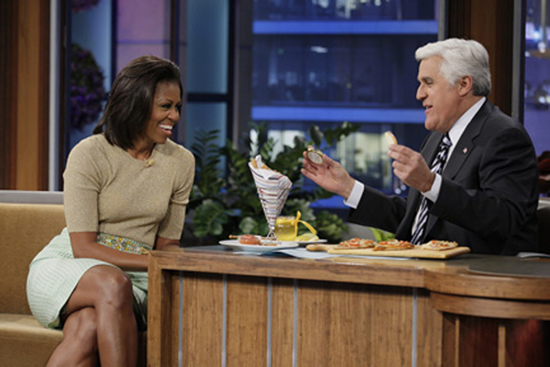
First Lady did fine on the Tonight Show on Jan 31, 2012

Picture from the Heritage Foundation where a great article is linked here.

The First Lady started off her discussion with Jay Leno talking about her husband’s singing ability. She noted that he likes Al Green songs a lot. I grew up in Memphis and used to listen to Al Green when he first got hot in the early 1970’s.

Here is a rundown from CNN:

And here’s Michelle!

t1main.lesa
Posted by:

 We’re getting a glimpse into what life is like in the White House including mentally preparing for a presidential campaign and sleepovers for the first daughters from first lady Michelle Obama as she appeared on The Tonight Show with Jay Leno Tuesday.

The first lady is in California raising money for her husband’s campaign at Democratic National Committee fundraisers and also advancing her Let’s Move initiative to solve the problem of childhood obesity within a generation.

Appearing on The Tonight Show with Jay Leno, Mrs. Obama confided her feelings on the upcoming campaign.

“There’s really no way to prepare for it.  You know, you just take each day as it comes.  I think, Barack and I, our motto is, you try to do the best job we can do every single day and the hope is that will speak for itself.  So, you know, we wake up everyday, we think about what this country needs.”

She told Leno two of the most important issues she has pressed for as first lady are her initiative to combat childhood obesity in this country and her work with military families.

On the subject of her own family, the first lady said her daughters Sasha and Malia are adjusting well to life in the White House.

“They’re doing really well and I think that’s been one of the most surprising things about living in the White House and probably one of the things I’ve worried most about was whether we could have a normal life,”  she told Leno in a video clip released by NBC.

“The people at the White House are amazing, the girls are good, they’re normal, we always check in, they have a regular life.  They’ve got friends and sleepovers, and to them its home.  It’s been truly a blessing for us,” she said.

The first lady came to the Leno show bearing gifts as she presented the host with an apple and some White House honey from her White House kitchen garden.  The comedian couldn’t let that pass without a double entendre joke saying, “That sounds bad…You know, with a different president, that could mean a whole different thing.”

And Mitt Romney’s musical skills also came up as Leno asked Mrs. Obama if she heard the GOP candidate’s slightly off key rendition of  “America the Beautiful” on the campaign trail Tuesday.  Mrs. Obama didn’t miss a beat saying she had seen the video in the NBC green room and as the audience laughed she hesitated only briefly diplomatically declaring the rendition “beautiful” and that, “It’s a song that’s to be sung by every American.”

Related posts:

An open letter to President Obama

  January 25, 2012 President Obama c/o The White House 1600 Pennsylvania Avenue NW Washington, DC 20500 Dear Mr. President, I know that you receive 20,000 letters a day and that you actually read 10 of them every day. I really do respect you for trying to get a pulse on what is going on […]

By Everette Hatcher III | Also posted in Cato Institute | Edit | Comments (0)

A response to President’s comments

I want to give the president credit for the trade agreements that he has signed to allow more free trade but I condemn his efforts for trying to start more trade wars. Yes, we could learn from the army. Congress would accomplish a lot if they ran on orders. However, the  USA does not have […]

Did President Obama overreach?

An Abuse of Power: President Obama’s “Recess” Appointments Uploaded by HeritageFoundation on Jan 7, 2012 President Obama’s stunning appointments of Richard Cordray to the Consumer Financial Protection Bureau and of three more bureaucrats to the National Labor Relations Board has been described by many observers as a serious blow to the Constitution and the separation […]

A serious blow to the Constitution

Amazing story from Heritage Foundation website:   President Obama’s stunning appointments of Richard Cordray to the Consumer Financial Protection Bureau and of three more bureaucrats to the National Labor Relations Board has been described by many observers as a serious blow to the Constitution and the separation of powers. In addition to the strong Constitutional […]

Brantley agrees with Obama that the rich should pay more

The Laffer Curve, Part I: Understanding the Theory Max Brantley is fond of accusing Republicans of coddling the rich and here comes Warren Buffett and validates both what President Obama and Brantley have been saying. However, will the increase in taxes have the desired result that they are wanting? Higher Tax Rates on Rich Won’t […]

An open letter to President Obama

Barack Obama  (Photo by Saul Loeb-Pool/Getty Images)

 Milton Friedman’s Free to Choose (1980), episode 1 – Power of the Market. part 1

January 29, 2012

President Obama c/o The White House
1600 Pennsylvania Avenue NW
Washington, DC 20500

Dear Mr. President,

I know that you receive 20,000 letters a day and that you actually read 10 of them every day. I really do respect you for trying to get a pulse on what is going on out here.

I am a firm believer in economic freedom and I have got most of my philosophy from Milton Friedman. In this article you will see that Friedman influenced Ronald Reagan more than any other president and his policies were good the long term.

  • OPINION
  • JANUARY 25, 2012, 8:49 A.M. ET

Economics for the Long Run

Individuals should be free to decide what to produce and consume, and their decisions should be made within a predictable policy framework based on the rule of law.

By JOHN B. TAYLOR

As this election year begins, a lot of people are wondering what we can do to restore America’s prosperity and create more jobs. Republican presidential candidates are offering their ideas, and at his State of the Union message on Tuesday President Obama presented his. I believe the fundamental answer is simple: Government policies must adhere more closely to the principles of economic freedom upon which the country was founded.

At their most basic level, these principles are that families, individuals and entrepreneurs must be free to decide what to produce, what to consume, what to buy and sell, and how to help others. Their decisions are to be made within a predictable government policy framework based on the rule of law, with strong incentives derived from the market system, and with a clearly limited role for government.

Getty ImagesRonald Reagan: He and advisers such as George Shultz shunned the idea of stimulus and agreed on the need for a long-term point of view.

The history of American economic policy displays major movements between more and less economic freedom, more and less emphasis on rules-based policy in fiscal and monetary affairs, more and less expansive roles for government, more and less reliance on markets and incentives. Each of these swings has had enormous consequences. Taken together, they make for a historical proving ground to determine which policy direction is better for restoring prosperity.

A big move toward more interventionist policies started in the mid-1960s, after more activist Keynesian economists came to town in the Kennedy and Johnson administrations, and it lasted through the 1970s in the Nixon, Ford and Carter administrations. We saw short-term stimulus packages, temporary tax rebates or surcharges, go-stop monetary policy with inflationary overexpansion followed by severe contraction, wage-and-price guidelines and controls. The eventual result was high unemployment, high inflation and slow economic growth.

This was followed by a shift toward more predictable policies and a more limited role for government starting in the Reagan administration and largely continuing into the George H.W. Bush and Clinton administrations. The result was lower unemployment and higher economic growth with long expansions and few recessions.

More recently—beginning during the George W. Bush administration but really taking wings in the current Obama administration—policy has returned toward more and more government intervention, with results we are all experiencing.

How to move the country back toward the policies that sustain economic freedom and prosperity? To start, much can be learned from the stories of the politicians and economic officials who got us in and out of these messes, and remembering that the cast is bipartisan. Most pertinent to our current predicament is the story of how we got out of the economic mess of the late 1970s.

It’s difficult to recall now the seriousness of the U.S. economic slump at that time. Unemployment was high and persistent. Inflation had increased past the creeping stage to a trot. Confidence in U.S. economic leadership was plunging at home and abroad.

That changed when Ronald Reagan became president in 1981. Temporary, short-term Keynesian actions and interventions were out. Stable, permanent policy was in. Reagan proposed and Congress passed critical long-term reforms, especially across-the-board tax rate reductions.

The president was a firm believer in economic freedom, an avid reader and follower of economists like Milton Friedman and Friedrich Hayek. Between the time he failed to unseat President Gerald Ford in the 1976 Republican primaries and his announcement to run again in 1980, Reagan gave innumerable radio addresses putting forth his principles. He used down-home stories of economic freedom that he could tell in three minutes or less. There were no ghost writers—he wrote his stories in long hand on lined yellow paper as he traveled around the country. The failed policies of the 1970s made Reagan’s case appealing across the political spectrum. He based his winning election campaign on these principles.

Reagan appointed a large number of economic officials who also were firmly committed to moving away from interventionist policies. No members of the original Council of Economic Advisers under Reagan had come from the Keynesian school of thought, and most of them during the Reagan administrations were influenced by Milton Friedman.

In addition, the president appointed a group of outside economic advisers—originally including George Shultz, Milton Friedman, Alan Greenspan, Arthur Laffer, William Simon and Thomas Sowell—who helped him and others in the administration implement policies to move the country toward economic freedom and then stay the course.

As an example of Reagan’s firm commitment to principle, consider monetary policy. When he became president, Federal Reserve Chairman Paul Volcker, a Democrat appointed by President Carter, was determined to reduce inflation and end the go-stop interventions of the 1970s. That meant temporarily high interest rates, which contract the economy. One might have expected Reagan to pressure the Fed to lower interest rates to give a short-term boost to the economy. He did not, despite the political costs. In comparison with the political pressure put on Fed Chairman William McChesney Martin by the Johnson administration and on Arthur Burns by the Nixon administration to follow easy money policies, Reagan’s decision to support Mr. Volcker was remarkable.

The president’s economic strategy was ready to go as soon as the votes were counted in November 1980. That same month, George Shultz, along with many of the economists who had worked in the campaign, wrote an extraordinary memo to Reagan entitled “Economic Strategy for the Reagan Administration.” It began with a call for action: “Sharp change in present economic policy is an absolute necessity. The problems . . . an almost endless litany of economic ills, large and small, are severe. But they are not intractable. Having been produced by government policy, they can be redressed by a change in policy. . . . The need for a long-term point of view is essential to allow for the time, the coherence and the predictability so necessary for success.”

That predictable, long-term view continued well beyond the Reagan presidency, but it is no longer with us. The clear lesson is to find and select those leaders, regardless of political party, who along with their advisers are most firmly committed to the principles of economic freedom and who know how to implement and maintain them.

Mr. Taylor is a professor of economics at Stanford and a senior fellow at Stanford’s Hoover Institution. This op-ed is adapted from “First Principles: Five Keys to Restoring American Prosperity,” published this week by W.W. Norton.

Thank you so much for your time. I know how valuable it is. I also appreciate the fine family that you have and your committment as a father and a husband.

Sincerely,

Everette Hatcher III, 13900 Cottontail Lane, Alexander, AR 72002, ph 501-920-5733, lowcostsqueegees@yahoo.com

An open letter to President Obama

Barack Obama  (Photo by Saul Loeb-Pool/Getty Images)

January 27, 2012

President Obama c/o The White House
1600 Pennsylvania Avenue NW
Washington, DC 20500

Dear Mr. President,

I know that you receive 20,000 letters a day and that you actually read 10 of them every day. I really do respect you for trying to get a pulse on what is going on out here.

I am perplexed by some of your statements concerning our corporate tax rate here in the USA. It is my view that tax is basically double taxation and should be removed. Take a look at this short article from the Cato Institute that checks your State of the Union Speech assertions:

Fact Checking the SOTU: Corporate Taxes

Posted by Chris Edwards

Let’s do some fact checking on President Obama’s corporate tax comments in last night’s State of the Union.

Claim: “Right now, companies get tax breaks for moving jobs and profits overseas.”

False: There are no such breaks. Instead, we punish U.S. and foreign businesses for investing and creating jobs here.

Claim: “If you’re a business that wants to outsource jobs, you shouldn’t get a tax deduction for doing it.”

False: There is no such tax deduction.

Claim: “No American company should be able to avoid paying its fair share of taxes by moving jobs and profits overseas.”

False: America is not a prison camp. Besides, imposing a 40-percent tax rate on corporations that invest here is not a “fair share.”

Claim: “From now on, every multinational company should have to pay a basic minimum tax.”

False: We’ve already got a corporate “alternative minimum tax,” and it’s an idiotic waste of accounting resources that ought to be repealed.

Claim: “It is time to stop rewarding businesses that ship jobs overseas.”

False: We penalize them for locating jobs here. Besides, the overseas operations of U.S. companies generally complement domestic jobs by boosting U.S. exports.

Claim: “Companies that choose to stay in America get hit with one of the highest tax rates in the world.”

True: Our rate is 40 percent, which compares to the global average rate of just 23 percent. See the chart below, which is based on KPMG data.

Claim: “If you’re an American manufacturer, you should get a bigger tax cut. If you’re a high-tech manufacturer, we should double the tax deduction you get for making your products here. And if you want to relocate in a community that was hit hard when a factory left town, you should get help financing a new plant, equipment, or training for new workers.”

False: It’s a horrible idea to create special breaks for certain types of government-favored businesses. It would simply encourage the exact type of tax game-playing and lobbying that the president decries. What’s a “high-tech” manufacturer? What’s an “American” manufacturer? What’s a “manufacturer”? How “hard hit” do towns need to be?

Upshot: From the president’s one “true” comment we can derive the simple and logical solution to our corporate tax problem. We should stop “hitting” companies with a 40-percent sledgehammer, and cut our corporate statutory rate to boost investment and reduce corporate tax avoidance.  

Note to self: Mail copies of Global Tax Revolution to WH speechwriters.

Thank you so much for your time. I know how valuable it is. I also appreciate the fine family that you have and your committment as a father and a husband.

Sincerely,

Everette Hatcher III, 13900 Cottontail Lane, Alexander, AR 72002, ph 501-920-5733, lowcostsqueegees@yahoo.com

An open letter to President Obama

Barack Obama  (Photo by Saul Loeb-Pool/Getty Images)

January 26, 2012

President Obama c/o The White House
1600 Pennsylvania Avenue NW
Washington, DC 20500

Dear Mr. President,

I know that you receive 20,000 letters a day and that you actually read 10 of them every day. I really do respect you for trying to get a pulse on what is going on out here.

In your State of the Union Speech you asserted, “We need to change our tax code so people like me pay our fair share.” There is a problem with that statement. If we want to get out of this recession we will not do it but raising taxes on the job creators. Also raising the tax rates will not necessarily translate into higher revenues. Did you know that the highest tax rate of 1988 was 28% and it yielded FIVE TIMES THE AMOUNT OF REVENUE THAT THE 70% TAX RATE DID IN 1980!!!

You need to go to the Cato Institute website and check out their videos on the Laffer Curve. I actually got to hear Arthur Laffer speak in 1981 at the University of Memphis where I was a student. He predicted what would happen in the 1980’s and it did occur as he predicted.

Thank you so much for your time. I know how valuable it is. I also appreciate the fine family that you have and your committment as a father and a husband.

Sincerely,

Everette Hatcher III, 13900 Cottontail Lane, Alexander, AR 72002, ph 501-920-5733, lowcostsqueegees@yahoo.com

The Laffer Curve, Part III: Dynamic Scoring

Uploaded by on May 28, 2008

A video by CF&P Foundation that builds on the discussion of theory in Part I and evidence in Part II, this concluding video in the series on the Laffer Curve explains how the Joint Committee on Taxation’s revenue-estimating process is based on the absurd theory that changes in tax policy – even dramatic reforms such as a flat tax – do not effect economic growth. In other words, the current system assumes the Laffer Curve does not exist. Because of congressional budget rules, this leads to a bias for tax increases and against tax cuts. The video explains that “static scoring” should be replaced with “dynamic scoring” so that lawmakers will have more accurate information when making decisions about tax policy. For more information please visit the Center for Freedom and Prosperity’s web site: http://www.freedomandprosperity.org.

An open letter to President Obama

Barack Obama  (Photo by Saul Loeb-Pool/Getty Images)


January 25, 2012

President Obama c/o The White House
1600 Pennsylvania Avenue NW
Washington, DC 20500

Dear Mr. President,

I know that you receive 20,000 letters a day and that you actually read 10 of them every day. I really do respect you for trying to get a pulse on what is going on out here.

I noticed that you took credit for saving General Motors. I think it would have been best for everyone if you had allowed the free market to work. GM would have gone out of business but other automakers would have picked up the pieces and become stronger and hired more workers. 

Below is the conclusion Daniel J. Ikenson of the Cato Institute:

The objection to the auto bailout was not that the federal government wouldn’t be able to marshal adequate resources to help GM. The most serious concerns were about the consequences of that intervention — the undermining of the rule of law, the property confiscations, the politically driven decisions and the distortion of market signals.

Any verdict on the auto bailouts must take into account, among other things, the illegal diversion of TARP funds, the forced transfer of assets from shareholders and debt-holders to pensioners and their union; the higher-risk premiums consequently built into U.S. corporate debt; the costs of denying Ford and the other more worthy automakers the spoils of competition; the costs of insulating irresponsible actors, such as the autoworkers’ union, from the outcomes of an apolitical bankruptcy proceeding; the diminution of U.S. moral authority to counsel foreign governments against market interventions; and the lingering uncertainty about policy that pervades the business environment to this day.

GM’s recent profits speak only to the fact that politicians committed more than $50 billion to the task of rescuing those companies and the United Auto Workers. With debts expunged, cash infused, inefficiencies severed, ownership reconstituted, sales rebates underwritten and political obstacles steamrolled — all in the midst of a recovery in U.S. auto demand — only the most incompetent operations could fail to make profits.

But taxpayers are still short at least $10 billion to $20 billion (depending on the price that the government’s 500 million shares of GM will fetch), and there is still significant overcapacity in the auto industry.

The administration should divest as soon as possible, without regard to the stock price. Keeping the government’s tentacles around a large firm in an important industry will keep the door open wider to industrial policy and will deter market-driven decision-making throughout the industry, possibly keeping the brakes on the recovery. Yes, there will be a significant loss to taxpayers. But the right lesson to learn from this chapter in history is that government interventions carry real economic costs — only some of which are readily measurable.

Thank you so much for your time. I know how valuable it is. I also appreciate the fine family that you have and your committment as a father and a husband.

Sincerely,

Everette Hatcher III, 13900 Cottontail Lane, Alexander, AR 72002, ph 501-920-5733, lowcostsqueegees@yahoo.com


A response to President’s comments

I want to give the president credit for the trade agreements that he has signed to allow more free trade but I condemn his efforts for trying to start more trade wars.

Yes, we could learn from the army. Congress would accomplish a lot if they ran on orders. However, the  USA does not have a dictator. The army was built to react fast to orders and to not question them.

I do think that it is good that we are out of Iraq. It is also good that Osama is dead. Way to go. We have to give credit to the president here because he did have the guts to make sure that Osama bit the dust.

Now to his comments on fairness. He wants to talk about how to get the economy going, but he doesn’t realize that raising taxes on job creators is a very bad idea.

He noted that we lost 4 million jobs before he took office but he also admitted that his policies have done nothing to turn the corner. In fact, he should have just admitted that his stimulus was a total failure.  Take a look at these posts below:

Stimulus plans never work!!!

Government Spending Doesn’t Create Jobs Uploaded by catoinstitutevideo on Sep 7, 2011 Share this on Facebook: http://on.fb.me/qnjkn9 Tweet it: http://tiny.cc/o9v9t In the debate of job creation and how best to pursue it as a policy goal, one point is forgotten: Government doesn’t create jobs. Government only diverts resources from one use to another, which doesn’t […]

Stimulus plans do not work (part 2)

Dan Mitchell discusses the effectiveness of the stimulus Uploaded by catoinstitutevideo on Nov 3, 2009 11-2-09 When I think of all our hard earned money that has been wasted on stimulus programs it makes me sad. It has never worked and will not in the future too. Take a look at a few thoughts from […]

Stimulus plans do not work (Part 1)

Government Spending Doesn’t Create Jobs Uploaded by catoinstitutevideo on Sep 7, 2011 Share this on Facebook: http://on.fb.me/qnjkn9 Tweet it: http://tiny.cc/o9v9t In the debate of job creation and how best to pursue it as a policy goal, one point is forgotten: Government doesn’t create jobs. Government only diverts resources from one use to another, which doesn’t […]

Stimulus did not work earlier and will not now (Part 1)

Government Spending Doesn’t Create Jobs Uploaded by catoinstitutevideo on Sep 7, 2011 Share this on Facebook: http://on.fb.me/qnjkn9 Tweet it: http://tiny.cc/o9v9t In the debate of job creation and how best to pursue it as a policy goal, one point is forgotten: Government doesn’t create jobs. Government only diverts resources from one use to another, which doesn’t […]

Obama has not learned that government stimulus will not work

President Obama just does not learn from the past. The Stimulus: The Government Job Creation Myth by Tad DeHaven   Tad DeHaven is a budget analyst at the Cato Institute and co-editor of Downsizing the Federal Government. Added to cato.org on August 2, 2010 This article appeared in the Richmond Times-Dispatch on August 1, 2010 […]

Did President Obama overreach?

An Abuse of Power: President Obama’s “Recess” Appointments

Uploaded by on Jan 7, 2012

President Obama’s stunning appointments of Richard Cordray to the Consumer Financial Protection Bureau and of three more bureaucrats to the National Labor Relations Board has been described by many observers as a serious blow to the Constitution and the separation of powers.

___________________

Did President Obama do something unlawful? (Another great article on this is linked here.)

  • JANUARY 10, 2012

Democrats and Executive Overreach

It’s a mistake to excuse Obama’s disregard for the Constitution. Precedents set now will be exploited by the next administration.

By MICHAEL MCCONNELL

One reason so many Americans entrusted Barack Obama with the presidency was his pledge to correct the prior administration’s tendency to push unilateral executive power beyond constitutional and customary limits.

Yet last week’s recess appointments of Richard Cordray as the first chief of the Consumer Financial Protection Bureau and three new members to the President’s National Labor Relations Board—taken together with other aggressive and probably unconstitutional executive actions—suggest that this president lacks a proper respect for constitutional checks and balances.

The Obama administration has offered no considered legal defense for the recess appointments. It even appears that it got no opinion from the Office of Legal Counsel in advance of the action—a sure sign the administration understood it was on shaky legal ground.

It is hard to imagine a plausible constitutional basis for the appointments. The president has power to make recess appointments only when the Senate is in recess. Several years ago—under the leadership of Harry Reid and with the vote of then-Sen. Obama—the Senate adopted a practice of holding pro forma sessions every three days during its holidays with the expressed purpose of preventing President George W. Bush from making recess appointments during intrasession adjournments. This administration must think the rules made to hamstring President Bush do not apply to President Obama. But an essential bedrock of any functioning democratic republic is that the same rules apply regardless of who holds office.

It does not matter, constitutionally, that congressional Republicans have abused their authority by refusing to confirm qualified nominees—just as congressional Democrats did in the previous administration. Governance in a divided system is by nature frustrating. But the president cannot use unconstitutional means to combat political shenanigans. If the filibuster is a problem, the Senate majority has power to eliminate or weaken it, by an amendment to Senate Rule 22. They just need to be aware that the same rules will apply to them if and when they return to minority status and wish to use the filibuster to obstruct Republican appointments and policies.

AFP/Getty ImagesPresident Obama alongside Richard Cordray, head of the Consumer Financial Protection Bureau, in Shaker Heights, Ohio, Jan. 4.

Moreover, in this case, two of the recess appointees to the National Labor Relations Board had just been nominated and sent to the Senate on Dec. 15—two days before the holiday. So it is simply not true that they were victims of Republican obstructionism, even if that mattered.

Some of the administration’s supporters have tried to argue that the pro forma sessions are a sham and thus that the Senate has been in recess since Dec. 17. Aside from the fact that these sessions are not, in fact, a sham—the Senate enacted the payroll tax holiday extension, President Obama’s leading legislative priority, on Dec. 23 during one of those pro forma sessions—the plain language of the Constitution precludes any such conclusion.

Article I, Section 5, Clause 4 requires the concurrence of the other house to any adjournment of more than three days. The Senate did not request, and the House did not agree to, any such adjournment. This means that the Senate was not in adjournment according to the Constitution (let alone in “recess,” which requires a longer break).

Others have argued that the president can make recess appointments during any adjournment, however brief, including the three days between pro forma sessions. That cannot be right, because it would allow the president free rein to avoid senatorial advice and consent, which is a major structural feature of the Constitution. He could, for example, make an appointment overnight, or during a lunch break. In a brief in the Supreme Court in 2004, Harvard law professor Laurence Tribe dismissed as “absurd” any suggestion that a period of “a fortnight, or a weekend, or overnight” is a “recess” for purposes of the Recess Appointments Clause.

This is not the first time this administration has asserted unilateral executive power beyond past presidential practice and the seeming letter of the Constitution. Its slender justification for going to war in Libya without a congressional declaration persuaded almost no one, and its evasion of the reporting requirements of the War Powers Resolution—over the legal objections of Justice Department lawyers—was even more brazen. According to the administration, not only was our involvement in Libya not a “war” for constitutional purposes; it did not even amount to “hostilities” that trigger a reporting requirement and a 60-day deadline for congressional authorization.

Indeed, the Obama administration has admitted to a strategy of governing by executive order when it cannot prevail through proper legislative channels. Rather than work with Congress to get reasonable changes to President Bush’s No Child Left Behind education law, it has used an aggressive interpretation of its waiver authority to substitute the president’s favored policies for the law passed by Congress. When the president’s preferred cap-and-trade legislation to limit carbon emissions failed in Congress, the Environmental Protection Agency announced it would proceed by regulation instead. And when Congress refused to enact “card check” legislation doing away with secret ballots in union elections, the president’s National Labor Relations Board announced plans to impose the change by administrative fiat—one of the reasons Senate Republicans have tried to block appointments.

The English philosopher John Locke, who so influenced our Founding Fathers, wrote that a “good prince” is more dangerous than a bad one because the people are less vigilant to protect against the aggrandizement of power when they perceive the ruler as beneficent.

I fear many Democrats are falling into this trap. They like President Obama and his policies, and they are willing to look the other way when it comes to constitutional niceties. The problem is that checks and balances are important, precedents created by one administration will be exploited by the next, and not all princes are good.

Mr. McConnell, a former federal judge, is a professor of law and director of the Constitutional Law Center at Stanford Law School, and a senior fellow at the Hoover Institution.