Category Archives: President Obama

Dear Senator Pryor, why not pass the Balanced Budget Amendment? (“Thirsty Thursday”, Open letter to Senator Pryor)

House Republicans for a Balanced Budget Amendment

Uploaded by on Nov 17, 2011

This week, House Republican freshmen Members held a press conference to discuss the importance of passing a balanced budget amendment to the United States Constitution and how now is the time for a permanent solution to our nation’s spending-driven debt crisis. We need a balanced budget amendment to ensure a prosperous future for our children and grandchildren. It’s the right thing to do.

______________

Dear Senator Pryor,

Why not pass the Balanced  Budget Amendment? As you know that federal deficit is at all time high (1.6 trillion deficit with revenues of 2.2 trillion and spending at 3.8 trillion).

On my blog www.HaltingArkansasLiberalswithTruth.com I took you at your word and sent you over 100 emails with specific spending cut ideas. However, I did not see any of them in the recent debt deal that Congress adopted. Now I am trying another approach. Every week from now on I will send you an email explaining different reasons why we need the Balanced Budget Amendment. It will appear on my blog on “Thirsty Thursday” because the government is always thirsty for more money to spend.

Over and over in the past Milton Friedman pleaded for restraint in our federal spending. Below you will see a fine article supporting the Balanced Budget Amendment and it points out that Friedman favored this mechanism to control our spending.

The Answer Is a Balanced Budget Amendment

By from the October 2011 issue

The question is how to solve our problem of unsustainable debt.

The United States of America is on the road to bankruptcy, with a federal debt of more than $14.2 trillion, almost half of which is owned by foreign countries. (Communist China alone owns fully a quarter of the foreign-held portion). The problem is so well known that it almost came as an anticlimax when Standard & Poor’s recently downgraded U.S. debt from its coveted AAA rating to an unheard-of AA+. As for the budget deficit, it is expected to total $1.3 trillion for this year alone, with tax revenues of about $2.3 trillion and total expenditures of about $3.6 trillion. If a household ran its budget like that, we would say it was headed for a rude shock.

Making matters worse is that our debt is structural rather than cyclical: the federal budget is in deficit both in good economic times and bad. When George W. Bush took office in 2001, the gross federal debt was $5.76 trillion. When he left eight years later, the debt was up to $10.626 trillion, an increase of $607 billion a year. During Barack Obama’s presidency it has risen by $1.7 trillion a year and now almost 40 percent higher than when he took office. Deficits of this size are quite simply unsustainable.

The only way to fix this mess is to radically cut federal spending, cap the budget with pay-as-you-go spending rules, and then enact a balanced budget amendment (BBA).

The most important point is that we need to cut spending, not raise taxes. Total federal spending as a percentage of Gross Domestic Product (GDP) has skyrocketed from around 18 percent, when George W. Bush became president, to more than 25 percent today. This shows that our current deficit problem is entirely due to overspending. If tomorrow we cut spending back to the levels of January 20, 2001, when Bush took office, the deficit would almost disappear.

Then we need to cap and balance the budget, once we’ve cut overall spending back to 2001 levels. To do this effectively, we need to enact a federal BBA to the U.S. Constitution. This amendment should have several features.

First, it should require that the president submit to Congress each year a balanced federal budget with no fiscal gimmicks. Presidential failure to do so would be an impeachable offense. Congress should be constitutionally required to hold a vote in both houses on the president’s proposed budget within three months, with the president and Congress having up to six months to adopt a final budget in any given calendar year (this requirement should be waivable during any time of declared war for up to two years). If they fail to do that, all federal spending except for payments on the debt should be frozen at levels 10 percent lower than in the preceding fiscal year. To help impose this, any one of the several states should have standing to sue in the Supreme Court’s original jurisdiction for enforcement of this requirement.

Second, the BBA should cap federal spending at 18 percent of GDP. A spending cap of this proportion would keep the federal government at the size it was under President Bill Clinton — hardly onerous or severe. The amendment should require a two-thirds vote of both houses of Congress to enact any new taxes or to raise tax rates. Votes to raise the national debt limit should also require a two-thirds majority. These provisions are essential to prevent a BBA from becoming just an excuse to raise taxes.

THE USUAL RESPONSE to calls for such an amendment is that we ought not tamper with the Constitution. Critics of a BBA also claim it is not needed since a majority of Congress could balance the budget today if it really wanted to. There are at least five reasons why those critics are dead wrong.

First, it is a core principle of American constitutionalism that there be no taxation without representation. The American Revolution was fought in part to prevent taxation by a British Parliament in which Americans were not represented. When Congress borrows 40 cents of every dollar it spends, as it is doing today, it passes the burden of paying for current spending on to our children and grandchildren who cannot vote right now — nothing less than taxation without representation.

Second, a core purpose of the Constitution is to protect fundamental principles like freedom of speech and of the press from being whittled away during moments of legislative passion. Exactly the same argument holds true with respect to spending more money than the government collects in tax revenue. Constitutionalizing the balanced budget requirement is as necessary as constitutionalizing the protection of freedom of speech and of the press. This is an argument that was first made more than 30 years ago by Noble Prize laureate Milton Friedman. It is just as true today as it was then.

Third, there is an economic reason why it is easier to assemble lobbies for government spending than it is to assemble a nationwide lobby for a balanced budget. Consider the farm lobby that argues for agricultural price supports, or the AARP that lobbies for benefits for the elderly. It is cheaper and easier for small groups with a shared common interest to lobby Congress than for a large, diffuse majority of the American population to do the same. That’s why the silent majority is silent. A BBA in the Constitution would prevent the special interests from ripping off the children and grandchildren of the silent majority. James Madison wrote in The Federalist No. 51 that the secret of constitutional government was to make ambition counteract ambition. The way to check and balance over-spending is to constitutionalize a pay-as-you-go rule while making tax increases hard to enact.

Fourth, yet another economic reason for a BBA is that it would reduce risk and thereby promote investment. When people are looking for a place to invest, one of their first questions is how risky is the investment and how large is the potential reward. Foreign and American investors since World War II have invested in the U.S. and in its debt because our Constitution of checks and balances makes it hard to do crazy things like nationalize industries or set up a single payer health insurance monopoly.

A BBA would reduce further the risk of investing in the U. S., and that would promote investment and economic growth by constitutionally committing itself not to overspend. The risk of inflationary devaluation of the dollar would thus go way down. This in turn would bolster the dollar as the world’s reserve currency. It would also prevent federal borrowing from crowding out private sector borrowing in the U.S. This would free up a capital for investment in job-creating ventures.

A fifth argument for the BBA paradoxically grows out of one of the arguments commonly made against it: it would be purely symbolic. Or as James Madison would have said, “a mere parchment barrier” against overspending.

This criticism fails for many reasons. A BBA of the kind I argue for would have enforcement teeth. Presidential failure to submit a good-faith balanced budget would be a specific ground for impeachment. Then too, if Congress failed to enact a balanced budget, state governments could sue for an across theboard spending cut of 10 percent.

But suppose Congress wimps out and enacts a BBA without teeth. Would such a symbolic victory be worth anything? The answer again is clearly yes. Almost every state has some form of a balanced budget requirement in its constitution or law. The fact is that balanced budget requirements actually do work at the state level. This strongly suggests they would work at the federal level as well.

CONSTITUTIONAL PROVISIONS, even symbolic ones, set the agenda of political debate. The Second and Tenth Amendments clearly do that in the U.S. today, even though the federal courts almost never enforce them. A BBA would work very much the same way.

The case for a BBA is so powerful that Germany and Switzerland — both models of fiscal sobriety — actually require a balanced budget in their own constitutions. And now Germany and France have actually proposed requiring that all Eurozone countries amend their national constitutions to require a balanced budget. What is good enough for almost every state in the Union and for many countries of Europe is certainly worth trying at the federal level here.

So what harm could come from enacting a BBA to the U.S. Constitution? Is there any argument against such an amendment that outweighs the arguments in favor of it?

One concern conservatives have is that it might lead to tax increases. I share that concern and therefore would couple it with a super-majority requirement for tax increases. That should make a BBA clearly appealing to conservatives of all stripes. But what if such an amendment gets ratified that does not protect against tax increases? Would we then be worse off?

I think the answer is no. It is harder politically for Congress to tax real people living today than it is to borrow money from the children and grandchildren of the silent majority. People living today will mobilize in many ways against tax increases. The correct solution is to cut, cap, and balance, but I would not let concerns about tax increases stop us from doing what virtually every state constitution does.

Another real concern for conservatives is that a BBA could lead to dangerous cuts in spending on national defense. This concern I share. The U.S. is a world leader and the greatest force for liberty and economic opportunity in history. We must always be ready to defend liberty worldwide.

The problem is, however, that current levels of deficit spending — almost half of which is financed by foreign countries — is itself a threat to U.S. global might. We simply cannot defend liberty in Asia, for example, if we continue to borrow massively from the Chinese. We cannot defend freedom in Arab countries while being so dependent on Saudi Arabia and others for imported oil and purchases of our debt. The status quo is at least as threatening to America’s military might as is living under a BBA, for the status quo is not sustainable.

Finally, some conservatives argue that the solution to congressional deficit spending is a line item veto amendment giving the president the same power over spending enjoyed by a majority of state governors. I am quite skeptical about such an amendment because of the enormous power it would shift from Congress to the president. Imagine for a moment that President Obama could threaten senators or representatives with line item vetoes of locally important spending projects unless they voted his way on socialized medicine. Or on a card check law reform making it easy to fraudulently form a union. Do we really want to cede that much power from Congress to the president? I do not think so.

In sum, we need to cut, cap, and balance. To do that permanently, we must enact a BBA. Nothing less than the future of government of the people, by the people, and for the people is at stake.
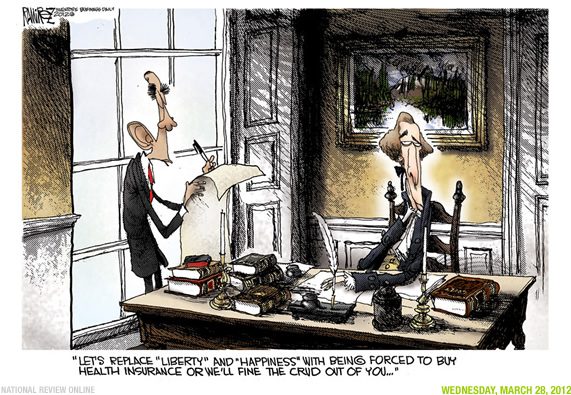
Cartoons from Dan Mitchell’s blog that demonstrate what Obama is doing to our economy Part 1


I have put up lots of cartoons from Dan Mitchell’s blog before and they have got lots of hits before. Many of them have dealt with the economy, eternal unemployment benefits, socialism,  Greece,  welfare state or on gun control.

I think Max Brantley of the Arkansas Times Blog was right to point out on 2-6-13 that Hillary Clinton may be tough for Republicans to beat in 2016. He noted, “A former campaigner for George H.W. Bush writes in the Daily Beast that Hillary Rodham Clinton is a particularly dangerous opponent for Republicans in 2016, as evidenced by her popularity among voters in Texas and Kentucky over Republican candidates.”

The main problem for Hillary will be the performance of Obamacare. If it works well then I see Republicans having a hard time winning in 2016, but if it does not work well and there are lines then watch out for a Republican win.

The Lord knows that I was dreadfully wrong about my 2012 prediction that Obama would lose in Ohio and other swing states. I really doubted the Max Brantley’s prediction of an Obama win and I had to come back and give him credit afterwards for the good prediction.

I ran across a funny carton from Dan Mitchell’s blog on President Obama concerning Obamacare.

Obama vs. the Founding Fathers

March 31, 2012 by Dan Mitchell

I’ve repeatedly said that Michael Ramirez is a good political cartoonist (see here, hereherehere, here, and here), and he’s proved his worth in this cartoon that cleverly mocks the cavalier attitude that statists have about America’s founding principles.

And here are two more Ramirez cartoons, including one that also uses the theme of Obama vs the Founding Fathers.

Finally, for those who want some analysis of why schemes like Obamacare are inconsistent with the Constitution, here’s some good analysis by Walter Williams, Thomas Sowell, Philip Klein and Damon Root, and yours truly.

Related posts:

Election result predictions on Romney vs. Obama

I came on here on Friday and predicted that Romney would win 301 to 237. My view was skewed by something I read on Jason Tolbert’s blog recently: Our neighbors in Tennessee started casting ballots this week. Jim Geraghty with National Review notes a dramatic swing in what looks like good news for Republicans. His […]

Projected Presidential election results between Obama and Romney

I predict that President Obama will lose to Mitt Romney because so many of the battleground states will go for Romney because of the horrible economies in their states. Real Clear Politics as of 11:14 am on 10-19-12 had President Obama with 201 electorial votes locked up and Mitt Romney with 206. I think that […]

Are Max Brantley and Dan Mitchell right about Obama winning?

I have a lot of respect for Max Brantley of the Arkansas Times Blog and Dan Mitchell of the Cato Institute for their political analysis. They both have picked Obama to win today. I parted company and chose Romney to win 301 to 237. Knowing how Dan Mitchell thinks leads me to believe that he […]


Cartons on Obama’s budget math

Dan Mitchell Discussing Dishonest Budget Numbers with John Stossel Uploaded by danmitchellcato on Feb 11, 2012 No description available. ______________ Dan Mitchell of the Cato Institute has shown before how excessive spending at the federal level has increased in recent years. A Humorous Look at Obama’s Screwy Budget Math May 31, 2012 by Dan Mitchell I’ve […]

Obama on creating jobs!!!!(Funny Carton)

Another great carton on President Obama’s efforts to create jobs!!! A Simple Lesson about Job Creation for Barack Obama December 7, 2011 by Dan Mitchell Even though leftist economists such as Paul Krugman and Larry Summers have admitted that unemployment insurance benefits are a recipe for more joblessness, the White House is arguing that Congress should […]

Get people off of government support and get them in the private market place!!!!(great carton too)

Dan Mitchell hits the nail on the head and sometimes it gets so sad that you just have to laugh at it like Conan does. In order to correct this mess we got to get people off of government support and get them in the private market place!!!! Chuck Asay’s New Cartoon Nicely Captures Mentality […]

Funny carton from Dan Mitchell’s blog on Greece

Sometimes it is so crazy that you just have to laugh a little. The European Mess, Captured by a Cartoon June 22, 2012 by Dan Mitchell The self-inflicted economic crisis in Europe has generated some good humor, as you can see from these cartoons by Michael Ramirez and Chuck Asay. But for pure laughter, I don’t […]

Cartons on Obama’s budget math

Dan Mitchell Discussing Dishonest Budget Numbers with John Stossel Uploaded by danmitchellcato on Feb 11, 2012 No description available. ______________ Dan Mitchell of the Cato Institute has shown before how excessive spending at the federal level has increased in recent years. A Humorous Look at Obama’s Screwy Budget Math May 31, 2012 by Dan Mitchell I’ve […]

Obama on creating jobs!!!!(Funny Carton)

Another great carton on President Obama’s efforts to create jobs!!! A Simple Lesson about Job Creation for Barack Obama December 7, 2011 by Dan Mitchell Even though leftist economists such as Paul Krugman and Larry Summers have admitted that unemployment insurance benefits are a recipe for more joblessness, the White House is arguing that Congress should […]

2 cartons illustrate the fate of socialism from the Cato Institute

Cato Institute scholar Dan Mitchell is right about Greece and the fate of socialism: Two Pictures that Perfectly Capture the Rise and Fall of the Welfare State July 15, 2011 by Dan Mitchell In my speeches, especially when talking about the fiscal crisis in Europe (or the future fiscal crisis in America), I often warn that […]

2 cartons illustrate the fate of socialism from the Cato Institute

Cato Institute scholar Dan Mitchell is right about Greece and the fate of socialism: Two Pictures that Perfectly Capture the Rise and Fall of the Welfare State July 15, 2011 by Dan Mitchell In my speeches, especially when talking about the fiscal crisis in Europe (or the future fiscal crisis in America), I often warn that […]


Open letter to President Obama (Part 232)


President Obama c/o The White House
1600 Pennsylvania Avenue NW
Washington, DC 20500

Dear Mr. President,

I know that you receive 20,000 letters a day and that you actually read 10 of them every day. I really do respect you for trying to get a pulse on what is going on out here.

I have been involved with the March for Life for almost 30 years here in Little Rock. My four kids and I  have walked in it on a regular basis in Little Rock and I have posted about it before on my blog www.thedailyhatch.org . When I first marched in it Ronald Reagan was the president and he wrote one of the best articles on the pro-life movement that I ever read. I have included below.

Nelly Gray passed away on August 13, 2012 and she started the March almost 40 years ago. I wanted to honor her today with this post. Please stand on the side of life!!!!!

Nellie Gray, Founder Of ‘March For Life,’ Dies

EnlargeRoger L. Wollenberg /UPI /LandovNellie Gray, president of the March for Life Fund, at the March for Life rally near the White House in 2004.

Nellie Gray, president of the  March for Life Fund, at the March for Life rally near the White House in 2004.

Roger L. Wollenberg /UPI /LandovNellie Gray, president of the March for Life Fund, at the March for Life rally near the White House in 2004.

Nellie Gray, who in 1974 helped start the annual antiabortion demonstration in Washington called March for Life that attracts thousands to the nation’s capital, has died. She was 88.

According to The Washington Post, “Gene Ruane, a colleague, said that he found Miss Gray dead Monday in her Capitol Hill home and that the chief medical examiner will determine the cause and date of her death.”

National Review’s The Corner blog writes that:

“The March for Life is Nellie Gray’s main legacy. Many pro-lifers sometimes seem to take the annual March for granted, but the longevity of the March is actually a remarkable achievement. Some 39 years ago, pro-life activists felt a need to properly commemorate the first anniversary of the tragic Roe v. Wade decision. That is when the idea for the March for Life was born. Interestingly, there was no plan to repeat the first March, but when deciding what to do with the leftover funds, someone suggested hosting a March the next year. Before long, the March for Life was incorporated with Nellie Gray as president and became an annual tradition.

“Since then, the March has been a key contribution to the pro-life cause.”

The Associated Press says “Gray was a lawyer and former federal employee who devoted herself full-time to the anti-abortion movement after the Supreme Court’s 1973 Roe v. Wade decision. … [She] was the primary organizer of the march throughout its 38-year history. She used the phrase ‘no exceptions, no compromise’ to sum up her belief that life begins at conception and abortion should be illegal. At this year’s march, she referred to abortion as genocide and the Roe v. Wade decision as ‘an evil imposed upon our country.’ ”

The next March for Life is scheduled for Jan. 25, 2013.


Nellie Gray: ‘No one … can legalize even a little bit of abortion’

June 10, 2004, 10:30 a.m.
Abortion and the Conscience of the Nation
Ronald Reagan’s pro-life tract.

EDITOR’S NOTE: While president, Ronald Reagan penned this article for The Human Life Review, unsolicited. It ran in the Review‘s Spring 1983, issue and is reprinted here with permission.

The 10th anniversary of the Supreme Court decision in Roe v. Wade. Our nationwide policy of abortion-on-demand through all nine months of pregnancy was neither voted for by our people nor enacted by our legislators — not a single state had such unrestricted abortion before the Supreme Court decreed it to be national policy in 1973 is a good time for us to pause and reflect. But the consequences of this judicial decision are now obvious: since 1973, more than 15 million unborn children have had their lives snuffed out by legalized abortions. That is over ten times the number of Americans lost in all our nation’s wars.

Make no mistake, abortion-on-demand is not a right granted by the Constitution. No serious scholar, including one disposed to agree with the Court’s result, has argued that the framers of the Constitution intended to create such a right. Shortly after the Roe v. Wade decision, Professor John Hart Ely, now Dean of Stanford Law School, wrote that the opinion “is not constitutional law and gives almost no sense of an obligation to try to be.” Nowhere do the plain words of the Constitution even hint at a “right” so sweeping as to permit abortion up to the time the child is ready to be born. Yet that is what the Court ruled.

As an act of “raw judicial power” (to use Justice White’s biting phrase), the decision by the seven-man majority inRoev. Wade has so far been made to stick. But the Court’s decision has by no means settled the debate. Instead,Roe v. Wadehas become a continuing prod to the conscience of the nation.

Abortion concerns not just the unborn child, it concerns every one of us. The English poet, John Donne, wrote: “. . . any man’s death diminishes me, because I am involved in mankind; and therefore never send to know for whom the bell tolls; it tolls for thee.”

We cannot diminish the value of one category of human life — the unborn — without diminishing the value of all human life. We saw tragic proof of this truism last year when the Indiana courts allowed the starvation death of “Baby Doe” in Bloomington because the child had Down’s Syndrome.

Many of our fellow citizens grieve over the loss of life that has followed Roe v. Wade. Margaret Heckler, soon after being nominated to head the largest department of our government, Health and Human Services, told an audience that she believed abortion to be the greatest moral crisis facing our country today. And the revered Mother Teresa, who works in the streets of Calcutta ministering to dying people in her world-famous mission of mercy, has said that “the greatest misery of our time is the generalized abortion of children.”

Over the first two years of my Administration I have closely followed and assisted efforts in Congress to reverse the tide of abortion — efforts of Congressmen, Senators and citizens responding to an urgent moral crisis. Regrettably, I have also seen the massive efforts of those who, under the banner of “freedom of choice,” have so far blocked every effort to reverse nationwide abortion-on-demand.

Despite the formidable obstacles before us, we must not lose heart. This is not the first time our country has been divided by a Supreme Court decision that denied the value of certain human lives. The Dred Scott decision of 1857 was not overturned in a day, or a year, or even a decade. At first, only a minority of Americans recognized and deplored the moral crisis brought about by denying the full humanity of our black brothers and sisters; but that minority persisted in their vision and finally prevailed. They did it by appealing to the hearts and minds of their countrymen, to the truth of human dignity under God. From their example, we know that respect for the sacred value of human life is too deeply engrained in the hearts of our people to remain forever suppressed. But the great majority of the American people have not yet made their voices heard, and we cannot expect them to — any more than the public voice arose against slavery — until the issue is clearly framed and presented.

What, then, is the real issue? I have often said that when we talk about abortion, we are talking about two lives — the life of the mother and the life of the unborn child. Why else do we call a pregnant woman a mother? I have also said that anyone who doesn’t feel sure whether we are talking about a second human life should clearly give life the benefit of the doubt. If you don’t know whether a body is alive or dead, you would never bury it. I think this consideration itself should be enough for all of us to insist on protecting the unborn.

________________________________________________

I remember when President Carter and candidate Reagan debated in 1980 and the subject of abortion came up. Reagan said that if you were on a dusty area and you found someone laying down would you bury him without knowing for sure if he is alive or not? It is the same with the case of abortion.

Thank you so much for your time. I know how valuable it is. I also appreciate the fine family that you have and your commitment as a father and a husband.

Sincerely,

Everette Hatcher III, 13900 Cottontail Lane, Alexander, AR 72002, ph 501-920-5733, lowcostsqueegees@yahoo.com

Related posts:

Pro-life posts can be seen on the www.thedailyhatch.org

Uploaded by ProLifeOnCampus on Jan 29, 2011 The Miracle of Life by Valley Baptist Church of Bakersfield, California. _________ If you want to see some more great pro-life videos and articles then check out these links below: Kathy Ireland’s argument with Planned Parenthood over abortion February 24, 2012 – 6:54 am   Science Matters #2: Former […]

Ronald Reagan’s videos and pictures displayed here on the www.thedailyhatch.org

President Reagan, Nancy Reagan, Bill Clinton and Hillary Clinton attending the Dinner Honoring the Nation’s Governors. 2/22/87. Ronald Reagan is my favorite president and I have devoted several hundred looking at his ideas. Take a look at these links below: President Reagan and Nancy Reagan attending “All Star Tribute to Dutch Reagan” at NBC Studios(from […]

“Feedback Friday” Letter to White House generated form letter response (on abortion) April 16, 2012 (part 5)

I have been writing President Obama letters and have not received a personal response yet.  (He reads 10 letters a day personally and responds to each of them.) However, I did receive a form letter in the form of an email on April 16, 2011. First you will see my letter to him which was mailed around April 9th. […]

Hank Hanegraaff on the issue of abortion (Part 2)

Two Minute Warning: How Then Should We Live?: Francis Schaeffer at 100 Uploaded by ColsonCenter on Jan 31, 2012 Under Francis Schaeffer’s tutelage, Evangelicals like Chuck Colson learned to see life through the lens of a Christian worldview. Join Chuck as he celebrates a life well lived. ______________ Despite what the liberals like Max Brantley […]

Unborn babies lose out:Susan G. Komen reverses decison on Planned Parenthood

Richard Dawkins comments on Tim Tebow pro-life commercial. I am sad today because Susan G. Komen reversed their decision and will continue to supports Planned Parenthood which the USA’s largest abortion provider. The Arkansas Times Blog reported that the leader of Susan G. Komen apologized and explained that Planned Parenthood would be receiving funds from […]

Ron Paul’s Pro-life view

Ron Paul’s Pro-life view Ron Paul’s Pro-Life Speech in Ames, Iowa Uploaded by RonPaul2008dotcom on Aug 13, 2011 Free email updates: http://www.RonPaul.com/welcome.php Please like, share, subscribe & comment! http://www.RonPaul.com 08/13/2011– Ron Paul is America’s leading voice for limited, constitutional government, low taxes, free markets, sound money, and a pro-America foreign policy. ___________________________________ Related posts: Crowd […]

Prolife March in Little Rock has 20 to 1 ratio more than abortion march of previous day

PHOTO BY STATON BREIDENTHAL Marchers arrive at the state Capitol on Sunday after beginning the Arkansas March for Life in downtown Little Rock As in the past, the pr0-life March in Little Rock had at least twenty times the people in attendance that the pr0-abortion march did the previous day. In fact, last year Channel […]

March for Life in Little Rock 2pm Jan 22, 2012

34th Annual March For Life Sunday, January 22, 2012 2:00 PM Capitol and Louisiana Downtown Little Rock Will your face appear in pictures at the next March for Life? We certainly hope that you will consider joining us each January for this important pro-life event. Hundreds of people from across the state make the annual […]

Listing of transcripts and videos of Free to Choose by Milton Friedman: Episode “Created Equal” on www.theDailyHatch.org


Milton Friedman in his series “Free to Choose” used a pencil as a simple example to should have the “invisible hand” of the freemarket works (phrase originally used by Adam Smith).
 
 
Milton Friedman congratulated by President Ronald Reagan. © 2008 Free To Choose Media, courtesy of the Power of Choice press kit

Here are some great quotes about Milton Friedman:

“Milton Friedman is a scholar of first rank whose original contributions to economic science have made him one of the greatest thinkers in modern history.”
President Ronald Reagan

“How grateful I have been over the years for the cogency of Friedman’s ideas which have influenced me. Cherishers of freedom will be indebted to him for generations to come.”
Alan Greenspan, former Chairman, Federal Reserve System

“Right at this moment there are people all over the land, I could put dots on the map, who are trying to prove Milton wrong. At some point, somebody else is trying to prove he’s right That’s what I call influence.”
Paul Samuelson, Nobel Laureate in Economic Science

“Friedman’s influence reaches far beyond the academic community and the world of economics. Rather than lock himself in an ivory tower, he has joined the fray to fight for the survival of this great country of ours.”
William E. Simon, former Secretary of the Treasury

“Milton Friedman is the most original social thinker of the era.”
John Kenneth Galbraith, former Professor of Economics, Harvard University

Perhaps Friedman’s greatest success began in 1979 when he and his wife Rose authored the book, Free to Choose, based on the famous ten-part TV series for PBS by the same title. Both the TV program and the book were drawn from an earlier series of lectures presented by Friedman. Because it aired during a period of critical economic distress during the Carter Administration and in the aftermath of the Vietnam War, Watergate scandal, and Richard Nixon’s resignation as President, the program is widely regarded as being a major factor in shifting American public opinion toward appreciating the need to dismantle government largess. The series was shown in England, Japan, Italy, Australia, Germany, Canada, and many other countries, and the book was translated for distribution around the world, selling more than one million copies.

__________

No other issue is more misunderstood today than equality. President Obama has used class warfare over and over the last few months and according to him equality at the finish line is the equality that we should all be talking about. However, socialism has never worked and it has always killed incentive to produce more. Milton Friedman expressed the conversative’s best and I am glad that I had the chance to be studying his work for over 30 years now.

In 1980 when I first sat down and read the book “Free to Choose” I was involved in Ronald Reagan’s campaign for president and excited about the race. Milton Friedman’s books and film series really helped form my conservative views. Take a look at one of my favorite films of his:

Created Equal [1/7]. Milton Friedman’s Free to Choose (1980)

Uploaded by on May 30, 2010

In this program, Milton Friedman visits India, the U.S., and Britain, examining the question of equality. He points out that our society traditionally has embraced two kinds of equality: equality before God and equality of opportunity. The first of these implies that human beings enjoy a certain dignity simply because they are members of the human community. The second suggests societies should allow the talents and inclinations of individuals to unfold, free from arbitrary barriers. Both of these concepts of equality are consistent with the goal of personal freedom.

In recent years, there has been growing support for a third type of equality, which Dr. Friedman calls “equality of outcome.” This concept of equality assumes that justice demands a more equal distribution of the economic fruits of society. While admitting the good intentions of those supporting the idea of equality of outcome, Dr. Friedman points out that government policies undertaken in support of this objective are inconsistent with the ideal of personal freedom. Advocates of equality of outcome typically argue that consumers must be protected by government from the insensitivities of the free market place.

Dr. Friedman demonstrates that in countries where governments have pursued the goal of equality of outcome, the differences in wealth and well being between the top and the bottom are actually much greater than in countries that have relied on free markets to coordinate economic activity. Indeed, says Dr. Friedman, it is the ordinary citizen who benefits most from the free market system. Dr. Friedman concludes that any society that puts equality ahead of freedom will end up with neither. But the society that puts freedom before equality will end up with both greater freedom and great equality.

___________________________

FREE TO CHOOSE 5: “Created Equal” (Milton Friedman)
Free to Choose ^ | 1980 | Milton Friedman

Posted on Friday, July 21, 2006 3:58:44 PM by Choose Ye This Day

FREE TO CHOOSE: Created Equal

Friedman: From the Victorian novelists to modern reformers, a favorite device to stir our emotions is to contrast extremes of wealth and of poverty. We are expected to conclude that the rich are responsible for the deprivations of the poor __ that they are rich at the expense of the poor.

Whether it is in the slums of New Delhi or in the affluence of Las Vegas, it simply isn’t fair that there should be any losers. Life is unfair __ there is nothing fair about one man being born blind and another man being born with sight. There is nothing fair about one man being born of a wealthy parent and one of an indigenous parent. There is nothing fair about Mohammed Ali having been born with a skill that enables him to make millions of dollars one night. There is nothing fair about Marleena Detrich having great legs that we all want to watch. There is nothing fair about any of that. But on the other hand, don’t you think a lot of people who like to look at Marleena Detrich’s legs benefited from nature’s unfairness in producing a Marleena Detrich. What kind of a world would it be if everybody was an absolute identical duplicate of anybody else. You might as well destroy the whole world and just keep one specimen left for a museum. In the same way, it’s unfair that Muhammed Ali should be a great fighter and should be able to earn millions. But would it not be even more unfair to the people who like to watch him if you said that in the pursuit of some abstract idea of equality we’re not going to let Muhammed Ali get more for one nights fight than the lowest man on the totem pole can get for a days unskilled work on the docks. You can do that but the result of that would be to deny people the opportunity to watch Mohammad Ali. I doubt very much he would be willing to subject himself to the kind of fights he’s gone through if he were to get the pay of an unskilled docker.

This beautiful estate, its manicured lawns, its trees, its shrubs, was built by men and women who were taken by force in Africa and sold as slaves in America. These kitchen gardens were planted and tended by them to furnish food for themselves and their master, Thomas Jefferson, the Squire of Monticello. It was Jefferson who wrote these words: We hold these truths to be self-evident that all men are created equal. That they are endowed by their creator with certain inalienable rights, that among these are life, liberty and the pursuit of happiness. These words penned by Thomas Jefferson at the age of 33 when he wrote the Declaration of Independence, have served to define a basic ideal of the United States throughout its history.

Much of our history has revolved about the definition and redefinition of the concept of equality, about the intent to translate it into practice. What did Thomas Jefferson mean by the words all men are created equal? He surely did not mean that they were equal and/or identical in what they could do and what they believed. After all, he was himself a most remarkable person. At the age of 26, he designed this beautiful house of Monticello, supervised its construction and indeed is said to have worked on it with his own hands. He was an inventor, a scholar, an author, a statesman, governor of Virginia, President of the United States, minister to France, he helped shape and create the United States. What he meant by the word “equal” can be seen in the phrase “endowed by their creator”. To Thomas Jefferson, all men are equal in the eyes of God. They all must be treated as individuals who have each separately a right to life, liberty and the pursuit of happiness.

Of course, practice did not conform to the ideals. In Jefferson’s life or in ours as a nation, he agonized repeatedly during his lifetime about the conflict between the institution of slavery and the fine words of the declaration. Yet, during his whole life, he was a slave owner.

This is the City Palace in Jaipur, the capitol of the Indian state of Rajasthan, is just one of the elegant houses that were built here 150 years ago by the prince who ruled this land. There are no more princes, no more Maharajas in India today. All titles were swept away by the government of India in its quest for equality. But as you can see, there are still some people here who live a very privileged life. The descendants of the Maharajas financed this kind of life partly by using other palaces as hotels for tourists __ tourists who come to India to see how the other half lives. This side of India, the exotic glamorous side, is still very real. Everywhere in the world there are gross inequalities of income and wealth. They offend most of us.

A myth has grown up that free market capitalism increases such inequalities, that the rich benefit at the expense of the poor. Nothing could be further from the truth. Wherever the free market has been permitted to operate, the ordinary man has been able to attain levels of living never dreamed of before. Nowhere is the gap between rich and poor. Nowhere are the rich richer and the poor poorer than in those societies that do not permit the free market to operate, whether they be feudal societies where status determines position, or modern, centrally-planned economies where access to government determines position.

Central planning was introduced in India in considerable part in the name of equality. The tragedy is that after 30 years, it is hard to see any significant improvement in the lot of the ordinary person.

__________________

Other segments:

Free to Choose by Milton Friedman: Episode “Created Equal” (Part 7 of transcript and video)

Liberals like President Obama want to shoot for an equality of outcome. That system does not work. In fact, our free society allows for the closest gap between the wealthy and the poor. Unlike other countries where free enterprise and other freedoms are not present.  This is a seven part series. Created Equal [7/7]. Milton Friedman’s Free to Choose […]

Liberals’ solution for the poor is more welfare, but that will not work

Milton Friedman’s solution to limiting poverty Liberals like Michael Cook just don’t get it. They should listen to Milton Friedman (who is quoted in this video below concerning the best way to limit poverty). New Video Shows the War on Poverty Is a Failure Posted by Daniel J. Mitchell The Center for Freedom and Prosperity has […]

Free to Choose by Milton Friedman: Episode “Created Equal” (Part 6 of transcript and video)

Liberals like President Obama want to shoot for an equality of outcome. That system does not work. In fact, our free society allows for the closest gap between the wealthy and the poor. Unlike other countries where free enterprise and other freedoms are not present.  This is a seven part series. Created Equal [6/7]. Milton Friedman’s Free to Choose […]

“Friedman Friday” Free to Choose by Milton Friedman: Episode “Created Equal” (Part 5 of transcript and video)

Liberals like President Obama want to shoot for an equality of outcome. That system does not work. In fact, our free society allows for the closest gap between the wealthy and the poor. Unlike other countries where free enterprise and other freedoms are not present.  This is a seven part series. Created Equal [5/7]. Milton Friedman’s Free to Choose […]

Republican debate Oct 18, 2011 (last part) with video clips and transcript

Republican debate Oct 18, 2011 (last part) with video clips and transcript Below are video clips and the transcript. pt 5 pt 6 pt 7 COOPER: We’re going to move on to an issue very important here in the state of Nevada and throughout the West. We have a question from the hall. QUESTION: Yeah, […]

Milton Friedman discusses Reagan and Reagan discusses Friedman

Uploaded by YAFTV on Aug 19, 2009 Nobel Laureate Dr. Milton Friedman discusses the principles of Ronald Reagan during this talk for students at Young America’s Foundation’s 25th annual National Conservative Student Conference MILTON FRIEDMAN ON RONALD REAGAN In Friday’s WSJ, Milton Friedman reflectedon Ronald Reagan’s legacy. (The link should work for a few more […]

Free to Choose by Milton Friedman: Episode “Created Equal” (Part 4 of transcript and video)

Liberals like President Obama want to shoot for an equality of outcome. That system does not work. In fact, our free society allows for the closest gap between the wealthy and the poor. Unlike other countries where free enterprise and other freedoms are not present.  This is a seven part series. Created Equal [4/7]. Milton Friedman’s Free to Choose […]

Friedman Friday” Free to Choose by Milton Friedman: Episode “Created Equal” (Part 3 of transcript and video)

Friedman Friday” Free to Choose by Milton Friedman: Episode “Created Equal” (Part 3 of transcript and video) Liberals like President Obama want to shoot for an equality of outcome. That system does not work. In fact, our free society allows for the closest gap between the wealthy and the poor. Unlike other countries where free enterprise and other […]

Free to Choose by Milton Friedman: Episode “Created Equal” (Part 2 of transcript and video)

Free to Choose by Milton Friedman: Episode “Created Equal” (Part 2 of transcript and video) Liberals like President Obama want to shoot for an equality of outcome. That system does not work. In fact, our free society allows for the closest gap between the wealthy and the poor. Unlike other countries where free enterprise and other freedoms are […]

Free to Choose by Milton Friedman: Episode “Created Equal” (Part 1 of transcript and video)

 Milton Friedman and Ronald Reagan Liberals like President Obama (and John Brummett) want to shoot for an equality of outcome. That system does not work. In fact, our free society allows for the closest gap between the wealthy and the poor. Unlike other countries where free enterprise and other freedoms are not present.  This is a seven part series. […]


Open letter to President Obama (Part 231 B)


President Obama c/o The White House
1600 Pennsylvania Avenue NW
Washington, DC 20500

Dear Mr. President,

I know that you receive 20,000 letters a day and that you actually read 10 of them every day. I really do respect you for trying to get a pulse on what is going on out here. I know you are not pro-life but I wanted to share some pro-life material with you regardless.

Many evangelicals today are pro-life because of Francis Schaeffer. Maybe you should understand where we are coming from.

 
First published in 1981, Francis Schaeffer’s A Christian Manifestois increasingly relevant today in 2010. The book, penned as a Christian response to the Communist and Humanist Manifestos, describes how the United States is being systematically torn apart by secular humanism and its “material-energy, chance world view.” The second half of the book details what actions the Christian should take in defending one’s self and country.In explaining civil disobedience, Schaeffer uses Samuel Rutherford’smodel of “three appropriate levels of resistance.”“First, he must defend himself by protest (in contemporary society this would most often be by legal action); second, he must flee if at all possible; and, third, he may use force, if necessary, to defend himself (Schaeffer 103).”Schaeffer then goes on to provide an example that would be worthy of Rutherford’s first level of resistance.“In our day an illustration for the need of protest is tax money used for abortion. After all the normal constitutional means of protest had been exhausted, then what could be done? At some point protest could lead some Christians to refuse to pay some portion of their tax money. Of course, this would mean a trial. Such a move would have to be the individual’s choice under God. No one should decide for another. But somewhere along the way, such a decision might easily have to be faced. Happily, at the present time in the United States the Hyde Amendment has removed the use of national tax money for abortions, but that does not change the possibility that in some cases such a protest would be the only way to be heard (Schaeffer 108).”Fastforward 19 years. Today, the concern for pro-lifers is no longer the Hyde Amendment. The United States now has a tax-funded federal healthcare program that, according to a new Congressional Research Service report, allows federal tax dollars to fund elective abortions.What should be the Christian response? If the legal challenges fail and our government does indeed choose to use federal tax money to fund the killing of unborn babies, how will God’s people respond?It is interesting just how prophetic Francis Schaeffer’s thoughts and concerns were. This is the first of his writings I have read and I look forward to reading more of his work. The abortion fight is no different than any other war in the sense that individual battles will decide victory. But the battles involved have so much more at stake than I often realize. There is certainly a “war of world views” going on in this country and the preservation or destruction of the U.S. Constitution will surely determine if liberty is for all or none.Schaeffer, Francis A. A Christian Manifesto. Westchester: Crossway, 1982

________

Thank you so much for your time. I know how valuable it is. I also appreciate the fine family that you have and your commitment as a father and a husband.

Sincerely,

Everette Hatcher III, 13900 Cottontail Lane, Alexander, AR 72002, ph 501-920-5733, lowcostsqueegees@yahoo.com

Open letter to President Obama (Part 231)

President Obama c/o The White House
1600 Pennsylvania Avenue NW
Washington, DC 20500

Dear Mr. President,

I know that you receive 20,000 letters a day and that you actually read 10 of them every day. I really do respect you for trying to get a pulse on what is going on out here.

We got to stop all the red ink. How can keep our federal spending at the high level it is at now and not end up in Greece? As the president you should take the bull by the horns and balance the budget!!!!

The burden of federal spending in the United States was down to 18.2 percent of gross domestic product when Bill Clinton left office.

But this progress didn’t last long. Thanks to George Bush’s reckless spending policies, the federal budget grew about twice as fast as the economy, jumping by nearly 90 percent in just eight years This pushed federal spending up to about 25 percent of GDP.

President Obama promised hope and change, but he has kept spending at this high level rather than undoing the mistakes of his predecessor.

This new video from the Center for Freedom and Prosperity Foundation uses examples of waste, fraud, and abuse to highlight President Obama’s failed fiscal policy.

Published on Aug 12, 2012 by

This mini-documentary from the Center for Freedom and Prosperity Foundation highlights egregious examples of wasteful spending from the so-called stimulus legislation and explains why government spending hurts economic performance.

____________________

Good stuff, though the video actually understates the indictment against Obama. There is no mention, for instance, about all the new spending for Obamacare that will begin to take effect over the next few years.

But not everything can be covered in a 5-minute video. And I suspect the video is more effective because it closes instead with some discussion of the corrupt insider dealing of Obama’s so-called green energy programs.

__________

Thank you so much for your time. I know how valuable it is. I also appreciate the fine family that you have and your commitment as a father and a husband.

Sincerely,

Everette Hatcher III, 13900 Cottontail Lane, Alexander, AR 72002, ph 501-920-5733, lowcostsqueegees@yahoo.com

Open letter to President Obama (Part 230 B)

A Ronald Reagan radio address from 1975 addresses the topics of abortion and adoption. This comes from a collection of audio commentaries titled “Reagan in His Own Voice.”


President Obama c/o The White House
1600 Pennsylvania Avenue NW
Washington, DC 20500

Dear Mr. President,

I know that you receive 20,000 letters a day and that you actually read 10 of them every day. I really do respect you for trying to get a pulse on what is going on out here. I know you are not pro-life but I wanted to share some pro-life material with you regardless.

Francis Schaeffer said in the book CHRISTIAN MANIFESTO:

Certainly every Christian ought to be praying and working to nullify the abominable abortion law. But as we work and pray, we should have in mind not only this important issue as though it stood alone. Rather, we should be struggling and praying that this whole other total entity “(this godless) worldview” can be rolled back with all its results across all of life.

I just wanted to share with you one of the finest prolife papers I have ever read, and it is by President Ronald Wilson Reagan.

I have a son named Wilson Daniel Hatcher and he is named after two of the most respected men I have ever read about : Daniel from the Old Testament and Ronald Wilson Reagan. I have studied that book of Daniel for years and have come to respect that author who was a saint who worked in two pagan governments but he never compromised. My favorite record was the album “No Compromise” by Keith Green and on the cover was a picture from the Book of Daniel.

One of the thrills of my life was getting to hear President Reagan speak in the beginning of November of 1984 at the State House Convention Center in Little Rock.  Immediately after that program I was standing outside on Markham with my girlfriend Jill Sawyer (now wife of 25 years) and we were alone on a corner and President was driven by and he waved at us and we waved back.

My former pastor from Memphis, Adrian Rogers, got the opportunity to visit with President Ronald Reagan on several occasions.

Take time to read this below and comment below and let me know what you thought of his words.

June 10, 2004, 10:30 a.m.
Abortion and the Conscience of the Nation
Ronald Reagan’s pro-life tract.

EDITOR’S NOTE: While president, Ronald Reagan penned this article for The Human Life Review, unsolicited. It ran in the Review‘s Spring 1983, issue and is reprinted here with permission.

The 10th anniversary of the Supreme Court decision in Roe v. Wade. Our nationwide policy of abortion-on-demand through all nine months of pregnancy was neither voted for by our people nor enacted by our legislators — not a single state had such unrestricted abortion before the Supreme Court decreed it to be national policy in 1973 is a good time for us to pause and reflect. But the consequences of this judicial decision are now obvious: since 1973, more than 15 million unborn children have had their lives snuffed out by legalized abortions. That is over ten times the number of Americans lost in all our nation’s wars.

Make no mistake, abortion-on-demand is not a right granted by the Constitution. No serious scholar, including one disposed to agree with the Court’s result, has argued that the framers of the Constitution intended to create such a right. Shortly after the Roe v. Wade decision, Professor John Hart Ely, now Dean of Stanford Law School, wrote that the opinion “is not constitutional law and gives almost no sense of an obligation to try to be.” Nowhere do the plain words of the Constitution even hint at a “right” so sweeping as to permit abortion up to the time the child is ready to be born. Yet that is what the Court ruled.

As an act of “raw judicial power” (to use Justice White’s biting phrase), the decision by the seven-man majority inRoev. Wade has so far been made to stick. But the Court’s decision has by no means settled the debate. Instead,Roe v. Wadehas become a continuing prod to the conscience of the nation.

Abortion concerns not just the unborn child, it concerns every one of us. The English poet, John Donne, wrote: “. . . any man’s death diminishes me, because I am involved in mankind; and therefore never send to know for whom the bell tolls; it tolls for thee.”

We cannot diminish the value of one category of human life — the unborn — without diminishing the value of all human life. We saw tragic proof of this truism last year when the Indiana courts allowed the starvation death of “Baby Doe” in Bloomington because the child had Down’s Syndrome.

Many of our fellow citizens grieve over the loss of life that has followed Roe v. Wade. Margaret Heckler, soon after being nominated to head the largest department of our government, Health and Human Services, told an audience that she believed abortion to be the greatest moral crisis facing our country today. And the revered Mother Teresa, who works in the streets of Calcutta ministering to dying people in her world-famous mission of mercy, has said that “the greatest misery of our time is the generalized abortion of children.”

Over the first two years of my Administration I have closely followed and assisted efforts in Congress to reverse the tide of abortion — efforts of Congressmen, Senators and citizens responding to an urgent moral crisis. Regrettably, I have also seen the massive efforts of those who, under the banner of “freedom of choice,” have so far blocked every effort to reverse nationwide abortion-on-demand.

Despite the formidable obstacles before us, we must not lose heart. This is not the first time our country has been divided by a Supreme Court decision that denied the value of certain human lives. The Dred Scott decision of 1857 was not overturned in a day, or a year, or even a decade. At first, only a minority of Americans recognized and deplored the moral crisis brought about by denying the full humanity of our black brothers and sisters; but that minority persisted in their vision and finally prevailed. They did it by appealing to the hearts and minds of their countrymen, to the truth of human dignity under God. From their example, we know that respect for the sacred value of human life is too deeply engrained in the hearts of our people to remain forever suppressed. But the great majority of the American people have not yet made their voices heard, and we cannot expect them to — any more than the public voice arose against slavery — until the issue is clearly framed and presented.

What, then, is the real issue? I have often said that when we talk about abortion, we are talking about two lives — the life of the mother and the life of the unborn child. Why else do we call a pregnant woman a mother? I have also said that anyone who doesn’t feel sure whether we are talking about a second human life should clearly give life the benefit of the doubt. If you don’t know whether a body is alive or dead, you would never bury it. I think this consideration itself should be enough for all of us to insist on protecting the unborn.

________________________________________________

I remember when President Carter and candidate Reagan debated in 1980 and the subject of abortion came up. Reagan said that if you were on a dusty area and you found someone laying down would you bury him without knowing for sure if he is alive or not? It is the same with the case of abortion.

Thank you so much for your time. I know how valuable it is. I also appreciate the fine family that you have and your commitment as a father and a husband.

Sincerely,

Everette Hatcher III, 13900 Cottontail Lane, Alexander, AR 72002, ph 501-920-5733, lowcostsqueegees@yahoo.com

Open letter to President Obama (Part 230)


President Obama c/o The White House
1600 Pennsylvania Avenue NW
Washington, DC 20500

Dear Mr. President,

I know that you receive 20,000 letters a day and that you actually read 10 of them every day. I really do respect you for trying to get a pulse on what is going on out here.

You have seen the figures like I have Mr. President. Social Security will run out of money in the next few decades.

Liberals that say that Social Security is running fine don’t want to live in the real world but in a make-believe liberal world that doesn’t exist.

I don’t give the issue much attention on this blog, but I’m very interested in Social Security reform. I wrote my dissertation on Australia’s very successful system of personal retirement accounts, for instance, and I narrated this video on Social Security reform in the United States.

So I was very interested to see that the Associated Press put out a story warning about the dismal state of the program’s finances.

Here’s some of what the AP reported.

For nearly three decades Social Security produced big surpluses, collecting more in taxes from workers than it paid in benefits to retirees, disabled workers, spouses and children. The surpluses also helped mask the size of the budget deficit being generated by the rest of the federal government. Those days are over. Since 2010, Social Security has been paying out more in benefits than it collects in taxes… The projected shortfall in 2033 is $623 billion, according to the trustees’ latest report. It reaches $1 trillion in 2045 and nearly $7 trillion in 2086, the end of a 75-year period used by Social Security’s number crunchers because it covers the retirement years of just about everyone working today. Add up 75 years’ worth of shortfalls and you get an astonishing figure: $134 trillion. Adjusted for inflation, that’s $30.5 trillion in 2012 dollars, or eight times the size of this year’s entire federal budget.

First of all, kudos to the AP. I criticized them for a sloppy and biased report on poverty last month, so it behooves me to mention that their story on Social Security is mostly fair and accurate.

My only complaint is that the story does include some analysis of the Social Security Trust Fund, even though that supposed Fund is nothing but a pile of IOUs – money that one part of the government promises to give to another part of the government.

But let’s set that aside. Another interesting tidbit from the story is this quote from one of the kleptocrats at the American Association of Retired Persons. Note that he implicitly rules out any changes other than those that enable the government to “pay the benefits we promised.”  But that shouldn’t be a surprise. AARP is part of the left-wing coalition.

“I’m not suggesting we need to wait 20 years but we do have time to make changes to Social Security so that we can pay the benefits we promised,” said David Certner, AARP’s legislative policy director. “Let’s face it. Relative to a lot of other things right now, Social Security is in pretty good shape.”

But I will say that Mr. Certner is sort of correct about Social Security being in better shape than Medicare and Medicaid. But that’s like saying the guy with lung cancer who is 75 lbs overweight is in better shape than the two guys with brain tumors who are both 150 lbs overweight.

If you have to engage in fiscal triage, it would be smart to first address Medicare and Medicaid, but Social Security also needs reform. And not the kind of statist reform the folks at AARP would like to see.

By the way, you probably won’t be surprised to learn that President Obama’s approach is similar to the left-wingers at AARP. Here’s a video I narrated about his preferred policy.

It seems that the question doesn’t matter with this administration. The answer is always to impose more class-warfare tax policy.

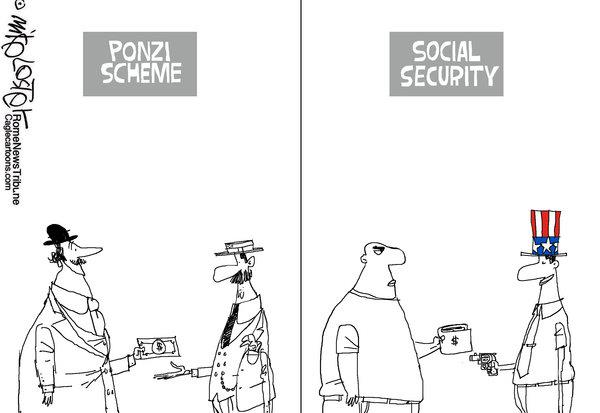
P.S. If you need to be cheered up after reading this post, here’s a good cartoon showing the difference between Social Security and a Ponzi scheme, and here’s another cartoon showing what inspired Bernie Madoff to steal so much money.

__________

Thank you so much for your time. I know how valuable it is. I also appreciate the fine family that you have and your commitment as a father and a husband.

Sincerely,

Everette Hatcher III, 13900 Cottontail Lane, Alexander, AR 72002, ph 501-920-5733, lowcostsqueegees@yahoo.com

.

Open letter to President Obama (Part 229 B)

President Obama c/o The White House
1600 Pennsylvania Avenue NW
Washington, DC 20500

Dear Mr. President,

I know that you receive 20,000 letters a day and that you actually read 10 of them every day. I really do respect you for trying to get a pulse on what is going on out here. I know you are not pro-life but I wanted to share some pro-life material with you regardless.

Francis Schaeffer and Dr. Koop impacted the pro-life movement in a great way.


Vice Admiral C. Everett Koop, USPHS
Surgeon General of the United States

Francis Schaeffer

Author photo.

Francis Schaeffer and Dr. C. Everett Koop put together this wonderful film series “Whatever happened to the human race?” and my senior class teacher Mark Brink taught us a semester long course on it in 1979. I was so impacted by it that I returned the following two years to sit in and watch the series again even though I had graduated and was in college. I knew the impact this film series would have on the pro-life movement and I wanted to soak it all in.

I posted this on the Arkansas Times Blog and got a very strongly worded response from someone with the username “”Outlier” who was obviously very angry about my post.

Max, you are right to say that the economy is a very important issue. However, the sanctity of life is a big issue too. I just got finished reading about the life of Dr. Bernard Nathanson and his transformation from being a founder of NARAL to putting together the film “The Silent Scream.” Ronald Reagan rightly said that all Representatives and Senators should see this film and then it would be easy to pass pro-life laws. Want to know more then check outhttp://haltingarkansasliberalswithtruth.co…

(I know that President Reagan made the remark about our representatives in Washington needing to watch this pro-life film of Nathanson, but after reading Jason Tolbert’s recent article on our representatives in the Arkansas State Government, I think they need to watch it too.)

Posted by SalineRepublican on March 27, 2011 at 10:47 AM | Report this comment
 
Cecile Richards, president of Planned Parenthood and daughter of Anne Richards, former governor of Texas and Mollie Ivins cohort, is on C-Span Newsmakers talking about the consequences of defunding Planned Parenthood. The care women (and men since there is nothing like a case of the clap and no insurance to send one scurrying to their door) are receiving is essential. One in five women in America have used their services for birth control and health screening. Life saving screening for both women and men won’t be available through PP. And they are very cost effective compared to ERs.

All these Republican a**holes and some cowardly dems would hie their daughters off to wherever for an abortion if it so happened that the father was not a suitable boy. Poor women get to go the coat hangar route, or die in back alleys.Posted by the outlier on March 27, 2011 at 10:49 AM | Report this comment_________________________________________

I think this post by “the outlier” overlooks the basic issue of the personhood of the unborn baby and Dr. Nathanson was forced by scientific advances to admit that the unborn baby is a person. “Poor women get to go the coat hanger route or die in back alleys” is the concern of “the outlier” but what about the unborn baby? Is there any consideration of the mass murder of these unborn babies?

I wanted to pass along a portion of the excellent article “Bernard Nathanson: A Life Transformed by the Truth about Abortion.” (Feb 11, 2011)

LifeNews.com Note: Robert P. George is McCormick Professor of Jurisprudence and Director of the James Madison Program in American Ideals and Institutions at Princeton University. He is a member of the President’s Council on Bioethics and previously served on the United States Commission on Civil Rights. This article previously appeared in Public Discourse:

Within a year after Roe v. Wade, however, Nathanson began to have moral doubts about the cause to which he had been so single-mindedly devoted. In a widely noticed 1974 essay in the prestigious New England Journal of Medicine, he revealed his growing doubts about the “pro-choice” dogma that abortion was merely the removal of an “undifferentiated mass of cells,” and not the killing of a developing human being. Referring to abortions that he had supervised or performed, he confessed to an “increasing certainty that I had in fact presided over 60,000 deaths.”

Still, he was not ready to abandon support for legal abortion. It was, he continued to insist, necessary to prevent the bad consequences of illegal abortions. But he was moving from viewing abortion itself as a legitimate solution to a woman’s personal problem, to seeing it as an evil that should be discouraged, even if for practical reasons it had to be tolerated. Over the next several years, while continuing to perform abortions for what he regarded as legitimate “health” reasons, Nathanson would be moved still further toward the pro-life position by the emergence of new technologies, especially fetoscopy and ultrasound, that made it increasingly difficult, and finally impossible, to deny that abortion is the deliberate killing of a unique human being–a child in the womb.

By 1980, the weight of evidence in favor of the pro-life position had overwhelmed Nathanson and driven him out of the practice of abortion. He had come to regard the procedure as unjustified homicide and refused to perform it. Soon he was dedicating himself to the fight against abortion and revealing to the world the lies he and his abortion movement colleagues had told to break down public opposition.

In 1985, Nathanson employed the new fetal imaging technology to produce a documentary film, “The Silent Scream,” which energized the pro-life movement and threw the pro-choice side onto the defensive by showing in graphic detail the killing of a twelve-week-old fetus in a suction abortion. Nathanson used the footage to describe the facts of fetal development and to make the case for the humanity and dignity of the child in the womb. At one point, viewers see the child draw back from the surgical instrument and open his mouth: “This,” Nathanson says in the narration, “is the silent scream of a child threatened imminently with extinction.”

Publicity for “The Silent Scream” was provided by no less a figure than President Ronald Reagan, who showed the film in the White House and touted it in speeches. Like Nathanson, Reagan, who had signed one of the first abortion-legalization bills when he was Governor of California, was a zealous convert to the pro-life cause. During his term as president, Reagan wrote and published a powerful pro-life book entitled Abortion and the Conscience of the Nation–a book that Nathanson praised for telling the truth about the life of the child in the womb and the injustice of abortion.

___________

Thank you so much for your time. I know how valuable it is. I also appreciate the fine family that you have and your commitment as a father and a husband.

Sincerely,

Everette Hatcher III, 13900 Cottontail Lane, Alexander, AR 72002, ph 501-920-5733, lowcostsqueegees@yahoo.com

The Silent Scream

Open letter to President Obama (Part 229)


President Obama c/o The White House
1600 Pennsylvania Avenue NW
Washington, DC 20500

Dear Mr. President,

I know that you receive 20,000 letters a day and that you actually read 10 of them every day. I really do respect you for trying to get a pulse on what is going on out here.

One thing that stands out about Dan Mitchell is that is not a Democrat or a Republican but a lover of freedom like Milton Friedman was. Don’t you want to take up for freedom like Dan does? Don’t you think we should attempt to grow the private sector more than the public sector? Take a look at this article of his below.

Posted by Ryan Minto on August 16, 2012

By DANIEL J. MITCHELL

Thanks to several years of fiscal restraint during the 1990s, the burden of federal spending dropped to 18.2% of gross domestic product by the time Bill Clinton left office. The federal budget today consumes more than 24% of economic output, a one-third increase since 2001 in the share of the U.S. economy allocated by politics rather than market forces. That makes the Republican House budget, which would reverse this trend, extremely important for the economic health of the country.

Both political parties deserve blame for the spending spree that’s put America in a fiscal ditch. President George W. Bush was a big spender and President Obama has compounded the damage with his stimulus spending and other programs.

But the era of bipartisan big government may have come to an end. Largely thanks to Rep. Paul Ryan and the fiscal blueprint he prepared as chairman of the House Budget Committee earlier this year, the GOP has begun climbing back on the wagon of fiscal sobriety and has shown at least some willingness to restrain the growth of government.

The Ryan budget has generated considerable controversy in Washington, and it will become even more of an issue now that Mr. Ryan is Mitt Romney’s running mate. So it’s an appropriate time to analyze the plan and consider what it would mean for America.

image

Chad Crowe

The most important headline about the Ryan budget is that it limits the growth rate of federal spending, with outlays increasing by an average of 3.1% annually over the next 10 years. If spending is left on autopilot, by contrast, it would grow by 4.3% (or nearly 39% faster). If President Obama is re-elected, the burden of spending presumably will climb more rapidly.

This comes as a surprise to many people since the press is filled with stories about the Ryan budget imposing trillions of dollars of “savage” and “draconian” spending cuts. All of these stories, however, are based on Washington’s misleading budget process that automatically assumes an ever-expanding government. The 4.3% “base line” increase is the benchmark for measuring “cuts”—even though spending is rising rather than falling, and it’s only the rate of spending growth that is being slowed.

Even limiting spending so it grows by 3.1% per year, as Mr. Ryan proposes, quickly leads to less red ink. This is because federal tax revenues are projected by the House Budget Committee to increase 6.6% annually over the next 10 years if the House budget is approved (and this assumes the Bush tax cuts are made permanent). Since revenues would climb more than twice as fast as spending, the deficit would drop to about 1% of gross domestic product by the end of the 10-year budget window.

To balance the budget within 10 years would require that outlays grow by about 2% each year. Spending in the Ryan budget means the federal budget reaches balance in 2040. There are many who would prefer that the deficit come down more quickly, but from a jobs and growth perspective, it isn’t the deficit that matters.

Rather, what matters for prosperity and living standards is the degree to which labor and capital are used productively. This is why policy makers should focus on reducing the burden of government spending as a share of GDP—leaving more resources in the private economy.

The simple way of making this happen is to follow what I’ve been calling the golden rule of good fiscal policy: The private sector should grow faster than the government. This is what happens with the Ryan budget. The Congressional Budget Office expects nominal economic output (before inflation) to grow about 5% each year over the next decade. So if federal spending grows 3.1% annually, the burden of federal spending slowly shrinks as a share of GDP.

According to the House Budget Committee, the federal budget would consume slightly less than 20% of economic output if the Ryan budget remained in place for 10 years. This would be remarkable progress considering that the federal government is now consuming 24% of GDP vs. Mr. Clinton’s 18.2% in 2001. If Paul Ryan’s policies are social Darwinism, as Mr. Obama and his allies allege, one can only speculate where Bill Clinton ranks in their estimation.

Spending restraint also creates more leeway for good tax policy. Regardless of what you think about deficits, the political reality is that it is difficult to lower tax rates if government borrowing remains at high or rising levels. If deficit spending continues at current levels, then higher tax rates are almost sure to follow. And higher tax rates can’t create an environment conducive to more investment and jobs.

The Ryan budget avoids this unpleasant outcome by addressing the problem of excessive government spending. This makes it possible to extend the 2001 and 2003 tax-rate reductions. It also clears the way for other pro-growth reforms, such as Gov. Romney’s proposed across-the-board 20% income tax cut, a more competitive 25% corporate tax rate, and less double-taxation of dividends and capital gains.

One of the best features of the Ryan budget is that he reforms the two big health entitlements instead of simply trying to save money. Medicaid gets block-granted to the states, building on the success of welfare reform in the 1990s. And Medicare is modernized by creating a premium-support option for people retiring in 2022 and beyond.

This is much better than the traditional Beltway approach of trying to save money with price controls on health-care providers and means testing on health-care consumers. Price controls are notoriously ineffective—because health-care providers adapt by ordering more tests and procedures—and politically unsustainable due to lobbying pressure. Means testing imposes an indirect penalty on people who save and invest during their working years. That should be a nonstarter for a political party that seeks to encourage productive behavior and discourage dependency.

But good entitlement policy also is a godsend for taxpayers, particularly in the long run. Without reform, the burden of federal spending will jump to 35% of GDP by 2040, compared to 18.75% of output under the Ryan budget.

Assuming the GOP ticket prevails in November, Mitt Romney will make the big decisions on fiscal policy. But there is no escaping the fiscal math. If Mr. Romney intends to keep his no-tax-hike promise, he has to restrain the growth of spending. This doesn’t mean he has to go with every detail of the Ryan budget—but it’s certainly a good place to start.

Mr. Mitchell is a senior fellow at the Cato Institute.

A version of this article appeared August 16, 2012, on page A11 in the U.S. edition of The Wall Street Journal, with the headline: What’s Really in the Ryan Budget.

__________

Thank you so much for your time. I know how valuable it is. I also appreciate the fine family that you have and your commitment as a father and a husband.

Sincerely,

Everette Hatcher III, 13900 Cottontail Lane, Alexander, AR 72002, ph 501-920-5733, lowcostsqueegees@yahoo.com