Category Archives: Milton Friedman

“Friedman Friday” Milton Friedman destroys liberal student challenges

In the video above Milton Friedman takes on some liberal students with their challenges to capitalism.
 
As Delivered by Secretary of Defense Donald H. Rumsfeld, White House, Washington, D.C., Thursday, May 09, 2002

Mr. President (George W. Bush), Rose and Milton (Friedman), Minister of Defense of Italy (Antonio) Martino, a student of Milton’s, colleagues and friends, it’s good to see you all.

I am delighted to join in celebrating the life and work of a good friend, and a rare talent-indeed, a talent to be treasured.

Last year, I was disappointed to miss the birthday lunch that Ed Feulner hosts every year at some fish house on the road to Bohemian Grove in July. It’s nice of the President to bring us all together for an early celebration here in the EEOB (Eisenhower Executive Office Building).

And Milton, what an impact you have had. Precious few people live long enough to witness the rise and fall of empires. Even fewer can see that their work has had a profound effect on those truly momentous events.

Milton is the embodiment of the truth that “ideas have consequences.” Over the course of his career, he has turned down offers of influential posts, in and out of government, preferring to fight the battle of ideas, trusting that reasoned argument could change the course of history. And indeed, as we heard from Gary Becker, Ed Meese and Alan Greenspan, it has changed the course of history.

Of course, we cannot honor Milton without also honoring Rose. I’m told they met in Economics 301 at the University of Chicago… how appropriate. Rose, as has been indicated, has been the intellectual collaborator ever since, to his and our great benefit.

They were creators of the television series, “Free to Choose.” Several decades ago I had the good fortune to participate on occasion on their television shows. There is something about Milton that when I am around him, and talking to him, I feel smarter. (laughter)… So I felt very fortunate to do that.

More recently, their book, a joint-memoir, “Two Lucky People,” as Alan has indicated – really should be reversed, because we indeed are the lucky ones and have benefited from that lifetime of collaboration.

I’m told that when Capitalism and Freedom came out in 1963, it was almost ignored by the mainstream press. The ideas were seen as so unorthodox – so unusual – that no major newspaper bothered to do a book review.

What a difference forty years makes. Today, many of those ideas, which seemed outrageous and so unorthodox to some in the 1960s, are now the law of the land, and many of them have been mentioned – airline deregulation has not, trucking deregulation has not, and-heaven forbid-private competition for the Post Office. (laughter)

In fact, for all his books and lectures, I suspect that when it’s all over, maybe that Milton will be best remembered as the “godfather of overnight delivery.” (laughter)

As a young Congressman in the 1960s, I used to go to seminars at the University of Chicago. Bob Goldman was the Director of the Center for Continuing Education there, He would gather a cluster of geniuses, and then allow a few young pups to come in and learn at their feet. As a then young pup, I was so privileged, and participated on a number of occasions.

I remember well the conference on the “all-volunteer” Army-Milton was persuasive that I became an early advocate- as a young congressman, introducing legislation, testifying before the House and Senate Armed Services Committees, and then, as a young Cabinet officer in the Nixon Administration working to help achieve the all-volunteer service.

Later, life turned down, and George Shultz came to me and asked me if I would run the wage price controls for the United States of America. (laughter) It was the country’s first peacetime experiment. As I recall, it was not Milton Friedman, but H. L. Mencken who once said, “For every human problem there is a solution that is simple, neat and wrong.” Richard Nixon found it.

(laughter and applause)

Early on, I figured out that the key to success was not to even try to manage wages and prices. Senator Proxmire’s law, I think written on the back of an envelope, was only a paragraph or two, and it embarrassed the President because inflation was coming along and the President wasn’t stopping it. So he passed a law saying that the president shall have the right to control wages and prices. I put the law on the floor in my office, next to my desk. And then every time The Wage Board, or The Price Commission, or The Health Services Board, or The Rent Board, or The Construction Stabilization Industries Board, any one of those alphabet boards that were spawned by this Economic Stabilization Act – every time they issued a regulation, we stuck on top. Before too long it started working its way up to the ceiling. As a reminder for everybody for the potential damage we were doing.

He’s not here and I hate to talk behind people’s back, but I think the record should show that Vice President (Richard) Cheney, of course, was part of that operation, (laughter) and I have never once seen it on his resume. (laughter) But he was there.

There was one other thing we did early on was to get agreement that any employee of the wage price controls could be fired within 30 days. The goal was to not allow a permanent bureaucracy to self-perpetuate, and it worked. So we worked and we worked we kept letting out everybody, we kept freeing up all of these categories. We had tiers and we would let this group free at wages and controls, and this group free at price controls, because it was an option or because of something else, or because it was food and the answer to (inaudible) prices is high prices.

And after a while, Milton Friedman called me up and he said, “You have got to stop doing what you are doing.” And I said, “Why? Inflation used to be up at around 6 or 7, it’s now down to about 4 or 5. We’re freeing up all kinds of activities. We’re not doing much damage the economy.” He said, “I know, I know that. But you’re not the reason inflation is coming down, and YOU know that! (laughter) I said “That’s true.” And he said the problem is that people are going to think that you’re doing it, and you’re not – you’re letting everybody out and Inflation’s coming down and they’re going to learn the going to learn the wrong lesson. And it’s important he did not quite go as far as to say that I should start damaging the economy, but that was right underneath what he was telling me. (laughter) And of course he was correct.

Of course, the central theme of Milton’s work in public policy has been the defense and promotion of human freedom-and the critical link between political and economic freedom.

“Government,” he has told us, “has three primary functions: It should provide for the military defense of the nation. It should enforce contracts between individuals. And it should protect citizens against crimes against themselves or their property.” Milton, I’m relieved Defense made the cut. (laughter)

You know, what’s remarkable about this man is that he was making these arguments in the heyday of the Great Society-a time when the Federal government was growing in unprecedented size and scope. Against the rising concentration of federal power, he stood as an often lonesome voice. “If government is to exercise power,” he declared, “better in the county than in the state, better in the state than in Washington, D.C. because if I do not like what my local community does, I can move to another community… and if I do not like what my state does, I can move to another. But if I do not like what Washington D.C. imposes, I have few alternatives in this world of jealous nations.” I’ve heard President Bush express similar sentiments.

Building a truly great society requires not the power of government, but unleashing the power of human freedom — creating a climate in which millions of individuals can think, speak, create and build.

People behind the Iron Curtain were listening — the dissidents and intellectuals of the captive nations, who were later to become the Presidents and Prime Ministers of free nations.

One such Prime Minister was recounting the steps his country was taking to build a free market society out of the rubble of communism. Dick Armey asked where the government got the ideas for their reforms. The Prime Minister replied: “We read Milton Friedman and F. A. Hayek’.”

So, yes, he has changed the course of history.

So today, Milton, as we say when we are visiting our troops around the world – the men and women who defend what you have helped to build, “Thank you for what you do for our country.” Thank You. (applause)
“Friedman Friday” Milton Friedman: “If taxes are raised in order to keep down the deficit, the result is likely to be a higher norm for government spending” (Charlie Rose interview pt 4)

MILTON FRIEDMAN: THE MIND BEHIND THE REPUBLICAN TAX REVOLT

| Jul 22, 2011 | 0 comments

The on-going debate over raising the debt ceiling has focused on many areas of disagreement between Democrats and Republicans but none bigger than the Republican determination not to raise taxes.  Many pundits credit this to the political power of Grover Norquist and his Americans for Tax Reform who have spent years collecting “No Tax Increase” pledges from Republican candidates.  Others attribute Republican intransigence on taxes to a near religious belief in supply side economics, a school of thought founded by economist Arthur Laffer and journalist Jude Wanniski in the late 1970s.

The true seeds of this attitude toward tax increases, in my view, actually go back farther and can be traced to an even nobler pedigree.  The real inspiration for this conviction comes from the late Nobel prize-winning economist, Milton Friedman.  It is only by understanding Friedman’s reasoning and his values that one can fully understand why Republican refuse to see spending cuts and tax increases as simply two sides of the same budget-balancing coin.

This was not always the Republican, or even the conservative, position.  During the 1950s, it was Democrats who advocated tax cuts to stimulate the economy and President Eisenhower who insisted “we can never justify going further into debt to give ourselves a tax cut at the expense of our children.”

In 1964, the eventual Republican nominee for president, Senator Barry Goldwater, voted against the so-called Kennedy tax cuts (actually passed after Kennedy’s assassination the previous year) because he was convinced the resulting deficits would be inflationary.  Even after losing the presidential election to President Lyndon Johnson in a landslide later that year, Goldwater predicted a Republican comeback, telling U.S. News & World Report that a no-win war in Vietnam and high inflation would prompt a backlash against the Democrats two years later (he was right on both counts).

So if Eisenhower and Goldwater represented Republican orthodoxy in the 1950s and ‘60s, what happened?  In large part, it was an intellectual revolution in conservative/libertarian thought prompted by economist Milton Friedman.  While Friedman rejected the simplistic Keynesian (and later supply-side) notion that tax cuts automatically stimulate the economy, he believed that higher taxes were bad because they led to more and bigger government, which he was convinced at best led to waste and at worse to greater government control over our economy, our lives and our freedoms.

In 1967, three year’s after the Kennedy tax cuts, the Johnson Administration was already running huge deficits thanks to the a combination of Great Society social programs and the Vietnam War.  Writing in his regular Newsweek column on August 7, 1967, Friedman expresseded his concern that this would soon lead to higher taxes, using an analysis that would become familiar to his readers over the years:

“.If we adopt such programs, does not fiscal responsibility at least call for imposing taxes to pay for them?  The answer is that postwar experience has demonstrated two things. First, that Congress will spend whatever the tax system will raise—plus a little (and recently, a lot) more.  Second, that, surprising as it seems, it has proved difficult to get taxes down once they are raised.  The special interests created by government spending have proved more potent than the general interest in tax reduction.

“If taxes are raised in order to keep down the deficit, the result is likely to be a higher norm for government spending. Deficits will again mount and the process will be repeated.”

Sure enough, a year later a 10% income tax surcharge was enacted by Congress to cut the deficit and fight inflation.  His prediction having been confirmed, Friedman returned to the subject in another Newsweek column dated July 15, 1968.  He now described a familiar pattern of how Democrats used the traditional view of fiscal conservatism to convince Republicans to help pay for the Democrats’ own profligate spending:

“The standard scenario has been that the Democrats—in the name of the New Deal, the Fair Deal, or the Great Society—push through large spending programs . . . generally against the opposition of the Republican leadership.  The spending programs not only absorb the increased tax yield generated by the ‘fiscal drag,’ they go farther and produce deficits.

“The Democrats then appeal to the Republicans’ sense of fiscal responsibility to refrain from cutting tax rates or, as in this case, to raise them.  The Republicans cooperate, thereby establishing a new higher revenue base for further spending.  The Democrats get the ‘credit’ for the spending; the Republicans, the ‘blame’ for the taxes; and you and I pay the bill.”

Fast forward seven years, when Republican President Gerald Ford was proposing a tax cut to stimulate the economy during a brief recession.  As an economist who believed monetary, not fiscal, policy was the best way to keep the economy on a stable path to growth, Friedman did not believe the proposed tax cut would have its intended stimulatory effect.  He explained why in another Newseek column on July 15, 1975 but went on to say:

“Yet I must confess that I favor tax cuts—not as a cure for recession but for a very different reason.  Our basic long-term need is to stop the explosive growth in government spending.  I am persuaded that the only effective way to do so is by cutting taxes—at any time for any excuse in any way.

“The reason is that government will spend whatever the tax system raises plus a good deal more—but not an indefinite amount more.  The most effective way to force each of us to economize is to reduce our income.  The restraint is less rigid on government, but it is there and seems to be the only one we have.

“So hail the tax cut—but let’s do it for the right reason.”

Another six years went by and now it was the newly-elected president, Ronald Reagan, who was proposing a large, multi-year tax cut to get the economy moving. At the time, he was also proposing off-setting spending cuts (which we all know didn’t happen).  Friedman wrote yet another Newsweek column dated July 27, 1981, refuting objections to the plan by liberal economists while also discounting many of the claims of supply-siders in the Reagan Administration.  Friedman still supported the tax cuts, of course, and explained why liberals were suddenly worried about deficits:

“The analysis so far treats government spending and taxes as if they were two independent entities.  They clearly are not.  We know full well that Congress will spend every penny—and more—that is yielded by taxes.  A cut in taxes will mean a cut in government spending.  And there is no other way to get a cut in spending.

“That is the real reason why the big spenders and the big inflationists of the past have suddenly been converted to fiscal conservatism and to preaching the virtues of fighting inflation.  They know that a multi-year tax cut will force multi-year spending reductions.  They hope that a one-year tax cut will quiet public agitation and allow them to revert next year to their high-spending ways.”

Taken as a whole, these excerpts from columns written for a popular magazine by a Nobel laureate economist between 1967 and 1981—44 to 30 years ago—spell out precisely the philosophy that today motivates many Republicans in and out of Congress to firmly oppose any tax increase as part of a deficit reduction or budget-balancing plan proposed by Democrats.

Like Milton Friedman, they are firmly convinced that any taxes they raise will ultimately result in increased government spending.  They believe government spending necessarily translates into more and bigger government.  They believe the federal government is already too big, threatening not just the health of the economy but their freedom and way of life as well.

One can argue with Friedman’s assumptions as well as the conclusions he draws from them.  But until those on the other side—including the President, Democratic congressional leaders and the media—understand the reasoning and motivations behind the anti-tax sentiments of Republicans from Capitol Hill to the Tea Party activists, it’s hard to imagine anything more than a temporary truce in the battle being waged over the budget.

Milton Friedman did not favor free immigration with existing welfare state in USA

Milton Friedman did not favor free immigration with existing welfare state in USA

Milton Friedman – Illegal Immigration – PT 2

Uploaded on Dec 18, 2009

(2 of 2) Professor Friedman fields a question on the dynamics of illegal immigration

________________

May 8, 2013 at 8:41 am

The Heritage Foundation has issued the following statement in response to Senator Marco Rubio’s (R-FL) comments about our new study on the cost of amnesty.

Senator Rubio’s family story is a testament to the American Dream. His parents’ ability to scrimp and save and sacrifice for their children is something in which we all take pride. The story of the Rubios, in fact, makes the point we make with our study. They represent the immigration model that worked for America for centuries and one we need to get back to.

Senator Rubio’s parents came here in 1956, almost a decade before the introduction of the Great Society programs that laid the foundation of the modern welfare state. Over the following four and a half decades, our government has added layer upon layer of government involvement in our lives, creating a dependency that undermines self-respect and self-reliance.

That dependency has been devastating to our society; it has shattered communities, families, and individuals. It is now threatening the American Dream. This is true for all—native and immigrant alike, lawful or unlawful. We do not blame immigrants for being entrapped by that system; we blame the people who created that system. We especially blame people who now seek to expand it.

This is why Heritage has been leading the fight on the need to recreate upward mobility for low-income and middle-income Americans. The current welfare and entitlement systems lower opportunity and make it all but impossible for people to climb the ladder of success.

Heritage has worked with Senator Rubio on numerous issues, and we admire him. He is right: Our study is “an argument for welfare reform and entitlement reform.” He cannot pretend, however, that this already herculean task will be made easier after we have added millions of new people to a failing entitlement system. The time to fix it is now. We are ready to work with him and any man and woman of either party who realizes the urgency of our plight.

As Milton Friedman, the Nobel Prize-winning economist, once said:

It is one thing to have free immigration to jobs. It is another thing to have free immigration to welfare. You cannot have both. If you have a welfare state, if you have a state in which a resident is promised certain minimum level of income or a minimum subsistence regardless of whether he works or not produces it or not. Well then it really is an impossibility.

Related posts:

Dan Mitchell, Ron Paul, and Milton Friedman on Immigration Debate (includes editorial cartoon)

I like Milton Friedman’s comments on this issue of immigration   and Ron Paul and Dan Mitchell do well on the issue too. Question of the Week: What’s Your Take on the Immigration Debate? April 7, 2013 by Dan Mitchell A reader from overseas wonders about my views on immigration, particularly amnesty. I confess that this is one of […]

Immigration views of Ron Paul and Milton Friedman

Two very wise men below: Milton Friedman – Illegal Immigration – PT 1 (1 of 2) Professor Friedman looks at the dynamics of illegal immigration. See part two:http://www.youtube.com/watch?v=NfU9Fqah-f4 http://Libertypen.com_______________________________________ Back in 1980 I read the book “Free to Choose” by Milton and Rose Friedman. I noticed that Milton made it clear both in […]

“Friedman Friday” (“Free to Choose” episode 1 – Power of the Market. part 5 of 7)

Part 5 Milton Friedman: I do not believe it’s proper to put the situation in terms of industrialist versus government. On the contrary, one of the reasons why I am in favor of less government is because when you have more government industrialists take it over, and the two together form a coalition against the ordinary […]

Where the USA’s economic success come from?

Where the USA’s economic success come from? An Amazing Story of Economic Success May 5, 2013 by Dan Mitchell I’ve written before about the remarkable vitality of Hong Kong and Singapore, two jurisdictions that deserve praise for small government and free markets. Pretending to be a jet-setter in Monaco I have also praised Switzerland because of policies such as genuine federalism […]

Why are despicable people sometimes subsidized by taxpayers?

  Why are despicable people sometimes subsidized by taxpayers? Are You Happy that Your Tax Dollars Subsidized the Tsarnaev Family? April 28, 2013 by Dan Mitchell The bad news is that there are despicable and evil people seeking to kill innocents. The worse news is that some of these pathetic excuses for protoplasm are subsidized by […]

White House’s political motivated chicanery with the FAA

Obama is up to his old tricks again and here comes the White House’s political motivated chicanery with the FAA Privatization Is the Best Response to the FAA’s Deliberate Attempt to Inconvenience Air Passengers April 24, 2013 by Dan Mitchell In an interview with Neil Cavuto earlier this month, I mocked proponents of big government for […]

A closer look at the Boston Marathon terrorists

Sad case indeed. Immigration, Terrorism, and Welfare Tourism April 24, 2013 by Dan Mitchell So we’ve now learned that the Boston Marathon terrorists were welfare bums. Why am I not surprised? “Thanks for the handouts, suckers!” Heck, it was only a couple of days ago that I announced the Moocher Hall of Fame and included terrorists from theUnited Kingdom and Australia (and […]

Tax Freedom Day

President Obama is from Illinois and he is running our nation like the politicians of Illinois run their state with lots of wasteful spending and too many high taxes. It’s Tax Freedom Day, So Congratulations (if You Don’t Live in New York, California, New Jersey, Illinois, etc) April 18, 2013 by Dan Mitchell It’s time to celebrate. […]

People hated tax collectors like Zacchaeus 2000 years ago and they hate them today too!!!

The IRS agents are as well thought of as Zacchaeus who was the tax collector that only Jesus was nice to. Here is a fine article by Dan Mitchell of the Cato Institute.  Some Good Cartoons if You’re Suffering from Post-Tax Return Traumatic Stress Disorder April 16, 2013 by Dan Mitchell For the past 30 or so […]

Use of our tax money is pretty stupid

Sad that the government wastes so much of our money and it wants more from us under President Obama. An Aggravating Reminder of Government Waste on Tax Day April 15, 2013 by Dan Mitchell Remember the Spending Quiz from 2010, which asked people to guess whether absurd examples of government waste were true or false? Well, […]

Open letter to President Obama (Part 314)

Milton Friedman – Public Schools / Voucher System (Q&A) Part 2

Published on May 7, 2012 by

__________

President Obama c/o The White House
1600 Pennsylvania Avenue NW
Washington, DC 20500

Dear Mr. President,

I know that you receive 20,000 letters a day and that you actually read 10 of them every day. I really do respect you for trying to get a pulse on what is going on out here.

Since 1950 the staffing of public schools has skyrocketed but we are getting a good return on our money. We need to turn to the voucher system that Milton Friedman proposed.

Lindsey Burke

October 24, 2012 at 7:00 pm

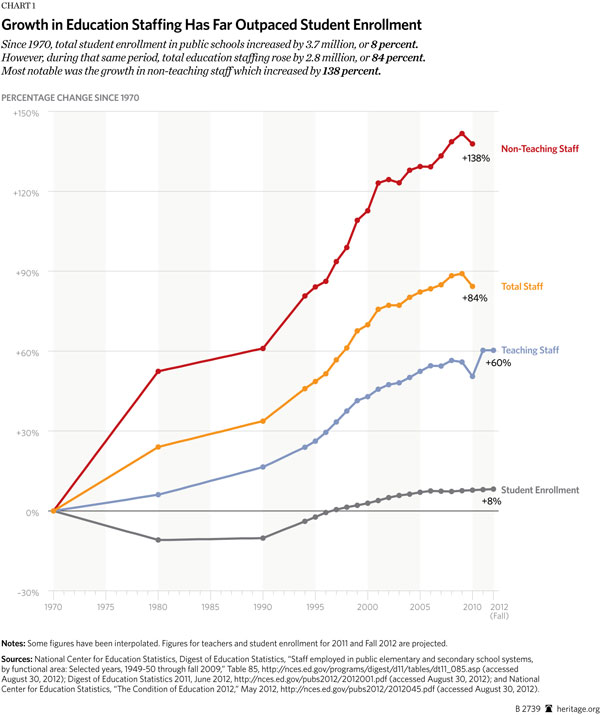
The Friedman Foundation has published an excellent report detailing the administrative bloat plaguing our nation’s public schools. The School Staffing Surge: Decades of Employment Growth in America’s Public Schools shows dramatic increases in teaching and non-teaching staff over the past five decades despite modest increases in student enrollment.

As we detailed in a recent report on growth in non-teaching positions in public schools across the country, student enrollment has increased just 8 percent since 1970, while the number of teachers has increased 60 percent, and the number of non-teaching administrative and other staff has increased 138 percent. (continues below chart)

The Friedman report, authored by Ben Scafidi, PhD, takes an even longer look, demonstrating that since 1950, public school enrollment has increased 96 percent, while the number of teachers has increased 252 percent and the number of non-teaching personnel (administrators and other staff) has increased an astonishing 702 percent. “Put differently,” Scafidi notes, “the rise in non-teaching staff was more than seven times faster than the increase in students”:

Between 1950 and 2009, the pupil-staff ratio declined to 7.8 students per public school employee from 19.3 students per public school employee. By 2009, there were fewer than eight public school students per adult employed in the public school system. The drop in the pupil-teacher ratio also was large—the pupil-teacher ratio was 27.5 students per teacher in 1950 and only 15.4 in 2009.

Scafidi also shows how this administrative bloat has affected schools on a state-by-state basis (and uses an interactive map to make the point). Of note: “Nine states with declining student populations had significant increases in public school personnel—D.C., Iowa, Louisiana, Maine, Mississippi, North Dakota, South Dakota, Wyoming, and Vermont.”

The Friedman report notes that the dramatic reduction in class size over the decades has not led to increases in student achievement. Why? As Scafidi reports, an increase in teacher quantity has not produced an increase in teacher quality:

As public schools have reduced class sizes continually since at least 1950, they have had to hire more teachers. And, the evidence is in—the disparity in effectiveness across teachers is considerable. Accordingly, state governments and local public school boards should have been more concerned with improving teacher effectiveness than lowering class sizes.

Continuing a trend of growing staff positions in our nation’s public schools won’t create the types of improvements that the system so desperately needs.

Instead, public school districts should trim bureaucracy and work on long-term reform options for better targeting of taxpayer resources. And decision making should be decentralized, placing staffing and other decisions in the hands of principals, teachers, and parents.

Finally, parents—and teachers—should have options. We’ll never see improvement in our nation’s education system without providing students with a choice about which schools—public, private, virtual, or homeschooling—will best meet their unique learning needs.

___________

Thank you so much for your time. I know how valuable it is. I also appreciate the fine family that you have and your commitment as a father and a husband.

Sincerely,

Everette Hatcher III, 13900 Cottontail Lane, Alexander, AR 72002, ph 501-920-5733, lowcostsqueegees@yahoo.com

Related posts:

Milton Friedman on school voucher system

Max Brantley of the Arkansas Times Blog reports today that Mitt Romney is for school vouchers. I am glad to hear that. Over and over we hear that the reason private schools are better is because they don’t have to keep the troubling making kids. It reminds me of this short film that I saw many […]

The school voucher system is the best way to get competition between schools

Milton Friedman – Public Schools / Voucher System (Q&A) Part 2 Published on May 7, 2012 by BasicEconomics __________ We need to get competition back again among schools and the voucher system is the best way to do that. D.C. Public Schools Spend Almost $30,000 Per Student Ericka Andersen July 25, 2012 at 10:00 am […]

School voucher system in Chili

Milton Friedman – Public Schools / Voucher System (Q&A) Part 1 Published on May 7, 2012 by BasicEconomics ___________ We have to turn to the school voucher system if we want competition between schools and want to lower the cost of education. Chile’s Amazing School Choice Revolution September 29, 2012 by Dan Mitchell I wrote back […]

Free or equal? 30 years after Milton Friedman’s Free to Choose (Part 5)

Johan Norberg – Free or Equal – Free to Choose 30 years later 5/5 Published on Jun 10, 2012 by BasicEconomics In 1980 economist and Nobel laureate Milton Friedman inspired market reform in the West and revolutions in the East with his celebrated television series “Free To Choose.” Thirty years later, in this one-hour documentary, […]

Listing of transcripts and videos of Free to Choose by Milton Friedman: Episode “What is wrong with our schools?” on www.theDailyHatch.org

Everywhere school vouchers have been tried they have been met with great success. Why do you think President Obama got rid of them in Washington D.C.? It was a political disaster for him because the school unions had always opposed them and their success made Obama’s allies look bad. In 1980 when I first sat […]

Free or equal? 30 years after Milton Friedman’s Free to Choose (Part 4)

Johan Norberg – Free or Equal – Free to Choose 30 years later 4/5 Published on Jun 10, 2012 by BasicEconomics In 1980 economist and Nobel laureate Milton Friedman inspired market reform in the West and revolutions in the East with his celebrated television series “Free To Choose.” Thirty years later, in this one-hour documentary, […]

Free or equal? 30 years after Milton Friedman’s Free to Choose (Part 3)

Johan Norberg – Free or Equal – Free to Choose 30 years later 3/5 Published on Jun 10, 2012 by BasicEconomics In 1980 economist and Nobel laureate Milton Friedman inspired market reform in the West and revolutions in the East with his celebrated television series “Free To Choose.” Thirty years later, in this one-hour documentary, […]

Milton Friedman’s passion was to make a difference in the lives of young people

The Machine: The Truth Behind Teachers Unions Published on Sep 4, 2012 by ReasonTV America’s public education system is failing. We’re spending more money on education but not getting better results for our children. That’s because the machine that runs the K-12 education system isn’t designed to produce better schools. It’s designed to produce more […]

Milton and Rose Friedman “Two Lucky People”

Milton Friedman on Hayek’s “Road to Serfdom” 1994 Interview 2 of 2 Uploaded by PenguinProseMedia on Oct 26, 2011 2nd half of 1994 interview. ________________ I have a lot of respect for the Friedmans.Two Lucky People by Milton and Rose Friedman reviewed by David Frum — October 1998. However, I liked this review below better. It […]

Free or equal? 30 years after Milton Friedman’s Free to Choose (Part 2)

Johan Norberg – Free or Equal – Free to Choose 30 years later 2/5 Published on Jun 10, 2012 by BasicEconomics In 1980 economist and Nobel laureate Milton Friedman inspired market reform in the West and revolutions in the East with his celebrated television series “Free To Choose.” Thirty years later, in this one-hour documentary, […]

“Friedman Friday” Milton Friedman’s biography (Part 2)(Interview by Charlie Rose of Milton Friedman part 3)

Biography Part 2

In 1977, when I reached the age of 65, I retired from teaching at the University of Chicago. At the invitation of Glenn Campbell, Director of the Hoover Institution at Stanford University, I shifted my scholarly work to Hoover where I remain a Senior Research Fellow. We moved to San Francisco, purchasing an apartment in a high-rise apartment building in which we still reside. The transition of my scholarly activities from Chicago to California was greatly eased by the willingness of Gloria Valentine, my assistant at Chicago, to accompany us west. She remains my indispensable assistant.

Hoover has provided excellent facilities for scholarly work. It enabled me to remain productive and an active member of a lively scholarly community.

Initially we continued to spend spring and summer quarters at Capitaf, our second home in Vermont. However, we soon came to appreciate the inconvenience of maintaining homes a continent apart and began to look in California for a replacement for Capitaf. In 1979, we purchased a house on the ocean in Sea Ranch, a lovely community 110 miles north of San Francisco. In 1981, we disposed of Capitaf and began to spend about half the year at Sea Ranch at intervals of a week or so, spread throughout the year, rather than in one solid block. It proved a fine locale for scholarly work. The Internet plus an assistant at Hoover more than made up for the absence of a library near at hand.

After more than two wonderful decades at Sea Ranch, we sold our house to simplify our lives. We now have one home, our apartment in San Francisco.

To return to the 1970s, not long after we arrived in California, Bob Chitester persuaded us to join him in producing a major television program presenting my economic and social philosophy. The resulting effort, spread over three years, proved the most exciting adventure of our lives. The end result was Free to Choose, ten one-hour programs, each consisting of a half-hour documentary and a half-hour discussion. The first of the ten programs appeared on PBS (Public Broadcasting System) in January 1980. Since then, the series has been shown in many foreign countries.

When we agreed to undertake the project, little did Rose and I realize what was involved in producing a major TV series. As a first step, I gave a series of fifteen lectures over a period of nine months at a wide variety of locations. The lectures and question-and-answer sessions were all videotaped to provide the producers with a basis for planning the programs.

The filming began in March 1978 and continued for the next eight months at locations in the United States and around the world, including Hong Kong, Japan, India, Greece, Germany, and the United Kingdom – in the process generating more than six miles of video and audiotape.

Three months after the end of filming, we returned to London to view the documentaries that Michael Latham, our wonderful producer, and his associates had created from that tape and to dub the voice-overs. Another six months passed before we gathered again in Chicago where we filmed the discussion sessions – one of the most stressful weeks I have ever experienced.

One distinguishing feature of the series was that there was no written script. I talked extemporaneously from notes. When we returned to Capitaf from London with the transcripts of the final documentaries, we set to work to convert them to a book to appear simultaneously with the TV program. The book, Free to Choose (Harcourt Brace Jovanovich, 1980) was the bestseller nonfiction book of 1980 and continues to sell well. It has been translated into more than fourteen foreign languages.

As Rose wrote in our memoirs, “As we look back at the events chronicled in this chapter, it all seems like something of a fairy tale. Who would have dreamed that after retiring from teaching, Milton would be able to preach the doctrine of human freedom to many millions of people in countries around the globe through television, millions more through our book based on the television program, and countless others through videocassettes” (p. 503).

Monetary Trends in the United States and the United Kingdom, published in 1982, was the final major product of a collaboration with Anna J. Schwartz under the auspices of the National Bureau of Economic Research that lasted more than three decades. Money Mischief (Harcourt Brace Jovanovich, 1992) collects assorted pieces of monetary history, some of which I had published elsewhere, some of which appear first in this book.

I have continued to be active in public policy since 1977. I continued my tri-weekly column in Newsweek until it was terminated in 1983. Since then, I have published numerous op-eds in major newspapers. I served as an unofficial adviser to Ronald Reagan during his candidacy for the presidency in 1980, and as a member of the President’s Economic Policy Advisory Board during his presidency. In 1988, President Reagan awarded me the Presidential Medal of Freedom and in the same year I was awarded the National Medal of Science.

We have traveled extensively since 1977, including a trip through Eastern Europe in 1990, where we filmed a documentary on former Soviet satellites. The documentary was included in a shortened reissue of Free to Choose.

Perhaps the most notable foreign travel consisted of three trips to China: one in 1980 when I gave a series of lectures under the auspices of the Chinese government; one in 1988 when I attended a conference in Shanghai on Chinese economic development and had a fascinating session in Beijing with Zhao Ziyang, at the time, the General Secretary of the Communist Party, deposed a few months later for his unwillingness to approve the use of force on Tiananmen Square; and one in 1993 when I traveled with a group of Chinese friends from Hong Kong throughout the country. The three visits covered a period of revolutionary economic growth and development, the first stage of a shift from an authoritarian, centrally planned economy to a largely free market economy.

Ever since the 1950s, Rose and I have been interested in the promotion of parental choice in schooling through the use of vouchers. Finally, in 1996, when it became clear that our personal involvement would have to be limited, we established a foundation, The Milton and Rose D. Friedman Foundation devoted to promoting parental choice in schooling. We were fortunate in being able to persuade Gordon St. Angelo to serve as president. He has done an outstanding job. Progress toward our objective of universal vouchers has been distressingly slow, but there has been progress. The pace of progress shows every sign of speeding up, and our foundation has made a significant contribution to that progress.

In 1998, the University of Chicago Press published our memoirs, Milton and Rose D. Friedman, Two Lucky People.

Milton Friedman died on November 16, 2006.

Six great economic crossroads of the 20th and 21st centuries examined by Michael Reagan

I found this article very interesting.

The Kennedy-Reagan Truth vs. the Obama Delusion

by Jim Denney

In his book The New Reagan Revolution, Michael Reagan examined six great economic crossroads of the 20th and 21st centuries. These six critical junctures in the history of the United States serve as economic laboratories to test two contrasting economic theories. One theory consistently produced economic expansion and sustained growth. The other theory invariably produced failure and misery. Here are Michael Reagan findings:

1. The “Forgotten Depression” of January 1920. During the last year of Woodrow Wilson’s presidency, the economy nosedived. GNP fell 17 percent; unemployment soared from 4 to almost 12 percent. This was the “Forgotten Depression” of 1920. Wilson’s successor, Warren G. Harding, came into office and immediately cut tax rates for all income brackets, slashed federal spending, and balanced the budget. Long before the world ever heard of Ronald Reagan, Harding practiced “Reaganomics.”

“President Harding applied the principles of Reaganomics,” Michael Reagan observed, “even though Ronald Reagan was at that time a nine-year-old boy living in Dixon, Illinois. Harding was not following an economic theory. He was following common sense. He treated the federal budget as you would treat the family budget: When times are tough, cut spending and stay out of debt. Harding also treated his fellow citizens with commonsense compassion: If folks are going through tough times, government should ease their burden and cut their taxes.”

The Harding recovery was astonishingly rapid, beginning just half a year into his presidency. Unemployment fell to 6.7 percent by 1922, and to 2.4 percent by 1923. Harding’s successor, Calvin Coolidge, maintained Harding’s program of low tax rates, balanced budgets, and limited government. The Harding-Coolidge era of prosperity became known as “the Roaring Twenties”—a time of soaring prosperity, stable prices, and boundless optimism.

Obvious conclusion based on the evidence: Reaganomics works.

2. The Great Depression. Coolidge was succeeded by Herbert Hoover. In the eighth month of Hoover’s presidency, the stock market crashed—the infamous Crash of 1929. Many factors led to the Great Depression, but the Crash was the precipitating event. Hoover had failed to learn the lessons of the Harding-Coolidge years, so he responded by raising taxes (hiking the top marginal rate from 25 to 63 percent), imposing protectionism (the Smoot-Hawley Tariff Act), and boosting government spending by 47 percent, driving America deep into debt. Hoover’s actions worsened the Depression. A defeated Herbert Hoover bequeathed a ruined economy to Franklin Delano Roosevelt

FDR took office at a time when 25 percent of the nation’s workforce was unemployed. He, too, ignored the lessons of the “Forgotten Depression,” and doubled down on Hoover’s failed tax-and-spend policies, applying the economic theory known as Keynesianism (after British economist John Maynard Keynes). The Keynes-FDR approach involved deficit spending, soak-the-rich tax policies, and big-government make-work programs (the New Deal). FDR and a compliant Congress hiked personal and corporate income tax rates, estate taxes, and excise taxes.

Michael Reagan wrote, “From 1937 to 1939, the stock market lost almost half its value, car sales fell by one-third, and business failures increased by one-half. From 1932 to 1939, the U.S. racked up more debt than in all the preceding 150 years of America’s existence. By early 1939, as the Great Depression was in its tenth year, unemployment again climbed past the 20 percent mark.”

Many Americans credit FDR with “getting America through the Depression.” In reality, FDR’s policies prolonged the Depression. In a time of catastrophic unemployment, Roosevelt made it prohibitively expensive to hire people, making a terrible human tragedy even worse. While thousands of U.S banks failed under FDR’s policies, across the border in Canada, not one bank failed—because Canadian banks were not hamstrung by FDR’s foolish over-regulation. In FDR’s Folly, historian Jim Powell questions the disturbing FDR legacy:

Why did New Dealers make it more expensive for employers to hire people? Why did FDR’s Justice Department file some 150 lawsuits threatening big employers? Why did New Deal policies discourage private investment without which private employment was unlikely to revive? Why so many policies to push up the cost of living? Why did New Dealers destroy food while people went hungry? To what extent did New Deal labor laws penalize blacks? Why did New Dealers break up the strongest banks? . . . Why didn’t New Deal public works projects bring about a recovery? Why was so much New Deal relief spending channeled away from the poorest people?

In May 1939, a demoralized and defeated Henry Morgenthau, FDR’s treasury secretary, told the House Ways and Means Committee, “We are spending more than we have ever spent before and it does not work. . . . I want to see people get a job. I want to see people get enough to eat. We have never made good on our promises. . . . After eight years of this administration we have just as much unemployment as when we started. . . . And an enormous debt to boot!”

Many people mistakenly believe that World War II lifted America out of the Great Depression. Not true. What WWII did was take 12 million men out of the workforce and send them into war, which ended unemployment. But all the other signs of a damaged economy remained during the war: low stock prices, depressed private investment, and depressed consumer demand.

Roosevelt and his successor, Harry Truman, had a post-war plan to impose an even bigger Second New Deal after the war. Fortunately, Congress refused, and chose instead to cut taxes and cut spending—the same commonsense “Reaganomics” approach that had produced prosperity during the 1920s. The result: a post-war economic boom from the late 1940s through the 1950s. Had FDR and Truman gotten their way, the country would have slipped right back into recession if not a second Great Depression.

Obvious conclusion based on the evidence: Keynesianomics fails, prolonging economic hardship and misery, while Reaganomics works again.

3. The Recession of 1960 and 1961. When John F. Kennedy came into office, he faced a jobless figure of 7.1 percent. Wanting the economy to keep up with the growing workforce, JFK addressed the Economic Club of New York in December 1962 and proposed a bold notion: “It is a paradoxical truth that tax rates are too high today and tax revenues are too low and the soundest way to raise the revenues in the long run is to cut the rates now. . . . The purpose of cutting taxes now is not to incur a budget deficit, but to achieve the more prosperous, expanding economy which can bring a budget surplus.”

Those are the words of John F. Kennedy—and he was preaching Reaganomics. Kennedy was assassinated less than a year later, but his successor, Lyndon Johnson, lobbied hard for the JFK tax cuts, and he signed them into law in 1964. As a result of JFK’s Reaganesque economic plan, the economy experienced a dramatic 5 percent expansion and personal income increased by 7 percent. Gross national product grew from $628 billion to $672 billion, corporate profits by an explosive 21 percent, auto production rose by 22 percent, steel production grew by 6 percent, and unemployment plummeted to 4.2 percent—an eight-year low. The Kennedy-Johnson tax rate cuts produced a sustained economic expansion for nearly a decade.

Obvious conclusion based on the evidence: Reaganomics works again.

4. The Recession of the 1970s. This recession began in November 1973 under Nixon and ended (technically) in March 1975 under Gerald Ford—a 16-month recession. According to the graphs and charts of the economists, real GDP was on the rise by the spring of 1975, yet unemployment and inflation remained painfully high throughout rest of the 1970s. Americans continue to suffer joblessness amid spiraling prices after the recession officially ended.

In 1976, Ronald Reagan narrowly lost the primary race against Gerald Ford. Reagan was convinced that he knew how to solve the long and painful recession of the 1970s, but he was forced to watch from the sidelines as Gerald Ford and Jimmy Carter—two befuddled, clueless Keynesians!—battled each other for the White House. On October 8, 1976, at the height of the presidential race between Carter and Ford, Reagan outlined the principles of Reaganomics in a syndicated newspaper column entitled “Tax Cuts and Increased Revenue.” He wrote:

Warren Harding did it. John Kennedy did it. But Jimmy Carter and President Ford aren’t talking about it. The ‘it’ that Harding and Kennedy had in common was to cut the income tax. In both cases, federal revenues went up instead of down. . . . Since the idea worked under both Democratic and Republican administrations before, who’s to say it couldn’t work again?”

Reagan had majored in economics at Eureka College and had spent years studying the great free market economists such as Adam Smith (The Wealth of Nations), Friedrich Hayek (The Road to Serfdom), and Milton Friedman (Capitalism and Freedom). While Reagan’s opponents ignorantly wrote him off as an “amiable dunce,” it is clear that Reagan correctly and insightfully diagnosed the ailing economy of the 1970s. Unfortunately, Reagan would have to wait more than four years for the opportunity to put his prescription into practice.

Obvious conclusion based on the evidence: Keynesianism fails again.

5. The Jimmy Carter Stagflation Recession of 1980. After Jimmy Carter was inaugurated in January 1977, he inflicted the failed FDR-style Keynesian approach on the country—an approach which says the federal government can spend its way to prosperity. The result of Carter’s policies was an economic disaster called “stagflation”—slow economic growth coupled with the misery of rampant inflation and high unemployment.

By the 1980 election, America under Carter was in a full-blown recession. The American people had suffered years of double-digit interest rates, double-digit inflation, and double-digit unemployment, plus blocks-long lines at the gas station. Ronald Reagan defeated Carter in a landslide. Newsweek observed: “When Ronald Reagan steps into the White House . . . he will inherit the most dangerous economic crisis since Franklin Roosevelt took office 48 years ago.”

Reagan moved confidently and quickly to slash tax rates and domestic spending. Under his leadership, the top marginal tax rate dropped from 70 percent to 28 percent. Michael Reagan described the results:

Tax cuts generated 4 million jobs in 1983 alone and 16 million jobs over the course of Ronald Reagan’s presidency. Unemployment among African-Americans dropped dramatically, from 19.5 percent in 1983 to 11.4 percent in 1989. . . .

The inflation rate fell from 13.5 percent in 1980 . . . to 3.2 percent in 1983. . . .

The Reagan tax cuts nearly doubled federal revenue. After his 25 percent across-the-board tax rate cuts went into effect, receipts from both individual and corporate income taxes rose dramatically. According to the White House Office of Management and Budget, revenue from individual income taxes went from $244.1 billion in 1980 to $445.7 billion in 1989, an increase of over 82 percent. Revenue from corporate income taxes went from $64.6 billion to $103.3 billion, a 60 percent jump.

This was the fulfillment of the “paradoxical truth” that John F. Kennedy spoke of in his 1962 speech: “Cutting taxes now . . . can bring a budget surplus.” Both JFK and Ronald Reagan predicted that lower tax rates would generate more revenue. This “paradoxical truth” worked exactly as predicted.

At a White House press conference in 1981, President Reagan took reporters to school, explaining that the principles of Reaganomics have been known for centuries. Lower tax rates invariably bring more money into the treasury, he explained, “because of the almost instant stimulant to the economy.” This principle, Reagan added, “goes back at least, I know, as far as the fourteenth century, when a Moslem philosopher named Ibn Khaldun said, ‘In the beginning of the dynasty, great tax revenues were gained from small assessments. At the end of the dynasty, small tax revenues were gained from large assessments.’”

The principles of Reaganomics have been proved true—and Keynesian theory has been exposed as a fraud once more.

6. The Obama Recession. To be fair, what I call “The Obama Recession” actually began under George W. Bush, triggered by the collapse of the housing bubble. I think it’s fair to call it The Obama Recession because, when Barack Obama took office, he threw $814 billion of stimulus money at the recession (plus billions more in corporate bailouts, “Cash for Clunkers,” Solyndra-style green energy boondoggles, and other prime-the-pump schemes). He promised to jump-start the economy and hold unemployment below 8 percent. This was weapons-grade Keynesianism, practiced on a scale never before witnessed in human history. After spending so much money on the “cure,” Obama now owned that recession.

If Keynesian theory works at all, the Obama stimulus plan should have completely turned the economy around. But the stimulus plan—officially known as the American Recovery and Reinvestment Act of 2009—not only failed to make a splash, it didn’t make a ripple. Even after the government pumped nearly a trillion dollars of borrowed money into the economy, unemployment nudged up toward the 10 percent mark. Today, unemployment is officially below 9 percent—but the actual jobless rate is much higher.

In 2010, the Population Reference Bureau calculated the workforce to be at just over 157 million people. The Bureau of Labor Statistics reports that there are 131 million jobs in America. That would leave 26 million people jobless—or about 16 percent of the total workforce. But it gets worse: Many of those jobs are just part-time jobs, and many people hold two or more of those jobs, so the actual jobless number is certainly far higher than 16 percent—maybe 20 percent or higher.

Obvious conclusion based on the evidence: Keynesianomics fails catastrophically.

Unfortunately, the high priests of the Keynesian religion refuse to see the light. President Obama clings to his delusional Keynesian faith, insisting that all we have to do is throw more money at the economy with another stimulus bill! That is economic insanity. Former Reagan aide Peter Ferrara wrote in the Wall Street Journal:

The fallacies of Keynesian economics were exposed decades ago by Friedrich Hayek and Milton Friedman. Keynesian thinking was then discredited in practice in the 1970s, when the Keynesians could neither explain nor cure the double-digit inflation, interest rates, and unemployment that resulted from their policies. Ronald Reagan’s decision to dump Keynesianism in favor of supply-side policies—which emphasize incentives for investment — produced a 25-year economic boom. That boom ended as the Bush administration abandoned every component of Reaganomics one by one, culminating in Treasury Secretary Henry Paulson’s throwback Keynesian stimulus in early 2008.

Mr. Obama showed up in early 2009 with the dismissive certitude that none of this history ever happened, and suddenly national economic policy was back in the 1930s. Instead of the change voters thought they were getting, Mr. Obama quintupled down on Mr. Bush’s 2008 Keynesianism.

Keynesian theory is every bit as superstitious as believing in astrology or a flat Earth or the good-luck powers of a rabbit’s foot. The facts of history are beyond dispute. The old Keynesian superstition has failed every time it was tried. But Keynesian fundamentalists like Barack Obama continue to live in a state of denial.

We know what works. Nearly a century of economic history proves it. Now we need a president and a Congress with the common sense to apply the lessons of history to the economic crisis of today.

______

The Laffer Curve, Part III: Dynamic Scoring

Milton Friedman’s biography (part 1) (Interview by Charlie Rose of Milton Friedman part 2)

Milton Friedman was the best. I had the chance to correspond with him and he was a complete gentleman.

Autobiography

Milton FriedmanI was born July 31, 1912, in Brooklyn, N.Y., the fourth and last child and first son of Sarah Ethel (Landau) and Jeno Saul Friedman. My parents were born in Carpatho-Ruthenia (then a province of Austria-Hungary; later, part of inter-war Czechoslovakia, and, currently, of the Soviet Union). They emigrated to the U.S. in their teens, meeting in New York. When I was a year old, my parents moved to Rahway, N.J., a small town about 20 miles from New York City. There, my mother ran a small retail “dry goods” store, while my father engaged in a succession of mostly unsuccessful “jobbing” ventures. The family income was small and highly uncertain; financial crisis was a constant companion. Yet there was always enough to eat, and the family atmosphere was warm and supportive.

Along with my sisters, I attended public elementary and secondary schools, graduating from Rahway High School in 1928, just before my 16th birthday. My father died during my senior year in high school, leaving my mother plus two older sisters to support the family. Nonetheless, it was taken for granted that I would attend college, though, also, that I would have to finance myself.

I was awarded a competitive scholarship to Rutgers University (then a relatively small and predominantly private university receiving limited financial assistance from the State of New Jersey, mostly in the form of such scholarship awards). I was graduated from Rutgers in 1932, financing the rest of my college expenses by the usual mixture of waiting on tables, clerking in a retail store, occasional entrepreneurial ventures, and summer earnings. Initially, I specialized in mathematics, intending to become an actuary, and went so far as to take actuarial examinations, passing several but also failing several. Shortly, however, I became interested in economics, and eventually ended with the equivalent of a major in both fields.

In economics, I had the good fortune to be exposed to two remarkable men: Arthur F. Burns, then teaching at Rutgers while completing his doctoral dissertation for Columbia; and Homer Jones, teaching between spells of graduate work at the University of Chicago. Arthur Burns shaped my understanding of economic research, introduced me to the highest scientific standards, and became a guiding influence on my subsequent career. Homer Jones introduced me to rigorous economic theory, made economics exciting and relevant, and encouraged me to go on to graduate work. On his recommendation, the Chicago Economics Department offered me a tuition scholarship. As it happened, I was also offered a scholarship by Brown University in Applied Mathematics, but, by that time, I had definitely transferred my primary allegiance to economics. Arthur Burns and Homer Jones remain today among my closest and most valued friends.

Though 1932-33, my first year at Chicago, was, financially, my most difficult year; intellectually, it opened new worlds. Jacob Viner, Frank Knight, Henry Schultz, Lloyd Mints, Henry Simons and, equally important, a brilliant group of graduate students from all over the world exposed me to a cosmopolitan and vibrant intellectual atmosphere of a kind that I had never dreamed existed. I have never recovered.

Personally, the most important event of that year was meeting a shy, withdrawn, lovely, and extremely bright fellow economics student, Rose Director. We were married six years later, when our depression fears of where our livelihood would come from had been dissipated, and, in the words of the fairy tale, have lived happily ever after. Rose has been an active partner in all my professional work since that time.

Thanks to Henry Schultz’s friendship with Harold Hotelling, I was offered an attractive fellowship at Columbia for the next year. The year at Columbia widened my horizons still further. Harold Hotelling did for mathematical statistics what Jacob Viner had done for economic theory: revealed it to be an integrated logical whole, not a set of cook-book recipes. He also introduced me to rigorous mathematical economics. Wesley C. Mitchell, John M. Clark and others exposed me to an institutional and empirical approach and a view of economic theory that differed sharply from the Chicago view. Here, too, an exceptional group of fellow students were the most effective teachers.

After the year at Columbia, I returned to Chicago, spending a year as research assistant to Henry Schultz who was then completing his classic, The Theory and Measurement of Demand. Equally important, I formed a lifelong friendship with two fellow students, George J. Stigler and W. Allen Wallis.

Allen went first to New Deal Washington. Largely through his efforts, I followed in the summer of 1935, working at the National Resources Committee on the design of a large consumer budget study then under way. This was one of the two principal components of my later Theory of the Consumption Function.

The other came from my next job – at the National Bureau of Economic Research, where I went in the fall of 1937 to assist Simon Kuznets in his studies of professional income. The end result was our jointly published Incomes from Independent Professional Practice, which also served as my doctoral dissertation at Columbia. That book was finished by 1940, but its publication was delayed until after the war because of controversy among some Bureau directors about our conclusion that the medical profession’s monopoly powers had raised substantially the incomes of physicians relative to that of dentists. More important, scientifically, that book introduced the concepts of permanent and transitory income.

The catalyst in combining my earlier consumption work with the income analysis in professional incomes into the permanent income hypothesis was a series of fireside conversations at our summer cottage in New Hampshire with my wife and two of our friends, Dorothy S. Brady and Margaret Reid, all of whom were at the time working on consumption.

I spent 1941 to 1943 at the U.S. Treasury Department, working on wartime tax policy, and 1943-45 at Columbia University in a group headed by Harold Hotelling and W. Allen Wallis, working as a mathematical statistician on problems of weapon design, military tactics, and metallurgical experiments. My capacity as a mathematical statistician undoubtedly reached its zenith on V. E. Day, 1945.

In 1945, I joined George Stigler at the University of Minnesota, from which he had been on leave. After one year there, I accepted an offer from the University of Chicago to teach economic theory, a position opened up by Jacob Viner’s departure for Princeton. Chicago has been my intellectual home ever since. At about the same time, Arthur Burns, then director of research at the National Bureau, persuaded me to rejoin the Bureau’s staff and take responsibility for their study of the role of money in the business cycle.

The combination of Chicago and the Bureau has been highly productive. At Chicago, I established a “Workshop in Money and Banking”. which has enabled our monetary studies to be a cumulative body of work to which many have contributed, rather than a one-man project. I have been fortunate in its participants, who include, I am proud to say, a large fraction of all the leading contributors to the revival in monetary studies that has been such a striking development in our science in the past two decades. At the Bureau, I was supported by Anna J. Schwartz, who brought an economic historian’s skill, and an incredible capacity for painstaking attention to detail, to supplement my theoretical propensities. Our work on monetary history and statistics has been enriched and supplemented by both the empirical studies and the theoretical developments that have grown out of the Chicago Workshop.

In the fall of 1950, I spent a quarter in Paris as a consultant to the U.S. governmental agency administering the Marshall Plan. My major assignment was to study the Schuman Plan, the precursor of the common market. This was the origin of my interest in floating exchange rates, since I concluded that a common market would inevitably founder without floating exchange rates. My essay, The Case for Flexible Exchange Rates, was one product.

During the academic year 1953-54, I was a Fulbright Visiting Professor at Gonville & Caius College, Cambridge University. Because my liberal policy views were “extreme” by any Cambridge standards, I was acceptable to, and able greatly to profit from, both groups into which Cambridge economics was tragically and very deeply divided: D.H. Robertson and the “anti-Keynesians”; Joan Robinson, Richard Kahn and the Keynesian majority.

Beginning in the early 1960s, I was increasingly drawn into the public arena, serving in 1964 as an economic adviser to Senator Goldwater in his unsuccessful quest for the presidency, and, in 1968, as one of a committee of economic advisers during Richard Nixon’s successful quest. In 1966, I began to write a triweekly column on current affairs for Newsweek magazine, alternating with Paul Samuelson and Henry Wallich. However, these public activities have remained a minor avocation – I have consistently refused offers of full-time positions in Washington. My primary interest continues to be my scientific work.

In 1977, I retire from active teaching at the University of Chicago, though retaining a link with the Department and its research activities. Thereafter, I shall continue to spend spring and summer months at our second home in Vermont, where I have ready access to the library at Dartmouth College – and autumn and winter months as a Senior Research Fellow at the Hoover lnstitution of Stanford University.

From Nobel Lectures, Economics 1969-1980, Editor Assar Lindbeck, World Scientific Publishing Co., Singapore, 1992

This autobiography/biography was written at the time of the award and first published in the book series Les Prix Nobel. It was later edited and republished in Nobel Lectures. To cite this document, always state the source as shown above.

Copyright © The Nobel Foundation 1976

Open letter to President Obama (Part 302.6)


President Obama c/o The White House
1600 Pennsylvania Avenue NW
Washington, DC 20500

Dear Mr. President,

I know that you receive 20,000 letters a day and that you actually read 10 of them every day. I really do respect you for trying to get a pulse on what is going on out here.

Today in the USA it seems we are losing some of our freedom because of increased federal government control of our lives.

People all the world love freedom and those that had to live under the rule of communism hungered for freedom. When I think about the actions of Ronald Reagan and Milton Friedman during the 1980’s I am grateful for their love of freedom. Ronald Reagan is responsible for bringing down the Russian communist state and the ones in Eastern Europe.

Below you will read how the 1980 book and film series “Free to Choose” was being smuggled into these countries and was giving the people a hunger for freedom. I wish the USA would reduce the size of our federal government spending and regulations and return more freedom to our people too. Below is an article that talks about the making of that film series.

Celebrating Milton Friedman

by Andrew J. Coulson

Andrew Coulson directs the Cato Institute’s Center for Educational Freedom and is the author of Market Education: The Unknown History.

Added to cato.org on July 31, 2012

This article appeared in Cato.org on July 31, 2012.

For us, who lived in the communist world, Milton Friedman was the greatest champion of freedom, of limited and unobtrusive government and of free markets. Because of him I became a true believer in the unrestricted market economy.

Those are the words of Czech President Vaclav Klaus. Both Friedman’s writings and his landmark 1980 documentary series “Free to Choose”were smuggled into totalitarian communist states, inspiring a generation of future scholars, activists, and politicians.

July 31st, 2012 is the 100th anniversary of Friedman’s birth. To commemorate that occasion, the Cato Institute has put together a video interview with Bob Chitester, producer of “Free to Choose,” recounting how it came to be, its impact, and what it was like working with Milton Friedman.

Bob Chitester Discusses Milton Friedman and ‘Free to Choose’

Published on Jul 30, 2012 by

“There are very few people over the generations who have ideas that are sufficiently original to materially alter the direction of civilization. Milton is one of those very few people.”

That is how former Federal Reserve Chairman Alan Greenspan described the Nobel laureate economist Milton Friedman. But it is not for his technical work in monetary economics that Friedman is best known. Like mathematician Jacob Bronowski and astronomer Carl Sagan, Friedman had a gift for communicating complex ideas to a general audience.

It was this gift that brought him to the attention of filmmaker Bob Chitester. At Chitester’s urging, Friedman agreed to make a 10 part documentary series explaining the power of economic freedom. It was called “Free to Choose,” and became one of the most watched documentaries in history.

The series not only reached audiences in liberal democracies, but was smuggled behind the iron curtain where it played, in secret, to large audiences.

__________

Aside from those who lived under communism, there is another group for whom Friedman was and is a colossal figure: advocates of educational freedom. At a time when state-run schooling had been the norm for nearly a century, and had long ceased to be questioned by America’s elites, Friedman offered a modest observation: there was no good reason for the government of a free society to actually run schools and many good reasons for it not to do so.

He made this case in his essay “On the Role of Government in Education,” first published in 1955. The idea had been floated by others, including Adam Smith and Thomas Paine, but Friedman eloquently and powerfully introduced it to the American policy debate. In so doing, he, more than any other individual, can be credited with giving rise to the modern school choice movement.

Not only did Friedman spark the creation of this movement, he helped to fan the flame of educational freedom, writing popular commentaries and book chapters, speaking with and encouraging activists, founding a leading school choice institution, and dedicating the entire sixth episode of “Free to Choose” to this subject.

I had the good fortune to speak and correspond with Milton occasionally, starting in the late 1990s, and what struck me most about him was his personal integrity. He once told me that he never said anything negative about a person in private that he would not be willing to say openly in that person’s presence. So far as I know, he never violated that principle. And while he staunchly defended his conclusions as long as he remained convinced of their correctness, he would amend them if the weight of evidence shifted.

Indeed the rigorous empiricism that Friedman applied in his scholarly work is generally regarded as one of his most influential contributions to the field of economics—for a long time controversial but eventually the norm, at least in principle. His view, published in the 1953 collection Essays in Positive Economics, was that

the ultimate test of the validity of a theory is… the ability to deduce facts that have not yet been observed, that are capable of being contradicted by observation, and that subsequent observation does not contradict. [p. 300]

Equally wise, though not yet as widely accepted, is the long time horizon against which Friedman measured policy outcomes. Economist and philosopher of science James R. Wible notes that Friedman’s greatest contribution “may be his constant reminder not to forget the long run consequences of short run policies.”

In the 1982 edition of his book Capitalism and Freedom, Friedman observed that scholars cannot single-handedly bring about change. Their real role, he wrote, is to “keep the lights on”—to remind us which policies work and which do not, and to show us how to advance our understanding even further. His own unfailing empiricism and concern for the long term remain valuable beacons today, both for advocates of educational freedom and the broader policy community.

__________

Thank you so much for your time. I know how valuable it is. I also appreciate the fine family that you have and your commitment as a father and a husband.

Sincerely,

Everette Hatcher III, 13900 Cottontail Lane, Alexander, AR 72002, ph 501-920-5733, lowcostsqueegees@yahoo.com

The Empirical Evidence on School Choice

Milton Friedman on School Vouchers

_______________

Just the facts Mam.

APRIL 18, 2013 5:17PM

School Choice Works

The evidence is in: school choice works. Yesterday, the Friedman Foundation for Educational Choice released their third edition of their report “A Win-Win Solution: The Empirical Evidence on School Choice.” The report provides a literature review of dozens of high-quality studies of school choice programs around the country, including studies from scholars at Harvard University, Stanford University, Cornell University, the University of Arkansas, the Brookings Institution, and the Federal Reserve Bank. The studies examine the impact of school choice programs on the academic performance of participants and public school students, the fiscal impact on taxpayers, racial segregation, and civic values.

The report’s key findings included the following:

  • Twelve empirical studies have examined academic outcomes for school choice participants using random assignment, the “gold standard” of social science. Of these, 11 find that choice improves student outcomes—six that all students benefit and five that some benefit and some are not affected. One study finds no visible impact. No empirical study has found a negative impact.
  • Twenty-three empirical studies (including all methods) have examined school choice’s impact on academic outcomes in public schools. Of these, 22 find that choice improves public schools and one finds no visible impact. No empirical study has found that choice harms public schools.
  • Six empirical studies have examined school choice’s fiscal impact on taxpayers. All six find that school choice saves money for taxpayers. No empirical study has found a negative fiscal impact.
  • Eight empirical studies have examined school choice and racial segregation in schools. Of these, seven find that school choice moves students from more segregated schools into less segregated schools. One finds no net effect on segregation from school choice. No empirical study has found that choice increases racial segregation.
  • Seven empirical studies have examined school choice’s impact on civic values and practices such as respect for the rights of others and civic knowledge. Of these, five find that school choice improves civic values and practices. Two find no visible impact from school choice. No empirical study has found that school choice has a negative impact on civic values and practices.

On the same day, a new study from researchers at Harvard University and the Brookings Institution found that a school choice program boosted college enrollment among African-American participants by 24 percent.

While many of the findings show only modest improvement, they consistently show that school choice programs produce the same or superior results across a gamut of measures. Moreover, not all the benefits of choice are easily measurable. Some families are looking for a school that better meets a student’s special needs, instills the parents’ values, inspires a lifelong love of learning, or where a student is safe from bullying. These outcomes are sometimes difficult if not impossible to measure in the aggregate, but parents are in the best position to tell the difference for their own children.

Related posts:

Open letter to Republican Presidential Candidate Mitt Romney on school vouchers

The Machine: The Truth Behind Teachers Unions Published on Sep 4, 2012 by ReasonTV America’s public education system is failing. We’re spending more money on education but not getting better results for our children. That’s because the machine that runs the K-12 education system isn’t designed to produce better schools. It’s designed to produce more […]

Brummett still resistant to vouchers because he wants us to save public schools at all cost

John Brummett in his article, “A new civil rights struggle in Little Rock?” Arkansas News Burea, August 25, 2011, asserted the main role vouchers should have is  “providing new models for regular public schools to emulate, not about replacing regular public schools.” The Heritage Foundation cares nothing about saving the public schools. If the public […]

Open letter to President Obama (Part 290) (Vouchers)

Milton Friedman – Public Schools / Voucher System Published on May 9, 2012 by BasicEconomics The Machine: The Truth Behind Teachers Unions Published on Sep 4, 2012 by ReasonTV America’s public education system is failing. We’re spending more money on education but not getting better results for our children. That’s because the machine that runs […]

Open letter to President Obama (Part 287) (on vouchers)

(This letter was mailed before Oct 25, 2012.) President Obama c/o The White House 1600 Pennsylvania Avenue NW Washington, DC 20500 Dear Mr. President, I know that you receive 20,000 letters a day and that you actually read 10 of them every day. I really do respect you for trying to get a pulse on […]

Open letter to President Obama (Part 254) (on vouchers)

The Machine: The Truth Behind Teachers Unions Published on Sep 4, 2012 by ReasonTV America’s public education system is failing. We’re spending more money on education but not getting better results for our children. That’s because the machine that runs the K-12 education system isn’t designed to produce better schools. It’s designed to produce more […]

Listing of transcripts and videos of Free to Choose by Milton Friedman: Episode “What is wrong with our schools?” on www.theDailyHatch.org

Everywhere school vouchers have been tried they have been met with great success. Why do you think President Obama got rid of them in Washington D.C.? It was a political disaster for him because the school unions had always opposed them and their success made Obama’s allies look bad. In 1980 when I first sat […]

Public school staffing has skyrocketed, we must turn to voucher system

Milton Friedman – Public Schools / Voucher System (Q&A) Part 2 Published on May 7, 2012 by BasicEconomics __________ Max Brantley of the Arkansas Times Blog is always critical of the voucher system but has he taken a closer look at what has been going on in the public schools the last few decades with […]

Listing of transcripts and videos of Free to Choose by Milton Friedman: Episode “What is wrong with our schools?” on www.theDailyHatch.org

Everywhere school vouchers have been tried they have been met with great success. Why do you think President Obama got rid of them in Washington D.C.? It was a political disaster for him because the school unions had always opposed them and their success made Obama’s allies look bad. In 1980 when I first sat […]


“Friedman Friday” Milton Friedman believed in liberty (Interview by Charlie Rose of Milton Friedman part 1)

Charlie Rose interview of Milton Friedman

My favorite economist:

Milton Friedman : A Great Champion of Liberty  by V. Sundaram  

Milton Friedman, the Nobel Prize-winning economist who advocated an unfettered free market and had the ear of three US Presidents – Nixon, Ford and Reagan – died last Thursday (16 November, 2006 ) in San Francisco at the age of 94. Gordon St Angelo, President and CEO of the Milton and Rose D Friedman Foundation in Indianapolis said in a statement, ‘Milton’s passion for freedom and liberty has influenced more lives than he ever could possibly know. His writings and ideas have transformed the minds of U.S. presidents, world leaders, entrepreneurs and freshmen economic majors alike.’

While honoring Milton Friedman at a public function in 2002, US President Bush said: ‘Milton Friedman has used a brilliant mind to advance a moral vision – the vision of a society where men and women are free, free to choose, but where government is not as free to override their decisions. That vision has changed America, and it is changing the world.’

The Great Depression of the 1930s was blamed on free markets and brought a vast expansion of government interference with the economy. Then came the II World War and with that the position became even worse with government controlling all aspects of the economy in USA. After the war, when anybody who favored rolling back the power of government inevitably faced the question, ‘What about the Great Depression?’. Without all the laws from that era, it was feared, there would again be high unemployment, chronic monopolies and gross inequalities. Nobel laureate Milton Friedman did more than anyone else to change thinking on these issues. He gathered massive documentary evidence to show that the Great Depression occurred primarily because the money supply contracted by one-third between 1929 and 1933, although the Federal Reserve (Central Bank) in USA had been granted the power to prevent such a catastrophe.

Milton Friedman argued that the Great Depression was a government failure. Further he also proved that – inflation is always and everywhere a monetary phenomenon. He made a formidable case that government ‘fine-tuning’ is more likely to backfire: by the time Central Bankers realize that the economy is slipping into a recession or depression and they inflate the money supply, the effects are likely to be felt after the economy has already recovered, worsening the subsequent inflation. Conversely, by the time Central Bankers realize inflation is a problem and they contract the money supply, the effects are likely to be felt after the economy has slowed down, worsening the next recession or depression. Thus Friedman effectively proved that Government is the biggest source of instability in the economy. All this he proved in his most important single work on economics called ‘A Monetary History of the United States 1867 – 1960’ which he co-authored with Anna Jacobson Schwartz and which was published in 1963.

Many champions of liberty have generally done well to achieve significant impact on a single area of public policy. Bur Friedman has had a significant impact on many public policies in USA. He helped usher in the era of free foreign exchange markets. He campaigned for ballot initiatives to limit government spending and taxes. He inspired the movement for educational choice using tuition vouchers that would enable poor people to opt out of public schools. He courageously spoke out against drugs prohibition and he helped fight President Clinton’s effort to seize an eighth of the US economy in his plan for Government-run health care. His greatest achievement of which he was most proud was that of helping to end military conscription in the United States.

Milton Friedman was born on 31 July, 1912 at Brooklyn in New York. He entered Rutgers University in 1928. He graduated from Rutgers University in 1932. He moved over to University of Chicago in 1932 for higher studies. In Jacob Viner’s Price Theory class, the student who always sat next to him was the petite and lively Rose Director. She was to become his future wife. She was doing Ph D in economics under Frank Knight and Friedman worked as assistant under another economics professor Henry Schultz. Friendship between the two developed into romance and Milton and Rose got married in New York on 25 June, 1938. Another Chicago economist Henry Simons had a big impact on Friedman. In 1934, Simons wrote A Positive Programme for Laissez Faire in which he emphasized that people generally share common goals, such as promoting prosperity and the major differences of opinion are often about the most effective ways to achieve the goals. Friedman won over millions by embracing this fundamental approach and making a practical case that private individuals in competitive markets are much better at solving problems than bureaucrats are. Simons had warned that political liberty can survive only within an effective competitive economic system and this became a major theme of Friedman.

In 1937 Friedman went to Columbia University to do his Ph D. In September 1937, future Nobel laureate Simon Kuznets invited Friedman to work at the National Bureau of Economic Research where he studied independent professionals, lawyers, accountants, engineers, dentists and doctors. This work became the basis for Friedman’s doctoral dissertation and first book, Income from Independent Professional Practice, co-authored by Simon Kuznets.

From 1941 to 43, Friedman worked in the Treasury Department’s Division of Tax Research. In September 1946, Friedman began teaching at the University of Chicago and became an international celebrity. His most widely quoted essay The Methodology of Positive Economics published in 1953 maintained that when one makes statements about phenomena, they ought to be verified by some kind of observation. The primary test of economic analysis is the correctness of predictions. In 1956, William Volker Charities Fund arranged for Friedman to deliver a series of lectures about general principles and major public policy issues such as unemployment, monopolies, racial discrimination, social security and international trade. His wife Rose Friedman edited the lectures into a book, Capitalism and Freedom, which the University of Chicago published in 1962. This book went on to sell some 500,000 copies. It was smuggled into the Soviet Union and served as the basis for an underground edition. After the fall of the Berlin Wall in 1989, this book was translated into Serbo-Croatian, Chinese, Polish and Estonian and many other languages.

In his next important book, ‘A Theory of the Consumption Function‘ published in 1957 Friedman explained that people decide how much to spend and save according to their expected earning, not the amount of government spending. Friedman’s work, together with data developed by Simon Kuznets and others, overthrew a key Keynesian claim that government spending was essential for prosperity. In 1962 and 1963, Friedman and his wife traveled around the world, visiting 21 countries. He reported in Harper’s, ‘Wherever we found any large element of individual freedom, some beauty in the ordinary life of the ordinary man, some measure of real progress in the material comforts at his disposal, and a live hope of further progress in the future – there we also found that the private market was the main device being used to organize economic activity. Wherever the private market was largely suppressed and the State undertook to control in detail the economic activity of its citizens, there the ordinary man was in political fetters, had a low standard of living, and was largely bereft of any conception of controlling his own destiny.’

In 1966, Newsweek’s editor invited Milton Friedman to contribute a weekly column on public issues. All his writings in Newsweek were collected and published in three volumes : An Economist’s Protest (1972), There’s No Such Thing as a Free Lunch (1975) , and Bright Promises, Dismal Performance (1983). Milton Friedman continued to contribute articles to the Wall Street Journal, New York Times, Washington Post, San Francisco Chronicle and other publications.
In 1976 he was awarded the Nobel Prize in economics for his work in the field of consumption analysis, monetary history and stabilization policy. His theory of monetarism, adopted in part by the Nixon, Ford and Reagan administrations, opposed the traditional Keynesian economics that had dominated US policy since the New Deal. He was a member of Reagan’s Economic Policy Advisory Board.
In 1977, Friedman was requested to present a TV programme under the title Free to Choose and the first part of this programme was broadcast in January 1980. It became one of the most popular programs around the world. Later it came in the form of a book Free to Choose and became the top selling non fiction book in the 1980s. It was translated into 17 languages.

In numerous books, a Newsweek magazine column and a PBS show, Milton Friedman championed individual freedom in economics and politics. He pioneered a school of thought that became known as the Chicago school of economics.

Former British Prime Minister Margaret Thatcher said: ‘Milton Friedman was an intellectual freedom fighter. He revived the economics of liberty when it had been all but forgotten. Never was there a less dismal practitioner of a dismal science.’
President Bush in his memorial tribute has said that ‘America has lost one of its greatest citizens. Milton Friedman was a revolutionary thinker and extraordinary economist whose work helped advance human dignity and human freedom.’

 26-Nov-2006