Two years ago I set off one Sunday from my new home in York, England. I remember it well as I was being slashed furiously by wind and rain as it cut at my ineptitude to buy a new umbrella. Rain-soaked and dripping like a drowned rat, I walked in through the door of Trinity Church York.
It was whilst attending Trinity Church York that I first became aware of a small man (5’ 8’’ or 1.72m) who had a massive and long-lasting influence on post-war evangelicalism. He is none other than theologian and missionary, Francis Schaeffer.
I was in York to study for a Master’s degree in Modern & Contemporary Literature. I’ve always enjoyed reading modernist literature such as the intriguing stream-of-consciousness style of Virginia Woolf and the mad patchwork quilt of literary allusions in T.S. Eliot’s The Waste Land. The minister at Trinity (Matthew Roberts) is a sound preacher of the Word and a great friend. He challenged me to think biblically as I studied modernist and postmodernist thought.
This was where Francis Schaeffer had such an influence on me, as I sought to study for God’s glory. Schaeffer actively encouraged Christians to engage in a dialogue with the secular world with how it was expressed in art and literature. He encouraged me as I studied my Master’s to infiltrate a web of humanist thinking with the truth of the gospel rather than to be moulded and corrupted by it.
There have been many others that have greatly benefitted me in my faith and I praise God for all of them. But allow me to mention eight things about this influential man Francis Schaeffer here:
Schaeffer was one of the most influential theologians in post-war American evangelicalism.
In the late 1940s, along with his wife Edith, he moved to Switzerland as a long- term missionary. Whilst there, they founded a programme called Children for Christ.
In 1955 both he and his wife established L’Abri (The Shelter), an independent ministry organisation that was based in the mountain village of Huemoz. L’Abri became popular with students who the Schaeffers hosted on weekends, discussing religion, philosophy, art, and culture.
In 1960, Time magazine featured an article on Francis Schaeffer and his ministry at L’Abri.
In the late 1970s he sparked a return to political activism among protestant evangelicals.
In 1981 he published A Christian Manifesto, a Christian answer to The Communist Manifesto (1848) and Humanist Manifesto (1933;1973).
Schaeffer wrote a total of 22 books covering a range of topics to do with the faith.
Schaeffer formed the International Presbyterian Church as a missionary of the Reformed Presbyterian Church in the United States. The first congregation started in Ealing, London in 1969.
Brandon Barnard message “LOVE AS YOU HAVE BEEN LOVED” at Fellowship Bible Church on 4-12-15
On 4-12-15 Brandon Barnard a teaching pastor at Fellowship Bible Church of Little Rock spoke on the subject “LOVE AS YOU HAVE BEEN LOVED.”
As the cross approaches, Jesus reminds his disciples why his death is necessary how his love for them and in them can be a powerful witness to the world around them. See the new commandment Jesus gives and how we can live that out in our everyday context. John 13:31-38 English Standard Version (ESV)
A New Commandment
31 When he had gone out, Jesus said, “Now is the Son of Man glorified, and God is glorified in him.32 If God is glorified in him, God will also glorify him in himself, and glorify him at once.33 Little children, yet a little while I am with you. You will seek me, and just as I said to the Jews, so now I also say to you, ‘Where I am going you cannot come.’34 A new commandment I give to you,that you love one another: just as I have loved you, you also are to love one another.35 By this all people will know that you are my disciples, if you have love for one another.”
Jesus Foretells Peter’s Denial
36 Simon Peter said to him, “Lord, where are you going?” Jesus answered him,“Where I am going you cannot follow me now, but you will follow afterward.”37 Peter said to him, “Lord, why can I not follow you now? I will lay down my life for you.”38 Jesus answered, “Will you lay down your life for me? Truly, truly, I say to you, the rooster will not crow till you have denied me three times.
1. God’s plan always brings glory to himself.
2. Jesus loves his disciples.
3. Jesus gives us a model for how to love. (The power loving others is in understanding how Jesus loves us.)
Leviticus 19:18English Standard Version (ESV)
18 You shall not take vengeance or bear a grudge against the sons of your own people, but you shall love your neighbor as yourself: I am the Lord.
Mark 12:29-31English Standard Version (ESV)
29 Jesus answered, “The most important is, ‘Hear, O Israel: The Lord our God,the Lord is one.30 And you shall love the Lord your God with all your heart and with all your soul and with all your mind and with all your strength.’31 The second is this: ‘You shall love your neighbor as yourself.’ There is no other commandment greater than these.”
1 John 4:12English Standard Version (ESV)
12 No one has ever seen God; if we love one another, God abides in us and his love is perfected in us.
4. Jesus tells us the power of love. (The world should recognize us by our love for one another.)
“Yet, without true Christians loving one another, Christ says the world cannot be expected to listen, even when we give proper answers. Let us be careful, indeed, to spend a lifetime studying to give honest answers. For years the orthodox, evangelical church has done this very poorly. So it is well to spend time learning to answer the questions of men who are about us. But after we have done our best to communicate to a lost world, still we must never forget that the final apologetic which Jesus gives is the observable love of true Christians for true Christians.” Francis Schaffer, The Great Evangelical Disaster, pgs. 164-165
Francis Schaeffer founder of the L’Abri Fellowship said:
“A loving community is the visible authentication of the Gospel. Love is the final apologetic”
Tertullian in the second century reported the comments of pagans in his day:
“Behold, how these Christians love one another! How they are ready to die for each other!”
Their mutual love, Bruce Milne, the BST Bible Commentator wrote ”was the magnet which drew pagan multitudes to Christ. It has the potential to do so still.”
Philippians 2:1-7English Standard Version (ESV)
Christ’s Example of Humility
2 So if there is any encouragement in Christ, any comfort from love, anyparticipation in the Spirit, any affection and sympathy,2 complete my joy by being of the same mind, having the same love, being in full accord and of one mind.3 Do nothing from selfish ambition or conceit, but in humility count others more significant than yourselves.4 Let each of you look not only to his own interests, but also to the interests of others.5 Have this mind among yourselves, which is yours in Christ Jesus,[a]6 who, though he was in the form of God, did not count equality with God a thing to be grasped,7 but emptied himself, by taking the form of a servant,[b] being born in the likeness of men.
John 15:9-12English Standard Version (ESV)
9 As the Father has loved me, so have I loved you. Abide in my love.10 If you keep my commandments, you will abide in my love, just as I have kept my Father’s commandments and abide in his love.11 These things I have spoken to you, that my joy may be in you, and that your joy may be full.
12 “This is my commandment, that you love one another as I have loved you.
___________ I have been profiling artists for over a year now and here is some of my past posts: Marina Abramovic, Ida Applebroog, Matthew Barney, Allora & Calzadilla, Christo and Jeanne-Claude, Olafur Eliasson, Tracey Emin, Jan Fabre, Makoto Fujimura, Hamish Fulton, Ellen Gallaugher, Ryan Gander, John Giorno, Cai Guo-Qiang, Arturo Herrera, Oliver Herring, David Hockney, David Hooker, Roni Horn, Peter Howson, Robert Indiana, Jasper Johns, Martin Karplus, Margaret Keane, Mike Kelley, Jeff Koons, Sally […]
____________________ Bill Parkinson, one of the teaching pastors at Fellowship Bible Church in Little Rock delivered the message GOD’S INDESCRIBABLE GIFT on December 14, 2014. In Luke 2, we hear the angels praising God, proclaiming, “Glory to God in the highest, and on earth peace among men on whom His favor rests.” This morning we […]
________________ Brandon Barnard pictured below: On Sunday November 30, 2014 at FELLOWSHIP BIBLE CHURCH in Little Rock our teaching pastor BRANDON BARNARD delivered the message A TALE OF TWO HEARTS based on John 7:1-24: As we look at the passage in John 7 today, we see a tale of two hearts. One that seeks the […]
_____ Brandon Barnard pictured below: Dr. Charles Barg’s book below: Dr. Jack Sternberg below: When I was 15 I joined my family on an amazing trip with our pastor Adrian Rogers to the land of Israel in 1976 and the most notable event to me was our visit to the Western Wall (or Wailing Wall) […]
I Still Haven’t Found What I’m Looking For / U2 The Rolling Stones Satisfaction (rare) If you want to see the path that Kerry Livgren and Dave Hope of the rock group Kansas took to find true satisfaction then listen to their song “Dust in the Wind” and then read their testimony at this link […]
On the show Gene Simmons Family Jewels, Shannon Tweed, 54 yrs old, is the mother of Gene’s two kids and she has been with Gene for 28 yrs but now she is looking for more committment from Gene. She wants him to stop cheating on her. In the July 19th episode Nick said to his […]
Gene Simmons and his son Nick (Refer to end of post for more on Nick and Gene) 28 July 2011 Gene Simmons has proposed to long-term girlfriend Shannon Tweed. The Kiss bassist – who claims to have slept with over 2,000 women and has for a long time vowed never to marry – popped the question […]
Gene Simmons and Shannon Tweed John McArthur The Truth About Divorce, #2 (Mark 10:1-12) On the show Gene Simmons has been arguing the point that he admits that he is selfish, but he still feels he has the right to be selfish. In the conclusion of the final episode of the year on July 24th […]
Gene Simmons Proposes To Shannon Tweed Kiss singer/bassist Gene Simmons proposed to his longtime girlfriend Shannon Tweed in Belize recently, TMZ reports. The couple has been together 28 years and share two children, 22-year-old son Nicholas and 18-year-old daughter Sophie. Simmons popped the question on the A&E reality show ‘Gene Simmons Family Jewels,’ which has followed the life of the Simmons brood since […]
_____________ Brian Harrison (historian) Emeritus Fellow of Corpus Christi College On November 21, 2014 I received a letter from Nobel Laureate Harry Kroto and it said: …Please click on this URL http://vimeo.com/26991975 and you will hear what far smarter people than I have to say on this matter. I agree with them. Harry Kroto __________________________ There […]
In the summer of 1981 friends helped us pack our belongings into a rented truck. The next day we drove from Albuquerque, NM where we had been living to Rochester, MN where we have lived ever since. We could not move into our house when we arrived so we unloaded everything into a storage unit. We visited family and when our house was vacated by its old owners we loaded everything back into another rental truck to unload it in our new home, which our children christened Toad Hall. We had moved to Rochester not because we had a new job here, or because we had friends or family here, but because it was where our spiritual mentors lived.
Thirteen years earlier, the year it was published, someone had given me a copy of The God Who Is There by Francis Schaeffer. I had never read anything remotely like it before. I had been raised in the church but the Christianity I had known was not like this—open to culture, embracing all of life, and vibrant with a love for God, for people, for the gospel, and for seeking honest answers to honest questions without fear or defensiveness. This was the life I desired and a vision of the faith that made sense of things across all of life, reality and culture. Now we were moving to a new home in a new city simply because Francis and Edith Schaeffer lived here. All these years later I do not regret our choice. People need mentors, people who embody the ideas, worldview, values, and lifestyle that shape their vocation. It is an ancient notion but one confirmed by research, wise tradition, and common sense—it is a wonder to me that I haven’t met far more people over the years that have moved at some point for the same reason.
For those who want an introduction to Schaeffer—the man, his life, his impact and his thinking—there are two books, both brief and accessible, that I would recommend.
The first is Francis Schaeffer: A Mind and Heart for God. In 2008 a conference with that title was held at Southeastern Baptist Theological Seminary. The book collects five presentations made by four speakers that knew Schaeffer well. Udo Middelmann (“Francis Schaeffer: the Man”); Jerram Barrs (“His Apologetics” and “His Legacy & His Influence on Evangelicalism”); Ranald Macauley (“Francis Schaeffer in the Twenty-First Century”); and finally a lecture by Dick Keyes on sentimentality that demonstrates the approach Schaeffer used in thinking about culture in the light of the gospel.
My experience of Schaeffer resonates with what these four authors write. To give merely one example, I had grown up in a setting where witnessing had become a legalism, reduced to techniques we were taught and practiced, a rote task you did to prove your spirituality and because nothing else in life had any significance except trying to rescue a few souls from the coming judgment. Some argued for lifestyle evangelism which meant the Christian’s life should be different enough that non-Christians will ask about it. In practice, few if any asked, so for most believers I knew it turned out to be a form of social withdrawal into a privatized faith. Then I came across Schaeffer and was astonished that he cared for people as he did, treating them with dignity and listening intently. He asked them about their story, their interests, their background, their spiritual pilgrimage, their dreams and fears, and so much more. The way I would express it is that he wanted them to flourish as human being across all of life and so he was interested in all of it, and in the process he delighted to discuss the Christian story because it was an emotionally satisfying, intellectually coherent, and imaginatively open worldview that made true flourishing actually possible. This was the Christianity I craved with all my being. It was a faith in which evangelism didn’t need to be taught because it was a natural part of caring for my neighbor as someone made in God’s image, whom I could learn from and be blessed to have a friend. Looking back now I realize that the reason evangelism had become a topic so fraught with tension and artificiality was that the fundamentalist faith it sought to commend did not result in flourishing but in mere conformity to a set of rules and expectations our tradition had come to identify as spiritually acceptable.
“I am often asked,” Jerram Barrs writes, “‘What about Schaeffer made the greatest impression on you?’” I think all of us who had the privilege of working with Schaeffer would respond to such a question: “His compassion for people.”
Some who came to the Schaeffers’ home were believers struggling with doubts and deep hurts. Some were people lost and wandering in the wasteland of twentieth-century Western intellectual thought. Some had experimented with psychedelic drugs or with religious ideas and practices that were damaging their lives. Some were so wounded and bitter because of their treatment by churches, or because of the sorrows of their lives, that their questions were hostile and they would come seeking to attack and to discredit Christianity. But, no matter who they were, or how they spoke, Schaeffer would be filled with compassion for them. He would treat them with respect, he would take their questions seriously (even if he had heard the same question a thousand times before), and he would answer them gently. Always he would pray for them and seek to challenge them with the truth. But this challenge was never given aggressively. He would say to us (and he would model for us): “Always leave someone with a corner to retire gracefully into. You are not trying to win an argument, or to knock someone down. You are seeking to win a person, a person made in the image of God. This is not about your winning; it is not about your ego. If that is your approach all you will do is arouse their pride and make it more difficult for them to hear what you have to say.”
Schaeffer believed and practiced the conviction that it is God who saves people. Indeed, he would frequently encourage people to leave L’Abri for a time and to go off by themselves to think through what they were hearing. He would say that we do not have to try to push and to pressure people into the kingdom… [p. 34-35]
Schaeffer recognized that there are fewer and fewer people who truly hold to a biblical worldview. Consequently he saw that it is absolutely essential with the majority of people we meet to begin at the beginning. The beginning for modern people, and even more for postmodern people, is denial or doubt about the existence of God and denial or doubt about the existence of truth. While these might seem like abstract issues, they are not in fact abstract. Rather, they are very practical. Nothing is more practical, nothing is more basic, than the conviction that there is truth that can be known. Without this conviction, life becomes more and more intolerable and more and more filled with alienation. The more consistently people live with the loss of truth, the more their lives will fall apart, for the center does not hold. [p. 39]
The second book I would recommend is Schaeffer on the Christian Life: Countercultural Spirituality by William Edgar. Edgar, long a professor of apologetics at Westminster Theological Seminary came to faith at L’Abri in the early years of Schaeffer’s ministry. His understanding of Schaeffer is thus both deeply personal and solidly scholarly, and his book reflects those strengths. He writes in an accessible style, covering Schaeffer and his times, Schaeffer’s convictions about spirituality, and how Schaeffer sought to demonstrate practically what it looks like to live under Christ’s Lordship day by day. Edgar’s treatment is especially helpful for those who wish to reflect not merely on Schaeffer and his impact in a historical sense but in terms of what we can learn from Schaeffer and the founding of L’Abri for our lives as Christians outside L’Abri as the 21st century unfolds.
Schaeffer on the Christian Life has the advantage of having a single author, so the voice throughout is consistent and the story told can move consistently forward. Transcriptions of good lectures make for good reading, but they still seem a bit choppy when compared to a good book by a thoughtful author on the same topic. This is not a criticism of the book edited by Bruce Little, but an observation to prepare the reader for the experience of reading both titles. Edgar also weaves Edith Schaeffer into his narrative, her life and books and personality, and that adds another degree of richness to Edgar’s book. Still, I commend both books, and do so warmly.
William Edgar’s Schaeffer on the Christian Life is part of series being published intended to include volumes on a wide variety of the most influential theologians on the Christian life. And that naturally raises the question as to whether Francis Schaeffer should be considered as part of such a series—a questions Edgar addresses at the beginning of the book.
Is Francis Schaeffer in the same league as Saint Augustine, Martin Luther, John Calvin, John Wesley, Dietrich Bonhoeffer, and the other figures in the Theologians on the Christian Life series? Had you asked me twenty years ago, I would have said no. It would be hard to overstate my love for the man. However, I thought he had neither the academic standing nor perhaps the influence wielded by these giants. His writings and films often seemed dated, and his principal legacy is no doubt people, not a movement based on revolutionary ideas. I was always a bit troubled by comparisons made between him and C. S. Lewis, whose stature is nothing if not towering. But today I gladly agree that Schaeffer belongs to this hall of fame.
A legacy of people is just the reason why. Schaeffer’s importance is because of the way he could take God, thinkers, and truth and make them so profoundly exciting—to people! Os Guinness, one of Schaeffer’s closest associates, tells us he has never met anyone like him anywhere “who took God so passionately seriously, people so passionately seriously, and truth so passionately seriously.” While a number of Schaeffer’s ideas or historical assessments could and should be put into question, what is unquestionable is the way Francis Schaeffer moved from the heart of the Christian faith, or “true spirituality,” into every realm of life, with absolute continuity and astonishing freshness, and communicated all of that to so many people. I am honored to be asked to help defend such a legacy. [p. 14]
I do not recommend these books in order to place Francis Schaeffer on some sort of pedestal. I realize he was not perfect, and neither book treats him as such. There are details in his books or lectures that I would dispute, having come to different conclusions about the topic, author, thinker, or event that he was exploring. He was not perfect in life, either, and we lived closely enough to him and his wife in the final years of his life to catch glimpses of the brokenness that wove its way through their relationships, actions, and choices. Still, the foundational principles that he taught and demonstrated—the reality of Christian community, that there are no little people, that doubts and questions are not to be feared but addressed compassionately, the centrality of prayer to the Christian life, that Christianity has something substantial to say to every sphere of life, that the truth of the gospel is to be exhibited by those who claim to believe it, that God has spoken in a way we can understand—all these basic principles remain not just true but essential to Christian faithfulness. And yet, perversely, it is often the central, simple, foundational, essential ideas that can be easily forgotten.
There are two groups to whom I especially commend these books. First, those who like me were influenced by Francis Schaeffer and could use a pleasant and challenging reminder of who he was and what he stood for. This can be especially helpful right now when a number of writers, pundits, and cultural warriors are claiming they are continuing Schaeffer’s “legacy.” Of course those who work in L’Abri Fellowship can make that claim, though they tend to make it not about themselves but about L’Abri. It’s fascinating to me that the only people outside L’Abri who to my mind could plausibly claim such a thing—Jerram Barrs, for example—do not claim it but instead honor Schaeffer’s memory by carrying on living out the gospel as Schaeffer insisted should be done. It seems to me that if you have to claim you are embodying Schaeffer’s legacy you probably aren’t. In any case, I need reminders of the essential things in life, and these books served that purpose admirably.
The second group of Christians to whom I recommend these books are those who have come to faith since Schaeffer’s time and so only have a vague idea of who he was and what he stood for. You have come to adulthood at a period in history when the church has waned in cultural influence so much so that the movers and shakers of society often dismiss the gospel as either dangerous or irrelevant. If you listen to the clamor in the public square you will know that those claiming to speak for the evangelical community often seem more shaped by politics than by the resurrection. If you attend church you will know some churches are theologically orthodox but so solemn and strict as to be stifling while others are so doctrinally relaxed one realizes that their message has nothing unique to offer a fragmented culture populated by people seeking a vision of life that is both whole and compelling. In the midst of all the claims and counter-claims, you may wonder what Christian faithfulness looks like in our postmodern world. To you, I commend these books, not because Schaeffer is the final word in such things, but because he so ably named and tried to embody how the gospel embraces the essential ideas and values, all distinct graces, that are necessary for human beings to flourish. Taking his ideas and the example of his life and applying them creatively to our particular cultural/historical setting can be a fruitful—and robustly countercultural—effort for everyone who names Christ as Savior and Lord.
Questions: –
Source: Francis Schaeffer: A Mind and Heart for God edited by Bruce A. Little (Phillipsburg, PA: P&R Publishing; 2010) 108 pages. Schaeffer on the Christian Life: Countercultural Spirituality by William Edgar (Wheaton, IL: Crossway; 2013) 192 pages + appendix + indices.
It is common to hear Christians grumble and complain about what they perceive to be “wrong” with the country. Many will reference “the way things used to be” without much explanation of what they actually mean by this. While it is true that the general sense of personal and ethical responsibility has changed in this country during the last 50 years, what else has changed that has made the current state of the country so bad? Perhaps America has become “no country for old men” because the young men that currently hold power continue to use the same tactics to remain in power that got them there in the first place. The “good old days” were only good in our collective memory banks; the men of old were just as corrupt as the men of late—the old men were just better at concealing it.At times such as these, the idea of escape—either by going into hiding or leaving it all behind—can become an attractive option. When cornered, men can become like little children, threatening to run away from home because nobody listens to them; or they can become the adults they are meant to be, filled with resolve and courage to not only curse the darkness, but do something about it. The romantic notion of being able to leave it all behind and go looking for a “tropic island nest” has a certain flair that can certainly be tempting to those who count themselves among the “old men.” Paul Gauguin and Vincent van Gogh would empathize.
Gauguin was a successful stockbroker who discovered that he had a talent for painting. His disillusionment with material wealth and the business world led him to leave his wife and five children and pursue a painting career in Paris. As a post-impressionist, Gauguin would portray reality in his paintings in a somewhat distorted fashion, while still retaining the overall details that characterized the Impressionists like Renoir, Manet and Pissarro (one of his mentors). With time, Gauguin’s paintings increasingly became an outworking of his philosophy. His last painting, Where Do We Come From? What Are We? Where Are We Going?, was meant to be his masterpiece, his coup de grace. “Of its entirety he said, ‘I believe that this canvas not only surpasses all my preceding ones, but that I shall never do anything better—or even like it.’” ((http://en.wikipedia.org/wiki/Paul_Gaugin)) His search for universal meaning in life led him to the island of Tahiti. He believed that Tahiti held a more primitive lifestyle, one farther removed from the distractions and material trappings of the Parisian culture.
In the sense of absolute freedom upstairs [of the mind], not only is man not to be bound by revelation, but he is not to be bound by society, the polis, either. This concept of autonomous freedom is clearly seen in Gauguin, the painter. He was getting rid of all the restraints—not just the restraint of God, but also the restraint of the polis, which for Gauguin was epitomized by the highly developed culture of France. He left France and went to Tahiti to be rid of the culture. In doing this, he practiced the concept of the noble savage which Jean-Jacques Rousseau had previously set forth. You get rid of the restraints, you get rid of the polis, you get rid of God or the gods; and then you are free. Unhappily, though not surprisingly, this did not turn out as he expected. ((Francis Schaeffer, “He Is There and He Is Not Silent,” The Complete Works of Francis Schaeffer, Volume One (Wheaton, IL: Crossway, 1982), 310-311.))
Faced with the knowledge that he had just finished painting the pinnacle of his career—his “gospel” as he called it—and unable to find the simplistic universal of meaning that he sought in tropical Tahiti, Gauguin made an unsuccessful attempt on his own life. The reality of his own nihilistic worldview was more than he could bear.
A contemporary and friend of Gauguin, Vincent van Gogh, is another tragic study. His early aspiration was to be a pastor, he wanted to “preach the gospel everywhere.” His desires were not matched by his studies however, and he soon failed out of his theological training. Taking residence with his parents in the country in the early 1880s, Vincent began painting. His style about this time was very impressionistic and grounded in reality. But as Vincent became more depressed and isolated from reality in his own life of recklessness and debauchery, his paintings also began to reflect this attitude. His transformation from Impressionist to Post-Impressionist to Expressionist is very much indicative of where he was as an individual in the various stages of his life. Like Gauguin, he wanted to escape the harsh reality of life and set up a better world—a utopia.
Van Gogh thought to make a new religion in which the sensitive people, the artists, would blaze the trail. For this purpose, he dreamt of starting an artistic community in Arles where he was living. He was joined by Gauguin, but after a few months they began to quarrel violently. Van Gogh’s hope of his new religion was gone and soon after, he committed suicide. ((Francis Schaeffer, “The God Who Is There,” The Complete Works of Francis Schaeffer, Volume One (Wheaton, IL: Crossway, 1982), 28.))
Rejected by the religion he so desperately wanted to be a part of, Van Gogh sought to create one in his own image. When converts were slow in coming, he decided to become the first martyr for his new religion. Van Gogh’s Starry Night is a perfect example of the beauty of God’s created order, marred by the misplaced emotional zeal of a humanistic worldview. The symmetry and balance that exist in such a scene naturally, are distorted in favor of bringing the Creator down to the level of the artist. Vincent couldn’t escape God but he could foolishly try to cut Him down to size. In the end, Van Gogh found it impossible to escape. Like Gauguin, he came to the conclusion that suicide was the only way out. “He who falls on this stone will be broken to pieces; but on whomever it falls, it will scatter him like dust” (Matthew 21:44).
The examples of Gauguin and Van Gogh should remind us that we can’t escape or run away from our problems—they will follow us, even into “utopia.” Although Christians should know that their hope doesn’t lie in political candidates or American jurisprudence, we allow ourselves to get too wrapped up in it anyway. Our hope lies in Christ. We have lost sight of this for far too long. We need to retain our focus of God’s sovereign control over everything and quit complaining about how bad everything has gotten. An attitude like this is not only unproductive, it is counter-productive. Instead of retreating into failed utopian hideaways, we need to be rolling up our sleeves (why they were ever rolled down is a mystery to me) and getting to work. While the Gauguin’s and the Van Gogh’s of the world are busy preaching their gospel, we need to be living ours.
We have now moved through the first two books in what is considered the Schaeffer Trilogy: The God Who is There and Escape from Reason. The final book is He Is There and He Is Not Silent. In the title of the book Schaeffer tips his hat to the content of the book: that God exists and that He has spoken. For those familiar with apologetics you will recognize that these two statements are the fundamental building blocks to the apologetic method presuppositionalism: God exists and He has revealed Himself. He is there and He is not silent the title states. These two simple truths are the fundamental building blocks to all of life.
The basic aim of He Is There and He Is Not Silent is to show “the philosophical necessity of God’s being there and not being silent – in the areas of metaphysics, morals, and epistemology.” (p. 277) That is to say, for these three categories to even exist, let alone be discussed and have some foundation, it is required that God exist and have spoken. These concepts are heavy. Schaeffer addresses metaphysics and morals in one chapter each and epistemology in two chapters. This post will deal with a basic introduction to the concepts, the next will deal with the first two and a third will deal with the last. Let’s briefly introduce them.
Metaphysics – This deals with existence or being. It deals with what is. This deals with the basic philosophical question why is there something rather than nothing?
Morals – Here, Schaeffer addresses the dilemma of man as seen through the fact that man is personal, yet finite. That he has nobility (he is made in the image of God), yet he is cruel. Schaeffer sums it up as “the alienation of man from himself and from all other men in the area of morals.” (p. 279)
Epistemology – This deals with the area of knowing. That is to ask, how do we know and how do we know we know? God’s existence and self-revelation are tied to how we know things and how we know we know things. We’ll explain this more later.
With these basic ideas in place Schaeffer lays some preliminary groundwork in the area of philosophy before he begins to look at how to address the three above areas. Schaeffer is very insistent upon Christians understanding that philosophy is not an enemy of Christianity. They both address the same questions though they have different vocabulary and can have different answers. They should not be thought of as Christianity vs philosophy but rather working together.
What can help us understand this relationship is to see philosophy from two angles. First, philosophy is a discipline in that it is a field of study and those who study it are called philosophers. There are few people in this category. Second, there is philosophy as a worldview. That is, a world and life view. Just as everyone is a theologian so is everyone a philosopher in the sense that everyone has a worldview (whether or not they realize it). In regards to the attitude of Christians to philosophy, Schaeffer rightly notes,
Christians have tended to despise the concept of philosophy. This has been one of the weaknesses of evangelical, orthodox Christianity – we have been proud in despising philosophy, and we have been exceedingly proud in despising the intellect. Our theological seminaries hardly ever relate their theology to philosophy, and specifically to current philosophy. Thus, students go out from the theological seminaries not knowing how to relate Christianity to the surrounding world-view. It is not that they do not know the answers. My observation is that most students graduating from our theological seminaries do not know the questions. (p. 279)
When it comes to addressing the three areas above, Schaeffer points out that there are two ways of answering them. First, one can say that there is no logical rational answer. But any thinking person can realize that this position is impossible to live. In fact, livability is a test criteria for the validity of a worldview. Schaeffer notes, “The first reason the irrational position cannot be held consistently in practice is the fact that the external world is there and it has form and order. It is not a chaotic world.” (p. 280) The second kind of answer is that there is one that is logical and rational.
On a final note to the introductory material for He is There and He is Not Silent, Schaeffer will rightly argue that there is not a range of possible answers to the areas of metaphysics, morals and epistemology but that there is only one answer – Christianity. Next week we will look at metaphysics and morals and then follow up with epistemology in the following week.
In 1972’s Play It Again, Sam, Allen plays a film critic trying to get over his wife’s leaving him by dating again. In one scene, Allen tries to pick up a depressive woman in front of the early Jackson Pollock work. This painting, because of its elusive title, has been the subject of much debate as to what it portrays. This makes for a nifty gag when Allen strolls up and asks the suicidal belle, “What does it say to you?”
______________
Woody Allen in Play It Again Sam
Uploaded on May 20, 2009
Scene from ‘Play it Again Sam’ (1972)
____________
Allan: That’s quite a lovely Jackson Pollock, isn’t it?
Museum Girl: It restates the negativeness of the universe. The hideous lonely emptiness of existence. Nothingness. The predicament of Man forced to live in a barren, Godless eternity like a tiny flame flickering in an immense void with nothing but waste, horror and degradation, forming a useless bleak straitjacket in a black absurd cosmos.
Thinking this was a documentary about Jackson Pollock, I borrowed it from a local library. It turns out to be more of a real-life mystery than a study of Pollock, the man or his work. But along the way, one learns quite a bit about this strange and intriguing figure and his abstract painting (if that is the proper label). The plot-line of this documentary is simple: an uneducated and plucky female truck driver, named Teri Horton, buys a large, odd painting for a friend from a thrift shop for $5. She is later told that it looks like a Jackson Pollock original. She eventually learns who he was (she had no idea, and thought the the painting was essentially junk, since it was nonrepresentational), the tremendous worth of his painting (a new original work would fetch fifty million dollars), and approaches the art world in the hope that it will be authenticated as a genuine Pollock.
The film is about how we know things (epistemology)–in this case, how do we know whether a painting is painted by a particular painter. That is, how to we come to a justified and true belief about this painting? Was it painted by Pollock or not? To answer this, one must consider criteria for authenticity. We find (at least) two cultures in conflict. The culture of the experts in the art world and the culture of forensics. Those in the art world largely rejected the painting as inauthentic. Some rejected it forcefully, others more hesitantly, but no recognized art expert certified the painting as a Pollock for the following reasons. (1) It is unsigned. (2) It has no provenance. Provenance concerns the documented genealogy of the painting, its causal ancestry or pedigree. Mrs. Horton bought it as a thrift shop and was not able to gather information beyond that. That is, it simply appears as a painting without a history. (3) It does not look enough like a Pollock work to the trained eye.
However, there is another angle to pursue–forensic evidence. Mrs. Horton hires a forensic expert who has authenticated several anonymous paintings as legitimate works by well-known artists. He finds a fingerprint on the back of the painting that matches one found in Pollock’s studio. He also finds paint like that used by Pollock. The art world cares nothing for this: forensics is not art criticism. They are two different worlds, with two different sets of criteria.
This epistemological debate is what I found fascinating about the film. I did not warm to the crusty, seventy-three-year old who discovered the painting. One may pity her hard life and appreciate her tenacity, but she strikes me as crass and pointlessly stubborn–refusing to sell a painting of at least questionable pedigree for nine million dollars. She says her unwillingness to sell for anything less than the full worth of a Pollock is a matter of “principle.” But what principle might that be? Apparently, she is convinced it is a Pollock, and hired a professional art dealer to sell it as such (a rather slick and slimy character, to be sure). But is any moral principle violated if one sells a painting for nine million dollars when, in fact, it may be worth fifty million; however? There is, after all, still good reason to question its authenticity.
What criteria are normative for identifying a work of art? When the experts evaluate the work, they size it up rather intuitively, based on previous knowledge of Pollock’s style. But they do not all agree. Moreover, artists do vary their style to some degree. The other side has to do with trying find in the extant painting some forensic (not aesthetic) quality that identifies it as having been painted by Pollack. This involves photography, chemistry, and some speculative history (since documented provenance cannot be established). One large question is whether one can establish a plausible scenario in which Pollack, an established if eccentric painter, somehow lets one of his works lose such that it ends up in a thrift shop in California, as opposed to having it displayed in a New York art museum or as part of an art collector’s collection.
It is difficult to come to a conclusion about the identity of this painting. But working through the questions is fascinating and rewarding. To make a more accurate assessment, one would need much more than simply a film on which to base a judgment.
This is not a film that directly addresses the aesthetic value of Jackson Pollock’s paintings or the worldview behind his work. (At some point, Pollock set up mechanical means by which to make paintings which attempted to leave out his own personality and rely on chance. Francis Schaeffer (1912-1984) assesses this philosophically in his book and film series, How Shall We Then Live?)However, the film stimulates significant thought about the art of knowing. Who is a reliable witness? What are the proper criteria for truth assessment. For those reasons, I delighted in the film and may use it for teaching on these subject.
As we observed in the first question, The Three Questions, Francis Schaeffer noted that philosophy and religion deal with the same three fundamental questions. 1. The question of existence: Where did all this come from? 2. The question of man: Who is man and what is the basic of morality. 3. And last, the question of knowing: How do we know that we know? In this lesson I want to deal with the second question. In the book He Is There And He Is Not Silent, Schaeffer writes, “We now turn to the second area of philosophic thought, which is man and the dilemma of man. There are, as we have seen, two problems concerning man and his dilemma. The first of them is the fact that man is personal, different from non-man, yet finite. Because he is finite, he has no sufficient integration point in himself. Again, as Jean Paul Sartre put it, if a finite point does not have an infinite reference point, it is meaningless and absurd. The second point concerning man and the dilemma of man is what I call the nobility of man… There is a wonder of man – but contrasted with this there is his cruelty. So man stands with all his wonder and nobility, and yet also with his horrible cruelty that runs throughout the warp and woof of man’s history” (pp. 21-22).
No Sufficient Integration Point in Himself
In other words, seeing that man is finite and limited, man himself cannot be the absolute reference point of truth. Man cannot say, “This is true, because I say so”. This is one reason why it is so ridiculous to say, “What is true, is what is true for me”. In Jesus’ day people understood that authority that rests solely with man is a very weak argument, when they asked, “The baptism of John was from what source, from heaven or from men?” (Matthew 21:25). In fact, man is so finite that claiming that the authority for something a person believes or does rests purely on human authority, is viewed as an insult, “But if we say, ‘From men’, we fear the multitude; for they all hold John to be a prophet” (Matthew 21:26), or as in, “You must made that up, didn’t you”?
Impersonal Beginnings and Morals
“With an impersonal beginning (everything just came from energy or matter, plus time, plus chance) morals really do not exist as morals. If one starts with an impersonal beginning, the answer to morals eventually turns out to be the assertion that there are no morals (in however sophisticated way this may be expressed). This is true whether one begins with the Eastern pantheism or the new theology’s pantheism, or with the energy particle. With an impersonal beginning, everything is finally equal in the area of morals… Let in this position, we can talk about what is antisocial, or what society does not like, or even what I do not like, but we cannot talk about what is really right and what is really wrong” (pp. 22-23).
Statistical Ethics
In 1972 Schaeffer quoted Marshall McLuhan in reference to the idea that democracy was finished and in its place there would be coming a time in the global village when we will be able to wire everybody up to a giant computer, and what the computer strikes as the average at any given moment will be what is right and wrong. We might not be wired up to a giant computer, but most people today are wired up to the Internet. Thus if we begin with something impersonal, like Evolution, we end up with nothing more than “statistic ethics”, that is, something is right or wrong only because at least 51% of the people think it is. In fact, it is worse than that. Seeing that many people opt out, and many do not vote and others simply respond “I don’t know” or “I don’t care”, often something is right or wrong because 43% of a group says it is. Yet even unbelievers often do not accept statistical ethics. This was recently seen in the last election. The majority of people in the State of California said “no” to gay marriage, and this “statistical moral code” was not accepted by the homosexual community. Before we move on, we need to remind ourselves that God is obviously not into statistical ethics. Even if everyone contradicts something that God has said, God is still right (Romans 3:4). If the entire world stands against God and His eight followers, God and His eight followers are still right and the world is wrong (2 Peter 2:5). It is noteworthy that Abraham did not believe that truth was with numbers, rather he hoped that a small minority that was right could keep God’s judgment from destroying the city in which a loved one lived (Genesis 18:25-33).
What Man Really Believes
It is clear that men have always felt that things are right and wrong. “I am not talking about certain norms being right and wrong. All men have this sense of moral motions. You do not find man without them anywhere back in antiquity” (p. 23). We see such emotions in men like Abimelech, who said to Abraham, “You have done to me things that ought not to be done” (Genesis 20:9).
Wherever you go, and whenever you live, you will find that people have definite feelings about various actions. In our modern society, people have strong feelings about perceived greed that has affected them or what they consider to be “torture” or “unjust”. Therefore, no one is an “true” relativist.
Man’s Attempted Answer for Man’s Cruelty
“There are two possibilities. The first is that man as he is now in his cruelty is what he has always intrinsically been: that is what man is. The symbol m-a-n equals that which is cruel, and the two cannot be separated” (p. 27). Yet there are a couple of problems with this point of view. First, we have too many examples of man not being cruel, and we ourselves have been the recipients of many acts of human kindness. We actually do see people living the precepts of Scripture (Galatians 5:22-24; 2 Peter 1:5-11), and history is filled with many examples of nobility (Hebrews, chapter 11). Second, if man was created by a personal God, and if man is inherently cruel, then how does one escape the conclusion that the Creator must be equally cruel? At this point Schaeffer notes that much of liberal theology in the West says something like, “’We have no answer for this, but let us take a step of faith against all reason and all reasonableness and say that God is good’. That is the position of all modern liberal theology… I have said that people who argue irrationality to be the answer are always selective about where they will become irrational… Suddenly men who have been saying that they are arguing with great reason become irrationalists at this point… The other tension that is immediately set up when people give this answer is to spin off in the opposite direction, towards making everything irrational. As they spin off towards irrationality, they ask, where do I stop?” (pp. 28, 29). Schaeffer also reminds us, “The difference between Christian thinking and the non-Christian philosopher has always been at this point. The non-Christian philosopher has always said that man is normal now, but biblical Christianity says he is abnormal now” (p. 31).
The Bible’s Answer
“Behold, I have found only this, that God made men upright, but they have sought out many devices” (Ecclesiastes 7:29). This is one reason why Genesis, and respecting the historical integrity and inspiration of Genesis is so essential. Jesus certainly took Genesis seriously and used it as an essential reference point (Matthew 19:8 “but from the beginning it has not been this way”). Schaeffer rightly observes, “Often I find evangelicals playing games with the first half of Genesis. But if you remove a true, historic, space-time fall, the answers are unfinished. It is not only that historic, biblical Christianity as it stands in the stream of history is gone, but every answer we possess in the area of morals in the area of man and his dilemma, is gone” (p. 35). Consider what we learn from taking Genesis seriously:
Man was created good, by a good and loving God (Genesis 1:26), and there is an answer for man’s cruelty (Ephesians 4:24ff), that does not shift the blame to God.
Man is now cruel, because man decided to rebel against his Creator (Genesis 3), and this rebellion was completely unreasonable.
Yet the good Creator immediately provided man with a path back to goodness (Genesis 3:15; 4:1ff).
Man has an eternal Creator, therefore man’s reference point for who he is and what is right and wrong will only be found in His Creator. “Plato was entirely right when he held that unless you have absolutes morals do not exist. Here is the complete answer to Plato’s dilemma; he spent his time trying to find a place to root his absolutes but he was never able to do so because his gods were not enough. But here is the infinite-personal God who has a character from which all evil is excluded (1 John 1:5; Titus 1:2), and so His character is the moral absolute of the universe” (p. 33).
We therefore have a real ground for fighting evil, including social evil and social injustices. “Modern man has no real basis for fighting evil, because he sees man as normal… But the Christian has – he can fight evil without fighting God. He has the solution… we can fight evil without fighting God, because God did not make things as they are now – as man in his cruelty has made them… These are abnormal, contrary to what God made, and so we can fight the evil without fighting God” (p. 32).
Finally we can fight evil or abhor evil (Romans 12:9), without abhorring ourselves or man in general. Seeing that evil is not inherently part of us, we can love people and see them for what they could become if they would only come back to their Creator.
We cannot deal with people like human beings, we cannot deal with them on the high level of true humanity, unless we really know their origin—who they are. God tells man who he is. God tells us that He created man in His image. So man is some- thing wonderful.
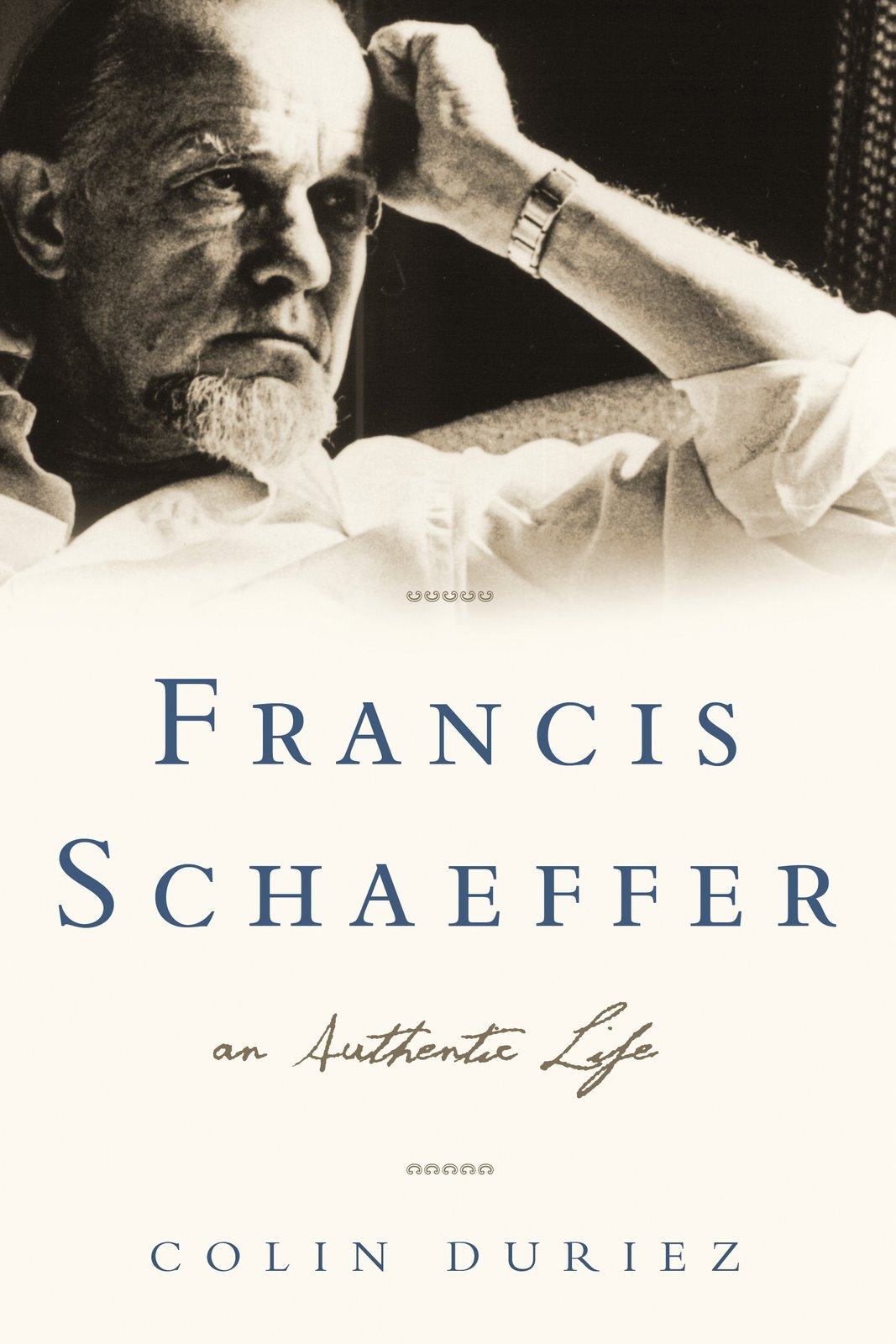
Francis Schaeffer is one of the most influential Christians to have lived in the twentieth century. His life closely paralleled the rise and fall of godless communism in Europe. Schaeffer spent many of those years fighting to instill a depleted western Protestantism and an increasingly materialistic America with a sense of God’s presence and His voice in human affairs.
Francis Schaeffer
Schaeffer began his career as a simple minister of the gospel, a shepherd of a flock. From the beginning, he had a special affinity for young people. Programs he and his wife Edith put together for children proved to be strikingly successful. After pastoring in America for a few years, he and Edith went to Europe as missionaries. They would find their destiny at a Swiss chalet they called L’Abri (the shelter). There, they entertained college students tramping about Europe. Schaeffer relished engaging them in debate about the things they were learning in universities. From this small beginning emerged taped lectures, books (Escape from Reason, The God Who Is There, and many others), and then films (Whatever Happened to the Human Race?, How Should We Then Live?) that would shape the minds of evangelical Christians for decades.
Three key themes dominated Schaeffer’s relentless assault upon social decline and spiritual impoverishment. First, he insisted that Biblical occurrences, like the resurrection of Christ, were real events in space and time. In this sense, he was an apologist for the Christian faith and saw these Biblical truths as the only legitimate foundation for our ethics. Second, he pulled Christian pietists out of a purely devotional faith by demonstrating the massive impact the faith has had on the development of civilization. For Schaeffer, the Christian faith was not some exercise in supernatural therapy for people bewildered by the adversities of life. Instead, he drew out the connections between Christianity, social events, art, history, music, government, and the many other endeavors of human beings in the world. His faith led Christians out of their tiny reading room and into an enormous library of human experience and learning. Third, and finally, Schaeffer made a powerful stand against the shallow materialism increasingly manifest in western society. He criticized the addiction of many Americans to their own “personal peace and affluence” while being insulated against the travails of the poor. And he crusaded fiercely against the devaluation of human life, particularly in the realm of bioethics. In this regard, he helped forge a bond between Catholics and Protestants as he urged them to engage in co-belligerency against a culture in love with death.
Though it is sometimes fashionable to criticize Schaeffer for a misreading of one thinker or the other in his voluminous work, the simple fact is that this minister of the gospel sallied forth into battle during a time when the world sorely needed men like him. And it still does. Thank God for sending them.
Read the entire article on the Acton Institute website (new window will open). Reprinted with permission.
Recently, I read Saving Leonardo by Nancy Pearcey and How Should We Then Live by Francis Schaeffer. Both books have opened my eyes to the importance of art. I used to think art was simply for people who were gifted in music, painting, acting etc. Or, it was the fall back for those who couldn’t cut it in sports. As for me, I never had artistic gifts. And as to my sports career, I was twice cut before the second day of practice, after attempting to walk-on to two different NAIA Division II basketball teams! Needless to say, I couldn’t make athleticism an art form, nor could I create anything of real artistic value in any other manner. So I never really considered it much–until recently.
Art is the ability to take an experience, either real or imagined, and re-create it for others. The format may be music, mat, wood, word, dance, drama, rhyme, rhythm or other. Art will draw a person into the experience, heighten the senses, engage the emotions, block out what was or what will be, and bring to the now a full appreciation of the gift the artist offers. The best art will instruct us to live better lives and appreciate each “now” for the gift that it is.
And art doesn’t always have to be created by others for us. We can have our own artistic moments that bring us to an awareness and appreciation of life that is outside the norm.
I remember my last solo flight at pilot training. It was a late afternoon flight, so the sun was setting and the orange of the sky gave the old beat up black and white jet brand new paint–it shined with the setting sun. The sky was perfectly clear and its color ranged from bright orange to deep purple and the transition in between was, in itself, worthy of capture to understand how it connects the two extremes. But the flying would not permit the time. Because the moment the color struck me, was the brief moment when I was flat on my back as the nose of my aircraft stood perfectly between the orange and purple. And though I wouldn’t get to fully appreciate the glory of God’s canvas, I was about to revel in one of the things I love most about flying–when I look up to see what is beneath me, or look down to see what is above me. Both phrases making absolutely no sense, and at the same time, make perfect sense, whether my head is bowed or tilted back. My feet rest on the moon’s ellipse, and I look up to behold the Texas fall, horizon to horizon, as if it was, itself, the perfect transition from orange to purple. That afternoon God gave me a true appreciation for his creation and his artistry. And I didn’t recognize it as art in the moment, but it impacted me as true art always does.
So in the end, art, ultimately, reveals God to us. It shows us His glory, impresses upon us His majesty. It is, for us, a tiny glimpse of the Creator, Sustainer, and Savior. That is Art.
Congressman Jack Kemp introduced Francis Schaeffer to Washington insiders!!!! This article below pointed this out and this video below shows Jack Kemp tracing the roots of the Conservative movement in the USA to the Bible.
Jack Kemp: An American Conservative Statesman
Published on Jul 30, 2013
Had there never been a Reagan Revolution, there might well have been a Kemp Revolution. Jack Kemp established himself as one of the conservative policy movement’s most articulate speakers and defenders of personal liberty and responsibility. The public first knew of Kemp for his exploits on the gridiron. Kemp played in all three major professional football leagues, the NFL, the AFL and the Canadian Football League. Schooled in supply-side economics, the second part of his life found Kemp serving nine terms in Congress and then as Housing Secretary under President George H.W. Bush, Kemp was a 1988 Republican candidate for President and he was the Republican 1996 nominee for Vice President. Kemp spoke to the Public Policy Foundation on October 20, 1993. Jack Kemp died May 2, 2009 and with his passing, the American conservative movement lost one of its most articulate statesmen.
Why you should know him: Schaeffer was one of the most influential figures in American evangelicalism in the period between World War II and the mid-1980s.
Biography and Assessment: In the late 1940’s, Schaeffer and his wife Edith moved to Switzerland as long-term missionaries. They initially began a program called “Children for Christ” and on weekends entertained groups of schoolgirls on ski holidays in their Swiss chalet. By 1955 the couple had set up their own independent ministry organization called L’Abri (“The Shelter”) in the mountain village of Huemoz. They began taking guests, and developed a regular weekend schedule that consisted of conversations about religion, philosophy, art, and culture. L’Abri became popular among student circles, and by 1957 the Schaeffers were hosting about 25 guests every weekend.
The European students that showed up at L’Abri were well-versed in the post-Enlightenment philosophers like Kierkegaard and Hegel and with the existentialist literature of Camus and Sartre. As historian Michael S. Hamilton notes,
These students tutored Francis in the details of modern post-Christian thought, while he observed its impact on their lives. They had been taught that human beings were the mere product of time and chance in a materialistic world. This left many of them unable to find any basis for distinctions between right and wrong nor meaning in the normal activities of human life. The young people’s self-destructive moral confusion, alienation from society, and sincere search for something better stirred the Schaeffers’ compassion. It made the cost of an open home worth bearing, and it compelled Francis into ever-deeper reflection on the trajectory of modern culture.
The popularity of L’Abri continued to increase and by 1960 even Time magazine was taking notice. Workers at the chalet began recording Schaeffer’s lectures on the philosophical meaning of modern theology and culture. The tapes quickly developed an international circulation prompting the evangelist to return to the states. In 1965 Schaeffer took his first speaking trip to the United States, giving a series of lectures in the Boston area. He then gave a series of talks at Wheaton College that were later published as The God Who Is There. Although he dressed like a Swiss farmer, wearing knickers and an alpine hiking outfit, the most unusual aspect about Schaeffer was the way in which he differed from other evangelicals in engaging with the broader culture. Hamilton points out,
At Wheaton College, students were fighting to show films like Bambi, while Francis was talking about the films of Bergman and Fellini. Administrators were censoring existential themes out of student publications, while Francis was discussing Camus, Sartre, and Heidegger. He quoted Dylan Thomas, knew the artwork of Salvador Dali, listened to the music of the Beatles and John Cage.
Over the next ten years Francis and Edith became increasingly influential figures within American evangelicalism. Francis published eighteen books and booklets, most of which came out of lectures and talks he had been giving since the 1950s, that sold over 2.5 million copies in the U.S.
Schaeffer often railed against the middle-class evangelical mindset that placed an emphasis on “personal peace and affluence” and became an intellectual hero to Christian counter-culture figures like Jack Sparks, founder of Berkeley’s Christian World Liberation Front, and Larry Norman, “poet laureate of the Jesus Revolution.” By the 1970’s, though, he had also begun to gain a hearing within what would later be viewed as the “religious right.” Congressman Jack Kemp introduced the Schaeffers to Washington insiders and an encounter with L’Abri student Michael Ford led to a private dinner in the Ford White House.
In 1974, Schaeffer’s son Franky, a budding filmmaker, designed a ten-part documentary film series intended as a Christian response to Kenneth Clark’s widely viewed Civilization series. The project, How Should We Then Live?, consisted of an 18-city tour that attracted tens of thousands of people and was viewed as a resounding success.
What set the film series apart was the focus on legalized abortion. By the late 1970s, Schaeffer began devoting his full attention to the issue and encouraged pediatric surgeon C. Everett Koop to collaborate on a five-part film series with accompanying book, action handbook, and international lecture tour. In Whatever Happened to the Human Race? , Schaeffer argued that secular humanism had led to the devaluation of human life while Koop presented testimony about the widespread practice of infanticide in hospitals and its links to abortion. Koop later wrote that his involvement in this project was his first step toward becoming President Reagan’s surgeon general.
Unlike his first series, Human Race failed to garner a large audience and even lost money in some of the locations it was screened. Undaunted, Schaeffer continued to focus on abortion, calling it the hinge issue for American society in his book A Christian Manifesto. The book inspired Jerry Falwell to take a stand against abortion and inspired Operation Rescue founder Randall Terry to start a new kind of abortion protest employing passive resistance techniques used in the civil-rights struggle.
In early 1984 he had just enough strength left from his battle with cancer to complete a 13-city tour lecturing on this theme. A month after the tour was complete, he died at his home in Rochester, Minnesota.
Schaeffer—who always claimed to be an evangelist and not a philosopher—was often criticized for the way his work oversimplified intellectual history and philosophy. Even his most ardent admirers admit that he made significant errors in detail and overly broad generalizations. His books, which were often edited together from lecture notes, often fail to provide a systematic coherence that would allow them to withstand greater scrutiny.
Michael Hamilton rightly acknowledges, though, that Schaeffer played a vital role in “stepping stone scholarship.” His work provided an opening to the intellectual depths of Christianity that had been sorely lacking in conservative Protestant Christianity. Schaeffer helped to restore the value of developing a Christian worldview and offered the intellectuals tools that evangelicals needed to properly engage with the secular culture. The effect of his legacy still reverberates through evangelicalism. His influence shaped such thinkers as Chuck Colson, Nancy Pearcey, Cal Thomas, Ron Sider, Harold O. J. Brown, Os Guinness, Thomas Morris, Clark Pinnock, Mark Noll, Doug Groothuis, Jim Sire, and Ronald Wells. Perhaps the best summation of the evangelist who was considered both a “missionary to intellectuals” and a “guru to fundamentalists” is the one provided by Albert Mohler:
Schaeffer served as a prophet of cultural engagement during an age of rebellion among America’s youth, and he shaped the thinking of an entire generation of theologically-minded Christian young people.
Francis Schaeffer: “Whatever Happened to the Human Race” (Episode 1) ABORTION OF THE HUMAN RACE Published on Oct 6, 2012 by AdamMetropolis The 45 minute video above is from the film series created from Francis Schaeffer’s book “Whatever Happened to the Human Race?” with Dr. C. Everett Koop. This book really helped develop my political views […]
E P I S O D E 1 0 Dr. Francis Schaeffer – Episode X – Final Choices 27 min FINAL CHOICES I. Authoritarianism the Only Humanistic Social Option One man or an elite giving authoritative arbitrary absolutes. A. Society is sole absolute in absence of other absolutes. B. But society has to be […]
E P I S O D E 9 Dr. Francis Schaeffer – Episode IX – The Age of Personal Peace and Affluence 27 min T h e Age of Personal Peace and Afflunce I. By the Early 1960s People Were Bombarded From Every Side by Modern Man’s Humanistic Thought II. Modern Form of Humanistic Thought Leads […]
E P I S O D E 8 Dr. Francis Schaeffer – Episode VIII – The Age of Fragmentation 27 min I saw this film series in 1979 and it had a major impact on me. T h e Age of FRAGMENTATION I. Art As a Vehicle Of Modern Thought A. Impressionism (Monet, Renoir, Pissarro, Sisley, […]
E P I S O D E 7 Dr. Francis Schaeffer – Episode VII – The Age of Non Reason I am thrilled to get this film series with you. I saw it first in 1979 and it had such a big impact on me. Today’s episode is where we see modern humanist man act […]
E P I S O D E 6 How Should We Then Live 6#1 Uploaded by NoMirrorHDDHrorriMoN on Oct 3, 2011 How Should We Then Live? Episode 6 of 12 ________ I am sharing with you a film series that I saw in 1979. In this film Francis Schaeffer asserted that was a shift in […]
E P I S O D E 5 How Should We Then Live? Episode 5: The Revolutionary Age I was impacted by this film series by Francis Schaeffer back in the 1970′s and I wanted to share it with you. Francis Schaeffer noted, “Reformation Did Not Bring Perfection. But gradually on basis of biblical teaching there […]
Dr. Francis Schaeffer – Episode IV – The Reformation 27 min I was impacted by this film series by Francis Schaeffer back in the 1970′s and I wanted to share it with you. Schaeffer makes three key points concerning the Reformation: “1. Erasmian Christian humanism rejected by Farel. 2. Bible gives needed answers not only as to […]
Francis Schaeffer’s “How should we then live?” Video and outline of episode 3 “The Renaissance” Francis Schaeffer: “How Should We Then Live?” (Episode 3) THE RENAISSANCE I was impacted by this film series by Francis Schaeffer back in the 1970′s and I wanted to share it with you. Schaeffer really shows why we have so […]
Francis Schaeffer: “How Should We Then Live?” (Episode 2) THE MIDDLE AGES I was impacted by this film series by Francis Schaeffer back in the 1970′s and I wanted to share it with you. Schaeffer points out that during this time period unfortunately we have the “Church’s deviation from early church’s teaching in regard […]
Francis Schaeffer: “How Should We Then Live?” (Episode 1) THE ROMAN AGE Today I am starting a series that really had a big impact on my life back in the 1970′s when I first saw it. There are ten parts and today is the first. Francis Schaeffer takes a look at Rome and why […]
Francis Schaeffer: “Whatever Happened to the Human Race” (Episode 5) TRUTH AND HISTORY Published on Oct 7, 2012 by AdamMetropolis This crucial series is narrated by the late Dr. Francis Schaeffer and former Surgeon General Dr. C. Everett Koop. Today, choices are being made that undermine human rights at their most basic level. Practices once […]
The opening song at the beginning of this episode is very insightful. Francis Schaeffer: “Whatever Happened to the Human Race” (Episode 4) THE BASIS FOR HUMAN DIGNITY Published on Oct 7, 2012 by AdamMetropolis This crucial series is narrated by the late Dr. Francis Schaeffer and former Surgeon General Dr. C. Everett Koop. Today, choices […]
Francis Schaeffer: “Whatever Happened to the Human Race” (Episode 3) DEATH BY SOMEONE’S CHOICE Published on Oct 6, 2012 by AdamMetropolis This crucial series is narrated by the late Dr. Francis Schaeffer and former Surgeon General Dr. C. Everett Koop. Today, choices are being made that undermine human rights at their most basic level. Practices […]
Francis Schaeffer: “Whatever Happened to the Human Race?” (Episode 2) SLAUGHTER OF THE INNOCENTS Published on Oct 6, 2012 by AdamMetropolis This crucial series is narrated by the late Dr. Francis Schaeffer and former Surgeon General Dr. C. Everett Koop. Today, choices are being made that undermine human rights at their most basic level. Practices […]
It is not possible to know where the pro-life evangelicals are coming from unless you look at the work of the person who inspired them the most. That person was Francis Schaeffer. I do care about economic issues but the pro-life issue is the most important to me. Several years ago Adrian Rogers (past president of […]
This essay below is worth the read. Schaeffer, Francis – “Francis Schaeffer and the Pro-Life Movement” [How Should We Then Live?, Whatever Happened to the Human Race?, A Christian Manifesto] Editor note: <p> </p> [The following essay explores the role that Francis Schaeffer played in the rise of the pro-life movement. It examines the place of […]
Great article on Schaeffer. Who was Dr. Francis A. Schaeffer? By Francis Schaeffer The unique contribution of Dr. Francis Schaeffer on a whole generation was the ability to communicate the truth of historic Biblical Christianity in a way that combined intellectual integrity with practical, loving care. This grew out of his extensive understanding of the Bible […]
Dr Richard Land discusses abortion and slavery – 10/14/2004 – part 3 The best pro-life film I have ever seen below by Francis Schaeffer and Dr. C. Everett Koop “Whatever happened to the human race?” Over the years I have taken on the Ark Times liberal bloggers over and over and over concerning the issue […]
The best pro-life film I have ever seen below by Francis Schaeffer and Dr. C. Everett Koop “Whatever happened to the human race?” Francis Schaeffer pictured above._________ The 45 minute video above is from the film series created from Francis Schaeffer’s book “Whatever Happened to the Human Race?” with Dr. C. Everett Koop. This book really […]
The best pro-life film I have ever seen below by Francis Schaeffer and Dr. C. Everett Koop “Whatever happened to the human race?” Over the years I have taken on the Ark Times liberal bloggers over and over and over concerning the issue of abortion. I asked over and over again for one liberal blogger […]
Francis Schaeffer pictured above._________ The best pro-life film I have ever seen below by Francis Schaeffer and Dr. C. Everett Koop “Whatever happened to the human race?” Over the years I have taken on the Ark Times liberal bloggers over and over and over concerning the issue of abortion. I asked over and over again […]
The best pro-life film I have ever seen below by Francis Schaeffer and Dr. C. Everett Koop “Whatever happened to the human race?” On 1-24-13 I took on the child abuse argument put forth by Ark Times Blogger “Deathbyinches,” and the day before I pointed out that because the unborn baby has all the genetic code […]
PHOTO BY STATON BREIDENTHAL from Pro-life march in Little Rock on 1-20-13. Tim Tebow on pro-life super bowl commercial. Over the years I have taken on the Ark Times liberal bloggers over and over and over concerning the issue of abortion. Here is another encounter below. On January 22, 2013 (on the 40th anniversary of the […]
Dr Richard Land discusses abortion and slavery – 10/14/2004 – part 3 The best pro-life film I have ever seen below by Francis Schaeffer and Dr. C. Everett Koop “Whatever happened to the human race?” Over the years I have taken on the Ark Times liberal bloggers over and over and over concerning the issue […]






 Francis Schaeffer


 The Daily Hatch