Category Archives: Francis Schaeffer

“Schaeffer Sundays” can be seen on the www.thedailyhatch.org

What Ever Happened to the Human Race?

Francis Schaeffer  

  I learned so much from Francis Schaeffer and as a result I have posted a lot of posts with his film clips and articles. Below are a few.

Related posts:

Francis Schaeffer: We can’t possess ultimate answers apart from the reference point of the infinite personal God himself (Schaeffer Sunday)

Dr. Francis Schaeffer – The Biblical flow of Truth & History (intro) Uploaded by Scott87508 on Oct 3, 2010 __________________ Some wise words below I got off the internet: Tuesday, July 01, 2008 The Infinite-Personal God: Thoughts from Francis Schaeffer’s Escape from Reason   Perhaps you are familiar with the indie band Arcade Fire. Their […]

Francis Schaeffer’s L’Abri Fellowship in Switzerland (Schaeffer Sunday)

L’Abri : Sounds & Sites of a Shelter Uploaded by mdshivers on Nov 12, 2006 A fun video of the day in the life at L’Abri Fellowship in Switzerland. I made this video in 2003 while there and I was trying to capture the sounds and everyday life of it. Was on the Labri.org site […]

Francis Schaeffer would be 100 years old this year (Schaeffer Sunday)

Dr. Francis Schaeffer – Extra – Interview – Part 2 Francis Schaeffer had a big impact on me in the late 1970′s and I have been enjoying his books and films ever since. Here is great video clip of an interview and below is a fine article about him. Francis Schaeffer 1912-1984 Christian Theologian, Philosopher, […]

Francis Schaeffer’s “How should we then live?” Video and outline of episode 10 “Final Choices” (Schaeffer Sundays)

E P I S O D E 1 0 How Should We Then Live 10#1 FINAL CHOICES I. Authoritarianism the Only Humanistic Social Option One man or an elite giving authoritative arbitrary absolutes. A. Society is sole absolute in absence of other absolutes. B. But society has to be led by an elite: John Kenneth […]

A Christian Manifesto by Francis Schaeffer (Part 9) (Schaeffer Sundays)

Part 1 Part 2 Below is a summary of “A Christian Manifesto” which is a very important book written by Francis Schaeffer just a couple of years before his death in 1984. A Christian Manifesto by Dr. Francis A. Schaeffer This address was delivered by the late Dr. Schaeffer in 1982 at the Coral Ridge Presbyterian […]

Francis Schaeffer and C. Everett Koop were prophetic (jh29)

Francis Schaeffer and C. Everett Koop were prophetic (jh29) What Ever Happened to the Human Race? I recently heard this Breakpoint Commentary by Chuck Colson and it just reminded me of how prophetic Francis Schaeffer and C. Everett Koop were in the late 1970′s with their book and film series “Whatever happened to the human […]

Francis Schaeffer noted “If there are no absolutes by which to judge society, then society is absolute.” (“Schaeffer Sundays” Part 4)

___________________________________________ Francis Schaeffer is a hero of mine and I want to honor him with a series of posts on Sundays called “Schaeffer Sundays” which will include his writings and clips from his film series. I have posted many times in the past using his material. Philosopher and Theologian, Francis A. Schaeffer has argued, “If […]

Communism catches the attention of the young at heart but it has always brought repression wherever it is tried (“Schaeffer Sundays” Part 1)

 (“Schaeffer Sundays” Part 1)   Francis Schaeffer is a hero of mine and I want to honor him with a series of posts on Sundays called “Schaeffer Sundays” which will include his writings and clips from his film series. I have posted many times in the past using his material.   Communism has never been […]


Francis Schaeffer’s film series “How should we then live?” (The Renaissance) can be seen on the www.thedailyhatch.org

Francis and Edith Schaeffer January 1975
Huemoz sur Ollon at L’abri, Switzerland

Here is a portion of the third episode on “The Renaissance.” You need to check this film out. It is great:

How Should We Then Live 3-1

I was impacted by this film series by Francis Schaeffer back in the 1970’s and I wanted to share it with you. Schaeffer really shows why we have so many problems today with this excellent episode. He noted, “Could have gone either way—with emphasis on real people living in a real world which God had made, or humanism could take over with its emphasis on the individual things being autonomous…Humanism’s problem: What is the meaning of individual things, including Man, if there is no final thing to relate them to? And how do we know what is right or wrong if there is no absolute to give us certainty? Humanism ends with only statistical averages.” That is exactly where we are today in 2011. Just left with no final answers, but just with statistical averages.

E P I S O D E 3

T h e RENAISSANCE

I. The Art of the Renaissance Is One of Mankind’s Glories

A. The artists reflect their culture.

B. The artists often provide the way for the next step in culture.

1. Positive emphasis on nature in Giotto’s art.

2. Significance of work of Masaccio.

3. Perspective as a form of humanism.

4. Parallel and supportive developments in Low Countries. Van Eyck’s Adoration of the Lamb, the substitutionary work of the crucified and risen Christ. Also an example of landscape naturalism.

5. Dante’s life and work.

a) Following Aquinas, he mixed Christian and classical elements.

b) Dichotomy in Dante and other writers between sensual and idealized, spiritual love.

6. Brunelleschi’s architecture and the conquest of space.

7. Trend to autobiography and self-portraiture a mark of emphasis on Man.

C. Italian Renaissance music.

1. Invention of orchestration.

2. Invention of movable type for music.

II. Increased Drift Toward a Total Humanism

A. Could have gone either way—with emphasis on real people living in a real world which God had made, orhumanism could take over with its emphasis on the individual things being autonomous.

B. The die was cast: Man tried to make himself independent, autonomous.

C. A growing humanism sees what preceded the Renaissance as the “Dark Ages.”

D. Idea of a “Dark Age” and a “rebirth” in Renaissance.

E. Aquinas had opened the door for that which is the problem of humanism.

Other segments:

Francis Schaeffer’s “How should we then live?” Video and outline of episode 10 “Final Choices” (Schaeffer Sundays)

E P I S O D E 1 0 How Should We Then Live 10#1 FINAL CHOICES I. Authoritarianism the Only Humanistic Social Option One man or an elite giving authoritative arbitrary absolutes. A. Society is sole absolute in absence of other absolutes. B. But society has to be led by an elite: John Kenneth […]

Francis Schaeffer’s “How should we then live?” Video and outline of episode 9 “The Age of Personal Peace and Affluence” (Schaeffer Sundays)

E P I S O D E 9 How Should We Then Live 9#1 T h e Age of Personal Peace and Afflunce I. By the Early 1960s People Were Bombarded From Every Side by Modern Man’s Humanistic Thought II. Modern Form of Humanistic Thought Leads to Pessimism Regarding a Meaning for Life and for Fixed […]

Francis Schaeffer’s “How should we then live?” Video and outline of episode 8 “The Age of Fragmentation” (Schaeffer Sundays)

E P I S O D E 8 How Should We Then Live 8#1 I saw this film series in 1979 and it had a major impact on me. T h e Age of FRAGMENTATION I. Art As a Vehicle Of Modern Thought A. Impressionism (Monet, Renoir, Pissarro, Sisley, Degas) and Post-Impressionism (Cézanne, Van Gogh, Gauguin, […]

Francis Schaeffer’s “How should we then live?” Video and outline of episode 7 “The Age of Non-Reason” (Schaeffer Sundays)

E P I S O D E 7 How Should We Then Live 7#1 I am thrilled to get this film series with you. I saw it first in 1979 and it had such a big impact on me. Today’s episode is where we see modern humanist man act on his belief that we live […]

Francis Schaeffer’s “How should we then live?” Video and outline of episode 6 “The Scientific Age” (Schaeffer Sundays)

E P I S O D E 6 How Should We Then Live 6#1 I am sharing with you a film series that I saw in 1979. In this film Francis Schaeffer asserted that was a shift in Modern Science. A. Change in conviction from earlier modern scientists.B. From an open to a closed natural system: […]

Francis Schaeffer’s “How should we then live?” Video and outline of episode 5 “The Revolutionary Age” (Schaeffer Sundays)

E P I S O D E 5 How Should We Then Live 5-1 I was impacted by this film series by Francis Schaeffer back in the 1970′s and I wanted to share it with you. Francis Schaeffer noted, “Reformation Did Not Bring Perfection. But gradually on basis of biblical teaching there was a unique improvement. A. […]

Francis Schaeffer’s “How should we then live?” Video and outline of episode 4 “The Reformation” (Schaeffer Sundays)

How Should We Then Live 4-1 I was impacted by this film series by Francis Schaeffer back in the 1970′s and I wanted to share it with you. Schaeffer makes three key points concerning the Reformation: “1. Erasmian Christian humanism rejected by Farel. 2. Bible gives needed answers not only as to how to be right with […]

Francis Schaeffer’s “How should we then live?” Video and outline of episode 3 “The Renaissance”

How Should We Then Live 3-1 I was impacted by this film series by Francis Schaeffer back in the 1970′s and I wanted to share it with you. Schaeffer really shows why we have so many problems today with this excellent episode. He noted, “Could have gone either way—with emphasis on real people living in […]

Francis Schaeffer’s “How should we then live?” Video and outline of episode 2 “The Middle Ages” (Schaeffer Sundays)

How Should We Then Live 2-1 I was impacted by this film series by Francis Schaeffer back in the 1970′s and I wanted to share it with you. Schaeffer points out that during this time period unfortunately we have the “Church’s deviation from early church’s teaching in regard to authority and the approach to God.” […]

Francis Schaeffer’s “How should we then live?” Video and outline of episode 1 “The Roman Age” (Schaeffer Sundays)

How Should We Then Live 1-1 Today I am starting a series that really had a big impact on my life back in the 1970′s when I first saw it. There are ten parts and today is the first. Francis Schaeffer takes a look at Rome and why it fell. It fell because of inward […]

Francis Bacon: Humanist artist who believed life “is meaningless” (Part 4)

John Whitehead in an article noted:

Bacon, however, clearly expressed his atheistic pessimism: “Man now realizes that he is an accident, that he is a completely futile being, that he has to play out the game without purpose, other than of his own choosing.” On another occasion, he remarked: “We are born and we die and there’s nothing else. We’re just part of animal life.”

Thus, Bacon, in terms of humanity and the supernatural, reached not only a position of unbelief but of despair. His paintings express modern humanity’s condition: dehumanized man dispossessed of any durable paradise.

https://youtu.be/qA1ZszJTwAo
________________________

I first read about Francis Bacon in a book written by Francis Schaeffer. I was interested in looking into his art. His art really shows where modern man has come to the place of desperation since modern man has embraced the closed system that does not include God. What is left for man but what time and chance can bring. Bacon admitted that he was very depressed about man’s future and it comes out in his paintings.

I wish he would have read the work of Francis Schaeffer. I have posted links to Schaeffer’s works below.

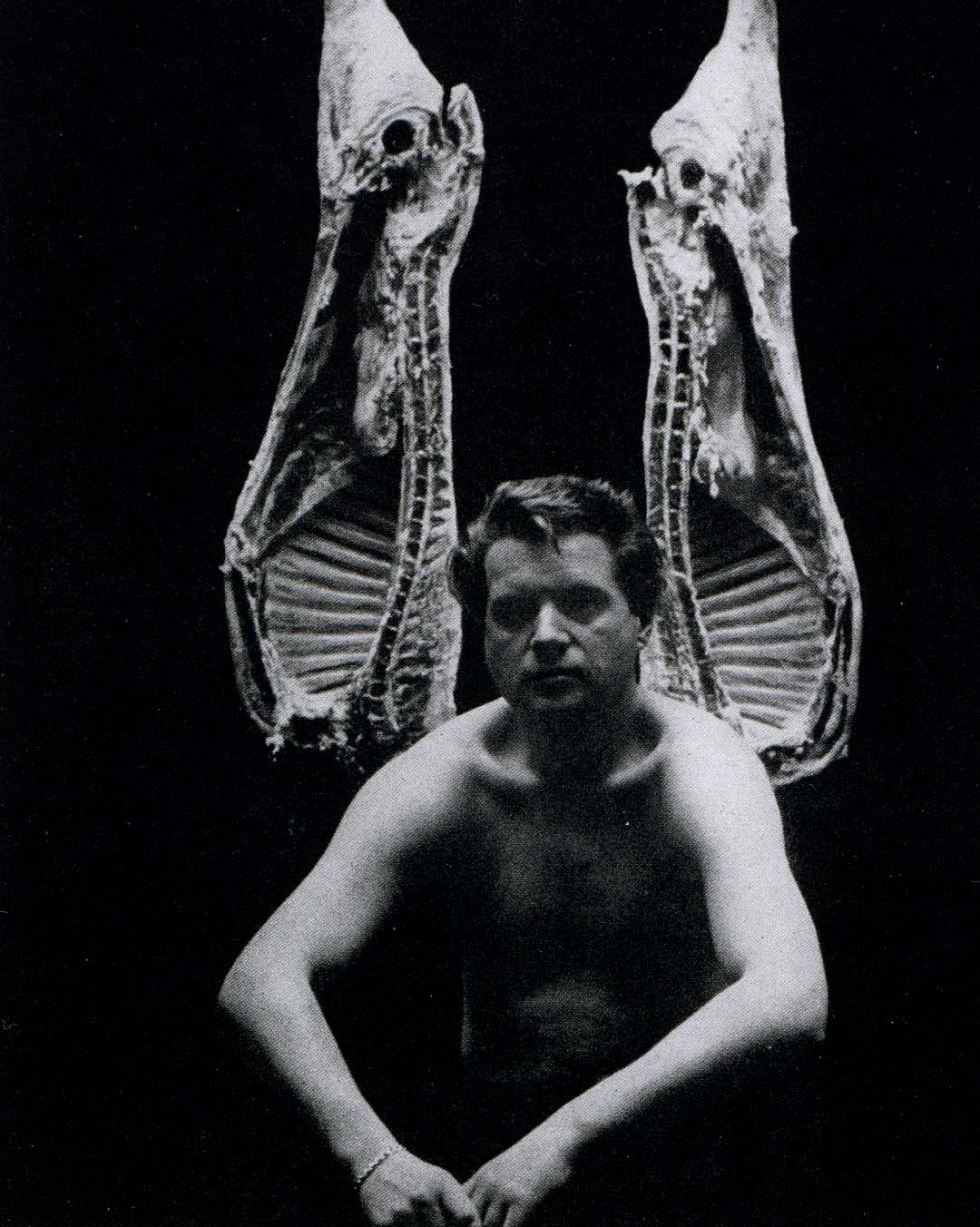
Photograph of Bacon taken by John Deakin for Vogue, 1962

The Striptease of Humanism

This, then, is “the striptease of humanism,” a gathering crisis of optimism, an escape from reason, a surfacing of subterranean pessimism. Understanding it as the daily climate of our time, we can now analyze more closely certain features of its arrival and of its permanent residue.

First, there is the strong element of surprise. For any who had read Nietzsche, this should not have been so but in fact it was. In 1929 Freud remarked on this in Civilization and Its Discontents: “Man has, as it were, become a prosthetic god. . . . Future ages . . . will increase man’s likeness to God still more. But . . . present day man does not feel happy in his Godlike character.”33 In 1951 Camus felt it still more keenly: “During the last century, man cast off the fetters of religion. Hardly was he free, however, when he created new and utterly intolerable chains. . . . The kingdom of grace has been conquered, but the kingdom of justice is crumbling too. Europe is dying of this deception.”34

The situation is pregnant with irony: There is a crisis of disbelief as well as a crisis of belief. Some religious thinkers may be endlessly reporting the death of God (almost as their contemporary creedal confession), but the fact no longer seems heroic to the perceptive atheist. If the city of God has been razed, who is in need of a home now? Who feels the chill most keenly?

A second feature is the irreversibility of the exposure of humanism. It would be comforting to regard the present pessimism as a cycle, or swing of the pendulum, but there are various reasons why we cannot. For one thing there are new factors which prevent a reversal. Here we come to the difference between Oswald Spengler and Max Weber. Spengler thought the decline of the West was essentially what had happened before. Weber held that what was occurring had never happened before. It was different because, although there were similar symptoms, the “disenchantment of the world” by technology was new. So the situation was irreversible.

These elements of surprise and irreversibility were two features of the arrival of the crisis, but of even greater importance are the various symptomatic features of its continuing presence. We shall now examine these. The key to the understanding of each of them is that they stem from the humanist’s lack of a basis, the loss of center, the death of absolutes.

Alienation

The first symptom is alienation which occurs when the lack of basis is actually seen, felt or experienced. Whenever a man is not fulfilled by his own view of himself, his society or his environment, then he is at odds with himself and feels estranged, alienated and called in question. Optimistic humanism, lacking sufficient basis for the full range of humanness, also lacks sufficient balance, and alienation is inescapable when this is so. First of all this is true today of metaphysical alienation. Denying the optimistic implications of Darwinism, Nietzsche pointed to man’s “ontological predicament”: “Man is a rope, tied between beast and overman — a rope over an abyss.”49 Caught between the all-too-human and the superhuman, man, if he is not to despair, must stretch across an unbridgeable chasm to the revalued ideals of the overman. Nietzsche himself felt mocked, even in madness, by this impossible struggle. As all-too-human he knew only anguish, terror, loneliness, desperation, disgust, “the great seasickness” of the world without God.

This last phrase was picked up by Sartre in his first novel Nausea, a classic of existentialism. Walking in the city park one day, Roquentin was overcome by the nausea of the meaninglessness of life. Looking around him, he concluded, “Every existent is born without reason, prolongs itself out of weakness and dies by chance.”50 He was forced to the unhappy conclusion that the key to life is its fundamental absurdity. Man as man has to reach towards being God in order to fulfill his aspirations, yet with God dead and the world as it is these aspirations are limitations cast back in his face as an absurdity. Sartre’s reluctant conclusion is that “man is a useless passion.”51

The drastic extremity of this is well portrayed in the drama of Samuel Beckett, whose Parisian home and early research in Marcel Proust’s philosophy of time bring him close to the thought world of existentialism. In Waiting for Godot, Godot’s failure to arrive reduces all of life to the level of irrational absurdity.52 In Krapp’s Last Tape, the personality of the old man is completely desiccated by the sequential flow of time shattering his identity into fragments.53 Beckett’s ultimate in economic starkness is Breath, thirty seconds in duration, with no actors nor dialogue nor any props on the stage except miscellaneous rubbish; the whole script is the sigh of human life from a baby’s cry to a man’s last gasp before the grave.

The same metaphysical alienation, expressed in terms of the counter culture, is brilliantly distilled in Yoko Ono’s single line poems in Grapefruit.54All of them are capsules of nihilism, variations on a theme of meaninglessness. “Map Piece” reads, “Draw a map to get lost.” Another called “Lighting Piece” runs, “Light a match and watch it till it goes out.” These are the poetic counterpoint to Breath.

The same sense of alienation can be heard in many expressions of protest chafing at the constricting philosophies and psychologies dominant today. Paul Simon cries out in “Patterns” against the reductionism of determinism that conceives of man as a rat in a cage.55

Jean Luc Godard says much the same in his film La Chinoise.56When love is meaningful, to say “I don’t love you” is tragic, but when love is reduced to the chemistry of the color of the eye or the preference of the sweater color, to say “I don’t love you” is to say almost nothing.

Metaphysical alienation is also seen in the attempt to escape from nihilism through gamesmanship. Whether the games are crass, like the money or success games, or sophisticated and esoteric, like aesthetics or meditation techniques, they are only games created to escape the meaninglessness. Speaking as an artist, Francis Bacon says that man now realizes that he is an accident, a completely futile being and that he can attempt to beguile himself only for a time. Art has become a game by which man distracts himself.57

The heightened tragedy of the contemporary situation is that this is being confirmed, cemented and compounded by a newly felt sociological alienation. This alienation stems partly from the disjointedness of society, but even more from the estrangement induced by a modern technological environment in which men feel unfulfilled, depersonalized, dehumanized and condemned to grow up absurd. Jacques Ellul describes this graphically: “The human being was made to breathe the good air of nature, but what he breathes is an obscure compound of acids and coal tars. He was created for a living environment, but he dwells in a lunar world of stone, cement, asphalt, glass, cast iron and steel. The trees wilt and blanch among sterile and stone facades. Cats and dogs disappear little by little in the city, going the way of the horse. Only rats and men remain to populate a dead world.”58 Man is ill at ease in this environment and the tension demanded of him weighs heavily on his time and nerves, his life and being. If he tries to escape, he is drawn towards an entertainment world of dreams, and if he complies, he falls into a life of crowded, organized routine in which to conform is to feel the malaise of maladjustment.

This alienation, metaphysical and environmental, is an inescapable consequence of humanism and symptomatic of its lack of a basis, making man unfulfillable on the basis of his own views of himself…..

Modern humanism also refuses to touch the danger points, to face the logic of its own premises. It prefers to live in intellectual inconsistency. In The Disinherited Mind Erich Heller says, “In Kafka we have before us the modern mind, seemingly self-sufficient, intelligent, sceptical, ironical, splendidly trained for the great game of pretending that the world it comprehends in sterilized sobriety is the only and ultimate reality there is — yet a mind living in sin with the soul of Abraham. Thus he knows two things at once, and both with equal assurance; that there is no God, and that there must be God.”83

Kafka was not unique. Nietzsche himself, for all his scorn, made his leap of faith. He asserts that any attempt to understand the universe is prompted by man’s will to power but fails to see that his own conception of the will to power must then be admitted by him to be a creation of his will to power. What to Kafka was a weakness is now a disease of almost epidemic proportions. Erich Fromm ponders, “In the nineteenth century the problem was that God is dead, in the twentieth century the problem is that man is dead,”84 but Fromm shies away from exploring the connection between the two. R. D. Laing poses the alternative, “Deus absconditus. Or we have absconded,”85 but his vision of the divine is Eastern, not Christian, and his use of Luther’s concept is merely rhetorical.

Thus optimistic humanism is currently in the throes of a gathering crisis. But we dare not let this negate the humanness of its ideals. What is needed is a stronger humanism, not a weaker one. We need a concern for humanness that has a basis for its ideals and the possibility of their substantial realization.

There are several requirements which any contending solution must satisfy. First, it must provide a basis that will define and demonstrate the individuality of man as human. Here the Eastern conceptions of man with their essential negation of the value of man in this life, the communist subordination of the individual to the state, and the post-Christian failure of Western man to resist the trends of dehumanization point to answers which do not satisfy this first requirement.

Second, it must provide a basis for the fulfillment of an individual’s aspirations. The Eastern religions, communism and humanism again fall short for similar reasons. So also do determinism and existentialism.

Third, it must provide a basis for the substantial healing of man’s alienations in terms of an individual’s becoming more fully himself. Many views falter here.

Fourth, it must provide a basis for community, combining social unity and diversity, and it must avoid the chaos of relativism or the swing to control seen in many modern states and intentional communes.

These together must provide a basis for defining and demonstrating a humanness sufficiently robust to be an anchor against the dehumanization coming from social disruption and the fear of global destruction.

A Third Way is obviously required — one which speaks to the basic situation of humanity, both in individuality and in community. It must provide an answer to existentialism and a fulfillment to optimistic humanism. But this is still to run ahead of ourselves.

With the erosion of the Christian culture and the crisis of humanism, the direction of Western culture is uncertain. Will we see a desperate vacuum from which nihilism will rise? Will we lurch on uneasily to a new technological barbarism? Will a novel mysticism turn the West into the East? Or will the slow disintegration of Western culture herald a decline of power, until the egoism of Western culture is judged by the hammer of the Soviets?

Only the future will show. Curiously, the recent pre-occupation with “the end of ideology” has given rise to a new ideology — futurology. Here evolutionary optimistic humanism has its last chance. If, searching into his future, man finds grounds for believing in himself and his ability to control his future, then secular humanism may become solvent again. This quest forms the story of our next chapter.

Notes

  • Friedrich Wilhelm Nietzsche, The Gay Science, 125, in The Portable Nietzsche (New York: The Viking Press, 1954), p. 96; C. G. Jung. “Epilogue,” Modern Man in Search of a Soul (New York: Routledge Books, 1933); Bertrand Russell, Has Man a Future? (Harmondsworth: Penguin Books, 1961), p. 110; Federico Fellini, Fellini’s Satyricon, ed. Darlo Zanelli, trans. Eugene Walters and John Matthews (New York: Ballantine Books, 1970), p. 269.
  • Quoted in Kenneth Clark, Civilisation (London: John Murray Ltd., 1971), p. 104.
  • Quoted in ibid., p. 101.
  • Peter Gay, The Enlightenment: An Interpretation (New York: Alfred A. Knopf, Inc., 1966), p. 44.
  • Ibid.,p.417.
  • Michael Harrington, The Accidental Century (Harmondsworth: Penguin Books, 1967), p. 31.
  • Gordon Childe, Man Makes Himself (New York: Mentor Books, 1951).
  • Julian Huxley, ed., The Humanist Frame (London: George Allen and Unwin Ltd., 1961), p. 44.
  • Ibid.,p.7.
  • Algernon Charles Swinburne, “Hymn of Man.”
  • J. Huxley, p. 6.
  • Ibid., p. 26.
  • Harrington, p. 35.
  • Heinrich Heine, quoted in WaIter Kaufmann, Nietzsche: Philosopher, Psychologist, Antichrist (New York: Meridian Books, 1956), p. 375.
  • Nietzsche, The Will to Power, 1-2, quoted in Kaufmann, p. 103.
  • C. S. Lewis, Christian Reflections (London: Geoffrey Bles Ltd., 1967), p. 82.
  • Frantz Fanon, The Wretched of the Earth, trans. Constance Farrington (Harmondsworth: Penguin Books, 1967), p. 251.
  • lbid., p.21.
  • Letter of Aldous Huxley to Sibylle Bedford quoted in Time, May 4, 1970.
  • J. R. Platt, The Step to Man (New York: John Wiley & Sons Ltd., 1966), p. 196.
  • Norman O. Brown, Life Against Death (London: Sphere Books Ltd., 1968), p. 267.
  • See discussion in Nigel Calder, Technopolis (London: MacGibbon & Kee Ltd., 1969), pp. 98-99.
  • Arnold Toynbee, “Changing Attitudes towards Death in the Modern Western World” in Arnold Toynbee and others, Man’s Concern with Death (London: Hodder and Stoughton Ltd., 1968), p. 125.
  • Arthur Koestler, The Ghost in the Machine (London: Hutchinson & Co. Ltd., 1967), p. 15.
  • Viktor E. Frankl, “Reductionism and Nihilism” in Beyond Reductionism, ed. Arthur Koestler and J. R. Smythies (London: Hutchinson & Co. Ltd., 1969), p. 398.
  • Mortimer J. Adler, The Difference of Man and the Difference It Makes (London: Holt, Rinehart & Winston Ltd., 1967).
  • Quoted in T. M. Kitwood, What Is Human? (Downers Grove, Ill.: InterVarsity Press, 1970), p. 49.
  • Nietzsche, Ecce Homo, IV, 1, as quoted in Kaufmann, pp. 83-84.
  • Harrington, p. 26.
  • Koestler, p. 313.
  • Fanon, pp. 251-52.
  • Harrington, p. 36.
  • Sigmund Freud, Civilization and Its Discontents, Standard Works of Freud, 21 (London: The Hogarth Press Ltd., 1961), p. 91-92.
  • Albert Camus, The Rebel, trans. Anthony Bower (Harmondsworth: Penguin Books, 1962), pp. 243-44.
  • Nietzsche, The Gay Science, 125.
  • Quoted in Gay, p. 65.
  • Quoted in Kitwood, p. 54.
  • Erich Heller, The Disinherited Mind (Harmondsworth: Penguin Books, 1961), p. 75.
  • Nietzsche, p. 409.
  • Nietzsche, Thus Spake Zarathustra, I, 11, in The Portable Nietzsche, p. 160.
  • Fyodor Dostoevsky, The Possessed (New York: Signet Classics, 1962), pp. 384-85.
  • Camus, The Rebel, p. 199.
  • Fyodor Dostoevsky, The Brothers Karamazov (Harmondsworth: Penguin Books, Inc., 1968), p. 733.
  • Quoted in Camus, The Rebel, p. 58.
  • Quoted in ibid., p. 62.
  • Quoted in ibid.
  • Quoted in ibid.
  • Heller, p. 76.
  • Nietzsche, Zarathustra’s Prologue, 4, in The Portable Nietzsche, p. 126.
  • Jean Paul Sartre, Nausea (Harmondsworth: Penguin Books, 1965), p. 191.
  • Sartre, Being and Nothingness, trans. Hazel E. Barnes (London: Methuen, 1957), p. 566.
  • Samuel Beckett, Waiting for Godot (London: Faber and Faber Ltd., 1956).
  • Samuel Beckett, Krapp’s Last Tape (New York: Grove Press, Inc., 1958).
  • Yoko Ono, Grapefruit (London: Peter Owen Ltd., 1970).
  • Paul Simon, The Paul Simon Songbook, C.B.S. 62579.
  • Jean Luc Godard, La Chinoise, filmed 1967.
  • Quoted in H. R. Rookmaaker, Modern Art and the Death of a Culture (Downers Grove, Ill.: InterVarsity Press, 1970), p. 174.
  • Jacques Ellul, The Technological Society, trans. John Wilkinson (New York: Alfred A. Knopf, 1970), p.321.
  • Chores and Roy Medvedev, A Question of Madness (New York: Alfred A. Knopf, 1971).
  • “Psychoadaptation, or How to Handle Dissenters,” Time,September 27, 1971, p. 45.
  • lbid., p.44.
  • Quoted in Harrison Salisbury, “Introduction,” The Prison Diary of Ho Chi Minh (New York: Bantam Books, 1971), p. ix.
  • Fyodor Dostoevsky, The Idiot (New York: Bantam Books, 1958), p. 71.
  • Jerzy Grotowski, Towards a Poor Theatre (New York: Simon and Schuster, 1968), p. 123.
  • Erich Fromm, The Sane Society (New York: Routledge Books, 1956).
  • R. D. Laing, The Politics of Experience (Harmondsworth: Penguin Books, 1967), p. 24.
  • Ibid., p.24.
  • David Cooper, ed., The Dialectics of Liberation (Harmondsworth: Penguin Books, 1968).
  • Malcolm Muggeridge, Tread Softly for You Tread on My Jokes (Glasgow: William Collins Sons & Co. Ltd.), p. 28.
  • Ibid., p. 29.
  • Christopher Booker, The Neophiliacs (Glasgow: Fontana, 1970), p. 70.
  • Ibid., p. 44.
  • Ibid., p. 339.
  • Ernst Fischer, The Necessity of Art, trans. Anna Bostock (Harmondsworth: Penguin Books, 1963).
  • Lewis Feuer, “What Is Alienation? The Career of a Concept,” New Politics, Spring 1962, pp. 116-34.
  • Fischer, p. 80.
  • Erich Frornm, Marx’s Concept of Man (New York: Frederick Ungar Publishing Co., 1961).
  • Hermann Dooyeweerd, A New Critique of Theoretical Thought, 4 vols. (Nutley, N.J.: The Presbyterian and Reformed Publishing Co., 1957); The Twilight of Western Thought (Nutley, N.J.: Craig Press, 1960).
  • Francis A. Schaeffer, The God Who Is There (Downers Grove, Ill.: InterVarsity Press, 1968); Escape from Reason(Downers Grove, III.: InterVarsity Press, 1968).
  • J. A. Rushdoony, “Preface,” Dooyeweerd, The Twilight of Western Thought, p. 9.
  • Camus, The Rebel, p. 16.
  • Nietzsche in a letter to Gersdorff, November 7, 1970, quoted in Erich Heller, p. 70.
  • Ibid., p.181.
  • Fromm, Sane Society, p. 360.
  • Laing, The Politics of Experience, p. 118.

Author

Os Guinness is an Englishman born in China during the war with Japan and educated at the University of London. He has traveled widely in the East and lectured to student groups in Europe, the United States and Canada. His major work was with Francis Schaeffer at L’Abri Fellowship in Switzerland.

Related posts:

Responding to Oppenneimer and Lizza:Defending Francis Schaeffer’s influence on believers such as Michele Bachmann(Part 1)

Today I read an article in the New York Times, “Son of Evangelical Royalty, turns his back and tells the tale,” August 19, 2011. The liberal Max Brantley of the Arkansas Times Blog called this article by Mark Oppenneimer “the best reading of the morning.” Oppenneimer asserted: Edith Schaeffer also wrote books, and in 1977, Frank, an amateur filmmaker, […]

Francis Schaeffer’s “How should we then live?” Video and outline of episode 10 “Final Choices”

E P I S O D E 1 0 How Should We Then Live 10#1 FINAL CHOICES I. Authoritarianism the Only Humanistic Social Option One man or an elite giving authoritative arbitrary absolutes. A. Society is sole absolute in absence of other absolutes. B. But society has to be led by an elite: John Kenneth […]

Francis Schaeffer’s “How should we then live?” Video and outline of episode 9 “The Age of Personal Peace and Affluence”

E P I S O D E 9 How Should We Then Live 9#1 T h e Age of Personal Peace and Afflunce I. By the Early 1960s People Were Bombarded From Every Side by Modern Man’s Humanistic Thought II. Modern Form of Humanistic Thought Leads to Pessimism Regarding a Meaning for Life and for Fixed […]

Francis Schaeffer’s “How should we then live?” Video and outline of episode 8 “The Age of Fragmentation”

E P I S O D E 8 How Should We Then Live 8#1 I saw this film series in 1979 and it had a major impact on me. T h e Age of FRAGMENTATION I. Art As a Vehicle Of Modern Thought A. Impressionism (Monet, Renoir, Pissarro, Sisley, Degas) and Post-Impressionism (Cézanne, Van Gogh, Gauguin, […]

Francis Schaeffer’s “How should we then live?” Video and outline of episode 7 “The Age of Non-Reason”

E P I S O D E 7 How Should We Then Live 7#1 I am thrilled to get this film series with you. I saw it first in 1979 and it had such a big impact on me. Today’s episode is where we see modern humanist man act on his belief that we live […]

Taking up for Francis Schaeffer’s book Christian Manifesto

I have made it clear from day one when I started this blog that Francis Schaeffer, Milton Friedman, Ronald Reagan and Adrian Rogers had been the biggest influences on my political and religious views. Today I am responding to an unfair attack on Francis Schaeffer’s book “A Christian Manifesto.” As you can see on the […]

Francis Schaeffer’s “How should we then live?” Video and outline of episode 6 “The Scientific Age”

E P I S O D E 6 How Should We Then Live 6#1 I am sharing with you a film series that I saw in 1979. In this film Francis Schaeffer asserted that was a shift in Modern Science. A. Change in conviction from earlier modern scientists.B. From an open to a closed natural system: […]

Francis Schaeffer’s “How should we then live?” Video and outline of episode 5 “The Revolutionary Age”

E P I S O D E 5 How Should We Then Live 5-1 I was impacted by this film series by Francis Schaeffer back in the 1970′s and I wanted to share it with you. Francis Schaeffer noted, “Reformation Did Not Bring Perfection. But gradually on basis of biblical teaching there was a unique improvement. A. […]

Francis Bacon: Humanist artist who believed life “is meaningless” (Part 3)

I first read about Bacon in a book by Francis Schaeffer.

John Whitehead in an article noted:

Bacon’s work epitomizes the spirit of twentieth century man—a grasping for meaning and dignity within an environment of dehumanization and meaninglessness. He once said: “Nietzsche forecast our future for us—he was the Cassandra of the nineteenth century—he told us it’s all so meaningless we might as well be extraordinary.”

____________

Below is a portion of an article by Os Guinness

“I come too early. My time has not come yet. This tremendous event is still on its way.” Nietzsche“To be a man means to reach toward being God.” Jean Paul Sartre“In seeking to become angels we may become less than men.” Pascal“True civilization does not lie in gas, nor in steam, nor in turntables. It lies in the reduction of the traces of original sin.” Baudelaire“It is becoming more and more obvious, that it is not starvation, not microbes, not cancer but man himself who is mankind’s greatest danger.” Carl Jung“It is in our hearts that the evil lies, and it is from our hearts that it must be plucked Out.” Bertrand Russell“Oh great gods, how far he lies from his destination!” Fillini, Fellini’s Satyricon1


Western culture is marked at the present moment by a distinct slowing of momentum, or perhaps, more accurately, by a decline in purposefulness and an increase in cultural introspection. This temporary lull, this vacuum in thought and effective action, has been created by the convergence of three cultural trends, each emphasizing a loss of direction. The first is the erosion of the Christian basis of Western culture, an erosion with deep historical causes and clearly visible results. The second is the failure of optimistic humanism to provide an effective alternative in the leadership of the post-Christian culture. And the third is the failure of our generation’s counter culture to demonstrate a credible alternative to either of the other two — Western Christianity and humanism.

The convergence of these three factors in the late sixties marks this period as especially important. What is at stake is nothing less than the direction of Western man. Only a few years ago the dismissal of Christianity was held to be a prerequisite for cultural advance. The decline of Christianity thus represented a cure for man’s problems, not a cause. So with the dawning of optimistic humanism the decline of Christianity was welcomed. Its adherents would be the only losers.

But that was yesterday. And contemporary yesterdays have a habit of suddenly seeming a hundred years ago. Today the cultural memory of traditional values hangs precariously like late autumn leaves, and in the new wintry bleakness optimism itself is greying. Now it appears that all of Western culture may be the loser.

My purpose is first to examine humanism, partially as a movement in itself but even more as a backdrop against which to appreciate the need for an alternative; then to chart the alternative offered by the counter culture with all its kaleidescopic variety; and finally, to present a third way as a more viable option in the light of man’s current situation. The weaknesses in both humanism and the counter culture are pointed out, not to negate much that has been extremely sensitive and intensely human, but to show the inevitability of their failures. The critique at least serves to illustrate certain mistakes that must not be repeated, and it highlights important questions and dilemmas with which further alternatives must grapple.

A third way is desperately necessary because the present options are growing more obviously unacceptable. And, in fact, there is a Third Way — one which is becoming increasingly welcome to a large number of sensitive searchers and free-spirited individuals who make up a major part of those dissatisfied with things as they are. This Third Way holds the promise of realism without despair, involvement without frustration, hope without romanticism. It combines a concern for humanness with intellectual integrity, a love of truth with a love of beauty, conviction with compassion and deep spirituality. But this is running ahead.

The Surfacing of Pessimism

Now we can see an important point more clearly. Optimistic humanism was only one stream of secular humanism. Its reverse was pessimistic humanism, and if the optimism was characteristically strong in academic circles, it is now evident that pessimism was more prevalent in the wider reality of life. Pessimistic humanism was always there, like a subterranean stream, murky in its depths and dark in its apprehension of dilemmas. It is this subterranean stream that is now threatening to surface and usurp the dignity and dominance of optimistic humanism.

Again we must go back in history to realize the full importance of this surfacing pessimism. Its genius was to see that behind the apparent stability of the nineteenth-century world in which modern humanism was born stood a different reality. Both Nietzsche and Kirkegaard were men who lived in passionate revolt against the smugness of the nineteenth century, particularly against the cheapness of its religious faith and the brash confidence of its secular reasoning, or generally against its shallow optimism, wordy idealism and tendency to conform. Such a smug world was not just false but dangerously foolish, if the true nature of reality lay elsewhere.

It is amazing that this subterranean pessimism was not taken more seriously earlier. But it was derided as the “Devil’s Party” — the poets, philosophers and prophets of chaos and catastrophe — and all too easy to dismiss.13 Some were ignored. Their repeated warnings were simply relegated to the status of cultural myth having only an innocuous respectability. In 1832 Hemrich Heine had said, “Do you hear the little bell tinkle? Kneel down — one brings the sacraments for a dying God.”14 Nietzsche’s later cry of the death of God and his searching diagnosis (“Everything lacks meaning. What does nihilism mean? That the highest values devaluate themselves. The goal is lacking; the answer is lacking to our ‘Why?’”)15 were not taken seriously either. After all, wasn’t Heine a poet, and wasn’t Nietzsche later deranged?

Other warnings were dismissed as only to be expected from the theory or temperament of their particular authors. Repeatedly in the 1930s, George Orwell depicted Western intellectuals as men who in blithe ignorance were sawing off the very branch on which they were sitting. Malcolm Muggeridge in his articles lanced open the “death wish of liberalism.” C. S. Lewis carefully made his exposures in “The Funeral of a Great Myth.”16 But the serious disquiet of Orwell, the humorous if testy honesty of Muggeridge and the gentle clarity and utter reasonableness of C. S. Lewis were before their time. They were predictable. They were ignored.

But the rising tide of disquiet cannot now be ignored. It is becoming the accepted mood of much recent judgment, as a hundred illustrations could quickly show. Writing in 1961 specifically on problems of Western culture, Frantz Fanon mocked, “Look at them today, swaying between atomic and spiritual disintegration.”17 In the same context, Jean Paul Sartre challenged, “Let us look at ourselves if we can bear to, and see what is becoming of us. First we must face that unexpected revelation, the strip tease of our humanism.”18 These two men could easily be dismissed as pessimistic, prejudiced politically and philosophically, but the disquiet does not stop there. Coming closer to the heart of humanism and speaking almost as an heir to a distinguished humanist house, Aldous Huxley described himself this way: “I was born wandering between two worlds, one dead and the other powerless to be born, and have made in a curious way the worst of both.”19 From the world of science John Rader Platt, the American biophysicist, said, “The world has now become too dangerous for anything less than Utopia.”20 Norman O. Brown, a man famous for the lyrical romanticism of his visions, admitted, “Today even the survival of humanity is a utopian hope.”21

There can be no stable equilibrium between optimism and pessimism but only an uneasy oscillation between the two. Optimistic humanism is strong in its stress on the aspirations of man but weak in its understanding of his aberrations. Accordingly, it lacks a base for the fulfillment of the former and its solutions to the latter are deficient; thus its ultimate optimism is eternally romantic. Pessimistic humanism, on the other hand, insists on the absurdity of man’s aspirations and speaks to the heart of his aberrations, but the price of its realism is the constant pull toward despair. This clear contrast throws further light on the current crisis.

Four Pillars of Optimistic Humanism

Optimistic humanism is being exposed as idealism without sufficient ideals. More accurately, its ideals are impossible to attain without a sufficient basis in truth, and this is just what its rationalistic premises are unable to provide. This is the key weakness of each of the four central pillars of optimistic humanism.

The first pillar is the belief in reason. Here optimistic humanism is forced to its initial leap of faith… Much of what was called reasoning is now more properly called rationalizing.

Modern philosophy also has reduced the pretentions of reason. For man, speaking from a finite reference point without divine revelation, to claim to have found a “universal” is not just to be mistaken. The claim itself is meaningless. For most modern men, objectivity, universals or absolutes are in a realm beyond the scope of reason; in this realm there is only the existential, non-rational, subjective understanding of truth.

Both psychology and philosophy have thus clipped the proud wings of rationalism and the unlimited usefulness of reason by itself. By rationalism I do not mean “rationalism” as opposed to “empiricism” but rather the hidden premise common to both — the humanist’s leap of faith in which the critical faculty of reason is tacitly made into an absolute and used as a super-tool to marshal particulars and claim meaning which in fact is proper only to the world of universals.

The second pillar is the belief in progress. The orientation toward the future introduced into Western culture by Christian linear teleology was secularized by the Enlightenment. Ostensibly it had been given objective scientific support by the evolutionary theory. It was widely believed that nature was marching forward inevitably to higher and higher views of life (as expressed, for instance, in the philosophy of Herbert Spencer). But this is now being drastically undermined. Many point to evidence of an evolutionary crisis, somewhat tarnishing the comfortable image of inevitable progress with man at the center of the stage controlling his own evolution. Some even predict the extinction of the human species.

The third pillar is the belief in science as the guide to human progress and the provider of an alternative to both religion and morals. If “evolution is good,” then evolution must be allowed to proceed and the very process of change becomes absolutized.

The fourth pillar is the belief in the self-sufficiency of man. A persistent erosion of man’s view of himself is occurring. The fact that man has made so many significant scientific discoveries points strongly to the significance of man, yet the content of these same scientific discoveries underscores his insignificance. Man finds himself dwarfed bodily by the vast stretches of space and belittled temporally by the long reaches of time. Humanists are caught in a strange dilemma. If they affirm the greatness of man, it is only at the expense of ignoring his aberrations. If they regard human aberrations seriously, they have to escape the dilemma raised, either by blaming the situation on God (and how often those most strongly affirming the non-existence of God have a perverse propensity to question his goodness!) or by reducing man to the point of insignificance where his aberrations are no longer a problem. During World War II, Einstein, plagued by the mounting monstrosity of man against man, was heard to mutter to himself, “After all, this is a small star.”23 He escaped the dilemmas of man’s crime and evil but only at the price of undermining man’s significance.

Notes

  • Friedrich Wilhelm Nietzsche, The Gay Science, 125, in The Portable Nietzsche (New York: The Viking Press, 1954), p. 96; C. G. Jung. “Epilogue,” Modern Man in Search of a Soul (New York: Routledge Books, 1933); Bertrand Russell, Has Man a Future? (Harmondsworth: Penguin Books, 1961), p. 110; Federico Fellini, Fellini’s Satyricon, ed. Darlo Zanelli, trans. Eugene Walters and John Matthews (New York: Ballantine Books, 1970), p. 269.
  • Quoted in Kenneth Clark, Civilisation (London: John Murray Ltd., 1971), p. 104.
  • Quoted in ibid., p. 101.
  • Peter Gay, The Enlightenment: An Interpretation (New York: Alfred A. Knopf, Inc., 1966), p. 44.
  • Ibid.,p.417.
  • Michael Harrington, The Accidental Century (Harmondsworth: Penguin Books, 1967), p. 31.
  • Gordon Childe, Man Makes Himself (New York: Mentor Books, 1951).
  • Julian Huxley, ed., The Humanist Frame (London: George Allen and Unwin Ltd., 1961), p. 44.
  • Ibid.,p.7.
  • Algernon Charles Swinburne, “Hymn of Man.”
  • J. Huxley, p. 6.
  • Ibid., p. 26.
  • Harrington, p. 35.
  • Heinrich Heine, quoted in WaIter Kaufmann, Nietzsche: Philosopher, Psychologist, Antichrist (New York: Meridian Books, 1956), p. 375.
  • Nietzsche, The Will to Power, 1-2, quoted in Kaufmann, p. 103.
  • C. S. Lewis, Christian Reflections (London: Geoffrey Bles Ltd., 1967), p. 82.
  • Frantz Fanon, The Wretched of the Earth, trans. Constance Farrington (Harmondsworth: Penguin Books, 1967), p. 251.
  • lbid., p.21.
  • Letter of Aldous Huxley to Sibylle Bedford quoted in Time, May 4, 1970.
  • J. R. Platt, The Step to Man (New York: John Wiley & Sons Ltd., 1966), p. 196.
  • Norman O. Brown, Life Against Death (London: Sphere Books Ltd., 1968), p. 267.
  • See discussion in Nigel Calder, Technopolis (London: MacGibbon & Kee Ltd., 1969), pp. 98-99.
  • Arnold Toynbee, “Changing Attitudes towards Death in the Modern Western World” in Arnold Toynbee and others, Man’s Concern with Death (London: Hodder and Stoughton Ltd., 1968), p. 125.
  • Arthur Koestler, The Ghost in the Machine (London: Hutchinson & Co. Ltd., 1967), p. 15.
  • Viktor E. Frankl, “Reductionism and Nihilism” in Beyond Reductionism, ed. Arthur Koestler and J. R. Smythies (London: Hutchinson & Co. Ltd., 1969), p. 398.
  • Mortimer J. Adler, The Difference of Man and the Difference It Makes (London: Holt, Rinehart & Winston Ltd., 1967).
  • Quoted in T. M. Kitwood, What Is Human? (Downers Grove, Ill.: InterVarsity Press, 1970), p. 49.
  • Nietzsche, Ecce Homo, IV, 1, as quoted in Kaufmann, pp. 83-84.
  • Harrington, p. 26.
  • Koestler, p. 313.
  • Fanon, pp. 251-52.
  • Harrington, p. 36.
  • Sigmund Freud, Civilization and Its Discontents, Standard Works of Freud, 21 (London: The Hogarth Press Ltd., 1961), p. 91-92.
  • Albert Camus, The Rebel, trans. Anthony Bower (Harmondsworth: Penguin Books, 1962), pp. 243-44.
  • Nietzsche, The Gay Science, 125.
  • Quoted in Gay, p. 65.
  • Quoted in Kitwood, p. 54.
  • Erich Heller, The Disinherited Mind (Harmondsworth: Penguin Books, 1961), p. 75.
  • Nietzsche, p. 409.
  • Nietzsche, Thus Spake Zarathustra, I, 11, in The Portable Nietzsche, p. 160.
  • Fyodor Dostoevsky, The Possessed (New York: Signet Classics, 1962), pp. 384-85.
  • Camus, The Rebel, p. 199.
  • Fyodor Dostoevsky, The Brothers Karamazov (Harmondsworth: Penguin Books, Inc., 1968), p. 733.
  • Quoted in Camus, The Rebel, p. 58.
  • Quoted in ibid., p. 62.
  • Quoted in ibid.
  • Quoted in ibid.
  • Heller, p. 76.
  • Nietzsche, Zarathustra’s Prologue, 4, in The Portable Nietzsche, p. 126.
  • Jean Paul Sartre, Nausea (Harmondsworth: Penguin Books, 1965), p. 191.
  • Sartre, Being and Nothingness, trans. Hazel E. Barnes (London: Methuen, 1957), p. 566.
  • Samuel Beckett, Waiting for Godot (London: Faber and Faber Ltd., 1956).
  • Samuel Beckett, Krapp’s Last Tape (New York: Grove Press, Inc., 1958).
  • Yoko Ono, Grapefruit (London: Peter Owen Ltd., 1970).
  • Paul Simon, The Paul Simon Songbook, C.B.S. 62579.
  • Jean Luc Godard, La Chinoise, filmed 1967.
  • Quoted in H. R. Rookmaaker, Modern Art and the Death of a Culture (Downers Grove, Ill.: InterVarsity Press, 1970), p. 174.
  • Jacques Ellul, The Technological Society, trans. John Wilkinson (New York: Alfred A. Knopf, 1970), p.321.
  • Chores and Roy Medvedev, A Question of Madness (New York: Alfred A. Knopf, 1971).
  • “Psychoadaptation, or How to Handle Dissenters,” Time,September 27, 1971, p. 45.
  • lbid., p.44.
  • Quoted in Harrison Salisbury, “Introduction,” The Prison Diary of Ho Chi Minh (New York: Bantam Books, 1971), p. ix.
  • Fyodor Dostoevsky, The Idiot (New York: Bantam Books, 1958), p. 71.
  • Jerzy Grotowski, Towards a Poor Theatre (New York: Simon and Schuster, 1968), p. 123.
  • Erich Fromm, The Sane Society (New York: Routledge Books, 1956).
  • R. D. Laing, The Politics of Experience (Harmondsworth: Penguin Books, 1967), p. 24.
  • Ibid., p.24.
  • David Cooper, ed., The Dialectics of Liberation (Harmondsworth: Penguin Books, 1968).
  • Malcolm Muggeridge, Tread Softly for You Tread on My Jokes (Glasgow: William Collins Sons & Co. Ltd.), p. 28.
  • Ibid., p. 29.
  • Christopher Booker, The Neophiliacs (Glasgow: Fontana, 1970), p. 70.
  • Ibid., p. 44.
  • Ibid., p. 339.
  • Ernst Fischer, The Necessity of Art, trans. Anna Bostock (Harmondsworth: Penguin Books, 1963).
  • Lewis Feuer, “What Is Alienation? The Career of a Concept,” New Politics, Spring 1962, pp. 116-34.
  • Fischer, p. 80.
  • Erich Frornm, Marx’s Concept of Man (New York: Frederick Ungar Publishing Co., 1961).
  • Hermann Dooyeweerd, A New Critique of Theoretical Thought, 4 vols. (Nutley, N.J.: The Presbyterian and Reformed Publishing Co., 1957); The Twilight of Western Thought (Nutley, N.J.: Craig Press, 1960).
  • Francis A. Schaeffer, The God Who Is There (Downers Grove, Ill.: InterVarsity Press, 1968); Escape from Reason(Downers Grove, III.: InterVarsity Press, 1968).
  • J. A. Rushdoony, “Preface,” Dooyeweerd, The Twilight of Western Thought, p. 9.
  • Camus, The Rebel, p. 16.
  • Nietzsche in a letter to Gersdorff, November 7, 1970, quoted in Erich Heller, p. 70.
  • Ibid., p.181.
  • Fromm, Sane Society, p. 360.
  • Laing, The Politics of Experience, p. 118.

Author

Os Guinness is an Englishman born in China during the war with Japan and educated at the University of London. He has traveled widely in the East and lectured to student groups in Europe, the United States and Canada. His major work was with Francis Schaeffer at L’Abri Fellowship in Switzerland.

Related posts:

Responding to Oppenneimer and Lizza:Defending Francis Schaeffer’s influence on believers such as Michele Bachmann(Part 1)

Today I read an article in the New York Times, “Son of Evangelical Royalty, turns his back and tells the tale,” August 19, 2011. The liberal Max Brantley of the Arkansas Times Blog called this article by Mark Oppenneimer “the best reading of the morning.” Oppenneimer asserted: Edith Schaeffer also wrote books, and in 1977, Frank, an amateur filmmaker, […]

Francis Schaeffer’s “How should we then live?” Video and outline of episode 10 “Final Choices”

E P I S O D E 1 0 How Should We Then Live 10#1 FINAL CHOICES I. Authoritarianism the Only Humanistic Social Option One man or an elite giving authoritative arbitrary absolutes. A. Society is sole absolute in absence of other absolutes. B. But society has to be led by an elite: John Kenneth […]

Francis Schaeffer’s “How should we then live?” Video and outline of episode 9 “The Age of Personal Peace and Affluence”

E P I S O D E 9 How Should We Then Live 9#1 T h e Age of Personal Peace and Afflunce I. By the Early 1960s People Were Bombarded From Every Side by Modern Man’s Humanistic Thought II. Modern Form of Humanistic Thought Leads to Pessimism Regarding a Meaning for Life and for Fixed […]

Francis Schaeffer’s “How should we then live?” Video and outline of episode 8 “The Age of Fragmentation”

E P I S O D E 8 How Should We Then Live 8#1 I saw this film series in 1979 and it had a major impact on me. T h e Age of FRAGMENTATION I. Art As a Vehicle Of Modern Thought A. Impressionism (Monet, Renoir, Pissarro, Sisley, Degas) and Post-Impressionism (Cézanne, Van Gogh, Gauguin, […]

Francis Schaeffer’s “How should we then live?” Video and outline of episode 7 “The Age of Non-Reason”

E P I S O D E 7 How Should We Then Live 7#1 I am thrilled to get this film series with you. I saw it first in 1979 and it had such a big impact on me. Today’s episode is where we see modern humanist man act on his belief that we live […]

Taking up for Francis Schaeffer’s book Christian Manifesto

I have made it clear from day one when I started this blog that Francis Schaeffer, Milton Friedman, Ronald Reagan and Adrian Rogers had been the biggest influences on my political and religious views. Today I am responding to an unfair attack on Francis Schaeffer’s book “A Christian Manifesto.” As you can see on the […]

Francis Schaeffer’s “How should we then live?” Video and outline of episode 6 “The Scientific Age”

E P I S O D E 6 How Should We Then Live 6#1 I am sharing with you a film series that I saw in 1979. In this film Francis Schaeffer asserted that was a shift in Modern Science. A. Change in conviction from earlier modern scientists.B. From an open to a closed natural system: […]

Francis Schaeffer’s “How should we then live?” Video and outline of episode 5 “The Revolutionary Age”

E P I S O D E 5 How Should We Then Live 5-1 I was impacted by this film series by Francis Schaeffer back in the 1970′s and I wanted to share it with you. Francis Schaeffer noted, “Reformation Did Not Bring Perfection. But gradually on basis of biblical teaching there was a unique improvement. A. […]

____________________

Francis Bacon: Humanist artist who believed life “is meaningless” (Part 2)

Francis Bacon: Humanist artist who believed life “is meaningless” (Part 2)

I first read of Bacon’s work in a book by Francis Schaeffer.

FRANCIS BACON’S EYE OF DESPAIR
By John W. Whitehead

Of course, we are meat. We are potential carcasses.
—Francis Bacon

Irish-born Francis Bacon (1909-1992), possibly the greatest painter of the latter half of the twentieth century, quintessentially exemplified modern humanity’s loneliness and alienation. Indeed, Bacon is considered the greatest British painter since William Turner.

Bacon’s paintings cry out for lost values and lost greatness; for a dehumanized humanity deprived of its freedom, love, rationality; for everything the great humanist painters had celebrated in Judeo-Christian and classical tradition.

Bacon’s life illustrates that no man is an island. The influences on his lifestyle and work were multitudinous.

One in particular was his fascination with carnage and carcasses. Bacon, in fact, became fascinated with animal carcasses in butcher shops and even expressed the beauty of the carnage at automobile accidents. He translated his interest in violence to the canvas: “I think of myself as a kind of pulverizing machine into which everything I look at and feel is fed.”

Bacon also used a manual on oral disease as an inspiration for his work, along with Eadweard Muybridge’s Animal Locomotion (1887). What did such books have in common? Robert Hughes in The Shock of the New (1993) writes:

Detachment: the clinical gaze on the human body as a specimen, all its privacy brushed aside. Bacon thought there was a strong analogy between the body’s various availabilities—to inspection, sex, or political coercion.

Bacon’s sources, thus, evoked different forms of abandonment. An early patron described Bacon’s “predilection for portraying people as though they were alone, unaware of any other presence.”

Moreover, as Bacon commented to a friend, “the news-photograph of the thirties was his education in painting. It formalised disrespect. It wrenched the figures of authority out of their high places. It caught them unguarded and inconsequent, ‘racked by tics, their faces distorted, their clothes in disorder, their bodies off balance’.”

Bacon, an atheist, faced constant torment, dissatisfaction and uncertainty, never knowing the security of a traditional religious belief. However, in a perverse way, Bacon was one of the most deeply religious painters of the century. The agony of his unbelief became so acute that the negative in his work—pessimism, loneliness, despair, emptiness, distortion, darkness, stark mortality—became an almost religious attribute. In fact, Bacon had an acute fascination with the crucifixion of Christ. “I’ve always been very moved by pictures about slaughterhouses and meat, and to me they belong very much to the whole thing,” Bacon once said. “I know for religious people, for Christians, the Crucifixion has a totally different signature. But as a nonbeliever, it was just an act of man’s behavior, a way of behavior to another.”

Bacon, however, clearly expressed his atheistic pessimism: “Man now realizes that he is an accident, that he is a completely futile being, that he has to play out the game without purpose, other than of his own choosing.” On another occasion, he remarked: “We are born and we die and there’s nothing else. We’re just part of animal life.”

Thus, Bacon, in terms of humanity and the supernatural, reached not only a position of unbelief but of despair. His paintings express modern humanity’s condition: dehumanized man dispossessed of any durable paradise.

Bacon poignantly illustrates his despair in a number of his paintings. A casual glance at his Crucifixion (1933) reveals that the stick-like limbs of a luminous and fantastic insect were superimposed by Bacon onto the crucifixion of Christ. Biographer Andrew Sinclair writes: “As he said later, he wanted his pictures to look as if a human being had passed between them like a snail, leaving a trail of slime.” Despite his atheism, Bacon identified his own suffering from his homosexuality and anguish with the martyrdom of Christ.

Bacon’s Three Studies for Figures at the Base of a Crucifixion (1944) seems to depict the loss of all hope. One commentator notes: “The forcefulness with which these three Greek Furies…hurl their misery and rage at us proves the extent of his own loss of faith.”

Bacon painted Three Studies under a tremendous hangover. “It’s one of those pictures,” Bacon later said, “that I’ve ever been able to do under drink. I believe that the drink helped me to be a bit freer.”

One art analyst noted that the “figures in the three canvases were joined in the theme of the violence that men did to one another by the power of sex and hatred. The body on the right, lying head down, suggested an inverted crucifixion by Cimabue, which Bacon thought was like ‘a worm crawling…just moving, undulating down the cross’.”

Bacon’s work epitomizes the spirit of twentieth century man—a grasping for meaning and dignity within an environment of dehumanization and meaninglessness. He once said: “Nietzsche forecast our future for us—he was the Cassandra of the nineteenth century—he told us it’s all so meaningless we might as well be extraordinary.”

Bacon’s human corpses (his figures of Christ hung like mutton in a butcher’s shop) showed a belief in the absolute mortality of man without hope of redemption. “Of course, we are meat,” he said, “we are potential carcasses.”

Bacon’s distorted and idiosyncratic images bear eloquent witness to the actual events of the post-war period and more generally to twentieth century humanity’s innate capacity for mass violence. The artist as prophet, Bacon is the extreme voice of despair in which people are totally dehumanized, blurred, decrepit banshees. Robert Hughes writes: “In his work, the image of the classical nude body is simply dismissed; it becomes, instead, a two-legged animal with the various addictions: to sex, the needle, security, or power.”

While it may be true, as Bacon said, that “you only need to think about the meat on your plate” to see the general truth about mankind in his paintings, no modern artist has hammered at the twentieth century human condition with more repetitive pessimism.

Up until recently, the public has been exposed to Bacon’s finished paintings. Now with the release of the artist’s sketches from the Joule Archive, we get a glimpse of the genius at work.

Bacon first met Barry Joule in 1978, when the two men began a friendship that would last fourteen years. In April 1992, Bacon arranged to make a trip to Spain and asked Joule to drive him to the airport. Before they set off, Bacon gave Joule a collection of material, which Joule understood to be a gift. Bacon revealed little about the gift and died a few days later in Madrid.

This amazing bundle turned out to be an old photograph album full of sketches, as well as a number of books and a collection of over 900 photographic images—many of them worked over by hand. The album’s two covers are painted with large crosses, which have given the work its current name—”The X album.” The book’s inside covers feature drawings, and the 68 pages from the album held in the Joule Archive feature a further series of boldly worked oil sketches and collages, filling the front and back of the sheets. Many of the images in the album relate to Francis Bacon’s works from the ‘50s and ‘60s, and arguably, most of the album was executed toward the end of this period.

With Bacon’s Eye: Works on paper attributed to Francis Bacon from the Joule Archive (Barbican Art and 21 Publishing, 2001), we have reproductions from “The X Album.” This amazing work contains images that are, by turn, erotic, beautiful and appalling—yes, typically Bacon.

Related posts:

Responding to Oppenneimer and Lizza:Defending Francis Schaeffer’s influence on believers such as Michele Bachmann(Part 1)

Today I read an article in the New York Times, “Son of Evangelical Royalty, turns his back and tells the tale,” August 19, 2011. The liberal Max Brantley of the Arkansas Times Blog called this article by Mark Oppenneimer “the best reading of the morning.” Oppenneimer asserted: Edith Schaeffer also wrote books, and in 1977, Frank, an amateur filmmaker, […]

Francis Schaeffer’s “How should we then live?” Video and outline of episode 10 “Final Choices”

E P I S O D E 1 0 How Should We Then Live 10#1 FINAL CHOICES I. Authoritarianism the Only Humanistic Social Option One man or an elite giving authoritative arbitrary absolutes. A. Society is sole absolute in absence of other absolutes. B. But society has to be led by an elite: John Kenneth […]

Francis Schaeffer’s “How should we then live?” Video and outline of episode 9 “The Age of Personal Peace and Affluence”

E P I S O D E 9 How Should We Then Live 9#1 T h e Age of Personal Peace and Afflunce I. By the Early 1960s People Were Bombarded From Every Side by Modern Man’s Humanistic Thought II. Modern Form of Humanistic Thought Leads to Pessimism Regarding a Meaning for Life and for Fixed […]

Francis Schaeffer’s “How should we then live?” Video and outline of episode 8 “The Age of Fragmentation”

E P I S O D E 8 How Should We Then Live 8#1 I saw this film series in 1979 and it had a major impact on me. T h e Age of FRAGMENTATION I. Art As a Vehicle Of Modern Thought A. Impressionism (Monet, Renoir, Pissarro, Sisley, Degas) and Post-Impressionism (Cézanne, Van Gogh, Gauguin, […]

Francis Schaeffer’s “How should we then live?” Video and outline of episode 7 “The Age of Non-Reason”

E P I S O D E 7 How Should We Then Live 7#1 I am thrilled to get this film series with you. I saw it first in 1979 and it had such a big impact on me. Today’s episode is where we see modern humanist man act on his belief that we live […]

Taking up for Francis Schaeffer’s book Christian Manifesto

I have made it clear from day one when I started this blog that Francis Schaeffer, Milton Friedman, Ronald Reagan and Adrian Rogers had been the biggest influences on my political and religious views. Today I am responding to an unfair attack on Francis Schaeffer’s book “A Christian Manifesto.” As you can see on the […]

Francis Schaeffer’s “How should we then live?” Video and outline of episode 6 “The Scientific Age”

E P I S O D E 6 How Should We Then Live 6#1 I am sharing with you a film series that I saw in 1979. In this film Francis Schaeffer asserted that was a shift in Modern Science. A. Change in conviction from earlier modern scientists.B. From an open to a closed natural system: […]

Francis Schaeffer’s “How should we then live?” Video and outline of episode 5 “The Revolutionary Age”

E P I S O D E 5 How Should We Then Live 5-1 I was impacted by this film series by Francis Schaeffer back in the 1970′s and I wanted to share it with you. Francis Schaeffer noted, “Reformation Did Not Bring Perfection. But gradually on basis of biblical teaching there was a unique improvement. A. […]

Francis Bacon: Humanist artist who believed life “is meaningless” (Part 1)

Francis Bacon: Humanist artist who believed life “is meaningless” (Part 1)

John Whitehead in an article noted:

Bacon, however, clearly expressed his atheistic pessimism: “Man now realizes that he is an accident, that he is a completely futile being, that he has to play out the game without purpose, other than of his own choosing.” On another occasion, he remarked: “We are born and we die and there’s nothing else. We’re just part of animal life.”

Thus, Bacon, in terms of humanity and the supernatural, reached not only a position of unbelief but of despair. His paintings express modern humanity’s condition: dehumanized man dispossessed of any durable paradise.

________________________

I first read about Francis Bacon in a book written by Francis Schaeffer. I was interested in looking into his art. His art really shows where modern man has come to the place of desperation since modern man has embraced the closed system that does not include God. What is left for man but what time and chance can bring. Bacon admitted that he was very depressed about man’s future and it comes out in his paintings.

I wish he would have read the work of Francis Schaeffer. I have posted links to Schaeffer’s works below.

Photograph of Bacon taken by John Deakin for Vogue, 1962

Francis Bacon was a modern painter.

August 1, 2009 • Volume 23, Number 10

Artspace

Francis Bacon: The darker side of art

By Jenna Smith  |  ChristianWeek Columnist

Francis Bacon’s Painting 1946

This summer, the Metropolitain Museum of Art is hosting the first major Francis Bacon exhibition it has known in twenty years. “Francis Bacon: A Centenary Retrospective” celebrates the 100th anniversary of the artist’s birth. The British painter had the rare luxury of becoming rich and famous in his own lifetime. By his death in 1992, his paintings were already selling for millions, and their value has only risen since.

Bacon is a celebrated and controversial figure in the art world, or any world at that. One New York Times critic wrote, “If paintings could speak, Bacon’s would shriek.” Those who shudder in the presence his works are justified in doing so. The harshness of his critique of humanity is surpassed only by the grotesque nature of his images. Open bleeding flesh, exposed bones and carcasses fill the canvas. His faces and figures are often distorted, made to look broken or mutilated. The violence in his art is palpable. In a televised interview with Charlie Rose, Thomas Campbell, director of the Met, said “These are paintings that are created to evoke a reaction. Their subject matter is disturbing, unpleasant even revolting. But the surface of his paintings is also so engaging… you’re compelled to look.”

Critics, art historians and philosophers alike have offered up explanations as to Bacon’s view on life. He was abused as a child, a lifelong alcoholic who died of sclerosis of the liver, and he reached his prime as a painter during the last years of World War II.

His negative view of humankind was not unfounded. It would be false, however, to romanticize Bacon’s suffering. He rejected people’s complaints about his art being too harsh, stating, “People complain that I show the horrible side of life. I try to show the excitement of life.” In some ways, whether the viewer likes this or not, Bacon felt he was stating facts, not pushing buttons on our delicate sensibilities.

Gary Tinterow, the show’s curator, said this to Rose: “Here is the problem. He was constantly rubbing our face in our own mess, the mess that men and women are capable of doing to one another. He is constantly reminding us of our own bestiality….he would say that his art was the history of Europe in his own time.”

As if to add insult to injury, Bacon had recurring themes of Christian religious art in his work, recognizing the power of tryptichs and iconography. The crucifixion is especially present, representing for him the epitome of what horrible cruelty men are able of inflicting one upon the other. Take Painting 1946, for example. A faceless crucified figure dominates the backdrop, its skinless rib cage exposed. Above it hangs what looks like sausage from a butcher shop, and at the bottom of the canvas are two pieces of a carcass. A disfigured man holds a black umbrella in the centre of the painting. Bacon’s message is clear: we are meat.

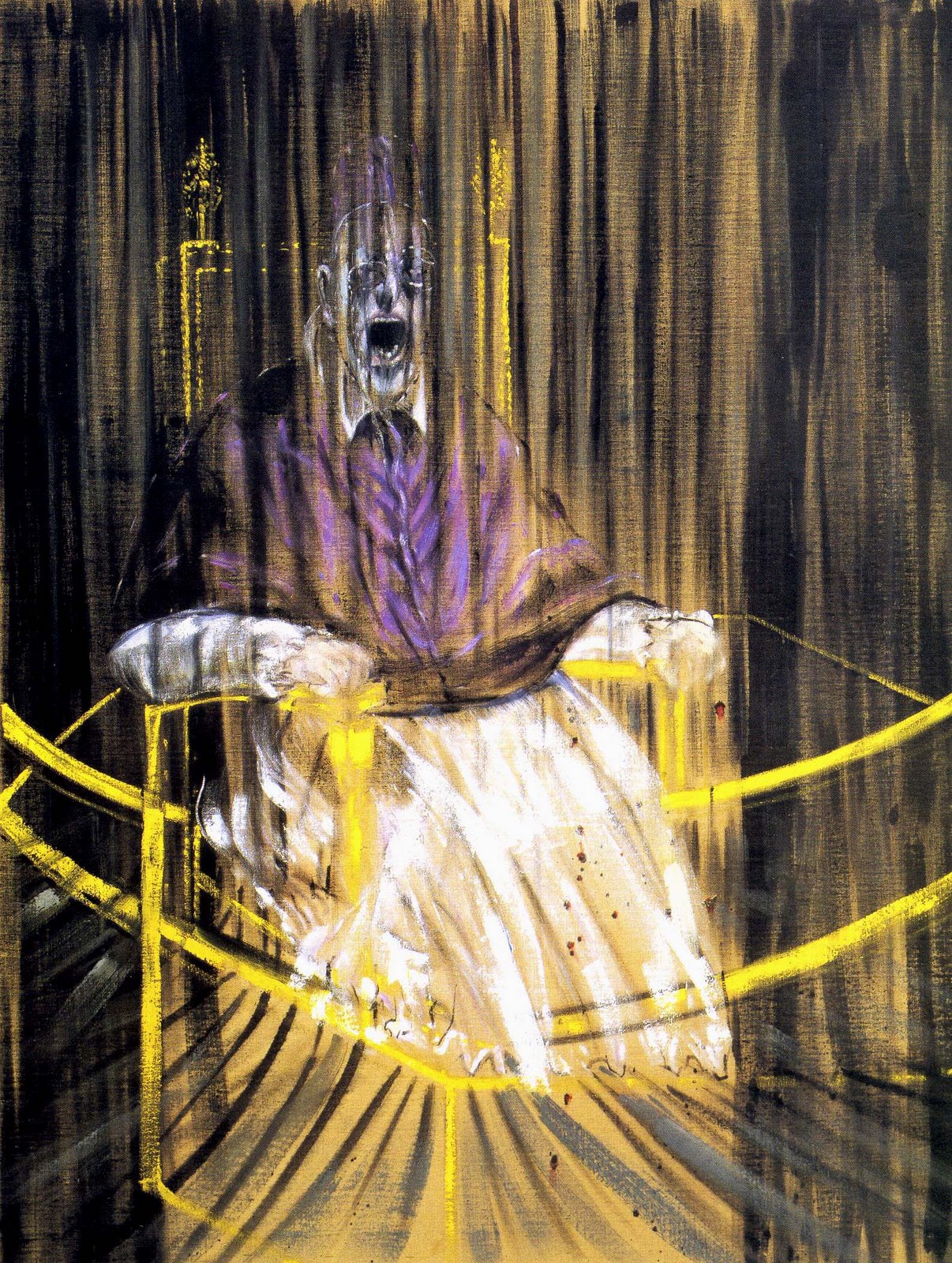
Study After Velazquez’s Portrait of Pope Innocent X (“The Screaming Pope”), 1953

Bacon also loved painting popes. His Study after Velzquez’s portrait of Innocent X evokes a renaissance portrait of this pope, except once more, there is a twist. Innocent X’s mouth is open in a scream, barely hidden by black shuttered stripes. Tinterow commented on his take of Christian religion: “He was an old-fashioned militant atheist…there was always a general squeamishness about his take on Christianity.”

What can a Christian’s response be to such art? What should it be? Can we accept the place of violence and darkness in our dialogue with art? Should we take into consideration his contribution to the ongoing debate about human existence? I would be inclined to say we must. We may not like the fact that there is little redemption in Bacon’s work, nor are we obliged to agree with his interpretation of the crucifixion. But there is undeniable power in his works, shocking us even today, some 60 years after their execution. And there is undeniable truth to his take on humanity.

Let us not be too hurt by his distortion of Christianity. He had a much bigger bone to pick with humans than he did with God. “He respected Christian ethics, and maintained that the Christian way of life was amongst the best in the panoply of ways of life,” commented Tinterow. “It’s just that his common sense forbade him from believing in the Church. He recognized, however, that the Church didn’t believe in him. The feeling was mutual.”

Jenna Smith is completing a joint Masters degree in the faculties of music and theology at the Université de Montréal. She lives in Montreal where she directs Innovation-Jeunes, an arts and nutrition centre for teens.

Related posts:

Responding to Oppenneimer and Lizza:Defending Francis Schaeffer’s influence on believers such as Michele Bachmann(Part 1)

Today I read an article in the New York Times, “Son of Evangelical Royalty, turns his back and tells the tale,” August 19, 2011. The liberal Max Brantley of the Arkansas Times Blog called this article by Mark Oppenneimer “the best reading of the morning.” Oppenneimer asserted: Edith Schaeffer also wrote books, and in 1977, Frank, an amateur filmmaker, […]

Francis Schaeffer’s “How should we then live?” Video and outline of episode 10 “Final Choices”

E P I S O D E 1 0 How Should We Then Live 10#1 FINAL CHOICES I. Authoritarianism the Only Humanistic Social Option One man or an elite giving authoritative arbitrary absolutes. A. Society is sole absolute in absence of other absolutes. B. But society has to be led by an elite: John Kenneth […]

Francis Schaeffer’s “How should we then live?” Video and outline of episode 9 “The Age of Personal Peace and Affluence”

E P I S O D E 9 How Should We Then Live 9#1 T h e Age of Personal Peace and Afflunce I. By the Early 1960s People Were Bombarded From Every Side by Modern Man’s Humanistic Thought II. Modern Form of Humanistic Thought Leads to Pessimism Regarding a Meaning for Life and for Fixed […]

Francis Schaeffer’s “How should we then live?” Video and outline of episode 8 “The Age of Fragmentation”

E P I S O D E 8 How Should We Then Live 8#1 I saw this film series in 1979 and it had a major impact on me. T h e Age of FRAGMENTATION I. Art As a Vehicle Of Modern Thought A. Impressionism (Monet, Renoir, Pissarro, Sisley, Degas) and Post-Impressionism (Cézanne, Van Gogh, Gauguin, […]

Francis Schaeffer’s “How should we then live?” Video and outline of episode 7 “The Age of Non-Reason”

E P I S O D E 7 How Should We Then Live 7#1 I am thrilled to get this film series with you. I saw it first in 1979 and it had such a big impact on me. Today’s episode is where we see modern humanist man act on his belief that we live […]

Taking up for Francis Schaeffer’s book Christian Manifesto

I have made it clear from day one when I started this blog that Francis Schaeffer, Milton Friedman, Ronald Reagan and Adrian Rogers had been the biggest influences on my political and religious views. Today I am responding to an unfair attack on Francis Schaeffer’s book “A Christian Manifesto.” As you can see on the […]

Francis Schaeffer’s “How should we then live?” Video and outline of episode 6 “The Scientific Age”

E P I S O D E 6 How Should We Then Live 6#1 I am sharing with you a film series that I saw in 1979. In this film Francis Schaeffer asserted that was a shift in Modern Science. A. Change in conviction from earlier modern scientists.B. From an open to a closed natural system: […]

Francis Schaeffer’s “How should we then live?” Video and outline of episode 5 “The Revolutionary Age”

E P I S O D E 5 How Should We Then Live 5-1 I was impacted by this film series by Francis Schaeffer back in the 1970′s and I wanted to share it with you. Francis Schaeffer noted, “Reformation Did Not Bring Perfection. But gradually on basis of biblical teaching there was a unique improvement. A. […]

Remembering Francis Schaeffer at 100 (Part 13)

schaeffer

THE FRANCIS SCHAEFFER CENTENNIAL – INVOCATION – PASTOR TONY FELICH

Uploaded by on Feb 3, 2012

Pastor Tony Felich of Redeemer Presbyterian Church in Overland Park, KS gives the invocation to the mini conference event in honor of Francis Schaeffer’s 100th Birthday.

__________________________

This year Francis Schaeffer would have turned 100 on Jan 30, 2012. I remember like yesterday when I first was introduced to his books. I was even more amazed when I first saw his films. I was so influenced by them that I bought every one of his 30 something books and his two film series. Here is a  tribute that I got off the internet from Chuck Colson’s website www.breakpoint.org :

A Brief Evangelical History of Worldview
ruggedcross

By John Stonestreet|Published Date: June 14, 2010

Evangelicals and Worldview (2)

Two Calvinists

David Naugle traces the use of worldview among Christians to the teachings and writings of James Orr (1844-1913) and Abraham Kuyper (1837-1920), and claims that each, having emerged from a Calvinist tradition, utilized the concept of worldview via its widely-accepted use in German philosophy. These two men are the “headwaters” from which emerged a stream of Christian worldview thinkers.

Orr’s influence can be seen in the writings of Gordon Clark (1902-1986) and Carl F.H. Henry (1913-2003), while Kuyper’s influence is seen primarily among reformed thinkers, most prominently Herman Dooyeweerd (1894-1977) and Francis Schaeffer (1912-1984).[i] The influence of these men can be further seen in the writings of others, including Ronald Nash, Albert Wolters, Arthur Holmes, W. Gary Phillips and William E. Brown, Richard Middleton and Brian J. Walsh, Charles Colson, Nancy Pearcey, James Sire, David Noebel, and David Naugle.[ii]

James Orr

When James Orr delivered the Kerr Lecture is 1891, he appropriated the idea of worldview and applied it to Christianity. Although Christianity had been seen holistically by many before him, he was the first to specifically utilize the English translation of weltanschauung which, as already noted, had become a significant concept in German philosophy. Living during the time some had called the “un-Christening of Europe,”[iii] Orr noted that there was a growing confidence in the coherence of the universe and the ability to achieve a synthesis of knowledge about the universe, and that Christianity would stand or fall according to its ability to answer challenges that were comprehensive. Christianity, also, had a “worldview”[iv] in that sense, and Orr asserted that it should be talked about as such.

Further, Orr saw it as the natural tendency of humans to theorize towards a comprehensive view of things, and practically to seek answers to ultimate questions of origin and destiny.[v] Worldviews, to Orr, were human nature. Additionally, Orr believed there were four advantages of thinking of Christianity in this way: (1) it would highlight the differences between Christianity and modernist views; (2) the debate over miracles would be reconfigured from particular miracles to the nature of reality; (3) it would alter the Christian’s approach to other worldviews and the truth that is found in those views; and (4) it would tie the Old and New Testaments together.[vi]

Orr’s influence can be easily traced. The title of Clark’s book A Christian View of Men and Things suggests that he was influenced by Orr’s The Christian View of God and the World, and was even attempting to take Orr’s work further. To Clark, only the Christian worldview could adequately explain the way the world is, offer legitimate meaning and hope, and support the existence of truth that is attainable.[vii] Through Clark’s influence, the language of worldview gained further momentum. For example, Ron Nash, a student and admirer of Clark, utilizes the language of worldview in many of his books and has influenced other students to think along those lines as well.[viii]

More prominent in Orr’s legacy is Carl F. H. Henry, who pointed to the influence of Orr as key to his worldview approach. This is evident in Henry’s masterful God, Revelation and Authority.[ix] Although it would be hard to fully measure the influence of Henry on twentieth century evangelicalism, it can certainly be seen in David Noebel’s contribution to worldview thinking, Understanding the Times: The Collision of Today’s Worldviews.[x]

Abraham Kuyper

Kuyper, in Lectures on Calvinism (the published form of his 1898 Stone Lectures at Princeton University) stated, “Two life systems are wrestling with one another, in mortal combat. This is the struggle in Europe, this is the struggle in America …”[xi] To Kuyper, these two systems were modernism and Christianity, and if modernism were a comprehensive system, then Christianity ought to be conceived of as comprehensive as well. If non-Christian worldviews were marked out across the spectrum of society, so too should Christianity be worked out and applied to every area. When fully applied and compared, Christianity would naturally prove to be the “more brilliant” and “the more capable of taking us to a higher level as a civilization.”[xii]

This approach, Kuyper thought, would be more effective than traditional apologetics, which, “has not advanced us one single step.”[xiii] For Kuyper, the goal was the transformation of all of culture, at every level, to recognize God’s authority. Key to Kuyper’s approach, and legacy, are the following themes: (1) a cosmic understanding of salvation, that grace restore nature as well as souls; (2) the sovereignty of God over all of life and order; (3) the cultural mandate as prior to, and unlocking the meaning of, the great commission; and (4) a spiritual antithesis characterizes the relationships of believers and unbelievers.[xiv]

Kuyper exerted significant influence on future worldview thinkers through the founding of the Free University of Amsterdam, as well as through his considerable success in Dutch politics. This influence continued through the work of Dooyeweerd, who emerged as Kuyper’s heir at Free University and has been called “the most creative and influential philosopher among neo-Calvinists in the 20th century.”[xv]

Dooyeweerd followed up on Kuyper’s concept of worldview early in his career, altered it later in his career, and became a key individual in the academic discussion of worldview. His influence can be especially seen through Calvin College and the Institute for Christian Studies in Toronto, Canada.[xvi] Writers on Christian worldview that have followed in the Kuyperian tradition include Albert Wolters, Arthur Holmes, Richard Middleton and Brian Walsh, Charles Colson, and Nancy Pearcey.

Francis Schaeffer

Still, the one who may have influenced Protestant Evangelicalism more than any other towards worldview thinking is Francis Schaeffer. Schaeffer’s most significant contribution was bringing the concept of Christian worldview out of the academy to popular Christian thought. Through books like How Should We Then Live[xvii], videos, and his L’Abri Study Center, Schaeffer made worldview thinking accessible and applicable to non-academics, demonstrated the broad relevance of Christianity to culture, paved the way for para-church organizations committed to Christian worldview thinking, and influenced the worldview writings of individuals such as Charles Colson and Nancy Pearcey. Naugle traces Schaeffer’s thought back to Kuyper, pointing to Schaeffer’s wide application of Christianity to culture. However, Schaeffer’s varied approach to worldview thinking suggests that his use of the concept went beyond the Kuyperian tradition.

Orr vs. Kuyper

While Orr and Kuyper shared a belief in a common foe (modernism), and though it is believed that Kuyper relied heavily on Orr’s earlier lectures[xviii], their overall approach to worldview differed. Though Orr was clearly a Calvinist, he did not emphasize it as much as Kuyper did, who attempted to understand everything first and foremost in light of the absolute sovereignty of God. Kuyper’s famous line from a speech delivered at the opening of the Free University in Amsterdam, which he founded, reflects his starting point of thinking about Christianity as a worldview, “There is not a square inch in the whole domain of our human existence over which Christ, who is Sovereign over all, does not cry: ‘Mine!’”[xix]

So, while Orr focused on Christianity as a total belief system in contrast with other systems, Kuyper focused on Christianity applied (more specifically Calvinism) compared with modernism applied. For Kuyper, worldview was a notion that offered an apologetic primarily not by comparison with other worldviews, but by allowing it to provide cultural leadership in a wide variety of areas;[xx] and he is well-known for his attempts to actually apply a Christian worldview to diverse areas of culture in The Netherlands through his various roles as scholar, journalist, writer, pastor, and politician. The heritage of the two diverging approaches of Orr and Kuyper can be seen in the different approaches to worldview study today.

Questions for Study or Discussion

  • What do Orr’s and Kuyper’s understanding of worldview have in common? Where do they differ?
  • Why is it essential to keep both of these understandings of worldview in mind as we work to build our on Christian worldview?
  • What are some aspects of contemporary Christian belief that might frustrate our attempt to construct a comprehensive Christian worldview?
  • In what areas of contemporary culture do you think a Christian worldview is most urgently needed?
  • Why does Francis Schaeffer matter so much in the discussion of Christian worldview?

[i]Naugle, Worldview, 5, 6-15, and 16-32. See also, Peter S. Heslam, Creating a Christian Worldview: Abraham Kuyper’s Lectures on Calvinism, 88-95.

[ii]Ronald Nash, Worldviews in Conflict: Choosing Christianity in a World of Ideas (Grand Rapids, Mich.: Zondervan, 1992); Albert Wolters, Creation Regained: Biblical Basics for a Reformational Worldview (Grand Rapids,Mich.:

Eerdman’s, 1985); Arthur Holmes, Contours of a Worldview (Grand Rapids, Mich.: Eerdman’s, 1983); Brown and Phillips, Making Sense of Your World; Richard Middleton and Brian J. Walsh, The Transforming Vision: Shaping a Christian Worldview (Downers Grove, Ill.: InterVarsity Press, 1984); Colson and Pearcey, How Now Shall We Live?; Pearcey, Total Truth; James Sire, The Universe Next Door: A Basic Worldview Catalog, 4th ed. (Downers Grove,

Ill.: InterVarsity Press, 2004); David Noebel, Understanding the Times: The Religious Worldviews of Our Day and the Search for Truth (Eugene, Or.: Harvest House, 1991); David Naugle, Worldview. Many more could be added here, but these are among the more important who reflect a direct influence from Orr, Kuyper, Clark, Henry, Dooeyweerd, and Schaeffer.

[iii]See Naugle, Worldview, 6.

[iv]Orr, A Christian View, 8-9.

[v]Ibid, 6-7.

[vi]See Naugle, Worldview, 11-12.

[vii]Gordon H. Clark, A Christian View of Men and Things, 218.

[viii]Most significant are Worldviews in Conflict and Faith and Reason: Searching for a Rational Faith (Grand Rapids, Mich.: Zondervan, 1968). Nash’s influence can be seen in Phillips and Brown, Making Sense of Your World.

[ix]See Naugle, Worldview, 15.

[x]For example, Noebel, Understanding the Times, 12, 25, 89-90, 166-167.

[xi]Kuyper, Lectures on Calvinism, 11.

[xii]Ibid, 41.

[xiii]Ibid, 11. Cf. Naugle, Worldview, 18-19.

[xiv]Naugle, Worldview, 22-23.

[xv]Naugle, Worldview, 25. See also, Nash, Dooyeweerd and the Amsterdam Philosophy (Grand Rapids,Mich.:

Zondervan, 1962).

[xvi]See Naugle, 25-29; Also, Paul Marshall, Sander Griffioen, Richard J. Mouw, eds. Stained Glass: Worldviews and  Social Science (Lanham, Md.: University Press of America, 1989) and James Sire, Naming the Elephant (Downers Grove,Ill.: InterVarsity Press, 2004).

[xvii]Schaeffer, How Should We Then Live? The Rise and Decline of Western Thought and Culture (Wheaton,Ill.: Crossway, 1983).

[xviii]Heslam, Creating a Christian Worldview, 92-95. Heslam cites the following point made by Kuyper that were initially made by Orr: (1) Christianity and modernism each derived from separate, antithetical “first principles;”

(2) the only Christian defense against modernism is the development of a comprehensive, coherent worldview;

(3) the concept of worldview had bearing on all theoretical thought, not just religion; (4) all true religions possess a worldview of their own; and (5) the purpose of the lecture series itself was to show that Christianity had a definite view on things.

[xix]Kuper, “Sphere Sovereignty.” Quoted in Naugle, Worldview, 16.

[xx]Wolters, “On the Idea of Worldview and Its Relationship to Philosophy” in Stained Glass, 20.

Related posts:

Francis Schaeffer would be 100 years old this year (Schaeffer Sunday)

Dr. Francis Schaeffer – Extra – Interview – Part 2 Francis Schaeffer had a big impact on me in the late 1970′s and I have been enjoying his books and films ever since. Here is great video clip of an interview and below is a fine article about him. Francis Schaeffer 1912-1984 Christian Theologian, Philosopher, […]

Francis Schaeffer’s “How should we then live?” Video and outline of episode 10 “Final Choices” (Schaeffer Sundays)

E P I S O D E 1 0 How Should We Then Live 10#1 FINAL CHOICES I. Authoritarianism the Only Humanistic Social Option One man or an elite giving authoritative arbitrary absolutes. A. Society is sole absolute in absence of other absolutes. B. But society has to be led by an elite: John Kenneth […]

Fellow admirer of Francis Schaeffer, Michele Bachmann quits presidential race

What Ever Happened to the Human Race? Bachmann was a student of the works of Francis Schaeffer like I am and I know she was pro-life because of it. (Observe video clip above and picture of Schaeffer.) I hated to see her go.  DES MOINES, Iowa — Last night, Minnesota Rep. Michele Bachmann vowed to […]

Francis Schaeffer’s “How should we then live?” Video and outline of episode 9 “The Age of Personal Peace and Affluence” (Schaeffer Sundays)

E P I S O D E 9 How Should We Then Live 9#1 T h e Age of Personal Peace and Afflunce I. By the Early 1960s People Were Bombarded From Every Side by Modern Man’s Humanistic Thought II. Modern Form of Humanistic Thought Leads to Pessimism Regarding a Meaning for Life and for Fixed […]

Francis Schaeffer’s “How should we then live?” Video and outline of episode 8 “The Age of Fragmentation” (Schaeffer Sundays)

E P I S O D E 8 How Should We Then Live 8#1 I saw this film series in 1979 and it had a major impact on me. T h e Age of FRAGMENTATION I. Art As a Vehicle Of Modern Thought A. Impressionism (Monet, Renoir, Pissarro, Sisley, Degas) and Post-Impressionism (Cézanne, Van Gogh, Gauguin, […]

Francis Schaeffer’s “How should we then live?” Video and outline of episode 7 “The Age of Non-Reason” (Schaeffer Sundays)

E P I S O D E 7 How Should We Then Live 7#1 I am thrilled to get this film series with you. I saw it first in 1979 and it had such a big impact on me. Today’s episode is where we see modern humanist man act on his belief that we live […]

Francis Schaeffer would be 100 years old this year (Schaeffer Sunday)

Dr. Francis Schaeffer – Extra – Interview – Part 2 Francis Schaeffer had a big impact on me in the late 1970′s and I have been enjoying his books and films ever since. Here is great video clip of an interview and below is a fine article about him. Francis Schaeffer 1912-1984 Christian Theologian, Philosopher, […]

Francis Schaeffer’s “How should we then live?” Video and outline of episode 6 “The Scientific Age” (Schaeffer Sundays)

E P I S O D E 6 How Should We Then Live 6#1 I am sharing with you a film series that I saw in 1979. In this film Francis Schaeffer asserted that was a shift in Modern Science. A. Change in conviction from earlier modern scientists.B. From an open to a closed natural system: […]

Francis Schaeffer’s “How should we then live?” Video and outline of episode 5 “The Revolutionary Age” (Schaeffer Sundays)

E P I S O D E 5 How Should We Then Live 5-1 I was impacted by this film series by Francis Schaeffer back in the 1970′s and I wanted to share it with you. Francis Schaeffer noted, “Reformation Did Not Bring Perfection. But gradually on basis of biblical teaching there was a unique improvement. A. […]

Francis Schaeffer’s “How should we then live?” Video and outline of episode 4 “The Reformation” (Schaeffer Sundays)

How Should We Then Live 4-1 I was impacted by this film series by Francis Schaeffer back in the 1970′s and I wanted to share it with you. Schaeffer makes three key points concerning the Reformation: “1. Erasmian Christian humanism rejected by Farel. 2. Bible gives needed answers not only as to how to be right with […]

Francis Schaeffer’s “How should we then live?” Video and outline of episode 3 “The Renaissance”

How Should We Then Live 3-1 I was impacted by this film series by Francis Schaeffer back in the 1970′s and I wanted to share it with you. Schaeffer really shows why we have so many problems today with this excellent episode. He noted, “Could have gone either way—with emphasis on real people living in […]

Francis Schaeffer’s “How should we then live?” Video and outline of episode 2 “The Middle Ages” (Schaeffer Sundays)

How Should We Then Live 2-1 I was impacted by this film series by Francis Schaeffer back in the 1970′s and I wanted to share it with you. Schaeffer points out that during this time period unfortunately we have the “Church’s deviation from early church’s teaching in regard to authority and the approach to God.” […]

Francis Schaeffer’s “How should we then live?” Video and outline of episode 1 “The Roman Age” (Schaeffer Sundays)

How Should We Then Live 1-1 Today I am starting a series that really had a big impact on my life back in the 1970′s when I first saw it. There are ten parts and today is the first. Francis Schaeffer takes a look at Rome and why it fell. It fell because of inward […]

Andy Rooney was an atheist

How Now Shall We LiveClick here to purchase Chuck Colson and Nancy Pearcey’s How Now Shall We Live?, dedicated to Francis Schaeffer.


Click here for a list of Francis Schaeffer’s greatest works, from the Colson Center store!
SchaefferBooks

Remembering Francis Schaeffer at 100 (Part 12)

Dr. Francis Schaeffer – The Naturalistic, Materialistic, World View

This year Francis Schaeffer would have turned 100 on Jan 30, 2012. I remember like yesterday when I first was introduced to his books. I was even more amazed when I first saw his films. I was so influenced by them that I bought every one of his 30 something books and his two film series. Here is an article that I got off the internet that quotes Schaeffer and it comes from Chuck Colson’s website www.breakpoint.org :

Piece By Piece
By Chuck Colson|Published Date: July 25, 2011

Taking Apart a Worldview

fence-sky1

First published in February, 1998, this BreakPoint commentary reminds us of the utter necessity of confronting and dealing with sin.

How important is it to understand another person’s worldview—someone’s conception of the world, of human life, of reality? It took a former communist to remind me of the answer: It’s absolutely essential.

A few months ago I traveled to Eastern Europe to meet with Prison Fellowship volunteers in a number of countries. One stop was Bulgaria. At the prison in Sofia, we dedicated a prison hospital, provided by Prison Fellowship Holland, and a new prison chapel that had been built by Bulgarian Christians.

It was a glorious occasion. Bulgaria’s national press corps were in attendance, along with the minister of justice, a former Communist and an atheist.

During the dedication ceremonies I told the crowd that crime was a moral problem. Thus, the chapel was vital in dealing with crime, because it would address the restoration of souls.

The minister of justice, who had stood indifferently through most of the proceedings, now stared intently at me as I spoke. Later, he invited me to drop by his office. A remarkable conversation followed.

“Mr. Colson,” the justice minister said, “you speak of crime as a moral problem. What do you mean? Is that a sociological statement?”

I told him that crime was caused by sin—by people choosing to do wrong. He looked bewildered and shook his head. “Oh, no,” he said. “Crime is caused by economic factors.”

At that moment I realized I was face to face with an absolutely alien worldview. As a Communist, this man had been steeped in dialectical materialism—the philosophical underpinnings of Marxism. That is, that economics determines how we behave. That’s the way he saw reality and life.

I realized that before I could even begin to witness to this man, I would have to engage in what the late Francis Schaeffer called “pre-evangelism.” So during the next 90 minutes, I took apart this man’s most basic suppositions, piece by piece. I talked about human sin—the evidence of it in the tragedies of the twentieth century. I talked about the fact that people are motivated by spiritual forces, not by economics. I talked about the relationship of morality to crime.

It was fascinating to watch his expression change as I challenged his view of human nature and of reality. Finally-after an hour and 20 minutes—I was able to openly share what Jesus Christ had done in my life. At that point the minister could understand it; it was as if a dark cloud had lifted.

My experience in Bulgaria is a metaphor for what Christians face—not only in foreign lands but here at home, as well. You see, if people believe there is no such thing as sin, then talk of a Savior makes no sense. If they believe that man is in charge of his destiny—that he can create utopia—then to their minds they make the law, and there is no such thing as a law above the law.

That Bulgarian bureaucrat reminds us that what stands between many people and the Lord is a worldview that cannot accommodate the essential truths of the faith. Until Christians understand this, it will be next to impossible for us to communicate with the modern, secular mind.

Because the man, whether in Bulgaria or America, who does not believe in sin will not believe in a Savior.

BookYou should get a copy of Cornelius Plantinga’s book, Not the Way It’s Supposed to Be, from our online store. Dr. Plantinga can help you to understand better the devastating effects of sin. You should also read the article, “Slaves to Sin,” by T. M. Moore.

Remembering Francis Schaeffer at 100 (Part 11)

The Gospel of Christ in the pages of the Bible

_______________________

 This year Francis Schaeffer would have turned 100 on Jan 30, 2012. I remember like yesterday when I first was introduced to his books. I was even more amazed when I first saw his films. I was so influenced by them that I bought every one of his 30 something books and his two film series. Chuck Colson’s website www.breakpoint.org  and I was directed from there to Probe’s website where I found this great article below. I will share it in 4 parts. Todd Kappelman is the author and here is some info on him and Probe.

Todd KappelmanTodd A. Kappelman is a field associate with Probe Ministries. He is a graduate of Dallas Baptist University (B.A. and M.A.B.S., religion and Greek), and the University of Dallas (M.A., philosophy/humanities). Currently he is pursuing a Ph.D. in philosophy at the University of Dallas. He has served as assistant director of the Trinity Institute, a study center devoted to Christian thought and inquiry. He has been the managing editor of The Antithesis, a bi-monthly publication devoted to the critique of foreign and independent film. His central area of expertise is Continental philosophy (especially nineteenth and twentieth century) and postmodern thought.

What is Probe?

Probe Ministries is a non-profit ministry whose mission is to assist the church in renewing the minds of believers with a Christian worldview and to equip the church to engage the world for Christ. Probe fulfills this mission through our Mind Games conferences for youth and adults, our 3-minute daily radio program, and our extensive Web site at www.probe.org.

Further information about Probe’s materials and ministry may be obtained by contacting us at:

Probe Ministries
2001 W. Plano Parkway, Suite 2000
Plano TX 75075
(972) 941-4565

info@probe.org
www.probe.org
Copyright information

This is the fifth part:

The Need to Read: Francis Schaeffer Print E-mail

Todd Kappelman Written by Todd Kappelman

The Need to Read series began several months ago with a program on C.S. Lewis . The rationale for this series is that many of the great writers who have helped many Christians mature are now either unknown or neglected by many who could use these authors insights into the faith.

This installment focuses on Francis Schaeffer (1912-1984), one of the most recognized and respected Christian authors of the twentieth century.

Francis Schaeffer and “The Man Without a Bible”

The purpose of this discussion of the works of Francis Schaeffer is that we hope Christians will once again turn to this great apologist for the Christian faith and learn from him. In closing, we will address one of his lesser known works titled Death In The City. In chapter seven, The Man Without a Bible, Schaeffer offers some advice for Christians living in a post-Christian world. He argues very convincingly that the church in America has largely turned away from God and the knowledge of the things of God. This occurred in just a few short decades, from the 1920s to the 1960s.{12}

We must always bear in mind that many people do not believe that the Bible is inspired or authoritative. For these people the Bible is just another book. The dismantling of biblical authority has been very efficient in the last 150 years. Very few of our major secular universities treat the Bible as authoritative anymore. Yet many of these universities were founded at a time when no one would have doubted the importance of the Holy Scriptures. The majority of men at the end of this century hold vastly different views about the Bible than did their ancestors at the close of the previous century. So, how do we share the Christian message with the man without the Bible?

Schaeffer cites three instances where Paul spoke to non-Christians and did not appeal to the Scriptures. These are found in Acts 14:15-17; 17:16-32, and Romans 1:18-2:16. The reason that Paul did not use the Scriptures on these three occasions is that the people he was addressing did not recognize the claims that the Holy Scriptures made on their lives. In approaching these individuals, Paul appealed to the moral knowledge that men possess as a feature of their created being. Schaeffer refers to this as the manishness of man.

In Romans 1:18 we have the description of Gods wrath being poured out on man. Schaeffer believes that this is an ideal place to approach modern man. We may tell the modern non-believer that he knows that God exists and that he has suppressed this knowledge. (The knowledge of God must be understood here as natural revelation, and not the gospel.) Paul means that each and every man, regardless of what he says, knows that God exists. This knowledge of God that the non-believer possesses is supplemented by the moral argument for Gods existence. The fact that men hold beliefs about right and wrong betrays the fact that they know that God necessarily exists. Men willingly suppress this knowledge of God and this brings His wrath.

The man without the Bible has suppressed the natural revelation of God, not the special revelation found in the Scriptures. The man without the Bible has not followed his initial knowledge of God to the proper conclusions and therefore remains lost. The many men without the Bible present both an opportunity and a challenge for the Christian. The opportunity is that this man is lost and Christians can share their faith with him. The challenge is in showing these lost people how the world around them and the human nature within them point toward the existence of God.

Francis Schaeffer was wonderful at discussing Christian truths with non-believers without appealing to the Scriptures. It is our loss if we do not familiarize ourselves with, and use, the works of one of this countrys greatest Christian thinkers.

Notes

  1. J.I. Packer, forward to Francis A. Schaeffer Trilogy, by Francis Schaeffer (Wheaton: Crossway Publishers, 1990), xiv.
  2. Hosea 4:6.
  3. Francis Schaeffer, The God Who Is There in Francis A. Schaeffer Trilogy (Wheaton: Crossway Publishers, 1990), 109-114.
  4. Ibid., 196.
  5. Ibid., 217-224.
  6. Ibid., 225-236.
  7. Ibid., 261-270.
  8. Ibid., 207-208.
  9. Francis Schaeffer, He Is There and He Is Not Silent in Francis A. Schaeffer Trilogy (Wheaton: Crossway Publishers, 1990), 277.
  10. Ibid., 275-290.
  11. Ibid., 291-302.
  12. Ibid., 211.

©1999 Probe Ministries.

schaeffer

Related posts:

Francis Schaeffer would be 100 years old this year (Schaeffer Sunday)

Dr. Francis Schaeffer – Extra – Interview – Part 2 Francis Schaeffer had a big impact on me in the late 1970′s and I have been enjoying his books and films ever since. Here is great video clip of an interview and below is a fine article about him. Francis Schaeffer 1912-1984 Christian Theologian, Philosopher, […]

Francis Schaeffer’s “How should we then live?” Video and outline of episode 10 “Final Choices” (Schaeffer Sundays)

E P I S O D E 1 0 How Should We Then Live 10#1 FINAL CHOICES I. Authoritarianism the Only Humanistic Social Option One man or an elite giving authoritative arbitrary absolutes. A. Society is sole absolute in absence of other absolutes. B. But society has to be led by an elite: John Kenneth […]

Fellow admirer of Francis Schaeffer, Michele Bachmann quits presidential race

What Ever Happened to the Human Race? Bachmann was a student of the works of Francis Schaeffer like I am and I know she was pro-life because of it. (Observe video clip above and picture of Schaeffer.) I hated to see her go.  DES MOINES, Iowa — Last night, Minnesota Rep. Michele Bachmann vowed to […]

Francis Schaeffer’s “How should we then live?” Video and outline of episode 9 “The Age of Personal Peace and Affluence” (Schaeffer Sundays)

E P I S O D E 9 How Should We Then Live 9#1 T h e Age of Personal Peace and Afflunce I. By the Early 1960s People Were Bombarded From Every Side by Modern Man’s Humanistic Thought II. Modern Form of Humanistic Thought Leads to Pessimism Regarding a Meaning for Life and for Fixed […]

Francis Schaeffer’s “How should we then live?” Video and outline of episode 8 “The Age of Fragmentation” (Schaeffer Sundays)

E P I S O D E 8 How Should We Then Live 8#1 I saw this film series in 1979 and it had a major impact on me. T h e Age of FRAGMENTATION I. Art As a Vehicle Of Modern Thought A. Impressionism (Monet, Renoir, Pissarro, Sisley, Degas) and Post-Impressionism (Cézanne, Van Gogh, Gauguin, […]

Francis Schaeffer’s “How should we then live?” Video and outline of episode 7 “The Age of Non-Reason” (Schaeffer Sundays)

E P I S O D E 7 How Should We Then Live 7#1 I am thrilled to get this film series with you. I saw it first in 1979 and it had such a big impact on me. Today’s episode is where we see modern humanist man act on his belief that we live […]

Francis Schaeffer would be 100 years old this year (Schaeffer Sunday)

Dr. Francis Schaeffer – Extra – Interview – Part 2 Francis Schaeffer had a big impact on me in the late 1970′s and I have been enjoying his books and films ever since. Here is great video clip of an interview and below is a fine article about him. Francis Schaeffer 1912-1984 Christian Theologian, Philosopher, […]

Francis Schaeffer’s “How should we then live?” Video and outline of episode 6 “The Scientific Age” (Schaeffer Sundays)

E P I S O D E 6 How Should We Then Live 6#1 I am sharing with you a film series that I saw in 1979. In this film Francis Schaeffer asserted that was a shift in Modern Science. A. Change in conviction from earlier modern scientists.B. From an open to a closed natural system: […]

Francis Schaeffer’s “How should we then live?” Video and outline of episode 5 “The Revolutionary Age” (Schaeffer Sundays)

E P I S O D E 5 How Should We Then Live 5-1 I was impacted by this film series by Francis Schaeffer back in the 1970′s and I wanted to share it with you. Francis Schaeffer noted, “Reformation Did Not Bring Perfection. But gradually on basis of biblical teaching there was a unique improvement. A. […]

Francis Schaeffer’s “How should we then live?” Video and outline of episode 4 “The Reformation” (Schaeffer Sundays)

How Should We Then Live 4-1 I was impacted by this film series by Francis Schaeffer back in the 1970′s and I wanted to share it with you. Schaeffer makes three key points concerning the Reformation: “1. Erasmian Christian humanism rejected by Farel. 2. Bible gives needed answers not only as to how to be right with […]

Francis Schaeffer’s “How should we then live?” Video and outline of episode 3 “The Renaissance”

How Should We Then Live 3-1 I was impacted by this film series by Francis Schaeffer back in the 1970′s and I wanted to share it with you. Schaeffer really shows why we have so many problems today with this excellent episode. He noted, “Could have gone either way—with emphasis on real people living in […]

Francis Schaeffer’s “How should we then live?” Video and outline of episode 2 “The Middle Ages” (Schaeffer Sundays)

How Should We Then Live 2-1 I was impacted by this film series by Francis Schaeffer back in the 1970′s and I wanted to share it with you. Schaeffer points out that during this time period unfortunately we have the “Church’s deviation from early church’s teaching in regard to authority and the approach to God.” […]

Francis Schaeffer’s “How should we then live?” Video and outline of episode 1 “The Roman Age” (Schaeffer Sundays)

How Should We Then Live 1-1 Today I am starting a series that really had a big impact on my life back in the 1970′s when I first saw it. There are ten parts and today is the first. Francis Schaeffer takes a look at Rome and why it fell. It fell because of inward […]

Andy Rooney was an atheist

How Now Shall We LiveClick here to purchase Chuck Colson and Nancy Pearcey’s How Now Shall We Live?, dedicated to Francis Schaeffer.


Click here for a list of Francis Schaeffer’s greatest works, from the Colson Center store!
SchaefferBooks

Remembering Francis Schaeffer at 100 (Part 10)

Truth With Tears – A Story of Dr. Schaeffer Shedding Tears At the Lausanne Congress, 1974

Uploaded by on Dec 10, 2011

This video is a segment of an interview we did with Dr. David Calhoun of Covenant Theological Seminary where he described a touching moment with Dr. Schaeffer when he sheds tears at the Lausanne Congress, 1974. The significance of this event is that it depicts both the character of Dr. Schaeffer over schisms in the church but also the deep hurt that he felt over divisions in the church during the early splits with in the church over modernism (Religious Liberalism). The results of these deep feelings would eventually produce a crisis in Schaeffer, and out of that crisis came the work True Spirituality, which is at the foundation of all of Schaeffer’s works. He further elaborated on this topic in a more succinct way in his work The Mark Of A Christian.

__________________________

______________

schaeffer

This year Francis Schaeffer would have turned 100 on Jan 30, 2012. I remember like yesterday when I first was introduced to his books. I was even more amazed when I first saw his films. I was so influenced by them that I bought every one of his 30 something books and his two film series. Chuck Colson’s website www.breakpoint.org  and I was directed from there to Probe’s website where I found this great article below. I will share it in 4 parts. Todd Kappelman is the author and here is some info on him and Probe.

Todd KappelmanTodd A. Kappelman is a field associate with Probe Ministries. He is a graduate of Dallas Baptist University (B.A. and M.A.B.S., religion and Greek), and the University of Dallas (M.A., philosophy/humanities). Currently he is pursuing a Ph.D. in philosophy at the University of Dallas. He has served as assistant director of the Trinity Institute, a study center devoted to Christian thought and inquiry. He has been the managing editor of The Antithesis, a bi-monthly publication devoted to the critique of foreign and independent film. His central area of expertise is Continental philosophy (especially nineteenth and twentieth century) and postmodern thought.

What is Probe?

Probe Ministries is a non-profit ministry whose mission is to assist the church in renewing the minds of believers with a Christian worldview and to equip the church to engage the world for Christ. Probe fulfills this mission through our Mind Games conferences for youth and adults, our 3-minute daily radio program, and our extensive Web site at www.probe.org.

Further information about Probe’s materials and ministry may be obtained by contacting us at:

Probe Ministries
2001 W. Plano Parkway, Suite 2000
Plano TX 75075
(972) 941-4565
info@probe.org
www.probe.org
Copyright information

This is the fourth part:

The Need to Read: Francis Schaeffer Print E-mail

Todd Kappelman Written by Todd Kappelman

The Need to Read series began several months ago with a program on C.S. Lewis . The rationale for this series is that many of the great writers who have helped many Christians mature are now either unknown or neglected by many who could use these authors insights into the faith.

This installment focuses on Francis Schaeffer (1912-1984), one of the most recognized and respected Christian authors of the twentieth century.

THE FRANCIS SCHAEFFER CENTENNIAL – INVOCATION – PASTOR TONY FELICH

Uploaded by on Feb 3, 2012

Pastor Tony Felich of Redeemer Presbyterian Church in Overland Park, KS gives the invocation to the mini conference event in honor of Francis Schaeffer’s 100th Birthday.

He Is There and He Is Not Silent

In the analysis of the previous two books, we have seen that Schaeffer explains the development of modern history and how mankind has largely embraced non-reason in the area of morals. In He Is There and He Is Not Silent, Schaeffer outlines a solution for the predicament that faces modern man. He argues that there are three areas in which modern mankind has an absolute necessity for God: metaphysics, morals, and epistemology.{9} These are three areas of philosophy which have to do with, respectively, the problem of existence, the problem of mans moral behavior, and how man can come to a true knowledge of anything at all.

Prior to the seventeenth century, philosophy and theology recognized that they were dealing with the same basic questions. The only difference between the two disciplines was that the former appealed largely to reason and natural revelation, while the latter appealed mostly to reason and special revelation. In the middle ages, philosophy was said to be the handmaiden to theology. Theology was understood to be the queen of the sciences. When philosophy took the lead, it soon became apparent that it was not up to the task of answering the big questions. The reality of God known through His revelation, however, does provide the answers for such questions.

Lets consider the areas of metaphysics, moral, and epistemology. The metaphysical need for the existence of God implies that there must be something or someone who is big enough, powerful enough, wise enough, and willing enough to create and maintain the universe we live in. If these requirements are not met, then man is forced to admit that he is here by chance occurrence and has no special destiny.{10}

The moral necessity of Gods existence centers on man as a personal being and a being who distinguishes between right and wrong. There are only two options. Either man was created from an impersonal beginning and his moral system is a product of his culture, or man had a personal beginning and was given laws to follow and an internal sense of right and wrong.{11} The moral necessity of God is founded on the philosophical need to account for why man is both cruel and wonderful at the same time. This can only be explained in terms of the biblical account of the Fall.

The epistemological necessity of Gods existence addresses our ability to know what is ultimately real. Much of the modern problem in the area of knowledge began in the seventeenth century. As the scientific revolution developed, the criteria for truth became that which could be demonstrated in a laboratory. The result was that belief in God and the miraculous, which cannot be demonstrated in a laboratory, came into doubt and were eventually dismissed by many. The final result was pessimism regarding theological truths and, more recently, any truth at all. We have all encountered the individual who asks, How do you know that? And often this question is repeated for every subsequent answer.

The only answer to these three dilemmas is an appeal to the God who is there, and to His natural and special revelation. The basis of Christianity is the belief that God is there and that man can communicate with Him. If this is not true, then we are without a foundation.

Related posts:

Francis Schaeffer would be 100 years old this year (Schaeffer Sunday)

Dr. Francis Schaeffer – Extra – Interview – Part 2 Francis Schaeffer had a big impact on me in the late 1970′s and I have been enjoying his books and films ever since. Here is great video clip of an interview and below is a fine article about him. Francis Schaeffer 1912-1984 Christian Theologian, Philosopher, […]

Francis Schaeffer’s “How should we then live?” Video and outline of episode 10 “Final Choices” (Schaeffer Sundays)

E P I S O D E 1 0 How Should We Then Live 10#1 FINAL CHOICES I. Authoritarianism the Only Humanistic Social Option One man or an elite giving authoritative arbitrary absolutes. A. Society is sole absolute in absence of other absolutes. B. But society has to be led by an elite: John Kenneth […]

Fellow admirer of Francis Schaeffer, Michele Bachmann quits presidential race

What Ever Happened to the Human Race? Bachmann was a student of the works of Francis Schaeffer like I am and I know she was pro-life because of it. (Observe video clip above and picture of Schaeffer.) I hated to see her go.  DES MOINES, Iowa — Last night, Minnesota Rep. Michele Bachmann vowed to […]

Francis Schaeffer’s “How should we then live?” Video and outline of episode 9 “The Age of Personal Peace and Affluence” (Schaeffer Sundays)

E P I S O D E 9 How Should We Then Live 9#1 T h e Age of Personal Peace and Afflunce I. By the Early 1960s People Were Bombarded From Every Side by Modern Man’s Humanistic Thought II. Modern Form of Humanistic Thought Leads to Pessimism Regarding a Meaning for Life and for Fixed […]

Francis Schaeffer’s “How should we then live?” Video and outline of episode 8 “The Age of Fragmentation” (Schaeffer Sundays)

E P I S O D E 8 How Should We Then Live 8#1 I saw this film series in 1979 and it had a major impact on me. T h e Age of FRAGMENTATION I. Art As a Vehicle Of Modern Thought A. Impressionism (Monet, Renoir, Pissarro, Sisley, Degas) and Post-Impressionism (Cézanne, Van Gogh, Gauguin, […]

Francis Schaeffer’s “How should we then live?” Video and outline of episode 7 “The Age of Non-Reason” (Schaeffer Sundays)

E P I S O D E 7 How Should We Then Live 7#1 I am thrilled to get this film series with you. I saw it first in 1979 and it had such a big impact on me. Today’s episode is where we see modern humanist man act on his belief that we live […]

Francis Schaeffer would be 100 years old this year (Schaeffer Sunday)

Dr. Francis Schaeffer – Extra – Interview – Part 2 Francis Schaeffer had a big impact on me in the late 1970′s and I have been enjoying his books and films ever since. Here is great video clip of an interview and below is a fine article about him. Francis Schaeffer 1912-1984 Christian Theologian, Philosopher, […]

Francis Schaeffer’s “How should we then live?” Video and outline of episode 6 “The Scientific Age” (Schaeffer Sundays)

E P I S O D E 6 How Should We Then Live 6#1 I am sharing with you a film series that I saw in 1979. In this film Francis Schaeffer asserted that was a shift in Modern Science. A. Change in conviction from earlier modern scientists.B. From an open to a closed natural system: […]

Francis Schaeffer’s “How should we then live?” Video and outline of episode 5 “The Revolutionary Age” (Schaeffer Sundays)

E P I S O D E 5 How Should We Then Live 5-1 I was impacted by this film series by Francis Schaeffer back in the 1970′s and I wanted to share it with you. Francis Schaeffer noted, “Reformation Did Not Bring Perfection. But gradually on basis of biblical teaching there was a unique improvement. A. […]

Francis Schaeffer’s “How should we then live?” Video and outline of episode 4 “The Reformation” (Schaeffer Sundays)

How Should We Then Live 4-1 I was impacted by this film series by Francis Schaeffer back in the 1970′s and I wanted to share it with you. Schaeffer makes three key points concerning the Reformation: “1. Erasmian Christian humanism rejected by Farel. 2. Bible gives needed answers not only as to how to be right with […]

Francis Schaeffer’s “How should we then live?” Video and outline of episode 3 “The Renaissance”

How Should We Then Live 3-1 I was impacted by this film series by Francis Schaeffer back in the 1970′s and I wanted to share it with you. Schaeffer really shows why we have so many problems today with this excellent episode. He noted, “Could have gone either way—with emphasis on real people living in […]

Francis Schaeffer’s “How should we then live?” Video and outline of episode 2 “The Middle Ages” (Schaeffer Sundays)

How Should We Then Live 2-1 I was impacted by this film series by Francis Schaeffer back in the 1970′s and I wanted to share it with you. Schaeffer points out that during this time period unfortunately we have the “Church’s deviation from early church’s teaching in regard to authority and the approach to God.” […]

Francis Schaeffer’s “How should we then live?” Video and outline of episode 1 “The Roman Age” (Schaeffer Sundays)

How Should We Then Live 1-1 Today I am starting a series that really had a big impact on my life back in the 1970′s when I first saw it. There are ten parts and today is the first. Francis Schaeffer takes a look at Rome and why it fell. It fell because of inward […]

Andy Rooney was an atheist

How Now Shall We LiveClick here to purchase Chuck Colson and Nancy Pearcey’s How Now Shall We Live?, dedicated to Francis Schaeffer.


Click here for a list of Francis Schaeffer’s greatest works, from the Colson Center store!
SchaefferBooks