Francis Schaeffer Whatever Happened to the Human Race (Episode 1) ABORTION
Francis Schaeffer: What Ever Happened to the Human Race? (Full-Length Documentary)
Part 1 on abortion runs from 00:00 to 39:50, Part 2 on Infanticide runs from 39:50 to 1:21:30, Part 3 on Youth Euthanasia runs from 1:21:30 to 1:45:40, Part 4 on the basis of human dignity runs from 1:45:40 to 2:24:45 and Part 5 on the basis of truth runs from 2:24:45 to 3:00:04
Francis Schaeffer “BASIS FOR HUMAN DIGNITY” Whatever…HTTHR
________________
Picture of Francis Schaeffer and his wife Edith from the 1930′s above. I was sad to read about Edith passing away on Easter weekend in 2013. I wanted to pass along this fine article below.
What most impressed me in knowing Edith at L’Abri was her emphasis on everyday beauty.
Arriving as a critical agnostic, I was surprised to meet Christians who actually cared about the world of ideas and the arts. It was not merely that Francis Schaeffer lectured about the arts, however.
It was also that Edith thought it important for the Christian to incorporate beauty into all of life — such as simple but elegant table settings with a flower and a candle. Not expensive items, not conspicuous consumption. But creative (expressing your unique personality) and natural (using items and themes from nature when possible).
Though I had grown up in the church, I had never before met Christians who understood that our souls hunger for beauty just as much as for truth and goodness.
For me, as for many others who studied at L’Abri in the days when Edith still presided, there was an apologetics of beauty that made me want Christianity to be true, at the same time that I was working through a philosophical apologetics that was persuading me intellectually that it was true.
Edith described her love of everyday beauty in Hidden Art (the title was later expanded to The Hidden Art of Homemaking).
(Francis did a great job in his film series “How Should we then live?” in looking at how humanism has affected art and culture in the Western World in the last 2000 years. My favorite episodes include his study of the Renaissance, the Revolutionary age, the age of Nonreason, and the age of Fragmentation.)
E P I S O D E 1 0 Dr. Francis Schaeffer – Episode X – Final Choices 27 min FINAL CHOICES I. Authoritarianism the Only Humanistic Social Option One man or an elite giving authoritative arbitrary absolutes. A. Society is sole absolute in absence of other absolutes. B. But society has to be […]
E P I S O D E 9 Dr. Francis Schaeffer – Episode IX – The Age of Personal Peace and Affluence 27 min T h e Age of Personal Peace and Afflunce I. By the Early 1960s People Were Bombarded From Every Side by Modern Man’s Humanistic Thought II. Modern Form of Humanistic Thought Leads […]
E P I S O D E 8 Dr. Francis Schaeffer – Episode VIII – The Age of Fragmentation 27 min I saw this film series in 1979 and it had a major impact on me. T h e Age of FRAGMENTATION I. Art As a Vehicle Of Modern Thought A. Impressionism (Monet, Renoir, Pissarro, Sisley, […]
E P I S O D E 7 Dr. Francis Schaeffer – Episode VII – The Age of Non Reason I am thrilled to get this film series with you. I saw it first in 1979 and it had such a big impact on me. Today’s episode is where we see modern humanist man act […]
E P I S O D E 6 How Should We Then Live 6#1 Uploaded by NoMirrorHDDHrorriMoN on Oct 3, 2011 How Should We Then Live? Episode 6 of 12 ________ I am sharing with you a film series that I saw in 1979. In this film Francis Schaeffer asserted that was a shift in […]
E P I S O D E 5 How Should We Then Live? Episode 5: The Revolutionary Age I was impacted by this film series by Francis Schaeffer back in the 1970′s and I wanted to share it with you. Francis Schaeffer noted, “Reformation Did Not Bring Perfection. But gradually on basis of biblical teaching there […]
Dr. Francis Schaeffer – Episode IV – The Reformation 27 min I was impacted by this film series by Francis Schaeffer back in the 1970′s and I wanted to share it with you. Schaeffer makes three key points concerning the Reformation: “1. Erasmian Christian humanism rejected by Farel. 2. Bible gives needed answers not only as to […]
Francis Schaeffer’s “How should we then live?” Video and outline of episode 3 “The Renaissance” Francis Schaeffer: “How Should We Then Live?” (Episode 3) THE RENAISSANCE I was impacted by this film series by Francis Schaeffer back in the 1970′s and I wanted to share it with you. Schaeffer really shows why we have so […]
Francis Schaeffer: “How Should We Then Live?” (Episode 2) THE MIDDLE AGES I was impacted by this film series by Francis Schaeffer back in the 1970′s and I wanted to share it with you. Schaeffer points out that during this time period unfortunately we have the “Church’s deviation from early church’s teaching in regard […]
Francis Schaeffer: “How Should We Then Live?” (Episode 1) THE ROMAN AGE Today I am starting a series that really had a big impact on my life back in the 1970′s when I first saw it. There are ten parts and today is the first. Francis Schaeffer takes a look at Rome and why […]
Dr William Lane Craig was invited by the School of Oriental and African Studies (SOAS) Christian Union, London to give a lecture titled “Can we be good without God?” In this video Dr Craig answers a question about the objectivity of morality. Should we consider morals to be objective? If so, why can’t morals be “abiding” and objectively grounded in society?
The lecture formed part of the Reasonable Faith Tour in October 2011. The Tour was sponsored by Damaris Trust, UCCF and Premier Christian Radio.
(Samuel Beckett example: Life is meaningless, live in tension with reality)
(Modern man sees no hope for the future and has deluded himself by appealing to nonreason to stay sane. Look at the example of the lady tied to the railroad tracks in this above video as a example.)
Francis and Edith Schaeffer pictured below:
HOW SHOULD WE THEN LIVE? was both a book and a film series.
I have discussed many subjects with my liberal friends over at the Ark Times Blog in the past and I have taken them on now on the subject of the absurdity of life without God in the picture. Most of my responses included quotes from William Lane Craig’s book THE ABSURDITY OF LIFE WITHOUT GOD. Here is the result of one of those encounters from June of 2013:
I wrote:
Outlier, if there is no afterlife then maybe Hitler lived “an honorable and fulfilling life” and he was not morally wrong since there are no absolute moral values that we can impose on German Society in the 1930’s and the Germans did think that Hitler was very good at that time. What right do atheists have to impose their morality on the German people then?
Of course, a Christian with his Bible can stand up to Hitler and say that the German laws against Jews were wrong because man is made in the image of God. This is because the infinite-personal God of the universe has revealed this truth in the Bible.
_______________
William Lane Craig notes:
Turn now to the problem of value. Here is where the most blatant inconsistencies occur. FIRST OF ALL, ATHEISTIC HUMANISTS ARE TOTALLY INCONSISTENT IN AFFIRMING THE TRADITIONAL VALUES OF LOVE AND BROTHERHOOD. Camus has been rightly criticized for inconsistently holding both to the absurdity of life and to the ethics of human love and brotherhood. The two are logically incompatible. Bertrand Russell, too, was inconsistent. For though he was an atheist, he was an outspoken social critic, denouncing war and restrictions on sexual freedom. Russell admitted that he could not live as though ethical values were simply a matter of personal taste, and that he therefore found his own views “incredible.” “I do not know the solution,” he confessed.17 The point is that if there is no God, then objective right and wrong cannot exist. As Dostoyevsky said, “All things are permitted.”
BUT DOSTOYVEVSKY ALSO SHOWED IN HIS NOVELS THAT MAN CANNOT LIVE THIS WAY. HE CANNOT LIVE AS THOUGH IT IS PERFECTLY ALL RIGHT FOR SOLDIERS TO SLAUGHTER INNOCENT CHILDREN. He cannot live as though it is all right for dictatorial regimes to follow a systematic program of physical torture of political prisoners. He cannot live as though it is all right for dictators like Pol Pot or Saddam Hussein to exterminate millions of their own countrymen. Everything in him cries out to say these acts are wrong—really wrong. But if there is no God, he cannot. So he makes a leap of faith and affirms values anyway. And when he does so, he reveals the inadequacy of a world without God.
He cannot live as though it is all right for dictatorial regimes to follow a systematic program of physical torture of political prisoners. He cannot live as though it is all right for dictators like Pol Pot or Saddam Hussein to exterminate millions of their own countrymen. Everything in him cries out to say these acts are wrong—really wrong. But if there is no God, he cannot. So he makes a leap of faith and affirms values anyway. And when he does so, he reveals the inadequacy of a world without God.
The horror of a world devoid of value was brought home to me with new intensity several years ago as I viewed a BBC television documentary called “The Gathering.” IT CONCERNED THE REUNION OF SURVIVORS OF THE HOLOCAUST IN JERUSALEM, where they rediscovered lost friendships and shared their experiences. NOW I HAD HEARD STORIES OF THE HOLOCAUST BEFORE AND HAD EVEN VISITED DACHAU AND BUCHENWALD, and I thought I was beyond shocking by further tales of horror. But I found that I was not. Perhaps I had been made more sensitive by the recent birth of our beautiful baby girl, so that I applied the situations to her as they were related on the television. In any case, one woman prisoner, a nurse, told of how she was made the gynecologist at Auschwitz. She observed that pregnant women were grouped together by the soldiers under the direction of Dr. Mengele and housed in the same barracks. Some time passed, and she noted that she no longer saw any of these women. She made inquiries. “Where are the pregnant women who were housed in that barracks?” “Haven’t you heard?” came the reply. “Dr. Mengele used them for vivisection.”
Another woman told of how Mengele had bound up her breasts so that she could not suckle her infant. The doctor wanted to learn how long an infant could survive without nourishment. Desperately this poor woman tried to keep her baby alive by giving it pieces of bread soaked in coffee, but to no avail. Each day the baby lost weight, a fact that was eagerly monitored by Dr. Mengele. A nurse then came secretly to this woman and told her, “I have arranged a way for you to get out of here, but you cannot take your baby with you. I have brought a morphine injection that you can give to your child to end its life.” When the woman protested, the nurse was insistent: “Look, your baby is going to die anyway. At least save yourself.” And so this mother felt compelled to take the life of her own baby. Dr. Mengele was furious when he learned of it because he had lost his experimental specimen, and he searched among the dead to find the baby’s discarded corpse so that he could have one last weighing.
My heart was torn by these stories. One rabbi who survived the camp summed it up well when he said that at Auschwitz it was as though there existed a world in which all the Ten Commandments were reversed: “Thou shalt kill, thou shalt lie, thou shalt steal …” Mankind had never seen such a hell.
And yet, if God does not exist, then in a sense, our world is Auschwitz: there is no right and wrong; all things are permitted. But no atheist, no agnostic, can live consistently with such a view of life. Nietzsche himself, who proclaimed the necessity of living “beyond good and evil,” broke with his mentor Richard Wagner precisely over the issue of the composer’s anti-Semitism and strident German nationalism. Similarly Sartre, writing in the aftermath of the Second World War, condemned anti-Semitism, declaring that a doctrine that leads to extermination is not merely an opinion or matter of personal taste, of equal value with its opposite.18 In his important essay “Existentialism Is a Humanism,” Sartre struggles vainly to elude the contradiction between his denial of divinely pre-established values and his urgent desire to affirm the value of human persons. Like Russell, he could not live with the implications of his own denial of ethical absolutes.
Neither can Richard Dawkins. For although he solemnly pronounces, “There is at bottom no design, no purpose, no evil, no good, nothing but pointless indifference…. We are machines for propagating DNA,”19 he is a patent moralist. He declares himself mortified that Enron executive Jeff Skilling regards Dawkins’s The Selfish Gene as his favorite book because of its perceived Social Darwinism.20 He characterizes “Darwinian mistakes” like pity for someone unable to pay us back or sexual attraction to an infertile member of the opposite sex as “blessed, precious mistakes” and calls compassion and generosity “noble emotions.”21 He denounces the doctrine of original sin as “morally obnoxious.”22 He vigorously condemns such actions as the harassment and abuse of homosexuals, religious indoctrination of children, the Incan practice of human sacrifice, and prizing cultural diversity in the case of the Amish over the interests of their children.23 He even goes so far as to offer his own amended Ten Commandments for guiding moral behavior, all the while marvelously oblivious to the contradiction with his ethical subjectivism.24
A second problem for the atheist is that if God does not exist and there is no immortality, then all the evil acts of men go unpunished and all the sacrifices of good men go unrewarded. But who can live with such a view? Richard Wurmbrand, who has been tortured for his faith in communist prisons, says,
The cruelty of atheism is hard to believe when man has no faith in the reward of good or the punishment of evil. There is no reason to be human. There is no restraint from the depths of evil which is in man. The communist torturers often said, “There is no God, no Hereafter, no punishment for evil. We can do what we wish.” I have heard one torturer even say, “I thank God, in whom I don’t believe, that I have lived to this hour when I can express all the evil in my heart.” He expressed it in unbelievable brutality and torture inflicted on prisoners.25
The English theologian Cardinal Newman once said that if he believed that all the evils and injustices of life throughout history were not to be made right by God in the afterlife, “Why I think I should go mad.” Rightly so.
And the same applies to acts of self-sacrifice. A number of years ago, a terrible mid-winter air disaster occurred when a plane leaving the Washington, D.C., airport smashed into a bridge spanning the Potomac River, plunging its passengers into the icy waters. As the rescue helicopters came, attention was focused on one man who again and again pushed the dangling rope ladder to other passengers rather than be pulled to safety himself. Six times he passed the ladder by. When they came again, he was gone. He had freely given his life that others might live. The whole nation turned its eyes to this man in respect and admiration for the selfless and good act he had performed. And yet, if the atheist is right, that man was not noble—he did the stupidest thing possible. He should have gone for the ladder first, pushed others away if necessary in order to survive. But to die for others he did not even know, to give up all the brief existence he would ever have—what for? For the atheist there can be no reason. And yet the atheist, like the rest of us, instinctively reacts with praise for this man’s selfless action. Indeed, one will probably never find an atheist who lives consistently with his system. For a universe without moral account-ability and devoid of value is unimaginably terrible.
E P I S O D E 1 0 Dr. Francis Schaeffer – Episode X – Final Choices 27 min FINAL CHOICES I. Authoritarianism the Only Humanistic Social Option One man or an elite giving authoritative arbitrary absolutes. A. Society is sole absolute in absence of other absolutes. B. But society has to be […]
E P I S O D E 9 Dr. Francis Schaeffer – Episode IX – The Age of Personal Peace and Affluence 27 min T h e Age of Personal Peace and Afflunce I. By the Early 1960s People Were Bombarded From Every Side by Modern Man’s Humanistic Thought II. Modern Form of Humanistic Thought Leads […]
E P I S O D E 8 Dr. Francis Schaeffer – Episode VIII – The Age of Fragmentation 27 min I saw this film series in 1979 and it had a major impact on me. T h e Age of FRAGMENTATION I. Art As a Vehicle Of Modern Thought A. Impressionism (Monet, Renoir, Pissarro, Sisley, […]
E P I S O D E 7 Dr. Francis Schaeffer – Episode VII – The Age of Non Reason I am thrilled to get this film series with you. I saw it first in 1979 and it had such a big impact on me. Today’s episode is where we see modern humanist man act […]
E P I S O D E 6 How Should We Then Live 6#1 Uploaded by NoMirrorHDDHrorriMoN on Oct 3, 2011 How Should We Then Live? Episode 6 of 12 ________ I am sharing with you a film series that I saw in 1979. In this film Francis Schaeffer asserted that was a shift in […]
E P I S O D E 5 How Should We Then Live? Episode 5: The Revolutionary Age I was impacted by this film series by Francis Schaeffer back in the 1970′s and I wanted to share it with you. Francis Schaeffer noted, “Reformation Did Not Bring Perfection. But gradually on basis of biblical teaching there […]
Dr. Francis Schaeffer – Episode IV – The Reformation 27 min I was impacted by this film series by Francis Schaeffer back in the 1970′s and I wanted to share it with you. Schaeffer makes three key points concerning the Reformation: “1. Erasmian Christian humanism rejected by Farel. 2. Bible gives needed answers not only as to […]
Francis Schaeffer’s “How should we then live?” Video and outline of episode 3 “The Renaissance” Francis Schaeffer: “How Should We Then Live?” (Episode 3) THE RENAISSANCE I was impacted by this film series by Francis Schaeffer back in the 1970′s and I wanted to share it with you. Schaeffer really shows why we have so […]
I have debated with Ark Times Bloggers many times in the past on many different subjects. Abortion is probably the most often debated subject and I have noticed that many pro-life individuals are now surfacing on the Arkansas Times Blog. Here are some examples. Arhogfan501 asserted: This is the beginning of the end for recreational abortion in Arkansas. Songbird777 noted: Babies have a right to live and not be chopped up for someone else’s convenience. The person using the username “baker” commented: Planned Parenthood (PPA) does not nor cannot provide mammograms, indeed no affiliate has the necessary license. PPA is an abortion provider and at some 900 plus killings a day rather prolific.
Here is another debate I got into recently on the Arkansas Times Blog and I go by the username “Saline Republican”:
Organizers of the “Protest at the State Capital” event are calling on women who are appalled at the treatment the Arkansas legislature has handed them this session to rally at the Capitol at 3 p.m. March 23, and so far more than 1,000 people (men and women) have indicated on the event”s Facebook page that they will attend.
Organizers Donna Shade and LeeWood Thomas issued a press release today about the event today and said a speaker line-up is being formed. (Press release on the jump.)
The rally will protest the newly-enacted laws unconstitutionally rescinding abortion rights and well as bills still under consideration to grant personhood to the embryo and defund Planned Parenthood.
1000 PEOPLE ARE GOING TO SHOW UP FOR PRO-ABORTION EVENT IN ARKANSAS? I doubt that very much. (Actually 500 came out when the day came according to Ark Times Blog.) Of course there has been a lot of lies spread out there in the past about how many show up for pro-abortion events. Here is a post I did from 2011:
Go to Fox 16 website and you will read this story below and watch a video clip on both marches. What you will not read is the fact that only 150 people showed up for the pro-choice march on Jan 22, 2011 while over 5000 came out for the pro-life rally the following day. In fact, on the video the reporter notes, “A similar scene on Saturday..” The reporter summarizes, “Both pro-choice and pro-life rally organizers say they were pleased with the crowd their events drew.” In the article on the website are these words, “Both pro-life and pro-choice rally-goers came out strong, equally passionate about their beliefs.”
Read this info below from the Fox 16 website:
LITTLE ROCK, AR – Thousands of Arkansans marched near the Capitol this weekend to make their voices heard. Saturday it was those in favor of a woman’s right to choose. Sunday, pro-life supporters gathered for the 33rd Annual March for Life. Both pro-life and pro-choice rally-goers came out strong, equally passionate about their beliefs. Lauren Long is pro-life and says, “I’m 16 today because my mom chose life and I’m really proud of that.”Politicians, doctors, religious leaders and even the famous TV family from Arkansas, the Duggar’s, came out for the Right to Life March. Jill Duggar says her family is a prime example of what it means to be pro-life. “Life is precious and a lot of people don’t understand the significance of it. It’s not just a ball of tissue, it’s a baby from the very start.”
Dr. Matt Sellers is an OB/GYN with the Cornerstone Clinic for Woman. He says, “Every unborn life is a treasure that should be treated as such.”
Congressman Tim Griffin also attended Sunday’s pro-life rally. He says, “We need to respect life and all our policies in the way we treat other people, and the way we think about public policy, we need to think about life.”
Pro-choice rally-goers lined the steps of the Capitol on Saturday. Senator Joyce Elliott spoke to the crowd. “Trust women, show respect for women and the choices they make.” Senator Elliott also added, “It’s in our national and economic best interest to make sure women have the choice of good healthcare services.”
Stephanie Oshrin, with the National Organization for Women says, “We believe every person has a right to choose their family and plan their family. We advocate strong, healthy women, and happy children.” Oshrin also mentioned, “We’ve made monumental gains over the last decade, however we recognize with all the gains, we still have many struggles that we will continue to fight for.”
Both pro-life and pro-choice rally organizers say, they’re pleased with the crowd their events drew, and hope to continue to spread their messages long after these rallies are over. Both rallies were peaceful and respectful, and while police were present at both events, there have been no reports of any problems. Both crowds drew larger numbers than last year.
We should not denigrate salinerepublican personally here on the blog. We should simply denigrate his ideas. Unlike most trolls, he does not insult people or call them names; he simply provides opposing ideas. Unlike larock (a/k/a coolbeeze). Steven E., arhogfan, and the other obnoxious trollers on the blog, I would call him a positive troller, someone who throws out assertions that we can all disagree with. As far as I can tell from his posts, he has never gotten angry with people who disagree with him.
____________
I truly believe that many of the problems we have today in the USA are due to the advancement of humanism in the last few decades in our society. Ronald Reagan appointed the evangelical Dr. C. Everett Koop to the position of Surgeon General in his administration. He partnered with Dr. Francis Schaeffer in making the video below. It is very valuable information for Christians to have. Actually I have included a video below that includes comments from him on this subject.
Francis Schaeffer Whatever Happened to the Human Race (Episode 1) ABORTION
Francis Schaeffer: What Ever Happened to the Human Race? (Full-Length Documentary)
Part 1 on abortion runs from 00:00 to 39:50, Part 2 on Infanticide runs from 39:50 to 1:21:30, Part 3 on Youth Euthanasia runs from 1:21:30 to 1:45:40, Part 4 on the basis of human dignity runs from 1:45:40 to 2:24:45 and Part 5 on the basis of truth runs from 2:24:45 to 3:00:04
Francis Schaeffer “BASIS FOR HUMAN DIGNITY” Whatever…HTTHR
Francis Schaeffer and, former Surgeon General, C. Everette Koop deal directly with the devaluing of human life and its results in our society. It did not take place in a vacuum. It is a direct result of a worldview that has rejected the doctrine of man being created in the image of God. Man as a product of the impersonal, plus time and chance has no sufficient basis for worth.
For a while, Western culture — from sheer inertia — continued to live by the old Christian ethics while increasingly embracing the mechanistic, time-plus-chance view of people. People came more and more to hold that the universe is intrinsically and originally impersonal — as a stone is impersonal. Thus, by chance, life began on the earth and then, through long, long periods of time, by chance, life became more complex, until man with his special brain came into existence. By “chance” is meant that there was no reason for these things to occur; they just happened that way. No matter how loftily it is phrased, this view drastically reduces our view of self-worth as well as our estimation of the worth of others, for we are viewing ourselves as mere accidents of the universe.
(Francis A. Schaeffer and C. Everette Koop, Whatever Happened to the Human Race?, Ch. 1)
Today is the 40th anniversary of the tragic Roe v. Wade decision – as good a day as any to pass along some pro-life resources that I’ve found particularly insightful:
Bad Pro-Choice Arguments (Neil Shenvi): Dr. Shenvi debunks a number of popular, yet seriously flawed, pro-choice arguments. Examples include “The unborn is not a human being, it is just a mass of cells” and “We should combat abortion by reducing poverty, not by making it illegal.”
Questions for Pro-Choice People (Michael Pakaluk): Dr. Pakaluk poses some tough questions to those who support legalized abortion. This is a must-read for anyone who considers himself “pro-choice”, but nonetheless has a few inner qualms about the actual practice of abortion.
A Future Like Ours (Clinton Wilcox): This summary of Don Marquis’s “Future Like Ours” argument appeared recently on the Secular Pro-Life Perspectives blog. The argument states that murder is wrong, in part, because it deprives the victim of future experiences. This “future value” of a living entity constitutes a sufficient reason to presume that killing is wrong. Abortion is thus tantamount to murder…even though the embryo or fetus is at an early developmental stage, and may lack some of the physical qualities that we otherwise associate with “humanness”.
The Pro-Life Position and the Bible (J.W. Wartick): My friend J.W. demonstrates how Scripture compellingly supports a pro-life stance. He’s written extensively on the issue of abortion, and you can check out an index of his pro-life posts HERE.
Why I Lost Faith in the Pro-Choice Movement (Jennifer Fulwiler): In this powerful narrative, Ms. Fulwiler explains how she came to abandon her support of “abortion rights”. In particular, she discusses the widespread fear of information within the pro-choice movement, as well as the startling lack of interest among many pro-choicers in defining when, exactly, we should start protecting life.
Unstringing the Violinist (Gregory Koukl): The well-known “violinist argument” for abortion rights (sometimes formulated as the “parasite argument”) is widely regarded as one of the most persuasive pro-choice arguments. Mr. Koukl uncovers some serious flaws with this argument, however, and explains why its strength is only illusory. In addition to Mr. Koukl’s criticisms, I would also emphasize the issue of implicit consent to the possibility of pregnancy that comes with the act of sex – at least in the vast majority of abortion cases that don’t involve rape.
Why Your Friends are ‘Pro-Choice’ (Scott Klusendorf): This article analyzes the common claim, “I don’t like abortion, but I don’t think the government should be involved in taking away a woman’s choice” (or, “Don’t like abortion? Don’t have one.”). Abortion is wrong not because pro-lifers find it distasteful, but because it violates rational moral principles.
Guest Post on BadCatholic (Michael Frances): In the “pro-choice” vs. “pro-life” debate, which viewpoint is the scientific default, and which viewpoint must rely on philosophical or religious assumptions? The answer might surprise you.
As a bonus, I’ve listed below a few of my own previous articles on the issue of abortion:
The Roots of the Abortion Debate: I explain why pro-life and pro-choice advocates both seem to genuinely believe they are acting ethically. The answer, I believe, often boils down to one’s philosophical views on the value of life.
Abortion Methods: An Overview: I describe the various surgical and non-surgical methods used to terminate a pregnancy. I intentionally avoided using gory photographs, but the content is nonetheless quite disturbing. As it should be.
Possibly the Worst New York Times Op-Ed in the History of New York Times Op-Eds: This was my response to a NY Times opinion piece by Thomas Friedman. I point out the hypocrisy of those who support a “woman’s right to choose” when it comes to killing her unborn child, but not when it comes to consuming “giant sugary drinks”.
Francis Schaeffer: “Whatever Happened to the Human Race” (Episode 1) ABORTION OF THE HUMAN RACE Published on Oct 6, 2012 by AdamMetropolis The 45 minute video above is from the film series created from Francis Schaeffer’s book “Whatever Happened to the Human Race?” with Dr. C. Everett Koop. This book really helped develop my political views […]
E P I S O D E 1 0 Dr. Francis Schaeffer – Episode X – Final Choices 27 min FINAL CHOICES I. Authoritarianism the Only Humanistic Social Option One man or an elite giving authoritative arbitrary absolutes. A. Society is sole absolute in absence of other absolutes. B. But society has to be […]
E P I S O D E 9 Dr. Francis Schaeffer – Episode IX – The Age of Personal Peace and Affluence 27 min T h e Age of Personal Peace and Afflunce I. By the Early 1960s People Were Bombarded From Every Side by Modern Man’s Humanistic Thought II. Modern Form of Humanistic Thought Leads […]
E P I S O D E 8 Dr. Francis Schaeffer – Episode VIII – The Age of Fragmentation 27 min I saw this film series in 1979 and it had a major impact on me. T h e Age of FRAGMENTATION I. Art As a Vehicle Of Modern Thought A. Impressionism (Monet, Renoir, Pissarro, Sisley, […]
E P I S O D E 7 Dr. Francis Schaeffer – Episode VII – The Age of Non Reason I am thrilled to get this film series with you. I saw it first in 1979 and it had such a big impact on me. Today’s episode is where we see modern humanist man act […]
E P I S O D E 6 How Should We Then Live 6#1 Uploaded by NoMirrorHDDHrorriMoN on Oct 3, 2011 How Should We Then Live? Episode 6 of 12 ________ I am sharing with you a film series that I saw in 1979. In this film Francis Schaeffer asserted that was a shift in […]
E P I S O D E 5 How Should We Then Live? Episode 5: The Revolutionary Age I was impacted by this film series by Francis Schaeffer back in the 1970′s and I wanted to share it with you. Francis Schaeffer noted, “Reformation Did Not Bring Perfection. But gradually on basis of biblical teaching there […]
Dr. Francis Schaeffer – Episode IV – The Reformation 27 min I was impacted by this film series by Francis Schaeffer back in the 1970′s and I wanted to share it with you. Schaeffer makes three key points concerning the Reformation: “1. Erasmian Christian humanism rejected by Farel. 2. Bible gives needed answers not only as to […]
Francis Schaeffer’s “How should we then live?” Video and outline of episode 3 “The Renaissance” Francis Schaeffer: “How Should We Then Live?” (Episode 3) THE RENAISSANCE I was impacted by this film series by Francis Schaeffer back in the 1970′s and I wanted to share it with you. Schaeffer really shows why we have so […]
Francis Schaeffer: “How Should We Then Live?” (Episode 2) THE MIDDLE AGES I was impacted by this film series by Francis Schaeffer back in the 1970′s and I wanted to share it with you. Schaeffer points out that during this time period unfortunately we have the “Church’s deviation from early church’s teaching in regard […]
Francis Schaeffer: “How Should We Then Live?” (Episode 1) THE ROMAN AGE Today I am starting a series that really had a big impact on my life back in the 1970′s when I first saw it. There are ten parts and today is the first. Francis Schaeffer takes a look at Rome and why […]
Francis Schaeffer: “Whatever Happened to the Human Race” (Episode 5) TRUTH AND HISTORY Published on Oct 7, 2012 by AdamMetropolis This crucial series is narrated by the late Dr. Francis Schaeffer and former Surgeon General Dr. C. Everett Koop. Today, choices are being made that undermine human rights at their most basic level. Practices once […]
The opening song at the beginning of this episode is very insightful. Francis Schaeffer: “Whatever Happened to the Human Race” (Episode 4) THE BASIS FOR HUMAN DIGNITY Published on Oct 7, 2012 by AdamMetropolis This crucial series is narrated by the late Dr. Francis Schaeffer and former Surgeon General Dr. C. Everett Koop. Today, choices […]
Francis Schaeffer: “Whatever Happened to the Human Race” (Episode 3) DEATH BY SOMEONE’S CHOICE Published on Oct 6, 2012 by AdamMetropolis This crucial series is narrated by the late Dr. Francis Schaeffer and former Surgeon General Dr. C. Everett Koop. Today, choices are being made that undermine human rights at their most basic level. Practices […]
Francis Schaeffer: “Whatever Happened to the Human Race?” (Episode 2) SLAUGHTER OF THE INNOCENTS Published on Oct 6, 2012 by AdamMetropolis This crucial series is narrated by the late Dr. Francis Schaeffer and former Surgeon General Dr. C. Everett Koop. Today, choices are being made that undermine human rights at their most basic level. Practices […]
It is not possible to know where the pro-life evangelicals are coming from unless you look at the work of the person who inspired them the most. That person was Francis Schaeffer. I do care about economic issues but the pro-life issue is the most important to me. Several years ago Adrian Rogers (past president of […]
This essay below is worth the read. Schaeffer, Francis – “Francis Schaeffer and the Pro-Life Movement” [How Should We Then Live?, Whatever Happened to the Human Race?, A Christian Manifesto] Editor note: <p> </p> [The following essay explores the role that Francis Schaeffer played in the rise of the pro-life movement. It examines the place of […]
Great article on Schaeffer. Who was Dr. Francis A. Schaeffer? By Francis Schaeffer The unique contribution of Dr. Francis Schaeffer on a whole generation was the ability to communicate the truth of historic Biblical Christianity in a way that combined intellectual integrity with practical, loving care. This grew out of his extensive understanding of the Bible […]
A Comparison of Two Book Titles and the Thirty Years that Separate Them
by John Fischer
I have always considered myself fortunate to have been in the formative years of my life when Francis Schaeffer was having his greatest impact on evangelical Christianity. His visits to Wheaton College, two of which I witnessed as a student there during the last half of the sixties, became the watermarks of my college experience. It was during those visits that Schaeffer presented the material that was to later become his most comprehensive philosophical work, The God Who Is There.
Almost 30 years later, in an issue of Christianity Today that celebrated Schaeffer’s influence in an article by Michael Hamilton, I noticed a coincidental ad for a book by Bill Hybels, pastor of Willow Creek Community Church, titled,The God You’re Looking For. The similarity of these titles made their key differences stand out. Something about these two titles speaks volumes about the way thinking has changed over the years that separate their respective releases.
The God Who Is There
Francis Schaeffer spoke to a generation that cared enough about the concept of God to despair over its loss. In Schaeffer’s analysis, drug use, pornography, existentialism and even madness were not merely sin and debauchery for the fun of it, they were the logical conclusions of philosophical ideas that had been crossing the ocean from Europe for decades and surfacing in the works of American artists, writers and film makers. Piece by piece, the old ways of thinking were being stripped away by philosophers and theologians until God was nothing but a memory. And yet a memory was more than nothing, and it was that memory of God and propositional truth that Schaeffer was always seeking to retrieve.
Francis Schaeffer spoke to young people from families that still prayed to God, in a nation that still pledged its allegiance under Him. Many of these students made the long trek to L’Abri, Switzerland, to find if there was any validity to their childhood beliefs about God and the meaning of human existence. So when Schaeffer gave credibility to both, and even a historical context as to why they had doubted God in the first place, many were persuaded to believe.
Thirty years ago, it was enough to prove the existence of God and the reliability of the scriptures. Belief would follow the evidence. The God Who Is There assumes that people care enough to do something about God should it prove to be a rational thing to believe in him.
Reading Schaeffer again today makes one long for such a mind-set. It also makes despair seem almost attractive when compared to the moral relativism and self-absorption that characterizes most of western culture in the nineties. Would that people cared enough today to actually despair. Would that truth meant enough for people to lament its absence. Would that proving the rationality of the existence of God would assume the embracing of that God as its logical consequence.
The God You’re Looking For
We now live in a generation that lies beyond the rational boundaries of Schaeffer’s day–even beyond despair. Hope is fantasy. Truth is whatever anyone wants to make it. God is a concept to be used only when useful. Religion is a preference. There is nothing beyond self to appeal to; only the subjective desires and felt needs of human existence are left. The God Who is There is about as relevant to today’s thought processes as Francis Schaeffer’s knickers. Not that the truth is no longer true, it is just that the postmodern mind does not possess the thought-forms necessary to grasp truth as absolute. Announce the God “who is there” today, and people will want to know which God you are talking about. On which channel? Representing which ethnic group? Which religion? And if he is “there”, just where is he? Is he out on video? And before anything else, people would want to know what this God could do for them, for whether God is or is not there, the operative question is, what can belief in God do for me?
In this context, The God You’re Looking For is a fitting title. There is simply no other way to address a postmodern mind except by way of the expressed needs, longings and desires of people. And the churches who are adopting this approach are currently finding much success. But in doing so, are we not now facing a new dilemma for ministry?
Schaeffer himself has stated that each generation of the church “has the responsibility of communicating the gospel in understandable terms, considering the language and thought-forms of that setting.” [Escape from Reason, p.94] But what if the language and thought-forms of a generation are inept at holding the kind of belief systems necessary to sustain a relationship with God over the long haul? Then we will have to teach people to think in thought-forms that are foreign to them‹that are outside their cultural experience. To some degree then, in teaching people how to follow God, we must now teach them how to think all over again.
For instance, we keep hearing how the postmodern mind cannot grasp the idea of absolutes. Well then, it doesn’t take a rocket scientist to figure out that the postmodern mind is incapable of grasping the idea of God. Something has to give here: either the postmodern mind, or the God we preach, and I don’t think God is very interested in making too many adjustments in his nature or his character in deference to our inadequate minds. People, in order to grow in their understanding and relationship with God, are going to have to somehow graduate from a God they once met on one level, to a God who demands they stretch their minds in order to meet him in ways they have never thought of before.
Actually, this process is not unlike one common to all believers. We all begin a relationship with God on a subjective level through our own personal salvation. But our growth (or sanctification) is the process of discovering that God does not exist for us; we exist for him. “True worshipers will worship the Father in Spirit and truth (John 4:23)”–speaking not of my truth, but of his truth to which I adjust myself and my thought processes. New believers have come to God because he has met their need; mature believers come to God regardless of their need. They come because he is God and he is worthy of their worship and allegiance.
The Current Task
If I am right about this, then the current task that faces the church is a difficult one that poses some rather ticklish questions. Having convinced people to embrace a God who is relevant and contemporary, will Christians still love God when they find he can also be irrelevant and old and sometimes difficult to follow? What do we do when the God who is there is not the God anyone wants? Do we still preach him? Will we be tempted to continue giving people a God they are looking for when the God who is there no longer holds their interest?
One can readily see how addressing this generation with the truth about God is a more formidable task than it was thirty years ago. If people no longer have the thought-forms to grasp absolute truth, then we have to teach and challenge them until God forms in them a new mind. “Do not conform any longer to the pattern of this world, but be transformed by the renewing of your mind (Romans 12:2)” takes on new significance in this regard. It will take a new mind to even believe.
In reality, both these titles are true and necessary. The God You’re Looking For is a good way to start people thinking about God today, but at some point, the God you are looking for has to become The God Who Is There–the God who was there all along, and the God who will be there forever. He is the absolute we will all eventually bump into, regardless of our ability or inability to conceive of him. This is the God who deserves our praise whether or not he fits our description or meets our needs. Somewhere in me, I hear God saying to us all today, “If you are looking for God, I am the God you get, because I am that I am.”
The Francis and Edith Schaeffer Story Pt.1 – Today’s Christian Videos The Francis and Edith Schaeffer Story – Part 3 of 3 Francis Schaeffer: “Whatever Happened to the Human Race” (Episode 1) ABORTION OF THE HUMAN RACE Published on Oct 6, 2012 by AdamMetropolis ________________ Picture of Francis Schaeffer and his wife Edith from the […]
THE MARK OF A CHRISTIAN – CLASS 1 – Introduction Published on Mar 7, 2012 This is the introductory class on “The Mark Of A Christian” by Francis Schaeffer. The class was originally taught at Redeemer Presbyterian Church in Overland Park, KS by Dan Guinn from FrancisSchaefferStudies.org as part of the adult Sunday School hour […]
The Francis and Edith Schaeffer Story Pt.1 – Today’s Christian Videos The Francis and Edith Schaeffer Story – Part 3 of 3 Francis Schaeffer: “Whatever Happened to the Human Race” (Episode 1) ABORTION OF THE HUMAN RACE Published on Oct 6, 2012 by AdamMetropolis ________________ Picture of Francis Schaeffer and his wife Edith from the […]
The Francis and Edith Schaeffer Story Pt.1 – Today’s Christian Videos The Francis and Edith Schaeffer Story – Part 3 of 3 Francis Schaeffer: “Whatever Happened to the Human Race” (Episode 1) ABORTION OF THE HUMAN RACE Published on Oct 6, 2012 by AdamMetropolis ________________ Picture of Francis Schaeffer and his wife Edith from the […]
The Francis and Edith Schaeffer Story Pt.1 – Today’s Christian Videos The Francis and Edith Schaeffer Story – Part 3 of 3 Francis Schaeffer: “Whatever Happened to the Human Race” (Episode 1) ABORTION OF THE HUMAN RACE Published on Oct 6, 2012 by AdamMetropolis ________________ Picture of Francis Schaeffer and his wife Edith from the […]
The Francis and Edith Schaeffer Story Pt.1 – Today’s Christian Videos The Francis and Edith Schaeffer Story – Part 3 of 3 Francis Schaeffer: “Whatever Happened to the Human Race” (Episode 1) ABORTION OF THE HUMAN RACE Published on Oct 6, 2012 by AdamMetropolis ________________ Picture of Francis Schaeffer and his wife Edith from the […]
Francis Schaeffer: “Whatever Happened to the Human Race?” (Episode 2) SLAUGHTER OF THE INNOCENTS Published on Oct 6, 2012 by AdamMetropolis The 45 minute video above is from the film series created from Francis Schaeffer’s book “Whatever Happened to the Human Race?” with Dr. C. Everett Koop. This book really helped develop my political views concerning […]
Francis Schaeffer: “Whatever Happened to the Human Race” (Episode 1) ABORTION OF THE HUMAN RACE Published on Oct 6, 2012 by AdamMetropolis The 45 minute video above is from the film series created from Francis Schaeffer’s book “Whatever Happened to the Human Race?” with Dr. C. Everett Koop. This book really helped develop my political views […]
I have gone back and forth and back and forth with many liberals on the Arkansas Times Blog on many issues such as abortion, human rights, welfare, poverty, gun control and issues dealing with popular culture. Here is another exchange I had with them a while back. My username at the Ark Times Blog is Saline […]
Francis Schaeffer: “Whatever Happened to the Human Race” (Episode 5) TRUTH AND HISTORY Published on Oct 7, 2012 by AdamMetropolis The 45 minute video above is from the film series created from Francis Schaeffer’s book “Whatever Happened to the Human Race?” with Dr. C. Everett Koop. This book really helped develop my political views concerning abortion, […]
President Obama c/o The White House 1600 Pennsylvania Avenue NW Washington, DC 20500
Dear Mr. President,
I know that you receive 20,000 letters a day and that you actually read 10 of them every day. I really do respect you for trying to get a pulse on what is going on out here. I have a pro-life point of view because I am a Christian and I base my views on an interpretation of the Bible. Francis Schaeffer’s teachings probably influenced more in this area than any other person. In 1979 he teamed up with Dr. C. Everett Koop and put together the film series WHATEVER HAPPENED TO THE HUMAN RACE? and here is the first episode with covers the issue of abortion. Since you are also a Christian Mr. President I thought would take a great interest in what they had to say.
Francis Schaeffer Whatever Happened to the Human Race (Episode 1) ABORTION
Francis Schaeffer: What Ever Happened to the Human Race? (Full-Length Documentary)
Part 1 on abortion runs from 00:00 to 39:50, Part 2 on Infanticide runs from 39:50 to 1:21:30, Part 3 on Youth Euthanasia runs from 1:21:30 to 1:45:40, Part 4 on the basis of human dignity runs from 1:45:40 to 2:24:45 and Part 5 on the basis of truth runs from 2:24:45 to 3:00:04
Francis Schaeffer “BASIS FOR HUMAN DIGNITY” Whatever…HTTHR
Below you will see more about my pro-life views and also the reason why Christians are against polution.
____________________
Francis Schaeffer — Review of “Polution and the Death of Man”
How Should We Then Live? Episode 5: The Revolutionary Age
Episode VII – The Age of Non Reason
Dr. Schaeffer’s sweeping epic on the rise and decline of Western thought and Culture
Today is the twenty-fifth anniversary of the death of Christian author, philosopher, and pastor Francis Schaeffer. Schaeffer is highly regarded in the Evangelical Christian world for his defense of the faith, his advocacy of pro-life political action, and leadership of the l’Abri community in Switzerland. Francis Schaeffer was also an advocate of environmental protection.HT: World Magazine blog:Remembering Francis Schaeffer, by Scott LambThe following item was originally posted in January 2008. I have added it to my blog recycling program. Because I have new readers ofThe GeoChristian, I will occasionally go back and re-use some of my favorite blog entries.
I recently finished re-readingPollution and the Death of Manby Francis Schaeffer. If you read only one book on why Christians should care about nature, this is the book. It is short, and fairly easy reading (by Schaeffer standards). It is not a book about “50 ways to be green;” rather it lays the Biblical and philosophical foundations for taking care of the Earth. Even though it was written almost forty years ago, it is still relevant to the environmental issues we face. Unlike many conservative Evangelical leaders, Schaeffer was willing to admit that we face an ecological crisis.
The book has seven chapters:
“What Have They Done to Our Fair Sister?”
Pantheism: Man Is No More Than the Grass
Other Inadequate Answers
The Christian View: Creation
A Substantial Healing
The Christian View: The “Pilot Plant.”
Concluding Chapter by Udo Middelmann
The book also has two essays as appendices. “The Historical Roots of Our Ecologic Crisis” by Lynn White, Jr., and “Why Worry About Nature.” by Richard Means. These were two important essays of the late 1960s; the first was written to state the case that the environmental crisis is Christianity’s fault, and the second was written to present pantheism as the answer.
Near the end of his life, Darwin acknowledged several times in his writing that two things had become dull to him as he got older. The first was his joy in the arts and the second his joy in nature…. The distressing thing about this is that orthodox Christians often really have no better sense about these things than unbelievers.
Our agreement with Means [an advocate of pantheism as the solution to the ecologic crisis] at this point centers on the fact that the hippies of the 1960s did understand something. They were right in fighting the plastic culture, and the church should have been fighting it too, a long, long time ago, before the counterculture ever came onto the scene.
Again, a pantheistic stand always brings man to an impersonal and low place rather than elevating him. This is an absolute rule…. Eventually nature does not become high, but man becomes low…. In the Eastern countries there is no real base for the dignity of man.
Far from raising nature to man’s height, pantheism must push both man and nature down into a bog.
A poor Christianity is not the answer either.
Much orthodoxy, much evangelical Christianity, is rooted in a Platonic concept. In this kind of Christianity there is only interest in the “upper story,” in the heavenly things—only in “saving the soul” and getting it to Heaven…. There is little or no interest in the proper pleasure of the body or the proper uses of the intellect…. Nature has become merely an academic proof of the existence of the Creator, with little value in itself. Christians of this outlook do not show an interest in natureitself.
We should treat each thing with integrity because it is the way God has made it.
The man who believes things are there only by chance cannot give things a real intrinsic value. But for the Christian, there is an intrinsic value. The value of a thing is not in itself autonomously, but because God made it.
But we should be looking now, on the basis of the work of Christ, for substantial healing in every area affected by the Fall.
But Christians who believe the Bible are not simply called to say that “one day” there will be healing, but that by God’s grace, upon the basis of the work of Christ, substantial healing can be a reality here and now.
Here the church—the orthodox, Bible-believing church—has been really poor. What have we done to heal sociological divisions? Often our churches are a scandal; they are cruel not only to the man “outside,” but also to the man “inside.”
The same thing is true psychologically. We load people with psychological problems by telling them that “Christians don’t have breakdowns,” and that is a kind of murder.
On the other hand, what we should have, individually and corporately, is a situation where, on the basis of the work of Christ, Christianity is seen to be not just “pie in the sky,” but something that has in it the possibility of substantial healings now in every area where there are divisions because of the Fall. First of all, my division from God is healed by justification, but then there must be the “existential reality” of this moment by moment. Second, there is the psychological division of man from himself. Third, the sociological divisions of man from other men. And last, the division of man from nature, and nature from nature.
One of the first fruits of that healing is a new sense of beauty.
We are to have dominion over it [nature], but we are not going to use it as fallen man uses it.
Man is not to be sacrificed…. And yet nature is to be honored.
Christians, of all people, should not be the destroyers. We should treat nature with an overwhelming respect.
Most Christians simply do not care about nature as such…. These are reasons why the church seems irrelevant and helpless in our generation. We are living in and practicing a sub-Christianity.
If we treat nature as having no intrinsic value, our own value is diminished.
To just list quotes does not do justice to the stream of reason that Schaeffer develops in this book. If environmental issues are important to you, this is a must-read.
Grace and Peace
__________________________
______________________
Thank you so much for your time. I know how valuable it is. I also appreciate the fine family that you have and your commitment as a father and a husband.
Sincerely,
Everette Hatcher III, 13900 Cottontail Lane, Alexander, AR 72002, ph 501-920-5733, lowcostsqueegees@yahoo.com
I have gone back and forth and back and forth with many liberals on the Arkansas Times Blog on many issues such as abortion, human rights, welfare, poverty, gun control and issues dealing with popular culture. Here is another exchange I had with them a while back. My username at the Ark Times Blog is Saline […]
It is not possible to know where the pro-life evangelicals are coming from unless you look at the work of the person who inspired them the most. That person was Francis Schaeffer. I do care about economic issues but the pro-life issue is the most important to me. Several years ago Adrian Rogers (past president of […]
I got this off a Christian blog spot. This person makes some good points and quotes my favorite Christian philosopher Francis Schaeffer too. Prostitution, Chaos, and Christian Art The newest theatrical release of Victor Hugo’s 1862 novel “Les Miserables” was released on Christmas, but many Christians are refusing to see the movie. The reason simple — […]
Francis Schaeffer was truly a great man and I enjoyed reading his books. A theologian #2: Rev. Francis Schaeffer Duriez, Colin. Francis Schaeffer: An Authentic Life. Wheaton, IL: Crossway Books, 2008. Pp. 240. Francis Schaeffer is one of the great evangelical theologians of our modern day. I was already familiar with some of his books and his […]
Francis Schaeffer: “Whatever Happened to the Human Race?” (Episode 2) SLAUGHTER OF THE INNOCENTS Published on Oct 6, 2012 by AdamMetropolis ___________ The 45 minute video above is from the film series created from Francis Schaeffer’s book “Whatever Happened to the Human Race?” with Dr. C. Everett Koop. This book really helped develop my political views […]
The Francis and Edith Schaeffer Story Pt.1 – Today’s Christian Videos The Francis and Edith Schaeffer Story – Part 3 of 3 Francis Schaeffer: “Whatever Happened to the Human Race” (Episode 1) ABORTION OF THE HUMAN RACE Published on Oct 6, 2012 by AdamMetropolis ________________ Picture of Francis Schaeffer and his wife Edith from the […]
THE MARK OF A CHRISTIAN – CLASS 1 – Introduction Published on Mar 7, 2012 This is the introductory class on “The Mark Of A Christian” by Francis Schaeffer. The class was originally taught at Redeemer Presbyterian Church in Overland Park, KS by Dan Guinn from FrancisSchaefferStudies.org as part of the adult Sunday School hour […]
Francis Schaeffer: “Whatever Happened to the Human Race?” (Episode 2) SLAUGHTER OF THE INNOCENTS Published on Oct 6, 2012 by AdamMetropolis The 45 minute video above is from the film series created from Francis Schaeffer’s book “Whatever Happened to the Human Race?” with Dr. C. Everett Koop. This book really helped develop my political views concerning […]
Francis Schaeffer: “Whatever Happened to the Human Race” (Episode 1) ABORTION OF THE HUMAN RACE Published on Oct 6, 2012 by AdamMetropolis The 45 minute video above is from the film series created from Francis Schaeffer’s book “Whatever Happened to the Human Race?” with Dr. C. Everett Koop. This book really helped develop my political views […]
I have gone back and forth and back and forth with many liberals on the Arkansas Times Blog on many issues such as abortion, human rights, welfare, poverty, gun control and issues dealing with popular culture. Here is another exchange I had with them a while back. My username at the Ark Times Blog is Saline […]
Francis Schaeffer: “Whatever Happened to the Human Race” (Episode 5) TRUTH AND HISTORY Published on Oct 7, 2012 by AdamMetropolis The 45 minute video above is from the film series created from Francis Schaeffer’s book “Whatever Happened to the Human Race?” with Dr. C. Everett Koop. This book really helped develop my political views concerning abortion, […]
I have debated with Ark Times Bloggers many times in the past on many different subjects. Abortion is probably the most often debated subject and I have noticed that many pro-life individuals are now surfacing on the Arkansas Times Blog. Here are some examples. Arhogfan501 asserted: This is the beginning of the end for recreational abortion in Arkansas. Songbird777 noted: Babies have a right to live and not be chopped up for someone else’s convenience. The person using the username “baker” commented: Planned Parenthood (PPA) does not nor cannot provide mammograms, indeed no affiliate has the necessary license. PPA is an abortion provider and at some 900 plus killings a day rather prolific.
Here is another debate I got into recently on the Arkansas Times Blog:
Saline slips in partial birth abortion, not the subject we’re discussing and something that is very rare in the US. It’s something I never had to face, thank Allah and something I want to know NOTHING about.
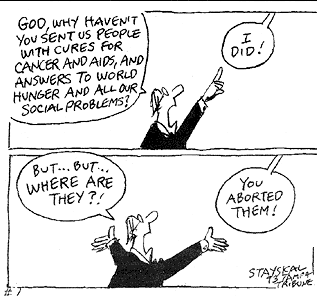
You people feed on stories like you copy/pasted and stories about… plays about aborted children dropping from space to have a discussion with the parents who aborted them. Clearly you and I don’t think alike at all.
I also have to say based on evidence on this blog that Saline is unable to choose the right people to read or listen to. He pulls out the damnedest experts, most who are totally discredited by thinking beings on the Internet. I think this goes back to my Republican friends who still believe Obama is a Kenyan Socialist and GWB is a hero…..you get down to it and it’s obvious they don’t know the difference between a good President and a bad one.
I’ll admit I don’t know the difference between a good horse or a bad horse, a good table saw and a bad one or even a good bra from a bad one, but I try not to comment on such things in hopes of keeping my ignorance a secret from my blog family.
…..Saline, you must not really believe in the Bible that teaches many many lessons about the poor and nothing about abortion. I just checked my facts about the Bible and abortion and found nothing credible at all….at all! … This whole abortion debate at this late date of 2013 is sickening and a total waste of our time.
DBI you say that the issue of abortion is not addressed in the Bible.
A Biblical argument for life beginning at conception from Psalms 139 from Kerby Anderson of Probe Ministries:
One of the key verses to understand in developing a biblical view of the sanctity of human life is Psalm 139. This psalm is the inspired record of David’s praise for God’s sovereignty in his life. He begins by acknowledging that God is omniscient and knows what David is doing at any given point in time. He goes on to acknowledge that God is aware of David’s thoughts before he expresses them. David adds that wherever he might go, he cannot escape from God, whether he travels to heaven or ventures into Sheol. God is in the remotest part of the sea and even in the darkness. Finally David contemplates the origin of his life and confesses that God was there forming him in the womb:
For you created my inmost being; you knit me together in my mother’s womb. I praise you because I am fearfully and wonderfully made; your works are wonderful, I know that full well. My frame was not hidden from you when I was made in the secret place. When I was woven together in the depths of the earth, your eyes saw my unformed body. All the days ordained for me were written in your book before one of them came to be (vv. 13-16).
Here David speaks of God’s relationship with him while he was growing and developing before birth. Notice that the Bible doesn’t speak of fetal life as mere biochemistry. The description here is not of a piece of protoplasm that becomes David: this is David already being cared for by God while in the womb.
In verse 13, we see that God is the Master Craftsman fashioning David into a living person. In verses 14 and 15, David reflects on the fact that he is a product of God’s creative work within his mother’s womb, and he praises God for how wonderfully God has woven him together.
David draws a parallel between his development in the womb and Adam’s creation from the earth. Using figurative language in verse 15, he refers to his life before birth when “I was made in secret, and skillfully wrought in the depths of the earth.” This poetic allusion harkens back to Genesis 2:7 which says that Adam was made from the dust of the earth.
David also notes that “Thine eyes have seen my unformed substance.” This shows that God knew David even before he was known to others. The term translated unformed substance is a noun derivative of a verb meaning “to roll up.” When David was just forming as a fetus, God’s care and compassion already extended to him. The reference to “God’s eyes” is an Old Testament term used to connotate divine oversight of God in the life of an individual or group of people.
I truly believe that many of the problems we have today in the USA are due to the advancement of humanism in the last few decades in our society. Ronald Reagan appointed the evangelical Dr. C. Everett Koop to the position of Surgeon General in his administration. He partnered with Dr. Francis Schaeffer in making the video below. It is very valuable information for Christians to have. Actually I have included a video below that includes comments from him on this subject.
___________
Francis Schaeffer Whatever Happened to the Human Race (Episode 1) ABORTION
Francis Schaeffer: What Ever Happened to the Human Race? (Full-Length Documentary)
Part 1 on abortion runs from 00:00 to 39:50, Part 2 on Infanticide runs from 39:50 to 1:21:30, Part 3 on Youth Euthanasia runs from 1:21:30 to 1:45:40, Part 4 on the basis of human dignity runs from 1:45:40 to 2:24:45 and Part 5 on the basis of truth runs from 2:24:45 to 3:00:04
Francis Schaeffer “BASIS FOR HUMAN DIGNITY” Whatever…HTTHR
________________
Francis Schaeffer never backed down from his position that the Bible is the inerrant word of God. Dr. Gene Veith, Jr. says: “Schaeffer showed that orthodox Christianity, uncompromised and undiluted, is strong enough to challenge secularist thought in its own territory.” I love taking Schaeffer’s work and applying it to today’s social problems. He knew where humanism would take us. It is not a pretty sight.
In Philadelphia in the late 1920’s, a young teenage boy decided that he didn’t need God. He had tried church, and it didn’t give him the answers he was looking for.
After a time of living as a self-proclaimed agnostic, he decided to read the Bible, beginning with Genesis, and see for himself if God exists. Within six months, he was convinced that God is real and that the Bible is His revealed Word to mankind. In 1930, eighteen-year-old Francis August Schaeffer prayed to receive Christ as his Savior.
From that day, for more than fifty years, Schaeffer was passionately committed to the proclamation and rational defense of the Gospel. One of the foremost Christian thinkers and apologists of this century, he wrote twenty-four books, which have been translated into more than twenty languages. Schaeffer’s basic message is the same – God’s Word is the only guide man needs to interpret his past and solve contemporary problems.
When Schaeffer graduated from Faith Theological Seminary in 1938, the United States faced many perplexing new social and religious problems. The evangelical movement was threatened by encroaching liberal ideologies, which argued that the Bible is not a reliable source of truth. He and his wife Edith, whom he had met at a church theology debate, were both eager for opportunities to speak out in defense of conservative doctrine.
As a pastor of several churches throughout Pennsylvania and Missouri, Schaeffer was grieved at the compromise he saw in many mainline Protestant denominations. Then, in the late 1940’s, he toured Europe on behalf of the American Council of Christian Churches. To his astonishment, he saw even greater needs there and moved to Switzerland to work with youth.
The Schaeffers founded the Children for Christ ministry in 1948 in Lausanne. With three daughters himself already, Schaeffer was familiar with the challenges of teaching young people. In the meantime, he continued touring, lecturing, and studying history and philosophy.
In 1951, Schaeffer’s heart became troubled. He wasn’t sure where God was leading him, and he questioned his convictions. He remembers, “I felt a strong burden to stand for the historical Christian position, and for the purity of the visible church. As I rethought my reasons for being a Christian, I saw again that there were totally sufficient reasons to know that the infinite-personal God does exist and Christianity is true.”
But what was the best way to reach cultures so closed to God’s Word? Schaeffer was convicted to start right where he lived in Switzerland. In 1955, he formally opened his chalet in Huemoz as a “home” for solid Bible teaching, where anyone could come and listen to thought-provoking analysis of Scripture. This haven of spiritual rest and discovery was named L’Abri.
Throughout the remainder of the 1950’s, but especially in the 1960’s when authority and “the establishment” were most severely questioned, L’Abri drew thousands of visitors. How did it keep going? Edith Schaeffer explains: “We prayed that God would bring the people of His choice…send in the needed financial means to care for us all, and open His plan to us.”
Scholar and WJI teacher (2002) Dr. Harold O.J. Brown says, “L’Abri’s initial theological impact was not made institutionally…but indirectly, through individuals whom the Schaeffers came to know and whose lives they changed.”
In 1968, Schaeffer published his first two books – Escape From Reason and The God Who Is There. In these landmark works he explored ways in which other philosophies have failed to adequately come to terms with real-world problems. Gradually, the work that Schaeffer had been developing for years gained recognition, especially in the United States.
It was largely the U. S. Supreme Court’s 1973 Roe vs. Wade decision, which opened the door to legal abortions on demand, that drew Schaeffer’s interest back to America. In the book How Should We Then Live?, Schaeffer addressed the foundational problems which led to this devaluing of human life.
Such a breakdown of values can eventually lead to further violations of human life in the forms of euthanasia and infanticide. With former Surgeon General C. Everett Koop and his son Franky, Schaeffer published Whatever Happened To The Human Race?, which tackled these social issues specifically.
Schaeffer was frequently criticized by non-Christians, but more surprisingly by many Christians who were worried by the explicit stand he took for the bold and consistent application of the Bible.
However, Schaeffer continued to proclaim the message of the inerrant Bible. Dr. Gene Veith, Jr. says: “Schaeffer showed that orthodox Christianity, uncompromised and undiluted, is strong enough to challenge secularist thought in its own territory.”
When Schaeffer was diagnosed with cancer in 1981 and given only six months to live, he did not cease his labor. He had three more years of active teaching and exhorting. His illness, with its long and sometimes debilitating treatments, gave him fresh opportunities to address nationwide medical concerns.
Schaeffer died in his home on May 15, 1984. As President Ronald Reagan said: “It can rarely be said of an individual that his life touched many others and affected them for the better; it will be said of Dr. Francis Schaeffer that his life touched millions of souls and brought them to the truth of their Creator.
Francis Schaeffer: “Whatever Happened to the Human Race” (Episode 1) ABORTION OF THE HUMAN RACE Published on Oct 6, 2012 by AdamMetropolis The 45 minute video above is from the film series created from Francis Schaeffer’s book “Whatever Happened to the Human Race?” with Dr. C. Everett Koop. This book really helped develop my political views […]
E P I S O D E 1 0 Dr. Francis Schaeffer – Episode X – Final Choices 27 min FINAL CHOICES I. Authoritarianism the Only Humanistic Social Option One man or an elite giving authoritative arbitrary absolutes. A. Society is sole absolute in absence of other absolutes. B. But society has to be […]
E P I S O D E 9 Dr. Francis Schaeffer – Episode IX – The Age of Personal Peace and Affluence 27 min T h e Age of Personal Peace and Afflunce I. By the Early 1960s People Were Bombarded From Every Side by Modern Man’s Humanistic Thought II. Modern Form of Humanistic Thought Leads […]
E P I S O D E 8 Dr. Francis Schaeffer – Episode VIII – The Age of Fragmentation 27 min I saw this film series in 1979 and it had a major impact on me. T h e Age of FRAGMENTATION I. Art As a Vehicle Of Modern Thought A. Impressionism (Monet, Renoir, Pissarro, Sisley, […]
E P I S O D E 7 Dr. Francis Schaeffer – Episode VII – The Age of Non Reason I am thrilled to get this film series with you. I saw it first in 1979 and it had such a big impact on me. Today’s episode is where we see modern humanist man act […]
E P I S O D E 6 How Should We Then Live 6#1 Uploaded by NoMirrorHDDHrorriMoN on Oct 3, 2011 How Should We Then Live? Episode 6 of 12 ________ I am sharing with you a film series that I saw in 1979. In this film Francis Schaeffer asserted that was a shift in […]
E P I S O D E 5 How Should We Then Live? Episode 5: The Revolutionary Age I was impacted by this film series by Francis Schaeffer back in the 1970′s and I wanted to share it with you. Francis Schaeffer noted, “Reformation Did Not Bring Perfection. But gradually on basis of biblical teaching there […]
Dr. Francis Schaeffer – Episode IV – The Reformation 27 min I was impacted by this film series by Francis Schaeffer back in the 1970′s and I wanted to share it with you. Schaeffer makes three key points concerning the Reformation: “1. Erasmian Christian humanism rejected by Farel. 2. Bible gives needed answers not only as to […]
Francis Schaeffer’s “How should we then live?” Video and outline of episode 3 “The Renaissance” Francis Schaeffer: “How Should We Then Live?” (Episode 3) THE RENAISSANCE I was impacted by this film series by Francis Schaeffer back in the 1970′s and I wanted to share it with you. Schaeffer really shows why we have so […]
Francis Schaeffer: “How Should We Then Live?” (Episode 2) THE MIDDLE AGES I was impacted by this film series by Francis Schaeffer back in the 1970′s and I wanted to share it with you. Schaeffer points out that during this time period unfortunately we have the “Church’s deviation from early church’s teaching in regard […]
Francis Schaeffer: “How Should We Then Live?” (Episode 1) THE ROMAN AGE Today I am starting a series that really had a big impact on my life back in the 1970′s when I first saw it. There are ten parts and today is the first. Francis Schaeffer takes a look at Rome and why […]
Francis Schaeffer: “Whatever Happened to the Human Race” (Episode 5) TRUTH AND HISTORY Published on Oct 7, 2012 by AdamMetropolis This crucial series is narrated by the late Dr. Francis Schaeffer and former Surgeon General Dr. C. Everett Koop. Today, choices are being made that undermine human rights at their most basic level. Practices once […]
The opening song at the beginning of this episode is very insightful. Francis Schaeffer: “Whatever Happened to the Human Race” (Episode 4) THE BASIS FOR HUMAN DIGNITY Published on Oct 7, 2012 by AdamMetropolis This crucial series is narrated by the late Dr. Francis Schaeffer and former Surgeon General Dr. C. Everett Koop. Today, choices […]
Francis Schaeffer: “Whatever Happened to the Human Race” (Episode 3) DEATH BY SOMEONE’S CHOICE Published on Oct 6, 2012 by AdamMetropolis This crucial series is narrated by the late Dr. Francis Schaeffer and former Surgeon General Dr. C. Everett Koop. Today, choices are being made that undermine human rights at their most basic level. Practices […]
Francis Schaeffer: “Whatever Happened to the Human Race?” (Episode 2) SLAUGHTER OF THE INNOCENTS Published on Oct 6, 2012 by AdamMetropolis This crucial series is narrated by the late Dr. Francis Schaeffer and former Surgeon General Dr. C. Everett Koop. Today, choices are being made that undermine human rights at their most basic level. Practices […]
It is not possible to know where the pro-life evangelicals are coming from unless you look at the work of the person who inspired them the most. That person was Francis Schaeffer. I do care about economic issues but the pro-life issue is the most important to me. Several years ago Adrian Rogers (past president of […]
This essay below is worth the read. Schaeffer, Francis – “Francis Schaeffer and the Pro-Life Movement” [How Should We Then Live?, Whatever Happened to the Human Race?, A Christian Manifesto] Editor note: <p> </p> [The following essay explores the role that Francis Schaeffer played in the rise of the pro-life movement. It examines the place of […]
Great article on Schaeffer. Who was Dr. Francis A. Schaeffer? By Francis Schaeffer The unique contribution of Dr. Francis Schaeffer on a whole generation was the ability to communicate the truth of historic Biblical Christianity in a way that combined intellectual integrity with practical, loving care. This grew out of his extensive understanding of the Bible […]
Francis Schaeffer Whatever Happened to the Human Race (Episode 1) ABORTION
Francis Schaeffer: What Ever Happened to the Human Race? (Full-Length Documentary)
Part 1 on abortion runs from 00:00 to 39:50, Part 2 on Infanticide runs from 39:50 to 1:21:30, Part 3 on Youth Euthanasia runs from 1:21:30 to 1:45:40, Part 4 on the basis of human dignity runs from 1:45:40 to 2:24:45 and Part 5 on the basis of truth runs from 2:24:45 to 3:00:04
Francis Schaeffer “BASIS FOR HUMAN DIGNITY” Whatever…HTTHR
________________
Picture of Francis Schaeffer and his wife Edith from the 1930′s above. I was sad to read about Edith passing away on Easter weekend in 2013. I wanted to pass along this fine article below.
After writing numerous books, 98-year-old ‘completed a dramatic life with a final flourish.’
Jeremy Weber
Edith Schaeffer, who along with her husband Francis founded the influential L’Abri Fellowship in Switzerland, died at home on Saturday. She was 98.
Her son, Frank Schaeffer, announced her passing on his Patheos blog. “Mom completed a dramatic life with a final flourish: she died on Easter Saturday, to join her risen Lord,” he wrote, later noting:
Mom was a wonderful paradox: an evangelical conservative fundamentalist who treated people as if she was an all-forgiving progressive liberal of the most tolerant variety. Mom’s daily life was a rebuke and contradiction to people who see everything as black and white. Liberals and secularists alike who make smug disparaging declarations about “all those evangelicals” would see their fondest prejudices founder upon the reality of my mother’s compassion, cultural literacy and loving energy.
CT featured Edith Schaeffer’s thoughts on the illusion or reality of heaven in a 2003 roundup of evangelical views on the afterlife. Reflecting on a visit to San Francisco, she wrote:
This is reality. Heaven is a place. There is a city we are going to see and walk in. Neither the place, nor the singing instead of sighing, nor the pleasure instead of pain, is an illusion. We await that which is real.
World magazine noted that “her hospitality complemented Francis’ anguish for the lost.” Francis Beckwith writes about his own encounter with Edith.
CT noted this reflection by Edith Schaeffer in 1996:
IMAGING THE ARTISTA Christian, above all people, should live artistically, aesthetically, and creatively. We are supposed to be representing the Creator who is there, and whom we acknowledge to be there. It is true that all people are created in the image of God, but Christians are supposed to be conscious of that fact, and being conscious of it should recognize the importance of living artistically, aesthetically, and creatively, as creative creatures of the Creator. If we have been created in the image of an Artist, then we should look for expressions of artistry, and be sensitive to beauty, responsive to what has been created for our appreciaton.
Edith Schaeffer in “The Art of Life”
posted by Jeremy Weber
Have you ever thought about the possibility that when we get to heaven and get to ask God why he never sent us the cure for cancer that God may tell us that a person was sent to earth with the answer to cancer? Take a look at this editorial cartoon below:
(Francis did a great job in his film series “How Should we then live?” in looking at how humanism has affected art and culture in the Western World in the last 2000 years. My favorite episodes include his study of the Renaissance, the Revolutionary age, the age of Nonreason, and the age of Fragmentation.)
E P I S O D E 1 0 Dr. Francis Schaeffer – Episode X – Final Choices 27 min FINAL CHOICES I. Authoritarianism the Only Humanistic Social Option One man or an elite giving authoritative arbitrary absolutes. A. Society is sole absolute in absence of other absolutes. B. But society has to be […]
E P I S O D E 9 Dr. Francis Schaeffer – Episode IX – The Age of Personal Peace and Affluence 27 min T h e Age of Personal Peace and Afflunce I. By the Early 1960s People Were Bombarded From Every Side by Modern Man’s Humanistic Thought II. Modern Form of Humanistic Thought Leads […]
E P I S O D E 8 Dr. Francis Schaeffer – Episode VIII – The Age of Fragmentation 27 min I saw this film series in 1979 and it had a major impact on me. T h e Age of FRAGMENTATION I. Art As a Vehicle Of Modern Thought A. Impressionism (Monet, Renoir, Pissarro, Sisley, […]
E P I S O D E 7 Dr. Francis Schaeffer – Episode VII – The Age of Non Reason I am thrilled to get this film series with you. I saw it first in 1979 and it had such a big impact on me. Today’s episode is where we see modern humanist man act […]
E P I S O D E 6 How Should We Then Live 6#1 Uploaded by NoMirrorHDDHrorriMoN on Oct 3, 2011 How Should We Then Live? Episode 6 of 12 ________ I am sharing with you a film series that I saw in 1979. In this film Francis Schaeffer asserted that was a shift in […]
E P I S O D E 5 How Should We Then Live? Episode 5: The Revolutionary Age I was impacted by this film series by Francis Schaeffer back in the 1970′s and I wanted to share it with you. Francis Schaeffer noted, “Reformation Did Not Bring Perfection. But gradually on basis of biblical teaching there […]
Dr. Francis Schaeffer – Episode IV – The Reformation 27 min I was impacted by this film series by Francis Schaeffer back in the 1970′s and I wanted to share it with you. Schaeffer makes three key points concerning the Reformation: “1. Erasmian Christian humanism rejected by Farel. 2. Bible gives needed answers not only as to […]
Francis Schaeffer’s “How should we then live?” Video and outline of episode 3 “The Renaissance” Francis Schaeffer: “How Should We Then Live?” (Episode 3) THE RENAISSANCE I was impacted by this film series by Francis Schaeffer back in the 1970′s and I wanted to share it with you. Schaeffer really shows why we have so […]
Francis Schaeffer: “How Should We Then Live?” (Episode 2) THE MIDDLE AGES I was impacted by this film series by Francis Schaeffer back in the 1970′s and I wanted to share it with you. Schaeffer points out that during this time period unfortunately we have the “Church’s deviation from early church’s teaching in regard […]
Francis Schaeffer: “How Should We Then Live?” (Episode 1) THE ROMAN AGE Today I am starting a series that really had a big impact on my life back in the 1970′s when I first saw it. There are ten parts and today is the first. Francis Schaeffer takes a look at Rome and why […]
I have debated with Ark Times Bloggers many times in the past on many different subjects. Abortion is probably the most often debated subject and I have noticed that many pro-life individuals are now surfacing on the Arkansas Times Blog. Here are some examples. Arhogfan501 asserted: This is the beginning of the end for recreational abortion in Arkansas. Songbird777 noted: Babies have a right to live and not be chopped up for someone else’s convenience. The person using the username “baker” commented: Planned Parenthood (PPA) does not nor cannot provide mammograms, indeed no affiliate has the necessary license. PPA is an abortion provider and at some 900 plus killings a day rather prolific.
Here is another debate I got into recently on the Arkansas Times Blog:
The outlier said “abortion is not a slippery slope to infanticide” however Justice Harry Blaackmun in his Roe v Wade related the two issues.
Abortion was present even in ancient times. Under Roman rule “[n]ot only [was] … abortion permitted; [but also] infanticide. The shriveled remains of exposed babies could be found in every countryside of the [Roman] Empire…” Supreme Court Justice Harry Blackmun referred to this culture in Roe v. Wade: “Greek and Roman law afforded little protection to the unborn … Ancient religion did not bar abortion.”
I truly believe that many of the problems we have today in the USA are due to the advancement of humanism in the last few decades in our society. Ronald Reagan appointed the evangelical Dr. C. Everett Koop to the position of Surgeon General in his administration. He partnered with Dr. Francis Schaeffer in making the video below. It is very valuable information for Christians to have. Actually I have included a video below that includes comments from him on this subject.
Once government begins to define life and humanity, there is no end to the possibilities for subjective and selective determination as to who will be allowed to live.
At one time, blacks were not recognized as human beings. This was the rationale behind the slave trade that brought black Africans to the United States. They were transported in slave ships that held them confined in the same manner that livestock is confined when shipped to the slaughter houses. In Nazi Germany, only the Aryan race was considered human, and we know the consequences of that thinking. The treatment of Jews and other non-Aryans was similar to that of animals. And the Nazi genetic experiments remain a source for horror stories even today.
Will a society which has assumed the right to kill infants in the womb – because they are unwanted, imperfect, or merely inconvenient – have difficulty in assuming the right to kill other human beings, especially older adults who are judged unwanted, deemed imperfect physically or mentally, or considered a possible social nuisance?
The next candidates for arbitrary reclassification as non-persons are the elderly. This will become increasingly so as the proportion of the old and weak in relation to the young and strong becomes abnormally large, due to the growing antifamily sentiment, the abortion rate, and medicine’s contribution to the lengthening of the normal life span. The imbalance will cause many of the young to perceive the old as a cramping nuisance in the hedonistic lifestyle they claim as their right. As the demand for affluence continues and the economic crunch gets greater, the amount of compassion that the legislature and the courts will have for the old does not seem likely to be significant considering the precedent of the non-protection given to the unborn and newborn. [Francis Schaeffer, Whatever Happened to the Human Race?]
Euthanasia
Joseph Fletcher, the popularizer of “situational ethics,” in his 1973 discussion of death with dignity gives this argument for euthanasia:
It is ridiculous to give ethical approval to the positive ending of sub-human life in utero as we do in therapeutic abortions for reasons of mercy and compassion but refuse to approve of positively ending a sub-human life in extremis. If we are morally obliged to put an end to a pregnancy when an amniocentesis reveals a terrible defective fetus, we are equally obliged to put an end to a patient’s hopeless misery when a brain scan reveals that a patient with cancer has advanced brain metastases. [Joseph Fletcher, “Ethics and Euthanasia,” American Journal of Nursing, 1973.]
One is reminded of the slave holders who devoutly espoused the theory that slavery was really for the good of the black man and that in the end he would be thankful for the opportunity to share in the white man’s culture, even from the distance of the garden shed. The Nazis also argued that their victims were being sacrificed for the high end of the general good of society. Many well-meaning people are attracted to what might seem to be the beneficial aspects of some sort of euthanasia program, because they think they can be free of the guilt of responsibility.
The “right-to-die” movement is not calling for a right to die, they’re mostly talking about a right to kill. The advocates of euthanasia are asking the government and courts to step aside and allow people who are feeble and elderly to be snuffed out.
Consider the people who were “assisted” in ending their lives by Dr. Jack Kevorkian. He wasn’t killing terminally ill patients – they had Alzheimer’s and were in a lot of pain, but they were alive and walking around. Dr. Kevorkian portrays another basic belief of humanist ideology – the extermination of the old, useless, and the infirm. Kervorkian believes that he has the right to help people out of their pain if they want to die. He claims to render “a medical service,” and his lawyer is clear that “he’s not going to stop … doing the right thing.” Already the suicide doctor has had an impact on our society’s views regarding suicide and euthanasia.
Language is an important tool in convincing others of your position. Euthanasia advocates have been skillful in masking their true intent with slogans like “death with dignity” and “a right to die.” These phrases easily capture people’s attention. Everyone believes in a death with dignity.
Though I’m sure the medical community is well intentioned, it is still a fact that their idea of mercy is increasingly to dehumanize their patients, to disguise the helpless person so that not even their family recognizes them. In time, the family’s love turns to pity, which turns to horror until, to our warped hearts, murder becomes mercy.
But these slogans take on new meaning when they are interpreted by our courts. The right to die may sound wonderful – until we realize that legally it means that you can kill yourself or someone can kill you, even if you don’t want to die. Language is powerful. But when it is interpreted by the courts it becomes much more than mere slogans. It becomes the law of the land, and often that interpretation is not at all what we expected.
Daily, senior citizens and accident victims are starved to death because their families have been convinced that even food and water are extraordinary means to preserve their life.
Over one-fifth of Medicare expenses are for persons in their last year of life. Thus in fiscal year 1978, $4.9 billion dollars was spent for such persons and if just one-quarter of those expenditures were avoided through adoption of living wills, the savings under Medicare alone would amount to $1.2 billion. [ WASHINGTON POST, June 22, 1977]
The drug company, Hoescht AG, has been granted the first patent for a euthanasia drug developed by Michigan State University. The drug is intended for use on animals but the patent is worded to include humans. (Source: UPI)
Critics of the U.S. Supreme Court’ Roe v. Wade decision have long claimed that legalized abortion would lead to legalized euthanasia. Supporters of Roe have often scoffed at the idea, insisting that decisions to eliminate a human fetus in no way devalue the lives of born persons. Yet recent court cases in Michigan and Washington have reversed the debate: Euthanasia supporters are openly citing Roe as precedent for a constitutional right to “rational” suicide. In the case of People v. Kevorkian, a trial judge has relied partly on Roe and the later abortion case, Planned Parenthood v. Casey, to find a consitutional right to assisted suicide. Jack Kevorkian’s attorney, Geoffrey Fieger argues that such a right is even better grounded than a right to abortion, because no unwilling ‘third party’ is involved.
Citing Planned Parenthood vs. Casey, on May 3, 1994, Washington U.S. District Court Judge Barbara Rothstein struck down the Washington state law that banned physician assisted suicide. Judge Rothstein stated that the terminally ill “have the same right to hasten death that they have to choose an abortion…” “Like the abortion decision, the decision of a terminally ill person to end his life involves the most intimate and personal choices a person may make in a lifetime,” the judge wrote in her decision.
Francis Schaeffer Whatever Happened to the Human Race (Episode 1) ABORTION
Francis Schaeffer: What Ever Happened to the Human Race? (Full-Length Documentary)
Part 1 on abortion runs from 00:00 to 39:50, Part 2 on Infanticide runs from 39:50 to 1:21:30, Part 3 on Youth Euthanasia runs from 1:21:30 to 1:45:40, Part 4 on the basis of human dignity runs from 1:45:40 to 2:24:45 and Part 5 on the basis of truth runs from 2:24:45 to 3:00:04
Francis Schaeffer “BASIS FOR HUMAN DIGNITY” Whatever…HTTHR
Dr. C. Everett Koop pictured above.
__________
President Obama before appointing a Supreme Court Justice said that he wanted the judge to be empathic. Pro-life people wanted to know if that judge would care about the smallest in our society? Here is an editorial cartoon that deals with that issue.
Francis Schaeffer: “Whatever Happened to the Human Race” (Episode 1) ABORTION OF THE HUMAN RACE Published on Oct 6, 2012 by AdamMetropolis The 45 minute video above is from the film series created from Francis Schaeffer’s book “Whatever Happened to the Human Race?” with Dr. C. Everett Koop. This book really helped develop my political views […]
E P I S O D E 1 0 Dr. Francis Schaeffer – Episode X – Final Choices 27 min FINAL CHOICES I. Authoritarianism the Only Humanistic Social Option One man or an elite giving authoritative arbitrary absolutes. A. Society is sole absolute in absence of other absolutes. B. But society has to be […]
E P I S O D E 9 Dr. Francis Schaeffer – Episode IX – The Age of Personal Peace and Affluence 27 min T h e Age of Personal Peace and Afflunce I. By the Early 1960s People Were Bombarded From Every Side by Modern Man’s Humanistic Thought II. Modern Form of Humanistic Thought Leads […]
E P I S O D E 8 Dr. Francis Schaeffer – Episode VIII – The Age of Fragmentation 27 min I saw this film series in 1979 and it had a major impact on me. T h e Age of FRAGMENTATION I. Art As a Vehicle Of Modern Thought A. Impressionism (Monet, Renoir, Pissarro, Sisley, […]
E P I S O D E 7 Dr. Francis Schaeffer – Episode VII – The Age of Non Reason I am thrilled to get this film series with you. I saw it first in 1979 and it had such a big impact on me. Today’s episode is where we see modern humanist man act […]
E P I S O D E 6 How Should We Then Live 6#1 Uploaded by NoMirrorHDDHrorriMoN on Oct 3, 2011 How Should We Then Live? Episode 6 of 12 ________ I am sharing with you a film series that I saw in 1979. In this film Francis Schaeffer asserted that was a shift in […]
E P I S O D E 5 How Should We Then Live? Episode 5: The Revolutionary Age I was impacted by this film series by Francis Schaeffer back in the 1970′s and I wanted to share it with you. Francis Schaeffer noted, “Reformation Did Not Bring Perfection. But gradually on basis of biblical teaching there […]
Dr. Francis Schaeffer – Episode IV – The Reformation 27 min I was impacted by this film series by Francis Schaeffer back in the 1970′s and I wanted to share it with you. Schaeffer makes three key points concerning the Reformation: “1. Erasmian Christian humanism rejected by Farel. 2. Bible gives needed answers not only as to […]
Francis Schaeffer’s “How should we then live?” Video and outline of episode 3 “The Renaissance” Francis Schaeffer: “How Should We Then Live?” (Episode 3) THE RENAISSANCE I was impacted by this film series by Francis Schaeffer back in the 1970′s and I wanted to share it with you. Schaeffer really shows why we have so […]
Francis Schaeffer: “How Should We Then Live?” (Episode 2) THE MIDDLE AGES I was impacted by this film series by Francis Schaeffer back in the 1970′s and I wanted to share it with you. Schaeffer points out that during this time period unfortunately we have the “Church’s deviation from early church’s teaching in regard […]
Francis Schaeffer: “How Should We Then Live?” (Episode 1) THE ROMAN AGE Today I am starting a series that really had a big impact on my life back in the 1970′s when I first saw it. There are ten parts and today is the first. Francis Schaeffer takes a look at Rome and why […]
Francis Schaeffer: “Whatever Happened to the Human Race” (Episode 5) TRUTH AND HISTORY Published on Oct 7, 2012 by AdamMetropolis This crucial series is narrated by the late Dr. Francis Schaeffer and former Surgeon General Dr. C. Everett Koop. Today, choices are being made that undermine human rights at their most basic level. Practices once […]
The opening song at the beginning of this episode is very insightful. Francis Schaeffer: “Whatever Happened to the Human Race” (Episode 4) THE BASIS FOR HUMAN DIGNITY Published on Oct 7, 2012 by AdamMetropolis This crucial series is narrated by the late Dr. Francis Schaeffer and former Surgeon General Dr. C. Everett Koop. Today, choices […]
Francis Schaeffer: “Whatever Happened to the Human Race” (Episode 3) DEATH BY SOMEONE’S CHOICE Published on Oct 6, 2012 by AdamMetropolis This crucial series is narrated by the late Dr. Francis Schaeffer and former Surgeon General Dr. C. Everett Koop. Today, choices are being made that undermine human rights at their most basic level. Practices […]
Francis Schaeffer: “Whatever Happened to the Human Race?” (Episode 2) SLAUGHTER OF THE INNOCENTS Published on Oct 6, 2012 by AdamMetropolis This crucial series is narrated by the late Dr. Francis Schaeffer and former Surgeon General Dr. C. Everett Koop. Today, choices are being made that undermine human rights at their most basic level. Practices […]
It is not possible to know where the pro-life evangelicals are coming from unless you look at the work of the person who inspired them the most. That person was Francis Schaeffer. I do care about economic issues but the pro-life issue is the most important to me. Several years ago Adrian Rogers (past president of […]
This essay below is worth the read. Schaeffer, Francis – “Francis Schaeffer and the Pro-Life Movement” [How Should We Then Live?, Whatever Happened to the Human Race?, A Christian Manifesto] Editor note: <p> </p> [The following essay explores the role that Francis Schaeffer played in the rise of the pro-life movement. It examines the place of […]
Great article on Schaeffer. Who was Dr. Francis A. Schaeffer? By Francis Schaeffer The unique contribution of Dr. Francis Schaeffer on a whole generation was the ability to communicate the truth of historic Biblical Christianity in a way that combined intellectual integrity with practical, loving care. This grew out of his extensive understanding of the Bible […]
On September 29th, 2012, William Lane Craig participated in the Contending with Christianity’s Critics Conference held at Watermark Community Church in Dallas, TX. In this short clip, Dr. Craig uses the technique of Eastwooding to deal with Richard Dawkins’ attempted refutations of the moral argument for God’s existence.
The statements ascribed to Richard Dawkins in this presentation are statements actually made by Prof. Dawkins. The following is a list of the sources of such statements:
Dawkins, Richard. “Afterword.” In Lawrence Krauss, A Universe from Nothing. New York: Free Press, 2012.
Citations of these statements with references may be found in:
“Richard Dawkins on Arguments for God.” In God Is Great, God Is Good, pp. 13-31. Ed. Wm. L Craig and Chad Meister. Downers Grove, Ill.: Inter-Varsity, 2009.
I have discussed many subjects with my liberal friends over at the Ark Times Blog in the past and I have taken them on now on the subject of the absurdity of life without God in the picture. Most of my responses included quotes from William Lane Craig’s book THE ABSURDITY OF LIFE WITHOUT GOD. Here is the result of one of those encounters from June of 2013:
I wrote:
Outlier you don’t think that an afterlife would influence the way people act now on this earth? Why did the Russian writer Fyodor Dostoyevsky (1821–1881) tackle this very issue so long ago?
_______________
William Lane Craig noted:
Another apologetic based on the human predicament may be found in the magnificent novels of the great nineteenth-century Russian writer Fyodor Dostoyevsky (1821–1881). (May I add that I think the obsession of contemporary evangelicals with the writings of authors like C. S. Lewis to the neglect of writers like Dostoyevsky is a great shame? Dostoyevsky is a far, far grander writer.) The problem that tortured Dostoyevsky was the problem of evil: how can a good and loving God exist when the world is filled with so much suffering and evil? Dostoyevsky presented this problem in his works so persuasively, so poignantly, that certain passages of his, notably “The Grand Inquisitor” section from his Brothers Karamazov, are often reprinted in anthologies as classic statements of the problem of evil. As a result, some people are under the impression that Dostoyevsky was himself an atheist and that the viewpoint of the Grand Inquisitor is his own.
Actually, he sought to carry through a two-pronged defense of theism in the face of the problem of evil. Positively, he argued that innocent suffering may perfect character and bring one into a closer relation with God. Negatively, HE TRIED TO SHOW THAT IF THE EXISTENCE OF GOD IS DENIED, THEN ONE IS LANDED IN COMPLETE MORAL RELATIVISM, SO THAT NO ACT, REGARDLESS HOW DREADFUL OR HEINOUS, CAN BE CONDEMNED BY THE ATHEIST. To live consistently with such a view of life is unthinkable and impossible. Hence, atheism is destructive of life and ends logically in suicide.
Dostoyevsky’s magnificent novels Crime and Punishment and The Brothers Karamazov powerfully illustrate these themes. In the former a young atheist, convinced of moral relativism, brutally murders an old woman. Though he knows that on his presuppositions he should not feel guilty, nevertheless he is consumed with guilt until he confesses his crime and gives his life to God. The latter novel is the story of four brothers, one of whom murders their father because his atheist brother Ivan had told him that moral absolutes do not exist. Unable to live with the consequences of his own philosophical system, Ivan suffers a mental collapse. The remaining two brothers, one of whom is unjustly accused of the parricide and the other a young Russian orthodox priest, find in what they suffer the perfection of their character and a nearness to God.
Dostoyevsky recognizes that his response to atheism constitutes no positive proof of Christianity. Indeed, he rejects that there could be such. Men demand of Christ that he furnish them “bread and circuses,” but he refuses to do so. The decision to follow Christ must be made in loneliness and anxiety. Each person must face for himself the anguish of a world without God and in the solitude of his own heart give himself to God in faith.
E P I S O D E 1 0 Dr. Francis Schaeffer – Episode X – Final Choices 27 min FINAL CHOICES I. Authoritarianism the Only Humanistic Social Option One man or an elite giving authoritative arbitrary absolutes. A. Society is sole absolute in absence of other absolutes. B. But society has to be […]
E P I S O D E 9 Dr. Francis Schaeffer – Episode IX – The Age of Personal Peace and Affluence 27 min T h e Age of Personal Peace and Afflunce I. By the Early 1960s People Were Bombarded From Every Side by Modern Man’s Humanistic Thought II. Modern Form of Humanistic Thought Leads […]
E P I S O D E 8 Dr. Francis Schaeffer – Episode VIII – The Age of Fragmentation 27 min I saw this film series in 1979 and it had a major impact on me. T h e Age of FRAGMENTATION I. Art As a Vehicle Of Modern Thought A. Impressionism (Monet, Renoir, Pissarro, Sisley, […]
E P I S O D E 7 Dr. Francis Schaeffer – Episode VII – The Age of Non Reason I am thrilled to get this film series with you. I saw it first in 1979 and it had such a big impact on me. Today’s episode is where we see modern humanist man act […]
E P I S O D E 6 How Should We Then Live 6#1 Uploaded by NoMirrorHDDHrorriMoN on Oct 3, 2011 How Should We Then Live? Episode 6 of 12 ________ I am sharing with you a film series that I saw in 1979. In this film Francis Schaeffer asserted that was a shift in […]
E P I S O D E 5 How Should We Then Live? Episode 5: The Revolutionary Age I was impacted by this film series by Francis Schaeffer back in the 1970′s and I wanted to share it with you. Francis Schaeffer noted, “Reformation Did Not Bring Perfection. But gradually on basis of biblical teaching there […]
Dr. Francis Schaeffer – Episode IV – The Reformation 27 min I was impacted by this film series by Francis Schaeffer back in the 1970′s and I wanted to share it with you. Schaeffer makes three key points concerning the Reformation: “1. Erasmian Christian humanism rejected by Farel. 2. Bible gives needed answers not only as to […]
Francis Schaeffer’s “How should we then live?” Video and outline of episode 3 “The Renaissance” Francis Schaeffer: “How Should We Then Live?” (Episode 3) THE RENAISSANCE I was impacted by this film series by Francis Schaeffer back in the 1970′s and I wanted to share it with you. Schaeffer really shows why we have so […]
Francis Schaeffer: “How Should We Then Live?” (Episode 2) THE MIDDLE AGES I was impacted by this film series by Francis Schaeffer back in the 1970′s and I wanted to share it with you. Schaeffer points out that during this time period unfortunately we have the “Church’s deviation from early church’s teaching in regard […]
Francis Schaeffer: “How Should We Then Live?” (Episode 1) THE ROMAN AGE Today I am starting a series that really had a big impact on my life back in the 1970′s when I first saw it. There are ten parts and today is the first. Francis Schaeffer takes a look at Rome and why […]
Francis Schaeffer: “Whatever Happened to the Human Race” (Episode 5) TRUTH AND HISTORY Published on Oct 7, 2012 by AdamMetropolis This crucial series is narrated by the late Dr. Francis Schaeffer and former Surgeon General Dr. C. Everett Koop. Today, choices are being made that undermine human rights at their most basic level. Practices once […]
The opening song at the beginning of this episode is very insightful. Francis Schaeffer: “Whatever Happened to the Human Race” (Episode 4) THE BASIS FOR HUMAN DIGNITY Published on Oct 7, 2012 by AdamMetropolis This crucial series is narrated by the late Dr. Francis Schaeffer and former Surgeon General Dr. C. Everett Koop. Today, choices […]
Francis Schaeffer: “Whatever Happened to the Human Race” (Episode 3) DEATH BY SOMEONE’S CHOICE Published on Oct 6, 2012 by AdamMetropolis This crucial series is narrated by the late Dr. Francis Schaeffer and former Surgeon General Dr. C. Everett Koop. Today, choices are being made that undermine human rights at their most basic level. Practices […]
Francis Schaeffer: “Whatever Happened to the Human Race?” (Episode 2) SLAUGHTER OF THE INNOCENTS Published on Oct 6, 2012 by AdamMetropolis This crucial series is narrated by the late Dr. Francis Schaeffer and former Surgeon General Dr. C. Everett Koop. Today, choices are being made that undermine human rights at their most basic level. Practices […]
It is not possible to know where the pro-life evangelicals are coming from unless you look at the work of the person who inspired them the most. That person was Francis Schaeffer. I do care about economic issues but the pro-life issue is the most important to me. Several years ago Adrian Rogers (past president of […]
Ecclesiastes 2-3 Published on Sep 19, 2012 Calvary Chapel Spring Valley | Sunday Evening | September 16, 2012 | Derek Neider _____________________________ I have written on the Book of Ecclesiastes and the subject of the meaning of our lives on several occasions on this blog. In this series on Ecclesiastes I hope to show how secular […]
Ecclesiastes 1 Published on Sep 4, 2012 Calvary Chapel Spring Valley | Sunday Evening | September 2, 2012 | Pastor Derek Neider _____________________ I have written on the Book of Ecclesiastes and the subject of the meaning of our lives on several occasions on this blog. In this series on Ecclesiastes I hope to show how […]
Ecclesiastes 8-10 | Still Searching After All These Years Published on Oct 9, 2012 Calvary Chapel Spring Valley | Sunday Evening | October 7, 2012 | Pastor Derek Neider _______________________ Ecclesiastes 11-12 | Solomon Finds His Way Published on Oct 30, 2012 Calvary Chapel Spring Valley | Sunday Evening | October 28, 2012 | Pastor Derek Neider […]
Ecclesiastes 6-8 | Solomon Turns Over a New Leaf Published on Oct 2, 2012 Calvary Chapel Spring Valley | Sunday Evening | September 30, 2012 | Pastor Derek Neider _____________________ I have written on the Book of Ecclesiastes and the subject of the meaning of our lives on several occasions on this blog. In this series […]
Ecclesiastes 4-6 | Solomon’s Dissatisfaction Published on Sep 24, 2012 Calvary Chapel Spring Valley | Sunday Evening | September 23, 2012 | Pastor Derek Neider ___________________ I have written on the Book of Ecclesiastes and the subject of the meaning of our lives on several occasions on this blog. In this series on Ecclesiastes I hope […]
Overview of the Book of Ecclesiastes Overview of the Book of EcclesiastesAuthor: Solomon or an unknown sage in the royal courtPurpose: To demonstrate that life viewed merely from a realistic human perspective must result in pessimism, and to offer hope through humble obedience and faithfulness to God until the final judgment.Date: 930-586 B.C. Ecclesiastes 2-3 Published on Sep 19, […]
Ecclesiastes 1 Published on Sep 4, 2012 Calvary Chapel Spring Valley | Sunday Evening | September 2, 2012 | Pastor Derek Neider _____________________ I have written on the Book of Ecclesiastes and the subject of the meaning of our lives on several occasions on this blog. In this series on Ecclesiastes I hope to show how […]
Ecclesiastes 8-10 | Still Searching After All These Years Published on Oct 9, 2012 Calvary Chapel Spring Valley | Sunday Evening | October 7, 2012 | Pastor Derek Neider _______________________ Ecclesiastes 11-12 | Solomon Finds His Way Published on Oct 30, 2012 Calvary Chapel Spring Valley | Sunday Evening | October 28, 2012 | Pastor Derek Neider […]
Edith and Francis Schaeffer always stood up for the unborn children. Mr. President when will you start doing that?
___________________
Francis Schaeffer Whatever Happened to the Human Race (Episode 1) ABORTION
Francis Schaeffer: What Ever Happened to the Human Race? (Full-Length Documentary)
Part 1 on abortion runs from 00:00 to 39:50, Part 2 on Infanticide runs from 39:50 to 1:21:30, Part 3 on Youth Euthanasia runs from 1:21:30 to 1:45:40, Part 4 on the basis of human dignity runs from 1:45:40 to 2:24:45 and Part 5 on the basis of truth runs from 2:24:45 to 3:00:04
Francis Schaeffer “BASIS FOR HUMAN DIGNITY” Whatever…HTTHR
________________
Picture of Francis Schaeffer and his wife Edith from the 1930′s above. I was sad to read about Edith passing away on Easter weekend in 2013. I wanted to pass along this fine article below.
Thousands were led to belief in the importance of prayer by her weekly prayer times with students
Written by Marvin Padgett | Monday, April 1, 2013
As a personal note, no one, aside from my parents, more deeply affected the way I see God, his universe, his people and all people than did the Schaeffers. Their deep and sincere belief that Jesus Christ was Lord of all—all, all—carried me along throughout all my life. It was a deep and gracious thing that the Lord did to all me and mine to know these two great saints personally.
Edith Schaeffer passed into the presence of her Lord and Savior, whom she had served well and tirelessly for many years, on March 30th. Born Edith Rachel Merritt Seville on November 3, 1914, the fourth child of George and Jessie Seville, while her parents were serving in China with the China Inland Mission, her life began and ended as a missionary. She attended Beaver College in Glenside PA. After meeting in a church youth group, the Schaeffers married in 1935. Mrs. Schaeffer has four children, Priscilla, Susan, Deborah, and Frank; fifteen grandchildren, thirty-four great-grandchildren, and two great-great grandchildren.
She was possessed of a love of and zest for life. As a child she saw her father accommodate himself to the local Chinese culture rather than expecting it to accommodate itself to Western ways. This marked her life as the Schaeffers later defended and demonstrated their belief in the dignity of the lives of all human beings. Both firmly believed that all human beings were created in the image of God and were more like God than any other creature or thing in the entire universe.
Mealtimes were not cafeteria style, but served on finely set tables with folded napkins. There is a direct line from this treatment of people to the later controversies over human lives being taken in the horror of abortion. All death was seen as a horror, but hardly ever more so than in abortion.
She gave her life in service to God and all those created in his image. Schedules were never as important as the needs of the people in front of her. Planes missed, dignitaries kept waiting, and artificial imperatives all quailed before the dignity of the person with her at the moment.
Thousands were led to belief in the importance of prayer by her weekly prayer times with students. Prayer, public or private, convenient or inconvenient, came first. She truly believed that she was communicating with her Lord and God. Dr. and Mrs. Schaeffer were “constant in prayer” beyond anyone the writer has known.
Mealtimes were long and full of discussion. While the students were served elegantly, they were expected after the meals to clean up the mess that was made in the work of those who had prepared these feasts. We live after the Fall and before the coming of the Lord. In this time, work has to be done. She saw all godly work was as dignified and necessary. People were always to be treated well.
The ministry of L’Abri, cofounded by the Schaeffers, was the result of conflicts with a mission agency. This led the Schaeffers to begin L’Abri, a residential Christian community, that began in 1955 in a remote Swiss village and became one of the most important Christian works of our time. Beginning without a commitment to an American style growth mentality, the Schaeffers employed prayer for their needs in order to demonstrate to a watching world that the God they served was able to supply all their needs.
Honest answers to honest questions became a by-word at L’Abri. Men and women, young and old, flocked to an obscure Swiss village to find answers to their questions. A hard fought determination to the very concept of Truth and that the Bible was “breathed out by God,” led the Schaeffers to be dogged in their beliefs, and to demonstrate by word and deed that the God of the Bible “is there and is not silent.” All this work was permeated by loving patience for the difficult ones in their midst that they might be won.
Edith Schaeffer wrote nineteen books, many bestsellers, including L’Abri, and her Evangelical Christian Publishers Association Gold Medallion winners, Affliction (This was used by the writer as an important tool in graduate school.) and The Tapestry: the Life and Times of Francis and Edith Schaeffer.
As a personal note, no one, aside from my parents, more deeply affected the way I see God, his universe, his people and all people than did the Schaeffers. Their deep and sincere belief that Jesus Christ was Lord of all—all, all—carried me along throughout all my life. It was a deep and gracious thing that the Lord did to all me and mine to know
these two great saints personally. SDG!
Marvin Padgett is a Teaching Elder in the Presbyterian Church in America. He is currently the Acting Executive Director of Great Commission Publications.
Who is this influential man, not widely known outside of the conservative evangelical community?
FRONTLINE profiled Schaeffer in episode six of God in America, our co-production with American Experience. The above clip explores his role as a catalyst who inspired evangelicals’ re-entry into American politics in 1970s, including that:
He provided an “intellectual ballast” to a community tarred with an anti-intellectual reputation after Scopes Trial: “He was confrontational. He was willing to say ‘Modernity has gone wrong’ … He gave a way to hang onto the Biblical narrative and yet be a modern, intelligent person,” explained religion scholar Stephen Prothero.
He was “an embodiment of the counterculture”: With his long hair, goatee, knickers and knee socks, Schaeffer cut a striking figure. L’Abri (“the shelter”), the spiritual community he founded in the Swiss Alps, attracted “lots of long-haired hippies, coming through with backpacks,” his son Frank, who remembers Timothy Leary coming to L’Abri on a pilgrimage, told us.
His documentary films inspired thousands of evangelicals — including Bachmann — to enter the political arena: His first series, How Should We Then Live (watch here) targeted what Schaeffer saw as the culture’s great evil — secular humanism. “Humanism is man putting himself at the center of all things, rather than the creator God,” Schaeffer explains in the film. He goes on to argue that surrendering to humanism would lead to the moral decay of society.
He persuaded Jerry Falwell that evangelicals needed to take up the cause of abortion: Falwell and other evangelicals initially viewed Roe v. Wade as “a Catholic issue.” Even Schaeffer himself initially didn’t see abortion as a political cause. He was persuaded to the cause by his son Frank (who, after impregnating his girlfriend at age 17, became a passionate abortion foe) and his good friend Dr. C. Everett Koop. Schaeffer’s second film series Whatever Happened to the Human Race (watch here) is a powerful indictment of abortion, euthanasia and indifference to life: “If in these last decades of the 20th century, the Christian community does not make a determined stand on the issue of each individual to have a right to live and a right to be treated as made in the image of God, rather than a machine, I believe we have failed in the greatest moral challenge of this century. The choice is yours to make.”
__________________________
(Francis did a great job in his film series “How Should we then live?” in looking at how humanism has affected art and culture in the Western World in the last 2000 years. My favorite episodes include his study of the Renaissance, the Revolutionary age, the age of Nonreason, and the age of Fragmentation.)
Planned Parenthood is the largest abortion provider in the USA and this editorial cartoon touches on this issue.
______________________
Thank you so much for your time. I know how valuable it is. I also appreciate the fine family that you have and your commitment as a father and a husband.
Sincerely,
Everette Hatcher III, 13900 Cottontail Lane, Alexander, AR 72002, ph 501-920-5733, lowcostsqueegees@yahoo.com
E P I S O D E 1 0 Dr. Francis Schaeffer – Episode X – Final Choices 27 min FINAL CHOICES I. Authoritarianism the Only Humanistic Social Option One man or an elite giving authoritative arbitrary absolutes. A. Society is sole absolute in absence of other absolutes. B. But society has to be […]
E P I S O D E 9 Dr. Francis Schaeffer – Episode IX – The Age of Personal Peace and Affluence 27 min T h e Age of Personal Peace and Afflunce I. By the Early 1960s People Were Bombarded From Every Side by Modern Man’s Humanistic Thought II. Modern Form of Humanistic Thought Leads […]
E P I S O D E 8 Dr. Francis Schaeffer – Episode VIII – The Age of Fragmentation 27 min I saw this film series in 1979 and it had a major impact on me. T h e Age of FRAGMENTATION I. Art As a Vehicle Of Modern Thought A. Impressionism (Monet, Renoir, Pissarro, Sisley, […]
E P I S O D E 7 Dr. Francis Schaeffer – Episode VII – The Age of Non Reason I am thrilled to get this film series with you. I saw it first in 1979 and it had such a big impact on me. Today’s episode is where we see modern humanist man act […]
E P I S O D E 6 How Should We Then Live 6#1 Uploaded by NoMirrorHDDHrorriMoN on Oct 3, 2011 How Should We Then Live? Episode 6 of 12 ________ I am sharing with you a film series that I saw in 1979. In this film Francis Schaeffer asserted that was a shift in […]
E P I S O D E 5 How Should We Then Live? Episode 5: The Revolutionary Age I was impacted by this film series by Francis Schaeffer back in the 1970′s and I wanted to share it with you. Francis Schaeffer noted, “Reformation Did Not Bring Perfection. But gradually on basis of biblical teaching there […]
Dr. Francis Schaeffer – Episode IV – The Reformation 27 min I was impacted by this film series by Francis Schaeffer back in the 1970′s and I wanted to share it with you. Schaeffer makes three key points concerning the Reformation: “1. Erasmian Christian humanism rejected by Farel. 2. Bible gives needed answers not only as to […]
Francis Schaeffer’s “How should we then live?” Video and outline of episode 3 “The Renaissance” Francis Schaeffer: “How Should We Then Live?” (Episode 3) THE RENAISSANCE I was impacted by this film series by Francis Schaeffer back in the 1970′s and I wanted to share it with you. Schaeffer really shows why we have so […]
Francis Schaeffer: “How Should We Then Live?” (Episode 2) THE MIDDLE AGES I was impacted by this film series by Francis Schaeffer back in the 1970′s and I wanted to share it with you. Schaeffer points out that during this time period unfortunately we have the “Church’s deviation from early church’s teaching in regard […]
Francis Schaeffer: “How Should We Then Live?” (Episode 1) THE ROMAN AGE Today I am starting a series that really had a big impact on my life back in the 1970′s when I first saw it. There are ten parts and today is the first. Francis Schaeffer takes a look at Rome and why […]


 I recently finished re-reading


 The Daily Hatch