Category Archives: Economist Dan Mitchell

We need school choice and the voucher program that Milton Friedman envisioned

 Funding Government by the Minute

Published on Mar 28, 2012

At the rate the federal government spends, it runs out of money on July 31. What programs should be cut to balance the budget and fund the government for the remaining five months of the year? Cutting NASA might buy two days; cutting the Navy could buy fifteen. It seems that balancing the budget may require more than just cutting government programs. What should be done?

_____________

We need school choice and the voucher program that Milton Friedman envisioned.

Head Start: Another Costly Government Failure

January 24, 2013 by Dan Mitchell

What’s more realistic: A unicorn, Bigfoot, the Loch Ness Monster, or a successful government program?

This isn’t a trick question. Even though I’ve presented both theoretical and empirical arguments against government spending, that doesn’t mean every government program is a failure.

I suppose the answer depends on the definition of success.

Government roads do enable me to get from Virginia to Washington every day. And the Post Office usually gets mail from one side of the country to another. By that standard, many government programs and activities yield positive results.

But if the question is whether government achieves anything in a cost-efficient manner, you’re probably better off searching under your bed for unicorns.

If you pose this question to someone on the left, however, don’t be surprised if they point to Head Start. The conventional wisdom in Washington is that this program gives low-income kids a critical leg up before they start school.

I would like this to be true. I may not be fond of big and bloated government, but the best interests of these kids are more important than my desire for a talking point against the welfare state.

So what does the evidence say?
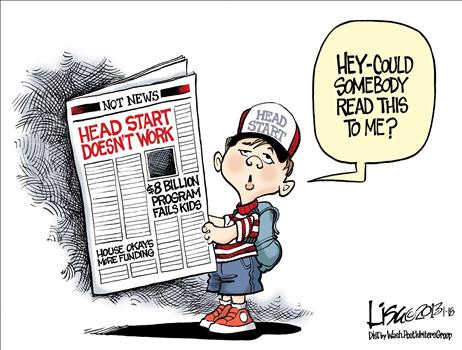
Head Start CartoonHere’s what the Washington Examiner wrote about the program, starting with an explanation of what the program is supposed to accomplish.

There are few institutions more sacrosanct in Washington than President Johnson’s Head Start program. The federal government spent more than $7.9 billion on the program in 2012 alone to provide preschool services for nearly 1 million low-income Americans. The program represents everything that is supposedly great about the liberal welfare state. It redistributes resources from wealthy to poor. It uses the power of the federal government to combat inequality by giving poor and minority students an educational boost before they fall behind their wealthier peers. There’s just one problem: It doesn’t work.

Is that an empty assertion? Nope, it’s the evidence from the government’s own research.

The ongoing randomized study of Head Start was based on a nationally representative sample of 5,000 children who applied for the program in 2002. Approximately half of the subjects received Head Start services, while the other half did not. The students were then tested on their language, literacy, math and school performance skills. …the 2010 Head Start Impact Study report notes, “the benefits of access to Head Start at age four are largely absent by 1st grade for the program population as a whole.” Specifically, the language, literacy, math and school performance skills of the Head Start children all failed to improve. …Now, the HHS has finally published a follow-up to its 2010 study that follows the same children through the end of third grade. And again, the HHS has concluded that Head Start is ineffective, concluding that Heat Start resulted in “very few impacts … in any of the four domains of cognitive, social-emotional, health and parenting practices.” And those impacts that were found “did not show a clear pattern of favorable or unfavorable impacts for children.”

So what’s this costing the nation (above and beyond the failure to improve the lives of children)?

Since 1965, the federal government has spent $180 billion on Head Start. …Does that sound like a program you’d want to spend $8 billion on next year?

Now imagine the good things that would have happened if that money was left in the economy’s productive sector.

Or, if you like government, but at least want good results, imagine the good things that would have happened if state and local governments shifted $180 billion from the failed school monopoly into genuine school choice programs.

But let’s close on an optimistic note. As far as I know, there’s no evidence that Head Start actually damages children. It’s just wasted money.

That’s a much better track record than other welfare state programs.

Related posts:

Milton Friedman’s views on vouchers have not been tried?

On the Arkansas Times Blog the person using the username “Jake da Snake” noted, “Friedman also railed long and hard for school vouchers to be adopted, to little avail…” (June 11, 2011). Milton Friedman firmly believed, “competition is a way in which both public and private schools can be required to satisfy their customers.” Here […]

Listing of transcripts and videos of Free to Choose by Milton Friedman: Episode “What is wrong with our schools?” on www.theDailyHatch.org

Everywhere school vouchers have been tried they have been met with great success. Why do you think President Obama got rid of them in Washington D.C.? It was a political disaster for him because the school unions had always opposed them and their success made Obama’s allies look bad. In 1980 when I first sat […]

The Welfare trap can be destroyed by Milton Friedman’s negative income tax

The best way to destroy the welfare trap is to put in Milton Friedman’s negative income tax. A Picture of How Redistribution Programs Trap the Less Fortunate in Lives of Dependency I wrote last year about the way in which welfare programs lead to very high implicit marginal tax rates on low-income people. More specifically, they […]

Listing of transcripts and videos of Free to Choose by Milton Friedman: Episode “What is wrong with our schools?” on www.theDailyHatch.org

Everywhere school vouchers have been tried they have been met with great success. Why do you think President Obama got rid of them in Washington D.C.? It was a political disaster for him because the school unions had always opposed them and their success made Obama’s allies look bad. In 1980 when I first sat […]

Dear Senator Pryor, why not pass the Balanced Budget Amendment? (“Thirsty Thursday”, Open letter to Senator Pryor, quotes Milton Friedman)

Broun Introduces Balanced Budget Amendment Uploaded by RepPaulBroun on Feb 23, 2010 No description available. _______________ Dear Senator Pryor, Why not pass the Balanced  Budget Amendment? As you know that federal deficit is at all time high (1.6 trillion deficit with revenues of 2.2 trillion and spending at 3.8 trillion). On my blog http://www.HaltingArkansasLiberalswithTruth.com I took […]

Listing of transcripts and videos of Free to Choose by Milton Friedman: Episode “What is wrong with our schools?” on www.theDailyHatch.org

Everywhere school vouchers have been tried they have been met with great success. Why do you think President Obama got rid of them in Washington D.C.? It was a political disaster for him because the school unions had always opposed them and their success made Obama’s allies look bad. In 1980 when I first sat […]

 

We got to cut spending and stop raising the debt ceiling!!!


We got to cut spending and stop raising the debt ceiling!!!

When Governments Cut Spending

Uploaded on Sep 28, 2011

Do governments ever cut spending? According to Dr. Stephen Davies, there are historical examples of government spending cuts in Canada, New Zealand, Sweden, and America. In these cases, despite popular belief, the government spending cuts did not cause economic stagnation. In fact, the spending cuts often accelerated economic growth by freeing up resources for the private sector.

_______________

I just don’t understand why we have to run our private budgets on a balanced basis but the federal government does not!!!

As part of the silly budget debate in Washington, President Obama is claiming that an increase in the debt limit wouldn’t authorize higher spending.

That’s technically true, but it sure would enable higher spending.

This Chuck Asay cartoon offers an amusing perspective on the battle.

Asay Debt Limit Bills Cartoon

In the interest of accuracy, however, it should show President Bush having already gone through the checkout line with an equally big cart full of handouts.

After all, government spending imposes a heavy cost on the economy regardless of whether Republicans or Democrats are the ones in charge of policy.

Gun control posters from Dan Mitchell’s blog Part 1

I have put up lots of cartons and posters from Dan Mitchell’s blog before and they have got lots of hits before. Many of them have dealt with the economy, eternal unemployment benefits, socialism,  Greece,  welfare state or on gun control.

On 2-6-13 the Arkansas Times Blogger “Sound Policy” suggested,  “All churches that wish to allow concealed weapons may post signs to that effect at all entrances.”

I responded:

I suggest that all churches that don’t allow conceal weapons should post signs that say, “GUN FREE ZONE: In case of emergency  crawl to nearest exit. If help is delayed in arriving, kiss your defenseless butt good-bye. If you survive then maybe this will at least help your prayer life!!!”

The problem of course is that criminals are using strong young males who can over power people. Therefore, if we lived in a perfect gun free world the criminal would still have the advantage. The reality is that under strict gun control it will be only the honest people who surrender the weapons and not the criminals.

I have collected several of these funny gun posters from Dan Mitchell’s blog and here they are below:

I’ve shared a very clever Chuck Asay cartoon about gun-free zones, so let’s now enjoy four posters on the topic.

Let’s begin with a good jab at one of the anti-Second Amendment groups.

But remember the serious point. If you’re a bad guy and know that a potential victim is sure to be unarmed, does that make you happy or sad?

I realize that an anti-gun zealot will respond by arguing that they want a world where the thugs and crooks also will be disarmed, but how likely is it that such people will turn in their weapons? In any event, most criminals are young men and potential victims need guns to compensate for the inability to match the physical strength of their attackers.

Next let’s look at a poster showing the kind of instructions that statists such as Mayor Bloomberg should post in public places.

These clowns expect us to have blind faith in the ability of public authorities, but the odds of a cop being immediately available when trouble strikes are almost nonexistent.

Here’s a poster that captures the blind naiveté of anti-gun activists. I don’t think I need to add any commentary.

Last but not least, here’s a sign that all anti-gun leftists – assuming they have the courage to publicly celebrate their beliefs – should post outside their homes.

If you enjoy these posters, you can view previous editions here, hereherehere, and here.

Related posts:

Taking on Ark Times bloggers on the issue of “gun control” (Part 3) “Did Hitler advocate gun control?”

Gun Free Zones???? Stalin and gun control On 1-31-13 ”Arkie” on the Arkansas Times Blog the following: “Remember that the biggest gun control advocate was Hitler and every other tyrant that every lived.” Except that under Hitler, Germany liberalized its gun control laws. __________ After reading the link  from Wikipedia that Arkie provided then I responded: […]

Taking on Ark Times bloggers on the issue of “gun control” (Part 2) “Did Hitler advocate gun control?”

On 1-31-13 I posted on the Arkansas Times Blog the following: I like the poster of the lady holding the rifle and next to her are these words: I am compensating for being smaller and weaker than more violent criminals. __________ Then I gave a link to this poster below: On 1-31-13 also I posted […]

Taking on Ark Times bloggers on the issue of “gun control” (Part 1) “Bill Clinton responsible some for Ft Hood gun control policy?”

Will “CARRYING HANDGUN IS PROHIBITED” poster work? Dan Mitchell of the Cato Institute on gun control On 1-13-13 on the Arkansas Times Blog the person with the username “ArkDemocrat” stated, “I visited a church in another state that allows guns, and there was a sign similar to the “No Smoking” signs (i.e. smoking cigarette with […]

Great gun control posters from Dan Mitchell’s blog

Poster for November 2008 benefit for Pressly family, held at Peabody Hotel in Little Rock. ______________ Max Brantley of the Ark Times Blog often attacks those on my side of the gun control debate and that makes me argue even harder for the 2nd amendment. Several months ago Lindsey Miller and Max Brantley were talking […]

Funny gun control posters!!!

I have posted some cartoons featured on Dan Mitchell’s blog before and they are very funny. An Amusing Look at Gun-Free Zones September 26, 2012 by Dan Mitchell I’ve shared a very clever Chuck Asay cartoon about gun-free zones, so let’s now enjoy four posters on the topic. Let’s begin with a good jab at one […]

There is no safety crisis in schools as far as mass shootings go!!!

The recent killing by a mad gunman in CT is not indicating a trend. School killings have gone down and probably peaked in 1929. Nick Gillespie reported in the below video, “Across the board, schools are less dangerous than they used be. Over the past 20 years, the rate of theft per 1,000 students dropped […]

The Atlantic’s Jeffrey Goldberg abandons his liberal friends on gun control.

Pretty shocking admissions from the liberal Jeffrey Goldberg on gun control. An Honest Liberal Writes about Gun Control December 16, 2012 by Dan Mitchell I wrote earlier this month about an honest liberal who acknowledged the problems created by government dependency. Well, it happened again. First, some background. Like every other decent person, I was horrified […]

Gun control does not make since unless you suspend your reasoning ability

Despite what Max Brantley of the Arkansas Times Blog (1-9-13) would have you believe gun control does not make since unless you suspend your reasoning ability. There are so many examples that show how silly gun control is. Mocking Gun Control Fanatics October 18, 2012 by Dan Mitchell Last month, I shared some very amusing images […]

Gun control arguments very logical?

It seems to me that most of the gun control arguments I have heard are not very logical. Deciphering How Statists Think about Gun Control September 9, 2012 by Dan Mitchell Even though I don’t own that many guns, I’m an unyielding supporter of the 2nd Amendment. Indeed, I use gun control as a quick and […]

Charlie Collins versus Max Brantley on Gun Control

John Stossel report “Myth: Gun Control Reduces Crime After this horrible shooting in the school the other day it seems the gun control debate has fired up again.  Max Brantley of the Arkansas Times jumped on Charlie Collins concerning his position on concealed weapons but I think that would lower gun crimes and not raise […]

Our nation is becoming a nation of takers when it used to be mainly makers!!!!!

We got to stop becoming a nation of takers.

Obama’s Vision of a Nation of Takers

January 25, 2013 by Dan Mitchell

If you don’t want to be depressed, you should stop reading right now.

You probably know that we’ve been suffering because of a rising burden of government spending. And you probably understand that much of the problem is the relentless growth of redistribution and transfer programs.

But you probably don’t realize how far America has traveled in the wrong direction.

In today’s Wall Street Journal, Nicholas Eberstadt of the American Enterprise Institute rips apart President Obama’s empty assertion that the welfare state is desirable.

…the president is tired of listening to critics of America’s entitlement programs, and as far as he is concerned, the discussion is now over. It is not over—and won’t be anytime soon, because the country’s social-welfare spending is generating severe and mounting hazards for the nation. These hazards are not only fiscal but moral.

Eberstadt shares a bunch of bullet points that should worry anybody who cares about the future of the nation, starting with an inverse version of Mitchell’s Golden Rule. Handouts have been growing twice as fast as overall personal income!

• Over the 50-plus years since 1960, according to the Bureau of Economic Analysis, entitlement transfers—government payments of cash, goods and services to citizens—have been growing twice as fast as overall personal income. Government transfers now account for nearly 18% of all personal income in America—up from 6% in 1960.

• According to the BEA, America’s myriad social-welfare programs (the federal bureaucracy apparently cannot determine exactly how many of these there are) currently dispense entitlement benefits of more than $2.3 trillion annually. Since those entitlements must be paid for—either through taxes or borrowing—the burden of entitlement spending now amounts to over $7,400 per American man, woman and child.

The $7400 figure for per-capita redistribution burden is astounding. Others have calculated that this is akin to $60,000 for every poor household.

Dependency Burden 49 percentAnd even though I’ve written about the 49 percent figure, I had no idea that such a small portion was due to the aging population.

• According to the latest data from the U.S. Census Bureau, nearly half (49%) of Americans today live in homes receiving one or more government transfer benefits. That percentage is up almost 20 points from the early 1980s. And contrary to what the Obama White House team suggested during the election campaign, this leap is not due to the aging of the population. In fact, only about one-tenth of the increase is due to upticks in old-age pensions and health-care programs for seniors.

A big problem is that many working-age people have decided not to work.

• As entitlement outlays have risen, there has been flight of men from the work force. According to the Bureau of Labor Statistics, the proportion of adult men 20 and older working or seeking work dropped by 13 percentage points between 1948 and 2008. …In December 2012, more than 8.8 million working-age men and women took such disability payments from the government—nearly three times as many as in December 1990. For every 17 people in the labor force, there is now one recipient of Social Security disability program payments.

The solution, of course, is entitlement reform.

But that’s just part of the answer. We also need to change the culture. If people decide it is okay to live off the government, even leftists have begun to admit that it is very hard to re-create a system of self reliance.

If you encourage people to stay home and be lazy then they will be

Real Time with Bill Maher March 16 2012 – Alexandra Pelosi Interviews Welfare Recipients in NYC

Published on Mar 18, 2012 by

Real Time with Bill Maher March 16 2012 – Alexandra Pelosi Interviews Welfare Recipients

____________

If you encourage people to stay home and be lazy then they will be.

The welfare state creates some amazingly pathetic and disgusting individuals.

But I’ve never found a match for Olga, a Greek woman who thinks it is government’s job to take care of her from cradle to grave.

At least not until now. I’m excited to announce that Olga has a soulmate named Natalija. She’s from Lithuania, but she now lives in England, and she doubtlessly will inspire Olga on how to live off the state.

UK Welfare Horror StoryHere’s some of what The Sun reported about this very successful moocher.

Natalija Belova, 33, told The Sun how she spurns full-time work — yet can afford foreign holidays and buys designer clothes. The Lithuanian said: “British benefits give me and my daughter a good life.” She has milked soft-touch Britain for £50,000 in benefits and yesterday said: “I simply take what is given to me.”

And what is given to her? Quite a lot.

The graduate, who became a single mum after she arrived here, rakes in more than £1,000 a month in handouts — £14,508 a year — to fund her love of designer clothes, jaunts to the Spanish sun and nightclubbing. She bragged: “I have a lovely, fully-furnished flat and money to live properly on. …Her handouts total £279 a week — with housing benefit contributing £183, child tax credit adding £56, child benefit £20 and her council tax being paid to the tune of £20.

UK Welfare HandoutsYou might expect Natalija to be grateful, but you’d be wrong.

But she does have one criticism. Natalija moaned: “I think they should help pay for private nannies, rather than just free nursery.” …Natalija vowed: “I am not going to work like a dog on minimum wage.” She added: “I don’t care what anyone thinks. I’m not doing anything wrong. “I know people won’t like to read this, but what would they do? “Would they not take the money that was being handed to them to stay with their child all day?”

I’ve written about the benefits of tax competition between nations. Well, this story shows the perverse impact of welfare competition between countries.

Speaking at her two-bedroom pad that came fully furnished in Watford, Herts, courtesy of the taxpayer, grateful Natalija said: “In Lithuania the benefits system does not pay enough. “I have a friend over there who is a single mother. “She only gets £20 a month in child benefit, plus some discounted help with gas and electricity — and some housing help. “It’s not enough to keep a normal level of life, like here. “If I was on benefits there, I couldn’t afford nice clothes or the holidays abroad.” She went on: “I am sure people will say I should return to Lithuania. But that won’t be happening. Being in Britain offers me far better benefits.”

We also have a remarkable example of labor supply economics. This is the real-world example of these charts showing how the British welfare state destroys incentives.

She is careful to work fewer than 16 hours a week so that the benefits keep rolling in. But her wages boost her income to more than £400 a week. On top of that she gets free childcare, fruit and milk vouchers — and even a clothes allowance for “job interviews”. Natalija said: “It is a strange system in this country. Basically, the fewer hours I work, the more I can earn on benefits. But that’s the way it is and it is not my fault.” …She insisted she would be prepared to get a full-time job — but only if the salary tops £25,000. …”Some people may think I am picky. But I am a realist. I need a full-time job that pays at least £25,000 — that is just enough to cover all my living costs that benefits currently pay for. “Otherwise working full time is not worth my while. “If I worked full time, I’d have to pay for childcare costs as well as rent and all my bills. “The benefits system in this country means that I do not have to do this.”

By the way, here’s a chart showing the same destructive policies in the United States.

Let’s look at one last excerpt about Natalija. British taxpayers can take comfort in the fact that this human tick is living a nice life.

In September she escaped the dreary British summer by jetting off with her daughter for a sun-kissed week in Spain. Last month she enjoyed a second holiday — back in her Lithuanian homeland. Natalija, who has three credit cards and loves to go on sprees at designer clothes stores, crowed: “After our holiday to Malaga, we went to Lithuania over Christmas and spent £1,000.” She continued: “I love to buy clothes on my credit cards and often have a blow-out at stores like Roberto Cavalli and the Armani Exchange. …”I also enjoy going to nightclubs and parties with my friends. It’s important to go out and get dressed up. It’s good for my self-esteem.”

Her self esteem has been boosted? Oh, joy!

And I can just imagine how much self esteem her daughter will have after growing up with a moocher for a mother.

John Hinderaker of Powerline was first on this horrific story and his analysis is very much worth reading as well. But since imitation is the sincerest form of flattery, I figured I would share the story and add some of my thoughts.

By the way, if you want more than just horrifying anecdotes, click here for a video that looks at the dismal impact of the American welfare state and click here to see how Obama has exacerbated the negative effects of such policies in America.

Open letter to President Obama (Part 227)

Milton Friedman – Socialism is Force

Uploaded by on May 21, 2010

Milton Friedman discusses the moral values encouraged by economic systems and explains that a primary difference between capitalism and socialism is the difference between free choice and compulsory force.


________________

President Obama c/o The White House
1600 Pennsylvania Avenue NW
Washington, DC 20500

Dear Mr. President,

I know that you receive 20,000 letters a day and that you actually read 10 of them every day. I really do respect you for trying to get a pulse on what is going on out here.

Do we want freedom or may we don’t?  It seems to me those who want more of our private money to be given over to government control are limiting our freedom greatly.

Every so often, you read something so ridiculously stupid and absurd that you assume that you’re being pranked. So you look to the date of the article to see if it says April 1. Or you look at the Internet address to see if it’s a parody of a real website.

So when I read a column suggesting that the United States should become more like Italy, I thought this must be some sort of practical joke. After all, Italy is teetering on the edge of bankruptcy, kept afloat by bailouts and subsidies. Its economy is in the toilet, with pervasively high unemployment, almost no growth for a decade, and living standards that are only about two-thirds of U.S. levels.

The Italian government is also famously incompetent (naming the wrong people to high-level posts), with stifling levels of regulation, a dysfunctional fiscal system, and a corrupt legal system (and when it’s not crooked, it’s inane).

Notwithstanding all these crippling flaws, Italy has something akin to catnip for the left. It has a punitive tax burden, and that means it must be a nation worth emulating.

Here’s some of what Eduardo Porter wrote for the New York Times.

Italy may be in a funk, with a shrinking economy and a high unemployment rate, but the United States can learn a lot from it, and not just about the benefits of public health care. Italians live longer. Their poverty rate is much lower than ours. If they lose their jobs or suffer some other misfortune, they can turn to a more generous social safety net. …The reason is not difficult to figure out: rich though we are, we can’t afford the policies needed to improve our record. …But though the nation’s fiscal challenge has taken center stage in the presidential election campaign, raising more taxes from American families remains stubbornly off the table.

I’m willing to believe Italians live longer, but every other assertion in that passage is upside down. Yes, they have more subsidies for joblessness, but that’s one of the reasons they have higher unemployment (as even Paul Krugman and Larry Summers have acknowledged).

And the claim about less poverty is laughable. I’m guessing the author naively relied upon the slipshod analysis from the statists at the Organization for Economic Cooperation and Development. Those bureaucrats put together a moving-goalposts measure of income distribution and falsely categorized it as a tool for measuring poverty.

Setting aside these mistakes, the column is designed to convince people that we should give more money to Washington.

Citizens of most industrial countries have demanded more public services as they have become richer. And they have been by and large willing to pay more taxes to finance them. Since 1965, tax revenue raised by governments in the developed world have risen to 34 percent of their gross domestic product from 25 percent, on average. The big exception has been the United States. …the United States raises less tax revenue, as a share of the economy, than every other industrial country. No wonder we can’t afford to keep more children alive. In 2007, the most recent year for which figures are available, the United States government spent about 16 percent of its output on social programs — things like public health, food and housing for the poor. In Italy, that figure was 25 percent. …Every other industrial country has a national consumption tax, which can be used to raise a lot of money.

I will give the author credit. If you read the entire column, it’s clear he wants all Americans to pay higher taxes, not just the so-called rich. So at least he’s being honest, unlike a lot of statists (click here for a list of honest leftists who admit you can’t finance big government without screwing the middle class).

But honesty about goals doesn’t mean desirability of policy. If America becomes more like Italy, it will mean Italian-style stagnation and joblessness.

And it’s particularly worrisome to see that the author wants a value-added tax, which is a sure-fire way of giving politicians a big pile of money that will be used to expand the burden of government spending.

I have nothing against copying other nations, either when they get one policy right (such as Estonia’s flat tax or Australia’s system of personal retirement accounts), or when they get a bunch of policies right and routinely rank at the top for economic freedom and prosperity (such as Hong Kong and Singapore).

But I’m mystified by those who look at failure and conclude America should do likewise.

P.S. The Italians have a bad tax system, but they don’t meekly comply. Whether they’re firebombing tax offices or sailing yachts to other countries, they are a powerful example of the Laffer Curve insight that higher tax rates don’t necessarily translate into higher tax revenues.

_________

Thank you so much for your time. I know how valuable it is. I also appreciate the fine family that you have and your commitment as a father and a husband.

Sincerely,

Everette Hatcher III, 13900 Cottontail Lane, Alexander, AR 72002, ph 501-920-5733, lowcostsqueegees@yahoo.com

Related posts:

Open letter to President Obama (Part 201)Tea Party favorite Representative links article “Prescott and Ohanian: Taxes Are Much Higher Than You Think”

    (Emailed to White House on 12-21-12.) President Obama c/o The White House 1600 Pennsylvania Avenue NW Washington, DC 20500 Dear Mr. President, I know that you receive 20,000 letters a day and that you actually read 10 of them every day. I really do respect you for trying to get a pulse on […]

Open letter to President Obama (Part 200.2)Tea Party Republican Representative takes on the President concerning fiscal cliff

(Emailed to White House on 12-21-12.) President Obama c/o The White House 1600 Pennsylvania Avenue NW Washington, DC 20500 Dear Mr. President, I know that you receive 20,000 letters a day and that you actually read 10 of them every day. I really do respect you for trying to get a pulse on what is […]

Open letter to President Obama (Part 200.1)Tea Party favorite Representative shares link on facebook

 (Emailed to White House on 12-21-12) President Obama c/o The White House 1600 Pennsylvania Avenue NW Washington, DC 20500 Dear Mr. President, I know that you receive 20,000 letters a day and that you actually read 10 of them every day. I really do respect you for trying to get a pulse on what is […]

Open letter to President Obama (Part 199) Tea Party favorite takes on President

  The federal government has a spending problem and Milton Friedman came up with the negative income tax to help poor people get out of the welfare trap. It seems that the government screws up about everything. Then why is President Obama wanting more taxes? _______________ Milton Friedman – The Negative Income Tax Published on […]

Tea Party Heroes Rep. David Schweikert (R-AZ),Justin Amash (R-MI), Tim Huelskamp (R-KS) have been punished by Boehner

I was sad to read that the Speaker John Boehner has been involved in punishing tea  party republicans. Actually I have written letters to several of these same tea party heroes telling them that I have emailed Boehner encouraging him to listen to them. Rep. David Schweikert (R-AZ),Justin Amash (R-MI), and Tim Huelskamp (R-KS). have been contacted […]

Some Tea Party heroes (Part 10)

Michael Tanner of the Cato Institute in his article, “Hitting the Ceiling,” National Review Online, March 7, 2012 noted: After all, despite all the sturm und drang about spending cuts as part of last year’s debt-ceiling deal, federal spending not only increased from 2011 to 2012, it rose faster than inflation and population growth combined. […]


Bailouts are legal corruption

There is no free money out there. Somebody has to always pay.

Bailout Nation

January 13, 2013 by Dan Mitchell

I have a serious question for readers. What’s worse, bailouts for government or bailouts for the private sector?

Yes, both are bad, but is it worse to bail out a bankrupt entitlement program, such as Social Security, or it is worse to bail out an industry, such as the financial sector?

Bailout gravy train cartoonTo bail out the housing sector, or to bail out Medicare? Fannie and Freddie, or GM and Chrysler?

All these examples involve huge amounts of money, and both private-sector and public-sector bailouts have perverse long-run effects, but which is worse?

And don’t forget there are lots of other bailouts in our future, as discussed on this interview for Fox Business News.

The interview took place before Christmas, but the topic is even more relevant today since the budget season is about to begin.

Most of the discussion was about government agencies and programs that may get more handouts, though bailouts for the Federal Housing Administration and the Pension Benefit Guaranty Corporation would be indirect bailouts for big business and housing.

So we’d get the worst of all worlds, more government spending and more cronyism.

Or, as they call it in Washington, a win-win situation.

But I call it legal corruption.

What was most tragic policy development of 2012 in USA?

Not much accomplished in the area of liberty and freedom in the USA in 2012. If the founding fathers were here today that would be horrified that their idea of limited government had been transformed into what the federal government is today.

I’m not sure I could pick out a significant victory for human freedom in 2012.

Maybe I’m missing something, but the only good policy that’s even worth mentioning was the decision in Wisconsin to rein in the special privileges and excessive compensation for government workers.

But there definitely have been lots of sad developments.

The hard part is picking the most disappointing story.

1. Was it the craven decision by John Roberts to put politics before the Constitution and cast the deciding vote for Obamacare? This certainly could be the most disappointing event of the year, but technically it didn’t represent a step in the wrong direction since the Supreme Court basically gave a green light to unlimited federal power back in the 1930s and 1940s. The Obamacare case is best characterized as a failure to do the right thing. A very tragic decision, to be sure, but it maintained the status quo.

2. Was it the lawless decision by the Internal Revenue Service to impose a horrible regulation that forces American banks to put foreign law above U.S. law? This was a very bad development in the battle for tax competition, financial privacy, and fiscal sovereignty. But in the grand scheme of things, it’s just another in a long line of policies (such as FATCA) designed to increase the power of governments to impose and enforce bad tax policy.

3. Was it the Japanese government’s decision to double the value-added tax? I’m definitely not a fan of adding a VAT on top of the income tax, but Japan made that mistake years ago. The choice to increase the tax rate just shows why it’s dangerous to give politicians any new source of revenue. So this isn’t the worst policy development of 2012, particularly since the new Japanese government may suspend the tax hike.

4. Was it the delusional decision by 54 percent of California voters to impose a big, class-warfare tax hike? I thought the vote for Prop 30 was a very troubling development since it signaled that voters could be tricked into enacting class-warfare tax policy, even though they should have realized that more revenue for the state’s politicians would simply exacerbate the eventual fiscal collapse. But since I think this will be a learning experience on what not to do, I can’t put this at the top of my list.

5. Was it the French government’s punitive decision to impose a 75-percent top tax rate? This is a spectacularly misguided policy, and it’s already resulting in an exodus of entrepreneurs and other successful people. But just as I enjoy have California as a negative role model, I like using France as an example of bad policy. So it would be a bit hypocritical for me to list this as the worst policy of 2012.

6. Or was it the envy-motivated decisions by politicians in both Slovakia and the Czech Republic to replace flat tax systems with so-called progressive tax regimes? This is a strong candidate for the worst policy of the year. It’s very rare to see governments do the right thing, so it’s really tragic when politicians implement good reforms and later decide to reinstate class-warfare policies.

All things considered, I think this last option is the worst policy development of 2012. To be sure, I’m a bit biased since my work focuses on public finance issues and I’ve spent 20 years advocating for tax reform.

But I think there’s a strong case to be made, by anyone who believes in freedom, that politicians from Slovakia and the Czech Republic deserve the booby prize for worst public policy development of 2012.

Alvin Rabushka, sometimes referred to as the Father of the Flat Tax , summarizes the grim news.

On December 4, 2013, the center-left parliament of Slovakia modified the country’s historic 19% flat-rate tax…  Effective January 1, 2013, the income tax rate for corporations was raised from 19% to 23%, while that on individuals earning more than €39,600 (€1=$1.30) a year was raised to 25%, thereby creating two brackets of 19% and 25%. …On November 7, 2012, the lower house (Chamber of Deputies) of the national parliament approved a proposal to impose a second higher rate of 22% on annual income exceeding Czech Koruna (CZK) 100,000 ($5,200) per month.  President Vaclav Klaus signed the bill on December 22, 2012, which will take effect on January 1, 2013.

What’s especially depressing about these two defeats is that the supposedly right-wing parties deserve the blame.

Two nations filled with brain-dead conservative politicians

In Slovakia, all but one of the right-leaning parties in the old government decided to support the Greek bailout, leading to the collapse of the government and the election of a new socialist government that then sabotaged tax reform.

And in the Czech Republic, the current right-of-center government decided to scrap the flat tax for “fairness” reasons. I’m sure that will really be comforting to the Czech people as the economy suffers from less growth.

To understand what the people of those nations are losing, here’s my video on the flat tax.

Now for a bit of good news. There are still more than 25 flat tax jurisdictions in the world, including two of my favorite places – Hong Kong and Estonia.

So there are still some pockets of rationality. It’s just very unfortunate that the scope of human liberty is getting smaller every year.

P.S. The absolute worst thing that happened in 2012, if we look beyond public policy, was Georgia falling 4 yards short of beating Alabama in the Southeastern Conference Championship.

P.P.S. Speaking of sports, the best thing about 2012 occurred in Virginia Beach back in October.

The death tax discourages saving and investing

The death tax discourages saving and investing.

Just before the end of the year, I shared some fascinating research about people dying quicker or living longer when there are changes in the death tax. Sort of the ultimate Laffer Curve response, particularly if it’s the former.

But the more serious point is that the death tax shouldn’t exist at all, as I’ve explained for USA Today. And in this CNBC debate, I argue that it is an immoral form of double taxation.

You’ll see that Jared sneakily tries to include wealth taxes and death taxes together in order to accuse me of an inaccuracy, but the chart (click to enlarge) clearly shows that there are many jurisdictions that wisely avoid this anti-competitive levy.

The data is a few years old, but it’s clear that the United states has one of the most punitive death tax systems in the world.

Unfortunately, this is a good description of many parts of our tax system. We also have the world’s highest corporate tax rate and we also have very high tax burdens on dividends and capital gains (and the tax rates on both just got worse thanks to the fiscal cliff legislation).

But probably the key difference between us is that Jared genuinely thinks government should be bigger and that the tax burden should be much higher.

Though I will give him credit. Not only does he want class-warfare tax hikes, such as a higher death tax, but he openly admits he wants to rape and pillage the middle class as well.

Not surprisingly, I argue that more revenue in Washington will exacerbate the real problem of a federal government that is too big and spending too much.

P.S. Here’s a cartoon that is only funny if you don’t think too deeply about what it means.

P.P.S. You’ll notice that the video in this post has good quality, unlike the fuzzy resolution and discontinuous footage in clips I’ve recently shared. That’s because Cato’s expert on such things is back in the office and we’re no longer relying on my sub-par technical knowledge.

Is the no new tax pledge going to work?

Milton and Rose Friedman with President Bush.

Milton Friedman on Donahue 1979 (2/5)

I believe the “no new tax pledge” ultimately will work. Milton Friedman believed we should starve the beast and that is good enough for me. “If taxes are raised in order to keep down the deficit, the result is likely to be a higher norm for government spending.” Milton Friedman

There’s a debate among policy wonks about whether a no-tax-hike policy is an effective way of restraining the burden of government spending.

At the risk of over-simplifying, the folks who support the “starve the beast” theory argue that there are political and/or economic limits to government borrowing, so if you don’t let politicians tax more, you indirectly impose a cap on total spending (outlays = tax revenue + borrowing limit). We’ll call this the STB approach, for obvious reasons.

Critics of the theory, by contrast, say that a low-tax policy creates fiscal illusion by making government spending seem artificially cheap. After all, standard microeconomic analysis tells us that people will demand more of something when the perceived price is low (get a $1 of spending for 80 cents of tax = recipe for higher outlays). We’ll call this the “pay for government” approach, or PFG.

There’s almost surely some truth to both arguments, but the real issue if whether one effect is dominant – particularly in the long run. In other words, should supporters of small government fight tax increases? Or welcome them?

I’ve never studied this issue, but my gut instinct has been on the “STB” side of the debate. Here are a few of the reasons.

  1. The politicians and interest groups that favor bigger government seem especially anxious to convince anti-tax lawmakers to change their minds. If nothing else, that suggests higher taxes would “feed the beast.” I suppose this could be a clever example of reverse psychology, but something tells me that Harry Reid and Nancy Pelosi lack the cleverness and subtlety to pull off that kind of trick.
  2. The people who pay for government generally aren’t the ones who reap the benefits. And if you keep increasing taxes on the “rich,” as Obama proposes, why would that affect the preferences of the rest of the population? Especially the huge chunk of the population that doesn’t pay income tax? Simply stated, the PFG approach incorrectly assumes that payers and payees are the same.
  3. Casual empiricism certainly suggests that higher taxes are associated with more government, not less red ink. We see this, for instance, in the evidence I recently shared from Europe. Taxes have jumped in recent decades, but government debt also has climbed, which implies all additional revenue was spent, and then some.
  4. Just look at the real world, specifically the fiscal crisis in nations such as Greece. At the risk of stating the obvious, the recent events in Europe confirm that there does come a point when governments lose the ability to borrow. So if taxpayers somehow can prevent politicians from seizing more money, there is a de facto limit on government spending.

Seems like the STB approach makes sense, but not everyone thinks my theoretical musings and generic observations are all that’s needed to settle an argument.

Particularly when there are some very sensible people on the other side. The late Bill Niskanen wrote in the 2006 Cato Journal that:

There are three major problems with the starve-the-beast argument: (1) it is not a plausible economic theory; (2) it is inconsistent with the facts; and (3) it has diverted attention away from the political reforms needed to limit government growth.

I fully agree with Bill that there should be much more focus on restraining the growth of government, so there’s no disagreement on his third point. I think he’s wrong on the first point because half the population no longer pays federal income tax and the top 20 percent pay the lion’s share, but that’s a bit of a judgment call.

What about the facts? Bill does some regression analysis for the 1949-2005 period, where he looks at the change in federal spending as a share of GDP and tests its relationship with the level of tax receipts as a share of GDP, the change in the unemployment rate, and the change in interest payments (the latter two variables are there to hopefully wash out the effects of the business cycle and to limit the analysis to the spending that lawmakers actually can control).

Bill crunches the numbers and concludes:

For no extended period did these estimates reveal a significant positive relation between the change in federal spending as a percent of GDP and the level of federal receipts as a percent of GDP, the necessary condition for the starve-the-beast hypothesis to be confirmed.

Moreover, Bill even found evidence for the PFG approach when he looked solely at the 1981-2005 period.

A 1 percentage point increase in current federal receipts as a share of GDP apparently reduces the change in current federal spending as a share of GDP by about one-seventh of 1 percent a year indefinitely.

I don’t doubt that Bill’s numbers are sound. Indeed, Cato Adjunct Scholar Michael New re-crunched the numbers for the Cato Journal in 2009 and produced similar findings, even when looking only at non-defense discretionary spending.

But I don’t find this research very compelling, and it’s not just because I’m from Austrian school, which sometimes has a reputation for being skeptical about empirical analysis.

Here are some reasons why I’m not convinced, and even the biggest quant jocks in the world should share these concerns.

  1. Is 57 years of data (1949-2005) or 25 years of data (1981-2005) really enough to draw any sweeping conclusions, particularly when there could be many other factors involved? We would be very reluctant to jump to conclusions about the demand for Big Macs by interviewing a handful of customers and looking at just three variables.
  2. More important, why didn’t Bill measure changes in spending against legislated tax changes? After all, lawmakers rarely pay attention to tax receipts as a share of GDP, and that variable rarely if ever is part of the lawmaking process. But politicians are acutely aware of whether they are voting to either reduce taxes or increase them.
  3. And why use spending as a share of GDP rather than nominal spending or inflation-adjusted spending, particularly since Congress votes to spend specific amounts of money, not for outlays as a percent of economic output.
  4. Equally perplexing, why didn’t Bill include lags in his research? I’m not aware of any STB proponents who claim that there’s an instantaneous impact. Instead, they argue that long-term limits on revenue can impose long-run restraints on spending.

To be fair, Bill was breaking some new ground. There was not a lot of empirical analysis to that point, so there was no right or wrong way to test the relationship between taxing and spending. Niskanen picked one approach, and it’s the role of subsequent researchers to poke and prod the results and contemplate alternatives.

That’s exactly what Christina Romer and David Romer did in their article that appeared in the 2009 Brookings Papers on Economic Activity. They investigated the data from several angles and decided it made the most sense to look at legislated tax changes and look at the long-run impact on spending. And, in an attempt to test the STB hypothesis, they looked solely at major tax bills designed to reduce government revenue.

That’s the good news. The bad news is that this gave them only four pieces of data – the Revenue Act of 1948, the Kennedy tax cuts, the Reagan tax cuts, and the 2001/2003 Bush tax cuts.

Setting aside this problem of limited data, what did Romer and Romer discover? Their headline results were similar to Niskanen’s.

The results provide no support for the hypothesis that tax cuts restrain government spending.

That sounds like bad news for STB advocates. But if you dig into their findings, you find out that the real problem is that politicians can’t resist the temptation to feed the beast.

…roughly three-quarters of a long-run tax cut is typically undone by legislated tax increases of various sorts within five years. …The fact that policymakers have been able to largely reverse tax cuts helps to explain why the cuts have not reduced spending.

In other words, you can’t starve the beast if you don’t maintain the diet.

Which is basically what other economists concluded when analyzing the work of Romer and Romer. Here’s what Steven Davis of the University of Chicago wrote.

…if it takes 5 years for a new policymaker to reverse a previous tax cut, so that it remains in effect for 10 years rather than 5, the starve-thebeast effect roughly doubles. In the extreme case where tax cuts cannot be reversed, government spending cuts must eventually absorb the entire adjustment. Clearly, then, tax cuts can produce large starve-the-beast effects if they are sufficiently sticky.

And Jeffrey Miron of Harvard University had a similar interpretation.

…concerns over letting children play with matches—that is, giving politicians access to increased tax revenue—are valid. Thus, advocates of small government would seem to have good reason to oppose tax increases.

All things considered, I think that STB is correct.

But I’ll close by returning to one of Bill Niskanen’s points. He warned that the focus on tax limitation was harmful because it “diverted attention away from the political reforms needed to limit government growth.”

I fully agree. Too many politicians focus on the easy – and more politically popular – job of fighting tax increases. But then they fail to support measures to restrain the burden of government spending.

Or, as we saw during the Bush years, they cut taxes and then opened the spigot on the spending side of the fiscal equation. No wonder Romer and Romer found that tax cuts generally are reversed. Tax cuts are difficult to maintain and preserve if they are simply gimmicks put in place by feckless politicians.

P.S. Another interesting tidbit is that Romer and Romer acknowledge the Laffer Curve.

We also find that the overall rebound in revenue exceeds the portion due to legislated changes. The key source of the nonlegislated change in revenue is almost certainly the effect of the tax cut on economic activity.

Too bad Christina Romer didn’t share that insight with the President when she was at the Council of Economic Advisers.