Category Archives: Economist Dan Mitchell

Dan Mitchell: America’s fiscal future is very grim, largely because of an ever-expanding burden of entitlement spending!

How to Solve America’s Worsening Fiscal Mess

America’s fiscal future is very grim, largely because of an ever-expanding burden of entitlement spending.

To see the magnitude of the problem, let’s peruse the Budget and Economic Outlook, which was released yesterday by the Congressional Budget Office has some.

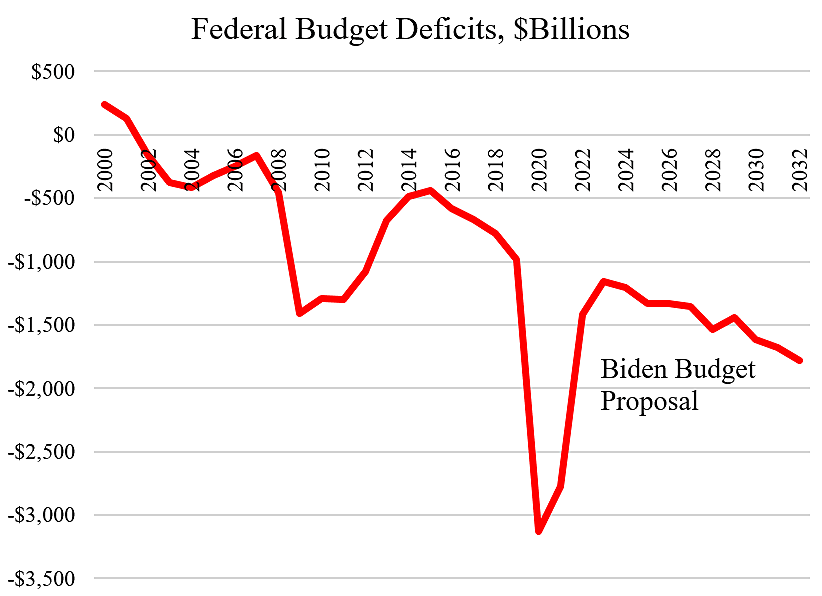
Most people are focusing on how deficits are going to climb from $1 trillion to $2 trillion-plus over the next 10 years.

That’s not good news, but we should be far more worried about the fact that the burden of government spending is growing faster than the private economy. As a result, government will be consuming an ever-larger share of national output.

The budget wonks who (mistakenly) focus on red ink say the problem is so serious that we need higher taxes.

They look at this chart, which is based on CBO’s baseline forecast (what will happen if taxes and spending are left on autopilot), and assert we have no choice but to raise taxes.
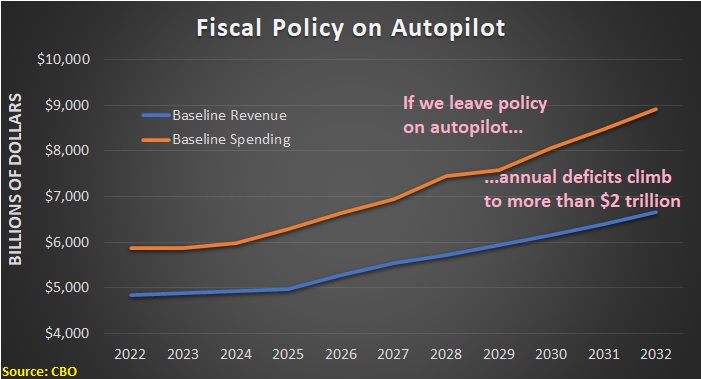
They point out that the annual deficit in 2032 will be almost $2.3 trillion and that it’s impossible cut spending by that much.

Needless to say, it would be a near-impossible political undertaking to cut $2.3 trillion in one year (though it would fulfill libertarian fantasies).

But what if, instead of kicking the can down the road, policymakers imposed some sort of overall spending cap to avoid a giant deficit in 10 year.

This second chart displays that scenario. I took CBO’s baseline (autopilot) numbers and assumed that spending could only increase by 1.4 percent annually starting in 2024.

As you can see, that modest bit of fiscal discipline completely eliminates the project $2.3 trillion annual deficit in 2032.
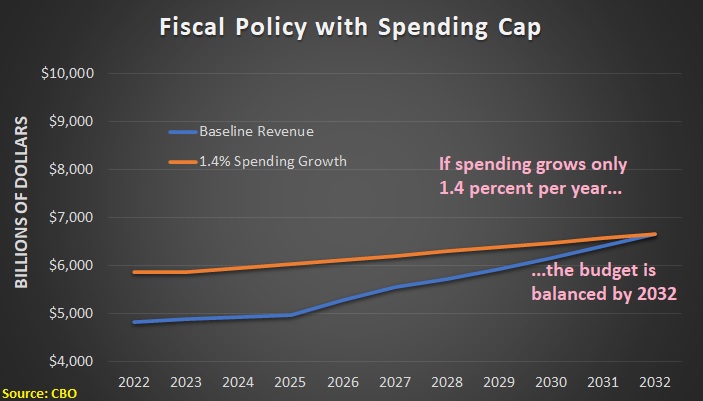
In other words, there is no need for any tax increase.

Especially since politicians almost certainly would respond to the expectation of additional revenue by increasing spending above the baseline (as would happen with Joe Biden’s so-called Build Back Better scheme).

I’ll close by noting that there’s no need to fixate on whether the budget is balanced by 2032. What matters is trend lines.

It’s not good for government to grow faster than the private economy in the long run. And it’s not good for deficits and debt to climb as a share of economic output in the long run.

Both of those outcomes can be avoided if we have some sort of spending cap so that outlays grow slower than the private sector.

The stricter the cap, the quicker the progress.

  • I prefer actual cuts (a requirement to reduce nominal spending each year).
  • I would be happy with a hard freeze (like we had for a few years after the Tea Party revolt).
  • As noted above, a 1.4 percent spending cap balances the budget by 2032.
  • But we would make progress, albeit slow progress, even if the spending cap allowed the budget to grow by 2.0 percent of 2.5 percent per year.

P.S. I start the spending cap in 2024 because spending is not projected to grow by very much between 2022 and 2023. That’s not because today’s politicians are being responsible, however. It’s simply a result of one-time pandemic emergency spending coming to an end. But since that one-time spending has a big impact on short-run numbers, I delayed the spending cap for one year.

P.P.S. The blue revenue line has a kink in 2025 because the baseline forecast assumes that many of the Trump tax cuts expire that year. If those tax cuts are extended or made permanent, revenues would be about $400 billion lower in 2032. As such, balancing the budget by that year would require a spending cap that allows annual outlays to increase by less than 0.9 percent per year.

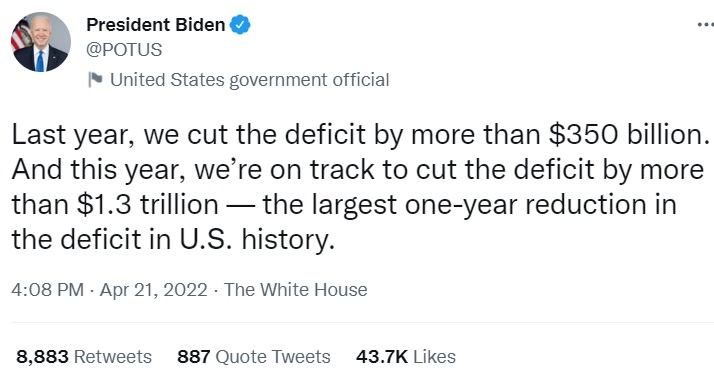
P.P.P.S. President Biden is bragging that the deficit is falling this year, but that’s only because the one-time pandemic spending is coming to an end.

P.P.P.P.S. A spending cap is a simple solution, but it would not be an easy solution. In the long-run, it would require genuine entitlement reform.

Another Reason for Spending Caps

The United States needs a constitutional spending cap, sort of like the “debt brake” that has been producing positive results in Switzerland for the past two decades.

Imposing a limit on annual spending increases would be a much-needed way of stopping politicians from saddling the nation with “Goldfish Government.”

The best-case scenario is that a spending cap is very stringent (say, limiting annual spending increases to 2 percent annually). This level of fiscal restraint reduces the burden of government spending compared to the private sector (i.e., it fulfills fiscal policy’s Golden Rule).

The avoid-harm scenario is that a spending cap prevents government from becoming a bigger burden. Given dismal long-run fiscal forecasts (a consequence of demographic change and poorly designed entitlement programs), this actually would be an impressive achievement.

There are also some auxiliary benefits of a spending cap.

A new working paper from Italy’s central bank, authored by Anna Laura Mancini and Pietro Tommasino, considers whether spending caps can mitigate the problem of dishonest budgeting by politicians.

…policy-makers have an incentive to “plan to cheat”. That is, they promise an amount of expenditures higher than what they will actually deliver, because this allows them to cater to the demands of the various groups of voters, and at the same time they present overoptimistic revenue forecasts, in order to preserve the appearance of fiscal discipline. Once the extra revenues hoped for by the government fail to materialize, budgeted investment expenditures are downsized or abandoned altogether. In this context, caps on realized spending can contribute to more realistic ex ante spending plans. Indeed, politicians have less room to inflate planned expenditures, once there is a legal ceiling in place.

The authors crunch the numbers and conclude that spending caps result in a greater level of fiscal honesty.

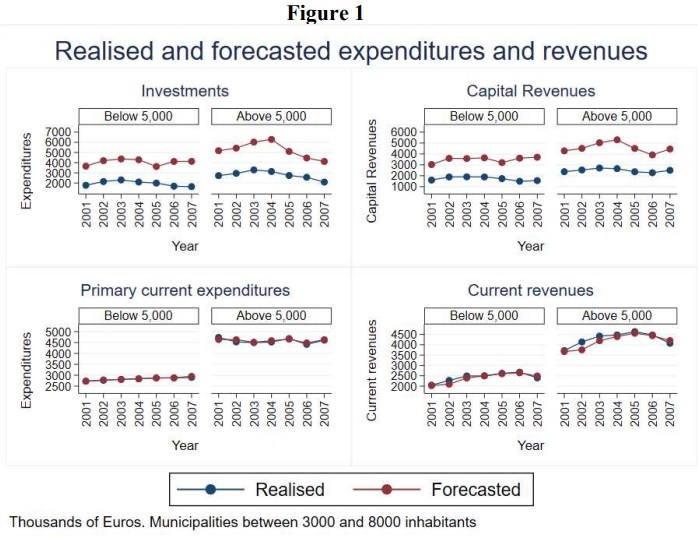
In this paper, we provide evidence in favour of this theoretical intuition, exploiting a unique dataset including the ex-ante budget plans as well as ex-post budget outcomes of…a rule that constrains capital expenditures in municipalities with more than 5,000 residents. …Our analysis show that the municipalities subject to the new capital-spending rule significantly reduced their over-optimism in expenditure projections… Furthermore, in the new regime revenue projections are also more accurate (less over-optimistic). …The reform reduced the forecast error concerning capital expenditures… The effects is significant both statistically and in economic terms. …the introduction of the cap on investment reduced the forecast error on investment expenditures by almost €1 mln, or 35% of the pre-reform average error.

For wonky readers, Figure 1 shows some of relevant data.
For what it’s worth, we seem to have a different problem in the United States.

Rather than exaggerate potential spending on so-called public investment, as seems to have been the case in Italy, American politicians generally low-ball cost estimates for infrastructure projects.

And then, once the projects get started, we get absurd cost overruns (with the high-speed rail project in California being an especially absurd example).

The good news is that a spending cap solves both the Italian version of the problem and the American version of the problem.

As the authors found in their research, it removes the incentive for dishonest budgeting in Italy. And, if adopted in the United States, politicians would learn that it doesn’t help to produce laughably low cost estimates if a spending cap means there is no way of financing cost overruns in the future.

P.S. There is a spending limit in Hong Kong’s constitution, and it has generated very positive results. Given China’s increasing control, it’s unclear how effective it will be in the future.

P.P.S. There’s also a spending limit in Colorado’s constitution, known as the Taxpayers Bill of Rights. It has been very successful.

P.P.P.S. Last month, I wrote about research from both the IMF and the ECB about the benefits of spending caps.

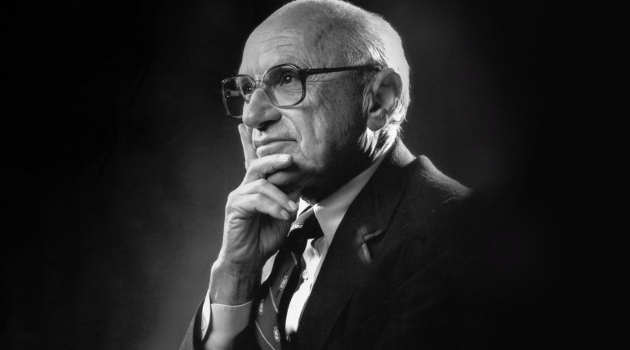
Steve Forbes is 100 percent correct, as was Milton Friedman. Bloated and wasteful government spending is the problem, not inadequate revenue. Deficits are merely a symptom of over-spending:

The late Nobel Prize-winning economist Milton Friedman once famously observed that he would prefer a federal government budget of $1 trillion (this was when a trillion bucks was real money) with a big deficit to a federal budget of $2 trillion that was balanced. His obvious point was that the bigger Washington is, the more of a burden it puts on the economy, whether it finances its spending via taxation, borrowing or printing money. So it’s not President Obama’s mind-numbing, from-here-to-eternity deficits that we should be worrying about but the increasing deadweight put on the rest of us by Washington’s burgeoning budget bloat. Senate Republicans were right to put the kibosh on the formation of a formal bipartisan deficit-fighting commission. Those things always end up increasing taxes while doing little to reduce spending. …One of the biggest economic myths since the Great Depression is that governments can ameliorate or counteract the ebbs and flows of free markets. Government spending has never worked as a trigger for sustained and vibrant economic growth. Ever. Scholarship has demonstrated that the New Deal perpetuated the Depression rather than cured it. On the eve of the Depression the U.S. had the lowest unemployment rate among developed nations. But a decade later, despite six years of FDR’s New Deal, our unemployment rate was one of the highest among developed economies. Japan’s serial stimulus programs over the past two decades have repeatedly underscored this truth. The more the government takes as a proportion of the economy, the worse equity markets do and the higher the unemployment rate.

Everything You Need to Know about the National Debt

The title of this column is an exaggeration. What we’re really going to do today is explain the main things you need to knowabout government debt.

We’ll start with this video from Kite and Key Media, which correctly observes that entitlement programs are the main cause of red ink.

I like that the video pointed out how tax-the-rich schemeswouldn’t work, though it would have been nice if they added some information on how genuine entitlement reform could solve the problem  (as you can see here and here, I’ve also nit-picked other debt-themed videos).

Which is why I humbly think this is the best video ever produced on the topic.

As you can see, I’m not an anti-debt fanatic. It was perfectly okay, for instance, to incur debt to win World War II.

But I’m very skeptical of running up the nation’s credit card for routine pork and fake stimulus.

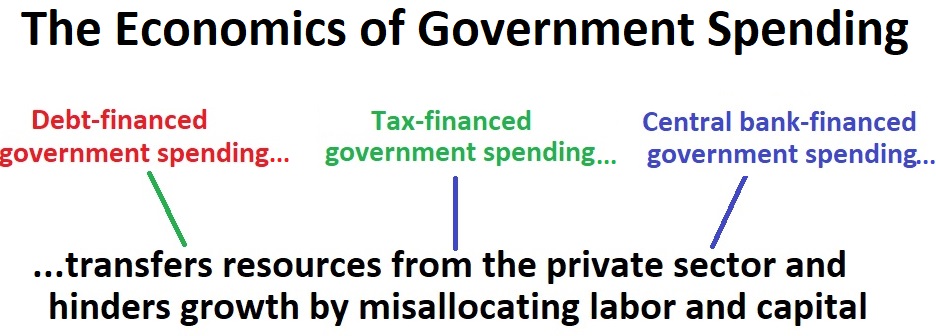
But my main message, which I’ve shared over and over again, is that deficits and debt are merely a symptom. The underlying disease is excessive government spending.

And that spending hurts our economy whether it is financed by taxing or borrowing (or, heaven forbid, by printing money).
Now let’s look at some recent articles on the topic.

We’ll start with Eric Boehm’s column for Reason, which explains how red ink has exploded in recent years.

America’s national debt exceeded $10 trillion for the first time ever in October 2008. By mid-September 2017 the national debt had doubled to $20 trillion. …data released by the U.S. Treasury confirmed that the national debt reached a new milestone: $30 trillion.…Entitlements like Social Security and Medicare are in dire fiscal straits and will become even more costly as the average American gets older. Even without another unexpected crisis, deficits will exceed $1 trillion annually, which means the debt will continue growing, both in real terms and as a percentage of the economy. The Congressional Budget Office estimates that the federal government will add another $12.2 trillion to the debt by 2031.

As already stated, I think the real problem is the spending and the debt is the symptom.

But it is possible, of course, that debt rises so high that investors (the people who buy government bonds) begin to lose faith that they will get repaid.

At that point, governments have to pay higher interest rates to compensate for perceived risk of default, which exacerbates the fiscal burden.

And if there’s not a credible plan to fix the problem, a country can go into a downward spiral. In other words, a debt crisis.

This is what happened to Greece. And I think it’s just a matter of time before it happens to Italy.

Heck, many European nations are vulnerable to a debt crisis. As are many developing countries. And don’t forget Japan.

Could the United States also be hit by a debt crisis? Will we reach a “tipping point” that leads to the aforementioned loss of faith?

That’s one of the possibilities mentioned in the New York Timescolumn by Peter Coy.

It’s hard to know how much to worry about the federal debt of the United States. …Either the United States can continue to run big deficits and skate along with no harm done or it’s at risk of losing investors’ confidence and having to pay higher interest rates on its debt, which would suppress economic growth. …the huge increase in federal debt incurred during and after the past two recessions — those of 2007-09 and 2020 — has used upa lot of the “fiscal space” the United States once had. In other words, the federal government is closer to the tipping point where big increases in debt finally start to become a real problem. …any given amount of debt becomes easier to sustain as long as the growth rate of the economy (and thus the growth rate of tax revenue) is higher than the interest rate on the debt. In that scenario, interest payments gradually shrink relative to tax revenue. …but it doesn’t explain how much more the debt can grow. …Past a certain point, there’s a double whammy of more dollars of debt plus higher interest costs on each dollar. …sovereign debt crises tend to be self-fulfilling prophecies: Investors get nervous about a government’s ability to pay, so they demand higher interest rates, which raise borrowing costs and produce the bad outcome they feared. It’s a dynamic that Argentines are familiar with — and that Americans had better hope they never experience.

For what it’s worth, I think other major nations will suffer fiscal crisis before the problem becomes acute in the United States.

I really this will make me sound uncharacteristically optimistic, but I’m keeping my fingers crossed that this will finally lead politicians to adopt a spending cap so we don’t become Argentina.

P.S. The Wall Street Journal recently editorialized on the issue of government debt and made a very important point about the difference between the $30 trillion “gross debt” and the “debt held by the public,” which is about $6 trillion lower.

…the debt really isn’t $30 trillion. About $6 trillion of that is debt the government owes to itself in Social Security and other IOUs. …The debt held by the public is some $24 trillion, which is bad enough.

As I’ve noted when writing about Social Security, the IOUs in government trust funds are not real.

They’re just bookkeeping entries, as even Bill Clinton’s budget freely admitted.

Indeed, if you want to know whether some is both honest and knowledgeable about budget matters, ask them which measure of the national debt really matters.

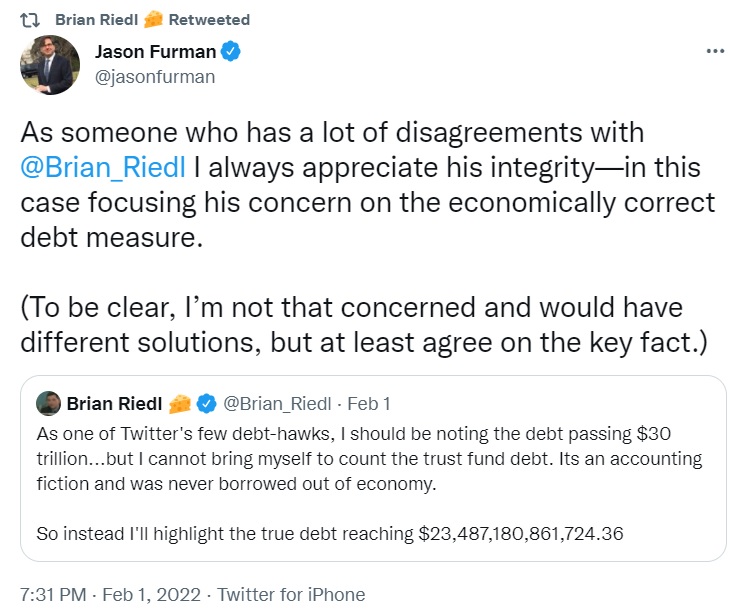
As you can see from this exchange of tweets, competent and careful budget people (regardless of whether they favor big government or small government) focus on “debt held by the public,” which is the term for the money government actually borrows from credit markets.
If you want to know the difference between the various types of government debt – including “unfunded liabilities” – watch this video.

P.P.S. This column explains how and when debt matters. If you’re interested in how to reduce the debt, there’s very good evidence that spending restraint is the only effective approach. Even in cases where debt is enormous.

P.P.P.S. By contrast, the evidence is very clear that higher taxesactually make debt problems worse.

Yes, Starve the Beast

As part of a recent discussion with Gene Tunny in Australia, I explained why I support “Starve the Beast,” which means keeping taxes as low as possible to help achieve the goal of spending restraint.

The premise of Starve the Beast is very simple.

Politicians like to spend money and they don’t particularly care whether that spending is financed by taxes or financed by borrowing (both bad options).
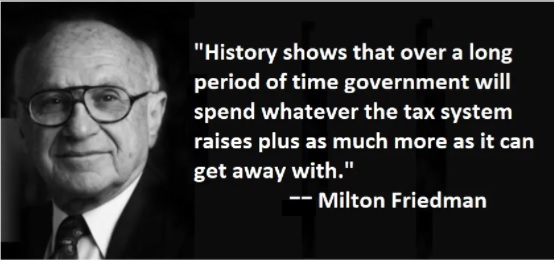
As Milton Friedman sagely observed, that means they will spend every penny they collect in taxes plus as much additional spending financed by borrowing that the political system will allow.

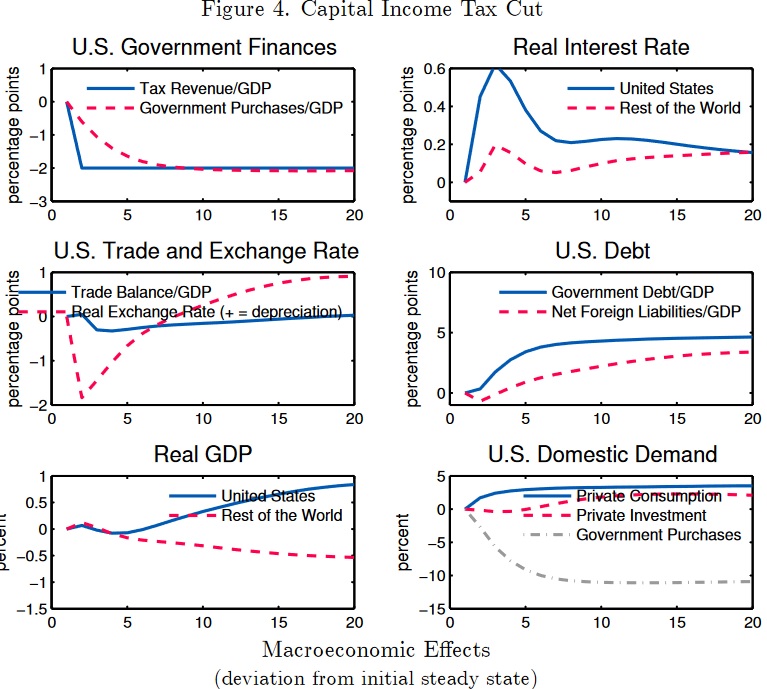
The IMF published a study on this issue about 10 years ago. The authors (Michael Kumhof, Douglas Laxton, and Daniel Leigh) assert that there’s no way of knowing whether Starve the Beast will lead to good or bad results.

…there is no consensus regarding the macroeconomic and welfare consequences of implementing a starve-the-beast approach, henceforth referred to as STB. …it could be beneficial in the ideal case in which it results in cuts in entirely wasteful government spending. In particular, lower spending frees up resources for private consumption, and the associated lower tax rates reduce distortions in the economy. On the other hand, …lower government spending may itself entail welfare losses…if it augments the productivity of private factors of production. …the paper examines whether the principal macroeconomic variables such as GDP and consumption, both in the United States and in the rest of the world, respond positively to this policy. …In addition, the paper assesses how the welfare effects depend on the degree to which government spending directly contributes to household welfare or to productivity.

The authors don’t really push any particular conclusion. Instead, they show various economic outcomes depending on with assumptions one adopts.

Since plenty of research shows that government spending is not a net plus for the economy (even IMF economists agree on that point), and because I think a less-punitive tax system is possible (and desirable) if there’s a smaller burden of government spending, I think the findings shown in Figure 4 make the most sense.
Now let’s shift from academic analysis to policy analysis.

In a piece for National Review back in July 2020, Jim Geraghty notes that Starve the Beast has an impact on government finances at the state level.

…we’re probably not going to see a massive expansion of government at the state level in the coming year or two. …Thanks to the pandemic lockdown bringing vast swaths of the economy to a halt, state tax revenues are plummeting.…So states will have much less tax revenue, constitutional balanced-budget requirements that are not easily repealed, and a limited amount of budgetary tricks to work around it. State governments could attempt to raise taxes, but that’s going to be unpopular and hurt state economies when they’re already struggling. Add it all up and it’s a tough set of circumstances for a dramatic expansion of government, no matter how ardently progressive the governor and state legislatures are.

For what it’s worth, Geraghty warned in the article that fiscal restraint by state governments wouldn’t happen if the federal government turned on the spending spigot.

And that, of course, is exactly what happened.

Now let’s look at the most unintentional endorsement of Stave the Beast.

A couple of years ago, Paul Krugman sort of admitted that cutting taxes was a potentially effective strategy for spending restraint.

…the same Republicans now wringing their hands over budget deficits…blew up that same deficit by enacting a huge tax cut for corporations and the wealthy. …this has been the G.O.P.’s budget strategy for decades. First, cut taxes. Then, bemoan the deficit created by those tax cuts and demand cuts in social spending.Lather, rinse, repeat. This strategy, known as “starve the beast,” has been around since the 1970s, when Republican economists like Alan Greenspan and Milton Friedman began declaring that the role of tax cuts in worsening budget deficits was a feature, not a bug. As Greenspan openly put it in 1978, the goal was to rein in spending with tax cuts that reduce revenue, then “trust that there is a political limit to deficit spending.” …voters should realize that the threat to programs… Social Security and Medicare as we know them will be very much in danger.

In other words, Krugman doesn’t like Starve the Beast because he fears it is effective (just like he also acknowledges the Laffer Curve, even though he’s opposed to tax cuts).

Let’s close by looking at some very powerful real-world evidence. Over the past 50 years, there’s been a massive increase in the tax burden in Western Europe.

Did all that additional tax revenue lead to lower deficits and less debt?

Nope, the opposite happened. European politicians spent every penny of the new tax revenue (much of it from value-added taxes). And then they added even more spending financed by additional borrowing.

To be fair, one could argue that this was an argument for the view of “Don’t Feed the Beast” rather than “Starve the Beast,” but it nonetheless shows that more money in the hands of politicians simply means more spending. And more red ink.

P.S. I had a discussion last year with Gene Tunny about the issue of “state capacity libertarianism.”


Friedman & Sowell: Should Our School System Be Privatized?

Regular readers know that the two things that get me most excited are the Georgia Bulldogs and the fight against a bloated public sector that is ineffective in the best of circumstances and more often than not is a threat to our freedoms.

So you will not be surprised to know that I am delighted that former Georgia Bulldog star Fran Tarkenton (who also happened to play in the NFL) has a superb piece in the Wall Street Journal ripping apart the inherent inefficiency of government-run monopoly schools.

Here is the key passage.

Imagine the National Football League in an alternate reality. Each player’s salary is based on how long he’s been in the league. It’s about tenure, not talent. The same scale is used for every player, no matter whether he’s an All-Pro quarterback or the last man on the roster. For every year a player’s been in this NFL, he gets a bump in pay. The only difference between Tom Brady and the worst player in the league is a few years of step increases. And if a player makes it through his third season, he can never be cut from the roster until he chooses to retire, except in the most extreme cases of misconduct. Let’s face the truth about this alternate reality: The on-field product would steadily decline. Why bother playing harder or better and risk getting hurt? No matter how much money was poured into the league, it wouldn’t get better. In fact, in many ways the disincentive to play harder or to try to stand out would be even stronger with more money. Of course, a few wild-eyed reformers might suggest the whole system was broken and needed revamping to reward better results, but the players union would refuse to budge and then demonize the reform advocates: “They hate football. They hate the players. They hate the fans.” The only thing that might get done would be building bigger, more expensive stadiums and installing more state-of-the-art technology. But that just wouldn’t help.

This sounds absurd, of course, but Mr. Tarkenton goes on to explain that this is precisely how government schools operate.

If you haven’t figured it out yet, the NFL in this alternate reality is the real-life American public education system. Teachers’ salaries have no relation to whether teachers are actually good at their job—excellence isn’t rewarded, and neither is extra effort. Pay is almost solely determined by how many years they’ve been teaching. That’s it. After a teacher earns tenure, which is often essentially automatic, firing him or her becomes almost impossible, no matter how bad the performance might be. And if you criticize the system, you’re demonized for hating teachers and not believing in our nation’s children. Inflation-adjusted spending per student in the United States has nearly tripled since 1970. According to the Organization for Economic Cooperation and Development, we spend more per student than any nation except Switzerland, with only middling results to show for it.

Actually, I will disagree with the last sentence of this excerpt. We’re not even getting “middling results.” Here’s a chart from an earlier post showing that we’ve gotten more bureaucracy and more spending but no improvement over the past 40 years.

So what’s the solution to this mess? Well, since government is the problem, it stands to reason that competition and markets are the answer.

Sweden, Chile, and the Netherlands are just some of the countries that have seen good results after breaking up state-run education monopolies.

Watch this video to get more details.

Economics 101: School Choice Example Shows Why Government Monopolies Are Bad

Related posts:

FRIEDMAN FRIDAY Milton Friedman’s FREE TO CHOOSE “The Tyranny of Control” Transcript and Video (60 Minutes)

Milton Friedman’s FREE TO CHOOSE “The Tyranny of Control” Transcript and Video (60 Minutes) In 1980 I read the book FREE TO CHOOSE by Milton Friedman and it really enlightened me a tremendous amount.  I suggest checking out these episodes and transcripts of Milton Friedman’s film series FREE TO CHOOSE: “The Failure of Socialism” and […]

FRIEDMAN FRIDAY “The Tyranny of Control” in Milton Friedman’s FREE TO CHOOSE Part 7 of 7 (Transcript and Video) “I’m not pro business, I’m pro free enterprise, which is a very different thing, and the reason I’m pro free enterprise”

In 1980 I read the book FREE TO CHOOSE by Milton Friedman and it really enlightened me a tremendous amount.  I suggest checking out these episodes and transcripts of Milton Friedman’s film series FREE TO CHOOSE: “The Failure of Socialism” and “What is wrong with our schools?”  and “Created Equal”  and  From Cradle to Grave, […]

FRIEDMAN FRIDAY “The Tyranny of Control” in Milton Friedman’s FREE TO CHOOSE Part 6 of 7 (Transcript and Video) “We are the ones who promote freedom, and free enterprise, and individual initiative, And what do we do? We force puny little Hong Kong to impose limits, restrictions on its exports at tariffs, in order to protect our textile workers”

In 1980 I read the book FREE TO CHOOSE by Milton Friedman and it really enlightened me a tremendous amount.  I suggest checking out these episodes and transcripts of Milton Friedman’s film series FREE TO CHOOSE: “The Failure of Socialism” and “What is wrong with our schools?”  and “Created Equal”  and  From Cradle to Grave, […]

FRIEDMAN FRIDAY “The Tyranny of Control” in Milton Friedman’s FREE TO CHOOSE Part 5 of 7 (Transcript and Video) “There is no measure whatsoever that would do more to prevent private monopoly development than complete free trade”

In 1980 I read the book FREE TO CHOOSE by Milton Friedman and it really enlightened me a tremendous amount.  I suggest checking out these episodes and transcripts of Milton Friedman’s film series FREE TO CHOOSE: “The Failure of Socialism” and “What is wrong with our schools?”  and “Created Equal”  and  From Cradle to Grave, […]

FRIEDMAN FRIDAY “The Tyranny of Control” in Milton Friedman’s FREE TO CHOOSE Part 4 of 7 (Transcript and Video) ” What we need are constitutional restraints on the power of government to interfere with free markets in foreign exchange, in foreign trade, and in many other aspects of our lives.”

In 1980 I read the book FREE TO CHOOSE by Milton Friedman and it really enlightened me a tremendous amount.  I suggest checking out these episodes and transcripts of Milton Friedman’s film series FREE TO CHOOSE: “The Failure of Socialism” and “What is wrong with our schools?”  and “Created Equal”  and  From Cradle to Grave, […]

FRIEDMAN FRIDAY “The Tyranny of Control” in Milton Friedman’s FREE TO CHOOSE Part 3 of 7 (Transcript and Video) “When anyone complains about unfair competition, consumers beware, That is really a cry for special privilege always at the expense of the consumer”

In 1980 I read the book FREE TO CHOOSE by Milton Friedman and it really enlightened me a tremendous amount.  I suggest checking out these episodes and transcripts of Milton Friedman’s film series FREE TO CHOOSE: “The Failure of Socialism” and “What is wrong with our schools?”  and “Created Equal”  and  From Cradle to Grave, […]

FRIEDMAN FRIDAY “The Tyranny of Control” in Milton Friedman’s FREE TO CHOOSE Part 2 of 7 (Transcript and Video) “As always, economic freedom promotes human freedom”

In 1980 I read the book FREE TO CHOOSE by Milton Friedman and it really enlightened me a tremendous amount.  I suggest checking out these episodes and transcripts of Milton Friedman’s film series FREE TO CHOOSE: “The Failure of Socialism” and “What is wrong with our schools?”  and “Created Equal”  and  From Cradle to Grave, […]

FRIEDMAN FRIDAY “The Tyranny of Control” Milton Friedman’s FREE TO CHOOSE Part 1 of 7 (Transcript and Video) “Adam Smith’s… key idea was that self-interest could produce an orderly society benefiting everybody, It was as though there were an invisible hand at work”

In 1980 I read the book FREE TO CHOOSE by Milton Friedman and it really enlightened me a tremendous amount.  I suggest checking out these episodes and transcripts of Milton Friedman’s film series FREE TO CHOOSE: “The Failure of Socialism” and “What is wrong with our schools?”  and “Created Equal”  and  From Cradle to Grave, […]

Open letter to President Obama (Part 654) “The Tyranny of Control” in Milton Friedman’s FREE TO CHOOSE Part 7 of 7 (Transcript and Video) “I’m not pro business, I’m pro free enterprise, which is a very different thing, and the reason I’m pro free enterprise”

Open letter to President Obama (Part 654) (Emailed to White House on July 22, 2013) President Obama c/o The White House 1600 Pennsylvania Avenue NW Washington, DC 20500 Dear Mr. President, I know that you receive 20,000 letters a day and that you actually read 10 of them every day. I really do respect you […]

Open letter to President Obama (Part 650) “The Tyranny of Control” in Milton Friedman’s FREE TO CHOOSE Part 6 of 7 (Transcript and Video) “We are the ones who promote freedom, and free enterprise, and individual initiative, And what do we do? We force puny little Hong Kong to impose limits, restrictions on its exports at tariffs, in order to protect our textile workers”

Open letter to President Obama (Part 650) (Emailed to White House on July 22, 2013) President Obama c/o The White House 1600 Pennsylvania Avenue NW Washington, DC 20500 Dear Mr. President, I know that you receive 20,000 letters a day and that you actually read 10 of them every day. I really do respect you […]

_________

Dan Mitchell: “I don’t think politicians and bureaucrats should be able to interfere with my freedom to buy good and services from people who happen to live in other nations”

Milton Friedman – Free Trade vs. Protectionism

Free to Choose Part 2: The Tyranny of Control (Featuring Milton Friedman

Trade, Jobs, and Wages

I’m a knee-jerk supporter of free trade, which simply means I don’t think politicians and bureaucrats should be able to interfere with my freedom to buy good and services from people who happen to live in other nations.

But my support for free trade is not just based on ideology. I also cite data on how trade taxes and other restrictions make nations poorer.

Simply stated, trade barriers (like other forms of government intervention) make an economy less efficient.

And the negative effects go beyond overall economic output. Researchers also find job losses, lower productivity, and increased inequality.

Today, let’s look at some new research on this topic. The IMF earlier this year released a new working paper authored by Kim Beaton, Valerie Cerra, and Metodij Hadzi-Vaskov.

Here are the main results.

…firms in countries and industries experiencing greater competition from imports reduce employment slightly. …Even so, the low elasticity of employment growth to imports indicates a limited adverse impact. …Contrary to popular belief and anti-globalization sentiment, import competition is associated with higher average wage growth across the global sample of firms…, driven by the EMDEs… Taking employment and wages together, import growth in an industry leads to a rise in the wage bill of domestic firms in the same industry. Thus, while import competition generates some job dislocations, the overall impact on earnings of workers in the same industry is positive.

Here’s a chart that was included with the study.

One unexpected finding from the study is that rich nations are more likely to enjoy job gains.

The job loss associated with import competition appears to be dominated by the behavior of firms in emerging and developing economies… In contrast, the import shock provides a statistically significant positive boost to firms’ employment in advanced economies.

And here’s a finding that should not surprise anyone.

…we find relatively positive outcomes of import competition on exposed firms, including higher sales, profits, wage growth, and investment. Moreover, the import shock to exposed firms, and the ensuing employment changes, do not take place in isolation. Import growth often goes hand in hand with export growth, which spurs job creation.

But I didn’t like everything I found in the paper. In some circumstances, trade reduces inequality, but by hurting those with high incomes rather than helping those with low incomes.

Our results also show that firms experiencing higher imports shocks are those with higher average wage levels. Thus, to the extent that employment growth is lower in these more exposed firms, it could lead to lower inequality.

For some of our friends on the left, this is a good outcome. Crazy.

Fortunately, trade generally helps everyone, so this quirky result is an exception rather than the rule.

The bottom line is that free trade is an overall winner for the economy. Does that mean that everyone benefits in short run? Of course not.

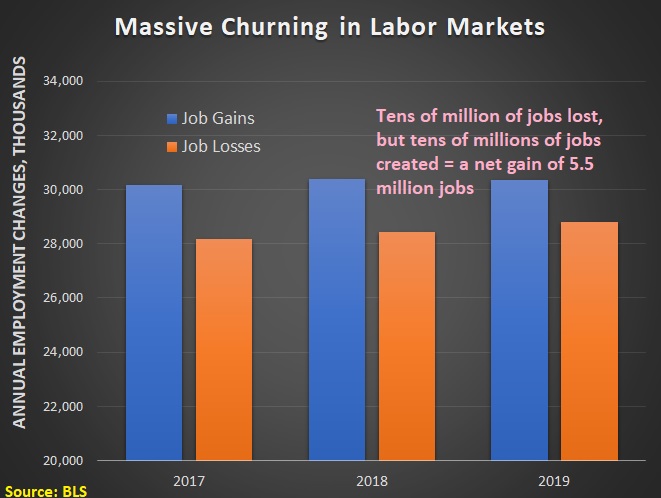
Jobs always get destroyed when there’s competition. And that’s true whether the competition comes from inside a country or outside a country.

The goal, of course, is to have a vibrant economy that regularly produces plenty of new jobs to offset any job losses.

Don’t Sweat the Trade Deficit

When the Commerce Department announced in February that the United States had a record trade deficit for 2021, I shared this video to help make the point that those trade numbers were that year’s “least important economic news.”

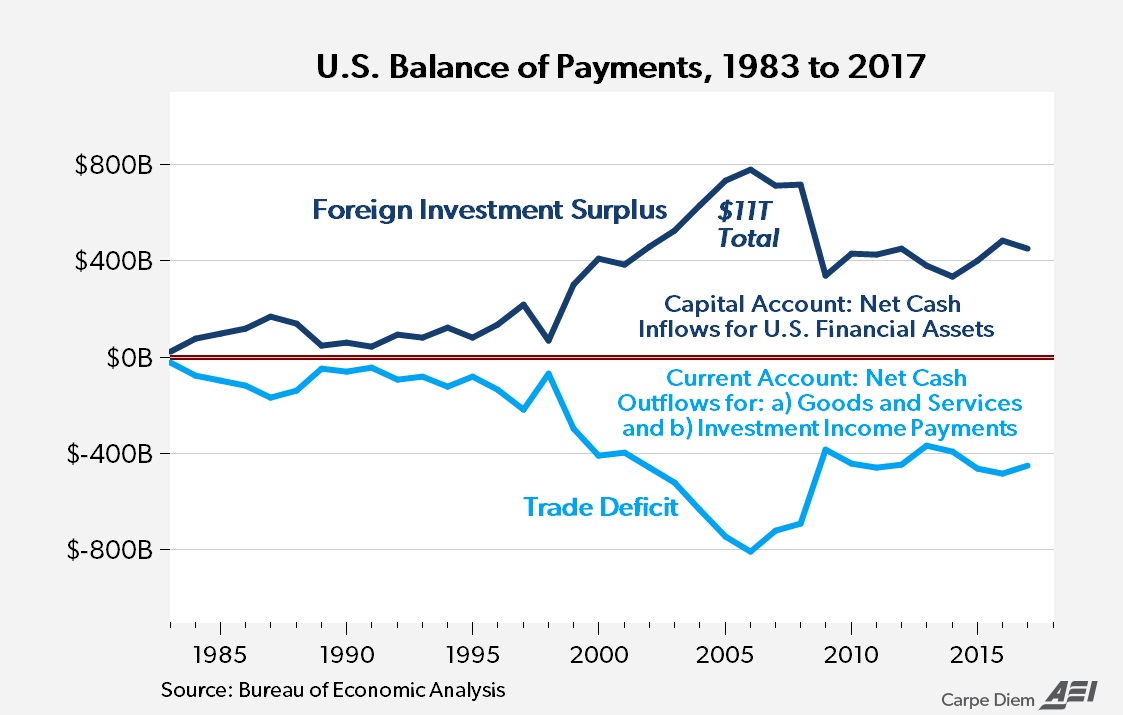
The main thing to understand is that a trade deficit is simply the flip side of an investment surplus.

When Americans use dollars to buy goods from other nations, those dollars are only valuable to foreigners because they can use them to buy things from America.

In many cases, they buy American goods and services. But they also use many of those dollars to invest in the U.S. economy.

That’s generally a positive thing. It’s a vote of confidence about America’s economic future.

Jeff Jacoby of the Boston Globe shares my viewpoint. He recently opined on this issue, echoing the important insight about the link between trade flows and investment flows.

The US trade deficit hit an all-time high in March, widening to nearly $110 billion as the nation imported considerably more goods than it exported. That can’t be good, right? Actually, it’s fine. …It’s not an indication of actual economic weakness. …Quite the contrary: All things being equal, imports are usually evidence of economic vitality and success.…The dollars Americans spend on imports aren’t “lost.” They are exchanged for desirable and affordable goods, services, parts, and commodities that strengthen Americans’ economy while elevating their US lifestyle. Better still, those dollars then come back to the United States, where they are used to invest in American assets or buy American exports, creating even more value and putting even more Americans to work. …a trade “deficit” isn’t a debt we owe. It is an accounting entry that tells us how much more we were enriched by foreigners than they were by us. ..the US economy has some real problems. Happily, the trade deficit isn’t one of them. Imports are good. And more imports? They’re good too.

This does not mean, however, that everyone is a winner.

As I explain in this video, jobs are destroyed when there is trade between nations. But I also point out that jobs are destroyed by trade inside a nation’s borders.

That’s bad news for workers in sectors that are dying (such as typewriter makers after personal computers hit the market).

What’s important is whether the new jobs that are createdexceed the number of jobs that are lost.

This is what is called “creative destruction.” It’s painful, but it is why we are much richer today than we were in the past.

The good news is that this usually happens…at least if politicians resist the temptation to over-tax, over-spend, and over-regulate.

The bottom line is that free trade is much better for long-run prosperity than protectionism.

Unless, of course, you think it’s a good idea to copy the policies of Herbert Hoover.

Trump, Sanders, and the Snake-Oil Economics of Protectionism

John Cowperthwaite deserves a lot of credit for Hong Kong’s prosperity. As a British appointee, he took a hands-off policy and allowed the colony’s economy to thrive. He didn’t even want the government to collect statistics since that would give interventionists data that might be used to argue for interventionism.

I have mixed feelings about that approach. I constantly use statistics because they so often show that free markets and small government produce the best outcomes. I even use data to show that Hong Kong’s economy should be emulated.

On the other hand, there are some statistics that cause a lot of mischief.

I’ve argued, for instance, that we should focus on how national prosperity is generated (gross domestic income) rather than how it is allocated (gross domestic product). If we changed the focus to GDI, the debate would more naturally focus on pro-growth policies to boost wages, small business income, and corporate profits rather than the misguided policies (such asKeynesian economics) that are enabled by a focus on GDP.

That being said, there’s a good argument that the worst government statistic is the “trade deficit.”

This is a very destructive piece of data because people instinctively assume a “deficit” is bad. Yet I have a trade deficit every year with my local grocery store. I’m always buying things from them and they never buy anything from me. Does that mean I’m a “loser”? Of course not. Voluntary exchange, by definition, means that both parties gain from any transaction. And this principle applies when voluntary exchange occurs across national borders.

Moreover, people oftentimes don’t realize that the necessary and automatic flip side of a “trade deficit” is a “capital surplus.” In other words, when foreign companies acquire dollars by selling to American consumers, they frequently decide that investing in the American economy is the best use of that money. And the huge amount of investment from overseas is a sign of comparative prosperity and vitality, not a sign of weakness.

And for any readers who nonetheless think protectionism might be a good idea, I challenge them to answer these eight questions.

I’m confident that both Donald Trump and Bernie Sanders wouldn’t be able to successfully answer any of them. Yet it appears they’ve gained some traction with voters by calling for protectionism.

That’s quite unfortunate. If the pro-trade policy consensus in America breaks down, that would create dangerous opportunities for politicians and bureaucrats to rig the game in favor of special interests while also imposing higher costs of taxpayers and consumers.

Let’s dig into the issue.

In a column for the Wall Street Journal, Mort Kondracke and Matthew Slaughter combine to produce a strong defense of trade.

…the four leading presidential candidates…oppose the U.S. ratifying the Trans-Pacific Partnership. All four demonize trade the same way. …Where is the leader with the courage to tell the truth? To say that trade made this nation great, and that trade barriers will destroy far more jobs than they can ever “save.” …America’s exporters and importers are among the country’s most dynamic companies, paying their workers about 15%-20% more than workers earn elsewhere in the economy. The overall gains are large. Trade and related activities—spurred by accords such as the North American Free Trade Agreement, or Nafta, have boosted annual U.S. income today by about 10 percentage points of GDP relative to what it would have been otherwise. This translates into an aggregate gain of about $1.8 trillion in 2015—thousands of dollars per U.S. household every year. …creative destruction—the movement of people and capital from weaker businesses to stronger ones and new opportunities—is how many of the gains from trade arise. …For generations, American presidents of both parties have spoken about the benefits of trade. “Economic isolation and political leadership are wholly incompatible,” warned John Kennedy. “A creative, competitive America is the answer to a changing world,” said Ronald Reagan. “We should always remember: protectionism is destructionism.”

By the way, I think Kondracke and Slaughter paint with too broad a brush. Both Cruz and Clinton are far less protectionist than Trump and Sanders. Though the authors are correct in noting that they’ve been reluctant (especially in the case of Clinton) to vigorously defend free trade.

The great legal scholar Richard Epstein (also my former debating partner) writesabout the dangers of protectionism.

There are of course major difference between the insidious Trump and buffoonish Sanders. …Still, the real selling point of each boils down to one issue: In the indecorous language of the pollster, Pat Caddell, Americans feel “they have been screwed” by free trade. …free trade is in retreat as protectionism becomes the common thread across the both political parties. It is as though the economic unwisdom of the 1930 Smoot-Hawley Tariff Act is back.

Richard makes a very important point that politicians often support protectionism in an attempt to hide the damage they do with other misguided policies.

Free trade offers an uncompromising indictment of, and a powerful corrective for, America’s unsound economic policies. …the reason that local businesses outsource from the United States is the same reason why foreign businesses are reluctant to expand operations here. Our regulatory and labor environment is hostile to economic growth and there are no signs of that abating anytime soon. …the steady decline in freedom and productivity inside the United States has continued apace. Ironically, the strong likelihood that the next American president will expand protectionist practices will only make matters worse: firms, both foreign and domestic, are more reluctant to invest in the United States…free trade gives the federal government and the individual states strong incentives to clean up their act so that they can once again be attractive to foreign investment.

My buddy Ross Kaminsky explains in the American Spectator that free trade is good because it is part of the competitive process that boosts living standards, particularly for the poor.

…in trade, as in any economic endeavor, there are losers in the short run. Capitalism is, after all, fundamentally a system of creative destruction. But if there is any area of agreement among economists of all political stripes…it is that free trade provides large net benefits to the societies that engage in it, even if other nations do not lower trade barriers to the same degree. Furthermore, the benefits of trade accrue in large measure to the lower economic echelons of society in an extension of Schumpeter’s profound observation that “the capitalist achievement does not typically consist in providing more silk stockings for queens but in bringing them within the reach of factory girls in return for steadily decreasing amounts of effort.”

And Ross echoes Richard Epstein’s point about the real problem being anti-growth policies that make America less competitive.

Trade is complex and like all complex things politicians will dumb it down in a way that benefits them, generally by lying to the public and creating a frothy anger against those “damn furiners” instead of pointing fingers at the true culprits: unions, regulators, and politicians of all stripes.

Ross and Richard are right. If politicians really want more jobs in America, they should be adopting policies to boost U.S. competitiveness.

And we don’t need giant steps. Yes, a flat tax would be great, but even incremental reforms such as a lower corporate tax rate or the right tax treatment of business investment would yield big dividends.

Let’s add a few more voices to the discussion.

In an editorial, the Wall Street Journal debunks Donald Trump’s protectionist tirade against China.

The real-estate developer recently added Japan to his most-wanted list of job killers… “They’re killing us. You know what we sell to Japan? Practically nothing.” Is $116 billion worth of annual goods and services exports to Japan practically nothing? Japan is the fourth largest U.S. export market in goods after Canada, Mexico and China. …The best way to boost American exports is to remove trade barriers with new trade agreements. U.S. farm producers would particularly benefit from the Trans-Pacific Partnership with Japan and 10 other countries. Japanese tariffs on beef would fall to 9% in the 16th year of the deal from 38.5% while the 20% tariff on ground pork would be eliminated in six years. Japan’s 21.3% levy on poultry and eggs would be abolished in six to 13 years.

Writing for the Washington Post, David Ignatius defends trade in general and trade agreements in particular.

…the revolt against free trade that has captured both parties could do the most long-term damage. …there’s strong evidence that trade has benefited the U.S. economy and created whole new industries in which the United States is dominant. That’s the essence of the “creative destruction” that makes a market economy so potent: It relentlessly pushes innovation and change. …The bipartisan protectionism of Trump and Sanders has focused its attacks on the Trans-Pacific Partnership… Robert Z. Lawrence and Tyler Moran estimate that between 2017 and 2026, when TPP would have its major impact, the costs to displaced workers would be 6 percent of the benefits to the economy — or an 18-to-1 benefit-to-cost ratio. …David Autor, David Dorn and Gordon Hanson…noted that the pact would promote trade in knowledge industries where the United States has a big advantage and that “killing the TPP would do little to bring factory work back to America.”

Ignatius also makes a very important observation that protectionists want us to be scared of nations that have much bigger problems than the United States.

Trump, the businessman, seems weirdly out of touch with real economic trends. He speaks of Japan as though it were an economic powerhouse, when it has actually suffered a two-decades-long slump; he describes a surging China, when the numbers show its growth is sagging.

Amen. Japan has huge problems and China still has quite a way to go before it becomes a developed nation.

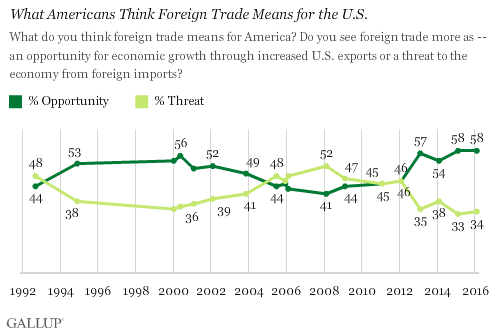
Let’s close with some good news. Politicians may be engaging in anti-trade demagoguery, and there may be some voters that are motivated by hostility to voluntary exchange, but that doesn’t mean the protectionists have won.

Indeed, pro-trade sentiment has never been higher by some measures. Here’s some amazingly positive polling data from Gallup.

P.S. One final point. The growing burden of government spending and taxation since World War II have been very unfortunate, but the good news is that we have strong evidence that the economic damage of worsening fiscal policy has been offset by the economic gains from trade liberalization. It would be tragic to see that reversed.

P.P.S. Fans of Richard Epstein may enjoy this video of him reminiscing about Barack Obama’s undistinguished tenure at the University of Chicago Law School, as well asthis video of him dismantling George Soros in a debate that took place at Cato.

Related posts:

FRIEDMAN FRIDAY Milton Friedman’s FREE TO CHOOSE “The Tyranny of Control” Transcript and Video (60 Minutes)

Milton Friedman’s FREE TO CHOOSE “The Tyranny of Control” Transcript and Video (60 Minutes) In 1980 I read the book FREE TO CHOOSE by Milton Friedman and it really enlightened me a tremendous amount.  I suggest checking out these episodes and transcripts of Milton Friedman’s film series FREE TO CHOOSE: “The Failure of Socialism” and […]

FRIEDMAN FRIDAY “The Tyranny of Control” in Milton Friedman’s FREE TO CHOOSE Part 7 of 7 (Transcript and Video) “I’m not pro business, I’m pro free enterprise, which is a very different thing, and the reason I’m pro free enterprise”

In 1980 I read the book FREE TO CHOOSE by Milton Friedman and it really enlightened me a tremendous amount.  I suggest checking out these episodes and transcripts of Milton Friedman’s film series FREE TO CHOOSE: “The Failure of Socialism” and “What is wrong with our schools?”  and “Created Equal”  and  From Cradle to Grave, […]

FRIEDMAN FRIDAY “The Tyranny of Control” in Milton Friedman’s FREE TO CHOOSE Part 6 of 7 (Transcript and Video) “We are the ones who promote freedom, and free enterprise, and individual initiative, And what do we do? We force puny little Hong Kong to impose limits, restrictions on its exports at tariffs, in order to protect our textile workers”

In 1980 I read the book FREE TO CHOOSE by Milton Friedman and it really enlightened me a tremendous amount.  I suggest checking out these episodes and transcripts of Milton Friedman’s film series FREE TO CHOOSE: “The Failure of Socialism” and “What is wrong with our schools?”  and “Created Equal”  and  From Cradle to Grave, […]

FRIEDMAN FRIDAY “The Tyranny of Control” in Milton Friedman’s FREE TO CHOOSE Part 5 of 7 (Transcript and Video) “There is no measure whatsoever that would do more to prevent private monopoly development than complete free trade”

In 1980 I read the book FREE TO CHOOSE by Milton Friedman and it really enlightened me a tremendous amount.  I suggest checking out these episodes and transcripts of Milton Friedman’s film series FREE TO CHOOSE: “The Failure of Socialism” and “What is wrong with our schools?”  and “Created Equal”  and  From Cradle to Grave, […]

FRIEDMAN FRIDAY “The Tyranny of Control” in Milton Friedman’s FREE TO CHOOSE Part 4 of 7 (Transcript and Video) ” What we need are constitutional restraints on the power of government to interfere with free markets in foreign exchange, in foreign trade, and in many other aspects of our lives.”

In 1980 I read the book FREE TO CHOOSE by Milton Friedman and it really enlightened me a tremendous amount.  I suggest checking out these episodes and transcripts of Milton Friedman’s film series FREE TO CHOOSE: “The Failure of Socialism” and “What is wrong with our schools?”  and “Created Equal”  and  From Cradle to Grave, […]

FRIEDMAN FRIDAY “The Tyranny of Control” in Milton Friedman’s FREE TO CHOOSE Part 3 of 7 (Transcript and Video) “When anyone complains about unfair competition, consumers beware, That is really a cry for special privilege always at the expense of the consumer”

In 1980 I read the book FREE TO CHOOSE by Milton Friedman and it really enlightened me a tremendous amount.  I suggest checking out these episodes and transcripts of Milton Friedman’s film series FREE TO CHOOSE: “The Failure of Socialism” and “What is wrong with our schools?”  and “Created Equal”  and  From Cradle to Grave, […]

FRIEDMAN FRIDAY “The Tyranny of Control” in Milton Friedman’s FREE TO CHOOSE Part 2 of 7 (Transcript and Video) “As always, economic freedom promotes human freedom”

In 1980 I read the book FREE TO CHOOSE by Milton Friedman and it really enlightened me a tremendous amount.  I suggest checking out these episodes and transcripts of Milton Friedman’s film series FREE TO CHOOSE: “The Failure of Socialism” and “What is wrong with our schools?”  and “Created Equal”  and  From Cradle to Grave, […]

FRIEDMAN FRIDAY “The Tyranny of Control” Milton Friedman’s FREE TO CHOOSE Part 1 of 7 (Transcript and Video) “Adam Smith’s… key idea was that self-interest could produce an orderly society benefiting everybody, It was as though there were an invisible hand at work”

In 1980 I read the book FREE TO CHOOSE by Milton Friedman and it really enlightened me a tremendous amount.  I suggest checking out these episodes and transcripts of Milton Friedman’s film series FREE TO CHOOSE: “The Failure of Socialism” and “What is wrong with our schools?”  and “Created Equal”  and  From Cradle to Grave, […]

Open letter to President Obama (Part 654) “The Tyranny of Control” in Milton Friedman’s FREE TO CHOOSE Part 7 of 7 (Transcript and Video) “I’m not pro business, I’m pro free enterprise, which is a very different thing, and the reason I’m pro free enterprise”

Open letter to President Obama (Part 654) (Emailed to White House on July 22, 2013) President Obama c/o The White House 1600 Pennsylvania Avenue NW Washington, DC 20500 Dear Mr. President, I know that you receive 20,000 letters a day and that you actually read 10 of them every day. I really do respect you […]

Open letter to President Obama (Part 650) “The Tyranny of Control” in Milton Friedman’s FREE TO CHOOSE Part 6 of 7 (Transcript and Video) “We are the ones who promote freedom, and free enterprise, and individual initiative, And what do we do? We force puny little Hong Kong to impose limits, restrictions on its exports at tariffs, in order to protect our textile workers”

Open letter to President Obama (Part 650) (Emailed to White House on July 22, 2013) President Obama c/o The White House 1600 Pennsylvania Avenue NW Washington, DC 20500 Dear Mr. President, I know that you receive 20,000 letters a day and that you actually read 10 of them every day. I really do respect you […]

__________

Daniel Mitchell: The bottom line is that Biden used the pandemic as an excuse to squander $1.9 trillion, even though at most only $80 billion of the money was for anything that was even vaguely related to vaccines and treatments!

Least Surprising Headline of All Time

Government spending, almost by definition, is wasteful. But it’s worth distinguishing between two types of waste.

  1. Money that is spent properly but inefficiently.
  2. Money that is diverted by crooks and scammers.

Today, we’re going to focus on the second type of waste.

I’ve previously written about widespread fraud affecting programs such as Medicare, Medicaid, food stamps, welfare, disability, and the earned income credit.

Now let’s augment our previous analysis exposing how coronavirus-related spending has been a windfall for criminals.

We’ll start with a report from the Washington Post , authored by Tony Romm and Yeganeh Torbati. It contains a headline that begins with a quote that could apply to just about anything the government does.

Testifying at a little-noticed congressional hearing this spring, a top watchdog for the Labor Department estimated there could have been “at least” $163 billion in unemployment-related “overpayments,”a projection that includes wrongly paid sums as well as “significant” benefits obtained by malicious actors. …In many cases, the criminals stole the unemployment funds using real Americans’ personal information. They bombarded states with applications filed in the names of actual workers or people in prison — sometimes to such a degree that, in the case of Maryland, fraudulent claims came to outnumber real requests for help..

You won’t be surprised to learn that some bureaucrats did not want to stop the fraud.

Some of the malicious actors potentially even avoided detection, at least for a time, after the Labor Department refused to supply information needed to assist federal fraud investigations.

And you also won’t be surprised to learn that some states allowed far more fraud than other states.

In California, state officials acknowledged in October 2021 that they may have paid out more than $20 billion in undeserved unemployment payments to criminals. That included at least $810 million that had been wrongly paid to applicants whose information matched the names of people in prison.

The Wall Street Journal also opined on the topic of wasteful covid-related spending, but its editorial focused on the $1.9 trillion boondoggle that was pushed through by Biden.

…what happened to the $1.9 trillion for Covid Democrats passed last March? Most went to transfer payments, including child tax credits, enhanced unemployment benefitsand stimulus checks. About a quarter subsidized state and local budgets and schools. Democrats appropriated a mere $80 billion for public health, only $16 billion of which was available for vaccines and therapies. …Democrats skimped on vaccine and therapies in order to ladle benefits to their political constituencies.

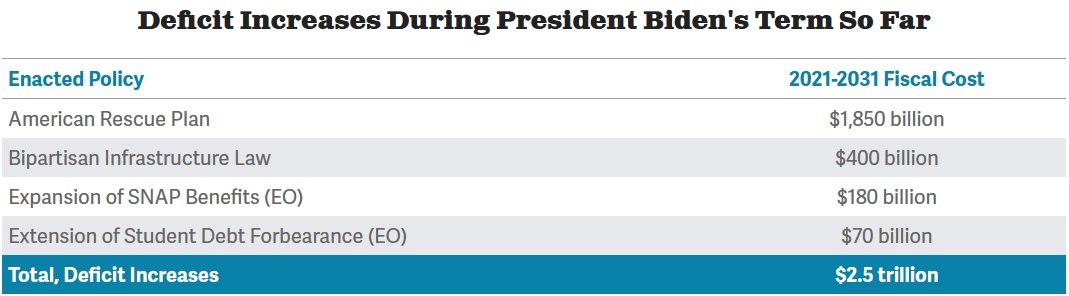
The bottom line is that Biden used the pandemic as an excuse to squander $1.9 trillion, even though at most only $80 billion of the money was for anything that was even vaguely related to vaccines and treatments.

From an economic perspective, that legislation was a spectacular failure.

I wonder whether we’ll ever learn how much of the remaining $1.82 trillion was wasted?

I’m guessing the answer is $1.82 trillion, but we won’t know how much was lost to run-of-the-mill waste and how much was lost to outright fraud.

P.S. Don’t forget that all government spending, even the small fraction that is spent wisely and efficiently, imposes economic costs. For more information, click here, here, here, here, here, and here.

—-

Milton Friedman on Spending

MILTON FRIEDMAN ON SPENDING

I identified four heroes from the “Battle of Ideas” video I shared in late August – Friedrich Hayek, Milton Friedman, Ronald Reagan, and Margaret Thatcher. Here’s one of those heroes, Milton Friedman, explaining what’s needed to control big government.

Friedman Fundamentals: How To Control Big Government

For all intents and purposes, Friedman is pointing out that there’s a “public choice” incentive for government to expand.

To counteract that disturbing trend, he explains that we need a high level of “societal capital.” In other words, we need a self-reliant and ethical populace – i.e., people who realize it’s wrong to use the coercive power of government to take from others.

Sadly, I don’t think that’s an accurate description of today’s United States.

So how, then, can we get control of government?

Since politicians are unlikely to control spending in the short run (their time horizon is always the next election), our best hope is to get them to agree to a rule that constrains what can happen in the future.

I’ve repeatedly argued in favor of a spending cap. Such a policy has a proven track record, and is far more effective than a balanced budget requirement.

That’s what should happen.

Now let’s focus on what shouldn’t happen. As Milton Friedman famously observed in 2001, tax increases are never the solution because politicians will simply spend any additional revenue (and the tax increases also will hurt the economy and cause Laffer-Curve feedback effects).

P.S. You can enjoy more wisdom from Friedman on issues such as the role of the firmspending other people’s money, and so-called Robber Barons.

P.P.S. On the issue of spending other people’s money, here’s an example of Jay Leno channeling Friedman.

ECB and IMF Studies Show Spending Caps Are the Ideal Fiscal Rule

Back in 2017, the Center for Freedom and Prosperity released this video to help explain why spending caps are the most sensible and sustainable fiscal rule.

Switzerland actually has a spending cap in its constitution, and similar fiscal rules also exist in Hong Kong and the state of Colorado.

These policies have produced very good results.

There are many reasons to support a spending cap, including the obvious observation that an expenditure limit (as it is sometimes called) directly addresses the actual problem of excessive government.

And addressing the underlying disease works better than rules that focus on symptoms, such as balanced budget requirements or anti-deficit mandates.

You’ll notice toward the end of the video that the narrator cites pro-spending cap research from international bureaucracies, which is remarkable since those institutions normally have a biasfor bigger government.

I’ve also written about that research, citing studies by the International Monetary Fund (here and here), the Organization for Economic Cooperation and Development (here and here) and the European Central Bank (here).

Today, let’s look at more evidence from these bureaucracies.

We’ll start with a new study from the European Central Bank. Here’s some of what the authors (Nicholai Benalal, Maximilian Freier, Wim Melyn, Stefan Van Parys, and Lukas Reiss) found when comparing spending limits and anti-deficit rules.

this paper provides an in-depth assessment of two alternative measures of fiscal consolidation and expansion: the change in the structural balance (dSB) and the expenditure benchmark (EB). Both the dSB and the EB are currently used to assess compliance with the fiscal rules under the Stability and Growth Pact (SGP).The EB was introduced as an indicator in 2011, and has gained in importance relative to the dSB since the European Commission began to put more emphasis on it in 2016.A comparison of the fiscal performance of euro area countries reveals significant differences depending on whether the assessment is based on the dSB or the EB. this paper finds that the EB has advantages over the dSB as a fiscal performance indicator. …expenditure rules…provide more predictability in fiscal requirements. …Even more importantly, the EB can be shown to be less procyclical as a fiscal rule than the dSB. 

Let’s also review some 2019 research from the International Monetary Fund.

This study (authored by Kodjovi Eklou and Marcelin Joanis) looks at whether fiscal rules can constrain vote-buying politicians.

In order to increase their chances of reelection, politicians are known to undertake fiscal manipulations, especially in election years. These fiscal manipulations typically take the form of increased public expenditure… Many countries, both developed and developing, have adopted fiscal rules in recent decades as an attempt to enforce fiscal discipline. …In this paper, we employ a cross-country panel dataset in order to test whether fiscal rules adopted in developing countries have been effective in constraining political budget cycles. The dataset covers 67 developing countries over the period 1985-2007. …Our dependent variable is the general government’s final consumption expenditure as a share of GDP.

Here’s what the authors concluded about the effectiveness of spending caps.

Our empirical evidence in a sample of 67 developing countries over the period 1985-2007, shows that fiscal rules cause fiscal discipline over the electoral cycle. More specifically, in election years with fiscal rules in place, public consumption is reduced by 1.65% point of GDP as compared to election years without these rules. Furthermore, the effectiveness of these rules depends on their type… In particular, expenditure rules, rules covering the general government and rules characterized by a monitoring body outside the government dampen political budget cycles in government consumption.

Indeed, footnote 12 of the paper specifically notes the superiority of expenditure limits.

…the results show that public consumption is reduced by 2.44% points during election years with expenditure rules in place. The findings on expenditure rules are consistent with Cordes et al. (2015) who show that the compliance rate for these rules are high.

Last but not least, the fiscal experts at the Office of Management and Budget included in Trump’s final budget some very encouraging language at the end of Chapter 10 of the Analytical Perspectives.

…additional efforts to control spending are needed. Several budget process reforms should be considered, including setting spending caps… Outlay caps that are consistent with the historical average as a share of gross domestic product (GDP),post-World War II levels could be enforced with sequestration across programs similar to other budget enforcement regimes. An outlay cap on mandatory spending would complement discretionary caps, which have been in place since 2013. The Budget proposes to continue discretionary caps through 2025 at declining levels and declining levels through 2030.

Trump was a big spender, of course, but at least there were people in his administration who realized there was a problem.

And they recognized the right solution.

P.S. It’s also interesting that the authors of the IMF study found that fiscal rules work better in democracies.

…estimates focusing on the subsample of democratic elections. The effect of fiscal rules on the political budget cycle is larger… More specifically, public consumption is reduced by 2.46% point of GDP (while it is 1.65% point in the baseline).

This may not bode well for the durability of Hong Kong’s spending cap.

The authors also found that foreign aid makes it less likely that a government will follow sensible policy.

Foreign aid, which relaxes the budget constraint of the government, is negatively correlated with the probability of having fiscal rules.

Needless to say, nobody should be surprised to learn that foreign aid undermines good policy.

Yes, Starve the Beast

As part of a recent discussion with Gene Tunny in Australia, I explained why I support “Starve the Beast,” which means keeping taxes as low as possible to help achieve the goal of spending restraint.

The premise of Starve the Beast is very simple.

Politicians like to spend money and they don’t particularly care whether that spending is financed by taxes or financed by borrowing (both bad options).

As Milton Friedman sagely observed, that means they will spend every penny they collect in taxes plus as much additional spending financed by borrowing that the political system will allow.

The IMF published a study on this issue about 10 years ago. The authors (Michael Kumhof, Douglas Laxton, and Daniel Leigh) assert that there’s no way of knowing whether Starve the Beast will lead to good or bad results.

…there is no consensus regarding the macroeconomic and welfare consequences of implementing a starve-the-beast approach, henceforth referred to as STB. …it could be beneficial in the ideal case in which it results in cuts in entirely wasteful government spending. In particular, lower spending frees up resources for private consumption, and the associated lower tax rates reduce distortions in the economy. On the other hand, …lower government spending may itself entail welfare losses…if it augments the productivity of private factors of production. …the paper examines whether the principal macroeconomic variables such as GDP and consumption, both in the United States and in the rest of the world, respond positively to this policy. …In addition, the paper assesses how the welfare effects depend on the degree to which government spending directly contributes to household welfare or to productivity.

The authors don’t really push any particular conclusion. Instead, they show various economic outcomes depending on with assumptions one adopts.

Since plenty of research shows that government spending is not a net plus for the economy (even IMF economists agree on that point), and because I think a less-punitive tax system is possible (and desirable) if there’s a smaller burden of government spending, I think the findings shown in Figure 4 make the most sense.

Now let’s shift from academic analysis to policy analysis.

In a piece for National Review back in July 2020, Jim Geraghty notes that Starve the Beast has an impact on government finances at the state level.

…we’re probably not going to see a massive expansion of government at the state level in the coming year or two. …Thanks to the pandemic lockdown bringing vast swaths of the economy to a halt, state tax revenues are plummeting.…So states will have much less tax revenue, constitutional balanced-budget requirements that are not easily repealed, and a limited amount of budgetary tricks to work around it. State governments could attempt to raise taxes, but that’s going to be unpopular and hurt state economies when they’re already struggling. Add it all up and it’s a tough set of circumstances for a dramatic expansion of government, no matter how ardently progressive the governor and state legislatures are.

For what it’s worth, Geraghty warned in the article that fiscal restraint by state governments wouldn’t happen if the federal government turned on the spending spigot.

And that, of course, is exactly what happened.

Now let’s look at the most unintentional endorsement of Stave the Beast.

A couple of years ago, Paul Krugman sort of admitted that cutting taxes was a potentially effective strategy for spending restraint.

…the same Republicans now wringing their hands over budget deficits…blew up that same deficit by enacting a huge tax cut for corporations and the wealthy. …this has been the G.O.P.’s budget strategy for decades. First, cut taxes. Then, bemoan the deficit created by those tax cuts and demand cuts in social spending.Lather, rinse, repeat. This strategy, known as “starve the beast,” has been around since the 1970s, when Republican economists like Alan Greenspan and Milton Friedman began declaring that the role of tax cuts in worsening budget deficits was a feature, not a bug. As Greenspan openly put it in 1978, the goal was to rein in spending with tax cuts that reduce revenue, then “trust that there is a political limit to deficit spending.” …voters should realize that the threat to programs… Social Security and Medicare as we know them will be very much in danger.

In other words, Krugman doesn’t like Starve the Beast because he fears it is effective (just like he also acknowledges the Laffer Curve, even though he’s opposed to tax cuts).

Let’s close by looking at some very powerful real-world evidence. Over the past 50 years, there’s been a massive increase in the tax burden in Western Europe.

Did all that additional tax revenue lead to lower deficits and less debt?

Nope, the opposite happened. European politicians spent every penny of the new tax revenue (much of it from value-added taxes). And then they added even more spending financed by additional borrowing.

To be fair, one could argue that this was an argument for the view of “Don’t Feed the Beast” rather than “Starve the Beast,” but it nonetheless shows that more money in the hands of politicians simply means more spending. And more red ink.

P.S. I had a discussion last year with Gene Tunny about the issue of “state capacity libertarianism.”


Friedman & Sowell: Should Our School System Be Privatized?

Regular readers know that the two things that get me most excited are the Georgia Bulldogs and the fight against a bloated public sector that is ineffective in the best of circumstances and more often than not is a threat to our freedoms.

So you will not be surprised to know that I am delighted that former Georgia Bulldog star Fran Tarkenton (who also happened to play in the NFL) has a superb piece in the Wall Street Journal ripping apart the inherent inefficiency of government-run monopoly schools.

Here is the key passage.

Imagine the National Football League in an alternate reality. Each player’s salary is based on how long he’s been in the league. It’s about tenure, not talent. The same scale is used for every player, no matter whether he’s an All-Pro quarterback or the last man on the roster. For every year a player’s been in this NFL, he gets a bump in pay. The only difference between Tom Brady and the worst player in the league is a few years of step increases. And if a player makes it through his third season, he can never be cut from the roster until he chooses to retire, except in the most extreme cases of misconduct. Let’s face the truth about this alternate reality: The on-field product would steadily decline. Why bother playing harder or better and risk getting hurt? No matter how much money was poured into the league, it wouldn’t get better. In fact, in many ways the disincentive to play harder or to try to stand out would be even stronger with more money. Of course, a few wild-eyed reformers might suggest the whole system was broken and needed revamping to reward better results, but the players union would refuse to budge and then demonize the reform advocates: “They hate football. They hate the players. They hate the fans.” The only thing that might get done would be building bigger, more expensive stadiums and installing more state-of-the-art technology. But that just wouldn’t help.

This sounds absurd, of course, but Mr. Tarkenton goes on to explain that this is precisely how government schools operate.

If you haven’t figured it out yet, the NFL in this alternate reality is the real-life American public education system. Teachers’ salaries have no relation to whether teachers are actually good at their job—excellence isn’t rewarded, and neither is extra effort. Pay is almost solely determined by how many years they’ve been teaching. That’s it. After a teacher earns tenure, which is often essentially automatic, firing him or her becomes almost impossible, no matter how bad the performance might be. And if you criticize the system, you’re demonized for hating teachers and not believing in our nation’s children. Inflation-adjusted spending per student in the United States has nearly tripled since 1970. According to the Organization for Economic Cooperation and Development, we spend more per student than any nation except Switzerland, with only middling results to show for it.

Actually, I will disagree with the last sentence of this excerpt. We’re not even getting “middling results.” Here’s a chart from an earlier post showing that we’ve gotten more bureaucracy and more spending but no improvement over the past 40 years.

So what’s the solution to this mess? Well, since government is the problem, it stands to reason that competition and markets are the answer.

Sweden, Chile, and the Netherlands are just some of the countries that have seen good results after breaking up state-run education monopolies.

Watch this video to get more details.

Economics 101: School Choice Example Shows Why Government Monopolies Are Bad

Related posts:

FRIEDMAN FRIDAY Milton Friedman’s FREE TO CHOOSE “The Tyranny of Control” Transcript and Video (60 Minutes)

Milton Friedman’s FREE TO CHOOSE “The Tyranny of Control” Transcript and Video (60 Minutes) In 1980 I read the book FREE TO CHOOSE by Milton Friedman and it really enlightened me a tremendous amount.  I suggest checking out these episodes and transcripts of Milton Friedman’s film series FREE TO CHOOSE: “The Failure of Socialism” and […]

FRIEDMAN FRIDAY “The Tyranny of Control” in Milton Friedman’s FREE TO CHOOSE Part 7 of 7 (Transcript and Video) “I’m not pro business, I’m pro free enterprise, which is a very different thing, and the reason I’m pro free enterprise”

In 1980 I read the book FREE TO CHOOSE by Milton Friedman and it really enlightened me a tremendous amount.  I suggest checking out these episodes and transcripts of Milton Friedman’s film series FREE TO CHOOSE: “The Failure of Socialism” and “What is wrong with our schools?”  and “Created Equal”  and  From Cradle to Grave, […]

FRIEDMAN FRIDAY “The Tyranny of Control” in Milton Friedman’s FREE TO CHOOSE Part 6 of 7 (Transcript and Video) “We are the ones who promote freedom, and free enterprise, and individual initiative, And what do we do? We force puny little Hong Kong to impose limits, restrictions on its exports at tariffs, in order to protect our textile workers”

In 1980 I read the book FREE TO CHOOSE by Milton Friedman and it really enlightened me a tremendous amount.  I suggest checking out these episodes and transcripts of Milton Friedman’s film series FREE TO CHOOSE: “The Failure of Socialism” and “What is wrong with our schools?”  and “Created Equal”  and  From Cradle to Grave, […]

FRIEDMAN FRIDAY “The Tyranny of Control” in Milton Friedman’s FREE TO CHOOSE Part 5 of 7 (Transcript and Video) “There is no measure whatsoever that would do more to prevent private monopoly development than complete free trade”

In 1980 I read the book FREE TO CHOOSE by Milton Friedman and it really enlightened me a tremendous amount.  I suggest checking out these episodes and transcripts of Milton Friedman’s film series FREE TO CHOOSE: “The Failure of Socialism” and “What is wrong with our schools?”  and “Created Equal”  and  From Cradle to Grave, […]

FRIEDMAN FRIDAY “The Tyranny of Control” in Milton Friedman’s FREE TO CHOOSE Part 4 of 7 (Transcript and Video) ” What we need are constitutional restraints on the power of government to interfere with free markets in foreign exchange, in foreign trade, and in many other aspects of our lives.”

In 1980 I read the book FREE TO CHOOSE by Milton Friedman and it really enlightened me a tremendous amount.  I suggest checking out these episodes and transcripts of Milton Friedman’s film series FREE TO CHOOSE: “The Failure of Socialism” and “What is wrong with our schools?”  and “Created Equal”  and  From Cradle to Grave, […]

FRIEDMAN FRIDAY “The Tyranny of Control” in Milton Friedman’s FREE TO CHOOSE Part 3 of 7 (Transcript and Video) “When anyone complains about unfair competition, consumers beware, That is really a cry for special privilege always at the expense of the consumer”

In 1980 I read the book FREE TO CHOOSE by Milton Friedman and it really enlightened me a tremendous amount.  I suggest checking out these episodes and transcripts of Milton Friedman’s film series FREE TO CHOOSE: “The Failure of Socialism” and “What is wrong with our schools?”  and “Created Equal”  and  From Cradle to Grave, […]

FRIEDMAN FRIDAY “The Tyranny of Control” in Milton Friedman’s FREE TO CHOOSE Part 2 of 7 (Transcript and Video) “As always, economic freedom promotes human freedom”

In 1980 I read the book FREE TO CHOOSE by Milton Friedman and it really enlightened me a tremendous amount.  I suggest checking out these episodes and transcripts of Milton Friedman’s film series FREE TO CHOOSE: “The Failure of Socialism” and “What is wrong with our schools?”  and “Created Equal”  and  From Cradle to Grave, […]

FRIEDMAN FRIDAY “The Tyranny of Control” Milton Friedman’s FREE TO CHOOSE Part 1 of 7 (Transcript and Video) “Adam Smith’s… key idea was that self-interest could produce an orderly society benefiting everybody, It was as though there were an invisible hand at work”

In 1980 I read the book FREE TO CHOOSE by Milton Friedman and it really enlightened me a tremendous amount.  I suggest checking out these episodes and transcripts of Milton Friedman’s film series FREE TO CHOOSE: “The Failure of Socialism” and “What is wrong with our schools?”  and “Created Equal”  and  From Cradle to Grave, […]

Open letter to President Obama (Part 654) “The Tyranny of Control” in Milton Friedman’s FREE TO CHOOSE Part 7 of 7 (Transcript and Video) “I’m not pro business, I’m pro free enterprise, which is a very different thing, and the reason I’m pro free enterprise”

Open letter to President Obama (Part 654) (Emailed to White House on July 22, 2013) President Obama c/o The White House 1600 Pennsylvania Avenue NW Washington, DC 20500 Dear Mr. President, I know that you receive 20,000 letters a day and that you actually read 10 of them every day. I really do respect you […]

Open letter to President Obama (Part 650) “The Tyranny of Control” in Milton Friedman’s FREE TO CHOOSE Part 6 of 7 (Transcript and Video) “We are the ones who promote freedom, and free enterprise, and individual initiative, And what do we do? We force puny little Hong Kong to impose limits, restrictions on its exports at tariffs, in order to protect our textile workers”

Open letter to President Obama (Part 650) (Emailed to White House on July 22, 2013) President Obama c/o The White House 1600 Pennsylvania Avenue NW Washington, DC 20500 Dear Mr. President, I know that you receive 20,000 letters a day and that you actually read 10 of them every day. I really do respect you […]

_________
Dan Mitchell and Milton Friedman on while FREE TRADE IS GOOD and TRADE DEFICITS don’t matter!

Milton Friedman – Free Trade vs. Protectionism

Free to Choose Part 2: The Tyranny of Control (Featuring Milton Friedman

Don’t Sweat the Trade Deficit

When the Commerce Department announced in February that the United States had a record trade deficit for 2021, I shared this video to help make the point that those trade numbers were that year’s “least important economic news.”

The main thing to understand is that a trade deficit is simply the flip side of an investment surplus.

When Americans use dollars to buy goods from other nations, those dollars are only valuable to foreigners because they can use them to buy things from America.

In many cases, they buy American goods and services. But they also use many of those dollars to invest in the U.S. economy.

That’s generally a positive thing. It’s a vote of confidence about America’s economic future.

Jeff Jacoby of the Boston Globe shares my viewpoint. He recently opined on this issue, echoing the important insight about the link between trade flows and investment flows.

The US trade deficit hit an all-time high in March, widening to nearly $110 billion as the nation imported considerably more goods than it exported. That can’t be good, right? Actually, it’s fine. …It’s not an indication of actual economic weakness. …Quite the contrary: All things being equal, imports are usually evidence of economic vitality and success.…The dollars Americans spend on imports aren’t “lost.” They are exchanged for desirable and affordable goods, services, parts, and commodities that strengthen Americans’ economy while elevating their US lifestyle. Better still, those dollars then come back to the United States, where they are used to invest in American assets or buy American exports, creating even more value and putting even more Americans to work. …a trade “deficit” isn’t a debt we owe. It is an accounting entry that tells us how much more we were enriched by foreigners than they were by us. ..the US economy has some real problems. Happily, the trade deficit isn’t one of them. Imports are good. And more imports? They’re good too.

This does not mean, however, that everyone is a winner.

As I explain in this video, jobs are destroyed when there is trade between nations. But I also point out that jobs are destroyed by trade inside a nation’s borders.

That’s bad news for workers in sectors that are dying (such as typewriter makers after personal computers hit the market).

What’s important is whether the new jobs that are createdexceed the number of jobs that are lost.

This is what is called “creative destruction.” It’s painful, but it is why we are much richer today than we were in the past.

The good news is that this usually happens…at least if politicians resist the temptation to over-tax, over-spend, and over-regulate.

The bottom line is that free trade is much better for long-run prosperity than protectionism.

Unless, of course, you think it’s a good idea to copy the policies of Herbert Hoover.

Trump, Sanders, and the Snake-Oil Economics of Protectionism

John Cowperthwaite deserves a lot of credit for Hong Kong’s prosperity. As a British appointee, he took a hands-off policy and allowed the colony’s economy to thrive. He didn’t even want the government to collect statistics since that would give interventionists data that might be used to argue for interventionism.

I have mixed feelings about that approach. I constantly use statistics because they so often show that free markets and small government produce the best outcomes. I even use data to show that Hong Kong’s economy should be emulated.

On the other hand, there are some statistics that cause a lot of mischief.

I’ve argued, for instance, that we should focus on how national prosperity is generated (gross domestic income) rather than how it is allocated (gross domestic product). If we changed the focus to GDI, the debate would more naturally focus on pro-growth policies to boost wages, small business income, and corporate profits rather than the misguided policies (such asKeynesian economics) that are enabled by a focus on GDP.

That being said, there’s a good argument that the worst government statistic is the “trade deficit.”

This is a very destructive piece of data because people instinctively assume a “deficit” is bad. Yet I have a trade deficit every year with my local grocery store. I’m always buying things from them and they never buy anything from me. Does that mean I’m a “loser”? Of course not. Voluntary exchange, by definition, means that both parties gain from any transaction. And this principle applies when voluntary exchange occurs across national borders.

Moreover, people oftentimes don’t realize that the necessary and automatic flip side of a “trade deficit” is a “capital surplus.” In other words, when foreign companies acquire dollars by selling to American consumers, they frequently decide that investing in the American economy is the best use of that money. And the huge amount of investment from overseas is a sign of comparative prosperity and vitality, not a sign of weakness.

And for any readers who nonetheless think protectionism might be a good idea, I challenge them to answer these eight questions.

I’m confident that both Donald Trump and Bernie Sanders wouldn’t be able to successfully answer any of them. Yet it appears they’ve gained some traction with voters by calling for protectionism.

That’s quite unfortunate. If the pro-trade policy consensus in America breaks down, that would create dangerous opportunities for politicians and bureaucrats to rig the game in favor of special interests while also imposing higher costs of taxpayers and consumers.

Let’s dig into the issue.

In a column for the Wall Street Journal, Mort Kondracke and Matthew Slaughter combine to produce a strong defense of trade.

…the four leading presidential candidates…oppose the U.S. ratifying the Trans-Pacific Partnership. All four demonize trade the same way. …Where is the leader with the courage to tell the truth? To say that trade made this nation great, and that trade barriers will destroy far more jobs than they can ever “save.” …America’s exporters and importers are among the country’s most dynamic companies, paying their workers about 15%-20% more than workers earn elsewhere in the economy. The overall gains are large. Trade and related activities—spurred by accords such as the North American Free Trade Agreement, or Nafta, have boosted annual U.S. income today by about 10 percentage points of GDP relative to what it would have been otherwise. This translates into an aggregate gain of about $1.8 trillion in 2015—thousands of dollars per U.S. household every year. …creative destruction—the movement of people and capital from weaker businesses to stronger ones and new opportunities—is how many of the gains from trade arise. …For generations, American presidents of both parties have spoken about the benefits of trade. “Economic isolation and political leadership are wholly incompatible,” warned John Kennedy. “A creative, competitive America is the answer to a changing world,” said Ronald Reagan. “We should always remember: protectionism is destructionism.”

By the way, I think Kondracke and Slaughter paint with too broad a brush. Both Cruz and Clinton are far less protectionist than Trump and Sanders. Though the authors are correct in noting that they’ve been reluctant (especially in the case of Clinton) to vigorously defend free trade.

The great legal scholar Richard Epstein (also my former debating partner) writesabout the dangers of protectionism.

There are of course major difference between the insidious Trump and buffoonish Sanders. …Still, the real selling point of each boils down to one issue: In the indecorous language of the pollster, Pat Caddell, Americans feel “they have been screwed” by free trade. …free trade is in retreat as protectionism becomes the common thread across the both political parties. It is as though the economic unwisdom of the 1930 Smoot-Hawley Tariff Act is back.

Richard makes a very important point that politicians often support protectionism in an attempt to hide the damage they do with other misguided policies.

Free trade offers an uncompromising indictment of, and a powerful corrective for, America’s unsound economic policies. …the reason that local businesses outsource from the United States is the same reason why foreign businesses are reluctant to expand operations here. Our regulatory and labor environment is hostile to economic growth and there are no signs of that abating anytime soon. …the steady decline in freedom and productivity inside the United States has continued apace. Ironically, the strong likelihood that the next American president will expand protectionist practices will only make matters worse: firms, both foreign and domestic, are more reluctant to invest in the United States…free trade gives the federal government and the individual states strong incentives to clean up their act so that they can once again be attractive to foreign investment.

My buddy Ross Kaminsky explains in the American Spectator that free trade is good because it is part of the competitive process that boosts living standards, particularly for the poor.

…in trade, as in any economic endeavor, there are losers in the short run. Capitalism is, after all, fundamentally a system of creative destruction. But if there is any area of agreement among economists of all political stripes…it is that free trade provides large net benefits to the societies that engage in it, even if other nations do not lower trade barriers to the same degree. Furthermore, the benefits of trade accrue in large measure to the lower economic echelons of society in an extension of Schumpeter’s profound observation that “the capitalist achievement does not typically consist in providing more silk stockings for queens but in bringing them within the reach of factory girls in return for steadily decreasing amounts of effort.”

And Ross echoes Richard Epstein’s point about the real problem being anti-growth policies that make America less competitive.

Trade is complex and like all complex things politicians will dumb it down in a way that benefits them, generally by lying to the public and creating a frothy anger against those “damn furiners” instead of pointing fingers at the true culprits: unions, regulators, and politicians of all stripes.

Ross and Richard are right. If politicians really want more jobs in America, they should be adopting policies to boost U.S. competitiveness.

And we don’t need giant steps. Yes, a flat tax would be great, but even incremental reforms such as a lower corporate tax rate or the right tax treatment of business investment would yield big dividends.

Let’s add a few more voices to the discussion.

In an editorial, the Wall Street Journal debunks Donald Trump’s protectionist tirade against China.

The real-estate developer recently added Japan to his most-wanted list of job killers… “They’re killing us. You know what we sell to Japan? Practically nothing.” Is $116 billion worth of annual goods and services exports to Japan practically nothing? Japan is the fourth largest U.S. export market in goods after Canada, Mexico and China. …The best way to boost American exports is to remove trade barriers with new trade agreements. U.S. farm producers would particularly benefit from the Trans-Pacific Partnership with Japan and 10 other countries. Japanese tariffs on beef would fall to 9% in the 16th year of the deal from 38.5% while the 20% tariff on ground pork would be eliminated in six years. Japan’s 21.3% levy on poultry and eggs would be abolished in six to 13 years.

Writing for the Washington Post, David Ignatius defends trade in general and trade agreements in particular.

…the revolt against free trade that has captured both parties could do the most long-term damage. …there’s strong evidence that trade has benefited the U.S. economy and created whole new industries in which the United States is dominant. That’s the essence of the “creative destruction” that makes a market economy so potent: It relentlessly pushes innovation and change. …The bipartisan protectionism of Trump and Sanders has focused its attacks on the Trans-Pacific Partnership… Robert Z. Lawrence and Tyler Moran estimate that between 2017 and 2026, when TPP would have its major impact, the costs to displaced workers would be 6 percent of the benefits to the economy — or an 18-to-1 benefit-to-cost ratio. …David Autor, David Dorn and Gordon Hanson…noted that the pact would promote trade in knowledge industries where the United States has a big advantage and that “killing the TPP would do little to bring factory work back to America.”

Ignatius also makes a very important observation that protectionists want us to be scared of nations that have much bigger problems than the United States.

Trump, the businessman, seems weirdly out of touch with real economic trends. He speaks of Japan as though it were an economic powerhouse, when it has actually suffered a two-decades-long slump; he describes a surging China, when the numbers show its growth is sagging.

Amen. Japan has huge problems and China still has quite a way to go before it becomes a developed nation.

Let’s close with some good news. Politicians may be engaging in anti-trade demagoguery, and there may be some voters that are motivated by hostility to voluntary exchange, but that doesn’t mean the protectionists have won.

Indeed, pro-trade sentiment has never been higher by some measures. Here’s some amazingly positive polling data from Gallup.

P.S. One final point. The growing burden of government spending and taxation since World War II have been very unfortunate, but the good news is that we have strong evidence that the economic damage of worsening fiscal policy has been offset by the economic gains from trade liberalization. It would be tragic to see that reversed.

P.P.S. Fans of Richard Epstein may enjoy this video of him reminiscing about Barack Obama’s undistinguished tenure at the University of Chicago Law School, as well asthis video of him dismantling George Soros in a debate that took place at Cato.

Related posts:

FRIEDMAN FRIDAY Milton Friedman’s FREE TO CHOOSE “The Tyranny of Control” Transcript and Video (60 Minutes)

Milton Friedman’s FREE TO CHOOSE “The Tyranny of Control” Transcript and Video (60 Minutes) In 1980 I read the book FREE TO CHOOSE by Milton Friedman and it really enlightened me a tremendous amount.  I suggest checking out these episodes and transcripts of Milton Friedman’s film series FREE TO CHOOSE: “The Failure of Socialism” and […]

FRIEDMAN FRIDAY “The Tyranny of Control” in Milton Friedman’s FREE TO CHOOSE Part 7 of 7 (Transcript and Video) “I’m not pro business, I’m pro free enterprise, which is a very different thing, and the reason I’m pro free enterprise”

In 1980 I read the book FREE TO CHOOSE by Milton Friedman and it really enlightened me a tremendous amount.  I suggest checking out these episodes and transcripts of Milton Friedman’s film series FREE TO CHOOSE: “The Failure of Socialism” and “What is wrong with our schools?”  and “Created Equal”  and  From Cradle to Grave, […]

FRIEDMAN FRIDAY “The Tyranny of Control” in Milton Friedman’s FREE TO CHOOSE Part 6 of 7 (Transcript and Video) “We are the ones who promote freedom, and free enterprise, and individual initiative, And what do we do? We force puny little Hong Kong to impose limits, restrictions on its exports at tariffs, in order to protect our textile workers”

In 1980 I read the book FREE TO CHOOSE by Milton Friedman and it really enlightened me a tremendous amount.  I suggest checking out these episodes and transcripts of Milton Friedman’s film series FREE TO CHOOSE: “The Failure of Socialism” and “What is wrong with our schools?”  and “Created Equal”  and  From Cradle to Grave, […]

FRIEDMAN FRIDAY “The Tyranny of Control” in Milton Friedman’s FREE TO CHOOSE Part 5 of 7 (Transcript and Video) “There is no measure whatsoever that would do more to prevent private monopoly development than complete free trade”

In 1980 I read the book FREE TO CHOOSE by Milton Friedman and it really enlightened me a tremendous amount.  I suggest checking out these episodes and transcripts of Milton Friedman’s film series FREE TO CHOOSE: “The Failure of Socialism” and “What is wrong with our schools?”  and “Created Equal”  and  From Cradle to Grave, […]

FRIEDMAN FRIDAY “The Tyranny of Control” in Milton Friedman’s FREE TO CHOOSE Part 4 of 7 (Transcript and Video) ” What we need are constitutional restraints on the power of government to interfere with free markets in foreign exchange, in foreign trade, and in many other aspects of our lives.”

In 1980 I read the book FREE TO CHOOSE by Milton Friedman and it really enlightened me a tremendous amount.  I suggest checking out these episodes and transcripts of Milton Friedman’s film series FREE TO CHOOSE: “The Failure of Socialism” and “What is wrong with our schools?”  and “Created Equal”  and  From Cradle to Grave, […]

FRIEDMAN FRIDAY “The Tyranny of Control” in Milton Friedman’s FREE TO CHOOSE Part 3 of 7 (Transcript and Video) “When anyone complains about unfair competition, consumers beware, That is really a cry for special privilege always at the expense of the consumer”

In 1980 I read the book FREE TO CHOOSE by Milton Friedman and it really enlightened me a tremendous amount.  I suggest checking out these episodes and transcripts of Milton Friedman’s film series FREE TO CHOOSE: “The Failure of Socialism” and “What is wrong with our schools?”  and “Created Equal”  and  From Cradle to Grave, […]

FRIEDMAN FRIDAY “The Tyranny of Control” in Milton Friedman’s FREE TO CHOOSE Part 2 of 7 (Transcript and Video) “As always, economic freedom promotes human freedom”

In 1980 I read the book FREE TO CHOOSE by Milton Friedman and it really enlightened me a tremendous amount.  I suggest checking out these episodes and transcripts of Milton Friedman’s film series FREE TO CHOOSE: “The Failure of Socialism” and “What is wrong with our schools?”  and “Created Equal”  and  From Cradle to Grave, […]

FRIEDMAN FRIDAY “The Tyranny of Control” Milton Friedman’s FREE TO CHOOSE Part 1 of 7 (Transcript and Video) “Adam Smith’s… key idea was that self-interest could produce an orderly society benefiting everybody, It was as though there were an invisible hand at work”

In 1980 I read the book FREE TO CHOOSE by Milton Friedman and it really enlightened me a tremendous amount.  I suggest checking out these episodes and transcripts of Milton Friedman’s film series FREE TO CHOOSE: “The Failure of Socialism” and “What is wrong with our schools?”  and “Created Equal”  and  From Cradle to Grave, […]

Open letter to President Obama (Part 654) “The Tyranny of Control” in Milton Friedman’s FREE TO CHOOSE Part 7 of 7 (Transcript and Video) “I’m not pro business, I’m pro free enterprise, which is a very different thing, and the reason I’m pro free enterprise”

Open letter to President Obama (Part 654) (Emailed to White House on July 22, 2013) President Obama c/o The White House 1600 Pennsylvania Avenue NW Washington, DC 20500 Dear Mr. President, I know that you receive 20,000 letters a day and that you actually read 10 of them every day. I really do respect you […]

Open letter to President Obama (Part 650) “The Tyranny of Control” in Milton Friedman’s FREE TO CHOOSE Part 6 of 7 (Transcript and Video) “We are the ones who promote freedom, and free enterprise, and individual initiative, And what do we do? We force puny little Hong Kong to impose limits, restrictions on its exports at tariffs, in order to protect our textile workers”

Open letter to President Obama (Part 650) (Emailed to White House on July 22, 2013) President Obama c/o The White House 1600 Pennsylvania Avenue NW Washington, DC 20500 Dear Mr. President, I know that you receive 20,000 letters a day and that you actually read 10 of them every day. I really do respect you […]

__________

Dan Mitchell article: Debunking Biden’s Absurd “Cut the Deficit” Claim

A.F. Branco for Oct 21, 2021

Debunking Biden’s Absurd “Cut the Deficit” Claim

After almost 16 months in office, what is President Biden’s track record on fiscal policy?

The good news is that his big tax-and-spend plan to “build back better” has not been approved by Congress (and fingers crossed that it stays that way).

The bad news is that he has done other things, such as getting a fake stimulus though Congress, as well as a so-called infrastructure package.

The Committee for a Responsible Federal Budget put together an estimate of his major initiatives.

By the way, the CRFB folks fixate on how these initiative impact the deficit. What we really should be concerned about is how much money is being spent.

But let’s set that aside and focus instead on a jaw-dropping claim from the White House.

Even though all of his major initiatives have increased red ink, he is patting himself on the backfor lower deficits.

For what it is worth, Biden’s claim is semi-accurate. It is true that budget deficits are temporarily falling.

But not because of him. Instead, red ink is falling because there was massive, one-time, multi-trillion dollar emergency spending for the COVID pandemic in 2020. That spending began to wind down in 2021 and it has mostly dissipated this year, so of course deficits have fallen.

For Biden to take credit for this drop would be akin to Truman taking credit for the big drop in red ink after World War II ended.

Eric Boehm of Reason wrote a column that debunks Biden’s ludicrous claim.

…this year’s budget deficit is forecasted to be the third or fourth-largest in American history—but President Joe Biden claims…his administration is overseeing a period of fiscal austerity. …Here are some words that actually tumbled out of the president’s mouth at a press conference… “We’re on track to cut the federal deficit by another $1.5 trillion by the end of this fiscal year. …on top of us having a $350 billion drop in the deficit last year, my first year as president,” Biden continued.…Those facts, however, exclude a few key details. …Biden took office the year after the budget deficit hit previously unimaginable highs due to a completely unprecedented spending binge triggered by a once-in-a-generation public health disaster. …if you look at the actual budgetary baselines published by the Congressional Budget Office—that is, the ongoing amount of annual federal spending absent any emergency stimulus bills like the ones passed on several occasions during the height of the pandemic—Biden has overseen a noticeable increase in the deficit above the pre-pandemic baseline. According to the Committee for a Responsible Federal Budget, a fiscal watchdog group that advocates for lower deficits, Biden’s policies have added about $2.5 trillion to the deficit over the next 10 years.

Brian Riedl is now with the Manhattan Institute, but we used to work together earlier this century at the Heritage Foundation. One of his admirable traits is that he hasn’t lost the ability to be outraged.

That comes through in his tweet about Biden’s supposed accomplishment.

By the way, I’m not making a partisan point. I have no doubt Trump would have done the same thing.

After all, politicians are probably the least ethical people in the nation. And Washington brings out the worst of the worst.

Biden talks up deficit reduction, as watchdog says it’s ‘highly misleading’

Last Updated: May 4, 2022 at 11:50 a.m. ETFirst Published: May 4, 2022 at 10:22 a.m. ET

President: ‘Bringing down the deficit is one way to ease inflationary pressures’

President Joe Biden speaks Wednesday about the economy at the White House. Also pictured (L-R) are Shalanda Young, director of the Office of Management and Budget; Cecilia Rouse, chair of the Council of Economic Advisers; and Brian Deese, director of the National Economic Council.

AFP/GETTY IMAGES

President Joe Biden on Wednesday delivered an economic speech that highlighted cuts to the federal deficit, even as some watchdogs have criticized his rhetoric around reducing red ink.

“The bottom line is the deficit went up every year under my predecessor, before the pandemic and during the pandemic, and it’s gone down both years since I’ve been here. Period. They’re the facts,” Biden said at the White House.

“Why is it important? Because bringing down the deficit is one way to ease inflationary pressures.”

The president has been talking up fiscal deficit reduction as a way to win over a key Democratic senator — West Virginia’s Joe Manchin — who has blocked Biden’s Build Back Better spending plan and wants to see Washington focused on closing the budget gap and fighting high inflation.

Biden’s rhetoric on eliminating red ink has drawn flak from the Committee for a Responsible Federal Budget, a nonpartisan watchdog organization.

“While President Biden’s Fiscal Year (FY) 2023 budget calls for $1.05 trillion of welcomed deficit reduction, the administration has largely been focused on taking credit for the expected $1.3 trillion fall in the deficit between FY 2021 and 2022,” the organization said in a blog post last month.

“The administration touting this victory is highly misleading; deficits are falling mainly because COVID relief is ending, and deficits will remain high even after this decline.”

Biden on Thursday said his administration revealed this week that it’s on track to cut the federal deficit by $1.5 trillion by the end of the current fiscal year, adding that it’s “the biggest decline in a single year ever in American history.”

The president’s remarks come after his Treasury Department on Monday surprised observers by announcing that it plans to pay down $26 billion in debt in the second quarter.

“For the first time since 2016, the Treasury Department is planning to pay down the national debt issued to the public this quarter,” he said on Wednesday. “For all the talk Republicans make about deficits, it didn’t happen a single quarter under my predecessor, not once.”

Biden’s speech initially had been planned for 2 p.m. Eastern, but the White House moved up the scheduled time for his remarks by three hours.

The Federal Reserve at 2 p.m. Eastern is expected to announce its biggest hike in interest rates in 20 years — a half-percentage-point rise — as the American central bank aims to combat the highest U.S. inflation in 40 years. Fed Chairman Jerome Powell is due to speak at a news conference at 2:30 p.m.

March 31, 2021

President Biden  c/o The White House
1600 Pennsylvania Avenue NW
Washington, DC 20500

Dear Mr. President,

Please explain to me if you ever do plan to balance the budget while you are President? I have written these things below about you and I really do think that you don’t want to cut spending in order to balance the budget. It seems you ever are daring the Congress to stop you from spending more.

President Barack Obama speaks about the debt limit in the East Room of the White House in Washington. | AP Photo

“The credit of the United States ‘is not a bargaining chip,’ Obama said on 1-14-13. However, President Obama keeps getting our country’s credit rating downgraded as he raises the debt ceiling higher and higher!!!!

Washington Could Learn a Lot from a Drug Addict

Just spend more, don’t know how to cut!!! Really!!! That is not living in the real world is it?

Making more dependent on government is not the way to go!!

Why is our government in over 16 trillion dollars in debt? There are many reasons for this but the biggest reason is people say “Let’s spend someone else’s money to solve our problems.” Liberals like Max Brantley have talked this way for years. Brantley will say that conservatives are being harsh when they don’t want the government out encouraging people to be dependent on the government. The Obama adminstration has even promoted a plan for young people to follow like Julia the Moocher.  

David Ramsey demonstrates in his Arkansas Times Blog post of 1-14-13 that very point:

Arkansas Politics / Health Care Arkansas’s share of Medicaid expansion and the national debt

Posted by on Mon, Jan 14, 2013 at 1:02 PM

Baby carrot Arkansas Medicaid expansion image

Imagine standing a baby carrot up next to the 25-story Stephens building in Little Rock. That gives you a picture of the impact on the national debt that federal spending in Arkansas on Medicaid expansion would have, while here at home expansion would give coverage to more than 200,000 of our neediest citizens, create jobs, and save money for the state.

Here’s the thing: while more than a billion dollars a year in federal spending would represent a big-time stimulus for Arkansas, it’s not even a drop in the bucket when it comes to the national debt.

Currently, the national debt is around $16.4 trillion. In fiscal year 2015, the federal government would spend somewhere in the neighborhood of $1.2 billion to fund Medicaid expansion in Arkansas if we say yes. That’s about 1/13,700th of the debt.

It’s hard to get a handle on numbers that big, so to put that in perspective, let’s get back to the baby carrot. Imagine that the height of the Stephens building (365 feet) is the $16 trillion national debt. That $1.2 billion would be the length of a ladybug. Of course, we’re not just talking about one year if we expand. Between now and 2021, the federal government projects to contribute around $10 billion. The federal debt is projected to be around $25 trillion by then, so we’re talking about 1/2,500th of the debt. Compared to the Stephens building? That’s a baby carrot.

______________

Here is how it will all end if everyone feels they should be allowed to have their “baby carrot.”

How sad it is that liberals just don’t get this reality.

Here is what the Founding Fathers had to say about welfare. David Weinberger noted:

While living in Europe in the 1760s, Franklin observed: “in different countries … the more public provisions were made for the poor, the less they provided for themselves, and of course became poorer. And, on the contrary, the less was done for them, the more they did for themselves, and became richer.”

Alexander Fraser Tytler, Lord Woodhouselee (15 October 1747 – 5 January 1813) was a Scottish lawyer, writer, and professor. Tytler was also a historian, and he noted, “A democracy cannot exist as a permanent form of government. It can only exist until the majority discovers it can vote itself largess out of the public treasury. After that, the majority always votes for the candidate promising the most benefits with the result the democracy collapses because of the loose fiscal policy ensuing, always to be followed by a dictatorship, then a monarchy.”

Thomas Jefferson to Joseph Milligan

April 6, 1816

[Jefferson affirms that the main purpose of society is to enable human beings to keep the fruits of their labor. — TGW]

To take from one, because it is thought that his own industry and that of his fathers has acquired too much, in order to spare to others, who, or whose fathers have not exercised equal industry and skill, is to violate arbitrarily the first principle of association, “the guarantee to every one of a free exercise of his industry, and the fruits acquired by it.” If the overgrown wealth of an individual be deemed dangerous to the State, the best corrective is the law of equal inheritance to all in equal degree; and the better, as this enforces a law of nature, while extra taxation violates it.

[From Writings of Thomas Jefferson, ed. Albert E. Bergh (Washington: Thomas Jefferson Memorial Association, 1904), 14:466.]

_______

Jefferson pointed out that to take from the rich and give to the poor through government is just wrong. Franklin knew the poor would have a better path upward without government welfare coming their way. Milton Friedman’s negative income tax is the best method for doing that and by taking away all welfare programs and letting them go to the churches for charity.

_____________

_________

Thank you so much for your time. I know how valuable it is. I also appreciate the fine family that you have and your commitment as a father and a husband.

Sincerely,

Everette Hatcher III, 13900 Cottontail Lane, Alexander, AR 72002, ph 501-920-5733

Williams with Sowell – Minimum Wage

Thomas Sowell

Thomas Sowell – Reducing Black Unemployment

By WALTER WILLIAMS

—-

Ronald Reagan with Milton Friedman
Milton Friedman The Power of the Market 2-5

Related posts:

Welfare Spending Shattering All-Time Highs

  We got to act fast and get off this path of socialism. Morning Bell: Welfare Spending Shattering All-Time Highs Robert Rector and Amy Payne October 18, 2012 at 9:03 am It’s been a pretty big year for welfare—and a new report shows welfare is bigger than ever. The Obama Administration turned a giant spotlight […]

We need more brave souls that will vote against Washington welfare programs

We need to cut Food Stamp program and not extend it. However, it seems that people tell the taxpayers back home they are going to Washington and cut government spending but once they get up there they just fall in line with  everyone else that keeps spending our money. I am glad that at least […]

Welfare programs are not the answer for the poor

Government Must Cut Spending Uploaded by HeritageFoundation on Dec 2, 2010 The government can cut roughly $343 billion from the federal budget and they can do so immediately. __________ Liberals argue that the poor need more welfare programs, but I have always argued that these programs enslave the poor to the government. Food Stamps Growth […]

Private charities are best solution and not government welfare

Milton Friedman – The Negative Income Tax Published on May 11, 2012 by LibertyPen In this 1968 interview, Milton Friedman explained the negative income tax, a proposal that at minimum would save taxpayers the 72 percent of our current welfare budget spent on administration. http://www.LibertyPen.com Source: Firing Line with William F Buckley Jr. ________________ Milton […]

The book “After the Welfare State”

Dan Mitchell Commenting on Obama’s Failure to Propose a Fiscal Plan Published on Aug 16, 2012 by danmitchellcato No description available. ___________ After the Welfare State Posted by David Boaz Cato senior fellow Tom G. Palmer, who is lecturing about freedom in Slovenia and Tbilisi this week, asked me to post this announcement of his […]

President Obama responds to Heritage Foundation critics on welfare reform waivers

Is President Obama gutting the welfare reform that Bill Clinton signed into law? Morning Bell: Obama Denies Gutting Welfare Reform Amy Payne August 8, 2012 at 9:15 am The Obama Administration came out swinging against its critics on welfare reform yesterday, with Press Secretary Jay Carney saying the charge that the Administration gutted the successful […]

Welfare reform part 3

Thomas Sowell – Welfare Welfare reform was working so good. Why did we have to abandon it? Look at this article from 2003. The Continuing Good News About Welfare Reform By Robert Rector and Patrick Fagan, Ph.D. February 6, 2003 Six years ago, President Bill Clinton signed legislation overhauling part of the nation’s welfare system. […]

Welfare reform part 2

Uploaded by ForaTv on May 29, 2009 Complete video at: http://fora.tv/2009/05/18/James_Bartholomew_The_Welfare_State_Were_In Author James Bartholomew argues that welfare benefits actually increase government handouts by ‘ruining’ ambition. He compares welfare to a humane mousetrap. —– Welfare reform was working so good. Why did we have to abandon it? Look at this article from 2003. In the controversial […]

Why did Obama stop the Welfare Reform that Clinton put in?

Thomas Sowell If the welfare reform law was successful then why change it? Wasn’t Bill Clinton the president that signed into law? Obama Guts Welfare Reform Robert Rector and Kiki Bradley July 12, 2012 at 4:10 pm Today, the Obama Department of Health and Human Services (HHS) released an official policy directive rewriting the welfare […]

“Feedback Friday” Letter to White House generated form letter response July 10,2012 on welfare, etc (part 14)

I have been writing President Obama letters and have not received a personal response yet.  (He reads 10 letters a day personally and responds to each of them.) However, I did receive a form letter in the form of an email on July 10, 2012. I don’t know which letter of mine generated this response so I have […]

Biden talks up deficit reduction, as watchdog says it’s ‘highly misleading’

A.F. Branco for Oct 21, 2021

Biden talks up deficit reduction, as watchdog says it’s ‘highly misleading’

Last Updated: May 4, 2022 at 11:50 a.m. ETFirst Published: May 4, 2022 at 10:22 a.m. ET

President: ‘Bringing down the deficit is one way to ease inflationary pressures’

President Joe Biden speaks Wednesday about the economy at the White House. Also pictured (L-R) are Shalanda Young, director of the Office of Management and Budget; Cecilia Rouse, chair of the Council of Economic Advisers; and Brian Deese, director of the National Economic Council.

AFP/GETTY IMAGES

President Joe Biden on Wednesday delivered an economic speech that highlighted cuts to the federal deficit, even as some watchdogs have criticized his rhetoric around reducing red ink.

“The bottom line is the deficit went up every year under my predecessor, before the pandemic and during the pandemic, and it’s gone down both years since I’ve been here. Period. They’re the facts,” Biden said at the White House.

“Why is it important? Because bringing down the deficit is one way to ease inflationary pressures.”

The president has been talking up fiscal deficit reduction as a way to win over a key Democratic senator — West Virginia’s Joe Manchin — who has blocked Biden’s Build Back Better spending plan and wants to see Washington focused on closing the budget gap and fighting high inflation.

Biden’s rhetoric on eliminating red ink has drawn flak from the Committee for a Responsible Federal Budget, a nonpartisan watchdog organization.

“While President Biden’s Fiscal Year (FY) 2023 budget calls for $1.05 trillion of welcomed deficit reduction, the administration has largely been focused on taking credit for the expected $1.3 trillion fall in the deficit between FY 2021 and 2022,” the organization said in a blog post last month.

“The administration touting this victory is highly misleading; deficits are falling mainly because COVID relief is ending, and deficits will remain high even after this decline.”

Biden on Thursday said his administration revealed this week that it’s on track to cut the federal deficit by $1.5 trillion by the end of the current fiscal year, adding that it’s “the biggest decline in a single year ever in American history.”

The president’s remarks come after his Treasury Department on Monday surprised observers by announcing that it plans to pay down $26 billion in debt in the second quarter.

“For the first time since 2016, the Treasury Department is planning to pay down the national debt issued to the public this quarter,” he said on Wednesday. “For all the talk Republicans make about deficits, it didn’t happen a single quarter under my predecessor, not once.”

Biden’s speech initially had been planned for 2 p.m. Eastern, but the White House moved up the scheduled time for his remarks by three hours.

The Federal Reserve at 2 p.m. Eastern is expected to announce its biggest hike in interest rates in 20 years — a half-percentage-point rise — as the American central bank aims to combat the highest U.S. inflation in 40 years. Fed Chairman Jerome Powell is due to speak at a news conference at 2:30 p.m.

March 31, 2021

President Biden  c/o The White House
1600 Pennsylvania Avenue NW
Washington, DC 20500

Dear Mr. President,

Please explain to me if you ever do plan to balance the budget while you are President? I have written these things below about you and I really do think that you don’t want to cut spending in order to balance the budget. It seems you ever are daring the Congress to stop you from spending more.

President Barack Obama speaks about the debt limit in the East Room of the White House in Washington. | AP Photo

“The credit of the United States ‘is not a bargaining chip,’ Obama said on 1-14-13. However, President Obama keeps getting our country’s credit rating downgraded as he raises the debt ceiling higher and higher!!!!

Washington Could Learn a Lot from a Drug Addict

Just spend more, don’t know how to cut!!! Really!!! That is not living in the real world is it?

Making more dependent on government is not the way to go!!

Why is our government in over 16 trillion dollars in debt? There are many reasons for this but the biggest reason is people say “Let’s spend someone else’s money to solve our problems.” Liberals like Max Brantley have talked this way for years. Brantley will say that conservatives are being harsh when they don’t want the government out encouraging people to be dependent on the government. The Obama adminstration has even promoted a plan for young people to follow like Julia the Moocher.  

David Ramsey demonstrates in his Arkansas Times Blog post of 1-14-13 that very point:

Arkansas Politics / Health Care Arkansas’s share of Medicaid expansion and the national debt

Posted by on Mon, Jan 14, 2013 at 1:02 PM

Baby carrot Arkansas Medicaid expansion image

Imagine standing a baby carrot up next to the 25-story Stephens building in Little Rock. That gives you a picture of the impact on the national debt that federal spending in Arkansas on Medicaid expansion would have, while here at home expansion would give coverage to more than 200,000 of our neediest citizens, create jobs, and save money for the state.

Here’s the thing: while more than a billion dollars a year in federal spending would represent a big-time stimulus for Arkansas, it’s not even a drop in the bucket when it comes to the national debt.

Currently, the national debt is around $16.4 trillion. In fiscal year 2015, the federal government would spend somewhere in the neighborhood of $1.2 billion to fund Medicaid expansion in Arkansas if we say yes. That’s about 1/13,700th of the debt.

It’s hard to get a handle on numbers that big, so to put that in perspective, let’s get back to the baby carrot. Imagine that the height of the Stephens building (365 feet) is the $16 trillion national debt. That $1.2 billion would be the length of a ladybug. Of course, we’re not just talking about one year if we expand. Between now and 2021, the federal government projects to contribute around $10 billion. The federal debt is projected to be around $25 trillion by then, so we’re talking about 1/2,500th of the debt. Compared to the Stephens building? That’s a baby carrot.

______________

Here is how it will all end if everyone feels they should be allowed to have their “baby carrot.”

How sad it is that liberals just don’t get this reality.

Here is what the Founding Fathers had to say about welfare. David Weinberger noted:

While living in Europe in the 1760s, Franklin observed: “in different countries … the more public provisions were made for the poor, the less they provided for themselves, and of course became poorer. And, on the contrary, the less was done for them, the more they did for themselves, and became richer.”

Alexander Fraser Tytler, Lord Woodhouselee (15 October 1747 – 5 January 1813) was a Scottish lawyer, writer, and professor. Tytler was also a historian, and he noted, “A democracy cannot exist as a permanent form of government. It can only exist until the majority discovers it can vote itself largess out of the public treasury. After that, the majority always votes for the candidate promising the most benefits with the result the democracy collapses because of the loose fiscal policy ensuing, always to be followed by a dictatorship, then a monarchy.”

Thomas Jefferson to Joseph Milligan

April 6, 1816

[Jefferson affirms that the main purpose of society is to enable human beings to keep the fruits of their labor. — TGW]

To take from one, because it is thought that his own industry and that of his fathers has acquired too much, in order to spare to others, who, or whose fathers have not exercised equal industry and skill, is to violate arbitrarily the first principle of association, “the guarantee to every one of a free exercise of his industry, and the fruits acquired by it.” If the overgrown wealth of an individual be deemed dangerous to the State, the best corrective is the law of equal inheritance to all in equal degree; and the better, as this enforces a law of nature, while extra taxation violates it.

[From Writings of Thomas Jefferson, ed. Albert E. Bergh (Washington: Thomas Jefferson Memorial Association, 1904), 14:466.]

_______

Jefferson pointed out that to take from the rich and give to the poor through government is just wrong. Franklin knew the poor would have a better path upward without government welfare coming their way. Milton Friedman’s negative income tax is the best method for doing that and by taking away all welfare programs and letting them go to the churches for charity.

_____________

_________

Thank you so much for your time. I know how valuable it is. I also appreciate the fine family that you have and your commitment as a father and a husband.

Sincerely,

Everette Hatcher III, 13900 Cottontail Lane, Alexander, AR 72002, ph 501-920-5733

Williams with Sowell – Minimum Wage

Thomas Sowell

Thomas Sowell – Reducing Black Unemployment

By WALTER WILLIAMS

—-

Ronald Reagan with Milton Friedman
Milton Friedman The Power of the Market 2-5

Related posts:

Welfare Spending Shattering All-Time Highs

  We got to act fast and get off this path of socialism. Morning Bell: Welfare Spending Shattering All-Time Highs Robert Rector and Amy Payne October 18, 2012 at 9:03 am It’s been a pretty big year for welfare—and a new report shows welfare is bigger than ever. The Obama Administration turned a giant spotlight […]

We need more brave souls that will vote against Washington welfare programs

We need to cut Food Stamp program and not extend it. However, it seems that people tell the taxpayers back home they are going to Washington and cut government spending but once they get up there they just fall in line with  everyone else that keeps spending our money. I am glad that at least […]

Welfare programs are not the answer for the poor

Government Must Cut Spending Uploaded by HeritageFoundation on Dec 2, 2010 The government can cut roughly $343 billion from the federal budget and they can do so immediately. __________ Liberals argue that the poor need more welfare programs, but I have always argued that these programs enslave the poor to the government. Food Stamps Growth […]

Private charities are best solution and not government welfare

Milton Friedman – The Negative Income Tax Published on May 11, 2012 by LibertyPen In this 1968 interview, Milton Friedman explained the negative income tax, a proposal that at minimum would save taxpayers the 72 percent of our current welfare budget spent on administration. http://www.LibertyPen.com Source: Firing Line with William F Buckley Jr. ________________ Milton […]

The book “After the Welfare State”

Dan Mitchell Commenting on Obama’s Failure to Propose a Fiscal Plan Published on Aug 16, 2012 by danmitchellcato No description available. ___________ After the Welfare State Posted by David Boaz Cato senior fellow Tom G. Palmer, who is lecturing about freedom in Slovenia and Tbilisi this week, asked me to post this announcement of his […]

President Obama responds to Heritage Foundation critics on welfare reform waivers

Is President Obama gutting the welfare reform that Bill Clinton signed into law? Morning Bell: Obama Denies Gutting Welfare Reform Amy Payne August 8, 2012 at 9:15 am The Obama Administration came out swinging against its critics on welfare reform yesterday, with Press Secretary Jay Carney saying the charge that the Administration gutted the successful […]

Welfare reform part 3

Thomas Sowell – Welfare Welfare reform was working so good. Why did we have to abandon it? Look at this article from 2003. The Continuing Good News About Welfare Reform By Robert Rector and Patrick Fagan, Ph.D. February 6, 2003 Six years ago, President Bill Clinton signed legislation overhauling part of the nation’s welfare system. […]

Welfare reform part 2

Uploaded by ForaTv on May 29, 2009 Complete video at: http://fora.tv/2009/05/18/James_Bartholomew_The_Welfare_State_Were_In Author James Bartholomew argues that welfare benefits actually increase government handouts by ‘ruining’ ambition. He compares welfare to a humane mousetrap. —– Welfare reform was working so good. Why did we have to abandon it? Look at this article from 2003. In the controversial […]

Why did Obama stop the Welfare Reform that Clinton put in?

Thomas Sowell If the welfare reform law was successful then why change it? Wasn’t Bill Clinton the president that signed into law? Obama Guts Welfare Reform Robert Rector and Kiki Bradley July 12, 2012 at 4:10 pm Today, the Obama Department of Health and Human Services (HHS) released an official policy directive rewriting the welfare […]

“Feedback Friday” Letter to White House generated form letter response July 10,2012 on welfare, etc (part 14)

I have been writing President Obama letters and have not received a personal response yet.  (He reads 10 letters a day personally and responds to each of them.) However, I did receive a form letter in the form of an email on July 10, 2012. I don’t know which letter of mine generated this response so I have […]

Dan Mitchell article: Updated Assessment of Switzerland’s Spending Cap

Updated Assessment of Switzerland’s Spending Cap

Since I’m a big fan of spending caps, I’m very happy to be in Zurich as part of the Free Market Road Show.

Switzerland’s spending cap (called “the debt brake“) is probably the best system in the world. It does have an escape clause for emergencies, so the government did increase spending during the pandemic.

But as this chart illustrates, Swiss lawmakers were much more responsible than their American counterparts. Over the past few years, IMF datashows that the national debt (as a share of GDP) increased by about 3.4 percent in Switzerland compared to 12.8 percent in the United States.

Even more amazing, Switzerland is now quickly restoring spending restraint.

Indeed, as reported by Le News, Switzerland already is going to be back to fiscal balance by the end of this year.

The Covid-19 pandemic plunged Switzerland’s budget into the red in 2020 and 2021. The federal government expects to returnto normality with a balanced budget in 2022. …In 2022, the federal government expects to spend CHF 0.6 billion less than it collects. …the government is aiming for an ordinary operating surplus of CHF 1 billion. Past budget surpluses may also be applied to the accumulated deficit to bring the accounting into line with the debt brake rules.

If you want to know why there such quick progress, one of the big banks, Credit Suisse, recently analyzed the nation’s fiscal status and explained how the debt brake requires future spending restraint to compensate for the emergency spending during the pandemic.

As part of the pandemic response, the Federal Council approved fiscal measures of over 70 billion Swiss francs… As a result of the debt brake, this deficit should be offset in the immediate following years. …the Federal Council announced that it would classify the majority of the fiscal measures as extraordinary spending. Under the law, this can be paid back more slowly – specifically, within six years. Additionally, with the escape clause, the Federal Assembly has the option of extending the repayment deadline even further in special cases.

Another international bank, ING, also issued a reportabout the country’s spending cap and actually expressed concern that the level of government debt is too low.

The main cause of Switzerland’s low indebtedness is a mechanism introduced by the Confederation to stabilise the federal debt: “the debt brake”. Enabled in the Constitution since 2003, with a population approval rate of 85% in 2001, the rule has strong legitimacy and many cantons have introduced similar models.The principle: public spending should not exceed revenues over a full economic cycle. The formula allows for a deficit during a recession, offset by surpluses during an expansion period. …the implementation of this system has resulted in a significant debt reduction, rather than just stabilisation. This is because the rule is applied asymmetrically and expenditure tends to be overestimated each year, while revenue is systematically underestimated. …every budget surplus is greeted with a self-congratulatory round of applause on the sound management of public finances.

Here’s a chart from the article showing on government debt began to decline once the spending cap was implemented. By contrast, debt in other industrialized nations has continued to climb.

Keep in mind, by the way, that this chart was before the pandemic.

Given Switzerland’s more prudent approach, the gap between the two lines is even higher today.

P.S. If you want a more in-depth discussion of how Switzerland’s de facto spending cap operates, there’s a very good article in the Swiss Journal of Economics and Statistics. Authored by Tobias Beljean and Alain Geier, the 2013 study has a lot of useful information.

…the success is not just visible in figures – it is also evident in the way that the budget process has changed. The debt brake has turned the budget process upside down. Previously, spending intentions were submitted by individual government offices, and it was very difficult to make changes to a large number of budget items during the short interval between the first consolidated budget plan (largely influenced by government offices) between April and the final budget proposal in June.More problematic still, the finance minister faced the potential opposition of six “spending” ministers, who were each looking for support to get their policy proposals into the budget. The budget process is now essentially a top-down process, in which targets are set at the beginning of the process and then broken down to individual ministries and offices. …One key aspect is the fact that the debt brake sets a clear target for the deficit and expenditure. …the (risk-averse) administration tends to plan its spending cautiously so as to not exceed the limit of the credit item. Hence, actual outcomes are mostly below spending limits and are not compensated for by occasional overspending and supplementary credits. The consequence for overall spending is a systematic undershooting of expenditure with respect to the budget. … This “revenue brake” and the “debt brake” taken together now result in a framework similar to an expenditure rule, as it is rather difficult to meet the requirements of the debt brake through revenue-side measures – at least in the short term.

P.P.S. You can also read a couple of good summaries (here and here) from the Swiss government’s Federal Finance Administration.

P.P.P.S. Hong Kong also has a spending cap, and Colorado’s Taxpayer Bill of Rights is a spending cap as well. You can click here to watch informative video presentations about the various spending caps.

Steve Forbes is 100 percent correct, as was Milton Friedman. Bloated and wasteful government spending is the problem, not inadequate revenue. Deficits are merely a symptom of over-spending:

The late Nobel Prize-winning economist Milton Friedman once famously observed that he would prefer a federal government budget of $1 trillion (this was when a trillion bucks was real money) with a big deficit to a federal budget of $2 trillion that was balanced. His obvious point was that the bigger Washington is, the more of a burden it puts on the economy, whether it finances its spending via taxation, borrowing or printing money. So it’s not President Obama’s mind-numbing, from-here-to-eternity deficits that we should be worrying about but the increasing deadweight put on the rest of us by Washington’s burgeoning budget bloat. Senate Republicans were right to put the kibosh on the formation of a formal bipartisan deficit-fighting commission. Those things always end up increasing taxes while doing little to reduce spending. …One of the biggest economic myths since the Great Depression is that governments can ameliorate or counteract the ebbs and flows of free markets. Government spending has never worked as a trigger for sustained and vibrant economic growth. Ever. Scholarship has demonstrated that the New Deal perpetuated the Depression rather than cured it. On the eve of the Depression the U.S. had the lowest unemployment rate among developed nations. But a decade later, despite six years of FDR’s New Deal, our unemployment rate was one of the highest among developed economies. Japan’s serial stimulus programs over the past two decades have repeatedly underscored this truth. The more the government takes as a proportion of the economy, the worse equity markets do and the higher the unemployment rate.

Everything You Need to Know about the National Debt

The title of this column is an exaggeration. What we’re really going to do today is explain the main things you need to knowabout government debt.

We’ll start with this video from Kite and Key Media, which correctly observes that entitlement programs are the main cause of red ink.

I like that the video pointed out how tax-the-rich schemeswouldn’t work, though it would have been nice if they added some information on how genuine entitlement reform could solve the problem  (as you can see here and here, I’ve also nit-picked other debt-themed videos).

Which is why I humbly think this is the best video ever produced on the topic.

As you can see, I’m not an anti-debt fanatic. It was perfectly okay, for instance, to incur debt to win World War II.

But I’m very skeptical of running up the nation’s credit card for routine pork and fake stimulus.

But my main message, which I’ve shared over and over again, is that deficits and debt are merely a symptom. The underlying disease is excessive government spending.

And that spending hurts our economy whether it is financed by taxing or borrowing (or, heaven forbid, by printing money).

Now let’s look at some recent articles on the topic.

We’ll start with Eric Boehm’s column for Reason, which explains how red ink has exploded in recent years.

America’s national debt exceeded $10 trillion for the first time ever in October 2008. By mid-September 2017 the national debt had doubled to $20 trillion. …data released by the U.S. Treasury confirmed that the national debt reached a new milestone: $30 trillion.…Entitlements like Social Security and Medicare are in dire fiscal straits and will become even more costly as the average American gets older. Even without another unexpected crisis, deficits will exceed $1 trillion annually, which means the debt will continue growing, both in real terms and as a percentage of the economy. The Congressional Budget Office estimates that the federal government will add another $12.2 trillion to the debt by 2031.

As already stated, I think the real problem is the spending and the debt is the symptom.

But it is possible, of course, that debt rises so high that investors (the people who buy government bonds) begin to lose faith that they will get repaid.

At that point, governments have to pay higher interest rates to compensate for perceived risk of default, which exacerbates the fiscal burden.

And if there’s not a credible plan to fix the problem, a country can go into a downward spiral. In other words, a debt crisis.

This is what happened to Greece. And I think it’s just a matter of time before it happens to Italy.

Heck, many European nations are vulnerable to a debt crisis. As are many developing countries. And don’t forget Japan.

Could the United States also be hit by a debt crisis? Will we reach a “tipping point” that leads to the aforementioned loss of faith?

That’s one of the possibilities mentioned in the New York Timescolumn by Peter Coy.

It’s hard to know how much to worry about the federal debt of the United States. …Either the United States can continue to run big deficits and skate along with no harm done or it’s at risk of losing investors’ confidence and having to pay higher interest rates on its debt, which would suppress economic growth. …the huge increase in federal debt incurred during and after the past two recessions — those of 2007-09 and 2020 — has used upa lot of the “fiscal space” the United States once had. In other words, the federal government is closer to the tipping point where big increases in debt finally start to become a real problem. …any given amount of debt becomes easier to sustain as long as the growth rate of the economy (and thus the growth rate of tax revenue) is higher than the interest rate on the debt. In that scenario, interest payments gradually shrink relative to tax revenue. …but it doesn’t explain how much more the debt can grow. …Past a certain point, there’s a double whammy of more dollars of debt plus higher interest costs on each dollar. …sovereign debt crises tend to be self-fulfilling prophecies: Investors get nervous about a government’s ability to pay, so they demand higher interest rates, which raise borrowing costs and produce the bad outcome they feared. It’s a dynamic that Argentines are familiar with — and that Americans had better hope they never experience.

For what it’s worth, I think other major nations will suffer fiscal crisis before the problem becomes acute in the United States.

I really this will make me sound uncharacteristically optimistic, but I’m keeping my fingers crossed that this will finally lead politicians to adopt a spending cap so we don’t become Argentina.

P.S. The Wall Street Journal recently editorialized on the issue of government debt and made a very important point about the difference between the $30 trillion “gross debt” and the “debt held by the public,” which is about $6 trillion lower.

…the debt really isn’t $30 trillion. About $6 trillion of that is debt the government owes to itself in Social Security and other IOUs. …The debt held by the public is some $24 trillion, which is bad enough.

As I’ve noted when writing about Social Security, the IOUs in government trust funds are not real.

They’re just bookkeeping entries, as even Bill Clinton’s budget freely admitted.

Indeed, if you want to know whether some is both honest and knowledgeable about budget matters, ask them which measure of the national debt really matters.

As you can see from this exchange of tweets, competent and careful budget people (regardless of whether they favor big government or small government) focus on “debt held by the public,” which is the term for the money government actually borrows from credit markets.

If you want to know the difference between the various types of government debt – including “unfunded liabilities” – watch this video.

P.P.S. This column explains how and when debt matters. If you’re interested in how to reduce the debt, there’s very good evidence that spending restraint is the only effective approach. Even in cases where debt is enormous.

P.P.P.S. By contrast, the evidence is very clear that higher taxesactually make debt problems worse.

Yes, Starve the Beast

As part of a recent discussion with Gene Tunny in Australia, I explained why I support “Starve the Beast,” which means keeping taxes as low as possible to help achieve the goal of spending restraint.

The premise of Starve the Beast is very simple.

Politicians like to spend money and they don’t particularly care whether that spending is financed by taxes or financed by borrowing (both bad options).

As Milton Friedman sagely observed, that means they will spend every penny they collect in taxes plus as much additional spending financed by borrowing that the political system will allow.

The IMF published a study on this issue about 10 years ago. The authors (Michael Kumhof, Douglas Laxton, and Daniel Leigh) assert that there’s no way of knowing whether Starve the Beast will lead to good or bad results.

…there is no consensus regarding the macroeconomic and welfare consequences of implementing a starve-the-beast approach, henceforth referred to as STB. …it could be beneficial in the ideal case in which it results in cuts in entirely wasteful government spending. In particular, lower spending frees up resources for private consumption, and the associated lower tax rates reduce distortions in the economy. On the other hand, …lower government spending may itself entail welfare losses…if it augments the productivity of private factors of production. …the paper examines whether the principal macroeconomic variables such as GDP and consumption, both in the United States and in the rest of the world, respond positively to this policy. …In addition, the paper assesses how the welfare effects depend on the degree to which government spending directly contributes to household welfare or to productivity.

The authors don’t really push any particular conclusion. Instead, they show various economic outcomes depending on with assumptions one adopts.

Since plenty of research shows that government spending is not a net plus for the economy (even IMF economists agree on that point), and because I think a less-punitive tax system is possible (and desirable) if there’s a smaller burden of government spending, I think the findings shown in Figure 4 make the most sense.

Now let’s shift from academic analysis to policy analysis.

In a piece for National Review back in July 2020, Jim Geraghty notes that Starve the Beast has an impact on government finances at the state level.

…we’re probably not going to see a massive expansion of government at the state level in the coming year or two. …Thanks to the pandemic lockdown bringing vast swaths of the economy to a halt, state tax revenues are plummeting.…So states will have much less tax revenue, constitutional balanced-budget requirements that are not easily repealed, and a limited amount of budgetary tricks to work around it. State governments could attempt to raise taxes, but that’s going to be unpopular and hurt state economies when they’re already struggling. Add it all up and it’s a tough set of circumstances for a dramatic expansion of government, no matter how ardently progressive the governor and state legislatures are.

For what it’s worth, Geraghty warned in the article that fiscal restraint by state governments wouldn’t happen if the federal government turned on the spending spigot.

And that, of course, is exactly what happened.

Now let’s look at the most unintentional endorsement of Stave the Beast.

A couple of years ago, Paul Krugman sort of admitted that cutting taxes was a potentially effective strategy for spending restraint.

…the same Republicans now wringing their hands over budget deficits…blew up that same deficit by enacting a huge tax cut for corporations and the wealthy. …this has been the G.O.P.’s budget strategy for decades. First, cut taxes. Then, bemoan the deficit created by those tax cuts and demand cuts in social spending.Lather, rinse, repeat. This strategy, known as “starve the beast,” has been around since the 1970s, when Republican economists like Alan Greenspan and Milton Friedman began declaring that the role of tax cuts in worsening budget deficits was a feature, not a bug. As Greenspan openly put it in 1978, the goal was to rein in spending with tax cuts that reduce revenue, then “trust that there is a political limit to deficit spending.” …voters should realize that the threat to programs… Social Security and Medicare as we know them will be very much in danger.

In other words, Krugman doesn’t like Starve the Beast because he fears it is effective (just like he also acknowledges the Laffer Curve, even though he’s opposed to tax cuts).

Let’s close by looking at some very powerful real-world evidence. Over the past 50 years, there’s been a massive increase in the tax burden in Western Europe.

Did all that additional tax revenue lead to lower deficits and less debt?

Nope, the opposite happened. European politicians spent every penny of the new tax revenue (much of it from value-added taxes). And then they added even more spending financed by additional borrowing.

To be fair, one could argue that this was an argument for the view of “Don’t Feed the Beast” rather than “Starve the Beast,” but it nonetheless shows that more money in the hands of politicians simply means more spending. And more red ink.

P.S. I had a discussion last year with Gene Tunny about the issue of “state capacity libertarianism.”


Friedman & Sowell: Should Our School System Be Privatized?

Regular readers know that the two things that get me most excited are the Georgia Bulldogs and the fight against a bloated public sector that is ineffective in the best of circumstances and more often than not is a threat to our freedoms.

So you will not be surprised to know that I am delighted that former Georgia Bulldog star Fran Tarkenton (who also happened to play in the NFL) has a superb piece in the Wall Street Journal ripping apart the inherent inefficiency of government-run monopoly schools.

Here is the key passage.

Imagine the National Football League in an alternate reality. Each player’s salary is based on how long he’s been in the league. It’s about tenure, not talent. The same scale is used for every player, no matter whether he’s an All-Pro quarterback or the last man on the roster. For every year a player’s been in this NFL, he gets a bump in pay. The only difference between Tom Brady and the worst player in the league is a few years of step increases. And if a player makes it through his third season, he can never be cut from the roster until he chooses to retire, except in the most extreme cases of misconduct. Let’s face the truth about this alternate reality: The on-field product would steadily decline. Why bother playing harder or better and risk getting hurt? No matter how much money was poured into the league, it wouldn’t get better. In fact, in many ways the disincentive to play harder or to try to stand out would be even stronger with more money. Of course, a few wild-eyed reformers might suggest the whole system was broken and needed revamping to reward better results, but the players union would refuse to budge and then demonize the reform advocates: “They hate football. They hate the players. They hate the fans.” The only thing that might get done would be building bigger, more expensive stadiums and installing more state-of-the-art technology. But that just wouldn’t help.

This sounds absurd, of course, but Mr. Tarkenton goes on to explain that this is precisely how government schools operate.

If you haven’t figured it out yet, the NFL in this alternate reality is the real-life American public education system. Teachers’ salaries have no relation to whether teachers are actually good at their job—excellence isn’t rewarded, and neither is extra effort. Pay is almost solely determined by how many years they’ve been teaching. That’s it. After a teacher earns tenure, which is often essentially automatic, firing him or her becomes almost impossible, no matter how bad the performance might be. And if you criticize the system, you’re demonized for hating teachers and not believing in our nation’s children. Inflation-adjusted spending per student in the United States has nearly tripled since 1970. According to the Organization for Economic Cooperation and Development, we spend more per student than any nation except Switzerland, with only middling results to show for it.

Actually, I will disagree with the last sentence of this excerpt. We’re not even getting “middling results.” Here’s a chart from an earlier post showing that we’ve gotten more bureaucracy and more spending but no improvement over the past 40 years.

So what’s the solution to this mess? Well, since government is the problem, it stands to reason that competition and markets are the answer.

Sweden, Chile, and the Netherlands are just some of the countries that have seen good results after breaking up state-run education monopolies.

Watch this video to get more details.

Economics 101: School Choice Example Shows Why Government Monopolies Are Bad

Related posts:

FRIEDMAN FRIDAY Milton Friedman’s FREE TO CHOOSE “The Tyranny of Control” Transcript and Video (60 Minutes)

Milton Friedman’s FREE TO CHOOSE “The Tyranny of Control” Transcript and Video (60 Minutes) In 1980 I read the book FREE TO CHOOSE by Milton Friedman and it really enlightened me a tremendous amount.  I suggest checking out these episodes and transcripts of Milton Friedman’s film series FREE TO CHOOSE: “The Failure of Socialism” and […]

FRIEDMAN FRIDAY “The Tyranny of Control” in Milton Friedman’s FREE TO CHOOSE Part 7 of 7 (Transcript and Video) “I’m not pro business, I’m pro free enterprise, which is a very different thing, and the reason I’m pro free enterprise”

In 1980 I read the book FREE TO CHOOSE by Milton Friedman and it really enlightened me a tremendous amount.  I suggest checking out these episodes and transcripts of Milton Friedman’s film series FREE TO CHOOSE: “The Failure of Socialism” and “What is wrong with our schools?”  and “Created Equal”  and  From Cradle to Grave, […]

FRIEDMAN FRIDAY “The Tyranny of Control” in Milton Friedman’s FREE TO CHOOSE Part 6 of 7 (Transcript and Video) “We are the ones who promote freedom, and free enterprise, and individual initiative, And what do we do? We force puny little Hong Kong to impose limits, restrictions on its exports at tariffs, in order to protect our textile workers”

In 1980 I read the book FREE TO CHOOSE by Milton Friedman and it really enlightened me a tremendous amount.  I suggest checking out these episodes and transcripts of Milton Friedman’s film series FREE TO CHOOSE: “The Failure of Socialism” and “What is wrong with our schools?”  and “Created Equal”  and  From Cradle to Grave, […]

FRIEDMAN FRIDAY “The Tyranny of Control” in Milton Friedman’s FREE TO CHOOSE Part 5 of 7 (Transcript and Video) “There is no measure whatsoever that would do more to prevent private monopoly development than complete free trade”

In 1980 I read the book FREE TO CHOOSE by Milton Friedman and it really enlightened me a tremendous amount.  I suggest checking out these episodes and transcripts of Milton Friedman’s film series FREE TO CHOOSE: “The Failure of Socialism” and “What is wrong with our schools?”  and “Created Equal”  and  From Cradle to Grave, […]

FRIEDMAN FRIDAY “The Tyranny of Control” in Milton Friedman’s FREE TO CHOOSE Part 4 of 7 (Transcript and Video) ” What we need are constitutional restraints on the power of government to interfere with free markets in foreign exchange, in foreign trade, and in many other aspects of our lives.”

In 1980 I read the book FREE TO CHOOSE by Milton Friedman and it really enlightened me a tremendous amount.  I suggest checking out these episodes and transcripts of Milton Friedman’s film series FREE TO CHOOSE: “The Failure of Socialism” and “What is wrong with our schools?”  and “Created Equal”  and  From Cradle to Grave, […]

FRIEDMAN FRIDAY “The Tyranny of Control” in Milton Friedman’s FREE TO CHOOSE Part 3 of 7 (Transcript and Video) “When anyone complains about unfair competition, consumers beware, That is really a cry for special privilege always at the expense of the consumer”

In 1980 I read the book FREE TO CHOOSE by Milton Friedman and it really enlightened me a tremendous amount.  I suggest checking out these episodes and transcripts of Milton Friedman’s film series FREE TO CHOOSE: “The Failure of Socialism” and “What is wrong with our schools?”  and “Created Equal”  and  From Cradle to Grave, […]

FRIEDMAN FRIDAY “The Tyranny of Control” in Milton Friedman’s FREE TO CHOOSE Part 2 of 7 (Transcript and Video) “As always, economic freedom promotes human freedom”

In 1980 I read the book FREE TO CHOOSE by Milton Friedman and it really enlightened me a tremendous amount.  I suggest checking out these episodes and transcripts of Milton Friedman’s film series FREE TO CHOOSE: “The Failure of Socialism” and “What is wrong with our schools?”  and “Created Equal”  and  From Cradle to Grave, […]

FRIEDMAN FRIDAY “The Tyranny of Control” Milton Friedman’s FREE TO CHOOSE Part 1 of 7 (Transcript and Video) “Adam Smith’s… key idea was that self-interest could produce an orderly society benefiting everybody, It was as though there were an invisible hand at work”

In 1980 I read the book FREE TO CHOOSE by Milton Friedman and it really enlightened me a tremendous amount.  I suggest checking out these episodes and transcripts of Milton Friedman’s film series FREE TO CHOOSE: “The Failure of Socialism” and “What is wrong with our schools?”  and “Created Equal”  and  From Cradle to Grave, […]

Open letter to President Obama (Part 654) “The Tyranny of Control” in Milton Friedman’s FREE TO CHOOSE Part 7 of 7 (Transcript and Video) “I’m not pro business, I’m pro free enterprise, which is a very different thing, and the reason I’m pro free enterprise”

Open letter to President Obama (Part 654) (Emailed to White House on July 22, 2013) President Obama c/o The White House 1600 Pennsylvania Avenue NW Washington, DC 20500 Dear Mr. President, I know that you receive 20,000 letters a day and that you actually read 10 of them every day. I really do respect you […]

Open letter to President Obama (Part 650) “The Tyranny of Control” in Milton Friedman’s FREE TO CHOOSE Part 6 of 7 (Transcript and Video) “We are the ones who promote freedom, and free enterprise, and individual initiative, And what do we do? We force puny little Hong Kong to impose limits, restrictions on its exports at tariffs, in order to protect our textile workers”

Open letter to President Obama (Part 650) (Emailed to White House on July 22, 2013) President Obama c/o The White House 1600 Pennsylvania Avenue NW Washington, DC 20500 Dear Mr. President, I know that you receive 20,000 letters a day and that you actually read 10 of them every day. I really do respect you […]

_________
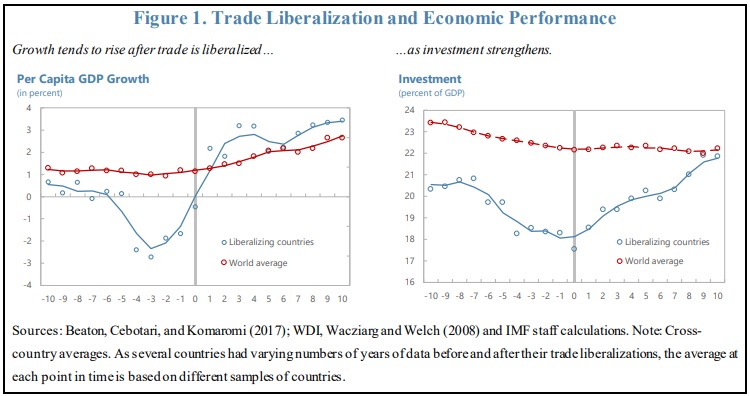
Dan Mitchell: I’m not a fan of the government-distorted health system in the United States… Our British friends are burdened with something akin to “Medicare for All.” But it’s even worse because doctors and nurses are directly employed by government, which means they have been turned into government bureaucrats!

Milton Friedman on Medical Care (Full Lecture)

The Deadly Impact of Government-Run Health, Part I

I’m not a fan of the government-distorted health system in the United States.

Various laws and programs from Washington have created a massive problem with third-party payer, which makes America’s system very expensive and inefficient.

But it’s possible to have a system that is even worse. Americans can look across the ocean at the United Kingdom’s National Health Service.

Our British friends are burdened with something akin to “Medicare for All.”

But it’s even worse because doctors and nurses are directly employed by government, which means they have been turned into government bureaucrats.

And government bureaucrats generally don’t have a track record of good performance. That seems to apply to health bureaucrats, as captured by this Alys Denby column for CapX.

Numbers are no way to express a human tragedy, but those in the Ockenden Report into maternity services at Shrewsbury and Telford Hospital NHS Trust are nonetheless devastating. The inquiry examined 1,592 incidents since 2000. It found that poor care led to the deaths of 201 babies and nine mothers;94 babies suffered avoidable brain damage; and one in four cases of stillbirth could have had a different outcome. That’s hundreds of lives lost, and hundreds of families suffering unimaginable pain, all on the watch of ‘Our NHS’. …the report is strewn with examples of individual cruelty and incompetence. Bereaved parents…were given excuses, false information and even blamed for their own child’s death. The Health Secretary has said that vital clinical information was written on post-it notes that were swept into the bin by cleaners. …The NHS has a culture of arrogance, sanctimony and impunity.

And here are some excerpts from a 2021 article in National Review by Cameron Hilditch.

The NHS has proven itself comprehensively and consistently incapable of dealing with a regular flu season, something that crops up at the same predictable time of year in every country north of the equator. It has long been obvious that Britain’s single-payer health-care system isn’t fit for purpose even in normal times,much less during a global pandemic. Yet the NHS’s failures are systematically ignored. …age-standardized survival rates in the U.K. for the most common kinds of cancer are well below those of other developed countries, which translates into thousands of needless deaths… The excess deaths that the U.K. is suffering…along with the crushing physical and mental burdens borne by British doctors and nurses ultimately redound to this long-term failure of British culture. By transforming a medical institution into a cultural institution for the sake of forging a new, progressive national identity, Britons have underwritten decades of deadly failure.

This is damning information.

To be sure, mistakes will happen in any type of health system. But when government runs the show, the odds of appropriate feedback are much lower.

If you don’t believe me, click here, here, here, here, here, here, here, here, here, here, here, here, here, here, hereand here.

Another Grim Reminder that Obamacare Has Made Healthcare More Expensive

Way back in 2009, some folks on the left shared a chart showing that national expenditures on healthcare compared to life expectancy.

This comparison was not favorable to the United States, which easily spent the most money but didn’t have concomitantly impressive life expectancy.

At the very least, people looking at the chart were supposed to conclude that other nations had better healthcare systems.

And since the chart circulated while Obamacare was being debated, supporters of that initiative clearly wanted people to believe that the U.S. somehow could get better results at lower cost if the government played a bigger role in the healthcare sector.

There were all sorts of reasons to think that chart was misleading (higher average incomes in the United States, more obesity in the United States, different demographics in the United States, etc), but my main gripe was that the chart was being used to advance the cause of bigger government when it actually showed – at least in part – the consequences of government intervention.

The real problem, I argued, was third-party payer. Thanks to programs such asMedicare and Medicaid, government already was paying for nearly 50 percent of all heath spending in the United States (indeed, the U.S. has more government spending for health programs than some nations with single-payer systems!).

But that’s just party of the story. Thanks to a loophole in the tax code for fringe benefits (a.k.a., the healthcare exclusion), there’s a huge incentive for both employers and employees to provide compensation in the form of very generous health insurance policies. And this means a big chunk of health spending is paid by insurance companies.

The combination of these direct and indirect government policies is that consumers pay very little for their healthcare. Or, to be more precise, they may pay a lot in terms of taxes and foregone cash compensation, but their direct out-of-pocket expenditures are relatively modest.

And this is why I said the national health spending vs life expectancy chart was far less important than a chart I put together showing the relentless expansion of third-party payer. And the reason this chart is so important is that it helps to explain why healthcare costs are so high and why there’s so much inefficiency in the health sector.

Simply stated, doctors, hospitals, and other providers have very little market-based incentive to control costs and be efficient because they know that the overwhelming majority of consumers won’t care because they are buying care with other people’s money.

To get this point across, I sometimes ask audiences how their behavior would change if I told them I would pay 89 percent of their dinner bill on Friday night. Would they be more likely to eat at McDonald’s or a fancy steakhouse? The answer is obvious (or should be obvious) since they are in box 2 of Milton Friedman’s matrix.

So why, then, would anybody think that Obamacare – a program that was designed to expand third-party payer – was going to control costs?

Though I guess it doesn’t matter what anybody thought at the time. The sad reality is that Obamacare was enacted. The President famously promised healthcare would be more affordable under his new system, both for consumers and for taxpayers.

So what happened?

Well, the law’s clearly been bad news for taxpayers.

But let’s focus today on households, which haveborne the brunt of the President’s bad policies. The Wall Street Journal had a report a few days ago about what’s been happening to the spending patterns of middle-class households.

The numbers are rather grim, at least for those who thought Obamacare would control health costs.

A June Brookings Institution study found middle-income households now devote the largest share of their spending to health care, 8.9%… By 2014, middle-income households’ health-care spending was 25% higher than what they were spending before the recession that began in 2007, even as spending fell for other “basic needs” such as food, housing, clothing and transportation, according to an analysis for The Wall Street Journal by Brookings senior fellow Diane Schanzenbach. …Workers aren’t the only ones feeling the pain of rising health-care costs. Employers still typically pay roughly 80% of individual health-insurance premiums… In 2015, 8% of Americans’ household spending went toward health care, up from 5.8% in 2007, according to the Labor Department.

Here’s a chart from the story. It looks at data from 2007-2014, so it surely wouldn’t be fair to say Obamacare caused all the increase. But it would be fair to say that the law hasn’t delivered on the empty promise of lower costs.

Let’s close with a few important observations.

First, there’s a very strong case to repeal Obamacare, but nobody should be under the illusion that this will solve the myriad problems in the health sector. It would be a good start, but never forget that the third-party payer problem existed before Obamacare.

Second, undoing third-party payer will be like putting toothpaste back in a tube. Even though there are some powerful examples of how healthcare costs are constrained when genuine market forces are allowed to operate, consumers will be very worried about shifting to a system where they pay directly for a greater share of their healthcare costs.

Third, there’s one part of Obamacare that shouldn’t be repealed. The so-called Cadillac Tax may not be the right way to deal with the distorting impact of the healthcare exclusion, but it’s better than nothing.

Actually, we could add one final observation since the Obama era will soon be ending. When historians write about his presidency, will his main legacy be the Obamacare failure? Or will they focus more on the failed stimulus? Or maybe the economic stagnation that was caused by his policies?

Related posts:

Michael Cannon observed, “The centerpiece of Rubio’s proposal… If you purchase a government-approved health plan, you could save, for example, $2,000 on your taxes. If you don’t, you pay that $2,000 to the government. That is exactly how Obamacare’s individual mandate works.”

  Michael Cannon observed, “The centerpiece of Rubio’s proposal… If you purchase a government-approved health plan, you could save, for example, $2,000 on your taxes. If you don’t, you pay that $2,000 to the government. That is exactly how Obamacare’s individual mandate works.” The Obama-Rubio “Healthcare Mandate” Controversy March 2, 2016 by Dan Mitchell My colleague […]

FRIEDMAN FRIDAY Taxmageddon and Obamacare: What Would Milton Friedman Say? Rich Tucker / @RichardBTucker / July 31, 2012

Milton Friedman on Medical Care (Full Lecture) Published on Feb 2, 2014 Website:http://www.commonsensecapitalism.com Facebook:http://www.facebook.com/pages/Common-… Twitter:https://twitter.com/#!/CommonSenseCap Taxmageddon and Obamacare: What Would Milton Friedman Say? Rich Tucker / @RichardBTucker / July 31, 2012 / 3 comments “I am in favor of cutting taxes under any circumstances and for any excuse, for any reason, whenever […]

FRIEDMAN FRIDAY Column: Don’t blame Heritage for ObamaCare mandate By Stuart Butler

Milton Friedman on Medical Care (Full Lecture) Published on Feb 2, 2014 Website:http://www.commonsensecapitalism.com Facebook:http://www.facebook.com/pages/Common-… Twitter:https://twitter.com/#!/CommonSenseCap I have written about Obamacare over and over again on this blog. Dan Mitchell has shared many funny cartoons about Obamacare too. Milton Friedman has spoken out about government healthcare many times in the past and his film […]

FRIEDMAN FRIDAY Milton Friedman on the Energy Crisis (and ObamaCare to come) By Robert Bradley Jr. — July 31, 2013

Milton Friedman – Health Care Reform (1992) pt 1/4 Milton Friedman – Health Care Reform (1992) pt 2/4 Milton Friedman on the Energy Crisis (and ObamaCare to come) By Robert Bradley Jr. — July 31, 2013 July 31st is the birth date of one of the great intellectuals of the freedom philosophy. Milton Friedman (1912–2006) would have […]

FRIEDMAN FRIDAY Milton Friedman And ObamaCare November 4, 2013

Milton Friedman – Health Care Reform (1992) pt 1/4 Milton Friedman – Health Care Reform (1992) pt 2/4 Milton Friedman – Health Care Reform (1992) pt 3/4 Milton Friedman – Health Care Reform (1992) pt 4/4 Milton Friedman And ObamaCare November 4, 2013 Where is Milton Friedman when we need him most? His ability to […]

FRIEDMAN FRIDAY Milton Friedman would oppose bailouts, Obamacare Robert Enlow | Tuesday Jul 31, 2012 6:02 PM

Milton Friedman on Medical Care (Full Lecture) Published on Feb 2, 2014 Website:http://www.commonsensecapitalism.com Facebook:http://www.facebook.com/pages/Common-… Twitter:https://twitter.com/#!/CommonSenseCap I have written about Obamacare over and over again on this blog. Dan Mitchell has shared many funny cartoons about Obamacare too. Milton Friedman has spoken out about government healthcare many times in the past and his film […]

Taxmageddon and Obamacare: What Would Milton Friedman Say? Rich Tucker / @RichardBTucker / July 31, 2012

Milton Friedman on Medical Care (Full Lecture) Published on Feb 2, 2014 Website:http://www.commonsensecapitalism.com Facebook:http://www.facebook.com/pages/Common-… Twitter:https://twitter.com/#!/CommonSenseCap Taxmageddon and Obamacare: What Would Milton Friedman Say? Rich Tucker / @RichardBTucker / July 31, 2012 / 3 comments “I am in favor of cutting taxes under any circumstances and for any excuse, for any reason, whenever […]

Column: Don’t blame Heritage for ObamaCare mandate By Stuart Butler

Milton Friedman on Medical Care (Full Lecture) Published on Feb 2, 2014 Website:http://www.commonsensecapitalism.com Facebook:http://www.facebook.com/pages/Common-… Twitter:https://twitter.com/#!/CommonSenseCap I have written about Obamacare over and over again on this blog. Dan Mitchell has shared many funny cartoons about Obamacare too. Milton Friedman has spoken out about government healthcare many times in the past and his film […]

FRIEDMAN FRIDAY Whining Harvard Professors Discover Obamacare 3225 JAN 5, 2015 4:29 PM EST By Megan McArdle

Milton Friedman on Medical Care (Full Lecture) Published on Feb 2, 2014 Website:http://www.commonsensecapitalism.com Facebook:http://www.facebook.com/pages/Common-… Twitter:https://twitter.com/#!/CommonSenseCap I have written about Obamacare over and over again on this blog. Dan Mitchell has shared many funny cartoons about Obamacare too. Milton Friedman has spoken out about government healthcare many times in the past and his film […]

Milton Friedman on the Energy Crisis (and ObamaCare to come) By Robert Bradley Jr. — July 31, 2013

Milton Friedman – Health Care Reform (1992) pt 1/4 Milton Friedman – Health Care Reform (1992) pt 2/4 Milton Friedman on the Energy Crisis (and ObamaCare to come) By Robert Bradley Jr. — July 31, 2013 July 31st is the birth date of one of the great intellectuals of the freedom philosophy. Milton Friedman (1912–2006) would have […]

Dan Mitchell: As Professor Friedman explained, the economics of price controls are very clear. When politicians and bureaucrats suppress prices, you get shortages (as all students should learn in their introductory economics classes)

<img srcset="https://s-libertaddigital-com.cdn.ampproject.org/i/s/s.libertaddigital.com/2022/01/04/300/0/miltonfriedman.jpg.webp 300w, https://s-libertaddigital-com.cdn.ampproject.org/i/s/s.libertaddigital.com/2022/01/04/600/0/miltonfriedman.jpg.webp 600w, https://s-libertaddigital-com.cdn.ampproject.org/i/s/s.libertaddigital.com/2022/01/04/1200/0/miltonfriedman.jpg.webp 1200w" alt="El economista, Milton Friedman (1912-2006) | <span>Alamy

Portrait of Milton Friedman.jpg


The Case Against Price Controls, Part III

In Part I of this series, Professor Don Boudreaux explained the folly of price controls, and Professor Antony Davies was featured in Part II.

Now let’s see some commentary from the late, great, Milton Friedman.

As Professor Friedman explained, the economics of price controls are very clear.

When politicians and bureaucrats suppress prices, you get shortages (as all students should learn in their introductory economics classes).

Sometimes that happens with price controls on specific sectors, such as rental housing in poorly governed cities.

Sometimes it happens because of economy-wide price controls, as we saw during Richard Nixon’s disastrous presidency.

In all cases, price controls are imposed by politicians who are stupid or evil. That’s blunt language, but it’s the only explanation.

Sadly, there will never be a shortage of those kinds of politicians, as can be seen from this column in the Wall Street Journal by Andy Kessler.

Here are some excerpts.

On the 2020 campaign trail, Joe Biden declared, “ Milton Friedman isn’t running the show anymore.” Wrong! …Lo and behold, inflation is running at 7.9%, supply chains are tight, and many store shelves are empty. Friedman’s adage “Inflation is always and everywhere a monetary phenomenon” has stood the test of time. But what scares me most is the likely policy responses by the Biden administration that would pour salt into this self-inflicted wound.It feels as if price controls are coming. …Prices set by producers are signals, and consumers whisper feedback billions of times a day by buying or not buying products. Mess with prices and the economy has no guide. The Soviets instituted price controls on everything from subsidized “red bread” to meat, often resulting in empty shelves. President Franklin D. Roosevelt’s National Recovery Agency fixed prices, prolonging the Depression, all in the name of “fair competition.” …Price controls don’t work. Never have, never will. But we keep instituting them. Try finding a cheap apartment in rent-controlled New York City. …Sen. Elizabeth Warren, a leader among our economic illiterate, noted in February that high prices are caused in part by “giant corporations…”

He closes with a very succinct and sensible observation.

Want to whip inflation now? Forget all the Band-Aids and government controls. Instead, as Friedman suggests, stop printing money.

In other words, Mr. Kessler is suggesting that politicians do the opposite of Mitchell’s Law.

Instead of using one bad policy (inflation) as an excuse to impose a second bad policy (price controls), he wants them to undo the original mistake.

Will Joe Biden and Elizabeth Warren take his advice?

That’s doubtful, but I’m hoping there are more rational people in the rooms where these decisions get made.

Maybe some of them will have read this column from Professor Boudreaux.

Prices are among the visible results of the invisible hand’s successful operation, as well as the single most important source of this success. Each price objectively summarizes an inconceivably large number of details that must be taken account of if the economy is to perform even moderately well. Consider the price of a loaf of a particular kind and brand of bread.…The price at the supermarket of a loaf of bread, a straightforward $4.99, is the distillation of the economic results of the interaction of an unfathomably large number of details from around the globe about opportunities, trade-offs, and preferences. The invisible hand of the market causes these details to be visibly summarized not only in the price of bread, but in the prices of all other consumer goods and services, as well as in the prices of each of the inputs used in production. …These market prices also give investors and entrepreneurs guidance on how to deploy scarce resources in ways that produce that particular mix of goods and services that will today be of greatest benefit for consumers.

I have two comments.

First, Don obviously buys fancier bread than my $1.29-a-loaf store brand (used to be 99 cents, so thanks for nothing to the Federal Reserve).

Second, and far more important, he’s pointing out that market-based prices play an absolutely critical role in coordinating the desires of consumers and producers.

When politicians interfere with prices, it’s akin to throwing sand in the gears of a machine.

For more information on the role of prices, I strongly recommend these videos from Professors Russ Roberts, Howard Baetjer, and Alex Tabarrok.

By Ryan Bourne and Brad Subramaniam

Anti‐​price gouging laws prolonged shortages of certain goods that were in high demand early in the pandemic. Some analysis suggests these laws even worsened public health outcomes, because ongoing shortages of, say, hand sanitizer and toilet paper, led to consumers in states with these regulations searching for them more at physical retailers, actually increasing transmission of the virus.

But there’s an interesting question that’s often underexplored in regard to these laws: how does the expectation that these price controls will be triggered shape people’s beliefs about products’ availability and so customer search behavior?

That’s the topic of another fascinating new paper by economists Rik Chakraborti and Gavin Roberts. Using data for online searches for hand sanitizer and toilet paper across states, they harness the variation in when laws were introduced to research the question: is consumer search behaviour different in states with new anti‐​price gouging legislation introduced during the pandemic from states with pre‐​existing anti‐​price gouging laws?

Economic theory would suggest that any anti‐​price gouging legislation, whenever introduced, would lead to more consumer search for goods, due to the induced shortages. And, sure enough, after controlling for the effects of lockdowns, rising infections, and declines in travel which plagued the early stages of the pandemic, consumers in states with anti‐​price gouging laws were significantly more likely to search online for toilet paper and hand sanitizer than those in states without such laws.

More searching presumably reflects higher levels of hoarding and panic‐​buying creating the shortages—after all, having to resort to online shopping for goods that are commonly bought in stores means the local grocery or drug store has probably been emptied already.

But theory would also suggest that customers in states with past experience of anti‐​price gouging laws might search even more intensely, because people come to expect shortages again when crises hit. In other words, those who have experienced shortages before might be more likely to hoard and panic buy this time around, leading to even higher online search than in situations where new laws are introduced for the first time.

Again, Chakraborti and Roberts’ paper suggests economic theory is correct. States with anti‐​price gouging regulations on the books before the pandemic saw Google Shopping searches for hand sanitizer jump by 153 percent and toilet paper searches nearly double (a 99 percent increase) relative to states without anti‐​price gouging laws. This uplift was much larger than in states where the laws were introduced during the pandemic (100 percent and 46 percent, respectively).

The long and short is that consumers in states with pre‐​existing price controls searched most intensely online for hand sanitizer and toilet paper. This suggests customers learned from previous experience of these price regulations’ effects, with the higher search levels reflecting greater hoarding and panic buying in anticipation of shortages to come. As the authors state, this implies that longstanding anti‐​price gouging legislation is even worse for economic welfare than we might think. The anticipation of shortages actually compounds shortages as consumers become more “experienced,” with excessive and fruitless searching for products the wasteful result.

For more on the basics of anti‐​price gouging legislation in the pandemic, see my book Economics In One Virus. Other Cato pieces can be found here, here, and here.

Government, Markets, and the Supply Chain

Way back in 2009, I shared a meme that succinctly summarizes how Washington operates.

It’s basically a version of Mitchell’s Law. To elaborate, governments cause problems and politicians then use those problems as an excuse to make government even bigger.

Lather, rinse, repeat.

I worry the same thing may be about to happen because of the current concern about “supply chain” issues, perhaps best illustrated by the backlog of ships at key ports, leading to shortages of key goods.

Some of this mess is fallout from the coronavirus pandemic, but it’s being exacerbated by bad policy.

In a column for Reason, J.D. Tuccille points out that government is the problem, not the solution.

…supply-chain issues…create shortages and push prices up around the world. …Lockdowns also changed people’s lives, closing offices and factories and confining people at home. That resulted in massive and unpredictable shifts in demand and unreliable supply. …”Market economies tend to be pretty good at getting food on the supermarket shelves and fuel in petrol stations, if left to themselves,” agrees Pilkington. “That last part is key: if left to themselves. Heavy-handed interference in market economies tends to produce the same pathologies we see in socialist economies, including shortages and inflation. That has been the unintended consequence of lockdown.” …The danger is that people see economic problems caused by earlier fiddling and then demand even more government intervention. …if the government were to further meddle in the market to allocate products made scarce by earlier actions, it’s hard to see how the result wouldn’t be anything other than increased supply chain chaos.

Allysia Finley opines for the Wall Street Journal about California’s role in the supply-chain mess.

The backup of container ships at the Long Beach and Los Angeles ports has grown in recent weeks… The two Southern California ports handle only about 40% of containers entering the U.S., mostly from Asia. Yet ports in other states seem to be handling the surge better. Gov. Ron DeSantis said last month that Florida’s seaports had open capacity.So what’s the matter with California? State labor and environmental policies. …business groups recently asked Gov. Gavin Newsom to declare a state of emergency and suspend labor and environmental laws that are interfering with the movement of goods. …One barrier is a law known as AB5. …Trucking companies warned that the law could put small carriers out of business and cause drivers to leave the state. …there’s little doubt the law hinders efficiency and productivity. …State officials have also pressed localities to attach green mandates to permits for new warehouses, which can be poison pills. …This boatload of regulations is making it more expensive and difficult to store goods arriving at California ports.

Needless to say, I’m not surprised California is making things worse.

The state seems to have some of the nation’s worst politicians.

But let’s set that aside and close with some discussion about one of the differences between government and the private sector.

This may surprise some readers, but people and businesses in the private sector make mistakes all the time.

So part of the supply-chain mess presumably is a result of companies and entrepreneurs making bad guesses.

That being said, there’s a big feedback mechanism in the private sector. It’s called profit and loss.

So when mistakes are made, there’s a big incentive to quickly change.

With government, by contrast, there’s very little flexibility (as we saw during the pandemic). And when politicians and bureaucrats do act, they often respond to political incentives that lead them to make things worse.

Big-Government Republicans Enable Big-Government Democrats

I get asked why I frequently criticize Republicans.

My response is easy. I care about results rather than rhetoric. And while GOP politicians often pay lip service to the principles of limited government,they usually increase spending even faster than Democrats.

Indeed, Republicans are even worse than Democrats when measuring the growth of domestic spending!

This is bad news because it means the burden of government expands when Republicans are in charge.

And, as Gary Abernathy points out in a column for the Washington Post, Republicans then don’t have the moral authority to complain when Democrats engage in spending binges.

President Biden is proposing another $3 trillion in spending… There are objections, but none that can be taken seriously. …Republicans had lost their standing as the party of fiscal responsibility when most of them succumbed to the political virus of covid fever and rubber-stamped around $4 trillion in “covid relief,”… With Trump out and Biden in, Republicans suddenly pretended that their 2020 spending spree happened in some alternate universe.But the GOP’s united opposition to Biden’s $1.9 trillion package won’t wash off the stench of the hypocrisy. …I noted a year ago that we had crossed the Rubicon, that our longtime flirtation with socialism had become a permanent relationship. Congratulations, Bernie Sanders. The GOP won’t become irrelevant because of its association with Trump, as some predict. It will diminish because it is bizarrely opposing now that which it helped make palatable just last year. Fiscal responsibility is dead, and Republicans helped bury it. Put the shovels away, there’s no digging it up now.

For what it’s worth, I hope genuine fiscal responsibility isn’t dead.

Maybe it’s been hibernating ever since Reagan left office (like Pepperidge Farm, I’m old enough to remember those wonderful years).

Subsequent Republican presidents liked to copy Reagan’s rhetoric, but they definitely didn’t copy his policies.

  • Spending restraint was hibernating during the presidency of George H.W. Bush.
  • Spending restraint also was hibernating during the presidency of George W. Bush.
  • And spending restraint was hibernating during the presidency of Donald Trump.

I’m not the only one to notice GOP hypocrisy.

Here are some excerpts from a 2019 column in the Washington Post by Fareed Zakaria.

In what Republicans used to call the core of their agenda — limited government — Trump has been profoundly unconservative. …Trump has now added more than $88 billion in taxes in the form of tariffs, according to the right-leaning Tax Foundation. (Despite what the president says, tariffs are taxes on foreign goods paid by U.S. consumers.) This has had the effect of reducing gross domestic product and denting the wages of Americans.…For decades, conservatives including Margaret Thatcher and Ronald Reagan preached to the world the virtues of free trade. But perhaps even more, they believed in the idea that governments should not pick winners and losers in the economy… Yet the Trump administration…behaved like a Central Planning Agency, granting exemptions on tariffs to favored companies and industries, while refusing them to others. …In true Soviet style, lobbyists, lawyers and corporate executives now line up to petition government officials for these treasured waivers, which are granted in an opaque process… On the core issue that used to define the GOP — economics — the party’s agenda today is state planning and crony capitalism.

Zakaria is right about Republicans going along with most of Trump’s bad policies (as illustrated by this cartoon strip).*

The bottom line is that Republicans would be much more effective arguing against Biden’s spending orgy had they also argued for spending restraint when Trump was in the White House.

P.S. It will be interesting to see what happens in the near future. Will the GOP be a small-government Reagan party or a big-government Trump party?

Or maybe it will go back to being a Nixon-type party, which would mean bigger government but without mean tweets. And there are plenty of options.

If they make the wrong choice (anything other than Reaganism), Margaret Thatcher has already warned us about the consequences.

*To be fair, Republicans also went along with Trump’s good policies. It’s just unfortunate that spending restraint wasn’t one of them.

—-

March 31, 2021

President Biden  c/o The White House
1600 Pennsylvania Avenue NW
Washington, DC 20500

Dear Mr. President,

Please explain to me if you ever do plan to balance the budget while you are President? I have written these things below about you and I really do think that you don’t want to cut spending in order to balance the budget. It seems you ever are daring the Congress to stop you from spending more.

President Barack Obama speaks about the debt limit in the East Room of the White House in Washington. | AP Photo


“The credit of the United States ‘is not a bargaining chip,’ Obama said on 1-14-13. However, President Obama keeps getting our country’s credit rating downgraded as he raises the debt ceiling higher and higher!!!!

Washington Could Learn a Lot from a Drug Addict

Just spend more, don’t know how to cut!!! Really!!! That is not living in the real world is it?

Making more dependent on government is not the way to go!!

Why is our government in over 16 trillion dollars in debt? There are many reasons for this but the biggest reason is people say “Let’s spend someone else’s money to solve our problems.” Liberals like Max Brantley have talked this way for years. Brantley will say that conservatives are being harsh when they don’t want the government out encouraging people to be dependent on the government. The Obama adminstration has even promoted a plan for young people to follow like Julia the Moocher.  

David Ramsey demonstrates in his Arkansas Times Blog post of 1-14-13 that very point:

Arkansas Politics / Health Care Arkansas’s share of Medicaid expansion and the national debt

Posted by on Mon, Jan 14, 2013 at 1:02 PM

Baby carrot Arkansas Medicaid expansion image


Imagine standing a baby carrot up next to the 25-story Stephens building in Little Rock. That gives you a picture of the impact on the national debt that federal spending in Arkansas on Medicaid expansion would have, while here at home expansion would give coverage to more than 200,000 of our neediest citizens, create jobs, and save money for the state.

Here’s the thing: while more than a billion dollars a year in federal spending would represent a big-time stimulus for Arkansas, it’s not even a drop in the bucket when it comes to the national debt.

Currently, the national debt is around $16.4 trillion. In fiscal year 2015, the federal government would spend somewhere in the neighborhood of $1.2 billion to fund Medicaid expansion in Arkansas if we say yes. That’s about 1/13,700th of the debt.

It’s hard to get a handle on numbers that big, so to put that in perspective, let’s get back to the baby carrot. Imagine that the height of the Stephens building (365 feet) is the $16 trillion national debt. That $1.2 billion would be the length of a ladybug. Of course, we’re not just talking about one year if we expand. Between now and 2021, the federal government projects to contribute around $10 billion. The federal debt is projected to be around $25 trillion by then, so we’re talking about 1/2,500th of the debt. Compared to the Stephens building? That’s a baby carrot.

______________

Here is how it will all end if everyone feels they should be allowed to have their “baby carrot.”

How sad it is that liberals just don’t get this reality.

Here is what the Founding Fathers had to say about welfare. David Weinberger noted:

While living in Europe in the 1760s, Franklin observed: “in different countries … the more public provisions were made for the poor, the less they provided for themselves, and of course became poorer. And, on the contrary, the less was done for them, the more they did for themselves, and became richer.”

Alexander Fraser Tytler, Lord Woodhouselee (15 October 1747 – 5 January 1813) was a Scottish lawyer, writer, and professor. Tytler was also a historian, and he noted, “A democracy cannot exist as a permanent form of government. It can only exist until the majority discovers it can vote itself largess out of the public treasury. After that, the majority always votes for the candidate promising the most benefits with the result the democracy collapses because of the loose fiscal policy ensuing, always to be followed by a dictatorship, then a monarchy.”

Thomas Jefferson to Joseph Milligan

April 6, 1816

[Jefferson affirms that the main purpose of society is to enable human beings to keep the fruits of their labor. — TGW]

To take from one, because it is thought that his own industry and that of his fathers has acquired too much, in order to spare to others, who, or whose fathers have not exercised equal industry and skill, is to violate arbitrarily the first principle of association, “the guarantee to every one of a free exercise of his industry, and the fruits acquired by it.” If the overgrown wealth of an individual be deemed dangerous to the State, the best corrective is the law of equal inheritance to all in equal degree; and the better, as this enforces a law of nature, while extra taxation violates it.

[From Writings of Thomas Jefferson, ed. Albert E. Bergh (Washington: Thomas Jefferson Memorial Association, 1904), 14:466.]

_______

Jefferson pointed out that to take from the rich and give to the poor through government is just wrong. Franklin knew the poor would have a better path upward without government welfare coming their way. Milton Friedman’s negative income tax is the best method for doing that and by taking away all welfare programs and letting them go to the churches for charity.

_____________

_________
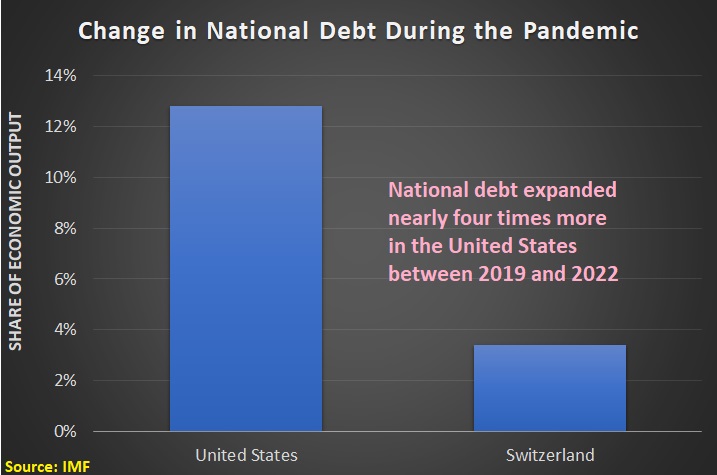
Thank you so much for your time. I know how valuable it is. I also appreciate the fine family that you have and your commitment as a father and a husband.

Sincerely,

Everette Hatcher III, 13900 Cottontail Lane, Alexander, AR 72002, ph 501-920-5733

Williams with Sowell – Minimum Wage

Thomas Sowell

Thomas Sowell – Reducing Black Unemployment

By WALTER WILLIAMS

—-

Ronald Reagan with Milton Friedman
Milton Friedman The Power of the Market 2-5

Related posts:

Welfare Spending Shattering All-Time Highs

  We got to act fast and get off this path of socialism. Morning Bell: Welfare Spending Shattering All-Time Highs Robert Rector and Amy Payne October 18, 2012 at 9:03 am It’s been a pretty big year for welfare—and a new report shows welfare is bigger than ever. The Obama Administration turned a giant spotlight […]

We need more brave souls that will vote against Washington welfare programs

We need to cut Food Stamp program and not extend it. However, it seems that people tell the taxpayers back home they are going to Washington and cut government spending but once they get up there they just fall in line with  everyone else that keeps spending our money. I am glad that at least […]

Welfare programs are not the answer for the poor

Government Must Cut Spending Uploaded by HeritageFoundation on Dec 2, 2010 The government can cut roughly $343 billion from the federal budget and they can do so immediately. __________ Liberals argue that the poor need more welfare programs, but I have always argued that these programs enslave the poor to the government. Food Stamps Growth […]

Private charities are best solution and not government welfare

Milton Friedman – The Negative Income Tax Published on May 11, 2012 by LibertyPen In this 1968 interview, Milton Friedman explained the negative income tax, a proposal that at minimum would save taxpayers the 72 percent of our current welfare budget spent on administration. http://www.LibertyPen.com Source: Firing Line with William F Buckley Jr. ________________ Milton […]

The book “After the Welfare State”

Dan Mitchell Commenting on Obama’s Failure to Propose a Fiscal Plan Published on Aug 16, 2012 by danmitchellcato No description available. ___________ After the Welfare State Posted by David Boaz Cato senior fellow Tom G. Palmer, who is lecturing about freedom in Slovenia and Tbilisi this week, asked me to post this announcement of his […]

President Obama responds to Heritage Foundation critics on welfare reform waivers

Is President Obama gutting the welfare reform that Bill Clinton signed into law? Morning Bell: Obama Denies Gutting Welfare Reform Amy Payne August 8, 2012 at 9:15 am The Obama Administration came out swinging against its critics on welfare reform yesterday, with Press Secretary Jay Carney saying the charge that the Administration gutted the successful […]

Welfare reform part 3

Thomas Sowell – Welfare Welfare reform was working so good. Why did we have to abandon it? Look at this article from 2003. The Continuing Good News About Welfare Reform By Robert Rector and Patrick Fagan, Ph.D. February 6, 2003 Six years ago, President Bill Clinton signed legislation overhauling part of the nation’s welfare system. […]

Welfare reform part 2

Uploaded by ForaTv on May 29, 2009 Complete video at: http://fora.tv/2009/05/18/James_Bartholomew_The_Welfare_State_Were_In Author James Bartholomew argues that welfare benefits actually increase government handouts by ‘ruining’ ambition. He compares welfare to a humane mousetrap. —– Welfare reform was working so good. Why did we have to abandon it? Look at this article from 2003. In the controversial […]

Why did Obama stop the Welfare Reform that Clinton put in?

Thomas Sowell If the welfare reform law was successful then why change it? Wasn’t Bill Clinton the president that signed into law? Obama Guts Welfare Reform Robert Rector and Kiki Bradley July 12, 2012 at 4:10 pm Today, the Obama Department of Health and Human Services (HHS) released an official policy directive rewriting the welfare […]

“Feedback Friday” Letter to White House generated form letter response July 10,2012 on welfare, etc (part 14)

I have been writing President Obama letters and have not received a personal response yet.  (He reads 10 letters a day personally and responds to each of them.) However, I did receive a form letter in the form of an email on July 10, 2012. I don’t know which letter of mine generated this response so I have […]

Biden’s Budget Deficits 

A.F. Branco for Oct 21, 2021


The Biden administration has released its federal budget for 2023. One of the themes is deficit reduction. The president says the budget “keeps us on track to reduce the deficit this year to less than half of what it was before I took office.” The administration will be “the first in history to reduce the deficit by more than $1 trillion in a single year.”

Finally, someone is taking an axe to the bloated federal budget!

Or maybe not. Under the Biden budget:

  • Deficits are currently falling, but would start rising again in 2024, as shown in the chart.
  • Spending would rise from $5.85 trillion this year to $8.87 trillion in 2032.
  • Debt held by the public would rise from $24.8 trillion this year to $39.5 trillion in 2032, or 102.4 percent of GDP to 106.7 percent.
  • Taxes would be increased $2.5 trillion over 10 years, but these hikes likely won’t pass Congress, so deficits would be higher than proposed unless spending is restrained.
  • Interest rates on federal debt are projected to remain low, with the rate on 10‐​year debt only rising to 3.3 percent by 2032. Thus the budget says the “burden of debt would stay low,” which seems very optimistic. Every 1 percentage point increase in average borrowing costs on $25 trillion of federal debt is $250 billion in added annual interest outlays.
d

March 31, 2021

President Biden  c/o The White House
1600 Pennsylvania Avenue NW
Washington, DC 20500

Dear Mr. President,

Please explain to me if you ever do plan to balance the budget while you are President? I have written these things below about you and I really do think that you don’t want to cut spending in order to balance the budget. It seems you ever are daring the Congress to stop you from spending more.

President Barack Obama speaks about the debt limit in the East Room of the White House in Washington. | AP Photo

“The credit of the United States ‘is not a bargaining chip,’ Obama said on 1-14-13. However, President Obama keeps getting our country’s credit rating downgraded as he raises the debt ceiling higher and higher!!!!

Washington Could Learn a Lot from a Drug Addict

Just spend more, don’t know how to cut!!! Really!!! That is not living in the real world is it?

Making more dependent on government is not the way to go!!

Why is our government in over 16 trillion dollars in debt? There are many reasons for this but the biggest reason is people say “Let’s spend someone else’s money to solve our problems.” Liberals like Max Brantley have talked this way for years. Brantley will say that conservatives are being harsh when they don’t want the government out encouraging people to be dependent on the government. The Obama adminstration has even promoted a plan for young people to follow like Julia the Moocher.  

David Ramsey demonstrates in his Arkansas Times Blog post of 1-14-13 that very point:

Arkansas Politics / Health Care Arkansas’s share of Medicaid expansion and the national debt

Posted by on Mon, Jan 14, 2013 at 1:02 PM

Baby carrot Arkansas Medicaid expansion image

Imagine standing a baby carrot up next to the 25-story Stephens building in Little Rock. That gives you a picture of the impact on the national debt that federal spending in Arkansas on Medicaid expansion would have, while here at home expansion would give coverage to more than 200,000 of our neediest citizens, create jobs, and save money for the state.

Here’s the thing: while more than a billion dollars a year in federal spending would represent a big-time stimulus for Arkansas, it’s not even a drop in the bucket when it comes to the national debt.

Currently, the national debt is around $16.4 trillion. In fiscal year 2015, the federal government would spend somewhere in the neighborhood of $1.2 billion to fund Medicaid expansion in Arkansas if we say yes. That’s about 1/13,700th of the debt.

It’s hard to get a handle on numbers that big, so to put that in perspective, let’s get back to the baby carrot. Imagine that the height of the Stephens building (365 feet) is the $16 trillion national debt. That $1.2 billion would be the length of a ladybug. Of course, we’re not just talking about one year if we expand. Between now and 2021, the federal government projects to contribute around $10 billion. The federal debt is projected to be around $25 trillion by then, so we’re talking about 1/2,500th of the debt. Compared to the Stephens building? That’s a baby carrot.

______________
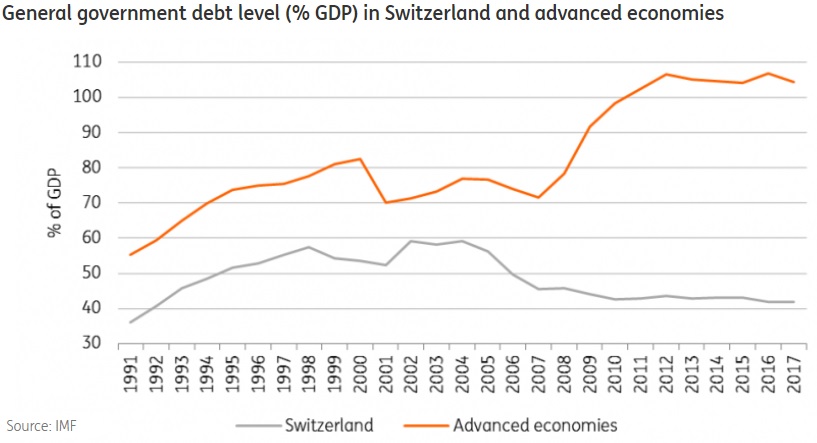
Here is how it will all end if everyone feels they should be allowed to have their “baby carrot.”

How sad it is that liberals just don’t get this reality.

Here is what the Founding Fathers had to say about welfare. David Weinberger noted:

While living in Europe in the 1760s, Franklin observed: “in different countries … the more public provisions were made for the poor, the less they provided for themselves, and of course became poorer. And, on the contrary, the less was done for them, the more they did for themselves, and became richer.”

Alexander Fraser Tytler, Lord Woodhouselee (15 October 1747 – 5 January 1813) was a Scottish lawyer, writer, and professor. Tytler was also a historian, and he noted, “A democracy cannot exist as a permanent form of government. It can only exist until the majority discovers it can vote itself largess out of the public treasury. After that, the majority always votes for the candidate promising the most benefits with the result the democracy collapses because of the loose fiscal policy ensuing, always to be followed by a dictatorship, then a monarchy.”

Thomas Jefferson to Joseph Milligan

April 6, 1816

[Jefferson affirms that the main purpose of society is to enable human beings to keep the fruits of their labor. — TGW]

To take from one, because it is thought that his own industry and that of his fathers has acquired too much, in order to spare to others, who, or whose fathers have not exercised equal industry and skill, is to violate arbitrarily the first principle of association, “the guarantee to every one of a free exercise of his industry, and the fruits acquired by it.” If the overgrown wealth of an individual be deemed dangerous to the State, the best corrective is the law of equal inheritance to all in equal degree; and the better, as this enforces a law of nature, while extra taxation violates it.

[From Writings of Thomas Jefferson, ed. Albert E. Bergh (Washington: Thomas Jefferson Memorial Association, 1904), 14:466.]

_______
Jefferson pointed out that to take from the rich and give to the poor through government is just wrong. Franklin knew the poor would have a better path upward without government welfare coming their way. Milton Friedman’s negative income tax is the best method for doing that and by taking away all welfare programs and letting them go to the churches for charity.

_____________

_________
Thank you so much for your time. I know how valuable it is. I also appreciate the fine family that you have and your commitment as a father and a husband.

Sincerely,

Everette Hatcher III, 13900 Cottontail Lane, Alexander, AR 72002, ph 501-920-5733

Williams with Sowell – Minimum Wage

Thomas Sowell

Thomas Sowell – Reducing Black Unemployment

By WALTER WILLIAMS

—-

Ronald Reagan with Milton Friedman
Milton Friedman The Power of the Market 2-5

Related posts:

Welfare Spending Shattering All-Time Highs

  We got to act fast and get off this path of socialism. Morning Bell: Welfare Spending Shattering All-Time Highs Robert Rector and Amy Payne October 18, 2012 at 9:03 am It’s been a pretty big year for welfare—and a new report shows welfare is bigger than ever. The Obama Administration turned a giant spotlight […]

We need more brave souls that will vote against Washington welfare programs

We need to cut Food Stamp program and not extend it. However, it seems that people tell the taxpayers back home they are going to Washington and cut government spending but once they get up there they just fall in line with  everyone else that keeps spending our money. I am glad that at least […]

Welfare programs are not the answer for the poor

Government Must Cut Spending Uploaded by HeritageFoundation on Dec 2, 2010 The government can cut roughly $343 billion from the federal budget and they can do so immediately. __________ Liberals argue that the poor need more welfare programs, but I have always argued that these programs enslave the poor to the government. Food Stamps Growth […]
Private charities are best solution and not government welfare

Milton Friedman – The Negative Income Tax Published on May 11, 2012 by LibertyPen In this 1968 interview, Milton Friedman explained the negative income tax, a proposal that at minimum would save taxpayers the 72 percent of our current welfare budget spent on administration. http://www.LibertyPen.com Source: Firing Line with William F Buckley Jr. ________________ Milton […]

The book “After the Welfare State”

Dan Mitchell Commenting on Obama’s Failure to Propose a Fiscal Plan Published on Aug 16, 2012 by danmitchellcato No description available. ___________ After the Welfare State Posted by David Boaz Cato senior fellow Tom G. Palmer, who is lecturing about freedom in Slovenia and Tbilisi this week, asked me to post this announcement of his […]

President Obama responds to Heritage Foundation critics on welfare reform waivers

Is President Obama gutting the welfare reform that Bill Clinton signed into law? Morning Bell: Obama Denies Gutting Welfare Reform Amy Payne August 8, 2012 at 9:15 am The Obama Administration came out swinging against its critics on welfare reform yesterday, with Press Secretary Jay Carney saying the charge that the Administration gutted the successful […]

Welfare reform part 3

Thomas Sowell – Welfare Welfare reform was working so good. Why did we have to abandon it? Look at this article from 2003. The Continuing Good News About Welfare Reform By Robert Rector and Patrick Fagan, Ph.D. February 6, 2003 Six years ago, President Bill Clinton signed legislation overhauling part of the nation’s welfare system. […]

Welfare reform part 2

Uploaded by ForaTv on May 29, 2009 Complete video at: http://fora.tv/2009/05/18/James_Bartholomew_The_Welfare_State_Were_In Author James Bartholomew argues that welfare benefits actually increase government handouts by ‘ruining’ ambition. He compares welfare to a humane mousetrap. —– Welfare reform was working so good. Why did we have to abandon it? Look at this article from 2003. In the controversial […]

Why did Obama stop the Welfare Reform that Clinton put in?

Thomas Sowell If the welfare reform law was successful then why change it? Wasn’t Bill Clinton the president that signed into law? Obama Guts Welfare Reform Robert Rector and Kiki Bradley July 12, 2012 at 4:10 pm Today, the Obama Department of Health and Human Services (HHS) released an official policy directive rewriting the welfare […]

“Feedback Friday” Letter to White House generated form letter response July 10,2012 on welfare, etc (part 14)

I have been writing President Obama letters and have not received a personal response yet.  (He reads 10 letters a day personally and responds to each of them.) However, I did receive a form letter in the form of an email on July 10, 2012. I don’t know which letter of mine generated this response so I have […]