Category Archives: Current Events

The characters referenced in Woody Allen’s movie “Midnight in Paris” (Part 30, Albert Camus)

Recently I read a review of “Midnight in Paris” the latest Woody Allen movie that noted, “Many a writer or artist has longed to travel back in time to the sizzling Paris of the 1920’s to sip absinthe with Hemingway at Les Deux Magots ,” and that got me thinking. What other famous people were patrons of this famous restaurant through the years? Albert Camus is one of those gentlemen and he is the one I am looking at today. 
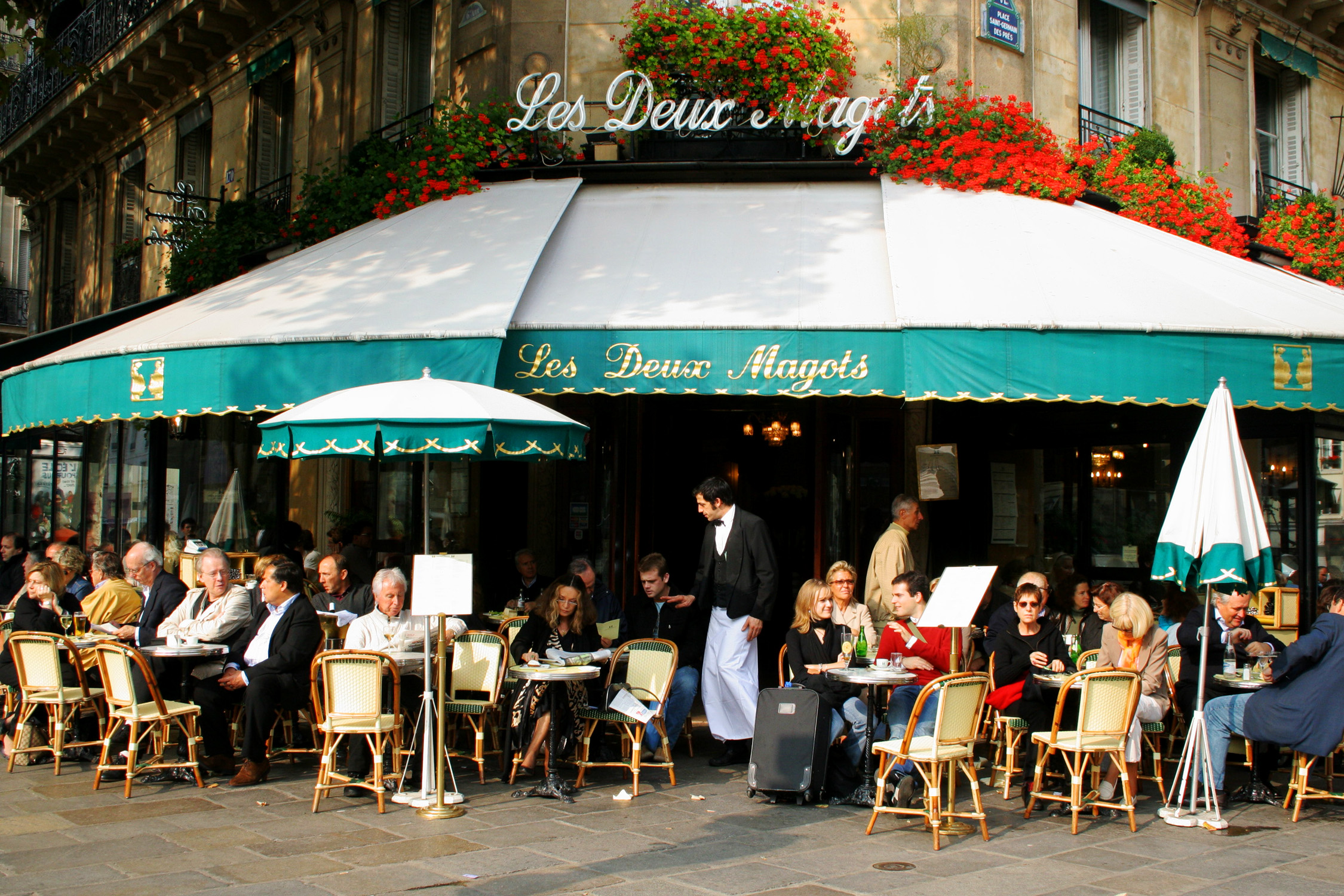
File:Lesdeuxmagots.jpg

I am really reaching at this point. Up until this point I have really been trying to only talk about the characters that Woody Allen referenced in his latest movie “Midnight in Paris.” However, now I am stepping over the line and talking about famous philosophers who ate regularly at Les Deux Magots which is featured in the movie. So be it.

Les Deux Magots (French pronunciation: [le dø maɡo]) is a famous[1] café in the Saint-Germain-des-Prés area of Paris, France. It once had a reputation as the rendezvous of the literary and intellectual élite of the city. It is now a popular tourist destination. Its historical reputation is derived from the patronage of Surrealist artists, intellectuals such as Simone de Beauvoir and Jean-Paul Sartre, and young writers, such as Ernest Hemingway. Other patrons included Albert Camus and Pablo Picasso.

The Deux Magots literary prize has been awarded to a French novel every year since 1933.
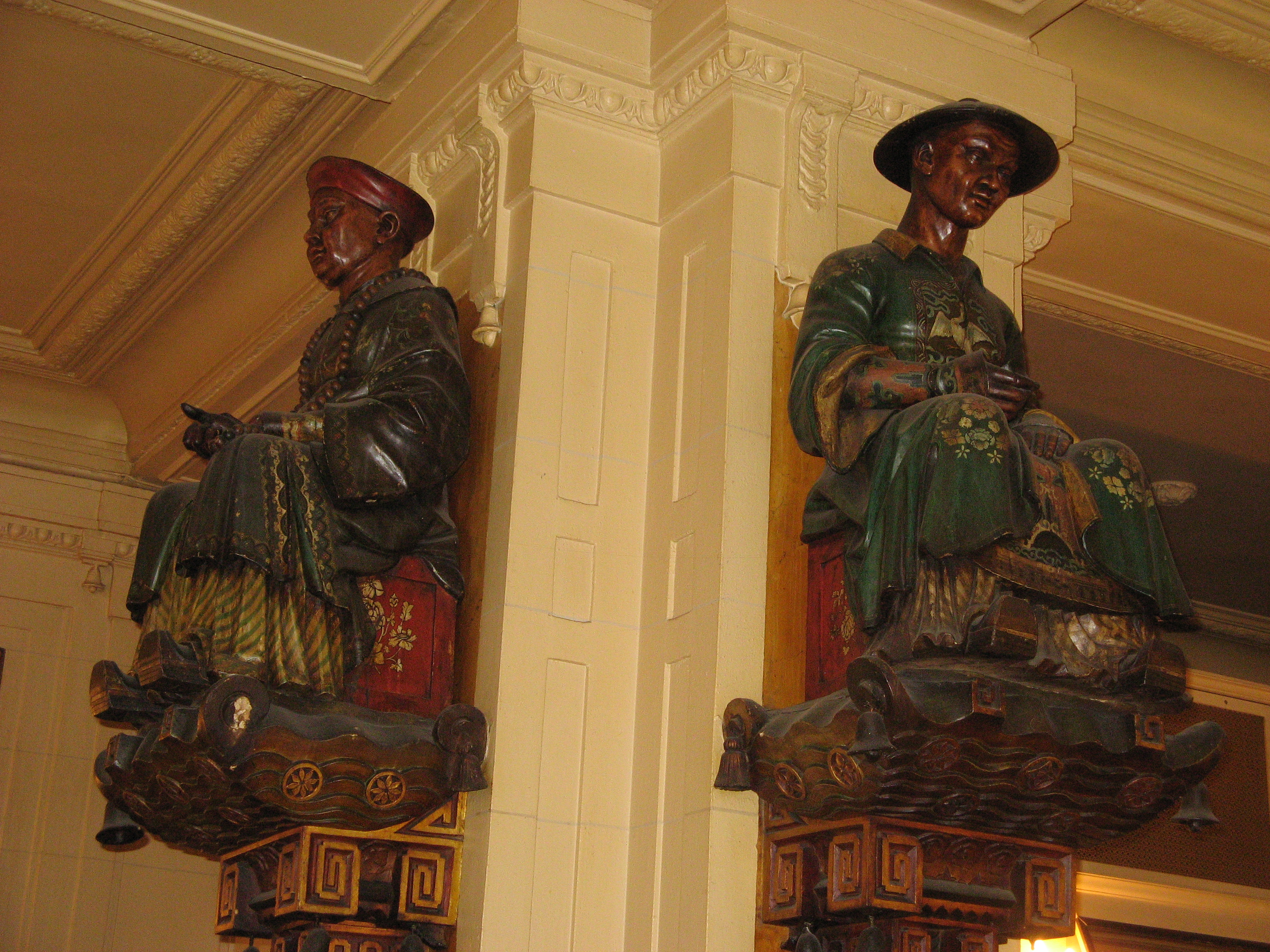
File:Statues, Les Deux Magots, Paris.JPG

The name originally belonged to a fabric and novelty shop at nearby 23 Rue de Buci. The shop sold silk lingerie and took its name from a popular play of the moment (1800s) entitled Les Deux Magots de la Chine (Two Figurines from China.)[2] In 1873 the business transferred to its current location in the Place Saint-Germain-des-Prés. In 1884 the business changed to a café and liquoriste, keeping the name.

Auguste Boulay bought the business in 1914, when it was on the brink of bankruptcy, for 400,000 francs (anciens). The present manager, Catherine Mathivat, is his great-great-granddaughter.

__________________________________

Albert Camus, (1913-60)


  • Life in AlgeriaAlthough born in extreme poverty, Camus attended the lycee and university in Algiers, where he developed an abiding interest in sports and the theater. His university career was cut short by a severe attack of tuberculosis, an illness from which he suffered periodically throughout his life. The themes of poverty, sport, and the horror of human mortality all figure prominently in his volumes of so-called Algerian essays: L’Envers et l’endroit (The Wrong Side and the Right Side, 1937), Noces (Nuptials, 1938), and L’Ete (Summer, 1954). In 1938 he became a journalist with Alger-Republicain, an anticolonialist newspaper. While working for this daily he wrote detailed reports on the condition of poor Arabs in the Kabyles region. These reports were later published in abridged form in Actuelles III (1958).
  • The War YearsSuch journalistic experience proved invaluable when Camus went to France during World War II. There he worked for the Combat resistance network and undertook the editorship of the Parisian daily Combat, which first appeared clandestinely in 1943. His editorials, both before and after the liberation, showed a deep desire to combine political action with strict adherence to moral principles.During the war Camus published the main works associated with his doctrine of the absurd–his view that human life is rendered ultimately meaningless by the fact of death and that the individual cannot make rational sense of his experience. These works include the novel The Stranger (1942; Eng. trans., 1946), perhaps his finest work of fiction, which memorably embodies the 20th-century theme of the alienated stranger or outsider; a long essay on the absurd, The Myth of Sysiphysus (1942; Eng. trans., 1955); and two plays published in 1944, Cross Purpose (Eng. trans., 1948) and Caligula (Eng. trans., 1948). In these works Camus explored contemporary nihilism with considerable sympathy, but his own attitude toward the “absurd” remained ambivalent. In theory, philosophical absurdism logically entails total moral indifference. Camus found, however, that neither his own temperament nor his experiences in occupied France allowed him to be satisfied with such total moral neutrality. The growth of his ideas on moral responsibility is partly sketched in the four Letters to a German Friend (1945) included, with a number of other political essays, in Resistance, Rebellion, and Death (1960).
  • RebellionundefinedFrom this point on, Camus was concerned mainly with exploring avenues of rebellion against the absurd as he strove to create something like a humane stoicism. The Plague (1947; Eng. trans., 1948) is a symbolic novel in which the important achievement of those who fight bubonic plague in Oran lies not in the little success they have but in their assertion of human dignity and endurance. In the controversial essay The Rebel (1951; Eng. trans., 1954), he criticized what he regarded as the deceptive doctrines of “absolutist” philosophies–the vertical (eternal) transcendence of Christianity and the horizontal (historical) transcendence of Marxism. He argued in favor of Mediterranean humanism, advocating nature and moderation rather than historicism and violence. He subsequently became involved in a bitter controversy with Jean Paul Sartre over the issues raised in this essay.Camus wrote two overtly political plays, the satirical State of Siege (1948; Eng. trans., 1958) and The Just Assassins (1950; Eng. trans., 1958). It can be argued, however, that Camus scored his major theatrical success with stage adaptations of such novels as William Faulkner’s Requiem for a Nun (1956) and Dostoyevsky’s The Possessed (1959). He also published a third novel, The Fall (1956; Eng. trans., 1957), which some critics read as a flirtation with Christian ideas, and a collection of short stories noteworthy for their technical virtuosity,Exile and the Kingdom (1957; Eng. trans., 1958). Posthumous publications include two sets of Notebooks covering the period 1935-51, an early novel, A Happy Death (1971; Eng. trans., 1972), and a collection of essays, Youthful Writings (1973; Eng. trans., 1976 and 1977)John Cruickshank

How Should We Then Live  Pt 7

T h e AGE OF NON-REASON

I. Optimism Of Older Humanist Philosophers:

The unity and true knowledge of reality defined as starting from Man alone.

II. Shift in Modern Philosophy

A. Eighteenth century as the vital watershed.

B. Rousseau: ideas and influence.

1. Rousseau and autonomous freedom.

2. Personal freedom and social necessity clash in Rousseau.

3. Rousseau’s influence.

a) Robespierre and the ideology of the Terror.

b) Gauguin, natural freedom, and disillusionment.

C. DeSade: If nature is the absolute, cruelty equals non-cruelty.

D. Impossible tension between autonomous freedom and autonomous reasons conclusion that the universe and people are a part of the total cosmic machine.

E. Kant, Hegel, and Kierkegaard and their followers sought for a unity but they did not solve the problem.

1. After these men and their followers, there came an absolute break between the area of meaning and values, and the area of reason.

2. Now humanistic philosophy sees reason as always leading to pessimism; any hope of optimism lies in non-reason.


III. Existentialism and Non-Reason

A. French existentialism.

1. Total separation of reason and will: Sartre.

2. Not possible to live consistently with this position.

B. German existentialism.

1. Jaspers and the “final experience.”

2. Heidegger and angst.


C. Influence of existentialism. 


1. As a formal philosophy it is declining.

2. As a generalized attitude it dominates modern thought.

IV. Forms of Popularization of Nonrational Experience

A. Drug experience.

1. Aldous Huxley and “truth inside one’s head.”

2. Influence of rock groups in spreading the drug culture; psychedelic rock.

B. Eastern religious experience: from the drug trip to the Eastern religious trip.

C. The occult as a basis for “hope” in the area of non-reason.

V. Theological Liberalism and Existentialism

A. Preparation for theological existentialism.

1. Renaissance’s attempt to “synthesize” Greek philosophers and Christianity; religious liberals’ attempt to “synthesize” Enlightenment and Christianity.

2. Religious liberals denied supernatural but accepted reason.

3. Schweitzer’s demolition of liberal aim to separate the natural from the supernatural in the New Testament.


B. Theological existentialism.

1. Intellectual failure of rationalist theology opened door to theological existentialism.

2. Barth brought the existential methodology into theology.

a) Barth’s teaching led to theologians who said that the Bible is not true in the areas of science and history, but they nevertheless look for a religious experience from it.

b) For many adherents of this theology, the Bible does not give absolutes in regard to what is right or wrong in human behavior.

3. Theological existentialism as a cul-de-sac.

a) If Bible is divorced from its teaching concerning the cosmos and history, its values can’t be applied to a historic situation in either morals or law; theological pronouncements

about morals or law are arbitrary.

b) No way to explain evil or distinguish good from evil. Therefore, these theologians are in same position as Hindu philosophers (as illustrated by Kali).

c) Tillich, prayer as reflection, and the deadness of “god.”

d) Religious words used for manipulation of society.


VI. Conclusion

With what Christ and the Bible teach, Man can have life instead of death—in having knowledge that is more than finite Man can have from himself.

Questions

1. What is the difference between theologians and philosophers of the rationalist tradition and those of the existentialist tradition?

2. “If the early church had embraced an existentialist theology, it would have been absorbed into the Roman pantheon.” It didn’t. Why not?

3. “It is true that existentialist theology is foreign to biblical religion. But biblical religion was the product of a particular culture and, though useful for societies in the same cultural stream, it is no longer suitable for an age in which an entire range of world cultures requires a common religious denominator. Religious existentialism provides that, without losing the universal instinct for the holy.” Study this statement carefully. What assumptions are betrayed by it?

4. Can you isolate attitudes and tendencies in yourself, your church, and your community which reflect the “existentialist methodology” described by Dr. Schaeffer?

Key Events and Persons

Rousseau: 1712-1778

Kant: 1724-1804

Marquis de Sade: 1740-1814

The Social Contract: 1762

Hegel: 1770-1831

Kierkegaard: 1813-1855

Paul Gauguin: 1848-1903

Whence, What Whither?: 1897-1898

Albert Schweitzer: 1875-1965

Quest for the Historical Jesus: 1906

Karl Jaspers: 1883-1969

Paul Tillich: 1886-1965

Karl Barth: 1886-1968

Martin Heidegger: 1889-1976

Aldous Huxley: 1894-1963

J.P. Sartre: 1905-1980

Beatles’ Sergeant Pepper: 1967 


Further Study

Unless already familiar with them, take time to listen to the Beatles’ records, as well as to discs put out by other groups at the time.

Albert Camus, The Stranger (1942).

Aldous Huxley, The Doors of Perception (1954).

Rousseau, The Social Contract (1762).

J.P. Sartre, Nausea (1938).

Paul Tillich, The Courage to Be (1952).

Following Rousseau, the exaggeration of the delights and the pathos of nature and experience which marks Romanticism may be sampled in, for example, Wordsworth’s poems, Casper David Friedrich’s paintings, and Schubert’s songs.

J.G. Fichte, Addresses to the German Nation (1968).

J.W. von Goethe, The Sorrows of Young Werther (1962).

Erich Heller, The Disinherited Mind (1952).


Camus, The Fall, and the Question of Faith

By Jimmy Maher

The Fall is a work absolutely drenched in Christian, particularly Catholic, symbolism. The title is an obvious reference to the Biblical story of Adam and Eve; the novel’s setting of Amsterdam is a stand-in for Dante’s Nine Circles of Hell; and the work is structured as an extended confession of the narrator’s sins, with the reader playing the role of the priest. Yet the novel was written by Albert Camus, a man generally considered a leading light of the atheistic French existentialist movement of the mid-twentieth century. By taking a closer look at Camus’ life and thought, we may discover that there really is no contradiction here. The literary establishment has a constant tendency to lump thinkers together into easily digestable categories. I believe that Camus was, at least partially, a victim of this lust for simplicity.

Camus never expressed the same contempt toward religion as Jean-Paul Sartre and other prominent existentialists. This marked lack, so unfashionable in the French literary circle in which Camus traveled, was perhaps partially due to the fact that Camus never had a religious upbringing to rebel against. Although the young Albert went through certain polite motions of Catholicism, such as first communion, the religion was not taken particularly seriously by anyone within his extended family. Biographer Oliver Todd notes that Albert’s grandmother’s typical response upon learning of someone’s death was, “Well, he’s farted his last” (12). With no family coercion to react emotionally against, Camus exhibited an intellectual, if not spiritual, interest in Christianity from a young age. Indeed, his first work to attract attention in the world of letters was entitled “Christian Metaphysics and Neoplatonism: Plotinus and Saint Augustine.”

Lack of hostility toward Christianity does not of course imply acceptance. Camus throughout his life was very much a secular philosopher. One is thus left wondering what to make of The Fall, steeped as it is in Christian imagery and thought, and positively crying out for the sort of spiritual redemption that Catholics would say can only be found in the confessional. Perhaps as he reached middle age Camus was questioning the relentlessly amoral, self-centered worldview of the existentialists, along with their notion of an essentially meaningless universe devoid of absolutes. To paraphrase Nietzsche, the existentialists had killed God, yet they offered nothing to replace Him, thus leaving a guilt-ridden man like Jean-Baptiste Clamence with nowhere to turn. Clamence desperately wants to confess his sins to a higher power, but the intelligentsia, with their pseudo-sophisticated chattering about relativity and modernity, have taken that option away from him. And so he turns to his only alternative, his fellow man. The Fall documents the sick results of Clamence’s compulsion. He talks and talks to us, confessing sin after sin over the course of several long evenings, yet never achieves the redemption he craves. He is left exhausted but not redeemed, able to take satisfaction only in the notion that he may have dragged the reader down to his own level of empty spiritual misery. Clamence seeks redemption, yet redemption is not something that mortal man can provide.

The issue that Clamence, and by extension Camus, is wrestling with here is hardly unknown to those who have rejected metaphysics. The problem is implicit in our language itself. When it comes to the really important matters, to life and death and love, the secular man finds that words fail him. The old words, much as he would love to dismiss them as outmoded, superstitious nonsense, are the only ones that fit. Faced with a death, the atheist has no alternative that resonates in the same way as the “God rest his soul” of the man of faith. Similarly, a guilt-wracked secularist like Clamence can find no solace in confession, because he does not believe anyone is qualified to hear him and wash him clean. And so the stain remains, and devours him. Religion remains such a potent force in society, against all the evidence of science and rational thought, because it offers something those things cannot. If one would discredit religion, one should perhaps be required to offer something other than empty rationalizations to replace it. I do not know what that something might be, of course, and, for all of his intellectual brilliance, neither did Camus. His novel provides no answers, only painful, almost desperate questions.

The Fall has the feeling of a deeply personal book. One senses somehow that the questions that torment Clamence are the questions that also torment the author. Certainly many commentators at the time of the book’s publication took it as direct description of Camus’ state of mind, circa 1956. Its note of questioning dissatisfaction led many to conclude that Camus was himself on the verge of embracing Christianity, not just intellectually but also spiritually. Speculation on this point is now rather pointless, of course. Camus may just as likely have been casting about for some new value system that could fill the void of traditional religion. Most likely, he had little idea of his own future. We certainly cannot know where Camus’ thoughts would eventually have taken him had he not died so soon after The Fall’s publication, but we do know that he was growing increasingly critical of the existential philosophies of Sartre and others. He wrote shortly after completing the novel that “far from leading to a decent solution of the problem of freedom versus authority, [existentialism can only lead] to servitude” (Oliver 346).

Up to this point, I have been equating Camus very closely with his novel’s protagonist, Clamence. One might question the wisdom of doing so. It is after all a truism in literary criticism that a novel is not a work of autobiography. In the case of The Fall, however, I believe that drawing a close parallel between the author and his protagonist is justified. Certainly there is much circumstantial evidence supporting my case. Clamence is forty years old; Camus was forty-three at the time of the novel’s publication. Both men were socially adept, both were notably polite and patient, and both were quite generous with their money. Both seduced women seemingly effortlessly, but shied away from serious involvement with their conquests. Todd notes in his biography that “when he slept with a woman, and she insisted on further involvement, Camus would explain that his real attachments were elsewhere. …brief sexual adventures posed no problem for him” (345). The similarities are rather striking.

That is not to say that Camus is Clamence, or vice versa. While Camus seems to have drawn from his own psyche in constructing the character, there is no reason to believe that he ever reached the state of bitter despair that marked Clamence. One proof of this might be the fact that the novel exists at all. If one accepts the premise that the creation of art, even deeply tragic art, is fundamentally life-affirming, one has to conclude that by the very act of writing The Fall Camus has transcended Clamence’s existential nihilism. Certainly Camus denied, repeatedly and vehemently, that he and Clamence were one. Some of this may have been self-serving, for no one would want to be too closely associated in the public mind with such an unpleasant character as Clamence, but nevertheless those who remember Camus generally describe him as a fundamentally gentle person, a far cry from the reprobate Clamence has become by the end of the novel. We are on much firmer ground in saying that Clamence, while an individual distinctly separate from his creator, represents the consequence of certain aspects of Camus’ psyche taken to their extremes.

The Fall feels like a transitional work to this reader. Unfortunately, we never got to see where that transition would eventually lead Camus, for his life was cut short in the middle of his stream of thought. Having rejected Christianity, at least as a workable belief system for himself personally, very early in his career, and now having rejected Sartre’s brand of existential atheism, he seems to be searching for some third, better path. If he found it, he never had the chance to share it with us. This gives The Fall an unsettled feeling of incompletion. We are left in limbo, waiting for some sort of answer to the dilemmas it poses, an answer that will of course never arrive. There are no happy endings, and certainly no redemption. We have only some of the most difficult questions one can ask, accompanied by a protagonist who is the very definition of existential angst. Clamence is a martyr for the modern, smugly sophisticated, secular man embodied by thinkers like Sartre, and, yes, his sometimes friend and sometimes enemy Albert Camus himself.


Works Cited and Consulted

Brée, Germaine, ed. Camus. Englewood Cliffs: Prentice-Hall, 1962.

Bronner, Stephen Eric. Camus: Portrait of a Moralist. Minneapolis: University of Minnesota, 1999.

Camus, Albert. The Fall. Trans. Justin O’Brien. Vintage: New York, 1991.

Rhein, Phillip H. Albert Camus. New York: Twayne, 1989.

Todd, Oliver. Albert Camus: A Life. Trans. Benjamin Ivry. New York: Knopf, 1997.

 
Home > 2000 > October 23 Christianity Today, October 23, 2000
A pastor describes how the great existentialist atheist asked him late in life, Do you perform baptisms?
James W. Sire | posted 10/23/2000 12:00AM
Albert Camus and the Ministerby Howard Mumma
Paraclete, 217 pages, $15.95When Albert Camus’s The Fall was published in 1956, “numerous pious souls” thought the famous atheist, existentialist novelist, and philosopher was nearing conversion—so says French critic Alain Costes. Methodist pastor Howard Mumma was one of those pious souls and for good reason.Mumma is no wishful thinker, no pious Christian admirer who imagines reasons to list Camus among the saints. Over several summers, as he served as guest minister at the American Church in Paris, Mumma was sought out by Camus. Sworn to secrecy at the time, Mumma now reconstructs the “irregular and occasional” dialogues that took place before Camus’s tragic death in a car accident on January 4, 1960. These dialogues climaxed with Camus’s request to be baptized privately.To me and, I imagine, to many not quite so pious readers of Camus, the conversations this book describes come as a stunning revelation—but not one lacking credibility. Still, some readers will surely find this revelation a serious challenge to Camus’s intellectual stature and will refuse to believe it.There is, of course, little way for readers now to verify whether these dialogues took place, or to verify the accuracy of Mumma’s memory then or now, 40 years later, when he is in his 90s. Still, the details of the setting for the dialogues and the reconstructed interchanges have the ring of truth.The problem of painCamus had long dealt with religious issues: the meaning of life, the problem of evil, the feelings of guilt, the foundation for morality, the longing for eternal life.Though, as Camus tells Mumma, “The silence of the universe has led me to conclude that the world is without meaning,” he had already confessed in an essay written in 1950 that he had made his whole life an attempt to “transcend nihilism.” His three major novels—The Stranger (1942), The Plague (1947), and The Fall (1956)—deal with profound moral and spiritual issues. Still, none of them—nor any of his short stories, dramas or essays—gives any indication that he was seriously considering conversion to Christianity.

Camus rejected both Marxism, his constant enemy, and Christianity, his frequent sparring partner. His main sticking point was the problem of suffering and evil. Camus refused to believe in the existence of a God who is both omnipotent and good. The world taken on its own is meaningless. If there were a God, then there might be a meaning to the world. But the profound suffering of the innocent is universal. God—if there is a God—does nothing to prevent it or alleviate it. Therefore he either does not exist or he is not omnipotent and not worth believing in. Worse, he may be evil himself.

Camus’s response to this meaningless world is to rebel, to launch an attack on suffering. In the image of his novel, it is to fight the plague.

What attracts all morally sensitive readers to Camus’s philosophy is its honesty, its openness to the reality of suffering, his refusal to accept any cheap answers, but at the same time his passion to act positively, not only to have compassion on the suffering but, as an intellectual with stellar gifts as a writer, to encourage others to do so as well. Without believing in anything “transcendent,” he calls us to “transcend” nihilism by our actions, to make meaning where there is no meaning.

What Mumma shows us, however, is a Camus who had doubts about his own solution and premonitions that genuine meaning did in fact exist in God as understood by traditional Christianity. “I am searching for something I do not have, something I’m not sure I can define,” he tells Mumma in their first encounter. The world is not rational, it does not fit human needs and desire. “In a word, our very existence is absurd.” Suicide seems the only logical response.

Mumma does not hasten to counter Camus’s charge; rather, he sympathizes with Camus’s frustration and confesses his own inability to make sense of the world. This at first seems like strange behavior for a pastor. In fact, however, it mirrors the behavior of Job’s friends—the one thing they got right. They sat with Job for seven days and seven nights without speaking. Camus returns for a second visit and the dialogue resumes.

As the conversations continue, Camus begins to read the Bible, something he confesses not to have done before. In fact he does not even own one; so Mumma gets one for him, and Camus starts with Genesis. This raises the issue of the whether the Bible is to be taken literally, especially the story of Adam and Eve. When Mumma interprets it as a parable of the origin of the conscience, in short, a tale putting the origin of human evil in the attempt of human beings to make themselves gods, Camus finds the story to ring true.

While Mumma’s answers are broadly speaking neo-orthodox, not quite those an evangelical would likely give, the theology is traditional at heart, and it is in line with Camus’s own understanding of human nature.

Sartre the blusterer.

Mumma then mentions the well-known relationship between Jean-Paul Sartre and Camus. Mumma has already had two significant encounters with Sartre; these become a springboard for further dialogue with Camus. In his conversation with Mumma, Sartre held that there is no god of any kind. Human beings alone have a nonmaterial dimension; from that, they are able to break free of their material constraints and create their own nature, their own character.

When Mumma asks where this nonmaterial nature comes from, Sartre has no explanation. He merely blusters, “I have no answers to this question, but I emphatically deny any natural or biological origin for the spiritual freedom with which man is cursed or blessed. … Let us drop the subject.” Still, a bit dejected, he asks Mumma to explain the Christian view of the question. When Mumma replies, Sartre says, “I have not heard this reasoning before and will have to think on it further.”

The conversation with Sartre then moves to morality. According to Sartre, free individuals create by their choices both their own character and the moral principles by which they live. They are obligated only to themselves. But if they are obligated to no one else, how can ethics be anything but relative? In short, how can there be a morality—an ought in a world of contrary notions of what is good, none of which has a claim on any other? Mumma has only two encounters with Sartre, neither of which stirs Sartre from his commitment to atheism.

Private baptism?

Mumma is no novelist; he does not try to picture the movement of Camus’s mind. What he does is to shock us as he himself is shocked by what Camus suddenly asks: “Howard, do you perform baptisms?” What does “You must be born again” mean? After being told that “baptism is a symbolic commitment to God” and being born again means “to enter anew or afresh into the process of spiritual growth … to receive forgiveness because you have asked God to forgive you of all your sins,” Camus says, “Howard, I am ready. I want this.”

Then came the dilemma for Mumma. Camus had already been baptized in the Roman Catholic Church. According to Methodist belief and that of many other denominations, once is enough. Moreover, baptism is a public affair. It means becoming a part of the visible community of faith. It is the latter that now becomes the sticking point. Camus is a very public figure.

But Mumma would not agree to a private baptism. Instead, he counseled Camus to continue his study of the faith and to postpone baptism till the two of them could reach the same persuasion. Camus accompanied Mumma to the airport as he prepared to return to the States, expecting to see Camus again the next year. “My friend, mon ché;ri, thank you. … I am going to keep striving for the Faith!” Suddenly Mumma has second thoughts. Should he have baptized and confirmed him?

But it is too late. A few months later, Mumma hears of Camus’s sudden death. Although he wonders if he had made a mistake, Mumma writes:

I had implied that baptism was an event that usually only happens once, and I certainly wasn’t worried for his soul. God had set aside a special place for him, I was sure.

Apologetic questions

For any Christian interested in apologetics, this book raises a host of questions.

What if Mumma had answered Camus’s questions in a more evangelical way, arguing for the historicity of Adam and Eve and a less exclusively theological reading of the Bible? Camus could see the power of the theological understanding of evil, one with which most evangelicals would be in basic agreement. Would he have been so ready to proceed if Mumma insisted that he accept a more literal understanding of the Old Testament?

What if Mumma had directed Camus to the Gospels first? Would that have raised a different set of questions in Camus’s mind? Camus has shown some sympathy with Jesus in his writing. Would his fresh and direct encounter with him in the New Testament have given a different focus to his struggle with the problem of evil?

When a seeker asks for baptism, how much must be believed? Given Camus’s status as a celebrity, how important is the public aspect of baptism? We know, for example, the strain on public figures who are converted. Already in the limelight, they are prone to overconfidence and too often fade from overexposure. Worse, the Christian community often parades them before the public as arguments for the faith.

This book is an important addition to apologetic literature—not because of the details of the argument, for there is nothing new here—but because of who Sartre and Camus were and continue to be in the intellectual world. If Sartre could only bluster when a key weakness of his philosophy is pointed out by an ordinary pastor, how solid is the intellectual foundation of atheism? If Camus, more honest and open than Sartre to the flaws of his own system, could finally see the truth of Christianity, how optimistic could we be about the conversion of honest atheists?

James W. Sire, author of The Universe Next Door, has recently published Habits of the Mind: Intellectual Life as a Christian Calling (InterVarsity Press).

Related Elsewhere

For hundreds of Camus links, click here.

Read a brief Camus biography.

In October’s The New Republic James Wood’s ” The Sickness Unto Life” examines why Camus, and thinkers who question God most rigorously, often arrive at highly orthodox conclusions.

You can purchase Howard E. Mumma’s Albert Camus and the Minister online.

James W. Sire’s The Universe Next Door: A Basic Worldview Catalog is available from Worthy books. Habits of the Mind, his latest work, is available from IVP.

Copyright © 2004 Christianity Today. Click for reprint information.


Decoding Woody Allen’s ‘Midnight in Paris’

Roger Arpajou/Versitil Cinema & Gravier Productions, Courtesy of Sony Pictures Classics

Owen Wilson, left, is Gil, who travels back in time to 1920s Paris, and Marion Cotillard is Adriana, a fictional mistress of Picasso’s who catches Gil’s eye. More Photos »

By
Published: May 27, 2011

Many a writer or artist has longed to travel back in time to the sizzling Paris of the 1920s, to sip absinthe with Hemingway at Les Deux Magots or dine on choucroute garnie with Picasso at La Rotonde. Imagine the conversation! What has beguiled audiences about the new Woody Allen movie, “Midnight in Paris,” is that the protagonist, Gil, a disenchanted Hollywood screenwriter played by Owen Wilson, gets to live exactly that fantasy.

//

Multimedia
Associated Press

F. Scott Fitzgerald, center, with his daughter Scottie, left and his wife Zelda in Paris in 1925.                            More Photos »

Roger Arpajou/Versatil Cinema & Gravier Productions, Courtesy of Sony Pictures Classics

Alison Pill and Tom Hiddleston as Zelda and F. Scott Fitzgerald in “Midnight in Paris.”                            More Photos »

Associated Press

Gertrude Stein and Alice B. Toklas in 1934.                            More Photos »

The New York Times

Ernest Hemingway, around 1937.                            More Photos »

Associated Press

Salvador Dalí in 1971.                            More Photos »

Associated Press

Cole Porter, around 1910.                            More Photos »

He runs into Scott and Zelda Fitzgerald at an elegant soiree, where he hears Cole Porter crooning “Let’s Do It (Let’s Fall in Love).” He gets writing advice from a laconic Hemingway, persuades Gertrude Stein to read the manuscript of his novel, and falls in love with Picasso’s mistress. He meets Salvador Dalí, T. S. Eliot, Djuna Barnes, Josephine Baker, Luis Buñuel, Man Ray and others in the enormously talented cast of expatriates and bohemians that peopled Jazz Age Paris. Reeling from the folly of World War I and so offering fodder for novels and paintings dripping with disillusionment, Paris was the center of the artistic universe then, and those legends really did converge on Paris around the same time.

“If you are lucky enough to have lived in Paris as a young man then wherever you go for the rest of your life, it stays with you, for Paris is a moveable feast,” Hemingway wrote in “A Moveable Feast,” his memoir that was posthumously published in 1964.

The movie sometimes assumes viewers know the details of these luminous lives, so it may be helpful to understand some of the complicated relationships that made Paris in that era both a dream and often something less.

In 1922 Hemingway and his first wife, Hadley, took a two-room flat near the Sorbonne that had no hot water and no indoor toilet. He also rented a room around the corner to write, something like the “attic with a skylight” Gil craves. It had a view of the smokestacks and rooftops that Mr. Allen captures in worshipful shots of the city.

Hemingway also discovered Shakespeare & Company, a bookstore near the Jardin du Luxembourg owned by Sylvia Beach that became a crossroads for Americans in Paris. It’s where he borrowed books by Turgenev and Tolstoy, and it makes a cameo in the film.

Gil meets Hemingway in a run-down cafe not unlike the legendary Dingo, where Hemingway’s less than beautiful friendship with Fitzgerald began with the latter’s drunken near-blackout. Hemingway, who is parodied in the film with dialogue like “no subject is terrible if the story is true and if the prose is clean and honest,” was envious of the seemingly effortless lyricism of Fitzgerald’s writing in works like “The Great Gatsby.” In “Midnight in Paris,” Hemingway tells Fitzgerald that Zelda, a writer herself, sees her husband as a competitor. But “A Moveable Feast” offers a more full-throated account. Hemingway grew to despise Zelda, partly because she had betrayed Fitzgerald with a French aviator and partly because he blamed her decadent tempestuousness for ruining her husband’s productivity.

Picasso and Matisse, who appear in the film, also had a rivalry, barely acknowledged in the film, with the two artists echoing — some critics say swiping — each other’s themes. Both gained the attention of the art collector Leo Stein and his sister, Gertrude. In the film Gil hears that Gertrude Stein has bought a Matisse for 500 francs and, in the hope of making a time-bending killing, asks her if he could pick up “six or seven” Matisses as well. The twice-married Picasso was famous for mistresses, and in the film Marion Cotillard plays Adriana, a capricious, if melancholy stand-in for all of Picasso’s lovers, models and muses. She claims to have been the lover of Modigliani and Braque as well. In actuality, Picasso’s mistresses were relatively constant. Marie-Thérèse Walter, who was 17 when she met Picasso, was with him for eight years, bearing him a daughter, Maya. Dora Maar, whom he met around 1935, was his lover for at least eight years as well.

The Indiana-born Cole Porter maintained an elegant apartment, where he gave hedonistic parties that were daring for their mingling of gay and straight friends. Porter met and married Linda Lee Thomas, a divorcée from Louisville who was eight years older and aware that Porter was gay. They set up an even more lavish apartment — walls covered in zebra hide — near Les Invalides, a home that seems like the setting for the on-screen party where Porter entertains his guests at the piano.

The film recounts how many Porter songs were hommages to Paris —“I Love Paris” and “C’est Magnifique,” among them — and indeed Porter wrote a musical, “Paris,” for the chanteuse Irene Bordoni. One of the show’s songs was “Let’s Do It,” with teasingly suggestive lines including: “In shallow shoals English soles do it./Goldfish in the privacy of bowls do it.”

When Gil sits down in a cafe with Dalí and Man Ray, he confides to those artists his shock at being catapulted back in time. Man Ray is delighted with the idea, but Gil tells him that’s because “you’re a Surrealist and I’m a normal guy.”

Dalí, played here by Adrien Brody, first visited Paris in 1926, grew the mustache that would become his trademark, and met his idol and fellow Spaniard, Picasso. Experimenting with many forms, Dalí fell in with a circle of Surrealists in Montparnasse whose members were probing the Freudian depths of their psyches for what they regarded as a new expressive frontier. He met his future wife, Gala, who was inconveniently married to a Surrealist poet.

Dalí collaborated with Buñuel on the short avant-garde film “Un Chien Andalou.” In “Midnight in Paris,” Gil suggests to Buñuel that he make a film about a dinner party gone haywire. Buñuel, of course, took up the suggestion. The film was “The Exterminating Angel,” released in 1962.

This article has been revised to reflect the following correction:

Correction: May 31, 2011

An earlier version of this article omitted the final paragraph.

This article has been revised to reflect the following correction:

Correction: June 1, 2011

An article on Saturday about figures from the Paris arts scene in the 1920s who appear in the new Woody Allen movie, “Midnight in Paris,” including the filmmaker Luis Buñuel, misidentified a film by Buñuel that the Allen movie’s protagonist urges him to make some day. It is “The Exterminating Angel,”

The Characters referenced in Woody Allen’s “Midnight in Paris” (Part 29, Pablo Picasso)

In his weekly opinion piece, Andy Rooney shares his views on public art.
I have really enjoyed this series on the characters referenced in the film “Midnight in Paris.” I can’t express how much I have learned during this series on the characters referenced in Woody Allen’s latest movie “Midnight  in Paris.” Today I am looking at Pablo Picasso. We are going to explore the life and worldview of Picasso too.
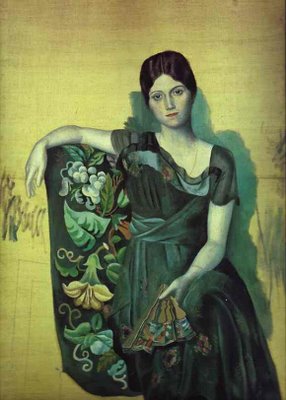
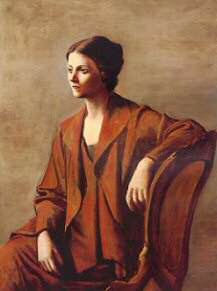
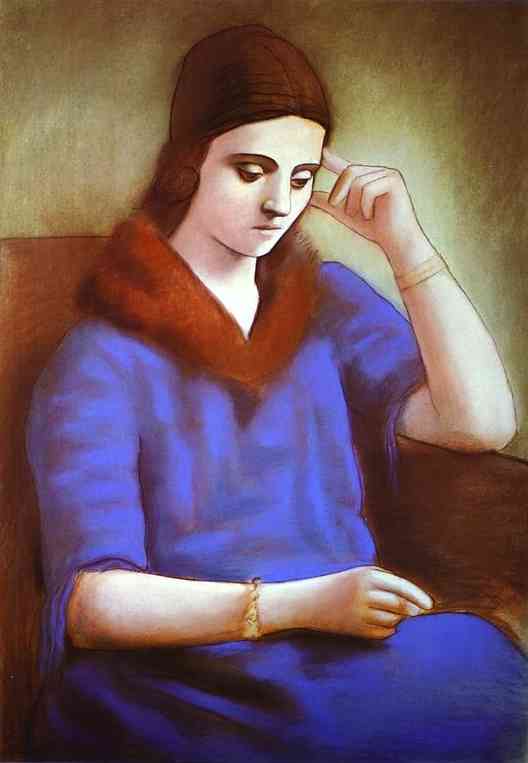
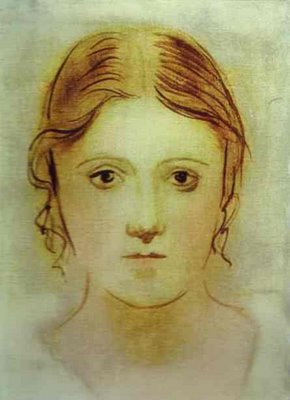
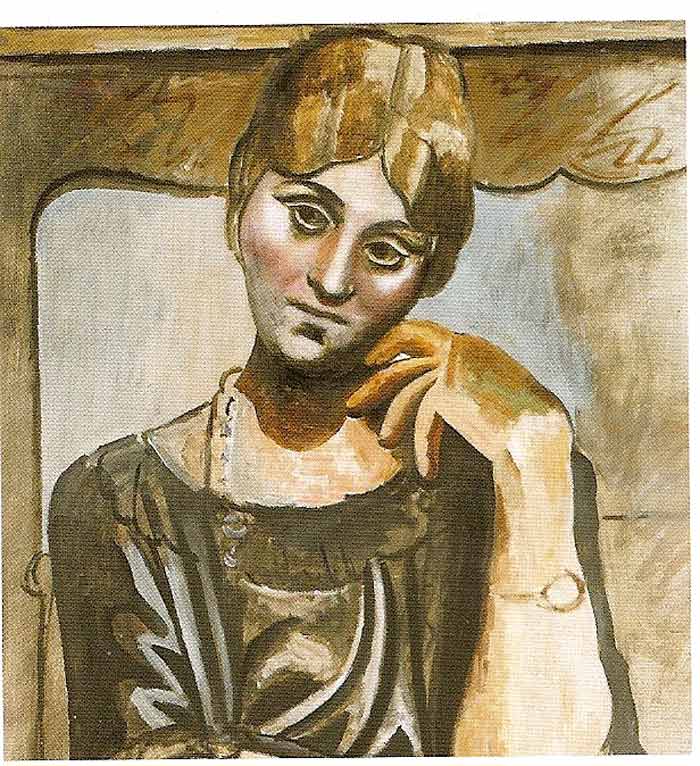
The character Adriana in “Midnight in Paris” is a fictional character but she exposes the fact that Picasso was constantly possessive of his mistresses and hateful at times to the women in his life. Francis Schaeffer in his film series “How should we then live?” has some very insightful commentary on Picasso and the loss of humanity pictured in his paintings. However, Picasso could not be consistent because when it came to painting Olga, Jacqueline and his children, Picasso would use  all of abilities to show them the way God made them and not in a fragmented way.
avignon.jpg

Above is Picasso’s greatest masterpiece, Les Desmoiselles d ’Avignon (1907).

Roy Saper wrote in 2006 (and many of these pictures below come from Saper Galleries):

In 1943 Picasso (age 62) then kept company with young art student Françoise Gilot (born in 1921).  Their two children were Claude (1947) and Paloma (1949) who was named for the dove of peace that Picasso painted in support of the peace movement post World War II.  Gilot, frustrated with Picasso’s relationships with other woman and his abusive nature left him in 1953.   Gilot’s book “Life with Picasso” was published 11 years after their separation.  In 1970 she married American physician-researcher Jonas Salk (who later died in 1995).

_______________________________

Picasso and Françoise with their two children were Claude (1947) and Paloma (1949) pictured below in the early 1950’s.

https://i0.wp.com/www.sapergalleries.com/PicassoPhoto1953.jpg

https://i0.wp.com/www.sapergalleries.com/PicassofrancoiseGilotPhoto.jpg

Picasso’s drawing, Portrait of Francoise, from 1946:

Francis Schaeffer in the episode, “The Age of Fragmentation,” Episode 8 of HOW SHOULD WE THEN  LIVE? noted:

Monet, Renoir, Pissaro, Sisley, Degas were following nature as it has been called in their painting they were impressionists.They painted only what their eyes brought them. But was there reality behind the light waves reaching their eyes? After 1885 Monet carried this to its conclusion and reality tended to become a dream. With impressionism the door was open for art to become the vehicle for modern thought. As reality became a dream, impressionism began to fall apart. These men Cezanne, Van Gogh, 
Gauguin, Seurat, all great post Impressionists felt the problem, felt the loss  of meaning. They set out to solve the problem, to find the way back to reality, to the absolute behind the individual things, behind the particulars, ultimately they failed. I am not saying that these 
painters were always consciously painting their philosophy of life, but rather in their work as a whole their worldview was often reflected. Cezanne reduced nature to what he considered its basic geometric forms. In this he was searching for an universal which would tie all kinds of individual things in nature together, but this gave a broken fragmented appearance to his pictures. In his bathers there is much freshness, much vitality. An absolute wonder in the balance of the picture as a whole, but he portrayed not only nature but also man himself in fragmented form. 
I want to stress that I am not minimizing these men as men. To read van Gogh’s letters is to weep for the pain of this sensitive man. Nor do I minimize their talent as painters. Their work often has great beauty indeed. But their art did become the vehicle of modern man’s view of fractured truth and light. As philosophy had moved from unity to fragmentation so did painting. In 1912  Kaczynski wrote an article saying that in so far as the old harmony, that is an unity of knowledge have been lost, that only two possibilities remained: extreme abstraction or extreme naturalism, both he said were equal.
With this painting modern art was born. Picasso painted it in 1907 and called it Les Demoiselles d’Avignon. It unites Cezzanne’s fragmentation with Gauguin’s concept of the nobel savage using the form of the african mask which was popular with Parisian art circle of that 
time. In great art technique is united with worldview and the technique of  fragmentation works well with the worldview of modern man. A view of a fragmented world and a fragmented man and a complete break with the art of the Renaissance which was founded on man’s humanist hopes.
Here man is made to be less than man. Humanity is lost. Speaking of a part of Picasso’s private collection of his own works David Douglas Duncan says “Of course, not one of these pictures was actually a portrait, but his prophecy of a ruined world.”
But Picasso himself could not live  with this loss of the human. When he was in love with Olga and later  Jacqueline he did not consistently paint them in a fragmented way. At crucial 
points of their relationship he painted them as they really were with all his genius, with all their humanity. When he was painting his own young children he did not use fragmented techniques and presentation. I want you to understand that I am not saying that gentleness and humanness is not present in modern art, but as the techniques of modern art advanced, humanity was increasingly 
fragmented. The opposite of fragmentation would be unity, and the old philosophic thinkers thought they could bring forth this unity from  the humanist base and then they gave this up.

__________

Olga Khokhlova and Picasso (1917-1927)

Picasso-and-ballerina Olga Khokhlova-web-art-academy

In 1917 ballerina Olga Khokhlova (1891-1955) met Picasso while the artist was designing the ballet “Parade” in Rome, to be performed by the Ballet Russe.

olga-khokhlova-and-picasso

They married in the Russian Orthodox church in Paris in 1918 and lived a life of conflict.

picasso_olga-kokhlova-web-art-academy

Olga Khokhlova by Picasso

pablo picasso Olga Khokhlova webartacademy

She was of high society and enjoyed formal events while Picasso was more bohemian in his interests and pursuits.

Picasso and Olga Khokhlova

Their son Paulo (Paul) was born in 1921 (and died in 1975), influencing Picasso’s imagery to turn to mother and child themes.  Paul’s three children are Pablito (1949-1973), Marina (born in 1951), and Bernard (1959).  Some of the Picassos in this Saper Galleries exhibition are from Marina and Bernard’s  personal Picasso collection.

Pablo Picasso. Portrait of Paul Picasso as a Child.

Portrait of Paul Picasso as a Child. 1923. Oil on canvas.
Collection of Paul Picasso, Paris, France.

PABLO PICASSO
The Art History Archive – Cubism


This Website is Best Viewed Using Firefox

The Most Famous Artist of the 20th Century

Biography by Charles Moffat.

Full Name: Pablo Diego José Francisco de Paula Juan Nepomuceno María de los Remedios Cipriano de la Santísima Trinidad Clito Ruiz y Picasso

Born October 25, 1881 – Died April 8, 1973.

“Everyone wants to understand art. Why don’t we try to understand the song of a bird? Why do we love the night, the flowers, everything around us, without trying to understand them? But in the case of a painting, people think they have to understand. If only they would realize above all that an artist works of necessity, that he himself is only an insignificant part of the world, and that no more importance should be attached to him than to plenty of other things which please us in the world though we can’t explain them; people who try to explain pictures are usually barking up the wrong tree.” – Picasso

The Beginning, Childhood and Youth: 1881-1901

Pablo Ruiz Picasso was born on October 25, 1881 to Don José Ruiz Blasco (1838-1939) and Doña Maria Picasso y Lopez (1855-1939). The family at the time resided in Málaga, Spain, where Don José, a painter himself, taught drawing at the local school of Fine Arts and Crafts. Pablo spent the first ten years of his life there. The family was far from rich, and when 2 other children were born — Dolorès (“Lola”) in 1884 and Concepción (“Conchita”) in 1887 — it was often difficult to make ends meet. When Don José was offered a better-paid job, he accepted it immediately, and the Picassos moved to the provincial capital of La Coruna, where they lived for the next four years. In 1892, Pablo entered the School of Fine Arts there, but it was mostly his father who taught him painting. By 1894 Pablo’s works were so well executed for a boy of his age that his father recognized Pablo’s amazing talent, and, handing Pablo his brush and palette, declared that he would never paint again.

The Blue and Rose periods: 1901-1906

In February 1901 Picasso’s friend Casagemas committed suicide: he shot himself in a Parisian café because a girl he loved had refused him. His death was a great shock to Picasso, and the painter would return to it again and again in his art: he painted the Death of Casagemas in color, the Death of Casagemas again in blue and then “Evocation – The Burial of Casagemas”. In this latter canvas the compositional and stylistic influence of El Greco’s “The Burial of Count Orgaz” can be traced. Picasso began to use blue and green almost exclusively. “I began to paint in blue, when I realized that Casademas had died” Picasso later wrote.

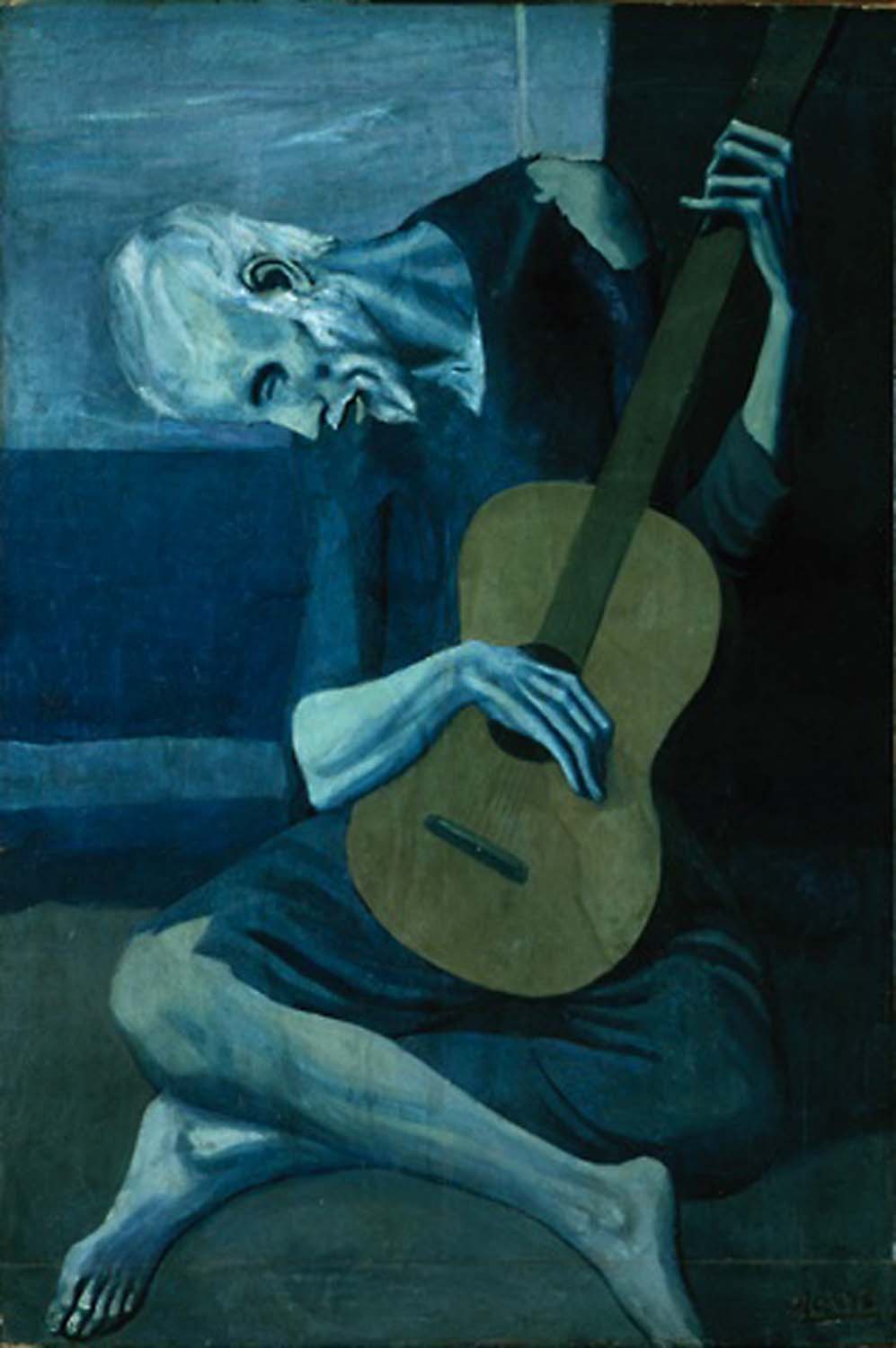
Restless and lonely, the arist moved constantly between Paris and Barcelona, depicting isolation, unhappiness, despair, misery of physical weakness, old age, and poverty; all of it in shades of blue. In the allegorical La Vie (1903), in monochrome blue, the man has the face of his deceased friend.

In 1904 Picasso finally settled in Paris, at 13 Rue Ravignan, called “Bateau-Lavoir”. He met Fernande Olivier, a model, who would be his mistress for the next seven years. He even proposed to her, but she had to refuse because she was already married. They paid frequent visits to the Circus Médrano, whose bright pink tent at the foot of the Montmartre shone for miles and was quite close to his studio. There, Picasso got ideas for his pictures of circus actors. The pub Le Lapin Agile (The Agile Rabbit) was a meeting place of young artists and authors. In the pub, Picasso got acquainted with the poets Guillaume Apollinaire and Max Jacob. The landlord, Frédé, accepted pictures as payment, and this made his café attractive for the artists and he acquired a splendid collection of paintings, including, of course, one by Picasso “At the Lapin Agile”, with Picasso as a harlequin and Frédé as a guitar player. The picture “Woman with a Crow” shows Frédé’s daughter.

By 1905, Picasso lightened his palette, relieving it with pink and rose, yellow-ochre and gray. His circus performers, harlequins and acrobats became more graceful, delicate and sensuous. In 1906 the art dealer Ambroise Vollard bought most of Picasso’s “Rose” pictures. This marked the beginning of Picasso’s prosperity: he would never again experience financial worries. Accompanied by Fernande the painter traveled to Barcelona, then to Gosol in the north of Catalonia, where he painted “La Toilette”. Deeply impressed by the Iberian sculptures at the Louvre, he began to think over and experiment with geometrical forms.

Cubism: 1907-1917

“Cubism is no different from any other school of painting. The same principles and the same elements are common to all. The fact that for a long time cubism has not been understood and that even today there are people who cannot see anything in it, means nothing. I do not read English, and an English book is a blank to me. This does not mean that the English language does not exist, and why should I blame anyone but myself if I cannot understand what I know nothing about?” – Picasso

African Period

In 1907, after numerous studies and variations Picasso painted his first Cubist picture – “Les demoiselles d’Avignon”. Impressed with African sculptures at an ethnographic museum he tried to combine the angular structures of the “primitive art” and his new ideas about cubism. The critics immediately dubbed this stage in his work the African Period, seeing in it only an imitation of African ethnic art.

“In the Demoiselles d’Avignon I painted a profile nose into a frontal view of a face. I had to depict it sideways so that I could give it a name, so that I could call it ‘nose’. And so they started talking about Negro art. Have you ever seen a single African sculpture — just one — where a face mask has a profile nose in it?”Picasso wrote.

Picasso’s new experiments were received very differently by his friends, some of whom were sincerely disappointed, and even horrified, while others were interested. The art dealer Kahnweiler loved the Demoiselles and took it for sale. Picasso’s new friend, the artist Georges Braque (1882-1963), was so enthusiastic about Picasso’s new works that the two painters came together to explore the possibilities of cubism over several of the following years. In the summer of 1908, the two began their experiments by going on holidays in the countryside. Afterwards, they found that they had painted very similar pictures completely independently of each other.

Analytical Cubism

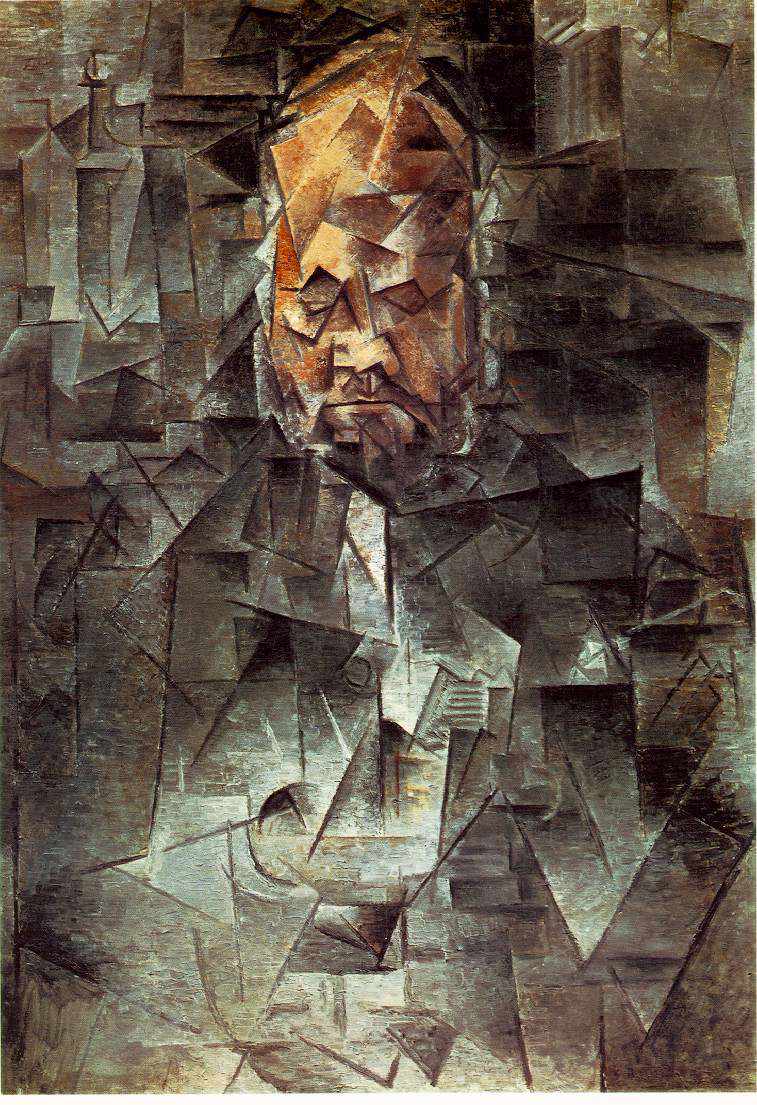
Bread and Fruit Dish on a Table (1909) marks the beginning of Picasso’s “Analytical” Cubism: he gives up a central perspective and splits forms up into facet-like stereo-metric shapes. The famous portraits of Fernande, Woman with Pears, and of the art dealers Vollard and Kahnweiller are fulfilled in the analytical cubist style .

By 1911, Picasso’s relationship with Fernande went through a crisis. He broke up with her and started a liaison with Eva Gouel (Marcelle Humbert), whom he called “Ma Jolie”.

Synthetic or Collage Cubism

By 1912 the possibilities of analytical cubism seemed to be exhausted. Picasso and Braque began new experiments. Within a year they were composing still lifes of cut-and-pasted scraps of material, with only a few lines added to complete the design, such as Still-Life with Chair Caning. These collages led to synthetic cubism — paintings with large, schematic patterning, such as The Guitar.

“Cubism has remained within the limits and limitations of painting, never pretending to go beyond. Drawing, design and color are understood and practiced in cubism in the spirit and manner that are understood and practiced in other schools. Our subjects might be different, because we have introduced into painting objects and forms that used to be ignored. We look at our surroundings with open eyes, and also open minds. We give each form and color its own significance, as we see it; in our subjects, we keep the joy of discovery, the pleasure of the unexpected; our subject itself must be a source of interest. But why tell you what we are doing when everybody can see it if they want to?” wrote Picasso.

World War I (1914-18) changed the life, mood, state of mind, and, of course, art of Picasso. His fellow French artists, Braque and Derain, were called up into the army at the beginning of the war. The art dealer Kahnweiler, a German, had to go to Italy, and his gallery was confiscated. Picasso’s pictures became somber, showing realistic more often, for example Pierrot.

“When I paint a bowl, I want to show you that it is round, of course. But the general rhythm of the picture, its composition framework, may compel me to show the round shape as a square. When you come to think of it, I am probably a painter without style. ‘Style’ is often something that ties the artist down and makes him look at things in one particular way, the same technique, the same formulas, year after year, sometimes for a whole lifetime. You recognize him immediately, for he is always in the same suit, or a suit of the same cut. There are, of course, great painters who have a certain style. However, I always thrash about rather wildly. I am a bit of a tramp. You can see me at this moment, but I have already changed, I am already somewhere else. I can never be tied down, and that is why I have no style,” Picasso wrote.

In 1916, the young poet Jean Cocteau brought the Russian ballet impresario Diaghilev and the composer Erik Satie to meet Picasso in his studio. They asked him to design the décor for their ballet “Parade”, which was to be performed by Diaghilev’s Ballet Russe. The meeting and Picasso’s affirmative answer would bring major changes to his life in the followng years. In 1917, he traveled to Rome with Cocteau and spent time with Diaghilev’s ballet company, working on décor for “Parade”. There, Picasso met Igor Stravinsky and fell in love with the dancer Olga Khokhlova. He accompanied the ballet group to Madrid and Barcelona because of Olga, and eventually persuaded her to stay with him.

Between Wars, Classicism and Surrealism: 1918-1936

In 1918, Olga and Picasso got married. The young couple moved to an apartment that occupied two floors at 23 Rue La Boétie, acquired servants, a chauffeur, and began to move in different social circles, no doubt due to Olga’s influence. The chaotic get-togethers Picasso had with his artist friends gradually changed into formal receptions. Picasso’s image of himself changed as well, and this was reflected in the more conventional style he adopted in his art and the way in which he consciously made use of artistic traditions and ceased to be provocative.

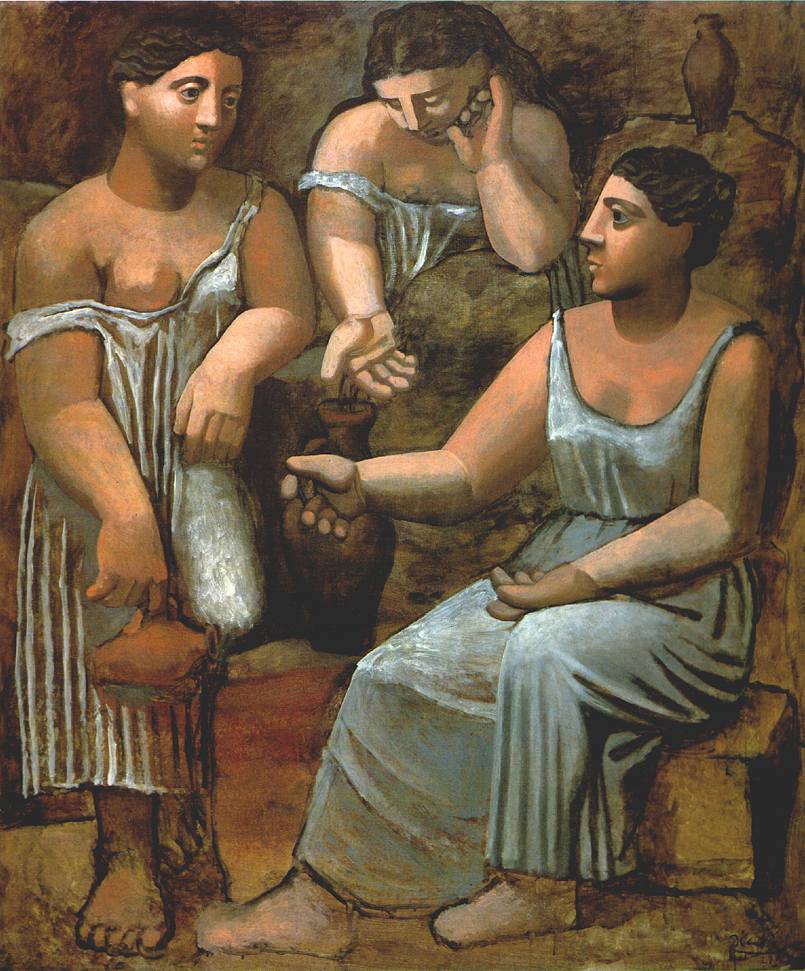
After cubism, Picasso returned to more traditional patterns — if not exactly classical ones — and this period is thus known as his Classicist period. A typical example of this new style is The Lovers. From time to time, he would return to cubism. His collaboration with the Ballet Russe went on: he worked on décor for “Le Tricorne” and drew portraits of the dancers. In 1920, he began to work on the décor for Stravinsky’s ballet Pulcinella. With the birth of his son Paul (Paolo) (1921), he returned to the Mother and Child theme again and again: Mother and Child.

In 1921, he painted his Cubist Three Musicians, in which he used a group of people as a cubist subject for the first time. The three figures are characters from the Italian Commedia dell’Arte (Pierrot, Harlequin and a monk). Though created after his Cubist period, the picture came to be regarded as a masterpiece of cubism. “Those who set out to explain a picture are setting out on the wrong foot. A short time ago Gertrude Stein elatedly informed me that at last she understood what my painting ‘Three Musicians’ represented. It was a still life!” wrote Picasso.

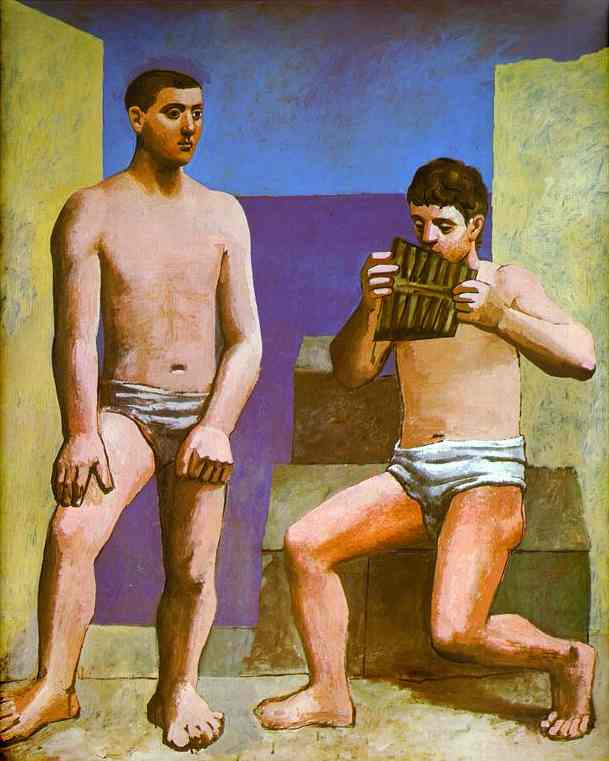
In 1923, Picasso painted The Pipes of Pan, which is regarded as the most important work of his “classicist period”. Other interesting works include The Seated Harlequin and Women Running on the Beach.

“Of all the misfortunes – hunger, misery, being misunderstood by the public – fame is by far the worst. This is how God chastises the artist. It is sad. It is true,” wrote Picasso

God had chastised Picasso. By the mid-twenties he became so popular that he “had to suffer a public that was gradually suppressing his individuality by blindly applauding every single picture he produced.” In addition to this, the artist was having marital problems. His wife Olga, a former ballet dancer, for whom the attention and admiration of the public was necessary, vital, and natural, could not understand Picasso’s discomfort with his fame.

Picasso tried to preserve his independence by taking an interest in the unknown and the unfamiliar. He set up a sculptor’s studio near Paris and began to experiment with this new artistic medium. He produced a series of assemblies with a Guitar theme, using objects such as shirts, floor-rags, nails and string, as well as sculptures. In 1927, Picasso began an affair with seventeen-year old Marie-Thérèse Walter, his son Paolo’s nurse.

Much of his work after 1927 is fantastic and visionary in character. His Woman with Flower (1932) is a portrait of Marie-Thérèse, distorted and deformed in the manner of Surrealism. The Surrealism movement was growing in strength and popularity at the time, and even Picasso could not really avoid being influenced by this group of Parisian artists, although they, conversely, regarded him as their artistic stepfather.

“I keep doing my best not to lose sight of nature. I want to aim at similarity, a profound similarity which is more real than reality, thus becoming surrealist,” Picasso wrote.

The worst time of his life, according to Picasso himself, began in June 1935. Marie-Thérèse was pregnant with his child, and his divorce from Olga had to be postponed again and again: their common wealth had become a target for lawyers. During this time of personal financial crisis, Picasso would add the bull, either dying or snorting furiously and threatening both man and animal alike, to his artistic arsenal. Being Spanish, Picasso had always been fascinated by bullfights, the so-called “tauromachia”. On October 5th of that year, his second child, a daughter, Maria de la Concepcion, called Maya, was born.

In 1936, he met Dora Maar, a Yugoslavian photographer. Later, during the war, she became his constant companion. See Portrait of Dora.

Wartime Experience: 1937-1945

“Guernica, the oldest town of the Basque provinces and the center of their cultural traditions, was almost completely destroyed by the rebels in an air attack yesterday afternoon. The bombing of the undefended town far behind the front line took exactly three quarters of an hour. During this time and without interruption a group of German aircraft – Junker and Heinkel bombers as well as Heinkel fighters – dropped bombs weighing up to 500 kilogrammes on the town. At the same time low-flying fighter planes fired machine-guns at the inhabitants who had taken refuge in the fields. The whole of Guernica was in flames in a very short time.” – The Times, April 27, 1937.

The Spanish government had asked Picasso to paint a mural for the Spanish pavilion at the Paris World Exhibition. He planned to depict the subject “a painter in his studio”, but when he heard about the events in Guernica, he changed his original plans. After numerous sketches and studies, Picasso gave his own personal view of the tragedy. His gigantic mural Guernica has remained part of the collective consciousness of the twentieth century, a forceful reminder of the event. Though painted for the Spanish government, it wasn’t until 1981, after forty years of exile in New York, that the picture found its way to Spain. This was because Picasso had decreed that it should not become Spanish property until the end of fascism. In October 1937, Picasso also painted the “Weeping Woman” as a kind of postscript to “Guernica”.

In 1940, when Paris was occupied by the Nazis, he handed out prints of his painting to German officers. When they asked asked him “Did you do this?” (referring to the pictures), he replied, “No, you did”. Whether those world-reknowned military brains were simply unable to perceive the symbolism of the picture, or whether it was Picasso’s fame that stopped them from taking any action, the painter was not arrested and went on working. During the war, he met a young female painter, Françoise Gillot, who would later become his third official wife.

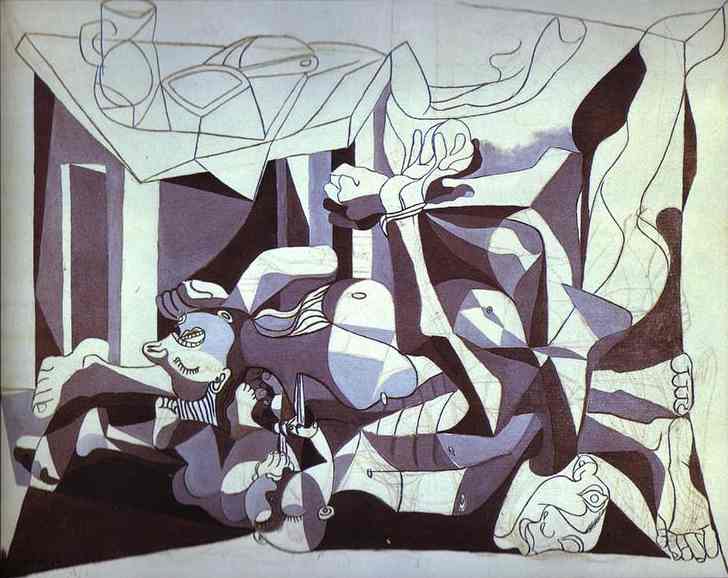
With his Charnel House of 1945, Picasso concluded the series of pictures that he had started with “Guernica”. The connection between the paintings becomes immediately obvious when we consider the rigidly limited color scheme and the triangular composition of the center. However, in the latter painting, the nightmare had been superceded by reality. The Charnel House was painted under the impact of reports from the Nazi concentration camps which had been discovered and liberated. It wasn’t until then, that people realized the atrociousness of the Second World War. It was a time when the lives of millions of people had been literally pushed aside, a turn of phase which Picasso expressed rather vividly in the pile of dead bodies in his Charnel House.

After WWII, The Late Works: 1946-1973

In 1944, after the liberation of Paris, Picasso joined the Communist Party and became an active participant of the Peace Movement. In 1949, the Paris World Peace Conference adopted a dove created by Picasso as the official symbol of the various peace movements. The USSR awarded Picasso the International Stalin Peace Prize twice, once in 1950 and for the second time in 1961 (by this time, the award had been renamed the International Lenin Peace Prize, as a result of destalinization) . He protested against the American intervention in Korea and against the Soviet occupation of Hungary. In his public life, he always expressed humanitarian views.

After WWII, Françoise gave birth to two children: Claude (1947) and Paloma (1949). Paloma is the Spanish word for “dove” — the girl was named after the peace symbol.

Picasso would not settle down, and more women would come into his life, some coming and going, like Sylvette David; and some staying longer, like Jacqueline Rogue. Picasso would remain sexually active and seeking throughout most of his life; it wasn’t that he was looking for something better than what he had had previously; the artist had a passion for the new and untried, evident in his travels, his art and, of course, his women. For him, it was a way of staying young.

In the summer of 1955, Picasso bought “La Californie”, a large villa near Cannes. From his studio, he had a view of the enormous garden, which he filled with his sculptures. The south and the Mediterranean were just right for his mentality; they reminded of Barcelona, his childhood and youth. There, he painted “Studio ‘La Californie’ at Cannes” (1956) and Jacqueline in the Studio (1956). By 1958, however “La Californie” had become a tourist attraction. There had been a constantly increasing stream of admirers and of people trying to catch a glimpse of the painter at his work, and Picasso, who disliked public attention, chose to move house. Picasso bought the Chateau Vauvenargues, near Aix-en-Provence, and this was reflected in his art with an increasing reduction of his range of colors to black, white and green.

The mass media turned Picasso into a celebrity, and the public deprived him of privacy and wanted to know his every step, but his later art was given very little attention and was regarded as no more than the hobby of an aging genius who could do nothing but talk about himself in his pictures. Picasso’s late works are an expression of his final refusal to fit into categories. He did whatever he wanted in art and did not arouse a word of criticism.

With his adaptation of “Las Meninas” by Velászquez and his experiments with Manet’s Luncheon on the Grass, was Picasso still trying to discover something new, or was he just laughing at the public, its stupidity and its inability to see the obvious.

A number of elements had become characteristic in his art of this period: Picasso’s use of simplified imagery, the way he let the unpainted canvas shine through, his emphatic use of lines, and the vagueness of the subject. In 1956, the artist would comment, referring to some schoolchildren: “When I was as old as these children, I could draw like Raphael, but it took me a lifetime to learn to draw like them.”

In the last years of his life, painting became an obsession with Picasso, and he would date each picture with absolute precision, thus creating a vast amount of similar paintings — as if attempting to crystallize individual moments of time, but knowing that, in the end, everything would be in vain.

Pablo Picasso passed away at last on April 8, 1973, at the age of 92. He was buried on the grounds of his Chateau Vauvenargues.

“The different styles I have been using in my art must not be seen as an evolution, or as steps towards an unknown ideal of painting. Everything I have ever made was made for the present and with the hope that it would always remain in the present. I have never had time for the idea of searching. Whenever I wanted to express something, I did so without thinking of the past or the future. I have never made radically different experiments. Whenever I wanted to say something, I said it the way I believed I should. Different themes inevitably require different methods of expression. This does not imply either evolution or progress; it is a matter of following the idea one wants to express and the way in which one wants to express it.” – Picasso

A Christian Manifesto Francis Schaeffer

Published on Dec 18, 2012

A video important to today. The man was very wise in the ways of God. And of government. Hope you enjoy a good solis teaching from the past. The truth never gets old.

The Roots of the Emergent Church by Francis Schaeffer

How Should We then Live Episode 7 small (Age of Nonreason)

#02 How Should We Then Live? (Promo Clip) Dr. Francis Schaeffer

10 Worldview and Truth

Two Minute Warning: How Then Should We Live?: Francis Schaeffer at 100

Francis Schaeffer Whatever Happened to the Human Race (Episode 1) ABORTION

Francis Schaeffer “BASIS FOR HUMAN DIGNITY” Whatever…HTTHR

Rachel McAdams as Inez and Owen Wilson as Gil in "Midnight in Paris." 2011 Roger Arpajou / Sony Pictures Classics

Rachel McAdams as Inez and Owen Wilson as Gil in “Midnight in Paris.”

Owen Wilson as Gil and Marion Cotillard as Adriana in "Midnight in Paris." 2011 Roger Arpajou / Sony Pictures Classics

Owen Wilson as Gil and Marion Cotillard as Adriana in “Midnight in Paris.”

“Midnight in Paris” is, without question, the best Woody Allen film I’ve seen in the past decade.And, I should stop right there. As I was setting out to catch the screening of “Midnight in Paris”, it occurred to me that it has actually been some time since I last saw a Woody Allen film when it was new. It sure didn’t feel that way, as I’ve been keeping up the director vicariously, but the last one I saw in the theater was “Small Time Crooks”, in 2000. Sheesh, that is a while ago.
In the meantime, Allen has, for better or for worse, continued to churn out movie after movie at his standard clip of one per year. Obviously, with a regiment like that, particularly at this point in ones career, we cannot expect every effort to be a masterpiece. And although it seems that for almost every new Allen film, there’s at least a small contingent of critics who shrug and say, “well, it’s the best he’s done in the past decade”, it occurs to me that “Midnight in Paris” must be different. Different in a good way. Naturally, with my dismal recent Allen track record, I cannot say for sure, not by a long shot. But I do know this – “Midnight in Paris” has a little bit of magic in it.”Midnight in Paris” has been most compared to Allen’s 1986 classic “The Purple Rose of Cairo”, an apt comparison if not a perfect one. The melancholy comedic tone fused with the protagonist’s longing to escape to a more lush, romantic time (and then doing so) are the greatest common bonds, although both films also stand close in terms of overall quality (the edge of course going to “Purple Rose”, a perennial favorite of mine). Also, Allen himself does not appear in either film. (Consider that fact however you will.)Unlike Mia Farrow’s desired “Purple Rose” escapism from the Great Depression of 1930s America, this time, for Gil – Owen Wilson’s frustrated-but-successful screenwriter of Hollywood schlock – his depression is now. And who can blame him, as his vacation in Paris is comprised of either being dragged from one high-end shop to the next by his steamroller of a fiancée (Rachel McAdams) and her staunchly conservative parents, or being condescended to in various museums and galleries by her insufferable know-it-all friends. Even as he finds himself in the most wonderful and romantic of cities, he is all the more pained by the fact that he’s there in the wrong decade, with the wrong people. Paris in the 1920s. Now THAT was a time. Pablo Picasso, on the cusp on his painterly brilliance. Ernest Hemingway, hunting wild beasts and churning out prose of inner bravado. Gertrude Stein, at the hub of it all. And the surrealists – Dali, Bunuel, and Man Ray – striving valiantly to live life in the non sequitur. Right city, wrong time. If only…And then it happens. One night as Gil is out for a midnight stroll, an extended vintage motor carriage comes by and picks him up. This is his magical ride to the Paris of yore, the Paris he’s been pining for, the Paris he’s been utterly romanticizing. All the luminaries are there. He takes this trip each night, developing relationships with them, and realizing their own human neuroses. Pablo Picasso, the uncertain lover. Ernest Hemingway, the unblinking blowhard. Gertrude Stein, enduring mother hen. And the surrealists – Dali, Bunuel, and Man Ray – striving ridiculously to live life in the non sequitur. This abrupt humanization of these icons of the art and literature is as amusing to Gil as it is to us. The electricity of the time is felt as he makes not just priceless connections and contacts, but friendships. The magic and charm of 1920s Paris is right out in front of everything, but at the same time, the imperfections begin to show, and not just the contrasts, but the comparisons to his present-time situation grow all the more evident.Allen does a remarkable job of putting a fresh and fun spin on the well-worn time travel story device. One must bear in mind Allen’s age, as the pacing and flow of the film veers into that fascinatingly tempered category of “old man cinema”, a type of film that although it’s in no hurry, does not have to lack spark or wisdom for years. Heck, Allen even has the audacity to begin his film with a five-minute travelogue pictorial of modern day Paris, in all its charm. Wilson, as one-note as his performances can be, here proves to be yet another quality Woody Allen surrogate protagonist – watchable, witty and yes, neurotic. For those even a little familiar with the luminaries met in vintage Paris, this will prove to be an engaging and rewarding trip.Nostalgia for a past time is a theme not only of this film, but of the film career of Woody Allen (as many continue to pine away for his “older, funnier movies”). But of the several things that “Midnight in Paris” tells us, one big one is that for fans of its filmmaker, 2011 is a perfectly fine time to be in.

Maria Shriver turns down press jobs

TMZ reported today:

0705_maria_shriver_networks_composite_ex
Maria has been getting offers to host talk shows, anchor news magazine shows and join news organizations, but she made it clear she does not want a time-consuming job that will take her away from her responsibilities as a mom. 

We’re told all of the usual suspects on broadcast and cable are trying to snag an interview with Maria, but she has no interest.  We’re told Maria has “a special place in her heart for Oprah” and if she ends up doing anything it will probably be with her.

Bottom line …. Maria doesn’t want a full-time job now — and with a settlement that could approach $200 million, she doesn’t need it.

Related posts:

Maria Shriver files for divorce (Pictures of Arnold and Maria through the years)

LOS ANGELES (Reuters) – Former California first lady Maria Shriver filed for divorce on Friday from her estranged husband,Arnold Schwarzenegger, the ex-governor and film star who has admitted fathering a child out of wedlock more than a decade ago. Shriver, 55, a former television journalist and a daughter of theKennedy political dynasty, filed papers seeking to dissolve her […]

Will Maria Shriver’s marriage survive Arnold Schwarzenegger’s admission of infidelity? I hope so (Part 34)

Arnold Schwarzenegger FILE – In this April 4, 2011 file photo, actor and former California Gov. Arnold Schwarzenegger, poses after receiving the insignia of Chevalier in the Order of the Legion of Honor during the MIPTV (International Television Programme Market) in Cannes, southern France. Schwarzenegger delayed his Hollywood comeback Thursday, May 19, 2011 as he […]

Will Maria Shriver’s marriage survive Arnold Schwarzenegger’s admission of infidelity? I hope so (Part 33)

Arnold Schwarzenegger: News On Woman & Love Child TMZ Scoop Maria Shriver Asks – How Do You Handle Transitions in Your Life? Arnold Schwarzenegger admitted to his wife several months ago that he had fathered a child about 10 years ago with a member of their household staff. Maria moved out, but has not filed […]

Fathers Day 2011

For almost three months I have been thinking a lot about the issue of fatherhood and marriage.  I have started two new series which have been very popular. The first series deals with Kate Middleton and Prince William and the second series has been concerning Arnold and Maria. I will post some links to past […]

Will Maria Shriver’s marriage survive Arnold Schwarzenegger’s admission of infidelity? I hope so (Part 32)

_ Arnold Schwarzenegger, Maria Shriver and family – “The Longest Yard” Los Angeles premiere, May 19, 2005   _____________________________________ California Governor Arnold Schwarzenegger California Governor Arnold Schwarzenegger, his son Christopher, 9, and his wife Maria Shriver hold hands as they walk to their vehicle after voting inthe U.S. midterm elections at the Crestwood Hills Recreation […]

Arnold Schwarzenegger’s response to Mildred’s revelation, “Cool!”

A month after it was revealed that she fathered a love child with Arnold Schwarzenegger, the Sperminator’s low-key housekeeper is finally talking. In a sit-down with Hello! magazine, Mildred Baena said that when she first told her now-13-year-old son that his real dad was none other than Schwarzenegger, his response was short and sweet: “Cool!” […]

Mildred Baena speaks out about her child

June 3, 2011 picture Mother of Arnold Schwarzenegger’s lovechild speaks out The mother of Arnold Schwarzenegger’s lovechild has spoken out about the scandal for the first time, confirming her son was fathered by the actor. The Terminator star stunned fans by splitting from his wife of 25 years, Maria Shriver, last month and subsequently revealing […]

Arnold Schwarzenegger and Maria Shriver: Dr. Gary Chapman offers hope

  Arnold Schwarzenegger and Maria Shriver: Dr. Gary Chapman offers hope By Radell Smith, Atlanta Pop Culture Examiner May 19, 2011 10:39 am ET   With over four million copies of his bestseller “The Five Love Languages” under his belt, Dr. Gary Chapman went on to write other popular books as well, and one of […]

The characters referenced in Woody Allen’s movie “Midnight in Paris” (Part 28,Van Gogh)

I have been going through the characters referenced in Woody Allen’s latest film “Midnight in Paris.” I only have a few characters left. Today is Vincent van Gogh who actually is not mentioned but his painting “The Starry Night” is featured in the poster to promote the movie.

The Starry Night

Vincent van Gogh (Dutch, 1853-1890)

Saint Rémy, June 1889. Oil on canvas, 29 x 36 1/4″ (73.7 x 92.1 cm). Acquired through the Lillie P. Bliss Bequest

Vincent van Gogh. The Starry Night. Saint Rémy, June 1889

Van Gogh Brings Color to Woody Allen’s ‘Midnight in Paris’ Poster

March 17, 2011
Source: Yahoo
by Alex Billington

Woody Allen's Midnight in Paris

While I’ve been covering Woody Allen films these last few years, I haven’t been that impressed by any of the posters. His last film, You Will Meet a Tall Dark Stranger, had a rather boring poster and Whatever Works’ was bland, too. Now we finally have a poster that is at least colorful, though it borrows from the brilliance of another artist. Yahoo has debuted the poster for Woody Allen’s Midnight in Paris, his new rom-com with a cast of: Owen Wilson, seen strolling the streets below, Rachel McAdams, Marion Cotillard, Kathy Bates, Adrien Brody and Léa Seydoux. And if you don’t know, that’s Vincent van Gogh’s Starry Night they’re using.

Woody Allen's Midnight in Paris Poster

Midnight in Paris is a wonderful love letter to Paris“, declared Festival director Thierry Frémaux in the press release. “It’s a film in which Woody Allen takes a deeper look at the issues raised in his last films: our relationship with history, art, pleasure and life. His 41st feature reveals once again his inspiration.” You may also remember it was officially announced that Woody Allen’s Midnight in Paris will be the opening film of the upcoming 64th Cannes Film Festival this summer. As always, I’m not sure what to expect with every new Woody Allen movie, but at least they’re starting off quite well.

Review: Midnight in Paris

Notre Dame. Montmatre. Sacre Coeur. It would be unfair to say that the streets of Paris serve as a backdrop for Woody Allen’s latest romantic comedy Midnight in Paris. Rather, the city itself takes center stage, playing the role of life-changer to Owen Wilson’s neurotic screenwriter/novelist/lovable doofus/youthful Woody Allen-substitute. Paris walks into the protagonist’s life, overwhelms the screen, and tricks the audience into believing that Midnight in Paris is Woody Allen’s return to his 1970s heyday (it’s not). Nevertheless, I’ll be the first to admit that I am more than happy to be tricked by Allen’s magical characterization of the City of Lights in Midnight in Paris.

Early on in the film, Owen Wilson’s character Gil and his fiance Inez (played by Rachel McAdams) visit the Versailles Palace on a sunny afternoon. They are accompanied by Inez’s former professor Paul (Michael Sheen) and his girlfriend Wendy (Mimi Kennedy). Inez flirts with Paul, who pedantically serves as unofficial tour guide. It’s all so familiar to Allen fans. Meanwhile, Gil, a successful screenwriter working unsuccessfully on his first novel, takes in the palace with a warm sentimentality that drives the film through the heart of Paris marked by nostalgia and the romantic past.

The same adulterous entanglements that occupy much of Allen’s filmography are at work here, and McAdams’ Inez is the “obnoxious shrew” at her worst (and I don’t mean that in a complimentary, Penelope Cruz in Vicky Cristina Barcelona kind of way). Paris’s female actors struggle with their surface-only, flat characters, and the adultery is worthy of an eye roll among tired audiences.

Shortly after the scene at Versailles, Midnight in Paris picks up the pace when Gil finds himself wandering the Parisian streets at midnight. He whimsically joins a friendly party in their vintage car and soon discovers that he is now in 1920s Jazz Age Paris, carousing with artists and expatriates including Scott and Zelda Fitzgerald, Ernest Hemingway, Gertrude Stein, Pablo Picasso, and Salvidor Dali. In the wrong hands, such a scenario would never have worked, but Allen lets the campy atmosphere simmer and the absurdity never seems unreasonable. Gil takes the advice of his new friends and revisits the problematic novel he’s been working on. The more Allen pushes the boundaries into 1920s Paris, the more enchanting and endearing Midnight in Paris becomes.

Despite grating flaws in the female characters and a frustratingly contrived ending, all is forgiven for Midnight in Paris due to its nostalgic energy and the overwhelming charm of the main character—the city of Paris. Allen has proved time and again that he thrives in character studies about tourists in his favorite cities, and it’s safe to assume that he truly loves Paris.

_________________________________________________

Vincent van Gogh Biography

Vincent van Gogh (March 30, 1853 – July 29, 1890) is generally considered the greatest Dutch painter after Rembrandt, though he had little success during his lifetime. Van Gogh produced all of his work (some 900 paintings and 1100 drawings) during a period of only 10 years before he succumbed to mental illness (possibly bipolar disorder) and committed suicide. His fame grew rapidly after his death especially following a showing of 71 of van Gogh’s paintings in Paris on March 17, 1901 (11 years after his death).

(Properly the name rhymes with loch, but it is also pronounced ‘goph’, ‘go’ and ‘goe’.)

Van Gogh’s influence on expressionism, fauvism and early abstraction was enormous, and can be seen in many other aspects of 20th-century art. The Van Gogh Museum in Amsterdam is dedicated to Van Gogh’s work and that of his contemporaries.

Several paintings by Van Gogh rank among the most expensive paintings in the world. On March 30, 1987 Van Gogh’s painting Irises was sold for a record $53.9 million at Southeby’s, New York. On May 15, 1990 his Portrait of Doctor Gachet was sold for $82.5 million at Christie’s, thus establishing a new price record (see also List of most expensive paintings).

Life and Work

Vincent was born in Zundert, The Netherlands; his father was a protestant minister, a profession that Vincent found appealing and to which he would be drawn to a certain extent later in his life. His sister described him as a serious and introspective child.

Vincent van Gogh Grave

At age 16 Vincent started to work for the art dealer Goupil & Co. in The Hague. His four years younger brother Theo, with whom Vincent cherished a life long friendship, would join the company later. This friendship is amply documented in a vast amount of letters they sent each other. These letters have been preserved and were published in 1914. They provide a lot of insight into the life of the painter, and show him to be a talented writer with a keen mind. Theo would support Vincent financially throughout his life.

In 1873, his firm transferred him to London, then to Paris. He became increasingly interested in religion; in 1876 Goupil dismissed him for lack of motivation. He became a teaching assistant in Ramsgate near London, then returned to Amsterdam to study theology in 1877.

After dropping out in 1878, he became a layman preacher in Belgium in a poor mining region known as the Borinage. He even preached down in the mines and was extremely concerned with the lot of the workers. He was dismissed after 6 months and continued without pay. During this period he started to produce charcoal sketches.

In 1880, Vincent van Gogh followed the suggestion of his brother Theo and took up painting in earnest. For a brief period Vincent took painting lessons from Anton Mauve at The Hague. Although Vicent and Anton soon split over divergence of artistic views, influences of the Hague School of painting would remain in Vincents work, notably in the way he played with light and in the looseness of his brush strokes. However his usage of colours, favouring dark tones, set him apart from his teacher.

In 1881 he declared his love to his widowed cousin Kee Vos, who rejected him. Later he would move in with the prostitute Sien Hoornik and her children and considered marrying her; his father was strictly against this relationship and even his brother Theo advised against it. They later separated.

Impressed and influenced by Jean-Francois Millet, van Gogh focussed on painting peasants and rural scenes. He moved to the Dutch province Drenthe, later to Nuenen, North Brabant, also in The Netherlands. Here he painted in 1885.

In the winter of 1885-1886 Van Gogh attended the art academy of Antwerp, Belgium. This proved a disappointment as he was dismissed after a few months by his Professor. Van Gogh did however get in touch with Japanese art during this period, which he started to collect eagerly. He admired its bright colors, use of canvas space and the role lines played in the picture. These impressions would influence him strongly. Van Gogh made some painting in Japanese style. Also some of the portraits he painted are set against a background which shows Japanese art.

In spring 1886 Vincent van Gogh went to Paris, where he moved in with his brother Theo; they shared a house on Montmartre. Here he met the painters met Edgar Degas, Camille Pissarro, Bernard, Henri de Toulouse-Lautrec and Paul Gauguin. He discovered impressionism and liked its use of light and color, more than its lack of social engagement (as he saw it). Especially the technique known as pointillism (where many small dots are applied to the canvas that blend into rich colors only in the eye of the beholder, seeing it from a distance) made its mark on Van Goghs own style. It should be noted that Van Gogh is regarded as a post-impressionist, rather than an impressionist.

In 1888, when city life and living with his brothers proved too much, Van Gogh left Paris and went to Arles, Bouches-du-Rh, France. He was impressed with the local landscape and hoped to found an art colony. He decorated a “yellow house” and created a celebrated series of yellow sunflower paintings for this purpose. Only Paul Gauguin, whose simplified colour schemes and forms (known as synthetism) attracted van Gogh, followed his invitation. The admiration was mutual, and Gauguin painted van Gogh painting sunflowers. However their encounter ended in a quarrel. Van Gogh suffered a mental breakdown and cut off part of his left ear, which he gave to a startled prostitute friend. Gauguin left in December 1888.

The only painting he sold during his lifetime, The Red Vineyard, was created in 1888. It is now on display in the Pushkin Museum in Moscow, Russia.

Vincent van Gogh now exchanged painting dots for small stripes. He suffered from depression, and in 1889 on his own request Van Gogh was admitted to the psychiatric center at Monastery Saint-Paul de Mausole in Saint Remy de Provence, Bouches-du-Rh, France. During his stay here the clinic and its garden became his main subject. Pencil strokes changed again, now into spiral curves.

In May 1890 Vincent van Gogh left the clinic and went to the physician Paul Gachet, in Auvers-sur-Oise near Paris, where he was closer to his brother Theo, who had recently married. Gachet had been recommended to him by Pissarro; he had treated several artists before. Here van Gogh created his only etching: a portrait of the melancholic doctor Gachet. His depression aggravated. On July 27 of the same year, at the age of 37, after a fit of painting activity, van Gogh shot himself in the chest. He died two days later, with Theo at his side, who reported his last words as “La tristesse durera toujours” (French: “The sadness will last forever”). He was buried at the cemetery of Auvers-sur-Oise; Theo unable to come to terms with his brother’s death died 6 months later and was buried next to him. It would not take long before his fame grew higher and higher. Large exhibitions were organized soon: Paris 1901, Amsterdam 1905, Cologne 1912, New York 1913 and Berlin 1914.

Vincent van Gogh’s mother threw away quite a number of his paintings during Vincent’s life and even after his death.  But she would live long enough to see her son become a world famous painter.

___________________________________________________________

How Should We Then Live? Episode 8: The Age Of Fragmentation

Published on Jul 24, 2012

Dr. Schaeffer’s sweeping epic on the rise and decline of Western thought and Culture

__________

The above clip is from the film series by Francis Schaeffer “How should we then live?” Below is an outline of the 8th episode on the Impressionists and the age of Fragmentation. Vincent van Gogh was a post-impressionist and he is mentioned in this film series by Schaeffer

AGE OF FRAGMENTATION

I. Art As a Vehicle Of Modern Thought

A. Impressionism (Monet, Renoir, Pissarro, Sisley, Degas) and Post-Impressionism (Cézanne, Van Gogh, Gauguin, Seurat): appearance and reality.

1. Problem of reality in Impressionism: no universal.

2. Post-Impression seeks the universal behind appearances.

3. Painting expresses an idea in its own terms as a work of art; to discuss the idea in a painting is not to intellectualize art.

4. Parallel search for universal in art and philosophy; Cézanne.

B. Fragmentation.

1. Extremes of ultra-naturalism or abstraction: Wassily Kandinsky.

2. Picasso leads choice for abstraction: relevance of this choice.

3. Failure of Picasso (like Sartre, and for similar reasons) to be fully consistent with his choice.

C. Retreat to absurdity.

1. Dada , and Marcel Duchamp: art as absurd. (Dada gave birth to Surrealism).

2. Art followed philosophy but came sooner to logical end.

3. Chance in his art technique as an art theory impossible to practice: Pollock.


II. Music As a Vehicle of Modern Thought

A. Non-resolution and fragmentation: German and French streams.

1. Influence of Beethoven’s last Quartets.

2. Direction and influence of Debussy.

3. Schoenberg’s non-resolution; contrast with Bach.

4. Stockhausen: electronic music and concern with the element of change.

B. Cage: a case study in confusion.

1. Deliberate chance and confusion in Cage’s music.

2. Cage’s inability to live the philosophy of his music.

C. Contrast of music-by-chance and the world around us.

1. Inconsistency of indulging in expression of chaos when we acknowledge order for practical matters like airplane design.

2. Art as anti-art when it is mere intellectual statement, divorced from reality of who people are and the fullness of what the universe is.

III. General Culture As the Vehicle of Modern Thought

A. Propagation of idea of fragmentation in literature.

1. Effect of Eliot’s Wasteland and Picasso’s Demoiselles d’ Avignon

compared; the drift of general culture.

2. Eliot’s change in his form of writing when he became a Christian.

3. Philosophic popularization by novel: Sartre, Camus, de Beauvoir.

B. Cinema as advanced medium of philosophy.

1. Cinema in the 1960s used to express Man’s destruction: e.g. Blow-up.

2. Cinema and the leap into fantasy:


The Hour of the WolfBelle de JourJuliet of the Spirits,

The Last Year at Marienbad.

3. Bergman’s inability to live out his philosophy (see Cage):

Silence and The Hour of the Wolf.

IV. Only on Christian Base Can Reality Be Faced Squarely

The Characters referenced in Woody Allen’s “Midnight in Paris” (Part 27, Man Ray)

I just got finished watching Woody Allen’s latest movie “Midnight in Paris” and I loved it. In that movie there are several famous writers and artists that appear in the film. I am doing a series of posts that takes a look at this great writers and artists. There is a scene when Salvador Dali, Luis Bunuel and Man Ray all get to visit with Gil in the film “Midnight and Paris.” He tells them that he traveled through time and they all believed him!!!

File:Man Ray Salvador Dali.jpg
Size of this preview: 800 × 523 pixels Salvador Dalí and Man Ray in Paris, on June 16, 1934 making “wild eyes” for photographer Carl Van Vecht

Man Ray (August 27, 1890 – November 18, 1976), born Emmanuel Radnitzky, was an American artist who spent most of his career inParis, France. Perhaps best described simply as a modernist, he was a significant contributor to both the Dada and Surrealist movements, although his ties to each were informal. Best known in the art world for his avant-garde photography, Man Ray produced major works in a variety of media and considered himself a painter above all. He was also a renowned fashion and portrait photographer. He is noted for hisphotograms, which he renamed “rayographs” after himself.[1]

While appreciation for Man Ray’s work beyond his fashion and portrait photography was slow in coming during his lifetime, especially in his native United States, his reputation has grown steadily in the decades since.

In 1999, ARTnews magazine named him one of the 25 most influential artists of the 20th century, citing his groundbreaking photography as well as “his explorations of film, paintingsculpturecollageassemblage, and prototypes of what would eventually be called performance artand conceptual art” and saying “Man Ray offered artists in all media an example of a creative intelligence that, in its ‘pursuit of pleasure and liberty,'”—Man Ray’s stated guiding principles—”unlocked every door it came to and walked freely where it would.”[2]

[edit]Life and career

[edit]Background and early life

From the time he began attracting attention as an artist until his death more than sixty years later, Man Ray allowed little of his early life or family background to be known to the public, even refusing to acknowledge that he ever had a name other than Man Ray.[3]

Man Ray was born Emmanuel Radnitzky in South PhiladelphiaPennsylvania, USA in 1890, the eldest child of recent Russian Jewish immigrants. The family would eventually include another son and two daughters, the youngest born shortly after they settled in the Williamsburg section of BrooklynNew York, in 1897. In early 1912, the Radnitzky family changed their surname to Ray, a name selected by Man Ray’s brother, in reaction to the ethnic discrimination and anti-Semitism prevalent at that time. Emmanuel, who was called “Manny” as a nickname, changed his first name to Man at this time, and gradually began to use Man Ray as his combined single name.[3][4]

Man Ray’s father was a garment factory worker who also ran a small tailoring business out of the family home, enlisting his children from an early age. Man Ray’s mother enjoyed making the family’s clothes from her own designs and inventing patchwork items from scraps of fabric.[3] Despite Man Ray’s desire to disassociate himself from his family background, this experience left an enduring mark on his art. Tailor’s dummies, flat irons, sewing machines, needles, pins, threads, swatches of fabric, and other items related to clothing and sewing appear at every stage of his work and in almost every medium.[5] Art historians have also noted similarity in his collage and painting techniques to those used in making clothing.[4]

Mason Klein, curator of an exhibition of Man Ray’s work at the Jewish Museum entitled “Alias Man Ray: The Art of Reinvention,” suggests that Man Ray may have been “the first Jewish avant-garde artist.”[6]

[edit]First artistic endeavors

The Misunderstood (1938). Collection of the Man Ray Estate.

Man Ray displayed artistic and mechanical ability from childhood. His education at Boys’ High School from 1904 to 1908 provided him with a solid grounding in drafting and other basic art techniques. At the same time, he educated himself with frequent visits to the local art museums, where he studied the works of the Old Masters. After graduation from high school, he was offered a scholarship to study architecture but chose to pursue a career as an artist instead. However much this decision disappointed his parents’ aspirations to upward mobility and assimilation, they nevertheless rearranged the family’s modest living quarters so that Man Ray could use a room as his studio. He stayed for the next four years, working steadily toward being a professional painter, while earning money as a commercial artist and technical illustrator at severalManhattan companies.[3][4]

From the surviving examples of his work from this period, it appears he attempted mostly paintings and drawings in 19th-century styles. He was already an avid admirer of avant-garde art of the time, such as the European modernists he saw at Alfred Stieglitz‘s “291” gallery and works by the Ashcan School, but, with a few exceptions, was not yet able to integrate these new trends into his own work. The art classes he sporadically attended—including stints at the National Academy of Design and the Art Students League—were of little apparent benefit to him, until he enrolled in the Ferrer School in the autumn of 1912, thus beginning a period of intense and rapid artistic development.[4]

[edit]New York

Living in New York City, influenced by what he saw at the 1913 Armory Show and in galleries showing contemporary works from Europe, Man Ray’s early paintings display facets of cubism. Upon befriending Marcel Duchamp who was interested in showing movement in static paintings, his works begin to depict movement of the figures, for example in the repetitive positions of the skirts of the dancer in The Rope Dancer Accompanies Herself with Shadows (1916).[7]

In 1915, Man Ray had his first solo show of paintings and drawings. His first proto-Dada object, an assemblage titled Self-Portrait, was exhibited the following year. He produced his first significant photographs in 1918.

A Night at Saint Jean-de- Luz (1929).
Collection of the Modern Art Museum of the City of Paris

Abandoning conventional painting, Man Ray involved himself with Dada, a radical anti-art movement, started making objects, and developed unique mechanical and photographic methods of making images. For the 1918 version of Rope Dancer he combined a spray-gun technique with a pen drawing. Again, like Duchamp, he made “readymades“—objects selected by the artist, sometimes modified and presented as art. His Gift readymade (1921) is a flatiron with metal tacks attached to the bottom, and Enigma of Isidore Ducasse is an unseen object (a sewing machine) wrapped in cloth and tied with cord. Another work from this period, Aerograph (1919), was done with airbrush on glass.[7]

In 1920 Ray helped Duchamp make his first machine and one of the earliest examples of kinetic art, the Rotary Glass Plates composed of glass plates turned by a motor. That same year Man Ray, Katherine Dreier and Duchamp founded the Société Anonyme, an itinerant collection which in effect was the first museum of modern art in the U.S.

Ray teamed up with Duchamp to publish the one issue of New York Dada in 1920. Man Ray expressed that “dada’s experimentation was no match for the wild and chaotic streets of New York, and he wrote “Dada cannot live in New York. All New York is dada, and will not tolerate a rival.”[8] Man Ray moved to Paris in 1921.

Man Ray met his first wife, the Belgian poet Adon Lacroix, in 1913 in New York. They married in 1914, separated in 1919, and were formally divorced in 1937.[9]

[edit]Paris

In July 1921, Man Ray went to live and work in Paris, France, and soon settled in the Montparnasse quarter favored by many artists. Shortly after arriving in Paris, he met and fell in love with Kiki de Montparnasse (Alice Prin), an artists’ model and celebrated character in Paris bohemian circles. Kiki was Man Ray’s companion for most of the 1920s. She became the subject of some of his most famous photographic images and starred in his experimental films. In 1929 he began a love affair with the Surrealist photographer Lee Miller.

Salvador Dalí and Man Ray in Paris, on June 16, 1934 making “wild eyes” for photographer Carl Van Vechten

For the next 20 years in Montparnasse, Man Ray made his mark on the art ofphotography. Significant members of the art world, such as James JoyceGertrude SteinJean CocteauBridget Bate Tichenor,[10] and Antonin Artaud posed for his camera.

With Jean ArpMax ErnstAndré MassonJoan Miró, and Pablo Picasso, Man Ray was represented in the first Surrealistexhibition at the Galerie Pierre in Paris in 1925. Works from this period include a metronome with an eye, originally titled Object to Be Destroyed. Another important work from this part of Man Ray’s life is the Violon d’Ingres,[11] a stunning photograph of Kiki de Montparnasse,[12] styled after the painter/musician, Ingres. This work is a popular example of how Man Ray could juxtapose disparate elements in his photography in order to generate meaning.[13]

In 1934, surrealist artist Méret Oppenheim, known for her fur-covered teacup, posed nude for Man Ray in what became a well-known series of photographs depicting her standing next to a printing press.

Together with Lee Miller, who was his photography assistant and lover, Man Ray reinvented the photographic technique ofsolarization. He also created a technique using photograms he called rayographs, which he described as “pure dadaism”.

Man Ray directed a number of influential avant-garde short films, known as Cinéma Pur, such as Le Retour à la Raison (2 mins, 1923); Emak-Bakia (16 mins, 1926); L’Étoile de Mer (15 mins, 1928); and Les Mystères du Château de Dé (27 mins, 1929). Man Ray also assisted Marcel Duchamp with the cinematography of his film Anemic Cinema (1926), and personally manned the camera on Fernand Léger‘s Ballet Mécanique (1924). Man Ray also appeared in René Clair‘s film Entr’acte(1924), in a brief scene playing chess with Duchamp.

Duchamp, Man Ray, and Francis Picabia were friends as well as collaborators, connected by their experimental, entertaining, and innovative art.[14][15]

[edit]Later life

Man Ray portrayed by Lothar Wolleh, Paris, 1975

Later in life, Man Ray returned to the United States, having been forced to leave Paris due to the dislocations of the Second World War. He lived in Los Angeles, California from 1940 until 1951. A few days after arriving in Los Angeles, Man Ray met Juliet Browner, a first generation American of Rumanian-Jewish lineage; a trained dancer and experienced artists’ model.[16] They began living together almost immediately, and married in 1946 in a double wedding with their friends Max Ernst and Dorothea Tanning. However, he called Montparnasse home and he returned there.

In 1963 he published his autobiography, Self-Portrait, which was republished in 1999 (ISBN 0-8212-2474-3).

He died in Paris on November 18, 1976 of a lung infection, and was interred in the Cimetière du Montparnasse, Paris. His epitaph reads:unconcerned, but not indifferent. When Juliet Browner died in 1991, she was interred in the same tomb. Her epitaph reads, together again. Juliet set up a trust for his work and made many donations of his work to museums.

[edit]Quotations

[edit]By Man Ray

  • “It has never been my object to record my dreams, just the determination to realize them.” (Julien Levy exhibition catalog, April 1945.)
  • “There is no progress in art, any more than there is progress in making love. There are simply different ways of doing it.” (1948 essay, “To Be Continued, Unnoticed”.)
  • “To create is divine, to reproduce is human.” (“Originals Graphic Multiples”, circa 1968; published in Objets de Mon Affection, 1983.)
  • “I paint what cannot be photographed, that which comes from the imagination or from dreams, or from an unconscious drive. I photograph the things that I do not wish to paint, the things which already have an existence.” (Undated interview, circa 1970s; published in Man Ray: Photographer, 1981.)
  • “I have been accused of being a joker. But the most successful art to me involves humor.” (Undated interview, circa 1970s; published in Man Ray: Photographer, 1981.)
  • “An original is a creation motivated by desire. Any reproduction of an originals motivated by necessity. It is marvelous that we are the only species that creates gratuitous forms. To create is divine, to reproduce is human.”
  • “Of course, there will always be those who look only at technique, who ask ‘how’, while others of a more curious nature will ask ‘why’. Personally, I have always preferred inspiration to information.”
  • “I do not photograph nature. I photograph my visions.” [8]

[edit]About Man Ray

  • “MAN RAY, n.m. synon. de Joie jouer jouir.” (Translation: “MAN RAY, masculine noun, synonymous with joy, to play, to enjoy.”) — Marcel Duchamp, as the opening epigram for Man Ray’s memoir Self-Portrait, 1963.
  • “With him you could try anything—there was nothing you were told not to do, except spill the chemicals. With Man Ray, you were free to do what your imagination conjured, and that kind of encouragement was wonderful.” — Artist and photographer, Naomi Savage, Man Ray’s niece and protégée, in a 2000 newspaper interview.
  • “Man Ray is a youthful alchemist forever in quest of the painter’s philosopher’s stone. May he never find it, as that would bring an end to his experimentations which are the very condition of living art expression.” — Adolf Wolff, “Art Notes”, International 8, no. 1 (January 1914), p. 21.
  • “[Man Ray was] a kind of short man who looked a little like Mr. Peepers, spoke slowly with a slight Brooklynese accent, and talked so you could never tell when he was kidding.” — Brother-in-law Joseph Browner on his first impression of the artist; quoted in the Fresno Bee, August 26, 1990.

[edit]Selected books by Man Ray

  • Man Ray and Tristan Tzara (1922). Champs délicieux: album de photographies. Paris: [Société générale d’imprimerie et d’édition].
  • Man Ray (1926). Revolving doors, 1916-1917: 10 planches. Paris: Éditions Surrealistes.
  • Man Ray (1934). Man Ray: photographs, 1920–1934, Paris. Hartford, CT: James Thrall Soby.
  • Éluard, Paul, and Man Ray (1935). Facile. Paris: Éditions G.L.M.
  • Man Ray and André Breton (1937). La photographie n’est pas l’art. Paris: Éditions G.L.M.
  • Man Ray and Paul Éluard (1937). Les mains libres: dessins. Paris: Éditions Jeanne Bucher.
  • Man Ray (1948). Alphabet for adults. Beverly Hills, CA: Copley Galleries.
  • Man Ray (1963). Self portrait. London: Andre Deutsch.
  • Man Ray and L. Fritz Gruber (1963). Portraits. Gütersloh, Germany: Sigbert Mohn Verlag.

[edit]

File:Man Ray by Wolleh.jpg

Man Ray portrayed by Lothar Wolleh, Paris, 1975

_____________________________________

A Christian Manifesto Francis Schaeffer

Published on Dec 18, 2012

A video important to today. The man was very wise in the ways of God. And of government. Hope you enjoy a good solis teaching from the past. The truth never gets old.

The Roots of the Emergent Church by Francis Schaeffer

How Should We then Live Episode 7 small (Age of Nonreason)

#02 How Should We Then Live? (Promo Clip) Dr. Francis Schaeffer

10 Worldview and Truth

Two Minute Warning: How Then Should We Live?: Francis Schaeffer at 100

Francis Schaeffer Whatever Happened to the Human Race (Episode 1) ABORTION

Francis Schaeffer “BASIS FOR HUMAN DIGNITY” Whatever…HTTHR

__________

The above clip is from the film series by Francis Schaeffer “How should we then live?” Below is an outline of the 8th episode on the Impressionists and the age of Fragmentation. Attention is also given to Surrealism which is what Man Ray was involved in. Also he spent a lot of time working with Marcel Duchamp and Dali who are also mentioned in this film series. 

AGE OF FRAGMENTATION

I. Art As a Vehicle Of Modern Thought

A. Impressionism (Monet, Renoir, Pissarro, Sisley, Degas) and Post-Impressionism (Cézanne, Van Gogh, Gauguin, Seurat): appearance and reality.

1. Problem of reality in Impressionism: no universal.

2. Post-Impression seeks the universal behind appearances.

3. Painting expresses an idea in its own terms as a work of art; to discuss the idea in a painting is not to intellectualize art.

4. Parallel search for universal in art and philosophy; Cézanne.

B. Fragmentation.

1. Extremes of ultra-naturalism or abstraction: Wassily Kandinsky.

2. Picasso leads choice for abstraction: relevance of this choice.

3. Failure of Picasso (like Sartre, and for similar reasons) to be fully consistent with his choice.

C. Retreat to absurdity.

1. Dada , and Marcel Duchamp: art as absurd. (Dada gave birth to Surrealism).

2. Art followed philosophy but came sooner to logical end.

3. Chance in his art technique as an art theory impossible to practice: Pollock.

II. Music As a Vehicle of Modern Thought

A. Non-resolution and fragmentation: German and French streams.

1. Influence of Beethoven’s last Quartets.

2. Direction and influence of Debussy.

3. Schoenberg’s non-resolution; contrast with Bach.

4. Stockhausen: electronic music and concern with the element of change.

B. Cage: a case study in confusion.

1. Deliberate chance and confusion in Cage’s music.

2. Cage’s inability to live the philosophy of his music.

C. Contrast of music-by-chance and the world around us.

1. Inconsistency of indulging in expression of chaos when we acknowledge order for practical matters like airplane design.

2. Art as anti-art when it is mere intellectual statement, divorced from reality of who people are and the fullness of what the universe is.

III. General Culture As the Vehicle of Modern Thought

A. Propagation of idea of fragmentation in literature.

1. Effect of Eliot’s Wasteland and Picasso’s Demoiselles d’ Avignon

compared; the drift of general culture.

2. Eliot’s change in his form of writing when he became a Christian.

3. Philosophic popularization by novel: Sartre, Camus, de Beauvoir.

B. Cinema as advanced medium of philosophy.

1. Cinema in the 1960s used to express Man’s destruction: e.g. Blow-up.

2. Cinema and the leap into fantasy:


The Hour of the WolfBelle de JourJuliet of the Spirits,

The Last Year at Marienbad.

3. Bergman’s inability to live out his philosophy (see Cage):

Silence and The Hour of the Wolf.

IV. Only on Christian Base Can Reality Be Faced Squarely

Well, Mr. Allen, it would appear you still have the ability to surprise and delight me.

Don’t get me wrong, I’ve enjoyed plenty of your recent movies, particularly the ones with Scarlett Johansson. And it’s not just because I love Scarlett Johansson–though I suspect we have some very similar thoughts on the lady (and not just the obvious ones that most people think; my readers can be so bourgeois!) You’ve had several very good films in the last six years, and a few merely okay ones. Even the good ones, though, are what they are. They hit a certain predictable level, they never took me unaware. Not like Midnight in Paris.

Now, granted, I maybe walked into those movies armed with a little more foreknowledge as to their plot. How I managed to avoid learning what Midnight in Paris was really about is beyond me, particularly given my affinity for some of the details you include in your love letter to the legendary city. I knew it starred Owen Wilson as a man engaged to Rachel McAdams, and that Wilson’s character, Gil Pender, was more romanced by Paris than his fiancée. I also picked up that Michael Sheen represented a kind of threat to this young couple, that he was, shall we say, more intellectual and sophisticated, than his neurotic rival. At the same time, Gil’s head would be turned by more than architecture, and likely, the whole thing would be a criss-crossing examination of commitment and dreams and the reasons couples go together in the first place.

Again, this is Woody Allen territory. No surprise there. You can get that from just a cursory glace at the trailer. Sharp viewers might even be able to figure it out from the poster. That poster also promotes the fact that Adrien Brody, Kathy Bates, and Marion Cotillard are in the film, and had I been pushed to guess, honestly, Marion Cotillard would have to be Owen Wilson’s temptation (and I’d have been right). The funny thing is, those three aren’t in the first fifteen or twenty minutes of Midnight in Paris, which is exactly how long my uninformed impressions of the film held true.

And then…whammo! Here comes the curveball.

I feel like I should say “spoiler alert” here, but that seems kind of silly since I am faking a conversation with the guy who wrote and directed Midnight in Paris, to whom none of what I am about to say should be a surprise. I also have a feeling that later trailers must have given this stuff away. I mean, how long did you keep it a secret that Jeff Daniels steps out of the movie screen in Purple Rose of Cairo? That’s what the movie is about! And given how similar the flights of fancy are between your older movie and this new one, and how this fictional conceit ends up informing the life of the character to whom it happens, comparisons between Purple Rose of Cairo and Midnight in Paris are inevitable. That should be on the poster. “From Woody Allen, the man who brought you Purple Rose of Cairo.”

Regardless, SPOILER!

As it goes, I’m just sitting there watching Owen Wilson be sad because Rachel McAdams wants to hang out with annoying people and fails to see the magic in the rich creative history of Paris–or, for that matter, the creative present of her husband-to-be. Gil is a writer who has wasted his talent on cheap Hollywood screenplays and is now trying to complete his first novel. It’s a book about a man who runs a “nostalgia shop,” named Out of the Past, presumably after the old Robert Mitchum and Jane Greer movie, because that’s just what a guy who sells memorabilia from eras long gone would do. Obviously Gil’s protagonist is just an analogue for Gil, a man who believes he was born in the wrong time, who longs for an idealized past, which is exactly what Gil is thinking about when a classic Peugeot turns the corner and stops in front of him. The people in the car motion Gil over, convince him to jump in, give him champagne, and take him to a party.

And, oh, what a party it is! Cole Porter music, conversation about the work of F. Scott Fitzgerald, the works. The catch is, that’s really Cole Porter at the piano, and that’s really Scott and Zelda Fitzgerald (Tom Hiddleston and Alison Pill) that Gil is talking to. He has been transported back in time! The rest of the movie is Gil taking full advantage of whatever temporal anomaly he has stumbled into. At midnight, he climbs into the car and goes back in time to meet his idols; in the morning, he returns to his disappointing present. In between, Gil must sort out what is happening to him, relating it to the themes that he is exploring in his novel, and then relating that further to what it means to him as a person. It’s a scenario too good to be true, every one of his literary and artistic heroes turns out to be exactly as he expected them to be–but then, this is his fantasy, isn’t it? You wouldn’t travel back in time to meet Muhammad Ali just to sit on the couch and watch him eat potato chips. You’d want him to talk in rhyme and shadow box right in front of you! Likewise, you’d want Ernest Hemingway (Corey Stoll for Law & Order: Los Angeles) to talk in clipped prose about bullfighters and give you writing tips.

I mean, that’s what I’d want, Mr. Allen, and that’s what you deliver. Midnight in Paris is a delightful, witty movie. It even gets poignant in its final scenes. Owen Wilson is surprisingly good playing the motormouthed stand-in for yourself, and all of your supporting actors are so perfectly cast. They latch onto these bygone personalities and refuse to let go. All the performers are clearly having fun. Alison Pill is absolutely train-wreck charming as Zelda Fitzgerald–though, the implications of Gil giving her valium are a little weird–and Corey Stoll attacks the Hemingway material like an unstoppable elephant. Maybe the most fun, though, is Adrien Brody, who only has one full scene, but he pretty much steals the whole movie. “Dali!”

Marion Cotillard is also extremely charming and she is easy to buy in the role of the ineffable muse. If I had one complaint, it’s that I wish there had been just a tad more romance here. The scenes with her and Wilson play it safe, and we never get to see her be the volcano she is once described as being. There is no agony in the choice Gil must make, it’s pretty obvious how it’s going to go–that’s the lesson he must learn, after all–and if you learned anything from the writers you are portraying, it’s that the drama comes out of the choice being too difficult. Rachel McAdams is adorable, but let’s be honest, the character she plays is rotten, start to finish.

It’s not enough of a complaint to have ruined the warm glow I had after watching Midnight in Paris. I just don’t want to overdo and pretend it’s a perfect movie–even if it is perfectly wonderful to watch. Like the myths of the city it depicts, Midnight in Paris is its own inscrutable thing. It couldn’t happen anywhere else, and it could happen with anyone but you, Mr. Allen. My hat is doffed in your direction.

Jamie S. Rich is a novelist and comic book writer. He is best known for his collaborations with Joëlle Jones, including the hardboiled crime comic book You Have Killed Me, the challenging romance 12 Reasons Why I Love Her, and the 2007 prose novel Have You Seen the Horizon Lately?, for which Jones did the cover. All three were published by Oni Press. His most recent project is the comedy series Spell Checkers, again with Jones and artist Nicolas Hitori de. Follow Rich’s blog at Confessions123.com.

The characters referenced in Woody Allen’s movie “Midnight in Paris” (Part 26,James Joyce)

I have really been enjoying this series on the characters referenced by Woody Allen’s latest movie “Midnight in Paris.” Today is James Joyce.

File:Revolutionary Joyce Better Contrast.jpg

Joyce in Zurich around 1918

  • Birthplace: Rathgar (near Dublin), Ireland
  • Died: 13 January 1941 (perforated ulcer)
  • Best Known As: Author of Ulysses and Finnegan’s Wake

Name at birth: James Augustine Aloysius Joyce

Joyce was to modern literature what Picasso was to modern art: he scrambled up the old formulas and set the table for the 20th century. Joyce’s books Ulysses (1921) and Finnegan’s Wake (1939) ignored traditional plot and sentence structure in favor of sprawling, witty, complex mixtures of wordplay, streams of consciousness, and snatches of sights and aromas woven in with the rambling reveries of the characters. Joyce grew up in Dublin, set all his major stories there, and is intricately associated with the city; Ulysses tells the story of one day in the life of Leopold Bloom as he travels the city’s streets. (Bloom’s wanderings are compared to those of mythical hero Ulysses — hence the book’s title.) Finnegan’s Wake went even further with dreamy wordplay and inventive genius, but also cemented Joyce’s reputation as a challenging, even difficult author to read. Joyce moved from Dublin in 1904 with his girlfriend Nora Barnacle; they had a son (Giorgio) in 1905 and a daughter (Lucia) in 1907, but were not married until 1931. They lived in Paris from 1920 until World War II forced a move to Zurich, where Joyce died in 1941. His other works include The Dubliners (1914) and A Portrait of the Artist as a Young Man (1916).

Joyce worked on Finnegan’s Wake for 17 years before its publication in 1939… Joyce suffered from weak eyesight throughout his life and wore thick, owlish glasses… The day described in Ulysses is 16 June 1904, and in some cities 16 June is whimsically celebrated as “Bloomsday”… Though Joyce is closely tied to Dublin, he never returned to the city after a visit in 1912… Joyce’s birthday also happens to be Groundhog Day… The main character of Finnegan’s Wake is named Humphrey Chimpden Earwicker… The famous first line of Finnegan’s Wake is: “riverrun, past Eve and Adam’s, from swerve of shore to bend of bay, brings us by a commodius vicus of recirculation back to Howth Castle and Environs.”
‘Midnight in Paris’ brims with wit, soul

BY ANN HORNADAY
The Washington Post
Sunday, June 5, 2011

From its rapturous opening sequence, “Midnight in Paris” announces that Woody Allen has returned to at least one of his most beloved forms.

The writer-director, whose work has skimmed screwball comedy, Bergman-esque drama, melancholic romance and misanthropic satire, comes back to his “Manhattan” roots here, as that opening number soaringly attests.

While saxophonist Sidney Bechet plays “Si Tu Vois Ma Mere,” images of Paris amble past, each street corner, rooftop and rainy square more unabashedly romantic than the last. Allen lingers on the sequence, letting it play just a tad longer than is strictly comfortable. His message to the audience is underlined, italicized and written in bold: This is my Paris. Sink in, soak it up and surrender yourself.

Those who follow his lead will be richly rewarded. “Midnight in Paris” finds Allen in a larky, slightly tart and altogether bountiful mood, giving filmgoers a movie that, while unabashedly funny and playful, provides a profiterole or two for thought. Owen Wilson plays Gil, a screenwriter and would-be serious author who’s visiting Paris with his fiancee, Inez (Rachel McAdams), and her parents (Kurt Fuller and Mimi Kennedy).

Gil is besotted with the Paris of the 1920s, when his heroes F. Scott Fitzgerald and Ernest Hemingway traded dry martinis and drier barbs with the likes of Gertrude Stein and Pablo Picasso. Inez and her family, on the other hand, couldn’t care less. When Gil mentions that Hemingway called Paris a moveable feast, Inez’s mom quips that “in this traffic, nothing moves.” The mood is doubly spoiled when they bump into Paul (Michael Sheen), an old college crush of Inez’s, now an incorrigible pedant. (Versailles, he helpfully advises Gil and Inez, originally meant “terrain where the weeds have been pulled”).

Newly alive to his own thwarted literary ambitions, or perhaps threatened by the obvious attraction between Inez and Paul, Gil winds up exploring Paris on his own, embarking on an enchanted journey that brings him into contact with a ravishing designer named Adriana (Marion Cotillard).

Toggling easily between the contemporary Paris and the idealized city of Gil’s imagination, “Midnight in Paris” finds Allen at his most fluid and fluently witty in years.

The filmmaker has set himself a tricky technical needle to thread, but Allen moves with ease between contemporary satire and a fairy tale inhabited by such legendary artists as Dali, Picasso and Hemingway, the last played here by Corey Stoll (”Law & Order: L.A.”) in scene-stealing line readings from Papa’s famously terse prose. (Once in a while the two worlds collide with particular hilarity, as when Gil slips a Valium to Zelda Fitzgerald, played by Alison Pill.)

Allen is less generous toward his present-day cast of characters. With more texture and depth, for example, Inez and Paul could have been far more interesting and amusing than the odious caricatures they are here.

In Wilson, however, Allen has lighted on an improbably appealing guide. Granted, it’s a bit of a stretch to believe the ultimate surfer dude as the type of guy who would know what James Joyce ate during his Paris sojourn. But he makes for a refreshingly sunny Allen avatar, displaying none of his director’s neurotic mannerisms and, in crucial sequences, perfectly embodying a quintessential 21st-century man utterly at odds with his archaic surroundings.

As an exhilarating valentine to the luminosity that gives the City of Light its name, “Midnight in Paris” is sheer pleasure to watch, full of rich visuals and felicitous comic turns. But there’s also substance beneath the glossy veneer and fanciful high jinks: a wistful meditation on nostalgia, self-deception and commitment that reminds viewers of the philosophical heft that has always characterized Allen’s strongest work.

As Gil succumbs to the enticements of ambered memory and Paris’ most alluring charms, “Midnight in Paris” becomes not so much an escape into fantasy as a seductive, oddly affecting reverie on the most timeless reality of all: that love may have less to do with physical attraction or even intellectual harmony than with the willingness to inhabit someone else’s dreams. “Midnight in Paris” may be a mere bagatelle, but it’s a beguiling one, brimming with sweetness and soul.

The characters referenced in Woody Allen’s movie “Midnight in Paris” (Part 25, T.S.Elliot)

I have really enjoyed going through the characters referenced in Woody Allen’s latest movie “Midnight in Paris.” Today I am going to discusss T.S. Eliot.

T.S. Eliot
Modernist poet
Friday, August 8, 2008

“The only hope, or else despair
Lies in the choice of pyre or pyre—
To be redeemed from fire by fire.”

The man who wrote the most despairing poem of the twentieth century is today mostly remembered as the author of doggerel verse made popular in the hit musical Cats. Besides his poetry (the serious, the light, and the profoundly Christian), he produced literary criticism and drama so fine he was awarded the 1948 Nobel Prize for Literature and the British Order of Merit.

Timeline
1867 The Dominion of Canada is Established
1876 Alexander Grahm Bell invents the telephone
1882 Formation of Standard Oil Company
1888 T.S. Eliot born
1965 T.S. Eliot dies
1966 Chinese Cultural Revolution

Brooding masterpiece
Thomas Stearns Eliot was born in St. Louis to a family descended from New England stock. There was no smoking or drinking in the Eliot household, and the literary-minded family—Tom, his brother, five sisters, and mother—would gather around his father, a wholesale grocer, as he read Dickens aloud. In fact, frail Tom spent much of his childhood curled up in a big leather armchair reading.

He was sent to New England to private schools and was accepted at Harvard University, where he studied under the likes of philosopher and poet George Santayana and completed his degree in three years. Though naturally shy, he gained a reputation as a dancer and party-goer, and when he decided he was too puny, he took boxing lessons.

Eliot won a traveling fellowship to Germany in 1914; he barely escaped getting caught by the war and made his way to Britain. It turned out to be a long stay. He never returned to take his oral examination, which was all that stood between him and a Harvard Ph.D.

After a year at Oxford University, then a stint at teaching history, Latin, French, German, arithmetic, drawing, and swimming in English schools, he became a banker with Lloyds of London. Later he became an editor with Faber and Faber (where he eventually became known as a prolific writer of blurbs for book jackets).

Meanwhile he brooded over the crumbling of European civilization.

His first masterpiece, the first “modernist” poem in English, was “The Love Song of J. Alfred Prufrock,” a portrait of an aging man reviewing a life frittered away between timid hopes and lost opportunities:

For I have known them all already, known them all
Have known the evenings, mornings, afternoons
I have measured out my life with coffee spoons …

With the publication of “The Waste Land” in 1922, he came to international attention. The poem begins,

April is the cruelest month, breeding
Lilacs out of the dead land, mixing
Memory and desire, stirring
Dull roots with spring rain.

It expresses the disillusionment and disgust after World War I, portraying a fearful world pursuing barren lusts, yearning desperately for any sign of redemption. It is considered by many to be the most influential poem of the twentieth century.

Redeemed from fire
Eliot’s despair, however, was short-lived. After reading agnostic Bertrand Russell’s essay “A Free Man’s Worship,” essentially an argument that man must worship man, Eliot decided its reasoning was shallow. He moved in the opposite direction and in 1927 was confirmed in the Church of England. The same year, he also gave up his American citizenship and became a British subject.

His faith became more widely known with the publication of “Ash Wednesday” in 1930, a poem showing the difficult search for truth (“Where shall the word be found, where will the word / Resound? Not here, there is not enough silence”) and the discovery of a faith that will last, expressed in the repeated phrase, “Because I do not hope to turn again.” Though criticized sharply by the literati for his turn to Christianity, he continued to express his faith in his poetry.

Eliot believed his finest achievement was writing the broadly religious poem “Four Quartets” (1943). It deals with the themes of incarnation, time and eternity, spiritual insight and revelation, culminating in an allusion to Pentecost:

The dove descending breaks the air
With flame of incandescent terror
Of which the tongues declare
The one discharge from sin and error.
The only hope, or else despair
Lies in the choice of pyre or pyre—
To be redeemed from fire by fire.

In The Idea of a Christian Society (1939), as well as other works, Eliot argued that the humanist attempt to form a non-Christian, “rational” civilization was doomed. “The experiment will fail,” he wrote, “but we must be very patient in awaiting its collapse; meanwhile redeeming the time: so that the Faith may be preserved alive through the dark ages before us; to renew and rebuild civilization, and save the world from suicide.”

He didn’t believe society should be ruled by the church, only by Christian principles, with Christians being “the conscious mind and the conscience of the nation.”

Eliot turned to writing plays in the 1930s and ’40s because he believed drama attracts people who unconsciously seek a religion. The year 1935 saw the premiere of Murder in the Cathedral, a play based on the martyrdom of Thomas Becket, in which Eliot reiterates that faith can live only if the faithful are ready to die for it. It was followed by The Family Reunion (1939) and The Cocktail Party(1949), his greatest theatrical success. In his plays, he managed to handle complex moral and religious themes while entertaining audiences with farcical plots and keen social satire.

Verse to the postman
More personally, Eliot’s first marriage was a disaster: his wife became increasingly unstable until she had to spend her last days in a mental institution. He then shared a flat with writer-critic John Hayward (who was almost completely paralyzed) until he married again in 1957.

Eliot enjoyed children, was a fan of Sherlock Holmes detective stories, addressed letters in verse (“Postman, propel thy feet / And take this note to greet / The Mrs. Hutchinson / Who lives on Charlotte Street … “), and made up rhymes about cats, which turned into his Old Possum’s Book of Practical Cats (1939). He was an Anglican of Anglo-Catholic persuasion and served for a time as church warden at his local parish.

_______________________________________

The impact of T.S. Eliot’s Christianity on his poetry

By Barry Spurr
ABC Religion and Ethics | 16 Aug 2010

By the time that T.S. Eliot, aged 39, was baptised and confirmed in the Church of England in 1927, his reputation as the leading Modernist poet had been secured by the publication of the revolutionary collection, Prufrock and Other Observations (1917) and The Waste Land in (1922).

These presented confronting analyses of the human condition in contemporary Western society which was emerging from the bloodbath of the Great War, in which the opposing sides had claimed the support of God.

Eliot focused on individual lives (in the monologues of such despairing figures as Prufrock, in his ironically-titled “Love Song,” and Gerontion, the little old man in the poem of that name). But he also criticised civilisation at large in the epic range of The Waste Land, where the title introduces the principal metaphor of the hopelessness it describes.

Eliot presented a post-Christian world, despairing of human and divine love or redemption from its despair. The best expression of this diagnosis, in his verse, came in “The Hollow Men” (1925), where Eliot’s speakers are discovered hopelessly – but, paradoxically, with an extraordinary lyrical beauty – on the brink of Hell.

Here was a poet, according to Eliot’s contemporaries, who had evoked the nihilism of modern lives and societies. Phrases from these poems still resonate powerfully, nearly a century later: “I have measured out my life with coffee spoons,” “This is the way the world ends / Not with a bang but a whimper,” “After such knowledge, what forgiveness?” and so on.

It might have been expected, after Eliot’s conversion a few years later, that his recognition of the promise of salvation which Christianity proposes would have been reflected in revolutionary changes in his poetic subjects and techniques.

Instead, it is the consistency of Eliot’s poetry, from 1927 onwards, with what he had been writing before that most often strikes us.

Several powerful metaphors remain, such as, for example, that of the journey (which we encounter, for instance, in “Prufrock” and in the quest-motif in The Waste Land).

Indeed, Eliot’s first “Christian” poem is called “Journey of the Magi” (1927). What is notable about this work is the perilousness of the undertaking (“A cold coming we had of it”), underlined by the contingency of the outcome and the lack of final resolution as a single Magus meditates upon the journey at the end.

These wise men, while recalling the biblical figures who were drawn to the Christ-child, are more tellingly interpreted as the worldly-wise men of modern life – people much like Eliot himself – who must struggle to reclaim the experience of faith and cannot even be sure of the character or implications of that experience when they have had it.

His Magi travel backwards through time, past the scene of suffering at the crucifixion (dimly represented as “three trees on the low sky”), to the baby at Bethlehem.

It is an encounter with the source of faith – “it was (you may say) satisfactory,” they note flatly – apprehended after intense and protracted personal and universal suffering and attended by the ever-present temptations of worldliness (“silken girls bringing sherbet”) and in the face of contemporary, irreligious derision – “with the voices ringing in our ears, saying / That this was all folly.”

This was precisely how Eliot’s conversion was regarded by many of his friends and literary associates in these years.

The Magi return from their encounter with the Incarnation to a now-alien people, “clutching their gods.” Incompleteness closes the poem as one of them yearns for a further dying to worldliness – “I should be glad of another death.”

For all its negativity, the poem is rich in Christian symbolism and, for the first time, there is at least the sense that the journey is not absolutely pointless, but, rather, a challenging experience.

Moreover, as it is undeniably focused on the Lord’s birth, it presents, in Eliot’s first recognisably Christian poem, that emphasis on the Word made flesh – the doctrine of the Incarnation – which is central to Anglo-Catholic theological, liturgical and spiritual life.

From this still point of “intersection of the timeless / With time” (as Eliot was later to put it, in Four Quartets) was derived the richly sacramental rule and practice of faith which dominated the rest of Eliot’s life, particularly in the Mass and in recourse to the sacrament of penance.

In “Journey of the Magi,” there is the symbol of a “water-mill beating the darkness.” It speaks of rejuvenation, conquering the darkness of sin and, sacramentally, of baptism. It has the potential to revive the desert landscape of The Waste Land where there “is no water.”

In 1930, in his most liturgical poem, Ash-Wednesday, Eliot presents an extended meditation on that aspect of spirituality which inspired his own quest for transcendence of the world of the wastelanders and the hollow men, and which had its source in his own abiding sense of unworthiness. This is his preoccupation with sin and purification.

In the liturgical calendar, Ash Wednesday is the first day of the penitential season of Lent. So, in this Lenten poem, Eliot’s speaker embarks on yet another journey – but this time, of renunciation and penitence.

Again, in its six sections, there is the dominant sense of the difficulty of the process, in the midst of worldliness, a condition characterised here as a “time of tension between dying and birth.”

One of the reasons that Eliot’s poetry of his “Christian” period speaks as strongly to the contemporary world as his earlier nihilistic works – which seem more aligned to its values – is that he never imagines that religious belief, or the behaviour which that belief entails, makes life or the acceptance of oneself, with all its demons, easier.

On the contrary, it is a more difficult journey. In Ash-Wednesday, scepticism about faith and lack of faith in the penitent’s own ability to rise to the demands of belief dramatically bedevil him as he makes his painful way through those several weeks to Easter and the mystery of the resurrection.

Typically, the poem only looks forward to this theological resolution, finding its centre, rather, in “this brief transit where the dreams cross,” the temporal dispensation of past, present and future which the speaker aspires to transcend now that he has recognised a higher reality beyond that dreamtime.

His glimpses of the beatific vision – Ash-Wednesday is much indebted to Dante for several of its references – encourage the speaker at the end, in quotation from the old prayer, Anima Christi, to plead, “Suffer me not to be separated / And let my cry come unto Thee.”

This “cry” is a prayer coming out of suffering. Such was Eliot’s faith.

Barry Spurr is Associate Professor in the Department of English at the University of Sydney. His most recent book is “Anglo-Catholic in Religion”: T.S. Eliot and Christianity (Lutterworth, 2010).

Below is an excellent article from Breakpoint.org:

A Costly Journey Print
threekings

By Diane Singer|Published Date: November 29, 2010

Now after Jesus was born in Bethlehem of Judea in the days of Herod the king, behold, wise men from the east came to Jerusalem, saying, “Where is he who has been born king of the Jews? For we saw his star when it rose and have come to worship him.”
-–Matthew 2:1-2

Before he became a Christian in 1927, Nobel laureate T.S. Eliot wrote poems – such as The Waste Land and “The Love Song of J. Alfred Prufrock”– which characterized the despair, disillusionment, and nihilist spirit of the post-World War I period. But not long after his conversion and his confirmation in the Anglican Church, Eliot published “Journey of the Magi” [1] – a poem which imagines events from the viewpoint of one of wise men who followed the Christmas star in search of the king of the Jews. Eliot used the form of a dramatic monologue to reveal what the magi endured as they made the arduous journey toJudea, and how their encounter with the Christ child impacted their lives.

In the first twenty lines, the speaker is remembering – and not fondly – the difficult trek from their home in the east (tradition says they came from Persia) to Bethlehem. It’s a litany of complaints about the cold, the long distance, the stubbornness of the camels, the unreliability and crudeness of the camel drivers, and the filth and corruption they found in every village and town they passed through. On too many nights and days, they had good reason to regret their decision to undertake the journey, and reason enough to call themselves every kind of fool for leaving “the summer palaces” and “silken girls bringing sherbet” back home.

In the second stanza (lines 21-31), the speaker describes their disappointing arrival in Bethlehem. Despite the warmer climate, their mood is somber and puzzled because none of the locals seemed aware that something momentous has just occurred, the arrival of their long-awaited Messiah (Genesis 3:15; Jeremiah 23:5-6; Micah 5:2; Daniel 9:25).

Significantly, Eliot packs this section with images that foreshadow not the birth of Christ, but the agony of His death, such as “three trees on the low sky” and “[s]ix hands at an open door dicing for pieces of silver” – images which remind readers that Jesus was a newborn destined for a very particular kind of death (Psalm 22:17-18). And it is this juxtaposition of birth and death which leaves the speaker, decades after he sees the baby Jesus, longing for his own death.

In the last stanza (lines 32 -43), the setting shifts from the distant past to the aged speaker’s present as he mulls over the journey and tries to puzzle out what it meant. Rather than glowing words expressing joy, as we might expect, his words are uncertain, tentative, even pained. They found this infant’s birth “[h]ard and bitter agony for us, like Death, our death” (ll. 38-39). Though they left their gifts and returned to their homeland, they never again felt at home: “We returned to our places, these Kingdoms, / But no longer at ease here, in the old dispensation, / With an alien people clutching their gods” (ll. 40-42). He then ends his musings on a sigh, a longing: “I should be glad of another death” (l. 43).

“The Journey of the Magi” is an unusual Christmas poem in that it lacks the seasonal cheerfulness and celebratory mood that we generally expect from such fare. Instead, Eliot’s poem reveals the paradoxical nature of our Lord and of our own faith journey. While Jesus is the Prince of Peace (Isaiah 9:6) who came to reconcile God and man through His death on the Cross (Colossians 1:19-20), He is also the One who brought “a sword” (Matthew 10:34-39) that inevitably divides families, friends, and peers – as Eliot discovered when he converted, much to the disdain of his fellow members of the intelligentsia.

While Jesus offers His disciples abundant life, it comes at the cost of our old life, our old way of thinking, and our old values. And while He guarantees us a heavenly home, He leaves us with a nagging sense of alienation in our earthly ones. Therefore, like the magi, we may one day look back on our journey of faith and see much that disappoints and confuses us. But also like the magi, we can anticipate the day we will die and come face to face with our Lord. Then, we will understand that though it was a costly journey, it was well worth the price.

at_the_cross
For more insight to this topic, get the book,
Christians at the Cross, by N. T. Wright, from our online store. Or read the article, “The Humanity of Christmas: The Nativity Story,” by Charles Colson.


[1] The poem may be found at http://www.poetryarchive.org/poetryarchive/singlePoem.do?poemId=7070 where you can both read the text and hear Eliot reading the poem.

Comments: All comments are approved before posting.

Copyright © 2011 Prison Fellowship. All Rights Reserved

Lea Seydoux as Gabrielle and Owen Wilson as Gil in "Midnight in Paris." 2011 Roger Arpajou / Sony Pictures Classics

Lea Seydoux as Gabrielle and Owen Wilson as Gil in “Midnight in Paris.”

Owen Wilson portrays Gil Pender, a Hollywood screenwriter on holiday in Paris with his fiancée, Inez (Rachel McAdams) and her parents.  Gil is on vacation from being a Hollywood Hack and in the process of writing his “Great American Novel;” the theme of which is being enamored of the past.  You can tell from the beginning that he is not happy with either his life or his fiancé and wishes to be part of a better generation and era.

Inez, the direct opposite of Gil, is a materialistic ambitious character who is pretty much unlikable from the beginning.  Her mother is such a bitch that you cannot help but expect the same of her.  Her father is portrayed as a right-wing “tea bagger” who is constantly getting into arguments with the liberal Gil, mostly over politics.  There is never a point in the film when you feel the slightest sympathy for anyone in Inez’s family.  You just simply know that Inez will do something during the course of the film that will allow Gil to get out of the engagement and relationship.

There is not much more I can say without giving the major plot twist away.  However, I will say that the majority of  jokes and dialogue require the viewer to have a strong background in the material.  Anything short of that will leave the viewer perplexed and completely out of touch with the plot.  In fact, when I saw the film, there were many jokes where only about five people in the audience were laughing hysterically.  The remainder of the sold-out crowd just didn’t get it.

This is where the elitism and self-indulgent nature of Woody Allen shines.  If you are not part of the inside joke and well aware of the literary and artistic references throughout, you will be lost.  And, this, unfortunately, will be what kills this film commercially.  It will play very well in intellectual centers and areas where elitism shines.  But the mass general public throughout the world will almost definitely never see it.  In fact, I was mentioning this film to a Thai friend this morning and we were both sure that it will never see the light of day there.

As is always the case in Woody Allen films, the acting is outstanding.  Although, in my opinion, Owen Wilson tries a little too hard to play the nebbish character that Woody Allen himself has portrayed in all of his movies prior to the turn of the Century.

The Paris locales shine under the cinematography of Darius Khondji.  The use of rain and earth tones gives this film the feel needed to transport the viewer to another world.  The Costume and Set Design is also outstanding.

Three stars out of five.

____________________________________

How Should We Then Live – Episode 8 – The Age of Fragmentation

Published on Aug 6, 2015

Francis Shaeffer

__________

The above clip is from the film series by Francis Schaeffer “How should we then live?” Below is an outline of the 8th episode on the Impressionists and the age of Fragmentation and he spends some time on T.S. Eliot’s “The Wasteland.”

AGE OF FRAGMENTATION

I. Art As a Vehicle Of Modern Thought

A. Impressionism (Monet, Renoir, Pissarro, Sisley, Degas) and Post-Impressionism (Cézanne, Van Gogh, Gauguin, Seurat): appearance and reality.

1. Problem of reality in Impressionism: no universal.

2. Post-Impression seeks the universal behind appearances.

3. Painting expresses an idea in its own terms as a work of art; to discuss the idea in a painting is not to intellectualize art.

4. Parallel search for universal in art and philosophy; Cézanne.

B. Fragmentation.

1. Extremes of ultra-naturalism or abstraction: Wassily Kandinsky.

2. Picasso leads choice for abstraction: relevance of this choice.

3. Failure of Picasso (like Sartre, and for similar reasons) to be fully consistent with his choice.

C. Retreat to absurdity.

1. Dada , and Marcel Duchamp: art as absurd. (Dada gave birth to Surrealism).

2. Art followed philosophy but came sooner to logical end.

3. Chance in his art technique as an art theory impossible to practice: Pollock.

II. Music As a Vehicle of Modern Thought

A. Non-resolution and fragmentation: German and French streams.

1. Influence of Beethoven’s last Quartets.

2. Direction and influence of Debussy.

3. Schoenberg’s non-resolution; contrast with Bach.

4. Stockhausen: electronic music and concern with the element of change.

B. Cage: a case study in confusion.

1. Deliberate chance and confusion in Cage’s music.

2. Cage’s inability to live the philosophy of his music.

C. Contrast of music-by-chance and the world around us.

1. Inconsistency of indulging in expression of chaos when we acknowledge order for practical matters like airplane design.

2. Art as anti-art when it is mere intellectual statement, divorced from reality of who people are and the fullness of what the universe is.

III. General Culture As the Vehicle of Modern Thought

A. Propagation of idea of fragmentation in literature.

1. Effect of Eliot’s Wasteland and Picasso’s Demoiselles d’ Avignon

compared; the drift of general culture.

2. Eliot’s change in his form of writing when he became a Christian.

3. Philosophic popularization by novel: Sartre, Camus, de Beauvoir.

B. Cinema as advanced medium of philosophy.

1. Cinema in the 1960s used to express Man’s destruction: e.g. Blow-up.

2. Cinema and the leap into fantasy:

The Hour of the Wolf, Belle de Jour, Juliet of the Spirits, The Last Year at Marienbad.

3. Bergman’s inability to live out his philosophy (see Cage):

Silence and The Hour of the Wolf.

IV. Only on Christian Base Can Reality Be Faced Squarely

The characters referenced in Woody Allen’s movie “Midnight in Paris” (Part 24, Djuna Barnes)

Paris The Luminous Years | PBSPremieres nationwide Wednesday, December 15 at 9 p.m. on PBS (check local listings). Discover the roots of our modern culture in this new documentary by pioneering filmmaker Perry Miller Adato. The first TV program to tell the story of Paris as vibrant incubator of creativity in the modern arts during the early 20th century (1905-1930), “Paris The Luminous Years” features Pablo Picasso, Marc Chagall, Igor Stravinsky, Ernest Hemingway, Serge Diaghilev, Jean Cocteau, Gertrude Stein, Aaron Copland, Josephine Baker, Marcel Duchamp, Langston Hughes, Sylvia Beach, Henri Matisse, Georges Braque, Vaslav Nijinsky, Joan Miró, Janet Flanner, Tristan Tzara, D.H. Kahnweiler, and many more. These key figures in the art world’s first international avant-garde recount why and how Paris transformed them and their work. Premieres nationwide Wednesday, December 15 at 9 p.m. on PBS (check local listings). For more information and to get the DVD, visit: http://www.pbs.org/parisWoody Allen’s movie “Midnight in Paris” has really educated me concerning a tremendous amount of talent that was in Paris during the 1920’s. Today I will be discussing Djuna Barnes.

Djuna Barnes was born June 12, 1892,
in Cornwall-on-Hudson, New York on her family’s farm. Through her father and
grandmother, Barnes gained a great appreciation of and dedication to the arts
(the Barnes home was often frequented by such artistic greats as Jack London and
Franz Liszt).
Barnes did not have a formal education because her father
believed that the public school system was inadequate, and thus felt he felt
that home schooling was much more beneficial. Her only formal schooling came
after she left the home and moved to New York City.
In 1912 Barnes
enrolled as a student at Pratt Institute (1912-13) and the Art
Students League
(1915-16). While at Pratt, she began her writing career as a
reporter and illustrator for the Brooklyn Eagle. Barnes wrote mostly
feature articles and interviews. Douglas Messerli wrote in his foreword to I
Could Never be Lonely without a Husband, Interviews
by Djuna Barnes, “The
more I worked with [the interviews], the more I came to understand these pieces
less as standard journalism than as fascinating experiments in the
impressionistic characterization that Barnes would perfect in her novels and
poetry”. This is illustrated by Barnes’ choice of titles for her interviews,
such as “Interviewing Arthur Voegtlin is Something Like Having a Nightmare,”
“Nothing Amuses Coco Chanel After Midnight,” etc.
Barnes’ first
published her poetry in 1915 as a collection of “rhythms and drawings” entitled
The Book of Repulsive Women; four years later three of her plays were
produced by the Provincetown Players.
     In 1923, Barnes published
a collection of lyrical poems, stories, drawings, and one-act plays which she
entitled A Book. The publisher of A Book described it as “… a
chant which could be sung by those who are in the daily procession through the
streets and highways of our metropolis but which could also be sung by those who
are on balconies and house-tops viewing the eternal show of daily life.”

In 1921, Barnes was sent to Paris by McCall’s as a correspondant and
wrote articles for such magazines as Vanity Fair, Charm, and
The New Yorker; she stayed for almost twenty years.
While in
France, she was heavily immersed in the modernist scene in Paris where she
befriended such beneficial patrons as Natalie Barney and Peggy Guggenheim. This
circle of women, which included wwriters such as Mina Loy, Janet Flanner, Dolly
Wilde, and Gertrude Stein, became known as ‘The Academy of Women.’ (These days
they are reffered to as “The Literary Women of the Left Bank.”) Barnes wrote a
satirical work, Ladies Almanack, about this salon and the women who were
a part of it.
Her second novel, Nightwood (1936), is her
masterpiece of which * “T.S. Eliot wrote ‘It is so good a
novel that only sensibilities trained on poetry can wholly appreciate it.’ In
fact, it is often analyzed against the conventions of an extended poem rather
than a short novel. However, the one thing which critics are not divided upon is
the large sphere of influence that Barnes had upon other writers of her era. She
is often compared to Joyce, Pynchon and Nathaniel West and the circle of her
influence reaches out to include Truman Capote, William Goyen, Isak Dinesen,
John Hawkes, and Anais Nin. Along with Nathaniel West she has been identified as
one of the originators of Black Comedy and as Donald J. Greiner writes, it
“…stands out among post-World War I American novels as one of the first
notable experiments with a type of comedy that makes the reader want to lean
forward and laugh with terror” (p.54).”
Barnes also wrote a verse drama,
The Antiphon (1958).
When she returned to the United States, she
wrote little and lived a reclusive life in her apartment on Patchin Place in
Greenwich Village, where she died in 1982. Creatures in an Alphabet
(1982), a small book of alphabet rhymes for adults, and Smoke, and Other
Early Stories
(1982) were published posthumously.

*quote
cited from an article written by: Betsy Johnson, Karin Satrom, Ryan McGee &
Danielle Tarris, from the site “Women of the Left Bank”

__________________________—


chicagotribune.com

Movie review: ‘Midnight in Paris’

Woody Allen’s film is his warmest, mellowest and funniest venture in
years.

By Kenneth Turan, Los Angeles Times Film Critic

May 20, 2011

Here’s a sentence I never thought I’d write again: Woody Allen has made a
wonderful new picture, “Midnight in Paris,” and it’s his best, most enjoyable
work in years.

If you’re surprised to be reading that, think how I feel
writing it. I’ve been a tough sell on the past dozen or so Allen films, very
much including the well-acted but finally wearying “Vicky Cristina Barcelona.”
It seemed that everything he touched in recent years was tainted by misanthropy
and sourness. Until now.

With “Midnight in Paris,” Allen has lightened
up, allowed himself a treat and in the process created a gift for us and him.
His new film is simple and fable-like, with a definite “when you wish upon a
star” quality, but, bolstered by appealing performers like Owen Wilson, Marion
Cotillard and Rachel McAdams, it is his warmest, mellowest and funniest venture
in far too long.

This is also a film with an unanticipated twist, so the
less you know about it the better. Try to see it immediately, before
well-meaning friends tell you more than they should. “Midnight in Paris” is too
charming to be ruined by anything, but this is a case where ignorance really is
bliss.

Allen says he’s been enamored of Paris since he wrote and acted in
“What’s New Pussycat?” in 1965. You can sense his continued passion for the city
throughout the film, feel the extra pep in his step and pleasure in his
heart.

Seductively shot by Darius Khondji (whatever tax credits this film
got will be paid back with interest), “Midnight” opens with an extended montage
of Paris’ tourist landmarks, a montage that lasts longer than necessary to
simply establish location. Allen is saying: Pay attention — this is a special
place, a place where magic can happen.

That’s certainly the attitude of
Gil (Wilson), a successful Hollywood screenwriter who is an effusive enthusiast
for the City of Light in general, and the 1920s golden age of
Fitzgerald-Hemingway Paris in particular. So much so that Gil dreams of turning
his back on all that studio money and writing novels on the Left
Bank.

Gil’s fiancée, Inez (McAdams), doesn’t like the sound of that. She
and Gil are in Paris accompanying her wealthy parents on a business trip and she
doesn’t even want to think about anything that would diminish Gil’s
income.

Gil’s raptures are put on hold when he and Inez bump into Inez’s
friend Paul (Michael Sheen) and his wife. A professor whom Inez once had a crush
on, Paul is in Paris to lecture at the Sorbonne. It’s soon clear he’s an
insufferable bore so pedantic he gets into an argument with a guide at the Rodin
Museum (a brief cameo for French First Lady Carla Bruni).

As much to
escape Paul as anything else, Gil takes a late-night walk and just as the clock
strikes midnight on the Rue Montagne St. Genevieve, something happens that
throws everything in Gil’s life into disarray.

Perhaps most unsettling,
but in a good way, is Gil’s meeting with the beautiful and spirited Adriana
(Cotillard), an aspiring fashion designer who has a history of inspiring
artists. The connection between them is immediate but the barriers to any kind
of relationship are formidable.

With remarkable naturalness and
considerable charisma, Cotillard is just as she should be here, as are both
Wilson, one of the most likable of contemporary actors, and McAdams, who deftly
handles a part that is less amiable than usual for her.

Also great fun in
smaller roles are Kathy Bates and Adrien Brody as well as French stars Lea
Seydoux and Gad Elmaleh.

On display as well is Allen’s sharp and
satisfying script. It makes jokes about everyone from Djuna Barnes to Luis
Bunuel but also takes time to ponder the role of the artist and the importance
of not undervaluing the age we live in.

More than anything, obviously,
“Midnight” has Paris. For one film, at least, that extraordinary city has
changed Allen’s mood and altered his outlook on cinema and life. It may do the
same for you.

kenneth.turan@latimes.com


‘Midnight in Paris’

MPAA rating: PG-13 for some sexual
references and smoking

Running time: 1 hour, 34
minutes

Playing:In general release

Copyright © 2011, Los Angeles Times


Djuna Barnes

From Wikipedia, the free encyclopedia
Jump to: navigation, search

Djuna Barnes, ca. 1921.

Djuna Barnes (12 June 1892 – 18 June 1982) was an American writer who played an important part in the development of 20th century English language modernist writing and was one of the key figures in 1920s and 30s bohemian Paris after filling a similar role in the Greenwich Village of the teens. Her novel Nightwood became a cult work of modern fiction, helped by an introduction by T. S. Eliot. It stands out today for its portrayal of lesbian themes and its distinctive writing style. Since Barnes’s death, interest in her work has grown and many of her books are back in print.

Contents

[hide]

[edit] Life and writing

[edit] Early life (1892–1912)

Barnes was born in a log cabin on Storm King Mountain, near Cornwall-on-Hudson, New York. Her paternal grandmother, Zadel Turner Barnes, was a writer, journalist, and Women’s Suffrage activist who had once hosted an influential literary salon. Her father, Wald Barnes,[1] was an unsuccessful composer, musician, and painter. An advocate of polygamy, he married Barnes’s mother Elizabeth in 1889; his mistress Fanny Clark moved in with them in 1897, when Barnes was five. They had eight children, whom Wald made little effort to support financially. Zadel, who believed her son was a misunderstood artistic genius, struggled to provide for the entire family, supplementing her diminishing income by writing begging letters to friends and acquaintances.[2]

As the second oldest child, Barnes spent much of her childhood helping care for siblings and half-siblings. She received her early education at home, mostly from her father and grandmother, who taught her writing, art, and music but neglected subjects such as math and spelling.[3] She claimed to have had no formal schooling at all; some evidence suggests that she was enrolled in public school for a time after age ten, though her attendance was inconsistent.[4]

At the age of 16 she was raped, apparently by a neighbor with the knowledge and consent of her father, or possibly by her father himself. She referred to the rape obliquely in her first novel Ryder and more directly in her furious final play The Antiphon. Sexually explicit references in correspondence from her grandmother, with whom she shared a bed for years, suggest incest, but Zadel—dead for forty years by the time The Antiphon was written—was left out of its indictments.[5] Shortly before her eighteenth birthday she reluctantly “married” Fanny Clark’s brother Percy Faulkner in a private ceremony without benefit of clergy. He was fifty-two. The match had been strongly promoted by her father and grandmother,mother, brother but she stayed with him for no more than two months.[6]

[edit] New York City (1912–1921)

In 1912 Barnes’s family, facing financial ruin, split up. Elizabeth moved to New York City with Barnes and three of her brothers, then filed for divorce, freeing Wald to marry Fanny Clark. The move gave Barnes an opportunity to study art formally for the first time; she attended the Pratt Institute for about six months, but the need to support herself and her family—a burden that fell largely on her—soon drove her to leave school and take a job as a reporter at the Brooklyn Daily Eagle. Over the next few years her work appeared in almost every newspaper in New York; she wrote interviews, features, theatre reviews, and a variety of news stories, often illustrating them with her own drawings. She also published short fiction in the New York Morning Telegraph’s Sunday supplement and in the pulp magazine All-Story Cavalier Weekly.[7]

Clipping from World Magazine, September 6, 1914.

Much of Barnes’s journalism was subjective and experiential. Writing about a conversation with James Joyce, she admitted to missing part of what he said because her attention had wandered, though she revered Joyce’s writing. Interviewing the successful playwright Donald Ogden Stewart, she shouted at him for “roll[ing] over and find[ing] yourself famous” while other writers continued to struggle, then said she wouldn’t mind dying; as her biographer Phillip Herring points out, this is “a depressing and perhaps unprecedented note on which to end an interview”.[8] For a 1914 World Magazine article she submitted to force-feeding, a technique then being used on hunger-striking suffragists. Barnes wrote “If I, play acting, felt my being burning with revolt at this brutal usurpation of my own functions, how they who actually suffered the ordeal in its acutest horror must have flamed at the violation of the sanctuaries of their spirits.” She concluded “I had shared the greatest experience of the bravest of my sex”.[9] While she mocked conservative suffrage activist Carrie Chapman Catt when Catt admonished would-be suffrage orators never to “hold a militant pose”, or wear “a dress that shows your feet in front”,[10] Barnes was supportive of progressive suffragists. Barnes alluded that Catt’s conservatism was an obstacle to the suffrage movement when she tried to ostracize fellow suffragists Alice Paul and Lucy Burns, who sought the vote for women through media attention directed at their strikes and non-violent protesting. It was their mistreatment which motivated Barnes to experience for herself the torture of being force-fed.

This satirical drawing of a dandyish Greenwich Village resident accompanied Barnes’s 1916 article “How the Villagers Amuse Themselves”.

In 1915 Barnes moved out of her family’s flat to an apartment in Greenwich Village, where she entered a thriving Bohemian community of artists and writers. Among her social circle were Edmund Wilson, Berenice Abbott, and the Dadaist artist and poet Elsa von Freytag-Loringhoven, whose biography Barnes tried to write but never finished. She also came into contact with Guido Bruno, an entrepreneur and promoter who published magazines and chapbooks out of his garret on Washington Square. Bruno had a reputation for unscrupulousness, and was often accused of exploiting Greenwich Village residents for profit—he used to charge tourists admission to watch Bohemians paint—but he was a strong opponent of censorship and was willing to risk prosecution by publishing Barnes’s 1915 collection of “rhythms and drawings”, The Book of Repulsive Women. Remarkably, despite a description of sex between women in the first poem, the book was never legally challenged; the passage seems explicit now, but at a time when lesbianism was virtually invisible in American culture, the New York Society for the Suppression of Vice may not have understood its imagery.[11] Others were not as naïve, and Bruno was able to cash in on the book’s reputation by raising the price from fifteen to fifty cents and pocketing the difference.[12] Twenty years later she used him as one of the models for Felix Volkbein in Nightwood, caricaturing his pretensions to nobility and his habit of bowing down before anyone titled or important.[13]

Illustration by Barnes of a scene from J. M. Synge’s play The Well of the Saints.

Barnes was a member of the Provincetown Players, an amateur theatrical collective whose emphasis on artistic rather than commercial success meshed well with her own values. The Players’ Greenwich Village theatre was a converted stable with bench seating and a tiny stage; according to Barnes it was “always just about to be given back to the horses”. Yet it played a significant role in the development of American drama, featuring works by Susan Glaspell, Edna St. Vincent Millay, Wallace Stevens, and Theodore Dreiser, as well as launching the career of Eugene O’Neill. Three one-act plays by Barnes were produced there in 1919 and 1920; a fourth, The Dove, premiered at Smith College in 1925, and a series of short closet dramas were published in magazines, some under Barnes’s pseudonym Lydia Steptoe. These plays show the strong influence of the Irish playwright J. M. Synge; she was drawn to both the poetic quality of Synge’s language and the pessimism of his vision. Critics have found them derivative, particularly those in which she tried to imitate Synge’s Irish dialect, and Barnes may have agreed, since in later years she dismissed them as mere juvenilia.[14] Yet in their content, these stylized and enigmatic early plays are more experimental than those of her fellow playwrights at Provincetown.[15] A New York Times review by Alexander Woollcott of her play Three From the Earth called it a demonstration of “how absorbing and essentially dramatic a play can be without the audience ever knowing what, if anything, the author is driving at…. The spectators sit with bated breath listening to each word of a playlet of which the darkly suggested clues leave the mystery unsolved.”[16]

Greenwich Village in the 1910s was known for its atmosphere of sexual as well as intellectual freedom. Barnes was unusual among Villagers in having been raised with a philosophy of free love, espoused both by her grandmother and her father. Her father’s idiosyncratic vision had included a commitment to unlimited procreation, which she strongly rejected; criticism of childbearing would become a major theme in her work.[17] She did, however, retain sexual freedom as a value. In the 1930s she told Antonia White that “she had no feeling of guilt whatever about sex, about going to bed with any man or woman she wanted”;[18] correspondence indicates that by the time she was 21 her family was well aware of her bisexuality,[19] and she had a number of affairs with both men and women during her Greenwich Village years.

Cover illlustration, The Trend magazine, by Djuna Barnes, issue of October 1914.

Of these, the most important was probably her engagement to Ernst Hanfstaengl, a Harvard graduate who ran the American branch of his family’s art publishing house. Hanfstaengl had once given a piano concert at the White House and was a friend of then-Senator Franklin Delano Roosevelt, but he became increasingly angered by anti-German sentiment in the United States during World War I. In 1916 he told Barnes he wanted a German wife; the painful breakup became the basis of a deleted scene in Nightwood. He later returned to Germany and became a close associate of Adolf Hitler. Starting in 1916 or 1917, she lived with a socialist philosopher and critic named Courtenay Lemon, whom she referred to as her common-law husband, but this too ended, for reasons that are unclear. She also had a passionate romantic relationship with Mary Pyne, a reporter for the New York Press and fellow member of the Provincetown Players. Pyne died of tuberculosis in 1919, attended by Barnes until the end.[20]

The Fountain of the Four Bishops in Paris’s Place Saint-Sulpice, an important location in Nightwood.

[edit] Paris (1921–1930)

In the 1920s, Paris was the center of modernism in art and literature; as Gertrude Stein remarked, “Paris was where the twentieth century was”.[21] Barnes first travelled there in 1921 on an assignment for McCall’s Magazine. She interviewed her fellow expatriate writers and artists for U.S. periodicals and soon became a well-known figure on the local scene; her black cloak and her acerbic wit are remembered in many memoirs of the time. Even before her first novel was published, her literary reputation was already high, largely on the strength of her story “A Night Among the Horses”, which was published in The Little Review and reprinted in her 1923 collection A Book.[22] She was part of the inner circle of the influential salon hostess Natalie Barney, who would become a lifelong friend and patron, as well as the central figure in Barnes’s satiric chronicle of Paris lesbian life, Ladies Almanack. They probably also had a brief affair, but the most important relationship of Barnes’s Paris years was with the artist Thelma Wood. Wood was a Kansas native who had come to Paris to become a sculptor, but at Barnes’s suggestion took up silverpoint instead, producing drawings of animals and plants that one critic compared to Rousseau. By the winter of 1922 they had set up housekeeping together in a flat on the Boulevard Saint-Germain.[23]

Barnes’s drawing of James Joyce illustrated her 1922 interview with him in Vanity Fair.

Barnes arrived in Paris with a letter of introduction to James Joyce, whom she interviewed for Vanity Fair and who became a friend. The headline of her Vanity Fair interview billed him as “the man who is, at present, one of the more significant figures in literature”, but her personal reaction to Ulysses was less guarded: “I shall never write another line…. Who has the nerve to after that?”[24] It may have been reading Joyce that led Barnes to turn away from the late 19th century Decadent and Aesthetic influences of The Book of Repulsive Women toward the modernist experimentation of her later work.[25] They differed, however, on the proper subject of literature; Joyce thought writers should focus on commonplace subjects and make them extraordinary, while Barnes was always drawn to the unusual, even the grotesque.[26] Then, too, her own life was an extraordinary subject. Her autobiographical first novel Ryder would not only present readers with the difficulty of deciphering its shifting literary styles—a technique inspired by Ulysses—but also with the challenge of piecing together the history of an unconventional polygamous household, far removed from most readers’ expectations and experience.[27]

Despite the difficulties of the text, Ryder’s bawdiness drew attention, and it briefly became a New York Times bestseller. Its popularity caught the publisher unprepared; a first edition of 3,000 sold out quickly, and by the time more copies made it into bookstores, public interest in the book had died down. Still, the advance allowed Barnes to buy a new apartment on Rue Saint-Romain, where she lived with Thelma Wood starting in September 1927. The move made them neighbors of Mina Loy, a friend of Barnes’s since Greenwich Village days, who appeared in Ladies Almanack as Patience Scalpel, the sole heterosexual character, who “could not understand Women and their Ways”.[28]

Due to its subject matter, Ladies Almanack was published in a small, privately printed edition under the pseudonym “A Lady of Fashion”. Copies were sold on the streets of Paris by Barnes and her friends, and Barnes managed to smuggle a few into the United States to sell. A bookseller, Edward Titus, offered to carry Ladies Almanack in his store in exchange for being mentioned on the title page, but when he demanded a share of the royalties on the entire print run, Barnes was furious. She later gave the name Titus to the abusive father in The Antiphon.[29]

Barnes dedicated Ryder and Ladies Almanack to Thelma Wood, but the year both books were published—1928—was also the year that she and Wood separated. Barnes had wanted their relationship to be monogamous, but had discovered that Wood wanted her “along with the rest of the world”.[30] Wood had a worsening dependency on alcohol, and she spent her nights drinking and seeking out casual sex partners; Barnes would search the cafés for her, often winding up equally drunk. Barnes broke up with Wood over her involvement with heiress Henriette McCrea Metcalf (1888–1981), who would be scathingly portrayed in Nightwood as Jenny Petherbridge.[31]

[edit] 1930s

Much of Nightwood was written during the summers of 1932 and 1933, while Barnes was staying at Hayford Hall, a country manor in Devonshire rented by the art patron Peggy Guggenheim. Fellow guests included Antonia White, John Ferrar Holms, and the novelist and poet Emily Coleman. Evenings at the manor—nicknamed “Hangover Hall” by its residents—often featured a party game called Truth that encouraged brutal frankness, creating a tense emotional atmosphere. Barnes was afraid to leave her work in progress unattended because the volatile Coleman, having told Barnes one of her secrets, had threatened to burn the manuscript if Barnes revealed it. But once she had read the book, Coleman became its champion. Her critiques of successive drafts led Barnes to make major structural changes, and when publisher after publisher rejected the manuscript, it was Coleman who pressed T. S. Eliot, then an editor at Faber and Faber, to read it.[32]

Faber published the book in 1936. Though reviews treated it as a major work of art,[33] the book did not sell well. Barnes received no advance from Faber and the first royalty statement was for only £43; the U.S. edition published by Harcourt, Brace the following year fared no better.[34] Barnes had published little journalism in the 30s and was largely dependent on Peggy Guggenheim’s financial support. She was constantly ill and drank more and more heavily—according to Guggenheim, she accounted for a bottle of whiskey a day. In February 1939 she checked into a hotel in London and attempted suicide. Guggenheim funded hospital visits and doctors, but finally lost patience and sent her back to New York. There she shared a single room with her mother, who coughed all night and who kept reading her passages from Mary Baker Eddy, having converted to Christian Science. In March 1940 her family sent her to a sanatorium in upstate New York to dry out.[35] Furious, Barnes began to plan a biography of her family, writing to Emily Coleman that “there is no reason any longer why I should feel for them in any way but hate”. This idea would eventually come to fruition in her play The Antiphon. After she returned to New York City, she quarrelled bitterly with her mother and was thrown out on the street.[36]

[edit] Return to Greenwich Village (1940–1982)

Patchin Place, where Barnes lived for 42 years.

Left with nowhere else to go, Barnes stayed at Thelma Wood’s apartment while Wood was out of town, then spent two months on a working ranch in Arizona with Emily Coleman and Coleman’s lover Jake Scarborough. She returned to New York and, in September, moved into the small apartment at 5 Patchin Place in Greenwich Village where she would spend the last 42 years of her life. Throughout the 40s she continued to drink and wrote virtually nothing. Guggenheim, despite misgivings, provided her with a small stipend, and Coleman, who could ill afford it, sent US$20 a month. In 1946 she worked for Henry Holt as a manuscript reader, but her reports were invariably caustic and she was soon fired.[37]

In 1950, realizing that alcoholism had made it impossible for her to function as an artist, Barnes stopped drinking in order to begin work on her verse play The Antiphon. The play drew heavily on her own family history, and the writing was fuelled by anger; she said “I wrote The Antiphon with clenched teeth, and I noted that my handwriting was as savage as a dagger.”[38] When he read the play, her brother Thurn accused her of wanting “revenge for something long dead and to be forgotten”, but Barnes, in the margin of his letter, described her motive instead as “justice”, and next to the word dead she wrote “not dead”.[39]

After The Antiphon Barnes returned to writing poetry, which she worked and reworked, producing as many as 500 drafts. She wrote eight hours a day despite a growing list of health problems, including arthritis so severe that she had difficulty even sitting at her typewriter or turning on her desk lamp. Many of these poems were never finalized and only a few were published in her lifetime.[40]

During her Patchin Place years, Barnes became a notorious recluse, intensely suspicious of anyone she did not know well. E. E. Cummings, who lived across the street, would check on her periodically by shouting out his window “Are you still alive, Djuna?”[41] Bertha Harris put roses in her mailbox, but never succeeded in meeting her; Carson McCullers camped on her doorstep, but Barnes only called down “Whoever is ringing this bell, please go the hell away.”[42] She was angry that Anaïs Nin had named a character Djuna,[43] and when the feminist bookstore Djuna Books opened in Greenwich Village, Barnes called to demand that the name be changed.[44] Barnes had a lifelong affection for poet Marianne Moore since she an Moore were young in the 1920’s. Barnes was bitter at the end, but underneath her sometimes formidable facade she was warm and always amusing, with an almost Shakespearean vocabulary (despite having not had much formal education).[45]

Although Barnes had other female lovers, in her later years she was known to claim “I am not a lesbian, I just loved Thelma.”

Barnes was elected to the National Institute of Arts and Letters in 1961. She was the last surviving member of the first generation of English-language modernists when she died in New York in 1982.

[edit] Works

[edit] The Book of Repulsive Women

Illustration from The Book of Repulsive Women.

Barnes’s chapbook The Book of Repulsive Women (1915) collects eight “rhythms” and five drawings. The poems show the strong influence of late 19th century Decadence, and the style of the illustrations resembles Aubrey Beardsley‘s. The setting is New York City, and the subjects are all women: a cabaret singer, a woman seen through an open window from the elevated train, and, in the last poem, the corpses of two suicides in the morgue. The book describes women’s bodies and sexuality in terms that have indeed struck many readers as repulsive, but, as with much of Barnes’s work, the author’s stance is ambiguous. Some critics read the poems as exposing and satirizing cultural attitudes toward women.[46]

Barnes herself came to regard The Book of Repulsive Women as an embarrassment; she called the title “idiotic”, left it out of her curriculum vitae, and even burned copies. But since the copyright had never been registered, she was unable to prevent it from being republished, and it became one of her most reprinted works.[47]

[edit] Ryder

Barnes’s novel Ryder (1928) draws heavily on her childhood experiences in Cornwall-on-Hudson. It covers fifty years of history of the Ryder family: Sophia Grieve Ryder, like Zadel a former salon hostess fallen into poverty; her idle son Wendell; his wife Amelia; his resident mistress Kate-Careless; and their children. Barnes herself appears as Wendell and Amelia’s daughter Julie. The story has a large cast and is told from a variety of points of view; some characters appear as the protagonist of a single chapter only to disappear from the text entirely. Fragments of the Ryder family chronicle are interspersed with children’s stories, songs, letters, poems, parables, and dreams. The book changes style from chapter to chapter, parodying writers from Chaucer to Dante Gabriel Rossetti.[48]

Both Ryder and Ladies Almanack abandon the Beardsleyesque style of her drawings for The Book of Repulsive Women in favor of a visual vocabulary borrowed from French folk art. Several illustrations are closely based on the engravings and woodcuts collected by Pierre Louis Duchartre and René Saulnier in the 1926 book L’Imagerie Populaire—images that had been copied with variations since medieval times.[49] The bawdiness of Ryder’s illustrations led the U.S. Postal Service to refuse to ship it, and several had to be left out of the first edition, including an image in which Sophia is seen urinating into a chamberpot and one in which Amelia and Kate-Careless sit by the fire knitting codpieces. Parts of the text were also expurgated. In an acerbic introduction, Barnes explained that the missing words and passages had been replaced with asterisks so that readers could see the “havoc” wreaked by censorship. A 1990 Dalkey Archive edition restored the missing drawings, but the original text was lost with the destruction of the manuscript in World War II.[50]

[edit] Ladies Almanack

Cover of Ladies Almanack.

H U S, from L’Imagerie Populaire.

Ladies Almanack (1928) is a roman à clef about a predominantly lesbian social circle centering on Natalie Clifford Barney‘s salon in Paris. It is written in an archaic, Rabelaisian style, with Barnes’s own illustrations in the style of Elizabethan woodcuts.

Barney appears as Dame Evangeline Musset, “who was in her Heart one Grand Red Cross for the Pursuance, the Relief and the Distraction, of such Girls as in their Hinder Parts, and their Fore Parts, and in whatsoever Parts did suffer them most, lament Cruelly”.[51] “[A] Pioneer and a Menace” in her youth, Dame Musset has reached “a witty and learned Fifty”;[52] she rescues women in distress, dispenses wisdom, and upon her death is elevated to sainthood. Also appearing pseudonymously are Elisabeth de Gramont, Romaine Brooks, Dolly Wilde, Radclyffe Hall and her partner Una Troubridge, Janet Flanner and Solita Solano, and Mina Loy.[53]

The obscure language, inside jokes, and ambiguity of Ladies Almanack have kept critics arguing about whether it is an affectionate satire or a bitter attack, but Barnes herself loved the book and reread it throughout her life.[54]

[edit] Nightwood

Barnes’s reputation as a writer was made when Nightwood was published in England in 1936 in an expensive edition by Faber and Faber, and in America in 1937 by Harcourt, Brace and Company, with an added introduction by T. S. Eliot.

The novel, set in Paris in the 1920s, revolves around the lives of five characters, two of whom are based on Barnes and Wood, and it reflects the circumstances surrounding the ending of their relationship. In his introduction, Eliot praises Barnes’ style, which while having “prose rhythm that is prose style, and the musical pattern which is not that of verse, is so good a novel that only sensibilities trained on poetry can wholly appreciate it.”

Due to concerns about censorship, Eliot edited Nightwood to soften some language relating to sexuality and religion. An edition restoring these changes, edited by Cheryl J. Plumb, was published by Dalkey Archive Press in 1995.

Dylan Thomas described Nightwood as “one of the three great prose books ever written by a woman,” while William Burroughs called it “one of the great books of the twentieth century.” It was number 12 on a list of the top 100 gay books compiled by The Publishing Triangle in 1999.[55]

[edit] The Antiphon

Barnes’s verse play The Antiphon (1958) is set in England in 1939. Jeremy Hobbs, in disguise as Jack Blow, has brought his family together at their ruined ancestral home, Burley Hall. His motive is never explicitly stated, but he seems to want to provoke a confrontation among the members of his family and force them to confront the truth about their past.[56] His sister Miranda is a stage actress, now “out of patron and of money”;[57] her materialistic brothers, Elisha and Dudley, see her as a threat to their financial well-being. Elisha and Dudley accuse their mother Augusta of complicity with their abusive father Titus Hobbs. They take advantage of Jeremy’s absence to don animal masks and assault both women, making cruel and sexually suggestive remarks; Augusta treats this attack as a game.[58] Jeremy returns with a doll house, a miniature version of the house in America where the children grew up. As she examines it, he charges her with making herself “a madam by submission”, since she failed to prevent Titus from orchestrating Miranda’s rape by “a travelling Cockney thrice [her] age”.[59] The last act finds Miranda and Augusta alone together. Augusta, at once disapproving and envious of her daughter’s more liberated life, exchanges clothes with her daughter and wants to pretend she is young again, but Miranda refuses to enter into this play.[60] When Augusta hears Elisha and Dudley driving away, she blames Miranda for their abandonment and beats her to death with a curfew bell, falling dead at her side from the exertion.

The play premiered in 1962 in Stockholm, in a Swedish translation by Karl Ragnar Gierow and U.N. Secretary-General Dag Hammarskjöld.

[edit] Creatures in an Alphabet

Jacques-Louis David’s portrait of Madame Récamier. In Creatures in an Alphabet, Barnes wrote:

The Seal, she lounges like a bride,
Much too docile, there’s no doubt;
Madame Récamier, on side,
(if such she has), and bottom out.

Barnes’s last book, Creatures in an Alphabet (1982), is a collection of short rhyming poems. The format suggests a children’s book, but it contains enough allusiveness and advanced vocabulary to make it an unlikely read for a child: the entry for T quotes Blake‘s “The Tyger“, a seal is compared to Jacques-Louis David‘s portrait of Madame Récamier, and a braying donkey is described as “practicing solfeggio“. Creatures continues the themes of nature and culture found in Barnes’s earlier work, and their arrangement as a bestiary reflects her longstanding interest in systems for organizing knowledge, such as encyclopedias and almanacs.[61]

[edit] Legacy

Barnes has been cited as an influence by writers as diverse as Truman Capote, William Goyen, Karen Blixen, John Hawkes, Bertha Harris, and Anaïs Nin. Writer Bertha Harris described her work as “practically the only available expression of lesbian culture we have in the modern western world” since Sappho.[citation needed]

[edit] Bibliography

  • The Book of Repulsive Women: 8 Rhythms and 5 Drawings (1915)
  • A Book(1923) – revised versions published as:
  • Ryder (1928)
  • Ladies Almanack (1928)
  • Nightwood (1936)
  • The Antiphon (1958)
  • Selected Works (1962) – Spillway, Nightwood, and a revised version of The Antiphon
  • Vagaries Malicieux: Two Stories (1974) – unauthorized publication
  • Creatures in an Alphabet (1982)
  • Smoke and Other Early Stories (1982)
  • I Could Never Be Lonely without a Husband: Interviews by Djuna Barnes (1987) – ed. A. Barry
  • New York (1989) – journalism
  • At the Roots of the Stars: The Short Plays (1995)
  • Collected Stories of Djuna Barnes (1996)
  • Poe’s Mother: Selected Drawings (1996) – ed. and with an introduction by Douglas Messerli
  • Discanto, poesie 1911–1982, Roma, Edizione del Giano, 2004 a cura di Maura Del Serra
  • Collected Poems: With Notes Toward the Memoirs (2005) – ed. Phillip Herring and Osias Stutman
  • _____________________________________________________-

Maria Shriver files for divorce (Pictures of Arnold and Maria through the years)

Maria Shriver and former California Gov. Arnold Schwarzenegger have four children together.

LOS ANGELES (Reuters) – Former California first lady Maria Shriver filed for divorce on Friday from her estranged husband,Arnold Schwarzenegger, the ex-governor and film star who has admitted fathering a child out of wedlock more than a decade ago.

Shriver, 55, a former television journalist and a daughter of theKennedy political dynasty, filed papers seeking to dissolve her 25-year marriage to Schwarzenegger, 63, in Los Angeles County Superior Court, citing irreconcilable differences.

According to the four-page, standard-form divorce filing, Shriver seeks unspecified spousal support and joint custody of the couple’s two minor children, Patrick, 17, and Christopher, 13. They have two adult children together, Katherine 21, and Christina, 19.

A spokesman for the former “Terminator” film star declined comment. Representatives for Shriver could not be reached immediately.

Shriver and Schwarzenegger, the Austrian-born former bodybuilder turned Hollywood action star and politician, announced their separation in May, just four months after he left office as California governor.

A week later, Schwarzenegger stunned the world by acknowledging publicly that he had fathered a child more than 10 years earlier with a member of his household staff.

He said then that he had revealed the affair and his out-of-wedlock child to Shriver shortly after his two terms in office ended in January.

SCORN AND RIDICULE

The admission drew a torrent of scorn and ridicule in the media, with some comparing it to scandal over Woody Allen’s affair with Soon-Yi Previn, the adopted daughter of his longtime companion, actress Mia Farrow, in 1992.

Comic and co-host of TV’s “The View” Joy Behar, among others, promptly dubbed Schwarzenegger “the Sperminator.”

Schwarzenegger and Shriver met at a charity tennis tournament in New York in 1977 and married in April 1986.

As one of the most high-profile but improbable couples in American public life — a powerful Republican politician married to a stalwart Democrat — the pair endured years of persistent allegations about Schwarzenegger’s extramarital dalliances and sexual misconduct.

Shriver was widely credited with saving Schwarzenegger’s successful 2003 gubernatorial campaign by steadfastly standing by her husband amid a swirl of media accounts at the time reporting on his history of groping other women.

Their split came at a time of upheaval and change in both their lives.

Shriver, forced to give up her NBC News career while acting as California’s first lady, posted a video message to supporters on YouTube shortly before their separation saying she found it “stressful to not know what you’re doing next.” Her parents both died during the past two years.

Her mother, Eunice Kennedy, was the sister of assassinated President John F. Kennedy, and her father, Sargent Shriver, was the first director of the Peace Corps and the 1972 Democratic nominee for vice president.

Schwarzenegger said shortly after leaving office that he planned to resume his Hollywood career. But days after the scandal broke over his extramarital affair with a housekeeper and their secret child, now a 13-year-old boy, he said he was putting a number of show-business projects on hold, including a proposed new “Terminator” movie.

While Schwarzenegger has largely retreated from the public eye in recent weeks, Shriver made a nationally televised appearance more than a week after their split on a star-studded tribute to TV talk show queen Oprah Winfrey.

(Additional reporting by Alex Dobuzinskis and Dan Whitcomb; Editing by Jerry Norton)

Casting their ballots

Schwarzenegger and Shriver meet with the media after voting in Brentwood in 2006. (Anne Cusack / Los Angeles Times)

An American citizen


( Wally Fong / Associated Press )

Arnold Schwarzenegger and Maria Shriver with Schwarzenegger’s U.S. citizenship papers on Sept. 16, 1983.

Married in Massachusetts


(Associated Press)

Shriver and Schwarzenegger outside St. Francis Xavier Church in Hyannis, Mass., after their wedding on April 26, 1986.

On the Hollywood scene


(Paul Morse / Los Angeles Times)

Shriver and Schwarzenegger at the 2000 Oscars in Los Angeles.

Golden State governor


(Wally Skalij / Los Angeles Times)

Shriver and Schwarzenegger celebrate his victory in the 2003 gubernatorial election.

At the De Laurentiis funeral


(Reuters)

Arnold Schwarzengger and Maria Shriver attend funeral services for Italian film producer Dino De Laurentiis in Los Angeles in November 2010.

Other posts with Arnold and Maria:

Maria Shriver files for divorce (Pictures of Arnold and Maria through the years)

LOS ANGELES (Reuters) – Former California first lady Maria Shriver filed for divorce on Friday from her estranged husband,Arnold Schwarzenegger, the ex-governor and film star who has admitted fathering a child out of wedlock more than a decade ago. Shriver, 55, a former television journalist and a daughter of theKennedy political dynasty, filed papers seeking to dissolve her […]

Will Maria Shriver’s marriage survive Arnold Schwarzenegger’s admission of infidelity? I hope so (Part 34)

Arnold Schwarzenegger FILE – In this April 4, 2011 file photo, actor and former California Gov. Arnold Schwarzenegger, poses after receiving the insignia of Chevalier in the Order of the Legion of Honor during the MIPTV (International Television Programme Market) in Cannes, southern France. Schwarzenegger delayed his Hollywood comeback Thursday, May 19, 2011 as he […]

Will Maria Shriver’s marriage survive Arnold Schwarzenegger’s admission of infidelity? I hope so (Part 33)

Arnold Schwarzenegger: News On Woman & Love Child TMZ Scoop Maria Shriver Asks – How Do You Handle Transitions in Your Life? Arnold Schwarzenegger admitted to his wife several months ago that he had fathered a child about 10 years ago with a member of their household staff. Maria moved out, but has not filed […]

Fathers Day 2011

For almost three months I have been thinking a lot about the issue of fatherhood and marriage.  I have started two new series which have been very popular. The first series deals with Kate Middleton and Prince William and the second series has been concerning Arnold and Maria. I will post some links to past […]

Will Maria Shriver’s marriage survive Arnold Schwarzenegger’s admission of infidelity? I hope so (Part 32)

_ Arnold Schwarzenegger, Maria Shriver and family – “The Longest Yard” Los Angeles premiere, May 19, 2005   _____________________________________ California Governor Arnold Schwarzenegger California Governor Arnold Schwarzenegger, his son Christopher, 9, and his wife Maria Shriver hold hands as they walk to their vehicle after voting inthe U.S. midterm elections at the Crestwood Hills Recreation […]

Arnold Schwarzenegger’s response to Mildred’s revelation, “Cool!”

A month after it was revealed that she fathered a love child with Arnold Schwarzenegger, the Sperminator’s low-key housekeeper is finally talking. In a sit-down with Hello! magazine, Mildred Baena said that when she first told her now-13-year-old son that his real dad was none other than Schwarzenegger, his response was short and sweet: “Cool!” […]

Mildred Baena speaks out about her child

June 3, 2011 picture Mother of Arnold Schwarzenegger’s lovechild speaks out The mother of Arnold Schwarzenegger’s lovechild has spoken out about the scandal for the first time, confirming her son was fathered by the actor. The Terminator star stunned fans by splitting from his wife of 25 years, Maria Shriver, last month and subsequently revealing […]

Arnold Schwarzenegger and Maria Shriver: Dr. Gary Chapman offers hope

  Arnold Schwarzenegger and Maria Shriver: Dr. Gary Chapman offers hope By Radell Smith, Atlanta Pop Culture Examiner May 19, 2011 10:39 am ET   With over four million copies of his bestseller “The Five Love Languages” under his belt, Dr. Gary Chapman went on to write other popular books as well, and one of […]

The characters referenced in Woody Allen’s movie “Midnight in Paris” (Part 23,Adriana, fictional mistress of Picasso)

(UPDATE: A reader that used the username “therealchirpy” notes, “Although any affair with Picasso may be fictional, isn’t the ‘Adriana’ referred to in Allen’s ‘Midnight in Paris’ based on Hemingway’s mistress Adriana Ivancich.” I have found some evidence for that. I read a review that draws that same conclusion although some have said that Hemingway just had a crush on her. )

I can’t express how much I have learned during this series on the characters referenced in Woody Allen’s latest movie “Midnight  in Paris.” Today’s is one of my favorites because she allows us to look at all of the women in Picasso’s life and in the process we get to take a closer look at how Picasso’s worldview was expressed in his paintings.
The character Adriana in “Midnight in Paris” is a fictional character but she exposes the fact that Picasso was constantly possessive of his mistresses and hateful at times to the women in his life. Francis Schaeffer in his film series “How should we then live?” has some very insightful commentary on Picasso and the loss of humanity pictured in his paintings. However, Picasso could not be consistent because when it came to painting Olga, Jacqueline and his children, Picasso would use  all of abilities to show them the way God made them and not in a fragmented way.
Les Demoiselles d'Avignon.jpg
Artist Pablo Picasso
Year 1907
Type Oil on canvas
Dimensions 243.9 cm × 233.7 cm (96 in × 92 in)
Location Museum of Modern Art. Acquired through the Lillie P. Bliss Bequest, New York City[1]
Les Demoiselles d'Avignon.jpg

Above is Picasso’s greatest masterpiece, Les Desmoiselles d ’Avignon (1907).

Francis Schaeffer in the episode, “The Age of Fragmentation,” Episode 8 of HOW SHOULD WE THEN  LIVE? noted:

Monet, Renoir, Pissaro, Sisley,
Degas were following nature as it has been called in their painting they were
impressionists.They painted only what their eyes brought them. But was there
reality behind the light waves reaching their eyes? After 1885 Monet carried
this to its conclusion and reality tended to become a dream. With impressionism
the door was open for art to become the vehicle for modern thought. As reality
became a dream, impressionism began to fall apart. These men Cezanne, Van Gogh,
Gauguin, Seurat, all great post Impressionists felt the problem, felt the loss
of meaning. They set out to solve the problem, to find the way back to reality,
to the absolute behind the individual things, behind the particulars, ultimately
they failed.
I am not saying that these
painters were always consciously painting their philosophy of life, but rather
in their work as a whole their worldview was often reflected. Cezanne reduced
nature to what he considered its basic geometric forms. In this he was searching
for an universal which would tie all kinds of individual things in nature
together, but this gave a broken fragmented appearance to his pictures.
In his bathers there is much
freshness, much vitality. An absolute wonder in the balance of the picture as a
whole, but he portrayed not only nature but also man himself in fragmented form.
I want to stress that I am not minimizing these men as men. To read van Gogh’s
letters is to weep for the pain of this sensitive man. Nor do I minimize their
talent as painters. Their work often has great beauty indeed. But their art did
become the vehicle of modern man’s view of fractured truth and light. As
philosophy had moved from unity to fragmentation so did painting. In 1912 
Kaczynski wrote an article saying that in so far as the old harmony, that is an
unity of knowledge have been lost, that only two possibilities remained: extreme
abstraction or extreme naturalism, both he said were equal.
With this painting modern art
was born. Picasso painted it in 1907 and called it Les Demoiselles d’Avignon. It
unites Cezzanne’s fragmentation with Gauguin’s concept of the nobel savage using
the form of the african mask which was popular with Parisian art circle of that
time. In great art technique is united with worldview and the technique of
fragmentation works well with the worldview of modern man. A view of a
fragmented world and a fragmented man and a complete break with the art of the
Renaissance which was founded on man’s humanist hopes.
Here man is made to be less
than man. Humanity is lost. Speaking of a part of Picasso’s private collection
of his own works David Douglas Duncan says “Of course, not one of these pictures
was actually a portrait, but his prophecy of a ruined world.”
But Picasso himself could not
live  with this loss of the human. When he was in love with Olga and later 
Jacqueline he did not consistently paint them in a fragmented way. At crucial
points of their relationship he painted them as they really were with all his
genius, with all their humanity. When he was painting his own young children he
did not use fragmented techniques and presentation. I want you to understand
that I am not saying that gentleness and humanness is not present in modern art,
but as the techniques of modern art advanced, humanity was increasingly
fragmented.
The opposite of fragmentation
would be unity, and the old philosophic thinkers thought they could bring forth
this unity from  the humanist base and then they gave this up.

How Should We Then Live – Episode 8 – The Age of Fragmentation

__________

Olga Khokhlova and Picasso (1917-1927)

Picasso-and-ballerina Olga Khokhlova-web-art-academy

In 1917 ballerina Olga Khokhlova (1891-1955) met Picasso while the artist was designing the ballet “Parade” in Rome, to be performed by the Ballet Russe.

olga-khokhlova-and-picasso

They married in the Russian Orthodox church in Paris in 1918 and lived a life of conflict.

picasso_olga-kokhlova-web-art-academy

Olga Khokhlova by Picasso

pablo picasso Olga Khokhlova webartacademy

She was of high society and enjoyed formal events while Picasso was more bohemian in his interests and pursuits.

Picasso and Olga Khokhlova

Their son Paulo (Paul) was born in 1921 (and died in 1975), influencing Picasso’s imagery to turn to mother and child themes.  Paul’s three children are Pablito (1949-1973), Marina (born in 1951), and Bernard (1959).  Some of the Picassos in this Saper Galleries exhibition are from Marina and Bernard’s  personal Picasso collection.

Pablo Picasso. Portrait of Paul Picasso as a Child.

Portrait of Paul Picasso as a Child. 1923. Oil on canvas.
Collection of Paul Picasso, Paris, France.

________________________
Most of the art displayed in the Saper Galleries exhibition of original graphics and ceramics revolves around  Picasso’s relations with his various mistresses and wives, sometimes overlapping, sometimes, private, and sometimes public.  It has been said that Picasso changed his companions as often as he changed painting styles.  Many of his portraits are of his wives, mistresses and children.  Click herefor a genealogical picture of these relationships. Picasso had two wives (Olga and Jacqueline) and four children by three women.  We have assembled this summary below to provide you a better understanding of eight of Picasso’s major relationships.
https://i0.wp.com/www.sapergalleries.com/PicassoPhoto1953.jpg
1904-1912

Artist model Fernande Olivier (1881-1966) was Picasso’s first long term relation and subject of many of Picasso’s Rose Period paintings (1905-07).   Picasso met her after settling in Paris in 1904.  Although Fernande was married, she stayed with Picasso for 7 years.  Fernande modeled for other artists between 1900 and 1905 after which she moved in with “the Spanish artist”, Picasso, who then prevented her from modeling for others.  Fernande’s having published selections from the memoirs of her life with Picasso infuriated the artist but eventually, at age 70, Picasso paid the ailing and bedridden Fernande a small pension.  The full memoir was not published until 1988, “Loving Picasso”.  In early 2004 the National Gallery in Washington, D.C. had an exhibition of 60 portraits of Fernande that Picasso painted in a few months of 1909.

https://i0.wp.com/www.sapergalleries.com/PicassoFernandePhoto.jpg

https://i0.wp.com/www.sapergalleries.com/PicassoFernande.jpg

1912-1915

Fernande left Picasso in 1912, months after Picasso took an interest in Marcelle Humbert, known as Eva Gouel (1885-1915).  Picasso was devastated by her early death due to tuberculosis or cancer in 1915.   Picasso professed his love to Eva by painting “I Love Eva” in some of his paintings.   Still, during Eva’s sickness Picasso managed a  relationship with Gaby Lespinasse.  (Picasso’s father died in May, 1913 at the time that Eva moved in with him.)

https://i0.wp.com/www.sapergalleries.com/PicassoEvaPhoto.jpg

https://i0.wp.com/www.sapergalleries.com/PicassoEva.jpg

1917-1927

In 1917 ballerina Olga Khokhlova (1891-1955) met Picasso while the artist was designing the ballet “Parade” in Rome, to be performed by the Ballet Russe.  They married in the Russian Orthodox church in Paris in 1918 and lived a life of conflict.  She was of high society and enjoyed formal events while Picasso was more bohemian in his interests and pursuits.  Their son Paulo (Paul) was born in 1921 (and died in 1975), influencing Picasso’s imagery to turn to mother and child themes.  Paul’s three children are Pablito (1949-1973), Marina (born in 1951), and Bernard (1959).  Some of the Picassos in this Saper Galleries exhibition are from Marina and Bernard’s  personal Picasso collection.

https://i0.wp.com/www.sapergalleries.com/PicassoOlga.jpg

https://i0.wp.com/www.sapergalleries.com/PicassoOlgaPhoto.jpg

1927-1936

In 1927 Picasso met Marie-Thérèse Walter (1909-1977), a 17 year old who Picasso then lived with in a flat across the street from his marital home (while still married to Olga).  Marie-Thérèse and  Picasso had a daughter, Maya (Maria de la Concepcion) on October 5, 1935.  (Picasso and Olga later separated although they remained married so Olga would not receive half of Picasso’s wealth — until she died in 1955. )   Picasso’s relation with Marie was kept from Olga until Olga was told of Marie’s pregnancy.   Marie understandably became jealous when Picasso started to fall in love with Dora Maar in 1936, a year after Maya was born.  It was Marie-Thérèse who was the inspiration for many of Picasso’s famous Vollard Suite etchings.  Marie-Thérèse died by hanging herself in 1977, four years after Picasso died.  Maya’s son, Olivier Widmaier wrote “Picasso: The Real Family Story” about his artist grandfather, in 2004.

https://i0.wp.com/www.sapergalleries.com/PicassoMarieTheresePhoto.jpg

https://i0.wp.com/www.sapergalleries.com/PicassoMarieTherese.jpg

1936-1944

In 1936 54-year old Picasso met Yugoslavian Dora Maar (1907 -1997), the photographer who documented Picasso’s painting of Guernica, the 1937 painting of Picasso’s depiction of the German’s having bombed the Basque city of Guernica, Spain during the Spanish Civil War.   She became Picasso’s constant companion and lover from 1936 through April, 1944.  Maar went back to painting and exhibited in Paris soon after Picasso left her for Françoise.  Picasso referred to Dora as his “private muse”.  In later years she became a recluse, dying poor and alone.

https://i0.wp.com/www.sapergalleries.com/PicassoDoraMaarPhoto.jpg

https://i0.wp.com/www.sapergalleries.com/PicassoDoraMaar.jpg

1943-1953

In 1943 Picasso (age 62) then kept company with young art student Françoise Gilot (born in 1921).  Their two children were Claude (1947) and Paloma (1949) who was named for the dove of peace that Picasso painted in support of the peace movement post World War II.  Gilot, frustrated with Picasso’s relationships with other woman and his abusive nature left him in 1953.   Gilot’s book “Life with Picasso” was published 11 years after their separation.  In 1970 she married American physician-researcher Jonas Salk (who later died in 1995).

https://i0.wp.com/www.sapergalleries.com/PicassofrancoiseGilotPhoto.jpg

https://i0.wp.com/www.sapergalleries.com/PicassoFrancoiseGilot.jpg

1951-1953

In 1944 17-year old Genevieve Laporte (born in 1927) interviewed Picasso for a school newspaper.   Years later in May,1951 Picasso began an affair with the then-24 year old.  The relationship started when Laporte visited the 70-year old Picasso at his studio while he was still living with Françoise Gilot.  That summer of 1951 Picasso took Laporte to St Tropez, leaving Françoise behind.  After declining Picasso’s invitation to move in with him in St. Tropez, she left him in 1953 at the same time that Françoise left the artist.

In 1972 she went public with the affair and stored the art that Picasso created of her in a safe.   In 2005, at age 79, the poet Laporte auctioned 20 drawings of her that Picasso created during their secret affair.  Picasso’s time with Laporte has been referred to as Picasso’s “tender period”.

https://i0.wp.com/www.sapergalleries.com/PicassoLaportePhoto.jpg

https://i0.wp.com/www.sapergalleries.com/PicassoLaporteDrawing.jpg

1953-1973

Dejected and alone, in 1953 Picasso met Jacqueline Roque (1926 -1986) at the Madoura Pottery where Picasso created his ceramics.  In 1961 (when Picasso was 79) she became his second wife.   Picasso created more works of art based on Jacqueline than any of his other loves, in one year painting over 70 portraits of her.

When Picasso died on April 8, 1973, Jacqueline, who had been with Picasso for 20 years, prevented Picasso’s children Claude and Paloma from attending his funeral.  Jacqueline died from shooting herself in 1986.

https://i0.wp.com/www.sapergalleries.com/PicassoJacquelinePhoto.jpg

https://i0.wp.com/www.sapergalleries.com/PicassoJacqueline.jpg

______________________________________________________________________________

May 26, 2011

Sex and Salvation according to Picasso

Seeing the huge Picasso exhibit now touring the world reminded me of why Christians should make time for the fine arts.

Karen Swallow Prior

Amid the press of daily demands, most of us think we don’t have time for enjoying the fine arts. A recent visit to a Picasso exhibit reminded me why Christians especially should make time for it.

Les Demoiselles d'Avignon.jpg

If Horace’s adage is correct, that good art both “teaches and delights” (a description that certainly applies to the works of the Creator), then Pablo Picasso has rightly earned his reputation as one of the great artists of the modern age.

Picasso: Masterpieces from the Musee National Picasso, Paris,” an exhibit touring worldwide during renovation of its permanent home in Paris, proved Picasso’s ability to delight even before gaining admission to the show. On the day I attended, traffic was gridlocked, the parking garage was full, and those like me with pre-paid reservations for an appointed time found out our tickets granted a place in line with hundreds of other ticket holders. And no wonder: During its three-month run at the Virginia Museum of Fine Arts (one of only three U.S. stops), a whopping 229,729 people made time for Picasso.

Of course, just because something is popular doesn’t mean it’s good. But Picasso really is good. Known for his place in the avant-garde as one of the originators of cubism, Picasso also produced works in the schools of naturalism and classicism. This exhibit of 176 pieces from among those Picasso selected himself for his personal collection featured a breathtaking array of mediums, styles, genres, and techniques: chalk drawings, classical portraits, sculptures, collages, bronze busts, and photographs.

To dismiss Picasso’s more abstract paintings as mere child’s play, as some do, is a great error. This was a serious artist. To prepare for the creation of his greatest masterpiece, Les Desmoiselles d ’Avignon (1907), Picasso produced 1,000 sketches and studies. Although the eleven-room exhibit represented a fraction of the works produced over a lifetime (Picasso began painting as a teenager and didn’t stop until his death in 1973, at age 92) from it, a worldview clearly emerges. So, too, does the reminder that Christians who wish to have significant influence in the culture ignore the arts at their peril.

In How Should We Then Live?, Francis Schaeffer explains, “In great art the technique fits the worldview being presented.” On this test alone, Picasso passes with flying colors. Les Desmoiselles d ‘Avignon was shocking both for its content (nude prostitutes) and its form (human figures reduced to geometric angles representing multiple perspectives).

Literature professor Gene Edward Veith describes how Picasso’s efforts to depict reality “as it is” resulted, ironically, in an extreme version of classical formalism that turns in on itself. In the “attempt to pin down objective form,” Picasso “reduces human beings to objects,” mere “grotesque caricatures or mathematical patterns.” Picasso’s work marked a watershed in art history, Veith says, ushering in a kind of art that’s “cut off from ordinary perception and dependent upon theory. The work of art no longer can stand alone; it needs an explanation.”

The worldview expressed by Les Desmoiselles d ‘Avignon and the body of Picasso’s works is one in which the “real” or “nature” exists underneath the surfaces; reality cannot be singularly or finally captured or represented, so is analyzed and dissected beyond recognition. With Les Desmoiselles d ‘Avignon, Schaeffer claims, came the age of modern art, a period characterized by the same experimentation, subjectivity, and rejection of tradition that defines the modern worldview.

Take just one issue, one at the center of the culture wars and the focus of Picassos’ masterpiece: sex. The experimentation, subjectivity, and rejection of tradition that define modern art also describe Picasso’s approach to sex in both his life and his art.

Picasso was married twice and had numerous affairs, mistresses, and girlfriends. He depicted many of these women in his paintings. The various styles, colors, moods, and techniques of these works reveal the fragmentation of his relationships and his skewed perspective on sexual relationships. His depictions of women range from classical to naturalistic to cubist. His most characteristic feature — uneven faces in which one eye is higher than the other — reflects a disjointed worldview based on two ways of seeing the world: the way of nature (the lower) and the way of grace (the higher). Schaeffer describes these realms of grace and nature as those dealing with the things of God, universals, and meaning (grace), and the created order of humanity, particularities, and individual experience (nature). Both realms are evident in the body of Picasso’s works, but are rarely in harmony, tending instead to reflect a dichotomized view of nature and grace at war with one another.

Thus Picasso’s portrayals of sexual liaisons frequently resort to abstraction: discombobulated human figures intertwine, limbs arranged helter-skelter, recognizable as isolated parts but not as organic wholes. One mother who brought her young daughter to the exhibit stood before the surrealist painting Figures at the Seashore (1931), explaining to her child, “See? Here are arms . . . boobs . . . and legs.” When nature and grace are dissevered, so too is everything else. Schaeffer says that in the early modern age when nature was separated from God, nature began to “eat up” grace. One can see this phenomenon at work in Picasso’s paintings and personal life.

One of Picasso’s mistresses, Marie-Thérèse Walter, was only 17 when the then-married 45-year-old first seduced her. She later bore him a daughter but eventually found herself replaced by a new mistress. A few years after Picasso’s death, Marie-Thérèse hanged herself.

Just as Christians can and should critique the worldviews expressed by the world’s great artists, so too is our worldview displayed through our creative works. What worldview does the world see in the artistry of Christians today?

______________________-

Midnight in Paris
Sony Pictures

The Bottom Line

Woody’s in good form and Paris looks glorious in this droll time-traveling fantasy.

Venue:

Cannes Film Festival (Opening night, Out of Competition)

Opens:

May 20 (Sony Pictures Classics)

Cast:

Owen Wilson, Rachel McAdams, Marion Cotillard, Michael Sheen

Director-screenwriter:

Woody Allen

Literary giants of the 1920s and Owen Wilson interact in Woody Allen’s love letter to the City of Light.

As beguiling as a stroll around Paris on a warm spring evening — something that Owen Wilson’s character here becomes very fond of himself — Midnight in Paris represents Woody Allen’s companion piece to his The Purple Rose of Cairo, a fanciful time machine that allows him to indulge playfully in the artistic Paris of his, and many other people’s, dreams.  A sure-fire source of gentle amusement to Allen’s core audience but unlikely to connect with those with no knowledge of or feel for the Paris of the Fitzgeralds, Hemingway, Gertrude Stein and Picasso, this love letter to the City of Light looks to do better-than-average business for the writer-director in the U.S. upon its May 20 release, and expectations in certain foreign territories could be even higher.

As has happened before when Allen has filmed in photogenic foreign locales — London in Match Point, Barcelona in Vicki Cristina Barcelona — the director seems stimulated by discovering the possibilities of a new environment. In fact, Allen has worked in Paris before, as a writer and actor in What’s New Pussycat? 46 years ago and in one section of Everyone Says I Love You, but this is the first time he’s given the city the royal treatment.

Granted, it’s mostly a touristic view of the city, as witness the voluptuously photographed opening montage of famous sites, but that’s entirely acceptable given that the leading characters are well-off Americans on vacation. Playing Allen’s alter ego this time around is Owen Wilson as Gil, a highly successful hack Hollywood screenwriter still young enough to feel pangs over not having seriously tested himself as a novelist.

That things may not be entirely right between Gil and his pushy fiancée Inez (Rachel McAdams) becomes clear early on, as the couple tours around with Inez’s friends Carol (Nina Arianda) and Paul (Michael Sheen), the latter an insufferable expert on all things cultural (that Inez’s parents are right-wingers also allows Allen to sneak in some Tea Party jokes).  “Nostalgia is denial,” Paul intones to Gil, who is keen to break off on his own to indulge his own reveries of the literary Paris that fuels his creative imagination.

Lo and behold, that night, while wandering through a quiet part of the city, Gil is invited into an elegant old car carrying some inebriated revelers. Arriving at an even more elegant party, Gil shortly finds that he’s in the company of F. Scott and Zelda Fitzgerald and that it’s Cole Porter playing the piano. Later, they end up at a bar with Ernest Hemingway, who promises to show Gil’s unfinished novel to Gertrude Stein.

And so begins a flight of fancy that allows Gil to circulate with, and receive a measure of approval from, his lifelong literary heroes, not to mention such other giants as Dali (a vastly amusing Adrien Brody), Picasso, Man Ray, T.S. Eliot and Luis Bunuel, to whom the young American gives the premise of The Exterminating Angel. If not more important, he also meets the beauteous Adriana (Marion Cotillard), the former lover of Braque and Modigliani who’s now involved with Picasso, will shortly go off with Hemingway but is also curiously receptive to Gil, who seems somehow different than everyone else.

After trying but failing to bring the balky Inez along through the midnight portal along with him, Gil keeps returning to the 1920s night after night, getting pertinent advice from Stein about his novel and becoming seriously distracted by Adriana, who herself would prefer to have lived during La Belle Epoque. Although it’s all done glibly in traditional Allen one-liner style, the format nonetheless allows the writer, who has never been shy about honoring his idols in his work, to reflect on the way people have always idealized earlier periods and cultural moments, as if they were automatically superior to whatever exists at the time.  “Surely you don’t think the ‘20s is a Golden Age?” Adriana asks a bewildered Gil, who has always been so certain of it. “It’s the present. It’s dull,” she insists.

For anyone whose historical and cultural fantasies run anywhere near those that Allen toys with here, Midnight in Paris will be a pretty constant delight. As Allen surrogates go, Wilson is a pretty good one, being so different from the author physically and vocally that there’s little possibility of the annoying traces of imitation that have sometimes afflicted other actors in such roles. Cotillard is the perfect object of Gil’s romantic and creative dreams; Kathy Bates, speaking English, French and Spanish, makes Stein into a wonderfully appealing straight-shooter, Sheen has fun with his fatuous walking encyclopedia role and McAdams is a bundle of argumentative energy in a role one is meant to find a bit off-putting. French first lady Carla Bruni is perfectly acceptable in her three scenes as a tour guide at the Rodin Museum, while Corey Stoll very nicely pulls off the trick of both sending up Hemingway’s manly pretentions and honestly conveying his core artistic values.

Darius Khondji’s cinematography evokes to the hilt the gorgeously inviting Paris of so many people’s imaginations (while conveniently ignoring the rest), and the film has the concision and snappy pace of Allen’s best work.

Venue: Cannes Film Festival (Opening night, Out of Competition)
Opens: May 20 (Sony Pictures Classics)
Production: Mediapro, Versatil Cinema, Gravier Prods., Pontchartrain Prods.)
Cast: Owen Wilson, Rachel McAdams, Marion Cotillard, Michael Sheen, Kathy Bates, Adrien Brody, Carla Bruni, Nina Arianda, Kurt Fuller, Tom Hiddleston, Alison Pill, Lea Seydoux, Corey Stoll
Director-screenwriter: Woody Allen
Producers: Letty Aronson, Stephen Tenenbaum, Jaume Roures
Executive producers: Javier Mendez
Director of photography: Darius Khondji
Production designer: Anne Seibel
Costume designer: Sonia Grande
Editor: Alisa Lepselter
Rated PG-13, 94 minutes