The U.S. Men’s National Team earned a 1-0 win against Honduras at Sun Life Stadium in Miami, Fla. Clint Dempsey’s first half goal and a strong performance from Tim Howard were enough to give Jurgen Klinsmann his first win as U.S. MNT head coach.
MIAMI — The United States got Jurgen Klinsmann a victory in his fourth try as American coach.
Clint Dempsey scored in the 36th minute and goalkeeper Tim Howard made several key saves in a 1-0 exhibition victory over Honduras on Saturday night.
“It’s huge for all of us. You don’t ever want to go a long period of time without winning,” Howard said. “We performed well, I think, and we’re trying to set a foundation, but ultimately you have to win. That was the focus coming in.”
Since Klinsmann replaced Bob Bradley on July 29 after the CONCACAF Gold Cup, the Americans had tied Mexico, and lost to Costa Rica and Belgium.
When Klinsmann took over as coach of Germany’s national team seven years ago, Die Mannschaft beat Austria in his debut.
“This team is hungry for success,” Klinsmann said. “They want to do well and get the results right.”
Eight days after acquiring a U.S. passport, Danny Williams started in his national team debut. The 22-year-old midfielder, the son of a U.S. serviceman and a German mother, joined Hoffenheim from Freiburg at the end of August and only made his first start for Hoffenheim against Bayern Munich last weekend.
“It was great — I had goose bumps,” Williams said. “When I heard the national anthem played I said, ‘Wow! This is the first time playing for the U.S. national team.”
He is among four German-Americans in the U.S. program. Schalke midfielder Jermaine Jonesmade his debut last October, and Nuremberg defender Timmy Chandler debuted in March. Hoffenheim midfielder Fabian Johnson, sidelined by a neck injury, was been approved by FIFA last month for a switch from Germany to the U.S.
On a rainy night in south Florida, a frog could be seen on the field. The game was the first of a pair for the U.S. during the international fixture period. The Americans host Ecuador on Tuesday night in Harrison, N.J.
The U.S. used a 4-1-3-2 formation and Howard made up for a few defensive lapses.
“I think it took us a little bit to get into a higher pace,” Klinsmann said. “The first 20 minutes were a bit too static. And then we took over, created a lot more chances.”
Dempsey put the U.S. ahead with his 23rd international goal. Brek Shea‘s centering pass got past several players and touched Michael Orozco Fiscal before Dempsey gained control at the top of the penalty area, He moved the ball from his right foot to his left and shot high past goalkeeper Donis Escobar .
“I didn’t know if the ball was going to come through, I got a little lucky,” Dempsey said. “I took my time. I was going to take it with my right foot but saw it was going to be blocked, so I pulled it back to my left and couldn’t have hit it any sweeter.”
Dempsey also appeared to score on a header in the 84th minute, but the Americans were called for offside.
With the U.S. using most top players other than Landon Donovan (strained right quadriceps) and midfielder Stuart Holden (knee surgery), the Americans seemed to better adapt to the system employed by Klinsmann.
In the 18th minute, Honduras’ Jerry Bengston broke in alone on Howard and let go a shot from the top of the box. Then in the 26th minute, Howard made a diving save of a straight-on, left-footed shot by Carlos Costly from well beyond the box.
Howard also stopped a shot from Boniek Garcia, who fired from the left corner in the 52nd minute. With his 37th win, Howard tied Tony Meola for second among U.S. goalkeepers behind Kasey Keller‘s 53.
“Tim is getting to a time in his career where he realizes these are the golden years for him ahead,” Klinsmann said. “We really enjoy what he brings to the table.”
Oguchi Onyewu, appearing for the first time under Klinsmann, squandered a scoring chance in the 66th minute when he volleyed a rebound over the crossbar. Escobar had made a save on Dempsey and the ball landed at Onyewu’s feet.
NOTES: Carlos Bocanegra and Howard are the only players to start all four games under Klinsmann. … Williams was the first player to make his debut under Klinsmann. DaMarcus Beasley replaced Williams in the 65th minute, his first international appearance since last year’s World Cup game against Algeria. … Jonathan Spector made his first appearance under Klinsmann, replacing Chandler in the 76th. Copyright 2011 by The Associated Press
PrintWith the sad passing of Steve Jobs, everyone is talking about what an awesome entrepreneur he was. But what exactly do entrepreneurs like Jobs do for the economy?I’ve studied the stories of dozens of America’s pioneering business leaders from Samuel Morse and Thomas Edison to Bill Gates and Fred Smith. What I’ve found is that while Steve Jobs was great, the rise of his Apple Computer was far from unique in our history.
Historians Nathan Rosenberg and L.E. Birdzell found that “new enterprises, specializing in new technologies, were instrumental in the introduction of electricity, the internal-combustion engine, automobiles, aircraft, electronics, aluminum, petroleum, plastic materials, and many other advances.” At the start of nearly every industry, a few gutsy people have taken huge risks to challenge old ways, to undermine dominant firms, and often to battle against government barriers that stood in their way.
Looking at Jobs and other great entrepreneurs, I’ve found five key roles they play in generating growth:
Entrepreneurs are Radical Innovators. Their inventions are usually unexpected and very disruptive to exiting businesses. Rosenberg and Birdzell note that Apple’s pioneering early products were not thought of “by any of the leading American computer manufacturers, nor by the Soviet Union, nor by the French Commissariat du Plan, nor by MITI in Japan.” Another radical innovator of the 1970s was Fred Smith of Federal Express. Today, we take overnight delivery for granted, but it was up to Smith to battle regulatory roadblocks and to show that there was a huge demand for the service.
Entrepreneurs Grow Niches into Big Industries. Bill Gates began his career in the 1970s writing code for an obscure hobbyist computer called the MITS Altair. That would not have seemed like the path to the top at the time — it was a niche market (software) within a niche market (microcomputers). But leaders of the giant mini and mainframe computer firms overlooked the microcomputer that outsiders like Gates and Jobs were developing. Just last year, Apple’s iPad looked like a niche product, but tablet computing has exploded.
Entrepreneurs Generate Competition. Apple Computer has played a crucial role in providing an alternative to giant Microsoft by always staying one step ahead. American history is full of agile and upstart firms providing a crucial competitive check to dominant firms. One great story is the rise of William McGowan’s MCI Corporation in the 1970s and 1980s. MCI helped destroy the AT&T monopoly, thus paving the way for Jobs and other entrepreneurs to marry computers with telecommunications technology.
Entrepreneurs are Guinea Pigs. The modern economy is steeped in uncertainty. No one can accurately predict the future, not even the best entrepreneurs. Instead, what makes entrepreneurs unique is that they act in the face of uncertainty. Steve Jobs was a great high-tech guinea pig, and he had plenty of product failures. But good entrepreneurs learn from their mistakes and try again. Ransom Olds, the father of the U.S. automobile industry, failed numerous times with steam-powered cars and other technologies before he succeeded with the first mass-produced gasoline car in 1901. Even by 1910, Thomas Edison was still insisting that “the nickel-iron battery will put the gasoline buggy … out of existence in no time.”
Entrepreneurs Turn Inventions into Innovations. America’s rise to prosperity is often portrayed as a steady process of accumulating new inventions. That “science push” understanding of history is often implicit in calls for government funding of science. But that view is wrong. Economies grow because of innovations, which are inventions that entrepreneurs package and test in the marketplace. The Chinese invented paper, but it was in pluralistic Europe where printing exploded after Gutenberg’s advances. Apple Computer has been brilliant at both making technological breakthroughs and guessing the demands of the marketplace.
What are the policy lessons from America’s great entrepreneurial history? One lesson is that the politicians who steer subsidies to solar firms, fast trains, and other schemes are ignorant of the real sources of economic growth. Because market uncertainties are pervasive, government agencies and dominant companies cannot be relied upon to secure our economic future.
Instead, we can spur growth by encouraging a culture of entrepreneurship, repealing barriers to entry, reducing taxes on risky investments, and simply getting out of the way of the next generation of Steve Jobses.
Francis Schaeffer observes in How Should We Then Live: The Rise And Decline Of Western Thought And Culturethat evolutionary theory in the form of humanistic thought has reduced everything to the level of a component in a great universal machine.
Of this outlook, Schaeffer writes, “In one form of reductionism, man is explained by reducing him to the smallest particles which make up his body. Man is seen as being only the molecule or the energy particle, more complex but not intrinsically different (164).”
To prove such an observation is more than Evangelical hyperbole, Schaeffer quotes Harvard University Chemistry Professor George Wald who said, “Four hundred years ago there was a collection of molecules named Shakespeare which produced Hamlet(164).”
In order to remain consistent, those holding to such a perspective have to concede such a masterpiece is not so much the result of creative insight as it is a fortuitous case of gas. And to any naturalist offended by my remarks, they cannot very well complain about them since by their own worldview, I had no control over what I wrote.
After I read that I had the opportunity three times in the 1990′s to correspond with Dr. George Wald of Harvard. In one of his letters he suggested that Atheism and Buddhism are the same thing. I tend to agree.
Many Buddhists do not believe in reincarnation. I would call these individuals atheists. The article below points out that the others believe: “When a person becomes enlightened, reincarnation ceases.” Both views are close to the same end result of atheism.
Below is a futher discussion of Buddhism.
– Steve McConkey, president of 4 WINDS, a website also known as christianinvestigator.com, and minister to track and field athletes (www.trackandfieldreport.com): “From all indications, Steve Jobs was a Buddhist. The college dropout started Apple Computer with friend Steve Wozniak in the late 1970s. By 1980, he was a millionaire. Jobs was born in San Francisco. His favorite musicians were the Beatles and Bob Dylan. The San Francisco counterculture had an influence on Jobs. He experimented with psychedelic drugs. The name Apple was inspired by the Beatles’ Apple Corps. Like the Beatles, Jobs went to India to seek spiritual truth. He eventually converted to Buddhism. Buddhist monk Kobun Chino presided over his wedding. Also, Forbes magazine is publishing a comic book about Steve Jobs. The book focuses on Steve’s travels to Japan. The [comic] book re-creates the relationship with his mentor, Kobun Chino Otogawa, a Buddhist priest. Ö Steve Jobs’ mission was to understand Buddhism better. Steve Jobs was the Einstein of our time with advances in technology that shape everything we do. Because of his Buddhist beliefs, our concern is about this worldview. Buddha was a prince in India and founded Buddhism. Buddhists do not believe in a Supreme Being. Seven percent of the world’s population are Buddhists. Buddhists believe suffering comes from desire. In order to remedy the situation, they believe a person should have right thoughts and do good things. They follow the ‘Eightfold Path’ and ‘The Four Noble Truths.’ Many Buddhists believe in reincarnation. When a person becomes enlightened, reincarnation ceases. Christianity counters Buddhism. Christians believe in Jesus Christ, the Son of God. There is one God who reveals Himself eternally through the Father, Son, and Holy Spirit. Christians believe that all people have sinned and need salvation through Jesus Christ. Good works cannot save a person. Christians believe that Jesus Christ died for man’s sins so that those who believe in Christ will be saved. Once a Christian, a person will spend eternity with Jesus Christ.”
Steve Jobs’ 2005 Stanford Commencement Address Uploaded by StanfordUniversity on Mar 7, 2008 Drawing from some of the most pivotal points in his life, Steve Jobs, chief executive officer and co-founder of Apple Computer and of Pixar Animation Studios, urged graduates to pursue their dreams and see the opportunities in life’s setbacks — including death […]
Another look at Steve Jobs. Best Bits From the Steve Jobs Bio By Sadie Bass | The Daily Beast – 1 hr 0 mins ago The Profound Effect of Being Adopted What’s the key to understanding Steve Jobs? According to his biographer, Walter Isaacson, it starts at the beginning—literally. Jobs was born to unwed parents and placed […]
I have posted a lot about Steve Jobs and I have the links below after this fine aricle: Steve Jobs to Obama in 2010: ‘You’re Headed for a One-Term Presidency’ Lachlan Markay October 21, 2011 at 12:04 pm Steve Jobs, the late Apple founder and digital pioneer, told President Obama in a 2010 meeting […]
Steve Jobs was raised as a conservative Lutheran but he chose to leave those beliefs behind. Below is a very good article on his life. COVER STORY ARTICLE | Issue: “Steve Jobs 1955-2011″ October 22, 2011 A god of our age Who was Steve Jobs? A revered technology pioneer and a relentless innovator, the Apple […]
COUNTER-DEMONSTRATION: At Kappa Sigma house in Fayetteville. The Drew Wilson photo above went viral last night — at least in Arkansas e-mail and social media users — after the Fayetteville Flyer posted it in coverage of an Occupy Northwest Arkansas demonstration in Fayetteville. The 1 percent banner was unfurled briefly on the Kappa Sigma frat […]
(If you want to check out other posts I have done about about Steve Jobs:Some say Steve Jobs was an atheist , Steve Jobs and Adoption , What is the eternal impact of Steve Jobs’ life? ,Steve Jobs versus President Obama: Who created more jobs? ,Steve Jobs’ view of death and what the Bible has to say about it ,8 things you might not know about Steve Jobs ,Steve […]
(If you want to check out other posts I have done about about Steve Jobs:Some say Steve Jobs was an atheist , Steve Jobs and Adoption , What is the eternal impact of Steve Jobs’ life? ,Steve Jobs versus President Obama: Who created more jobs? ,Steve Jobs’ view of death and what the Bible has to say about it ,8 things you might not know about Steve Jobs ,Steve […]
It is strange that the New Yorker Magazine did no research. (If you want to check out other posts I have done about about Steve Jobs:Some say Steve Jobs was an atheist , Steve Jobs and Adoption , What is the eternal impact of Steve Jobs’ life? ,Steve Jobs versus President Obama: Who created more jobs? ,Steve Jobs’ view of death and what the Bible […]
According to published reports Steve Jobs was a Buddhist and he had a very interesting quote on death which I discussed in another post. Back in 1979 I saw the film series HOW SHOULD WE THEN LIVE? by Francis Schaeffer and I also read the book. Francis Schaeffer observes in How Should We Then Live: The Rise […]
Steve Jobs’ 2005 Stanford Commencement Address Uploaded by StanfordUniversity on Mar 7, 2008 It was a quite moving story to hear about Steve Jobs’ adoption. Ryan Scott Bomberger (www.toomanyaborted.com), co-founder of The Radiance Foundation, an adoptee and adoptive father: “As a creative professional, [Jobs’] visionary work has helped my own visions become reality. But his […]
I have written several posts on Steve Jobs and they are listed below. Today I want to look at the eternal impact of Steve Jobs’ life. Below are the words of – R. Albert Mohler Jr., president of Southern Baptist Theological Seminary in Louisville, Ky.: “Christians cannot leave the matter where the secular world will […]
I loved reading this article below. (Take a look at the link to other posts I have done on Steve Jobs.) David Boaz makes some great observations: How much value is the Post Office creating this year? Or Amtrak? Or Solyndra? And if you point out that the Post Office does create value for its […]
Steve Jobs’ 2005 Stanford Commencement Address Uploaded by StanfordUniversity on Mar 7, 2008 Drawing from some of the most pivotal points in his life, Steve Jobs, chief executive officer and co-founder of Apple Computer and of Pixar Animation Studios, urged graduates to pursue their dreams and see the opportunities in life’s setbacks — including death […]
Things you may not know about Steve Jobs: Steve Jobs leans against his wife, Laurene Powell Jobs (Lea Suzuki/San Francisco Chronicle/Corbis) For all of his years in the spotlight at the helm of Apple, Steve Jobs in many ways remains an inscrutable figure — even in his death. Fiercely private, Jobs concealed most specifics about […]
Steve Jobs passed away on October 5, 2011. I personally am very grateful to him for helping the world so much with his ideas and I have written about that before. Dan Mitchell of the Cato Institute noted: He’s built a $360 billion company. That presumably means at least $352 billion of wealth in the […]
Did Steve Jobs help people even though he did not give away a lot of money? (I just finished a post concerning Steve’s religious beliefs and a post about 8 things you may not know about Steve Jobs) Uploaded by UM0kusha0kusha on Sep 16, 2010 clip from The First Round Up *1934* ~~enjoy!! ______________________________________________ In the short film […]
It was a quite moving story to hear about Steve Jobs’ adoption.
Ryan Scott Bomberger (www.toomanyaborted.com), co-founder of The Radiance Foundation, an adoptee and adoptive father: “As a creative professional, [Jobs’] visionary work has helped my own visions become reality. But his vision, his destiny and his ability to affect people, globally, may never have happened. Jobs was adopted as a baby and loved by his parents, Clara and Paul Jobs. The baby they took into their hearts and home had a purpose in life that would be unleashed by the powerful act of adoption. It’s amazing to me that, in 2011, especially among Christians, how foreign a concept adoption is. Adoption is the essence of salvation. There is no Christianity without adoption, in the spiritual sense. Yet, in the physical sense, it is rarely considered as an option. For those who are so passionately pro-life, it is often the challenge thrown before us in our opposition to abortion, and rightfully so. We have an opportunity to unleash purpose in a child waiting to be loved. I was one of those children back in 1971. Steve Jobs was back in 1955. The beauty of possibility is that we all can play a role in helping to foster and encourage it. Who knows what my children, both adopted and biological, will become? All I know is that loving them, unconditionally, will allow their God-given purpose to flourish. There are so many well-known adopted individuals that have impacted many of our lives in one way or another: Charles Dickens, George Washington Carver, Nat King Cole, Babe Ruth, Dave Thomas (Wendy’s), Bo Diddley (musician/performer), Dan O’Brien (Olympic Decathlon gold medalist) and Faith Hill, just to name a few. Steve Jobs is among this list of infinite possibility. No matter the perceived worldly success of an adoptee, adoption is a loving act that transforms, not only the life of the child, but the entire family. And, sometimes, the world.”
Steve Jobs’ 2005 Stanford Commencement Address Uploaded by StanfordUniversity on Mar 7, 2008 It was a quite moving story to hear about Steve Jobs’ adoption. Ryan Scott Bomberger (www.toomanyaborted.com), co-founder of The Radiance Foundation, an adoptee and adoptive father: “As a creative professional, [Jobs’] visionary work has helped my own visions become reality. But his […]
I have written several posts on Steve Jobs and they are listed below. Today I want to look at the eternal impact of Steve Jobs’ life. Below are the words of – R. Albert Mohler Jr., president of Southern Baptist Theological Seminary in Louisville, Ky.: “Christians cannot leave the matter where the secular world will […]
I loved reading this article below. (Take a look at the link to other posts I have done on Steve Jobs.) David Boaz makes some great observations: How much value is the Post Office creating this year? Or Amtrak? Or Solyndra? And if you point out that the Post Office does create value for its […]
Steve Jobs’ 2005 Stanford Commencement Address Uploaded by StanfordUniversity on Mar 7, 2008 Drawing from some of the most pivotal points in his life, Steve Jobs, chief executive officer and co-founder of Apple Computer and of Pixar Animation Studios, urged graduates to pursue their dreams and see the opportunities in life’s setbacks — including death […]
Things you may not know about Steve Jobs: Steve Jobs leans against his wife, Laurene Powell Jobs (Lea Suzuki/San Francisco Chronicle/Corbis) For all of his years in the spotlight at the helm of Apple, Steve Jobs in many ways remains an inscrutable figure — even in his death. Fiercely private, Jobs concealed most specifics about […]
Steve Jobs passed away on October 5, 2011. I personally am very grateful to him for helping the world so much with his ideas and I have written about that before. Dan Mitchell of the Cato Institute noted: He’s built a $360 billion company. That presumably means at least $352 billion of wealth in the […]
Did Steve Jobs help people even though he did not give away a lot of money? (I just finished a post concerning Steve’s religious beliefs and a post about 8 things you may not know about Steve Jobs) Uploaded by UM0kusha0kusha on Sep 16, 2010 clip from The First Round Up *1934* ~~enjoy!! ______________________________________________ In the short film […]
“Christians cannot leave the matter where the secular world will settle on Steve Jobs’ legacy. The secular conversation will evade questions of eternal significance, but Christians cannot. As is the case with so many kings, rulers, inventors, leaders, and shapers of history, Christians can learn from Steve Jobs and even admire many of his gifts and contributions. Yet, we must also observe what is missing here.
“I am writing this essay on an Apple laptop computer. I am listening to the strains of Bach playing from my iPad via an AirPort Express. My iPhone sits on my desk, downloading a new App from iTunes. Steve Jobs has invaded my life, my house, my office, my car, and my desktop, and I am thankful for all of these technologies.
“But Christians know what the world does not – that the mother tending her child, the farmer planting his crops, the father protecting his family, the couple faithfully living out their marital vows, the factory worker laboring to support his family, and the preacher preparing to preach the Word of God are all doing far more important work.
“We have to measure life by its eternal impact, even as we are thankful for every individual who makes this world a better place. But, don’t expect eternal impact to be the main concern of the business pages.”
Steve Jobs’ 2005 Stanford Commencement Address Uploaded by StanfordUniversity on Mar 7, 2008 It was a quite moving story to hear about Steve Jobs’ adoption. Ryan Scott Bomberger (www.toomanyaborted.com), co-founder of The Radiance Foundation, an adoptee and adoptive father: “As a creative professional, [Jobs’] visionary work has helped my own visions become reality. But his […]
I have written several posts on Steve Jobs and they are listed below. Today I want to look at the eternal impact of Steve Jobs’ life. Below are the words of – R. Albert Mohler Jr., president of Southern Baptist Theological Seminary in Louisville, Ky.: “Christians cannot leave the matter where the secular world will […]
I loved reading this article below. (Take a look at the link to other posts I have done on Steve Jobs.) David Boaz makes some great observations: How much value is the Post Office creating this year? Or Amtrak? Or Solyndra? And if you point out that the Post Office does create value for its […]
Steve Jobs’ 2005 Stanford Commencement Address Uploaded by StanfordUniversity on Mar 7, 2008 Drawing from some of the most pivotal points in his life, Steve Jobs, chief executive officer and co-founder of Apple Computer and of Pixar Animation Studios, urged graduates to pursue their dreams and see the opportunities in life’s setbacks — including death […]
Things you may not know about Steve Jobs: Steve Jobs leans against his wife, Laurene Powell Jobs (Lea Suzuki/San Francisco Chronicle/Corbis) For all of his years in the spotlight at the helm of Apple, Steve Jobs in many ways remains an inscrutable figure — even in his death. Fiercely private, Jobs concealed most specifics about […]
Steve Jobs passed away on October 5, 2011. I personally am very grateful to him for helping the world so much with his ideas and I have written about that before. Dan Mitchell of the Cato Institute noted: He’s built a $360 billion company. That presumably means at least $352 billion of wealth in the […]
Did Steve Jobs help people even though he did not give away a lot of money? (I just finished a post concerning Steve’s religious beliefs and a post about 8 things you may not know about Steve Jobs) Uploaded by UM0kusha0kusha on Sep 16, 2010 clip from The First Round Up *1934* ~~enjoy!! ______________________________________________ In the short film […]
Bacon, however, clearly expressed his atheistic pessimism: “Man now realizes that he is an accident, that he is a completely futile being, that he has to play out the game without purpose, other than of his own choosing.” On another occasion, he remarked: “We are born and we die and there’s nothing else. We’re just part of animal life.”
Thus, Bacon, in terms of humanity and the supernatural, reached not only a position of unbelief but of despair. His paintings express modern humanity’s condition: dehumanized man dispossessed of any durable paradise.
________________________
I first read about Francis Bacon in a book written by Francis Schaeffer. I was interested in looking into his art. His art really shows where modern man has come to the place of desperation since modern man has embraced the closed system that does not include God. What is left for man but what time and chance can bring. Bacon admitted that he was very depressed about man’s future and it comes out in his paintings.
I wish he would have read the work of Francis Schaeffer. I have posted links to Schaeffer’s works below.
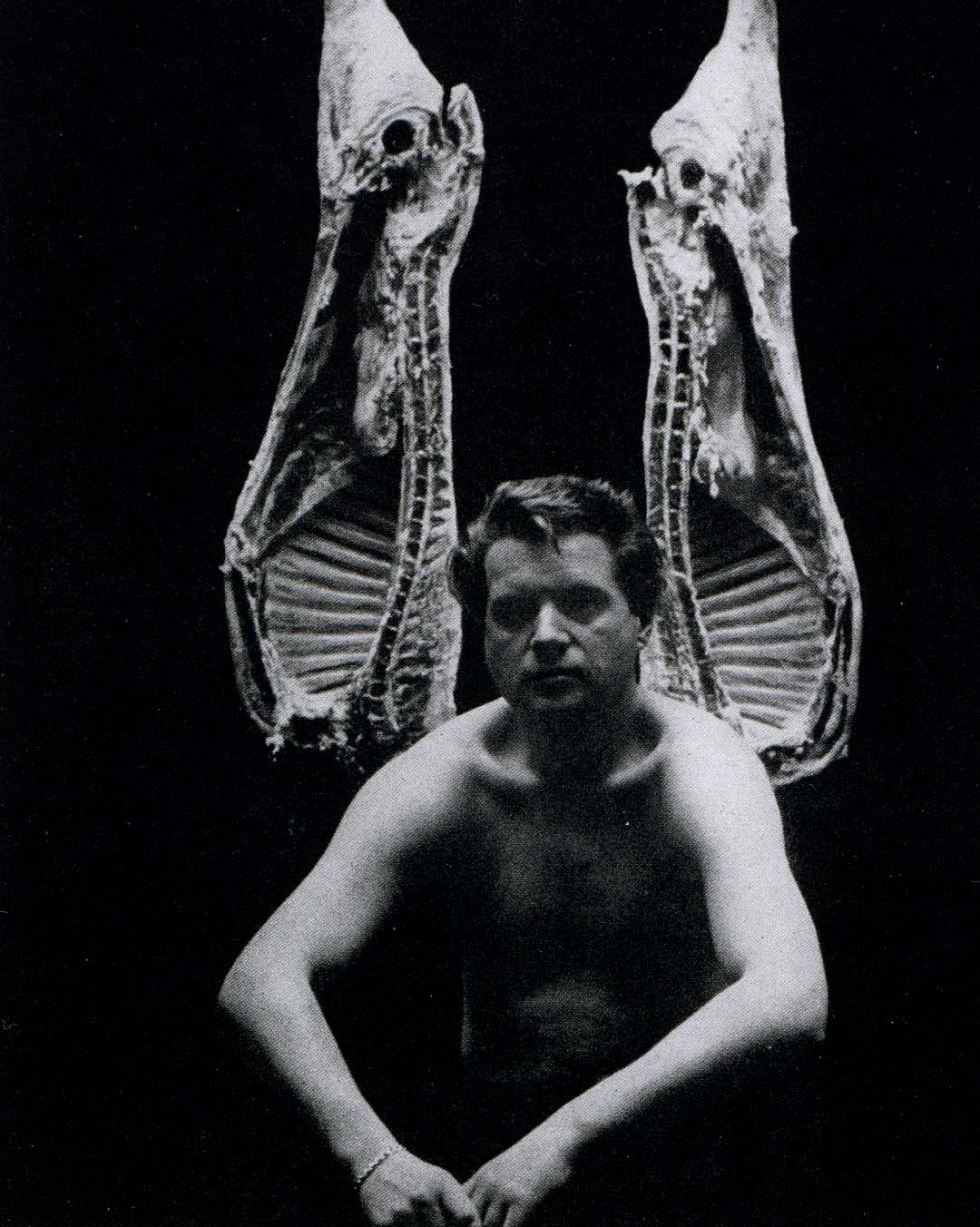
Photograph of Bacon taken by John Deakin for Vogue, 1962
This summer, the Metropolitain Museum of Art is hosting the first major Francis Bacon exhibition it has known in twenty years. “Francis Bacon: A Centenary Retrospective” celebrates the 100th anniversary of the artist’s birth. The British painter had the rare luxury of becoming rich and famous in his own lifetime. By his death in 1992, his paintings were already selling for millions, and their value has only risen since.
Bacon is a celebrated and controversial figure in the art world, or any world at that. One New York Times critic wrote, “If paintings could speak, Bacon’s would shriek.” Those who shudder in the presence his works are justified in doing so. The harshness of his critique of humanity is surpassed only by the grotesque nature of his images. Open bleeding flesh, exposed bones and carcasses fill the canvas. His faces and figures are often distorted, made to look broken or mutilated. The violence in his art is palpable. In a televised interview with Charlie Rose, Thomas Campbell, director of the Met, said “These are paintings that are created to evoke a reaction. Their subject matter is disturbing, unpleasant even revolting. But the surface of his paintings is also so engaging… you’re compelled to look.”
Critics, art historians and philosophers alike have offered up explanations as to Bacon’s view on life. He was abused as a child, a lifelong alcoholic who died of sclerosis of the liver, and he reached his prime as a painter during the last years of World War II.
His negative view of humankind was not unfounded. It would be false, however, to romanticize Bacon’s suffering. He rejected people’s complaints about his art being too harsh, stating, “People complain that I show the horrible side of life. I try to show the excitement of life.” In some ways, whether the viewer likes this or not, Bacon felt he was stating facts, not pushing buttons on our delicate sensibilities.
Gary Tinterow, the show’s curator, said this to Rose: “Here is the problem. He was constantly rubbing our face in our own mess, the mess that men and women are capable of doing to one another. He is constantly reminding us of our own bestiality….he would say that his art was the history of Europe in his own time.”
As if to add insult to injury, Bacon had recurring themes of Christian religious art in his work, recognizing the power of tryptichs and iconography. The crucifixion is especially present, representing for him the epitome of what horrible cruelty men are able of inflicting one upon the other. Take Painting 1946, for example. A faceless crucified figure dominates the backdrop, its skinless rib cage exposed. Above it hangs what looks like sausage from a butcher shop, and at the bottom of the canvas are two pieces of a carcass. A disfigured man holds a black umbrella in the centre of the painting. Bacon’s message is clear: we are meat.
Study After Velazquez’s Portrait of Pope Innocent X (“The Screaming Pope”), 1953
Bacon also loved painting popes. His Study after Velzquez’s portrait of Innocent X evokes a renaissance portrait of this pope, except once more, there is a twist. Innocent X’s mouth is open in a scream, barely hidden by black shuttered stripes. Tinterow commented on his take of Christian religion: “He was an old-fashioned militant atheist…there was always a general squeamishness about his take on Christianity.”
What can a Christian’s response be to such art? What should it be? Can we accept the place of violence and darkness in our dialogue with art? Should we take into consideration his contribution to the ongoing debate about human existence? I would be inclined to say we must. We may not like the fact that there is little redemption in Bacon’s work, nor are we obliged to agree with his interpretation of the crucifixion. But there is undeniable power in his works, shocking us even today, some 60 years after their execution. And there is undeniable truth to his take on humanity.
Let us not be too hurt by his distortion of Christianity. He had a much bigger bone to pick with humans than he did with God. “He respected Christian ethics, and maintained that the Christian way of life was amongst the best in the panoply of ways of life,” commented Tinterow. “It’s just that his common sense forbade him from believing in the Church. He recognized, however, that the Church didn’t believe in him. The feeling was mutual.”
Jenna Smith is completing a joint Masters degree in the faculties of music and theology at the Université de Montréal. She lives in Montreal where she directs Innovation-Jeunes, an arts and nutrition centre for teens.
Today I read an article in the New York Times, “Son of Evangelical Royalty, turns his back and tells the tale,” August 19, 2011. The liberal Max Brantley of the Arkansas Times Blog called this article by Mark Oppenneimer “the best reading of the morning.” Oppenneimer asserted: Edith Schaeffer also wrote books, and in 1977, Frank, an amateur filmmaker, […]
E P I S O D E 1 0 How Should We Then Live 10#1 FINAL CHOICES I. Authoritarianism the Only Humanistic Social Option One man or an elite giving authoritative arbitrary absolutes. A. Society is sole absolute in absence of other absolutes. B. But society has to be led by an elite: John Kenneth […]
E P I S O D E 9 How Should We Then Live 9#1 T h e Age of Personal Peace and Afflunce I. By the Early 1960s People Were Bombarded From Every Side by Modern Man’s Humanistic Thought II. Modern Form of Humanistic Thought Leads to Pessimism Regarding a Meaning for Life and for Fixed […]
E P I S O D E 8 How Should We Then Live 8#1 I saw this film series in 1979 and it had a major impact on me. T h e Age of FRAGMENTATION I. Art As a Vehicle Of Modern Thought A. Impressionism (Monet, Renoir, Pissarro, Sisley, Degas) and Post-Impressionism (Cézanne, Van Gogh, Gauguin, […]
E P I S O D E 7 How Should We Then Live 7#1 I am thrilled to get this film series with you. I saw it first in 1979 and it had such a big impact on me. Today’s episode is where we see modern humanist man act on his belief that we live […]
I have made it clear from day one when I started this blog that Francis Schaeffer, Milton Friedman, Ronald Reagan and Adrian Rogers had been the biggest influences on my political and religious views. Today I am responding to an unfair attack on Francis Schaeffer’s book “A Christian Manifesto.” As you can see on the […]
E P I S O D E 6 How Should We Then Live 6#1 I am sharing with you a film series that I saw in 1979. In this film Francis Schaeffer asserted that was a shift in Modern Science. A. Change in conviction from earlier modern scientists.B. From an open to a closed natural system: […]
E P I S O D E 5 How Should We Then Live 5-1 I was impacted by this film series by Francis Schaeffer back in the 1970′s and I wanted to share it with you. Francis Schaeffer noted, “Reformation Did Not Bring Perfection. But gradually on basis of biblical teaching there was a unique improvement. A. […]
Drawing from some of the most pivotal points in his life, Steve Jobs, chief executive officer and co-founder of Apple Computer and of Pixar Animation Studios, urged graduates to pursue their dreams and see the opportunities in life’s setbacks — including death itself — at the university’s 114th Commencement on June 12, 2005.
Remembering that I’ll be dead soon is the most important tool I’ve ever encountered to help me make the big choices in life. Because almost everything — all external expectations, all pride, all fear of embarrassment or failure — these things just fall away in the face of death, leaving only what is truly important. Remembering that you are going to die is the best way I know to avoid the trap of thinking you have something to lose. You are already naked. There is no reason not to follow your heart. — Steve Jobs, speaking at Stanford University’s commencement, June 2005.
Steve Jobs was a Buddhist and it is my view that this is almost the same as being an atheist. In this clip above he discusses the issue of death. There is one book in the Bible that confronts the view of death and the issue of atheism more than any other book.
Three thousand years ago, Solomon took a look at life “under the sun” in his book of Ecclesiastes. Christian scholar Ravi Zacharias has noted, “The key to understanding the Book of Ecclesiastes is the term ‘under the sun.’ What that literally means is you lock God out of a closed system, and you are left with only this world of time plus chance plus matter.”
Let me show you some inescapable conclusions if you choose to live without God in the picture. Solomon came to these same conclusions when he looked at life “under the sun.”
Death is the great equalizer (Eccl 3:20, “All go to the same place; all come from dust, and to dust all return.”)
Chance and time have determined the past, and they will determine the future. (Ecclesiastes 9:11-13 “I have seen something else under the sun: The race is not to the swift
or the battle to the strong, nor does food come to the wise
or wealth to the brilliant or favor to the learned; but time and chance happen to them all. Moreover, no one knows when their hour will come: As fish are caught in a cruel net,
or birds are taken in a snare, so people are trapped by evil times that fall unexpectedly upon them.”)
Power reigns in this life, and the scales are not balanced(Eccl 4:1; “Again I looked and saw all the oppression that was taking place under the sun: I saw the tears of the oppressed—
and they have no comforter; power was on the side of their oppressors— and they have no comforter.” 7:15 “In this meaningless life of mine I have seen both of these: the righteous perishing in their righteousness, and the wicked living long in their wickedness. ).
Nothing in life gives true satisfaction without God including knowledge (1:16-18), ladies and liquor (2:1-3, 8, 10, 11), and great building projects (2:4-6, 18-20).
_______________________
Power reigns in this life and the scales are not balanced.
Solomon comes to the realization that powers reigns in this life and the scales are not balanced. Solomon notes, “Again, I observed all the oppression that takes place under the sun. I saw the tears of the oppressed, with no one to comfort them. The oppressors have great power, and their victims are helpless. (Ecclesiastes 4:1).
People that believe there is no afterlife must concede that Hitler will never face the due punishment for his acts. I am a big Woody Allen movie fan and no other movie better demonstrates Ecclesiastes 4:1 better than the movie CRIMES AND MISDEMEANORS because the character Judah was able to get away with murder and in the end of the movie does not fear that God will punish him.
If you do not have God in the picture then you must come to the same conclusions that Solomon came to and Woody Allen shows that very clearly in his film.
By the way, the final chapter of Ecclesiastes finishes with Solomon emphasizing that serving God is the only proper response of man. Solomon looks above the sun and brings God back into the picture. I am hoping that Woody Allen will also come to that same conclusion that Solomon came to concerning the meaning of life and man’s proper place in the universe in Ecclesiastes 12:13-14:
13 Now all has been heard;
here is the conclusion of the matter:
Fear God and keep his commandments,
for this is the whole duty of man.
14 For God will bring every deed into judgment,
including every hidden thing,
whether it is good or evil
Another chapter in Ecclesiastes takes on the issue of death head on.
Ecclesiastes 9:1-12
The Message (MSG)
Ecclesiastes 9
1-3Well, I took all this in and thought it through, inside and out. Here’s what I understood: The good, the wise, and all that they do are in God’s hands—but, day by day, whether it’s love or hate they’re dealing with, they don’t know.
Anything’s possible. It’s one fate for everybody—righteous and wicked, good people, bad people, the nice and the nasty, worshipers and non-worshipers, committed and uncommitted. I find this outrageous—the worst thing about living on this earth—that everyone’s lumped together in one fate. Is it any wonder that so many people are obsessed with evil? Is it any wonder that people go crazy right and left? Life leads to death. That’s it.
Seize Life!
4-6 Still, anyone selected out for life has hope, for, as they say, “A living dog is better than a dead lion.” The living at least know something, even if it’s only that they’re going to die. But the dead know nothing and get nothing. They’re a minus that no one remembers. Their loves, their hates, yes, even their dreams, are long gone. There’s not a trace of them left in the affairs of this earth.
7-10 Seize life! Eat bread with gusto,
Drink wine with a robust heart.
Oh yes—God takes pleasure in your pleasure!
Dress festively every morning.
Don’t skimp on colors and scarves.
Relish life with the spouse you love
Each and every day of your precarious life.
Each day is God’s gift. It’s all you get in exchange
For the hard work of staying alive.
Make the most of each one!
Whatever turns up, grab it and do it. And heartily!
This is your last and only chance at it,
For there’s neither work to do nor thoughts to think
In the company of the dead, where you’re most certainly headed.
11 I took another walk around the neighborhood and realized that on this earth as it is—
The race is not always to the swift,
Nor the battle to the strong,
Nor satisfaction to the wise,
Nor riches to the smart,
Nor grace to the learned.
Sooner or later bad luck hits us all.
12 No one can predict misfortune.
Like fish caught in a cruel net or birds in a trap,
So men and women are caught
By accidents evil and sudden.
In 1978 I heard the song “Dust in the Wind” by Kansas when it rose to #6 on the charts. That song told me thatKerry Livgren the writer of that song and a member of Kansas had come to the same conclusion that Solomon had. I remember mentioning to my friends at church that we may soon see some members of Kansas become Christians because their search for the meaning of life had obviously come up empty even though they had risen from being an unknown band to the top of the music business and had all the wealth and fame that came with that. Furthermore, like Solomon and Coldplay, they realized death comes to everyone and “there must be something more.”
Livgren wrote:
“All we do, crumbles to the ground though we refuse to see, Dust in the Wind, All we are is dust in the wind, Don’t hang on, Nothing lasts forever but the Earth and Sky, It slips away, And all your money won’t another minute buy.”
Both Kerry Livgren and Dave Hope of Kansas became Christians eventually. Kerry Livgren first tried Eastern Religions and Dave Hope had to come out of a heavy drug addiction. I was shocked and elated to see their personal testimony on The 700 Club in 1981 and that same interview can be seen on youtube today. Livgren lives in Topeka, Kansas today where he teaches “Diggers,” a Sunday school class at Topeka Bible Church. Hope is the head of Worship, Evangelism and Outreach at Immanuel Anglican Church in Destin, Florida.
You can hear Kerry Livgren’s story from this youtube link:
Steve Jobs was raised as a conservative Lutheran but he chose to leave those beliefs behind. Below is a very good article on his life. COVER STORY ARTICLE | Issue: “Steve Jobs 1955-2011″ October 22, 2011 A god of our age Who was Steve Jobs? A revered technology pioneer and a relentless innovator, the Apple […]
COUNTER-DEMONSTRATION: At Kappa Sigma house in Fayetteville. The Drew Wilson photo above went viral last night — at least in Arkansas e-mail and social media users — after the Fayetteville Flyer posted it in coverage of an Occupy Northwest Arkansas demonstration in Fayetteville. The 1 percent banner was unfurled briefly on the Kappa Sigma frat […]
(If you want to check out other posts I have done about about Steve Jobs:Some say Steve Jobs was an atheist , Steve Jobs and Adoption , What is the eternal impact of Steve Jobs’ life? ,Steve Jobs versus President Obama: Who created more jobs? ,Steve Jobs’ view of death and what the Bible has to say about it ,8 things you might not know about Steve Jobs ,Steve […]
(If you want to check out other posts I have done about about Steve Jobs:Some say Steve Jobs was an atheist , Steve Jobs and Adoption , What is the eternal impact of Steve Jobs’ life? ,Steve Jobs versus President Obama: Who created more jobs? ,Steve Jobs’ view of death and what the Bible has to say about it ,8 things you might not know about Steve Jobs ,Steve […]
It is strange that the New Yorker Magazine did no research. (If you want to check out other posts I have done about about Steve Jobs:Some say Steve Jobs was an atheist , Steve Jobs and Adoption , What is the eternal impact of Steve Jobs’ life? ,Steve Jobs versus President Obama: Who created more jobs? ,Steve Jobs’ view of death and what the Bible […]
I loved reading this article below. (Take a look at the link to other posts I have done on Steve Jobs.) David Boaz makes some great observations: How much value is the Post Office creating this year? Or Amtrak? Or Solyndra? And if you point out that the Post Office does create value for its […]
Steve Jobs’ 2005 Stanford Commencement Address Uploaded by StanfordUniversity on Mar 7, 2008 Drawing from some of the most pivotal points in his life, Steve Jobs, chief executive officer and co-founder of Apple Computer and of Pixar Animation Studios, urged graduates to pursue their dreams and see the opportunities in life’s setbacks — including death […]
Things you may not know about Steve Jobs: Steve Jobs leans against his wife, Laurene Powell Jobs (Lea Suzuki/San Francisco Chronicle/Corbis) For all of his years in the spotlight at the helm of Apple, Steve Jobs in many ways remains an inscrutable figure — even in his death. Fiercely private, Jobs concealed most specifics about […]
Steve Jobs passed away on October 5, 2011. I personally am very grateful to him for helping the world so much with his ideas and I have written about tha before. Dan Mitchell of the Cato Institute noted: He’s built a $360 billion company. That presumably means at least $352 billion of wealth in the […]
Did Steve Jobs help people even though he did not give away a lot of money? (I just finished a post concerning Steve’s religious beliefs and a post about 8 things you may not know about Steve Jobs) Uploaded by UM0kusha0kusha on Sep 16, 2010 clip from The First Round Up *1934* ~~enjoy!! ______________________________________________ In the short film […]
Steve Jobs leans against his wife, Laurene Powell Jobs (Lea Suzuki/San Francisco Chronicle/Corbis)
For all of his years in the spotlight at the helm of Apple, Steve Jobs in many ways remains an inscrutable figure — even in his death. Fiercely private, Jobs concealed most specifics about his personal life, from his curious family life to the details of his battle with pancreatic cancer — a disease that ultimately claimed him on Wednesday, at the age of 56.
While the CEO and co-founder of Apple steered most interviews away from the public fascination with his private life, there’s plenty we know about Jobs the person, beyond the Mac and the iPhone. If anything, the obscure details of his interior life paint a subtler, more nuanced portrait of how one of the finest technology minds of our time grew into the dynamo that we remember him as today.
1. Early life and childhood
Jobs was born in San Francisco on February 24, 1955. He was adopted shortly after his birth and reared near Mountain View, California by a couple named Clara and Paul Jobs. His adoptive father — a term that Jobs openly objected to — was a machinist for a laser company and his mother worked as an accountant.
Later in life, Jobs discovered the identities of his estranged parents. His birth mother, Joanne Simpson, was a graduate student at the time and later a speech pathologist; his biological father, Abdulfattah John Jandali, was a Syrian Muslim who left the country at age 18 and reportedly now serves as the vice president of a Reno, Nevada casino. While Jobs reconnected with Simpson in later years, he and his biological father remained estranged.
Reed College
2. College dropout
The lead mind behind the most successful company on the planet never graduated from college, in fact, he didn’t even get close. After graduating from high school in Cupertino, California — a town now synonymous with 1 Infinite Loop, Apple’s headquarters — Jobs enrolled in Reed College in 1972. Jobs stayed at Reed (a liberal arts university in Portland, Oregon) for only one semester, dropping out quickly due to the financial burden the private school’s steep tuition placed on his parents.
In his famous 2005 commencement speech to Stanford University, Jobs said of his time at Reed: “It wasn’t all romantic. I didn’t have a dorm room, so I slept on the floor in friends’ rooms, I returned coke bottles for the 5 cent deposits to buy food with, and I would walk the seven miles across town every Sunday night to get one good meal a week at the Hare Krishna temple.”
Breakout for the Atari
3. Fibbed to his Apple co-founder about a job at Atari
Jobs is well known for his innovations in personal computing, mobile tech, and software, but he also helped create one of the best known video games of all-time. In 1975, Jobs was tapped by Atari to work on the Pong-like game Breakout.
He was reportedly offered $750 for his development work, with the possibility of an extra $100 for each chip eliminated from the game’s final design. Jobs recruited Steve Wozniak (later one of Apple’s other founders) to help him with the challenge. Wozniak managed to whittle the prototype’s design down so much that Atari paid out a $5,000 bonus — but Jobs kept the bonus for himself, and paid his unsuspecting friend only $375, according to Wozniak’s own autobiography.
4. The wife he leaves behind
Like the rest of his family life, Jobs kept his marriage out of the public eye. Thinking back on his legacy conjures images of him commanding the stage in his trademark black turtleneck and jeans, and those solo moments are his most iconic. But at home in Palo Alto, Jobs was raising a family with his wife, Laurene, an entrepreneur who attended the University of Pennsylvania’s prestigious Wharton business school and later received her MBA at Stanford, where she first met her future husband.
For all of his single-minded dedication to the company he built from the ground up, Jobs actually skipped a meeting to take Laurene on their first date: “I was in the parking lot with the key in the car, and I thought to myself, ‘If this is my last night on earth, would I rather spend it at a business meeting or with this woman?’ I ran across the parking lot, asked her if she’d have dinner with me. She said yes, we walked into town and we’ve been together ever since.”
In 1991, Jobs and Powell were married in the Ahwahnee Hotel at Yosemite National Park, and the marriage was officiated by Kobin Chino, a Zen Buddhist monk.
5. His sister is a famous author
Later in his life, Jobs crossed paths with his biological sister while seeking the identity of his birth parents. His sister, Mona Simpson (born Mona Jandali), is the well-known author of Anywhere But Here — a story about a mother and daughter that was later adapted into a film starring Natalie Portman and Susan Sarandon.
After reuniting, Jobs and Simpson developed a close relationship. Of his sister, he told a New York Times interviewer: “We’re family. She’s one of my best friends in the world. I call her and talk to her every couple of days.” Anywhere But Here is dedicated to “my brother Steve.”
Joan Baez
6. Celebrity romances
In The Second Coming of Steve Jobs, an unauthorized biography, a friend from Reed reveals that Jobs had a brief fling with folk singer Joan Baez. Baez confirmedthe the two were close “briefly,” though her romantic connection with Bob Dylan is much better known (Dylan was the Apple icon’s favorite musician). The biography also notes that Jobs went out with actress Diane Keaton briefly.
7. His first daughter
When he was 23, Jobs and his high school girlfriend Chris Ann Brennan conceived a daughter, Lisa Brennan Jobs. She was born in 1978, just as Apple began picking up steam in the tech world. He and Brennan never married, and Jobs reportedly denied paternity for some time, going as far as stating that he was sterile in court documents. He went on to father three more children with Laurene Powell. After later mending their relationship, Jobs paid for his first daughter’s education at Harvard. She graduated in 2000 and now works as a magazine writer.
8. Alternative lifestyle
In a few interviews, Jobs hinted at his early experience with the psychedelic drug LSD. Of Microsoft founder Bill Gates, Jobs said: “I wish him the best, I really do. I just think he and Microsoft are a bit narrow. He’d be a broader guy if he had dropped acid once or gone off to an ashram when he was younger.”
The connection has enough weight that Albert Hofmann, the Swiss scientist who first synthesized (and took) LSD, appealed to Jobs for funding for research about the drug’s therapeutic use.
In a book interview, Jobs called his experience with the drug “one of the two or three most important things I have done in my life.” As Jobs himself has suggested, LSD may have contributed to the “think different” approach that still puts Apple’s designs a head above the competition.
Jobs will forever be a visionary, and his personal life also reflects the forward-thinking, alternative approach that vaulted Apple to success. During a trip to India, Jobs visited a well-known ashram and returned to the U.S. as a Zen Buddhist.
Jobs was also a pescetarian who didn’t consume most animal products, and didn’t eat meat other than fish. A strong believer in Eastern medicine, he sought to treat his own cancer through alternative approaches and specialized diets before reluctantly seeking his first surgery for a cancerous tumor in 2004.
9. His fortune
As the CEO of the world’s most valuable brand, Jobs pulled in a comically low annual salary of just $1. While the gesture isn’t unheard of in the corporate world — Google’s Larry Page, Sergey Brin, and Eric Schmidt all pocketed the same 100 penny salary annually — Jobs has kept his salary at $1 since 1997, the year he became Apple’s lead executive. Of his salary, Jobs joked in 2007: “I get 50 cents a year for showing up, and the other 50 cents is based on my performance.”
In early 2011, Jobs owned 5.5 million shares of Apple. After his death, Apple shares were valued at $377.64 — a roughly 43-fold growth in valuation over the last 10 years that shows no signs of slowing down.
He may only have taken in a single dollar per year, but Jobs leaves behind a vast fortune. The largest chunk of that wealth is the roughly $7 billion from the sale of Pixar to Disney in 2006. In 2011, with an estimated net worth of $8.3 billion, he was the 110th richest person in the world, according to Forbes. If Jobs hadn’t sold his shares upon leaving Apple in 1985 (before returning to the company in 1996), he would be the world’s fifth richest individual.
While there’s no word yet on plans for his estate, Jobs leaves behind three children from his marriage to Laurene Jobs (Reed, Erin, and Eve), as well as his first daughter, Lisa Brennan-Jobs.
Steve Jobs passed away on October 5, 2011. I personally am very grateful to him for helping the world so much with his ideas and I have written about tha before. Dan Mitchell of the Cato Institute noted: He’s built a $360 billion company. That presumably means at least $352 billion of wealth in the […]
Did Steve Jobs help people even though he did not give away a lot of money? (I just finished a post concerning Steve’s religious beliefs) Uploaded by UM0kusha0kusha on Sep 16, 2010 clip from The First Round Up *1934* ~~enjoy!! ______________________________________________ In the short film above you can see that it was the kindness of the two […]
By Robbie Neiswanger
Arkansas News Bureau • rneiswanger@arkansasnews.com
FAYETTEVILLE — Kiehl Frazier began attending Arkansas games when he was five years old.
Over the years, he watched Arkansas play countless times in Razorback Stadium. He went to games with his family. He’d watch with friends. He even saw one as part of a recruiting visit to campus, calling the 2009 Georgia game one of his most memorable experiences.
So walking into the stadium won’t be anything new to Frazier when he returns this weekend. The difference, of course, will be the fact he’s wearing an Auburn uniform and trying to help the Tigers beat Arkansas.
“I can’t wait,” Frazier said Wednesday. “Fayetteville will always be my home and I grew up watching the Razorbacks and going to the game. So it will be a dream come true getting to play in the stadium.”
Frazier, a Shiloh Christian graduate, and Auburn running back Michael Dyer (Little Rock Christian) will make their first trip back to their home state with the Tigers on Saturday. Dyer carries a big role in offensive coordinator Gus Malzahn’s offense, leading the Tigers in rushing (567 yards). Frazier is finding his niche, offering a change of pace to starter Barrett Trotter at quarterback as a true freshman.
Neither has played in Razorback Stadium in their football careers, but Dyer knows what to expect when they’re greeted by Arkansas fans Saturday night.
“I’m sure they’ll have some boos and stuff like that,” Dyer said. “But that’s part of it when you’re one of those guys that could’ve stayed home and played, but decided to go somewhere else.”
Both Dyer and Frazier were recruited by Arkansas coach Bobby Petrino and his staff, but selected the Tigers for a chance to play in Malzahn’s offense. They joined a recent run of former Arkansas high school players to head to Auburn, joining former Tigers like tackle Lee Ziemba and receiver/quarterback Kodi Burns.
It’s hard to argue Dyer made the wrong choice after playing a big role in Auburn’s championship season.
He rushed for 1,093 yards, including 143 in the national title game win. His 37-yard run in the fourth quarter helped set up the game-winning field goal.
“I came down here and was able to do the things I was asked to do during my recruiting process and be able to play and contribute to the team,” Dyer said.
Dyer now is one of just a few returning offensive starters in a revamped attack. He showed some of his leadership in tying an Auburn record with 41 carries for 141 yards in the 16-13 win at South Carolina. It included 16 carries after suffering an ankle injury.
“That was just kind of the plan going in, and that’s kind of what was working the best,” Malzahn said of Dyer’s workload. “But we don’t plan on giving the ball 41 times to our running back each week.”
Frazier has only attempted one pass, but has helped the Tigers more and more with his running ability.
Frazier — who is still the third-team quarterback behind Barrett Trotter and Clint Moseley — ranks third in rushing (81 yards). Most of the production came in his 48-yard performance against South Carolina.
“I’ve really thought he’s done a very solid job with what we’ve asked him to do,” Malzahn said. “Last week he came in during some key moments in the game and really, really made big plays for us.”
Both players would love nothing more than to enjoy success homecomings in Arkansas on Saturday.
Malzahn is the first to admit the return trip can be “weird” and “odd” the first time around. He said that was the case for him in 2008, when he came back to Arkansas as Tulsa’s offensive coordinator.
The newness has worn off for Malzahn, who is still looking for his first win in Arkansas. He’s confident Dyer and Frazier will handle the situation Saturday.
“From what I saw (Tuesday), they’re approaching it like any other game,” Malzahn said. “I’m sure there will be different emotions once they get there and all that, but they’ve got a job to do, and we’re playing against a very good defense. So they’ve got to be prepared and not get too high or too low.”
Dyer and Frazier said it’s no problem, although gameday probably can’t arrive quick enough for either Arkansas native. Both were busy earlier this week collecting tickets for family and friends.
Frazier said it will be good to seem them, too, although he’s certain not everyone will be rooting for Auburn to knock Arkansas in Fayetteville.
“They definitely want the Razorbacks to win,” Frazier said of his friends. “There’s deep loyalty there. But they’ve been kind of telling me they hope I do well.”
Saturday’s Ticket
No. 15 Auburn (4-1) vs. No. 10 Arkansas (4-1)
When: 6 p.m.
Where: Razorback Stadium in Fayetteville
TV: ESPN
Radio: Razorback Sports Network
Satellite Radio: Sirius (Ch. 91), XM (Ch. 91)
Series Record: Auburn leads 8-11-1
Last Meeting: Auburn 65, Arkansas 43 in 2010
Coaches: Arkansas — Bobby Petrino (27-16 in fourth season); Auburn — Gene Chizik (26-6 in third season)
There is still a lot of campaigning to go. This time in 2007, Rudy Giuliani was the front-runner with Fred Thompson close behind. The eventual nominee, John McCain, was a distant third
Lieutenant Governor Mark Darr announced today his endorsement of former Massachusetts Gov. Mitt Romney for President. Darr made the announcement at the Little Rock Political Animal’s Club luncheon, which was held at the Arkansas Governor’s Mansion. The endorsement is the first high-profile endorsement for Romney in the Natural State, although more will likely follow. (Update – Congressman Tim Griffin announced his endorsement about the same time as Darr.)
“I think Arkansas is looking for its leaders to be bold and want to know where they stand on the issues and who they do or do not support,” said Darr when asked why he is endorsing this early in the primary. “Because the field of candidates needs to begin to narrow, I have decided who I am going to support and felt now was the time to make that public.”
Darr stated that he believes that Romney “gives us our best chance of defeating President Obama.”
“I like that he has real-world business knowledge. He’s not just a politician, he’s owned businesses. I think he has stood out during the debates as someone who is well-versed on the issues. He has shown that he can go toe-to-toe with the President. I believe he will be able to appeal to and pull support from other parts of the country that other candidates might not. He also has shown that he can put together the necessary resources to mount a successful campaign,” said Darr.
In June, 20 Arkansas legislatorsformed “Arkansans for Rick Perry” encouraging the Texas Governor to get in the race. Darr was part of a group from Arkansas that traveled to Austinto meet with Perry in late July. In August, Perry took the Arkansas legislators’ advice as well as others from around the country unhappy with the current field of Presidential contenders and jumped in the race. He immediately shot up to the top of the polls and became the frontrunner; however, after a lackluster performance at a debate last month in Florida and a distant second place showing in the Florida straw poll a few days later, his bubble seemed to burst and former Godfather’s Pizza CEO Herman Cain’s stock started to rise.
“I think Governor Perry is a great man and a great governor for Texas, but from what I’ve seen in the campaign so far, I think Governor Romney is better prepared to take on the President and win,” said Darr when asked why he went with Romney over Perry.
Rep. David Sanders with Arkansas for Rick Perry said he is sticking with Perry in spite of his recent stumbles pointing out that he is “a proven job creator” in Texas and just announced today that he has raised $17 million.
“Campaigns are long enterprises. There are going to be starts and stops and bumps in the road,” said Sanders. “To not acknowledge that there have been some bumps along the way would be to ignore reality. But I feel confident in his ability to get things going, and again, I think the message and record is so compelling. Some of the items have been substantive while some have been nitpicky but I think the record and the message overshadow that.”


 Francis Bacon’s Painting 1946
 Remembering that I’ll be dead soon is the most important tool I’ve ever encountered to help me make the big choices in life. Because almost everything — all external expectations, all pride, all fear of embarrassment or failure — these things just fall away in the face of death, leaving only what is truly important. Remembering that you are going to die is the best way I know to avoid the trap of thinking you have something to lose. You are already naked. There is no reason not to follow your heart. — Steve Jobs, speaking at
 Reed College
 Breakout for the Atari
 Joan Baez


