Category Archives: Cato Institute

Lessons for the Super Committee

Uploaded by on Sep 7, 2011

Share this on Facebook: http://on.fb.me/qnjkn9 Tweet it: http://tiny.cc/o9v9t

In the debate of job creation and how best to pursue it as a policy goal, one point is forgotten: Government doesn’t create jobs. Government only diverts resources from one use to another, which doesn’t create new employment.

Video produced by Caleb Brown and Austin Bragg.

___________________________

I wish the Super Committee would read this article below:


A Short Econ Quiz for the Super Committee

Why an extra trillion in ‘irresponsible’ deficit spending can’t become ‘responsible’ if paid for by higher taxes.

By STEVEN E. LANDSBURG

Suppose that year after year, you spend more than you earn. You are worried that you’ve become fiscally irresponsible. Which of the following could be paths back to fiscal sanity for your household?

A) Spend less.

B) Earn more.

C) Stop at the ATM more often so you’ll have more cash in your pocket.

Do we all understand why C is a really bad answer? Good. Now let’s try another one.

Suppose that year after year, your government spends more than it collects in taxes. You are worried that it’s become fiscally irresponsible. Which of the following could be a path back to fiscal sanity for your government?

A) Spend less.

Dan Henninger discusses the supercommittee’s deliberations on Opinion Journal. Photo: AP.

B) Collect more tax revenue.

Spending less—at least spending less on things you don’t need—can be a first step toward sanity for a government just as it can for a household. So A is a pretty good answer. What about B?

As the deadline looms for the congressional super committee, there’s seems to be a growing sense that tax revenue for the government is like income for the household. That’s wrong. Raising taxes is nothing at all like earning income. Instead, it’s a lot more like visiting the ATM.

The government’s debt is the American people’s debt. If we pay down that debt through higher taxes, we will, for the most part, pay those taxes by drawing down our savings. That’s no more “responsible” than drawing down those savings to finance overconsumption within the household.

If you buy a kayak you don’t need and can’t afford, you’re unlikely to placate your spouse by saying “Don’t worry, dear, I withdrew the money from our retirement account.” If your government insists on maintaining social programs we don’t need and can’t afford, nobody should be placated by a congressional agreement to finance that program with money withdrawn from those same accounts.

Here’s another way to say essentially the same thing: The government’s chief asset—in fact, pretty much its only asset—is its ability to tax people, now and in the future. The taxpayers are the government’s ATM. Make a withdrawal today, and there’s less available tomorrow.

Now the ability to tax is a pretty huge asset and the government has not (yet!) come close to depleting it. In that sense, there’s a lot of money in the bank. But no matter how much you’ve got in the bank, a policy of ever-increasing withdrawals is nothing at all like a decision to earn more income. It’s important to get the analogy right. And it’s clear from the blogs and the op-ed pages that not everybody gets this.

Instead, the notion persists that an extra trillion in federal spending can be converted from “irresponsible” to “responsible” as long as it’s accompanied by an extra trillion in tax hikes. That’s like saying a $500 haircut can be converted from “irresponsible” to “responsible” as long as you withdraw the $500 from your bank account. If the super committee loses sight of this fundamental truth, it is doomed to fail.

Mr. Landsburg, an economics professor at the University of Rochester in New York, is the author of, among other books, “The Armchair Economist” (Free Press, 1995). He blogs at TheBigQuestions.com.

Dick Cheney appointed to hunting safety commission? Better chance of that than politicians correcting housing problem

Mark Calabria from the Cato Institute on Financial Regulation

Mark Calabria from the Cato Institute joins Crane to discuss financial regulation

______________________________________________

Can liberal politicians correct the housing problem? No way!!

Uh-Oh: Bipartisan Housing Commission Announced

Posted by Tad DeHaven

The words “bipartisan” and “commission” usually send a chill down my spine. I felt such a chill when I learned that the Bipartisan Policy Center (BPC) had formed a Housing Commission to “address the long-term challenges facing a struggling housing sector.” My initial reaction was confirmed when I read that it would be chaired by former government officials and politicians of the establishment type:

  • Christopher “Kit” Bond – former U.S. senator (R-MO)
  • Henry Cisneros – Housing and Urban Development (HUD) secretary under President Bill Clinton
  • Mel Martinez – former U.S. senator (R-FL) and HUD secretary under President George W. Bush
  • George Mitchell – former Senate majority leader (D-ME) and BPC co-founder

The most disturbing name is Henry Cisneros. Policies implemented by Cisneros’s HUD helped lead to the housing bubble and bust (see this section on Cisneros from a Cato essay on HUD Scandals). What’s next, Dick Cheney on a hunting safety commission?

Christopher “Kit” Bond, former appropriator and proud porker, hangs himself with his statement on the BPC’s website:

Since serving as Missouri’s Governor, and then as a United States Senator, I have worked to be an advocate for improving public housing and advancing community development. Some of my proudest achievements are helping shape housing policy and programs in homelessness, rural housing, public housing, HOPE VI, and affordable housing. None of these successes would have been possible without strong partners on the other side of the aisle.

In fact, my fellow Commission Co-Chair, and former HUD Secretary, Henry Cisneros and I, were referred to in a 1996 Wall Street Journal article as the ‘Odd Couple’ of federal housing policy – a moniker I still wear as a badge of honor. Though it was a different time in our nation’s history, Henry and I were then – as we are now – committed to coming together to address long-ignored problems with immense implications.

The federal government’s abysmal record on housing (see these Cato essays here for more) is a poster child for government failure. But not only does Bond consider his support for these programs to be among his “proudest” achievements, he actually states that collaborating with Cisneros back in the 1990s is a “badge of honor.”

I’m not sure what Mel Martinez has going for him on housing policy other than that his relatively short tenure as HUD secretary under Bush wasn’t marred by scandal like his successor’s, Alphonso Jackson. At least Martinez acknowledges that the Bush administration continued the Clinton administration’s misplaced emphasis on expanding homeownership.

As for George Mitchell, his claim to federal housing policy fame is that he authored the creation of the Low-Income Housing Tax Credit. Here’s what a Cato essay on public housing has to say about the LIHTC:

Another response to the failure of traditional public housing has been the creation of the Low Income Housing Tax Credit in 1986, which currently subsidizes construction or rehabilitation of roughly 70,000 units of low-income housing each year. This is another failed attempt to manipulate markets, and it has a variety of negative effects. For one thing, the structure of the tax credit program encourages the location of projects in particularly low-income areas, thus exacerbating the concentration of poverty in cities, just as traditional public housing did. Also, the method of allocating tax credits to the states results in many subsidies going to areas of the country where few housing affordability problems exist.

Further, the projects built under the LIHTC program have income caps for tenants, which create the same disincentive effects for personal advancement that traditional welfare programs do. Finally, the program essentially functions as a subsidy program for developers. Economists Edward Glaeser and Joseph Gyourko argue that developers effectively pocket the $4 billion or so in annual federal tax credits, while the rents in buildings constructed under the program are generally no lower than they would have been in the absence of the program.

In a nutshell: an establishment commission is planning to “reform the nation’s housing policy by crafting a package of realistic and actionable policy recommendations” for the Beltway establishment’s consideration. Hold onto your wallets, taxpayers.

“Trust-fund babies?”

President Obama and other politicians are advocating higher taxes, with a particular emphasis on class-warfare taxes targeting the so-called rich. This Center for Freedom and Prosperity Foundation video explains why fiscal policy based on hate and envy is fundamentally misguided. For more information please visit our web page: www.freedomandprosperity.org.

_________________________

Are all those rich people born that way?

The Real “1 Percent”

by Michael D. Tanner

This article appeared in The New York Post on November 8, 2011.

So just who are those top 1 percent of Americans that we’re all supposed to hate?

If you listen to President Obama, the protesters at Occupy Wall Street, and much of the media, it’s obvious. They’re either “trust-fund babies” who inherited their money, or greedy bankers and hedge-fund managers. Certainly, they haven’t worked especially hard for their money. While the recession has thrown millions of Americans out of work, they’ve been getting even richer. Worse, they don’t even pay their fair share in taxes: Millionaires and billionaires are paying a lower tax rate than their secretaries.

In reality, each of these stereotypes is wrong.

By and large, the wealthy have worked hard for their money.

Roughly 80 percent of millionaires in America are the first generation of their family to be rich. They didn’t inherit their wealth; they earned it. How? According to a recent survey of the top 1 percent of American earners, slightly less than 14 percent were involved in banking or finance.

Roughly a third were entrepreneurs or managers of nonfinancial businesses. Nearly 16 percent were doctors or other medical professionals.

Lawyers made up slightly more than 8 percent, and engineers, scientists and computer professionals another 6.6 percent.

Sports and entertainment figures — the folks flying in on their private jets to express solidarity with Occupy Wall Street — composed almost 2 percent.

By and large, the wealthy have worked hard for their money. NYU sociologist Dalton Conley says that “higher-income folks work more hours than lower-wage earners do.”

Because so much of their income is tied up in investments, the recession has hit the rich especially hard. Much attention has been paid recently to a Congressional Budget Office study that showed incomes for the top 1 percent rose far faster from 1980 until 2007 than for the rest of us. But the nonpartisan Tax Foundation has found that since 2007, there has been a 39 percent decline in the number of American millionaires.

Among the “super-rich,” the decline has been even sharper: The number of Americans earning more than $10 million a year has fallen by 55 percent. In fact, while in 2008 the top 1 percent earned 20 percent of all income here, that figure has declined to just 16 percent. Inequality in America is declining.

As for not paying their fair share, the top 1 percent pay 36.7 percent of all federal income taxes. Because, as noted above, they earn just 16 percent of all income, that certainly seems likemore than a fair share.

Maybe Warren Buffett is paying a lower tax rate than his secretary, as he claims. But the comparison is misleading because Buffett’s income comes mostly from capital gains, which were already taxed at their origin through the corporate-income tax.

Moreover, the Buffetts of the world are clearly an exception. Overall, the rich pay an effective tax rate (after all deductions and exemptions) of roughly 24 percent. For all taxpayers as a group, the average effective tax rate is about 11 percent.

Beyond taxes, the rich also pay in terms of private charity. Households with more than $1 million in income donated more than $150 billion to charity last year, roughly half of all US charitable donations. Greedy? It hardly seems so.

Michael Tanner is a Cato Institute senior fellow.

More by Michael D. Tanner

And let us not forget the fact that the rich provide the investment capital that funds ventures, creates jobs and spurs innovation. The money that the rich save and invest is the money that companies use to start or expand businesses, buy machinery and other physical capital and hire workers.

It has become fashionable to ridicule the idea of the rich as “job creators,” but if the rich don’t create jobs, who will? How many workers have been hired recently by the poor?

No doubt dishonest or unscrupulous businessmen have gotten rich by taking advantage of others. And few of us are likely to lose much sleep over the plight of the rich.

But shouldn’t public policy be based on something more than class warfare, envy and stereotypes?

Liberals’ solution for the poor is more welfare, but that will not work

Milton Friedman’s solution to limiting poverty

Liberals like Michael Cook just don’t get it. They should listen to Milton Friedman (who is quoted in this video below concerning the best way to limit poverty).

New Video Shows the War on Poverty Is a Failure

Posted by Daniel J. Mitchell

The Center for Freedom and Prosperity has released another “Economics 101″ video, and this one has a very powerful message about the federal government’s so-called War on Poverty.

As explained by Hadley Heath of the Independent Women’s Forum, the various income redistribution schemes being imposed by Washington are bad for taxpayers — and bad for poor people.

Free Markets, Not Redistribution, Is Best Way to Reduce Poverty

Uploaded by  on Oct 3, 2011

The so-called War on Poverty has failed. Making government bigger and creating more federal redistribution programs has been bad news for taxpayers. But the welfare state also has been a disaster for the less fortunate, creating a flypaper effect that makes it difficult for people to lead independent and self-reliant lives. This Center for Freedom and Prosperity Foundation video shows how the poverty rate was falling after World War II — but then stagnated once the federal government got involved. www.freedomandprosperity.org

_____________________________

___________

The video has a plethora of useful information, but the data on the poverty rate is particularly compelling. Prior to the War on Poverty, the United States was getting more prosperous with each passing year and there were dramatic reductions in the level of destitution.

But once the federal government got involved in the mid-1960s, the good news evaporated. Indeed, the poverty rate has basically stagnated for the past 40-plus years, usually hovering around 13 percent depending on economic conditions.

Another remarkable finding in the video is that poor people in America rarely suffer from material deprivation. Indeed, they have wide access to consumer goods that used to be considered luxuries – and they also have more housing space than the average European (and with Europe falling apart, the comparisons presumably will become even more noteworthy).

The most important message of the video, however, is that small government and economic freedom are the best answers for poverty. As Hadley explains, poor people can be liberated to live meaningful, self-reliant lives if we can reduce the heavy burden of the federal government.

Last but not least, the video doesn’t address every issue in great detail, and there are three additional points that should be added to any discussion of poverty.

  1. The biggest beneficiaries of the current system are the army of bureaucrats that receive very comfortable salariesadministering various programs.
  2. The Obama Administration is looking to re-define poverty in a way that would expand the welfare state andincrease the burden of redistribution programs.
  3. The welfare reform legislation of the 1990s was a small step in the right direction because it eliminated a federal entitlement and shifted responsibility back to the state level. This success story should be replicated for programs such as Medicaid.

This last point is worth emphasizing because it is also one of the core messages of the video. The federal government has done a terrible job dealing with poverty. The time has come to get Washington out of the racket of income redistribution.

Related posts by Milton Friedman. Pay attention to posts about poverty or FREE TO CHOOSE episode on “Cradle to Grave.”

Friedman Friday” Free to Choose by Milton Friedman: Episode “Created Equal” (Part 3 of transcript and video)

Friedman Friday” Free to Choose by Milton Friedman: Episode “Created Equal” (Part 3 of transcript and video) Liberals like President Obama want to shoot for an equality of outcome. That system does not work. In fact, our free society allows for the closest gap between the wealthy and the poor. Unlike other countries where free enterprise and other […]

Free to Choose by Milton Friedman: Episode “Created Equal” (Part 2 of transcript and video)

Free to Choose by Milton Friedman: Episode “Created Equal” (Part 2 of transcript and video) Liberals like President Obama want to shoot for an equality of outcome. That system does not work. In fact, our free society allows for the closest gap between the wealthy and the poor. Unlike other countries where free enterprise and other freedoms are […]

Milton Friedman Friday: (“Free to Choose” episode 4 – From Cradle to Grave, Part 4 of 7)

 I am currently going through his film series “Free to Choose” which is one the most powerful film series I have ever seen. PART 4 of 7 The massive growth of central government that started after the depression has continued ever since. If anything, it has even speeded up in recent years. Each year there […]

Debate on Milton Friedman’s cure for inflation

If you would like to see the first three episodes on inflation in Milton Friedman’s film series “Free to Choose” then go to a previous post I did. Ep. 9 – How to Cure Inflation [4/7]. Milton Friedman’s Free to Choose (1980) Uploaded by investbligurucom on Jun 16, 2010 While many people have a fairly […]

Milton Friedman addressed the belief that inflation can cure unemployment, implicit in the Obama administration’s spending blowout

Ep. 9 – How to Cure Inflation [1/7]. Milton Friedman’s Free to Choose (1980) Cochrane’s Kinky Curves Posted by Jim Powell The doctrine that inflation can cure unemployment, implicit in the Obama administration’s spending blowout, goes way back. The modern version originated with William Phillips, a New Zealand-born economist who, in 1958, wrote a paper […]

Milton Friedman Friday: (“Free to Choose” episode 4 – From Cradle to Grave, Part 3 of 7)

 I am currently going through his film series “Free to Choose” which is one the most powerful film series I have ever seen. PART 3 OF 7 Worse still, America’s depression was to become worldwide because of what lies behind these doors. This is the vault of the Federal Reserve Bank of New York. Inside […]

Free to Choose by Milton Friedman: Episode “Created Equal” (Part 1 of transcript and video)

 Milton Friedman and Ronald Reagan Liberals like President Obama (and John Brummett) want to shoot for an equality of outcome. That system does not work. In fact, our free society allows for the closest gap between the wealthy and the poor. Unlike other countries where free enterprise and other freedoms are not present.  This is a seven part series. […]

Ernest Istook of the Heritage Foundation speaks in Little Rock on 6-22-11 (Part 2)

The third monthly luncheon with featured speaker Ernest Istook was excellent. First, we got to hear from Dave Elswick of KARN   who came up with the idea of this luncheon, and then from Teresa Crossland of Americans for Prosperity. Below is a portion of Istook’s biography from the Heritage Foundation: Ernest Istook Distinguished Fellow Government Studies Ernest […]

Milton Friedman Friday:(“Free to Choose” episode 4 – From Cradle to Grave, Part 2 of 7)

 I am currently going through his film series “Free to Choose” which is one the most powerful film series I have ever seen. For the past 7 years Maureen Ramsey has had to buy food and clothes for her family out of a government handout. For the whole of that time, her husband, Steve, hasn’t […]

The poor in the USA have best chance in the world to go up

I love Milton Friedman’s film series “Free to Choose.” In that film series over and over it is shown that the ability to move from poor to rich is more abundant here than any other country in the world. This article below reminded me of that that. Are Poor Really Helpless Without Government? By Michael […]

2 cartons illustrate the fate of socialism from the Cato Institute

Cato Institute scholar Dan Mitchell is right about Greece and the fate of socialism:

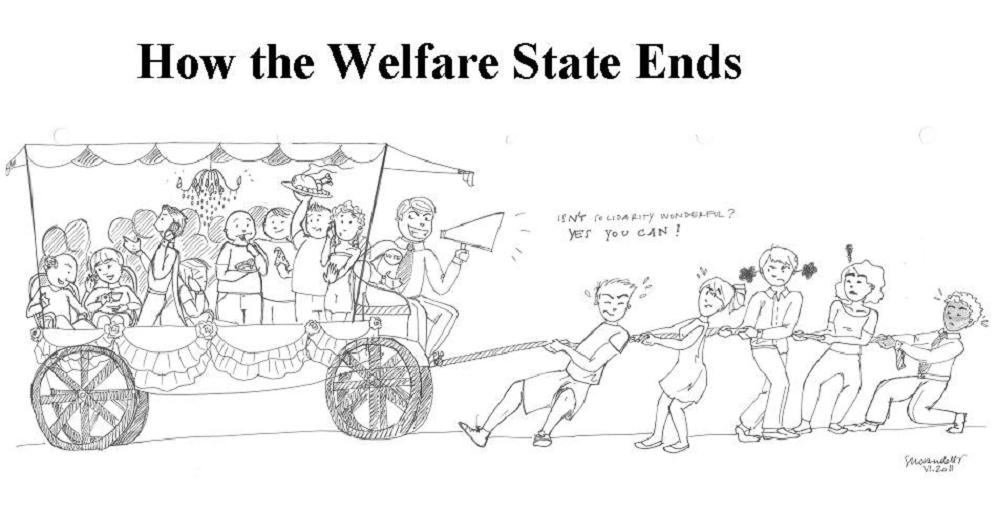
In my speeches, especially when talking about the fiscal crisis in Europe (or the future fiscal crisis in America), I often warn that the welfare state reaches a point-of-no-return when the number of people riding in the wagon begins to outnumber the number of people pulling the wagon.

To be more specific, if more than 50 percent of the population is dependent on government (employed in the bureaucracy, living off welfare, receiving pensions, etc), it becomes rather difficult to form a coalition to fix the mess. This may explain why Greek politicians have resisted significant reforms, even though the nation faces a fiscal death spiral.

But you don’t need me to explain this relationship. One of our Cato interns, Silvia Morandotti, used her artistic skills to create two images (click pictures for better resolution) that show what a welfare state looks like when it first begins and what it eventually becomes.

These images are remarkably accurate. The welfare state starts with small programs targeted at a handful of genuinely needy people. But as  politicians figure out the electoral benefits of expanding programs and people figure out the that they can let others work on their behalf, the ratio of producers to consumers begins to worsen.

Eventually, even though the moochers and looters should realize that it is not in their interest to over-burden the people pulling the wagon, the entire system breaks down.

Then things get really interesting. Small nations such as Greece can rely on permanent bailouts from bigger countries and the IMF, but sooner or later, as larger nations begin to go bankrupt, that approach won’t be feasible.

I often conclude my speeches by joking with the audience that it’s time to stock up on canned goods, bottled water, and ammo. Many people, I’m finding, don’t think that line very funny.

___________________

The Department of Health and Human Services administers the huge and fast-growing Medicare and Medicaid programs. These programs fuel rising health costs, distort health markets, and are plagued by waste and fraud. The department also runs an array of other expensive subsidy programs, including Head Start, TANF, and LIHEAP. Growth in HHS spending is creating a federal financial crisis, and the 2010 health care law sadly makes the situation worse.

The department will spend $910 billion in 2011, or $7,710 for every U.S. household. It employs 68,000 workers and runs more than 420 subsidy programs.


Timeline of Government Growth

  • See this timeline for key events in the department’s growth.

Reading Room

Cato Experts

Spending Cuts Summary

  • Here are proposed reforms to save $81 billion annually in the short-run and prevent federal health costs from consuming a growing share of the economy in the long-run.

Downsize This!

  • Medicare Reforms. Medicare should be transformed into a system based on vouchers, individual savings, and competitive insurance markets.
  • Medicaid Reforms. Federal spending on low-income health care should be converted to block grants for the states.
  • TANF and Welfare Spending. Welfare reforms in 1996 created Temporary Assistance for Needy Families, but this sort of aid should be provided by private charities.
  • Head Start and Other Subsidies. HHS funds a vast array of other subsidy programs, many of which are wasteful and ineffective.
  • 2010 Health Care Legislation. The law expanded Medicaid, added new taxes and subsidies, created new bureaucracies, and did little to reduce cost growth in health care.

The government of the United States is a definite government, confined to specified objects. It is not like the state governments, whose powers are more general. Charity is no part of the legislative duty of the government.

– James Madison. A paraphrase from Elliot’s Debates regarding a proposed subsidy bill, House of Representatives, January 10, 1794.

Dear Senator Pryor, why not pass the Balanced Budget Amendment? (Part 13 Thirsty Thursday, Open letter to Senator Pryor)

Dear Senator Pryor, why not pass the Balanced Budget Amendment? (Part 13 Thirsty Thursday, Open letter to Senator Pryor)

Office of the Majority Whip | Balanced Budget Amendment Video

In 1995, Congress nearly passed a constitutional amendment mandating a balanced budget. The Balanced Budget Amendment would have forced the federal government to live within its means. This Balanced Budget Amendment failed by one vote. 16 years later, Congress has the chance to get it right. Our time is now.

______________________

Dear Senator Pryor,

Why not pass the Balanced  Budget Amendment? As you know that federal deficit is at all time high (1.6 trillion deficit with revenues of 2.2 trillion and spending at 3.8 trillion).

On my blog www.HaltingArkansasLiberalswithTruth.com I took you at your word and sent you over 100 emails with specific spending cut ideas. However, I did not see any of them in the recent debt deal that Congress adopted. Now I am trying another approach. Every week from now on I will send you an email explaining different reasons why we need the Balanced Budget Amendment. It will appear on my blog on “Thirsty Thursday” because the government is always thirsty for more money to spend.

The Debt Ceiling and the Balanced Budget Amendment

Posted by David Boaz

The Washington Post editorializes:

A balanced-budget amendment would deprive policymakers of the flexibility they need to address national security and economic emergencies.

A fair point. Statesmen should have the ability to “address national security and economic emergencies.” But the same day’s paper included this graphic on the growth of the national debt:

National Debt

Does this look like the record of policymakers making sensible decisions, running surpluses in good year and deficits when they have to “address national security and economic emergencies”? Of course not. Once Keynesianism gave policymakers permission to run deficits, they spent with abandon year after year. And that’s why it makes sense to impose rules on them, even rules that leave less flexibility than would be ideal if you had ideal statesmen. Indeed, the debt ceiling itself should be that kind of rule, one that limits the amount of debt policymakers can run up. But it has obviously failed.

We’ve become so used to these stunning, incomprehensible, unfathomable levels of deficits and debt — and to the once-rare concept of trillions of dollars — that we forget how new all this debt is. In 1980, after 190 years of federal spending, the national debt was “only” $1 trillion. Now, just 30 years later, it’s sailing past $14 trillion.

Historian John Steele Gordon points out how unnecessary our situation is:

There have always been two reasons for adding to the national debt. One is to fight wars. The second is to counteract recessions. But while the national debt in 1982 was 35% of GDP, after a quarter century of nearly uninterrupted economic growth and the end of the Cold War the debt-to-GDP ratio has more than doubled.

It is hard to escape the idea that this happened only because Democrats and Republicans alike never said no to any significant interest group. Despite a genuine economic emergency, the stimulus bill is more about dispensing goodies to Democratic interest groups than stimulating the economy. Even Sen. Charles Schumer (D., N.Y.) — no deficit hawk when his party is in the majority — called it “porky.”

Annual federal spending rose by a trillion dollars when Republicans controlled the government from 2001 to 2007. It has risen another trillion during the Bush-Obama response to the financial crisis. So spending every year is now twice what it was when Bill Clinton left office. Republicans and Democrats alike should be able to find wasteful, extravagant, and unnecessary programs to cut back or eliminate. They could find some of them here in this report by Chris Edwards.

In the Kentucky Resolutions, Thomas Jefferson wrote, “In questions of power, then, let no more be heard of confidence in man, but bind him down from mischief by the chains of the Constitution.” Just so. When it becomes clear that Congress as a body cannot be trusted with the management of the public fisc, then bind them down with the chains of the Constitution, even — or especially — chains that deny them the flexibility they have heretofore abused.

Cato Institute grades Perry’s flat tax

I really like to read Dan Mitchell’s opinions.

Grading Perry’s Flat Tax: Some Missing Homework, but a Solid B+

Posted by Daniel J. Mitchell

Governor Rick Perry of Texas has announced a plan, which he outlines in the Wall Street Journal, to replace the corrupt and inefficient internal revenue code with a flat tax. Let’s review his proposal, using the principles of good tax policy as a benchmark.

1. Does the plan have a low, flat rate to minimize penalties on productive behavior?

Governor Perry is proposing an optional 20 percent tax rate. Combined with a very generous allowance (it appears that a family of four would not pay tax on the first $50,000 of income), this means the income tax will be only a modest burden for households. Most important, at least from an economic perspective, the 20-percent marginal tax rate will be much more conducive to entrepreneurship and hard work, giving people more incentive to create jobs and wealth.

2. Does the plan eliminate double taxation so there is no longer a tax bias against saving and investment?

The Perry flat tax gets rid of the death tax, the capital gains tax, and the double tax on dividends. This would significantly reduce the discriminatory and punitive treatment of income that is saved and invested (see this chart to understand why this is a serious problem in the current tax code). Since all economic theories – even socialism and Marxism – agree that capital formation is key for long-run growth and higher living standards, addressing the tax bias against saving and investment is one of the best features of Perry’s plan.

3. Does the plan get rid of deductions, preferences, exemptions, preferences, deductions, loopholes, credits, shelters, and other provisions that distort economic behavior?

A pure flat tax does not include any preferences or penalties. The goal is to leave people alone so they make decisions based on what makes economic sense rather than what reduces their tax liability. Unfortunately, this is one area where the Perry flat tax falls a bit short. His plan gets rid of lots of special favors in the tax code, but it would retain deductions (for those earning less than $500,000 yearly) for charitable contributions, home mortgage interest, and state and local taxes.

As a long-time advocate of a pure flat tax, I’m not happy that Perry has deviated from the ideal approach. But the perfect should not be the enemy of the very good. If implemented, his plan would dramatically boost economic performance and improve competitiveness.

That being said, there are some questions that need to be answered before giving a final grade to the plan. Based on Perry’s Wall Street Journal column and material from the campaign, here are some unknowns.

1. Is the double tax on interest eliminated?

A flat tax should get rid of all forms of double taxation. For all intents and purposes, a pure flat tax includes an unlimited and unrestricted IRA. You pay tax when you first earn your income, but the IRS shouldn’t get another bite of the apple simply because you save and invest your after-tax income. It’s not clear, though, whether the Perry plan eliminates the double tax on interest. Also, the Perry plan eliminates the double taxation of “qualified dividends,” but it’s not clear what that means.

2. Is the special tax preference for fringe benefits eliminated?

One of the best features of the flat tax is that it gets rid of the business deduction for fringe benefits such as health insurance. This special tax break has helped create a very inefficient healthcare system and a third-party payer crisis. It is unclear, though, whether this pernicious tax distortion is eliminated with the Perry flat tax.

3. How will the optional flat tax operate?

The Perry plan copies the Hong Kong system in that it allows people to choose whether to participate in the flat tax. This is attractive since it ensures that nobody can be disadvantaged, but how will it work? Can people switch back and forth every year? Is the optional system also available to all the small businesses that use the 1040 individual tax system to file their returns?

4. Will businesses be allowed to “expense” investment expenditures?

The current tax code penalizes new business investment by forcing companies to pretend that a substantial share of current-year investment outlays take place in the future. The government imposes this perverse policy in order to get more short-run revenue since companies are forced to artificially overstate current-year profits. A pure flat tax allows a business to “expense” the cost of business investments (just as they “expense” workers wages) for the simple reason that taxable income should be defined as total revenue minus total costs.

Depending on the answers to these questions, the grade for Perry’s flat tax could be as high as A- or as low as B. Regardless, it will be a radical improvement compared to the current tax system, which gets a D- (and that’s a very kind grade).

Here’s a brief video for those who want more information about the flat tax.

———-

The Flat Tax: How it Works and Why it is Good for America

Uploaded by on Mar 29, 2010

This Center for Freedom and Prosperity Foundation video shows how the flat tax would benefit families and businesses, and also explains how this simple and fair system would boost economic growth and eliminate the special-interest corruption of the internal revenue code. www.freedomandprosperity.org

________________________

Last but not least, I’ve already receive several requests to comment on how Perry’s flat tax compares to Cain’s 9-9-9 plan.

At a conceptual level, the plans are quite similar. They both replace the discriminatory rate structure of the current system with a low rate. They both get rid of double taxation. And they both dramatically reduce corrupt loopholes and distortions when compared to the current tax code.

All things considered, though, I prefer the flat tax. The 9-9-9 plan combines a 9 percent flat tax with a 9 percent VAT and a 9 percent national sales tax, and I don’t trust that politicians will keep the rates at 9 percent.

The worst thing that can happen with a flat tax is that we degenerate back to the current system. The worst thing that happens with the 9-9-9 plan, as I explain in this video, is that politicians pull a bait-and-switch and America becomes Greece or France.

Cato Institute looks at Herman Cain’s 9-9-9 plan (Republican Debate 10-19-11 Part 4 and 5 video clips)

Cato Institute looks at Herman Cain’s 9-9-9 plan

pt 4

pt 5

Herman Cain has a lot to say about his 9-9-9 plan as do others in the debate above. I also enjoyed Cain’s comments on the Occupy Wall Street crowd in the clips above. Below is closer look at it.

Cain 9-9-9: Huge Tax Haul from VAT

Posted by Chris Edwards

The Herman Cain campaign released details of the revenue expected to be collected from his 9-9-9 tax plan. Here are the estimates for 2010:

  • $701 billion from the 9 percent personal income tax.
  • $753 billion from the 9 percent retail sales tax.
  • $863 billion from the 9 percent business VAT.

Yikes! By far the largest tax haul under the Cain plan would be from the business VAT—a tax which would be hidden from most voters.

By the way, the Cain business tax is not a tax on “corporate income,” as some media stories are identifying it. The new revenue data makes it clear that it is a tax on all value added by all businesses in the nation—corporate, partnership, and proprietorship.

Sorry Mr. Cain, I think your tax plan gives the federal government far too much room to grow in coming decades as entitlement cost pressures increase. I’d suggest dropping 9-9-9 and going with my 15-15-15 tax plan. After that, you could move on to proposing a detailed plan for spending cuts, as candidate Ron Paul has delivered.

No one wants to cut spending and as a result another credit downgrade coming

The Price of a U.S. Credit Rating Downgrade

Uploaded by on Aug 5, 2011

http://www.downsizinggovernment.org

The federal government’s debt may soon be downgraded by major credit rating agencies. What would that mean?

Video produced by Caleb O. Brown and Austin Bragg

__________

Looks like the politicians in Washington better cut spending or another downgrade will be coming soon.

U.S. rating likely to be downgraded again: Merrill

ReutersBy Walter Brandimarte | Reuters – 15 hrs ago

NEW YORK (Reuters) – The United States will likely suffer the loss of its triple-A credit rating from another major rating agency by the end of this year due to concerns over the deficit, Bank of America Merrill Lynch forecasts.

The trigger would be a likely failure by Congress to agree on a credible long-term plan to cut the U.S. deficit, the bank said in a research note published on Friday.

A second downgrade — either from Moody’s or Fitch — would follow Standard & Poor’s downgrade in August on concerns about the government’s budget deficit and rising debt burden. A second loss of the country’s top credit rating would be an additional blow to the sluggish U.S. economy, Merrill said.

“The credit rating agencies have strongly suggested that further rating cuts are likely if Congress does not come up with a credible long-run plan” to cut the deficit, Merrill’s North American economist, Ethan Harris, wrote in the report.

“Hence, we expect at least one credit downgrade in late November or early December when the super committee crashes,” he added.

The bipartisan congressional committee formed to address the deficit — known as the “super committee” — needs to break an impasse between Republicans and Democrats in order to reach a deal to reduce the U.S. deficit by at least $1.2 trillion by November 23.

If a majority of the 12-member committee fails to agree on a plan, $1.2 trillion in automatic spending cuts will be triggered, beginning in 2013.

Those automatic cuts, mostly in discretionary spending, would weigh further on a fragile U.S. economy, Merrill said. In the same report, the bank reduced its 2012 and 2013 growth forecasts for the United States to 1.8 percent and 1.4 percent, respectively.

If there were a downgrade, it was not clear which ratings agency would move first.

Moody’s Investors Service, which has a negative outlook on the United States’s Aaa rating, said it is looking at several other factors, including the results of presidential elections and the expiration of the Bush-era tax cuts late in 2012, to decide on the rating.

“It’s not that we’re waiting just for this committee to decide on the rating,” Steven Hess, Moody’s lead analyst for the United States, told Reuters in an interview last week.

Failure by the committee to come up with an agreement, he said, “would be negative information but it is not decisive in our view about the rating.”

To be sure, Hess did not rule out the possibility of an early move on U.S. ratings if the country’s economy slips into recession. So far, however, the economic performance “is certainly not super positive but not a disaster either,” he said.

Fitch Ratings, on the other hand, still has a stable outlook on its AAA rating on the United States, meaning it is more likely to revise that outlook to negative before actually downgrading the rating.

In its latest report on the United States, Fitch says a “negative rating action,” which could be only an outlook revision, could result from a weaker-than-expected economic recovery or by failure by the bipartisan committee to reach agreement on at least $1.2 billion in deficit-reduction measures..

(Editing by Leslie Adler)

President Obama’s Statement on Credit Downgrade

Uploaded by on Aug 8, 2011

The President assures Americans that, “we will always be a triple-A country.” August 8, 2011.

______________________________________

Related posts:

Projected Federal spending caused U.S. credit downgrade

Everyone wants to blame the Tea Party for the downgrade, but a Tea party approach is needed to get on the right tract.   The Debt Ceiling and the Balanced Budget Amendment Posted by David Boaz The Washington Post editorializes: A balanced-budget amendment would deprive policymakers of the flexibility they need to address national security […]

Tea Party representatives claim debt deal responsible for downgrade because it did not cut enough (Part 5)

Tea Party representatives claim debt deal responsible for downgrade because it did not cut enough (Part 5) The Tea Party members in the Republican Party voted against the debt deal and have even claimed that the debt deal did not cut enough out of the budget and that is why the USA got a downgrade […]

What is the cause of the U.S. credit downgrade? (Part 3)

Born in The USA – John Candy – Canadian Bacon What is the cause of the U.S. credit downgrade? (Part 3)   7 January 2011 © 1995 Metro-Goldwyn-Mayer Studios Inc. All Rights Reserved. Titles: Canadian Bacon Names: Alan Alda, John Candy, Kevin Pollak, Rip Torn, Michael Moore, Rhea Perlman Still of Alan Alda, John Candy, […]

The Sixty Six who resisted “Sugar-coated Satan Sandwich” Debt Deal (Part 1)

The Sixty Six who resisted “Sugar-coated Satan Sandwich” Debt Deal (Part 1) This post today is a part of a series I am doing on the 66 Republican Tea Party favorites that resisted eating the “Sugar-coated Satan Sandwich” Debt Deal. Actually that name did not originate from a representative who agrees with the Tea Party, […]

President Obama taking orders from Michael Moore? (Part 2 of series “What is the cause of the U.S. credit downgrade?”)

7 January 2011 © 1995 Metro-Goldwyn-Mayer Studios Inc. All Rights Reserved. Titles: Canadian Bacon Names: Alan Alda, John Candy, Kevin Pollak, Rip Torn, Michael Moore, Rhea Perlman Still of Alan Alda, John Candy, Kevin Pollak, Rip Torn, Michael Moore and Rhea Perlman in Canadian Bacon Michael Moore is a liberal movie director and his films […]

Heritage foundation on debt deal

It was a sad day when this dumb debt deal was signed. Morning Bell: Our Work Has Only Begun Ed Feulner August 2, 2011 at 9:30 am My fellow conservatives, Americans are disappointed. They are disappointed that the debate over our debt limit was about the needs of politicians instead of the needs of the country. […]

What is the cause of the U.S. credit downgrade? (Part 1)

Movie Clip Canadian Bacon Prt 1 What is the cause of the U.S. credit downgrade? (Part 1)   7 January 2011 © 1995 Metro-Goldwyn-Mayer Studios Inc. All Rights Reserved. Titles: Canadian Bacon Names: Alan Alda, John Candy, Kevin Pollak, Rip Torn, Michael Moore, Rhea Perlman Still of Alan Alda, John Candy, Kevin Pollak, Rip Torn, […]

Cutting spending is the way to balance the budget despite what liberals say

President Obama really believes that we must raise taxes in order to balance the budget. Nevertheless, conservatives argue that the bloated federal spending should come down to a level where he can balance the budget. Take a look at the excellent article “Unbalanced,” by Michael D. Tanner  Michael Tanner is a senior fellow at the […]

Tea Party representatives claim debt deal responsible for downgrade because it did not cut enough (Part 2, Tom Cotton weighs in)

The Tea Party members in the Republican Party voted against the debt deal and have even claimed that the debt deal did not cut enough out of the budget and that is why the USA got a downgrade in the  credit rating. Below I have the comments on the downgrade from two of those representatives. […]

Tea Party representatives claim debt deal responsible for downgrade because it did not cut enough (Part 1)

  The Tea Party members in the Republican Party voted against the debt deal and have even claimed that the debt deal did not cut enough out of the budget and that is why the USA got a downgrade in the  credit rating. KINGSTON STATEMENT ON S&P ANNOUNCEMENT       Washington, D.C., Aug 5-Congressman […]

Occupy Wall St. wants the 99% to scare the 1%, but the Tea Party has real solutions

Occupy Wall St. wants the 99% to scare the 1%, but the Tea Party has real solutions

Dan Mitchell is right about the “Occupy Wall St crowd”

The Arkansas Times Blog reported:

Occupy Little Rock occupies Clinton Library parking lot

Occupy Little Rock at the Clinton Presidential Park image

  • Gabe Gentry

Members of the Occupy Little Rock group have set up camp outside the Clinton Library, video contributor Gabe Gentry reports. Around 65 are gathered currently with chimineas and grills and pizzas. Thirty plan to camp and remain indefinitely, Gentry said, though a police cruiser had just arrived on the scene to idle 30 yards from the protesters around 8:15 p.m.

I’m going to go take a look as soon as I’m able. More when I’ve got it.

UPDATE: It looks like the police aren’t going to try to disperse the crowd. The protesters have a chiminea going now that they lit only after first getting permission from one of the police officers on the scene.

_________
(The blog Blue Arkansas also reported on Occupy Arkansas and the Clinton Library.) 

Some people have tried to praise Occupy Wall St, but they do have any good solutions. The most simple explanation I have seen was by a reader who commented on the story above saying maybe the 99% COULD SCARE THE 1%.

Tea Party vs. Occupy Wall Street

Posted by Zachary Graves

Cato’s Tom Palmer discusses the Occupy Wall Street movement and the Tea Party in a debatewith The Nation‘s Peter Rothberg at PolicyMic:

The Tea Party has a coherent message: Stop the bailouts, stop the cronyism, and stop swindling today’s voters with empty promises and sinking future generations under mountains of debt…

What caused the crisis, the indebtedness, the unemployment, the stagnation? The culprits are state agencies and enterprises, including our Federal Reserve…

The Occupiers have the wrong address. The subprime crisis was designed in Washington, not New York…

Government debts and printing-press money will harm future generations. It’s unfair. It’s immoral. And it’s going to be solved not by occupying Phoenix, or Wall Street, or Atlanta, but by demanding that spendthrift politicians stop the bailouts and the cronyism, put the brakes on spending, and pay attention to a truly radical concept: arithmetic. Those are sound Tea Party values.

Read the full article: “Who Should Americans Support: the Tea Party or Occupy Wall Street?

Zachary Graves • October 21, 2011 @ 5:05 pm             Related posts:

Steve Jobs to the President: “You’re headed for a one-term presidency,”

I have posted a lot about Steve Jobs and I have the links below after this fine aricle: Steve Jobs to Obama in 2010: ‘You’re Headed for a One-Term Presidency’ Lachlan Markay October 21, 2011 at 12:04 pm   Steve Jobs, the late Apple founder and digital pioneer, told President Obama in a 2010 meeting […]

Brawner: Occupy Wall St. crowd brings no solutions

Steve Brawner made the comment: For now, the Occupy movement doesn’t seem to be offering a lot of concrete solutions for the nation’s problems, and until it does, it won’t accomplish much. Captain America is  a loyal reader of Brawner and he pointed to a great article on the subject and here it is: Confusing […]

Republican debate Oct 18, 2011 (last part) with video clips and transcript

Republican debate Oct 18, 2011 (last part) with video clips and transcript Below are video clips and the transcript. pt 5 pt 6 pt 7 COOPER: We’re going to move on to an issue very important here in the state of Nevada and throughout the West. We have a question from the hall. QUESTION: Yeah, […]

India’s government officials smart as Steve Jobs?

I have written a lot about Steve Jobs recently and I wanted to link those posts below. Here is an interesting article for those who think that government officials are smart as those like Steve Jobs who are able to survive in the private market place and thrive. Indian Bureaucrats Are No Steve Jobs by […]

Pictures and video of Occupy Arkansas March of 10-15-11

Dan Mitchell is right about the “Occupy Wall St crowd” Here is some video and pictures of the Occupy Arkansas March of October 15, 2011 followed by an excellent article by Jason Tolbert. Steve Brawner has rightly said: For now, the Occupy movement doesn’t seem to be offering a lot of concrete solutions for the […]

Steve Jobs left conservative Lutheran upbringing behind

Steve Jobs was raised as a conservative Lutheran but he chose to leave those beliefs behind. Below is a very good article on his life. COVER STORY ARTICLE | Issue: “Steve Jobs 1955-2011″ October 22, 2011 A god of our age Who was Steve Jobs? A revered technology pioneer and a relentless innovator, the Apple […]

Crowd at Occupy Arkansas pales in comparison to annual pro-life march

Demonstrators march through the streets of Little Rock on Saturday in a protest organized by Occupy Little Rock. (John Lyon photo) Occupy Arkansas got cranked up today in Little Rock with their first march and several hundred showed up. It was unlike the pro-life marches that I have been a part of that have had […]

Occupy Wall Street vs. Steve Jobs

COUNTER-DEMONSTRATION: At Kappa Sigma house in Fayetteville. The Drew Wilson photo above went viral last night — at least in Arkansas e-mail and social media users — after the Fayetteville Flyer posted it in coverage of an Occupy Northwest Arkansas demonstration in Fayetteville. The 1 percent banner was unfurled briefly on the Kappa Sigma frat […]

Big Bad Wall St Corporations

I found this article interesting from the Wall Street Journal: OCTOBER 10, 2011 The Corporate Exec: Hollywood Demon Nazis are getting old, moviemakers don’t want to offend foreign audiences, so corporate types top the list of evil stereotypes By EDWARD JAY EPSTEIN It is not surprising that pop-culture protesters are now intent on occupying Wall […]

Herman Cain tells Wall St marchers where to march

The Arkansas Times Blog reported today: Around 100 were on hand for tonight’s Occupy Little Rock planning meeting, the second since the group formed in Little Rock earlier this month. Organizers and attendees struggled with a somewhat complicated voting-by-hand-signals process, but the assembly did get some key points ironed out, including the start time and […]

These pictures are from liberal Blue Arkansas website:

Marching on in front of B o A….

From Katherine Purcell:

From Scott White: Chanting “This is no recession; this is a robbery” on march to Capitol. #occupylittlerock #ows