How can Washington D. C. get enough money to balance the budget and not cut spending. The answer is that everyone’s taxes must go up. Don’t let anyone fool you. There is not enough money to just tax the rich. Instead, entitlements need to be reform and real spending cuts need to be made.
The Washington establishment loves talking about the “distribution” of income and taxes. The CBO has issued a new report on the topic that will no doubt keep the discussion rolling on.
The mindset of many people in government is encapsulated by this sentence in the CBO report: “Market income is very unevenly distributed.” But anyone with a decent appreciation of America’s economy knows that market income is in fact earned in a decentralized fashion by 140 million people and 25 million businesses spread across this vast land. It is not ”distributed” from a big vault in the capital by central-planning czars with a god-given preemptive right to decide how much everyone gets.
Yes, the huge subsidies that the federal government hands out each year are “distributed.” But CBO statisticians seem to be so used to thinking about the entire economy as a giant government-created pie that they say market income is also distributed.
That said, the CBO report has some interesting statistics to consider. Most important are calculations of average federal tax rates, which are total federal taxes paid as a share of income. The chart shows average tax rates by quintiles, which each contain one fifth of U.S. households grouped by income level. The households at the top are hit with the largest burdens by far. Elsewhere, I’ve discussed who some of these high-earning households are and the damage done by nailing them with such high taxes. (For example, see here and here).
There’s an old saying that insanity is doing the same thing over and over again while expecting different results. This certainly is a good description of Keynesians, who relentlessly push more government spending as some sort of magic potion for the economy – notwithstanding a record of failure.
The latest example if Larry Summers, the former economist for the Obama White House, who says Europeans need to make government bigger.
European efforts to contain crisis have fallen short. …Much of what is being urged on and in Europe is likely to be not just ineffective but counterproductive to maintaining the monetary union, restoring normal financial conditions and government access to markets, and reestablishing economic growth. The premise of European policymaking is that countries are overindebted and so unable to access markets on reasonable terms, and that the high interest rates associated with excessive debt hurt the financial system and inhibit growth. The strategy is to provide financing while insisting on austerity, in hopes that countries can rein in their excessive spending enough to restore credibility, bring down interest rates and restart economic growth.
The good news is that Summers recognizes that there has been “excessive spending.” The bad news is that he uses the wrong definition of austerity.
Many European nations seem to think higher taxes are a sign of fiscal conservatism (see this post by Veronique de Rugy for a good discussion of this confusion). Summers accepts that approach, and says that policy makers should choose a Keynesian policy instead.
Unfortunately, Europe has misdiagnosed its problems in important respects and set the wrong strategic course. …Europe’s problem countries are in trouble because the financial crisis underway since 2008 has damaged their financial systems and led to a collapse in growth. High deficits are much more a symptom than a cause of their problems. And treating symptoms rather than underlying causes is usually a good way to make a patient worse. …The right focus for Europe is on growth; in this dimension, increased austerity is a step in the wrong direction.
There’s more good news. Summers is right in stating that Europe suffers from low growth. And I agree with him that the European version of austerity – higher taxes – is not a solution.
But, as always, there is a catch. Summers has the wrong approach on how to encourage growth. He wants Keynesian spending, and here is his defense.
Skeptics will rightly wonder how a prescription for more spending by countries that already have trouble borrowing can be correct. The answer lies in the difference between borrowing by individuals and countries. Normally, an individual helps his creditors by borrowing less; but a person who stops borrowing to finance commuting to his job does his creditors no favor. A country’s income is determined by spending, so a country that pursues austerity to the point where its economy is driven into a downward spiral does its creditors no favor.
Sounds semi-reasonable. After all, everyone understands that it is important to get to their place of employment. Sometimes you spend money to make money.
But here’s the problem. Can anyone name anything in so-called stimulus schemes that actually increase a nation’s productive capacity? As we saw with Obama’s failed stimulus, lots of money gets distributed, but the main purpose seems to be buying votes and creating dependency.
Adding insult to injury, you probably won’t be surprised to learn that American taxpayers are supposed to pick up the lion’s share of the tab for the new spending in Europe since Summers wants the IMF to be the sugar daddy.
Going forward, the IMF and international community should condition further support not merely on individual countries’ actions but on a common European commitment to growth.
This approach is illogical, as explained in this video.
And let’s consider the historical record. Nations that have tried this type of “stimulus” have not fared well. Big spending increase under Hoover and Roosevelt failed in the 1930s. Japan tried several Keynesian packages and failed in the 1990s. Bush failed in 2008 and Obama failed in 2009.
Thank you so much for your time. I know how valuable it is. I also appreciate the fine family that you have and your commitment as a father and a husband.
Sincerely,
Everette Hatcher III, 13900 Cottontail Lane, Alexander, AR 72002, ph 501-920-5733, lowcostsqueegees@yahoo.com
Dan Mitchell notes, “To make matters worse, the United States also has one of the most onerous death taxes in the world.” I just don’t understand why a person has to pay a death tax when he dies. If a person is a very talented pianist is he allowed to pass that teaching and skill along to his children? Parents should not be encouraged to spend their money on wild living versus building up their businesses for their children. How would that affect the economy to encourage people to divide and sell their businesses versus building them up?
Considering that every economic theory agrees that living standards and worker compensation are closely correlated with the amount of capital in an economy (this picture is a compelling illustration of the relationship), one would think that politicians – particularly those who say they want to improve wages – would be very anxious not to create tax penalties on saving and investment.
To make matters worse, the United States also has one of the most onerous death taxes in the world. As you can see from this chart prepared by the Joint Economic Committee, it is more punitive than places such as Greece, France, and Venezuela.
Who would have ever thought that Russia would have the correct death tax rate, while the United States would have one of the world’s worst systems?
Fortunately, not all U.S. tax policies are this bad. Our taxation of labor income is generally not as bad as other industrialized nations. And the burden of government spending in the United States tends to be lower than European nations (though both Bush and Obama have undermined that advantage).
But these mitigating factors don’t change the fact that the U.S. needlessly punishes saving and investment, and workers are the biggest victims. So let’s junk the internal revenue code and adopt a simple and fair flat tax.
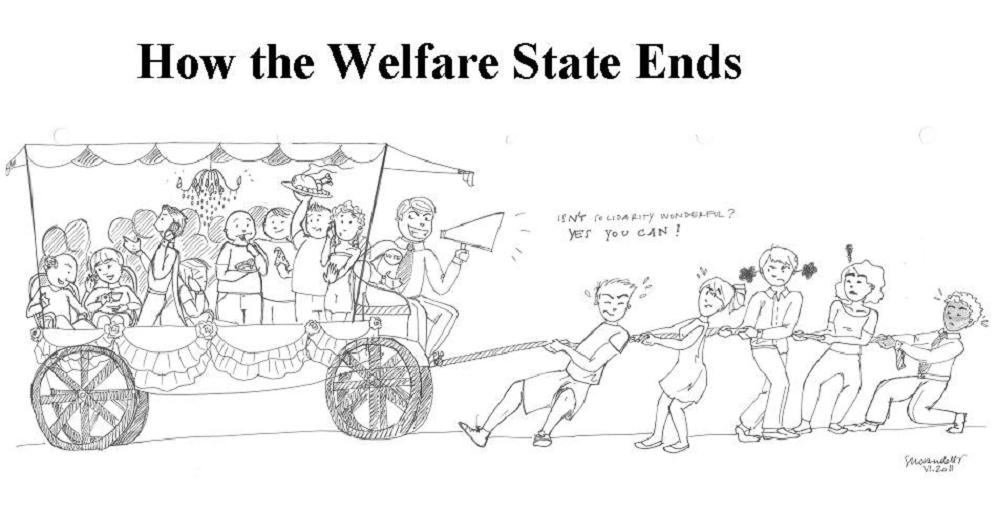
The all-time, most-viewed post on this blog is this set of cartoons showing how the welfare state begins and how it eventually becomes an unsustainable mess.
The great Chuck Asay has a cartoon that takes the next step, showing what happens when the looters and moochers who ride in the wagon get pitted against those who are pulling the wagon.
Since I’m not a Romney fan (for a bunch of reasons outlined here), I would have preferred if the cartoon didn’t imply anything about the current election and instead focused on the rhetorical question of what happens to a society when those living off the government outnumber those who get stuck picking up the tab.
It also would have been more accurate to have the two slave drivers somehow identified as “politicians” and the “IRS.”
But it’s a very clever cartoon, so it’s worth sharing even if I’m nitpicking.
President Obama c/o The White House 1600 Pennsylvania Avenue NW Washington, DC 20500 Dear Mr. President, I know that you receive 20,000 letters a day and that you actually read 10 of them every day. I really do respect you for trying to get a pulse on what is going on out here. Dan Mitchell […]
I have been writing President Obama letters and have not received a personal response yet. (He reads 10 letters a day personally and responds to each of them.) However, I did receive a form letter in the form of an email on July 10, 2012. I don’t know which letter of mine generated this response so I have […]
Welfare reform was working so good. Why did we have to abandon it? Look at this article from 2003. The Continuing Good News About Welfare Reform By Robert Rector and Patrick Fagan, Ph.D. February 6, 2003 Six years ago, President Bill Clinton signed legislation overhauling part of the nation’s welfare system. The Personal Responsibility and […]
Ep. 4 – From Cradle to Grave [3/7]. Milton Friedman’s Free to Choose (1980) President Obama c/o The White House 1600 Pennsylvania Avenue NW Washington, DC 20500 Dear Mr. President, I know that you receive 20,000 letters a day and that you actually read 10 of them every day. I really do respect you for […]
President Obama c/o The White House 1600 Pennsylvania Avenue NW Washington, DC 20500 Dear Mr. President, I know that you receive 20,000 letters a day and that you actually read 10 of them every day. I really do respect you for trying to get a pulse on what is going on out here. With the […]
Eight Reasons Why Big Government Hurts Economic Growth We got to cut these welfare programs before everyone stops working and wants to get the free stuff. The Bible says if you don’t work then you should not eat. It also says that churches should help the poor but it doesn’t say that the government should […]
Stimulating the economy comes from giving the private sector incentive to grow or in other words cutting taxes for job creators and not class warfare. Sadly we have had too many RINOS out there. The Tea Party is the answer for that. The liberal Arkansas Times blog runned by Max Brantley is upset that the Tea Party is making strides, but I hope they keep getting real spending conservatives in the Republican party. That is only hope or we will turn into Greece down the road.
I take the pro-market position in this special report on Fox News.
The discussion focuses on the following questions.
Does government spending create jobs? This is the discredited Keynesian notion that you become richer by switching money from your right pocket to left pocket, and I explain that this approach has never worked.
What does create jobs? I explain we need to shrink the burden of government and I cite my favorite Golden Rule about the importance of making sure the productive sector of the economy grows faster than the public sector.
Should there be more government workers? Anyone who has seen this video knows my answer to that question.
Is it a good idea to raise taxes on the rich? I argue that penalizing success doesn’t make sense, so class warfare tax policy should be rejected.
Would it help to impose higher taxes on corporations? Since the United States already penalizes companies with the world’s highest corporate tax rate, that question answers itself.
Dan Mitchell hits the nail on the head and sometimes it gets so sad that you just have to laugh at it like Conan does. In order to correct this mess we got to get people off of government support and get them in the private market place!!!!
A similar theme can be found in this great new cartoon from Chuck Asay.
And just in case you think Asay is being unfair, keep in mind that folks like Obama and Pelosi actually have claimed that more unemployment benefits is “stimulus.” Yes, you read correctly. Subsidizing unemployment is good for growth to these strange ideologues.
Late-night comedian Conan O’Brien’s blog has a new post parodying Washington’s excessive spending. “Team Coco has found out why our government is so broke,” the blog explains, “They’ve been spending all our hard earned tax dollars on some pretty ridiculous programs.” The post contains a list of humorous fake programs and encourages readers submit their own.
Washington will spend $2.6 million training Chinese prostitutes to drink more responsibly on the job.
Because of overstaffing, the U.S. Postal Service selects 1,125 employees per day to sit in empty rooms. They are not allowed to work, read, play cards, watch television, or do anything. This costs $50 million annually.
Stimulus dollars have been spent on mascot costumes, electric golf carts, and a university study examining how much alcohol college freshmen women require before agreeing to casual sex.
Washington will spend $615,175 on an archive honoring the Grateful Dead.
The Securities and Exchange Commission spent $3.9 million rearranging desks and offices at its Washington, D.C., headquarters.
Congress recently gave Alaska Airlines $500,000 to paint a Chinook salmon on a Boeing 737.
Washington spends $25 billion annually maintaining unused or vacant federal properties.
The Federal Communications Commission spent $350,000 to sponsor NASCAR driver David Gilliland.
Washington has spent $3 billion re-sanding beaches—even as this new sand washes back into the ocean.
Taxpayers are funding paintings of high-ranking government officials at a cost of up to $50,000 apiece.
The Conservation Reserve program pays farmers $2 billion annually not to farm their land.
And the list goes on and on. When it comes to government spending, the truth is often stranger than fiction.
_____________
Thank you so much for your time. I know how valuable it is. I also appreciate the fine family that you have and your commitment as a father and a husband.
Sincerely,
Everette Hatcher III, 13900 Cottontail Lane, Alexander, AR 72002, ph 501-920-5733, lowcostsqueegees@yahoo.com
I have been writing President Obama letters and have not received a personal response yet. (He reads 10 letters a day personally and responds to each of them.) However, I did receive a form letter in the form of an email on July 10, 2012. I don’t know which letter of mine generated this response so I have linked several of the letters I sent to him below with the email that I received. All these letters listed below include articles by Dan Mitchell of the Cato Institute. However, I think it was probably this one below:
The Rahn Curve and the Growth-Maximizing Level of Government
Government spending can promote economic growth if money is used for core “public goods” such as rule of law and property rights. But the burden of government spending in the United States and other industrialized nations is far higher than needed to finance such activities. Citing scholarly studies, this CF&P Foundation video examines the Rahn Curve, which graphically illustrates the negative impact of excessive government spending. www.freedomandprosperity.org
___________
These images are remarkably accurate. The welfare state starts with small programs targeted at a handful of genuinely needy people. But as politicians figure out the electoral benefits of expanding programs and people figure out the that they can let others work on their behalf, the ratio of producers to consumers begins to worsen.
_________
President Obama c/o The White House
1600 Pennsylvania Avenue NW
Washington, DC 20500
When the government gets so big that it distorts the behavior of the private market then it is too big. The federal government is now spending 24.8% of GDP and traditionally for the first 150 years of our nation’s history we spent under 5% unless in wartime. This massive spending now by the federal encourages people to lie in order to get money for the government too instead of trying to work hard to earn money in the private market.
Why is big government bad for an economy? The easy answer is that big government usually means high tax rates, and this penalizes work, saving, investment, and entrepreneurship. And perhaps some of the spending is financed by borrowing, and this diverts money from private investment.
That’s a correct answer, but it’s only part of the story. In most cases, there is added damage because politicians spend money in ways that further undermine incentives to produce.
For instance, let’s assume a government spends $1 billion on some sort of redistribution program. Extracting that money from the productive sector of the economy obviously will cause some damage, but it’s also important to estimate how the supposed beneficiaries of the money will react. What if they decide to earn less income in order to be eligible for the handouts, as even the statists at the OECD have recognized?
In other words, it hurts the economy when government collects money, and it often hurts the economy when government spends money. Sort of a perverse 2-for-1 special (though “Rahn Curve” analysis does show that some types of spending – on core public goods – is correlated with better economic performance)
Let’s look at an example from Greece, showing how handouts distort behavior and corrupt people. Here are some remarkable tidbits from a Wall Street Journal story.
The Greek health ministry is investigating on Zakynthos after local officials flagged records showing what they said is an implausibly high number of disability claims for blindness. About 1.8% of the island’s population of 39,000 claimed the benefit last year, according to the health ministry. That is around nine times the prevalence of blindness estimated for many European countries in a 2004 study published in a World Health Organization journal. Among those who put in for the blindness benefit on Zakynthos, a local official said, were a taxi driver and a bird hunter. …But the island is hardly alone, according to health ministry officials, who say fraudulent disability claims are a problem across the nation… Zakynthos Mayor Stelios Bozikis on a Greek television talk show said residents angry about the benefits crackdown and other financial overhauls pelted him with yogurt at a recent event.
Let’s go back to the story and look at a rough estimate of how much fraud exists.
In an attempt to root out fraud, the Greek health ministry recently required disability claimants nationwide to register in a centralized database, appearing in person or sending a representative. The registration resulted in 36,000 fewer disability claims than in 2011, the health ministry said. The ministry alleges these dropped claims were fraudulent, in many cases reflecting multiple claims for the same disability or payments in the name of dead beneficiaries. It also alleges that some doctors accepted money for false diagnoses and some local politicians signed off on the benefits to win support, and said it is giving public prosecutors information about areas where it suspects a high level of fraud. Only 190 of the nearly 700 people it says had been collecting the blindness benefit on Zakynthos participated in the registration, the ministry said.
I have no idea if Zakynthos is representative, but that’s an incredibly high fraud rate. And this is just a glimpse at the workings of one government program. Now multiply that by some large number and you’ll begin to understand the damage caused by government.
And America is not immune. When politicians make it easier to ride in the wagon than to pull the wagon (as this cartoon illustrates), society sooner or later gets in trouble.
____________
Thank you so much for your time. I know how valuable it is. I also appreciate the fine family that you have and your commitment as a father and a husband.
Sincerely,
Everette Hatcher III, 13900 Cottontail Lane, Alexander, AR 72002, ph 501-920-5733, lowcostsqueegees@yahoo.com
July 10, 2012
Dear Everette:
Thank you for writing. As President, it is my privilege to hear from Americans like you who take time to offer their perspective on the serious issues facing our Nation. I appreciate your message and value your input.
From putting Americans back to work to expanding access to medical care, my Administration continues to take bold action to do what is right for our Nation. We have enacted the most comprehensive financial reforms in decades, rescued and helped retool our auto industry, expanded student aid to millions of young people, helped level the playing field for working women, and made the largest investment in clean energy in our history. Because of the courageous acts of our service members, we have been able to end the war in Iraq and take down Osama bin Laden. We have also made historic commitments to provide for our troops as they return home. Securing our country’s future will take time, but I will not stop working to rebuild the kind of America where everyone gets a fair shot, everyone does their fair share, and everyone plays by the same rules.
I am always eager to hear ideas that will help our country adapt to changing times and lead us toward a brighter day. The enduring American spirit is revealed in the letters I receive, and I remain dedicated to ensuring it is reflected in our efforts to improve the lives of all Americans.
Thank you, again, for sharing your views. I encourage you to explore www.WhiteHouse.gov to learn more about the ways we are moving America forward.
Dan Mitchell on Austerity in Europe 2012 President Obama c/o The White House 1600 Pennsylvania Avenue NW Washington, DC 20500 Dear Mr. President, I know that you receive 20,000 letters a day and that you actually read 10 of them every day. I really do respect you for trying to get a pulse on what […]
I got this off the internet. U.S. Tax revenue: $2,170,000,000,000 Fed budget: $3,820,000,000,000 New debt: $1,650,000,000,000 National debt: $14,271,000,000,000 Recent budget cut: $38,500,000,000 Now, remove 8 zeros and pretend it’s a household budget Annual family income: $21,700 Money the family spent: $38,200 New debt on the credit card: $16,500 Outstanding balance on credit card: $142,710 […]
President Obama c/o The White House 1600 Pennsylvania Avenue NW Washington, DC 20500 Dear Mr. President, I know that you receive 20,000 letters a day and that you actually read 10 of them every day. I really do respect you for trying to get a pulse on what is going on out here. If our […]
The Rahn Curve and the Growth-Maximizing Level of Government Uploaded by afq2007 on Jun 29, 2010 Government spending can promote economic growth if money is used for core “public goods” such as rule of law and property rights. But the burden of government spending in the United States and other industrialized nations is far higher […]
Government Spending Doesn’t Create Jobs Uploaded by catoinstitutevideo on Sep 7, 2011 Share this on Facebook: http://on.fb.me/qnjkn9 Tweet it: http://tiny.cc/o9v9t In the debate of job creation and how best to pursue it as a policy goal, one point is forgotten: Government doesn’t create jobs. Government only diverts resources from one use to another, which doesn’t […]
The Economic Case for Tax Havens Uploaded by afq2007 on Sep 10, 2008 Statist politicians and international bureaucracies such as the OECD and UN routinely attack tax havens, claiming that they lead to “harmful tax competition.” Yet at no point do critics bother to provide any evidence for this claim. This mini-documentary from the Center […]
Sweden produced ABBA in the 1970′s, but now they are producing some pretty good economic policies. One of my favorite groups growing up was ABBA. Here are some of my favorite songs: _______________ President Obama c/o The White House 1600 Pennsylvania Avenue NW Washington, DC 20500 Dear Mr. President, I know that you receive 20,000 letters a […]
President Obama c/o The White House 1600 Pennsylvania Avenue NW Washington, DC 20500 Dear Mr. President, I know that you receive 20,000 letters a day and that you actually read 10 of them every day. I really do respect you for trying to get a pulse on what is going on out here. You want […]
B-b-b-but it’s his fault … he started it”…..a must read
TheWashington Post babbled again todayabout Obama inheriting a huge deficit from Bush. Amazingly enough, a lot of people swallow this nonsense. So once more,a short civics lesson.
Budgets do not come from the White House. They come from Congress and the party that controlled Congress since January 2007 is the Democratic Party.
Furthermore, the Democrats controlled the budget process for FY 2008 and FY 2009 as well as FY 2010 and FY 2011.
In that first year, they had to contend with George Bush, which caused them to compromise on spending, when Bush somewhat belatedly got tough on spending increases.
For FY 2009 though, Nancy Pelosi and Harry Reid bypassed George Bush entirely, passing continuing resolutions to keep government running until Barack Obama could take office. At that time, they passed a massive omnibus spending bill to complete the FY 2009 budgets.
And where was Barack Obama during this time? He was a member of that very Congress that passed all of these massive spending bills, and he signed the omnibus bill as President to complete FY 2009. Let’s remember what the deficits looked like during that period: (below)
If the Democrats inherited any deficit, it was the FY 2007 deficit, the last of the Republican budgets. That deficit was the lowest in five years, and the fourth straight decline in deficit spending. After that, Democrats in Congress took control of spending, and that includes Barack Obama, who voted for the budgets.
If Obama inherited anything, he inherited it from himself.
In a nutshell,what Obama is saying is I inherited a deficit that I voted for and then I voted to expand that deficit four-fold since January 20th.
In the debate of job creation and how best to pursue it as a policy goal, one point is forgotten: Government doesn’t create jobs. Government only diverts resources from one use to another, which doesn’t create new employment.
Video produced by Caleb Brown and Austin Bragg.
___________________________
Keynesian Catastrophe: Big Money, Big Government & Big Lies
Based on a theory known as Keynesianism, politicians are resuscitating the notion that more government spending can stimulate an economy. This mini-documentary produced by the Center for Freedom and Prosperity Foundation examines both theory and evidence and finds that allowing politicians to spend more money is not a recipe for better economic performance.
___________________
Obama’s So-Called Stimulus: Good For Government, Bad For the Economy
President Obama wants Congress to dramatically expand the burden of government spending. This CF&P Foundation mini-documentary explains why such a policy, based on the discredited Keynesian theory of economics, will not be successful. Indeed, the video demonstrates that Obama is proposing – for all intents and purposes – to repeat Bush’s mistakes. Government will be bigger, even though global evidence shows that nations with small governments are more prosperous.
____________
Big Government Is Not Stimulus: Why Keynes Was Wrong (The Condensed Version)
The CF&P Foundation has released a condensed version of our successful mini-documentary explaining why so-called stimulus schemes do not work. Based on a theory known as Keynesianism, politicians are resuscitating the notion that more government spending can stimulate an economy. This mini-documentary produced by the Center for Freedom and Prosperity Foundation examines both theory and evidence and finds that allowing politicians to spend more money is not a recipe for better economic performance.
_________________
Eight Reasons Why Big Government Hurts Economic Growth
This Center for Freedom and Prosperity Foundation video analyzes how excessive government spending undermines economic performance. While acknowledging that a very modest level of government spending on things such as “public goods” can facilitate growth, the video outlines eight different ways that that big government hinders prosperity. This video focuses on theory and will be augmented by a second video looking at the empirical evidence favoring smaller government.
___________________
Keynesian Economics Is Wrong: Economic Growth Causes Consumer Spending, Not the Other Way
Politicians and journalists who fixate on consumer spending are putting the cart before the horse. Consumer spending generally is a consequence of growth, not the cause of growth. This Center for Freedom and Prosperity video helps explain how to achieve more prosperity by looking at the differences between gross domestic product and gross domestic income. www.freedomandprosperity.org
_____________
Deficits, Debts and Unfunded Liabilities: The Consequences of Excessive Government Spending
Huge budget deficits and record levels of national debt are getting a lot of attention, but this video explains that unfunded liabilities for entitlement programs are Americas real red-ink challenge. More important, this CF&P mini-documentary reveals that deficits and debt are symptoms of the real problem of an excessive burden of government spending. www.freedomandprosperity.org
___________
Now that I have been critical of the Democrat President, I wanted to show that I am not concerned about taking up for Republicans but looking at the facts. President Clinton did increase government spending at a slower rate than many other presidents. Here are two videos that praise both Reagan and Clinton for both accomplished this feat.
Spending Restraint, Part I: Lessons from Ronald Reagan and Bill Clinton
Ronald Reagan and Bill Clinton both reduced the relative burden of government, largely because they were able to restrain the growth of domestic spending. The mini-documentary from the Center for Freedom and Prosperity uses data from the Historical Tables of the Budget to show how Reagan and Clinton succeeded and compares their record to the fiscal profligacy of the Bush-Obama years.
______________
Spending Restraint, Part II: Lessons from Canada, Ireland, Slovakia, and New Zealand
Nations can make remarkable fiscal progress if policy makers simply limit the growth of government spending. This video, which is Part II of a series, uses examples from recent history in Canada, Ireland, Slovakia, and New Zealand to demonstrate how it is possible to achieve rapid improvements in fiscal policy by restraining the burden of government spending. Part I of the series examined how Ronald Reagan and Bill Clinton were successful in controlling government outlays — particularly the burden of domestic spending programs. www.freedomandprosperity.org
Lawmakers are considering extending temporary payroll tax cuts. But the policy is based on faulty Keynesian theories and misplaced confidence in the government’s ability to micromanage short-run growth.
In textbook Keynesian terms, federal deficits stimulate growth by goosing “aggregate demand,” or consumer spending. Since the recession began, we’ve had a lot of goosing — deficits were $459 billion in 2008, $1.4 trillion in 2009, $1.3 trillion in 2010, and $1.3 trillion in 2011. Despite that huge supposed stimulus, unemployment remains remarkably high and the recovery has been the slowest since World War II.
Policymakers should ignore the Keynesians and their faulty models, and instead focus on reforms to aid long-run growth…
Yet supporters of extending payroll tax cuts think that adding another $265 billion to the deficit next year will somehow spur growth. That “stimulus” would be on top of the $1 trillion in deficit spending that is already expected in 2012. Far from helping the economy, all this deficit spending is destabilizing financial markets, scaring businesses away from investing, and imposing crushing debt burdens on young people.
For three years, policymakers have tried to manipulate short-run economic growth, and they have failed. They have put too much trust in macroeconomists, who are frankly lousy at modeling the complex workings of the short-run economy. In early 2008, the Congressional Budget Office projected that economic growth would strengthen in subsequent years, and thus completely missed the deep recession that had already begun. And then there was the infamously bad projection by Obama’s macroeconomists that unemployment would peak at 8 percent and then fall steadily if the 2009 stimulus plan was passed.
Some of the same Keynesian macroeconomists who got it wrong on the recession and stimulus are now claiming that a temporary payroll tax break would boost growth. But as Stanford University economist John Taylor has argued, the supposed benefits of government stimulus have been “built in” or predetermined by the underlying assumptions of the Keynesian models.
Policymakers should ignore the Keynesians and their faulty models, and instead focus on reforms to aid long-run growth, which economists know a lot more about. Cutting the corporate tax rate, for example, is an overdue reform with bipartisan support that would enhance America’s long-run productivity and competitiveness.
If Congress is intent on cutting payroll taxes, it should do so within the context of long-run fiscal reforms. One idea is to allow workers to steer a portion of their payroll taxes into personal retirement accounts, as Chile and other nations have done. That reform would feel like a tax cut to workers because they would retain ownership of the funds, and it would begin solving the long-term budget crisis that looms over the economy.
Dan Mitchell discusses the effectiveness of the stimulus Uploaded by catoinstitutevideo on Nov 3, 2009 11-2-09 When I think of all our hard earned money that has been wasted on stimulus programs it makes me sad. It has never worked and will not in the future too. Take a look at a few thoughts from […]
Government Spending Doesn’t Create Jobs Uploaded by catoinstitutevideo on Sep 7, 2011 Share this on Facebook: http://on.fb.me/qnjkn9 Tweet it: http://tiny.cc/o9v9t In the debate of job creation and how best to pursue it as a policy goal, one point is forgotten: Government doesn’t create jobs. Government only diverts resources from one use to another, which doesn’t […]
In his recent article Ernie Dumas sticks to his guns that we should balance the budget without being forced to with a “Balanced Budget Amendment,” but I wonder how well that has worked so far? I have made this a key issue for this blog in the past as you can tell below: Dear Senator […]
(Picture from Arkansas Times Blog) When I think about all the anger and hate coming from the Occupy Wall Street crowd, I wonder if they have read this story below? Solyndra: Crooked Politics or Just Bad Economics? Posted by David Boaz Amy Harder has a good take on the Solyndra issue in National Journal Daily […]
Dear Senator Pryor, why not pass the Balanced Budget Amendment? (Part 13 Thirsty Thursday, Open letter to Senator Pryor) Office of the Majority Whip | Balanced Budget Amendment Video In 1995, Congress nearly passed a constitutional amendment mandating a balanced budget. The Balanced Budget Amendment would have forced the federal government to live within its […]
Andrew Demillo pointed this out and also Jason Tolbert noted: PRYOR OPPOSES THE OBAMA JOBS BILL THAT HE VOTED TO ADVANCE Sen. Mark Pryor has been traveling around the state touting a six-part jobs plan that he says “includes a number of bipartisan initiatives, is aimed at creating jobs by setting the table for growth, encouraging new […]
Is a lack of money the problem for our public schools? Everything You Need to Know About Public School Spending in Less Than 2½ Minutes Posted by Adam Schaeffer Neal McCluskey gutted the President’s new “Save the Teachers” American Jobs Act sales pitch a good while back, as did Andrew Coulson here. Thankfully, it seems […]
I have been writing President Obama letters and have not received a personal response yet. (He reads 10 letters a day personally and responds to each of them.) However, I did receive a form letter in the form of an email on July 16, 2012. I don’t know which letter of mine generated this response so I have linked several […]
I have been writing President Obama letters and have not received a personal response yet. (He reads 10 letters a day personally and responds to each of them.) However, I did receive a form letter in the form of an email on July 18, 2012. I don’t know which letter of mine generated this response so I have […]
I have been writing President Obama letters and have not received a personal response yet. (He reads 10 letters a day personally and responds to each of them.) However, I did receive a form letter in the form of an email on June 22, 2012. I don’t know which letter of mine generated this response so I have […]
I have been writing President Obama letters and have not received a personal response yet. (He reads 10 letters a day personally and responds to each of them.) However, I did receive a form letter in the form of an email July 6, 2012. I don’t know which letter of mine generated this response, but if I had […]
I have been writing President Obama letters and have not received a personal response yet. (He reads 10 letters a day personally and responds to each of them.) However, I did receive a form letter in the form of an email on June 22, 2012. I don’t know which letter of mine generated this response so I have […]
I have been writing President Obama letters and have not received a personal response yet. (He reads 10 letters a day personally and responds to each of them.) However, I did receive a form letter in the form of an email on June 15, 2012. I don’t know which letter of mine generated this response so I have […]
I have been writing President Obama letters and have not received a personal response yet. (He reads 10 letters a day personally and responds to each of them.) However, I did receive a form letter in the form of an email on May 23, 2012. I don’t know which letter of mine generated this response so I have […]
I have been writing President Obama letters and have not received a personal response yet. (He reads 10 letters a day personally and responds to each of them.) However, I did receive a form letter in the form of an email on May 9, 2012. I don’t know which letter of mine generated this response so I have […]
I have been writing President Obama letters and have not received a personal response yet. (He reads 10 letters a day personally and responds to each of them.) However, I did receive a form letter in the form of an email on April 16, 2011. First you will see my letter to him which was mailed around April 9th. […]
I have been writing President Obama letters and have not received a personal response yet. (He reads 10 letters a day personally and responds to each of them.) However, I did receive a form letter in the form of an email on April 3, 2011. I don’t know which letter of mine generated this response so I have linked […]
I have been writing President Obama letters and have not received a personal response yet. (He reads 10 letters a day personally and responds to each of them.) However, I did receive a form letter in the form of an email on March 7, 2011. I don’t know which letter of mine generated this response so I have […]
I have been writing President Obama letters and have not received a personal response yet. (He reads 10 letters a day personally and responds to each of them.) However, I did receive a form letter in the form of an email on January 27, 2011. I don’t know which letter of mine generated this response so I have […]
I have been writing President Obama letters and have not received a personal response yet. (He reads 10 letters a day personally and responds to each of them.) However, I did receive a form letter in the form of an email on January 25, 2011. I don’t know which letter of mine generated this response so I have […]
Science Matters #2: Former supermodel Kathy Ireland tells Mike Huckabee about how she became pro-life after reading what the science books have to say.
Below is a portion of a letter I sent to President Obama that generated a response on May 23, 2012.








 The Daily Hatch