Category Archives: Cato Institute

The Atlantic’s Jeffrey Goldberg abandons his liberal friends on gun control.

Pretty shocking admissions from the liberal Jeffrey Goldberg on gun control.

An Honest Liberal Writes about Gun Control

December 16, 2012 by Dan Mitchell

I wrote earlier this month about an honest liberal who acknowledged the problems created by government dependency. Well, it happened again.

First, some background.

Like every other decent person, I was horrified and nauseated by the school shootings in Newton, Connecticut.

Part of me wishes the guy hadn’t killed himself so that he could be slowly fed into a meat grinder.

And my friends on the left will be happy to know that part of me, when I first learned about the murders, thought the world might be a better place if guns had never been invented.

Sort of like my gut reaction about cigarettes when I find out that somebody I know is dying of a smoking-related illness or how I feel about gambling when I read about a family being ruined because some jerk thought it would be a good idea to use the mortgage money at a casino.
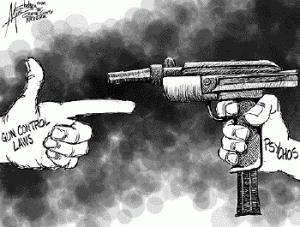
But there’s a reason why it’s generally not a good idea to make impulsive decisions based on immediate reactions. In the case of gun control, it can lead to policies that don’t work. Or perhaps even make a bad situation worse.

I’ve certainly made these points when writing and pontificating about gun control. But I’m a libertarian, so that’s hardly a surprise. We’re people who instinctively are skeptical of giving government power over individuals.

But when someone on the left reaches the same conclusion, that’s perhaps more significant. Especially when you get the feeling that they would like ban private gun ownership in their version of a perfect world.

That’s why I heartily recommend Jeffrey Goldberg’s article in The Atlantic.

Here are some of the most profound passages in the article, beginning with a common-sense observation that there’s no way for the government to end private gun ownership.

According to a 2011 Gallup poll, 47 percent of American adults keep at least one gun at home or on their property, and many of these gun owners are absolutists opposed to any government regulation of firearms. According to the same poll, only 26 percent of Americans support a ban on handguns. …There are ways, of course, to make it at least marginally more difficult for the criminally minded, for the dangerously mentally ill, and for the suicidal to buy guns and ammunition. …But these gun-control efforts, while noble, would only have a modest impact on the rate of gun violence in America. Why? Because it’s too late. There are an estimated 280 million to 300 million guns in private hands in America—many legally owned, many not. Each year, more than 4 million new guns enter the market. …America’s level of gun ownership means that even if the Supreme Court—which ruled in 2008 that the Second Amendment gives citizens the individual right to own firearms, as gun advocates have long insisted—suddenly reversed itself and ruled that the individual ownership of handguns was illegal, there would be no practical way for a democratic country to locate and seize those guns.

Which is why prohibition was a flop. Which is why the current War on Drugs is so misguided. And so on and so on.

The author then wonders whether the best way of protecting public safety is to have more gun ownership.

Which raises a question: When even anti-gun activists believe that the debate over private gun ownership is closed; when it is too late to reduce the number of guns in private hands—and since only the naive think that legislation will prevent more than a modest number of the criminally minded, and the mentally deranged, from acquiring a gun in a country absolutely inundated with weapons—could it be that an effective way to combat guns is with more guns? Today, more than 8 million vetted and (depending on the state) trained law-abiding citizens possess state-issued “concealed carry” handgun permits, which allow them to carry a concealed handgun or other weapon in public. Anti-gun activists believe the expansion of concealed-carry permits represents a serious threat to public order. But what if, in fact, the reverse is true? Mightn’t allowing more law-abiding private citizens to carry concealed weapons—when combined with other forms of stringent gun regulation—actually reduce gun violence?

He cites examples where armed citizens stopped mass killings.

In 1997, a disturbed high-school student named Luke Woodham stabbed his mother and then shot and killed two people at Pearl High School in Pearl, Mississippi. He then began driving toward a nearby junior high to continue his shooting spree, but the assistant principal of the high school, Joel Myrick, aimed a pistol he kept in his truck at Woodham, causing him to veer off the road. Myrick then put his pistol to Woodham’s neck and disarmed him. On January 16, 2002, a disgruntled former student at the Appalachian School of Law in Grundy, Virginia, had killed three people, including the school’s dean, when two students, both off-duty law-enforcement officers, retrieved their weapons and pointed them at the shooter, who ended his killing spree and surrendered. In December 2007, a man armed with a semiautomatic rifle and two pistols entered the New Life Church in Colorado Springs and killed two teenage girls before a church member, Jeanne Assam—a former Minneapolis police officer and a volunteer church security guard—shot and wounded the gunman, who then killed himself.

The author also punctures the left’s mythology about concealed carry laws.

In 2003, John Gilchrist, the legislative counsel for the Ohio Association of Chiefs of Police, testified, “If 200,000 to 300,000 citizens begin carrying a concealed weapon, common sense tells us that accidents will become a daily event.” When I called Gilchrist recently, he told me that events since the state’s concealed-carry law took effect have proved his point. …Gilchrist’s argument would be convincing but for one thing: the firearm crime rate in Ohio remained steady after the concealed-carry law passed in 2004.

Goldberg elaborates.

Today, the number of concealed-carry permits is the highest it’s ever been, at 8 million, and the homicide rate is the lowest it’s been in four decades—less than half what it was 20 years ago. (The number of people allowed to carry concealed weapons is actually considerably higher than 8 million, because residents of Vermont, Wyoming, Arizona, Alaska, and parts of Montana do not need government permission to carry their personal firearms. These states have what Second Amendment absolutists refer to as “constitutional carry,” meaning, in essence, that the Second Amendment is their permit.) Many gun-rights advocates see a link between an increasingly armed public and a decreasing crime rate. “I think effective law enforcement has had the biggest impact on crime rates, but I think concealed carry has something to do with it. We’ve seen an explosion in the number of people licensed to carry,” Lott told me. “You can deter criminality through longer sentencing, and you deter criminality by making it riskier for people to commit crimes. And one way to make it riskier is to create the impression among the criminal population that the law-abiding citizen they want to target may have a gun.” Crime statistics in Britain, where guns are much scarcer, bear this out. Gary Kleck, a criminologist at Florida State University, wrote in his 1991 book, Point Blank: Guns and Violence in America, that only 13 percent of burglaries in America occur when the occupant is home. In Britain, so-called hot burglaries account for about 45 percent of all break-ins. Kleck and others attribute America’s low rate of occupied-home burglaries to fear among criminals that homeowners might be armed. (A survey of almost 2,000 convicted U.S. felons, conducted by the criminologists Peter Rossi and James D. Wright in the late ’80s, concluded that burglars are more afraid of armed homeowners than they are of arrest by the police.)

That last bit of info is very powerful. The bad guys are more afraid of armed homeowners than the police. Surely, as I explained here, that tells us that gun ownership lowers crime.

Here’s another no-sh*t-Sherlock observation from the article.

It is also illogical for campuses to advertise themselves as “gun-free.” Someone bent on murder is not usually dissuaded by posted anti-gun regulations. Quite the opposite—publicly describing your property as gun-free is analogous to posting a notice on your front door saying your home has no burglar alarm. As it happens, the company that owns the Century 16 Cineplex in Aurora had declared the property a gun-free zone.

I recently mocked the idea of gun-free zones with several amusing posters. It’s unbelievable that some people think that killers care about such rules.

One place that isn’t likely to see any massacres is Colorado State University.

For much of the population of a typical campus, concealed-carry permitting is not an issue. Most states that issue permits will grant them only to people who are at least 21 years old. But the crime-rate statistics at universities that do allow permit holders on campus with their weapons are instructive. An hour north of Boulder, in Fort Collins, sits Colorado State University. Concealed carry has been allowed at CSU since 2003, and according to James Alderden, the former sheriff of Larimer County, which encompasses Fort Collins, violent crime at Colorado State has dropped since then.

I also recommend this video, which makes fun of those who support gun-free zones.

Here is Goldberg’s conclusion.

But I am sympathetic to the idea of armed self-defense, because it does often work, because encouraging learned helplessness is morally corrupt, and because, however much I might wish it, the United States is not going to become Canada. Guns are with us, whether we like it or not. Maybe this is tragic, but it is also reality. So Americans who are qualified to possess firearms shouldn’t be denied the right to participate in their own defense. And it is empirically true that the great majority of America’s tens of millions of law-abiding gun owners have not created chaos in society.

Goldberg’s article, by the way, doesn’t even mention the value of private gun ownership when government fails to maintain public order, as occurred after Hurricane Sandy and during last year’s British riots.

I have a couple of final things to share, including this this video about a woman who lost her parents because she decided to obey a bad government law. And here’s a great study from Cato about individuals using guns to protect themselves.


Didn’t the Fiscal Cliff Deal Originate in the Senate?

Ignoring the constitution has happened a lot recently.

January 10, 2013 6:04PM

Wait, Didn’t the Fiscal Cliff Deal Originate in the Senate?

If you thought the policy side of the “American Taxpayer Relief Act of 2012” is bad, did you notice that there’s a constitutional problem too? I’m sure there’s more than one, actually, but this one was easy to spot without even digging into the gory details.

Recall that the fiscal cliff bill was first passed by the Senate in the wee hours of New Year’s Day, and then seconded by a vote of the House some 20 hours later. And yet, Article I, Section 7, Clause 1—known as the Origination Clause—states: “All Bills for raising Revenue shall originate in the House of Representatives; but the Senate may propose or concur with Amendments as on other Bills.” 

Far from being “archaic, idiosyncratic and downright evil”—as Georgetown law professor Mike Seidman claimed as part of his argument for throwing out the Constitution altogether—this provision serves, or at least is supposed to serve, the very real and timeless purpose of keeping the taxing power as close to the voters as possible. Mindful of the potential for abuses of this awesome power (see, e.g., John Roberts on Obamacare) the Constitution’s authors chose to give it to the congressional body that is elected every two years directly by people in local districts (the House), instead of the one whose members serve alternating six-year terms and weren’t initially directly elected (the Senate). As Cato adjunct scholar Tim Sandefur explains in a forthcoming law review article (footnotes/citations omitted):

When the Anti-Federalist “Brutus” warned that the taxing power, “exercised without limitation,” will “introduce itself into every corner of the city, and country” and “light upon the head of every person in the United States” crying “GIVE! GIVE!” the Constitution’s supporters answered that this risk was minimized by the political checks over the taxing power. “The exclusive privilege of originating money bills [belongs] to the house of representatives,” wrote Alexander Hamilton.  This would ensure that the power to tax belonged to “the most popular branch” of the government, “the favorite of the people.” James Madison reiterated this point: the “principal reason” why the House was given the power “of originating money bills” was that the Representatives “were chosen by the people, and supposed to be the best acquainted with their interest and ability.” Perhaps the point was put best by George Mason, who considered the Senate “[a]n aristocratic body” which “should ever be suspected of an encroaching tendency,” and believed that “[t]he purse strings should never be put into its hands.”

So what happened last week? Did Harry Reid, John Boehner, and Barack Obama simply agree to ignore the Constitution? (Specifically here, I mean—we know they do generally where federal power is concerned.) Were the House and Senate parliamentarians overruled by a naked political deal?

No, actually what happened is an end-run around the Origination Clause that alas happens with some regularity (and at the hands of both parties):  some other revenue bill that passed the House but hasn’t been acted on by the Senate (deliberately or not) gets “amended” by a complete removal and replacement of its entire contents, including the title. This is, of course, what happened with Obamacare, as Sandefur again explains:

On November 19, 2009, Senator Harry Reid submitted an “amendment” to a bill that the House had passed the previous month, H.B. 3590. That bill, the “Service Members Home Ownership Act of 2009,” provided incentives for veterans to buy houses. Reid’s amendment struck out the entire text of H.B. 3590, and replaced it with what became the PPACA—including the Individual Mandate and 17 other separate revenue-raising provisions, estimated to increase federal revenue by $486 billion by 2019. Although this “strike and replace” procedure—sometimes called “gut and amend”—is not uncommon, the Court has never determined whether Congress can use the trick to get around the Origination Clause’s mandate.

(The reason Tim knows so much about this seemingly obscure – if important – clause is that he’s the lead attorney on Pacific Legal Foundation’s case, Sissel v. U.S. Dept. of Health & Human Services, that challenges Obamacare’s individual mandate in its metamorphosis into a tax.)

And so too with the “American Taxpayer Relief Act of 2012,” which was a true tax-relief bill of the same name that House Republicans (and 19 Democrats) passed on August 1, 2012. That bill was naturally DOA in Harry Reid’s Senate, but it did become a useful shell for last week’s shenanigans.

So there you have it: What’s a little Constitution between friends?

Oh, and a langiappe about our favorite new law: given that it was passed on January 1—but alas has not gone away with that day’s hangovers —even the year in the title is wrong. To be fair, however, it was both American and an act of Congress.

Portugal and the Laffer Curve

Class Warfare just don’t pay it seems. Why can’t we learn from other countries’ mistakes?

Back in mid-2010, I wrote that Portugal was going to exacerbate its fiscal problems by raising taxes.

Needless to say, I was right. Not that this required any special insight. After all, no nation has ever taxed its way to prosperity.

We’re now at the end of 2012 and Portugal is still saddled with a weak economy. And the higher taxes haven’t resulted in less red ink. Indeed, according to the Economist Intelligence Unit, government debt has jumped from 93 percent of GDP in 2010 to 124 percent of GDP this year.

Why did higher taxes backfire in Portugal? For the same reasons that higher taxes have failed in Greece, Spain, Bulgaria, France, Italy, the United Kingdom, and so many other nations.

  • Higher taxes undermine incentives for productive behavior, thus reducing an economy’s potential for growth. This means less economic output, which also means a smaller tax base. This Laffer Curve effect doesn’t necessarily mean less revenue, but it certainly means that tax increases rarely raise as much money as initially projected.
  • Higher taxes usually are a substitute for the real solution of spending restraint (i.e., Mitchell’s Golden Rule). Politicians oftentimes refuse to reduce the burden of government spending because of an expectation of additional tax revenue. Heck, in many cases, higher taxes trigger an increase in the size and scope of the public sector.

So did Portugal learn any lessons from this failed experiment in Obamanomics?

Hardly. Indeed, the government plans to double down on this approach – even though it’s increasingly apparent that higher tax burdens won’t translate into much – if any – additional tax revenue. Here are some excerpts from a report in the Financial Times.

Lisbon plans to lift income tax revenue by more than 30 per cent, raising the effective average rate by more than a third from 9.8 to 13.2 per cent. Anyone receiving more than the minimum wage of €485 a month, including pensioners, will also pay an extraordinary tax of 3.5 per cent on their income. …the steep tax increases facing many families have made the outlook for 2013 – the third consecutive year of austerity, recession and rising unemployment – the grimmest yet. Total tax revenue has fallen considerably below target this year, forcing the government to implement additional austerity measures… The coalition will be relying on increased state revenue to account for about 80 per cent of the fiscal adjustment required in 2013 – a reversal of the original bailout plan, in which consolidation was to be achieved mainly through spending cuts.

Amazing. The government imposes huge tax hikes, which don’t generate any positive results. Yet even though “tax revenue has fallen considerably below target,” confirming that there are significant Laffer Curve issues, the government chooses to repeat the snake-oil fiscal therapy of higher taxes.

Anybody want to guess what’s going to happen? The answer, of course, is that this will further dampen incentives to generate income and comply with the government’s fiscal demands.

The latest increases have stretched the tax system to the limit, says Carlos Loureiro, a tax partner at Deloitte. “The current model is exhausted. We need to do something different,” he says. “Any further increase in tax rates is unlikely to result in increased revenue.” Income from value added tax, the government’s biggest source of tax revenue representing about 36 per cent of the total, has been falling since 2008, despite a sharp increase in the rate – the main rate is now 23 per cent. Both the government and the European Commission have acknowledged the risks of depending on increased tax revenue, which is more growth sensitive, to meet fiscal targets and contingency spending cuts amounting to 0.5 per cent of national output have prepared in case of another tax shortfall.

I almost want to laugh at the part of the excerpt which notes that tax revenue “has been falling…despite a sharp increase in the rate.”

Maybe it’s time for these fiscal pyromaniacs to realize that revenues might be falling because rates are higher. In other words, Portugal not only isn’t at the ideal point on the Laffer Curve (collecting the amount of revenue needed to finance legitimate activities of government), it may even be past the revenue-maximizing part of the curve.

To be fair, there are lots of factors that determine economic performance, so higher tax burdens are just one possible explanation for why the tax base is shrinking or stagnant.

The one thing we can state with certainty, though, is that Portugal’s fiscal problem is too much government spending. The failure to address this problem then leads to very unpleasant symptoms, such as lots of red ink and self-destructive class-warfare tax policy.

If all that sounds familiar, that’s because it’s also a description of what President Obama is proposing for the United States.

Ummm…shouldn’t they be targeting politicians?

P.S. I don’t want to imply that Portugal is a total basket case. True, I’m not optimistic about the country’s future, but at least some lawmakers now acknowledge that Keynesian spending was a big mistake. And there are even signs that Portuguese officials are beginning to realize that lower tax rates should be part of the solution. But good policy may be impossible since so many people now have a moocher mentality.

P.P.S. At the risk of bearing bad news to close the year, research from both the Bank for International Settlements and the Organization for Economic Cooperation and Development shows the United States actually faces a bigger long-run fiscal challenge than Portugal.

The Laffer Curve – Explained

Uploaded by on Nov 14, 2011

This video explains the relationship between tax rates, taxable income, and tax revenue. The key lesson is that the Laffer Curve is not an all-or-nothing proposition, where we have to choose between the exaggerated claim that “all tax cuts pay for themselves” and the equally silly assumption that tax policy doesn’t effect the economy and there is never any revenue feedback. From http://www.freedomandprosperity.org 202-285-0244

__________________________________


Open letter to President Obama (Part 217)

President Bush with Milton Friedman.
 

President Obama c/o The White House
1600 Pennsylvania Avenue NW
Washington, DC 20500

Dear Mr. President,

I know that you receive 20,000 letters a day and that you actually read 10 of them every day. I really do respect you for trying to get a pulse on what is going on out here.

The best way to destroy the welfare trap is to put in Milton Friedman’s negative income tax. It seems to me that you would really want to destroy this welfare trap the most because you worked for a long time with the poor inner city kids in Chicago. Doesn’t it bother you that they are caught in this welfare trap? Below is an excellent article by Dan Mitchell of the Cato Institute.

A Picture of How Redistribution Programs Trap the Less Fortunate in Lives of Dependency

I wrote last year about the way in which welfare programs lead to very high implicit marginal tax rates on low-income people. More specifically, they lose handouts when they earn income. As such, it is not very advantageous for them to climb the economic ladder because hard work is comparatively unrewarding.

Thanks to the American Enterprise Institute, we now have a much more detailed picture showing the impact of redistribution programs on the incentive to earn more money.

It’s not a perfect analogy since people presumably prefer cash to in-kind handouts, but the vertical bars basically represent living standards for any given level of income that is earned (on the horizontal axis).

Needless to say, there’s not much reason to earn more income when living standards don’t improve. May as well stay home and good off rather than work hard and produce.

This is why income redistribution is so destructive, not just to taxpayers, but also to the people who get trapped into dependency. Which is exactly the point made in this video.

P.S. Most of you know that I’m not a fan of the Organization for Economic Cooperation and Development because the Paris-based bureaucracy has such statist impulses. But even the OECD has written about the negative impact of overly generous welfare programs on incentives for productive behavior.

__________

Thank you so much for your time. I know how valuable it is. I also appreciate the fine family that you have and your commitment as a father and a husband.

Sincerely,

Everette Hatcher III, 13900 Cottontail Lane, Alexander, AR 72002, ph 501-920-5733, lowcostsqueegees@yahoo.com

Related posts:

Open letter to President Obama (Part 201)Tea Party favorite Representative links article “Prescott and Ohanian: Taxes Are Much Higher Than You Think”

    (Emailed to White House on 12-21-12.) President Obama c/o The White House 1600 Pennsylvania Avenue NW Washington, DC 20500 Dear Mr. President, I know that you receive 20,000 letters a day and that you actually read 10 of them every day. I really do respect you for trying to get a pulse on […]

Open letter to President Obama (Part 200.2)Tea Party Republican Representative takes on the President concerning fiscal cliff

(Emailed to White House on 12-21-12.) President Obama c/o The White House 1600 Pennsylvania Avenue NW Washington, DC 20500 Dear Mr. President, I know that you receive 20,000 letters a day and that you actually read 10 of them every day. I really do respect you for trying to get a pulse on what is […]

Open letter to President Obama (Part 200.1)Tea Party favorite Representative shares link on facebook

 (Emailed to White House on 12-21-12) President Obama c/o The White House 1600 Pennsylvania Avenue NW Washington, DC 20500 Dear Mr. President, I know that you receive 20,000 letters a day and that you actually read 10 of them every day. I really do respect you for trying to get a pulse on what is […]

Open letter to President Obama (Part 199) Tea Party favorite takes on President

  The federal government has a spending problem and Milton Friedman came up with the negative income tax to help poor people get out of the welfare trap. It seems that the government screws up about everything. Then why is President Obama wanting more taxes? _______________ Milton Friedman – The Negative Income Tax Published on […]

Tea Party Heroes Rep. David Schweikert (R-AZ),Justin Amash (R-MI), Tim Huelskamp (R-KS) have been punished by Boehner

I was sad to read that the Speaker John Boehner has been involved in punishing tea  party republicans. Actually I have written letters to several of these same tea party heroes telling them that I have emailed Boehner encouraging him to listen to them. Rep. David Schweikert (R-AZ),Justin Amash (R-MI), and Tim Huelskamp (R-KS). have been contacted […]

Some Tea Party heroes (Part 10)

Michael Tanner of the Cato Institute in his article, “Hitting the Ceiling,” National Review Online, March 7, 2012 noted: After all, despite all the sturm und drang about spending cuts as part of last year’s debt-ceiling deal, federal spending not only increased from 2011 to 2012, it rose faster than inflation and population growth combined. […]


Open letter to President Obama (Part 117B)

Milton Friedman’s Free to Choose – Ep.4 (1/7) – From Cradle to Grave   President Obama c/o The White House 1600 Pennsylvania Avenue NW Washington, DC 20500 Dear Mr. President, I know that you receive 20,000 letters a day and that you actually read 10 of them every day. I really do respect you for […]

Milton Friedman remembered at 100 years from his birth (Part 5)

Testing Milton Friedman – Preview Uploaded by FreeToChooseNetwork on Feb 21, 2012 2012 is the 100th anniversary of Milton Friedman’s birth. His work and ideas continue to make the world a better place. As part of Milton Friedman’s Century, a revival of the ideas featured in the landmark television series Free To Choose are being […]

40% of USA on government dole, need to eliminate welfare and put in Friedman’s negative income tax

Eight Reasons Why Big Government Hurts Economic Growth We got to cut these welfare programs before everyone stops working and wants to get the free stuff. The Bible says if you don’t work then you should not eat. It also says that churches should help the poor but it doesn’t say that the government should […]

Free or equal? 30 years after Milton Friedman’s Free to Choose (Part 2)

Johan Norberg – Free or Equal – Free to Choose 30 years later 2/5 Published on Jun 10, 2012 by BasicEconomics In 1980 economist and Nobel laureate Milton Friedman inspired market reform in the West and revolutions in the East with his celebrated television series “Free To Choose.” Thirty years later, in this one-hour documentary, […]

Milton Friedman remembered at 100 years from his birth (Part 4)

I ran across this very interesting article about Milton Friedman from 2002: Friedman: Market offers poor better learningBy Tamara Henry, USA TODAY By Doug Mills, AP President Bush honors influential economist Milton Friedman for his 90th birthday earlier this month. About an economist Name:Milton FriedmanAge: 90Background: Winner of the 1976 Nobel Prize for economic science; […]

Transcript and video of Milton Friedman on Bill Clinton and Ronald Reagan (Part 2)

Below is a discussion from Milton Friedman on Bill Clinton and Ronald Reagan. February 10, 1999 | Recorded on February 10, 1999 audio, video, and blogs » uncommon knowledge PRESIDENTIAL REPORT CARD: Milton Friedman on the State of the Union with guest Milton Friedman Milton Friedman, Senior Research Fellow, Hoover Institution and Nobel Laureate in […]

If converted to cash and simply given to the recipients welfare check would be $44,000 per family of four

Milton Friedman came up with the idea of eliminating all welfare programs and putting in a negative income tax that would eliminate the welfare trap. However, our federal government just doesn’t listen to reason. Obama Ends Welfare Reform as We Know It, Calls for $12.7 Trillion in New Welfare Spending Robert Rector July 17, 2012 […]

Milton Friedman explains negative income tax to William F. Buckley in 1968

December 06, 2011 03:54 PM Milton Friedman Explains The Negative Income Tax – 1968 0 comments By Gordonskene enlarge Milton Friedman and friends.DOWNLOADS: 36 PLAYS: 35 Embed   The age-old question of Taxes. In the early 1960′s Economist Milton Friedman adopted an idea hatched in England in the 1950′s regarding a Negative Income Tax, to […]

Listing of transcripts and videos of “Free to Choose” episode 4 – From Cradle to Grave on www.theDailyHatch.org

In the last few years the number of people receiving Food Stamps has skyrocketed. President Obama has not cut any federal welfare programs but has increased them, and he  has used class warfare over and over the last few months and according to him equality at the finish line is the equality that we should […]

Milton Friedman remembered at 100 years from his birth (Part 2)

Testing Milton Friedman – Preview Uploaded by FreeToChooseNetwork on Feb 21, 2012 2012 is the 100th anniversary of Milton Friedman’s birth. His work and ideas continue to make the world a better place. As part of Milton Friedman’s Century, a revival of the ideas featured in the landmark television series Free To Choose are being […]

Francis Schaeffer and C. Everette Koop on the Hippocratic oath (March for Life January 20, 2013)

Dr. C. Everett Koop was appointed to the Reagan administration but was held up in the Senate in his confirmation hearings by Ted Kennedy because of his work in pro-life causes.

I was thinking about the March for Life that is coming up on Jan 20, 2013  and that is why I posted this today

Francis Schaeffer: “Whatever Happened to the Human Race?” (Episode 2) SLAUGHTER OF THE INNOCENTS

Published on Oct 6, 2012 by

In this same film series is a great episode on killing old people (youth euthanasia). Here it is:

One of my favorite economists is Dan Mitchell and recently he noted, “Wow. I guess doctors in the UK don’t have to take the Hippocratic Oath! A society like this is not going to last very long at all. The rot is pervasive and terminal.”

This comment by Mitchell was on his blog where the subject of infanticide came up and Mitchell was surprised that many of his readers jumped on the infanticide bandwagon. There are several reasons for this but the main reason is that many of Mitchell’s readers hold a mechanistic view of man. Man is the product not of creation by a personal God like our founding fathers believed but a product of the impersonal chance driven evolutionary process. I have discussed this with many people in the past and I just blogged about it today on the Arkansas Times Blog.

Schaeffer and Koop in their film series took the first three episodes to look where a mechanistic view of life leads. 1. Abortion, 2. Infanticide and 3. Youth Euthanasia. What is acceptable killing after all?  Was Hitler wrong or not?  Was Jack Kevorkian right or not? (Kevorkian could have taken on that problem of lack of funding for social security and solved it fast!!!)

Here is an article below that discusses what Francis Schaefffer and Dr. C. Everette Koop had to say about the Hippocratic oath and how it is being used in modern times. (Schaeffer and Koop really did look at what was happening in the 1970’s and correctly predicted what measures medical science would take the future concerning these crucial issues.) Actually  Francis Schaeffer actually predicted that men like Jack Kevorkian would come long ago.  Take a look at this article below.

Right to Life vs. Sanctity of Life

Perhaps the most basic right that a human being possesses under the law of an organized society is the right to be born and to continue living. Much attention in recent times has been given to the right of a fetus (Latin for “little one”) to exist until the time of birth. One writer who should be commended for addressing some of the philosophical and theological issues pertaining to people with disabilities is Dr. Francis A. Schaeffer. However, his prime foci in the book he co-authored with Dr. C. Everett Koop, Whatever Happened to the Human Race?, were abortion, infanticide, and euthanasia and not issues specifically related to disability.

Within the scdpe of the abortion issue lies the matter of terminating a pregnancy if some irregularity is discovered in the fetus, thereby warding off the possibility of “burdening the parents and society” with a child with disabilities. The authors remind us that. . .

the graduates of American medical schools have traditionally taken the Hippocratic oath, which goes back more than two thousand years at the time of their commencement. The Declaration of Geneva (adopted in September 1948 by the General Assembly of the World Medical Organization and modeled closely on the Hippocratic oath) became used as the graduation oath by more and more medical schools. It includes, “I will maintain the utmost respect for human life; from the time of conception.” This concept for the preservation of human life has been the basis of the medical profession and society in general. It is significant that, when the University of Pittsburgh changed from the Hippocratic oath to the Declaration of Geneva in 1971, the students deleted “from the time of conception” from the clause beginning “I will maintain the utmost respect for human life.” The University of Toronto School of Medicine has also removed the phrase “from the time of conception” from the form of oath it now uses.4

Therefore it is not difficult for some to take the step from dismissing a fetus as being a viable life to destroying a fetus that has some irregularity. This may be done in the name of humaneness, believing that by destroying a,”nonlife” you have preserved the quality of other “valid” lives – in particular the quality of life of the parents and siblings. Furthermore, the argument may continue, “ought not the population at large be spared the financial burden of providing care for those potentially disabled children?”

Thus the question is posed: Does a child with disabilities have a right to life? Furthermore, does a fetus, for which medical experts have declared the possibility of being disabled, have any right to be protected from being killed? Necessarily, the law must address any issue pertaining to “rights;” but theologically if we debate the questions at hand on the grounds of our intrinsic or civil rights, we are approaching this subject from a wrong perspective. If we fight this battle on the grounds of rights, then what about the right of the mother to control what happens in her own body or the right of the family not to be unduly restricted by the (perhaps) relentless burden of daily care of a child with disabilities? Then what about the right of the population not to be encumbered with a heavier tax burden, higher insurance premiums, and the extra expense of architectural adjustments in its public buildings in order to accommodate the special needs of certain groups? When “your rights” infringe upon “my rights,” then the battle is truly engaged!

Theologically, the so-called “right to life” terminology is a misnomer. Who, pray tell, has a right to life? I don’t. You don’t. And neither does a person with disabilities. The Scriptures, rather, teach the sanctity of life in that all life is God-given. Life is a gift from God. Job declared, . . . the breath of the Almighty gives me life. (Job 33:4). The writer of Ecclesiastes wrote that all the days of life that a man lives. . . God has given him. . . (Ecclesiastes 5:18, 8:15). Deuteronomy 30:20 reads, For the Lord is your life, and he will give you many years in the land. . . Acts 17:28 says, For in him we live and move and have our being. Colossians 1:17 teaches that all things are held together by Him. James 4:14,15 gives us to understand that the continuance or end of our lives is subject to God’s will.

All life, then, being God-given, God-sustained, and ultimately God-terminated, belongs strictly to the province of God’s authority. If God has chosen to give life, to a person with disabilities or to a fetus who has possible disabilities, then who BUT GOD shall dare to take unto herself or himself the authority to end that life? Life, human life-all human life-belongs to God. In a sense He loans it as a trust, a sacred trust. He alone has the authority to give, withhold, sustain, and withdraw life. And so we address this issue of life on the grounds of its sacredness. not on rights, at least as far as theology is concerned.

Related posts:

Francis Schaeffer affected pro-life movement (Part 3) “Schaeffer Sunday”

On the Arkansas Times blog in the comment section the person using username “Hackett” asserted: Life begins when the fetus is viable outside the womb, prior to that it is parasitical and lives at the discretion of the host. I responded with this post: It seems to me the real argument lies in the personhood […]

Open letter to Republican Presidential Candidate Mitt Romney on our pro-life views (Part 3)

To Mitt Romney, Box 96994, Washington, DC 20077-7556  From Everette Hatcher of http://www.thedailyhatch.org 13900 Cottontail Lane, Alexander, AR 72002 Did we forgive George Bush in 1988 for being pro-choice originally in 1980? We sure did. In fact, my former pastor, Adrian Rogers, had a chance to visit with Bush several times. He told him that the […]

Does human life begin at birth or conception?

On the Arkansas Times blog in the comment section the person using username “Hackett” asserted: Life begins when the fetus is viable outside the womb, prior to that it is parasitical and lives at the discretion of the host. I responded with this post today: It seems to me the real argument lies in the […]

A man of pro-life convictions: Bernard Nathanson (part 2)

“Jane Roe” or Roe v Wade is now a prolife Christian. She’s recently has done a commercial about it. _______________________________ I have often wondered why we got to this point in our country’s life and we allow abortion. The answer is found in the words of Schaffer. Philosopher and Theologian, Francis A. Schaeffer has argued, […]

A man of pro-life convictions: Bernard Nathanson (part 1)

This is such a great video series “The Silent Scream.” I have never seen it until now and I wish I had seen it 30 years ago.  Take a look at the video clip below. I wanted to pass along a portion of the excellent article “Bernard Nathanson: A Life Transformed by the Truth about […]

Pro-abortion Ark Times article refuted here (Part 1)jh52

The Arkansas Times article, “Putting the fetus first: Pro-lifers keep up attack on access, but pro-choice advocates fend off the end to abortion right” by Leslie Newell Peacock is very lengthy but I want to deal with all of it in this new series.   click to enlarge ROSE MIMMS: Arkansas Right to Life director unswayed by […]

Abortionist Bernard Nathanson turned pro-life activist (part 7) Have you wondered why we have abortion in the USA?

“Jane Roe” or Roe v Wade is now a prolife Christian. She’s recently has done a commercial about it.   _______________________________ I have often wondered why we got to this point in our country’s life and we allow abortion. The answer is found in the words of Schaffer. Philosopher and Theologian, Francis A. Schaeffer has […]

Francis Schaeffer’s prayer for us in USA

 Francis Schaeffer: “Whatever Happened to the Human Race” (Episode 1) ABORTION OF THE HUMAN RACE Published on Oct 6, 2012 by AdamMetropolis The 45 minute video above is from the film series created from Francis Schaeffer’s book “Whatever Happened to the Human Race?” with Dr. C. Everett Koop. This book  really helped develop my political views […]

Francis Schaeffer’s “How should we then live?” Video and outline of episode 10 “Final Choices” (Schaeffer Sundays)

E P I S O D E 1 0   Dr. Francis Schaeffer – Episode X – Final Choices 27 min FINAL CHOICES I. Authoritarianism the Only Humanistic Social Option One man or an elite giving authoritative arbitrary absolutes. A. Society is sole absolute in absence of other absolutes. B. But society has to be […]

Francis Schaeffer’s “How should we then live?” Video and outline of episode 9 “The Age of Personal Peace and Affluence” (Schaeffer Sundays)

E P I S O D E 9 Dr. Francis Schaeffer – Episode IX – The Age of Personal Peace and Affluence 27 min T h e Age of Personal Peace and Afflunce I. By the Early 1960s People Were Bombarded From Every Side by Modern Man’s Humanistic Thought II. Modern Form of Humanistic Thought Leads […]

Francis Schaeffer’s “How should we then live?” Video and outline of episode 8 “The Age of Fragmentation” (Schaeffer Sundays)

E P I S O D E 8 Dr. Francis Schaeffer – Episode VIII – The Age of Fragmentation 27 min I saw this film series in 1979 and it had a major impact on me. T h e Age of FRAGMENTATION I. Art As a Vehicle Of Modern Thought A. Impressionism (Monet, Renoir, Pissarro, Sisley, […]

Francis Schaeffer’s “How should we then live?” Video and outline of episode 7 “The Age of Non-Reason” (Schaeffer Sundays)

E P I S O D E 7 Dr. Francis Schaeffer – Episode VII – The Age of Non Reason I am thrilled to get this film series with you. I saw it first in 1979 and it had such a big impact on me. Today’s episode is where we see modern humanist man act […]

Francis Schaeffer’s “How should we then live?” Video and outline of episode 6 “The Scientific Age” (Schaeffer Sundays)

E P I S O D E 6 How Should We Then Live 6#1 Uploaded by NoMirrorHDDHrorriMoN on Oct 3, 2011 How Should We Then Live? Episode 6 of 12 ________ I am sharing with you a film series that I saw in 1979. In this film Francis Schaeffer asserted that was a shift in […]

Francis Schaeffer’s “How should we then live?” Video and outline of episode 5 “The Revolutionary Age” (Schaeffer Sundays)

E P I S O D E 5 How Should We Then Live? Episode 5: The Revolutionary Age I was impacted by this film series by Francis Schaeffer back in the 1970′s and I wanted to share it with you. Francis Schaeffer noted, “Reformation Did Not Bring Perfection. But gradually on basis of biblical teaching there […]

Francis Schaeffer’s “How should we then live?” Video and outline of episode 4 “The Reformation” (Schaeffer Sundays)

Dr. Francis Schaeffer – Episode IV – The Reformation 27 min I was impacted by this film series by Francis Schaeffer back in the 1970′s and I wanted to share it with you. Schaeffer makes three key points concerning the Reformation: “1. Erasmian Christian humanism rejected by Farel. 2. Bible gives needed answers not only as to […]

“Schaeffer Sundays” Francis Schaeffer’s “How should we then live?” Video and outline of episode 3 “The Renaissance”

Francis Schaeffer’s “How should we then live?” Video and outline of episode 3 “The Renaissance” Francis Schaeffer: “How Should We Then Live?” (Episode 3) THE RENAISSANCE I was impacted by this film series by Francis Schaeffer back in the 1970′s and I wanted to share it with you. Schaeffer really shows why we have so […]

Francis Schaeffer’s “How should we then live?” Video and outline of episode 2 “The Middle Ages” (Schaeffer Sundays)

  Francis Schaeffer: “How Should We Then Live?” (Episode 2) THE MIDDLE AGES I was impacted by this film series by Francis Schaeffer back in the 1970′s and I wanted to share it with you. Schaeffer points out that during this time period unfortunately we have the “Church’s deviation from early church’s teaching in regard […]

Francis Schaeffer’s “How should we then live?” Video and outline of episode 1 “The Roman Age” (Schaeffer Sundays)

Francis Schaeffer: “How Should We Then Live?” (Episode 1) THE ROMAN AGE   Today I am starting a series that really had a big impact on my life back in the 1970′s when I first saw it. There are ten parts and today is the first. Francis Schaeffer takes a look at Rome and why […]

Francis Schaeffer: “Whatever Happened to the Human Race” (Episode 5) TRUTH AND HISTORY

Francis Schaeffer: “Whatever Happened to the Human Race” (Episode 5) TRUTH AND HISTORY Published on Oct 7, 2012 by AdamMetropolis This crucial series is narrated by the late Dr. Francis Schaeffer and former Surgeon General Dr. C. Everett Koop. Today, choices are being made that undermine human rights at their most basic level. Practices once […]

Francis Schaeffer: “Whatever Happened to the Human Race” (Episode 4) THE BASIS FOR HUMAN DIGNITY

The opening song at the beginning of this episode is very insightful. Francis Schaeffer: “Whatever Happened to the Human Race” (Episode 4) THE BASIS FOR HUMAN DIGNITY Published on Oct 7, 2012 by AdamMetropolis This crucial series is narrated by the late Dr. Francis Schaeffer and former Surgeon General Dr. C. Everett Koop. Today, choices […]

Francis Schaeffer: “Whatever Happened to the Human Race” (Episode 3) DEATH BY SOMEONE’S CHOICE

Francis Schaeffer: “Whatever Happened to the Human Race” (Episode 3) DEATH BY SOMEONE’S CHOICE Published on Oct 6, 2012 by AdamMetropolis This crucial series is narrated by the late Dr. Francis Schaeffer and former Surgeon General Dr. C. Everett Koop. Today, choices are being made that undermine human rights at their most basic level. Practices […]

Francis Schaeffer: “Whatever Happened to the Human Race?” (Episode 2) SLAUGHTER OF THE INNOCENTS

Francis Schaeffer: “Whatever Happened to the Human Race?” (Episode 2) SLAUGHTER OF THE INNOCENTS Published on Oct 6, 2012 by AdamMetropolis This crucial series is narrated by the late Dr. Francis Schaeffer and former Surgeon General Dr. C. Everett Koop. Today, choices are being made that undermine human rights at their most basic level. Practices […]

Francis Schaeffer: “Whatever Happened to the Human Race” (Episode 1) ABORTION OF THE HUMAN RACE

It is not possible to know where the pro-life evangelicals are coming from unless you look at the work of the person who inspired them the most. That person was Francis Schaeffer.  I do care about economic issues but the pro-life issue is the most important to me. Several years ago Adrian Rogers (past president of […]

The following essay explores the role that Francis Schaeffer played in the rise of the pro-life movement. It examines the place of How Should We Then Live?, Whatever Happened to the Human Race?, and A Christian Manifesto in that process.

This essay below is worth the read. Schaeffer, Francis – “Francis Schaeffer and the Pro-Life Movement” [How Should We Then Live?, Whatever Happened to the Human Race?, A Christian Manifesto] Editor note: <p> </p> [The following essay explores the role that Francis Schaeffer played in the rise of the pro-life movement.  It examines the place of […]

Who was Francis Schaeffer? by Udo Middelmann

Great article on Schaeffer. Who was Dr. Francis A. Schaeffer? By Francis Schaeffer The unique contribution of Dr. Francis Schaeffer on a whole generation was the ability to communicate the truth of historic Biblical Christianity in a way that combined intellectual integrity with practical, loving care. This grew out of his extensive understanding of the Bible […]

Burden of government spending in the U.K. rose from 36.5 percent of economic output in 2000 up to 48.7 percent of GDP today

Dan Mitchell Discussing Fake Austerity in Europe on Fox Business

Published on May 9, 2012 by

No description available.

______________

Raising taxes just has not worked in England. Why would anyone think it would work here in the USA?

If you live in America and believe in free markets and small government, it’s easy to get depressed. We suffered through eight years of wasteful spending and misguided intervention under Bush, and now we’re enduring four years of additional spending and red tape under Obama.

Moreover, it’s not clear things will get any better in the next four years, regardless of what happens on November 6.

But whenever I begin to feel sorry for myself, I remind myself of how bad things could be if I lived in the United Kingdom.

The burden of government spending in the U.K. rose from 36.5 percent of economic output in 2000 up to 48.7 percent of GDP today. This mostly happened under Labor Party rule, but the coalition of so-called Conservatives and Liberal Democrats that took power in 2010 hasn’t done much to restrain government spending.

To augment the damage, taxes also have been increasing. The feckless Gordon Brown of the Labor Party boosted the top tax rate to 50 percent (a disaster from a Laffer-Curve perspective) before getting evicted by voters.

The Tory-Lib Dem coalition is similarly bad. In recent years, the capital gains tax has been increased (see these amusing posters to understand why this was a foolish idea), along with a big hike in the value-added tax (though, to be fair, the corporate rate has been slightly reduced and part of Gordon Brown’s higher income tax rate has been repealed).

But the Tories and Lib Dems aren’t through with their assault on the economy’s productive sector.

Both Prime Minster David Cameron and one of his deputies have argued that people have a moral obligation to turn more of their income over to the government.

And now the leader of the Lib Dems, Nick Clegg, is proposing a wealth tax. He says it will be a temporary measure until the fiscal emergency ends, but I would be shocked if politicians changed its mind after getting their hands on a new source of revenue (just look, for instance, how British politicians went crazy after first imposing an airline ticket tax).

Here are some illuminating excerpts from a column in the UK-based Telegraph.

“Let them eat cake”

…from what can be gleaned, the Deputy Prime Minister seemed to be suggesting a one-off or short term tax hike rather than a permanent change in the way the wealthiest are taxed. He described it as a “time limited contribution” to the “national effort” – since it was becoming clear, he said, that the country was embarked not on a “short economic battle” but a “longer economic war”. Mr Clegg said it would be “people of considerable wealth” who would be asked to make such a contribution.

It doesn’t appear that this plan will get the necessary support from the Tories, but it’s remarkable that it has been proposed. Like the death tax, the wealth tax is a turbo-charged form of double taxation.

P.S. One of the leading Lib Dem politicians got caught dodging taxes, making him the British version of America’s tax-cheating Treasury Secretary. I generally don’t object when people try to protect their income from greedy and incompetent government, but when they also are the same people proposing higher taxes on everyone else, they deserve special scorn.

P.P.S. This post is describing the current dismal fiscal situation, but the title references “a miserable and hopeless fiscal outlook.” That’s because I see no hope of good fiscal policy in the remaining years of the current government, and I suspect the statist failures of the Tory-Lib Dem coalition government will pave the way for a new Labor Party government. Needless to say, that will be – at best – jumping from one frying pan to another. Incidentally, I’m also worried about the United States for the same reason.

Maybe we will get true reformer in 2016?

I was not that excited about Romney anyway. He did come up with a healthcare program as governor that stinks. Here are some happy thoughts from Dan Mitchell after the Obama victory earlier this week.

Last night was great. Two big victories, including a major comeback. Lots of drama, plenty of excitement. Here’s the bottom line: Notwithstanding chilly conditions and determined opposition, my Arlington County softball team cemented its hold on first place by sweeping a doubleheader. And I was 4-6 with a pair of doubles, so I managed to contribute.

Oh, wait, a few of you are interested in something else that happened last night…that’s right, there was an election. Before contemplating what this means for the nation, let’s quickly check my predictions.

  • Well, my presidential pick was fairly accurate. Even though people were scolding me for being too favorable to Obama, it turns out that I wasn’t favorable enough. He won all the states I thought he would, and he also carried Colorado and Florida. And if about 100,000 people changed their minds, my prediction would have been perfect.
  • But I was way off in my predictions for the Senate. I actually thought Republicans would pick up a couple of seats. But they somehow managed to lose a few seats, even though Democrats had more than twice as many to defend.
  • That being said, I did a semi-decent job with my guess for the House of Representatives. We don’t know all the details yet, but Republicans pretty much fought to a draw.

Now let’s think about the consequences for America.

Based on the conversations I’ve had and the emails I’ve received, many of you are very glum. I can understand the angst, so let me try to cheer you up by mentioning seven silver linings to this dark cloud.

1. There will be a once-in-a-lifetime opportunity to reform entitlements the next time a Republican wins the White House. But it has to be the right kind of reform, not means-testing, price controls, and other gimmicks designed to somehow prop up the current programs. Romney did select Paul Ryan as his running mate, so it’s possible he would have pushed for structural reforms. But I’m guessing that the guy who adopted Obamacare on the state level ultimately would have botched this issue. This means good reforms are still possible, perhaps in as little as four years.

2. One of the most worrisome things about Mitt Romney is that he repeatedly refused to rule out a value-added tax when asked by the editors of the Wall Street Journal. I don’t trust politicians when they say they’ll do the right thing. So when they refuse to even give rhetorical assurances, alarm bells definitely start ringing. My nightmare scenario is that Romney would have been elected, made some half-hearted attempt to restrain spending, and then would have decided that a new source of revenue was needed once Harry Reid said no to any fiscal restraint. And as we saw during the Bush years, Republicans in Congress generally are willing to do the wrong thing when a Republican President makes the request. With Obama in the White House, it is highly unlikely that House Republicans would agree to this dangerous new tax.

3. As a general rule, the party controlling the White House loses seats in the House and Senate during mid-term elections. This presumably means more Tea Party-oriented Representatives and Senators after 2014.

4. With Obama in the White House for four more years, there’s an opportunity for a genuine advocate of small government to run and win in 2016. I don’t know whether that person will be Senator Marco Rubio, Senator Rand Paul, Governor Bobby Jindal, Representative Paul Ryan, or someone who isn’t even on my radar screen, but all of those options seem far more appealing – both philosophically and politically – than the GOP candidates who ran this year.

5. A Romney victory may have paved the way for Andrew Cuomo or some other statist in 2016. There will be leftists running next time, of course, but I’m guessing it will be more difficult for such a candidate to win since voters often get antsy after one party is in power for too long.

6. The election was not a mandate for Obamacare or the faux stimulus. The President spent almost no time bragging about the two biggest “accomplishments” of his first term. Indeed, he was probably fortunate that he ran against a Republican who couldn’t really exploit Obamacare because he did something very similar when he was Governor of Massachusetts (as this cartoon humorously illustrates). And he certainly didn’t get any political benefit from having flushed $800 billion down the drain on a bunch of Keynesian  gimmicks.

7. One very positive feature of the elections is that lawmakers did not measurably suffer because of their support for the Medicaid and Medicare reforms in the Ryan budget. Nancy Pelosi’s “Medi-scare” campaign was the dog that didn’t bark in the 2012 elections. This presumably bodes well if there’s ever a pro-reform President.

Now here are three reasons to be unhappy.

1. Obama is a bad President. His Keynesian stimulus was a flop. Obamacare made a bad healthcare system even worse. He keeps pushing for class-warfare tax policy. And he wants to increase the burden of government spending. I fully expect him to pursue the same misguided policies in a second term.

“Ha, ha, ha, I will haunt your dreams for the next four years!”

2. If there are any vacancies on the Supreme Court, they will be filled by doctrinaire leftists. So the great libertarian conspiracy to restore constitutional constraints on the federal government will be temporarily postponed.

3. We have to endure four more years of sanctimonious speeches.

But I doubt Romney would have pursued good policies, picked good Justices, or given uplifting speeches, so I would have been unhappy regardless.

So cheer up, my friends. Our Founding Fathers had to risk their lives, their fortunes, and their sacred honor to create America. In the battle to restore/protect their vision, all we have to do is engage in some activism.

P.S. Since I’ve written that conservatives and libertarians share some common ground on the issue of abortion, I’m going to make a friendly suggestion to pro-life Republican candidates and their consultants. Spend a couple of days before each campaign developing a few on-the-shelf talking points so you’re less likely to say really stupid things about rape and abortion.

P.P.S. For my partisan Republican friends who are looking for someone to blame, allow me to suggest George Bush and Karl Rove. By deliberately choosing bad policy in hopes of gaining short-run political advantage, they created the medium-run conditions that enabled Obama to win the White House.

The real truth about the financial condition of Social Security can be seen on the www.thedailyhatch.org

Uploaded by on Jan 8, 2009

Professor Williams explains what’s ahead for Social Security

If you want to know the real truth about the financial condition of Social Security then check out these links below:

Ark Times reader says Social Security is not Ponzi Scheme

Social Security is a Ponzi Scheme but Blake who is a blogger said I was off base. Ark Times reader says Social Security is not Ponzi Scheme Social Security Disaster Walter E. Williams Columnist, Townhall.com Politicians who are principled enough to point out the fraud of Social Security, referring to it as a lie and […]

Social Security is a Ponzi scheme that needs to be reformed

We got to do something soon about Social Security. The Case for Social Security Personal Accounts Posted by Daniel J. Mitchell There are two crises facing Social Security. First the program has a gigantic unfunded liability, largely caused by demographics. Second, the program is a very bad deal for younger workers, making them pay record […]

Senator Obama’s ideas on Social Security

Senator Obama’s Social Security Tax Plan Uploaded by afq2007 on Jul 23, 2008 In addition to several other tax increases, Senator Barack Obama wants to increase the Social Security payroll tax burden by imposing the tax on income above $250,000. This would be a sharp departure from current law, which only requires that the tax […]

Social Security is a Ponzi scheme (part 13)

Saving Social Security with Personal Retirement Accounts Uploaded by afq2007 on Jan 10, 2011 There are two crises facing Social Security. First the program has a gigantic unfunded liability, largely thanks to demographics. Second, the program is a very bad deal for younger workers, making them pay record amounts of tax in exchange for comparatively meager benefits. This […]

What does the Heritage Foundation have to say about saving Social Security:Study released May 10, 2011 (Part 7)

“Saving the American Dream: The Heritage Plan to Fix the Debt, Cut Spending, and Restore Prosperity,” Heritage Foundation, May 10, 2011 by  Stuart Butler, Ph.D. , Alison Acosta Fraser and William Beach is one of the finest papers I have ever read. Over the next few days I will post portions of this paper, but […]

Only difference between Ponzi scheme and Social Security is you can say no to Ponzi Scheme jh2d

Is Social Security  a Ponzi Scheme? I just started a series on this subject. In this article below you will see where the name “Ponzi scheme” came from and if it should be applied to the Social Security System. Ponzi! Ponzi! Ponzi! 9/14/2011 | Email John Stossel | Columnist’s Archive Ponzi! Ponzi! Ponzi! There, I […]

Social Security a Ponzi scheme?

Uploaded by LibertyPen on Jan 8, 2009 Professor Williams explains what’s ahead for Social Security Dan Mitchell on Social Security I have said that Social Security is a Ponzi scheme and sometimes you will hear someone in the public say the same thing. Yes, It Is a Ponzi Scheme by Michael D. Tanner Michael Tanner […]

Dan Mitchell on Social Security


At least the Tea Party stood up for the founding fathers’ idea of limited government

At least the Tea Party stood up for the founding fathers’ idea of limited government. They did not vote for the “fiscal cliff deal” which only cut 15 billion when it raised taxes by 600 billion. They wanted spending cut and I mean real cuts in spending too.

When Governments Cut Spending

Uploaded on Sep 28, 2011

Do governments ever cut spending? According to Dr. Stephen Davies, there are historical examples of government spending cuts in Canada, New Zealand, Sweden, and America. In these cases, despite popular belief, the government spending cuts did not cause economic stagnation. In fact, the spending cuts often accelerated economic growth by freeing up resources for the private sector.

Chuck Asay has produced some great political cartoons, including personal favorites such as the Geithner-Obama tractor, the big-bad-wolf economic climate, and (his all-time best, in my humble opinion) the nothing-left-to-steal warning for statists.

Here’s one that’s quite appropriate for today since the politicians are busy negotiating over how to raise taxes while failing to address the real problem of a federal government that is too big and spending too much.

What makes this cartoon so perceptive is that it shows how many – if not most – Republicans are just as willing and happy as Democrats to exacerbate our fiscal problems.

Asay Kick the Can Cartoon

The only bad news is that the cartoon implies the Tea Party has the ability to stop Obama and the other big spenders from kicking the can down the road.

If only. We’re going to get a tax increase in January and there’s nothing the Tea Party can do to stop that from happening. They can’t force Obama, the Senate, or even the GOP leadership in the House to implement pro-growth spending reforms such as a Swiss-style spending cap.

But at least there are some lawmakers who are fighting to do what’s right. I don’t know if they’ll ever succeed, but at least some folks in Washington understand that something needs to happen to restrain the burden of government spending.

Gun control does not make since unless you suspend your reasoning ability

Despite what Max Brantley of the Arkansas Times Blog (1-9-13) would have you believe gun control does not make since unless you suspend your reasoning ability. There are so many examples that show how silly gun control is.

Last month, I shared some very amusing images and signs mocking the concept of gun-free zones.

A couple of days later, I followed up with two amusing posters about the pro-gun control mindset.

Well, there seems to be a never-ending supply of good material supporting the Second Amendment. Let’s start with this set of dueling signs. You may notice a common theme between the thinking of the guy on the right and the thinking of the guy who owns this vehicle.

What’s the opposite of a gun-free zone? Well, it’s a place that thugs and crazies avoid when deciding to go on a killing spree.

Last but not least, ask yourself what you would prefer if one of your kids was trapped in a building with a nutcase. I’ll take the option on the top of this image.

Very similar to the message in these two signs and the upper image in this post.

To wrap things up, here’s my favorite poster on gun control, and here’s my favorite video on the Second Amendment.

P.S. I was disappointed but not surprised by Obama’s rabid response and Romney’s milquetoast response to the question about “assault weapons” in the last debate. John Lott is the go-to guy on that issue, as you can from this analysis.

P.P.S. People also like this powerpoint presentation on the 2nd Amendment. Feel free to share all this material.

__________________

Related posts:

Gun Control cartoon hits the internet

Again we have another shooting and the gun control bloggers are out again calling for more laws. I have written about this subject below  and on May 23, 2012, I even got a letter back from President Obama on the subject. Now some very interesting statistics below and a cartoon follows. (Since this just hit the […]

Subjects mentioned in letters from President Obama’s White House

“Feedback Friday” Letter to White House generated form letter response June 22, 2012(part B) on Healthcare (part 11) This letter from President Obama was a response to a letter I wrote that was both emailed and mailed to President Obama and the emailed version included this video below: Below are the subjects that President Obama or his […]

Dan Mitchell takes on gun control nuts!!!

The Colorado tragedy has got a lot of people talking about gun control again. Here are some facts for you from Dan Mitchell’s blog. Assault Weapons: Facts vs. Fiction July 28, 2012 by Dan Mitchell It’s not much of an exaggeration to say that John Lott has changed the national debate on gun control. His rigorous […]

Could Dark Knight mass murder in Colorado been avoided by more gun control?

John Stossel report “Myth: Gun Control Reduces Crime Sadly another mass murder happened last night. This time it was at a midnight showing of “The Dark Knight Rises” in Colorado. Over 50 people were shot by a gunman and many died as the Arkansas Times reported. This will start the gun control debate again and […]

Open letter to President Obama (Part 101)

John Stossel report “Myth: Gun Control Reduces Crime President Obama c/o The White House 1600 Pennsylvania Avenue NW Washington, DC 20500 Dear Mr. President, I know that you receive 20,000 letters a day and that you actually read 10 of them every day. I really do respect you for trying to get a pulse on […]

Fast and Furious: The real story

Published on Apr 19, 2012 by NRAVideos Cam Edwards talks to Katie Pavlich from Townhall about her new book, Fast and Furious: Barack Obama’s Bloodiest Scandal and the Shameless Cover-Up – NRA News – April 18, 2012. _______________ Scribecast: Katie Pavlich on the Scandal of Operation Fast and Furious Rob Bluey April 28, 2012 at […]

“Feedback Friday” Letter to White House generated form letter response May 23, 2012 on gun control (part 7)

I have been writing President Obama letters and have not received a personal response yet.  (He reads 10 letters a day personally and responds to each of them.) However, I did receive a form letter in the form of an email on May 23, 2012. I don’t know which letter of mine generated this response so I have […]

Open letter to President Obama (Part 84.3)

President Obama c/o The White House 1600 Pennsylvania Avenue NW Washington, DC 20500 Dear Mr. President, I know that you receive 20,000 letters a day and that you actually read 10 of them every day. I really do respect you for trying to get a pulse on what is going on out here. Great post […]

Gun control in Europe

I really like this post by Dan Mitchell: Will You Be Able to Protect Your Family if Politicians Destabilize Society? December 5, 2011 by Dan Mitchell About a week ago, I wrote that people in western nations need the freedom to own guns just in case there are riots, chaos, and social disarray when welfare states […]

The experts on gun control speak out

Great post from Dan Mitchell: The Best Poster I’ve Ever Seen on Gun Control, Without Rival April 19, 2010 by Dan Mitchell This image really captures the essence of the issue. Share this with your statist friends and maybe they’ll begin to understand.