Category Archives: Cato Institute

Agriculture Dept is bloated

Agriculture: Downsizing The Federal Government

Uploaded on Dec 19, 2008

Agriculture is easily the most distorted sector, with high tariffs and, in developed countries at least, large amounts of government subsidies through price supports and direct payments. On the other hand, developing countries, who have a comparative advantage in these products, cannot afford to subsidize their agriculture sector and face prohibitive tariffs for their products abroad. The powerful agriculture lobby groups, particularly in the large developed countries, make reform politically difficult. Chris Edwards, Sallie James and Dan Ikenson discuss the inequities of American farm policies.

____________________

We got to stop spending money on the dumb farm programs.

May 8, 2013 at 11:00 am

Federico Gambarini/dpa/picture-alliance/Newscom

Newscom

Every five years or so, Congress reauthorizes recurring legislation known as the “Farm Bill.” The Senate and House Agriculture Committees are expected to mark up new farm bill legislation this week and next week, respectively. As Congress develops a new farm bill, here are a few things it should keep in mind:

1) Central planning is just as bad with agriculture as it is with any other industry. Some in Washington may think, for example, that they can take on the impossible tasks of determining the perfect price for soybeans or the proper supply of sugar. Only the free market, and not centrally planned economic systems, can allocate resources in the most productive manner. Agriculture is an extremely complicated sector, and those who advocate for limited government and free-market principles in all other aspects of the economy shouldn’t create a special exception for agriculture.

2) Respect farmers and the agriculture sector. Farming is a sophisticated business and there are endless innovations within the field. Farmers are just as capable of handling the challenges and risks associated with their work as any other business leaders, as evidenced by record high net farm income. They don’t need subsidies upon subsidies, and they especially don’t need taxpayer dollars to try and eliminate virtually all of their risk. Just like with other business leaders, they can minimize their risk through private means and sound risk management. The myriad different farm policies can also hurt farmers, such as through quotas that limit the amount of a crop that can be placed in commerce and conservation restrictions that tie the hands of farmers when it comes to how they can utilize their own property.

3) Stop paying farmers to not grow crops. Under the direct payment program, farmers are paid regardless of whether they grow crops. According to a 2012 Government Accountability Office report, from 2003 to 2011, $10.6 billion (about 25 percent of all direct payments) went to farmers who did not grow any of the crops for which they were being allocated money in a given year.

4) Don’t forget about taxpayers and family farms. If the existing farm bill programs continue as is, it would likely cost about $1 trillion from 2014 to 2023. That’s not the federal government’s money, that’s taxpayer money. At a minimum, Congress should represent the interests of taxpayers by, among other things, placing a cap on all premium subsidies that farmers can receive through the crop insurance program, setting caps on total subsidies received, and setting strict income eligibility limits for receipt of any subsidies.

There’s a misconception that the purpose of the farm programs is to assist small family farms. While family farms receive significant subsidies, the large farms are the primary beneficiaries of subsidies. As stated in a recent Heritage report, “Nearly 80 percent of farms with gross cash farm income of $250,000–$999,999 receive government payments, compared to 24 percent of farms with gross cash farm income of $10,000–$249,999.” Ironically, as large farms receive massive subsidies, they are better able to compete against smaller farms and keep out any new competition.

5) No shell games: There needs to be a significant net reduction in subsidy costs. Last year, the Senate passed a farm bill that would have repealed costly programs, including direct payments. The House Agriculture Committee did the same thing. The problem is that the Senate and the House Agriculture Committee would have just replaced the direct payment program with programs that would have been as costly, or even costlier, than the direct payment program. Eliminating one program only to replace it with another is just a shell game that can’t hide the fact that taxpayers will continue to bear the large financial burden of massive farm subsidies.

6) Subsidies hurt consumers. The cost of subsidies is not just limited to the burden on taxpayers. Consumers are also harmed because of higher prices that result from artificial attempts to drive up prices, such as through quotas and tariffs. The sugar program, for example, which is essentially one big anti-consumer market distortion, has led to American sugar prices being two to four times greater than world sugar prices.

The farm bill is one of the most important pieces of legislation that Congress will consider this year. As it does so, these six principles would serve as a useful framework for providing direction in developing sound agriculture policy.

Related posts:

Agriculture dept continues to grow as the number of people at farms has decreased

Agriculture: Downsizing The Federal Government I got this info below from Cato Institute website: Uploaded by catoinstitutevideo on Dec 19, 2008 Agriculture is easily the most distorted sector, with high tariffs and, in developed countries at least, large amounts of government subsidies through price supports and direct payments. On the other hand, developing countries, who […]

We need more brave souls that will vote against Washington welfare programs

We need to cut Food Stamp program and not extend it. However, it seems that people tell the taxpayers back home they are going to Washington and cut government spending but once they get up there they just fall in line with  everyone else that keeps spending our money. I am glad that at least […]

Open letter to President Obama (Part 117.4)

President Obama c/o The White House 1600 Pennsylvania Avenue NW Washington, DC 20500 Dear Mr. President, I know that you receive 20,000 letters a day and that you actually read 10 of them every day. I really do respect you for trying to get a pulse on what is going on out here. We need […]

Rick Crawford again makes conservatives mad

Earlier I posted about Rick Crawford’s mistake where he said he agree to tax increases if the Democrats tried to balance the budget. Now he has allowed a bloated bill that includes Food Stamps to get out of committee and it has angered the conservative Cato Institute. GOP Freshmen Vote to Move Farm Bill Out […]

Senator Pryor asks for Spending Cut Suggestions! Here are a few!(Part 155)

Senator Mark Pryor wants our ideas on how to cut federal spending. Take a look at this video clip below: Senator Pryor has asked us to send our ideas to him at cutspending@pryor.senate.gov and I have done so in the past and will continue to do so in the future. On May 11, 2011,  I emailed to […]

Senator Pryor asks for Spending Cut Suggestions! Here are a few!(Part 137)

Senator Mark Pryor wants our ideas on how to cut federal spending. Take a look at this video clip below: Senator Pryor has asked us to send our ideas to him at cutspending@pryor.senate.gov and I have done so in the past and will continue to do so in the future. On May 11, 2011,  I emailed to […]

Senator Pryor asks for Spending Cut Suggestions! Here are a few!(Part 133)

  Senator Mark Pryor wants our ideas on how to cut federal spending. Take a look at this video clip below: Senator Pryor has asked us to send our ideas to him at cutspending@pryor.senate.gov and I have done so in the past and will continue to do so in the future. On May 11, 2011,  I emailed […]

Senator Pryor asks for Spending Cut Suggestions! Here are a few!(Part 103)

Senator Mark Pryor wants our ideas on how to cut federal spending. Take a look at this video clip below: Senator Pryor has asked us to send our ideas to him at cutspending@pryor.senate.gov and I have done so in the past and will continue to do so in the future. On May 11, 2011,  I […]

Senator Pryor asks for Spending Cut Suggestions! Here are a few!(Part 98)

  Senator Mark Pryor wants our ideas on how to cut federal spending. Take a look at this video clip below: Senator Pryor has asked us to send our ideas to him at cutspending@pryor.senate.gov and I have done so in the past and will continue to do so in the future. On May 11, 2011, […]

Senator Pryor asks for Spending Cut Suggestions! Here are a few!(Part 80)

Senator Mark Pryor wants our ideas on how to cut federal spending. Take a look at this video clip below: Senator Pryor has asked us to send our ideas to him at cutspending@pryor.senate.gov and I have done so in the past and will continue to do so in the future. On May 11, 2011,  I […]

Mistrust of government is at the heart of what the founders tried to do!!!!

Recently I wrote about President Obama’s speech on the founding fathers given at Ohio State and today I am doing it again.

When I was became interested in public policy, I thought Jimmy Carter was the epitome of a bad President. But as I began to learn economics, I realized that Richard Nixon and Lyndon Johnson also were terrible and belong in the Hall of Fame of bad Presidents.

Presidential Hall of ShameAnd the more I studied economics and public policy, I learned that Herbert Hoover and Franklin Roosevelt were two peas in a failed big-government pod and deserve membership in that Hall of Fame.

Or I guess we should call it a Hall of Shame (you can click on the image to see my selections).

Whatever we call it, I’m now at the point where I realize that Woodrow Wilson and Teddy Roosevelt are the charter members. Why? Well, because they were the first Presidents to reflect the progressive ideology.

More specifically, they shared the ideology of the progressive movement, which saw a powerful and activist central government as a force for good – a radical departure from the views of America’s Founding Fathers, who hoped that the Constitution would protect people by keeping government very small.

Not surprisingly, Barack Obama is in that “progressive” tradition, even to the point of attacking the views of the Founding Fathers in a recent speech at Ohio State University.

I commented on this issue in this Fox News segment.

Dan Mitchell Commenting on Why Citizens Should Distrust Washington

That short clip only scratches the surface.

For more detail, here are some excerpts from a column by Andrew Napolitano. Like me, he isn’t impressed by the President’s statolatry.

It should come as no surprise that President Obama told Ohio State students at graduation ceremonies last week that they should not question authority… And he blasted those who incessantly warn of government tyranny. Yet, mistrust of government is as old as America itself. America was born out of mistrust of government. …Thomas Jefferson…warned that it is the nature of government over time to increase and of liberty to decrease. And that’s why we should not trust government. In the same era, James Madison himself agreed when he wrote, “All men having power should be distrusted to a certain degree.” …The reason Obama likes government and the reason it is “a dangerous fire,” as George Washington warned, and the reason I have been warning against government tyranny in my public work is all the same: The government rejects the natural law because it is an obstacle to its control over us. …Because the tyranny of the majority can be as dangerous to freedom as the tyranny of a madman, all use of governmental power should be challenged and questioned. Government is essentially the negation of liberty.

Napolitano also warns against majoritarianism in his column, which is music to my ears.

Though I’m not sure our battle today is with majoritarianism or the progressive ideology.

Our real challenge is redistributionism. Far too many people think it is okay to use the coercive power of government to obtain unearned benefits. And that’s true whether the benefits are food stamps or bailouts.

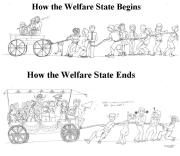
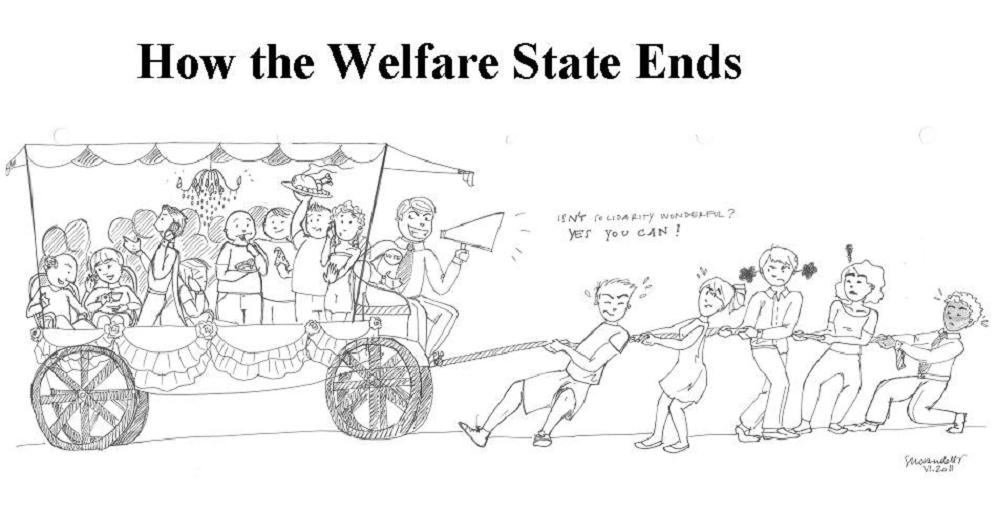
Welfare State Wagon CartoonsAnd as we travel farther and farther down this path, it leads to ever-greater levels of dependency and ever-higher levels of taxation. But that simply means more people decide it makes more sense to ride in the wagon rather than pull the wagon.

Somehow, we have to reverse this downward spiral.

Unless we want America to become Greece or France, at which point productive people may be forced to emigrate – assuming there are still some sensible nations left in the world.

Related posts:

Reagan and Clinton had good fiscal policies according to Cato Institute

Uploaded by HeritageFoundation on Dec 16, 2010http://blog.heritage.org/2010/12/16/new-video-pork-filled-spending-bill-just-… Despite promises from President Obama last year and again last month that he opposed reckless omnibus spending bills and earmarks, the White House and members of Congress are now supporting a reckless $1.1 trillion spending bill reportedly stuffed with roughly 6,500 earmarks. ________________________ Below you see an […]

Reagan and Clinton had good fiscal policies according to Cato Institute

Uploaded by HeritageFoundation on Dec 16, 2010http://blog.heritage.org/2010/12/16/new-video-pork-filled-spending-bill-just-… Despite promises from President Obama last year and again last month that he opposed reckless omnibus spending bills and earmarks, the White House and members of Congress are now supporting a reckless $1.1 trillion spending bill reportedly stuffed with roughly 6,500 earmarks. ________________________ Below you see an […]

Bill Clinton with Ronald Wilson Reagan (Part 92)

President Reagan, Nancy Reagan, Bill Clinton and Hillary Clinton attending the Dinner Honoring the Nation’s Governors. 2/22/87. ronald reagan debates walter mondale in 1984 Presidential race second clip Lee Edwards of the Heritage Foundation wrote an excellent article on Ronald Reagan and the events that transpired during the Reagan administration,  and I wanted to share it […]

Bill Clinton has a great appreciation for Mel Brooks’ movies like I do!!!

YOUNG FRANKENSTEIN trailer Uploaded on Dec 27, 2007 The Orpheum Film Series will present a special laughs-and-scares double-feature for Halloween, featuring both James Whale’s original 1931 “FRANKENSTEIN” and Mel Brooks’ 1974 send-up, “YOUNG FRANKENSTEIN”. The fun starts at 7pm on Halloween night, October 31! ________________________________ Authentic Frontier Gibberish young frankenstein – deleted scene 4 – […]

Barack Obama would lose badly to Ronald Reagan!!!

Barack Obama would lose badly to Ronald Reagan!!! The Spirit of Reagan Is Still With Us: The Gipper Crushes Obama in Hypothetical Matchup April 13, 2013 by Dan Mitchell Barack Obama has stated that he wants to be like Reagan, at least in the sense of wanting to be a transformational figure. But almost certainly he has […]

Cato Institute on privatizing the post office

Should we junk the mail and privatize the USPS? w/ Tad DeHaven

Uploaded by on Aug 10, 2009

With a deficit of almost 16 billion in 2011 the post office must be closed and private firms can take over. This is a complete joke now.

Privatizing the U.S. Postal Service

PrintPrint

by Tad DeHaven

November 2010

Overview
Background
Declining Revenues
Bloated Costs
Postal Unions
Lessons from Abroad
Conclusions

Overview

The U.S. Postal Service is a branch of the federal government. It is headed by a Postmaster General and a Board of Governors, with further oversight provided by the Postal Regulatory Commission. However, ultimate authority over the USPS rests with Congress.

The USPS is structured like a business in that revenues from the sale of postal products generally cover costs, and it receives virtually no federal appropriations.1 The organization is the second-largest civilian employer in the United States—after Wal-Mart—with about 600,000 workers. If the USPS were a private company, it would rank about 28th on the Fortune 500 list of largest companies.

While the USPS is structured like a business, Congress often prevents it from actually operating like a private company, such as taking actions to reduce costs, improve efficiency, or innovate in other ways. The agency is also obligated by statute to provide mail services to all Americans, irrespective of where they live and the cost of serving them. Furthermore, it is required to deliver first-class mail at a uniform price throughout the nation.

While Congress imposes various costs and obligations on the USPS, it also protects it from competition. The USPS has a legal monopoly over first-class mail and standard mail (formerly called third-class mail). Thus, we have a postal system that encourages high costs and inefficiency, while preventing entrepreneurs from trying to improve postal services for Americans.

The USPS is in deep financial trouble as a result of declining mail volume, bloated operating expenses, a costly and inflexible unionized workforce, and constant congressional meddling. At the same time, electronic communications and other technological advances are making physical mail delivery less relevant.

America’s postal system needs a radical overhaul. This essay discusses the problems of the USPS and looks at some recent postal reforms abroad.2 It concludes that taxpayers, consumers, and the broader economy would stand to gain with reforms to privatize the USPS and open U.S. mail delivery up to competition.

Background

Article 1, Section 8 of the Constitution says that Congress shall have the power “to establish Post Offices and post Roads.” Thus, the Constitution allows the government to get involved in postal services, but that doesn’t mean that the government has to be involved, let alone be granted a monopoly over mail.

Prior to the Postal Act of 1863, intercity letters were either held at the destination post office for pick-up or delivered by an independent contractor. The Postal Code of 1872 extended the postal monopoly to the delivery of local letters, banning intracity private carriers. These private carriers, which numbered 147 at one time, had been innovative: for example, they introduced stamps before the Post Office did.3

Prior to 1971 the government provided postal services through its U.S. Post Office Department, an agency that received annual appropriations and heavy subsidies from Congress. Members of Congress influenced many aspects of the Post Office Department’s operations, such as the pricing of postal products and the selection of managers.

The Postal Reorganization Act of 1970 replaced the Post Office Department with the U.S. Postal Service. The USPS was made an independent agency of the executive branch and designed to be financially self-sufficient, relying on the sale of postage, mail products, and services for revenue. The USPS is required by law to cover its costs, but can borrow from the U.S. Treasury subject to a limitation of $3 billion per year and a total debt ceiling of $15 billion.

As a federal organization, the USPS benefits from numerous other privileges. The USPS is exempt from vehicle licensing requirements, sales taxes, and local property taxes. It doesn’t have to pay parking tickets, and it has eminent domain powers. It pays to itself the income taxes that it would owe if it were a private business.

The USPS is mandated by Congress to provide the American public with “universal service,” which includes uniform prices, access to services, and six-day delivery nationwide. To ensure financial support for these obligations, Congress grants the USPS a statutory monopoly on the delivery of first-class and standard mail and restricts mailbox access to mail delivered by the USPS.4

The USPS’s express mail and package delivery services are subject to competition, which comes chiefly from FedEx and the United Parcel Service (UPS). However, the USPS’s monopoly prevents other companies from delivering first-class and standard mail, with an exception for urgent mail, and private companies are not allowed to place their deliveries in mail boxes.

The USPS does face increasing competition from correspondence sent via a variety of electronic alternatives. While the USPS may have a statutory monopoly over a portion of physical mail, new technologies are allowing Americans to bypass the organization on all of its lines of business.

Declining Revenues

Although the USPS is structured to operate like a self-supporting business, this model is on borrowed time.

From 2007 to 2010, the USPS lost $20 billion, and its debt increased from $2.1 billion to $12 billion. The USPS expects to hit its $15 billion legal borrowing ceiling in 2011. As a result, the Government Accountability Office placed the USPS on its “high risk” list of troubled federal agencies in 2009.5 These financial problems are not temporary. Postal experts expect a future of stagnant-to-declining revenue for the USPS with stable-to-increasing expenses unless Congress makes major reforms.

In 2009, USPS revenues totaled $68 billion, or $7 billion lower than 2008. About 88 percent of the revenue was generated by “market-dominant” products including first-class mail and standard mail (bulk advertising and direct-mail solicitations). First-class mail, which is the most profitable, accounted for 52 percent of those revenues. The remaining 12 percent of the USPS’s revenue came from competitive products including Express Mail, Priority Mail, bulk parcel post, and bulk international mail.6

The decline in USPS revenues has been driven by a large drop in mail volume, particularly for profitable first-class mail. The recent recession has hurt USPS finances, but the demand for mail delivered by the USPS has been steadily falling as consumers and businesses have shifted to electronic alternatives.

First-class mail volume has fallen 19 percent since 2001, and it is projected to fall another 37 percent by 2020.7 From 2006 to 2009 total mail volume dropped from 213 billion to 177 billion items, a 17 percent decrease.8 By 2020 the USPS estimates further volume declines of about 15 percent, to 150 billion pieces, which would be the lowest level since 1986.9

The 2006 Postal Accountability and Enhancement Act terminated a cumbersome rate‑setting structure and gave the USPS more flexibility to set prices. But the law required that average rates in each market-dominant mail class not increase faster than the consumer price index.

The USPS can request that the Postal Regulatory Commission approve a rate increase above the price cap on the basis of extraordinary or exceptional circumstances. The PRC recently rejected a USPS request for an exigent rate increase. Although it acknowledged that the recession has led to a substantial decline in mail volume, the PRC turned down the request because the rate adjustments represented “an attempt to address long-term structural problems not caused by the recent recession.”10

Looking forward, increasing postal rates may boost revenue in the short run, but would risk depressing mail volume and revenue in the long run, in part by accelerating the diversion of mail to competing electronic alternatives. Higher rates would also damage millions of businesses dependent on mailing and currently stuck with a monopoly provider of those services.

The USPS has asked Congress for permission to offer new nonpostal products and services (such as banking and insurance) to generate additional revenue. However, the USPS has a poor track record when it comes to introducing new products, and allowing a government entity to compete with the private sector in nonpostal markets would be unfair and unwise.11

Bloated Costs

Despite the USPS’s ability to achieve $10 billion in cost savings from 2007 to 2009, it has not been enough to offset the recent rapid decline in revenue.12 It also hasn’t been enough to prevent the upward trend in the organization’s cost per piece of mail, which rose from 34 cents in 2006 to 41 cents in 2009.13 If mail volume continues to decrease and the number of postal addresses increases, the cost to deliver each piece of mail will continue to rise while revenue per delivery point falls.

A key driver of mail delivery costs is the congressionally mandated obligation to serve virtually every mailing address, regardless of volume, six days a week. Fulfilling this “universal service” obligation results in the USPS having large fixed costs, including the costs of more than 36,000 postal outlets, 215,000 vehicles, and 600 processing facilities.

However, even given the universal service obligation, the Government Accountability Office and USPS officials believe that more than half of these processing facilities aren’t needed.14 Why aren’t they closed down to save money? The GAO notes that the USPS faces “formidable resistance” from members of Congress and postal unions when attempting to close or consolidate facilities.15

The USPS is required to provide services to all communities, including areas where post offices have low traffic and are not cost effective. Before closing a post office, the USPS must provide customers with at least 60 days of notice before the proposed closure date, and any person served by the post office may appeal its closure to the Postal Regulatory Commission. The USPS cannot close a post office “solely for operating at a deficit.”16

Members of Congress whose districts would be affected by a post office closure often raise a big fuss. Last year, for example, the USPS proposed consolidating 3,200 postal outlets, but following a congressional outcry, the number under consideration was reduced to a paltry 162.17 That is no way to run a business.

Full post offices are more costly to operate than other means of serving customers. The average post office transaction cost 23 cents per dollar of revenue in 2009 while the average transaction at a contract postal unit cost just 13 cents.18 Post offices used to generate almost all postal retail revenue, but 29 percent is now generated online through usps.com and other alternative channels.19

In 2009 post offices recorded 117 million fewer transactions than in 2008.20 Four out of five post offices are operating at a loss.21 However, the postal network’s overcapacity has drawn little corrective action from Congress. In fact, legislation introduced in the House with 102 cosponsors would apply the burdensome procedures for closing post offices to other postal outlets as well.22 Congress is actively working against the modernization of the U.S. postal system.

Excessive labor costs are another major problem. While the USPS has been able to eliminate a substantial number of employees through attrition, the USPS’s predominantly unionized workforce continues to account for 80 percent of the agency’s costs despite increased automation. The USPS estimates that, in the absence of changes, its total workforce costs will soar from $53 billion in 2009 to $77 billion in 2020.23

As of 2009 the USPS had financial liabilities and unfunded obligations of $88 billion.24 Unfunded obligations for retiree health benefits accounted for $52 billion of the total. The 2006 Postal Accountability and Enhancement Act addressed this unfunded liability by requiring the USPS to make a special payment of more than $5 billion annually from 2007 through 2016 to build up a retirement fund. This was a good idea to reduce possible liabilities on future taxpayers.

However, USPS revenues began plummeting shortly after the PAEA’s enactment. In 2009 Congress relieved the USPS by allowing it to defer $4 billion of its scheduled $5.4 billion retirement payment for the year. Facing the same situation this year, Congress adjourned without providing the USPS with similar relief. As a result, the USPS could soon run out of operating funds.

Critics argue that the pre-funding payment schedule is too aggressive, particularly in light of the USPS’s current financial struggles. However, the USPS faces a bleak future regardless of the payments. As the GAO notes, allowing the USPS to continue deferring the payments will “increase the risk that in the future USPS will not be able to pay these obligations as its core business continues to decline and if sufficient actions are not taken to restructure operations and reduce costs.”25

Opponents of pre-funding USPS retiree health benefits argue that private companies and the rest of the federal government are not legally required to do so. That is largely irrelevant. Retiree health care coverage is an increasingly rare perk in the private sector, and the federal government’s financial management is nothing to emulate. In 2008, only 17 percent of private sector workers were employed at a business that offered health benefits to Medicare-eligible retirees, down from 28 percent in 1997.26

Postal Unions

More than 85 percent of USPS employees are covered by collective-bargaining agreements. Among other provisions, these agreements include regular raises based on cost-of-living allowances. The other 15 percent of employees receive regular pay increases through a pay-for-performance program.

While the Postal Service negotiates with its unions to structure compensation, federal statutes hamper the USPS’s ability to craft market-based pay and benefits packages.27 The potential for mandatory arbitration gives the unions a big advantage in negotiations with management. When unions demand higher wages, more generous benefits, and added work rules, arbitrators usually give them part of what they want. And when weighing a decision on union contracts, arbitrators do not have to take the USPS’s financial situation into consideration. Not surprisingly, unions have been able to extract lucrative compensation packages from the USPS over the decades.

The Government Accountability Office notes that the USPS covers a higher proportion of employee premiums for health care and life insurance than other federal agencies.28 USPS workers participate in the federal workers’ compensation program, which generally provides larger benefits than the private sector. Also, instead of retiring when eligible, USPS workers can stay on the “more generous” workers’ compensation rolls.29

In 2009 the average postal employee received about $79,000 in total compensation.30 This compares to $61,000 in wages and benefits received by the average private sector worker that year.31 A recent study by labor economist James Sherk found that postal workers earn 15 to 20 percent more per hour than comparable workers in the private sector.32

Postal expert Michael Schuyler reviewed the studies on postal compensation and found the following:

Although the law says that postal employees should receive wages and benefits comparable to what they could earn in the private sector, the majority of economic studies examining the issue have concluded that a postal pay premium of 20%– 25% exists if just wages are counted and about 35% if the Service’s very generous benefits are also included.33

Another factor that reduces postal service efficiency is that union contracts inhibit the flexibility of USPS leaders in managing their workforce. For example, most postal workers are protected by “no-layoff” provisions, and the USPS must let go lower-cost part-time and temporary employees before it can lay off a full-time worker not covered by such provisions.

Collective bargaining agreements also make it difficult for the USPS to hire part-time workers, which would help to reduce labor costs. Hiring workers who can work less than eight-hour shifts would also give managers needed flexibility to address seasonal and weekly fluctuations in workload.

The USPS inspector general recently pointed out that the USPS’s utilization of part-time workers is less than that of UPS, FedEx, and postal systems in other countries.34 While only 13 percent of the USPS’s workforce is part-time, the figures for UPS and FedEx are a respective 53 and 40 percent. Germany’s Deutsche Post, which has been privatized, employs a workforce that is 40 percent part-time.35 The story is similar at many other foreign posts, such as the Netherlands’ postal service, TNT, which has also been privatized. TNT recently told its union that it would be “migrating towards an organization that employs mainly part‑time staff.”36

Unfortunately, already generous compensation combined with the USPS’s poor financial condition hasn’t stopped the postal unions from demanding more money and opposing greater flexibility. The American Postal Workers Union, which represents more than 200,000 workers, recently entered collective bargaining negotiations for a new contract. In an interview, APWU president William Burrus called a pay increase for his members an “entitlement” and stated that his union wants “more control over activities at work, more money, better benefits—we want more.”37 Burrus also called the sensible suggestion that arbitrators should be required to consider the USPS’s financial position “antidemocratic.”38

Lessons from Abroad

Declining demand and an inability to cut costs are not unique to the USPS, as government postal services in other countries have experienced similar problems. However, numerous countries have responded by shifting away from a government-run postal monopoly toward market liberalization, including privatizing the government postal agency and opening postal markets to entrepreneurs. The United States has lagged behind many countries on postal reforms. As a result, the U.S. rates near the bottom of the Consumer Postal Union’s 23-country “Index of Postal Freedom.”39

For some people, the idea of liberalization conjures up fears of a decline in the quality or universality of postal service. However, those things have not happened in the countries that have introduced pro-market postal reforms. Rather, these liberalizing countries have shown the ability to offer affordable, reliable, universal, and more efficient postal-delivery services.

In many countries, reforms have been pursued through the commercialization and corporatization of the postal service. Under such reforms, the government retains full or partial ownership but introduces modern practices involving management, labor compensation, finance, marketing, and capital investment.

In some countries the private sector has taken large ownership stakes. For example, 69 percent of Germany’s formerly government post office Deutsche Post is now privately owned.40 In the Netherlands, 100 percent of its formerly government post office is privately owned as TNT Post.41 The British government is considering selling off to private investors its ownership of the Royal Mail. At least 10 percent of the shares may be reserved for postal employees, which would have the benefit of reducing the unions’ incentive to take actions negatively affecting the company’s bottom line.42

While some nations have partly or fully privatized their post offices, a parallel trend is for countries to reduce or eliminate postal monopolies and allow for entrepreneurs to offer competitive services. New Zealand and Sweden repealed their postal monopolies in 1998 and 2003, respectively, and Germany and the Netherlands followed suit in 2008 and 2009, respectively. In 2008, the European Union announced a plan to eliminate the national monopolies of all EU member states by 2013.

Postal liberalization has produced more efficient services in many countries, but governments continue to impose unwarranted postal regulations in even the most reformed markets. For example, governments still typically mandate that universal service obligations be met, and they often also mandate certain service standards and pricing.

In New Zealand, for example, the government has a “deed of understanding” with the New Zealand Post under which it must maintain a specified number of post offices, keep the price of a stamp below a certain level, and refrain from implementing a rural service fee. Also, New Zealand Post must provide 95 percent of households with letter-delivery service six days per week in addition to other minimum service standards.43

Some patterns have emerged regarding the outcome of postal liberalization. Productivity has increased, costs have decreased, the universal service obligation continues to be met, service quality measured by on-time delivery has not dropped, and overall customer satisfaction seems to have increased.44

Another common result of postal liberalization is diversification of postal organizations into nonpostal activities. Consultants at Accenture have found that diversification not only has a measurable impact on the performance of international posts, but that it is what ultimately distinguishes high performers from low performers.45 America’s relatively dynamic economy is particularly suited for the diversification opportunities that would arise under postal liberalization.

Germany’s former postal monopoly, Deutsche Post, illustrates the type of transformation possible by liberalization. Today, the private Deutsche Post World Net has changed its compensation structure, imported managers from other industries, modernized the mail and parcels network within Germany, and developed new products such as hybrid mail and e-commerce. The company now has interests in not only the traditional mail and parcels business but also express mail logistics, banking, and more.46

Opening up America’s postal markets to new competitors promises great benefits for consumers because entrepreneurs have strong incentives to innovate, improve quality, and reduce costs. The universal service mandate could become less of an issue as entrepreneurs figure out cheaper and better ways to deliver mail to rural areas. Sam Walton, Henry Ford, and other great entrepreneurs made their fortunes by bringing affordable products and services to the masses. We need these sorts of innovators in the postal business.

Former Postmaster General William J. Henderson (1998–2001) stated in a Washington Post op-ed following his retirement that “what the Postal Service needs now is nothing short of privatization.” Henderson noted that while privatizing the USPS might sound radical, “it’s a concept the rest of the world has been taking seriously for years.”47

Conclusions

The USPS is in a financial death spiral because of the myriad factors discussed. It faces a projected $238 billion in losses over the next 10 years under the status quo. To avoid a large and growing burden from being foisted on taxpayers in coming years, the USPS should be privatized and postal markets open for competition from FedEx, UPS, and upstart entrepreneurs.

With privatization, Congress should end its micromanagement of the nation’s postal services. It should rescind the complex laws and regulations on delivery schedules, price caps, restrictions of facility shut-downs, and other business decisions. Such congressional meddling ultimately hurts the consumers that any postal business is supposed to serve by pushing up costs.

Consider the USPS’s recent request that Congress allow it to end Saturday mail delivery.48 Congress has blocked that move, which will raise USPS costs and ultimately result in higher stamp prices. The Saturday mail delivery issue also highlights the lack of consumer choice in the current system. If the USPS decides not to provide Saturday service, customers should be free to contract with other commercial entities to provide Saturday service, or service for any day of the week for that matter.

Policymakers resistant to reform often depict the USPS as a “national asset” that “binds the nation together.” But these days, it’s the Internet and our telecommunications networks that bind families and businesses together across the nation. It’s time to let go of the nostalgia for the USPS and bring America’s postal services into the 21st century with privatization, open competition, and entrepreneurial innovation.


1 The USPS receives a small annual appropriation from Congress of about $100 million as compensation for the revenue it forgoes in providing, at congressional mandate, free mailing privileges for the blind and absentee-ballot mailing for overseas military personnel.

2 I benefited greatly from the discussion of postal reforms in Robert Carbaugh and Thomas Tenerelli, “Restructuring the U.S. Postal Service,” forthcoming in Cato Journal.

3 Edward L. Hudgins, ed. The Last Monopoly: Privatizing the Postal Service for the Information Age (Washington: Cato Institute, 1996), p. 14.

4 The U.S. Supreme Court has confirmed this privilege by ruling that it is illegal in the United States for anyone other than the employees and agents of the Postal Service to deliver mail pieces to letter boxes marked “U.S. Mail.”

5 U.S. Government Accountability Office, “High Risk Series: Restructuring the U.S. Postal Service to Achieve Sustainable Financial Viability,” July 2009.

6 Government Accountability Office, “U.S. Postal Service: Financial Challenges Continue, with Relatively Limited Results from Recent Revenue-Generation Efforts,” GAO-10-191T, November 5, 2009, p. 4.

7 Government Accountability Office, “U.S. Postal Service: Strategies and Options to Facilitate Progress toward Financial Viability,” GAO-10-455, April 2010, p. 8.

8 United States Postal Service, “Ensuring a Viable Postal Service for America: An Action Plan for the Future,” March 2010, p. 3.

9 Government Accountability Office, “U.S. Postal Service: Strategies and Options to Facilitate Progress toward Financial Viability,” GAO-10-455, April 2010, p. 8.

10 Postal Regulatory Commission, Statement of Chairman Ruth Y. Goldway, Decision of the Commission in Docket R2010-4, “Rate Adjustment Due to Extraordinary or Exceptional Circumstances,” September 30, 2010.

11 Michael Schuyler, “The Postal Service Asks Congress to Eliminate Saturday Service; Congress Still Has Questions,” Institute for Research on the Economics of Taxation Advisory no. 267, July 7, 2010, p. 11.

12 Government Accountability Office, “U.S. Postal Service: Strategies and Options to Facilitate Progress toward Financial Viability,” GAO-10-455, April 2010, p. 11.

13 United States Postal Service, “Ensuring a Viable Postal Service for America: An Action Plan for the Future,” March 2010, p. 5.

14 Government Accountability Office, “U.S. Postal Service: Strategies and Options to Facilitate Progress toward Financial Viability,” GAO-10-455, April 2010, p. 29.

15 Government Accountability Office, “U.S. Postal Service: Strategies and Options to Facilitate Progress toward Financial Viability,” GAO-10-455, April 2010, p. 29.

16 Government Accountability Office, “U.S. Postal Service: Strategies and Options to Facilitate Progress toward Financial Viability,” GAO-10-455, April 2010, p. 30.

17 Sean Reilly, “80% of Post Offices Losing Money,” FederalTimes.com, October 10, 2010.

18 United States Postal Service, “Ensuring a Viable Postal Service for America: An Action Plan for the Future,” March 2010, p. 8.

19 United States Postal Service, “Ensuring a Viable Postal Service for America: An Action Plan for the Future,” March 2010, p. 8.

20 United States Postal Service, “Ensuring a Viable Postal Service for America: An Action Plan for the Future,” March 2010, p. 9.

21 Sean Reilly, “80% of Post Offices Losing Money,” FederalTimes.com, October 10, 2010.

22 Sean Reilly, “80% of Post Offices Losing Money,” FederalTimes.com, October 10, 2010.

23 United States Postal Service, “Ensuring a Viable Postal Service for America: An Action Plan for the Future,” March 2010, p. 9.

24 Government Accountability Office, “U.S. Postal Service: Strategies and Options to Facilitate Progress toward Financial Viability,” GAO-10-455, April 2010, p. 12.

25 Government Accountability Office, “U.S. Postal Service: Strategies and Options to Facilitate Progress toward Financial Viability,” GAO-10-455, April 2010, p. 22.

26 Paul Fronstin, “Implications of Health Reform for Retiree Health Benefits,” Employee Benefit Research Institute Issue Brief no. 338, January 2010, p. 4.

27 United States Postal Service, “Ensuring a Viable Postal Service for America: An Action Plan for the Future,” March 2010, p. 9.

28 Government Accountability Office, “U.S. Postal Service: Strategies and Options to Facilitate Progress toward Financial Viability,” GAO-10-455, April 2010, p. 28.

29 Government Accountability Office, “U.S. Postal Service: Strategies and Options to Facilitate Progress toward Financial Viability,” GAO-10-455, April 2010, pp. 15–16.

30 Budget of the U.S. Government, Fiscal Year 2011, Analytical Perspectives, Tables 10.2 and 10.3, pp. 108–109.

31 Chris Edwards, “Overpaid Federal Workers,” Cato Institute, June 2010, www.downsizinggovernment.org/overpaid-federal-workers.

32 James Sherk, “Inflated Federal Pay: How Americans are Overtaxed to Overpay the Civil Service,” Heritage Foundation, Center for Data Analysis, CDA10-05, July 7, 2010, p. 30.

33 Michael Schuyler, “Union Demands Hurt Postal Service Reforms,” Institute for Research on the Economics of Taxation Advisory no. 210, October 11, 2006, p. 6.

34 U.S. Postal Service, Office of Inspector General, “Workforce Flexibility—Would it Work for the Postal Service?” http://blog.uspsoig.gov/?p=3603.

35 U.S. Postal Service, Office of Inspector General, “Workforce Flexibility—Would it Work for the Postal Service?” http://blog.uspsoig.gov/?p=3603.

36 TNT Post letter issued to the trade unions, October 14, 2010, http://group.tnt.com/Images/Attachment_letter_to_the_trade_unions_tcm177-526206.pdf.

37 Emily Long, “Postal Service Looks for Ways to Reduce Labor Costs,” GovExec.com, September 1, 2010.

38 Emily Long, “Postal Service Looks for Ways to Reduce Labor Costs,” GovExec.com, September 1, 2010.

40 Deutsche Post DHL, www.dp-dhl.com/en.

41 TNT Post, www.tntpost.com.

42 Brian Groom, “Royal Mail Employees to be Offered Shares,” Financial Times, September 22, 2010.

43 Rick Geddes, “Reform of the U.S. Postal Service,” Journal of Economic Perspectives 19 no. 3 (2005): 217–32.

44 See, for example, Unites States Postal Service, “Transformation Plan,” Appendix H, April 2002, http://www.usps.com/strategicplanning/_pdf/2002TransformationPlan.pdf.

45 See Accenture, “Is Diversification the Answer to Mail Woes? The Experience of International Posts,” February 2010, www.usps.com/strategicplanning/_pdf/Accenture_Presentation.pdf.

46 See Michael Crew and Paul Kleindorfer eds., Competitive Transformation of the Postal and Delivery Sector (Norwell, MA: Kluwer Academic Publishers, 2003).

47 William J. Henderson, “End of the Route: I Ran the Postal Service—It Should be Privatized,” Washington Post, September 2, 2001, p. B1.

48 For more on the issue of eliminating Saturday mail delivery, see Michael Schuyler, “The Postal Service Asks Congress to Eliminate Saturday Service; Congress Still Has Questions,” Institute for Research on the Economics of Taxation Advisory no. 267, July 7, 2010.


Where the USA’s economic success come from?

Where the USA’s economic success come from?

An Amazing Story of Economic Success

I’ve written before about the remarkable vitality of Hong Kong and Singapore, two jurisdictions that deserve praise for small government and free markets.

Monaco T

Pretending to be a jet-setter in Monaco

I have also praised Switzerland because of policies such as genuine federalism and financial privacy, and it goes without saying that I admire tax havens such asBermuda, Monaco, and the Cayman Islands

I’m a big fan of Estonia, which has made big strides thanks to the flat tax and other free market reforms.

Australia also is one of my favorite nations, in part because of its privatized Social Security system.

Even Canada and Sweden have earned my praise for recent economic reforms.

But here’s a video, produced by the folks at The Fund for American Studies, that identifies an even more impressive economic miracle.

How Nations Succeed: What’s the Secret to Ending Poverty?

Published on May 1, 2013

http://www.TFAS.org/HowNationsSucceed Find out how one nation rose from poverty to unprecedented wealth in just a few generations in this eye-opening web video from The Fund for American Studies. The video raises the question: Will the United States continue to progress and innovate, or will big government stifle economic growth and innovation? Narrated by economist Michael Cox, the video comes during a time of economic uncertainty and calls on viewers like you to decide which path is best for the country.

______________

I did guess the country in the video, but only a few seconds before the narrator spilled the beans. My excuse is that I watched early on Sunday morning, when civilized people should still be asleep.

But allow me to atone for my slowness by adding a very important point about growth. The country in the video became successful because it enjoyed a very long period of decent growth. But that has recently changed for the worse.

And things got worse when statists were in power, as even the Washington Post has acknowledged.

The lesson to be learned is that even small differences in growthcan make a big difference over time.

By some measures, Hong Kong and Singapore are now richer than the United States. The simple reason is that those jurisdictions have been enjoying 5 percent-plus growth for decades while the United States economy has struggled to achieve 3 percent growth.

Then again, the United States is more prosperous than most European nations, though that may be an example of damning with faint praise.

Related posts:

Dan Mitchell explains what happened in Cyprus

Dan Mitchell explains what happened in Cyprus.   What Really Happened in Cyprus? April 14, 2013 by Dan Mitchell Did Cyprus become an economic basket case because it is a tax haven, as some leftists have implied? Did it get in trouble because the government overspent, which I have suggested? The answers to those questions are […]

Dan Mitchell on Obamacare (includes cartoons on Obamacare)

Some very good points by Dan Mitchell of the Cato Institute on Obamacare: Why We Should Be Optimistic about Repealing Obamacare and Fixing the Healthcare System April 10, 2013 by Dan Mitchell I’m going to make an assertion that seems utterly absurd. The enactment of Obamacare may have been good news. Before sending a team of medical […]

Dan Mitchell’s blog has great cartoon that demonstrates what President Obama has been doing the last 4 years!!!

I have put up lots of cartoons from Dan Mitchell’s blog before and they have got lots of hits before. Many of them have dealt with the economy, eternal unemployment benefits, socialism,  Greece,  welfare state or on gun control.     I’ve Obtained a Secret Pre-Release Copy of Obama’s Budget April 9, 2013 by Dan Mitchell The President is supposed to release […]

Dan Mitchell’s tribute to Margaret Thatcher

Very well said by Dan Mitchell. A Tribute to Margaret Thatcher April 8, 2013 by Dan Mitchell The woman who saved the United Kingdom has died. A Great Woman I got to meet Margaret Thatcher a couple of times and felt lucky each time that I was in the presence of someone who put her nation’s […]

Dan Mitchell, Ron Paul, and Milton Friedman on Immigration Debate (includes editorial cartoon)

I like Milton Friedman’s comments on this issue of immigration   and Ron Paul and Dan Mitchell do well on the issue too. Question of the Week: What’s Your Take on the Immigration Debate? April 7, 2013 by Dan Mitchell A reader from overseas wonders about my views on immigration, particularly amnesty. I confess that this is one of […]

Dan Mitchell on Texas v. California (includes editorial cartoon)

We should lower federal taxes because jobs are going to states like Texas that have low taxes. What Can We Learn by Comparing the Employment Situation in Texas vs. California? April 3, 2013 by Dan Mitchell One of the great things about federalism, above and beyond the fact that it both constrains the power of governments […]

Cartoons from Dan Mitchell’s blog on Obamacare

Third-Party Payer is the Biggest Economic Problem With America’s Health Care System Published on Jul 10, 2012 This mini-documentary from the Center for Freedom and Prosperity Foundation explains that “third-party payer” is the main problem with America’s health care system. This is why undoing Obamacare, while desirable, is just a small first step if we […]

Obamacare cartoons from Dan Mitchell’s blog

I have put up lots of cartoons from Dan Mitchell’s blog before and they have got lots of hits before. Many of them have dealt with the economy, eternal unemployment benefits, socialism,  Greece,  welfare state or on gun control. The funniest cartoon is the one with “Nurse Sebelius” stuffing the huge capsule down the kid’s throat!!! Obamacare […]

Editorial cartoon from Dan Mitchell’s blog on California’s sorry state of affairs

I have put up lots of cartoons from Dan Mitchell’s blog before and they have got lots of hits before. Many of them have dealt with the sequester, economy, eternal unemployment benefits, socialism,  minimum wage laws, tax increases, social security, high taxes in California, Obamacare,  Greece,  welfare state or on gun control. President Obama’s favorite state must be California because […]

Dan Mitchell of the Cato Institute:HUD has to go!!!! (includes political cartoon)

You want a suggestion on how to cut the government then start at HUD. I would prefer to eliminate all of it. Here are Dan Mitchell’s thoughts below: Sequestration’s Impact on HUD: Just 358 More Days and Mission Accomplished March 12, 2013 by Dan Mitchell As part of my “Question of the Week” series, I had […]

Dying laughing at Obamacare

When our government is spending over a trillion dollars they don’t have and then they put in another big government program then watch out. Costs will go through the roof because the government will run Obamacare about as good as it runs the post office. Sometimes things get so sad that you just have to sit back and laugh.

After the Supreme Court’s politically motivated decision to approve Obamacare, I shared a bunch of depressing (but funny) cartoons, including a few focusing on added power for the IRS.

That was a miserable point in time.

Five Justices on the Supreme Court basically said the Constitution didn’t limit the federal government, even though that’s exactly what our Founding Fathers were trying to do when they put together the document! And they gave the green light to a costly expansion of the welfare state.

Oh, and that decision was handed down on my birthday. What a kick in the gut.

Since that time, though, I’ve become a bit more optimistic.

I’m feeling hopeful because Obamacare is turning out to be a disaster. But why is that a reason for optimism?!?

Well, as I recently wrote, this creates an opportunity to help people understand that big government is the problem in health care.

Obamacare was enacted in 2010, and it was perceived to be a paradigm-shifting change in the healthcare system, even though it was just another layer of bad policy on top of lots of other bad policy. …But because people think we’ve had a paradigm shift and government now is in charge (pay attention, since this is my key argument), they will be much more likely to blame “Obamacare” and “government” for all the warts and inefficiencies of the healthcare system. This means the public will be more receptive to pro-market policies, such as Obamacare repeal, tax reforms to reduce over-insurance, as well as the Medicaid and Medicare reforms in the Ryan budget.

Here are some new cartoons that illustrate the law’s growing unpopularity.

We’ll start with this contribution from Eric Allie.

Obamacare Crtn 5

For obvious reasons, it sort of reminds me of this Jerry Holbert cartoon.

Our next cartoon is from Henry Payne.

Obamacare Crtn 4

And here’s one from Chuck Asay, our runner-up from the cartoon contest.

Obamacare Crtn 3

What makes the Asay cartoon so appropriate is that people who supported the law will now have to defend every bad thing that happens.

Speaking of which, a prominent Democrat recently warned that Obamacare was turning into a “train wreck,” and Steven Kelley turned that comment into a very good cartoon.

Obamacare Crtn 2

Let’s close with another Henry Payne cartoon.

Obamacare Crtn 1

A very relevant cartoon since the job market remains far below its potential. Something else that defenders of the law will have to justify.

If you haven’t exhausted your interest in anti-Obamacare cartoons, you can enjoy some others here, here, here, and here.

Related posts:

‘Why Indiana Shouldn’t Fall for Obamacare’s Medicaid Expansion’

Expanding government is not right. Take a look at this article: APRIL 25, 2013 6:35PM ‘Why Indiana Shouldn’t Fall for Obamacare’s Medicaid Expansion’ By  MICHAEL F. CANNON SHARE My latest oped, in the Indy Star: Meanwhile, many [Medicaid] enrollees can’t even find a doctor. One-third of primary care physicians won’t take new Medicaid patients. Only 20 percent of […]

If Obamacare is so wonderful then why are so many people trying to get exemptions?

If Obamacare is so wonderful then why are so many people trying to get exemptions? The Heritage foundation ran a fine article on this too.  Should Politicians Be Allowed to Exempt Themselves and their Staff from Obamacare? April 25, 2013 by Dan Mitchell I get upset by a lot of what happens in the corridors of power, […]

Reason’s Peter Suderman highlights six reasons why states should refuse to implement any part of ObamaCare

Jacque Martin asks CATO Institute Michael Cannon about Obamacare Published on Mar 19, 2013 The CATO Institute’s Michael Cannon spoke at the Arkansas Conservative Caucus on Tuesday March 19th. Several conservatives were present. Cannon talked about how to defeat Obamacare in Arkansas & how the states can stop Obamacare on a national level. Jacque Martin […]

Dan Mitchell on Obamacare (includes cartoons on Obamacare)

Some very good points by Dan Mitchell of the Cato Institute on Obamacare: Why We Should Be Optimistic about Repealing Obamacare and Fixing the Healthcare System April 10, 2013 by Dan Mitchell I’m going to make an assertion that seems utterly absurd. The enactment of Obamacare may have been good news. Before sending a team of medical […]

Obama up to his Chicago style politics and tricks with Obamacare

Nic Horton Medicaid Expansion will “Cost Almost Double than Doing Nothing” part I It is amazing to me that Repubican lawmakers are considering taking President Obama’s advice on anything in light of this article below. March 25, 2013 4:26PM Here’s Your Free Health Care. Would You Care to Vote? By Michael F. Cannon Share Tweet […]

Will President Obama keep his word concerning Obamacare?

A Red-Ink Train Wreck: The Real Fiscal Cost of Government-Run Healthcare Uploaded on Nov 9, 2009 This CF&P Foundation video explains why healthcare proposals in Washington will result in bloated government and higher deficits. This mini-documentary exposes the pervasive inaccuracy of congressional forecasts and succinctly lists 12 reasons why Obamacare will be a budget buster. […]

Republicans in Arkansas messing up by endorsing Obamacare

  Enlarge image Credit Nathan Vandiver / KUAR Michael Cannon of the Cato Institute told lawmakers March 19, 2013 that abandoning plans to partner with the federal government on a health insurance exchange would both benefit the state and reduce the power of the Affordable Care Act. __________________ I am very pleased with the Republican lawmakers in […]

Cartoons from Dan Mitchell’s blog on Obamacare

Third-Party Payer is the Biggest Economic Problem With America’s Health Care System Published on Jul 10, 2012 This mini-documentary from the Center for Freedom and Prosperity Foundation explains that “third-party payer” is the main problem with America’s health care system. This is why undoing Obamacare, while desirable, is just a small first step if we […]

Obamacare cartoons from Dan Mitchell’s blog

I have put up lots of cartoons from Dan Mitchell’s blog before and they have got lots of hits before. Many of them have dealt with the economy, eternal unemployment benefits, socialism,  Greece,  welfare state or on gun control. The funniest cartoon is the one with “Nurse Sebelius” stuffing the huge capsule down the kid’s throat!!! Obamacare […]

Lots of reasons to still oppose Obamacare (includes editorial cartoon)

Here is a great article I read on November9, 2012 in the National Review: November 9, 2012 4:00 A.M. Obamacare Is Still Vulnerable Now is not the time to go wobbly. By Michael F. Cannon President Obama has won reelection, and his administration has asked state officials to decide by Friday, November 16, whether their state […]

We got to cut defense too!!!!

I have written about this before and I have made it clear also that we don’t need to be paying for our wealthy allies’ defense when we are going broke. We need Congress to look at cutting anywhere in the budget where they find waste.

National defense is one of the few legitimate functions of the federal government, but that doesn’t mean the military should get a blank check to spend unlimited amounts of money.

To make sure taxpayers get the best bang for the buck (no pun intended), there should be a sober assessment of threats to national security and a plan to defend against those threats without adding superfluous expenditures.

That being said, America already accounts for close to 50 percent of world military spending, with another 25 percent of the global total coming from nations that are allied to the United States, so I’m fairly confident that we’re not under-spending on the Pentagon.

That’s one of the reasons I don’t worry that much about the sequester, particularly since military spending actually climbs by about $100 billion over the next 10 years.

But I would like the Defense Department to have some flexibility to reallocate funds so that we spend money on national security rather than boondoggles.

And there are some absurd examples of waste at the Pentagon, including “green” jet fuel that costs 15 times as much as regular fuel. Here are some of the mind-boggling details from the Washington Examiner.

Defense Secretary Chuck Hagel recently warned that sequestration would cause “suspension of important activities, curtailed training, and could result in furloughs of civilian personnel” but the spending cuts haven’t killed the green fuels program, as the Pentagon has continued purchasing renewable fuel at $59 per gallon. “In March, Gevo entered into a contract with the Defense Logistics Agency to supply the U.S. Army with 3,650 gallons of renewable jet fuel to be delivered by the second quarter of 2013,” Gevo announced this week in its first quarter financial report. “This initial order may be increased by 12,500 gallons.

This is even worse than the bizarre $600,000 frog statue than the Defense Department selected to adorn a new $700 million office building.

Military Frog SculptureI realize that the $700 million office building should be the bigger issue, but I can’t help but be irked by the thought that taxpayers are being raped and pillaged for the frog.

In any event, the $700 million for the office building is pocket change compared to the amount of money we misallocate to subsidize Western Europe to protect against a Warsaw Pact military alliance that no longer exists!

Yes, it’s true that America’s main fiscal problem is entitlement spending. And, yes, domestic discretionary spending is a bigger problem than the defense budget.

But wasting money in those areas is not a reason to also have waste at the Pentagon.

Related posts:

We need to stop paying for Germany and Japan’s defense

I have said for years that the USA should not pay for the defense Germany and Japan. Yes, there were many reasons that was true in the past, but now they are two of our biggest friends and trading partners and they are on our side. Why should we limit their military now? I read […]

Why are we paying for Germany and Japan’s defense?

We got lots of problems at home  with our country’s finances. Then why are we paying for Germany and Japan’s defense? Romney’s Other 47% Problem by Harvey Sapolsky and Benjamin H. Friedman Harvey Sapolsky is professor emeritus of public policy and organization at MIT. His co-author, Benjamin Friedman, is a research fellow at the Cato […]

We need to stop paying for Germany and Japan’s defense

I used to think that we must double the defense budget when we were in the cold war, but I did wonder why we were not letting Germany and Japan (who are two of our biggest trade partners) build up their defenses. I was given the old tired answer that we could not trust them […]

We need to stop paying for Germany and Japan’s defense

I used to think that we must double the defense budget when we were in the cold war, but I did wonder why we were not letting Germany and Japan (who are two of our biggest trade partners) build up their defenses. I was given the old tired answer that we could not trust them […]

“Friedman Friday” Milton Friedman’s biography (Part 2)(Interview by Charlie Rose of Milton Friedman part 3)

Biography Part 2 In 1977, when I reached the age of 65, I retired from teaching at the University of Chicago. At the invitation of Glenn Campbell, Director of the Hoover Institution at Stanford University, I shifted my scholarly work to Hoover where I remain a Senior Research Fellow. We moved to San Francisco, purchasing […]

Why are we subsidizing the security of wealthy allies?

I have said over and over in the past that we have no business paying for other wealthy countries’ defense needs. April 23, 2013 4:43PM Subsidizing the Security of Wealthy Allies By Christopher A. Preble Share How much does the United States spend on the military relative to our allies? A lot. A new Cato […]

We need to slash defense spending and make other wealthy allies pay for their own defense!!!!

We need to slash defense spending and make other wealthy allies pay for their own defense!!!! The Republicans need to wake up on this issue. APRIL 15, 2013 1:13PM Your Tax Dollars at Work: Subsidizing the Security of Wealthy Allies By CHRISTOPHER A. PREBLE SHARE It’s Tax Day, and for millions of Americans that means ponying […]


If you want the rich to pay a bigger percentage of the nation’s tax revenues then keep their tax rates low!!!

If you want the rich to pay a bigger percentage of the nation’s tax revenues then keep their tax rates low!!!

Evidence from England Shows that If You Want to “Soak the Rich,” Keep Tax Rates Low

September 26, 2012 by Dan Mitchell

I’ve pulled evidence from IRS publications to show that rich people paid a lot more to Uncle Sam after Reagan reduced the top tax rate from 70 percent to 28 percent.

The good ol’ days

But the Gipper wasn’t the only one to unleash the Laffer Curve. The United Kingdom saw similar dramatic results when Margaret Thatcher lowered the top tax rate from 83 percent to 40 percent. Allister Heath explains.

During the 1970s, when the tax system specialised in inflicting pain, the top one per cent of earners contributed 11pc of income tax. By 1986-87, with the top rate down to 60pc, that had increased to 14pc. After the top rate fell to 40pc in 1988, the top 1pc’s share jumped, reaching 21.3pc by 1999-2000, 24.4pc in 2007-08 and 26.5pc in 2009-10. Lower taxes fuelled a hard-work culture and an entrepreneurial revolution. Combined with globalisation and the much greater rewards available for skilled workers, Britain’s most successful individuals earned a lot and paid a lot in tax.

In other words, Margaret Thatcher’s supply-side tax rate reductions paid big dividends, both for the economy and for the Treasury.

Unfortunately, just as American politicians have forgotten (or decided to ignore) the lessons of the Reagan era, British politicians also have gravitated to a class-warfare approach. Allister points out that this is having a negative impact.

Yet times are changing, and not just because of the recession. HMRC recently slashed its forecasts for revenues from the top 1pc. It now believes the number of people expected to report £500,000 or more in earnings will fall by a tenth this year; those on £2m are set to drop by a third.

Why have the numbers headed in the wrong direction? There are almost certainly lots of factors, but tax policy has moved in the wrong direction and presumably deserves part of the blame. The top income tax rate is now 45 percent. The value-added tax has jumped to 20 percent. Allister provides more details.

Capital gains tax is too high. Luxury homes transactions are falling because of higher stamp duty. Britain is now a high tax economy; this is distorting work and investment decisions, gradually shifting talent and capital overseas. The overwhelming majority of high earners are already contributing disproportionately to the exchequer; tightening the screws further will be disastrously counter-productive. The lesson of the past 30 years is clear: the best way to entice the rich to pay even more tax is to keep rates low and allow them to get even richer.

I have to admit that I don’t want anyone to pay more tax, but I’m even less happy about punitively high tax rates. So I’m reluctantly willing to let the clowns in government have more money in exchange for a tax system that is more conducive to economic growth.

Here’s my Laffer Curve video, which explains more about the relationship of tax rates, taxable income, and tax revenue.

The ultimate goal, of course, is to shrink the central government so that the legitimate functions of the state can be financed at very low tax rates. Heck, if the United States and the United Kingdom had the kind of limited governments that existed 100 years ago, neither nation would even need a flat tax. A few user fees and excise taxes would suffice. Now that’s hope and change.

P.S. I periodically share two great Reagan videos, which can be seen here and here, but I also have a couple of inspiring videos of Thatcher in action, which can be viewed here and here.

Related posts:

The Laffer Curve Wreaks Havoc in the United Kingdom

I got to hear Arthur Laffer speak back in 1981 and he predicted what would happen in the next few years with the Reagan tax cuts and he was right with every prediction. The Laffer Curve Wreaks Havoc in the United Kingdom July 1, 2012 by Dan Mitchell Back in 2010, I excoriated the new […]

Liberals act like the Laffer Curve does not exist.

Raising taxes will not work. Liberals act like the Laffer Curve does not exist. The Laffer Curve Shows that Tax Increases Are a Very Bad Idea – even if They Generate More Tax Revenue April 10, 2012 by Dan Mitchell The Laffer Curve is a graphical representation of the relationship between tax rates, tax revenue, and […]

Dan Mitchell: “Romney is Right that You Can Lower Tax Rates and Reduce Tax Preferences without Hurting the Middle Class”

The Laffer Curve, Part I: Understanding the Theory Uploaded by afq2007 on Jan 28, 2008 The Laffer Curve charts a relationship between tax rates and tax revenue. While the theory behind the Laffer Curve is widely accepted, the concept has become very controversial because politicians on both sides of the debate exaggerate. This video shows […]

The flat tax will grow the economy

If we want the economy to grow then we should look closely at a flat tax. A Primer on the Flat Tax and Fundamental Tax Reform August 11, 2012 by Dan Mitchell In previous posts, I put together tutorials on the Laffer Curve, tax competition, and the economics of government spending. Today, we’re going to look […]

Open letter to President Obama (Part 123)

President Obama c/o The White House 1600 Pennsylvania Avenue NW Washington, DC 20500 Dear Mr. President, I know that you receive 20,000 letters a day and that you actually read 10 of them every day. I really do respect you for trying to get a pulse on what is going on out here. I got […]

Cartoons about Obama’s class warfare

I have written a lot about this in the past and sometimes you just have to sit back and laugh. Laughing at Obama’s Bumbling Class Warfare Agenda July 13, 2012 by Dan Mitchell We know that President Obama’s class-warfare agenda is bad economic policy. We know high tax rates undermine competitiveness. And we know tax increases […]

Open letter to President Obama (Part 111)

President Obama c/o The White House 1600 Pennsylvania Avenue NW Washington, DC 20500 Dear Mr. President, I know that you receive 20,000 letters a day and that you actually read 10 of them every day. I really do respect you for trying to get a pulse on what is going on out here. If our […]

If we want to cut back on the size of government then we have to cut our spending and not grow our spending

Does Government Have a Revenue or Spending Problem?

People say the government has a debt problem. Debt is caused by deficits, which is the difference between what the government collects in tax revenue and the amount of government spending. Every time the government runs a deficit, the government debt increases. So what’s to blame: too much spending, or too little tax revenue? Economics professor Antony Davies examines the data and concludes that the root cause of the debt is too much government spending.

_______________

If we want to cut back on the size of government then we have to cut our spending and not  grow our spending. Look at what is happening right now in the federal government with the foodstamp program.

April 30, 2013 at 12:45 pm

Joseph Sohm/Visions of America/Newscom

Joseph Sohm/Visions of America/Newscom

Across the country, states are courting participants for food stamps (now known as the Supplemental Nutrition Assistance Program, or SNAP). The U.S. Department of Agriculture (USDA) even has a webpage dedicated to helping states create “SNAP Outreach Plans.”

The argument from the USDA is that “Food Stamps Make America Stronger” by stimulating states’ economies. States are responding to the call. According to The Washington Post: “Rhode Island hosts SNAP-themed bingo games for the elderly. Alabama hands out fliers that read: ‘Be a patriot. Bring your food stamp money home.’ Three states in the Midwest throw food-stamp parties where new recipients sign up en masse.” And Florida even employs recruiters.

The recruiter profiled in the Post’s story, Dillie Nerios, is required to get “at least 150 seniors” to enroll in “food stamps each month, a quota she usually exceeds.”

“Help is available. You deserve it. So, yes or no?” she tells prospective food stamp recipients. “State-issued training manuals” even provides responses she can use when individuals protest.

Not surprisingly, food stamp enrollment in Florida has swelled in the past four years, rising from 1.45 million in 2008 to 3.35 million in 2012.

Policy changes over the years have also helped swell the numbers. For example, in 2000, the Clinton Administration broadened food stamp eligibility by allowing states to weaken income limits and waive asset limits. Then, in 2009, President Obama suspended food stamp work requirements for able-bodied adults. This was to be a temporary change, but he’s continued to allow states to waive work requirements.

The underlying mentality of all of this is one that completely overlooks helping individuals achieve self-sufficiency, instead promoting government dependence.

The U.S. welfare system—which today includes roughly 80 means-tested welfare programs that provide food, housing, cash, medical care, and social services—has operated under this mentality since the War on Poverty began in the 1960s. For decades now, welfare has failed to promote individual independence through addressing the causes of poverty, instead growing ever larger to merely band-aid the symptoms.

Americans are a generous people and want to help their neighbors—but they also know that work is the best way out of poverty. And helping individuals out of poverty should be the goal.

Said Senator Jeff Sessions (R–AL) in February of this year, “No longer can we measure compassion by how much we spend on poverty, but [instead we should measure it by] how many people we help to lift out of poverty.”

In my speeches, especially when talking about the fiscal crisis in Europe (or the future fiscal crisis in America), I often warn that the welfare state reaches a point-of-no-return when the number of people riding in the wagon begins to outnumber the number of people pulling the wagon.

To be more specific, if more than 50 percent of the population is dependent on government (employed in the bureaucracy, living off welfare, receiving pensions, etc), it becomes rather difficult to form a coalition to fix the mess. This may explain why Greek politicians have resisted significant reforms, even though the nation faces a fiscal death spiral.

But you don’t need me to explain this relationship. One of our Cato interns, Silvia Morandotti, used her artistic skills to create two images (click pictures for better resolution) that show what a welfare state looks like when it first begins and what it eventually becomes.

These images are remarkably accurate. The welfare state starts with small programs targeted at a handful of genuinely needy people. But as  politicians figure out the electoral benefits of expanding programs and people figure out the that they can let others work on their behalf, the ratio of producers to consumers begins to worsen.

Eventually, even though the moochers and looters should realize that it is not in their interest to over-burden the people pulling the wagon, the entire system breaks down.

Then things get really interesting. Small nations such as Greece can rely on permanent bailouts from bigger countries and the IMF, but sooner or later, as larger nations begin to go bankrupt, that approach won’t be feasible.

I often conclude my speeches by joking with the audience that it’s time to stock up on canned goods, bottled water, and ammo. Many people, I’m finding, don’t think that line very funny.

If you spend too much then people won’t want to work anymore.

Economists often do a crummy job of teaching people about the impact of fiscal policy on the labor force, largely because we put people to sleep with boring discussions about “labor supply” decisions (my blog post from last year perhaps being an example of this tendency).

From now on, I will try to remember to use this cartoon. It’s a parody of Obama’s policies, but the last slide (or is it a panel?) is a great teaching tool about what happens when politicians turn the safety net into a hammock.

_________

Bipartisan cliff cartoon

Related posts:

Tell the 48 million food stamps users to eat more broccoli!!!!

Welfare Can And Must Be Reformed             Uploaded on Jun 29, 2010 If America does not get welfare reform under control, it will bankrupt America. But the Heritage Foundation’s Robert Rector has a five-step plan to reform welfare while protecting our most vulnerable. __________________________ We got to slow down the growth of Food Stamps. One […]

Republicans for more food stamps?

Eight Reasons Why Big Government Hurts Economic Growth __________________ We got to cut spending and we must first start with food stamp program and we need some Senators that are willing to make the tough cuts. Food Stamp Republicans Posted by Chris Edwards Newt Gingrich had fun calling President Obama the “food stamp president,” but […]

Obama promotes food stamps but Milton Friedman had a better suggestion

Milton Friedman’s negative income tax explained by Friedman in 1968: We need to cut back on the Food Stamp program and not try to increase it. What really upsets me is that when the government gets involved in welfare there is a welfare trap created for those who become dependent on the program. Once they […]

400% increase in food stamps since 2000

Welfare Can And Must Be Reformed Uploaded by HeritageFoundation on Jun 29, 2010 If America does not get welfare reform under control, it will bankrupt America. But the Heritage Foundation’s Robert Rector has a five-step plan to reform welfare while protecting our most vulnerable. __________________________ If welfare increases as much as it has in the […]

Which states are the leaders in food stamp consumption?

I am glad that my state of Arkansas is not the leader in food stamps!!! Mirror, Mirror, on the Wall, Which State Has the Highest Food Stamp Usage of All? March 19, 2013 by Dan Mitchell The food stamp program seems to be a breeding ground of waste, fraud, and abuse. Some of the horror stories […]

Why not cancel the foodstamp program and let the churches step in?

Government Must Cut Spending Uploaded by HeritageFoundation on Dec 2, 2010 The government can cut roughly $343 billion from the federal budget and they can do so immediately. __________ We are becoming a country filled with people that dependent on the federal government when we should be growing our economy by lowering taxes and putting […]

Food Stamp Program is constantly ripped off and should be discontinued

Uploaded by oversightandreform on Mar 6, 2012 Learn More at http://oversight.house.gov The Oversight Committee is examining reports of food stamp merchants previously disqualified who continue to defraud the program. According to a Scripps Howard News Service report, food stamp fraud costs taxpayers hundreds of millions every year. Watch the Oversight hearing live tomorrow at 930 […]

Why are despicable people sometimes subsidized by taxpayers?

  Why are despicable people sometimes subsidized by taxpayers? Are You Happy that Your Tax Dollars Subsidized the Tsarnaev Family? April 28, 2013 by Dan Mitchell The bad news is that there are despicable and evil people seeking to kill innocents. The worse news is that some of these pathetic excuses for protoplasm are subsidized by […]

We got to stop encouraging people to stay on welfare

  We got to stop encouraging people to stay on welfare. How the Welfare State Erodes Social Capital, as Illustrated by a Chuck Asay Cartoon April 26, 2013 by Dan Mitchell I’m a big fan of Chuck Asay’s political cartoons. My favorite is his nothing-left-to-steal masterpiece. And his tractor cartoon and his regime-uncertainty cartoon are brilliant indictments […]

Moocher’s Hall of Fame is a hall of shame

  The Dangers of Government Dependency   Published on Jun 10, 2012 This video from the Center for Freedom and Prosperity Foundation contrasts the dependency mentality in the President’s “Life of Julia” campaign with the traditional American approach of self reliance and individual achievement. _____________________ Moocher’s Hall of Fame is a hall of shame. The Moocher […]

Medicaid mistake in Arkansas

I know and love many of the Arkansas Republicans that voted for this poor solution in Arkansas but my friend Dan Greenberg got it right in this article below when he takes them to task.

Medicaid Expansion in Arkansas: A Fig Leaf, Not a Solution

MedicaidChart_ARKANSAS_FINAL

As action to stop Obamacare languishes in Washington, the debate continues at the state level. Heritage is hosting a series of health care reports from our allies in the states to provide an up-close view of state-level action regarding Obamacare.

The states play an important role in protecting citizens against this flawed federal health care law–from challenging the health care law before the Supreme Court, to resisting efforts to establish Obamacare exchanges or expand a failing Medicaid program, to offering alternative proposals that will ensure citizens are not left abandoned when the federal law collapses.

Today, Dan Greenberg—President of the Advance Arkansas Institute—updates Foundry readers on developments in Arkansas.

A bipartisan alliance succeeded in convincing the Arkansas legislature to expand Medicaid. That was because enough Republicans were won over by the legislation’s theoretically pro-market design. However, a closer look suggests a textbook case of a beautiful theory slain by ugly facts.

Republican proponents of expansion claimed that the proposal was fundamentally different from a traditional Medicaid expansion, because it would enroll the new Medicaid clients in private insurance through the state’s Obamacare exchange. They dubbed it the “private option,” and argued that private plans would provide better care at lower cost.

When the arrangement was first proposed, it was greeted with cautious optimism in some quarters. But that optimism predated the “Good Friday memo from the U.S. Department of Health and Human Services, which clarified that any Medicaid expansion provided through private coverage would still have to conform to standard Medicaid benefit requirements and cost-sharing limitations.

In plain English, the maneuver Arkansas was contemplating would gain the state no additional flexibility on benefits or cost sharing beyond the (very limited) scope allowed under current federal Medicaid rules.

Thus, the notion that the “private option” could somehow produce significantly lower costs and better patient outcomes relative to traditional Medicaid became highly doubtful. At best, it would simply be a variant on the existing and common strategy of states contracting with private managed care companies to deliver Medicaid benefits. Yet, while the policy differences were vanishingly small, to the point of nonexistent, the rhetorical shift was enough for the pro-expansion forces to eke out a win in the end. Given that, it is worth deconstructing the rhetoric offered in support of the Arkansas plan.

  • The expansion isn’t really an expansion. Medicaid expansion, explained Republican Representative Charlie Collins, “is dead.” The expansion that Republican lawmakers were crafting was supposedly categorically different. Collins argued that the “private option” would take hundreds of thousands of people off the Medicaid rolls. Yet the notion that clients who get their Medicaid benefits through a private plan are somehow not on the Medicaid rolls is as factually incorrect as saying that seniors who get their Medicare benefits through a private Medicare Advantage plan are magically not in Medicare.
  • Reforming the state’s existing Medicaid program required expanding Medicaid to new enrollees. Private-option advocates argued that a number of taxpayer-friendly Medicaid reforms included in the legislation were part of the private option, implying that those reforms were an inseparable part of Medicaid expansion, but the need for joining these two measures was never explained. Indeed, at no point in the debate did the advocates offer to simply strip out the expansion provisions and then enact the other, meritorious reforms—such as new measures to detect and deter Medicaid fraud and abuse.
  • Medicaid expansion was linked to tax relief and economic growth. Democratic Governor Mike Beebe claimed that the two were linked, while Republican Speaker of the House Davy Carter provided a more nuanced explanation suggesting that negotiations over tax relief were in conjunction with Medicaid expansion. Speaker Carter also appeared to argue that the private option would increase net state government revenue. Shortly after the votes for Medicaid expansion were secured in the House, multiple tax relief bills began to roll onto the House floor. Yet, after the votes for Medicaid expansion were secured in the Senate, most of those tax relief bills were immediately amended so that they would not take effect until future budget years. If there was, in fact, some deal between the Governor and the legislative leadership that tied tax relief to the Medicaid expansion, its terms were never made public.
  • Arkansas could exit from expansion if federal promises weren’t kept. The legislation included provisions for the state to reverse the expansion if the federal government’s promised funding declined in the future. Setting aside the political question of how likely it is for politicians to terminate a government program—especially one that creates hundreds of thousands of new clients—once it has begun, there are also legal and constitutional questions about whether the contractual commitments that Medicaid expansion creates might make it a one-way street. To their credit, private-option advocates attempted to minimize the “Hotel California” problem with a last-minute amendment to their bill.

In sum, the advocates of Medicaid expansion in Arkansas built bipartisan political support by linking the Medicaid expansion to conservative reform. Republican Senator Jeremy Hutchinson argued on the Senate floor that the private option was a “down payment” on future reform of “entitlement programs.” Republican Senator Jason Rapert argued that the private option was “essentially what we all say we want—Medicaid block grant funding to allow states to innovate for their own populations.” Indeed, Representative Collins argued that the private option would allow Arkansas to “transcend Obamacare” while Speaker Carter insisted that a vote for the private option is “a vote against Obamacare.”

Such statements are less analytical than rhetorical—and to those who understand the basic workings of Medicaid and Obamacare, they are unpersuasive. In any event, such statements were enough to let Governor Beebe achieve his goal of expanding Arkansas’s Medicaid program.

Dan Greenberg, the President of the Advance Arkansas Institute, is both a former member of the Arkansas legislature and a former Heritage Foundation analyst.

Related posts:

‘Why Indiana Shouldn’t Fall for Obamacare’s Medicaid Expansion’

Expanding government is not right. Take a look at this article: APRIL 25, 2013 6:35PM ‘Why Indiana Shouldn’t Fall for Obamacare’s Medicaid Expansion’ By  MICHAEL F. CANNON SHARE My latest oped, in the Indy Star: Meanwhile, many [Medicaid] enrollees can’t even find a doctor. One-third of primary care physicians won’t take new Medicaid patients. Only 20 percent of […]

Conservatives win the first round in the medicaid expansion debate

  I was glad to see that the true Tea Party Conservatives won the first round in the medicaid expansion debate. According to AFP in the last 5 years Arkansas’ current Medicaid program has run a deficit of a billion dollars. Why expand it willingly with Obama? The “Do Nothing” expansion plan increases spending by […]

Will President give up any control of Medicaid program to the states?

CATO Institute Michael Cannon on the OReilly Factor Published on Mar 19, 2013 The CATO Institute’s Michael Cannon spoke at the Arkansas Conservative Caucus on Tuesday March 19th. Several conservatives were present. Cannon talked about how to defeat Obamacare in Arkansas & how the states can stop Obamacare on a national level. Max Brantley of […]

Rick Crawford warns Republican state lawmakers about expanding medicaid program in Arkansas

Nic Horton Medicaid Expansion will “Cost Almost Double than Doing Nothing” part II _______ I am hopeful that the Arkansas Republican state lawmakers will not expand the broken medicaid program. Evidently Congressman Rick Crawford feels strongly about this too. Crawford: Even With Arkansas Plan, ObamaCare Is Unaffordable Crawford urges state legislators to reject ObamaCare, because […]

Heritage Foundation mentions Arkansas lawmakers and medicaid expansion

Mike Maharrey talks AR Medicaid Expansion on the PHP ______________ This article from the Heritage Foundation mentions that the lawmakers in Arkansas are getting ready to make a big mistake if they think they will get flexibility from Obamacare on Medicaid expansion. Administration Rules Out “Deals” on Medicaid Expansion Edmund Haislmaier April 3, 2013 at […]

Americans for Prosperity against expanding Medicaid in Arkansas

  A Red-Ink Train Wreck: The Real Fiscal Cost of Government-Run Healthcare Uploaded on Nov 9, 2009 This CF&P Foundation video explains why healthcare proposals in Washington will result in bloated government and higher deficits. This mini-documentary exposes the pervasive inaccuracy of congressional forecasts and succinctly lists 12 reasons why Obamacare will be a budget […]

Great article by Michael Cannon on Arkansas Medicaid expansion plan

CATO Institute Michael Cannon on the OReilly Factor Published on Mar 19, 2013 The CATO Institute’s Michael Cannon spoke at the Arkansas Conservative Caucus on Tuesday March 19th. Several conservatives were present. Cannon talked about how to defeat Obamacare in Arkansas & how the states can stop Obamacare on a national level. __________________ CATO Institute […]

States response to Obamacare and Medicaid expansion

Great article from Heritage Foundation: Chart of the Week: The States That Have Expanded Medicaid T. Elliot Gaiser March 13, 2013 at 5:30 pm         «Expanding Medicaid will be costly for most states. The authors of The Patient Protection and Affordable Care Act of 2010 (Obamacare) threatened to strip all federal funding […]

Heritage Foundation says Arkansas would be “net payer” while NY would be “net saver” with medicaid expansion (editiorial cartoon included)

New York is the real winner in medicaid expansion  while Arkansas would lose out in the long run. The Arkansas Times has reported that Republican lawmakers were warming up to the idea of expansion recently. The representatives and senators in Arkansas need to take a close look at both this article below and this editorial […]

Arkansas should not take the federal Medicaid deal because the money is not free but we pay for it!!!

The Medicaid deals being presented by the federal government seem like great deals until you realize that the taxpayer will end up paying the bill and the taxpayer is us!!!! January 25, 2013 5:09PM Federal Money to the States Isn’t ‘Free’ By Tad DeHaven Share Tweet Like Google+1 Richmond Times-Dispatch columnist A. Barton Hinkle recently […]

Open letter to President Obama (Part 308)

Dan Mitchell Debating the Buffett Rule on CNBC

Published on Apr 10, 2012 by

No description available.


President Obama c/o The White House
1600 Pennsylvania Avenue NW
Washington, DC 20500

Dear Mr. President,

I know that you receive 20,000 letters a day and that you actually read 10 of them every day. I really do respect you for trying to get a pulse on what is going on out here.

Over and over you have said that the purpose of raising taxes on the rich would be to stop deficit spending. However, if we took all the money away from the rich we still would not have a balanced budget. Don’t we need to stop the overspending?

Mike Brownfield

April 16, 2012 at 2:22 pm

President Obama says his “Buffett Rule” — which imposes higher taxes on wealthy Americans and job creators — will help “stabilize our debt and deficits for the next decade.” But if you compare how much money his policy raises with how much he’d like to spend, you get a much different picture.

The Buffett Rule would impose a minimum 30 percent tax on businesses and families earning $1 million. That would bring in $47 billion in revenue in ten years. Next to the President’s budget, which adds $6.7 trillion to the national debt, you can see that Obama’s answer to America’s budget woes isn’t much of an answer at all. Do the math, and you’ll find that the Buffett Rule would cover just 0.7% of all of Obama’s debt and .1% of Obama’s spending.

As you can see, that’s a small drop in a very large bucket.

Thank you so much for your time. I know how valuable it is. I also appreciate the fine family that you have and your commitment as a father and a husband.

Sincerely,

Everette Hatcher III, 13900 Cottontail Lane, Alexander, AR 72002, ph 501-920-5733, lowcostsqueegees@yahoo.com