
—
Best of Carl Sagan on Religion
How Carl Sagan Strengthened My Faith
Below are Francis Schaeffer and his son Franky:
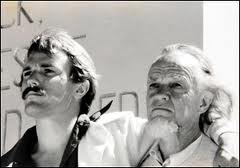
In 1992 I began to write skeptics letters after reading their books and articles and watching their films and I was introduced to Carl Sagan’s name by a book published in 1968 by Francis Schaeffer.
Francis Schaeffer in his book HE IS THERE AND HE IS NOT SILENT (Chapter 4) asserts:
Because men have lost the objective basis for certainty of knowledge in the areas in which they are working, more and more we are going to find them manipulating science according to their own sociological or political desires rather than standing upon concrete objectivity. We are going to find increasingly what I would call sociological science, where men manipulate the scientific facts. Carl Sagan (1934-1996),professor of astronomy and space science at Cornell University, demonstrates that the concept of a manipulated science is not far-fetched. He mixes science and science fiction constantly. He is a true follower of Edgar Rice Burroughs (1875-1950). The media gives him much TV prime time and much space in the press and magazine coverage, and the United State Government spent millions of dollars in the special equipment which was included in the equipment of the Mars probe–at his instigation, to give support to his obsessive certainty that life would be found on Mars, or that even large-sized life would be found there. With Carl Sagan the line concerning objective science is blurred, and the media spreads his mixture of science and science fiction out to the public as exciting fact.

Sagan in 1980
Carl Sagan on the Existence of God
RC Sproul confronts Carl Sagan.

Sagan in Rahway High School‘s 1951 yearbook
Sagan discusses FAITH when there is no evodence
Carl Sagan on Religion
—
The Bible and Archaeology – Is the Bible from God? (Kyle Butt)
Biblical Archaeology is Silencing the critics! Significantly, even liberal theologians, secular academics, and critics generally cannot deny that archaeology has confirmed thebiblical record at many points. Rationalistic detractors of the Bible can attack it all day long, but they cannot dispute archaeological facts.
—

Carl Sagan
Richard Dawkins on Carl Sagan, Einstein and Religion | A How To Academy …
—

Francis Schaeffer the Founder of the L’Abri community
The Cosmos Is All That Is
Francis Schaeffer wrote in 1981 in CHRISTIAN MANIFESTO chapter 3 The Destruction of Faith and Freedom:
Then there was a shift into materialistic science based on a philosophic change to the materialistic concept of final reality. This shift was based on no addition to the facts known. It was a choice, in faith, to see things that way. No clearer expression of this could be given than Carl Sagan’s arrogant statement on public television–made without any scientific proof for the statement–to 140 million viewers: “The cosmos is all that is or ever was or ever was or ever will be.” He opened the series, COSMOS, with this essentially creedal declaration and went on to build every subsequent conclusion upon it.
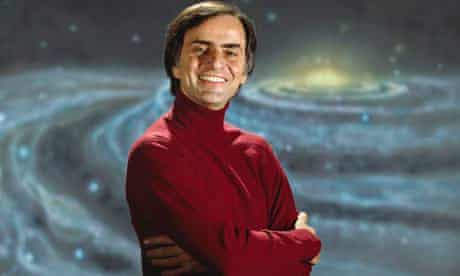 (Carl Sagan brought astronomy into popular culture. Photograph: Tony Korody/Corbis)
I am evangelical but I enjoyed reading Carl Sagan’s books and even had the chance to have my reviews of them published. Sagan’s correspondence with me with me in 1995 on two subjects showed what a gentleman he was.
Recently I have been revisiting my correspondence in 1995 with the famous astronomer Carl Sagan who I had the privilege to correspond with in 1994, 1995 and 1996. In 1996 I had a chance to respond to his December 5, 1995letter on January 10, 1996 and I never heard back from him again since his cancer returned and he passed away later in 1996. Below is what Carl Sagan wrote to me in his December 5, 1995 letter:
Thanks for your recent letter about evolution and abortion. The correlation is hardly one to one; there are evolutionists who are anti-abortion and anti-evolutionists who are pro-abortion.You argue that God exists because otherwise we could not understand the world in our consciousness. But if you think God is necessary to understand the world, then why do you not ask the next question of where God came from? And if you say “God was always here,” why not say that the universe was always here? On abortion, my views are contained in the enclosed article (Sagan, Carl and Ann Druyan {1990}, “The Question of Abortion,” Parade Magazine, April 22.)
I was introduced to when reading a book by Francis Schaeffer called HE IS THERE AND HE IS NOT SILENT written in 1968.
Michael K Lilley
This blog serves to provide the intellectual tools to educate, equip and encourage fellow Christians so that they have the confidence to face the challenges to their faith. This blog stands to build a strong foundation on the case for faith. John 16:1, 1 Corinthians 1:19, 2 Corinthians 10:5, Philippians 3:1, 1 Peter 3:15, Jude 1:3
Friday, 23 April 2010
You’re No One Special
Thursday, April 15, 2010 – Grace to You BlogCarl Sagan, perhaps the best-known scientific celebrity of the past couple of decades. A renowned astronomer and media figure, Sagan was overtly antagonistic to biblical theism. But he became the chief televangelist for the religion of naturalism. He preached a world-view that was based entirely on naturalistic assumptions. Underlying all he taught was the firm conviction that everything in the universe has a natural cause and a natural explanation. That belief—a matter of faith, not a truly scientific observation—governed and shaped every one of his theories about the universe.Sagan’s religion included the belief that the human race is nothing special. Given the incomprehensible vastness of the universe and the impersonality of it all, how could humanity possibly be important? Sagan concluded that our race is not significant at all. In December 1996, less than three weeks before Sagan died, he was interviewed by Ted Koppel on “Nightline.” Sagan knew he was dying, and Koppel asked him, “Dr. Sagan, do you have any pearls of wisdom that you would like to give to the human race?”
Sagan replied,
We live on a hunk of rock and metal that circles a humdrum star that is one of 400 billion other stars that make up the Milky Way Galaxy, which is one of billions of other galaxies, which make up a universe, which may be one of a very large number—perhaps an infinite number—of other universes. That is a perspective on human life and our culture that is well worth pondering. (ABC News Nightline, December 4, 1996)
In a book published posthumously, Sagan wrote, “Our planet is a lonely speck in the great enveloping cosmic dark. In our obscurity, in all this vastness, there is no hint that help will come from elsewhere to save us from ourselves” (Pale Blue Dot, New York: Random House, 1994, p. 9).
Although Sagan resolutely tried to maintain a semblance of optimism to the bitter end, his religion led where all naturalism inevitably leads: to a sense of utter insignificance and despair. According to his word-view, humanity occupies a tiny outpost—a pale blue speck in a vast sea of galaxies. As far as we know, we are unnoticed by the rest of the universe, accountable to no one, and petty and irrelevant in a cosmos so expansive. It is fatuous to talk of outside help or redemption for the human race. No help is forthcoming. It would be nice if we somehow managed to solve some of our problems, but whether we do or not will ultimately be a forgotten bit of cosmic trivia. That, said Sagan, is a perspective well worth pondering.
All of this underscores the spiritual barrenness of naturalism. The naturalist’s religion erases all moral and ethical accountability, and it ultimately abandons all hope for humanity. If the impersonal cosmos is all there is, all there ever was, and all there ever will be, then morality is ultimately moot. If there is no personal Creator to whom humanity is accountable and the survival of the fittest is the governing law of the universe, all the moral principles that normally regulate the human conscience are ultimately groundless—and possibly even deleterious to the survival of our species.
Indeed, the rise of naturalism has meant moral catastrophe for modern society. The most damaging ideologies of the nineteenth and twentieth centuries were all rooted in Darwinism. One of Darwin’s earliest champions, Thomas Huxley, gave a lecture in 1893 in which he argued that evolution and ethics are incompatible. He wrote that “the practice of that which is ethically best—what we call goodness or virtue—involves a course of conduct which, in all respects, is opposed to that which leads to success in the cosmic struggle for existence” (“Evolution and Ethics,” The Romanes Lecture, 1893).
[Note: Huxley nonetheless went on to try to justify ethics as a positive result of humanity’s higher rational functions, and he called upon his audience neither to imitate “the cosmic process” nor to run away from it, but rather to combat it—ostensibly by maintaining some semblance of morality and ethics. But what he could not do—what he and other philosophers of his era did not even bother attempting to do—was offer any justification for assuming the validity of morality and ethics per se on purely naturalistic principles. Huxley and his fellow naturalists could offer no moral compass other than their own personal preferences, and predictably, their philosophies all opened the door wide for complete moral subjectivity and ultimately amorality.]
Philosophers who incorporated Darwin’s ideas were quick to see Huxley’s point, conceiving new philosophies that set the stage for the amorality and genocide that characterized so much of the twentieth century.
Karl Marx, for example, self-consciously followed Darwin in the devising of his economic and social theories. He inscribed a copy of his book Das Kapital to Darwin, “from a devoted admirer.” He referred to Darwin’s The Origin of Species as “the book which contains the basis in natural history for our view” (Stephen Jay Gould, Ever Since Darwin, New York: Norton, 1977, p. 26).
Herbert Spencer’s philosophy of “Social Darwinism” applied the doctrines of evolution and the survival of the fittest to human societies. Spencer argued that if nature itself has determined that the strong survive and the weak perish, this rule should govern society as well. Racial and class distinctions simply reflect nature’s way. There is therefore no transcendent moral reason to be sympathetic to the struggle of the disadvantaged classes. It is, after all, part of the natural evolutionary process—and society would actually be improved by recognizing the superiority of the dominant classes and encouraging their ascendancy. The racialism of writers such as Ernst Haeckel (who believed that the African races were incapable of culture or higher mental development) was also rooted in Darwinism.
Friedrich Nietzsche’s whole philosophy was based on the doctrine of evolution. Nietzsche was bitterly hostile to religion, and particularly Christianity. Christian morality embodied the essence of everything Nietzsche hated; he believed Christ’s teaching glorified human weakness and was detrimental to the development of the human race. He scoffed at Christian moral values such as humility, mercy, modesty, meekness, compassion for the powerless, and service to one another. He believed such ideals had bred weakness in society. Nietzsche saw two types of people—the master-class, an enlightened, dominant minority; and the “herd,” sheeplike followers who were easily led. And he concluded that the only hope for humanity would be when the master-class evolved into a race of Übermenschen (supermen), unencumbered by religious or social mores, who would take power and bring humanity to the next stage of its evolution.
It’s not surprising that Nietzsche’s philosophy laid the foundation for the Nazi movement in Germany. What is surprising is that at the dawn of the twenty-first century, Nietzsche’s reputation has been rehabilitated by philosophical spin-doctors and his writings are once again trendy in the academic world. Indeed, his philosophy—or something very nearly like it—is what naturalism must inevitably return to.
All of these philosophies are based on notions that are diametrically opposed to a biblical view of the nature of man, because they all start by embracing a Darwinian view of the origin of humanity. They are rooted in anti-Christian theories about human origins and the origin of the cosmos, and therefore it is no wonder that they stand in opposition to biblical principles at every level.
The simple fact of the matter is that all the philosophical fruits of Darwinism have been negative, ignoble, and destructive to the very fabric of society. Not one of the major twentieth-century revolutions led by post-Darwinian philosophies ever improved or ennobled any society. Instead, the chief social and political legacy of Darwinian thought is a full spectrum of evil tyranny with Marx-inspired communism at one extreme and Nietzsche-inspired fascism at the other. And the moral catastrophe that has disfigured modern Western society is also directly traceable to Darwinism and the rejection of the early chapters of Genesis.
At this moment in history, even though most of modern society is already fully committed to an evolutionary and naturalistic world view, our society still benefits from the collective memory of a biblical worldview. People in general still believe human life is special. They still hold remnants of biblical morality, such as the notion that love is the greatest virtue (1 Corinthians 13:13); service to one another is better than fighting for personal dominion (Matthew 20:25-27); and humility and submission are superior to arrogance and rebellion (1 Peter 5:5).
But to whatever degree secular society still holds those virtues in esteem, it does so entirely without any philosophical foundation. Having already rejected the God revealed in Scripture and embraced instead pure naturalistic materialism, the modern mind has no grounds whatsoever for holding to any ethical standard; no reason whatsoever for esteeming “virtue” over “vice”; and no justification whatsoever for regarding human life as more valuable than any other form of life. Modern society has already abandoned its moral foundation.
Posted by Michael K. Lilley at 16:33
How Should We Then Live | Season 1 | Episode 6 | The Scientific Age
FEATURED ARTIST IS FRIDA KAHLO

MAGDALENA CARMEN FRIDA KAHLO CLADERÓN(1907-1954)
In recent years, Frida’s increasing fame seems to have obscured her importance in Latin American art. Marked since childhood by the physical aftermath of a bus accident, Kahlo’s self-portraits seem like silent, yet powerful wails.
Related posts:
Taking on Ark Times Bloggers on various issues Part F “Carl Sagan’s views on how God should try and contact us” includes film “The Basis for Human Dignity”
I have gone back and forth and back and forth with many liberals on the Arkansas Times Blog on many issues such as abortion, human rights, welfare, poverty, gun control and issues dealing with popular culture. Here is another exchange I had with them a while back. My username at the Ark Times Blog is Saline […]
By Everette Hatcher III|Posted in Francis Schaeffer, Prolife|Edit|Comments (0)
Carl Sagan v. Nancy Pearcey
On March 17, 2013 at our worship service at Fellowship Bible Church, Ben Parkinson who is one of our teaching pastors spoke on Genesis 1. He spoke about an issue that I was very interested in. Ben started the sermon by reading the following scripture: Genesis 1-2:3 English Standard Version (ESV) The Creation of the […]
By Everette Hatcher III|Posted in Adrian Rogers, Atheists Confronted, Current Events|TaggedBen Parkinson, Carl Sagan|Edit|Comments (0)
Review of Carl Sagan book (Part 4 of series on Evolution)
Review of Carl Sagan book (Part 4 of series on Evolution) The Long War against God-Henry Morris, part 5 of 6 Uploaded by FLIPWORLDUPSIDEDOWN3 on Aug 30, 2010 http://www.icr.org/ http://store.icr.org/prodinfo.asp?number=BLOWA2http://store.icr.org/prodinfo.asp?number=BLOWASGhttp://www.fliptheworldupsidedown.com/blog _______________________ I got this from a blogger in April of 2008 concerning candidate Obama’s view on evolution: Q: York County was recently in the news […]
By Everette Hatcher III|Posted in Atheists Confronted, Current Events, President Obama|Edit|Comments (0)
Review of Carl Sagan book (Part 3 of series on Evolution)
Review of Carl Sagan book (Part 3 of series on Evolution) The Long War against God-Henry Morris, part 4 of 6 Uploaded by FLIPWORLDUPSIDEDOWN3 on Aug 30, 2010 http://www.icr.org/ http://store.icr.org/prodinfo.asp?number=BLOWA2http://store.icr.org/prodinfo.asp?number=BLOWASGhttp://www.fliptheworldupsidedown.com/blog______________________________________ I got this from a blogger in April of 2008 concerning candidate Obama’s view on evolution: Q: York County was recently in the news […]
By Everette Hatcher III|Posted in Atheists Confronted, Current Events, President Obama|Edit|Comments (0)
Carl Sagan versus RC Sproul
At the end of this post is a message by RC Sproul in which he discusses Sagan. Over the years I have confronted many atheists. Here is one story below: I really believe Hebrews 4:12 when it asserts: For the word of God is living and active and sharper than any two-edged sword, and piercing as far as the […]
By Everette Hatcher III|Posted in Adrian Rogers, Atheists Confronted, Current Events, Francis Schaeffer|Tagged Bill Elliff, Carl Sagan, Jodie Foster, RC Sproul|Edit|Comments (0)
Review of Carl Sagan book (Part 4 of series on Evolution)jh68
Review of Carl Sagan book (Part 4 of series on Evolution) The Long War against God-Henry Morris, part 5 of 6 Uploaded by FLIPWORLDUPSIDEDOWN3 on Aug 30, 2010 http://www.icr.org/ http://store.icr.org/prodinfo.asp?number=BLOWA2http://store.icr.org/prodinfo.asp?number=BLOWASGhttp://www.fliptheworldupsidedown.com/blog _______________________ This is a review I did a few years ago. THE DEMON-HAUNTED WORLD: Science as a Candle in the Dark by Carl […]
By Everette Hatcher III|Posted in Atheists Confronted, Current Events|Edit|Comments (0)
Review of Carl Sagan book (Part 3 of series on Evolution)
Review of Carl Sagan book (Part 3 of series on Evolution) The Long War against God-Henry Morris, part 4 of 6 Uploaded by FLIPWORLDUPSIDEDOWN3 on Aug 30, 2010 http://www.icr.org/ http://store.icr.org/prodinfo.asp?number=BLOWA2http://store.icr.org/prodinfo.asp?number=BLOWASGhttp://www.fliptheworldupsidedown.com/blog______________________________________ I was really enjoyed this review of Carl Sagan’s book “Pale Blue Dot.” Carl Sagan’s Pale Blue Dot by Larry Vardiman, Ph.D. […]
By Everette Hatcher III|Posted in Atheists Confronted, Current Events|Edit|Comments (0)
Atheists confronted: How I confronted Carl Sagan the year before he died jh47
In today’s news you will read about Kirk Cameron taking on the atheist Stephen Hawking over some recent assertions he made concerning the existence of heaven. Back in December of 1995 I had the opportunity to correspond with Carl Sagan about a year before his untimely death. Sarah Anne Hughes in her article,”Kirk Cameron criticizes […]
By Everette Hatcher III|Posted in Atheists Confronted|Edit|Comments (2)
FRANCIS SCHAEFFER ANALYZES ART AND CULTURE Part 18 “Michelangelo’s DAVID is the statement of what humanistic man saw himself as being tomorrow” (Feature on artist Paul McCarthy)
In this post we are going to see that through the years humanist thought has encouraged artists like Michelangelo to think that the future was extremely bright versus the place today where many artist who hold the humanist and secular worldview are very pessimistic. In contrast to Michelangelo’s DAVID when humanist man thought he […]
By Everette Hatcher III|Posted in Francis Schaeffer|Tagged David Leeds, J.I.PACKER, Joe Carter, Massimiliano Gioni, Michelangelo, Michelangelo’s DAVID, Michelangelo’s Florence Pietà, Paul McCarthy, Renaissance, Rick Pearcey, Rush Limbaugh, Tony Bartolucci|Edit|Comments (0)
Was Antony Flew the most prominent atheist of the 20th century?
_________ Antony Flew on God and Atheism Published on Feb 11, 2013 Lee Strobel interviews philosopher and scholar Antony Flew on his conversion from atheism to deism. Much of it has to do with intelligent design. Flew was considered one of the most influential and important thinker for atheism during his time before his death […]
By Everette Hatcher III|Posted in Current Events|Edit|Comments (0)


 The Daily Hatch