
____
—

Elephants in the Room – Foreign Policy
—

B

Trump
https://forms.gov.il/globaldata/getsequence/getHtmlForm.aspx?formType=ContactUsEn@pmo.gov.il
The Prime Minister’s Office, Public Enquiries Department, Kiryat Ben Gurion, Building C, Jerusalem 91950, Israel
BIBI said it was about time to get a royal visit to Israel!!!
As Israel was becoming a rising power in the world, heads of state from nearly all major countries visited it. One notable exception was the British royal family. It took seventy years after Israel’s independence for a member of the British royal family to make an official visit to Israel. This glaring omission was probably advised by the hopelessly Arabist British Foreign Office, which had no problem sending royals to other countries in the Middle East. (State funerals provided the sad exception—Prince Charles had attended the funerals of Rabin in 1995 and Peres in 2016.) I thought it offensive that the one true democracy in the Middle East was not a suitable destination for a royal visit from the mother of modern democracies. I communicated this to the British government in meetings with their officials and diplomats in 2017 and 2018. “You’re among the last to know that in today’s technological world visiting Israel is an asset, not a liability,” I said to a senior British official. This was corrected in 2018 when Prince William visited Israel, making a great splash. The public loved him. Sara, the boys and I greeted him in Balfour. William was surprised by Avner’s mastery of detail about William’s favorite soccer team, Aston Villa. Avner’s favorite team was Manchester United. I recounted my positive impression of its legendary coach, Sir Alex Ferguson, whom I had once met at a New York restaurant. William and I discussed the role of helicopters in military search and rescue operations, a topic he as a pilot was familiar with and I had experience in as a special forces officer in need of heliborne extraction. We then discussed three extraordinary women who had great influence on William’s life and heritage. Sara told him how much her mother admired his grandmother, Queen Elizabeth. “My mother always told me that the Queen was very intelligent because she knows how to listen,” Sara said. Williams eyes lit up. “She is very much that, and an excellent listener,” he responded. In a private moment in my study, Sara also told William how much she identified with his mother, Princess Diana. “I think about her every day,” said William softly. Perhaps the most moving part of the visit for me involved William’s great-grandmother, Princess Alice. While a nun in Athens during the Nazi occupation of Greece in World War II, she sheltered Jewish refugees and was later honored by Yad Vashem, Israel’s Holocaust memorial, with the title of Righteous Among the Nations—a designation for non-Jewish individuals who risked their lives to aid Jews. We brought some of the descendants of the families saved by Alice to meet her great-grandson. They expressed their deep appreciation for the woman who made their lives possible. William was visibly moved. Princess Alice died in 1969, but per her request, her remains were later moved from England to Jerusalem. Two years after William’s visit, in January 2020, Prince Charles attended a ceremony in Jerusalem marking the 75th anniversary of the liberation of Auschwitz. The prince, whom I had first met at King Hussein’s funeral in 1999, approached me. “Don’t you ever age?” he joked. These visits were a symbolic expression of the close relations between Britain and Israel—countries which exchanged billions of dollars in trade and over time increasingly cooperated in fighting terror—and did a great deal to correct a historical omission.
_____
$6B Prisoner Swap Was ‘Just a Drop in the Bucket’ for Iran. Here’s How Much Tehran Has Raked in Under Biden.


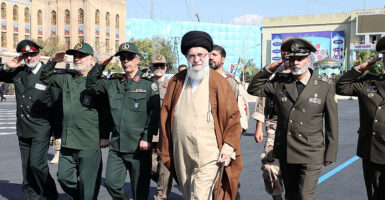
President Joe Biden’s administration arguably is responsible for at least $42 billion in funding for Iran, according to the Foundation for the Defense of Democracies. Pictured: Iranian Supreme Leader Ali Khamenei attends a graduation ceremony Oct. 10 for Iranian armed forces cadets at Imam Ali Officers’ Academy in Tehran. (Photo: Iranian Supreme Leader Press Office/Anadolu/Getty Images)
Republicans have castigated President Joe Biden’s administration for freeing up $6 billion in funds for Iran’s Islamist regime, money that likely contributed to Tehran’s funding of Hamas, the genocidal terrorist group that slaughtered more than 1,400 Israelis and took about 200 hostage Oct. 7.
Yet the Biden administration’s policies freed up far more than $6 billion for Iran.
“It’s a drop in the bucket,” Robert Greenway, director of The Heritage Foundation’s Center for National Defense, told The Daily Signal in an interview Wednesday. (The Daily Signal is Heritage’s news outlet.)
Greenway led a team to plan and execute the most significant U.S. economic sanctions against Iran. He served as a principal architect of the Abraham Accords, working as deputy assistant to President Donald Trump and senior director of the National Security Council’s Middle East and North African Affairs Directorate.
Referring to Iran, Greenway described the released $6 billion as “a fraction of the overall revenue that the Biden administration consciously has allowed them to have.”
He said Biden’s policies, by relaxing Trump’s “maximum pressure” campaign and signaling his willingness to strike a new nuclear deal with Iran, has emboldened Tehran and signaled other countries in the region that they should work with Iran.
“We’re encouraging everyone else to do this. Everybody in the region is paying Iran not to attack them,” Greenway warned.
He urged that the U.S. stop paying Hamas through funds ostensibly for Palestinian aid.
“This is extortion. I pay so Gaza won’t attack again,” Greenway said. “We should stop writing checks.”
While Greenway acknowledged Biden’s strong rhetoric in support of Israel, he said Americans and Israelis should see through that facade.
“I literally paid the people who attacked you,” Greenway said, speaking as though he were Biden. “No one should be defending this. No one in Israel can think that Biden is their friend.”
According to The Daily Signal’s calculations, Iran has received approximately $70 billion more under Biden than it would have under Trump.
Biden repeatedly has said that there is no “specific evidence” showing that Tehran had any involvement in the Hamas terrorist attack, but Iran has funded Hamas for years.
Hamas spokesman Ghazi Hamad told the BBC that Iran gave the green light for the attack. The Wall Street Journal reported that “senior members of Hamas and Hezbollah” confirmed that “Iran’s Islamic Revolutionary Guard Corps had worked with Hamas since August to devise the air, land, and sea incursions.”
Furthermore, Greenway and another Heritage Foundation national security expert, Victoria Coates, wrote: “Absent significant training, equipment, and intelligence capabilities supplied by Iran, Hamas would never have been able to have carried out such an operation.”
The $6 billion figure traces back to 2018, when the Trump administration granted a waiver to South Korea, among other nations, to continue buying Iranian oil after the U.S. left the 2015 nuclear deal.
The Trump administration canceled these exemptions in 2019, diverting payments for already-delivered oil into escrow accounts. Biden agreed to release the $6 billion South Korea owes Iran as part of a prisoner exchange in August.
The Biden administration has insisted that the $6 billion would fund only humanitarian projects, but money is fungible. Even if that money would support only infrastructure, health care, or education, it would free up funds for Tehran to send money to Hamas. Even if none of that money had been spent before Oct. 7, as the Biden administration has insisted, Tehran may have spent money elsewhere, expecting those funds to materialize.
Perhaps in response to criticism regarding the unfrozen funds, Deputy Treasury Secretary Wally Adeyemo told House Democrats that the U.S. and Qatar agreed to prevent Iran from accessing the $6 billion. It remains unclear whether any of that money had made it back to Tehran, but Secretary of State Antony Blinken said none had.
Even if Tehran doesn’t receive a penny from South Korea, the Biden administration has allowed more funds to flow to Iran from other sources.
$10 Billion From Iraq
In July, Blinken signed a 120-day national security waiver allowing Iraq, which is heavily dependent on Iranian electricity, to deposit payments into non-Iraqi banks in third countries instead of into restricted accounts in Iraq, Reuters reported.
Blinken did so as Tehran ratcheted up the pressure to release Iraq’s debt to Iran, totaling at least $10 billion, according to The Wall Street Journal. Some of that money may be denominated in dollars because the Federal Reserve provides dollars to Iraqin order to maintain a favorable trade balance.
Iraq relies upon Iranian natural gas, and sometimes repays Tehran in oil.
The U.S. reportedly granted the waiver in order to prevent Tehran from cutting power to Iraq during the heat of the summer. U.S. officials said the funds deposited into non-Iraqi accounts still would be restricted, requiring U.S. permission for Iran to access them and only for spending on humanitarian goods.
$52.2 Billion in Extra Oil Revenues
As president, Trump imposed “maximum pressure” sanctions on Iran, especially following his withdrawal from the Obama-era Iran nuclear deal in May 2018. Yet Biden campaigned on restoring the nuclear deal with Iran and loosening the sanctions, which sent a strong signal to global markets, according to Benham Ben Taleblu, a senior fellow at the Foundation for the Defense of Democracies.
“Markets are real, markets work, and when you send the wrong incentives, you get a whole bunch of risk-tolerant buyers becoming more active,” Ben Taleblu told The Daily Signal in a phone interview Tuesday.
Even before Biden took office, China and other buyers began to import more oil from Iran, anticipating the loosening of U.S. restrictions. Biden didn’t repeal the laws that impose sanctions on Iran’s oil industry, but his rhetoric still brought a windfall for Iran as buyers started to “capitalize on that sentiment in the market,” Ben Taleblu said.
Meanwhile, the Biden administration has undertaken fewer enforcement actions, and sanctions can atrophy when not enforced.
Ben Taleblu and his colleague Saeed Ghasseminejad (a senior Iran and financial economics adviser) estimated that Iran has sold $95 billion worth of oil since Biden entered office.
They estimated that about $32 million of that represents an excess. That number represents “the excess funds that Iran was able to generate because of relaxed or unenforced maximum pressure sanctions that legally remain on the books but de facto are not enforced,” Ben Taleblu said.
Yet that number relies on the assumption that the price of oil would have increased under Trump as it has under Biden, and that Iran would have been able to sell its oil at the market price. While it is unclear exactly how low Iran has to drop the price to convince buyers like China to purchase the oil, it stands to reason that the price of oil would have remained approximately $55 per barrel had Trump remained in office in 2021.
Had Iranian exports remained at the baseline “maximum pressure” level of 0.775 million barrels of oil per day (282.9 million per year) at $55, that translates to $15.6 billion per year, or $42.8 billion from January 2021 to October 2023.
This translates to a $52.2 billion windfall.
$3.8 Billion in Petrochemicals
As the Trump administration imposed sanctions on oil, Iran turned to the sale of petrochemicals, products derived from petroleum, to retain revenues.
Iran exported 25 million metric tons of petrochemicals and received approximately $20 billion in 2020, Reuters reported. This represented a jump over the 20 million tons Iran sold in 2019.
According to Oil & Gas Middle East, Iran sold 27.6 million tons between March 21, 2022, and March 20, 2023, which translates to approximately $22 billion during that time. That represented a 6% increase from the previous year, which means Iran sold approximately 26 million tons that year, which translates to approximately $20.8 billion.
Assuming Iran has netted another $11 billion from petrochemical sales in the past six months, the Islamist regime has received approximately $53.8 billion since March 2021. This represents a $3.8 billion increase over the $50 billion Iran would have received from petrochemical exports had the rate stayed the same since 2020.
$1.6 Billion in Steel
Iran exported 5.88 million metric tons of steel between March 21, 2019, and Jan. 20, 2020, Iran reported in 2020. This translates to an annual rate of 7 million tons. In calendar year 2018, Iran exported 9.2 million tons at a value of $4.2 billion, according to the U.S. Department of Commerce.
The Trump administration imposed sanctions on Iran’s steel industry, which the Biden administration hasn’t enforced.
According to a May report from the Iranian Steel & Iron Ore Market Conference & Expo, Tehran expects to export 14 million tons of steel between March 21, 2023, and March 21, 2024, about 4 million tons more than the approximately 10 million exported between March 2022 and March 2023.
Yet Iran exported only 4.2 million tons of steel from March 2021 to March 2022, an Iranian steel producer reported.
If Iran remained on track to export 14 million tons by March 2024, it would have exported 7 million tons through the end of September, totaling 21 million tons since March 2021. That translates to $9.597 billion since the beginning of the Biden administration. If Iran exported steel between March 2021 and September 2023 at the same rate as it did between March 2019 and March 2020, it would have exported 17.5 million tons. That translates to approximately $8 billion, meaning that Iran received approximately $1.6 billion more under Biden than it might have under Trump.
$3.42 Billion in Special Drawing Rights
The International Monetary Fund created special drawing rights to supplement the official reserves of member countries. Countries may use these rights to infuse cash into their economies.
In August 2021, the IMF sent $3.42 billion to Iran in special drawing rights. According to the Foundation for the Defense of Democracies, the Biden administration had the authority oppose this allocation and did not do so. U.S. law mandates that the IMF’s American executive director oppose allocating any funds to a state sponsor of terror.
Mohammed Reza Farzin, the governor of the Central Bank of Iran, and his deputy for international affairs, Mohsen Karimi, said during a May 30 meeting with IMF officials that Tehran had access to $6.7 billion worth of special drawing rights, which Iran could use promptly to help meet the country’s “economic needs.”
Although it remains unclear how much money in special drawing rights Tehran has accessed, the Biden administration has the power to block such moves.
“While there are unconventional ways for Iran to use its [special drawing right]s, for example as collateral to get a line of credit from an IMF member country, I do not assess that this has happened at this point but there is little doubt Iran is seeking ways to do that,” the Foundation for the Defense of Democracies’ Ghasseminejad told The Daily Signal in a statement Wednesday.
Toby Dershowitz, senior vice president of government relations at the foundation, noted that the Financial Action Task Force “sets standards for anti-money laundering and combatting the financing of terrorism.” Iran remains on the task force’s blacklist, he noted.
“It would be deeply concerning should the IMF to permit a global terror financier known also for its financial corruption, to access SDRs until it ceases its malign conduct,” Dershowitz added.
Other Funds Iran May Try to Access
Other countries still owe Iran for oil purchased in 2018. Iranian Foreign Minister Hossein Amir-Abdollahian visited Japan in August and urged Tokyo to release the $3 billion owed to Tehran. It remains unclear how much other countries still owe Iran.
Last week, Biden warned Iran to “be careful” amid Israel’s war with Hamas. The Biden administration has a plethora of options to crack down on Tehran after Iran’s proxy attacked Israel.
The administration’s previous record already has translated to an extra $42 billion flowing to Iran’s ruling mullahs.
Neither the Biden White House nor the State Department nor the Treasury Department responded to The Daily Signal’s request for comment by publication time.
Have an opinion about this article? To sound off, please email letters@DailySignal.com, and we’ll consider publishing your edited remarks in our regular “We Hear You” feature. Remember to include the URL or headline of the article plus your name and town and/or state.
__________
The Bible and Archaeology
Biblical Archaeology: Factual Evidence to Support the Historicity of the Bible
Article ID: DA111 | By: Paul L. Maier
This article first appeared in the Christian Research Journal, volume 27, number 2 (2004). For further information or to subscribe to the Christian Research Journal go to: http://www.equip.org
Archaeological finds that contradict the contentions of biblical minimalists and other revisionists have been listed above. There are many more, however, that corroborate biblical evidence, and the following list provides only the most significant discoveries:
The Existence of Hittites. Genesis 23 reports that Abraham buried Sarah in the Cave of Machpelah, which he purchased from Ephron the Hittite. Second Samuel 11 tells of David’s adultery with Bathsheba, the wife of Uriah the Hittite. A century ago the Hittites were unknown outside of the Old Testament, and critics claimed that they were a figment of biblical imagination. In 1906, however, archaeologists digging east of Ankara, Turkey, discovered the ruins of Hattusas, the ancient Hittite capital at what is today called Boghazkoy, as well as its vast collection of Hittite historical records, which showed an empire flourishing in the mid-second millennium BC. This critical challenge, among many others, was immediately proved worthless — a pattern that would often be repeated in the decades to come.
The Merneptah Stele. A seven-foot slab engraved with hieroglyphics, also called the Israel Stele, boasts of the Egyptian pharaoh’s conquest of Libyans and peoples in Palestine, including the Israelites: “Israel — his seed is not.” This is the earliest reference to Israel in nonbiblical sources and demonstrates that, as of c. 1230 BC, the Hebrews were already living in the Promised Land.
Biblical Cities Attested Archaeologically. In addition to Jericho, places such as Haran, Hazor, Dan, Megiddo, Shechem, Samaria, Shiloh, Gezer, Gibeah, Beth Shemesh, Beth Shean, Beersheba, Lachish, and many other urban sites have been excavated, quite apart from such larger and obvious locations as Jerusalem or Babylon. Such geographical markers are extremely significant in demonstrating that fact, not fantasy, is intended in the Old Testament historical narratives; otherwise, the specificity regarding these urban sites would have been replaced by “Once upon a time” narratives with only hazy geographical parameters, if any.
Israel’s enemies in the Hebrew Bible likewise are not contrived but solidly historical. Among the most dangerous of these were the Philistines, the people after whom Palestine itself would be named. Their earliest depiction is on the Temple of Rameses III at Thebes, c. 1150 BC, as “peoples of the sea” who invaded the Delta area and later the coastal plain of Canaan. The Pentapolis (five cities) they established — namely Ashkelon, Ashdod, Gaza, Gath, and Ekron — have all been excavated, at least in part, and some remain cities to this day. Such precise urban evidence measures favorably when compared with the geographical sites claimed in the holy books of other religious systems, which often have no basis whatever in reality.10
Shishak’s Invasion of Judah. First Kings 14 and 2 Chronicles 12 tell of Pharaoh Shishak’s conquest of Judah in the fifth year of the reign of King Rehoboam, the brainless son of Solomon, and how Solomon’s temple in Jerusalem was robbed of its treasures on that occasion. This victory is also commemorated in hieroglyphic wall carvings on the Temple of Amon at Thebes.
The Moabite Stone. Second Kings 3 reports that Mesha, the king of Moab, rebelled against the king of Israel following the death of Ahab. A three-foot stone slab, also called the Mesha Stele, confirms the revolt by claiming triumph over Ahab’s family, c. 850 BC, and that Israel had “perished forever.”
Obelisk of Shalmaneser III. In 2 Kings 9–10, Jehu is mentioned as King of Israel (841–814 BC). That the growing power of Assyria was already encroaching on the northern kings prior to their ultimate conquest in 722 BC is demonstrated by a six-and-a-half-foot black obelisk discovered in the ruins of the palace at Nimrud in 1846. On it, Jehu is shown kneeling before Shalmaneser III and offering tribute to the Assyrian king, the only relief we have to date of a Hebrew monarch.
Burial Plaque of King Uzziah. Down in Judah, King Uzziah ruled from 792 to 740 BC, a contemporary of Amos, Hosea, and Isaiah. Like Solomon, he began well and ended badly. In 2 Chronicles 26 his sin is recorded, which resulted in his being struck with leprosy later in life. When Uzziah died, he was interred in a “field of burial that belonged to the kings.” His stone burial plaque has been discovered on the Mount of Olives, and it reads: “Here, the bones of Uzziah, King of Judah, were brought. Do not open.”
Hezekiah’s Siloam Tunnel Inscription. King Hezekiah of Judah ruled from 721 to 686 BC. Fearing a siege by the Assyrian king, Sennacherib, Hezekiah preserved Jerusalem’s water supply by cutting a tunnel through 1,750 feet of solid rock from the Gihon Spring to the Pool of Siloam inside the city walls (2 Kings 20; 2 Chron. 32). At the Siloam end of the tunnel, an inscription, presently in the archaeological museum at Istanbul, Turkey, celebrates this remarkable accomplishment. The tunnel is probably the only biblical site that has not changed its appearance in 2,700 years.
The Sennacherib Prism. After having conquered the 10 northern tribes of Israel, the Assyrians moved southward to do the same to Judah (2 Kings 18–19). The prophet Isaiah, however, told Hezekiah that God would protect Judah and Jerusalem against Sennacherib (2 Chron. 32; Isa. 36–37). Assyrian records virtually confirm this. The cuneiform on a hexagonal, 15-inch baked clay prism found at the Assyrian capital of Nineveh describes Sennacherib’s invasion of Judah in 701 BC in which it claims that the Assyrian king shut Hezekiah inside Jerusalem “like a caged bird.” Like the biblical record, however, it does not state that he conquered Jerusalem, which the prism certainly would have done had this been the case. The Assyrians, in fact, bypassed Jerusalem on their way to Egypt, and the city would not fall until the time of Nebuchadnezzar and the Neo-Babylonians in 586 BC. Sennacherib himself returned to Nineveh where his own sons murdered him.
The Cylinder of Cyrus the Great. Second Chronicles 36:23 and Ezra 1 report that Cyrus the Great of Persia, after conquering Babylon, permitted Jews in the Babylonian Captivity to return to their homeland. Isaiah had even prophesied this (Isa. 44:28). This tolerant policy of the founder of the Persian Empire is borne out by the discovery of a nine-inch clay cylinder found at Babylon from the time of its conquest, 539 BC, which reports Cyrus’s victory and his subsequent policy of permitting Babylonian captives to return to their homes and even rebuild their temples.
So it goes. This list of correlations between Old Testament texts and the hard evidence of Near Eastern archaeology could easily be tripled in length. When it comes to the intertestamental and New Testament eras, as we might expect, the needle on the gauge of positive correlations simply goes off the scale.
To use terms such as “false testament” for the Hebrew Bible and to vaporize its earlier personalities into nonexistence accordingly has no justification whatever in terms of the mass of geographical, archaeological, and historical evidence that correlates so admirably with Scripture.
notes
1. Israel Finkelstein and Neil Asher Silberman, The Bible Unearthed: Archaeology’s New Vision of Ancient Israel and the Origin of Its Sacred Texts (New York: The Free Press, 2001).
2. Daniel Lazare, “False Testament: Archaeology Refutes the Bible’s Claim to History,” Harper’s, March 2002, 39–47.
3. Ibid., 40.
4. See Kenneth Kitchen, “The Patriarchal Age: Myth or History?” Biblical Archaeology Review(hereafter BAR), March/April 1995, 48ff.
5. A considerable, and growing, body of literature exists on the Hebrews in Egypt, the role of Joseph, the pharaoh who befriended him, the Hyksos, the pharaoh of the Oppression, the pharaoh of the Exodus, and the Exodus itself. See recent issues of Bible and Spade, especially no. 16 (Winter 2003). Joseph P. Free and Howard F. Vos, Archaeology and Bible History (Grand Rapids: Zondervan Publishing House, 1992), 69–105 is also helpful, as is Alfred J. Hoerth,Archaeology and the Old Testament (Grand Rapids: Baker Book House, 1999).
6. Kathleen M. Kenyon, Digging up Jericho (London: Ernest Benn, 1957); Excavations at Jericho, vol. 3 (London: British School of Archaeology in Jerusalem, 1981).
7. Bryant G. Wood, “Did the Israelites Conquer Jericho?” BAR, March/April 1990, 44–58.
8. Lazare, 45–46.
9. Hershel Shanks, “Biran at Ninety,” BAR, September/October 1999, 44.
10. For example, in The Book of Mormon, proper names of places and people have no substantiation from outside sources.
11. William A. Dever, “Save Us from Postmodern Malarkey,” BAR, March/April 2000, 28.
12. William A. Dever, cited in Gordon Govier, “Biblical Archaeology’s Dusty Little Secret,”Christianity Today, October 2003, 38.
13. Steven Feldman, “Is the Bible a Bunch of Historical Hooey?” BAR, May/June 2002, 6.
Related posts:
Taking on Ark Times Bloggers on various issues Part I “Old Testament Bible Prophecy” includes the film TRUTH AND HISTORY and article ” Jane Roe became pro-life”
I have gone back and forth and back and forth with many liberals on the Arkansas Times Blog on many issues such as abortion, human rights, welfare, poverty, gun control and issues dealing with popular culture. Here is another exchange I had with them a while back. My username at the Ark Times Blog is Saline […]
John MacArthur on fulfilled prophecy from the Bible Part 2
I have posted many of the sermons by John MacArthur. He is a great bible teacher and this sermon below is another great message. His series on the Book of Proverbs was outstanding too. I also have posted several of the visits MacArthur made to Larry King’s Show. One of two most popular posts I […]
John MacArthur on fulfilled prophecy from the Bible Part 1
I have posted many of the sermons by John MacArthur. He is a great bible teacher and this sermon below is another great message. His series on the Book of Proverbs was outstanding too. I also have posted several of the visits MacArthur made to Larry King’s Show. One of two most popular posts I […]
John MacArthur: Fulfilled prophecy in the Bible? (Ezekiel 26-28 and the story of Tyre, video clips)
Prophecy–The Biblical Prophesy About Tyre.mp4 Uploaded by TruthIsLife7 on Dec 5, 2010 A short summary of the prophecy about Tyre and it’s precise fulfillment. Go to this link and watch the whole series for the amazing fulfillment from secular sources. http://www.youtube.com/watch?v=qvt4mDZUefo ________________ John MacArthur on the amazing fulfilled prophecy on Tyre and how it was fulfilled […]
John MacArthur on the Bible and Science (Part 2)
John MacArthur on the Bible and Science (Part 2) I have posted many of the sermons by John MacArthur. He is a great bible teacher and this sermon below is another great message. His series on the Book of Proverbs was outstanding too. I also have posted several of the visits MacArthur made to Larry […]
John MacArthur on the Bible and Science (Part 1)
John MacArthur on the Bible and Science (Part 1) I have posted many of the sermons by John MacArthur. He is a great bible teacher and this sermon below is another great message. His series on the Book of Proverbs was outstanding too. I also have posted several of the visits MacArthur made to Larry […]
Adrian Rogers: “Why I believe the Bible is true”
Adrian Rogers – How you can be certain the Bible is the word of God Great article by Adrian Rogers. What evidence is there that the Bible is in fact God’s Word? I want to give you five reasons to affirm the Bible is the Word of God. First, I believe the Bible is the […]
The Old Testament is Filled with Fulfilled Prophecy by Jim Wallace
Is there any evidence the Bible is true? Articles By PleaseConvinceMe Apologetics Radio The Old Testament is Filled with Fulfilled Prophecy Jim Wallace A Simple Litmus Test There are many ways to verify the reliability of scripture from both internal evidences of transmission and agreement, to external confirmation through archeology and science. But perhaps the […]
Taking on Ark Times Bloggers on various issues Part M “Old Testament prophecy fulfilled?”Part 3(includes film DEATH BY SOMEONE’S CHOICE)
I have gone back and forth and back and forth with many liberals on the Arkansas Times Blog on many issues such as abortion, human rights, welfare, poverty, gun control and issues dealing with popular culture. Here is another exchange I had with them a while back. My username at the Ark Times Blog is […]
Evidence for the Bible
Here is some very convincing evidence that points to the view that the Bible is historically accurate. Archaeological and External Evidence for the Bible Archeology consistently confirms the Bible! Archaeology and the Old Testament Ebla tablets—discovered in 1970s in Northern Syria. Documents written on clay tablets from around 2300 B.C. demonstrate that personal and place […]
Related posts:
FRANCIS SCHAEFFER ANALYZES ART AND CULTURE Part 53 THE BEATLES (Part E, Stg. Pepper’s and John Lennon’s search in 1967 for truth was through drugs, money, laughter, etc & similar to King Solomon’s, LOTS OF PICTURES OF JOHN AND CYNTHIA) (Feature on artist Yoko Ono)
The John Lennon and the Beatles really were on a long search for meaning and fulfillment in their lives just like King Solomon did in the Book of Ecclesiastes. Solomon looked into learning (1:12-18, 2:12-17), laughter, ladies, luxuries, and liquor (2:1-2, 8, 10, 11), and labor (2:4-6, 18-20). He fount that without God in the picture all […]
FRANCIS SCHAEFFER ANALYZES ART AND CULTURE Part 52 THE BEATLES (Part D, There is evidence that the Beatles may have been exposed to Francis Schaeffer!!!) (Feature on artist Anna Margaret Rose Freeman )
______________ George Harrison Swears & Insults Paul and Yoko Lucy in the Sky with Diamonds- The Beatles The Beatles: I have dedicated several posts to this series on the Beatles and I don’t know when this series will end because Francis Schaeffer spent a lot of time listening to the Beatles and talking […]
FRANCIS SCHAEFFER ANALYZES ART AND CULTURE Part 51 THE BEATLES (Part C, List of those on cover of Stg.Pepper’s ) (Feature on artist Raqib Shaw )
The Beatles in a press conference after their Return from the USA Uploaded on Nov 29, 2010 The Beatles in a press conference after their Return from the USA. The Beatles: I have dedicated several posts to this series on the Beatles and I don’t know when this series will end because Francis […]
FRANCIS SCHAEFFER ANALYZES ART AND CULTURE Part 50 THE BEATLES (Part B, The Psychedelic Music of the Beatles) (Feature on artist Peter Blake )
__________________ Beatles 1966 Last interview I have dedicated several posts to this series on the Beatles and I don’t know when this series will end because Francis Schaeffer spent a lot of time listening to the Beatles and talking and writing about them and their impact on the culture of the 1960’s. In this […]
FRANCIS SCHAEFFER ANALYZES ART AND CULTURE Part 49 THE BEATLES (Part A, The Meaning of Stg. Pepper’s Cover) (Feature on artist Mika Tajima)
_______________ The Beatles documentary || A Long and Winding Road || Episode 5 (This video discusses Stg. Pepper’s creation I have dedicated several posts to this series on the Beatles and I don’t know when this series will end because Francis Schaeffer spent a lot of time listening to the Beatles and talking and writing about […]
FRANCIS SCHAEFFER ANALYZES ART AND CULTURE PART 48 “BLOW UP” by Michelangelo Antonioni makes Philosophic Statement (Feature on artist Nancy Holt)
_______________ Francis Schaeffer pictured below: _____________________ I have included the 27 minute episode THE AGE OF NONREASON by Francis Schaeffer. In that video Schaeffer noted, ” Sergeant Pepper’s Lonely Hearts Club Band…for a time it became the rallying cry for young people throughout the world. It expressed the essence of their lives, thoughts and their feelings.” How Should […]
FRANCIS SCHAEFFER ANALYZES ART AND CULTURE Part 47 Woody Allen and Professor Levy and the death of “Optimistic Humanism” from the movie CRIMES AND MISDEMEANORS Plus Charles Darwin’s comments too!!! (Feature on artist Rodney Graham)
Crimes and Misdemeanors: A Discussion: Part 1 ___________________________________ Today I will answer the simple question: IS IT POSSIBLE TO BE AN OPTIMISTIC SECULAR HUMANIST THAT DOES NOT BELIEVE IN GOD OR AN AFTERLIFE? This question has been around for a long time and you can go back to the 19th century and read this same […]
FRANCIS SCHAEFFER ANALYZES ART AND CULTURE PART 46 Friedrich Nietzsche (Featured artist is Thomas Schütte)
____________________________________ Francis Schaeffer pictured below: __________ Francis Schaeffer has written extensively on art and culture spanning the last 2000years and here are some posts I have done on this subject before : Francis Schaeffer’s “How should we then live?” Video and outline of episode 10 “Final Choices” , episode 9 “The Age of Personal Peace and Affluence”, episode 8 […]
_____________


 The Daily Hatch