
—

Bill Clinton with former Israeli Prime Minister Ariel Sharon in 2000; Donald Trump with Israeli Prime Minister Benjamin Netanyahu on March 25. Photo illustration by Slate. Photos by Thomas Coex/AFP/Getty Images; Drew Angerer/Getty Images.
/cdn.vox-cdn.com/uploads/chorus_image/image/45777608/GettyImages_460494092.0.jpg)
Zack Beauchamp is a senior correspondent at Vox, where he covers ideology and challenges to democracy, both at home and abroad. Before coming to Vox in 2014, he edited TP Ideas, a section of Think Progress devoted to the ideas shaping our political world.
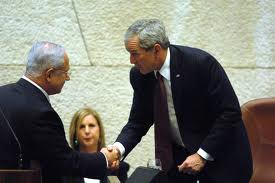
Then opposition leader Benjamin Netanyahu greets US President George W. Bush in the Knesset.

Vice President Joe Biden meets with Israeli Prime Minister Benjamin Netanyahu at the annual General Assembly of the Jewish Federations of North America in New Orleans on Nov. 7, 2010. | Gerald Herbert/AP Photo
BIBI noted The Bible can do wonders for diplomacy.
When Temer was succeeded by President Jair Bolsonaro in 2018, the latter reissued Temer’s invitation to visit Brazil and also attend his inauguration on January 1, 2019. I accepted. The controversial and conservative Bolsonaro, who had visited Israel twice, was a strong supporter of fostering ties with Israel. Coming to Rio de Janeiro, I took a break to stroll along Copacabana Beach and joined an impromptu soccer game in the sand. The people on the beach greeted me with supportive chants, and probably not because of my rusty soccer skills. This expression of support was loudly repeated by thousands of Brazilian evangelicals who saw me outside the palace in Brasilia during the inauguration ceremony. The Bible can do wonders for diplomacy. So can technology. When Narendra Modi, India’s prime minister, visited Israel in July 2017, I accompanied him for four days. Having seen Israel’s agricultural expertise when he was the governor of Gujarat, Modi was already favorably disposed to Israeli agricultural technology such as drip irrigation, but now he would see with his own eyes how far it had advanced.
https://www.dailysignal.com/2023/10/18/4
Biden Pick for Ambassador to Israel Confronted on Iran Deal, Misleading Congress. Here Are 4 Takeaways.



“I don’t think this is the moment for us to be negotiating with Iran. I believe deeply that an agreement to not have nuclear weapons would be a good thing, but this is not the moment,” Jacob “Jack” Lew, President Biden’s nominee for ambassador to Israel, testifies Wednesday before the Senate Foreign Relations Committee. (Photo: Roberto Schmidt/AFP/Getty Images)
Former Treasury Secretary Jacob “Jack” Lew’s role in sanctions relief for Iran proved to be a key aspect Wednesday in his Senate confirmation hearing as the next U.S. ambassador to Israel.
Several Republicans on the Senate Foreign Relations Committee pressed Lew, 68, on whether he misled Congress about allowing Iran to access the U.S. financial system as part of the Obama administration’s Iran nuclear deal, known as the Joint Comprehensive Plan of Action.
Intelligence officials suspect Iran of helping to finance and plan the Hamas terrorist attacks Oct. 7 that left 1,400 dead and as many as 250 held hostage. At least 31 Americans were killed and another 13 taken hostage, authorities said.
Here are four key takeaways from Lew’s appearance before the committee on the 11th day of the latest Israel-Hamas war.
1. Pro-Palestinian Protesters Disrupt Hearing
Senate Foreign Relations Chairman Ben Cardin, D-Md., stressed that Lew’s confirmation as U.S. ambassador to Israel is urgent because of Hamas’ Oct. 7 terrorist attack on Israel and the Jewish state’s counteroffensive.
Cardin said the United States needs a confirmed ambassador to Israel in place.
“Now is not the time to play political games. We need to make sure that other nations and terrorist groups … ,” Cardin said, before being interrupted by the shouting of a man who apparently supports Palestinians who live in the Gaza Strip.
“Now is not the time to play political games,” the protester said. “How many bombs must be dropped? Our families are dying. We need a cease-fire now. We need a cease-fire now. Cease-fire now. Cease-fire now. ”
Cardin finished his thought after security escorted the protester from the hearing room.
“As I said, now is not the time to play political games,” the Maryland Democrat said. “We need to make sure that other nations and terrorist groups do not exploit the crisis and open new fronts in the conflict. We need to be clear with everyone. From Hezbollah in Lebanon to the regime in Iran, to Assad in Syria and even Putin in Russia. Don’t even think about joining or expanding the war.”
Next, Sen. Jim Risch, R-Idaho, ranking member of the committee, opened his remarks.
“Eighteen years ago, Israel took the brave step of dismantling Israeli settlements in Gaza and … ,” Risch said, before being interrupted by a female protester.
“Israel is committing genocide in Gaza,” she shouted. “And we’re funding it.”
She went on to shout: “Eight hundred international human rights lawyers called on the United States to intervene to help stop the genocide in Gaza. Help!”
After security removed the woman, Risch finished his thought.
“Eighteen years ago, Israel took the brave step of dismantling Israeli settlements in Gaza, handing the territory over to the Palestinian Authority,” the Idaho Republican said. “This good faith effort has been a disaster for the people of Gaza, and for Israel as well.”
2. Bill Hagerty: ‘Do You Know Rob Malley?’
Sen. Pete Ricketts, R-Neb., asked Lew whether he expected Biden to rejoin the Obama-era Iran nuclear deal, which his predecessor, Donald Trump, exited.
“I don’t think this is the moment for us to be negotiating with Iran,” Lew, an Orthodox Jew, told Ricketts. “I believe deeply that an agreement to not have nuclear weapons would be a good thing, but this is not the moment.”
Sen. Bill Hagerty, R-Tenn., noted that when Trump’s “maximum pressure” sanctions against Iran were in place, “It was widely reported that Hamas and Hezbollah were going broke.”
Hagerty asked about Biden’s special envoy for Iran, Rob Malley, who advised the Obama administration on the nuclear deal and now is under FBI investigation for alleged ties to Iran.
“Do you know, Rob Malley?” Hagerty asked.
Lew replied haltingly: “I haven’t known. I have, yes, I’ve known him.”
Hagerty then asked: “Did he undertake efforts to quash sanctions enforcement on Iran?”
Lew replied: “I do not recall Rob Malley having a role in the enforcement of sanctions.”
Hagerty then made his point.
“It’s clear to me that the Biden administration’s enforcement of sanctions against Iran is every bit as ineffective as the Biden administration’s enforcement of our border security,” the Tennessee Republican said. “Everything and everyone gets through, and the results have been deadly. I just want to say this.”
3. Ted Cruz Asks: ‘Safer or Less Safe?’
Sen. Ted Cruz, R-Texas, noted that Lew had told him in a meeting before the hearing that “nobody could have imagined” the severity of Hamas’ surprise attack on Israel.
“Many of us not only imagined, we predicted it,” Cruz said, referring to his opposition to the 2015 Iran nuclear deal.
“You were a critical player in the Obama administration’s campaign of appeasement with Iran, you played a pivotal role in flooding over $100 billion to the Iranian regime,” Cruz told Lew. “The Biden administration has continued that policy.”
Under the Iran nuclear deal, Resolution 2231 before the United Nations, the arms embargo on Iran ended Wednesday. That means economic sanctions were dropped against persons and entities connected with Iran’s nuclear and military infrastructure, according to the Foundation for Defense of Democracies.
“As you know, today the U.N. arms embargo on Iran expires; today, ironically, the day of your hearing,” Cruz said to Lew. “Hamas used swarms of sophisticated drones in their Oct. 7 attack. Do you believe the world is safer today because of [Resolution] 2231 and the expiration of the arms embargo, allowing Iran now to sell ballistic missiles and long-range drones?”
Lew didn’t give a clear answer.
“Senator, I think you’d have to agree that the history of the U.S. engagement on JCPOA [the Iran nuclear deal] has changed substantially,” Lew said.
Cruz then asked: “Are we safer today with no arms embargo?”
Lew responded that it’s complicated.
“I think it’s much more complicated than that, because we’re not part of JCPOA,” Lew said. “Therefore, there was no extension of the arms embargo. I would have advocated for an extension of the arms embargo, and we might well have that in another way.”
Cruz noted that the Biden administration also sent “hundreds of millions of dollars” in aid to Palestinians in the Gaza Strip, but the money ended up in the hands of Hamas, which governs the area.
“Was it a mistake to send hundreds of millions of dollars to Gaza that in a very real and practical way, funded the death squads and funded the rockets that are being used to murder Israelis?” the Texas Republican asked.
Lew replied only that he wasn’t in the Biden administration, but that those funds were intended for humanitarian relief.
“Senator, I was not in government at the time these decisions were made, but my understanding is the funding that went to Gaza was for things like hospitals and humanitarian funding,” the nominee said.
Cruz pressed, asking: “Is the world safer or less safe because hundreds of millions of dollars were spent on Gaza when it’s controlled by Hamas?”
Lew responded: “Hamas’ activities have proven how evil they are.”
4. Marco Rubio: ‘Misled Congress on What Was Happening’
Sen. Marco Rubio, R-Fla., talked about contradictions in what Lew told the Senate in 2015 about whether Iran would have access to the U.S. financial system under the nuclear deal, comparing what Lew said then to the findings of a Senate investigation in 2017.
In July 2015, as treasury secretary, Lew told the Senate Foreign Relations Committee, referring to the deal: “Iranian banks will not be able to clear U.S. dollars through New York, hold correspondent account relationships with U.S. financial institutions, or enter into financing arrangements with U.S. banks.”
However, by February 2016, the Treasury Department had “granted a specific license that authorized a conversion of Iranian assets worth billions of U.S. dollars using the U.S. financial system,” according to a 2018 report by the investigative subcommittee of the Senate Homeland Security and Governmental Affairs Committee.
This Senate report said the Obama administration tried to help Iran use U.S. banks to convert $5.7 billion in Iranian assets. It also said the Office of Foreign Assets Control, an appendage of the Treasury Department that regulates U.S. law on economic sanctions, “encouraged two U.S. correspondent banks to convert the funds.”
The report also pointed to State Department documents that said the Obama administration conducted “roadshows” across the world to encourage financial institutions to work with Iran.
“The Treasury instituted about 200 roadshows that actually encouraged banks to convert these funds,” Rubio said, adding:
The report found that at least one European regulator who attended one of these roadshows commented that foreign financial institutions felt political pressure to conduct business with Iran and Iranian companies and, in fact, the report also found that Treasury Department officials, while you were secretary of treasury, proactively contacted foreign financial institutions.
Rubio and then-Sen. Mark Kirk, R-Ill., wrote in 2016 to Lew as treasury secretary, asking for details about Iran and financial interactions. Rubio said the Treasury Department provided misleading responses.
“So how are we supposed to see all of that and then somehow confirm you to this very important post when you deliberately, in my view, misled me, misled Sen. Kirk, misled Congress on what was happening behind the scenes with regards to all of this?” Rubio asked.
Lew responded that he was sanctioned by Iran’s Islamist regime because it didn’t get what it wanted in access to the U.S. financial system.
“It’s important to distinguish between the technical details to facilitate implementation of JCPOA and, more broadly, welcoming Iran into the U.S. financial community,” Lew asserted.
The nominee said banks and governments sought advice from the United States on working with Iran.
“We told them what sanctions were lifted, what sanctions remained in place, and we told them to be careful,” Lew said.
“The message that we were telling people [was] not to do business with them,” he said, referring to Iran. “That’s why they sanctioned me. That’s why I’ve been sanctioned for human rights violations in Iran, and I’m proud of it.”
Have an opinion about this article? To sound off, please email letters@DailySignal.com and we’ll consider publishing your edited remarks in our regular “We Hear You” feature. Remember to include the url or headline of the article plus your name and town and/or state.
—
In the next few days I will be sharing portions of the article “Archaeology and the new Atheism:The Plausibility of the Biblical Record,” Apologetic Press. Dewayne Bryant is the author and in the first portion he notes:
Archaeology demonstrates solid connections between the biblical record and ancient history, in contrast to Christopher Hitchens’ assertion that it is an implausible record. Consider the following:
The Life of Joseph
In the very section of the Bible that Hitchens questions is found some of the most compelling evidence for the historicity of Scripture. As Egyptologist James K. Hoffmeier demonstrates, the story for Joseph rings true with numerous details (Hoffmeier, 1996, pp. 77-98). The 20-shekel price paid for Joseph (Genesis 37:28) is consistent with the price of a slave c. 1700 B.C. Egyptian mummification took about 70 days once the period for mourning was included, which matches the time given for the mummification of Jacob (Genesis 50:3). Examples of non-Egyptians becoming viziers is known from Egyptian sources. Further, it appears that the story of Joseph was put down in writing during the 18th-19th Dynasties in Egypt, the very period during which Moses lived. This idea is borne out by the fact that the Pentateuch uses the name “Pharaoh” (Hebrew phar’oh, Egyptian per-`3) when referring to the king of Egypt. During this time, the term was a generic one referring to the king, similar to referring to the U.S. President as “the White House,” or to the British monarch as “the Crown.” Prior to this time, the name of the king was used, and afterward sources mention the monarch as “Pharaoh X” or “X, king of Egypt”—as in the case of pharaohs Shishak (1 Kings 11:40; 2 Chronicles 12:2) and Neco (2 Kings 23:29).
The United Monarchy
David’s existence has been questioned frequently. Examples of petty monarchs ruling miniscule kingdoms in the Near East find rare mention in ancient sources, yet generally their historicity is taken at face value with minimal skepticism. Even Gilgamesh, the hero of the Epic of Gilgamesh, is thought to have been a historical figure ruling in Mesopotamia between 2600-2700 B.C. based on a reference in the famous Sumerian king list. Yet, David’s historicity is viewed with extreme suspicion, even though there are references to David found in the Tel Dan Inscription and the Moabite Stone, as well as numerous references in the Hebrew Bible. Indeed, Gilgamesh is thought to have been a real person despite being the semi-divine hero in a mythical composition, which also includes such fantastic details as a beast-man named Enkidu, a divinely sent creature of destruction called the Bull of Heaven, and a plant that can grant the person who eats it eternal life. David is frequently labeled a myth despite the solid evidence in favor of his existence.
The Divided Monarchy
Archaeology has vindicated the Bible’s mention of several figures that were once thought to have been fictional. The existence of Sargon (Isaiah 20:1) was questioned until a relief bearing his image was found in the throne room of his capital city of Dur-Sharrukin (“Fort Sargon”). Belshazzar (Daniel 5:1) was likewise questioned because Babylonian documents listed Nabonidus as the last king of the Babylonian empire. Scholars uncovered ancient evidence showing that Belshazzar co-ruled with his father Nabonidus, ruling from the city while Nabonidus sat for 10 years in self-imposed exile. Additional figures such as Sanballat (the governor of Samaria), Tobiah, Geshem (Nehemiah 2:10), and perhaps even Balaam (Numbers 22-24) have all been located in an extrabiblical source called the Deir ‘Alla Inscription written during this period (Mazar, 1990, p. 330).
The Life of Christ
Archaeology does not always mention any one individual, and in the case of Christ, more substantial evidence comes from history rather than archaeology. One significant find is the 1990 discovery of the ossuary (bone box) of Joseph Caiaphas, high priest at the time of Jesus’ trial and crucifixion (John 11:49-53). Jesus is mentioned by the Roman writers Suetonius and Tacitus, the Roman governor Pliny the Younger, and is indirectly referenced by the Greek satirist Lucian of Samosata. He is also noted in a Jewish composition from the fifth century called the Toledoth Jesu, which gives an alternate explanation for the empty tomb from a hostile source. Jesus is far from the “myth” critics claim Him to be.
The Early Church
Inscriptions have revealed the names of numerous individuals mentioned in the New Testament. Gallio, proconsul of Achaia (Acts 18:12-17), is mentioned in an inscription found at the city of Delphi. Paul’s friend Erastus (Acts 19:22) is likely mentioned in an inscription found at Corinth. Sergius Paulus, mentioned as the first convert on the island of Cyprus, was proconsul (a Roman governor) when the apostle Paul visited the island (Acts 13:7). He is mentioned in an inscription found near Paphos (Reed, 2007, p. 13).
After the evidence is surveyed, it is apparent that much of the criticism of the Bible arises—not from intense scrutiny of the evidence—but from ignorance of it. The overwhelming weight of the archaeological and historical evidence firmly places the Bible in the sphere of reality rather than myth.
REFERENCES
Butt, Kyle and Eric Lyons (2006), Behold! The Lamb of God (Montgomery, AL: Apologetics Press).
Dawkins, Richard (2006), The God Delusion (Boston, MA: Houghton Mifflin).
Dever, William (2001), “Excavating the Hebrew Bible or Burying It Again?” Bulletin of the American Schools of Oriental Research, 322: 67-77, May.
Dever, William (2005), Did God Have a Wife? (Grand Rapids, MI: Eerdmans).
Ehrman, Bart (2005), Misquoting Jesus: The Story Behind Who Changed the Bible and Why (New York: HarperSanFrancisco).
Ehrman, Bart (2008), God’s Problem: How the Bible Fails to Answer Our Most Important Question—Why We Suffer (New York: HarperOne).
Ehrman, Bart (2009), Jesus Interrupted: Revealing the Hidden Contradictions in the Bible (and Why We Don’t Know About Them) (New York: HarperOne).
Finkelstein, Israel and Neil Asher Silberman (2001), The Bible Unearthed: Archaeology’s New Vision of Ancient Israel and the Origin of Its Sacred Texts (New York: Free Press).
Garrett, Duane (2000), Rethinking Genesis: The Sources and Authorship of the First Book of the Pentateuch (Geanies House, Fern: Christian Focus Publications).
Haught, John F. (2008), God and the New Atheism: A Critical Response to Dawkins, Harris, and Hitchens (Louisville, KY: Westminster John Knox).
Hitchens, Christopher (2007), God is Not Great: How Religion Poisons Everything(New York: Hachette).
Hoffmeier, James K. (1996), Israel in Egypt: The Evidence for the Authenticity of the Exodus Tradition (Oxford: Oxford University Press).
Jackson, Wayne (1991), “Are There Two Creation Accounts in Genesis?” http://www.apologeticspress.org/articles/2194.
Kaiser, Walt C. Jr. (2001), The Old Testament Documents: Are They Reliable and Relevant? (Downers Grove, IL: IVP).
Kitchen, Kenneth A., trans. (2000) “The Battle of Kadesh—The Poem, or Literary Record,” The Context of Scripture, Volume Two: Monumental Inscriptions Form the Biblical World (Leiden: Brill).
Kitchen, Kenneth A. (2003), On the Reliability of the Old Testament (Grand Rapids: Eerdmans).
Klinghoffer, David (2007), “Prophets of the New Atheism,” http://seattletimes.nwsource.com/html/opinion/2003653502_klinghoffer06.html.
Lazare, Daniel (2002), “False Testament: Archaeology Refutes the Bible’s Claim to History,” Harper’s Magazine, 304/1822:39-47, March.
Levin, Yigal (2002), “Let There Be Light,” Harper’s Magazine, 304[1825]:4, June.
Lucian of Samosata (no date), “The Death of Peregrine,” in H.W. Fowler and F.G. Fowler (1905), The Works of Lucian of Samosata (Oxford: Clarendon Press).
Mazar, Amihai (1990), Archaeology of the Land of the Bible, 10,000-586 B.C.E.(New York: Doubleday).
Meyers, P.Z. (2006), “The Courtier’s Reply,” http://scienceblogs.com/pharyngula/2006/12/the_courtiers_reply.php.
Miller, Dave (2003), “The Genealogies of Matthew and Luke,” http://www.apologeticspress.org/articles/1834.
Mills, David (2006), Atheist Universe: The Thinking Person’s Answer to Christian Fundamentalism (Berkley, CA: Ulysses Press).
Prophet, Sean (2008), “Pastor Acknowledges Arguments of New Atheism,” http://www.blacksunjournal.com/atheism/1397_pastor-acknowledges-arguments-of-new-atheism_2008.html.
Reed, Jonathan (2007), The HarperCollins Visual Guide to the New Testament: What Archaeology Reveals about the First Christians (New York: HarperOne).
Sherwin-White, Adrian Nicholas (1963), Roman Society and Roman Law in the New Testament(Oxford: Clarendon).
Wolf, Gary (2006), “Church of the Non-Believers,” http://www.wired.com/wired/archive/14.11/atheism.html
EDITOR’S NOTES: The original article can be found at: http://www.apologeticspress.org/apPubPage.aspx?pub=1&issue=968
As of April 8, 2011, Dewayne Bryant holds two Masters degrees, and is completing Masters study in Ancient Near Eastern Archaeology and Languages at Trinity Evangelical Divinity School, while pursuing doctoral studies at Amridge University. He has participated in an archaeological dig at Tell El-Borg in Egypt and holds professional membership in the American Schools of Oriental Research, the Society of Biblical Literature, and the Archaeological Institute of America.
<!–
 Comment RSS
 Subscribe to comments
–>
_______________________________________________________
I will be sharing portions of the article “How Do We Know that the Bible Is True?,” by Dr. Jason Lisle, Answers in Genesis, March 22, 2011. Here is the first part:
The Bible is an extraordinary work of literature, and it makes some astonishing claims. It records the details of the creation of the universe, the origin of life, the moral law of God, the history of man’s rebellion against God, and the historical details of God’s work of redemption for all who trust in His Son. Moreover, the Bible claims to be God’s revelation to mankind. If true, this has implications for all aspects of life: how we should live, why we exist, what happens when we die, and what our meaning and purpose is. But how do we know if the claims of the Bible are true?
Some Typical Answers
A number of Christians have tried to answer this question. Unfortunately, not all of those answers have been as cogent as we might hope. Some answers make very little sense at all. Others have some merit but fall short of proving the truth of the Bible with certainty. Let’s consider some of the arguments that have been put forth by Christians.
A Subjective Standard
Some Christians have argued for the truth of the Scriptures by pointing to the changes in their own lives that belief in the God who inspired the Bible has induced. Receiving Jesus as Lord is a life-changing experience that brings great joy. A believer is a “new creation” (2 Corinthians 5:17). However, this change does not in and of itself prove the Bible is true. People might experience positive feelings and changes by believing in a position that happens to be false.
At best, a changed life shows consistency with the Scriptures. We would expect a difference in attitudes and actions given that the Bible is true. Although giving a testimony is certainly acceptable, a changed life does not (by itself) demonstrate the truth of the Scriptures. Even an atheist might argue that his belief in atheism produces feelings of inner peace or satisfaction. This does not mean that his position is true.
By Faith
When asked how they know that the Bible is true, some Christians have answered, “We know the Bible is true by faith.” While that answer may sound pious, it is not very logical, nor is it a correct application of Scripture. Faith is the confident belief in something that you cannot perceive with your senses (Hebrews 11:1). So when I believe without observation that the earth’s core is molten, I am acting on a type of faith. Likewise, when I believe in God whom I cannot directly see, I am acting on faith. Don’t misunderstand. We should indeed have faith in God and His Word. But the “by faith” response does not actually answer the objection that has been posed—namely, how we know that the Bible is true.
Since faith is a belief in something unseen, the above response is not a good argument. “We know by faith” is the equivalent of saying, “We know by believing.” But clearly, the act of believing in something doesn’t necessarily make it true. A person doesn’t really know something just by believing it. He simply believes it. So the response is essentially, “We believe because we believe.” While it is true that we believe, this answer is totally irrelevant to the question being asked. It is a non-answer. Such a response is not acceptable for a person who is a follower of Christ. The Bible teaches that we are to be ready to give an answer to anyone who asks a reason of the hope that is within us (1 Peter 3:15). Saying that we have faith is not the same as giving a reason for that faith.
Begging the Question
Some have cited 2 Timothy 3:16 as proof that the Bible is the inerrant Word of God. This text indicates that all Scripture is inspired by God (or “God-breathed”) and useful for teaching. That is, every writing in the Bible is a revelation from God that can be trusted as factually true. Clearly, if the Bible is given by revelation of the God of truth, then it can be trusted at every point as an accurate depiction. The problem with answering the question this way is that it presupposes that the verse itself is truthful—which is the very claim at issue.
In other words, how do we know that 2 Timothy 3:16 is true? “Well it’s in the Bible,” some might say. But how do we know the Bible is true? “2 Timothy 3:16 assures us that it is.” This is a vicious circular argument. It must first arbitrarily assume the very thing it is trying to prove. Circular reasoning of this type (while technically valid) is not useful in a debate because it does not prove anything beyond what it merely assumes. After all, this type of argument would be equally valid for any other book that claims to be inspired by God. How do we know that book X is inspired by God? “Because it says it is.” But how do we know that what it’s saying is true? “Well, God wouldn’t lie!”
On the other hand, some Christians might go too far the other way—thinking that what the Bible says about itself is utterly irrelevant to the question of its truthfulness or its inspiration from God. This, too, is a mistake. After all, how would we know that a book is inspired by God unless it claimed to be? Think about it: how do you know who wrote a particular book? The book itself usually states who the author is. Most people are willing to accept what a book says about itself unless they have good evidence to the contrary.
So it is quite relevant that the Bible itself claims to be inspired by God. It does claim that all of its assertions are true and useful for teaching. Such statements do prove at least that the writers of the Bible considered it to be not merely their own opinion, but in fact the inerrant Word of God. However, arguing that the Bible must be true solely on the basis that it says so is not a powerful argument. Yes, it is a relevant claim. But we need some additional information if we are to escape a vicious circle.
Textual Consistency and Uniqueness
Another argument for the truthfulness of the Bible concerns its uniqueness and internal consistency. The Bible is remarkably self-consistent, despite having been written by more than 40 different writers over a timespan of about 2,000 years. God’s moral law, man’s rebellion against God’s law, and God’s plan of salvation are the continuing themes throughout the pages of Scripture. This internal consistency is what we would expect if the Bible really is what it claims to be—God’s revelation.
Moreover, the Bible is uniquely authentic among ancient literary works in terms of the number of ancient manuscripts found and the smallness of the timescale between when the work was first written and the oldest extant manuscript (thereby minimizing any possibility of alteration from the original).1 This indicates that the Bible has been accurately transmitted throughout the ages, far more so than other ancient documents. Few people would doubt that Plato really wrote the works ascribed to him, and yet the Bible is far more authenticated. Such textual criticism shows at least that the Bible (1) is unique in ancient literature and (2) has been accurately transmitted throughout the ages. What we have today is a good representation of the original. No one could consistently argue that the Bible’s authenticity is in doubt unless he is willing to doubt all other works of antiquity (because they are far less substantiated).2
To be sure, this is what we would expect given the premise that the Bible is true. And yet, uniqueness and authenticity to the original do not necessarily prove that the source is true. They simply mean that the Bible is unique and has been accurately transmitted. This is consistent with the claim that the Bible is the Word of God, but it does not decisively prove the claim.
External Evidence
Some Christians have argued for the truth of Scripture on the basis of various lines of external evidence. For example, archaeological discoveries have confirmed many events of the Bible. The excavation of Jericho reveals that the walls of this city did indeed fall as described in the book of Joshua.3 Indeed, some passages of the Bible, which critics once claimed were merely myth, have now been confirmed archeologically. For example, the five cities of the plain described in Genesis 14:2 were once thought by secular scholars to be mythical, but ancient documents have been found that list these cities as part of ancient trade routes.4
Archaeology certainly confirms Scripture. Yet it does not prove that the Bible is entirely true. After all, not every claim in Scripture has been confirmed archeologically. The Garden of Eden has never been found, nor has the Tower of Babel or Noah’s Ark (as of the writing of this article). So at best, archaeology demonstrates that some of the Bible is true.
Such consistency is to be expected. Yet, using archaeology in an attempt to prove the Bible seems inappropriate. After all, archaeology is an uncertain science; its findings are inevitably subject to the interpretation and bias of the observer and are sometimes overturned by newer evidence. Archaeology is useful, but fallible. Is it appropriate to use a fallible procedure to judge what claims to be the infallible Word of God? Using the less certain to judge the more certain seems logically flawed. Yes, archaeology can show consistency with Scripture but is not in a position to prove the Bible in any decisive way because archaeology itself is not decisive.
Predictive Prophecy and Divine Insight
A number of passages in the Bible predict future events in great detail—events that were future to the writers but are now in our past. For example, in Daniel 2 a prophecy predicted the next three world empires (up to and including the Roman Empire) and their falls. If the Bible were not inspired by God, how could its mere human writers possibly have known about events in the distant future?5
The Bible also touches on matters of science in ways that seem to go beyond what was known to humankind at the time. In Isaiah 40:22 we read about the spreading out (expansion) of the heavens (the universe). Yet secular scientists did not discover such expansion until the 1920s. The spherical nature of the earth and the fact that the earth hangs in space are suggested in Scriptures such as Job 26:10 and Job 26:7 respectively. The book of Job is thought to have been written around 2000 BC—long before the nature of our planet was generally known.
Such evidence is certainly consistent with the claim that the Bible is inspired by God. And some people find such evidence convincing. Yet, persons who tenaciously resist the idea that the Bible is the Word of God have offered their counterarguments to the above examples. They have suggested that the predictive prophetic passages were written after the fact, much later than the text itself would indicate. Examples of apparent scientific insight in the Bible are chalked up to coincidence.
Moreover, there is something inappropriate about using secular science to judge the claims of the Bible. As with archeological claims, what constitutes a scientific fact is often subject to the bias of the interpreter. Some people would claim that particles-to-people evolution is a scientific fact. Although creationists would disagree, we must concede that what some people think is good science does not always coincide with the Bible.
The Bible does show agreement with some of what is commonly accepted as scientific fact. But what is considered scientific fact today might not be tomorrow. We are once again in the embarrassing position of attempting to judge what claims to be infallible revelation from God by the questionable standards of men. Again, how can we judge what claims to be inerrant revelation by a standard that is itself uncertain and ever-changing? This would be like using something we merely suspect to be about three feet long to check whether a yardstick is accurate. Using the less-certain to judge the more-certain just doesn’t make sense. At best, such things merely show consistency.
The Standard of Standards
The above lines of evidence are certainly consistent with the premise that the Bible is true. Many people have no doubt found such evidence quite convincing. Yet, we must admit that none of the above lines of evidence quite proves that the Bible must be the inerrant Word of God. Critics have their counterarguments to all of the above. If we are to know for certain that the Bible is true, we will need a different kind of argument—one that is absolutely conclusive and irrefutable. In all the above cases, we took as an unstated premise that there are certain standards by which we judge how likely something is true. When we stop to consider what these standards are, we will see that the standards themselves are proof that the Bible is true.
Putting it another way, only the Bible can make sense of the standards by which we evaluate whether or not something is true. One such set of standards are the laws of logic. We all know that a true claim cannot contradict another true claim. That would violate a law of logic: the law of non-contradiction. The statements “The light is red” and “The light is not red” cannot both be true at the same time and in the same sense. Laws of logic thus represent a standard by which we can judge certain truth claims. Moreover, all people seem to “know” laws like the law of non-contradiction. We all assume that such laws are the same everywhere and apply at all times without exception. But why is this? How do we know such things?
If we consider the biblical worldview, we find that we can make sense of the laws of logic. The Bible tells us that God’s mind is the standard for all knowledge (Colossians 2:3). Since God upholds the entire universe and since He is beyond time, we would expect that laws of logic apply everywhere in the universe and at all times. There can never be an exception to a law of logic because God’s mind is sovereign over all truth. We can know laws of logic because we are made in God’s image and are thus able to think in a way that is consistent with His nature (Genesis 1:27). So, when we take the Bible as our worldview, we find that laws of logic make sense.
But if we don’t accept the Bible as true, we are left without a foundation for laws of logic. How could we know (apart from God) that laws of logic work everywhere? After all, none of us have universal knowledge. We have not experienced the future nor have we travelled to distant regions of the universe. Yet we assume that laws of logic will work in the future as they have in the past and that they work in the distant cosmos as they work here. But how could we possibly know that apart from revelation from God?
Arguing that laws of logic have worked in our past experiences is pointless—because that’s not the question. The question is: how can we know that they will work in the future or in regions of space that we have never visited? Only the Christian worldview can make sense of the universal, exception-less, unchanging nature of laws of logic. Apart from the truth revealed in the Bible, we would have no reason to assume that laws of logic apply everywhere at all times, yet we all do assume this. Only the Christian has a good reason to presume the continued reliability of logic. The non-Christian does not have such a reason in his own professed worldview, and so he is being irrational: believing something without a good reason. The unbeliever has only “blind faith” but the Christian’s faith in the Bible makes knowledge possible.
The Foundation of Science
Another standard we use when evaluating certain kinds of claims is the standard of science. The tools of science allow us to describe the predictable, consistent way in which the universe normally behaves. Science allows us to make successful predictions about certain future states. For example, if I mix chemical A with chemical B, I expect to get result C because it has always been that way in the past. This happens the same way every time: if the conditions are the same, I will get the same result. Science is based on an underlying uniformity in nature. But why should there be such uniformity in nature? And how do we know about it?
We all presume that the future will be like the past in terms of the basic operation of nature. This does not mean that Friday will be exactly like Monday—conditions change. But it does mean that things like gravity will work the same on Friday as they have on Monday. With great precision astronomers are able to calculate years in advance the positions of planets, the timing of eclipses, and so on—only because the universe operates in such a consistent way. We all know that (in basic ways) the universe will behave in the future as it has in the past. Science would be impossible without this critical principle. But what is the foundation for this principle?
The Bible provides that foundation. According to the biblical worldview, God has chosen to uphold the universe in a consistent way for our benefit. He has promised us in places such as Genesis 8:22 that the basic cycles of nature will continue to be in the future as they have been in the past. Although specific circumstances change, the basic laws of nature (such as gravity) will continue to work in the future as they have in the past. Interestingly, only God is in a position to tell us on His own authority that this will be true. According to the Bible, God is beyond time,6 and so only He knows what the future will be. But we are within time and have not experienced the future. The only way we could know the future will be (in certain ways) like the past is because God has told us in His Word that it will be.
Apart from the Bible, is there any way we could know that the future will be like the past? So far, no one has been able to show how such a belief would make sense apart from Scripture. The only nonbiblical explanations offered have turned out to be faulty. For example, consider the following.
Some people argue that they can know that the future will be like the past on the basis of past experience. That is, in the past, when they had assumed that the future would be like the past, they were right. They then argue that this past success is a good indicator of future success. However, in doing so, they arbitrarily assume the very thing they are supposed to be proving: that the future will be like the past. They commit the logical fallacy of begging the question. Any time we use past experience as an indicator of what will probably happen in the future, we are relying on the belief that the future will be (in basic ways) like the past. So we cannot merely use past experience as our reason for belief that in the future nature will be uniform, unless we already knew by some other way that nature is uniform. If nature were not uniform, then past success would be utterly irrelevant to the future! Only the biblical worldview can provide an escape from this vicious logical circle. And that is another very good reason to believe the Bible is true.
We Already Know the God of the Bible
Since only the Bible can make sense of the standards of knowledge, it may seem perplexing at first that people who deny the Bible are able to have knowledge. We must admit that non-Christians are able to use laws of logic and the methods of science with great success—despite the fact that such procedures only make sense in light of what the Bible teaches. How are we to explain this inconsistency? How is it that people deny the truth of the Bible and yet simultaneously rely upon the truth of the Bible?
The Bible itself gives us the resolution to this paradox. In Romans 1:18–21 the Scriptures teach that God has revealed Himself to everyone. God has “hardwired” knowledge of Himself into every human being, such that we all have inescapable knowledge of God. However, people have rebelled against God—they “suppress the truth in unrighteousness” (Romans 1:18). People go to great lengths to convince themselves and others that they do not know what, in fact, they must know. They are denying the existence of a God who is rightly angry at them for their rebellion against Him.
But, since all men are made in God’s image, we are able to use the knowledge of logic and uniformity that He has placed within us,7 even if we inconsistently deny the God that makes such knowledge possible. So the fact that even unbelievers are able to use logic and science is a proof that the Bible really is true. When we understand the Bible, we find that what it teaches can make sense of those things necessary for science and reasoning. God has designed us so that when believers read His Word, we recognize it as the voice of our Creator (John 10:27). The truth of the Bible is inescapably certain. For if the Bible were not true, we couldn’t know anything at all. It turns out that the worldview delineated by the Bible is the only worldview that can make sense of all those things necessary for knowledge.
Conclusion
The truth of the Bible is obvious to anyone willing to fairly investigate it. The Bible is uniquely self-consistent and extraordinarily authentic. It has changed the lives of millions of people who have placed their faith in Christ. It has been confirmed countless times by archaeology and other sciences. It possesses divine insight into the nature of the universe and has made correct predictions about distant future events with perfect accuracy. When Christians read the Bible, they cannot help but recognize the voice of their Creator. The Bible claims to be the Word of God, and it demonstrates this claim by making knowledge possible. It is the standard of standards. The proof of the Bible is that unless its truth is presupposed, we couldn’t prove anything at all.8
Help keep these daily articles coming. Support AiG.
Footnotes
- See chapters 5 and 12 of Brian Edwards, Nothing but the Truth (Darlington, UK: Evangelical Press, 2006). Back
- Josh McDowell and Bill Wilson, A Ready Defense (Nashville, TN: Thomas Nelson Publishers, 1993), pp. 42–55. Back
- Bryant Wood, “The Walls of Jericho,” Creation 21 (2) March–May 1999, pp. 36–40, http://www.answersingenesis.org/creation/v21/i2/jericho.asp. Back
- Bryant Wood, “The Discovery of the Sin Cities of Sodom and Gomorrah,” Bible and Spade (Summer 1999), http://www.biblearchaeology.org/post/2008/04/16/The-Discovery-of-the-Sin-Cities-of-Sodom-and-Gomorrah.aspx. Back
- Even this begs the question to some degree. A critic could (hypothetically) argue that some people have the ability to perceive distant future events through some as-yet-undiscovered mechanism (be it psychic powers or whatever). The Christian knows better; he knows that God alone declares the end from the beginning (Isaiah 46:9–10). But the Christian knows this because it is what the Bible says. So, only by presupposing the truth of the Bible could we cogently argue that only God can know the future. Back
- E.g., 2 Peter 3:8; Isaiah 46:9–10. Back
- Babies do not “learn” uniformity in nature. They are born already knowing it. When a baby burns his hand on a candle, he does not quickly do it again because he rightly believes that if he does it again it will hurt again. The baby already knows that the future reflects the past. Back
- This fact has been recognized and elaborated upon by Christian scholars such as Dr. Cornelius Van Til and Dr. Greg Bahnsen. Back
Related posts:
Taking on Ark Times Bloggers on various issues Part I “Old Testament Bible Prophecy” includes the film TRUTH AND HISTORY and article ” Jane Roe became pro-life”
I have gone back and forth and back and forth with many liberals on the Arkansas Times Blog on many issues such as abortion, human rights, welfare, poverty, gun control and issues dealing with popular culture. Here is another exchange I had with them a while back. My username at the Ark Times Blog is Saline […]
John MacArthur on fulfilled prophecy from the Bible Part 2
I have posted many of the sermons by John MacArthur. He is a great bible teacher and this sermon below is another great message. His series on the Book of Proverbs was outstanding too. I also have posted several of the visits MacArthur made to Larry King’s Show. One of two most popular posts I […]
John MacArthur on fulfilled prophecy from the Bible Part 1
I have posted many of the sermons by John MacArthur. He is a great bible teacher and this sermon below is another great message. His series on the Book of Proverbs was outstanding too. I also have posted several of the visits MacArthur made to Larry King’s Show. One of two most popular posts I […]
John MacArthur: Fulfilled prophecy in the Bible? (Ezekiel 26-28 and the story of Tyre, video clips)
Prophecy–The Biblical Prophesy About Tyre.mp4 Uploaded by TruthIsLife7 on Dec 5, 2010 A short summary of the prophecy about Tyre and it’s precise fulfillment. Go to this link and watch the whole series for the amazing fulfillment from secular sources. http://www.youtube.com/watch?v=qvt4mDZUefo ________________ John MacArthur on the amazing fulfilled prophecy on Tyre and how it was fulfilled […]
John MacArthur on the Bible and Science (Part 2)
John MacArthur on the Bible and Science (Part 2) I have posted many of the sermons by John MacArthur. He is a great bible teacher and this sermon below is another great message. His series on the Book of Proverbs was outstanding too. I also have posted several of the visits MacArthur made to Larry […]
John MacArthur on the Bible and Science (Part 1)
John MacArthur on the Bible and Science (Part 1) I have posted many of the sermons by John MacArthur. He is a great bible teacher and this sermon below is another great message. His series on the Book of Proverbs was outstanding too. I also have posted several of the visits MacArthur made to Larry […]
Adrian Rogers: “Why I believe the Bible is true”
Adrian Rogers – How you can be certain the Bible is the word of God Great article by Adrian Rogers. What evidence is there that the Bible is in fact God’s Word? I want to give you five reasons to affirm the Bible is the Word of God. First, I believe the Bible is the […]
The Old Testament is Filled with Fulfilled Prophecy by Jim Wallace
Is there any evidence the Bible is true? Articles By PleaseConvinceMe Apologetics Radio The Old Testament is Filled with Fulfilled Prophecy Jim Wallace A Simple Litmus Test There are many ways to verify the reliability of scripture from both internal evidences of transmission and agreement, to external confirmation through archeology and science. But perhaps the […]
Taking on Ark Times Bloggers on various issues Part M “Old Testament prophecy fulfilled?”Part 3(includes film DEATH BY SOMEONE’S CHOICE)
I have gone back and forth and back and forth with many liberals on the Arkansas Times Blog on many issues such as abortion, human rights, welfare, poverty, gun control and issues dealing with popular culture. Here is another exchange I had with them a while back. My username at the Ark Times Blog is […]
Evidence for the Bible
Here is some very convincing evidence that points to the view that the Bible is historically accurate. Archaeological and External Evidence for the Bible Archeology consistently confirms the Bible! Archaeology and the Old Testament Ebla tablets—discovered in 1970s in Northern Syria. Documents written on clay tablets from around 2300 B.C. demonstrate that personal and place […]
Related posts:
FRANCIS SCHAEFFER ANALYZES ART AND CULTURE Part 53 THE BEATLES (Part E, Stg. Pepper’s and John Lennon’s search in 1967 for truth was through drugs, money, laughter, etc & similar to King Solomon’s, LOTS OF PICTURES OF JOHN AND CYNTHIA) (Feature on artist Yoko Ono)
The John Lennon and the Beatles really were on a long search for meaning and fulfillment in their lives just like King Solomon did in the Book of Ecclesiastes. Solomon looked into learning (1:12-18, 2:12-17), laughter, ladies, luxuries, and liquor (2:1-2, 8, 10, 11), and labor (2:4-6, 18-20). He fount that without God in the picture all […]
FRANCIS SCHAEFFER ANALYZES ART AND CULTURE Part 52 THE BEATLES (Part D, There is evidence that the Beatles may have been exposed to Francis Schaeffer!!!) (Feature on artist Anna Margaret Rose Freeman )
______________ George Harrison Swears & Insults Paul and Yoko Lucy in the Sky with Diamonds- The Beatles The Beatles: I have dedicated several posts to this series on the Beatles and I don’t know when this series will end because Francis Schaeffer spent a lot of time listening to the Beatles and talking […]
FRANCIS SCHAEFFER ANALYZES ART AND CULTURE Part 51 THE BEATLES (Part C, List of those on cover of Stg.Pepper’s ) (Feature on artist Raqib Shaw )
The Beatles in a press conference after their Return from the USA Uploaded on Nov 29, 2010 The Beatles in a press conference after their Return from the USA. The Beatles: I have dedicated several posts to this series on the Beatles and I don’t know when this series will end because Francis […]
FRANCIS SCHAEFFER ANALYZES ART AND CULTURE Part 50 THE BEATLES (Part B, The Psychedelic Music of the Beatles) (Feature on artist Peter Blake )
__________________ Beatles 1966 Last interview I have dedicated several posts to this series on the Beatles and I don’t know when this series will end because Francis Schaeffer spent a lot of time listening to the Beatles and talking and writing about them and their impact on the culture of the 1960’s. In this […]
FRANCIS SCHAEFFER ANALYZES ART AND CULTURE Part 49 THE BEATLES (Part A, The Meaning of Stg. Pepper’s Cover) (Feature on artist Mika Tajima)
_______________ The Beatles documentary || A Long and Winding Road || Episode 5 (This video discusses Stg. Pepper’s creation I have dedicated several posts to this series on the Beatles and I don’t know when this series will end because Francis Schaeffer spent a lot of time listening to the Beatles and talking and writing about […]
FRANCIS SCHAEFFER ANALYZES ART AND CULTURE PART 48 “BLOW UP” by Michelangelo Antonioni makes Philosophic Statement (Feature on artist Nancy Holt)
_______________ Francis Schaeffer pictured below: _____________________ I have included the 27 minute episode THE AGE OF NONREASON by Francis Schaeffer. In that video Schaeffer noted, ” Sergeant Pepper’s Lonely Hearts Club Band…for a time it became the rallying cry for young people throughout the world. It expressed the essence of their lives, thoughts and their feelings.” How Should […]
FRANCIS SCHAEFFER ANALYZES ART AND CULTURE Part 47 Woody Allen and Professor Levy and the death of “Optimistic Humanism” from the movie CRIMES AND MISDEMEANORS Plus Charles Darwin’s comments too!!! (Feature on artist Rodney Graham)
Crimes and Misdemeanors: A Discussion: Part 1 ___________________________________ Today I will answer the simple question: IS IT POSSIBLE TO BE AN OPTIMISTIC SECULAR HUMANIST THAT DOES NOT BELIEVE IN GOD OR AN AFTERLIFE? This question has been around for a long time and you can go back to the 19th century and read this same […]
FRANCIS SCHAEFFER ANALYZES ART AND CULTURE PART 46 Friedrich Nietzsche (Featured artist is Thomas Schütte)
____________________________________ Francis Schaeffer pictured below: __________ Francis Schaeffer has written extensively on art and culture spanning the last 2000years and here are some posts I have done on this subject before : Francis Schaeffer’s “How should we then live?” Video and outline of episode 10 “Final Choices” , episode 9 “The Age of Personal Peace and Affluence”, episode 8 […]


 The Daily Hatch