
_______

Yonathan Netanyahu –

Yoni, Bibi and Iddo Netanyahu (Courtesy Netanyahu family)
:quality(85)//s3.amazonaws.com/arc-wordpress-client-uploads/infobae-wp/wp-content/uploads/2016/10/26171108/Netanyahu-1920-1.jpg "tuti netanyahu resolution: 900x1200")
——

———

Prime Minister Benjamin Netanyahu meets with Democratic nominee Hillary Clinton in New York, September 25, 2016 (Kobi Gideon/GPO)
———

In this handout photo provided by the Israeli Government Press Office, Israeli prime minister Benjamin Netanyahu meets former U.S. President Bill Clinton, on November 8, 2010 in New York City. | Getty
In the earlier post I wrote about this same subject.
REVIEW OF “Bibi: My Story – by Benjamin Netanyahu” Part 20 HILLARY CLINTON TALKS A LOT ABOUT ELECTION BUT HER OWN HUSBAND ADMITTED IN CHAPTER 25 HIS OWN ELECTION INTERFERENCE IN ISRAEL TRYING TO GET BIBI BEAT!!! at this link: https://thedailyhatch.org/2023/10/15/review-of-bibi-my-story-by-benjamin-netanyahu-part-20-hillary-clinton-talks-a-lot-about-election-but-her-own-husband-admitted-in-chapter-25-his-own-election-interference-in-israel/
USA ELECTION INTERFERENCE BY BIBI? BUT CLINTON ADMITTED HE DID I!!! THAT IS IRONIC!!!
American anxiety that Israel would act against Iran dominated the rest of the year leading to the presidential elections. Before the elections, Mitt Romney, the Republican candidate for president, visited Israel. As I had done with Obama when he visited Israel as a presidential candidate, I met Romney to discuss Iran, the Palestinians and the American-Israeli alliance. I could easily imagine Romney, who was handsome and fit, with only a bit of gray hair, at BCG thirty-five years earlier. We never actually mingled during our time there because Mitt was a senior manager and I was a junior consultant, and we also never worked on the same case. Nonetheless, like anyone who had been at BCG in those days we reminisced about Bruce Henderson. All BCG graduates spoke in a common code when it came to economic matters. On the economy Romney spoke passionately and authoritatively. He was knowledgeable about political and defense matters as well, but spoke about them with a bit less passion. Passion and conviction are the foundation of strength, which is what most people look for in a leader. Obama had these in abundance, even if his convictions and his reading of reality were often in direct conflict with my own. As the months passed by during 2012, Obama sent a string of envoys to try to convince me not to act militarily. These included Leon Panetta and National Security Council director Tom Donilon, a straightforward professional. Both described to me in detail the developments in America’s military preparations, hoping to curb Israel’s activities. I was noncommittal. Israeli preparations were real, and if they prompted similar preparations by the Americans, so much the better. Still, the balance of American policy was to avoid concrete action, and even more than that, to make sure that I avoided it. Administration spokespersons constantly briefed against the wisdom and efficacy of such an attack.
On August 30, 2012, General Martin Dempsey, the chairman of the Joint Chiefs of Staff, went further, saying, “The US will not be complicit in any Israeli action.” His choice of words outraged me. It both imputed an illegitimate, even criminal, nature to a potential Israeli action and signaled to Iran that the United States did not support Israel. This was putting blinding daylight between the US and Israel. What better way to reassure Iran that it was not in any danger if it continued to pursue its nuclear program? Worse signals of America’s passivity would soon follow.
On the eve of the eleventh anniversary of 9/11, I said on Bloomberg Television: “Iran will not stop unless it sees a clear determination by the democratic countries and a clear red line. They don’t see a clear red line and I think the sooner we establish one, the greater the chances that there won’t be a need for other types of action.” Barely a few hours passed before Secretary of State Clinton, while being interviewed on Canadian television, said emphatically, clearly in response to me, “The US is not setting deadlines for Iran.” Stunned by the speed in which the American administration rushed to distance themselves from Israel and assuage Iran’s fears, we briefed the press: “Without a clear red line Iran will not cease its race toward a nuclear weapon.”
The next day, September 11, I used a press conference during a visit by the Bulgarian prime minister, Boyko Borisov, to push back with my own words. “The world tells Israel, ‘Wait, there’s still time,’ ” I said. “And I say, ‘Wait for what? Wait until when?’ Those in the international community who refuse to put red lines before Iran don’t have a moral right to place a red light before Israel. “If Iran knows that there is no red line and no deadline, what will it do? Exactly what it’s doing. It’s continuing, without any interference, towards obtaining nuclear bombs.”1 I had a challenging phone call with Obama following my speech. My agenda was clear—get tough on Iran. Obama’s agenda was centered on something else—making sure I didn’t meet with Romney when I came to the UN a few days later. A month earlier, Ron Dermer—whom I had appointed as Israel’s ambassador to Washington in 2013—told Dan Shapiro, who had been appointed US ambassador to Israel, that in my coming visit to the UN I would want to see Obama. Obama didn’t want to have the meeting, believing it would prompt a parallel meeting with Romney, who had asked to meet me when I came to the US. At the same time, Obama did not want it to look like he was snubbing me so close to the election. He argued that meeting opposing presidential candidates so close to an election would politicize the discussions. I thought differently. I wasn’t concerned with politics but rather with Israel’s survival.
Four years later I met with both candidate Donald Trump and candidate Hillary Clinton on the eve of the 2016 elections. I spoke to both about Iran. But now I felt boxed in by a direct plea from the president of the United States. “C’mon, man, work with me on this,” he said. His plea was so direct and so candid that I was left with little choice. Would I force upon the president of the United States a meeting he didn’t want? I instructed National Security Advisor Yaakov Amidror to tell the press that we hadn’t asked for a meeting with Obama, even though Dermer had. Amidror said it was the only time he had lied in all his years of public service. I offered a lame excuse to Mitt Romney on why we couldn’t meet. He accepted it graciously. In my September 11 phone conversation with Obama, I weighed in on the statements by Hillary and General Dempsey. “These statements convey that the US has no deadline and undermine Israel’s right to self-defense. The number one terror regime in the world calls for the annihilation of my country and my people, and most of the criticism is reserved for whether Israel should act or not act.” Obama pushed back on this: “We’ve imposed the toughest sanctions ever on Iran. The idea that we’re spending more time convincing Israel not to act than on Iran is not true. Some of the concerns we raised were raised by your military people, too.” Ouch! I had wondered when he would get to that one. “We don’t need to get into the deliberations of our military but they are more nuanced than that,” I said. “At least they don’t speak out publicly, while the head of your military did speak out against us, which is extraordinary.” But my main point was reserved for something else. “I believe that if Iran sees a clear red line, they will not cross it,” I said to the president. “I can’t give a red line,” he replied, “that says that if they have X amount of centrifuges on Y date, then I’d bomb a week later. The red line I gave is no nuclear weapons.” That, I thought, would be too late. When the conversation ended, I put the phone down and looked at my staff. As in all such conversations with foreign leaders, they had sat around the table and heard the exchange, occasionally handing me notes with suggestions. “I guess we have no choice,” I said. “We’ll have to be the ones to draw the red line. We’ll do that when I next speak at the UN.”
https://www.foxnews.com/media/flashback-george-soros-wrote-op-ed-bashing-us-israel-not-working-hamas

The New York Post recounted Friday how in a 2007 Financial Times op-ed, the wealthy progressive blasted the U.S. government for supporting Israel’s decision not to work with Hamas after it won an election to govern Gaza the previous year.
Last weekend, Hamas terrorists invaded Israel and murdered over 1,200 people, including 27 Americans. They also kidnapped approximately 150 people.
LIVE UPDATES: ISRAEL AT WAR WITH HAMAS

Hungarian-born US investor and Democrat donor George Soros wrote an op-ed in 2007 slamming the U.S. and Israel for not recognizing Hamas election in Palestine. (Photo by FABRICE COFFRINI/AFP via Getty Images)
In his piece, titled, “America and Israel Must Open the Door to Hamas,” Soros claimed, “The Bush administration is again committing a blunder in the Middle East by supporting the Israeli government in its refusal to recognize a Palestinian unity government that includes Hamas.”
He argued that the decision impeded peace between Israel and the Palestinian people and the Middle East at large. He wrote, “This precludes any progress towards a peace settlement at a time when such progress could help avert conflagration in the greater Middle East.”
Israel condemned Hamas’ election in 2006, as the terror group’s main goal is to establish a Palestinian stateincluding the city of Jerusalem as its capital by employing violence.
The billionaire added that the U.S. and Israel’s hope for new elections to deny Hamas’ majority is “a hopeless strategy, because Hamas would boycott early elections and, even if their outcome resulted in Hamas’s exclusion from the government, no peace agreement would hold without Hamas support.”
He noted that, “If Israel had accepted the results of the election, that might have strengthened the more moderate political wing. Unfortunately, the ideology of the ‘war on terror’ does not permit such subtle distinctions.”
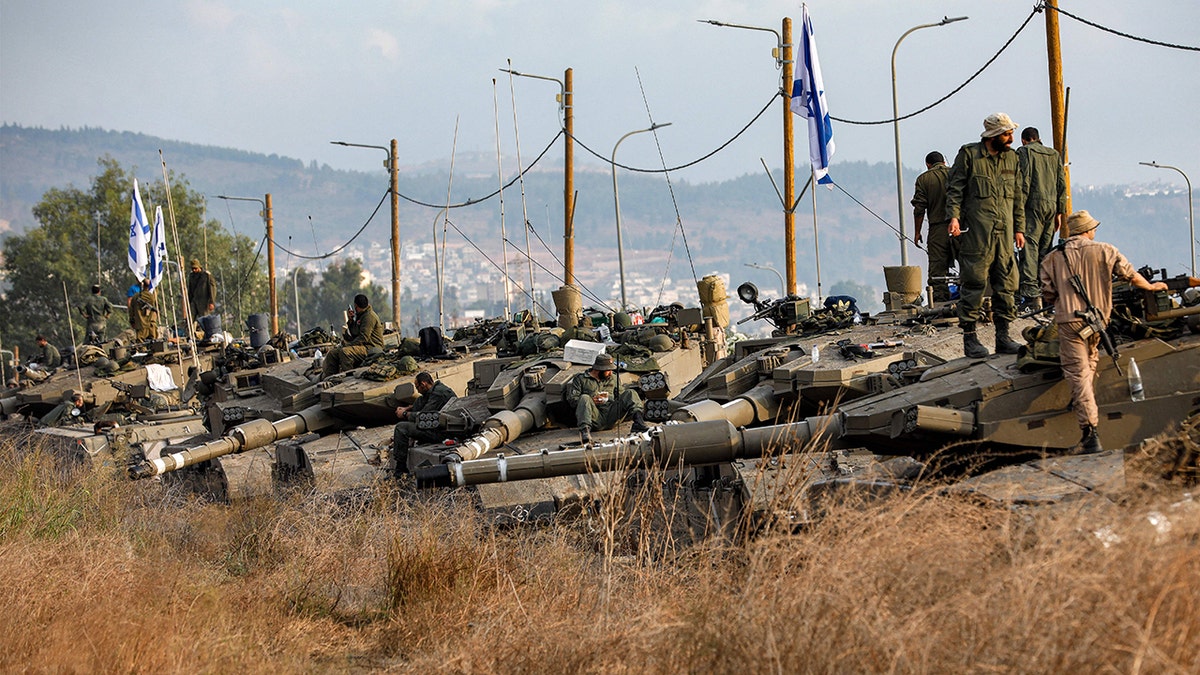
A column of Israeli Merkava battle tanks is amassed in the upper Galilee in northern Israel near the border with Lebanon on October 11, 2023. (JALAA MAREY/AFP via Getty Images)
Despite Hamas’ extremist and violent ambitions, Soros argued that Israel must negotiate with the group for its own benefit.
He said, “Defenders of the current policy argue that Israel cannot afford to negotiate from a position of weakness. But Israel’s position is unlikely to improve as long as it pursues its current course.”
Soros accused Israel of adopting heavy-handed retaliation tactics against Hamas violence, saying, “Military escalation – not just an eye for an eye but roughly 10 Palestinian lives for every Israeli one – has reached its limit.”
He also urged Israel and U.S to loosen the requirement that Hamas and Palestinian authorities recognize the legitimacy of the Jewish state, stating, “that could be made a condition for an eventual settlement rather than a precondition for negotiations.”
The op-ed concluded with a jab towards President George W. Bush’s “war on terror” at the time, claiming it had encouraged Israel to make these errors regarding Hamas. “Demonstrating military superiority is not sufficient as a policy for dealing with the Palestinian problem. There is now the chance of a political solution with Hamas brought on board by Saudi Arabia. It would be tragic to miss out on that prospect because the Bush administration is mired in the ideology of the war on terror.”
______
Top Ten Biblical Discoveries in Archaeology – #1 Dead Sea Scrolls

This post wraps up our Top Ten Biblical Discoveries in Archaeology series. To see the complete series please click here.
Old Testament Scribes
 How accurate is the Old Testament we hold in our hands? It’s popular today to attack the accuracy of the Bible on the grounds of its lack of effective transmission. Popular authors claim the Bible we have today has simply been copied too many times, with too many textual errors, to be believed as the very words of God handed down to us over the millennia.
Free Video – Session 1 from the Church History Boot Camp
Every single copy of the Old Testament was hand copied up until the printing press came along in the 15th century AD. Imagine that, some of the books of the Old Testament were copied over and over for more than 3,000 years (traditional view of dating). Can a document copied so many times by hand truly be accurate today?
Tradition tells us the Hebrew people were meticulous copyists of Scripture. Scribes were so aware of their task they would go to great lengths to make sure their hand-written copy of Scripture was free from error. Hebrew scribes were bound to the following rules:
- They could only use clean animal skins, both to write on, and even to bind manuscripts.
- Each column of writing could have no less than forty-eight, and no more than sixty lines.
- The ink must be black, and of a special recipe.
- They must verbalize each word aloud while they were writing.
- They must wipe the pen and wash their entire bodies every time before writing God’s name.
- There must be a review within thirty days, and if as many as three pages required corrections, the entire manuscript had to be redone.
- The letters, words, and paragraphs had to be counted, and the document became invalid if two letters touched each other. The middle paragraph, word and letter must correspond to those of the original document.
- The documents could be stored only in sacred places (synagogues, etc.).
Silver Amulet Scroll and Nash Papyrus
 With all the careful scribal work a shockingly few number of Old Testament ancient manuscripts exist until today. The silver amulet scroll is by far the oldest. The scroll was mentioned as #4 in this top ten series. The amulet scroll dates way back to 600 BC. This is fantastic but it is only a couple verses of the entire Bible. So we can get a feel for the accuracy of those couple verses but not be able to get a good representative sample for the entirety of Scripture.
The Nash Papyrus dates to around 200 BC. It’s also a wonderful discovery but similar to the amulet scroll it only contains a hand-full of verses. Gratefully those verses are the Ten Commandments, but nonetheless our only 2 manuscripts of the Old Testament from the BC era are a very small representation of the entire Old Testament canon.
Codex Aleppo
 Codex Aleppo is the oldest entire Old Testament possessed by humanity. The manuscript dates to around 900AD. The priceless manuscript is indeed magnificent. When analyzing the more than 2.7 million writing details that make up the Old Testament, the manuscript appears to be very precise in its creation. Although we have such a beautiful manuscript, the elephant in the room is that this manuscript dates from 900AD. Many New Testament manuscripts are older than our oldest Old Testament manuscript. Most of the Old Testament was written over 1500 years before Codex Aleppo.
1946-47
 The greatest biblically relevant archaeological discovery, made in the winter of 1946-47, would shake up the biblical and archaeological world. John C. Trever has done a good job reconstructing the story of the scrolls from several interviews with the Bedouin people.
Muhammed edh-Dhib, a 15 year old Bedouin living in Bethlehem, was with his cousin in the region of the Dead Sea. Jum’a Muhammad, the cousin of edh-Dhib, noticed some possible cave openings while out shepherding some goats. Edh-Dhib made it into a cave and discovered something that had been untouched for more than 2,200 years. He reached into a pot and retrieved some scrolls and showed them to Jum’a.
The impact of these scrolls were not readily apparent. The scrolls were taken back to the Bedouin camp to show the rest of the family. The Bedouin kept the scrolls hanging on a tent pole while they figured out what to do with them, periodically taking them out to show people.
 The scrolls were first taken to a dealer named Ibrahim ‘ljha in Bethlehem. In one of those famous dumb moments of history ‘ljha returned them saying they were worthless. Undaunted, thankfully, the Bedouin went to a nearby market, where a Syrian Christian offered to buy them. A sheikh joined their conversation and suggested they take the scrolls to a part-time antiques dealer. The Bedouin left one scroll with the dealer and then sold three scrolls to another for the ridiculous sum of $29!
George Isha’ya, a member of the Syrian Orthodox Church, heard about the scrolls and contacted St. Mark’s Monastery in the hope of getting an appraisal, news of the find then reached Metropolitan bishop Athanasius Yeshue Samuel, better known as Mar Samuel.
 After examining the scrolls and suspecting their astronomical worth, he expressed interest in purchasing them. Four scrolls found their way into his hands. More scrolls continued to arrive on the scene. By the end of 1948, nearly two years after their first discovery, scholars had yet to locate the source of the manuscripts.
What was all the fuss about? After careful analysis and scientific analysis at the University of California, Davis it was determined that a new era of Old Testament biblical manuscripts had arrived. We were witnessing what appeared to be the discovery of an entire library of Old Testament and ancient Jewish writings. How old were these books? Remember our oldest complete Old Testament had been 900AD. An entire scroll of Isaiah was found and dated to around 200BC! Can you believe that, in one discovery 1100 years of biblical hand-written copies were spanned.
Magnitude of the Discovery
 Archaeologists were able to track down the origin of the first scrolls and together with the Bedouins ended up finding a total of 972 manuscripts from 11 different caves. All 11 caves are in the southeastern Dead Sea area of Israel. The area receives almost no rainfall making it a perfect climate for ancient manuscripts to last thousands of years without decomposing.
The scrolls contain verses from every Old Testament book except for one. Only about 1/3rd of the scrolls are biblical writings. 2/3rds of the manuscripts are not biblical but pertain to Jewish life at the time. Think of it as stumbling across the 1,000 volume library of a Christian with many books of the Bible but then all sorts of books about 21st century Christian life and thought. This is the equivalent of the Dead Sea Scroll discovery. Many of the non-biblical books discovered were not known to even exist!
 The scrolls, for some insane reason, were put up for sale in the Wall Street Journal on June 1, 1954. They were purchased for $250,000 and brought to Jerusalem where they eventually became housed in a museum called the Shrine of the Book where they reside today when not circulating in museums around the world. The scrolls today are considered priceless. Just to purchase a replica facsimile copy of 3 of the scrolls currently will run you $60,000 (a donation of replica scrolls to Parchment & Pen will not be turned down).
Significance of the Discovery
 The scrolls are still, after decades, a discovery still being digested. The 972 manuscripts have shed great light on the accuracy and complexity of the Old Testament. The Isaiah Scroll, in comparison to Codex Aleppo and other manuscripts, show that the message of the Old Testament has not been changed over millennia. More articles and books have been written about the Dead Sea Scrolls than any other archaeological discovery with biblical significance. The scrolls are shedding a great deal of light on the Jewish religious world of roughly 200BC-90AD. The scrolls are generally showing the modern-day Old Testament to be an extremely accurate representation of the original writers.
Work in Progress
 Google has announced a new deal with the Israeli Antiquities Authority to photograph all of the scrolls in order to make high-resolution photos available to anyone online for free. The scrolls continue to amaze and delight us; where we once had only a couple fragments of the ancient Old Testament we now enjoy an abundant library.
Please join the discussion by posting your thoughts in the comments section below.
___________
The Bible and Archaeology – Is the Bible from God? (Kyle Butt 42 min)
You want some evidence that indicates that the Bible is true? Here is a good place to start and that is taking a closer look at the archaeology of the Old Testament times. Is the Bible historically accurate? Here are some of the posts I have done in the past on the subject: 1. The Babylonian Chronicle, of Nebuchadnezzars Siege of Jerusalem, 2. Hezekiah’s Siloam Tunnel Inscription. 3. Taylor Prism (Sennacherib Hexagonal Prism), 4. Biblical Cities Attested Archaeologically. 5. The Discovery of the Hittites, 6.Shishak Smiting His Captives, 7. Moabite Stone, 8. Black Obelisk of Shalmaneser III, 9A Verification of places in Gospel of John and Book of Acts., 9B Discovery of Ebla Tablets. 10. Cyrus Cylinder, 11. Puru “The lot of Yahali” 9th Century B.C.E., 12. The Uzziah Tablet Inscription, 13. The Pilate Inscription, 14. Caiaphas Ossuary, 14 B Pontius Pilate Part 2, 14c. Three greatest American Archaeologists moved to accept Bible’s accuracy through archaeology.,
Related posts:
Taking on Ark Times Bloggers on various issues Part I “Old Testament Bible Prophecy” includes the film TRUTH AND HISTORY and article ” Jane Roe became pro-life”
I have gone back and forth and back and forth with many liberals on the Arkansas Times Blog on many issues such as abortion, human rights, welfare, poverty, gun control and issues dealing with popular culture. Here is another exchange I had with them a while back. My username at the Ark Times Blog is Saline […]
John MacArthur on fulfilled prophecy from the Bible Part 2
I have posted many of the sermons by John MacArthur. He is a great bible teacher and this sermon below is another great message. His series on the Book of Proverbs was outstanding too. I also have posted several of the visits MacArthur made to Larry King’s Show. One of two most popular posts I […]
John MacArthur on fulfilled prophecy from the Bible Part 1
I have posted many of the sermons by John MacArthur. He is a great bible teacher and this sermon below is another great message. His series on the Book of Proverbs was outstanding too. I also have posted several of the visits MacArthur made to Larry King’s Show. One of two most popular posts I […]
John MacArthur: Fulfilled prophecy in the Bible? (Ezekiel 26-28 and the story of Tyre, video clips)
Prophecy–The Biblical Prophesy About Tyre.mp4 Uploaded by TruthIsLife7 on Dec 5, 2010 A short summary of the prophecy about Tyre and it’s precise fulfillment. Go to this link and watch the whole series for the amazing fulfillment from secular sources. http://www.youtube.com/watch?v=qvt4mDZUefo ________________ John MacArthur on the amazing fulfilled prophecy on Tyre and how it was fulfilled […]
John MacArthur on the Bible and Science (Part 2)
John MacArthur on the Bible and Science (Part 2) I have posted many of the sermons by John MacArthur. He is a great bible teacher and this sermon below is another great message. His series on the Book of Proverbs was outstanding too. I also have posted several of the visits MacArthur made to Larry […]
John MacArthur on the Bible and Science (Part 1)
John MacArthur on the Bible and Science (Part 1) I have posted many of the sermons by John MacArthur. He is a great bible teacher and this sermon below is another great message. His series on the Book of Proverbs was outstanding too. I also have posted several of the visits MacArthur made to Larry […]
Adrian Rogers: “Why I believe the Bible is true”
Adrian Rogers – How you can be certain the Bible is the word of God Great article by Adrian Rogers. What evidence is there that the Bible is in fact God’s Word? I want to give you five reasons to affirm the Bible is the Word of God. First, I believe the Bible is the […]
The Old Testament is Filled with Fulfilled Prophecy by Jim Wallace
Is there any evidence the Bible is true? Articles By PleaseConvinceMe Apologetics Radio The Old Testament is Filled with Fulfilled Prophecy Jim Wallace A Simple Litmus Test There are many ways to verify the reliability of scripture from both internal evidences of transmission and agreement, to external confirmation through archeology and science. But perhaps the […]
Taking on Ark Times Bloggers on various issues Part M “Old Testament prophecy fulfilled?”Part 3(includes film DEATH BY SOMEONE’S CHOICE)
I have gone back and forth and back and forth with many liberals on the Arkansas Times Blog on many issues such as abortion, human rights, welfare, poverty, gun control and issues dealing with popular culture. Here is another exchange I had with them a while back. My username at the Ark Times Blog is […]
Evidence for the Bible
Here is some very convincing evidence that points to the view that the Bible is historically accurate. Archaeological and External Evidence for the Bible Archeology consistently confirms the Bible! Archaeology and the Old Testament Ebla tablets—discovered in 1970s in Northern Syria. Documents written on clay tablets from around 2300 B.C. demonstrate that personal and place […]
_______
_____________


 The Daily Hatch