
____

Prime Minister Benjamin Netanyahu meets with Democratic nominee Hillary Clinton in New York, September 25, 2016 (Kobi Gideon/GPO)
———

In this handout photo provided by the Israeli Government Press Office, Israeli prime minister Benjamin Netanyahu meets former U.S. President Bill Clinton, on November 8, 2010 in New York City. | Getty
—
W O VAUGHT WAS CLINTON’S PASTOR
DESPITE HIS CONTINUED efforts to get me out of office, it was impossible to dislike Bill Clinton personally. Even in the toughest encounters, he maintained an even keel and a glint in his eye that disarmed you. A natural and gifted politician, he was less guided by ideology than by the desire to solve problems by finding a middle ground. It was this search for the center that had guided his economic and social policies when he passed the North American Free Trade Agreement (NAFTA) in December 1993 and the sweeping welfare reforms that put him at odds with the left wing of the Democratic Party. In my conversations with him I was impressed by his mastery of these and other economic issues. He was also naturally sympathetic to Israel. In his speech to the Knesset in 1994, he recalled the words of his ailing pastor who accompanied him on his first trip to Israel. “If you abandon Israel, God will never forgive you.” However, in his eyes and those of his staff this often meant “saving Israel from itself,” since time and again Israeli voters apparently didn’t know what was good for them. (This prompted one of my colleagues to wryly comment, “After all, what do we know? We just live here.”) And if saving Israel required intervening in Israel’s electoral campaign, so be it. Clinton twice sent his personal political advisors to help Peres and Barak in the Israeli elections against me, openly admitting the first effort to me when it failed and openly celebrating the second when it succeeded. The irony was that I was falsely accused of interfering in the US elections by the very people who intervened in mine. Clinton was genuinely smitten with Rabin, whom he looked up to. His oration at Rabin’s funeral and his words “Shalom, chaver” (“Farewell, friend”) were genuinely moving.
REMARKS BY PRESIDENT CLINTON TO THE ISRAELI KNESSET The Knesset Jerusalem, Israel October 27, 1994
9:25 p.m. (L)
PRESIDENT CLINTON: Mr. President, Mr. Prime Minister, Mr. Speaker, Mr. Netanyahu, ladies and gentlemen of the Knesset: Let me begin by thanking the Prime Minister and the people of Israel for welcoming me to your wonderful country, and thanking all of you for giving me the opportunity to address this great democratic body where, clearly, people of all different views are welcome to express their convictions. I feel right at home. (Laughter and applause.)
Yesterday Israel took a great stride toward fulfilling the ancient dream of the Jewish people — the patriarch’s dream of a strong and plentiful people living freely in their own land, enjoying the fruits of peace with their neighbors. Nearly 17 years after President Sadat came to this chamber to seek peace, and Prime Minister Begin reached out in reconciliation. And just over a year after Israel and the PLO declared a pathway to peace on the South Lawn of the White House, Israel and Jordan have now written a new chapter.
Tonight we praise the courage of the leaders who have given life to this treaty, Prime Minister Rabin and Foreign Minister Peres. They have shown the vision and the tenacity of other leaders of Israel’s past whose names will be remembered always for their devotion to your cause and your people — Ben Gurion, Maier, Begin.
In your life, Prime Minister, we see the life of your country. As a youth, you wished to fulfill the commandment to farm the land of Israel, but instead you had to answer the call to defend the people of Israel. You have devoted your life to cultivating strength so that others could till the soil in safety. You have fought many battles and won many victories in war. Now, in strength, you are fighting and winning battles for peace. Indeed, you have shown your people that they can free themselves from siege; that for the first time, they can make real a peace for the generations.
For the American people, too, this peace is a blessing. For decades, as Israel has struggled to survive, we have rejoiced in your triumphs and shared in your agonies. In the years since Israel was founded, Americans of every faith have admired and supported you. Like your country, ours is a land that welcomes exiles — a nation of hope; a nation of refuge. From the Orient and Europe, and now from the former Soviet Union, your people have come, Ashkenazim and Sephardim, Yemenites and Ethiopians — all of you committed to living free, to building a common home.
One of nearly four of the citizens of this country is an Arab, something very few people know beyond your borders. Even without the blessings of secure borders, you have secured from your own people the blessings of democracy. With all of its turmoil and debate, it is still the best of all systems.
In times of war and times of peace, every President of the United States since Harry Truman, and every Congress has understood the importance of Israel. The survival of Israel is important not only to our interests, but to every single value we hold dear as a people. Our role in war has been to help you defend yourself by yourself. That is what you have asked. Now that you are taking risks for peace, our role is to help you minimize the risks of peace.
I am committed to working with our Congress to maintain the current levels of military and economic assistance. We have taken concrete steps to strengthen Israel’s qualitative edge. The U.S.-Israel Science and Technology Commission unprecedented Israeli access to the U.S. high-technology market, and acquisition of advanced computers — all these keep Israel in the forefront of global advances and competitive and global markets.
I have also taken steps to enhance Israel’s military and your capacity to address possible threats not only to yourselves, but to the region. F-15 aircraft are being provided, and F-16s transferred out of U.S. stocks. We work closely with you to develop the Arrow missile, to protect against the threat of ballistic missiles.
As we help to overcome the risks of peace, we also are helping to build a peace that will bring with it the safety and security Israel deserves. That peace must be real, based on treaty commitments arrived at directly by the parties, not imposed from outside. It must be secure. Israel must always be able to defend itself by itself. And it must be comprehensive. We have worked hard to end the Arab boycott, and we’ve had some success. But we will not stop until it is completely lifted. (Applause.)
There is a treaty with Jordan and an agreement with the PLO. But we must keep going until Syria and Lebanon close the circle of states entering into peace, and the other nations of the Arab world normalize their relations with Israel.
This morning in Damascus I discussed peace with President Assad. He repeated at our press conference what he had earlier said to his own Parliament, Syria has made a strategic choice for peace with Israel. He also explained that Syria is ready to commit itself to the requirements of peace through the establishment of normal peaceful relations with Israel. His hope, as he articulated it, is to transform the region from a state of war to a state of peace that enables both Arabs and Israelis to live in security, stability and prosperity.
We have been urging President Assad to speak to you in a language of peace that you can understand. Today he began to do so. Of course, it would take more than words — much more than words. Yet I believe something is changing in Syria. Its leaders understand that it is time to make peace. There will still be a good deal of hard bargaining before a breakthrough, but they are serious about proceeding.
Just as we have worked with you from Camp David to Wadi Araba to bring peace with security to your people, so, too, we will walk with you on the road to Damascus for peace with security.
There are those who see peace still as all too distant. Surely, they include the families of those burned in the rubble of the community center in Buenos Aires; those in the basement of New York’s World Trade Center; the loved ones of the passengers on bus No. 5; and of course, two people who, as been noted, are in the chamber with us tonight — and we honor their parents — the parents of Corporal Nachsan Waxman, a son of your nation and, I proudly say, a citizen of ours. (Applause.)
We grieve with the families of those who are lost and with all the people of Israel. So long as Jews are murdered just because they are Jews, or just because they are citizens of Israel the plaque of anti-Semitism lives, and we must stand against it. We must stand against terror as strongly as we stand for peace, for without an end to terror there can be no peace.
The forces of terror and extremism still threaten us all. Sometimes they pretend to act in the name of God and country. But their deeds violate their own religious faith and make a mockery of any notion of honorable patriotism.
As I said last night to the Parliament in Jordan, we respect Islam. Millions of Americans citizens every day answer the Moslem call to prayer. But we know that the real fight is not about religion or culture. It is about a worldwide conflict between those who believe in peace and those who believe in terror; those who believe in hope and those who believe in fear.
Those who stoke the fires of violence and seek to destroy the peace, make no mistake about it, have one great goal. Their goal is to make the people of Israel, who have defeated all odds on the field of battle, to give up inside on the peace by giving into the doubts that terror brings to every one of us. But having come so far, you cannot give up or give in. Your future must lie in the words of a survivor of the carnage of Bus No. 5 who said, I want the peace process to continue; I want to live in peace; I want my children to live in peace.
So let us say to the merchants of terror once again, you cannot succeed; you must not succeed; you will not succeed. You are the past, not the future; the peacemakers are the future. (Applause.)
I say to you, my friends, in spite of all the dangers and difficulties that still surround you, the circle of your enemies is shrinking. Their time has passed. Their increasing isolation is reflected in the desperation of their disgusting deeds.
Once in this area, you were shunned. Now, more and more, you are embraced. As you share the waters of the River Jordan and work with your neighbors, new crops will emerge where the soil is now barren. As you join together to mine the Dead Sea for its minerals, you will bring prosperity to all your people. As you roll up the barbed wire and cross the desert of Araba, the sands will yield new life to you. As you dock in each other’s ports along the Gulf of Aqaba, more and more people will have the chance to experience give wonders of both your lands, and more and more children will share the joys of youth, not the dread of war.
This is the great promise of peace. It is the promise of making sure that all those who have sacrificed their lives did not die in vain; the promise of a Sabbath afternoon, not violated by gunfight; a drive across the plains to the mountains of Moab where Moses died and Ruth was born; A Yom Kippur of pure prayer without the rumble of tanks, voices of fear or rumors of war. After all the bloodshed and all your tears, you are now far closer to the day when the clash of arms is heard no more and all the children of Abraham, the children of Isaac, the children of Israel will live side by side in peace. (Applause.)
This was, after all, the message the prophet Mohammed himself brought to peoples of other faiths when he said, “There is no argument between us and you. God will bring us together, and unto Him is the homecoming.” And this was the message Moses spoke to the children of Israel when, for the last time, he spoke to them as they gathered across the River Jordan into the Promised Land when he said, “I have set before you life and death, blessings and curses. Choose life so that you and your descendants may live.”
This week, once again, the people of Israel made a homecoming. Once again, you choose life. Once again, America was proud to walk with you.
The Prime Minister mentioned a story in his remarks that he never asked me about. Wouldn’t it be embarrassing if it weren’t true? (Laughter.) The truth is that the only time my wife and I ever came to Israel before today was 13 years ago with my pastor on a religious mission. I was then out of office. I was the youngest former governor in the history of the United States. (Laughter.) No one thought I would ever be here — perhaps my mother; no one else. (Laughter.)
We visited the holy sites. I relived the history of the Bible, of your Scriptures and mine. And I formed a bond with my pastor. Later, when he became desperately ill, he said I thought I might one day become President. And he said, more bluntly than the Prime Minister did, “If you abandon Israel, God will never forgive you.” (Applause.) He said it is God’s will that Israel, the biblical home of the people of Israel, continue forever and ever. (Applause.)
So I say to you tonight, my friends, one of our Presidents, John Kennedy, reminded us that here on Earth, God’s will must truly be our own. It is for us to make the homecoming; for us to chose life; for us to work for peace. But until we achieve a comprehensive peace in the Middle East and then after we achieve comprehensive peace in the Middle East, know this — your journey is our journey, and America will stand with you now and always.
Thank you and God bless you. (Applause.)
Pres. Clinton’s Address to the thirteenth Knesset in Jerusalem (1994)
University DEI Offices Not Being ‘Inclusive’ of Jewish Students After Hamas Attacks
University DEI Offices Not Being ‘Inclusive’ of Jewish Students After Hamas Attacks


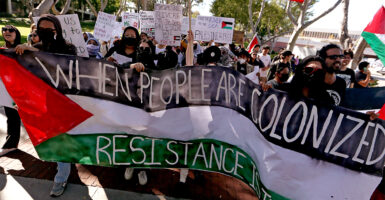
Those at U.S. colleges are blaming Israel and supporting Hamas over the latest attacks. While alumni are appalled, their money is often fueling such outrages by expanding campus DEI bureaucracies. Pictured: Cal State Long Beach students hold a campus rally in support of Palestinians after Hamas’ terrorist attack on Israel Oct. 7. Long Beach, California, Oct. 10, 2023. (Photo: Luis Sinco, Los Angeles Times/Getty Images)
Would you send a check to support Hamas’ gleeful slaughter of innocent Israeli civilians? Your alma mater may help you do it.
Israel, America’s great ally, faced the darkest day in its history Saturday. There is simply no moral justification for Hamas’ terror. The only normal response is to condemn such violence.
Yet, on college campuses across this country, administrators, faculty, and student activists took turns blaming Israel and expressing enthusiastic support for Hamas. And while alumni have been shocked and appalled at these spectacles, it’s often their money that’s fueling such outrages by expanding “diversity, equity, and inclusion” bureaucracies.
One of the fastest-growing budget items at universities today is the explosion of diversity, equity, and inclusion staff. These DEI staff are supposedly there to foster an environment where all ethnic groups and nationalities will feel respected. What better time for a DEI office to voice unqualified support for Jewish students than in the face of Hamas’ war crimes?
Except DEI bureaucracies are hotbeds of antisemitism. Heritage scholar Jay Greene looked at tweets by DEI staff at colleges and universities and found that they “pay a disproportionately high amount of attention to Israel and nearly always attack Israel.” (The Daily Signal is Heritage’s news and commentary outlet.)
In fact, 96% of their tweets or retweets about Israelwere critical of the Jewish state. In contrast, 62% of their tweets about China (which is currently carrying out a genocide against its minority Uyghur Muslim population) were positive.
In other words, instead of fighting antisemitism on campuses to make them more “inclusive,” DEI staff are fueling hostility toward Jews. And now, we’re seeing the results.
Harvard University’s DEI mission statement says it “establishes a profound sense of belonging for each member of our community.” Yet this week, 33 student groups cosigned a letter that “holds the Israeli regime entirely responsible for all unfolding violence.”
As the nightmarish images of innocent Israelis being murdered, tortured, and kidnapped populated the news and social media, Harvard took days to utter a response to their campus activists. How many Jewish students at Harvard could possibly feel a sense of belonging on that campus?
At Yale University, Associate Professor of American Studies Zareena Grewal has taken to X (formerly Twitter) in support of Hamas. With over a thousand Israelis dead, including butchered infants, Grewal praised Hamas’ treatment of Israeli captives: “Today, Palestinian freedom fighters showed their humanity in their treatment of Israeli settlers, compared to the brutal actions of the Israeli occupying forces towards Palestinian women and children.”
Yale has been rife with violations of free speech on its campus recently, including the disruption of Alliance Defending Freedom’s Kristen Waggoner. But it chose to defend Grewal’s freedom of expression. How are “diversity” and “inclusion” served by silencing conservatives while letting a faculty member celebrate the murder of over a thousand Jews?
At Stanford, an instructor of a “Civil, Liberal, and Global Education” course used the Hamas attack to teach Jews a lesson. The instructor demanded Jewish students move themselves into the corner of the classroom, telling them “This is what Israel does to the Palestinians.” Then the instructor said that while 6 million Jewish people were murdered in the Holocaust, “colonizers killed more than 6 million. Israel is a colonizer.”
According to Stanford’s DEI website, “A diverse and inclusive community offers different perspectives, experiences, and cultures that enrich the educational experience.” Do Stanford’s DEI officers have nothing to say about this outrage?
Examples like this are popping up all over the place. But it doesn’t have to be this way.
University of Florida President Ben Sasse offered an unequivocal letter of support to the school’s Jewish community and a stern warning against campus activists supporting Hamas’ terror. Sasse wrote, “I also want to be clear about this: We will protect our Jewish students from violence. … If anti-Israel protests come, we will absolutely be ready to act if anyone dares to escalate beyond peaceful protest. Speech is protected—violence and vandalism are not.”
What a bold and rational stance. But why is this so rare? As universities and colleges pain themselves to appear as havens of diversity and inclusion, Sasse’s cogent statement should be the status quo.
Of course, free speech should be protected on college campuses. And there’s nothing wrong with a university aspiring to create an environment where all students, no matter their culture or ethnicity, can feel welcome.
But what good is a (very expensive) army of DEI officers if campus activists feel empowered to celebrate the deadliest day of violence against Jews since the Holocaust?
Soon, you may get a letter in the mail from your alma mater asking for money to help it cover the cost of an ever-expanding DEI bureaucracy. And you might feel a sense of obligation to an institution that helped shape your life.
But before writing that check, call the DEI office and ask about the status of pro-Hamas activism on campus.
This year, your answer just might be “no.”
Have an opinion about this article? To sound off, please email letters@DailySignal.com, and we’ll consider publishing your edited remarks in our regular “We Hear You” feature. Remember to include the URL or headline of the article plus your name and town and/or state.
_
Top Ten Biblical Discoveries in Archaeology – #8 Caiaphas Ossuary

This post is a continuation of our Top Ten Biblical Discoveries in Archaeology series. To see the complete series please click here.
1967
 1967 was an active year. The Doors kicked off the year releasing their self-entitled debut album. The United States was fully involved in the Vietnam War. The Green Bay Packers won their third consecutive championship against the Dallas Cowboys in the frozen “Ice Bowl.” In 1967 NASA had a lunar orbiter circling the moon taking photos of the surface looking for the best place to take that famous, “One small step for man, one giant leap for mankind.”
In the Middle East, June 5th through the 10th of 1967 has become known as the Six Day War. It was a war between Israel and the neighboring countries of Egypt, Jordan and Syria. The Arab countries of Iraq, Saudi Arabia, Sudan, Tunisia, Morocco and Algeria additionally sent troops to the war. At the war’s end, Israel had gained control of the Sinai Peninsula, the Gaza Strip, the West Bank, East Jerusalem, and the Golan Heights. The results of the war affect the geopolitics of the region to this day.
For the first time in centuries Jerusalem was again a unified city. To commemorate the new unification of Jerusalem a forest was planted. The Jerusalem Peace Forest links the city’s eastern and western parts. The forest’s name symbolizes the hope for peace and brotherhood among the united city’s residents.
 The Jerusalem Peace Forest, which was planted at the edge of the desert, offers its visitors a unique spectacle created by the natural contrast of green trees surrounded by a barren landscape. Unknown to those in 1967 a marvelous archaeological discovery just happened to lay underneath the Jerusalem Peace Forest. The discovery we will focus on today would never have happened without the six day war in 1967. The discovery would have never happened without the creation of the Peace Forest.
Uneventful Construction Project Turned Eventful
Many archaeological discoveries in Israel come from pure chance. The discovery we are focusing on today is no exception. In December, 1990, a new park was being constructed within the Peace Forest. As the workers, using modern construction equipment, dug down they soon picked up their telephones. A long forgotten ceiling collapsed revealing a room deep in the earth.
The construction superintendent knew he had stumbled upon something ancient. The construction workers suspected they may have found an ancient burial tomb. The park project would be put on hold until the ancient room could be inspected. Israelis, like most cultures, put a priority on honoring the graves of their ancestors. It would be dishonoring for a large modern-day excavator to press on and brashly dig up human bones.
The construction superintendent contacted the Israeli Antiquities Authority. Zvi Greenhut arrived on the scene to see what the construction workers stumbled upon.
Burial Chamber Discovered
Greenhut writes, “When I arrived at the site, I found a rock-hewn loculi burial cave, the type of tomb that is typical of the Second Temple period in Jerusalem. The cave is located in an area in which scores of other such tombs have been discovered, all part of the Jerusalem necropolis which stretches southward as far as the vicinity of the Arab village of Sur Bahir.
The limestone bedrock into which the cave is hewn is soft and crumbly and full of cracks, very characteristic of the area. The cave has an irregular floor plan, and its entrance is on the east side. We reached the entrance from within the burial chamber, entering the tomb through what had been the roof.”
What a great sight. They get into the hole dug by the construction equipment. Then they see the secondary hole from the collapsed ceiling. They lower themselves through the ancient ceiling and quickly recognize they’re in a burial tomb from the period of the Second Temple.
The Ossuary
 The archaeologists have just stepped back in time more than 2,000 years. As the flashlights sweep the tomb several ossuaries are found. An ossuary is a surprisingly small burial box. When looking at an ossuary you think there’s no chance a body could fit inside the box. That’s not the point. The ossuary is only used to store the bones after the body has decomposed.
An ancient burial chamber would include an area where the most recent death in the family lies on a chiseled-out rock bench. A family member would come into the chamber about a year after their death, take the bones, and place them in an ossuary in order to make room on the bench for the next deceased family member.
Zvi Greenhut discovers an exceptionally fancy ossuary. The ossuary is dated to the first century. It measures 37 centimeters high (14.6 inches) and 75 centimeters long (29.6 inches). The ossuary is covered with an ornate design which would seem to point toward an important person. The contents of the ossuary are studied and found to contain the remains of several people. This is not unusual. A family would place as many deceased relatives as possible into one ossuary.
Inside this ornate ossuary are found the bones of two babies, an adolescent child, a teenage boy, an adult woman, and a man about 60 years of age. The ossuary is an interesting chance discovery but not something to rock the archaeological world.
 On the outside of the ossuary is found an inscription in Aramaic dramatically increasing the value of the ossuary and importance of this piece to the world of archaeology. In Aramaic the inscription reads, “Joseph son of Caiaphas.” Another ossuary, additionally, is found in the tomb containing an inscription reading simply, “Caiaphas.” The first ossuary draws the most attention.
The name Caiaphas is found in the New Testament. Cool, we found someone sharing the same name as someone from the Bible. The excitement from this discovery came from the big question, “Is this ‘the’ Caiaphas from the Bible?”
The New Testament describes Caiaphas as one of the primary individuals involved in the crucifixion of Jesus. Matthew, Luke and John each identify Caiaphas as the high priest that presided over the arrest and trial of Jesus. Being the high priest made him second in power only to the Roman governor. Jewish law did not allow the high priest to sentence people to death. The Bible explains Caiaphas worked with the Roman governor, Pontius Pilate, to carry out a death sentence on Jesus. You may be thinking, “Wait a second. The inscription says Joseph son of Caiaphas. Not just Caiaphas.” That’s what I originally thought too. The way the inscription is written is actually why it drew so much attention.
The first-century historian Josephus helps piece together the significance of the discovery. He identifies the high priest at the time of Jesus as not only Caiaphas but “Joseph Caiaphas.” Josephus tells us additionally Caiaphas was the Jewish high priest from 18 to 36 AD (Jewish Antiquities 18:35). A source outside the Bible helps us to establish the right name at the right time. Josephus later refers to him as “Joseph who was called Caiaphas of the high priesthood” (Jewish Antiquities 18:95).
Significance of the Ossuary
The discovery in 1990 brought excitement to the world of archaeology. The 60 year old man found in the ossuary is determined by Greenhut and others to be the high priest involved in the crucifixion of Jesus. The discovery is significant for really only one reason.
For the past 2,000 years Christians have viewed the crucifixion of Jesus (and subsequent resurrection) as the most important event of all human history. My objective in this series is not to make a reasoned case for the importance of the crucifixion. If you do not hold to the belief that Jesus, the Son of God and Son of Man, paid for the sins of humankind on the cross then you will not find any significant value in the Caiaphas Ossuary. If you do believe in the crucifixion as the most important event of human history then the Caiaphas Ossuary holds substantial significance. The Caiaphas Ossuary shows to us the bones of a 60 year old man who 2,000 years ago led the charge to put Jesus on the cross. The ossuary strengthens the historical reliability of the cross by supporting the existence of one of its central characters.
What do you think? Do you find the Caiaphas Ossuary to be a significant discovery in archaeology? Join the conversation by commenting on the post. In the next post we head to Jerusalem to get our feet wet.
The Bible and Archaeology – Is the Bible from God? (Kyle Butt 42 min)
You want some evidence that indicates that the Bible is true? Here is a good place to start and that is taking a closer look at the archaeology of the Old Testament times. Is the Bible historically accurate? Here are some of the posts I have done in the past on the subject: 1. The Babylonian Chronicle, of Nebuchadnezzars Siege of Jerusalem, 2. Hezekiah’s Siloam Tunnel Inscription. 3. Taylor Prism (Sennacherib Hexagonal Prism), 4. Biblical Cities Attested Archaeologically. 5. The Discovery of the Hittites, 6.Shishak Smiting His Captives, 7. Moabite Stone, 8. Black Obelisk of Shalmaneser III, 9A Verification of places in Gospel of John and Book of Acts., 9B Discovery of Ebla Tablets. 10. Cyrus Cylinder, 11. Puru “The lot of Yahali” 9th Century B.C.E., 12. The Uzziah Tablet Inscription, 13. The Pilate Inscription, 14. Caiaphas Ossuary, 14 B Pontius Pilate Part 2, 14c. Three greatest American Archaeologists moved to accept Bible’s accuracy through archaeology.,
Related posts:
Taking on Ark Times Bloggers on various issues Part I “Old Testament Bible Prophecy” includes the film TRUTH AND HISTORY and article ” Jane Roe became pro-life”
I have gone back and forth and back and forth with many liberals on the Arkansas Times Blog on many issues such as abortion, human rights, welfare, poverty, gun control and issues dealing with popular culture. Here is another exchange I had with them a while back. My username at the Ark Times Blog is Saline […]
John MacArthur on fulfilled prophecy from the Bible Part 2
I have posted many of the sermons by John MacArthur. He is a great bible teacher and this sermon below is another great message. His series on the Book of Proverbs was outstanding too. I also have posted several of the visits MacArthur made to Larry King’s Show. One of two most popular posts I […]
John MacArthur on fulfilled prophecy from the Bible Part 1
I have posted many of the sermons by John MacArthur. He is a great bible teacher and this sermon below is another great message. His series on the Book of Proverbs was outstanding too. I also have posted several of the visits MacArthur made to Larry King’s Show. One of two most popular posts I […]
John MacArthur: Fulfilled prophecy in the Bible? (Ezekiel 26-28 and the story of Tyre, video clips)
Prophecy–The Biblical Prophesy About Tyre.mp4 Uploaded by TruthIsLife7 on Dec 5, 2010 A short summary of the prophecy about Tyre and it’s precise fulfillment. Go to this link and watch the whole series for the amazing fulfillment from secular sources. http://www.youtube.com/watch?v=qvt4mDZUefo ________________ John MacArthur on the amazing fulfilled prophecy on Tyre and how it was fulfilled […]
John MacArthur on the Bible and Science (Part 2)
John MacArthur on the Bible and Science (Part 2) I have posted many of the sermons by John MacArthur. He is a great bible teacher and this sermon below is another great message. His series on the Book of Proverbs was outstanding too. I also have posted several of the visits MacArthur made to Larry […]
John MacArthur on the Bible and Science (Part 1)
John MacArthur on the Bible and Science (Part 1) I have posted many of the sermons by John MacArthur. He is a great bible teacher and this sermon below is another great message. His series on the Book of Proverbs was outstanding too. I also have posted several of the visits MacArthur made to Larry […]
Adrian Rogers: “Why I believe the Bible is true”
Adrian Rogers – How you can be certain the Bible is the word of God Great article by Adrian Rogers. What evidence is there that the Bible is in fact God’s Word? I want to give you five reasons to affirm the Bible is the Word of God. First, I believe the Bible is the […]
The Old Testament is Filled with Fulfilled Prophecy by Jim Wallace
Is there any evidence the Bible is true? Articles By PleaseConvinceMe Apologetics Radio The Old Testament is Filled with Fulfilled Prophecy Jim Wallace A Simple Litmus Test There are many ways to verify the reliability of scripture from both internal evidences of transmission and agreement, to external confirmation through archeology and science. But perhaps the […]
Taking on Ark Times Bloggers on various issues Part M “Old Testament prophecy fulfilled?”Part 3(includes film DEATH BY SOMEONE’S CHOICE)
I have gone back and forth and back and forth with many liberals on the Arkansas Times Blog on many issues such as abortion, human rights, welfare, poverty, gun control and issues dealing with popular culture. Here is another exchange I had with them a while back. My username at the Ark Times Blog is […]
Evidence for the Bible
Here is some very convincing evidence that points to the view that the Bible is historically accurate. Archaeological and External Evidence for the Bible Archeology consistently confirms the Bible! Archaeology and the Old Testament Ebla tablets—discovered in 1970s in Northern Syria. Documents written on clay tablets from around 2300 B.C. demonstrate that personal and place […]
_______


 The Daily Hatch