
________
:quality(85)//s3.amazonaws.com/arc-wordpress-client-uploads/infobae-wp/wp-content/uploads/2016/10/26171108/Netanyahu-1920-1.jpg "tuti netanyahu resolution: 900x1200")
——

——
https://www.youtube.com/live/rQaiPuBYaNY?si=GfJc-6SNK_PEdPRL
—

Prime Minister Benjamin Netanyahu meets with Democratic nominee Hillary Clinton in New York, September 25, 2016 (Kobi Gideon/GPO)
———

In this handout photo provided by the Israeli Government Press Office, Israeli prime minister Benjamin Netanyahu meets former U.S. President Bill Clinton, on November 8, 2010 in New York City. | Getty

Bill Clinton with former Israeli Prime Minister Ariel Sharon in 2000; Donald Trump with Israeli Prime Minister Benjamin Netanyahu on March 25. Photo illustration by Slate. Photos by Thomas Coex/AFP/Getty Images; Drew Angerer/Getty Images.
/cdn.vox-cdn.com/uploads/chorus_image/image/45777608/GettyImages_460494092.0.jpg)
Zack Beauchamp is a senior correspondent at Vox, where he covers ideology and challenges to democracy, both at home and abroad. Before coming to Vox in 2014, he edited TP Ideas, a section of Think Progress devoted to the ideas shaping our political world.
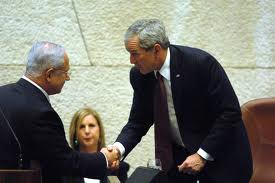
Then opposition leader Benjamin Netanyahu greets US President George W. Bush in the Knesset.

Vice President Joe Biden meets with Israeli Prime Minister Benjamin Netanyahu at the annual General Assembly of the Jewish Federations of North America in New Orleans on Nov. 7, 2010. | Gerald Herbert/AP Photo
BIBI RIGHTLY NOTED THE PALESTINIANS “grievances were directed against Israel’s very existence, in any territory. The inability of America’s diplomats to see this simple truth remains astonishing.”
The overriding axiom was that the Palestinians would not make peace unless we withdrew from Judea and Samaria and Gaza and that Syria would not make peace unless we withdrew from the Golan. The conclusion of this line of thinking was not complicated: get Israel to withdraw from all these territories and you’ll have peace. But all this flew in the face of the facts. Palestinian and Syrian grievances against Israel were not rooted in Israel’s holding on to this or that territory. That’s why they attacked us from the Golan, Judea and Samaria, and Gaza when those areas were in their hands. Their grievances were directed against Israel’s very existence, in any territory. The inability of America’s diplomats to see this simple truth remains astonishing. But to face it they would have to chuck the sacred “territory for peace” equation. That formula could work with Egypt because President Anwar Sadat didn’t seek our destruction, but it couldn’t work with the Palestinians because they did. That the Palestinians were able to pull the wool so easily over the eyes of American officials was no small achievement for Palestinian spokespersons like Hanan Ashrawi and Saeb Erekat. They put a human face on the Palestinian annihilationist goal and persuaded the world that all that was necessary to advance peace were Israeli territorial withdrawals. In this they received enormous help from the Israeli left and the Israeli media. If Israelis agreed with this claim, why shouldn’t the rest of the world?
https://thefederalist.com/2023/10/13/ass
Associated Press Reporter Tasked With Covering Israel And Gaza Is A Longtime Anti-Israel Activist

The Associated Press reporter tasked with covering Israel’s war on terrorists in the Gaza Strip has a long history of public anti-Israel activism that the wire service’s hiring department likely saw on his resume but ignored.
Mere weeks after Issam Adwan joined the AP newsroom as the outlet’s Gaza correspondent, Adwan became one of the outlet’s most prolific reporters on the chaos in the Middle East region. His coverage repeatedly buries or omits the atrocities committed against Israel last weekend in favor of elevating the plea of Gaza.
In an Oct. 8 article that other national outlets, including CBS, picked up, Adwan noted that “human rights groups have previously said that Israel’s pattern of deadly attacks on residential homes display a disregard for the lives of Palestinian civilians and argued they may amount to war crimes.”
In an Oct.11 article, Adwan complained that an “Unprecedented Israeli bombardment lays waste to upscale Rimal, the beating heart of Gaza City.”
His sanitized version of events did not mention that the precedent for the Israeli strike lay in Hamas’ recent decision to launch the deadliest assault on Jewish civilians since the Holocaust until nine paragraphs into the article.
During the attack, more than 1,300 Israelis and more than two dozen Americans were murdered. Babies and young children were reportedly beheaded, butchered, and burned in their beds. Some survivors were kidnapped back to Gaza, where Hamas is headquartered.
Adwan is no stranger to anti-Israel activism. Sprinkled among the articles lining his X page are revealing posts about his disdain for the Jewish nation.
“Oppressing me, then invite me to talk to their media about ‘tensions’ and ‘clashes,’” Adwan wrote in a 2022 Twitter post.
An accompanying screenshot of the text exchange shows Adwan repeatedly referring to “colonialism” and the “apartheid practicing policies in Jerusalem.”
In a series of now-deleted 2022 posts captured by HonestReporting, Adwan accused the Jewish state of “building another racist regime that is so similar to the Nazis.”
Adwan’s commentary was attached to a repost from a photographer who was fired from covering Israel’s war with Gaza terrorists for The New York Times because he celebrated terrorist attacks on Jews.
“This disturbing comparison is explicitly defined as antisemitic according to the internationally recognized IHRA (International Holocaust Remembrance Alliance) working definition of antisemitism,” HonestReporting noted.
In addition to retweeting posts supporting the boycott Israel movement, Adwan also insinuated Israel is a “colonial system” and warned that “the Palestinian revolt against the Israeli oppression will be a triumph sooner rather than later.”
LinkedIn shows that, before his time at the AP, Adwan worked for an anti-Israel NGO called the Palestinian Center for Democracy and Conflict Resolution. The PCDCR has a long history of bashing Israel’s actions as “state terrorism.” Press releases on its website refer to Israelis as the perpetrators of a “Gaza holocaust.”
Adwan also worked for the international media outlet Al Jazeera, which is often criticized for being “beholden to the Qatari government” and advancing “Qatar’s ideological and geopolitical objectives.” In 2020, during Adwan’s short tenure at the network, the Department of Justice began demanding Al Jazeera register as a foreign agent.
Around that same time, Adwan was also featured in a special video message for American Muslims for Palestine. In the wake of the Hamas attacks, AMP was one of many organizations that blamed Israel for the brutalism, planned a “pro-Palestine” rally, accused Israel of being a “racist apartheid regime” guilty of committing “genocide,”and called Israelis “violent settlers” who are “conducting their racist pogroms.”
As project manager of We Are Not Numbers from 2018-2021, another organization that refers to Israel as “an unjust oppressor” and an “inhumane and merciless state,” Adwan called for sanctions on Israel.
“This is an ongoing ethnic cleansing, brutality, bloodshed of Palestinians,” Adwan said in a 2021 interview with TRTWorld. “That is the proper word to be used. This is not a conflict. This is not a confrontation. This is not a symmetrical power war. This is only one-sided massacres committed by Israel.”
Adwan was also caught on a Facebook livecalling for the explicit end of Israel as we know it.
“The regime of Israel should fall, and the land should return to its owners,” he said.
Fox News Digital reported after the publication of this article that the AP removed Adwan “from reporting duties while it investigates his past further.”
This article has been updated since publication.
In 2021, Adwan suggested it was “ignorant” to draw attention to Hamas’ crimes “when we talk about Israeli war crimes/apartheid/enthnic cleansing.”
_____
Top Ten Biblical Discoveries in Archaeology – #10 Assyrian Lachish Reliefs

Setting the Stage

In 930 BC the unified country of Israel split into two kingdoms. The northern kingdom is known as Israel. The southern kingdom is known as Judah. 200 years later, in 720 BC, Israel is destroyed by Assyria (modern day Iraq).
With Israel destroyed Assyria turns its gaze toward destroying Judah. 2 Kings 18:13 says, “In the fourteenth year of King Hezekiah’s reign, Sennacherib king of Assyria attacked all the fortified cities of Judah and captured them.”
2 Kings 18:17 states, “The king of Assyria sent his supreme commander, his chief officer and his field commander with a large army, from Lachish to King Hezekiah at Jerusalem.” The prize of Judah would be the destruction of Jerusalem. Conquering Boston would be a victory but defeating Washington, D.C. would be even greater.  Sennacherib drives one of the most powerful armies of all human history toward Jerusalem. The Assyrian commander tells the people of Jerusalem, “Do not listen to Hezekiah, for he is misleading you when he says, ‘The Lord will deliver us.’ Has the god of any nation ever delivered his land from the hand of the king of Assyria?”
Hezekiah prays fervently for deliverance. He sends a delegation to Isaiah the prophet for counsel. Isaiah tells him not to worry Jerusalem will NOT be destroyed by the leading world power, God will intervene. This is just one of the myriad stories found in the Bible. Is this story accurate? How can a story from nearly 3,000 years ago be trusted as completely true? Does archaeology support or deny the accuracy of 2 Kings 18 and 19?
The Discovery
We know from Assyrian history, outside the Bible, there was a king named Sennacherib. His reign was from 704-681 BC. We know Sennacherib moved the capital of the Assyrian empire from a city named Dur Sharrukin to Nineveh. He then built an amazing palace. He actually named his palace, “The Palace without Rival.” John Malcolm Russell explains, “The walls of some seventy rooms in this structure were lined with limestone slabs carved in low relief with scenes commemorating Sennacherib’s royal exploits.” For nearly 2,500 years the palace lay buried and forgotten.
 In 1847 Sennacherib’s palace was discovered by the British diplomat and amateur archaeologist Austin Henry Layard. Layard’s discovery drew a huge amount of attention. Inscriptions discovered within the palace removed any doubt this was indeed Sennacherib’s famous palace. The finds were magnificent. The main focus of the excitement came from a room archaeologists labeled, “Room XXVI.”
Layard found the walls of this room covered with limestone 8 feet tall and 80 feet long wrapping around all four walls. Every inch of the room’s walls powerfully depicted only one scene in history, Sennacherib’s defeat of the southern kingdom city of Lachish. Remember in 2 Kings 18:17, “The king of Assyria sent his supreme commander, his chief officer and his field commander with a large army, from Lachish to King Hezekiah at Jerusalem.”
The piece of art identifies itself as the battle of Lachish and provides detailed chronological information about the battle. Some women are seen walking down siege ramps; while possibly their husbands are being impaled by the Assyrians.  We see what the women of Lachish were wearing the day of the battle; we see the type of facial hair worn by the men. We see the type of military equipment and military techniques the Assyrians used to defeat Lachish and threaten Jerusalem. The relief gives us stunning play-by-play detail of the destruction of Lachish.
Do you see all the little dome-shaped objects in the background? What are they? Each one represents a soldier’s helmet. They are depicting in art a vast sea of soldier’s helmets, representing the immensity of the Assyrian army.
Provenance
 The Provenance, or history, of the Lachish Relief is without dispute. The relief did not appear mysteriously on the black market. The dig of Sennacherib’s palace was well-documented and the relief clearly discovered from within the city of Nineveh and specifically in Room XXVI of Sennacherib’s palace. Even though Austin Henry Layard was an amateur archaeologist at the time of the discovery, the discovery has a strong provenance. Furthermore, leading archaeologists have been able to examine the relief and confirm its authenticity and importance.
Significance
Why would Sennacherib cover a room in his palace with scenes from this one battle? That’s where it gets really interesting. Archaeologists have been able to determine this room was a waiting room for people getting ready to see Sennacherib. Many of the people getting ready to see the emperor were kings or dignitaries in their own land. These powerful people, as they waited to meet with Sennacherib, would be able to see the power of the king and the fate of those who would resist his rule.
The discovery is significant on many levels, here are but a few:
- The discovery confirms Israel as a powerful/important nation in the 8thcentury BC. If you want to show yourself as powerful to other kings/dignitaries you will mention someone powerful whom you defeated. No one is impressed if you steal candy from a baby. Yet if you steel candy from an Ultimate Fighting Champion, you have my attention. Many critics argue the nation of Israel was not great during the time of the kings (David, Solomon, etc…). Critics will say Israel was a sparsely populated country full of poor farmers. The Assyrian relief, in support of the Bible, proves Israel was a powerful country during the period of the kings.
- Sennacherib uses 8 feet-by-80 feet of wall space to brag about destroying Lachish. Why didn’t he instead use that prime real estate to brag about destroying Jerusalem? Jerusalem would have been the ultimate prize to brag about, Lachish is generally regarded as the second most important city of Judah behind Jerusalem. Destroying Jerusalem would have meant destroying the temple of the God of Israel. A message would be sent throughout the world telling people the god of Assyria is greater than the God of Israel. Since the relief depicts Lachish instead of Jerusalem it is obvious Sennacherib did not destroy Jerusalem. The biblical account is accurate; Lachish was destroyed not Jerusalem. In additional support to my first point, Sennacherib is boasting to other kings about destroying the second most influential city in Judah.
 The destruction of Lachish is the most widely documented event from the Old Testament. The story is explained in four independent sources from the same era: 1) In the Bible; 2) In Assyrian cuneiform prisms (another discovery shown in picture at left) accounting the same events, 3) In archaeological excavations at the site of Lachish; and 4) In the monumental reliefs discovered in Nineveh.
 The discovery supports the construction of another archaeological marvel: Hezekiah’s Tunnel. Sennacherib’s army thought they had cut off all sources of water to Jerusalem. It would be a matter of a couple weeks until the people fled Jerusalem in need of water. The joke was on them. Hezekiah, without modern tools, had constructed a tunnel inside Jerusalem through 1750 feet of solid rock in order to reach an underground water supply. The tunnel wasn’t discovered in modern times until 1837. I have had the amazing privilege, with water up to my knees, of walking through all 1750 feet of the tunnel constructed to survive Sennacherib’s siege.
The Assyrian Lachish Relief is the 8th century BC’s equivalent of finding an HD video taken during a war that occurred during the Old Testament. The HD video completely supports the biblical account making this one of the ten most significant biblical discoveries in archaeology of all time.
As we continue down our Top Ten list the significance of our discoveries only grow. What do you think of the Assyrian Lachish reliefs? Feel free to join the conversation by commenting on this discovery.
The Bible and Archaeology – Is the Bible from God? (Kyle Butt 42 min)
You want some evidence that indicates that the Bible is true? Here is a good place to start and that is taking a closer look at the archaeology of the Old Testament times. Is the Bible historically accurate? Here are some of the posts I have done in the past on the subject: 1. The Babylonian Chronicle, of Nebuchadnezzars Siege of Jerusalem, 2. Hezekiah’s Siloam Tunnel Inscription. 3. Taylor Prism (Sennacherib Hexagonal Prism), 4. Biblical Cities Attested Archaeologically. 5. The Discovery of the Hittites, 6.Shishak Smiting His Captives, 7. Moabite Stone, 8. Black Obelisk of Shalmaneser III, 9A Verification of places in Gospel of John and Book of Acts., 9B Discovery of Ebla Tablets. 10. Cyrus Cylinder, 11. Puru “The lot of Yahali” 9th Century B.C.E., 12. The Uzziah Tablet Inscription, 13. The Pilate Inscription, 14. Caiaphas Ossuary, 14 B Pontius Pilate Part 2, 14c. Three greatest American Archaeologists moved to accept Bible’s accuracy through archaeology.,
Related posts:
Taking on Ark Times Bloggers on various issues Part I “Old Testament Bible Prophecy” includes the film TRUTH AND HISTORY and article ” Jane Roe became pro-life”
I have gone back and forth and back and forth with many liberals on the Arkansas Times Blog on many issues such as abortion, human rights, welfare, poverty, gun control and issues dealing with popular culture. Here is another exchange I had with them a while back. My username at the Ark Times Blog is Saline […]
John MacArthur on fulfilled prophecy from the Bible Part 2
I have posted many of the sermons by John MacArthur. He is a great bible teacher and this sermon below is another great message. His series on the Book of Proverbs was outstanding too. I also have posted several of the visits MacArthur made to Larry King’s Show. One of two most popular posts I […]
John MacArthur on fulfilled prophecy from the Bible Part 1
I have posted many of the sermons by John MacArthur. He is a great bible teacher and this sermon below is another great message. His series on the Book of Proverbs was outstanding too. I also have posted several of the visits MacArthur made to Larry King’s Show. One of two most popular posts I […]
John MacArthur: Fulfilled prophecy in the Bible? (Ezekiel 26-28 and the story of Tyre, video clips)
Prophecy–The Biblical Prophesy About Tyre.mp4 Uploaded by TruthIsLife7 on Dec 5, 2010 A short summary of the prophecy about Tyre and it’s precise fulfillment. Go to this link and watch the whole series for the amazing fulfillment from secular sources. http://www.youtube.com/watch?v=qvt4mDZUefo ________________ John MacArthur on the amazing fulfilled prophecy on Tyre and how it was fulfilled […]
John MacArthur on the Bible and Science (Part 2)
John MacArthur on the Bible and Science (Part 2) I have posted many of the sermons by John MacArthur. He is a great bible teacher and this sermon below is another great message. His series on the Book of Proverbs was outstanding too. I also have posted several of the visits MacArthur made to Larry […]
John MacArthur on the Bible and Science (Part 1)
John MacArthur on the Bible and Science (Part 1) I have posted many of the sermons by John MacArthur. He is a great bible teacher and this sermon below is another great message. His series on the Book of Proverbs was outstanding too. I also have posted several of the visits MacArthur made to Larry […]
Adrian Rogers: “Why I believe the Bible is true”
Adrian Rogers – How you can be certain the Bible is the word of God Great article by Adrian Rogers. What evidence is there that the Bible is in fact God’s Word? I want to give you five reasons to affirm the Bible is the Word of God. First, I believe the Bible is the […]
The Old Testament is Filled with Fulfilled Prophecy by Jim Wallace
Is there any evidence the Bible is true? Articles By PleaseConvinceMe Apologetics Radio The Old Testament is Filled with Fulfilled Prophecy Jim Wallace A Simple Litmus Test There are many ways to verify the reliability of scripture from both internal evidences of transmission and agreement, to external confirmation through archeology and science. But perhaps the […]
Taking on Ark Times Bloggers on various issues Part M “Old Testament prophecy fulfilled?”Part 3(includes film DEATH BY SOMEONE’S CHOICE)
I have gone back and forth and back and forth with many liberals on the Arkansas Times Blog on many issues such as abortion, human rights, welfare, poverty, gun control and issues dealing with popular culture. Here is another exchange I had with them a while back. My username at the Ark Times Blog is […]
Evidence for the Bible
Here is some very convincing evidence that points to the view that the Bible is historically accurate. Archaeological and External Evidence for the Bible Archeology consistently confirms the Bible! Archaeology and the Old Testament Ebla tablets—discovered in 1970s in Northern Syria. Documents written on clay tablets from around 2300 B.C. demonstrate that personal and place […]
_______


 The Daily Hatch