_____
—
———-
—
Show captionPhotography
Paul McCartney: Photographs 1963-64 review – watching the world change, almost overnight
National Portrait Gallery, London
Eyes of the Storm, which collects McCartney’s pictures taken as the Beatles’ fame went stratospheric, record a pivotal moment in pop culture
Mon 26 Jun 2023 19.01 EDT
First they were ours, for a brief and precious moment. Then, suddenly, they belonged to the world. Eyes of the Storm, the exhibition of Paul McCartney’s photographs at London’s newly reopened National Portrait Gallery, depicts with great clarity and special intimacy the handful of weeks in which the Beatles were transformed from a local celebration into a global phenomenon. Whatever their merits as art, McCartney’s hitherto unseen photos, taken between December 1963 and February 1964, record a pivotal moment in popular culture.
The sequence of 250 backstage and off-duty images begins at the Liverpool Empire, a triumphant return home for the group during a UK tour reaching its climax at Finsbury Park Astoria in north London, where their 16-night Christmas variety show also features the actor Dora Bryan, recently in the charts with All I Want for Christmas Is a Beatle. Then, early in the new year, come 18 sold-out days and nights at the venerable Olympia music hall in Paris, playing two and sometimes three shows a day to a new generation of yé-yé fans at the top of a bill including acrobats and comedians.

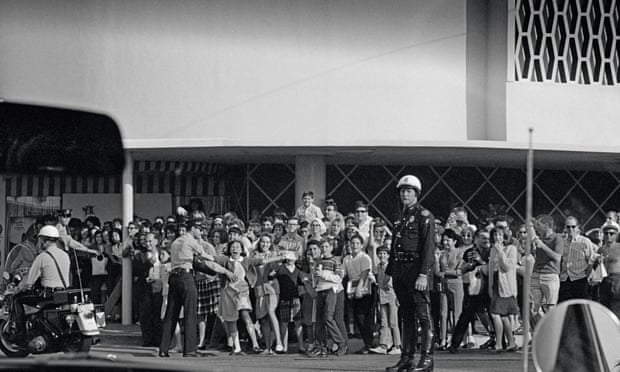
Within days they are in New York, appearing on the Ed Sullivan Show and conquering the hearts of a nation whose teenagers have, until this moment, been content to worship home-grown idols. As the Beatles travel on to snow-covered Washington DC and sun-kissed Miami Beach, I Want to Hold Your Hand is topping the US charts and the British invasion has begun.
McCartney wasn’t a photographer, although later he would marry one, and later still a daughter of that marriage would become one. (His younger brother has also worked as a photographer, and Mike McCartney’s wonderful study of Paul and John Lennon playing acoustic guitars together, heads down as they work on a song, is part of this exhibition.) But Paul fondly remembers, as many of his contemporaries would, the experience of loading his parents’ primitive “Kodak box Brownie” with a roll of film good for only eight exposures, generally considered quite enough to record an entire postwar family holiday.
In 1963, as Beatlemania swept Britain, and perhaps partly in retaliation against now being constantly confronted by the lenses of newspaper and magazine photographers, McCartney acquired a 35mm Pentax. Small enough to carry with him on tour, it enabled him to capture moments offstage with his bandmates and their entourage.
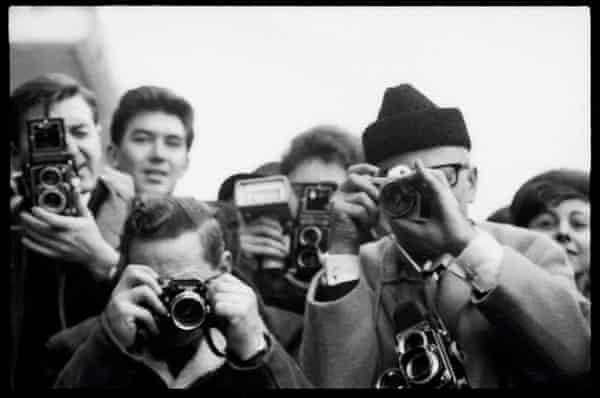
From the ever-present professionals, he could solicit advice. Dezo Hoffmann, a Czech émigré who had flown with the RAF in the second world war and now worked for Record Mirror, was one; he had travelled to Liverpool to photograph the Beatles in 1962 and stayed close. Robert Freeman was another; he had recently been hired by Brian Epstein, the band’s manager, to take the striking chiaroscuro shot, influenced by French new wave cinema, for the cover of With the Beatles, their second album. Closer to their age, Freeman looked like he belonged in their gang.
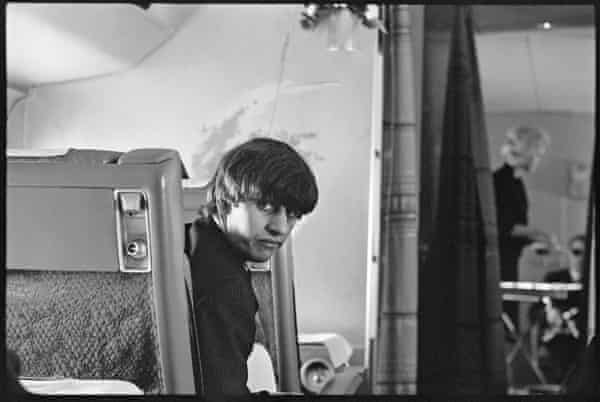
After McCartney’s films were developed, he marked up his favourite shots on contact sheets with a chinagraph pencil, as he’d watched the pros do. In the absence of the original negatives, lost over the years, many of the images in this show are printed from the contacts. Some softening is inevitable but unimportant; it suits the best of the black and white shots. Anyone would be proud of Paul’s image of Ringo Starr in a tricorn hat, taken during their stay in Paris, while his discernment is shown in the choice between two very similar shots of George Harrison: he selects the less obvious but more intriguing of the pair.
Among those who pass before his lens are Epstein, faithful crew members Neil Aspinall and Mal Evans, Cilla Black, Paul’s girlfriend Jane Asher, David Jacobs, host of the special Beatles edition of BBC TV’s Juke Box Jury, and Sylvie Vartan, their co-star at the Olympia, and her boyfriend, Johnny Hallyday. The novelty of a first visit to New York is captured in shots of skyscrapers and NYPD officers on horseback, penning back the fans outside their hotel.
In those innocent days their circle was relatively porous, with no permanent ring of personal security to guard them. Hence the presence of Murray the K, the soi-disant “fifth Beatle”, the radio DJ who had broadcast his show from their suite at the Plaza in New York and followed them to Miami, where he joined them by their hotel pool, in swimming trunks. There’s a quayside photo of Diane Levine, a pretty brunette who accompanied Paul to a drive-in movie in Miami.
The convulsion set off by that short US trip is reflected in McCartney’s acquisition of colour film. Superficially, the results seem less “serious” – like going from character studies to holiday snaps. But the switch reflects a deeper sense of how their world was changing, almost overnight, as they took everyone along with them for the ride of a lifetime.
- Paul McCartney Photographs 1963-64: Eyes of the Storm is at the National Portrait Gallery, London, from 28 June to 1 October
- This article has been corrected: Mike McCartney is Paul’s younger, not older brother.
… we have a small favour to ask. Tens of millions have placed their trust in the Guardian’s fearless journalism since we started publishing 200 years ago, turning to us in moments of crisis, uncertainty, solidarity and hope. More than 1.5 million supporters, from 180 countries, now power us financially – keeping us open to all, and fiercely independent. Will you make a difference and support us too?
Unlike many others, the Guardian has no shareholders and no billionaire owner. Just the determination and passion to deliver high-impact global reporting, always free from commercial or political influence. Reporting like this is vital for democracy, for fairness and to demand better from the powerful.
And we provide all this for free, for everyone to read. We do this because we believe in information equality. Greater numbers of people can keep track of the events shaping our world, understand their impact on people and communities, and become inspired to take meaningful action. Millions can benefit from open access to quality, truthful news, regardless of their ability to pay for it.
Whether you give a little or a lot, your funding will power our reporting for the years to come.
______
____
I have read over 40 autobiographies by ROCKERS and it seems to me that almost every one of those books can be reduced to 4 points. Once fame hit me then I became hooked on drugs. Next I became an alcoholic (or may have been hooked on both at same time). Thirdly, I chased the skirts and thought happiness would be found through more sex with more women. Finally, in my old age I have found being faithful to my wife and getting over addictions has led to happiness like I never knew before. (Almost every autobiography I have read from rockers has these points in it although Steven Tyler is still chasing the skirts!!). Paul was a playboy early on when with the Beatles but he settled down when he met Linda. Paul has not written an autobiography but I highly recommend the book PAUL MCCARTNEY: THE LIFE by Philip Norman.
_
August 13, 2022
Paul McCartney
Dear Paul,
I was so pumped up to attend your fine concert in Little Rock in 2016. I got a big kick out of taking my family to see Ringo at Orange Beach, Alabama on July 4th, 2012. It was a great show. In fact, I have been so focused on the Beatles in recent years that I have done over a year worth of weekly posts on my blog http://www.thedailyhatch.org ever Thursday entitled FRANCIS SCHAEFFER ANALYZES ART AND CULTURE and posts 49 to 101 have been about the Beatles with more to come. In fact, if you google the words FRANCIS SCHAEFFER BEATLES you the first 10 items that pop up will be links to my blog posts on Thursdays about the Beatles and what Francis Schaeffer had to say about them.
Let me give you a taste of post #67 FRANCIS SCHAEFFER ANALYZES ART AND CULTURE Part 64 THE BEATLES (Part P The Meaning of Stg. Pepper’s song SHE’S LEAVING HOME according to Schaeffer!!!!) (Featured artist Stuart Sutcliffe)
Melanie Coe ran away from home in 1967 when she was 15. Paul McCartney read about her in the papers and wrote ‘She’s Leaving Home’ for Sgt.Pepper’s. Melanie didn’t know Paul’s song was about her, but actually, the two did meet earlier, when Paul was the judge and Melanie a contestant in Ready Steady Go!
The subtitles are produced live for The One Show, so some seconds late and with a few mistakes.

Melanie at 17 in the picture that made the front pages in 1967 and inspired the Beatles.

Melanie’s first moment of fame, receiving a prize from Paul McCartney for miming to Brenda Lee on Ready Steady Go! in 1963

Melanie in 2008
She’s Leaving Home
The Beatles
Sgt. Pepper’s
Wednesday morning at five o’clock as the day begins
Silently closing her bedroom door
Leaving the note that she hoped would say more
She goes downstairs to the kitchen clutching her hankerchief
Quietly turing the backdoor key
Stepping outside she is free.
She (We gave her most of our lives)
is leaving (Sacraficed most of our lives)
home (We gave her everything money could buy)
She’s leaving home after living alone
For so many years. Bye, bye
Father snores as his wife gets into her dressing gown
Picks up the letter that’s lying there
Standing alone at the top of the stairs
She breaks down and cries to her husband
Daddy our baby’s gone.
Why would she treat us so thoughtlessly
How could she do this to me.
She (We never though of ourselves)
Is leaving (Never a thought for ourselves)
home (We struggled hard all our lives to get by)
She’s leaving home after living alone
For so many years. Bye, bye
Friday morning at nine o’clock she is far away
Waiting to keep the appointment she made
Meeting a man from the motor trade.
She What did we do that was wrong
Is having We didn’t know it was wrong
Fun Fun is the one thing that money can’t buy
Something inside that was always denied
For so many years. Bye, Bye
She’s leaving home bye bye
Why is she leaving home? Francis Schaeffer noted on pages 15-17 in volume 4 of THE COMPLETE WORKS OF FRANCIS SCHAEFFER from the original book “The Church at the end of the 20th Century” the reason she left and it was because of the bankruptcy of the materialistic views of her parents. Schaeffer points that for many years there was one message that the media was promoting and that was since we now believe in the “UNIFORMITY OF NATURAL CAUSES IN A CLOSED SYSTEM we are left with only the impersonal plus time plus chance.” Schaeffer continued:What is taught is that there is no final truth, no meaning, no absolutes, that it is only that we have not found truth and meaning, but that they do not exist. The student and the common man may not be able to analyze it, but day after day, day after day, they are being battered by this concept. We have now had several generations exposed to this and we must not be blind to the fact that it is being excepted increasingly.In contrast, this way of thinking has not had as much influence on the middle class. Many of these keep thinking in the old way as a memory of the time before the Christian base was lost in this post-Christian world. However, the majority in the middle-class have no real basis for their values since so many have given up the Christian viewpoint. They just function on the “memory.” This is why so many young people have felt that the middle class is ugly. They feel middle-class people are plastic, ugly and plastic because they try to tell others what to do on the basis of their own values but with no ground for those values.They have no base and they have no clear categories for their choices of right and wrong. Their choices tend to turn on what is for their material benefit. Take for example the fact faculty members who cheered when the student revolt struck against the administration and who immediately began to howl when the students started to burn up faculty manuscripts. They have no categories to say this is right and that is wrong. Many such people still hang on to their old values by memory but they have no base for them at all. A few years ago John Gardner head of the urban coalition spoke in Washington to a group of student leaders. His topic was on restoring values in our culture. When he finished there was a dead silence then finally one man from Harvard stood up and in a moment of brilliance asked, “Sir upon what base do you build your values?” I have never felt more sorry for anybody in my life. He simply looked down and said, “I do not know.” I had spoken that same day about what I was writing in the first part of this book. It was almost too good an illustration of my lecture. Here was a man appealing to the young people for a return to values but he is offering nothing to build on. man who was trying to tell his hearers not to drop out and yet giving no reason why they should not. Functioning only on a dim memory, these are the parents who have turned off their children when their children ask why and how. When their children crying out, “Yours is a plastic culture.” They are silent. We had the response so beautifully stated in the 1960s in the Beatles’ Sergeant Pepper’s song “She is leaving home.” “We gave her everything money could buy.” This is the only answer many parents can give.They are bothered about what they read in the newspapers concerning the way the country and the culture are going. When they read of the pornographic plays, see pornographic films on TV, they are distressed. They have a vague unhappiness about it, feel threatened by all of it and yet have no base upon which to found their judgments. And tragically such people are everywhere. They constitute the largest body in our culture-northern Europe, Britain, and also in America and other countries as well. They are a majority-what is called for a time the “silent majority”–but they are weak as water. They are people who like the old ways because they are pleasant memories, because they give what to them is a comfortable way to live but they have no basis for their values. Education for example is excepted and pressed upon their children as the only thinkable thing to pursue. Success is starting the child at the earliest possible age and then within the least possible years he is obtaining a Masters or PhD degree. Yet if the child asks why?, the only answers are first because it gives social status and then because statistics show that if you have a university or college education you will make more money. There is no base for real values are even the why of a real education. ________ When you think about the song SHE’S LEAVING HOME, you must come to the conclusion that the Beatles knew exactly what was going through the young person’s mind in the 1960’s. No wonder in the video THE AGE OF NON-REASON (which is on You Tube under the title HOW SHOULD WE THEN LIVE? EPISODE 7) Schaeffer noted, ” Sergeant Pepper’s Lonely Hearts Club Band…for a time it became the rallying cry for young people throughout the world. It expressed the essence of their lives, thoughts and their feelings.”
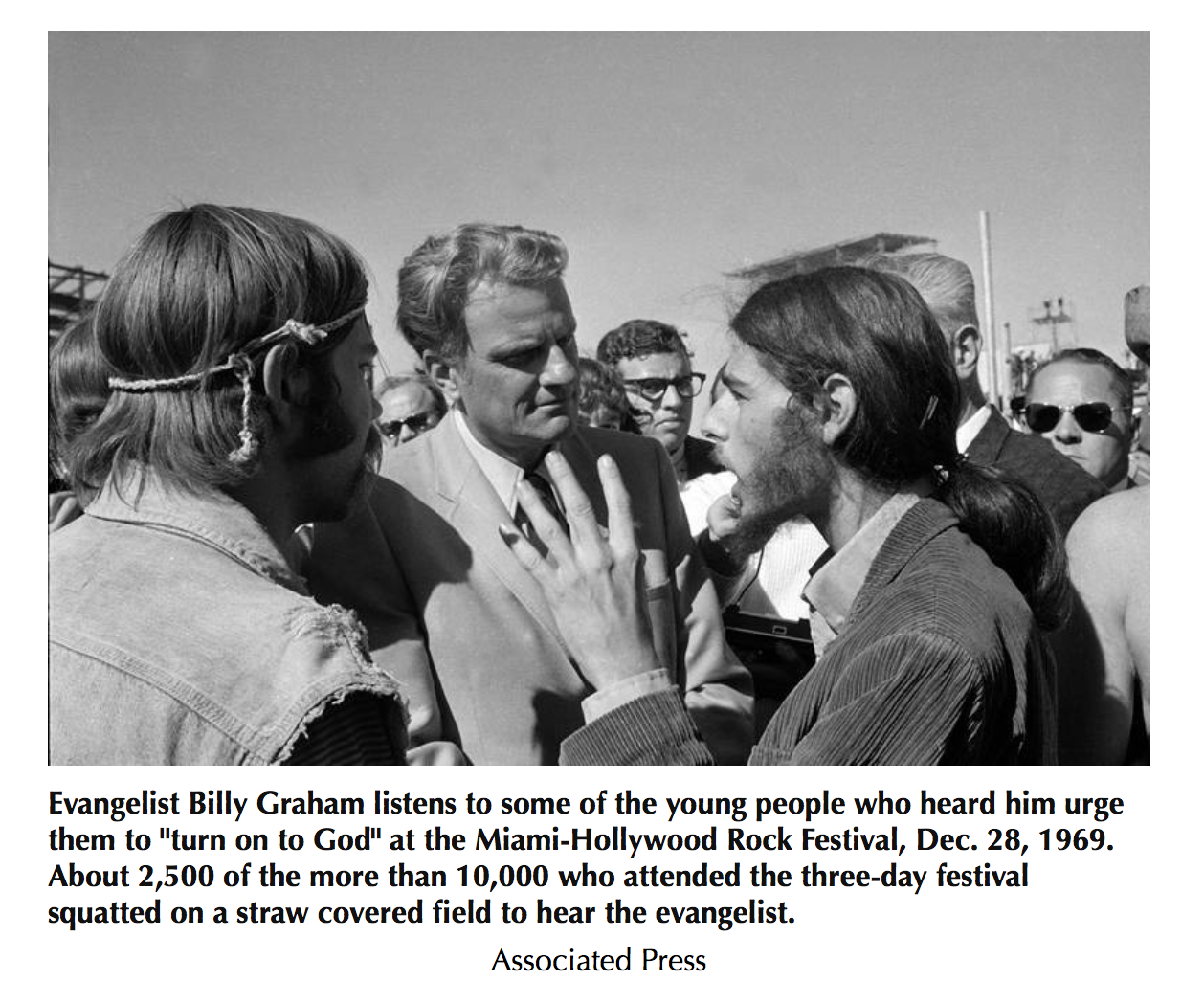
Billy Graham had a similar message to the young people in 1969 that they like the girl in SHE’S LEAVING HOME was right to Re just her parents materialism!!!
Billy Graham, hippies, and the rock concert
Posted on March 5, 2018 by Steve-O
The 1969 Miami Rock Music Festival featured the Grateful Dead, Santana, Canned Heat, Johnny Winter, Vanilla Fudge and, interestingly enough, Billy Graham.
What follows is Billy Graham’s description of his countercultural gospel message at the Miami Rock Music Festival found in his autobiography Just As I Am.
It was eleven o’clock on a Sunday morning, but I was most definitely not in church. Instead, to the horror of some, I was attending the 1969 Miami Rock Music Festival.
America in 1969 was in the midst of cataclysmic social upheaval. Stories of violent student protests against the Vietnam War filled the media. Images from the huge Woodstock music festival that took place just six months before the Miami event near Bethel, New York – for many a striking symbol of the anti-establishment feelings of a whole generation of rebellious youth – were still firmly etched in the public’s memory.
Concert promoter Norman Johnson perhaps hoped my presence would neutralize at least some of the fierce opposition he had encountered from Miami officials. Whatever his reasons, I was delighted for the opportunity to speak from the concert stage to young people who probably would have felt uncomfortable in the average church, and yet whose searching questions about life and sharp protests against society’s values echoed from almost every song.
“I gladly accept your kind invitation to speak to those attending the Miami Rock Festival on Sunday morning, December 28,” I wired him the day before Christmas. “They are the most exciting and challenging generation in American history.”
As I stepped onto the platform that Sunday morning, several thousand young people were lolling on the straw-covered ground or wandering around the concert site in the warm December sun, waiting for such groups as the Grateful Dead and Santana to make their appearance. A few were sleeping; the nonstop music had quit around four that morning.
In order to get a feel for the event, for a few hours the night before I put on a simple disguise and slipped into the crowd. My heart went out to them. Though I was thankful for their youthful exuberance, I was burdened by their spiritual searching and emptiness.
A bearded youth who had come all the way from California for the event recognized me. “Do me a favor,” he said to me with a smile, “and say a prayer to thank God for good friends and good weed.” Every evening at sunset, he confided to me, he got high on marijuana and other drugs.
“You can also get high on Jesus,” I replied.
That Sunday morning, I came prepared to be shouted down, but instead I was greeted with scattered applause. Most listened politely as I spoke. I told the young people that I had been listening carefully to the message of their music. We reject your materialism, it seemed to proclaim, and we want something of the soul. Jesus was a nonconformist, I reminded them, and He could fill their souls and give them meaning and purpose in life. “Tune in to God today, and let Him give you faith. Turn on to His power.”
Afterward two dozen responded by visiting a tent on the grounds set up by a local church as a means of outreach. During the whole weekend, the pastor wrote me later, 350 young people made commitments to Christ, and two thousand New Testaments were distributed.
As I have reflected on my own calling as an evangelist, I frequently recall the words of Christianity’s greatest evangelist, the Apostle Paul: “It has always been my ambition to preach the gospel where Christ was not known … ” (Romans 15:20). … I once told an interviewer that I would be glad to preach in Hell itself-if the Devil would let me out again!
Excerpted from Just As I Am: The Autobiography of Billy Graham (Harper Collins 1997).
Actually the answer to find meaning in life is found in putting your faith and trust in Jesus Christ. The Bible is true from cover to cover and can be trusted.
Thanks for your time.
Sincerely,
Everette Hatcher, everettehatcher@gmail.com, http://www.thedailyhatch.org, cell ph 501-920-5733, Box 23416, LittleRock, AR 72221
______________
Related posts:
MUSIC MONDAY The song LITTLE ONE sung by Rebecca St. James in the film SARAH’S CHOICE
Little One – From the Film, “Sarah’s Choice” Rebecca St James on faith and values – theDove.us Sarah’s Choice Trailer Sarah’s Choice – Behind the Scenes Rebecca St. James on Sarah’s Choice – CBN.com Rebecca St James Interview on Real Videos Sarah’s Choice – The Proposal Sarahs Choice Pregnancy Test Sarahs Choice Crossroad Sarah’s Choice […]By Everette Hatcher III | Posted in Current Events | Edit | Comments (0)
MUSIC MONDAY Rebecca St James
Lion – Rebecca St. James I will praise You – Rebecca St James Rebecca St James 1995 TBN – Everything I Do Rebecca St. James & Rachel Scott “Blessed Be Your Name” Rebecca St. James From Wikipedia, the free encyclopedia Rebecca St. James St. James in 2007 Background information Birth name Rebecca Jean Smallbone Also […]By Everette Hatcher III | Posted in Current Events | Edit | Comments (0)
MUSIC MONDAY “Foster the People” Cubbie Fink married to Rebecca St. James who is one of my favorite Christian singers!!!
Foster The People – Pumped up Kicks Foster the People From Wikipedia, the free encyclopedia Foster the People Foster the People at the 2011 MuchMusic Video Awards, from left to right: Pontius, Foster, and Fink Background information Origin Los Angeles, California, U.S. Genres Indie pop alternative rock indietronica alternative dance neo-psychedelia[1] Years active 2009–present Labels […]By Everette Hatcher III | Posted in Current Events | Edit | Comments (0)
MUSIC MONDAY ‘Apple gave me advice’: Coldplay’s Chris Martin turned to 11-year-old daughter for words of wisdom ahead of Superbowl 50 By DAILYMAIL.COM REPORTER PUBLISHED: 00:58 EST, 2 February 2016
‘Apple gave me advice’: Coldplay’s Chris Martin turned to 11-year-old daughter for words of wisdom ahead of Superbowl 50 By DAILYMAIL.COM REPORTER PUBLISHED: 00:58 EST, 2 February 2016 | UPDATED: 17:20 EST, 2 February 2016 n Facebook They’ve sold 80 million records and been around for 20 years. But Coldplay’s lead singer Chris Martin, 38, […]By Everette Hatcher III | Posted in Current Events | Edit | Comments (0)
MUSIC MONDAY Chris Martin, Lead Singer of Coldplay: 5 Fast Facts You Need to Know Published 3:44 pm EDT, February 7, 2016
__________ Chris Martin, Lead Singer of Coldplay: 5 Fast Facts You Need to Know Published 3:44 pm EDT, February 7, 2016 Updated 3:44 pm EDT, February 7, 2016 Comment By Lauren Weigle 17.6k (Getty) Chris Martin has been the front-man of the band Coldplay for about 20 years, though the band changed its name a […]By Everette Hatcher III | Posted in Current Events | Edit | Comments (0)
MUSIC MONDAY Christian Rock Pioneer Larry Norman’s Songs Part 14
Christian Rock Pioneer Larry Norman’s Songs Part 14 I posted a lot in the past about my favorite Christian musicians such as Keith Green (I enjoyed reading Green’s monthly publications too), and 2nd Chapter of Acts and others. Today I wanted to talk about one of Larry Norman’s songs. David Rogers introduced me to Larry […]By Everette Hatcher III | Posted in Current Events | Edit | Comments (0)
MUSIC MONDAY Christian Rock Pioneer Larry Norman’s Songs Part 13
Christian Rock Pioneer Larry Norman’s Songs Part 13 I posted a lot in the past about my favorite Christian musicians such as Keith Green (I enjoyed reading Green’s monthly publications too), and 2nd Chapter of Acts and others. Today I wanted to talk about one of Larry Norman’s songs. David Rogers introduced me to Larry […]By Everette Hatcher III | Posted in Current Events | Edit | Comments (0)
MUSIC MONDAY Christian Rock Pioneer Larry Norman’s Songs Part 12
Christian Rock Pioneer Larry Norman’s Songs Part 12 I posted a lot in the past about my favorite Christian musicians such as Keith Green (I enjoyed reading Green’s monthly publications too), and 2nd Chapter of Acts and others. Today I wanted to talk about one of Larry Norman’s songs. David Rogers introduced me to Larry […]By Everette Hatcher III | Posted in Current Events | Edit | Comments (0)
MUSIC MONDAY Christian Rock Pioneer Larry Norman’s Songs Part 11
Christian Rock Pioneer Larry Norman’s Songs Part 11 I posted a lot in the past about my favorite Christian musicians such as Keith Green (I enjoyed reading Green’s monthly publications too), and 2nd Chapter of Acts and others. Today I wanted to talk about one of Larry Norman’s songs. David Rogers introduced me to Larry […]By Everette Hatcher III | Posted in Current Events | Edit | Comments (0)
MUSIC MONDAY Christian Rock Pioneer Larry Norman’s Songs Part 10 more on Album “Only Visiting This Planet”
Christian Rock Pioneer Larry Norman’s Songs Part 10 more on Album “Only Visiting This Planet” I posted a lot in the past about my favorite Christian musicians such as Keith Green (I enjoyed reading Green’s monthly publications too), and 2nd Chapter of Acts and others. Today I wanted to talk about one of Larry Norman’s […]By Everette Hatcher III | Posted in Current Events | Edit | Comments (0)


 The Daily Hatch