Monthly Archives: April 2019

BREAKING DOWN CARL SAGAN’S LOGIC ON ABORTION Part 23 “A woman’s right to reproductive freedom is protected, the court ruled, by constitutional guarantees of privacy” (My 1995 correspondence with Sagan)

The last few posts have dealt with material from Adrian Rogers and Francis Schaeffer, But today Bernard Nathanson testimony is given.


Image result for francis schaeffer

Francis Schaeffer and Adrian Rogers


Carl Sagan pictured below:

_________

_

Recently I have been revisiting my correspondence in 1995 with the famous astronomer Carl Sagan who I had the privilege to correspond with in 1994, 1995 and 1996. In 1996 I had a chance to respond to his December 5, 1995letter on January 10, 1996 and I never heard back from him again since his cancer returned and he passed away later in 1996. Below is what Carl Sagan wrote to me in his December 5, 1995 letter:

Thanks for your recent letter about evolution and abortion. The correlation is hardly one to one; there are evolutionists who are anti-abortion and anti-evolutionists who are pro-abortion.You argue that God exists because otherwise we could not understand the world in our consciousness. But if you think God is necessary to understand the world, then why do you not ask the next question of where God came from? And if you say “God was always here,” why not say that the universe was always here? On abortion, my views are contained in the enclosed article (Sagan, Carl and Ann Druyan {1990}, “The Question of Abortion,” Parade Magazine, April 22.)

I was introduced to when reading a book by Francis Schaeffer called HE IS THERE AND HE IS NOT SILENT written in 1968. 

Image result for francis schaeffer

Francis Schaeffer

I was blessed with the opportunity to correspond with Dr. Sagan, and in his December 5, 1995 letter Dr. Sagan went on to tell me that he was enclosing his article “The Question of Abortion: A Search for Answers”by Carl Sagan and Ann Druyan. I am going to respond to several points made in that article. Here is a portion of Sagan’s article (here is a link to the whole article):

Image result for adrian rogers
(both Adrian Rogers and Francis Schaeffer mentioned Carl Sagan in their books and that prompted me to write Sagan and expose him to their views.

__

Image result for carl sagan ann

Carl Sagan and Ann Druyan pictured above

 “The Question of Abortion: A Search for Answers”

by Carl Sagan and Ann Druyan

For the complete text, including illustrations, introductory quote, footnotes, and commentary on the reaction to the originally published article see Billions and Billions.

The issue had been decided years ago. The court had chosen the middle ground. You’d think the fight was over. Instead, there are mass rallies, bombings and intimidation, murders of workers at abortion clinics, arrests, intense lobbying, legislative drama, Congressional hearings, Supreme Court decisions, major political parties almost defining themselves on the issue, and clerics threatening politicians with perdition. Partisans fling accusations of hypocrisy and murder. The intent of the Constitution and the will of God are equally invoked. Doubtful arguments are trotted out as certitudes. The contending factions call on science to bolster their positions. Families are divided, husbands and wives agree not to discuss it, old friends are no longer speaking. Politicians check the latest polls to discover the dictates of their consciences. Amid all the shouting, it is hard for the adversaries to hear one another. Opinions are polarized. Minds are closed.


Is it wrong to abort a pregnancy? Always? Sometimes? Never? How do we decide? We wrote this article to understand better what the contending views are and to see if we ourselves could find a position that would satisfy us both. Is there no middle ground? We had to weigh the arguments of both sides for consistency and to pose test cases, some of which are purely hypothetical. If in some of these tests we seem to go too far, we ask the reader to be patient with us–we’re trying to stress the various positions to the breaking point to see their weaknesses and where they fail.

In contemplative moments, nearly everyone recognizes that the issue is not wholly one-sided. Many partisans of differing views, we find, feel some disquiet, some unease when confronting what’s behind the opposing arguments. (This is partly why such confrontations are avoided.) And the issue surely touches on deep questions: What are our responses to one another? Should we permit the state to intrude into the most intimate and personal aspects of our lives? Where are the boundaries of freedom? What does it mean to be human?

Of the many actual points of view, it is widely held–especially in the media, which rarely have the time or the inclination to make fine distinctions–that there are only two: “pro-choice” and “pro-life.” This is what the two principal warring camps like to call themselves, and that’s what we’ll call them here. In the simplest characterization, a pro-choicer would hold that the decision to abort a pregnancy is to be made only by the woman; the state has no right to interfere. And a pro-lifer would hold that, from the moment of conception, the embryo or fetus is alive; that this life imposes on us a moral obligation to preserve it; and that abortion is tantamount to murder. Both names–pro-choice and pro-life–were picked with an eye toward influencing those whose minds are not yet made up: Few people wish to be counted either as being against freedom of choice or as opposed to life. Indeed, freedom and life are two of our most cherished values, and here they seem to be in fundamental conflict.

Let’s consider these two absolutist positions in turn. A newborn baby is surely the same being it was just before birth. There ‘s good evidence that a late-term fetus responds to sound–including music, but especially its mother’s voice. It can suck its thumb or do a somersault. Occasionally, it generates adult brain-wave patterns. Some people claim to remember being born, or even the uterine environment. Perhaps there is thought in the womb. It’s hard to maintain that a transformation to full personhood happens abruptly at the moment of birth. Why, then, should it be murder to kill an infant the day after it was born but not the day before?

As a practical matter, this isn’t very important: Less than 1 percent of all tabulated abortions in the United States are listed in the last three months of pregnancy (and, on closer investigation, most such reports turn out to be due to miscarriage or miscalculation). But third-trimester abortions provide a test of the limits of the pro-choice point of view. Does a woman’s “innate right to control her own body” encompass the right to kill a near-term fetus who is, for all intents and purposes, identical to a newborn child?

We believe that many supporters of reproductive freedom are troubled at least occasionally by this question. But they are reluctant to raise it because it is the beginning of a slippery slope. If it is impermissible to abort a pregnancy in the ninth month, what about the eighth, seventh, sixth … ? Once we acknowledge that the state can interfere at any time in the pregnancy, doesn’t it follow that the state can interfere at all times?

Abortion and the slippery slope argument above

This conjures up the specter of predominantly male, predominantly affluent legislators telling poor women they must bear and raise alone children they cannot afford to bring up; forcing teenagers to bear children they are not emotionally prepared to deal with; saying to women who wish for a career that they must give up their dreams, stay home, and bring up babies; and, worst of all, condemning victims of rape and incest to carry and nurture the offspring of their assailants. Legislative prohibitions on abortion arouse the suspicion that their real intent is to control the independence and sexuality of women…

And yet, by consensus, all of us think it proper that there be prohibitions against, and penalties exacted for, murder. It would be a flimsy defense if the murderer pleads that this is just between him and his victim and none of the government’s business. If killing a fetus is truly killing a human being, is it not the duty of the state to prevent it? Indeed, one of the chief functions of government is to protect the weak from the strong.

If we do not oppose abortion at some stage of pregnancy, is there not a danger of dismissing an entire category of human beings as unworthy of our protection and respect? And isn’t that dismissal the hallmark of sexism, racism, nationalism, and religious fanaticism? Shouldn’t those dedicated to fighting such injustices be scrupulously careful not to embrace another?

Adrian Rogers’ sermon on animal rights refutes Sagan here

There is no right to life in any society on Earth today, nor has there been at any former time… : We raise farm animals for slaughter; destroy forests; pollute rivers and lakes until no fish can live there; kill deer and elk for sport, leopards for the pelts, and whales for fertilizer; entrap dolphins, gasping and writhing, in great tuna nets; club seal pups to death; and render a species extinct every day. All these beasts and vegetables are as alive as we. What is (allegedly) protected is not life, but human life.

Genesis 3 defines being human

And even with that protection, casual murder is an urban commonplace, and we wage “conventional” wars with tolls so terrible that we are, most of us, afraid to consider them very deeply… That protection, that right to life, eludes the 40,000 children under five who die on our planet each day from preventable starvation, dehydration, disease, and neglect.

Those who assert a “right to life” are for (at most) not just any kind of life, but for–particularly and uniquely—human life. So they too, like pro-choicers, must decide what distinguishes a human being from other animals and when, during gestation, the uniquely human qualities–whatever they are–emerge.

The Bible talks about the differences between humans and animals

Despite many claims to the contrary, life does not begin at conception: It is an unbroken chain that stretches back nearly to the origin of the Earth, 4.6 billion years ago. Nor does human life begin at conception: It is an unbroken chain dating back to the origin of our species, hundreds of thousands of years ago. Every human sperm and egg is, beyond the shadow of a doubt, alive. They are not human beings, of course. However, it could be argued that neither is a fertilized egg.

In some animals, an egg develops into a healthy adult without benefit of a sperm cell. But not, so far as we know, among humans. A sperm and an unfertilized egg jointly comprise the full genetic blueprint for a human being. Under certain circumstances, after fertilization, they can develop into a baby. But most fertilized eggs are spontaneously miscarried. Development into a baby is by no means guaranteed. Neither a sperm and egg separately, nor a fertilized egg, is more than a potential baby or a potential adult. So if a sperm and egg are as human as the fertilized egg produced by their union, and if it is murder to destroy a fertilized egg–despite the fact that it’s only potentially a baby–why isn’t it murder to destroy a sperm or an egg?

Hundreds of millions of sperm cells (top speed with tails lashing: five inches per hour) are produced in an average human ejaculation. A healthy young man can produce in a week or two enough spermatozoa to double the human population of the Earth. So is masturbation mass murder? How about nocturnal emissions or just plain sex? When the unfertilized egg is expelled each month, has someone died? Should we mourn all those spontaneous miscarriages? Many lower animals can be grown in a laboratory from a single body cell. Human cells can be cloned… In light of such cloning technology, would we be committing mass murder by destroying any potentially clonable cells? By shedding a drop of blood?


All human sperm and eggs are genetic halves of “potential” human beings. Should heroic efforts be made to save and preserve all of them, everywhere, because of this “potential”? Is failure to do so immoral or criminal? Of course, there’s a difference between taking a life and failing to save it. And there’s a big difference between the probability of survival of a sperm cell and that of a fertilized egg. But the absurdity of a corps of high-minded semen-preservers moves us to wonder whether a fertilized egg’s mere “potential” to become a baby really does make destroying it murder.

Opponents of abortion worry that, once abortion is permissible immediately after conception, no argument will restrict it at any later time in the pregnancy. Then, they fear, one day it will be permissible to murder a fetus that is unambiguously a human being. Both pro-choicers and pro-lifers (at least some of them) are pushed toward absolutist positions by parallel fears of the slippery slope.


Another slippery slope is reached by those pro-lifers who are willing to make an exception in the agonizing case of a pregnancy resulting from rape or incest. But why should the right to live depend on the circumstances of conception? If the same child were to result, can the state ordain life for the offspring of a lawful union but death for one conceived by force or coercion? How can this be just? And if exceptions are extended to such a fetus, why should they be withheld from any other fetus? This is part of the reason some pro-lifers adopt what many others consider the outrageous posture of opposing abortions under any and all circumstances–only excepting, perhaps, when the life of the mother is in danger.

By far the most common reason for abortion worldwide is birth control. So shouldn’t opponents of abortion be handing out contraceptives and teaching school children how to use them? That would be an effective way to reduce the number of abortions. Instead, the United States is far behind other nations in the development of safe and effective methods of birth control–and, in many cases, opposition to such research (and to sex education) has come from the same people who oppose abortions.continue on to Part 3

For the complete text, including illustrations, introductory quote, footnotes, and commentary on the reaction to the originally published article see Billions and Billions.

The attempt to find an ethically sound and unambiguous judgment on when, if ever, abortion is permissible has deep historical roots. Often, especially in Christian tradition, such attempts were connected with the question of when the soul enters the body–a matter not readily amenable to scientific investigation and an issue of controversy even among learned theologians. Ensoulment has been asserted to occur in the sperm before conception, at conception, at the time of “quickening” (when the mother is first able to feel the fetus stirring within her), and at birth. Or even later.

Different religions have different teachings. Among hunter-gatherers, there are usually no prohibitions against abortion, and it was common in ancient Greece and Rome. In contrast, the more severe Assyrians impaled women on stakes for attempting abortion. The Jewish Talmud teaches that the fetus is not a person and has no rights. The Old and New Testaments–rich in astonishingly detailed prohibitions on dress, diet, and permissible words–contain not a word specifically prohibiting abortion. The only passage that’s remotely relevant (Exodus 21:22) decrees that if there’s a fight and a woman bystander should accidentally be injured and made to miscarry, the assailant must pay a fine.

Neither St. Augustine nor St. Thomas Aquinas considered early-term abortion to be homicide (the latter on the grounds that the embryo doesn’t look human). This view was embraced by the Church in the Council of Vienne in 1312, and has never been repudiated. The Catholic Church’s first and long-standing collection of canon law (according to the leading historian of the Church’s teaching on abortion, John Connery, S.J.) held that abortion was homicide only after the fetus was already “formed”–roughly, the end of the first trimester.

But when sperm cells were examined in the seventeenth century by the first microscopes, they were thought to show a fully formed human being. An old idea of the homunculus was resuscitated–in which within each sperm cell was a fully formed tiny human, within whose testes were innumerable other homunculi, etc., ad infinitum. In part through this misinterpretation of scientific data, in 1869 abortion at any time for any reason became grounds for excommunication. It is surprising to most Catholics and others to discover that the date was not much earlier.

From colonial times to the nineteenth century, the choice in the United States was the woman’s until “quickening.” An abortion in the first or even second trimester was at worst a misdemeanor. Convictions were rarely sought and almost impossible to obtain, because they depended entirely on the woman’s own testimony of whether she had felt quickening, and because of the jury’s distaste for prosecuting a woman for exercising her right to choose. In 1800 there was not, so far as is known, a single statute in the United States concerning abortion. Advertisements for drugs to induce abortion could be found in virtually every newspaper and even in many church publications–although the language used was suitably euphemistic, if widely understood.

But by 1900, abortion had been banned at any time in pregnancy by every state in the Union, except when necessary to save the woman’s life. What happened to bring about so striking a reversal? Religion had little to do with it.Drastic economic and social conversions were turning this country from an agrarian to an urban-industrial society. America was in the process of changing from having one of the highest birthrates in the world to one of the lowest. Abortion certainly played a role and stimulated forces to suppress it.


One of the most significant of these forces was the medical profession. Up to the mid-nineteenth century, medicine was an uncertified, unsupervised business. Anyone could hang up a shingle and call himself (or herself) a doctor. With the rise of a new, university-educated medical elite, anxious to enhance the status and influence of physicians, the American Medical Association was formed. In its first decade, the AMA began lobbying against abortions performed by anyone except licensed physicians. New knowledge of embryology, the physicians said, had shown the fetus to be human even before quickening.

Their assault on abortion was motivated not by concern for the health of the woman but, they claimed, for the welfare of the fetus. You had to be a physician to know when abortion was morally justified, because the question depended on scientific and medical facts understood only by physicians. At the same time, women were effectively excluded from the medical schools, where such arcane knowledge could be acquired. So, as things worked out, women had almost nothing to say about terminating their own pregnancies. It was also up to the physician to decide if the pregnancy posed a threat to the woman, and it was entirely at his discretion to determine what was and was not a threat. For the rich woman, the threat might be a threat to her emotional tranquillity or even to her lifestyle. The poor woman was often forced to resort to the back alley or the coat hanger.

This was the law until the 1960s, when a coalition of individuals and organizations, the AMA now among them, sought to overturn it and to reinstate the more traditional values that were to be embodied in Roe v. Wade.continue on to Part 4

If you deliberately kill a human being, it’s called murder. If you deliberately kill a chimpanzee–biologically, our closest relative, sharing 99.6 percent of our active genes–whatever else it is, it’s not murder. To date, murder uniquely applies to killing human beings. Therefore, the question of when personhood (or, if we like, ensoulment) arises is key to the abortion debate. When does the fetus become human? When do distinct and characteristic human qualities emerge?

Section 8 Sperm journey to becoming Human 

We recognize that specifying a precise moment will overlook individual differences. Therefore, if we must draw a line, it ought to be drawn conservatively–that is, on the early side. There are people who object to having to set some numerical limit, and we share their disquiet; but if there is to be a law on this matter, and it is to effect some useful compromise between the two absolutist positions, it must specify, at least roughly, a time of transition to personhood.

Every one of us began from a dot. A fertilized egg is roughly the size of the period at the end of this sentence. The momentous meeting of sperm and egg generally occurs in one of the two fallopian tubes. One cell becomes two, two become four, and so on—an exponentiation of base-2 arithmetic. By the tenth day the fertilized egg has become a kind of hollow sphere wandering off to another realm: the womb. It destroys tissue in its path. It sucks blood from capillaries. It bathes itself in maternal blood, from which it extracts oxygen and nutrients. It establishes itself as a kind of parasite on the walls of the uterus.By the third week, around the time of the first missed menstrual period, the forming embryo is about 2 millimeters long and is developing various body parts. Only at this stage does it begin to be dependent on a rudimentary placenta. It looks a little like a segmented worm.By the end of the fourth week, it’s about 5 millimeters (about 1/5 inch) long. It’s recognizable now as a vertebrate, its tube-shaped heart is beginning to beat, something like the gill arches of a fish or an amphibian become conspicuous, and there is a pronounced tail. It looks rather like a newt or a tadpole. This is the end of the first month after conception.By the fifth week, the gross divisions of the brain can be distinguished. What will later develop into eyes are apparent, and little buds appear—on their way to becoming arms and legs.By the sixth week, the embryo is 13 millimeteres (about ½ inch) long. The eyes are still on the side of the head, as in most animals, and the reptilian face has connected slits where the mouth and nose eventually will be.By the end of the seventh week, the tail is almost gone, and sexual characteristics can be discerned (although both sexes look female). The face is mammalian but somewhat piglike.By the end of the eighth week, the face resembles that of a primate but is still not quite human. Most of the human body parts are present in their essentials. Some lower brain anatomy is well-developed. The fetus shows some reflex response to delicate stimulation.By the tenth week, the face has an unmistakably human cast. It is beginning to be possible to distinguish males from females. Nails and major bone structures are not apparent until the third month.By the fourth month, you can tell the face of one fetus from that of another. Quickening is most commonly felt in the fifth month. The bronchioles of the lungs do not begin developing until approximately the sixth month, the alveoli still later.

So, if only a person can be murdered, when does the fetus attain personhood? When its face becomes distinctly human, near the end of the first trimester? When the fetus becomes responsive to stimuli–again, at the end of the first trimester? When it becomes active enough to be felt as quickening, typically in the middle of the second trimester? When the lungs have reached a stage of development sufficient that the fetus might, just conceivably, be able to breathe on its own in the outside air?

The trouble with these particular developmental milestones is not just that they’re arbitrary. More troubling is the fact that none of them involves uniquely humancharacteristics–apart from the superficial matter of facial appearance. All animals respond to stimuli and move of their own volition. Large numbers are able to breathe. But that doesn’t stop us from slaughtering them by the billions. Reflexes and motion are not what make us human.

Section 9 Sagan’s conclusion based on arbitrary choice of the presence of thought by unborn baby

Other animals have advantages over us–in speed, strength, endurance, climbing or burrowing skills, camouflage, sight or smell or hearing, mastery of the air or water. Our one great advantage, the secret of our success, is thought–characteristically human thought. We are able to think things through, imagine events yet to occur, figure things out. That’s how we invented agriculture and civilization. Thought is our blessing and our curse, and it makes us who we are.

Thinking occurs, of course, in the brain–principally in the top layers of the convoluted “gray matter” called the cerebral cortex. The roughly 100 billion neurons in the brain constitute the material basis of thought. The neurons are connected to each other, and their linkups play a major role in what we experience as thinking. But large-scale linking up of neurons doesn’t begin until the 24th to 27th week of pregnancy–the sixth month.

By placing harmless electrodes on a subject’s head, scientists can measure the electrical activity produced by the network of neurons inside the skull. Different kinds of mental activity show different kinds of brain waves. But brain waves with regular patterns typical of adult human brains do not appear in the fetus until about the 30th week of pregnancy–near the beginning of the third trimester. Fetuses younger than this–however alive and active they may be–lack the necessary brain architecture. They cannot yet think.

Acquiescing in the killing of any living creature, especially one that might later become a baby, is troublesome and painful. But we’ve rejected the extremes of “always” and “never,” and this puts us–like it or not–on the slippery slope. If we are forced to choose a developmental criterion, then this is where we draw the line: when the beginning of characteristically human thinking becomes barely possible.

It is, in fact, a very conservative definition: Regular brain waves are rarely found in fetuses. More research would help… If we wanted to make the criterion still more stringent, to allow for occasional precocious fetal brain development, we might draw the line at six months. This, it so happens, is where the Supreme Court drew it in 1973–although for completely different reasons.

Its decision in the case of Roe v. Wade changed American law on abortion. It permits abortion at the request of the woman without restriction in the first trimester and, with some restrictions intended to protect her health, in the second trimester. It allows states to forbid abortion in the third trimester, except when there’s a serious threat to the life or health of the woman. In the 1989 Webster decision, the Supreme Court declined explicitly to overturn Roe v. Wade but in effect invited the 50 state legislatures to decide for themselves.

What was the reasoning in Roe v. Wade? There was no legal weight given to what happens to the children once they are born, or to the family. Instead, a woman’s right to reproductive freedom is protected, the court ruled, by constitutional guarantees of privacy. But that right is not unqualified. The woman’s guarantee of privacy and the fetus’s right to life must be weighed–and when the court did the weighing’ priority was given to privacy in the first trimester and to life in the third. The transition was decided not from any of the considerations we have been dealing with so far…–not when “ensoulment” occurs, not when the fetus takes on sufficient human characteristics to be protected by laws against murder. Instead, the criterion adopted was whether the fetus could live outside the mother. This is called “viability” and depends in part on the ability to breathe. The lungs are simply not developed, and the fetus cannot breathe–no matter how advanced an artificial lung it might be placed in—until about the 24th week, near the start of the sixth month. This is why Roe v. Wade permits the states to prohibit abortions in the last trimester. It’s a very pragmatic criterion.

If the fetus at a certain stage of gestation would be viable outside the womb, the argument goes, then the right of the fetus to life overrides the right of the woman to privacy. But just what does “viable” mean? Even a full-term newborn is not viable without a great deal of care and love. There was a time before incubators, only a few decades ago, when babies in their seventh month were unlikely to be viable. Would aborting in the seventh month have been permissible then? After the invention of incubators, did aborting pregnancies in the seventh month suddenly become immoral? What happens if, in the future, a new technology develops so that an artificial womb can sustain a fetus even before the sixth month by delivering oxygen and nutrients through the blood–as the mother does through the placenta and into the fetal blood system? We grant that this technology is unlikely to be developed soon or become available to many. But if it were available, does it then become immoral to abort earlier than the sixth month, when previously it was moral? A morality that depends on, and changes with, technology is a fragile morality; for some, it is also an unacceptable morality.

And why, exactly, should breathing (or kidney function, or the ability to resist disease) justify legal protection? If a fetus can be shown to think and feel but not be able to breathe, would it be all right to kill it? Do we value breathing more than thinking and feeling? Viability arguments cannot, it seems to us, coherently determine when abortions are permissible. Some other criterion is needed. Again, we offer for consideration the earliest onset of human thinking as that criterion.

Since, on average, fetal thinking occurs even later than fetal lung development, we find Roe v. Wade to be a good and prudent decision addressing a complex and difficult issue. With prohibitions on abortion in the last trimester–except in cases of grave medical necessity–it strikes a fair balance between the conflicting claims of freedom and life.What do you think? What have others said about Carl Sagan’s thoughts on 

End of Sagan Excerpt 

Carl Sagan stated, “A woman’s right to reproductive freedom is protected, the court ruled, by constitutional guarantees of privacy” 

Francis Schaeffer and Adrian Rogers discuss the Roe v Wade Decision below.

Xxxxxxxxxxxxx 
________

Pt 1 of 2 Listen to this Important Message by Francis Schaeffer

Published on Sep 30, 2013

This message “A Christian Manifesto” was given in 1982 by the late Christian Philosopher Francis Schaeffer when he was age 70 at D. James Kennedy’s Corral Ridge Presbyterian Church.
Listen to this important message where Dr. Schaeffer says it is the duty of Christians to disobey the government when it comes in conflict with God’s laws. So many have misinterpreted Romans 13 to mean unconditional obedience to the state. When the state promotes an evil agenda and anti-Christian statues we must obey God rather than men. Acts
I use to watch James Kennedy preach from his TV pulpit with great delight in the 1980’s. Both of these men are gone to be with the Lord now. We need new Christian leaders to rise up in their stead.
To view Part 2 See Francis Schaeffer Lecture- Christian Manifesto Pt 2 of 2 video
The religious and political freedom’s we enjoy as Americans was based on the Bible and the legacy of the Reformation according to Francis Schaeffer. These freedoms will continue to diminish as we cast off the authority of Holy Scripture.
In public schools there is no other view of reality but that final reality is shaped by chance.
Likewise, public television gives us many things that we like culturally but so much of it is mere propaganda shaped by a humanistic world and life view.

_____________________________

 
I was able to watch Francis Schaeffer deliver a speech on a book he wrote called “A Christian Manifesto” and I heard him in several interviews on it in 1981 and 1982. I listened with great interest since I also read that book over and over again. Below is a portion of one of Schaeffer’s talks  on a crucial subject that is very important today too.


A Christian Manifesto
by Dr. Francis A. Schaeffer
This address was delivered by the late Dr. Schaeffer in 1982 at the Coral Ridge Presbyterian Church, Fort Lauderdale, Florida. It is based on one of his books, which bears the same title.

——–

TYRANNY as anti-God agenda pushed through courts in USA
 
———-_

It is about us on every side, and especially the government and the courts have become the vehicle to force this anti-God view on the total population. It’s exactly where we are.
The abortion ruling is a very clear one. The abortion ruling, of course, is also a natural result of this other world view because with this other world view, human life — your individual life — has no intrinsic value. You are a wart upon the face of an absolutely impersonal universe. Your aspirations have no fulfillment in the “what-isness” of what is. Your aspirations damn you. Many of the young people who come to us understand this very well because their aspirations as Humanists have no fulfillment, if indeed the final reality is only material or energy shaped by pure chance.
The universe cannot fulfill anything that you say when you say, “It is beautiful”; “I love”; “It is right”; “It is wrong.” These words are meaningless words against the backdrop of this other world view. So what we find is that the abortion case should not have been a surprise because it boiled up out of, quite naturally, (I would use the word again) mathematically, this other world view. In this case, human life has no distinct value whatsoever, and we find this Supreme Court in one ruling overthrew the abortion laws of all 50 states, and they made this form of killing human life (because that’s what it is) the law. The law declared that this form of killing human life was to be accepted, and for many people, because they had no set ethic, when the Supreme Court said that it was legal, in the intervening years, it has become ethical.
The courts of this country have forced this view and its results on the total population. What we find is that as the courts have done this, without any longer that which the founding fathers comprehended of law (A man like Blackstone, with his Commentaries, understood, and the other lawgivers in this country in the beginning): That there is a law of God which gives foundation. It becomes quite natural then, that they would also cut themselves loose from a strict constructionism concerning the Constitution.
Everything is relative. So as you cut yourself loose from the Law of God, in any concept whatsoever, you also soon are cutting yourself loose from a strict constructionism and each ruling is to be seen as an arbitrary choice by a group of people as to what they may honestly think is for the sociological good of the community, of the country, for the given moment.
Now, along with that is the fact that the courts are increasingly making law and thus we find that the legislatures’ powers are increasingly diminished in relationship to the power of the courts. Now the pro-abortion people have been very wise about this in the last, say, 10 years, and Christians very silly. I wonder sometimes where we’ve been because the pro-abortion people have used the courts for their end rather than the legislatures — because the courts are not subject to the people’s thinking, nor their will, either by election nor by a re-election. Consequently, the courts have been the vehicle used to bring this whole view and to force it on our total population. It has not been largely the legislatures. It has been rather, the courts.
The result is a relativistic value system. A lack of a final meaning to life — that’s first. Why does human life have any value at all, if that is all that reality is? Not only are you going to die individually, but the whole human race is going to die, someday. It may not take the falling of the atom bombs, but someday the world will grow too hot, too cold. That’s what we are told on this other final reality, and someday all you people not only will be individually dead, but the whole conscious life on this world will be dead, and nobody will see the birds fly. And there’s no meaning to life.
As you know, I don’t speak academically, shut off in some scholastic cubicle, as it were. I have lots of young people and older ones come to us from the ends of the earth. And as they come to us, they have gone to the end of this logically and they are not living in a romantic setting. They realize what the situation is. They can’t find any meaning to life. It’s the meaning to the black poetry. It’s the meaning of the black plays. It’s the meaning of all this. It’s the meaning of the words “punk rock.” And I must say, that on the basis of what they are being taught in school, that the final reality is only this material thing, they are not wrong. They’re right! On this other basis there is no meaning to life and not only is there no meaning to life, but there is no value system that is fixed, and we find that the law is based then only on a relativistic basis and that law becomes purely arbitrary.
And this is brought to bear, specifically, and perhaps most clearly, in the public schools (I’ll come to that now) in this country. In the courts of this country, they are saying that it’s absolutely illegal, from the lowest grades up through university, for the public schools of this country to teach any other world view except this world view of final material or energy. Now this is done, no matter what the parents may wish. This is done regardless of what those who pay the taxes for their schools may wish. I’m giving you an illustration, as well as making a point. The way the courts force their view, and this false view of reality on the total population, no matter what the total population wants.
We find that in the January 18 — just recently — Time magazine, there was an article that said there was a poll that pointed out that about 76% of the people in this country thought it would be a good idea to have both creation and evolution taught in the public schools. I don’t know if the poll was accurate, but assuming that the poll was accurate, what does it mean? It means that your public schools are told by the courts that they cannot teach this, even though 76% of the people in the United States want it taught. I’ll give you a word. It’s TYRANNY. There is no other word that fits at such a point.
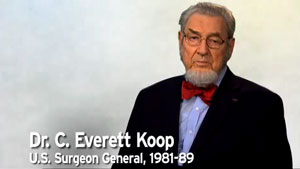
And at the same time we find the medical profession has radically changed. Dr. Koop, in our seminars for Whatever Happened to the Human Race, often said that (speaking for himself), “When I graduated from medical school, the idea was ‘how can I save this life?’ But for a great number of the medical students now, it’s not, ‘How can I save this life?’, but ‘Should I save this life?'”
Believe me, it’s everywhere. It isn’t just abortion. It’s infanticide. It’s allowing the babies to starve to death after they are born. If they do not come up to some doctor’s concept of a quality of life worth living. I’ll just say in passing — and never forget it – it takes about 15 days, often, for these babies to starve to death. And I’d say something else that we haven’t stressed enough. In abortion itself, there is no abortion method that is not painful to the child — just as painful that month before birth as the baby you see a month after birth in one of these cribs down here that I passed — just as painful.

—-

Why I Am Pro-Life, Part 1

In one of the most poignant verses in the Bible, Isaiah describes the day we now live in.

 “Woe unto them that call evil good, and good evil; that put darkness for light, and light for darkness; that put bitter for sweet, and sweet for bitter!” Isaiah 5:20

Some people like to say they’re for “a right to choose,” but then don’t complete the sentence. Choose what? What do you choose? They can’t say, “I’m for the choice to kill a baby in the mother’s womb,” because it doesn’t sound so good.

The decision to take an innocent life in the mother’s womb really is a choice between life and death. God’s Word says clearly in Deuteronomy 30:19

Therefore choose life, that both you and your children may live.

Understand that you are free to choose. You are not free not to choose. And you are not free to choose the consequences of your choice. God has told us we are to choose life.

I’m going to give you three reasons I’m pro-life. But first, let’s look at our present situation:

On the day you are reading this, in America 3,000-4,000 lives will be snuffed out. They’ve not had the benefit of a trial; they’ll have no counsel to represent them. They’ll be executed in a cruel and inhumane way. Though they’ve committed no crime, one will die about every 21 seconds.

Who are the co-conspirators of this atrocity? Who is putting the unborn to death?

  • Supreme Court justices. Six of them, high priests of humanism, wrapped in their robes, sided with Justice Harry Blackmun to do this.  
  • Governmental social planners. Some receive your tax dollars and mine. Planned Parenthood does for parenthood what Orkin does for bugs.
  • Willing physicians.
  • The willing mother or father of the child.
  • Abortion clinics, getting wealthy on the death of the unborn.
  • Many others who are silent and unconcerned. Or too timid to speak out.
  • Politicians who put self-interest and re-election above the lives of innocent children.      

January 22, 1973, was a day which will live in infamy, one of the darkest in American history, like 9/11 or Pearl Harbor. In America it is now legal to kill a baby. That probably just went right past you. It is now legal to kill a baby.

The only requirements are:

1. The baby still lives inside the mother, at least a portion of the baby. (Part of the baby can now be outside the mother.)

2. The mother wants the baby killed.

3. A doctor is willing to do the killing.

The Court ruled in 1973: “A state is forbidden to proscribe (forbid) abortion any time prior to the birth if in the opinion of one licensed physician an abortion is necessary to preserve the life or the health of the mother.” 

Few would argue about “life of the mother.”  But note that key word “health of the mother.” The court elaborated, “All factors, physical, emotional, psychological, familial and the woman’s age, relevant to the wellbeing of the patient” could legally justify the taking of an innocent human life.

Roe ruled abortion is permitted if the woman says it would (1) distress her (2) produce psychological harm (3) tax mental and physical health by child care, or (4) bring distress associated with an unwanted child. That is, “If I don’t want this child, then that’s my mental health condition that okays the child being put to death.” Or, “We can’t take of the baby; kill it.” Or, “We didn’t get married. We are pregnant. Kill the baby.”

Most people are aware of Roe v. Wade, but few of Doe v. Bolton, companion piece to Roe v. Wade, legalizing any abortionist to kill a baby through all nine months of pregnancy.  It is even legal to kill a baby while the mother is in labor and the baby is partially delivered, partially out of the birth canal.

In America, if you crush a bald eagle’s egg you can be fined $5,000 and spend a year in jail, but you can make a handsome living killing babies in the mother’s womb.  Pharaoh and Herod must now take second place to America.

          Woe unto them that call good evil that put light for dark.

In America, a teenage girl can receive amoral sex education in school and be given contraceptives with government money, and if she comes up pregnant, she can be taken to a Planned Parenthood clinic without her parents’ knowledge or consent, where she can have the baby killed. Yet many of these same schools would not dare give an aspirin without parental consent. That is barbaric. It is also crazy.

I.

I am pro-life because it is just that: a matter of LIFE.

What is being put to death in the mother’s womb is a human life. When the ovum and the sperm are united, it becomes human life. There’s no question about that.

Here are some of the pro-abortion arguments you hear and my answers to them:

IT’S NOT A HUMAN

Someone wrote “Dear Abby” saying they were a pro-choice because “to believe the ovum and sperm united are human life would like believing a vehicle was in existence after a nut and bolt were joined together at the beginning of an auto assembly line.” So if you have an egg and sperm come together, that’s no more life, they say, than a nut and bolt in a car factory is a car.

What convoluted logic! There is a great difference. A nut and bolt are only a nut and bolt. They will not one day become a Cadillac! But when the egg and sperm come together, that is a human life, and no carburetor, fender, steering wheel or engine is added. Everything is already there! All that little life needs is nutrition and water to grow. You don’t add anything. It’s a human being already.

Dr. Bernard N. Nathanson, obstetrician/gynecologist, was director of the largest abortion clinic in the western world. But his eyes were opened. He suddenly changed his tune after his clinic had performed 60,000 abortions. Resigning, he said: “I’m deeply troubled by my own increasing certainty that I had in fact presided over 60,000 deaths.” Think of it. He stated there is a “vector of life.” From the moment of conception, there’s “a self-directed force of life that, if not interrupted, will lead to the birth of a human baby.” The child conceived is a human being from the moment of conception.

All the components of life being there, some will say, “That’s only some blob, not human life.” Is it animal? Vegetable? Mineral? It is human life.

IT’S MY BODY

Abortion advocates talk about having “a right to my own body.” The child is not a part of the mother’s body. He or she is a new life, altogether different, with their own unique DNA, circulatory system, often even a different blood type than the mother, and certainly their own unique fingerprints. The nucleus of a human cell has 46 chromosomes, 23 from the father and 23 from the mother. So the child is not merely “part of the mother’s body.” It is as much a part of the father as the mother. It is life, and it is life from God.

IT’S JUST A “FETUS”—NOT A PERSON

People often use the word “fetus.” In Latin, “fetus” means “baby, child”; to say “fetus” is to say “child” in Latin. No matter how small, it is a child. It’s all simply a continuum. You and I were once a child all the way through in gradual development. Just because he is little and young has nothing to do with the reality that he or she is a human being. When conceived, a baby is as small as a grain of sand. But a new human being has begun, no less a person than the child or adult walking around.

Speaking of development within the womb, the Psalmist said,

Thou hast covered me in my mother’s womb. I will praise thee; for I am fearfully and wonderfully made: marvelous are thy works; and that my soul knoweth right well. My substance was not hid from thee, when I was made in secret, and curiously wrought in the lowest parts of the earth. Thine eyes did see my substance, yet being unperfect; and in thy book all my members were written, which in continuance were fashioned, when as yet there was none of them. Psalm 139:13-16.

This passage, inspired by the Holy Spirit, reveals that when a mother is pregnant, God Himself is forming a child within her. “Wonderfully and fearfully made” literally means awesomely made. It also tells us that little baby is the object of God’s love and concern. The Bible does not distinguish between prenatal and postnatal life but speaks of babies in the womb as people and persons.

Jeremiah was ordained in his mother’s womb.

Before I formed thee in the belly I knew thee; and before thou camest forth out of the womb I sanctified thee, and I ordained thee a prophet unto the nations. Jeremiah 1:5.

You don’t ordain a blob of tissue. God said, “Before I formed you, I knew you, Jeremiah. You are my prophet.”

John the Baptist was in his mother Elisabeth’s womb when his cousin Mary came to visit with Jesus in her womb.

And it came to pass that when Elisabeth heard the salutation of Mary, the babe leaped in her womb, and Elisabeth was filled with the Holy Ghost. Luke 1:41.

The word Luke used for babe is brephos. Thayer’s Lexicon says, “The word brephos is an unborn child, embryo, fetus, a newborn child, an infant, a babe.” Whether in the womb or out of the womb, the Bible uses the same word.

And they brought unto [Jesus] also infants [brephos], that He would touch them. Luke 18:15

Brephos, infant, is the same word used for John the Baptist in his mother’s womb.

Why am I pro-life?  The Bible says it is a crime against God to kill innocent life.

These six things doth the LORD hate: yea, seven are an abomination unto him: A proud look, a lying tongue, and hands that shed innocent blood. Proverbs 6:16-17.

The taking of life in the womb is an abomination to Almighty God. What could be more clear? He hates abortion.

Doctors and nurses who had worked with abortionist Dr. Nathanson told him of nightmares, depression and personality changes they and other clinic personnel were experiencing because of the taking of innocent life. I am pro-life because it is a matter of life.

In Part Two, I will tell you the two other reasons I am pro-life.

Related posts:

Francis Schaeffer’s prayer for us in USA

 Francis Schaeffer: “Whatever Happened to the Human Race” (Episode 1) ABORTION OF THE HUMAN RACE Published on Oct 6, 2012 by AdamMetropolis The 45 minute video above is from the film series created from Francis Schaeffer’s book “Whatever Happened to the Human Race?” with Dr. C. Everett Koop. This book  really helped develop my political views […]


Francis Schaeffer’s “How should we then live?” Video and outline of episode 10 “Final Choices” (Schaeffer Sundays)

E P I S O D E 1 0   Dr. Francis Schaeffer – Episode X – Final Choices 27 min FINAL CHOICES I. Authoritarianism the Only Humanistic Social Option One man or an elite giving authoritative arbitrary absolutes. A. Society is sole absolute in absence of other absolutes. B. But society has to be […]

Francis Schaeffer’s “How should we then live?” Video and outline of episode 9 “The Age of Personal Peace and Affluence” (Schaeffer Sundays)

E P I S O D E 9 Dr. Francis Schaeffer – Episode IX – The Age of Personal Peace and Affluence 27 min T h e Age of Personal Peace and Afflunce I. By the Early 1960s People Were Bombarded From Every Side by Modern Man’s Humanistic Thought II. Modern Form of Humanistic Thought Leads […]

Francis Schaeffer’s “How should we then live?” Video and outline of episode 8 “The Age of Fragmentation” (Schaeffer Sundays)

E P I S O D E 8 Dr. Francis Schaeffer – Episode VIII – The Age of Fragmentation 27 min I saw this film series in 1979 and it had a major impact on me. T h e Age of FRAGMENTATION I. Art As a Vehicle Of Modern Thought A. Impressionism (Monet, Renoir, Pissarro, Sisley, […]

Francis Schaeffer’s “How should we then live?” Video and outline of episode 7 “The Age of Non-Reason” (Schaeffer Sundays)

E P I S O D E 7 Dr. Francis Schaeffer – Episode VII – The Age of Non Reason I am thrilled to get this film series with you. I saw it first in 1979 and it had such a big impact on me. Today’s episode is where we see modern humanist man act […]

Francis Schaeffer’s “How should we then live?” Video and outline of episode 6 “The Scientific Age” (Schaeffer Sundays)

E P I S O D E 6 How Should We Then Live 6#1 Uploaded by NoMirrorHDDHrorriMoN on Oct 3, 2011 How Should We Then Live? Episode 6 of 12 ________ I am sharing with you a film series that I saw in 1979. In this film Francis Schaeffer asserted that was a shift in […]

Francis Schaeffer’s “How should we then live?” Video and outline of episode 5 “The Revolutionary Age” (Schaeffer Sundays)

E P I S O D E 5 How Should We Then Live? Episode 5: The Revolutionary Age I was impacted by this film series by Francis Schaeffer back in the 1970′s and I wanted to share it with you. Francis Schaeffer noted, “Reformation Did Not Bring Perfection. But gradually on basis of biblical teaching there […]

Francis Schaeffer’s “How should we then live?” Video and outline of episode 4 “The Reformation” (Schaeffer Sundays)

Dr. Francis Schaeffer – Episode IV – The Reformation 27 min I was impacted by this film series by Francis Schaeffer back in the 1970′s and I wanted to share it with you. Schaeffer makes three key points concerning the Reformation: “1. Erasmian Christian humanism rejected by Farel. 2. Bible gives needed answers not only as to […]

“Schaeffer Sundays” Francis Schaeffer’s “How should we then live?” Video and outline of episode 3 “The Renaissance”

Francis Schaeffer’s “How should we then live?” Video and outline of episode 3 “The Renaissance” Francis Schaeffer: “How Should We Then Live?” (Episode 3) THE RENAISSANCE I was impacted by this film series by Francis Schaeffer back in the 1970′s and I wanted to share it with you. Schaeffer really shows why we have so […]

Francis Schaeffer’s “How should we then live?” Video and outline of episode 2 “The Middle Ages” (Schaeffer Sundays)

  Francis Schaeffer: “How Should We Then Live?” (Episode 2) THE MIDDLE AGES I was impacted by this film series by Francis Schaeffer back in the 1970′s and I wanted to share it with you. Schaeffer points out that during this time period unfortunately we have the “Church’s deviation from early church’s teaching in regard […]

Francis Schaeffer’s “How should we then live?” Video and outline of episode 1 “The Roman Age” (Schaeffer Sundays)

Francis Schaeffer: “How Should We Then Live?” (Episode 1) THE ROMAN AGE   Today I am starting a series that really had a big impact on my life back in the 1970′s when I first saw it. There are ten parts and today is the first. Francis Schaeffer takes a look at Rome and why […]


Francis Schaeffer: “Whatever Happened to the Human Race” (Episode 5) TRUTH AND HISTORY

Francis Schaeffer: “Whatever Happened to the Human Race” (Episode 5) TRUTH AND HISTORY Published on Oct 7, 2012 by AdamMetropolis This crucial series is narrated by the late Dr. Francis Schaeffer and former Surgeon General Dr. C. Everett Koop. Today, choices are being made that undermine human rights at their most basic level. Practices once […]

Francis Schaeffer: “Whatever Happened to the Human Race” (Episode 4) THE BASIS FOR HUMAN DIGNITY

The opening song at the beginning of this episode is very insightful. Francis Schaeffer: “Whatever Happened to the Human Race” (Episode 4) THE BASIS FOR HUMAN DIGNITY Published on Oct 7, 2012 by AdamMetropolis This crucial series is narrated by the late Dr. Francis Schaeffer and former Surgeon General Dr. C. Everett Koop. Today, choices […]

Francis Schaeffer: “Whatever Happened to the Human Race” (Episode 3) DEATH BY SOMEONE’S CHOICE

Francis Schaeffer: “Whatever Happened to the Human Race” (Episode 3) DEATH BY SOMEONE’S CHOICE Published on Oct 6, 2012 by AdamMetropolis This crucial series is narrated by the late Dr. Francis Schaeffer and former Surgeon General Dr. C. Everett Koop. Today, choices are being made that undermine human rights at their most basic level. Practices […]

Francis Schaeffer: “Whatever Happened to the Human Race?” (Episode 2) SLAUGHTER OF THE INNOCENTS

Francis Schaeffer: “Whatever Happened to the Human Race?” (Episode 2) SLAUGHTER OF THE INNOCENTS Published on Oct 6, 2012 by AdamMetropolis This crucial series is narrated by the late Dr. Francis Schaeffer and former Surgeon General Dr. C. Everett Koop. Today, choices are being made that undermine human rights at their most basic level. Practices […]


Francis Schaeffer: “Whatever Happened to the Human Race” (Episode 1) ABORTION OF THE HUMAN RACE

It is not possible to know where the pro-life evangelicals are coming from unless you look at the work of the person who inspired them the most. That person was Francis Schaeffer.  I do care about economic issues but the pro-life issue is the most important to me. Several years ago Adrian Rogers (past president of […]

The following essay explores the role that Francis Schaeffer played in the rise of the pro-life movement. It examines the place of How Should We Then Live?, Whatever Happened to the Human Race?, and A Christian Manifesto in that process.

This essay below is worth the read. Schaeffer, Francis – “Francis Schaeffer and the Pro-Life Movement” [How Should We Then Live?, Whatever Happened to the Human Race?, A Christian Manifesto] Editor note: <p> </p> [The following essay explores the role that Francis Schaeffer played in the rise of the pro-life movement.  It examines the place of […]

Who was Francis Schaeffer? by Udo Middelmann

Great article on Schaeffer. Who was Dr. Francis A. Schaeffer? By Francis Schaeffer The unique contribution of Dr. Francis Schaeffer on a whole generation was the ability to communicate the truth of historic Biblical Christianity in a way that combined intellectual integrity with practical, loving care. This grew out of his extensive understanding of the Bible […]

——

.

Related posts:

Taking on Ark Times Bloggers on various issues Part F “Carl Sagan’s views on how God should try and contact us” includes film “The Basis for Human Dignity”

April 8, 2013 – 7:07 am

I have gone back and forth and back and forth with many liberals on the Arkansas Times Blog on many issues such as abortion, human rights, welfare, poverty, gun control  and issues dealing with popular culture. Here is another exchange I had with them a while back. My username at the Ark Times Blog is Saline […] By Everette Hatcher III | Posted in Francis SchaefferProlife | Edit | Comments (0)

Carl Sagan v. Nancy Pearcey

March 18, 2013 – 9:11 am

On March 17, 2013 at our worship service at Fellowship Bible Church, Ben Parkinson who is one of our teaching pastors spoke on Genesis 1. He spoke about an issue that I was very interested in. Ben started the sermon by reading the following scripture: Genesis 1-2:3 English Standard Version (ESV) The Creation of the […] By Everette Hatcher III | Posted in Adrian RogersAtheists ConfrontedCurrent Events | TaggedBen ParkinsonCarl Sagan | Edit | Comments (0)

Review of Carl Sagan book (Part 4 of series on Evolution)

May 24, 2012 – 1:47 am

Review of Carl Sagan book (Part 4 of series on Evolution) The Long War against God-Henry Morris, part 5 of 6 Uploaded by FLIPWORLDUPSIDEDOWN3 on Aug 30, 2010 http://www.icr.org/ http://store.icr.org/prodinfo.asp?number=BLOWA2http://store.icr.org/prodinfo.asp?number=BLOWASGhttp://www.fliptheworldupsidedown.com/blog _______________________ I got this from a blogger in April of 2008 concerning candidate Obama’s view on evolution: Q: York County was recently in the news […] By Everette Hatcher III | Posted in Atheists ConfrontedCurrent EventsPresident Obama | EditComments (0)

_

BREAKING DOWN CARL SAGAN’S LOGIC ON ABORTION Part 22 “Why, then, should it be murder to kill an infant the day after it was born but not the day before?” (My 1995 correspondence with Sagan) Ken Ham vs Carl Sagan


Carl Sagan pictured below:

_________

_

Recently I have been revisiting my correspondence in 1995 with the famous astronomer Carl Sagan who I had the privilege to correspond with in 1994, 1995 and 1996. In 1996 I had a chance to respond to his December 5, 1995letter on January 10, 1996 and I never heard back from him again since his cancer returned and he passed away later in 1996. Below is what Carl Sagan wrote to me in his December 5, 1995 letter:

Thanks for your recent letter about evolution and abortion. The correlation is hardly one to one; there are evolutionists who are anti-abortion and anti-evolutionists who are pro-abortion.You argue that God exists because otherwise we could not understand the world in our consciousness. But if you think God is necessary to understand the world, then why do you not ask the next question of where God came from? And if you say “God was always here,” why not say that the universe was always here? On abortion, my views are contained in the enclosed article (Sagan, Carl and Ann Druyan {1990}, “The Question of Abortion,” Parade Magazine, April 22.)

I was introduced to when reading a book by Francis Schaeffer called HE IS THERE AND HE IS NOT SILENT written in 1968. 

Image result for francis schaeffer

Francis Schaeffer

I was blessed with the opportunity to correspond with Dr. Sagan, and in his December 5, 1995 letter Dr. Sagan went on to tell me that he was enclosing his article “The Question of Abortion: A Search for Answers”by Carl Sagan and Ann Druyan. I am going to respond to several points made in that article. Here is a portion of Sagan’s article (here is a link to the whole article):

Image result for adrian rogers
(both Adrian Rogers and Francis Schaeffer mentioned Carl Sagan in their books and that prompted me to write Sagan and expose him to their views.
Image result for carl sagan ann

618 × 348Images may be subject to copyright. Learn More

Image result for Ann Druyan

Carl Sagan and Ann Druyan pictured above

 “The Question of Abortion: A Search for Answers”

by Carl Sagan and Ann Druyan

For the complete text, including illustrations, introductory quote, footnotes, and commentary on the reaction to the originally published article see Billions and Billions.

The issue had been decided years ago. The court had chosen the middle ground. You’d think the fight was over. Instead, there are mass rallies, bombings and intimidation, murders of workers at abortion clinics, arrests, intense lobbying, legislative drama, Congressional hearings, Supreme Court decisions, major political parties almost defining themselves on the issue, and clerics threatening politicians with perdition. Partisans fling accusations of hypocrisy and murder. The intent of the Constitution and the will of God are equally invoked. Doubtful arguments are trotted out as certitudes. The contending factions call on science to bolster their positions. Families are divided, husbands and wives agree not to discuss it, old friends are no longer speaking. Politicians check the latest polls to discover the dictates of their consciences. Amid all the shouting, it is hard for the adversaries to hear one another. Opinions are polarized. Minds are closed.


Is it wrong to abort a pregnancy? Always? Sometimes? Never? How do we decide? We wrote this article to understand better what the contending views are and to see if we ourselves could find a position that would satisfy us both. Is there no middle ground? We had to weigh the arguments of both sides for consistency and to pose test cases, some of which are purely hypothetical. If in some of these tests we seem to go too far, we ask the reader to be patient with us–we’re trying to stress the various positions to the breaking point to see their weaknesses and where they fail.

In contemplative moments, nearly everyone recognizes that the issue is not wholly one-sided. Many partisans of differing views, we find, feel some disquiet, some unease when confronting what’s behind the opposing arguments. (This is partly why such confrontations are avoided.) And the issue surely touches on deep questions: What are our responses to one another? Should we permit the state to intrude into the most intimate and personal aspects of our lives? Where are the boundaries of freedom? What does it mean to be human?

Of the many actual points of view, it is widely held–especially in the media, which rarely have the time or the inclination to make fine distinctions–that there are only two: “pro-choice” and “pro-life.” This is what the two principal warring camps like to call themselves, and that’s what we’ll call them here. In the simplest characterization, a pro-choicer would hold that the decision to abort a pregnancy is to be made only by the woman; the state has no right to interfere. And a pro-lifer would hold that, from the moment of conception, the embryo or fetus is alive; that this life imposes on us a moral obligation to preserve it; and that abortion is tantamount to murder. Both names–pro-choice and pro-life–were picked with an eye toward influencing those whose minds are not yet made up: Few people wish to be counted either as being against freedom of choice or as opposed to life. Indeed, freedom and life are two of our most cherished values, and here they seem to be in fundamental conflict.

Let’s consider these two absolutist positions in turn. A newborn baby is surely the same being it was just before birth. There ‘s good evidence that a late-term fetus responds to sound–including music, but especially its mother’s voice. It can suck its thumb or do a somersault. Occasionally, it generates adult brain-wave patterns. Some people claim to remember being born, or even the uterine environment. Perhaps there is thought in the womb. It’s hard to maintain that a transformation to full personhood happens abruptly at the moment of birth. Why, then, should it be murder to kill an infant the day after it was born but not the day before?

As a practical matter, this isn’t very important: Less than 1 percent of all tabulated abortions in the United States are listed in the last three months of pregnancy (and, on closer investigation, most such reports turn out to be due to miscarriage or miscalculation). But third-trimester abortions provide a test of the limits of the pro-choice point of view. Does a woman’s “innate right to control her own body” encompass the right to kill a near-term fetus who is, for all intents and purposes, identical to a newborn child?

Image result for c. everett koop

Great article by Ken Ham on Alberto Giubilini, Francesca Minerva, and   Peter Singer:

Peter Singer below:

ShareThis Published on March 3, 2012 in Current Issues in the World and Thoughts and Things.

Recently, the Journal of Medical Ethics caused an uproar when it published an article titled, “After-birth Abortion: Why Should the Baby Live?” News reports initially focused on the short abstract of the article that was available for free online (the full paper cost $30 to purchase, according to one report www.ncregister.com/blog/matthew-archbold/ethicists-argue-for-post-birth-abortions), when the paper was suddenly made available in full shortly after the controversy began.  Although I already posted about this story on my Facebook page, I thought it worth looking at the full report for today’s blog and including this link so now you can all read the four-page paper for yourself here (jme.bmj.com/content/early/2012/02/22/medethics-2011-100411.full.pdf+html).

The authors of the paper were Alberto Giubilini, who works with the Centre for Human Bioethics at Monash University in Australia, and Francesca Minerva, who works with the Centre for Applied Philosophy and Public Ethics at the University of Melbourne, Australia. Their thesis? They believe that parents should be allowed to abort their newborn infants.

The authors stated their argument as follows:

Abortion is largely accepted even for reasons that do not have anything to do with the fetus’ health. By showing that (1) both fetuses and newborns do not have the same moral status as actual persons, (2) the fact that both are potential persons is morally irrelevant and (3) adoption is not always in the best interest of actual people, the authors argue that what we call ‘after-birth abortion’ (killing a newborn) should be permissible in all the cases where abortion is, including cases where the newborn is not disabled. (p. 1)

Giubilini and Minerva take abortion a step further, arguing that parents should be allowed to abort their newborns. They justify their position by claiming that an infant is not technically a person:

Both a fetus and a newborn certainly are human beings and potential persons, but neither is a ‘person’ in the sense of ‘subject of a moral right to life’. We take ‘person’ to mean an individual who is capable of attributing to her own existence some (at least) basic value such that being deprived of this existence represents a loss to her. (p. 2)

At which point do Giubilini and Minerva consider infants to be persons? They declined to say: “we do not put forward any claim about the moment at which after-birth abortion would no longer be permissible” (p. 3).

To give you an idea of just where this sort of thinking leads, consider this paragraph from the article:

Failing to bring a new person into existence cannot be compared with the wrong caused by procuring the death of an existing person. The reason is that, unlike the case of death of an existing person, failing to bring a new person into existence does not prevent anyone from accomplishing any of her future aims. However, this consideration entails a much stronger idea than the one according to which severely handicapped children should be euthanised. If the death of a newborn is not wrongful to her on the grounds that she cannot have formed any aim that she is prevented from accomplishing, then it should also be permissible to practise an after-birth abortion on ahealthy newborn too, given that she has not formed any aim yet. (p. 2)

What we’re seeing here is what happens when society loses its biblical foundation. Once people abandon a basis in the absolute authority of God’s Word, then moral relativism will permeate the culture. This is what is happening in our once Christianized West. The situation is akin to that described in the book of Judges:

In those days there was no king in Israel; everyone did what was right in his own eyes. (Judges 21:25)

It also reminds me of Isaiah 5:20: “Woe to those who call evil good and good evil, who put darkness for light and light for darkness.” These people are so blinded by evil that they believe allowing after-birth abortions will be good for society—that it will be good for parents to be able to abort kill their own newborn children for any reason.

This type of thinking may shock many Christians who understand that all life, both inside and outside of the womb, is precious, but it is not really new. Another “ethicist” named Peter Singer has advocated similar ideas for years. (See Singer, Peter. 1979. Practical Ethics, 1st ed., pp. 122–123. Cambridge: Cambridge University Press.) And it won’t just stop at what this article is reporting on—much evil will be claimed as okay as God turns our nations over to judgment because of their rebellion, and as sinful man determines to do what is right in his own eyes.

Romans 1:28–32 delivers the sobering reality of what society will look like when the people willfully reject their Creator. Among other things, they invent ways of doing evil, and even though they know that those who practice such things deserve death, they not only engage in those activities, but approve of those who practice them.

What these two “ethicists” believe about life is exactly contrary to what God teaches about life. The Psalmist praises God, saying, “For you formed my inward parts; you knitted me together in my mother’s womb. I praise you, for I am fearfully and wonderfully made.” God tells Jeremiah, “Before I formed you in the womb, I knew you” (Jeremiah 1:5). Our God is about life—He values it—and He makes clear in His Word that every person—unborn babies and newborn infants alike—are known by Him and exist from conception.
For more on this shocking pro-infanticide thinking, see today’s News to Note and read the commentary by a medical doctor and AiG researcher, Dr. Elizabeth Mitchell.

  1. Thanks for stopping by and thanks for praying,
    Ken

____________

Pt 1 of 2 Listen to this Important Message by Francis Schaeffer

Published on Sep 30, 2013

This message “A Christian Manifesto” was given in 1982 by the late Christian Philosopher Francis Schaeffer when he was age 70 at D. James Kennedy’s Corral Ridge Presbyterian Church.
Listen to this important message where Dr. Schaeffer says it is the duty of Christians to disobey the government when it comes in conflict with God’s laws. So many have misinterpreted Romans 13 to mean unconditional obedience to the state. When the state promotes an evil agenda and anti-Christian statues we must obey God rather than men. Acts
I use to watch James Kennedy preach from his TV pulpit with great delight in the 1980’s. Both of these men are gone to be with the Lord now. We need new Christian leaders to rise up in their stead.
To view Part 2 See Francis Schaeffer Lecture- Christian Manifesto Pt 2 of 2 video
The religious and political freedom’s we enjoy as Americans was based on the Bible and the legacy of the Reformation according to Francis Schaeffer. These freedoms will continue to diminish as we cast off the authority of Holy Scripture.
In public schools there is no other view of reality but that final reality is shaped by chance.
Likewise, public television gives us many things that we like culturally but so much of it is mere propaganda shaped by a humanistic world and life view.

_____________________________ I was able to watch Francis Schaeffer deliver a speech on a book he wrote called “A Christian Manifesto” and I heard him in several interviews on it in 1981 and 1982. I listened with great interest since I also read that book over and over again. Below is a portion of one of Schaeffer’s talks  on a crucial subject that is very important today too.  A great talk by Francis Schaeffer:A Christian Manifesto
by Dr. Francis A. SchaefferThis address was delivered by the late Dr. Schaeffer in 1982 at the Coral Ridge Presbyterian Church, Fort Lauderdale, Florida. It is based on one of his books, which bears the same title._________Infanticide and youth enthansia ———So what we find then, is that the medical profession has largely changed — not all doctors. I’m sure there are doctors here in the audience who feel very, very differently, who feel indeed that human life is important and you wouldn’t take it, easily, wantonly. But, in general, we must say (and all you have to do is look at the TV programs), all you have to do is hear about the increased talk about allowing the Mongoloid child — the child with Down’s Syndrome — to starve to death if it’s born this way. Increasingly, we find on every side the medical profession has changed its views. The view now is, “Is this life worth saving?”I look at you… You’re an older congregation than I am usually used to speaking to. You’d better think, because — this — means — you! It does not stop with abortion and infanticide. It stops at the question, “What about the old person? Is he worth hanging on to?” Should we, as they are doing in England in this awful organization, EXIT, teach older people to commit suicide? Should we help them get rid of them because they are an economic burden, a nuisance? I want to tell you, once you begin chipping away the medical profession… The intrinsic value of the human life is founded upon the Judeo-Christian concept that man is unique because he is made in the image of God, and not because he is well, strong, a consumer, a sex object or any other thing. That is where whatever compassion this country has is, and certainly it is far from perfect and has never been perfect. Nor out of the Reformation has there been a Golden Age, but whatever compassion there has ever been, it is rooted in the fact that our culture knows that man is unique, is made in the image of God. Take it away, and I just say gently, the stopper is out of the bathtub for all human life. Related posts:

Francis Schaeffer’s prayer for us in USA

November 29, 2012 – 7:30 am

 Francis Schaeffer: “Whatever Happened to the Human Race” (Episode 1) ABORTION OF THE HUMAN RACE Published on Oct 6, 2012 by AdamMetropolis The 45 minute video above is from the film series created from Francis Schaeffer’s book “Whatever Happened to the Human Race?” with Dr. C. Everett Koop. This book  really helped develop my political views […]By Everette Hatcher III | Posted in Founding FathersFrancis SchaefferProlife | Edit | Comments (1)

Francis Schaeffer’s “How should we then live?” Video and outline of episode 10 “Final Choices” (Schaeffer Sundays)

January 8, 2012 – 12:54 am

E P I S O D E 1 0   Dr. Francis Schaeffer – Episode X – Final Choices 27 min FINAL CHOICES I. Authoritarianism the Only Humanistic Social Option One man or an elite giving authoritative arbitrary absolutes. A. Society is sole absolute in absence of other absolutes. B. But society has to be […]By Everette Hatcher III | Posted in Francis Schaeffer | Tagged francis crickhitler and stalinjohn kenneth galbraithrobert theobaldyoutube | Edit | Comments (0)

Francis Schaeffer’s “How should we then live?” Video and outline of episode 9 “The Age of Personal Peace and Affluence” (Schaeffer Sundays)

January 1, 2012 – 12:51 am

E P I S O D E 9 Dr. Francis Schaeffer – Episode IX – The Age of Personal Peace and Affluence 27 min T h e Age of Personal Peace and Afflunce I. By the Early 1960s People Were Bombarded From Every Side by Modern Man’s Humanistic Thought II. Modern Form of Humanistic Thought Leads […]By Everette Hatcher III | Posted in Francis Schaeffer | Tagged free speech movementparis riotspersonal peace.sproul plazawww youtube | Edit | Comments (0)

Francis Schaeffer’s “How should we then live?” Video and outline of episode 8 “The Age of Fragmentation” (Schaeffer Sundays)

December 25, 2011 – 12:45 am

E P I S O D E 8 Dr. Francis Schaeffer – Episode VIII – The Age of Fragmentation 27 min I saw this film series in 1979 and it had a major impact on me. T h e Age of FRAGMENTATION I. Art As a Vehicle Of Modern Thought A. Impressionism (Monet, Renoir, Pissarro, Sisley, […]By Everette Hatcher III | Posted in Francis Schaeffer | Tagged airplane designhttp www youtubemarcel duchamp artpost impressionismvan gogh gauguin | Edit | Comments (0)

Francis Schaeffer’s “How should we then live?” Video and outline of episode 7 “The Age of Non-Reason” (Schaeffer Sundays)

December 18, 2011 – 12:41 am

E P I S O D E 7 Dr. Francis Schaeffer – Episode VII – The Age of Non Reason I am thrilled to get this film series with you. I saw it first in 1979 and it had such a big impact on me. Today’s episode is where we see modern humanist man act […]By Everette Hatcher III | Posted in Francis Schaeffer | Tagged french existentialismhumanist philosophershumanistic philosophynatural freedomwww youtube | Edit | Comments (0)

Francis Schaeffer’s “How should we then live?” Video and outline of episode 6 “The Scientific Age” (Schaeffer Sundays)

December 11, 2011 – 12:37 am

E P I S O D E 6 How Should We Then Live 6#1 Uploaded by NoMirrorHDDHrorriMoN on Oct 3, 2011 How Should We Then Live? Episode 6 of 12 ________ I am sharing with you a film series that I saw in 1979. In this film Francis Schaeffer asserted that was a shift in […]By Everette Hatcher III | Posted in Francis Schaeffer | Tagged biblical foundations.biblical influencefrench proseneo darwinismwww youtube | Edit | Comments (0)

Francis Schaeffer’s “How should we then live?” Video and outline of episode 5 “The Revolutionary Age” (Schaeffer Sundays)

December 4, 2011 – 12:33 am

E P I S O D E 5 How Should We Then Live? Episode 5: The Revolutionary Age I was impacted by this film series by Francis Schaeffer back in the 1970′s and I wanted to share it with you. Francis Schaeffer noted, “Reformation Did Not Bring Perfection. But gradually on basis of biblical teaching there […]By Everette Hatcher III | Posted in Francis Schaeffer | Tagged christian foundationsfreedom of pressfreedom of religionlex rexwww youtube | Edit | Comments (0)

Francis Schaeffer’s “How should we then live?” Video and outline of episode 4 “The Reformation” (Schaeffer Sundays)

November 27, 2011 – 12:26 am

Dr. Francis Schaeffer – Episode IV – The Reformation 27 min I was impacted by this film series by Francis Schaeffer back in the 1970′s and I wanted to share it with you. Schaeffer makes three key points concerning the Reformation: “1. Erasmian Christian humanism rejected by Farel. 2. Bible gives needed answers not only as to […]By Everette Hatcher III | Posted in Francis Schaeffer | Tagged authority of the biblechristian humanismold testament prophetsschool of athens.thomas cromwell | Edit | Comments (0)

“Schaeffer Sundays” Francis Schaeffer’s “How should we then live?” Video and outline of episode 3 “The Renaissance”

November 20, 2011 – 10:03 am

Francis Schaeffer’s “How should we then live?” Video and outline of episode 3 “The Renaissance” Francis Schaeffer: “How Should We Then Live?” (Episode 3) THE RENAISSANCE I was impacted by this film series by Francis Schaeffer back in the 1970′s and I wanted to share it with you. Schaeffer really shows why we have so […]By Everette Hatcher III | Posted in Francis Schaeffer | Edit | Comments (0)

Francis Schaeffer’s “How should we then live?” Video and outline of episode 2 “The Middle Ages” (Schaeffer Sundays)

November 13, 2011 – 12:13 am

  Francis Schaeffer: “How Should We Then Live?” (Episode 2) THE MIDDLE AGES I was impacted by this film series by Francis Schaeffer back in the 1970′s and I wanted to share it with you. Schaeffer points out that during this time period unfortunately we have the “Church’s deviation from early church’s teaching in regard […]By Everette Hatcher III | Posted in Francis Schaeffer | Tagged byzantine artconservative evangelicalismgothic architecture.gregorian chantsnaturalism in art | Edit | Comments (0)

Francis Schaeffer’s “How should we then live?” Video and outline of episode 1 “The Roman Age” (Schaeffer Sundays)

November 6, 2011 – 12:01 am

Francis Schaeffer: “How Should We Then Live?” (Episode 1) THE ROMAN AGE   Today I am starting a series that really had a big impact on my life back in the 1970′s when I first saw it. There are ten parts and today is the first. Francis Schaeffer takes a look at Rome and why […]By Everette Hatcher III | Posted in Francis Schaeffer | Edit | Comments (0)

Francis Schaeffer: “Whatever Happened to the Human Race” (Episode 5) TRUTH AND HISTORY

November 8, 2012 – 7:56 am

Francis Schaeffer: “Whatever Happened to the Human Race” (Episode 5) TRUTH AND HISTORY Published on Oct 7, 2012 by AdamMetropolis This crucial series is narrated by the late Dr. Francis Schaeffer and former Surgeon General Dr. C. Everett Koop. Today, choices are being made that undermine human rights at their most basic level. Practices once […]By Everette Hatcher III | Posted in Francis Schaeffer | Edit | Comments (0)

Francis Schaeffer: “Whatever Happened to the Human Race” (Episode 4) THE BASIS FOR HUMAN DIGNITY

November 7, 2012 – 7:06 am

The opening song at the beginning of this episode is very insightful. Francis Schaeffer: “Whatever Happened to the Human Race” (Episode 4) THE BASIS FOR HUMAN DIGNITY Published on Oct 7, 2012 by AdamMetropolis This crucial series is narrated by the late Dr. Francis Schaeffer and former Surgeon General Dr. C. Everett Koop. Today, choices […]By Everette Hatcher III | Posted in Francis Schaeffer | Edit | Comments (0)

Francis Schaeffer: “Whatever Happened to the Human Race” (Episode 3) DEATH BY SOMEONE’S CHOICE

November 6, 2012 – 8:01 am

Francis Schaeffer: “Whatever Happened to the Human Race” (Episode 3) DEATH BY SOMEONE’S CHOICE Published on Oct 6, 2012 by AdamMetropolis This crucial series is narrated by the late Dr. Francis Schaeffer and former Surgeon General Dr. C. Everett Koop. Today, choices are being made that undermine human rights at their most basic level. Practices […]By Everette Hatcher III | Posted in Francis Schaeffer | Edit | Comments (0)

Francis Schaeffer: “Whatever Happened to the Human Race?” (Episode 2) SLAUGHTER OF THE INNOCENTS

November 5, 2012 – 6:31 am

Francis Schaeffer: “Whatever Happened to the Human Race?” (Episode 2) SLAUGHTER OF THE INNOCENTS Published on Oct 6, 2012 by AdamMetropolis This crucial series is narrated by the late Dr. Francis Schaeffer and former Surgeon General Dr. C. Everett Koop. Today, choices are being made that undermine human rights at their most basic level. Practices […]By Everette Hatcher III | Posted in Francis Schaeffer | Edit | Comments (0)

Francis Schaeffer: “Whatever Happened to the Human Race” (Episode 1) ABORTION OF THE HUMAN RACE

November 2, 2012 – 8:52 am

It is not possible to know where the pro-life evangelicals are coming from unless you look at the work of the person who inspired them the most. That person was Francis Schaeffer.  I do care about economic issues but the pro-life issue is the most important to me. Several years ago Adrian Rogers (past president of […]By Everette Hatcher III | Posted in Francis Schaeffer | Edit | Comments (0)

The following essay explores the role that Francis Schaeffer played in the rise of the pro-life movement. It examines the place of How Should We Then Live?, Whatever Happened to the Human Race?, and A Christian Manifesto in that process.

November 2, 2012 – 8:46 am

This essay below is worth the read. Schaeffer, Francis – “Francis Schaeffer and the Pro-Life Movement” [How Should We Then Live?, Whatever Happened to the Human Race?, A Christian Manifesto] Editor note: <p> </p> [The following essay explores the role that Francis Schaeffer played in the rise of the pro-life movement.  It examines the place of […]By Everette Hatcher III | Posted in Francis Schaeffer | Edit | Comments (0)

Who was Francis Schaeffer? by Udo Middelmann

November 2, 2012 – 8:11 am

Great article on Schaeffer. Who was Dr. Francis A. Schaeffer? By Francis Schaeffer The unique contribution of Dr. Francis Schaeffer on a whole generation was the ability to communicate the truth of historic Biblical Christianity in a way that combined intellectual integrity with practical, loving care. This grew out of his extensive understanding of the Bible […]By Everette Hatcher III | Posted in Francis Schaeffer | Edit | Comments (0)


Related posts:

Taking on Ark Times Bloggers on various issues Part F “Carl Sagan’s views on how God should try and contact us” includes film “The Basis for Human Dignity”

April 8, 2013 – 7:07 am

I have gone back and forth and back and forth with many liberals on the Arkansas Times Blog on many issues such as abortion, human rights, welfare, poverty, gun control  and issues dealing with popular culture. Here is another exchange I had with them a while back. My username at the Ark Times Blog is Saline […] By Everette Hatcher III | Posted in Francis SchaefferProlife | Edit | Comments (0)

Carl Sagan v. Nancy Pearcey

March 18, 2013 – 9:11 am

On March 17, 2013 at our worship service at Fellowship Bible Church, Ben Parkinson who is one of our teaching pastors spoke on Genesis 1. He spoke about an issue that I was very interested in. Ben started the sermon by reading the following scripture: Genesis 1-2:3 English Standard Version (ESV) The Creation of the […] By Everette Hatcher III | Posted in Adrian RogersAtheists ConfrontedCurrent Events | TaggedBen ParkinsonCarl Sagan | Edit | Comments (0)

Review of Carl Sagan book (Part 4 of series on Evolution)

May 24, 2012 – 1:47 am

Review of Carl Sagan book (Part 4 of series on Evolution) The Long War against God-Henry Morris, part 5 of 6 Uploaded by FLIPWORLDUPSIDEDOWN3 on Aug 30, 2010 http://www.icr.org/ http://store.icr.org/prodinfo.asp?number=BLOWA2http://store.icr.org/prodinfo.asp?number=BLOWASGhttp://www.fliptheworldupsidedown.com/blog _______________________ I got this from a blogger in April of 2008 concerning candidate Obama’s view on evolution: Q: York County was recently in the news […] By Everette Hatcher III | Posted in Atheists ConfrontedCurrent EventsPresident Obama | EditComments (0)

Review of Carl Sagan book (Part 3 of series on Evolution)

May 23, 2012 – 1:43 am

Review of Carl Sagan book (Part 3 of series on Evolution) The Long War against God-Henry Morris, part 4 of 6 Uploaded by FLIPWORLDUPSIDEDOWN3 on Aug 30, 2010 http://www.icr.org/ http://store.icr.org/prodinfo.asp?number=BLOWA2http://store.icr.org/prodinfo.asp?number=BLOWASGhttp://www.fliptheworldupsidedown.com/blog______________________________________ I got this from a blogger in April of 2008 concerning candidate Obama’s view on evolution: Q: York County was recently in the news […] By Everette Hatcher III | Posted in Atheists ConfrontedCurrent EventsPresident Obama | EditComments (0)

Carl Sagan versus RC Sproul

January 9, 2012 – 2:44 pm

At the end of this post is a message by RC Sproul in which he discusses Sagan. Over the years I have confronted many atheists. Here is one story below: I really believe Hebrews 4:12 when it asserts: For the word of God is living and active and sharper than any two-edged sword, and piercing as far as the […] By Everette Hatcher III | Posted in Adrian RogersAtheists ConfrontedCurrent EventsFrancis Schaeffer | Tagged Bill ElliffCarl SaganJodie FosterRC Sproul | Edit | Comments (0)

Review of Carl Sagan book (Part 4 of series on Evolution)jh68

November 8, 2011 – 12:01 am

Review of Carl Sagan book (Part 4 of series on Evolution) The Long War against God-Henry Morris, part 5 of 6 Uploaded by FLIPWORLDUPSIDEDOWN3 on Aug 30, 2010 http://www.icr.org/ http://store.icr.org/prodinfo.asp?number=BLOWA2http://store.icr.org/prodinfo.asp?number=BLOWASGhttp://www.fliptheworldupsidedown.com/blog _______________________ This is a review I did a few years ago. THE DEMON-HAUNTED WORLD: Science as a Candle in the Dark by Carl […] By Everette Hatcher III | Posted in Atheists ConfrontedCurrent Events | Edit | Comments (0)

Review of Carl Sagan book (Part 3 of series on Evolution)

November 4, 2011 – 12:57 am

Review of Carl Sagan book (Part 3 of series on Evolution) The Long War against God-Henry Morris, part 4 of 6 Uploaded by FLIPWORLDUPSIDEDOWN3 on Aug 30, 2010 http://www.icr.org/ http://store.icr.org/prodinfo.asp?number=BLOWA2http://store.icr.org/prodinfo.asp?number=BLOWASGhttp://www.fliptheworldupsidedown.com/blog______________________________________ I was really enjoyed this review of Carl Sagan’s book “Pale Blue Dot.” Carl Sagan’s Pale Blue Dot by Larry Vardiman, Ph.D. […] By Everette Hatcher III | Posted in Atheists ConfrontedCurrent Events | Edit | Comments (0)

Atheists confronted: How I confronted Carl Sagan the year before he died jh47

May 19, 2011 – 10:30 am

In today’s news you will read about Kirk Cameron taking on the atheist Stephen Hawking over some recent assertions he made concerning the existence of heaven. Back in December of 1995 I had the opportunity to correspond with Carl Sagan about a year before his untimely death. Sarah Anne Hughes in her article,”Kirk Cameron criticizes […] By Everette Hatcher III | Posted in Atheists Confronted | Edit | Comments (2)

FRANCIS SCHAEFFER ANALYZES ART AND CULTURE Part 18 “Michelangelo’s DAVID is the statement of what humanistic man saw himself as being tomorrow” (Feature on artist Paul McCarthy)

April 25, 2014 – 8:26 am

In this post we are going to see that through the years  humanist thought has encouraged artists like Michelangelo to think that the future was extremely bright versus the place today where many artist who hold the humanist and secular worldview are very pessimistic.   In contrast to Michelangelo’s DAVID when humanist man thought he […]

BREAKING DOWN CARL SAGAN’S LOGIC ON ABORTION Part 21 “A morality that depends on, and changes with, technology is a fragile morality; for some, it is also an unacceptable morality” (My 1995 correspondence with Sagan) Scott Klusendorf vs Carl Sagan

Image result for francis schaeffer

Francis Schaeffer and Adrian Rogers


Carl Sagan pictured below:

_________

Recently I have been revisiting my correspondence in 1995 with the famous astronomer Carl Sagan who I was introduced to when reading a book by Francis Schaeffer called HE IS THERE AND HE IS NOT SILENT written in 1968. 

Image result for francis schaeffer

Francis Schaeffer

I was blessed with the opportunity to correspond with Dr. Sagan, and in his December 5, 1995 letter Dr. Sagan went on to tell me that he was enclosing his article “The Question of Abortion: A Search for Answers”by Carl Sagan and Ann Druyan. I am going to respond to several points made in that article. Here is a portion of Sagan’s article (here is a link to the whole article):

Image result for carl sagan ann

Carl Sagan and Ann Druyan pictured above

 “The Question of Abortion: A Search for Answers”

by Carl Sagan and Ann Druyan

For the complete text, including illustrations, introductory quote, footnotes, and commentary on the reaction to the originally published article see Billions and Billions.

The issue had been decided years ago. The court had chosen the middle ground. You’d think the fight was over. Instead, there are mass rallies, bombings and intimidation, murders of workers at abortion clinics, arrests, intense lobbying, legislative drama, Congressional hearings, Supreme Court decisions, major political parties almost defining themselves on the issue, and clerics threatening politicians with perdition. Partisans fling accusations of hypocrisy and murder. The intent of the Constitution and the will of God are equally invoked. Doubtful arguments are trotted out as certitudes. The contending factions call on science to bolster their positions. Families are divided, husbands and wives agree not to discuss it, old friends are no longer speaking. Politicians check the latest polls to discover the dictates of their consciences. Amid all the shouting, it is hard for the adversaries to hear one another. Opinions are polarized. Minds are closed.


Is it wrong to abort a pregnancy? Always? Sometimes? Never? How do we decide? We wrote this article to understand better what the contending views are and to see if we ourselves could find a position that would satisfy us both. Is there no middle ground? We had to weigh the arguments of both sides for consistency and to pose test cases, some of which are purely hypothetical. If in some of these tests we seem to go too far, we ask the reader to be patient with us–we’re trying to stress the various positions to the breaking point to see their weaknesses and where they fail.

In contemplative moments, nearly everyone recognizes that the issue is not wholly one-sided. Many partisans of differing views, we find, feel some disquiet, some unease when confronting what’s behind the opposing arguments. (This is partly why such confrontations are avoided.) And the issue surely touches on deep questions: What are our responses to one another? Should we permit the state to intrude into the most intimate and personal aspects of our lives? Where are the boundaries of freedom? What does it mean to be human?

Of the many actual points of view, it is widely held–especially in the media, which rarely have the time or the inclination to make fine distinctions–that there are only two: “pro-choice” and “pro-life.” This is what the two principal warring camps like to call themselves, and that’s what we’ll call them here. In the simplest characterization, a pro-choicer would hold that the decision to abort a pregnancy is to be made only by the woman; the state has no right to interfere. And a pro-lifer would hold that, from the moment of conception, the embryo or fetus is alive; that this life imposes on us a moral obligation to preserve it; and that abortion is tantamount to murder. Both names–pro-choice and pro-life–were picked with an eye toward influencing those whose minds are not yet made up: Few people wish to be counted either as being against freedom of choice or as opposed to life. Indeed, freedom and life are two of our most cherished values, and here they seem to be in fundamental conflict.

Let’s consider these two absolutist positions in turn. A newborn baby is surely the same being it was just before birth. There ‘s good evidence that a late-term fetus responds to sound–including music, but especially its mother’s voice. It can suck its thumb or do a somersault. Occasionally, it generates adult brain-wave patterns. Some people claim to remember being born, or even the uterine environment. Perhaps there is thought in the womb. It’s hard to maintain that a transformation to full personhood happens abruptly at the moment of birth. Why, then, should it be murder to kill an infant the day after it was born but not the day before?

As a practical matter, this isn’t very important: Less than 1 percent of all tabulated abortions in the United States are listed in the last three months of pregnancy (and, on closer investigation, most such reports turn out to be due to miscarriage or miscalculation). But third-trimester abortions provide a test of the limits of the pro-choice point of view. Does a woman’s “innate right to control her own body” encompass the right to kill a near-term fetus who is, for all intents and purposes, identical to a newborn child?

We believe that many supporters of reproductive freedom are troubled at least occasionally by this question. But they are reluctant to raise it because it is the beginning of a slippery slope. If it is impermissible to abort a pregnancy in the ninth month, what about the eighth, seventh, sixth … ? Once we acknowledge that the state can interfere at any time in the pregnancy, doesn’t it follow that the state can interfere at all times?

Abortion and the slippery slope argument above

This conjures up the specter of predominantly male, predominantly affluent legislators telling poor women they must bear and raise alone children they cannot afford to bring up; forcing teenagers to bear children they are not emotionally prepared to deal with; saying to women who wish for a career that they must give up their dreams, stay home, and bring up babies; and, worst of all, condemning victims of rape and incest to carry and nurture the offspring of their assailants. Legislative prohibitions on abortion arouse the suspicion that their real intent is to control the independence and sexuality of women…

And yet, by consensus, all of us think it proper that there be prohibitions against, and penalties exacted for, murder. It would be a flimsy defense if the murderer pleads that this is just between him and his victim and none of the government’s business. If killing a fetus is truly killing a human being, is it not the duty of the state to prevent it? Indeed, one of the chief functions of government is to protect the weak from the strong.

If we do not oppose abortion at some stage of pregnancy, is there not a danger of dismissing an entire category of human beings as unworthy of our protection and respect? And isn’t that dismissal the hallmark of sexism, racism, nationalism, and religious fanaticism? Shouldn’t those dedicated to fighting such injustices be scrupulously careful not to embrace another?

Adrian Rogers’ sermon on animal rights refutes Sagan here

There is no right to life in any society on Earth today, nor has there been at any former time… : We raise farm animals for slaughter; destroy forests; pollute rivers and lakes until no fish can live there; kill deer and elk for sport, leopards for the pelts, and whales for fertilizer; entrap dolphins, gasping and writhing, in great tuna nets; club seal pups to death; and render a species extinct every day. All these beasts and vegetables are as alive as we. What is (allegedly) protected is not life, but human life.

Genesis 3 defines being human

And even with that protection, casual murder is an urban commonplace, and we wage “conventional” wars with tolls so terrible that we are, most of us, afraid to consider them very deeply… That protection, that right to life, eludes the 40,000 children under five who die on our planet each day from preventable starvation, dehydration, disease, and neglect.

Those who assert a “right to life” are for (at most) not just any kind of life, but for–particularly and uniquely—human life. So they too, like pro-choicers, must decide what distinguishes a human being from other animals and when, during gestation, the uniquely human qualities–whatever they are–emerge.

The Bible talks about the differences between humans and animals

Despite many claims to the contrary, life does not begin at conception: It is an unbroken chain that stretches back nearly to the origin of the Earth, 4.6 billion years ago. Nor does human life begin at conception: It is an unbroken chain dating back to the origin of our species, hundreds of thousands of years ago. Every human sperm and egg is, beyond the shadow of a doubt, alive. They are not human beings, of course. However, it could be argued that neither is a fertilized egg.

In some animals, an egg develops into a healthy adult without benefit of a sperm cell. But not, so far as we know, among humans. A sperm and an unfertilized egg jointly comprise the full genetic blueprint for a human being. Under certain circumstances, after fertilization, they can develop into a baby. But most fertilized eggs are spontaneously miscarried. Development into a baby is by no means guaranteed. Neither a sperm and egg separately, nor a fertilized egg, is more than a potential baby or a potential adult. So if a sperm and egg are as human as the fertilized egg produced by their union, and if it is murder to destroy a fertilized egg–despite the fact that it’s only potentially a baby–why isn’t it murder to destroy a sperm or an egg?

Hundreds of millions of sperm cells (top speed with tails lashing: five inches per hour) are produced in an average human ejaculation. A healthy young man can produce in a week or two enough spermatozoa to double the human population of the Earth. So is masturbation mass murder? How about nocturnal emissions or just plain sex? When the unfertilized egg is expelled each month, has someone died? Should we mourn all those spontaneous miscarriages? Many lower animals can be grown in a laboratory from a single body cell. Human cells can be cloned… In light of such cloning technology, would we be committing mass murder by destroying any potentially clonable cells? By shedding a drop of blood?


All human sperm and eggs are genetic halves of “potential” human beings. Should heroic efforts be made to save and preserve all of them, everywhere, because of this “potential”? Is failure to do so immoral or criminal? Of course, there’s a difference between taking a life and failing to save it. And there’s a big difference between the probability of survival of a sperm cell and that of a fertilized egg. But the absurdity of a corps of high-minded semen-preservers moves us to wonder whether a fertilized egg’s mere “potential” to become a baby really does make destroying it murder.

Opponents of abortion worry that, once abortion is permissible immediately after conception, no argument will restrict it at any later time in the pregnancy. Then, they fear, one day it will be permissible to murder a fetus that is unambiguously a human being. Both pro-choicers and pro-lifers (at least some of them) are pushed toward absolutist positions by parallel fears of the slippery slope.


Another slippery slope is reached by those pro-lifers who are willing to make an exception in the agonizing case of a pregnancy resulting from rape or incest. But why should the right to live depend on the circumstances of conception? If the same child were to result, can the state ordain life for the offspring of a lawful union but death for one conceived by force or coercion? How can this be just? And if exceptions are extended to such a fetus, why should they be withheld from any other fetus? This is part of the reason some pro-lifers adopt what many others consider the outrageous posture of opposing abortions under any and all circumstances–only excepting, perhaps, when the life of the mother is in danger.

By far the most common reason for abortion worldwide is birth control. So shouldn’t opponents of abortion be handing out contraceptives and teaching school children how to use them? That would be an effective way to reduce the number of abortions. Instead, the United States is far behind other nations in the development of safe and effective methods of birth control–and, in many cases, opposition to such research (and to sex education) has come from the same people who oppose abortions.continue on to Part 3

For the complete text, including illustrations, introductory quote, footnotes, and commentary on the reaction to the originally published article see Billions and Billions.

The attempt to find an ethically sound and unambiguous judgment on when, if ever, abortion is permissible has deep historical roots. Often, especially in Christian tradition, such attempts were connected with the question of when the soul enters the body–a matter not readily amenable to scientific investigation and an issue of controversy even among learned theologians. Ensoulment has been asserted to occur in the sperm before conception, at conception, at the time of “quickening” (when the mother is first able to feel the fetus stirring within her), and at birth. Or even later.

Different religions have different teachings. Among hunter-gatherers, there are usually no prohibitions against abortion, and it was common in ancient Greece and Rome. In contrast, the more severe Assyrians impaled women on stakes for attempting abortion. The Jewish Talmud teaches that the fetus is not a person and has no rights. The Old and New Testaments–rich in astonishingly detailed prohibitions on dress, diet, and permissible words–contain not a word specifically prohibiting abortion. The only passage that’s remotely relevant (Exodus 21:22) decrees that if there’s a fight and a woman bystander should accidentally be injured and made to miscarry, the assailant must pay a fine.

Neither St. Augustine nor St. Thomas Aquinas considered early-term abortion to be homicide (the latter on the grounds that the embryo doesn’t look human). This view was embraced by the Church in the Council of Vienne in 1312, and has never been repudiated. The Catholic Church’s first and long-standing collection of canon law (according to the leading historian of the Church’s teaching on abortion, John Connery, S.J.) held that abortion was homicide only after the fetus was already “formed”–roughly, the end of the first trimester.

But when sperm cells were examined in the seventeenth century by the first microscopes, they were thought to show a fully formed human being. An old idea of the homunculus was resuscitated–in which within each sperm cell was a fully formed tiny human, within whose testes were innumerable other homunculi, etc., ad infinitum. In part through this misinterpretation of scientific data, in 1869 abortion at any time for any reason became grounds for excommunication. It is surprising to most Catholics and others to discover that the date was not much earlier.

From colonial times to the nineteenth century, the choice in the United States was the woman’s until “quickening.” An abortion in the first or even second trimester was at worst a misdemeanor. Convictions were rarely sought and almost impossible to obtain, because they depended entirely on the woman’s own testimony of whether she had felt quickening, and because of the jury’s distaste for prosecuting a woman for exercising her right to choose. In 1800 there was not, so far as is known, a single statute in the United States concerning abortion. Advertisements for drugs to induce abortion could be found in virtually every newspaper and even in many church publications–although the language used was suitably euphemistic, if widely understood.

But by 1900, abortion had been banned at any time in pregnancy by every state in the Union, except when necessary to save the woman’s life. What happened to bring about so striking a reversal? Religion had little to do with it.Drastic economic and social conversions were turning this country from an agrarian to an urban-industrial society. America was in the process of changing from having one of the highest birthrates in the world to one of the lowest. Abortion certainly played a role and stimulated forces to suppress it.


One of the most significant of these forces was the medical profession. Up to the mid-nineteenth century, medicine was an uncertified, unsupervised business. Anyone could hang up a shingle and call himself (or herself) a doctor. With the rise of a new, university-educated medical elite, anxious to enhance the status and influence of physicians, the American Medical Association was formed. In its first decade, the AMA began lobbying against abortions performed by anyone except licensed physicians. New knowledge of embryology, the physicians said, had shown the fetus to be human even before quickening.

Their assault on abortion was motivated not by concern for the health of the woman but, they claimed, for the welfare of the fetus. You had to be a physician to know when abortion was morally justified, because the question depended on scientific and medical facts understood only by physicians. At the same time, women were effectively excluded from the medical schools, where such arcane knowledge could be acquired. So, as things worked out, women had almost nothing to say about terminating their own pregnancies. It was also up to the physician to decide if the pregnancy posed a threat to the woman, and it was entirely at his discretion to determine what was and was not a threat. For the rich woman, the threat might be a threat to her emotional tranquillity or even to her lifestyle. The poor woman was often forced to resort to the back alley or the coat hanger.

This was the law until the 1960s, when a coalition of individuals and organizations, the AMA now among them, sought to overturn it and to reinstate the more traditional values that were to be embodied in Roe v. Wade.continue on to Part 4

If you deliberately kill a human being, it’s called murder. If you deliberately kill a chimpanzee–biologically, our closest relative, sharing 99.6 percent of our active genes–whatever else it is, it’s not murder. To date, murder uniquely applies to killing human beings. Therefore, the question of when personhood (or, if we like, ensoulment) arises is key to the abortion debate. When does the fetus become human? When do distinct and characteristic human qualities emerge?

Section 8 Sperm journey to becoming Human 

We recognize that specifying a precise moment will overlook individual differences. Therefore, if we must draw a line, it ought to be drawn conservatively–that is, on the early side. There are people who object to having to set some numerical limit, and we share their disquiet; but if there is to be a law on this matter, and it is to effect some useful compromise between the two absolutist positions, it must specify, at least roughly, a time of transition to personhood.

Every one of us began from a dot. A fertilized egg is roughly the size of the period at the end of this sentence. The momentous meeting of sperm and egg generally occurs in one of the two fallopian tubes. One cell becomes two, two become four, and so on—an exponentiation of base-2 arithmetic. By the tenth day the fertilized egg has become a kind of hollow sphere wandering off to another realm: the womb. It destroys tissue in its path. It sucks blood from capillaries. It bathes itself in maternal blood, from which it extracts oxygen and nutrients. It establishes itself as a kind of parasite on the walls of the uterus.By the third week, around the time of the first missed menstrual period, the forming embryo is about 2 millimeters long and is developing various body parts. Only at this stage does it begin to be dependent on a rudimentary placenta. It looks a little like a segmented worm.By the end of the fourth week, it’s about 5 millimeters (about 1/5 inch) long. It’s recognizable now as a vertebrate, its tube-shaped heart is beginning to beat, something like the gill arches of a fish or an amphibian become conspicuous, and there is a pronounced tail. It looks rather like a newt or a tadpole. This is the end of the first month after conception.By the fifth week, the gross divisions of the brain can be distinguished. What will later develop into eyes are apparent, and little buds appear—on their way to becoming arms and legs.By the sixth week, the embryo is 13 millimeteres (about ½ inch) long. The eyes are still on the side of the head, as in most animals, and the reptilian face has connected slits where the mouth and nose eventually will be.By the end of the seventh week, the tail is almost gone, and sexual characteristics can be discerned (although both sexes look female). The face is mammalian but somewhat piglike.By the end of the eighth week, the face resembles that of a primate but is still not quite human. Most of the human body parts are present in their essentials. Some lower brain anatomy is well-developed. The fetus shows some reflex response to delicate stimulation.By the tenth week, the face has an unmistakably human cast. It is beginning to be possible to distinguish males from females. Nails and major bone structures are not apparent until the third month.By the fourth month, you can tell the face of one fetus from that of another. Quickening is most commonly felt in the fifth month. The bronchioles of the lungs do not begin developing until approximately the sixth month, the alveoli still later.

So, if only a person can be murdered, when does the fetus attain personhood? When its face becomes distinctly human, near the end of the first trimester? When the fetus becomes responsive to stimuli–again, at the end of the first trimester? When it becomes active enough to be felt as quickening, typically in the middle of the second trimester? When the lungs have reached a stage of development sufficient that the fetus might, just conceivably, be able to breathe on its own in the outside air?

The trouble with these particular developmental milestones is not just that they’re arbitrary. More troubling is the fact that none of them involves uniquely humancharacteristics–apart from the superficial matter of facial appearance. All animals respond to stimuli and move of their own volition. Large numbers are able to breathe. But that doesn’t stop us from slaughtering them by the billions. Reflexes and motion are not what make us human.

Section 9 Sagan’s conclusion based on arbitrary choice of the presence of thought by unborn baby

Other animals have advantages over us–in speed, strength, endurance, climbing or burrowing skills, camouflage, sight or smell or hearing, mastery of the air or water. Our one great advantage, the secret of our success, is thought–characteristically human thought. We are able to think things through, imagine events yet to occur, figure things out. That’s how we invented agriculture and civilization. Thought is our blessing and our curse, and it makes us who we are.

Thinking occurs, of course, in the brain–principally in the top layers of the convoluted “gray matter” called the cerebral cortex. The roughly 100 billion neurons in the brain constitute the material basis of thought. The neurons are connected to each other, and their linkups play a major role in what we experience as thinking. But large-scale linking up of neurons doesn’t begin until the 24th to 27th week of pregnancy–the sixth month.

By placing harmless electrodes on a subject’s head, scientists can measure the electrical activity produced by the network of neurons inside the skull. Different kinds of mental activity show different kinds of brain waves. But brain waves with regular patterns typical of adult human brains do not appear in the fetus until about the 30th week of pregnancy–near the beginning of the third trimester. Fetuses younger than this–however alive and active they may be–lack the necessary brain architecture. They cannot yet think.

Acquiescing in the killing of any living creature, especially one that might later become a baby, is troublesome and painful. But we’ve rejected the extremes of “always” and “never,” and this puts us–like it or not–on the slippery slope. If we are forced to choose a developmental criterion, then this is where we draw the line: when the beginning of characteristically human thinking becomes barely possible.

It is, in fact, a very conservative definition: Regular brain waves are rarely found in fetuses. More research would help… If we wanted to make the criterion still more stringent, to allow for occasional precocious fetal brain development, we might draw the line at six months. This, it so happens, is where the Supreme Court drew it in 1973–although for completely different reasons.

Its decision in the case of Roe v. Wade changed American law on abortion. It permits abortion at the request of the woman without restriction in the first trimester and, with some restrictions intended to protect her health, in the second trimester. It allows states to forbid abortion in the third trimester, except when there’s a serious threat to the life or health of the woman. In the 1989 Webster decision, the Supreme Court declined explicitly to overturn Roe v. Wade but in effect invited the 50 state legislatures to decide for themselves.

What was the reasoning in Roe v. Wade? There was no legal weight given to what happens to the children once they are born, or to the family. Instead, a woman’s right to reproductive freedom is protected, the court ruled, by constitutional guarantees of privacy. But that right is not unqualified. The woman’s guarantee of privacy and the fetus’s right to life must be weighed–and when the court did the weighing’ priority was given to privacy in the first trimester and to life in the third. The transition was decided not from any of the considerations we have been dealing with so far…–not when “ensoulment” occurs, not when the fetus takes on sufficient human characteristics to be protected by laws against murder. Instead, the criterion adopted was whether the fetus could live outside the mother. This is called “viability” and depends in part on the ability to breathe. The lungs are simply not developed, and the fetus cannot breathe–no matter how advanced an artificial lung it might be placed in—until about the 24th week, near the start of the sixth month. This is why Roe v. Wade permits the states to prohibit abortions in the last trimester. It’s a very pragmatic criterion.

If the fetus at a certain stage of gestation would be viable outside the womb, the argument goes, then the right of the fetus to life overrides the right of the woman to privacy. But just what does “viable” mean? Even a full-term newborn is not viable without a great deal of care and love. There was a time before incubators, only a few decades ago, when babies in their seventh month were unlikely to be viable. Would aborting in the seventh month have been permissible then? After the invention of incubators, did aborting pregnancies in the seventh month suddenly become immoral? What happens if, in the future, a new technology develops so that an artificial womb can sustain a fetus even before the sixth month by delivering oxygen and nutrients through the blood–as the mother does through the placenta and into the fetal blood system? We grant that this technology is unlikely to be developed soon or become available to many. But if it were available, does it then become immoral to abort earlier than the sixth month, when previously it was moral? A morality that depends on, and changes with, technology is a fragile morality; for some, it is also an unacceptable morality.

And why, exactly, should breathing (or kidney function, or the ability to resist disease) justify legal protection? If a fetus can be shown to think and feel but not be able to breathe, would it be all right to kill it? Do we value breathing more than thinking and feeling? Viability arguments cannot, it seems to us, coherently determine when abortions are permissible. Some other criterion is needed. Again, we offer for consideration the earliest onset of human thinking as that criterion.

Since, on average, fetal thinking occurs even later than fetal lung development, we find Roe v. Wade to be a good and prudent decision addressing a complex and difficult issue. With prohibitions on abortion in the last trimester–except in cases of grave medical necessity–it strikes a fair balance between the conflicting claims of freedom and life.What do you think? What have others said about Carl Sagan’s thoughts on 

End of Sagan Excerpt 

Xxxxxxxxxxxxx 

Now I am going to unleash the work of Scott Klusendorf. Here are a fun questions he is fond of asking:

1. Do you believe that morals (what’s right and what’s wrong) are real things or do we just make them up for ourselves?

2. Consider the following two statements: A) It is wrong to torture toddlers for fun. B) It is wrong to rape women for fun. How do they differ from the claim, “chocolate ice-cream is better than vanilla?”

3. Do you think that the terrorists who flew airplanes into the World Trade Center were evil or did they just have preferences different from our own?

4. People once disagreed on slavery: Some thought it was wrong while others thought it was perfectly fine. Was slavery wrong even though people disagreed?

5. People today disagree on the issue of abortion. What is the best way to get at the thuth and resolve the matter?

6. Pro-life advocates claim the elective abortion is wrong because it unjustly takes the life of a defenseless human being. How does this claim differ from saying that you like chocolate ice-cream rather than vanilla?
________________
I expect any pro-choice bloggers will be brave enough to answer these questions because they know they will look bad for believing they can make up their own morality to suit them and they have frequently equated morality choices with preferences in trivial matters such as food taste and they don’t want to ever call anything wrong and then actually back it up by pointing out on what basis they arrived at their decision.

.

Francis Schaeffer rightly noted, “If there is no absolute moral standard, then one cannot say in a final sense that anything is right or wrong. By absolute we mean that which always applies, that which provides a final or ultimate standard. There must be an absolute if there are to be morals, and there must be an absolute if there are to be real values. If there is no absolute beyond man’s ideas, then there is no final appeal to judge between individuals and groups whose moral judgements conflict. We are merely left with conflicting opinions.”

2. Consider the following two statements: A) It is wrong to torture toddlers for fun. B) It is wrong to rape women for fun. How do they differ from the claim, “chocolate ice-cream is better than vanilla?” THEY DIFFER AND THAT IS WHY WE HAVE LAWS. 

3. Do you think that the terrorists who flew airplanes into the World Trade Center were evil or did they just have preferences different from our own? THEY WERE CRIMINALS AND MULTIPLE MURDERS.

4. People once disagreed on slavery: Some thought it was wrong while others thought it was perfectly fine. Was slavery wrong even though people disagreed? IT IS WRONG.
Recently I have enjoyed watching the series “The Abolitionists” on PBS and I noticed that the key leaders in this movement were Christians. I read this piece below by Al Mohler that mentions the abolition movement:

As a philosopher, Beckwith takes both words and arguments with deadly seriousness. Thus, he recognizes the inherent contradiction that marks the position held by millions of Americans. They argue that abortion is morally wrong, and recognize that it is the taking of innocent human life. At the same time, they argue that it would be wrong to impose this moral principle upon women and defend a legal right to abortion as the most appropriate public policy. Insightfully, Beckwith raises the issue of slavery, demonstrating conclusively that the application of this same argument to the question of slavery would never have led to abolition. Beckwith argues that Americans would react in anger to a politician who said, “I am personally opposed to owning a slave and torturing my spouse, but it would be wrong for me to try to force my personal beliefs on someone who felt it consistent with his deeply held beliefs to engage in such behaviors.” This politician would be considered “a moral monster,” Beckwith argues–yet this very pattern of argument is precisely what millions of Americans propose as their own highly moral position.

The pro-life movement had better get back to contending for the inherent humanity and dignity of the fetus, Beckwith argues, or the argument against abortion will be lost. Americans must be shown that “if fetuses are human persons, one cannot be pro-choice on abortion, just as one cannot be pro-choice on slavery and at the same time maintain that slaves are human persons.”

5. People today disagree on the issue of abortion. What is the best way to get at the thuth and resolve the matter?LET’S HAVE A NATIONAL REFERENDUM. 

6. Pro-life advocates claim the elective abortion is wrong because it unjustly takes the life of a defenseless human being. How does this claim differ from saying that you like chocolate ice-cream rather than vanilla? NEITHER OPINION (PRO-CHOICE OR PRO-LIFE) HAS BEEN PROVEN. 

So many times I have been accused of saying that religious reasons are why people turn to the pro-life point of view. That was not true with Dr. Bernard Nathanson. He was an atheist in 1979 when he became pro-life because of technology that advanced enough for him to see that the 12 week old unborn child does experience pain when an abortion is performed. 

Here is his story:
Dr. Bernard N. Nathanson, an obstetrician who oversaw the performance of about 75,000 abortions before becoming a leading pro-life advocate and a convert to the Catholic faith, died at his home in New York Feb. 21 after a prolonged battle with cancer. He was 84.

After performing his last abortion in 1979 and declaring himself to be pro-life, Nathanson produced the 1985 film The Silent Scream, which shows sonogram images of a child in the womb shrinking from an abortionist’s instruments, and the documentary film Eclipse of Reason, which displays and explains various abortion procedures in graphic detail. Both films had a significant impact on the abortion debate, solidified his credentials among pro-life advocates and earned him the scorn of his former pro-abortion friends and colleagues.

He also published a number of influential books, including Aborting America, written in 1979 with Richard Ostling, then a religion reporter for Time magazine, in which he exposed the deceptive and dishonest beginnings of the pro-abortion movement and undermined the argument that abortion is safe for women.

He often admitted that he and other abortion advocates in the 1960s lied about the number of women who died from illegal abortions at that time, inflating the figure from a few hundred to 10,000 to gain sympathy for their cause.

In his 1996 autobiography The Hand of God, he told the story of his journey from pro-abortion to pro-life, saying that viewing images from the new ultrasound technology in the 1970s convinced him of the humanity of the unborn baby. Outlining the enormous challenge of restoring a pro-life ethic, he wrote, “Abortion is now a monster so unimaginably gargantuan that even to think of stuffing it back into its cage … is ludicrous beyond words. Yet that is our charge — a herculean endeavor.”

He noted, regretfully, “I am one of those who helped usher in this barbaric age.”

His pro-life witness could not easily be dismissed as one-sided propaganda since Nathanson had enjoyed such a high standing among abortion supporters as a co-founder of the National Association for the Repeal of Abortion Laws (now called NARAL ProChoice America), and as operator of what he called the nation’s busiest abortion business. The facility was opened in New York City after the state’s abortion laws were loosened in 1970 and abortion promoters realized that the high number of women seeking abortion could not all be admitted to a hospital for the procedure. A freestanding ambulatory clinic, in which abortion and recovery took about three hours, was an innovation devised by Nathanson and his colleagues.

Overall, Nathanson estimated, he presided over 60,000 abortions as director of the facility, instructed fellow practitioners in the performance of 15,000 other abortions, and personally performed about 5,000 abortions, including one on his own child conceived with a girlfriend in the 1960s.

Read more: http://www.ncregister.com/daily-news/berna…

Related

——

.

Related posts:

Taking on Ark Times Bloggers on various issues Part F “Carl Sagan’s views on how God should try and contact us” includes film “The Basis for Human Dignity”

April 8, 2013 – 7:07 am

I have gone back and forth and back and forth with many liberals on the Arkansas Times Blog on many issues such as abortion, human rights, welfare, poverty, gun control  and issues dealing with popular culture. Here is another exchange I had with them a while back. My username at the Ark Times Blog is Saline […] By Everette Hatcher III | Posted in Francis SchaefferProlife | Edit | Comments (0)

Carl Sagan v. Nancy Pearcey

March 18, 2013 – 9:11 am

On March 17, 2013 at our worship service at Fellowship Bible Church, Ben Parkinson who is one of our teaching pastors spoke on Genesis 1. He spoke about an issue that I was very interested in. Ben started the sermon by reading the following scripture: Genesis 1-2:3 English Standard Version (ESV) The Creation of the […] By Everette Hatcher III | Posted in Adrian RogersAtheists ConfrontedCurrent Events | TaggedBen ParkinsonCarl Sagan | Edit | Comments (0)

Review of Carl Sagan book (Part 4 of series on Evolution)

May 24, 2012 – 1:47 am

Review of Carl Sagan book (Part 4 of series on Evolution) The Long War against God-Henry Morris, part 5 of 6 Uploaded by FLIPWORLDUPSIDEDOWN3 on Aug 30, 2010 http://www.icr.org/ http://store.icr.org/prodinfo.asp?number=BLOWA2http://store.icr.org/prodinfo.asp?number=BLOWASGhttp://www.fliptheworldupsidedown.com/blog _______________________ I got this from a blogger in April of 2008 concerning candidate Obama’s view on evolution: Q: York County was recently in the news […] By Everette Hatcher III | Posted in Atheists ConfrontedCurrent EventsPresident Obama | EditComments (0)

_

BREAKING DOWN CARL SAGAN’S LOGIC ON ABORTION Part 20 “The poor woman was often forced to resort to the back alley or the coat hanger” (My 1995 correspondence with Sagan) Scott Klusendorf vs Carl Sagan

Image result for francis schaeffer

Francis Schaeffer and Adrian Rogers


Carl Sagan pictured below:

_________

Recently I have been revisiting my correspondence in 1995 with the famous astronomer Carl Sagan who I was introduced to when reading a book by Francis Schaeffer called HE IS THERE AND HE IS NOT SILENT written in 1968. 

Image result for francis schaeffer

Francis Schaeffer

I was blessed with the opportunity to correspond with Dr. Sagan, and in his December 5, 1995 letter Dr. Sagan went on to tell me that he was enclosing his article “The Question of Abortion: A Search for Answers”by Carl Sagan and Ann Druyan. I am going to respond to several points made in that article. Here is a portion of Sagan’s article (here is a link to the whole article):

Image result for carl sagan ann

Carl Sagan and Ann Druyan pictured above

 “The Question of Abortion: A Search for Answers”

by Carl Sagan and Ann Druyan

For the complete text, including illustrations, introductory quote, footnotes, and commentary on the reaction to the originally published article see Billions and Billions.

The issue had been decided years ago. The court had chosen the middle ground. You’d think the fight was over. Instead, there are mass rallies, bombings and intimidation, murders of workers at abortion clinics, arrests, intense lobbying, legislative drama, Congressional hearings, Supreme Court decisions, major political parties almost defining themselves on the issue, and clerics threatening politicians with perdition. Partisans fling accusations of hypocrisy and murder. The intent of the Constitution and the will of God are equally invoked. Doubtful arguments are trotted out as certitudes. The contending factions call on science to bolster their positions. Families are divided, husbands and wives agree not to discuss it, old friends are no longer speaking. Politicians check the latest polls to discover the dictates of their consciences. Amid all the shouting, it is hard for the adversaries to hear one another. Opinions are polarized. Minds are closed.


Is it wrong to abort a pregnancy? Always? Sometimes? Never? How do we decide? We wrote this article to understand better what the contending views are and to see if we ourselves could find a position that would satisfy us both. Is there no middle ground? We had to weigh the arguments of both sides for consistency and to pose test cases, some of which are purely hypothetical. If in some of these tests we seem to go too far, we ask the reader to be patient with us–we’re trying to stress the various positions to the breaking point to see their weaknesses and where they fail.

In contemplative moments, nearly everyone recognizes that the issue is not wholly one-sided. Many partisans of differing views, we find, feel some disquiet, some unease when confronting what’s behind the opposing arguments. (This is partly why such confrontations are avoided.) And the issue surely touches on deep questions: What are our responses to one another? Should we permit the state to intrude into the most intimate and personal aspects of our lives? Where are the boundaries of freedom? What does it mean to be human?

Of the many actual points of view, it is widely held–especially in the media, which rarely have the time or the inclination to make fine distinctions–that there are only two: “pro-choice” and “pro-life.” This is what the two principal warring camps like to call themselves, and that’s what we’ll call them here. In the simplest characterization, a pro-choicer would hold that the decision to abort a pregnancy is to be made only by the woman; the state has no right to interfere. And a pro-lifer would hold that, from the moment of conception, the embryo or fetus is alive; that this life imposes on us a moral obligation to preserve it; and that abortion is tantamount to murder. Both names–pro-choice and pro-life–were picked with an eye toward influencing those whose minds are not yet made up: Few people wish to be counted either as being against freedom of choice or as opposed to life. Indeed, freedom and life are two of our most cherished values, and here they seem to be in fundamental conflict.

Let’s consider these two absolutist positions in turn. A newborn baby is surely the same being it was just before birth. There ‘s good evidence that a late-term fetus responds to sound–including music, but especially its mother’s voice. It can suck its thumb or do a somersault. Occasionally, it generates adult brain-wave patterns. Some people claim to remember being born, or even the uterine environment. Perhaps there is thought in the womb. It’s hard to maintain that a transformation to full personhood happens abruptly at the moment of birth. Why, then, should it be murder to kill an infant the day after it was born but not the day before?

As a practical matter, this isn’t very important: Less than 1 percent of all tabulated abortions in the United States are listed in the last three months of pregnancy (and, on closer investigation, most such reports turn out to be due to miscarriage or miscalculation). But third-trimester abortions provide a test of the limits of the pro-choice point of view. Does a woman’s “innate right to control her own body” encompass the right to kill a near-term fetus who is, for all intents and purposes, identical to a newborn child?

We believe that many supporters of reproductive freedom are troubled at least occasionally by this question. But they are reluctant to raise it because it is the beginning of a slippery slope. If it is impermissible to abort a pregnancy in the ninth month, what about the eighth, seventh, sixth … ? Once we acknowledge that the state can interfere at any time in the pregnancy, doesn’t it follow that the state can interfere at all times?

Abortion and the slippery slope argument above

This conjures up the specter of predominantly male, predominantly affluent legislators telling poor women they must bear and raise alone children they cannot afford to bring up; forcing teenagers to bear children they are not emotionally prepared to deal with; saying to women who wish for a career that they must give up their dreams, stay home, and bring up babies; and, worst of all, condemning victims of rape and incest to carry and nurture the offspring of their assailants. Legislative prohibitions on abortion arouse the suspicion that their real intent is to control the independence and sexuality of women…

And yet, by consensus, all of us think it proper that there be prohibitions against, and penalties exacted for, murder. It would be a flimsy defense if the murderer pleads that this is just between him and his victim and none of the government’s business. If killing a fetus is truly killing a human being, is it not the duty of the state to prevent it? Indeed, one of the chief functions of government is to protect the weak from the strong.

If we do not oppose abortion at some stage of pregnancy, is there not a danger of dismissing an entire category of human beings as unworthy of our protection and respect? And isn’t that dismissal the hallmark of sexism, racism, nationalism, and religious fanaticism? Shouldn’t those dedicated to fighting such injustices be scrupulously careful not to embrace another?

Adrian Rogers’ sermon on animal rights refutes Sagan here

There is no right to life in any society on Earth today, nor has there been at any former time… : We raise farm animals for slaughter; destroy forests; pollute rivers and lakes until no fish can live there; kill deer and elk for sport, leopards for the pelts, and whales for fertilizer; entrap dolphins, gasping and writhing, in great tuna nets; club seal pups to death; and render a species extinct every day. All these beasts and vegetables are as alive as we. What is (allegedly) protected is not life, but human life.

Genesis 3 defines being human

And even with that protection, casual murder is an urban commonplace, and we wage “conventional” wars with tolls so terrible that we are, most of us, afraid to consider them very deeply… That protection, that right to life, eludes the 40,000 children under five who die on our planet each day from preventable starvation, dehydration, disease, and neglect.

Those who assert a “right to life” are for (at most) not just any kind of life, but for–particularly and uniquely—human life. So they too, like pro-choicers, must decide what distinguishes a human being from other animals and when, during gestation, the uniquely human qualities–whatever they are–emerge.

The Bible talks about the differences between humans and animals

Despite many claims to the contrary, life does not begin at conception: It is an unbroken chain that stretches back nearly to the origin of the Earth, 4.6 billion years ago. Nor does human life begin at conception: It is an unbroken chain dating back to the origin of our species, hundreds of thousands of years ago. Every human sperm and egg is, beyond the shadow of a doubt, alive. They are not human beings, of course. However, it could be argued that neither is a fertilized egg.

In some animals, an egg develops into a healthy adult without benefit of a sperm cell. But not, so far as we know, among humans. A sperm and an unfertilized egg jointly comprise the full genetic blueprint for a human being. Under certain circumstances, after fertilization, they can develop into a baby. But most fertilized eggs are spontaneously miscarried. Development into a baby is by no means guaranteed. Neither a sperm and egg separately, nor a fertilized egg, is more than a potential baby or a potential adult. So if a sperm and egg are as human as the fertilized egg produced by their union, and if it is murder to destroy a fertilized egg–despite the fact that it’s only potentially a baby–why isn’t it murder to destroy a sperm or an egg?

Hundreds of millions of sperm cells (top speed with tails lashing: five inches per hour) are produced in an average human ejaculation. A healthy young man can produce in a week or two enough spermatozoa to double the human population of the Earth. So is masturbation mass murder? How about nocturnal emissions or just plain sex? When the unfertilized egg is expelled each month, has someone died? Should we mourn all those spontaneous miscarriages? Many lower animals can be grown in a laboratory from a single body cell. Human cells can be cloned… In light of such cloning technology, would we be committing mass murder by destroying any potentially clonable cells? By shedding a drop of blood?


All human sperm and eggs are genetic halves of “potential” human beings. Should heroic efforts be made to save and preserve all of them, everywhere, because of this “potential”? Is failure to do so immoral or criminal? Of course, there’s a difference between taking a life and failing to save it. And there’s a big difference between the probability of survival of a sperm cell and that of a fertilized egg. But the absurdity of a corps of high-minded semen-preservers moves us to wonder whether a fertilized egg’s mere “potential” to become a baby really does make destroying it murder.

Opponents of abortion worry that, once abortion is permissible immediately after conception, no argument will restrict it at any later time in the pregnancy. Then, they fear, one day it will be permissible to murder a fetus that is unambiguously a human being. Both pro-choicers and pro-lifers (at least some of them) are pushed toward absolutist positions by parallel fears of the slippery slope.


Another slippery slope is reached by those pro-lifers who are willing to make an exception in the agonizing case of a pregnancy resulting from rape or incest. But why should the right to live depend on the circumstances of conception? If the same child were to result, can the state ordain life for the offspring of a lawful union but death for one conceived by force or coercion? How can this be just? And if exceptions are extended to such a fetus, why should they be withheld from any other fetus? This is part of the reason some pro-lifers adopt what many others consider the outrageous posture of opposing abortions under any and all circumstances–only excepting, perhaps, when the life of the mother is in danger.

By far the most common reason for abortion worldwide is birth control. So shouldn’t opponents of abortion be handing out contraceptives and teaching school children how to use them? That would be an effective way to reduce the number of abortions. Instead, the United States is far behind other nations in the development of safe and effective methods of birth control–and, in many cases, opposition to such research (and to sex education) has come from the same people who oppose abortions.continue on to Part 3

For the complete text, including illustrations, introductory quote, footnotes, and commentary on the reaction to the originally published article see Billions and Billions.

The attempt to find an ethically sound and unambiguous judgment on when, if ever, abortion is permissible has deep historical roots. Often, especially in Christian tradition, such attempts were connected with the question of when the soul enters the body–a matter not readily amenable to scientific investigation and an issue of controversy even among learned theologians. Ensoulment has been asserted to occur in the sperm before conception, at conception, at the time of “quickening” (when the mother is first able to feel the fetus stirring within her), and at birth. Or even later.

Different religions have different teachings. Among hunter-gatherers, there are usually no prohibitions against abortion, and it was common in ancient Greece and Rome. In contrast, the more severe Assyrians impaled women on stakes for attempting abortion. The Jewish Talmud teaches that the fetus is not a person and has no rights. The Old and New Testaments–rich in astonishingly detailed prohibitions on dress, diet, and permissible words–contain not a word specifically prohibiting abortion. The only passage that’s remotely relevant (Exodus 21:22) decrees that if there’s a fight and a woman bystander should accidentally be injured and made to miscarry, the assailant must pay a fine.

Neither St. Augustine nor St. Thomas Aquinas considered early-term abortion to be homicide (the latter on the grounds that the embryo doesn’t look human). This view was embraced by the Church in the Council of Vienne in 1312, and has never been repudiated. The Catholic Church’s first and long-standing collection of canon law (according to the leading historian of the Church’s teaching on abortion, John Connery, S.J.) held that abortion was homicide only after the fetus was already “formed”–roughly, the end of the first trimester.

But when sperm cells were examined in the seventeenth century by the first microscopes, they were thought to show a fully formed human being. An old idea of the homunculus was resuscitated–in which within each sperm cell was a fully formed tiny human, within whose testes were innumerable other homunculi, etc., ad infinitum. In part through this misinterpretation of scientific data, in 1869 abortion at any time for any reason became grounds for excommunication. It is surprising to most Catholics and others to discover that the date was not much earlier.

From colonial times to the nineteenth century, the choice in the United States was the woman’s until “quickening.” An abortion in the first or even second trimester was at worst a misdemeanor. Convictions were rarely sought and almost impossible to obtain, because they depended entirely on the woman’s own testimony of whether she had felt quickening, and because of the jury’s distaste for prosecuting a woman for exercising her right to choose. In 1800 there was not, so far as is known, a single statute in the United States concerning abortion. Advertisements for drugs to induce abortion could be found in virtually every newspaper and even in many church publications–although the language used was suitably euphemistic, if widely understood.

But by 1900, abortion had been banned at any time in pregnancy by every state in the Union, except when necessary to save the woman’s life. What happened to bring about so striking a reversal? Religion had little to do with it.Drastic economic and social conversions were turning this country from an agrarian to an urban-industrial society. America was in the process of changing from having one of the highest birthrates in the world to one of the lowest. Abortion certainly played a role and stimulated forces to suppress it.


One of the most significant of these forces was the medical profession. Up to the mid-nineteenth century, medicine was an uncertified, unsupervised business. Anyone could hang up a shingle and call himself (or herself) a doctor. With the rise of a new, university-educated medical elite, anxious to enhance the status and influence of physicians, the American Medical Association was formed. In its first decade, the AMA began lobbying against abortions performed by anyone except licensed physicians. New knowledge of embryology, the physicians said, had shown the fetus to be human even before quickening.

Their assault on abortion was motivated not by concern for the health of the woman but, they claimed, for the welfare of the fetus. You had to be a physician to know when abortion was morally justified, because the question depended on scientific and medical facts understood only by physicians. At the same time, women were effectively excluded from the medical schools, where such arcane knowledge could be acquired. So, as things worked out, women had almost nothing to say about terminating their own pregnancies. It was also up to the physician to decide if the pregnancy posed a threat to the woman, and it was entirely at his discretion to determine what was and was not a threat. For the rich woman, the threat might be a threat to her emotional tranquillity or even to her lifestyle. The poor woman was often forced to resort to the back alley or the coat hanger.

Carl Sagan stated, “For the rich woman, the threat might be a threat to her emotional tranquillity or even to her lifestyle. The poor woman was often forced to resort to the back alley or the coat hanger.” Scott Klusendorf answered this type of reasoning.

 Scott Klusendorf responded to this kind of thinking by stating:

Many pro-choice arguments beg the question. So is the coat-hanger/back-alley argument, which states that women will once again be forced to procure dangerous illegal abortions if laws are passed protecting the unborn. Besides, we are told, the law can’t stop all abortions, so why not keep the practice legal? But unless you begin with the assumption that the unborn are not human, you are making the highly questionable claim that because some people will die attempting to kill others, the state should make it safe and legal for them to do so. Why should the law be faulted for making it tougher for one human being to take the life of another, completely innocent one? Should we legalize bank robbery so it is safer for felons? As abortion advocate Mary Anne Warren points out, “The fact that restricting access to abortion has tragic side effects does not, in itself, show that the restrictions are unjustified, since murder is wrong regardless of the consequences of forbidding it.”32 Again, the issue isn’t safety. The issue is the status of the unborn.

(To digress for a moment, the objection that the law cannot stop all abortions is silly. Laws cannot stop all rape—should we legalize rape? The fact is that laws against abortion, like laws against rape, drastically reduce its occurrence. Prior to Roe v. Wade (1973), there were at most 210,000 illegal abortions per year while more conservative estimates suggest an average of 89,000 per year. Within seven years of legalization, abortion totals jumped to over 1.5 million annually!

——

.

Related posts:

Taking on Ark Times Bloggers on various issues Part F “Carl Sagan’s views on how God should try and contact us” includes film “The Basis for Human Dignity”

April 8, 2013 – 7:07 am

I have gone back and forth and back and forth with many liberals on the Arkansas Times Blog on many issues such as abortion, human rights, welfare, poverty, gun control  and issues dealing with popular culture. Here is another exchange I had with them a while back. My username at the Ark Times Blog is Saline […] By Everette Hatcher III | Posted in Francis SchaefferProlife | Edit | Comments (0)

Carl Sagan v. Nancy Pearcey

March 18, 2013 – 9:11 am

On March 17, 2013 at our worship service at Fellowship Bible Church, Ben Parkinson who is one of our teaching pastors spoke on Genesis 1. He spoke about an issue that I was very interested in. Ben started the sermon by reading the following scripture: Genesis 1-2:3 English Standard Version (ESV) The Creation of the […] By Everette Hatcher III | Posted in Adrian RogersAtheists ConfrontedCurrent Events | TaggedBen ParkinsonCarl Sagan | Edit | Comments (0)

Review of Carl Sagan book (Part 4 of series on Evolution)

May 24, 2012 – 1:47 am

Review of Carl Sagan book (Part 4 of series on Evolution) The Long War against God-Henry Morris, part 5 of 6 Uploaded by FLIPWORLDUPSIDEDOWN3 on Aug 30, 2010 http://www.icr.org/ http://store.icr.org/prodinfo.asp?number=BLOWA2http://store.icr.org/prodinfo.asp?number=BLOWASGhttp://www.fliptheworldupsidedown.com/blog _______________________ I got this from a blogger in April of 2008 concerning candidate Obama’s view on evolution: Q: York County was recently in the news […] By Everette Hatcher III | Posted in Atheists ConfrontedCurrent EventsPresident Obama | EditComments (0)

_

BREAKING DOWN CARL SAGAN’S LOGIC ON ABORTION Part 19 “Acquiescing in the killing of any living creature, especially one that might later become a baby, is troublesome and painful” (My 1995 correspondence with Sagan) Scott Klusendorf vs Carl Sagan

Image result for francis schaeffer

Francis Schaeffer and Adrian Rogers


Carl Sagan pictured below:

_________

Recently I have been revisiting my correspondence in 1995 with the famous astronomer Carl Sagan who I was introduced to when reading a book by Francis Schaeffer called HE IS THERE AND HE IS NOT SILENT written in 1968. 

Image result for francis schaeffer

Francis Schaeffer

I was blessed with the opportunity to correspond with Dr. Sagan, and in his December 5, 1995 letter Dr. Sagan went on to tell me that he was enclosing his article “The Question of Abortion: A Search for Answers”by Carl Sagan and Ann Druyan. I am going to respond to several points made in that article. Here is a portion of Sagan’s article (here is a link to the whole article):

Image result for carl sagan ann

Carl Sagan and Ann Druyan pictured above

 “The Question of Abortion: A Search for Answers”

by Carl Sagan and Ann Druyan

For the complete text, including illustrations, introductory quote, footnotes, and commentary on the reaction to the originally published article see Billions and Billions.

The issue had been decided years ago. The court had chosen the middle ground. You’d think the fight was over. Instead, there are mass rallies, bombings and intimidation, murders of workers at abortion clinics, arrests, intense lobbying, legislative drama, Congressional hearings, Supreme Court decisions, major political parties almost defining themselves on the issue, and clerics threatening politicians with perdition. Partisans fling accusations of hypocrisy and murder. The intent of the Constitution and the will of God are equally invoked. Doubtful arguments are trotted out as certitudes. The contending factions call on science to bolster their positions. Families are divided, husbands and wives agree not to discuss it, old friends are no longer speaking. Politicians check the latest polls to discover the dictates of their consciences. Amid all the shouting, it is hard for the adversaries to hear one another. Opinions are polarized. Minds are closed.


Is it wrong to abort a pregnancy? Always? Sometimes? Never? How do we decide? We wrote this article to understand better what the contending views are and to see if we ourselves could find a position that would satisfy us both. Is there no middle ground? We had to weigh the arguments of both sides for consistency and to pose test cases, some of which are purely hypothetical. If in some of these tests we seem to go too far, we ask the reader to be patient with us–we’re trying to stress the various positions to the breaking point to see their weaknesses and where they fail.

In contemplative moments, nearly everyone recognizes that the issue is not wholly one-sided. Many partisans of differing views, we find, feel some disquiet, some unease when confronting what’s behind the opposing arguments. (This is partly why such confrontations are avoided.) And the issue surely touches on deep questions: What are our responses to one another? Should we permit the state to intrude into the most intimate and personal aspects of our lives? Where are the boundaries of freedom? What does it mean to be human?

Of the many actual points of view, it is widely held–especially in the media, which rarely have the time or the inclination to make fine distinctions–that there are only two: “pro-choice” and “pro-life.” This is what the two principal warring camps like to call themselves, and that’s what we’ll call them here. In the simplest characterization, a pro-choicer would hold that the decision to abort a pregnancy is to be made only by the woman; the state has no right to interfere. And a pro-lifer would hold that, from the moment of conception, the embryo or fetus is alive; that this life imposes on us a moral obligation to preserve it; and that abortion is tantamount to murder. Both names–pro-choice and pro-life–were picked with an eye toward influencing those whose minds are not yet made up: Few people wish to be counted either as being against freedom of choice or as opposed to life. Indeed, freedom and life are two of our most cherished values, and here they seem to be in fundamental conflict.

Let’s consider these two absolutist positions in turn. A newborn baby is surely the same being it was just before birth. There ‘s good evidence that a late-term fetus responds to sound–including music, but especially its mother’s voice. It can suck its thumb or do a somersault. Occasionally, it generates adult brain-wave patterns. Some people claim to remember being born, or even the uterine environment. Perhaps there is thought in the womb. It’s hard to maintain that a transformation to full personhood happens abruptly at the moment of birth. Why, then, should it be murder to kill an infant the day after it was born but not the day before?

As a practical matter, this isn’t very important: Less than 1 percent of all tabulated abortions in the United States are listed in the last three months of pregnancy (and, on closer investigation, most such reports turn out to be due to miscarriage or miscalculation). But third-trimester abortions provide a test of the limits of the pro-choice point of view. Does a woman’s “innate right to control her own body” encompass the right to kill a near-term fetus who is, for all intents and purposes, identical to a newborn child?

We believe that many supporters of reproductive freedom are troubled at least occasionally by this question. But they are reluctant to raise it because it is the beginning of a slippery slope. If it is impermissible to abort a pregnancy in the ninth month, what about the eighth, seventh, sixth … ? Once we acknowledge that the state can interfere at any time in the pregnancy, doesn’t it follow that the state can interfere at all times?

Abortion and the slippery slope argument above

This conjures up the specter of predominantly male, predominantly affluent legislators telling poor women they must bear and raise alone children they cannot afford to bring up; forcing teenagers to bear children they are not emotionally prepared to deal with; saying to women who wish for a career that they must give up their dreams, stay home, and bring up babies; and, worst of all, condemning victims of rape and incest to carry and nurture the offspring of their assailants. Legislative prohibitions on abortion arouse the suspicion that their real intent is to control the independence and sexuality of women…

And yet, by consensus, all of us think it proper that there be prohibitions against, and penalties exacted for, murder. It would be a flimsy defense if the murderer pleads that this is just between him and his victim and none of the government’s business. If killing a fetus is truly killing a human being, is it not the duty of the state to prevent it? Indeed, one of the chief functions of government is to protect the weak from the strong.

If we do not oppose abortion at some stage of pregnancy, is there not a danger of dismissing an entire category of human beings as unworthy of our protection and respect? And isn’t that dismissal the hallmark of sexism, racism, nationalism, and religious fanaticism? Shouldn’t those dedicated to fighting such injustices be scrupulously careful not to embrace another?

Adrian Rogers’ sermon on animal rights refutes Sagan here

There is no right to life in any society on Earth today, nor has there been at any former time… : We raise farm animals for slaughter; destroy forests; pollute rivers and lakes until no fish can live there; kill deer and elk for sport, leopards for the pelts, and whales for fertilizer; entrap dolphins, gasping and writhing, in great tuna nets; club seal pups to death; and render a species extinct every day. All these beasts and vegetables are as alive as we. What is (allegedly) protected is not life, but human life.

Genesis 3 defines being human

And even with that protection, casual murder is an urban commonplace, and we wage “conventional” wars with tolls so terrible that we are, most of us, afraid to consider them very deeply… That protection, that right to life, eludes the 40,000 children under five who die on our planet each day from preventable starvation, dehydration, disease, and neglect.

Those who assert a “right to life” are for (at most) not just any kind of life, but for–particularly and uniquely—human life. So they too, like pro-choicers, must decide what distinguishes a human being from other animals and when, during gestation, the uniquely human qualities–whatever they are–emerge.

The Bible talks about the differences between humans and animals

Despite many claims to the contrary, life does not begin at conception: It is an unbroken chain that stretches back nearly to the origin of the Earth, 4.6 billion years ago. Nor does human life begin at conception: It is an unbroken chain dating back to the origin of our species, hundreds of thousands of years ago. Every human sperm and egg is, beyond the shadow of a doubt, alive. They are not human beings, of course. However, it could be argued that neither is a fertilized egg.

In some animals, an egg develops into a healthy adult without benefit of a sperm cell. But not, so far as we know, among humans. A sperm and an unfertilized egg jointly comprise the full genetic blueprint for a human being. Under certain circumstances, after fertilization, they can develop into a baby. But most fertilized eggs are spontaneously miscarried. Development into a baby is by no means guaranteed. Neither a sperm and egg separately, nor a fertilized egg, is more than a potential baby or a potential adult. So if a sperm and egg are as human as the fertilized egg produced by their union, and if it is murder to destroy a fertilized egg–despite the fact that it’s only potentially a baby–why isn’t it murder to destroy a sperm or an egg?

Hundreds of millions of sperm cells (top speed with tails lashing: five inches per hour) are produced in an average human ejaculation. A healthy young man can produce in a week or two enough spermatozoa to double the human population of the Earth. So is masturbation mass murder? How about nocturnal emissions or just plain sex? When the unfertilized egg is expelled each month, has someone died? Should we mourn all those spontaneous miscarriages? Many lower animals can be grown in a laboratory from a single body cell. Human cells can be cloned… In light of such cloning technology, would we be committing mass murder by destroying any potentially clonable cells? By shedding a drop of blood?


All human sperm and eggs are genetic halves of “potential” human beings. Should heroic efforts be made to save and preserve all of them, everywhere, because of this “potential”? Is failure to do so immoral or criminal? Of course, there’s a difference between taking a life and failing to save it. And there’s a big difference between the probability of survival of a sperm cell and that of a fertilized egg. But the absurdity of a corps of high-minded semen-preservers moves us to wonder whether a fertilized egg’s mere “potential” to become a baby really does make destroying it murder.

Opponents of abortion worry that, once abortion is permissible immediately after conception, no argument will restrict it at any later time in the pregnancy. Then, they fear, one day it will be permissible to murder a fetus that is unambiguously a human being. Both pro-choicers and pro-lifers (at least some of them) are pushed toward absolutist positions by parallel fears of the slippery slope.


Another slippery slope is reached by those pro-lifers who are willing to make an exception in the agonizing case of a pregnancy resulting from rape or incest. But why should the right to live depend on the circumstances of conception? If the same child were to result, can the state ordain life for the offspring of a lawful union but death for one conceived by force or coercion? How can this be just? And if exceptions are extended to such a fetus, why should they be withheld from any other fetus? This is part of the reason some pro-lifers adopt what many others consider the outrageous posture of opposing abortions under any and all circumstances–only excepting, perhaps, when the life of the mother is in danger.

By far the most common reason for abortion worldwide is birth control. So shouldn’t opponents of abortion be handing out contraceptives and teaching school children how to use them? That would be an effective way to reduce the number of abortions. Instead, the United States is far behind other nations in the development of safe and effective methods of birth control–and, in many cases, opposition to such research (and to sex education) has come from the same people who oppose abortions.continue on to Part 3

For the complete text, including illustrations, introductory quote, footnotes, and commentary on the reaction to the originally published article see Billions and Billions.

The attempt to find an ethically sound and unambiguous judgment on when, if ever, abortion is permissible has deep historical roots. Often, especially in Christian tradition, such attempts were connected with the question of when the soul enters the body–a matter not readily amenable to scientific investigation and an issue of controversy even among learned theologians. Ensoulment has been asserted to occur in the sperm before conception, at conception, at the time of “quickening” (when the mother is first able to feel the fetus stirring within her), and at birth. Or even later.

Different religions have different teachings. Among hunter-gatherers, there are usually no prohibitions against abortion, and it was common in ancient Greece and Rome. In contrast, the more severe Assyrians impaled women on stakes for attempting abortion. The Jewish Talmud teaches that the fetus is not a person and has no rights. The Old and New Testaments–rich in astonishingly detailed prohibitions on dress, diet, and permissible words–contain not a word specifically prohibiting abortion. The only passage that’s remotely relevant (Exodus 21:22) decrees that if there’s a fight and a woman bystander should accidentally be injured and made to miscarry, the assailant must pay a fine.

Neither St. Augustine nor St. Thomas Aquinas considered early-term abortion to be homicide (the latter on the grounds that the embryo doesn’t look human). This view was embraced by the Church in the Council of Vienne in 1312, and has never been repudiated. The Catholic Church’s first and long-standing collection of canon law (according to the leading historian of the Church’s teaching on abortion, John Connery, S.J.) held that abortion was homicide only after the fetus was already “formed”–roughly, the end of the first trimester.

But when sperm cells were examined in the seventeenth century by the first microscopes, they were thought to show a fully formed human being. An old idea of the homunculus was resuscitated–in which within each sperm cell was a fully formed tiny human, within whose testes were innumerable other homunculi, etc., ad infinitum. In part through this misinterpretation of scientific data, in 1869 abortion at any time for any reason became grounds for excommunication. It is surprising to most Catholics and others to discover that the date was not much earlier.

From colonial times to the nineteenth century, the choice in the United States was the woman’s until “quickening.” An abortion in the first or even second trimester was at worst a misdemeanor. Convictions were rarely sought and almost impossible to obtain, because they depended entirely on the woman’s own testimony of whether she had felt quickening, and because of the jury’s distaste for prosecuting a woman for exercising her right to choose. In 1800 there was not, so far as is known, a single statute in the United States concerning abortion. Advertisements for drugs to induce abortion could be found in virtually every newspaper and even in many church publications–although the language used was suitably euphemistic, if widely understood.

But by 1900, abortion had been banned at any time in pregnancy by every state in the Union, except when necessary to save the woman’s life. What happened to bring about so striking a reversal? Religion had little to do with it.Drastic economic and social conversions were turning this country from an agrarian to an urban-industrial society. America was in the process of changing from having one of the highest birthrates in the world to one of the lowest. Abortion certainly played a role and stimulated forces to suppress it.


One of the most significant of these forces was the medical profession. Up to the mid-nineteenth century, medicine was an uncertified, unsupervised business. Anyone could hang up a shingle and call himself (or herself) a doctor. With the rise of a new, university-educated medical elite, anxious to enhance the status and influence of physicians, the American Medical Association was formed. In its first decade, the AMA began lobbying against abortions performed by anyone except licensed physicians. New knowledge of embryology, the physicians said, had shown the fetus to be human even before quickening.

Their assault on abortion was motivated not by concern for the health of the woman but, they claimed, for the welfare of the fetus. You had to be a physician to know when abortion was morally justified, because the question depended on scientific and medical facts understood only by physicians. At the same time, women were effectively excluded from the medical schools, where such arcane knowledge could be acquired. So, as things worked out, women had almost nothing to say about terminating their own pregnancies. It was also up to the physician to decide if the pregnancy posed a threat to the woman, and it was entirely at his discretion to determine what was and was not a threat. For the rich woman, the threat might be a threat to her emotional tranquillity or even to her lifestyle. The poor woman was often forced to resort to the back alley or the coat hanger.

This was the law until the 1960s, when a coalition of individuals and organizations, the AMA now among them, sought to overturn it and to reinstate the more traditional values that were to be embodied in Roe v. Wade.continue on to Part 4

If you deliberately kill a human being, it’s called murder. If you deliberately kill a chimpanzee–biologically, our closest relative, sharing 99.6 percent of our active genes–whatever else it is, it’s not murder. To date, murder uniquely applies to killing human beings. Therefore, the question of when personhood (or, if we like, ensoulment) arises is key to the abortion debate. When does the fetus become human? When do distinct and characteristic human qualities emerge?

Section 8 Sperm journey to becoming Human 

We recognize that specifying a precise moment will overlook individual differences. Therefore, if we must draw a line, it ought to be drawn conservatively–that is, on the early side. There are people who object to having to set some numerical limit, and we share their disquiet; but if there is to be a law on this matter, and it is to effect some useful compromise between the two absolutist positions, it must specify, at least roughly, a time of transition to personhood.

Every one of us began from a dot. A fertilized egg is roughly the size of the period at the end of this sentence. The momentous meeting of sperm and egg generally occurs in one of the two fallopian tubes. One cell becomes two, two become four, and so on—an exponentiation of base-2 arithmetic. By the tenth day the fertilized egg has become a kind of hollow sphere wandering off to another realm: the womb. It destroys tissue in its path. It sucks blood from capillaries. It bathes itself in maternal blood, from which it extracts oxygen and nutrients. It establishes itself as a kind of parasite on the walls of the uterus.By the third week, around the time of the first missed menstrual period, the forming embryo is about 2 millimeters long and is developing various body parts. Only at this stage does it begin to be dependent on a rudimentary placenta. It looks a little like a segmented worm.By the end of the fourth week, it’s about 5 millimeters (about 1/5 inch) long. It’s recognizable now as a vertebrate, its tube-shaped heart is beginning to beat, something like the gill arches of a fish or an amphibian become conspicuous, and there is a pronounced tail. It looks rather like a newt or a tadpole. This is the end of the first month after conception.By the fifth week, the gross divisions of the brain can be distinguished. What will later develop into eyes are apparent, and little buds appear—on their way to becoming arms and legs.By the sixth week, the embryo is 13 millimeteres (about ½ inch) long. The eyes are still on the side of the head, as in most animals, and the reptilian face has connected slits where the mouth and nose eventually will be.By the end of the seventh week, the tail is almost gone, and sexual characteristics can be discerned (although both sexes look female). The face is mammalian but somewhat piglike.By the end of the eighth week, the face resembles that of a primate but is still not quite human. Most of the human body parts are present in their essentials. Some lower brain anatomy is well-developed. The fetus shows some reflex response to delicate stimulation.By the tenth week, the face has an unmistakably human cast. It is beginning to be possible to distinguish males from females. Nails and major bone structures are not apparent until the third month.By the fourth month, you can tell the face of one fetus from that of another. Quickening is most commonly felt in the fifth month. The bronchioles of the lungs do not begin developing until approximately the sixth month, the alveoli still later.

So, if only a person can be murdered, when does the fetus attain personhood? When its face becomes distinctly human, near the end of the first trimester? When the fetus becomes responsive to stimuli–again, at the end of the first trimester? When it becomes active enough to be felt as quickening, typically in the middle of the second trimester? When the lungs have reached a stage of development sufficient that the fetus might, just conceivably, be able to breathe on its own in the outside air?

The trouble with these particular developmental milestones is not just that they’re arbitrary. More troubling is the fact that none of them involves uniquely humancharacteristics–apart from the superficial matter of facial appearance. All animals respond to stimuli and move of their own volition. Large numbers are able to breathe. But that doesn’t stop us from slaughtering them by the billions. Reflexes and motion are not what make us human.

Section 9 Sagan’s conclusion based on arbitrary choice of the presence of thought by unborn baby

Other animals have advantages over us–in speed, strength, endurance, climbing or burrowing skills, camouflage, sight or smell or hearing, mastery of the air or water. Our one great advantage, the secret of our success, is thought–characteristically human thought. We are able to think things through, imagine events yet to occur, figure things out. That’s how we invented agriculture and civilization. Thought is our blessing and our curse, and it makes us who we are.

Thinking occurs, of course, in the brain–principally in the top layers of the convoluted “gray matter” called the cerebral cortex. The roughly 100 billion neurons in the brain constitute the material basis of thought. The neurons are connected to each other, and their linkups play a major role in what we experience as thinking. But large-scale linking up of neurons doesn’t begin until the 24th to 27th week of pregnancy–the sixth month.

By placing harmless electrodes on a subject’s head, scientists can measure the electrical activity produced by the network of neurons inside the skull. Different kinds of mental activity show different kinds of brain waves. But brain waves with regular patterns typical of adult human brains do not appear in the fetus until about the 30th week of pregnancy–near the beginning of the third trimester. Fetuses younger than this–however alive and active they may be–lack the necessary brain architecture. They cannot yet think.

Acquiescing in the killing of any living creature, especially one that might later become a baby, is troublesome and painful. But we’ve rejected the extremes of “always” and “never,” and this puts us–like it or not–on the slippery slope. If we are forced to choose a developmental criterion, then this is where we draw the line: when the beginning of characteristically human thinking becomes barely possible.

It is, in fact, a very conservative definition: Regular brain waves are rarely found in fetuses. More research would help… If we wanted to make the criterion still more stringent, to allow for occasional precocious fetal brain development, we might draw the line at six months. This, it so happens, is where the Supreme Court drew it in 1973–although for completely different reasons.

Its decision in the case of Roe v. Wade changed American law on abortion. It permits abortion at the request of the woman without restriction in the first trimester and, with some restrictions intended to protect her health, in the second trimester. It allows states to forbid abortion in the third trimester, except when there’s a serious threat to the life or health of the woman. In the 1989 Webster decision, the Supreme Court declined explicitly to overturn Roe v. Wade but in effect invited the 50 state legislatures to decide for themselves.

What was the reasoning in Roe v. Wade? There was no legal weight given to what happens to the children once they are born, or to the family. Instead, a woman’s right to reproductive freedom is protected, the court ruled, by constitutional guarantees of privacy. But that right is not unqualified. The woman’s guarantee of privacy and the fetus’s right to life must be weighed–and when the court did the weighing’ priority was given to privacy in the first trimester and to life in the third. The transition was decided not from any of the considerations we have been dealing with so far…–not when “ensoulment” occurs, not when the fetus takes on sufficient human characteristics to be protected by laws against murder. Instead, the criterion adopted was whether the fetus could live outside the mother. This is called “viability” and depends in part on the ability to breathe. The lungs are simply not developed, and the fetus cannot breathe–no matter how advanced an artificial lung it might be placed in—until about the 24th week, near the start of the sixth month. This is why Roe v. Wade permits the states to prohibit abortions in the last trimester. It’s a very pragmatic criterion.

If the fetus at a certain stage of gestation would be viable outside the womb, the argument goes, then the right of the fetus to life overrides the right of the woman to privacy. But just what does “viable” mean? Even a full-term newborn is not viable without a great deal of care and love. There was a time before incubators, only a few decades ago, when babies in their seventh month were unlikely to be viable. Would aborting in the seventh month have been permissible then? After the invention of incubators, did aborting pregnancies in the seventh month suddenly become immoral? What happens if, in the future, a new technology develops so that an artificial womb can sustain a fetus even before the sixth month by delivering oxygen and nutrients through the blood–as the mother does through the placenta and into the fetal blood system? We grant that this technology is unlikely to be developed soon or become available to many. But if it were available, does it then become immoral to abort earlier than the sixth month, when previously it was moral? A morality that depends on, and changes with, technology is a fragile morality; for some, it is also an unacceptable morality.

And why, exactly, should breathing (or kidney function, or the ability to resist disease) justify legal protection? If a fetus can be shown to think and feel but not be able to breathe, would it be all right to kill it? Do we value breathing more than thinking and feeling? Viability arguments cannot, it seems to us, coherently determine when abortions are permissible. Some other criterion is needed. Again, we offer for consideration the earliest onset of human thinking as that criterion.

Since, on average, fetal thinking occurs even later than fetal lung development, we find Roe v. Wade to be a good and prudent decision addressing a complex and difficult issue. With prohibitions on abortion in the last trimester–except in cases of grave medical necessity–it strikes a fair balance between the conflicting claims of freedom and life.What do you think? What have others said about Carl Sagan’s thoughts on 

Xxxxxxxxxxxxx 

Carl Sagan asserted, “Acquiescing in the killing of any living creature, especially one that might later become a baby, is troublesome and painful.” 

Scott Klusendorf put together these talking points:

Abortion Advocate: Abortion is a private choice between a woman and her doctor.

Pro-Lifer: Do we allow parents to mistreat their children if done in private?

Abortion Advocate: Of course not. Those children are human beings.

Pro-Lifer: Then the issue isn’t privacy. It’s “What is the unborn?”

Abortion Advocate: But many poor women cannot afford to raise another child.

Pro-Lifer: When human beings get expensive, may we kill them?

Abortion Advocate: Well, no, but aborting a fetus is not the same as killing a person.

Pro-Lifer: So, once again, the issue is “What is the unborn? Is the fetus a human person?”

Abortion Advocate: But you’re being too simplistic. This is a very complex issue involving women who must make agonizing decisions.

Pro-Lifer: The decision may be psychologically complex for the mother, but morally it is not complex at all. When blacks are mistreated in a certain society; do we spin a tale about com­plex, agonizing decisions for the whites in power or do we condemn the evil of racism?

Abortion Advocate: Aborting a fetus that is not a person is one thing, discriminating against black persons is quite another.

Pro-Lifer: So we’re agreed: If abortion kills a defenseless human being, then the issue wouldn’t be complex at all. The question is, “What is the unborn?”

Abortion Advocate: Enough with your abstract philosophy. Let’s talk about real life. Do you really think a woman should be forced to bring an unwanted child into the world?

Pro-Lifer: The homeless are unwanted, may we kill them?

Abortion Advocate: But it’s not the same.

Pro-Lifer: That’s the issue, isn’t it? Are they the same? If the unborn are human like the homeless, then we can’t kill them to get them out of the way. We’re back to my first question, “What is the unborn?”

Abortion Advocate: But you still shouldn’t force your morality on women.

Pro-Lifer: You don’t really believe what you just said. You’d feel very comfortable forcing your morality on a mother who was physically abusing her two-year-old, wouldn’t you?

Abortion Advocate: But the two cases are not the same.

Pro-Lifer: Oh? Why is that?

Abortion Advocate: Because you’re assuming the unborn are human, like the two-year-old.

Pro-Lifer: And you’re assuming they’re not. So the issue is quite simple, isn’t it? It’s not forcing morality; it’s not privacy; it’s not economic hardship; it’s not unwantedness; it’s “What is the unborn?”

The Vanishing Pro-Life Apologist: Putting The “Life” Back Into The Abortion Debate

Article ID: DA021

By: Scott Klusendorf

This article first appeared in the Christian Research Journal, volume 22, number 1 (1999). For further information or to subscribe to the Christian Research Journal go to: http://www.equip.org


SYNOPSIS

The past few years have witnessed a stunning development in the pro-life movement. Many pro-life leaders now think we can make abortion rare by downplaying the moral question, “Does abortion take the life of a defenseless human being?” They favor a new strategy that appeals to the self-interests of women rather than moral truth. One leader asserts that an emphasis on unborn babies will only drive women of childbearing age away from the pro-life movement. But this new strategy is dangerous because it leaves the pro-abortion culture largely unchallenged. At the same time, it unilaterally strips the pro-life movement of its most powerful tools of persuasion. If pro-life advocates are to make abortion unthinkable, they must speak frankly about the nature of abortion.


For the past 26 years, pro-life apologists have argued that elective abortion unjustly takes the life of a defenseless human being. The rationale for their argument is clear-cut and can be expressed in the following syllogism:

1. Intentionally killing an innocent person is a moral wrong.

2. Elective abortion is the intentional killing of an innocent human person.

3. Hence, elective abortion is a moral wrong.

Despite the clarity and soundness of this argument, some pro-life leaders now question its ability to persuade. They contend that although abortion is an objective moral evil, pro-life advocates should reconsider their arguments or risk alienating women of childbearing age.

THE CHANGING PRO-LIFE FOCUS

Paul Swope, for example, calls it a “failure to communicate” when pro-lifers focus primarily on the fetus rather than the felt needs of women. “The pro-life movement,” he writes, “must show that abortion is not in a woman’s own self-interest, and that the choice of life offers hope and a positive, expanded sense of self.”1

Swope believes pro-life advocates have won the moral and philosophical debate over the status of the fetus, but have failed to address the needs of women. He cites research indicating that even “pro-choice” women agree that abortion is killing. “The women believe that abortion is wrong, an evil, and that God will punish a woman who makes that choice.” Yet, the choice of abortion becomes one of self-preservation (at least socially), and since the woman did not intend to get pregnant, she reasons that “God will ultimately forgive her.”2

Until recently, the pro-life response was to point out that hardship did not justify homicide, but Swope thinks that a focus on babies only makes matters worse. He writes, “The pro-life movement’s own self-chosen slogans and educational presentations have tended to exacerbate the problem, as they focus almost exclusively on the unborn child, not the mother.”3

Pro-life feminist Frederica Matthews-Green agrees, “Pro-Lifers will not be able to break through this deadlock by stressing the humanity of the unborn. [T]hat is a question nobody is asking. But there is a question they are asking. It is, ‘How can we live without it?’ The problem is not moral, but practical.”4

There is merit to what both say. Pro-lifers must do more than stress the humanity of the unborn, especially with those facing the terror of unplanned pregnancy. This is why crisis pregnancy centers are so important. It is also true that for some abortion-minded women, appeals to self-interest may dissuade them from killing their babies.

But Swope and Matthews-Green are not saying we should reframe the debate in the narrow context of crisis counseling. Rather, they are telling the pro-life movement in general to speak less of the fetus and more to the self- interested needs of women. Although both have made important contributions to our cause, I think they are mistaken for the following reasons.

1. It is simply not true that the pro-life movement has won the debate over the status of the fetus. Both authors rightly point out that a majority of Americans support legal abortion even though most say that it is morally wrong. They interpret these contradictory findings to mean that while pro-lifers have won the moral debate over the humanity of the fetus, practical considerations keep many Americans committed to abortion.

Swope and Matthews-Green are confusing what the public says with what it truly believes. People hold contradictory and incoherent views on abortion precisely because they don’t really believe that the unborn are fully human, despite their rhetoric to the contrary. As philosopher Francis Beckwith points out, why do women only kill their fetuses when confronted with practical difficulties, rather than their already born children, if they truly believe their fetuses are fully human?5

Put differently; is there any reasonable person in America today who would argue that while he personally opposed the enslavement of blacks, he wouldn’t oppose the legal right of his neighbor to own one if he so chose? In fact, when people tell me they personally oppose abortion but think it should be legal anyway, I ask a simple question to audit their core beliefs about the unborn. I ask why they personally oppose abortion. Nearly always, the response is, “I oppose it because it kills a baby,” at which point I merely repeat their own words. “Let me see if I’ve got this straight: You say you oppose abortion because it kills a baby, but you think it should be legal to kill babies?” Those who are intellectually honest respond with stunned silence before conceding, “Gee, I never thought of it like that.” But many others reply glibly, “Well, it’s not the same thing.”

People who talk like this cannot possibly have thought much about the status of the fetus, let alone have resolved the issue in our favor. When it comes to first trimester abortion, polling data suggests the public has indeed resolved the issue, but it hardly agrees with us. A whopping 62 percent support the practice precisely because they don’t think the unborn at that stage of development are human persons.This is not a practical problem, but a deeply moral and intellectual one.

2. A strategy centered primarily on the self-interest of the woman sets a dangerous precedent for the pro-life movement. As Dr. Beckwith points out, even if appeals to self-interest temporarily reduce the number of abortions, it does not follow that our culture is becoming pro-life.

Say, for example, that Planned Parenthood releases a study demonstrating that women who abort live on average 10 years longer than those who don’t. Or, take an exact case from Boston where the National Abortion Access Project is running ads (soon to be released nationally) depicting abortion as “the responsible choice” for women who don’t want to “pay the price and have the baby.”

What principled argument against abortion can Swope or Matthews-Green make in either case? Beckwith writes, “Nurturing an unprincipled, self-interested culture may have the unfortunate con­sequence of increasing the number of people who think that unless their needs are pacified they are perfectly justified in performing homicide on the most vulnerable of our population.”7

Swope replies that moral persuasion simply does not work with many women. Consequently, he produces pro-life television ads that speak to the self-interest of women rather than the morality of abortion. He claims to have data proving the ads not only save babies, but change public opinion as well. “A 30 second ad with the objective of reaching women of childbearing age is simply not the place to teach about abstract moral obligations,” he writes.8

Perhaps so, but we shouldn’t then claim that these ads genuinely convert people to the pro-life view. True conversion on any ethical issue requires moral and intellectual assent. How can there be moral and intellectual assent if nothing in the ads speaks to moral or intellectual issues? What you get in this case are not true converts to the pro-life position, but self-interested converts who may readily abandon their newly found pro-life views. As one abortion rights leader put it, “The overwhelming majority of Americans are against abortion except in cases of rape, incest, and their own personal circumstances.” That is the heart of the issue.

Data from the pregnancy care profession seems to confirm this. Pro-life crisis pregnancy centers (CPCs) outnumber abortion clinics nearly two to one, but there are still 1.3 million abortions annually. In fact Care Net, the nation’s largest affiliate of CPCs, reports that 80 percent of clients seen by its centers are not abortion minded.10 That means the vast majority of women considering abortion blow right by the local CPC on their way to Planned Parenthood. This is true despite Care Net’s laudable 1993 goal of making pregnancy care centers “so accessible and so effective in serving women that we put abortionists virtually out of business by the end of the decade.”11

Four years ago, I visited a well-funded midwestern CPC whose staff took me through comfortably furnished residential quarters that can house 40 pregnant women, most in their own private rooms. Residents enjoy impressive meals and round-the-clock medical care. The CPC also has a large, well-stocked library, classrooms in which clients pursue various courses of study, and an impressive list of services offered to women not in need of residency. The facility has the capacity to care for hundreds of nonresident clients as well. It’s hard to imagine a crisis pregnancy center that is more caring and more in tune with the self-interested needs of its clients.

Despite this CPC’s effective management and comprehensive services, it saved 80 babies that year in a metro area in which some ten thousand were killed! At times, the facility was less than half full. When pregnant women reject help from one of the best-run CPCs in the country, we don’t have practical problems; we have moral and philosophical problems. We struggle in the practical realm precisely because the culture does not agree with us that abortion is a serious moral wrong. But this center is hardly alone.

According to research presented by the Family Research Council (FRC) at a 1998 Focus on the Family conference for crisis pregnancy center staff the number of abortion-minded clients visiting CPCs is declining nationwide. For example, 10 CPCs, noted for their size and strong leadership, were asked to report their statistics for 1994 to 1996. The number of abortion-minded clients increased in four centers, but decreased in six. The number of “service only” clients (those coming in for diapers, clothing, etc., but not at risk for abortion) increased in seven, remained unchanged in one, and decreased in two. The FRC report warns that if these trends continue throughout the CPC movement, it could “threaten the primary mission of centers — to reach women at risk for abortion.”12

It’s not that women at risk are unaware that CPCs can help. According to a 1997 survey by the Wirthlin Group, 66 percent of American women were aware of crisis pregnancy centers and the services they provide, while 49 percent knew of their local center. Most important, 87 percent of those aware of CPCs believed they have a positive impact on the women they serve.13 Despite excellent services and high approval ratings, these centers are failing to reach the women most at risk.

Crisis pregnancy centers are vital to the pro-life movement, but even if there were one on every street corner in America, it would never “put abortionists virtually out of business,” much less by the end of the decade. “I’m glad that some women can be loved into loving their babies,” writes Gregg Cunningham of the Center for Bio-Ethical Reform. “But I won’t let that fact blind me to the reality that there are many others who will kill their babies if they are not made more horrified of abortion than they are terrified of their own crisis pregnancies.”14

3. Downplaying the truth about abortion patronizes the very women we are trying to help. Speaking of pro-choice women facing a crisis pregnancy, Swope writes, an “emphasis on babies, whether dismembered fetuses or happy newborns, will tend to deepen the woman’s sense of denial, isolation, and despair, the very emotions that will lead her to choose abortion.”15

Swope is right that pro-lifers must address the woman’s emotional concerns but wrong to say that we must downplay the truth about abortion in order to do this. Are we to conclude that women can’t look at abortion objectively? As feminist author and abortion advocate, Naomi Wolf, points out, this view is condescending to women:

The pro-choice movement often treats with contempt the pro-lifers’ practice of holding up to our faces their disturbing graphics….[But] how can we charge that it is vile and repulsive for pro-lifers to brandish vile and repulsive images if the images are real? To insist that truth is in poor taste is the very height of hypocrisy. Besides, if these images are often the facts of the matter, and if we then claim that it is offensive for pro-choice women to be confronted by them, then we are making a judgment that women are too inherently weak to face a truth about which they have to make a grave decision. This view is unworthy of feminism.16

Some (though thankfully not all) CPCs have a policy forbidding the use of abortion pictures in counseling sessions, even when the client may consent to viewing them. As unpleasant as it seems, breaking people’s hearts over abortion is often an indispensable predicate to changing their minds. Pictures change the way they feel, and facts change the way they think. Both are vital. “I wish it weren’t so, but whatever might be a CPCs reasons for categorically rejecting the use of graphic depictions of abortion, those reasons had better be more important than the lives of the babies who will die because of that policy,” writes Cunningham.17

4. Downplaying the truth about abortion is totally unnecessary and strips the pro-life movement of its most powerful tools of persuasion. We can win if we force abortion advocates to defend killing babies. The national debate over partial-birth abortion (PBA) is a case in point. Though President Clinton has twice vetoed legislation banning the procedure, the debate has helped pro-lifers in at least five ways.

First, public opinion has shifted modestly in our favor. Although Swope disputes that this has anything to do with PBA, the evidence is compelling.18 Since the partial-birth issue was first raised in 1995, the percentage of those who think abortion should be legal under any circumstances has dropped on average from 33 percent to 22 percent.19 The trend among women 18 and over is also encouraging. According to a 1999 study by The Center for Gender Equity, more women oppose abortion than support it. Fifty-three percent now say abortion should be illegal altogether or allowed only in cases of rape, incest, or endangerment of the mother’s life.20 That’s an eight-percent shift away from abortion rights compared to a poll taken two years prior.

Why the shift? For the first time in 25 years, the debate is about the abortion act itself and how it affects the unborn.21 “When someone holds up a model of a six-month-old fetus and a pair of surgical scissors, we say ‘choice’ and we lose,” writes Naomi Wolf.22

At a National Abortion Federation meeting in 1996, Kathryn Kohlbert cautioned delegates that if the debate over partial-birth abortion focuses on what happens to the unborn, their side will get “creamed.” She urged focusing exclusively on the woman:

If the debate is whether or not the fetus feels pain, we lose. If the debate in the public arena is what’s the effect of anesthesia. [on the fetus], we’ll lose. If the debate is on whether or not women ought to be entitled to late abortion, we will probably lose. But if the debate is on the circumstances of individual women, and [how] the government shouldn’t be making those decisions, then I think we can win these fights.23

We have yet to convince many of the inhumanity of abortion in the first trimester. But graphic depictions of abortion have put our opponents on the defensive.

Second, the shift in public opinion has led to legislative progress. Despite recent setbacks in the states of Washington and Colorado, where ballot initiatives banning PBA suffered narrow defeats, the trend has been remarkably positive for the pro-life movement. For instance, New Jersey legislators — including many liberal Democrats — are supporting limits on abortion. According to The New York Times, the New Jersey experience is typical of the national trend where 31 states have now passed measures restricting access to abortion. Pro-lifers are forcing liberals to defend the abortion act itself. In New Jersey; lawmakers were actually shown videos of abortion procedures prior to a committee vote on PBA.24

Mary Balch, director of the National Right to Life State Legislative Department, explains her success with liberal lawmakers: “All we had done was to say to them, ‘Pro-abortionists support removing a large, living unborn baby almost entirely from her mother’s womb, stabbing her in the head with scissors, and sucking out her brains. Are you willing to support that?”25

Swope replies that his strategy does not necessarily apply to legislative or political change, but only to reaching the general public. This misses the point entirely. Politicians will restrict abortion precisely because public opinion demands it. Most legislators, especially those who are pro-abortion, are not going to support pro-life legislation in the absence of intense pressure from constituents. What changed the minds of constituents in this case was not concern for the self-interest of women, but the brutal reality of abortion.

Third, both the American Medical Association and the American College of Obstetrics and Gynecology have issued reports condemning partial-birth abortion.26 The AMA has gone even further, stating that late-term abortions are rarely, if ever, needed to save the mother’s life or physical health.27 Though abortion advocates within the AMA have protested that the reports were politically motivated, they’ve presented no evidence to challenge the fact that partial-birth abortion procedures are nearly always performed on healthy women carrying healthy babies. Both organizations have a history of supporting abortion-on-demand, yet the debate over PBA forced each to issue statements questioning the morality of some abortions.

Fourth, PBA legislation has raised the issue of fetal pain, further calling into question the morality of abortion. An editorial in the Journal of the American Medical Association states, “It is beyond ironic that the pain management practiced for an intact D&X on a human fetus would not meet the federal standards for the humane care of animals used in medical research.”28 Other medical journals have raised similar concerns.29

Fifth, the PBA debate has undermined the credibility of abortion advocates in general. Simply put they were caught lying, and even their staunchest supporters in the media felt cheated. Pro-abortion columnist Richard Cohen writes, “I was led to believe that these late-term abortions were extremely rare and performed only when the life of the mother was in danger or the fetus irreparably deformed. I was wrong.”30 A short time later, Ron Fitzimmons, executive director of the National Coalition of Abortion Providers, admitted that he and others intentionally lied to the public when they said only four-hundred of these grisly procedures were done each year. He confessed that thousands of these procedures are performed annually on perfectly healthy mothers carrying perfectly healthy babies.31

The partial birth debate damaged the pro-abortion side because it focused on what abortion does to the unborn. Pro-lifers did two things right. First, we forced abortion advocates to defend the indefensible. Second, we marshaled factual evidence to show that our opponents were lying. That’s the essence of effective pro-life apologetics as we approach the twenty-first century.

CHANGING OUR BEHAVIOR, NOT OUR MESSAGE

The primary challenge confronting the pro-life movement is not persuading the public that our position is practical, but that our position is true. Public revulsion over partial-birth abortion has given us a rare opportunity to frame the debate in moral terms. But we are doing precious little to press our advantage.

This past January, I conducted a state-by-state survey of major pro-life events around the country. State pro-life groups were eager to send me their list of activities, as January is their most active month due to the anniversary of Roe. vWade. Listed were numerous banquets, rallies, Christian rock concerts, potluck suppers, golf tournaments, marches, candlelight vigils, prayer services, and religious events. Shocking was the fact that not one of the events I surveyed remotely related to impacting the culture at the idea level or equipping our people to think and defend their views persuasively.32

The American public is confused and holds contradictory positions on abortion because people think the issue is morally complex. This confusion can be cleared up if pro-life apologists frame the debate around one question, as Gregory Koukl, president of Stand to Reason, explains: “Imagine that your child walks up when your back is turned and asks, ‘Daddy, can I kill this? What is the first thing you must find out before you can answer him? You can never answer the question “Can I kill this?” unless you’ve answered a prior question: What is it?”33

The answer to the question “What is the unborn?” trumps all other considerations. It is key to answering virtually every objection to the pro-life view. The following dialogue illustrates why there is only one issue to resolve, not many:

Abortion Advocate: Abortion is a private choice between a woman and her doctor.

Pro-Lifer: Do we allow parents to mistreat their children if done in private?

Abortion Advocate: Of course not. Those children are human beings.

Pro-Lifer: Then the issue isn’t privacy. It’s “What is the unborn?”

Abortion Advocate: But many poor women cannot afford to raise another child.

Pro-Lifer: When human beings get expensive, may we kill them?

Abortion Advocate: Well, no, but aborting a fetus is not the same as killing a person.

Pro-Lifer: So, once again, the issue is “What is the unborn? Is the fetus a human person?”

Abortion Advocate: But you’re being too simplistic. This is a very complex issue involving women who must make agonizing decisions.

Pro-Lifer: The decision may be psychologically complex for the mother, but morally it is not complex at all. When blacks are mistreated in a certain society; do we spin a tale about com­plex, agonizing decisions for the whites in power or do we condemn the evil of racism?

Abortion Advocate: Aborting a fetus that is not a person is one thing, discriminating against black persons is quite another.

Pro-Lifer: So we’re agreed: If abortion kills a defenseless human being, then the issue wouldn’t be complex at all. The question is, “What is the unborn?”

Abortion Advocate: Enough with your abstract philosophy. Let’s talk about real life. Do you really think a woman should be forced to bring an unwanted child into the world?

Pro-Lifer: The homeless are unwanted, may we kill them?

Abortion Advocate: But it’s not the same.

Pro-Lifer: That’s the issue, isn’t it? Are they the same? If the unborn are human like the homeless, then we can’t kill them to get them out of the way. We’re back to my first question, “What is the unborn?”

Abortion Advocate: But you still shouldn’t force your morality on women.

Pro-Lifer: You don’t really believe what you just said. You’d feel very comfortable forcing your morality on a mother who was physically abusing her two-year-old, wouldn’t you?

Abortion Advocate: But the two cases are not the same.

Pro-Lifer: Oh? Why is that?

Abortion Advocate: Because you’re assuming the unborn are human, like the two-year-old.

Pro-Lifer: And you’re assuming they’re not. So the issue is quite simple, isn’t it? It’s not forcing morality; it’s not privacy; it’s not economic hardship; it’s not unwantedness; it’s “What is the unborn?”

What we must change is not our message, but our behavior. Babies are dying whose lives could be saved if pro-life advocates were equipped to argue their case persuasively. We can win if we force abortion advocates to defend killing babies. The battle over partial-birth abortion indicates this.

When the pro-life debate has faltered, it’s because the focus has been shifted from the real issue: What is the unborn? The reluctance of some pro-lifers to advance moral arguments is a tacit admission they either don’t have a moral case to offer or lack the courage to proclaim it. Either way, these pro-lifers have not merely failed to communicate, they’ve abandoned the fight altogether. This we cannot do.

notes

1. Paul Swope, “Abortion: A Failure to Communicate,” First Things, April 1998.

2. Ibid.

3. Ibid.

4. Frederica Matthews-Green, Real Choices (Sisters, OR: Multnomah, 1994), 32.

5. Francis J. Beckwith, letter to the editor, First Things (October, 1998).

6. Susan Yoachum, “California Pro-Choice — Early-on Poll Says Late-Term Abortions Opposed,” The San Francisco Chronicle, 10 March 1997, and The New York Times/CBS poll (January 1998).

7. Francis J. Beckwith, “Taking Abortion Seriously,” unpublished paper, 1999. This paper will be presented at the 51st Annual Meeting of the Evangelical Theological Society in Danvers, Massachusetts, 17-19 November 1999.

8. Reply to Francis J. Beckwith’s letter to the editor, First Things, October1998.

9. David Shaw, “Abortion Bias Seeps into News,” The Los Angeles Times, 1-4 July 1990.

10. Care Net Volunteer Training Manual, 1995, 24.

11. “Action Line” (the former newsletter of the Christian Action Council, the group now known as Care Net), January 1993; see also Kim Lawton, “20 Years after Roe, Christianity Today, 11 January 1993, 38.

12. Kurt Young, “Assessing Center Impact Increasing Center Effectiveness,” Family Outreach Council, February 1998. This paper was presented at a Focus on the Family conference specifically to address the decline in abortion-minded clients.

13. Poll cited in National Rights to Life News, 7 May 1998.

14. 12 April 1993 letter from Gregg Cunningham to Scott Klusendorf.

15. Swope.

16. Naomi Wolf, “Our Bodies, Our Souls,” The New Republic, 16 October 1996.

17. 12 April 1993 letter from Cunningham to Klusendorf. I have letters on file from CPCs that have responsibly used graphic visual aids to deter women from abortion.

18. Swope credits his ads (in states where they run) rather than PBA for the shift, but this flies in the face of nearly every opinion poll taken since 1997. Pollsters consistently cite PBA for the change in public attitudes. See also n. 21.

19. USA Today/CNN poll, 1997; cited in Ruth Padawer, “Partial Birth Battle Changing Public Views,” USA Today, 17 November 1997.

20. Study conducted by the Center for Gender Equality, January 1999. Cited in John Leo, “The Joy of Sexual Values,” U.S. News and World Report, 1 March 1999. Another sign of slippage in support for legal abortion is UCLA’s annual survey of college freshman, where in 1998 only 50.9 percent favored the practice, down front 65 percent in 1990.

21. Even pro-abortion feminists concede this. Faye Wattleton, Executive Director of the Center for Gender Equity said the debate over PBA has affected women’s overall views on abortion. “We’ve been seeing an erosion of support [for abortion], and that probably grows out of the late-term abortion debate.” (Cited in The Boston Herald, 4 February 1999.)

22. Naomi Wolf, “Pro-Choice and Pro-Life,” The New York Time’s, 3 April 1997.

23. Diane Gianelli, “Abortion Rights Leader Urges End to Half-Truths.” American Medical News, 3 March 1997.

24. Abby Goodnough, “Trenton Turning from Its longtime Support of Abortion Rights,” The New York Times, 22 February 1998.

25. “The Untold Story of Partial-Birth Abortion,” National Right to Life News, 15 March 1999.

26. On the AMA, see M. L. Sprang and M. G. Neerhof, “Rationale for Banning Abortions Late in Pregnancy,” Journal of the American Medical Association, 26 August 1998. On the ACOG, see Diane Gianelli, “AMA Report: Third Trimester Abortions Rarely Necessary” American Medical News, 26 May 1997.

27. Gianelli, “AMA Report.”

28. Sprang and Neerhof.

29. Xenophon Giannakoulopoulos, et al, “Fetal Plasma Cortisol and B-Endorphin Response to Intrauterine Needling,” The Lancet (July 9, 1994): See also Diane Gianelli, “Anesthesiologists Question Claims in Abortion Debate,” American Medical News, 1 January 1996.

30. Richard Cohen, “Late Abortions Can Transcend the Issue of Choice,” The New York Times, 26 September 1996.

31. David Stout, “An Abortion Advocate Says He Lied about Procedure,” The New York Times, 26 February 1997. See also Gianelli, “Abortion Rights Leader Urges End to Half-Truths.”

32. I am speaking here only of major events as advertised by pro-life groups. I do not mean to imply that local pro-life groups or individuals did nothing to persuade the public.

33. Gregory P. Koukl, Precious Human Unborn Persons (San Pedro, CA: Stand to Reason, 1997), 4-5.

——

.

Related posts:

Taking on Ark Times Bloggers on various issues Part F “Carl Sagan’s views on how God should try and contact us” includes film “The Basis for Human Dignity”

April 8, 2013 – 7:07 am

I have gone back and forth and back and forth with many liberals on the Arkansas Times Blog on many issues such as abortion, human rights, welfare, poverty, gun control  and issues dealing with popular culture. Here is another exchange I had with them a while back. My username at the Ark Times Blog is Saline […] By Everette Hatcher III | Posted in Francis SchaefferProlife | Edit | Comments (0)

Carl Sagan v. Nancy Pearcey

March 18, 2013 – 9:11 am

On March 17, 2013 at our worship service at Fellowship Bible Church, Ben Parkinson who is one of our teaching pastors spoke on Genesis 1. He spoke about an issue that I was very interested in. Ben started the sermon by reading the following scripture: Genesis 1-2:3 English Standard Version (ESV) The Creation of the […] By Everette Hatcher III | Posted in Adrian RogersAtheists ConfrontedCurrent Events | TaggedBen ParkinsonCarl Sagan | Edit | Comments (0)

Review of Carl Sagan book (Part 4 of series on Evolution)

May 24, 2012 – 1:47 am

Review of Carl Sagan book (Part 4 of series on Evolution) The Long War against God-Henry Morris, part 5 of 6 Uploaded by FLIPWORLDUPSIDEDOWN3 on Aug 30, 2010 http://www.icr.org/ http://store.icr.org/prodinfo.asp?number=BLOWA2http://store.icr.org/prodinfo.asp?number=BLOWASGhttp://www.fliptheworldupsidedown.com/blog _______________________ I got this from a blogger in April of 2008 concerning candidate Obama’s view on evolution: Q: York County was recently in the news […] By Everette Hatcher III | Posted in Atheists ConfrontedCurrent EventsPresident Obama | EditComments (0)

_

BREAKING DOWN CARL SAGAN’S LOGIC ON ABORTION Part 18 “Roe v. Wade changed American law on abortion. It permits abortion at the request of the woman without restriction in the first trimester and…It allows states to forbid abortion in the third trimester, except when there’s a serious threat to the life or health of the woman” (My 1995 correspondence with Sagan) Francis J. Beckwith vs Carl Sagan

The last few posts have dealt with material from Adrian Rogers and Francis Schaeffer, But today Bernard Nathanson testimony is given.

Image result for francis schaeffer

Francis Schaeffer and Adrian Rogers


Carl Sagan pictured below:

_________

_

Recently I have been revisiting my correspondence in 1995 with the famous astronomer Carl Sagan who I had the privilege to correspond with in 1994, 1995 and 1996. In 1996 I had a chance to respond to his December 5, 1995letter on January 10, 1996 and I never heard back from him again since his cancer returned and he passed away later in 1996. Below is what Carl Sagan wrote to me in his December 5, 1995 letter:

Thanks for your recent letter about evolution and abortion. The correlation is hardly one to one; there are evolutionists who are anti-abortion and anti-evolutionists who are pro-abortion.You argue that God exists because otherwise we could not understand the world in our consciousness. But if you think God is necessary to understand the world, then why do you not ask the next question of where God came from? And if you say “God was always here,” why not say that the universe was always here? On abortion, my views are contained in the enclosed article (Sagan, Carl and Ann Druyan {1990}, “The Question of Abortion,” Parade Magazine, April 22.)

I was introduced to when reading a book by Francis Schaeffer called HE IS THERE AND HE IS NOT SILENT written in 1968. 

Image result for francis schaeffer

Francis Schaeffer

I was blessed with the opportunity to correspond with Dr. Sagan, and in his December 5, 1995 letter Dr. Sagan went on to tell me that he was enclosing his article “The Question of Abortion: A Search for Answers”by Carl Sagan and Ann Druyan. I am going to respond to several points made in that article. Here is a portion of Sagan’s article (here is a link to the whole article):

Image result for adrian rogers
(both Adrian Rogers and Francis Schaeffer mentioned Carl Sagan in their books and that prompted me to write Sagan and expose him to their views.

__

Image result for carl sagan ann

Carl Sagan and Ann Druyan pictured above

 “The Question of Abortion: A Search for Answers”

by Carl Sagan and Ann Druyan

For the complete text, including illustrations, introductory quote, footnotes, and commentary on the reaction to the originally published article see Billions and Billions.

The issue had been decided years ago. The court had chosen the middle ground. You’d think the fight was over. Instead, there are mass rallies, bombings and intimidation, murders of workers at abortion clinics, arrests, intense lobbying, legislative drama, Congressional hearings, Supreme Court decisions, major political parties almost defining themselves on the issue, and clerics threatening politicians with perdition. Partisans fling accusations of hypocrisy and murder. The intent of the Constitution and the will of God are equally invoked. Doubtful arguments are trotted out as certitudes. The contending factions call on science to bolster their positions. Families are divided, husbands and wives agree not to discuss it, old friends are no longer speaking. Politicians check the latest polls to discover the dictates of their consciences. Amid all the shouting, it is hard for the adversaries to hear one another. Opinions are polarized. Minds are closed.


Is it wrong to abort a pregnancy? Always? Sometimes? Never? How do we decide? We wrote this article to understand better what the contending views are and to see if we ourselves could find a position that would satisfy us both. Is there no middle ground? We had to weigh the arguments of both sides for consistency and to pose test cases, some of which are purely hypothetical. If in some of these tests we seem to go too far, we ask the reader to be patient with us–we’re trying to stress the various positions to the breaking point to see their weaknesses and where they fail.

In contemplative moments, nearly everyone recognizes that the issue is not wholly one-sided. Many partisans of differing views, we find, feel some disquiet, some unease when confronting what’s behind the opposing arguments. (This is partly why such confrontations are avoided.) And the issue surely touches on deep questions: What are our responses to one another? Should we permit the state to intrude into the most intimate and personal aspects of our lives? Where are the boundaries of freedom? What does it mean to be human?

Of the many actual points of view, it is widely held–especially in the media, which rarely have the time or the inclination to make fine distinctions–that there are only two: “pro-choice” and “pro-life.” This is what the two principal warring camps like to call themselves, and that’s what we’ll call them here. In the simplest characterization, a pro-choicer would hold that the decision to abort a pregnancy is to be made only by the woman; the state has no right to interfere. And a pro-lifer would hold that, from the moment of conception, the embryo or fetus is alive; that this life imposes on us a moral obligation to preserve it; and that abortion is tantamount to murder. Both names–pro-choice and pro-life–were picked with an eye toward influencing those whose minds are not yet made up: Few people wish to be counted either as being against freedom of choice or as opposed to life. Indeed, freedom and life are two of our most cherished values, and here they seem to be in fundamental conflict.

Let’s consider these two absolutist positions in turn. A newborn baby is surely the same being it was just before birth. There ‘s good evidence that a late-term fetus responds to sound–including music, but especially its mother’s voice. It can suck its thumb or do a somersault. Occasionally, it generates adult brain-wave patterns. Some people claim to remember being born, or even the uterine environment. Perhaps there is thought in the womb. It’s hard to maintain that a transformation to full personhood happens abruptly at the moment of birth. Why, then, should it be murder to kill an infant the day after it was born but not the day before?

As a practical matter, this isn’t very important: Less than 1 percent of all tabulated abortions in the United States are listed in the last three months of pregnancy (and, on closer investigation, most such reports turn out to be due to miscarriage or miscalculation). But third-trimester abortions provide a test of the limits of the pro-choice point of view. Does a woman’s “innate right to control her own body” encompass the right to kill a near-term fetus who is, for all intents and purposes, identical to a newborn child?

We believe that many supporters of reproductive freedom are troubled at least occasionally by this question. But they are reluctant to raise it because it is the beginning of a slippery slope. If it is impermissible to abort a pregnancy in the ninth month, what about the eighth, seventh, sixth … ? Once we acknowledge that the state can interfere at any time in the pregnancy, doesn’t it follow that the state can interfere at all times?

Abortion and the slippery slope argument above

This conjures up the specter of predominantly male, predominantly affluent legislators telling poor women they must bear and raise alone children they cannot afford to bring up; forcing teenagers to bear children they are not emotionally prepared to deal with; saying to women who wish for a career that they must give up their dreams, stay home, and bring up babies; and, worst of all, condemning victims of rape and incest to carry and nurture the offspring of their assailants. Legislative prohibitions on abortion arouse the suspicion that their real intent is to control the independence and sexuality of women…

And yet, by consensus, all of us think it proper that there be prohibitions against, and penalties exacted for, murder. It would be a flimsy defense if the murderer pleads that this is just between him and his victim and none of the government’s business. If killing a fetus is truly killing a human being, is it not the duty of the state to prevent it? Indeed, one of the chief functions of government is to protect the weak from the strong.

If we do not oppose abortion at some stage of pregnancy, is there not a danger of dismissing an entire category of human beings as unworthy of our protection and respect? And isn’t that dismissal the hallmark of sexism, racism, nationalism, and religious fanaticism? Shouldn’t those dedicated to fighting such injustices be scrupulously careful not to embrace another?

Adrian Rogers’ sermon on animal rights refutes Sagan here

There is no right to life in any society on Earth today, nor has there been at any former time… : We raise farm animals for slaughter; destroy forests; pollute rivers and lakes until no fish can live there; kill deer and elk for sport, leopards for the pelts, and whales for fertilizer; entrap dolphins, gasping and writhing, in great tuna nets; club seal pups to death; and render a species extinct every day. All these beasts and vegetables are as alive as we. What is (allegedly) protected is not life, but human life.

Genesis 3 defines being human

And even with that protection, casual murder is an urban commonplace, and we wage “conventional” wars with tolls so terrible that we are, most of us, afraid to consider them very deeply… That protection, that right to life, eludes the 40,000 children under five who die on our planet each day from preventable starvation, dehydration, disease, and neglect.

Those who assert a “right to life” are for (at most) not just any kind of life, but for–particularly and uniquely—human life. So they too, like pro-choicers, must decide what distinguishes a human being from other animals and when, during gestation, the uniquely human qualities–whatever they are–emerge.

The Bible talks about the differences between humans and animals

Despite many claims to the contrary, life does not begin at conception: It is an unbroken chain that stretches back nearly to the origin of the Earth, 4.6 billion years ago. Nor does human life begin at conception: It is an unbroken chain dating back to the origin of our species, hundreds of thousands of years ago. Every human sperm and egg is, beyond the shadow of a doubt, alive. They are not human beings, of course. However, it could be argued that neither is a fertilized egg.

In some animals, an egg develops into a healthy adult without benefit of a sperm cell. But not, so far as we know, among humans. A sperm and an unfertilized egg jointly comprise the full genetic blueprint for a human being. Under certain circumstances, after fertilization, they can develop into a baby. But most fertilized eggs are spontaneously miscarried. Development into a baby is by no means guaranteed. Neither a sperm and egg separately, nor a fertilized egg, is more than a potential baby or a potential adult. So if a sperm and egg are as human as the fertilized egg produced by their union, and if it is murder to destroy a fertilized egg–despite the fact that it’s only potentially a baby–why isn’t it murder to destroy a sperm or an egg?

Hundreds of millions of sperm cells (top speed with tails lashing: five inches per hour) are produced in an average human ejaculation. A healthy young man can produce in a week or two enough spermatozoa to double the human population of the Earth. So is masturbation mass murder? How about nocturnal emissions or just plain sex? When the unfertilized egg is expelled each month, has someone died? Should we mourn all those spontaneous miscarriages? Many lower animals can be grown in a laboratory from a single body cell. Human cells can be cloned… In light of such cloning technology, would we be committing mass murder by destroying any potentially clonable cells? By shedding a drop of blood?


All human sperm and eggs are genetic halves of “potential” human beings. Should heroic efforts be made to save and preserve all of them, everywhere, because of this “potential”? Is failure to do so immoral or criminal? Of course, there’s a difference between taking a life and failing to save it. And there’s a big difference between the probability of survival of a sperm cell and that of a fertilized egg. But the absurdity of a corps of high-minded semen-preservers moves us to wonder whether a fertilized egg’s mere “potential” to become a baby really does make destroying it murder.

Opponents of abortion worry that, once abortion is permissible immediately after conception, no argument will restrict it at any later time in the pregnancy. Then, they fear, one day it will be permissible to murder a fetus that is unambiguously a human being. Both pro-choicers and pro-lifers (at least some of them) are pushed toward absolutist positions by parallel fears of the slippery slope.


Another slippery slope is reached by those pro-lifers who are willing to make an exception in the agonizing case of a pregnancy resulting from rape or incest. But why should the right to live depend on the circumstances of conception? If the same child were to result, can the state ordain life for the offspring of a lawful union but death for one conceived by force or coercion? How can this be just? And if exceptions are extended to such a fetus, why should they be withheld from any other fetus? This is part of the reason some pro-lifers adopt what many others consider the outrageous posture of opposing abortions under any and all circumstances–only excepting, perhaps, when the life of the mother is in danger.

By far the most common reason for abortion worldwide is birth control. So shouldn’t opponents of abortion be handing out contraceptives and teaching school children how to use them? That would be an effective way to reduce the number of abortions. Instead, the United States is far behind other nations in the development of safe and effective methods of birth control–and, in many cases, opposition to such research (and to sex education) has come from the same people who oppose abortions.continue on to Part 3

For the complete text, including illustrations, introductory quote, footnotes, and commentary on the reaction to the originally published article see Billions and Billions.

The attempt to find an ethically sound and unambiguous judgment on when, if ever, abortion is permissible has deep historical roots. Often, especially in Christian tradition, such attempts were connected with the question of when the soul enters the body–a matter not readily amenable to scientific investigation and an issue of controversy even among learned theologians. Ensoulment has been asserted to occur in the sperm before conception, at conception, at the time of “quickening” (when the mother is first able to feel the fetus stirring within her), and at birth. Or even later.

Different religions have different teachings. Among hunter-gatherers, there are usually no prohibitions against abortion, and it was common in ancient Greece and Rome. In contrast, the more severe Assyrians impaled women on stakes for attempting abortion. The Jewish Talmud teaches that the fetus is not a person and has no rights. The Old and New Testaments–rich in astonishingly detailed prohibitions on dress, diet, and permissible words–contain not a word specifically prohibiting abortion. The only passage that’s remotely relevant (Exodus 21:22) decrees that if there’s a fight and a woman bystander should accidentally be injured and made to miscarry, the assailant must pay a fine.

Neither St. Augustine nor St. Thomas Aquinas considered early-term abortion to be homicide (the latter on the grounds that the embryo doesn’t look human). This view was embraced by the Church in the Council of Vienne in 1312, and has never been repudiated. The Catholic Church’s first and long-standing collection of canon law (according to the leading historian of the Church’s teaching on abortion, John Connery, S.J.) held that abortion was homicide only after the fetus was already “formed”–roughly, the end of the first trimester.

But when sperm cells were examined in the seventeenth century by the first microscopes, they were thought to show a fully formed human being. An old idea of the homunculus was resuscitated–in which within each sperm cell was a fully formed tiny human, within whose testes were innumerable other homunculi, etc., ad infinitum. In part through this misinterpretation of scientific data, in 1869 abortion at any time for any reason became grounds for excommunication. It is surprising to most Catholics and others to discover that the date was not much earlier.

From colonial times to the nineteenth century, the choice in the United States was the woman’s until “quickening.” An abortion in the first or even second trimester was at worst a misdemeanor. Convictions were rarely sought and almost impossible to obtain, because they depended entirely on the woman’s own testimony of whether she had felt quickening, and because of the jury’s distaste for prosecuting a woman for exercising her right to choose. In 1800 there was not, so far as is known, a single statute in the United States concerning abortion. Advertisements for drugs to induce abortion could be found in virtually every newspaper and even in many church publications–although the language used was suitably euphemistic, if widely understood.

But by 1900, abortion had been banned at any time in pregnancy by every state in the Union, except when necessary to save the woman’s life. What happened to bring about so striking a reversal? Religion had little to do with it.Drastic economic and social conversions were turning this country from an agrarian to an urban-industrial society. America was in the process of changing from having one of the highest birthrates in the world to one of the lowest. Abortion certainly played a role and stimulated forces to suppress it.


One of the most significant of these forces was the medical profession. Up to the mid-nineteenth century, medicine was an uncertified, unsupervised business. Anyone could hang up a shingle and call himself (or herself) a doctor. With the rise of a new, university-educated medical elite, anxious to enhance the status and influence of physicians, the American Medical Association was formed. In its first decade, the AMA began lobbying against abortions performed by anyone except licensed physicians. New knowledge of embryology, the physicians said, had shown the fetus to be human even before quickening.

Their assault on abortion was motivated not by concern for the health of the woman but, they claimed, for the welfare of the fetus. You had to be a physician to know when abortion was morally justified, because the question depended on scientific and medical facts understood only by physicians. At the same time, women were effectively excluded from the medical schools, where such arcane knowledge could be acquired. So, as things worked out, women had almost nothing to say about terminating their own pregnancies. It was also up to the physician to decide if the pregnancy posed a threat to the woman, and it was entirely at his discretion to determine what was and was not a threat. For the rich woman, the threat might be a threat to her emotional tranquillity or even to her lifestyle. The poor woman was often forced to resort to the back alley or the coat hanger.

This was the law until the 1960s, when a coalition of individuals and organizations, the AMA now among them, sought to overturn it and to reinstate the more traditional values that were to be embodied in Roe v. Wade.continue on to Part 4

If you deliberately kill a human being, it’s called murder. If you deliberately kill a chimpanzee–biologically, our closest relative, sharing 99.6 percent of our active genes–whatever else it is, it’s not murder. To date, murder uniquely applies to killing human beings. Therefore, the question of when personhood (or, if we like, ensoulment) arises is key to the abortion debate. When does the fetus become human? When do distinct and characteristic human qualities emerge?

Section 8 Sperm journey to becoming Human

We recognize that specifying a precise moment will overlook individual differences. Therefore, if we must draw a line, it ought to be drawn conservatively–that is, on the early side. There are people who object to having to set some numerical limit, and we share their disquiet; but if there is to be a law on this matter, and it is to effect some useful compromise between the two absolutist positions, it must specify, at least roughly, a time of transition to personhood.

Every one of us began from a dot. A fertilized egg is roughly the size of the period at the end of this sentence. The momentous meeting of sperm and egg generally occurs in one of the two fallopian tubes. One cell becomes two, two become four, and so on—an exponentiation of base-2 arithmetic. By the tenth day the fertilized egg has become a kind of hollow sphere wandering off to another realm: the womb. It destroys tissue in its path. It sucks blood from capillaries. It bathes itself in maternal blood, from which it extracts oxygen and nutrients. It establishes itself as a kind of parasite on the walls of the uterus.By the third week, around the time of the first missed menstrual period, the forming embryo is about 2 millimeters long and is developing various body parts. Only at this stage does it begin to be dependent on a rudimentary placenta. It looks a little like a segmented worm.By the end of the fourth week, it’s about 5 millimeters (about 1/5 inch) long. It’s recognizable now as a vertebrate, its tube-shaped heart is beginning to beat, something like the gill arches of a fish or an amphibian become conspicuous, and there is a pronounced tail. It looks rather like a newt or a tadpole. This is the end of the first month after conception.By the fifth week, the gross divisions of the brain can be distinguished. What will later develop into eyes are apparent, and little buds appear—on their way to becoming arms and legs.By the sixth week, the embryo is 13 millimeteres (about ½ inch) long. The eyes are still on the side of the head, as in most animals, and the reptilian face has connected slits where the mouth and nose eventually will be.By the end of the seventh week, the tail is almost gone, and sexual characteristics can be discerned (although both sexes look female). The face is mammalian but somewhat piglike.By the end of the eighth week, the face resembles that of a primate but is still not quite human. Most of the human body parts are present in their essentials. Some lower brain anatomy is well-developed. The fetus shows some reflex response to delicate stimulation.By the tenth week, the face has an unmistakably human cast. It is beginning to be possible to distinguish males from females. Nails and major bone structures are not apparent until the third month.By the fourth month, you can tell the face of one fetus from that of another. Quickening is most commonly felt in the fifth month. The bronchioles of the lungs do not begin developing until approximately the sixth month, the alveoli still later.

So, if only a person can be murdered, when does the fetus attain personhood? When its face becomes distinctly human, near the end of the first trimester? When the fetus becomes responsive to stimuli–again, at the end of the first trimester? When it becomes active enough to be felt as quickening, typically in the middle of the second trimester? When the lungs have reached a stage of development sufficient that the fetus might, just conceivably, be able to breathe on its own in the outside air?

The trouble with these particular developmental milestones is not just that they’re arbitrary. More troubling is the fact that none of them involves uniquely humancharacteristics–apart from the superficial matter of facial appearance. All animals respond to stimuli and move of their own volition. Large numbers are able to breathe. But that doesn’t stop us from slaughtering them by the billions. Reflexes and motion are not what make us human.

Section 9 Sagan’s conclusion based on arbitrary choice of the presence of thought by unborn baby

Other animals have advantages over us–in speed, strength, endurance, climbing or burrowing skills, camouflage, sight or smell or hearing, mastery of the air or water. Our one great advantage, the secret of our success, is thought–characteristically human thought. We are able to think things through, imagine events yet to occur, figure things out. That’s how we invented agriculture and civilization. Thought is our blessing and our curse, and it makes us who we are.

Thinking occurs, of course, in the brain–principally in the top layers of the convoluted “gray matter” called the cerebral cortex. The roughly 100 billion neurons in the brain constitute the material basis of thought. The neurons are connected to each other, and their linkups play a major role in what we experience as thinking. But large-scale linking up of neurons doesn’t begin until the 24th to 27th week of pregnancy–the sixth month.

By placing harmless electrodes on a subject’s head, scientists can measure the electrical activity produced by the network of neurons inside the skull. Different kinds of mental activity show different kinds of brain waves. But brain waves with regular patterns typical of adult human brains do not appear in the fetus until about the 30th week of pregnancy–near the beginning of the third trimester. Fetuses younger than this–however alive and active they may be–lack the necessary brain architecture. They cannot yet think.

Acquiescing in the killing of any living creature, especially one that might later become a baby, is troublesome and painful. But we’ve rejected the extremes of “always” and “never,” and this puts us–like it or not–on the slippery slope. If we are forced to choose a developmental criterion, then this is where we draw the line: when the beginning of characteristically human thinking becomes barely possible.

It is, in fact, a very conservative definition: Regular brain waves are rarely found in fetuses. More research would help… If we wanted to make the criterion still more stringent, to allow for occasional precocious fetal brain development, we might draw the line at six months. This, it so happens, is where the Supreme Court drew it in 1973–although for completely different reasons.

Its decision in the case of Roe v. Wade changed American law on abortion. It permits abortion at the request of the woman without restriction in the first trimester and, with some restrictions intended to protect her health, in the second trimester. It allows states to forbid abortion in the third trimester, except when there’s a serious threat to the life or health of the woman. In the 1989 Webster decision, the Supreme Court declined explicitly to overturn Roe v. Wade but in effect invited the 50 state legislatures to decide for themselves.

What was the reasoning in Roe v. Wade? There was no legal weight given to what happens to the children once they are born, or to the family. Instead, a woman’s right to reproductive freedom is protected, the court ruled, by constitutional guarantees of privacy. But that right is not unqualified. The woman’s guarantee of privacy and the fetus’s right to life must be weighed–and when the court did the weighing’ priority was given to privacy in the first trimester and to life in the third. The transition was decided not from any of the considerations we have been dealing with so far…–not when “ensoulment” occurs, not when the fetus takes on sufficient human characteristics to be protected by laws against murder. Instead, the criterion adopted was whether the fetus could live outside the mother. This is called “viability” and depends in part on the ability to breathe. The lungs are simply not developed, and the fetus cannot breathe–no matter how advanced an artificial lung it might be placed in—until about the 24th week, near the start of the sixth month. This is why Roe v. Wade permits the states to prohibit abortions in the last trimester. It’s a very pragmatic criterion.

If the fetus at a certain stage of gestation would be viable outside the womb, the argument goes, then the right of the fetus to life overrides the right of the woman to privacy. But just what does “viable” mean? Even a full-term newborn is not viable without a great deal of care and love. There was a time before incubators, only a few decades ago, when babies in their seventh month were unlikely to be viable. Would aborting in the seventh month have been permissible then? After the invention of incubators, did aborting pregnancies in the seventh month suddenly become immoral? What happens if, in the future, a new technology develops so that an artificial womb can sustain a fetus even before the sixth month by delivering oxygen and nutrients through the blood–as the mother does through the placenta and into the fetal blood system? We grant that this technology is unlikely to be developed soon or become available to many. But if it were available, does it then become immoral to abort earlier than the sixth month, when previously it was moral? A morality that depends on, and changes with, technology is a fragile morality; for some, it is also an unacceptable morality.

And why, exactly, should breathing (or kidney function, or the ability to resist disease) justify legal protection? If a fetus can be shown to think and feel but not be able to breathe, would it be all right to kill it? Do we value breathing more than thinking and feeling? Viability arguments cannot, it seems to us, coherently determine when abortions are permissible. Some other criterion is needed. Again, we offer for consideration the earliest onset of human thinking as that criterion.

Since, on average, fetal thinking occurs even later than fetal lung development, we find Roe v. Wade to be a good and prudent decision addressing a complex and difficult issue. With prohibitions on abortion in the last trimester–except in cases of grave medical necessity–it strikes a fair balance between the conflicting claims of freedom and life.What do you think? What have others said about Carl Sagan’s thoughts on 

CARL SAGAN ASSERTED:

“Roe v. Wade changed American law on abortion. It permits abortion at the request of the woman without restriction in the first trimester and, with some restrictions intended to protect her health, in the second trimester. It allows states to forbid abortion in the third trimester, except when there’s a serious threat to the life or health of the woman”

End of Carl Sagan Excerpt

Xxxxxxxxxxxxx 

Francis J. Beckwith noted:

After viability the mother’s life or health (which presumably is to be defined very broadly indeed, so as to include what many might regard as the mother’s convenience…) must, as a matter of constitutional law, take precedence over…the fetus’s life…7 (emphasis in original).

Abortion Rights: Answering the Arguments for Abortion Rights

Article ID: DA020-1

By: Francis J. Beckwith

Abortion has become the most divisive political and social issue in late twentieth century America. When the Supreme Court ruled that the state of Missouri was within its constitutional rights to enact abortion restrictions (Webster v. Reproductive Health Services, 1989), it moved the debate from the realm of the federal judiciary into the lap of the legislative process. It is now possible for other states to enact similar and even more restrictive legislation. This, of course, makes a candidate’s stance on abortion rights much more important in the electoral process, since his or her view on abortion can now make a practical difference in terms of what laws will be enacted if he or she is elected. And, since our judiciary has become more conservative, it is apparent that the abortion rights movement has the most to lose if the issue returns to the courts. Thus the arguments for abortion rights are being put forth in the political arena with greater vigor and hotter rhetoric than ever before. It is also apparent that pro-life spokespersons and political candidates have, for the most part, responded inadequately. They have either toned down their pro-life position, caved in to the opposition, or permitted the pro-choice movement to control the terminology and framework of the debate.It is my hope that this four-part series will help to reverse this trend by providing a rigorous intellectual defense of the pro-life position — helpful to policy makers, political consultants, pro-life leadership, and ordinary Americans. In this first article, after briefly explaining what it means to be pro-life and discussing why abortion on demand is legal in America, I will present and critique those arguments best classified as appeals to pity. The second article will deal with more appeals to pity, appeals to tolerance, and arguments from ad hominem (“attacking the person”). In articles three and four I will present the pro-life case for the full humanness of the unborn from the moment of conception. Article four will conclude with answers to some common questions about the pro-life position. Of course, not every defender of abortion rights holds to all or any of the arguments that will appear in this four-part series. Some of the more sophisticated defenders of abortion rights eschew much of the popular rhetoric and defend their position on other grounds. But since most people will come into contact with these arguments in both the popular media and pro-choice literature, it is necessary that they be carefully analyzed.

WHAT IS PRO-LIFE?

The pro-life position is subject to somewhat varying formulations. The most widely accepted and representative of these can be defined in the following way: The unborn entity is fully human from the moment of conception. Abortion (narrowly defined) results in the intentional death of the unborn entity. Therefore, abortion entails the intentional killing of a human being. This killing is in most cases unjustified, since the unborn human being has a full right to life. If, however, there is a high probability that a woman’s pregnancy will result in her death (as in the case of a tubal pregnancy, for example), then abortion is justified. For it is a greater good that one human should live (the mother) rather than two die (the mother and her child). Or, to put it another way, in such cases the intent is not to kill the unborn (though that is an unfortunate effect) but to save the life of the mother. With the exception of such cases, abortion is an act in which an innocent human being is intentionally killed; therefore, abortion should be made illegal, as are all other such acts of killing. This is the pro-life position I will be defending in this series. Some people claim to be both pro-life and pro-choice. This is a ploy taken by politicians, such as Nevada Senator Richard Bryan and New York Governor Mario Cuomo, who appear absolutely petrified to take a stand on the abortion issue. They usually say, “I’m personally against abortion, but I don’t object to a woman who wants to have one if she believes it is the right thing to do.” The problem with this statement is that it doesn’t tell us the reason why the politician claims to be personally against abortion. Since most people who are against abortion are so because they believe that the unborn are fully human and have all the rights that go along with such a status, we would expect that if the politician were personally against abortion it would be for the same reason. But this would make the politician’s personal opposition and public permission of abortion somewhat perplexing, since the assumed reason why he would be personally against abortion is the same reason why he should be against publicly permitting it, namely, that an entity which is fully human has a right to life. After all, what would we think of the depth of an individual’s convictions if he claimed that he was personally against the genocide of a particular ethnic group (e.g., the Jews), but he added that if others thought this race was not human, they were certainly welcome to participate in the genocide if they so chose? What I’m getting at is simply that the nature of some “personal” opinions warrants public actions, even if these opinions turn out to be wrong, while other opinions (e.g., one’s personal preference for German chocolate cake) do not. Thus, it makes little moral sense to claim that one is both pro-life and pro-choice.

WHY ABORTION ON DEMAND IS LEGAL IN AMERICA

It is important that the reader understand the current legal status of abortion in America. There seems to be a widespread perception that the Supreme Court decision Roe v. Wade (1973) only permits abortions up to 24 weeks, and after that time only to save the life of the mother. This false perception — fueled in large part by groups supporting abortion rights — is uncritically accepted by the media. The fact is that the current law does not restrict a woman from getting an abortion for practically any reason she deems fit during the entire nine months of pregnancy. In order to understand why this is the case, a brief history lesson is in order. In Roe,Justice Harry Blackmun divided pregnancy into three trimesters. He ruled that aside from normal procedural guidelines (e.g., an abortion must be safely performed by a licensed physician), a state has no right to restrict abortion in the first six months of pregnancy. Thus a woman could have an abortion during the first two trimesters for any reason she deemed fit, whether it be an unplanned pregnancy, gender selection, convenience, or rape. In the last trimester the state has a right, although not an obligation, to restrict abortions to only those cases in which the mother’s health is jeopardized. In sum, Roe v. Wade does not prevent a state from allowing unrestricted abortion for the entire nine months of pregnancy if it so chooses. Like many other states, the state of Nevada has chosen to restrict abortion in the last trimester by only permitting abortions if “there is a substantial risk that the continuance of the pregnancy would endanger the life of the patient or would gravely impair the physical or mental health of the patient.”2 But this restriction is a restriction in name only. For the Supreme Court so broadly defined “health” in Roe’s companion decision, Doe v. Bolton (1973), that for all intents and purposes the current law in every state except Missouri and Pennsylvania (where the restrictions allowed by Webster have been enacted into law) allows for abortion on demand. In Bolton the court ruled that “health” must be taken in its broadest possible medical context, and must be defined “in light of all factors — physical, emotional, psychological, familial, and the woman’s age — relevant to the well being of the patient. All these factors relate to health.”3 Since all pregnancies have consequences for a woman’s emotional and family situation, the court’s health provision has the practical effect of legalizing abortion up until the time of birth — if a woman can convince her physician that she needs the abortion to preserve her “emotional health.” This is why the Senate Judiciary Committee, after much critical evaluation of the current law in light of the court’s opinions, concluded that “no significant legal barriers of any kind whatsoever exist today in the United States for a woman to obtain an abortion for any reason during any stage of her pregnancy.”4A number of legal scholars have come to the same conclusion, offering comments and observations such as the following:

In actual effect, Roe v. Wade judicially created abortion on demand in the United States.5 The concept of “health,” as defined by the Supreme Court in Doe v. Bolton, includes all medical, psychological, social, familial, and economic factors which might potentially inspire a decision to procure an abortion. As such, “health” abortion is indistinguishable from elective abortion. Thus, until a more narrow definition of “health” is obtained, it may not be possible to limit effectively the number of abortions performed.6

After viability the mother’s life or health (which presumably is to be defined very broadly indeed, so as to include what many might regard as the mother’s convenience…) must, as a matter of constitutional law, take precedence over…the fetus’s life…7 (emphasis in original).

It is safe to say, therefore, that in the first six months of pregnancy a woman can have an abortion for no reason, but in the last three months she can have it for any reason. This is abortion on demand. Those who defend abortion rights do not deny this disturbing fact but often dismiss it by claiming that only one percent of all abortions are done in the last trimester. There are several problems with this statistical dismissal. First, the fact that third-trimester abortions are permitted for nearly any reason and that unborn children are left unprotected is significant in itself regardless of whether a small percentage of total abortions has taken place during this time. Second, since there are about 1.5 million abortions per year in the U.S., it follows that 15,000 (or one percent) of them are done in the third trimester. This means that 1,250 of them are performed every month (about 40 a day). This is no insignificant number.

ARGUMENTS THAT APPEAL TO PITY

When one fallaciously argues by appealing to pity, one is arguing that certain actions should be permitted or tolerated out of pity for those performing them (or those on whose behalf they are done), when in fact the basis for showing them pity is not a legitimate basis for the action. For example, a woman who argues that she should not receive a parking ticket because her child was crying and she took her child to a candy store to cheer her up is fallaciously appealing to pity.8 The following abortion rights arguments are textbook examples of such appeals to pity.

Argument from the Dangers of Illegal Abortions

Anyone who keeps up with the many pro-choice demonstrations in the United States cannot help but see on pro-choice placards and buttons a drawing of the infamous coat hanger. This symbol of the pro-choice movement represents the many women who were harmed or killed because they either performed illegal abortions on themselves (i.e., the surgery was performed with a “coat hanger”) or went to unscrupulous physicians (or “back-alley butchers”). Hence, as the argument goes, if abortion is made illegal, then women will once again be harmed. Needless to say, this argument serves a powerful rhetorical purpose. Although the thought of finding a deceased young woman with a bloody coat hanger dangling between her legs is — to say the least — unpleasant, powerful and emotionally charged rhetoric does not a good argument make. The chief reason this argument fails is because it commits the fallacy of begging the question. In fact, as we shall see, this fallacy seems to lurk behind a good percentage of the popular arguments for the pro-choice position. One begs the question when one assumes what one is trying to prove. Another way of putting it is to say that the arguer is reasoning in a circle. For example, if one concludes that the Boston Celtics are the best team because no team is as good, one is not giving any reasons for this belief other than the conclusion one is trying to prove, since to claim that a team is the best team is exactly the same as saying that no team is as good. The question-begging nature of the coat-hanger argument is not difficult to discern: only by assuming that the unborn are not fully human does the argument work. If the unborn are not fully human, then the pro-choice advocate has a legitimate concern, just as one would have in overturning a law forbidding appendicitis operations if countless people were needlessly dying of both appendicitis and illegal operations. But if the unborn are fully human, this pro-choice argument is tantamount to saying that because people die or are harmed while killing other people, the state should make it safe for them to do so. Even some pro-choice advocates, who argue for their position in other ways, admit that the coat hanger/back-alley argument is fallacious. For example, pro-choice philosopher Mary Anne Warren clearly recognizes that her position on abortion cannot rest on this argument without it first being demonstrated that the unborn entity is not fully human. She writes that “the fact that restricting access to abortion has tragic side effects does not, in itself, show that the restrictions are unjustified, since murder is wrong regardless of the consequences of prohibiting it…”9 Although it is doubtful whether statistics can establish a particular moral position, it should be pointed out that there has been considerable debate over both the actual number of illegal abortions and the number of women who died as a result of them prior to legalization.10 Prior to Roe, pro-choicers were fond of saying that nearly a million women every year obtained illegal abortions performed with rusty coat hangers in back-alleys that resulted in thousands of fatalities. Given the gravity of the issue at hand, it would go beyond the duty of kindness to call such claims an exaggeration, because several well-attested facts establish that the pro-choice movement was simply lying. First, Dr. Bernard Nathanson — who was one of the original leaders of the American pro-abortion movement and co-founder of N.A.R.A.L. (National Abortion Rights Action League), and who has since become pro-life — admits that he and others in the abortion rights movement intentionally fabricated the number of women who allegedly died as a result of illegal abortions.

How many deaths were we talking about when abortion was illegal? In N.A.R.A.L. we generally emphasized the drama of the individual case, not the mass statistics, but when we spoke of the latter it was always “5,000 to 10,000 deaths a year.” I confess that I knew the figures were totally false, and I suppose the others did too if they stopped to think of it. But in the “morality” of the revolution, it was a useful figure, widely accepted, so why go out of our way to correct it with honest statistics. The overriding concern was to get the laws eliminated, and anything within reason which had to be done was permissible.11

Second, Dr. Nathanson’s observation is borne out in the best official statistical studies available. According to the U.S. Bureau of Vital Statistics, there were a mere 39 women who died from illegal abortions in 1972, the year before Roe v. Wade.12 Dr. Andre Hellegers, the late Professor of Obstetrics and Gynecology at Georgetown University Hospital, pointed out that there has been a steady decrease of abortion-related deaths since 1942. That year there were 1,231 deaths. Due to improved medical care and the use of penicillin, this number fell to 133 by 1968.13 The year before the first state-legalized abortion, 1966, there were about 120 abortion-related deaths.14 This is not to minimize the undeniable fact that such deaths were significant losses to the families and loved ones of those who died. But one must be willing to admit the equally undeniable fact that if the unborn are fully human, these abortion-related maternal deaths pale in comparison to the 1.5 million preborn humans who die (on the average) every year. And even if we grant that there were more abortion-related deaths than the low number confirmed, there is no doubt that the 5,000 to 10,000 deaths cited by the abortion rights movement is a gross exaggeration.15 Third, it is simply false to claim that there were nearly a million illegal abortions per year prior to legalization. There is no reliable statistical support for this claim.16 In addition, a highly sophisticated recent study has concluded that “a reasonable estimate for the actual number of criminal abortions per year in the prelegalization era [prior to 1967] would be from a low of 39,000 (1950) to a high of 210,000 (1961) and a mean of 98,000 per year.17Fourth, it is misleading to say that pre-Roe illegal abortions were performed by “back-alley butchers” with rusty coat hangers. While president of Planned Parenthood, Dr. Mary Calderone pointed out in a 1960 American Journal of Healtharticle that Dr. Kinsey showed in 1958 that 84% to 87% of all illegal abortions were performed by licensed physicians in good standing. Dr. Calderone herself concluded that “90% of all illegal abortions are presently done by physicians.”18 It seems that the vast majority of the alleged “back-alley butchers” eventually became the “reproductive health providers” of our present day.

Argument from Economic Inequity

Pro-choice advocates often argue that prior to abortion being legalized, pregnant women who did not go to unscrupulous physicians or “back-alley butchers” traveled to foreign nations where abortions were legal. This was an option open only to rich women who could afford such an expense. Hence, Roe v. Wade has made the current situation fairer for poor women. Therefore, if abortion is prohibited it will not prevent rich women from having safe and legal abortions elsewhere.19 This argument is fallacious: it assumes that legal abortion is a moral good which poor women will be denied if abortion is made illegal. But since the morality of abortion is the point under question, the pro-choice proponent assumes what he or she is trying to prove and therefore begs the question. One can think of a number of examples to better understand this point. To cite one, we would consider it outrageous if someone argued that the hiring of hit men to kill one’s enemies should be legalized, since — after all — the poor do not have easy economic access to such “professionals.” In the abortion debate the question of whether abortion entails the death of a being who is fully human must be answered before the question of fairness is even asked. That is to say, since equal opportunity to eliminate an innocent human being is rarely if ever a moral good, the question of whether it is fair that certain rich people will have privileged access to abortion if it becomes illegal must be answered after we answer the question of whether abortion in fact is not the killing of an innocent human life. For it is not true that the vices of the wealthy are virtues simply because the poor are denied them.

Argument from Population, Poverty, and Financial Burden

Some pro-choice advocates make much of both the use of abortion as a means of population control and the financial and emotional burden a child may put on a family. It is argued that in such situations abortion is justified. Along the same lines, a number of pro-choice advocates argue that if abortion is forbidden, then the poor will keep producing more children to draw more welfare. Hence, in addition to pity, there is an economic incentive invoked in this appeal. Beyond pointing out that the so-called “population explosion” is an economic and not a people problem,20 there are several fundamental moral problems with this argument. First, it does not really support the pro-choice position that abortion is a fundamental right the pregnant woman can exercise for any reason she deems fit during the entire nine months of pregnancy (see above). If this argument is successful it only establishes the right to an abortion in the cases of overpopulation, poverty, and financial burden, and not“for any reason the pregnant woman deems fit.” Second, like the other arguments we have examined, this one also begs the question. That is, only if the pro-choice advocate assumes that the unborn poor are not fully human does his or her policy carry any weight. For if the unborn poor are fully human, the pro-choice advocate’s plan to eliminate overpopulation and poverty by permitting the extermination of the unborn poor is inconsistent with his or her own ethic of personal rights. Thus, the question of aborting the unborn poor, like the points brought up earlier, hinges on the status of the unborn. Furthermore, if the unborn are fully human, then this is also a good argument for infanticide and the killing of all humans we find to be financially burdensome or emotionally taxing. Therefore, only by assuming that the unborn are not fully human does the pro-choice advocate avoid such horrendous implications. Thus, in order for this argument to work, the pro-choice advocate must beg the question. This is not to say that the human race may not reach a time in its history at which overpopulation becomes a problem so severe that it must significantly curtail its birthrate. At such a time it would be wise to try to persuade people either to willingly use contraceptive devices or to practice sexual discipline. If such a tactic does not work, then forced sterilization may be a viable — albeit desperate — option, since it does not entail the death of the unborn. In any event, if the unborn are fully human, abortion is not a solution to population problems even in the most dire of circumstances. Hence, the real question is whether or not the unborn are fully human. Underlying this type of pro-choice argument is a fundamental confusion between the concept of “finding a solution” and the concept of “eliminating a problem.” For example, one can eliminate the problem of poverty by executing all poor people, but this would not really solve the problem, since it would directly conflict with a basic moral truth that human beings should not be gratuitously exterminated for the sake of easing economic tension. This “solution” would undermine the very moral sentiments that ground our compassion for poor people — namely, that they are humans of great worth and should be treated with dignity regardless of their predicament. Similarly, one can eliminate the problem of having a headache by cutting off one’s head, but this is certainly not a real solution. Therefore, the argument of the pro-choice advocate is superfluous unless he or she can first show that the unborn are not fully human and hence do not deserve to be the recipients of our basic moral sentiments. Baylor University philosopher and bioethicist Baruch Brody comments:

In an age where we doubt the justice of capital punishment even for very dangerous criminals, killing a fetus who has not done any harm, to avoid a future problem it may pose, seems totally unjust. There are indeed many social problems that could be erased simply by destroying those persons who constitute or cause them, but that is a solution repugnant to the values of society itself. In short, then, if the fetus is a human being, the appeal to its being unwanted justifies no abortions.21

This is not to minimize the fact that there are tragic circumstances with which our society is all too familiar, such as the poor woman with four small children who has become pregnant by her alcoholic husband. But once again we must ask whether or not the unborn entity is fully human, for hardship does not justify homicide. In such cases, those in the religious and charitable communities should help lend financial and emotional support to the family. And it may be wise — if it is a case of extreme hardship — for the woman to put her baby up for adoption, so that she may give to others the gift of parenthood.

Argument from the Deformed and Mongoloid Child

Since it is now possible to detect through amniocentesis and other tests whether the unborn entity will turn out to be physically or mentally handicapped,22 some pro-choice advocates argue that abortion should remain a choice for women who do not want to take care of such a child. Another reason cited for advocating the aborting of the defective unborn is that it is better for such children never to be born rather than to live a life burdened with a serious mental or physical handicap. There are several problems with this argument. First, this argument, like many of the appeals to “hard cases,” does not really support the pro-choice position — the position that abortion is a fundamental right the pregnant woman can exercise for any reason she deems fit during the entire nine months of pregnancy (see above). In other words, if this argument is successful in showing that abortion is justified in the case of a woman pregnant with a deformed or Mongoloid fetus, it only establishes the right to an abortion in such cases, not “for any reason the pregnant woman deems fit.” Second, like many of the pro-choice arguments, this argument begs the question by assuming that the unborn entity is not fully human. For if the unborn are fully human, then to promote the aborting of the handicapped unborn is no different morally than promoting the execution of handicapped people who are already born. But such a practice is morally reprehensible. Are not adults with deformities human? Then so too are smaller people who have the same deformities. In fact, pro-choice advocates Peter Singer and Helga Kuhse, who argue for their position in other ways, admit that “pro-life groups are right about one thing: the location of the baby inside or outside the womb cannot make such a crucial moral difference…The solution, however, is not to accept the pro-life view that the fetus is a human being with the same moral status as yours or mine. The solution is the very opposite: to abandon the idea that all human life is of equal worth.”23 Although I do not agree with this conclusion, and will argue against it in this series, Singer and Kuhse make an important observation: the question is not whether a handicapped individual is born or unborn, but whether handicapped human life should be protected equally with healthy human life. Third, it is amazingly presumptuous for mere human beings to say that certain other human beings are better off not existing. Those who make such judgments concerning the handicapped seem to assume that handicapped persons cannot live meaningful and even happy lives. However, this assumption is false. Former Surgeon General C. Everett Koop, who worked for years with severely deformed infants as a pediatric surgeon at Philadelphia’s Children’s Hospital, commented that “it has been my constant experience that disability and unhappiness do not necessarily go together.”24 He continues:

Some of the most unhappy children whom I have known have all of their physical and mental faculties, and on the other hand some of the happiest youngsters have borne burdens which I myself would find very difficult to bear. Our obligation in such circumstances is to find alternatives for the problems our patients face. I don’t consider death an acceptable alternative. With our technology and creativity, we are merely at the beginning of what we can do educationally and in the field of leisure activities for such youngsters. And who knows what happiness is for another person?25

This is not to deny that there are tragedies in life and that having a handicapped child is often a difficult burden to undertake. But I think it is important to realize that if the unborn entity is fully human, homicide cannot be justified simply because it relieves one of a terrible burden. Though it may be hard to accept, I believe the following principle is fundamental to correct moral reasoning: it is better to suffer evil rather than to inflict it.26 If this moral precept were not true, all so-called moral dilemmas would be easily soluble by simply appealing to one’s own relief from suffering. But in such a world the antidote would be worse than the poison, for people would then have a right to inflict suffering on another if it relieved them of their own. This would be morally intolerable. Moreover, it should not be forgotten that a handicapped child can give both society and the family into which it has been born an opportunity to exercise true compassion, love, charity, and kindness. It is an assault upon our common humanity to deny our capacity to attain virtue in the presence of suffering. Fourth, for obvious reasons many handicapped people are vehemently opposed to this argument. In fact, there is not a single organization of handicapped people that is on record in favor of abortion of those who may be handicapped. Surgeon General Koop cites the following letter, which appeared in the London Daily Telegraph (8 Dec. 1962) at a time when European newspapers were seriously discussing the use of abortion as an effective means by which to avoid the birth of children who became defective in utero due to their mother’s use of Thalidomide (a tranquilizer used by European women in the 1950s and 1960s but never approved by the FDA for sale in the U.S.):

Trowbridge Kent Dec. 8, 1962

Sirs:

We were disabled from causes other than Thalidomide, the first of us two having useless arms and hands; the second, two useless legs; and the third, the use of neither arms nor legs. We were fortunate…in having been allowed to live and we want to say with strong conviction how thankful we are that none took it upon themselves to destroy us as useless cripples.

Here at the Debarue school of spastics, one of the schools of the National Spastic Society, we have found worthwhile and happy lives and we face our future with confidence. Despite our disability, life still has much to offer and we are more than anxious, if only metaphorically, to reach out toward the future.

This, we hope will give comfort and hope to the parents of the Thalidomide babies, and at the same time serve to condemn those who would contemplate the destruction of even a limbless baby.

Yours faithfully,

Elaine Duckett, Glynn Verdon, Caryl Hodges.27

Fifth, if there were a negative correlation between happiness and handicap, it would seem natural to find more suicides among the handicapped than the general public. But the opposite is the case. Professor Krason points out that “no study…has found that handicapped persons are more likely than non-handicapped persons to want to be killed or to commit suicide.” Citing a study of the late Dr. Hellegers, Krason writes that “of 200 consecutive suicides at the Baltimore Morgue…none had been committed by people with congenital anomalies.”28 A society whose ethic asserts that certain preborn human beings forfeit their right to life simply because they have a certain physical deformity or mental handicap is a society that will inevitably see those who have already been born with the same features as having lives “not worth living.” The chilling logic of this conclusion was played out in a real-life situation in 1982. That year, Infant Doe, an Indiana newborn who was born with Down’s syndrome and correctable spina bifida, was permitted to die at the request of her parents who asked the attending physician to withhold food and water from the infant. This parental decision was upheld by an Indiana court. Since her spina bifida was correctable by surgery, if Infant Doe had not been “retarded,” there is no doubt that the parents would have requested the necessary surgery. So it was not the spina bifida that killed Infant Doe, but parents who neglected her simply because she had Down’s syndrome. While commenting on this case, columnist George Will writes about his own son, Jonathan, a Down’s syndrome citizen:

When a commentator has a direct personal interest in an issue, it behooves him to say so. Some of my best friends are Down’s syndrome citizens. (Citizens are what Down’s syndrome children are if they avoid being homicide victims in hospitals.) Jonathan Will, 10, fourth-grader and Orioles fan (and the best Wiffle-ball hitter in southern Maryland), has Down’s syndrome. He does not “suffer from” (as newspapers are wont to say) Down’s syndrome. He suffers from nothing, except anxiety about the Orioles’ lousy start. He is doing nicely, thank you. But he is bound to have quite enough problems dealing with society — receiving rights, let alone empathy. He can do without people like Infant Doe’s parents, and courts like Indiana’s asserting by their actions the principle that people like him are less than fully human. On the evidence, Down’s syndrome citizens have little to learn about being human from people responsible for the death of Infant Doe.29

Finally, abortion is sometimes justified by pro-choicers by appealing to certain extreme cases in which the entities in the womb are so genetically abnormal as to be arguably nonhuman. For example, the tertatoma is simply a tumor with some human genetic material that has gone awry. Sometimes it may contain hair, teeth, skin, or even fingers, but it is not an unborn human entity and does not have the inherent capacity to develop under any conditions into a human infant. The tertatoma is part of the woman’s bodily tissue and is not a separate human individual.30

More difficult is the case of the anencephalic baby. According to the American Medical Association Encyclopedia of Medicine, anencephaly is the “absence at birth of the brain, cranial vault (top of the skull), and spinal cord. Most affected infants are stillborn or survive only a few hours.” Anencephaly occurs “due to a failure in development of the neural tube, the nerve tissue in the embryo that eventually develops into the spinal cord and brain.” A woman can know early in pregnancy that she is carrying an anencephalic baby “by measurement of alphafetoprotein, by ultrasound scanning, and by amnio-centesis…”31 We may or may not be dealing with human beings in the case of anencephalic babies. Citing the work of Professor Germain Grisez, Krason argues that “there are two ways we may view the ‘anencephalic monster,’ depending on when the abnormality originates.” One way, “when the abnormality or the genetic certainty of it is present from conception, is to view the organism as human in its conception, but incapable of developing beyond a few hours, a few days, or a few weeks.” He argues “that in such cases, especially if the specifically human genetic pattern is greatly transformed, we may not consider the conceptus a human individual.”32 Relying on Grisez, Krason writes that when the abnormality develops some time after conception we could view the anencephelic as we would an individual who has had his head blown off by a shotgun. “Such a person is human and remains such until he dies.” Since “the anencephalic originated as a human and developed normally up to the point when the neural tube failed to close…he thus can be viewed as a human being, albeit a damaged one, whose abnormality will cause his death shortly after birth, like the gunshot-wounded person will die a short while after his wound.”33 A damaged human is not a nonhuman. It should be remembered, however, that the anencephalic is a “hard case,” and cannot be used to justify the vast majority of abortions that involve the killing of healthy unborns for any reason the pregnant woman deems fit. Furthermore, the argument from the apparent nonhumanness of the anencephalic implicitly admits what is the main contention of the pro-life position, namely, that unborn human beings should not be killed.

Francis J. Beckwith, Ph.D., is a Lecturer of Philosophy at the University of Nevada, Las Vegas. He has written extensively on ethics, abortion, and public policy, including A Matter of Life and Death: Questions and Answers about Abortion and Euthanasia, a forthcoming book co-authored with Norman L. Geisler.

NOTES

1 See Fred Barnes, “Republicans Miscarry Abortion,” The American Spectator 23 (January 1990):14-15. 2 Nevada Revised Statute, 442.250, subsection 3. 3 Doe v. Bolton 410 U.S. 179, 192 (1973). 4 Report, Committee on the Judiciary, U.S. Senate, on Senate Resolution 3, 98th Congress, 98-149, 7 June 1983, 6. 5 John Warwick Montgomery, “The Rights of Unborn Children,” Simon Greenleaf Law Review 5 (1985-86):40.6 Victor G. Rosenblum and Thomas J. Marzen, “Strategies for Reversing Roe v. Wade through the Courts,” in Abortion and the Constitution: Reversing Roe v. Wade through the Courts, ed. Dennis Horan, Edward R. Grant, and Paige C. Cunningham (Washington, D.C.: Georgetown University Press, 1987), 199-200. 7 John Hart Ely, “The Wages of Crying Wolf: A comment on Roe v. Wade,” Yale Law Journal 82 (1973):921. 8 John Nolt and Dennis Rohatyn, Schaum’s Outline of Theory and Problems of Logic (New York: McGraw-Hill Book Co., 1988), 172. 9Mary Anne Warren “On the Moral and Legal Status of Abortion,” in The Problem of Abortion, 2nd ed., ed. Joel Feinberg (Belmont, CA: Wadsworth, 1984), 103. 10 See Daniel Callahan, Abortion: Law, Choice, and Morality (New York: Macmillan, 1970), 132-36; and Stephen Krason, Abortion: Politics, Morality, and the Constitution (Lanham, MD: University Press of America, 1984), 301-10. 11Bernard Nathanson, M.D., Aborting America (New York: Doubleday, 1979), 193. 12From the U.S. Bureau of Vital Statistics Center for Disease Control, as cited in Dr. and Mrs. J. C. Wilke, Abortion: Questions and Answers, rev. ed. (Cincinnati: Hayes Publishing, 1988), 101-2. 13 From Dr. Hellegers’s testimony before the U.S. Senate Judiciary Committee on Constitutional Amendments, April 25, 1 1974; cited in John Jefferson Davis, Abortion and the Christian (Phillipsburg, NJ: Presbyterian and Reformed, 1984), 75. 14 From the U.S. Bureau of Vital Statistics Center for Disease Control, as cited in Wilke, 101-2. 15 See Davis, 75. 16 See note 10; Callahan, 132-36; Krason, 301-10. 17 Barbara J. Syska, Thomas W. Hilgers, M.D., and Dennis O’Hare, “An Objective Model for Estimating Criminal Abortions and Its Implications for Public Policy,” in New Perspectives on Human Abortion, ed. Thomas Hilgers, M.D., Dennis J. Horan, and David Mall (Frederick, MD: University Publications of America, 1981), 78. 18 Mary Calderone, “Illegal Abortion as a Public Health Problem,” in American Journal of Health 50 (July 1960):949. 19 See Craig Walton, “Socrates Comes to His Senses During Meeting With Bush,” Las VegasReview-Journal (3 November 1988):11B. 20 See Jaqueline Kasun, “The Population Bomb Threat: A Look at the Facts,” in The Zero People, 33-41. Originally published in Intellect (June 1977). 21 Baruch Brody, Abortion and the Sanctity of Human Life: A Philosophical View (Cambridge, MA: M.I.T. Press, 1975), 36-37. 22 See “Birth Defects,” in The American Medical Association Encyclopedia of Medicine, 172-73. 23 Peter Singer and Helen Kuhse, “On Letting Handicapped Infants Die,” in The Right Thing to Do: Basic Readings in Moral Philosophy, ed. James Rachels (New York: Random House, 1989), 146. 24 Quoted in Nathanson, 235. 25 Ibid., 235-36. 26 See Peter Kreeft, The Unaborted Socrates (Downers Grove, IL: InterVarsity, 1982), 140. 27 C. Everett Koop, The Right to Live: The Right to Die (Wheaton, IL: Tyndale House, 1976), 51-52. 28 Krason, 295. 29 George Will, “The Killing Will Not Stop,” in The Zero People, 206-7. Originally published in the Washington Post (22 April 1982). 30 AMA Encyclopedia, 971. 31 Ibid., 104. 32 Krason, 386-87. SeeGermain Grisez, Abortion: the Myths, the Realities, and the Arguments (New York: Corpus Books, 1970), 30. 33 Krason, 387. See Grisez, 28-30.

Dr. C. Everett Koop with Bill Graham.

Pt 1 of 2 Listen to this Important Message by Francis Schaeffer

Published on Sep 30, 2013

This message “A Christian Manifesto” was given in 1982 by the late Christian Philosopher Francis Schaeffer when he was age 70 at D. James Kennedy’s Corral Ridge Presbyterian Church.
Listen to this important message where Dr. Schaeffer says it is the duty of Christians to disobey the government when it comes in conflict with God’s laws. So many have misinterpreted Romans 13 to mean unconditional obedience to the state. When the state promotes an evil agenda and anti-Christian statues we must obey God rather than men. Acts
I use to watch James Kennedy preach from his TV pulpit with great delight in the 1980’s. Both of these men are gone to be with the Lord now. We need new Christian leaders to rise up in their stead.
To view Part 2 See Francis Schaeffer Lecture- Christian Manifesto Pt 2 of 2 video
The religious and political freedom’s we enjoy as Americans was based on the Bible and the legacy of the Reformation according to Francis Schaeffer. These freedoms will continue to diminish as we cast off the authority of Holy Scripture.
In public schools there is no other view of reality but that final reality is shaped by chance.
Likewise, public television gives us many things that we like culturally but so much of it is mere propaganda shaped by a humanistic world and life view.

_____________________________

 
I was able to watch Francis Schaeffer deliver a speech on a book he wrote called “A Christian Manifesto” and I heard him in several interviews on it in 1981 and 1982. I listened with great interest since I also read that book over and over again. Below is a portion of one of Schaeffer’s talks  on a crucial subject that is very important today too.


A Christian Manifesto
by Dr. Francis A. Schaeffer
This address was delivered by the late Dr. Schaeffer in 1982 at the Coral Ridge Presbyterian Church, Fort Lauderdale, Florida. It is based on one of his books, which bears the same title.
 
Founding fathers believed gave us inalienable rights
 
———-

It should be noticed that this new dominant world view is a view which is exactly opposite from that of the founding fathers of this country. Now, not all the founding fathers were individually, personally, Christians. That certainly is true. But, nevertheless, they founded the country on the base that there is a God who is the Creator (now I come to the next central phrase) who gave the inalienable rights.
We must understand something very thoroughly. If society — if the state gives the rights, it can take them away — they’re not inalienable. If the states give the rights, they can change them and manipulate them. But this was not the view of the founding fathers of this country. They believed, although not all of them were individual Christians, that there was a Creator and that this Creator gave the inalienable rights — this upon which our country was founded and which has given us the freedoms which we still have — even the freedoms which are being used now to destroy the freedoms.
The reason that these freedoms were there is because they believed there was somebody who gave the inalienable rights. But if we have the view that the final reality is material or energy which has existed forever in some form, we must understand that this view never, never, never would have given the rights which we now know and which, unhappily, I say to you (those of you who are Christians) that too often you take all too much for granted. You forget that the freedoms which we have in northern Europe after the Reformation (and the United States is an extension of that, as would be Australia or Canada, New Zealand, etc.) are absolutely unique in the world.
Occasionally, some of you who have gone to universities have been taught that these freedoms are rooted in the Greek city-states. That is not the truth. All you have to do is read Plato’s Republic and you understand that the Greek city-states never had any concept of the freedoms that we have. Go back into history. The freedoms which we have (the form / freedom balance of government) are unique in history and they are also unique in the world at this day.
A fairly recent poll of the 150 some countries that now constitute the world shows that only 25 of these countries have any freedoms at all. What we have, and take so poorly for granted, is unique. It was brought forth by a specific world view and that specific world view was the Judeo-Christian world view especially as it was refined in the Reformation, putting the authority indeed at a central point — not in the Church and the state and the Word of God, but rather the Word of God alone. All the benefits which we know — I would repeat — which we have taken so easily and so much for granted, are unique. They have been grounded on the certain world view that there was a Creator there to give inalienable rights. And this other view over here, which has become increasingly dominant, of the material-energy final world view (shaped by pure chance) never would have, could not, has, no basis of values, in order to give such a balance of freedom that we have known so easily and which we unhappily, if we are not careful, take so for granted.
Related posts:

Francis Schaeffer’s prayer for us in USA

 Francis Schaeffer: “Whatever Happened to the Human Race” (Episode 1) ABORTION OF THE HUMAN RACE Published on Oct 6, 2012 by AdamMetropolis The 45 minute video above is from the film series created from Francis Schaeffer’s book “Whatever Happened to the Human Race?” with Dr. C. Everett Koop. This book  really helped develop my political views […]


Francis Schaeffer’s “How should we then live?” Video and outline of episode 10 “Final Choices” (Schaeffer Sundays)

E P I S O D E 1 0   Dr. Francis Schaeffer – Episode X – Final Choices 27 min FINAL CHOICES I. Authoritarianism the Only Humanistic Social Option One man or an elite giving authoritative arbitrary absolutes. A. Society is sole absolute in absence of other absolutes. B. But society has to be […]

Francis Schaeffer’s “How should we then live?” Video and outline of episode 9 “The Age of Personal Peace and Affluence” (Schaeffer Sundays)

E P I S O D E 9 Dr. Francis Schaeffer – Episode IX – The Age of Personal Peace and Affluence 27 min T h e Age of Personal Peace and Afflunce I. By the Early 1960s People Were Bombarded From Every Side by Modern Man’s Humanistic Thought II. Modern Form of Humanistic Thought Leads […]

Francis Schaeffer’s “How should we then live?” Video and outline of episode 8 “The Age of Fragmentation” (Schaeffer Sundays)

E P I S O D E 8 Dr. Francis Schaeffer – Episode VIII – The Age of Fragmentation 27 min I saw this film series in 1979 and it had a major impact on me. T h e Age of FRAGMENTATION I. Art As a Vehicle Of Modern Thought A. Impressionism (Monet, Renoir, Pissarro, Sisley, […]

Francis Schaeffer’s “How should we then live?” Video and outline of episode 7 “The Age of Non-Reason” (Schaeffer Sundays)

E P I S O D E 7 Dr. Francis Schaeffer – Episode VII – The Age of Non Reason I am thrilled to get this film series with you. I saw it first in 1979 and it had such a big impact on me. Today’s episode is where we see modern humanist man act […]

Francis Schaeffer’s “How should we then live?” Video and outline of episode 6 “The Scientific Age” (Schaeffer Sundays)

E P I S O D E 6 How Should We Then Live 6#1 Uploaded by NoMirrorHDDHrorriMoN on Oct 3, 2011 How Should We Then Live? Episode 6 of 12 ________ I am sharing with you a film series that I saw in 1979. In this film Francis Schaeffer asserted that was a shift in […]

Francis Schaeffer’s “How should we then live?” Video and outline of episode 5 “The Revolutionary Age” (Schaeffer Sundays)

E P I S O D E 5 How Should We Then Live? Episode 5: The Revolutionary Age I was impacted by this film series by Francis Schaeffer back in the 1970′s and I wanted to share it with you. Francis Schaeffer noted, “Reformation Did Not Bring Perfection. But gradually on basis of biblical teaching there […]

Francis Schaeffer’s “How should we then live?” Video and outline of episode 4 “The Reformation” (Schaeffer Sundays)

Dr. Francis Schaeffer – Episode IV – The Reformation 27 min I was impacted by this film series by Francis Schaeffer back in the 1970′s and I wanted to share it with you. Schaeffer makes three key points concerning the Reformation: “1. Erasmian Christian humanism rejected by Farel. 2. Bible gives needed answers not only as to […]

“Schaeffer Sundays” Francis Schaeffer’s “How should we then live?” Video and outline of episode 3 “The Renaissance”

Francis Schaeffer’s “How should we then live?” Video and outline of episode 3 “The Renaissance” Francis Schaeffer: “How Should We Then Live?” (Episode 3) THE RENAISSANCE I was impacted by this film series by Francis Schaeffer back in the 1970′s and I wanted to share it with you. Schaeffer really shows why we have so […]

Francis Schaeffer’s “How should we then live?” Video and outline of episode 2 “The Middle Ages” (Schaeffer Sundays)

  Francis Schaeffer: “How Should We Then Live?” (Episode 2) THE MIDDLE AGES I was impacted by this film series by Francis Schaeffer back in the 1970′s and I wanted to share it with you. Schaeffer points out that during this time period unfortunately we have the “Church’s deviation from early church’s teaching in regard […]

Francis Schaeffer’s “How should we then live?” Video and outline of episode 1 “The Roman Age” (Schaeffer Sundays)

Francis Schaeffer: “How Should We Then Live?” (Episode 1) THE ROMAN AGE   Today I am starting a series that really had a big impact on my life back in the 1970′s when I first saw it. There are ten parts and today is the first. Francis Schaeffer takes a look at Rome and why […]


Francis Schaeffer: “Whatever Happened to the Human Race” (Episode 5) TRUTH AND HISTORY

Francis Schaeffer: “Whatever Happened to the Human Race” (Episode 5) TRUTH AND HISTORY Published on Oct 7, 2012 by AdamMetropolis This crucial series is narrated by the late Dr. Francis Schaeffer and former Surgeon General Dr. C. Everett Koop. Today, choices are being made that undermine human rights at their most basic level. Practices once […]

Francis Schaeffer: “Whatever Happened to the Human Race” (Episode 4) THE BASIS FOR HUMAN DIGNITY

The opening song at the beginning of this episode is very insightful. Francis Schaeffer: “Whatever Happened to the Human Race” (Episode 4) THE BASIS FOR HUMAN DIGNITY Published on Oct 7, 2012 by AdamMetropolis This crucial series is narrated by the late Dr. Francis Schaeffer and former Surgeon General Dr. C. Everett Koop. Today, choices […]

Francis Schaeffer: “Whatever Happened to the Human Race” (Episode 3) DEATH BY SOMEONE’S CHOICE

Francis Schaeffer: “Whatever Happened to the Human Race” (Episode 3) DEATH BY SOMEONE’S CHOICE Published on Oct 6, 2012 by AdamMetropolis This crucial series is narrated by the late Dr. Francis Schaeffer and former Surgeon General Dr. C. Everett Koop. Today, choices are being made that undermine human rights at their most basic level. Practices […]

Francis Schaeffer: “Whatever Happened to the Human Race?” (Episode 2) SLAUGHTER OF THE INNOCENTS

Francis Schaeffer: “Whatever Happened to the Human Race?” (Episode 2) SLAUGHTER OF THE INNOCENTS Published on Oct 6, 2012 by AdamMetropolis This crucial series is narrated by the late Dr. Francis Schaeffer and former Surgeon General Dr. C. Everett Koop. Today, choices are being made that undermine human rights at their most basic level. Practices […]


Francis Schaeffer: “Whatever Happened to the Human Race” (Episode 1) ABORTION OF THE HUMAN RACE

It is not possible to know where the pro-life evangelicals are coming from unless you look at the work of the person who inspired them the most. That person was Francis Schaeffer.  I do care about economic issues but the pro-life issue is the most important to me. Several years ago Adrian Rogers (past president of […]

The following essay explores the role that Francis Schaeffer played in the rise of the pro-life movement. It examines the place of How Should We Then Live?, Whatever Happened to the Human Race?, and A Christian Manifesto in that process.

This essay below is worth the read. Schaeffer, Francis – “Francis Schaeffer and the Pro-Life Movement” [How Should We Then Live?, Whatever Happened to the Human Race?, A Christian Manifesto] Editor note: <p> </p> [The following essay explores the role that Francis Schaeffer played in the rise of the pro-life movement.  It examines the place of […]

Who was Francis Schaeffer? by Udo Middelmann

Great article on Schaeffer. Who was Dr. Francis A. Schaeffer? By Francis Schaeffer The unique contribution of Dr. Francis Schaeffer on a whole generation was the ability to communicate the truth of historic Biblical Christianity in a way that combined intellectual integrity with practical, loving care. This grew out of his extensive understanding of the Bible […]


——

.

Related posts:

Taking on Ark Times Bloggers on various issues Part F “Carl Sagan’s views on how God should try and contact us” includes film “The Basis for Human Dignity”

April 8, 2013 – 7:07 am

I have gone back and forth and back and forth with many liberals on the Arkansas Times Blog on many issues such as abortion, human rights, welfare, poverty, gun control  and issues dealing with popular culture. Here is another exchange I had with them a while back. My username at the Ark Times Blog is Saline […] By Everette Hatcher III | Posted in Francis SchaefferProlife | Edit | Comments (0)

Carl Sagan v. Nancy Pearcey

March 18, 2013 – 9:11 am

On March 17, 2013 at our worship service at Fellowship Bible Church, Ben Parkinson who is one of our teaching pastors spoke on Genesis 1. He spoke about an issue that I was very interested in. Ben started the sermon by reading the following scripture: Genesis 1-2:3 English Standard Version (ESV) The Creation of the […] By Everette Hatcher III | Posted in Adrian RogersAtheists ConfrontedCurrent Events | TaggedBen ParkinsonCarl Sagan | Edit | Comments (0)

Review of Carl Sagan book (Part 4 of series on Evolution)

May 24, 2012 – 1:47 am

Review of Carl Sagan book (Part 4 of series on Evolution) The Long War against God-Henry Morris, part 5 of 6 Uploaded by FLIPWORLDUPSIDEDOWN3 on Aug 30, 2010 http://www.icr.org/ http://store.icr.org/prodinfo.asp?number=BLOWA2http://store.icr.org/prodinfo.asp?number=BLOWASGhttp://www.fliptheworldupsidedown.com/blog _______________________ I got this from a blogger in April of 2008 concerning candidate Obama’s view on evolution: Q: York County was recently in the news […] By Everette Hatcher III | Posted in Atheists ConfrontedCurrent EventsPresident Obama | EditComments (0)

_

BREAKING DOWN CARL SAGAN’S LOGIC ON ABORTION Part 17 “Does a woman’s ‘innate right to control her own body’ encompass the right to kill a near-term fetus who is, for all intents and purposes, identical to a newborn child?” (My 1995 correspondence with Sagan) Kerby Anderson vs Carl Sagan

_

We

Below is an excerpt from a paper by Carl Sagan on abortion followed by an excerpt from a sermon by Adrian Rogers.


Carl Sagan pictured below:

_________

Recently I have been revisiting my correspondence in 1995 with the famous astronomer Carl Sagan who I was introduced to when reading a book by Francis Schaeffer called HE IS THERE AND HE IS NOT SILENT written in 1968. 

Image result for francis schaeffer

Francis Schaeffer

I was blessed with the opportunity to correspond with Dr. Sagan, and in his December 5, 1995 letter Dr. Sagan went on to tell me that he was enclosing his article “The Question of Abortion: A Search for Answers”by Carl Sagan and Ann Druyan. I am going to respond to several points made in that article. Here is a portion of Sagan’s article (here is a link to the whole article):

Image result for carl sagan ann

Carl Sagan and Ann Druyan pictured above

 “The Question of Abortion: A Search for Answers”

by Carl Sagan and Ann Druyan

For the complete text, including illustrations, introductory quote, footnotes, and commentary on the reaction to the originally published article see Billions and Billions.

Adrian Rogers (1931-2005) I shared my correspondence with Carl Sagan with Dr Rogers and the fact that many of my letters to Sagan contained material from Rogers.


The issue had been decided years ago. The court had chosen the middle ground. You’d think the fight was over. Instead, there are mass rallies, bombings and intimidation, murders of workers at abortion clinics, arrests, intense lobbying, legislative drama, Congressional hearings, Supreme Court decisions, major political parties almost defining themselves on the issue, and clerics threatening politicians with perdition. Partisans fling accusations of hypocrisy and murder. The intent of the Constitution and the will of God are equally invoked. Doubtful arguments are trotted out as certitudes. The contending factions call on science to bolster their positions. Families are divided, husbands and wives agree not to discuss it, old friends are no longer speaking. Politicians check the latest polls to discover the dictates of their consciences. Amid all the shouting, it is hard for the adversaries to hear one another. Opinions are polarized. Minds are closed.


Is it wrong to abort a pregnancy? Always? Sometimes? Never? How do we decide? We wrote this article to understand better what the contending views are and to see if we ourselves could find a position that would satisfy us both. Is there no middle ground? We had to weigh the arguments of both sides for consistency and to pose test cases, some of which are purely hypothetical. If in some of these tests we seem to go too far, we ask the reader to be patient with us–we’re trying to stress the various positions to the breaking point to see their weaknesses and where they fail.

In contemplative moments, nearly everyone recognizes that the issue is not wholly one-sided. Many partisans of differing views, we find, feel some disquiet, some unease when confronting what’s behind the opposing arguments. (This is partly why such confrontations are avoided.) And the issue surely touches on deep questions: What are our responses to one another? Should we permit the state to intrude into the most intimate and personal aspects of our lives? Where are the boundaries of freedom? What does it mean to be human?

Of the many actual points of view, it is widely held–especially in the media, which rarely have the time or the inclination to make fine distinctions–that there are only two: “pro-choice” and “pro-life.” This is what the two principal warring camps like to call themselves, and that’s what we’ll call them here. In the simplest characterization, a pro-choicer would hold that the decision to abort a pregnancy is to be made only by the woman; the state has no right to interfere. And a pro-lifer would hold that, from the moment of conception, the embryo or fetus is alive; that this life imposes on us a moral obligation to preserve it; and that abortion is tantamount to murder. Both names–pro-choice and pro-life–were picked with an eye toward influencing those whose minds are not yet made up: Few people wish to be counted either as being against freedom of choice or as opposed to life. Indeed, freedom and life are two of our most cherished values, and here they seem to be in fundamental conflict.

Let’s consider these two absolutist positions in turn. A newborn baby is surely the same being it was just before birth. There ‘s good evidence that a late-term fetus responds to sound–including music, but especially its mother’s voice. It can suck its thumb or do a somersault. Occasionally, it generates adult brain-wave patterns. Some people claim to remember being born, or even the uterine environment. Perhaps there is thought in the womb. It’s hard to maintain that a transformation to full personhood happens abruptly at the moment of birth. Why, then, should it be murder to kill an infant the day after it was born but not the day before?

As a practical matter, this isn’t very important: Less than 1 percent of all tabulated abortions in the United States are listed in the last three months of pregnancy (and, on closer investigation, most such reports turn out to be due to miscarriage or miscalculation). But third-trimester abortions provide a test of the limits of the pro-choice point of view. Does a woman’s “innate right to control her own body” encompass the right to kill a near-term fetus who is, for all intents and purposes, identical to a newborn child?

We believe that many supporters of reproductive freedom are troubled at least occasionally by this question. But they are reluctant to raise it because it is the beginning of a slippery slope. If it is impermissible to abort a pregnancy in the ninth month, what about the eighth, seventh, sixth … ? Once we acknowledge that the state can interfere at any time in the pregnancy, doesn’t it follow that the state can interfere at all times?

Abortion and the slippery slope argument above

This conjures up the specter of predominantly male, predominantly affluent legislators telling poor women they must bear and raise alone children they cannot afford to bring up; forcing teenagers to bear children they are not emotionally prepared to deal with; saying to women who wish for a career that they must give up their dreams, stay home, and bring up babies; and, worst of all, condemning victims of rape and incest to carry and nurture the offspring of their assailants. Legislative prohibitions on abortion arouse the suspicion that their real intent is to control the independence and sexuality of women…

And yet, by consensus, all of us think it proper that there be prohibitions against, and penalties exacted for, murder. It would be a flimsy defense if the murderer pleads that this is just between him and his victim and none of the government’s business. If killing a fetus is truly killing a human being, is it not the duty of the state to prevent it? Indeed, one of the chief functions of government is to protect the weak from the strong.

If we do not oppose abortion at some stage of pregnancy, is there not a danger of dismissing an entire category of human beings as unworthy of our protection and respect? And isn’t that dismissal the hallmark of sexism, racism, nationalism, and religious fanaticism? Shouldn’t those dedicated to fighting such injustices be scrupulously careful not to embrace another? https://content.swncdn.com/zcast/oneplace/host-images/love-worth-finding/640×480.jpg?v=181220-090

For the complete text, including illustrations, introductory quote, footnotes, and commentary on the reaction to the originally published article see Billions and Billions.

Xxxx

Carl Sagan asserted, “Does a woman’s ‘innate right to control her own body’ encompass the right to kill a near-term fetus who is, for all intents and purposes, identical to a newborn child?”

In Sagan’s provocative article he writes statements like this but he doesn’t really think this pro-life way like Kerby Anderson does.

Home / Faith and Sexuality / Arguments Against Abortion

Arguments Against Abortion

By KerbyAnderson On Friday, May 27 th, 2005 · no Comments · In Faith and Sexuality , Gender Issues , Marriage and Family , Society

Kerby Anderson helps us understand that concerns about abortion are more than just a fundamentalist backlash. He reviews arguments from a Christian, biblical perspective and then introduces arguments from medical, legal and philosophical points of views as well. He concludes, “The Bible and logic are on the side of the Christian who wants to stand for the sanctity of human life.”

Biblical Arguments Against Abortion

In this essay we will be discussing arguments against abortion. The first set of arguments we will consider are biblical arguments.

That being said, we must begin by acknowledging that the Bible doesn’t say anything about abortion directly. Why the silence of the Bible on abortion? The answer is simple. Abortion was so unthinkable to an Israelite woman that there was no need to even mention it in the criminal code. Why was abortion an unthinkable act? First, children were viewed as a gift or heritage from the Lord. Second, the Scriptures state–and the Jews concurred–that God opens and closes the womb and is sovereign over conception. Third, childlessness was seen as a curse.

One of the key verses to understand in developing a biblical view of the sanctity of human life is Psalm 139. This psalm is the inspired record of David’s praise for God’s sovereignty in his life. He begins by acknowledging that God is omniscient and knows what David is doing at any given point in time. He goes on to acknowledge that God is aware of David’s thoughts before he expresses them. David adds that wherever he might go, he cannot escape from God, whether he travels to heaven or ventures into Sheol. God is in the remotest part of the sea and even in the darkness. Finally David contemplates the origin of his life and confesses that God was there forming him in the womb:

For you created my inmost being; you knit me together in my mother’s womb. I praise you because I am fearfully and wonderfully made; your works are wonderful, I know that full well. My frame was not hidden from you when I was made in the secret place. When I was woven together in the depths of the earth, your eyes saw my unformed body. All the days ordained for me were written in your book before one of them came to be (vv. 13-16).

Here David speaks of God’s relationship with him while he was growing and developing before birth. Notice that the Bible doesn’t speak of fetal life as mere biochemistry. The description here is not of a piece of protoplasm that becomes David: this is David already being cared for by God while in the womb.

In verse 13, we see that God is the Master Craftsman fashioning David into a living person. In verses 14 and 15, David reflects on the fact that he is a product of God’s creative work within his mother’s womb, and he praises God for how wonderfully God has woven him together.

David draws a parallel between his development in the womb and Adam’s creation from the earth. Using figurative language in verse 15, he refers to his life before birth when “I was made in secret, and skillfully wrought in the depths of the earth.” This poetic allusion harkens back to Genesis 2:7 which says that Adam was made from the dust of the earth.

David also notes that “Thine eyes have seen my unformed substance.” This shows that God knew David even before he was known to others. The term translated unformed substance is a noun derivative of a verb meaning “to roll up.” When David was just forming as a fetus, God’s care and compassion already extended to him. The reference to “God’s eyes” is an Old Testament term used to connotate divine oversight of God in the life of an individual or group of people.

Next, we will consider additional Old Testament passages that provide a biblical argument against abortion.

Additional Old Testament Arguments Against Abortion

Now that we’ve looked at Psalm 139, the most popular argument against abortion, let’s look at two other Old Testament passages.

Another significant passage is Psalm 51. It was written by David after his sin of adultery with Bathsheba and records his repentance. David confesses that his sinful act demonstrated the original sin that was within him, “Surely I have been a sinner from birth, sinful from the time my mother conceived me” (Ps. 5l:5). David concludes that from his time of conception, he had a sin nature. This would imply that he carried the image of God from the moment of conception, including the marred image scarred from sin.

Human beings are created in the image and likeness of God (Gen. 1:26-27; 5:1; 9:6). Bearing the image of God is the essence of humanness. And though God’s image in man was marred at the Fall, it was not erased (cf. 1 Cor. 11:7; James 3:9). Thus, the unborn baby is made in the image of God and therefore fully human in God’s sight.

This verse also provides support for what is called the traducian view of the origin of the soul. According to this perspective, human beings were potentially in Adam (Rom. 5:12, Heb. 7:9-10) and thus participated in his original sin. The “soulish” part of humans is transferred through conception. Therefore, an unborn baby is morally accountable and thus fully human.

Another argument against abortion can be found in the Old Testament legal code, specifically Exodus 21:22-25.

If men who are fighting hit a pregnant woman and she gives birth prematurely but there is no serious injury, the offender must be fined whatever the woman’s husband demands and the court allows. But if there is serious injury, you are to take life for life, eye for eye, tooth for tooth, hand for hand, foot for foot, burn for burn, wound for wound, bruise for bruise.

The verses appear to teach that if a woman gives birth prematurely, but the baby is not injured, then only a fine is appropriate. However, if the child dies then the law of retaliation (lex talionis) should be applied. In other words, killing an unborn baby would carry the same penalty as killing a born baby. A baby inside the womb has the same legal status as a baby outside the womb.

Some commentators have come to a different conclusion because they believe the first verses only refer to a case of accidental miscarriage. Since only a fine is levied, they argue that an unborn baby is merely potential life and does not carry the same legal status as a baby that has been born.

There are at least two problems with this interpretation. First, the normal Hebrew word for miscarry is not used in this passage (cf. Gen. 31:38; Exod. 23:26; Job 2:10; Hos. 9:14). Most commentators now believe that the action described in verse 22 is a premature birth not an accidental miscarriage. Second, even if the verses do describe a miscarriage, the passage cannot be used to justify abortion. The injury was accidental, not intentional (as abortion would be). Also, the action was a criminal offense and punishable by law.

Medical Arguments Against Abortion

Thus far in our discussion we have looked at biblical arguments against abortion. But what if someone doesn’t believe in the Bible? Are there other arguments we can use? Yes, there are: medical arguments, for example. Let’s look, then, at some of the medical arguments against abortion.

The medical arguments against abortion are compelling. For example, at conception the embryo is genetically distinct from the mother. To say that the developing baby is no different from the mother’s appendix is scientifically inaccurate. A developing embryo is genetically different from the mother. A developing embryo is also genetically different from the sperm and egg that created it. A human being has 46 chromosomes (sometimes 47 chromosomes). Sperm and egg have 23 chromosomes. A trained geneticist can distinguish between the DNA of an embryo and that of a sperm and egg. But that same geneticist could not distinguish between the DNA of a developing embryo and a full-grown human being.

Another set of medical arguments against abortion surround the definition of life and death. If one set of criteria have been used to define death, could they also be used to define life? Death used to be defined by the cessation of heartbeat. A stopped heart was a clear sign of death. If the cessation of heartbeat could define death, could the onset of a heartbeat define life? The heart is formed by the 18th day in the womb. If heartbeat was used to define life, then nearly all abortions would be outlawed.

Physicians now use a more rigorous criterion for death: brain wave activity. A flat EEG (electroencephalograph) is one of the most important criteria used to determine death. If the cessation of brain wave activity can define death, could the onset of brain wave activity define life? Individual brain waves are detected in the fetus in about 40-43 days. Using brain wave activity to define life would outlaw at least a majority of abortions.

Opponents to abortion also raise the controversial issue of fetal pain. Does the fetus feel pain during abortion? The evidence seems fairly clear and consistent. Consider this statement made in a British medical journal: “Try sticking an infant with a pin and you know what happens. She opens her mouth to cry and also pulls away. Try sticking an 8-week-old human fetus in the palm of his hand. He opens his mouth and pulls his hand away. A more technical description would add that changes in heart rate and fetal movement also suggest that intrauterine manipulations are painful to the fetus.”{1}

Obviously, other medical criteria could be used. For example, the developing fetus has a unique set of fingerprints as well as genetic patterns that make it unique. The development of sonography has provided us with a “window to the womb” showing us that a person is growing and developing in the mother’s womb. We can discern eyes, ears, fingers, a nose, and a mouth. Our visual senses tell us this is a baby growing and maturing. This is not a piece of protoplasm; this is a baby inside the womb.

The point is simple. Medical science leads to a pro-life perspective rather than a pro-choice perspective. If medical science can be used at all to draw a line, the clearest line is at the moment of conception. Medical arguments provide a strong case against abortion and for life.

Legal Arguments Against Abortion

At this point in our discussion, we need to look at legal arguments against abortion.

The best legal argument against abortion can be seen in the case of Roe v. Wade. It violated standard legal reasoning. The Supreme Court decided not to decide when life begins and then turned around and overturned the laws of 50 different states.

Most of the Supreme Court’s verdict rested upon two sentences. “We need not resolve the difficult question of when life begins. When those trained in the respective disciplines of medicine, philosophy, and theology are unable to arrive at any consensus, the judiciary, at this point in the development of man’s knowledge, is not in a position to speculate as to an answer.”

Although the sentences sounded both innocuous and unpretentious, they were neither. The Supreme Court’s non-decision was not innocuous. It overturned state laws that protected the unborn and has resulted in over 30 million abortions (roughly the population of Canada) in the United States.

The decision also seems unpretentious by acknowledging that it did not know when life begins. But if the Court did not know, then it should have acted “as if” life was in the womb. A crucial role of government is to protect life. Government cannot remove a segment of the human population from its protection without adequate justification.

The burden of proof should lie with the life-taker, and the benefit of the doubt should be with the life-saver. Put another way: “when in doubt, don’t.” A hunter who hears rustling in the bushes shouldn’t fire until he knows what is in the bushes. Likewise, a Court which doesn’t know when life begins, should not declare open season on the unborn.

The burden of proof in law is on the prosecution. The benefit of doubt is with the defense. This is also known as a presumption of innocence. The defendant is assumed to be innocent unless proven guilty. Again the burden of proof is on the entity that would take away life or liberty. The benefit of the doubt lies with the defense.

The Supreme Court clearly stated that it does not know when life begins and then violated the very spirit of this legal principle by acting as if it just proved that no life existed in the womb. Even more curious was the fact that to do so, it had to ignore the religious community and international community on the subject of the unborn.

Had the religious community really failed to reach a consensus? Although there were some intramural disagreements, certainly the weight of evidence indicated that a Western culture founded on Judeo-Christian values held abortion to be morally wrong. People with widely divergent theological perspectives (Jewish, Catholic, evangelical and fundamental Protestants) shared a common agreement about the humanity of the unborn.

The same could be said about the international legal community. Physicians around the world subscribed to the Hippocratic Oath (“I will not give a woman a pessary to produce abortion”). The unborn were protected by various international documents like the Declaration of Geneva and the U.N. Declaration of the Rights of the Child.

Just as there are solid medical arguments against abortion, so also there are legal arguments against abortion. Roe vs. Wade was a bad decision that needs to be overturned.

Philosophical Arguments Against Abortion

Finally, we will conclude our discussion by looking at philosophical arguments against abortion.

A third set of arguments against abortion would be philosophical arguments. A key philosophical question is where do you draw the line? Put another way, when does a human being become a person?

The Supreme Court’s decision of Roe v. Wade separated personhood from humanity. In other words, the judges argued that a developing fetus was a human (i.e., a member of the species Homo sapiens) but not a person. Since only persons are given 14th Amendment protection under the Constitution, the Court argued that abortion could be legal at certain times. This left to doctors, parents, or even other judges the responsibility of arbitrarily deciding when personhood should be awarded to human beings.

The Supreme Court’s cleavage of personhood and humanity made the ethical slide down society’s slippery slope inevitable. Once the Court allowed people to start drawing lines, some drew them in unexpected ways and effectively opened the door for infanticide and euthanasia.

The Court, in the tradition of previous line-drawers, opted for biological criteria in their definition of a “person” in Roe v. Wade. In the past, such criteria as implantation or quickening had been suggested. The Court chose the idea of viability and allowed for the possibility that states could outlaw abortions performed after a child was viable. But viability was an arbitrary criterion, and there was no biological reason why the line had to be drawn near the early stages of development. The line, for example, could be drawn much later.

Ethicist Paul Ramsey frequently warned that any argument for abortion could logically be also used as an argument for infanticide. As if to illustrate this, Dr. Francis Crick, of DNA fame, demonstrated that he was less concerned about the ethics of such logical extensions and proposed a more radical definition of personhood. He suggested in the British journal Nature that if “a child were considered to be legally born when two days old, it could be examined to see whether it was an ‘acceptable member of human society.’” Obviously this is not only an argument for abortion; it’s an argument for infanticide.

Other line-drawers have suggested a cultural criterion for personhood. Ashley Montagu, for example, stated, “A newborn baby is not truly human until he or she is molded by cultural influences later.” Again, this is more than just an argument for abortion. It is also an argument for infanticide.

More recently some line-drawers have focused on a mental criterion for personhood. Dr. Joseph Fletcher argues in his book Humanhood that “Humans without some minimum of intelligence or mental capacity are not persons, no matter how many of these organs are active, no matter how spontaneous their living processes are.” This is not only an argument for abortion and infanticide; it’s adequate justification for euthanasia and the potential elimination of those who do not possess a certain IQ. In other writings, Joseph Fletcher suggested that an “individual” was not truly a “person” unless he has an IQ of at least 40.

In conclusion, we can see that there are many good arguments against abortion. Obviously there are a number of biblical arguments against abortion. But there are also medical, legal, and philosophical arguments against abortion. The Bible and logic are on the side of the Christian who wants to stand for the sanctity of human life.

Endnote

1. H.P. Valman and J. F. Pearson, What the Fetus Feels, British Medical Journal (26 January 1980): 233-234.

© 1997 Probe Ministries International

Note from Kerby Anderson:
So many people ask for more information on abortion; I suggest you check out the Abortion Facts Web site atwww.abortionfacts.com.

About Kerby

Kerby Anderson is president of Probe Ministries International. He holds masters degrees from Yale University (science) and from Georgetown University (government). He is the author of several books, including Christian Ethics in Plain LanguageGenetic EngineeringOrigin ScienceSigns of Warning, Signs of Hope and Making the Most of Your Money in Tough Times. His new series with Harvest House Publishers includes: A Biblical Point of View on Islam, A Biblical Point of View on HomosexualityA Biblical Point of View on Intelligent Design and A Biblical Point of View on Spiritual Warfare. He is the host of “Point of View” (USA Radio Network) heard on 360 radio outlets nationwide as well as on the Internet (www.pointofview.net) and shortwave. He is also a regular guest on “Prime Time America” (Moody Broadcasting Network) and “Fire Away” (American Family Radio). He produces a daily syndicated radio commentary and writes editorials that have appeared in papers such as the Dallas Morning News, the Miami Herald, the San Jose Mercury, and the Houston Post.


Related posts:

Taking on Ark Times Bloggers on various issues Part F “Carl Sagan’s views on how God should try and contact us” includes film “The Basis for Human Dignity”

April 8, 2013 – 7:07 am

I have gone back and forth and back and forth with many liberals on the Arkansas Times Blog on many issues such as abortion, human rights, welfare, poverty, gun control  and issues dealing with popular culture. Here is another exchange I had with them a while back. My username at the Ark Times Blog is Saline […] By Everette Hatcher III | Posted in Francis SchaefferProlife | Edit | Comments (0)

Carl Sagan v. Nancy Pearcey

March 18, 2013 – 9:11 am

On March 17, 2013 at our worship service at Fellowship Bible Church, Ben Parkinson who is one of our teaching pastors spoke on Genesis 1. He spoke about an issue that I was very interested in. Ben started the sermon by reading the following scripture: Genesis 1-2:3 English Standard Version (ESV) The Creation of the […] By Everette Hatcher III | Posted in Adrian RogersAtheists ConfrontedCurrent Events | TaggedBen ParkinsonCarl Sagan | Edit | Comments (0)

Review of Carl Sagan book (Part 4 of series on Evolution)

May 24, 2012 – 1:47 am

Review of Carl Sagan book (Part 4 of series on Evolution) The Long War against God-Henry Morris, part 5 of 6 Uploaded by FLIPWORLDUPSIDEDOWN3 on Aug 30, 2010 http://www.icr.org/ http://store.icr.org/prodinfo.asp?number=BLOWA2http://store.icr.org/prodinfo.asp?number=BLOWASGhttp://www.fliptheworldupsidedown.com/blog _______________________ I got this from a blogger in April of 2008 concerning candidate Obama’s view on evolution: Q: York County was recently in the news […] By Everette Hatcher III | Posted in Atheists ConfrontedCurrent EventsPresident Obama | EditComments (0)

_

BREAKING DOWN CARL SAGAN’S LOGIC ON ABORTION Part 16 “If we are forced to choose a developmental criterion, then this is where we draw the line: when the beginning of characteristically human thinking becomes barely possible” (My 1995 correspondence with Sagan) Francis J. Beckwith vs Carl Sagan

The last few posts have dealt with material from Adrian Rogers and Francis Schaeffer, But today Bernard Nathanson testimony is given.

Image result for francis schaeffer

Francis Schaeffer and Adrian Rogers


Carl Sagan pictured below:

_________

Recently I have been revisiting my correspondence in 1995 with the famous astronomer Carl Sagan who I was introduced to when reading a book by Francis Schaeffer called HE IS THERE AND HE IS NOT SILENT written in 1968. 

Image result for francis schaeffer

Francis Schaeffer

I was blessed with the opportunity to correspond with Dr. Sagan, and in his December 5, 1995 letter Dr. Sagan went on to tell me that he was enclosing his article “The Question of Abortion: A Search for Answers”by Carl Sagan and Ann Druyan. I am going to respond to several points made in that article. Here is a portion of Sagan’s article (here is a link to the whole article):

Image result for carl sagan ann

Carl Sagan and Ann Druyan pictured above

 “The Question of Abortion: A Search for Answers”

by Carl Sagan and Ann Druyan

For the complete text, including illustrations, introductory quote, footnotes, and commentary on the reaction to the originally published article see Billions and Billions.

The issue had been decided years ago. The court had chosen the middle ground. You’d think the fight was over. Instead, there are mass rallies, bombings and intimidation, murders of workers at abortion clinics, arrests, intense lobbying, legislative drama, Congressional hearings, Supreme Court decisions, major political parties almost defining themselves on the issue, and clerics threatening politicians with perdition. Partisans fling accusations of hypocrisy and murder. The intent of the Constitution and the will of God are equally invoked. Doubtful arguments are trotted out as certitudes. The contending factions call on science to bolster their positions. Families are divided, husbands and wives agree not to discuss it, old friends are no longer speaking. Politicians check the latest polls to discover the dictates of their consciences. Amid all the shouting, it is hard for the adversaries to hear one another. Opinions are polarized. Minds are closed.


Is it wrong to abort a pregnancy? Always? Sometimes? Never? How do we decide? We wrote this article to understand better what the contending views are and to see if we ourselves could find a position that would satisfy us both. Is there no middle ground? We had to weigh the arguments of both sides for consistency and to pose test cases, some of which are purely hypothetical. If in some of these tests we seem to go too far, we ask the reader to be patient with us–we’re trying to stress the various positions to the breaking point to see their weaknesses and where they fail.

In contemplative moments, nearly everyone recognizes that the issue is not wholly one-sided. Many partisans of differing views, we find, feel some disquiet, some unease when confronting what’s behind the opposing arguments. (This is partly why such confrontations are avoided.) And the issue surely touches on deep questions: What are our responses to one another? Should we permit the state to intrude into the most intimate and personal aspects of our lives? Where are the boundaries of freedom? What does it mean to be human?

Of the many actual points of view, it is widely held–especially in the media, which rarely have the time or the inclination to make fine distinctions–that there are only two: “pro-choice” and “pro-life.” This is what the two principal warring camps like to call themselves, and that’s what we’ll call them here. In the simplest characterization, a pro-choicer would hold that the decision to abort a pregnancy is to be made only by the woman; the state has no right to interfere. And a pro-lifer would hold that, from the moment of conception, the embryo or fetus is alive; that this life imposes on us a moral obligation to preserve it; and that abortion is tantamount to murder. Both names–pro-choice and pro-life–were picked with an eye toward influencing those whose minds are not yet made up: Few people wish to be counted either as being against freedom of choice or as opposed to life. Indeed, freedom and life are two of our most cherished values, and here they seem to be in fundamental conflict.

Let’s consider these two absolutist positions in turn. A newborn baby is surely the same being it was just before birth. There ‘s good evidence that a late-term fetus responds to sound–including music, but especially its mother’s voice. It can suck its thumb or do a somersault. Occasionally, it generates adult brain-wave patterns. Some people claim to remember being born, or even the uterine environment. Perhaps there is thought in the womb. It’s hard to maintain that a transformation to full personhood happens abruptly at the moment of birth. Why, then, should it be murder to kill an infant the day after it was born but not the day before?

As a practical matter, this isn’t very important: Less than 1 percent of all tabulated abortions in the United States are listed in the last three months of pregnancy (and, on closer investigation, most such reports turn out to be due to miscarriage or miscalculation). But third-trimester abortions provide a test of the limits of the pro-choice point of view. Does a woman’s “innate right to control her own body” encompass the right to kill a near-term fetus who is, for all intents and purposes, identical to a newborn child?

We believe that many supporters of reproductive freedom are troubled at least occasionally by this question. But they are reluctant to raise it because it is the beginning of a slippery slope. If it is impermissible to abort a pregnancy in the ninth month, what about the eighth, seventh, sixth … ? Once we acknowledge that the state can interfere at any time in the pregnancy, doesn’t it follow that the state can interfere at all times?

Abortion and the slippery slope argument above

This conjures up the specter of predominantly male, predominantly affluent legislators telling poor women they must bear and raise alone children they cannot afford to bring up; forcing teenagers to bear children they are not emotionally prepared to deal with; saying to women who wish for a career that they must give up their dreams, stay home, and bring up babies; and, worst of all, condemning victims of rape and incest to carry and nurture the offspring of their assailants. Legislative prohibitions on abortion arouse the suspicion that their real intent is to control the independence and sexuality of women…

And yet, by consensus, all of us think it proper that there be prohibitions against, and penalties exacted for, murder. It would be a flimsy defense if the murderer pleads that this is just between him and his victim and none of the government’s business. If killing a fetus is truly killing a human being, is it not the duty of the state to prevent it? Indeed, one of the chief functions of government is to protect the weak from the strong.

If we do not oppose abortion at some stage of pregnancy, is there not a danger of dismissing an entire category of human beings as unworthy of our protection and respect? And isn’t that dismissal the hallmark of sexism, racism, nationalism, and religious fanaticism? Shouldn’t those dedicated to fighting such injustices be scrupulously careful not to embrace another?

Adrian Rogers’ sermon on animal rights refutes Sagan here

There is no right to life in any society on Earth today, nor has there been at any former time… : We raise farm animals for slaughter; destroy forests; pollute rivers and lakes until no fish can live there; kill deer and elk for sport, leopards for the pelts, and whales for fertilizer; entrap dolphins, gasping and writhing, in great tuna nets; club seal pups to death; and render a species extinct every day. All these beasts and vegetables are as alive as we. What is (allegedly) protected is not life, but human life.

Genesis 3 defines being human

And even with that protection, casual murder is an urban commonplace, and we wage “conventional” wars with tolls so terrible that we are, most of us, afraid to consider them very deeply… That protection, that right to life, eludes the 40,000 children under five who die on our planet each day from preventable starvation, dehydration, disease, and neglect.

Those who assert a “right to life” are for (at most) not just any kind of life, but for–particularly and uniquely—human life. So they too, like pro-choicers, must decide what distinguishes a human being from other animals and when, during gestation, the uniquely human qualities–whatever they are–emerge.

The Bible talks about the differences between humans and animals

Despite many claims to the contrary, life does not begin at conception: It is an unbroken chain that stretches back nearly to the origin of the Earth, 4.6 billion years ago. Nor does human life begin at conception: It is an unbroken chain dating back to the origin of our species, hundreds of thousands of years ago. Every human sperm and egg is, beyond the shadow of a doubt, alive. They are not human beings, of course. However, it could be argued that neither is a fertilized egg.

In some animals, an egg develops into a healthy adult without benefit of a sperm cell. But not, so far as we know, among humans. A sperm and an unfertilized egg jointly comprise the full genetic blueprint for a human being. Under certain circumstances, after fertilization, they can develop into a baby. But most fertilized eggs are spontaneously miscarried. Development into a baby is by no means guaranteed. Neither a sperm and egg separately, nor a fertilized egg, is more than a potential baby or a potential adult. So if a sperm and egg are as human as the fertilized egg produced by their union, and if it is murder to destroy a fertilized egg–despite the fact that it’s only potentially a baby–why isn’t it murder to destroy a sperm or an egg?

Hundreds of millions of sperm cells (top speed with tails lashing: five inches per hour) are produced in an average human ejaculation. A healthy young man can produce in a week or two enough spermatozoa to double the human population of the Earth. So is masturbation mass murder? How about nocturnal emissions or just plain sex? When the unfertilized egg is expelled each month, has someone died? Should we mourn all those spontaneous miscarriages? Many lower animals can be grown in a laboratory from a single body cell. Human cells can be cloned… In light of such cloning technology, would we be committing mass murder by destroying any potentially clonable cells? By shedding a drop of blood?


All human sperm and eggs are genetic halves of “potential” human beings. Should heroic efforts be made to save and preserve all of them, everywhere, because of this “potential”? Is failure to do so immoral or criminal? Of course, there’s a difference between taking a life and failing to save it. And there’s a big difference between the probability of survival of a sperm cell and that of a fertilized egg. But the absurdity of a corps of high-minded semen-preservers moves us to wonder whether a fertilized egg’s mere “potential” to become a baby really does make destroying it murder.

Opponents of abortion worry that, once abortion is permissible immediately after conception, no argument will restrict it at any later time in the pregnancy. Then, they fear, one day it will be permissible to murder a fetus that is unambiguously a human being. Both pro-choicers and pro-lifers (at least some of them) are pushed toward absolutist positions by parallel fears of the slippery slope.


Another slippery slope is reached by those pro-lifers who are willing to make an exception in the agonizing case of a pregnancy resulting from rape or incest. But why should the right to live depend on the circumstances of conception? If the same child were to result, can the state ordain life for the offspring of a lawful union but death for one conceived by force or coercion? How can this be just? And if exceptions are extended to such a fetus, why should they be withheld from any other fetus? This is part of the reason some pro-lifers adopt what many others consider the outrageous posture of opposing abortions under any and all circumstances–only excepting, perhaps, when the life of the mother is in danger.

By far the most common reason for abortion worldwide is birth control. So shouldn’t opponents of abortion be handing out contraceptives and teaching school children how to use them? That would be an effective way to reduce the number of abortions. Instead, the United States is far behind other nations in the development of safe and effective methods of birth control–and, in many cases, opposition to such research (and to sex education) has come from the same people who oppose abortions.continue on to Part 3

For the complete text, including illustrations, introductory quote, footnotes, and commentary on the reaction to the originally published article see Billions and Billions.

The attempt to find an ethically sound and unambiguous judgment on when, if ever, abortion is permissible has deep historical roots. Often, especially in Christian tradition, such attempts were connected with the question of when the soul enters the body–a matter not readily amenable to scientific investigation and an issue of controversy even among learned theologians. Ensoulment has been asserted to occur in the sperm before conception, at conception, at the time of “quickening” (when the mother is first able to feel the fetus stirring within her), and at birth. Or even later.

Different religions have different teachings. Among hunter-gatherers, there are usually no prohibitions against abortion, and it was common in ancient Greece and Rome. In contrast, the more severe Assyrians impaled women on stakes for attempting abortion. The Jewish Talmud teaches that the fetus is not a person and has no rights. The Old and New Testaments–rich in astonishingly detailed prohibitions on dress, diet, and permissible words–contain not a word specifically prohibiting abortion. The only passage that’s remotely relevant (Exodus 21:22) decrees that if there’s a fight and a woman bystander should accidentally be injured and made to miscarry, the assailant must pay a fine.

Neither St. Augustine nor St. Thomas Aquinas considered early-term abortion to be homicide (the latter on the grounds that the embryo doesn’t look human). This view was embraced by the Church in the Council of Vienne in 1312, and has never been repudiated. The Catholic Church’s first and long-standing collection of canon law (according to the leading historian of the Church’s teaching on abortion, John Connery, S.J.) held that abortion was homicide only after the fetus was already “formed”–roughly, the end of the first trimester.

But when sperm cells were examined in the seventeenth century by the first microscopes, they were thought to show a fully formed human being. An old idea of the homunculus was resuscitated–in which within each sperm cell was a fully formed tiny human, within whose testes were innumerable other homunculi, etc., ad infinitum. In part through this misinterpretation of scientific data, in 1869 abortion at any time for any reason became grounds for excommunication. It is surprising to most Catholics and others to discover that the date was not much earlier.

From colonial times to the nineteenth century, the choice in the United States was the woman’s until “quickening.” An abortion in the first or even second trimester was at worst a misdemeanor. Convictions were rarely sought and almost impossible to obtain, because they depended entirely on the woman’s own testimony of whether she had felt quickening, and because of the jury’s distaste for prosecuting a woman for exercising her right to choose. In 1800 there was not, so far as is known, a single statute in the United States concerning abortion. Advertisements for drugs to induce abortion could be found in virtually every newspaper and even in many church publications–although the language used was suitably euphemistic, if widely understood.

But by 1900, abortion had been banned at any time in pregnancy by every state in the Union, except when necessary to save the woman’s life. What happened to bring about so striking a reversal? Religion had little to do with it.Drastic economic and social conversions were turning this country from an agrarian to an urban-industrial society. America was in the process of changing from having one of the highest birthrates in the world to one of the lowest. Abortion certainly played a role and stimulated forces to suppress it.


One of the most significant of these forces was the medical profession. Up to the mid-nineteenth century, medicine was an uncertified, unsupervised business. Anyone could hang up a shingle and call himself (or herself) a doctor. With the rise of a new, university-educated medical elite, anxious to enhance the status and influence of physicians, the American Medical Association was formed. In its first decade, the AMA began lobbying against abortions performed by anyone except licensed physicians. New knowledge of embryology, the physicians said, had shown the fetus to be human even before quickening.

Their assault on abortion was motivated not by concern for the health of the woman but, they claimed, for the welfare of the fetus. You had to be a physician to know when abortion was morally justified, because the question depended on scientific and medical facts understood only by physicians. At the same time, women were effectively excluded from the medical schools, where such arcane knowledge could be acquired. So, as things worked out, women had almost nothing to say about terminating their own pregnancies. It was also up to the physician to decide if the pregnancy posed a threat to the woman, and it was entirely at his discretion to determine what was and was not a threat. For the rich woman, the threat might be a threat to her emotional tranquillity or even to her lifestyle. The poor woman was often forced to resort to the back alley or the coat hanger.

This was the law until the 1960s, when a coalition of individuals and organizations, the AMA now among them, sought to overturn it and to reinstate the more traditional values that were to be embodied in Roe v. Wade.continue on to Part 4

If you deliberately kill a human being, it’s called murder. If you deliberately kill a chimpanzee–biologically, our closest relative, sharing 99.6 percent of our active genes–whatever else it is, it’s not murder. To date, murder uniquely applies to killing human beings. Therefore, the question of when personhood (or, if we like, ensoulment) arises is key to the abortion debate. When does the fetus become human? When do distinct and characteristic human qualities emerge?

Section 8 Sperm journey to becoming Human (use Ernst Haeckel here) 

We recognize that specifying a precise moment will overlook individual differences. Therefore, if we must draw a line, it ought to be drawn conservatively–that is, on the early side. There are people who object to having to set some numerical limit, and we share their disquiet; but if there is to be a law on this matter, and it is to effect some useful compromise between the two absolutist positions, it must specify, at least roughly, a time of transition to personhood.

Every one of us began from a dot. A fertilized egg is roughly the size of the period at the end of this sentence. The momentous meeting of sperm and egg generally occurs in one of the two fallopian tubes. One cell becomes two, two become four, and so on—an exponentiation of base-2 arithmetic. By the tenth day the fertilized egg has become a kind of hollow sphere wandering off to another realm: the womb. It destroys tissue in its path. It sucks blood from capillaries. It bathes itself in maternal blood, from which it extracts oxygen and nutrients. It establishes itself as a kind of parasite on the walls of the uterus.By the third week, around the time of the first missed menstrual period, the forming embryo is about 2 millimeters long and is developing various body parts. Only at this stage does it begin to be dependent on a rudimentary placenta. It looks a little like a segmented worm.By the end of the fourth week, it’s about 5 millimeters (about 1/5 inch) long. It’s recognizable now as a vertebrate, its tube-shaped heart is beginning to beat, something like the gill arches of a fish or an amphibian become conspicuous, and there is a pronounced tail. It looks rather like a newt or a tadpole. This is the end of the first month after conception.By the fifth week, the gross divisions of the brain can be distinguished. What will later develop into eyes are apparent, and little buds appear—on their way to becoming arms and legs.By the sixth week, the embryo is 13 millimeteres (about ½ inch) long. The eyes are still on the side of the head, as in most animals, and the reptilian face has connected slits where the mouth and nose eventually will be.By the end of the seventh week, the tail is almost gone, and sexual characteristics can be discerned (although both sexes look female). The face is mammalian but somewhat piglike.By the end of the eighth week, the face resembles that of a primate but is still not quite human. Most of the human body parts are present in their essentials. Some lower brain anatomy is well-developed. The fetus shows some reflex response to delicate stimulation.By the tenth week, the face has an unmistakably human cast. It is beginning to be possible to distinguish males from females. Nails and major bone structures are not apparent until the third month.By the fourth month, you can tell the face of one fetus from that of another. Quickening is most commonly felt in the fifth month. The bronchioles of the lungs do not begin developing until approximately the sixth month, the alveoli still later.

So, if only a person can be murdered, when does the fetus attain personhood? When its face becomes distinctly human, near the end of the first trimester? When the fetus becomes responsive to stimuli–again, at the end of the first trimester? When it becomes active enough to be felt as quickening, typically in the middle of the second trimester? When the lungs have reached a stage of development sufficient that the fetus might, just conceivably, be able to breathe on its own in the outside air?

The trouble with these particular developmental milestones is not just that they’re arbitrary. More troubling is the fact that none of them involves uniquely humancharacteristics–apart from the superficial matter of facial appearance. All animals respond to stimuli and move of their own volition. Large numbers are able to breathe. But that doesn’t stop us from slaughtering them by the billions. Reflexes and motion are not what make us human.

Section 9 Sagan’s conclusion based on arbitrary choice of the presence of thought by unborn baby

Other animals have advantages over us–in speed, strength, endurance, climbing or burrowing skills, camouflage, sight or smell or hearing, mastery of the air or water. Our one great advantage, the secret of our success, is thought–characteristically human thought. We are able to think things through, imagine events yet to occur, figure things out. That’s how we invented agriculture and civilization. Thought is our blessing and our curse, and it makes us who we are.

Thinking occurs, of course, in the brain–principally in the top layers of the convoluted “gray matter” called the cerebral cortex. The roughly 100 billion neurons in the brain constitute the material basis of thought. The neurons are connected to each other, and their linkups play a major role in what we experience as thinking. But large-scale linking up of neurons doesn’t begin until the 24th to 27th week of pregnancy–the sixth month.

By placing harmless electrodes on a subject’s head, scientists can measure the electrical activity produced by the network of neurons inside the skull. Different kinds of mental activity show different kinds of brain waves. But brain waves with regular patterns typical of adult human brains do not appear in the fetus until about the 30th week of pregnancy–near the beginning of the third trimester. Fetuses younger than this–however alive and active they may be–lack the necessary brain architecture. They cannot yet think.

Acquiescing in the killing of any living creature, especially one that might later become a baby, is troublesome and painful. But we’ve rejected the extremes of “always” and “never,” and this puts us–like it or not–on the slippery slope. If we are forced to choose a developmental criterion, then this is where we draw the line: when the beginning of characteristically human thinking becomes barely possible.

It is, in fact, a very conservative definition: Regular brain waves are rarely found in fetuses. More research would help… If we wanted to make the criterion still more stringent, to allow for occasional precocious fetal brain development, we might draw the line at six months. This, it so happens, is where the Supreme Court drew it in 1973–although for completely different reasons.

Its decision in the case of Roe v. Wade changed American law on abortion. It permits abortion at the request of the woman without restriction in the first trimester and, with some restrictions intended to protect her health, in the second trimester. It allows states to forbid abortion in the third trimester, except when there’s a serious threat to the life or health of the woman. In the 1989 Webster decision, the Supreme Court declined explicitly to overturn Roe v. Wade but in effect invited the 50 state legislatures to decide for themselves.

What was the reasoning in Roe v. Wade? There was no legal weight given to what happens to the children once they are born, or to the family. Instead, a woman’s right to reproductive freedom is protected, the court ruled, by constitutional guarantees of privacy. But that right is not unqualified. The woman’s guarantee of privacy and the fetus’s right to life must be weighed–and when the court did the weighing’ priority was given to privacy in the first trimester and to life in the third. The transition was decided not from any of the considerations we have been dealing with so far…–not when “ensoulment” occurs, not when the fetus takes on sufficient human characteristics to be protected by laws against murder. Instead, the criterion adopted was whether the fetus could live outside the mother. This is called “viability” and depends in part on the ability to breathe. The lungs are simply not developed, and the fetus cannot breathe–no matter how advanced an artificial lung it might be placed in—until about the 24th week, near the start of the sixth month. This is why Roe v. Wade permits the states to prohibit abortions in the last trimester. It’s a very pragmatic criterion.

If the fetus at a certain stage of gestation would be viable outside the womb, the argument goes, then the right of the fetus to life overrides the right of the woman to privacy. But just what does “viable” mean? Even a full-term newborn is not viable without a great deal of care and love. There was a time before incubators, only a few decades ago, when babies in their seventh month were unlikely to be viable. Would aborting in the seventh month have been permissible then? After the invention of incubators, did aborting pregnancies in the seventh month suddenly become immoral? What happens if, in the future, a new technology develops so that an artificial womb can sustain a fetus even before the sixth month by delivering oxygen and nutrients through the blood–as the mother does through the placenta and into the fetal blood system? We grant that this technology is unlikely to be developed soon or become available to many. But if it were available, does it then become immoral to abort earlier than the sixth month, when previously it was moral? A morality that depends on, and changes with, technology is a fragile morality; for some, it is also an unacceptable morality.

And why, exactly, should breathing (or kidney function, or the ability to resist disease) justify legal protection? If a fetus can be shown to think and feel but not be able to breathe, would it be all right to kill it? Do we value breathing more than thinking and feeling? Viability arguments cannot, it seems to us, coherently determine when abortions are permissible. Some other criterion is needed. Again, we offer for consideration the earliest onset of human thinking as that criterion.

Since, on average, fetal thinking occurs even later than fetal lung development, we find Roe v. Wade to be a good and prudent decision addressing a complex and difficult issue. With prohibitions on abortion in the last trimester–except in cases of grave medical necessity–it strikes a fair balance between the conflicting claims of freedom and life.What do you think? What have others said about Carl Sagan’s thoughts on 

End Of Sagan Excerpt 

Xxxxxxxxxxxxx 

Carl Sagan stated, “If we are forced to choose a developmental criterion, then this is where we draw the line: when the beginning of characteristically human thinking becomes barely possible.” Below Francis J. Beckwith shows there is a problem with this sort of relativistic reasoning of Sagan.

Philosophical Problems With Moral Relativism

Article ID: DA241

By: Francis J. Beckwith

Summary In moral debate in the United States today, many people resort to moral relativism. They argue that there are no objective moral values which help us to determine what is right or wrong. They claim “everything is relative.” In order to defend this position, the relativist puts forth two arguments: (1) Since people and cultures disagree about morality, there are no objective moral values; (2) Moral relativism leads to tolerance of practices we may find different or odd. These two arguments are seriously flawed. In addition, the moral relativist has a difficult time explaining moral progress, moral reformation, and clear-cut cases of moral saints and moral devils.

Ethical, moral, and social issues are beginning to dominate the headlines of major newspapers and the front covers of leading magazines. Unfortunately many today seem to assume that rationality and logic have no place in discussions of moral issues, and that there is no way such questions can be answered. Many assume that we are simply stuck with our opinions, and that all opinions are relative — having no basis in any objective or unchanging moral values. Should all values and opinions be accorded equal moral weight? The purpose of this article is to critically address the problem of moral relativism, which I believe impedes our ability as a people to critically and rationally discuss issues of great moral and ethical importance.

MORAL RELATIVISM

In his influential work, The Closing of the American Mind,Professor Allan Bloom makes the observation that “there is one thing a professor can be absolutely certain of: almost every student entering the university believes, or says he believes, that truth is relative…The students, of course, cannot defend their opinion. It is something with which they have been indoctrinated.”1 By dogmatically asserting that there is no truth, people have become close-minded to the possibility of knowing truth, if in fact it does exist. Consequently, lurking behind most of the moral rhetoric in America today is moral relativism, the belief that there are no objective moral values that transcend culture or the individual. This is why many people begin or end their moral judgments with qualifying phrases such as, “It is only my personal opinion,” “Of course I am not judging anyone’s behavior,” or “If you think it is all right, that is okay, but I’m personally against it.” Although such assertions have their place, we often use them inappropriately. Let us consider a few examples of how moral relativism affects the way many people approach public moral issues.

The Abortion Debate

Some abortion-rights advocates, in response to pro-life arguments, emote such bumper-sticker slogans as: “Pro-choice, but personally opposed,” “Don’t like abortion, don’t have one,” or “Abortion is against my beliefs, but I would never dream of imposing my beliefs on others.” These slogans attempt to articulate in a simple way a common avenue taken by politicians and others who want to avoid the slings and arrows that naturally follow a firm position on abortion. It is an attempt to find “a compromise” or “a middle ground”; it’s a way to avoid being labeled “an extremist” of either camp. During the 1984 presidential campaign — when questions of Geraldine Ferraro’s Catholicism and its apparent conflict with her abortion-rights stance were prominent in the media — New York Governor Mario Cuomo, in a lecture delivered at the University of Notre Dame, attempted to give this “middle ground” intellectual respectability. He tried to provide a philosophical foundation for his friend’s position, but failed miserably. For one cannot appeal to the fact that we live in a pluralistic society (characterized by moral pluralism/relativism) when the very question of who is part of that society (that is, whether it includes unborn children) is itself the point under dispute. Cuomo begged the question and lost the argument. The pro-abortionist’s unargued assumption of moral relativism to solve the abortion debate reveals a tremendous ignorance of the pro-life position. For the fact is that if one believes that the unborn are fully human (persons), then the unborn carried in the wombs of pro-choice women are just as human as those carried in the wombs of pro-life women. For the pro-lifer, an unborn child is no less a human person simply because the child happens to be living inside Whoopi Goldberg or Cybil Shepherd. Ideology does not change identity. Pro-choicers ought to put at least some effort into understanding the pro-life position. When they tell pro-lifers (as they often do) that they have a right to believe what they want to believe, they are unwittingly promoting the radical tactics of Operation Rescue (OR). Think about it. If you believed that a class of persons were being murdered by methods that include dismemberment, suffocation, and burning — resulting in excruciating pain in many cases — wouldn’t you be perplexed if someone tried to ease your outrage by telling you that you didn’t have to participate in the murders if you didn’t want to? That is exactly what pro-lifers hear when abortion-rights supporters tell them, “Don’t like abortion, don’t have one,” or “I’m pro-choice, but personally opposed.” In the mind of the pro-lifer, this is like telling an abolitionist, “Don’t like slavery, don’t own one,” or telling Dietrich Bonhoffer, “Don’t like the holocaust, don’t kill a Jew.” Consequently, to request that pro-lifers “shouldn’t force their pro-life belief on others” while at the same time claiming that “they have a right to believe what they want to believe” is to reveal an incredible ignorance of their position. Contrary to popular belief, the so-called “pro-choice” position is not neutral. The abortion-rights activist’s claim that women should have the “right to choose” to kill their unborn fetuses amounts to denying the pro-life position that the unborn are worthy of protection. And the pro-lifer’s affirmation that the unborn are fully human with a “right to life” amounts to denying the abortion-rights position that women have a fundamental right to terminate their pregnancies, since such a termination would result in a homicide. It seems, then, that appealing to moral relativism (or moral pluralism ala Mario Cuomo) to “solve” the abortion debate is an intellectual impossibility and solves nothing.

Censorship and the Public Good

Another example of how ethical relativism affects the way many people approach public moral issues can be seen in the arguments concerning the right to boycott products advertised on television programs which certain groups believe are psychologically and morally harmful. The usual argument in response to these groups is, “If you don’t like a particular program, you don’t have to watch it. You can always change the channel.” But is this response really compelling? One must point out that these groups are not only saying that they personally find these programs offensive, but rather are arguing that the programs themselves convey messages and create a moral climate that will affect others — especially children — in a way they believe is adverse to the public good. Hence, what bothers these groups is that you and your children will not change the channel. I believe that as long as these groups do not advocate state censorship, but merely apply social and economic pressure to private corporations (which civil rights and feminist groups have been doing for some time now), a balance of freedoms is achieved. Both are free to pursue their interests within the confines of constitutional protection, although both must be willing to accept the social and economic consequences of their actions. This seems to best serve the public good. Notice that this position does not resort to ethical relativism, but takes seriously the values of freedom, the public good, and individual rights — and attempts to uphold these values in a way that is consistent and fair.

ARGUMENTS FOR MORAL RELATIVISM

There are several arguments people have put forth to defend moral relativism. Of these, two are especially popular, surfacing again and again in our culture under different forms. The remainder of this article will be devoted to examining these arguments.

The Argument from Diversity in Moral Practice

Argument no. 1 states: Since cultures and individuals differ in certain moral practices, there are no objective moral values. Several objections can be made to this argument. First, the fact that people disagree about something does not mean there is no objective truth. If you and I disagree about whether or not the earth is round, for example, this is not proof that the earth has noshape. In moral discussion, the fact that a skinhead (a type of young Neo-Nazi) and I may disagree about whether we should treat people equally and fairly is not sufficient evidence to say that equality and fairness have no objective value. Even if individuals and cultures held no values in common, it does not follow from this that nobody is right or wrong about the correct values. That is, there could be a morally erring individual or culture, such as Adolf Hitler and Nazi Germany. Another problem with this argument is that it does not follow from the fact that cultures and individuals differ in moral practices that they do not share common values. For example, the fact that some female islanders who live in the South Seas do not cover their breasts and British women do doesn’t mean that the former do not value modesty. Due to the climate, environmental conditions, and certain religious beliefs, the people of the South Seas have developed certain practices by which to manifest the transcultural value of modesty. Although cultures may differ about how they manifest such values as honesty, courage, and the preserving of life, they do not promote dishonesty, cowardice, or arbitrary killing. Second, sometimes apparent moral differences are not moral differences at all but factual differences. For example, many people who live in India do not eat cows because they believe in reincarnation — that these cows may possess the souls of deceased human beings. In the United States we do not believe cows have human souls. For this reason, we eat cows — but we do not eat Grandma. It appears on the surface, therefore, that there is a fundamental value difference between Indians and Americans. This is a hasty conclusion, however, for both cultures do believe it is wrong to eat Grandma; the Indians, however, believe the cow may be Grandma. Thus it is a factual and not a value difference that divides our culinary habits. Other examples can be produced to show why this first argument for moral relativism is inadequate.2 It should be noted, however, that the fact there are some common values among peoples and cultures does not mean all cultures share all the same values. Obviously certain peoples and cultures may have developed some values that others have not. Hence, the discovering of a unique value in a particular society does not in any way take away from my central thesis that there are certain values to which all societies either implicitly or explicitly hold. Third, the argument from differing practices puts an undue emphasis on differences while ignoring similarities, in addition to giving the mistaken appearance that all moral conflicts are in some sense insoluble. In discussing moral conflicts in the United States we tend to focus our attention on contemporary issues — abortion, euthanasia, affirmative action, and so forth — over which there is obviously wide and impassioned disagreement. However, we tend to ignore the fact that the disputants in these moral debates hold a number of values in common, that there are many moral issues on which almost all Americans agree (e.g., “It is wrong to molest six-year-old girls”), and that a number of past moral conflicts have been solved (e.g., slavery, women’s suffrage). Hence, by focusing our attention only on disagreements, our perception has become skewed. Philosopher James Rachels illustrates this point with an example from the sciences:

If we think of questions like this [i.e., abortion, euthanasia, affirmative action, etc.], it is easy to believe that “proof” in ethics is impossible. The same can be said of the sciences. There are many complicated matters that physicists cannot agree on; and if we focused our attention entirely on them we might conclude that there is no “proof” in physics. But of course, many simpler matters in physics can be proven, and about those all competent physicists agree. Similarly, in ethics there are many matters far simpler than abortion, about which all reasonable people must agree.3

The Argument from the Virtue of Tolerance

Argument no. 2 for ethical relativism states: Since ethical relativism promotes tolerance of certain cultural practices that members of Western civilization may think are strange, ethical relativism is a good thing. However, although tolerance often is a virtue, ethical relativists simply cannot justify their own position by appealing to it in this way. First, the value of tolerance presupposes the existence of at least one real objective (or absolute) value: tolerance. Bioethicist Tom Beauchamp makes this observation:

If we interpret normative relativism as requiring tolerance of other views, the whole theory is imperiled by inconsistency. The proposition that we ought to tolerate the views of others, or that it is right not to interfere with others, is precluded by the very strictures of the theory. Such a proposition bears all the marks of a non-relativeaccount of moral rightness, one based on, but not reducible to, the cross-cultural findings of anthropologists…But if this moral principle [of tolerance] is recognized as valid, it can of course be employed as an instrument for criticizing such cultural practices as the denial of human rights to minorities and such beliefs as that of racial superiority. A moral commitment to tolerance of other practices and beliefs thus leads inexorably to the abandonment of normative relativism.4

Second, tolerance can only be a virtue if we think the other person, whose viewpoint we’re supposed to tolerate, is mistaken. That is to say, if we do not believe one viewpoint is better than another, then to ask us to be tolerant of other viewpoints makes no sense. For to tolerate another’s viewpoint implies that this other person has a right to his or her viewpoint despite the fact that others may think it is wrong. To be tolerant of differing viewpoints involves just that — differing viewpoints, all of which cannot be equally correct at the same time. The man who supposes himself tolerant while at the same time he believes nobody is either right or wrong about any moral value is actually no more virtuous than the man who supposes his virginity is chastity even though he was born with no sexual organs. Consequently, real tolerance presupposes someone is right and someone is wrong, which implicitly denies moral relativism. It must be acknowledged, however, that there is a noble motive behind the relativists’ appeal to tolerance. They believe their view of tolerance will help us to better understand other cultures and people without being hypercritical about their practices. This in turn will keep us from using such criticism to justify the forced imposition of our own cultural practices on them, such as putting blouses on the bare-breasted women of the South Seas or forcing polygamous families to divide and become monogamous. I can sympathize with this view of transcultural tolerance. As I stated earlier, however, a cultural practice is different from a cultural value. It does not follow from different practices that people have different values. The local controversies surrounding the elimination of certain books from public school curricula and libraries is an example of how people can agree on values and yet disagree on practice. Those who favor more conservative guidelines, and who are often referred to as advocating censorship, usually propose that certain materials are not suitable for certain age groups. They argue that parents, not educational administrators, are best suited to know what is good for their children. On the other hand, their opponents, who are often referred to as advocating freedom of expression, usually propose that it should be up to the teacher and the educational administrators to choose what is suitable material, although they do believe that a line should be drawn somewhere. For example, none of these defenders of freedom of expression defend the placing of hard-core pornography in the hands of fourth graders. This, of course, makes the debate all the more interesting, since it means that both sides agree on the following general principles: a line must be drawn, certain materials are suitable for certain age groups, and education is important. Both advocate some kind of “censorship.” They just disagree on who should be the censors, what should be censored, and on what basis the decision should be made. Therefore, they both hold to many of the same values, but they disagree as to the application of these values, and the acceptability of certain factual claims. Although this distinction between practice and value helps us to be tolerant of unusual cultural practices, we are still able to make valuable moral judgments about others and ourselves. First, we are free to criticize those intolerable cultural practices that doconflict with basic human values, such as in the cases of genocide in Nazi Germany and apartheid in South Africa. Second, we are able to admit to real moral progress, such as in the case of the abolition of slavery. And third, there can exist real moral reformers, such as Martin Luther King, Jr., and the prophets of the Old Testament, who served as prophetic voices to reprimand their cultures for having drifted far from a true moral practice based on basic human values. The above three points — each of which follow from a belief in objective transcultural values — do not follow from a belief in ethical relativism. That is to say, to remain consistent the ethical relativist cannot criticize intolerable moral practices, believe in real moral progress, or acknowledge the existence of real moral reformers. For these three forms of moral judgment presuppose the existence of real objective transcultural values. Although much more can be said about the justification and existence of certain values,5 the above is sufficient to demonstrate that ethical relativism is enormously problematic. It shows that we can rationally discuss and argue with each other about right and wrong without resorting to the claim that ethical judgments are merely subjective or relative and that all such judgments have equal validity. For to claim the latter logically leads one to the bizarre judgment that Mother Teresa is no more and no less virtuous than Adolf Hitler. I believe this is sufficient to show ethical relativism to be bankrupt. Moral relativism has been rejected by a near unanimous number of both secular and theistic ethicists and philosophers.6 Yet it is still popular to espouse this view in many of our secularized cultural institutions. It is thought to be more tolerant, more open, and more intellectually respectable than the old-fashioned “absolutism.”7 As we have seen, however, moral relativism is inconsistent with tolerance, closed off to the possibility of moral truth, and an intellectual failure. Francis J. Beckwith, Ph.D. is a Lecturer of Philosophy at the University of Nevada, Las Vegas. His latest books are Politically Correct Death: Answering the Arguments for Abortion Rights (Baker, 1993) and Are You Politically Correct? Debating America’s Cultural Standards (Prometheus, 1993).

NOTES

1 Allan Bloom, The Closing of the American Mind (New York: Simon and Schuster, 1987), 25. 2 James Rachels, “A Critique of Ethical Relativism,” in Philosophy: The Quest for Truth, ed. Louis P. Pojman (Belmont, CA: Wadsworth, 1989), 322-23. 3 James Rachels, “Some Basic Points about Arguments,” in The Right Thing to Do: Basic Readings in Moral Philosophy, ed. James Rachels (New York: Random House, 1989), 40. 4 Tom L. Beauchamp, Philosophical Ethics: An Introduction to Moral Philosophy(New York: McGraw-Hill, 1982), 42. 5 For a philosophical defense of particular universal values, see C. S. Lewis, The Abolition of Man (New York: Macmillan, 1947), 95-121; Lewis, Mere Christianity (New York: Macmillan, 1984), chapters 1-5; Rachels, “A Critique,” 322-24; and J. P. Moreland, Scaling the Secular City (Grand Rapids: Baker Book House, 1987), chapter 4. 6 E.g., see Rachels, “A Critique”; J. P. Moreland and Norman L. Geisler, The Life and Death Debate: Moral Issues of Our Time (New York: Greenwood Press, 1990), chapter 1. 7 I think this is more accurately referred to as moral objectivism, since not all the values the absolutist holds are absolutely equal; some are better than others. See Norman L. Geisler, Christian Ethics: Options and Issues (Grand Rapids: Baker Book House, 1989). This article is a significantly revised version of a portion of chapter 1 of Francis J. Beckwith’s Politically Correct Death: Answering the Arguments for Abortion Rights (Grand Rapids: Baker Book House, 1993), 19-25. Reprinted by permission

——

.

Related posts:

Taking on Ark Times Bloggers on various issues Part F “Carl Sagan’s views on how God should try and contact us” includes film “The Basis for Human Dignity”

April 8, 2013 – 7:07 am

I have gone back and forth and back and forth with many liberals on the Arkansas Times Blog on many issues such as abortion, human rights, welfare, poverty, gun control  and issues dealing with popular culture. Here is another exchange I had with them a while back. My username at the Ark Times Blog is Saline […] By Everette Hatcher III | Posted in Francis SchaefferProlife | Edit | Comments (0)

Carl Sagan v. Nancy Pearcey

March 18, 2013 – 9:11 am

On March 17, 2013 at our worship service at Fellowship Bible Church, Ben Parkinson who is one of our teaching pastors spoke on Genesis 1. He spoke about an issue that I was very interested in. Ben started the sermon by reading the following scripture: Genesis 1-2:3 English Standard Version (ESV) The Creation of the […] By Everette Hatcher III | Posted in Adrian RogersAtheists ConfrontedCurrent Events | TaggedBen ParkinsonCarl Sagan | Edit | Comments (0)

Review of Carl Sagan book (Part 4 of series on Evolution)

May 24, 2012 – 1:47 am

Review of Carl Sagan book (Part 4 of series on Evolution) The Long War against God-Henry Morris, part 5 of 6 Uploaded by FLIPWORLDUPSIDEDOWN3 on Aug 30, 2010 http://www.icr.org/ http://store.icr.org/prodinfo.asp?number=BLOWA2http://store.icr.org/prodinfo.asp?number=BLOWASGhttp://www.fliptheworldupsidedown.com/blog _______________________ I got this from a blogger in April of 2008 concerning candidate Obama’s view on evolution: Q: York County was recently in the news […] By Everette Hatcher III | Posted in Atheists ConfrontedCurrent EventsPresident Obama | EditComments (0)

_

BREAKING DOWN CARL SAGAN’S LOGIC ON ABORTION Part 15 “Some pro-lifers adopt what many others consider the outrageous posture of opposing abortions under any and all circumstances–only excepting, perhaps, when the life of the mother is in danger”(My 1995 correspondence with Sagan) Francis J. Beckwith vs Carl Sagan

_


Carl Sagan pictured below:

_________

Recently I have been revisiting my correspondence in 1995 with the famous astronomer Carl Sagan who I was introduced to when reading a book by Francis Schaeffer called HE IS THERE AND HE IS NOT SILENT written in 1968. 

Image result for francis schaeffer

Francis Schaeffer

I was blessed with the opportunity to correspond with Dr. Sagan, and in his December 5, 1995 letter Dr. Sagan went on to tell me that he was enclosing his article “The Question of Abortion: A Search for Answers”by Carl Sagan and Ann Druyan. I am going to respond to several points made in that article. Here is a portion of Sagan’s article (here is a link to the whole article):

Image result for carl sagan ann

Carl Sagan and Ann Druyan pictured above

 “The Question of Abortion: A Search for Answers”

by Carl Sagan and Ann Druyan

For the complete text, including illustrations, introductory quote, footnotes, and commentary on the reaction to the originally published article see Billions and Billions.

The issue had been decided years ago. The court had chosen the middle ground. You’d think the fight was over. Instead, there are mass rallies, bombings and intimidation, murders of workers at abortion clinics, arrests, intense lobbying, legislative drama, Congressional hearings, Supreme Court decisions, major political parties almost defining themselves on the issue, and clerics threatening politicians with perdition. Partisans fling accusations of hypocrisy and murder. The intent of the Constitution and the will of God are equally invoked. Doubtful arguments are trotted out as certitudes. The contending factions call on science to bolster their positions. Families are divided, husbands and wives agree not to discuss it, old friends are no longer speaking. Politicians check the latest polls to discover the dictates of their consciences. Amid all the shouting, it is hard for the adversaries to hear one another. Opinions are polarized. Minds are closed.


Is it wrong to abort a pregnancy? Always? Sometimes? Never? How do we decide? We wrote this article to understand better what the contending views are and to see if we ourselves could find a position that would satisfy us both. Is there no middle ground? We had to weigh the arguments of both sides for consistency and to pose test cases, some of which are purely hypothetical. If in some of these tests we seem to go too far, we ask the reader to be patient with us–we’re trying to stress the various positions to the breaking point to see their weaknesses and where they fail.

In contemplative moments, nearly everyone recognizes that the issue is not wholly one-sided. Many partisans of differing views, we find, feel some disquiet, some unease when confronting what’s behind the opposing arguments. (This is partly why such confrontations are avoided.) And the issue surely touches on deep questions: What are our responses to one another? Should we permit the state to intrude into the most intimate and personal aspects of our lives? Where are the boundaries of freedom? What does it mean to be human?

Of the many actual points of view, it is widely held–especially in the media, which rarely have the time or the inclination to make fine distinctions–that there are only two: “pro-choice” and “pro-life.” This is what the two principal warring camps like to call themselves, and that’s what we’ll call them here. In the simplest characterization, a pro-choicer would hold that the decision to abort a pregnancy is to be made only by the woman; the state has no right to interfere. And a pro-lifer would hold that, from the moment of conception, the embryo or fetus is alive; that this life imposes on us a moral obligation to preserve it; and that abortion is tantamount to murder. Both names–pro-choice and pro-life–were picked with an eye toward influencing those whose minds are not yet made up: Few people wish to be counted either as being against freedom of choice or as opposed to life. Indeed, freedom and life are two of our most cherished values, and here they seem to be in fundamental conflict.

Let’s consider these two absolutist positions in turn. A newborn baby is surely the same being it was just before birth. There ‘s good evidence that a late-term fetus responds to sound–including music, but especially its mother’s voice. It can suck its thumb or do a somersault. Occasionally, it generates adult brain-wave patterns. Some people claim to remember being born, or even the uterine environment. Perhaps there is thought in the womb. It’s hard to maintain that a transformation to full personhood happens abruptly at the moment of birth. Why, then, should it be murder to kill an infant the day after it was born but not the day before?

As a practical matter, this isn’t very important: Less than 1 percent of all tabulated abortions in the United States are listed in the last three months of pregnancy (and, on closer investigation, most such reports turn out to be due to miscarriage or miscalculation). But third-trimester abortions provide a test of the limits of the pro-choice point of view. Does a woman’s “innate right to control her own body” encompass the right to kill a near-term fetus who is, for all intents and purposes, identical to a newborn child?

We believe that many supporters of reproductive freedom are troubled at least occasionally by this question. But they are reluctant to raise it because it is the beginning of a slippery slope. If it is impermissible to abort a pregnancy in the ninth month, what about the eighth, seventh, sixth … ? Once we acknowledge that the state can interfere at any time in the pregnancy, doesn’t it follow that the state can interfere at all times?

Abortion and the slippery slope argument above

This conjures up the specter of predominantly male, predominantly affluent legislators telling poor women they must bear and raise alone children they cannot afford to bring up; forcing teenagers to bear children they are not emotionally prepared to deal with; saying to women who wish for a career that they must give up their dreams, stay home, and bring up babies; and, worst of all, condemning victims of rape and incest to carry and nurture the offspring of their assailants. Legislative prohibitions on abortion arouse the suspicion that their real intent is to control the independence and sexuality of women…

And yet, by consensus, all of us think it proper that there be prohibitions against, and penalties exacted for, murder. It would be a flimsy defense if the murderer pleads that this is just between him and his victim and none of the government’s business. If killing a fetus is truly killing a human being, is it not the duty of the state to prevent it? Indeed, one of the chief functions of government is to protect the weak from the strong.

If we do not oppose abortion at some stage of pregnancy, is there not a danger of dismissing an entire category of human beings as unworthy of our protection and respect? And isn’t that dismissal the hallmark of sexism, racism, nationalism, and religious fanaticism? Shouldn’t those dedicated to fighting such injustices be scrupulously careful not to embrace another?

Adrian Rogers’ sermon on animal rights refutes Sagan here

There is no right to life in any society on Earth today, nor has there been at any former time… : We raise farm animals for slaughter; destroy forests; pollute rivers and lakes until no fish can live there; kill deer and elk for sport, leopards for the pelts, and whales for fertilizer; entrap dolphins, gasping and writhing, in great tuna nets; club seal pups to death; and render a species extinct every day. All these beasts and vegetables are as alive as we. What is (allegedly) protected is not life, but human life.

Genesis 3 defines being human

And even with that protection, casual murder is an urban commonplace, and we wage “conventional” wars with tolls so terrible that we are, most of us, afraid to consider them very deeply… That protection, that right to life, eludes the 40,000 children under five who die on our planet each day from preventable starvation, dehydration, disease, and neglect.

Those who assert a “right to life” are for (at most) not just any kind of life, but for–particularly and uniquely—human life. So they too, like pro-choicers, must decide what distinguishes a human being from other animals and when, during gestation, the uniquely human qualities–whatever they are–emerge.

The Bible talks about the differences between humans and animals

Despite many claims to the contrary, life does not begin at conception: It is an unbroken chain that stretches back nearly to the origin of the Earth, 4.6 billion years ago. Nor does human life begin at conception: It is an unbroken chain dating back to the origin of our species, hundreds of thousands of years ago. Every human sperm and egg is, beyond the shadow of a doubt, alive. They are not human beings, of course. However, it could be argued that neither is a fertilized egg.

In some animals, an egg develops into a healthy adult without benefit of a sperm cell. But not, so far as we know, among humans. A sperm and an unfertilized egg jointly comprise the full genetic blueprint for a human being. Under certain circumstances, after fertilization, they can develop into a baby. But most fertilized eggs are spontaneously miscarried. Development into a baby is by no means guaranteed. Neither a sperm and egg separately, nor a fertilized egg, is more than a potential baby or a potential adult. So if a sperm and egg are as human as the fertilized egg produced by their union, and if it is murder to destroy a fertilized egg–despite the fact that it’s only potentially a baby–why isn’t it murder to destroy a sperm or an egg?

Hundreds of millions of sperm cells (top speed with tails lashing: five inches per hour) are produced in an average human ejaculation. A healthy young man can produce in a week or two enough spermatozoa to double the human population of the Earth. So is masturbation mass murder? How about nocturnal emissions or just plain sex? When the unfertilized egg is expelled each month, has someone died? Should we mourn all those spontaneous miscarriages? Many lower animals can be grown in a laboratory from a single body cell. Human cells can be cloned… In light of such cloning technology, would we be committing mass murder by destroying any potentially clonable cells? By shedding a drop of blood?

All human sperm and eggs are genetic halves of “potential” human beings

All human sperm and eggs are genetic halves of “potential” human beings. Should heroic efforts be made to save and preserve all of them, everywhere, because of this “potential”? Is failure to do so immoral or criminal? Of course, there’s a difference between taking a life and failing to save it. And there’s a big difference between the probability of survival of a sperm cell and that of a fertilized egg. But the absurdity of a corps of high-minded semen-preservers moves us to wonder whether a fertilized egg’s mere “potential” to become a baby really does make destroying it murder.

Opponents of abortion worry that, once abortion is permissible immediately after conception, no argument will restrict it at any later time in the pregnancy. Then, they fear, one day it will be permissible to murder a fetus that is unambiguously a human being. Both pro-choicers and pro-lifers (at least some of them) are pushed toward absolutist positions by parallel fears of the slippery slope.

This position of only when the life of the mother is in danger is not an extreme position (see below)

Another slippery slope is reached by those pro-lifers who are willing to make an exception in the agonizing case of a pregnancy resulting from rape or incest. But why should the right to live depend on the circumstances of conception? If the same child were to result, can the state ordain life for the offspring of a lawful union but death for one conceived by force or coercion? How can this be just? And if exceptions are extended to such a fetus, why should they be withheld from any other fetus? This is part of the reason some pro-lifers adopt what many others consider the outrageous posture of opposing abortions under any and all circumstances–only excepting, perhaps, when the life of the mother is in danger.

By far the most common reason for abortion worldwide is birth control. So shouldn’t opponents of abortion be handing out contraceptives and teaching school children how to use them? That would be an effective way to reduce the number of abortions. Instead, the United States is far behind other nations in the development of safe and effective methods of birth control–and, in many cases, opposition to such research (and to sex education) has come from the same people who oppose abortions.continue on to Part 3

For the complete text, including illustrations, introductory quote, footnotes, and commentary on the reaction to the originally published article see Billions and Billions.

The attempt to find an ethically sound and unambiguous judgment on when, if ever, abortion is permissible has deep historical roots. Often, especially in Christian tradition, such attempts were connected with the question of when the soul enters the body–a matter not readily amenable to scientific investigation and an issue of controversy even among learned theologians. Ensoulment has been asserted to occur in the sperm before conception, at conception, at the time of “quickening” (when the mother is first able to feel the fetus stirring within her), and at birth. Or even later.

Different religions have different teachings. Among hunter-gatherers, there are usually no prohibitions against abortion, and it was common in ancient Greece and Rome. In contrast, the more severe Assyrians impaled women on stakes for attempting abortion. The Jewish Talmud teaches that the fetus is not a person and has no rights. The Old and New Testaments–rich in astonishingly detailed prohibitions on dress, diet, and permissible words–contain not a word specifically prohibiting abortion. The only passage that’s remotely relevant (Exodus 21:22) decrees that if there’s a fight and a woman bystander should accidentally be injured and made to miscarry, the assailant must pay a fine.

End of Sagan Excerpt 

——

Carl Sagan said “Some pro-lifers adopt what many others consider the outrageous posture of opposing abortions under any and all circumstances–only excepting, perhaps, when the life of the mother is in danger”

Francis J. Beckwith Answers that objection below:

Aren’t you absolutizing the unborn’s right to life? No, for there could be times at which abortion is justified. The pro-lifer is fully cognizant of the fact that we live in a world in which moral conflicts can occur. Take, for example, the case in which it is highly likely that a woman’s pregnancy will result in her death, as with a tubal pregnancy. Because it is a greater good that one human should live rather than two die, the pro-lifer believes that in this case abortion is justified, since otherwise both unborn and mother would die. However, as I argued elsewhere in this series, abortion is not justified by appeals to reasons such as financial burden or the child’s potential handicap, because if the unborn entity is fully human, one must respect her life as one respects the lives of those who are already born.

Anti-Abortion Arguments: What Are Some Anti-Abortion Arguments?

Article ID: DA020-4

By: Francis J. Beckwith

Anti-Abortion Arguments- THE GRADUALIST THESIS

Those who defend the gradualist thesis, such as Daniel Callahan and Robert Wennberg,29 argue that the unborn entity increases in value as it develops physically. Unlike the theories critiqued above, in this view there is no one decisive moment at which the unborn entity moves from nonperson to person. For example, the one-celled zygote has less value than the three-month fetus while the three-month fetus has a lesser right-to-life than the eight-month fetus. There have been a number of critiques of this position which space does not permit me to articulate here.30 However, our critique of the major decisive-moment theories in Parts Three and Four of this series is sufficient to refute gradualism. That is to say, since none of the decisive moments we have already gone over can be shown to eradicate the full humanness of the unborn entity at any stage of her development, it follows that there are no philosophical, scientific, or moral grounds by which to say that the unborn gradually becomes fully human. For she would still need to achieve full humanness at some decisive moment. That is, someone who is fully human cannot gradually become more fully human. Certainly it is true that the unborn human physically develops gradually,as is true of humans at later stages (e.g., infancy, childhood, adolescence). But it does not follow from this fact that the unborn human is any less human than the infant, the child, or the adolescent. They are nonetheless fully human although they are gradually developing.

Anti-Abortion Arguments- COMMON QUESTIONS

In my critique of the decisive moment theories, I dealt with a number of objections to the pro-life position. However, there are other common objections which should be answered. In this final section, I will briefly respond to five common questions asked about the pro-life position. 1. Why don’t sperm and ova have a right to life since they are also genetically human? Sperm and ova do not have a right to life because they are not individual genetic human beings, but are merely parts of individual genetic human beings. They are only genetically human insofar as they share the genetic codes of their owners, but this is also true of their owners’ other parts (e.g., hands, feet, kidneys, etc.). Sperm and ova cease to exist at conception when the zygote, an individual genetic human being, comes into existence. 2. Doesn’t this view “absolutize” biological human life? Not at all. Although the pro-life advocate believes that biological human life is important, he or she certainly does not believe that it is absolute. For biological human life without the natural inherent capacity to function as a person is probably not fully human. And it is questionable whether the taking of such a life or the permitting of such a life to die can be classified as homicide. For example, I do not think it is homicide to pull the plug on a respirator that is biologically sustaining a brain-dead patient. Such a patient’s natural capacity for personal acts is simply not present. Of course, other questions surrounding the problem of the withdrawal of certain forms of health care are much more complex and fall outside the scope of this series.31 In any event, the pro-life advocate does not absolutize biological human life and is willing to apply his principles critically and to think reflectively in morally challenging situations. 3. Aren’t you absolutizing the unborn’s right to life? No, for there could be times at which abortion is justified. The pro-lifer is fully cognizant of the fact that we live in a world in which moral conflicts can occur. Take, for example, the case in which it is highly likely that a woman’s pregnancy will result in her death, as with a tubal pregnancy. Because it is a greater good that one human should live rather than two die, the pro-lifer believes that in this case abortion is justified, since otherwise both unborn and mother would die. However, as I argued elsewhere in this series, abortion is not justified by appeals to reasons such as financial burden or the child’s potential handicap, because if the unborn entity is fully human, one must respect her life as one respects the lives of those who are already born. 4. Wouldn’t your position mean that some forms of artificial birth control result in homicide? Yes. For example, forms of birth control that result in the death of the conceptus, such as the IUD and the “morning-after” pill (RU-486), would logically entail homicide if the pro-life position is correct. However, not every form of birth control results in the death of the conceptus. For example, the condom, diaphragm, some forms of the Pill, spermicides, and sterilization would not logically entail homicide if the pro-life position is correct, for they merely prevent conception. This is why the pro-life advocate makes a distinction between contraception and birth control. Contraception literally means “to prevent conception.” Therefore, all contraception is a form of birth control, since it prevents birth. But not all forms of birth control are contraceptive, since some forms — such as the ones cited above — prevent birth by killing the conceptus after conception. Hence, the pro-life advocate as such finds no problem with contraception as a form of family planning. 5. Isn’t it true that some zygotes do not have forty-six chromosomes? Yes. Although the normal number of chromosomes is 46, some people are born with less (e.g., people with Turner’s syndrome have 45) and some people are born with more (e.g., people with Down’s syndrome have 47). But don’t forget that my case for the unborn’s humanness does not rest necessarily on the number of chromosomes an individual may have, but on the fact that the entity in question has a human genetic structure. Consequently, a human genetic structure can still subsist in an abnormal number of chromosomes (genes are contained in the chromosomes within the nuclei of a person’s cells). That is to say, the Down’s or Turner’s syndrome child with human genes and an abnormal number of chromosomes is no more nonhuman than a child with an abnormal number of more obvious parts. For example, a person born with six fingers is human, as is a person born with one arm or one leg.

Anti-Abortion Arguments- SUMMING IT UP

In this four-part series I critiqued four basic types of arguments that have been put forth in defense of both liberal and moderate positions on abortion rights: (1) arguments from pity (Parts One and Two); (2) arguments from tolerance (Part Two); (3) ad hominem arguments (Part Two); and (4) arguments from decisive moments (Parts Three and Four). In the process of critiquing these arguments I gave a defense of the pro-life position that full humanness begins at conception (Parts Three and Four), which included a detailed presentation of fetal development (Part Three). Despite the number of arguments covered in this series, some readers will be disappointed that I did not deal with some theological arguments32 or lesser known philosophical arguments.33But since even a four-part series has its limitations and since Justice Harry Blackmun (who wrote the majority decision in Roe v. Wade [1973]) has argued that the morality of abortion is completely contingent on the full humanness of the unborn,34 what has been covered in this series is more than sufficient. For this series has clearly established the following conclusions: (1) the popular arguments for abortion rights either beg the question as to the full humanness of the unborn or ignore the question altogether; and (2) both sound philosophical and scientific reasoning clearly establish the full humanness of the unborn from the moment of conception.

NOTES

1 Baruch Brody, Abortion and the Sanctity of Human Life: A Philosophical View (Cambridge, MA: M.I.T. Press, 1975). 2 Ibid., 102. 3 Andrew Varga, The Main Issues in Bioethics,2d ed. (New York: Paulist Press, 1984), 61-62. 4 Ibid., 62. 5Brody, 113-14. 6 A. Chadwick Ray, “Humanity, Personhood, and Abortion,” International Philosophical Quarterly 25 (1985):238. 7 Ibid. 8 Ibid. 9 Varga, 62-63. 10Ibid., 63. 11 Jane English, “Abortion and the Concept of a Person,” in Biomedical Ethics, ed. Thomas A. Mappes and Jane S. Zembatty (New York: McGraw-Hill, 1981), 430. 12Webster v. Reproductive Health Services (1989) in United States Law Week 57 (July 1989):5040. 13 For a defense of this view, see Richard Werner, “Abortion: The Ontological and Moral Status of the Unborn,” Social Policy and Practice 3 (1974):201-22. 14 See Joel Feinberg, “Grounds For Coercion,” in Ethical Theory and Social Issues, ed. David Theo Goldberg (New York: Holt, Rinehart, and Winston, 1989), 307-15. 15 Ray, 240. 16 Peter Kreeft, “Human Personhood Begins at Conception,” in Journal of Biblical Ethics in Medicine 4 (Winter 1990):11. 17 Michael Tooley, Abortion and Infanticide (Oxford: Clarendon Press, 1983). 18 Mary Anne warren, “On the Moral and Legal status of Abortion,” in Biomedical Ethics, 417-23. 19James Rachels, The End of Life (Oxford: Oxford University Press, 1986). For a critical analysis of this book, see J. P. Moreland’s review in The Thomist 53 (Oct. 1989):714-22. 20 Virginia Ramey Mollenkott, “Reproducive Choice: Basic to Justice for Women,” Christian Scholar’s Review 17 (March 1988):286-93. 21 See Tooley. 22 Mollenkott, 291. 23Tooley, 167. In rebuttal, see David Clark, “An Evaluation of the Quality of Life Argument for Infanticide,” Simon Greenleaf Law Review 5 (1985-86):104-8; and Richard A. McCormick, S.J., How Brave a New World? Dilemmas in Bioethics (Washington, DC: Georgetown University Press, 1981), 157-59. 24 English, 429. 25 Ibid., 430. 26 Some philosophers, such as Tooley (Abortion & Infanticide), “bite the bullet” and say that infanticide is not a form of murder since the newborn is not a person. 27 John Jefferson Davis, Abortion and the Christian (Phillipsburg, NJ: Presbyterian and Reformed Publishing Co., 1984), 57. 28Ray, 240-41. 29 Daniel Callahan, Abortion: Law, Choice, and Morality (New York: Macmillan, 1970); and Robert Wennberg, Life in the Balance: Exploring the Abortion Controversy (Grand Rapids, MI: Williams B. Eerdmans Publishing Co., 1985). 30 Philip Devine, The Ethics of Homicide (Ithaca, NY: Cornell University Press, 1979); Robert E. Joyce, “Personhood and the Conception Event,” The New Scholasticism 52 (Winter 1978):104-9; J. P. Moreland and Norman L. Geisler, The Life and Death Debate: Moral Issues of Our Time (Westport, CT: Praeger Books, 1990), 31-34. 31 See Moreland and Geisler, The Life and Death Debate; and Francis J. Beckwith and Norman L. Geisler, Matters of Life and Death: Calm Answers to Tough Questions about Abortion and Euthanasia (Grand Rapids: Baker Book House, 1991), part 2. 32 See my “A Critical Appraisal of the Theological Arguments for Abortion Rights,” Bibliotheca Sacra(July/September 1991). 33 Judith Jarvis Thomson, for example, argues that abortion is morally justified even ifthe unborn are fully human. I critique this argument in “Personal Bodily Rights, Abortion, and Unplugging the Violinist: A Critical Analysis,” International Philosophical Quarterly (March 1992) (forthcoming). 34 Justice Harry Blackmun, in “The 1973 Supreme Court Decisions on State Abortion Laws: Excerpts from Opinion in Roe v. Wade,” in The Problem of Abortion, 2d ed., ed. Joel Feinberg (Belmont, CA: Wadsworth, 1984), 1

.

Related posts:

Taking on Ark Times Bloggers on various issues Part F “Carl Sagan’s views on how God should try and contact us” includes film “The Basis for Human Dignity”

April 8, 2013 – 7:07 am

I have gone back and forth and back and forth with many liberals on the Arkansas Times Blog on many issues such as abortion, human rights, welfare, poverty, gun control  and issues dealing with popular culture. Here is another exchange I had with them a while back. My username at the Ark Times Blog is Saline […] By Everette Hatcher III | Posted in Francis SchaefferProlife | Edit | Comments (0)

Carl Sagan v. Nancy Pearcey

March 18, 2013 – 9:11 am

On March 17, 2013 at our worship service at Fellowship Bible Church, Ben Parkinson who is one of our teaching pastors spoke on Genesis 1. He spoke about an issue that I was very interested in. Ben started the sermon by reading the following scripture: Genesis 1-2:3 English Standard Version (ESV) The Creation of the […] By Everette Hatcher III | Posted in Adrian RogersAtheists ConfrontedCurrent Events | TaggedBen ParkinsonCarl Sagan | Edit | Comments (0)

Review of Carl Sagan book (Part 4 of series on Evolution)

May 24, 2012 – 1:47 am

Review of Carl Sagan book (Part 4 of series on Evolution) The Long War against God-Henry Morris, part 5 of 6 Uploaded by FLIPWORLDUPSIDEDOWN3 on Aug 30, 2010 http://www.icr.org/ http://store.icr.org/prodinfo.asp?number=BLOWA2http://store.icr.org/prodinfo.asp?number=BLOWASGhttp://www.fliptheworldupsidedown.com/blog _______________________ I got this from a blogger in April of 2008 concerning candidate Obama’s view on evolution: Q: York County was recently in the news […] By Everette Hatcher III | Posted in Atheists ConfrontedCurrent EventsPresident Obama | EditComments (0)

_

BREAKING DOWN CARL SAGAN’S LOGIC ON ABORTION Part 14 “Viability arguments cannot, it seems to us, coherently determine when abortions are permissible…we offer for consideration the earliest onset of human thinking as that criterion” (My 1995 correspondence with Sagan) Francis J. Beckwith vs Carl Sagan

The last few posts have dealt with material from Adrian Rogers and Francis Schaeffer, But today Bernard Nathanson testimony is given.

Image result for francis schaeffer

Francis Schaeffer and Adrian Rogers


Carl Sagan pictured below:

_________

Recently I have been revisiting my correspondence in 1995 with the famous astronomer Carl Sagan who I was introduced to when reading a book by Francis Schaeffer called HE IS THERE AND HE IS NOT SILENT written in 1968. 

Image result for francis schaeffer

Francis Schaeffer

I was blessed with the opportunity to correspond with Dr. Sagan, and in his December 5, 1995 letter Dr. Sagan went on to tell me that he was enclosing his article “The Question of Abortion: A Search for Answers”by Carl Sagan and Ann Druyan. I am going to respond to several points made in that article. Here is a portion of Sagan’s article (here is a link to the whole article):

Image result for carl sagan ann

Carl Sagan and Ann Druyan pictured above

 “The Question of Abortion: A Search for Answers”

by Carl Sagan and Ann Druyan

For the complete text, including illustrations, introductory quote, footnotes, and commentary on the reaction to the originally published article see Billions and Billions.

The issue had been decided years ago. The court had chosen the middle ground. You’d think the fight was over. Instead, there are mass rallies, bombings and intimidation, murders of workers at abortion clinics, arrests, intense lobbying, legislative drama, Congressional hearings, Supreme Court decisions, major political parties almost defining themselves on the issue, and clerics threatening politicians with perdition. Partisans fling accusations of hypocrisy and murder. The intent of the Constitution and the will of God are equally invoked. Doubtful arguments are trotted out as certitudes. The contending factions call on science to bolster their positions. Families are divided, husbands and wives agree not to discuss it, old friends are no longer speaking. Politicians check the latest polls to discover the dictates of their consciences. Amid all the shouting, it is hard for the adversaries to hear one another. Opinions are polarized. Minds are closed.


Is it wrong to abort a pregnancy? Always? Sometimes? Never? How do we decide? We wrote this article to understand better what the contending views are and to see if we ourselves could find a position that would satisfy us both. Is there no middle ground? We had to weigh the arguments of both sides for consistency and to pose test cases, some of which are purely hypothetical. If in some of these tests we seem to go too far, we ask the reader to be patient with us–we’re trying to stress the various positions to the breaking point to see their weaknesses and where they fail.

In contemplative moments, nearly everyone recognizes that the issue is not wholly one-sided. Many partisans of differing views, we find, feel some disquiet, some unease when confronting what’s behind the opposing arguments. (This is partly why such confrontations are avoided.) And the issue surely touches on deep questions: What are our responses to one another? Should we permit the state to intrude into the most intimate and personal aspects of our lives? Where are the boundaries of freedom? What does it mean to be human?

Of the many actual points of view, it is widely held–especially in the media, which rarely have the time or the inclination to make fine distinctions–that there are only two: “pro-choice” and “pro-life.” This is what the two principal warring camps like to call themselves, and that’s what we’ll call them here. In the simplest characterization, a pro-choicer would hold that the decision to abort a pregnancy is to be made only by the woman; the state has no right to interfere. And a pro-lifer would hold that, from the moment of conception, the embryo or fetus is alive; that this life imposes on us a moral obligation to preserve it; and that abortion is tantamount to murder. Both names–pro-choice and pro-life–were picked with an eye toward influencing those whose minds are not yet made up: Few people wish to be counted either as being against freedom of choice or as opposed to life. Indeed, freedom and life are two of our most cherished values, and here they seem to be in fundamental conflict.

Let’s consider these two absolutist positions in turn. A newborn baby is surely the same being it was just before birth. There ‘s good evidence that a late-term fetus responds to sound–including music, but especially its mother’s voice. It can suck its thumb or do a somersault. Occasionally, it generates adult brain-wave patterns. Some people claim to remember being born, or even the uterine environment. Perhaps there is thought in the womb. It’s hard to maintain that a transformation to full personhood happens abruptly at the moment of birth. Why, then, should it be murder to kill an infant the day after it was born but not the day before?

As a practical matter, this isn’t very important: Less than 1 percent of all tabulated abortions in the United States are listed in the last three months of pregnancy (and, on closer investigation, most such reports turn out to be due to miscarriage or miscalculation). But third-trimester abortions provide a test of the limits of the pro-choice point of view. Does a woman’s “innate right to control her own body” encompass the right to kill a near-term fetus who is, for all intents and purposes, identical to a newborn child?

We believe that many supporters of reproductive freedom are troubled at least occasionally by this question. But they are reluctant to raise it because it is the beginning of a slippery slope. If it is impermissible to abort a pregnancy in the ninth month, what about the eighth, seventh, sixth … ? Once we acknowledge that the state can interfere at any time in the pregnancy, doesn’t it follow that the state can interfere at all times?

Abortion and the slippery slope argument above

This conjures up the specter of predominantly male, predominantly affluent legislators telling poor women they must bear and raise alone children they cannot afford to bring up; forcing teenagers to bear children they are not emotionally prepared to deal with; saying to women who wish for a career that they must give up their dreams, stay home, and bring up babies; and, worst of all, condemning victims of rape and incest to carry and nurture the offspring of their assailants. Legislative prohibitions on abortion arouse the suspicion that their real intent is to control the independence and sexuality of women…

And yet, by consensus, all of us think it proper that there be prohibitions against, and penalties exacted for, murder. It would be a flimsy defense if the murderer pleads that this is just between him and his victim and none of the government’s business. If killing a fetus is truly killing a human being, is it not the duty of the state to prevent it? Indeed, one of the chief functions of government is to protect the weak from the strong.

If we do not oppose abortion at some stage of pregnancy, is there not a danger of dismissing an entire category of human beings as unworthy of our protection and respect? And isn’t that dismissal the hallmark of sexism, racism, nationalism, and religious fanaticism? Shouldn’t those dedicated to fighting such injustices be scrupulously careful not to embrace another?

Adrian Rogers’ sermon on animal rights refutes Sagan here

There is no right to life in any society on Earth today, nor has there been at any former time… : We raise farm animals for slaughter; destroy forests; pollute rivers and lakes until no fish can live there; kill deer and elk for sport, leopards for the pelts, and whales for fertilizer; entrap dolphins, gasping and writhing, in great tuna nets; club seal pups to death; and render a species extinct every day. All these beasts and vegetables are as alive as we. What is (allegedly) protected is not life, but human life.

Genesis 3 defines being human

And even with that protection, casual murder is an urban commonplace, and we wage “conventional” wars with tolls so terrible that we are, most of us, afraid to consider them very deeply… That protection, that right to life, eludes the 40,000 children under five who die on our planet each day from preventable starvation, dehydration, disease, and neglect.

Those who assert a “right to life” are for (at most) not just any kind of life, but for–particularly and uniquely—human life. So they too, like pro-choicers, must decide what distinguishes a human being from other animals and when, during gestation, the uniquely human qualities–whatever they are–emerge.

The Bible talks about the differences between humans and animals

Despite many claims to the contrary, life does not begin at conception: It is an unbroken chain that stretches back nearly to the origin of the Earth, 4.6 billion years ago. Nor does human life begin at conception: It is an unbroken chain dating back to the origin of our species, hundreds of thousands of years ago. Every human sperm and egg is, beyond the shadow of a doubt, alive. They are not human beings, of course. However, it could be argued that neither is a fertilized egg.

In some animals, an egg develops into a healthy adult without benefit of a sperm cell. But not, so far as we know, among humans. A sperm and an unfertilized egg jointly comprise the full genetic blueprint for a human being. Under certain circumstances, after fertilization, they can develop into a baby. But most fertilized eggs are spontaneously miscarried. Development into a baby is by no means guaranteed. Neither a sperm and egg separately, nor a fertilized egg, is more than a potential baby or a potential adult. So if a sperm and egg are as human as the fertilized egg produced by their union, and if it is murder to destroy a fertilized egg–despite the fact that it’s only potentially a baby–why isn’t it murder to destroy a sperm or an egg?

Hundreds of millions of sperm cells (top speed with tails lashing: five inches per hour) are produced in an average human ejaculation. A healthy young man can produce in a week or two enough spermatozoa to double the human population of the Earth. So is masturbation mass murder? How about nocturnal emissions or just plain sex? When the unfertilized egg is expelled each month, has someone died? Should we mourn all those spontaneous miscarriages? Many lower animals can be grown in a laboratory from a single body cell. Human cells can be cloned… In light of such cloning technology, would we be committing mass murder by destroying any potentially clonable cells? By shedding a drop of blood?


All human sperm and eggs are genetic halves of “potential” human beings. Should heroic efforts be made to save and preserve all of them, everywhere, because of this “potential”? Is failure to do so immoral or criminal? Of course, there’s a difference between taking a life and failing to save it. And there’s a big difference between the probability of survival of a sperm cell and that of a fertilized egg. But the absurdity of a corps of high-minded semen-preservers moves us to wonder whether a fertilized egg’s mere “potential” to become a baby really does make destroying it murder.

Opponents of abortion worry that, once abortion is permissible immediately after conception, no argument will restrict it at any later time in the pregnancy. Then, they fear, one day it will be permissible to murder a fetus that is unambiguously a human being. Both pro-choicers and pro-lifers (at least some of them) are pushed toward absolutist positions by parallel fears of the slippery slope.


Another slippery slope is reached by those pro-lifers who are willing to make an exception in the agonizing case of a pregnancy resulting from rape or incest. But why should the right to live depend on the circumstances of conception? If the same child were to result, can the state ordain life for the offspring of a lawful union but death for one conceived by force or coercion? How can this be just? And if exceptions are extended to such a fetus, why should they be withheld from any other fetus? This is part of the reason some pro-lifers adopt what many others consider the outrageous posture of opposing abortions under any and all circumstances–only excepting, perhaps, when the life of the mother is in danger.

By far the most common reason for abortion worldwide is birth control. So shouldn’t opponents of abortion be handing out contraceptives and teaching school children how to use them? That would be an effective way to reduce the number of abortions. Instead, the United States is far behind other nations in the development of safe and effective methods of birth control–and, in many cases, opposition to such research (and to sex education) has come from the same people who oppose abortions.continue on to Part 3

For the complete text, including illustrations, introductory quote, footnotes, and commentary on the reaction to the originally published article see Billions and Billions.

The attempt to find an ethically sound and unambiguous judgment on when, if ever, abortion is permissible has deep historical roots. Often, especially in Christian tradition, such attempts were connected with the question of when the soul enters the body–a matter not readily amenable to scientific investigation and an issue of controversy even among learned theologians. Ensoulment has been asserted to occur in the sperm before conception, at conception, at the time of “quickening” (when the mother is first able to feel the fetus stirring within her), and at birth. Or even later.

Different religions have different teachings. Among hunter-gatherers, there are usually no prohibitions against abortion, and it was common in ancient Greece and Rome. In contrast, the more severe Assyrians impaled women on stakes for attempting abortion. The Jewish Talmud teaches that the fetus is not a person and has no rights. The Old and New Testaments–rich in astonishingly detailed prohibitions on dress, diet, and permissible words–contain not a word specifically prohibiting abortion. The only passage that’s remotely relevant (Exodus 21:22) decrees that if there’s a fight and a woman bystander should accidentally be injured and made to miscarry, the assailant must pay a fine.

Neither St. Augustine nor St. Thomas Aquinas considered early-term abortion to be homicide (the latter on the grounds that the embryo doesn’t look human). This view was embraced by the Church in the Council of Vienne in 1312, and has never been repudiated. The Catholic Church’s first and long-standing collection of canon law (according to the leading historian of the Church’s teaching on abortion, John Connery, S.J.) held that abortion was homicide only after the fetus was already “formed”–roughly, the end of the first trimester.

But when sperm cells were examined in the seventeenth century by the first microscopes, they were thought to show a fully formed human being. An old idea of the homunculus was resuscitated–in which within each sperm cell was a fully formed tiny human, within whose testes were innumerable other homunculi, etc., ad infinitum. In part through this misinterpretation of scientific data, in 1869 abortion at any time for any reason became grounds for excommunication. It is surprising to most Catholics and others to discover that the date was not much earlier.

From colonial times to the nineteenth century, the choice in the United States was the woman’s until “quickening.” An abortion in the first or even second trimester was at worst a misdemeanor. Convictions were rarely sought and almost impossible to obtain, because they depended entirely on the woman’s own testimony of whether she had felt quickening, and because of the jury’s distaste for prosecuting a woman for exercising her right to choose. In 1800 there was not, so far as is known, a single statute in the United States concerning abortion. Advertisements for drugs to induce abortion could be found in virtually every newspaper and even in many church publications–although the language used was suitably euphemistic, if widely understood.

But by 1900, abortion had been banned at any time in pregnancy by every state in the Union, except when necessary to save the woman’s life. What happened to bring about so striking a reversal? Religion had little to do with it.Drastic economic and social conversions were turning this country from an agrarian to an urban-industrial society. America was in the process of changing from having one of the highest birthrates in the world to one of the lowest. Abortion certainly played a role and stimulated forces to suppress it.


One of the most significant of these forces was the medical profession. Up to the mid-nineteenth century, medicine was an uncertified, unsupervised business. Anyone could hang up a shingle and call himself (or herself) a doctor. With the rise of a new, university-educated medical elite, anxious to enhance the status and influence of physicians, the American Medical Association was formed. In its first decade, the AMA began lobbying against abortions performed by anyone except licensed physicians. New knowledge of embryology, the physicians said, had shown the fetus to be human even before quickening.

Their assault on abortion was motivated not by concern for the health of the woman but, they claimed, for the welfare of the fetus. You had to be a physician to know when abortion was morally justified, because the question depended on scientific and medical facts understood only by physicians. At the same time, women were effectively excluded from the medical schools, where such arcane knowledge could be acquired. So, as things worked out, women had almost nothing to say about terminating their own pregnancies. It was also up to the physician to decide if the pregnancy posed a threat to the woman, and it was entirely at his discretion to determine what was and was not a threat. For the rich woman, the threat might be a threat to her emotional tranquillity or even to her lifestyle. The poor woman was often forced to resort to the back alley or the coat hanger.

This was the law until the 1960s, when a coalition of individuals and organizations, the AMA now among them, sought to overturn it and to reinstate the more traditional values that were to be embodied in Roe v. Wade.continue on to Part 4

If you deliberately kill a human being, it’s called murder. If you deliberately kill a chimpanzee–biologically, our closest relative, sharing 99.6 percent of our active genes–whatever else it is, it’s not murder. To date, murder uniquely applies to killing human beings. Therefore, the question of when personhood (or, if we like, ensoulment) arises is key to the abortion debate. When does the fetus become human? When do distinct and characteristic human qualities emerge?

Section 8 Sperm journey to becoming Human 

We recognize that specifying a precise moment will overlook individual differences. Therefore, if we must draw a line, it ought to be drawn conservatively–that is, on the early side. There are people who object to having to set some numerical limit, and we share their disquiet; but if there is to be a law on this matter, and it is to effect some useful compromise between the two absolutist positions, it must specify, at least roughly, a time of transition to personhood.

Every one of us began from a dot. A fertilized egg is roughly the size of the period at the end of this sentence. The momentous meeting of sperm and egg generally occurs in one of the two fallopian tubes. One cell becomes two, two become four, and so on—an exponentiation of base-2 arithmetic. By the tenth day the fertilized egg has become a kind of hollow sphere wandering off to another realm: the womb. It destroys tissue in its path. It sucks blood from capillaries. It bathes itself in maternal blood, from which it extracts oxygen and nutrients. It establishes itself as a kind of parasite on the walls of the uterus.By the third week, around the time of the first missed menstrual period, the forming embryo is about 2 millimeters long and is developing various body parts. Only at this stage does it begin to be dependent on a rudimentary placenta. It looks a little like a segmented worm.By the end of the fourth week, it’s about 5 millimeters (about 1/5 inch) long. It’s recognizable now as a vertebrate, its tube-shaped heart is beginning to beat, something like the gill arches of a fish or an amphibian become conspicuous, and there is a pronounced tail. It looks rather like a newt or a tadpole. This is the end of the first month after conception.By the fifth week, the gross divisions of the brain can be distinguished. What will later develop into eyes are apparent, and little buds appear—on their way to becoming arms and legs.By the sixth week, the embryo is 13 millimeteres (about ½ inch) long. The eyes are still on the side of the head, as in most animals, and the reptilian face has connected slits where the mouth and nose eventually will be.By the end of the seventh week, the tail is almost gone, and sexual characteristics can be discerned (although both sexes look female). The face is mammalian but somewhat piglike.By the end of the eighth week, the face resembles that of a primate but is still not quite human. Most of the human body parts are present in their essentials. Some lower brain anatomy is well-developed. The fetus shows some reflex response to delicate stimulation.By the tenth week, the face has an unmistakably human cast. It is beginning to be possible to distinguish males from females. Nails and major bone structures are not apparent until the third month.By the fourth month, you can tell the face of one fetus from that of another. Quickening is most commonly felt in the fifth month. The bronchioles of the lungs do not begin developing until approximately the sixth month, the alveoli still later.

So, if only a person can be murdered, when does the fetus attain personhood? When its face becomes distinctly human, near the end of the first trimester? When the fetus becomes responsive to stimuli–again, at the end of the first trimester? When it becomes active enough to be felt as quickening, typically in the middle of the second trimester? When the lungs have reached a stage of development sufficient that the fetus might, just conceivably, be able to breathe on its own in the outside air?

The trouble with these particular developmental milestones is not just that they’re arbitrary. More troubling is the fact that none of them involves uniquely humancharacteristics–apart from the superficial matter of facial appearance. All animals respond to stimuli and move of their own volition. Large numbers are able to breathe. But that doesn’t stop us from slaughtering them by the billions. Reflexes and motion are not what make us human.

Section 9 Sagan’s conclusion based on arbitrary choice of the presence of thought by unborn baby

Other animals have advantages over us–in speed, strength, endurance, climbing or burrowing skills, camouflage, sight or smell or hearing, mastery of the air or water. Our one great advantage, the secret of our success, is thought–characteristically human thought. We are able to think things through, imagine events yet to occur, figure things out. That’s how we invented agriculture and civilization. Thought is our blessing and our curse, and it makes us who we are.

Thinking occurs, of course, in the brain–principally in the top layers of the convoluted “gray matter” called the cerebral cortex. The roughly 100 billion neurons in the brain constitute the material basis of thought. The neurons are connected to each other, and their linkups play a major role in what we experience as thinking. But large-scale linking up of neurons doesn’t begin until the 24th to 27th week of pregnancy–the sixth month.

By placing harmless electrodes on a subject’s head, scientists can measure the electrical activity produced by the network of neurons inside the skull. Different kinds of mental activity show different kinds of brain waves. But brain waves with regular patterns typical of adult human brains do not appear in the fetus until about the 30th week of pregnancy–near the beginning of the third trimester. Fetuses younger than this–however alive and active they may be–lack the necessary brain architecture. They cannot yet think.

Acquiescing in the killing of any living creature, especially one that might later become a baby, is troublesome and painful. But we’ve rejected the extremes of “always” and “never,” and this puts us–like it or not–on the slippery slope. If we are forced to choose a developmental criterion, then this is where we draw the line: when the beginning of characteristically human thinking becomes barely possible.

It is, in fact, a very conservative definition: Regular brain waves are rarely found in fetuses. More research would help… If we wanted to make the criterion still more stringent, to allow for occasional precocious fetal brain development, we might draw the line at six months. This, it so happens, is where the Supreme Court drew it in 1973–although for completely different reasons.

Its decision in the case of Roe v. Wade changed American law on abortion. It permits abortion at the request of the woman without restriction in the first trimester and, with some restrictions intended to protect her health, in the second trimester. It allows states to forbid abortion in the third trimester, except when there’s a serious threat to the life or health of the woman. In the 1989 Webster decision, the Supreme Court declined explicitly to overturn Roe v. Wade but in effect invited the 50 state legislatures to decide for themselves.

What was the reasoning in Roe v. Wade? There was no legal weight given to what happens to the children once they are born, or to the family. Instead, a woman’s right to reproductive freedom is protected, the court ruled, by constitutional guarantees of privacy. But that right is not unqualified. The woman’s guarantee of privacy and the fetus’s right to life must be weighed–and when the court did the weighing’ priority was given to privacy in the first trimester and to life in the third. The transition was decided not from any of the considerations we have been dealing with so far…–not when “ensoulment” occurs, not when the fetus takes on sufficient human characteristics to be protected by laws against murder. Instead, the criterion adopted was whether the fetus could live outside the mother. This is called “viability” and depends in part on the ability to breathe. The lungs are simply not developed, and the fetus cannot breathe–no matter how advanced an artificial lung it might be placed in—until about the 24th week, near the start of the sixth month. This is why Roe v. Wade permits the states to prohibit abortions in the last trimester. It’s a very pragmatic criterion.

If the fetus at a certain stage of gestation would be viable outside the womb, the argument goes, then the right of the fetus to life overrides the right of the woman to privacy. But just what does “viable” mean? Even a full-term newborn is not viable without a great deal of care and love. There was a time before incubators, only a few decades ago, when babies in their seventh month were unlikely to be viable. Would aborting in the seventh month have been permissible then? After the invention of incubators, did aborting pregnancies in the seventh month suddenly become immoral? What happens if, in the future, a new technology develops so that an artificial womb can sustain a fetus even before the sixth month by delivering oxygen and nutrients through the blood–as the mother does through the placenta and into the fetal blood system? We grant that this technology is unlikely to be developed soon or become available to many. But if it were available, does it then become immoral to abort earlier than the sixth month, when previously it was moral? A morality that depends on, and changes with, technology is a fragile morality; for some, it is also an unacceptable morality.

And why, exactly, should breathing (or kidney function, or the ability to resist disease) justify legal protection? If a fetus can be shown to think and feel but not be able to breathe, would it be all right to kill it? Do we value breathing more than thinking and feeling? Viability arguments cannot, it seems to us, coherently determine when abortions are permissible. Some other criterion is needed. Again, we offer for consideration the earliest onset of human thinking as that criterion.

Since, on average, fetal thinking occurs even later than fetal lung development, we find Roe v. Wade to be a good and prudent decision addressing a complex and difficult issue. With prohibitions on abortion in the last trimester–except in cases of grave medical necessity–it strikes a fair balance between the conflicting claims of freedom and life.What do you think? What have others said about Carl Sagan’s thoughts on 

Carl Sagan asserted, “Viability arguments cannot, it seems to us, coherently determine when abortions are permissible…we offer for consideration the earliest onset of human thinking as that criterion.”

This relativistic thinking of Sagan is challenged below by Francis J. Beckwith.

Xxxxxxxxxxxxx 

The Shifting Focus in the Abortion Debate: Does The Humanity of the Unborn Matter Anymore?

Article ID: DA017

By: Francis J. Beckwith

This article first appeared in the Volume 17 / Number 3 Winter 1995 issue of the Christian Research Journal. For further information or to subscribe to the Christian Research Journal go to: http://www.equip.org

Pro-lifers in the United States have always assumed that if they could demonstrate beyond a reasonable doubt that the fetus is a human person, then it would be only a matter of time before the courts and legislatures would declare nontherapeutic abortion — the willful destruction of a living fetus — unjustified homicide. Thus the pro-life view would be vindicated and nontherapeutic abortion would once again be illegal.

Even pro-abortion Supreme Court Justice Harry Blackmun, who wrote the majority opinion in Roe v. Wade (1973), agrees with this assumption: “If the suggestion of personhood [of the unborn] is established, the appellant’s case, of course, collapses, for the fetus’ right to life is then guaranteed specifically by the [Fourteenth Amendment].”2 The scholarly and popular literature produced by evangelicals on the issue of abortion seems to make this assumption as well.3

In 1985, however, evangelical philosopher Robert Wennberg4 defended a moderate pro-choice position employing an argument first presented in 1971 by M.I.T. philosopher Judith Jarvis Thomson. Thomson argued that even if the fetus is a human person, abortion — at least in the early months of pregnancy — is still morally justified.5 Unfortunately, nearly all the books published by evangelical opponents of abortion since the release of Wennberg’s6 — with the exception of recent works by John and Paul Feinberg,7 Keith J. Pavlischek,8 and this writer9 — have failed to address this important argument. This is so despite the fact that this argument — though nearly a quarter of a century old — is now being suggested by a number of legal scholars as a way to circumvent the problems of fetal personhood which they believe were mishandled in Roe v. Wade.

THOS PERSONHOOD DOES NOT MATTER

In her 1971 article, which by 1986 had become “the most widely reprinted essay in all of contemporary philosophy,”10 Professor Thomson argued that even if the fetus is fully a human person with a right to life, this does not mean a woman must be forced to use her bodily organs to sustain its life. It is much the same, we are told, as the case in which one does not have a right to use another’s kidney if one’s kidney has failed. Consequently, a pregnant woman’s removal of a fetus from her body, even though it will probably result in its death, is no more immoral than an ordinary person’s refusal to donate his or her kidney to another in need of one, even though this refusal will probably result in the death of the prospective recipient. Thomson illustrates her position with the following story:

You wake up in the morning and find yourself back to back in bed with an unconscious violinist. A famous unconscious violinist. He has been found to have a fatal kidney ailment, and the Society of Music Lovers has canvassed all the available medical records and found that you alone have the right blood type to help. They have therefore kidnapped you, and last night the violinist’s circulatory system was plugged into yours, so that your kidneys can be used to extract poisons from his blood as well as your own. The director of the hospital now tells you, “Look we’re sorry the Society of Music Lovers did this to you — we would never have permitted it if we had known. But still, they did it, and the violinist now is plugged into you. To unplug you would be to kill him. But never mind, it’s only for nine months. By then he will have recovered from his ailment, and can safely be unplugged from you.” Is it morally incumbent on you to accede to this situation? No doubt it would be very nice of you if you did, a great kindness. But do you have to accede to it? What if it were not nine months, but nine years? Or still longer? What if the director of the hospital says, “Tough luck, I agree, but you’ve now got to stay in bed, with the violinist plugged into you, for the rest of your life. Because remember this. All persons have a right to life, and violinists are persons. Granted you have a right to decide what happens in and to your body, but a person’s right to life outweighs your right to decide what happens in and to your body. So you cannot ever be unplugged from him.” I imagine that you would regard this as outrageous…(emphasis in original)11

Thomson’s argument makes some very important observations that have gone virtually unnoticed. She is asking, “What happens if, for the sake of argument, we allow the premise [that the unborn are fully human or persons]? How, precisely, are we supposed to get from there to the conclusion that abortion is morally impermissible?”12 That is to say, from the fact that a certain living organism is fully a human person, how does it logically follow that it is never permissible to kill that person?

Although a near unanimous number of ethicists maintain that it is prima facie wrong to kill an innocent human person, a vast majority agree that there may be some circumstances in which taking a human life or letting a human being die is justified, such as in the event of a just war, capital punishment, self-defense, or withdrawing medical treatment. Thomson’s argument, however, includes abortion as one of these justified circumstances. She maintains that, since pregnancy constitutes an infringement by the fetus on the pregnant woman’s personal bodily autonomy, the ordinary abortion — though it results in the death of an innocent human person — is not prima facie wrong.

One can immediately appreciate the appeal of this argument, especially in light of what is arguably the most quoted passage from Roe: “We need not resolve the difficult question of when life begins. When those trained in the respective disciplines of medicine, philosophy, and theology are unable to arrive at any consensus, the judiciary, at this point in the development of man’s knowledge, is not in a position to speculate.”13 The Court, however, did not choose to employ Thomson’s argument, though there is little doubt that it was brought to its attention. Consequently, the Roe Court assumed the major premise of the pro-life position: If the fetus is a person, then abortion in almost every case is unjustified homicide. This, according to a growing number of scholars, was a fatal mistake — a mistake that energized the right-to-life movement.

It appears that the first leading legal scholar to have recommended Thomson’s argument to the judiciary was Michigan Law School professor, Donald Regan, in a law review article that appeared in 1979.14 More recently, Professor Laurence Tribe of Harvard Law School, whose influence on the Court’s liberal wing is well-known, suggested in a 1990 book on abortion that the Court should have seriously considered Thomson’s argument. Tribe writes: “Perhaps the Supreme Court’s opinion in Roe, by gratuitously insisting that the fetus cannot be deemed a ‘person,’ needlessly insulted and alienated those for whom the view that the fetus is a person represents a fundamental article of faith or a bedrock personal commitment…The Court could instead have said: Even if the fetus is a person, our Constitution forbids compelling a woman to carry it for nine months and become a mother” (emphasis in original).15

In his highly acclaimed book, The Culture of Disbelief (1993), Stephen Carter of Yale Law School also recommended Thoinstead of an approach that denies that humanity under cover of the pretense that the definition is none of the state’s business. The conclusion of fetal humanity by no means ends the argument; it simply forces the striking of a balance….My point is that the only fair way around a successful legislative effort to define the fetus as human — the only option that does not deride religiously based moral judgments as inferior to secular ones — is to argue for a right to abortion despite it. And an argument of that kind does not require an attack on the religious motivations of any abortion opponents. (emphasis in original)16

In addition to what has already been mentioned, a subtle philosophical shift seems to have occurred on the Supreme Court as well as society at large, which would indicate an openness to Thomson’s argument. First, in a 1985 article Justice Ruth Bader Ginsburg, recent Clinton appointee to the Supreme Court, chided the Court for appealing to the right to privacy rather than the equal protection clause in its grounding of abortion rights. She argued that since women are unique in their ability to be burdened by pregnancy — giving men a distinct advantage in social and political advancement — women should have the right to abortion based on the constitutional principle that all people, regardless of gender, deserve equal protection under the law. Thus, Ginsburg argued, by permitting women to undergo abortions on the basis of the equal protection clause, the Court would have made a clear stand for gender equity on firm constitutional grounds rather than basing its decision on the controversial and constitutionally vague right to privacy.17

Second, consider the recent physician-assisted suicide cases in Washington state and Michigan, in which a judge in the first case and a jury in the latter acquitted physicians who had killed consenting patients by appealing to an almost absolute principle of personal autonomy. The judge in Washington claimed she could find this principle in the 14th Amendment, the same place Justice Blackmun found the right to privacy in order to constitutionally ground Roe.

Third, in the 1992 case that upheld Roe as precedent, Casey v. Planned Parenthood, the Court asserted the following about the meaning of the 14th Amendment:

Our law affords constitutional protection to personal decisions relating to marriage, procreation, family relationships, child rearing, and education….These matters, involving the most intimate and personal choices a person may make in a lifetime, choices central to personal dignity and autonomy, are central to the liberty protected by the Fourteenth Amendment. At the heart of liberty is the right to define one’s own concept of existence, of meaning, of the universe, and of the mystery of human life. Beliefs about these matters could not define the attributes of personhood were they formed under compulsion by the State.18

Evidently the Supreme Court has chosen to abandon a rigorous defense of philosophical argument in the free marketplace of ideas only to replace it with a New Age mantra (“define your own reality”) in the convenience store of slogans.

In any event, there is little doubt that a shift is occurring in the abortion debate. This shift should be addressed by those who oppose abortion as well as those who, regardless of their stand on abortion, see Thomson’s argument as a threat to the moral force of parental obligations. Let us, therefore, take a critical look at Professor Thomson’s argument.

WHY FETAL PERSONHOOD MATTERS

Although there are a number of problems with Thomson’s argument, the following five are sufficient for the judiciary to reject it from consideration.

(1) Thomson assumes that all moral obligations are voluntary. By using the violinist story as a paradigm for all relationships, Thompson implies that moral obligations must be voluntarily accepted in order to have moral force. Thus she mistakenly infers that all true moral obligations to one’s offspring are voluntary.

Consider the following story. Suppose a couple has a sexual encounter that is fully protected by several forms of birth control short of abortion (condom, the Pill, IUD, and so forth), but nevertheless results in conception. Instead of getting an abortion, the mother of the conceptus decides to bring it to term, although the father is unaware of this decision. After the birth of the child the mother pleads with the father for child support. Because he refuses, she seeks legal action and takes him to court. Although he took every precaution to avoid fatherhood — thus showing that he did not wish to accept such a status — according to nearly all child support laws in the United States he would still be obligated to pay support precisely because of his relationship to this child.19

As Michael Levin points out, “All child-support laws make the parental body an indirect resource for the child. If the father is a construction worker, the state will intervene unless some of his calories he extends lifting equipment go to providing food for his children.”20

For this reason, Keith Pavlischek argues that “given the logic of” Thomson’s argument, “the most reasonable course to follow would be to surrender the defense of paternal support laws for those children whose fathers would rather have had their children aborted.” This “will lend some credence not only to the pro-life insistence on the corollary — that an intimate connection exists between the way we collectively relate to the unborn and the way we relate to our children after birth — but also to the claim made by pro-life feminists that the abortion mentality simply reaffirms the worst historical failings, neglect, and chauvinism ofmales.”21

(2) A case can be made that the unborn does have a prima facie right to her mother’s body. Assuming there is such a thing as a special obligation to one’s children that does not have to be voluntarily accepted to have moral force, it is not obvious that the unborn entity in ordinary circumstances (that is, with the exception of significant life-endangerment to the mother) does not have a natural prima facie claim to her mother’s body. There are several reasons to suppose that the unborn entity does have such a natural claim.

First, unlike Thomson’s violinist, who is artificially attached to another person in order to save his life and is therefore not naturally dependent on any particular human being, the unborn entity is a human being who is by her very nature dependent on her mother. This is how human beings are at this stage of their development.

Second, this period of a human being’s natural development occurs in the womb. This is the journey we all must take and is a necessary condition for any human being’s post-uterine existence. And this fact alone brings out the most glaring disanalogy between the violinist and the unborn: the womb is the unborn’s natural environment whereas being artificially hooked-up to a stranger is not the natural environment for the violinist. It would seem, then, that the unborn has a prima facie natural claim upon its mother’s body.

Third, this same entity, when it becomes a newborn, has a natural claim upon her parents to care for her, regardless of whether her parents “wanted” her (see the above story of the irresponsible father). This is why we prosecute child abusers, people who throw their babies in trashcans, and parents who abandon their children.

Although it should not be ignored that pregnancy and childbirth entail certain emotional, physical, and financial sacrifices on the part of the pregnant woman, these sacrifices are also endemic of parenthood in general (which ordinarily lasts much longer than nine months). And these sacrifices do not justify the execution of troublesome infants and younger children whose existence entails a natural claim to certain financial and bodily goods that are under the ownership of their parents. If the unborn entity is fully human, as Thomson is willing to grant, why should the unborn’s natural prima facie claim to her parents’ goods differ before birth from what it will be after departing her mother’s womb?

Of course, a court will not force a parent to donate a kidney to her dying offspring. But, as in the case of the unconscious violinist, this sort of dependence on another’s body is highly unusual and is not part of the ordinary parental obligations associated with the natural process of human development.

Professor Stephen Schwarz points out that “the very thing that makes it plausible to say that the person in bed with the violinist has no duty to sustain him; namely, that he is a stranger unnaturally hooked up to him, is precisely what is absent in the case of the mother and her child.” That is to say, the mother “does have an obligation to take care of her child, to sustain her, to protect her, and especially, to let her live in the only place where she can now be protected, nourished, and allowed to grow, namely the womb.”22

It is evident that Thomson’s violinist illustration undermines the deep natural bond between mother and child by making it seem no different than two strangers artificially hooked-up to each other so that one can “steal” the service of the other’s kidneys. Rarely if ever has something so human, so natural, so beautiful, and so wonderfully demanding of our human creativity and love been reduced to such a brutal caricature.

This is not to say that the unborn entity has an absolute natural claim to her mother’s body, but simply that she has a prima facie natural claim. For one can easily imagine a situation in which this natural claim is outweighed by other important prima facie values, such as when a pregnancy significantly endangers the mother’s life.

(3) Thomson ignores the fact that abortion is indeed killing and not merely the withholding of treatment. Thomson makes an excellent point in her use of the violinist story; namely, there are times when withholding and/or withdrawing medical treatment is morally justified. For instance, one is not morally obligated to donate his kidney to Fred (one’s next-door neighbor) simply because Fred needs a kidney in order to live. In other words, one is not obligated to risk his life so that Fred may live a few years longer. Fred should not expect that. If, however, one donates a kidney to Fred, one will have acted above and beyond the call of duty, since he will have performed a supererogatory moral act. But this case is not analogous to pregnancy and abortion.

Levin argues that there is an essential disanalogy between abortion and the unplugging of the violinist. In the case of the violinist (as well as one’s relationship to Fred’s welfare), “the person who withdraws [or withholds] his assistance is not completely responsible for the dependency on him of the person who is about to die, while the mother is completely responsible for the dependency of her fetus on her. When one is completely responsible for dependence, refusal to continue to aid is indeed killing.”

For example, “if a woman brings a newborn home from the hospital, puts it in its crib and refuses to feed it until it has starved to death, it would be absurd to say that she simply refused to assist it and had done nothing for which she should be criminally liable.”23 Just as the withholding of food kills the child after birth, in the case of abortion it is the abortion that kills the child. In neither case is there any ailment from which the child suffers and for which highly invasive medical treatment (with the cooperation of another’s bodily organs) is necessary in order to cure this ailment and save the child’s life.

Or consider the case of a person who returns home after work to find a baby at his doorstep (as was the case in the film Three Men and a Baby, starring Tom Selleck, Ted Danson, and Steve Guttenberg). Suppose that no one else is able to care for the child, but this person only has to care for the child for nine months. (After that time a couple will adopt the child.) If we assume with Thomson that the fetus is as much a person as you or me, would “withholding treatment” (i.e., nourishment and protection) from this child and its subsequent death be justified on the basis that the homeowner was only “withholding treatment” from a child who could not benefit him, and for whom he did not ask? Is any person, born or unborn, obligated to sacrifice his life because his death would benefit another person?

Is it accurate to think of abortion as the withholding of support or treatment? Professors Schwarz and R. K. Tacelli make the important point that although “a woman who has an abortion is indeed ‘withholding support’ from her unborn child….abortion is far more than that. It is the active killing of a human person — by burning him, by crushing him, by dis­membering him.”24 Euphemistically calling abortion the “withholding of support or treatment” makes about as much sense as calling suffocating someone with a pillow the withdrawing of oxygen.

(4) Thomson’s argument ignores family law. Thomson’s argument is inconsistent with the body of well-established family law, which presupposes parental responsibility of a child’s welfare. And, of course, assuming as Thomson does that the unborn are fully human, this body of law would also apply to parents’ responsibility for their unborn children. According to legal scholars Dennis J. Horan and Burke J. Balche, “All 50 states, the District of Columbia, American Samoa, Guam, and the U.S. Virgin Islands have child abuse and neglect statutes which provide for the protection of a child who does not receive needed medical care.” They further state that “a review of cases makes it clear that these statutes are properly applied to secure emergency medical treatment and sustenance (food or water, whether given orally or through intravenous or nasogastic tube) for children when parents, with or without the acquiescence of physicians, refuse to provide it.”25 Evidently, “pulling the plug” on a perfectly healthy fetus, assuming that it is a human person, would clearly violate these statutes.

In a case in New York, for example, the court ruled that the parents’ actions constituted neglect when they failed to provide medical care to a child with leukemia: “The parent…may not deprive a child of lifesaving treatment, however well-intentioned. Even when the parents’ decision to decline necessary treatment is based on constitutional grounds, such as religious beliefs, it must yield to the State’s interests, as parens patriae, in protecting the health and welfare of the child.”26 The fact is that the “courts have uniformly held that a parent has the legal responsibility of furnishing his dependent child with adequate food and medical care.”27

It is evident, then, that child-protection laws reflect our deepest moral intuitions about parental and community responsibility and the utter helplessness of infants and small children. These moral scruples are undoubtedly undermined by “brave new notions” of a socially contracted “voluntaristic” family (Thomson’s view). Without such scruples the protection of children and the natural bonds and filial obligations that undergird family life (and, through it, society itself) will become a thing of the past. This seems too high a price to pay for “bodily autonomy.”

(5) Thomson’s argument implies a “macho” view of bodily control, which is inconsistent with true feminism. Some pro-life feminists have pointed out that Thomson’s argument and/or the reasoning behind it, which is supposed to be consistent with feminism, is actually quite anti-feminist.28 In response to a similar argument from a woman’s right to control her own body, one feminist publication asked the question, “What kind of control are we talking about? A control that allows for violence against another human being is a macho, oppressive kind of control. Women rightly object when others try to have that kind of control over them, and the movement for women’s rights asserts the moral right of women to be free from the control of others.” After all, “abortion involves violence against a small, weak and dependent child. It is macho control, the very kind the feminist movement most eloquently opposes in other contexts.”29

Professor Celia Wolf-Devine makes the observation that “abortion has something…in common with the behavior ecofeminists and pacifist feminists take to be characteristically masculine; it shows a willingness to use violence in order to take control. The fetus is destroyed by being pulled apart by suction, cut in pieces, or poisoned.” Wolf-Devine goes on to point out that in terms of social thought…it is the masculine models which are most frequently employed in thinking about abortion. If masculine thought is naturally hierarchical and oriented toward power and control, then the interests of the fetus (who has no power) would naturally be suppressed in favor of the interests of the mother. But to the extent that feminist social thought is egalitarian, the question must be raised of why the mother’s interests should prevail over the child’s….Feminist thought about abortion has…been deeply pervaded by the individualism which they so ardently criticize.30

Despite the recent suggestion in legal scholarship that fetal personhood ought not be the question that determines the morality of abortion, we have seen that if such a move is carried out by the courts the result would be morally and legally disastrous. For this reason, opponents of abortion ought to master the contents of this article and be prepared to engage this old philosophical, though new legal, challenge to human dignity.

Francis J. Beckwith, Ph.D. is Lecturer in Philosophy at the University of Nevada, Las Vegas, as well as Professor at Large, Simon Greenleaf University (Anaheim, CA) and Senior Research Fellow, Nevada Policy Research Institute. He is the author of Politically Correct Death: Answering the Arguments for Abortion Rights (Baker) and co-editor of The Abortion Controversy: A Reader (Jones & Bartlett). He is on the North American editorial board of the journal Ethics and Medicine.

NOTES

1This article, under a different title, was presented at the conference, “The Christian Stake in Bioethics” (May 19-21, 1994), at Trinity Evangelical Divinity School, Deerfield, Illinois. Another version of this article (titled “From Personhood to Bodily Autonomy: The Shifting Legal Focus in the Abortion Debate”) will be published in Bioethics and the Future of Medicine, ed. Nigel Cameron, David Schiedermayer, and John Kilner (Cumbria, UK: The Pasternoster Press, 1995).

2Justice Harry Blackmun, “The 1973 Supreme Court Decisions on State Abortion Laws: Excerpts from Opinion in Roe v. Wade,” in The Problem of Abortion, 2d ed., ed. Joel Feinberg (Belmont, CA: Wadsworth, 1984), 195.

3See, for example, Harold O.J. Brown, Death Before Birth(Nashville: Thomas Nelson, 1977); Francis A. Schaeffer and C. Everett Koop, Whatever Happened to the Human Race? (Old Tappan, NJ: Revell, 1979); and John Warwick Montgomery, Slaughter of the Innocents: Abortion, Birth Control, and Divorce in the Light of Science, Law, and Theology (Westchester, IL: Crossway Books, 1981).

4Robert Wennberg, Life in the Balance: Exploring the Abortion Controversy (Grand Rapids: Eerdmans, 1985).

5Judith Jarvis Thomson, “A Defense of Abortion,” in The Problem of Abortion, 173-87. This article was originally published in Philosophy and Public Affairs 1 (1971): 47-66. All references to Thomson’s article in this article are from the Feinberg book.

6See, for example, R.C. Sproul, Abortion: A Rational Look at an Emotional Issue (Colorado Springs: NavPress, 1990); Randy Alcorn, Pro Life Answers to Pro Choice Questions (Portland, OR: Multnomah, 1992); and F. LaGard Smith, When Choice Becomes God (Eugene, OR: Harvest House, 1990).

7John S. Feinberg and Paul D. Feinberg, Ethics in a Brave New World (Wheaton, IL: Crossway Books, 1993), 66-69.

8Keith J. Pavlischek, “Abortion Logic and Paternal Responsibilities: One More Look at Judith Thomson’s ‘A Defense of Abortion,’” Public Affairs Quarterly 7 (October 1993):341-61.

9Francis J. Beckwith, Politically Correct Death: Answering the Arguments for Abortion Rights (Grand Rapids: Baker Book House, 1993), chapter 7.

10According to her editor, William Parent, in Judith Jarvis Thomson, Rights, Restitution, and Risk (Cambridge: Harvard University Press, 1986), vii.

11Thomson, “A Defense of Abortion,” 174-75.

12Ibid., 174.

13Blackmun, 195.

14Donald Regan, “Rewriting Roe v. Wade,” Michigan Law Review 77 (1979).

15Laurence Tribe, Abortion: The Clash of Absolutes (New York: W. W. Norton, 1990), 135.

16Stephen L. Carter, The Culture of Disbelief: How American Law and Politics Trivialize Religious Devotion (New York: HarperCollins, 1993), 257-58.

17Ruth Bader Ginsburg, “Some Thoughts on Autonomy and Equality in Relation to Roe v. Wade,” University of North CarolinaLaw Review (1985).

18Justice O’Connor, Justice Kennedy, and Justice Souter in “Planned Parenthood v. Casey (1992),” in The Abortion Controversy: A Reader, eds. Louis P. Pojman and Francis J. Beckwith (Boston: Jones & Bartlett, 1994), 54.

19See In the Best Interest of the Child: A Guide to State Child Support and Paternity Laws, eds. Carolyn Royce Kastner and Lawrence R. Young (n.p.: Child Support Enforcement Beneficial Laws Project, National Conference of State Legislatures, 1981).

20Michael Levin, review of Life in the Balance by Robert Wennberg, Constitutional Commentary 3 (Summer 1986):511.

21Pavlischek, 343.

22Stephen D. Schwarz, The Moral Question of Abortion (Chicago: Loyola University Press, 1990), 118.

23Michael Levin, Feminism and Freedom (New Brunswick: Transaction Books, 1987), 288-89.

24Stephen D. Schwarz and R. K. Tacelli, “Abortion and Some Philosophers: A Critical Examination,” Public Affairs Quarterly 3 (April 1989), 85.

25Dennis J. Horan and Burke J. Balch, Infant Doe and Baby Jane Doe: Medical Treatment of the Handicapped Newborn, Studies in Law and Medicine Series (Chicago: Americans United for Life, 1985), 2.

26In re Storar, 53 N>Y> 2d 363, 380-81, 420 N.E. 2d 64, 73, 438 N.Y.S. 2d 266, 275 (1981), as quoted in ibid., 2-3.

27Horan and Balch, 3-4.

28Although not dealing exclusively with Thomson’s argument, Celia Wolf-Devine’s article is quite helpful. “Abortion and the ‘Feminine Voice,’” Public Affairs Quarterly 3 (July 1989). See also Sidney Callahan, “Abortion and the Sexual Agenda,” Commonweal 113 (25 April 1986); and Janet Smith “Abortion as a Feminist Concern,” in The Zero People, ed. Jeff Lane Hensley (Ann Arbor: Servant, 1983).

29N.a., Sound Advice for All Pro-life Activists and Candidates Who Wish to Include a Concern for Women’s Rights in Their Pro-life Advocacy: Feminists for Life Debate Handbook (Kansas City, MO: Feminists for Life, n.d.), 15-16.

30Wolf-Devine, 86-87

——

.

Related posts:

Taking on Ark Times Bloggers on various issues Part F “Carl Sagan’s views on how God should try and contact us” includes film “The Basis for Human Dignity”

April 8, 2013 – 7:07 am

I have gone back and forth and back and forth with many liberals on the Arkansas Times Blog on many issues such as abortion, human rights, welfare, poverty, gun control  and issues dealing with popular culture. Here is another exchange I had with them a while back. My username at the Ark Times Blog is Saline […] By Everette Hatcher III | Posted in Francis SchaefferProlife | Edit | Comments (0)

Carl Sagan v. Nancy Pearcey

March 18, 2013 – 9:11 am

On March 17, 2013 at our worship service at Fellowship Bible Church, Ben Parkinson who is one of our teaching pastors spoke on Genesis 1. He spoke about an issue that I was very interested in. Ben started the sermon by reading the following scripture: Genesis 1-2:3 English Standard Version (ESV) The Creation of the […] By Everette Hatcher III | Posted in Adrian RogersAtheists ConfrontedCurrent Events | TaggedBen ParkinsonCarl Sagan | Edit | Comments (0)

Review of Carl Sagan book (Part 4 of series on Evolution)

May 24, 2012 – 1:47 am

Review of Carl Sagan book (Part 4 of series on Evolution) The Long War against God-Henry Morris, part 5 of 6 Uploaded by FLIPWORLDUPSIDEDOWN3 on Aug 30, 2010 http://www.icr.org/ http://store.icr.org/prodinfo.asp?number=BLOWA2http://store.icr.org/prodinfo.asp?number=BLOWASGhttp://www.fliptheworldupsidedown.com/blog _______________________ I got this from a blogger in April of 2008 concerning candidate Obama’s view on evolution: Q: York County was recently in the news […] By Everette Hatcher III | Posted in Atheists ConfrontedCurrent EventsPresident Obama | EditComments (0)

_