Monthly Archives: January 2014

“How to Cure Inflation” in Milton Friedman’s FREE TO CHOOSE Part 7 of 7 “The crucial thing is to cut down total government spending from the point of view of inflation, from the point of view of productivity, some of the other measures you were talking about are far more important”

In 1980 I read the book FREE TO CHOOSE by Milton Friedman and it really enlightened me a tremendous amount.  I suggest checking out these episodes and transcripts of Milton Friedman’s film series FREE TO CHOOSE: “The Failure of Socialism” and “What is wrong with our schools?”  and “Created Equal”  and  From Cradle to Grave, and – Power of the Market.“If we could just stop the printing presses, we would stop inflation,” Milton Friedman says in “How to Cure Inflation” from the Free To Choose series. Now as then, there is only one cause of inflation, and that is when governments print too much money. Milton explains why it is that politicians like inflation, and why wage and price controls are not solutions to the problem.

In this episode Friedman notes, “And therefore the crucial thing is to cut down total government spending from the point of view of inflation. From the point of view of productivity, some of the other measures you were talking about are far more important.”
BROWN
Pt 7
BROWN: But, Dr. Friedman, let me __
(Applause)
BROWN: Let me differ with you to this extent. I think it is important that at the time you are trying to get inflation out of the economy that you also give the man in the street, the common man, the opportunity to have a little bit more of his own resources to spend. And if you can reduce his taxes at that time and then reduce government in that process, you give him his money to spend rather than having to yield up all that money to government. If you cut his taxes in a way to encourage it, to putting that money into savings, you can encourage the additional savings in a private sense to finance the debt that you have to carry, and you can also encourage the stimulation of growth in the society, that is the investment into the capital improvements of modernization of plant, make the U.S. more competitive with other countries. And we can try to do it without as much painful unemployment as we can get by with. Don’t you think that has some merit?
FRIEDMAN: The only way __ I am all in favor, as you know, of cutting government spending. I am all in favor of getting rid of the counterproductive government regulation that reduces productivity and disrupts investment. But __
BROWN: And we do that, we can cut taxes some, can we not?
FRIEDMAN: We should __ taxes __ but you are introducing a confusion that has confused the American people. And that is the confusion between spending and taxes. The real tax on the American people is not what you label taxes. It’s total spending. If Congress spends fifty billion dollars more than it takes in, if government spends fifty billion dollars, who do you suppose pays that fifty billion dollars?
BROWN: Of course, of course.
FRIEDMAN: The Arab Sheiks aren’t paying it. Santa Claus isn’t paying it. The Tooth Fairy isn’t paying it. You and I as taxpayers are paying it indirectly through hidden taxation.
MCKENZIE: Your view __
FRIEDMAN: And therefore the crucial thing is to cut down total government spending from the point of view of inflation. From the point of view of productivity, some of the other measures you were talking about are far more important.
BROWN: But if you concede that inflation and taxes are both part and parcel of the same thing, and if you cut spending __
FRIEDMAN: They’re not part and parcel of the same thing.
BROWN: If you cut spending you __ well, but, you take the money from them in one way or another. The average citizen.
FRIEDMAN: Absolutely.
BROWN: To finance the growth of government.
FRIEDMAN: That’s right.
BROWN: So if you cut back the size of government, you can cut both their inflation and their taxes.
FRIEDMAN: That’s right.
BROWN: If you __
FRIEDMAN: I am all in favor of that.
BROWN: All right.
FRIEDMAN: All I am saying is don’t kid yourself into thinking that there is some painless way to do it. There just is not.
BROWN: One other way is productivity. If you can __ if you can increase production, then the impact of inflation is less because you have more goods chasing __
FRIEDMAN: Absolutely, but you have to have a sense of proportion. From the point of view of the real income of the American people, nothing is more important than increasing productivity. But from the point of view of inflation, it’s a bit actor. It would be a miracle if we could raise our productivity from three to five percent a year, that would reduce inflation by two percent.
BROWN: No question, it won’t happen overnight, but it’s part of the __ it’s part of a long range squeezing out of inflation.
FRIEDMAN: There is only one way to ease the __ in my opinion there is only one way to ease the pains of curing inflation and that way is not available. That way is to make it credible to the American people that you are really going to follow the policy you say you’re going to follow. Unfortunately I don’t see any way we can do that.
(Several people talking at once.)
EMMINGER: Professor Friedman, that’s exactly the point which I wanted to illustrate by our own experience. We also had to squeeze out inflation and there was a painful time of one-and-a-half years, but after that we had a continuous lowering of the inflation rate with a slow upward movement in the economy since 1975. Year by year inflation went down and we had a moderate growth rate which has led us now to full employment.
FRIEDMAN: That’s what __
EMMINGER: So you can shorten this period by just this credibility and by a consensus you must have, also with the trade unions, with the whole population that they acknowledge that policy and also play their part in it. Then the pains will be much less.
SPRINKEL: You see in our case, expectations are that inflation’s going to get worse because it always has. This means we must disappoint in a very painful way those expectations and it’s likely to take longer, at least the first time around. Now our real problem has not been that we haven’t tried. We have tried and brought inflation down. Our real problem was, we didn’t stick to it. And then you have it all to do over.
BROWN: Well I would __ I would concede that psychology plays a great, perhaps even the major part, but I do believe that if you have private savings stimulated by your tax system, rather than discouraged by your tax system, you can finance some of that public debt by private savings rather than by inflation and the result will be to ease to some degree the paint of that heavy unemployment that you seem to suggest is the only way to deal with the problem.
FRIEDMAN: The talk is fine, but the problem is that it’s used to evade the key issue: How do you make it credible to the public that you are really going to stick to a policy? Four times we’ve tried it and four times we’ve stopped before we’ve run the course.
(Several people talking at once.)
MCKENZIE: There we leave the matter for tonight, and next week’s concluding program in this series is not to be missed.
(Applause)
From Harper Library, goodbye.

Related posts:

“The Power of the Market” episode of Free to Choose in 1990 by Milton Friedman (Part 1)

Milton Friedman The Power of the Market 1-5 How can we have personal freedom without economic freedom? That is why I don’t understand why socialists who value individual freedoms want to take away our economic freedoms.  I wanted to share this info below with you from Milton Friedman who has influenced me greatly over the […]

“Friedman Friday,” EPISODE “The Failure of Socialism” of Free to Choose in 1990 by Milton Friedman (Part 1)

Milton Friedman: Free To Choose – The Failure Of Socialism With Ronald Reagan (Full) Published on Mar 19, 2012 by NoNationalityNeeded Milton Friedman’s writings affected me greatly when I first discovered them and I wanted to share with you. We must not head down the path of socialism like Greece has done. Abstract: Ronald Reagan […]

________________

“Friedman Friday” (“Free to Choose” episode 3 – Anatomy of a Crisis. part 3 of 7)

Worse still, America’s depression was to become worldwide because of what lies behind these doors. This is the vault of the Federal Reserve Bank of New York. Inside is the largest horde of gold in the world. Because the world was on a gold standard in 1929, these vaults, where the U.S. gold was stored, […]

“Friedman Friday” (Part 16) (“Free to Choose” episode 3 – Anatomy of a Crisis. part 2 of 7)

  George Eccles: Well, then we called all our employees together. And we told them to be at the bank at their place at 8:00 a.m. and just act as if nothing was happening, just have a smile on their face, if they could, and me too. And we have four savings windows and we […]

“Friedman Friday” (“Free to Choose” episode 3 – Anatomy of a Crisis. part 1of 7)

Milton Friedman’s Free to Choose (1980), episode 3 – Anatomy of a Crisis. part 1 FREE TO CHOOSE: Anatomy of Crisis Friedman Delancy Street in New York’s lower east side, hardly one of the city’s best known sites, yet what happened in this street nearly 50 years ago continues to effect all of us today. […]

By Everette Hatcher III | Also posted in Current Events | Edit | Comments (0)

____________________________

_____________


________________________________________________

_____________________________________________

Friedman Friday” Free to Choose by Milton Friedman: Episode “What is wrong with our schools?” (Part 3 of transcript and video)

Friedman Friday” Free to Choose by Milton Friedman: Episode “What is wrong with our schools?” (Part 3 of transcript and video) Here is the video clip and transcript of the film series FREE TO CHOOSE episode “What is wrong with our schools?” Part 3 of 6.   Volume 6 – What’s Wrong with our Schools Transcript: If it […]

Friedman Friday” Free to Choose by Milton Friedman: Episode “What is wrong with our schools?” (Part 2 of transcript and video)

Here is the video clip and transcript of the film series FREE TO CHOOSE episode “What is wrong with our schools?” Part 2 of 6.   Volume 6 – What’s Wrong with our Schools Transcript: Groups of concerned parents and teachers decided to do something about it. They used private funds to take over empty stores and they […]

By Everette Hatcher III | Also posted in Vouchers | Edit | Comments (1)

Friedman Friday” Free to Choose by Milton Friedman: Episode “What is wrong with our schools?” (Part 1 of transcript and video)

Here is the video clip and transcript of the film series FREE TO CHOOSE episode “What is wrong with our schools?” Part 1 of 6.   Volume 6 – What’s Wrong with our Schools Transcript: Friedman: These youngsters are beginning another day at one of America’s public schools, Hyde Park High School in Boston. What happens when […]

By Everette Hatcher III | Also posted in Vouchers | Tagged , , , , | Edit | Comments (0)

Friedman Friday” Free to Choose by Milton Friedman: Episode “Created Equal” (Part 3 of transcript and video)

Friedman Friday” Free to Choose by Milton Friedman: Episode “Created Equal” (Part 3 of transcript and video) Liberals like President Obama want to shoot for an equality of outcome. That system does not work. In fact, our free society allows for the closest gap between the wealthy and the poor. Unlike other countries where free enterprise and other […]

Free to Choose by Milton Friedman: Episode “Created Equal” (Part 2 of transcript and video)

Free to Choose by Milton Friedman: Episode “Created Equal” (Part 2 of transcript and video) Liberals like President Obama want to shoot for an equality of outcome. That system does not work. In fact, our free society allows for the closest gap between the wealthy and the poor. Unlike other countries where free enterprise and other freedoms are […]

Free to Choose by Milton Friedman: Episode “Created Equal” (Part 1 of transcript and video)

 Milton Friedman and Ronald Reagan Liberals like President Obama (and John Brummett) want to shoot for an equality of outcome. That system does not work. In fact, our free society allows for the closest gap between the wealthy and the poor. Unlike other countries where free enterprise and other freedoms are not present.  This is a seven part series. […]

Milton Friedman Friday: (“Free to Choose” episode 4 – From Cradle to Grave, Part 3 of 7)

 I am currently going through his film series “Free to Choose” which is one the most powerful film series I have ever seen. PART 3 OF 7 Worse still, America’s depression was to become worldwide because of what lies behind these doors. This is the vault of the Federal Reserve Bank of New York. Inside […]

By Everette Hatcher III | Edit | Comments (0)

Milton Friedman Friday:(“Free to Choose” episode 4 – From Cradle to Grave, Part 2 of 7)

 I am currently going through his film series “Free to Choose” which is one the most powerful film series I have ever seen. For the past 7 years Maureen Ramsey has had to buy food and clothes for her family out of a government handout. For the whole of that time, her husband, Steve, hasn’t […]

Friedman Friday:(“Free to Choose” episode 4 – From Cradle to Grave, Part 1 of 7)

Friedman Friday:(“Free to Choose” episode 4 – From Cradle to Grave, Part 1 of 7) Volume 4 – From Cradle to Grave Abstract: Since the Depression years of the 1930s, there has been almost continuous expansion of governmental efforts to provide for people’s welfare. First, there was a tremendous expansion of public works. The Social Security Act […]

By Everette Hatcher III | Edit | Comments (0)

“Friedman Friday” (“Free to Choose” episode 1 – Power of the Market. part 3 of 7)

  _________________________   Pt3  Nowadays there’s a considerable amount of traffic at this border. People cross a little more freely than they use to. Many people from Hong Kong trade in China and the market has helped bring the two countries closer together, but the barriers between them are still very real. On this side […]

“Friedman Friday” (“Free to Choose” episode 1 – Power of the Market. part 2 of 7)

  Aside from its harbor, the only other important resource of Hong Kong is people __ over 4_ million of them. Like America a century ago, Hong Kong in the past few decades has been a haven for people who sought the freedom to make the most of their own abilities. Many of them are […]

“Friedman Friday” (“Free to Choose” episode 1 – Power of the Market. part 1of 7)

“FREE TO CHOOSE” 1: The Power of the Market (Milton Friedman) Free to Choose ^ | 1980 | Milton Friedman Posted on Monday, July 17, 2006 4:20:46 PM by Choose Ye This Day FREE TO CHOOSE: The Power of the Market Friedman: Once all of this was a swamp, covered with forest. The Canarce Indians […]

By Everette Hatcher III | Posted in Current Events, Milton Friedman | Edit | Comments (0)

“Friedman Friday,” EPISODE “The Failure of Socialism” of Free to Choose in 1990 by Milton Friedman (Part 1)

Milton Friedman: Free To Choose – The Failure Of Socialism With Ronald Reagan (Full) Published on Mar 19, 2012 by NoNationalityNeeded Milton Friedman’s writings affected me greatly when I first discovered them and I wanted to share with you. We must not head down the path of socialism like Greece has done. Abstract: Ronald Reagan […]

By Everette Hatcher III | Posted in Milton FriedmanPresident Obama | Edit | Comments (1)

“Music Monday” Andrae Crouch Part 3

I got to hear Andrae Crouch at the Billy Graham crusade in Memphis in 1978 and also a full concert at Memphis State University in 1981. The concert in 1981 was in front of a crowd of around 800 in a small room and I was on the 3rd row. The Billy Graham crusade was in front of over 35,000 people at the Liberty Bowl Stadium.

Tell them – Andrae Crouch & The Disciples

Andrae Crouch & The Disciples – It Won’t Be Long

________________

Ray Charles – Andrae Crouch – The Angels Keep Watching Over Me

Uploaded on Dec 1, 2010

Wonderful gospel.

From the show: A Man and His Soul. This show was celebrating Ray’s 40 years in showbusiness. It was taped in the Coconut Grove Night Club of The Ambassador Hotel in los Angeles in August 1983. A part of the show was broadcasted by the German TV on ZDF

______________________

Andrae Crouch-I Don’t Know Why in 2011

Uploaded on May 20, 2011

Andrae Crouch & the Disciples reunited for an afternoon in April, 2011. Joining the singers were two members of their backup band, Bill Maxwell on drums and Hadley Hockensmith on guitar. Legendary bass player Abraham Laboriel was also there and played on a couple of songs. When they sang,”I Don’t Know Why”, Andrae had Sue, a woman from his church join them and at the end of the song Hadley and Abraham added a couple of burning solos.

_________________

Andrae Crouch: A Jesus Music Pioneer

Published on May 9, 2013

The late 60’s and early ’70’s were a time of tremendous upheaval in American culture as the hippie generation abandoned the values of their parents, turned to drugs and away from materialism, and went on a search for love and peace.

It was out of this tumultuous era that young, musical voices began to surface. These newly converted musicians began singing about the new hope they had found through Jesus Christ.

Andrae Crouch was one of these young voices. Go behind the scenes with him to look at this exciting era in this clip from, “First Love”.

_____________________

Related posts:

Christian music from the 1970′s and 80′s

Keith Green – Asleep In The Light (live) Uploaded on May 25, 2008 Keith Green performing “Asleep In The Light” live from Estes Park ’78 Russ Taff – Praise The Lord 1983 (Live)   For Those Tears I Died – Children of the Day Uploaded on Apr 22, 2007 Children of the Day singing For […]

My favorite Christian music artist of all time is Keith Green.

My favorite Christian music artist of all time is Keith Green. Sunday, May 5, 2013 You Are Celled To Go – Keith Green Keith Green – (talks about) Jesus Commands Us To Go! (live) Uploaded on May 26, 2008 Keith Green talks about “Jesus Commands Us To Go!” live at Jesus West Coast ’82 You can find […]

Amy Grant

AMY GRANT tekstovi 800 x 533 | 127KB | tekstovi-pesama.com Michael W. Smith & Amy Grant – El Shaddai – (Live) Uploaded on Feb 15, 2011 MICHAEL W. SMITH with AMY GRANT – EL SHADDAI – (LIVE) — From the album “LIVE IN CONCERT – A 20 YEAR CELEBRATION 2004″ — The View Chatting with Amy Grant in […]

Don Francisco

Don Francisco – He’s Alive Adam Where Are You w/ASl & Lyrics – Don Francisco Gotta Tell Somebody Don Francisco In South Africa – “Jehoshaphat” I Could Never Promise You w/ASL – Don Francisco Dolly Parton – He´s alive (Full song) I saw Don Francisco in concert in Memphis in the late 70′s with my good […]

Dallas Holm

RISE AGAIN – DALLAS HOLM Dallas Holm Harvest Interview 2008 Come unto Jesus   My friend David Rogers invited to a concert at First Assembly of God church in Memphis in the late 1970′s and we got to hear Dallas Holm sing and David Wilkerson speak. Here is some info on Dallas Holm from his website: […]

Petra

I saw Petra in concert in North Little Rock in the 1980′s. Here is the link for the bio. Classic Petra – 2011 – DVD Documentary Uploaded on Sep 17, 2011 The videos published here are for pure enjoyment, these videos are very inferior quality to the quality of the original DVD, please let us bless […]

Skillet is a Christian Heavy Metal Band from Memphis Part 1

Skillet – Monster (Video) Uploaded on Oct 2, 2009 © 2009 WMG Monster (Video) A good friend of our family told us back in the 1990′s that her cousin was part of a new group called Skillet and we had no idea that the group would grow into such a big national hit. The song […]

Obama is far behind other presidents on job creation!!!!

__________

Obama is far behind other presidents on job creation!!!!

According to the most recent numbers from the Bureau of Labor Statistics, the unemployment rate has dropped to 6.7 percent. Is this good news?

Well, it’s depends on your benchmark. Compared to France’s anemic economyand double-digit levels of unemployment, America is in decent shape.

But if you use data from the Minneapolis Federal Reserve to compare the current business cycle to previous downturns and upturns in the U.S. economy, then the outlook is very grim. Simply stated, the American economy is enduring the worst performance for labor markets since the Great Depression.

Moreover, the Washington Post put together a chart in 2012 showing that Obama was far behind other presidents on job creation (a point humorously reinforced by Michael Ramirez).

Let’s look at some additional data to assess the President’s track record on jobs.

We’ll start with a chart, versions of which I’ve been sharing for nearly four years. It shows the unemployment rate that the White House claimed we would have back in 2009 if the so-called stimulus was enacted, compared to what actually happened.

Obama Unemployment

As you can see, this is hardly a ringing endorsement for the Keynesian notionthat more government spending is good for job creation (or for Nancy Pelosi’s laughable claim that you create jobs by paying people not to work).

But even though I’ve used variations of that chart several times, I don’t think it’s the best measure of either employment markets or the President’s performance. The White House can argue, with some validity, that the chart merely shows that the recession was more severe than they first forecast.

And critics of the Obama Administration can argue, also with validity, that the unemployment rate is an inadequate measure because it doesn’t capture the extent to which people drop out of the job market.

That’s why I’ve always liked the Labor Department’s figures showing the employment-population ratio. It’s a very straightforward number, showing the share of the working-age population that is employed.

And this data series is perhaps even more unfavorable if we’re giving Obama a grade for jobs.

The big drop took place before the President took office, so that’s definitely not his fault. But he can be blamed for the fact that the labor market didn’t bounce back, which usually happens after a recession.

Having millions of people leave the labor force translates into less economic output.

…economic output is a function of labor and capital. And if you want an economy to produce more, your only choices are to somehow achieve one or more of the following:

  • More capital.
  • More labor.
  • More efficient use of capital.
  • More productive use of labor.

In other words, labor and capital are the two ingredients that determine economic performance.

Needless to say, if you have less of one of the ingredients, you’re not going to produce as much.

Let’s look at another chart that reveals the Administration’s poor performance on jobs. James Pethokoukis of the American Enterprise Institute combines concepts by replicating the White House’s chart (including their prediction of joblessness in the absence of a so-called stimulus), but also including red dots showing what the unemployment rate would be today based on the various labor force participation rates that we might expect in a healthier economy.

The startling takeaway from this chart is that the unemployment rate today would be more than 10 percent if people hadn’t dropped out of the labor market!

Very sobering data, indeed.

And the main response from the White House is to argue for more unemployment benefits. That’s not very compassionate, as Senator Rand Paul and I explained in a piece for USA Today.

BLS LFP ForecastBy the way, there is no reason to think that labor force was supposed to shrink. Here’s what the Bureau of Labor Statistics predicted in 2007 compared to what’s actually happened.

So we have to ask ourselves why did so many workers leave the labor market? Was it the overall increase in the burden of government? The increase in the minimum wage? The disability scamSubsidized unemployment? The welfare trap?

The honest answer is either “I don’t know” or “all of the above.” Or maybe something in between.

But I do know that it’s a very bad sign.

And it’s especially discouraging that we’re seeing a significant drop if labor force participation among males of prime working age.

That may reflect an erosion of social capital, and once a society loses the spirit of self reliance and the work ethic, it’s very difficult to restore those valuable norms. And once a nation has too many people riding in the wagon and not enough people pulling the wagon, that doesn’t bode well.

Since this post has been filled withe depressing data, let’s close by sharing some amusing cartoons.

Nate Beeler has produced some gems, so let’s start with this cartoon showing that some people have been stuck in a deep freeze.

Cartoon Obama Unemployment 3

And here’s Beeler’s take on the “drop” in labor force participation.

Cartoon Obama Unemployment 2

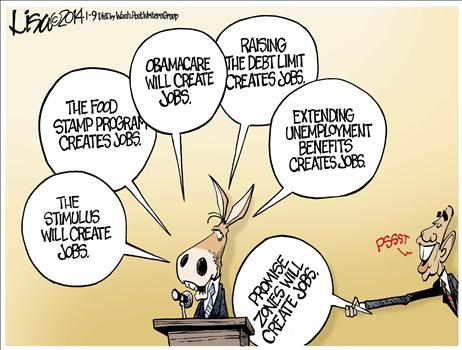
Lisa Benson, meanwhile, mocks the President’s empty talking points.

Cartoon Obama Unemployment 4

And Glenn McCoy shows the President’s version of compassion.

Cartoon Obama Unemployment 1

These cartoons remind me of the ones I shared last August.

P.S. Careful readers will have noticed that this piece cites both the employment-population ratio and the labor force participation rate. These two data series are sometimes used interchangeably, though I prefer the former for reasons explained in this article for the BLS’s Monthly Labor Review.

P.P.S. On a totally separate topic, I want to share some good news about the International Monetary Fund. The IMF is a statist international bureaucracy that pushed for bad policy, both in America and other nations. Last year, I reported that the Obama Administration proposed to give the IMF more money and authority, but that lawmakers on Capitol Hill wisely rejected the request. Well, the same positive outcome  happened again as part of the spending bill just approved by Congress.

Here’s some of what the New York Times reported.

Administration officials concede that Congress’s decision not to make the changes will be an embarrassment to President Obama internationally…congressional Republicans would not budge… The structural changes to the fund have languished since Mr. Obama agreed to the “rebalancing” with great fanfare at the G-20 meeting in Seoul, South Korea, in 2010.  …Since the 2010 accord, every nation involved but the United States has ratified it. But the United States remains the monetary fund’s largest contributor, and without Congress’s approval, the restructuring cannot happen.

P.P.P.S. And since I’m sharing random news, here’s something else that may interest readers. Time has a non-political personality quiz that supposedly reveals whether you are liberal or conservative. For what it’s worth, I’m 83 percent conservative and 17 percent liberal. I’m not sure what to think of the test, but it’s definitely better than the “social attitude test” I took last year, which concluded that I’m a “moderate” and “a centrist with few strong opinions.” I much prefer Professor Bryan Caplan’s libertarian purity quiz, where I scored a 94 out of 160, which may not sound impressive, but it was enough to put me in “the heady realm of hard-core libertarianism.”

____________

Dan Mitchell Discussing Food Stamps, Dependency and Faux Compassion on Kudlow’s CNBC Show

________________

Related posts:

If you want to cut government waste then stop allowing people to get addicted to government programs!!!!

______________ If you want to cut government waste then stop allowing people  to get addicted to government programs!!!! November 3, 2013 1:07PM Lindbeck’s Law: The Self-Destructive Nature of Expanding Government Benefits By Alan Reynolds Share Relevant foresight from Swedish economist Assar Lindbeck, “Hazardous Welfare State Dynamics,” American Economic Review, May 1995: The basic dilemma of […]

We got to shutdown government waste now!!!

We got to shutdown government waste now!!! October 2, 2013 11:16AM Shutdown Could Shut Down Waste By Chris Edwards Share A benefit of the government shutdown may be that it slows the stream of waste and bad behavior flowing from the federal bureaucracy. Catching up on my reading, I noticed these items in just the […]

Open letter to President Obama (Part 440) A suggestion to cut some wasteful spending out of the government Part 6 (includes editorial cartoon)

(Emailed to White House on 3-15-13.) President Obama c/o The White House 1600 Pennsylvania Avenue NW Washington, DC 20500 Dear Mr. President, I know that you receive 20,000 letters a day and that you actually read 10 of them every day. I really do respect you for trying to get a pulse on what is […]

Open letter to President Obama (Part 438) A suggestion to cut some wasteful spending out of the government Part 5 (includes editorial cartoon)

(Emailed to White House on 3-15-13.) President Obama c/o The White House 1600 Pennsylvania Avenue NW Washington, DC 20500 Dear Mr. President, I know that you receive 20,000 letters a day and that you actually read 10 of them every day. I really do respect you for trying to get a pulse on what is […]

Open letter to President Obama (Part 436) A suggestion to cut some wasteful spending out of the government Part 4 (includes editorial cartoon)

(Emailed to White House on 3-15-13.) President Obama c/o The White House 1600 Pennsylvania Avenue NW Washington, DC 20500 Dear Mr. President, I know that you receive 20,000 letters a day and that you actually read 10 of them every day. I really do respect you for trying to get a pulse on what is […]

Open letter to President Obama (Part 434) A suggestion to cut some wasteful spending out of the government Part 3 (includes editorial cartoon)

(Emailed to White House on 3-15-13.) President Obama c/o The White House 1600 Pennsylvania Avenue NW Washington, DC 20500 Dear Mr. President, I know that you receive 20,000 letters a day and that you actually read 10 of them every day. I really do respect you for trying to get a pulse on what is […]

Open letter to President Obama (Part 432) A suggestion to cut some wasteful spending out of the government Part 2 (includes editorial cartoon)

(Emailed to White House on 3-15-13.) President Obama c/o The White House 1600 Pennsylvania Avenue NW Washington, DC 20500 Dear Mr. President, I know that you receive 20,000 letters a day and that you actually read 10 of them every day. I really do respect you for trying to get a pulse on what is […]

Open letter to President Obama (Part 430) A suggestion to cut some wasteful spending out of the government Part 1 (includes editorial cartoon)

(Emailed to White House on 3-15-13.) President Obama c/o The White House 1600 Pennsylvania Avenue NW Washington, DC 20500 Dear Mr. President, I know that you receive 20,000 letters a day and that you actually read 10 of them every day. I really do respect you for trying to get a pulse on what is […]

We need to stop wasteful government spending by privatizing the post office!!

We need to stop wasteful government spending by privatizing the post office!! Postal Service Won’t Shut Down but Will Default on Its Debt James Gattuso October 1, 2013 at 9:30 am Newscom The U.S. Postal Service (USPS) defaulted on its debt last night. No, it has nothing to do with the partial shutdown of the […]

President Obama and government spending (GSA Govt waste tip of iceberg)

I wish President Obama would try to cut spending instead of increasing spending and our debt. Two Very Good GSA Waste Cartoons April 21, 2012 by Dan Mitchell One of my first blog posts back in 2009 featured a column about the Social Security Administration squandering $750,000 on a “conference” at a fancy golf resort in […]

“Schaeffer Sunday” Excerpts from Pro Life Answers to Pro Choice Arguments

Watch the film below starting at the 19 minute mark and that will lead into a powerful question from Dr. C. Everett Koop. This film is WHATEVER HAPPENED TO THE HUMAN RACE? by Francis Schaeffer and Dr. C. Everett Koop.

Francis Schaeffer Whatever Happened to the Human Race (Episode 1) ABORTION

k

Excerpts from Pro Life Answers to Pro Choice Arguments
by Raldy Alcorn, Multnomah Books, 1992

Pro Choice Argument Pro Life Answer
Science is uncertain when life begins, therefore it must be a religious question. ENCYCLOPEDIA BRITANNICA -“A new individual is created when the elements of a potent sperm merge with those of a fertile ovum, or egg.”
The unborn is an embryo or fetus – not a baby. Abortion is terminating a pregnancy and is not actually killing a child. Pro-choice people insist that the unborn is an “embryo.” By definition, embryo means any living creature at an early stage of development. Further, they say it’s not a baby; it’s a “fetus.” Fetus is a Latin word meaning “young one” or “little child.”
Abortion providers are respected medical professionals working in the woman’s best interest. A former abortion clinic counselor says, “I was totally uninformed of available alternatives to abortion. I never recommended adoption or keeping the baby. I received no training in factual matters–my job was just to keep women happy and make sure they went through with an abortion.”
Abortion is a safe medical procedure, safer than full term pregnancy and childbirth. Researchers state, “Morbidity and mortality rates of legal abortion are several times higher than that for carrying a pregnancy to term. The immediate complication rate is no less than 10%, while long range complication rates show no less than 17%.”
Abortion is an easy and painless procedure. The various abortion procedures are often both difficult and painful for women. One abortion procedure, the D & C, involves the scraping of the uterus, which typically involves some bleeding and other side effects that some women find quite painful.
Unwanted children usually end up being battered and abused children later on in life. A recent study showed 91% of the battered children surveyed were planned pregnancies and 90% were legitimate, according to Dr. Edward Lenoski, Professor of Pediatrics at U.S.C.
Child abuse has decreased since legalized abortion. Since abortion’s legalization in 1973, child abuse has increased fifteen hundred percent according to U.S. Department of Health & Human Services.
Legally preventing a woman from having an abortion is an invasion of her privacy. Our laws allow police to enter the privacy of people’s homes to stop them from battering and abusing their children. Now the same force of law guarantees the “privacy and rights” of parents to dismember or poison their babies before birth.
Abortion relieves women of stress and responsibility and thereby enhances their psychological well-being. Post-abortion therapy and support groups with members numbering over 30,000 testify to the reality of abortion’s potentially harmful psychological effects. Women’s World, September 1991, reports a study of women who have had abortions in which 45% said they had thoughts of suicide following their abortion.
What about a woman who’s life is threatened by pregnancy or childbirth? While he was United States Surgeon General, Dr. C. Everett Koop stated publicly that in his thirty-eight years as a pediatric surgeon, he was never aware of a single situation in which a pre-born child’s life had to be taken in order to save the life of the mother.
Related posts:

Francis Schaeffer’s prayer for us in USA

 Francis Schaeffer: “Whatever Happened to the Human Race” (Episode 1) ABORTION OF THE HUMAN RACE Published on Oct 6, 2012 by AdamMetropolis The 45 minute video above is from the film series created from Francis Schaeffer’s book “Whatever Happened to the Human Race?” with Dr. C. Everett Koop. This book  really helped develop my political views […]

Francis Schaeffer’s “How should we then live?” Video and outline of episode 10 “Final Choices” (Schaeffer Sundays)

E P I S O D E 1 0   Dr. Francis Schaeffer – Episode X – Final Choices 27 min FINAL CHOICES I. Authoritarianism the Only Humanistic Social Option One man or an elite giving authoritative arbitrary absolutes. A. Society is sole absolute in absence of other absolutes. B. But society has to be […]

Francis Schaeffer’s “How should we then live?” Video and outline of episode 9 “The Age of Personal Peace and Affluence” (Schaeffer Sundays)

E P I S O D E 9 Dr. Francis Schaeffer – Episode IX – The Age of Personal Peace and Affluence 27 min T h e Age of Personal Peace and Afflunce I. By the Early 1960s People Were Bombarded From Every Side by Modern Man’s Humanistic Thought II. Modern Form of Humanistic Thought Leads […]

Francis Schaeffer’s “How should we then live?” Video and outline of episode 8 “The Age of Fragmentation” (Schaeffer Sundays)

E P I S O D E 8 Dr. Francis Schaeffer – Episode VIII – The Age of Fragmentation 27 min I saw this film series in 1979 and it had a major impact on me. T h e Age of FRAGMENTATION I. Art As a Vehicle Of Modern Thought A. Impressionism (Monet, Renoir, Pissarro, Sisley, […]

Francis Schaeffer’s “How should we then live?” Video and outline of episode 7 “The Age of Non-Reason” (Schaeffer Sundays)

E P I S O D E 7 Dr. Francis Schaeffer – Episode VII – The Age of Non Reason I am thrilled to get this film series with you. I saw it first in 1979 and it had such a big impact on me. Today’s episode is where we see modern humanist man act […]

Francis Schaeffer’s “How should we then live?” Video and outline of episode 6 “The Scientific Age” (Schaeffer Sundays)

E P I S O D E 6 How Should We Then Live 6#1 Uploaded by NoMirrorHDDHrorriMoN on Oct 3, 2011 How Should We Then Live? Episode 6 of 12 ________ I am sharing with you a film series that I saw in 1979. In this film Francis Schaeffer asserted that was a shift in […]

Francis Schaeffer’s “How should we then live?” Video and outline of episode 5 “The Revolutionary Age” (Schaeffer Sundays)

E P I S O D E 5 How Should We Then Live? Episode 5: The Revolutionary Age I was impacted by this film series by Francis Schaeffer back in the 1970′s and I wanted to share it with you. Francis Schaeffer noted, “Reformation Did Not Bring Perfection. But gradually on basis of biblical teaching there […]

Francis Schaeffer’s “How should we then live?” Video and outline of episode 4 “The Reformation” (Schaeffer Sundays)

Dr. Francis Schaeffer – Episode IV – The Reformation 27 min I was impacted by this film series by Francis Schaeffer back in the 1970′s and I wanted to share it with you. Schaeffer makes three key points concerning the Reformation: “1. Erasmian Christian humanism rejected by Farel. 2. Bible gives needed answers not only as to […]

“Schaeffer Sundays” Francis Schaeffer’s “How should we then live?” Video and outline of episode 3 “The Renaissance”

Francis Schaeffer’s “How should we then live?” Video and outline of episode 3 “The Renaissance” Francis Schaeffer: “How Should We Then Live?” (Episode 3) THE RENAISSANCE I was impacted by this film series by Francis Schaeffer back in the 1970′s and I wanted to share it with you. Schaeffer really shows why we have so […]

Francis Schaeffer’s “How should we then live?” Video and outline of episode 2 “The Middle Ages” (Schaeffer Sundays)

  Francis Schaeffer: “How Should We Then Live?” (Episode 2) THE MIDDLE AGES I was impacted by this film series by Francis Schaeffer back in the 1970′s and I wanted to share it with you. Schaeffer points out that during this time period unfortunately we have the “Church’s deviation from early church’s teaching in regard […]

Francis Schaeffer’s “How should we then live?” Video and outline of episode 1 “The Roman Age” (Schaeffer Sundays)

Francis Schaeffer: “How Should We Then Live?” (Episode 1) THE ROMAN AGE   Today I am starting a series that really had a big impact on my life back in the 1970′s when I first saw it. There are ten parts and today is the first. Francis Schaeffer takes a look at Rome and why […]

Francis Schaeffer: “Whatever Happened to the Human Race” (Episode 5) TRUTH AND HISTORY

Francis Schaeffer: “Whatever Happened to the Human Race” (Episode 5) TRUTH AND HISTORY Published on Oct 7, 2012 by AdamMetropolis This crucial series is narrated by the late Dr. Francis Schaeffer and former Surgeon General Dr. C. Everett Koop. Today, choices are being made that undermine human rights at their most basic level. Practices once […]

Francis Schaeffer: “Whatever Happened to the Human Race” (Episode 4) THE BASIS FOR HUMAN DIGNITY

The opening song at the beginning of this episode is very insightful. Francis Schaeffer: “Whatever Happened to the Human Race” (Episode 4) THE BASIS FOR HUMAN DIGNITY Published on Oct 7, 2012 by AdamMetropolis This crucial series is narrated by the late Dr. Francis Schaeffer and former Surgeon General Dr. C. Everett Koop. Today, choices […]

Francis Schaeffer: “Whatever Happened to the Human Race” (Episode 3) DEATH BY SOMEONE’S CHOICE

Francis Schaeffer: “Whatever Happened to the Human Race” (Episode 3) DEATH BY SOMEONE’S CHOICE Published on Oct 6, 2012 by AdamMetropolis This crucial series is narrated by the late Dr. Francis Schaeffer and former Surgeon General Dr. C. Everett Koop. Today, choices are being made that undermine human rights at their most basic level. Practices […]

Francis Schaeffer: “Whatever Happened to the Human Race?” (Episode 2) SLAUGHTER OF THE INNOCENTS

Francis Schaeffer: “Whatever Happened to the Human Race?” (Episode 2) SLAUGHTER OF THE INNOCENTS Published on Oct 6, 2012 by AdamMetropolis This crucial series is narrated by the late Dr. Francis Schaeffer and former Surgeon General Dr. C. Everett Koop. Today, choices are being made that undermine human rights at their most basic level. Practices […]

Francis Schaeffer: “Whatever Happened to the Human Race” (Episode 1) ABORTION OF THE HUMAN RACE

It is not possible to know where the pro-life evangelicals are coming from unless you look at the work of the person who inspired them the most. That person was Francis Schaeffer.  I do care about economic issues but the pro-life issue is the most important to me. Several years ago Adrian Rogers (past president of […]

The following essay explores the role that Francis Schaeffer played in the rise of the pro-life movement. It examines the place of How Should We Then Live?, Whatever Happened to the Human Race?, and A Christian Manifesto in that process.

This essay below is worth the read. Schaeffer, Francis – “Francis Schaeffer and the Pro-Life Movement” [How Should We Then Live?, Whatever Happened to the Human Race?, A Christian Manifesto] Editor note: <p> </p> [The following essay explores the role that Francis Schaeffer played in the rise of the pro-life movement.  It examines the place of […]

Who was Francis Schaeffer? by Udo Middelmann

Great article on Schaeffer. Who was Dr. Francis A. Schaeffer? By Francis Schaeffer The unique contribution of Dr. Francis Schaeffer on a whole generation was the ability to communicate the truth of historic Biblical Christianity in a way that combined intellectual integrity with practical, loving care. This grew out of his extensive understanding of the Bible […]

Sanctity of life Sunday March today in Little Rock at 2pm downtown!!!! (Remembering Ronald Reagan’s pro-life speeches)

President Reagan’s Remarks at The Annual National Prayer Breakfast on February 4,  1984 (discusses prayer)


President Reagan’s Remarks at an Ecumenical Prayer Breakfast in Dallas, Texas on August 23, 1984 (Compares US founding to French Revolution and shows different results)

Uploaded on Jan 4, 2011

President Reagan’s Remarks at an Ecumenical Prayer Breakfast in Dallas, Texas on August 23, 1984.

National Right to Life Convention 2010

Uploaded on Mar 7, 2010

The National Right to Life Convention has a rich tradition of educating, building, and energizing the pro-life grassroots across the country. America know we are National Right to Life and we are making a difference! Now more than ever is the time to join the pro-life grassroots network.

_________

Reagan “Until we establish unborn child is not a living human being then he or she deserves protection from the government”

____________________

Ronald Reagan against abortion for Personhood.com

Uploaded on Jun 24, 2011

Reagan’s wording is from his “Address to the National Religious Broadcasters Convention”,
delivered 30 January 1984 @ Sheraton Washington Hotel, Washington, D.C.

Discusses Lincoln and problem of slavery and compares it to the unborn child’s right to life.

__________

Ronald Reagan on adoption and abortion

Uploaded on May 31, 2009

Ronald Reagan radio address from 1975 addresses the topics of abortion and adoption.

________

Jason Rapert for State Senate 2010

______________

 
——-
 
 Pain aborted baby feels

 
We must all educate ourselves to the reality of the horrors taking place. Doctors today know that unborn children can feel a touch within the womb and that they respond to pain. But how many Americans are aware that abortion techniques are allowed today, in all 50 states, that burn the skin of a baby with a salt solution, in an agonizing death that can last for hours?


Aborted babies survive sometimes


Another example: two years ago, the Philadelphia Inquirer ran a Sunday special supplement on “The Dreaded Complication.” The “dreaded complication” referred to in the article — the complication feared by doctors who perform abortions — is the survival of the child despite all the painful attacks during the abortion procedure. Some unborn children dosurvive the late-term abortions the Supreme Court has made legal. Is there any question that these victims of abortion deserve our attention and protection? Is there any question that those who don’t survive were living human beings before they were killed?

Late-term abortions, especially when the baby survives, but is then killed by starvation, neglect, or suffocation, show once again the link between abortion and infanticide. The time to stop both is now.
 
Infanticide


As my Administration acts to stop infanticide, we will be fully aware of the real issue that underlies the death of babies before and soon after birth.
Our society has, fortunately, become sensitive to the rights and special needs of the handicapped, but I am shocked that physical or mental handicaps of newborns are still used to justify their extinction. This Administration has a Surgeon General, Dr. C. Everett Koop, who has done perhaps more than any other American for handicapped children, by pioneering surgical techniques to help them, by speaking out on the value of their lives, and by working with them in the context of loving families. You will not find his former patients advocating the so-called “quality-of-life” ethic.
I know that when the true issue of infanticide is placed before the American people, with all the facts openly aired, we will have no trouble deciding that a mentally or physically handicapped baby has the same intrinsic worth and right to life as the rest of us. As the New Jersey Supreme Court said two decades ago, in a decision upholding the sanctity of human life, “a child need not be perfect to have a worthwhile life.”
Whether we are talking about pain suffered by unborn children, or about late-term abortions, or about infanticide, we inevitably focus on the humanity of the unborn child. Each of these issues is a potential rallying point for the sanctity of life ethic. Once we as a nation rally around any one of these issues to affirm the sanctity of life, we will see the importance of affirming this principle across the board.
Malcolm Muggeridge, the English writer, goes right to the heart of the matter: “Either life is always and in all circumstances sacred, or intrinsically of no account; it is inconceivable that it should be in some cases the one, and in some the other.” The sanctity of innocent human life is a principle that Congress should proclaim at every opportunity.
 
 
Adoption is the answer
 
It is possible that the Supreme Court itself may overturn its abortion rulings. We need only recall that in Brown v.Board of Education the court reversed its own earlier “separate-but-equal” decision. I believe if the Supreme Court took another look at Roe v. Wade, and considered the real issue between the sanctity of life ethic and the quality of life ethic, it would change its mind once again.
As we continue to work to overturn Roe v. Wade, we must also continue to lay the groundwork for a society in which abortion is not the accepted answer to unwanted pregnancy. Pro-life people have already taken heroic steps, often at great personal sacrifice, to provide for unwed mothers. I recently spoke about a young pregnant woman named Victoria, who said, “In this society we save whales, we save timber wolves and bald eagles and Coke bottles. Yet, everyone wanted me to throw away my baby.” She has been helped by Save-a-Life, a group in Dallas, which provides a way for unwed mothers to preserve the human life within them when they might otherwise be tempted to resort to abortion. I think also of House of His Creation in Catesville, Pennsylvania, where a loving couple has taken in almost 200 young women in the past ten years. They have seen, as a fact of life, that the girls arenot better off having abortions than saving their babies. I am also reminded of the remarkable Rossow family of Ellington, Connecticut, who have opened their hearts and their home to nine handicapped adopted and foster children.
The Adolescent Family Life Program, adopted by Congress at the request of Senator Jeremiah Denton, has opened new opportunities for unwed mothers to give their children life. We should not rest until our entire society echoes the tone of John Powell in the dedication of his book, Abortion: The Silent Holocaust, a dedication to every woman carrying an unwanted child: “Please believe that you are not alone. There are many of us that truly love you, who want to stand at your side, and help in any way we can.” And we can echo the always-practical woman of faith, Mother Teresa, when she says, “If you don’t want the little child, that unborn child, give him to me.” We have so many families in America seeking to adopt children that the slogan “every child a wanted child” is now the emptiest of all reasons to tolerate abortion.
 
Slavery and unborn child


I have often said we need to join in prayer to bring protection to the unborn. Prayer and action are needed to uphold the sanctity of human life. I believe it will not be possible to accomplish our work, the work of saving lives, “without being a soul of prayer.” The famous British Member of Parliament, William Wilberforce, prayed with his small group of influential friends, the “Clapham Sect,” for decades to see an end to slavery in the British empire. Wilberforce led that struggle in Parliament, unflaggingly, because he believed in the sanctity of human life. He saw the fulfillment of his impossible dream when Parliament outlawed slavery just before his death.
Let his faith and perseverance be our guide. We will never recognize the true value of our own lives until we affirm the value in the life of others, a value of which Malcolm Muggeridge says:. . . however low it flickers or fiercely burns, it is still a Divine flame which no man dare presume to put out, be his motives ever so humane and enlightened.”
Abraham Lincoln recognized that we could not survive as a free land when some men could decide that others were not fit to be free and should therefore be slaves. Likewise, we cannot survive as a free nation when some men decide that others are not fit to live and should be abandoned to abortion or infanticide. My Administration is dedicated to the preservation of America as a free land, and there is no cause more important for preserving that freedom than affirming the transcendent right to life of all human beings, the right without which no other rights have any meaning.


_________________
 

June 10, 2004, 10:30 a.m.
Abortion and the Conscience of the Nation
Ronald Reagan’s pro-life tract.

EDITOR’S NOTE: While president, Ronald Reagan penned this article for The Human Life Review, unsolicited. It ran in the Review‘s Spring 1983, issue and is reprinted here with permission.

The case against abortion does not rest here, however, for medical practice confirms at every step the correctness of these moral sensibilities. Modern medicine treats the unborn child as a patient. Medical pioneers have made great breakthroughs in treating the unborn — for genetic problems, vitamin deficiencies, irregular heart rhythms, and other medical conditions. Who can forget George Will’s moving account of the little boy who underwent brain surgery six times during the nine weeks before he was born? Who is the patient if not that tiny unborn human being who can feel pain when he or she is approached by doctors who come to kill rather than to cure?

The real question today is not when human life begins, but, What is the value of human life? The abortionist who reassembles the arms and legs of a tiny baby to make sure all its parts have been torn from its mother’s body can hardly doubt whether it is a human being. The real question for him and for all of us is whether that tiny human life has a God-given right to be protected by the law — the same right we have.

What more dramatic confirmation could we have of the real issue than the Baby Doe case in Bloomington, Indiana? The death of that tiny infant tore at the hearts of all Americans because the child was undeniably a live human being — one lying helpless before the eyes of the doctors and the eyes of the nation. The real issue for the courts was notwhether Baby Doe was a human being. The real issue was whether to protect the life of a human being who had Down’s Syndrome, who would probably be mentally handicapped, but who needed a routine surgical procedure to unblock his esophagus and allow him to eat. A doctor testified to the presiding judge that, even with his physical problem corrected, Baby Doe would have a “non-existent” possibility for “a minimally adequate quality of life” — in other words, that retardation was the equivalent of a crime deserving the death penalty. The judge let Baby Doe starve and die, and the Indiana Supreme Court sanctioned his decision.

Federal law does not allow federally-assisted hospitals to decide that Down’s Syndrome infants are not worth treating, much less to decide to starve them to death. Accordingly, I have directed the Departments of Justice and HHS to apply civil rights regulations to protect handicapped newborns. All hospitals receiving federal funds must post notices which will clearly state that failure to feed handicapped babies is prohibited by federal law. The basic issue is whether to value and protect the lives of the handicapped, whether to recognize the sanctity of human life. This is the same basic issue that underlies the question of abortion.

The 1981 Senate hearings on the beginning of human life brought out the basic issue more clearly than ever before. The many medical and scientific witnesses who testified disagreed on many things, but not on the scientific evidence that the unborn child is alive, is a distinct individual, or is a member of the human species. They did disagree over the value question, whether to give value to a human life at its early and most vulnerable stages of existence.

Regrettably, we live at a time when some persons do not value all human life. They want to pick and choose which individuals have value. Some have said that only those individuals with “consciousness of self” are human beings. One such writer has followed this deadly logic and concluded that “shocking as it may seem, a newly born infant is not a human being.”

A Nobel Prize winning scientist has suggested that if a handicapped child “were not declared fully human until three days after birth, then all parents could be allowed the choice.” In other words, “quality control” to see if newly born human beings are up to snuff.

Obviously, some influential people want to deny that every human life has intrinsic, sacred worth. They insist that a member of the human race must have certain qualities before they accord him or her status as a “human being.”

Events have borne out the editorial in a California medical journal which explained three years before Roe v. Wade that the social acceptance of abortion is a “defiance of the long-held Western ethic of intrinsic and equal value for every human life regardless of its stage, condition, or status.”

Every legislator, every doctor, and every citizen needs to recognize that the real issue is whether to affirm and protect the sanctity of all human life, or to embrace a social ethic where some human lives are valued and others are not. As a nation, we must choose between the sanctity of life ethic and the “quality of life” ethic.

I have no trouble identifying the answer our nation has always given to this basic question, and the answer that I hope and pray it will give in the future. American was founded by men and women who shared a vision of the value of each and every individual. They stated this vision clearly from the very start in the Declaration of Independence, using words that every schoolboy and schoolgirl can recite:

We hold these truths to be self-evident, that all men are created equal, that they are endowed by their Creator with certain unalienable rights, that among these are life, liberty, and the pursuit of happiness.

We fought a terrible war to guarantee that one category of mankind — black people in America — could not be denied the inalienable rights with which their Creator endowed them. The great champion of the sanctity of all human life in that day, Abraham Lincoln, gave us his assessment of the Declaration’s purpose. Speaking of the framers of that noble document, he said
:

This was their majestic interpretation of the economy of the Universe. This was their lofty, and wise, and noble understanding of the justice of the Creator to His creatures. Yes, gentlemen, to all his creatures, to the whole great family of man. In their enlightened belief, nothing stamped with the divine image and likeness was sent into the world to be trodden on. . . They grasped not only the whole race of man then living, but they reached forward and seized upon the farthest posterity. They erected a beacon to guide their children and their children’s children, and the countless myriads who should inhabit the earth in other ages.

He warned also of the danger we would face if we closed our eyes to the value of life in any category of human beings:

I should like to know if taking this old Declaration of Independence, which declares that all men are equal upon principle and making exceptions to it where will it stop. If one man says it does not mean a Negro, why not another say it does not mean some other man?

When Congressman John A. Bingham of Ohio drafted the Fourteenth Amendment to guarantee the rights of life, liberty, and property to all human beings, he explained that all are “entitled to the protection of American law, because its divine spirit of equality declares that all men are created equal.” He said the right guaranteed by the amendment would therefore apply to “any human being.” Justice William Brennan, writing in another case decided only the year before Roe v. Wade, referred to our society as one that “strongly affirms the sanctity of life.”

Another William Brennan — not the Justice — has reminded us of the terrible consequences that can follow when a nation rejects the sanctity of life ethic:

The cultural environment for a human holocaust is present whenever any society can be misled into defining individuals as less than human and therefore devoid of value and respect.

As a nation today, we have not rejected the sanctity of human life. The American people have not had an opportunity to express their view on the sanctity of human life in the unborn. I am convinced that Americans do not want to play God with the value of human life. It is not for us to decide who is worthy to live and who is not. Even the Supreme Court’s opinion in Roe v. Wade did not explicitly reject the traditional American idea of intrinsic worth and value in all human life; it simply dodged this issue.

The Congress has before it several measures that would enable our people to reaffirm the sanctity of human life, even the smallest and the youngest and the most defenseless. The Human Life Bill expressly recognizes the unborn as human beings and accordingly protects them as persons under our Constitution. This bill, first introduced by Senator Jesse Helms, provided the vehicle for the Senate hearings in 1981 which contributed so much to our understanding of the real issue of abortion.

The Respect Human Life Act, just introduced in the 98th Congress, states in its first section that the policy of the United States is “to protect innocent life, both before and after birth.” This bill, sponsored by Congressman Henry Hyde and Senator Roger Jepsen, prohibits the federal government from performing abortions or assisting those who do so, except to save the life of the mother. It also addresses the pressing issue of infanticide which, as we have seen, flows inevitably from permissive abortion as another step in the denial of the inviolability of innocent human life.

I have endorsed each of these measures, as well as the more difficult route of constitutional amendment, and I will give these initiatives my full support. Each of them, in different ways, attempts to reverse the tragic policy of abortion-on-demand imposed by the Supreme Court ten years ago. Each of them is a decisive way to affirm the sanctity of human life.

“Sanctity of Life Saturday” Francis Schaeffer’s wife Edith passes away on Easter weekend 2013 Part 13 (includes pro-life editorial cartoon)

Francis Schaeffer Whatever Happened to the Human Race (Episode 1) ABORTION

Francis Schaeffer: What Ever Happened to the Human Race? (Full-Length Documentary)


Part 1 on abortion runs from 00:00 to 39:50, Part 2 on Infanticide runs from 39:50 to 1:21:30, Part 3 on Youth Euthanasia runs from 1:21:30 to 1:45:40, Part 4 on the basis of human dignity runs from 1:45:40 to 2:24:45 and Part 5 on the basis of truth runs from 2:24:45 to 3:00:04

________________

Picture of Francis Schaeffer and his wife Edith from the 1930′s above. I was sad to read about Edith passing away on Easter weekend in 2013. I wanted to pass along this fine article below.

From Daniel Silliman’s blog.

Edith Schaeffer, 1914 – 2013

Edith Schaeffer has died at the age of 98.
Schaeffer co-founded L’Abri with her husband Francis, and was a monumental figure in late twentieth century American evangelicalism. She taught that homemaking and hospitality were important Christian ministries, and that art and beauty should have a cherished place in contemporary Christian life. According to Schaeffer, God was creative and brought beauty into the world and Christian women, through feminine service to their families, could do the same.
Tim Challies, pastor of a Baptist Church in Toronto, writes a brief history of L’Abri, and Schaeffer’s role in that work:

In 1948 the Independent Board for Presbyterian Foreign Missions sent the Schaeffers to Switzerland as missionaries. In 1955, after identifying significant disagreements with IBPFM and subsequently withdrawing from that organization, they decided to simply open up their home and make it available as a place to demonstrate God’s love and provide a forum for discussing God and the meaning of life. They called it L’Abri after the French word for “shelter.” By the mid-1950’s up to 30 people each week were visiting.

Edith had an integral role in maintaining the home and mentoring those who visited. She wrote or co-wrote twenty books, including Affliction, a book on suffering, and the autobiographical The Tapestry: the Life and Times of Francis and Edith Schaeffer, each of which received the Gold Medallion Award from the Evangelical Christian Publishers Association (in 1979 and 1982 respectively).

Os Guinness once called Schaeffer “the secret of L’Abri.”

World Magazine explains that for Schaeffer, Christianity could be expressed through hospitality, since “hospitality meant a real love for strangers, and having time for them when she didn’t have time for them: ‘Sit at our dinner table, have a meal with us, sleep in our beds, under our roof.'”

Schaeffer’s son, Frank, who has been very critical of his parents, notably in a book titled, Sex, Mom and God, writes that his mother was a paradox, embodying both the best and worst of Christian fundamentalism:

I trust my mother’s hope-filled view of death because of the way Mom lived her life. Mom first introduced me to a non-retributive loving Lord who did not come to “die for us” to “satisfy” an angry God but came as a friend who ended all cycles of retribution and violence. Mom made this introduction to Jesus through her life example.

Mom was a wonderful paradox: an evangelical conservative fundamentalist who treated people as if she was an all-forgiving progressive liberal of the most tolerant variety.

Mom’s daily life was a rebuke and contradiction to people who see everything as black and white. Liberals and secularists alike who make smug disparaging declarations about “all those evangelicals” would see their fondest prejudices founder upon the reality of my mother’s compassion, cultural literacy and loving energy.

For a sense of Schaeffer’s impact on evangelical women, one only has to look at the many reader reviews of her work on Goodreads and Amazon.com.

Of her book, The Hidden Art of Homemaking, for example:

  • I read this book when I was a young wife 26 years ago and it still inspires me today. All of Edith Schaeffer’s books have had a huge impact on my life. Expressing beauty everyday where ever you are is one of her ideas that I think about all the time.
  • it’s light, but inspiring, and makes you feel like cleaning up at home, baking a loaf of bread, and inviting friends over for coffee and conversation.
  • My pastor’s wife gave this book to me when I graduated from high school, w-a-y back in 1974. I’ve read quite a few books about homemaking since then, but this one is timeless. It remains, hands-down, the best book on home arts that I’ve ever read. Filling a home with beauty does not require a lot of money, it requires a lot of love. Edith knows how to stimulate creativity by sharing examples from her own life such as creating makeshift furniture, feeding people, filling a home with music, welcoming guests, incorporating art in the home, caring for a sick family member.
  • When I first picked up this book, I wasn’t to excited to begin reading… But as soon as I cracked the cover, I was hooked. And not only that, but I found myself being inspired to use my talents to enrich myself and others. Even though I’m not really ‘artistic’ I was encouraged to use whatever talents I have to their fullest extent and enjoy the process.
  • She was my mentor by books…. If your husband brings someone home unexpectedly for dinner and all you can do is dump tuna on a plate in the shape of a can, she has help for you.
At the end of her life, Schaeffer lived with her daughter and son-in-law in a small southern Swiss village called Gryon.

Here is another great pro-life editorial cartoon:

(Francis did a great job in his film series “How Should we then live?” in looking at how humanism has affected art and culture in the Western World in the last 2000 years. My favorite episodes include his study of the Renaissance, the Revolutionary age, the age of Nonreason, and the age of Fragmentation.)

Related posts:

Francis Schaeffer’s “How should we then live?” Video and outline of episode 10 “Final Choices” (Schaeffer Sundays)

E P I S O D E 1 0   Dr. Francis Schaeffer – Episode X – Final Choices 27 min FINAL CHOICES I. Authoritarianism the Only Humanistic Social Option One man or an elite giving authoritative arbitrary absolutes. A. Society is sole absolute in absence of other absolutes. B. But society has to be […]

Francis Schaeffer’s “How should we then live?” Video and outline of episode 9 “The Age of Personal Peace and Affluence” (Schaeffer Sundays)

E P I S O D E 9 Dr. Francis Schaeffer – Episode IX – The Age of Personal Peace and Affluence 27 min T h e Age of Personal Peace and Afflunce I. By the Early 1960s People Were Bombarded From Every Side by Modern Man’s Humanistic Thought II. Modern Form of Humanistic Thought Leads […]

Francis Schaeffer’s “How should we then live?” Video and outline of episode 8 “The Age of Fragmentation” (Schaeffer Sundays)

E P I S O D E 8 Dr. Francis Schaeffer – Episode VIII – The Age of Fragmentation 27 min I saw this film series in 1979 and it had a major impact on me. T h e Age of FRAGMENTATION I. Art As a Vehicle Of Modern Thought A. Impressionism (Monet, Renoir, Pissarro, Sisley, […]

Francis Schaeffer’s “How should we then live?” Video and outline of episode 7 “The Age of Non-Reason” (Schaeffer Sundays)

E P I S O D E 7 Dr. Francis Schaeffer – Episode VII – The Age of Non Reason I am thrilled to get this film series with you. I saw it first in 1979 and it had such a big impact on me. Today’s episode is where we see modern humanist man act […]

Francis Schaeffer’s “How should we then live?” Video and outline of episode 6 “The Scientific Age” (Schaeffer Sundays)

E P I S O D E 6 How Should We Then Live 6#1 Uploaded by NoMirrorHDDHrorriMoN on Oct 3, 2011 How Should We Then Live? Episode 6 of 12 ________ I am sharing with you a film series that I saw in 1979. In this film Francis Schaeffer asserted that was a shift in […]

Francis Schaeffer’s “How should we then live?” Video and outline of episode 5 “The Revolutionary Age” (Schaeffer Sundays)

E P I S O D E 5 How Should We Then Live? Episode 5: The Revolutionary Age I was impacted by this film series by Francis Schaeffer back in the 1970′s and I wanted to share it with you. Francis Schaeffer noted, “Reformation Did Not Bring Perfection. But gradually on basis of biblical teaching there […]

Francis Schaeffer’s “How should we then live?” Video and outline of episode 4 “The Reformation” (Schaeffer Sundays)

Dr. Francis Schaeffer – Episode IV – The Reformation 27 min I was impacted by this film series by Francis Schaeffer back in the 1970′s and I wanted to share it with you. Schaeffer makes three key points concerning the Reformation: “1. Erasmian Christian humanism rejected by Farel. 2. Bible gives needed answers not only as to […]

“Schaeffer Sundays” Francis Schaeffer’s “How should we then live?” Video and outline of episode 3 “The Renaissance”

Francis Schaeffer’s “How should we then live?” Video and outline of episode 3 “The Renaissance” Francis Schaeffer: “How Should We Then Live?” (Episode 3) THE RENAISSANCE I was impacted by this film series by Francis Schaeffer back in the 1970′s and I wanted to share it with you. Schaeffer really shows why we have so […]

Francis Schaeffer’s “How should we then live?” Video and outline of episode 2 “The Middle Ages” (Schaeffer Sundays)

  Francis Schaeffer: “How Should We Then Live?” (Episode 2) THE MIDDLE AGES I was impacted by this film series by Francis Schaeffer back in the 1970′s and I wanted to share it with you. Schaeffer points out that during this time period unfortunately we have the “Church’s deviation from early church’s teaching in regard […]

Francis Schaeffer’s “How should we then live?” Video and outline of episode 1 “The Roman Age” (Schaeffer Sundays)

Francis Schaeffer: “How Should We Then Live?” (Episode 1) THE ROMAN AGE   Today I am starting a series that really had a big impact on my life back in the 1970′s when I first saw it. There are ten parts and today is the first. Francis Schaeffer takes a look at Rome and why […]

Is Common Core national standards is a one-size-fits-all approach that will tend toward mediocrity?

____________

Is Common Core national standards is a one-size-fits-all approach that will tend toward mediocrity?

January 17, 2014 at 10:00 am


Arkansas Mother Obliterates Common Core in 4 Minutes!

Published on Dec 16, 2013

Karen Lamoreaux – Arkansas State Board of Ed – 12/16
Learn more about Common Core on our website: http://www.arkansasagainstcommoncore.com
Like us on Facebook: http://facebook.com/ArkansasAgainstCo…
Follow us on Twitter: http://facebook.com/ARstopCC

__________________

Karen Lamoreaux, a mother and former National Honor Society member, made waves last month when she appeared before the Arkansas State Board of Education to voice her concerns over the state’s adoption of Common Core national standards. Lamoreaux asked board members to solve a simple math problem.

“Are you ready? Get your pencils out. I’m not kidding,” she said with a big smile captured on video. “Are you smarter than a Common Core fourth-grader? Let’s find out.”

If a class of 18 students counts off by a certain number and ends up with 90, she asked board members, what number did they count by? A board member quickly and correctly answered “5” and explained that she got the number by dividing 90 by 18.  That’s how most of us were taught to find the answer, Lamoreaux responded, but the federal Common Core standards require students to take 108 steps to solve the problem. She held up a chart to make her point.

“This is not rigorous. This is not college-ready,” Lamoreaux, who said she has 12 years of college education, told the Arkansas board. “This is not preparing our children to compete in a global economy.”

Lindsey M. Burke, who has written and spoken at length on national education standards as Heritage’s Will Skillman Fellow in Education Policy, yesterday sympathized with Lamoreaux’s public stance. Burke said:

Centralized standard-setting would force parents and other taxpayers to relinquish one of their most powerful tools for school improvement: control of the academic content, standards and testing through their state and local policymakers. National standards are unlikely to make public schools accountable to families; rather, they are more likely to make schools responsive to Washington, D.C. What we have with Common Core national standards is a one-size-fits-all approach that will tend toward mediocrity and standardization, undercutting the pockets of excellence that currently exist.

In an interview with The Blaze, Lamoreaux told Glenn Beck that teachers as well as fellow parents share her frustration, telling her:

This is what we have to teach. This is the Common Core way. This is the Common Core standard.

Lamoreaux isn’t the first parent to go viral for standing up and speaking out against Common Core. Last fall, The Foundry wrote about a Maryland parent who was thrown out of a public forum held by the Maryland State Department of Education and arrested after he challenged the official line on Common Core. “Is this America?” he asked.

The Foundry also recently reported on concerns that Common Core is leaving students unprepared for math and science.


_______________


Related posts:

Public schools need more competition and vouchers is the answer

Public schools need more competition and vouchers is the answer. Related posts: Powerful Evidence for School Choice April 22, 2013 by Dan Mitchell I expressed pessimism a few days ago about the possibility of replacing the corrupt internal revenue code with a flat tax. Either now or in the future. But that’s an exception to my […]

Open letter to President Obama (Part 290) (Vouchers)

Milton Friedman – Public Schools / Voucher System Published on May 9, 2012 by BasicEconomics The Machine: The Truth Behind Teachers Unions Published on Sep 4, 2012 by ReasonTV America’s public education system is failing. We’re spending more money on education but not getting better results for our children. That’s because the machine that runs […]

Open letter to President Obama (Part 287) (on vouchers)

(This letter was mailed before Oct 25, 2012.) President Obama c/o The White House 1600 Pennsylvania Avenue NW Washington, DC 20500 Dear Mr. President, I know that you receive 20,000 letters a day and that you actually read 10 of them every day. I really do respect you for trying to get a pulse on […]

Open letter to President Obama (Part 254) (on vouchers)

The Machine: The Truth Behind Teachers Unions Published on Sep 4, 2012 by ReasonTV America’s public education system is failing. We’re spending more money on education but not getting better results for our children. That’s because the machine that runs the K-12 education system isn’t designed to produce better schools. It’s designed to produce more […]

Open letter to Republican Presidential Candidate Mitt Romney on school vouchers

The Machine: The Truth Behind Teachers Unions Published on Sep 4, 2012 by ReasonTV America’s public education system is failing. We’re spending more money on education but not getting better results for our children. That’s because the machine that runs the K-12 education system isn’t designed to produce better schools. It’s designed to produce more […]

By Everette Hatcher III | Posted in Vouchers | Edit | Comments (0)

Paul Ryan on vouchers

I have always favored the voucher system to create more competition between schools. Ryan Makes Case for School Choice Lindsey Burke October 25, 2012 at 12:00 pm House Budget Committee chairman Paul Ryan (R–WI) made a strong case yesterday for the need to ensure that every child in America has the opportunity to attend a […]

Obama rule apply to vouchers?

Introducing the ‘Obama Rule’ Posted by Neal McCluskey In his latest weekly radio address, President Obama featured what will no doubt be a mainstay of his reelection campaign: the “Buffett Rule,” which says that rich people should pay at least the same tax rate as middle-class folks. It’s named after mega-investor Warren Buffett, who famously declared […]

Brummett still resistant to vouchers because he wants us to save public schools at all cost

John Brummett in his article, “A new civil rights struggle in Little Rock?” Arkansas News Burea, August 25, 2011, asserted the main role vouchers should have is  “providing new models for regular public schools to emulate, not about replacing regular public schools.” The Heritage Foundation cares nothing about saving the public schools. If the public […]

Milton Friedman’s views on vouchers have not been tried?

On the Arkansas Times Blog the person using the username “Jake da Snake” noted, “Friedman also railed long and hard for school vouchers to be adopted, to little avail…” (June 11, 2011). Milton Friedman firmly believed, “competition is a way in which both public and private schools can be required to satisfy their customers.” Here […]


Major changes need to happen to the Dept of Health and Human Services or it will continue to explode our budget!!!

______________

Major changes need to happen to the Dept of Health and Human Services or it will continue to explode our budget!!!

JANUARY 13, 2014 3:00PM

Downsize the Department of Health and Human Services

The Department of Health and Human Service (HHS) spends more than $908 billion each year (nearly a third of the federal budget) in various redistribution programs, the most important ones being Medicaid and Medicare.

Medicaid helps low-income citizens getting healthcare. It matches state spending, encouraging them to spend more than they otherwise would – their spending increased from $ 118 billion in 2000 to $ 275 billion in 2010, and is projected to double in the next decade. Ten to twenty percent of Medicaid funds ($ 180 billion) are wasted in various frauds.

Medicare, which helps seniors over 65 getting healthcare, is the third largest expenditure for the federal government. It is estimated that its unfunded liabilities could reach $30 trillion (in other words, $30,000 billion) in the next 75 years.

In order to stop hemorrhaging so much money, serious reforms need to be enacted. For Medicare, freedom of choice in coverage should be given back to citizens, along with private competition and personal savings. And for Medicaid, states should ultimately be the only ones spending money of the program, keeping them from overspending. In the end, this would save hundreds on billions of dollars each year. To that end we’ve created a short video which makes these and other points, which you can watch below:

Downsize the Department of Health and Human Services

Published on Jan 9, 2014

http://www.downsizinggovernment.org/h…

The Department of Health and Human Services runs the huge and fast-growing Medicare and Medicaid. These programs fuel rising health costs, distort markets, and are plagued by waste and fraud. The department also runs other costly subsidy programs, including Head Start, TANF, and LIHEAP. Growth in HHS spending is creating a federal fiscal crisis, and the 2010 health care law sadly makes the situation worse.

The department spent around $908 billion in 2013, or about $7,500 for every U.S. household. It employs 70,000 workers.

______________________________

Related posts: 

If you want to cut government waste then stop allowing people to get addicted to government programs!!!!

______________ If you want to cut government waste then stop allowing people  to get addicted to government programs!!!! November 3, 2013 1:07PM Lindbeck’s Law: The Self-Destructive Nature of Expanding Government Benefits By Alan Reynolds Share Relevant foresight from Swedish economist Assar Lindbeck, “Hazardous Welfare State Dynamics,” American Economic Review, May 1995: The basic dilemma of […]

Lots of Waste at the Federal Mediation and Conciliation Service!!!!

____________ Lots of Waste at the Federal Mediation and Conciliation Service!!!! November 5, 2013 12:50PM ICYMI: FMCS By Jim Harper Share During the hullaballoo around the government shutdown, the Washington Examiner published a jaw-dropping series of stories about blatant waste in an obscure federal agency called the Federal Mediation and Conciliation Service. These stories shouldn’t […]

Open letter to President Obama (Part 440) A suggestion to cut some wasteful spending out of the government Part 6 (includes editorial cartoon)

(Emailed to White House on 3-15-13.) President Obama c/o The White House 1600 Pennsylvania Avenue NW Washington, DC 20500 Dear Mr. President, I know that you receive 20,000 letters a day and that you actually read 10 of them every day. I really do respect you for trying to get a pulse on what is […]

“Friedman Friday” Milton on Balanced Budget Amendment

_______________

The main reason we need a Balanced Budget Amendment is to control spending. Milton Friedman was right about that. Notice below that Ron Paul quotes Friedman on this issue.

Ron Paul: Constitutional Amendment Needed to Limit Taxes and Spending

Submitted by bobbyw24 on Wed, 07/20/2011– 07:09

Congressman Ron Paul (R-Texas) says merely scaling back to 2008 spending levels is nowhere near enough to fix the massive government debt problems.

“As Milton Friedman famously argued, what we really need is a constitutional amendment to limit taxes and spending, not simply to balance the budget,” Paul said in a speech to the House of Representatives made prior to the vote on the “Cut, Cap and Balance” bill. The bill is expected to pass the House tonight, but President Barack Obama has said he will veto it if it clears the Senate and reaches his desk.

What is needed is a dramatically smaller federal government, says Paul. “If we achieve this, a balanced budget will take care of itself,” he says. “We need to cut back at least to where spending was a decade ago.”

Open letter to President Obama (Part 499) (Frank Beckwith and Bernard Nathanson, M.D on abortion includes the film TRUTH AND HISTORY and editorial cartoon)

Open letter to President Obama (Part 499)

(Emailed to White House on 4-24-13.)

President Obama c/o The White House 1600 Pennsylvania Avenue NW Washington, DC 20500

Dear Mr. President,

I know that you receive 20,000 letters a day and that you actually read 10 of them every day. I really do respect you for trying to get a pulse on what is going on out here. I know that you don’t agree with my pro-life views but I wanted to challenge you as a fellow Christian to re-examine your pro-choice view.

___________________

I have debated with Ark Times Bloggers many times in the past on many different subjects. Abortion is probably the most often debated subject and I have noticed that many pro-life individuals are now surfacing on the Arkansas Times Blog.  Here are some examples. Arhogfan501 asserted: This is the beginning of the end for recreational abortion in Arkansas. Songbird777 noted: Babies have a right to live and not be chopped up for someone else’s convenience. The person using the username “baker” commented: Planned Parenthood (PPA) does not nor cannot provide mammograms, indeed no affiliate has the necessary license. PPA is an abortion provider and at some 900 plus killings a day rather prolific.

Here is another debate I got into recently on the Arkansas Times Blog and I go by the username “Saline Republican”:

The person with the username “the outlier” said on 3-22-13 on the Ark Times Blog:

“You cannot honestly describe yourself as “pro-life”, Saline. You are anti-abortion.”

I responded:

Am I pro-life? Frank Beckwith put forth a good definition of a pro-life view:

The pro-life position is subject to somewhat varying formulations. The most widely accepted and representative of these can be defined in the following way: The unborn entity is fully human from the moment of conception. Abortion (narrowly defined) results in the intentional death of the unborn entity. Therefore, abortion entails the intentional killing of a human being. This killing is in most cases unjustified, since the unborn human being has a full right to life.

Later I noted:

Special Sanders asserted, “Any person with the slightest intelligence knows that these measures are not going to have the desired effect. If women can’t get abortions in Arkansas, they will get them in other states OR they can and will simply go to the internet and buy abortion methods which while not deemed SAFE, is NOT illegal. Women in Arkansas simply want access to “safe” abortions with experienced medical professionals in the healthcare field that are skilled in pregnancy terminations.”

_________ Frank Beckwith answers this argument very well concerning the coat hangers:

The chief reason this argument fails is because it commits the fallacy of begging the question. In fact, as we shall see, this fallacy seems to lurk behind a good percentage of the popular arguments for the pro-choice position. One begs the question when one assumes what one is trying to prove. Another way of putting it is to say that the arguer is reasoning in a circle. For example, if one concludes that the Boston Celtics are the best team because no team is as good, one is not giving any reasons for this belief other than the conclusion one is trying to prove, since to claim that a team is the best team is exactly the same as saying that no team is as good. The question-begging nature of the coat-hanger argument is not difficult to discern: only by assuming that the unborn are not fully human does the argument work. If the unborn are not fully human, then the pro-choice advocate has a legitimate concern, just as one would have in overturning a law forbidding appendicitis operations if countless people were needlessly dying of both appendicitis and illegal operations. But if the unborn are fully human, this pro-choice argument is tantamount to saying that because people die or are harmed while killing other people, the state should make it safe for them to do so. Even some pro-choice advocates, who argue for their position in other ways, admit that the coat hanger/back-alley argument is fallacious. For example, pro-choice philosopher Mary Anne Warren clearly recognizes that her position on abortion cannot rest on this argument without it first being demonstrated that the unborn entity is not fully human. She writes that “the fact that restricting access to abortion has tragic side effects does not, in itself, show that the restrictions are unjustified, since murder is wrong regardless of the consequences of prohibiting it…”9 Although it is doubtful whether statistics can establish a particular moral position, it should be pointed out that there has been considerable debate over both the actual number of illegal abortions and the number of women who died as a result of them prior to legalization.10 Prior to Roe, pro-choicers were fond of saying that nearly a million women every year obtained illegal abortions performed with rusty coat hangers in back-alleys that resulted in thousands of fatalities. Given the gravity of the issue at hand, it would go beyond the duty of kindness to call such claims an exaggeration, because several well-attested facts establish that the pro-choice movement was simply lying. First, Dr. Bernard Nathanson — who was one of the original leaders of the American pro-abortion movement and co-founder of N.A.R.A.L. (National Abortion Rights Action League), and who has since become pro-life — admits that he and others in the abortion rights movement intentionally fabricated the number of women who allegedly died as a result of illegal abortions.

How many deaths were we talking about when abortion was illegal? In N.A.R.A.L. we generally emphasized the drama of the individual case, not the mass statistics, but when we spoke of the latter it was always “5,000 to 10,000 deaths a year.” I confess that I knew the figures were totally false, and I suppose the others did too if they stopped to think of it. But in the “morality” of the revolution, it was a useful figure, widely accepted, so why go out of our way to correct it with honest statistics. The overriding concern was to get the laws eliminated, and anything within reason which had to be done was permissible.11

Second, Dr. Nathanson’s observation is borne out in the best official statistical studies available. According to the U.S. Bureau of Vital Statistics, there were a mere 39 women who died from illegal abortions in 1972, the year before Roe v. Wade.12 Dr. Andre Hellegers, the late Professor of Obstetrics and Gynecology at Georgetown University Hospital, pointed out that there has been a steady decrease of abortion-related deaths since 1942. That year there were 1,231 deaths. Due to improved medical care and the use of penicillin, this number fell to 133 by 1968.13 The year before the first state-legalized abortion, 1966, there were about 120 abortion-related deaths.14 This is not to minimize the undeniable fact that such deaths were significant losses to the families and loved ones of those who died. But one must be willing to admit the equally undeniable fact that if the unborn are fully human, these abortion-related maternal deaths pale in comparison to the 1.5 million preborn humans who die (on the average) every year. And even if we grant that there were more abortion-related deaths than the low number confirmed, there is no doubt that the 5,000 to 10,000 deaths cited by the abortion rights movement is a gross exaggeration.15 Third, it is simply false to claim that there were nearly a million illegal abortions per year prior to legalization. There is no reliable statistical support for this claim.16 In addition, a highly sophisticated recent study has concluded that “a reasonable estimate for the actual number of criminal abortions per year in the prelegalization era [prior to 1967] would be from a low of 39,000 (1950) to a high of 210,000 (1961) and a mean of 98,000 per year.17 Fourth, it is misleading to say that pre-Roe illegal abortions were performed by “back-alley butchers” with rusty coat hangers. While president of Planned Parenthood, Dr. Mary Calderone pointed out in a 1960 American Journal of Health article that Dr. Kinsey showed in 1958 that 84% to 87% of all illegal abortions were performed by licensed physicians in good standing. Dr. Calderone herself concluded that “90% of all illegal abortions are presently done by physicians.”18 It seems that the vast majority of the alleged “back-alley butchers” eventually became the “reproductive health providers” of our present day. FOOTNOTES

9Mary Anne Warren “On the Moral and Legal Status of Abortion,” in The Problem of Abortion, 2nd ed., ed. Joel Feinberg (Belmont, CA: Wadsworth, 1984), 103. 10 See Daniel Callahan, Abortion: Law, Choice, and Morality (New York: Macmillan, 1970), 132-36; and Stephen Krason, Abortion: Politics, Morality, and the Constitution (Lanham, MD: University Press of America, 1984), 301-10. 11 Bernard Nathanson, M.D., Aborting America (New York: Doubleday, 1979), 193. 12 From the U.S. Bureau of Vital Statistics Center for Disease Control, as cited in Dr. and Mrs. J. C. Wilke, Abortion: Questions and Answers, rev. ed. (Cincinnati: Hayes Publishing, 1988), 101-2. 13 From Dr. Hellegers’s testimony before the U.S. Senate Judiciary Committee on Constitutional Amendments, April 25, 1 1974; cited in John Jefferson Davis, Abortion and the Christian (Phillipsburg, NJ: Presbyterian and Reformed, 1984), 75. 14 From the U.S. Bureau of Vital Statistics Center for Disease Control, as cited in Wilke, 101-2. 15 See Davis, 75. 16 See note 10; Callahan, 132-36; Krason, 301-10. 17 Barbara J. Syska, Thomas W. Hilgers, M.D., and Dennis O’Hare, “An Objective Model for Estimating Criminal Abortions and Its Implications for Public Policy,” in New Perspectives on Human Abortion, ed. Thomas Hilgers, M.D., Dennis J. Horan, and David Mall (Frederick, MD: University Publications of America, 1981), 78. 18 Mary Calderone, “Illegal Abortion as a Public Health Problem,” in American Journal of Health 50 (July 1960):949.

_____________

In the film series “WHATEVER HAPPENED TO THE HUMAN RACE?” the arguments are presented  against abortion (Episode 1),  infanticide (Episode 2),   euthenasia (Episode 3), and then there is a discussion of the Christian versus Humanist worldview concerning the issue of “the basis for human dignity” in Episode 4 and then in the last episode a close look at the truth claims of the Bible.

I truly believe that many of the problems we have today in the USA are due to the advancement of humanism in the last few decades in our society. Ronald Reagan appointed the evangelical Dr. C. Everett Koop to the position of Surgeon General in his administration. He partnered with Dr. Francis Schaeffer in making the video below. It is very valuable information for Christians to have.  Actually I have included a video below that includes comments from him on this subject.

___________

Francis Schaeffer Whatever Happened to the Human Race (Episode 1) ABORTION

Francis Schaeffer: What Ever Happened to the Human Race? (Full-Length Documentary)


Part 1 on abortion runs from 00:00 to 39:50, Part 2 on Infanticide runs from 39:50 to 1:21:30, Part 3 on Youth Euthanasia runs from 1:21:30 to 1:45:40, Part 4 on the basis of human dignity runs from 1:45:40 to 2:24:45 and Part 5 on the basis of truth runs from 2:24:45 to 3:00:04


Francis Schaeffer experienced doubts early in his ministry about Christ and the Bible but he worked his way through that.

Compassionate Engagement: A Brief Survey of the Life of Francis Schaeffer, Part 2 – The Early Years

By Derek Brown on January 6, 2012

Read part one here.  

Francis Schaeffer was born on January 30, 1912 in Germantown, Pennsylvania to middle-class parents of German heritage.  After being converted as a young man, Schaeffer felt a calling from God to be a pastor.  After his graduation from college in 1935, Schaeffer married Edith Seville and then entered Westminster Theological Seminary (in Philadelphia) in September of that same year.  As a result of a split within his denomination (PCUSA), Schaeffer soon found himself transferring to a new seminary, Faith Theological, and relocating his membership to a new denomination, the Bible Presbyterian Church.  From this point, it is most helpful to trace Schaeffer’s life in three phases: his time as a separatist pastor, the prelude and development of the work of L’Abri fellowship, and his involvement as a political activist.

Separatist Pastor After graduation, Francis and Edith would find themselves in three different cities throughout the United States, as Francis would spend the next ten years serving in pastoral ministry.  In the spring of 1947, the Independent Board of Foreign Missions (of the Bible Presbyterian Church) would invite Schaeffer to make a “fact-finding tour” for three months that summer in order to determine how churches in Europe were faring theologically under the destructive influence of neo-orthodoxy.  The impact of this investigative expedition upon Schaeffer cannot be overstated.  Indeed, as biographer and personal friend Colin Duriez observes, “This tour would change his life—and eventually the lives of countless others throughout Europe and the world” (Francis Schaeffer: An Authentic Life, 63).

When the Schaeffer’s returned to St. Louis, Francis began to receive letters from Europeans, requesting that he return to Europe and help establish the same kind of evangelical work that was being cultivated in America.  The mission agency agreed to these requests and decided to send the Schaeffer’s to Europe permanently so that Francis might help revive European Protestantism.  After six months of preparation in Philadelphia, the Schaeffer’s moved to Switzerland.

While in Europe, Schaeffer delivered an address to the International Council of Christian Churches (an organization of separatist churches).  In the address entitled, “The New Modernism,” Schaeffer, responded to the neo-orthodoxy of Karl Barth.  Schaeffer argued that Barth’s separating of religious truth from the facts of history was both nonsensical and dangerous.  Nevertheless, despite his passionate denunciation of Barth’s teaching, Schaeffer revealed his heart for right use of apologetic reasoning; an approach that would later characterize all of his evangelistic efforts:  “The end of apologetics is not to slay men with our logic, but to lead them to the true Christ, the Christ of the whole Scriptures” (Hankins, 32).  Schaeffer’s address in Geneva would anticipate the direction his thought would begin to take, as he would attempt to wrestle with the writings of prominent thinkers and philosophers and their influence on Christianity; this time would also feature Schaeffer’s break with fundamentalism (Hankins, 40).

Schaeffer was beginning to experience growing doubts about the adequacy of fundamentalism, especially with regard to its focus on strident separatism.  Schaeffer believed the Lord would not bless the efforts of separatist churches if they continued “fight without restraint” against those who differed from their work.  Furthermore, Schaeffer began to grow tired of his old mentor, Carl McIntire’s “insatiable desire to fight against other evangelical Christians and institutions” (Hankins, 46).  By 1954, Schaeffer and McIntire were in open warfare; the feud would eventually lead to Schaeffer’s break from McIntire and separatist churches.  The break, however, would free Schaeffer to pursue what would become his life’s work.

Next: Life at L’Abri

________________

Here is a great pro-life cartoon:

______________________

Thank you so much for your time. I know how valuable it is. I also appreciate the fine family that you have and your commitment as a father and a husband. I also respect you for putting your faith in Christ for your eternal life. I am pleading to you on the basis of the Bible to please review your religious views concerning abortion. It was the Bible that caused the abolition movement of the 1800’s and it also was the basis for Martin Luther King’s movement for civil rights and it also is the basis for recognizing the unborn children.

Sincerely,

Everette Hatcher III, 13900 Cottontail Lane, Alexander, AR 72002, ph 501-920-5733, lowcostsqueegees@yahoo.com

Related posts: