Monthly Archives: January 2014

“Schaeffer Sunday” The question that pro-abortionists will never answer!!!

One of my all time favorite films is WHATEVER HAPPENED TO THE HUMAN RACE?

Billy Graham with Dr. C. Everett Koop.

Watch the film below starting at the 19 minute mark and that will lead into a powerful question from Dr. C. Everett Koop. This film is WHATEVER HAPPENED TO THE HUMAN RACE? by Francis Schaeffer and Dr. C. Everett Koop.

_____

Francis Schaeffer Whatever Happened to the Human Race (Episode 1) ABORTION

Francis Schaeffer: What Ever Happened to the Human Race? (Full-Length Documentary)


Part 1 on abortion runs from 00:00 to 39:50, Part 2 on Infanticide runs from 39:50 to 1:21:30, Part 3 on Youth Euthanasia runs from 1:21:30 to 1:45:40, Part 4 on the basis of human dignity runs from 1:45:40 to 2:24:45 and Part 5 on the basis of truth runs from 2:24:45 to 3:00:04

________-

Medical science has developed so much in the last few decades that we now know that the unborn baby feels pain.  Nevertheless, our selfish society continues to support the availability of abortion (according to Max Brantley of the Arkansas Times Blog).

There is a question that I have asked pro-abortionist over and over and I have never got a straight answer. It comes from the first episode of WHATEVER HAPPENED TO THE HUMAN RACE. Dr. C. Everett Koop put forth the question:

My question to the pro-abortionist who would not directly kill a newborn baby the minute it is born is this, “Would you have killed it a minute before that or a minute before that or a minute before that or a minute before that?” You can see what I am getting at. At what minute does an unborn baby cease to be worthless and become a person entitled to the right to life and legal protection?

_________

I asked this question on the Arkansas Times Blog on January 16, 2013 and got these all of these non-answers:

Sound Policy tried to change the subject with his response:

“One thing pro choice people can’t answer and that is when is an unborn baby human?

Neither can anti-choice folks, Saline/Ev. You see, my religion teaches me that every one of a woman’s unfertilized eggs is human, so if you anti-choice folks have not brought into the world a newborn at least every 9 months or so, you have murdered one or more humans (unfertilized eggs neither conceived nor birthed). Do you accept my definition of when an unborn baby is human which is just as arbitrary as your definition?

__

SalineRetarded responded:

Saline: An unborn “baby” ceases to be an unborn “baby” the second it’s born. You’re welcome.

_________

ChildeRolandReturneth angerily posted:

Damn, Saline, you’re perfectly willing to see them shot down at their desks when they’re six years old.

Anyway, if you were really serious about reducing abortions by relying on the facts, you’d be for universal health care — unless you are arguing that our world-leading abortion rate is because our mothers are the most evil mothers in the world. Implementing single-payer health care would immediately save the lives of unborn children.

________________

My constant opponent, Elwood, (who I do respect for his honest liberal opinions), observed:

“Would you have killed it a minute before that or a minute before that or a minute before that or a minute before that?” You can see what I am getting at.<

Yes, that’s called logical extension. It will invariably lead to the egg and sperm.
How many lives have you destroyed in a kleenex?

____________

Hardheadedwoman lashed out:

Oh, give it a rest, Saline. Roe v Wade has been the law of the land since 1973. Your republicans have had countless opportunities to overturn the law in that time and yet they haven’t done so. Why? Well, first, it would dry up all the money they raise railing against it. But the real reason is that republicans use abortion services, too. Yes, it’s true! Sure can’t have some pregnant mistress or knocked up 15-year-old daughter damaging the reputation of some god-fearing christian republican, now can we?
And the simple truth is, a woman’s choice in this matter is none of your @#$%$#@  business.

_________________________________

As you can see all of these are non-answers. THEY ALL ARE AVOIDING THE DIRECT QUESTION. I wish people would look at this  logically. If there is doubt when an unborn baby is alive then we should err on the side of caution.

Ronald Reagan rightly noted,What, then, is the real issue? I have often said that when we talk about abortion, we are talking about two lives — the life of the mother and the life of the unborn child. Why else do we call a pregnant woman a mother? I have also said that anyone who doesn’t feel sure whether we are talking about a second human life should clearly give life the benefit of the doubt. If you don’t know whether a body is alive or dead, you would never bury it. I think this consideration itself should be enough for all of us to insist on protecting the unborn.”

We are truly a selfish society. Mother Teresa observed, “If we can accept that a mother can kill even her own child, how can we tell other people to not kill each other? Any country that accepts abortion is not teaching its people to love, but to use any violence to get what they want.”

(There are several articles out saying that a majority of people in the USA support the availibility of abortion. The ironic thing about the article from Rueters by Mary Wisniewski released on 1-17-13 is that it features a picture of NARAL workers. Dr. Bernard Nathanson was a founding member of NARAL and a director of NARAL. Yet he left the pro-abortion movement and joined the pro-life movement after the advancements in medical science proved to him that the unborn babies felt pain.)

Related Posts:

Abortionist Bernard Nathanson turned pro-life activist (part 11)

ABORTION – THE SILENT SCREAM 1 / Extended, High-Resolution Version (with permission from APF). Republished with Permission from Roy Tidwell of American Portrait Films as long as the following credits are shown: VHS/DVDs Available American Portrait Films Call 1-800-736-4567 http://www.amport.com The Hand of God-Selected Quotes from Bernard N. Nathanson, M.D., Unjust laws exist. Shall we […]

Abortionist Bernard Nathanson turned pro-life activist (part 10)

Dr. Bernard N. Nathanson, a leading pro-life advocate and convert to Catholicism, died at the age of 84 on Monday a week ago in his New York home, after a long struggle with cancer. The Hand of God-Selected Quotes from Bernard N. Nathanson, M.D., Chapter 12 is titled To The Thanatoriums, an allusion the Walker […]

On eve of Shutdown Republicans cave on demand concerning eliminating Planned Parenthood Funding

The pro-life position is very important to a great many of the freshmen members of the House of Representatives. As you can see above in the clip from the film series Whatever Happened to the Human Race? by Francis Schaeffer and C. Everett Koop, the unborn baby is a child, but we are treating many […]

Abortionist Bernard Nathanson turned pro-life activist (part 9)(Donald Trump changes to pro-life view)

When I think of the things that make me sad concerning this country, the first thing that pops into my mind is our treatment of unborn children. Donald Trump is probably going to run for president of the United States. Tony Perkins of the Family Research Council recently had a conversation with him concerning the […]

Francis Schaeffer’s prayer for us in USA

 Francis Schaeffer: “Whatever Happened to the Human Race” (Episode 1) ABORTION OF THE HUMAN RACE Published on Oct 6, 2012 by AdamMetropolis The 45 minute video above is from the film series created from Francis Schaeffer’s book “Whatever Happened to the Human Race?” with Dr. C. Everett Koop. This book  really helped develop my political views […]

Francis Schaeffer’s “How should we then live?” Video and outline of episode 10 “Final Choices” (Schaeffer Sundays)

E P I S O D E 1 0   Dr. Francis Schaeffer – Episode X – Final Choices 27 min FINAL CHOICES I. Authoritarianism the Only Humanistic Social Option One man or an elite giving authoritative arbitrary absolutes. A. Society is sole absolute in absence of other absolutes. B. But society has to be […]

Francis Schaeffer’s “How should we then live?” Video and outline of episode 9 “The Age of Personal Peace and Affluence” (Schaeffer Sundays)

E P I S O D E 9 Dr. Francis Schaeffer – Episode IX – The Age of Personal Peace and Affluence 27 min T h e Age of Personal Peace and Afflunce I. By the Early 1960s People Were Bombarded From Every Side by Modern Man’s Humanistic Thought II. Modern Form of Humanistic Thought Leads […]

Francis Schaeffer’s “How should we then live?” Video and outline of episode 8 “The Age of Fragmentation” (Schaeffer Sundays)

E P I S O D E 8 Dr. Francis Schaeffer – Episode VIII – The Age of Fragmentation 27 min I saw this film series in 1979 and it had a major impact on me. T h e Age of FRAGMENTATION I. Art As a Vehicle Of Modern Thought A. Impressionism (Monet, Renoir, Pissarro, Sisley, […]

Francis Schaeffer’s “How should we then live?” Video and outline of episode 7 “The Age of Non-Reason” (Schaeffer Sundays)

E P I S O D E 7 Dr. Francis Schaeffer – Episode VII – The Age of Non Reason I am thrilled to get this film series with you. I saw it first in 1979 and it had such a big impact on me. Today’s episode is where we see modern humanist man act […]

Francis Schaeffer’s “How should we then live?” Video and outline of episode 6 “The Scientific Age” (Schaeffer Sundays)

E P I S O D E 6 How Should We Then Live 6#1 Uploaded by NoMirrorHDDHrorriMoN on Oct 3, 2011 How Should We Then Live? Episode 6 of 12 ________ I am sharing with you a film series that I saw in 1979. In this film Francis Schaeffer asserted that was a shift in […]

Francis Schaeffer’s “How should we then live?” Video and outline of episode 5 “The Revolutionary Age” (Schaeffer Sundays)

E P I S O D E 5 How Should We Then Live? Episode 5: The Revolutionary Age I was impacted by this film series by Francis Schaeffer back in the 1970′s and I wanted to share it with you. Francis Schaeffer noted, “Reformation Did Not Bring Perfection. But gradually on basis of biblical teaching there […]

Francis Schaeffer’s “How should we then live?” Video and outline of episode 4 “The Reformation” (Schaeffer Sundays)

Dr. Francis Schaeffer – Episode IV – The Reformation 27 min I was impacted by this film series by Francis Schaeffer back in the 1970′s and I wanted to share it with you. Schaeffer makes three key points concerning the Reformation: “1. Erasmian Christian humanism rejected by Farel. 2. Bible gives needed answers not only as to […]

“Schaeffer Sundays” Francis Schaeffer’s “How should we then live?” Video and outline of episode 3 “The Renaissance”

Francis Schaeffer’s “How should we then live?” Video and outline of episode 3 “The Renaissance” Francis Schaeffer: “How Should We Then Live?” (Episode 3) THE RENAISSANCE I was impacted by this film series by Francis Schaeffer back in the 1970′s and I wanted to share it with you. Schaeffer really shows why we have so […]

Francis Schaeffer’s “How should we then live?” Video and outline of episode 2 “The Middle Ages” (Schaeffer Sundays)

  Francis Schaeffer: “How Should We Then Live?” (Episode 2) THE MIDDLE AGES I was impacted by this film series by Francis Schaeffer back in the 1970′s and I wanted to share it with you. Schaeffer points out that during this time period unfortunately we have the “Church’s deviation from early church’s teaching in regard […]

Francis Schaeffer’s “How should we then live?” Video and outline of episode 1 “The Roman Age” (Schaeffer Sundays)

Francis Schaeffer: “How Should We Then Live?” (Episode 1) THE ROMAN AGE   Today I am starting a series that really had a big impact on my life back in the 1970′s when I first saw it. There are ten parts and today is the first. Francis Schaeffer takes a look at Rome and why […]

Francis Schaeffer: “Whatever Happened to the Human Race” (Episode 5) TRUTH AND HISTORY

Francis Schaeffer: “Whatever Happened to the Human Race” (Episode 5) TRUTH AND HISTORY Published on Oct 7, 2012 by AdamMetropolis This crucial series is narrated by the late Dr. Francis Schaeffer and former Surgeon General Dr. C. Everett Koop. Today, choices are being made that undermine human rights at their most basic level. Practices once […]

Francis Schaeffer: “Whatever Happened to the Human Race” (Episode 4) THE BASIS FOR HUMAN DIGNITY

The opening song at the beginning of this episode is very insightful. Francis Schaeffer: “Whatever Happened to the Human Race” (Episode 4) THE BASIS FOR HUMAN DIGNITY Published on Oct 7, 2012 by AdamMetropolis This crucial series is narrated by the late Dr. Francis Schaeffer and former Surgeon General Dr. C. Everett Koop. Today, choices […]

Francis Schaeffer: “Whatever Happened to the Human Race” (Episode 3) DEATH BY SOMEONE’S CHOICE

Francis Schaeffer: “Whatever Happened to the Human Race” (Episode 3) DEATH BY SOMEONE’S CHOICE Published on Oct 6, 2012 by AdamMetropolis This crucial series is narrated by the late Dr. Francis Schaeffer and former Surgeon General Dr. C. Everett Koop. Today, choices are being made that undermine human rights at their most basic level. Practices […]

Francis Schaeffer: “Whatever Happened to the Human Race?” (Episode 2) SLAUGHTER OF THE INNOCENTS

Francis Schaeffer: “Whatever Happened to the Human Race?” (Episode 2) SLAUGHTER OF THE INNOCENTS Published on Oct 6, 2012 by AdamMetropolis This crucial series is narrated by the late Dr. Francis Schaeffer and former Surgeon General Dr. C. Everett Koop. Today, choices are being made that undermine human rights at their most basic level. Practices […]

Francis Schaeffer: “Whatever Happened to the Human Race” (Episode 1) ABORTION OF THE HUMAN RACE

It is not possible to know where the pro-life evangelicals are coming from unless you look at the work of the person who inspired them the most. That person was Francis Schaeffer.  I do care about economic issues but the pro-life issue is the most important to me. Several years ago Adrian Rogers (past president of […]

The following essay explores the role that Francis Schaeffer played in the rise of the pro-life movement. It examines the place of How Should We Then Live?, Whatever Happened to the Human Race?, and A Christian Manifesto in that process.

This essay below is worth the read. Schaeffer, Francis – “Francis Schaeffer and the Pro-Life Movement” [How Should We Then Live?, Whatever Happened to the Human Race?, A Christian Manifesto] Editor note: <p> </p> [The following essay explores the role that Francis Schaeffer played in the rise of the pro-life movement.  It examines the place of […]

Who was Francis Schaeffer? by Udo Middelmann

Great article on Schaeffer. Who was Dr. Francis A. Schaeffer? By Francis Schaeffer The unique contribution of Dr. Francis Schaeffer on a whole generation was the ability to communicate the truth of historic Biblical Christianity in a way that combined intellectual integrity with practical, loving care. This grew out of his extensive understanding of the Bible […]

I don’t feel sorry for Insurance Companies that endorsed Obamacare but I feel sorry for taxpayers who are about to bail them out!!!

_____________

I don’t feel sorry for Insurance Companies that endorsed Obamacare but I feel sorry for taxpayers who are about to bail them out!!!

I hate to dredge up bad memories so early in a new year, but we need to remind ourselves of the awful TARP bailout of 2008.

Our financial system had gone out of whack because of bad monetary policy from the Federal Reserve and unsustainable housing subsidies from Fannie Mae and Freddie Mac.

Some financial institutions gambled on the government’s misguided policies and got caught with their pants down when the bubble burst.

But rather than let those companies fail and use the sensible and non-corrupt “FDIC resolution” method to recapitalize the banking system, we got a taxpayer-to-Wall-Street bailout.

Or, from the perspective of the big banks, they got a very good return on their campaign contributions (read Kevin Williamson if you want to get upset about this disgusting form of cronyism).

Well, as Yogi Berra might say, it’s deja vu all over again.

Except now the fat cats lining up at the Treasury door are the big health insurance corporate titans. They got in bed with the White House to push Obamacare and now they’re worried about losing money now that it’s becoming more apparent that the American version of government-run healthcare doesn’t work any better than the British version.

Charles Krauthammer warns us about what may happen in his Washington Post column.

…there’s a Plan B. It’s a government bailout. Administration officials can’t say it for political reasons. And they don’t have to say it because it’s already in the Affordable Care Act, buried deep. First, Section 1341, the “reinsurance” fund collected from insurers and self-insuring employers at a nifty $63 a head. (Who do you think the cost is passed on to?) This yields about $20 billion over three years to cover losses. Then there is Section 1342, the “risk corridor” provision that mandates a major taxpayer payout covering up to 80 percent of insurance-company losses.

At this point, you may be wondering why there’s bailout language buried in the Obamacare legislation.

The simple answer is that politicians always love to accumulate power, and the insurance industry probably lobbied very hard to get this back-door access to our money.

But maybe the White House knew that Obamacare would be unstable and they needed a bailout option to keep the system from totally unraveling. Particularly when it seems that the Obama Administration is arbitrarily changing the system every other day.

First, it postponed the employer mandate. Then it exempted from the individual mandate people whose policies were canceled (by Obamacare). And for those who did join the exchanges, Health and Human Services Secretary Kathleen Sebeliusis “strongly encouraging” insurers — during the “transition” — to cover doctors and drugs not included in their clients’ plans. The insurers were stunned. Told to give free coverage. Deprived of their best customers. Forced to offer stripped-down “catastrophic” plans to people age 30 and over (contrary to the law). These dictates, complained an insurance industry spokesman, could“destabilize” the insurance market.

So what does all this mean? It’s not good news for Big Insurance.

Shrinking revenues and rising costs could bring on the “death spiral” — an unbalanced patient pool forcing huge premium increases (to restore revenue) that would further unbalance the patient pool as the young and healthy drop out. End result? Insolvency — before which the insurance companies will pull out of Obamacare. Solution? A huge government bailout. It’s Obamacare’s escape hatch. And — surprise, surprise — it’s already baked into the law.

This sounds depressing, but Krauthammer suggests that there could be a way of derailing a bailout before it begins.

…the GOP needs to act. Obamacare is a Rube Goldberg machine with hundreds of moving parts. Without viable insurance companies doing the work, it falls apart. No bailout, no Obamacare. Such a bill would be overwhelmingly popular because Americans hate fat-cat bailouts of any kind. Why should their tax dollars be spent not only saving giant insurers but also rescuing this unworkable, unbalanced, unstable, unpopular money-pit of a health-care scheme? …Do you really think vulnerable Democrats up for reelection will vote for a bailout? And who better to slay Obamacare than a Democratic Senate — liberalism repudiating its most important creation of the last 50 years. Want to be even bolder? Attach the anti-bailout bill to the debt ceiling. That and nothing else. Dare the president to stand up and say: “I’m willing to let the country default in order to preserve a massive bailout for insurance companies.” …Who can argue with no bailout? Let the Senate Democrats decide: Support the bailout and lose the Senate. Or oppose the bailout and bury Obamacare.

I hope his political judgement is correct, though I suspect the statists (and their echo chamber in the media) would portray any effort to amend the debt limit as a sore-loser attack on Obamacare.

But if it’s a simple no-bailout message, perhaps that would be sufficiently popular to overcome the political establishment. As Krauthammer points out, the legislation could be very simple: “Sections 1341 and 1342 of the Affordable Care Act are hereby repealed.”

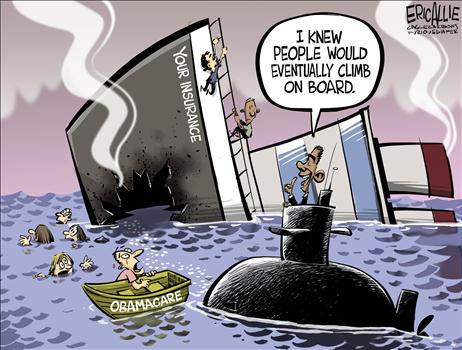
Let’s close today’s post with some good Obamacare cartoons. We’ll start with Eric Allie’s amusing look at how the White House is measuring success.

Obamacare Cartoon Jan 2014 1

Nice gimmick, huh? You pass a law that destroys people’s existing insurance policies, then you claim victory when some of them sign up for more expensive Obamacare insurance.

Next we have Nate Beeler welcoming the new year.

Obamacare Cartoon Jan 2014 2

Chip Bok’s cartoon is somewhat optimistic in that he’s suggesting that Obamacare may unravel.

Obamacare Cartoon Jan 2014 3

And Gary Varvel mocks the moving goalposts of Obamacare.

Obamacare Cartoon Jan 2014 4

Lisa Benson congratulates the President for winning Politifact’s Lie of the Year Award.

Obamacare cartoon Jan 2014 5

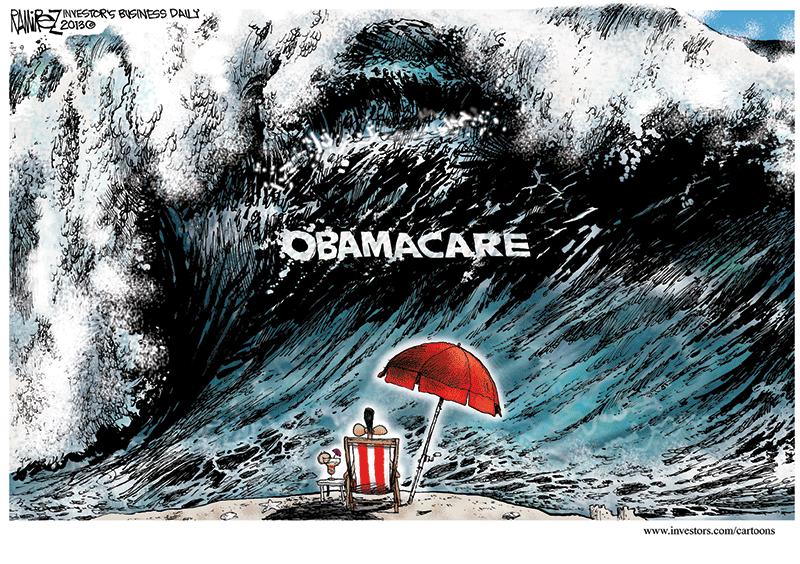
Michael Ramirez hints that the President may not be in a position to enjoy his multi-million dollar Hawaiian vacation.

Obamacare Cartoon Jan 2014 6

Last but not least, Scott Stantis warns us that Obamacare violates the Hippocratic Oath about doing no harm.

Obamacare Cartoon Jan 2014 7

P.S. Under no circumstances should you feel sorry for the insurance companies. As I noted the other day, they endorsed Obamacare and actively lobbied for its passage. They deserve every bad thing that might happen to them.

P.P.S. It’s hard to find much humor in this situation, but perhaps this funny “bailout application” could be updated to make it easier for big insurance companies to rape and pillage taxpayers.


Related posts:

Obamacare is so dumb that you just have to laugh!!!

________ Obamacare is so dumb that you just have to laugh!!! Some Partially Serious Thanksgiving Humor November 28, 2013 by Dan Mitchell Tim Carney of the Washington Examiner is a must-read columnist and expert on the pervasive corruption in Washington. He’s also an insightful commentator on why freedom and morality go hand in hand, which suggests […]

Open letter to President Obama (Part 469)(An Obamacare Chart to Make You Cry…Balanced by Obamacare Cartoons to Make You Laugh)

Open letter to President Obama (Part 469) (Emailed to White House on 5-4-13.) President Obama c/o The White House 1600 Pennsylvania Avenue NW Washington, DC 20500 Dear Mr. President, I know that you receive 20,000 letters a day and that you actually read 10 of them every day. I really do respect you for trying to get […]

We need to repeal Obamacare and get away from third-party payer system and get a genuine free market!!!!

______ We need to repeal Obamacare and get away from third-party payer system and get a genuine free market!!!! The Continuing Obamacare Disaster November 11, 2013 by Dan Mitchell You know things are going poorly for the Obama White House when even the New York Times is writing about the “third world experience” of Obamacare. Heck, […]

Supreme Court to Hear Challenges to Obamacare Anti-Conscience Mandate

________ I have written about this before and I have even emailed the White House about it. Today we have some very good news!!! Supreme Court to Hear Challenges to Obamacare Anti-Conscience Mandate Elizabeth Slattery and Sarah Torre November 26, 2013 at 2:12 pm (0) Today, the Supreme Court announced that it will take up […]

Open letter to President Obama (Part 460) Lots of reasons to still oppose Obamacare (includes editorial cartoon)

(Emailed to White House on 3-20-13.) President Obama c/o The White House 1600 Pennsylvania Avenue NW Washington, DC 20500 Dear Mr. President, I know that you receive 20,000 letters a day and that you actually read 10 of them every day. I really do respect you for trying to get a pulse on what is […]

Open letter to President Obama (Part 418) Why do religious institutions have to provide a way for their employees to get abortions under Obamacare?

  (Emailed to White House on 1-14-13.) President Obama c/o The White House 1600 Pennsylvania Avenue NW Washington, DC 20500 Dear Mr. President, I know that you receive 20,000 letters a day and that you actually read 10 of them every day. I really do respect you for trying to get a pulse on what […]

We got to cut the size of government and Obamacare is the best place to cut!!!!

We got to cut the size of government and Obamacare is the best place to cut!!!!   A Funny Look at How Obamacare Screws Young People August 30, 2013 by Dan Mitchell During the big-spending Bush years, economic and fiscal people inside the Administration often would sympathize with my complaints about bad policy, but say that […]

Cartoons from Dan Mitchell’s blog that demonstrate what Obama is doing to our economy Part 29 (Romneycare is Obamacare)

I have put up lots of cartoons from Dan Mitchell’s blog before and they have got lots of hits before. Many of them have dealt with the economy, eternal unemployment benefits, socialism,  Greece,  welfare state or on gun control. Mitt Romney is probably the most liberal candidate the Republicans ever ran for President. Maybe it is good […]

Obamacare is a tragedy about to happen so why not just laugh!!!

Obamacare is a tragedy about to happen so why not just laugh!!! Obamanomics, as Captured by Cartoonists August 22, 2013 by Dan Mitchell As evidenced by my political cartoon contest, I’m a big fan of that form of satire. And if I’m looking at cartoons specifically about statist economic policy, my favorites include Chuck Asay’s […]

Is Obama acting like a dictator with his recent actions regarding the Obamacare Program?

_________ Is Obama acting like a dictator with his recent actions regarding the Obamacare Program? The Arbitrary Diktats of Generalissimo Obama August 16, 2013 by Dan Mitchell There’s an old joke that the definition of quandary is when your mother-in-law drives off a cliff in your new car. But since I’m not married, I can’t use […]

“Sanctity of Life Saturday” Francis Schaeffer’s wife Edith passes away on Easter weekend 2013 Part 11 (includes pro-life editorial cartoon)

Francis Schaeffer Whatever Happened to the Human Race (Episode 1) ABORTION

Francis Schaeffer: What Ever Happened to the Human Race? (Full-Length Documentary)


Part 1 on abortion runs from 00:00 to 39:50, Part 2 on Infanticide runs from 39:50 to 1:21:30, Part 3 on Youth Euthanasia runs from 1:21:30 to 1:45:40, Part 4 on the basis of human dignity runs from 1:45:40 to 2:24:45 and Part 5 on the basis of truth runs from 2:24:45 to 3:00:04

________________

Picture of Francis Schaeffer and his wife Edith from the 1930′s above. I was sad to read about Edith passing away on Easter weekend in 2013. I wanted to pass along this fine article below.

Below is a blog post by a professor of Philosophy:

Saturday, March 30, 2013

Edith Schaeffer, RIP


Edith Schaeffer, wife of the late Evangelical apologist Francis A. Schaeffer and co-founder of L’Abri Fellowship in Switzerland, died today (Holy Saturday) at the age of 98. A prolific author in her own right, she was also a beloved matriarch of L’Abri Fellowship and leader of various Bible study groups, as well as a conference speaker around the world.During her last years, she had been cared for reportedly by her daughter Debbie and her son-in-law Udo Middelmann, in whose home I had the honor of spending a year between my sophomore and junior years of college long ago.Together with her late husband Francis, Edith influenced many lives through L’Abri Fellowship, including those of Dr. Eduardo Echeverria and my own at Sacred Heart Major Seminary whose years at L’Abri nearly overlapped back in the 1970s.

Born in Wenzhou, China as the daughter of missionaries to China, like yours truly, she had an international vision of the task of the church in the world.

She will be buried in Rochester, MN, where, sometime later, a public memorial service will be held.

A message from the L’Abri Staff on the passing of Edith Schaeffer may be found HERE on The Aquila Report on the website of the Reformed Theological Seminary (March 30, 2013).

Her son, Franky A. Schaeffer has written “A Tribute to My Evangelical Leader Mom– Edith Schaeffer RIP” (The Huffington Post [There’s a backstory on that], March 30, 2013). Franky includes a bibliography of his mother’s works.

2 comments:

  1. I never thought anything new by Franky would move me. I was wrong. For me any my generation, Edith Schaeffer was one among those “Last of the Giants.” Godspeed to her soul.

    ReplyDelete

  2. Franky Schaeffer:

    “Mom’s daily life was a rebuke and contradiction to people who see everything as black and white. Liberals and secularists alike who make smug disparaging declarations about ‘all those evangelicals’ would see their fondest prejudices founder upon the reality of my mother’s compassion, cultural literacy and loving energy.”

    In recent years it’s been hard to distinguish Franky from the “liberals and secularists” who disparage evangelical Christianity. But that was a touching tribute to his mother, and perhaps one day he’ll come around with regards to his father as well.

    RIP Edith.

    ReplyDelete

Dr. Koop with Francis Schaeffer in their film WHATEVER HAPPENED TO THE HUMAN RACE? made it clear that unborn babies have the right to life. That point is made well in this political cartoon about abortion:

(Francis did a great job in his film series “How Should we then live?” in looking at how humanism has affected art and culture in the Western World in the last 2000 years. My favorite episodes include his study of the Renaissance, the Revolutionary age, the age of Nonreason, and the age of Fragmentation.)

Related posts:

Francis Schaeffer’s “How should we then live?” Video and outline of episode 10 “Final Choices” (Schaeffer Sundays)

E P I S O D E 1 0   Dr. Francis Schaeffer – Episode X – Final Choices 27 min FINAL CHOICES I. Authoritarianism the Only Humanistic Social Option One man or an elite giving authoritative arbitrary absolutes. A. Society is sole absolute in absence of other absolutes. B. But society has to be […]

Francis Schaeffer’s “How should we then live?” Video and outline of episode 9 “The Age of Personal Peace and Affluence” (Schaeffer Sundays)

E P I S O D E 9 Dr. Francis Schaeffer – Episode IX – The Age of Personal Peace and Affluence 27 min T h e Age of Personal Peace and Afflunce I. By the Early 1960s People Were Bombarded From Every Side by Modern Man’s Humanistic Thought II. Modern Form of Humanistic Thought Leads […]

Francis Schaeffer’s “How should we then live?” Video and outline of episode 8 “The Age of Fragmentation” (Schaeffer Sundays)

E P I S O D E 8 Dr. Francis Schaeffer – Episode VIII – The Age of Fragmentation 27 min I saw this film series in 1979 and it had a major impact on me. T h e Age of FRAGMENTATION I. Art As a Vehicle Of Modern Thought A. Impressionism (Monet, Renoir, Pissarro, Sisley, […]

Francis Schaeffer’s “How should we then live?” Video and outline of episode 7 “The Age of Non-Reason” (Schaeffer Sundays)

E P I S O D E 7 Dr. Francis Schaeffer – Episode VII – The Age of Non Reason I am thrilled to get this film series with you. I saw it first in 1979 and it had such a big impact on me. Today’s episode is where we see modern humanist man act […]

Francis Schaeffer’s “How should we then live?” Video and outline of episode 6 “The Scientific Age” (Schaeffer Sundays)

E P I S O D E 6 How Should We Then Live 6#1 Uploaded by NoMirrorHDDHrorriMoN on Oct 3, 2011 How Should We Then Live? Episode 6 of 12 ________ I am sharing with you a film series that I saw in 1979. In this film Francis Schaeffer asserted that was a shift in […]

Francis Schaeffer’s “How should we then live?” Video and outline of episode 5 “The Revolutionary Age” (Schaeffer Sundays)

E P I S O D E 5 How Should We Then Live? Episode 5: The Revolutionary Age I was impacted by this film series by Francis Schaeffer back in the 1970′s and I wanted to share it with you. Francis Schaeffer noted, “Reformation Did Not Bring Perfection. But gradually on basis of biblical teaching there […]

Francis Schaeffer’s “How should we then live?” Video and outline of episode 4 “The Reformation” (Schaeffer Sundays)

Dr. Francis Schaeffer – Episode IV – The Reformation 27 min I was impacted by this film series by Francis Schaeffer back in the 1970′s and I wanted to share it with you. Schaeffer makes three key points concerning the Reformation: “1. Erasmian Christian humanism rejected by Farel. 2. Bible gives needed answers not only as to […]

“Schaeffer Sundays” Francis Schaeffer’s “How should we then live?” Video and outline of episode 3 “The Renaissance”

Francis Schaeffer’s “How should we then live?” Video and outline of episode 3 “The Renaissance” Francis Schaeffer: “How Should We Then Live?” (Episode 3) THE RENAISSANCE I was impacted by this film series by Francis Schaeffer back in the 1970′s and I wanted to share it with you. Schaeffer really shows why we have so […]

Francis Schaeffer’s “How should we then live?” Video and outline of episode 2 “The Middle Ages” (Schaeffer Sundays)

  Francis Schaeffer: “How Should We Then Live?” (Episode 2) THE MIDDLE AGES I was impacted by this film series by Francis Schaeffer back in the 1970′s and I wanted to share it with you. Schaeffer points out that during this time period unfortunately we have the “Church’s deviation from early church’s teaching in regard […]

Francis Schaeffer’s “How should we then live?” Video and outline of episode 1 “The Roman Age” (Schaeffer Sundays)

Francis Schaeffer: “How Should We Then Live?” (Episode 1) THE ROMAN AGE   Today I am starting a series that really had a big impact on my life back in the 1970′s when I first saw it. There are ten parts and today is the first. Francis Schaeffer takes a look at Rome and why […]

Dec 2013 Budget Deal:Federal spending has fallen for two straight years for the first time since the end of the Korean War because of Sequestration so why change it?

++++++++++++++++++++++++___________________________________________________________________________________

Budget Deal Disappointment: Dr. Coburn on Morning Joe 12/11/2013

Rep. Rokita Rises in Support of Bipartisan Budget Deal

I am so sad about the Republicans caving in and letting President Obama and the Democrats get rid of the Sequester spending cap limits!!!! I have contacted my Representatives and Senators and told them what I wanted them to do. I am happy to report that Tom Cotton and Rick Crawford voted in the House to keep the Sequester limits. I AM SO PROUD OF THEM!!!!!

Dec 2013 Budget Deal:Federal spending has fallen for two straight years for the first time since the end of the Korean War because of Sequestration so why change it?

Spending Caps Have Worked, but Ryan-Murray Budget Would Lift Them

and

December 16, 2013 at 11:01 am

Bill Clark/CQ Roll Call/Newscom

Bill Clark/CQ Roll Call/Newscom

In terms of cutting government spending, the Budget Control Act’s spending caps and sequestration have been an unparalleled success story in recent years. And yet, the House of Representatives voted last Thursday to weaken the caps in 2014 and 2015 for a $63 billion increase in the discretionary budget.

Sequestration has been an effective tool to do what Congress for too long failed to do—cut spending. Federal spending has fallen for two straight years for the first time since the end of the Korean War—a remarkable feat with Democratic control over the White House and Senate. As The Wall Street Journal put it, “A testament to the success of the [sequestration] caps is that nearly every Democrat and spending lobby in Washington is desperate to get rid of them.”

Concerns that sequestration would decimate vital government functions were largely exaggerated. After the President sounded the alarm over the supposed budget “meat cleaver” earlier this year, The Washington Post reported that the vast majority of the President’s doomsday predictions never came to pass. Federal agencies (with the help of Congress) were for the most part able to cope with the $85 billion in cuts by prioritizing their budgets.

Worries that sequestration would hurt the economy were also overblown. As Moody’s remarked, the U.S. economy “has demonstrated a degree of resilience to major reductions in the growth of government spending.” Moreover, research shows that reductions in government spending free resources in the economy for investment and job creation, thus spurring economic growth in the long-run.

Although the across-the-board nature of sequestration has its flaws, it would be a mistake to eliminate this spending restraint in exchange for more spending and revenue and hollow promises of future restraint.

The indiscriminate cuts fall disproportionately on defense spending compared to other discretionary programs. Lawmakers could better prioritize spending within the budget caps to protect core constitutional functions such as defense. Additionally, sequestration reduces projected spending by a mere 2.5 percent over the decade it is in effect.

Its biggest shortcoming, however, is that it is the wrong instrument to reduce the growth in entitlement programs—the main drivers of growing deficits and debt. Reforming Medicare, Social Security, and health-related spending such as Medicaid—which account for 45 percent of government spending—will be critical in devising any fiscally responsible budget in the future.

Despite its imperfections, sequestration works. It has been the one policy out of Washington that has cut spending. The recent Ryan–Murray budget does Americans a disservice by weakening the sequestration spending caps in exchange for spending and revenue increases today and mostly promises of savings in a distant future that may never materialize. The deal also takes pressure off Congress to push for more important entitlement reforms. If Congress is serious about reducing spending and debt, keeping sequestration in place is the better option for now.

Michael Sargent is currently a member of the Young Leaders Program at The Heritage Foundation. For more information on interning at Heritage, please click here.

Related posts:


THE NEW BUDGET DEAL OF DEC 2013 IS: Promises of fictitious spending now instead of real spending caps!!!

House, Senate Budget chairs reach deal to preempt another gov t shutdown Paul Ryan has been fighting for sequestration for years(1 yr ago) _____________________________ THE NEW BUDGET DEAL OF DEC 2013 IS: Promises of fictitious spending now instead of real spending caps!!! 3 Things You Need to Know About the Congressional Budget Deal Romina Boccia […]

We got to cut spending increases like the Sequester was doing in order to control government spending!!!

House, Senate Budget chairs reach deal to preempt another gov t shutdown Paul Ryan has been fighting for sequestration for years(1 yr ago) _____________________________ We got to cut spending increases like the Sequester was doing in order to control government spending!!! The budget deal is a huge Republican cave-in Republicans in Congress have put in […]

The Sequester works so why are the Republicans giving it up?

____ I POURED MY HEART OUT IN AN EMAIL TO SENATOR BOOZMAN THE OTHER DAY AND THEN SENT THAT EMAIL TO 30 SENATORS AND REPRESENTATIVES ALL OVER THE USA!!! HERE I GO AGAIN. This is very much the same case as raising the debt ceiling in my view. It seems that the Republicans keep allowing […]

If you really want to cut the growth of government spending then keep the sequester in place!!!

______ If you really want to cut the growth of government spending then keep the sequester in place!!! December 9, 2013 11:01AM Budget Deal: A Dangerous Precedent By Chris Edwards Share Republican and Democratic negotiators are expected to agree to a budget deal this week setting spending levels for 2014. The Washington Post says that […]

Letter to Senator John Boozman about Sequester Negotiations (PLEASE KEEP SEQUESTER!!!!)

________________________ Senator John Boozman, 320 Hart Senate Office Building Washington, DC 20510 Phone: (202) 224-4843 Fax: (202) 228-1371 Dear Senator Boozman, I want to thank you for taking the time out of your busy day to respond to my earlier letter to you on this same subject. I have always TRIED TO CONTACT THE REPRESENTATIVES AND SENATORS ABOUT THEIR RESPONSIBILITY […]

The Sequester actually did help control the growth of government and hopefully we can cut deeper this time around!!!

The Sequester actually did help control the growth of government and hopefully we can cut deeper this time around!!! Government Shutdown Jokes…and the Sick Joke of Obama’s Shutdown Strategy October 8, 2013 by Dan Mitchell Even though it’s an uphill battle, I’m glad there are some lawmakers willing to fight Obamacare. They realize a hard battle […]

We need deeper cuts than the Sequester!!! (Cartoons included)

What Can Washington Politicians Learn From America’s Moms? Published on Apr 2, 2013 We asked folks what Washington politicians can learn from America’s moms ___________________ We need deeper cuts than the Sequester!!! Below are some very funny cartoons from Dan Mitchell’s blog on the Sequester. Sequestration “Meat Cleaver” Is Really a Scalpel Danny Huizinga July 26, […]

Obama acts like the Sequester cuts would bring the world to an end!!!

When Governments Cut Spending Uploaded on Sep 28, 2011 Do governments ever cut spending? According to Dr. Stephen Davies, there are historical examples of government spending cuts in Canada, New Zealand, Sweden, and America. In these cases, despite popular belief, the government spending cuts did not cause economic stagnation. In fact, the spending cuts often […]

Sequester did not hurt job growth!!!!!

If you blame the Sequester for blaming job growth then you don’t have a good grasp on economics. The Overlooked Jobs Tragedy April 9, 2013 by Dan Mitchell When the monthly job numbers are released, most people focus on the unemployment rate. On many occasions, I’ve cited that number, usually to point out that the unemployment […]

Sequester not so bad after all (includes cartoons)

I have put up lots of cartoons from Dan Mitchell’s blog before and they have got lots of hits before. Many of them have dealt with the economy, eternal unemployment benefits, socialism,  Greece,  welfare state or on gun control. Sequester was not so bad after all. Since the Sequester Has Been in Place for More than One […]

Another funny sequester cartoon from Dan Mitchell’s blog

I have put up lots of cartoons from Dan Mitchell’s blog before and they have got lots of hits before. Many of them have dealt with the economy, eternal unemployment benefits, socialism,  Greece,  welfare state or on gun control. As Humorously Explained by Henry Payne, the World Amazingly Didn’t End When Uncle Sam Got Put on a […]

By Everette Hatcher III | Posted in Cato Institute, Economist Dan Mitchell | Edit | Comments (0)

“Friedman Friday” Milton Friedman: “the purpose of the balanced-budget-and-tax-limitation amendment is to limit the government in order to free the people — this time from excessive taxation.”

Friedman on Reagan

Uploaded by on Aug 19, 2009

Nobel Laureate Dr. Milton Friedman discusses the principles of Ronald Reagan during this talk for students at Young America’s Foundation’s 25th annual National Conservative Student Conference

_______________

Passing the Balanced Budget Amendment would be what the founding fathers would have wanted. Look at what my favorite economist once said.

“The amendment is very much in the spirit of the first 10 amendments — the Bill of Rights. Their purpose was to limit the government in order to free the people. Similarly, the purpose of the balanced-budget-and-tax-limitation amendment is to limit the government in order to free the people — this time from excessive taxation.”

The Return of the Balanced Budget Amendment

By: jmattera
3/7/2011 03:01 AM

“The balanced budget amendment has good aspects, but it is simply not good enough in dealing with fundamental constitutional change for our country.” And thus with that 23-word statement in 1997, Democrat Sen. Robert Torricelli of New Jersey sunk conservative spirits. No longer did the U.S. Senate have the two-thirds it needed to enshrine a fundamental principle of governing into the highest law of the land: that politicians should pay for what they spend.

Controversial, I know. Pfft.

Due to Democrat Torricelli’s jellyfish backbone, the 1997 Balanced Budget Amendment fell one vote short of hitting the needed threshold, which was the same margin of failure as just one year before. And liberals couldnt have been happier. Their penchant for obligating the taxpayers of tomorrow to pay for the spending binges of today remained unbroken.

Not that the dissenting senators worded their objections that way. Nope. To Vermont’s incorrigible leftist Sen. Patrick Leahy, inserting a mechanism into the Constitution that would enable our government’s books to mirror the realities American businesses and families face daily was “bumper sticker politics” and “sloganeering.” The way toward rectifying Uncle Sam’s balance sheet was, according to Leahy, “political courage,” not tinkering with the Constitution. Thirty-three of Leahy’s Democratic colleagues agreed.

Mind-Boggling Debt

Of course, by “political courage,” Leahy didnt mean reforming our insolvent entitlement systems or abolishing many of the improvident, senseless, and unconstitutional government bureaucracies and programs in existence. Nah. He meant tax increases on the rich. You know the drill, people.

Prescience, however, is not a valued commodity in Washington, D.C., as lawmakers pursue policies that are in the best interest of their reelection, not of the republic.

When the balanced budget amendment failed in 1997, the federal deficit stood at just $22 billion and the national debt hovered around 5.5 trillion — meager compared with today’s obscene figures, where we have a deficit topping $1.6 trillion this year alone accompanied by a mind-boggling debt of $14 trillion and growing.

To put our debt in perspective, Kobe Bryant makes $25 million playing for the Los Angeles Lakers. Any guesses on how many seasons Kobe would have to play in order to pay off today’s national debt? How about a whopping 560,000. That’s chilling, and quite frankly, incomprehensible.

Heck, we’ve run deficits in 54 of the last 60 years, as the National Taxpayer Union points out. That’s a figure that would make Keynes himself blink.

Ironically, Leahy was on the right track when he spoke of the need for political courage. This country desperately needs it, but it must manifest itself in the form of politicians who will defend the property rights of all Americans as opposed to the current lawmaking that treats this nation’s treasury as a personal ATM card.

The brute political courage we need is for politicians to plug Congress’s desire to ransack the appropriations process to engineer winners and losers in the marketplace and thus perpetuate a class of constituents whose inspiration to vote is driven by keeping the government gravy train on a track straight to their bank accounts.

Thanks to the midterm elections, the time for real political courage is now: The balanced budget amendment is making a comeback thanks to one veteran and one freshman senator.

“The people are calling for it. They are clamoring for it. They’re demanding it,” said newly elected Utah Sen. Mike Lee, who has 19 of his colleagues, including Jim DeMint and Rand Paul, rallying in support of his balanced budget amendment. “The American people overwhelmingly demand it, and if members of Congress value their jobs, they are going to vote for it,” he told Human Events in an exclusive interview.

Lee’s a Tea Party faithful who believes his job boils down to this bare-bones task: produce a government in the original mold of the Constitution, which is to say, one whose legislative reach is restricted and clearly defined. In other words, a federal government that looks absolutely nothing like what we have today.

Opportune Time Needed

Lee is so intent on getting a vote on his balanced budget amendment that he’s ready to filibuster the vote on whether or not to raise the debt ceiling as a tactical move.

“I can tell you that there are a lot of people who will not even consider it [a vote on the debt limit] without a balanced budget amendment first being proposed by Congress,” he said emphatically.

That’s certainly one approach — to hold the Senate hostage until real, austere statutory spending limits are adopted.

Utah’s senior Sen. Orrin Hatch doesnt see it that way. He’s looking for a vote on his balanced budget amendment too, but at a time believed to be the most opportune for passage. He hasn’t set firm timetables or made any strict demands.

“You have to have a bipartisan vote. You have to have a President that does care, and you have to have a setting in time where people can’t do anything but vote for it,” Hatch explained. “Right now, I don’t think we have that.”

If youre keeping score, the two senators from Utah both have competing balanced budget amendments floating around the Senate. In some ways, these jockeying amendments are a reflection of the Tea Party being a big kid on the block within the GOP.

Hatch, though, has been in the Senate for more than three decades, and is confident that he can get a balanced budget amendment through, which is why he’s taking a softer tone and insisting on waiting for the best moment to accomplish that.

And there’s something to be said for Hatch’s, well, “political,” approach. He’s shepherded the balanced budget amendment since 1982, when it was approved in the Senate, but torpedoed in the House by then-Speaker Tip O’Neill. And, as noted above, Hatch came painstakingly close twice in the Senate, both in 1996 and 1997.

“It’s every bit as difficult now, but it’s important that we bring it up and that we make all the strides we can,” he said.

The long-serving senator has 32 co-sponsors for his bill, including Chuck Grassley of Iowa, who is the ranking member on the Judiciary Committee.

When it comes down to it, both Hatch and Lee’s amendments have the same goal: ending profligate spending. In fact, as Nobel Laureate James Buchanan said, “The balanced budget norm is ultimately based on the acceptance of the classic principles of public finance, meaning that politicians shouldn’t spend more than they are willing to generate in tax revenues, except during periods of extreme and temporary emergency.”

Wait, why is this concept controversial again? Because it handcuffs Big Government believers from exerting influence over our personal decision making, thats why.


Courts Involved

There are notable differences between the balanced budget amendments of Hatch and Lee, which we lay out in detail in the accompanying chart. While Mike Lee would restrict government spending to 18% of the gross domestic product (GDP), Hatch’s limits the figure to 20%. The 40-year average of tax receipts to GDP is around 18%, and Hatch knows this to be the case, but, to quote him, “If you get it too low, then you lose any chance with the Democrats.” And that, right there, encapsulates the internal friction the GOP will face with this budding Tea Party caucus going head-to-head with those who are willing to work with Democrats to deliver a final product.

But there’s more: Hatch’s proposal allows a simple majority vote to waive the balanced budget requirement when there’s a declaration of war or a designated military conflict, whereas Lee’s amendment provides no such exception. His threshold is much higher — a two-thirds vote.

When aren’t we in a military conflict? Lee quips.

There are also differences in the enforcement mechanism. Lee would grant standing in federal court to members of Congress if flagrant violations of the amendment occur. Hatch doesnt want the courts anywhere near enforcement, believing that public pressure placed on politicians instead provides the best form of accountability. Plus, “Who wants the courts doing it?” asked Hatch, alluding to their predilection toward activism.

Lee himself acknowledges that court intervention would be rare, but that the mere possibility that it could occur would add some additional incentive to Congress to make sure that it stays within their restrictions.

So far, so good.

But procedurally, how would our gargantuan budget ever get balanced? We’re dealing with trillions of dollars here, after all, a highly complex web of arithmetic. Congress must make a good-faith effort, say Hatch and Lee, to use the best possible projections of spending and receipts. Even with the accurate projections, economic conditions change throughout the year that may inhibit the Feds’ budget from being balanced, such as underestimating costs, which happens more frequently than not these days. If such a scenario plays out, and a fiscal year does end with a deficit, such spending cuts can be incorporated into the next fiscal year’s budget and make up the difference on the back end. Under both plans, by the way, two-thirds of Congress would be needed to raise taxes, so it would be more likely than not that the budget would be balanced by spending cuts, not tax increases.

Hey, were all game for that.

Naturally, getting a balanced budget amendment adopted as part of the Constitution will not be an easy feat. And not because of the numerical hurdles and multiple steps needed to get any amendment through the Constitution (the process should be difficult). It’s because Democrats will kick and scream over the severe cuts to spending that would ensue after the adoption of a balanced budget amendment.

Heck, Senate Majority Leader Harry Reid and his left-wing posse went apoplectic at a proposed spending reduction of $61 billion over the next seven months, calling it “extreme” and “draconian.” Just $61 billion. Thats it. To realize just how absurd such objections were, $61 billion is only a one-third of the money needed to cover the interest payments for U.S. bondholders this year alone.

Imagine when formal debate begins on the need to cut trillions in spending to rein in our deficit? Democrats may cut off their right arms in protest.

“This is exhibit A for why we need a balanced budget amendment,” responded Lee. “Politicians have reached the conclusion that they are the bad guys unless they say ‘yes’ to more spending, and it’s in light of that aspect of human nature that particularly tends to affect politicians, and that’s why we need a constitutional amendment.”

Unified GOP Caucus

“If this is going to get passed in the next two years,” says Hatch, “President Obama will have to step to the plate. Ultimately you’ll need presidential leadership because everybody knows that you’re not going to get spending under control until we take on entitlements as well. You cannot do it without presidential leadership.”

Remider: There’s always new presidential leadership come 2012. Well, we hope so anyway.

In the end, expect the GOP to have a unified caucus on a merger of the Hatch and Lee balanced budget amendments. It’s hard enough (almost impossible) to get one through when Democrats are in control of the Senate and the presidency, so the Republicans will need a unified front like they’ve had in the past.

A balanced budget amendment restricts the power of lawmakers, and that’s why the left despises it, and will work vigorously to defeat it. Get ready.

In the end, it is exactly what the Constitution needs. And esteemed economist Milton Friedman identified why two decades ago.

Said Friedman: “The amendment is very much in the spirit of the first 10 amendments — the Bill of Rights. Their purpose was to limit the government in order to free the people. Similarly, the purpose of the balanced-budget-and-tax-limitation amendment is to limit the government in order to free the people — this time from excessive taxation.”

If we cannot cut the Welfare State under these distressing economic conditions, then we’ll never do it. Now’s the time.

“How to Cure Inflation” in Milton Friedman’s FREE TO CHOOSE Part 2 of 7 “Many a political leader has been tempted to turn to wage and price controls despite their repeated failure in practice. On this subject they never seem to learn. But some lessons may be learned”

In 1980 I read the book FREE TO CHOOSE by Milton Friedman and it really enlightened me a tremendous amount.  I suggest checking out these episodes and transcripts of Milton Friedman’s film series FREE TO CHOOSE: “The Failure of Socialism” and “What is wrong with our schools?”  and “Created Equal”  and  From Cradle to Grave, and – Power of the Market.“If we could just stop the printing presses, we would stop inflation,” Milton Friedman says in “How to Cure Inflation” from the Free To Choose series. Now as then, there is only one cause of inflation, and that is when governments print too much money. Milton explains why it is that politicians like inflation, and why wage and price controls are not solutions to the problem.

In this episode Friedman notes, “Many a political leader has been tempted to turn to wage and price controls despite their repeated failure in practice. On this subject they never seem to learn. But some lessons may be learned.”
Bob Crawford: The more I work, it seems like the more they take off me. I know if I work an extra day or two extra days, what they take in federal income tax alone is almost doubled because apparently it puts you in a higher income tax bracket and it takes more off you.
Friedman: Bob Crawford lives with his wife and three children in a suburb of Pittsburgh. They’re a fairly average American family.
Mrs. Crawford: Don’t slam the door Daphne. Okay. Alright. What are you doing? Making your favorite dish.
Friedman: We went to the Crawford’s home after he had spent a couple of days working out his federal and state income taxes for the year. For our benefit, he tried to estimate all the other taxes he had paid as well. In the end, though, he didn’t discover much that would surprise anybody.
Bob Crawford: Inflation is going up, everything is getting more expensive. No matter what you do, as soon as you walk out of the house, everything went up. Your gas bills keep going up, electric bills, your gasoline, you can name a thousand things that are going up. Everything is going sky high. Your food. My wife goes to the grocery store. We used to live on say, $60 or $50 every two weeks just for our basic food. Now it’s $80 or $90 every two weeks. Things are just going out of sight as far as expense to live on. Like I say it’s getting tough. It seems like every month it gets worse and worse. And I don’t know where it’s going to end. At the end of the day that I spend nearly $6,000 of my earnings on taxes. That leaves me with a total of $12,000 to live on. It might seem like a lot of money, but five, six years ago I was earning $12,000.
Friedman: How does taxation without representation really effect how much the Crawford family has left to spend after it’s paid its income taxes. Well in 1972 Bob Crawford earned $12,000. Some of that income was not subject to income tax. After paying income tax on the rest he had this much left to spend. Six years later he was earning $18,000 a year. By 1978 the amount free from tax was larger. But he was now in a higher tax bracket so his taxes went up by a larger percentage than his income. However, those dollars weren’t worth anything like as much. Even his wages, let alone his income after taxes, hadn’t kept up with inflation. His buying power was lower than before. That is taxation without representation in practice.
Unnamed Individual: We have with us today you brothers that are sitting here today that were with us on that committee and I’d like to tell you….
Friedman: There are many traditional scapegoats blamed for inflation. How often have you heard inflation blamed on labor unions for pushing up wages. Workers, of course, don’t agree.
Unnamed Individual: But fellows this is not true. This is subterfuge. This is a myth. Your wage rates are not creating inflation.
Friedman: And he’s right. Higher wages are mostly a result of inflation rather than a cause of it. Indeed, the impression that unions cause inflation arises partly because union wages are slow to react to inflation and then there is pressure to catch up.
Worker: On a day to day basis, try to represent our own numbers. But that in fact is not the case. Not only can we not play catch up, we can’t even maintain a wage rate commensurate with the cost of living that’s gone up in this country.
Friedman: Another scapegoat for inflation is the cost of goods coming from abroad. Inflation, we’re told, is imported. Higher prices abroad driving up prices at home. It’s another way government can blame someone else for inflation. But this argument, too, is wrong. The prices of imports and the countries from which they come are not in terms of dollars, they are in terms of lira or yen or other foreign currencies. What happens to their prices in dollars depends on exchange rates which in turn reflect inflation in the United States.
Since 1973 some governments have had a field day blaming the Arabs for inflation. But if high oil prices were the cause of inflation, how is it that inflation has been less here in Germany, a country that must import every drop of oil and gas that it uses on the roads and in industry, then for example it is in the U.S. which produces half of its own oil. Japan has no oil of its own at all. Yet at the very time the Arabs were quadrupling oil prices, the Japanese people were bringing inflation down from 30 to less than 5% a year. The fallacy is to confuse particular prices like the price of oil, with prices in general. Back at home, President Nixon understood this.
Nixon: “Now here’s what I will not do. I will not take this nation down the road of wage and price controls however politically expedient that may seem. The pros of rationing may seem like an easy way out, but they are really an easy way in for more trouble. To the explosion that follows when you try to clamp a lid on a rising head of steam without turning down the fire under the pot, wage and price controls only postpone the day of reckoning. And in so doing, they rob every American of a very important part of his freedom.
Friedman: Now listen to this:
Nixon: “The time has come for decisive action. Action that will break the vicious circle of spiraling prices and costs. I am today ordering a freeze on all prices and wages throughout the United States for a period of 90 days. In addition, I call upon corporations to extend the wage price freeze to all dividends.”
Friedman: Many a political leader has been tempted to turn to wage and price controls despite their repeated failure in practice. On this subject they never seem to learn. But some lessons may be learned. That happened to British Prime Minister James Callahan who finally discovered that a very different economic myth was wrong. He told the Labor Party Conference about it in 1976.
James Callahan: “We used to think that you could use, spend your way out of a recession and increase employment by cutting taxes and boosting government spending. I tell you in all candor that option no longer exists. It only works on each occasion since the war by injecting a bigger dose of inflation into the economy followed by a higher level of unemployment as the next step. That’s the history of the last 20 years.”
Friedman: Well, it’s one thing to say it. One reason why inflation does so much harm is because it effects different groups differently. Some benefit and of course they attribute that to their own cleverness. Some are hurt, but of course they attribute that to the evil actions of other people. And the whole problem is made far worse by the false cures which government adopts, particularly wage and price control.
The garbage collectors in London felt justifiably aggrieved because their wages had not been permitted to keep pace with the cost of living. They struck, hurting not the people who impose the controls, but their friends and neighbors who had to live with mounting piles of rat infested garbage. Hospital attendants felt justifiably aggrieved because their wages had not been permitted to keep up with the cost of living. They struck, hurting not the people who impose the controls, but cancer patients who were turned out of hospital beds. The attendants behaved as a group in a way they never would have behaved as individuals. One group is set against another group. The social fabric of society is torn apart inflicting scars that it will take decades to heal and all to no avail because wage and price controls, far from being a cure for inflation, only make inflation worse.
Within the memory of most of our political leaders, there’s one vivid example of how economic ruin can be magnified by controls. And the classic demonstration of what to do when it happens.

Related posts:

“The Power of the Market” episode of Free to Choose in 1990 by Milton Friedman (Part 1)

Milton Friedman The Power of the Market 1-5 How can we have personal freedom without economic freedom? That is why I don’t understand why socialists who value individual freedoms want to take away our economic freedoms.  I wanted to share this info below with you from Milton Friedman who has influenced me greatly over the […]

“Friedman Friday,” EPISODE “The Failure of Socialism” of Free to Choose in 1990 by Milton Friedman (Part 1)

Milton Friedman: Free To Choose – The Failure Of Socialism With Ronald Reagan (Full) Published on Mar 19, 2012 by NoNationalityNeeded Milton Friedman’s writings affected me greatly when I first discovered them and I wanted to share with you. We must not head down the path of socialism like Greece has done. Abstract: Ronald Reagan […]

________________

“Friedman Friday” (“Free to Choose” episode 3 – Anatomy of a Crisis. part 3 of 7)

Worse still, America’s depression was to become worldwide because of what lies behind these doors. This is the vault of the Federal Reserve Bank of New York. Inside is the largest horde of gold in the world. Because the world was on a gold standard in 1929, these vaults, where the U.S. gold was stored, […]

“Friedman Friday” (Part 16) (“Free to Choose” episode 3 – Anatomy of a Crisis. part 2 of 7)

  George Eccles: Well, then we called all our employees together. And we told them to be at the bank at their place at 8:00 a.m. and just act as if nothing was happening, just have a smile on their face, if they could, and me too. And we have four savings windows and we […]

“Friedman Friday” (“Free to Choose” episode 3 – Anatomy of a Crisis. part 1of 7)

Milton Friedman’s Free to Choose (1980), episode 3 – Anatomy of a Crisis. part 1 FREE TO CHOOSE: Anatomy of Crisis Friedman Delancy Street in New York’s lower east side, hardly one of the city’s best known sites, yet what happened in this street nearly 50 years ago continues to effect all of us today. […]

By Everette Hatcher III | Also posted in Current Events | Edit | Comments (0)

____________________________

_____________


________________________________________________

_____________________________________________

Friedman Friday” Free to Choose by Milton Friedman: Episode “What is wrong with our schools?” (Part 3 of transcript and video)

Friedman Friday” Free to Choose by Milton Friedman: Episode “What is wrong with our schools?” (Part 3 of transcript and video) Here is the video clip and transcript of the film series FREE TO CHOOSE episode “What is wrong with our schools?” Part 3 of 6.   Volume 6 – What’s Wrong with our Schools Transcript: If it […]

Friedman Friday” Free to Choose by Milton Friedman: Episode “What is wrong with our schools?” (Part 2 of transcript and video)

Here is the video clip and transcript of the film series FREE TO CHOOSE episode “What is wrong with our schools?” Part 2 of 6.   Volume 6 – What’s Wrong with our Schools Transcript: Groups of concerned parents and teachers decided to do something about it. They used private funds to take over empty stores and they […]

By Everette Hatcher III | Also posted in Vouchers | Edit | Comments (1)

Friedman Friday” Free to Choose by Milton Friedman: Episode “What is wrong with our schools?” (Part 1 of transcript and video)

Here is the video clip and transcript of the film series FREE TO CHOOSE episode “What is wrong with our schools?” Part 1 of 6.   Volume 6 – What’s Wrong with our Schools Transcript: Friedman: These youngsters are beginning another day at one of America’s public schools, Hyde Park High School in Boston. What happens when […]

By Everette Hatcher III | Also posted in Vouchers | Tagged , , , , | Edit | Comments (0)

Friedman Friday” Free to Choose by Milton Friedman: Episode “Created Equal” (Part 3 of transcript and video)

Friedman Friday” Free to Choose by Milton Friedman: Episode “Created Equal” (Part 3 of transcript and video) Liberals like President Obama want to shoot for an equality of outcome. That system does not work. In fact, our free society allows for the closest gap between the wealthy and the poor. Unlike other countries where free enterprise and other […]

Free to Choose by Milton Friedman: Episode “Created Equal” (Part 2 of transcript and video)

Free to Choose by Milton Friedman: Episode “Created Equal” (Part 2 of transcript and video) Liberals like President Obama want to shoot for an equality of outcome. That system does not work. In fact, our free society allows for the closest gap between the wealthy and the poor. Unlike other countries where free enterprise and other freedoms are […]

Free to Choose by Milton Friedman: Episode “Created Equal” (Part 1 of transcript and video)

 Milton Friedman and Ronald Reagan Liberals like President Obama (and John Brummett) want to shoot for an equality of outcome. That system does not work. In fact, our free society allows for the closest gap between the wealthy and the poor. Unlike other countries where free enterprise and other freedoms are not present.  This is a seven part series. […]

Milton Friedman Friday: (“Free to Choose” episode 4 – From Cradle to Grave, Part 3 of 7)

 I am currently going through his film series “Free to Choose” which is one the most powerful film series I have ever seen. PART 3 OF 7 Worse still, America’s depression was to become worldwide because of what lies behind these doors. This is the vault of the Federal Reserve Bank of New York. Inside […]

By Everette Hatcher III | Edit | Comments (0)

Milton Friedman Friday:(“Free to Choose” episode 4 – From Cradle to Grave, Part 2 of 7)

 I am currently going through his film series “Free to Choose” which is one the most powerful film series I have ever seen. For the past 7 years Maureen Ramsey has had to buy food and clothes for her family out of a government handout. For the whole of that time, her husband, Steve, hasn’t […]

Friedman Friday:(“Free to Choose” episode 4 – From Cradle to Grave, Part 1 of 7)

Friedman Friday:(“Free to Choose” episode 4 – From Cradle to Grave, Part 1 of 7) Volume 4 – From Cradle to Grave Abstract: Since the Depression years of the 1930s, there has been almost continuous expansion of governmental efforts to provide for people’s welfare. First, there was a tremendous expansion of public works. The Social Security Act […]

By Everette Hatcher III | Edit | Comments (0)

“Friedman Friday” (“Free to Choose” episode 1 – Power of the Market. part 3 of 7)

  _________________________   Pt3  Nowadays there’s a considerable amount of traffic at this border. People cross a little more freely than they use to. Many people from Hong Kong trade in China and the market has helped bring the two countries closer together, but the barriers between them are still very real. On this side […]

“Friedman Friday” (“Free to Choose” episode 1 – Power of the Market. part 2 of 7)

  Aside from its harbor, the only other important resource of Hong Kong is people __ over 4_ million of them. Like America a century ago, Hong Kong in the past few decades has been a haven for people who sought the freedom to make the most of their own abilities. Many of them are […]

“Friedman Friday” (“Free to Choose” episode 1 – Power of the Market. part 1of 7)

“FREE TO CHOOSE” 1: The Power of the Market (Milton Friedman) Free to Choose ^ | 1980 | Milton Friedman Posted on Monday, July 17, 2006 4:20:46 PM by Choose Ye This Day FREE TO CHOOSE: The Power of the Market Friedman: Once all of this was a swamp, covered with forest. The Canarce Indians […]

By Everette Hatcher III | Posted in Current Events, Milton Friedman | Edit | Comments (0)

“Friedman Friday,” EPISODE “The Failure of Socialism” of Free to Choose in 1990 by Milton Friedman (Part 1)

Milton Friedman: Free To Choose – The Failure Of Socialism With Ronald Reagan (Full) Published on Mar 19, 2012 by NoNationalityNeeded Milton Friedman’s writings affected me greatly when I first discovered them and I wanted to share with you. We must not head down the path of socialism like Greece has done. Abstract: Ronald Reagan […]

By Everette Hatcher III | Posted in Milton FriedmanPresident Obama | Edit | Comments (1)

Open letter to President Obama (Part 489) (Obama Suffers a Painful Loss in the First Big Fiscal Battle of His Second Term)

Open letter to President Obama (Part 489)

(Emailed to White House on 5-4-13.)

President Obama c/o The White House 1600 Pennsylvania Avenue NW Washington, DC 20500

Dear Mr. President,

I know that you receive 20,000 letters a day and that you actually read 10 of them every day. I really do respect you for trying to get a pulse on what is going on out here.

______________

Does Government Have a Revenue or Spending Problem?

People say the government has a debt problem. Debt is caused by deficits, which is the difference between what the government collects in tax revenue and the amount of government spending. Every time the government runs a deficit, the government debt increases. So what’s to blame: too much spending, or too little tax revenue? Economics professor Antony Davies examines the data and concludes that the root cause of the debt is too much government spending.

____________

We got to starve the beast and not increase taxes.

The statist agenda of ever-growing government requires more money going to Washington, which is why I think that proponents of limited government should do everything they can to block tax increases.

This is the “starve the beast” theory, and I’ve previously explained why I think it is a necessary part of any long-run strategy to restrain the burden of government spending.

He would never admit it, but Obama seems to agree, which is why he is dogmatically fixated on doing everything he can to seduce Republicans into supporting higher taxes.

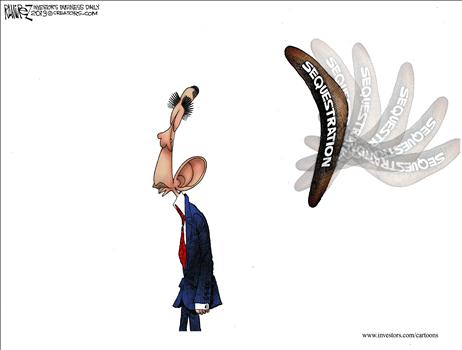
Obama Sequester Boomerang CartoonBut he miscalculated in thinking that the fiscal cliff tax hike somehow meant that he had permanently neutered the GOP, and he definitely goofed when he tried to use the sequester as a weapon to bully Republicans into another tax hike.

Ignoring the President’s hyperbole about the supposed catastrophic effects of a very modest reduction in the growth of the federal budget, Republicans have held firm.

And the President has suffered a painful political and policy defeat.

Here’s some of what was reported in The Hill about the President’s attitude.

The first months of President Obama’s second term are being built around a simple premise: No caving. …Obama is in an ultra-assertive mood, practically daring Republicans to defy his wishes. …Obama’s attitude is more akin to that of a general leading his forces into battle, confident that he can decimate the enemy. …On the sequester, for instance, Obama did little more than pay lip-service to the idea of a last-minute compromise to avert the package of cuts.

Well, Republicans did “defy his wishes” and it’s the worst possible outcome for the President. The growth of spending is being slowed and taxes are not going up.

Democrats on Capitol Hill also thought that the fiscal cliff tax hike would be a precedent for lots of future tax hikes. As reported by Politico, their analysis was misguided.

Democrats toasted the New Year’s fiscal cliff deal with the belief that they had set a crucial new precedent: Tax hikes would be part of any future deficit reduction package. Two months later, the champagne buzz is wearing off. …the exuberance expressed by many Democrats at the beginning of the year was misplaced. Efforts to avert the sequester never achieved liftoff, and Democrats are realizing that new tax revenues are off the table for the immediate future. …“We’ve tried everything we can,” Senate Majority Leader Harry Reid (D-Nev.) told reporters Thursday. “They will not budge on anything dealing with revenue.”

Byron York has the best analysis, explaining in his Washington Examiner column that Obama gambled and (at least so far) lost.

Nine months ago, Barack Obama likened his Republican opposition to an illness. If he could just defeat Mitt Romney, Obama said, then the illness might subside. “I believe that if we’re successful in this election — when we’re successful in this election — that the fever may break,” Obama told a fundraiser in Minneapolis last June. After Obama won re-election, there was extensive discussion among his supporters about whether the Republican “fever” would, in fact, break.

But this strategy appears to have boomeranged. Byron thinks that the White House is now in a weak position.

There was little speculation about whether something quite different might happen: Would determined GOP opposition break Obama’s fever?  That is, could Republicans weaken the president’s resolve to defeat the GOP and further raise taxes? That appears to be what has occurred, at least for the moment. …Friday morning, Obama seemed resigned to the possibility that he cannot win the further tax increases he seeks, and that after enlisting his entire administration in a campaign to frighten Americans about sequestration, the cuts have become a reality that he has to acknowledge.

While I’m glad the President goofed, I’m not under any illusion that winning a battle is the same thing as winning a war.

It’s quite possible that the modest sequester savings will be undone as part of the “continuing resolution” legislation to fund the federal government between March 27 and the rest of the fiscal year.

There will also be a debt limit fight later in the Spring, which will give proponents of bigger government another bite at the apple (though it’s a double-edged sword since advocates of limited government also can use the debt limit as a vehicle for reform).

And the President obviously won’t give up on his campaign for higher taxes. I worry that he’ll trick gullible GOPers into a tax hike at some point, either as part of a Trojan Horse tax reform or as part of a budget summit that produces something like Bowles-Simposon, a package of real tax hikes and illusory entitlement reforms.

But we can fight those battles down the road. Today, let’s enjoy the sweet smell of victory.

_______________________

Thank you so much for your time. I know how valuable it is. I also appreciate the fine family that you have and your commitment as a father and a husband.

Sincerely,

Everette Hatcher III, 13900 Cottontail Lane, Alexander, AR 72002, ph 501-920-5733, lowcostsqueegees@yahoo.com

Dec 2013 Budget Deal: Chris Edwards, “How could a deal composed of spending and revenue increases possibly be the right direction when the government is already far too large?”

Should Congress approve the budget compromise?(Includes
Romina Boccia of the Heritage Foundation)

Published on Dec 11, 2013

Avoiding provisions that sharply divide the two parties, budget negotiators reached a deal to fund the government for two years. Kwame Holman reports on reaction to the deal. Judy Woodruff talks to Steven Rattner of Willett Advisors, Douglas Holtz-Eakin of the American Action Forum and Romina Boccia of the Heritage Foundation.

Bipartisan Budget Deal

I am so sad about the Republicans caving in and letting President Obama and the Democrats get rid of the Sequester spending cap limits!!!! I have contacted my Representatives and Senators and told them what I wanted them to do. I am happy to report that Tom Cotton and Rick Crawford voted in the House to keep the Sequester limits. I AM SO PROUD OF THEM!!!!!

Dec 2013 Budget Deal: Chris Edwards, “How could a deal composed of spending and revenue increases possibly be the right direction when the government is already far too large?”

December 16, 2013 12:31PM

Even More on Ryan-Murray Budget Deal

In the Wall Street Journal, Peggy Noonan calls the Ryan-Murray budget deal a “step in the right direction,” which echoes a claim by Rep. Paul Ryan. She says the deal “goes in the right general direction, not the wrong one.”

But how could a deal composed of spending and revenue increases possibly be the right direction when the government is already far too large? Noonan points to savings from “a little entitlement reform” that will “compound in the outyears.” She seems to be referring to planned health care provider cuts in 2022 and 2023, but those tiny trims are purely smoke and mirrors.

Noonan says “the deal breaks the caps for discretionary spending but fortunately leaves most of the sequester intact.” But that is not true for 2014, which is the only year that matters in a discretionary spending deal since appropriations is an annual process. Indeed, this deal proves that Congress can’t be trusted on caps or other sorts of promises for future discretionary spending restraint.

Before this deal, 2014 discretionary spending was to be sequestered $20 billion and capped at $967 billion. I had thought that GOP leaders would perhaps agree to put aside the $20 billion cut in exchange for some actual entitlement reforms. But the deal hikes 2014 spending to $1.012 trillion, or $45 billion above the current law amount. That’s not “moderate progress” as Noonan says, but a total GOP cave-in.

Noonan calls the deal a “confidence-building measure” that could “encourage both parties toward bigger agreements, such as tax reform.” In fact, approval of this tax-and-spending deal will blow the trust of fiscal conservatives that GOP leaders could negotiate any reasonable deal with Democrats on bigger issues such as tax reform. Rather than build confidence, this deal will undermine the confidence of conservative voters that Republican leaders are on their side. Sadly, this deal shows that today’s GOP leaders would probably be taken to the cleaners by the Democrats on a major tax or entitlement reform deal.

Other observations on this bad deal are here and here.

Related posts:


THE NEW BUDGET DEAL OF DEC 2013 IS: Promises of fictitious spending now instead of real spending caps!!!

House, Senate Budget chairs reach deal to preempt another gov t shutdown Paul Ryan has been fighting for sequestration for years(1 yr ago) _____________________________ THE NEW BUDGET DEAL OF DEC 2013 IS: Promises of fictitious spending now instead of real spending caps!!! 3 Things You Need to Know About the Congressional Budget Deal Romina Boccia […]

We got to cut spending increases like the Sequester was doing in order to control government spending!!!

House, Senate Budget chairs reach deal to preempt another gov t shutdown Paul Ryan has been fighting for sequestration for years(1 yr ago) _____________________________ We got to cut spending increases like the Sequester was doing in order to control government spending!!! The budget deal is a huge Republican cave-in Republicans in Congress have put in […]

The Sequester works so why are the Republicans giving it up?

____ I POURED MY HEART OUT IN AN EMAIL TO SENATOR BOOZMAN THE OTHER DAY AND THEN SENT THAT EMAIL TO 30 SENATORS AND REPRESENTATIVES ALL OVER THE USA!!! HERE I GO AGAIN. This is very much the same case as raising the debt ceiling in my view. It seems that the Republicans keep allowing […]

If you really want to cut the growth of government spending then keep the sequester in place!!!

______ If you really want to cut the growth of government spending then keep the sequester in place!!! December 9, 2013 11:01AM Budget Deal: A Dangerous Precedent By Chris Edwards Share Republican and Democratic negotiators are expected to agree to a budget deal this week setting spending levels for 2014. The Washington Post says that […]

Letter to Senator John Boozman about Sequester Negotiations (PLEASE KEEP SEQUESTER!!!!)

________________________ Senator John Boozman, 320 Hart Senate Office Building Washington, DC 20510 Phone: (202) 224-4843 Fax: (202) 228-1371 Dear Senator Boozman, I want to thank you for taking the time out of your busy day to respond to my earlier letter to you on this same subject. I have always TRIED TO CONTACT THE REPRESENTATIVES AND SENATORS ABOUT THEIR RESPONSIBILITY […]

The Sequester actually did help control the growth of government and hopefully we can cut deeper this time around!!!

The Sequester actually did help control the growth of government and hopefully we can cut deeper this time around!!! Government Shutdown Jokes…and the Sick Joke of Obama’s Shutdown Strategy October 8, 2013 by Dan Mitchell Even though it’s an uphill battle, I’m glad there are some lawmakers willing to fight Obamacare. They realize a hard battle […]

We need deeper cuts than the Sequester!!! (Cartoons included)

What Can Washington Politicians Learn From America’s Moms? Published on Apr 2, 2013 We asked folks what Washington politicians can learn from America’s moms ___________________ We need deeper cuts than the Sequester!!! Below are some very funny cartoons from Dan Mitchell’s blog on the Sequester. Sequestration “Meat Cleaver” Is Really a Scalpel Danny Huizinga July 26, […]

Obama acts like the Sequester cuts would bring the world to an end!!!

When Governments Cut Spending Uploaded on Sep 28, 2011 Do governments ever cut spending? According to Dr. Stephen Davies, there are historical examples of government spending cuts in Canada, New Zealand, Sweden, and America. In these cases, despite popular belief, the government spending cuts did not cause economic stagnation. In fact, the spending cuts often […]

Sequester did not hurt job growth!!!!!

If you blame the Sequester for blaming job growth then you don’t have a good grasp on economics. The Overlooked Jobs Tragedy April 9, 2013 by Dan Mitchell When the monthly job numbers are released, most people focus on the unemployment rate. On many occasions, I’ve cited that number, usually to point out that the unemployment […]

Sequester not so bad after all (includes cartoons)

I have put up lots of cartoons from Dan Mitchell’s blog before and they have got lots of hits before. Many of them have dealt with the economy, eternal unemployment benefits, socialism,  Greece,  welfare state or on gun control. Sequester was not so bad after all. Since the Sequester Has Been in Place for More than One […]

Another funny sequester cartoon from Dan Mitchell’s blog

I have put up lots of cartoons from Dan Mitchell’s blog before and they have got lots of hits before. Many of them have dealt with the economy, eternal unemployment benefits, socialism,  Greece,  welfare state or on gun control. As Humorously Explained by Henry Payne, the World Amazingly Didn’t End When Uncle Sam Got Put on a […]

By Everette Hatcher III | Posted in Cato Institute, Economist Dan Mitchell | Edit | Comments (0)

Open letter to President Obama (Part 488) (Between 1988 and 2011, the amount of the U.S. population that receives assistance from the federal government grew by 62 percent, includes cartoon)

Open letter to President Obama (Part 488)

(Emailed to White House on 4-9-13.)

President Obama c/o The White House 1600 Pennsylvania Avenue NW Washington, DC 20500

Dear Mr. President,

I know that you receive 20,000 letters a day and that you actually read 10 of them every day. I really do respect you for trying to get a pulse on what is going on out here.

___________

Big government will destroy the human spirit. We got to cut spending in the federal government Mr. President!!!!

After the poll I shared the other day, this cartoon seems appropriate.

Maybe the better lesson to be learned, thought, isn’t that we should fear big government (though we should, as this t-shirt makes clear), but that statism destroys the human spirit.

If we don’t have entitlement reform soon then we will see the programs go bankrupt in the next couple of decades. Here is a first step that we can take below. Watch this great video below:

Social Security vs. Private Retirement

Is Social Security a good retirement plan? Economics professor Antony Davies shows that Americans stand to earn significantly less and assume more risk with Social Security than other investment options. According to Davies, taxpayers would be better off both in terms of financial security and return on investment by investing their money privately. Social security is extremely expensive, soon to be insolvent, and doesn’t even offer taxpayers the most bang for their buck. For those reasons, Prof. Davies argues that it is time for the government to phase out Social Security. Davies’ solution: the government should honor its obligations to current retirees while giving Americans the freedom to invest their money as they see fit.

_____________________________

U.S. Government Increases National Debt—and Keeps 128 Million People on Government Programs

By and
January 8, 2013

Abstract: Between 1988 and 2011, the amount of the U.S. population that receives assistance from the federal government grew by 62 percent. That means that more than 41 percent of the U.S. population is enrolled in at least one federal assistance program. To make matters worse, per capita expenditures on recipients are rising as well. In 2010, over 70 percent of all federal spending went to dependence-creating programs. That growth is unsustainable, as baby boomers are now retiring every day and their entitlements cost more each year. The publicly held federal debt will exceed 100 percent of GDP in 2024. Such a high level of debt always hurts an economy—and the people who live in it. The time for Congress to reform dependence-creating government programs is now.

The number of people receiving benefits from the federal government in the United States has grown from under 94 million people in 2000 to more than 128 million people in 2011. That means that 41.3 percent of the U.S. population is now on a federal government program. The 128 million is an estimate based on the recently released March 2011 U.S. Census Bureau Current Population Survey (CPS), which, due to the survey methodology, most likely undercounts the actual number.

Heritage Foundation calculations using the March 2011 CPS found the number of people who receive assistance from at least one federal program to be 128.8 million. Using the Census Bureau number for the U.S. population in July 2011, which was 311,591,917, at least 41.34 percent are federal government program beneficiaries.[1] While very few Americans would deny that the federal government should play a role in aiding those in need, this number doubtless qualifies as far too large, indicating that taxpayer dollars are going to those not in need as well.

Many of those who receive benefits from the federal government could live well without them, so they do not count as truly dependent on the federal government.[2] Warren Buffett is the beneficiary of a federal program—Social Security—but, since he does not rely on that income for his livelihood, he should not be considered dependent on government programs. Others depend on the programs for nearly all of their income, housing, health care, food, and other needs and so fall under the classification of truly dependent on the government. Still others are somewhere in between, depending on government financing for, say, college, but little else. Consequently, it is important to note that stating that 128.8 million people receive benefits from a government program does not mean that all of them are dependent on the government.

The Numbers

In the CPS, the Census Bureau surveys thousands of U.S. citizens and non-citizens living in the U.S. in randomly drawn monthly phone surveys. Together, the roughly 60,000 households surveyed are a representative cross section of the U.S. population. While the CPS is conducted each month, the March survey has the most detailed questions. Only the March CPS survey format contains a sufficient level of detail to count federal government program participants.

The responses to the March 2011 CPS have now been released, and these individual responses were sorted for this report. All of the data were examined for responses by individuals who answered affirmatively that they were receiving benefits at the time of the survey. Based on their responses, Heritage created a new dataset from those who responded that they receive financial or in-kind benefits from at least one government program. By counting the individuals in that dataset, and using a weight assigned by the Census Bureau to each individual, the weighted number of people who depend on government programs was found.

The new dataset of people on government programs can then be further sorted to find out how many people say they are on a particular program. Here are some of the resulting numbers:

  • 128,818,142 people are enrolled in at least one government program.
  • 48,580,105 people are on Medicaid.
  • 35,770,301 people receive their retirement income from Social Security.
  • 43,834,566 people are on Medicare.
  • 39,030,579 people are living in a household where at least one person accepts food stamps.
  • 6,984,783 people are living in subsidized rental housing.
  • 2,047,149 people are receiving a higher-education subsidy.

It is important to note that the above categories overlap; for example an individual may receive both subsidized rental housing and food stamps. The total number—128,818,142 people on at least one government program does not double count individuals, however.

The 128,818,142 figure for people enrolled in at least one program is surely an undercount: The CPS responses are well known to undercount those receiving Medicaid, Medicare, Social Security, State Children’s Health Insurance, higher-education support, and Temporary Assistance for Needy Families.[3]

The undercount in higher-education subsidies may be the most important, because recipients of education subsidies are generally younger and not likely to be enrolled in other programs. Sorting the March 2011 CPS data shows that, of the two million people in the survey who responded that they receive higher-education subsidies, fewer than one half of 1 percent relied on Social Security retirement income; only 1.5 percent were also on Medicare; and only 16 percent received food stamps. The 2 million people who stated they receive higher-education subsidies are assuredly much fewer than the actual number, since the number of people receiving Pell Grants alone in 2011 was 9.7 million.[4] It is not known why the undercount in education subsidies is so large, but it is likely related to the weights the CPS uses to represent college students. Therefore, even counting only Pell Grant recipients would add millions to the lowball estimate of 128.8 million total people who receive assistance from a government program.

Housing subsidies are also most likely undercounted. According to the March 2011 CPS, only 6,984,783 individuals live in subsidized rental housing. Other government data puts the number at 4,952,191 households in 2010, not individuals.[5] Again, the weights used in the survey may contribute to the shortfall.

Growth in Number of People on Government Programs Over Time

The rate of growth in the number of people who are enrolled in a federal program far outpaces general population growth. (See chart.) In fact, an analysis of the March 2011 CPS responses going back to 1988 reveals that the number in March 2011 (128,818,142) is 62 percent higher than it was in March 1988 (79,592,924). Meanwhile, the U.S. population has grown only 27 percent since that year. In other words, the number of people who are enrolled in at least one federal program has grown more than two times faster than has the U.S. population. That growth is unsustainable as baby boomers are now retiring every day, and their entitlements cost more each year. The publicly held federal debt will exceed 100 percent of gross domestic product (GDP) by 2024.[6] Such a high level of debt always slows an economy.[7] One need look no further than the current situations in Greece, Italy, or Spain to see what high levels of national debt do to a country’s economic health. The European Union now faces a recession because of the debt its members owe. Shrinking economies are bad for everyone who lives in them, but they especially hurt the young, who have much higher rates of unemployment than older workers.[8] Shrinking economies make it even harder for young workers to find jobs. Their very futures are the ones in peril because of that debt.

While the number of people on a federal program has grown too fast, the average amount spent per capita has greatly outpaced even that level. (See chart.) The Heritage Foundation’s Index of Dependence on Government has been released annually since 2002. It tracks the amount of money that is spent on federal-assistance programs.[9] The data is in constant 2005 dollars, meaning that the amount spent increases or decreases due to government policies, not inflation. Between 1988 and 2011, spending on dependence-creating federal government programs has increased 180 percent.[10] versus “only” a 62 percent increase in the number of people who are enrolled in federal government programs, and a 27 percent increase in the population. Not only are more people enrolled in government programs than ever before, but more U.S. taxpayer dollars are being spent on each recipient every year.

What the Numbers Mean

What these alarming numbers mean is that a large proportion of the people in the United States have two kinds of income: (1) money that they or their family have earned, and (2) money transferred to them from U.S. taxpayers through the vehicle of a federal government program. Those consuming the second kind count for over 128.8 million individuals—41.3 percent of the population. According to Wall Street Journal research, when counting the number of people who live in a household where at least one person is on a government program, the dangerous tipping point of half of all Americans is nearly reached.[11] at 49.1 percent.

If one person in a household receives federal assistance, it is often the case that all members of that household do. This is certainly the case for food stamps: If a family shares meals and one of the relatives accepts food stamps, all members of that household are using those food stamps for part of their food.[12] If one person in a household receives a rent subsidy, everyone who lives in the home is a recipient.

The Clock is Ticking

The time to reform dependence-creating government programs is now. In 2010, over 70 percent of all federal spending went to dependence-creating programs.[13] It went to subsidize the living expenses of over 128.8 million individuals in the U.S. in 2011, which was more than 41 percent of the U.S. population. When the percentage of those living in a household where at least one person is subsidized is calculated, the number tops 49 percent. The problem is too much government subsidizing, and too much transfer of wealth from taxpayers to those who pay fewer and fewer taxes. After all, government does not create wealth by spreading it around.

Congress would do well to remember that there are no free subsidies and benefits. The government today is borrowing from future taxpayers to pay the current government program enrollees. The game will soon be up as debt approaches 100 percent of GDP. The United States should not owe 100 percent of all the goods and services produced in a year to its debtors. It is time for across-the-board entitlement reform so that the red ink does not drown America’s babies as they grow older and seek out their vision of the American dream. It is time for elected officials to restore America’s future for kids today who deserve to live in the great land of opportunity that America has been for the generations that came before them—instead of being bound to pay off a mountain of debt that they had no part in creating and that they should not have to face.[14]

Patrick D. Tyrrell is Research Coordinator in the Center for Data Analysis, and William W. Beach is Director of the Center for Data Analysis, and Lazof Family Fellow in Economics, at The Heritage Foundation.


___________________

Thank you so much for your time. I know how valuable it is. I also appreciate the fine family that you have and your commitment as a father and a husband.

Sincerely,

Everette Hatcher III, 13900 Cottontail Lane, Alexander, AR 72002, ph 501-920-5733, lowcostsqueegees@yahoo.com

“How to Cure Inflation” in Milton Friedman’s FREE TO CHOOSE Part 1 of 7 Taxation without representation: Getting knocked up to higher tax brackets because of inflation!!!!

In 1980 I read the book FREE TO CHOOSE by Milton Friedman and it really enlightened me a tremendous amount.  I suggest checking out these episodes and transcripts of Milton Friedman’s film series FREE TO CHOOSE: “The Failure of Socialism” and “What is wrong with our schools?”  and “Created Equal”  and  From Cradle to Grave, and – Power of the Market.“If we could just stop the printing presses, we would stop inflation,” Milton Friedman says in “How to Cure Inflation” from the Free To Choose series. Now as then, there is only one cause of inflation, and that is when governments print too much money. Milton explains why it is that politicians like inflation, and why wage and price controls are not solutions to the problem.

In this episode Friedman talks about taxation without representation: Getting knocked up to higher tax brackets because of inflation!!!!

Videos are good, Fw: Vol 9 How to cure inflation FREE TO CHOOSE Episode 9 Videos and transcripts

http://www.freetochoosemedia.org/freetochoose/detail_ftc1980_transcript.php?page=9

While many people have a fairly good grasp of what inflation is, few really understand its fundamental cause. There are many popular scapegoats: labor unions, big business, spendthrift consumers, greed, and international forces. Dr. Friedman explains that the actual cause is a government that has exclusive control of the money supply. Friedman says that the solution to inflation is well known among those who have the power to stop it: simply slow down the rate at which new money is printed. But government is one of the primary beneficiaries of inflation. By inflating the currency, tax revenues rise as families are pushed into higher income tax brackets. Thus, inflation transfers wealth and resources from the private to the public sector. In short, inflation is attractive to government because it is a way of increasing taxes without having to pass new legislation to raise tax rates. Inflation is in fact taxation without representation. Wage and price controls are not the cure for inflation because they treat only the symptom (rising prices) and not the disease (monetary expansion). History records that such controls do not work; instead, they have perverse effects on both prices and economic growth and undermine the fundamental productivity of the economy. There is only one cure for inflation: slow the printing presses. But the cure produces the painful side effects of a temporary increase in unemployment and reduced economic growth. It takes considerable political courage to undergo the cure. Friedman cites the example of Japan, which successfully underwent the cure in the mid-seventies but took five years to squeeze inflation out of the system. Inflation is a social disease that has the potential for destroying a free society if it is unchecked. Prolonged inflation undermines belief in the basic equity of the free market system because it tends to destroy the link between effort and reward. And it tears the social fabric because it divides society into winners and losers and sets group against group.http://www.youtube.com/watch?v=b1dTWDNKH3c

Volume 9 How to Cure Inflation

Transcript:
Friedman: The Sierra Nevada’s in California 10,000 feet above sea level, in the winter temperatures drop to 40 below zero, in the summer the place bakes in the thin mountain air. In this unlikely spot the town of Body sprang up. In its day Body was filled with prostitutes, drunkards and gamblers part of a colorful history of the American West.
A century ago, this was a town of 10,000 people. What brought them here? Gold. If this were real gold, people would be scrambling for it. The series of gold strikes throughout the West brought people from all over the world, all kinds of people. They came here for one purpose and one purpose only, to strike it rich, quick. But in the process, they built towns, cities, in places where nobody would otherwise have dreamed of building a city. Gold built these cities and when the gold was exhausted, the cities collapsed and became ghost towns. Many of the people who came here ended up the way they began, broke and unhappy. But a few struck it rich. For them, gold was real wealth. But was it for the world as a whole. People couldn’t eat the gold, they couldn’t wear the gold, they couldn’t live in houses made of gold. Because there was more gold, they had to pay a little more gold to buy goods and services. The prices of things in terms of gold went up.
At tremendous cost, at sacrifice of lives, people dug gold out of the bowels of the earth. What happened to that gold? Eventually, at long last, it was transported to distant places only to be buried again under the ground. This time in the vaults of banks throughout the world. There is hardly anything that hasn’t been used for money; rock salt in Ethiopia, brass rings in West Africa, Calgary shells in Uganda, even a toy cannon. Anything can be used as money. Crocodile money in Malaysia, absurd isn’t it?
That beleaguered minority of the population that still smokes may recognize this stuff as the raw material from which their cigarettes are made. But in the early days of the colonies, long before the U.S. was established, this was money. It was the common money of Virginia, Maryland and the Carolinas. It was used for all sorts of things. The legislature voted that it could be used legally to pay taxes. It was used to buy food, clothing and housing. Indeed, one of the most interesting sites was to see the husky young fellows at that time, lug 100 pounds of it down to the docks to pay the costs of the passage of the beauteous young ladies who had come over from England to be their brides.
Now you know how money is. There’s a tendency for it to grow, for more and more of it to be produced and that’s what happened with this tobacco. As more tobacco was produced, there was more money. And as always when there’s more money, prices went up. Inflation. Indeed, at the very end of the process, prices were 40 times as high in terms of tobacco as they had been at the beginning of the process. And as always when inflation occurs, people complained. And as always, the legislature tried to do something. And as always, to very little avail. They prohibited certain classes of people from growing tobacco. They tried to reduce the total amount of tobacco grown, they required people to destroy part of their tobacco. But it did no good. Finally, many people took it into their own hands and they went around destroying other people’s tobacco fields. That was too much. Then they passed a law making it a capital offense, punishable by death, to destroy somebody else’s tobacco. Grecian’s Law, one of the oldest laws in economics, was well illustrated. That law says that cheap money drives out dear money and so it was with tobacco. Anybody who had a debt to pay, of course, tried to pay it in the worst quality of tobacco he had. He saved the good tobacco to sell overseas for hard money. The result was that bad money drove out good money.
Finally, almost a century after they had started using tobacco as money, they established warehouses in which tobacco was deposited in barrels, certified by an inspector according to his views as to it’s quality and quantity. And they issued warehouse certificates which people gave from one to another to pay for the bills that they accumulated.
These pieces of green printed paper are today’s counterparts of those tobacco certificates. Except that they bear no relation to any commodity. In this program I want to take you to Britain to see how inflation weakens the social fabric of society. Then to Tokyo, where the Japanese have the courage to cure inflation. To Berlin, where there is a lesson to be learned from the West Germans and how so called cures are often worse than the disease. And to Washington where our government keeps these machines working overtime. And I am going to show you how inflation can be cured.
The fact is that most people enjoy the early stages of the inflationary process. Britain, in the swinging 60’s, there was plenty of money around, business was brisk, jobs were plentiful and prices had not yet taken off. Everybody seemed happy at first. But by the early 70’s, as the good times rolled along, prices started to rise more and more rapidly. Soon, some of these people are going to lose their jobs. The party was coming to an end.
The story is much the same in the U.S. Only the process started a little later. We’ve had one inflationary party after another. Yet we still can’t seem to avoid them. How come?
Before every election our representatives would like to make us think we are getting a tax break. When they are able to do it, while at the same time actually raising our taxes because of a bit of magic they have in their kit bag. That magic is inflation. They reduced the tax rates but the taxes we have to pay go up because we are automatically shoved into higher brackets by the effective inflation. A neat trick. Taxation without representation.

Related posts:

“The Power of the Market” episode of Free to Choose in 1990 by Milton Friedman (Part 1)

Milton Friedman The Power of the Market 1-5 How can we have personal freedom without economic freedom? That is why I don’t understand why socialists who value individual freedoms want to take away our economic freedoms.  I wanted to share this info below with you from Milton Friedman who has influenced me greatly over the […]

“Friedman Friday,” EPISODE “The Failure of Socialism” of Free to Choose in 1990 by Milton Friedman (Part 1)

Milton Friedman: Free To Choose – The Failure Of Socialism With Ronald Reagan (Full) Published on Mar 19, 2012 by NoNationalityNeeded Milton Friedman’s writings affected me greatly when I first discovered them and I wanted to share with you. We must not head down the path of socialism like Greece has done. Abstract: Ronald Reagan […]

________________

“Friedman Friday” (“Free to Choose” episode 3 – Anatomy of a Crisis. part 3 of 7)

Worse still, America’s depression was to become worldwide because of what lies behind these doors. This is the vault of the Federal Reserve Bank of New York. Inside is the largest horde of gold in the world. Because the world was on a gold standard in 1929, these vaults, where the U.S. gold was stored, […]

“Friedman Friday” (Part 16) (“Free to Choose” episode 3 – Anatomy of a Crisis. part 2 of 7)

  George Eccles: Well, then we called all our employees together. And we told them to be at the bank at their place at 8:00 a.m. and just act as if nothing was happening, just have a smile on their face, if they could, and me too. And we have four savings windows and we […]

“Friedman Friday” (“Free to Choose” episode 3 – Anatomy of a Crisis. part 1of 7)

Milton Friedman’s Free to Choose (1980), episode 3 – Anatomy of a Crisis. part 1 FREE TO CHOOSE: Anatomy of Crisis Friedman Delancy Street in New York’s lower east side, hardly one of the city’s best known sites, yet what happened in this street nearly 50 years ago continues to effect all of us today. […]

By Everette Hatcher III | Also posted in Current Events | Edit | Comments (0)

____________________________

_____________


________________________________________________

_____________________________________________

Friedman Friday” Free to Choose by Milton Friedman: Episode “What is wrong with our schools?” (Part 3 of transcript and video)

Friedman Friday” Free to Choose by Milton Friedman: Episode “What is wrong with our schools?” (Part 3 of transcript and video) Here is the video clip and transcript of the film series FREE TO CHOOSE episode “What is wrong with our schools?” Part 3 of 6.   Volume 6 – What’s Wrong with our Schools Transcript: If it […]

Friedman Friday” Free to Choose by Milton Friedman: Episode “What is wrong with our schools?” (Part 2 of transcript and video)

Here is the video clip and transcript of the film series FREE TO CHOOSE episode “What is wrong with our schools?” Part 2 of 6.   Volume 6 – What’s Wrong with our Schools Transcript: Groups of concerned parents and teachers decided to do something about it. They used private funds to take over empty stores and they […]

By Everette Hatcher III | Also posted in Vouchers | Edit | Comments (1)

Friedman Friday” Free to Choose by Milton Friedman: Episode “What is wrong with our schools?” (Part 1 of transcript and video)

Here is the video clip and transcript of the film series FREE TO CHOOSE episode “What is wrong with our schools?” Part 1 of 6.   Volume 6 – What’s Wrong with our Schools Transcript: Friedman: These youngsters are beginning another day at one of America’s public schools, Hyde Park High School in Boston. What happens when […]

By Everette Hatcher III | Also posted in Vouchers | Tagged , , , , | Edit | Comments (0)

Friedman Friday” Free to Choose by Milton Friedman: Episode “Created Equal” (Part 3 of transcript and video)

Friedman Friday” Free to Choose by Milton Friedman: Episode “Created Equal” (Part 3 of transcript and video) Liberals like President Obama want to shoot for an equality of outcome. That system does not work. In fact, our free society allows for the closest gap between the wealthy and the poor. Unlike other countries where free enterprise and other […]

Free to Choose by Milton Friedman: Episode “Created Equal” (Part 2 of transcript and video)

Free to Choose by Milton Friedman: Episode “Created Equal” (Part 2 of transcript and video) Liberals like President Obama want to shoot for an equality of outcome. That system does not work. In fact, our free society allows for the closest gap between the wealthy and the poor. Unlike other countries where free enterprise and other freedoms are […]

Free to Choose by Milton Friedman: Episode “Created Equal” (Part 1 of transcript and video)

 Milton Friedman and Ronald Reagan Liberals like President Obama (and John Brummett) want to shoot for an equality of outcome. That system does not work. In fact, our free society allows for the closest gap between the wealthy and the poor. Unlike other countries where free enterprise and other freedoms are not present.  This is a seven part series. […]

Milton Friedman Friday: (“Free to Choose” episode 4 – From Cradle to Grave, Part 3 of 7)

 I am currently going through his film series “Free to Choose” which is one the most powerful film series I have ever seen. PART 3 OF 7 Worse still, America’s depression was to become worldwide because of what lies behind these doors. This is the vault of the Federal Reserve Bank of New York. Inside […]

By Everette Hatcher III | Edit | Comments (0)

Milton Friedman Friday:(“Free to Choose” episode 4 – From Cradle to Grave, Part 2 of 7)

 I am currently going through his film series “Free to Choose” which is one the most powerful film series I have ever seen. For the past 7 years Maureen Ramsey has had to buy food and clothes for her family out of a government handout. For the whole of that time, her husband, Steve, hasn’t […]

Friedman Friday:(“Free to Choose” episode 4 – From Cradle to Grave, Part 1 of 7)

Friedman Friday:(“Free to Choose” episode 4 – From Cradle to Grave, Part 1 of 7) Volume 4 – From Cradle to Grave Abstract: Since the Depression years of the 1930s, there has been almost continuous expansion of governmental efforts to provide for people’s welfare. First, there was a tremendous expansion of public works. The Social Security Act […]

By Everette Hatcher III | Edit | Comments (0)

“Friedman Friday” (“Free to Choose” episode 1 – Power of the Market. part 3 of 7)

  _________________________   Pt3  Nowadays there’s a considerable amount of traffic at this border. People cross a little more freely than they use to. Many people from Hong Kong trade in China and the market has helped bring the two countries closer together, but the barriers between them are still very real. On this side […]

“Friedman Friday” (“Free to Choose” episode 1 – Power of the Market. part 2 of 7)

  Aside from its harbor, the only other important resource of Hong Kong is people __ over 4_ million of them. Like America a century ago, Hong Kong in the past few decades has been a haven for people who sought the freedom to make the most of their own abilities. Many of them are […]

“Friedman Friday” (“Free to Choose” episode 1 – Power of the Market. part 1of 7)

“FREE TO CHOOSE” 1: The Power of the Market (Milton Friedman) Free to Choose ^ | 1980 | Milton Friedman Posted on Monday, July 17, 2006 4:20:46 PM by Choose Ye This Day FREE TO CHOOSE: The Power of the Market Friedman: Once all of this was a swamp, covered with forest. The Canarce Indians […]

By Everette Hatcher III | Posted in Current Events, Milton Friedman | Edit | Comments (0)

“Friedman Friday,” EPISODE “The Failure of Socialism” of Free to Choose in 1990 by Milton Friedman (Part 1)

Milton Friedman: Free To Choose – The Failure Of Socialism With Ronald Reagan (Full) Published on Mar 19, 2012 by NoNationalityNeeded Milton Friedman’s writings affected me greatly when I first discovered them and I wanted to share with you. We must not head down the path of socialism like Greece has done. Abstract: Ronald Reagan […]

By Everette Hatcher III | Posted in Milton FriedmanPresident Obama | Edit | Comments (1)