I have spent alot of time talking about Woody Allen films on this blog and looking at his worldview. He has a hopeless, meaningless, nihilistic worldview that believes we are going to turn to dust and there is no afterlife. Even though he has this view he has taken the opportunity to look at the weaknesses of his own secular view. I salute him for doing that. That is why I have returned to his work over and over and presented my own Christian worldview as an alternative.
Woody Allen has made many movies in his time, and still averages around one movie per year. Allen is a director you either love or hate – I happen to love his films – but I am sure this list will have some very extreme comments from both perspectives. This list compiles not only the obvious choices but also some not so obvious ones.
10
Small Time Crooks (2000) trailer
Woody Allen stars, along with Tracy Ullman, in this funny film about a husband and wife who try to steal money from a bank. They do this by buying a neighboring pizza place, and turning it into a cookie shop so they can tunnel under it and inside the bank. The plan gets shot down when people actually want to buy cookies from the fake shop. It’s a hilarious piece of work that has a good start, a weak middle and a strong ending.
Small Time Crooks 10
9
Deconstructing Harry
1997
In this film Woody Allen plays a writer who finds out he’s getting an award from his school and he decides he doesn’t wanna go alone. He takes along his best friend, a prostitute, and his son (against his ex-wife’s wishes). Also in the film we see characters from the stories he’s written come to life, such as Robin Williams as a literally out of focus man. Another hilarious moment is Billy Crystal as the devil. If this sounds as crazy as anything, it is.
8
Manhattan Murder Mystery
1993
This film stars Woody Allen and reunites him with long time co-star Diane Keaton. It also brings back Alan Alda who was previously in Crimes and Misdemeanors. In the film Woody Allen and Diane Keaton play a married couple who discover a murder, and decide to play detectives a la The Thin Man. It’s a brilliant piece of film because of its sense of realism, and the fact that it could happen in real life.
7
Zelig
1983
Zelig
Woody Allen makes a farce on documentaries in this film. He plays Leonard Zelig, a human chameleon who can blend into any background and is seen at many of the most historical events in history. This film also stars Mia Farrow as a psychiatrist who tries to cure him of his changing. It’s funny seeing Allen change face and form, and even language, as he morphs into whoever he’s around at the time.
6
Sleeper
1973
Sleeper (1973) – Trailer
In this hilarious film about the future, Woody Allen plays Miles Monroe, a jazz musician who is frozen and not defrosted until two hundred years in the future. He doesn’t know how to deal with it since everything has changed so much. He pretends to be a robot and kidnaps Luna, who is played by Diane Keaton, and they try to figure out how to destroy an evil dictator. It’s full of laughs and funny to see what a comedian’s idea of the future was like.
5
Everything You Always Wanted to Know About Sex
1972
The film was based on a book by Dr. David Reuben, published in 1969. The film is comprised of a series of sketches on the subject of sex, including Woody Allen as a court jester trying to seduce a queen and a cross dressing husband. It’s a real trip to watch.
4
Take the Money and Run
1969
WOODY ALLEN TAKE THE MONEY AND RUN CELLO MARCHING BAND SCENE
This movie is like Zelig in the sense that it’s another documentary style parody. Woody Allen plays an escaped convict who is trying to escape, for good, from the law. He meets a girl that he really likes and everything seems to work out, until he tries to rob a bank with terrible results (they can’t read his hold up note). It’s a humorous film that keeps the laughs going every second it can.
3
Bananas
1971
Bananas (1971) – Trailer
In this film Woody Allen plays a products tester for a large corporation who feels his life is going nowhere. Then he gets on the subway and is mangled by a young Sly Stallone, in his first major film appearance. However, he meets a female activist, played by Louise Lasser, and things start looking up. When they break up he takes a trip to a little country called San Marcos, where the revolutionaries decide to assassinate the ruler of the country. Eventually, Allen becomes ruler of San Marcos and goes back to the US after getting involved in what is one of the funniest courtroom scenes ever. There’s a great cameo by Howard Cosell and much much more.
2
Play it Again, Sam
1972
Play It Again, Sam trailer
Woody Allen and Diane Keaton supposedly met when they were auditioning for the play that this movie was based on, and they both found each other delighted by their sense of humor. If that is true then it’s no question why they ended up doing a film of the play in 1972. The premise is a very uncool man, played by Woody Allen, tries to emulate one of his great movie heroes, Humphrey Bogart, so he can meet women. To the extent that Bogart himself (played by Jerry Lacy) is giving him dating advice. He has a female friend (Linda) who is played by Diane Keaton, she is married to Dick who is played by Tony Roberts. He is a businessman who never pays any attention to his wife, and Woody Allen figures that he should be with Linda instead of him. The hilarity starts when Woody Allen’s character is set up on several dates which led to very humorous results. A real hilarious picture.
1
Annie Hall
1977
Annie Hall – Movie Trailer
Yes, this film has probably won the most awards, and received the most nominations so far of any of Woody Allen’s films. If you’ve seen it already, there’s no need to go into much details, but the basic story is about Woody Allen’s character, Alvy. Alvy happens to be a stand up comic, much like Allen himself who started in the same field, and his relationship with Annie Hall, played by Diane Keaton. It is one of his funniest films, and it has been parodied several times in tv shows and other media. One of my favorite scenes is when Woody is standing in line for a movie and a man who teaches film is behind him. He is trying to explain the plots and sub plots of director Marshall McLuhan’s films, and Allen actually brings him forth to speak to the guy, telling him that he knows nothing of his work and how he got to teach a course in anything is nothing short of amazing. If you haven’t seen this film go see it immediately, and if you don’t enjoy it the first time then wait a while and see it again, it will grow on you.
Manhattan
1979
This is probably the best known Woody Allen film on the list, and for that reason I have made it a bonus item instead of ranking it (where it would probably take top spot). If you have never seen a Woody Allen film, this is the one to see. Isaac (Allen), 42, has divorced Jill. She is now living with another woman, Connie, and is writing a book in which she will reveal some very private points of their relationship. Isaac has a love affair with Tracy, 17, when he meets Mary, the mistress of his best friend, Yale. This film features some stunning cinematography and really is worth the watch.
Related posts:
I love the movie “Midnight in Paris” by Woody Allen and I have done over 30 posts on the historical characters mentioned in the film. Take a look below:
I have spent alot of time talking about Woody Allen films on this blog and looking at his worldview. He has a hopeless, meaningless, nihilistic worldview that believes we are going to turn to dust and there is no afterlife. Even though he has this view he has taken the opportunity to look at the weaknesses of […]
I have spent alot of time talking about Woody Allen films on this blog and looking at his worldview. He has a hopeless, meaningless, nihilistic worldview that believes we are going to turn to dust and there is no afterlife. Even though he has this view he has taken the opportunity to look at the weaknesses of […]
Woody Allen video interview in France Related posts: “Woody Wednesdays” Woody Allen on God and Death June 6, 2012 – 6:00 am Good website on Woody Allen How can I believe in God when just last week I got my tongue caught in the roller of an electric typewriter? If Jesus Christ came back today and […]
I have spent alot of time talking about Woody Allen films on this blog and looking at his worldview. He has a hopeless, meaningless, nihilistic worldview that believes we are going to turn to dust and there is no afterlife. Even though he has this view he has taken the opportunity to look at the weaknesses of […]
A surprisingly civil discussion between evangelical Billy Graham and agnostic comedian Woody Allen. Skip to 2:00 in the video to hear Graham discuss premarital sex, to 4:30 to hear him respond to Allen’s question about the worst sin and to 7:55 for the comparison between accepting Christ and taking LSD. ___________________ The Christian Post > […]
Crimes and Misdemeanors: A Discussion: Part 1 If you like Woody Allen films as much as I do then join me every Wednesday for another look the man and his movies. Below are some of the posts from the past: “Woody Wednesday” How Allen’s film “Crimes and Misdemeanors makes the point that hell is necessary […]
I really enjoyed this documentary on Woody Allen from PBS. Woody Allen: A Documentary, Part 1 Published on Mar 26, 2012 by NewVideoDigital Beginning with Allen’s childhood and his first professional gigs as a teen – furnishing jokes for comics and publicists – WOODY ALLEN: A DOCUMENTARY chronicles the trajectory and longevity of Allen’s career: […]
Crimes and Misdemeanors: A Discussion: Part 3 Uploaded by camdiscussion on Sep 23, 2007 Part 3 of 3: ‘Is Woody Allen A Romantic Or A Realist?’ A discussion of Woody Allen’s 1989 movie, Crimes and Misdemeanors, perhaps his finest. By Anton Scamvougeras. http://camdiscussion.blogspot.com/antons@mail.ubc.ca ______________ One of my favorite Woody Allen movies and I reviewed […]
Crimes and Misdemeanors: A Discussion: Part 2 Uploaded by camdiscussion on Sep 23, 2007 Part 2 of 3: ‘What Does The Movie Tell Us About Ourselves?’ A discussion of Woody Allen’s 1989 movie, perhaps his finest. By Anton Scamvougeras. http://camdiscussion.blogspot.com/antons@mail.ubc.ca _________________- One of my favorite Woody Allen movies and I reviewed it earlier but […]
I have spent alot of time talking about Woody Allen films on this blog and looking at his worldview. He has a hopeless, meaningless, nihilistic worldview that believes we are going to turn to dust and there is no afterlife. Even though he has this view he has taken the opportunity to look at the weaknesses of […]
Crimes and Misdemeanors: A Discussion: Part 1 If you like Woody Allen films as much as I do then join me every Wednesday for another look the man and his movies. Below are some of the posts from the past: “Woody Wednesday” How Allen’s film “Crimes and Misdemeanors makes the point that hell is necessary […]
I have spent alot of time talking about Woody Allen films on this blog and looking at his worldview. He has a hopeless, meaningless, nihilistic worldview that believes we are going to turn to dust and there is no afterlife. Even though he has this view he has taken the opportunity to look at the weaknesses of […]
Crimes and Misdemeanors: A Discussion: Part 1 Uploaded by camdiscussion on Sep 23, 2007 Part 1 of 3: ‘What Does Judah Believe?’ A discussion of Woody Allen’s 1989 movie, perhaps his finest. By Anton Scamvougeras. http://camdiscussion.blogspot.com/antons@mail.ubc.ca _____________ One of my favorite films is this gem by Woody Allen “Crimes and Misdemeanors”: Film Review By […]
Crimes and Misdemeanors: A Discussion: Part 3 Uploaded by camdiscussion on Sep 23, 2007 Part 3 of 3: ‘Is Woody Allen A Romantic Or A Realist?’ A discussion of Woody Allen’s 1989 movie, Crimes and Misdemeanors, perhaps his finest. By Anton Scamvougeras. http://camdiscussion.blogspot.com/antons@mail.ubc.ca ______________ One of my favorite Woody Allen movies and I reviewed […]
Crimes and Misdemeanors: A Discussion: Part 2 Uploaded by camdiscussion on Sep 23, 2007 Part 2 of 3: ‘What Does The Movie Tell Us About Ourselves?’ A discussion of Woody Allen’s 1989 movie, perhaps his finest. By Anton Scamvougeras. http://camdiscussion.blogspot.com/antons@mail.ubc.ca _________________- One of my favorite Woody Allen movies and I reviewed it earlier but […]
Crimes and Misdemeanors: A Discussion: Part 1 Uploaded by camdiscussion on Sep 23, 2007 Part 1 of 3: ‘What Does Judah Believe?’ A discussion of Woody Allen’s 1989 movie, perhaps his finest. By Anton Scamvougeras. http://camdiscussion.blogspot.com/antons@mail.ubc.ca _____________ Today I am starting a discusssion of the movie “Crimes and Misdemeanors” by Woody Allen. This 1989 […]
In 1984 after the Democratic Primary, my girlfriend Jill Sawyer and I drove day to Fordyce, Arkansas and spent the day with Monroe Schwarzlose.
He was a lonely man, but he was extremely funny. He asked my future wife, Jill Sawyer, to marry him so she could be Arkansas’ first lady once he became governor. However, I was able to convince her not to take him up on that offer. Below is an article from Wikipedia on Monroe:
Schwarzlose ran as a Republican in 1974, a heavily Democratic year nationally, for a seat in the Arkansas House of Representatives from a district which then encompassed Dallas and Calhoun, and part of Cleveland counties in southern Arkansas. He was easily beaten by the Democrat Thomas Sparks of Fordyce, the seat of Dallas County.
In 1978, Schwarzlose polled 1 percent of the vote in the Democratic gubernatorial primary against then Attorney General Bill Clinton and three other rivals. He ran on a platform calling for legalized gambling and a state lottery. Schwarzlose said that gambling will continue to be practiced, and the state government should obtain a portion of the proceeds.
In 1980, Schwarzlose, at seventy-eight, became the focus of much anti-Clinton sentiment in Arkansas even though he was personally friendly with the young governor. Clinton’s voter appeal seemed to rest on his advocacy of utility reform, consumer protection, and environmental quality. Others were disturbed when Mrs. Clinton, the former Hillary Rodham, used her maiden name as an attorney in Little Rock. A retired military man, Billy Geren of Fayetteville, called Clinton a “draft dodger” in the Vietnam War. Others objected to Clinton’s embrace of a 30 percent hike in motor vehicle registration fees, a one-cent per gallon increase in motor fuel taxes, and a 20 percent boost in state aid to local school districts. Others felt even then that Clinton had presidential aspirations and had become bored with the job of governor of a small state. Yet, no prognosticators expected Clinton to be defeated by the politically unknown Frank White. Then troubles developed for Clinton involving Cuban refugees sent into Fort Smith by President Jimmy Carter.
Schwarzlose spent only $4,000, mostly for travel and for distributing home-canning recipes as campaign literature. The Arkansas Gazette called Schwarzlose “an engaging gentleman with good home-canning recipes and some fetching stories about turkey farming and bucolic life around his home in Kingsland.” Ernest Dumas, then the Gazette associate editor described Schwarzlose as a “quixotiic candidate” and a maverick using his own money and campaigning on the most undesirable platform planks and making the “most outrageous” promises. Schwarzlose, for instance, said that if he were elected governor in 1980, he would donate his farm to the Arkansas Sheriff‘s Association Boys and Girls Ranches for use as an orphanage. Dumas said of Schwarzlose that “even Hee Haw gets tiresome on the third rerun.”
Schwarzlose ran again for governor in the 1982 Democratic primary against Clinton, former Lieutenant Governor Joe Purcell, U.S. RepresentativeJim Guy Tucker, and State SenatorKim Hendren of Benton County. Clinton won the nomination in a runoff with Purcell, and Schwarzlose finished in fifth place. In 1986, Schwarzlose filed as a write-in candidate, when Clinton won the first of his two four-year terms. He would not finish the second term because of his election as U.S. President.
At the time of Schwarzlose’s death, Clinton said through a spokesman that he had first met Schwarzlose at a campaign event in 1978 in Lake Village, the seat of Chicot County in the heavily Democratic southeastern corner of the state. He last saw him in 1989 at the Veterans AdministrationHospital in Little Rock. Schwarzlose was a veteran of World War II. Clinton added that he “really enjoyed knowing him.”
Schwarzlose was Lutheran. He was survived by a daughter, Carol Johnson of Dayton, Ohio, and a grandchild. Schwarzlose was interred in the Zorn Cemetery in the Zorn community in Guadalupe County, Texas, near his family members.
Many in the world today are taking a long look at the abortion industry because of the May 14, 2013 guilty verdict and life term penalty handed down by a jury (which included 9 out of 12 pro-choice jurors) to Dr. Kermit Gosnell. During this time of reflection I wanted to put forth some of the pro-life’s best arguments.
I truly believe that many of the problems we have today in the USA are due to the advancement of humanism in the last few decades in our society. Ronald Reagan appointed the evangelical Dr. C. Everett Koop to the position of Surgeon General in his administration. He partnered with Dr. Francis Schaeffer in making the video below. It is very valuable information for Christians to have. Actually I have included a video below that includes comments from him on this subject.
Francis Schaeffer: “Whatever Happened to the Human Race” (Episode 1) ABORTION OF THE HUMAN RACE
The passerby tried to justify Dr. Gosnell’s brutal abortions. “It’s not murder.”
Refering to pregnant mothers, she said: “There’s nothing there until there’s love.”
TFP volunteer: “If it’s not murder, then what is it?”
Pro-abortion woman: “It’s like you’re weeding your garden.”
TFP: “Really? Do you kill the weeds?”
“You have to love. There’s not life until there’s love.”
On Monday, April 28, 2013, six TFP Student Action members travelled to downtown Philadelphia to campaign against abortion. The atmosphere was highly charged as the young men formed outside the Center for Criminal Justice, where final arguments in the murder trial of abortionist Kermit Gosnell were taking place. He is being charged with eights counts of murder.
Shortly after arriving and forming beside the main entrance of the court building, TFP members began praying the rosary in reparation for the sin of abortion. Many passersby frequented the busy streets around the courthouse, amid a light rain that persisted through the morning. Volunteers distributed the flyer St. Michael the Archangel and the Pro-Life Victory, showing the need for invoking the prince of the heavenly armies for victory in the fight against abortion. It wasn’t long before this firm condemnation of the sin of abortion was met with some vocal opposition.
Soon after beginning the rosary, two elderly women approached and began shouting insults. “It’s not murder! You men don’t ever have to have one!” This elicited the quick reply “Abortion is a sin, shame on you!”
As another woman passed reading the signs opposing abortion, she said in disgust, “It isn’t murder… it’s just like weeding your garden.” Following her questionable logic, a volunteer replied, “When you uproot the weeds from your garden, what do you do with them? You’re not transplanting them, you’re killing them.”
The negative reactions were counteracted by many supportive comments. A group of young women gave thumbs up as they crossed the intersection, one of whom shouted back, “That’s right, abortion is murder. I’m keeping my baby!”
Ending a Media Blackout
The controversial case of Kermit Gosnell received very little media coverage since beginning two months ago. On Friday, April 12, advocates of the unborn sought to end the media blackout by using the social networking site Twitter to openly challenge journalists and media outlets, alleging bias in not reporting one of the most horrific murder trials in living memory.
According to LifeSiteNews.com, 166,800 tweets using the #Gosnell hashtag were sent in a matter of 12 hours. This put overwhelming pressure on members of the media, which resulted in admissions of bias and oversight, and new attempts to bring the story to the public. The website whoisgosnell.com was set up to track the coverage of the story, while also showcasing a 20-minute documentary exposing what was dubbed Gosnell’s ‘house of horrors’.
An Offense Against God
As the morning changed to afternoon, TFP Student Action was joined by other abortion opponents for a prayer vigil outside the courthouse. Leaders in the fight for the unborn led the crowd in prayer, and gave prepared statements to the media. Many large signs and banners showed outrage over the crimes Gosnell perpetrated.
Consistent in opposing abortion, one TFP sign read: “Every abortion facility is a house of horrors that offends God!” Anyone who read it immediately reacted, some giving approval, others showing contempt, but the vast majority averting their eyes and choosing to ignore reality.
The campaign came to a close in mid-afternoon, all mindful that the outcome of the trial was still hanging in the balance. The six young men headed home, more determined than ever to continue legal and peaceful battle to end abortion. May St. Michael lead the way in this spiritual combat to bring about a pro-life victory in America and throughout the world.
Francis Schaeffer: “Whatever Happened to the Human Race” (Episode 1) ABORTION OF THE HUMAN RACE Published on Oct 6, 2012 by AdamMetropolis ________________ Picture of Francis Schaeffer and his wife Edith from the 1930′s above. I was sad to read about Edith passing away on Easter weekend in 2013. I wanted to pass along this fine […]
I have gone back and forth and back and forth with many liberals on the Arkansas Times Blog on many issues such as abortion, human rights, welfare, poverty, gun control and issues dealing with popular culture. Here is another exchange I had with them a while back. My username at the Ark Times Blog is Saline […]
I have gone back and forth and back and forth with many liberals on the Arkansas Times Blog on many issues such as abortion, human rights, welfare, poverty, gun control and issues dealing with popular culture. Here is another exchange I had with them a while back. My username at the Ark Times Blog is Saline […]
It is truly sad to me that liberals will lie in order to attack good Christian people like state senator Jason Rapert of Conway, Arkansas because he headed a group of pro-life senators that got a pro-life bill through the Arkansas State Senate the last week of January in 2013. I have gone back and […]
I have gone back and forth and back and forth with many liberals on the Arkansas Times Blog on many issues such as abortion, human rights, welfare, poverty, gun control and issues dealing with popular culture. Here is another exchange I had with them a while back. My username at the Ark Times Blog is Saline […]
I have gone back and forth and back and forth with many liberals on the Arkansas Times Blog on many issues such as abortion, human rights, welfare, poverty, gun control and issues dealing with popular culture. Here is another exchange I had with them a while back. My username at the Ark Times Blog is Saline […]
I have gone back and forth and back and forth with many liberals on the Arkansas Times Blog on many issues such as abortion, human rights, welfare, poverty, gun control and issues dealing with popular culture. Here is another exchange I had with them a while back. My username at the Ark Times Blog is Saline […]
Sometimes you can see evidences in someone’s life of how content they really are. I saw something like that on 2-8-13 when I confronted a blogger that goes by the name “AngryOldWoman” on the Arkansas Times Blog. See below. Leadership Crisis in America Published on Jul 11, 2012 Picture of Adrian Rogers above from 1970′s […]
In the film series “WHATEVER HAPPENED TO THE HUMAN RACE?” the arguments are presented against abortion (Episode 1), infanticide (Episode 2), euthenasia (Episode 3), and then there is a discussion of the Christian versus Humanist worldview concerning the issue of “the basis for human dignity” in Episode 4 and then in the last episode a close […]
I have gone back and forth and back and forth with many liberals on the Arkansas Times Blog on many issues such as abortion, human rights, welfare, poverty, gun control and issues dealing with popular culture. Here is another exchange I had with them a while back. My username at the Ark Times Blog is Saline […]
I have gone back and forth and back and forth with many liberals on the Arkansas Times Blog on many issues such as abortion, human rights, welfare, poverty, gun control and issues dealing with popular culture. Here is another exchange I had with them a while back. My username at the Ark Times Blog is Saline […]
I have gone back and forth and back and forth with many liberals on the Arkansas Times Blog on many issues such as abortion, human rights, welfare, poverty, gun control and issues dealing with popular culture. Here is another exchange I had with them a while back. My username at the Ark Times Blog is Saline […]
E P I S O D E 1 0 Dr. Francis Schaeffer – Episode X – Final Choices 27 min FINAL CHOICES I. Authoritarianism the Only Humanistic Social Option One man or an elite giving authoritative arbitrary absolutes. A. Society is sole absolute in absence of other absolutes. B. But society has to be […]
E P I S O D E 9 Dr. Francis Schaeffer – Episode IX – The Age of Personal Peace and Affluence 27 min T h e Age of Personal Peace and Afflunce I. By the Early 1960s People Were Bombarded From Every Side by Modern Man’s Humanistic Thought II. Modern Form of Humanistic Thought Leads […]
E P I S O D E 8 Dr. Francis Schaeffer – Episode VIII – The Age of Fragmentation 27 min I saw this film series in 1979 and it had a major impact on me. T h e Age of FRAGMENTATION I. Art As a Vehicle Of Modern Thought A. Impressionism (Monet, Renoir, Pissarro, Sisley, […]
E P I S O D E 7 Dr. Francis Schaeffer – Episode VII – The Age of Non Reason I am thrilled to get this film series with you. I saw it first in 1979 and it had such a big impact on me. Today’s episode is where we see modern humanist man act […]
E P I S O D E 6 How Should We Then Live 6#1 Uploaded by NoMirrorHDDHrorriMoN on Oct 3, 2011 How Should We Then Live? Episode 6 of 12 ________ I am sharing with you a film series that I saw in 1979. In this film Francis Schaeffer asserted that was a shift in […]
E P I S O D E 5 How Should We Then Live? Episode 5: The Revolutionary Age I was impacted by this film series by Francis Schaeffer back in the 1970′s and I wanted to share it with you. Francis Schaeffer noted, “Reformation Did Not Bring Perfection. But gradually on basis of biblical teaching there […]
Dr. Francis Schaeffer – Episode IV – The Reformation 27 min I was impacted by this film series by Francis Schaeffer back in the 1970′s and I wanted to share it with you. Schaeffer makes three key points concerning the Reformation: “1. Erasmian Christian humanism rejected by Farel. 2. Bible gives needed answers not only as to […]
Francis Schaeffer’s “How should we then live?” Video and outline of episode 3 “The Renaissance” Francis Schaeffer: “How Should We Then Live?” (Episode 3) THE RENAISSANCE I was impacted by this film series by Francis Schaeffer back in the 1970′s and I wanted to share it with you. Schaeffer really shows why we have so […]
Francis Schaeffer: “How Should We Then Live?” (Episode 2) THE MIDDLE AGES I was impacted by this film series by Francis Schaeffer back in the 1970′s and I wanted to share it with you. Schaeffer points out that during this time period unfortunately we have the “Church’s deviation from early church’s teaching in regard […]
Francis Schaeffer: “How Should We Then Live?” (Episode 1) THE ROMAN AGE Today I am starting a series that really had a big impact on my life back in the 1970′s when I first saw it. There are ten parts and today is the first. Francis Schaeffer takes a look at Rome and why […]
As the U.S. debt and deficit grows, some politicians and economist have called for higher tax rates in order to balance the budget. The question becomes: when the government raises taxes, does it actually collect a larger portion of the US economy?
Professor Antony Davies examines 50 years of economic data and finds that regardless of tax rates, the percentage of GDP that the government collects has remained relatively constant. In other words, no matter how high government sets tax rates, the government gets about the same portion. According to Davies, if we’re concerned about balancing the budget, we should worry less about raising tax revenue and more about growing the economy. The recipe for growth? Lower tax rates and a simplified tax code.
___________
(This letter was emailed to White House on 12-12-12.)
President Obama c/o The White House
1600 Pennsylvania Avenue NW
Washington, DC 20500
“We make some tough spending cuts on things that we don’t need; and then we ask the wealthiest Americans to pay a slightly higher tax rate. And that’s a principle I won’t compromise on.”
At yesterday’s fiscal cliff campaign stop in Redford, Michigan, President Obama delivered these remarks and hammered away at his “balanced” plan to avert the fiscal cliff. Balance, as defined in the President’s plan, consists of $4 in tax increases up front for every $1 in loosely defined spending cuts promised down the road. The balance scale at the White House, it seems, needs to be recalibrated.
Obama’s plan misses a crucial point: Washington does not have a problem of too little revenue. Its problem is too much spending. Though revenue has decreased during the recession, the nonpartisan Congressional Budget Office projects that revenues will return to their normal historical level once the economy fully recovers. Spending, however, is out of control. Instead of debating any variety of tax increases—hiking rates or limiting deductions—Congress and the President should be reducing spending. They can start with entitlement program reforms.
Raising taxes on more affluent Americans and businesses, as Obama’s plan would do, would not generate enough revenue to close our massive deficits. Doing so would require mathematically impossible tax rates. Any such attempt would also seriously hurt the economy and jeopardize job creation.
What if you stretched Obama’s version of balance a bit further, though, and let all current tax policy expire? Such massive tax increases—ignoring the certain economic damage that would occur—would STILL not balance the budget. Entitlement program spending would continue to rise dramatically, soaking up all available revenue and driving deficits deeper. (continues below chart)
Not even Obama is proposing this idea outright, but by virtue of Obama’s insistence on tax increases and unblushing silence on entitlement program reforms, he is leading the nation down this path.
A responsible solution exists to avoid the fiscal cliff without harming the economy. Bipartisan entitlement program reforms also exist that can begin to solve the country’s real fiscal crisis. President Obama insists on taxing his way to prosperity, dealing a blow to capital, investments, and small businesses. The only trouble is that he’s forgetting—or ignoring—that spending is the problem.
__________
___________
Thank you so much for your time. I know how valuable it is. I also appreciate the fine family that you have and your commitment as a father and a husband.
Sincerely,
Everette Hatcher III, 13900 Cottontail Lane, Alexander, AR 72002, ph 501-920-5733, lowcostsqueegees@yahoo.com
As the U.S. debt and deficit grows, some politicians and economist have called for higher tax rates in order to balance the budget. The question becomes: when the government raises taxes, does it actually collect a larger portion of the US economy?
Professor Antony Davies examines 50 years of economic data and finds that regardless of tax rates, the percentage of GDP that the government collects has remained relatively constant. In other words, no matter how high government sets tax rates, the government gets about the same portion. According to Davies, if we’re concerned about balancing the budget, we should worry less about raising tax revenue and more about growing the economy. The recipe for growth? Lower tax rates and a simplified tax code.
_____________
We are taxed too high and raising taxes at this point will not help.
I suppose I should write something serious about Obama’s class-warfare agenda, but I’m in Iceland and it’s almost time to head into Reykjavik for dinner. So let’s simply enjoy some humor that gets across the points I would make anyhow.
We’ll start with this great cartoon from Lisa Benson. In a perfect world, this monster would be named “Big Government.” But I’m not complaining too much since the obvious implication of the cartoon is that the soak-the-rich tax hikes will make the deficit worse – which implies that politicians will spend the money and/or that there will be a Laffer Curve response leading to less revenue than politicians predict.
Here’s a similar cartoon. But instead of feeding a deficit monster, it shows that a tax hike will enable a bunch of politicians to continue their binging at our expense.
Holbert is relatively new to me. The only other cartoon of his that I’ve used (at least than I can remember) can be seen here.
Our final cartoon isn’t about Obama’s class-warfare proposal, but it does show where we’re going if we allow the politicians to continue down the path of tax-and-spend dependency.
You can see two additional Glenn Foden cartoons by clicking here and here.
I especially like the “spa” comment in the basket cartoon. Sort of reminds me of the “frog” story showing how it would be impossible to impose statism in one fell swoop. People would recognize the danger and immediately revolt, much as a frog would immediately hop out if you tried to drop it in boiling water. But just as you can lure a frog into danger by putting it in lukewarm water and slowing turning up the heat until it’s been too weakened to escape, you can also slowly but surely hook people on dependency by creating little programs and eventually turning them into big programs.
That’s sort of where we are today. The burden of government spending has exploded and will get even worse if we don’t enact serious entitlement reform. But too many people now can’t envision a world other than the status quo and they are fearful of change – even though inaction eventually means a Greek-style fiscal crisis.
P.S. Given the theme of this post, you will probably enjoy this Chuck Asay cartoon and this Henry Payne cartoon. Or perhaps you won’t enjoy them if you stop and think about what they’re really saying. But they are both gems, so try to focus only on the humor.
Although the author is in agreement with the doctrinal statement of IBRI, it does not follow that all of the viewpoints espoused in this paper represent official positions of IBRI. Since one of the purposes of the IBRI report series is to serve as a preprint forum, it is possible that the author has revised some aspects of this work since it was first written.
ISBN 0-944788-07-6
INTRODUCTION
In the past eight years the name Francis Schaeffer has become a household word among a great many evangelicals. Even within professional academia he has attracted considerable attention as he has spoken to large — often overflowing — university and seminary audiences across the country. That Schaeffer has had an impact upon a wide spectrnm of Americans there can be no doubt, but why such an enthusiastic reception? It surely cannot be the mere fact that he has added several new volumes to an already inflated apologetic literature. Prior to the appearance of his first two books in 1968,1 there were plenty of works in Christian apologetics — these latter marking off two rather entrenched apologetic traditions.2 It seems to me that there are basically two reasons for the response Schaeffer has gotten. First, in the words of Richard Russell, “Francis Schaeffer is a pastor with a rare and deep sensitivity to the spiritual plight of the present generation…”3 In Schaeffer, this sensitivity is coupled with a charisma that both engages and excites the minds of his audiences and readers. But there is this and more. Schaeffer genuinely loves those he confronts. This is admittedly a personal and subjective judgment, but I believe it is true. I have on several occasions witnessed Schaeffer, tired and spent after an hour’s lecture — perhaps the third such lecture in a single day, taking an additional hour or two talking and witnessing to a cluster of young people gathered around him. This is the Schaeffer that best accounts for the L’Abri phenomenon. Secondly, there is Schaeffer’s apologetic approach. In the following section I will mention a positive and a negative aspect to this approach, but suffice it to say here that Schaeffer does not have a “textbook” style. As he often has said, he is interested in giving honest answers to honest questions. Moreover, he restricts questions and answers to the truth-claims and intellectual defensibility of the Christian faith — the question or comment that exploits the situation by feeding, in its effect, apologetic infighting is characteristically put off. And, whether in a popular lecture or any of his books, his style is a rustic, almost thinking-out-loud affair; yet it is just this quality at the personal level that proves to be so winsome.4 There is, of course, a great deal more to Schaeffer’s approach than what can be judged on the personal level — but it is very likely true that many young people come under his spell for little more than this! In what follows we will be trying to assess the merit or lack of merit in Schaeffer’s apologetic as such. We will not be concerned with Schaeffer the theologian or Schaeffer the preacher — except as it bears on the apologetic issue. Some additional remarks before proceeding: in the section to follow, our main objective will be to appreciate what is distinctive about Schaeffer’s approach to apologetics. We will be concerned, so to speak, to get the big picture. After a brief flyover, I want to turn to some preliminary definitions and distinctions that will serve us in a selective but critical assessment on foot. Then will follow a response to Schaeffer’s critics, with discussion limited to Richard Russell’s charge of rationalism and Cornelius Van Til’s recent syllabus. The last section will give several criticisms of my own. SCHAEFFER’S APOLOGETIC APPROACH
In considering Schaeffer’s apologetics it seems best to speak of an “approach” rather than a “system,” because for all that Schaeffer has written he claims not to have a technical “philosophical apologetic.” That is to say, he does not have an apologetic system, although in He Is There and He Is Not Silent (1972) he seems, at least, to have attempted one. In any case, on page four of that work, Schaeffer distinguishes two senses of the term “philosophy”: in the first sense philosophy is a technical academic discipline, whereas in the second sense philosophy is dubbed the common man’s “world view.” I think there is a subtle (but not very serious) mistake here, but it will repay us to get clear on what it is. Schaeffer wants to say that “all men are philosophers” in the sense that all men at least have a world view. But it does not at all follow that one is a philosopher, whoever he may be, merely by having a world view. Perhaps we can make this clearer by substituting the German Weltanschauung for world view. Accordingly, we agree with Schaeffer that, with the possible exception of idiots, infants and deranged persons, everyone has a Weltanschauung — which is to say that everyone has a conceptual grid that is historically and culturally conditioned through which he makes sense of the world in which he lives. But a Weltanschauung, or world view, is characteristically the sort of thing a person is — if at all — only dimly aware of. Ask the “man-on-the-street” what his world view is — what its doctrines are — and you are likely to get a blank (if not suspicious) stare, unless, of course, you have chanced upon a philosopher in our first sense (or at least a reasonably well-educated and reflective individual). Press him further — say, for a rational defense of his world view — and he may take you for a Jehovah’s Witness and hurry on. The point I want to press is that to the extent that one is able to take up the topic of his world view, he is a philosopher in sense one; and to the extent that one cannot say anything intelligible about the Weltanschauung that he assuredly has, he is not a philosopher at all. A world view is simply not the sort of thing that persons, although having them, normally adopt. We all have one because we are inevitably members of a cultural millieu. So it is false that every man is a philosopher. It is true, however, that Weltanschauungen can be philosophically analyzed or diagnosed profitably for one’s apologetic endeavor. To return from our digression, it is important at the outset to understand why Schaeffer eschews apologetic system-building. While I do not find any explicit reasons in his writings, it would probably be safe to list the following three: (1) Schaeffer is not a professionally-trained philosopher and is therefore simply acknowledging his limitations in that field. (2) The very notion of a rough-and-ready system that can easily (once one gets the hang of it) generate answers to any and all objections to Christianity smacks too much of pretense — in fact, saying of apologetics that it is a system belies the very character of apologetics. If I am correct in ascribing this reasoning to Schaeffer, there is a cleansing insight couched in it for contemporary apologetics — namely, apologetics is more properly a task requiring certain diagnostic and logical skills than a seminary outline to be memorized. This is not intended at all to slight the use of outlines and other materials in seminary courses; it is just to say that such learning as may result in this way ought to be geared to the development of the requisite skills. Moreover, apologetics taken naively to be a system invites the false confidence that one is always sure to have an answer in advance of any question whatever. Often, it has seemed to me, system-bound apologists lapse into a somewhat abstract, heady soliloquy that nearly always fails to hit the problem nail on the head. Specific questions require specific answers. One who wields a system that is abstract enough to cover every contingency that can arise within apologetic discourse has a “tool” that is far too blunt to be effective. It seems strange indeed to say, in effect, “Never mind what is specifically bothering you; just attend to my system and the trouble will disappear!” And (3), probably foremost in Schaeffer’s mind, is that historically, when apologetics has been taught as some thinker’s system, the risk is run that the “system” and its author will encourage a binding discipleship. The danger, then, is that the disciples will treat their “system” as a kind of privileged knowledge, a veritable Apologetic Gnosis! My own seminary experience was torn — or perhaps a better word is excited — in three different directions in apologetics (but through no fault of my instructor). In retrospect two of those three now seem to me to have been of the “Gnosis” variety, while the third has proven to have been a good beginning for subsequent work. The point to be stressed is that whenever students become captivated by a “sure-fire” all-encompassing method (or “argument”!) the result is very frequently apologetic infighting and precious little confrontation with those in need and those who oppose the faith. Negatively, then, Schaeffer is not out to build a system in the narrow sense — indeed, as was indicated earlier, it is a category mistake to think that Biblical apologetics can be a system! But it would be a mistake also to think that Schaeffer approaches problems helter-skelter. He fully intends that his material and lectures be systematic — which is to say, logical. In defending the faith one will have constant recourse to his understanding of the system of doctrine taught in Scripture as well as whatever Christian philosophy he possesses, but the essence of apologetics is Biblically sound and culturally relevant argument. And it is here that Schaeffer has made a truly significant contribution. The positive aspect of Schaeffer’s approach is that he revived a practicing and diagnostic apologetics. The God Who Is There was explosive for a good many seminarians back in 1968. It is tempting to say that we all became instant Schaefferians! Perhaps we were for the moment — but that has not been the long-term effect. Properly understood, Schaeffer’s work simply does not lend itself to that sort of thing. Rather, Schaeffer showed us dramatically what it means to engage in apologetics. It was Schaeffer’s contention that Christianity — its Gospel — must become culturally deep if it is to be a formative power for our times. Thus for a great many students a dry-as-dust scholastic apologetics gave way to a culturally aware, diagnostic apologetics. And whatever shortcomings we will see in Schaeffer’s books, his approach filled a long-standing vacuum. Schaeffer sums it up best in the foreword to Escape from Reason: Every generation of Christians has this problem of learning how to speak meaningfully to its own age. It cannot be solved without an understanding of the changing existential situation which it faces. If we are to communicate the Christian faith effectively, therefore, we must know and understand the thought-forms of our own generation. (p. 7) APOLOGIA: METHODOLOGY, ARGUMENT, AND PROOF
We now turn our attention to the bare rudiments of any viable apologetic.5 The question is, what sort of minimal constraints are there for an apologetic argument to succeed? We have already noted that “the essence of apologetics is Biblically sound and culturally revelant argument.” This statement must now be further unpacked for some implications that may not be obvious at the surface. Bernard Ramm, for example, seems to labor within a confusion when he discusses “The Concept of System In Apologetics” in his very fine book, Varieties of Christian Apologetics (1961). After stating that “Christian apologetics is the strategy of setting forth the truthfulness of the Christian faith and its right to the claim of the knowledge of God”6 (emphasis mine), he goes on to stress that apologetics, of whatever variety, is a system — i.e., that apologetics is the sort of thing that can be called a system. He then gives two senses of the term “system,” the first of which is “a very tightly organized set of propositions which are carefully interrelated.”7 But it is his second sense of “system” that Ramm feels is appropriately applied to apologetics: A system may mean an interpretation of some subject matter which is guided by certain fundamental assumptions with no attempt made rigorously to coordinate everything that is said. Rather it means a cluster of axioms and assumptions which function as guides and directives for the discussions and thus serve to unify and integrate the discussions.8 Although there may be an attenuated sense in which Ramm is correct, it can be very misleading to think of apologetics as a system.9 What is critical for apologetics, and what alone is critical, is sound argument for whatever conclusion is at stake. Apologetics itself has to do with arguing for a system, but is not itself a system. Moreover, for any putative truth-claim that comes up for apologetic scrutiny, there may be any number of valid and sound arguments to provide support for it. What is crucial for any “variety” of apologetics, therefore, is whether or not that apologetic employs a sound logical structure. Returning to Ramm, it can be conceded that there are varying ways that Christianity’s truth-claims (system) have been argued, both conceptually and empirically, but methodologically (or logically) no argument, no matter what label it goes by, is worth its salt if it is incoherent. What counts in apologetics is sound argumentation — period! And this is easily seen in the fact that it is solely in virtue of an argument’s (apologia’s) logical structure that its conclusion can be forced in any way. The interesting consequence of this is that I might seem to a friend to be an “evidentialist” today, a “presuppositionalist” tomorrow, and even a “fideist” the day following. Yet in no way has my logic changed — I have let my opponent’s background (whether, say, science or the arts) and his particular interests and intellect determine how the discussion will go. In this regard, it would be foolish to fault Schaeffer for not saying enough about evidences. If there is something amiss about the bare bones of Schaeffer’s method, it is not his historico-philosophical approach. Schaeffer’s writings have come out of years of confronting, and witnessing to, a generation of young people who have sought him out on that level. The relevant questions are, does Schaeffer speak the truth, and is his argumentation sound and cogent? We proceed now to address this issue more directly. We have dwelt at length on what I have termed Schaeffer’s approach; we come now to method. The term “approach” has so far forth been the more generic term; for our purposes “method” will have the narrower sense of logical structure — “logical structure” is at least subsumed under the notion of method. So to borrow the language of Ramm’s book (though perhaps in a way he would disapprove) there are a variety of apologetic approaches, but each is viable or laudable only insofar as it can logically yield the desired conclusion. Apologetic approaches, no matter how many (Ramm puts the number at ten or twelve), are, after all, types of argument. What matters, then, is that an argument both square with Scripture and that it be valid, sound and cogent. If this is so, and it hardly seems it could be otherwise, the traditional schools “evidentialism” and “presuppositionalism” ought to bury the hatchet because they both get whatever clout they have in virtue of their logical viability. So for the presuppositionalist to say there can be no good inductive argument is just a presuppositionalist sulk. Moreover, for the evidentialist to disdain a presuppositional (reductio ad absurdum) argument is likewise a sulk. I speak rather abstractly here, however, for it will be seen later that Van Til is not a presuppositionalist in the foregoing sense — his system collapses of its own weight; but more on this in the proper section. What is by now becoming apparent, the Achilles Heel of apologetics is its logical structure — its method, not its label, nor even whether it finds an exact precedent in Scripture. There are, of course, texts in Scripture that certainly do serve as argument paradigms (Isa 41:21-29; Lk 1:1-4; Jn 20:31; Acts 1:3; and 1 Cor 15:1-8, to name a few), but such paradigms, so far as I can see, serve the contemporary apologist more in indicating a much wider range of ways to shore support for Biblical authenticity. Negatively, they count decisively against fellow apologists who insist that one cannot argue by testing a model in terms of data — for example, that archeological and empirical evidence in general can be used. Certainly there can be no question about the legitimacy of appealing to fulfilled prophecy as counting in favor of theistic authenticity for the Bible. But it would be a mistake to suppose that Scripture functions as a sort of logic text, exhausting the number of ways one can advance arguments for its status as the infallible Word of God. There is indeed a Biblical “mode” of defending Biblical truth-claims, but that mode is, to put it crudely, just a lot of “horse-sense” within God-ordained logical limits. Let us now attempt a rough and brief characterization of the logical structure of Schaeffer’s apologetic. Again, it is very important to be clear on precisely the sort of question this is — it is not to ask what approach he takes. That has been established. It is to ask how his basic argumentation goes. What Schaeffer appears to be doing — especially in He Is There and He Is Not Silent — is to begin implicitly with Christianity as a model (or hypothesis), a conceptual structure that best accounts for, and explains the greatest range of data within, one’s world of experience. For example, that there exists something rather than nothing at all, that there is and always has been a moral dimension to Human life, and that one can know things, are all explained, and explained well, by the Biblical revelation. In fact, Schaeffer contends that one would have total mystery in these areas were it not for the Biblical “model.” In a nutshell, that, I think, is the Schaefferian strategy and I have no real quarrel with it. However, as will be seen, these major contentions of Schaeffer are at best poorly argued, and at worst, not argued at all. He seems, in fact, time and again to give the illusion of argument by the mere (hoped-for) connotations of words and coinages — banking, in effect, upon his reader’s intuitions, say, about what a person is. But another difficulty pervades Schaeffer’s works. While I do not put Schaeffer in the same rather leaky epistemological boat with Cornelius Van Til, Schaeffer speaks as though he has shown that the Biblical answer is the “only” answer, not merely the best answer, but an answer enjoying the logical status of necessity. For instance, he says, “Let us notice again that this is not simply the best answer — it is the only answer;”10 and again, “… as in the area of metaphysics, we must understand that this is not simply the best answer — it is the only answer in morals for man in his dilemma.”11 But flipping back a few pages disclosed no argument for these stupendous claims. Schaeffer, (as I fear is the case with Van Til) is merely recording a determination that the logical necessity of his conclusions is bona fide — he has certainly not argued it. But I will deal more fully with arguing the logically necessary status of existential truth-claims in the next section. Upon reflection, what I find here in Schaeffer, as with Van Til, is the desire to demonstrate (by discursive argument) that one’s conclusion is necessarily true — not true as a matter of fact — but true in the sense that one could deny the conclusion only upon pain of self-contradiction. This is the status claimed for the conclusion of the Ontological Argument: the fool cannot deny that God exists without contradiction. Now Schaeffer’s and Van Til’s motivation is understandable enough. It would be ever so nice to “prove” one’s claims — so let us for a moment worry over this notion of proof, what it is and what it isn’t. What is a proof? This is an extremely important question for apologetics — especially so because at least one prominent apologist has exclaimed there is absolutely certain proof for the existence of God and the truth of Christian theism.”12 But what might this proof be? It surely cannot be a proof in the strict deductive sense of a string of dummy letters (premisses) entailing some conclusion C. Nor can it be, it seems to me, a version of the Ontological Argument (although Alvin Plantinga has recently given what he considers to be a sound version of that argument!).13 The notion of proof is a formal one (and, so to say, sacred to contemporary logic!). What is involved is a set of statements (the premisses) that bears a relation to another statement (the conclusion) such that if the premisses are true, the conclusion would have to be true as well. This is a truism of deductive logic. But can there be a set of statements that are all true (actually, it isn’t necessary that they all be true) and that severally entail that God exists? Yes and no. George I. Mavrodes in his little work Belief in God has given a very nice treatment to the problem of what it means to prove that God exists.14 In deductive logic, the matter is rather simple: e.g., “if A, then B” and it is the case that A, then B is sure to be the case as well. But when we substitute empirically-laden premisses for the dummy letters, quite another matter arises.
This is seen in that one can advance a logically legitimate question about any empirical or existential proposition — even if perniciously. What the apologist must do, therefore, is to proffer the least objectionable premisses that will get him where he wants to go. Suppose, for example, that the following “dummy” argument contains all real existential and empirical propositions:
P1
P2
P3
.
.
.
Pn ____
C
Now suppose, so far as you are concerned, all the premisses (all the P’s) in the argument are true. Your listener, however, sincerely finds that he can neither accept P2 nor Pn, both of which are critical for the argument to go through. He isn’t being pernicious; it just is not clear to him that the propositions in question are true. What then? Well, your listener will not feel constrained by dint of the force of your argument to accept its conclusion. The next move must be yours, so you say, “Okay, let us substitute for P2 and Pn the propositions P’2 and P’n. Both are hospitable to your conclusion and your listener finds them at least plausible. Of course these substitute premisses might also prove objectionable, in which case you would have to substitute P”2 and P”n and so on. We also notice that the argument has certain formal properties of a deductive argument but is itself a purely inductive argument. The question therefore becomes, is there such a thing as inductive proof? The answer, officially at any rate, is no. Such argumentation may be correct, plausible, or probable as concerns the conclusion, but so long as the conclusion is logically corrigible, the argument can only be persuasive. But I do think there is sense in the question, when does an argument become a proof? For we frequently speak as though an inductive set of premisses “proved” something to us. For example, the testimony for the prosecution proved beyond a reasonable doubt that the accused was guilty. So, if our colloquial and inductive notion of proof is approved, an argument becomes a proof when our listener sees the conclusion to follow from the premisses and is convinced of this. In our second sense of proof, therefore, proof is always “person-variable.”15 That is to say, in most of those instances where we are attempting to “prove” a thing to someone, such a proof will invariably have the status of being a proof for that someone. It may not suffice as a proof for a different individual simply because that individual may not be acquainted with those premisses that the former person was. And indeed, “proofs” do seem to be interesting only to the extent that they stand to increase our knowledge. But let us not lose sight of why the discussion of proof came up: Schaeffer, at least on some occasions, seems to imply that he (like Van Til) has accomplished a proof in the incorrigible sense — but not only are the arguments absent, such an argument is an impossibility. It seems to me, however, that when Schaeffer lapses into the sort of statements that were quoted, they are more homiletic and hortatory than an incorrigible finish to an argument. SCHAEFFER AND HIS CRITICS: RICHARD RUSSELL AND CORNELIUS VAN TIL
Richard Russell
In a review article for the International Reformed Bulletin (1970), Richard Russell, instructor in philosophy at Trinity Christian College (Palos Heights, IL) , charges Schaeffer with rationalism and individualism. My concern will be with just the former. At the outset it should be stressed that Schaeffer is primarily concerned with the intellectual defensibility of the Christian faith and its truth. This in itself is unobjectionable. Russell, however, faults Schaeffer for his overall interpretation of what has happened in the history of philosophy. He quotes Schaeffer in Escape from Reason (p. 92) a saying “… the Jewish and Biblical concept of truth is much closer to the Greek than the modern.” Now I am as dubious of this remark as Russell is, but I think Russell has not attended to what Schaeffer means in remarks like these. I am convinced that for a significant number of Schaeffer’s statements, what Schaeffer says is not always what Schaeffer means. It is true that Schaeffer thinks of “modern modern man” as post-Hegelian, but to conclude from this that Schaeffer wants to champion pre-Hegelian rationalism, as Russell contends, is entirely unwarranted. Schaeffer is concerned for an intuitively sound logic wherein A is not non-A. Schaeffer is concerned for the law of identity (A is A) , the law of contradiction (A is not non-A) , and the law of excluded middle (either A, or non-A). Without these logical laws there could be no intelligible discourse. However, it is not really certain that these laws suffered at the hands of Hegel. Hegel is ambiguous at this point, and at any rate, his subsequent influence had least to do with his logic! Rather it was Hegel’s notion of nature and the vicissitudes of human endeavor and thought as one organic and ever-developing whole that played upon the minds of Bradley, the pragmatists, and Whitehead. So far from being post-Hegelian in logic, Schaeffer’s modern modern man within the Anglo-American culture has the legacy and continuing development of nearly a century of logic. Philosophically, this has been the century of logic from Frege’s early work through Russell, Whitehead, and Wittgenstein! What Schaeffer must attend to is just what aspects of contemporary thought can be attributed to Hegel’s influence. Further, it seems to me, from typical Schaeffer examples (which often have the distressing feature of little more than name-dropping) , he reads the Anglo-Canadian~American tradition through a heavy existential and phenomenological mist. The Anglo-American tradition has majored in logic, the philosophy of language, and the philosophy of science. In all these, the “Law of Excluded Middle” is alive and well. But perhaps Russell’s point may be taken against Schaeffer in yet another way. In Escape from Reason we are given diagrams which sum up Schaeffer’s diagnosis of modern man. I think there may not merely be a minor flaw in the argument of the book, but a decisive one. Tracing western man’s philosophical roots to the present day, Schaeffer finds much to criticize in Aquinas, Kant and Kierkegaard. Each of these thinkers built, as it were, a two-storeyed house but with no logical staircase to connect the upper with the lower storey. It is instructive to see what, in each “house,” characterizes the storeys. For Aquinas it was nature/grace; Aquinas did much to set human reason off on its autonomously merry way. Next is Kant, who gave up on grace altogether, and with his religion of moral freedom, built a house of nature/freedom. And last, apparently, is that house that Hegel and Kierkegaard built — faith/rationality. Now in each house notice that the lower storey is the realm of what may be ascertained by autonomous reason. The lower storey is the domain of the particulars of nature as discriminated and assessed by man and his logic: GRACE FREEDOM FAITH ________ __________ _____________
NATURE NATURE RATIONALITY In the upper storey is the element of freedom and that which provides meaning and significance to the downstairs of particulars. But in none of these houses is there a logical (or coherent) connection from one floor to the other; there is no staircase. Thus, regarding these philosophers’ “houses” as symbols of their systematically worked-out woridviews, Schaeffer’s point is that in none of them can universality (meaning) logically relate to particularity (items in one’s world of experience). In this I believe Schaeffer’s analyses are basically sound. Over against the despair of these faulty worldviews Schaeffer holds out the Christian position, the Christian “house.” Scripture, Schaeffer tells us, speaks of both the “upstairs and the downstairs.”16 This addressing of both universals and particulars in the Bible assures us of the unity that was lacking in the other views. But of course Kant “spoke” of upstairs and downstairs too, to use Schaeffer’s metaphor. So did Aquinas. How is it that mere biblical reference to both universality and particularity secures a coherence unobtainable in the other views? To see whether Schaeffer faces a difficulty here we must attempt to make Schaeffer’s “upstairs” and “downstairs” explicit. It seems to me that the only candidates for these two “floors” within Schaeffer’s biblical commitments are (1) God and His decrees — the source of all created meaning , and (2) the particulars of created reality — including man and his moral responsibility. On the one hand, Schaeffer, subscribing as he does to the Westminster Confession of Faith, would have to put in the upstairs of the Christian house “God and His decrees.” Quoting from the Catechism, question number seven, “The decrees of God are, his eternal purpose, according to the counsel of his will, whereby, for his own glory, he hath foreordained whatsoever comes to pass” (emphasis mine). Note that this is a commitment to complete determinism — theistic and teleological in character, but a thoroughgoing determinism just the same. On the other hand, the particulars of Schaeffer’s downstairs include man as significantly free, significantly responsible, not an automaton. So we are bidden to take up residence in an apparently split-level house wherein upstairs is a radical determination of all things and the downstairs is area of “unprogrammed man,” to use Schaeffer’s expression. We have then:
God and His Decrees _________________
Created Particularity
But what does this construction invite Schaeffer’s opponent to say? I do not doubt what the Catechism says in the least, but for all that, doesn’t this situation pose for Schaeffer an equally formidable logical problem to that which destroyed the other “houses”? It certainly seems that if each “house” is assessed according to its logically apparent features, Schaeffer’s “house” doesn’t get a staircase either. That is to say, there can surely be no staircase in the requisite sense if there is no current human understanding of the logical steps between, say, divine foreordination of all things and human responsibility. Indeed, God has addressed both areas in His Word, but their logical unity (or integration) is nowhere rationally exhibited. Thus while we should like to appreciate real value in Schaeffer’s point that God reveals to us in His Word that His plan is ultimately coherent, we must hasten to add that not only doesn’t Scripture logically harmonize certain of its clear teachings (concerning, e.g., the Trinity, the Incarnation, and God’s absolute sovereignty vis-a-vis man’s responsibility), man may be quite incapable of construing such material as free from logical difficulty (cf. Isa 55:8-9; Deut 29:29). But if this is right, and if Schaeffer invites a rationalistic assessment of Christianity’s most fundamental claims, then the blow to Schaeffer’s central thesis in Escape From Reason is devastating! He has left mystery and finitude of perspective out of account at a very sensitive point. In fact, any quickwitted antagonist could, with Schaeffer’s own logic, dismiss Schaeffer’s entire effort. One may simply not fault Kant, let us say, for failing to harmonize universality and particularity within his system when no Christian thinker has ever logically penetrated the problematics of God’s decrees and man’s responsibility — unless, that is, it can be shown that the latter problematics arise for quite different reasons than in the Kantian system. (Alvin Plantinga has recently advanced an ingenious way out, but he seems to have come precariously close to Arminianism.)17 I conclude, then, that Russell’s point is well taken if he has this sort of thought in mind. If I am right, Schaeffer’s whole program in both Escape From Reason and The God Who Is There is left in the lurch. While we should not want to “escape reason,” it is equally clear that we should not allow the case for Christianity to rest upon the human ability to exhibit Christianity as a perspicuously logically-harmonized system. Cornelius Van Til Recently Professor Emeritus Cornelius Van Til has allowed a rather lengthy critique of Schaeffer to be printed and sold at the Westminster Seminary Bookstore. Although there are several well-taken criticisms of Schaeffer’s approach, Van Til’s central concern is that Schaeffer has taken up the cudgels of a basically Butler-Paley apologetic and that, despite certain superficial similarities of language, Schaeffer is not a presuppositionalist but a veritable Arminian in apologetics! I shall maintain that, insofar as Schaeffer has been charged with holding an apologetic method that fails because it is not true to Van Til’s apologetic, Schaeffer need have no qualms. Schaeffer is being judged in terms of an incoherent apologetic framework! The charge I make is quite serious, but, I think, demonstrably true. Let me preface my remarks by acknowledging a real debt of gratitude to Professor Van Til, both through a reading of his books (many of them given me by him) and through personal acquaintance with him, for the stimulus he has been to my own development. I will now respond to what strikes me as fallacious about the very heart of Van Til’s presuppositionalism. If his apologetic fails, as I think it does, it can hardly be used to critique someone else’s thought. I will contend that Van Til’s method does not give way because of any empiricistic critique, but because its own logical strategy, as specified by Van Til, simply cannot yield the only type of conclusion Van Til will accept. It must be one hundred per-cent or nothing. But as we shall see, Van Til, in effect, logically short-circuits his own line of argument. Van Til calls his method “presuppositional.” Its chief feature is presupposing the truth of Christianity as the system that integrates all factuality and that accounts for life as it is actually lived. The objective is to show or demonstrate to one’s opponent that Christian theism (1) truly does this, and (the much more ambitious claim) (2) that Christianity alone can do this. The question is, can presuppositional argumentation accomplish these objectives? Let us first review why it is that Van Til insists that his presuppositionalism is the only approach that does not ultimately sacrifice the truth of Christianity. To begin with, all facts (presumably statable states of affairs) in the universe are such by virtue of creation and so are God-interpreted (i.e., ultimately rational) facts. Particularly important for Van Til is that there are no “brute” facts (that is, uninterpreted and therefore non-integrated and non-rational facts). Therefore, in principle, according to Van Til, one cannot know any particular fact without exhausting its integral relation with every other fact in the universe. Without the principle that the universe is a rational whole, he seems to argue, one is epistemologically cut adrift upon a sea of pure contingency. Although man, with only a finite intellect, cannot fathom the universal context for each particular fact, God can. This being the case, the way is open for man — particularly, if not solely, the Christian man — to “think God’s thoughts after God” and thus “reinterpret” what has already been interpreted by God. But whereas God knows exhaustively and therefore incorrigibly, man knows analogically (i.e., in some such fashion as God knows). And insofar as man’s ‘kiowledge” might be aptly described a reinterpretation, Van Til would say his knowledge is “knowing truly.” But this is all very obscure. First, how does one know when he has “reinterpreted” a part of God’s knowledge — say, about some aspect of created reality? Van Til, at this point, would doubtless introduce an array of postulates that are formulable from biblical texts. If the statement purporting to be factual is consistent and/or deducible from any of these postulates (presuppositions) , one has rightly reinterpreted and can be said to know “truly.” But it is not at all the same whether a putative assertion sustains a consistency or a deductive relationship to another statement. If consistency is the desideratum, one is faced with the paradox that several empirical (hypothetical) statements might be consistent with the same postulate, but only one of which could be true! Moreover, each consistent statement would count, pace Van Til, as a “reinterpretation.” If deducibility is the desideratum, one ends in total rationalism, and it seems clear that this is not what Van Til wants. I think here we have an inescapable dilemma given Van Til’s notion of what may be called the “integrality principle.” All facts are so related such that partial knowledge entails, in principle at least, exhaustive knowledge. Clearly, one needs some omniscience principle to vouchsafe any human knowledge whatever. For Van Til, this principle is embodied and confirmed (in part) by God’s revelation, the Bible. But here is a problem: Revelation for Van Til is just that; in the case of the Old and New Testaments it is God Himself who reveals Himself. It is the inscripturated “Word of God” and God is speaking. Moreover, as we find in Psalm 19:1, the heavens do not declare that God “probably” exists, nor do the Scriptures evidence the least bit of doubt as to the verities they assert. How then can a believing apologist argue to a dubitable and corrigible conclusion? Is this not tantamount to telling God His revelation is muddled? Van Til would insist that this is just what “evidential” apologists invariably do. Van Til’s response is that the inscripturated “Word of God” is God speaking, and since it is God who speaks, the content of the revelation is authoritative — in fact, absolutely authoritative. If so, one does not apply external criteria of testing to such an authority; one can only obey or disobey. For Van Til, any external checking principle — e.g., logical coherence or even the corroboration of Scripture by such disciplines as archeology, paleontology, or astronomy — must tacitly deny the ultimacy of God’s authority by assuming a more ultimate verificatory authority (human reason), in terms of which the very worth and credibility of God’s Word is judged! But there are at least two problems that Van Til has ignored: (1) authority — as pertaining to a document — presupposes authenticity, and authenticity is straightforwardly a pressing epistemological issue. If some alleged “canonical” literature X or Y is offered to us as the infallible Word of God (say, the Book of Mormon, or the Koran), it is certainly not impertinent but highly necessary to inquire into its theistic authenticity before accepting it as binding. And this leads to: (2) there do happen to be several ‘canonical” literatures competing for allegiance. Does one fideistically (no questions asked) just imbibe one of these, or is there some adequate process of rational discrimination that can help to weed out those that are bogus? Let us now briefly go to the root problem of Van Til’s presuppositionalism — why in principle it is not a viable apologetic method. In his Defense of the Faith (p. 100) , Van Til states, “The Reformed apologist will frankly admit that his own methodology presupposes the truth of Christian theism” (emphasis mine) Van Til is embarking upon what he feels is the only uncompromising apologetic, and it is well to notice the wording here; we shall revert back to it later. What is important is the strategy, the logical structure, that Van Til sets up. In Defense of the Faith, as elsewhere, the strategy outlined in the various passages on method stresses that the believer will put himself on the assumptions (or presuppositions) of the unbeliever for the sake of argument, and demonstrate that on those assumptions “the facts are not facts and the laws are not laws.” In effect, the believer performs a Socratic elenchus upon the unbeliever’s major assumptions — that is to say, he refutes the unbeliever’s position by showing it to be either incoherent or inadequate or both (cf. Phaedo 101d, and both Kenneth H. Sayre’s Plato’s Analytic Method, pp. 3-56 and Richard Robinson’s Essays in Greek Philosophy, pp. 1-15). What is of special interest is that there is a critical symmetry outlined in Van Til’s method with respect to analyzing first the non-Christian’s position and then the Christian position. If the symmetry is maintained, Van Til’s conclusion about the necessary truth of the Christian position cannot possibly follow. When you, the believer, assume the non-Christian’s presuppositions for the sake of argument, you are assuming them as provisionally true to see what would happen, for according to Van Til: We can begin reasoning with our opponent at any point in heaven or earth and may for argument’s sake present Christian theism as one hypothesis among many [!], and may for argument’s sake place ourselves upon the ground of our opponent in order to see what will happen.18 The symmetry, then, is this: in both cases, your opponent’s case and your own, the provisional or hypothetical character of the opposing (both) sets of pre-suppositions is the same. Neither has the status in the argument of being true, only of being provisionally true for the sake of analysis. Now let us revert back to Van Til’s earlier statement about presupposing “the truth of Christian theism.” Although there is a clear sense in which it would be okay to use this wording, the fuller context of Van Til’s methodology passages shows that he has shifted the logical ground on the opposition. He is not presupposing his own presuppositions as being true — the word “as” being elliptical for “as though” — he is rather changing the rules of the inquiry when it comes his turn to be examined — in effect, fudging on the logical symmetry that originally determined the ground rules for discussion. The wording in Defense of the Faith must be taken quite literally — even letterally — if we are to see what has taken place! An assymetry is introduced, as we can now see in retrospect, that is designed to mysteriously endow the Christian’s presuppositions with the remarkable logical status of self-evident truth! If indeed one sets up the process of analysis on the basis that systems X and Y are both hypothetically true, or what is the same thing, provisionally true for argument’s sake, one must, upon pain of incoherence, strictly adhere to those ruiles. Van Til does not do this. This is extremely serious because at stake in apologetics is sound argumentation — one either has or does not have an argument. If Y is the conclusion of an argument, it is essential to see how that argument goes. But, assuming Van Til has been successful in rebutting X via a reductio ad absurdum, the up-till-now equally hypothetical Y (Christianity) , is suddenly regarded as factually necessary, not hypothetically or provisionally true as in the case of the hapless system X! Lest this critique should seem cavalier, perhaps unfair, in suggesting that Van Til has only pretended the initial strategy so clearly marked off in the above quotation, consider a rather amazing statement that Van Til makes against Buswell: The argument for the existence of God and for the truth of Christianity is objectively valid. We should not tone down the validity of this argument to the probability level. The argument may be poorly stated, and may never be adequately stated. But in itself the argument is perfectly sound.19 This is a remarkably confused statement — a conflation of the categories of logic and metaphysics. Van Til, the metaphysical banker, is guaranteeing his disciples that they have plenty of epistemological credit — in fact, they can hardly overdraw their account! Because one is assured (fideistically) of what metaphysically must be the case, it does not matter much how one argues for it. This is an unfortunate position to hold since it is so vulnerable. One hardly needs reminding that one can have a perfectly valid argument whose conclusion is factually false. Moreover, it is just the adequacy of an argument’s formulation that constitutes its soundness. What Van Til really means to say is that God really does exist and that testimony to this fact, no matter how feeble, will never lack a corresponding reality. There seems to be no attempt to distinguish “kerygma” from “apologia” (they are distinguished in Scripture, e.g., 1 Pet 3:15), and so the question remains, is there anything to Van Til’s kerygma? Answer: only if God exists. Although a more rigorous logical critique of Van Til’s method could be given, I think the above line of criticism is both fair and decisive. It will hardly do, therefore, as a platform to criticize Schaeffer. AREAS OF WEAKNESS IN SCHAEFFER’S APOLOGETIC
Again I shall preface my remarks with an expression of thankfulness and deep admiration for Dr. Schaeffer. He has been mightily used by God as a missionary to thousands of young people — beginning with the L’Abri work and now continuing through his books and lectures. The following criticisms have no other intent than to suggest wherein Schaeffer might be more effective. My examples will hopefully appear as constructive efforts to indicate general tendencies, not a harassment. Also, it is only the apologetic aspect of Schaeffer’s work that will be the focus. Schaeffer’s Diagnosis of the Historical Roots of Modern Thought Perhaps due to a lack of specific footnoting, a reader canvassing Schaeffer’s books may become uneasy when generalizations are made about Plato, Aquinas, Kant and contemporary thinkers. Two examples may serve to illustrate this: Schaeffer speaks of Plato’s “gods” being too small to account for unity in diversity.20 However, it is at least dubious that Plato was a polytheist and far more probable that he was an atheist. While it is true that in the Timaeus a “Demiurge” is depicted as forming the world according to the Ideal or Exemplary Pattern, most commentators take this language to be a pedagogical device on Plato’s part. It is quite certain, at any rate, that Plato felt no compunction to reckon with any “gods.” When speaking through Socrates in the Euthyphro, Plato seems to mock the very notion of a quarreling semi-corporeal nest of gods on Olympus. But with Kant, Schaeffer’s facility or lack of facility with the history of philosophy is far more critical for his major concerns. Schaeffer states that: Kant’s system broke upon the rock of trying to find a way to bring the phenomenal world of nature into relationship with the noumenal world of universals.21 The fact is, however, Kant had no proof, within his system, that there even was a “noumenal” world of things-in-themselves. He merely argued its bare possibility, and in any case, such a world would not have served in Kant’s system as the supplier of universals. Knowledge for Kant was restricted to what the human mind could rationalize through its pure forms of intuition and its several categories. One can know only phenomena; the thing-in-itself may or may not have the good fortune to exist. The mind conceptually brings to the raw appearances (sensations) its categories and thus particularity is unified within a conceptualism. It is just false that the “noumenal” was even hoped to supply universals because none of the rational categories could even apply in a realm beyond the phenomenal. Man has rationality to do the work of universalizing and that is all. Finally, Schaeffer seems to be unfamiliar with the philosophic roots of the Anglo-Canadian-American tradition. The philosopher William Barrett (Irrational Man) has stated that philosophers cannot respond to what their own cultural milieu has yet to live through. Europe was traumatized by two world wars in a way that America was not. Correspondingly, Europe’s art and philosophy was also shaken and does indeed reflect a monumental change in values. It would be a great mistake and overly simplistic, however, to say that the same holds true for America. Moreover, it is not a post-Hegelian-Kierkegaardian despair that afflicts the American Weltanschauung. True enough, America’s youth have developed a sort of crackerbarrel existentialism — but mostly a much diluted version developed during the ’60s. What, it seems to me, Schaeffer has not attended to is what is distinctively American about the present outlook in the U.S. It has not been, nor is it now, an existentialism — incipient or otherwise — that accounts for our present tradition. Rather, it is the outcome of a distinctively American philosophical movement, not European. It was the pragmatist philosophy and its subsequent influence upon the philosophy of science and logic that best accounts for the present state of mind. What pragmatism and the subsequent movement in analytic-logic oriented philosophy bequeathed to our American thought-milieu was an epistemology of fallibilism — in fact, an unrestricted fallibilism (there is no such thing as incorrigible knowledge because the-data-is-never-all-in, or it is always conceivable that the present data have been misconstrued) . This was not true of the older positivism. It has been fallibilism, as it has utterly permeated the university systems in Canada, Britain and America, that best accounts for the loss of confidence in absolutes of any kind. Perhaps, though, it is safe to say that confidence in logic itself has been persistent (although there are a variety of ‘other logics” being studied). Schaeffer’s Logic This heading is perhaps misleading, since it is Schaeffer’s tendency to commit non-sequiturs that I want to discuss. Many readers of Schaeffer have shared their own frustrations with me on this count: Schaeffer makes one statement and then says another statement follows from it when there is no apparent logical relationship there at all. In fact, this is the primary difficulty in loaning Schaeffer’s books out to unsaved friends. A particularly flagrant example is found in He Is There and He Is Not Silent. While agreeing heartily with all that the title stands for, the book as a whole is very poorly argued. A case in point is found on page eight: The great problem with beginning with the impersonal is to find any meaning for the particulars…. If we begin with the impersonal, then how do any of the particulars that now exist — including man — have any meaning? Nobody has given us an answer to that. In all the history of philosophical thought, whether from the East or West, no one has given us an answer.22 Perhaps this is an elliptical argument or enthymeme, but as it stands, it just does not make sense. What I suspect is going on is that Schaeffer has a gut-feeling that complexity and particularity logically require a personal creator. If the reader’s intuitions match Schaeffer’s, perhaps the passage will have some force; but logically speaking, it is extremely puzzling to see any necessary connection between bare particularity and personality. But most importantly, there is just no logical entailment involved as Schaeffer seems to suppose. I can very easily imagine a world in which there are particulars without persons. Although it is empirically unlikely that the universe of matter-energy is eternal, there is no logical necessity — that is to say, conceptual necessity — that (a) the universe should not be eternal, nor (b) that the universe consist in as many particulars as you please, including man — all that without a “personal beginning.” Less stringently, it is surely conceivable that the universe exist but have no persons. The problem of rationalism and the “Christian two-storeyed house” has already been taken up, so we pass on to our final consideration. Schaeffer and Personhood: the “Mannishness” of Man Perhaps the most frustrating thing about Schaeffer’s writings in general is the freedom he takes in coining new terms. I do not doubt for a moment that he does so for emphasis and clarity. But time and time again it would be in the interest of both precision and clarity if the strange terms did not arise. Such animals as “true Truth,” “modern modern man,” “nothing nothing,” and “moral motions” clutter and confuse rather than clarify — and perhaps the greatest difficulty is this notion of “the mannishness of man.” What is clear, virtually after a reading of any of Schaeffer’s material, is that man, and more particularly, the bare notion of a person, is absolutely critical to the logical development of his primary thesis: the significance of, and salvation for, man. But, more often than not, it appears that Schaeffer depends upon the intuitions of his listeners or readers, for nowhere does he offer a concise characterization of what it means to be a person. Rather, he characteristically throws up coinages and then says some extraordinary things about a hoped-for connotativeness of each. This practice seems to me quite analogous to the “God-words” he faults modern liberalism for. If there is content for the word “person,” or “man,” then let us have a full discussion of it. This is an extremely important request to make of Schaeffer, because secular materials within the philosophy of mind, psychology, neurophysiology, and even experimental parapsychology all are zeroing in on the nature of man. Within an atmosphere of such an abundance of secular works on the subject,23 Schaeffer may not safely throw about “person-words.” To do so is just to beg the most fundamental questions that are being heavily scrutinized today. Consider “the mannishness of man.” What is that? The closest Schaeffer comes to unpacking this expression is when he characterizes man as both “noble” and “cruel,” as capable of love — even at first sight! The trouble is, each of these predicates can equally characterize animals. Indeed, is there such a thing as Schaeffer credits Dante for: loving at first sight?24 And what a lot of metaphysical problems could be solved merely by appending “ishness” to each worrisome entity! Imagine — the essence of books would be their “bookishness”; that of lumps, their “lumpishness”; and perhaps most informative of all, that of slugs their “slugishness.” What seems clear is that without an account of persons other than connotation words, there is just no significant defense being brought against the philosopher of mind’s program (in cooperation with allied disciplines) to reduce the human being to just an extraordinarily adaptive biochemical organism. As one prominent philosopher, soon to publish a book Persons and Minds,25 put it, “persons” are just “culturally emergent entities,” nothing more, and certainly not natural entities (beings with essences in their own right). So “ishness” may be good fare for young and naive audiences, but at the frontier of philosophy of mind and neurophysiology it just begs the question. It is desperately important that we draw the intellectual scrimmage line at the right place in apologetics — we dare not be oblivious to Satan’s contemporary strategy! POSTSCRIPT
Schaeffer, for all that we have considered, has provoked us to think. Even if his diagnoses miss their targets by a degree or two, he has still brought us face-to-face with the monumental task of working for a culturally-deep Christianity. We all, I think, have much more yet to learn from his example. And as long as he writes, he will stimulate and provoke widespread response. May God firmly establish the L’Abri work and many others like it! Schaeffer has shown us — myself at any rate — that orthodoxy is far from being dull, and that — in the words of his former associate Os Guiness — the Christian need not be the odd man out. How exciting to “occupy till He comes”!
SCHAEFFER’S BOOKS THROUGH 1979 Escape from Reason (1968)
The God Who is There (1968)
Death in the City (1969)
Pollution & the Death of Man (1970)
The Church at the End of the 20th Century (1970)
The Mark of the Christian (1970)
The Church Before the Watching World (1971)
True Spirituality (1972)
He is There and He is Not Silent (1972)
Basic Bible Studies (1972)
The New Super-Spirituality (1972)
Back to Freedom and Dignity (1972)
Genesis in Space and Time (1972)
Art and the Bible (1973)
No Little People (1974)
Two Contents, Two Realities (1974)
Joshua & the Flow of Biblical History (1975)
No Final Conflict (1975)
Everybody Can Know (1975; with Edith Schaeffer)
How Should We Then Live? (1976)
Whatever Happened to the Human Race? (1979; with C. Everett Koop)
REFERENCES
1. The God Who Is There and Escape from Reason.
2. For want of better labels, “Evidentialism” and “Presuppositionalism.” Later in this paper I hope to show that neither label conveys much useful information.
3. Richard Russell, “Escape from Reason,” International Reformed Bulletin 43 (Fall 1970) , 23.
4. It is also Schaeffer’s style that occasionally proves to be a liability. There are points where clarity and precision are sacrificed by solecistic, vague and ambiguous terminology. On some critical issues the reader is frustrated by “living room” parlance, even leaving him to wonder whether there is any theoretical depth behind the talk. More footnoting and references would help remedy this.
5. As I am using the terms, an “apologetic” will denote a specific argumentive approach, while “apologetics” has more the connotation of the academic discipline by that name.
6. Bernard Ramm, Varieties of Christian Apologetics (Grand Rapids: Baker, 1961), p. 13.
7. Ibid., p. 14.
8. Ibid.
9. I think one could own a system in Ramm’s sense only in philosophically assessing another’s apologetic approach. This would be a sort of meta-apologetics, a second-order discourse about apologetics that hinges upon one’s theology and Christian philosophy. But apologetics proper is, as Ramm states, “the strategy of setting forth the truthfulness of the Christian faith.” A strategy per se must be systematic, but it seems solecistic to say it is also a system.
10. Francis A. Schaeffer, He Is There and He Is Not Silent (Wheaton, IL: Tyndale House, 1972), p. 16.
11. Ibid., p. 33.
12. Cornelius Van Til, The Defense of the Faith (Philadelphia: Presbyterian and Reformed, 1953), p. 103.
13. Alvin Plantinga, The Nature of Necessity (New York: Oxford, 1974), pp. 196-221.
14. George I. Mavrodes, Belief in God: A Study in the Epistemology of Religion (New York: Random House, 1970).
15. Ibid., pp. 40-41.
16. Francis A. Schaeffer, Escape >From Reason (Chicago: InterVarsity, 1968) p. 23.
17. Plantinga, Nature of Necessity, passim.
18. Cornelius Van Til, Survey of Christian Epistemology (Philadelphia: den Dulk Christian Foundation, 1960), p. xi.
19. Cornelius Van Til, A Christian Theory of Knowledge (Grand Rapids: Baker, 1969) , p. 291.
20. Schaeffer, He Is There…, p. 13.
21. Schaeffer, Escape From Reason, p. 33.
22. Schaeffer, He Is There…, pp. 8-9.
23. E.g., D.C. Dennett, Content and Consciousness and Roland Puccetti, Persons.
I have gone back and forth and back and forth with many liberals on the Arkansas Times Blog on many issues such as abortion, human rights, welfare, poverty, gun control and issues dealing with popular culture. Here is another exchange I had with them a while back. My username at the Ark Times Blog is Saline […]
It is not possible to know where the pro-life evangelicals are coming from unless you look at the work of the person who inspired them the most. That person was Francis Schaeffer. I do care about economic issues but the pro-life issue is the most important to me. Several years ago Adrian Rogers (past president of […]
I got this off a Christian blog spot. This person makes some good points and quotes my favorite Christian philosopher Francis Schaeffer too. Prostitution, Chaos, and Christian Art The newest theatrical release of Victor Hugo’s 1862 novel “Les Miserables” was released on Christmas, but many Christians are refusing to see the movie. The reason simple — […]
Francis Schaeffer was truly a great man and I enjoyed reading his books. A theologian #2: Rev. Francis Schaeffer Duriez, Colin. Francis Schaeffer: An Authentic Life. Wheaton, IL: Crossway Books, 2008. Pp. 240. Francis Schaeffer is one of the great evangelical theologians of our modern day. I was already familiar with some of his books and his […]
Francis Schaeffer: “Whatever Happened to the Human Race?” (Episode 2) SLAUGHTER OF THE INNOCENTS Published on Oct 6, 2012 by AdamMetropolis ___________ The 45 minute video above is from the film series created from Francis Schaeffer’s book “Whatever Happened to the Human Race?” with Dr. C. Everett Koop. This book really helped develop my political views […]
The Francis and Edith Schaeffer Story Pt.1 – Today’s Christian Videos The Francis and Edith Schaeffer Story – Part 3 of 3 Francis Schaeffer: “Whatever Happened to the Human Race” (Episode 1) ABORTION OF THE HUMAN RACE Published on Oct 6, 2012 by AdamMetropolis ________________ Picture of Francis Schaeffer and his wife Edith from the […]
THE MARK OF A CHRISTIAN – CLASS 1 – Introduction Published on Mar 7, 2012 This is the introductory class on “The Mark Of A Christian” by Francis Schaeffer. The class was originally taught at Redeemer Presbyterian Church in Overland Park, KS by Dan Guinn from FrancisSchaefferStudies.org as part of the adult Sunday School hour […]
Francis Schaeffer: “Whatever Happened to the Human Race?” (Episode 2) SLAUGHTER OF THE INNOCENTS Published on Oct 6, 2012 by AdamMetropolis The 45 minute video above is from the film series created from Francis Schaeffer’s book “Whatever Happened to the Human Race?” with Dr. C. Everett Koop. This book really helped develop my political views concerning […]
Francis Schaeffer: “Whatever Happened to the Human Race” (Episode 1) ABORTION OF THE HUMAN RACE Published on Oct 6, 2012 by AdamMetropolis The 45 minute video above is from the film series created from Francis Schaeffer’s book “Whatever Happened to the Human Race?” with Dr. C. Everett Koop. This book really helped develop my political views […]
I have gone back and forth and back and forth with many liberals on the Arkansas Times Blog on many issues such as abortion, human rights, welfare, poverty, gun control and issues dealing with popular culture. Here is another exchange I had with them a while back. My username at the Ark Times Blog is Saline […]
Francis Schaeffer: “Whatever Happened to the Human Race” (Episode 5) TRUTH AND HISTORY Published on Oct 7, 2012 by AdamMetropolis The 45 minute video above is from the film series created from Francis Schaeffer’s book “Whatever Happened to the Human Race?” with Dr. C. Everett Koop. This book really helped develop my political views concerning abortion, […]
Mark Levin “I feel that we can do great things.” Mark is excited by the proposed Balanced Budget Amendment. He states that this would be a great thing for America to pass. He believes the Balanced Budget Amendment will help bring the nation back to it’s Constitutional roots. Mark explains what the amendment is and how it will work. In his February 1983 classic essay, Nobel Prize-winning economist Milton Friedman gives his opinion on a balanced budget amendment that requires a super majority to raise taxes. Friedman states, “The purpose of the balanced-budget-and-tax-limitation amendment is to limit the government in order to free the people—this time from excessive taxation. Its passage would go a long way to remedy the defect that has developed in our budgetary process.” Part #1 3-25-2011
___________________
The best article I have ever read on the Balanced Budget Amendment was written by my favorite economist Milton Friedman. Here is the second portion below:
I have been much more surprised, and dismayed, by the criticism that has been expressed by persons who share my basic outlook about the importance of limiting government in order to preserve and expand individual freedom—for example, the editors of The Wall Street Journal and a former editor and current columnist, Vermont Royster. They do not question the objectives of the amendment, but they doubt its necessity and potential effectiveness.
Those doubts are presumably shared by many other thoughtful citizens of all shades of political opinion who are united by concern about the growth of government spending and deficits. Here, for their consideration, are my answers to the principal objections to the proposed amendment that I have come across, other than those that arise from a desire to have a still-bigger government:
1. The amendment is unnecessary. Congress and the President have the power to limit spending and balance the budget.
Taken seriously, this is an argument for scrapping most of the Constitution. Congress and the President have the power to preserve freedom of the press and of speech without the First Amendment. Does that make the First Amendment unnecessary? Not surprisingly, I know of no one who has criticized the balanced-budget amendment as unnecessary—however caustic his comments on congressional hypocrisy—who would draw the conclusion that the First Amendment should be scrapped.
It is essential to look not only at the power of Congress but at the incentives of its members—to act in such a way as to be re-elected. As Phil Gramm, a Democratic congressman from Texas, has said: Every time you vote on every issue, all the people who want the program are looking over your right shoulder and nobody’s looking over your left shoulder….In being fiscally responsible under such circumstances, we’re asking more of people than the Lord asks.”
Under present arrangements, Congress will not in fact balance the budget. Similarly, a President will not produce a balanced budget by using the kind of vetoes that would be required. The function of the amendment is to remedy the defect in our legislative procedure that distorts the will of the people as it is filtered through their representatives. The amendment process is the only effective way the public can treat the budget as a whole. That is the function of the First Amendment, as well—it treats free speech as a bundle. In its absence, Congress would consider each case “on its merits.” It is not hard to envisage the way unpopular groups and views would fare.
2. The President and Congress are guilty of hypocrisy in voting simultaneously for a large current deficit and for a constitutional amendment to prevent future deficits.
Of course, I have long believed that congressional hypocrisy and shortsightedness are the only reasons there is a ghost of a chance of getting Congress to pass an amendment limiting itself. Most members of Congress will do anything to postpone the problems they face by a couple of years—only Wall Street has a shorter perspective. If the hypocrisy did not exist, if Congress behaved “responsibly,” there would be no need for the amendment. Congress’s irresponsibility is the reason we need an amendment and at the same time the reason that there is a chance of getting one.
Hypocrisy may eventually lead to the passing of the amendment. But hypocrisy will not prevent the amendment from having important effects three or four years down the line—and from casting its shadow on events even earlier. Congress will not violate the Constitution lightly. Members of Congress will wriggle and squirm; they will seek, and no doubt find, subterfuges and evasions. But their actions will be significantly affected by the existence of the amendment. The experience of several states that have passed similar tax-limitation amendments provides ample evidence of that.
3. The amendment is substantive, not procedural and the Constitution should be limited to procedural matters. The fate of the Prohibition amendment is a cautionary tale that should give us pause in enacting substantive amendments.
If this amendment is substantive, so is the income-tax (sixteenth) amendment and so are many specific provisions of the Constitution. The income-tax amendment does not specify the rate of tax. It leaves that to Congress. Similarly, this amendment does not specify the size of the budget. It simply outlines a procedure for approving it: the same as now exists if total legislated outlays do not exceed an amount determined by prior events (the prior budget and the prior growth in national income); and by a majority of 60 percent if total legislated outlays do exceed that amount. The requirement of a supernormal majority is neither substantive nor undemocratic nor unprecedented. Witness the two-thirds majority necessary to override a presidential veto or to approve a treaty.
The prohibition amendment was incompatible with the basic aim of the Constitution, because it was not directed at limiting government. On the contrary, it limited the people and freed government to control them. The balanced-budget-tax-limitation amendment is thoroughly compatible with the basic role of the Constitution, because it seeks to improve the ability of the public to limit government.
4. The amendment is unduly rigid because it requires an annually balanced budget.
This is a misconception. Section 1 of the amendment prohibits a planned budget deficit unless it is explicitly approved by three fifths of the members of the House and Senate. It further requires the Congress and the President to “ensure that actual outlays do not exceed the outlays set forth in [the budget] statement.” But it does not require that actual receipts equal or exceed statement receipts. A deficit that emerged because a recession produced a reduction in tax receipts would not be in violation of the amendment, provided that outlays were no greater than statement outlays. This is a sensible arrangement: outlays can be controlled more readily over short periods than receipts.
I have never been willing to support an amendment calling for an annually balanced budget. I do support this one, because it has the necessary flexibility.
5. The amendment will be ineffective because (a) it requires estimates of receipts and outlays which can be fudged; (b) its language is fuzzy; (c) the Congress can find loopholes to evade it; (d) it contains no specific provisions for enforcement.
(a) It will be possible to evade the amendment by overestimating receipts—but only once, for the first year the amendment is effective. Thereafter, section 2 of the amendment limits each year’s statement receipts to the prior year’s statement receipts plus the prior rate of increase of national income. No further estimates of budget receipts are called for. This is one of the overlooked subtleties in the amendment.
Any further fudging would have to be of the national-income estimates. That is possible but both unlikely and not easy. What matters is not the level of national income but the percentage change in national income. Alterations of the definition of national income that affect levels are likely to have far less effect on percentage changes. Moreover, making the change in income artificially high in one year will tend to make it artificially low the next. All in all, I do not believe that this is a serious problem.
(b) The language is not fuzzy. The only undefined technical term is “national income.” The amendment also refers to “receipts” and “outlays,” terms of long-standing usage in government accounting; in section 4, total receipts and total outlays are defined explicitly.
Nor is the amendment a hastily drawn gimmick designed to provide a fig leaf to hide Congress’s sins. On the contrary, it is a sophisticated product, developed over a period of years, that reflects the combined wisdom of the many persons who participated in its development.
(c) Loopholes are a more serious problem. One obvious loophole—off-budget outlays—has been closed by phrasing the amendment in terms of total outlays and defining them to include “all outlays of the United States except those for repayment of debt principal.” But other, less obvious, loopholes have not been closed. Two are particularly worrisome: government credit guarantees, and mandating private expenditures for public purposes (e. g., antipollution devices on automobiles). These loopholes now exist and are now being resorted to. I wish there were some way to close them. No doubt the amendment would provide an incentive to make greater use of them. Yet I find it hard to believe that they are such attractive alternatives to direct government spending that they would render the amendment useless.
(d) No constitutional provision will be enforced unless it has widespread public support. That has certainly been demonstrated. However, if a provision does have widespread support—as public-opinion polls have clearly shown that this one does—legislators are not likely to flout it, which brings us back to the loopholes.
Equally important, legislators will find it in their own interest to confer an aura of inviolability on the amendment. This point has been impressed on me by the experience of legislators in states that have adopted amendments limiting state spending. Prior to the amendments, they had no effective defense against lobbyists urging spending programs—all of them, of course, for good purposes. Now they do. They can say: Your program is an excellent one; I would like to support it, but the total amount we can spend is fixed. To get funds for your program, we shall have to cut elsewhere. Where should we cut?” The effect is to force lobbyists to compete against one another rather than form a coalition against the general taxpayer.
That is the purpose of constitutional rules: to establish arrangements under which private interest coincides with the public interest. This amendment passes that test with flying colors.
6. The key problem is not deficits but the size of government spending.
My sentiments exactly. Which is why I have never supported an amendment directed solely at a balanced budget. I have written repeatedly that while I would prefer that the budget be balanced, I would rather have government spend $500 billion and run a deficit of $100 billion than have it spend $800 billion with a balanced budget. It matters greatly how the budget is balanced, whether by cutting spending or by raising taxes.
In my eyes, the chief merit of the amendment recommended by the Senate Judiciary Committee is precisely that it does limit spending. Section 1 requires that statement outlays be no greater than statement receipts; section 2 limits the maximum increase in statement receipts; the two together effectively limit statement outlays. Moreover, if in any year Congress manages to keep statement receipts and outlays below the maximum level, the effect is to lower the maximum level for future years, thus fostering a gradual ratcheting down of spending relative to national income.
A further strength of the amendment is the provision for approving an exceptional increase in statement receipts (hence in statement outlays). The spending-limitation amendment that was drafted by the National Tax Limitation Committee required a two-thirds majority of both houses in order to justify an exceptional increase in outlays. The amendment passed by the Senate requires only “a majority of the whole number of both houses of Congress.” However, the majority must vote for an explicit tax increase. I submit that it is far easier to get a two-thirds majority of Congress to approve an exceptional increase in spending than to get a simple majority to approve an explicit increase in taxes. So this is a stronger, not a weaker, amendment.
Section 6 proposed by Senator Armstrong in the course of Senate debate, makes the debt ceiling permanent and requires a supermajority vote to raise it. That provision was approved by a narrow majority composed of a coalition of right-wing Republicans and left-wing Democrats—the one group demonstrating its hardcore conservatism, the other seeking to reduce the chances of adoption of the basic amendment.
I do not favor the debt-limit provision. Its objective—to strengthen pressure on Congress to balance the budget—is fine, and it may be that it would do little harm. But it seems to me both unnecessary and potentially harmful. I trust that it will be eliminated if and when the amendment is finally approved by Congress. I shall favor the amendment even if the debt-limit provision is left in, but less enthusiastically.
7. The amendment introduces a near economic theory into the Constitution.
It does nothing of the kind—unless the idea that there should be some connection between receipts and outlays is a new economic theory. The amendment does not even change the present budget process, if Congress enacts a balanced budget that rises by no greater a percentage than does national income. But it does significantly stiffen the requirement for passing a budget that is in deficit or for raising the fraction of our income spent on our behalf by the government.
The amendment recommended by the Senate Judiciary Committee deserves the wholehearted backing of every believer in a limited government and maximum freedom for the individual.
Milton Friedman received the Nobel Prize in economics in 1976. He is the Paul Snowden Russell Distinguished Service Professor Emeritus of Economics at the University of Chicago and a senior research fellow at the Hoover Institution at Stanford University.
The late Milton Friedman discusses economics and otherwise with Charlie Rose.
_________________________________________
Milton Friedman: Life and ideas – Part 01
Milton Friedman: Life and ideas
A brief biography of Milton Friedman
_____________________________________
Stossel – “Free to Choose” (Milton Friedman) 1/6
6-10-10. pt.1 of 6. Stossel discusses Milton Friedman’s 1980 book, “Free to Choose”, which was smuggled in and read widely in Eastern Europe during the Cold War by many countries under Soviet rule. Read and admired the world over by the likes of Margaret Thatcher and Ronald Reagan, this book served as the inspiration for many of the Soviet sattellite countries’ economies once they achieved freedom after the fall of the Soviet Union.
Milton Friedman famously noted that, “Nothing is so permanent as a temporary government program”and Ronald Reagan sagely observed that “a government bureau is the nearest thing to eternal life we’ll ever see on this earth.”
Two great Americans
They’re both right, but they should have included the other half of the fiscal equation. Repealing a tax, even a “temporary tax,” is just as difficult as getting rid of wasteful spending.
Simply stated, once politicians get access to a source of additional revenue, it’s feeding time at the zoo and good luck getting them to give the money back. Here’s a sobering example from Philadelphia.
Skeptics say there’s no such thing as a “temporary” tax. Like the two-year property tax increase City Council passed in 2010 that, lo and behold, is still with us. Or another dreaded levy: the wage tax. It was passed in 1939 as a short-term fix for the city’s finances, but succeeding generations have nonetheless been forced to accept its bite in their paychecks. The latest tax under consideration for immortality is the 1 percent sales-tax increase the state allowed Philadelphia to impose in 2009 as a bridge through the recession.The increase – which raised the tax on most goods and services in Philadelphia from 7 percent to 8 percent – is slated to expire next June. City and state leaders are now talking about making the increase permanent, with the extra money being put toward one or both of the city’s greatest needs: the struggling School District and the vastly underfunded public employee pension fund.
The bulk of that excerpt is a straightforward recitation of how temporary tax hikes become permanent tax hikes, but I have to object to the final sentence. The “city’s greatest needs” are replacing the failed government education monopoly with school choice and reducing the excessive pensions for over-compensated government bureaucrats – such as the city’s former “managing director” (whatever that is), Camille Cates Barnett.
Joe Grace, director of public policy at the Greater Philadelphia Chamber of Commerce, said, “We have not seen any evidence that extending the 1 percent is going to have any negative impact on the local businesses.” The chamber is also backing a $2-a-pack cigarette tax dedicated to the schools. “Our belief is the School District needs resources,” Grace said. “We’re working, along with many others, to close the school-funding gap, really by any means necessary.”
So Mr. Grace thinks more funding for a failed education bureaucracy should be achieved by “any means necessary.” Well, I think a 100 percent tax rate on Mr. Grace should be at the top of the list.
Heck, if France can tax at 100 percent, then so can the City of Philadelphia, and Mr. Grace is a deserving recipient of such a levy.
But there are some opponents of the tax, though they’re not exactly libertarian heroes.
…members of the nearly all-Democratic Philadelphia delegation have raised concerns about using the 1 percent to help fund the schools because it lets the state off the hook for its share of education funding. Danilo Burgos, president of the Dominican Grocers Association, argued that giving sales-tax revenue to the schools was “a Band-Aid.” The state, which has control of the city’s schools, should be responsible for devising “a real solution for our schools.”
In other words, they want more money to waste, but they want to take it from people in the rest of the state.
Sort of reminds me of what the great Frederic Bastiat wrote more than 150 years ago, “The state is that great fiction by which everyone tries to live at the expense of everyone else.”
Related posts:Milton Friedman’s “Free to Choose” film transcripts and videos here on http://www.thedailyhatch.org
I have many posts on my blog that include both the transcript and videos of Milton Friedman’s film series “Free to Choose” and here are the episodes that I have posted.
_____________
Here are the posts and you can find the links in order below this.
The Power of the Market from 1990
The Failure of Socialism from 1990
The Anatomy of a Crisis from 1980
What is wrong with our schools? from 1980
Created Equal from 1980
From Cradle to Grave from 1980
The Power of the Market 1980
Debate on Inflation from 1980
Milton Friedman is the short one!!!
Milton Friedman’s Free to Choose (1980), episode 3 – Anatomy of a Crisis. part 1
Milton Friedman The Power of the Market 5-5 How can we have personal freedom without economic freedom? That is why I don’t understand why socialists who value individual freedoms want to take away our economic freedoms. I wanted to share this info below with you from Milton Friedman who has influenced me greatly over the […]
Milton Friedman The Power of the Market 4-5 How can we have personal freedom without economic freedom? That is why I don’t understand why socialists who value individual freedoms want to take away our economic freedoms. I wanted to share this info below with you from Milton Friedman who has influenced me greatly over the […]
Milton Friedman The Power of the Market 3-5 How can we have personal freedom without economic freedom? That is why I don’t understand why socialists who value individual freedoms want to take away our economic freedoms. I wanted to share this info below with you from Milton Friedman who has influenced me greatly over the […]
Milton Friedman The Power of the Market 2-5 How can we have personal freedom without economic freedom? That is why I don’t understand why socialists who value individual freedoms want to take away our economic freedoms. I wanted to share this info below with you from Milton Friedman who has influenced me greatly over the […]
Milton Friedman The Power of the Market 1-5 How can we have personal freedom without economic freedom? That is why I don’t understand why socialists who value individual freedoms want to take away our economic freedoms. I wanted to share this info below with you from Milton Friedman who has influenced me greatly over the […]
Milton Friedman: Free To Choose – The Failure Of Socialism With Ronald Reagan (Full) Published on Mar 19, 2012 by NoNationalityNeeded Milton Friedman’s writings affected me greatly when I first discovered them and I wanted to share with you. Abstract: Ronald Reagan introduces this program, and traces a line from Adam Smith’s “The Wealth of […]
Milton Friedman: Free To Choose – The Failure Of Socialism With Ronald Reagan (Full) Published on Mar 19, 2012 by NoNationalityNeeded Milton Friedman’s writings affected me greatly when I first discovered them and I wanted to share with you. Abstract: Ronald Reagan introduces this program, and traces a line from Adam Smith’s “The Wealth of […]
Milton Friedman: Free To Choose – The Failure Of Socialism With Ronald Reagan (Full) Published on Mar 19, 2012 by NoNationalityNeeded Milton Friedman’s writings affected me greatly when I first discovered them and I wanted to share with you. Abstract: Ronald Reagan introduces this program, and traces a line from Adam Smith’s “The Wealth of […]
Milton Friedman: Free To Choose – The Failure Of Socialism With Ronald Reagan (Full) Published on Mar 19, 2012 by NoNationalityNeeded Milton Friedman’s writings affected me greatly when I first discovered them and I wanted to share with you. Abstract: Ronald Reagan introduces this program, and traces a line from Adam Smith’s “The Wealth of […]
Milton Friedman: Free To Choose – The Failure Of Socialism With Ronald Reagan (Full) Published on Mar 19, 2012 by NoNationalityNeeded Milton Friedman’s writings affected me greatly when I first discovered them and I wanted to share with you. We must not head down the path of socialism like Greece has done. Abstract: Ronald Reagan […]
TEMIN: We don’t think the big capital arose before the government did? VON HOFFMAN: Listen, what are we doing here? I mean __ defending big government is like defending death and taxes. When was the last time you met anybody that was in favor of big government? FRIEDMAN: Today, today I met Bob Lekachman, I […]
worked pretty well for a whole generation. Now anything that works well for a whole generation isn’t entirely bad. From the fact __ from that fact, and the undeniable fact that things are working poorly now, are we to conclude that the Keynesian sort of mixed regulation was wrong __ FRIEDMAN: Yes. LEKACHMAN: __ or […]
MCKENZIE: Ah, well, that’s not on our agenda actually. (Laughter) VOICE OFF SCREEN: Why not? MCKENZIE: I boldly repeat the question, though, the expectation having been __ having been raised in the public mind, can you reverse this process where government is expected to produce the happy result? LEKACHMAN: Oh, no way. And it would […]
The massive growth of central government that started after the depression has continued ever since. If anything, it has even speeded up in recent years. Each year there are more buildings in Washington occupied by more bureaucrats administering more laws. The Great Depression persuaded the public that private enterprise was a fundamentally unstable system. That […]
Worse still, America’s depression was to become worldwide because of what lies behind these doors. This is the vault of the Federal Reserve Bank of New York. Inside is the largest horde of gold in the world. Because the world was on a gold standard in 1929, these vaults, where the U.S. gold was stored, […]
George Eccles: Well, then we called all our employees together. And we told them to be at the bank at their place at 8:00 a.m. and just act as if nothing was happening, just have a smile on their face, if they could, and me too. And we have four savings windows and we […]
Milton Friedman’s Free to Choose (1980), episode 3 – Anatomy of a Crisis. part 1 FREE TO CHOOSE: Anatomy of Crisis Friedman Delancy Street in New York’s lower east side, hardly one of the city’s best known sites, yet what happened in this street nearly 50 years ago continues to effect all of us today. […]
Here is the video clip and transcript of the film series FREE TO CHOOSE episode “What is wrong with our schools?” Part 6 of 6. Volume 6 – What’s Wrong with our Schools Transcript: FRIEDMAN: But I personally think it’s a good thing. But I don’t see that any reason whatsoever why I shouldn’t have been required […]
Here is the video clip and transcript of the film series FREE TO CHOOSE episode “What is wrong with our schools?” Part 5 of 6. Volume 6 – What’s Wrong with our Schools Transcript: Are your voucher schools going to accept these tough children? COONS: You bet they are. (Several talking at once.) COONS: May I answer […]
Here is the video clip and transcript of the film series FREE TO CHOOSE episode “What is wrong with our schools?” Part 4 of 6. Volume 6 – What’s Wrong with our Schools Transcript: It seems to me that if one is truly interested in liberty, which I think is the ultimate value that Milton Friedman talks […]
Friedman Friday” Free to Choose by Milton Friedman: Episode “What is wrong with our schools?” (Part 3 of transcript and video) Here is the video clip and transcript of the film series FREE TO CHOOSE episode “What is wrong with our schools?” Part 3 of 6. Volume 6 – What’s Wrong with our Schools Transcript: If it […]
Here is the video clip and transcript of the film series FREE TO CHOOSE episode “What is wrong with our schools?” Part 2 of 6. Volume 6 – What’s Wrong with our Schools Transcript: Groups of concerned parents and teachers decided to do something about it. They used private funds to take over empty stores and they […]
Here is the video clip and transcript of the film series FREE TO CHOOSE episode “What is wrong with our schools?” Part 1 of 6. Volume 6 – What’s Wrong with our Schools Transcript: Friedman: These youngsters are beginning another day at one of America’s public schools, Hyde Park High School in Boston. What happens when […]
Liberals like President Obama want to shoot for an equality of outcome. That system does not work. In fact, our free society allows for the closest gap between the wealthy and the poor. Unlike other countries where free enterprise and other freedoms are not present. This is a seven part series. Created Equal [7/7]. Milton Friedman’s Free to Choose […]
Liberals like President Obama want to shoot for an equality of outcome. That system does not work. In fact, our free society allows for the closest gap between the wealthy and the poor. Unlike other countries where free enterprise and other freedoms are not present. This is a seven part series. Created Equal [6/7]. Milton Friedman’s Free to Choose […]
Liberals like President Obama want to shoot for an equality of outcome. That system does not work. In fact, our free society allows for the closest gap between the wealthy and the poor. Unlike other countries where free enterprise and other freedoms are not present. This is a seven part series. Created Equal [5/7]. Milton Friedman’s Free to Choose […]
Liberals like President Obama want to shoot for an equality of outcome. That system does not work. In fact, our free society allows for the closest gap between the wealthy and the poor. Unlike other countries where free enterprise and other freedoms are not present. This is a seven part series. Created Equal [4/7]. Milton Friedman’s Free to Choose […]
Friedman Friday” Free to Choose by Milton Friedman: Episode “Created Equal” (Part 3 of transcript and video) Liberals like President Obama want to shoot for an equality of outcome. That system does not work. In fact, our free society allows for the closest gap between the wealthy and the poor. Unlike other countries where free enterprise and other […]
Free to Choose by Milton Friedman: Episode “Created Equal” (Part 2 of transcript and video) Liberals like President Obama want to shoot for an equality of outcome. That system does not work. In fact, our free society allows for the closest gap between the wealthy and the poor. Unlike other countries where free enterprise and other freedoms are […]
Milton Friedman and Ronald Reagan Liberals like President Obama (and John Brummett) want to shoot for an equality of outcome. That system does not work. In fact, our free society allows for the closest gap between the wealthy and the poor. Unlike other countries where free enterprise and other freedoms are not present. This is a seven part series. […]
I am currently going through his film series “Free to Choose” which is one the most powerful film series I have ever seen. TEMIN: We don’t think the big capital arose before the government did? VON HOFFMAN: Listen, what are we doing here? I mean __ defending big government is like defending death and taxes. […]
I am currently going through his film series “Free to Choose” which is one the most powerful film series I have ever seen worked pretty well for a whole generation. Now anything that works well for a whole generation isn’t entirely bad. From the fact __ from that fact, and the undeniable fact that things […]
I am currently going through his film series “Free to Choose” which is one the most powerful film series I have ever seen. PART 5 of 7 MCKENZIE: Ah, well, that’s not on our agenda actually. (Laughter) VOICE OFF SCREEN: Why not? MCKENZIE: I boldly repeat the question, though, the expectation having been __ having […]
I am currently going through his film series “Free to Choose” which is one the most powerful film series I have ever seen. PART 4 of 7 The massive growth of central government that started after the depression has continued ever since. If anything, it has even speeded up in recent years. Each year there […]
I am currently going through his film series “Free to Choose” which is one the most powerful film series I have ever seen. PART 3 OF 7 Worse still, America’s depression was to become worldwide because of what lies behind these doors. This is the vault of the Federal Reserve Bank of New York. Inside […]
I am currently going through his film series “Free to Choose” which is one the most powerful film series I have ever seen. For the past 7 years Maureen Ramsey has had to buy food and clothes for her family out of a government handout. For the whole of that time, her husband, Steve, hasn’t […]
Friedman Friday:(“Free to Choose” episode 4 – From Cradle to Grave, Part 1 of 7) Volume 4 – From Cradle to Grave Abstract: Since the Depression years of the 1930s, there has been almost continuous expansion of governmental efforts to provide for people’s welfare. First, there was a tremendous expansion of public works. The Social Security Act […]
Michael Harrington: If you don’t have the expertise, the knowledge technology today, you’re out of the debate. And I think that we have to democratize information and government as well as the economy and society. FRIEDMAN: I am sorry to say Michael Harrington’s solution is not a solution to it. He wants minority rule, I […]
PETERSON: Well, let me ask you how you would cope with this problem, Dr. Friedman. The people decided that they wanted cool air, and there was tremendous need, and so we built a huge industry, the air conditioning industry, hundreds of thousands of jobs, tremendous earnings opportunities and nearly all of us now have air […]
Part 5 Milton Friedman: I do not believe it’s proper to put the situation in terms of industrialist versus government. On the contrary, one of the reasons why I am in favor of less government is because when you have more government industrialists take it over, and the two together form a coalition against the ordinary […]
The fundamental principal of the free society is voluntary cooperation. The economic market, buying and selling, is one example. But it’s only one example. Voluntary cooperation is far broader than that. To take an example that at first sight seems about as far away as you can get __ the language we speak; the words […]
_________________________ Pt3 Nowadays there’s a considerable amount of traffic at this border. People cross a little more freely than they use to. Many people from Hong Kong trade in China and the market has helped bring the two countries closer together, but the barriers between them are still very real. On this side […]
Aside from its harbor, the only other important resource of Hong Kong is people __ over 4_ million of them. Like America a century ago, Hong Kong in the past few decades has been a haven for people who sought the freedom to make the most of their own abilities. Many of them are […]
“FREE TO CHOOSE” 1: The Power of the Market (Milton Friedman) Free to Choose ^ | 1980 | Milton Friedman Posted on Monday, July 17, 2006 4:20:46 PM by Choose Ye This Day FREE TO CHOOSE: The Power of the Market Friedman: Once all of this was a swamp, covered with forest. The Canarce Indians […]
If you would like to see the first three episodes on inflation in Milton Friedman’s film series “Free to Choose” then go to a previous post I did. Ep. 9 – How to Cure Inflation [4/7]. Milton Friedman’s Free to Choose (1980) Uploaded by investbligurucom on Jun 16, 2010 While many people have a fairly […]
Charlie Rose interview of Milton Friedman My favorite economist: Milton Friedman : A Great Champion of Liberty by V. Sundaram Milton Friedman, the Nobel Prize-winning economist who advocated an unfettered free market and had the ear of three US Presidents – Nixon, Ford and Reagan – died last Thursday (16 November, 2006 ) in San Francisco […]
Stearns Speaks on House Floor in Support of Balanced Budget Amendment Uploaded by RepCliffStearns on Nov 18, 2011 Speaking on House floor in support of Balanced Budget Resolution, 11/18/2011 ___________ Below are some of the main proposals of Milton Friedman. I highly respected his work. David J. Theroux said this about Milton Friedman’s view concerning […]
Milton Friedman: Free To Choose – The Failure Of Socialism With Ronald Reagan (Full) Published on Mar 19, 2012 by NoNationalityNeeded Milton Friedman’s writings affected me greatly when I first discovered them and I wanted to share with you. We must not head down the path of socialism like Greece has done. Abstract: Ronald Reagan […]
What a great defense of Milton Friedman!!!! Defaming Milton Friedman by Johan Norberg This article appeared in Reason Online on September 26, 2008 PRINT PAGE CITE THIS Sans Serif Serif Share with your friends: ShareThis In the future, if you tell a student or a journalist that you favor free markets and limited government, there is […]
Milton Friedman on Hayek’s “Road to Serfdom” 1994 Interview 2 of 2 Uploaded by PenguinProseMedia on Oct 26, 2011 2nd half of 1994 interview. ________________ I have a lot of respect for the Friedmans.Two Lucky People by Milton and Rose Friedman reviewed by David Frum — October 1998. However, I liked this review below better. It […]
Milton Friedman on Hayek’s “Road to Serfdom” 1994 Interview 1 of 2 Uploaded by PenguinProseMedia on Oct 25, 2011 Says Federal Reserve should be abolished, criticizes Keynes. One of Friedman’s best interviews, discussion spans Friedman’s career and his view of numerous political figures and public policy issues. ___________________ Here is a review of “Two Lucky People.” […]
Charlie Rose interview of Milton Friedman My favorite economist: Milton Friedman : A Great Champion of Liberty by V. Sundaram Milton Friedman, the Nobel Prize-winning economist who advocated an unfettered free market and had the ear of three US Presidents – Nixon, Ford and Reagan – died last Thursday (16 November, 2006 ) in San Francisco […]
Milton Friedman: Free To Choose – The Failure Of Socialism With Ronald Reagan (Full) Published on Mar 19, 2012 by NoNationalityNeeded Milton Friedman’s writings affected me greatly when I first discovered them and I wanted to share with you. We must not head down the path of socialism like Greece has done. Abstract: Ronald Reagan […]
Milton Friedman – Power of Choice (Biography) Part 3 Published on May 21, 2012 by BasicEconomics Tribute to Milton Friedman English Pages, 8. 9. 2008 Dear colleagues, dear friends, (1) It is a great honor for me to be asked to say a few words to this distinguished and very knowledgeable audience about one of our greatest […]
Milton Friedman – Power of Choice (Biography) Part 2 Published on May 21, 2012 by BasicEconomics My Tribute to Milton Friedman: The Little Giant of Free Market Economics By: admin- 11/17/2006 09:49 AM RESIZE: AAA Milton Friedman, the intellectual architect of the free-market reforms of the post-World War II era, was a dear friend. I […]
Milton Friedman – Power of Choice – Biography (Part 1) Published on May 20, 2012 by BasicEconomics David R. Henderson The Pursuit of Happiness ~ Milton Friedman: A Personal Tribute May 2007 • Volume: 57 • Issue: 4 David Henderson (davidrhenderson1950@gmail.com) is a research fellow with the Hoover Institution and an economics professor at […]
Milton Friedman and Chile – The Power of Choice Uploaded on May 13, 2011 In this excerpt from Free To Choose Network’s “The Power of Choice (2006)”, we set the record straight on Milton Friedman’s dealings with Chile — including training the Chicago Boys and his meeting with Augusto Pinochet. Was the tremendous prosperity unleashed […]
RARE Friedman Footage – On Keys to Reagan and Thatcher’s Success Margaret Thatcher and Milton Friedman were two of my heroes. Thatcher praises Friedman, her freedom fighter By George Jones, Political Editor 12:01AM GMT 17 Nov 2006 A tireless champion of the free market Let’s not get misty eyed over the Friedman legacy Milton Friedman, […]
Milton Friedman was a great economist and a fine speaker. ___________________ I have written before about Milton Friedman’s influence on the economy of Chile. Now I saw this fine article below fromhttp://www.heritage.org and below that article I have included an article from the Wall Street Journal that talks about Milton Friedman’s influence on Chile. I […]
December 06, 2011 03:54 PM Milton Friedman Explains The Negative Income Tax – 1968 0 comments By Gordonskene enlarge Milton Friedman and friends.DOWNLOADS: 36 PLAYS: 35 Embed The age-old question of Taxes. In the early 1960′s Economist Milton Friedman adopted an idea hatched in England in the 1950′s regarding a Negative Income Tax, to […]
RARE Friedman Footage – On Keys to Reagan and Thatcher’s Success Margaret Thatcher and Milton Friedman were two of my heroes. Milton Friedman on How Francois Mitterrand (and Failed Lefty Economics) Helped Re-elect Margaret Thatcher Matt Welch|Apr. 10, 2013 9:37 am Yesterday I wrote a column about how Margaret Thatcher liberated Western Europe from the […]
I have written about the tremendous increase in the food stamp program the last 9 years before and that means that both President Obama and Bush were guilty of not trying to slow down it’s growth. Furthermore, Republicans have been some of the biggest supporters of the food stamp program. Milton Friedman had a […]
Milton Friedman, Ronald Reagan And William F. Buckley Jr. Peter Robinson, 12.12.08, 12:01 AM EST In a time of crisis, don’t forget what they had to say. As the federal deficit surpasses $1 trillion, Congress debates a bailout for the Detroit automakers and President-elect Barack Obama draws up plans for a vast new stimulus package, […]
Mark Levin “I feel that we can do great things.” Mark is excited by the proposed Balanced Budget Amendment. He states that this would be a great thing for America to pass. He believes the Balanced Budget Amendment will help bring the nation back to it’s Constitutional roots. Mark explains what the amendment is and how it will work. In his February 1983 classic essay, Nobel Prize-winning economist Milton Friedman gives his opinion on a balanced budget amendment that requires a super majority to raise taxes. Friedman states, “The purpose of the balanced-budget-and-tax-limitation amendment is to limit the government in order to free the people—this time from excessive taxation. Its passage would go a long way to remedy the defect that has developed in our budgetary process.” Part #1 3-25-2011
The best article I have ever read on the Balanced Budget Amendment was written by my favorite economist Milton Friedman. Here is the first portion below:
An argument that the balanced-budget amendment would be a rare merging of public and private interests.
Our elected representatives in Congress have been voting larger expenditures year after year—larger not only in dollars but as a fraction of the national income. Tax revenue has been rising as well, but nothing like so rapidly. As a result, deficits have grown and grown.
At the same time, the public has demonstrated increasing resistance to higher spending, higher taxes, and higher deficits. Every survey of public opinion shows a large majority that believes that government is spending too much money, and that the government budget should be balanced.
How is it that a government of the majority produces results that the majority opposes?
The paradox reflects a defect in our political structure. We are ruled by a majority—but it is a majority composed of a coalition of minorities representing special interests. A particular minority may lose more from programs benefiting other minorities than it gains from programs benefiting itself. It might be willing to give up its own programs as part of a package deal eliminating all programs—but, currently, there is no way it can express that preference.
Similarly, it is not in the interest of a legislator to vote against a particular appropriation bill if that vote would create strong enemies while a vote in its favor would alienate few supporters. That is why simply electing the right people is not a solution. Each of us will be favorably inclined toward a legislator who has voted for a bill that confers a large benefit on us, as we perceive it. Yet who among us will oppose a legislator because he has voted for a measure that, while requiring a large expenditure, will increase the taxes on each of us by a few cents or a few dollars? When we are among the few who benefit, it pays us to keep track of the vote. When we are among the many who bear the cost, it does not pay us even to read about it.
The result is a major defect in the legislative procedure whereby a budget is enacted: each measure is considered separately, and the final budget is the sum of the separate items, limited by no effective, overriding total. That defect will not be remedied by Congress itself—as the failure of one attempt after another at reforming the budget process has demonstrated. It simply is not in the self-interest of legislators to remedy it—at least not as they have perceived their self-interest.
Dissatisfaction with ever-increasing spending and taxes first took the form of pressure on legislators to discipline themselves. When it became clear that they could not or would not do so, the dissatisfaction took the form of a drive for constitutional amendments at both the state and the federal levels. The drive captured national attention when Proposition 13, reducing property taxes, was passed in California; it has held public attention since, scoring successes in state after state. The constitutional route remains the only one by which the general interest of the public can be expressed, by which package deals, as it were, can be realized.
Two national organizations have led this drive: the National Tax Limitation Committee (NTLC), founded in 1975 as a single-issue, nonpartisan organization to serve as a clearinghouse for information on attempts to limit taxes at a local, state, or federal level, and to assist such attempts; and the National Taxpayers Union (NTU), which led the drive to persuade state legislatures to pass resolutions calling for a constitutional convention to enact an amendment requiring the federal government to balance its budget. Thirty-one states have already passed resolutions calling for a convention. If three more pass similar resolutions, the Constitution requires Congress to call such a convention—a major reason Congress has been active in producing its own amendment.
The amendment that was passed by the Senate last August 4, by a vote of 69 to 31 (two more than the two thirds required for approval of a constitutional amendment), had its origin in 1973 in a California proposition that failed at the time but passed in 1979 in improved form (not Proposition 13). A drafting committee organized by the NTLC produced a draft amendment applicable to the federal government in late 1978. The NTU contributed its own version. The Senate Judiciary Committee approved a final version on May 19, 1981, after lengthy hearings and with the cooperation of all the major contributors to the earlier work. In my opinion, the committee’s final version was better than any earlier draft. That version was adopted by the Senate except for the addition of section 6, proposed by Senator William Armstrong, of Colorado, a Republican. Approval by the Senate, like the sponsorship of the amendment, was bipartisan: forty-seven Republicans, twenty-one Democrats, and one Independent voted for the amendment.
The House Democratic leadership tried to prevent a vote on the amendment in the House before last November’s elections. However, a discharge petition forced a vote on it on October 1, the last full day of the regular session. The amendment was approved by a majority (236 to 187), but not by the necessary two thirds. Again, the majority was bipartisan: 167 Republicans, 69 Democrats. In view of its near passage and the widespread public support for it, the amendment is sure to be reintroduced in the current session of Congress. Hence it remains a very live issue.
The amendment as adopted by the Senate would achieve two related objectives: first, it would increase the likelihood that the federal budget would be brought into balance, not by prohibiting an unbalanced budget but by making it more difficult to enact a budget calling for a deficit; second, it would check the growth of government spending—again, not by prohibiting such growth but by making it more difficult.
The amendment is very much in the spirit of the first ten amendments—the Bill of Rights. Their purpose was to limit the government in order to free the people. Similarly, the purpose of the balanced-budget-and-tax-limitation amendment is to limit the government in order to free the people—this time from excessive taxation. Its passage would go a long way to remedy the defect that has developed in our budgetary process. By the same token, it would make it more difficult for supporters of ever-bigger government to attain their goals.
It is no surprise, therefore, that a torrent of criticism has been loosed against the proposed amendment by people who believe that our problems arise not from excessive government but from our failure to give government enough power, enough control over us as individuals. It is no surprise that Tip O’Neill and his fellow advocates of big government tried to prevent a vote in the House on the amendment, and used all the pressure at their command to prevent its receiving a two-thirds majority.
It is no surprise, either, that when the amendment did come to a vote in the House, a substantial majority voted for it. After all, in repeated opinion polls, more than three quarters of the public have favored such an amendment. Their representatives do not find it easy to disregard that sentiment in an open vote—which is why Democratic leaders tried to prevent the amendment from coming to a vote. When their hand was forced, they quickly introduced a meaningless substitute that was overwhelmingly defeated (346 to 77) but gave some representatives an opportunity to cast a recorded vote for a token budget-balancing amendment while at the same time voting against the real thing.
Milton Friedman received the Nobel Prize in economics in 1976. He is the Paul Snowden Russell Distinguished Service Professor Emeritus of Economics at the University of Chicago and a senior research fellow at the Hoover Institution at Stanford University.
Notwithstanding hysterical rhetoric from the White House, the bureaucracies, and the various pro-spending lobbies in Washington, the sequester does not mean “vicious” or “draconian” spending cuts.
But the sequester is certainly better than doing nothing.
My concern, though, is that feckless and incompetent Republicans will fumble away victory. I explain in this Larry Kudlow interview that “doing nothing” is the right approach since the sequester happens automatically, but I’m worried that this very modest step in the right direction will be eroded as part of subsequent spending bills.
On a related note, Byron York of the Washington Examiner is rather perplexed by the GOP’s sequester strategy, which is based on the inconsistent message that it should happen, but that it’s bad.
Boehner calls the cuts “deep,” when most conservatives emphasize that for the next year they amount to about $85 billion out of a $3,600 billion budget. Which leads to another question: Why would Boehner adopt the Democratic description of the cuts as “deep” when they would touch such a relatively small part of federal spending? The effect of Boehner’s argument is to make Obama seem reasonable in comparison. After all, the president certainly agrees with Boehner that the sequester cuts threaten national security and jobs. The difference is that Obama wants to avoid them. At the same time, Boehner is contributing to Republican confusion on the question of whether the cuts are in fact “deep” or whether they are relatively minor. Could the GOP message on the sequester be any more self-defeating?
I’m not naive enough to think that GOPers actually care about my demands, but I certainly think the sequester is a “gut-check” moment for Republicans.
If they capitulate to Obama in the short run, or if they wipe out the sequester savings as part of subsequent spending bills, that will be a very dismal sign that the folks who came to DC thinking it was a cesspool have instead decided that it’s really a hot tub.


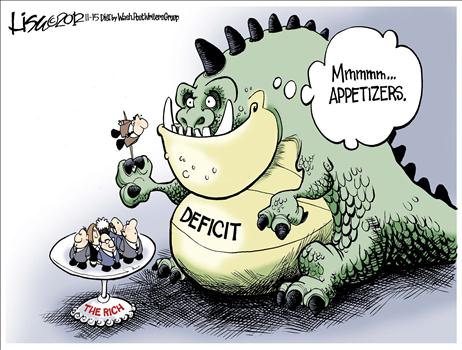
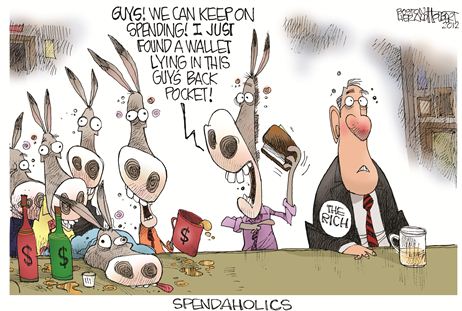

 Two great Americans


 The Daily Hatch