Since 1950 the staffing of public schools has skyrocketed but we are getting a good return on our money. We need to turn to the voucher system that Milton Friedman proposed.
The Friedman Foundation has published an excellent report detailing the administrative bloat plaguing our nation’s public schools. The School Staffing Surge: Decades of Employment Growth in America’s Public Schoolsshows dramatic increases in teaching and non-teaching staff over the past five decades despite modest increases in student enrollment.
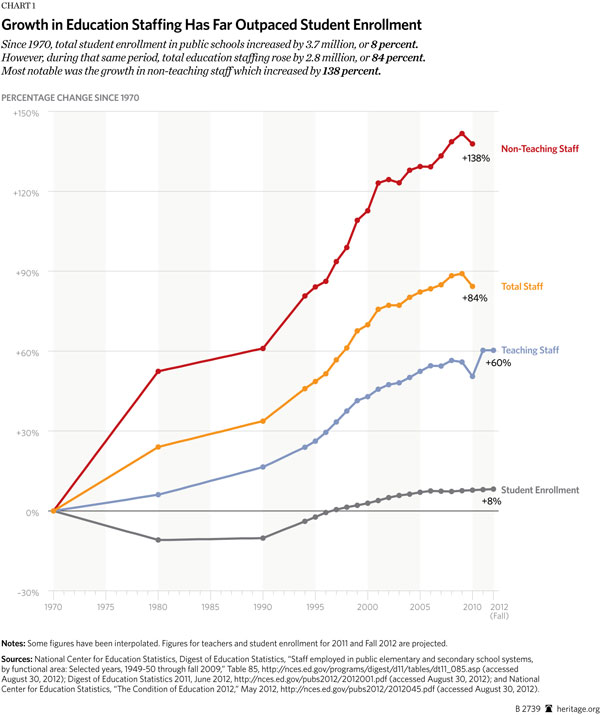
As we detailed in a recent report on growth in non-teaching positions in public schools across the country, student enrollment has increased just 8 percent since 1970, while the number of teachers has increased 60 percent, and the number of non-teaching administrative and other staff has increased 138 percent. (continues below chart)
The Friedman report, authored by Ben Scafidi, PhD, takes an even longer look, demonstrating that since 1950, public school enrollment has increased 96 percent, while the number of teachers has increased 252 percent and the number of non-teaching personnel (administrators and other staff) has increased an astonishing 702 percent. “Put differently,” Scafidi notes, “the rise in non-teaching staff was more than seven times faster than the increase in students”:
Between 1950 and 2009, the pupil-staff ratio declined to 7.8 students per public school employee from 19.3 students per public school employee. By 2009, there were fewer than eight public school students per adult employed in the public school system. The drop in the pupil-teacher ratio also was large—the pupil-teacher ratio was 27.5 students per teacher in 1950 and only 15.4 in 2009.
Scafidi also shows how this administrative bloat has affected schools on a state-by-state basis (and uses an interactive map to make the point). Of note: “Nine states with declining student populations had significant increases in public school personnel—D.C., Iowa, Louisiana, Maine, Mississippi, North Dakota, South Dakota, Wyoming, and Vermont.”
The Friedman report notes that the dramatic reduction in class size over the decades has not led to increases in student achievement. Why? As Scafidi reports, an increase in teacher quantity has not produced an increase in teacher quality:
As public schools have reduced class sizes continually since at least 1950, they have had to hire more teachers. And, the evidence is in—the disparity in effectiveness across teachers is considerable. Accordingly, state governments and local public school boards should have been more concerned with improving teacher effectiveness than lowering class sizes.
Continuing a trend of growing staff positions in our nation’s public schools won’t create the types of improvements that the system so desperately needs.
Instead, public school districts should trim bureaucracy and work on long-term reform options for better targeting of taxpayer resources. And decision making should be decentralized, placing staffing and other decisions in the hands of principals, teachers, and parents.
Finally, parents—and teachers—should have options. We’ll never see improvement in our nation’s education system without providing students with a choice about which schools—public, private, virtual, or homeschooling—will best meet their unique learning needs.
___________
Thank you so much for your time. I know how valuable it is. I also appreciate the fine family that you have and your commitment as a father and a husband.
Sincerely,
Everette Hatcher III, 13900 Cottontail Lane, Alexander, AR 72002, ph 501-920-5733, lowcostsqueegees@yahoo.com
Max Brantley of the Arkansas Times Blog reports today that Mitt Romney is for school vouchers. I am glad to hear that. Over and over we hear that the reason private schools are better is because they don’t have to keep the troubling making kids. It reminds me of this short film that I saw many […]
Milton Friedman – Public Schools / Voucher System (Q&A) Part 2 Published on May 7, 2012 by BasicEconomics __________ We need to get competition back again among schools and the voucher system is the best way to do that. D.C. Public Schools Spend Almost $30,000 Per Student Ericka Andersen July 25, 2012 at 10:00 am […]
Milton Friedman – Public Schools / Voucher System (Q&A) Part 1 Published on May 7, 2012 by BasicEconomics ___________ We have to turn to the school voucher system if we want competition between schools and want to lower the cost of education. Chile’s Amazing School Choice Revolution September 29, 2012 by Dan Mitchell I wrote back […]
Johan Norberg – Free or Equal – Free to Choose 30 years later 5/5 Published on Jun 10, 2012 by BasicEconomics In 1980 economist and Nobel laureate Milton Friedman inspired market reform in the West and revolutions in the East with his celebrated television series “Free To Choose.” Thirty years later, in this one-hour documentary, […]
Everywhere school vouchers have been tried they have been met with great success. Why do you think President Obama got rid of them in Washington D.C.? It was a political disaster for him because the school unions had always opposed them and their success made Obama’s allies look bad. In 1980 when I first sat […]
Johan Norberg – Free or Equal – Free to Choose 30 years later 4/5 Published on Jun 10, 2012 by BasicEconomics In 1980 economist and Nobel laureate Milton Friedman inspired market reform in the West and revolutions in the East with his celebrated television series “Free To Choose.” Thirty years later, in this one-hour documentary, […]
Johan Norberg – Free or Equal – Free to Choose 30 years later 3/5 Published on Jun 10, 2012 by BasicEconomics In 1980 economist and Nobel laureate Milton Friedman inspired market reform in the West and revolutions in the East with his celebrated television series “Free To Choose.” Thirty years later, in this one-hour documentary, […]
The Machine: The Truth Behind Teachers Unions Published on Sep 4, 2012 by ReasonTV America’s public education system is failing. We’re spending more money on education but not getting better results for our children. That’s because the machine that runs the K-12 education system isn’t designed to produce better schools. It’s designed to produce more […]
Milton Friedman on Hayek’s “Road to Serfdom” 1994 Interview 2 of 2 Uploaded by PenguinProseMedia on Oct 26, 2011 2nd half of 1994 interview. ________________ I have a lot of respect for the Friedmans.Two Lucky People by Milton and Rose Friedman reviewed by David Frum — October 1998. However, I liked this review below better. It […]
Johan Norberg – Free or Equal – Free to Choose 30 years later 2/5 Published on Jun 10, 2012 by BasicEconomics In 1980 economist and Nobel laureate Milton Friedman inspired market reform in the West and revolutions in the East with his celebrated television series “Free To Choose.” Thirty years later, in this one-hour documentary, […]
His preferred medium was talk—conversation, whether with an individual or with a large group of people. He had the uncanny knack of addressing an individual personally, even if one was sitting with several hundred other people. His tapes, books, and films are best seen as embodiments of his conversation or table talk. The overwhelming impression of those who met him briefly or more extensively, particularly in connection with his homely yet expansive community at L’Abri in Switzerland, was his kindness, a word that constantly occurs in people’s memories of him, whether Dutch, English, American, Irish, or other nationality.
His attire was quirky and memorable, dapper in knee-breeches and colorful tops, a goatee beard he wore later in life adding to his artistic, cultured appearance, far from the stereotype of the evangelical pastor. He was cool, knew about Bob Dylan, Jackson Pollock, Merce Cunningham, the older Wittgenstein, the younger Heidegger, and neoorthodoxy and spoke of postmodernism in the sixties before it was clearly post. He bluntly challenged evangelical and fundamentalist pietism and later superspirituality as “neo-platonic.” This challenge left at least one of his students, me, wondering at the time how it was “neo” as well as “platonic,” but it had the desired effect of leading to a spiritual pilgrimage that was often painful.
Francis Schaeffer was a small man whose giant passion for truth, for reality, for God, and for the needs of people made him a key shaper of modern Christianity, larger than any label put on him. This biography portrays his formation and achievement, illuminating the complex person and his vivid teaching.
Having studied under Francis Schaeffer when young, interviewed him about the course of his life near the end of it, and heard many friends and others acknowledge their debt to him, I waited in vain for a comprehensive biography. I have therefore tried to meet this need. It is now nearly a quarter-century since his death, and it seems to me that his essential message is as topical and important as it was in his lifetime. He has some detractors, but for me, he always eludes their nets. I have attempted to give an affectionate, accurate, warts-and-all portrait of a fascinating and complex person whom people always remembered. To ensure a truthful and reasonably objective portrait, I have been guided by over 180,000 words of oral history concerning Francis Schaeffer. This oral history was gathered by the historian Christopher Catherwood, his wife (musicologist Paulette Catherwood), and myself. We carried out interviews in Switzerland, the Netherlands, England, Northern Ireland, and the USA, talking to a variety of people, including former L’Abri members, workers, helpers, students, as well as members of the immediate family.
I’ve also made use of PCA (Presbyterian Church of America) archive material, early writings of Francis Schaeffer, letters, biography and memoirs by Edith Schaeffer, writings of the novelist Frank Schaeffer, and assessments of the pastor-intellectual (including Time magazine and De Spiegel). I’ve put this into a continuous narrative so that the reader might get to know Francis Schaeffer, his vision and concerns, and the thrust of his teaching (the purpose of my book is, of course, biographical, not to give an analysis of Schaeffer’s thought).
My hope is that my book may play a little part in drawing a new generation of readers to Schaeffer’s crucial work and message—sadly, they can no longer have the benefit of the teacher in person. I emphasize teacher. Schaeffer was of the old school of teacher or master—charismatic, memorable, learned. Though he wasn’t a scholar in the usually accepted sense, he pushed those who truly listened to explore more, to learn more, to be more prepared for living as a Christian and human being in today’s post-Christian, media-rich, exciting, dangerous world. Like John Milton I believe the image of God is captured in a unique way in books, and though Schaeffer is dead, his mind and spirit are alive in his writings, even though they lack the elegance and style of a C. S. Lewis. His message can still leap from mind to mind, as it did at the time I remember as a student. Our world still cries out for his imaginative L’Abri (“The Shelter”), which can and should take many forms for differing needs.
A biography of Francis Schaeffer must account for his remarkable impact on people of many types—the intellectual, the humble laborer, the scientist, the artist, the doubting Christian, the questioning nonbeliever; man, woman, youth, and child; white, black, hairy, and smooth. After Francis Schaeffer’s first visit to Europe, still suffering from the effects of war in 1947, a wall of parochialism in his life began to collapse—a process quickened by his friendship with the Dutchman Hans Rookmaaker and his own long-standing interest in and love for art. A biography of him (or a critique, for that matter) cannot itself be parochial in any sense, intellectual or regional. He was larger than any denominational or political context.
In this book I write about Francis Schaeffer’s strengths and flaws, placing him in the context of his times, portraying the formation of his ideas and the genesis of his lectures, writings, seminars, and movies, as well as the complex person and his relationships. I portray the establishment and impact of the L’Abri community, and the deeper idea of a “shelter,” as Schaeffer’s most representative and abiding achievement, showing the development of this unique phenomenon and revealing its importance in the context of church and recent cultural history. The man himself is pictured as in essence undivided, rather than consisting of two or even three Schaeffers, though he went through sometimes anguished change and growth. Even his late and very emphatic association with the American church in the Reagan years was for him a development from the L’Abri work, not a capitulation to what he called the “middle-class church.”
Though Francis Schaeffer is undivided, the distinct phases of his life are all portrayed here, each illuminating the other phases: his working-class childhood in Germantown, Pennsylvania; his intellectual and cultural awakening and student and seminary years; the ten years as a “separated” pastor in eastern and midwestern America; his early years in Europe working with his wife Edith for Children for Christ and speaking widely on the dangers of a new, deceptive liberalism as regards the Bible; the crisis in his faith resulting in a deep experience of the Holy Spirit; the birth and early struggles of L’Abri in Switzerland; the gradual opening up of a wider ministry through taped lectures, international speaking, books, and the formation of new L’Abri centers, first in England, then in other countries; and, at the end of his life, the dramatic, celebrity phase of the movies and large seminars, in which Schaeffer extended his cultural analysis to the sphere of politics, law, and government, putting his long-standing role as a compassionate controversialist into the spotlight, with all its distortions of view.
As I was completing this book, Frank Schaeffer’s Crazy for God was published. This is a confessional memoir of his life. While it vividly and sometimes poignantly portrays Frank’s own life and journey, it added little to what I had already documented about his father—as a biographer I knew his strengths and weaknesses. Many of those interviewed for this book spoke of them openly. What I must remark on is Frank’s portrayal of his father as keeping up a façade of conviction about his faith, especially in his final years. This bears no relation to what was the case. Francis Schaeffer was always open about his personal struggles and failings—this was the secret of his strength as a pastor and as a counselor. He emphatically did not divorce his inner and public life. When I was a young student, on my first or second visit to his L’Abri community in Switzerland, I once joined him on the descent to the chalet-style chapel for his regular Saturday night discussion. Suddenly he confided, “Colin, I feel like I’m about to jump out of an airplane without a parachute.”
In an unpublished letter to his close friend and peer Hans Rookmaaker, perhaps that same year, he confided that he was low after working hard on the manuscript of The God Who Is There with an editor: “I am so very much behind in every aspect of the work that I feel in a rather depressed mood which means of course that it is a difficult time. However, the Lord continues to open doors and we are thankful. . . . I would be glad if you would continue to pray for me personally because . . . this is a bit of a low period for me. However, I suppose I will be dug out in a couple of weeks and then I will feel better.”1
As my book reveals, Francis Schaeffer in the twilight of his life was as convinced of the truth-claims of Christianity and the efficacy of what he called the finished work of Christ as he was after his struggles in the early 1950s and even immediately after his conversion in 1930. Indeed, his conviction continued to deepen into his closing years, allowing him no respite from his grief over the lost condition of human beings and still expanding his empathy for those whom he encountered. In his final film series, Whatever Happened to the Human Race? He included a powerful episode about the historical underpinnings of Christian conviction.
What is the essence of Francis Schaeffer? Is it his system of theology, his books, his political campaigning, the existence of L’Abri? Ironically, though he attacked first the “old” modernism, then the “new” modernism of existentialism, neo-orthodoxy, and even, in anticipation, postmodernism, he demonstrates what might be called an existential Christianity—living in the moment; embracing the reality of existence; seeing the underpinning certainty of Christian faith in the historical death and resurrection of Jesus Christ; and reckoning on the specific intervention of the Holy Spirit in conversion at a point in time in a person’s life, after which he or she passes from death to life. Schaeffer might be dismissed as a scholar or even original thinker (though it can be argued he was both, but particularly the latter), but his realistic, existential Christianity is remarkable and perhaps unique for someone of his biblical orthodoxy in his generation and is the secret, perhaps, of his impact on many people of diverse backgrounds and nationalities.
A full list of acknowledgments appears toward the end of this book, but I must here especially express my thanks to Christopher and Paulette Catherwood, for their brilliant and enthusiastic help with the interviewing for this book; to Ted Griffin, for his wise and thorough editing; to others who added to this book in a very special way, including Lane Dennis, John and Prisca Sandri, Ranald and Susan Macaulay, and Udo and Deborah Middelmann. Though not well enough to give me more than a warm smile and greeting, Edith Schaeffer’s published records of the family and L’Abri history, and unpublished Family Letters must have a special mention. While Christopher, Paulette, and I interviewed, we received kindness and hospitality of a Dutch, Swiss, English, Irish, and American variety. I particularly remember the kindness of Marleen and Albert Hengelaar and the inspiring memories of the late Anky Rookmaaker as she reached back in her mind to the war years; the events she recounted seemed as yesterday. It is a privilege even to share a little in others’ lives.
The Francis and Edith Schaeffer Story Pt.1 – Today’s Christian Videos The Francis and Edith Schaeffer Story – Part 3 of 3 Francis Schaeffer: “Whatever Happened to the Human Race” (Episode 1) ABORTION OF THE HUMAN RACE Published on Oct 6, 2012 by AdamMetropolis ________________ Picture of Francis Schaeffer and his wife Edith from the […]
THE MARK OF A CHRISTIAN – CLASS 1 – Introduction Published on Mar 7, 2012 This is the introductory class on “The Mark Of A Christian” by Francis Schaeffer. The class was originally taught at Redeemer Presbyterian Church in Overland Park, KS by Dan Guinn from FrancisSchaefferStudies.org as part of the adult Sunday School hour […]
The Francis and Edith Schaeffer Story Pt.1 – Today’s Christian Videos The Francis and Edith Schaeffer Story – Part 3 of 3 Francis Schaeffer: “Whatever Happened to the Human Race” (Episode 1) ABORTION OF THE HUMAN RACE Published on Oct 6, 2012 by AdamMetropolis ________________ Picture of Francis Schaeffer and his wife Edith from the […]
The Francis and Edith Schaeffer Story Pt.1 – Today’s Christian Videos The Francis and Edith Schaeffer Story – Part 3 of 3 Francis Schaeffer: “Whatever Happened to the Human Race” (Episode 1) ABORTION OF THE HUMAN RACE Published on Oct 6, 2012 by AdamMetropolis ________________ Picture of Francis Schaeffer and his wife Edith from the […]
The Francis and Edith Schaeffer Story Pt.1 – Today’s Christian Videos The Francis and Edith Schaeffer Story – Part 3 of 3 Francis Schaeffer: “Whatever Happened to the Human Race” (Episode 1) ABORTION OF THE HUMAN RACE Published on Oct 6, 2012 by AdamMetropolis ________________ Picture of Francis Schaeffer and his wife Edith from the […]
The Francis and Edith Schaeffer Story Pt.1 – Today’s Christian Videos The Francis and Edith Schaeffer Story – Part 3 of 3 Francis Schaeffer: “Whatever Happened to the Human Race” (Episode 1) ABORTION OF THE HUMAN RACE Published on Oct 6, 2012 by AdamMetropolis ________________ Picture of Francis Schaeffer and his wife Edith from the […]
Francis Schaeffer: “Whatever Happened to the Human Race?” (Episode 2) SLAUGHTER OF THE INNOCENTS Published on Oct 6, 2012 by AdamMetropolis The 45 minute video above is from the film series created from Francis Schaeffer’s book “Whatever Happened to the Human Race?” with Dr. C. Everett Koop. This book really helped develop my political views concerning […]
Francis Schaeffer: “Whatever Happened to the Human Race” (Episode 1) ABORTION OF THE HUMAN RACE Published on Oct 6, 2012 by AdamMetropolis The 45 minute video above is from the film series created from Francis Schaeffer’s book “Whatever Happened to the Human Race?” with Dr. C. Everett Koop. This book really helped develop my political views […]
I have gone back and forth and back and forth with many liberals on the Arkansas Times Blog on many issues such as abortion, human rights, welfare, poverty, gun control and issues dealing with popular culture. Here is another exchange I had with them a while back. My username at the Ark Times Blog is Saline […]
Francis Schaeffer: “Whatever Happened to the Human Race” (Episode 5) TRUTH AND HISTORY Published on Oct 7, 2012 by AdamMetropolis The 45 minute video above is from the film series created from Francis Schaeffer’s book “Whatever Happened to the Human Race?” with Dr. C. Everett Koop. This book really helped develop my political views concerning abortion, […]
My friend David Rogers invited to a concert at First Assembly of God church in Memphis in the late 1970’s and we got to hear Dallas Holm sing and David Wilkerson speak. Here is some info on Dallas Holm from his website:
Dallas Holm Biography
I started out livin’ for Jesus many years ago
He gave me His love and I gave Him my heart and my soul
Some folks said that I’d never make it
But I guess that they must’ve been wrong
Cause He’s still got control of my life and I’m still goin’ strong
Those lines from the song, The Long Ride, probably best describe the journey and ministry of Dallas Holm.
Many refer to this legendary Christian artist as a pioneer or forerunner. Holm says, “I became a Christian in 1965 and my life was radically and eternally transformed. My music became the means whereby I could express the dynamics of that transformation and share the reality of Christ with others. Through God’s grace, I’ve been part of the Christian music ministry for a long time.”
Dallas has earned his influence in today’s Christian music throughout more than 40 years of writing, singing and ministry in some 4,000 concerts in every state in the USA as well as many countries abroad. His 38 recording have garnered gold records, multiple Dove awards, Grammy nominations, number one songs, and countless accolades. During his travels, Dallas also speaks and teaches what God has taught him in his journey.
Holm’s creativity and diversity offer everything from inspirational to blues, from country to reggae. Whatever the style, it all points to Christ and the Cross. Songs like Rise Again, I Saw the Lord, Here We Are and Before Your Throne remind us that it’s all about Jesus. Holm’s songs focus on His life, His death and resurrection and His desire for intimate relationship with us.
Artists such as Steven Curtis Chapman, Twila Paris and Greg Long of Avalon all make reference to Holm’s significant impact on their lives and ministries. Holm can be seen on several of the Bill Gaither Homecoming videos. On one video Gaither introduces Dallas by saying, “This is one of the nicest guys in our entire industry.” This broad appeal and respect by peers has undoubtedly been one of the reasons for Holm’s amazing longevity and relevance.
Dallas says, “One of the great blessings of being around this long is that now I hear nightly of how God has used this ministry to change lives through the years. People come up and share how they were saved in a concert many years ago. I receive letters from parents telling me their kids came to know Christ at a concert and I also receive letters from kids who say their parents received Christ at a concert. We know of many in ministry both here and abroad who say that it was at a Dallas Holm concert where they felt the call to ministry. These testimonies and many more are the great highlight and reward of our ministry.”
Dallas married his wife, Linda, in 1969. His family, his role as husband, father and grandfather, take precedence for Dallas. “If I reached the whole world but lost my own family, I’d consider myself a failure. Early on, I set a priority system that put God first, family second and ministry third. If I’m not the husband and father I need to be in my own home, I have no right to proclaim truths of the Kingdom to others.”
Dallas and Linda have two grown children, Jennifer and Jeffrey. Jennifer and her husband Jason have three children: Jacob, Sophia and Alex. Jeffrey and his wife Jennifer have been married for a couple years and will add to the grandchildren count when the time is right.
Holm says, “Now that our kids are grown, Linda and I can travel and minister together all the time. Linda has a beautiful voice. We have sung together on my records through the year but now we get to sing together every night we’re in concert. We love where God has us in this season of our lives. We still travel everywhere in the U.S. and occasionally abroad and minister in churches of varied denominations.”
Dallas is quick to point out, “It’s been a remarkable journey, yet is hasn’t all been easy. When people hear my music or see me on TV or in concert, they don’t realize those are just moments in a life. I’ve had struggles, heartaches, and disappointments just like everyone else. Linda has fought an ongoing 24-year battle surviving cancer. But Christ remains preeminent in all things. No matter what has happened, what I’m going through now or what I may endure tomorrow, “nothing can separate me from the love of Christ.”
Dallas grew up in Minnesota but says, “Like the bumper sticker I see on many a Texas vehicle, I wasn’t born here but I got here as fast as I could.”
After Bible College and a short stint as youth pastor, Dallas joined David Wilkerson in his youth crusade ministry in 1970. He traveled and ministered with Wilkerson for ten years. During that time he formed Dallas Holm and Praise in 1976. They became the first Contemporary Christian band to receive an RIAA certified Gold Album for Dallas Holm and Praise LIVE. That album contained the song Rise Again. They toured together for eleven years.
Now, after more than 40 years of ministry Holm says, “I love it more than ever and everyday consider the great privilege of being a co-laborer with Christ Jesus.”
Dallas reminds us, “In Chariots of Fire, Eric Liddell said, ‘When I run, I feel God’s pleasure.’ I say, ‘When I write, sing and play these songs, I feel His pleasure.'”
________________
In Honor of David Wilkerson !1931-2011 [Tribute:I Saw The Lord-Dallas Holm]
Uploaded onMay 2, 2011
The is a special video in honor of “David Wilkerson” who went to be with Jesus April 27,2011 !The Bible says in Proverbs10:7″The memory of the just is blessed.’ The song by Dallas Holm is very fitting seeing that Dallas was a vital part of the Wilkerson ministry for many years ! The is my tribute to a very honest sincere man of God who loved the Lord with a fervent heart.God bless you.
PS-Many souls are now in the kingdom due to his obedience to the Lord.And countless believers have been inspired by his preaching of the Word of God.He was not a perfect man and we are simply doing this to honor what the Lord did in and through a country preacher who was pastoring a rural church in the hills of Pennsylvania when he called him to reach the gangs of New York City in the late 1950s ! He obeyed the Lord and sought the Lord and God used him as a vessel of honor ! He was sold out to Jesus and the LORD used him in a mighty way .The list is endless of the various ministries that are very fruitful because David obeyed God.Many people are in the ministry today due to the ministry of David Wilkerson.Now is the time for a new generation of men of God to arise with a holy passion for God ,for holiness, for the Truth and for the souls of men and women.
FEEL FREE TO SHARE YOU APPRECIATION OF BROTHER DAVID WILKERSON AND SHARE THIS VIDEO AS THE LORD LEADS YOU.
__________________
The Cross And The Switchblade 5 11
Uploaded onSep 8, 2009
The Cross and the Switchblade is a book written in 1963 by pastor David Wilkerson with John and Elizabeth Sherrill. It tells the true story of Wilkerson’s first five years in New York City, where he ministered to disillusioned youth, encouraging them to turn away from the drugs and gang violence they were involved with. The book became a best seller, with more than 15 million copies distributed in over 30 languages.
In 1970, a film adaptation was released, starring Pat Boone as David Wilkerson and Erik Estrada as Nicky Cruz, the teen gang member whose life was transformed by Wilkerson’s ministry. The movie was dismissed by secular critics as uninteresting. However, it has been viewed by an estimated 50 million people in over 30 languages in 150 countries, according to World Film Crusade.
In 1972, the book was adapted into a comic book published by Fawcett Comics under their Spire Christian Comics label.
In 1968, Cruz wrote the book Run Baby Run with Jamie Buckingham, telling the story of his life including coming to New York and being in the gang, and subsequently meeting Wilkerson and thereafter becoming an Evangelical Christian.
David Meece shares about his alcoholic abusive father
Uploaded onAug 19, 2010
Recording Artist David Meece shares his testimony about his abusive father and how he walked down the road of forgiveness
“We were the reason” David Meece
Uploaded onSep 16, 2009
The gospel to music is what this famous song is written and recorded by so many Christian artists is still today a blessing whenever it is heard. http://www.DavidMeece.com
DAVID MEECE Much of David Meece’s musical success can be credited to his widespread appeal. His fans still range from pre-teens to retirees, with musical tastes that vary from classical to pop. His ability to connect with a broad public is rooted in his childhood: Growing up in the small town of Humble, Texas, David distinguished himself as a child prodigy and began touring as a concert pianist at the age of ten. By fourteen, he performed the Mozart Piano Concerto in F Major with the Houston Chamber Orchestra. He won a nationwide talent show at the age of fifteen and toured England, Germany, France, Switzerland and Holland. When he was sixteen, he was the featured soloist with the Houston Symphony, performing the difficult Khachaturian Piano Concerto, 45 minutes in length under the direction of renowned conductor, Andre Previn.
David received a full scholarship to study at the famous Peabody Conservatory in Baltimore, Maryland. It was there that he fully surrendered his life to Christ. He found his goals changing from his intended career as a classical pianist as he began to pen songs of his relationship with the Lord and sing them.
Immediately upon graduating from the Peabody Conservatory, he became a worship/youth pastor. In 1976, he married his college sweetheart, Debbie Pearce, a viola major. That same year, he was discovered by the executives of Word Records and his first album, self-titled, “David” was released on the Myrrh label. He went on to record a dozen more of his own collections of original songs and contributed his gifted works of inspiration to many other projects. Over 30 of his compositions have reached the top of the charts, some titles sharing the #1 place simultaneously in more than one genre. Favorites such as his signature song, “We Are the Reason” have been recorded by well over 200 other artists and sung in several languages.
His songs caught on internationally and so did his travels as he became a favorite in Australia, Canada, throughout Asia, Europe and South Africa. He was called upon to guest in Billy Graham Crusades among other outreaches and television broadcasts. He has participated in festivals that introduced Contemporary Christian Music to the masses. Though memories of many are of his packed out stadium concerts with his band, he has truly enjoyed the opportunity to endear himself with just a piano to the smaller congregations tucked away here and there.
Life has not always been easy for the gifted artist. David grew up in a house dominated by an abusive, alcoholic father, crippling his self worth and confidence. In 1986, at the height of his career, his father passed away, bringing deep unresolved hurts to the surface. He was in the middle of a 70 City Tour entitled, “Seventy Times Seven,” when he received a phone call from his brother telling him of his father’s death. After the funeral, he resumed his tour. While standing up in front of thousands each night, singing about forgiveness, he found himself in desperate need of forgiving his own dad. Because of David’s courage to transparently share his powerful testimony of this process, countless individuals have been brought to a place of healing in their own lives!
David was inducted into the Christian Music Hall of Fame and received the 2009 Visionary Award for the Inspirational Male Soloist category. His life continues to impact millions worldwide and his passion for excellence in the field of Contemporary Christian Music will leave a powerful legacy for generations to come.
David Meece (born May 26, 1952) is a Contemporary Christianmusician who enjoyed success in the mid 80s throughout the early 2000s with more than 30 Top 10 hits (several reaching #1).
David worked with Canadian songwriter/producer and Juno Award winner Gino Vanelli for his albums Chronology and Candle In The Rain. Meece is perhaps best known for his songs “We Are The Reason” (which has been recorded by well over 200 other artists and sung in several languages according to Meece’s website),[2] “One Small Child”[3] and “Seventy-Times-Seven”.[4]
Meece was called upon to guest appear in Billy Graham Crusades, among other outreach groups and television broadcasts. He was inducted into the Christian Music Hall of Fame on June 14, 2008 [5] and received the 2009 Visionary Award for the Inspirational Male Soloist category.[6]In November 2012, Meece was given a Lifetime Achievement Award for his body of work by the Artists Music Guild.[1]
Possibly due to his conservatory training, David uses pieces of classical piano works as intros or settings for some of his songs. For example, in the song “This Time” from the album Learning to Trust, the opening section of the song (as well as the bridge and ending tag) is from Frédéric Chopin‘s “Revolutionary Etude” (Op. 10, No. 12) in C minor. The introductory melody for “You Can Go”, from the album 7, is taken from the Two-Part Invention No. 13 in A Minor (BWV 784) by Johann Sebastian Bach. (Because of the prevalent use of synthesizers, “You Can Go” is sometimes incorrectly connected to an advertisement in the early 1980s for Commodore 64 which used the Bach Invention played by a synthesizer.) Also, “Falling Down” from Count the Cost is based on a sonata by Mozart.
In 2012 Meece co-wrote the piece Hands of Hope with fellow performers, David L Cook and Bruce Carroll. The song was a current day remake of “We Are the World” which featured many famous voices from the music industry. The song was recorded by the Charlotte Civic Orchestra and featured the voices of: Babbie Mason, Christy Sutherland, David L Cook, Caroline Keller, Fantasia Barrino, Gayla Earlene, Joshua Cobb, Paul Zeaman and many of the former PTL Singers from the Jim and Tammy Faye Bakker show. The song went number one on the charts and remained there for two weeks.[3] The song was used as the theme song for Turning Point Centers for Domestic Violence.[4] On May 5, 2012 NATAS announced that the song Hands of Hope garnered Meece, Cook and Carroll the Emmy nomination for best Arrangement/Composer of a television theme song.[5]
I have gone back and forth and back and forth with many liberals on the Arkansas Times Blog on many issues such as abortion, human rights, welfare, poverty, gun control and issues dealing with popular culture. Here is another exchange I had with them a while back. My username at the Ark Times Blog is Saline Republican.
>>he looked at the 1973 ruling in some detail. He talked about the decline of absolutes in American law, and how this decision was completely arbitrary.<
Just to pull you out the rainbow cloud for brief moment of time there have never been “absolutes” in American law. Once you experience the game of law you realize for every rule there’s an exception or an overrule. Slaves were absolutely property until they weren’t. Corporations were limited purpose organizations until they weren’t.
Absolutes are for belief systems like religion. In religions it doesn’t matter how absolute you want to be because it’s (1)made up and (2) strictly based upon faith, not knowledge.
Elwood asserted, “Absolutes are for belief systems like religion. In religions it doesn’t matter how absolute you want to be because it’s (1)made up and (2) strictly based upon faith, not knowledge.”
Elwood says this belongs in religion but what did our Founding fathers mean by the phrase “certain inalienable rights?”
Francis Schaeffer noted, “Think of this great flaming phrase: “certain inalienable rights.” Who gives the rights? The state? Then they are not inalienable because the state can change them and take them away. Where do the rights come from? [Jefferson and others] understood that they were founding the country upon the concept that goes back into the Judeo-Christian thinking that there is Someone there who gave the inalienable rights.”
You have to have a lawgiver and the God of the Bible is the lawgiver that the Founding Fathers recognized.
Schaeffer notes where we are today, “Humanism, man beginning only from himself, had destroyed the old basis of values, and could find no way to generate with certainty any new values. In the resulting vacuum the impoverished values of personal peace and affluence had come to stand supreme.”
Elwood you can try as you hard as you can but you can’t answer my simple questions I posed about morality questions because you have no absolute basis of revealed truth to justify your morality decisions. Olphart was brave enough to answer the questions but made no attempt to give a reasonable and rational explanation for why murder is wrong.
Schaeffer sums up the secular humanist’s problem when he observed, “But if I live in a world of nonabsolutes and would fight social injustice on the mood of the moment, how can I establish what social justice is? What criterion do I have to distinguish between right and wrong so that I can know what I should be fighting? Is it not possible that I could in fact acquiesce in evil and stamp out good? The word love cannot tell me how to discern, for within the humanistic framework love can have no defined meaning.”
____________
I truly believe that many of the problems we have today in the USA are due to the advancement of humanism in the last few decades in our society. Ronald Reagan appointed the evangelical Dr. C. Everett Koop to the position of Surgeon General in his administration. He partnered with Dr. Francis Schaeffer in making the video below. It is very valuable information for Christians to have. Actually I have included a video below that includes comments from him on this subject.
Much more could be said if we had time. There are other biblical arguments against abortion. There is mounting evidence that many women who choose abortion suffer severe long-term emotional and physical problems.
I want to conclude by suggesting some action points. Some of these are things that every Christian can and should do. Others are things that only some will be called to do. But at some level, all of us need to come to the defense of unborn children.
(1) We can pray about the situation. It is ultimately a spiritual battle (Eph. 6:10-12). Pray for pro-life judges to receive Senate confirmation, especially to the Supreme Court. Pray for the horrors of abortion to become obvious to our self-centered culture. Pray for Christians to get involved in the pro-life cause.
(2) We can vote for pro-life candidates. Don’t vote for pro-abortion candidates. You ask, “Are you a one-issue voter?” I grant that being pro-life does not qualify a person as a good political leader. But being pro-abortion should disqualify anyone from public office. For example, if a candidate said, “I believe that black people should not hold public office,” that one issue should disqualify the candidate from office. Why doesn’t favoring killing babies disqualify a candidate? The person who favors abortion is an immoral person!
(3) We can write our legislators and the newspaper to support the pro-life cause. Hold them accountable!
(4) We can support the pro-life cause with our money and time. Godly women are needed to counsel young women with problem pregnancies, so that they choose life for their babies. Godly families that are able should consider taking in such young women and helping them carry their babies to term. There are many ways to get involved.
(5) Our church should discipline any members who advocate abortion, perform abortions, or obtain abortions in disobedience to being counseled about God’s truth on the matter. It is a national tragedy that two of our former Presidents, Jimmy Carter and Bill Clinton, both claimed to be Southern Baptists, but were pro-abortion. Their churches should have disciplined them publicly.
In conclusion, I want to speak to any who may already have had an abortion or who may have urged someone else to have an abortion. Perhaps you did it in ignorance, but now you realize that you committed a serious sin in God’s sight. The great news of God’s Word is that “Christ Jesus came into the world to save sinners” (1 Tim. 1:15). The apostle Paul, who persecuted the church and was responsible for the deaths of many innocent people, wrote that, and then claimed, “among whom I am foremost of all.” Paul found God’s forgiveness and mercy at the cross. No matter how great your guilt, if you will turn from your sin and trust Jesus Christ as the one who bore your sin on the cross, God will pardon all of your sin and credit the righteousness of Jesus to your account (Rom. 4:4-5).
Francis Schaeffer and his wife Edith pictured below.
Francis Schaeffer: “Whatever Happened to the Human Race?” (Episode 2) SLAUGHTER OF THE INNOCENTS
Francis Schaeffer: “Whatever Happened to the Human Race” (Episode 1) ABORTION OF THE HUMAN RACE Published on Oct 6, 2012 by AdamMetropolis The 45 minute video above is from the film series created from Francis Schaeffer’s book “Whatever Happened to the Human Race?” with Dr. C. Everett Koop. This book really helped develop my political views […]
E P I S O D E 1 0 Dr. Francis Schaeffer – Episode X – Final Choices 27 min FINAL CHOICES I. Authoritarianism the Only Humanistic Social Option One man or an elite giving authoritative arbitrary absolutes. A. Society is sole absolute in absence of other absolutes. B. But society has to be […]
E P I S O D E 9 Dr. Francis Schaeffer – Episode IX – The Age of Personal Peace and Affluence 27 min T h e Age of Personal Peace and Afflunce I. By the Early 1960s People Were Bombarded From Every Side by Modern Man’s Humanistic Thought II. Modern Form of Humanistic Thought Leads […]
E P I S O D E 8 Dr. Francis Schaeffer – Episode VIII – The Age of Fragmentation 27 min I saw this film series in 1979 and it had a major impact on me. T h e Age of FRAGMENTATION I. Art As a Vehicle Of Modern Thought A. Impressionism (Monet, Renoir, Pissarro, Sisley, […]
E P I S O D E 7 Dr. Francis Schaeffer – Episode VII – The Age of Non Reason I am thrilled to get this film series with you. I saw it first in 1979 and it had such a big impact on me. Today’s episode is where we see modern humanist man act […]
E P I S O D E 6 How Should We Then Live 6#1 Uploaded by NoMirrorHDDHrorriMoN on Oct 3, 2011 How Should We Then Live? Episode 6 of 12 ________ I am sharing with you a film series that I saw in 1979. In this film Francis Schaeffer asserted that was a shift in […]
E P I S O D E 5 How Should We Then Live? Episode 5: The Revolutionary Age I was impacted by this film series by Francis Schaeffer back in the 1970′s and I wanted to share it with you. Francis Schaeffer noted, “Reformation Did Not Bring Perfection. But gradually on basis of biblical teaching there […]
Dr. Francis Schaeffer – Episode IV – The Reformation 27 min I was impacted by this film series by Francis Schaeffer back in the 1970′s and I wanted to share it with you. Schaeffer makes three key points concerning the Reformation: “1. Erasmian Christian humanism rejected by Farel. 2. Bible gives needed answers not only as to […]
Francis Schaeffer’s “How should we then live?” Video and outline of episode 3 “The Renaissance” Francis Schaeffer: “How Should We Then Live?” (Episode 3) THE RENAISSANCE I was impacted by this film series by Francis Schaeffer back in the 1970′s and I wanted to share it with you. Schaeffer really shows why we have so […]
Francis Schaeffer: “How Should We Then Live?” (Episode 2) THE MIDDLE AGES I was impacted by this film series by Francis Schaeffer back in the 1970′s and I wanted to share it with you. Schaeffer points out that during this time period unfortunately we have the “Church’s deviation from early church’s teaching in regard […]
Francis Schaeffer: “How Should We Then Live?” (Episode 1) THE ROMAN AGE Today I am starting a series that really had a big impact on my life back in the 1970′s when I first saw it. There are ten parts and today is the first. Francis Schaeffer takes a look at Rome and why […]
Francis Schaeffer: “Whatever Happened to the Human Race” (Episode 5) TRUTH AND HISTORY Published on Oct 7, 2012 by AdamMetropolis This crucial series is narrated by the late Dr. Francis Schaeffer and former Surgeon General Dr. C. Everett Koop. Today, choices are being made that undermine human rights at their most basic level. Practices once […]
The opening song at the beginning of this episode is very insightful. Francis Schaeffer: “Whatever Happened to the Human Race” (Episode 4) THE BASIS FOR HUMAN DIGNITY Published on Oct 7, 2012 by AdamMetropolis This crucial series is narrated by the late Dr. Francis Schaeffer and former Surgeon General Dr. C. Everett Koop. Today, choices […]
Francis Schaeffer: “Whatever Happened to the Human Race” (Episode 3) DEATH BY SOMEONE’S CHOICE Published on Oct 6, 2012 by AdamMetropolis This crucial series is narrated by the late Dr. Francis Schaeffer and former Surgeon General Dr. C. Everett Koop. Today, choices are being made that undermine human rights at their most basic level. Practices […]
Francis Schaeffer: “Whatever Happened to the Human Race?” (Episode 2) SLAUGHTER OF THE INNOCENTS Published on Oct 6, 2012 by AdamMetropolis This crucial series is narrated by the late Dr. Francis Schaeffer and former Surgeon General Dr. C. Everett Koop. Today, choices are being made that undermine human rights at their most basic level. Practices […]
It is not possible to know where the pro-life evangelicals are coming from unless you look at the work of the person who inspired them the most. That person was Francis Schaeffer. I do care about economic issues but the pro-life issue is the most important to me. Several years ago Adrian Rogers (past president of […]
This essay below is worth the read. Schaeffer, Francis – “Francis Schaeffer and the Pro-Life Movement” [How Should We Then Live?, Whatever Happened to the Human Race?, A Christian Manifesto] Editor note: <p> </p> [The following essay explores the role that Francis Schaeffer played in the rise of the pro-life movement. It examines the place of […]
Great article on Schaeffer. Who was Dr. Francis A. Schaeffer? By Francis Schaeffer The unique contribution of Dr. Francis Schaeffer on a whole generation was the ability to communicate the truth of historic Biblical Christianity in a way that combined intellectual integrity with practical, loving care. This grew out of his extensive understanding of the Bible […]
You are called to go Keith’s concerts were evangelistic and exhortational. He was theLecraeof the 70’s. Here is what he has to say about the great commission:
“The world isn’t being won today because we’re not doing it. It’s our fault. This generation of Christians is responsible for this generation of souls on the earth. And no where in the world is the gospel so plentiful as here in the United States. No where. And I don’t want to see us stand before God on that day ans say, ‘but God I didn’t hear you call me.’ Here is something for all you to chew on, you don’t need to hear a call, you’re already called. In fact, if you stay home from going into all nations you had better be able to say to God, ‘You called me to stay home God, I know that as a fact.'”
Keith Green – Asleep In The Light (live)
Uploaded onMay 26, 2008
Keith Green performing “Asleep In The Light” live at Jesus West Coast ’82
Keith Green was an intense and radical man of God. He was taken from this Earth at a relatively young age. His legacy lives on through his music and his sermons. This video is about his life.
My favorite Christian music artist of all time is Keith Green. Sunday, May 5, 2013 You Are Celled To Go – Keith Green Keith Green – (talks about) Jesus Commands Us To Go! (live) Uploaded on May 26, 2008 Keith Green talks about “Jesus Commands Us To Go!” live at Jesus West Coast ’82 You can find […]
Keith Green – So You Wanna Go Back To Egypt (live) Uploaded by monum on May 25, 2008 Keith Green performing “So You Wanna Go Back To Egypt” live at West Coast 1980 ____________ This song really shows Keith’s humor, but it really has great message. Keith also had a great newsletter that went out […]
Keith Green – So You Wanna Go Back To Egypt (live) Uploaded by monum on May 25, 2008 Keith Green performing “So You Wanna Go Back To Egypt” live at West Coast 1980 ____________ This song really shows Keith’s humor, but it really has great message. Keith also had a great newsletter that went out […]
Keith Green – So You Wanna Go Back To Egypt (live) Uploaded by monum on May 25, 2008 Keith Green performing “So You Wanna Go Back To Egypt” live at West Coast 1980 ____________ This song really shows Keith’s humor, but it really has great message. Keith also had a great newsletter that went out […]
Keith Green – So You Wanna Go Back To Egypt (live) Uploaded by monum on May 25, 2008 Keith Green performing “So You Wanna Go Back To Egypt” live at West Coast 1980 ____________ This song really shows Keith’s humor, but it really has great message. Keith also had a great newsletter that went out […]
Keith Green – Easter Song (live) Uploaded by monum on May 25, 2008 Keith Green performing “Easter Song” live from The Daisy Club — LA (1982) ____________________________ Keith Green was a great song writer and performer. Here is his story below: The Lord had taken Keith from concerts of 20 or less — to stadiums […]
Keith Green – Asleep In The Light Uploaded by keithyhuntington on Jul 23, 2006 keith green performing Asleep In The Light at Jesus West Coast 1982 __________________________ Keith Green was a great song writer and performer and the video clip above includes my favorite Keith Green song. Here is his story below: “I repent of […]
Keith Green – Your Love Broke Through Here is something I got off the internet and this website has lots of Keith’s great songs: Keith Green: His Music, Ministry, and Legacy My mom hung up the phone and broke into tears. She had just heard the news of Keith Green’s death. I was only ten […]
The Keith Green Story pt 7/7 I remember when I first Keith Green. He had a great impact on me. Below are some quotes on Keith: Quotes “It’s time to quit playing church and start being the Church (Matt. 18:20)” — Keith Green, as quoted by Melody Green in the introduction to A Cry […]
The Keith Green Story pt 6/7 When I first heard Keith Green in 1978 it had a major impact on my life. Below is his story: LEGEND Keith Green CBN.com – When musician Keith Green died in a plane crash on July 28, 1982, the world lost a special man whose heart was aflame […]
Steve Hanke points out, “When President Clinton took office in 1993, government expenditures were 22.1% of GDP, and when he departed in 2000, the federal government’s share of the economy had been squeezed to a low of 18.2%.”
That is not what has happened the last four years!!!! We have got to cut federal government spending back to the level it was under Clinton in 2000.
Last night, Bill Clinton introduced President Barack Obama as the Democratic nominee. He went to great lengths to stress their similarities, but failed to mention their divergent views on the appropriate size of government.
When President Clinton took office in 1993, government expenditures were 22.1% of GDP, and when he departed in 2000, the federal government’s share of the economy had been squeezed to a low of 18.2%. As the accompanying table shows, during the Clinton years, federal government expenditures as a percent of GDP fell by 3.9 percentage points. No other modern president has come close.
And, that’s not all. During the final three years of the former President’s second term, the federal government was generating fiscal surpluses. Clinton was even confident enough to boldly claim, in his January 1996 State of the Union address, that “the era of big government is over.”
When it comes to the appropriate size of government, Clinton and Obama are polar opposites.
Thank you so much for your time. I know how valuable it is. I also appreciate the fine family that you have and your commitment as a father and a husband.
Sincerely,
Everette Hatcher III, 13900 Cottontail Lane, Alexander, AR 72002, ph 501-920-5733, lowcostsqueegees@yahoo.com
“I love the man that can smile in trouble, that can gather strength from distress, and grow brave by reflection. ‘Tis the business of little minds to shrink; but he whose heart is firm, and whose conscience approves his conduct, will pursue his principles unto death.” – Thomas Paine, The Crisis
What the deist Thomas Paine wrote better describes the measure of Biblical courage– the ability to advance what one reasonably knows is true when doubt weighs heavy and there is seemingly only hopelessness to embrace. To have this courage is essential to a mature Christian faith. It takes courage-to-be a Christian thinker while the world moves in and out of philosophical belief systems. Courage is necessary to face the onslaught of non-Christian worldviews and philosophies that pop-up again and again in everyday conversations. Moreover, because philosophy changes culture like nothing else can, I believe that the courage-to-be Christian in spite of the philosophical pluralism that abounds today is necessary for cultural change.
Just realizing that we live in a post-modern Western world is too shallow of an analyses. The truth is that there is a plethora of worldviews from strong philosophical systems of ages ago still to grapple with in the public square today. That is, Obama is half-black and president. But this does not mean we are in a post-racial world where racism is triumphed because a half-black man is the highest public office. No racism still abounds today. Likewise, Western societies are still negotiating with existential anxiety, lostness, and dread. We may not be living in such a post-existential world just yet. Among the many philosophical systems that abound today, it seems that there is a lurking existentialism that persists, virtually shadowed by other worldviews. Taken down to the individual level, the existential worldview for a non-believer seems to be the crux of the matter for a person to live for Jesus. After much truth is conveyed in an appropriate apologetic fashion, he/she typically contends “Even if Jesus is not a fairytale, what will he do for me? I already have sufficient reasons for my existence in this world!”
Additionally, one of the ultimate tasks of apologetics is to help remove the intellectual barriers and road blocks that a person has which keeps them from coming face to face with Jesus. At the heart of apologetics is Jesus. Once the struggles of doubt, competing worldviews, and falsities are removed, the soul has nowhere to hide. Light encounters darkness. A decision must be made. Apologetical truth and diplomacy can do nothing efficient at this point because this is where the pure and unadulterated gospel (good news) is timely and poignant. This is the point of conversion or rejection. The soul needs at this moment courage to face the truth of his existential lostness. It is at this moment a person can introspectively turn towards Jesus for healing & the satisfying meaning for his existence or continue to subjectively search for his existential meaning elsewhere.
This persistent existential search is comfortable for the rejecting soul and makes sense when one considers the humanistic backdrop of mankind’s history without God. People from the tower of Babel till now subjectively and objectively acknowledge that life apart from an ultimate higher purpose tends towards abstraction and hedonism. So where does that lead one to? – anxiety, despair, loneliness, dread, fear, and hopelessness. So man must have an alternate meaning to live for, a reason for being that is Godless but necessarily courageous. So man tends to get creative and build. Societies, infrastructure, and development begin. Man is in control of his own fate. Man creates meaning for his being.
About the middle of the last century, the existentialist movement of Western philosophy was flourishing. Thinkers such as Nietzsche, Jon Paul Sartre, Albert Camus, and others courageously led the dreadful charge into the realms of death, nothingness, and absurdity. Man’s existence was wrought with tragedy, purposelessness, and hopelessness because man is alone in the universe and there is nothing else like him in it. But out of this nothingness and lostness, man creates something and goes somewhere. Existential hope emerges. There can be courage to live another day. Perhaps, in another blog more existentialist points of view can be developed.
While some of this train of thought eventually morphed and declined away into other philosophical genres during the latter part of the century, much remains at the heart of our current cultural milieu. Now, interestingly, the writings of Paul Tillich, a notable theologian during the 1950’s who responded to the governing voices of humanist existential thinkers, influenced President Obama. Obama’s book, The Audacity of Hope, is undergirded by the courage-to-be that Tillich resolutely declares is necessary for hopelessness. Hope without courage is unsavory and useless.
But more importantly, and I think Obama knows this, hope without truth is dangerous. Although it can lead to powerful optimism, when tried repeatedly, it will fatigue. Hope needs substance beyond the subject – a transcendent reality in which hope is grounded.
For the soul who rejects Jesus after truths are provided, it is clear that truth is more audacious than Obama’s audacious hope. In response to this existential rejection, Francis Schaeffer contended that “Man cannot make his own universe and then live in it.” There is a house bigger and better than the fort in the backyard. The audacious truth is: a habited un-lonely mansion awaits us post-death.
Overall, in terms of academic philosophy, existentialism has been tried and found wanting. Most of academia does not interact with it. But how existentialism was so and is still so courageously embraced (sometimes unknowingly) by many average persons and great thinkers alike fascinates me. And this is the point – even secular thinkers displayed great courage to think well and advance their humanist thought, even if that thought has to do with hope in spite of nothingness and creating one’s own existential meaning in the universe.
Unfortunately, Christian courage-to-be and think cogently about Christianity is what I find sadly missing from most Western Christians. As so many Christian young people lose their faith due to questions that seem to have no answers, I stagger in disbelief and shake my head in frustration.
Moreover, the pervasive decline in general intellectualism by many adult believers is just as surprising. Christians struggle to have any courage-to-be smart in a world pluralized with strange existentialist meanings & worldviews. This is a heartbreaking reality of our present church. Why do most Christians not even know what apologetics is? And where is the Christian courage to advance our hope? For the most part, courage just is appallingly lacking in many Christians. Courage to share one’s faith with a non-believer, courage to face one’s family of origin issues with a professional counselor, or courage to learn some apologetic type truth and exercise those brain muscles is at best dormant in many believers.
But the Bible is full of heroes who lived lives with courage. There were many heroes like Moses, David, Gideon, Daniel, Nehemiah, & Paul who experienced and exhibited the power and the boldness of the Holy Spirit. But more importantly, they were not just action heroes, they were people of fortitude and being. They were heroes “who, contrary to hope, in hope believed.” (Romans 4:18) These heroes had what Paul Tillich called the “courage-to-be.” This is a type of courage that is rooted in a reasoned filled faith which allowed them to look into the face of the anxiety and despair to find God’s purpose. It came from “being” in-spite of “non-being” –living in spite of death. The courage I am advocating is that which attacks on offense in spite of life’s failures and fears.
I’m reminded of playing quarterback in high school. Because my team was small in numbers, I had to play both offense and defense. Also, because my school had a small student body, in both numbers and size, my offensive line could only amount to an average 5’-5” tall 200 lb each. So needless to say, due to the onslaught of the defense, I scrambled and was sacked often. It forced me to learn the hard way how to have poise in the pocket and see down field to complete a pass when several hungry linebackers wanted to eat a quarterback sandwich. This is the kind of courage-to-be that Tillich is talking about. It’s the ability to look the world of despair straight in the eye and in spite of it, still be.
When thinking about the dread, despair, and loneliness that Sarte, Camus, and others wrote of, the competitiveness in me is fired up. If they can find a way to achieve meaning and hope, we ought to be able to do it and do it better. It is the Christian who has a better hope in the midst of hopelessness and has a better courage in the midst of fear, dread, and anxiety. “Where O death where is your victory?” Where O death where is your sting?” (1 Cor 15:55 & Hosea 13:14)
The striking, blinding, and deafening hope of a Christian is that Jesus is the hero of existentialism. He accounted for the anxiety, fear, and despair of the abyss. “He is not a refuge from reality, but a way into its depths.” (Brennan Manning, Abba’s Child) “Death has been swallowed up in Victory?” (1 Cor 15:54) Jesus did as it was prophesied, “He will swallow up death forever. The Sovereign Lord will wipe away the tears from all faces.” (Isaiah 25:8) Deep in the heart of man’s lostness and loneliness, Jesus appears.
The courage we need to face the demands of our intellectual drought & the dread of our own existential journey is not elated passion or desperate clinging to Jesus during a trial or tribulation. It’s not the highs that come from an intense worship song or a spiritual retreat. This courage is the existential aliveness, awakening, and awareness of the present risenness of Jesus. Courage that is grounded in His presence and His rock solid systematic theological belief system of truths continually built – plateau over plateau by the illuminating power of the Holy Spirit.
Moreover, in terms of our need for rediscovering Christian intellectualism, it is not dull or passive. The insightful Brennan Manning states that “In this decade of much empty religious talk and proliferating Bible studies, idle intellectual curiosity, and pretensions of importance, intelligence without courage is bankrupt. The truth of faith has little value when it is not also the life of the heart.” This truth really needs a courageous heart. This is the intelligence that pursues truth for one’s own meaning sake, which is a worthy task, as Jesus says, “The truth shall set you free.”
Lastly, Christians must be thinkers who stand firm with courage emerging from the inside out. Francis Schaeffer further responded to this cultural drama saying “If it is true that evil is evil, that God hates it to the point of the cross and that there is a moral law fixed in what God is in Himself, then Christians should be the first into the field against what is wrong – including man’s inhumanity to man.” Paul says in 1 Corinthians 16:13 “Be on your guard; stand firm in the faith; be men of courage; be strong.” These are strong words, but we can do it Paul, maybe one day as you did, when you literally did face death for your beliefs. We can have the courage to “fight the good fight” and “contend for the faith” even in spite of fear, anxiety, and despair.
By remaining true to Truth and advancing with such courage, the better Hope will last unto death.
The Francis and Edith Schaeffer Story Pt.1 – Today’s Christian Videos The Francis and Edith Schaeffer Story – Part 3 of 3 Francis Schaeffer: “Whatever Happened to the Human Race” (Episode 1) ABORTION OF THE HUMAN RACE Published on Oct 6, 2012 by AdamMetropolis ________________ Picture of Francis Schaeffer and his wife Edith from the […]
THE MARK OF A CHRISTIAN – CLASS 1 – Introduction Published on Mar 7, 2012 This is the introductory class on “The Mark Of A Christian” by Francis Schaeffer. The class was originally taught at Redeemer Presbyterian Church in Overland Park, KS by Dan Guinn from FrancisSchaefferStudies.org as part of the adult Sunday School hour […]
The Francis and Edith Schaeffer Story Pt.1 – Today’s Christian Videos The Francis and Edith Schaeffer Story – Part 3 of 3 Francis Schaeffer: “Whatever Happened to the Human Race” (Episode 1) ABORTION OF THE HUMAN RACE Published on Oct 6, 2012 by AdamMetropolis ________________ Picture of Francis Schaeffer and his wife Edith from the […]
The Francis and Edith Schaeffer Story Pt.1 – Today’s Christian Videos The Francis and Edith Schaeffer Story – Part 3 of 3 Francis Schaeffer: “Whatever Happened to the Human Race” (Episode 1) ABORTION OF THE HUMAN RACE Published on Oct 6, 2012 by AdamMetropolis ________________ Picture of Francis Schaeffer and his wife Edith from the […]
The Francis and Edith Schaeffer Story Pt.1 – Today’s Christian Videos The Francis and Edith Schaeffer Story – Part 3 of 3 Francis Schaeffer: “Whatever Happened to the Human Race” (Episode 1) ABORTION OF THE HUMAN RACE Published on Oct 6, 2012 by AdamMetropolis ________________ Picture of Francis Schaeffer and his wife Edith from the […]
The Francis and Edith Schaeffer Story Pt.1 – Today’s Christian Videos The Francis and Edith Schaeffer Story – Part 3 of 3 Francis Schaeffer: “Whatever Happened to the Human Race” (Episode 1) ABORTION OF THE HUMAN RACE Published on Oct 6, 2012 by AdamMetropolis ________________ Picture of Francis Schaeffer and his wife Edith from the […]
Francis Schaeffer: “Whatever Happened to the Human Race?” (Episode 2) SLAUGHTER OF THE INNOCENTS Published on Oct 6, 2012 by AdamMetropolis The 45 minute video above is from the film series created from Francis Schaeffer’s book “Whatever Happened to the Human Race?” with Dr. C. Everett Koop. This book really helped develop my political views concerning […]
Francis Schaeffer: “Whatever Happened to the Human Race” (Episode 1) ABORTION OF THE HUMAN RACE Published on Oct 6, 2012 by AdamMetropolis The 45 minute video above is from the film series created from Francis Schaeffer’s book “Whatever Happened to the Human Race?” with Dr. C. Everett Koop. This book really helped develop my political views […]
I have gone back and forth and back and forth with many liberals on the Arkansas Times Blog on many issues such as abortion, human rights, welfare, poverty, gun control and issues dealing with popular culture. Here is another exchange I had with them a while back. My username at the Ark Times Blog is Saline […]
Francis Schaeffer: “Whatever Happened to the Human Race” (Episode 5) TRUTH AND HISTORY Published on Oct 7, 2012 by AdamMetropolis The 45 minute video above is from the film series created from Francis Schaeffer’s book “Whatever Happened to the Human Race?” with Dr. C. Everett Koop. This book really helped develop my political views concerning abortion, […]
Picture of Francis Schaeffer and his wife Edith from the 1930′s above. I was sad to read about Edith passing away on Easter weekend in 2013. I wanted to pass along this fine article below.
Francis and Edith Schaeffer are now together in paradise with their Lord and Savior, Jesus. Edith died today and you can read the details here: Edith Schaeffer 1914-2013.
“As most of you know, her husband Francis had a tremendous influence on my life as a young Christian and I have benefited from his discipleship down through these many years. The writings and teaching of Edith were especially important and dear to my wife Linda! We are now blessed to see her influence in the second and third generations of our family. We miss them both very much and yet rejoice that they are now together with their Lord in paradise!”
Her work will continue to bless generation after generation of Christians who, like her, find shelter (French: l’abri) in the Lord.
I’ve posted a few quotes that you should share around on your blog, Twitter, Facebook, and in conversations to memorialize the life of a true Proverbs 31 woman.
Tradition as the Best Gift:
“There is something about saying, ‘We always do this,’ which helps keep the years together. Time is such an elusive thing that if we keep on meaning to do something interesting, but never do it, year would follow year with no special thoughtfulness being expressed in making gifts, surprises, charming table settings, and familiar, favorite food. Tradition is a good gift intended to guard the best gifts.”
The Homemaker:
“There needs to be a homemaker exercising some measure of skill, imagination, creativity, desire to fulfill needs and give pleasure to others in the family. How precious a thing is the human family. It it not worth some sacrifice in time, energy, safety, discomfort, work? Does anything come forth without work?”
“A Christian, who realizes he has been made in the image of the Creator God and is therefore meant to be creative on a finite level, should certainly have more understanding of his responsibility to treat God’s creation with sensitivity, and should develop his talents to do something to beautify his little spot on the earth’s surface.”
“We need to remind ourselves that although prayer is a very personal and private communication with God, pouring out our repentance and sorrow for sin, it is also to be a constant connection with God, an unbroken communication, a means of receiving assurance as to how to go on in this next hour in our work, and our means of receiving guidance. Prayer is also to be our means of receiving sufficient grace and strength to do what we are being guided to do. This reality is to be handed to the next generation, not to end when we die.”
“There is a mystical oneness God has made possible in the sexual relationship which belongs not to promiscuousness, but to a continuity in marriage, because it parallels the eternal oneness we have when we are united with the Lord.”
“God does not promise to treat each of his children the same in this life. God does not say that each one of his children will have the same pattern of living or follow the same plan. God is a God of diversity. God can make trees—but among the trees are hundreds of kinds of trees. God can make apples trees, but among the apples on that tree no two look identically alike. God is able to make snowflakes, and make each snowflake differently. God has a different plan for each of his children—but it all fits together.”
Dr. Koop said, “We live in a schizophrenic society” and that makes me think of this cartoon:
(Francis did a great job in his film series “How Should we then live?” in looking at how humanism has affected art and culture in the Western World in the last 2000 years. My favorite episodes include his study of the Renaissance, the Revolutionary age, the age of Nonreason, and the age of Fragmentation.)
E P I S O D E 1 0 Dr. Francis Schaeffer – Episode X – Final Choices 27 min FINAL CHOICES I. Authoritarianism the Only Humanistic Social Option One man or an elite giving authoritative arbitrary absolutes. A. Society is sole absolute in absence of other absolutes. B. But society has to be […]
E P I S O D E 9 Dr. Francis Schaeffer – Episode IX – The Age of Personal Peace and Affluence 27 min T h e Age of Personal Peace and Afflunce I. By the Early 1960s People Were Bombarded From Every Side by Modern Man’s Humanistic Thought II. Modern Form of Humanistic Thought Leads […]
E P I S O D E 8 Dr. Francis Schaeffer – Episode VIII – The Age of Fragmentation 27 min I saw this film series in 1979 and it had a major impact on me. T h e Age of FRAGMENTATION I. Art As a Vehicle Of Modern Thought A. Impressionism (Monet, Renoir, Pissarro, Sisley, […]
E P I S O D E 7 Dr. Francis Schaeffer – Episode VII – The Age of Non Reason I am thrilled to get this film series with you. I saw it first in 1979 and it had such a big impact on me. Today’s episode is where we see modern humanist man act […]
E P I S O D E 6 How Should We Then Live 6#1 Uploaded by NoMirrorHDDHrorriMoN on Oct 3, 2011 How Should We Then Live? Episode 6 of 12 ________ I am sharing with you a film series that I saw in 1979. In this film Francis Schaeffer asserted that was a shift in […]
E P I S O D E 5 How Should We Then Live? Episode 5: The Revolutionary Age I was impacted by this film series by Francis Schaeffer back in the 1970′s and I wanted to share it with you. Francis Schaeffer noted, “Reformation Did Not Bring Perfection. But gradually on basis of biblical teaching there […]
Dr. Francis Schaeffer – Episode IV – The Reformation 27 min I was impacted by this film series by Francis Schaeffer back in the 1970′s and I wanted to share it with you. Schaeffer makes three key points concerning the Reformation: “1. Erasmian Christian humanism rejected by Farel. 2. Bible gives needed answers not only as to […]
Francis Schaeffer’s “How should we then live?” Video and outline of episode 3 “The Renaissance” Francis Schaeffer: “How Should We Then Live?” (Episode 3) THE RENAISSANCE I was impacted by this film series by Francis Schaeffer back in the 1970′s and I wanted to share it with you. Schaeffer really shows why we have so […]
Francis Schaeffer: “How Should We Then Live?” (Episode 2) THE MIDDLE AGES I was impacted by this film series by Francis Schaeffer back in the 1970′s and I wanted to share it with you. Schaeffer points out that during this time period unfortunately we have the “Church’s deviation from early church’s teaching in regard […]
Francis Schaeffer: “How Should We Then Live?” (Episode 1) THE ROMAN AGE Today I am starting a series that really had a big impact on my life back in the 1970′s when I first saw it. There are ten parts and today is the first. Francis Schaeffer takes a look at Rome and why […]



 worship/youth pastor. In 1976, he married his college sweetheart, Debbie Pearce, a viola major. That same year, he was discovered by the executives of Word Records and his first album, self-titled, “David” was released on the Myrrh label. He went on to record a dozen more of his own collections of original songs and contributed his gifted works of inspiration to many other projects. Over 30 of his compositions have reached the top of the charts, some titles sharing the #1 place simultaneously in more than one genre. Favorites such as his signature song, “We Are the Reason” have been recorded by well over 200 other artists and sung in several languages.
 t in Billy Graham Crusades among other outreaches and television broadcasts. He has participated in festivals that introduced Contemporary Christian Music to the masses. Though memories of many are of his packed out stadium concerts with his band, he has truly enjoyed the opportunity to endear himself with just a piano to the smaller congregations tucked away here and there.
 Life has not always been easy for the gifted artist. David grew up in a house dominated by an abusive, alcoholic father, crippling his self worth and confidence. In 1986, at the height of his career, his father passed away, bringing deep unresolved hurts to the surface. He was in the middle of a 70 City Tour entitled, “Seventy Times Seven,” when he received a phone call from his brother telling him of his father’s death. After the funeral, he resumed his tour. While standing up in front of thousands each night, singing about forgiveness, he found himself in desperate need of forgiving his own dad. Because of David’s courage to transparently share his powerful testimony of this process, countless individuals have been brought to a place of healing in their own lives!


 The Daily Hatch