Monthly Archives: April 2013

“Schaeffer Sundays” Francis Schaeffer’s own words concerning censorship of God from public life

Francis Schaeffer: “Whatever Happened to the Human Race” (Episode 3) DEATH BY SOMEONE’S CHOICE

Published on Oct 6, 2012 by

The 45 minute video above is from the film series created from Francis Schaeffer’s book “Whatever Happened to the Human Race?” with Dr. C. Everett Koop. This book  really helped develop my political views concerning abortion, infanticide, and youth euthanasia, and it gave me a good understanding of those issues.
 
I was able to watch Francis Schaeffer deliver a speech on a book he wrote called “A Christian Manifesto” and I heard him in several interviews on it in 1981 and 1982. I listened with great interest since I also read that book over and over again. Below is a portion of one of Schaeffer’s talks  on a crucial subject that is very important today too.


A Christian Manifesto
by Dr. Francis A. Schaeffer
This address was delivered by the late Dr. Schaeffer in 1982 at the Coral Ridge Presbyterian Church, Fort Lauderdale, Florida. It is based on one of his books, which bears the same title.

———-

Censorship of God from public life
 
—-
I would now repeat again the word I used before. There is no other word we can use for our present situation that I have just been describing, except the word TYRANNY! TYRANNY! That’s what we face! We face a world view which never would have given us our freedoms. It has been forced upon us by the courts and the government — the men holding this other world view, whether we want it or not, even though it’s destroying the very freedoms which give the freedoms for the excesses and for the things which are wrong.
We, who are Christians, and others who love liberty, should be acting in our day as the founding fathers acted in their day. Those who founded this country believed that they were facing tyranny. All you have to do is read their writings. That’s why the war was fought. That’s why this country was founded. They believed that God never, never, never wanted people to be under tyrannical governments. They did it not as a pragmatic or economic thing, though that was involved too, I guess, but for principle. They were against tyranny, and if the founding fathers stood against tyranny, we ought to recognize, in this year 1982, if they were back here and one of them was standing right here, he would say the same thing — what you are facing is tyranny. The very kind of tyranny we fought, he would say, in order that we might escape.
And we face a very hidden censorship. Every once in a while, as soon as we begin to talk about the need of re-entering Christian values into the discussion, someone shouts “Khomeni.” Someone says that what you are after is theocracy. Absolutely not! We must make absolutely plain, we are not in favor of theocracy, in name or in fact. But, having said that, nevertheless, we must realize that we already face a hidden censorship — a hidden censorship in which it is impossible to get the other world view presented in something like public television. It’s absolutely impossible.
I could give you a couple of examples. I’ll give you one because it’s so close to me. And that is, that after we made Whatever Happened to the Human Race, Franky made an 80 minute cutting for TV of the first 3 episodes (and people who know television say that it’s one of the best television films they have ever seen technically, so that’s not a problem). Their representative presented it to a director of public television, and as soon as she heard (It happened to be a woman. I’m sure that’s incidental.) that it was against abortion, she said, “We can’t show that. We only shoe things that give both sides.” And, at exactly the same time, they were showing that abominable Hard Choices, which is just straight propaganda for abortion. As I point out, the study guide that went with it (as I quote it in Christian Manifesto [the book] with a long quote) was even worse. It was saying that the only possible view of reality was *this material thing — this material reality. They spelled it out in that study guide more clearly than I have tonight as to what the issue is. They said, “that’s it!” What do you call that? That’s hidden censorship.
Dr. Koop, one of the great surgeons of the world, when he was nominated as Surgeon General, much of the press (printed) great swelling things against him — a lot of them not true, a lot of them twisted. Certainly though, lots of space was made for trying to not get his nomination accepted. When it was accepted though, I looked like mad in some of the papers, and in most of them what I found was about one inch on the third page that said that Dr. Koop had been accepted. What do you call that? Just one thing: hidden censorship.
 
Related posts:

Francis Schaeffer’s own words concerning religious liberals and humanists

Francis Schaeffer: “Whatever Happened to the Human Race” (Episode 5) TRUTH AND HISTORY Published on Oct 7, 2012 by AdamMetropolis The 45 minute video above is from the film series created from Francis Schaeffer’s book “Whatever Happened to the Human Race?” with Dr. C. Everett Koop. This book  really helped develop my political views concerning abortion, […]

Francis Schaeffer’s own words concerning the possibility that minorities may be mistreated under 51% rule

Francis Schaeffer: “Whatever Happened to the Human Race” (Episode 4) THE BASIS FOR HUMAN DIGNITY Published on Oct 7, 2012 by AdamMetropolis ____________ The 45 minute video above is from the film series created from Francis Schaeffer’s book “Whatever Happened to the Human Race?” with Dr. C. Everett Koop. This book  really helped develop my political […]

Francis Schaeffer’s own words concerning our view of acceptable killing versus Stalin, Mao and Hitler

Francis Schaeffer: “Whatever Happened to the Human Race” (Episode 3) DEATH BY SOMEONE’S CHOICE Published on Oct 6, 2012 by AdamMetropolis _________ The 45 minute video above is from the film series created from Francis Schaeffer’s book “Whatever Happened to the Human Race?” with Dr. C. Everett Koop. This book  really helped develop my political views […]

Francis Schaeffer’s own words concerning infanticide and youth enthansia

Francis Schaeffer: “Whatever Happened to the Human Race?” (Episode 2) SLAUGHTER OF THE INNOCENTS Published on Oct 6, 2012 by AdamMetropolis ___________ The 45 minute video above is from the film series created from Francis Schaeffer’s book “Whatever Happened to the Human Race?” with Dr. C. Everett Koop. This book  really helped develop my political views […]

Francis Schaeffer’s own words concerning tyranny as anti-God agenda pushed through courts

Francis Schaeffer: “Whatever Happened to the Human Race” (Episode 1) ABORTION OF THE HUMAN RACE Published on Oct 6, 2012 by AdamMetropolis ________ The 45 minute video above is from the film series created from Francis Schaeffer’s book “Whatever Happened to the Human Race?” with Dr. C. Everett Koop. This book  really helped develop my political […]

Francis Schaeffer’s own words concerning secular humanism and the public schools in the USA

Francis Schaeffer: “Whatever Happened to the Human Race” (Episode 5) TRUTH AND HISTORY Published on Oct 7, 2012 by AdamMetropolis The 45 minute video above is from the film series created from Francis Schaeffer’s book “Whatever Happened to the Human Race?” with Dr. C. Everett Koop. This book  really helped develop my political views concerning abortion, […]

Francis Schaeffer’s own words concerning the founding fathers and their belief in inalienable rights

Francis Schaeffer: “Whatever Happened to the Human Race” (Episode 4) THE BASIS FOR HUMAN DIGNITY Published on Oct 7, 2012 by AdamMetropolis The 45 minute video above is from the film series created from Francis Schaeffer’s book “Whatever Happened to the Human Race?” with Dr. C. Everett Koop. This book  really helped develop my political views […]

Francis Schaeffer’s own words concerning humanism and its arbitrary laws

Francis Schaeffer: “Whatever Happened to the Human Race” (Episode 3) DEATH BY SOMEONE’S CHOICE Published on Oct 6, 2012 by AdamMetropolis The 45 minute video above is from the film series created from Francis Schaeffer’s book “Whatever Happened to the Human Race?” with Dr. C. Everett Koop. This book  really helped develop my political views concerning […]

Francis Schaeffer’s own words concerning humanism and its bad results

Francis Schaeffer: “Whatever Happened to the Human Race?” (Episode 2) SLAUGHTER OF THE INNOCENTS Published on Oct 6, 2012 by AdamMetropolis The 45 minute video above is from the film series created from Francis Schaeffer’s book “Whatever Happened to the Human Race?” with Dr. C. Everett Koop. This book  really helped develop my political views concerning […]

Francis Schaeffer’s prayer for us in USA

 Francis Schaeffer: “Whatever Happened to the Human Race” (Episode 1) ABORTION OF THE HUMAN RACE Published on Oct 6, 2012 by AdamMetropolis The 45 minute video above is from the film series created from Francis Schaeffer’s book “Whatever Happened to the Human Race?” with Dr. C. Everett Koop. This book  really helped develop my political views […]


Francis Schaeffer’s “How should we then live?” Video and outline of episode 10 “Final Choices” (Schaeffer Sundays)

E P I S O D E 1 0   Dr. Francis Schaeffer – Episode X – Final Choices 27 min FINAL CHOICES I. Authoritarianism the Only Humanistic Social Option One man or an elite giving authoritative arbitrary absolutes. A. Society is sole absolute in absence of other absolutes. B. But society has to be […]

Francis Schaeffer’s “How should we then live?” Video and outline of episode 9 “The Age of Personal Peace and Affluence” (Schaeffer Sundays)

E P I S O D E 9 Dr. Francis Schaeffer – Episode IX – The Age of Personal Peace and Affluence 27 min T h e Age of Personal Peace and Afflunce I. By the Early 1960s People Were Bombarded From Every Side by Modern Man’s Humanistic Thought II. Modern Form of Humanistic Thought Leads […]

Francis Schaeffer’s “How should we then live?” Video and outline of episode 8 “The Age of Fragmentation” (Schaeffer Sundays)

E P I S O D E 8 Dr. Francis Schaeffer – Episode VIII – The Age of Fragmentation 27 min I saw this film series in 1979 and it had a major impact on me. T h e Age of FRAGMENTATION I. Art As a Vehicle Of Modern Thought A. Impressionism (Monet, Renoir, Pissarro, Sisley, […]

Francis Schaeffer’s “How should we then live?” Video and outline of episode 7 “The Age of Non-Reason” (Schaeffer Sundays)

E P I S O D E 7 Dr. Francis Schaeffer – Episode VII – The Age of Non Reason I am thrilled to get this film series with you. I saw it first in 1979 and it had such a big impact on me. Today’s episode is where we see modern humanist man act […]

Francis Schaeffer’s “How should we then live?” Video and outline of episode 6 “The Scientific Age” (Schaeffer Sundays)

E P I S O D E 6 How Should We Then Live 6#1 Uploaded by NoMirrorHDDHrorriMoN on Oct 3, 2011 How Should We Then Live? Episode 6 of 12 ________ I am sharing with you a film series that I saw in 1979. In this film Francis Schaeffer asserted that was a shift in […]

Francis Schaeffer’s “How should we then live?” Video and outline of episode 5 “The Revolutionary Age” (Schaeffer Sundays)

E P I S O D E 5 How Should We Then Live? Episode 5: The Revolutionary Age I was impacted by this film series by Francis Schaeffer back in the 1970′s and I wanted to share it with you. Francis Schaeffer noted, “Reformation Did Not Bring Perfection. But gradually on basis of biblical teaching there […]

Francis Schaeffer’s “How should we then live?” Video and outline of episode 4 “The Reformation” (Schaeffer Sundays)

Dr. Francis Schaeffer – Episode IV – The Reformation 27 min I was impacted by this film series by Francis Schaeffer back in the 1970′s and I wanted to share it with you. Schaeffer makes three key points concerning the Reformation: “1. Erasmian Christian humanism rejected by Farel. 2. Bible gives needed answers not only as to […]

“Schaeffer Sundays” Francis Schaeffer’s “How should we then live?” Video and outline of episode 3 “The Renaissance”

Francis Schaeffer’s “How should we then live?” Video and outline of episode 3 “The Renaissance” Francis Schaeffer: “How Should We Then Live?” (Episode 3) THE RENAISSANCE I was impacted by this film series by Francis Schaeffer back in the 1970′s and I wanted to share it with you. Schaeffer really shows why we have so […]

Francis Schaeffer’s “How should we then live?” Video and outline of episode 2 “The Middle Ages” (Schaeffer Sundays)

  Francis Schaeffer: “How Should We Then Live?” (Episode 2) THE MIDDLE AGES I was impacted by this film series by Francis Schaeffer back in the 1970′s and I wanted to share it with you. Schaeffer points out that during this time period unfortunately we have the “Church’s deviation from early church’s teaching in regard […]

Francis Schaeffer’s “How should we then live?” Video and outline of episode 1 “The Roman Age” (Schaeffer Sundays)

Francis Schaeffer: “How Should We Then Live?” (Episode 1) THE ROMAN AGE   Today I am starting a series that really had a big impact on my life back in the 1970′s when I first saw it. There are ten parts and today is the first. Francis Schaeffer takes a look at Rome and why […]

Francis Schaeffer: “Whatever Happened to the Human Race” (Episode 5) TRUTH AND HISTORY

Francis Schaeffer: “Whatever Happened to the Human Race” (Episode 5) TRUTH AND HISTORY Published on Oct 7, 2012 by AdamMetropolis This crucial series is narrated by the late Dr. Francis Schaeffer and former Surgeon General Dr. C. Everett Koop. Today, choices are being made that undermine human rights at their most basic level. Practices once […]

Francis Schaeffer: “Whatever Happened to the Human Race” (Episode 4) THE BASIS FOR HUMAN DIGNITY

The opening song at the beginning of this episode is very insightful. Francis Schaeffer: “Whatever Happened to the Human Race” (Episode 4) THE BASIS FOR HUMAN DIGNITY Published on Oct 7, 2012 by AdamMetropolis This crucial series is narrated by the late Dr. Francis Schaeffer and former Surgeon General Dr. C. Everett Koop. Today, choices […]

Francis Schaeffer: “Whatever Happened to the Human Race” (Episode 3) DEATH BY SOMEONE’S CHOICE

Francis Schaeffer: “Whatever Happened to the Human Race” (Episode 3) DEATH BY SOMEONE’S CHOICE Published on Oct 6, 2012 by AdamMetropolis This crucial series is narrated by the late Dr. Francis Schaeffer and former Surgeon General Dr. C. Everett Koop. Today, choices are being made that undermine human rights at their most basic level. Practices […]

Francis Schaeffer: “Whatever Happened to the Human Race?” (Episode 2) SLAUGHTER OF THE INNOCENTS

Francis Schaeffer: “Whatever Happened to the Human Race?” (Episode 2) SLAUGHTER OF THE INNOCENTS Published on Oct 6, 2012 by AdamMetropolis This crucial series is narrated by the late Dr. Francis Schaeffer and former Surgeon General Dr. C. Everett Koop. Today, choices are being made that undermine human rights at their most basic level. Practices […]


Francis Schaeffer: “Whatever Happened to the Human Race” (Episode 1) ABORTION OF THE HUMAN RACE

It is not possible to know where the pro-life evangelicals are coming from unless you look at the work of the person who inspired them the most. That person was Francis Schaeffer.  I do care about economic issues but the pro-life issue is the most important to me. Several years ago Adrian Rogers (past president of […]

The following essay explores the role that Francis Schaeffer played in the rise of the pro-life movement. It examines the place of How Should We Then Live?, Whatever Happened to the Human Race?, and A Christian Manifesto in that process.

This essay below is worth the read. Schaeffer, Francis – “Francis Schaeffer and the Pro-Life Movement” [How Should We Then Live?, Whatever Happened to the Human Race?, A Christian Manifesto] Editor note: <p> </p> [The following essay explores the role that Francis Schaeffer played in the rise of the pro-life movement.  It examines the place of […]

Who was Francis Schaeffer? by Udo Middelmann

Great article on Schaeffer. Who was Dr. Francis A. Schaeffer? By Francis Schaeffer The unique contribution of Dr. Francis Schaeffer on a whole generation was the ability to communicate the truth of historic Biblical Christianity in a way that combined intellectual integrity with practical, loving care. This grew out of his extensive understanding of the Bible […]

“Sanctity of Life Saturday” Remembering Dr. C. Everett Koop with pictures and quotes Part 3 ( three more editorial cartoons too)

MemFormer Surgeon General C.Everett Koop © A Genuine G-Shot.wmv

orial Tribute ________________

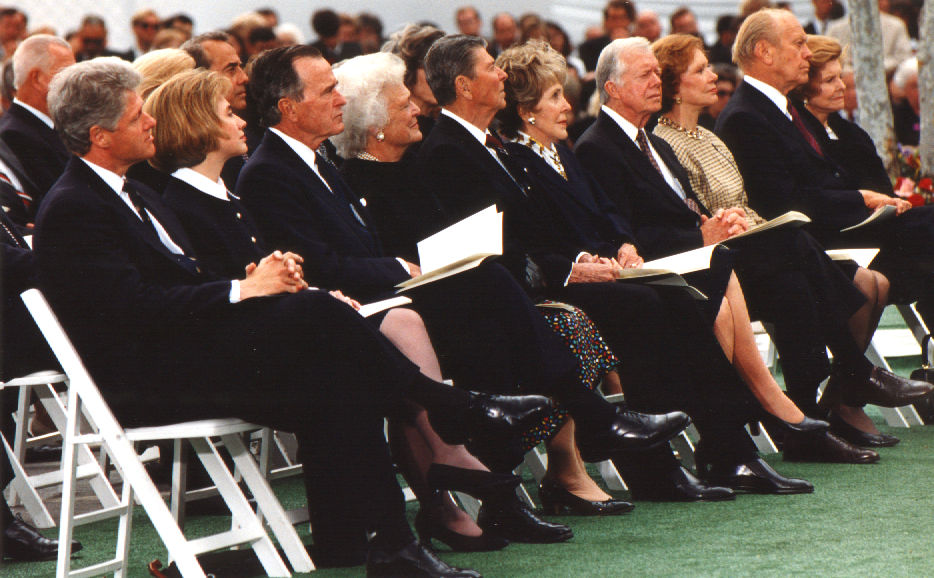
Dr. Koop with Hillary Clinton

In 1980 I really was influenced at my highschool by a teacher of mine named Mark Brink. He introduced me to the film series “Whatever happened to the human race?” by Francis Schaeffer and Dr. C. Everett Koop.

In this  film series that came out in 1979 they dealt with the big social issues and predicted what social problems we have in the future because of humanism. For instance, they knew that the Jack Kevorkians of the world would be coming down the pike. They predicted that there was a slippery slope from abortion to infanticide to youth euthanasia brought on by the materialistic worldview.

Later in the summer of 1980 I saw the film series “Free to Choose” by Milton Friedman and I read his book “Free to Choose” over and over during the years that followed. That same year I worked in Ronald Reagan’s campaign as a volunteer.

Sadly all of those political and religious heroes of mine have now passed away. Francis Schaeffer at age 72 in 1984, Ronald Reagan at age 93 in 2004, Milton Friedman at age 94 in 2006 and now Dr. C. Everett Koop at age 96 on Feb 25, 2013.

I still stay in touch with my former teacher Mark Brink and enjoy corresponding with him. He introduced me to the film series “Whatever happened to the human race?” that truly was an amazing look at the social issues that we would be facing in the coming years in the USA.

I found three more editorial cartoons of Dr. C. Everett Koop from the 1980’s. He also did some work with the Clinton Administration in the 1990’s on several issues. I had forgotten about that.

On 2-25-13 we lost a great man when we lost Dr. C. Everett Koop. I have written over and over the last few years quoting Dr. C. Everett Koop and his good friend Francis Schaeffer. They both came together for the first time in 1973 when Dr. Koop operated on Schaeffer’s daughter and as a result they became close friends. That led to their involvement together in the book and film series “WHATEVER HAPPENED TO THE HUMAN RACE?” in 1979.

In the film series “WHATEVER HAPPENED TO THE HUMAN RACE?” the arguments are presented  against abortion (Episode 1),  infanticide (Episode 2),   euthenasia (Episode 3), and then there is a discussion of the Christian versus Humanist worldview concerning the issue of “the basis for human dignity” in Episode 4 and then in the last episode a close look at the truth claims of the Bible.

(normal size jpg)e

Title:
Attention! All Aboard!! Hey, Folks. . . Hello. . . Yoo-Hoo. . .

(normal size jpg)

We’re Not Finished

Abortion is not simply one item on our social agenda.
Stan Guthrie
[ posted 5/20/2008 9:29AM ]

Ever since C. Everett Koop and Francis Schaeffer pricked our consciences, abortion has been on the front burner for socially minded evangelicals. Thirty-five years since Roe v. Wade, it’s time to ask whether it should remain the sine qua non of Christian social engagement.

Claiming to represent the new center, an increasingly self-confident wing of sincere evangelicals thinks not. “The evangelical social agenda is now much broader and deeper,” asserts Jim Wallis in his new book, The Great Awakening, “engaging issues such as poverty and economic justice, global warming, hiv/aids, sex trafficking, genocide in Darfur, and the ethics of the war in Iraq.”

In The Scandal of Evangelical Politics, Ron Sider, echoing a common complaint that pro-lifers believe that “life begins at conception and ends at birth,” says starvation and second-hand smoke are also “sanctity of life” issues.

In other words, these and other voices seem to be saying that fighting legalized abortion—the deliberate, state- sanctioned taking of 50 million unborn human lives from their mothers’ wombs since 1973 (and the accompanying national guilt)—should simply be one item among many on an ever-expanding evangelical to-do list. I agree that we have multiple responsibilities as Christians, and different callings. But if everything is a priority, then nothing is. While no one is saying that defending unborn human life is optional, the way we sometimes talk about our broader agenda appears to minimize the importance of abortion.

If everything is a priority, then nothing is.

Imagine an adviser telling Martin Luther King Jr. that he won’t be participating in the march from Selma to Montgomery because there is a broader social agenda. Rightly might King retort, “But we’re not finished!”

Despite all our other good and necessary deeds during the ’60s, we evangelicals faced scathing criticism for being largely awol on civil rights, the premier social issue of the era. What will future generations say if we neglect the preeminent moral issue of our day? We cannot excuse ourselves by saying, “Well, protecting unborn human life is someone else’s calling, but [fill in the blank] is my calling.” We are all called to fight abortion.

“God wants to save these children,” Ohio Congressman Tony Hall says in Michael Lindsay’s Faith in the Halls of Power. “He doesn’t want these children killed.” Jesus never turned his back on children. Will we?

And faltering now would be doubly tragic, because the tide is turning. According to the pro-choice Guttmacher Institute, the abortion rate has dropped to its lowest level since 1974. The number has also fallen, from 1.6 million abortions in 1990 to 1.2 million in 2005. While that’s still far too many, and the prospect of actually overturning Roe seems distant, it’s real progress nevertheless.

For example, Americans United for Life notes that over a 14-year period, Mississippi passed 15 pro-life laws, such as the Abortion Complication Reporting Act. As a result, the number of abortions has declined by 60 percent, and six of seven abortion clinics in the state have closed.

Thanks to pregnancy care centers, ramped up adoption efforts, increased access to ultrasounds, and the judicious use of pro-life arguments (such as those in Francis Beckwith’s book Defending Life), we are also winning hearts and minds. The Pew Research Center reports that 18- to 29-year-olds (many of whom consider themselves abortion survivors) consistently favor tougher abortion restrictions than do those 30 and older. In 2003 Gallup found that 32 percent of teens surveyed said abortion should be illegal in all cases—compared with 17 percent of adults. Even Hollywood appears to be sympathetic to pro-life concerns (ct, February, page 34).

Yes, some pro-lifers have besmirched the cause by the use of violence, brass-knuckle political tactics, or hateful rhetoric. And yes, a majority of Americans favors keeping abortion legal in some circumstances. But Carrie Gordon Earll of Focus on the Family notes that most would make abortion illegal except in cases of rape, incest, or threat to the life of the mother. “That’s a far cry from what we have today,” Earll says, “and an encouraging sign that this nation can move back to a place where abortion is no longer legal or thinkable.”

It’s hard to find anyone who is “pro-abortion” these days. Hillary Clinton calls abortion a “sad, even tragic choice.” Barack Obama opposed banning partial-birth abortion, which the Supreme Court restricted last year. But even Obama told this magazine, “I don’t know anybody who is pro-abortion.”

No, we will not all be called to picket or pray in front of an abortion clinic or pass legislation or support an unwed mother or adopt a child or write letters to the editor. But we all can do something.

Opposing abortion is not simply another agenda item for evangelicals. It is our sacred duty. Whatever other good deeds we are called to do—and there are many—we cannot say abortion is someone else’s business. It’s our business.

e

Dr. C. Everett Koop is pictured above.

Francis Schaeffer: “Whatever Happened to the Human Race” (Episode 1) ABORTION OF THE HUMAN RACE

Published on Oct 6, 2012 by

h

Related posts:

Open letter to President Obama (Part 232 B) Dr. C. Everett Koop and Reagan pictured together

Dr. C. Everett Koop with Ronald Reagan. Dr. Koop was delayed in his confirmation by Ted Kennedy because of his film Whatever Happened to the Human Race? President Obama c/o The White House 1600 Pennsylvania Avenue NW Washington, DC 20500 Dear Mr. President, I know that you receive 20,000 letters a day and that you […]

“Sanctity of Life Saturday” Francis Schaeffer and Dr. C. Everett Koop asked Reagan to issue pro-life proclamation in 1983 (includes video ABORTION OF THE HUMAN RACE)

In the film series “WHATEVER HAPPENED TO THE HUMAN RACE?” the arguments are presented  against abortion (Episode 1),  infanticide (Episode 2),   euthenasia (Episode 3), and then there is a discussion of the Christian versus Humanist worldview concerning the issue of “the basis for human dignity” in Episode 4 and then in the last episode a close […]

Dr. C. Everett Koop on abortion’s 1973 Roe v. Wade impact on child abuse

Dr. C. Everett Koop with Ronald Reagan. Dr. Koop was delayed in his confirmation by Ted Kennedy because of his film Whatever Happened to the Human Race? Watch the film below starting at the 19 minute mark and that will lead into a powerful question from Dr. C. Everett Koop. This 1979 film is WHATEVER […]

Open letter to President Obama (Part 221 B) Dr. C. Everett Koop and Francis Schaeffer rightly called abortion “the watershed issue of our era”

 Dr. Koop was delayed in his confirmation by Ted Kennedy because of his film Whatever Happened to the Human Race? Francis Schaeffer February 21, 1982 (Part 1) Uploaded by DeBunker7 on Feb 21, 2008 READ THIS FIRST: In decline of all civilizations we first see a war against the freedom of ideas. Discussion is limited […]

Francis Schaeffer and C. Everette Koop on the Hippocratic oath (March for Life January 20, 2013)

Dr. C. Everett Koop was appointed to the Reagan administration but was held up in the Senate in his confirmation hearings by Ted Kennedy because of his work in pro-life causes. I was thinking about the March for Life that is coming up on Jan 20, 2013  and that is why I posted this today […]

Ronald Wilson Reagan pictured with Dr. C. Everett Koop

High resolution version (11,426,583 Bytes) Description: The photograph is signed by President Ronald Reagan with the inscription “To Chick Koop, With Best Wishes.” Chick, from chicken coop, was the nickname Koop gained will attending Dartmouth College in the mid-1930s. Koop maintained a cordial relationship with President Reagan, despite his disappointment over Reagan’s refusal to address […]

Francis Schaeffer and C. Everett Koop were prophetic (jh29)

Francis Schaeffer and C. Everett Koop were prophetic (jh29) What Ever Happened to the Human Race? I recently heard this Breakpoint Commentary by Chuck Colson and it just reminded me of how prophetic Francis Schaeffer and C. Everett Koop were in the late 1970′s with their book and film series “Whatever happened to the human […]

Should Michele Bachmann be punished for taking pro-life views from Schaeffer and Koop? (March for Life January 20, 2013)

  Dr. C. Everett Koop I was thinking about the March for Life that is coming up on Jan 20, 2013  and that is why I posted this today Secular leaps of faith 39 Comments Written by Janie B. Cheaney August 15, 2011, 2:17 PM I’m willing to cut Ryan Lizza some slack. His profile […]

“Schaeffer Sundays” Francis Schaeffer’s own words concerning humanism and its bad results

Francis Schaeffer: “Whatever Happened to the Human Race?” (Episode 2) SLAUGHTER OF THE INNOCENTS Published on Oct 6, 2012 by AdamMetropolis The 45 minute video above is from the film series created from Francis Schaeffer’s book “Whatever Happened to the Human Race?” with Dr. C. Everett Koop. This book  really helped develop my political views concerning […]

“Sanctity of Life Saturday”:Derek Melleby’s review of the book “Francis Schaeffer: An Authentic Life” (includes film THE BASIS FOR HUMAN DIGNITY)

  I truly believe that many of the problems we have today in the USA are due to the advancement of humanism in the last few decades in our society. Ronald Reagan appointed the evangelical Dr. C. Everett Koop to the position of Surgeon General in his administration. He partnered with Dr. Francis Schaeffer in making […]

Taking on Ark Times bloggers about abortion on the 40th anniversary date of Roe v. Wade (Part 5) “Slavery issue compared to rights of unborn child”

The best pro-life film I have ever seen below by Francis Schaeffer and Dr. C. Everett Koop “Whatever happened to the human race?” Over the years I have taken on the Ark Times liberal bloggers over and over and over concerning the issue of abortion. I asked over and over again for one liberal blogger […]

Taking on Ark Times bloggers about abortion on the 40th anniversary date of Roe v. Wade (Part 4) “How do pro-lifers react to the movie THE CIDER HOUSE RULES?”

Francis Schaeffer pictured above._________ The best pro-life film I have ever seen below by Francis Schaeffer and Dr. C. Everett Koop “Whatever happened to the human race?” Over the years I have taken on the Ark Times liberal bloggers over and over and over concerning the issue of abortion. I asked over and over again […]

Taking on Ark Times bloggers about abortion on the 40th anniversary date of Roe v. Wade (Part 3) “What should be the punishment for abortion doctors?”

The best pro-life film I have ever seen below by Francis Schaeffer and Dr. C. Everett Koop “Whatever happened to the human race?” On 1-24-13 I took on the child abuse argument put forth by Ark Times Blogger “Deathbyinches,” and the day before I pointed out that because the unborn baby has all the genetic code […]

Taking on Ark Times bloggers about abortion on the 40th anniversary date of Roe v. Wade (Part 2) “The pro-abortion child abuse argument destroyed here”

PHOTO BY STATON BREIDENTHAL from Pro-life march in Little Rock on 1-20-13. Tim Tebow on pro-life super bowl commercial. Over the years I have taken on the Ark Times liberal bloggers over and over and over concerning the issue of abortion. Here is another encounter below. On January 22, 2013 (on the 40th anniversary of the […]

Taking on Ark Times bloggers about abortion on the 40th anniversary date of Roe v. Wade (Part 6) For many pro-abortionists ” …the problem is not determining when actual human life begins, but when the value of that life begins to out weigh other considerations”

The best pro-life film I have ever seen below by Francis Schaeffer and Dr. C. Everett Koop “Whatever happened to the human race?” Francis Schaeffer pictured above._________ The 45 minute video above is from the film series created from Francis Schaeffer’s book “Whatever Happened to the Human Race?” with Dr. C. Everett Koop. This book  really […]

Taking on Ark Times bloggers about abortion on the 40th anniversary date of Roe v. Wade (Part 7) “Poverty not good reason for abortion, why not give up for adoption?”

Dr Richard Land discusses abortion and slavery – 10/14/2004 – part 3 The best pro-life film I have ever seen below by Francis Schaeffer and Dr. C. Everett Koop “Whatever happened to the human race?” Over the years I have taken on the Ark Times liberal bloggers over and over and over concerning the issue […]

Taking on Ark Times bloggers about abortion on the 40th anniversary date of Roe v. Wade (Part 1)

Dr Richard Land discusses abortion and slavery – 10/14/2004 – part 3 The best pro-life film I have ever seen below by Francis Schaeffer and Dr. C. Everett Koop “Whatever happened to the human race?” Over the years I have taken on the Ark Times liberal bloggers over and over and over concerning the issue […]

Paul Greenberg became pro-life because we are all “endowed with certain unalienable rights”

On January 20, 2013 I heard Paul Greenberg talk about the words of Thomas Jefferson that we are all “endowed with certain unalienable rights” and the most important one is the right to life. He mentioned this also in this speech below from 2011: Paul Greenberg Dinner Speech 2011 Fall 2011 Issue Some of you […]

How Pulitzer Prize-winning Paul Greenberg, one of the most respected and honored commentators in America, changed his mind about abortion and endorses now the pro-life view

It is not possible to know where the pro-life evangelicals are coming from unless you look at the work of the person who inspired them the most. That person was Francis Schaeffer.  I do care about economic issues but the pro-life issue is the most important to me. Several years ago Adrian Rogers (past president of […]

Open letter to President Obama (Part 304)

(Mailed before 10-1-12.)

President Obama c/o The White House
1600 Pennsylvania Avenue NW
Washington, DC 20500

Dear Mr. President,

I know that you receive 20,000 letters a day and that you actually read 10 of them every day. I really do respect you for trying to get a pulse on what is going on out here.

I really wish that you would have not had the federal government buy up General Motors. We need to keep the federal government out of the private market as much as possible. This goes for the post office too. It should be in private hands.

Postal Problems: the Role of Government Micromanagement

Posted by Tad DeHaven

Postal expert Michael Schuyler has released a follow-up to his January paper that compared the recent financial performance of the U.S. Postal Service to foreign postal service providers. Not surprisingly, the USPS has fared relatively poorly in comparison to its foreign counterparts. In his new paper, Schuyler looks at the role government micromanagement plays and finds that “Foreign posts have much more flexibility than USPS to adjust operations to keep costs in line with revenue.”

The following are some key points:

  • Foreign governments intervene in their postal markets, but “foreign governments often temper their demands and grant their postal services substantial operational discretion, in order that they not undermine their posts’ financial viability.”
  • The USPS has reduced headcount by 29 percent since 1999, but in comparison to foreign operators, it has less flexibility when it comes to managing labor costs. For instance, “there have been few layoffs because contracts with postal unions contain no-layoff provisions that protect the jobs of most career postal workers…Although the reduction the Service accomplished through attrition and buyouts has been skillful, it has not been sufficient to bring the workforce into balance with reduced mail volume.”
  • While many foreign operators have moved to five-day mail delivery, Congress continues to insist that the USPS deliver mail six days a week. Given the continuing – and permanent – decline in the demand for mail, the case for cutting back on delivery is getting stronger. Regardless of whether the USPS should move to five day delivery, the “requirement shows how the U.S. Postal Service is hamstrung in its ability to rein in costs through operational adjustments, compared to many foreign posts.”
  • Congressional meddling makes it harder for the USPS to downsize its retail network to better reflect financial reality. When the USPS tries to close post offices and other facilities, “members of Congress often object vigorously to proposed closings within their jurisdictions and occasionally threaten to introduce legislation to block proposed changes.” As a result, the USPS usually backs down.

I’ll conclude by making my standard pitch for liberalization of the U.S. postal market, which would ideally lead to privatization of the USPS. The word “privatization” scares a lot of people, but it shouldn’t. If one were to spend a couple of years working in the U.S. Senate, as I have, there’s a good chance that he or she will conclude that continuing to allow 535 politicians to manage a business is a whole lot scarier.

_______

Thank you so much for your time. I know how valuable it is. I also appreciate the fine family that you have and your commitment as a father and a husband.

Sincerely,

Everette Hatcher III, 13900 Cottontail Lane, Alexander, AR 72002, ph 501-920-5733, lowcostsqueegees@yahoo.com

Related posts:

Private entrepreneurs can solve our post office problem

When you look at how good the private enterprise does with deliveries and then compare it to how bad the federal government does with the same duties it is laughable. The answer to the federal post office problem is to encourage private entrepreneurs to fill the gap and provide competition for the post office in […]

Senator Pryor asks for Spending Cut Suggestions! Here are a few!(Part 131)

Senator Mark Pryor wants our ideas on how to cut federal spending. Take a look at this video clip below: Senator Pryor has asked us to send our ideas to him at cutspending@pryor.senate.gov and I have done so in the past and will continue to do so in the future. On May 11, 2011,  I emailed to […]

Privatize the post office

The Arkansas Times rightly jumped on Republicans for whining about the local post office branches that were closing.  (It is sad to me that Republican Presidential Candidates are not very brave about offering any spending cuts.) The real answer is privatizing the post office. Here is a good article from the Cato Institute:   The USPS […]

We need to close U.S.Post Office

We need to close U.S.Post Office There is only one option in my view. We can not keep on losing money every year like the U.S.Postal Service (7 billion this year). Closing Post Offices   PrintThe U.S. Postal Service just posted a $3.1 billion loss for the third quarter and the outlook for the rest […]

‘Why Indiana Shouldn’t Fall for Obamacare’s Medicaid Expansion’

Expanding government is not right. Take a look at this article:

APRIL 25, 2013 6:35PM

‘Why Indiana Shouldn’t Fall for Obamacare’s Medicaid Expansion’

My latest oped, in the Indy Star:

Meanwhile, many [Medicaid] enrollees can’t even find a doctor. One-third of primary care physicians won’t take new Medicaid patients. Only 20 percent of dentists accept Medicaid. In 2007, 12-year-old Deamonte Driver died — yes, died — because his mother couldn’t find one of those dentists.

For more on why states should reject ObamaCare’s Medicaid expansion, read my latest Cato white paper, “50 Vetoes: How States Can Stop the Obama Health Law.”

Related posts:

Great article by Michael Cannon on Arkansas Medicaid expansion plan

CATO Institute Michael Cannon on the OReilly Factor Published on Mar 19, 2013 The CATO Institute’s Michael Cannon spoke at the Arkansas Conservative Caucus on Tuesday March 19th. Several conservatives were present. Cannon talked about how to defeat Obamacare in Arkansas & how the states can stop Obamacare on a national level. __________________ CATO Institute […]

Michael Cannon of Cato Institute speaks to Arkansas Senators (Part 3 includes editorial cartoon)

Jacque Martin asks CATO Institute Michael Cannon about Obamacare Published on Mar 19, 2013 The CATO Institute’s Michael Cannon spoke at the Arkansas Conservative Caucus on Tuesday March 19th. Several conservatives were present. Cannon talked about how to defeat Obamacare in Arkansas & how the states can stop Obamacare on a national level. Jacque Martin […]

After visit to Arkansas Cato’s Michael Cannon puts out new article

  After a visit to Arkansas on March 19, 2013 the Cato Institute’s Michael Cannon published another article claiming that “To date, 34 states, accounting for roughly two-thirds of the U.S. population, have refused to create Exchanges. Under the statute, this shields employers in those states from a $2,000 per worker tax that will apply […]

Michael Cannon of Cato Institute speaks to Arkansas Senators (Part 2 includes editorial cartoon)

Representative Doug House asks CATO Institute Michael Cannon about Obamacare Published on Mar 19, 2013 The CATO Institute’s Michael Cannon spoke at the Arkansas Conservative Caucus on Tuesday March 19th. Several conservatives were present. Cannon talked about how to defeat Obamacare in Arkansas & how the states can stop Obamacare on a national level. Representative […]

Michael Cannon on Obamacare (editorial cartoons on Judge Roberts and Obamacare)

Representative Bollinger asks CATO Institute Michael Cannon about Obamacare Published on Mar 19, 2013 The CATO Institute’s Michael Cannon spoke at the Arkansas Conservative Caucus on Tuesday March 19th. Several conservatives were present. Cannon talked about how to defeat Obamacare in Arkansas & how the states can stop Obamacare on a national level. Representative Bollinger […]

Michael Cannon of Cato Institute speaks to Arkansas Senators (Part 1, includes editorial cartoon)

An ObamaCare Debate Challenge (Michael F. Cannon) CATO Institute Michael Cannon at the Arkansas Conservative Caucus Published on Mar 19, 2013 The CATO Institute’s Michael Cannon spoke at the Arkansas Conservative Caucus on Tuesday March 19th. Several conservatives were present. Cannon talked about how to defeat Obamacare in Arkansas & how the states can stop […]

Max Brantley of the Ark Times takes on Michael Cannon of the Cato Institute today concerning Obamacare

Max Brantley of the Ark Times takes on Michael Cannon of the Cato Institute today concerning Obamacare. I have posted many links to Cannon’s articles in the past on my blog and on the Arkansas Times liberal blog. The finest article written in my estimation was written on Nov 20, 2012 and here is a […]

Is Michael Cannon of the Cato Institute right about states blocking Obamacare, factchecker says he is wrong.

Cato’s Michael F. Cannon Discusses ObamaCare’s Individual Mandate Is Michael Cannon of the Cato Institute right about states blocking Obamacare, factchecker says he is wrong. I Have Been False* Posted by Michael F. Cannon *According to PolitiFact. In an unconscious parody of everything that’s wrong with the “fact-checker” movement in journalism, PolitiFact Georgia (a project of […]

An ObamaCare Debate Challenge by Michael F. Cannon (editorial cartoon)

Obamacare is a poorly written and because of that the majority of states may never have to put into practice.   February 28, 2013 2:13PM ObamaCare Debate Challenge: Lawrence Wasden Edition By Michael F. Cannon Share Tweet Like Google+1 Congress empowered states to block major provisions of ObamaCare, including its subsidies and employer mandate. All […]

If Obamacare is so wonderful then why are so many people trying to get exemptions?

If Obamacare is so wonderful then why are so many people trying to get exemptions? The Heritage foundation ran a fine article on this too.  Should Politicians Be Allowed to Exempt Themselves and their Staff from Obamacare? April 25, 2013 by Dan Mitchell I get upset by a lot of what happens in the corridors of power, […]

A suggestion to cut some wasteful spending out of the government Part 3 (includes editorial cartoon)

What Can We Cut to Balance the Budget

Published on Oct 16, 2012

Will Rogers has a great quote that I love. He noted, “Lord, the money we do spend on Government and it’s not one bit better than the government we got for one-third the money twenty years ago”(Paula McSpadden Love, The Will Rogers Book, (1972) p. 20.)

If the U.S. government cut all government services except Social Security, Medicare, Medicaid, and payments on the debt, federal spending would still outpace revenues. Prof. Antony Davies argues that there are not specific cuts that will enable government to balance the budget. He says, “Nothing less than a redesign will solve this problem.” That redesign should begin by determining what the proper role of government is.

__________________

We got to cut wasteful spending out of the government and here is another fine suggestion from the Heritage Foundation.

Todd Thurman

March 12, 2013 at 5:40 pm

Newscom

The massive spending bill, or continuing resolution, released by the Senate this week continues spending on programs which are inappropriate or wasteful and fails to adopt good policies in many areas. Here’s a rundown of some of the worst offenders in the Senate bill:

Energy. The Senate CR continues to fund a failed energy policy that empowers Washington bureaucrats instead of American families and businesses. Though it does cut some programs minimally, it does the equivalent of removing a used napkin from a full trash can. There’s much more waste that needs to be removed. For example, section 1203 reduces Department of Energy (DOE) funding by $44 million when more than $5.3 billion could be cut. The $44 million is equivalent to 0.8 percent of what should be cut.

Perhaps most egregious is the meager $11 million cut from the $1.8 billion request for Office of Energy Efficiency and Renewable Energy. In total, the DOE budget funds applied-research programs on conventional fuels, renewable energy sources, and nuclear energy that the private sector should be undertaking. American families and business are far better equipped than government to determine what types of energy technologies work for them. Eliminating these programs alone would save $3 billion in taxpayer money and help to return energy choice back to Americans.

Though the bill cuts $10 million from nuclear energy spending, based on the 2013 request, it would still fund over $150 million for nuclear waste disposal and management programs. None of this funding would go toward Yucca Mountain, the waste repository mandated by the Nuclear Waste Policy Act, as amended. Given the complete lack of any nuclear waste disposal or management policy by the Administration and its insistence on terminating the Yucca project, there is little justification for this spending. Instead, Congress should provide $40 million for the Nuclear Regulatory Commission to finish its review of the DOE’s Yucca Mountain permit application.

—Jack Spencer, Senior Research Fellow, Nuclear Energy, and Nick Loris, Herbert and Joyce Morgan Fellow

Last year, I made fun of the Washington Post for biased reporting when they used the world “slash” to describe a budget proposal that would have trimmed $6 billion out of a giant $3,800 billion budget.

I wrote that this was the budgetary equivalent of “going on a diet by leaving a couple of french fries in the bottom of the bag after bingeing on three Big Mac meals at McDonald’s.” A couple of other bloggers then had some fun by doing the exact calculations of what this would mean.

Now we have a cartoon version of Washington budgeting, authored by Gary Varvel.

Keep in mind, though, that this cartoon actually is inaccurate because it implicitly accepts the dishonest Washington definition of a budget cut (having spending grow, but not as fast as previously planned).

Every budget plan, even the very admirable proposals put forth by Sen. Rand Paul and the House Republican Study Committee, merely restrains the growth of federal spending.

So the cartoon should show Uncle Same with some clippers, simply seeking to keep the weed from growing even faster.

And if we replaced Uncle Sam with Barack Obama, instead of scissors or clippers, he’d be holding fertilizer.

We got to cut the budget and not just pretend to cut the budget

We got to cut the budget and not just pretend to cut the budget.

April 25, 2013 at 3:30 pm


Harry ReidSenate Majority Leader Harry Reid (D–NV) is proposing not one but two old budget gimmicks to spend $85 billion more in 2013 than allowed under sequestration. Contrary to Senator Reid’s claim that “it wouldn’t add a penny to the deficit,” this spending would in fact add every single penny in foregone cuts to the deficit.

1.      Phantom War Savings

Reid’s proposal (S. 788) suggests placing caps on war-related spending for Iraq and Afghanistan, referred to as Overseas Contingency Operations (OCO), a category otherwise exempted from the Budget Control Act caps. The savings from the caps are phony because they appear to be based on the Congressional Budget Office (CBO) baseline, which assumes that OCO spending will rise, even though it’s winding down.

Under this inflated baseline, Reid could claim nearly $110 billion over three years in phony savings from his OCO spending caps. Under the CBO alternative baseline, however—which includes the reality that the number of troops deployed will fall by 2015—Reid’s proposal could actually increase spending by $28 billion. And that is before cancelling sequestration, which increases spending by $85 billion in 2013 for a total spending increase of $113 billion over three years.

The practical reality is that there is no accepted baseline for OCO spending. Even the President’s budget resorts to mere placeholders for OCO “because final decisions about the pace of the drawdown in Afghanistan have not yet been made.”

2.      Spend Now, Save Later

Even if Reid’s savings were real, his proposal would increase spending immediately by $85 billion while cutting it by that amount over the course of three years. If it takes Reid three years to offset five months of sequestration, how long would it take to replace all of sequestration with other cuts? Too darn long for them to possibly ever materialize.

Real Savings Are Only $95 Billion in Overlap Waste Away

Senator Reid should stop playing budget games and instead find real savings that would avoid unnecessarily painful sequestration impacts. He could start by following the Government Accountability Office’s suggestions to save $95 billion from 31 new areas of overlap. Heck, he’d have $10 billion left over to reduce the deficit! Now that would be a proposal that taxpayers could embrace.

Francis Schaeffer’s wife Edith passes away on Easter weekend 2013 Part 7 (includes pro-life editorial cartoon)

The Francis and Edith Schaeffer Story Pt.1 – Today’s Christian Videos

The Francis and Edith Schaeffer Story – Part 3 of 3

Francis Schaeffer: “Whatever Happened to the Human Race” (Episode 1) ABORTION OF THE HUMAN RACE

Published on Oct 6, 2012 by

________________

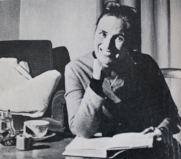
Picture of Francis Schaeffer and his wife Edith from the 1930′s above. I was sad to read about Edith passing away on Easter weekend in 2013. I wanted to pass along this fine article below.

Saturday, March 30, 2013

FINALLY ENTRANCE TOGETHER INTO ETERNITY – Edith Schaeffer (1914 – 2013)

Edith Schaeffer
Photo by Mustapha Ashrad

“How I hope we may have many years of service together, and finally entrance together into eternity.” ~ Francis Schaeffer to his wife Edith, 1935.

As we reflect on the passing of Edith Schaeffer, who went to be with the Lord in the early hours of March 30th, 2013, it is worthwhile to note the events of her life to get a sense of who she was. It is a most distinct providence that guided such a couple as her and Francis together. Both whom were avid defenders of the faith, who were passionate about people and teaching the truth. Yet, as we reflect, consider the story, but also consider Edith’s passion. She was passionate for Christ, for ministry, for children, and especially her dear husband “Fran” whom she loved and served with side-by-side with for so many years.

1914 – “Edith Rachel Merritt Seville was born in Wenchow, China on November 3. [1]” She was the fourth child of missionaries, George Hugh Seville and Jessie Maude Merritt Seville. [2] They served in what was formerly known as the China Inland Mission, founded by Hudson Taylor. Edith had a wonderful family Christian heritage and was well educated and highly artistic and loved the arts greatly. She and her family had tried to learn Chinese culture and even adopted some Chinese dress. Edith was known as Mei Fuh during their time in China. Edith notes in her children’s book by the same title that because of the time difference, her birth was recorded officially a day earlier in the United States as November the 2nd. [3]

1920 – Edith’s family would move back to the states when she was six years old. When her family relocated to Germantown, she began attending Germantown High School (Fran’s former school) in her senior year. [4]
1932 – Fran met his future wife on June 26 at the First Presbyterian Church in Germantown, Pennsylvania in the defense of the faith. Edith had just graduated from Germantown High School [5]. Fran had just returned home from college. They both were at a Young People’s meeting, where a former member, now a member of the Unitarian church, was lecturing on the topic, “How I know that Jesus is not the Son of God, and how I know that the Bible is not the Word of God.” During the lecture, Edith jumped up and began to make a reply, when across the room Fran, who was already standing began to speak. Edith sat back down and listened in amazement. Edith asked her friends, “Who’s that boy?” She was not aware of anyone in the church who knew any replies against Modernism. Edith soon rose to make her points, quoting from J. Gresham Machen, and Robert D. Wilson. of Westminster Theological Seminary nearby. Schaeffer likewise asked his friend, “Who’s that girl?” Fran was impressed and was not aware that anyone attending the church was familiar with Old Princeton Apologetics (In fact, Edith would first introduce Fran to J. Gresham Machen’s book, Christianity and Liberalism early in their friendship). Thereafter, Francis would ask Edith if he could walk her home, to which Edith replied, “I have a date.” Schaeffer looked at her calmly and simply said, “Break it!” Thus began their life together as defenders of the faith. [5]
Edith would go on to enter Beaver College [6] for a degree in home economics that same year. Edith was highly trained in foods, dietetics, dressmaking, interior decorating, and art appreciation. All of which she would put to good use eventually at L’Abri.1935 – Francis Graduated from Hampden-Sydney College in June and graduated second in his senior class, magna cum laude. [7]
Fran & Edith’s Wedding
July 6, 1936

Francis and Edith would be married on July 6th. They were married at Wayne Avenue United Presbyterian Church, by Edith’s father George Seville. Fran was twenty-three and Edith was twenty. Fran and Edith saw their relationship as rooted in ministry. He remarked to Edith in a letter, this wonderful thought: “How I hope we may have many years of service together, and finally entrance together into eternity.” [8] They would spend their honeymoon working at a Christian camp. Immediately, they would discover that they contrast each other, as Fran was intense, passionate and sometimes overly driven, while Edith could be romantic and idealistic and prone to flighty thoughts of the ideal. Yet they would also discover that they complemented each other as well. Edith was cultural and refined, gifted in the formal aspects of hospitality and Fran took great interest in personal relationships, and they both grew to have strongly convictions about the personal aspects of hospitality. Both of them stood passionately together for Biblical Truth against Liberalism and where avid readers, and eventually would be great writers, speakers and teachers.

Fran would enter Westminster Theological Seminary in September of that year.  Edith discontinued her education at Beaver College only completing 3 of the 4 years, to support Fran in seminary, but it was no passive support. She was very purposeful and took time to share everything with him. She made him lunches, but she also made a second, and tried to eat at the same time he ate so that she could be aware of how hungry he might be when he came home. She studied alongside Fran and received a seminary education right along with him from home. She stayed up late with him and shared in the discoveries of theology and philosophy, and learned some of the Greek and Hebrew words he was studying (although Fran needed a considerable amount of time alone studying Hebrew due to his battle with dyslexia). She learned the faculty names and took great interest in the happenings of the seminary. During the day she worked from home as a leather-worker and seamstress working on numerous projects. Fran had received a small grant from Westminster, but Edith was the primary source of income during this time.
1938 – Fran Graduated from Faith Theological Seminary on Willmington, Delaware [10]. “Francis is ordained as the first pastor of the Bible Presbyterian Church denomination. Francis began serving as senior pastor of Covenant Presbyterian Church in Grove City, Pennsylvania. [11]”
The Schaeffers started a large Summer Bible School program that grew and grew. These were formative years in the ministry work of Fran and Edith. Fran persistence and tenacity are well noted, he once squeezed twenty-one boys into a car! Edith’s creativity, on the other hand, broadened the programs available for the summer school. Francis regularly made house calls to every member of the church as well as many of the parents of the children that attended the Summer Bible School.
1943 – After serving as an associate pastor of the Bible Presbyterian Church in Chester, Pennsylvania (1941), God would lead the Schaeffer’s to pastor a church in the Midwest. “Francis began serving as the senior pastor of the Bible Presbyterian Church in St. Louis, Missouri. [11]” The Schaeffer’s picked up where they left off as senior pastors at their first church, creating and establishing ministry with a particular emphasis on children and youth. Several months after arrival, the Schaeffers founded Children For Christ which in a very short time would develop into an international ministry. All of this was based on their earlier work with children in Grove City.As we consider the early story of the life of Francis and Edith Schaeffer, we can see the youthful passion that they had for both beauty and truth. Edith the creative, and Francis the strong teacher. They were young, idealistic, and full of life. They realized very quickly as a young couple that there were limitations in each other. Yet they learned also that God had given them gifts, that they could use, and that complimented each other. They did not yet know how God would use all of them, but they applied their gifts in each new setting and grew together through good times and tough ones. They felt in many ways like they were on an escalator, quickly moving forward in greater service together. They had just began to settle in toward a long term ministry, and the future looked stable and bright. Edith envisioned a life for them in the home where they lived in St. Louis. It was beautiful, and conventional. But in a five short years their idealism would be tested by living in a fallen world, impacted by a post-war climate of hurt and needs. They would be asked to reconsider the nature of Truth, and the nature of beauty in a quest to find answers to the question of “reality.”
1947 – Fran was asked to travel throughout Europe for three months to evaluate the state of the church in Europe as a representative of the Independent Board for Presbyterian Foreign Missions and as the American Secretary for the Foreign Relations Department of the American Council of Christian Churches. Schaeffer toured 31 cities (many more than once), in 13 countries in just 90 days. He slept in 56 different places in that period of time. This trip was both incredibly stimulating and yet deeply exhausting touring in war-torn Europe, just two years after the war, which was still under rationing and with many travel restrictions and a broken infrastructure. It was both psychologically and physically draining on him. The highs and the lows of the events during his travels would catch up to Schaeffer when he got home and he would experience a bout of what some have described as depression and fatigue that fully immobilized him. Edith, carefully nursed him back to health. Edith believed that he was in many ways just short of an absolute physical and mental collapse. She was a solid strength in Fran’s life and was his consummate helper, friend and source of encouragement.

This trip would result in them being called by the missions board to be missionaries to Europe, with the specific calling to, “strengthen that which remains.” They would have a particular emphasis on spreading their work of Children For Christ there.

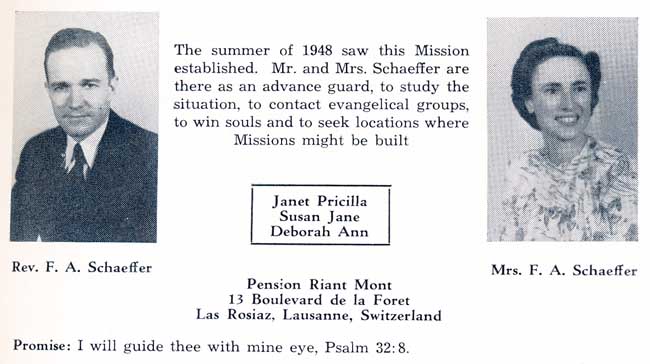
1948 – The Schaeffers move to Lausanne, Switzerland with their three daughters to be missionaries to Europe. Their primary work involved their Children for Christ ministry, and helping with the formation of the International Council of Christian Churches. Their first home would be the Chalet Bijou. Eventually their prayers would be answered to stay in Champery and they would move to Chalet des Frenes. [12]

1951 – During the early winter months, Fran would begin to go through a spiritual crisis. Edith would prayerfully support her husband as she always had and in this time with much prayer. As a result of this crisis, Schaeffer recognized that something was deeply wrong and he carefully reconsidered his Christian commitment and the concepts of truth and reality. Schaeffer emerged from this experience with a new certainty about his faith in True-Truth, and a new emphasis on sanctification and the work of the Holy Spirit, and a new direction in his life which would unfold over the next four years.
Edith’s Begins Writing Her “Family Letters” – Edith begins to write her letters in August. [13] These were sort of a family newsletter that recounted what they were going through and the various happenings. They were not filled with promotional or advertising content, but just family news. Edith was a wonderful and honest writer. She was the other voice of L’Abri, and it is very easy to fall in love with her wonderful creative spirit. People connected with her words, and attitude of prayer. God used these letters in many ways to work through His people miraculously and naturally in a very organic way. People would often give timely gifts that were direct answers to prayer, and very often they did not even know the need. As Edith wrote their story, people responded not out of compulsion, but out of the good of their heart in both prayer and giving.

1953-54  – The Schaeffers return to the US with family on furlough, and Fran began an extensive speaking and traveling schedule. Schaeffer traveled across the country speaking 346 times during 515 days, sometimes three times a day, about the deeper spiritual life.

As the family returned to Champery, Switzerland in September. It was on the deck of the of the USS Ile de France that Francis first told Edith of the desire to use the word “L’Abri,” for their ministry and thought of changing the name of their chalet in Champery. [14]
1955 – In the following year, on February 14 the Schaeffer received notice from the Swiss government on that they must leave Switzerland permanently within six weeks for their “religious influence” in the Catholic canton. Each Swiss canton are member states within the federal state of Switzerland. The word canton is a French word that more literally means “corner” or “district.” The Schaeffers were at this time living in the Roman Catholic bishopric of Valais.

The Schaeffers, by April 1st would move out of this canton and into another. Their new home would be Chalet Les Melezes in Huemoz, Switzerland. God brought about a series of miraculous circumstances which would open the way for a new beginning in ministry. The circumstances that surrounded this event are numerous and amazing all recounted in Edith’s book entitled L’Abri. Edith’s strong faith and conviction in the matter proved to open the door to the new location, as at just the right time God would provide both the location as well as the provision through a gift in the mail to start L’Abri.

Edith’s March 7-9th family letter makes the official announcement of the work of L’Abri. “L’Abri is what we feel the Lord would have us add to the work He had given us here in Switzerland. L’Abri means “shelter” in French, and our thought is to have a spiritual shelter for any who have spiritual need. [15]”

In her May 30th family letter, written just after they had completed their move into Chalet les Melezes, Edith remarks, “And so literally L’Abri began in Chalet les Melezes immediately upon our arrival–with a German musician, a Swiss peasant, and an English ex-Wren and ex-nurse for our first guest.

The Schaeffers officially resigned from the Independent Board of Presbyterian Foreign Missions on June 4, marking the final commitment to L’Abri Fellowship.
1955 – Following the resignation, in her June 17th letter, Edith explains in a bit more detail how L’Abri will operate. “And so we face a busy summer as L’Abri Fellowship begins, and such a thing as a vacation must be put off again. But the Lord is sending those who need a time in L’Abri, and he can just as easily provide an opening for a vacation when He knows it is necessary.
There are a few things you should know about L’Abri Fellowship. The material needs of the work, and ourselves, will be met as the Lord sends in gifts in answer to prayer. We believe that if He sends the people to us who need to be here for study and asking questions and prayer, He will also send in the means to feed them.” Edith goes on to explain the garden and matters with the appliances, the states, “Each need will be prayed about and we will wait for guidance to proceed according to His specific answers in sending the means.
Finally, and most important–L’Abri Fellowship may seem very small–but we know there are many who are having a daily part in the work here through your faithful prayers. The ones who are working here through prayer we wish to speak of as the Praying Family of L’Abri. You yourself know whether you are one whom the Lord has joined to us in this way or not. May L’Abri truly be a shelter in a weary land for those who will find Christ their shelter here. [16]”
Edith clarifies in her work L’Abri that L’Abri Fellowship became official in July when her father, Dr. George H. Seville, former missionary to China with the China Inland Mission took on the work of creating a home office in the states for them. He had just retired from his teaching position at a theological school and wanted to work as their “home secretary” as his contribution to the work of L’Abri. While he assumed legal roles and the handling and sending of gifts, Edith’s mother duplicated and mailed the family letters to their family. These letters, with family members in mind would become “Dear Family” and would grow as God brought people to follow the work of their ministry. [17]
1959 – In November of 1959 a journalist from Time magazine, showed up at L’Abri, who had been tipped off by a journalist parent who had a daughter in school with Deborah Schaeffer. The following day a photographer would also drop in to shoot the photographs.
1960 – The Time magazine article was published entitled “Mission to Intellectuals” in the January 11th publication.[18]
1964 –  It was about this time that Betty Carlson is convinced that the Lord is leading her to give a month’s wages to send Edith away to write the story of L’Abri. [19] Edith in fact does write her book on L’Abri. It however sits as a completed manuscript under the Schaeffer’s bed for the next five years! During which time Betty remained confident that it would be published at the right time. [20] Probably one of the first converts from the reading of the book, and in this instance, in it’s pre-published state, was Larry Snyder, future leader of the Rochester branch, who ran the branch with his wife Nancy. Larry and Nancy have now since retired. Larry came to L’Abri searching for answers when he met a person in a youth hostel in Europe who that told him, that he seemed confused and that L’Abri was a place he could go to get his questions answered.[21] Many others in Larry’s situation would find their way to L’Abri under similar circumstances. Larry was quite intent on finding answers and immediately inquired about them. As Edith describes it, as soon as he had heard the person say L’Abri, he felt driven to go there, and began working in order to do so. Finally, he arrived late one night on his motorcycle and wanted to know all that he could so that he could start studying the next day. Edith apparently saw how intent he was and let him read her manuscript. He read it that night and started study at the Farel house the next day. Although Larry noticed something happening, he could not quite grasp it yet, and he was not an immediate convert. Larry would have further discussion with Dr. Schaeffer, in which he told him flatly that he did not want to discuss his God or his religion. Yet much to his surprise, Francis did not see that as the end of the conversation, but rather encouraged him to stay and keep asking his questions. Edith notes, “As time went on, Larry became an understanding Christian and the problems he had in philosophic areas and areas of doctrine cleared up. He not only studied hard, he was an outstanding help…” During his time as a L’Abri worker he would become convinced that he was being led into further Christian ministry. He would leave in the following summer for Covenant Seminary.
1968 – Fran’s first books, Escape From Reason and The God Who Is There are published.
1969 – Edith publishes her first book, L’Abri.
Fancis and Edith saw L’Abri as a witness of living by faith and prayer before the watching world. Their work was always seen as being in tandem. Here Edith sets out to chronicle the early history of L’Abri. Edith here writes a very personal and “real” work that recounts the history of L’Abri thus far. It is a testimony of the hand of God at work in their lives “before a watching world” as thousands of visitors journey to their house from all over the world.
As we mentioned before, L’Abri had actually been written five years earlier. Betty Carlson gave Edith a gift which allowed her to get away for a time and write the work. The manuscript would sit under the Schaeffer’s bed, until Francis published his first books. The timing of the printing would allow the book to become very popular along with Francis’ books.
1969-2000 – Edith would go on to publish 20 books, and her works would be popular in their own right, with a unique and endearing writing style. Perhaps her most notable works are L’Abri, The Tapestry, Hidden Art, and Affliction.  These last two books won her the Gold Medallion Award from the Evangelical Christian Publishers Association (in 1979 and 1982 respectively).

1984 – Fran and Edith had relocated to Rochester, MN for Fran to receive treatment. From there she continued a busy speaking schedule and wrote further books.

2000 – Edith moved to Switzerland to live with her daughter Debbie and husband Udo Middleman.

2013 – Edith passes into eternity to be with Fran and her Lord Jesus.

[1] Lane T. Dennis. The Letters of Francis Schaeffer.
Westchester, IL, Crossway Books,1985. 25.

[2] Ibid., 29.

[3] Edith Schaeffer, Mei Fuh, Memories from China,
Houghton Mifflin Company, Boston 1998.  1-2.
[4] Colin Duriez. Francis Schaeffer: An Authentic Life.
Wheaton, IL, Crossway Books, 2008. 29,30.
[5] Ibid., 30.
[6] Ibid., 32.
[7] Ibid., 33.
[8] Lane T. Dennis. The Letters of Francis Schaeffer.
Westchester, IL, Crossway Books,1985. 25.
[9] Ibid.
[10] Colin Duriez. Francis Schaeffer: An Authentic Life.
Wheaton, IL, Crossway Books, 2008. 45.
[11] Lane T. Dennis. The Letters of Francis Schaeffer.
Westchester, IL, Crossway Books,1985. 25.
[12]  Schaeffer, Edith. The Tapestry: The Life and Times of
Francis and Edith Schaeffer, Waco, Tx, Word Books. 308.
[13] Schaeffer, Edith. With Love Edith.
Harper & Row, San Francisco, CA. 1989. 5.
[14] Ibid. 402.
[15] Ibid. 308.
[16] Ibid. 332.
[17] Schaeffer, Edith. L’Abri. Tyndale House, USA. 1969. 135.
[18] “Mission to Intelectuals,” Time, January, 11, 1960.
[19] Carlson, Betty. The Unhurried Chase that Ended at L’Abri. Good News Publishers. Westchester, IL. 1984. Forward by Edith Schaeffer.
[20] Ibid. 12.
[21] Schaeffer, Edith. Dear Family. Harper & Row, San Francisco, CA. 1989. 98-98.

We take up for the prisoners that are tortured but what about unborn babies?

(Francis did a great job in his film series “How Should we then live?” in looking at how humanism has affected art and culture in the Western World in the last 2000 years. My favorite episodes include his study of the Renaissance, the Revolutionary age, the age of Nonreason, and the age of Fragmentation.)

Related posts:

Francis Schaeffer’s “How should we then live?” Video and outline of episode 10 “Final Choices” (Schaeffer Sundays)

E P I S O D E 1 0   Dr. Francis Schaeffer – Episode X – Final Choices 27 min FINAL CHOICES I. Authoritarianism the Only Humanistic Social Option One man or an elite giving authoritative arbitrary absolutes. A. Society is sole absolute in absence of other absolutes. B. But society has to be […]

Francis Schaeffer’s “How should we then live?” Video and outline of episode 9 “The Age of Personal Peace and Affluence” (Schaeffer Sundays)

E P I S O D E 9 Dr. Francis Schaeffer – Episode IX – The Age of Personal Peace and Affluence 27 min T h e Age of Personal Peace and Afflunce I. By the Early 1960s People Were Bombarded From Every Side by Modern Man’s Humanistic Thought II. Modern Form of Humanistic Thought Leads […]

Francis Schaeffer’s “How should we then live?” Video and outline of episode 8 “The Age of Fragmentation” (Schaeffer Sundays)

E P I S O D E 8 Dr. Francis Schaeffer – Episode VIII – The Age of Fragmentation 27 min I saw this film series in 1979 and it had a major impact on me. T h e Age of FRAGMENTATION I. Art As a Vehicle Of Modern Thought A. Impressionism (Monet, Renoir, Pissarro, Sisley, […]

Francis Schaeffer’s “How should we then live?” Video and outline of episode 7 “The Age of Non-Reason” (Schaeffer Sundays)

E P I S O D E 7 Dr. Francis Schaeffer – Episode VII – The Age of Non Reason I am thrilled to get this film series with you. I saw it first in 1979 and it had such a big impact on me. Today’s episode is where we see modern humanist man act […]

Francis Schaeffer’s “How should we then live?” Video and outline of episode 6 “The Scientific Age” (Schaeffer Sundays)

E P I S O D E 6 How Should We Then Live 6#1 Uploaded by NoMirrorHDDHrorriMoN on Oct 3, 2011 How Should We Then Live? Episode 6 of 12 ________ I am sharing with you a film series that I saw in 1979. In this film Francis Schaeffer asserted that was a shift in […]

Francis Schaeffer’s “How should we then live?” Video and outline of episode 5 “The Revolutionary Age” (Schaeffer Sundays)

E P I S O D E 5 How Should We Then Live? Episode 5: The Revolutionary Age I was impacted by this film series by Francis Schaeffer back in the 1970′s and I wanted to share it with you. Francis Schaeffer noted, “Reformation Did Not Bring Perfection. But gradually on basis of biblical teaching there […]

Francis Schaeffer’s “How should we then live?” Video and outline of episode 4 “The Reformation” (Schaeffer Sundays)

Dr. Francis Schaeffer – Episode IV – The Reformation 27 min I was impacted by this film series by Francis Schaeffer back in the 1970′s and I wanted to share it with you. Schaeffer makes three key points concerning the Reformation: “1. Erasmian Christian humanism rejected by Farel. 2. Bible gives needed answers not only as to […]

“Schaeffer Sundays” Francis Schaeffer’s “How should we then live?” Video and outline of episode 3 “The Renaissance”

Francis Schaeffer’s “How should we then live?” Video and outline of episode 3 “The Renaissance” Francis Schaeffer: “How Should We Then Live?” (Episode 3) THE RENAISSANCE I was impacted by this film series by Francis Schaeffer back in the 1970′s and I wanted to share it with you. Schaeffer really shows why we have so […]

Francis Schaeffer’s “How should we then live?” Video and outline of episode 2 “The Middle Ages” (Schaeffer Sundays)

  Francis Schaeffer: “How Should We Then Live?” (Episode 2) THE MIDDLE AGES I was impacted by this film series by Francis Schaeffer back in the 1970′s and I wanted to share it with you. Schaeffer points out that during this time period unfortunately we have the “Church’s deviation from early church’s teaching in regard […]

Francis Schaeffer’s “How should we then live?” Video and outline of episode 1 “The Roman Age” (Schaeffer Sundays)

Francis Schaeffer: “How Should We Then Live?” (Episode 1) THE ROMAN AGE   Today I am starting a series that really had a big impact on my life back in the 1970′s when I first saw it. There are ten parts and today is the first. Francis Schaeffer takes a look at Rome and why […]

Open letter to President Obama (Part 303)

(Mailed before Oct 1, 2012.)

President Obama c/o The White House
1600 Pennsylvania Avenue NW
Washington, DC 20500

Dear Mr. President,

I know that you receive 20,000 letters a day and that you actually read 10 of them every day. I really do respect you for trying to get a pulse on what is going on out here.

There have been many articles written by evangelicals like me who fear that our founding fathers would not recognize our country today because secular humanism has rid our nation of spiritual roots. I am deeply troubled by the secular agenda of those who are at war with religion in our public life.

Lillian Kwon quoted somebody that I respect a lot  in her article, “Christianity losing out to Secular Humanism?” :

“Most of the founding fathers of this nation … built the worldview of this nation on the authority of the Word of God,” Ken Ham said. “Because of that, there have been reminders in this culture concerning God’s Word, the God of creation.”

At the time I started this series I was in Boston, MA which was the home of John Adams. I have toured his home and found it very interesting. SO MANY FOUNDING FATHERS ARE FROM MASSACHUSETTS!!!

David Barton, 05-2008

A Few Declarations of Founding Fathers and  early Statesmen on Jesus Christianity and the Bible

John Hancock is another one of those great Massachusetts guys who had a major impact.

John Hancock

SIGNER OF THE DECLARATION OF INDEPENDENCE; PRESIDENT OF CONGRESS; REVOLUTIONARY GENERAL; GOVERNOR OF MASSACHUSETTS

Sensible of the importance of Christian piety and virtue to the order and happiness of a state, I cannot but earnestly commend to you every measure for their support and encouragement.38

He called on the entire state to pray “that universal happiness may be established in the world [and] that all may bow to the scepter of our Lord Jesus Christ, and the whole earth be filled with His glory.”39

He also called on the State of Massachusetts to pray . . .

  • that all nations may bow to the scepter of our Lord and Savior Jesus Christ and that the whole earth may be filled with his glory.40
  • that the spiritual kingdom of our Lord and Savior Jesus Christ may be continually increasing until the whole earth shall be filled with His glory.41
  • to confess their sins and to implore forgiveness of God through the merits of the Savior of the World.42
  • to cause the benign religion of our Lord and Savior Jesus Christ to be known, understood, and practiced among all the inhabitants of the earth.43
  • to confess their sins before God and implore His forgiveness through the merits and mediation of Jesus Christ, our Lord and Savior.44
  • that He would finally overrule all events to the advancement of the Redeemer’s kingdom and the establishment of universal peace and good will among men.45
  • that the kingdom of our Lord and Savior Jesus Christ may be established in peace and righteousness among all the nations of the earth.46
  • that with true contrition of heart we may confess our sins, resolve to forsake them, and implore the Divine forgiveness, through the merits and mediation of Jesus Christ, our Savior. . . . And finally to overrule all the commotions in the world to the spreading the true religion of our Lord Jesus Christ in its purity and power among all the people of the earth.47
  • Thank you so much for your time. I know how valuable it is. I also appreciate the fine family that you have and your commitment as a father and a husband.

    Sincerely,

    Everette Hatcher III, 13900 Cottontail Lane, Alexander, AR 72002, ph 501-920-5733, lowcostsqueegees@yahoo.com

Milton Friedman’s biography (part 1) (Interview by Charlie Rose of Milton Friedman part 2)

Milton Friedman was the best. I had the chance to correspond with him and he was a complete gentleman.

Autobiography

Milton FriedmanI was born July 31, 1912, in Brooklyn, N.Y., the fourth and last child and first son of Sarah Ethel (Landau) and Jeno Saul Friedman. My parents were born in Carpatho-Ruthenia (then a province of Austria-Hungary; later, part of inter-war Czechoslovakia, and, currently, of the Soviet Union). They emigrated to the U.S. in their teens, meeting in New York. When I was a year old, my parents moved to Rahway, N.J., a small town about 20 miles from New York City. There, my mother ran a small retail “dry goods” store, while my father engaged in a succession of mostly unsuccessful “jobbing” ventures. The family income was small and highly uncertain; financial crisis was a constant companion. Yet there was always enough to eat, and the family atmosphere was warm and supportive.

Along with my sisters, I attended public elementary and secondary schools, graduating from Rahway High School in 1928, just before my 16th birthday. My father died during my senior year in high school, leaving my mother plus two older sisters to support the family. Nonetheless, it was taken for granted that I would attend college, though, also, that I would have to finance myself.

I was awarded a competitive scholarship to Rutgers University (then a relatively small and predominantly private university receiving limited financial assistance from the State of New Jersey, mostly in the form of such scholarship awards). I was graduated from Rutgers in 1932, financing the rest of my college expenses by the usual mixture of waiting on tables, clerking in a retail store, occasional entrepreneurial ventures, and summer earnings. Initially, I specialized in mathematics, intending to become an actuary, and went so far as to take actuarial examinations, passing several but also failing several. Shortly, however, I became interested in economics, and eventually ended with the equivalent of a major in both fields.

In economics, I had the good fortune to be exposed to two remarkable men: Arthur F. Burns, then teaching at Rutgers while completing his doctoral dissertation for Columbia; and Homer Jones, teaching between spells of graduate work at the University of Chicago. Arthur Burns shaped my understanding of economic research, introduced me to the highest scientific standards, and became a guiding influence on my subsequent career. Homer Jones introduced me to rigorous economic theory, made economics exciting and relevant, and encouraged me to go on to graduate work. On his recommendation, the Chicago Economics Department offered me a tuition scholarship. As it happened, I was also offered a scholarship by Brown University in Applied Mathematics, but, by that time, I had definitely transferred my primary allegiance to economics. Arthur Burns and Homer Jones remain today among my closest and most valued friends.

Though 1932-33, my first year at Chicago, was, financially, my most difficult year; intellectually, it opened new worlds. Jacob Viner, Frank Knight, Henry Schultz, Lloyd Mints, Henry Simons and, equally important, a brilliant group of graduate students from all over the world exposed me to a cosmopolitan and vibrant intellectual atmosphere of a kind that I had never dreamed existed. I have never recovered.

Personally, the most important event of that year was meeting a shy, withdrawn, lovely, and extremely bright fellow economics student, Rose Director. We were married six years later, when our depression fears of where our livelihood would come from had been dissipated, and, in the words of the fairy tale, have lived happily ever after. Rose has been an active partner in all my professional work since that time.

Thanks to Henry Schultz’s friendship with Harold Hotelling, I was offered an attractive fellowship at Columbia for the next year. The year at Columbia widened my horizons still further. Harold Hotelling did for mathematical statistics what Jacob Viner had done for economic theory: revealed it to be an integrated logical whole, not a set of cook-book recipes. He also introduced me to rigorous mathematical economics. Wesley C. Mitchell, John M. Clark and others exposed me to an institutional and empirical approach and a view of economic theory that differed sharply from the Chicago view. Here, too, an exceptional group of fellow students were the most effective teachers.

After the year at Columbia, I returned to Chicago, spending a year as research assistant to Henry Schultz who was then completing his classic, The Theory and Measurement of Demand. Equally important, I formed a lifelong friendship with two fellow students, George J. Stigler and W. Allen Wallis.

Allen went first to New Deal Washington. Largely through his efforts, I followed in the summer of 1935, working at the National Resources Committee on the design of a large consumer budget study then under way. This was one of the two principal components of my later Theory of the Consumption Function.

The other came from my next job – at the National Bureau of Economic Research, where I went in the fall of 1937 to assist Simon Kuznets in his studies of professional income. The end result was our jointly published Incomes from Independent Professional Practice, which also served as my doctoral dissertation at Columbia. That book was finished by 1940, but its publication was delayed until after the war because of controversy among some Bureau directors about our conclusion that the medical profession’s monopoly powers had raised substantially the incomes of physicians relative to that of dentists. More important, scientifically, that book introduced the concepts of permanent and transitory income.

The catalyst in combining my earlier consumption work with the income analysis in professional incomes into the permanent income hypothesis was a series of fireside conversations at our summer cottage in New Hampshire with my wife and two of our friends, Dorothy S. Brady and Margaret Reid, all of whom were at the time working on consumption.

I spent 1941 to 1943 at the U.S. Treasury Department, working on wartime tax policy, and 1943-45 at Columbia University in a group headed by Harold Hotelling and W. Allen Wallis, working as a mathematical statistician on problems of weapon design, military tactics, and metallurgical experiments. My capacity as a mathematical statistician undoubtedly reached its zenith on V. E. Day, 1945.

In 1945, I joined George Stigler at the University of Minnesota, from which he had been on leave. After one year there, I accepted an offer from the University of Chicago to teach economic theory, a position opened up by Jacob Viner’s departure for Princeton. Chicago has been my intellectual home ever since. At about the same time, Arthur Burns, then director of research at the National Bureau, persuaded me to rejoin the Bureau’s staff and take responsibility for their study of the role of money in the business cycle.

The combination of Chicago and the Bureau has been highly productive. At Chicago, I established a “Workshop in Money and Banking”. which has enabled our monetary studies to be a cumulative body of work to which many have contributed, rather than a one-man project. I have been fortunate in its participants, who include, I am proud to say, a large fraction of all the leading contributors to the revival in monetary studies that has been such a striking development in our science in the past two decades. At the Bureau, I was supported by Anna J. Schwartz, who brought an economic historian’s skill, and an incredible capacity for painstaking attention to detail, to supplement my theoretical propensities. Our work on monetary history and statistics has been enriched and supplemented by both the empirical studies and the theoretical developments that have grown out of the Chicago Workshop.

In the fall of 1950, I spent a quarter in Paris as a consultant to the U.S. governmental agency administering the Marshall Plan. My major assignment was to study the Schuman Plan, the precursor of the common market. This was the origin of my interest in floating exchange rates, since I concluded that a common market would inevitably founder without floating exchange rates. My essay, The Case for Flexible Exchange Rates, was one product.

During the academic year 1953-54, I was a Fulbright Visiting Professor at Gonville & Caius College, Cambridge University. Because my liberal policy views were “extreme” by any Cambridge standards, I was acceptable to, and able greatly to profit from, both groups into which Cambridge economics was tragically and very deeply divided: D.H. Robertson and the “anti-Keynesians”; Joan Robinson, Richard Kahn and the Keynesian majority.

Beginning in the early 1960s, I was increasingly drawn into the public arena, serving in 1964 as an economic adviser to Senator Goldwater in his unsuccessful quest for the presidency, and, in 1968, as one of a committee of economic advisers during Richard Nixon’s successful quest. In 1966, I began to write a triweekly column on current affairs for Newsweek magazine, alternating with Paul Samuelson and Henry Wallich. However, these public activities have remained a minor avocation – I have consistently refused offers of full-time positions in Washington. My primary interest continues to be my scientific work.

In 1977, I retire from active teaching at the University of Chicago, though retaining a link with the Department and its research activities. Thereafter, I shall continue to spend spring and summer months at our second home in Vermont, where I have ready access to the library at Dartmouth College – and autumn and winter months as a Senior Research Fellow at the Hoover lnstitution of Stanford University.

From Nobel Lectures, Economics 1969-1980, Editor Assar Lindbeck, World Scientific Publishing Co., Singapore, 1992

This autobiography/biography was written at the time of the award and first published in the book series Les Prix Nobel. It was later edited and republished in Nobel Lectures. To cite this document, always state the source as shown above.

Copyright © The Nobel Foundation 1976

Pictures and videos of 5 presidents together at one time

Nixon’s funeral

Richard Nixon Funeral (7): President Bill Clinton’s eulogy

Five Surviving US Presidents Meet

Battle Hymn of the Republic from the 2004 funeral of President Reagan

5 U.S. Presidents Meet

Gerald R. Ford Funeral – President George W. Bush Speech

________________

Max Brantley of the Arkansas Times Blog put this picture up on 4-25-13:

FIVE PRESIDENTS: At Bush Library opening.

  • @billclinton/Twitter
  • FIVE PRESIDENTS: At Bush Library opening.

_____________

bush library presidents
(Photo credit: Jewel Samad/AFP/Getty Images)

______________________

Here is the link for a picture of President Nixon’s funeral that has a picture of Reagan, Clinton, Bush, Ford and Carter.

http://americanfreedom1776.tripod.com/presidents5.bmp

__________________

_______________

________________

___________________

_____________

From 1981 we have 4 presidents together.

_______________

If you prefer color:


______________