Monthly Archives: January 2013

Milton Friedman tells us why our government spends out money so foolishly

The 4 Ways to Spend Money by Milton Friedman

Uploaded by on Aug 26, 2006

1. You spend your own money on yourself.
2. You spend your own money on someone else.
3. You spend someone else’s money on yourself.
4. You spend someone else’s money on someone else.

___________

We need a Balanced Budget Amendment today so we can limit the amount of money the federal government can spend. Why does the government spend our money so foolishly? Milton Friedman has the answer below.

Friedman’s Four Ways

By on 10.5.11 @ 6:08AM

Who’s spending whose money? That’s the crucial question.

Sometimes the explanation for vexing problems is clear as can be after you see it. A perfect example is an observation made by the late Milton Friedman in a 2004 interview with Fox News:

There are four ways to spend money. You can spend your own money on yourself. When you do that, why you really watch out for what you’re doing, and you try to get the most for your money. Then you can spend your own money on somebody else. For example, I buy a birthday present for someone. Well then, I’m not so careful about the content of the present, but I’m very careful about the cost. Then, I can spend somebody else’s money on myself. And if I spend somebody else’s money on myself, then I’m going to have a good lunch! Finally, I can spend somebody else’s money on somebody else. And if I spend somebody else’s money on somebody else, I’m not concerned about how much it costs, and I’m not concerned about what I get. And that’s government. And that’s close to 40 percent of our national income.

It would be nearly impossible to exaggerate how many of our current economic problems are explained by Friedman’s four ways of spending money. Think of the four ways in the order they’re presented as S1, S2, S3, and S4. As Friedman explains, the effectiveness of how money is spent declines inexorably as you move from S1 to S4.

The important demarcation line in ways money can be spent is between S2 and S3. In other words, the issue that matters most is your money versus someone else’s money. If you’re spending your own money on someone else, your spouse or children, for example, you still take the expenditure seriously. You still pay a price if you don’t look for bargains.

A new Gallup survey finds that “Americans believe, on average, that the federal government wastes 51 cents of every tax dollar, similar to a year ago, but up significantly from 46 cents a decade ago and from an average 43 cents three decades ago.” This is a good example of “the wisdom of crowds.” The trend shows that the crowd is wising up regarding the implications of gargantuan government.

The survey respondents are correct in their assessment of how government spends money, and you need go no further than Friedman’s distinctions of how to spend money in understanding the source of the problem.

My guess would be that many of the respondents would think the government doesn’t necessarily need to waste half the public’s money. The problem, however, is it’s the nature of the beast. Because of the realities Friedman refers to, the government will never be able to spend money as effectively as the private sector.

The problems associated with how the government spends money are not the result of who’s running the government. The problems are systemic. Unless government is seriously downsized, waste and inefficiency will remain problems no matter which party is in power.

The source of the problem can be further clarified by keeping in mind the observations of another economist, Steven Landsburg: “Most of economics can be summarized in four words: People respond to incentives.” (That’s the first sentence in his excellent book, The Armchair Economist.)

The incentives for spending money wisely and efficiently are simply too weak when it’s not your own money. It’s no skin off your nose if the benefits of the expenditure are a small fraction of the costs. When it’s your own funds being used, you will not only restrict your expenditures to things having more benefits than costs, you will choose the ones you think will have the highest ratio of benefits to costs.

When it’s your own money you’re spending, it costs you something when you spend it foolishly. That’s not to say that we never spend our own money foolishly, but it comes out of our own hides when we do. When we spend our own money foolishly, we’re left with less money to spend well. It’s a self-policing structure. Of course, your incentives are even stronger when you worked hard for the money in question.

When a politician or bureaucrat spends taxpayer money it’s treated essentially a freebie. It’s only natural that taxpayer money gets treated like monopoly money. Politicians and bureaucrats have virtually no incentive to care about the value of an expenditure or its cost. This is a profound disadvantage of public spending that will never, ever go away.

Contrary to the straw-man accusations of some liberals, conservatives do not advocate zero government expenditures. Conservatives definitely are not anarchists. Nevertheless, the inherent and inescapable inferiority of spending someone else’s money on someone else is a strong argument for minimizing the size of government. The public’s opinion that the amount of government waste has been increasing parallels the exponential growth of government.

The Solyndra fiasco is another recent confirmation of Friedman’s observations. Despite alarm bells going off, the Obama administration pushed the doomed endeavor forward. Why not? It wasn’t their money, after all. Because it has now becoming so notorious, it appears the administration may pay a political price. Nevertheless, half a billion dollars of taxpayer money has gone down a rat hole. Unfortunately, Solyndra is the rule, not the exception. Absurdly generous public employee pension plans are another predictable result of spending someone else’s money.

Friedman said that the fourth spending alternative is how we spend forty percent of GDP. He was, I think, referring only to budgetary expenditures. Forty percent is a lot. Unfortunately, it understates the full extent of the problem.

The vast regulatory apparatus of the government is basically a system of spending someone else’s money on someone else. It is estimated that government regulations currently cost the economy $1.7 trillion a year. For example, requiring a private business owner to spend hundreds of thousands of dollars to comply with the American with Disabilities Act is a clear case of spending someone else’s money on someone else. Requiring a private business to spend a million dollars doing an “environmental impact report” is a clear example of spending someone else’s money on someone else. Spending a million dollars or more on an EIR, in fact, is an example of spending someone else’s money for no one and for nothing. Minimum wage laws likewise are a case of spending someone else’s money on someone else.

The billions of hours Americans spend each year preparing their tax returns is a case of spending someone else’s time on someone else. Time is money, as they say, and most people I know complain a lot more about a scarcity of time than they do of money.

When you spend your own money (or time) on yourself, or for your loved ones, the process is essentially self-regulating. The incentives are automatically aligned with waste minimization. When such incentives are not present, elaborate and complex systems of rules and artificial punishments must be put in their place. There can never be enough rules and regulations to match the effectiveness and elegance of the self-regulating market.
Did Obama prolong the recession with the auto baleout?

Obamanomics: A Legacy of Wasteful Spending

Published on Aug 12, 2012 by

This mini-documentary from the Center for Freedom and Prosperity Foundation highlights egregious examples of wasteful spending from the so-called stimulus legislation and explains why government spending hurts economic performance.

**Links to additional reading material**

Thomas Sowell, “Stimulus or Sedative?”
http://www.realclearpolitics.com/articles/2010/03/09/stimulus_or_sedative_104…

Veronique de Rugy, “Green Energy Loans: Beyond the Solyndra Drama,”
http://www.nationalreview.com/corner/303787/green-energy-loans-beyond-solyndr…

CF&P Economic Lessons Video, “Keynesian Economics is Wrong: Bigger Gov’t Is Not Stimulus,”
http://freedomandprosperity.org/2008/videos/keynesian-economics-is-wrong-bigg…

Doug Bandow, “Federal Spending: Killing the Economy with Government Stimulus,”
http://www.cato.org/publications/commentary/federal-spending-killing-economy-…

Dan Mitchell, “Spending Is Not Stimulus: Bigger Government Did Not Work for bush, and It Will Not Work for Obama,”
http://www.cato.org/pubs/tbb/tbb_0209-53.pdf

CF&P Economic Lessons Video, “Obamas So-Called Stimulus: Good For Government, Bad For the Economy,”
http://freedomandprosperity.org/2009/videos/obamas-so-called-stimulus-good-fo…

Nicolas Loris, “Department of Energy Budget Cuts: Time to End the Hidden Green Stimulus,”
http://www.heritage.org/research/reports/2012/03/department-of-energy-budget-…

Jim Powell, “How Obama’s Last Stimulus Bill Became a Comedy of Errors,”
http://www.cato.org/publications/commentary/how-obamas-last-stimulus-bill-bec…

__________

President Obama messed up when he bailed out the auto industry.

The Truth about the GM and Chrysler Bailouts

Posted by Randal O’Toole

Vice presidential candidate Paul Ryan has been accused of lying when he claimed that Obama broke a promise by letting a Wisconsin auto factory close, when in fact the factory closed before Obama took office. Although that isn’t precisely what Ryan said, there is some validity to the accusation that his statement was deceptive.

But numerous Obama supporters are playing just as loose with the facts when they say that, if Obama hadn’t rescued GM and Chrysler, far more factories would have closed permanently. That is simply untrue. While news agencies have fact-checked some of the things being said at the Democratic convention, I haven’t seen any challenges of this claim.

Both GM and Chrysler were headed for bankruptcy. If they had gone bankrupt under chapter 11, most of their factories would have stayed open and they would have continued making and selling cars. Bankruptcy would have allowed the companies to avoid interest and dividend payments for a time, and to renegotiate union contracts. Under bankruptcy laws, stockholders would have lost the value of their stocks, but bond owners–who have first claim to company assets and profits–would have been paid off, if not in whole than at least in part.

Instead of letting the companies declare bankruptcy, Obama decided to “bail them out” by taking them over. Once the administration had control of the companies, it had them file for bankruptcy, just as they would have done without the government takeover. Stockholders still lost everything, but so did Chrysler’s bond holders. Instead of renegotiating union contracts, the administration gave the unions greater say over the companies. In other words, the administration didn’t bail out the companies; it bailed out the unions at the expense of (in Chrysler’s case) the bondholders.

In doing so, the administration created uncertainty in the bond market. Bonds were supposed to be safer investments than stocks. But who would want to invest in long-term bonds if the government could step in at any time and void the legal rights of the bond owners? The result is that bond sellers must be willing to pay more interest to attract buyers.

In short, the Obama auto bailout probably didn’t save many jobs (though it probably did keep worker pay uncompetitively high). Instead, it is more likely that the Obama administration’s action prolonged the recession by discouraging private investment in American industry.

Obama’s stimulus failed according to his own figures

The president wants to raise taxes on the job creators and he thinks he can get more jobs that way. Dan Mitchell brings up some great points about lowering government spending will help us not become Europe.

I almost feel sorry for the ideologues and partisan hacks who feel obliged to defends Obama’s miserable economic performance.

Keynesian spending policies and class-warfare tax policies have produced dismal economic performance, with unemployment stuck above 8 percent – even though the White House promised the joblessness rate by this point would be about 5.5 percent if we squandered $800 billion-plus on the so-called stimulus.

Yet Keith Boykin gamely tries to put perfume on this hog in our debate on CNBC.

Notice that I began this post by saying I “almost feel sorry” for the spin-meisters who defend Obamanomics. But “almost” is the key word in that sentence. I reserve my genuine sympathy for the millions of people who can’t find jobs because of the President’s destructive policies.

Let me add a few comments.

Boykin tries to disavow the Romer-Bernstein report and pretend that the President didn’t highlight and promote its claims when pushing for the faux stimulus. That’s a remarkable bit of revisionist history and I think I was effective at tying that rotting fish around his neck.

Keith also highlights the relatively good performance of the Clinton years. As I’ve done before, I announce that we’d be much better off with the Clinton tax rates – but only if we also get rid of all the reckless spending and regulation of the Bush and Obama years. I thinks that’s an effective point to make, but I confess I don’t have any feedback one way or the other to indicate that it’s a persuasive argument.

The most revealing point of the interview is when the host incredulously remarked to Keith that “you think we should have bigger government.”

But if anybody thinks that it’s a good idea to increase the burden of government spending, then they need to explain why America will be better off if we make our country more like Greece and France.

Last week, I shared some numbers from the left-wing OECD which showed that living standards are much higher in the United States than they are in Europe’s welfare states. That is what this fight is all about.

Greece going broke before the USA?

Federal Spending by the Numbers

Uploaded by on Jun 10, 2010

http://blog.heritage.org/2010/06/10/new-video-federal-spending-by-the-numbers The Federal Government is addicted to spending. Watch this video from the Heritage Foundation to learn about the trouble we are in and where to find solutions.

_______

Greece going broke before the USA? We got to control the entitlement mentality.

I wrote yesterday that the United Kingdom is doomed because there isn’t a political party with the vision or courage to restrain the welfare state.

At various points, I’ve also expressed pessimism about the future of France, Germany, Italy, Spain, Ireland, and even the United States.

Simply stated, almost all western nations suffer from the same toxic combination of dependency, demographic decline, and poorly structured entitlement programs.

But some nations are heading in the wrong direction more rapidly than others, and Greece is best example (perhaps I should say worst example?) of a country that is careening toward catastrophe.

It’s such a basket case that I’m not sure whether the politicians or the people deserve the lion’s share of the blame.

  •  The politicians deserve blame because they treat public office as a tool for self-enrichment and self-aggrandizement, largely by steering taxpayer money to friends, cronies, contributors, and supporters. Sometimes they do this in a search for votes. Sometimes in a search for cash.
  •  The people deserve blame because they view the state as a magical source of freebies and they see no economic or moral problem with using a coercive government to steal from fellow citizens. They realize the system is corrupt, which is why they seek to evade taxes, but that doesn’t stop them from trying to live at the expense of others.

In a best-case scenario, this type of dysfunctional system reduces prosperity. But when the number of people mooching off the state reaches a critical mass (as illustrated by these two cartoons), then you get societal meltdown.

Which is a good description of what’s happening in Greece.

And even when the government is on the verge of collapse and there’s pressure for reform, the political elite somehow figure out how to screw things up.

The latest example is the possible creation of “special economic zones.” When I first glanced at the story excerpted below, I thought this meant the Greek government was going to create something akin to “enterprise zones” featuring lower tax rates and less red tape.

Because I’m a supporter of the law applying equally to everybody, I’m not a big fan of such policies. I want to reduce the burden of government, of course, but I want that approach for entire countries, not just a handful of areas selected by politicians.

But at least the concept is good, right?

Not when Greek politicians are involved. They have taken the worst features of enterprise zones and combined them with the worst features of redistributionism. Here’s some of the story from Ekathimerini.

The government is paving the way for negotiations with the European Commission regarding the creation of special economic zones (SEZ) in Greece, Development Minister Costis Hatzidakis confirmed on Tuesday in Athens. …“SEZ will give a boost to the basis of the real economy,” said Hatzidakis, reiterating that the existing labor legislation will be fully respected. ..This forms part of the 10-point priority plan Hatzidakis announced yesterday aimed at boosting growth. Changes to the investment incentives law and the fast-track regulations will be completed within the next 15 days. The bill to be prepared will include subsidies of up to 80 percent for smaller companies… Public-private partnerships will be used for bolstering regional growth.

So the zones will keep all the bad labor laws, but provide big subsidies and create “public-private partnerships” (i.e., cronyism).

I hate to sound negative all the time, but that sounds precisely like the kind of nonsense that put Greece in a ditch to begin with.

To be fair, the article does talk about targeted tax relief and accelerated procedures for dealing with red tape. But that’s not exactly good news. Targeted tax cuts are a form of discrimination and they create an environment favorable to lobbying and corruption. And while it seems like good news to approve licenses more quickly, why not just get rid of bureaucratic hurdles? After all, this is the country (this is not a joke) that requires stool samples from entrepreneurs seeking to set up online companies.

It’s very hard to have any optimism after reading this type of story. Greece surely is an example of statism run amok, but let’s return to the point I made above about almost all other western nations heading in the same direction. Greece may be closest to the fiscal cliff, but the rest of us are driving in the same direction.

And if you think this is overheated rhetoric (yes, I’m prone to hyperbole), check out these dismal numbers from the Bank for International Settlements and the Organization for Economic Cooperation and Development.

P.S. The BIS and OECD numbers show that the United States is in worse shape – in the long run – than every European welfare state. I assume this is largely based on assumptions of health care spending rising more rapidly in America. The bad news is that this is a reasonable assumption (thanks to our third-party payer problem). The good news is that we can easily solve the problem with a combination of entitlement reform (which deals with a direct cause of third-party payer) and tax reform (which deals with an indirect cause of third-party payer).

Letting the Federal Reserve continue to print money is not the way to go

Letting the Federal Reserve continue to print money is not the way to go.

Ron Paul has made “End the Fed” a popular slogan, but some people worry that this is a radical untested idea. In part, this is because it is human nature to fear the unknown.

But there are plenty of examples of policy reforms that used to be considered radical but are now commonplace.

This list could go on, but the pattern is always the same. People assume something has to be done by government because “that’s the way it’s always been.” Then reform begins to happen and the myth is busted.

But is money somehow different? Not according to some experts.

Here’s some of what John Stossel wrote in a recent column.

Why must our government make currency competition illegal? …Competition is generally good. Why not competition in currencies? Most people I interviewed scoffed at the idea. They said private currency should be illegal. But impressive thinkers disagree. In 1975, a year after he won the Nobel Prize in economics, F.A. Hayek published “Choice in Currency,”which has inspired a generation of “free banking” economists. Hayek taught us that competition not only respects individual liberty, it produces essential knowledge we cannot obtain any other way. Any central bank is limited in its access to such knowledge, and subject to political pressure, no matter how independent it’s supposed to be. “This monopoly of government, like the postal monopoly, has its origin not in any benefit it secures for the people but solely in the desire to enhance the coercive powers of government,” Hayek wrote. “I doubt whether it has ever done any good except to the rulers and their favorites. All history contradicts the belief that governments have given us a safer money than we would have had without their claiming an exclusive right to issue it.” Former Federal Reserve economist David Barker discussed this idea recently with me. “There are a lot of ways that private money might be better,” Barker said. “It might have embedded chips that would make it easier to count.” The chips would also prevent counterfeiting. There used to be private currencies. A businessman who sold iron and tin made coins that advertised his business. The Georgia Railroad Co. also produced its own currency. This became illegal in 1864 — Abraham Lincoln was a fan of central banking.

Stossel’s historical references are particularly important. As I explain in this video, many nations – including the United States – used to have competing currencies.

Uploaded by on Mar 21, 2011

The Federal Reserve has existed for almost 100 years and it has created depressions, recessions, inflation, and bubbles. This CF&P Foundation video explains the origin of central banking and mentions possible alternatives that will be discussed in subsequent mini-documentaries.

________________-

And if you want a thorough analysis of the Fed’s performance, I urge you to watch this George Selgin speech. Then ask yourself whether we would have been in better shape with private currencies.

Socialism steals our freedom

Milton Friedman – Socialism is Force

Uploaded by on May 21, 2010

Milton Friedman discusses the moral values encouraged by economic systems and explains that a primary difference between capitalism and socialism is the difference between free choice and compulsory force.

________________

Do we want freedom or may we don’t?  It seems to me those who want more of our private money to be given over to government control are limiting our freedom greatly.

Every so often, you read something so ridiculously stupid and absurd that you assume that you’re being pranked. So you look to the date of the article to see if it says April 1. Or you look at the Internet address to see if it’s a parody of a real website.

So when I read a column suggesting that the United States should become more like Italy, I thought this must be some sort of practical joke. After all, Italy is teetering on the edge of bankruptcy, kept afloat by bailouts and subsidies. Its economy is in the toilet, with pervasively high unemployment, almost no growth for a decade, and living standards that are only about two-thirds of U.S. levels.

The Italian government is also famously incompetent (naming the wrong people to high-level posts), with stifling levels of regulation, a dysfunctional fiscal system, and a corrupt legal system (and when it’s not crooked, it’s inane).

Notwithstanding all these crippling flaws, Italy has something akin to catnip for the left. It has a punitive tax burden, and that means it must be a nation worth emulating.

Here’s some of what Eduardo Porter wrote for the New York Times.

Italy may be in a funk, with a shrinking economy and a high unemployment rate, but the United States can learn a lot from it, and not just about the benefits of public health care. Italians live longer. Their poverty rate is much lower than ours. If they lose their jobs or suffer some other misfortune, they can turn to a more generous social safety net. …The reason is not difficult to figure out: rich though we are, we can’t afford the policies needed to improve our record. …But though the nation’s fiscal challenge has taken center stage in the presidential election campaign, raising more taxes from American families remains stubbornly off the table.

I’m willing to believe Italians live longer, but every other assertion in that passage is upside down. Yes, they have more subsidies for joblessness, but that’s one of the reasons they have higher unemployment (as even Paul Krugman and Larry Summers have acknowledged).

And the claim about less poverty is laughable. I’m guessing the author naively relied upon the slipshod analysis from the statists at the Organization for Economic Cooperation and Development. Those bureaucrats put together a moving-goalposts measure of income distribution and falsely categorized it as a tool for measuring poverty.

Setting aside these mistakes, the column is designed to convince people that we should give more money to Washington.

Citizens of most industrial countries have demanded more public services as they have become richer. And they have been by and large willing to pay more taxes to finance them. Since 1965, tax revenue raised by governments in the developed world have risen to 34 percent of their gross domestic product from 25 percent, on average. The big exception has been the United States. …the United States raises less tax revenue, as a share of the economy, than every other industrial country. No wonder we can’t afford to keep more children alive. In 2007, the most recent year for which figures are available, the United States government spent about 16 percent of its output on social programs — things like public health, food and housing for the poor. In Italy, that figure was 25 percent. …Every other industrial country has a national consumption tax, which can be used to raise a lot of money.

I will give the author credit. If you read the entire column, it’s clear he wants all Americans to pay higher taxes, not just the so-called rich. So at least he’s being honest, unlike a lot of statists (click here for a list of honest leftists who admit you can’t finance big government without screwing the middle class).

But honesty about goals doesn’t mean desirability of policy. If America becomes more like Italy, it will mean Italian-style stagnation and joblessness.

And it’s particularly worrisome to see that the author wants a value-added tax, which is a sure-fire way of giving politicians a big pile of money that will be used to expand the burden of government spending.

I have nothing against copying other nations, either when they get one policy right (such as Estonia’s flat tax or Australia’s system of personal retirement accounts), or when they get a bunch of policies right and routinely rank at the top for economic freedom and prosperity (such as Hong Kong and Singapore).

But I’m mystified by those who look at failure and conclude America should do likewise.

P.S. The Italians have a bad tax system, but they don’t meekly comply. Whether they’re firebombing tax offices or sailing yachts to other countries, they are a powerful example of the Laffer Curve insight that higher tax rates don’t necessarily translate into higher tax revenues.

Videos on government debt

Federal Spending by the Numbers

Uploaded by on Jun 10, 2010

http://blog.heritage.org/2010/06/10/new-video-federal-spending-by-the-numbers The Federal Government is addicted to spending. Watch this video from the Heritage Foundation to learn about the trouble we are in and where to find solutions.

_______

Here’s a riddle for policy wonks. What do you get if you take my videos on the  economics of government spending and mix them in a blender with my videos on America’s entitlement crisis?

You get this concise but compelling video from the Blaise Ingoglia at Government Gone Wild.

Blaise has several other videos I strongly recommend.

You’ll notice a common theme in all his videos: He lays out the facts in a blunt, hard-hitting manner.

And if you watch all of them, you’ll realize that government is the problem, not the solution.

In 2011 49 percent of Americans lived in a household where at least one member of the family received a government benefit

Cato Institute’s Dan Mitchell on WMAL 07-10-12

Published on Jul 10, 2012 by

INTERVIEW: DAN MITCHELL — Senior Fellow, Cato Institute — discussed the ObamaCare tax vs. penalty rhetoric, the growing number of people on disability, whether America is becoming Europe and President Obama’s tax-the-rich speech yesterday.

ObamaCare: Is It a Tax or a Penalty? Dan examines the messaging.
Obama’s Class Warfare: President Obama Monday proposed a one-year extension of the Bush-era tax cuts for American families earning less than $250,000 a year.
Spain Given Extra Year To Reach Deficit Reduction Targets. Spain is getting another year to meet its deficit-reduction targets. The country was given until 2014 to meet its goals in exchange for budget savings and an aid package for banks. Euro zone ministers were concerned that Spain, their fourth-largest economy, was on the path to a full bailout which they could not afford. Spain has been hit hard with bad debts from the housing crash and worldwide recession.
AEI’s Arthur Brooks writes in the WSJ: “America Already Is Europe: In spending, debt and progressivity of taxes, the U.S. is as much a social-welfare state as Spain.

________________

I wish we have a country where freedom was everywhere but instead we have many enslaved to the federal government. We need to get the government interference  out of our lives so we can truly be free again.

Alison Acosta Fraser

September 18, 2012 at 5:39 pm

Mother Jones has opened a broad debate about the role of government in our society.

In a clandestine tape recorded in May and obtained by the magazine, former Governor Mitt Romney (R-MA) remarked that 47 percent of taxpayers pay no federal income taxes. He notes, among other things, the increase in dependency on government in the country.

This is not a widely held secret: 47 percent of all tax filers paid no federal individual income taxes in 2009, and in 2011 that figure was 46 percent. This is all perfectly legitimate as taxpayers take advantage of various credits, deductions, exemptions, and the like. These filers are largely (but not exclusively) low-income Americans including seniors and students.

This doesn’t necessarily mean that these taxpayers are dependent on the federal government. (More on that later.) But it does raise a crucial issue for our democracy: Who should pay to fund the federal government?

Who Pays Taxes

At 47.4 percent of federal revenue, the federal income tax is by far the single largest source of revenue for the federal government. The payroll tax is next largest, raising 35.6 percent. But those revenues are reserved for Social Security and Medicare benefits. So the individual income tax funds the bulk of operations of the federal government, including such core things as national defense, homeland security, and the judicial system.

Shouldn’t all Americans have some stake, even if just a nominal one, in funding these government programs? Should nearly 50 percent of Americans really be exempt from funding the most basic constitutional functions of government—along with education, food stamps, energy, welfare, foreign aid, veterans’ benefits, housing, and so forth?

Do the non-taxpayers represent those Americans who are dependent on government? Not necessarily, but there is overlap. Many take advantage of Washington policies that remove their liability or even send them money, via the IRS, that they never paid in to begin with. But to really understand government dependence requires looking at the full panoply of government programs and direct benefits.

Who’s Dependent on the Government

The 2012 Heritage Index of Dependence on Government found that 63.7 million Americans received either Temporary Assistance for Needy Families, Social Security, or support for higher education—an 8 percent increase over the previous year. These same people were very likely to receive other federal benefits, such as Medicare or food stamps. Separately, The Wall Street Journal found that in 2011, 49 percent of Americans lived in a household where at least one member of the family received a government benefit.

So we find the nation at a tipping point. Nearly half of all taxpayers pay no income tax, while nearly half of all Americans receive direct government support for income, food, housing, medical care, school lunches, etc. This makes strong incentives for those who pay no income taxes to press for more and higher benefits. But government programs are rife with poor outcomes.

As Heritage scholar Robert Rector writes, “The federal government operates more than 80 means-tested welfare programs to provide cash, food, housing, medical care, and social services to poor and low-income people. President Obama has increased federal means-tested welfare spending by a third since taking office. Last year, combined federal and state spending on means-tested welfare hit $927 billion.” Yet according to the Census Bureau, 15 percent of the population still lives in poverty.

Growing these dependency programs, as the President would do, will balloon the federal checkbook. Moreover, government dependency erodes human dignity and civil society. As Curtis Dubay writes, “the goal of government policy shouldn’t be to make more people dependent. It should be to maximize the ability of all Americans to make the greatest use of their abilities so they can lead meaningful, purposeful lives.”

Can We Afford This?

We reach this tipping point just as the nation struggles to confront our twin crises of spending and debt. The total national debt just surpassed $16 trillion; total federal spending is projected to be nearly 23 percent of the economy in 2012; and, for the fourth year in a row, the federal government will run a deficit in excess of $1 trillion.

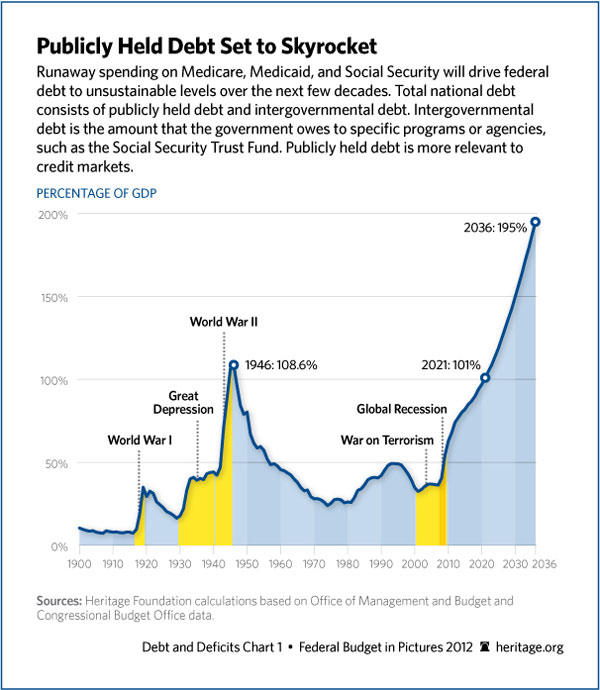
That’s just for starters. Nearly 78 million baby boomers are already starting to pour into Social Security and Medicare, while Medicaid is exploding. Within just one generation, total federal spending will reach nearly 36 percent of GDP, and debt held by the public will reach nearly 200 percent of GDP. (continues below chart)

This is unsustainable. But it is also economically and morally bankrupting. America is on the verge of becoming a nation in decline—economically stagnant and permanently debt-ridden, more dependent, and less self-governing.

Government should be smaller. Taxes should be flatter and should not penalize ordinary and low-income Americans for saving—whether for a car, a condo, or retirement. Federal dependency programs should be redesigned to not just assist low-income individuals, but also move them out of dependency. Social Security, Medicare, and Medicaid should be overhauled. The goal is to strengthen the safety net, not destroy it. The out-of-control growth of these programs virtually ensures their ultimate destruction, so we should act now.

These choices, while difficult, are not radical: extending the means testing in Medicare today further to fix the program’s finances while also embracing premium support to improve health care delivery and outcomes; extending means testing in Social Security further (after all, do Bill Gates or Warren Buffett really need Social Security?); gradually moving Social Security away from a benefit for everyone to a benefit that, unlike today, guarantees that seniors won’t live in poverty because their benefits are so low.

Ah, Mother Jones, these are the kinds of solutions that will help in Saving the American Dream.

Posted in Entitlements

The question that pro-abortionists will never answer!!!

Billy Graham with Dr. C. Everett Koop.

Watch the film below starting at the 19 minute mark and that will lead into a powerful question from Dr. C. Everett Koop. This film is WHATEVER HAPPENED TO THE HUMAN RACE? by Francis Schaeffer and Dr. C. Everett Koop.

Medical science has developed so much in the last few decades that we now know that the unborn baby feels pain.  Nevertheless, our selfish society continues to support the availability of abortion (according to Max Brantley of the Arkansas Times Blog).

There is a question that I have asked pro-abortionist over and over and I have never got a straight answer. It comes from the first episode of WHATEVER HAPPENED TO THE HUMAN RACE. Dr. C. Everett Koop put forth the question:

My question to the pro-abortionist who would not directly kill a newborn baby the minute it is born is this, “Would you have killed it a minute before that or a minute before that or a minute before that or a minute before that?” You can see what I am getting at. At what minute does an unborn baby cease to be worthless and become a person entitled to the right to life and legal protection?

_________

I asked this question on the Arkansas Times Blog on January 16, 2013 and got these all of these non-answers:

Sound Policy tried to change the subject with his response:

“One thing pro choice people can’t answer and that is when is an unborn baby human?

Neither can anti-choice folks, Saline/Ev. You see, my religion teaches me that every one of a woman’s unfertilized eggs is human, so if you anti-choice folks have not brought into the world a newborn at least every 9 months or so, you have murdered one or more humans (unfertilized eggs neither conceived nor birthed). Do you accept my definition of when an unborn baby is human which is just as arbitrary as your definition?

__

SalineRetarded responded:

Saline: An unborn “baby” ceases to be an unborn “baby” the second it’s born. You’re welcome.

_________

ChildeRolandReturneth angerily posted:

Damn, Saline, you’re perfectly willing to see them shot down at their desks when they’re six years old.

Anyway, if you were really serious about reducing abortions by relying on the facts, you’d be for universal health care — unless you are arguing that our world-leading abortion rate is because our mothers are the most evil mothers in the world. Implementing single-payer health care would immediately save the lives of unborn children.

________________

My constant opponent, Elwood, (who I do respect for his honest liberal opinions), observed:

“Would you have killed it a minute before that or a minute before that or a minute before that or a minute before that?” You can see what I am getting at.<

Yes, that’s called logical extension. It will invariably lead to the egg and sperm.
How many lives have you destroyed in a kleenex?

____________

Hardheadedwoman lashed out:

Oh, give it a rest, Saline. Roe v Wade has been the law of the land since 1973. Your republicans have had countless opportunities to overturn the law in that time and yet they haven’t done so. Why? Well, first, it would dry up all the money they raise railing against it. But the real reason is that republicans use abortion services, too. Yes, it’s true! Sure can’t have some pregnant mistress or knocked up 15-year-old daughter damaging the reputation of some god-fearing christian republican, now can we?
And the simple truth is, a woman’s choice in this matter is none of your @#$%$#@  business.

_________________________________

As you can see all of these are non-answers. THEY ALL ARE AVOIDING THE DIRECT QUESTION. I wish people would look at this  logically. If there is doubt when an unborn baby is alive then we should err on the side of caution.

Ronald Reagan rightly noted,What, then, is the real issue? I have often said that when we talk about abortion, we are talking about two lives — the life of the mother and the life of the unborn child. Why else do we call a pregnant woman a mother? I have also said that anyone who doesn’t feel sure whether we are talking about a second human life should clearly give life the benefit of the doubt. If you don’t know whether a body is alive or dead, you would never bury it. I think this consideration itself should be enough for all of us to insist on protecting the unborn.”

We are truly a selfish society. Mother Teresa observed, “If we can accept that a mother can kill even her own child, how can we tell other people to not kill each other? Any country that accepts abortion is not teaching its people to love, but to use any violence to get what they want.”

(There are several articles out saying that a majority of people in the USA support the availibility of abortion. The ironic thing about the article from Rueters by Mary Wisniewski released on 1-17-13 is that it features a picture of NARAL workers. Dr. Bernard Nathanson was a founding member of NARAL and a director of NARAL. Yet he left the pro-abortion movement and joined the pro-life movement after the advancements in medical science proved to him that the unborn babies felt pain.)

Related Posts:

Abortionist Bernard Nathanson turned pro-life activist (part 11)

ABORTION – THE SILENT SCREAM 1 / Extended, High-Resolution Version (with permission from APF). Republished with Permission from Roy Tidwell of American Portrait Films as long as the following credits are shown: VHS/DVDs Available American Portrait Films Call 1-800-736-4567 http://www.amport.com The Hand of God-Selected Quotes from Bernard N. Nathanson, M.D., Unjust laws exist. Shall we […]

Abortionist Bernard Nathanson turned pro-life activist (part 10)

Dr. Bernard N. Nathanson, a leading pro-life advocate and convert to Catholicism, died at the age of 84 on Monday a week ago in his New York home, after a long struggle with cancer. The Hand of God-Selected Quotes from Bernard N. Nathanson, M.D., Chapter 12 is titled To The Thanatoriums, an allusion the Walker […]

On eve of Shutdown Republicans cave on demand concerning eliminating Planned Parenthood Funding

The pro-life position is very important to a great many of the freshmen members of the House of Representatives. As you can see above in the clip from the film series Whatever Happened to the Human Race? by Francis Schaeffer and C. Everett Koop, the unborn baby is a child, but we are treating many […]

Abortionist Bernard Nathanson turned pro-life activist (part 9)(Donald Trump changes to pro-life view)

When I think of the things that make me sad concerning this country, the first thing that pops into my mind is our treatment of unborn children. Donald Trump is probably going to run for president of the United States. Tony Perkins of the Family Research Council recently had a conversation with him concerning the […]

John McArthur and Adrian Rogers on Proverbs and Alcohol (Eddie Sutton and Ryan Dunn used as examples)

Same old story it seems. Kentucky pulls out another close victory over the Vols. This is not the only story I am talking about today.


Kentucky’s Alex Poythress (22) shoots between Tennessee’s Josh Richardson, left, and Yemi Makanjuola during the first half of an NCAA college basketball game at Rupp Arena in Lexington, Ky., Tuesday, Jan. 15, 2013. (AP Photo/James Crisp)

Kentucky's Ryan Harrow (12) shoots in front of Tennessee's Jordan McRae during the second half of an NCAA college basketball game at Rupp Arena in Lexington, Ky., Tuesday, Jan. 15, 2013. Kentucky defeated Tennessee 75-65. (AP Photo/James Crisp)<br /><br /><br /><br />

Photo by James Crisp

Kentucky’s Ryan Harrow (12) shoots in front of Tennessee’s Jordan McRae during the second half of an NCAA college basketball game at Rupp Arena in Lexington, Ky., Tuesday, Jan. 15, 2013. Kentucky defeated Tennessee 75-65. (AP Photo/James Crisp)

Today I saw that the University of Tennessee basketball team fell to Kentucky in a very exciting basketball game in Lexington 75-65 on January15, 2013. Tennessee sports writer Mike Strange pointed out, “Snatching a win at Rupp Arena happens about as often as a total solar eclipse. In Tennessee’s case, it happens maybe once per coaching tenure — if you’re lucky. Don DeVoe, Jerry Green and Bruce Pearl were lucky — once. Wade Houston and Buzz Peterson weren’t.”

I remember a game that I got to see where Eddie Sutton coached one of his best games ever. I was in Lexington on February 11, 1987 and I had never been to a Kentucky basketball game so I tried to buy a ticket.

I had seen Eddie Sutton coach both in the 1970’s and 1980’s when he was the Arkansas Razorback Coach and I knew that he was going to take Kentucky to the national championship!!!

I did get a ticket that night even though I had to pay a premium price. It was well worth it because it was one of the most exciting games I had ever seen in my life. Tennessee secured a 6 to 10 point lead down the stretch. However, Rex Chapman and Ed Davenport got hot at the end of the game and were able to get the Wildcats into overtime. They both finished with at least 25 points each and Kentucky won 91-84.

Did Sutton lead Kentucky to a national championship? He should have but he didn’t. Everyone knows why too and it is because of his addiction to alcohol. The first year he started off great with a 32-4 record and a trip to the elite 8 in the NCAA Tournament. However, three years later he had a losing team and left Lexington in disgrace.

A Kentucky blog puts it this way in a post from 2006:

STILLWATER, Okla. (AP) — When Eddie Sutton became the basketball coach at Oklahoma State in 1990, he openly spoke of his struggle with alcoholism.Sutton underwent treatment at the Betty Ford Center in 1987 while he was coach at Kentucky. When discussing the issue three years later, he said, “I’ve dealt with it.”He’s going to deal with it again.During a late-night news conference Wednesday at Gallagher-Iba Arena — where the Cowboys play their home games on Eddie Sutton Court — he addressed reporters by telephone and acknowledged drinking before an accident Friday that has cast a cloud over the future of his 35-year coaching career.Sutton apologized to numerous people for the accident — his university family, his current and former players, and the driver of the other vehicle involved in the wreck. He said he plans to seek treatment for his drinking relapse during his current medical leave of absence, which began Monday.

He didn’t say where he would be seeking treatment, but did say he would do so next week.

____________________________
Driving drunk is stupid. We all can agree on that. Wouldn’t it have been better if Eddie had just abstained from alcohol like many others do?

I love the Book of Proverbs and every day I read one chapter of Proverbs. Since there are 31 chapters, I start the 1st of ever month and read chapter 1 and then the next day I read chapter 2 and so on the rest of the month.

John McArthur said:

”First of all, number one issue in gaining wisdom is to fear God…is to fear God. How do you know that? Back in chapter 1 verse 7, we read this, “The fear of the Lord is the beginning of knowledge. Fools despise wisdom and instruction.” The fear of the Lord is the beginning of knowledge. Proverbs 9:10, “The fear of the Lord is the beginning of wisdom and the knowledge of the holy one is true understanding.”

____________

One of the issues I have learned about in Proverbs is concerning the issue of alcohol.

ryan dunn Jackass dead in crash

Bam Margera’s First Interview After Ryan Dunn’s Death

Ryan Dunn and his friends moments before they died.

Flickr user Eric Lewis posted the image below with a caption that says the photo shows what’s left of Dunn’s car.

Ryan Dunn tweeted a picture of himself drinking from a bar. At 2 am he left the bar and a few minutes later he was killed after running off the road in his car.There are three reasons that I do not drink and here they are.First,alcohol has brought a social plague on our country not matched by anything we have ever seen in the past.  I will never forget the day I heard this statistic in 1975:  ”Drunk drivers are responsible for 50% of highway fatalities.”My pastor Adrian Rogers shared that statistic from the pulpit. I was only 14 years old at the time, but I was looking forward to driving. It caused me to realize that I had to abstain from alcohol and try to convince my friends and family to do likewise.Second, the Bible does condemn alcoholic wine. There were three kinds of wine mentioned in the Bible (grapes, grape juice and strong drink). Wine in the cluster which is equal to our grapes. Isaiah 65:8 ” “As the new wine is found in the cluster…”  The point I am making here is very clear. The Bible does refer to nonalcoholic wine which is equal to our grape juice. Don’t take for granted everytime you read the word “wine” in the Bible that it is referring to the kind of wine we are used to today.Next we have the term “strong drink” which is equal to our wine today. Strong drink is condemned. .Proverbs 20:1 states, “Wine is a mocker, strong drink is raging: and whosoever is deceived thereby is not wise. ”

  • WHAT WAS “STRONG DRINK” IN BIBLE TIMES?

Distillation was not discovered until about 1500 A.D. Strong drink and unmixed wine in Bible times was from 3% to 11% alcohol. Dr. John MacArthur says “…since anybody in biblical times who drank unmixed wine (9-11% alcohol) was definitely considered a barbarian, then we dont even need to discuss whether a Christian should drink hard liquor–that is apparent!”

Since wine has 9 to 11% alcohol and one brand 20% alcohol, you should not drink that. Brandy contains 15 to 20% alcohol, so thats out! Hard liquor has 40 to 50% alcohol (80 to 100 proof), and that is obviously excluded!

For documentation on this subject Google “alcohol” with the name of Adrian Rogers or John MacArthur. These theologians  have covered this subject fully with biblical references.

Third, Romans 14:21 states, “It is better not to eat meat (that had been offered to idols) or drink wine or to do anything else that will cause your brother to fall.” If a person rejects all the linguistic arguments, there is still Romans 14:21 concerning not causing a weaker brother to stumble..

It is consistent with the ethic of love for believers and unbelievers alike. Because I am an example to others, I will make certain no one ever walks the road of sorrow called alcoholism because they saw me take a drink and assumed, “if it is alright for Everette Hatcher, it is alright for me.” No, I will choose to set an uncompromising example of abstinence because I love them. The fact is that 1 of every 6 drinkers in the USA are problem drinkers. Maybe if my family of 6 drank, that could be me or one of my children?


 Related posts:

Whitney Houston dead at 48, long history of drugs and alcohol

Sad news about Whitney Houston’s death tonight. I have included some earlier posts about drugs and alcohol and rock stars. LOS ANGELES (AP) — Whitney Houston, who ruled as pop music’s queen until her majestic voice and regal image were ravaged by drug use, erratic behavior and a tumultuous marriage to singer Bobby Brown, has […]

Amy Winehouse died of alcohol poisoning like AC/DC lead singer Bon Scott

There is a truth that many people know. You can die from drinking too much alcohol at one time. I remember like yesterday when AC/DC lead singer Bon Scott died while on tour in England in 1980. According to Wikipedia: On 19 February 1980, Scott, 33 at the time, passed out after a night of […]

The sad case of Brett Cummins: Alcohol takes another victim jh14c

Brett Cummins and his friends were drinking heavily and taking drugs on Sunday night and all three of them went to sleep under the influence of alcohol and drugs and only 2 of them woke  up.  This reminds me of a few verses from the Old Testament. (There is hope. Check out the video interviews of Kerry Livgren […]

Ron “Pigpen” McKernan of the Grateful Dead is a member of “27 Club” because of alcohol (Part 8)

cc ‘Janis Joplin’ 2/5 from True Hollywood Story (Janis was having affair with Pigpen) Jerry Garcia (guitar, vocals), Ron “Pigpen” McKernan (vocals, harmonica), Bob Weir (guitar, vocals), Phil Lesh (bass), Mickey Hart (drums), Bill Kreutzman (drums). Grateful Dead “Don’t Ease Me In” Live @ Canadian National Exhibition Hall Toronto, CA June 27th, 1970 Grateful Dead […]

Characters referenced in Woody Allen’s movie “Midnight in Paris” (Part 38,Alcoholism and great writers and artists)

I have really enjoyed going through all the characters mentioned in Woody Allen’s latest film “Midnight in Paris.” One think that shocked me was that many of these great writers mentioned in the film were also alcoholics. Why is that? It is my view that if a sensitive person really does examine life closely without […]

Tennessee's Jarnell Stokes, right, has his shot pressured by Kentucky's Willie Cauley-Stein, center, and blocked by Nerlens Noel during the first half of an NCAA college basketball game at Rupp Arena in Lexington, Ky., Tuesday, Jan. 15, 2013. (AP Photo/James Crisp)<br /><br /><br />

Photo by James Crisp, AP2013

Tennessee’s Jarnell Stokes, right, has his shot pressured by Kentucky’s Willie Cauley-Stein, center, and blocked by Nerlens Noel during the first half of an NCAA college basketball game at Rupp Arena in Lexington, Ky., Tuesday, Jan. 15, 2013. (AP Photo/James Crisp)