http://blog.heritage.org | Today marks the 1,000th day since the United States Senate has passed a budget. While the House has put forth (and passed) its own budget, the Senate has failed to do the same. To help illustrate how extraordinary this failure has been, our new video highlights a few of impressive feats in history that have been accomplished in less time.
_________________________
President Obama c/o The White House
1600 Pennsylvania Avenue NW
Washington, DC 20500
On Feb 13, 2012, President Barack Obama released his budget for Fiscal Year 2013. Experts from The Heritage Foundation are analyzing the President’s proposal and offer their reactions, below:
President Obama’s Budget Proposal: Running on Empty – Patrick Louis Knudsen
Coming from a President whose economic philosophy is a borrowed car company slogan, the Obama budget submitted Monday all too predictably repeats the stale and unsuccessful policies of the past three years.
The Administration has tapped all its resources and can only recycle the President’s shopworn “vision”: bigger government, more spending, higher taxes, and deeper deficits. At a time when runaway spending and swelling deficits must be reversed, he worsens both immediately but, as usual, promises to fix them later. In his first post-debt-ceiling fiscal plan—delayed a week, with no explanation—the President appears to have offered an election-year campaign document, not a credible blueprint for addressing the nation’s fiscal and economic problems.
Spending in the President’s budget rises inexorably from today’s $3.8 trillion to $5.8 trillion in 2022. Throughout the decade, outlays hold stubbornly above 22 percent of gross domestic product (GDP), more than twice the New Deal’s share of the economy in its peak years. In constant dollars, outlays are more than three times the peak of World War II.
In 2012, his budget results deliver a fourth consecutive annual deficit exceeding $1 trillion and then make it worse with another round of not-so-shovel-ready construction projects and government “investments” totaling $178 billion. Among these are the typical road, bridge, and school construction, but then they go alarmingly beyond the usual “infrastructure” arguments to fund teachers’ pay.
Obama’s future deficit reduction comes mainly from Budget Control Act cuts already in place, $848 billion in discredited phantom “savings” from the wind-down of operations in Iraq and Afghanistan, taking credit for reductions in 2011 appropriations, and roughly $1.8 trillion in unnecessary tax increases on those earning above $250,000 and the oil and gas industry.
Yet even with the hefty tax increases and illusory savings, the President’s deficits over the next decade never fall below $575 billion (in 2018) and climb back to $704 billion (in 2022)—but again only assuming the tax increases and mystical savings cited above.
Debt held by the public in the President’s budget rises from 74.2 percent of GDP today to an economically hazardous 76.5 percent of GDP in 2022. These are historically high debt levels: the post–World War II average is just 43 percent. Moreover, the President’s debt estimates are low because of the unreal nature of much of his proposed deficit reduction.
Regarding the most critical fiscal challenge of the day—the need to restructure Medicare, Medicaid, and Social Security—the President has once again taken a pass. By the middle of this century, these three programs and Obamacare will consume about 18 percent of GDP, soaking up all the historical average of federal tax revenue. The notion of “protecting” them through benign neglect only ensures their collapse, and the longer Congress and the President wait to address the problem, the more wrenching will be the consequences. But the President merely reruns previous ideas, such as more cuts to medical providers, ignoring the need for fundamental reform.
For other entitlements, the President repeats a range of mere chipping-around-the-edges proposals from last year’s budget, many of which are really tax or fee increases, not spending reductions.
In short, the President’s budget is the same worn-out collection of higher spending and higher taxes he has offered three times before—with the same inevitable result of more spending, higher taxes, and still more government debt.
_____________
More government is not the answer. We are heading in the wrong direction. Stop calling it investments and call it what it is: “Stealing our freedom!!!”
Thank you so much for your time. I know how valuable it is. I also appreciate the fine family that you have and your committment as a father and a husband.
Sincerely,
Everette Hatcher III, 13900 Cottontail Lane, Alexander, AR 72002, ph 501-920-5733, lowcostsqueegees@yahoo.com
Pastor Tony Felich of Redeemer Presbyterian Church in Overland Park, KS gives the invocation to the mini conference event in honor of Francis Schaeffer’s 100th Birthday.
__________________________
This year Francis Schaeffer would have turned 100 on Jan 30, 2012. I remember like yesterday when I first was introduced to his books. I was even more amazed when I first saw his films. I was so influenced by them that I bought every one of his 30 something books and his two film series. Here is a tribute that I got off the internet from Chuck Colson’s website www.breakpoint.org :
“And I will declare my judgments against them, for all their evil in forsaking me. They have made offerings to other gods and worshiped the works of their own hands.” Jeremiah 1:16
Prophetic timing
The summer of 2011 has been a memorable one, but for all the wrong reasons. Much of the country has been gripped by an unrelenting heat wave, the nation is reeling from ever-worsening economic news, violence has broken out in a number of cities here and abroad, and the battle for traditional marriage and moral decency lost another round with New York state’s endorsement of same-sex marriage.
During this time, I’ve been teaching Jeremiah in my Sunday morning Explore the Bible class. It wasn’t my idea to teach this particular book at this particular time: it’s part of a nine year through-the-Bible curriculum established by Lifeway publishers. However, the timing does seem, well, prophetic. The similarities between the stiff-necked rebellious people of Judah living six centuries before Christ and the stiff-necked rebellious people of America living today are terrifying — terrifying because of the strong possibility that Judah’s fate foreshadows America’s not-too-distant future.
I realize that many people will say, “America is not Judah. God does not have the same relationship with America as He did with Israel and Judah; therefore, it’s impossible to draw parallels.” They’re wrong. While I concede that no two nations are alike, let alone two nations separated by more than 2500 years of history, we must recognize that God establishes and rules over all nations from the beginning of history to its end. Time does not erase what He requires, both for those who rule and for those who are ruled. Think about it:
God is still the same.
His holiness hasn’t diminished.
His standards for what constitute a good and just society haven’t altered.
Our responsibility to hear and obey His Word hasn’t been negated.
The “law of cause and effect” (sowing and reaping) is still in effect.
Furthermore, to ignore the warning signs of a nation on the verge of destruction – signs we see in Jeremiah – is to make a liar of the apostle Paul, who wrote that all of the Old Testament is written for our instruction (Romans 15:4; 1 Corinthians 10:11). It also makes a liar out of God, who speaking through the prophet, asserts that “If any nation will not listen, then I will utterly pluck it up and destroy it” (Jeremiah 12:17).
The indictment against Judah
Jeremiah had a great deal to say about why the people of Judah were headed for destruction:
They “went after worthlessness and became worthless” (2:5).
They “turned degenerate” (2:21) and wore themselves out sinning (9:5).
They were so wicked that they even taught “wicked women” things they didn’t know (2:33).
They “polluted the land with [their] vile whoredom” (3:2).
They were callous and unjust toward the poor (2:34).
They repeatedly claimed that they had not sinned (2:35).
They were greedy, conniving, unashamed, and self-deluded regarding their true status (6:13-15).
They treated the Word as an object of scorn (6:10).
They were incapable of speaking the Truth (7:28).
They followed their own hearts and went after false gods even more diligently than their forefathers had (9:14).
They broke their covenant with the Lord (11:1-13).
They were not correctable: they would not listen to God’s prophet (2:30; 5:3), and they would not obey His Word.
They assured themselves that God would not judge them, that disaster would not fall (5:12).
They were wrong, as history demonstrated in 586 BC when Judah was crushed by the Babylonians.
The indictment against America
It doesn’t take much effort to read through the list of Judah’s sins and see America’s. Even a casual perusal of the television shows being offered today provides plenty of examples of “worthlessness” and of an exuberant, even gleeful, promotion of every kind of immorality and perversion. The poor, and even the middle class, are being destroyed by the government’s irresponsible fiscal policies and by a welfare policy that keeps them dependant and living in poverty. Movies, television shows, and many so-called news programs are boldly promoting their anti-Christian agenda – one designed to keep Bible-believing Christians intimidated and cowed into silence when it comes to the public square. (If you don’t believe this, consider how people who support the Bible’s view of marriage are now labeled homophobic haters in the media.) And public figures who speak up about what the Bible has to say about the state of the nation are ridiculed as backward, desperate, and dangerously out of touch with reality. Even our president has characterized Bible-believing Christians in disparaging terms.
At the 2011 Resolved Conference, pastor John MacArthur made a claim, based on a passage in Isaiah 5, that particularly offended the anti-Christian crowd: “Materialism, drunkard pleasure seeking, arrogant conceit, defiant sinfulness, moral perversion, and corrupt leadership…Do you not see [them] in America?,” MacArthur asked. He then explained that just as these sins resulted in the destruction of Israel in 721 BC, these sins have brought the USA under divine judgment today.
The Christian response
MacArthur’s pronouncement comes as no surprise to anyone who has read Francis Schaeffer’s 1969 book Death in the City. Schaeffer not only claimed that both Europe and America were even then under “the wrath of God,” he also addressed the question of the contemporary relevance of Jeremiah:
“We do not have to guess what God would say about this because there was a period of history, biblical history, which greatly parallels our day. That is the day of Jeremiah. The Book of Jeremiah and the Book of Lamentations show how God looks at a culture which knew Him and deliberately turned away.
But this is not just the character of Jeremiah’s day of apostasy. It’s my day. It’s our day. And if we are going to help our own generation, our perspective must be that of Jeremiah, that weeping prophet Rembrandt so magnificently pictured weeping over Jerusalem, yet in the midst of his tears speaking without mitigating his message of judgment to a people who had had so much yet turned away.” (emphasis mine)
Our response to the evil of our day – to the millions of people who “knew Him and deliberately turned away” – therefore, must mirror Jeremiah’s sorrowful but unflinching response:
We must, like Jeremiah, keep speaking the truth about human nature (17:9): “the heart is deceitful above all things, and desperately sick.” Unless people understand that they are sinners in need of a Savior, they will — in the words of one bumper sticker I’ve seen around town — tragically believe they are “Born OK the first time” and so don’t need Christ. Evangelism becomes more difficult in a culture where people think they are basically good and where people reject the concept of personal sin.
We must keep warning our fellow citizens that it is foolish to trust in man (17:5), but wise to trust in God (17:7). The corollary to this is that people must learn to trust what the Bible has to say about what has gone wrong with our world and what God has done to set things right. We need to promote a biblical worldview in all areas of life so unbelievers can see the futility of the man-made philosophies they have been clinging to, and suffering under, and instead embrace the Truth of God’s Word as it speaks to issues such as marriage, the family, the right and wrong use of technology and science, the sanctity of human life, the proper role of government, and other “hot button” issues.
We must pray that we will stand firm in these evil days, as Jeremiah did (17:14-17). And while Jeremiah was forbidden to pray for his nation (7:16), we have not yet reached that point: therefore, we must fervently pray for revival to come to America.
We should, if our theology allows it, pray for God’s judgment to fall on the unrepentant who are leading many others down the destructive path of sin and evil (18:19-23).
Dr. Francis Schaeffer – Extra – Interview – Part 2 Francis Schaeffer had a big impact on me in the late 1970′s and I have been enjoying his books and films ever since. Here is great video clip of an interview and below is a fine article about him. Francis Schaeffer 1912-1984 Christian Theologian, Philosopher, […]
E P I S O D E 1 0 How Should We Then Live 10#1 FINAL CHOICES I. Authoritarianism the Only Humanistic Social Option One man or an elite giving authoritative arbitrary absolutes. A. Society is sole absolute in absence of other absolutes. B. But society has to be led by an elite: John Kenneth […]
What Ever Happened to the Human Race? Bachmann was a student of the works of Francis Schaeffer like I am and I know she was pro-life because of it. (Observe video clip above and picture of Schaeffer.) I hated to see her go. DES MOINES, Iowa — Last night, Minnesota Rep. Michele Bachmann vowed to […]
E P I S O D E 9 How Should We Then Live 9#1 T h e Age of Personal Peace and Afflunce I. By the Early 1960s People Were Bombarded From Every Side by Modern Man’s Humanistic Thought II. Modern Form of Humanistic Thought Leads to Pessimism Regarding a Meaning for Life and for Fixed […]
E P I S O D E 8 How Should We Then Live 8#1 I saw this film series in 1979 and it had a major impact on me. T h e Age of FRAGMENTATION I. Art As a Vehicle Of Modern Thought A. Impressionism (Monet, Renoir, Pissarro, Sisley, Degas) and Post-Impressionism (Cézanne, Van Gogh, Gauguin, […]
E P I S O D E 7 How Should We Then Live 7#1 I am thrilled to get this film series with you. I saw it first in 1979 and it had such a big impact on me. Today’s episode is where we see modern humanist man act on his belief that we live […]
Dr. Francis Schaeffer – Extra – Interview – Part 2 Francis Schaeffer had a big impact on me in the late 1970′s and I have been enjoying his books and films ever since. Here is great video clip of an interview and below is a fine article about him. Francis Schaeffer 1912-1984 Christian Theologian, Philosopher, […]
E P I S O D E 6 How Should We Then Live 6#1 I am sharing with you a film series that I saw in 1979. In this film Francis Schaeffer asserted that was a shift in Modern Science. A. Change in conviction from earlier modern scientists.B. From an open to a closed natural system: […]
E P I S O D E 5 How Should We Then Live 5-1 I was impacted by this film series by Francis Schaeffer back in the 1970′s and I wanted to share it with you. Francis Schaeffer noted, “Reformation Did Not Bring Perfection. But gradually on basis of biblical teaching there was a unique improvement. A. […]
How Should We Then Live 4-1 I was impacted by this film series by Francis Schaeffer back in the 1970′s and I wanted to share it with you. Schaeffer makes three key points concerning the Reformation: “1. Erasmian Christian humanism rejected by Farel. 2. Bible gives needed answers not only as to how to be right with […]
How Should We Then Live 3-1 I was impacted by this film series by Francis Schaeffer back in the 1970′s and I wanted to share it with you. Schaeffer really shows why we have so many problems today with this excellent episode. He noted, “Could have gone either way—with emphasis on real people living in […]
How Should We Then Live 2-1 I was impacted by this film series by Francis Schaeffer back in the 1970′s and I wanted to share it with you. Schaeffer points out that during this time period unfortunately we have the “Church’s deviation from early church’s teaching in regard to authority and the approach to God.” […]
How Should We Then Live 1-1 Today I am starting a series that really had a big impact on my life back in the 1970′s when I first saw it. There are ten parts and today is the first. Francis Schaeffer takes a look at Rome and why it fell. It fell because of inward […]
Senator Mark Pryor wants our ideas on how to cut federal spending. Take a look at this video clip below:
Senator Pryor has asked us to send our ideas to him at cutspending@pryor.senate.gov and I have done so in the past and will continue to do so in the future.
On May 11, 2011, I emailed to this above address and I got this email back from Senator Pryor’s office:
Please note, this is not a monitored email account. Due to the sheer volume of correspondence I receive, I ask that constituents please contact me via my website with any responses or additional concerns. If you would like a specific reply to your message, please visit http://pryor.senate.gov/contact. This system ensures that I will continue to keep Arkansas First by allowing me to better organize the thousands of emails I get from Arkansans each week and ensuring that I have all the information I need to respond to your particular communication in timely manner. I appreciate you writing. I always welcome your input and suggestions. Please do not hesitate to contact me on any issue of concern to you in the future.
Reducing the number of consultants employed by the federal government by 150,000;
Suspending acquisition of new federal office space;
Trimming the federal vehicle budget by 5 percent; and
Freezing the federal travel budget at $8 billion15 (Total annual savings: $11 billion).
Implement some additional housekeeping items, including:
Taking back grants to state and local governments that have not been spent within the past three years;
Rescinding any remaining appropriated funds to promote the new $20 bill (2004 spending: up to $53 million, discretionary); and
Consolidating the dozens of small, irrelevant education programs that divert money from more effective education programs ($200 million, discretionary).
Entitlement spending is on autopilot, with annual spending determined by benefit formulas and caseloads.
Entitlements (excluding net interest) account for 56 percent of all federal spending and 14 percent of GDP—up from 10 percent of GDP three years ago.
The three largest entitlements are Social Security, Medicare, and Medicaid. Their total cost is projected to leap from 8.4 percent of GDP in 2007 to 18.4 percent by 2050.
Unless those three programs are reformed, policymakers will eventually have to choose from among:
$12,636 per household by 2050, and further thereafter;
Eliminating every federal program except Social Security, Medicare, and Medicaid; or
Increasing the national debt to unprecedented levels that could cause an economic collapse.
By KEVIN DOLAK, CHRISTINA NG and CECILIA VEGA | Good Morning America – 29 minutes ago
Whitney Houston probably died from a combination of the drug Xanax and other prescription medication mixed with alcohol, TMZ reported, citing family sources who were briefed by L.A. County Coroner officials.
Coroners informed Houston’s family that there was not enough water in the singer’s lungs for her to have drowned, and that she may have died before her head became submerged in the bathtub at the Beverly Hilton Hotel where her body was found Saturday, TMZ.com reported.
Whitney’s aunt, Mary Jones, found her lifeless body in the bathtub, having laid out her dress for a party Houston was set to attend Saturday night, sources told TMZ. a Half hour later, at 3:45 p.m. on Saturday, someone from Houston’s entourage called hotel security when they found the singer’s lifeless body.
Houston’s mother has arranged for her body to be flown back to Atlanta as early as Tuesday, TMZ reported. Her family was reportedly told that since there is no suspicion of foul play police have not put a hold on the body, and it may be transported.
Investigators looking into the death of Houston have said that they will be examining the pop icon’s behavior in the hours and days before she was found dead in the bathtub, while the singer’s family, friends and staff have already been questioned.
The Los Angeles Coroner said Sunday that toxicology reports on Houston were will not be available for six to eight weeks, but a family member confirmed that Houston’s family, along with those working for her, have been questioned about any health issues she may have had and her behavior before her death.
Houston was staying at the Beverly Hilton Hotel, where she was to attend music industry executive Clive Davis’ annual pre-Grammy party. It is the same event where she was introduced to the record industry and the world nearly three decades ago.
Bobbi Kristina Brown, Houston’s daughter, was staying in the hotel with her mother and according to TMZ had also fallen asleep in the bathtub the night before her mother’s death in another room. Friends of the 18-year-old tried knocking on her door repeatedly and eventually had to contact security to open the door to her room so she could be removed from the tub.
Houston, who has struggled with drugs and alcohol for many years and entered rehab last year, reportedly spent Friday night at the bar of the Beverly Hilton hotel with a group of friends. She was at the bar for a long time, drinking and being very loud, according to TMZ.
On Thursday Houston was a guest at Grammy nominee Kelly Price’s party, “Kelly Price and Friends Unplugged: For the Love of R&B Grammy Party” at the nightclub, Tru Hollywood. Price recalls an enjoyable evening with Houston.
“We laughed and we joked and we cracked up, and we danced and sang. She was never more than two feet from me the entire night. I gave her a hug, and while I was talking to her she said give me the mic,” Price recalled.
Houston was there with her 18-year-old daughter Bobbi Kristina Brown and performed a duet with Price in the early hours of Friday morning, in what would become her last performance.
“In retrospect it’s a much bigger moment than I could have imagined. It was a big moment just because it was Whitney. The world got a gift in that they got an opportunity to see her perform one last time,” Price said.
At the party, Houston reportedly clashed with singer and former “X Factor” finalist Stacy Francis, who had credited Houston as her inspiration and had been pulled onstage to sing with her in 1999 during a concert, according to The Hollywood Reporter.
Houston and Francis were re-introduced at the party and all seemed fine until R&B star Ray J, who had dated Houston on-and-off for several years, entered the conversation.
“Whitney just got belligerent,” a witness told The Hollywood Reporter. “Ray was trying to defend Stacy, telling Whitney, ‘Stacy’s family!’, but Whitney was feeling crowded out and hands were raised.”
Photos taken later that night showed Houston disheveled, agitated and bloated as she left. She reportedly had to be escorted from the club with blood dripping down her leg and scratches on her wrist.
“It was a great event and she left sweaty, and I have heard the word ‘disheveled,'” Price told ABC News. “That’s about right. When you stand for three hours and in that time period you are dancing. You would leave a club looking that way.
“She didn’t look like she was under the influence of anything. She drank some champagne and toasted Kelly Price’s three Grammy nominations Thursday night. That’s what Whitney Houston did,” Price added.
Over the days preceding her death Houston’s behavior was erratic. She was seen skipping around a ballroom and doing handstands near the hotel pool, the Los Angeles Times reported, adding that she was seen in mismatched clothes and with dripping wet hair.
At some point on Saturday morning or early afternoon Houston’s cousin, the singer Dionne Warwick, spoke to her over the phone to make sure they were seated at the same table at Davis’ party. At this point there were no signs of trouble, according to TMZ.
Around 3:15 p.m., Houston spoke to her mother, Cissy Houston, and everything still seemed to be fine.
Police, who were already on the scene in preparation for the event later in the evening, arrived at Houston’s room two minutes after her body was discovered.
Officials tried to resuscitate the 48-year-old singer with CPR but were unable to revive her. Houston was pronounced dead at 3:55 p.m.
Beverly Hills police Lt. Mark Rosen said she was pronounced dead at 3:55 p.m. He said there were “no obvious signs of foul play and no obvious signs of a cause of death.”
It was so sad to lose these people so soon. The Curse of 27 This page is in response to my most frequently asked questions – is there really a Curse of 27, how many musicians actually died at that age, and who are they. When legendary Blues man, Robert Johnson, was killed at the age […]
A curve ball in the Amy Winehouse case. Troubled Brit singer Amy Winehouse was found dead at her London home in July. / AP FILE PHOTO Written by JILL LAWLESS, | Associated Press FILED UNDER Entertainment LONDON — The coroner who oversaw the inquest into the death of singer Amy Winehouse has resigned after her […]
Jim Morrison’s picture above. He died way too young and many of our young people turn to drugs and suicide because of loneliness. It is sad that this is such a pressing problem. I think of songs that point this out: Adam’s Song, The Last Resort, etc. There are two usual approaches to this problem that […]
I have posted a lot about Amy before. Posted at 04:38 PM ET, 10/31/2011 Amy Winehouse releases posthumous album: why we keep listening after she stops singing By Jessica Goldstein Despite her death in July, Amy Winehouse will be releasing a new album: “Lioness: Hidden Treasures” this year. This is not a posthumous album of […]
There is a truth that many people know. You can die from drinking too much alcohol at one time. I remember like yesterday when AC/DC lead singer Bon Scott died while on tour in England in 1980. According to Wikipedia: On 19 February 1980, Scott, 33 at the time, passed out after a night of […]
Aaron Douglas played for Vols and Bama before dying because of drugs jh39 Aaron Douglas was a lineman for Alabama and I have already written about another Bama lineman by the name of Barrett Jones who was a teammate of Aaron’s. Here are the two links below: Barrett Jones of Alabama Crimson Tide (Part 1 […]
CHICAGO (AP) — Former Weezer bass player Mikey Welsh, who also found success in his second career as an artist, died in aChicago hotel room, police said Sunday. Chicago police spokeswoman Laura Kubiak said Welsh was supposed to check out of the Raffaello Hotel at 1 p.m. Saturday. When he didn’t, hotel staff went to his room, entered it and […]
It is sad that my favorite group did not win a Grammy!!
Kevin Winter / Getty Images
After his duet with Rihanna, Martin joined the rest of his band for “Paradise” off Coldplay’s latest album, Mylo Xyloto. As expected, it was bombastic and over the top. But Coldplay’s strength is its live performance, and boy did the group deliver. Even the jaded Grammy audience got into it, waving multi-colored light-up wrist bands as if they were at an outdoor music festival. This felt like a real concert, not a one-song performance inside an auditorium.
Related posts:
Music Monday”:Coldplay’s best songs of all time (Part 4)
Dave Hogan/ Getty Images This is “Music Monday” and I always look at a band with some of their best music. I am currently looking at Coldplay’s best songs. Here are a few followed by another person’s preference: For the 17th best Coldplay song of all-time, Hunter picks “42.” He notes, “You thought you might […]
The best band in the world. Below I have linked some articles I have earlier about the search for meaning in life the band seems to involved in. Chris Martin, Jonny Buckland, Guy Berryman, and Will Champion formed Coldplay in 1996 while going to University in London. The young band quickly established themselves in the […]
I am presently involved in the counting down of the best Coldplay songs of all time, but I am also in a series here reviewing the upcoming songs on Coldplay’s new cd that will be released soon. Here is a review from Rolling Stone: Coldplay Debut new song ‘Charlie Brown’ June 6, 2011 Coldplay debuted […]
Great documentary on Coldplay. I have written a lot on Coldplay the last few years and I see something spiritually happening with the group as they continue to search for a deeping meaning in life. Coldplay Max Masters – Part 1 of 7 Uploaded by thepostbox on May 6, 2009 The ASTRA Award winning music documentary […]
Several members of the 70′s band Kansas became committed Christians after they realized that the world had nothing but meaningless to offer. It seems through the writings of both Woody Allen and Chris Martin of Coldplay that they both are wrestling with the issue of death and what meaning does life bring. Kansas went through […]
This is “Music Monday” and I always look at a band with some of their best music. I am currently looking at Coldplay’s best songs. Here are a few followed by another person’s preference: Hunter has chosen the song “Viva La Vida” as his number 18 pick. Hunter noted, “The violin synth is a […]
Coldplay – Every Teardrop Is A Waterfall Published on Jun 28, 2011 by ColdplayVEVO The new single, taken from Every Teardrop Is A Waterfall EP (featuring two more new tracks). Download it from http://cldp.ly/itunescp Music video by Coldplay performing Every Teardrop Is A Waterfall. (P) 2011 The copyright in this audiovisual recording is owned by […]
Clayton E. Cramer teaches history at the College of Western Idaho and is the author of Armed America: The Remarkable Story of How and Why Guns Became as American as Apple Pie (Nelson Current, 2007).
Every so often, a local news story about a victim of crime goes national. Most recently, it was Sarah McKinley, 18, home alone with her 3-month-old son, a few days after Sarah’s husband had died of lung cancer. Two men apparently looking to steal pain medicine prescribed for the husband broke in. Sarah grabbed a shotgun and a pistol and killed Justin Martin as he forced entry into her home.
How often do such incidents happen? While the results from studies vary, the numbers are large. The National Crime Victimization Survey, for various procedural reasons, is at the low end, showing 108,000 such cases a year (although this was some years back, when crime rates were higher than now). The widely reported Kleck/Gertz study, which has its own set of problems, showed a range of 830,000 to 2.45 million defensive gun uses per year. Other studies have fallen solidly in the middle, with hundreds of thousands of defensive gun uses per year.
Our study examines a variety of incident types: concealed-weapon permit holders (285 accounts); home invasions (1,227 incidents); residential burglaries (488). There are categories that we would never have thought were all that common: 172 incidents where people defended themselves from animal attacks (some wild, some dogs gone wild); 34 were incidents where pizza delivery drivers defended themselves from robbery.
Startled? You might think from how rarely stories like this go national that defensive gun use is relatively rare in America. Why don’t we see these stories more often, if victims are using guns in self-defense so often? Keep in mind that the vast majority of defensive gun uses never receive even local news coverage. “Homeowner scares away burglar, no shots fired” is not exactly a major news story, unless you live in a very small town.
Nonetheless, from 2003 through 2011, when I collaborated in an effort to gather local news stories and official reports of civilians using guns in self-defense here in the United States, I was astonished by how many such incidents there were, the vast majority of which never received national attention. Over a period of more than seven years, we compiled almost 5,000 such accounts. Most ended happily, with a burglar, carjacker or robber held for police. Some ended in bloodshed, as in the case of Sarah McKinley. Very few ended with the victim injured or killed.
Some of the news stories that did receive national attention are unsurprising, such as that of Matthew Murray, a mentally ill young man, who walked into New Life Church in Colorado Springs in 2007, carrying two handguns, an assault rifle and 1,000 rounds of ammunition. Murray had already murdered four people in the previous 12 hours, two of them in the church’s parking lot. Jeanne Assam, who was licensed to carry a concealed weapon, drew her weapon and shot Murray, preventing what could have been the most lethal mass murder in U.S. history.
Some of the news stories that stayed local, however, were dramatic stories of life and death, good and evil, that seem like the dictionary definition of “human interest story.” On May 4, 2009, two masked men with guns burst into a home in College Park, Ga., while a birthday party was in progress. Ten people, some of them college students, were inside the apartment. The intruders separated the men from the women. One of the intruders started counting his bullets; the other asked how many bullets he had. “Enough,” he said. It does not take much imagination to figure out that there would be no survivors. At this point, one of the students managed to reach into his backpack, pull out a gun and shoot one of the intruders, who then fled the apartment wounded. The armed student then caught the other intruder in the act of raping one of the women in the other room. The student shot the rapist as he jumped out the window.
Do law-abiding adults responsibly use guns in self-defense? The evidence we have amassed says yes, and frequently.
Yesterday I got to hear Mike Anderson on 103.7 the buzz. Mike is really firing up the fans and I think he will be a great coach, but not in the first year. People all around me are jumping to conclusions. They tell me that we are going to the final four for sure next […]
HALT:HaltingArkansasLiberalswithTruth.com Gun control debate on Hannity and Combs with Allen Gottlieb Earlier both John Brummett and Max Brantley have made it clear that they support gun control. However, in today’s article Brummett states: Let us first take the matter of guns in church. Several years ago, owing to our gun-addicted culture and to our insistence on […]
HALT:HaltingArkansasLiberalswithTruth.com Ronald Reagan and others comment on “Gun Control” efforts Series on Gun Control: Part 6 Max Brantley commented on Jan 8th (Arkansas Times Blog) on the Congresswoman Gabrielle Giffords getting shot and that led to his comments on the state of Arizona laws on guns: “As I said to a pro-carry lobbyist n the […]
HALT:HaltingArkansasLiberalswithTruth.com Series on Gun Control: Part 5 Video on Crime Rates in Switzerland Both John Brummett and Max Brantley have made it clear that they support gun control. They really believe that we should follow the lead of many of the foreign countries that have more strict gun control laws. However, is there a correlation […]
HALT:HaltingArkansasLiberalswithTruth.com Series on Gun Control: Part 4 John Stossel on Gun Control (2003 clip) Bill Clinton asserted, “The Brady Bill [is] a commonsense law that establishes a five-day waiting period and a background check that has already kept handguns out of the hands of some 60,000 felons, fugitives, and other criminals.” However, what do the […]
HALT:HaltingArkansasLiberalswithTruth.com Series on Gun Control: Part 3 Glenn Beck on School Shootings video clip Just yesterday another school shooting occurred. This one in Omaha, Nebraska: An angry online posting from the 17-year-old boy who opened fire at a Nebraska high school, fatally wounding an assistant principal before later killing himself, offers some clues about why […]
HALT:HaltingArkansasLiberalswithTruth.com Series on Gun Control: Part 2 Glenn Beck’s guest mentions Mike Ross and 65 other Democrats upset at Gun Control bills sent up by White House “I would close the gun show loophole…” President Clinton on NBC’s Tom Brokaw discusses gun control with the president, April 12, 2000) This is the second in a […]
HALT:HaltingArkansasLiberalswithTruth.com John Stossel report “Myth: Gun Control Reduces Crime Both John Brummett and Max Brantley have made it clear that they support gun control. I am going to start a series today debunking popular myths about guns and gun control. During this series on gun control, I will be quoting from an article “Gun Control:Myths […]
The way to grow the economy is to cut taxes. Last night in the State of the Union address President Obama said he wanted to close tax loopholes which is another way of saying that he is not through raising taxes yet.
Not that it makes any difference. I’m slowly coming the conclusion that my friends on the left will never learn – in large part because they’re more interested in punishing success with class warfare tax policy than they are in collecting extra revenue for government.
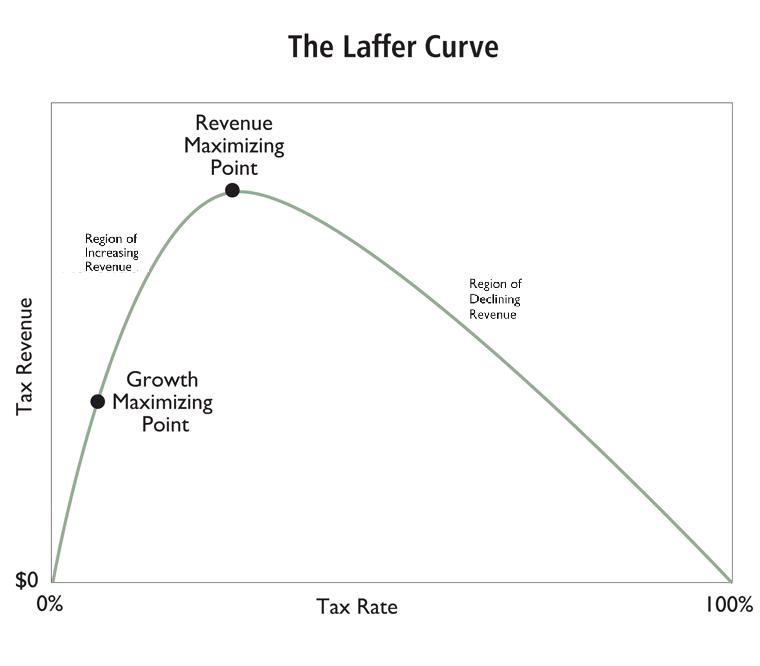
But surely there are some statists who are motivated by emotions other than spite, so I refuse to give up. Let’s look at some evidence from Spain to further confirm that high tax rates aren’t necessarily the way to maximize tax revenue (this also is a story showing that tax competition between nations is a good way of disciplining governments that are too greedy, but that’s another issue).
Spain’s corporate tax take has tumbled by almost two thirds from pre-crisis levels as small businesses fail and a growing number of big corporations seek profits abroad to compensate for the prolonged downturn at home. …Spain has a headline corporate tax rate of 30 percent, broadly in line with other large European economies. Switzerland, however, has a headline rate of 8.5 percent, and lawyers say deductions can be made to reduce this further. “A fundamental right of EU law is the freedom of establishment. All companies and taxpayers look after their tax affairs, and if they can pay a lower rate somewhere else, it’s better for their business and natural that they would do so,” a global tax lawyer based in Spain said. …Rajoy did eliminate some corporate tax breaks in 2012, a policy he will continue in 2013, and has also brought forward some tax payments, though that could be storing up problems.
The one tax rate that hasn’t been increased, though, is the top rate of corporate tax. So how can this be a story about the Laffer Curve?
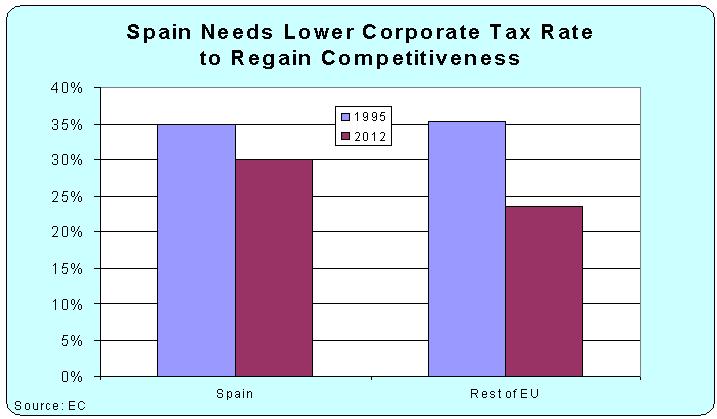
Well, sometimes standing still is a recipe for defeat. And sometimes moving in the right direction isn’t enough when everybody else is going in the right direction at a faster rate.
Here’s a chart showing changes in the average EU corporate tax rate compared to Spain’s corporate tax rate.
Spain’s corporate tax rate has dropped by five percentage points. That’s progress, but other nations have moved more rapidly in the right direction. Back in 1995, the Spanish corporate rate was slightly lower than the EU average. Now it’s noticeably higher.
And as the excerpt above notes, there are nations such as Switzerland that have far lower tax rates and much better fiscal policy.
To be sure, Spain’s main challenge is the need to dramatically reduce the burden of government spending. That will help long-run growth because more resources will be allocated by private markets.
But Spain also should seek an immediate boost to growth by reducing tax rates on productive behavior. A lower corporate tax rate should be part of the answer.
I got to hear Arthur Laffer speak back in 1981 and he predicted what would happen in the next few years with the Reagan tax cuts and he was right with every prediction. The Laffer Curve Wreaks Havoc in the United Kingdom July 1, 2012 by Dan Mitchell Back in 2010, I excoriated the new […]
Raising taxes will not work. Liberals act like the Laffer Curve does not exist. The Laffer Curve Shows that Tax Increases Are a Very Bad Idea – even if They Generate More Tax Revenue April 10, 2012 by Dan Mitchell The Laffer Curve is a graphical representation of the relationship between tax rates, tax revenue, and […]
The Laffer Curve, Part I: Understanding the Theory Uploaded by afq2007 on Jan 28, 2008 The Laffer Curve charts a relationship between tax rates and tax revenue. While the theory behind the Laffer Curve is widely accepted, the concept has become very controversial because politicians on both sides of the debate exaggerate. This video shows […]
If we want the economy to grow then we should look closely at a flat tax. A Primer on the Flat Tax and Fundamental Tax Reform August 11, 2012 by Dan Mitchell In previous posts, I put together tutorials on the Laffer Curve, tax competition, and the economics of government spending. Today, we’re going to look […]
President Obama c/o The White House 1600 Pennsylvania Avenue NW Washington, DC 20500 Dear Mr. President, I know that you receive 20,000 letters a day and that you actually read 10 of them every day. I really do respect you for trying to get a pulse on what is going on out here. I got […]
I have written a lot about this in the past and sometimes you just have to sit back and laugh. Laughing at Obama’s Bumbling Class Warfare Agenda July 13, 2012 by Dan Mitchell We know that President Obama’s class-warfare agenda is bad economic policy. We know high tax rates undermine competitiveness. And we know tax increases […]
President Obama c/o The White House 1600 Pennsylvania Avenue NW Washington, DC 20500 Dear Mr. President, I know that you receive 20,000 letters a day and that you actually read 10 of them every day. I really do respect you for trying to get a pulse on what is going on out here. If our […]
Late Amy Winehouse gets Grammy award for best pop performance by a duo for duet with Tony Bennett.
Singer Tony Bennett and parents of the late Amy Winehouse Mitch and Janis Winehouse accept the award for Best Pop Duo/Group Performance for “Body and Soul” onstage at the 54th Annual GRAMMY Awards held at Staples Center on February 12, 2012 in Los Angeles, California. Photo: Getty
Mitch and Janis Winehouse, the parents of the British singer Amy who died last year at the age of 27 following a battle with drugs and alcohol, were invited on stage at theGrammy awardsto jointly accept a posthumous award on her behalf.
The gong for best pop performance by a duo or group was awarded for Winehouse’s duet with Tony Bennett on the single Body and Soul.
“We shouldn’t be here. Our darling daughter should be here. These are the cards that we’re dealt,” said Mitch after he was called on stage by Bennett.
Paying tribute to his daughter and Houston as well as Etta James who died earlier this year, he added: “Long live Whitney Houston, long live Amy Winehouse, Long live Etta James. There’s a beautiful girl band up in heaven.”
Songstress Adele and Winehouse led an early British charge at this year’s sombre Grammy Awards, which were dampened by the shock death of singing star Whitney Houston.
Adele captured two of her six possible Grammys, including best pop vocal album for 21, at the pre-telecast ceremony which came just 24 hours after the troubled 48-year-old Houston was discovered in a bathtub at her Los Angeles hotel.
British singer/songwriter Corinne Bailey Rae also picked up a Grammy for best R&B performance as the night kicked off.
The televised segment of the 54th annual awards opened with a prayer and standing ovation to the singer, who herself won a clutch of six prestigious Recording Academy gongs over a turbulent career marred by spells of drug addiction.
Host LL Cool J said: “There is no way around this. We’ve had a death in our family so at least for me, the only thing that seems right is to start with a prayer for our fallen sister Whitney Houston.”
He declared the night one to “celebrate and remember”, and played a clip of Houston performing I Will Always Love You from the 1994 Grammys.
Houston, one of the world’s best-selling artists in the 1980s and 1990s, died on Saturday at the Beverly Hilton Hotel, where she was preparing to attend a pre-Grammy party.
Sad news about Whitney Houston’s death tonight. I have included some earlier posts about drugs and alcohol and rock stars. LOS ANGELES (AP) — Whitney Houston, who ruled as pop music’s queen until her majestic voice and regal image were ravaged by drug use, erratic behavior and a tumultuous marriage to singer Bobby Brown, has […]
It was so sad to lose these people so soon. The Curse of 27 This page is in response to my most frequently asked questions – is there really a Curse of 27, how many musicians actually died at that age, and who are they. When legendary Blues man, Robert Johnson, was killed at the age […]
A curve ball in the Amy Winehouse case. Troubled Brit singer Amy Winehouse was found dead at her London home in July. / AP FILE PHOTO Written by JILL LAWLESS, | Associated Press FILED UNDER Entertainment LONDON — The coroner who oversaw the inquest into the death of singer Amy Winehouse has resigned after her […]
Jim Morrison’s picture above. He died way too young and many of our young people turn to drugs and suicide because of loneliness. It is sad that this is such a pressing problem. I think of songs that point this out: Adam’s Song, The Last Resort, etc. There are two usual approaches to this problem that […]
CNN reported today: NEW YORK (CNNMoney) — Ilya Zhitomirskiy, one of four co-founders of social network Diaspora, died over the weekend in San Francisco at age 22. Zhitomirskiy committed suicide, a source close to the company told CNNMoney on Sunday. A San Francisco Police Department officer confirmed on Monday that a police report about […]
I have posted a lot about Amy before. Posted at 04:38 PM ET, 10/31/2011 Amy Winehouse releases posthumous album: why we keep listening after she stops singing By Jessica Goldstein Despite her death in July, Amy Winehouse will be releasing a new album: “Lioness: Hidden Treasures” this year. This is not a posthumous album of […]
There is a truth that many people know. You can die from drinking too much alcohol at one time. I remember like yesterday when AC/DC lead singer Bon Scott died while on tour in England in 1980. According to Wikipedia: On 19 February 1980, Scott, 33 at the time, passed out after a night of […]
Charles Murray is the W.H. Brady Scholar at the American Enterprise Institute. He received his B.A. in history at Harvard University and his Ph.D. in political science from the Massachusetts Institute of Technology. He has written for numerous newspapers and journals, including the Washington Post, the Wall Street Journal, the New York Times, the Weekly Standard, Commentary, and National Review. His books include Losing Ground: American Social Policy 1950-1980, What It Means to Be a Libertarian, and Real Education: Four Simple Truths for Bringing America’s Schools Back to Reality. His new book, Coming Apart: The State of White America, 1960-2010, will be published at the end of January.
The following is adapted from a speech delivered in Atlanta, Georgia, on October 28, 2011, at a conference on “Markets, Government, and the Common Good,” sponsored by Hillsdale College’s Center for the Study of Monetary Systems and Free Enterprise.
THE CASE FOR the Department of Education could rest on one or more of three legs: its constitutional appropriateness, the existence of serious problems in education that could be solved only at the federal level, and/or its track record since it came into being. Let us consider these in order.
(The last two parts were covered earlier.)
(3) So what is the federal government’s track record in education?
The most obvious way to look at the track record is the long-term trend data of the National Assessment of Educational Progress (NAEP). Consider, for instance, the results for the math test for students in fourth, eighth and twelfth grades from 1978 through 2004. The good news is that the scores for fourth graders showed significant improvement in both reading and math—although those gains diminished slightly as the children got older. The bad news is that the baseline year of 1978 represents the nadir of the test score decline from the mid-1960s through the 1970s. Probably we are today about where we were in math achievement in the 1960s. For reading, the story is even bleaker. The small gains among fourth graders diminish by eighth grade and vanish by the twelfth grade. And once again, the baseline tests in the 1970s represent a nadir.
From 1942 through the 1990s, the state of Iowa administered a consistent and comprehensive test to all of its public school students in grade school, middle school, and high school—making it, to my knowledge, the only state in the union to have good longitudinal data that go back that far. The Iowa Test of Basic Skills offers not a sample, but an entire state population of students. What can we learn from a single state? Not much, if we are mainly interested in the education of minorities—Iowa from 1942 through 1970 was 97 percent white, and even in the 2010 census was 91 percent white. But, paradoxically, that racial homogeneity is also an advantage, because it sidesteps all the complications associated with changing ethnic populations.
Since retention through high school has changed greatly over the last 70 years, I will consider here only the data for ninth graders. What the data show is that when the federal government decided to get involved on a large scale in K-12 education in 1965, Iowa’s education had been improving substantially since the first test was administered in 1942. There is reason to think that the same thing had been happening throughout the country. As I documented in my book, Real Education, collateral data from other sources are not as detailed, nor do they go back to the 1940s, but they tell a consistent story. American education had been improving since World War II. Then, when the federal government began to get involved, it got worse.
I will not try to make the case that federal involvement caused the downturn. The effort that went into programs associated with the Elementary and Secondary Education Act of 1965 in the early years was not enough to have changed American education, and the more likely causes for the downturn are the spirit of the 1960s—do your own thing—and the rise of progressive education to dominance over American public education. But this much can certainly be said: The overall data on the performance of American K-12 students give no reason to think that federal involvement, which took the form of the Department of Education after 1979, has been an engine of improvement.
What about the education of the disadvantaged, especially minorities? After all, this was arguably the main reason that the federal government began to get involved in education—to reduce the achievement gap separating poor children and rich children, and especially the gap separating poor black children and the rest of the country.
The most famous part of the Elementary and Secondary Education Act was Title I, initially authorizing more than a billion dollars annually (equivalent to more than $7 billion today) to upgrade the schools attended by children from low-income families. The program has continued to grow ever since, disposing of about $19 billion in 2010 (No Child Left Behind has also been part of Title I).
Supporters of Title I confidently expected to see progress, and so formal evaluation of Title I was built into the legislation from the beginning. Over the years, the evaluations became progressively more ambitious and more methodologically sophisticated. But while the evaluations have improved, the story they tell has not changed. Despite being conducted by people who wished the program well, no evaluation of Title I from the 1970s onward has found credible evidence of a significant positive impact on student achievement. If one steps back from the formal evaluations and looks at the NAEP test score gap between high-poverty schools (the ones that qualify for Title I support) and low-poverty schools, the implications are worse. A study by the Department of Education published in 2001 revealed that the gap grew rather than diminished from 1986—the earliest year such comparisons have been made—through 1999.
That brings us to No Child Left Behind. Have you noticed that no one talks about No Child Left Behind any more? The explanation is that its one-time advocates are no longer willing to defend it. The nearly-flat NAEP trendlines since 2002 make that much-ballyhooed legislative mandate—a mandate to bring all children to proficiency in math and reading by 2014—too embarrassing to mention.
In summary: the long, intrusive, expensive role of the federal government in K-12 education does not have any credible evidence for a positive effect on American education.
* * *
I have chosen to focus on K-12 because everyone agrees that K-12 education leaves much to be desired in this country and that it is reasonable to hold the government’s feet to the fire when there is no evidence that K-12 education has improved. When we turn to post-secondary education, there is much less agreement on first principles.
The bachelor of arts degree as it has evolved over the last half-century has become the work of the devil. It is now a substantively meaningless piece of paper—genuinely meaningless, if you don’t know where the degree was obtained and what courses were taken. It is expensive, too, as documented by the College Board: Public four-year colleges average about $7,000 per year in tuition, not including transportation, housing, and food. Tuition at the average private four-year college is more than $27,000 per year. And yet the B.A. has become the minimum requirement for getting a job interview for millions of jobs, a cost-free way for employers to screen for a certain amount of IQ and perseverance. Employers seldom even bother to check grades or courses, being able to tell enough about a graduate just by knowing the institution that he or she got into as an 18-year-old.
So what happens when a paper credential is essential for securing a job interview, but that credential can be obtained by taking the easiest courses and doing the minimum amount of work? The result is hundreds of thousands of college students who go to college not to get an education, but to get a piece of paper. When the dean of one East Coast college is asked how many students are in his institution, he likes to answer, “Oh, maybe six or seven.” The situation at his college is not unusual. The degradation of American college education is not a matter of a few parents horrified at stories of silly courses, trivial study requirements, and campus binge drinking. It has been documented in detail, affects a large proportion of the students in colleges, and is a disgrace.
The Department of Education, with decades of student loans and scholarships for university education, has not just been complicit in this evolution of the B.A. It has been its enabler. The size of these programs is immense. In 2010, the federal government issued new loans totaling $125 billion. It handed out more than eight million Pell Grants totaling more than $32 billion dollars. Absent this level of intervention, the last three decades would have seen a much healthier evolution of post-secondary education that focused on concrete job credentials and courses of studies not constricted by the traditional model of the four-year residential college. The absence of this artificial subsidy would also have let market forces hold down costs. Defenders of the Department of Education can unquestionably make the case that its policies have increased the number of people going to four-year residential colleges. But I view that as part of the Department of Education’s indictment, not its defense.
* * *
What other case might be made for federal involvement in education? Its contributions to good educational practice? Think of the good things that have happened to education in the last 30 years—the growth of homeschooling and the invention and spread of charter schools. The Department of Education had nothing to do with either development. Both happened because of the initiatives taken by parents who were disgusted with standard public education and took matters into their own hands. To watch the process by which charter schools are created, against the resistance of school boards and administrators, is to watch the best of American traditions in operation. Government has had nothing to do with it, except as a drag on what citizens are trying to do for their children.
Think of the best books on educational practice, such as Howard Gardner’s many innovative writings and E.D. Hirsch’s Core Knowledge Curriculum, developed after his landmark book, Cultural Literacy, was published in 1987. None of this came out of the Department of Education. The Department of Education spends about $200 million a year on research intended to improve educational practice. No evidence exists that these expenditures have done any significant good.
As far as I can determine, the Department of Education has no track record of positive accomplishment—nothing in the national numbers on educational achievement, nothing in the improvement of educational outcomes for the disadvantaged, nothing in the advancement of educational practice. It just spends a lot of money. This brings us to the practical question: If the Department of Education disappeared from next year’s budget, would anyone notice? The only reason that anyone would notice is the money. The nation’s public schools have developed a dependence on the federal infusion of funds. As a practical matter, actually doing away with the Department of Education would involve creating block grants so that school district budgets throughout the nation wouldn’t crater.
Sadly, even that isn’t practical. The education lobby will prevent any serious inroads on the Department of Education for the foreseeable future. But the answer to the question posed in the title of this talk—“Do we need the Department of Education?”—is to me unambiguous: No.
Florida’s Patric Young (4) goes to the basket as Tennessee’s Jarnell Stokes (5) tries to block the shot during the first half of an NCAA college basketball game in Gainesville, Fla., Saturday, Feb. 11, 2012. (AP Photo/Phil Sandlin)
_____________________________
It appears the Arkansas Razorbacks will be facing a new and improved Tennessee Vols basketball team after UT went to Gainesville and beat the ranked Gators on Saturday.
The Hogs will also be facing Jarnell Stokes who chose the Vols over the Hogs just a few weeks ago. Arkansas really needed the presence of a good big man and is still searching for one on the recruiting trail.
I think this game will come down to one simple fact: WILL THE HOGS FIND THE SAME MENTAL EDGE THAT THE VOLS DID IN GAINESVILLE TO WIN THEIR FIRST BIG ROAD GAME?
Below is an article from Knoxville that indicates the Vols are looking to the Arkansas game for a key victory on their way back to the upper part of the SEC standings.
Key stretch has Vols in position to rise in SEC standings
By Mike Griffith
Originally published 07:08 p.m., February 12, 2012
Updated 09:20 p.m., February 12, 2012
Cuonzo Martin tried to explain what he saw in his basketball team that made him confident Tennessee would beat Florida in the days leading up to Saturday’s game.
“When players walk with a certain type of swagger, a level of confidence — not cockiness, not arrogance — they can play, and they can compete,” the first-year Vols coach said after UT shocked No. 8 Florida in Gainesville, 75-70. “Before, we just weren’t mentally ready.”
Martin’s not ready to get too carried away with his young team; especially not with an upcoming stretch run of games against teams for positions.
The Vols’ 13-12 overall and 5-5 SEC mark has lifted them into a four-way tie for fifth-place in the SEC, well ahead of the 11th-place projection they were dealt at SEC Basketball Media Day in October.
UT plays host to Arkansas (17-8, 5-5) at 8 p.m. Wednesday (TV: MyVLT) at Thompson-Boling Arena before traveling to play at Alabama (16-8, 5-5) at 1:30 p.m. Saturday.
___________
Florida’s Erving Walker (11) has to reach out to get around Tennessee’s Kenny Hall (20) during the first half of an NCAA college basketball game in Gainesville, Fla., Saturday, Feb. 11, 2012. (AP Photo/Phil Sandlin)
____________________
Martin has taken to Twitter to urge Vols fans to turn out for the game against the Razorbacks. There was an announced (paid) attendance of 14,784 for UT’s home win over South Carolina last Wednesday, but the arena appeared half empty.
“We need our fans, and we need their support to help get us over the hump,” Martin said. “If our guys are giving effort, and they are leaving everything out on the floor, they deserve that support.”
Wins this week would
strengthen the Vols’ postseason résumé as they look to secure a spot in the NIT while also maintaining mathematical possibilities for an NCAA tournament at-large berth.
Tennessee’s RPI rating is 110, 10th-best in the SEC, while the Vols rank No. 91 in the Sagarin USA Today computer ratings and No. 81 in Ken Pomeroy’s computer rankings.
Martin had estimated at the start of the season it would take at least a year for him to get the program competing at an acceptable level.
But the Vols showed the makings of a tough, achieving unit on Saturday, playing solid defense and passing the ball unselfishly en route to snapping the Gators’ 19-game home win streak.
“We’re getting there right now,” Martin said, asked if his team has arrived. “Once we get to the point where hard work is a way of life for them, and they’re doing all the little things because they want to instead of because coach tells them to, then we’ll be successful.”
______________
Florida’s Kenny Boynton (1) goes for two points as he gets over Tennessee’s Kenny Hall (20) during the first half of an NCAA college basketball game in Gainesville, Fla., Saturday, Feb. 11, 2012. (AP Photo/Phil Sandlin)
_______________
UT sophomore point guard Trae Golden was the catalyst for what Martin said was the team’s most complete win of the season.
Golden had 17 points and seven assists while making four of seven shots from the floor and nine of 11 from the free-throw line in his 38 minutes.
“I think the last two games Trae has led the team on both ends of the floor and been very vocal,” Martin said. “The things I talk to him about are leading the team, getting the assists, feeding your teammates. It goes a long way when your point guard leads like that.
“That (Florida) win started with Trae putting pressure on their point guard.”
The Gators committed 15 turnovers while getting just nine assists as UT dominated throughout the game.
“I just think we’re getting better as a team,” Golden said. “We all know what we need to do now, and we all know our roles.”
McBee for Threes: Vols shooting guard Skylar McBee played a career-high 38 minutes alongside Golden, scoring 13 points on 4-of-7 shooting beyond the 3-point arc. McBee is averaging 13.7 points in his three starts.
“Skylar does a good job taking what the defense gives him,” Martin said. “He stretches the defense, he can make shots and he can get the ball inside. With Skylar being a player they have to identify on the perimeter, our big guys can play one-on-one.”
No Fuss: UT freshman Jarnell Stokes said he didn’t mean for Florida’s Patric Young to fall to the floor when he fouled him and was assessed a flagrant foul.
“Basketball is a competitive game, and I wasn’t going to let him score,” Stokes said. “But he’s a big guy, and I’m surprised he fell like that.”
Vols freshman Wes Washpun got a late technical foul after blocking a shot.
“Apparently, he used a bad word after the block,” said Martin, who replaced Washpun immediately.
Orange Slices: Jeronne Maymon recorded his seventh double-double of the season (15 points, 11 rebounds) and played 36 minutes. … Cam Tatum played 17 minutes before fouling out without having attempted a shot. … Jordan McRae’s 12-point effort in 26 minutes marked the third time in the past five games he has scored in double figures.
Florida’s Erick Murphy (33) reaches up for the basket during the first half of an NCAA college basketball game against Tennessee in Gainesville, Fla., Saturday, Feb. 11, 2012. (AP Photo/Phil Sandlin)




 The Daily Hatch