Yearly Archives: 2012

George Lindsey “Goober of Andy Griffith Show” passed away, some of my favorite clips from show

George Lindsey “Goober” who I got to meet while in Memphis in the 1970’s has passed away. Take a look at the story below and the Andy Griffith Clips.

You can still catch the series on television in reruns, however. It was televised by CBS between October 3, 1960, and April 1, 1968. It was also one of those shows that ended its run on top, finishing its final season at No. 1, and never finishing lower than No. 7 in the ratings.

“The Andy Griffith Show” spawned a spin-off series, “Gomer Pyle, U.S.M.C.” (1964) which ran five seasons, and a sequel series, “Mayberry R.F.D.” (1968), which ran three seasons. There was also a reunion telemovie, “Return to Mayberry” (1986).

That spin-off, “Gomer Pyle, U.S.M.C.” was important for another reason. It removed the character of Gomer Pyle from Mayberry and the Andy Griffith show. A simple, somewhat dim-witted mechanic at Wally’s Filling Station, when Gomer (Jim Nabors) left the series, his cousin Goober took over the job.

George Lindsay, who played Goober, had originally read for the part of Gomer, which went to neighbors. In addition to portraying Goober on “The Andy Griffith Show,” he continued the role on “Mayberry R.F.D.,” as many of the characters from the first series transitioned to the sequel.

During his first full season, Goober was initially referred to as “Goober Beasley.” However, to better solidify the connection to Gomer, his surname was changed to “Pyle.”

After the end of “Mayberry R.F.D.,” Lindsay portrayed the same jovial service station attendant on the country music-comedy show until the show ended in 1983.

___________

The Andy Griffith Show (S5E20) – Goober and the Art of Love(1/3)

A press release from Marshall-Donnelly-Combs Funeral Home in Nashville said that George Lindsay died early Sunday morning after a brief illness. Funeral arrangements are still being made.

Lindsay once told an interviewer of the wonderful cast and crew, and time on “The Andy Griffith Show.” He said, “At that time, we were the best acting ensemble on TV. The scripts were terrific. Andy is the best script constructionist I’ve ever been involved with. And you have to lift your acting level up to his; he’s awfully good.”

In a statement released through the funeral home, Andy Griffith said, “George Lindsey was my friend. I had great respect for his talent and his human spirit. In recent years, we spoke often by telephone. Our last conversation was a few days ago … I am happy to say that as we found ourselves in our eighties, we were not afraid to say, `I love you.’ That was the last thing George and I had to say to each other. `I love you.'”

George Lindsay died on May 6, 2012, at the age of 83, according to press reports. However, Wikipedia says he was 76.

Image Source: Wikimedia Commons
Source: Wikipedia

The Andy Griffith Show (S5E20) – Goober and the Art of Love(2/3)

The Andy Griffith Show (S5E20) – Goober and the Art of Love(3/3)

“Music Monday” with the group Badfinger

Wikipedia reported:

Without You” is a song written by Pete Ham and Tom Evans of British rock group Badfinger, and first released on their 1970 album No Dice. The song has been recorded by over 180 artists,[1] and versions released as singles by Harry Nilsson (1971) and Mariah Carey (1994) became international best-sellers. Paul McCartney once described the ballad as “…the killer song of all time.”[2]

Open letter to President Obama (Part 72)

President Obama c/o The White House
1600 Pennsylvania Avenue NW
Washington, DC 20500

Dear Mr. President,

I know that you receive 20,000 letters a day and that you actually read 10 of them every day. I really do respect you for trying to get a pulse on what is going on out here.

The result of having lots of taxes is the mean IRS. Why not reverse course and lower taxes and lower spending?

The IRS: Even Worse Than You Think

Posted by Daniel J. Mitchell

Since it is tax-filing season and we all want to honor our wonderful tax system, let’sgo into the archives and show this video from last year about the onerous compliance costs of the internal revenue code.

Narrated by Hiwa Alaghebandian of the American Enterprise Institute, the mini-documentary explains how needless complexity creates an added burden – sort of like a hidden tax that we pay for the supposed privilege of paying taxes.

__________

The Onerous Compliance Cost of the Internal Revenue Code

Uploaded by  on Apr 12, 2010

The tax system is a complicated nightmare that forces taxpayers to devote ever-larger amounts of time, money, energy, and other resources in hopes of complying with the internal revenue code and avoiding IRS persecution. This CF&P Foundation video shows that this corrupt mess is the result of 97 years of social engineering and industrial policy that began almost immediately after that dark day in 1913 that the income tax was created. www.freedomandprosperity.org

______________________

Two things from the video are worth highlighting.

First, we should make sure to put most of the blame on Congress. As Ms. Alaghebandian notes, the IRS is in the unenviable position of trying to enforce Byzantine tax laws. Yes, there are examples of grotesque IRS abuse, but even the most angelic group of bureaucrats would have a hard time overseeing 70,000-plus pages of laws and regulations (by contrast, the Hong Kong flat tax, which has been in place for more than 60 years, requires less than 200 pages).

Second, we should remember that compliance costs are just the tip of the iceberg. The video also briefly mentions three other costs.

    1. The money we send to Washington, which is a direct cost to our pocketbooks and also an indirect cost since the money often is used tofinance counterproductive programs that further damage the economy.
    2. The budgetary burden of the IRS, which is a staggering $12.5 billion. This is the money we spend to employ an army of tax bureaucrats that is larger than the CIA and FBI combined.
    3. The economic burden of the tax system, which measures the lost economic output from a tax system that penalizes productive behavior.

The way to fix this mess, needless to say, is to junk the entire tax code and start all over.

I’ve been a big proponent of the flat tax, which would mean one low tax rate, no double taxation of savings, and no corrupt loopholes. But I’m also a big fan of national sales tax proposals such as the Fair Tax, assuming we can amend the Constitution so that greedy politicians don’t pull a bait and switch and impose both an income tax and a sales tax.

But the most important thing we need to understand is that bloated government is our main problem. If we had a limited federal government, as our Founding Fathers envisioned, it would be almost impossible to have a bad tax system. But if we continue to move in the direction of becoming a European-style welfare state, it will be impossible to have a good tax system.

___________

Thank you so much for your time. I know how valuable it is. I also appreciate the fine family that you have and your committment as a father and a husband.

Sincerely,

Everette Hatcher III, 13900 Cottontail Lane, Alexander, AR 72002, ph 501-920-5733, lowcostsqueegees@yahoo.com

Senator Pryor asks for Spending Cut Suggestions! Here are a few!(Part 146)

Senator Mark Pryor wants our ideas on how to cut federal spending. Take a look at this video clip below:

Senator Pryor has asked us to send our ideas to him at cutspending@pryor.senate.gov and I have done so in the past and will continue to do so in the future.

On May 11, 2011,  I emailed to this above address and I got this email back from Senator Pryor’s office:

Please note, this is not a monitored email account. Due to the sheer volume of correspondence I receive, I ask that constituents please contact me via my website with any responses or additional concerns. If you would like a specific reply to your message, please visit http://pryor.senate.gov/contact. This system ensures that I will continue to keep Arkansas First by allowing me to better organize the thousands of emails I get from Arkansans each week and ensuring that I have all the information I need to respond to your particular communication in timely manner.  I appreciate you writing. I always welcome your input and suggestions. Please do not hesitate to contact me on any issue of concern to you in the future.

Here are a few more I just emailed to Senator Pryor myself:

Government auditors spent the past five years examining all federal programs and found that 22 percent of them—costing taxpayers a total of $123 billion annually—fail to show any positive impact on the populations they serve.

  • The Advanced Technology Program spends $150 million annually subsidizing private businesses; 40 percent of this funding goes to Fortune 500 companies.
  • The Conservation Reserve program pays farmers $2 billion annually not to farm their land.

Switchfoot is a Christian Band with a great message (Part 1)

Saturday 14 July 2012

Switchfoot

Venue

Magic Springs Theme Park 1701 E. Grand Ave. 71901 Hot Springs, AR, US

Venue info and map

Switchfoot is a Christian Band with a great message (Part 1)

My niece Mallory Nail went to see Switchfoot in concert at John Brown University on Oct 14, 2011 and I am very jealous.

969 Switchfoot Interview #2

Interview with Tim Foreman and Chad Butler airing March 13th, 2007.
Discuss: idea of success, fan interaction
________________________________________

Switchfoot is a Christian Band with a great message (Part 1)

One of my favorite bands is Switchfoot. Tim Foreman is the front man and this band has always been very vocal about their Christian faith. I am really enjoying this series on their band.

Switchfoot: Tim Foreman
by Robert Frezza
Static Noise
http://www.staticnoise.net

Rock band Switchfoot took the stage in Buffalo last night with label mates and co-headliners Copeland. I was fortunate not only to watch the show, but to interview both bassist Tim Foreman from Switchfoot and lead singer Bryan Laurenson from Copeland as well. Here is what they had to say:

StaticNoise: Switchfoot was first noticed as Christian band. Is that a stereotype or mold that the band is trying to break now??
Tim Foreman: “We’ve always been pretty honest about our faith. From one sense it is a compliment. To be associated with Christ, in my opinion, it is a really high honor. As an artist, though, it is can be limiting in the scope that what you are trying to do if you are grouped in that genre. If I was not a Christian, I wouldn’t listen to the songs and somehow they would not relate to me. We always tried to write music for everyone. We’ve been labeled a lot of things—Christian, Political, etcetera, but we just want to make music that is outside of the box.”

SN: Tim Palmer, who is noted for his work with U2’s Joshua Tree and Grammy award winning producer Steve Lillywhite worked on your latest album Oh! Gravity. Was this the first time you worked with both producers??
TF:
 “Yes! It seems like you have to be British to work on the track.” Foreman says with a chuckle. “Those guys are our heroes. They have been involved with a lot of our favorite records. What they both brought to the table was a big picture perspective. Lillywhite was big on not soloing tracks. Lillywhite wanted us to hear it when things came together.”

SN: So is the more edgier Switchfoot, then??
TF:
 “It’s a little bit more reckless. More reckless in the way that it’s not taken itself too seriously. When we started recording Oh! Gravity, we weren’t trying to make a record. We just had some free time and some songs and we wanted to record an EP. I think when you are recording when not thinking about it, there’s a lot of freedom there.”

SN: What is the best city you have played in so far on this tour and where do you think Buffalo will rank after tonight??
TF:
 “We had some great shows so far and I expect big things from Buffalo after tonight.”

The Founding Fathers views concerning Jesus, Christianity and the Bible (Part 4, Elbridge Gerry)

There have been many articles written by evangelicals like me who fear that our founding fathers would not recognize our country today because secular humanism has rid our nation of spiritual roots. I am deeply troubled by the secular agenda of those who are at war with religion in our public life.

Lillian Kwon quoted somebody that I respect a lot  in her article, “Christianity losing out to Secular Humanism?” :

“Most of the founding fathers of this nation … built the worldview of this nation on the authority of the Word of God,” Ken Ham said. “Because of that, there have been reminders in this culture concerning God’s Word, the God of creation.”

At the time I started this series I was in Boston, MA which was the home of John Adams. I have toured his home and found it very interesting. SO MANY FOUNDING FATHERS ARE FROM MASSACHUSETTS!!!

David Barton, 05-2008

A Few Declarations of Founding Fathers and  early Statesmen on Jesus Christianity and the Bible

Today we look at Elbridge Gerry who is also from Massachusetts like John Adams was.

Elbridge Gerry

SIGNER OF THE DECLARATION OF INDEPENDENCE; MEMBER OF THE CONSTITUTIONAL CONVENTION; FRAMER OF THE BILL OF RIGHTS, GOVERNOR OF MASSACHUSETTS, VICE PRESIDENT OF THE UNITED STATES

He called on the State of Massachusetts to pray that . . .

  • with one heart and voice we may prostrate ourselves at the throne of heavenly grace and present to our Great Benefactor sincere and unfeigned thanks for His infinite goodness and mercy towards us from our birth to the present moment for having above all things illuminated us by the Gospel of Jesus Christ, presenting to our view the happy prospect of a blessed immortality.32
  • And for our unparalleled ingratitude to that Adorable Being Who has seated us in a land irradiated by the cheering beams of the Gospel of Jesus Christ . . . let us fall prostrate before offended Deity, confess sincerely and penitently our manifold sins and our unworthiness of the least of His Divine favors, fervently implore His pardon through the merits of our mediator.33
  • And deeply impressed with a scene of our unparalleled ingratitude, let us contemplate the blessings which have flowed from the unlimited grave and favor of offended Deity, that we are still permitted to enjoy the first of Heaven’s blessings: the Gospel of Jesus Christ. 34

Reasons why Mark Pryor will be defeated in 2014 (Part 1)

It is apparent from this statement below that Senator Mark Pryor is against the Balanced Budget Amendment. He has voted against it over and over like his father did and now I will give reasons in this series why Senator Pryor will be defeated in his re-election bid in 2014. However, first I wanted to quote the statement Senator Pryor gave on December 14, 2011. This information below is from the Arkansas Times Blog on 12-14-11 and Max Brantley:

THREE CHEERS FOR MARK PRYOR: Our senator voted not once, but twice, today against one of the hoariest (and whoriest) of Republican gimmicks, a balanced budget amendment. Let’s quote him:

As H.L. Mencken once said, “For every complex problem there is a solution which is simple, clean, and wrong.” This quote describes the balanced budget amendment. While a balanced budget amendment makes for an easy talking point, it is an empty solution. Moreover, it’s a reckless choice that handcuffs our ability to respond to an economic downturn or national emergencies without massive tax increases or throwing everyone off Medicare, Social Security, or veteran’s care.There is a more responsible alternative to balance the budget. President Clinton led the way in turning deficits into record surpluses. We have that same opportunity today, using the blueprint provided by the debt commission as a starting point. We need to responsibly cut spending, reform our tax code and create job growth. This course requires hard choices over a number of years. However, it offers a more balanced approach over jeopardizing safety net programs and opportunity for robust economic growth.

____________________

Arkansans clearly see that if our leaders in Washington do not take the bull by the horns and pass the Balanced Budget Amendment that will continue to head toward the direction we are going now. Soon and I am afraid sooner than Mark Pryor realizes, we will be arriving where Greece is now. WE MUST AVOID HEADING TO GREECE AND THE PEOPLE OF ARKANSAS REALIZE THIS AND PRYOR DOES NOT. THIS IS ONE OF THE MAIN REASONS PRYOR WILL BE DEFEATED IN 2014.

Cato Institute scholar Dan Mitchell is right about Greece and the fate of socialism:

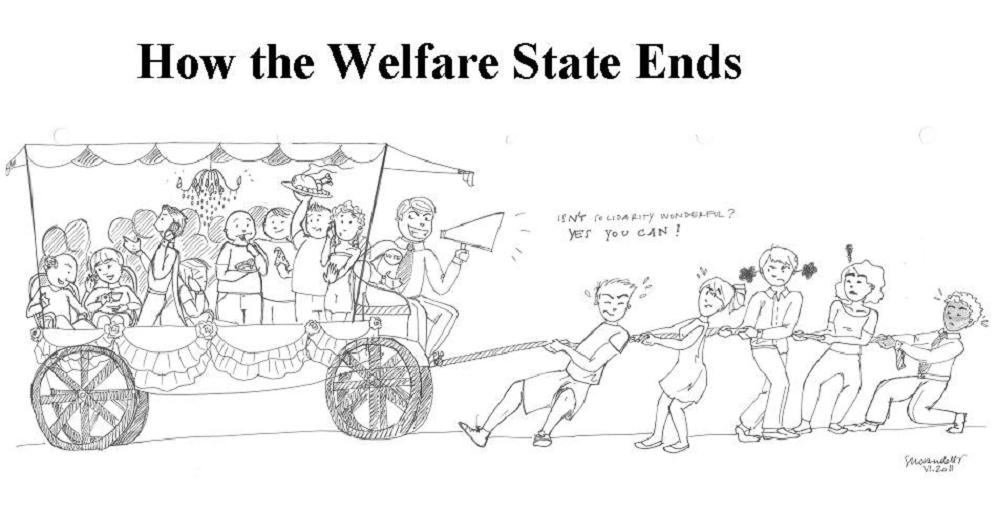
In my speeches, especially when talking about the fiscal crisis in Europe (or the future fiscal crisis in America), I often warn that the welfare state reaches a point-of-no-return when the number of people riding in the wagon begins to outnumber the number of people pulling the wagon.

To be more specific, if more than 50 percent of the population is dependent on government (employed in the bureaucracy, living off welfare, receiving pensions, etc), it becomes rather difficult to form a coalition to fix the mess. This may explain why Greek politicians have resisted significant reforms, even though the nation faces a fiscal death spiral.

But you don’t need me to explain this relationship. One of our Cato interns, Silvia Morandotti, used her artistic skills to create two images (click pictures for better resolution) that show what a welfare state looks like when it first begins and what it eventually becomes.

These images are remarkably accurate. The welfare state starts with small programs targeted at a handful of genuinely needy people. But as  politicians figure out the electoral benefits of expanding programs and people figure out the that they can let others work on their behalf, the ratio of producers to consumers begins to worsen.

Eventually, even though the moochers and looters should realize that it is not in their interest to over-burden the people pulling the wagon, the entire system breaks down.

Then things get really interesting. Small nations such as Greece can rely on permanent bailouts from bigger countries and the IMF, but sooner or later, as larger nations begin to go bankrupt, that approach won’t be feasible.

I often conclude my speeches by joking with the audience that it’s time to stock up on canned goods, bottled water, and ammo. Many people, I’m finding, don’t think that line very funny.

___________________

The Department of Health and Human Services administers the huge and fast-growing Medicare and Medicaid programs. These programs fuel rising health costs, distort health markets, and are plagued by waste and fraud. The department also runs an array of other expensive subsidy programs, including Head Start, TANF, and LIHEAP. Growth in HHS spending is creating a federal financial crisis, and the 2010 health care law sadly makes the situation worse.

The department will spend $910 billion in 2011, or $7,710 for every U.S. household. It employs 68,000 workers and runs more than 420 subsidy programs.


Timeline of Government Growth

  • See this timeline for key events in the department’s growth.

Reading Room

Cato Experts

Spending Cuts Summary

  • Here are proposed reforms to save $81 billion annually in the short-run and prevent federal health costs from consuming a growing share of the economy in the long-run.

Downsize This!

  • Medicare Reforms. Medicare should be transformed into a system based on vouchers, individual savings, and competitive insurance markets.
  • Medicaid Reforms. Federal spending on low-income health care should be converted to block grants for the states.
  • TANF and Welfare Spending. Welfare reforms in 1996 created Temporary Assistance for Needy Families, but this sort of aid should be provided by private charities.
  • Head Start and Other Subsidies. HHS funds a vast array of other subsidy programs, many of which are wasteful and ineffective.
  • 2010 Health Care Legislation. The law expanded Medicaid, added new taxes and subsidies, created new bureaucracies, and did little to reduce cost growth in health care.

The government of the United States is a definite government, confined to specified objects. It is not like the state governments, whose powers are more general. Charity is no part of the legislative duty of the government.

– James Madison. A paraphrase from Elliot’s Debates regarding a proposed subsidy bill, House of Representatives, January 10, 1794.

Reagan’s accomplishments

Ronald Reagan was my favorite president. Read this excellent article on his accomplishments from the Heritage Foundation:

What Were Ronald Reagan’s Achievements?

Julia Shaw

February 3, 2012 at 1:00 pm

February 6 is Ronald Reagan’s birthday. While the right has long looked to Reagan as the standard-bearer of conservative leadership, over the past few years, even liberals are waxing Reaganesque.

For instance, before he was the class warrior in the mold of Teddy Roosevelt, President Obama invoked the Gipper to support his millionaire tax. As Reagan historian Steven Hayward remarked, “Ever so slowly, liberals are attempting a subtle revisionism” of our 40th President.

Let’s set the record straight. Just take a look at Ronald Reagan’s greatest achievements as evidence of his conservatism.

Every President is judged on his performance in two areas: peace and prosperity. By this standard, Ronald Reagan was one of our greatest Presidents, and this is why the last half of the 20th century is often described by historians as the Age of Reagan.

Reagan’s military buildup and competition with the Soviet Union not only kept America safe but also, in Margaret Thatcher’s memorable phrase, won the Cold War without firing a shot. At home, he persuaded Congress to pass an economic recovery program—centered on cutting marginal tax rates—that sparked an unprecedented period of peacetime prosperity. As important, Reagan lifted the country out of a great psychological depression induced by the assassinations of John F. Kennedy and Martin Luther King, Jr., and sustained by the Vietnam War, Watergate, and the Jimmy Carter malaise. He did so by appealing to the best in the American character.

As Reagan explained in his Farewell Address, quoting the Constitution, “We the People” was the underlying basis for everything he tried to do as President.

Click here to leave a tribute to Ronald Reagan

Posted in First Principles

Have educational funds been slashed?

Have educational funds been slashed?

On rare occasions, when I get really irked, I complain about media bias. Examples include this AP story on poverty, the Brian Ross Tea Party slur, this example of implicit bias by USA Today, and a Reuters report on job creation and so-called stimulus.

On other occasions, though, you stumble upon a news report or column that is ignorant beyond belief and you have to assume that the person has transcended ordinary bias and belongs in a special category.

The Washington Post seems to specialize in this kind of über-mistake. It was a Post reporter, after all, who wrote last year about a GOP plan to “slash” spending when timid GOPers were merely trying to trim 0.15 percent from the growth of federal spending. Not 15 percent. Not 1.5 percent. A mere $6 billion out of a bloated federal budget of $3,800,000,000,000.

And it was the Washington Post that decided to refer to a certain country as fiscally conservative. Was the reporter writing about Hong Kong or Singapore, the two jurisdictions with the smallest government and freest markets? Nope. Was the reporter referring to Switzerland, with its strong human rights policy on financial privacy, or Australia, with its personal retirement accounts? Nope, the reporter wrote about “fiscally conservative Germany.”

I guess the folks at the New York Times were feeling left out, because our latest example comes from that newspaper. Someone named Chrystia Freeland wrote an article about income inequality, making some decent points about cronyism, but also reflexively regurgitating talking points on class-warfare tax policy. What caught my eye, though, was this incredible assertion about government funding of education.

Educational attainment, which created the American middle class, is no longer rising. The super-elite lavishes unlimited resources on its children, while public schools are starved of funding. …elite education is increasingly available only to those already at the top. Bill Clinton and Barack Obama enrolled their daughters in an exclusive private school; I’ve done the same with mine.

So “public schools are starved of funding”? That’s a strong statement. It implies very deep reductions in the amount of money being diverted from taxpayers to the government schools. So where are the numbers?

You won’t be surprised to learn that Ms. Freeland doesn’t offer any evidence. And there’s a good reason for that. As show in this chart, government spending on education has skyrocketed in recent years.

This data isn’t adjusted for inflation or population, but you can peruse this amazing chart put together by one of Cato’s education experts to see that per-pupil spending has skyrocketed even after adjusting for inflation.

In other words, Ms. Freeland has no clue what she’s talking about. Or, to be fair, she made a giant-sized mistake, perhaps because she’s lives in a statist bubble and blindly assumes that left-wing politicians tell the truth.

Though I do want to giver her credit. She acknowledges that Obama and Clinton both decided to save their kids from a failed government-run school system, thus exposing some hypocrisy on the left. So it’s quite possible that she wanted to write a fair piece, but simply had a few major blind spots.

And it goes without saying that none of the editors or (non-existent?) fact checkers at the New York Times knew enough or cared enough to catch a huge blunder.

P.S. You can enjoy some cartoons about media bias here, here, and here, with the last one being my favorite.

P.P.S. Yes, I know Paul Krugman writes at the New York Times and sometimes seems to specialize in big mistakes. But he’s explicitly an opinion writer, so readers are forewarned to expect a certain point of view.

Remembering Francis Schaeffer at 100 (Part 5) “Schaeffer Sunday”

This year Francis Schaeffer would have turned 100 on Jan 30, 2012. I remember like yesterday when I first was introduced to his books. I was even more amazed when I first saw his films. I was so influenced by them that I bought every one of his 30 something books and his two film series. Here is a tribute that I got off the internet from Chuck Colson’s website www.breakpoint.org :

Enlightened Ethics?
By Chuck Colson|Published Date: August 08, 2011

The Failure of Secularized Morality

Cheat

This commentary was first published November 1, 1995.

Christina Hoff Sommers, who teaches ethics at Clark University, tells a wonderful story—one that exposes the bankruptcy of modern ethics. After Sommers had written an article arguing that a just society begins with individual virtue, one of her colleagues berated her for holding to “an antiquated, Victorian, view of ethics.”

Modern ethics, her colleague informed her, is social justice. It is concerned not with personal morality but with causes, such as saving Brazilian rain forests and preventing Third World exploitation by multinational corporations.

Three months later the same colleague came back sheepishly to Sommers and said: “I have just had a shocking experience in my ethics class. Half of my students cheated on a take-home exam. And this is an ethics course!”

The woman confessed she needed to reread Sommers’s article about private virtue. When people see how flawed the modern view of ethics is, it opens a grand opportunity for a Christian apologetic.

Our modern dilemma in ethics began with the French Enlightenment. Like Sommers’s colleague, the Enlightenment thinkers believed that Christians were wrong about individual sin, that people were good, corrupted only by social structures. So reforming social structures would produce a perfect society.

For 200 years ethicists have tried to create ethical systems without God. The result has been the dismantling of any objective standard of right and wrong, leaving the individual to act according to his or her own “personal preference.”

But what happens when someone’s “personal preference” happens to be cheating on an exam? Or stealing? Or—for example—collaborating with murderous Nazis? That is exactly what happened in the very homeland of the Enlightenment. During wartime France the Vichy government rounded up Jews and handed them over to the Nazis. Seventy-five thousand French Jews perished in the death camps. French President Jacques Chirac recently acknowledged that shameful chapter of his country’s history. “France,” he said, “the homeland of the Enlightenment, and of the rights of man . . . committed the irreparable. Breaking its word, it handed over those who were under its protection to their executioners.”

How did the Enlightenment notion of the “rights of man” break down in wartime France? Well, ethical precepts in themselves have no moral force unless individuals view themselves as responsible to a Supreme Being. The French existentialist Jean Paul Sartre understood very well that ethics had no meaning once God was removed from the equation. “It doesn’t matter how you act,” Sartre said, “as long as you ‘authenticate yourself’ by an act of the will.”

Thus, to borrow a trenchant Francis Schaeffer illustration, you can decide to help an old lady across the street—or to push her into the path of an oncoming car. For Sartre, because there is no God, it doesn’t matter what one chooses to do. (WATCH THE 9 MINUTE VIDEO CLIP FOR THE CLASSIC EXAMPLE SCHAFFER GAVE.)

So the next time someone argues that ethics has nothing to do with obedience to God, show him exactly where that logic leads. And remind him that it is precisely because God exists that there is ultimately no getting away with cheating—or, for that matter, murder.

Want to learn more about the crisis of ethics in America? Order your copy of the DVD series, Doing the Right Thing, and gather with some friends to study this important 6-part series on why natural law matters.

schaeffer

Related posts:

Francis Schaeffer would be 100 years old this year (Schaeffer Sunday)

Dr. Francis Schaeffer – Extra – Interview – Part 2 Francis Schaeffer had a big impact on me in the late 1970′s and I have been enjoying his books and films ever since. Here is great video clip of an interview and below is a fine article about him. Francis Schaeffer 1912-1984 Christian Theologian, Philosopher, […]

Francis Schaeffer’s “How should we then live?” Video and outline of episode 10 “Final Choices” (Schaeffer Sundays)

E P I S O D E 1 0 How Should We Then Live 10#1 FINAL CHOICES I. Authoritarianism the Only Humanistic Social Option One man or an elite giving authoritative arbitrary absolutes. A. Society is sole absolute in absence of other absolutes. B. But society has to be led by an elite: John Kenneth […]

Fellow admirer of Francis Schaeffer, Michele Bachmann quits presidential race

What Ever Happened to the Human Race? Bachmann was a student of the works of Francis Schaeffer like I am and I know she was pro-life because of it. (Observe video clip above and picture of Schaeffer.) I hated to see her go.  DES MOINES, Iowa — Last night, Minnesota Rep. Michele Bachmann vowed to […]

Francis Schaeffer’s “How should we then live?” Video and outline of episode 9 “The Age of Personal Peace and Affluence” (Schaeffer Sundays)

E P I S O D E 9 How Should We Then Live 9#1 T h e Age of Personal Peace and Afflunce I. By the Early 1960s People Were Bombarded From Every Side by Modern Man’s Humanistic Thought II. Modern Form of Humanistic Thought Leads to Pessimism Regarding a Meaning for Life and for Fixed […]

Francis Schaeffer’s “How should we then live?” Video and outline of episode 8 “The Age of Fragmentation” (Schaeffer Sundays)

E P I S O D E 8 How Should We Then Live 8#1 I saw this film series in 1979 and it had a major impact on me. T h e Age of FRAGMENTATION I. Art As a Vehicle Of Modern Thought A. Impressionism (Monet, Renoir, Pissarro, Sisley, Degas) and Post-Impressionism (Cézanne, Van Gogh, Gauguin, […]

Francis Schaeffer’s “How should we then live?” Video and outline of episode 7 “The Age of Non-Reason” (Schaeffer Sundays)

E P I S O D E 7 How Should We Then Live 7#1 I am thrilled to get this film series with you. I saw it first in 1979 and it had such a big impact on me. Today’s episode is where we see modern humanist man act on his belief that we live […]

Francis Schaeffer would be 100 years old this year (Schaeffer Sunday)

Dr. Francis Schaeffer – Extra – Interview – Part 2 Francis Schaeffer had a big impact on me in the late 1970′s and I have been enjoying his books and films ever since. Here is great video clip of an interview and below is a fine article about him. Francis Schaeffer 1912-1984 Christian Theologian, Philosopher, […]

Francis Schaeffer’s “How should we then live?” Video and outline of episode 6 “The Scientific Age” (Schaeffer Sundays)

E P I S O D E 6 How Should We Then Live 6#1 I am sharing with you a film series that I saw in 1979. In this film Francis Schaeffer asserted that was a shift in Modern Science. A. Change in conviction from earlier modern scientists.B. From an open to a closed natural system: […]

Francis Schaeffer’s “How should we then live?” Video and outline of episode 5 “The Revolutionary Age” (Schaeffer Sundays)

E P I S O D E 5 How Should We Then Live 5-1 I was impacted by this film series by Francis Schaeffer back in the 1970′s and I wanted to share it with you. Francis Schaeffer noted, “Reformation Did Not Bring Perfection. But gradually on basis of biblical teaching there was a unique improvement. A. […]

Francis Schaeffer’s “How should we then live?” Video and outline of episode 4 “The Reformation” (Schaeffer Sundays)

How Should We Then Live 4-1 I was impacted by this film series by Francis Schaeffer back in the 1970′s and I wanted to share it with you. Schaeffer makes three key points concerning the Reformation: “1. Erasmian Christian humanism rejected by Farel. 2. Bible gives needed answers not only as to how to be right with […]

Francis Schaeffer’s “How should we then live?” Video and outline of episode 3 “The Renaissance”

How Should We Then Live 3-1 I was impacted by this film series by Francis Schaeffer back in the 1970′s and I wanted to share it with you. Schaeffer really shows why we have so many problems today with this excellent episode. He noted, “Could have gone either way—with emphasis on real people living in […]

Francis Schaeffer’s “How should we then live?” Video and outline of episode 2 “The Middle Ages” (Schaeffer Sundays)

How Should We Then Live 2-1 I was impacted by this film series by Francis Schaeffer back in the 1970′s and I wanted to share it with you. Schaeffer points out that during this time period unfortunately we have the “Church’s deviation from early church’s teaching in regard to authority and the approach to God.” […]

Francis Schaeffer’s “How should we then live?” Video and outline of episode 1 “The Roman Age” (Schaeffer Sundays)

How Should We Then Live 1-1 Today I am starting a series that really had a big impact on my life back in the 1970′s when I first saw it. There are ten parts and today is the first. Francis Schaeffer takes a look at Rome and why it fell. It fell because of inward […]

Andy Rooney was an atheist

How Now Shall We LiveClick here to purchase Chuck Colson and Nancy Pearcey’s How Now Shall We Live?, dedicated to Francis Schaeffer.


Click here for a list of Francis Schaeffer’s greatest works, from the Colson Center store!
SchaefferBooks