Yearly Archives: 2012

Milton Friedman – Power of Choice (Biography) Part 2

Milton Friedman – Power of Choice (Biography) Part 2

Published on May 21, 2012 by

My Tribute to Milton Friedman: The Little Giant of Free Market Economics

By: admin-
11/17/2006 09:49 AM

RESIZE: AAA 

Milton Friedman, the intellectual architect of the free-market reforms of the post-World War II era, was a dear friend. I was probably the last person to go out to lunch with Milton. We met at his favorite restaurant in San Francisco, where I showed him a picture of him standing next to John Kenneth Galbraith, the premier Keynesian and welfare statist of the 20th century. It was a picture in contrast: Milton Friedman, around 5 feet tall, and Galbraith, almost 6 feet, 10 inches in height. Beneath the picture was an ironic quotation by George Stigler: “All great economists are tall. There are two exceptions: John Kenneth Galbraith and Milton Friedman.” Milton was so pleased with the photo and caption that he sent it to all his friends only a few weeks before his passing.

The triumph of free-market reforms introduced by Thatcher, Reagan and other leaders in the post-Berlin Wall era (reforms such as lower taxes, deregulation, privatization, and the collapse of the Keynesian and Marxist paradigm) can be laid at the feet of a single giant figure: Milton Friedman. Other free-market economists had their impact, but Friedman’s was the most influential.

Founder of the modern-day Chicago school of economics, Milton Friedman was the catalyst of many new and exciting ideas that transformed economics from the “dismal science” to the “imperial science” of today. His impact has been felt in policies such as monetarism, privatization of Social Security, school choice, and futures markets in currencies, as well as in scholarly pursuits that transformed the economic profession and the war of ideas. He was the first economist to counter effectively the Keynesian monolith and its myths that capitalism is inherently unstable, that money does not matter, and that there is a trade-off between inflation and unemployment. Friedman debunked them all. He demonstrated that money mattered a lot: “Inflation is always and everywhere a monetary phenomenon.”

His most important work is his 1963 magnum opus, “A Monetary History of the United States, 1867-1960,” co-authored with Anna J. Schwartz. This book carefully demonstrated a close correlation between monetary policy and economic activity. The authors demonstrated beyond doubt that it was government ineptitude by the Federal Reserve, and not free-enterprise capitalism, that caused the Great Depression. Friedman and Schwartz showed that the Fed allowed the money supply to collapse by over a third. This booked marked the beginning of a counterrevolution—deviating from the Keynesian view that the welfare state and big government were beneficial. Now government was seen as the “cause” of our problems, not the cure, as Reagan used to say. Textbooks replaced “market failure” with “government failure.” And Friedman made it happen.

Friedman was able to succeed because he had impeccable credentials within the economics profession—earning his Ph.D. from Columbia University, becoming president of the American Economic Association in 1967, being published by Princeton University Press, teaching at the University of Chicago, and winning the Nobel Prize in Economics in 1976 (appropriately on the 200th anniversary of America’s Declaration of Independence).

After establishing himself as a top-ranked economist, he wrote for the general public, especially “Capitalism and Freedom” (1962) and “Free to Choose” (1980), co-authored with his wife and fellow economist, Rose Friedman. (Rose was his beloved companion in life — they traveled and worked together, had two children, and wrote the memoir “Two Lucky People”). Milton told me that he always regarded “Capitalism and Freedom” as his best book for the intelligent layman. I highly recommend the book as an ideal libertarian document.

On a personal level, Milton was a unique friend. Always intelligent and demanding of evidence, Milton had an “open door” policy toward people of all walks of life. He kept his secretary busy handling abundant correspondence with friends and strangers. When I first met him in the early 1980s, he didn’t know me from Adam, but he was willing to meet with me and answered my questions seriously. Ever since then I have kept up our friendship by letter, e-mails, telephone calls and dinner or lunch over the past dozen years. He invited me to my first Mont Pelerin Society meeting (a gathering of international scholars that Friedrich Hayek established in 1947) and through his influence, I became a member in 2002. He generously wrote blurbs for my recent books, and was a big fan of “FreedomFest,” my annual gathering of freedom lovers. When I had the opportunity to teach at Columbia Business School, he wrote a favorable letter to the dean to help me get the position.

Milton loved a good argument and we had plenty over the years, especially about the gold standard and the Austrian theory of the business cycle. When I told him the title of my new book, “Vienna and Chicago, Friends of Foes?” (Capital Press/Regnery, 2006), he responded, “Both—We’re friends and foes!” In the early 1990s, when I wrote a marketing piece for another book with the headline, “Japan and Germany Will Surpass the U.S. economy by 2000,” but he corrected me. “It won’t happen.” He was right. Occasionally, I was able to change his mind, but it was never easy.

Milton’s mind was bright and alert to the end, although he suffered from pain in his legs and he had a hard time walking. He also had gone through two open-heart surgeries in the 1980s. This year, when he turned 94, I asked him, “Do you think you will live to be 100?” His reply: “I hope not!” But Milton was almost always upbeat about life, even to the end. He was not a particularly religious man, but he expressed interest in religious topics near the end of his life. His favorite poem was Keat’s “Ode on a Grecian Urn,” which ends, “Beauty is truth, truth beauty—that is all/ Ye know on earth, and all ye need to know.” He discovered both in a full and complete life. I consider it a privilege and honor to have known him.


The Laffer Curve Wreaks Havoc in the United Kingdom

I got to hear Arthur Laffer speak back in 1981 and he predicted what would happen in the next few years with the Reagan tax cuts and he was right with every prediction.

The Laffer Curve Wreaks Havoc in the United Kingdom

July 1, 2012 by Dan Mitchell

Back in 2010, I excoriated the new Prime Minister of the United Kingdom, noting that David Cameron was increasing tax rates and expanding the burden of government spending (including an increase in the capital gains tax!).

I also criticized Cameron for leaving in place the 50 percent income tax rate imposed by his feckless predecessor, and was not surprised when experts began to warn that this class-warfare tax hike might actually result in less revenue because the reduction in taxable income could be more significant than the increase in the tax rate.

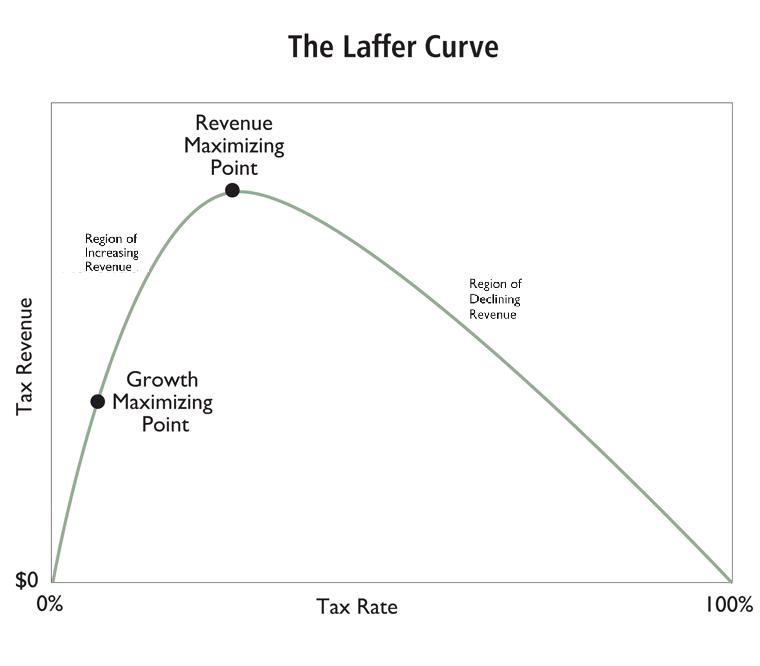
In other words, bad policy might lead to a turbo-charged version of the Laffer Curve.

Allow me to elaborate. In most cases, punitive tax hikes do raise revenue, but not as much as politicians predict. As explained in this three-part video series, this is because it takes a very significant reduction in taxable income to offset the revenue-generating impact of the higher tax rate.

But if a tax increase imposes a lot of damage and taxpayers have enough flexibility in their financial affairs, then it’s possible that a tax hike can lose revenue (or, as we saw with Reagan’s “tax cuts for the rich,” a well-designed reduction in tax rates can actually generate higher revenue).

With that background knowledge, let’s now take a closer look at David Cameron’s tax increases. They’ve been in place for a while, so we can look at some real-world data. Allister Heath of City AM has the details.

Something very worrying is happening to the UK’s public finances. Income tax and capital gains tax receipts fell by 7.3 per cent in May compared with a year ago, according to official figures. Over the first two months of the fiscal year, they are down by 0.5 per cent. This is merely the confirmation of a hugely important but largely overlooked trend: income and capital gains tax (CGT) receipts were stagnant in 2011-12, edging up by just £414m to £151.7bn, from £151.3bn, a rise of under 0.3 per cent. By contrast, overall tax receipts rose 3.9 per cent.

Is this because the United Kingdom is cutting tax rates? Nope. As we mentioned in the introduction, Cameron is doing just the opposite.

…overall taxes on labour and capital have been hiked: the 50p tax was introduced from April 2010 (and will fall to a still high 45p in April 2013), those earning above £150,000 have lost their personal allowance, CGT has risen to 28 per cent, many workers have been dragged into higher tax thresholds, and so on. In theory, if one were to believe the traditional static model of tax, beloved of establishment economists, this should have meant higher receipts, not lower revenues.

So what’s the problem? Well, it seems that there’s thing called the Laffer Curve.

…there is a revenue-maximising rate of tax – and that if you set rates too high, you raise less because people work less, find ways of avoiding tax or quit the country. The world isn’t static, it is dynamic; people respond to tax rates, just as they respond to other prices. Laffer told a gathering at the Institute of Economic Affairs that this is definitely true in the UK today – and the struggling tax take revealed in the official numbers suggest that he is right. Tax rates and levels are so high as to be counterproductive: slashing capital gains tax would undoubtedly increase its yield, for example. Many self-employed workers are delaying incomes as much as possible until the new, lower top rate of tax kicks in.

Allister’s column also makes the critical point that not all taxes are created equal.

…higher VAT is also damaging growth, though it is still yielding more. Some taxes can still raise more – but try doing that with income tax, CGT or corporation tax and the result is now clearly counter-productive. These taxes are maxed out; they have been pushed beyond their ability to raise revenues.

Last but not least, he makes an essential point about the role of bad spending policy.

The problem is that spending is too high – central government current expenditure is up by 3.7 per cent year on year in April-May – not that taxes are too low. The result is that the April-May budget deficit reached £30.7bn, some £6.2bn higher than a year ago.

By the way, you won’t be surprised to learn that Paul Krugman has been whining about “spending cuts” in the United Kingdom, even though the burden of the public sector has been climbing. But given his outlandish errors about Estonia, we shouldn’t be surprised.

But that’s not the point of this post. The relevant question is why do politicians pursue bad policy and why do some economists aid and abet bad policy?

For politicians, I think the answer is easy. They simply care about getting elected and holding power. So if they think class-warfare tax policy is the way of achieving those narcissistic goals, they’ll push higher tax rates. Even if it means lower revenue, notwithstanding their usual desire to have more money so they can buy more votes.

I’m more mystified by the behavior of economists. Let’s look at a couple of examples. Justin Wolfers and Mark Thoma recently cited some survey data to claim that the Laffer Curve was universally rejected by the profession.

But as James Pethokoukis of the American Enterprise Institute explained, the survey actually showed just the opposite, with economists by a margin of nearly 5-1 agreeing that lower tax rates could boost GDP (and therefore taxable income).

Those economists did say that a reduction in tax rates, based on current levels, would not cause taxable income to jump by a large enough amount to fully offset the revenue-losing impact of the lower tax rate. But the Laffer Curve says that only happens in extreme circumstances, so there’s zero contradiction.

So why did Wolfers and Thoma create a straw man in an attempt to discredit the Laffer Curve?

I have no idea, but Republican politicians probably deserve some of the blame. Too many of them make silly claims that “all tax cuts pay for themselves,” even when talking about new credits and deductions that have no positive impact on economic performance.

To the extent that Wolfers, Thoma, and others think that’s what the Laffer Curve is all about, then their skepticism is warranted.

But if that’s the case, they should read what Art Laffer actually wrote so they can be more accurate in the future. Or they can watch these three videos.

Part I describes the theory.

Part II describes the evidence.

And Part III explains the sloppy and inaccurate revenue-estimating methodology of the Joint Committee on Taxation.

But if they think I’m too biased or that Art is similarly misguided, then they should look at some of the evidence produced by other economists.

The sooner they get up to speed on these issues, the sooner they can help give politicians good advice so that the Laffer Curve doesn’t cause more unpleasant surprises.

Milton Friedman remembered at 100 years from his birth (Part 2)

Testing Milton Friedman – Preview

Uploaded by on Feb 21, 2012

2012 is the 100th anniversary of Milton Friedman’s birth. His work and ideas continue to make the world a better place. As part of Milton Friedman’s Century, a revival of the ideas featured in the landmark television series Free To Choose are being revisited in a new 3-part PBS broadcast.

To learn more visit: miltonfriedmanscentury(dot)org

Or: freetochoose(dot)net/media/broadcast/testing_milton_friedman/

______________________

Thinking Things Over       May 28, 2012

Volume II, Number 21: Remembering Milton Friedman in the Torpor of 1980  

By John L. Chapman, Ph.D.         Washington, D.C.

Amidst continuing nervousness about the Eurozone and slower global growth, political debate in the U.S. is centered around the best path forward to return to sustainable prosperity.  The Wall Street Journal reminded us this past weekend of similar tough times 32 years ago, and the group of economic advisors led by 1976 Nobel Laureate Milton Friedman who steeled a new President’s nerves to “stay the course” on a pro-growth and pro-investment policy mix — exactly what needs to happen again today.

The Global Backdrop Compared to 1980

This past week the continuing stream of data about the global economy was not good around the globe but, we hasten to add, “not bad” for the United States.  Manufacturing is contracting in the Eurozone and in China (for the seventh straight month in the latter), and slowing in the U.S., along with orders for durable goods including aircraft, computers, and heavy machinery (though still all positive growth here).  Both the OECD and IMF have cut their 2012 forecast for global growth, now below the 3.9% seen in 2011.  The Morgan Stanley MSCI Index for global equities is off 9% since mid-March, and the price of crude oil, the leading globally-traded industrial commodity – and hence indicator of commercial appetites – is down 15% since the beginning of May alone. Worries about Greece and its possible-to-likely exit (or forced eviction) from the Eurozone after its June 17 elections have only added to investor nervousness on a global scale: Greece is of course a small country, but its Euro-exit and debt repudiation could be a harbinger for the other heavily-indebted member states in the Eurozone, beginning with the 4th largest economy in the union, Spain, whose banking system is increasingly stressed.

Thus, Greece has an outsized influence on global markets as we head into June.  While in more “normal” times a Greek default and currency reconstruction would be absorbed in a global economy with $60 trillion in GDP, these are not normal times:  in the current environment, the play-out of tragedy in Greece sends out echoes to Italy, Portugal, Spain, and elsewhere, threatening a general depression if devalued currency warfare stunts global trade, as per its potential.

The economy in the United States continues to show amazing resilience, even as equity markets traded flat last week and are down 7% since peaking in April.  Indeed some of the performance metrics in the U.S. are nothing short of outstanding: retail sales are now up for 21 of the previous 22 months, during a 26-month span when 4.2 million private sector jobs have been created since the unemployment peak.  Consumer spending is up 4% in real terms from a year ago, exemplified by a preferred leading indicator for us, auto sales, up 10% year-on-year to a new annual run rate of 14.3 million vehicles.

Work hours are continuing a two-year rise as well, and business (nonresidential fixed) investment, while still way off its 2006 peak and well-below long term trend, is recovering smartly as well, up 12% year-on-year.

Meanwhile data out in the past week reinforces the positive “spin” on the U.S., even in the case of declining durable goods orders mentioned above.  New single-family home sales increased 3.3% in April, to a 343,000 annual rate (up nearly 10% from a year earlier), continuing a three year recovery that is on track to double from existing production levels in the next four years based on demographic needs (in contrast to Japan and most all of Europe, the United States is actually getting younger).  Sales were up in the Northeast, West, and Midwest, as the supply of new homes fell to 5.1 months’ inventory from 5.2 the prior month.  Further, the median price of new homes sold was $235,700 in April, up 4.9% from a year ago; the average price was $282,600, up 5.1% from 2011; this is very positive data that casts doubt on the recent gloom contained in the Case-Shiller data (all homes’ pricing is also up, by 2.7% from year-earlier levels).

Data on existing home sales matched that of new product: volumes of existing home sales rose 3.4% in April, to an annual rate of 4.62 million units; sales of these homes are also up 10.0% versus a year ago, and are up in all four regions of the U.S. including the South. Median prices for existing homes are up 10.1% from a year ago, with average prices up 7.4% in that time.  New orders for durable goods were positive, too: they increased 0.2% in April, and are up 6.9% year on year (and orders excluding the volatile transport sector are still up 6.3%).  While there was a severe decline in core capital goods production (viz., excluding aircraft and defense-related), the continuing rise in capacity utilization (nearing 80% for the first time in four years) and home-building should lead to a rebound in capital equipment production of all types in the months ahead.

What Reagan Faced

Considering the turmoil elsewhere, as well as the uncertainty around near term conditions here in the U.S., the continuing relative buoyancy here, and intrepid resourcefulness of American producers, is nothing short of astounding.  And related to this, how heartening it was, too, to see the reprint of portions of a famous memo on economic growth strategy appearing in the Wall Street Journal this past weekend. Written to then President-Elect Reagan within two weeks of his election victory, the memo, signed by a committee including George Schultz, Milton Friedman, William E. Simon, and the incoming Chair of the Council of Economic Advisors Murray Weidenbaum, outlined the serious challenges facing the U.S. economy, and the priorities to meet them.

The committee did not mince words at a time of nearly 8% unemployment, 13% inflation, and 21% interest rates. The core concepts of a new plan, indeed, governing paradigm, for sustainable growth, included the following:

You have identified in the campaign the key issues and lines of policy necessary to restore hope and confidence in a better economic future:

• Reestablish stability in the purchasing power of the dollar.

• Achieve a widely-shared prosperity through real growth in jobs, investment, and productivity.

• Devote the resources needed for a strong defense, and accomplish the goal of releasing the creative forces of entrepreneurship, management, and labor by:

• Restraining government spending.

Reducing the burden of taxation and regulation.

• Conducting monetary policy in a steady manner, directed toward eliminating inflation.

This amounts to emphasis on fundamentals for the full four years, as the key to a flourishing economy.

Reading the document in its entirety is an eerie experience because the solutions proffered mirror almost precisely what needs to happen today.  The leading influence in the memo’s production, which was itself a compendium of several economic policy position papers developed during the campaign, was Milton Friedman.  Professor Friedman, born 100 years ago this summer, went on to serve all eight years on President Reagan’s economic policy advisory committee, later joined by such luminaries as Thomas Sowell — it was a group Mr. Reagan described in his memoirs as enjoying immensely throughout his two terms, and a group whose 6-8 meetings per year he never missed.  Indeed, in one of the understated circumstances of history, it was this group that provided encouragement to Mr. Reagan to steel his courage to “stay the course” on this 1981 Economic Recovery and Tax Act, which in the horrible economy of 1982 he was repeatedly encouraged to abandon — by his own people.  In spite of electoral thrashing that November, he did exactly that, and engendered the 1983-89 seven year boom, with three million new jobs per year and a steadily declining debt-to-GDP ratio across his term.

The entire document is worth reading, but for our purposes, it is fascinating to see the items for action listed — and their priority in emphasis — as laid out by Professor Friedman.  At the top of the list was restoring a sound dollar, followed by the need to promote productivity-enhancing investment.  This was followed by building up the national defense in conjunction with a roll-back in spending and burdensome regulations.  The Committee knew that growth in the public sector — in both taxes and spending — had led to a fiscal “crowding out” of resources available for the private sector, including defense spending.  The committee advised the incoming President that his tax cuts, lessened government spending, and fewer regulations would unleash an entrepreneurial boom, and ignite the U.S. economy’s natural propensity for being the global drive-train of growth.   21 million jobs soon followed.

For those old enough to remember, it will be recalled that 1979-80 were miserable times in the U.S.: gas lines, high unemployment, stagnant real wages, increasing global trade tensions, high inflation, and an era of diminshed expectations as encouraged by the incumbent President.  Mr. Reagan would have none of it, and encouraged by Milton Friedman and his confreres, applied the wisdom of Adam Smith to that era’s troubles.  The resulting 25-year boom, in which the U.S. economy effectively added new growth the size of the German economy, can be re-ignited once again, and indeed could be transposed around the world to all troubled economies, including that of Greece.  To do so only requires the will to implement anew the policies followed then.

For information on Alhambra Investment Partners’ money management services and global portfolio approach to capital preservation, John Chapman can be reached at john.chapman@alhambrapartners.com. The views expressed here are solely those of the author, and do not necessarily reflect that of colleagues at Alhambra Partners or any of its affiliates.

“Friedman Friday” :“A Nobel Laureate on the American Economy” VTR: 5/31/77 Transcript and video clip (Part 4)

Milton Friedman on the American Economy (4 of 6)   Uploaded by donotswallow on Aug 9, 2009 THE OPEN MIND Host: Richard D. Heffner Guest: Milton Friedman Title: A Nobel Laureate on the American Economy VTR: 5/31/77 _____________________________________ Below is a transcipt from a portion of an interview that Milton Friedman gave on 5-31-77: Friedman: […]

Obama promotes food stamps but Milton Friedman had a better suggestion

Milton Friedman’s negative income tax explained by Friedman in 1968: We need to cut back on the Food Stamp program and not try to increase it. What really upsets me is that when the government gets involved in welfare there is a welfare trap created for those who become dependent on the program. Once they […]

“Friedman Friday” :“A Nobel Laureate on the American Economy” VTR: 5/31/77 Transcript and video clip (Part 3)

Milton Friedman on the American Economy (3 of 6) Uploaded by donotswallow on Aug 9, 2009 THE OPEN MIND Host: Richard D. Heffner Guest: Milton Friedman Title: A Nobel Laureate on the American Economy VTR: 5/31/77 _____________________________________ Below is a transcipt from a portion of an interview that Milton Friedman gave on 5-31-77: Friedman: Now […]

“The Power of the Market” episode of Free to Choose in 1990 by Milton Friedman (Part 5)

Milton Friedman The Power of the Market 5-5 How can we have personal freedom without economic freedom? That is why I don’t understand why socialists who value individual freedoms want to take away our economic freedoms.  I wanted to share this info below with you from Milton Friedman who has influenced me greatly over the […]

“The Power of the Market” episode of Free to Choose in 1990 by Milton Friedman (Part 4)

Milton Friedman The Power of the Market 4-5 How can we have personal freedom without economic freedom? That is why I don’t understand why socialists who value individual freedoms want to take away our economic freedoms.  I wanted to share this info below with you from Milton Friedman who has influenced me greatly over the […]

Obama’s solution to our healthcare problems: MORE FEDERAL OVERSIGHT!!!

A Taxing Distinction for ObamaCare Published on Jun 28, 2012 by catoinstitutevideo http://www.cato.org/publications/commentary/it-now-falls-congress http://www.cato.org/publications/commentary/taxing-decision http://www.cato-at-liberty.org/supreme-court-unlawfully-rewrites-obamacare-to… http://www.cato-at-liberty.org/congress-its-not-a-tax-scotus-yes-it-is/ The Cato Institute’s Roger Pilon, Ilya Shapiro, Michael F. Cannon, Michael D. Tanner and Trevor Burrus evaluate today’s ruling on ObamaCare at the Supreme Court. Video produced by Caleb O. Brown and Austin Bragg. ____________ When I think about […]

“Friedman Friday”:“A Nobel Laureate on the American Economy” VTR: 5/31/77 Transcript and video clip (Part 2)

Milton Friedman on the American Economy (2 of 6) Uploaded by donotswallow on Aug 9, 2009 THE OPEN MIND Host: Richard D. Heffner Guest: Milton Friedman Title: A Nobel Laureate on the American Economy VTR: 5/31/77 _____________________________________ Below is a transcipt from a portion of an interview that Milton Friedman gave on 5-31-77: Friedman: General […]

“The Power of the Market” episode of Free to Choose in 1990 by Milton Friedman (Part 3)

Milton Friedman The Power of the Market 3-5 How can we have personal freedom without economic freedom? That is why I don’t understand why socialists who value individual freedoms want to take away our economic freedoms.  I wanted to share this info below with you from Milton Friedman who has influenced me greatly over the […]

“The Power of the Market” episode of Free to Choose in 1990 by Milton Friedman (Part 2)

Milton Friedman The Power of the Market 2-5 How can we have personal freedom without economic freedom? That is why I don’t understand why socialists who value individual freedoms want to take away our economic freedoms.  I wanted to share this info below with you from Milton Friedman who has influenced me greatly over the […]

“Friedman Friday” :“A Nobel Laureate on the American Economy” VTR: 5/31/77 Transcript and video clip (Part 1)

Milton Friedman on the American Economy (1 of 6) Uploaded by donotswallow on Aug 9, 2009 THE OPEN MIND Host: Richard D. Heffner Guest: Milton Friedman Title: A Nobel Laureate on the American Economy VTR: 5/31/77 _____________________________________ Below is a transcipt from a portion of an interview that Milton Friedman gave on 5-31-77: THE OPEN […]

“The Power of the Market” episode of Free to Choose in 1990 by Milton Friedman (Part 1)

Milton Friedman The Power of the Market 1-5 How can we have personal freedom without economic freedom? That is why I don’t understand why socialists who value individual freedoms want to take away our economic freedoms.  I wanted to share this info below with you from Milton Friedman who has influenced me greatly over the […]

Milton Friedman’s best 10 quotes

Milton Friedman – Public Housing Uploaded by LibertyPen on May 6, 2011 Professor Friedman looks at the destination of another road paved with good intentions. _______________ 10 great quotes from Milton Friedman below: Nov 29, 2011 10 Of The Best Economics Quotes From Milton Friedman John Hawkins John Hawkins is a professional blogger who runs […]

Myth:Conservative Herbert Hoover responsible for Depression?

Myth:Conservative Herbert Hoover responsible for Depression When I grew up I always heard that the conservative Herbert Hoover was responsible for the depression. Is that true? The Hoover Myth Marches On Posted by David Boaz In the New York Times today,  columnist Joseph Nocera quotes a book published in 1940 on Herbert Hoover and the Great Depression: […]

“The Failure of Socialism” episode of Free to Choose in 1990 by Milton Friedman (Part 5)

Milton Friedman: Free To Choose – The Failure Of Socialism With Ronald Reagan (Full) Published on Mar 19, 2012 by NoNationalityNeeded Milton Friedman’s writings affected me greatly when I first discovered them and I wanted to share with you. Abstract: Ronald Reagan introduces this program, and traces a line from Adam Smith’s “The Wealth of […]

Case Study on Chelsea Clinton:Can equality of results be acheived best by punishing those who were born rich? “Friedman Friday”

Milton Friedman – Redistribution of Wealth Uploaded by LibertyPen on Feb 12, 2010 Milton Friedman clears up misconceptions about wealth redistribution, in general, and inheritance tax, in particular. http://www.LibertyPen.com _______________________________ Many times in the past our government has tried to even the playing field but the rich and poor will always be with us as […]

By Everette Hatcher III | Also posted in Current Events, spending out of control, Taxes | Edit | Comments (0)

Top football stadiums in the country (Part 20)

2007: Appalachian State v. Michigan (Drive-Thru)

Arkansas at Georgia Fantastic Finish 2010

Facing the Giants – Interview With Mark Richt

Uploaded by on Oct 24, 2008

Clip from”Facing the Giants: An inspiring interview with Mark Richt” A Head Coach at the University of Georgia, Bulldog Football Team

______________

Here is a list of the top football stadiums in the country.

Power Ranking All 124 College Football Stadiums  

By Alex Callos

(Featured Columnist) on April 19, 2012 

When it comes to college football stadiums, for some teams, it is simply not fair. Home-field advantage is a big thing in college football, and some teams have it way more than others.

There are 124 FBS college football teams, and when it comes to the stadiums they play in, they are obviously not all created equal.

There is a monumental difference from the top teams on the list to the bottom teams on the list. Either way, here it is: a complete ranking of the college football stadiums 1-124.

_________________

I really like Georgia’s coach. He is a fine Christian man. He has said before that he likes football but if he got fired tomorrow it was would not bother him because Christ is the Lord of his life and football is just a job.

4. Sanford Stadium: Georgia Bulldogs

300px-football_game_kickoff_georgia_vs_south_carolina_sanford_stadium_september_2007_display_image

Home to 92,746 fans on a Saturday afternoon, Sanford Stadium has been the home of the Bulldogs since 1929.

The student section is 10,000 strong every game, creating one of the most unique atmospheres in college football.

Georgia has had some good teams over the years, and when they have those teams, this place is even louder.

“Between the Hedges” is what they call it here, and beating Georgia at home is not an easy task for any SEC team.


3. Michigan Stadium: Michigan Wolverines

300px-michigan_stadium_2011_display_image

This stadium is known by everyone at simply “The Big House,” and that it is.

As the largest stadium in the country, “The Big House” seats 109,901 when at full capacity and has been around since 1927.

The marching band kicks everything off here about 20 minutes before kickoff.

Clapping to Hail to the Victors is another tradition that is certain to take place during a game. The scoreboards on each end of the field are 85 feet long, and even though nearly 110,000 fans pack in every Saturday, there is not a bad seat in the house.

Related posts:

Top football stadiums in the country (Part 10)

Tennessee Football – Johnny Majors – GREAT – Joining the VOLS in 1952 Uploaded by TheMemphisSlim on Sep 3, 2010 Johnny Majors from Huntland, TN tried out for the UT Football team weighing 150 pounds. His Father, Shirley Majors his HS Coach,encourage him and then 4 younger brothers all to be Vols. Johnny Majors was […]

Top football stadiums in the country (Part 9)

South Carolina D vs Arkansas O 2011 Tennessee ’86 Sugar Bowl Memories by Russ Finley Uploaded by yankeefanintenn on Dec 12, 2009 All video footage is copyright of WATE-TV6 and the University of Tennessee, but legally reproduced here in conjunction with Fair Use laws. Vols feature (1986 win over Miami 35-7 in the USF&G Sugar […]

Top football stadiums in the country (Part 8)

Vanderbilt Highlights vs. Arkansas – Oct. 29, 2011 Memphis 21 Tennessee 17 excerpt from “1996 Tiger Football Here is a list of the top football stadiums in the country. Power Ranking All 124 College Football Stadiums   By Alex Callos (Featured Columnist) on April 19, 2012  When it comes to college football stadiums, for some teams, […]

Top football stadiums in the country (Part 7)

Final Moments of Kentucky vs. Tennessee Football Game 2011 Uploaded by videorocker112 on Nov 27, 2011 Kentucky wins 10-7 and ends the 26 year losing streak!! Here is a list of the top football stadiums in the country. Power Ranking All 124 College Football Stadiums   By Alex Callos (Featured Columnist) on April 19, 2012  When […]

Top football stadiums in the country (Part 6)

THE FLEA KICKER – Nebraska vs. Missouri 1997 Here is a list of the top football stadiums in the country. Power Ranking All 124 College Football Stadiums   By Alex Callos (Featured Columnist) on April 19, 2012  When it comes to college football stadiums, for some teams, it is simply not fair. Home-field advantage is a […]

Top football stadiums in the country (Part 5)

Arkansas vs. Troy (2007 Football) 2010 Music City Bowl North Carolina vs Tennessee Uploaded by piotrkol1 on Jan 1, 2011 Highlights of North Carolina’s win over Tennessee in the 2010 Music City Bowl. Tennessee had the home-field advantage with the game being played at LP Field in Nashville, and the Volunteers thought they had won […]

Top football stadiums in the country (Part 4)

Rice 27 BYU 14 (1997 2nd half) Here is a list of the top football stadiums in the country. Power Ranking All 124 College Football Stadiums   By Alex Callos (Featured Columnist) on April 19, 2012  When it comes to college football stadiums, for some teams, it is simply not fair. Home-field advantage is a big […]

Top football stadiums in the country (Part 3)

Kansas Football 2007 Here is a list of the top football stadiums in the country. Power Ranking All 124 College Football Stadiums   By Alex Callos (Featured Columnist) on April 19, 2012  When it comes to college football stadiums, for some teams, it is simply not fair. Home-field advantage is a big thing in college football, […]

Top football stadiums in the country (Part 2)

2011 Arkansas State Football Highlights Here is a list of the top football stadiums in the country. Power Ranking All 124 College Football Stadiums   By Alex Callos (Featured Columnist) on April 19, 2012  When it comes to college football stadiums, for some teams, it is simply not fair. Home-field advantage is a big thing in […]

Top football stadiums in the country (Part 1)

Arkansas VS Tulsa 2008 Uploaded by jonesark on Nov 2, 2008 Arkansas entering the field to play #19 Tulsa. Here is a list of the top football stadiums in the country. Power Ranking All 124 College Football Stadiums   By Alex Callos (Featured Columnist) on April 19, 2012  When it comes to college football stadiums, for […]


Milton Friedman on “Firing Line” in 1968

Milton Friedman, Ronald Reagan And William F. Buckley Jr.

Peter Robinson, 12.12.08, 12:01 AM EST

In a time of crisis, don’t forget what they had to say.

pic

As the federal deficit surpasses $1 trillion, Congress debates a bailout for the Detroit automakers and President-elect Barack Obama draws up plans for a vast new stimulus package, we Americans are being asked to do something odd: Ignore the lessons of more than half a century.

Limit government spending? Resist the creation of bureaucracies? Take a skeptical view of the experts, academics and other elites who are always ready to argue that they know more about what’s good for us than we do?

Forget it.

How long this great forgetting will last, nobody can say. But if you’re reluctant to participate, permit me to suggest a small act of civil disobedience.

Print the three quotations below, put them on your refrigerator and read them once in awhile.

Remember.

Milton Friedman: The political system “tends to give undue political power to small groups that have highly concentrated interests; to give greater weight to obvious, direct and immediate effects of government action than to possibly more important but concealed, indirect and delayed effects; to set in motion a process that sacrifices the general interest to serve special interests rather than the other way around. There is, as it were, an invisible hand in politics that operates in precisely the opposite direction to Adam Smith’s invisible hand.”

The general interest, sacrificed to the special interests: This is the iron law of government spending, the fundamental and everlasting equation.

Stroll down K Street, the home of Washington lobbying firms, any night this coming month; no matter how late the hour, you’ll see lights on in all the office buildings. Inside, highly paid professionals will be working with the feverish intensity of Santa’s elves. Only instead of producing gifts for good children, they’ll be scheming to grab goodies from the Obama stimulus package–billions of dollars’ worth of goodies–on behalf of the naughty adults who employ them.

Ronald Reagan: “A government bureau is the closest thing to eternal life we’ll ever see on this earth.”

Like so much Reagan material, this aphorism isn’t merely amusing, it makes a vital point. The New Deal, the Square Deal, the Great Society–overwhelmingly, the programs that each of these expansions of the federal government entailed remain in place today. Why?

Because federal programs not only respond to special interests (see Milton Friedman, above), they create them–each new act of largesse calling into being a new group with enough at stake to become politically organized–paying lobbyists and consultants handsome sums to keep the government dollars coming.

The Obama administration’s huge new spending package might or might not stimulate the growth of economy. It will certainly stimulate the growth of government.

William F. Buckley Jr.: “I’d rather be governed by the first 2,000 names in the Boston telephone directory than by the faculty of Harvard.”

Ordinary Americans vs. the high priests of knowledge and culture. It would only make sense, you might think, to put the country in the hands of the priests. After examining the record of the closing decades of the 20th century, you’d think again.

Bigger government, higher taxes, modest defenses, détente with the Soviets–by and large, these were the policies of the intellectual establishment. During the 1970s, such policies nearly brought down the country. Limited government, tax cuts, rebuilding our defenses, standing up to the Soviets–by and large, these were the policies of ordinary Americans. During the 1980s, such policies brought down the Soviet Union.

“Jan. 20, 2009,” the New York Times columnist David Brooks recently wrote, “will be a historic day. Barack Obama (Columbia, Harvard Law) will take the oath of office as his wife, Michelle (Princeton, Harvard Law) looks on proudly. Nearby, his foreign policy advisers will stand beaming, including perhaps Hillary Clinton (Wellesley, Yale Law), Jim Steinberg (Harvard, Yale Law) and Susan Rice (Stanford, Oxford D. Phil.).”

The Obama administration, Brooks asserts, will represent “a valedictocracy.”

The rest of us may be forgiven for failing to share his enthusiasm.

Peter Robinson, a research fellow at the Hoover Institutionand contributor to RobinsonandLong.com, writes a weekly column for Forbes.com.

Dan Mitchell: Maryland to Texas, but Not Okay to Move from the United States to Singapore?

You can’t blame someone for leaving one state for another if they have a better an opportunity to make money.

Maryland to Texas, but Not Okay to Move from the United States to Singapore?

July 12, 2012 by Dan Mitchell

I’ve commented before about entrepreneurs, investors, and small business owners migrating from high tax states such as California to low-tax states such as Texas and nobody gets upset.

Indeed, I just appeared on Fox Business Network to talk about a new study showing an exodus from Maryland following the imposition of some class warfare tax hikes (which simply confirms earlier analysis showing the same trend), and at no point was there any discussion about whether the state’s taxpayers had some sort of moral obligation to stay put and get fleeced by Obama-style tax policy.

_________

But when a successful taxpayer decides to move from the United States to Singapore, there’s a different reaction. All of a sudden, that person becomes selfish, greedy, and unpatriotic.

Even though I’ve defended the right of people to protect themselves from greedy governments by moving across national borders, I can sort of understand why people tend to react in a negative fashion.

Simply stated, we self-identify as Americans (if we have any patriotism) and don’t have instinctive loyalty to individual states. So we don’t think there’s anything wrong when an American flees from New Jersey to Florida. But it rubs us the wrong way when American citizens renounce their citizenship. Even when we rationally understand that they are making the best possible choice for their families.

This issue has become hot again now that another big name has decided to escape the IRS, and I discuss the issue on Fox News. In my first soundbite, I warn that expatriation is driven by a combination of punitive tax policy and a growing perception that America will suffer a Greek-style fiscal crisis thanks to poorly designed entitlement programs.

________________

At this point, I can’t resist a detour. Shepard Smith goofed big time when he remarked that taxpayers would “lose” because of Denise Rich’s expatriation. Nonsense. If my neighbor puts locks on his doors and bars on his windows and no longer is being robbed, that doesn’t impose any cost on me. Indeed, I’m probably helped because thieves may get discouraged and decide to live honestly instead. And even if thieves now target me because my neighbor’s house is less vulnerable, that’s not the fault of my neighbor. We should always remember that the blame should fall on the thieves. Or, in this case, the politicians. As if there’s a difference.

Now, back to the main topic, Fox did the same report at a different point in the day, but they used a different soundbite. In my second appearance (only an excerpt, not the entire segment), I explain that it doesn’t make sense to drive the geese with the golden eggs out of the country.

_____________

Interestingly (or perhaps I should say disturbingly), even France has a better approach to tax expatriation than the U.S. government. That tells us something about how American policy has veered in the wrong direction.

The big picture, as I’ve noted before, is that we want people to have the freedom to cross borders as a means of disciplining politicians who will over-tax and over-spend if they think taxpayers have no choice but to meekly submit.

Which is why all of us should be very happy that tax havens exist. Imagine how high taxes would be if politicians didn’t have to worry that people had escape options.

Milton Friedman believed in liberty (Interview by Charlie Rose of Milton Friedman part 1)

Charlie Rose interview of Milton Friedman

My favorite economist:

Milton Friedman : A Great Champion of Liberty  by V. Sundaram  

Milton Friedman, the Nobel Prize-winning economist who advocated an unfettered free market and had the ear of three US Presidents – Nixon, Ford and Reagan – died last Thursday (16 November, 2006 ) in San Francisco at the age of 94. Gordon St Angelo, President and CEO of the Milton and Rose D Friedman Foundation in Indianapolis said in a statement, ‘Milton’s passion for freedom and liberty has influenced more lives than he ever could possibly know. His writings and ideas have transformed the minds of U.S. presidents, world leaders, entrepreneurs and freshmen economic majors alike.’

While honoring Milton Friedman at a public function in 2002, US President Bush said: ‘Milton Friedman has used a brilliant mind to advance a moral vision – the vision of a society where men and women are free, free to choose, but where government is not as free to override their decisions. That vision has changed America, and it is changing the world.’

The Great Depression of the 1930s was blamed on free markets and brought a vast expansion of government interference with the economy. Then came the II World War and with that the position became even worse with government controlling all aspects of the economy in USA. After the war, when anybody who favored rolling back the power of government inevitably faced the question, ‘What about the Great Depression?’. Without all the laws from that era, it was feared, there would again be high unemployment, chronic monopolies and gross inequalities. Nobel laureate Milton Friedman did more than anyone else to change thinking on these issues. He gathered massive documentary evidence to show that the Great Depression occurred primarily because the money supply contracted by one-third between 1929 and 1933, although the Federal Reserve (Central Bank) in USA had been granted the power to prevent such a catastrophe.

Milton Friedman argued that the Great Depression was a government failure. Further he also proved that – inflation is always and everywhere a monetary phenomenon. He made a formidable case that government ‘fine-tuning’ is more likely to backfire: by the time Central Bankers realize that the economy is slipping into a recession or depression and they inflate the money supply, the effects are likely to be felt after the economy has already recovered, worsening the subsequent inflation. Conversely, by the time Central Bankers realize inflation is a problem and they contract the money supply, the effects are likely to be felt after the economy has slowed down, worsening the next recession or depression. Thus Friedman effectively proved that Government is the biggest source of instability in the economy. All this he proved in his most important single work on economics called ‘A Monetary History of the United States 1867 – 1960’ which he co-authored with Anna Jacobson Schwartz and which was published in 1963.

Many champions of liberty have generally done well to achieve significant impact on a single area of public policy. Bur Friedman has had a significant impact on many public policies in USA. He helped usher in the era of free foreign exchange markets. He campaigned for ballot initiatives to limit government spending and taxes. He inspired the movement for educational choice using tuition vouchers that would enable poor people to opt out of public schools. He courageously spoke out against drugs prohibition and he helped fight President Clinton’s effort to seize an eighth of the US economy in his plan for Government-run health care. His greatest achievement of which he was most proud was that of helping to end military conscription in the United States.

Milton Friedman was born on 31 July, 1912 at Brooklyn in New York. He entered Rutgers University in 1928. He graduated from Rutgers University in 1932. He moved over to University of Chicago in 1932 for higher studies. In Jacob Viner’s Price Theory class, the student who always sat next to him was the petite and lively Rose Director. She was to become his future wife. She was doing Ph D in economics under Frank Knight and Friedman worked as assistant under another economics professor Henry Schultz. Friendship between the two developed into romance and Milton and Rose got married in New York on 25 June, 1938. Another Chicago economist Henry Simons had a big impact on Friedman. In 1934, Simons wrote A Positive Programme for Laissez Faire in which he emphasized that people generally share common goals, such as promoting prosperity and the major differences of opinion are often about the most effective ways to achieve the goals. Friedman won over millions by embracing this fundamental approach and making a practical case that private individuals in competitive markets are much better at solving problems than bureaucrats are. Simons had warned that political liberty can survive only within an effective competitive economic system and this became a major theme of Friedman.

In 1937 Friedman went to Columbia University to do his Ph D. In September 1937, future Nobel laureate Simon Kuznets invited Friedman to work at the National Bureau of Economic Research where he studied independent professionals, lawyers, accountants, engineers, dentists and doctors. This work became the basis for Friedman’s doctoral dissertation and first book, Income from Independent Professional Practice, co-authored by Simon Kuznets.

From 1941 to 43, Friedman worked in the Treasury Department’s Division of Tax Research. In September 1946, Friedman began teaching at the University of Chicago and became an international celebrity. His most widely quoted essay The Methodology of Positive Economics published in 1953 maintained that when one makes statements about phenomena, they ought to be verified by some kind of observation. The primary test of economic analysis is the correctness of predictions. In 1956, William Volker Charities Fund arranged for Friedman to deliver a series of lectures about general principles and major public policy issues such as unemployment, monopolies, racial discrimination, social security and international trade. His wife Rose Friedman edited the lectures into a book, Capitalism and Freedom, which the University of Chicago published in 1962. This book went on to sell some 500,000 copies. It was smuggled into the Soviet Union and served as the basis for an underground edition. After the fall of the Berlin Wall in 1989, this book was translated into Serbo-Croatian, Chinese, Polish and Estonian and many other languages.

In his next important book, ‘A Theory of the Consumption Function‘ published in 1957 Friedman explained that people decide how much to spend and save according to their expected earning, not the amount of government spending. Friedman’s work, together with data developed by Simon Kuznets and others, overthrew a key Keynesian claim that government spending was essential for prosperity. In 1962 and 1963, Friedman and his wife traveled around the world, visiting 21 countries. He reported in Harper’s, ‘Wherever we found any large element of individual freedom, some beauty in the ordinary life of the ordinary man, some measure of real progress in the material comforts at his disposal, and a live hope of further progress in the future – there we also found that the private market was the main device being used to organize economic activity. Wherever the private market was largely suppressed and the State undertook to control in detail the economic activity of its citizens, there the ordinary man was in political fetters, had a low standard of living, and was largely bereft of any conception of controlling his own destiny.’

In 1966, Newsweek’s editor invited Milton Friedman to contribute a weekly column on public issues. All his writings in Newsweek were collected and published in three volumes : An Economist’s Protest (1972), There’s No Such Thing as a Free Lunch (1975) , and Bright Promises, Dismal Performance (1983). Milton Friedman continued to contribute articles to the Wall Street Journal, New York Times, Washington Post, San Francisco Chronicle and other publications.
In 1976 he was awarded the Nobel Prize in economics for his work in the field of consumption analysis, monetary history and stabilization policy. His theory of monetarism, adopted in part by the Nixon, Ford and Reagan administrations, opposed the traditional Keynesian economics that had dominated US policy since the New Deal. He was a member of Reagan’s Economic Policy Advisory Board.
In 1977, Friedman was requested to present a TV programme under the title Free to Choose and the first part of this programme was broadcast in January 1980. It became one of the most popular programs around the world. Later it came in the form of a book Free to Choose and became the top selling non fiction book in the 1980s. It was translated into 17 languages.

In numerous books, a Newsweek magazine column and a PBS show, Milton Friedman championed individual freedom in economics and politics. He pioneered a school of thought that became known as the Chicago school of economics.

Former British Prime Minister Margaret Thatcher said: ‘Milton Friedman was an intellectual freedom fighter. He revived the economics of liberty when it had been all but forgotten. Never was there a less dismal practitioner of a dismal science.’
President Bush in his memorial tribute has said that ‘America has lost one of its greatest citizens. Milton Friedman was a revolutionary thinker and extraordinary economist whose work helped advance human dignity and human freedom.’

 26-Nov-2006

Open letter to President Obama (Part 116.9)

Published on Apr 19, 2012 by

Cam Edwards talks to Katie Pavlich from Townhall about her new book, Fast and Furious: Barack Obama’s Bloodiest Scandal and the Shameless Cover-Up – NRA News – April 18, 2012.

_______________

President Obama c/o The White House
1600 Pennsylvania Avenue NW
Washington, DC 20500

Dear Mr. President,

I know that you receive 20,000 letters a day and that you actually read 10 of them every day. I really do respect you for trying to get a pulse on what is going on out here. 

What really happened with this?

Katie Pavlich

Rob Bluey

April 28, 2012 at 9:32 am

(3)

Katie Pavlich’s new book, “Fast and Furious,” assembles the devastating evidence that implicates the Obama administration for its ill-advised gun-walking operation and ensuing scandal to mislead Congress and the American people.

Few journalists have devoted as much time reporting on Fast and Furious as Pavlich. As the news editor of Townhall, she has asked questions the mainstream media ignored. Now her book pieces the story together for a complete picture of how a government-run operation turned deadly. 

Operation Fast and Furious began in 2009 as an effort to eliminate high-level arms trafficking networks. Guns were allowed to “walk,” and rather than arresting straw purchasers and cartel buyers, hundreds were used to commit crimes in the United States and Mexico. Border Patrol Agent Brian Terry was killed with one in 2010 and an estimated 1,400 guns remain missing.

The book details President Obama’s lifelong mission to subvert the Second Amendment, long before he was seeking federal office. Pavlich also documents how Fast and Furious plays into his administration’s anti-gun agenda. She cites a Washington Post story from Dec. 15, 2010, before details of Fast and Furious had emerged, in which federal authorities attempt to blame the rise in gun violence on U.S. gun shops.

The podcast runs about eight minutes. It was produced with the help of Hannah Sternberg. Listen to previous interviews on Scribecast or subscribe to future episodes. Photo by Don Irvine

___________

Thank you so much for your time. I know how valuable it is. I also appreciate the fine family that you have and your commitment as a father and a husband.

Sincerely,

Everette Hatcher III, 13900 Cottontail Lane, Alexander, AR 72002, ph 501-920-5733, lowcostsqueegees@yahoo.com

Free or equal? 30 years after Milton Friedman’s Free to Choose (Part 1)

Free or Equal?: Johan Norberg Updates Milton & Rose Friedman’s Free to Choose

I got this below from Reason Magazine:

Swedish economist Johan Norberg is the host of the new documentary Free or Equal, which retraces and updates the 1980 classic Free to Choose, featuring Milton and Rose Friedman. Like the Friedmans, Norberg travels the globe to look at the conditions under which prosperity and freedom flourish – and under what conditions they wither and die. Made by the same producer who created Free to Choose, Free or Equal will be appearing on PBS in 2011. For more information, a clip of the new documentary and the entire Free to Choose series, go here.

Norberg is the author of numerous books, including In Defense of Global Capitalism (2002) and Fiscal Fiasco (2009), a look at how the U.S. government’s policies contributed to and have exacerbated the length and intensity of the Great Recession.

Reason’s Nick Gillespie sat down with Norberg to discuss how the changes in the world since the Friedmans’ earlier documentary effect their basic argument that individual economic freedom is a building block for a prosperous and open society. Overall, says Norberg, the Friedmans’ basic insights hold true and some of the places they celebrated – such as Hong Kong, then under British protection and now part of the People’s Republic of China – are still flourishing. But in countries and regions that continue to constrain economic and political liberties, reports Norberg, fear and privation still dominate.

About 6 minutes. Shot by Jim Epstein and Joshua Swain; edited by Swain.

Go to Reason.tv for downloadable versions, and subscribe to Reason.tv’s YouTube Channel to receive automatic notifications when new material goes live.

For an earlier Reason.tv interview with Norberg (about his book Fiscal Fiasco), go here.

Johan Norberg – Free or Equal – Free to Choose 30 years later 1/5

Published on Jun 10, 2012 by

In 1980 economist and Nobel laureate Milton Friedman inspired market reform in the West and revolutions in the East with his celebrated television series “Free To Choose.”
Thirty years later, in this one-hour documentary, the young Swedish writer, analyst and Cato Institute Fellow Johan Norberg travels in Friedman’s footsteps to see what has actually happened in the places Friedman’s ideas helped transform. In location after location Norberg examines the contemporary relevance of Friedman’s ideas in the 2011 world of globalization and financial crisis. Central to his examination are the perennial questions concerning power and prosperity, and the trade-offs between individual liberty and income equality.

___________

I have enjoyed reading this series of reviews by T. Kurt Jaros on Milton and Rose Friedman’s book “Free to Choose.” I hope you enjoy it as much as I did.

I have posted several transcripts and videos of the FREE TO CHOOSE film series on my blog. My favorite episodes are the “Failure of Socialism” and  “Power of the Market.” (This is the 1990 version but the 1980 version is good too.) Today with the increase of the welfare state maybe people should take a long look again at the episode “From Cradle to Grave.” 

Milton Friedman’s  view on vouchers for the schools needs to be heeded now more than ever too. “Created Equal” is probably the episode that I wanted President Obama to see the most and I wrote several letters to him suggesting that.

T. Kurt Jaros is currently a Master’s student studying Systematic Theology at King’s College in London.  He holds a B.A. in Philosophy and Political Science cum laude and an M.A. in Christian Apologetics high honors from Biola University, an evangelical Christian university outside of Los Angeles.

He enjoys learning and thinking about theology, specifically historical theology, philosophical theology and philosophy of religion, and issues pertaining to monergism and synergism.  Additionally, he enjoys learning and thinking about political philosophy, economics, American political history, and campaigns.

Free to Choose

T. Kurt Jaros on Economics
4 comments

This is part of a series on Milton Friedman’s “Free to Choose.”

This Christmas I asked for and received Free to Choose by Milton and Rose Friedman. I’ve been a big fan of Milton for a while now, be it reading some articles online or watching YouTube videos of him. My goal over the next several weeks is to write a post for each of the chapters to summarize his points and present something I’ve learned. There are ten in all, but this one will include the introduction.

Milton Friedman Free to Choose

Friedman begins the book by writing that there have been two miracles in the United States: one political and one economic. Coincidently, both miracles were the consequences of two written documents form 1776. The first, Adam Smith’s The Wealth of Nations, explained how it could be that two parties could both achieve their objectives through cooperation in the marketplace. However, the only way for that to be done is if the cooperation is voluntary. This cooperation is also done out of the individuals self-interest (not necessarily greed). We all work so that we can pay our bills and make a good life for our children and ourselves. This is the building block of an economy. The second document was Thomas Jefferson’s Declaration of Independence from British rule. Jefferson’s words marked the first time in history that a nation was formed based upon the belief that men have inalienable, God-given rights. Among those rights are the rights to liberty and to the pursuit of happiness.

Friedman notes that there is a strong correlation between economic and political freedom. This is one-two punch of freedom allowed for a huge growth in wealth during the 19th century.  In the late 18th century, “it took nineteen out of twenty workers to feed” the 3 million inhabitants of the country and yet today “it takes fewer than one out of twenty” to feed 330 million. What is the cause of this miracle? It’s obvious that there was no central government planning in agriculture (that first happened in the 1930s under the progressive Franklin Delano Roosevelt). The true cause of this change was “private initiative operating in a free market open to all” in the form of the industrial revolution.

Smith and Jefferson both believed that the role of government was to be a referee in the marketplace and not a player. Yet that view began to change over the course of time and people thought that perhaps government could help those that are less fortunate, if only government organization were in the right hands. This explains why the federal government has grown massively over the past 80 years. How much longer are we willing to let the government grow to create a massive entitlement state? “Adam Smith’s invisible hand has been powerful enough to overcome the deadening effects of the invisible hand that operates in the political sphere,” but for how much longer?

As each day goes on, we move closer and closer to the point of no return. Politicians keep spending other people’s money on themselves, their buddies in the special interests, and perpetual “temporary” programs. Our debt keeps increasing, states are going bankrupt, and soon enough the entitlement game will be over. We should stop it before it’s too late.

Related posts:

Reason Magazine’s rightly praises Milton Friedman but makes foolish claim along the way

I must say that I have lots of respect for Reason Magazine and for their admiration of Milton Friedman. However, I do disagree with one phrase below. At the end of this post I will tell you what sentence it is. Uploaded by ReasonTV on Jul 28, 2011 There’s no way to appreciate fully the […]

Video clip:Milton Friedman discusses his view of numerous political figures and policy issues in (Part 1)

Milton Friedman on Hayek’s “Road to Serfdom” 1994 Interview 1 of 2 Uploaded by PenguinProseMedia on Oct 25, 2011 Says Federal Reserve should be abolished, criticizes Keynes. One of Friedman’s best interviews, discussion spans Friedman’s career and his view of numerous political figures and public policy issues. ___________________ Two Lucky People by Milton and Rose Friedman […]

Milton Friedman remembered at 100 years from his birth (Part 1)

What a great man Milton Friedman was. The Legacy of Milton Friedman November 18, 2006 Alexander Tabarrok Great economist by day and crusading public intellectual by night, Milton Friedman was my hero. Friedman’s contributions to economics are profound, the permanent income hypothesis, the resurrection of the quantity theory of money, and his magnum opus with […]

Milton Friedman videos and transcripts Part 7

Milton Friedman videos and transcripts Part 7 On my blog http://www.thedailyhatch.org I have an extensive list of posts that have both videos and transcripts of MiltonFriedman’s interviews and speeches. Here below is just small list of those and more can be accessed by clicking on “Milton Friedman” on the side of this page or searching […]

Milton Friedman at Hillsdale College 2006 (part 1)

Milton Friedman at Hillsdale College 2006 July 2006 Free to Choose: A Conversation with Milton Friedman Milton Friedman Economist Milton Friedman is a senior research fellow at the Hoover Institution at Stanford University and a professor emeritus of economics at the University of Chicago, where he taught from 1946-1976. Dr. Friedman received the Nobel Memorial […]

Open letter to President Obama (Part 116.6)

Milton Friedman said that getting George Bush I to be his vice president was his biggest mistake because he knew that Bush was not a true conservative and sure enough George Bush did raise taxes when he later became President. Below is a speech by George W. Bush honoring Milton Friedman: Milton Friedman Honored for […]

Transcript and video of Milton Friedman on Bill Clinton and Ronald Reagan (Part 1)

Below is a discussion from Milton Friedman on Bill Clinton and Ronald Reagan. February 10, 1999 | Recorded on February 10, 1999 audio, video, and blogs » uncommon knowledge PRESIDENTIAL REPORT CARD: Milton Friedman on the State of the Union with guest Milton Friedman Milton Friedman, Senior Research Fellow, Hoover Institution and Nobel Laureate in […]

Dan Mitchell’s article on Chili and video clip on Milton Friedman’s influence

Milton Friedman and Chile – The Power of Choice Uploaded by FreeToChooseNetwork on May 13, 2011 In this excerpt from Free To Choose Network’s “The Power of Choice (2006)”, we set the record straight on Milton Friedman’s dealings with Chile — including training the Chicago Boys and his meeting with Augusto Pinochet. Was the tremendous […]

Open letter to President Obama (Part 116.5)

Milton Friedman’s negative income tax explained by Friedman in 1968: President Obama c/o The White House 1600 Pennsylvania Avenue NW Washington, DC 20500 Dear Mr. President, I know that you receive 20,000 letters a day and that you actually read 10 of them every day. I really do respect you for trying to get a […]

“Friedman Friday” :“A Nobel Laureate on the American Economy” VTR: 5/31/77 Transcript and video clip (Part 5)

Milton Friedman on the American Economy (5 of 6)   Uploaded by donotswallow on Aug 9, 2009 THE OPEN MIND Host: Richard D. Heffner Guest: Milton Friedman Title: A Nobel Laureate on the American Economy VTR: 5/31/77 _____________________________________ Below is a transcipt from a portion of an interview that Milton Friedman gave on 5-31-77: Friedman: […]

Marina Erakovic “Tennis Tuesday”

One on One With Marina Erakovic

Uploaded by on Jan 1, 2011

James McOnie talks with Marina Erakovic and gets some positive reinforcement.

__________________________________

From Wikipedia:

Jump to: navigation, search
Marina Erakovic

Erakovic at the 2009 ASB Classic
Country  New Zealand
Residence Auckland, New Zealand
Born 6 March 1988 (1988-03-06) (age 23)
Split, SFR Yugoslavia
(now Croatia)
Height 1.74 m (5 ft 9 in)
Weight 65 kg (140 lb)
Turned pro 2005
Plays Right-handed (two-handed backhand)
Career prize money US$666,012
Singles
Career titles 0 WTA, 9 ITF
Highest ranking No. 49 (7 July 2008)
Current ranking No. 54 (20 February 2012)
Grand Slam results
Australian Open 2R (2009, 2012)
French Open 2R (2008)
Wimbledon 3R (2008)
US Open 1R (2008, 2011)
Doubles
Career record 76–41
Career titles 5 WTA, 5 ITF
Highest ranking No. 43 (27 October 2008)
Current ranking No. 48 (21 November 2011)
Grand Slam Doubles results
Australian Open 1R (2009, 2010, 2011, 2012)
French Open 1R (2008)
Wimbledon SF (2011)
US Open QF (2008)
Last updated on: 5 September 2010.