Monthly Archives: November 2012

Obama will never live down his comment, “You didn’t build that.”

Obama will never live down his comment, “You didn’t build that.”

President Obama recently got himself in a bit of hot water with his “you didn’t build that” remark, which trivialized the hard work of entrepreneurs.

But he is right – in a perverse way – about government playing a big role in the life of small businesses. Thanks to a maze of regulations, the government is an unwelcome silent partner for every entrepreneur. And we’re not talking small numbers.

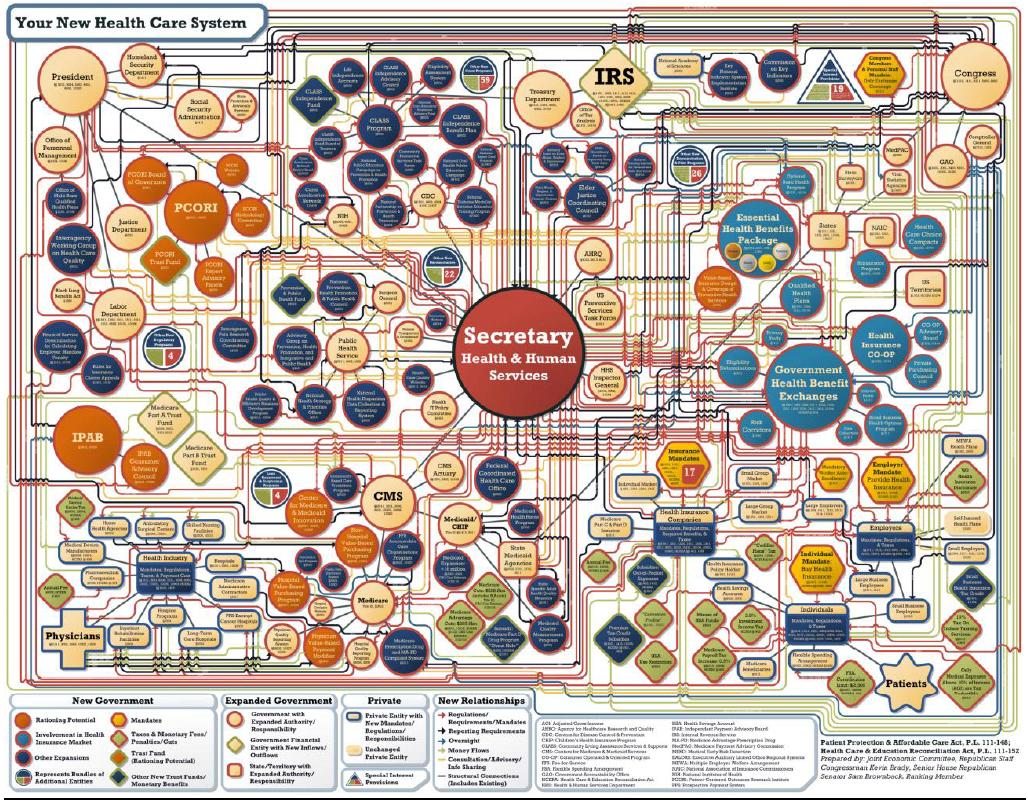
But sometimes an image helps to make things easy to understand. Here’s a chart from the Joint Economic Committee, which maps out the web of regulation imposed by Washington.

This chart does more than just show sources of red tape coming from Washington. It shows that “Washington” is really several entities, such as Congress, the executive branch, the courts, and so-called regulatory agencies.

These varies entities then impose regulatory burdens in various fields, such as labor, finance, tax, and environment.

Keep in mind, by the way, that each small pink circle actually represents an entire field of regulation. So when you see, for instance, the “Obamacare” circle, what you’re really seeing is this nightmarish image of regulatory complexity.

And don’t forget the role of state and local government.

Last but not least, remember that each regulatory bureaucracy is then capable of making individual decisions that…well, you judge for yourself.

Gee, it’s almost enough to make you think regulation might be the problem and not the solution.

Balanced Budget Amendment would help restrain out of control federal spending

House Republicans for a Balanced Budget Amendment

Uploaded by on Nov 17, 2011

This week, House Republican freshmen Members held a press conference to discuss the importance of passing a balanced budget amendment to the United States Constitution and how now is the time for a permanent solution to our nation’s spending-driven debt crisis. We need a balanced budget amendment to ensure a prosperous future for our children and grandchildren. It’s the right thing to do.

______________

Over and over in the past Milton Friedman pleaded for restraint in our federal spending. Below you will see a fine article supporting the Balanced Budget Amendment and it points out that Friedman favored this mechanism to control our spending.

The Answer Is a Balanced Budget Amendment

By from the October 2011 issue

The question is how to solve our problem of unsustainable debt.

The United States of America is on the road to bankruptcy, with a federal debt of more than $14.2 trillion, almost half of which is owned by foreign countries. (Communist China alone owns fully a quarter of the foreign-held portion). The problem is so well known that it almost came as an anticlimax when Standard & Poor’s recently downgraded U.S. debt from its coveted AAA rating to an unheard-of AA+. As for the budget deficit, it is expected to total $1.3 trillion for this year alone, with tax revenues of about $2.3 trillion and total expenditures of about $3.6 trillion. If a household ran its budget like that, we would say it was headed for a rude shock.

Making matters worse is that our debt is structural rather than cyclical: the federal budget is in deficit both in good economic times and bad. When George W. Bush took office in 2001, the gross federal debt was $5.76 trillion. When he left eight years later, the debt was up to $10.626 trillion, an increase of $607 billion a year. During Barack Obama’s presidency it has risen by $1.7 trillion a year and now almost 40 percent higher than when he took office. Deficits of this size are quite simply unsustainable.

The only way to fix this mess is to radically cut federal spending, cap the budget with pay-as-you-go spending rules, and then enact a balanced budget amendment (BBA).

The most important point is that we need to cut spending, not raise taxes. Total federal spending as a percentage of Gross Domestic Product (GDP) has skyrocketed from around 18 percent, when George W. Bush became president, to more than 25 percent today. This shows that our current deficit problem is entirely due to overspending. If tomorrow we cut spending back to the levels of January 20, 2001, when Bush took office, the deficit would almost disappear.

Then we need to cap and balance the budget, once we’ve cut overall spending back to 2001 levels. To do this effectively, we need to enact a federal BBA to the U.S. Constitution. This amendment should have several features.

First, it should require that the president submit to Congress each year a balanced federal budget with no fiscal gimmicks. Presidential failure to do so would be an impeachable offense. Congress should be constitutionally required to hold a vote in both houses on the president’s proposed budget within three months, with the president and Congress having up to six months to adopt a final budget in any given calendar year (this requirement should be waivable during any time of declared war for up to two years). If they fail to do that, all federal spending except for payments on the debt should be frozen at levels 10 percent lower than in the preceding fiscal year. To help impose this, any one of the several states should have standing to sue in the Supreme Court’s original jurisdiction for enforcement of this requirement.

Second, the BBA should cap federal spending at 18 percent of GDP. A spending cap of this proportion would keep the federal government at the size it was under President Bill Clinton — hardly onerous or severe. The amendment should require a two-thirds vote of both houses of Congress to enact any new taxes or to raise tax rates. Votes to raise the national debt limit should also require a two-thirds majority. These provisions are essential to prevent a BBA from becoming just an excuse to raise taxes.

THE USUAL RESPONSE to calls for such an amendment is that we ought not tamper with the Constitution. Critics of a BBA also claim it is not needed since a majority of Congress could balance the budget today if it really wanted to. There are at least five reasons why those critics are dead wrong.

First, it is a core principle of American constitutionalism that there be no taxation without representation. The American Revolution was fought in part to prevent taxation by a British Parliament in which Americans were not represented. When Congress borrows 40 cents of every dollar it spends, as it is doing today, it passes the burden of paying for current spending on to our children and grandchildren who cannot vote right now — nothing less than taxation without representation.

Second, a core purpose of the Constitution is to protect fundamental principles like freedom of speech and of the press from being whittled away during moments of legislative passion. Exactly the same argument holds true with respect to spending more money than the government collects in tax revenue. Constitutionalizing the balanced budget requirement is as necessary as constitutionalizing the protection of freedom of speech and of the press. This is an argument that was first made more than 30 years ago by Noble Prize laureate Milton Friedman. It is just as true today as it was then.

Third, there is an economic reason why it is easier to assemble lobbies for government spending than it is to assemble a nationwide lobby for a balanced budget. Consider the farm lobby that argues for agricultural price supports, or the AARP that lobbies for benefits for the elderly. It is cheaper and easier for small groups with a shared common interest to lobby Congress than for a large, diffuse majority of the American population to do the same. That’s why the silent majority is silent. A BBA in the Constitution would prevent the special interests from ripping off the children and grandchildren of the silent majority. James Madison wrote in The Federalist No. 51 that the secret of constitutional government was to make ambition counteract ambition. The way to check and balance over-spending is to constitutionalize a pay-as-you-go rule while making tax increases hard to enact.

Fourth, yet another economic reason for a BBA is that it would reduce risk and thereby promote investment. When people are looking for a place to invest, one of their first questions is how risky is the investment and how large is the potential reward. Foreign and American investors since World War II have invested in the U.S. and in its debt because our Constitution of checks and balances makes it hard to do crazy things like nationalize industries or set up a single payer health insurance monopoly.

A BBA would reduce further the risk of investing in the U. S., and that would promote investment and economic growth by constitutionally committing itself not to overspend. The risk of inflationary devaluation of the dollar would thus go way down. This in turn would bolster the dollar as the world’s reserve currency. It would also prevent federal borrowing from crowding out private sector borrowing in the U.S. This would free up a capital for investment in job-creating ventures.

A fifth argument for the BBA paradoxically grows out of one of the arguments commonly made against it: it would be purely symbolic. Or as James Madison would have said, “a mere parchment barrier” against overspending.

This criticism fails for many reasons. A BBA of the kind I argue for would have enforcement teeth. Presidential failure to submit a good-faith balanced budget would be a specific ground for impeachment. Then too, if Congress failed to enact a balanced budget, state governments could sue for an across theboard spending cut of 10 percent.

But suppose Congress wimps out and enacts a BBA without teeth. Would such a symbolic victory be worth anything? The answer again is clearly yes. Almost every state has some form of a balanced budget requirement in its constitution or law. The fact is that balanced budget requirements actually do work at the state level. This strongly suggests they would work at the federal level as well.

CONSTITUTIONAL PROVISIONS, even symbolic ones, set the agenda of political debate. The Second and Tenth Amendments clearly do that in the U.S. today, even though the federal courts almost never enforce them. A BBA would work very much the same way.

The case for a BBA is so powerful that Germany and Switzerland — both models of fiscal sobriety — actually require a balanced budget in their own constitutions. And now Germany and France have actually proposed requiring that all Eurozone countries amend their national constitutions to require a balanced budget. What is good enough for almost every state in the Union and for many countries of Europe is certainly worth trying at the federal level here.

So what harm could come from enacting a BBA to the U.S. Constitution? Is there any argument against such an amendment that outweighs the arguments in favor of it?

One concern conservatives have is that it might lead to tax increases. I share that concern and therefore would couple it with a super-majority requirement for tax increases. That should make a BBA clearly appealing to conservatives of all stripes. But what if such an amendment gets ratified that does not protect against tax increases? Would we then be worse off?

I think the answer is no. It is harder politically for Congress to tax real people living today than it is to borrow money from the children and grandchildren of the silent majority. People living today will mobilize in many ways against tax increases. The correct solution is to cut, cap, and balance, but I would not let concerns about tax increases stop us from doing what virtually every state constitution does.

Another real concern for conservatives is that a BBA could lead to dangerous cuts in spending on national defense. This concern I share. The U.S. is a world leader and the greatest force for liberty and economic opportunity in history. We must always be ready to defend liberty worldwide.

The problem is, however, that current levels of deficit spending — almost half of which is financed by foreign countries — is itself a threat to U.S. global might. We simply cannot defend liberty in Asia, for example, if we continue to borrow massively from the Chinese. We cannot defend freedom in Arab countries while being so dependent on Saudi Arabia and others for imported oil and purchases of our debt. The status quo is at least as threatening to America’s military might as is living under a BBA, for the status quo is not sustainable.

Finally, some conservatives argue that the solution to congressional deficit spending is a line item veto amendment giving the president the same power over spending enjoyed by a majority of state governors. I am quite skeptical about such an amendment because of the enormous power it would shift from Congress to the president. Imagine for a moment that President Obama could threaten senators or representatives with line item vetoes of locally important spending projects unless they voted his way on socialized medicine. Or on a card check law reform making it easy to fraudulently form a union. Do we really want to cede that much power from Congress to the president? I do not think so.

In sum, we need to cut, cap, and balance. To do that permanently, we must enact a BBA. Nothing less than the future of government of the people, by the people, and for the people is at stake.

Gus Malzahn does a great job at Little Rock Touchdown Club (Part 1)

GUS MALZAHN: Jonesboro here I come.

Gov. Beebe, Shane Broadway, Steve Sullivan, Jeff Hankins and all the notable ASU grads were in the audience today at the Little Rock Touchdown Club.

This was the second time I got to see Gus Malzahn speak at the Little Rock Touchdown Club. Two years ago he was skyped in since tornadoes made it impossible to catch a flight from Atlanta to Little Rock. (Gus went on to lead Auburn to an undefeated national championship later that year.) I remember that meeting because he was asked directly about the 10-1 Razorbacks in 2006 and the fact that the last three games of that year seemed to have coach Nutt calling the plays and Gus wisely avoided that question by saying, “No comment.”

This time around he alluded to that possibly when he said when things went south at Arkansas he took a job at Tulsa where he could call the plays. He noted that he was very blessed everywhere he went to have great talented players to coach.

Probably the most interesting answer he gave was concerning Arkansas State’s interest in playing the Razorbacks every year. Gus said that this is not 1970 anymore and this a different time. He noted that everyone else throughout the country plays instate teams!!!!

Related posts:

The good character of new Arkansas St Coach Gus Malzahn

Gus Malzahn is the new Arkansas State Football Coach and will paid 850,000 per year according to the Arkansas Times Blog and not 750,000 like other outlets reported earlier.  Arkansas 360 is reporting that Ark St has a press conference scheduled for 3:30pm today. Malzahn replaces his good friend Hugh Freeze as the new Ark […]

Paul Finebaum speaks at Little Rock Touchdown Club Part 3

Harvey Updyke Interview on The Paul Finebaum Show 4 21 11 Part 3 Bobby Petrino going to Tennessee later this year? I thought he would jump at the chance to do that. However, the Vols have looked pretty good this year and if they go into Miss St’s homefield this week and beat the #17 […]

Paul Finebaum speaks at Little Rock Touchdown Club Part 2

Harvey Updyke Interview on The Paul Finebaum Show – 4-21-11 – Part 2 ___________ I attended the Little Rock Touchdown Club on Oct 8, 2012 and enjoyed it very much. I got to ask a question. “Will we ever get to the point where someone else besides a running back, quarterback or receiver is considered for the Heisman […]

Mark May at Little Rock Touchdown Club Part 3

I went to hear Mark May speak at the Little Rock Touchdown Club on August 20, 2012 and he did a great job of giving some insights into the Penn St case and he also looked into the SEC race this year. I do think that May has some good insights and I think his […]

Mark May at Little Rock Touchdown Club Part 2

Wally Hall wrote a fine article on the Little Rock Touchdown Club meeting yesterday that I got to attend. It was moving when Mark May got choked up responding to a question about the Penn St scandal. Wally refers to that. LIKE IT IS: ESPN analyst starts LRTC talks with bang Tuesday, August 21, 2012 […]

10 most hated men in SEC football

Got this off the internet: Nutt makes the top 10 for one of the few times in his SEC Coaching Career 10 Most Hated Men in the SEC There is no doubt that the college football conference with the most emotion is the SEC.  One of those emotions is hate and this is the list […]

Past Little Rock Touchdown Club meetings (Part 3)

This year’s Little Rock Touchdown Club speakers are very exciting and I am really excited about the first one being Mark May. Below that are some of the posts about past speakers. Here is an article from Arkansas Sports 360 on the lineup of speakers: ESPN’s Mark May Kicks Off Little Rock Touchdown Club Aug. 20 <!– 23 […]

Top 25 football teams for 2012

Photo by Erin Nelson Alabama head coach Nick Saban signs autographs for fans at the Southeastern Conference NCAA college football media days in Hoover, Ala. on Thursday, July 19, 2012. (AP Photo/The Tuscaloosa News, Erin Nelson) Photo by Butch Dill LSU coach Les Miles speaks to reporters at the Southeastern Conference NCAA college football media […]

Past Little Rock Touchdown Club meetings (Part 1)

This year’s Little Rock Touchdown Club speakers are very exciting. Below is this year’s list followed by some of the posts about past speakers. Mark May – ESPN ESPN College Football Analyst teaming with Lou Holtz for the popular College Football Scoreboard. Inducted into the College Football Hall of Fame in 2005, May was a 1st Team […]

Little Rock native David Hodges wrote song for “Breaking Dawn Part 2”

David Hodges is a graduate of Arkansas Baptist High School in Little Rock and he co-wrote the song “A Thousand Years,”with Christina Perri. It was featured in the movie “Breaking Dawn Part 2.”

David is one of the three founding members of Evanescence and he has written for Kelly ClarksonCeline Dion, Reba McEntire, Carrie Underwood, Jessie James, Jason Derülo, Jason Mraz, Shinedown, Orianthi, Tyler Hilton, Boys Like Girls, Good Charlotte,Avril LavigneNatasha Bedingfield, Sara Evans, Carly Rae Jepsen, Chad Kroeger from Nickelback, Josh Groban, Skillet,and  Halestorm.

The movie opened on November 16, 2012 and experienced huge crowds the first weekend. According to the Hollywood Reporter:

The Twilight Saga: Breaking Dawn — Part 2 topped the worldwide weekend box office with $340.9 million opening, including $141.3 million domestically from 4,070 theaters and $199.6 million internationally from 61 markets. It’s the best global opening in the history of the franchise, thanks to massive international business.

Twilight Breaking Dawn Pt 2 Soundtrack feat. Green Day, Ellie Goulding, St. Vincent and more — EW’s review


breaking-dawn-2-soundtrack

Various artists
The Twilight Sara: Breaking Dawn—Part 2
Soundtrack (Chop Shop/Atlantic)
Good news, Twihards: Any of these indie-pop songs could be the first dance at your wedding. From the twinkling church bells of Passion Pit’s “Where I Come From” to the Pachabel-inspired violins of Christina Perri’s “A Thousand Years (Part 2)”—which sounds exactly like the first “A Thousand Years,” except it’s about 500 years longer—there’s one grand-ballroom epic after another.

The mood mostly ranges from ethereal (Spiderman: Turn Off the Dark star Reeve Carney’s “New For You”) to even more ethereal (Ellie Goulding’s “Bittersweet”), but the lovesick vibe only reaches “yuck” level twice: once, when the Boom Circuits serenade “an angel learning how to fly” on the excruciatingly twee “Everything and Nothing,” and again when Twilight actress Nikki Reed harmonizes with her real-life husband, American Idol alum Paul McDonald, on the get-a-room ballad “All I’ve Ever Needed.”

Good thing St Vincent and Green Day drop by to rough things up a bit.The former’s Annie Clark might have the best song on the album with “Antidote,” a sludge-rock anthem that pokes fun at vampire lore. (“I’ll show you where it really hurts,” she coos.) And the latter’s Billie Joe Armstrong manages to turn a stately piano ballad into an awesomely bitter love song. “Where in the world did the time go?” he wonders. Poor Edward Cullen. It’s tough to be 17 for 94 years. B

Related posts:

Music Monday:Religion and Chris Martin part 4

Coldplay – In My Place (Live in Dallas) June 22 2012 Published on Jun 24, 2012 by maimiaa Coldplay performing at American Airlines Center in Dallas, TX Coldplay brought confetti, lights and thousands of fans to the American Airlines Center; see photos from their colorful show Photo Gallery News Sports Lifestyles Comments (0)   7/11 […]

Music Monday:Religion and Chris Martin part 3

Viva La Vida Published on Jun 23, 2012 by TheRyanj64 Coldplay’s Viva La Vida at American Airlines Center in Dallas on June 22, 2012 __________ Coldplay brought confetti, lights and thousands of fans to the American Airlines Center; see photos from their colorful show Photo Gallery News Sports Lifestyles   Comments (0)   5/11 Chris […]

Music Monday:Religion and Chris Martin part 2

Coldplay – Mylo Xyloto/Hurts Like Heaven (Live) @ American Airlines Center Coldplay brought confetti, lights and thousands of fans to the American Airlines Center; see photos from their colorful show Photo Gallery News Sports Lifestyles   Comments (0)   2/11   Published on Jun 24, 2012 by Crwdickerson Coldplay Performing Mylo Xyloto/Hurts Like Heaven @ […]

“Music Mondays” here on the www.thedailyhatch.org

Would you like to know the spirtual meaning of these words above by Coldplay or find a christian response to the song “The Last Resort” by Papa Roach? You could if you checked out “Music Monday” here every week and see all the videos and articles. Take a look at the links before that refer to these songs: […]

“Music Mondays” here on the www.thedailyhatch.org

Would you like to know the spirtual meaning of these words above by Coldplay or find a christian response to the song “The Last Resort” by Papa Roach? You could if you checked out “Music Monday” here every week and see all the videos and articles. Take a look at the links before that refer to these songs: […]

Music Monday:Religion and Chris Martin part 1

Coldplay-DALLAS-2012-”Opening, Mylo Xyloto, and Hurts like Heaven!” Published on Jun 24, 2012 by ColdplayDALLAS2012 1:10 is where the concert starts! Sorry for the shaking and sound audio! It was really loud! AND AWESOME! Please THUMB UP and COMMENT if u went to this coldplay concert! And I also hope that this will get a few […]

“Music Monday” Switchfoot is a Christian Band with a great message (Part 5)

Switchfoot is a Christian Band with a great message (Part 5) One of my favorite bands is Switchfoot. Tim Foreman is the front man and this band has always been very vocal about their Christian faith. I am really enjoying this series on their band. Switchfoot: Oh! Gravity. The Meaning Behind  Posted: Friday, December 22, […]

“Music Monday” Switchfoot is a Christian Band with a great message (Part 4)

Switchfoot The Documentary Switchfoot is a Christian Band with a great message (Part 4) One of my favorite bands is Switchfoot. Tim Foreman is the front man and this band has always been very vocal about their Christian faith. I am really enjoying this series on their band. ___________________________________ Interview: Switchfoot Unplugged Fri, Feb. 09, […]


Open letter to Speaker of the House John Boehner (Part 9)

John Boehner, Speaker of the House

H-232, The Capital, Washington, DC 20515

Dear Mr. Speaker,

I know that you will have to meet with newly re-elected President Obama soon and he will probably be anxious for you to raise taxes and  federal spending, but he will want you to leave runaway entitlement programs alone. When that happens then you have one thing you can hold over his head and that is the debt ceiling.

You must stand up to him and tell him that you can not raise it. In December of 2012 or January of 2013 at the latest we will be shutting down the government if we don’t increase the debt limit according to the LA Times. You got to listen to the Tea Party heroes like Rep. Todd Rokita,  Ben Quayle (R-AZ), Jeff Landry (R, LA-03),  Raúl R. Labrador , Tim HuelskampRep. Justin Amash (R-MI),  , Brooks, Mo (AL – 5), Buerkle, Ann Marie (NY – 25),Chabot, Steven (OH – 1),Duncan, Jeff (SC – 3), Fleischmann, Chuck (TN – 3) ,Gowdy, Trey (SC – 4) ,Griffith, H. Morgan (VA – 9) , Harris, Andy (MD – 1) ,Huizenga, Bill (MI – 2) , Mulvaney, Mick (SC – 5) , Pompeo, Mike (KS – 4) , Ribble, Reid (WI – 8), Rigell, E. Scott (VA – 2) , Ross, Dennis (FL – 12) ,Schweikert, David (AZ – 5), Scott, Austin (GA – 8) , Scott, Tim (SC – 1) , Southerland, Steve (FL – 2) , Stutzman, Marlin (IN – 3) , Walberg, Timothy (MI – 7) , Walsh, Joe (IL – 8),and Woodall, Rob (GA – 7) .

Rep. Quayle on Fox News with Neil Cavuto

__________________

We have to get people realize that the most important issue is the debt!!! Recently I read a comment by Congressman Ben Quayle (R-AZ) made  after voting against the amended Budget Control Act on August 1, 2011. He said it was important to compel “Congressional Democrats and the Obama Administration to finally recognize how central America’s debt problem truly is.”

I can not agree more. I am glad that Rep. Quayle was brave enough to vote against this bill and I wish more were brave like him.

Michael Tanner of the Cato Institute in his article, “Hitting the Ceiling,” National Review Online, March 7, 2012 noted:

After all, despite all the sturm und drang about spending cuts as part of last year’s debt-ceiling deal, federal spending not only increased from 2011 to 2012, it rose faster than inflation and population growth combined.

We need some national statesmen (and ladies) who are willing to stop running up the nation’s credit card.

Ted DeHaven noted his his article, “Freshman Republicans switch from Tea to Kool-Aid,”  Cato Institute Blog, May 17, 2012:

This week the Club for Growth released a study of votes cast in 2011 by the 87 Republicans elected to the House in November 2010. The Club found that “In many cases, the rhetoric of the so-called “Tea Party” freshmen simply didn’t match their records.” Particularly disconcerting is the fact that so many GOP newcomers cast votes against spending cuts.

The study comes on the heels of three telling votes taken last week in the House that should have been slam-dunks for members who possess the slightest regard for limited government and free markets. Alas, only 26 of the 87 members of the “Tea Party class” voted to defund both the Economic Development Administration and the president’s new Advanced Manufacturing Technology Consortia program (see my previous discussion of these votes here) and against reauthorizing the Export-Import Bank (see my colleague Sallie James’s excoriation of that vote here).

One of those Tea Party heroes was Congressman Ben Quayle of Arizona. Last year I posted this below concerning his conservative views and his willingness to vote against the debt ceiling increase:

Rep. Quayle Votes No on Final Debt Ceiling Deal

Monday August 01, 2011

FOR IMMEDIATE RELEASE

Contact: Richard Cullen

202-225-3361

WASHINGTON (DC) Congressman Ben Quayle (R-AZ) released the following statement Monday after voting against the amended Budget Control Act:  

 “Last week I voted for the Boehner plan because— while imperfect—it made adequate strides to get our fiscal House in order. The final debt-ceiling bill, however, goes in a direction that I cannot support. Due to the design of the bill’s trigger mechanism, I am concerned that President Obama will be able to use the threat of tax hikes and drastic defense cuts to continue to amass record levels of spending.

 “Though I didn’t support today’s bill, I want to commend Speaker Boehner and the House Republican Leadership for changing the culture in Washington and compelling Congressional Democrats and the Obama Administration to finally recognize how central America’s debt problem truly is.

 “On another note, it was a very special moment seeing Congresswoman Gabby Giffords cast her vote on the House Floor tonight. Both sides of the aisle greeted her with a loud standing ovation. It was a nice way to end what has been a very tense few days in the House.”

___________

__________

Sincerely,

Everette Hatcher, 13900 Cottontail Lane, Alexander, AR 72002, lowcostsqueegees@yahoo.com, www.thedailyhatch.org, ph 501-920-5733

___________

Related posts:

Government shutdown coming, will there be any tea party heroes available to stand up to Obama?

DEBT LIMIT – A GUIDE TO AMERICAN FEDERAL DEBT MADE EASY. Uploaded by debtlimitusa on Nov 4, 2011 A satirical short film taking a look at the national debt and how it applies to just one family. Watch the guy from the Ferris Bueller Superbowl Spot! Produced by Seth William Meier, DP/Edited by Craig Evans, […]

Some Tea Party heroes (Part 1)

DEBT LIMIT – A GUIDE TO AMERICAN FEDERAL DEBT MADE EASY. Uploaded by debtlimitusa on Nov 4, 2011 A satirical short film taking a look at the national debt and how it applies to just one family. Watch the guy from the Ferris Bueller Superbowl Spot! Produced by Seth William Meier, DP/Edited by Craig Evans, […]

Some Tea Party heroes (Part 8)

Rep Himes and Rep Schweikert Discuss the Debt and Budget Deal Michael Tanner of the Cato Institute in his article, “Hitting the Ceiling,” National Review Online, March 7, 2012 noted: After all, despite all the sturm und drang about spending cuts as part of last year’s debt-ceiling deal, federal spending not only increased from 2011 […]

Some Tea Party heroes (Part 7)

Michael Tanner of the Cato Institute in his article, “Hitting the Ceiling,” National Review Online, March 7, 2012 noted: After all, despite all the sturm und drang about spending cuts as part of last year’s debt-ceiling deal, federal spending not only increased from 2011 to 2012, it rose faster than inflation and population growth combined. […]

Who are the Tea Party Heroes from the 87 Freshmen Republicans?

Here is a study done on the votes of the 87 incoming freshman republicans frm the Club for Growth. Freshman Vote Study In the 2010 election, 87 freshmen House Republicans came to Washington pledging fealty to the Tea Party movement and the ideals of limited government and economic freedom. The mainstream media likes to say […]

Tea Party Conservative Senator Mike Lee interview

Tea Party Conservative Senator Mike Lee interview Here is an excellent interview above with Senator Lee with a fine article below from the Heritage Foundation. Sen. Mike Lee (R-UT) came to Washington as the a tea-party conservative with the goal of fixing the economy, addressing the debt crisis and curbing the growth of the federal […]

Some Tea Party heroes (Part 6)

I feel so strongly about the evil practice of running up our national debt. I was so proud of Rep. Todd Rokita who voted against the Budget Control Act of 2011 on August 11, 2011. He made this comment:   For decades now, we have spent too much money on ourselves and have intentionally allowed our […]

Some Tea Party heroes (Part 5)

Rep. Quayle on Fox News with Neil Cavuto __________________ We have to get people realize that the most important issue is the debt!!! Recently I read a comment by Congressman Ben Quayle (R-AZ) made  after voting against the amended Budget Control Act on August 1, 2011. He said it was important to compel “Congressional Democrats and […]

Some Tea Party heroes (Part 4)

What future does our country have if we never even attempt to balance our budget. I read some wise words by Congressman Jeff Landry (R, LA-03) regarding the  debt ceiling deal that was passed on August 1, 2011:”Throughout this debate, the American people have demanded a real cure to America’s spending addiction – a Balanced Budget […]

Some Tea Party heroes (Part 3)

I read some wise comments by Idaho First District Congressman Raúl R. Labrador concerning the passage of the Budget Control Act on August 1, 2011 and I wanted to point them out: “The legislation  lacks a rock solid commitment to passage of a balanced budget amendment, which I believe is necessary to saving our nation.” I just […]

Some Tea Party heroes (Part 2)

Congressmen Tim Huelskamp on the debt ceiling I just don’t understand why people think we can go on and act like everything is okay when we have a trillion dollar deficit. Sometimes you run across some very wise words like I did the other day. Kansas Congressman Tim Huelskamp made the following comment on the […]

Christian Review of new movie about Abraham Lincoln

Steven Spielberg, Sally Field, Gloria Reuben, S. Epatha Merkerson and Tony Kushner at event of Lincoln

8 October 2012
Photo by Larry Busacca – © 2012 Getty Images – Image courtesy gettyimages.com
Steven Spielberg, Sally Field, Gloria Reuben, S. Epatha Merkerson and Tony Kushner at event of Lincoln

I have written a lot about Abraham Lincoln in the past as you can tell from the “related posts” noted below. Most of my posts were concerning the movie “The Conspirator” which is one of my favorite movies.  I enjoyed reading about all the historical people involved with Lincoln. Boston Corbett is the man who shot Booth. Louis Weichmann was originally a suspect but he later became one of the chief witnesses for the prosecution.  John Wilkes Booth was the first man to kill an American President. Louis Powell attempted to kill Secretary of State Seward.  Mary Surratt was in the center of the conspiracy we are told, but is that true? (I believe the evidence shows that it was true that she was guilty of that.)

Plugged in website always has good Christian reviews of movies:

Lincoln

Here there be dragons.

So wrote the old cartographers on their parchment maps, sketching fantastical beasts with fins and fangs. They were fearsome and horrible, these monsters, able to swallow ships and devour cities.

Perhaps Abraham Lincoln, a voracious reader, ran across one of those maps one day—a map made when the world’s worst dangers lurked in its blank spaces. Maybe he smiled. Maybe he thought of how much better it would be were these the real monsters—so horrible and so beautiful and so far away. How preferable they’d be to the ones that stalk our streets and devour our families and consume our nation’s very soul.

The year is 1865, and Mr. Lincoln has had his fill of dragons.

One is named War—a gluttonous beast that has fed on the country for four sickening years. Hundreds of thousands have died at its feet, lost in its bloody maw. America’s forests and fields are covered in corpses. The streets are alive with the cry of mothers and children, mourning the beloved dead.

Another is called Slavery, a demon that’s torn at the country since its inception and before—mocking its hypocrisy, decrying the duplicity of its declaration that “All men are created equal” when so many live in chains.

Now, finally, Lincoln feels the time is right to slay a monster or two. The rebellious South is exhausted and ready to plead for peace. Slavery may, with a little luck, be wiped out through an act of Congress—the 13th Amendment.

But there’s a catch: End the war, and the Confederate South will insist on preserving slavery. Free the slaves, and the South will have no incentive to make peace.

“It’s either the Amendment or this Confederate peace,” William Seward, Lincoln’s secretary of state, tells him. “You cannot have both.”

We know how this story ends. We read it in the Constitution, hear it in the ringing words of civil rights advocates, see it engraved on the tombs of soldiers and sewn to a field of blue on a flag that now boasts a full 50 stars.

Lincoln is the story of monsters, the man who slew them, and the price he paid to do so.

<!–

–>

Positive Elements

Lincoln led the country through the bloodiest conflict in its history and, while so doing, reversed a horrific evil that had plagued it from its inception. And while Daniel Day-Lewis’ layered portrayal of the United States’ 16th president informs us that Lincoln was a more complex character than we sometimes want to believe, we also observe a host of reasons why Lincoln was so successful then and so revered now.

We first see Lincoln visiting his troops, listening patiently as soldiers recite his own Gettysburg Address. Indeed, the film makes a point of stressing Lincoln’s almost boundless patience—enduring the petty requests of constituents with a kindly smile, chuckling off his cabinet’s combustibility, absorbing the occasional sideswipe from his political friends and foes with grace, even when he has to force it. His style is not to dazzle with brilliance, but to guide and cajole; he spins yarns to illustrate his point, disarming his opponents with self-deprecating humor.

Some consider Lincoln’s patience and down-home style to be a political liability, and we hear how Lincoln can seem to dawdle on almost every decision that needs to be made. Every decision except one: the 13th Amendment, which Lincoln wants to speed through a lame-duck session of Congress in less than a month. In his rush to pass the thing, he utilizes every trick in his arsenal to get the work done. (More about those “tricks” later.)

Amazingly, as he drives toward his goal, Lincoln never loses sight of his family. He dotes on his little boy, Tad, and during the House of Representative’s critical Amendment vote, the president is not pacing in his office. He is with his son. He, with very few exceptions, does his very best to help his wife Mary, who’s been driven practically insane by their boy Willie’s death two years earlier. He encourages her to stay strong—put on a brave face for his sake and for the nation’s. He struggles with whether to let his oldest boy, Robert, join the military or keep him safe at home for Mary’s sake. (Lincoln eventually allows it, knowing Robert would be ashamed for the rest of his life if he didn’t serve.)

Lincoln shows grace, pardoning a 16-year-old soldier for an act of cowardice. He shows courage, making horrifically difficult decisions that risk alienating his friends, his supporters and even his wife.

Spiritual Content

America during the Civil War was a deeply religious country. And everyone, it seems, tried to enlist God to their side.

“Congress must never declare equal those whom God created unequal!” thunders New York Representative Fernando Wood. Thaddeus Stevens, a powerful congressional abolitionist, retorts that such talk insults God. When an African-American servant tells Lincoln she’s sure the Amendment will pass—that God will see to it—Lincoln quips, “I wish He had chosen an instrument more wieldy than the House of Representatives.”

A worried father named Preston Blair pleads with Lincoln to open the door to peace “in the name of gentle Christ.” African-Americans raise or fold their hands in thanksgiving when the Amendment passes. We see and hear people asking for God’s blessing or guidance.

Lincoln talks about his longing to visit the Holy Land and walk in the footsteps of David and Solomon. Mary chides Abe and herself for not being necessarily fit to take such a spiritual pilgrimage, seeing as how they’re taking a buggy ride on Good Friday. Lincoln tells a humorous story about a parrot who was taught to say, “Today’s the day the world shall end, as the Scripture has foretold.” The punch line? The owner eventually shot the parrot, thus “confirming” the Scripture.

We hear hints that Mary tried to commune with Willie after he died. (In real life, Mary was fascinated by an unmoored spirituality in vogue at the time and held séances in Willie’s room.) She half-jokingly refers to herself as a soothsayer.

Sexual Content

We see Mary in a state of partial undress, wearing her undergarments. Stevens shares a non-marital bed with his African-American housekeeper. (The vibe is that of an old married couple—companionable, not passionate.)

Violent Content

The film opens on a battle scene; people are stabbed with bayonets, beaten and pushed deep into the mud to drown. The sequence isn’t bloody, but it vividly conveys the horrors of war. Toward the end of the war, Lincoln visits a battlefield strewn with corpses. One mangled body has its torso splayed open, devoid of organs. We see a city burning.

When Lincoln visits wounded war vets, his son Robert follows orderlies pushing a cart that’s dribbling blood along the way. The conveyance stops at a huge pit filled with human limbs, and the orderlies unveil the cart’s contents—newly amputated legs and arms. They dump the contents in the pit as people begin to fill in the hole with dirt.

When Robert and his father get into an argument, Lincoln slaps him across the face.

Lincoln is shown on his deathbed, a bloodstained pillow beneath his head.

Crude or Profane Language

One f-word. Four or five s-words. Bigots hurl derogatory terms for African-Americans several times, including the n-word. We hear “b‑‑ch,” “p‑‑‑,” “h‑‑‑” and “bloody.” God’s name is combined with “d‑‑n” more than a dozen times. Jesus’ name is abused once.

Drug and Alcohol Content

Several characters are shown drinking (wine, beer and other presumably alcoholic beverages) and smoking (mostly cigars). Preston Blair’s wife instructs a servant to get him drunk during a long journey so he’ll be able to sleep. Lobbyists seem inebriated in a scene or two.

Other Negative Elements

Remember those “tricks” Lincoln uses to push his Amendment through Congress? Well, politics can be a dirty business, and not even our most revered president escapes the muck here. From the beginning, Lincoln admits that the Emancipation Proclamation (enacted two years earlier) required some serious contortions to legally justify it. Amendment 13 will clear up any potential illegality … but to get it passed he has Seward hire some underhanded “lobbyists” to help garner the votes needed. These lobbyists are forbidden from using money to outright bribe anyone, but they’re free to offer jobs in exchange for “yes” votes.

When that’s not enough, Lincoln resorts to other means. He (in a roundabout way) tells one congressman that he’ll have him booted out of Congress unless he votes “yes.” He perpetually sidesteps rumors that he’s entertaining peace offers from the Confederacy—but in fact he is.

On the morning of the vote, the opposition demands the president respond to rumors that there’s a Confederate delegation in town. Lincoln says there is no delegation in Washington, D.C., “as far as I know.” It’s true, but only semantically so: He stalled the delegation outside town. When one principled adjunct refuses to deliver that message to Congress, Lincoln gently takes the missive out of his hands and gives it to a less scrupulous messenger.

Lincoln tells an off-color story involving a British bathroom and a picture of George Washington. He threatens to send Mary to the madhouse.

Conclusion

History has frozen Lincoln into something like the American conscience: kindly, principled, winsome, idealistic. And he was, indeed, all of those things.

But through that lens we lose sight of how politically savvy and shrewd he was. Steven Spielberg’s Lincoln is indeed a dramatization, but the sorts of steps we see Lincoln take here are not fiction—not according to historians. And portions of the screenplay are based on a book by Pulitzer Prize-winning biographer Doris Kearns Goodwin.

Lincoln didn’t rise above the game: He played it with the best of them. And when Thaddeus Stevens, both his ally and critic, chastises him for his seeming lack of a moral compass—his willingness to compromise, his occasional obfuscations—Lincoln rebuts him, naturally, with a story. He relates how as a backwoodsmen, he learned it was sometimes necessary to deviate from true north in order to evade a swamp or gorge. If you plow straight on toward your goal regardless of obstacles that might terminate your trip forever, Lincoln asks, “What’s the use of knowing true north?”

Lincoln, then, like the country he led, was both an idealist and a pragmatist. Were his actions admirable? Appalling? Perhaps a bit of both. And just as Lincoln got his own hands muddy to pass that invaluable 13th Amendment, his onscreen character feels a bit muddy to those of us used to seeing him as a gleaming marble statue.

Related posts:

Television interview of witness who saw Lincoln shot

  Pretty amazing video clip: Samuel J. Seymour, Last Surviving Witness Of Lincoln Assassination, Appears On Television In 1956 (VIDEO) Thanks to YouTube, this gem in American history has been preserved. In February 1956, two months before his death, 96-year-old Samuel J. Seymour appeared on the CBS television show “I’ve Got A Secret.” His secret: […]

Letters from a former slave to his former master

Fascinating story about a letter from a former slave to his former owner in Tennessee.  My grandfather who was born in 1903 told me about his great aunt who threw a fit in 1910 or so when someone mentioned Lincoln or Grant at the dinner table in Franklin, TN. She remembered the Northern soldiers coming […]

One the last civil war veterans: Julius Howell of Virginia (recording of interview included)

Uploaded by blackconfederate1 on Feb 1, 2011 Confederate soldier Julius Howell talking about his capture and imprisonment at the Union prison camp at Point Lookout, Md. Howell was born in 1846 near the Holy Neck section of Suffolk, in the Holland area. He was the youngest of 16 children, the son of a prominent Baptist […]

May 16-18, 1911 Confederate Veterans Reunion in Little Rock Pictures and story (Part 7)

Confederate soldier Julius Howell Interview What The south Fought For Confederate soldier Julius Howell talking about his capture and imprisonment at the Union prison camp at Point Lookout, Md. Howell was born in 1846 near the Holy Neck section of Suffolk, in the Holland area. He was the youngest of 16 children, the son of […]

Balanced Budget Amendment the answer? Boozman says yes, Pryor no (Part 21, Milton Friedman’s view is yes)(The Conspirator Part 27)

  Ep. 10 – How to Stay Free [4/7]. Milton Friedman’s Free to Choose (1980) Steve Brawner in his article “Safer roads and balanced budgets,” Arkansas News Bureau, April 13, 2011, noted: The disagreement is over the solutions — on what spending to cut; what taxes to raise (basically none ever, according to Boozman); whether […]

Senator Pryor asks for Spending Cut Suggestions! Here are a few!(Part 34)(The Conspirator Part 26, Boston Corbett, man who shot Booth),

Senator Mark Pryor wants our ideas on how to cut federal spending. Take a look at this video clip below: Senator Pryor has asked us to send our ideas to him at cutspending@pryor.senate.gov and I have done so in the past and will continue to do so in the future. Here are a few more […]

Balanced Budget Amendment the answer? Boozman says yes, Pryor no (Part 20, Milton Friedman’s view is yes)(The Conspirator Part 25, Louis Weichmann)

Steve Brawner in his article “Safer roads and balanced budgets,” Arkansas News Bureau, April 13, 2011, noted: The disagreement is over the solutions — on what spending to cut; what taxes to raise (basically none ever, according to Boozman); whether or not to enact a balanced budget amendment (Boozman says yes; Pryor no); and on […]

Senator Pryor asks for Spending Cut Suggestions! Here are a few!(Part 33)(Part 24, The Movie “The Conspirator,” John Wilkes Booth)

Senator Mark Pryor wants our ideas on how to cut federal spending. Take a look at this video clip below: Senator Pryor has asked us to send our ideas to him at cutspending@pryor.senate.gov and I have done so in the past and will continue to do so in the future. Here are a few more […]

Gene Lyons: Tax Cuts always reduce tax revenues (Part 1)(The Conspirator Part 23)

Ep. 10 – How to Stay Free [1/7]. Milton Friedman’s Free to Choose (1980) Gene Lyons in his article “The futility of reasoning with crazy,” April 27, 2011 makes this simple straight forward statement: Also contrary to Republican mythology, the infamous Bush tax cuts did anything but increase revenue, as tax cuts never do. As […]

Senator Pryor asks for Spending Cut Suggestions! Here are a few!(Part 22)(The Conspirator Part 22)

Senator Mark Pryor wants our ideas on how to cut federal spending. Take a look at this video clip below: Senator Pryor has asked us to send our ideas to him at cutspending@pryor.senate.gov and I have done so in the past and will continue to do so in the future. Here are a few more […]

Tim Griffin on Face the Nation: We need to drill for oil, Deal with Medicare and Debt Problem (The Conspirator, Part 21)

Tim Griffin on ‘Face the Nation’ Jason Tolbert reported yesterday: Tim Griffin was on CBS’ “Face the Nation” this morning…  He discussed the problem of the national debt and its impact on the economy, a reoccurring theme for Griffin.  He says that Medicare as we know it is on a path to bankruptcy in nine […]

Balanced Budget Amendment the answer? Boozman says yes, Pryor no (Part 14, Milton Friedman’s view is yes)(The Conspirator, Part 20)

In his book Free to Choose, Milton Friedman described four ways to spend money. 1. You spend your own money on yourself. 2. You spend your own money on someone else. 3. You spend someone else’s money on yourself. 4. You spend someone else’s money on someone else. The graphic shown in the video that […]

Senator Pryor asks for Spending Cut Suggestions! Here are a few!(Part 20)(The Conspirator, Part 19, Lewis Powell Part B)

  Senator Mark Pryor wants our ideas on how to cut federal spending. Take a look at this video clip below: Senator Pryor has asked us to send our ideas to him at cutspending@pryor.senate.gov and I have done so in the past and will continue to do so in the future. Here are a few […]

Balanced Budget Amendment the answer? Boozman says yes, Pryor no (Part 13, Milton Friedman’s view is yes)(The Conspirator Part 18, Lewis Powell Part A)

Dallas Fed president and CEO Richard W. Fisher sat down with economist Milton Friedman on October 19, 2005, as part of ongoing discussions with the Nobel Prize winner. In this clip, Friedman argues for a reduction in government spending. I really wish that Senator Pryor would see the wisdom of supporting the Balanced Budget amendment. […]

Senator Pryor asks for Spending Cut Suggestions! Here are a few!(Part 19)(The Conspirator Part 17)

  Senator Mark Pryor wants our ideas on how to cut federal spending. Take a look at this video clip below: Senator Pryor has asked us to send our ideas to him at cutspending@pryor.senate.gov and I have done so in the past and will continue to do so in the future. Here are a few […]

Will Senator Pryor be re-elected in 2014? Part 3 (The Conspirator Part 16)

U.S. Sen. Mark Pryor at the 2009 Democratic Party Jefferson Jackson Dinner, Arkansas’s largest annual political event. Mark Pryor is up for re-election to the Senate in 2014. It is my opinion that the only reason he did not have an opponent in 2008 was because the Republicans in Arkansas did not want to go […]

Balanced Budget Amendment the answer? Boozman says yes, Pryor no (Part 12, Milton Friedman’s view is yes)(The Conspirator Part 15)

  Professor Friedman examines the dynamics of “doing good” with other people’s money http://www.LlbertyPen.com Steve Brawner in his article “Safer roads and balanced budgets,” Arkansas News Bureau, April 13, 2011, asserted: The disagreement is over the solutions — on what spending to cut; what taxes to raise (basically none ever, according to Boozman); whether or […]

Senator Pryor asks for Spending Cut Suggestions! Here are a few!(Part 18)(The Conspirator Part 14)

  Senator Mark Pryor wants our ideas on how to cut federal spending. Take a look at this video clip below: Senator Pryor has asked us to send our ideas to him at cutspending@pryor.senate.gov and I have done so in the past and will continue to do so in the future. Here are a few […]

Ronald Wilson Reagan (Part 78)(1981 Orsini McArthur murder case part 3)(The Conspirator Part 13, Mary Surratt Part D)

  (Picture from the Ronald Reagan Library) Ronald Reagan with his older brother Neil (Moon) Reagan. (Circa 1912) Second Reagan-Mondale presidential debate 1984 October 21, 1984 The Second Reagan-Mondale Presidential Debate MS. RIDINGS: Good evening from the Municipal Auditorium in Kansas City. I am Dorothy Ridings, the president of the League of Women Voters, the […]

Senator Pryor asks for Spending Cut Suggestions! Here are a few!(Part 17)(The Conspirator, Part 12, Mary Surratt part C)

  Senator Mark Pryor wants our ideas on how to cut federal spending. Take a look at this video clip below: Senator Pryor has asked us to send our ideas to him at cutspending@pryor.senate.gov and I have done so in the past and will continue to do so in the future. Here are a few […]

Senator Pryor asks for Spending Cut Suggestions! Here are a few!(Part 16)(The Conspirator Part 10, Mary Surratt part A)

Here is clip from the new movie “The Conspirator” by Robert Redford about Mary Surratt. More on the movie below. Senator Mark Pryor wants our ideas on how to cut federal spending. Take a look at this video clip below: Senator Pryor has asked us to send our ideas to him at cutspending@pryor.senate.gov and I […]

Is the Bible historically accurate?(Part 14C)(The Conspirator Part 7)

Critics – Part 1 By Dr In my ongoing debate with other bloggers on the Arkansas Times Blog, I had an interesting response from Dobert: You can’t have it both ways. If the Gospel writers were allowed to adapt their message to a particular audience then it can’t be claimed that God literally took their […]

Balance Budget Amendment the answer? Boozman says yes, Pryor no, Part 10 (The Conspirator part 6)

  Steve Brawner in his article “Safer roads and balanced budgets,” Arkansas News Bureau, April 13, 2011, noted: The disagreement is over the solutions — on what spending to cut; what taxes to raise (basically none ever, according to Boozman); whether or not to enact a balanced budget amendment (Boozman says yes; Pryor no); and […]

Is the Bible historically accurate?(Part 14B)(The Conspirator Part 5)

The Institute for Creation Research equips believers with evidences of the Bible’s accuracy and authority through scientific research, educational programs, and media presentations, all conducted within a thoroughly biblical framework. info@icr.org http://www.icr.org Last night I had the opportunity to go back and forth with a couple of bloggers on the Arkansas Times Blog and this […]

Is the Bible historically accurate? (part 14)(The Conspirator part 3)

This is a quick summary of the Bible’s reliability by a famous and well-respected former atheist. Please check out his website (http://www.leestrobel.com) for hundreds of FREE high quality videos investigating the critical aspects of our faith. Todd Tyszka http://www.toddtyszka.com On April 19, 2011 on the Arkansas Blog an entry of mine got this response from […]

Balanced Budget Amendment the Answer? Pryor says no, Boozman says yes (part 8)(Famous Arkansan, Patsy Montana)(The Conspirator, part 2)

 It is 9:35 pm and we have been hiding from Tornadoes all night and I hope they are finished bothering us for the evening.  Ronald Reagan on Balanced Budget Amendment Steve Brawner in his article “Safer roads and balanced budgets,” Arkansas News Bureau, April 13, 2011, noted: The disagreement is over the solutions — on […]

Senator Pryor asks for Spending Cut Suggestions! Here are a few!(Part 14)(“The Conspirator” movie, part 1)

  Senator Mark Pryor wants our ideas on how to cut federal spending. Take a look at this video clip below: Senator Pryor has asked us to send our ideas to him at cutspending@pryor.senate.gov and I have done so in the past and will continue to do so in the future. Here are a few […]

Balanced Budget Amendment the answer? Boozman says yes, Pryor no (Part 11)(Conspirator Part 11)

Mark Levin interviews Senator Hatch 1/27/2011 about the balanced budget amendment. Mark is very excited about the balanced budget amendment being proposed by Senator Orin Hatch and John Cornyn and he discusses the amendment with Senator Hatch. Senator Hatch explains the bill it’s ramifications and limitations. Senator Hatch actually worked on this bill with renowned […]

Mark Pryor will not vote for debt limit increase unless there are real spending cuts (Conspirator part 9)

In the article “Mark Pryor: I won’t vote to raise debt limit without reforms,” April 20, 2011, Arkansas Business reports: U.S. Sen. Mark Pryor says he won’t vote to raise the federal government’s borrowing limit unless there is a “real and meaningful commitment” to reducing the nation’s debt by cutting spending and overhauling the tax […]

Senator Pryor asks for Spending Cut Suggestions! Here are a few!(Part 15)(Conspirator Part 8)

Senator Mark Pryor wants our ideas on how to cut federal spending. Take a look at this video clip below: Senator Pryor has asked us to send our ideas to him at cutspending@pryor.senate.gov and I have done so in the past and will continue to do so in the future. Here are a few more […]

Balanced Budget Amendment the Answer? Pryor says no, Boozman says yes (part 9)(Famous Arkansan, Art Porter Sr.)(Conspirator Part 4)

I survived last night even though there were several tornadoes all through Arkansas last night. America has too many bureaucrats and they are dramatically overpaid. This mini-documentary uses government data to show how federal, state, and local governments are in fiscal trouble in part because of excessive pay for a bloated civil service. Steve Brawner […]


Open letter to President Obama (Part 171)

Dr. Bergman: “Evolution teaches that the living world has no plan or purpose except survival”(Section B of Part 2 of series on Evolution)

The Long War against God-Henry Morris, part 3 of 6

Uploaded by  on Aug 30, 2010

http://www.icr.org/
http://store.icr.org/prodinfo.asp?number=BLOWA2
http://store.icr.org/prodinfo.asp?number=BLOWASG
http://www.fliptheworldupsidedown.com/blog

________________________________________

(Mailed before 9-1-12)

President Obama c/o The White House
1600 Pennsylvania Avenue NW
Washington, DC 20500

Dear Mr. President,

I know that you receive 20,000 letters a day and that you actually read 10 of them every day. I really do respect you for trying to get a pulse on what is going on out here.

I got this from a blogger in April of 2008 concerning candidate your view on evolution:

Q: York County was recently in the news for a lawsuit involving the teaching of intelligent design. What’s your attitude regarding the teaching of evolution in public schools?

A: “I’m a Christian, and I believe in parents being able to provide children with religious instruction without interference from the state. But I also believe our schools are there to teach worldly knowledge and science. I believe in evolution, and I believe there’s a difference between science and faith. That doesn’t make faith any less important than science. It just means they’re two different things. And I think it’s a mistake to try to cloud the teaching of science with theories that frankly don’t hold up to scientific inquiry.”

Is there any purpose in life? Evolution is clear on this point. I have included the last portion of the article by Dr. Jerry Bergman who I have corresponded with in the past.

Darwinism: Survival without Purpose

by Jerry Bergman, Ph.D. *

Humans have always wondered about the meaning of life…life has no higher purpose than to perpetuate the survival of DNA…life has no design, no purpose, no evil and no good, nothing but blind pitiless indifference.1 –Richard Dawkins

Purpose and Christianity

Christianity teaches that God made the universe as a home for humans. If the universe evolved purely by natural means, then it just exists and any “purpose” for its existence can only be that which humans themselves attribute to it. But our own experience and intellectual attainments argue against this. The similarity of human-constructed machines and the orderly functioning of the universe is the basis of the design argument. Just as a machine requires a designer and a builder, so too the universe that we see requires a designer and a builder.

Determining the purpose of something depends on the observer’s worldview. To a nontheist the question “What is thepurpose of a living organism’s structure?” means only “How does this structure aid survival?” Eyesight and legs would therefore have nothing to do with enjoyment of life; they are merely an unintended byproduct of evolution. Biologists consistently explain everything from coloration to sexual habits solely on the basis of survival. Orthodox neo-Darwinism views everything as either an unfortunate or a fortuitous event resulting from the outworking of natural law and random, naturally-selected mutations. Conversely, creationists interpret all reality according to beliefs about God’s purpose for humans. Evolutionists can usually explain even contradictory behavior, but creationists look beyond this and try to determine what role it plays in God’s plan.

Conclusions

Orthodox evolution teaches that the living world has no plan or purpose except survival, is random, undirected, and heartless. Humans live in a world that cares nothing for us, our minds are simply masses of meat, and no divine plan exists to guide us. These teachings are hardly neutral, but rather openly teach religion–the religion of atheism and nihilism. The courts have consistently approved teaching this anti-Christian religion in public schools and have blocked all attempts to neutralize these clearly religious ideas.

As the Word of God states, “For the time will come when they will not endure sound doctrine; but after their own lusts shall they heap to themselves teachers, having itching ears; And they shall turn away their ears from the truth, and shall be turned unto fables” (2 Timothy 4:3-4).

References

  1. Scheff, Liam. 2007. The Dawkins Delusion. Salvo, 2:94.
  2. Humes, Edward. 2007. Monkey Girl: Evolution, Education, Religion, and the Battle for America’s Soul. New York: Ecco, 119.
  3. Ibid, 119.
  4. Turner, J. Scott. 2007. The Tinkerer’s Accomplice: How Design Emerges from Life Itself. Cambridge, MA: Harvard University Press, 206.
  5. Humes, Monkey Girl, 119.
  6. Ibid, 172.
  7. Bloom, Paul and Deena Skolnick Weisberg. 2007. Childhood Origins to Adult Resistance to Science. Science, 316:996.
  8. Panek, Richard. 2007. Out There. New York Times Magazine, 56.
  9. Miller, Kenneth R. and Joseph S. Levine. Biology. 1998. Fourth Edition, Englewood Cliffs, NJ: Prentice Hall, 658, emphasis in original.
  10. Levine, Joseph S. and Kenneth R. Miller 1994. Biology: Discovering Life. Second Edition, Lexington, MA: D.C. Heath, 161, emphasis in original.
  11. Raven, Peter H. and George B. Johnson. 2002. Biology. Sixth Edition, Boston, MA: McGraw Hill, 16, 443.
  12. Purves, William K., David Sadava, Gordon H. Orians, and H. Craig Keller. 2001. Life: The Science of Biology. Sixth Edition, Sunderland, MA: Sinauer Associates; W.H. Freeman, 3.
  13. Interview with Richard Dawkins in Campbell, Neil A., Jane B. Reece, and Lawrence G. Mitchell. 1999. Biology. Fifth Edition, Menlo Park, CA: Addison Wesley Longman, 412-413.
  14. Futuyma, Douglas J. 1998. Evolutionary Biology. Third Edition, Sunderland, MA: Sinauer Associates, 5.
  15. Ibid, 5.
  16. Curtis, Helena and N. Sue Barnes. 1981. Invitation to Biology. Third Edition, New York, NY: Worth, 475.
  17. Strickberger, Monroe. 2000. Evolution. Third Edition, Sudbury, MA: Jones & Bartlett, 70-71.
  18. Darwin, Francis (editor). 1888. The Life and Letters of Charles Darwin. London: John Murray, 210.
  19. Alcock, John. 1998. Animal Behavior: An Evolutionary Approach. Sunderland, MA: Sinauer Associates, 16, 609.
  20. Browne, Janet. 1995. Charles Darwin: Voyaging, A Biography. Princeton, New Jersey: Princeton University Press, 542.
  21. Ibid, 542.
  22. Dawkins, Richard. 1995. River Out of Eden. New York: Basic Books, 133.
  23. Graffin, Gregory W. 2004. Evolution, Monism, Atheism, and the Naturalist World-View. Ithaca, NY: Polypterus Press, 42.
  24. Sommers, Tamler and Alex Rosenberg. 2003. Darwin’s Nihilistic Idea: Evolution and the Meaningless of Life.Biology and Philosophy, 18:653.

* Dr. Bergman is Professor of Biology at Northwest State College in Ohio.

Cite this article: Bergman, J. 2007. Darwinism: Survival without Purpose. Acts & Facts. 36 (11): 10.

_______________________________

Thank you so much for your time. I know how valuable it is. I also appreciate the fine family that you have and your commitment as a father and a husband.

Sincerely,

Everette Hatcher III, 13900 Cottontail Lane, Alexander, AR 72002, ph 501-920-5733, lowcostsqueegees@yahoo.com

More about the historical characters mentioned in the movie “Lincoln” by Steven Spielberg (Part 2) (Pictures of historical figures)

I have written a lot about Abraham Lincoln in the past as you can tell from the “related posts” noted below. Most of my posts were concerning the movie “The Conspirator” which is one of my favorite movies.  I enjoyed reading about all the historical people involved with Lincoln. Boston Corbett is the man who shot Booth. Louis Weichmann was originally a suspect but he later became one of the chief witnesses for the prosecution.  John Wilkes Booth was the first man to kill an American President. Louis Powell attempted to kill Secretary of State Seward.  Mary Surratt was in the center of the conspiracy we are told, but is that true? (I believe the evidence shows that it was true that she was guilty of that.)

What about the historical characters mentioned in the movie Lincoln? Here are some actual pictures of those characters from history:

What Did the People of Lincoln Really Look Like?

By and

 | 

Posted Thursday, Nov. 8, 2012, at 4:50 PM ET

More than 40 characters in Steven Spielberg’s Lincoln are based on historical figures. (There are also over a dozen named characters who appear to be fictional, judging from our research.) Given the movie’s obvious attention to historical detail—at one point in the film, you reportedly hear Lincoln’s actual pocketwatch—we thought we’d dip into the Library of Congress’s photo archive and do some comparisons. How closely did Spielberg and his costuming, make-up, and design teams model the look of the cast on their real-life inspirations?

Quite closely! Nearly everyone for whom we were able to find a historical photo bore at least a passing resemblance to their cinematic counterpart. (Though Hal Holbook as Francis Preston Blair, Sr. is a little bit of a stretch. We would have suggested Tom Noonan.)

121108_BB_AbrahamLincoln-2x

Abraham Lincoln (Daniel Day-Lewis)

Spielberg’s film follows 56-year-old Abraham Lincoln, the 16th president of the United States, from January of 1865 until his death in April. The portrait on the left was taken in 1864.

121108_BB_MaryToddLincoln-2x

Mary Todd Lincoln (Sally Field)*

Mary Todd Lincoln, the First Lady, was 47 at the time the film takes place. The photograph above shows her at 43.

121108_BB_RobertToddLincolns-2x

Robert Todd Lincoln (Joseph Gordon-Levitt)

Robert Todd Lincoln was the president’s eldest son, a 22-year-old Harvard graduate who would later become Secretary of War under Presidents Garfield and Chester A. Arthur. This photo shows him near the time that Lincoln takes place.

121108_BB_ThaddeusStevens-2x

Thaddeus Stevens (Tommy Lee Jones)

Thaddeus Stevens, a 73-year-old U.S. Representative from Pennsylvania, was a powerful Radical Republican who served as Chairman of the Ways and Means Committee. In the portrait above, he is somewhere between his mid-60s and mid-70s (he died at 76).

121108_BB_WilliamHSeward-2x

William H. Seward (David Strathairn)*

William H. Seward, nearly 64 in January 1865, served as U.S. Secretary of State under Lincoln during the Civil War after a stint as the governor of New York. This photograph dates from 1860 to 1865.

121108_BB_UlyssesGrant-2x

Ulysses S. Grant (Jared Harris)

By the age of 43, when Lincoln  is set, Ulysses S. Grant had been appointed to lead the Union Army. Here, we see him at 58.

121108_BB_FrancisPrestonBlair-2x

Francis Preston Blair, Sr. (Hal Holbrook)

A 74-year-old former chairman of the Republican Convention, Blair attempted to broker a peace with Confederate President Jefferson Davis in 1864, resulting in the “Peace Conference” of February 1865. This photograph was taken between 1860 and 1875.

121108_BB_FernandoWood-2x

Fernando Wood (Lee Pace)

Fernando Wood, who was born in 1812, represented New York in Congress after serving as mayor of New York City. In this portrait, he is in his early 40s.

121108_BB_AlexanderHamiltonStevens-2x

Alexander Hamilton Stephens (Jackie Earle Haley)

Alexander Hamilton Stephens governed the Confederate States of America as Vice President during the Civil War; he had previously represented Georgia in Congress. He was just shy of 53 when most of Lincoln is set. The photo above was taken between 1865 and 1880.

121108_BB_Keckley-2x


Elizabeth Keckley (Gloria Reuben)

Mary Todd Lincoln’s dressmaker and confidante, Elizabeth Keckley helped establish the Contraband Relief Association in 1862. She was about to turn 47 in January 1865. The date of the image above, provided by the Documenting the American South project at the University of North Carolina, is unknown.

121108_BB_JamesAshley-2x

James Mitchell Ashley (David Costabile)

James Mitchell Ashley, 40, represented Montana in Congress and was a chairman to the Committee on Territories. The portrait on the left was taken between 1860 and 1865.

Related posts:

More about the historical characters mentioned in the movie “Lincoln” by Steven Spielberg (Part 1)

13 September 2012 Photo by David James, SMPSP – © 2012 – DreamWorks II Distribution Co., LLC. All Rights Reserved. Titles: Lincoln Names: Joseph Gordon-Levitt, Robert Lincoln Characters: Robert Todd Lincoln I have written a lot about Abraham Lincoln in the past as you can tell from the “related posts” noted below. Most of my […]

New movie about Abraham Lincoln (Part 4)

13 September 2012 Photo by David James, SMPSP – © 2012 – DreamWorks II Distribution Co., LLC. All Rights Reserved. Titles: Lincoln Names: Daniel Day-Lewis Characters: Abraham Lincoln I have written a lot about Abraham Lincoln in the past as you can tell from the “related posts” noted below. Most of my posts were concerning […]

New movie about Abraham Lincoln (Part 3)

8 August 2012 Photo by David James – © 2012 – DreamWorks II Distribution Co., LLC. All Rights Reserved. Titles: Lincoln Names: Daniel Day-Lewis Characters: Abraham Lincoln I have written a lot about Abraham Lincoln in the past as you can tell from the “related posts” noted below. Most of my posts were concerning the […]

New movie about Abraham Lincoln (Part 2)

13 September 2012 Photo by Film Frame – © 2012 – DreamWorks II Distribution Co., LLC. All Rights Reserved. Titles: Lincoln Names: Daniel Day-Lewis Characters: Abraham Lincoln I have written a lot about Abraham Lincoln in the past as you can tell from the “related posts” noted below. Most of my posts were concerning the […]

New movie about Abraham Lincoln (Part 1)

13 September 2012 Photo by David James, SMPSP – © 2012 – DreamWorks II Distribution Co., LLC. All Rights Reserved. Titles: Lincoln Names: Daniel Day-Lewis Characters: Abraham Lincoln Still of Daniel Day-Lewis in Lincoln I have written a lot about Abraham Lincoln in the past as you can tell from the “related posts” noted below. […]

Television interview of witness who saw Lincoln shot

  Pretty amazing video clip: Samuel J. Seymour, Last Surviving Witness Of Lincoln Assassination, Appears On Television In 1956 (VIDEO) Thanks to YouTube, this gem in American history has been preserved. In February 1956, two months before his death, 96-year-old Samuel J. Seymour appeared on the CBS television show “I’ve Got A Secret.” His secret: […]


President Obama should be protecting unborn children!!!! (Part 9)

Answering Those Who Are Only “Personally Pro-Life” – Quick Thought

Uploaded by on Apr 28, 2010

Ana Benderas of Live Action addresses those who are personally against abortion but believe that others should be able to take the life on unborn children. Learn more about Live Action at: http://LiveAction.org

_____________

These posts are all dealing with issues that President Obama did not help on in his first term. I am hopeful that he will continue to respond to my letters that I have written him and that he will especially reconsider his view on the following import issue. President Obama should be protecting unborn children!!!!

When you look back at history in the USA and see court cases like the Dred Scott case then you will realize that humans must be given their rights. Blacks deserve them and so do the unborn children in their mother’s body. There is no way to say these cases are different.

abortion_baby Abortion and Human RightsGreg convincingly describes how the issue of abortion is truly no different than the issue of slavery. The issue to be considered is the issue of human rights.  By: Gregory Koukl
     
Let me ask you a question. Are you against slavery? Do you believe that the issue of slavery is a moral position? Are laws legislating that particular moral position appropriate? What you’ve said is that it’s appropriate to legislate certain moral issues and that you’d be in favor of that. The economic issue would actually be on the side of the South because slavery is what propped up the economic system of the South. When slaves were emancipated it gutted them of their economic force. Let’s remove the economic argument.Based solely on morality, are you willing to say that the moral issue of slavery should be enforced simply as a moral issue? This is a very important point. Many people have offered the objection that we should not force a particular morality in the issue of abortion. My questions are very pointed and leading, and they were simply to make the point that virtually everybody who makes that kind of objection actually does believe that there are cases in which morality should be legislated. We talked about the obvious issue of slavery because there is the human rights issue that is at stake.

divider

The question for us is whether the unborn child is a human being that has inalienable rights in the same way that a black is a human being that has inalienable rights.

divider

My encouragement to you and anyone else who would espouse the same position is to understand that the pro-life side is arguing this issue on the basis of human rights. The question for us is whether the unborn child is a human being that has inalienable rights in the same way that a black is a human being that has inalienable rights. If that is the case, it is just as appropriate for us to legislate on the abortion issue as it is in the slavery issue. It’s not just a casual parallel because in 1859 Judge Taney on the Supreme Court handed down the Dred Scott decision that declared that black people were not human beings and did not deserve protection under the law. That was a Supreme Court decision that was later overturned by The Emancipation Proclamation.The point I’m making is that if you don’t address this issue on a human rights basis then you’re not addressing it on the basis that pro-lifers are addressing it. The questions should be asked about the appropriateness of abortion or about laws against abortion based on a human rights issue. To be honest with you, I and virtually every other pro-lifer will abandon the fight if the unborn child is not a human being worthy of being protected. We’re not interested in getting into people’s bedrooms and telling them how to have sex and how to live. We’re not interested in restricting choices because we are bigoted and want to make people’s lives miserable. We’re interested in human rights just like those who argued against slavery.

If you are to reject my position on abortion, that’s your prerogative. I respect your right to do that. But I would encourage you to engage intellectually the real critical issue: is the unborn child a human being? If you can answer for yourself with some rationality that there is no reason to believe that this is a human being, then I think you’ve justified your position. But I don’t think the simple objection that it’s not appropriate for one person to force their morality on someone else is ultimately legitimate. When questioned a little bit you acknowledge that that’s not a valid way of approaching human rights issues.

What about cases of rape and incest?

divider

During the slavery debate, both in this country and at the turn of the century in England, the issues were framed in the same way: choice, the government shouldn’t be in the position of legislating morality, the government shouldn’t tell us how to run our private lives. Yet there a human being clearly was at issue.

divider

I don’t say that it’s permissible in those cases. I think you’re pointing out an inconsistency in this discussion that is very valid. I agree entirely and this is why I do not hold that abortion should be allowed in those cases. This really demonstrates how important the question of the human rights of the child is because it compels us to certain conclusions. It removes from us the liberty of making ad hoc decisions based on our emotions. We must approach this in a disciplined way as a transcendent human rights issue. If we don’t do that we are not doing the issue justice.But what I don’t want anybody to do is to mistakenly frame this issue as one of choice. It is not an issue of choice any more than slavery was an issue of choice. It’s not an issue of what a woman can do with her body. Frankly, a woman can’t do what she wants with her own body and neither can men. Laws restrict those freedoms given the right set of circumstances.

The issue to be considered here is the issue of human rights. It’s unfortunate that the press and certain people arguing for one position have framed the question differently because they have missed the entire point. During the slavery debate, both in this country and at the turn of the century in England, the issues were framed in the same way: choice, the government shouldn’t be in the position of legislating morality, the government shouldn’t tell us how to run our private lives. Yet there a human being clearly was at issue. Even then when you had a living, breathing human being standing there staring back, they still could argue that way. I’m not a bit surprised that it could be done with an unseen infant that is growing out of sight in the womb of its mother.

Anyway that’s my personal challenge to you to rethink this issue in a different fashion.


This is a transcript of a commentary from the radio show“Stand to Reason,” with Gregory Koukl. It is made available to you at no charge through the faithful giving of those who support Stand to Reason. Reproduction permitted for non-commercial use only. ©1992 Gregory Koukl

For more information, contact Stand to Reason at 1438 East 33rd St., Signal Hill, CA 90755
(800) 2-REASON (562) 595-7333 www.str.org

__________________

New movie about Abraham Lincoln (Part 5)

Still of Daniel Day-Lewis in Lincoln

13 September 2012
Photo by David James, SMPSP – © 2012 – DreamWorks II Distribution Co., LLC. All Rights Reserved.

I have written a lot about Abraham Lincoln in the past as you can tell from the “related posts” noted below. Most of my posts were concerning the movie “The Conspirator” which is one of my favorite movies.  I enjoyed reading about all the historical people involved with Lincoln. Boston Corbett is the man who shot Booth. Louis Weichmann was originally a suspect but he later became one of the chief witnesses for the prosecution.  John Wilkes Booth was the first man to kill an American President. Louis Powell attempted to kill Secretary of State Seward.  Mary Surratt was in the center of the conspiracy we are told, but is that true? (I believe the evidence shows that it was true that she was guilty of that.)

I don’t agree with everything in this review below but I did enjoy reading it.

(BBB, C, PCPC, RHRH, LLL, VV, S, A, D, MM) Very strong moral worldview against slavery but with only some light, infrequently uplifting references to God, strong anachronistic foul language, and some strong politically correct revisionist history that obliterates many of the nuances about the history of President Lincoln and the War for Southern Independence, aka the Civil War, aka The War of Northern Agression; 24 obscenities (including four “f” words), 13 or 14 strong profanities (all but two are GDs), and three light profanities; strong war violence in one scene with soldiers fighting and dying in the rain almost completely hand to hand with swords and some guns, scene showing amputated limbs being dumped outside of a military hospital and buried, and man runs from a gun-toting human varmint; no sex scenes but unmarried interracial couple lies in bed, thus implying that they are living together without being married; no nudity; alcohol use; some smoking; and, bribery, an attitude of the ends (outlawing slavery) justifying the means, political obfuscation to win political battles, and racism but rebuked.

Summary:

Steven Spielberg’s LINCOLN focuses on President Lincoln’s efforts in January 1865 to pass the Thirteenth Amendment, which outlawed slavery in the United States and its territories. LINCOLN is a meticulous, captivating, somewhat nuanced, and brilliantly performed moral plea against slavery, racism, and prejudice, but it sometimes suggests that the ends justifies the means and contains too much strong foul language that seems anachronistic.

Review:

The issue of slavery has always clouded the objective historical analysis of Abraham Lincoln, his life, and his political career. Lincoln’s opposition to slavery at the end of the Civil War seems to excuse all of his earlier actions that may be called into question. It’s also often said that history is written by the victors. Such is the case with Lincoln and the Civil War. However, there are many very smart historians taking the other side who have shown the dark side of Lincoln, the North (including its own rampant racism), the abolitionists, and the negative consequences of Lincoln’s expansion of the federal government.Steven Spielberg’s film LINCOLN clearly takes the politically correct, Northern view of Lincoln and wraps it up in the shroud of the moral fight against slavery. Thus, it decides mostly to focus on Lincoln’s fight in January 1865 to pass the Thirteenth Amendment, which outlawed slavery in the United States and its territories. Though the portrayal of this fight has its nuances, it doesn’t include the extensive evidence suggesting that Lincoln could be an ambitious, secretive tyrant. It also excludes such facts that, just before the Civil War began, President Lincoln had actually expressed support for a Thirteenth Amendment to perpetuate slavery, which had just been passed under his predecessor to encourage Southern states to stay in the Union. Sadly, LINCOLN also contains a surprising amount of anachronistic foul language and a surprising lack of uplifting religious references.The movie opens with a scene of black Union soldier battling white Confederate soldiers to the death in the rain, at the Battle of Jenkin’s Ferry in April 1864. Cut to a corny, rather politically correct scene where two white Union soldiers and two black soldiers quote the Gettysburg Address back to Lincoln near the battlefield. One of the black soldiers complains about unequal pay to Lincoln. At the end of the scene, he’s the one who actually remembers the last line to the Gettysburg Address. Pointedly, the two white soldiers forget it.

After winning re-election the following November, Lincoln decides he wants to resubmit the amendment to free the slaves throughout the country. The amendment had passed the Senate but was defeated in the House. After his 1864 victory at the polls, however, Lincoln thinks he can sway the now lame-duck House Democrats who had voted against the amendment. He dangles some carrots in front of these Democrats – some patronage jobs in the federal government.

Most of the movie’s plot involves the political wrangling over gaining the votes to pass the amendment. Now that victory in the war is near, Lincoln feels slavery will never be abolished unless they pass the amendment right away. Interspersed with this political fight are emotional scenes of Lincoln’s relationship with his wife, Mary, and his two remaining sons, young Todd and adult son Robert. The serious drama is lightened with examples of Lincoln’s fabled wit and storytelling abilities.

Except for a couple awkward scenes that don’t play well, like the opening corny scene about the Gettysburg Address, LINCOLN is an engrossing, captivating work. It’s full of superb performances, including Daniel Day-Lewis as Lincoln, as well as exquisite period detail. It’s certain to grab some major nominations during the upcoming awards season.

On the positive side, the movie does have some historical nuances. For instance, one scene mentions Lincoln’s suspension of a couple civil rights during the war, including habeus corpus and freedom of the press. One mention, however, is certainly not enough. Lincoln didn’t suspend such civil rights for Southern sympathizers and rebels but also for political opponents and other dissenters. LINCOLN also shows a contentious relationship between Lincoln and Thaddeus Stevens, the secular leader of the most radical abolitionist faction in the House of Representatives. In the end, however, there’s a politically correct scene of the rabble-rousing Stevens having a quiet moment in bed with the black woman who served as his housekeeper for many years. That relationship has long been rumored, and Stevens never outright denied it, but it’s also never been confirmed.

LINCOLN contains a few religious references. The strongest is a shot of black people raising their eyes to God when the Thirteenth Amendment outlawing slavery is passed. There are a few verbal references to God. Some put belief in God in a relatively positive light (e.g., one God bless you is said and the “Battle Hymn of the Republic,” which includes references to the Second Coming of Jesus Christ, is sung). Some, however, put faith in God in a negative light. The most negative references are one or two comments by opponents of the Thirteenth Amendment that God created blacks to be inferior to whites, thus implying that freeing black slaves would be a bad idea violating God’s natural order.

Ultimately, LINCOLN is a salute to Lincoln’s efforts to outlaw slavery and pass the Thirteenth Amendment. This turns the movie from being an examination of Lincoln to being a strong moral plea against slavery, racism and prejudice. As such, it glosses over the changes in Lincoln’s opinions on the slavery issue as the Civil War progressed. It also mostly ignores other historical details that might tarnish Lincoln’s reputation. Finally, LINCOLN suggests that the ends (outlawing slavery) justified the means (political bribery and deception to the point of nearly lying, or, at the very least, obfuscating the truth). Sadly, the movie also contains about 40 obscenities and profanities, including four “f” words and more than 10 GDs.

All in all, despite its good intentions and meticulous depiction of the past, LINCOLN warrants strong caution. Moviegoers always should be very cautious about getting their history from movies. Movies are seldom, if ever, a good substitute for serious study of the actual historical record.

Finally, if you asked our reviewer’s opinion, he would say that he much preferred Spielberg’s SCHINDLER’S LIST to his LINCOLN. It’s more heartfelt and riveting.

Note: For a radically different view of Lincoln, the abolitionists, and the Civil War, you might want to read THE SOUTH WAS RIGHT by James Ronald Kennedy and Walter Donald Kennedy. For a very scholarly, conservative examination of the limited meaning of the Thirteenth, Fourteenth and Fifteenth Amendments, see Chapter 8 of M.E. Bradford’s ORIGINAL INTENTIONS. For the Northern view of Lincoln and the Civil War, the works of historian James M. McPherson (BATTLE CRY OF FREEDOM) are a great place to start.

In Brief:

Steven Spielberg’s LINCOLN focuses on President Lincoln’s efforts in January 1865 to pass the Thirteenth Amendment, which outlawed slavery in the United States and its territories. Now that victory in the Civil War is near, Lincoln feels slavery will never be abolished unless they pass the amendment right away. Interspersed with this political fight are emotional scenes of Lincoln’s relationship with his wife, Mary, and his two remaining sons, young Todd and adult son Robert. The serious drama is lightened with examples of Lincoln’s fabled storytelling wit.Except for a couple awkward scenes that don’t play well, LINCOLN is an engrossing, captivating work. It’s full of superb performances and exquisite period detail. The movie is primarily a strong moral plea against slavery, racism, and prejudice. However, it ignores some historical details that might tarnish Lincoln’s reputation. Also, there’s much strong foul language, to the point of being excessive. Finally, the movie suggests that the ends justifies the means. Therefore, MOVIEGUIDE® advises strong caution for LINCOLN. Movies are seldom, if ever, a good substitute for serious study of the actual historical record.

Related posts:

Television interview of witness who saw Lincoln shot

  Pretty amazing video clip: Samuel J. Seymour, Last Surviving Witness Of Lincoln Assassination, Appears On Television In 1956 (VIDEO) Thanks to YouTube, this gem in American history has been preserved. In February 1956, two months before his death, 96-year-old Samuel J. Seymour appeared on the CBS television show “I’ve Got A Secret.” His secret: […]

Letters from a former slave to his former master

Fascinating story about a letter from a former slave to his former owner in Tennessee.  My grandfather who was born in 1903 told me about his great aunt who threw a fit in 1910 or so when someone mentioned Lincoln or Grant at the dinner table in Franklin, TN. She remembered the Northern soldiers coming […]

One the last civil war veterans: Julius Howell of Virginia (recording of interview included)

Uploaded by blackconfederate1 on Feb 1, 2011 Confederate soldier Julius Howell talking about his capture and imprisonment at the Union prison camp at Point Lookout, Md. Howell was born in 1846 near the Holy Neck section of Suffolk, in the Holland area. He was the youngest of 16 children, the son of a prominent Baptist […]

May 16-18, 1911 Confederate Veterans Reunion in Little Rock Pictures and story (Part 7)

Confederate soldier Julius Howell Interview What The south Fought For Confederate soldier Julius Howell talking about his capture and imprisonment at the Union prison camp at Point Lookout, Md. Howell was born in 1846 near the Holy Neck section of Suffolk, in the Holland area. He was the youngest of 16 children, the son of […]

Balanced Budget Amendment the answer? Boozman says yes, Pryor no (Part 21, Milton Friedman’s view is yes)(The Conspirator Part 27)

  Ep. 10 – How to Stay Free [4/7]. Milton Friedman’s Free to Choose (1980) Steve Brawner in his article “Safer roads and balanced budgets,” Arkansas News Bureau, April 13, 2011, noted: The disagreement is over the solutions — on what spending to cut; what taxes to raise (basically none ever, according to Boozman); whether […]

Senator Pryor asks for Spending Cut Suggestions! Here are a few!(Part 34)(The Conspirator Part 26, Boston Corbett, man who shot Booth),

Senator Mark Pryor wants our ideas on how to cut federal spending. Take a look at this video clip below: Senator Pryor has asked us to send our ideas to him at cutspending@pryor.senate.gov and I have done so in the past and will continue to do so in the future. Here are a few more […]

Balanced Budget Amendment the answer? Boozman says yes, Pryor no (Part 20, Milton Friedman’s view is yes)(The Conspirator Part 25, Louis Weichmann)

Steve Brawner in his article “Safer roads and balanced budgets,” Arkansas News Bureau, April 13, 2011, noted: The disagreement is over the solutions — on what spending to cut; what taxes to raise (basically none ever, according to Boozman); whether or not to enact a balanced budget amendment (Boozman says yes; Pryor no); and on […]

Senator Pryor asks for Spending Cut Suggestions! Here are a few!(Part 33)(Part 24, The Movie “The Conspirator,” John Wilkes Booth)

Senator Mark Pryor wants our ideas on how to cut federal spending. Take a look at this video clip below: Senator Pryor has asked us to send our ideas to him at cutspending@pryor.senate.gov and I have done so in the past and will continue to do so in the future. Here are a few more […]

Gene Lyons: Tax Cuts always reduce tax revenues (Part 1)(The Conspirator Part 23)

Ep. 10 – How to Stay Free [1/7]. Milton Friedman’s Free to Choose (1980) Gene Lyons in his article “The futility of reasoning with crazy,” April 27, 2011 makes this simple straight forward statement: Also contrary to Republican mythology, the infamous Bush tax cuts did anything but increase revenue, as tax cuts never do. As […]

Senator Pryor asks for Spending Cut Suggestions! Here are a few!(Part 22)(The Conspirator Part 22)

Senator Mark Pryor wants our ideas on how to cut federal spending. Take a look at this video clip below: Senator Pryor has asked us to send our ideas to him at cutspending@pryor.senate.gov and I have done so in the past and will continue to do so in the future. Here are a few more […]

Tim Griffin on Face the Nation: We need to drill for oil, Deal with Medicare and Debt Problem (The Conspirator, Part 21)

Tim Griffin on ‘Face the Nation’ Jason Tolbert reported yesterday: Tim Griffin was on CBS’ “Face the Nation” this morning…  He discussed the problem of the national debt and its impact on the economy, a reoccurring theme for Griffin.  He says that Medicare as we know it is on a path to bankruptcy in nine […]

Balanced Budget Amendment the answer? Boozman says yes, Pryor no (Part 14, Milton Friedman’s view is yes)(The Conspirator, Part 20)

In his book Free to Choose, Milton Friedman described four ways to spend money. 1. You spend your own money on yourself. 2. You spend your own money on someone else. 3. You spend someone else’s money on yourself. 4. You spend someone else’s money on someone else. The graphic shown in the video that […]

Senator Pryor asks for Spending Cut Suggestions! Here are a few!(Part 20)(The Conspirator, Part 19, Lewis Powell Part B)

  Senator Mark Pryor wants our ideas on how to cut federal spending. Take a look at this video clip below: Senator Pryor has asked us to send our ideas to him at cutspending@pryor.senate.gov and I have done so in the past and will continue to do so in the future. Here are a few […]

Balanced Budget Amendment the answer? Boozman says yes, Pryor no (Part 13, Milton Friedman’s view is yes)(The Conspirator Part 18, Lewis Powell Part A)

Dallas Fed president and CEO Richard W. Fisher sat down with economist Milton Friedman on October 19, 2005, as part of ongoing discussions with the Nobel Prize winner. In this clip, Friedman argues for a reduction in government spending. I really wish that Senator Pryor would see the wisdom of supporting the Balanced Budget amendment. […]

Senator Pryor asks for Spending Cut Suggestions! Here are a few!(Part 19)(The Conspirator Part 17)

  Senator Mark Pryor wants our ideas on how to cut federal spending. Take a look at this video clip below: Senator Pryor has asked us to send our ideas to him at cutspending@pryor.senate.gov and I have done so in the past and will continue to do so in the future. Here are a few […]

Will Senator Pryor be re-elected in 2014? Part 3 (The Conspirator Part 16)

U.S. Sen. Mark Pryor at the 2009 Democratic Party Jefferson Jackson Dinner, Arkansas’s largest annual political event. Mark Pryor is up for re-election to the Senate in 2014. It is my opinion that the only reason he did not have an opponent in 2008 was because the Republicans in Arkansas did not want to go […]

Balanced Budget Amendment the answer? Boozman says yes, Pryor no (Part 12, Milton Friedman’s view is yes)(The Conspirator Part 15)

  Professor Friedman examines the dynamics of “doing good” with other people’s money http://www.LlbertyPen.com Steve Brawner in his article “Safer roads and balanced budgets,” Arkansas News Bureau, April 13, 2011, asserted: The disagreement is over the solutions — on what spending to cut; what taxes to raise (basically none ever, according to Boozman); whether or […]

Senator Pryor asks for Spending Cut Suggestions! Here are a few!(Part 18)(The Conspirator Part 14)

  Senator Mark Pryor wants our ideas on how to cut federal spending. Take a look at this video clip below: Senator Pryor has asked us to send our ideas to him at cutspending@pryor.senate.gov and I have done so in the past and will continue to do so in the future. Here are a few […]

Ronald Wilson Reagan (Part 78)(1981 Orsini McArthur murder case part 3)(The Conspirator Part 13, Mary Surratt Part D)

  (Picture from the Ronald Reagan Library) Ronald Reagan with his older brother Neil (Moon) Reagan. (Circa 1912) Second Reagan-Mondale presidential debate 1984 October 21, 1984 The Second Reagan-Mondale Presidential Debate MS. RIDINGS: Good evening from the Municipal Auditorium in Kansas City. I am Dorothy Ridings, the president of the League of Women Voters, the […]

Senator Pryor asks for Spending Cut Suggestions! Here are a few!(Part 17)(The Conspirator, Part 12, Mary Surratt part C)

  Senator Mark Pryor wants our ideas on how to cut federal spending. Take a look at this video clip below: Senator Pryor has asked us to send our ideas to him at cutspending@pryor.senate.gov and I have done so in the past and will continue to do so in the future. Here are a few […]

Senator Pryor asks for Spending Cut Suggestions! Here are a few!(Part 16)(The Conspirator Part 10, Mary Surratt part A)

Here is clip from the new movie “The Conspirator” by Robert Redford about Mary Surratt. More on the movie below. Senator Mark Pryor wants our ideas on how to cut federal spending. Take a look at this video clip below: Senator Pryor has asked us to send our ideas to him at cutspending@pryor.senate.gov and I […]

Is the Bible historically accurate?(Part 14C)(The Conspirator Part 7)

Critics – Part 1 By Dr In my ongoing debate with other bloggers on the Arkansas Times Blog, I had an interesting response from Dobert: You can’t have it both ways. If the Gospel writers were allowed to adapt their message to a particular audience then it can’t be claimed that God literally took their […]

Balance Budget Amendment the answer? Boozman says yes, Pryor no, Part 10 (The Conspirator part 6)

  Steve Brawner in his article “Safer roads and balanced budgets,” Arkansas News Bureau, April 13, 2011, noted: The disagreement is over the solutions — on what spending to cut; what taxes to raise (basically none ever, according to Boozman); whether or not to enact a balanced budget amendment (Boozman says yes; Pryor no); and […]

Is the Bible historically accurate?(Part 14B)(The Conspirator Part 5)

The Institute for Creation Research equips believers with evidences of the Bible’s accuracy and authority through scientific research, educational programs, and media presentations, all conducted within a thoroughly biblical framework. info@icr.org http://www.icr.org Last night I had the opportunity to go back and forth with a couple of bloggers on the Arkansas Times Blog and this […]

Is the Bible historically accurate? (part 14)(The Conspirator part 3)

This is a quick summary of the Bible’s reliability by a famous and well-respected former atheist. Please check out his website (http://www.leestrobel.com) for hundreds of FREE high quality videos investigating the critical aspects of our faith. Todd Tyszka http://www.toddtyszka.com On April 19, 2011 on the Arkansas Blog an entry of mine got this response from […]

Balanced Budget Amendment the Answer? Pryor says no, Boozman says yes (part 8)(Famous Arkansan, Patsy Montana)(The Conspirator, part 2)

 It is 9:35 pm and we have been hiding from Tornadoes all night and I hope they are finished bothering us for the evening.  Ronald Reagan on Balanced Budget Amendment Steve Brawner in his article “Safer roads and balanced budgets,” Arkansas News Bureau, April 13, 2011, noted: The disagreement is over the solutions — on […]

Senator Pryor asks for Spending Cut Suggestions! Here are a few!(Part 14)(“The Conspirator” movie, part 1)

  Senator Mark Pryor wants our ideas on how to cut federal spending. Take a look at this video clip below: Senator Pryor has asked us to send our ideas to him at cutspending@pryor.senate.gov and I have done so in the past and will continue to do so in the future. Here are a few […]

Balanced Budget Amendment the answer? Boozman says yes, Pryor no (Part 11)(Conspirator Part 11)

Mark Levin interviews Senator Hatch 1/27/2011 about the balanced budget amendment. Mark is very excited about the balanced budget amendment being proposed by Senator Orin Hatch and John Cornyn and he discusses the amendment with Senator Hatch. Senator Hatch explains the bill it’s ramifications and limitations. Senator Hatch actually worked on this bill with renowned […]

Mark Pryor will not vote for debt limit increase unless there are real spending cuts (Conspirator part 9)

In the article “Mark Pryor: I won’t vote to raise debt limit without reforms,” April 20, 2011, Arkansas Business reports: U.S. Sen. Mark Pryor says he won’t vote to raise the federal government’s borrowing limit unless there is a “real and meaningful commitment” to reducing the nation’s debt by cutting spending and overhauling the tax […]

Senator Pryor asks for Spending Cut Suggestions! Here are a few!(Part 15)(Conspirator Part 8)

Senator Mark Pryor wants our ideas on how to cut federal spending. Take a look at this video clip below: Senator Pryor has asked us to send our ideas to him at cutspending@pryor.senate.gov and I have done so in the past and will continue to do so in the future. Here are a few more […]

Balanced Budget Amendment the Answer? Pryor says no, Boozman says yes (part 9)(Famous Arkansan, Art Porter Sr.)(Conspirator Part 4)

I survived last night even though there were several tornadoes all through Arkansas last night. America has too many bureaucrats and they are dramatically overpaid. This mini-documentary uses government data to show how federal, state, and local governments are in fiscal trouble in part because of excessive pay for a bloated civil service. Steve Brawner […]