Monthly Archives: September 2012

Two big SEC games this weekend!!!!

Tennessee lineman Steven Fowlkes stops Georgia State quarterback Ben McLane as he drops back to pass at Neyland Stadium on Saturday, Sept. 8, 2012. (AMY SMOTHERMAN BURGESS/NEWS SENTINEL)

Photo by Amy Smotherman Burgess, Knoxville News Sentinel

Tennessee lineman Steven Fowlkes stops Georgia State quarterback Ben McLane as he drops back to pass at Neyland Stadium on Saturday, Sept. 8, 2012. (AMY SMOTHERMAN BURGESS/NEWS SENTINEL)

______________

I am still sad about losing ESPN Game Day to rival Tennessee Vols because we can’t finish against ULM. With less than 4 minutes left ULM shanks a punt 9 yards and we take over at the ULM 44 yard line and all we have to do is get the ball a few yards down the field and kick a fieldgoal to go up by 10 but instead we give the ball back to them and they end up winning.

It is quite strange to only have 2 SEC conference games the 3rd week of the football season. Last weekend we had several games and the rest of the season will be flooded with games. However, this weekend we only have two. Bama travels to Fayetteville to take on my Hogs and Florida travels to Knoxville, Tennessee to take on the Vols.

I am going with Tennessee to win by 1 with a last second fieldgoal in this game and I think the Hogs will play their best game of the year and the game will be decided on the final possession. This is assuming that Tyler Wilson will be back like I am hearing that he will be. He did practice on Wednesday but has not been cleared to play yet.

One thing is common on both of these series. The home team has gone a long time without winning. The hometown Hogs have not beaten Alabama in several years and the hometown Vols have not beaten Florida since 2004.

Wikipedia reports on the Tennessee Florida results of the past:

Florida victories are colored blue ██. Tennessee victories are colored orange ██. Ties are white

Date Location Winner Score
October 28, 1916 Tampa, FL Tennessee 24–0
October 22, 1921 Knoxville, TN Tennessee 9–0
December 8, 1928 Knoxville, TN Tennessee 13–12
December 6, 1930 Jacksonville, FL Tennessee 13–6
December 3, 1932 Jacksonville, FL Tennessee 32–13
October 28, 1933 Knoxville, TN Tennessee 13–6
October 26, 1940 Knoxville, TN Tennessee 14–0
October 14, 1944 Knoxville, TN Tennessee 40–0
November 15, 1952 Knoxville, TN Tennessee 26–12
November 14, 1953 Gainesville, FL Tennessee 9–7
November 13, 1954 Knoxville, TN Florida 14–0
November 12, 1955 Gainesville, FL Tennessee 20–0
December 27, 1969 Jacksonville, FL Florida 14–13A
October 24, 1970 Knoxville, TN Tennessee 38–7
Date Location Winner Score
October 2, 1971 Gainesville, FL Tennessee 20–13
October 23, 1976 Knoxville, TN Florida 20–18
October 22, 1977 Gainesville, FL Florida 27–17
October 13, 1984 Knoxville, TN Florida 43–30
October 12, 1985 Gainesville, FL Florida 17–10
October 13, 1990 Knoxville, TN Tennessee 45–3
October 12, 1991 Gainesville, FL Florida 35–18
September 19, 1992 Knoxville, TN Tennessee 31–14
September 18, 1993 Gainesville, FL Florida 41–34
September 17, 1994 Knoxville, TN Florida 31–0
September 16, 1995 Gainesville, FL Florida 62–37
September 21, 1996 Knoxville, TN Florida 35–29
September 20, 1997 Gainesville, FL Florida 33–20
September 19, 1998 Knoxville, TN Tennessee 20–17
Date Location Winner Score
September 18, 1999 Gainesville, FL Florida 23–21
September 16, 2000 Knoxville, TN Florida 27–23
December 1, 2001 Gainesville, FL Tennessee 34–32
September 21, 2002 Knoxville, TN Florida 30–13
September 20, 2003 Gainesville, FL Tennessee 24–10
September 18, 2004 Knoxville, TN Tennessee 30–28
September 17, 2005 Gainesville, FL Florida 16–7
September 16, 2006 Knoxville, TN Florida 21–20
September 15, 2007 Gainesville, FL Florida 59–20
September 20, 2008 Knoxville, TN Florida 30–6
September 19, 2009 Gainesville, FL Florida 23–13
September 18, 2010 Knoxville, TN Florida 31–17
September 17, 2011 Gainesville, FL Florida 33–23
September 15, 2012 Knoxville, TN

AThe Florida–Tennessee game played on December 27, 1969 was the 1969 Gator Bowl.

Series record sources: 2011 Florida Gators Football Media Guide,[53]2011 Tennessee Football Media Guide,[54] and College Football Data Warehouse.[55]

Georgia State quarterback Ben McLane runs 12 yards for a touchdown with just under one minute left in the game against Tennessee at Neyland Stadium on Saturday, Sept. 8, 2012. UT won the home opener 51-13.(AMY SMOTHERMAN BURGESS/NEWS SENTINEL)<br /><br /><br />

Photo by Amy Smotherman Burgess

Georgia State quarterback Ben McLane runs 12 yards for a touchdown with just under one minute left in the game against Tennessee at Neyland Stadium on Saturday, Sept. 8, 2012. UT won the home opener 51-13.(AMY SMOTHERMAN BURGESS/NEWS SENTINEL)

Here is an article by John Adams on the Tennessee Florida series:

John Adams: The Streak has been one long chomp

John Adams
  • By John Adams
  • govolsxtra.com
  • Posted September 9, 2012 at 6:16 p.m

As soon as Tennessee’s game with Georgia State game ended, The Streak came to mind.

Why wouldn’t it?

The Tennessee-Florida rivalry, which will resume Saturday atNeyland Stadium, has become more of a streak than a series — a seven-game succession of Florida chomps and UT blunders.

Florida was streaking in the 1990s, too, when it beat the Vols five consecutive times (1993-97). But the Gators were dominating the SEC in those days. They’re an also-ran in the East now.

Florida has lost 11 games the previous two seasons. It has lost to Alabama, LSU, Auburn and Georgia in succession. It has lost back-to-back games to South Carolina. It has lost to Mississippi State. It has almost lost to Vanderbilt.

It still hasn’t lost to the Vols since 2004.

Depending on your side of The Streak, different names come to mind. Florida fans remember Tim Tebow converting on fourth-and-short or Brandon James going long. They remember Dustin Doe scooping up a fumble and running for a touchdown or Tony Joiner breaking up an ill-advised fourth-down pass from a freshman punter. They remember Janoris Jenkins intercepting in a crowd and Chris Rainey running free in the secondary.

Florida fans remember who scored. UT fans remember who fumbled.

Doe couldn’t have altered the course of Florida’s 59-20 victory in 2007 if UT running back Arian Foster hadn’t fumbled the ball his way when the Vols were only eight points down in the third quarter.

Britton Colquitt had to choose a pass over a punt before Joiner could become a fourth-down hero in 2005. And some coach had to sign off on kicking or punting the ball in James’ direction (pick any season between 2006 and 2009).

Obscured in those highlights and low-lights is my signature play of The Streak. It occurred in the last minute of the first half in 2008.

The Gators already had a 20-0 lead as UT lined up a yard away from their goal line. A third-down pass was incomplete. A fourth-down pass was intercepted by Jenkins.

Did I mention that the Vols had two downs to make 1 yard? You think someone with play-calling clout might have lobbied for at least one run?

Then again, maybe not. Two things the Vols haven’t done in The Streak: run the ball, or hold onto it as well as the Gators.

The rushing statistics are staggering in The Streak. The Gators rushed for 255 yards in the 2007 game. That’s only 80 yards fewer than the Vols have totaled rushing in the seven lost games. UT had -9 yards rushing against the Gators last season. They had -11 yards in 2006. Only once during what qualifies as the Dark Ages of the series have they rushed for more than 100 yards (117 in 2009).

Nor have the Gators had more turnovers than the Vols in any of the seven games. Florida has thrown just three interceptions in The Streak. UT might have thrown five last season if the Gators hadn’t dropped a handful of opportunities.

The Streak began with a drop.

The Vols were going for a third consecutive victory in the series in 2005 and looked capable of pulling it off at halftime. Then, early in the third quarter of a 7-7 game, Eric Wilbur punted the ball to UT’s Jonathan Hefney. He fumbled the ball back to the Gators, who took the lead on a field goal moments later en route to a 16-7 victory.

The series hasn’t been the same since.

John Adams is a senior columnist. He may be reached at 865-342-6284 or adamsj@knoxnews.com. Follow him at http://twitter.com/johnadamskns

Here is the series results between Arkansas and Alabama from Hogville:

Football Series History vs. Alabama

Winning team is bolded and Razorback Red.
 
Date Home Team Away Team Score
2012-09-15 Arkansas Alabama
Coach: John L Smith Notes: Fayetteville-AR
 
2011-09-24 Alabama Arkansas 38 – 14
Coach: Bobby Petrino Notes: Tuscaloosa-AL
 
2010-09-25 Arkansas Alabama 20 – 24
Coach: Bobby Petrino Notes: Fayetteville-AR
 
2009-09-26 Alabama Arkansas 35 – 7
Coach: Bobby Petrino Notes: Tuscaloosa-AL
 
2008-09-20 Arkansas Alabama 14 – 49
Coach: Bobby Petrino Notes: Fayetteville-AR
 
2007-09-15 Alabama Arkansas 41 – 38
Coach: Houston Nutt Notes: Tuscaloosa-AL – Alabama Forfeited this game
 
2006-09-23 Arkansas Alabama 24 – 23
Coach: Houston Nutt Notes: Fayetteville-AR
 
2005-09-24 Alabama Arkansas 24 – 13
Coach: Houston Nutt Notes: Tuscaloosa-AL – Alabama Forfeited this game
 
2004-09-25 Arkansas Alabama 27 – 10
Coach: Houston Nutt Notes: Fayetteville-AR
 
2003-09-27 Alabama Arkansas 31 – 34
Coach: Houston Nutt Notes: Tuscaloosa-AL
 
2002-09-28 Arkansas Alabama 12 – 30
Coach: Houston Nutt Notes: Fayetteville-AR
 
2001-09-22 Alabama Arkansas 31 – 10
Coach: Houston Nutt Notes: Tuscaloosa-AL
 
2000-09-23 Arkansas Alabama 28 – 21
Coach: Houston Nutt Notes: Fayetteville-AR
 
1999-09-25 Alabama Arkansas 35 – 28
Coach: Houston Nutt Notes: Tuscaloosa-AL
 
1998-09-26 Arkansas Alabama 42 – 6
Coach: Houston Nutt Notes: Fayetteville-AR
 
1997-09-20 Alabama Arkansas 16 – 17
Coach: Danny Ford Notes: Tuscaloosa-AL
 
1996-09-21 Arkansas Alabama 7 – 17
Coach: Danny Ford Notes: Little Rock-AR
 
1995-09-16 Alabama Arkansas 19 – 20
Coach: Danny Ford Notes: Tuscaloosa-AL
 
1994-09-17 Arkansas Alabama 6 – 13
Coach: Danny Ford Notes: Fayetteville-AR
 
1993-09-18 Alabama Arkansas 43 – 3
Coach: Danny Ford Notes: Tuscaloosa-AL – Alabama Forfeited this game
 
1992-09-19 Arkansas Alabama 11 – 38
Coach: Joe Kines Notes: Little Rock-AR
 
1980-01-01 Alabama Arkansas 24 – 9
Coach: Lou Holtz Notes: New Orleans-LA – Sugar Bowl
 
1962-01-01 Alabama Arkansas 10 – 3
Coach: Frank Broyles Notes: New Orleans-LA – Sugar Bowl

Throwing more money at education has not worked

Dan Mitchell Commenting on Obama’s Failure to Propose a Fiscal Plan

Published on Aug 16, 2012 by

No description available.

___________

Throwing more money at education has not worked.

Obama Must Not Read Our Stuff

Posted by Neal McCluskey

The topic of this weekend’s weekly presidential radio address was education. The message? You guessed it: The federal government needs to “invest” more in education — as do other levels of government — but instead they are making cuts.

At this point I don’t know what more can be said to show how nonexistent is the connection between federal spending and actual education. As we at Cato’s Center for Educational Freedom have pointed out on countless occasions, federal and overall spending on public schooling has skyrocketed for decades as test scores have laid motionless; staffing has ballooned at the same time; Head Start has almost no lasting benefits; and federal higher ed spending largely enables massive price inflation and encourages people to enter college but not finish.

The evidence, frankly, is overwhelming that federal education “investment” is really just flushing precious money down the toilet. Which makes me think that maybe President Obama doesn’t read our stuff. Or maybe he just doesn’t care.

Lane Kiffin a great coach? I doubt it but he will stretch the rules!!!

adam brimer/News Sentinel<br /><br /><br />
Tennessee coach Lane Kiffin reacts to a call during the Vols' 31-16 win over Vanderbilt in 2009.<br /><br /><br />

Photo by Adam Brimer // Buy this photo

adam brimer/News Sentinel Tennessee coach Lane Kiffin reacts to a call during the Vols’ 31-16 win over Vanderbilt in 2009.

I said in an earlier post that Lane Kiffin was silly recently when he talked about how they had overcome so much to earn the #1 ranking in the preseason poll. Sure enough he lost that ranking to Alabama a few days later and I pointed out that Kiffin was successful at only putting off the stiff NCAA recruiting sactions for 2 years and now he will have to reap the consequences in 2014-2015 when his junior and senior classes will be subpar for sure. Of course, these future penalties have not stopped Kiffin for bragging. The only thing I can think of that will do that will be Oregon or possibly a SEC team beat down in the national championship game.

John Robinson sounded pretty confident about USC when he spoke at the Little Rock Touchdown Club earlier this year. I do admit that the SEC can not continue to win the national championship every year. You would think that another team would come along and win it sooner or later.

Now a book has come along and claimed that Kiffin will be a great coach in the future, but he did stretch the rules while at Tennesseee.

Book says Lane Kiffin pushed NCAA envelope in taking on SEC

Anonymous emails to Hamilton questioned Kiffin

John Adams
  • By John Adams
  • govolsxtra.com
  • Posted September 10, 2012 at 4 a.m.

A book devoted to recent SEC national champions still had room for Tennessee football. Fans can thankLane Kiffin for that.

“How the SEC Became Goliath,” is the title of the book, which chronicles the conference’s ascent to preeminence in collegefootball. Former Knoxville sportswriter Ray Glier, who now works as a freelance journalist, features each of the conference’s six consecutive national champions (2006-11).

But he also includes an entire chapter on former UT coach Lane Kiffin’s brief, but determined, attempt to put the Vols back among the league’s elite programs.

“The real hook for me (on Tennessee) was that it’s an incredibly competitive conference, and people will stretch rules to win games,” said Glier, a former executive sports editor of the Knoxville Journal. “I think he’s a great coach. He’s a great play caller. What was going on in the SEC (in 2009) with three consecutive titles made him more ambitious.”

A series of emails from an anonymous UT employee to former athletic directorMike Hamilton reflected how ambitious, Glier said. One of the emails, which Glier obtained, questioned the videotaping of voluntary workouts in the early months of Kiffin’s tenure at UT.

According to the book, the email to Hamilton read: “When the team is working on the defensive end of Haslam Field, someone is set up in the stairwell in Stokely (Ath

letic Center) with a camera. They film from inside the stairwell through a glass window across the street. It just raises the question, ‘If filming these workouts is permissible, why not use some of the towers (on the practice field)? Why hide it?’ ”

Hamilton didn’t respond with an email, Glier said.

Glier quoted another email from an anonymous UT employee to Hamilton: “I hope you budgeted extra money for defending (NCAA) violations.”

The name of whoever sent the emails to Hamilton was redacted, according to Glier.

An NCAA investigation of UT’s football program turned up no major violations — just a number of secondary violations under Kiffin, who took the head-coaching job at Southern California after one year at Tennessee.

“I wanted to show the passion (of SEC football) and what teams go through to win a title,” Glier said. “Also, I think (Kiffin is) a great coach. He was on his way (at Tennessee) but he was taking some short cuts.”

Glier closed his chapter on UT and Kiffin with this: “If not this season, then one season soon, Kiffin will get a chance to show the SEC, after all the rigmarole, that he was not just talk, that he may be the next great coach in college football.”

Glier’s book will go on sale in the next two weeks.

John Adams is a senior columnist. He may be reached at 865-342-6284 or adamsj@knoxnews.com. Follow him at http://twitter.com/johnadamskns.

Open letter to President Obama (Part 140)

Milton Friedman – Health Care in a Free Market

President Obama c/o The White House
1600 Pennsylvania Avenue NW
Washington, DC 20500

Dear Mr. President,

I know that you receive 20,000 letters a day and that you actually read 10 of them every day. I really do respect you for trying to get a pulse on what is going on out here.

I believe in freedom and you believe in government control. Take a look at this article below. Milton is so good at addressing these issues.

It Just Ain’t So | Arthur E. Foulkes

Milton Friedman Is to Blame for Unsafe Food?

Krugman’s Cry Understates the Market’s Ability to Provide Food-Quality Assurance

October 2007 • Volume: 57 • Issue: 8

re is a “food safety crisis” in America and Milton Friedman is to blame, Princeton University economist Paul Krugman wrote on the New York Times op-ed page May 21. Friedman is responsible, Krugman wrote, because he legitimized a “sickening ideology” that rejects “even the most compelling” cases for government regulation of business.

Krugman’s “crisis” stems from several recent incidents with tainted food, including E. coli in spinach in 2006, which led to three deaths and several illnesses; salmonella in peanut butter; and melamine in pet food. More recently, food imported from China has caused concern.

He believes the government needs to guarantee food safety because market forces alone cannot. His case, however, both understates the ability of the market to provide food-quality assurance and disregards or ignores important arguments against relying on the government for this purpose.

Krugman writes that “the economic case” for government food-safety regulation is “overwhelming” because people buying food know much less about its quality than sellers do. This is the “asymmetric information” argument common in market-failure literature.

Yet asymmetric information problems are not unusual. For example, when I am hired, I know more about my work habits than the person doing the hiring. When I purchase auto insurance, I know more about my driving skills than the insurer. When I buy a lamp, I know far less about its quality than the manufacturer. Yet despite all this, somehow we engage in mutually beneficial exchanges every day.

Indeed, the existence of asymmetric information creates a market for assurance services that entrepreneurs quickly fill. Examples of private means of assurance range from neighborhood gossip to trusted brand names to Underwriters Laboratories to Consumer Reports. Brand names provide an informal means of quality assurance that companies and consumers are willing to pay for. Likewise, middlemen, such as department or grocery stores, also provide a reputation-conscious source of quality assurance that both consumers and producers are willing to pay for.

Food may be potentially more dangerous than many other goods, but this fact only adds to the incentives for private assurance. Indeed, a downside to using the government for food-quality assurance, such as the Food and Drug Administration (FDA), is that it makes consumers less conscious of food safety in general. Furthermore, the existence of the FDA “crowds out” private (and more creative) assurance providers that would certainly emerge in its absence.

Krugman worries about Americans buying so much food from abroad, pointing out darkly that FDA inspectors check only a tiny percentage of the imports. This leaves the American consumer “dependent on the quality of foreign food-safety enforcement,” he writes.

Yet government food inspectors are not really the only source of quality assurance for imported food. Even though Krugman dismisses this point in his piece, sellers of imported food really do have an important incentive to avoid making their customers sick.

“The food industry bristles at the notion that a greater diversity of foreign ingredient suppliers could increase risks for consumers,” the New York Times reported on June 16. “Executives at food companies say that they willingly bear the burden of ensuring the safety of their suppliers’ plants and products.” The same article quotes an executive at Sara Lee saying, “[Food safety is] on us. We can’t sit around and wait for government to iron these things out.”

Of course, it is always possible for bad food to reach consumers. There will always be accidents and negligence in any human endeavor. Nevertheless, to dismiss the fact that companies have an incentive not to harm their consumers and imply that only government officials can do this, as Krugman does, is to leave out an important part of the food-safety picture.

Krugman also writes that corporations are at fault in the food crisis, citing salmonella contamination in ConAgra peanut butter that came to light in 2005. Krugman also notes that ConAgra officials, during a surprise two-day FDA inspection prompted by an anonymous tip about the contamination, refused to hand over company documents without a written request from the FDA.

While this certainly shows corporations can have food-safety problems, it may not be a persuasive case of corporate irresponsibility. ConAgra detected the salmonella during its own routine inspections and, a spokeswoman told me, none of the contaminated peanut butter ever left the company’s control or reached consumers.

As for why ConAgra refused to hand over documents without a written request, the spokeswoman said it wanted to be sure it handed over all the requested information and to keep any of its “proprietary information” from becoming part of the public record.

Some people will see something sinister in anything a corporation does, but in this case at least, the company seems to have responded effectively to the problem and acted reasonably when dealing with a surprise government inspection.

Industry Wants Regulation

Krugman also blames the Bush administration for the food crisis because it refuses to regulate private industries even when they ask for it. He quotes the president of a food-industry group calling for stronger government regulations.

Yet it is not unusual for business people to seek government regulations, nor does this demonstrate that the sought regulations are in the public’s interest. Often business people want regulations to cripple competitors or restore public confidence at taxpayer expense. The Meat Inspection Acts of 1891 and 1906 provide good examples.

Refrigeration changed the meatpacking industry dramatically in the late 1800s, allowing large centralized packers in Chicago to offer meat in greater quantities and at lower costs than before. Threatened by the new competition, smaller local slaughterhouses began to claim the Chicago packers were unsanitary. Demand for meat fell (along with prices)—leading the industry to ask for federal regulations to restore public confidence. (See E.C. Pasour, Jr., “We Can Do Better than Government Inspection of Meat,” The Freeman, May 1998.) The result was the Meat Inspection Act of 1891.

A similar situation led to passage of the Meat Inspection Act of 1906 as well. As Lawrence Reed has written, big meatpackers “got the taxpayers to pick up the entire $3 million price tag for [the Meat Inspection Act’s] implementation.” They also got new regulations placed on their smaller competitors. (“Of Meat and Myth,” The Freeman, November 1994.)

Finally, Krugman’s essay overlooks an important economic argument against the FDA itself. Economists have long understood that because of the perverse incentives its employees face, the agency weighs decisions heavily on the side of caution. As a result, it has often kept lifesaving drugs and products off the market at the cost of many thousands of lives.

______________

Thank you so much for your time. I know how valuable it is. I also appreciate the fine family that you have and your commitment as a father and a husband.

Sincerely,

Everette Hatcher III, 13900 Cottontail Lane, Alexander, AR 72002, ph 501-920-5733, lowcostsqueegees@yahoo.com

Dear Senator Pryor, why not pass the Balanced Budget Amendment? (“Thirsty Thursday”, Open letter to Senator Pryor)

Sadly Senator Pryor has voted against the Balanced Budget Amendment over and over in his long time in the Senate. Senator Pryor: “There are a lot of people who think a balanced-budget amendment solves all the fiscal problems. I completely disagree.” (Peter Urban, Pryor Tilts Balanced Budget, Southwest Times Record, 11/17/11)

Dear Senator Pryor,

Why not pass the Balanced  Budget Amendment? As you know that federal deficit is at all time high (1.6 trillion deficit with revenues of 2.2 trillion and spending at 3.8 trillion).

On my blog www.HaltingArkansasLiberalswithTruth.com I took you at your word and sent you over 100 emails with specific spending cut ideas. However, I did not see any of them in the recent debt deal that Congress adopted. Now I am trying another approach. Every week from now on I will send you an email explaining different reasons why we need the Balanced Budget Amendment. It will appear on my blog on “Thirsty Thursday” because the government is always thirsty for more money to spend.

Congressman Walsh Introduces Balanced Budget Amendment

04/07/11

 Washington, D.C. –  As part of his ongoing effort to restore fiscal responsibility in Washington, Congressman Joe Walsh (R-IL) today introduced H.J.Res.54, a Balanced Budget Amendment to the United States Constitution that provides a framework for putting our country on a path economic stability. This amendment is the House-companion to the Senate amendment that all 47 Republicans unanimously introduced last week, which would require the President to submit a balanced budget to Congress prior to each fiscal year.

“The federal government cannot continue to burden our children with this crushing deficit,” said Congressman Walsh. “American families have been working through a recession for the past three years by spending less and saving more, yet the federal government continues to spend money it simply does not have. Congress has neglected the real root cause and continues to be part of the problem, not part of the solution.”

“This amendment is the solution. If the average American family has to find a way to balance their checkbook each year and live within their means, there is no reason that the federal government can’t do the same.”    

“It was important to me that my first piece of legislation as a United States Congressman serves the American people by easing the burden of the government in their daily lives.A key provision to this amendment is to ensure that the budget is not balanced on the backs of hard working Americans, and thus H.J.Res.54 would require a 2/3 super-majority in both Houses for any tax increase.”

“Most importantly, this amendment shows families and businesses across America that Congress is serious about stabilizing our economy long-term. It’s time to bring our country out of the red.”

The Balanced Budget Amendment resolution features the following key provisions:

  • Presidential requirement to submit a balanced budget and Congressional requirement to pass a balanced budget;
  • Federal spending cap that Congress must limit outlays to no more than 18 percent of GDP, in line with the historical average of revenues over the last 40 years (this year, the federal government is projected to spend close to 25% of GDP);
  • Prohibits the courts from ordering revenue increases.

“THIRSTY THURSDAY” open letters to Senator Pryor displayed here on the www.thedailyhatch.org

For almost a year now I have been writing an open letter to Senator Mark Pryor every week in what I call “Thirsty Thursday” because the government is always thirsty for more of our money and the only way to stop it is to pass the BALANCED BUDGET AMENDMENT!!!!! I have electronically sent all of these letters to him before I post them on the blog. Below are some of the links. Check them out:

Dear Senator Pryor,

Why not pass the Balanced Budget Amendment? As you know that federal deficit is at all time high (1.6 trillion deficit with revenues of 2.2 trillion and spending at 3.8 trillion).

On my blog www.HaltingArkansasLiberalswithTruth.com I took you at your word and sent you over 100 emails with specific spending cut ideas. However, I did not see any of them in the recent debt deal that Congress adopted. Now I am trying another approach. Every week from now on I will send you an email explaining different reasons why we need the Balanced Budget Amendment. It will appear on my blog on “Thirsty Thursday” because the government is always thirsty for more money to spend.

In this paper below you will read:

America cannot raise taxes to continue overspending, because tax hikes shrink our economy and grow our government. America cannot borrow more to continue overspending, because borrowing puts an enormous financial burden on the American children of tomorrow. A BBA will help address this long-term problem because, after the multi-year process for securing ratification of the BBA by three-quarters of the states, the BBA will keep federal spending under control in subsequent years.

Washington has not been able to cut spending so the BBA is needed to force Washington to do the right thing. Your father David Pryor was the governor of Arkansas and he knew what it meant to have a balanced budget by mandate.

Thank you again for this opportunity to share my ideas with you.

Sincerely,

Everette Hatcher, lowcostsqueegees@yahoo.com

Balanced Budget Amendment: Cut Spending Later, Cut Spending Now

March 31, 2011


Two key principles should govern congressional consideration of an amendment to the U.S. Constitution that requires the federal government to balance its budget:

  • First Principle: A Balanced Budget Amendment (BBA) is important to help bring long-term fiscal responsibility to America’s future when the BBA takes effect after ratification by three-quarters of the state legislatures; it is equally important for Congress to cut spending nowto address the current overspending crisis.
  • Second Principle: An effective BBA will include three elements to: (a) control spending, taxation, and borrowing, (b) ensure the defense of America, and (c) enforce the requirement to balance the budget.

Cuts for the Future, Cuts for the Present

Federal spending is out of control—both obligations for the future and spending right now.

Congress must get spending under control in the long term. America cannot raise taxes to continue overspending, because tax hikes shrink our economy and grow our government. America cannot borrow more to continue overspending, because borrowing puts an enormous financial burden on the American children of tomorrow. A BBA will help address this long-term problem because, after the multi-year process for securing ratification of the BBA by three-quarters of the states, the BBA will keep federal spending under control in subsequent years.

Congress also must get spending under control in the short term. Federal overspending is not simply about the future, but also about the present. Under the President’s Fiscal Year 2012 Budget Submission, measured by the Congressional Budget Office, the federal government will spend $1.2 trillion more than it will take in, a gargantuan burden of additional debt forced on future generations to pay current bills.

Thus, America needs both a Balanced Budget Amendment for the long term and deep cuts in federal spending starting right now, without waiting for a BBA to take effect. As Congress considers budget resolutions, appropriations bills, appropriations continuing resolutions, and debt limit bills, Congress should take every opportunity now to cut federal spending, including for the biggest overspending problem: the ever-growing entitlement programs.

Congress should recognize that the best way to encourage state legislatures to ratify a BBA is to demonstrate, through consistent congressional cuts in spending, that the American people have the will to accept spending cuts to balance the budget.

Elements of a Successful Balanced Budget Amendment

A successful BBA will:

  • Control spending, taxing, and borrowing through a requirement to balance the budget.The BBA should cap annual spending at a level not exceeding either: (a) a specified percentage of the value of goods and services the economy produces in a year (known as gross domestic product, or GDP), or (b) the level of revenues. To ensure that Congress cannot simply balance the budget by continually raising taxes instead of cutting overspending, the BBA should require Congress to act by supermajority votes if Members wish to raise taxes. Any authority the BBA grants Congress to deal with economic slowdowns, by waiving temporarily the requirement that spending not exceed the GDP percentage or revenue level, should specify the amount of above-revenue spending allowed and require supermajority votes.
  • Defend America. The BBA should allow Congress by supermajority votes to waive temporarily compliance with the balanced budget requirement when waiver is essential to pay for the defense of Americans from attack.
  • Enforce the balanced budget requirement. The BBA should provide for its own enforcement, but must specifically exclude courts from any enforcement of the BBA, so unelected judges do not make policy decisions such as determining the appropriate level of funding for federal programs. A government that spends money in excess of its revenues must borrow to cover the difference. Therefore, to enforce the requirement to balance the budget, the BBA should prohibit government issuance of debt, except when necessary to finance a temporary deficit resulting from congressional supermajority votes discussed above.

America is in a fiscal crisis. Our government spends too much. Overspending must stop immediately. Overspending will stop only if Congress cuts spending now, including with respect to the ever-expanding entitlement programs. For the future, Congress and three-quarters of state legislatures can adopt and ratify a Balanced Budget Amendment to the U.S. Constitution to anchor the American willingness to live within a balanced budget.

David S. Addington is Vice President for Domestic and Economic Policy, and J. D. Foster, Ph.D., is Norman B. Ture Senior Fellow in the Economics of Fiscal Policy, at The Heritage Foundation.

Dear Senator Pryor, why not pass the Balanced Budget Amendment? (“Thirsty Thursday”, Open letter to Senator Pryor)

Dear Senator Pryor, Why not pass the Balanced  Budget amendment? As you know that federal deficit is at all time high (1.6 trillion deficit with revenues of 2.2 trillion and spending at 3.8 trillion). On my blog http://www.HaltingArkansasLiberalswithTruth.com I took you at your word and sent you over 100 emails with specific spending cut ideas. However, […]

Dear Senator Pryor, why not pass the Balanced Budget Amendment? (“Thirsty Thursday”, Open letter to Senator Pryor)

Dear Senator Pryor, Why not pass the Balanced  Budget Amendment? As you know that federal deficit is at all time high (1.6 trillion deficit with revenues of 2.2 trillion and spending at 3.8 trillion). On my blog http://www.HaltingArkansasLiberalswithTruth.com I took you at your word and sent you over 100 emails with specific spending cut ideas. However, […]

Dear Senator Pryor, why not pass the Balanced Budget Amendment? ( “Thirsty Thursday,” Open letter to Senator Pryor)

Dear Senator Pryor, Why not pass the Balanced Budget Amendment? As you know that federal deficit is at all time high (1.6 trillion deficit with revenues of 2.2 trillion and spending at 3.8 trillion). On my blog www.HaltingArkansasLiberalswithTruth.com I took you at your word and sent you over 100 emails with specific spending cut ideas. However, I did […]

Dear Senator Pryor, why not pass the Balanced Budget Amendment? ( “Thirsty Thursday,” Open letter to Senator Pryor)

Dear Senator Pryor, Why not pass the Balanced  Budget Amendment? As you know that federal deficit is at all time high (1.6 trillion deficit with revenues of 2.2 trillion and spending at 3.8 trillion). On my blog www.HaltingArkansasLiberalswithTruth.com I took you at your word and sent you over 100 emails with specific spending cut ideas. However, I did […]

Dear Senator Pryor, why not pass the Balanced Budget Amendment? ( “Thirsty Thursday,” Open letter to Senator Pryor)

Dear Senator Pryor,  Why not pass the Balanced Budget Amendment? As you know that federal deficit is at all time high (1.6 trillion deficit with revenues of 2.2 trillion and spending at 3.8 trillion). On my blog www.HaltingArkansasLiberalswithTruth.com I took you at your word and sent you over 100 emails with specific spending cut ideas. However, I did […]

Dear Senator Pryor, why not pass the Balanced Budget Amendment? (“Thirsty Thursday,” Open letter to Senator Pryor)

Dear Senator Pryor, Why not pass the Balanced Budget Amendment? As you know that federal deficit is at all time high (1.6 trillion deficit with revenues of 2.2 trillion and spending at 3.8 trillion). On my blog www.HaltingArkansasLiberalswithTruth.com I took you at your word and sent you over 100 emails with specific spending cut ideas. However, I did […]

Dear Senator Pryor, why not pass the Balanced Budget Amendment? ( “Thirsty Thursday,” Open letter to Senator Pryor)

Dear Senator Pryor, Why not pass the Balanced Budget Amendment? As you know that federal deficit is at all time high (1.6 trillion deficit with revenues of 2.2 trillion and spending at 3.8 trillion). On my blog www.HaltingArkansasLiberalswithTruth.com I took you at your word and sent you over 100 emails with specific spending cut ideas. However, I did […]

Dear Senator Pryor, why not pass the Balanced Budget Amendment? ( “Thirsty Thursday,” Open letter to Senator Pryor)

Dear Senator Pryor, Why not pass the Balanced Budget Amendment? As you know that federal deficit is at all time high (1.6 trillion deficit with revenues of 2.2 trillion and spending at 3.8 trillion). On my blog www.HaltingArkansasLiberalswithTruth.com I took you at your word and sent you over 100 emails with specific spending cut ideas. However, I did […]

Open letters to President Obama displayed here on www.thedailyhatch.org

I have been writing letters to President Obama almost all of 2012. I have received several responses from the White House but none of the responses have been personal responses from the President.

Below is a letter I wrote to the President and a form letter response that I got followed by links to other letters I have written him.

KIreland.jpg 

Science Matters #2: Former supermodel Kathy Ireland tells Mike Huckabee about how she became pro-life after reading what the science books have to say.

President Obama c/o The White House
1600 Pennsylvania Avenue NW
Washington, DC 20500

Dear Mr. President,

I know that you receive 20,000 letters a day and that you actually read 10 of them every day. I really do respect you for trying to get a pulse on what is going on out here.

I wanted to talk to you today about your views on abortion. Everyone remembers Kathy Ireland from her Sports Illustrated days and actually she has became a very successful business person.  However, I wanted to talk about her pro-life views.

_____________

Back on April 27, 2009 Fox News ran a story by Hollie McKay(Supermodel Kathy Ireland Lashes Out Against Pro Choice,”) on  Ireland.

It’s no secret that the majority of Hollywood stars are strong advocates for a woman’s right to choose whether or not she wants to terminate a pregnancy, however former “Sports Illustrated” supermodel-turned-entrepreneur-turned-author Kathy Ireland has gone against the grain of the glitterati and spoken out against abortion.

“My entire life I was pro-choice — who was I to tell another woman what she could or couldn’t do with her body? But when I was 18, I became a Christian and I dove into the medical books, I dove into science,” Ireland told Tarts while promoting her insightful new book “Real Solutions for Busy Mom: Your Guide to Success and Sanity.”

“What I read was astounding and I learned that at the moment of conception a new life comes into being. The complete genetic blueprint is there, the DNA is determined, the blood type is determined, the sex is determined, the unique set of fingerprints that nobody has had or ever will have is already there.”

However Ireland admitted that she did everything she could to avoid becoming a believer in pro-life.

“I called Planned Parenthood and begged them to give me their best argument and all they could come up with that it is really just a clump of cells and if you get it early enough it doesn’t even look like a baby. Well, we’re all clumps of cells and the unborn does not look like a baby the same way the baby does not look like a teenager, a teenager does not look like a senior citizen. That unborn baby looks exactly the way human beings are supposed to look at that stage of development. It doesn’t suddenly become a human being at a certain point in time,” Ireland argued. “I’ve also asked leading scientists across our country to please show me some shred of evidence that the unborn is not a human being. I didn’t want to be pro-life, but this is not a woman’s rights issue but a human rights issue.”

My good friend Dr. Kevin R. Henke is a scientist and also an atheistic evolutionist. I had a lot of discussions with Kevin over religious views. I remember going over John 7:17 with him one day. It says:

John 7:17 (Amplified Bible)

17If any man desires to do His will (God’s pleasure), he will know (have the needed illumination to recognize, and can tell for himself) whether the teaching is from God or whether I am speaking from Myself and of My own accord and on My own authority.

I challenged Kevin to read a chapter a day of the Book of John and pray to God and ask God, “Dear God, if you are there then reveal yourself to me, and I pledge to serve you the rest of my life.”

Kevin did that and he even wrote down the thoughts that came to his mind and sent it to me and these thoughts filled a notebook.

Kevin did not become a Christian, but I am still praying for him. I do respect Kevin because he is an honest man. Interestingly enough he  told me that he was pro-life because the unborn baby has all the genetic code at  the time of conception that they will have for the rest of their life. Below are some other comments by other scientists:

Dr. Hymie Gordon (Mayo Clinic): “By all criteria of modern molecular biology, life is present from the moment of conception.”

Dr. Micheline Matthews-Roth (Harvard University Medical School): “It is scientifically correct to say that an individual human life begins at conception.”

Dr. Alfred Bongioanni (University of Pennsylvania): “I have learned from my earliest medical education that human life begins at the time of conception.”

Dr. Jerome LeJeune, “the Father of Modern Genetics” (University of Descartes, Paris): “To accept the fact that after fertilization has taken place a new human has come into being is no longer a matter of taste or opinion . . . it is plain experimental evidence.”

__

Thank you so much for your time. I know how valuable it is. I also appreciate the fine family that you have and your committment as a father and a husband.

Sincerely,

Everette Hatcher III, 13900 Cottontail Lane, Alexander, AR 72002, ph 501-920-5733, lowcostsqueegees@yahoo.com

_______________

I actually mailed this to President Obama about a week ago and got this email back:

The White House, Washington


April 16, 2012

Dear Everette:

Thank you for taking the time to share your views on abortion.  This is a heart-wrenching issue, and I appreciate your input and thoughts.

I am committed to making my Administration the most open and transparent in history, and part of delivering on that promise is hearing from people like you.  I take seriously your opinions and respect your point of view on this issue.  Please know that your concerns will be on my mind in the days ahead.

Thank you, again, for writing.  I encourage you to visit www.WhiteHouse.gov to learn more about my Administration or to contact me in the future.

Sincerely,

Barack Obama

An open letter to President Obama (Part 65)

Leader Cantor On CNN Responding To President Obama’s State of the Union Address Uploaded by EricCantor on Jan 25, 2012 ______________ President Obama c/o The White House 1600 Pennsylvania Avenue NW Washington, DC 20500 Dear Mr. President, I know that you receive 20,000 letters a day and that you actually read 10 of them every day. I […]


“Feedback Friday” Letter to White House generated form letter response March 7, 2011 (part 3)

I have been writing President Obama letters and have not received a personal response yet.  (He reads 10 letters a day personally and responds to each of them.) However, I did receive a form letter in the form of an email on March 7, 2011. I don’t know which letter of mine generated this response so I have […]


An open letter to President Obama (Part 58) “Our national debt threatens our security”

Liam Fox Issues a Warning to America Uploaded by HeritageFoundation on Feb 28, 2012 Britain’s Liam Fox has a warning for America: Fix the debt problem now or suffer the consequences of less power on the world stage. The former U.K. secretary of state for defense visited Heritage to explain why the America’s debt is […]

“Feedback Friday” Letter to White House generated form letter response Jan 27, 2011 (part 2)

I have been writing President Obama letters and have not received a personal response yet.  (He reads 10 letters a day personally and responds to each of them.) However, I did receive a form letter in the form of an email on January 27, 2011. I don’t know which letter of mine generated this response so I have […]

“Feedback Friday” Letter to White House generated form letter response Jan 25, 2011 (part 1)

I have been writing President Obama letters and have not received a personal response yet.  (He reads 10 letters a day personally and responds to each of them.) However, I did receive a form letter in the form of an email on January 25, 2011. I don’t know which letter of mine generated this response so I have […]

An open letter to President Obama (Part 48 of my response to State of Union Speech 1-24-12)

An open letter to President Obama (Part 48 of my response to State of Union Speech 1-24-12) Rep Michael Burgess response Uploaded by MichaelCBurgessMD on Jan 25, 2012 This week Dr. Burgess provides an update from Washington and responds to President Obama’s State of the Union address. President Obama’s state of the union speech Jan 24, 2012 […]

An open letter to President Obama (Part 47, A response to your budget)

Corker Says President’s 2012 Budget Proposal Shows “Lack of Urgency” on Spending Uploaded by senatorcorker on Feb 14, 2011 In remarks on the Senate floor today, U.S. Senator Bob Corker, R-Tenn., expressed disappointment in President Obama’s 2012 budget proposal, saying it displayed a “lack of urgency” to get federal spending under control. Corker has introduced […]

An open letter to President Obama (Part 1 of State of Union Speech 1-24-12)

President Obama’s state of the union speech Jan 24, 2012 Feb 6, 2012 President Obama c/o The White House 1600 Pennsylvania Avenue NW Washington, DC 20500 Dear Mr. President, I know that you receive 20,000 letters a day and that you actually read 10 of them every day. I really do respect you for trying […]

An open letter to President Obama

  January 25, 2012 President Obama c/o The White House 1600 Pennsylvania Avenue NW Washington, DC 20500 Dear Mr. President, I know that you receive 20,000 letters a day and that you actually read 10 of them every day. I really do respect you for trying to get a pulse on what is going on […]


Listing of transcripts and videos of Free to Choose by Milton Friedman: Episode “Created Equal” on www.theDailyHatch.org


Milton Friedman in his series “Free to Choose” used a pencil as a simple example to should have the “invisible hand” of the freemarket works (phrase originally used by Adam Smith).
 
 
Milton Friedman congratulated by President Ronald Reagan. © 2008 Free To Choose Media, courtesy of the Power of Choice press kit

Here are some great quotes about Milton Friedman:

“Milton Friedman is a scholar of first rank whose original contributions to economic science have made him one of the greatest thinkers in modern history.”
President Ronald Reagan

“How grateful I have been over the years for the cogency of Friedman’s ideas which have influenced me. Cherishers of freedom will be indebted to him for generations to come.”
Alan Greenspan, former Chairman, Federal Reserve System

“Right at this moment there are people all over the land, I could put dots on the map, who are trying to prove Milton wrong. At some point, somebody else is trying to prove he’s right That’s what I call influence.”
Paul Samuelson, Nobel Laureate in Economic Science

“Friedman’s influence reaches far beyond the academic community and the world of economics. Rather than lock himself in an ivory tower, he has joined the fray to fight for the survival of this great country of ours.”
William E. Simon, former Secretary of the Treasury

“Milton Friedman is the most original social thinker of the era.”
John Kenneth Galbraith, former Professor of Economics, Harvard University

Perhaps Friedman’s greatest success began in 1979 when he and his wife Rose authored the book, Free to Choose, based on the famous ten-part TV series for PBS by the same title. Both the TV program and the book were drawn from an earlier series of lectures presented by Friedman. Because it aired during a period of critical economic distress during the Carter Administration and in the aftermath of the Vietnam War, Watergate scandal, and Richard Nixon’s resignation as President, the program is widely regarded as being a major factor in shifting American public opinion toward appreciating the need to dismantle government largess. The series was shown in England, Japan, Italy, Australia, Germany, Canada, and many other countries, and the book was translated for distribution around the world, selling more than one million copies.

__________

No other issue is more misunderstood today than equality. President Obama has used class warfare over and over the last few months and according to him equality at the finish line is the equality that we should all be talking about. However, socialism has never worked and it has always killed incentive to produce more. Milton Friedman expressed the conversative’s best and I am glad that I had the chance to be studying his work for over 30 years now.

In 1980 when I first sat down and read the book “Free to Choose” I was involved in Ronald Reagan’s campaign for president and excited about the race. Milton Friedman’s books and film series really helped form my conservative views. Take a look at one of my favorite films of his:

Created Equal [1/7]. Milton Friedman’s Free to Choose (1980)

Uploaded by on May 30, 2010

In this program, Milton Friedman visits India, the U.S., and Britain, examining the question of equality. He points out that our society traditionally has embraced two kinds of equality: equality before God and equality of opportunity. The first of these implies that human beings enjoy a certain dignity simply because they are members of the human community. The second suggests societies should allow the talents and inclinations of individuals to unfold, free from arbitrary barriers. Both of these concepts of equality are consistent with the goal of personal freedom.

In recent years, there has been growing support for a third type of equality, which Dr. Friedman calls “equality of outcome.” This concept of equality assumes that justice demands a more equal distribution of the economic fruits of society. While admitting the good intentions of those supporting the idea of equality of outcome, Dr. Friedman points out that government policies undertaken in support of this objective are inconsistent with the ideal of personal freedom. Advocates of equality of outcome typically argue that consumers must be protected by government from the insensitivities of the free market place.

Dr. Friedman demonstrates that in countries where governments have pursued the goal of equality of outcome, the differences in wealth and well being between the top and the bottom are actually much greater than in countries that have relied on free markets to coordinate economic activity. Indeed, says Dr. Friedman, it is the ordinary citizen who benefits most from the free market system. Dr. Friedman concludes that any society that puts equality ahead of freedom will end up with neither. But the society that puts freedom before equality will end up with both greater freedom and great equality.

___________________________

FREE TO CHOOSE 5: “Created Equal” (Milton Friedman)
Free to Choose ^ | 1980 | Milton Friedman

Posted on Friday, July 21, 2006 3:58:44 PM by Choose Ye This Day

FREE TO CHOOSE: Created Equal

Friedman: From the Victorian novelists to modern reformers, a favorite device to stir our emotions is to contrast extremes of wealth and of poverty. We are expected to conclude that the rich are responsible for the deprivations of the poor __ that they are rich at the expense of the poor.

Whether it is in the slums of New Delhi or in the affluence of Las Vegas, it simply isn’t fair that there should be any losers. Life is unfair __ there is nothing fair about one man being born blind and another man being born with sight. There is nothing fair about one man being born of a wealthy parent and one of an indigenous parent. There is nothing fair about Mohammed Ali having been born with a skill that enables him to make millions of dollars one night. There is nothing fair about Marleena Detrich having great legs that we all want to watch. There is nothing fair about any of that. But on the other hand, don’t you think a lot of people who like to look at Marleena Detrich’s legs benefited from nature’s unfairness in producing a Marleena Detrich. What kind of a world would it be if everybody was an absolute identical duplicate of anybody else. You might as well destroy the whole world and just keep one specimen left for a museum. In the same way, it’s unfair that Muhammed Ali should be a great fighter and should be able to earn millions. But would it not be even more unfair to the people who like to watch him if you said that in the pursuit of some abstract idea of equality we’re not going to let Muhammed Ali get more for one nights fight than the lowest man on the totem pole can get for a days unskilled work on the docks. You can do that but the result of that would be to deny people the opportunity to watch Mohammad Ali. I doubt very much he would be willing to subject himself to the kind of fights he’s gone through if he were to get the pay of an unskilled docker.

This beautiful estate, its manicured lawns, its trees, its shrubs, was built by men and women who were taken by force in Africa and sold as slaves in America. These kitchen gardens were planted and tended by them to furnish food for themselves and their master, Thomas Jefferson, the Squire of Monticello. It was Jefferson who wrote these words: We hold these truths to be self-evident that all men are created equal. That they are endowed by their creator with certain inalienable rights, that among these are life, liberty and the pursuit of happiness. These words penned by Thomas Jefferson at the age of 33 when he wrote the Declaration of Independence, have served to define a basic ideal of the United States throughout its history.

Much of our history has revolved about the definition and redefinition of the concept of equality, about the intent to translate it into practice. What did Thomas Jefferson mean by the words all men are created equal? He surely did not mean that they were equal and/or identical in what they could do and what they believed. After all, he was himself a most remarkable person. At the age of 26, he designed this beautiful house of Monticello, supervised its construction and indeed is said to have worked on it with his own hands. He was an inventor, a scholar, an author, a statesman, governor of Virginia, President of the United States, minister to France, he helped shape and create the United States. What he meant by the word “equal” can be seen in the phrase “endowed by their creator”. To Thomas Jefferson, all men are equal in the eyes of God. They all must be treated as individuals who have each separately a right to life, liberty and the pursuit of happiness.

Of course, practice did not conform to the ideals. In Jefferson’s life or in ours as a nation, he agonized repeatedly during his lifetime about the conflict between the institution of slavery and the fine words of the declaration. Yet, during his whole life, he was a slave owner.

This is the City Palace in Jaipur, the capitol of the Indian state of Rajasthan, is just one of the elegant houses that were built here 150 years ago by the prince who ruled this land. There are no more princes, no more Maharajas in India today. All titles were swept away by the government of India in its quest for equality. But as you can see, there are still some people here who live a very privileged life. The descendants of the Maharajas financed this kind of life partly by using other palaces as hotels for tourists __ tourists who come to India to see how the other half lives. This side of India, the exotic glamorous side, is still very real. Everywhere in the world there are gross inequalities of income and wealth. They offend most of us.

A myth has grown up that free market capitalism increases such inequalities, that the rich benefit at the expense of the poor. Nothing could be further from the truth. Wherever the free market has been permitted to operate, the ordinary man has been able to attain levels of living never dreamed of before. Nowhere is the gap between rich and poor. Nowhere are the rich richer and the poor poorer than in those societies that do not permit the free market to operate, whether they be feudal societies where status determines position, or modern, centrally-planned economies where access to government determines position.

Central planning was introduced in India in considerable part in the name of equality. The tragedy is that after 30 years, it is hard to see any significant improvement in the lot of the ordinary person.

__________________

Other segments:

Free to Choose by Milton Friedman: Episode “Created Equal” (Part 7 of transcript and video)

Liberals like President Obama want to shoot for an equality of outcome. That system does not work. In fact, our free society allows for the closest gap between the wealthy and the poor. Unlike other countries where free enterprise and other freedoms are not present.  This is a seven part series. Created Equal [7/7]. Milton Friedman’s Free to Choose […]

Liberals’ solution for the poor is more welfare, but that will not work

Milton Friedman’s solution to limiting poverty Liberals like Michael Cook just don’t get it. They should listen to Milton Friedman (who is quoted in this video below concerning the best way to limit poverty). New Video Shows the War on Poverty Is a Failure Posted by Daniel J. Mitchell The Center for Freedom and Prosperity has […]

Free to Choose by Milton Friedman: Episode “Created Equal” (Part 6 of transcript and video)

Liberals like President Obama want to shoot for an equality of outcome. That system does not work. In fact, our free society allows for the closest gap between the wealthy and the poor. Unlike other countries where free enterprise and other freedoms are not present.  This is a seven part series. Created Equal [6/7]. Milton Friedman’s Free to Choose […]

“Friedman Friday” Free to Choose by Milton Friedman: Episode “Created Equal” (Part 5 of transcript and video)

Liberals like President Obama want to shoot for an equality of outcome. That system does not work. In fact, our free society allows for the closest gap between the wealthy and the poor. Unlike other countries where free enterprise and other freedoms are not present.  This is a seven part series. Created Equal [5/7]. Milton Friedman’s Free to Choose […]

Republican debate Oct 18, 2011 (last part) with video clips and transcript

Republican debate Oct 18, 2011 (last part) with video clips and transcript Below are video clips and the transcript. pt 5 pt 6 pt 7 COOPER: We’re going to move on to an issue very important here in the state of Nevada and throughout the West. We have a question from the hall. QUESTION: Yeah, […]

Milton Friedman discusses Reagan and Reagan discusses Friedman

Uploaded by YAFTV on Aug 19, 2009 Nobel Laureate Dr. Milton Friedman discusses the principles of Ronald Reagan during this talk for students at Young America’s Foundation’s 25th annual National Conservative Student Conference MILTON FRIEDMAN ON RONALD REAGAN In Friday’s WSJ, Milton Friedman reflectedon Ronald Reagan’s legacy. (The link should work for a few more […]

Free to Choose by Milton Friedman: Episode “Created Equal” (Part 4 of transcript and video)

Liberals like President Obama want to shoot for an equality of outcome. That system does not work. In fact, our free society allows for the closest gap between the wealthy and the poor. Unlike other countries where free enterprise and other freedoms are not present.  This is a seven part series. Created Equal [4/7]. Milton Friedman’s Free to Choose […]

Friedman Friday” Free to Choose by Milton Friedman: Episode “Created Equal” (Part 3 of transcript and video)

Friedman Friday” Free to Choose by Milton Friedman: Episode “Created Equal” (Part 3 of transcript and video) Liberals like President Obama want to shoot for an equality of outcome. That system does not work. In fact, our free society allows for the closest gap between the wealthy and the poor. Unlike other countries where free enterprise and other […]

Free to Choose by Milton Friedman: Episode “Created Equal” (Part 2 of transcript and video)

Free to Choose by Milton Friedman: Episode “Created Equal” (Part 2 of transcript and video) Liberals like President Obama want to shoot for an equality of outcome. That system does not work. In fact, our free society allows for the closest gap between the wealthy and the poor. Unlike other countries where free enterprise and other freedoms are […]

Free to Choose by Milton Friedman: Episode “Created Equal” (Part 1 of transcript and video)

 Milton Friedman and Ronald Reagan Liberals like President Obama (and John Brummett) want to shoot for an equality of outcome. That system does not work. In fact, our free society allows for the closest gap between the wealthy and the poor. Unlike other countries where free enterprise and other freedoms are not present.  This is a seven part series. […]


Will Derek Dooley’s hot seat cool down?

Tennessee head coach Derek Dooley, right, shakes hands with Georgia State head coach Bill Curry, left, after the Vols defeated the Panthers 51-13 at Neyland Stadium Saturday, Sept. 8, 2012. (ADAM BRIMER/NEWS SENTINEL)

Photo by Adam Brimer

Tennessee head coach Derek Dooley, right, shakes hands with Georgia State head coach Bill Curry, left, after the Vols defeated the Panthers 51-13 at Neyland Stadium Saturday, Sept. 8, 2012. (ADAM BRIMER/NEWS SENTINEL)

______________

It could be argued that Tennessee is going to have a good year with an improved defense and a healthy quarterback to lead them this year. Actually Mark May picked the Vols to surpise a lot of people because of these two reasons when he spoke at the Little Rock Touchdown Club a few weeks ago.

Here is what a few local journalists had to say on the matter on Arkansas Sports360:

COOLING SEATS
Harris: Derek Dooley (Tennessee) and Will Muschamp (Florida) square off this weekend? Who needs it the most? Is the loser squarely back on the hot seat?

Schroeder: Dooley needs it more. Somewhat lost in the hoopla over Texas A&M’s entrance into the SEC was that it was a pretty big game for Muschamp, too. He’s only in his second season, but the Gators haven’t been very good, and haven’t looked very good, and that fan base is not a patient bunch. The Aggies aren’t good, either — but that was an important road win for Muschamp. Yeah, he needs to win at Tennessee — but Dooley’s seat is much, much hotter.

Acri: I think they have led their teams to nice wins early and I think neither guy has to win this game. Sorry, I am not normally one who falls in line with the overhyping of Week 3 games, but they are both in good shape today, I think. I do like Tennessee, not that you asked.

Doc: I say Dooley, just because he’s in his third year and Muschamp is just in his second. I think Dooley’s hot seat would be much warmer than Muschamp’s just because of the extra year Dooley’s had to turn things around in Knoxville.

Schroeder: The win over NC State helped Dooley. But he has to win SEC games, especially at home, or he’ll be coaching elsewhere in 2013. (Aside: Wonder if the Vols could find a way to hire Bobby? Nah, couldn’t happen, right?)

Also, and this is completely unsolicited: Please, Derek, drop the orange pants (no, wait, that came out wrong). Try some khakis, man.

Robin Hood was not a left-wing hero who stole from the rich and redistributed to the poor

Not many people know the truth about Robin Hood. Robin Hood was not a left-wing hero who stole from the rich and redistributed to the poor.

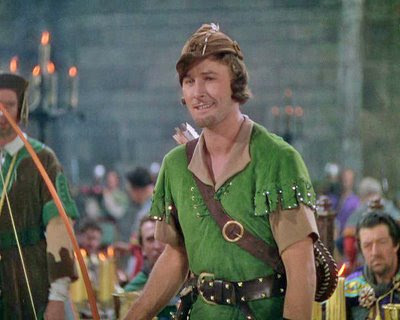
When I was a kid, I was a big fan of Robin Hood. I remember reading at least two books recounting the legend and I watched the Errol Flynn version of the movie several times.

And, as an adult, I saw both the Kevin Costner and Russell Crowe versions of Robin Hood.

“I’m not an occupy-Wall-Street moocher”

None of this makes me an expert, but it does allow me to state with some confidence that Robin Hood was not a left-wing hero who stole from the rich and redistributed to the poor.

Instead, he was a quasi-libertarian tax protestor. Okay, maybe it’s an exaggeration to claim he was a libertarian, but Robin Hood was on the side of ordinary people who were being exploited by incessant tax demands from the ruling class. His main enemies were Prince John and the Sheriff on Nottingham, not the medieval equivalents of Wall Street.

In the Russell Crowe version of the movie, Robin Hood even gives a speech about the importance of liberty.

So you can imagine how irked I get when statists agitate for things such as the “Robin Hood Tax” in this moronic video. But what motivated me today is a story in the Financial Times about a Cesar Chavez wannabee politician from Spain.

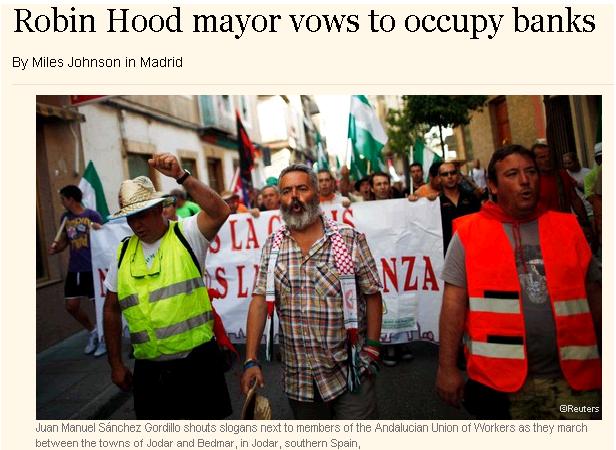
For Spain’s ruling politicians he is a criminal; for his supporters he is Robin Hood, stealing from supermarkets and redistributing the food to the poor. Juan Manuel Sánchez Gordillo, the mayor of Marinaleda, a southern town with a population of 2,600, has been catapulted to cult hero status in Spain after setting out this week on an anti-austerity march across Andalucia – occupying banks and stealing food… “We are fighting a war for the poor … going to jail is not important for me, it would be an honour,” Mr Sánchez Gordillo told the Financial Times. “We are going to occupy all of the banks and supermarkets we are able to in Andalucia. The robbers who have caused this crisis must pay the consequences for what they have done.”

But if the Mayor really wants to make robbers pay, he should march straight to jail and turn himself in. Not for the empty publicity stunt of robbing grocery stores, but for being part of a political class that has dramatically increased the burden of government spending in Spain, from about 30 percent of GDP in 1980 to well over 40 percent today.

But don’t hold your breath waiting for self-awareness from this clown.

Not surprisingly, unions are part of the protest. I’m guessing that Mr. Canamero represents government employees.

On Friday, the marchers, who plan to sleep in the open or in parks, occupied a branch of Banco Santander in the town of Mancha Real in the province of Jaén before leaving later in the day. Diego Canamero, head of the Andalucian Workers Union, was in the branch on Friday. He said critics of the protests were politicians protecting their own interests. “These are symbolic actions against an unsustainable economic situation,” he said. “The bankers rob us, and take our money to tax havens…”

The dig against tax havens is particularly laughable. Ordinary Spaniards should hope and pray that their deposits in the local banks are safely re-deposited in banks based in well-run and honest jurisdictions such as Switzerland, the Cayman Islands, or Singapore.

And if they’re smart, they already cut out the middleman and directly placed their savings in one of these low-tax jurisdictions. That way, they’re not only at much less risk of a bank collapse, but they also have greater ability to protect their assets from the venal and incompetent tax-hungry political elite.

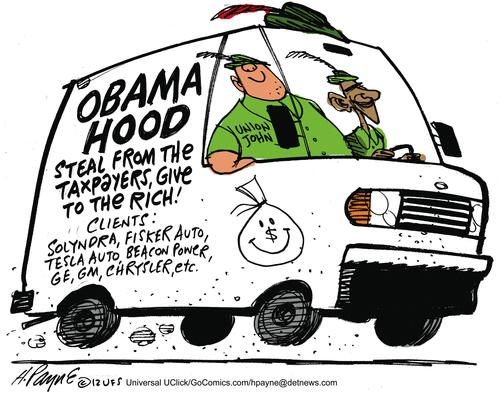
Returning to the mischaracterization of Robin Hood, this Payne cartoon does a good job of capturing my thoughts.

I especially like how Payne shows that the left-wing version of Robin Hood is all about a perniciously corrupt version of redistribution (though he should have included the Export-Import Bank on the side of the van). The genuine poor get crumbs while the well-connected interests make out like bandits.

P.S. Other good Payne cartoons can be seen here, here, herehereherehere, and here.