Monthly Archives: August 2012

Why are crimes elavated under “hate crime laws”?

I think that hate crimes laws should be removed from the books. A shooting against a gay should be punished just like one against a straight.

Jennifer Marshall

August 16, 2012 at 8:51 pm

A vandalized Chick-fil-A store in Torrance, California (credit: Reuters)

Yesterday’s shooting at the Washington, D.C., headquarters of the Family Research Council (FRC) stunned the nation. FRC’s long-time security guard, Leo Johnson, was shot in the arm by a gunman carrying a box of ammunition in his backpack trying to gain access to the building. Law enforcement hailed Leo a hero for his role in tackling and disarming the shooter, and reports today suggest Leo is recovering well from surgery. (Full disclosure: I worked at FRC between 1994 and 2002, and Leo’s warm greeting has always been a highlight of return visits.)

Leaders across the political spectrum have condemned the violent act, from conservative allies of FRC to Republican presidential candidate Mitt Romney to President Obama, the Human Rights Campaign, two dozen other LGBT organizations, and the DC Center for the LGBT Community where the shooter reportedly volunteered. The near-universal condemnation (the exceptions seem to fester in the backwaters of the Twittersphere) is a very welcome sign.

In eschewing such violence, we fortify our resolve to live peacefully with our deepest differences and to pursue consensus about societal norms through politics. Broadly speaking, politics isn’t just the electoral mechanics we typically think of. It’s how we conduct our life together as a people. It relies on debate, persuasion, negotiation…and tolerance. It demands that we communicate, especially when it comes to differences about deeply held beliefs, about the merits of our ideas.

While such resolve is fresh in the mind, this is a critical juncture for reflecting on the character of our political discourse over issues related to sexuality and marriage. We await a likely announcement this fall from the U.S. Supreme Court that it will take up cases involving marriage, following what has turned out to be a very hot summer of intolerance toward traditional views of marriage.

Since June, scorching backlash has been directed at the author of a peer-reviewed study that shows some negative outcomes for young adults whose parents had same-sex relationships. Such findings conflict with an assertion in Judge Vaughn Walker’s opinion overturning California’s marriage amendment, known as Proposition 8, that there is no difference between children of same-sex parents and their peers raised in married mother-and-father households.

Mark Regnerus’s New Family Structures Study improves on prior research through its use of a large, nationally representative sample, as three expert reviews published in the same journal acknowledge. Demographer Cynthia Osborne, for example, says that “the Regnerus study is more scientifically rigorous than most of the other studies in this area.”

That didn’t stop the Human Rights Campaign (HRC) and the Gay and Lesbian Alliance against Defamation (GLAAD) from denouncing the study as a “flawed, misleading, and scientifically unsound paper that seeks to disparage lesbian and gay parents.” Another source wrote off the study as “dangerous propaganda.” An assistant editor at The New Republic called Regnerus a “retrograde researcher” and suggested that this study should “mark the beginning of the end of Mark Regnerus’s credibility with respectable news outlets.”

Allegations from an activist blogger triggered a scientific misconduct inquiry into Regnerus’s work at the University of Texas. The editor of the sociological journal that published the study got such intensely hostile responses that he decided to resort to an internal audit to show the integrity of the publication process.

Then came the Chick-fil-A flap in July. When Dan Cathy, president and COO of the privately held company, made comments in a press interview supporting the “biblical definition of the family unit,” big city politicians from Boston to Chicago to San Francisco threatened to bar the chicken franchise from their communities. Chicago Alderman Joe Moreno announced: “Because of [Cathy’s] ignorance, I will now be denying Chick-fil-A’s permit to open a restaurant in the 1st Ward.”

That runs directly afoul of the First Amendment. A government official may not deny a business license because he doesn’t like things that the applicant has said, as my colleague John Malcolm explained in a recent post. As long as they abide by the law, writes Malcolm, “the owners of Chick-fil-A are well within their rights to say what they want and to put into effect their professed desire to operate Chick-fil-A based ‘on biblical principles.’” Based on the enormous response to Chick-fil-A appreciation day, many Americans would like the company to keep doing just that.

But the brutal summer lumbers on, and two days ago, the Human Rights Campaign ran a blog titled “Paul Ryan Speaking at Hate Group’s Annual Conference“—referring to FRC’s Values Voter Summit. As the blog explains, “FRC has been labeled a hate group by the Southern Poverty Law Center.” The post remains, jarringly, four entries down from the Joint Statement from LGBT Organizations on FRC Shooting.

As my colleague Tom Messner has written, “This is not ‘live and let live.’” These and other episodes fall far short of the tolerance that should characterize public life in America where we enjoy freedom of speech, freedom of religion, and freedom of association.

Given the magnitude of the policy questions at hand in our nation’s great ongoing marriage debate, we should encourage more research and dialogue in this area. To marginalize as illegitimate those whose research contributions or statements might support maintaining the institution of marriage as a union of one man and one woman is a disservice to public discourse and social harmony. (By the way, this includes a majority of voters in the 32 states where the question has been put to them.) Even before the FRC shooting, this summer’s string of uncivil responses falls far short of the tolerant discourse we’ll need to navigate the deep and widespread differences on this issue.

It’s good that we can all agree that waving a gun and yelling “I don’t like your politics” sabotages the very definition of politics. Now let’s agree that supporting traditional marriage isn’t cause for shunning from civil discourse and the public square.

Related posts:

Rachel Elizabeth demonstrates how christians should interact with lost world

Rachel Elizabeth who was attacked at Chick-fil-A Speaks out (Your World w Cavuto – Fox News) Rachel is the lady at Chick-Fil-A in Arizona that was treated horribly by Adam Smith, but she did not retreat from serving him to friendly confines, or apologize for any of the views of Chick-Fil-A’s president. Furthermore, she did […]

46 Tweets from www.thedailyhatch.org so far @everettehatcher

  9m thedailyhatchorg ‏@everettehatcher Brummett mad at Norquist again but Milton Friedman rightly noted Washington has too much to spend so we must cut taxes https://thedailyhatch.org/2012/08/02/milton-friedman-would-have-signed-norquists-pledge-to-brummetts-dismay/ …     1 Aug thedailyhatchorg ‏@everettehatcher Great article from Washington Times supports Chick-Fil-A day of appreciation August 1, 2012 https://thedailyhatch.org/2012/08/01/washington-times-article-supports-chick-fil-a-day-of-appreciation/ …     1 Aug thedailyhatchorg ‏@everettehatcher Anger from Max […]

Washington Times article supports Chick-fil-A day of Appreciation

Washington Times article supports Chick-fil-A day of Appreciation NANCE AND DIAZ: Happy Chick-fil-A Day of Appreciation Americans fight anti-Christian bigotry By Penny Young Nance and Mario Diaz Chick-fil-A may not represent Chicago Mayor Rahm Emanuel’s perception of “Chicago values,” but it sure represents the values of “We the People.” Today, millions of Americans, including the […]

Anger from Max Brantley concerning Huckabee’s Chick-Fil-A August 1 push!!!!!

This July 19, 2012, photo shows a Chick-fil-A fast food restaurant in Atlanta. (AP)____________ A friend of mine is involved in a Russian Baptist Church in California and he told me that there are 52 Chick-Fil-As in California and none of the 30 in attendence had ever been to one or even heard of them. Since […]

Mike Huckabee and Chick Fil-A

I will be eating there on August 1, 2012. Yesterday I was in Memphis on a business trip and I heard Mike Huckabee’s radio show. On the show he quoted his good friend “Houston Nutt” who told his players not to stoop to antics when they score but to act like they have been there before […]


“Feedback Friday” Letter to White House generated form letter response July 30,2012 on Social Security (part 16)

I have been writing President Obama letters and have not received a personal response yet.  (He reads 10 letters a day personally and responds to each of them.) However, I did receive a form letter in the form of an email on July 30, 2012. I don’t know which letter of mine generated this response so I have linked several of the letters I sent to him below with the email that I received. However, I think it was probably this one below:

President Obama’s state of the union speech Jan 24, 2012

Barack Obama  (Photo by Saul Loeb-Pool/Getty Images)

President Obama c/o The White House
1600 Pennsylvania Avenue NW
Washington, DC 20500

Dear Mr. President,

I know that you receive 20,000 letters a day and that you actually read 10 of them every day. I really do respect you for trying to get a pulse on what is going on out here.

The Heritage Foundation website (www.heritage.org ) has lots of good articles and one that caught my attention was concerning your State of Union Speech on January 24, 2012 and here is a short portion of that article:

Social Security Silence David John

In a night of disappointments, the complete lack of any mention of Social Security other than as an excuse to raise taxes was one of the greatest.  Although the Social Security trustees, several of whom are members of the President’s cabinet, has warned that the program faces perpetual deficits, the President evidently has no plan to protect the retirement security of millions of Americans who face a 25% benefit cut in less than 25 years.  Most officeholders join the President in treating Social Security as an issue that can be discussed later – much later, but the reality is that just like a leaky roof, the longer that the President and Congress waits to fix the program, the more expensive the reforms will be.

Tax Reform? It’s Needed, but There’s A Better Way to GoEmily Goff

President Obama says he is ready and willing to embark on tax reform. This is a welcome statement, as our current tax system is ripe for overhaul. However, instead of piecemeal approaches or solutions that give preferences to one industry or company over another, the President should look to the fundamental reforms that the New Flat Tax, as part of The Heritage Foundation’s Saving the American Dream, would bring.

Obama Doubles Down on the Worst U.S. Tax Policy – J.D. Foster

One of the universally acknowledged banes of the federal income tax has for years been the individual Alternative Minimum Tax.  Borne in its current form in the 1986 tax reform act, this parallel system which runs in parallel to the regular income tax forces taxpayers to calculate their taxes twice and pay the larger of the two.

Today, this tax makes no sense, and most tax reform proposals of sufficient heft seek as a primary goal the repeal of the AMT.  Tonight, President Obama proposed not merely to embrace the AMT in principle, but to extend the principle robustly to the business income tax – to create a new basic minimum tax for businesses.  Once again, when it comes to tax policy, President Obama sees what needs to be done – and does the exact opposite.

___________________

Got to tackle entitlement reform but your speech did not mention that once.

Thank you so much for your time. I know how valuable it is. I also appreciate the fine family that you have and your committment as a father and a husband.

Sincerely,

Everette Hatcher III, 13900 Cottontail Lane, Alexander, AR 72002, ph 501-920-5733, lowcostsqueegees@yahoo.com

The White House, Washington

July 30, 2012

Dear Everette:

Thank you for sharing your thoughts with me.  I have heard from many Americans who are worried about the future of their retirement savings, and I appreciate your perspective.

Retiring with dignity is a promise we must keep to all Americans, and I am working hard to strengthen our retirement system.  That is why I am committed to protecting Social Security and addressing Americans’ concerns.  Social Security cannot be subjected to risky privatization plans because the future of hard-working Americans should not be left to the fluctuations of financial markets.

To better secure their retirement and prepare for unforeseen circumstances, Americans must also save for their future in other ways.  We are laying the foundation for all individuals to participate in workplace retirement accounts.  Employees would be automatically enrolled in pension plans and could opt out if they choose.  Simple and automatic enrollment makes it easier for people to plan for retirement.  This would assist the 75 million working Americans—about half the workforce—who lack access to retirement plans through their employers.  Please join me online to learn more at:  www.whitehouse.gov/agenda/seniors-and-social-security.

Thank you, again, for writing.

Sincerely,

Barack Obama

Visit WhiteHouse.gov

Related posts:

Open letter to President Obama (Part 117.5)

6/6/12 Republican Leadership Press Conference Published on Jun 6, 2012 by HouseConference Today House Republican leaders, joined by Senate Republican Leader Mitch McConnell, discussed the importance of preventing any tax increase to provide certainty to America’s job creators. Even President Bill Clinton and Larry Summers agree — taxes should not be raised on anyone in […]

Open letter to President Obama (Part 117.4)

President Obama c/o The White House 1600 Pennsylvania Avenue NW Washington, DC 20500 Dear Mr. President, I know that you receive 20,000 letters a day and that you actually read 10 of them every day. I really do respect you for trying to get a pulse on what is going on out here. We need […]

Open letter to President Obama (Part 117.3)

A Taxing Distinction for ObamaCare Published on Jun 28, 2012 by catoinstitutevideo http://www.cato.org/publications/commentary/it-now-falls-congress http://www.cato.org/publications/commentary/taxing-decision http://www.cato-at-liberty.org/supreme-court-unlawfully-rewrites-obamacare-to… http://www.cato-at-liberty.org/congress-its-not-a-tax-scotus-yes-it-is/ The Cato Institute’s Roger Pilon, Ilya Shapiro, Michael F. Cannon, Michael D. Tanner and Trevor Burrus evaluate today’s ruling on ObamaCare at the Supreme Court. Video produced by Caleb O. Brown and Austin Bragg. ____________ President Obama c/o The […]

“Feedback Friday” Letter to White House generated form letter response July 16,2012 on small businesses (part 13)

I have been writing President Obama letters and have not received a personal response yet.  (He reads 10 letters a day personally and responds to each of them.) However, I did receive a form letter in the form of an email on July 16, 2012. I don’t know which letter of mine generated this response so I have linked several […]

Open letter to President Obama (Part 117.2)

  President Obama c/o The White House 1600 Pennsylvania Avenue NW Washington, DC 20500 Dear Mr. President, I know that you receive 20,000 letters a day and that you actually read 10 of them every day. I really do respect you for trying to get a pulse on what is going on out here.   […]

Open letter to President Obama (Part 117.1)

Glenn Beck Presents: F.A. Hayek’s “The Road to Serfdom” (Part 2) President Obama c/o The White House 1600 Pennsylvania Avenue NW Washington, DC 20500 Dear Mr. President, I know that you receive 20,000 letters a day and that you actually read 10 of them every day. I really do respect you for trying to get […]

Open letter to President Obama (Part 126)

Uploaded by on Jan 18, 2009

Margaret Thatcher’s last House of Commons Speech on November 22, 1990.

________________

President Obama c/o The White House
1600 Pennsylvania Avenue NW
Washington, DC 20500

Dear Mr. President,

I know that you receive 20,000 letters a day and that you actually read 10 of them every day. I really do respect you for trying to get a pulse on what is going on out here.

Prime Minister Margaret Thatcher:

People on all levels of income are better off than they were in 1979. The hon. Gentleman is saying that he would rather that the poor were poorer, provided that the rich were less rich. That way one will never create the wealth for better social services, as we have. What a policy. Yes, he would rather have the poor poorer, provided that the rich were less rich. That is the Liberal policy.

__________

No wonder Ronald Wilson Reagan (who I named my son Wilson after) and Prime Minister Thatcher were good friends. They both saw through the motives of the liberals.

I shared an amazing video last year featuring Margaret Thatcher exposing the left for wanting to keep the poor destitute if that was the price of hurting the so-called rich.

Deroy Murdock makes similar points in a great column for National Review.

For too many liberals like Obama, “fairness” is not about enriching the modest; it’s about impoverishing the moneyed. Multibillionaire Warren Buffett has energized liberals with his still-unverified claim that his tax rate lags his secretary’s. …Somehow, reducing the secretary’s taxes never came up. Instead liberals demand the so-called Buffett Rule, an instrument for bludgeoning the successful rather than boosting the downtrodden. …Here’s how the Right should challenge the Left: “If you dislike income inequality, lift those with the least. Let’s adopt universal school choice, allow personal Social Security retirement accounts (to democratize long-term capital accumulation), radically reduce or eliminate America’s anti-competitive 35 percent corporate tax (to supercharge businesses), and pass right-to-work laws (so the jobless won’t fester outside closed shops). Let’s build the Keystone Pipeline (to create 20,000 blue-collar positions right now and lower everyone’s energy costs), frack for natural gas, and tame the EPA, OSHA, SEC, and other power-mad bureaucracies, so U.S. companies will stay here, and foreign firms will move in.”

Needless to say, the left will not accept Deroy’s challenge.

Too many of them care about enriching teacher unions, for instance, more than they care about educational opportunity for poor children.

And most leftist leaders would like to impose higher tax rates on success, even if the government collects less revenue.

__________

Thank you so much for your time. I know how valuable it is. I also appreciate the fine family that you have and your commitment as a father and a husband.

Sincerely,

Everette Hatcher III, 13900 Cottontail Lane, Alexander, AR 72002, ph 501-920-5733, lowcostsqueegees@yahoo.com

“Friedman Friday” : Jewish tradition is so akin to capitalism but many Jews are socialists, what a paradox (Part 3)

Milton Friedman on the American Economy (5 of 6)

Uploaded by on Aug 9, 2009

THE OPEN MIND
Host: Richard D. Heffner
Guest: Milton Friedman
Title: A Nobel Laureate on the American Economy VTR: 5/31/77

__________________

Below is a part of the series on an article by Milton Friedman called “Capitalism and the Jews” published in 1972.

Capitalism and the Jews

October 1988 • Volume: 38 • Issue: 10 • Print This Post11 comments

Milton Friedman, recipient of the 1976 Nobel Memorial Prize in Economic Science, is a Senior Research Fellow at the Hoover Institution. This article is reprinted with the permission of Encounter and The Fraser Institute.

“Capitalism and the Jews” was originally presented as a lecture before the Mont Pelerin Society in 1972. It subsequently was published in England and Canada and appears here without significant revision.

The Jews as an Example of the Paradox

My aim here is not to give a ready answer—for I have none. My aim is rather to examine a particular case of paradox–the attitude of Jews toward capitalism. Two propositions can be readily demonstrated: first, the Jews owe an enormous debt to free enterprise and competitive capitalism; second, for at least the past century the Jews have been consistently opposed to capitalism and have done much on an ideological level to undermine it. How can these propositions be reconciled?

I was led to examine this paradox partly for obvious personal reasons. Some of us are accustomed to being members of an intellectual minority, to being accused by fellow intellectuals of being reactionaries or apologists or just plain nuts. But those of us who are also Jewish are even more embattled, being regarded not only as intellectual deviants but also as traitors to a supposed cultural and national tradition.

This personal interest was reinforced by the hope that study of this special case might offer a clue to the general paradox—typified by West Germany where Jews play a minor role. Unfortunately, that hope has not been fulfilled. I believe that I can explain to a very large extent the anti-capitalist tendency among Jews, but the most important elements of the explanation are peculiar to the special case and cannot readily be generalized. I trust that others will be more successful.

II. The Benefit Jews Have Derived from Capitalism

An Anecdote and Some History

Let me start by briefly documenting the first proposition: that the Jews owe an enormous debt to capitalism. The feature of capitalism that has benefited the Jews has, of course, been competition.[1] Wherever there is a monopoly, whether it be private or governmental, there is room for the application of arbitrary criteria in the selection of the beneficiaries of the monopoly—whether these criteria be color of skin, religion, national origin or what not. Where there is free competition, only performance counts. The market is color blind. No one who goes to the market to buy bread knows or cares whether the wheat was grown by a Jew, Catholic, Protestant, Muslim, or atheist; by whites or blacks. Any miller who wishes to express his personal prejudices by buying only from preferred groups is at a competitive disadvantage, since he is keeping himself from buying from the cheapest source. He can express his prejudice, but he will have to do so at his own expense, accepting a lower monetary income than he could otherwise earn.

A recent personal experience illuminates sharply the importance of competition. Some years ago, I attended an International Monetary Conference held in Montreal. The persons there consisted, on the one hand, of members of the Conference, who include the two top executives of the major commercial banks throughout the world; on the other, of persons like myself invited as speakers or participants in panel discussions. A conversation with an American banker present who recounted a tale of anti-Semitism in American banking led me to estimate roughly the fraction of the two groups who were Jewish. Of the first group—the bankers proper—I estimated that about 1 per cent were Jewish. Of the much smaller second group, the invited participants in the program, roughly 25 per cent were Jewish.

Why the difference? Because banking today is everywhere monopolistic in the sense that there is no free entry. Government permission or a franchise is required. On the other hand, intellectual activity of the kind that would recommend persons for the program is a highly competitive industry with almost completely free entry.

This example is particularly striking because banking is hardly a field, like, say, iron and steel, in which Jews have never played an important role. On the contrary, for centuries Jews were a major if not dominant element in banking and particularly in international banking. But when that was true, banking was an industry with rather free entry. Jews prospered in it for that reason and also because they had a comparative advantage arising from the Church’s views on usury, the dispersion of Jews throughout the world, and their usefulness to ruling monarchs precisely because of the isolation of the Jews from the rest of the community.[2]

This anecdote illuminates much history. Throughout the nearly two thousand years of the Diaspora, Jews were repeatedly discriminated against, restricted in the activities they could undertake, on occasion expelled en masse, as in 1492 from Spain, and often the object of the extreme hostility of the peoples among whom they lived. They were able nonetheless to exist because of the absence of a totalitarian state, so that there were always some market elements, some activities open to them to enter. In particular, the fragmented political structure and the numerous separate sovereignties meant that international trade and finance in particular escaped close control, which is why Jews were so prominent in this area. It is no accident that Nazi Germany and Soviet Russia, the two most totalitarian societies in the past two thousand years (modern China perhaps excepted), also offer the most extreme examples of official and effective anti-Semitism.

If we come to more recent time, Jews have flourished most in those countries in which competitive capitalism had the greatest scope: Holland in the sixteenth and seventeenth centuries, and Britain and the U.S. in the nineteenth and twentieth centuries, Germany in the late nineteenth and early twentieth century—a case that is particularly pertinent when that period is compared with the Hitler period.[3]

1.   The only other writer I have come across who explicitly stresses the benefits Jews have derived from capitalism is Ellis Rivkin, The Shaping of Jewish History (New York: Scribner’s, 1971). Unfortunately, Rivkin’s interesting analysis is marred by misconceptions about the nature and operation of capitalism. He takes the accumulation of capital rather than free entry as its distinguishing feature.

2.   See for example Hannah Arendt, The Origins of Totalitarianism (New York: Harcourt, Brace & Co., 1951), on “court Jews,” also Werner Sombart, The Jews and Modern Capitalism (London: T.Fisher Unwin, 1913) [translated from 1911 German original].

3.   Sombart argues that the relation is the reverse: that capitalism flourished where it did because Jews were given a considerable measure of freedom. But he would not have denied that the relation is reciprocal. And his version has been seriously questioned by economic historians. See Introduction by Bert F. Hoselitz to the American edition of Sombart’s book, Jewish Contributions to Civilization, 1919, chapter viia, pp. 247-267.

Open letter to President Obama (Part 125B)

Obama Calls GOP Budget Plan “Prescription for Decline”

Uploaded by on Apr 3, 2012

In a blistering attack on the House-Passed Republican budget Tuesday, President Obama called the plan proposed by Rep. Paul Ryan a “Trojan Horse” and “a prescription for decline.” Judy Woodruff, Jared Bernstein of the Center on Budget and Policy Priorities and the CATO Institute’s Daniel Mitchell discuss the GOP budget plan.

_______

President Obama c/o The White House
1600 Pennsylvania Avenue NW
Washington, DC 20500

Dear Mr. President,

I know that you receive 20,000 letters a day and that you actually read 10 of them every day. I really do respect you for trying to get a pulse on what is going on out here.

You were really hard on Paul Ryan for his plan, but your plan will NEVER LEAD TO A BALANCED BUDGET.

Obama’s And Paul Ryan’s Conflicting Budget Visions

by Michael D. Tanner

Michael Tanner is a senior fellow at the Cato Institute and author of Leviathan on the Right: How Big-Government Conservatism Brought Down the Republican Revolution.

Added to cato.org on April 6, 2012

This article appeared in Fiscal Times on April 6, 2012.

With his speech to news editors and executives this week, President Obama has made it clear that he plans to run a starkly ideological campaign, contrasting his vision for the future of the country with that of his Republican opponents. And, he plans to make the Republican budget, written by rising GOP star Rep. Paul Ryan of Wisconsin and embraced by presumptive Republican nominee Mitt Romney, exhibit one in that contrast. It would be worthwhile therefore to actually compare that budget with the one proposed by the president.

Deficits and Debt
The president’s budget proposal would reduce future deficits — at least until 2018 — but would never achieve balance. By 2018, the president projects deficits to fall to only $575 billion. After that, they begin rising again, reaching $704 billion by 2022. Overall, the president’s budget would add an additional $6.7 trillion to the national debt over the next 10 years.

Paul Ryan does better when it comes to deficit reduction, but only because the president has set such a low bar. Unlike the president, Ryan would eventually balance the budget — but not until 2040 or so. He does, however, generally run much lower annual deficits than the president would, and adds $3.3 trillion less to the national debt over the next 10 years.

Obama and Ryan have presented two distinct visions of the future.

Over the longer-term, the differences are much more pronounced. By 2050, for instance, Ryan would be running a surplus equal to as much as 3 percent of GDP. The president’s budget, in contrast, projects that we would still face budget deficits in excess of 6 percent of GDP.

Government Spending
Neither President Obama nor Paul Ryan actually cuts government spending. Rather, both are playing the time-honored game of calling a reduction in the rate of increase a “cut.” Thus, the president would increase federal spending from $3.8 trillion in 2013 to $5.82 trillion in 2022. That might not be as big an increase there might otherwise be, but in no way can it be called a cut. Meanwhile, Ryan, who is being accused of “thinly veiled Social Darwinism,” would actually increase spending from $3.53 trillion in 2013 to $4.88 trillion in 2022.

The president warns that Ryan’s spending “cuts” would “gut” the social safety net. And, it is true that Ryan’s budget knife falls more heavily on domestic discretionary spending than does the president’s — but only relatively. Over the next 10 years, Ryan would spend $352 billion less on those programs than would Obama, an average of just $35.2 billion per year in additional cuts. Given that domestic discretionary spending under the president’s budget will total more than $4 trillion over the next decade, Ryan’s cuts look less than draconian.

One area where the president appears to have the better argument is on defense spending. Ryan would undo the defense spending sequester agreed to under last year’s debt-ceiling compromise, and would spend $203 billion more over 10 years than was agreed to. Obama would cut defense by an additional $240 billion. Given our budget problems and the lack of a conventional military threat, Ryan’s plan to spare defense seems shortsighted.

Taxes
The president would increase tax revenue to 20.1 percent of GDP. That’s a huge increase from the current 15.4 percent, and higher than the post-World War II average of 18 percent. His budget includes tax hikes on people and small businesses making as little as $200,000 per year, as well as the usual panoply of tax hikes on energy products, businesses, investment and pretty much anything else the president can think of.

The president also continues to push for the so-called Buffet Rule, a new 30 percent minimum tax on the rich, based on the misleading claim that Warren Buffett pays a lower tax rate than his secretary. The Buffett Rule would raise very little revenue — less than $3.2 billion per year on average according to the Congressional Budget Office — but the president is pushing it as a matter of fairness.

Ryan would also allow taxes to increase as a percentage of GDP, returning to roughly their historical average around 18 percent of GDP. However, he is also calling for a major reform of the U.S. tax code. Ryan would replace the current four tax rates with two: 15 and 25 percent. He would also lower the current 38 percent corporate tax rate, the world’s highest, to 25 percent. At the same time, he would broaden the taxable base by eliminating many current deductions and loopholes. Unfortunately, Ryan has ducked the unpopular task of actually spelling out which loopholes would be eliminated.

Entitlement Reform
Perhaps the biggest disagreement between the president and Ryan is over how to reform the entitlement programs that are driving this country toward bankruptcy. Ryan would restructure Medicare for those under age 55 to give recipients a choice between the traditional program and a voucher that would allow them to purchase private insurance. That plan, drafted together with Democratic Sen. Ron Wyden of Oregon, would have little impact in the short-term — in 2022, it would spend just $21 billion less than the president’s budget — but over the longer term would reduce Medicare’s unfunded liability, which the Medicare trustees put at $24.6 trillion, by trillions of dollars.

The president makes no significant changes to Medicare, relying instead on expansion of changes contained in the new health care law to save a projected $364 billion over the next 10 years.

Ryan would also turn the current Medicaid program to the states in the form of a federal block grant, while reducing spending by $810 billion over 10 years. States would have far more freedom to experiment with ways to reform the system, but would likely receive less federal funds over the long term. Obama, by contrast, leaves the program unchanged, while significantly expanding eligibility under the health care law.

Unsurprisingly in an election year, both Ryan and the president punt on Social Security reform. Neither offers any reform of the troubled retirement system, despite its $21 trillion in unfunded liabilities.

Two Visions
The United States is teetering on the edge of Greek-style bankruptcy. Our total indebtedness, including the unfunded liabilities of Social Security and Medicare, could run as high as $130 trillion, more than 900 percent of GDP. In the face of this looming crisis, Obama and Ryan have presented two distinct visions of the future. The president offers a bigger government, paid for with more debt and higher taxes. Ryan’s vision may be maddeningly timid and vague in places, but it takes important steps toward a smaller, less costly, and less intrusive government.

If that’s the debate that President Obama wants to have, let’s do it.

____________

Thank you so much for your time. I know how valuable it is. I also appreciate the fine family that you have and your commitment as a father and a husband.

Sincerely,

Everette Hatcher III, 13900 Cottontail Lane, Alexander, AR 72002, ph 501-920-5733, lowcostsqueegees@yahoo.com

President Obama:“do not consider ourselves a Christian nation” (Part 4 of David Barton’s response)

America’s Founding Fathers Deist or Christian? – David Barton 4/6

David Barton provided an excellent response to President Obama’s assertion: “We do not consider ourselves a Christian nation.” Here it is:

Is President Obama Correct: Is America No Longer a Christian Nation?

Over the past several years, President Barack Obama has repeatedly claimed that America is not a Christian nation. He asserted that while a U. S. Senator, 1 repeated it as a presidential candidate, 2 and on a recent presidential trip to Turkey announced to the world that Americans “do not consider ourselves a Christian nation.” 3 (He made that announcement in Turkey because he said it was “a location he said he chose to send a clear message.” 4 ) Then preceding a subsequent trip to Egypt, he declared that America was “one of the largest Muslim countries in the world” 5 (even though the federal government’s own statistics show that less than one-percent of Americans are Muslims. 6

The President’s statements were publicized across the world but received little attention in the American media. Had they been carried here, the President might have been surprised to learn that nearly two-thirds of Americans currently consider America to be a Christian nation 7 and therefore certainly might have taken exception with his remarks. But regardless of what today’s Americans might think, it is unquestionable that four previous centuries of American leaders would definitely take umbrage with the President’s statements.

Modern claims that America is not a Christian nation are rarely noticed or refuted today because of the nation’s widespread lack of knowledge about America’s history and foundation. To help provide the missing historical knowledge necessary to combat today’s post-modern revisionism, presented below will be some statements by previous presidents, legislatures, and courts (as well as by current national Jewish spokesmen) about America being a Christian nation. These declarations from all three branches of government are representative of scores of others and therefore comprise only the proverbial “tip of the iceberg.”

.

The Judicial Branch Affirms that America is a Christian Nation

From the Judicial Branch, consider first some declarations of prominent U. S. Supreme Court Justices regarding America as a Christian nation.

Justice Joseph Story (1779-1845) was appointed to the Court by President James Madison. Story is considered the founder of Harvard Law School and authored the three-volume classic Commentaries on the Constitution of the United States (1833). In his 34 years on the Court, Story authored opinions in 286 cases, of which 269 were reported as the majority opinion or the opinion of the Court 31 and his many contributions to American law have caused him to be called a “Father of American Jurisprudence.” Justice Story openly declared:

One of the beautiful boasts of our municipal jurisprudence is that Christianity is a part of the Common Law. . . . There never has been a period in which the Common Law did not recognize Christianity as lying at its foundations. . . . I verily believe Christianity necessary to the support of civil society. 32

His conclusion about America and Christianity was straightforward:

In [our] republic, there would seem to be a peculiar propriety in viewing the Christian religion as the great basis on which it must rest for its support and permanence. 33

Justice John McLean (1785-1861) was appointed to the Court by President Andrew Jackson. McLean served in the U. S. Congress, as a judge on the Ohio Supreme Court, and then held cabinet positions under two U. S. Presidents. His view on the importance of Christianity to American government and its institutions was unambiguous:

For many years, my hope for the perpetuity of our institutions has rested upon Bible morality and the general dissemination of Christian principles. This is an element which did not exist in the ancient republics. It is a basis on which free governments may be maintained through all time. . . . Free government is not a self-moving machine. . . . Our mission of freedom is not carried out by brute force, by canon law, or any other law except the moral law and those Christian principles which are found in the Scriptures. 34

Justice David Brewer (1837-1910), appointed to the Court by President Benjamin Harrison, agreed. Brewer held several judgeships in Kansas and served on a federal circuit court before his appointment to the Supreme Court. Justice Brewer declared:

We constantly speak of this republic as a Christian nation – in fact, as the leading Christian nation of the world. 35

Brewer then chronicled the types of descriptions applied to nations:

We classify nations in various ways: as, for instance, by their form of government. One is a kingdom, another an empire, and still another a republic. Also by race. Great Britain is an Anglo-Saxon nation, France a Gallio, Germany a Teutonic, Russia a Slav. And still again by religion. One is a Mohammedan nation, others are heathen, and still others are Christian nations. This republic is classified among the Christian nations of the world. It was so formally declared by the Supreme Court of the United States. In the case of Holy Trinity Church vs. United States, 143 U.S. 471, that Court, after mentioning various circumstances, added, “these and many other matters which might be noticed, add a volume of unofficial declarations to the mass of organic utterances that this is a Christian nation.” 36

Brewer did not believe that calling America a Christian nation was a hollow appellation; in fact, he penned an entire book setting forth the evidence that America was a Christian nation. He concluded:

[I] have said enough to show that Christianity came to this country with the first colonists; has been powerfully identified with its rapid development, colonial and national, and today exists as a mighty factor in the life of the republic. This is a Christian nation. . . . [T]he calling of this republic a Christian nation is not a mere pretence, but a recognition of an historical, legal, and social truth. 37

Justice Earl Warren (1891-1974) agreed with his predecessors. Before being appointed as Chief Justice of the U. S. Supreme Court by President Dwight D. Eisenhower, Warren had been the Attorney General of California. Warren declared:

I believe the entire Bill of Rights came into being because of the knowledge our forefathers had of the Bible and their belief in it: freedom of belief, of expression, of assembly, of petition, the dignity of the individual, the sanctity of the home, equal justice under law, and the reservation of powers to the people. . . . I like to believe we are living today in the spirit of the Christian religion. I like also to believe that as long as we do so, no great harm can come to our country. 38

There are many similar declarations by other Supreme Court Justices, but in addition to the declarations of individual judges, the federal courts have repeatedly affirmed America to be a Christian nation – including the U. S. Supreme Court, which declared that America was “a Christian country,” 39filled with “Christian people,” 40 and was indeed “a Christian nation.” 41Dozens of other courts past and present have repeated these pronouncements 42 but so, too, have American Presidents – as in 1947 when President Harry Truman quoted the Supreme Court, declaring:

This is a Christian Nation. More than a half century ago that declaration was written into the decrees of the highest court in this land [in an 1892 decision]. 43

In addition to its “Christian nation” declarations, the Supreme Court also regularly relied on Christian principles as the basis of its rulings on issues such as marriage, citizenship, foreign affairs, and domestic treaties.

For example, when some federal territories attempted to introduce the practice of bigamy and polygamy, the Supreme Court disallowed those practices because:

Bigamy and polygamy are crimes by the laws of all civilized and Christian countries. 44

In another case, the Court similarly explained:

The organization of a community for the spread and practice of polygamy is . . . . contrary to the spirit of Christianity and of the civilization which Christianity has produced in the Western world. 45

And when the issue arose of whether marriages made in foreign nations would be recognized in the United States, the federal court held that foreign marriages would be recognized only if they were not “contrary to the general view of Christendom.” 46

The Supreme Court also decided military service issues in accord with Christian principles and standards. For example, in 1931, when a Canadian immigrant refused to take the oath of allegiance to the United States, the Supreme Court explained why he was therefore excluded from citizenship:

We are a Christian people (Holy Trinity Church v. United States. 143 U.S. 457, 470 , 471 S., 12 S. Ct. 511), according to one another the equal right of religious freedom and acknowledging with reverence the duty of obedience to the will of God. But also we are a nation with the duty to survive; a nation whose Constitution contemplates war as well as peace; whose government must go forward upon the assumption (and safely can proceed upon no other) that unqualified allegiance to the nation and submission and obedience to the laws of the land, as well those made for war as those made for peace, are not inconsistent with the will of God. 47

The Supreme Court also relied on Christian principles in its rulings on international policies. For example, if an American citizen living in a foreign land was accused of a crime under the laws of a fundamentally different nation (such as in Islamic nations, secular nations, and most recently in Japan following World War II), by means of international treaties, the U. S. citizen would be tried in front of the U. S. Consul in that nation (in what were called Consular Tribunals) rather than before the courts of that country. Of this practice, the Supreme Court explained:

In other than Christian countries, they [the Consuls] were by treaty stipulations usually clothed with authority to hear complaints against their countrymen and to sit in judgment upon them when charged with public offenses. . . . The intense hostility of the people of Moslem faith to all other sects, and particularly to Christians, affected all their intercourse [transactions] and all proceedings had in their tribunals. Even the rules of evidence adopted by them [the Muslims] placed those of different faith on unequal grounds in any controversy with them. For this cause, and by reason of the barbarous and cruel punishments inflicted in those countries and the frequent use of torture to enforce confession from parties accused, it was a matter of deep interest to Christian governments to withdraw the trial of their subjects, when charged with the commission of a public offense, from the arbitrary and despotic action of the local officials. Treaties conferring such jurisdiction upon these consuls were essential to the peaceful residence of Christians within those countries. 48

For example, an Islamic nation might charge an American with the capital-offense crime of blasphemy merely because the American attended Christian worship or used a Bible in that country; or a secular nation might accuse an American of the crime of proselytizing simply for sharing his faith with another (currently a crime in France, 49 across India, 50 Pakistan,51 Saudi Arabia, 52 Malaysia, 53 and many other nations). In such cases, the Consul tried the offense under America’s laws as a Christian nation. However, if another nation accused an American of a crime such as murder, the charge would stand since murder was also a crime in our Christian nation. 54
The Supreme Court commended this position 55 and federal courts observed the policy until deep into the twentieth century, 56 when many foreign nations finally began to adopt what the Supreme Court had earlier called “a system of judicial procedure like that of Christian countries.” 57

Federal domestic treaties were yet another area in which the federal judiciary relied on Christian principles and standards. For example, by 1877 a number of disputes had arisen in which Indian lands were wrongly being taken for timber, minerals, and other resources. When those cases reached the Supreme Court, the Court affirmed the occupancy rights of the tribes to the lands because:

It is to be presumed that in this matter the United States would be governed by such considerations of justice as would control a Christian people . . . 58

The Court repeated this position on numerous subsequent occasions – as in 1903 when it reiterated:

[I]n decisions of this court, the Indian right of occupancy of tribal lands, whether declared in a treaty or otherwise created, has been stated to be sacred. . . . Thus. . . . “It is to be presumed that in this matter the United States would be governed by such considerations of justice as would control a Christian people . . . ” 59

The Court’s position was subsequently enacted into federal statutory law in 1906, 60 and in 1955, the Supreme Court was still praising this position 61 – a position regularly cited by other courts for decades, 62 including in the late 1990s. 63

These are just a few examples of the literally hundreds of similar cases at both federal and state levels affirming that America is indeed a Christian nation.

31. “United States Founding Fathers,” Party of 1776 (at:http://www.partyof1776.net/p1776/fathers/contents.html) (accessed on May 1, 2009). (Return)

32. Joseph Story, Life and Letters of Joseph Story, William W. Story, editor (Boston: Charles C. Little and James Brown, 1851), Vol. II, pp. 8, 92. (Return)

33. Joseph Story, Commentaries on the Constitution of the United States(Boston: Hillard, Gray, and Company, 1833), Vol. III, p. 724, § 1867. (Return)

34. B. F. Morris, Christian Life and Character of the Civil Institutions of the United States, Developed in the Official and Historical Annals of the Republic(Philadelphia: George W. Childs, 1864), p. 639. (Return)

35. David J. Brewer, The United States: A Christian Nation (Philadelphia: John C. Winston Company, 1905), p. 12. (Return)

36. David J. Brewer, The United States: A Christian Nation (Philadelphia: John C. Winston Company, 1905), p. 11. (Return)

37. David J. Brewer, The United States: A Christian Nation (Philadelphia: John C. Winston Company, 1905), pp. 40, 46. (Return)

38. “Breakfast in Washington,” Time, February 15, 1954 (at:http://www.time.com/time/magazine/article/0,9171,936197,00.html).(Return)

39. Vidal v. Girard’s Executors, 43 U. S. 126, 198 (1844). (Return)

40. U.S. v. Macintosh, 283 U.S. 605, 625 (1931). (Return)

41. Church of the Holy Trinity v. U. S., 143 U. S. 457, 465, 470-471 (1892).(Return)

42. See for example, Warren v. U.S., 177 F.2d 596 (10th Cir. 1949); U.S. v. Girouard, 149 F.2d 760 (1st Cir.1945); Steiner v. Darby, Parker v. Los Angeles County, 199 P.2d 429 (Cal. App. 2d Dist 1948); Vogel v. County of Los Angeles, 434 P.2d 961 (1967). (Return)

43. Harry S. Truman, “Exchange of Messages with Pope Pius XII,” American Presidency Project, August 6, 1947 (at:http://www.presidency.ucsb.edu/ws/index.php?pid=12746).(Return)

44. Davis v. Beason, 133 U. S. 333, 341-344, 348 n. (1890). (Return)

45. The Church of Jesus Christ of Latter-Day Saints v. United States 136 U.S. 1, 49 (1890). (Return)

46. U.S. ex rel. Modianos v. Tuttle, 12 F.2d 927 (E.D. La. 1925). (Return)

47. U.S. v. Macintosh, 283 U.S. 605, 625 (1931). (Return)

48. Ross v. McIntyre, 140 U.S. 453, 463 (1891). (Return)

49. Patrick Goodenough, “French Anti-Sect Law: Christian Lawyers Prepare for Action,” Center for Studies on New Religions, June 4, 2001 (at:http://www.cesnur.org/2001/fr_june01.htm).(Return)

50. “India ‘Anti-Conversion’ Law Takes Effect in Fifth State,” WorthyNews, May 2, 2008 (at: http://www.worthynews.com/1641-india-anti-conversion-law-takes-effect-in-fifth-state). See also “India ‘Anti-Conversion’ Law Considered in Karnataka,” Compass Direct News, March 2, 2009 (at:http://www.compassdirect.org/en/display.php?page=news〈=en=long&idelement=5829). Seven of India’s 28 states have passed an anti-conversion law (which has been implemented in 5) and one additional state has a law in process that has not yet been passed. (Return)

51. “Congressional Hearings on Anti-Conversion Laws this Friday,” Free Copts, April 6, 2006 (at: http://freecopts.net/english/index.php?option=com_content&task=view&id=70).(Return)

52. Jerry Dykstra “A Leader in Religious Intolerance: In Saudi Arabia, conversion to Christianity is punishable by death,” Today’s Christian, July 1, 2006 (at: http://www.christianitytoday.com/tc/2006/004/11.53.html).(Return)

53. Jane Perlez “Once Muslim, Now Christian and Caught in the Courts,” New York Times, August 24, 2006 (at:http://www.nytimes.com/2006/08/24/world/asia/24malaysia.html?ex=1157083200&en=48413500adb50796&ei=5040&partner=MOREOVERNEWS).(Return)

54. Ross v. McIntyre, 140 U.S. 453 (1891). (Return)

55. See, for example, Kinsella v. Krueger, 351 U.S. 470 (1956); Reid v. Covert, 354 U.S. 1 (1957). (Return)

56. See, for example, U.S. v. Best, 76 F. Supp. 857 (D. Mass. 1948); U.S. v. Robertson, Court of Military Appeals (May 27, 1955); U.S. v. Tiede, 86 F.R.D. 227, 1979 U.S. Dist. LEXIS 13805 (D. Berlin Mar. 14, 1979); and many others.(Return)

57. Ross v. McIntyre, 140 U.S. 453, 480 (1891). (Return)

58. Beecher v. Wetherby, 95 U.S. 517, 525 (1877). (Return)

59. Lone Wolf v. Hitchcock, 187 U.S. 553, 565 (1903). See also the same language in Yankton Sioux Tribe of Indians v. U. S., 272 US 351 (1926); U. S. v. Choctaw Nation, 179 U.S. 494 (1900); Atlantic & P R Co v. Mingus, 165 U.S. 413 (1897); Missouri, Kansas & Texas Railway Company v. Roberts, 152 U.S. 114 (1894); Buttz v. Northern Pac. R. Co., 119 U.S. 55 (1886). (Return)

60. “Act of April 26, 1906, Public Number 129,” Access Genealogy Indian Tribal Records (at:http://www.accessgenealogy.com/native/laws/act_april_26_1906.htm) (accessed May 4, 2009). (Return)

61. Tee-Hit-Ton Indians v. United States, 348 U.S. 272 (1955). (Return)

62. Sioux Tribe of Indians v. U.S., 146 F. Supp. 229 (Ct. Cl. Nov. 7, 1956);Seminole Nation v. White, 224 F.2d 173 (10th Cir. 1955); U.S. v. Drumb, 152 F.2d 821 (10th Cir. 1946); Appeal of Brunt, 5 B.T.A. 134, 1926 WL 47 (October 21, 1926); Parr v. U.S., 153 F. 462 (D. Or. 1907). (Return)

63. Cohen v. Little Six, Inc., 543 N.W.2d 376 (Minn. App. 1996). (Return)

Open letter to President Obama (Part 125)

President Obama c/o The White House
1600 Pennsylvania Avenue NW
Washington, DC 20500

Dear Mr. President,

I know that you receive 20,000 letters a day and that you actually read 10 of them every day. I really do respect you for trying to get a pulse on what is going on out here.

Why did your stimulus idea  not work in 2009?

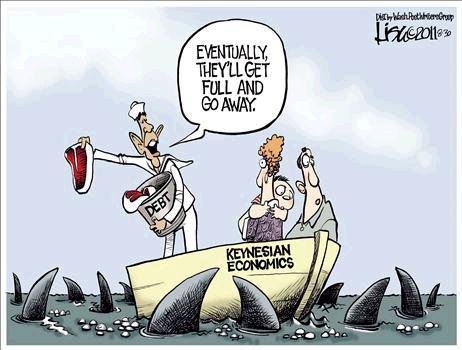
Keynesian Economics in a Cartoon

September 1, 2011 by Dan Mitchell

I’ve written extensively about the flaws of Keynesian economics, and I’ve even narrated a video on the flaws of Keynesian theory.

But this clever cartoon may be more effective than anything I’ve ever done.

If you like cartoons that teach economics, check out this gem. It’s not on Keynesianism, but it’s very good.

_______________

Thank you so much for your time. I know how valuable it is. I also appreciate the fine family that you have and your commitment as a father and a husband.

Sincerely,

Everette Hatcher III, 13900 Cottontail Lane, Alexander, AR 72002, ph 501-920-5733, lowcostsqueegees@yahoo.com

“Woody Allen Wednesdays” can be seen on the www.thedailyhatch.org

Crimes and Misdemeanors: A Discussion: Part 1

If you like Woody Allen films as much as I do then join me every Wednesday for another look the man and his movies. Below are some of the posts from the past:

“Woody Wednesday” How Allen’s film “Crimes and Misdemeanors makes the point that hell is necessary (jh 14)

Crimes and Misdemeanors: A Discussion: Part 1 Adrian Rogers – Crossing God’s Deadline Part 2 Jason Tolbert provided this recent video from Mike Huckabee: John Brummett in his article “Huckabee speaks for bad guy below,” Arkansas News Bureau, May 5, 2011 had to say: Are we supposed to understand and accept that Mike Huckabee is […]

According to Woody Allen Life is meaningless (Woody Wednesday)

Woody Allen, the film writer, director, and actor, has consistently populated his scripts with characters who exchange dialogue concerning meaning and purpose. In Hannah and Her Sisters a character named Mickey says, “Do you realize what a thread were all hanging by? Can you understand how meaningless everything is? Everything. I gotta get some answers.”{7} […]

“Midnight in Paris” wins academy award “Woody Wednesday”

Bananas (1971)    en cast ex-wife, Louise Lasser (the duo were married from 1966 to 1969), as his romantic lead in this quirky comedy. When asked why he chose to title the movie Bananas, Allen quipped, “Because there are no bananas in it.”  “Midnight in Paris” is one of Woody Allen best works. Woody Allen […]

Woody Wednesday” Will Allen and Martin follow same path as Kansas to Christ?

Several members of the 70′s band Kansas became committed Christians after they realized that the world had nothing but meaningless to offer. It seems through the writings of both Woody Allen and Chris Martin of Coldplay that they both are wrestling with the issue of death and what meaning does life bring. Kansas went through […]

Why am I obsessed with Woody Allen?

I guess the reason I have spent so much time on Woody Allen is because in so many films he discusses the big questions in life. His movie “Crimes and Misdemeanors” is a perfect example. Check out my earlier post Nihilism can be seen in Woody Allen’s latest film “Midnight in Paris” . September (1987) The director […]

Woody Allen films and the issue of guilt (Woody Wednesday)

Woody Allen and the Abandonment of Guilt Dr. Marc T. Newman : AgapePress Print In considering filmmaking as a pure visual art form, Woody Allen would have to be considered a master of the medium. From his humble beginnings as a comedy writer and filmmaker, he has emerged as a major influential force in Hollywood. […]

“Midnight in Paris” has become Woody Allen’s most successful movie at box office (Woody Wednesdays)

The dvd sales of “Midnight in Paris” which went on sale in December have gone through the roof (look at the bottom of this post) and this summer we learned this fact below: ‘Midnight in Paris’ becomes Woody Allen’s all-time biggest hit. How the heck did that happen? by Owen Gleiberman Categories: Annie Hall, Bridesmaids, […]

Agnostic Allen notes, “The people who successfully delude themselves seem happier than the people who can’t” (Woody Wednesday)

Woody Allen interviews Billy Graham on Religion This article below makes we think of the lady tied to the Railroad in the Schaeffer video. Dr. Francis schaeffer – The flow of Materialism (Modern man sees no hope for the future and has deluded himself by appealing to nonreason to stay sane. Look at the example […]

Woody Allen interviews Billy Graham (Woody Wednesday)

A surprisingly civil discussion between evangelical Billy Graham and agnostic comedian Woody Allen. Skip to 2:00 in the video to hear Graham discuss premarital sex, to 4:30 to hear him respond to Allen’s question about the worst sin and to 7:55 for the comparison between accepting Christ and taking LSD. ___________________ The Christian Post > […]

“Woody Wednesday” Allen acts silly in 1971 interview (Part 4)

“Woody Wednesday” Allen acts silly in 1971 interview (Part 4) Woody Allen interview 1971 PART 4/4 Uploaded by captainvontrapp on Jul 21, 2008 Woody Allen interview from 1971, just after the worldwide release of ‘Bananas’ ________________________ David Mishkin God and Carpeting: The Theology of Woody Allen by David Mishkin March 1, 1993 This is an […]


Dear Senator Pryor, why not pass the Balanced Budget Amendment? (“Thirsty Thursday”, Open letter to Senator Pryor)

Dear Senator Pryor,

Why not pass the Balanced  Budget Amendment? As you know that federal deficit is at all time high (1.6 trillion deficit with revenues of 2.2 trillion and spending at 3.8 trillion).

On my blog www.HaltingArkansasLiberalswithTruth.com I took you at your word and sent you over 100 emails with specific spending cut ideas. However, I did not see any of them in the recent debt deal that Congress adopted. Now I am trying another approach. Every week from now on I will send you an email explaining different reasons why we need the Balanced Budget Amendment. It will appear on my blog on “Thirsty Thursday” because the government is always thirsty for more money to spend.

There’s nothing nutty about a balanced-budget amendment
In fact, it makes a lot of sense
Thursday, July 21, 2011
By Dick Thornburgh

A late entry in the budget deficit-debt ceiling talkathon in Washington is increasing support for a constitutional requirement that the federal budget be balanced each and every year.

Doctrinaire liberals will no doubt characterize this proposal as a nutty one, but careful scrutiny of such an amendment to our Constitution demonstrates its potential to prevent future train wrecks in the budgeting process.

Coupled with a presidential line-item veto and separate capital budgeting (which differentiates investments from current outlays), a constitutional budget-balancing requirement makes sense. These tools already are available to most governors and state legislatures. And they work.

The current debate in the Congress will likely include the following arguments usually raised against a balanced-budget amendment.

First, it will be argued that the amendment would “clutter up” our basic document in a way contrary to the intention of the founding fathers.

This is clearly wrong. The framers of the Constitution contemplated that amendments would be necessary to keep it abreast of the times. It already has been amended on 27 occasions.

Moreover, at the time of the Constitutional Convention, one of the major preoccupations was how to liquidate the Revolutionary War debts of the states. Certainly, it would have been unthinkable to the framers that the federal government itself would systematically run at a deficit, decade after decade. Indeed, the Treasury did not begin to follow such a practice until the mid-1930s.

Second, critics will argue that the adoption of a balanced-budget amendment would not solve the deficit problem overnight.

This is correct, but begs the issue. Serious supporters of the amendment recognize that a phasing-in period of five or 10 years would be required to reach a zero deficit. During this interim period, however, budget makers would be disciplined to meet declining deficit targets in order to reach a balanced budget by the established deadline.

As pointed out by former Commerce Secretary Peter G. Peterson, such “steady progress toward eliminating the deficit will maintain investor confidence, keep long-term interest rates headed down and keep our economy growing.”

Third, it will be argued that such an amendment would require vast cuts in social services and entitlements or defense expenditures.

Not necessarily. True, these programs would have to be paid for on a current basis rather than heaped on the backs of upcoming generations. Certainly, difficult choices would have to be made about priorities and levels of program funding. But the very purpose of the amendment is to discipline the executive and legislative branches actually to debate these choices and not to propose or perpetuate vast spending programs without providing the revenues to fund them.

The amendment would, in effect, make the president and Congress fully accountable for their spending and taxing decisions, as they should be.

Fourth, critics will say that a balanced-budget amendment would prevent or hinder our capacity to respond to national defense or economic emergencies.

This concern is easy to counter. Any sensible amendment proposal would feature a “safety valve” to exempt deficits incurred in response to such emergencies, requiring, for example, a three-fifths “super majority” in both houses of Congress. Such action should, of course, be based on a finding that such an emergency actually exists.

Fifth, it will be said that a balanced-budget amendment would be “more loophole than law” and might be easily circumvented.

The experience of the states suggests otherwise. Balanced-budget requirements are now in effect in all but one of the 50 states and have served them well.

Moreover, the line-item veto, available to 43 governors, would assure that any specific congressional overruns (or loophole end-runs) could be dealt with by the president. The public’s outcry, the elective process and the courts would also provide backup restraint on any tendency to simply ignore a constitutional directive.

In the final analysis, most of the excuses raised for not enacting a constitutional mandate to balance the budget rest on a stated or implied preference for solving our deficit dilemma through the “political process” — that is to say, through responsible action by the president and Congress.

But that has been tried and found wanting, again and again.

Surely, this country is ready for a simple, clear and supreme directive that its elected officials fulfill their fiscal responsibilities. A constitutional amendment is the only instrument that will meet this need effectively. Years of experience at the state level argue persuasively in favor of such a step. Years of debate have produced no persuasive arguments against it.

Perhaps Thomas Jefferson put it best:

“To preserve our independence, we must not let our rulers load us down with perpetual debt.”

That is the aim of a balanced-budget amendment. Reform-minded members of Congress should choose to support such an amendment to our Constitution as a means of resolving future legislative crises and ending “credit card” government once and for all.

A nutty idea? Not by a long shot.

Dick Thornburgh, of counsel to the Pittsburgh law firm K&L Gates, is a former U.S. attorney general and governor of Pennsylvania.
First published on July 21, 2011 at 12:00 am

Differing with Dan Mitchell on one point

Dan Mitchell of the Cato Institute wrote a very good article and I agree with most of it. However, I do take exception to just one part. He is right to get on to USA Today for calling this current Congress the most unproductive since they only passed 61 bills. Dan rightly pointed out that in the first two years of Obama’s term the Democratically controlled Congress turned out lots of law but they included some very bad laws like Obamacare.

How I differ with Mitchell on this one point. In 2011 the Republicans in Congress failed to block the debt ceiling proposal and only 66 brave Republicans in the House voted against it. As a result we have continued to run trillion dollar deficits which in my view (and Dan’s too) makes this Congress the dumbest and most unproductive ever. Dan has actually shown how government involvement in deficit spending can actually hinder economic growth. and Dan did an excellent video series on restraining spending in government and I have included the You Tube clips of those in this post.

Here below is a list of those 66 brave Republicans that voted against the debt ceiling increase listed below in August of 2011.

Full House roll call
By: Associated Press
August 1, 2011 08:46 PM EDT

The 269-161 roll call Monday by which the House passed the compromise bill to raise the debt ceiling and prevent a government default.

A “yes” vote is a vote to pass the measure.

Voting yes were 95 Democrats and 174 Republicans.

Voting no were 95 Democrats and 66 Republicans.

X denotes those not voting.

There are 2 vacancies in the 435-member House.

ALABAMA

Democrats – Sewell, Y.

Republicans – Aderholt, Y; Bachus, Y; Bonner, Y; Brooks, N; Roby, N; Rogers, Y.

ALASKA

Republicans – Young, Y.

ARIZONA

Democrats – Giffords, Y; Grijalva, N; Pastor, N.

Republicans – Flake, N; Franks, N; Gosar, Y; Quayle, N; Schweikert, N.

ARKANSAS

Democrats – Ross, Y.

Republicans – Crawford, Y; Griffin, Y; Womack, Y.

CALIFORNIA

Democrats – Baca, X; Bass, Y; Becerra, N; Berman, Y; Capps, Y; Cardoza, N; Chu, N; Costa, Y; Davis, Y; Eshoo, Y; Farr, N; Filner, N; Garamendi, Y; Hahn, N; Honda, N; Lee, N; Lofgren, Zoe, N; Matsui, N; McNerney, N; Miller, George, N; Napolitano, N; Pelosi, Y; Richardson, N; Roybal-Allard, N; Sanchez, Linda T., N; Sanchez, Loretta, Y; Schiff, Y; Sherman, Y; Speier, Y; Stark, N; Thompson, Y; Waters, N; Waxman, N; Woolsey, N.

Republicans – Bilbray, Y; Bono Mack, Y; Calvert, Y; Campbell, Y; Denham, Y; Dreier, Y; Gallegly, Y; Herger, Y; Hunter, N; Issa, Y; Lewis, Y; Lungren, Daniel E., Y; McCarthy, Y; McClintock, N; McKeon, Y; Miller, Gary, Y; Nunes, N; Rohrabacher, Y; Royce, Y.

COLORADO

Democrats – DeGette, N; Perlmutter, Y; Polis, Y.

Republicans – Coffman, Y; Gardner, Y; Lamborn, N; Tipton, N.

CONNECTICUT

Democrats – Courtney, Y; DeLauro, N; Himes, Y; Larson, N; Murphy, N.

DELAWARE

Democrats – Carney, Y.

FLORIDA

Democrats – Brown, N; Castor, Y; Deutch, Y; Hastings, N; Wasserman Schultz, Y; Wilson, Y.

Republicans – Adams, Y; Bilirakis, Y; Buchanan, Y; Crenshaw, Y; Diaz-Balart, Y; Mack, N; Mica, Y; Miller, Y; Nugent, Y; Posey, N; Rivera, Y; Rooney, Y; Ros-Lehtinen, Y; Ross, N; Southerland, N; Stearns, N; Webster, Y; West, Y; Young, Y.

GEORGIA

Democrats – Barrow, Y; Bishop, Y; Johnson, Y; Lewis, N; Scott, David, Y.

Republicans – Broun, N; Gingrey, N; Graves, N; Kingston, N; Price, Y; Scott, Austin, N; Westmoreland, N; Woodall, Y.

HAWAII

Democrats – Hanabusa, Y; Hirono, Y.

IDAHO

Republicans – Labrador, N; Simpson, Y.

ILLINOIS

Democrats – Costello, Y; Davis, Y; Gutierrez, Y; Jackson, N; Lipinski, Y; Quigley, Y; Rush, Y; Schakowsky, N.

Republicans – Biggert, Y; Dold, Y; Hultgren, N; Johnson, N; Kinzinger, Y; Manzullo, Y; Roskam, Y; Schilling, Y; Schock, Y; Shimkus, Y; Walsh, N.

INDIANA

Democrats – Carson, N; Donnelly, Y; Visclosky, N.

Republicans – Bucshon, Y; Burton, N; Pence, Y; Rokita, N; Stutzman, N; Young, Y.

IOWA

Democrats – Boswell, N; Braley, N; Loebsack, N.

Republicans – King, N; Latham, N.


KANSAS

Republicans – Huelskamp, N; Jenkins, Y; Pompeo, Y; Yoder, N.

KENTUCKY

Democrats – Chandler, Y; Yarmuth, N.

Republicans – Davis, N; Guthrie, Y; Rogers, Y; Whitfield, Y.

LOUISIANA

Democrats – Richmond, Y.

Republicans – Alexander, Y; Boustany, Y; Cassidy, Y; Fleming, N; Landry, N; Scalise, N.

MAINE

Democrats – Michaud, Y; Pingree, N.

MARYLAND

Democrats – Cummings, N; Edwards, N; Hoyer, Y; Ruppersberger, Y; Sarbanes, N; Van Hollen, Y.

Republicans – Bartlett, Y; Harris, N.

MASSACHUSETTS

Democrats – Capuano, N; Frank, N; Keating, Y; Lynch, Y; Markey, N; McGovern, N; Neal, N; Olver, N; Tierney, N; Tsongas, Y.

MICHIGAN

Democrats – Clarke, N; Conyers, N; Dingell, Y; Kildee, Y; Levin, Y; Peters, N.

Republicans – Amash, N; Benishek, Y; Camp, Y; Huizenga, Y; McCotter, Y; Miller, Y; Rogers, Y; Upton, Y; Walberg, Y.

MINNESOTA

Democrats – Ellison, N; McCollum, N; Peterson, Y; Walz, Y.

Republicans – Bachmann, N; Cravaack, N; Kline, Y; Paulsen, Y.

MISSISSIPPI

Democrats – Thompson, N.

Republicans – Harper, Y; Nunnelee, Y; Palazzo, Y.

MISSOURI

Democrats – Carnahan, Y; Clay, Y; Cleaver, N.

Republicans – Akin, N; Emerson, Y; Graves, Y; Hartzler, N; Long, Y; Luetkemeyer, Y.

MONTANA

Republicans – Rehberg, N.

NEBRASKA

Republicans – Fortenberry, Y; Smith, Y; Terry, Y.

NEVADA

Democrats – Berkley, Y.

Republicans – Heck, Y.

NEW HAMPSHIRE

Republicans – Bass, Y; Guinta, Y.

NEW JERSEY

Democrats – Andrews, Y; Holt, N; Pallone, N; Pascrell, Y; Payne, N; Rothman, Y; Sires, Y.

Republicans – Frelinghuysen, Y; Garrett, N; Lance, Y; LoBiondo, Y; Runyan, Y; Smith, Y.


NEW MEXICO

Democrats – Heinrich, Y; Lujan, N.

Republicans – Pearce, N.

NEW YORK

Democrats – Ackerman, N; Bishop, Y; Clarke, N; Crowley, N; Engel, N; Higgins, Y; Hinchey, X; Hochul, Y; Israel, Y; Lowey, Y; Maloney, N; McCarthy, Y; Meeks, Y; Nadler, N; Owens, Y; Rangel, N; Serrano, N; Slaughter, N; Tonko, N; Towns, N; Velazquez, N.

Republicans – Buerkle, N; Gibson, Y; Grimm, Y; Hanna, Y; Hayworth, Y; King, Y; Reed, Y.

NORTH CAROLINA

Democrats – Butterfield, N; Kissell, N; McIntyre, N; Miller, N; Price, N; Shuler, Y; Watt, N.

Republicans – Coble, Y; Ellmers, Y; Foxx, Y; Jones, N; McHenry, Y; Myrick, Y.

NORTH DAKOTA

Republicans – Berg, Y.

OHIO

Democrats – Fudge, N; Kaptur, N; Kucinich, N; Ryan, N; Sutton, N.

Republicans – Austria, Y; Boehner, Y; Chabot, Y; Gibbs, Y; Johnson, Y; Jordan, N; LaTourette, Y; Latta, Y; Renacci, Y; Schmidt, Y; Stivers, Y; Tiberi, Y; Turner, N.

OKLAHOMA

Democrats – Boren, Y.

Republicans – Cole, Y; Lankford, Y; Lucas, Y; Sullivan, Y.

OREGON

Democrats – Blumenauer, N; DeFazio, N; Schrader, Y; Wu, Y.

Republicans – Walden, Y.

PENNSYLVANIA

Democrats – Altmire, Y; Brady, Y; Critz, Y; Doyle, N; Fattah, Y; Holden, Y; Schwartz, Y.

Republicans – Barletta, Y; Dent, Y; Fitzpatrick, Y; Gerlach, Y; Kelly, Y; Marino, Y; Meehan, Y; Murphy, Y; Pitts, Y; Platts, Y; Shuster, Y; Thompson, Y.

RHODE ISLAND

Democrats – Cicilline, Y; Langevin, Y.

SOUTH CAROLINA

Democrats – Clyburn, Y.

Republicans – Duncan, N; Gowdy, N; Mulvaney, N; Scott, N; Wilson, N.

SOUTH DAKOTA

Republicans – Noem, Y.

TENNESSEE

Democrats – Cohen, N; Cooper, Y.

Republicans – Black, Y; Blackburn, Y; DesJarlais, N; Duncan, Y; Fincher, Y; Fleischmann, N; Roe, Y.

TEXAS

Democrats – Cuellar, Y; Doggett, Y; Gonzalez, N; Green, Al, N; Green, Gene, Y; Hinojosa, Y; Jackson Lee, Y; Johnson, E. B., Y; Reyes, N.

Republicans – Barton, Y; Brady, Y; Burgess, Y; Canseco, Y; Carter, Y; Conaway, Y; Culberson, Y; Farenthold, Y; Flores, Y; Gohmert, N; Granger, Y; Hall, N; Hensarling, Y; Johnson, Sam, Y; Marchant, Y; McCaul, Y; Neugebauer, N; Olson, Y; Paul, N; Poe, N; Sessions, Y; Smith, Y; Thornberry, Y.

UTAH

Democrats – Matheson, Y.

Republicans – Bishop, N; Chaffetz, N.

VERMONT

Democrats – Welch, N.

VIRGINIA

Democrats – Connolly, Y; Moran, N; Scott, N.

Republicans – Cantor, Y; Forbes, N; Goodlatte, Y; Griffith, N; Hurt, Y; Rigell, Y; Wittman, Y; Wolf, Y.

WASHINGTON

Democrats – Dicks, Y; Inslee, Y; Larsen, Y; McDermott, N; Smith, N.

Republicans – Hastings, Y; Herrera Beutler, Y; McMorris Rodgers, Y; Reichert, Y.

WEST VIRGINIA

Democrats – Rahall, Y.

Republicans – Capito, Y; McKinley, Y.

WISCONSIN

Democrats – Baldwin, N; Kind, Y; Moore, X.

Republicans – Duffy, Y; Petri, Y; Ribble, Y; Ryan, Y; Sensenbrenner, Y.

WYOMING

Republicans – Lummis, Y.

_____

Although this line is attributed to many people, Wikiquote says that Gideon Tucker was the first to warn us that “No man’s life, liberty, or property are safe while the legislature is in session.”

This cartoon about Keynesian economics sort of makes the same point, but not with the same eloquence.

But that’s not the point of this post. Instead, I want to focus on this grossly misleading headline in USA Today: “This Congress could be least productive since 1947.”

I don’t think it’s a case of media bias or inaccuracy, as we saw with the AP story on poverty, the Brian Ross Tea Party slur, or the Reuters report on job creation and so-called stimulus.

But it does blindly assume that it is productive to impose more laws. Was it productive to enact Obamacare? What about the faux stimulus? Or the Dodd-Frank bailout bill?

Wouldn’t the headline be more accurate if it read, “This Congress could be least destructive since 1947″?

Here are the relevant parts of the USA Today report.

Congress is on pace to make history with the least productive legislative year in the post World War II era. Just 61 bills have become law to date in 2012 out of 3,914 bills that have been introduced by lawmakers, or less than 2% of all proposed laws, according to a USA TODAY analysis of records since 1947 kept by the U.S. House Clerk’s office. In 2011, after Republicans took control of the U.S. House, Congress passed just 90 bills into law. The only other year in which Congress failed to pass at least 125 laws was 1995. …When Democrats controlled both chambers during the 111th Congress, 258 laws were enacted in 2010 and 125 in 2009, including President Obama’s health care law.

To be sure, not all legislation is bad. Now that the Supreme Court has failed in its job, Congress would have to enact a law to repeal Obamacare. Laws also would need to be changed to reform entitlements, or adopt a flat tax.

And some laws are benign, such as the enactment of Dairy Goat Awareness Week or naming a federal courthouse.

But I’m guessing that the vast majority of substantive laws are bad for freedom and result in less prosperity.

So let’s cross our fingers that future Congresses are even less productive (and therefore less destructive) than the current one.

____________

Here is list from Wikipedia of the recent federal budgets: