Monthly Archives: June 2012

Did David Barton fabricate quotes and attribute them to the founding fathers? NO HE DIDN’T!

On the Arkansas Times Blog on June 17, 2012 I noted:

Google the phrase ” David Barton fabricated quotes” and you will get many websites that claim this is true and Rob Boston’s 1996 article “consumer alert” in the Church and State Magazine is what prompted this reaction throughout the country. As a journalist you would think people like Max would call Boston out on this. An apology should have been issued by Boston years ago.

Hopefully today when you google that phrase you will be taken to my website, www.thedailyhatch.org, and you will not have to read all those lies that were prompted by Rob Boston about David Barton.

If you go to http://www.youtube.com and type in “Rob Boston Fake Quotes” you will get a 6 min, 47 sec clip with Rob Boston being interview on February 10, 2010 on Countdown with Keith Olbermann. The origin of this “fake quote scandal” was my 1996 encounter with Rob Boston. Looking back I think it was my trusting nature that got me in trouble.  (I should have known that Boston could be quite rude at times and that should tipped me off to a character flaw.)

It all started because I was involved in a series of correspondence with  Boston who is the senior policy analyst at the Americans United for the Separation of Church and State (AU) and a board member of the American Humanist Society.

(Portions of this below appeared in an article I did for the Freedom Writer in May/June 1997 issue which is a publication friendly to Boston and not to me but they felt the record should be set straight concerning the misleading article that Boston had written in 1996 in Church & State titled “Consumer Alert.”.)

Let me start from the very beginning. As an evangelical Christian and a member of the Christian Coalition, I felt obliged to expose a misquote of John Adams’ I found in an article entitled “America’s Unchristian Beginnings” (Los Angeles Times, August 3, 1995, p.B-9) by the self-avowed atheist Dr. Steven Morris. However, what happened next changed my focus to the use of misquotes, unconfirmed quotes, and misleading attributions by the religious right.

In the process of attempting to correct Morris, I was guilty of using several misquotes myself. Dr John George  coauthor (with Paul Boller Jr.) of the book They Never Said It! (Oxford University Press, 1989) set me straight. George pointed out that George Washington never said, “It is impossible to rightly govern the world without God and the Bible.” (They Never Said It! pp. 126-127). I had cited page 18 of the 1927 edition of Halley’s Bible Handbook. This quote was probably generated by a similar statement that appears in A Life of Washington (New York: Harper and Brothers, 1835) by James Paulding. Sadly, no one has been able to verify any of the quotes in Paulding’s book since no footnotes were offered.

After reading They Never Said It! I had a better understanding of how widespread the problem of misquotes is. Furthermore, I discovered that many of these had been used by the leaders of the religious right. I decided to confront some individuals concerning their misquotes. WallBuilders, the publisher of David Barton’s The Myth of Separation (published in 1989), helped me further by providing me with their “Questionable Quote” list. The list contained a dozen quotes of the founders that Barton could only confirm with secondary sources.

Proverbs 19:25 states, “…rebuke a discerning man, and he will gain knowledge.” Since I was rebuking fellow Christians, I felt certain they would all gladly quit using unconfirmed or questionable quotes. The religious right leaders I contacted had three different responses.

The first was the reaction that I expected. Several thanked me for bringing these corrections to their attention. They agreed that it is wrong to use disputed quotes as if they were authentic.

The second, which was the most common response, was to claim that their critics were biased skeptics who find the truth offensive. The premise of this argument is, “We know our critics are 100% wrong all the time, so who cares what they have to say anyway. We are the only unbiased ones.”

And the third response was from one who defended his method of research and his method of confirming sources. Furthermore, he said that he pursued his graduate education in order to improve his level of scholarship. Nevertheless, that respondent never provided me with his original sources.

There are some misquotes used commonly by separationists, but evidently the religious right has a much more widespread problem. One illustration demonstrates just how widespread the problem is among religious right lay historians. When David Barton wrote The Myth of Separation he used many secondary sources for the 500 quotes that appeared in his book published in 1989. After an effort to find primary sources for these quotes, Barton complied the “Questionable Quote” list with the 12 quotes that could only had confirmation through secondary sources. None of these questionable quotes originated with Barton.

After confronting over thirty religious right authors, I turned my attention to individuals from the separationist point of view. During this time I provided Rob Boston, of Americans United, with the “questionable quote” list in the hope that he would confront some individuals on his  side of the ideological fence. I even included my correspondence from several religious right leaders such as the late D. James Kennedy. Nevertheless, based upon the “Questionable Quote” list that I provided to him, Boston wrote the slanted article for Church & State titled “Consumer Alert.” (July /August 1996). In this article he implies that Barton made up the dozen quotes on the “Questionable Quote” list.

In “Consumer Alert,” these words appeared in bold print: “Mything in action: David Barton’s ‘Questionable Quotes.'” Barton was called a “double fraud.” 

Professor Fritz Detweiler of Adrian College’s religion and philosophy department responded to this controversy in his weekly column stating that Barton “made up quotes and attributed them to James Madison, Patrick Henry, George Washington, Benjamin Franklin, and other leading Americans…. Barton’s fabricating quotes to serve his purpose is particularly disturbing on two fronts. First, Barton was not content to let the record speak for itself because it didn’t say quite what he wanted it to say. Second, the fraudulent construction of quotes poses a particular problem for [historians] seeking to verify their accuracy.”

In response to that article, David Barton wrote in WallBuilders‘ summer 1996 newsletter that “the article,  “Consumer Alert”‘ is agenda driven. Our honest efforts to clear the ‘world’s rhetorical rivers,’ as we casually stated in the earlier draft, were twisted and misconstrued to sound as if we created the quotes… We regret that the unconfirmed quotations have been circulated over the last century-and-a-half, and WallBuilders acknowledges the errors of using secondary sources for primary historical figures. (These quotes have been purged from our materials wherever possible.) David Barton went on to make clear that his current level of scholarship as of the early 1990’s was not to use founders quotes unless they are documented by a primary source.

I had the opportunity to talk to Rob Boston on the phone about this on November 19, 1996. I told him that people all across this country have been writing letters to the editor of their local newspapers blasting David Barton because of Boston’s article and many more have been posting articles on the internet.) Boston said he was very glad people were on to Barton.

Then I pointed out to Boston that many of these people were accusing Barton of knowingly using bad quotes. Furthermore, one individual accused Barton of “creating quotes.” These people could be sued for libel. Boston replied, “No malice can be proved. I don’t know much about law, but I at least know that much.” Shortly after that Boston hung up on me, but not before he claimed “poetic license” and said he was glad that Barton’s reputation had been damaged. (Blair Scott, Alabama State Director, American Atheists, Inc. has since claimed, “David Barton was cornered and he admitted to fabricating the quotes, okay he actually called them “spurious,” but we all know that means he made them up.”)

Later I got several board members of Americans United to contact Boston on my behalf and voice their opinion of how unfair Boston had been to Barton in his article  “Consumer Alert”. On March 7, 1997, I spoke with Barry Lynn the executive director of Americans United. Lynn was very gracious on the phone and  promised to consider an article from me in response to the slanted  “Consumer Alert” article Boston had written earlier. Americans United board member Dr. Paul Simmons of Louisville helped me write the aritcle, but ultimately it was never published.

The real scandal is that this same lie caused by Boston’s article about Barton is still today being spread throughout the world on youtube and on TV. On Feb 10, 2010 on MSNBC’s show Countdown with Keith Olberman, Rob Boston was the guest and Olberman opened the show with these words:

“What happens if you want your audience to believe that the the founding fathers did not want the separation of church and state when obviously and clearly and repeatedly they did. Well you make up quotes defending your position and dishonestly attribute them to the likes of James Madison and Thomas Jefferson… More on Mr Barton and those quotes in a moment.”

Then Olbermann and Boston go on to criticize  Barton throughout the remainder of the program. However, in this interview Boston never says that Barton manufactured quotes, but he doesn’t stop Olbermann from telling the same old lie about Barton that came from this 1996 scandal. Boston knew that his article  “Consumer Alert” from 1996 was responsible for Olbermann’s inaccurate words about Barton, but Boston didn’t lift a finger to set the record straight. In 2009 Boston finally admitted concerning Barton “Unconfirmed Quote List”: “He didn’t make the stuff up, he just relied on bad sources.” Boston should have admitted this in 1996 and apologized and then tried to correct the record anytime he saw it on the internet.

Furthermore this youtube video clip has received over 75,000 hits. The clip was put on youtube by a person going by the username “JesusSavesAtCitibank” whoever that is. If you click on the username you will be provided several links to articles. The first link will bring you to Boston’s 1996 article  “Consumer Alert”.

David Barton has tried to raise the level of scholarship in the debate concerning the founders by committing to use only quotes that have been confirmed by primary sources. Dr. John George has commented, “While not agreeing with Barton concerning separation of church and state, I must say he has done everyone a service by circulating the ‘Questionable Quote List.’ Especially gratifying is his encouraging those in his own Religious Right camp to cite only primary sources for the quotes they utilize. Unfortunately, a sizable minority will ignore the advice.”

Many separationists like Dr. George praised Barton for challenging others to a higher level of scholarship concerning these unconfirmed quotes. Instead, of complimenting Barton when I provided this information to Boston in 1996, he chose to imply that Barton was guilty of making up quotes.

Now Barton is being attacked on the Arkansas Times Blog June 15, 2012 by the username “Deathbyinches”for making up quotes and attributing them to the founders and another blogger even provided a link to the People for the American Way website which includes many criticisms of Barton concerning these quotes. Last year when Barton was scheduled to come hold a seminar for state legislators and constitutional officers on Jan 25 and 26 in Little Rock,one liberal media person (Max Brantley) in Arkansas associated with Americans United had called him the “bogus Texas historian.” That is when I knew I had to set the record straight concerning Rob Boston’s fake quote youtube clip.

1 Of 5 / The Bible’s Influence In America / American Heritage Series / David Barton

2 Of 5 / The Bible’s Influence In America / American Heritage Series / David Barton

3 Of 5 / The Bible’s Influence In America / American

Heritage Series / David Barton

4 Of 5 / The Bible’s Influence In America / American Heritage Series / David Barton

5 Of 5 / The Bible’s Influence In America / American Heritage Series / David Barton

__________________________________________

3 Of 3 / Faith Of The Founding Fathers / American Heritage Series / David Barton

__________________________

David Barton on Glenn Beck – Part 1 of 5

Uploaded by on Apr 9, 2010

Wallbuilders’ Founder and President David Barton joins Glenn Beck on the Fox News Channel for the full hour to discuss our Godly heritage and how faith was the foundational principle upon which America was built.

___________

David Barton on Glenn Beck – Part 2 of 5

Uploaded by on Apr 9, 2010

Wallbuilders’ Founder and President David Barton joins Glenn Beck on the Fox News Channel for the full hour to discuss our Godly heritage and how faith was the foundational principle upon which America was built.

___________________________

David Barton on Glenn Beck – Part 3 of 5

Uploaded by on Apr 9, 2010

Wallbuilders’ Founder and President David Barton joins Glenn Beck on the Fox News Channel for the full hour to discuss our Godly heritage and how faith was the foundational principle upon which America was built.

___________________________

David Barton on Glenn Beck – Part 4 of 5

Uploaded by on Apr 9, 2010

Wallbuilders’ Founder and President David Barton joins Glenn Beck on the Fox News Channel for the full hour to discuss our Godly heritage and how faith was the foundational principle upon which America was built.

______________________

David Barton on Glenn Beck – Part 5 of 5

Uploaded by on Apr 9, 2010

Wallbuilders’ Founder and President David Barton joins Glenn Beck on the Fox News Channel for the full hour to discuss our Godly heritage and how faith was the foundational principle upon which America was built.

Related posts:

Unconfirmed Quote attributed to Thomas Jefferson

HALT:HaltingArkansasLiberalswithTruth.com Part 6 David Barton:Were the Founding Fathers Deists? In 1988 only 25% of Christians voted but that doubled in 1994. Christians are the salt of the world. The last few days I have been  looking at this issue of unconfirmed quotes that people think that the Founding Fathers actually said and the historical evidence […]

Two Unconfirmed quotes attributed to Noah Webster

HALT:HaltingArkansasLiberalswithTruth.com Part 5 David Barton: Were the Founding Fathers Deists? First Bible printed in USA was printed by our founding fathers for use in the public schools. 20,000 Bibles. 10 commandments hanging in our courthouses. The last few days I have been  looking at this issue of unconfirmed quotes that people think that the Founding […]

Unconfirmed Quote attibuted to Patrick Henry

HALT:HaltingArkansasLiberalswithTruth.com Part 4 David Barton: Were Founding Fathers Deists? Only 5% of the original 250 founding fathers were not Christians (Ben Franklin, Thomas Jefferson, Aaron Burr, Thomas Paine, Ethan Allen, Joe Barlow, Charles Lee, Henry Dearborn, ect) In the next few weeks I will be looking at this issue of unconfirmed quotes that people think […]

Samuel Adams Unconfirmed Quote was Confirmed Eventually

HALT:HaltingArkansasLiberalswithTruth.com Part 3 David Barton: Were Founding Fathers Deists? American Bible Society filled with Founding Fathers Here is another in the series of  unconfirmed quotes that people think that the Founding Fathers actually said and the historical evidence concerning them. David Barton has collected these quotes and tried to confirm them over the last 20 […]

Unconfirmed Quote attributed to Ben Franklin

HALT:HaltingArkansasLiberalswithTruth.com Part 2 David Barton on Founding Fathers were they deists? Not James Wilson and William Samuel Johnson In the next few weeks I will be looking at this issue of unconfirmed quotes that people think that the Founding Fathers actually said and the historical evidence concerning them. David Barton has collected these quotes and […]

Unconfirmed Quote attributed to Alexis de Tocqueville

HALT: HaltingArkansasLiberalswithTruth.com Part 1 David Barton: Were the Founding Fathers Deists? Religious holidays, Court cases, punishing kids in school for praying in Jesus name In the next few weeks I will be looking at this issue of unconfirmed quotes that people think that the Founding Fathers actually said and the historical evidence concerning them. David […]

Supreme Court never said It.

Halting Arkansas Liberals with Truth David Barton goes through American History and looks at some of the obscure names in our history and how prayer and Bible Study affected some of our founding fathers In the next few weeks I will be looking at this issue of unconfirmed quotes that people think that the Founding […]

Lots of Fake Quotes of Founding Fathers in Circulation

HALT: HaltingArkansasLiberalswith Truth   ___ I wanted to thank Gene Lyons for bringing this issue of fake quotes of the Founding Fathers to our attention because it should be addressed. In April 8, 2010 article “Facts Drowning in Disinformation,” he rightly notes that Thomas Jefferson never said, “The democracy will cease to exist when you […]

Rob Boston is not very courteous while being interviewed on CNN

Uploaded by on Aug 16, 2007

Rob Boston of Americans United debates the Family Research Council’s Sharmane Yost over teaching creationism in public school science courses on CNN’s “Anderson Cooper 360.”

_______________

I saw this interview a few years ago and it reminded me of my run in with Rob Boston and how rude he can be. I received a more cordial reply from Carl Sagan. He also disagreed with my view that the God of the Bible exists.

Over the years I have confronted many atheists. Here is one story below about Carl Sagan:

I really believe Hebrews 4:12 when it asserts:

For the word of God is living and active and sharper than any two-edged sword, and piercing as far as the division of soul and spirit, of both joints and marrow, and able to judge the thoughts and intentions of the heart.

That verse prompted  me in 1992 to start sending a particular cassette tape out to these skeptics. This tape included three messages (“How I know the Bible is the Word of God,” Adrian Rogers, Sept 1972; “The Final Judgement,” Adrian Rogers,Sept 1972; “How to get a pure heart,” Bill Elliff, 1992.)

On Dec 5, 1995 Carl Sagan while suffering from cancer took time to finally answer the 4 letters I had written to him up to that point.(I don’t know if he ever listened to the tapes I had sent him.) Here is his response: 

Thanks for your recent letter about evolution and abortion. The correlation is hardly one to one; there are evolutionists who are anti-abortion and anti-evolutionists who are pro-abortion.You argue that God exists because otherwise we could not understand the world in our consciousness. But if you think God is necessary to understand the world, then why do you not ask the next question of where God came from? And if you say “God was always here,” why not say that the universe was always here? On abortion, my views are contained in the enclosed article (Sagan, Carl and Ann Druyan {1990}, “The Question of Abortion,” Parade Magazine, April 22.)

I responded with a two page letter on Jan 10, 1996 and I never heard back again from Dr. Sagan and he died on Dec 20, 1996. His wife Ann Druyan reported that many people of faith reached out to Sagan in last few months of his life, but he never left his agnosticism. 

I have read lots of Carl Sagan’s books and written several reviews and papers on his views. I will just leave you with two thoughts. 

Sagan observed,”Plainly, there’s something within me that’s ready to believe in life after death…If some good evidence for life after death was announced, I’d be eager to examine it; but it would have to be real scientific data, not mere antedote”(pp 203-204, The DemonHaunted World, 1995). 

Sagan said he had taken a look at Old Testament prophecy and it did not impress him because it was too vague. He had taken a look at Christ’s life in the gospels, but said it was unrealistic for God to send a man to communicate for God. Instead, Sagan suggested that God could have written a mathematical formula in the Bible or put a cross in the sky.However, what happens at the conclusion of the movie Contact?  This is Sagan’s last message to the world in the form of the movie that appeared shortly after his death. Dr Arroway (Jodie Foster) who is a young atheistic scientist who meets with an alien and this alien takes the form of Dr. Arroway’s father. The alien tells her that they thought this would make it easier for her. In fact, he meets her on a beach that resembles a beach that she grew up near so she would also be comfortable with the surroundings. Carl Sagan when writing this script chose to put the alien in human form so Dr. Arroway could relate to the alien. Christ chose to take our form and come into our world too and still many make up excuses for not believing.

Lastly, Carl Sagan could not rid himself of the “mannishness of man.” Those who have read Francis Schaeffer’s many books know exactly what I am talking about. We are made in God’s image and we are living in God’s world. Therefore, we can not totally suppress the objective truths of our unique humanity. In my letter of Jan 10, 1996 to Dr. Sagan, I really camped out on this point a long time because I had read Sagan’s  book Shadows of Forgotten Ancestors  and in it  Sagan attempts to  totally debunk the idea that we are any way special. However, what does Dr. Sagan have Dr. Arroway say at the end of the movie Contact when she is testifying before Congress about the alien that  communicated with her? See if you can pick out the one illogical word in her statement: “I was given a vision how tiny, insignificant, rare and precious we all are. We belong to something that is greater than ourselves and none of us are alone.” 

Dr Sagan deep down knows that we are special so he could not avoid putting the word “precious” in there. Schaeffer said unbelievers are put in a place of tension when they have to live in the world that God has made because deep down they know they are special because God has put that knowledge in their hearts.We are not the result of survival of the fittest and headed back to the dirt forevermore. This is what Schaeffer calls “taking the roof off” of the unbeliever’s worldview and showing the inconsistency that exists. 

In several of my letters I quoted this passage below:

Romans 1:17-22 (Amplified Bible)

17For in the Gospel a righteousness which God ascribes is revealed, both springing from faith and leading to faith [disclosed through the way of faith that arouses to more faith]. As it is written, The man who through faith is just and upright shall live and shall live by faith.(A)

    18For God’s [holy] wrath and indignation are revealed from heaven against all ungodliness and unrighteousness of men, who in their wickedness repress and hinder the truth and make it inoperative.

    19For that which is known about God is evident to them and made plain in their inner consciousness, because God [Himself] has shown it to them.

    20For ever since the creation of the world His invisible nature and attributes, that is, His eternal power and divinity, have been made intelligible and clearly discernible in and through the things that have been made (His handiworks). So [men] are without excuse [altogether without any defense or justification],(B)

    21Because when they knew and recognized Him as God, they did not honor and glorify Him as God or give Him thanks. But instead they became futile and [a]godless in their thinking [with vain imaginings, foolish reasoning, and stupid speculations] and their senseless minds were darkened.

    22Claiming to be wise, they became fools [professing to be smart, they made simpletons of themselves].

_________________

Review of Carl Sagan book (Part 4 of series on Evolution)

Review of Carl Sagan book (Part 4 of series on Evolution) The Long War against God-Henry Morris, part 5 of 6 Uploaded by FLIPWORLDUPSIDEDOWN3 on Aug 30, 2010 http://www.icr.org/ http://store.icr.org/prodinfo.asp?number=BLOWA2 http://store.icr.org/prodinfo.asp?number=BLOWASG http://www.fliptheworldupsidedown.com/blog _______________________ I got this from a blogger in April of 2008 concerning candidate Obama’s view on evolution: Q: York County was recently in the news […]

Review of Carl Sagan book (Part 3 of series on Evolution)

Review of Carl Sagan book (Part 3 of series on Evolution) The Long War against God-Henry Morris, part 4 of 6 Uploaded by FLIPWORLDUPSIDEDOWN3 on Aug 30, 2010 http://www.icr.org/ http://store.icr.org/prodinfo.asp?number=BLOWA2 http://store.icr.org/prodinfo.asp?number=BLOWASG http://www.fliptheworldupsidedown.com/blog ______________________________________ I got this from a blogger in April of 2008 concerning candidate Obama’s view on evolution: Q: York County was recently in the news […]


Christopher Hitchens’ debate with Douglas Wilson (Part 8)

Christopher Hitchens vs. Douglas Wilson Debate at Westminster Theological Seminary, Part 8 of 12 Douglas Wilson There are a few slight confusions that I would like deal with briefly within the scope of my first few paragraphs. Weather permitting, I would then like to take just a short space to address the central point which you […]

Carl Sagan versus RC Sproul

At the end of this post is a message by RC Sproul in which he discusses Sagan. Over the years I have confronted many atheists. Here is one story below: I really believe Hebrews 4:12 when it asserts: For the word of God is living and active and sharper than any two-edged sword, and piercing as far as the […]


Open letter to President Obama (Part 89)

Sen. Paul Delivers State of the Union Response – Jan. 24, 2012

Uploaded by on Jan 24, 2012

Sen. Rand Paul delivered the following Republican response to President Barack Obama’s State of the Union Address this evening

______________

President Obama c/o The White House
1600 Pennsylvania Avenue NW
Washington, DC 20500

Dear Mr. President,

I know that you receive 20,000 letters a day and that you actually read 10 of them every day. I really do respect you for trying to get a pulse on what is going on out here.

The problem is not that government does not have enough money but that spends too much. What would the Founding Fathers think if they were alive today?

Mike Brownfield

March 9, 2012 at 1:00 pm

More bad news for those who want to raise taxes in order to pay for another boatload of government spending: The vast majority of Americans say that the country is taxed enough already.

According to a new Rasmussen poll, 56% of likely U.S. voters believe America is overtaxed. Those numbers follow a poll last week that shows that the vast majority of likely voters want individuals and businesses to pay lower rates.

Of course, to hear liberals tell the story, you’d think Americans are clamoring for paying even more money to Uncle Sam. Meanwhile, the President is looking to higher taxes as a way of tackling America’s debt crisis. Last summer, he traveled America campaigning for higher taxes as part of Congress’ debt deal, saying “We can’t just cut our way out of this hole.” And in his FY 2013 budget released last month, the President’s tax hike proposal topped out at a whopping $2 trillion.

More taxes are part and parcel with the President’s plans to expand the size and scope of government — more spending for infrastructure, Obamacare, and green energy boondoggles, among them — paired up with a refusal to undertake serious, much-needed reforms for entitlement programs.

With the debt threat and the calls for more taxes, it’s no wonder the economy is stuck in a pattern of slow-motion growth. Businesses are sitting on the side, not knowing what taxes, fees, and regulations the future will hold. Meanwhile, the American people are saying “enough is enough” — it’s time to lower the tax burden.

__________

Thank you so much for your time. I know how valuable it is. I also appreciate the fine family that you have and your commitment as a father and a husband.

Sincerely,

Everette Hatcher III, 13900 Cottontail Lane, Alexander, AR 72002, ph 501-920-5733, lowcostsqueegees@yahoo.com

“The Failure of Socialism” episode of Free to Choose in 1990 by Milton Friedman (Part 5)

Milton Friedman: Free To Choose – The Failure Of Socialism With Ronald Reagan (Full)

Published on Mar 19, 2012 by

Milton Friedman’s writings affected me greatly when I first discovered them and I wanted to share with you.

Ronald Reagan introduces this program, and traces a line from Adam Smith’s “The Wealth of Nations” to Milton Friedman’s work, describing Free to Choose as “a survival kit for you, for our nation and for freedom.” Dr. Friedman travels to Hungary and Czechoslovakia to learn how Eastern Europeans are rebuilding their collapsed economies. His conclusion: they must accept the verdict of history that governments create no wealth. Economic freedom is the only source of prosperity. That means free, private markets. Attempts to find a “third way” between socialism and free markets are doomed from the start. If the people of Eastern Europe are given the chance to make their own choices they will achieve a high level of prosperity. Friedman tells us individual stories about how small businesses struggle to survive against the remains of extensive government control. Friedman says, “Everybody knows what needs to be done. The property that is now in the hands of the state, needs to be gotten into the hands of private people who can use it in accordance with their own interests and values.” Eastern Europe has observed the history of free markets in the United States and wants to copy our success. After the documentary, Dr. Friedman talks further about government and the economy with Gary Becker of the University of Chicago and Samuel Bowles of the University of Massachusetts. In a wide-ranging discussion, they disagree about the results of economic controls in countries around the world, with Friedman defending his thesis that the best government role is the smallest one.
___________
Below is a portion of the transcript of the program and above you will find the complete video of the program:
 

DISCUSSION

Hello, I am Linda Chavez and welcome to Free to Choose. Joining Dr. Friedman for a discussion of the failure of socialism are Gary Becker from the University of Chicago and Samuel Bowles of the University of Massachusetts. Dr. Bowles, I think we can all agree that socialism has failed Eastern Europe. Dr. Friedman believes that the path out of that is the free market and I think he thinks there are lessons for the United States. What do you think?

Bowles: The homeless people are homeless because they are poor and they are out of work. They are not homeless because of rent control.

Friedman: I beg your pardon. All of them aren’t. Of course there are some like that, but the existence of rent control has certainly increased the number of homeless.

Becker: Many people are homeless because they are mentally ill. But the homeless is a tiny fraction. Housing policy in the United States should not be oriented around the homeless because that is a tiny part of the problem in any major city, and certainly outside of major cities. If you look at the bulk of housing in the United States, I see no evidence that it cannot be adequately provided by the private sector.

Bowles: Let’s talk about incentives because I know both of you like to talk about incentives a lot. I think incentives are terribly important. Milton says in the show, and I agree with him, that we have to choose between taking orders from the top down, or incentives at the bottom. Now Milton’s idea of how do you get the incentives down at the bottom is essentially a view of an economy in which individuals, through their ownership of property, can own the results of their hard work and their innovation. It is a great idea. It doesn’t exist anywhere and it can’t exist. When I read your stuff Milton and when I watch you on TV, I think, you know, Milton has this idea of, Charlie Brown and Linus are going to have a lemonade stand and Lucy is going to have another lemonade stand and that is your idea of capitalism. But that is a myth. That is not what capitalism is. We don’t have thousands and millions of little firms competing on a level playing field. We have giant industrial corporations that use their power to their own advantage and to the disadvantage of others. That is what you have to be able to deal with you if you want to be relevant to the modern world. That is what the countries that I talked about, Sweden, Korea, Norway, Japan, are very good at doing __ dealing with the problem of economic power so that the power of those institutions can be used by and large for public good. If you ignore them with this lemonade stand capitalism myth, you are simply giving those powerful spenders of wealth and affluence free rein.

Friedman: Gary, it is a strange thing that not a single one of the countries that you have described has a standard of living as high as that of the United States with respect to the bulk of its population.

Bowles: Yes and the United States got its standard of living through precisely the policies that you have opposed such as protecting our industrial base from . . . . . .

Becker: I would be very happy to go back to the 19th century U.S. policy. It was a tiny part. The government, sure they did some things, but as a tiny part of the economy and let’s go back to a resource that went through the government at that time what was it? Ten percent of the maximum. The largest employer of the government was the postal system. That is the main thing the government was doing. Some tariff policies probably hurt us and a few other activities. Let me come back to the other issue raised then. There are millions and millions of companies in the United States. It is true that in some sectors these are very large companies like in manufacturing. But what I think has happened, particularly in the modern world, is these large companies are now having to compete with large countries from elsewhere. It is not capitalism. It is the political sector that is limiting that competition, partly at the behest of these companies, but also at the behest of the employees of these companies to limit the competition from abroad, but most industries, it would be hard put for you to argue now that even the large companies aren’t facing significant competition in the United States markets, not only from domestic companies, but from large companies based abroad.

Bowles: Oh, I agree with that completely. But what I am concerned about is this. If you work at General Motors or IBM and you are a secretary or you are a production worker, what you are getting there is you are getting orders from the top down. You don’t own your work. You don’t own the results of your work. When you talk about incentives from the bottom, if you want to get incentives from the bottom, you have to get the people who work at the bottom to own the results of their work and to have a say in how their work is going to be used. You can do that if you . . . like employee ownership and employee control. That is what made Wierton Steel from almost bankruptcy to one of the most successful steel companies in the United States __ employee ownership and control. The same with Columbia Aluminum, one of the most efficient aluminum companies in the United States. It went from shutdown to being a very successful company through employee ownership and employee control over their production processes. That is what I call putting incentives at the bottom where they belong, but you never advocate that.

Becker: I am not against employee ownership, but you have to permit employee ownership to compete on a level playing field against other forms. We permitted that in the United States, up until 1975, when you had trivial employee ownership in the United States. That to me suggests that workers didn’t want it.

Chavez: Dr. Friedman, who owns companies now? Are these in the hands of a small number of people or is it stockholders?

Friedman: No, it is the stockholders who own it and a very large fraction of that is owned in pension plans which are for the benefit of the employees. But of course, Gary is right, what produced the spate of employee ownership was government subsidy through ESOP’s since 1975.

Friedman: I think that is disgraceful.

Becker: That is the only reason you have gotten the growth of employee ownership in the United States. We have 5,000 or 6,000 employee owned companies now in the United States, and you take away these subsidies and they think that would go down to 1,000 or so, and let them be there, that is fine. Let the market determine which form is most desired and which form is most efficient.

Chavez: Gentlemen, obviously we have not exhausted this subject, but we are out of time. Thank you for watching Free to Choose. Next week we will be discussing the failure of our schools. We send our kids to school hoping that they will receive something that will benefit them in the future for when they go out here and compete in the job market. Unfortunately, none of that is taking place out of Hyde Park.

Senator Pryor asks for Spending Cut Suggestions! Here are a few!(Part 152)

Senator Mark Pryor wants our ideas on how to cut federal spending. Take a look at this video clip below:

Senator Pryor has asked us to send our ideas to him at cutspending@pryor.senate.gov and I have done so in the past and will continue to do so in the future.

On May 11, 2011,  I emailed to this above address and I got this email back from Senator Pryor’s office:

Please note, this is not a monitored email account. Due to the sheer volume of correspondence I receive, I ask that constituents please contact me via my website with any responses or additional concerns. If you would like a specific reply to your message, please visit http://pryor.senate.gov/contact. This system ensures that I will continue to keep Arkansas First by allowing me to better organize the thousands of emails I get from Arkansans each week and ensuring that I have all the information I need to respond to your particular communication in timely manner.  I appreciate you writing. I always welcome your input and suggestions. Please do not hesitate to contact me on any issue of concern to you in the future.

Here are a few more I just emailed to Senator Pryor myself:

Government auditors spent the past five years examining all federal programs and found that 22 percent of them—costing taxpayers a total of $123 billion annually—fail to show any positive impact on the populations they serve.

  • The State Department will spend $450,000on art shows in Venice, Italy.
  • During a recent three-day conference, NASA spent $62,611on “light refreshments” for its 317 attendees—$66 per day per person. NASA officials said such expensive snacks were needed to keep its officials from wandering away from the conference.
  • NASA spent $500 millionconstructing a 355-foot steel tower to launch a rocket that is now unlikely to ever be built.
  • The Congressional Research Service has confirmed that the new health care law may subsidize Viagraand other sexual performance drugs for convicted rapists and sex offenders.
  • Federal agencies are delinquent on nearly 20 percent of employee travel charge cards, costing taxpayers hundreds of millions of dollarsannually.
  • The Securities and Exchange Commission spent $3.9 millionrearranging desks and offices at its Washington, D.C., headquarters.

President Obama a socialist?

Uploaded by on Dec 14, 2008

Thomas Sowell discusses his concerns with the unconstrained vision of Barack Obama. http://www.LibertyPen.com

_______________

Government does not have the answer to all of our problems. I wish people would stop looking to it for every answer.

A couple of years ago, Newt Gingrich accused Obama of being a socialist, causing some squawking and grousing about incivility from the more sensitive types in Washington.

I jumped to the President’s defense, pointing out that Obama is a different type of statist.

I’m gratified that Thomas Sowell of Stanford University’s Hoover Institution agrees with me.

It bothers me a little when conservatives call Barack Obama a “socialist.” He certainly is an enemy of the free market, and wants politicians and bureaucrats to make the fundamental decisions about the economy. But that does not mean that he wants government ownership of the means of production, which has long been a standard definition of socialism. What President Obama has been pushing for, and moving toward, is more insidious: government control of the economy, while leaving ownership in private hands. That way, politicians get to call the shots but, when their bright ideas lead to disaster, they can always blame those who own businesses in the private sector. Politically, it is heads-I-win when things go right, and tails-you-lose when things go wrong. This is far preferable, from Obama’s point of view, since it gives him a variety of scapegoats for all his failed policies… Thus the Obama administration can arbitrarily force insurance companies to cover the children of their customers until the children are 26 years old. Obviously, this creates favorable publicity for President Obama. But if this and other government edicts cause insurance premiums to rise, then that is something that can be blamed on the “greed” of the insurance companies.

So what is the right technical description of what Obama is proposing? Well, if you allow nominal private property, but impose government control, it’s called fascism. Sowell agrees, and also adds some history for the unenlightened.

One of the reasons why both pro-Obama and anti-Obama observers may be reluctant to see him as fascist is that both tend to accept the prevailing notion that fascism is on the political right, while it is obvious that Obama is on the political left. Back in the 1920s, however, when fascism was a new political development, it was widely — and correctly — regarded as being on the political left. Jonah Goldberg’s great book “Liberal Fascism” cites overwhelming evidence of the fascists’ consistent pursuit of the goals of the left, and of the left’s embrace of the fascists as one of their own during the 1920s.Mussolini, the originator of fascism, was lionized by the left, both in Europe and in America, during the 1920s. Even Hitler, who adopted fascist ideas in the 1920s, was seen by some, including W.E.B. Du Bois, as a man of the left. …What socialism, fascism and other ideologies of the left have in common is an assumption that some very wise people — like themselves — need to take decisions out of the hands of lesser people, like the rest of us, and impose those decisions by government fiat. …Only our own awareness of the huge stakes involved can save us from the rampaging presumptions of our betters, whether they are called socialists or fascists. So long as we buy their heady rhetoric, we are selling our birthright of freedom.

All this being said, I want to reiterate something else that I wrote back in 2010. It is counterproductive to call Obama a fascist because that term is now linked to the specific form of evil produced by Hitler and the National Socialist Party.

So if you disapprove of Obama’s policies, call him a statist or a corporatist. Heck, you can say he believes in cronyism or maybe even collectivism. Those terms get across that he wants more government without causing needless controversy that distracts from the main message.

But make sure you apply the same term to Republicans who impose the same types of policies, such as Bush and Nixon.

If we don’t tackle entitlements we will end up in Greece

If we don’t cut spending then we will end up at Greece. We have to tackle entitlement reforms.

Will America Face a Greek-Style Fiscal Crisis?

June 14, 2012 by Dan Mitchell

Since I’ve written several times that the United States will face a fiscal crisis if entitlement programs aren’t reformed, you won’t be surprised to see that I repeat those points in this CNBC debate.

But I’m not happy with my performance.

Not because my leftist opponent grabbed more air time (mostly because the host started challenging him, which also happens periodically when I’m on Kudlow’s show), but because he gave me a giant opening to completely destroy his arguments and I failed to seize the opportunity.

He kept arguing that America is more dynamic and innovative than Europe, which generally is true, but then he argued that we should copy Europe’s fiscal policy by increasing the burden of government spending.

I think the points I made to wrap up the debate were fine, but I would be much happier with my performance if I had pointed out this huge hole in his position.

As shown in this amusing and clever poster, you don’t solve the problems created by government with more government.

Open letter to President Obama (Part 88)

Rick Santorum’s (entire) Speech at Chattanooga Tea Party’s Liberty Forum

Uploaded by on Feb 25, 2012

http://www.tinshipproductions.com Chattanooga Tea Party’s Liberty Forum Saturday, February 25, 2012
This speech is unedited and shown in it’s entire 55 minutes.

____________

President Obama c/o The White House
1600 Pennsylvania Avenue NW
Washington, DC 20500

Dear Mr. President,

I know that you receive 20,000 letters a day and that you actually read 10 of them every day. I really do respect you for trying to get a pulse on what is going on out here.

This recovery is way too slow and too small.

Mike Brownfield

March 9, 2012 at 9:11 am

In the Super Tuesday primary, the economy was the number one issue on voters’ minds, be they in Massachusetts, Georgia, Ohio, or Virginia. And that wasn’t because they were happy about high unemployment and slow wage growth. Yet according to President Barack Obama, “the economy is getting stronger, and the recovery is speeding up.” Of course, these things are relative. A disappointing recovery is underway. It just hasn’t touched the millions of Americans who remain out of work, the millions more whose wages can’t keep up with inflation, and it doesn’t offset the effects of high gas prices on family budgets.

Voters’ old-fashioned common sense about the economy was backed up by the numbers in the February jobs report just released this morning. According to the Bureau of Labor Statistics, the U.S. economy added 227,000 jobs last month. That’s the good news, and it does evidence that the recovery continues, albeit slowly. And this slow-trot recovery is why the unemployment rate remains at 8.3 percent, while the number of long-term unemployed workers remained at 5.4 million, accounting for 42.6 percent of the unemployed.

What’s more, an extraordinarily high number of Americans have dropped out of the work force, either choosing not to work, losing heart and abandoning the hunt for jobs, or accepting disability benefits. Because of the meager recovery, very few potential workers have returned to the job market to find work. With fewer people in the work force, the unemployment rate appears lower than it should as a matter of simple arithmetic. But this artificially low rate does not disguise the fact that talented, experienced, discouraged workers are choosing to sit on the sidelines instead of participating in the economy. In short, though the labor market is improving, it’s nowhere near where it should be given America’s potential.

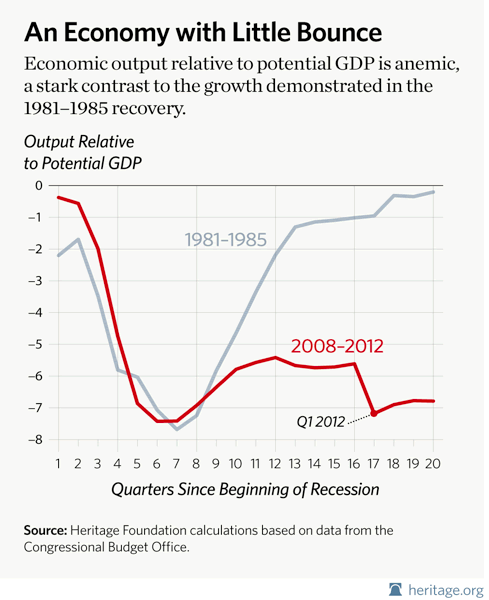
What should the economy’s recovery look like? Take a glance at history (and the chart below). Following the 1981-1982 recession — which looked a lot like the one America saw in 2008 in both depth and duration — the economy returned to near-full employment (which is around 5.5 percent) by 1984. Today, nearly three years after the most recent recession ended, the unemployment rate remains stuck well above 8 percent. So while the economy has grown for 10 straight quarters, it’s only done so at a measly 2.4 percent rate. In fact, it’s the slowest recovery America has seen in the post-war era. No wonder millions of Americans aren’t feeling the effects of the economic rebound and are voting their displeasure. (Article continued below chart.)

Even liberal economist / columnist Paul Krugman sees the economy for what it is. In a recent column in The New York Times, he wrote, “our economy remains deeply depressed” and that “every silver lining comes with a cloud.” So what’s bringing about that cloud? Why is this economy growing, and yet growing so slowly by comparison to the 1980s recovery?

While President Obama might like to take credit for the meager growth the economy is seeing, there’s an important fact to keep in mind. It’s the natural tendency for the economy to grow — and taking credit for its meager improvement is sort of like accepting kudos for the rising and setting of the sun. In fact, the President should of course (but never will) accept some blame for the fact that the economy isn’t growing faster. The policies Obama ushered in are markedly different from those that President Ronald Reagan adopted to unleash the economic recovery in the 1980s, and the results show the difference — a powerful recovery under Reagan, and weak recovery under Obama.

For starters, President Obama says he wants to encourage job creators to ramp up their economic engines, while at the same time he has proposed $2 trillion in higher taxes, much of which would fall on small businesses — the job creators. Add onto that a discouragingly successful policy of encouraging higher gas prices by opposing domestic energy production. This policy is so unpopular that eleven Democratic Senators voted with their Republican colleagues on Thursday to overturn the Obama decision to kill the Keystone XL pipeline. Proponents failed to get the 60 votes necessary to overturn the Keystone decision, but with Democratic support it came very close. Instead of tapping proven resources, Obama puts his faith in pie-in-the-sky renewable energy projects like Solyndra. No wonder Super Tuesday’s voters were worried about the economy.

On top of job-killing tax hikes and higher gas prices, President Obama continues to embrace the burden of untenably high spending and debt — which will of course motivate the left to call for even higher taxes — and you’re left with a mess of policies emanating from Washington signaling small businesses to hunker down instead of investing for the future. A better path for growth would be to enact a budget that curbs spending, reforms entitlements, and reforms the tax code to focus it on economic growth as proposed in Heritage’s Saving the American Dream plan — all of which would free the economy to grow at a faster rate than we’re witnessing today.

While any economic growth and job creation is welcome, a barely perceptible, incremental recovery doesn’t offer much hope for those Americans who can’t feel, see, or touch the fruits of recovery. Millions remain unemployed in the Obama economy, and Washington can and should do better for the American people.

__________

Thank you so much for your time. I know how valuable it is. I also appreciate the fine family that you have and your commitment as a father and a husband.

Sincerely,

Everette Hatcher III, 13900 Cottontail Lane, Alexander, AR 72002, ph 501-920-5733, lowcostsqueegees@yahoo.com

“Music Monday” Levon Helm 2007 interview with CBS

Uploaded by on Oct 16, 2007

Drummer and singer for The Band, Levon Helm, talks to Anthony Mason about losing his voice to cancer of the vocal chord, and how it returned years later. (CBSNews.com)

__________________________

Levon Helm

From Wikipedia, the free encyclopedia


Jump to: navigation, search

Levon Helm

Levon Helm performing in 2004 on the Village Green in Woodstock, New York.
Background information
Birth name Mark Lavon Helm
Born May 26, 1940(1940-05-26)
Elaine, Arkansas, United States
Died April 19, 2012(2012-04-19) (aged 71)
New York City, New York, United States
Genres Rock and roll, rhythm and blues, rock, blues, country, folk
Occupations Musician, songwriter, actor, producer
Instruments Vocals, drums, percussions, mandolin, guitar, bass, harmonica, banjo
Years active 1957–2012
Labels Capitol, Mobile Fidelity, MCA, Breeze Hill, Levon
Associated acts The Band, Ronnie Hawkins & The Hawks, Bob Dylan, Levon Helm’s Ramble on the Road, Levon Helm and The RCO All-Stars, Ringo Starr & His All-Starr Band
Website levonhelm.com

Mark Lavon “Levon” Helm (May 26, 1940 – April 19, 2012)[1] was an American rock multi-instrumentalist and actor who achieved fame as the drummer and frequent lead and backing vocalist for The Band.

Helm was known for his deeply soulful, country-accented voice, and creative drumming style highlighted on many of the Band’s recordings, such as “The Weight“, “Up on Cripple Creek“, “Ophelia” and “The Night They Drove Old Dixie Down“. His 2007 comeback album Dirt Farmer earned the Grammy Award for Best Traditional Folk Album in February 2008, and in November of that year, Rolling Stone magazine ranked him #91 in the list of The 100 Greatest Singers of All Time.[2] In 2010, Electric Dirt, his 2009 follow-up to Dirt Farmer, won the first ever Grammy Award for Best Americana Album, an inaugural category in 2010.[3] In 2011, his live album Ramble at the Ryman was nominated for the Grammy in the same category and won.[4]

On April 17, 2012, his wife and daughter announced on Helm’s website that he was “in the final stages of his battle with cancer” and thanked fans while requesting prayers.[5] Helm died on April 19, 2012, at Memorial Sloan-Kettering Cancer Center in New York City.[6][7]

Contents

 [hide

[edit] Biography

[edit] Early years

Helm was born in Marvell, Arkansas, and grew up in Turkey Scratch, a hamlet west of Helena, Arkansas, the son of Nell and Diamond Helm, who were cotton farmers and also great lovers of music who encouraged their children to play and sing. Young Lavon (as he was christened) began playing the guitar at the age of eight and also played drums during his formative years. He saw “Bill Monroe & his Blue Grass Boys” at the age of six and decided then to become a musician.

Arkansas in the 1940s and 50s was at the confluence of a variety of musical styles—blues, country and R&B—that later became known as rock and roll. Helm was influenced by all these styles listening to the Grand Ole Opry show on radio station WSM and R&B on radio station WLAC out of Nashville, Tennessee. He also saw traveling shows such as F.S. Walcott’s Rabbit’s Foot Minstrels that featured top African-American artists of the time.

Another early influence on Helm was the work of harmonica, guitarist and singer Sonny Boy Williamson II, who played blues and early rhythm and blues on the King Biscuit Time radio show on KFFA in Helena and performed regularly in Marvell with blues guitarist Robert Lockwood, Jr. In his 1993 autobiography, This Wheel’s on Fire – Levon Helm and the Story of The Band, Helm describes watching Williamson’s drummer, James “Peck” Curtis, intently during a live performance in the early 1950s and later imitating this R&B drumming style. Helm established his first band, The Jungle Bush Beaters, while in high school.

Helm also witnessed some of the earliest performances by Southern country music, blues and rockabilly artists such as Elvis Presley, Conway Twitty, Bo Diddley and a fellow Arkansan, Ronnie Hawkins. At age 17, Helm began playing in clubs and bars around Helena.

[edit] The Hawks

After graduating from high school, Helm was invited to join Ronnie Hawkins’ band, “The Hawks”, who were a popular bar and club act across the South and also in Canada, where rockabilly acts were very popular. Soon after Helm joined “The Hawks”, they moved to Toronto, Canada, where, in 1959, they signed with Roulette Records and released several singles, including a few hits.

Helm reports in his biography, This Wheel’s on Fire, that fellow “Hawks” band members had difficulty pronouncing “Lavon” correctly, and started calling him “Levon” (/ˈlvɒn/ LEE-von) because it was easier.

In the early 1960s Helm and Hawkins recruited an all-Canadian lineup of musicians: guitarist Robbie Robertson, bassist Rick Danko, pianist Richard Manuel and organist Garth Hudson– although all the musicians were multi-instrumentalists. In 1963, the band parted ways with Hawkins and started touring under the name “Levon and The Hawks,” and later as “The Canadian Squires” before finally changing back to “The Hawks.” They recorded two singles, but remained mostly a popular touring bar band in Texas, Arkansas, Canada, and on the East Coast of the United States, where they found regular summer club gigs on the New Jersey shore.

Helm with The Band, at the Santa Cruz Civic Auditorium 1976 Photo: David Gans

By the mid 1960s, songwriter and musician Bob Dylan was interested in performing electric rock music and asked “The Hawks” to be his backing band. Disheartened by fans’ negative response to Dylan’s new sound, Helm returned to Arkansas for what turned out to be a two-year layoff, being replaced by drummer Mickey Jones. During this period, Helm ended up working on off-shore oil rigs in the Gulf of Mexico until he was asked to rejoin the band.

After the “Hawks” toured Europe with Dylan, they followed him to live around Woodstock, New York, and remained under salary to him. The “Hawks” recorded a large volume of demo and practice tapes in Woodstock, playing almost daily with Dylan, who had completely withdrawn from public life the previous year. These recordings were widely bootlegged and were partially released officially in 1975 as The Basement Tapes. The songs and themes developed during this period played a crucial role in the group’s future direction and style. The “Hawks” members also began writing their own songs. Rick Danko and Richard Manuel also shared writing credits with Dylan on a few songs. In 1967, Danko called Helm and invited him to return to the band in Woodstock.

[edit] The Band

See also: The Band

Helm returned to the group, which by then was often referred to simply as “the band.” While contemplating a recording contract, Helm had dubbed the band as “The Crackers.” However, when Robertson and their new manager Albert Grossman worked out the contracts, the group’s name was cited as “The Band.” Under these contracts, “The Band” was contracted to Grossman, who in turn contracted their services to Capitol Records. This arrangement allowed “The Band” to release recordings on other labels if the work was done in support of Dylan. This allowed The Band to play on Dylan’s Planet Waves album and on The Last Waltz, both non-Capitol releases. “The Band” also recorded their own album Music from Big Pink, which catapulted them into stardom.

Helm, center, performing with The Band. Hamburg, 1971.

On Big Pink, Manuel was the most prominent vocalist and Helm sang mainly backup, with the exception of “The Weight.” However, as Manuel’s health deteriorated and Robbie Robertson‘s songwriting increasingly looked south for influence and direction, subsequent albums relied more and more on Helm’s vocals, alone or in harmony with Danko. Helm played drums for perhaps 85% of The Band’s songs,[citation needed] including most of those for which he sang lead. On the others, Manuel switched to drums while Helm played mandolin or, on rare occasion, guitar or bass guitar. The entire group was multi-instrumental and certain songs featured Manuel on drums, Helm on mandolin (as on “Evangeline”), rhythm guitar (the 12-string guitar backdrop to “Daniel and the Sacred Harp” is by Helm), or bass (while Danko played fiddle).[8]

Helm remained with “The Band” until their 1976 farewell performance, The Last Waltz, which was recorded in a documentary film by director Martin Scorsese. Many music enthusiasts know Helm through his appearance in the concert film, a performance remarkable for the fact that Helm’s vocal tracks appear substantially as he sang them during a grueling concert. However, Helm repudiated his involvement with The Last Waltz shortly after the final scenes were shot and. In his autobiography, Helm offers scathing criticisms of the film and of Robertson, who produced it.[9]

[edit] Solo artist and the reformed Band

Helm playing mandolin in 1971

With the breakup of “The Band” in its original form, Helm began working on a solo album Levon Helm and the RCO All Stars, followed by Levon Helm. Helm recorded solo albums in 1980 and 1982 entitled American Son and (once again) Levon Helm. Helm also participated in musician Paul Kennerley‘s 1980 country music concept album, The Legend of Jesse James, singing the role of Jesse James alongside Johnny Cash, Emmylou Harris and Albert Lee.

In 1983, “The Band” reunited without Robbie Robertson, with Jim Weider on guitar. In 1986, while on tour, Manuel committed suicide. Helm, Danko and Hudson continued in “The Band”, releasing the album Jericho in 1993 and High on the Hog in 1996. The final album from The Band was the 30th anniversary album, Jubilation, released in 1998.

In 1989, Helm and Danko toured with drummer Ringo Starr and His All-Starr Band. Other musicians in the band included singer/guitarist Joe Walsh, singer/pianist Dr. John, guitarist Nils Lofgren, singer Billy Preston, saxophonist Clarence Clemons and drummer Jim Keltner. Garth Hudson was a guest on accordion on certain dates. Levon played drums and harmonica, and sang “The Weight” and “Up On Cripple Creek” each night.

Helm performed with Danko and Hudson as “The Band” in 1990 at Roger Waters‘ epic The Wall – Live in Berlin Concert in Germany to an estimated 300,000 to half a million people.

In 1993, Helm published an autobiography entitled This Wheel’s on Fire – Levon Helm and the Story of The Band.

[edit] The Midnight Ramble

Helm’s performance career in the 2000s revolved mainly around the Midnight Ramble at his home and studio, “the Barn,” in Woodstock, New York. These concerts, featuring Helm and a variety of musical guests, allowed Helm to raise money for his medical bills and to resume performing after a nearly career-ending bout with cancer.

In the late 1990s, Helm was diagnosed with throat cancer suffering hoarseness. Advised to undergo a laryngectomy, Helm instead underwent an arduous regimen of radiation treatments at Memorial Sloan–Kettering Cancer Center in New York City. Although the tumor was then successfully removed, Helm’s vocal cords were damaged, and his clear, powerful tenor voice was replaced by a quiet rasp. Initially Helm only played drums and relied on guest vocalists at the Rambles, but Helm’s singing voice grew stronger. On January 10, 2004, he sang again of his Ramble Sessions. In 2007, during production of Dirt Farmer, Helm estimated that his singing voice was 80% recovered.

The “Levon Helm Band” featured his daughter guitarist Amy Helm, along with Larry Campbell, Teresa Williams, Jim Weider (the Band’s last guitarist), Jimmy Vivino, Mike Merritt, Brian Mitchell, Erik Lawrence, Steven Bernstein, Howard Johnson (tuba player in the horn section who played on “The Band”‘s “Rock of Ages” and “The Last Waltz” live albums), Byron Isaacs, and blues harmonica player Little Sammy Davis. Helm hosted Midnight Rambles at his home in Woodstock that were open to the public.

Helm performing in Central Park, New York, 2007

The Midnight Ramble was an outgrowth of an idea Helm explained to Martin Scorsese in The Last Waltz. Earlier in the 20th century, Helm explained, traveling medicine shows and music shows such as F.S. Walcott Rabbit’s Foot Minstrels, featuring African-American blues singers and dancers, would put on titillating performances in rural areas. This was also turned into a song by the Band, “The W.S. Walcott Medicine Show,” with the name altered so the lyric was easier to sing.

“After the finale, they’d have the midnight ramble,” Helm told Scorsese. With young children off the premises, the show resumed: “The songs would get a little bit juicier. The jokes would get a little funnier and the prettiest dancer would really get down and shake it a few times. A lot of the rock and roll duck walks and moves came from that.”

Artists who have performed at the Rambles include Helm’s former bandmate Garth Hudson, as well as Elvis Costello, Emmylou Harris, Dr. John, Chris Robinson, Allen Toussaint, Donald Fagen of Steely Dan and Jimmy Vivino of “Late Night with Conan O’Brien‘s” The Max Weinberg 7. Other performers have included Sean Costello, The Muddy Waters Tribute Band, Pinetop Perkins, Hubert Sumlin, Carolyn Wonderland, Kris Kristofferson, Gillian Welch, David Rawlings, Justin Townes Earle, Bow Thayer, Luther “Guitar Junior” Johnson, Rickie Lee Jones, Kate Taylor, Ollabelle, The Holmes Brothers, Catherine Russell, Norah Jones, Elvis Perkins in Dearland, Phil Lesh (along with his sons Grahame and Brian), Hot Tuna (although Jorma Kaukonen introduced the group as “The Secret Squirrels”), Michael Angelo D’Arrigo with various members of the Sistine Chapel, Johnny Johnson, Ithalia, David Bromberg, and Grace Potter and the Nocturnals[10].

As for his drumming, in recent years Helm switched to the matched grip and adopted a less busy, greatly simplified style, as opposed to his years with “The Band” when he played with the traditional grip.[11]

Helm was busy touring every year during 2000s, generally traveling by tour bus to venues in Eastern Canada and the Eastern United States. Since 2007, Helm had performed in large venues such the Beacon Theater in New York. Dr. John and Warren Haynes (The Allman Brothers Band, Gov’t Mule) and Garth Hudson played at the concerts as well along with several other guests. At a show in Vancouver, Canada, Elvis Costello joined to sing “Tears of Rage.” The “Alexis P. Suter Band” was a frequent opening act. Helm was a favorite of radio personality Don Imus and was frequently featured on Imus in the Morning. In the Summer of 2009, it was reported that a reality television series centering around the Midnight Ramble was in development.

[edit] Dirt Farmer and after

The Levon Helm Band performing at Austin City Limits Music Festival 2009

Levon Helm at Life is Good Festival in 2011

The Fall of 2007 saw the release of Dirt Farmer, Helm’s first studio solo album since 1982. Dedicated to Helm’s parents and co-produced by his daughter Amy, the album combines traditional tunes Levon recalled from his youth with newer songs (by Steve Earle, Paul Kennerley and others) which flow from similar historical streams. The album was released to almost immediate critical acclaim, and earned him a Grammy Award in the Traditional Folk Album category for 2007.

Helm declined to attend the Grammy Awards ceremony, instead holding a “Midnight Gramble” and celebrating the birth of his grandson, named Lavon (Lee) Henry Collins.[12][13][14]

In 2008, Helm performed at Warren HaynesMountain Jam Music Festival in Hunter, New York. Helm played alongside Warren Haynes on the last day of the three-day festival. Levon also joined guitarist Bob Weir and his band RatDog on stage as they closed out the festival. Helm performed to great acclaim at the 2008 Bonnaroo Music Festival in Manchester, Tennessee.[15][16]

Helm drummed on a couple of tracks for Jorma Kaukonen‘s February, 2009 album River of Time, recorded at the Levon Helm studio.

Helm released the album Electric Dirt on his own label on June 30, 2009.[17] The album won a best album Grammy for the newly created Americana category in 2010. Helm performed on the CBS Television program David Letterman Show on July 9, 2009. He also toured that same year in a supporting role with the band Black Crowes.

In March, 2010, a documentary on Helm’s day-to-day life titled Ain’t in It for My Health: A Film About Levon Helm was released. Directed by Jacob Hatley, it made its debut at the South by Southwest film festival in Austin, Texas, and went on to screen at the Los Angeles Film Festival in June 2009.[18]

On May 11, 2011, Helm released Ramble at the Ryman, a live album recorded during his September 17, 2008 performance at Nashville’s Ryman Auditorium. The album features Helm’s band playing six songs by “The Band” and other cover material, including some songs from previous Helm solo releases.[19] The album won the Grammy Award for Best Americana Album.[20]

[edit] Death

In 2012, during the Rock and Roll Hall of Fame Induction Ceremonies in New York City, Robbie Robertson sent “love and prayers” to Helm, fueling speculation on Helm’s health. Helm had previously cancelled several performances due to an alleged slipped disk in his back.[21]

On April 17, 2012, Helm’s wife Sandy and daughter Amy revealed that Helm had end-stage cancer. They posted the following message on Helm’s website:

“Dear Friends,
Levon is in the final stages of his battle with cancer. Please send your prayers and love to him as he makes his way through this part of his journey.
Thank you fans and music lovers who have made his life so filled with joy and celebration… he has loved nothing more than to play, to fill the room up with music, lay down the back beat, and make the people dance! He did it every time he took the stage…
We appreciate all the love and support and concern.
From his daughter Amy, and wife Sandy”[22]

Helm died on April 19, 2012, at 1:30 pm at Memorial Sloan-Kettering Cancer Center in New York.[23][24] A few days before his death, Robertson had a long visit with him at the hospital.[25]

[edit] Acting career

In addition to his work as musician, Helm also acted in several dramatic films after the breakup of The Band. His first acting role was the 1980 film Coal Miner’s Daughter in which he portrayed Loretta Lynn‘s father.

[edit] Filmography

[edit] Discography

[edit] With The Band

[edit] Solo and other works

[edit] Tributes

The subject of Elton John‘s song “Levon” was reportedly named after Helm.[27]

Marc Cohn wrote the song “Listening to Levon” in 2007. “The Man Behind the Drums,” written by Robert Earl Keen and Bill Whitbeck, appeared on Keen’s 2009 album The Rose Hotel

Open letter to President Obama (Part 87)

Uploaded by on Mar 6, 2012

Learn More at http://oversight.house.gov

The Oversight Committee is examining reports of food stamp merchants previously disqualified who continue to defraud the program. According to a Scripps Howard News Service report, food stamp fraud costs taxpayers hundreds of millions every year.

Watch the Oversight hearing live tomorrow at 930 AM EST at http://oversight.house.gov. Full hearing information is available here: http://oversight.house.gov/index.php?option=com_content&view=article&…

_______________________

President Obama c/o The White House
1600 Pennsylvania Avenue NW
Washington, DC 20500

Dear Mr. President,

I know that you receive 20,000 letters a day and that you actually read 10 of them every day. I really do respect you for trying to get a pulse on what is going on out here.

The Food Stamp Program is a very bad program and it is abused every day. It should be abolished.

Alison Meyer

March 9, 2012 at 4:35 pm

Food-stamp fraud and the government’s failed attempts to stop it were the focus of a House Oversight and Government Reform Committee hearing yesterday.

Chairman Darrell Issa (R-CA) called the hearing in response to a Scripps Howard News Service investigative report exposing widespread abuse. The investigation revealed that retailers who lost authorization to accept food stamps were still conducting business despite their restrictions.

“[D]ozens of individuals who had been banned as food-stamp vendors nonetheless remained in the business in New York; Los Angeles; Phoenix; San Diego; Tulsa, Okla.; West Palm Beach, Fla.; Baltimore and other communities across the country,” according to the report. Scripps Howard discovered this by comparing U.S. Department of Agriculture disqualification records against documents from health-inspection reports to business filings and corporate certificates.

At yesterday’s hearing, Kevin Concannon, undersecretary of the U.S. Department of Agriculture’s Food and Nutrition Service, defended the government’s efforts to combat fraud. He also cast blame on the messenger.

“As with other leads and observations we receive from the public, we took this information very seriously. We began an immediate investigation into all of the stores that were brought to our attention and we have added further layers of security to our retailer oversight process. However, our research indicates that many of the cases identified by Scripps Howard do not involve improper activity,” he said.

Scripps Howard isn’t the first to expose food-stamp fraud. Heritage’s Rachel Sheffield wrote last year on The Foundry that $2.5 billion in taxpayer money that was spent on improper food-stamp payments. Lawmakers such as Rep. Jim Jordan (R–OH) and Sen. Jim DeMint (R–SC) have proposed reforms to the program.

Issa, meanwhile, vowed to keep a watchful eye on USDA, demanding additional documents and information.

“With record numbers of Americans using food stamps, with an annual price tag of $75.3 billion, anything short of rigorous anti-fraud measures will be very costly to taxpayers,” Issa said.

The USDA should have been conducting the oversight that the Scripps Howard News Service was doing, according to Issa. “It was the government’s own databases that [Scripps] went to and discovered there was no enforcement under this administration,” he said.

The most common type of fraud is food-stamp trafficking where retailers encourage food-stamp recipients to trade their benefits for cash, alcohol or cigarettes. Once the card is swiped, the merchant takes full payment for the transaction’s stated price and pockets the difference, which can add up to $50,000 a month.

“The crime is as widespread as it is simple: Stores accept food stamps, but instead of requiring that customers walk away with wholesome groceries, they provide the customers a small amount of cash — typically 50 cents on the food stamp dollar. While taxpayers lose out — the money isn’t going toward wholesome food — food stamp recipients are receiving no-strings attached cash while stores are taking a hefty profit for serving as a moneychanger,” according to the Scripps Howard report.

This fraud comes at a high price to taxpayers. “According to Reuters, food stamp fraud accounts for just 1 percent of food stamp benefits, but equals about $750 million each year,” Issa wrote in a letter to USDA. “Since President Obama took office three years ago, the number of SNAP enrollees has dramatically increased. Today approximately 46.1 million people receive food stamps, with 14 million of those individuals enrolling since President Obama took office.  According to the Washington Times, SNAP enrolled six million new people in Fiscal Year 2011 at an increased cost of $7 billion.”

The Supplemental Nutrition Assistance Program, which administers food stamps, has a mission to address hunger and poverty. The SNAP website reads like an advertisement: “Only 86% of eligible District residents, and 41% of eligible low-income working families, receive SNAP/Food Stamps. Every $1 of SNAP/Food Stamps spent in the community generates $1.85 in local economic activity. D.C. would gain millions in federal funds by signing up eligible households — funds that would stimulate the local economy. People who work sometimes assume they are not eligible for SNAP/Food Stamps, or that time-off from work is required to apply. This is not true. A family of 3 with a minimum wage earner could be eligible for over $3,000 annually in benefits, and working families can complete phone interviews rather than go to the SNAP/Food Stamps office in-person.”

Under the Obama administration, the United States has seen a dramatic increase in the welfare state, making individuals more dependent on government.

“Now, more than 67.3 million Americans depend on the federal government for everything from food stamps and college tuition to retirement services and health care,” according to Heritage’s Index of Dependence on Government, which revealed an 8.1 percent increase at a cost of roughly $2.5 trillion.

__________

Thank you so much for your time. I know how valuable it is. I also appreciate the fine family that you have and your commitment as a father and a husband.

Sincerely,

Everette Hatcher III, 13900 Cottontail Lane, Alexander, AR 72002, ph 501-920-5733, lowcostsqueegees@yahoo.com