Monthly Archives: June 2012

“Friedman Friday”:“A Nobel Laureate on the American Economy” VTR: 5/31/77 Transcript and video clip (Part 2)

Milton Friedman on the American Economy (2 of 6)

Uploaded by on Aug 9, 2009

THE OPEN MIND
Host: Richard D. Heffner
Guest: Milton Friedman
Title: A Nobel Laureate on the American Economy VTR: 5/31/77
_____________________________________

Below is a transcipt from a portion of an interview that Milton Friedman gave on 5-31-77:

Friedman: General public ideas are much slower to move than intellectual ideas. That’s a fortunate thing. The public at large never moved as far in the direction of socialism and collectivism as the intellectual community did. They preserved a kind of a stability which kept us from going even faster than we did. One of the reasons in my opinion why Britain went so much faster toward a completely socialized state than we have gone is because the intellectual and ruling communities in Britain are more homogeneous and more nearly one. Well fortunately we have a much more diversified and varied set of elites. So I think the public at large never went as far as the intellectuals in that direction. And I am sure they are slow in turning around and going back the other way. I’m not saying that there has been any major trend in the public opinion at large, but only that in the intellectual community, in the community of the youngsters and young people who are coming up; no change in the older ones either.

You know, human beings have certain very common characteristics. It’s very hard for anybody to change his mind after he’s gotten to the age of 25 or 30 and gets set in his ways. It’s always fascinating to me. I had an interview this morning, a radio interview with a group of youngsters from a radio program called “Focus on Youth.” They were lively, energetic, bright; they were a wonderful group. They had a guest book in which they asked me to write a message and my name. And soothe message I wrote was “How is it that these bright, energetic, brilliant, dynamic young people turn within such few years into such deadly dull, unimaginative inactive adults?”

HEFFNER: You mean the rest of us?

FRIEDMAN: The rest of us. All of us. You’ve noticed this, I’m sure. You’re on the campus, on Rutgers. Haven’t you always been impressed by the contrast between…the liveliness and active minds of the young graduate students and of the opposite on the part of the settled, permanent tenured instructors?

HEFFNER: Well, we could argue that point out, Professor Friedman, at some point.

FRIEDMAN: I don’t want to overstate it. There’s an element to it. Well, going back to the main point, I believe it is true, and I’m sure you’re right and many people will believe that government owes them something. The point is that the first step in people’s conversion is never with respect to their own privileges but always with respect to somebody else. Everybody always knows he’s an exception. You ask people, “Do you think government should be cut down to size?” “Oh, of course.” “How about the program you benefit from?” “Oh, well, that’s a special case. That needs more money.” So I don’t believe there’s any contradiction between people saying “Gimme”, on the one hand; and these same people acting in another capacity to as to hold down the rate of growth in the state.

HEFFNER: You know, I would ask you the same question that I asked you a couple of years ago, and that is, why do you hold on, as it seems to me you do, hold on almost for dear life, to a kind of optimism despite all the things that you see and comment on in front of you? Why not recognize the situation for what it is, as you describe it so well, and then perhaps point ourselves in a different direction?

FRIEDMAN: Down the same road. There’s no different direction down that road. Don’t kid yourself. There just is no different direction down that road. This isn’t a strange road. We, you and I, who have been lucky enough to have been born in a free society, take freedom for granted as if it’s a natural phenomenon. But let me ask you, what fraction of the human race today lives in free societies?

HEFFNER: Tiny, tiny, tiny percentage.

FRIEDMAN: Over history, what fraction at any moment of time ever lived in free societies?

HEFFNER: Even tinier.

FRIEDMAN: Even tinier.

HEFFNER: I’m leading you down the garden path, Professor Friedman.

FRIEDMAN: No, you’re not. No, you’re not. It is true that the normal condition of mankind is tyranny and misery. We’ve escaped. We’ve been extraordinarily fortunate to escape into an island of freedom and prosperity. If we do not maintain that island of freedom, of prosperity, if we do not maintain the essential features of this society which made that freedom and prosperity possible, there isn’t a wide range of alternatives. We go to misery and tyranny, to the normal state of mankind. Why am I optimistic? Because we’re also ignorant. If we could really predict the future, you couldn’t be optimistic. But we’ve seen historically time and again that people have tried to make long-range predictions and not been very good at it. The human race is a funny thing. It’s always turning up surprises on you. People are capable of doing things you wouldn’t have expected to; of rising to the circumstance. And I suppose I maintain my optimism partly because my innate character is optimistic. But partly because the consequences of not recognizing our state of affairs, of not acting in time to check, seem to me so horrendous that I cannot but believe unless people realize the alternative before them they won’t take measures to make sure it doesn’t happen.

HEFFNER: Well, what took us into this little island of time in which we are so different or have enjoyed a difference from all the history of mankind?

FRIEDMAN: Well, that’s a very interesting question, and it’s one that can be spread more broadly. It’s a subject I’ve been very much interested in. From time to time in man’s history there have been golden ages. The fifth century B.C. in Greece, the Renaissance in Italy, the first Elizabethan period in England, the nineteenth century in Britain. We’re in the midst of what I regard as a golden age in the United States, the nineteenth and early twentieth centuries. Now, the interesting question is how is it here, to take it out of our own context, here’s the Greek peninsula. I refer to it as Peloponnesian, and somebody reminded me that it is not. What is it? It’s a different peninsula. At any rate, the area where…

HEFFNER: We’ll accept it as such.

FRIEDMAN: Okay. It was the same people there in the sixth century B.C. and in the fifth century B.C., the same people in the fourth century as in the fifth century. Why is it in the fifth century you have this sudden flowering, this enormously productive and brilliant period; it disappears in the fourth, third, second century B.C.? Why is it? Same people. Well, I think in many ways the fundamental explanation – and now I’m simplifying and conjecturing; this isn’t a solid, well-sustained hypothesis – is that some accident comes along which wipes the slate clean of restraints that have been holding people back. In our own golden age it’s very clear what that was. It was a new continent, with new people coming, with a new form of government, with a Constitution, the Declaration of Independence. It was an opportunity in which people were unrestrained and in which the natural instincts for people to improve their lot were given freest and fullest reign.

Well, what happens, and the reason these golden ages tend to be relatively brief, the reason they last 100 years, 150 years at most, is that as time passes the slate gets filled up. It’s very much easier to introduce restrictions and restraints than it is to remove them. It’s easier to pass a low than it is to repeal a low. And so over the course of time you tend to impose these chains and restraints on yourselves, mostly for good reasons. The initial objectives are always good. That doesn’t mean the outcome is. And finally, the slate becomes so full – if I may continue to use that image – that there’s no more room to write on, and you need somehow something which will provide for another removal of restraints.

HEFFNER: What do you think would provide now for a tabula rasa again, a wiping clear of the slate?

FRIEDMAN: Well, I think the first thing that’s necessary to wipe clear the slate is to set a limit to government spending. The thing that has been encroaching more and more upon that slate is that whereas until 1928 or 9, total government spending in the United States, federal, state and local, never exceeded ten percent of our income, except in the Civil War and the First World War. It has now risen to over 40 percent of our income. If that continues…well, 40 percent is an awful lot. In Britain now it’s reached somewhere between 50 and 60 percent. The first necessity, I think, as a tactical matter, is to set an end to that. As a strategic matter, the main necessity is to have a change in the intellectual climate of opinion which will substitute a belief in the individual responsibility for the false belief in social responsibility. Let me emphasize, the problems that have arisen for us have not come from evil people who were trying in conspiracy or anything like that to enslave us. That hasn’t been our problem. Our problems have arisen from good people who were trying to do good, but trying to do good is a fundamentally flawed way. The welfare state is in many ways a noble construct, a noble concept. It’s the concept that we ought to help our fellow men. What flaws it is that it’s one thing for you to help me out of your pocket; it’s another thing for your to help me out of his pocket. And the fundamental flaw of the welfare state, in my opinion, is the idea that you should do good with somebody else’s money.

An open letter to President Obama jh100

Barack Obama  (Photo by Saul Loeb-Pool/Getty Images)

 January 25, 2012

President Obama c/o The White House
1600 Pennsylvania Avenue NW
Washington, DC 20500

Dear Mr. President,

I know that you receive 20,000 letters a day and that you actually read 10 of them every day. I really do respect you for trying to get a pulse on what is going on out here.

Arkansans clearly see that if our leaders in Washington do not take the bull by the horns and pass the Balanced Budget Amendment that we will continue to head toward the direction we are going now. Soon and I am afraid sooner than you realize, we will be arriving where Greece is now. WE MUST AVOID HEADING TO GREECE AND THE PEOPLE OF ARKANSAS REALIZE THIS AND YOU DO NOT. THIS IS ONE OF THE MAIN REASONS YOU WILL BE DEFEATED IN 2012.

Cato Institute scholar Dan Mitchell is right about Greece and the fate of socialism:

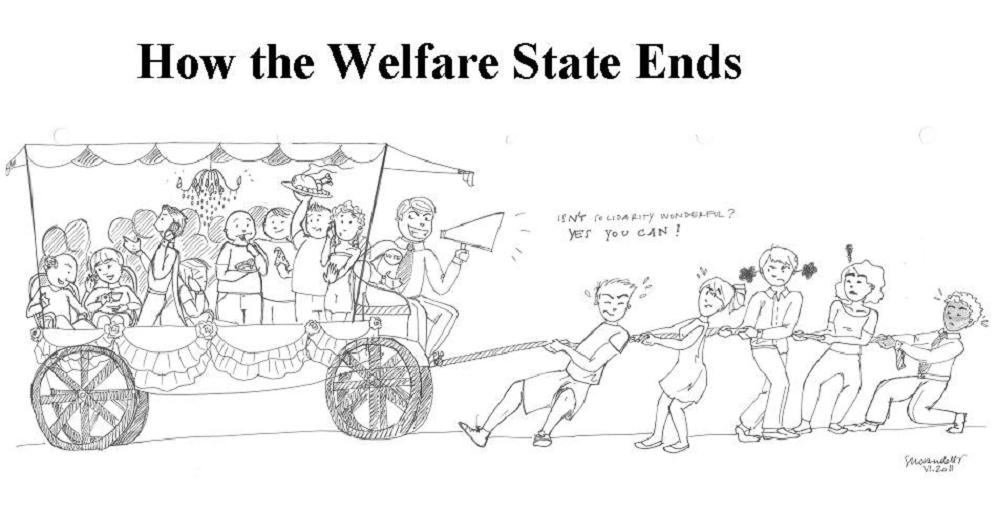
In my speeches, especially when talking about the fiscal crisis in Europe (or the future fiscal crisis in America), I often warn that the welfare state reaches a point-of-no-return when the number of people riding in the wagon begins to outnumber the number of people pulling the wagon.

To be more specific, if more than 50 percent of the population is dependent on government (employed in the bureaucracy, living off welfare, receiving pensions, etc), it becomes rather difficult to form a coalition to fix the mess. This may explain why Greek politicians have resisted significant reforms, even though the nation faces a fiscal death spiral.

But you don’t need me to explain this relationship. One of our Cato interns, Silvia Morandotti, used her artistic skills to create two images (click pictures for better resolution) that show what a welfare state looks like when it first begins and what it eventually becomes.

These images are remarkably accurate. The welfare state starts with small programs targeted at a handful of genuinely needy people. But as  politicians figure out the electoral benefits of expanding programs and people figure out the that they can let others work on their behalf, the ratio of producers to consumers begins to worsen.

Eventually, even though the moochers and looters should realize that it is not in their interest to over-burden the people pulling the wagon, the entire system breaks down.

Then things get really interesting. Small nations such as Greece can rely on permanent bailouts from bigger countries and the IMF, but sooner or later, as larger nations begin to go bankrupt, that approach won’t be feasible.

I often conclude my speeches by joking with the audience that it’s time to stock up on canned goods, bottled water, and ammo. Many people, I’m finding, don’t think that line very funny.

___________________

The Department of Health and Human Services administers the huge and fast-growing Medicare and Medicaid programs. These programs fuel rising health costs, distort health markets, and are plagued by waste and fraud. The department also runs an array of other expensive subsidy programs, including Head Start, TANF, and LIHEAP. Growth in HHS spending is creating a federal financial crisis, and the 2010 health care law sadly makes the situation worse.

The department will spend $910 billion in 2011, or $7,710 for every U.S. household. It employs 68,000 workers and runs more than 420 subsidy programs.

Thank you so much for your time. I know how valuable it is. I also appreciate the fine family that you have and your committment as a father and a husband.

Sincerely,

Everette Hatcher III, 13900 Cottontail Lane, Alexander, AR 72002, ph 501-920-5733, lowcostsqueegees@yahoo.com

Recent posts on Obamacare (including letters to the president and his responses)

Anyone who has followed this blog knows I have been writing letters to President Obama and he has actually responded 12 times now. Below are some videos and past posts about Obamacare and some of the open letters to the President are included with some of his responses:

Dear Senator Pryor, why not pass the Balanced Budget Amendment? (“Thirsty Thursday”, Open letter to Senator Pryor)

Sadly Senator Pryor has voted against the Balanced Budget Amendment over and over in his long time in the Senate. Senator Pryor: “There are a lot of people who think a balanced-budget amendment solves all the fiscal problems. I completely disagree.” (Peter Urban, Pryor Tilts Balanced Budget, Southwest Times Record, 11/17/11) Dear Senator Pryor, Why […]

Brantley and Obama want to go after the big bad wealthy again but they happen to be the job creators

President Obama and other politicians are advocating higher taxes, with a particular emphasis on class-warfare taxes targeting the so-called rich. This Center for Freedom and Prosperity Foundation video explains why fiscal policy based on hate and envy is fundamentally misguided. For more information please visit our web page: www.freedomandprosperity.org. _________________ President Obama really does stick to […]

Open letter to President Obama (Part 95)

Religious Liberty: Obamacare’s First Casualty Uploaded by HeritageFoundation on Feb 22, 2012 http://blog.heritage.org/2012/02/22/morning-bell-religious-liberty-under-attack/ | The controversy over the Obama Administration’s anti-conscience mandate and the fight for religious liberty only serves to highlight the inherent flaws in Obamacare. This conflict is a natural result of the centralization laid out under Obamacare and will only continue until […]

Milton Friedman – Socialized Medicine at Mayo Clinic in 1978

“Feedback Friday” Letter to White House generated form letter response June 15, 2012 on Healthcare (part 8)

I have been writing President Obama letters and have not received a personal response yet.  (He reads 10 letters a day personally and responds to each of them.) However, I did receive a form letter in the form of an email on June 15, 2012. I don’t know which letter of mine generated this response so I have […]

Open letter to President Obama (Part 93)

President Obama c/o The White House 1600 Pennsylvania Avenue NW Washington, DC 20500 Dear Mr. President, I know that you receive 20,000 letters a day and that you actually read 10 of them every day. I really do respect you for trying to get a pulse on what is going on out here. I wondered […]

Responding to Arkansas Times bloggers about Obamacare and abortion

On June 20, 2012 on the Arkansas Times Blog I asserted: Rude Rob Boston of Americans United favored President Obama speaking at Notre Dame but it turned out that after President Obama got the honorary degree he went out and now is going to force the catholic institutions to provide free abortions under Obamacare. (By […]

Randy Barnett Discusses ObamaCare at the Supreme Court

Uploaded by on Mar 26, 2012

http://www.cato.org/event.php?eventid=9074

Cato Institute Senior Fellow and Georgetown University law professor Randy E. Barnett discusses the arguments to be presented to the Supreme Court beginning March 26.

Rude Rob Boston favored Notre Dame giving Obama honorary degree but what came of that?

Uploaded by audotorg on May 13, 2009 Rob Boston of AU debates and defeats Bill Donahue on Obama’s invitation to speak at Notre Dame University. _________________ Rude Rob Boston favored President Obama speaking at Notre Dame but it turned out that after President Obama got the honorary degree he went out and now is going […]

Open letter to President Obama (Part 89)

Sen. Paul Delivers State of the Union Response – Jan. 24, 2012 Uploaded by SenatorRandPaul on Jan 24, 2012 Sen. Rand Paul delivered the following Republican response to President Barack Obama’s State of the Union Address this evening ______________ President Obama c/o The White House 1600 Pennsylvania Avenue NW Washington, DC 20500 Dear Mr. President, […]

Open letter to President Obama (Part 86)

Uploaded by HeritageForAmerica on Mar 5, 2012 If you listen to the media, conservatives are fading everywhere from Congress to the campaign trail. Nothing could be further from the truth; the strength of conservative principles continues to endure and thrive. There is an awakening across the country, and the fight is on to return power […]

Open letter to President Obama (Part 86)

Uploaded by HeritageForAmerica on Mar 5, 2012 If you listen to the media, conservatives are fading everywhere from Congress to the campaign trail. Nothing could be further from the truth; the strength of conservative principles continues to endure and thrive. There is an awakening across the country, and the fight is on to return power […]

Michael Tanner: “Time for Republicans to live up to the hype and get truly serious about cutting spending.”

Keynesian Economics Is Wrong: Bigger Gov’t Is Not Stimulus Uploaded by afq2007 on Dec 15, 2008 Based on a theory known as Keynesianism, politicians are resuscitating the notion that more government spending can stimulate an economy. This mini-documentary produced by the Center for Freedom and Prosperity Foundation examines both theory and evidence and finds that […]

Open letter to President Obama (Part 85.4)

Randy Barnett Discusses ObamaCare at the Supreme Court Uploaded by catoinstitutevideo on Mar 26, 2012 http://www.cato.org/event.php?eventid=9074 Cato Institute Senior Fellow and Georgetown University law professor Randy E. Barnett discusses the arguments to be presented to the Supreme Court beginning March 26. __________ President Obama c/o The White House 1600 Pennsylvania Avenue NW Washington, DC 20500 […]

Open letter to President Obama (Part 85.3)

Cato’s Michael F. Cannon Discusses ObamaCare’s Individual Mandate Uploaded by catoinstitutevideo on Mar 26, 2012 http://www.cato.org/event.php?eventid=9074 The individual mandate to purchase health insurance is the linchpin of the Patient Protection and Affordable Care Act. It is among the issues to be handled by the Supreme Court beginning March 26, 2012. Michael F. Cannon is the […]

Open letter to President Obama (Part 85.2)

Tim Sandefur Discusses ObamaCare’s Medicaid Expansion Uploaded by catoinstitutevideo on Mar 26, 2012 http://www.cato.org/event.php?eventid=9074 Tim Sandefur of the Pacific Legal Foundation explains some of the implications of the Affordable Care Act’s Medicaid expansion. ___________________ President Obama c/o The White House 1600 Pennsylvania Avenue NW Washington, DC 20500 Dear Mr. President, I know that you receive […]

John Brummett: President Obama has not been big spender

Dan Mitchell explains in the above video that Europe can grow and prosper, but only if politicians are willing to reduce the burden of government spending and lower tax rates. _____________ I have a lot of respect for Tea Party heroes like Tim Huelskamp and Justin Amash who are willing to propose deep spending cuts so we can eventually […]

Open letter to President Obama (Part 85)

President Obama c/o The White House 1600 Pennsylvania Avenue NW Washington, DC 20500 Dear Mr. President, I know that you receive 20,000 letters a day and that you actually read 10 of them every day. I really do respect you for trying to get a pulse on what is going on out here. It seems […]

Dear Senator Pryor, why not pass the Balance Budget Amendment? ( “Thirsty Thursday”, Open letter to Senator Pryor)

Dear Senator Pryor, Why not pass the Balanced  Budget amendment? As you know that federal deficit is at all time high (1.6 trillion deficit with revenues of 2.2 trillion and spending at 3.8 trillion). On my blog http://www.HaltingArkansasLiberalswithTruth.com I took you at your word and sent you over 100 emails with specific spending cut ideas. However, […]

Open letter to President Obama (Part 84.8)

Tim Sandefur Discusses ObamaCare’s Medicaid Expansion Uploaded by catoinstitutevideo on Mar 26, 2012 http://www.cato.org/event.php?eventid=9074 Tim Sandefur of the Pacific Legal Foundation explains some of the implications of the Affordable Care Act’s Medicaid expansion. _________________________ President Obama c/o The White House 1600 Pennsylvania Avenue NW Washington, DC 20500 Dear Mr. President, I know that you receive 20,000 […]

Open letter to President Obama (Part 84.7)

President Obama c/o The White House 1600 Pennsylvania Avenue NW Washington, DC 20500 Dear Mr. President, I know that you receive 20,000 letters a day and that you actually read 10 of them every day. I really do respect you for trying to get a pulse on what is going on out here. That is […]

Open letter to President Obama (Part 84.6)

Milton Friedman – Socialized Medicine at Mayo Clinic in 1978 President Obama c/o The White House 1600 Pennsylvania Avenue NW Washington, DC 20500 Dear Mr. President, I know that you receive 20,000 letters a day and that you actually read 10 of them every day. I really do respect you for trying to get a […]

Open letter to President Obama (Part 84.5)

Milton Friedman – Socialized Medicine at Mayo Clinic in 1978 President Obama c/o The White House 1600 Pennsylvania Avenue NW Washington, DC 20500 Dear Mr. President, I know that you receive 20,000 letters a day and that you actually read 10 of them every day. I really do respect you for trying to get a […]

Open letter to President Obama (Part 84.4)

Cato’s Michael F. Cannon Discusses ObamaCare’s Individual Mandate Uploaded by catoinstitutevideo on Mar 26, 2012 http://www.cato.org/event.php?eventid=9074 The individual mandate to purchase health insurance is the linchpin of the Patient Protection and Affordable Care Act. It is among the issues to be handled by the Supreme Court beginning March 26, 2012. Michael F. Cannon is the […]

Open letter to President Obama (Part 84.2)

__________ Milton Friedman – Socialized Medicine at Mayo Clinic in 1978 President Obama c/o The White House 1600 Pennsylvania Avenue NW Washington, DC 20500 Dear Mr. President, I know that you receive 20,000 letters a day and that you actually read 10 of them every day. I really do respect you for trying to get […]

Open letter to President Obama (Part 84.1)

President Obama c/o The White House 1600 Pennsylvania Avenue NW Washington, DC 20500 Dear Mr. President, I know that you receive 20,000 letters a day and that you actually read 10 of them every day. I really do respect you for trying to get a pulse on what is going on out here. It seems […]

France today: government spending is at 55 percent of GDP

The liberals in France do not want austerity but more spending but who will pay for their party? Morning Bell: Socialism Rises Again Mike Brownfield May 8, 2012 at 8:55 am Last weekend, the people of France took a sharp turn to the left, and the rest of Europe may be on the brink of […]

Open letter to President Obama (Part 79)

_ President Obama c/o The White House 1600 Pennsylvania Avenue NW Washington, DC 20500 Dear Mr. President, I know that you receive 20,000 letters a day and that you actually read 10 of them every day. I really do respect you for trying to get a pulse on what is going on out here. I […]

Open letter to President Obama (Part 77)

Sen. Toomey responds to State of the Union address 2012 Leader Cantor On CNN Responding To President Obama’s State of the Union Address Uploaded by EricCantor on Jan 25, 2012 Sen. Paul Delivers State of the Union Response – Jan. 24, 2012 President Obama c/o The White House 1600 Pennsylvania Avenue NW Washington, DC 20500 […]

Chris Martin of Coldplay unknowingly lives out his childhood Christian beliefs (Part 4 of notes from June 23, 2012 Dallas Coldplay Concert)

Coldplay – In My Place (Live in Dallas) June 22 2012

Published on Jun 24, 2012 by

Coldplay performing at American Airlines Center in Dallas, TX

Coldplay brought confetti, lights and thousands of fans to the American Airlines Center; see photos from their colorful show


7/11

Chris Martin was brought up as an evangelical Christian but he left the faith once he left his childhood home. However, there are been some actions in his life in the last few years that demonstrate that he still is grappling with his childhood Chistian beliefs. This is the fourth part of a series I am starting on this subject and today we will see how a few verses in the Book of Romans chapter one are relevant to a song written by Coldplay.

On June 23, 2012 my son Wilson and I got to attend a Coldplay Concert in Dallas. It was great. We drove down from our home in Little Rock, Arkansas earlier in the day. I wish they had played “Cemeteries of London” at the Dallas concert since I like that song a lot. Let me show you two points from the Book of Romans:

God reveals Himself in two Ways 

Lets take a look at the lyrics from the song “Cemeteries of London:”

God is in the houses
And God is in my head
And all the cemeteries of London
I see God come in my garden
But I don’t know what He said
For my heart, it wasn’t open
Not open

Romans chapter one clearly points out that God has revealed Himself through both the created world around us  and also in a God-given conscience that testifies to each person that God exists.
Notice in this song that the song writer notes, “I see God come in my garden” and “God is in my head.” These are the exact two places mentioned by the scripture.  Romans 1:18-20 (Amplified version)

18For God’s [holy] wrath and indignation are revealed from heaven against all ungodliness and unrighteousness of men, who in their wickedness repress and hinder the truth and make it inoperative.

19For that which is known about God is evident to them and made plain in their inner consciousness, because God [Himself] has shown it to them.

20For ever since the creation of the world His invisible nature and attributes, that is, His eternal power and divinity, have been made intelligible and clearly discernible in and through the things that have been made (His handiworks). So [men] are without excuse [altogether without any defense or justification],(B)

Concerning these verses Francis Schaeffer said:

The world is guilty of suppressing God’s truth and living accordingly. The universe and its form and the mannishness of Man speak the same truth that the Bible gives in greater detail.

This is what Chris Martin is having to deal with and he  is clearly searching for spiritual answers but it seems he have not found them quite yet. The song “42“: “Time is so short and I’m sure, There must be something more.” Then in the song “Lost” Martin sings these words: “Every river that I tried to cross, Every door I ever tried was locked..”
Solomon went to the extreme in his searching in the Book of Ecclesiastes for this “something more” that Coldplay is talking about, but he found riches (2:8-11), pleasure (2:1), education (2:3), fame (2:9) and his work (2:4) all “meaningless” and “vanity” and “a chasing of the wind.” Every door he tried was locked.

Solomon is searching for the meaning of life in the Book of Ecclesiastes and that reminds me a lot of the search that Chris Martin is currently in.  By the way, the final chapter of Ecclesiastes finishes with Solomon emphasizing that serving God is the only proper response of man. My prediction: I am hoping that Coldplay’s next album will also come to that same conclusion that Solomon came to in Ecclesiastes 12:13-14:
13 Now all has been heard;
here is the conclusion of the matter:
Fear God and keep his commandments,
for this is the whole duty of man.

14 For God will bring every deed into judgment,
including every hidden thing,
whether it is good or evil.

Kerry Livgren of Kansas found Christ eventually after first trying some Eastern Religions. I remember telling my friends in 1978 when “Dust in the Wind” was the number 6 song in the USA that Kansas had written a philosophical song that came to the same conclusion about humanistic man as Solomon did so long ago and I predicted that some members of that band would come to know the Christ of the Bible in a personal way. (Some rock bands  such as the “Verve“, claim that change is not possible, but it is when Christ comes in and changes someone.) You can hear Kerry Livgren’s story from this youtube link:

(part 1 ten minutes)

(part 2 ten minutes)

In the song Poppyfields” Chris Martin sings, ” People burying their dead…I don’t wanna die on my own here tonight.” That fatalistic view can also be seen in “Dust in the Wind.”

Here are the lyrics from the Kansas song “Dust in the Wind”:”

I close my eyes Only for a moment and the moment’s gone All my dreams Pass before my eyes with curiosity
Dust in the wind All they are is dust in the wind
Same old song Just a drop of water in an endless sea All we do Crumbles to the ground, though we refuse to see
(Aa aa aa) Dust in the wind All we are is dust in the wind Oh, ho, ho
Now don’t hang on Nothin’ last forever but the earth and sky It slips away And all your money won’t another minute buy
Dust in the wind All we are is dust in the wind (All we are is dust in the wind)
Dust in the wind (Everything is dust in the wind) Everything is dust in the wind (In the wind)

Coldplay – Cemeteries of London ( FULL VIDEO)

The brilliant video for Cemeteries of London. It’s the perfect mix between music and image, Coldplay sold around 8 million albums with Viva La Vida.

Ecclesiastes 1

Published on Sep 4, 2012

Calvary Chapel Spring Valley | Sunday Evening | September 2, 2012 | Pastor Derek Neider

_____________________

Ecclesiastes 2-3

Published on Sep 19, 2012

Calvary Chapel Spring Valley | Sunday Evening | September 16, 2012 | Derek Neider

_____________________________

_________________________________________

Related posts:

Chris Martin of Coldplay unknowingly lives out his childhood Christian beliefs (Part 8 of notes from June 23, 2012 Dallas Coldplay Concert)

Coldplay 6-22-12 Dallas, TX Best Opening.MOV Published on Jun 23, 2012 by jaimenolga 1 of Don’t miss the second song of this clip!! It was incredible! (One eye watching you song was great.) Coldplay brought confetti, lights and thousands of fans to the American Airlines Center; see photos from their colorful show Photo Gallery News […]

Chris Martin of Coldplay unknowingly lives out his childhood Christian beliefs (Part 7 of notes from June 23, 2012 Dallas Coldplay Concert)

Coldplay Live in Dallas – Lover’s in Japan Ball Drop Published on Jun 23, 2012 by TheRyanj64 Live From the American Airlines Center in Dallas Texas June 22, 2012 Coldplay – Lover’s in Japan Ball Drop Coldplay brought confetti, lights and thousands of fans to the American Airlines Center; see photos from their colorful show […]

Chris Martin of Coldplay unknowingly lives out his childhood Christian beliefs (Part 6 of notes from June 23, 2012 Dallas Coldplay Concert)

Coldplay – Yellow (Live) @ American Airlines Center Published on Jun 23, 2012 by Crwdickerson Coldplay Performing Yellow @ American Airlines Center Dallas June 22, 2012 Coldplay brought confetti, lights and thousands of fans to the American Airlines Center; see photos from their colorful show Photo Gallery News Sports Lifestyles Comments (0)   3/11 Chris […]

Chris Martin of Coldplay unknowingly lives out his childhood Christian beliefs (Part 5 of notes from June 23, 2012 Dallas Coldplay Concert)

Coldplay “paradise” Dallas Texas 6/22/12 ( Floor View ) Published on Jun 23, 2012 by ccam cher Awesome concert Coldplay brought confetti, lights and thousands of fans to the American Airlines Center; see photos from their colorful show Photo Gallery News Sports Lifestyles Comments (0)   9/11 Chris Martin was brought up as an evangelical […]

Chris Martin of Coldplay unknowingly lives out his childhood Christian beliefs (Part 4 of notes from June 23, 2012 Dallas Coldplay Concert)

Coldplay – In My Place (Live in Dallas) June 22 2012 Published on Jun 24, 2012 by maimiaa Coldplay performing at American Airlines Center in Dallas, TX Coldplay brought confetti, lights and thousands of fans to the American Airlines Center; see photos from their colorful show Photo Gallery News Sports Lifestyles Comments (0)   7/11 […]

Chris Martin of Coldplay unknowingly lives out his childhood Christian beliefs (Part 3 of notes from June 23, 2012 Dallas Coldplay Concert, Martin left Christianity because of teaching on hell then he writes bestselling song that teaches hell exists)

Viva La Vida Published on Jun 23, 2012 by TheRyanj64 Coldplay’s Viva La Vida at American Airlines Center in Dallas on June 22, 2012 __________ Coldplay brought confetti, lights and thousands of fans to the American Airlines Center; see photos from their colorful show Photo Gallery News Sports Lifestyles   Comments (0)   5/11 Chris […]

Chris Martin of Coldplay unknowingly lives out his childhood Christian beliefs (Part 2 of notes from June 23, 2012 Dallas Coldplay Concert)

Coldplay – Mylo Xyloto/Hurts Like Heaven (Live) @ American Airlines Center Coldplay brought confetti, lights and thousands of fans to the American Airlines Center; see photos from their colorful show Photo Gallery News Sports Lifestyles Comments (0)   2/11 Published on Jun 24, 2012 by Crwdickerson Coldplay Performing Mylo Xyloto/Hurts Like Heaven @ AAC Dallas […]

Chris Martin of Coldplay unknowingly lives out his childhood Christian beliefs (Part 1 of notes from June 23, 2012 Dallas Coldplay Concert)

Coldplay-DALLAS-2012-”Opening, Mylo Xyloto, and Hurts like Heaven!” Published on Jun 24, 2012 by ColdplayDALLAS2012 1:10 is where the concert starts! Sorry for the shaking and sound audio! It was really loud! AND AWESOME! Please THUMB UP and COMMENT if u went to this coldplay concert! And I also hope that this will get a few […]

“Music Monday” Chris Martin’s favorite song has a deep meaning

Uploaded by emimusic on Feb 28, 2009 Pre-VEVO play count: 22,581,204 Music video by The Verve performing Bitter Sweet Symphony. ________ At the 4.40 mark in the clip below Chris Martin identifies the best song ever written in his estimation: What does the song mean? Here is a thought off the internet: This song is […]

“Music Monday” Video interviews of Gwyneth Paltrow and Chris Martin (Part 2)

As far as I know they have never done an interview together. Therefore, I have included separate interviews that they have done below and I have some links to past posts I have done on them too. Gwyneth Paltrow & Robert Downey Jr. on Jonathan Ross 2010.04.23 (Part 1) Coldplay: Chris Martin and Jonny Buckland […]

Tom Landry of the Dallas Cowboys (Part 2)

Tom Landry was a committed Christian and look what impact a few words he had with a former player:

“Pat Summerall Here”
Theme of the Week: High-Profile Turnarounds
Tuesday, October 27, 2009

 1 of 1

Key Bible Verse: But God is so rich in mercy … that even though we were dead because of our sins, he gave us life (Ephesians 2:4). Bonus Reading: Ephesians 2:1-10

For 45 years Pat Summerall’s voice and face spelled football. After his own career as a star kicker, Pat went into broadcasting, at first covering golf and tennis. Teamed for years with John Madden, he was a Sunday afternoon voice of Fox TV NFL football.

But Pat was an only child whose parents divorced before he was born, leaving him feeling empty and alone. He became an alcoholic, living from drink to drink as his body broke down. During the 1994 Masters tournament, he faced up: “I’d been getting sick a lot, throwing up blood—and I got sick again at 4 a.m. I looked in the mirror, saw what a terrible sight I was, and said to myself, “‘This isn’t how I want to live.'”

Pat spent 33 days in the Betty Ford Center in Palm Springs, California. This helped alleviate his alcohol problems but didn’t address his spiritual vacuum. Then he bumped into his old coach, Tom Landry, who explained about his spiritual need and connected him with Dallas Cowboys chaplain John Weber. Pat’s life was transformed, and he was baptized at age 69.

“Summerall was once the life of every party with a drink in his hand,” Weber says. “Now he gets his power from another source.”

Wikipedia noted:

Landry played in the AAFC in 1949 for the New York Yankees, then moved in 1950 across town to the New York Giants. In 1946, the New York Giants had drafted Landry in the Seventh round of the college draft. He was drafted as a “Futures” pick, which was a rule in place at the time that allowed NFL teams to draft underclassmen, and hold their rights until the player had completed their college requirement. In 1948, the New York Yankees of the AAFC also drafted Landry.

Landry had just finished his final college football game, when Jack White[disambiguation needed ], who was an assistant coach for the Yankees, took Landry aside. He offered Landry a contract to play for New York in the AAFC. The contract was for $6,000, plus a $500 signing bonus. Landry used the bonus money to pay for a wedding with high school sweetheart, Alicia.

Landry’s career got off to a start after the Yankees starting punter was injured in the preseason, and Landry performed well in his place. The Yankees shared Yankee staduim with baseball’s beloved Yankees, and Landry remembered in his autobiography how in awe he was seeing names like DiMaggio, Rizzuto, and Ruffing above the lockers. Landry’s career began as a back-up to Yankees star running back Buddy Young. His first start would come against the AAFC’s powerhouse, the Cleveland Browns, coached by Paul Brown, and a roster full of future hall of famers like Lou Groza, Bill Willis, and Otto Graham. Landry did not have a good debut as a starter, Mac Speedie, the receiver he was assigned to cover, set an AAFC record for receiving yards in the game. It was after the game that Landry would learn his wife had given birth to their first child, a son.

After the 1949 season the AAFC folded, and the New York Yankees were not among the teams absorbed by the NFL. The New York Giants exercised their territorial rights and selected Landry in a dispersal draft. It would be under the guidance of Giants head coach Steve Owen that Landry would get his first taste of coaching. Instead of explaining the 6-1-4 defense to the players, Owen called Landry up to the front, and asked him to explain the defense to his teammates. Landry got up, and explained what the defense would do to counter the offense, and this became Landry’s first coaching experience. The 1953 season would be a season to forget, with the lowest point coming in a 62-10 loss at the hands of the Cleveland Browns. This loss would ultimately cost Coach Steve Owen his job, and would again have Landry pondering his future.[6] In 1954 he was selected as an all-pro. He played through the 1955 season, and acted as a player-assistant coach the last two years, 1954 through 1955, under the guidance of new Giants head coach Jim Lee Howell. Landry ended his playing career with 32 interceptions in only 80 games.

NFL coach

For the 1954 football season, Landry became the defensive coordinator for the Giants, opposite Vince Lombardi, who was the offensive coordinator. Landry led one of the best defensive teams in the league from 1956 to 1959. The two coaches created a fanatical loyalty within the unit they coached that drove the Giants to three appearances in the NFL championship game in four years. The Giants beat the Chicago Bears 47–7 in 1956, but lost to the Baltimore Colts in 1958 and 1959.

In 1960, he became the first head coach of the Dallas Cowboys and stayed for 29 seasons (1960–88). The Cowboys started with difficulties, recording an 0–11–1 record during their first season, with five or fewer wins in each of their next four. Despite this early futility, in 1964 Landry was given a ten year extension by owner Clint Murchison Jr. It would prove to be a wise move as Landry’s hard work and determination paid off, and the Cowboys improved to a 7–7 record in 1965. In 1966, they surprised the NFL by posting 10 wins, and making it all the way to the NFL championship game. Dallas lost the game to Lombardi’s Green Bay Packers, but this season was but a modest display of what lay ahead.

Throughout his tenure, Landry worked closely with the Cowboys general manager, Tex Schramm. The two were together during Landry’s entire tenure with the team. A third member of the Cowboys brain trust in this time was Gil Brandt.

The Great Innovator

Tom Landry sculpture.jpg

Tom Landry invented the now-popular “4-3 Defense“, while serving as Giants defensive coordinator.[7] It was called “4-3” because it featured four down lineman (two ends and two defensive tackles on either side of the offensive center) and three linebackers — middle, left, and right. The innovation was the middle linebacker. Previously, a lineman was placed over the center. But Landry had this person stand up and move back two yards. The Giants’ middle linebacker was the legendary Sam Huff.

Landry built the 4-3 defense around me. It revolutionized defense and opened the door for all the variations of zones and man-to-man coverage, which are used in conjunction with it today. —Sam Huff[8]

Landry also invented and popularized the use of keys (analyzing offensive tendencies) to determine what the offense might do.

When Landry was hired by the Dallas Cowboys, he became concerned with then-Green Bay Packers Coach Vince Lombardi‘s “Run to Daylight” idea, where the running back went to an open space, rather than a specific assigned hole. Landry reasoned that the best counter was a defense that flowed to daylight and blotted it out.

To do this, he refined the 4-3 defense by moving two of the four linemen off the line of scrimmage one yard and varied which linemen did this based on where the Cowboys thought the offense might run. This change was called “The Flex Defense,” because it altered its alignment to counter what the offense might do. Thus, there were three such Flex Defenses — strong, weak, and “tackle” — where both defensive tackles were off the line of scrimmage. The idea with the flexed linemen was to improve pursuit angles to stop the Green Bay Sweep — a popular play of the 1960s. The Flex Defense was also innovative in that it was a kind of zone defense against the run. Each defender was responsible for a given gap area, and was told to stay in that area before they knew where the play was going.

It has been said that, after inventing the Flex Defense, he then invented an offense to score on it, reviving the man-in-motion and starting in the mid-1970s, the shotgun formation. But Landry’s biggest contribution in this area was the use of “pre-shifting” where the offense would shift from one formation to the other before the snap of the ball. This tactic was not new. It was developed by Coach Amos Alonzo Stagg around the turn of the 19th to 20th century; Landry was the first coach to use the approach on a regular basis. The idea was to break the keys within the defense used to determine what the offense might do. An unusual feature of this offense was Landry having his offensive linemen get in their squatted pre-stance, stand up while the running backs shifted, and then go back down into their complete “hand down” stance. The purpose of the “up and down” movement was to make it more difficult for the defense to see where the backs were shifting (over the tall offensive linemen) and thus cut down on recognition time. While other NFL teams later employed shifting, few employed this “up and down” technique as much as Landry.

Landry also was ahead of his time in his philosophy of building a team. When the Packers were a dynasty in the 1960s with 245 lb (111 kg) guards and 250 lb (110 kg) tackles, he was busy stockpiling size for the next generation of linemen. Tackles Rayfield Wright stood 6 ft 6 in (1.98 m) and Ralph Neely weighed 265 lb (120 kg). Center Dave Manders weighed 250 lb (110 kg). All went on to block in Pro Bowls and Super Bowls in the 1970s.

The same with defense. The better linemen of the 1960s were the shorter, stockier, leverage players like Willie Davis, Alex Karras and Andy Robustelli. But Landry drafted the taller, leaner linemen like 6 ft 7 in (2.01 m) George Andrie and 6 ft 6 in (1.98 m) Jethro Pugh in the 1960s and later 6 ft 9 in (2.06 m) Ed Jones in the 1970s. Long arms allow for increased leverage in the pass rush. A quarter of a century later, all NFL teams covet pass rushers who resemble thickly muscled National Basketball Association (NBA) power forwards.

In the days before strength and speed programs, Landry brought in Alvin Roy and Boots Garland in the early 1970s to help make the Cowboys stronger and faster. Roy was a weightlifter and Garland a college track coach. Now every NFL team has specialty coaches.

Landry also was one of the first NFL coaches to search outside the traditional college football pipeline for talent. For example, he recruited several soccer players from Latin America, such as Efren Herrera and Raphael Septien, to compete for the job of placekicker for the Cowboys. Landry looked to the world of track and field for speedy skill position players. For example, Bob Hayes, once considered the fastest man in the world, was drafted by and played wide receiver for the Cowboys under Landry.[9]

Landry also was the first to employ a coach for quality control. Ermal Allen would analyze game films and chart the tendencies of the opposition for the Cowboys in the 1970s. That gave Landry an edge in preparation, because he knew what to expect from his opponent based on down and distance. Now every NFL team has a quality control coach, and most have two.

Landry produced a very large coaching tree. In 1986, five NFL head coaches were former Landry assistants: Mike Ditka, Dan Reeves, John Mackovic, Gene Stallings, and Raymond Berry.

Coaching in the Super Bowl

While Tom Landry’s Cowboys are known for their two Super Bowls against Chuck Noll and the Pittsburgh Steelers, Landry also led Dallas to three other Super Bowls, and were a Bart Starr quarterback sneak away from representing the NFL in the second Super Bowl. Tom Landry was 2-3 in Super Bowls, winning both in New Orleans and losing all three at Miami’s Orange Bowl Stadium.

Landry coached the Cowboys to their first Super Bowl win, defeating the Miami Dolphins 24-3, holding the Dolphins to a mere field goal. The Cowboys had now won their first Super Bowl, a year after losing a heart breaker to the Baltimore Colts. The Cowboys lost the first battle with the Steelers, in a game that is heralded as a classic. The rematch would be just as good, with the Cowboys being a Jackie Smith catch away from beating the Steelers in the rematch. Super Bowl XIII, the rematch, featured Cowboys Linebacker Thomas “Hollywood” Henderson saying famously “Terry Bradshaw couldn’t spell c-a-t if you spotted him the C and the T.” Landry recalled in his autobiography how he cringed when he heard that, because he didn’t feel that Bradshaw needed addition motivation in a big game like the Super Bowl.[6]

“The Power of the Market” episode of Free to Choose in 1990 by Milton Friedman (Part 3)

Milton Friedman The Power of the Market 3-5

How can we have personal freedom without economic freedom? That is why I don’t understand why socialists who value individual freedoms want to take away our economic freedoms.  I wanted to share this info below with you from Milton Friedman who has influenced me greatly over the last 30 plus years. Here is part three.

Two hundred years ago in Scotland, Adam Smith taught at the University of Glasgow. His brilliant book, The Wealth Of Nations, was based on the lectures he gave here.The basic principles underlying the free market, as Adam Smith taught them to his students in this University, are really very simple. Look at this lead pencil, there is not a single person in the world who could make this pencil. Remarkable statement? Not at all. The wood from which it’s made, for all I know, comes from a tree that was cut down in the State of Washington. To cut down that tree, it took a saw. To make the saw, it took steel. To make the steel, it took iron ore. This black center, we call it lead but it’s really compressed graphite, I am not sure where it comes from but I think it comes from some mines in South America. This red top up here, the eraser, a bit of rubber, probably comes from Malaya, where the rubber tree isn’t even native. It was imported from South America by some businessman with the help of the British government. This brass feral __ I haven’t the slightest idea where it came from or the yellow paint or the paint that made the black lines __ or the glue that holds it together. Literally thousands of people cooperated to make this pencil. People who don’t speak the same language; who practice different religions; who might hate one another if they ever met. When you go down to the store and buy this pencil, you are, in effect, trading a few minutes of your time for a few seconds of the time of all of those thousands of people. What brought them together and induced them to cooperate to make this pencil? There was no Commissar sending out orders from some central office. It was the magic of the price system __ the impersonal operation of prices that brought them together and got them to cooperate to make this pencil so that you could have it for a trifling sum.That is why the operation of the free market is so essential. Not only to promote productive efficiency, but even more, to foster harmony and peace among the peoples of the world.These people are crossing between two very different societies. This is Lo Wool, the official border crossing point between China and Hong Kong. Nowadays there’s a considerable amount of traffic at this border. People cross a little more freely than they use to. Many people from Hong Kong trade in China and the market has helped bring the two countries closer together, but the barriers between them are still very real. On this side of the border, people are free not only in the marketplace, but in all their lives. They are free to say what they want, to write what they want, to do pretty much as they please. Not so over there.That is why people in China who cannot get permission to leave go to desperate lengths to escape. They risk their lives in the process. Many lose their lives, but that doesn’t keep others from following. Some are attracted by the higher material standard of life in Hong Kong, but more by the natural human desire to be free.

The people who get official permission to leave China are fortunate. They are going to be able to enjoy the benefits of the economic freedom they will find in Hong Kong. More important, that will give them a much wider freedom.

Human and political freedom has never existed and cannot exist without a large measure of economic freedom. Those of us who have been so fortunate as to have been born in a free society tend to take freedom for granted __ to regard it as the natural state of mankind __ it is not. It is a rare and precious thing. Most people throughout history, most people today have lived in conditions of tyranny and misery, not of freedom and prosperity. The clearest demonstration of how much people value freedom is the way they vote with their feet when they have no other way to vote.

Of course, many of the people who pour into Hong Kong will end up in conditions that most of us in the West would find appalling. Hong Kong is very far from utopia. It has its slums, its crime, its desperately poor people. But the people are free. That’s after all, why so many of them have come here, despite having to live in leaky house boats in one of Hong Kong’s many small harbors. Here they have the freedom and the opportunity to better themselves, to improve their lot, and many succeed. There’s appalling poverty in Hong Kong, it’s true, but the conditions of the people have been getting better over time. They’re far better off now than they were when they first came across the border from China. And that poverty, appalling to us, because we’re accustomed to much higher standards of life, is not poverty as viewed by most of the people in the world. It’s the poverty to which they would aspire. A state of affairs they would like to achieve.

There is an enormous amount of poverty in the world everywhere. There is no system that’s perfect. There is no system that’s going to eliminate completely poverty in whatever sense. The question is, which system has the greatest chance? Which is the best arrangement for enabling poor people to improve their life? On that, the evidence of history speaks with a single voice. I do not know any exception to the proposition that if you compare like with like, the freer the system, the better off the ordinary poor people have been.

Ask yourself what it is that assures these garment workers in Hong Kong a good wage; not high by Western standards; but high enough to enable them to live far better than most people in the world. It is not government or trade union, these workers do well because there is competition for their labor and skills.

When a businessman faces trouble, a market threatens to disappear, or a new competitor arises, there are two things he can do. He can turn to the government for a tariff or quota or some other restriction on competition, or he can adjust and adapt. In Hong Kong the first option is closed. Hong Kong is too dependent on foreign trade so that the government has simply had to adopt a policy of complete noninterference. That’s tough on some individuals, but it is extremely healthy for the society as a whole. Only the businessmen who can adapt, who are flexible and adjustable survive and they create good employment opportunities for the rest.

The complete absence of tariffs or any other restrictions on trade is one of the main reasons why Hong Kong has been able to provide such rapidly rising standard of life for its people. Even Communist China recognizes Hong Kong’s success, it set up shop here and now excepts the universal symbol of capitalism. The Bank of China, the official bank of Communist China is the largest bank in Hong Kong. There’s no doubt that Communist China recognizes the power of the market.

In all this, the government of Hong Kong has played an important part, not only by what it has done, but as much by what it has refrained from doing. It has made sure that laws are enforced and contracts honored. It has provided the conditions in which a free market can work. Most importantly, it has not tried to direct the economic activities of the colony.

No government official is telling these people what to do. They are free to buy from whom they want, to sell to whom they want, to work for whom they want. Sometimes it looks like chaos and so it is, but underneath it’s highly organized by the impersonal forces of a free marketplace. The impersonal forces of a free marketplace at work back here in the United States, prices are the key. The prices that people are willing to pay for products determines what’s produced. The prices that have to be paid for raw materials, for the wages of labor, and so on, determine the cheapest way to produce these things.

In addition, these self same prices, the wages of labor, the interest on capital, and so on, determine how much each person has to spend on the market. It’s tempting to try to separate this final function of prices from the other two. To think that some how or other you can use prices to transmit the information about what should be produced and how it should be produced, without using those prices to determine how much each person gets. Indeed, government activity over the past few decades has been devoted to little else. But that’s a very serious mistake. If what people get is not going to be determined on what they produce, how they produce it, on how successfully they work, what incentive is there for them to act in accordance with the information that is transmitted. There is only one alternative: force __ some people telling other people what to do.

The fundamental principal of the free society is voluntary cooperation. The economic market, buying and selling, is one example. But it’s only one example. Voluntary cooperation is far broader than that.

Dear Senator Pryor, why not pass the Balanced Budget Amendment? (“Thirsty Thursday”, Open letter to Senator Pryor)

Sadly Senator Pryor has voted against the Balanced Budget Amendment over and over in his long time in the Senate. Senator Pryor: “There are a lot of people who think a balanced-budget amendment solves all the fiscal problems. I completely disagree.” (Peter Urban, Pryor Tilts Balanced Budget, Southwest Times Record, 11/17/11)

Dear Senator Pryor,

Why not pass the Balanced  Budget amendment? As you know that federal deficit is at all time high (1.6 trillion deficit with revenues of 2.2 trillion and spending at 3.8 trillion).

On my blog www.HaltingArkansasLiberalswithTruth.com I took you at your word and sent you over 100 emails with specific spending cut ideas. However, I did not see any of them in the recent debt deal that Congress adopted. Now I am trying another approach. Every week from now on I will send you an email explaining different reasons why we need the Balanced Budget Amendment. It will appear on my blog on “Thirsty Thursday” because the government is always thirsty for more money to spend.

Marco Rubio is one of your fellow citizens and he noted:

A balanced budget amendment would be a necessary step in reversing Washington’s tax-borrow-spend mantra. It would force Congress to balance its budget each year – not allow it to pass our problems on to the next generation any longer.

The Balanced Budget Amendment is the only thing I can think of that would force Washington to cut spending. We have only a handful of balanced budgets in the last 60 years, so obviously what we are doing is not working. We are passing along this debt to the next generation.

Thank you for this opportunity to share my ideas with you.

Sincerely,

Everette Hatcher, lowcostsqueegees@yahoo.com

 In my two short months in office, it has become clear to me that the spending problem in Washington is far worse than many of us feared. For years, politicians have blindly poured more and more borrowed money into ineffective government programs, leaving us with trillion dollar deficits and a crippling debt burden that threatens prosperity and economic growth.

In the Florida House of Representatives, where a balanced budget is a requirement, we had to make the tough choices to cut spending where necessary because it was required by state law. By no means was this an easy process, but it was our duty as elected officials to be accountable to our constituents and to future generations of Floridians. In Washington, a balanced budget amendment is not just a fiscally-responsible proposal, it’s a necessary step to curb politicians’ decades-long penchant for overspending.

Several senators have proposed balanced budget amendments that ensure Congress will not spend a penny more than we take in, while setting a high hurdle for future tax hikes. I am a co-sponsor of two balanced budget amendments, since it is clear that these measures would go a long way to reversing the spending gusher we’ve seen from Washington in recent years.

During my Senate campaign, while surrounded by the employees of Jacksonville’s Meridian Technologies, I proposed 12 simple ways to cut spending in Washington. That company, founded 13 years ago, has grown into a 200-employee, high-tech business, and the ideas I proposed would help ensure that similar companies have the opportunity to start or expand just like Meridian did.

To be clear, our unsustainable debt and deficits are threatening companies like Meridian and impeding job creation. In addition to proposing a balanced budget amendment, I recommended canceling unspent “stimulus” funds, banning all earmarks and returning discretionary spending to 2008 levels.

Fortunately, some of my ideas have found their way to the Senate chamber. The first bill I co-sponsored in the Senate was to repeal ObamaCare, the costly overhaul of our nation’s health care system that destroys jobs and impedes our economic recovery. Democratic leaders in the Senate have expressed their willingness to ban earmarks for two years after the Senate Republican conference adopted a moratorium. I have also co-sponsored the REINS Act, a common-sense measure that would increase accountability and transparency in our outdated and burdensome regulatory process. These bills, along with a balanced budget amendment, would help get our country back on a sustainable path and provide certainty to job creators.

While Republicans are proposing a variety of ideas to rein in Washington’s out-of-control spending, unfortunately, President Obama’s budget for the upcoming fiscal year proposes to spend $46 trillion, and even in its best year, the deficit would remain above $600 billion. Worst of all, the President’s budget completely avoids addressing the biggest drivers of our long-term debt – Social Security, Medicare and Medicaid.

Rather than tackle these tough, serious issues, President Obama is proposing a litany of tax hikes on small businesses and entrepreneurs, to the tune of more than $1.6 trillion. These tax increases destroy jobs, make us less competitive internationally and hurt our efforts to grow the economy and get our fiscal house in order.

A balanced budget amendment would be a necessary step in reversing Washington’s tax-borrow-spend mantra. It would force Congress to balance its budget each year – not allow it to pass our problems on to the next generation any longer.

Marco Rubio

Marco Rubio, a Republican, is a U.S. senator from Florida and former speaker of the Florida House of Representatives.

Cut the government by at least 10% should be our plan

Spending Cut Goal: 10% in Two Years

Posted by Chris Edwards

The new issue of International Economy has an article by Canada’s Liberal finance minister from the 1990s, Paul Martin, who succeeded in shrinking that country’s federal government. If a new President Mitt Romney wants to cut spending in Washington, Martin has some tips for him, such as cutting spending broadly, forecasting conservatively, and aiming to eliminate the deficit in a fixed time frame and sticking to it. (I’d also advise President Obama to follow the Canadian example, but he’s issued four budgets so far and seems to be more interested in following the Greek fiscal approach).

Paul Martin says:

I tabled the 1995 Budget in the House of Commons. No department of government escaped untouched. Transfers to the provinces for healthcare and education were reduced, public sector employment was cut by 20 percent, the Department of Transport was cut deeply, historic subsidies in the Department of Agriculture were eliminated, and spending in the Department of Industry was cut by 65 percent.

These were massive cuts, far greater than anything Canada had ever seen. Nor were the cuts simply reduction in the growth of future spending as is so often the case. These were absolute cuts in existing spending, such that by the end of the process the federal government’s expenditures as a percentage of GDP were lower than they had been at anytime in the previous fifty years.

From a libertarian perspective, Canada’s cuts weren’t actually “massive,” but for a Liberal government in a country with a population that had gotten used to government coddling, it was pretty impressive. As I noted in my recent article on Canada, Martin and his team cut the budget by 10 percent in just two years.

So my suggested goal for Romney and team if elected this Fall: at least match the Canadians and push for $380 billion of cuts out of otherwise expected spending in 2015 of $3.8 trillion. And do what the Canadians did: cut everything, including entitlements, aid to subnational governments, defense, business subsidies, farm subsidies, and much more in one big push. Many in Congress will resist of course, but presidents have their most leverage in the first year. Mitt will have nothing to lose but the country into a vortex of debt and economic despair if he doesn’t at least try.

National Debt Set to Skyrocket

National Debt Set to Skyrocket

Everyone wants to know more about the budget and here is some key information with a chart from the Heritage Foundation and a video from the Cato Institute.

In the past, wars and the Great Depression contributed to rapid but temporary increases in the national debt. Over the next few decades, runaway spending on MedicareMedicaid, and Social Security will drive the debt to unsustainable levels.

PERCENTAGE OF GDP

Download

National Debt Set to Skyrocket

Source: Heritage Foundation calculations based on data from the U.S. Department of the Treasury, Institute for the Measurement of Worth, Congressional Budget Office, and White House Office of Management and Budget.

Chart 20 of 42

In Depth

  • Policy Papers for Researchers

  • Technical Notes

    The charts in this book are based primarily on data available as of March 2011 from the Office of Management and Budget (OMB) and the Congressional Budget Office (CBO). The charts using OMB data display the historical growth of the federal government to 2010 while the charts using CBO data display both historical and projected growth from as early as 1940 to 2084. Projections based on OMB data are taken from the White House Fiscal Year 2012 budget. The charts provide data on an annual basis except… Read More

  • Authors

    Emily GoffResearch Assistant
    Thomas A. Roe Institute for Economic Policy StudiesKathryn NixPolicy Analyst
    Center for Health Policy StudiesJohn FlemingSenior Data Graphics Editor

Chris Martin of Coldplay unknowingly lives out his childhood Christian beliefs (Part 3 of notes from June 23, 2012 Dallas Coldplay Concert, Martin left Christianity because of teaching on hell then he writes bestselling song that teaches hell exists)

Viva La Vida

Published on Jun 23, 2012 by

Coldplay’s Viva La Vida at American Airlines Center in Dallas on June 22, 2012

__________

Coldplay brought confetti, lights and thousands of fans to the American Airlines Center; see photos from their colorful show

Chris Martin was brought up as an evangelical Christian but he left the faith once he left his childhood home. However, there are been some actions in his life in the last few years that demonstrate that he still is grappling with his childhood Chistian beliefs. This is the third part of a series I am starting on this subject. Today we will look at how the Bible has influenced the lyrics of Viva La Vida. (There are many interpretations of this song on the web.)

On June 23, 2012 my son Wilson and I got to attend a Coldplay Concert in Dallas. It was great. We drove down from our home in Little Rock, Arkansas earlier in the day. Viva La Vida was one of our favorite songs that did that night.

Here is an article I wrote a couple of years ago about Chris Martin’s view of hell. He says he does not believe in it but for some reason he writes a song that teaches that it exists:
Belief of Eternal Punishment in Grammy Winning Song
By Everette Hatcher
Chris Martin of the rock group Coldplay wrote the song Viva La Vida, and the song just won both the grammy for the “Song of the Year” and “Best Pop Performance by a duo or Group with Vocals.”
In this song, Martin is discussing an evil king that has been disposed. “I used to rule the world…Feel the fear in my enemy’s eyes…there was never an honest word and that was when I ruled the world, It was the wicked and wild wind, Blew down the doors to let me in, Shattered windows and the sound of drums, People couldn’t believe what I’d become…For some reason I can’t explain, I know Saint Peter won’t call my name,  Never an honest word, But that was when I ruled the world.”
Q Magazine asked Chris Martin about the lyric in this song “I know Saint Peter won’t call my name.” Martin replied, “It’s about…You’re not on the list. I was a naughty boy. Its always fascinated me that idea of finishing your life and then being analyzed on it…That is the most frightening thing you could possibly say to somebody. Eternal damnation. I know about this stuff because I studied it. I was into it all. I know it. It’s mildly terrifying to me. And this is serious.”
I have been following the career of Chris Martin for the last decade. He grew up in a Christian home that believed in Heaven and Hell, but made it clear several years ago that he actually resents those who hold to those same religious dogmatic views he did as a youth. Yet it seems his view on the possibility of an afterlife has changed again.
Chris Martin is a big Woody Allen movie fan like I am and no other movie better demonstrates the need for an afterlife than Allen’s 1989 film  Crimes and Misdemeanors.  It is  about a eye doctor who hires a killer to murder his mistress because she continually threatens to blow the whistle on his past questionable, probably illegal, business activities. Afterward he is haunted by guilt. His Jewish father had taught him that God sees all and will surely punish the evildoer.

But the doctor’s crime is never discovered. Later in the film, Judah reflects on the conversation his father had with Judah’s unbelieving Aunt May during a Jewish Sedar dinner  many years ago:

“Come on Sol, open your eyes. Six million Jews burned to death by the Nazi’s, and they got away with it because might makes right,” says Aunt May.

Sol replies, “May, how did they get away with it?”

Judah asks, “If a man kills, then what?”

Sol responds to his son, “Then in one way or another he will be punished.”

Aunt May comments, “I say if he can do it and get away with it and he chooses not to be bothered by the ethics, then he is home free.”

Judah’s final conclusion was that might did make right. He observed that one day, because of this conclusion, he woke up and the cloud of guilt was gone. He was, as his aunt said, “home free.”

The basic question Woody Allen is presenting to his own agnostic humanistic worldview is: If you really believe there is no God there to punish you in an afterlife, then why not murder if you can get away with it?  The secular humanist worldview that modern man has adopted does not work in the real world that God has created. God “has planted eternity in the human heart…” (Ecclesiastes 3:11). This is a direct result of our God-given conscience. The apostle Paul said it best in Romans 1:19, “For that which is known about God is evident to them and made plain in their inner consciousness, because God  has shown it to them” (Amplified Version).

It’s no wonder, then, that one of Allen’s fellow humanists would comment, “Certain moral truths — such as do not kill, do not steal, and do not lie — do have a special status of being not just ‘mere opinion’ but bulwarks of humanitarian action. I have no intention of saying, ‘I think Hitler was wrong.’ Hitler WAS wrong.” (Gloria Leitner, “A Perspective on Belief,” The Humanist, May/June 1997, pp.38-39). Here Leitner is reasoning from her God-givne conscience and not from humanist philosophy. It wasn’t long before she received criticism. Humanist Abigail Ann Martin responded, “Neither am I an advocate of Hitler; however, by whose criteria is he evil?” (The Humanist, September/October 1997, p. 2.). Humanists don’t really have an intellectual basis for saying that Hitler was wrong, but their God-given conscience tells them that they are wrong on this issue.

Evidently  Chris Martin who said he resented dogmatic religious views a few years ago, has now written a grammy winning song that pictures an evil king being punished in an afterlife. Could it be that his God-given conscience prompted him to put that line in? Or do men like Hitler get off home free as Woody Allen suggested in Crimes and Misdemeanors?

________

Even though Chris Martin says he does not believe in hell in this discussion below with Howard Stern he writes Viva La Vida (seen in clip at beginning of this post) where the bad king goes to hell. Again his childhood biblical views are coming out again.

On the Howard Stern Show Chris Martin was questioned about his religious beliefs on November 9, 2011:

CM: I was raised very religious.

HS: I know that. What religion?

CM: I am not really sure. People kept asking me that.

HS: You were studying religion but you don’t know what it was.

CM: It was Christian, but there are so many branches of that now. I don’t know which branch we were on.

HS: Are you a religious man?

CM: Not any more religious. I believe I am a spiritual guy I guess.

HS: Do you believe there is a heaven and a hell.

CM:There definately is not a hell. That is what made me stop being religious.

HS: Would you take your children to church or do you want them to get religious training?

CM: No. I think it is important to show that there is all these kinds of religions and this person believes that and you can believe whatever you want.

HS: What do you do if you want your children to get religious training and you want them to embrace all religions and get the concept of God? Where would take your kids to learn that?

CM:That is a good question. I have been doing it in the nihilist approach and I haven’t been taking them anywhere.

HS: So they are not going to be raised in any religious way.

CM: Not in any strict religious way, no…. Religion is not the same as having faith is it. Faith is different right. I am not saying I don’t believe in anything. I not saying that it has to be this and if you believe something else then the other person is going to hell and all that crap.

HS: I am with you on that.

Related posts:

Chris Martin of Coldplay unknowingly lives out his childhood Christian beliefs (Part 8 of notes from June 23, 2012 Dallas Coldplay Concert)

Coldplay 6-22-12 Dallas, TX Best Opening.MOV Published on Jun 23, 2012 by jaimenolga 1 of Don’t miss the second song of this clip!! It was incredible! (One eye watching you song was great.) Coldplay brought confetti, lights and thousands of fans to the American Airlines Center; see photos from their colorful show Photo Gallery News […]

Chris Martin of Coldplay unknowingly lives out his childhood Christian beliefs (Part 7 of notes from June 23, 2012 Dallas Coldplay Concert)

Coldplay Live in Dallas – Lover’s in Japan Ball Drop Published on Jun 23, 2012 by TheRyanj64 Live From the American Airlines Center in Dallas Texas June 22, 2012 Coldplay – Lover’s in Japan Ball Drop Coldplay brought confetti, lights and thousands of fans to the American Airlines Center; see photos from their colorful show […]

Chris Martin of Coldplay unknowingly lives out his childhood Christian beliefs (Part 6 of notes from June 23, 2012 Dallas Coldplay Concert)

Coldplay – Yellow (Live) @ American Airlines Center Published on Jun 23, 2012 by Crwdickerson Coldplay Performing Yellow @ American Airlines Center Dallas June 22, 2012 Coldplay brought confetti, lights and thousands of fans to the American Airlines Center; see photos from their colorful show Photo Gallery News Sports Lifestyles Comments (0)   3/11 Chris […]

Chris Martin of Coldplay unknowingly lives out his childhood Christian beliefs (Part 5 of notes from June 23, 2012 Dallas Coldplay Concert)

Coldplay “paradise” Dallas Texas 6/22/12 ( Floor View ) Published on Jun 23, 2012 by ccam cher Awesome concert Coldplay brought confetti, lights and thousands of fans to the American Airlines Center; see photos from their colorful show Photo Gallery News Sports Lifestyles Comments (0)   9/11 Chris Martin was brought up as an evangelical […]

Chris Martin of Coldplay unknowingly lives out his childhood Christian beliefs (Part 4 of notes from June 23, 2012 Dallas Coldplay Concert)

Coldplay – In My Place (Live in Dallas) June 22 2012 Published on Jun 24, 2012 by maimiaa Coldplay performing at American Airlines Center in Dallas, TX Coldplay brought confetti, lights and thousands of fans to the American Airlines Center; see photos from their colorful show Photo Gallery News Sports Lifestyles Comments (0)   7/11 […]

Chris Martin of Coldplay unknowingly lives out his childhood Christian beliefs (Part 3 of notes from June 23, 2012 Dallas Coldplay Concert, Martin left Christianity because of teaching on hell then he writes bestselling song that teaches hell exists)

Viva La Vida Published on Jun 23, 2012 by TheRyanj64 Coldplay’s Viva La Vida at American Airlines Center in Dallas on June 22, 2012 __________ Coldplay brought confetti, lights and thousands of fans to the American Airlines Center; see photos from their colorful show Photo Gallery News Sports Lifestyles   Comments (0)   5/11 Chris […]

Chris Martin of Coldplay unknowingly lives out his childhood Christian beliefs (Part 2 of notes from June 23, 2012 Dallas Coldplay Concert)

Coldplay – Mylo Xyloto/Hurts Like Heaven (Live) @ American Airlines Center Coldplay brought confetti, lights and thousands of fans to the American Airlines Center; see photos from their colorful show Photo Gallery News Sports Lifestyles Comments (0)   2/11 Published on Jun 24, 2012 by Crwdickerson Coldplay Performing Mylo Xyloto/Hurts Like Heaven @ AAC Dallas […]

Chris Martin of Coldplay unknowingly lives out his childhood Christian beliefs (Part 1 of notes from June 23, 2012 Dallas Coldplay Concert)

Coldplay-DALLAS-2012-”Opening, Mylo Xyloto, and Hurts like Heaven!” Published on Jun 24, 2012 by ColdplayDALLAS2012 1:10 is where the concert starts! Sorry for the shaking and sound audio! It was really loud! AND AWESOME! Please THUMB UP and COMMENT if u went to this coldplay concert! And I also hope that this will get a few […]

“Music Monday” Chris Martin’s favorite song has a deep meaning

Uploaded by emimusic on Feb 28, 2009 Pre-VEVO play count: 22,581,204 Music video by The Verve performing Bitter Sweet Symphony. ________ At the 4.40 mark in the clip below Chris Martin identifies the best song ever written in his estimation: What does the song mean? Here is a thought off the internet: This song is […]

“Music Monday” Video interviews of Gwyneth Paltrow and Chris Martin (Part 2)

As far as I know they have never done an interview together. Therefore, I have included separate interviews that they have done below and I have some links to past posts I have done on them too. Gwyneth Paltrow & Robert Downey Jr. on Jonathan Ross 2010.04.23 (Part 1) Coldplay: Chris Martin and Jonny Buckland […]