Monthly Archives: May 2012

Reasons why Mark Pryor will be defeated in 2014 (Part 12)

It is apparent from this statement below that Senator Mark Pryor is against the Balanced Budget Amendment. He has voted against it over and over like his father did and now I will give reasons in this series why Senator Pryor will be defeated in his re-election bid in 2014. However, first I wanted to quote the statement Senator Pryor gave on December 14, 2011. This information below is from the Arkansas Times Blog on 12-14-11 and Max Brantley:

THREE CHEERS FOR MARK PRYOR: Our senator voted not once, but twice, today against one of the hoariest (and whoriest) of Republican gimmicks, a balanced budget amendment. Let’s quote him:

As H.L. Mencken once said, “For every complex problem there is a solution which is simple, clean, and wrong.” This quote describes the balanced budget amendment. While a balanced budget amendment makes for an easy talking point, it is an empty solution. Moreover, it’s a reckless choice that handcuffs our ability to respond to an economic downturn or national emergencies without massive tax increases or throwing everyone off Medicare, Social Security, or veteran’s care.There is a more responsible alternative to balance the budget. President Clinton led the way in turning deficits into record surpluses. We have that same opportunity today, using the blueprint provided by the debt commission as a starting point. We need to responsibly cut spending, reform our tax code and create job growth. This course requires hard choices over a number of years. However, it offers a more balanced approach over jeopardizing safety net programs and opportunity for robust economic growth.

____________________

One of the biggest reasons that Senator Mark Pryor will not be re-elected in 2014 to the Senate is because EVEN THOUGH HE ASKS FOR SPENDING CUT IDEAS, HE REALLY DOESN’T WANT TO EMBRACE THEM. FOR INSTANCE, IN THIS ARTICLE BELOW BY JOHN STOSSEL THERE ARE PLENTY OF GREAT SUGGESTIONS BUT PRYOR HAS HEARD THEM ALL AND DOES NOT LIKE THEM BECAUSE HE LIKES SPENDING MORE!!!!

On August 4, 2011 John Brummett wrote:

The point is that we don’t need to choke our government — or, more to the point, ourselves — with such simplistic devices as balanced budget amendments. The point is that we need to make our often-essential deficit and debt more sustainable, more manageable, more responsible and less massive, and that we should do that by addressing both income and outgo.

You’re right, my tea party friend, about how government must change its ways. You’re not right, though, in the over-simplicity of your assessment or in the impractical, even drastic, nature of your remedies.

Brummett’s view used to be the majority view, but  in a recent poll by CNN over 70% now favor a Balanced Budget Amendment. I am starting a series today on the Balanced Budget Amendment!!!

Dear Senator Pryor,

Why not pass the Balanced Budget Amendment? As you know that federal deficit is at all time high (1.6 trillion deficit with revenues of 2.2 trillion and spending at 3.8 trillion).

On my blog www.HaltingArkansasLiberalswithTruth.com I took you at your word and sent you over 100 emails with specific spending cut ideas. However, I did not see any of them in the recent debt deal that Congress adopted. Now I am trying another approach. Every week from now on I will send you an email explaining different reasons why we need the Balanced Budget Amendment. It will appear on my blog on “Thirsty Thursday” because the government is always thirsty for more money to spend.

You are right to ask for ideas to cut spending because that is the real cause of the deficit. John Stossel rightly noted, “Milton Friedman always said taxes don’t tell the whole story. What counts is how much of our resources government spends, however it acquires them. The doubling of spending under Bush and Obama hasn’t gotten enough attention.”

Senator Pryor, you asked for spending cut advice. Here is some from John Stossel:

It’s not hard to balance the budget. On my show, we made enough cuts to create a $237 billion surplus. I cut whole departments, like Education and Commerce. I cut two-thirds of the Defense Department (which still leaves it much bigger than China’s). I indexed Medicare, Medicaid and Social Security to inflation, raised the retirement age, and took away benefits for rich people. But I don’t have to run for office. Congressmen do, and they can’t even manage to cut ridiculous tax breaks like those for ethanol.

Thank you again for your time.

Everette Hatcher, lowcostsqueegees@yahoo.com

Balancing the Budget

By John Stossel

8/3/2011

The political class predicted “disaster” if Congress didn’t raise its debt limit.

I think that was a scam to get more money. See, the poor politicians don’t have enough, and they need to borrow more. We taxpayers are cheap. This year we’ll give them only $2.2 trillion. They want to spend $3.8 trillion.

The president said if he didn’t get more money, Social Security checks wouldn’t go out. Why not?

With $2 trillion, they can pay Social Security, Medicare, the interest on the debt and still have billions left. It’s billions more than the government spent when President George W. Bush took office. What’s the problem?

The problem is that Republicans and Democrats under Bush and President Obama doubled spending. Now, Obama wants more taxes.

Taxes shouldn’t be the answer when spending is the problem.

Grover Norquist, who heads Americans for Tax Reform (ATR), leads the charge to keep the focus on spending. Norquist and ATR are famous for asking officeholders and candidates to sign a pledge not to raise taxes. Some say he is the reason the debt-ceiling debate was so drawn out.

“I think the reason there isn’t a tax increase on the table,” he told me, “is that 235 members of the House of Representatives signed a pledge never to raise taxes, a pledge to their voters, and 41 senators did. …

“Only if you take tax increases off the table do you even begin to … focus on spending, and that’s what Obama wants to keep our focus off of. He wants us to talk about the deficit, not spending.”

I pointed out that Obama might have scored points with the public because new revenues he sought — even though they wouldn’t do much to shrink the deficit — would come from closing unpopular tax “loopholes.”

Norquist said he favors that — if tax rates are lowered at the same time.

“(We) want to simplify the code,” he said. “(We) want to take a lot of the goodies that politicians have laced into that code … as long as you reduce tax rates and it’s not a hidden tax increase.”

Milton Friedman always said taxes don’t tell the whole story. What counts is how much of our resources government spends, however it acquires them. The doubling of spending under Bush and Obama hasn’t gotten enough attention.

“We need to ask what it is government should do,” Norquist said. “But it’s going to be knockdown, drag-out. All government overspending creates the constituency for its own perpetuation. … Weaning people off, that is very difficult.”

He’s right. When politicians make little cuts in the rate of spending growth, every interest group mobilizes to protect its little piece of the pie. That’s why you must cut government like you take off a Band-Aid: quickly and all at once.

It’s not hard to balance the budget. On my show, we made enough cuts to create a $237 billion surplus. I cut whole departments, like Education and Commerce. I cut two-thirds of the Defense Department (which still leaves it much bigger than China’s). I indexed Medicare, Medicaid and Social Security to inflation, raised the retirement age, and took away benefits for rich people. But I don’t have to run for office. Congressmen do, and they can’t even manage to cut ridiculous tax breaks like those for ethanol.

Obama predicted disaster if the debt ceiling wasn’t raised. Some predict disaster if the ratings agencies downgrade Treasury bonds. I’m dubious. In 1995, President Clinton and Republican Congress couldn’t agree on a budget, so the government shut down twice, the second time for three weeks.

Did the economy grind to a halt? No. During the first shutdown, the stock market went up. During the second, it dropped then recovered.

The alarmists screamed that the fight over the debt ceiling would discourage lenders. Wrong. Ten-year Treasury bonds sold for a measly 3 percent interest (versus 15 percent in 1981).

I wasn’t worried that Congress would fail to raise the debt ceiling. But I am worried that Congress will keep spending.

John Stossel

John Stossel is host of “Stossel” on the Fox Business Network. He’s the author of “Give Me a Break” and of “Myth, Lies, and Downright Stupidity.” To find out more about John Stossel, visit his site at johnstossel.com.

SEC football national championships through the years

Tennessee's head coach Phil Fulmer celebrates on stage with Tee Martin behind him and the Sears National Championship trophy after winning the 1998 National Championship game.

Tennessee’s head coach Phil Fulmer celebrates on stage with Tee Martin behind him and the Sears National Championship trophy after winning the 1998 National Championship game (Which was the first BCS championship.)

BCS Championship Highlight – LSU vs. Alabama

_____________

(Arkansas Sports 360 notes the large new stadium video board at Fayetteville for the Razorbacks. We seem to everything the biggest and the best in the SEC.)

Everyone knows the SEC is the best in football. Take a look at this article from the LA Times:

SEC is consistently better, with a little bit of luck

CHRIS DUFRESNE / ON COLLEGE FOOTBALL

With Louisiana State facing Alabama, the conference will win its eighth title of 14-year BCS era. The SEC cares more and draws from exceptionally talented base, and has pounced on missteps of others.

January 08, 2012|Chris Dufresne

Reporting from New Orleans — The malaise plaguing a football-viewing nation outside the four upcoming quarters near the French Quarter has been diagnosed as “SEC fatigue.”

The Southeastern Conference on Monday is guaranteed its sixth straight national title, and to lose its first, because the league is hoarding both spots of this year’s Bowl Championship Series game.

No.1 Louisiana State seeks its third BCS crown since 2002 against a No. 2 Alabama squad that hasn’t won it all since, um, 2009.

This is such an inside job that Nick Saban, coaching Alabama now, led LSU to the BCS title in 2003.

The SEC will win its eighth title of the 14-year BCS era. The SEC has had five different school champions: LSU, Alabama, Florida, Tennessee and Auburn.

“What makes our league very, very good is that there’s a lot of good teams and a lot of good competition,” Saban said Sunday at his final pregame news conference.

The SEC has been, inarguably, college football’s best conference for a long time.

Why?

“We do more to be good than other teams,” LSU center P.J. Longeran offered.

Has the SEC produced any of the greatest teams of the modern era?

Well, no.

You could not reasonably rank the best BCS champion from the SEC ahead of Miami of 2001, USC of 2004 or Florida State of 1999.

Alabama’s title team of 2009, arguably the best SEC team of the era, might not rank ahead of Texas’ 2005 team.

This year’s LSU squad, if it wins, would be in the conversation based on its top-tier performance and a killer non-conference schedule.

“The only team I’ve told them not to schedule was the Green Bay Packers,” LSU Coach Les Miles quipped.

Mostly, though, the SEC has just been consistently better than everyone else.

Part of it is caring more and paying more.

“The high school football is at a higher level,” Alabama defensive coordinator Kirby Smart said. “Coaches are paid more. So the more you pay the coaches, the better quality players you get, the better quality programs you get.”

Consider the caliber of SEC coaches who have won national titles: Steve Spurrier (pre-BCS), Nick Saban, Urban Meyer, Les Miles. Think of the coach who has averaged 10 wins a year, Georgia’s Mark Richt, but hasn’t won.

“I feel like our coaches have a little bit more edge than other conferences,” Alabama middle linebacker Dont’a Hightower said. “I feel like the players are a little more versatile and athletic.”

No argument there. Monday’s game will be chock-full of future NFL talent.

And while the SEC might not have produced a truly dominant team, the league as a collective is always positioned to pounce on the missteps of others.

Alabama wouldn’t be in this game had Stanford, Oklahoma State and Boise State not dropped the ball with eliminating defeats.

Then, when the SEC gets in the title game, it doesn’t lose. The league’s first BCS defeat will come at its own hands.

The SEC, dare we say, also has been lucky.

Tennessee would not have advanced to the 1998 inaugural game had Arkansas quarterback Clint Stoerner not fumbled without being touched.

Remember that one?

Because of a five-alarm BCS fiasco in 2003, LSU didn’t even have to play the No.1 team in the nation. USC was first in both polls entering the postseason but finished third to Oklahoma and LSU in the final BCS standings. LSU should have played USC that year, not Oklahoma, coming off an embarrassing Big 12 title-game loss to Kansas State.

The SEC began its string of six straight BCS titles in 2006, the year Florida successfully campaigned against an Ohio State-Michigan rematch in the title game.

Hypocritically, this year, the SEC campaigned for a rematch between LSU and Alabama.

Florida, in 2006, sneaked ahead of Michigan in the final BCS standings and defeated Ohio State for the championship.

In 2007, two-loss LSU took advantage of a wild sequence of final weekend upsets and jumped from No. 7 to No. 2 in a span of 24 hours to earn the right to beat Ohio State for the BCS title.

In 2008, Florida recovered from a home loss to Mississippi, which inspired the now-famous Tim Tebow “never again” postgame speech. The Gators went on to beat Oklahoma for the title.

In 2009, Alabama narrowly escaped a road loss at Tennessee and caught a huge break in the title game when Texas quarterback Colt McCoy was knocked out of the game early with an arm injury.

Last season, Auburn survived several near misses, including a Clemson player dropping the game-winning touchdown in overtime.

Auburn defeated Oregon in the title game, 22-19, on a last-second field goal.

Most conferences would rather be lucky than good — the SEC has been both.

It will continue to dominate until somebody stops it.

The SEC’s elite teams play better defense, build from an inside-out foundation and probably spend more time thinking about football.

After all the crazy Alamo bowls scores settled, we get a rematch of teams that combined for five field goals in November.

Monday’s final tally won’t be 67-56. The winning team, unlike in the Orange Bowl, won’t score 70.

This is the SEC’s block (and tackle) party.

“I’d expect it to be big-boy football,” Miles said.

If you don’t like it, well, tough.

This was an SEC invitation only, and you weren’t invited.

chris.dufresne@latimes.com

SEC Football History: National ChampionshipsSince 1920, SEC football teams have captured 30 National Championships (depending on which poll you rely on). They are:

    • Alabama — (10); 1934, 1941, 1961, 1964, 1965, 1973, 1978, 1979, 1992 and 2009;
    • Georgia – (2); 1942 and 1980;
    • Tennessee – (6); 1938, 1940, 1950, 1951, 1967, 1998;
    • Arkansas (1); 1964 (went 11-0; shared title with 1 loss Alabama — thanks to RM for this info);
    • Auburn (1); 1957; 2010
    • LSU (3); 1958, 2003, 2007;
    • Ole Miss (3); 1959, 1960, 1962; and,
    • Florida (3); 1996, 2006, 2008.

Read more from original site: http://www.secsportsfan.com/sec-football-history.html#ixzz1uwbEBz00

John Ward, former 'Voice of the Vols', left, and Tennessee coach Phillip Fulmer hold the 1998 national championship trophy during a 10-year anniversary tribute at Saturday's Orange and White Game at Neyland Stadium.<br /><br /><br />

Photo by Clay Owen

John Ward, former ‘Voice of the Vols’, left, and Tennessee coach Phillip Fulmer hold the 1998 national championship trophy during a 10-year anniversary tribute at Saturday’s Orange and White Game at Neyland Stadium.

Obama brags of progress in USA on economy to G-8 audience

1,000 Days Without A Budget

Uploaded by on Jan 24, 2012

http://blog.heritage.org | Today marks the 1,000th day since the United States Senate has passed a budget. While the House has put forth (and passed) its own budget, the Senate has failed to do the same. To help illustrate how extraordinary this failure has been, our new video highlights a few of impressive feats in history that have been accomplished in less time.

________________

It seems ironic to me that we have not had a budget passed by the Senate for over three years yet we have President Obama bragging to the G-8 audience that he has made a lot of progress getting measures passed that have helped the U.S. economy.

Mike Brownfield

May 21, 2012 at 3:39 pm

Europe is in bad shape, there’s no doubt about it. The sovereign debt crisis continues to roil the continent, Greece may leave the euro, Spain may have to revise its budget deficit upward for the second time because of bad loans, and France has a new socialist president pledging more spending instead of austerity. So when the G8 leaders met last week, President Obama had some words of advice to offer — “Look at me and learn from my stellar example!”

OK, that’s a paraphrase, but his actual words aren’t all that much different. No joke, the president who has presided over a downgraded credit rating, three years without a budget, an exploding deficit, an entitlement system desperately in need of reform, and an unemployment rate still over 8 percent has painted himself as a model for others to follow.

Quite remarkably, the president bragged that he has worked to “bring down our deficits and debt over the longer term” while staying “focused on growing the economy and creating jobs in the immediate term.” Though he acknowledges that “Of course, we still have a lot of work to do,” he says that now there’s “room to take a balanced approach to reducing our deficit and debt, while preserving our investments in the drivers of growth and job creation over the long term — education, innovation, and infrastructure for the 21st century.”

In other words, because of his supposed successes, America can afford to spend even more money on stimulus.

It’s hard to say whether the president’s intended audience was the leaders of the G8 or the American electorate, but regardless of who it was, there’s not much for Obama to brag about.

In the past four years, unemployment has gone up, more people are unemployed longer, gas prices are higher, the cost of health care insurance has increased, the national debt is higher, federal spending has increased, more Americans are on food stamps, regulatory costs are higher, home values have declined, America’s economic recovery is historically slow, and while federal spending on education has increased, results remain flat. You can see for yourself just how bad America’s fiscal outlook is in Heritage’s 2012 edition of the Federal Budget in Pictures.

Though Europe needs solutions, they certainly shouldn’t be looking at President Obama for the answers.

“The SEC is the best in football” is acknowledged but still causes hard feelings

For over 25 years now I have been attending a convention twice a year that has been held at major cities throughout the country. During these long hours in a booth I have the opportunity to make small talk with people from all across the country. Usually there are lots of shirts I see from major football schools and I have enjoyed asking this one simple question: “Which conference do you think has the best football?”

I used to get these responses:

In the west they would say, “The PAC 12.”

In Chicago they would say, “The Big 10.”

In Orlando they would say, “The SEC.”

In Washington D.C. they would say many different conferences (The Big 12, SEC, PAC 12) and sometimes they would say “The ACC or Big East,” but then they would usually laugh.

However, after Ohio State got beat twice in a row by SEC schools for the BCS championship, everyone has responded the same in the last 3 years!!!! They all say the SEC is the best!!! (Sometimes people will say their favorite conference but they will laugh and say it is really the SEC.)

None of the people I have visited have shown any hard feelings and resentment, but that is not true for the head man of the Big Ten Conference.

Big Ten’s Jim Delany needs to get over SEC obsession

11:46 PM, May. 13, 2012 

__________

Jim Delany

 
Big Ten Commissioner Jim Delany recently referred to Alabama as “that team.” / Paul Beaty / AP

I guess Jim Delany just can’t help himself.

It’s not enough that Delany continues to blurt out ideas for a college football playoff, each one geared to benefit the Big Ten. Can’t blame the guy for that. He’s trying to protect and promote the conference of which he is commissioner.

In the process, though, Delany keeps taking swipes at a certain team from a certain conference that won a certain championship last season.

Delany recently referred to Alabama as “that team” in an interview with the Associated Press. And the reference was not in a favorable vein.

Attempting to fortify the case for his plan that would give conference champions the inside track to berths in a four-team playoff, Delany said:

“I don’t have a lot of regard for that team. I certainly wouldn’t have as much regard for that team as I would for someone who played nine conference games in a tough conference and played a couple out-of-conference games on the road against really good opponents. If a poll doesn’t honor those teams and they’re conference champions, I do.”

Never mind that Alabama played four SEC opponents that were ranked in the Top 25 at the time of the game. Or that the Crimson Tide played at Penn State — a Big Ten team — and won 27-11.

In Delany’s world, Alabama didn’t amount to much because the Tide did not even win its division. The part he left out is that half of the teams in the SEC West — Alabama, LSU and Arkansas — ranked in the top five in the final AP poll last season.

I suppose Delany doesn’t pay much attention to polls. Can’t say I blame him since Big Ten champ Wisconsin checked in no better than No. 10 — behind four SEC teams.

Delany is suffering from SEC fatigue. The conference he loves to hate has won the past six football national championships. The Big Ten has not scratched since Ohio State won it all in 2002.

He’s showed his bias before. In January 2007, after Florida blitzed favored Ohio State 41-14 in the championship game, Delany dashed off a dispatch on the Big Ten’s website that suggested his league was more ethical and had stronger academic standards in recruiting, focusing his attention on the defensive line.

“I love speed and the SEC has great speed, especially on the defensive line,” Delany wrote, “but there are appropriate balances when mixing academics and athletics.”

And I suppose there are balances when mixing a lying football coach at Ohio State and covering up for an alleged pedophile at Penn State. But I digress.

Delany wasn’t always so misguided and bitter. When he was commissioner of the Ohio Valley Conference in 1979-89, he oversaw a period of impressive growth for both men’s and women’s sports. His move from the commissionership of the OVC to the Big Ten is one of the most extraordinary leaps in recent college sports history.

These days, though, Delany seems preoccupied with finding ways to undermine the SEC in order to elevate the Big Ten. In his world, Alabama (you know, that team) isn’t worthy.

The guy needs to get out more often.

David Climer’s columns appear on Monday, Wednesday, Friday and Sunday. Contact him at 615-259-8020 or dclimer@tennessean.com.

We can no longer afford the welfare state (Part 7)

Ep. 4 – From Cradle to Grave [7/7]. Milton Friedman’s Free to Choose (1980)

With the national debt increasing faster than ever we must make the hard decisions to balance the budget now. If we wait another decade to balance the budget then we will surely risk our economic collapse.

The first step is to remove all welfare programs and replace them with the negative income tax program that Milton Friedman first suggested.

Milton Friedman points out that though many government welfare programs are well intentioned, they tend to have pernicious side effects. In Dr. Friedman’s view, perhaps the most serious shortcoming of governmental welfare activities is their tendency to strip away individual independence and dignity. This is because bureaucrats in welfare agencies are placed in positions of tremendous power over welfare recipients, exercising great influence over their lives. In addition, welfare programs tend to be self-perpetuating because they destroy work incentives. Dr. Friedman suggests a negative income tax as a way of helping the poor. The government would pay money to people falling below a certain income level. As they obtained jobs and earned money, they would continue to receive some payments from the government until their outside income reached a certain ceiling. This system would make people better off who sought work and earned income.

Here is a  portion of the trancript of the “Free to Choose” program called “From Cradle to Grave” (program #4 in the 10 part series):

DISCUSSION

Participants: Robert McKenzie, Moderator; Milton Friedman; James R. Dumpson, Chief Administrator, Human Resources Admin., NYC; Thomas Sowell, Professor of Economics, UCLA; Robert Lampman, Professor of Economics, Institute of Poverty; Helen Bohen O’Bannon, Secretary of Welfare, State of Pennsylvania

FRIEDMAN: __ but political reality changes and that’s the important thing. I want to say one more thing about this, this whole problem that we’ve been talking about. And that is, going back to Bob Lampman’s comment, there is one thing that can be said in favor on the welfare program. Unaccustomed as I am to saying anything in favor of it; and that is, that it is the only social program I know of which at least, on the average, give money to people who are in lower income classes than those who pay the taxes. Every other welfare program, not only does a lot of money go to the people who are well off, but on the average the poor are taxed and the well-to-do are subsidized. We in the upper income classes have been very clever at conning the poor suckers at the bottom to pay us nice salaries as bureaucrats and to provide us with nice benefits at their expense, and at least the welfare program doesn’t do that.

MCKENZIE: And you stated with great confidence that it will come, the negative income tax, even though you recognize the hurdles. Why are you so sure it will come?

FRIEDMAN: Because the present system has within it the seeds of its own destruction. There is no way in which a system constructed like the present, in my opinion, can avoid creating more and more social problems, and something is going to have to be done. Nobody has proposed any alternative, so far as I know, there is no effective alternative to the negative income tax and so it gets knocked down and it keeps rising, it gets knocked down and it keeps rising.

MCKENZIE: He finally raised the question though whether in any modern industrial democracy like this one it’s conceivable system to be run without fairly elaborate welfare underpinning of some kind. What do you feel?

O’BANNON: I don’t think it can be because I think essentially the welfare __ set of welfare programs reflect the values of this society that if it didn’t there would have been revolt long before now. Yes, there are rumblings about its cost, and I think that’s primarily a function of rapid rates of inflation eroding real income earning power of the middle-class taxpayer, but I think on one level we wanted to give up the responsibility of caring, the responsibility of day-to-day actual caring and in a technical, modern, industrial society like we have the tax system and the government system is probably __ is a viable alternative. I don’t think we’re going to get out of it. I don’t think you’re going to see private charities who can take my money that I’m free to give, or not give, and essentially make a difference in people’s lives of any substance on any level.

SOWELL: I don’t think it has anything to do with the society being modern, technological or industrial, it has to do with an ideology and particularly an ideology that is very strong among academic intellectuals or in the media, and I think that as time goes on and more and more intelligent ideas replace the kinds of vague visions that dominate today, that the political climate will change and that’s the only thing that stands in the way of reform right now.

MCKENZIE: Jim Dumpson.

DUMPSON: I don’t think you’re going to get rid of the system but I’m interested __ welfare system, I’m interested in Tom’s last statement about academicians and theories and so forth, we forgot that we’re talking about people and we may sit in the ivory tower and talk about whether this system will work and either logically or illogically why it won’t work, at the same time there are masses of people outside who are locked out of the system that you and I are part of and somehow we’ve got to make sure those people are taken care of and the short of not doing it, of course, means that your safety and my safety and the vitality of this government and of our country is at stake. The Mayor of the city of New York asked me, when we had a strike, what would I do if I couldn’t get checks out to people when our workers were on strike and I said to him, “After the first month _ chaos.” And he said, “What do you mean?” I said, “No man or woman in this city of New York, you included Mr. Mayor, will be safe if we cannot take care of people…”

MCKENZIE: We leave this discussion and hope you’ll join us for the next episode of Free To Choose

Lleyton Hewitt “Tennis Tuesday”

Uploaded by on Sep 16, 2011

Lleyton Hewitt and Roger Federer speak to the media following Federer’s win in the second rubber.

_________________________

Wikipedia noted:

Lleyton Glynn Hewitt (play /ˈltən ˈhjuːɨt/;[2] born 24 February 1981) is an Australian professional tennis player and former world no. 1.

In 2000, Hewitt had won ATP titles on all three major surfaces (hard, clay and grass) and reached one final on carpet. By 2001, he became the youngest male ever to be ranked no. 1 at the age of 20. His career achievements include winning the 2000 US Open men’s doubles, the 2001 US Open and 2002 Wimbledon men’s singles, and back-to-back Tennis Masters Cup titles (2001 and 2002). In 2005, TENNIS Magazine put Hewitt in 34th place on its list of the 40 greatest tennis players since 1965.[3]

[edit] 2001

Hewitt started off the 2001 season well by winning the Medibank International in Sydney, and went on to win tournaments in London (Queen’s Club) and ‘s-Hertogenbosch. He captured his first Grand Slam singles title at the US Open in 2001, when he beat former world no. 1 Yevgeny Kafelnikov in the semifinals and defeated then-four-time champion Pete Sampras the next day in straight sets. This win made Hewitt, Pat Rafter, and Kafelnikov the only active ATP players to win a Grand Slam singles and doubles title during their career. Hewitt is still the last player to achieve this feat. Lleyton went on to win the Tokyo Open and again qualify for the year-end Tennis Masters Cup held in Sydney. During the tournament, Hewitt won all matches in his group, before defeating Sébastien Grosjean, 6–3, 6–3, 6–4, in the finals to take the title and gain the world no. 1 ranking.

Hewitt won a total of six titles in 2001.

[edit] 2002

The year 2002 was once again a solid year for Hewitt, winning three titles in San Jose, Indian Wells and London (Queen’s Club). He followed his 2001 US Open win by capturing the Wimbledon singles title, dominating first-time finalist David Nalbandian in straight sets; Hewitt lost only two sets throughout the championship. His victory reinforced the idea that, although the tournament had tended to be dominated by serve-and-volleyers, a baseliner could still triumph on grass (Hewitt was the first ‘baseliner’ to win the tournament since Agassi in 1992). Rafael Nadal and Roger Federer, who are also baseliners, won all titles between them from 2003 to 2010, with Novak Djokovic, also a baseliner, winning the tournament in 2011.

For his third straight year, He qualified for the year-end Tennis Masters Cup held in Shanghai and successfully defended his title by defeating Juan Carlos Ferrero in the final, 7–5, 7–5, 2–6, 2–6, 6–4. Hewitt’s win helped him finish the year as world no. 1 for a second straight year.

Lleyton Hewitt
Country  Australia
Residence Adelaide, South Australia
Sydney, New South Wales
Nassau, Bahamas[1]
Born 24 February 1981 (1981-02-24) (age 30)
Adelaide, South Australia
Height 1.78 m (5 ft 10 in)
Weight 77 kg (170 lb; 12.1 st)
Turned pro 1998
Plays Right-handed (two-handed backhand)
Career prize money US$19,001,021
Singles
Career record 546–197 (68.85%) (Grand Slam, ATP Tour level, and Davis Cup)
Career titles 29
Highest ranking No. 1 (19 November 2001)
Current ranking No. 131 (30 January 2012)
Grand Slam results
Australian Open F (2005)
French Open QF (2001, 2004)
Wimbledon W (2002)
US Open W (2001)
Other tournaments
Tour Finals W (2001, 2002)
Olympic Games 2R (2008)
Doubles
Career record 85–58 (Grand Slam, ATP Tour level, and Davis Cup)
Career titles 2
Highest ranking No. 18 (23 October 2000)
Grand Slam Doubles results
Australian Open 3R (1998, 2000)
French Open 2R (1999)
Wimbledon 3R (2000)
US Open W (2000)
Last updated on: 2 August 2010.

An open letter to President Obama (Part 84, A response to your budget)

1,000 Days Without A Budget

Uploaded by on Jan 24, 2012

http://blog.heritage.org | Today marks the 1,000th day since the United States Senate has passed a budget. While the House has put forth (and passed) its own budget, the Senate has failed to do the same. To help illustrate how extraordinary this failure has been, our new video highlights a few of impressive feats in history that have been accomplished in less time.

President Obama c/o The White House
1600 Pennsylvania Avenue NW
Washington, DC 20500

Dear Mr. President,

I know that you receive 20,000 letters a day and that you actually read 10 of them every day. I really do respect you for trying to get a pulse on what is going on out here.

I wish our federal government would lower spending from 25% of GDP to less than 10% of GDP where it had been the first 150 years of our country’s life. Take a look at this article below from the Heritage Foundation.

Debt Limit Increases to Nearly $16.4 Trillion

Emily Goff

January 27, 2012 at 4:32 pm

At the close of business, the federal government’s debt limit will increase by another $1.2 trillion, the final installment in a series of hikes that started last summer.

This last increase, from $15.194 trillion to $16.394 trillion, was essentially granted in the Budget Control Act (BCA) of 2011, passed August 2 at the culmination of the debt limit debate. Last week, the House rejected the debt limit increase in a resolution of disapproval, but the Senate blocked that legislation. The BCA states that unless both legislative bodies agree to reject the scheduled increase and no Presidential veto follows, then the increase will go into effect.

So this was expected. Yet now more than ever, Congress has work to do. It must make tough decisions to steer the nation in a new, fiscally responsible direction.

Though some question the value of debt ceiling votes, they are a useful exercise, as they force Congress to confront the consequences of reckless spending, which would be lost if the limit increased automatically. This check on the nation’s level of borrowing therefore serves an important, albeit painful, function. As The Heritage Foundation’s J. D. Foster describes the situation:

A change of course in federal spending is inevitable. The question is whether it will be orderly, beneficial change brought by design or disorderly, harmful change brought by disaster. Reaching the debt limit provides the critical moment to force the necessary action to reduce spending and borrowing.

This most recent increase of $1.2 trillion is practically automatic, taking the pressure off of Congress at a time when it should be taking steps to swiftly rein in runaway federal spending.

There is a lot to do to get the nation’s fiscal house in order. Before the ink on the BCA was dry last August, Heritage President Edwin Feulner spelled out Congress’s charge: come up with solutions that “drive spending down toward a balanced budget, reduce the share of the economy devoted to public debt, preserve America’s ability to protect the nation, and shift to a job-creating tax system without raising taxes.” This is Congress’s crucial job this year.

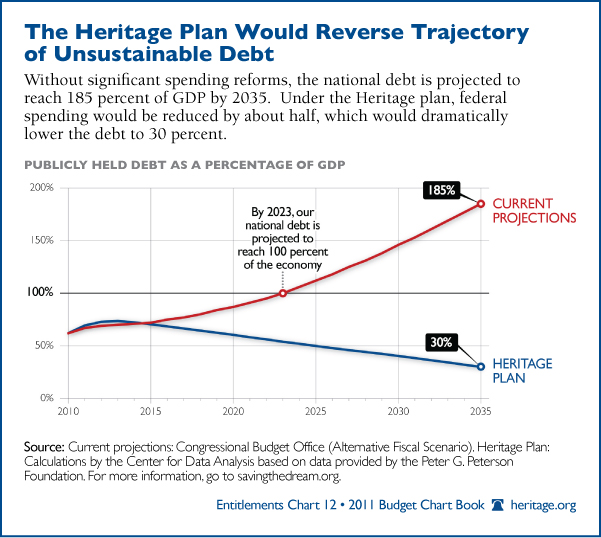
Other than insisting that the rich pay their “fair share,” which The Heritage Foundation has explained is “Fair to No One,” President Obama’s State of the Union address this week did not contain any ideas to get spending and deficits under control. Instead, he proposed even more spending, which of course has to be paid for through higher taxes or borrowing. Doing either will harm the economy further and do nothing to lower the level of debt. Publicly held debt represents about 70 percent of gross domestic product and, driven by expanding entitlement program spending, is on track to surpass 100 percent within a decade, as this chart illustrates.

The credit markets will not stand for this, because they know that a country cannot thrive economically with debt levels that high and rising.

Congress and the President should not let this happen. America needs bold solutions now that solve the spending and debt crisis. Now is the time to change course.

Thank you so much for your time. I know how valuable it is. I also appreciate the fine family that you have and your committment as a father and a husband.

Sincerely,

Everette Hatcher III, 13900 Cottontail Lane, Alexander, AR 72002, ph 501-920-5733, lowcostsqueegees@yahoo.com

Dr. Bergman: “Evolution teaches that the living world has no plan or purpose except survival”(Section B of Part 2 of series on Evolution)

Dr. Bergman: “Evolution teaches that the living world has no plan or purpose except survival”(Section B of Part 2 of series on Evolution)

The Long War against God-Henry Morris, part 3 of 6

Uploaded by  on Aug 30, 2010

http://www.icr.org/
http://store.icr.org/prodinfo.asp?number=BLOWA2
http://store.icr.org/prodinfo.asp?number=BLOWASG
http://www.fliptheworldupsidedown.com/blog

________________________________________

I got this from a blogger in April of 2008 concerning candidate Obama’s view on evolution:

Q: York County was recently in the news for a lawsuit involving the teaching of intelligent design. What’s your attitude regarding the teaching of evolution in public schools?

A: “I’m a Christian, and I believe in parents being able to provide children with religious instruction without interference from the state. But I also believe our schools are there to teach worldly knowledge and science. I believe in evolution, and I believe there’s a difference between science and faith. That doesn’t make faith any less important than science. It just means they’re two different things. And I think it’s a mistake to try to cloud the teaching of science with theories that frankly don’t hold up to scientific inquiry.”

Is there any purpose in life? Evolution is clear on this point. I have included the last portion of the article by Dr. Jerry Bergman who I have corresponded with in the past.

Darwinism: Survival without Purpose

by Jerry Bergman, Ph.D. *

Humans have always wondered about the meaning of life…life has no higher purpose than to perpetuate the survival of DNA…life has no design, no purpose, no evil and no good, nothing but blind pitiless indifference.1 –Richard Dawkins

Purpose and Christianity

Christianity teaches that God made the universe as a home for humans. If the universe evolved purely by natural means, then it just exists and any “purpose” for its existence can only be that which humans themselves attribute to it. But our own experience and intellectual attainments argue against this. The similarity of human-constructed machines and the orderly functioning of the universe is the basis of the design argument. Just as a machine requires a designer and a builder, so too the universe that we see requires a designer and a builder.

Determining the purpose of something depends on the observer’s worldview. To a nontheist the question “What is thepurpose of a living organism’s structure?” means only “How does this structure aid survival?” Eyesight and legs would therefore have nothing to do with enjoyment of life; they are merely an unintended byproduct of evolution. Biologists consistently explain everything from coloration to sexual habits solely on the basis of survival. Orthodox neo-Darwinism views everything as either an unfortunate or a fortuitous event resulting from the outworking of natural law and random, naturally-selected mutations. Conversely, creationists interpret all reality according to beliefs about God’s purpose for humans. Evolutionists can usually explain even contradictory behavior, but creationists look beyond this and try to determine what role it plays in God’s plan.

Conclusions

Orthodox evolution teaches that the living world has no plan or purpose except survival, is random, undirected, and heartless. Humans live in a world that cares nothing for us, our minds are simply masses of meat, and no divine plan exists to guide us. These teachings are hardly neutral, but rather openly teach religion–the religion of atheism and nihilism. The courts have consistently approved teaching this anti-Christian religion in public schools and have blocked all attempts to neutralize these clearly religious ideas.

As the Word of God states, “For the time will come when they will not endure sound doctrine; but after their own lusts shall they heap to themselves teachers, having itching ears; And they shall turn away their ears from the truth, and shall be turned unto fables” (2 Timothy 4:3-4).

References

  1. Scheff, Liam. 2007. The Dawkins Delusion. Salvo, 2:94.
  2. Humes, Edward. 2007. Monkey Girl: Evolution, Education, Religion, and the Battle for America’s Soul. New York: Ecco, 119.
  3. Ibid, 119.
  4. Turner, J. Scott. 2007. The Tinkerer’s Accomplice: How Design Emerges from Life Itself. Cambridge, MA: Harvard University Press, 206.
  5. Humes, Monkey Girl, 119.
  6. Ibid, 172.
  7. Bloom, Paul and Deena Skolnick Weisberg. 2007. Childhood Origins to Adult Resistance to Science. Science, 316:996.
  8. Panek, Richard. 2007. Out There. New York Times Magazine, 56.
  9. Miller, Kenneth R. and Joseph S. Levine. Biology. 1998. Fourth Edition, Englewood Cliffs, NJ: Prentice Hall, 658, emphasis in original.
  10. Levine, Joseph S. and Kenneth R. Miller 1994. Biology: Discovering Life. Second Edition, Lexington, MA: D.C. Heath, 161, emphasis in original.
  11. Raven, Peter H. and George B. Johnson. 2002. Biology. Sixth Edition, Boston, MA: McGraw Hill, 16, 443.
  12. Purves, William K., David Sadava, Gordon H. Orians, and H. Craig Keller. 2001. Life: The Science of Biology. Sixth Edition, Sunderland, MA: Sinauer Associates; W.H. Freeman, 3.
  13. Interview with Richard Dawkins in Campbell, Neil A., Jane B. Reece, and Lawrence G. Mitchell. 1999. Biology. Fifth Edition, Menlo Park, CA: Addison Wesley Longman, 412-413.
  14. Futuyma, Douglas J. 1998. Evolutionary Biology. Third Edition, Sunderland, MA: Sinauer Associates, 5.
  15. Ibid, 5.
  16. Curtis, Helena and N. Sue Barnes. 1981. Invitation to Biology. Third Edition, New York, NY: Worth, 475.
  17. Strickberger, Monroe. 2000. Evolution. Third Edition, Sudbury, MA: Jones & Bartlett, 70-71.
  18. Darwin, Francis (editor). 1888. The Life and Letters of Charles Darwin. London: John Murray, 210.
  19. Alcock, John. 1998. Animal Behavior: An Evolutionary Approach. Sunderland, MA: Sinauer Associates, 16, 609.
  20. Browne, Janet. 1995. Charles Darwin: Voyaging, A Biography. Princeton, New Jersey: Princeton University Press, 542.
  21. Ibid, 542.
  22. Dawkins, Richard. 1995. River Out of Eden. New York: Basic Books, 133.
  23. Graffin, Gregory W. 2004. Evolution, Monism, Atheism, and the Naturalist World-View. Ithaca, NY: Polypterus Press, 42.
  24. Sommers, Tamler and Alex Rosenberg. 2003. Darwin’s Nihilistic Idea: Evolution and the Meaningless of Life.Biology and Philosophy, 18:653.

* Dr. Bergman is Professor of Biology at Northwest State College in Ohio.

Cite this article: Bergman, J. 2007. Darwinism: Survival without Purpose. Acts & Facts. 36 (11): 10.

Reasons why Mark Pryor will be defeated in 2014 (Part 11)

It is apparent from this statement below that Senator Mark Pryor is against the Balanced Budget Amendment. He has voted against it over and over like his father did and now I will give reasons in this series why Senator Pryor will be defeated in his re-election bid in 2014. However, first I wanted to quote the statement Senator Pryor gave on December 14, 2011. This information below is from the Arkansas Times Blog on 12-14-11 and Max Brantley:

THREE CHEERS FOR MARK PRYOR: Our senator voted not once, but twice, today against one of the hoariest (and whoriest) of Republican gimmicks, a balanced budget amendment. Let’s quote him:

As H.L. Mencken once said, “For every complex problem there is a solution which is simple, clean, and wrong.” This quote describes the balanced budget amendment. While a balanced budget amendment makes for an easy talking point, it is an empty solution. Moreover, it’s a reckless choice that handcuffs our ability to respond to an economic downturn or national emergencies without massive tax increases or throwing everyone off Medicare, Social Security, or veteran’s care.There is a more responsible alternative to balance the budget. President Clinton led the way in turning deficits into record surpluses. We have that same opportunity today, using the blueprint provided by the debt commission as a starting point. We need to responsibly cut spending, reform our tax code and create job growth. This course requires hard choices over a number of years. However, it offers a more balanced approach over jeopardizing safety net programs and opportunity for robust economic growth.

____________________

Mark Pryor will not be re-elected in 2014 in part because he voted for a 900 billion stimulus bill in 2009. SENATOR PRYOR DOES NOT WANT THE BALANCED BUDGET AMENDMENT BECAUSE IT WOULD MAKE FUTURE STIMULUS BILLS UNLIKELY. BASICALLY PRYOR BELIEVES THAT GOVERNMENT IS THE SOLUTION TO ALL OUR PROBLEMS. WHY ELSE DID HE VOTE FOR THE FAILED STIMULUS IN 2009?

I have included an article below that makes a very good point about the Balanced Budget Amendment and the stimulus:

Lee believes there are several key components to a balanced budget amendment which he outlines in his book, including making tax increases contingent on a two-thirds vote in Congress so that the option to increase taxes is not the default maneuver to balance a budget. He believes the amendment should require Congress spends no more than it takes in, and in fact should cap the spending at a fixed percent of GDP (the proposal submitted in the Senate caps it at 18 percent of GDP, just about the historical average). There would also be a supermajority vote required to raise the debt ceiling.

And for those who argue that stimulus packages wouldn’t have been possible under the amendment, Lee sees little difficulty responding.

“That’s exibit A for why we ought to have it,” Lee said of the Obama stimulus package.

That is a very good point in favor of having a balanced budget amendment in my view. I have been critical of Pryor for supporting the stimulus in the past.

Lee Makes His Case for a Balanced Budget Amendment

By Elisabeth Meinecke

7/18/2011

As Washington spends the summer arguing over its spending addiction, GOP Sen. Mike Lee of Utah has a solution to help prevent the same crisis for future generations: a balanced budget amendment.

The House made news last week when, in the heat of negotiations over raising the debt ceiling, they announced a vote on a balanced budget amendment this Wednesday. Though the Senate GOP introduced a one earlier this year, President Obama has stated emphatically otherwise, telling Americans last week during a press conference that the country does not need a balanced budget amendment.

“Yes, we do,” Lee told Townhall when asked to respond to the president, adding later when talking about simultaneously raising the debt ceiling and cutting spending, “We can’t bind what a future Congress will do. We can pass laws that will affect this year, but there will be a new Congress that takes power in January of 2013, and then another new one that will take power in January 2015. And they will make their own spending decisions then — we can’t bind them unless we amend the Constitution to do so.”

Lee points out that the American people support the idea of a balanced budget – 65 percent, according to a Sachs/Mason Dixon poll from this year – but politicians have been reluctant to wade into the debate.

“The fact that we’re in this debate, the fact that we’re sort of deadlocked, or we’ve reached a point of gridlock in the discussions, is indicative of the problem that we have,” Lee said.

In fact, Lee thinks a balanced budget amendment is so important to the future of the country that he’s written a book on it: The Freedom Agenda: Why a Balanced Budget Amendment Is Necessary to Restore Constitutional Government.

Lee even takes the argument a step beyond fiscal issues, saying a balanced budget amendment safeguards individual liberties.

““The more money it [Congress] has access to, whether it’s through borrowing or through taxation, either way, that’s going to fuel Congress’ expansion, and whenever government acts, it does so at the expanse of individual liberty,” Lee said. “We become less free every time government expands.”

Lee believes there are several key components to a balanced budget amendment which he outlines in his book, including making tax increases contingent on a two-thirds vote in Congress so that the option to increase taxes is not the default maneuver to balance a budget. He believes the amendment should require Congress spends no more than it takes in, and in fact should cap the spending at a fixed percent of GDP (the proposal submitted in the Senate caps it at 18 percent of GDP, just about the historical average). There would also be a supermajority vote required to raise the debt ceiling.

And for those who argue that stimulus packages wouldn’t have been possible under the amendment, Lee sees little difficulty responding.

“That’s exibit A for why we ought to have it,” Lee said of the Obama stimulus package.

Lee also pointed out that his balanced budget amendment includes an exception to the spending restriction in time of war – “not a blank check, but to the extent necessary.” Congress would also be able to supersede the amendment with a two-thirds vote.

“We wanted to make it difficult, but not impossible, for Congress to spend more than it had access to,” Lee said, citing as an example a massive or immediate crisis created by a national emergency or natural disaster. “What this is designed to do is to make it more difficult – to make it impossible – for Congress to just do this as a matter of course.”

Elisabeth Meinecke

Elisabeth Meinecke is Associate Editor with Townhall.com

Are conservatives generous or are liberals?

Real Time with Bill Maher March 16 2012 – Alexandra Pelosi Interviews Welfare Recipients in NYC

Published on Mar 18, 2012 by

Real Time with Bill Maher March 16 2012 – Alexandra Pelosi Interviews Welfare Recipients

__________

Liberals like the idea of the welfare state while conservatives suggest charity through private organizations serve the poor better. I ran across this attitude on the Arkansas Times Blog. The person using the username “Elwood” noted:

Indeed the Bible teaches us a lot about where our concerns should be:

Proverbs 29:7) The righteous is concerned with the poor: but the wicked regardeth them not.

Seeking the Welfare of the City

By
May 1, 2012


Conservatives are often portrayed as selfish scrooges who only care about their own bottom lines. But when it comes to truly meeting people’s needs, they’re the leaders of the pack.

Star Parker knew poverty personally. As a young drug addict in southern California, she lacked money, employment and hope. At one point, she was arrested for helping to rob a liquor store, and over the span of a few years, she had four abortions—all paid for by the government. Parker survived on welfare checks and free medical-care stickers, which she would sell to purchase illegal drugs.

The scriptural call to care for people such as Parker is clear: Loving our neighbor entails helping those in dire straits and working for the common good of their community.

In the biblical sense, seeking welfare has to do with promoting circumstances that allow people to flourish. It means helping people thrive in their homes, workplaces, neighborhoods, economies and political communities. This goal characterizes a true conservative political framework.

Now the president of a social policy research center focused on poverty issues, Parker testifies that a biblical view of human flourishing is at home in a conservative agenda—one focused on basic human dignity, strong families, a vibrant civil society, prosperous free markets and limited government.

Who Cares?

Many conservatives—and especially those motivated by faith—are on the front lines of caring for the poor. They’re the “street saints” who work quietly but tirelessly in the trenches, providing critical services in education, health, drug rehabilitation, prisoner re-entry, job training and disaster relief.

In fact, research shows conservatives actually give more to the poor than liberals. Syracuse University professor Arthur Brooks compiled this body of research in his 2006 book Who Really Cares: The Surprising Truth about Compassionate Conservatism. Brooks found that conservative-headed households tend to give about 30 percent more money to charity than liberal-headed households, even though liberal families earn an average of 6 percent more each year than conservative families. Conservatives also tend to volunteer more time and give more blood than do liberals.

Despite such data, conventional wisdom portrays liberals as being the ones intent on fighting poverty and conservatives as selfish scrooges. Sadly, the promotion of free markets and limited government is often mistakenly equated with a disregard for people in need. Meanwhile, support for government redistribution programs functions as a kind of litmus test for genuine care and compassion. (Never mind the paradoxical fact that, according to Brooks, Americans who favor income-redistribution policies are significantly less likely to behave charitably than those who do not.)

True compassion, though, isn’t measured by how much money the federal government spends. The real question is which approach actually helps people escape poverty and flourish over the long-run. Conservatives tend to answer that question differently than liberals, although they both share the goal of “seeking the welfare of the city.”