Monthly Archives: April 2012

400% increase in food stamps since 2000

Welfare Can And Must Be Reformed

Uploaded by on Jun 29, 2010

If America does not get welfare reform under control, it will bankrupt America. But the Heritage Foundation’s Robert Rector has a five-step plan to reform welfare while protecting our most vulnerable.

__________________________

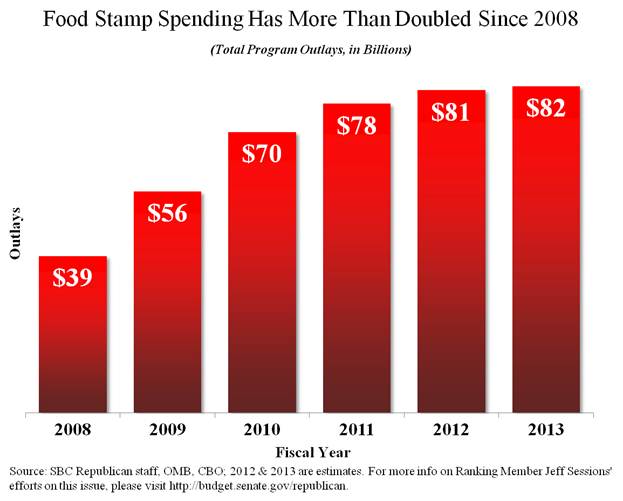
If welfare increases as much as it has in the last decade then it will ruin our country soon. Not only does it hurt the incentive to work since many get caught in the welfare trap, but we can no longer pay for increases like this one for the food stamp budget (up 400% since 2000).

Rachel Sheffield

April 23, 2012 at 11:39 am

The number of Americans on food stamps (or, as it is now called, the Supplemental Nutrition Assistance Program, or SNAP) is higher than ever before, according to a new Congressional Budget Office report. Since 2007, rolls have grown by 70 percent. And participation rates are expected to increase over the next two years.

While some of the growth can be attributed to the recession, participation rates were steadily climbing prior to the recession. Since 2000, the number of Americans on food stamps has jumped by roughly 260 percent, from 17.2 million to 44.7 million in 2011.

Naturally, government spending on food stamps has also jumped, from approximately $20 billion in 2000 to a whopping $78 billion last year, a nearly 400 percent increase.

The growth in participation rates seems to be part of the federal government’s goal, as a report from the U.S. Department of Agriculture released just this month explains.

The food stamps program is just one part of an ever-expanding government welfare system that includes not only 12 food assistance welfare programs but a total of 79 federal welfare programs. These programs provide not only food assistance but cash, housing, energy and utility assistance, education services, child care, medical care, and so forth.

The total cost of these programs reached $927 billion last year. Welfare is now the fastest growing part of government spending, and despite welfare costs increasing 16-fold since the War on Poverty began in the 1960s—and total spending on cash, food, and housing assistance now twice the amount necessary to pull all Americans out of poverty—President Obama wants to spend more. Aggregate welfare costs are projected to reach over $1.5 trillion in 2022.

As Heritage senior fellow Robert Rector said last week at a House Budget Committee hearing, out of control welfare costs are contributing to “ruinous and unsustainable future budget deficits.”

To get spending under control, Congress can roll back current welfare spending to pre-recession levels (adjusted for inflation) once the current recession ends and then capping aggregate welfare spending at the rate of inflation going forward. Doing so would save American taxpayers more than $2.7 trillion during the first decade.

America’s growing welfare state is creating a system of increased dependence and contributing to a growing federal debt. Helping the poor should mean promoting individual freedom through self-reliance rather than creating dependence through an unsustainable government dole.

Lessons to Obama on how to prosper from selected states

https://i0.wp.com/www.freetochoosemedia.org/production/POC/presskit2/milton-president-reagan.jpg

Milton Friedman served as economic advisor for two American Presidents – Richard Nixon and Ronald Reagan. Although Friedman was inevitably drawn into the national political spotlight, he never held public office.

Milton Friedman’s Free to Choose (1980), episode 1 – Power of the Market. part 1

Today President Obama is telling us that we must raise taxes in order for us to prosper and grow our economy. I have heard that before and it has never worked!!!!

Liberals like Ernie Dumas and Max Brantley who write for the Arkansas Times have always bragged on the 7% state income tax that Dale Bumpers raised in 1971 and how Arkansas has grown economically since then. However, the facts are quite different.

Ernie Dumas in his article “Arkansas” A tax myth-maker too,” Arkansas Times, April 13, 2011 asserts:

Until Gov. Dale Bumpers raised income-tax rates and other taxes in 1971, Arkansas had by far the lowest per-capita state and local taxes in the United States. Afterward, we were still 50th but within shouting distance of 49th.

Here are the real facts  according to Greg Kaza of the Arkansas Policy Foundation:

(June 2006) Democratic Gov. Dale Bumpers and the General Assembly raised Arkansas’ top income tax rate to “broaden the tax base” in 1971(1). Yet Arkansas’ per capita income, expressed as a percentage of the U.S. total, has barely improved, moving from 71 (1971) to 77.7 percent (2005) over the 34-year period, according to data from the U.S. Bureau of Economic Analysis. The 1971 income tax increase reversed a decades-long strong growth trend and left Arkansas with the highest income tax rate among bordering states (Mississippi, Missouri, Louisiana, Oklahoma, Tennessee and Texas).

Income Stagnation: The 1930s

One has to turn to the 1930s-the decade of the Great Depression-to find weaker income growth than in recent years.

Arkansas per capita personal income was 44 percent of the U.S. in 1929, the first year data was compiled in the BEA time series. The Great Depression started that year, and by the time it ended in 1933 Arkansas per capita income had fallen to 41 percent of the U.S. By decade’s end (1939) it had returned to 44 percent.

Growth Decades: The 1940s, 1950s & 1960s
Arkansas per capita income increased as a percentage of the U.S. in the next three decades.
In 1941, at the onset of World War II, Arkansas per capita income was 47 percent of the U.S. It was 59 percent at war’s end in 1945 and again in 1949. It was 56 percent in 1950, 62 percent a decade later in 1960, and 68 percent in 1969. If this growth rate had continued Arkansas would have exceeded 100 percent of the U.S. average in the current decade (2000-2009).

To summarize, Arkansas per capita income increased from 44 to 71 percent of the U.S. total between 1939 and 1971.

Anemic Income Growth (1971-2005)

The trend in recent decades is anemic growth in Arkansas per capita personal income. Fiscal policy changes effect economic behavior with a time lag. Arkansas per capita income was 71 percent of the U.S. in 1971 and 76 percent in 1973. Income growth stagnated for the rest of the decade, reaching 77 percent of the U.S. in 1979. It fell to 75 percent in 1989, and was 76 percent in 1999. Today, Arkansas per capita income, at 77.7 percent of the U.S., is barely above its high point of the 1970s.

_____________

We can look at other states and see what their experience is too.

I’ve done a couple of posts comparing Reaganomics and Obamanomics, mostly based on data from the Minneapolis Federal Reserve on employment and economic output.

I even did a TV interview on the subject, which generated some comments on my taste in clothing, and also cited a Richard Rahn column that got Paul Krugman and Ezra Klein upset.

Some of the best evidence about high tax rates vs. low tax rates comes from inside America. Art Laffer (yes, that Art Laffer) and Steve Moore have a great column in today’s Wall Street Journal. It’s sort of Reaganomics vs. Obamanomics, looking at evidence from the states.

Barack Obama is asking Americans to gamble that the U.S. economy can be taxed into prosperity. …Mr. Obama needs a refresher course on the 1920s, 1960s, 1980s and even the 1990s, when government spending and taxes fell and employment and incomes grew rapidly. But if the president wants to see fresher evidence of how taxes matter, he can look to what’s happening in the 50 states. In our new report “Rich States, Poor States,” prepared for the American Legislative Exchange Council, we compare the economic performance of states with no income tax to that of states with high rates. It’s like comparing Hong Kong with Greece… Every year for the past 40, the states without income taxes had faster output growth (measured on a decadal basis) than the states with the highest income taxes. In 1980, for example, there were 10 zero-income-tax states. Over the decade leading up to 1980, those states grew 32.3 percentage points faster than the 10 states with the highest tax rates. Job growth was also much higher in the zero-tax states. The states with the nine highest income tax rates had no net job growth at all, and seven of those nine managed to lose jobs.

Tax rates also lead people to “vote with their feet.” Laffer and Moore look at migration patterns.

Over the past decade, states without an income tax have seen 58% higher population growth than the national average, and more than double the growth of states with the highest income tax rates. …Illinois, Oregon and California are state practitioners of Obamanomics. All have passed soak-the-rich laws like the Buffett Rule (plus economically harmful regulations, like California’s cap-and-trade scheme), and all face big deficits because their economies continue to sink. Illinois has lost one resident every 10 minutes since hiking tax rates in January. California has 10.9% unemployment, having lost 4.8% of its jobs over the past decade. …Every time California, Illinois or New York raises taxes on millionaires, Florida, Texas and Tennessee see an influx of rich people who buy homes, start businesses and shop in the local economy.

Competition among the states is leading some states to make further improvements. Some are even trying to get rid of their income taxes.

Republican governors in Florida, Georgia, Idaho, North Dakota, South Carolina, Ohio, Tennessee, Wisconsin and even Michigan and New Jersey are cutting taxes to lure new businesses and jobs. Asked why he wants to reduce the cost of doing business in Wisconsin, Gov. Scott Walker replies: “I’ve never seen a store get more customers by raising its prices, but I’ve seen customers knock down the doors when they cut prices.” Georgia, Kansas, Missouri and Oklahoma are now racing to become America’s 10th state without an income tax.

I like the quote from Governor Walker. He seems to know what he’s talking about, so it will be interesting to see whether he survives the upcoming recall election. I guess it depends whether voters understand that big government and high tax rates is a recipe for continued decline.

Some states, such as Illinois and California, are filled with voters who refuse to recognize reality. Think of them as the Greece and Spain of America, perhaps because the number of tax-consumers is greater than the number of tax-producers.

And even though parasites should understand it doesn’t make sense to kill their host animals, this cartoon illustrates how the welfare states lures a growing number of people to ride in the wagon. And this cartoon shows the consequences of too many moochers and not enough producers.

______________

Take a look at all the Milton Friedman clips that I have posted today. These liberals I mentioned above have truly forgotten how powerful the market is if not interferred with by the government.

Milton Friedman’s Free to Choose (1980), episode 1 – Power of the Market. part 2

Related posts:


Why do people move to other states to avoid Arkansas’ high state income tax? (If you love Milton Friedman then you will love this post)

Milton Friedman served as economic advisor for two American Presidents – Richard Nixon and Ronald Reagan. Although Friedman was inevitably drawn into the national political spotlight, he never held public office. Milton Friedman’s Free to Choose (1980), episode 1 – Power of the Market. part 1 Mike Huckabee recently moved to Florida? Why? The answer […]

Milton Friedman’s Free to Choose (1980), episode 1 – Power of the Market. part 3

Was Chuck Colson’s jailhouse conversion real?

Chuck Colson: 35 Years of Faith — CBN.com

Uploaded by on Apr 4, 2008

The Christian author and apologist shares his conversion to Christ following the Watergate scandal, his ministry with Prison Fellowship, and insights on the importance of a Christian worldview today.

____________________

Many times people get involved in government and they let themselves make compromises with their own morality. Chuck Colson was definately guilty of that and he spent time in prison because of it. However, that was the best thing that ever happened to him since he found Christ there.

Many scoffed at his new conversion since he was a jailhouse conversion but 36 years later they are no longer doubting his convictions. One of those deep convictions concerned pro-life issues like banning partial birth abortions.

The infamous convicted Nixon adviser became famous for prison reform, evangelical-Catholic dialogue, and his Christian worldview.
Sarah Pulliam Bailey | posted 4/21/2012 03:04PM


Charles Colson, respected evangelical leader and former President Nixon adviser, died Saturday afternoon at age 80 from complications resulting from a brain hemorrhage.

Over the span of several decades, Colson became one of evangelicalism’s most influential voices within the movement and to the broader culture. Observers suggest Colson will likely be best remembered for his prison ministry, behind-the-scenes political involvement, work on evangelical and Catholic dialogue, and his cultural commentary.

In many ways, Colson’s life encapsulated the eclectic nature of evangelicalism. His example shaped how evangelicals would promote ministry and social justice, evangelism and ecumenicism, cultural and political engagement, radio and writing, and scholarship and discipleship.

“His demonization in the 1970s has been replaced by lionizations in the 2000s—at least among the nation’s 65 million evangelical Christians,” Jonathan Aitken wrote in his 2005 biography. Aitken portrayed Colson as an important but flawed figure in evangelicalism, “America’s best-known Christian leader after Billy Graham.”

Before his conversion to Christianity, Colson was described as an aggressive political mastermind who drank heavily, chain smoked, and smeared opponents. He served as special counsel to President Richard Nixon from 1969 to 1973 before he was indicted on Watergate-related charges, which led to a 7-month prison term. After his conversion experience, he published Born Again, helping popularize the term many evangelicals use to self-identify.

Colson’s public commitment to his faith drew initial skepticism from those who wondered whether he was attempting to profit from a conversion narrative. Criticism faded over time with his 30-plus years of commitment to prison ministry.

“The most important takeaway is that he was a specimen of God’s amazing grace, one of the most remarkable in modern times,” said Timothy George, dean of Beeson Divinity School at Samford University. “Over time, he proved to the whole world that this is the real thing.”

Colson’s “born again” phrase began to catch on in mainstream culture. Before the 1976 election, a reporter asked Jimmy Carter if he was “born again.” “Yes, I am born again,” Carter said. Reporters took notice and began to analyze and popularize the phrase that attempted to capture the Christian conversion story of repentance, redemption, and spiritual re-birth.

The same year, national magazines deemed 1976 the “year of the evangelical,” the year conservative Christians took on the political scene.

Colson was a key adviser in the George W. Bush administration, according to Aitken’s biography. He was a confidant and adviser on faith-based issues such as human rights, the war in Sudan, persecution, AIDS in Africa, sex trafficking, prison reform, and partial birth abortion.

“Chuck’s influence was not limited to ‘What are evangelicals thinking?'” said Karl Rove, Bush’s deputy chief of staff. “He was willing to provide guidance on that, but he was more interested in, “Here’s what an evangelically-minded president ought to be concerned about in fulfillment of the admonition that ‘To much is given, much is expected.'”

President Bush publicly supported Colson’s work, asking Congress in his 2003 State of the Union address to allocate $300 million to help prisoners. His influence was not limited to politics, Rove said.

“In all of my dealings with him in the last 15-20 years, I found him to be one of the most kind and gentle and thoughtful human beings I’ve ever met,” Rove said. “His life was a witness to his deep faith who nurtured the faith of others in deep and profound ways.”

As Jerry Falwell and Pat Robertson gained much of the media attention for their political involvement, Colson took a more backstage role.

“He stood out from the crowd because he had connections to elite society that most evangelical leaders lacked,” said Larry Eskridge, associate director of the Institute for the Study of American Evangelicals at Wheaton College. “In that way, he was a valuable addition to the fold simply because he knew people.”

As evangelicals negotiated political activism, they would call on Colson to give advice and make introductions, Eskridge said. “He never quite had an empire in the way that James Dobson or Jerry Falwell did,” Eskridge said. “He kind of fits the evangelical entrepreneur mold in the sense of how he took the bull by the horns and created Prison Fellowship out of pretty much nothing.”

Aiming to convert convicts into citizens, Prison Fellowship has successfully capitalized on church-based voluntarism.

“Chuck was a bridge builder,” said Jim Liske, CEO of Prison Fellowship. “He birthed an organization to empower the local church that continues to bring shalom to communities. He constantly looked for ways to help other organizations do the same thing.”

The ministry operates in 1,300 correctional facilities with about a $40 million budget and works with over 7,000 churches in the United States.

“His legacy will be a clear example of a person whose experience with Christian conversion evidenced itself in a clear and profound way,” said Michael Cromartie, vice president at the Ethics and Public Policy Center. “He’s an example of a public figure whose conversion stuck and evidenced in ways that were socially important.”

Prison Fellowship’s Angel Tree Ministry delivers thousands of Christmas gifts each year to children of inmates.

“Chuck enlarged and broadened evangelical outreach by emphasizing the inclusion of a strong biblically rooted justice component,” said Samuel Rodriguez, president of the National Hispanic Christian Leadership Conference.

Colson graduated from Brown University and earned a law degree from George Washington University before joining the Nixon administration. His personal life included some messy parts. Colson had three children with his first wife, Nancy Billings, whom he later divorced. In 1964, he married Patty Hughes, his wife of nearly 50 years. He has described his divorce as “the unhappiest and least attractive part of my life.” After Watergate, he served seven months in prison.

In his later years, Colson would note his relationship with his autistic grandson, Max. Colson wrote the prologue and epilogue to his daughter Emily Colson’s 2010 book Dancing With Max (Zondervan).

Colson’s cultural and political commentary reached millions of readers and listeners. His books, including his 1976 autobiography Born Again, have sold more than 25 million copies. His radio show BreakPoint reaches more than 1,200 outlets, and his Wilberforce Forum promotes Christian worldview thinking and teaching. In 1993, Colson won the Templeton Prize of $1 million for progress in religion. His award money, speaking fees, and royalties went to Prison Fellowship.

“He allowed a humbling period to define him and his whole posture to the culture,” said Eric Metaxas, who has written biographies of Dietrich Bonhoeffer and William Wilberforce. He took over for Colson on BreakPoint’s radio show after Colson fell ill. “One of the important things about Chuck is his commitment to worship God with our minds. As incredibly serious Chuck was about theology and evangelism, he brought those things into the public sphere.”

Colson was also known for his efforts in getting those from different backgrounds to collaborate. His personal life almost seemed to embody an evangelical-Catholic alliance. He was Southern Baptist with an admiration for John Calvin, Abraham Kuyper, and Francis Schaeffer, while his wife, Patty, is Catholic. He collaborated with Richard John Neuhaus to launch Evangelicals and Catholics Together, which produced a 1994 statement that alienated Colson from some leaders over evangelical/Catholic differences.

“Chuck and Richard helped wave caricatures aside. Catholics saw in Chuck Colson somebody who was a serious, intellectual, thoughtful guy, not some hick or hillbilly,” said Robert George, a professor at Princeton University. “We’re certainly in much better shape than we were even 20 years ago.”

In 2009, Robert George, Timothy George, and Colson collaborated together to form the Manhattan Declaration, asking Christians to stick to their convictions, even if it means civil disobedience.

“He was willing to sacrifice influence and standing if he thought that what he was doing meant taking up his cross,” Robert George said. “It’s hard to envision a world without Chuck.”

Jeff Long leaning against interim and hoping to name coach in days


Arkansas coach Bobby Petrino was fired after he admitted an “inappropriate relationship” with Jessica Dorrell.
_________________

I earlier was told that Jeff Long was looking to hire an interim and it would be Tim Hooten. However, this article below indicates that Long is not leaning that way but will go with another coach in days. I think that Paul Petrino would be a great pick.

Gruden, Mariucci, and the Arkansas Coaching Soap Opera

The Arkansas coaching search continued today, as Jeff Long made an announcement regarding the status of the search. Long didn’t provide any new information, but did admit that he has been looking at prospects in and out of the program. He also mentioned that the search will continue through the weekend, and he hopes Razorback fans will focus on the festivities this weekend. Jeff is right this weekend should be about the student-athletes that have been working extremely hard preparing for a spring performance. I am sure that Long knows as well as any of us that will not be the case for most Hog fans.

Razorback fans have been unable to relax and enjoy spring football since the firing of Bobby Petrino. Naturally the fans are very impatiently waiting to find out which direction Long will go to lead a program that was thought to be in great hands by most everyone just a few short weeks ago. Arkansas fans want to hear a “can’t miss” name like Jon Gruden or Pete Carroll announced by Long, but both names have been shot down by numerous reports. Someone close to Jon Gruden said that Gruden was not a candidate, and that he thought Mariucci would be the next coach at Arkansas earlier today.

Chris Mortensen of ESPN, a well-respected journalist who is extremely familiar with the Razorbacks, has said that Mariucci will not be named coach. Mortensen seems to be confident that he knows what is going on, and he claims all the reports he has heard are false. The more info that comes out keeps pointing to the fact that Long likely will not choose an interim coach. He believes interims are generally unsuccessful on the field, and the data seems to support that fact. So if Long is indeed going to hire a coach and all the names have been false as Mortensen believes, it makes you wonder where Long is looking.

Related posts:

Jeff Long leaning against interim and hoping to name coach in days April 23, 2012 – 6:36 am


Bobby Petrino’s phone records come out April 12, 2012 – 6:50 am

Jessica Dorrell and Bobby Petrino on ESPN together in 2011 April 12, 2012 – 6:38 am


How about a coach swap? :Charlie Strong to Arkansas and Bobby Petrino to Louisville April 11, 2012 – 7:37 am


Bobby Petrino statement April 11, 2012 – 6:51 am


Bobby Petrino fired, but now seeking forgiveness April 11, 2012 – 6:20 am


Video and transcript of Jeff Long’s press conference announcing firing of Bobby Petrino April 11, 2012 – 5:53 am


Bobby Petrino’s arrogance led to his downfall April 10, 2012 – 3:46 pm


Petrino 911 Call – Jessica Dorrell And Bobby Petrino Refuse Help April 9, 2012 – 7:03 am


Earlier concerns about Petrino’s character are coming back up again April 9, 2012 – 6:24 am


Bobby Petrino has achieved the American Dream, but still is looking for something more April 8, 2012 – 1:46 pm

Rex Nelson speculates that Petrino may be fired because “…trust has been so broken…” April 8, 2012 – 12:06 pm

Lying about Jessica Dorrell may get Bobby Petrino in a lot of trouble April 7, 2012 – 1:38 pm

Can Bobby Petrino, Tom Brady and Coldplay all find the satisfaction they are seeking? April 6, 2012 – 2:15 pm 

Bobby Petrino to survive this wreck? April 6, 2012 – 11:08 am

Pictures of Bobby Petrino April 6, 2012 – 9:11 am

Who is Jessica Dorrell? (with pictures) April 6, 2012 – 9:06 am

Major coverage of Bobby Petrino mistake April 6, 2012 – 6:51 am

What will be Jeff Long’s decision on Bobby Petrino? April 6, 2012 – 5:36 am

Bobby Petrino admits to an affair April 6, 2012 – 4:41 am

What impact will breaking trust with Bobby Petrino’s family have? April 6, 2012 – 4:24 am

Two choices now for Bobby Petrino: Follow the path of purity or impurity

If Bobby thinks he is bruised now, then he needs to read about the guy in Proverbs 7:10-27 and what happened to him. I really am hoping that Bobby Petrino can put his marriage back together. He has a clear choice between two paths. In the sermon at Fellowship Bible Church at July 24, 2011, […]

Jessica Dorrell was taking a long ride with Bobby Petrino April 5, 2012 – 4:52 pm

Bobby Petrino hurt in wreck (picture included) April 2, 2012 – 9:31 am

Churches, not the government, have traditionally helped the poor in the long history of the USA

If you look at the first 150 years of our nation’s history you will find practically no welfare or assistance to the poor coming from the government. In fact, most of the help came from local churches. During the last few decades the government had created the welfare trap that robs people of responsibility to better themselves. Many in the welfare trap feel they are being treated like children.

With all that in mind I found this article below very helpful.

U.S. Conference of Catholic Bishops and Spending Cuts

Posted by Tad DeHaven

House Budget Committee chairman Paul Ryan (R-WI) and Speaker John Boehner (R-OH) are pushing back against criticism from the U.S. Conference of Catholic Bishops over the GOP’s proposed cuts to domestic spending programs. They should.

The USCCB’s criticism comes at a time when it’s appropriately fighting the Obama administration’s mandate that Church-affiliated employers must provide health insurance that covers birth control. As a Catholic, it pains me that the bishops apparently do not recognize that a central government that is big and powerful enough to spend billions of other people’s dollars on housing, food, and health care programs, which the bishops support, is inevitably going to shove its tentacles into areas where they’re not wanted. In other words, if you play with fire, there’s a good chance you’re going to get burnt.

The bishops have now sent four letters to Congress that call on policymakers to “create a ‘circle of protection’ around poor and vulnerable people and programs that meet their basic needs and protect their lives and dignity.” Oh please. Even if it were the proper role of the federal government to fund such programs, the government’s efforts have been inefficient and often counterproductive. If anything, the massive federal welfare state that has sprung up over the past five decades has stripped countless Americans of their dignity by making them reliant on the cold hand of the bureaucrat.

Note this paragraph from a USCCB letter that argues against cuts to housing programs:

As bishops, we see firsthand the pain and suffering in our communities and in our parishes caused by homelessness and lack of affordable housing. The Catholic community is one of the largest private providers of housing services for the poor and vulnerable in the country. We shelter the homeless, develop affordable housing for families and people with disabilities, counsel families at risk of foreclosure, and provide housing and care for those at the end of life. At a time when the need for assistance from HUD programs is growing, cutting funds for them could cause thousands of individuals and families to lose their housing and worsen the hardship of thousands more in need of affordable housing. 

The responsibility for addressing such concerns properly belongs to the Church and other organizations that possess that “firsthand” view of the struggles many people face. I won’t get into a discussion on Catholic social teaching, but it’s impossible for me to imagine that the perpetual mess that is the Department of Housing & Urban Development comports with the principles of subsidiarity.

The Catholic Church could do a lot more for the poor if its parishioners were able to put more into the collection plate instead of rendering it unto Caesar. Thus, it’s pretty sad that the bishops see this as a “time when the need for assistance from HUD programs is growing” rather than a time for the Church to reassert its traditional role in taking care of those in need—a role that is hindered by the welfare state that the bishops embrace.

Heritage Foundation salutes Chuck Colson

Civil Disobedience and Christians

Uploaded by on Jul 20, 2010

Chuck Colson talks about civil disobedience and cases where Christians may need to practice it. Drawing on the Manhattan Declaration, which refers to civil disobedience as a possibility (if government encroaches too much on religious freedom), Colson also brings in Dr. Timothy George, a co-drafter of that document. Mr. Colson also highly recommends you read T.M. Moore’s,

_______________


I read this tribute from the Heritage Foundation:

Ed Feulner

April 21, 2012 at 6:59 pm

We at Heritage were saddened to learn of the death of Christian leader, cultural commentator and former White House counselor Charles W. “Chuck” Colson.

America is the land of second chances — and few men have made more of theirs than Chuck Colson did. For in addition to loving and serving his country, the former Marine captain and “President’s hatchetman” came to love and serve a God of second chances.

As an author, speaker and laborer in the vineyard, Chuck spent the past four decades encouraging others to escape poverty, addiction, hopelessness and dependence on government — and to embrace life and liberty. Through his Prison Fellowship Ministries, at the Colson Center for Christian Worldview and in partnership with countless allies — including Heritage on our “Seek Social Justice” project — it truly can be said that Chuck did the Lord’s work.

His was an unlikely, amazing journey of redemption. We, like so many others, will miss his cheerful, winsome presence on the battlefields and the mission fields.

Well done, Chuck. We’re lifting you, Patty and the entire Colson family in our prayers.

Other related posts that mention Chuck Colson:

Christian leaders react to Chuck Colson’s death

I got to hear Chuck Colson speak in person in 1976 at the church I grew up in (Bellevue Baptist Church in Memphis). Our pastor Adrian Rogers was personal friends with Colson. Colson – a guardian of the faith Charlie Butts – OneNewsNow – 4/21/2012 4:15:00 PM Chuck Colson, known worldwide for founding Prison Fellowship […]

Remembering Francis Schaeffer at 100 (Part 3) “Schaeffer Sunday”

Truth With Tears – A Story of Dr. Schaeffer Shedding Tears At the Lausanne Congress, 1974 Uploaded by schaefferstudies on Dec 10, 2011 This video is a segment of an interview we did with Dr. David Calhoun of Covenant Theological Seminary where he described a touching moment with Dr. Schaeffer when he sheds tears at […]

Remembering Francis Schaeffer at 100 (Part 2) “Schaeffer Sunday”

This THE FRANCIS SCHAEFFER CENTENNIAL – SCHAEFFER’S CULTURAL APOLOGETIC PT 1 – DONALD WILLAIMS Uploaded by schaefferstudies on Feb 6, 2012 Dr. Williams gives an introduction to Schaeffer’s life and work at the Francis Schaeffer Centennial, an event honoring Francis Schaeffer’s 100th birthday. ________________ This year Francis Schaeffer would have turned 100 on Jan 30, […]

Remembering Francis Schaeffer at 100 (Part 1) “Schaeffer Sunday”

This year Francis Schaeffer would have turned 100 on Jan 30, 2012. I remember like yesterday when I first was introduced to his books. I was even more amazed when I first saw his films. I was so influenced by them that I bought every one of his 30 something books and his two film […]

“Schaeffer Sundays” can be seen on the www.thedailyhatch.org

What Ever Happened to the Human Race?      I learned so much from Francis Schaeffer and as a result I have posted a lot of posts with his film clips and articles. Below are a few. Related posts: Francis Schaeffer: We can’t possess ultimate answers apart from the reference point of the infinite personal […]

Remembering Francis Schaeffer at 100 (Part 13)

THE FRANCIS SCHAEFFER CENTENNIAL – INVOCATION – PASTOR TONY FELICH Uploaded by schaefferstudies on Feb 3, 2012 Pastor Tony Felich of Redeemer Presbyterian Church in Overland Park, KS gives the invocation to the mini conference event in honor of Francis Schaeffer’s 100th Birthday. __________________________ This year Francis Schaeffer would have turned 100 on Jan 30, […]

Remembering Francis Schaeffer at 100 (Part 12)

Dr. Francis Schaeffer – The Naturalistic, Materialistic, World View This year Francis Schaeffer would have turned 100 on Jan 30, 2012. I remember like yesterday when I first was introduced to his books. I was even more amazed when I first saw his films. I was so influenced by them that I bought every one […]

Remembering Francis Schaeffer at 100 (Part 11)

The Gospel of Christ in the pages of the Bible _______________________  This year Francis Schaeffer would have turned 100 on Jan 30, 2012. I remember like yesterday when I first was introduced to his books. I was even more amazed when I first saw his films. I was so influenced by them that I bought […]

Remembering Francis Schaeffer at 100 (Part 10)

Truth With Tears – A Story of Dr. Schaeffer Shedding Tears At the Lausanne Congress, 1974 Uploaded by schaefferstudies on Dec 10, 2011 This video is a segment of an interview we did with Dr. David Calhoun of Covenant Theological Seminary where he described a touching moment with Dr. Schaeffer when he sheds tears at […]

Remembering Francis Schaeffer at 100 (Part 9)

THE FRANCIS SCHAEFFER CENTENNIAL – SCHAEFFER’S CULTURAL APOLOGETIC PT 1 – DONALD WILLAIMS This year Francis Schaeffer would have turned 100 on Jan 30, 2012. I remember like yesterday when I first was introduced to his books. I was even more amazed when I first saw his films. I was so influenced by them that […]


Like this:

Mike Wallace 1958 interview of Salvador Dali (Part 2)

There was a very interesting interview with Dali by Mike Wallace. Here are the video clips and transcript below:
WALLACE: …in religion. Well now I spoke with you about a year ago and we talked about religion, and you said that as the years go by,you embrace Roman Catholicism more and more with your mind but not yet completely with your heart.DALI: This is true,WALLACE: Why not?DALI: Because…perhaps it is my early intellectual training and information. But now every day is more approach of this real feeling of religion. Just one month ago– is one tremendous operation of appendix – a broken appendix. After this operation becoming three times more religious than before.

WALLACE: How old are you Dali?

DALI: Never remember exactly, but 54 or 53 or something.

WALLACE: Are you formally involved with your religion? Do you go to church a good deal – do you pray – do you….

DALI: Every day more, but is no sufficient…

WALLACE: Not sufficient….Have you ever had a supernatural vision?

DALI: Visionary things – but no supernatural.

WALLACE: No supernatural. An article about you – you mention your fear of death. An article about you in Life magazine once said that you’re afraid of almost everything from ocean liners to grasshoppers. The article said you won’t buy shoes because you don’t like to take off your shoes in public. And that when you go out you carry a little piece of Spanish driftwood which you keep to ward off evil spells.

DALI: Yes, because remind very very superstitious but this is- I’m sure is is common of every Spanish people, you know. Spanish people is very superstitious.

WALLACE: Do you know anything about politics at all? You say you don’t care about them. Do you know anything about them? Do you know, for instance who the prime minister of Great Britain is?

DALI: Yes, but no – not particularly care of this. Because, for me the important thing is look – the philosophical event of every moment. And now is absolutely sure for instance, monarchy is restored in Spain very shortly.

WALLACE: You think it will be?

DALI: Prince Juan Carlos and Franco agree on its restoration. Is absolutely convincing the monarchy coming back in France very shortly after one military mayor or perhaps one De Gaulle or another….

WALLACE: Do you know – do you know who the Vice President of the United States is? Can you name him…

DALI: Mr. Nixon. Yes, yes – but, but what is possible now – what is possible perhaps tomorrow you put this in quick question and…

WALLACE: And you will answer… What do you enjoy doing most? Do you like to talk, to paint, to eat, to think? What, what do you like to spend your time doing, Dali?

DALI: My manner of expend my time – is the more joy, the more delightful is becoming every day – a little more – Dali.

WALLACE: A little more Dali.

DALI: Because in the beginning of my life, you remember in like at becoming Napoleon…

WALLACE: First you wanted to be a cook – first you waited to be a cook, then you wanted to be a Napoleon.

DALI: Cook and woman – one woman cooking.

WALLACE: You wanted to be a woman, cooking?

DALI: Exactly … a woman cooking. Second, like of becoming Napoleon.

WALLACE: Napoleon.

DALI: A little one like it becoming Dali. And now is every day more Dali.

WALLACE: In a moment I’d like to ask you about an extraordinary power which you claim that you have. You’ve written that you can remember your thoughts and your feelings before you were born.

And I’d like to know what those thoughts and feelings were. And we’ll get Salvador Dali’s answer in just sixty seconds.

(COMMERCIAL)

WALLACE: Now then, Dali – you said that you can remember not only things that happened to you in your infancy, but even your feelings before you were born. What were they? What did you think about? What did you feel?

DALI: Well I remember very clearly many mansions. How so – not only in black and white but in glorious technicolor….technicolor.

WALLACE: I see, and what specifically.. What were some of these things?

DALI: At some phosphorous and x-luminous-x…..I told these visions to Doctor Freud in London. Freud tell me that it is absolutely true – is the region of intra-uterine memories. Probably my position – fetal position, my pupils is very hurt by my hands. Depend on my position.

WALLACE: Was it – well, what was it like? Was it, was it pleasant before you were born?

DALI: Ah – it was completely paradise.

WALLACE: Paradise…

DALI: From this moment the more divine nature – in the moment of born is the moment of the paradise is lost. This is an ethereal …

WALLACE: Well, under those circumstances I find it difficult to understand your fear of death. If the moment of being born was paradise-lost, perhaps death, for you will be paradise-regained. And therefore I would think that you would….

DALI: This is my hope. But is not absolutely sure. This is the trouble. You see, the death is again the regain of this paradise – this is excellent, but is not, not sure.

WALLACE: Do you, do you enjoy yourself as you live. Do you like yourself? You think – you say that you are a genius. Certainly you have had…

DALI: I enjoy my life every day more.

WALLACE: You do…

DALI: Every week more. Because of Sir Dali – and my admiration for Dali is becoming tremendous.

WALLACE: Yes, What kind of dreams do you have? What are they about, Dali?

DALI: Every time is very agreeable and creative. The last dreams is about the anti-matter angels. Perhaps for five months only dream about archangels, angels, kings and the most beautiful spectacular.

WALLACE: You seem to be a mild-mannered man. Are you?

DALI: I don’t understand – mild?

WALLACE: Are you, are you a mild man? Are you a pleasant man to deal with? Are you a friendly man? You seem to be a mild man.

DALI: Everybody love Dali very much.

WALLACE: Everybody loves Dali.

DALI: But they pick on him.

WALLACE: But your paintings – they’re frequently violent. And you’ve written, that in your private life you have had sudden impulses to injure people. As a child you kicked people – you threw a friend off a rocky ledge. As an adult you confessed that you once kicked a legless beggar along the street.

DALI: Exactly. But this is my adolescence period. Now becoming much more quiet in these kind of sadistic things.

WALLACE: Yes…

DALI: As a contrary – after my religious feelings becoming more strong – these sadistic things of my adolescence disappeared almost completely.

WALLACE: Is that so? And, and when you were a young man, too, you used to try to hurt – you were masochistic as well as sadistic. You used to try to hurt yourself…you’d bind your head until it hurt, because you felt that you could be more creative that way. You do not need that…..

DALI: No – now every of this has disappear because every of my libido now is simply made in the religion and the mysticism.

WALLACE: Well, there’s one story about yourself I’d like to ask you about before you go. When you were courting your wife, Gala you did an unusual thing. As you’ve described it, you smeared your body with your own blood from a cut. You tore your clothes and then you rubbed a jar of evil-smelling fish glue all over yourself. And you planned to present yourself this way in front of your future wife. Why did you do that?

DALI: Because in this moment of weakness in this moment Dali is true is almost crazy before met Gala. My, my brain is very close of one sick pathologic brain.

WALLACE: Your brain, yes…

DALI: In this moment liked seduce Gala in the most terrific manner. I believe from the smell is a more attractive manner for seduce Gala. Gala becoming in love with me appears as probably the real …Gala created the real mysticism or the real classicist of my adult life.

WALLACE: And you have been married now to Gala for how many years?

DALI: Oh perhaps 20 or more, but is still in love with Gala – more than in the beginning. That is something that nobody believe. Perhaps – Dali never make love avec one other woman than Gala.

WALLACE: In 20 years.

DALI: And the people never believe because – everybody….

WALLACE: Why – why shouldn’t we believe? It’s the most sensible thing in the world.

DALI: Yes, but there is no… you should believe – it’s very frequent. But the other people don’t think it’s very exceptional.

WALLACE: Well I don’t think perhaps as exceptional as…

DALI: And now my obsession is the chastity, because….

WALLACE: Chastity…

DALI: …is more important for religious belief.

WALLACE: Dali, I certainly thank you for coming and spending this time. I’m looking forward to the publication of your new book, “Dali” which will be published in the Fall and I understand will have a good many color plates of your paintings in it. Thank you Dali.

DALI: Merci.

WALLACE: To those who raise eyebrows or look down their noses at him, Salvador Dali bristles his remarkable moustache with equal disdain. As he puts it, “I cannot understand why human beings should be so little individualized. Why they should behave with such great collective uniformity.” He says, “I do not understand why, when I ask for grilled lobster in a restaurant, I’m never served a cooked telephone.” I’ll be back in a moment with a special announcement about future plans.

(COMMERCIAL)

WALLACE: Tonight’s interview ends my series which started a year ago for the Philip Morris Company, the makers of Philip Morris, Parliament, and Marlboro cigarettes and I want to thank the Philip Morris Company, sincerely, for helping me to bring you these programs.

WALLACE: Next Sunday evening – next Sunday evening at ten o’clock Eastern Daylight Saving Time, on many of these stations, I’ll start a new interview series devoted to the theme of Freedom and Survival. The series will be produced in cooperation with the Fund for the Republic and will be designed to encourage public discussion of freedom and justice. We’re going to talk about the problems of the individual in his relationship to big government, big business, and big labor.

WALLACE: We’re going to examine the growing power of political parties and pressure groups, we’ll talk about the responsibility of our mass media…newspapers, magazines, motion pictures and television. We’ll discuss these issues with such men as Supreme Court Justice William Douglas, Aldous Huxley, author of “Brave New World”, industrialist Cyrus Eaton. Next Sunday night on the first program, we’ll open the series with an examination of religious skepticism.

WALLACE: Of the conflict between church and state, of religion and morality in American life. Our guest, you see him behind me, will be one of the world’s leading religious thinkers, the Protestant theologian, Doctor Reinhold Niebuhr. We’ll ask Doctor Niebuhr why he charges that our current religious revival is essentially meaningless. We’ll find out why Doctor Niebuhr says that religion can never abolish injustice and evil in society. That’s next Sunday at ten on many of these stations. Until then, Mike Wallace – goodnight.

ANNOUNCER: The Mike Wallace Interview has been brought to you by the new high filtration Parliament. Parliament – now for the first time at popular price.

 

“Music Monday” Lester Flatt and Earl Scruggs on Beverly Hillbillies

Lester Flatt & Earl Scruggs – “The Ballad Of Jed Clampett

Lester & Earl – Wreck of Old 97

Related posts: 

Lester Flatt and Earl Scruggs on Beverly Hillbillies

Lester Flatt & Earl Scruggs – “The Ballad Of Jed Clampett Lester & Earl – Wreck of Old 97

Earl Scruggs rest in peace

Uploaded by Nekrophyliac on May 16, 2006 the best instrumental bluegrass song ever done!! ________ FLAT & SCRUGGS Uploaded by wininternetnetwork on Dec 2, 2007 Flat & Scruggs Shortbread From CNN: Bluegrass great Earl Scruggs dead at 88 By the CNN Wire Staff updated 11:43 AM EDT, Thu March 29, 2012 (CNN) — Earl Scruggs, […]

The Beverly Hillbillies episode with Scruggs and Flatt: Jed Throws A Wingding

The Beverly Hillbillies: Jed Throws A Wingding Uploaded by AllegroMediaMovies on Feb 23, 2012 The Beverly Hillbillies is one of the funniest and most inspired TV comedies of all time! The show was ranked #1 and attracted as many as 60 million viewers per week! The Clampett Clan includes Buddy Ebsen (Jed), Irene Ryan (“Granny”), […]

“Music Monday” Countdown of Coldplay’s best albums (part 3)

It has taken me a long time to make my decision but I’ve finally made it. Their 3rd best album is X&Y. I love this album so much! The CD includes many good songs like ”TALK”  ”WHAT IF”  ”SQUARE ONE” ”THE HARDEST PART”  ”TILL KINGDOM COME”  ”SPEED OF SOUND” and my favorite Coldplay song ever ” […]

“Music Monday” The Monkees (Part 1)

Davy Jones was a great singer and we will miss him. Jones, 66, born in Manchester, England, became the principal teen idol of the rock quartet featured on the NBC comedy series “The Monkees,” which was inspired in part by the Beatles film “A Hard Day’s Night” and ran from the fall of 1966 to […]

Otis Redding and Memphis “Music Monday”

(Sittin On) The Dock Of The Bay Uploaded by taylorgdaniel on Jun 9, 2010 Downtown Memphis, July 9, 2010, solo by Taylor G. Daniel of Germantown. This song was actually sung just a few miles away from where Redding originally recorded it in downtown Memphis at Stax Records. ______________________ Over the years Otis Redding’s influence […]

Katharine McPhee’s hit song co-wrote by Little Rock native David Hodges

The “American Idol” contestant-turned-actress is getting positive reviews for her role in “Smash.” The singer plays an actress who is competing for the part of Marilyn Monroe in a Broadway show. The Hollywood Reporter calls it “‘Glee’ for grownups” and Entertainment Weekly calls McPhee “mediocre” but “very likable.” Great song: Uploaded by KatharineMcPheeVEVO on Nov […]

An open letter to President Obama (Part 62)

Rep Michael Burgess response

Uploaded by on Jan 25, 2012

This week Dr. Burgess provides an update from Washington and responds to President Obama’s State of the Union address.

Sen. Toomey responds to State of the Union address 2012

President Obama c/o The White House
1600 Pennsylvania Avenue NW
Washington, DC 20500

Dear Mr. President,

I know that you receive 20,000 letters a day and that you actually read 10 of them every day. I really do respect you for trying to get a pulse on what is going on out here. Here is an excellent piece from the Heritage Foundation:

 What Would Obama Do? Insights from his budget – J.D. Foster What is President Obama’s vision for America, truly? What would he intend in a second term if re-elected? We need not wait for yet another soaring presidential speech to illuminate and clarify. We now have much of the answer to these questions in black and white from his own Administration. The answer is provided in the budget he released this morning. The answer, in short, is more of the same—only more, and less. In summary, Obama’s vision for America according to his own budget is: To add about $3 trillion more in national debt to the roughly $5.5 trillion he added in his first term. To increase federal spending by half a trillion dollars between 2012 and 2016, from $3.8 trillion to $4.3 trillion. To ignore the 2012 budget deficit (projected at $1.3 trillion), allow spending to grow substantially in the years immediately following, and then take sterner measures in some distant future—read: He intends to leave the pending fiscal disaster to his successor. To step up his economy-defeating and self-delusional ideological tax hike war. To hope Congress ignores his tax policies and the economy somehow continues to strengthen on its own. Ultimately, to live up to the moniker of tax-and-spend liberal. There is more, like a tax plan to turn the ownership of America’s largest companies over to foreign ownership. Once again the President has trotted out the liberals’ favorite lines about “investment” when referring to huge jumps in infrastructure spending. The budget also includes a smattering of public-relations-oriented micro policies like a community college proposal that give the President a chance to talk about something on the campaign trail, indeed anything, except the real issues facing America. There is also some good news in the budget. While spending goes up rapidly over time, there are at least no new efforts to pump up the economy and waste taxpayer dollars with another debt-based stimulus. Has the Obama Administration learned this will never work, or is the deficit now simply too large for them to try it again? In truth, a President’s second term is rarely a time of bold initiative and action. For the most part, it’s a time of marking time and continuing and completing policies laid out in a first term. It is also an exercise of denying the opposition power. But there have been notable exceptions. In his second term, President Reagan managed to slow the growth of spending substantially and to sign into law in 1986, the last great tax reform effort. President Clinton signed the landmark welfare reform into law, somewhat begrudgingly perhaps and at the point of a Republican policy bayonet perhaps, but he signed it nevertheless. President Bush tried mightily and failed spectacularly to turn Social Security from a fiscal disaster to a sustainable program for generations to come, but at least he tried. President Obama’s budget lays bare and strips away any pretense that a second Obama term would be marked by bold leadership to address problems like high unemployment, massive budget deficits, and vital entitlement programs headed for financial disaster of Greek-like proportions. As this message sinks in, the Administration will no doubt try to establish an alternative narrative of fear-mongering leavened with promised leadership. But the true picture is painted in black and white in his own budget.

______________

I am glad there is no more efforts in this budget to try another stimulus effort like before, but the sharp cuts that are necessary to balance the budget are not in this budget. Instead of adding 5.5 trillion to the debt like we did in the last three years we will add around 8 trillion.

Thank you so much for your time. I know how valuable it is. I also appreciate the fine family that you have and your committment as a father and a husband.

Sincerely,

Everette Hatcher III, 13900 Cottontail Lane, Alexander, AR 72002, ph 501-920-5733, lowcostsqueegees@yahoo.com

Senator Pryor asks for Spending Cut Suggestions! Here are a few!(Part 144)

Senator Mark Pryor wants our ideas on how to cut federal spending. Take a look at this video clip below:

Senator Pryor has asked us to send our ideas to him at cutspending@pryor.senate.gov and I have done so in the past and will continue to do so in the future.

On May 11, 2011,  I emailed to this above address and I got this email back from Senator Pryor’s office:

Please note, this is not a monitored email account. Due to the sheer volume of correspondence I receive, I ask that constituents please contact me via my website with any responses or additional concerns. If you would like a specific reply to your message, please visit http://pryor.senate.gov/contact. This system ensures that I will continue to keep Arkansas First by allowing me to better organize the thousands of emails I get from Arkansans each week and ensuring that I have all the information I need to respond to your particular communication in timely manner.  I appreciate you writing. I always welcome your input and suggestions. Please do not hesitate to contact me on any issue of concern to you in the future.

Here are a few more I just emailed to him myself:

GUIDELINE #10: Utilize the “ideas industry” for specific proposals.
Those seeking specific proposals to reduce wasteful spending have several options available:
  • The Congressional Budget Office (CBO) periodically releases a Budget Options book containing more than 200 specific reforms that would reduce more than $100 billion in wasteful spending, complete with justifications and savings estimates. (See Appendix 3.)
  • The General Accounting Office (GAO) conducts hundreds of studies each year on wasteful and underperforming federal programs. The GAO also often releases a Budgetary Implications of Selected GAO Work for the current fiscal year, which is a book similar to CBO’s Budget Options, detailing hundreds of specific, implementable ways to reduce waste.
  • The Government Performance and Results Act (GPRA) requires agencies to lay out specific multi-year goals to improve performance and reduce waste and report regularly on their progress toward these goals. Together with Inspector General (IG) reports, GPRA reports show which programs are failing in their missions.
  • Think tanks such as The Heritage Foundation, the Cato Institute, and Citizens Against Government Waste release hundreds of studies each year showing how to save taxpayer dollars.

Here are some more places to cut:

  • Immediately before the current recession, Washington spent $24,800 per household. Simply returning to that level (adjusted for inflation) would likely balance the budget by 2019without any tax hikes.
  • The federal government made at least $98 billionin improper payments in 2009.