Yearly Archives: 2011

Andy Rooney was an atheist

In this August 1978 file photo, CBS News producer and correspondent Andrew Rooney poses for photos in his New York office. CBS says former "60 Minutes" commentator Andy Rooney died at age 92. (AP Photo/Carlos Rene Perez, File)

I have written several posts about Steve Jobs who many thought was an atheist and I have a lot of links before.

Wikipedia reported:

He claimed on Larry King Live to have a liberal bias, stating, “There is just no question that I, among others, have a liberal bias. I mean, I’m consistently liberal in my opinions.”[30] In a controversial 1999 book Rooney self-identified as agnostic,[31] and in 2008, Rooney said he was an atheist.[32] Over the years, many of his editorials poked fun at the concept of God and organized religion. Increased speculation on this was brought to a head by a series of comments he made regarding Mel Gibson‘s film The Passion of the Christ (2004).[33]

Though Rooney has been called Irish-American, he once said “I’m proud of my Irish heritage, but I’m not Irish. I’m not even Irish-American. I am American, period.”

In 2005, when four people were fired at CBS News perhaps because of the Killian documents controversy, Rooney said, “The people on the front lines got fired while the people most instrumental in getting the broadcast on escaped.” Others at CBS had “kept mum” about the controversy.[34]

Andy Rooney was an agnostic at least although some reports have him claiming to be an atheist.

The only thing that I hide from people, that I have never said so far as being blunt and honest goes, is that I am not a religious person. I’m not sure the American public would accept from me that fact. I don’t think that would please them or that it would attract a lot of people to me. And I take the position that it is sort of a personal matter, so I do not ever make an issue of it.”

Andy Rooney

Trivia
In 2003, an e-mail purporting to be a 60 Minutes Transcript began circulating on the Internet. The e-mail assigns numerous political opinions to Rooney. He has said that the remarks were not his and that he did not agree with many of them.

In an interview segment on the satirical program, Da Ali G Show, Rooney erronously criticized the artist for his use of the word racialist. A relatively unused term in the United States, Rooney, among other criticisms of the artist’s speech, refused to accept Ali G’s use of the term and eventually conceded out of annoyance. In the same interview, Rooney thought he corrected Ali G’s grammar in the sentence “does you think the media has changed?”, by telling him it’s “do you think the media has changed”, overlooking the grammatical error he made himself by using the word “has” instead of “have” for the plural noun, “media”. Also in his anger, Rooney claimed that the press has never printed election results before the election was over, which is contrary to the famous case of the Chicago Daily Tribune printing “Dewey defeats Truman”.

An excerpt from an article on Rooney in the November 19, 2004 edition of The Tufts Daily:

Rooney also attributed voters’ reliance on religion in the recent election to ignorance. “I am an atheist,” Rooney said. “I don’t understand religion at all. I’m sure I’ll offend a lot of people by saying this, but I think it’s all nonsense.”

He said Christian fundamentalism is a result of “a lack of education. They haven’t been exposed to what the world has to offer.”

via Brian Westley and Michael Silver

_______________________________

Associated Press
<!–
–>

Nov 5, 8:51 AM EDT

Andy Rooney: Each Sunday he looked at the everyday

By FRAZIER MOORE
AP Television Writer

NEW YORK (AP) — It would be interesting to know what Andy Rooney would say now about the great beyond.

But if there’s a hereafter for the once lovably cantankerous commentator on CBS News’ “60 Minutes,” he, even as a new arrival, would already have some pointed reactions – and some bones to pick.

Sure, it’s Paradise. But who can sleep with all that harp-playing? Maybe he’s still miffed about the long line at the Pearly Gates. And, though he was never a fashion plate, he might have a beef with wearing white after Labor Day.

That was Rooney’s style during his 92-year life and remarkable career. He shrewdly observed the world he shared with the rest of us, and then gave voice to the everyday vexations and conundrums that afflict us all.

“I probably haven’t said anything here that you didn’t already know or have already thought,” he declared in his final “60 Minutes” essay – his 1097th – on Oct. 2, 2011. “That’s what a writer does.”

Despite his decades as a “60 Minutes” fixture, Rooney was a writer, not a talking head. Words, not vamping for the camera, were his stock in trade since his first “60 Minutes” essay in 1978, just as words were his business for more than 30 years before that.

Rooney, who died Friday, had been a champion of words on TV ever since he joined CBS in 1949 as a writer for the red-hot “Arthur Godfrey’s Talent Scouts.” Within a few years he was also writing for such CBS News public-affairs such as “The Twentieth Century” and “Calendar.”

A World War II veteran who reported for the military newspaper Stars and Stripes, he came from an ink-on-dead-trees brand of journalism that he never renounced. (During his CBS career, he had a syndicated newspaper column and published 16 books.) So it was logical that he would join “60 Minutes” with its inception in 1968. After all, the legendary creator of “60 Minutes,” Don Hewitt, is well remembered for insisting that, even on the visual medium of TV, the words should come first and the pictures follow. A decade later, Rooney was 59. At an age when many people might be pondering retirement, he took his seat before the camera to deliver his first “60 Minutes” essay.

Beetle-browed and rumpled, he wasn’t telegenic by conventional standards. But nobody minded, or even noticed. Viewers listened to his words and his wry delivery, and he caught on.

One reason is clear: He tapped into experiences common to his audience.

In his opinion pieces, he drew from a wellspring of random nuisances and absurdities, noting how life often doesn’t add up, especially in the modern day. This nettled him mightily, and his essays gave us license to be irked, too, as we tapped into our own inner fuddy-duddy.

One Sunday, for example, Rooney focused on motion-picture credits. There are too many of them. They take too long. Who cares, anyway? Things were better when he was a kid, without all those names cluttering the screen and wasting everybody’s time.

Another week, he marveled that, “If I’m so average American, how come I’ve never heard of most of the musical groups” – such as Justin Bieber, Lady Gaga, Usher – “that millions of other Americans apparently are listening to?”

He raised topics on which we all could readily agree: how packages misleadingly are bigger than the volume of product they contain, and how “computers make it easier to do a lot of things, but most of the things they make it easier to do don’t need to be done.” Amen!

He validated things in his own wry style that everybody knows: Like, how air travel stinks and how “nothing in fine print is ever good news.”

He took notably bold stands on certain major issues. He was one of television’s few voices to strongly oppose the war in Iraq when it began.

But there were easy targets, too. “There are a lot of know-nothing boobs who don’t appreciate the modern art being put up in public places in all our cities,” he declared peevishly one week. “I know this is true, because I’m one of those know-nothing boobs.”

Then, occasionally, he strayed into areas beyond his understanding. For example, he dismissed Kurt Cobain’s 1994 suicide as, in effect, a selfish act. What did Cobain know about suffering? The 27-year-old rock star hadn’t suffered through a war or the Depression! (The next week, he apologized on the air.)

He could play rough.

“One of my major shortcomings – I’m vindictive,” he pleasantly acknowledged in a 1998 interview with The Associated Press. “I don’t know why that is. Even in petty things in my life I tend to strike back. It’s a lot more pleasurable a sensation than feeling threatened.”

He summed up: “There’s no question I have a negative streak, which has served me well.”

Indeed. But if Rooney sometimes championed a get-off-my-lawn brand of crankiness, there was usually a twinkle in his eye and a “we’re-in-this-together” tone to his writing that gave comfort to his flock.

“I’ve done a lot of complaining here,” he acknowledged in his farewell commentary, and voiced a parting complaint: He doesn’t like being famous, nor does he like being bothered by fans. “I walk down the street now or go to a football game and people shout, `Hey, Andy!’ And I hate that.” No autographs, please.

“But of all the things I’ve complained about, I can’t complain about my life.” Without even being told, his fans always knew that beneath Rooney’s grumbling was gratitude for all the good things – his family, his job, his country – that life had given him. His fans identified with that, too.

Oh, sure, there were viewers who grew weary of his act, of his comments on the fleeting and the mundane (which, in a popular parody of Rooney, would begin as “Didja ever notice …?” – a phrase he insisted he had never used). Detractors thought he had long outstayed his welcome.

Even so, as he delivered his final essay – which he titled “My Lucky Life” – he spoke for much of the “60 Minutes” audience when he said, “This is a moment I have dreaded. I wish I could do this forever. I can’t though.”

Then he insisted he wasn’t retiring: “Writers don’t retire and I’ll always be a writer.”

For Rooney, it all came down to the writing, the words: simple, succinct, sometimes pungent, sometimes funny. And not many of them in a single serving.

His voice is stilled now, but never fear: If there are computers in heaven doing needless tasks, or forms containing fine print, or “the dullest” Olympic sport of curling, odds are Rooney is writing a cantankerous response.

© 2011 The Associated Press. All rights reserved. This material may not be published, broadcast, rewritten or redistributed. Learn more about our Privacy Policy and Terms of Use.

Related posts:

Some say Steve Jobs was an atheist jh42

Some people have called Steve Jobs an atheist. According to published reports Steve Jobs was a Buddhist and he had a very interesting quote on death which I discussed in another post. Back in 1979 I saw the film series HOW SHOULD WE THEN LIVE? by Francis Schaeffer and I also read the book. Francis Schaeffer observes […]

What is the eternal impact of Steve Jobs’ life?

(If you want to check out other posts I have done about about Steve Jobs:Some say Steve Jobs was an atheist , Steve Jobs and Adoption , What is the eternal impact of Steve Jobs’ life? ,Steve Jobs versus President Obama: Who created more jobs? ,Steve Jobs’ view of death and what the Bible has to say about it ,8 things you might not know about Steve Jobs ,Steve […]

Steve Jobs’ view of death and what the Bible has to say about it jh55

(If you want to check out other posts I have done about about Steve Jobs:Some say Steve Jobs was an atheist , Steve Jobs and Adoption , What is the eternal impact of Steve Jobs’ life? ,Steve Jobs versus President Obama: Who created more jobs? ,Steve Jobs’ view of death and what the Bible has to say about it ,8 things you might not know about Steve Jobs ,Steve […]

Steve Jobs at Stanford

(If you want to check out other posts I have done about about Steve Jobs:Some say Steve Jobs was an atheist , Steve Jobs and Adoption , What is the eternal impact of Steve Jobs’ life? ,Steve Jobs versus President Obama: Who created more jobs? ,Steve Jobs’ view of death and what the Bible has to say about it ,8 things you might not know about Steve Jobs ,Steve […]

Steve Jobs depicted at pearly gates with Saint Peter

It is strange that the New Yorker Magazine did no research. (If you want to check out other posts I have done about about Steve Jobs:Some say Steve Jobs was an atheist , Steve Jobs and Adoption , What is the eternal impact of Steve Jobs’ life? ,Steve Jobs versus President Obama: Who created more jobs? ,Steve Jobs’ view of death and what the Bible […]

Steve Jobs’ last words and his spiritual views

Steve Jobs’ 2005 Stanford Commencement Address Uploaded by StanfordUniversity on Mar 7, 2008 Drawing from some of the most pivotal points in his life, Steve Jobs, chief executive officer and co-founder of Apple Computer and of Pixar Animation Studios, urged graduates to pursue their dreams and see the opportunities in life’s setbacks — including death […]

“Soccer Saturday” Cristiano Ronaldo’s hat trick

My son Wilson got to see Cristiano Ronaldo play in LA in the summer and I have been keeping up with Ronaldo since. Look what he has been up to lately:

Sat Oct 22 05:39pm EDT

Karate kick back-heel completes Ronaldo’s 14-minute hat trick

By Brooks Peck

We’ve known that Cristiano Ronaldo is a prolific scorer, but now we see just how efficient he can be with his 14-minute hat trick in the first half of Real Madrid’s 4-0 win over Malaga on Saturday. Gonzalo Higuain started the scoring with his goal in the 11th minute, then Ronaldo took over, scoring three times between the 23rd and 38th minutes. And he finished his assault on Malaga when Sergio Ramos headed Angel Di Maria’s corner kick right in front of goal for Ronaldo to volley in with a high karate kick back-heel.

Real Madrid have now scored 25 goals in their last six matches (with three or more goals in each match). Seven have come from Ronaldo and eight from Higuain.

As nice as that was, it still wasn’t his greatest moment of the day (or quarter hour). That honor goes to his Rico Suave style dance routine with Marcelo. Have a look…

If  they just get Kaka and Higuain involved, they’ll have a full boy band going on here.

2 cartons illustrate the fate of socialism from the Cato Institute

Cato Institute scholar Dan Mitchell is right about Greece and the fate of socialism:

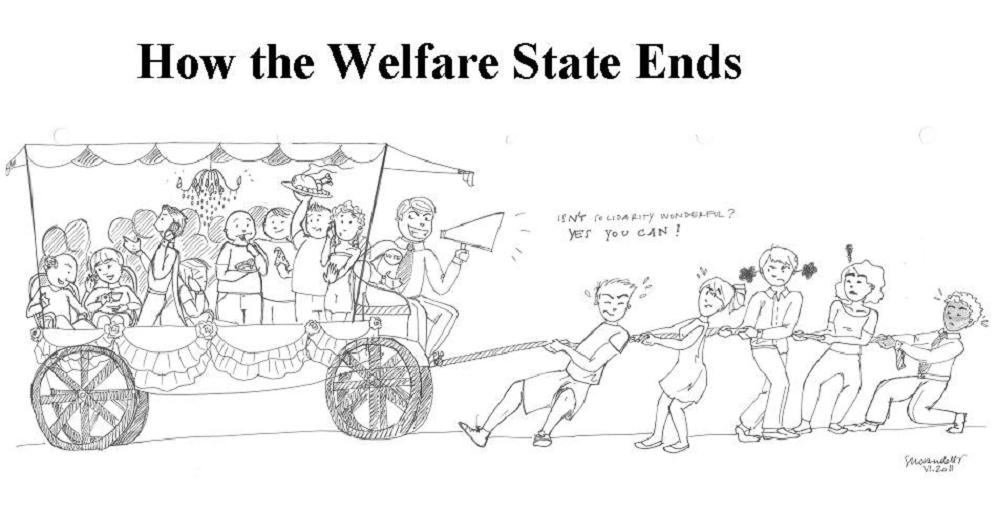
In my speeches, especially when talking about the fiscal crisis in Europe (or the future fiscal crisis in America), I often warn that the welfare state reaches a point-of-no-return when the number of people riding in the wagon begins to outnumber the number of people pulling the wagon.

To be more specific, if more than 50 percent of the population is dependent on government (employed in the bureaucracy, living off welfare, receiving pensions, etc), it becomes rather difficult to form a coalition to fix the mess. This may explain why Greek politicians have resisted significant reforms, even though the nation faces a fiscal death spiral.

But you don’t need me to explain this relationship. One of our Cato interns, Silvia Morandotti, used her artistic skills to create two images (click pictures for better resolution) that show what a welfare state looks like when it first begins and what it eventually becomes.

These images are remarkably accurate. The welfare state starts with small programs targeted at a handful of genuinely needy people. But as  politicians figure out the electoral benefits of expanding programs and people figure out the that they can let others work on their behalf, the ratio of producers to consumers begins to worsen.

Eventually, even though the moochers and looters should realize that it is not in their interest to over-burden the people pulling the wagon, the entire system breaks down.

Then things get really interesting. Small nations such as Greece can rely on permanent bailouts from bigger countries and the IMF, but sooner or later, as larger nations begin to go bankrupt, that approach won’t be feasible.

I often conclude my speeches by joking with the audience that it’s time to stock up on canned goods, bottled water, and ammo. Many people, I’m finding, don’t think that line very funny.

___________________

The Department of Health and Human Services administers the huge and fast-growing Medicare and Medicaid programs. These programs fuel rising health costs, distort health markets, and are plagued by waste and fraud. The department also runs an array of other expensive subsidy programs, including Head Start, TANF, and LIHEAP. Growth in HHS spending is creating a federal financial crisis, and the 2010 health care law sadly makes the situation worse.

The department will spend $910 billion in 2011, or $7,710 for every U.S. household. It employs 68,000 workers and runs more than 420 subsidy programs.


Timeline of Government Growth

  • See this timeline for key events in the department’s growth.

Reading Room

Cato Experts

Spending Cuts Summary

  • Here are proposed reforms to save $81 billion annually in the short-run and prevent federal health costs from consuming a growing share of the economy in the long-run.

Downsize This!

  • Medicare Reforms. Medicare should be transformed into a system based on vouchers, individual savings, and competitive insurance markets.
  • Medicaid Reforms. Federal spending on low-income health care should be converted to block grants for the states.
  • TANF and Welfare Spending. Welfare reforms in 1996 created Temporary Assistance for Needy Families, but this sort of aid should be provided by private charities.
  • Head Start and Other Subsidies. HHS funds a vast array of other subsidy programs, many of which are wasteful and ineffective.
  • 2010 Health Care Legislation. The law expanded Medicaid, added new taxes and subsidies, created new bureaucracies, and did little to reduce cost growth in health care.

The government of the United States is a definite government, confined to specified objects. It is not like the state governments, whose powers are more general. Charity is no part of the legislative duty of the government.

– James Madison. A paraphrase from Elliot’s Debates regarding a proposed subsidy bill, House of Representatives, January 10, 1794.

Review of Carl Sagan book (Part 3 of series on Evolution)

Review of Carl Sagan book (Part 3 of series on Evolution)

The Long War against God-Henry Morris, part 4 of 6

Uploaded by on Aug 30, 2010

http://www.icr.org/
http://store.icr.org/prodinfo.asp?number=BLOWA2
http://store.icr.org/prodinfo.asp?number=BLOWASG
http://www.fliptheworldupsidedown.com/blog

______________________________________

I was really enjoyed this review of Carl Sagan’s book “Pale Blue Dot.”

Carl Sagan’s Pale Blue Dot

by Larry Vardiman, Ph.D. *

On December 6, 1994, Carl Sagan, author of Cosmos, well-known astronomer and speaker, appeared before the Commonwealth Club of California in San Francisco to introduce his new book, Pale Blue Dot.1

Earlier in the day I had the opportunity to briefly talk with him during a break in presentations at the fall meeting of the American Geophysical Union. I introduced myself and found him very cordial but extremely animated and energetic in attempting to convince me that the Bible is not a valid source of truth and that science has proven it wrong.

I was puzzled at his enthusiasm until I purchased and read his book. In it he presents the case that the earth and man are not at the center of the universe or God’s attention. In fact, he stresses that science has disproved the Bible and that man is an insignificant species on a remote planet whirling through the vast reaches of space. He suggests space exploration and colonization as a vision for developing anew meaning in life to replace that given historically by religion.

Since Carl Sagan is such an effective spokesman for the naturalistic world view which prevails in the modern scientific community, and for his concept that a creator God is an outdated “geocentrist conceit” concocted by our less enlightened forefathers and foisted upon the human culture, I felt a review and rebuttal of his new book was in order.

REVIEWAt the heart of Dr. Sagan’s argument for a universe without a creator is the progressive disillusionment he believes science has handed those who believe in religion. This he calls “The Great Demotions.” He suggests that observation of the night-time sky by our ancestors led to a misplaced sense of importance of man:

And if the lights in the sky rise and set around us, isn’t it evident that we’re at the center of the Universe? These celestial bodies—so clearly reveals that we are special. The Universe seems designed for human beings. It’s difficult to contemplate these circumstances without experiencing stirrings of pride and reassurance. The entire Universe, made for us! We must really be something.

This satisfying demonstration of our importance, buttressed by daily observations of the heavens, made the geocentrist conceit a transcultural truth—taught in the schools, built into the language, part and parcel of great literature and sacred scripture. Dissenters were discouraged, sometimes with torture and death. It is no wonder that for the vast bulk of human history, no one questioned it.

Over the past 300 years, Sagan says, science began to strip away this “geocentrist conceit” starting with Copernicus’ finding that the earth revolved around the sun rather than the sun around the earth. Next it was determined that our earth is only one of a myriad of worlds, the sun is only one of our galaxy, and our galaxy is only one of a myriad of galaxies in the universe. Apparently, there is nothing special about our position in the universe. Einstein’s theory of relativity then discredited the view held by Newton and all other great classical physicists that the velocity of the earth in space constituted a “privileged frame of reference.” Next, the age of the solar system was calculated to be about 4.5 billion years old and the universe about 15 billion. The final demotion was the conclusion by Darwin that man is not a special creation but, rather, evolved in the primordial ooze from simple, single-celled organisms. Man is simply the end-product in a long chain of evolutionary change.

These “great demotions” lead to the conclusion that there is no meaning or purpose in our existence. Sagan bemoans this loss of meaning by lampooning the Biblical story of the Garden of Eden:

There was a particular tree of which we were not to partake, a tree of knowledge. Knowledge and understanding and wisdom were forbidden to us in this story. We were to be kept ignorant. But we couldn’t help ourselves. We were starving forknowledge—created hungry, you might say. This was the origin of all our troubles. In particular, it is why we no longer live in a garden: We found out too much. So long as we were incurious and obedient, I imagine, we could console ourselves with our importance and centrality, and tell ourselves that we were the reason the Universe was made. As we began to indulge our curiosity, though, to explore, to learn how the Universe really is, we expelled ourselves from Eden. Angels with a flaming sword were set as sentries at the gates of Paradise to bar our return. The gardeners became exiles and wanderers. Occasionally we mourn that lost world, but that, it seems to me, is maudlin and sentimental. We could not happily have remained ignorant forever.

Sagan admits several times in his book that “there is in this Universe much of what seems to be design.” Yet, he can not bring himself to attribute this design to a Designer. He does go so far as to say in one place that, “Maybe there is one [a designer] hiding, maddeningly unwilling to be revealed.” However, he finally concludes that the evidence does not require a Designer. He also admits that without a Designer there is no purpose and without purpose man cannot survive. Sagan has been building a justification for the remainder of his book. He now states in egotistical terms his agenda for the human race:

The significance of our lives and our fragile planet is then determined only by our own wisdom and courage. We are the custodians of life’s meaning. We long for a Parent to care for us, to forgive us our errors, to save us from our childish mistakes. But knowledge is preferable to ignorance. Better by far to embrace the hard truth than a reassuring fable. If we crave some cosmic purpose, then let us find ourselves a worthy goal. On behalf of Earthlife, I urge that, with full knowledge of our limitations, we vastly increase our knowledge of the Solar System and then begin to settle other worlds.

REBUTTALThe crux of Sagan’s arguments is the validity of his “great demotions.” Has science shown the Bible to be untrue and that the earth and man are insignificant random combinations of molecules near a remote star in a vast, uncaring universe? I do not believe that the sun revolves around the earth. However, I strongly hold to the view that man is at the center of God’s care and concern, if not very near the center of His creation.

The Bible nowhere says that the sun revolves around the earth. It simply uses the common everyday reference system we are all familiar with when referring to the motions of the sun. References to sunrise and sunset appear in the newspaper each day, and there is no difficulty in understanding their meaning. Similar terms are used in surveying, nautical navigation, even orbital mechanics. They communicate information just as does the Bible.

In the covenant with Abraham God implied that there is a myriad of stars in the universe. He said, “look now toward heaven, and tell the stars, if thou be able to number them….”Sagan believes some of these stars may have planets circling them with life on them. However, Sagan recently admitted in a radio interview that after 25 years of searching for intelligent life, he has been unable to find evidence of life anywhere else in the universe. (Sagan has stated that he would even be happy to find stupid life.) He went so far as to say, “there must be something unique about the earth.” Einstein’s theories of relativity and the great ages of our solar system and universe both have yet to be proven. If relativity can be shown to be true, some believe the effect could possibly explain the apparent great times of light traveling from distant stars.2

The theory of evolution is the greatest house of cards of all. It flies in the face of the well-founded Second Law of Thermodynamics, cannot be supported by the fossil record, violates common sense in the development of complex systems, and could not even occur in 15 billion years.

These “great demotions” then are the result of misapplying faulty theories rather than validating God’s statements in Scripture regarding our position and purpose.

God has declared our standing as follows:

“In the beginning God created the heavens and the earth” (Genesis 1:1).

“The heavens declare the glory of God; and the firmament sheweth His handiwork” (Psalm 19:1).

“And God said, Let us make man in our image, after our likeness” (Genesis 1:26).

“For God so loved the world, that He gave His only begotten Son, that whosoever believeth in Him should not perish, but have everlasting life” (John 3:16).

It is evident from only these few selected Scripture passages that God created the universe and cares for us to the point of providing His own Son as a sacrifice for our sins. In our finiteness we don’t fully understand an infinite God, but how dare we arrogantly deny such a God.

REACTIONSDr. Sagan is an excellent writer and public speaker. He has a very engaging writing style and dares to discuss controversial issues. His Cosmos series and book sold more copies than any science book ever written in English. He has won the Pulitzer Prize for his writing. However, he is wrong. Carl Sagan is blinded to the evidence that God exists and created man as His special object of love and concern.

This point of view among so many scientists today is described in Romans 1:20: “For the invisible things of Him from the creation of the world are clearly seen, being understood by the things that are made, even His eternal power and Godhead; so that they are without excuse.” Dr. Sagan has rejected out of hand the evidences he has clearly seen for design in the universe. Although he has expressed a reluctant need to find a Designer, he has given up on the search and has constructed his own “Tower of Babel.”

A recurrent theme throughout the book is his allegorizing of the Biblical account and an assumption that it is a transcription of man’s uninformed experiences. No place is given to the possibility that Scripture is inspired by the Creator. Dr. Sagan’s goal in Pale Blue Dot is to substitute his “creation myth” and purpose for “Earthlife” for the creation account and dominion mandate found in Genesis. Sagan even raises the specter of “becoming like the Most High.” I fear for men who would place themselves in such opposition to God and His Word.

CONCLUSIONSBecause of the kinship I feel toward scientists like Carl Sagan, I am saddened greatly by their actions. Scientists have the greatest opportunities of all to see the evidence of God’s marvelous provision for man in His creation. Those who can’t see God’s hand in the universe around them should be encouraged to ask God to reveal Himself to them. God is not hiding. He is waiting for us to see Him. Please pray for Carl Sagan and others like him who, in their conceit declare, “There is no God!” (Psalm 14:1).

REFERENCES

1. C. Sagan. Pale Blue Dot (Random House, 1994), 429 pp.
2. R. Humphries. Starlight and Time (Master Books, 1994), 133 pp.

* Dr. Vardiman is Administrative Vice President and Chairman of the Astro/Geophysics Department at ICR.

Other posts that relate to Carl Sagan:

Atheist says “It’s not about having a purpose in life..” (Arkansas Atheist, Part 1)

The Bible and Archaeology (1/5) The Bible maintains several characteristics that prove it is from God. One of those is the fact that the Bible is accurate in every one of its details. The field of archaeology brings to light this amazing accuracy. _________________________- I want to make two points today. 1. There is no […]

Ancient Sea Monsters (A Creationist point of view Part 3)

Leviathan: the Fire-Breathing Dragon: Kent Hovind [6 of 7] Everybody is trying to get info on this subject. Here is what the Bible has to say about it. Mace Baker wrote the aritcle, “Sea Dragons – The Institute for Creation Research,” and here is the third portion of that article:  Pterosaurs were the flying reptiles of the ancient world. Why […]

By Everette Hatcher III | Posted in Current Events | Edit | Comments (0)Other posts concerning Carl Sagan:

Atheists confronted: How I confronted Carl Sagan the year before he died

In today’s news you will read about Kirk Cameron taking on the atheist Stephen Hawking over some recent assertions he made concerning the existence of heaven. Back in December of 1995 I had the opportunity to correspond with Carl Sagan about a year before his untimely death. Sarah Anne Hughes in her article,”Kirk Cameron criticizes […]

Free to Choose by Milton Friedman: Episode “Created Equal” (Part 6 of transcript and video)

Liberals like President Obama want to shoot for an equality of outcome. That system does not work. In fact, our free society allows for the closest gap between the wealthy and the poor. Unlike other countries where free enterprise and other freedoms are not present.  This is a seven part series.

Created Equal [6/7]. Milton Friedman’s Free to Choose (1980)

(Laughter)

PIVEN: If you look at the leadership of the black __

(Applause)

FRIEDMAN: But I want to go back to the __

MCKENZIE: Yeah.

FRIEDMAN: __ I want to carry it back to an earlier point. Number one, there’s no question but what equality of results, if it comes about through a framework of freedom, is a desirable result. Number two, I argue in the film I’ve argued here that in point of fact you get greater equality of actual results by a system under which people are free to achieve unequal results. That for the poor people of the world that Frances Fox Piven was talking about, the most effective mechanism for enabling them to improve their status is not a governmental program which seeks to ascribe to them certain positions which seeks to provide them with certain goods and services, but a governmental program which tries to eliminate arbitrary barriers to advancement. I would say that in this world the greatest source of inequality has been special privileges granted by government. That government, you may talk a great deal, there may be a lot of talk about how we’re going to eliminate inequality. But if you look at __ go back to your case of Britain. Is there any doubt that one of the effects of governmental intervention in Britain has been to create new opportunities for special classes. That the way to get wealthy in a society that supposedly is aiming at equality, that the way to get wealthy is to get a special government permit to import __ to get foreign exchange or to import goods or to __ in this country to set up a television station. Those are the ways in which you get inequality.

JAY: Well I think, Milton, you grossly misrepresent the British experience and here perhaps I might make the point. First of all, the burden of taxation in Britain is lower then it has been for many years than in any other of the countries of the European community, the overall burden of taxation. Secondly, you will immediately come back and say, “Aaah, but the marginal rates of personal taxation have been extremely high.” Perfectly true, but not as high as they were in the United States until the early 1960s. It’s interesting to note in passing that when the United States reduced its ninety percent maximum personal rate to fifty percent, the rate of economic growth in the United States, and I’m not suggesting cause and effect, fell from the previously very low rate of 2 percent a year to about naught-point-four percent in the period since. So that any notion that there is an absolutely one-to-one relationship between the degree of personal taxation and efficiency is wholly mythical. Thirdly it__ thirdly__

FRIEDMAN: Well I’ll tell you what you can do with statistics.

(Laughter)

JAY: __ now let me, __ well, you ought to read. You ought to look at the facts. It’s easy to make glib remarks about statistics, but look at the facts.

FRIEDMAN: I know, but __

JAY: Look at the fact that in Britain over the last thirty years, during which period according to you Britain has been crushed by egalitarianism, whereas the United States has been soaring away in the glorious state of liberty. The rate of economic growth in Britain has been faster than that of the United States. How do you explain that?

FRIEDMAN: First of all, I have to look at what the figures mean in Britain. I have to look at the way __

JAY: First you ought to look at them.

FRIEDMAN: I have looked at them and you realize that in judging output in the government that’s judged in terms of cost not in terms of product. And what I really ought to look at is not the rate of growth of GNP as the statisticians measure it, but the consumption available to people in forms, as people value it, ultimate consumption, if I look at that I get a very different picture. Statistics are very, very, as you know very well, are very easy to use. They can be __ they can be used to throw light or they can be used to cast confusion.

JAY: Why don’t you look at facts.

FRIEDMAN: I agree with you. And facts __

JAY: The facts are that the amount of goods and services consumed by the government as a proportion of the national output are no higher in Britain than they are in the United States and haven’t been any time since the war.

FRIEDMAN: They have risen very sharply __

JAY: Which may be the explanation of the low rate of growth in the United States.

FRIEDMAN: They have risen very sharply. It has risen very sharply in the war, both __ since the war, in both countries. It is higher in Britain than it is in the Untied States, properly measured.

JAY: Both twenty-five percent in both cases.

FRIEDMAN: The proportion __ excuse me.

MCKENZIE: Well of goods and service.

FRIEDMAN: That again is a statistician’s nightmare. We have to look at total government spending.

JAY: You were the one who was talking about whether or not people have freedom to choose how their money is spent.

MCKENZIE: Yeah.

JAY: The transfers, which is pensions and other payments from government, leave the freedom as to how the money is spent in the hands of private individuals. It’s only the direct consumption of goods and services where the bureaucrats are making the decisions.

FRIEDMAN: It leaves the decision for freedom in the hands of the recipient, but not in the hand

MCKENZIE: Can we __ gentlemen, gentlemen__ I’m back in my Chairman’s role. Can we leave this statistical debate, fascinating I’m sure it is

(Laughter)

MCKENZIE: I want to make the point, Milton, it seems to me and I am not British, I’m Canadian, having lived a great deal in the U.K., it seems to me that you really have most unfairly used the U.K. as a whipping boy in the last third of your film, last third of your film. Because you say for much of the century the British are trying to use the law to impose equality. Now the Conservatives have been in office for sixty-five percent__

FRIEDMAN: I am not a partisan, I am not a partisan.

MCKENZIE: No, no, I now you’re not. But let me finish it. There have been three majority left governments in Britain. And it is not the case at all that unlike other parts of Europe, there has been consistent policies aimed at equality. Taxation is lower. There’s no wealth tax. There’s a wealth tax in eight other western European countries. Capital gains tax came in only, ten, fifteen years ago.

FRIEDMAN: But let me take your case. First of all, Conservative Labor, that’s not the issue. I have argued again and again, I do again __

MCKENZIE: Well, the Conservatives have not pursued equality.

FRIEDMAN: I do in a book which is associated with this series. I make the point that the policy of Britain in the past sixty or seventy years owes more to the philosophical idea of the Torres of the 19th century than it does to the ideas of Karl Marx. In the United States in the 1930s the Socialist Party never garnered more than a few percent of the vote, but it was the most influential political party in America because its policies were adopted by both the Republicans and the Democrats. In the same way, what you have to look at is not whether the Conservatives or the Labor Party is in power, but what were the basic philosophy and ideas? The ideas of Fabian Socialism, of Tory paternalism were being affected by both the Torres __

MCKENZIE: The Torres fought __ Milton, really.

FRIEDMAN: __ and the Labor.

JAY: There will be some very surprised Tory politicians an some very surprised voters to hear what you say. But let me give you another example of the way you’re playing fast and loose with the facts.

MCKENZIE: Yeah.

JAY: You talk about crime in Britain. I mean crime in Britain is a tiny fraction of what it is in the United States and has been throughout that period __

FRIEDMAN: That’s true.

JAY: __ when you say that we’re so egalitarian and you’re so free. You talk about able people being driven out of the country. More qualified people are living and working in Britain than at any time in the last 150 years of our history. Now this is largely because of the granting of independence to the colonies, the loss of empire, as you like, but in fact for example doctors which are endlessly talked about, more British-trained doctors are now working in Britain than at any time in our history.

MCKENZIE: And the final example, Milton __

FRIEDMAN: And it’s also true __ it’s also true that the physicians leaving Britain, emigrating from Britain __

JAY: Tiny, tiny minority.

FRIEDMAN: __ amount to one-third as many as the number of people graduating each year from your medical schools.

PIVEN: I think it’s a mistake to be arguing this.

MCKENZIE: Milton, I ought to take one __

JAY: Ones coming back.

PIVEN: It’s a distortion of the evidence to rest the argument for the free enterprise system by selectively using the example of England when you want to, the United States when you want to. The test of your argument about the free enterprise system and its capacity to produce both freedom and greater equality to relieve poverty, the test of that argument has to be made everywhere that the free enterprise system has been extended, has penetrated. The test of your argument is not only in what happens in England and the ostensible decline or not the decline of the English economy or what happened in the United States. The test of that argument has to look at what the free enterprise system has meant for the majority of people who do not live in England and who do not live in the United States, who do not live in the mother countries, but rather live in that part of the world where most people live and when __ where most people have had their lives disrupted. Peasants have lost their land, traumatic destruction occurs __

FRIEDMAN: Excuse me, excuse me. You’ve got to compare __

Friedman Friday” Free to Choose by Milton Friedman: Episode “What is wrong with our schools?” (Part 1 of transcript and video)

Here is the video clip and transcript of the film series FREE TO CHOOSE episode “What is wrong with our schools?” Part 1 of 6.

 
Volume 6 – What’s Wrong with our Schools
Transcript:
Friedman: These youngsters are beginning another day at one of America’s public schools, Hyde Park High School in Boston. What happens when they pass through those doors is a vivid illustration of some of the problems facing America’s schools.
They have to pass through metal detectors. They are faced by security guards looking for hidden weapons. They are watched over by armed police. Isn’t that awful. What a way for kids to have to go to school, through metal detectors and to be searched. What can they conceivably learn under such circumstances. Nobody is happy with this kind of education. The taxpayers surely aren’t. This isn’t cheap education. After all, those uniformed policemen, those metal detectors have to be paid for.
What about the broken windows, the torn school books, and the smashed school equipment. The teachers who teach here don’t like this kind of situation. The students don’t like to come here to go to school, and most of all, the parents __ they are the ones who get the worst deal __ they pay taxes like the rest of us and they are just as concerned about the kind of education that their kids get as the rest of us are. They know their kids are getting a bad education but they feel trapped. Many of them can see no alternative but to continue sending their kids to schools like this.
To go back to the beginning, it all started with the fine idea that every child should have a chance to learn his three R’s. Sometimes in June when it gets hot, the kids come out in the yard to do their lessons, all 15 of them, ages 5 to 13, along with their teacher. This is the last one-room schoolhouse still operating in the state of Vermont. That is the way it used to be. Parental control, parents choosing the teacher, parents monitoring the schooling, parents even getting together and chipping in to paint the schoolhouse as they did here just a few weeks ago. Parental concern is still here as much in the slums of the big cities as in Bucolic, Vermont. But control by parents over the schooling of their children is today the exception, not the rule.
Increasingly, schools have come under the control of centralized administration, professional educators deciding what shall be taught, who shall do the teaching, and even what children shall go to what school. The people who lose most from this system are the poor and the disadvantaged in the large cities. They are simply stuck. They have no alternative.
Of course, if you are well off you do have a choice. You can send your child to a private school or you can move to an area where the public schools are excellent, as the parents of many of these students have done. These students are graduating from Weston High School in one of Boston’s wealthier suburbs. Their parents pay taxes instead of tuition and they certainly get better value for their money than do the parents in Hyde Park. That is partly because they have kept a good deal of control over the local schools, and in the process, they have managed to retain many of the virtues of the one-room schoolhouse.
Students here, like Barbara King, get the equivalent of a private education. They have excellent recreational facilities. They have a teaching staff that is dedicated and responsive to parents and students. There is an atmosphere which encourages learning, yet the cost per pupil here is no higher than in many of our inner city schools. The difference is that at Weston, it all goes for education that the parents still retain a good deal of control.
Unfortunately, most parents have lost control over how their tax money in spent. Avabelle goes to Hyde Park High. Her parents too want her to have a good education, but many of the students here are not interested in schooling, and the teachers, however dedicated, soon lose heart in an atmosphere like this. Avabelle’s parents are certainly not getting value for their tax money.
Caroline Bell, Parent: I think it is a shame, really, that parents are being ripped off like we are. I am talking about parents like me that work every day, scuffle to try to make ends meet. We send our kids to school hoping that they will receive something that will benefit them in the future for when they go out here and compete in the job market. Unfortunately, none of that is taking place at Hyde Park.
Friedman: Children like Ava are being shortchanged by a system that was designed to help. But there are ways to help give parents more say over their children’s schooling.
This is a fundraising evening for a school supported by a voluntary organization, New York’s Inner City Scholarship Fund. The prints that have brought people here have been loaned by wealthy Japanese industrialist. Events like this have helped raise two million dollars to finance Catholic parochial schools in New York. The people here are part of a long American tradition. The results of their private voluntary activities have been remarkable.
This is one of the poorest neighborhoods in New York City: the Bronx. Yet this parochial school, supported by the fund, is a joy to visit. The youngsters here from poor families are at Saint John Christians because their parents have picked this school and their parents are paying some of the costs from their own pockets. The children are well behaved, eager to learn, the teachers are dedicated. The cost per pupil here is far less than in the public schools, yet on the average the children are two grades ahead. That is because teachers and parents are free to choose how the children shall be taught. Private money has replaced the tax money and so control has been taken away from the bureaucrats and put back where it belongs.
This doesn’t work just for younger children. In the 60’s, Harlem was devastated by riots. It was a hot bed of trouble. Many teenagers dropped out of school.

Arkansas v. South Carolina: A top 10 game but no one cares it seems

South Carolina is at Arkansas and both teams are in the top ten but it seems like no one in the nation cares. I am hoping that Arkansas can win and LSU will beat Alabama and that will keep Arkansas in the hunt for a SEC title (of course, that is the same as national title in the last 5 years). Here are Harry King’s thoughts:

Window to impress is small

Posted on 03 November 2011

By Harry King

LITTLE ROCK — Usually, announcement of the Arkansas kickoff is noted only for establishing departure times. This week, 6:15 p.m. is maddening.

A Sunday ago, USA Today reported that CBS and ESPN had swapped time slots so that the “eye” network could move LSU-Alabama to primetime. The news was shared with the trip coordinator and we eagerly began speculating about the start time for South Carolina at Arkansas.

An 11:21 a.m. kick would be optimum — cover the Arkansas game and be back in central Arkansas for the start of No. 1 vs. No. 2 in the BCS for only the fifth time in the regular season. Second choice for the Razorbacks and Gamecocks was 2:30 p.m., and a return trip from Fayetteville glued to the broadcast of Alabama-LSU.

Watching or listening, live is better. The DVR can be employed, but it’s not as riveting when you know the outcome.

Selfishly, 6:15 was the worst option.

For those in the pressbox, it means cajoling those in charge to dedicate one TV to the CBS telecast. Not that we would camp out there, but there are legitimate reasons to get up from the workspace now and then.

For the Razorbacks, the start time means one quarter to impress the national pundits and pollsters against the once-beaten Gamecocks. If Arkansas continues its notoriously slow starts, South Carolina will be in front when the remote is employed.

Everybody has an opinion about LSU-Alabama and mine is shaped by an excerpt from Tennessee-Alabama and from watching the Alabama secondary against Arkansas’ receivers in Tuscaloosa.

Crimson Tide quarterback A.J. McCarron was inaccurate in the first half against the Vols and the teams were tied at 6.

Alabama opened the second half with four straight passes, all McCarron completions, for 72 yards. The fifth play was also a called pass, but McCarron scrambled and scored.

Tennessee didn’t make anything on fourth-and-1 from its 39 and Kenny Bell ran under McCarron’s deep throw for a 20-6 lead. Game over.

McCarron has a better chance to make a big play in the passing game than either LSU quarterback and, as good as the two defenses are, a couple of key completions are likely to determine the outcome. The starter by default, Jarrett Lee, has been 70 percent or better in each of LSU’s last three games, but he only attempted 10, 17, and 20. The winning team will have to throw at least 20 times.

Lee is not as proficient as Tyler Wilson and the Arkansas quarterback had only the smallest of windows on pass attempts against Alabama. Even when an Arkansas receiver had a step or two and Wilson delivered, Dre Kirkpatrick or some other defender would close the gap in one step and make the tackle.

Always a suspect passer, Jordan Jefferson is more likely to run than throw when he replaces Lee. Asking him to pass against the Alabama secondary is dicey.

McCarron has thrown at least 20 times in every game and is 67 percent on his 200 attempts, a reason to have more confidence in the redshirt sophomore than either of LSU’s senior quarterbacks.

Thinking ahead to Nov. 25 in Baton Rouge, Arkansas fans will be in LSU’s corner. The guess is that McCarron will break their hearts if the Gamecocks don’t do it first.

The wild card is Les Miles’ penchant for seemingly hair-brained, but often successful play calling.

You never know when your time is up

My cousin just called me and told me about some dear Christian friends of his that lost their son in a car wreck. Two other young men died with him in a car crash last Sunday morning. They were on their way back to Oxford, Mississippi to attend church like they always did.

VAIDEN, Miss. — The funeral is Wednesday in Madison for three Ole Miss students killed in a car crash.Samuel Clayton Kelly, 18; Charles Walker Kelly, 19; and Bryant Mason Wilbanks, 19, all of Madison, died Sunday while on their way back to school after a weekend trip home, the Mississippi Highway Patrol said. “They were on their way back to go to church with us,” said Kappa Alpha Order pledge brother William Boyle. “We had to be at church at 10:30 a.m. They just didn’t make it there.”Troopers said the crash was reported about 8:30 a.m. Sunday on Interstate 55 near the Vaiden exit. There were no witnesses to the crash, MHP said. A 2009 Infiniti was traveling north on I-55 when it veered into the median at state Highway 35. The car left the median, flipped over the overpass and landed upside down on Highway 35, Trooper Tony Dunn said. 

 
Walker Kelly, Sam Kelly and Mason Wilbanks, all three freshmen at Ole Miss, died in a crash on Interstate 55 early Sunday. More

Paramedics said all of the teenagers were pronounced dead at the scene. They were each graduates of Madison Central High School and freshmen at the University of Mississippi.”It’s just hard to put in words to describe what it’s like to work an accident like that,” Dunn said. 

Visitation for all three families will be from 4 p.m. to 8 p.m. Tuesday and 9 a.m. to 10 a.m. Wednesday at Brooadmoor Baptist Church in Madison. The funeral for the three friends is set for 10 a.m. Wednesday at the church. The families have requested that those attending the funeral wear red and blue. “I really don’t know how I’m going to make it without him being here, getting me through life,” said Wilbanks’ friend Anna Claire Giles. “He encouraged me. He was everything.”

 The families received the news of the crash just hours after saying goodbye to the three teenagers, who were headed back to Ole Miss after a surprise weekend at home.

 “(The visit home) was just the best surprise, and you know, it’s a surprise that I’ll always remember,” said Mason Wilbanks’ mother, Lynn Wilbanks. “I know why it was orchestrated the way that it was, because it was our last time with him.”


The families are members of Broadmoor Baptist Church. Many members of the church gathered there Sunday afternoon.”It’s tough. Hundreds and hundreds of kids are affected because they had siblings,” said Broadmoor student pastor Michael Kelly. “A lot of people are mourning and grieving and it’s just going to be a tough couple of days.”

 The Highway Patrol said the crash will be reconstructed to help investigators determine what went wrong.

 Dunn said this is not the first wreck to happen along that stretch of interstate.

 “In the last five or six years, we have had a couple similar wrecks,” Dunn said.

 MHP said there was no evidence of alcohol or drugs at the scene.

 Copyright 2011 by WAPT.com. All rights reserved. This material may not be published, broadcast, rewritten or redistributed.

_________________

These gentlemen were Christians and I am sure they would want me to share the gospel. So here it is:

Page 2

Page 3

Page 4

Page 5

Page 6

Page 7

Page 8

Page 9

Page 10

Page 11

Page 12

Page 13

Page 14

Page 15

Page 16

Page 17

Page 18

Page 19

Page 20

Page 21

Page 22

Page 23

Dr. Bergman: “Evolution teaches that the living world has no plan or purpose except survival”(Section B of Part 2 of series on Evolution)

Dr. Bergman: “Evolution teaches that the living world has no plan or purpose except survival”(Section B of Part 2 of series on Evolution)

The Long War against God-Henry Morris, part 3 of 6

Uploaded by on Aug 30, 2010

Is there any purpose in life? Evolution is clear on this point. I have included the last portion of the article by Dr. Jerry Bergman who I have corresponded with in the past.

Darwinism: Survival without Purpose

by Jerry Bergman, Ph.D. *

Humans have always wondered about the meaning of life…life has no higher purpose than to perpetuate the survival of DNA…life has no design, no purpose, no evil and no good, nothing but blind pitiless indifference.1 –Richard Dawkins

Purpose and Christianity

Christianity teaches that God made the universe as a home for humans. If the universe evolved purely by natural means, then it just exists and any “purpose” for its existence can only be that which humans themselves attribute to it. But our own experience and intellectual attainments argue against this. The similarity of human-constructed machines and the orderly functioning of the universe is the basis of the design argument. Just as a machine requires a designer and a builder, so too the universe that we see requires a designer and a builder.

Determining the purpose of something depends on the observer’s worldview. To a nontheist the question “What is the purpose of a living organism’s structure?” means only “How does this structure aid survival?” Eyesight and legs would therefore have nothing to do with enjoyment of life; they are merely an unintended byproduct of evolution. Biologists consistently explain everything from coloration to sexual habits solely on the basis of survival. Orthodox neo-Darwinism views everything as either an unfortunate or a fortuitous event resulting from the outworking of natural law and random, naturally-selected mutations. Conversely, creationists interpret all reality according to beliefs about God’s purpose for humans. Evolutionists can usually explain even contradictory behavior, but creationists look beyond this and try to determine what role it plays in God’s plan.

Conclusions

Orthodox evolution teaches that the living world has no plan or purpose except survival, is random, undirected, and heartless. Humans live in a world that cares nothing for us, our minds are simply masses of meat, and no divine plan exists to guide us. These teachings are hardly neutral, but rather openly teach religion–the religion of atheism and nihilism. The courts have consistently approved teaching this anti-Christian religion in public schools and have blocked all attempts to neutralize these clearly religious ideas.

As the Word of God states, “For the time will come when they will not endure sound doctrine; but after their own lusts shall they heap to themselves teachers, having itching ears; And they shall turn away their ears from the truth, and shall be turned unto fables” (2 Timothy 4:3-4).

References

  1. Scheff, Liam. 2007. The Dawkins Delusion. Salvo, 2:94.
  2. Humes, Edward. 2007. Monkey Girl: Evolution, Education, Religion, and the Battle for America’s Soul. New York: Ecco, 119.
  3. Ibid, 119.
  4. Turner, J. Scott. 2007. The Tinkerer’s Accomplice: How Design Emerges from Life Itself. Cambridge, MA: Harvard University Press, 206.
  5. Humes, Monkey Girl, 119.
  6. Ibid, 172.
  7. Bloom, Paul and Deena Skolnick Weisberg. 2007. Childhood Origins to Adult Resistance to Science. Science, 316:996.
  8. Panek, Richard. 2007. Out There. New York Times Magazine, 56.
  9. Miller, Kenneth R. and Joseph S. Levine. Biology. 1998. Fourth Edition, Englewood Cliffs, NJ: Prentice Hall, 658, emphasis in original.
  10. Levine, Joseph S. and Kenneth R. Miller 1994. Biology: Discovering Life. Second Edition, Lexington, MA: D.C. Heath, 161, emphasis in original.
  11. Raven, Peter H. and George B. Johnson. 2002. Biology. Sixth Edition, Boston, MA: McGraw Hill, 16, 443.
  12. Purves, William K., David Sadava, Gordon H. Orians, and H. Craig Keller. 2001. Life: The Science of Biology. Sixth Edition, Sunderland, MA: Sinauer Associates; W.H. Freeman, 3.
  13. Interview with Richard Dawkins in Campbell, Neil A., Jane B. Reece, and Lawrence G. Mitchell. 1999. Biology. Fifth Edition, Menlo Park, CA: Addison Wesley Longman, 412-413.
  14. Futuyma, Douglas J. 1998. Evolutionary Biology. Third Edition, Sunderland, MA: Sinauer Associates, 5.
  15. Ibid, 5.
  16. Curtis, Helena and N. Sue Barnes. 1981. Invitation to Biology. Third Edition, New York, NY: Worth, 475.
  17. Strickberger, Monroe. 2000. Evolution. Third Edition, Sudbury, MA: Jones & Bartlett, 70-71.
  18. Darwin, Francis (editor). 1888. The Life and Letters of Charles Darwin. London: John Murray, 210.
  19. Alcock, John. 1998. Animal Behavior: An Evolutionary Approach. Sunderland, MA: Sinauer Associates, 16, 609.
  20. Browne, Janet. 1995. Charles Darwin: Voyaging, A Biography. Princeton, New Jersey: Princeton University Press, 542.
  21. Ibid, 542.
  22. Dawkins, Richard. 1995. River Out of Eden. New York: Basic Books, 133.
  23. Graffin, Gregory W. 2004. Evolution, Monism, Atheism, and the Naturalist World-View. Ithaca, NY: Polypterus Press, 42.
  24. Sommers, Tamler and Alex Rosenberg. 2003. Darwin’s Nihilistic Idea: Evolution and the Meaningless of Life. Biology and Philosophy, 18:653.

* Dr. Bergman is Professor of Biology at Northwest State College in Ohio.

Cite this article: Bergman, J. 2007. Darwinism: Survival without Purpose. Acts & Facts. 36 (11): 10.

Dear Senator Pryor, why not pass the Balanced Budget Amendment? (Part 14 Thirsty Thursday, Open letter to Senator Pryor)

Dear Senator Pryor, why not pass the Balanced Budget Amendment? (Part 14 Thirsty Thursday, Open letter to Senator Pryor)

Dear Senator Pryor,

Why not pass the Balanced  Budget Amendment? As you know that federal deficit is at all time high (1.6 trillion deficit with revenues of 2.2 trillion and spending at 3.8 trillion).

On my blog www.HaltingArkansasLiberalswithTruth.com I took you at your word and sent you over 100 emails with specific spending cut ideas. However, I did not see any of them in the recent debt deal that Congress adopted. Now I am trying another approach. Every week from now on I will send you an email explaining different reasons why we need the Balanced Budget Amendment. It will appear on my blog on “Thirsty Thursday” because the government is always thirsty for more money to spend.

Congressman Walsh Introduces Balanced Budget Amendment

04/07/11

 Washington, D.C. –  As part of his ongoing effort to restore fiscal responsibility in Washington, Congressman Joe Walsh (R-IL) today introduced H.J.Res.54, a Balanced Budget Amendment to the United States Constitution that provides a framework for putting our country on a path economic stability. This amendment is the House-companion to the Senate amendment that all 47 Republicans unanimously introduced last week, which would require the President to submit a balanced budget to Congress prior to each fiscal year.

“The federal government cannot continue to burden our children with this crushing deficit,” said Congressman Walsh. “American families have been working through a recession for the past three years by spending less and saving more, yet the federal government continues to spend money it simply does not have. Congress has neglected the real root cause and continues to be part of the problem, not part of the solution.”

“This amendment is the solution. If the average American family has to find a way to balance their checkbook each year and live within their means, there is no reason that the federal government can’t do the same.”    

“It was important to me that my first piece of legislation as a United States Congressman serves the American people by easing the burden of the government in their daily lives.A key provision to this amendment is to ensure that the budget is not balanced on the backs of hard working Americans, and thus H.J.Res.54 would require a 2/3 super-majority in both Houses for any tax increase.”

“Most importantly, this amendment shows families and businesses across America that Congress is serious about stabilizing our economy long-term. It’s time to bring our country out of the red.”

The Balanced Budget Amendment resolution features the following key provisions:

  • Presidential requirement to submit a balanced budget and Congressional requirement to pass a balanced budget;
  • Federal spending cap that Congress must limit outlays to no more than 18 percent of GDP, in line with the historical average of revenues over the last 40 years (this year, the federal government is projected to spend close to 25% of GDP);
  • Prohibits the courts from ordering revenue increases.